WO2022045091A1 - ケンペロールアグリコン含有抽出物 - Google Patents
ケンペロールアグリコン含有抽出物 Download PDFInfo
- Publication number
- WO2022045091A1 WO2022045091A1 PCT/JP2021/030890 JP2021030890W WO2022045091A1 WO 2022045091 A1 WO2022045091 A1 WO 2022045091A1 JP 2021030890 W JP2021030890 W JP 2021030890W WO 2022045091 A1 WO2022045091 A1 WO 2022045091A1
- Authority
- WO
- WIPO (PCT)
- Prior art keywords
- plant
- kaempferol
- extract
- less
- aglycone
- Prior art date
- Legal status (The legal status is an assumption and is not a legal conclusion. Google has not performed a legal analysis and makes no representation as to the accuracy of the status listed.)
- Ceased
Links
Images





Classifications
-
- A—HUMAN NECESSITIES
- A61—MEDICAL OR VETERINARY SCIENCE; HYGIENE
- A61K—PREPARATIONS FOR MEDICAL, DENTAL OR TOILETRY PURPOSES
- A61K31/00—Medicinal preparations containing organic active ingredients
- A61K31/33—Heterocyclic compounds
- A61K31/335—Heterocyclic compounds having oxygen as the only ring hetero atom, e.g. fungichromin
- A61K31/35—Heterocyclic compounds having oxygen as the only ring hetero atom, e.g. fungichromin having six-membered rings with one oxygen as the only ring hetero atom
- A61K31/352—Heterocyclic compounds having oxygen as the only ring hetero atom, e.g. fungichromin having six-membered rings with one oxygen as the only ring hetero atom condensed with carbocyclic rings, e.g. methantheline
-
- A—HUMAN NECESSITIES
- A61—MEDICAL OR VETERINARY SCIENCE; HYGIENE
- A61K—PREPARATIONS FOR MEDICAL, DENTAL OR TOILETRY PURPOSES
- A61K36/00—Medicinal preparations of undetermined constitution containing material from algae, lichens, fungi or plants, or derivatives thereof, e.g. traditional herbal medicines
- A61K36/18—Magnoliophyta (angiosperms)
- A61K36/185—Magnoliopsida (dicotyledons)
- A61K36/31—Brassicaceae or Cruciferae (Mustard family), e.g. broccoli, cabbage or kohlrabi
-
- A—HUMAN NECESSITIES
- A01—AGRICULTURE; FORESTRY; ANIMAL HUSBANDRY; HUNTING; TRAPPING; FISHING
- A01H—NEW PLANTS OR NON-TRANSGENIC PROCESSES FOR OBTAINING THEM; PLANT REPRODUCTION BY TISSUE CULTURE TECHNIQUES
- A01H1/00—Processes for modifying genotypes ; Plants characterised by associated natural traits
- A01H1/10—Processes for modifying non-agronomic quality output traits, e.g. for industrial processing; Value added, non-agronomic traits
- A01H1/101—Processes for modifying non-agronomic quality output traits, e.g. for industrial processing; Value added, non-agronomic traits involving biosynthetic or metabolic pathways, i.e. metabolic engineering, e.g. nicotine or caffeine
-
- A—HUMAN NECESSITIES
- A01—AGRICULTURE; FORESTRY; ANIMAL HUSBANDRY; HUNTING; TRAPPING; FISHING
- A01H—NEW PLANTS OR NON-TRANSGENIC PROCESSES FOR OBTAINING THEM; PLANT REPRODUCTION BY TISSUE CULTURE TECHNIQUES
- A01H6/00—Angiosperms, i.e. flowering plants, characterised by their botanic taxonomy
- A01H6/20—Brassicaceae, e.g. canola, broccoli or rucola
- A01H6/203—Brassica oleraceae, e.g. broccoli or kohlrabi
-
- A—HUMAN NECESSITIES
- A23—FOODS OR FOODSTUFFS; TREATMENT THEREOF, NOT COVERED BY OTHER CLASSES
- A23L—FOODS, FOODSTUFFS OR NON-ALCOHOLIC BEVERAGES, NOT OTHERWISE PROVIDED FOR; PREPARATION OR TREATMENT THEREOF
- A23L33/00—Modifying nutritive qualities of foods; Dietetic products; Preparation or treatment thereof
- A23L33/10—Modifying nutritive qualities of foods; Dietetic products; Preparation or treatment thereof using additives
- A23L33/105—Plant extracts, their artificial duplicates or their derivatives
-
- A—HUMAN NECESSITIES
- A61—MEDICAL OR VETERINARY SCIENCE; HYGIENE
- A61K—PREPARATIONS FOR MEDICAL, DENTAL OR TOILETRY PURPOSES
- A61K8/00—Cosmetics or similar toiletry preparations
- A61K8/18—Cosmetics or similar toiletry preparations characterised by the composition
- A61K8/30—Cosmetics or similar toiletry preparations characterised by the composition containing organic compounds
- A61K8/49—Cosmetics or similar toiletry preparations characterised by the composition containing organic compounds containing heterocyclic compounds
- A61K8/4973—Cosmetics or similar toiletry preparations characterised by the composition containing organic compounds containing heterocyclic compounds with oxygen as the only hetero atom
- A61K8/498—Cosmetics or similar toiletry preparations characterised by the composition containing organic compounds containing heterocyclic compounds with oxygen as the only hetero atom having 6-membered rings or their condensed derivatives, e.g. coumarin
-
- A—HUMAN NECESSITIES
- A61—MEDICAL OR VETERINARY SCIENCE; HYGIENE
- A61K—PREPARATIONS FOR MEDICAL, DENTAL OR TOILETRY PURPOSES
- A61K8/00—Cosmetics or similar toiletry preparations
- A61K8/18—Cosmetics or similar toiletry preparations characterised by the composition
- A61K8/96—Cosmetics or similar toiletry preparations characterised by the composition containing materials, or derivatives thereof of undetermined constitution
- A61K8/97—Cosmetics or similar toiletry preparations characterised by the composition containing materials, or derivatives thereof of undetermined constitution from algae, fungi, lichens or plants; from derivatives thereof
- A61K8/9783—Angiosperms [Magnoliophyta]
- A61K8/9789—Magnoliopsida [dicotyledons]
-
- A—HUMAN NECESSITIES
- A61—MEDICAL OR VETERINARY SCIENCE; HYGIENE
- A61P—SPECIFIC THERAPEUTIC ACTIVITY OF CHEMICAL COMPOUNDS OR MEDICINAL PREPARATIONS
- A61P3/00—Drugs for disorders of the metabolism
-
- A—HUMAN NECESSITIES
- A61—MEDICAL OR VETERINARY SCIENCE; HYGIENE
- A61Q—SPECIFIC USE OF COSMETICS OR SIMILAR TOILETRY PREPARATIONS
- A61Q19/00—Preparations for care of the skin
-
- A—HUMAN NECESSITIES
- A61—MEDICAL OR VETERINARY SCIENCE; HYGIENE
- A61Q—SPECIFIC USE OF COSMETICS OR SIMILAR TOILETRY PREPARATIONS
- A61Q19/00—Preparations for care of the skin
- A61Q19/10—Washing or bathing preparations
-
- C—CHEMISTRY; METALLURGY
- C12—BIOCHEMISTRY; BEER; SPIRITS; WINE; VINEGAR; MICROBIOLOGY; ENZYMOLOGY; MUTATION OR GENETIC ENGINEERING
- C12N—MICROORGANISMS OR ENZYMES; COMPOSITIONS THEREOF; PROPAGATING, PRESERVING, OR MAINTAINING MICROORGANISMS; MUTATION OR GENETIC ENGINEERING; CULTURE MEDIA
- C12N9/00—Enzymes; Proenzymes; Compositions thereof; Processes for preparing, activating, inhibiting, separating or purifying enzymes
- C12N9/14—Hydrolases (3)
- C12N9/24—Hydrolases (3) acting on glycosyl compounds (3.2)
- C12N9/2402—Hydrolases (3) acting on glycosyl compounds (3.2) hydrolysing O- and S- glycosyl compounds (3.2.1)
-
- C—CHEMISTRY; METALLURGY
- C12—BIOCHEMISTRY; BEER; SPIRITS; WINE; VINEGAR; MICROBIOLOGY; ENZYMOLOGY; MUTATION OR GENETIC ENGINEERING
- C12P—FERMENTATION OR ENZYME-USING PROCESSES TO SYNTHESISE A DESIRED CHEMICAL COMPOUND OR COMPOSITION OR TO SEPARATE OPTICAL ISOMERS FROM A RACEMIC MIXTURE
- C12P17/00—Preparation of heterocyclic carbon compounds with only O, N, S, Se or Te as ring hetero atoms
- C12P17/02—Oxygen as only ring hetero atoms
- C12P17/06—Oxygen as only ring hetero atoms containing a six-membered hetero ring, e.g. fluorescein
-
- C—CHEMISTRY; METALLURGY
- C12—BIOCHEMISTRY; BEER; SPIRITS; WINE; VINEGAR; MICROBIOLOGY; ENZYMOLOGY; MUTATION OR GENETIC ENGINEERING
- C12Y—ENZYMES
- C12Y302/00—Hydrolases acting on glycosyl compounds, i.e. glycosylases (3.2)
- C12Y302/01—Glycosidases, i.e. enzymes hydrolysing O- and S-glycosyl compounds (3.2.1)
- C12Y302/01008—Endo-1,4-beta-xylanase (3.2.1.8)
-
- C—CHEMISTRY; METALLURGY
- C12—BIOCHEMISTRY; BEER; SPIRITS; WINE; VINEGAR; MICROBIOLOGY; ENZYMOLOGY; MUTATION OR GENETIC ENGINEERING
- C12Y—ENZYMES
- C12Y302/00—Hydrolases acting on glycosyl compounds, i.e. glycosylases (3.2)
- C12Y302/01—Glycosidases, i.e. enzymes hydrolysing O- and S-glycosyl compounds (3.2.1)
- C12Y302/01108—Lactase (3.2.1.108)
-
- A—HUMAN NECESSITIES
- A61—MEDICAL OR VETERINARY SCIENCE; HYGIENE
- A61K—PREPARATIONS FOR MEDICAL, DENTAL OR TOILETRY PURPOSES
- A61K2236/00—Isolation or extraction methods of medicinal preparations of undetermined constitution containing material from algae, lichens, fungi or plants, or derivatives thereof, e.g. traditional herbal medicine
- A61K2236/10—Preparation or pretreatment of starting material
- A61K2236/19—Preparation or pretreatment of starting material involving fermentation using yeast, bacteria or both; enzymatic treatment
-
- C—CHEMISTRY; METALLURGY
- C07—ORGANIC CHEMISTRY
- C07D—HETEROCYCLIC COMPOUNDS
- C07D311/00—Heterocyclic compounds containing six-membered rings having one oxygen atom as the only hetero atom, condensed with other rings
- C07D311/02—Heterocyclic compounds containing six-membered rings having one oxygen atom as the only hetero atom, condensed with other rings ortho- or peri-condensed with carbocyclic rings or ring systems
- C07D311/04—Benzo[b]pyrans, not hydrogenated in the carbocyclic ring
- C07D311/22—Benzo[b]pyrans, not hydrogenated in the carbocyclic ring with oxygen or sulfur atoms directly attached in position 4
- C07D311/26—Benzo[b]pyrans, not hydrogenated in the carbocyclic ring with oxygen or sulfur atoms directly attached in position 4 with aromatic rings attached in position 2 or 3
- C07D311/28—Benzo[b]pyrans, not hydrogenated in the carbocyclic ring with oxygen or sulfur atoms directly attached in position 4 with aromatic rings attached in position 2 or 3 with aromatic rings attached in position 2 only
- C07D311/30—Benzo[b]pyrans, not hydrogenated in the carbocyclic ring with oxygen or sulfur atoms directly attached in position 4 with aromatic rings attached in position 2 or 3 with aromatic rings attached in position 2 only not hydrogenated in the hetero ring, e.g. flavones
Definitions
- Kaempferol is a substance represented by the following structural formula, such as tea, broccoli, grapefruit, cabbage, kale, beans, kikujisha, cabbage, tomato, strawberry, bidou, Brussels sprouts, apple, kinua, western wasabi, etc. It is a kind of natural flavonoid contained in edible plants.
- Patent Document 2 As a method for increasing polyphenols contained in plants, a cultivation method of irradiating buds of monocotyledonous plants with UV-B (Patent Document 2), a method of cultivating plants with warm water (Patent Document 3), molecular genetics. A method of reducing the activity of flavanone 3-hydroxylase using the above method (Patent Document 4) has been reported.
- Item A1 A plant extract containing 1 mg / g or more of kenperol aglycone in terms of dry weight.
- Item A2 Item 2.
- Item A3 Item 2.
- Item A4 The plant extract according to any one of Items A1 to A3, which further contains 0.1 mg / g or more of quercetin in terms of dry weight.
- Item A5 Item 6.
- Item A6 Item 2. The plant extract according to Item A5, wherein the cruciferous plant is western wasabi, kale, arugula, takana, mizuna, turnip, radish, broccoli, cabbage, radish sprouts, or bok choy.
- Item A7 Item 6. The plant extract according to any one of Items A1 to A4, which is an extract of Theaceae plants.
- Item A8 Item 2. The extract according to Item A7, wherein the Theaceae plant is black tea, oolong tea, jasmine tea, green tea, roasted tea, or sencha.
- Item A9 Item 6. The plant extract according to any one of Items A1 to A6, which is an extract of horseradish leaves.
- Item A10 A food, pharmaceutical, or cosmetic containing the plant extract according to any one of Items A1 to A9.
- Item A11 (1) Extracting a plant raw material containing a kaempferol glycoside with a solvent, and (2) Hydrolyzing the extract obtained in (1) above.
- Item A12 Item 9. The method according to Item 9, wherein the hydrolysis treatment comprises causing an enzyme or a microorganism to act on the extract.
- Item A13 Item 2.
- the method according to Item A11 or A12, wherein the hydrolysis treatment comprises causing an enzyme to act on the extract, wherein the enzyme comprises xylanase.
- Item A14 Item 6.
- the method according to Item A13, wherein the enzyme further comprises ⁇ -glucosidase.
- Item A15 Item 6.
- Item B1 Plants with increased content of keperol and / or kaempferol glycosides per unit weight (dry weight equivalent), including growing plants under conditions of oxygen concentration of 19% by volume or less or oxygen partial pressure of 193 hPa or less. How to make.
- Item B2 A method for improving the ability of a plant to produce kaempferol and / or kaempferol glycosides, which comprises cultivating a plant under conditions of an oxygen concentration of 19% by volume or less or an oxygen partial pressure of 193 hPa or less.
- Item B3 A method for producing a plant having an improved ability to produce kaempferol and / or kaempferol glycoside, which comprises cultivating a plant under the conditions of an oxygen concentration of 19% by volume or less or an oxygen partial pressure of 193 hPa or less.
- Item B4 Item 6. The method according to any one of Items B1 to B3, wherein the condition is an oxygen concentration of 19% by volume or less.
- Item B5 Item 6. The method according to any one of Items B1 to B3, wherein the condition is an oxygen partial pressure of 50 hPa or more and 193 hPa or less.
- Item B6 Item 6. The method according to any one of Items B1 to B5, wherein the plant is a Brassicaceae plant.
- Item B7 Item 6.
- Item B8 Item 6.
- Item B9 The plant obtained by the method according to any one of Items B1 to B8.
- Item B10 Item 9.
- a method for producing an extract containing kaempferol and kaempferol glycoside which comprises extracting kaempferol and kaempferol glycoside from the plant according to Item 9.
- Item B11 (A) Extracting kaempferol and kaempferol glycosides from the plant according to item B9, and (b) hydrolyzing the extract obtained in (a) above.
- Item C1 A method for increasing the efficiency of plant keperol production, which comprises giving L-tyrosine and / or L-phenylalanine to a plant capable of producing keperol.
- Item C2 A method for increasing the kaempferol content of a plant, which comprises giving L-tyrosine and / or L-phenylalanine to a plant capable of producing kaempferol.
- Item C3 A method for producing a plant having an increased efficiency of kaempferol production, which comprises giving L-tyrosine and / or L-phenylalanine to a plant capable of producing kaempferol.
- Item C4 Item 6.
- plant-derived kaempferol glycosides can be efficiently converted to aglycones.
- kaempferol and kaempferol glycosides may be collectively referred to as kaempferol.
- the white bar graph is for cultivation at an oxygen concentration of 21 vol%, and the black bar graph is for cultivation at an oxygen concentration of 17.5 vol%.
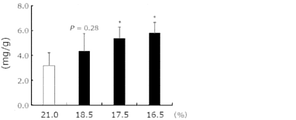
- the amount of kaempferol measured for horseradish cultivated under various oxygen concentration conditions is shown.
- the horizontal axis is the oxygen concentration (% by volume), and the vertical axis is the amount of kaempferol (mg / g).
- the leaf length measured for horseradish cultivated under various oxygen concentration conditions is shown.
- the horizontal axis is the oxygen concentration (% by volume), and the vertical axis is the leaf length (cm).
- the stem length measured for horseradish cultivated under various oxygen concentration conditions is shown.
- the horizontal axis is the oxygen concentration (% by volume), and the vertical axis is the length of the stem (cm).
- TAL Tyrosine ammonia lyase
- PAL Phenylalanine ammonia lyase
- C4H Cinnamic acid 4-hydroxylase
- 4CL 4-Coumaric acid CoA ligase
- CHS Chalcone synthase
- CHI Chalcone isomerase.
- F3H Flavanone 3-hydroxylase
- FLS Flavonol synthase
- F3'H Flavonoid 3'-hydroxylase.
- the white outline is the case where the L-phenylalanine aqueous solution is given
- the diagonal line is the case where the L-tyrosine-containing aqueous solution is given
- the black line is the case where the aqueous solution containing both L-phenylalanine and L-tyrosine is given.
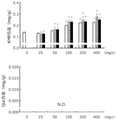
- KMP kaempferol
- Qur quercetin
- the vertical axis shows the kaempferol or quercetin content
- the horizontal axis shows the concentration of L-tyrosine and / or L-phenylalanine in the aqueous solution.
- the white outline is the case where the L-phenylalanine aqueous solution is given
- the diagonal line is the case where the L-tyrosine-containing aqueous solution is given
- the black line is the case where the aqueous solution containing both L-phenylalanine and L-tyrosine is given.
- the kaempferol (KMP) content (upper) and quercetin (Qur) content measured for radish sprouts cultivated by giving an aqueous solution containing L-tyrosine or L-phenylalanine are shown.
- the vertical axis shows the kaempferol or quercetin content, and the horizontal axis shows the concentration of L-tyrosine and / or L-phenylalanine in the aqueous solution.
- the white bar graph is for cultivation under the condition of oxygen concentration of 21 vol%, and the black bar graph is for the case of cultivation under the condition of oxygen concentration of 17.5 vol%.
- the plant extract preferably contains quercetin (aglycone type) in addition to chemperol aglycone.
- the content of quercetin in the plant extract is, for example, 0.1 mg / g to 100 mg / g, preferably 1 mg / g to 30 mg / g, and more preferably 5 mg to 10 mg in terms of dry weight.
- the lower limit and the upper limit are not particularly limited, but examples of the lower limit value are 0.1 mg / g, 0.5 mg / g, 1 mg / g, 2.5 mg / g, and 5 mg / g, and examples of the upper limit value are 100 mg / g.
- the plant extract By containing quercetin, the plant extract has physiological effects such as antioxidant effect, anti-inflammatory effect, anti-arteriosclerosis effect, prevention of cerebrovascular disease, antitumor effect, hypotensive effect, and / or vascular relaxing effect. Can be provided effectively.
- the plant extract preferably contains ferulic acid in addition to kenperol aglycone.
- the content of ferulic acid in the plant extract is, for example, 0.1 mg / g or more, 0.2 mg / g or more, 0.3 mg / g or more, 0.4 mg / g or more, 0.5 mg in terms of dry weight.
- the ferulic acid content there is no particular upper limit to the ferulic acid content, but for example, it may be 10 mg / g, 9 mg / g, 8 mg / g, 7 mg / g, 6 mg / g, 5 mg / g, 4 mg / g, 3 mg / g, or 2 mg / g.
- the method for quantifying ferulic acid in the plant extract is not particularly limited, and the ferulic acid can be measured by a conventional method.
- the plant extract By containing ferulic acid, the plant extract can effectively provide physiological effects such as antioxidant activity and / or antitumor activity.
- the plant extract is preferably an extract of Brassicaceae or Theaceae.
- cruciferous plants include western wasabi, kale, arugula, takana, mizuna, turnip, radish, broccoli, cabbage, radish sprouts, and bok choy.
- theaceae plants include black tea, oolong tea, jasmine tea, green tea, roasted tea, and sencha.
- the plant extract is preferably the extract of the plant described in "B. Method for improving kaempferol-producing ability and plant with improved kaempferol-producing ability" below.
- the plant extract may be a plant other than Brassicaceae and Theaceae.
- plants include saffron, gymnema, onion hulls, garlic, parsley, and millets such as quinoa, canario beans, and lentils.
- the plant extract can be an extract of any part of the plant.
- it can be an extract of any of the whole plant, leaves, stems, roots, and flowers, or any combination thereof.
- a Brassicaceae plant or a Theaceae plant is used as a raw material, it is preferable to use those leaves.
- leaves other than onions For plants exemplified as plants other than Brassicaceae and Theaceae, it is preferable to use leaves other than onions.
- the plant extract is preferably a horseradish extract, preferably a horseradish leaf extract. This is because the leaves of horseradish contain a large amount of kaempferol glycosides.
- the plant extract is obtained not only by subjecting the plant raw material to extraction, but also by subjecting it to a treatment of converting glycosides into aglycones.
- the above-mentioned plant extract can be obtained by any method, but it is preferably obtained by the method for producing a plant extract described later.
- the above-mentioned plant extract can be processed into any product, and for example, foods, pharmaceuticals, or cosmetics containing the plant extract are provided.
- the plant extract When used for such a purpose, the plant extract may be used as it is after being treated with an enzyme, or may be purified and used. If necessary, it can be used as a dry solid by being subjected to a drying treatment. In order to improve the storage stability of the plant extract, it is desirable to make it solid by drying treatment (including freeze-drying). Further, the dried plant extract may be powdered by subjecting it to a powdering treatment, if necessary.
- the daily intake of foods containing plant extracts varies depending on the age and weight of the ingestor, the purpose of ingestion, and the like.
- the daily intake of the plant extract can be adjusted to be 2 mg or more, 10 mg or more, or 50 mg or more, and 200 mg or less, 150 mg or less, or 100 mg or less in terms of dry weight.
- the intake of kenperol aglycone is preferably 0.1 mg or more, 1 mg or more, 2 mg or more, 3 mg or more, or 5 mg or more, and 100 mg or less, 50 mg or less, 40 mg or less, 20 mg or less, 12 mg or less. preferable. These lower and upper limit values can be combined arbitrarily.
- the daily intake of kenperol aglycone can be adjusted to 0.1 mg or more and 100 mg or less, 1 mg or more and 50 mg or less, or 2 mg or more and 40 mg or less.
- the plant extract When the plant extract is used as a pharmaceutical material, the plant extract may be, for example, a tablet, a pill, a powder, a liquid, a suspension, an emulsion, a granule, a capsule, an aerosol, a patch, an injection or a suppository. It can be prepared as a pharmaceutical preparation in the form of the above.
- the dose of the drug varies depending on the age and body weight of the recipient, symptoms, frequency of administration, purpose of administration, etc. and cannot be uniformly specified.
- the daily dose for an adult is a plant extract in terms of dry weight. It can be 0.1 mg / kg to 10 g / kg (body weight), preferably 1 mg to 5 g / kg (body weight).
- the plant extract When the plant extract is used as a cosmetic material, the plant extract may be in various desired forms such as paste-like, mousse-like, gel-like, liquid, milky liquid, suspension-like, cream-like, ointment-like, and sheet-like. Prepared in morphology.
- Such cosmetics can be used as basic cosmetics such as milky lotions, creams, lotions, oils and facial masks; cleaning agents such as washing pigments, cleansing and body cleaning; cleaning agents; and various cosmetics such as cleaning agents.
- the mixing ratio of the plant extract in the cosmetics can be appropriately set according to the type of cosmetics, the content of kaempferol, the purpose of use, and the like. For example, 0.01 g to 95 g, preferably 0.1 g to 50 g, and more preferably 1 g to 5 g of the plant extract can be mentioned with respect to 100 g of the cosmetic.
- Method for producing food extract is not particularly limited, but the plant raw material containing kaempferol glycoside is extracted with a solvent, and the obtained extract is hydrolyzed (aglycone-ized treatment). It is preferable to include offering to.
- the plant raw material may be in a raw state, or may be a dried product or a crudely dried product. However, from the viewpoint of efficiently extracting kaempferol or its glycoside, the raw material is crushed by a conventional method. It is preferable to use it after. In one embodiment, it is preferable to use the plant described in the following "B. Method for improving kaempferol-producing ability and plant with improved kaempferol-producing ability" as a plant raw material.
- the plant extract extracted using water or an organic solvent may be subjected to purification treatment such as column purification or solid-liquid separation before being subjected to hydrolysis treatment.
- the means of hydrolysis treatment is not particularly limited, but can be carried out using enzymes, microorganisms, acids, and / or bases.
- aglycone When aglycone is formed using an enzyme, it is preferable to select the enzyme to be used according to the type of sugar constituting the kaempferol glycoside and the structure of the glycoside.
- Glucose, galactose, rhamnose, xylose, and combinations thereof for example, sophorose (glucose + glucose), rutinose (rhamnose + glucose), neoheseridos) may be contained in the plant extract as saccharides constituting the kenperol glycoside. (Rhamnose + glucose)).
- These sugars form glycosides by O-glycosidic bonds at the 3-position, 5-position, and / or 7-position of kaempferol.
- Suitable enzymes for aglyconizing such chemperol glycosides include, for example, xylanase, lactase, glucosidase, arabinosidase, rhamnosidase, xylosidase ( Examples include xylosidase, cellulase, hesperidinase, naringinase, glucuronidase, pectinase, galactosidase, amyloglucosidase, or amylase. One or more of these can be used in combination as appropriate.
- the kaempferol glycoside contained in the horseradish leaf extract is aglycone-ized, it is preferable to use xylanase, a combination of xylanase and ⁇ -glucosidase is more preferable, and a combination of xylanase and lactase is further preferable. ..
- xylanase a combination of xylanase and ⁇ -glucosidase is more preferable, and a combination of xylanase and lactase is further preferable.
- ⁇ -glucosidase When the kaempferol glycoside contained in the extract of kale, mustard, radish leaf, black tea and quinoa is aglycone-ized, it is preferable to use ⁇ -glucosidase.
- the amount of xylanase and ⁇ -glucosidase used is not particularly limited.
- the glycoside by adding the microorganism to the plant extract and culturing the microorganism under conditions suitable for growth, for example.
- the conditions suitable for growth can be set for each microorganism, and can be appropriately designed, for example, under the conditions of 20 to 40 ° C. and pH 4 to 7.
- the acid that can be used for aglyconization of the chemperol glycoside is, for example, one or more acids selected from the group consisting of hydrochloric acid, sulfuric acid and nitric acid, or selected from the group consisting of these acids and ethanol, methanol and butanol.
- examples thereof include a mixed solvent with any one or more alcohols.
- the concentration of the acid is not particularly limited, but is, for example, 0.1 to 2N.
- the alcohol content of the mixed solvent is not particularly limited, but is, for example, 50 to 70%.
- the reaction temperature is, for example, 50 to 100 ° C., and the reaction time can be designed, for example, in the range of 0.5 to 24 hours.
- Examples of the bases that can be used for aglyconization of chemperol glycosides include any one or more bases selected from the group consisting of sodium hydroxide and potassium hydroxide, or the group consisting of these bases and ethanol, methanol and butanol.
- a mixed solvent with any one of alcohols selected from the above can be mentioned.
- the concentration of the base is not particularly limited, but is, for example, 0.1 to 0.5N.
- the alcohol content of the mixed solvent is not particularly limited, but is, for example, 50 to 70 v / v%.
- the reaction temperature is, for example, 50 to 100 ° C., and the reaction time can be designed, for example, in the range of 0.5 to 24 hours. It was
- Methods for improving kaempferol-producing ability and plants with improved kaempferol-producing ability Method for producing plants with increased content of kaempferol and / or kaempferol glycosides, methods for improving kaempferol and / or kaempferol glycoside-producing ability of plants, And the method for producing plants with improved kaempferol and / or kaempferol glycoside production is under acidity concentrations lower than about 20.9% by volume, which is the acidity concentration in the natural environment, or oxygen content lower than about 213 hPa. It is preferred to include growing the plant under pressure.
- the oxygen concentration in the environment in which the plant is cultivated can be measured using a commercially available oxygen concentration measuring device. It can also be measured by the device itself that controls the oxygen concentration or oxygen partial pressure in the air, which will be described later.
- the lower limit of the oxygen partial pressure is not particularly limited as long as the plant can grow, but for example, 50 hPa or more, 60 hPa or more, 70 hPa or more, 80 hPa or more, 90 hPa or more, 102 hPa or more, 112 hPa or more, 122 hPa or more, 132 hPa or more, 142 hPa or more. , 152 hPa or more, or 163 hPa or more.
- the method of controlling the oxygen concentration or oxygen partial pressure when cultivating a plant as described above is arbitrary.
- a plant can be cultivated in an environment where the plant can be cultivated while controlling the oxygen concentration or the oxygen partial pressure within a certain range, or in a facility or device.
- agricultural houses, plant factories, and other containers or covers in which plants can be cultivated can be used.
- the oxygen concentration or oxygen partial pressure of the air in contact with the plant is within the above range, the oxygen concentration or oxygen partial pressure of the entire environment in which the plant is cultivated need not be completely within the above range.
- the means for controlling the oxygen concentration or oxygen partial pressure is arbitrary. For example, selectively removing oxygen from the environment in which the plant is cultivated, supplying a gas other than oxygen (for example, nitrogen or carbon dioxide) to the environment in which the plant is cultivated, pre-existing oxygen concentration or oxygen partial pressure. For example, supplying controlled air to the environment in which plants are cultivated. Since various devices for supplying air having a controlled oxygen concentration are known, they can be appropriately selected and used.
- cultivating a plant under an acidity concentration of less than about 20.9% by volume or an oxygen partial pressure of less than about 213 hPa observes the oxygen concentration or oxygen partial pressure of the environment in which the plant is present.
- the observation frequency can be appropriately designed, for example, 3 times 1 day to 1 time / week, specifically 3 times / day, 2 times / day, 1 time / day, 1 time / week. It can be 2 days, 1 time / 3 days, 1 time / 4 days, 1 time / 5 days, 1 time / 6 days, or 1 time / 7 days.
- the cultivation conditions of the plant other than the oxygen concentration or the oxygen partial pressure can be appropriately designed within the range of the conditions under which the plant can grow, preferably the conditions suitable for the growth of the plant.
- the light source may be natural light (sunlight) or an artificial light source, and may or may not be irradiated with ultraviolet rays (for example, UV-A, UV-B).
- the cultivation method may be hydroponic cultivation (solid medium cultivation, hydroponics, spray cultivation) or conventional soil cultivation.
- the temperature condition for example, it can be appropriately designed in the range of 10 ° C. or higher and 35 ° C. or lower and 15 ° C. or higher and 30 ° C. or lower.
- the place where the plant is cultivated is arbitrary, and in one embodiment, for example, a place having an altitude of 0 m or more and 1000 m or less, 0 m or more and 800 m or less, and 0 m or more and 600 m or less can be appropriately selected.
- concentration of a gas other than oxygen eg, carbon dioxide
- L-tyrosine and / or L-phenylalanine it is preferable to give L-tyrosine and / or L-phenylalanine to cultivate the plant.
- L-tyrosine and / or L-phenylalanine By giving L-tyrosine and / or L-phenylalanine, the biosynthesis of kaempferol by plants can be promoted.
- the method of giving L-tyrosine and / or L-phenylalanine to the plant is not particularly limited and is arbitrary. For example, dissolving L-tyrosine and / or L-phenylalanine in a solvent such as water and giving it to the plant or soil in which the plant grows, or adding L-tyrosine and / or L-phenylalanine directly to the soil in which the plant grows. Can be done.
- the amount of L-tyrosine and / or L-phenylalanine given is not particularly limited, and can be appropriately set in consideration of, for example, the type, size, growing environment, and growing condition of the plant.
- the concentration of L-tyrosine and / or L-phenylalanine in the aqueous solution is, for example, 30 mg / L or more, 35 mg / L or more, 40 mg / L.
- the upper limit of the concentration of L-tyrosine and / or L-phenylalanine in the aqueous solution is arbitrary, for example, 2000 mg / L or less, 1500 mg / L or less, 1000 mg / L or less, 500 mg / L or less, 400 mg / L or less, 300 mg.
- L-tyrosine and / or L-phenylalanine may be given to the plant only once or continuously for a certain period of time.
- the fixed period is, for example, 1 day or more, 2 days or more, 3 days or more, 4 days or more, 5 days or more, 6 days or more, 1 week or more, 2 weeks or more, 3 weeks or more, 4 weeks or more, or 1 month.
- the period for cultivating the plant under an acidity concentration lower than about 20.9% by volume or an oxygen partial pressure lower than about 213 hPa is arbitrary, and depending on the type and purpose of the plant, for example, a period of one day to several months. Can be designed as appropriate.
- the timing of cultivating the plant in the growing process under an acidity concentration lower than about 20.9% by volume or an oxygen partial pressure lower than about 213 hPa is also arbitrary, for example, at the time of sowing, germination, growing season, harvesting. It can be one or more selected from the group consisting of pre-harvest, post-harvest and combinations thereof. In one embodiment, it is preferred to grow the plant under an acidity concentration of less than about 20.9% by volume or under an oxygen partial pressure of less than about 213 hPa over the entire period from sowing to harvest.
- the type of plant is not limited, but it is preferable to have the ability to produce kaempferol.
- the plant having a kaempferol-producing ability may be a plant originally having a kaempferol-producing ability or a plant having an artificially acquired kaempferol-producing ability by a genetic engineering method or the like.
- the plant is preferably a Brassicaceae plant or a Theaceae plant, preferably a Brassicaceae plant.
- cruciferous plants include western wasabi, kale, arugula, takana, mizuna, turnip, radish, broccoli, cabbage, radish sprouts, and bok choy.
- the Brassicaceae plant is preferably horseradish, radish, cabbage, or radish sprouts.
- theaceae plants include black tea, oolong tea, jasmine tea, green tea, roasted tea, and sencha.
- a method for producing an extract containing kaempferol and a kaempferol glycoside which comprises extracting kaempferol and a kaempferol glycoside from a plant cultivated by the above method.
- a method for producing a kaempferol-containing extract which comprises hydrolyzing a kaempferol glycoside extracted from a plant cultivated by the above method.
- the means of hydrolysis is not particularly limited and can be carried out using enzymes, microorganisms, acids and / or bases.
- the kaempferol-containing extract can be obtained by the extraction method described in A above.
- the kaempferol-containing extract can be used in the uses, purposes, and forms described in A above.
- a method for increasing the efficiency of plant keperol production, a method for increasing the kaempferol content of a plant, and a method for producing a plant having an increased efficiency of kaempferol production may include feeding L-tyrosine and / or L-phenylalanine to the plant.
- the type of plant, the method of giving L-tyrosine and / or L-phenylalanine to the plant, and the like are the same as those described for B above.
- KMP amount of each material The total KMP amount contained in each plant material was measured by the following procedure. After milling each material, 0.8 g of the pulverized product was taken, 40 mL of 70% ethanol was added, and the mixture was suspended at room temperature at 20,000 rpm for 1 minute with a polytron homogenizer. 1 mL of the suspension was dispensed and weighed in a glass test tube. After adding 1 mL of 2N hydrochloric acid and mixing with vortex, it was heated at 100 ° C. for 20 minutes in a heat block. After heating, it was ice-cooled for 5 minutes or more. After cooling, 5 mL of hexane was added and the mixture was shaken horizontally 20 times.
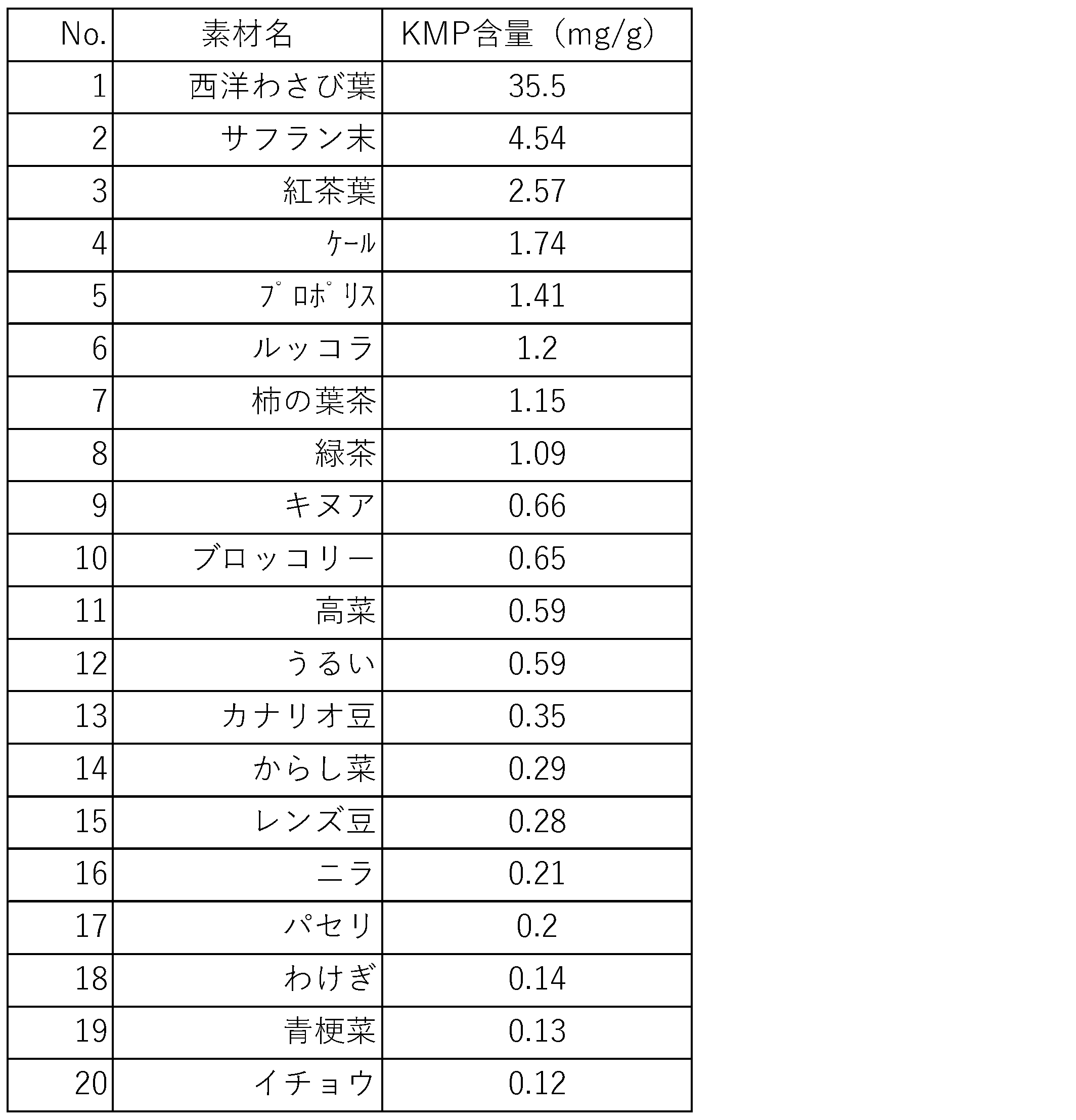
- cruciferous plants such as western wasabi leaves, kale, arugula, mustard and mustard, black tea leaves, oolong tea, jasmine tea, green tea, and roasted green tea, as well as quinoa, canario beans, and lens beans. High total KMP content was observed in such miscellaneous grains.
- the extraction recovery rate was calculated with the total value of the KMP amount of the extract residue and the extract as 100%.
- the extraction recovery rate of KMP under each condition is shown in FIG. As shown in FIG. 1, it was confirmed that the KMP glycoside of horseradish leaves can be recovered by hot water extraction or 30 to 70% water ethanol extraction, and the extraction temperature is good at 30 to 70 ° C. ..
- A3-2. Aglyconization test 2 (Aglyconization with xylanase) A hot water extract of horseradish leaves was prepared and adjusted to 50 ⁇ g / mL and pH 5.0 as KMP aglycone. Hemicellulase "Amano" 90 was added to the prepared reaction solution at final concentrations of 250, 500, 1000 and 1500 ⁇ g / mL, reacted at 50 ° C. for 5 hours, and the KMP aglycone concentration was measured by the HPLC method. The aglycone formation rate is shown with the KMP aglycone concentration at the time of acid hydrolysis as 100%.
- xylanase hemicellase "Amano" 90, manufactured by Amano Enzyme
- a 250 ⁇ g / mL enzyme achieves 70% aggreconization.
- a reaction of more than 90% can be achieved in 4 hours when the enzyme amount is 500 ⁇ g / mL, and 100% in 2 hours when 1000 ⁇ g / mL enzyme is used.
- aggreconization could be achieved, and when an enzyme of 1500 ⁇ g / mL was used, more than 100% aglyconization could be achieved in 1 hour. From this result, it can be seen that xylanase is effective for aglycone formation of KMP glycosides in horseradish leaf extract.
- A3-3 Aglycone conversion of KMP glycosides in various plant extracts by xylanase
- KMP aglycones at 25 ⁇ g / mL, pH 5.0. Adjusted to be.
- Xylanase hemicellulase "Amano" 90
- the aglycone formation rate is shown with the KMP aglycone concentration at the time of acid hydrolysis as 100%.
- A3-4 Aglycone formation by a combination of enzymes
- a hot water extract of horseradish leaves was prepared and adjusted to 50 ⁇ g / mL and pH 5.0 as KMP aglycone.
- Xylanase hemicellulase "Amano" 90
- lactase or ⁇ -glucosidase was added at the final concentration shown in the table below, reacted at 50 ° C for 4 hours, and the KMP aglycone concentration was measured by the HPLC method to confirm the combined effect of multiple enzymes.
- the aglycone formation rate was shown assuming that the KMP aglycone concentration at the time of acid hydrolysis was 100%.
- xylanase hemicellulase "Amano" 90
- xylanase hemicellulase "Amano" 90
- the KMP aglycon concentration was measured to confirm the optimum conditions for the enzymatic reaction.
- the aglycone formation rate is shown assuming that the KMP aglycone concentration at the time of acid hydrolysis is 100%.
- the optimum active pH of xylanase was 4 to 6, and the optimum activity temperature was around 50 ° C.
- a hot water extract of horseradish leaves was prepared and adjusted to 50 ⁇ g / mL and pH 5.0 as KMP aglycone.
- Xylanase hemicellulase "Amano" 90
- Lactobacillus such as L. tucceti, L. sakei, L. pentosus, L. casei, L. kefigranum can efficiently convert KMP glycosyl derived from western wasabi leaves to aggrecon at 95% or more in 24 hours. Was confirmed.
- Insoluble matter and low-polarity components were removed from the extract using a filter and a spin column.
- the same extraction operation was performed for no sample to obtain a mock sample.
- the mock sample was prepared to confirm and remove background noise mixed in during sample preparation and LC-MS analysis.
- Each extract was subjected to LC-MS analysis and metabolome analysis was performed.
- Quercetin is known to have physiological actions such as antioxidative action, antiinflammatory action, antiarteriosclerosis action, prevention of cerebrovascular disease, antitumor action, hypotensive action, and vascular relaxation action.
- Ferulic acid is known to have physiological effects such as antioxidant activity and antitumor activity.
- PCR is TaqMan Gene Expression Assays [flavonoid3'-hydroxylase (F3'H)), flavonol synthase (FLS), ACTIN] and using TaqMan Fast Advanced Master Mix (Thermofisher) , the QuantStudio TM 3 Real Time PCR System ( Thermofisher) It was carried out. Actin was used as an endogenous control for quantification.
- L-tyrosine can be converted to kaempferol via p-coumaric acid, 4-coumaroyl CoA, naringenin chalcone, naringenin, dihydrokaempferol.
- the kaempferol content was increased by giving L-tyrosine or L-phenylalanine under any oxygen concentration condition. It was confirmed that the rate of increase in kaempferol content due to the addition of L-tyrosine or L-phenylalanine was significantly increased under the condition of low oxygen concentration (17.5 vol%). This indicates that the addition of L-tyrosine or L-phenylalanine is more effective in cultivation under hypoxic conditions. No clear effect on plant growth (total length and weight) was observed with the addition of L-tyrosine or L-phenylalanine.
Landscapes
- Health & Medical Sciences (AREA)
- Life Sciences & Earth Sciences (AREA)
- Chemical & Material Sciences (AREA)
- General Health & Medical Sciences (AREA)
- Engineering & Computer Science (AREA)
- Natural Medicines & Medicinal Plants (AREA)
- Veterinary Medicine (AREA)
- Animal Behavior & Ethology (AREA)
- Public Health (AREA)
- Organic Chemistry (AREA)
- Botany (AREA)
- Epidemiology (AREA)
- Biotechnology (AREA)
- Medicinal Chemistry (AREA)
- Microbiology (AREA)
- Pharmacology & Pharmacy (AREA)
- Mycology (AREA)
- Genetics & Genomics (AREA)
- Zoology (AREA)
- Wood Science & Technology (AREA)
- Bioinformatics & Cheminformatics (AREA)
- General Engineering & Computer Science (AREA)
- Biochemistry (AREA)
- Medical Informatics (AREA)
- Alternative & Traditional Medicine (AREA)
- Dermatology (AREA)
- Birds (AREA)
- Developmental Biology & Embryology (AREA)
- Environmental Sciences (AREA)
- Food Science & Technology (AREA)
- Nutrition Science (AREA)
- Polymers & Plastics (AREA)
- Chemical Kinetics & Catalysis (AREA)
- General Chemical & Material Sciences (AREA)
- Biomedical Technology (AREA)
- Molecular Biology (AREA)
- Physiology (AREA)
- Hematology (AREA)
- Diabetes (AREA)
- Obesity (AREA)
Abstract
Description

乾燥重量換算でケンペロールアグリコンを1mg/g以上含有する、植物抽出物。
項A2
前記ケンペロールアグリコンを30mg/g以上含有する、項A1に記載の植物抽出物。
項A3
前記ケンペロールアグリコンを100mg/g以上含有する、項1A又はA2に記載の植物抽出物。
項A4
更に、乾燥重量換算で、ケルセチンを0.1mg/g以上含有する、項A1~A3のいずれかに記載の植物抽出物。
項A5
アブラナ科植物の抽出物である、項A1~A4のいずれかに記載の植物抽出物。
項A6
前記アブラナ科植物が、西洋ワサビ、ケール、ルッコラ、高菜、水菜、カブ、大根、ブロッコリー、キャベツ、カイワレ大根、またはチンゲンサイである、項A5に記載の植物抽出物。
項A7
ツバキ科植物の抽出物である、項A1~A4のいずれかに記載の植物抽出物。
項A8
前記ツバキ科植物が、紅茶、ウーロン茶、ジャスミン茶、緑茶、ほうじ茶、または煎茶である、項A7に記載の抽出物。
項A9
西洋ワサビ葉の抽出物である、項A1~A6のいずれかに記載の植物抽出物。
項A10
項A1~A9のいずれかに記載の植物抽出物を含む食品、医薬品、又は化粧品。
項A11
(1)ケンペロール配糖体を含む植物原料を溶媒で抽出すること、及び
(2)上記(1)で得られた抽出物を加水分解処理すること、
を含む、項A1~A7のいずれかに記載の植物抽出物を製造する方法。
項A12
前記加水分解処理が酵素または微生物を前記抽出物に作用させることを含む、項9に記載方法。
項A13
前記加水分解処理が酵素を前記抽出物に作用させることを含み、前記酵素がキシラナーゼを含む、項A11またはA12に記載の方法。
項A14
前記酵素が更にβ-グルコシダーゼを含む、項A13に記載の方法。
項A15
前記β-グルコシダーゼがラクターゼである、項A14に記載の方法。
19体積%以下の酸素濃度または193hPa以下の酸素分圧の条件下で植物を栽培することを含む、単位重量当たり(乾燥重量換算)のケペロール及び/又はケンペロール配糖体の含量が増加した植物を製造する方法。
項B2
19体積%以下の酸素濃度または193hPa以下の酸素分圧の条件下で植物を栽培することを含む、植物のケンペロール及び/又はケンペロール配糖体産生能を向上させる方法。
項B3
19体積%以下の酸素濃度または193hPa以下の酸素分圧の条件下で植物を栽培することを含む、ケンペロール及び/又はケンペロール配糖体の産生能が向上した植物を製造する方法。
項B4
前記条件が19体積%以下の酸素濃度である、項B1~B3のいずれかに記載の方法。
項B5
前記条件が50hPa以上193hPa以下の酸素分圧である、項B1~B3のいずれかに記載の方法。
項B6
前記植物がアブラナ科植物である、項B1~B5のいずれかに記載の方法。
項B7
前記アブラナ科植物が、西洋ワサビ、ケール、ルッコラ、高菜、水菜、カブ、大根、ブロッコリー、キャベツ、カイワレ大根、またはチンゲンサイである、項B6に記載の方法。
項B8
前記アブラナ科植物が、西洋ワサビ、大根、キャベツ、またはカイワレ大根である、項B6又はB7に記載の方法。
項B9
項B1~B8のいずれかに記載の方法によって得られる植物。
項B10
項9に記載の植物からケンペロール及びケンペロール配糖体を抽出することを含む、ケンペロール及びケンペロール配糖体を含む抽出物を製造する方法。
項B11
(a)項B9に記載の植物からケンペロール及びケンペロール配糖体を抽出すること、及び
(b)上記(a)で得られた抽出物を加水分解すること、
を含む、ケンペロール含有抽出物の製造方法。
項B12.
L-チロシン及び/又はL-フェニルアラニンを植物に与えることを含む、項B1~B8のいずれかに記載の方法。
ケペロール産生能を有する植物にL-チロシン及び/又はL-フェニルアラニンを与えることを含む、植物のケペロール産生効率を高める方法。
項C2
ケペロール産生能を有する植物にL-チロシン及び/又はL-フェニルアラニンを与えることを含む、植物のケンペロール含量を高める方法。
項C3
ケペロール産生能を有する植物にL-チロシン及び/又はL-フェニルアラニンを与えることを含む、ケンペロールの産生効率が高まった植物を製造する方法。
項C4
前記植物がアブラナ科植物である、項C1~C3のいずれかに記載の方法。
項C5
前記アブラナ科植物が、西洋ワサビ、ケール、ルッコラ、高菜、水菜、カブ、大根、ブロッコリー、キャベツ、カイワレ大根、またはチンゲンサイである、項C4に記載の方法。
A1.食品抽出物
植物抽出物は、乾燥重量換算で、例えば、1mg/g~500mg/g、好ましくは10mg/g~300mg/g、30mg~400mgさらに好ましくは100mg~200mgのケンペロールアグリコンを含有することが好ましい。ケンペロールアグリコン含有量の下限および上限は、特に制限されないが、下限値の例として1mg/g、5mg/g、10mg/g、30mg、50mg/g、および100mg/g、上限値の例として、400mg/g、300mg/g、250mg/g、および200mg/gが挙げられる。ケンペロールアグリコン含有量の好ましい範囲は該上限値と該下限値の任意の組合せにより示されうる。植物抽出物中のケンペロールアグリコンの定量方法は特に限定されず、常法により測定できるが、例えば、後述する実施例採用した方法で測定できる。なお、ケンペロールの測定は、pH2~7の条件で行うことが好ましい。
上述の植物抽出物の製造方法は特に制限されないが、ケンペロール配糖体を含む植物原料を溶媒で抽出すること、及び得られた抽出物を加水分解処理(アグリコン化処理)に供することを含むことが好ましい。
西洋わさび葉:ガラクトース+キシロース
サフラン:グルコース;
茶葉:グルコース、ガラクトース+ラムノース+グルコース、キシロース+ラムノース+グルコース、ガラクトース+グルコース、グルコース+ルチノース(ラムノース+グルコース);
ケール:グルコース+グルコース
高菜:グルコース+グルコース+グルコース
ルッコラ:グルコース
ケペロール及び/又はケンペロール配糖体の含量が増加した植物を製造する方法、植物のケンペロール及び/又はケンペロール配糖体産生能を向上させる方法、及びケンペロール及び/又はケンペロール配糖体の産生能が向上した植物を製造する方法は、自然環境中の酸度濃度である約20.9体積%よりも低い酸度濃度下または約213hPaよりも低い酸素分圧下で植物を栽培することを含むことが好ましい。植物が栽培される環境の酸素濃度は、市販される酸素濃度測定器を用いて測定することができる。また、後述する空気中の酸素濃度又は酸素分圧を制御する装置自体で測定することもできる。
次の手順で各植物素材に含まれる総KMP量を測定した。各素材をミル粉砕後、粉砕物を0.8g分取し、70%エタノール40mL添加後、ポリトロンホモジナイザーで、室温、20,000 rpm、1分間懸濁を行った。懸濁液1 mLをガラス試験管に分注・秤量した。2N塩酸を1 mL添加し、ボルテックスにて混合後、ヒートブロックにて100℃、20分間加熱した。加熱終了後5分以上氷冷した。冷却後、ヘキサン5 mLを添加し水平に20回振盪した。冷却遠心機にて4℃、3,000 rpm、5分間遠心後、上層を廃棄した。酢酸エチル5 mLを添加し、振盪機で室温、250 rpm、10分間水平に振盪した。大型冷却遠心機にて4℃、3,000 rpm、5分間遠心後、上層を乾固用のガラス試験管に回収した。下層には再度、酢酸エチル5 mLを添加し、振盪機で室温、250 rpm、10分間水平に振盪した。4℃、3,000 rpm、5分間遠心後,上層を乾固用のガラス試験管に回収した。回収した上層は吹付式窒素乾固機にて60℃で窒素乾固を行った。乾固が終了したら、70%エタノール水溶液を1 mL添加し、超音波発生装置にて1分間処理してボルテックスにて溶解した。0.45μmフィルターに溶解液を通した後に、HPLC分析に供し、KMPアグリコン分析を行った。
(1)総KMP量(酸加水分解法)測定:検体液1 mLをガラス試験管に分注・秤量した。2N塩酸を1 mL添加し、ボルテックスにて混合後、ヒートブロックにて100℃、20分間加熱した。加熱終了後5分以上氷冷した。冷却後、2N水酸化ナトリウム溶液を960μL添加・混合してpHを4-7に調整した。中和液全量をパスツールピペットで10 mLメスフラスコに移し、70%エタノール溶液にて10mLに定容・混合した。0.45μmフィルターに通した後に、HPLC法にてKMPアグリコン分析を行い、総KMP量とした。
(2)KMPアグリコン量測定:検体液1 mLを10 mLメスフラスコに分注・秤量し、70%エタノール溶液にて10mLに定容・混合した。0.45μmフィルターに通した後に、HPLC法にてKMPアグリコン分析を行い、KMPアグリコン量とした。
植物からのKMP配糖体の抽出における抽出溶媒および抽出温度の条件検討を行った。西洋わさび葉1.5gに、抽出溶媒として水あるいは30~70%のエタノール水溶液を75g添加し、70℃にて2回の抽出操作を行った。また、西洋わさび葉1.5gに、抽出溶媒として50%エタノール水溶液を75g添加し、30~70℃にて2回の抽出操作を行った。得られた抽出液は、全量を秤量した後、上記「(2)KMPアグリコン量測定」にてKMPアグリコン量を測定した。抽出残渣と抽出液のKMP量の合計値を100%として抽出回収率を求めた。各条件でのKMPの抽出回収率を図1に示した。図1に示すとおり、西洋わさび葉のKMP配糖体は、熱水抽出あるいは30~70%の水エタノール抽出で回収が可能で、抽出温度は30~70℃が良好であることが確認された。
A3-1.アグリコン化試験1(β-グルコシダーゼによるアグリコン化)
西洋わさび葉またはキヌアの熱水抽出物を作製し、KMPアグリコンとして50μg/mLになるように調整した。調整した反応液に、βグルコシダーゼ(アロマーゼ H2、天野エンザイム社製)、β-グルコシダーゼ(スミチーム BGA、新日本化学工業社製)、αグルコシダーゼ(天野エンザイム社製)を最終濃度500 μg/mLにて添加し、60℃で60分反応させ、HPLC法にてKMPアグリコン濃度を測定した。アグリコン化率を酸加水分解時のKMPアグリコン濃度を100%として図2に示した。なお、キヌア抽出物のアグリコン化は、βグルコシダーゼ(アロマーゼ H2)以外の酵素を用いた試験では行っていない。
西洋わさび葉の熱水抽出物を作製し、KMPアグリコンとして50μg/mL、pH5.0になるように調整した。調整した反応液に、ヘミセルラーゼ「アマノ」90を最終濃度250、500、1000、1500 μg/mLにて添加し,50℃で5時間反応させ、HPLC法にてKMPアグリコン濃度を測定した。アグリコン化率を酸加水分解時のKMPアグリコン濃度を100%として示した。
ケール、高菜、キヌア、大根葉、紅茶葉、および西洋わさび葉の熱水抽出物を作製し、KMPアグリコンとして25μg/mL、pH5.0になるように調整した。調整した反応液に、キシラナーゼ(ヘミセルラーゼ「アマノ」90)を最終濃度1250 μg/mLにて添加し、50℃で6時間反応させ、HPLC法にてKMPアグリコン濃度を測定した。アグリコン化率を酸加水分解時のKMPアグリコン濃度を100%として示した。
西洋わさび葉の熱水抽出物を作製し、KMPアグリコンとして50μg/mL、pH5.0になるように調整した。調整した反応液に、キシラナーゼ(ヘミセルラーゼ「アマノ」90)を下記表に示す最終濃度にて添加した。さらにラクターゼまたはβグルコシダーゼ(アロマーゼ)を下記表に示す最終濃度にて添加し,50℃で4時間反応させ、HPLC法にてKMPアグリコン濃度を測定し,複数酵素の組み合わせ効果を確認した。アグリコン化率は、酸加水分解時のKMPアグリコン濃度を100%として示した。

西洋わさび葉の熱水抽出物を作製し、KMPアグリコンとして50μg/mLになるように懸濁した。懸濁液をpH3~6.5に調整し、キシラナーゼ(ヘミセルラーゼ「アマノ」90)を最終濃度500μg/mLにて添加後、50℃で30分反応させpH依存性を検討した。また、pH 5.0に調整した西洋わさび葉の熱水抽出物に、キシラナーゼ(ヘミセルラーゼ「アマノ」90)を最終濃度500μg/mLにて添加後、30~70℃で30分反応させ、HPLC法でKMPアグリコン濃度を測定し、酵素反応の至適条件を確認した。アグリコン化率は酸加水分解時のKMPアグリコン濃度を100%として示した。図5に示されるとおり、キシラナーゼの至適活性pHは4~6であり、至適活性温度50度付近であることが確認された。
西洋わさび葉の熱水抽出物を作製し、KMPアグリコンとして50μg/mL、pH5.0になるように調整した。調整した反応液に、キシラナーゼ(ヘミセルラーゼ「アマノ」90)を最終濃度1000 μg/mLにて添加し、50℃で30、60、120分間反応させ、HPLC分析チャートを観察し,西洋わさびの中間体ピークの有無について確認した。
西洋わさび葉熱水抽出物を50μg/mLに調整し、食品から単離した188株の菌種を別々に植菌した。植菌後、37℃で好気培養を行い、24および120時間後に、HPLC法にてKMPアグリコン濃度を測定し,微生物培養により西洋わさびのKMP配糖体がKMPアグリコンに変換されるか検討した。その結果、下記表3に示すとおり、壬生菜漬け、しば漬け、白菜漬け、キムチ、発酵茶、発酵豚、発酵魚、酒麹などの発酵物から単離されたLactobacillus plantarum, L. brevis, L. tucceti, L. sakei, L. pentosus, L. casei, L. kefigranumといった乳酸菌によって、24時間で95%以上と効率的に西洋ワサビ葉由来のKMP配糖体のアグリコン化が可能であることが確認された。

西洋わさび葉の50%エタノール抽出物を減圧濃縮してエタノールを除去し、KMPアグリコンとして3 mg/mL、pH5.0になるように調整した。調整した反応液に、キシラナーゼ(ヘミセルラーゼ「アマノ」90)を最終濃度3 mg/mL、ラクターゼを最終濃度0.9 mg/mLにて添加し、50℃で2時間反応させた。その後、105度で15分処理し酵素を失活させた後、凍結乾燥した。得られた酵素処理された西洋わさび葉抽出物サンプルからメタノールを用いて化合物を抽出した。抽出液についてフィルターとスピンカラムを用いて不溶物や低極性成分を除去した。また、試料なしについても同様の抽出操作を行いmock試料とした。mock試料は試料調製やLC-MS分析中に混入するバックグラウンドノイズを確認・除去する為に作製した。各抽出液をLC-MS分析に供し、メタボローム解析を行った。

B1-1.カイワレ大根の栽培
カイワレ大根は、水をつけた脱脂綿に種が重ならないよう播種した。酸素コントローラーProOx110及びチャンバー(協同インターナショナル社製)にて酸素濃度を21.0vol%又は17.5vol%制御した環境下で1週間栽培した。酸素濃度の制御(低減)は、チャンバー内に窒素を充填して行った。
ケンペロール及びケルセチン量の測定は、それらの配糖体をすべて加水分解し、アグリコンに変換後測定した。実際には次の手順でおこなった。各サンプルをミル粉砕後、粉砕物を2.0g秤量し、70%エタノールを40mL添加後、ポリトロンホモジナイザーで、室温、20,000rpmで1分間懸濁した。懸濁液1mLをガラス試験管に分注・秤量し、2N塩酸を1mL添加し、ボルテックスにて混合後、ヒートブロックにて100℃、30分間加熱した。加熱終了後5分以上氷冷した。冷却後、ヘキサン5mLを添加し水平に20回振盪した。冷却遠心機にて4℃、3,000rpm、5分間遠心後、上層を廃棄した。酢酸エチル5mLを添加し、振盪機で室温、250rpmで10分間水平に振盪した。大型冷却遠心機にて4℃、3,000rpm、5分間遠心後、上層を乾固用のガラス試験管に回収した。下層には再度、酢酸エチ5mLを添加し、振盪機で室温、250rpmで10分間水平に振盪した。4℃3,000rpmで5分間遠心後、上層を乾固用のガラス試験管に回収した。回収した上層は吹付式窒素乾固機にて60℃で窒素乾固を行った。乾固が終了したら、70%エタノール水溶液を1mL添加し、超音波発生装置にて1分間処理してボルテックスにて溶解させた。0.45μmフィルターに溶解液を通した後、HPLC分析に供し、KMPアグリコン分析を行い、KMPアグリコン量を求めた。
酸素濃度21vol%又は17.5vol%で栽培したカイワレ大根について測定したケンペロール及びケルセチンの量を図7に示す。酸素濃度17.5vol%で栽培したカイワレ大根に含まれるKMP含量 は0.207±0.005mg/g(平均値±標準偏差、以下同様)であり、酸素濃度21vol%の通常栽培法方法(KMP含量:0.096±0.002mg/g)と比較して、有意に約2倍に増加した。一方、低酸素条件及び通常条件のカイワレ大根に含まれるケルセチン含量は、それぞれ0.02±0.00mg/g及び0.02±0.01mg/gであり、低酸素栽培による影響は見られなかった。これらの結果から、栽培時に酸素濃度を低減することにより、ケンペロールの生産量が増加することが確認された。
低酸素栽培による、フェノール生合成経路への影響を検討した。具体的には、ジヒドロケンペロールからケンペロールへの合成及びジヒドロケルセチンからケルセチンへの合成の両方に関与するフラボノールシンターゼ(FLS)、並びにジヒドロケンペロールからジヒドロヘルセチンへの合成に関与するフラボノイド3’ヒドロキシラーゼ(F3′H)の発現量に対する低温栽培の影響を下記の手順で測定した。ジヒドロケンペロールからケンペロールへの合成、ジヒドロケルセチンからケルセチンへの合成におけるFLSの関与、並びにジヒドロケンペロールからジヒドロヘルセチンへの合成におけるF3′Hの関与を図8に示す。
カイワレ大根とブロッコリーは、水をつけた脱脂綿に種が重ならないよう播種した。酸素コントローラーProOx110及びチャンバー(協同インターナショナル社製)にて酸素濃度を21.0vol%又は17.5vol%制御した環境下で1週間栽培した。酸素濃度の制御(低減)は、チャンバー内に窒素を充填しておこなった。
各サンプル(全草)を液体窒素で凍結させ、乳鉢と乳棒で粉砕後、粉砕物を100mg秤量した。トータルRNAをRNeasy Plant Mini Kit(Qiagen, Valencia,CA)を用いて抽出し、HighーCapacity cDNA Reverse Transcription Kit(Thermofisher,Waltham,MA) を用いてトータルRNAをcDNAに逆転写した。PCRはTaqMan Gene Expression Assays [flavonoid3′―hydroxylase(F3′H)),flavonol synthase(FLS), ACTIN]とTaqMan Fast Advanced Master Mix(Thermofisher)を用いて、QuantStudioTM3 Real Time PCR System(Thermofisher)にて実施した。定量化のための内因性コントロールとしてアクチンを使用した。
F3′H遺伝子の発現レベルを測定した結果を図9に、FLS遺伝子の発現レベルを測定した結果を図10に示す。酸素濃度21vol%の通常栽培時のF3′H遺伝子発現量を1とした場合に、ケンペロール含量が増加することが確認された酸素濃度17.5vol%で栽培した場合、カイワレ大根及びブロッコリーの両方でF3′H遺伝子発現量が有意に低下することが確認された。また、FLSについても、酸素濃度21vol%で栽培した場合と比較して酸素濃度17.5vol%で栽培した場合の発現量はカイワレ大根及びブロッコリーの両方で有意に増加することが確認された。これらの結果から、低酸素条件下で栽培すると、アブラナ科植物等のケンペロールを生産する植物において、ジヒドロケンペロールからケンペロールへの代謝反応が活性化され、ジヒドロケンペロールから他の物質への合成が抑制されることが示唆された。
B3-1.西洋ワサビの栽培
西洋ワサビは、根茎を土壌に播種した。酸素コントローラーProOx110及びチャンバー(協同インターナショナル社製)にて酸素濃度を21.0vol%、18.5vol%、17.5vol%、又は16.5vol%に制御した環境下で1週間栽培した。酸素濃度の制御(低減)は、チャンバー内に窒素を充填して行った。
各サンプルから葉、葉柄を切り取り、それぞれを定規にて測定した。
各酸素濃度条件下で栽培した西洋ワサビの葉について、上記1-2と同じ方法で測定したケンペロール量を図11に示す。栽培時の酸素濃度の低下に伴って、生産されるケンペロール量が増加することが確認された。図12及び図13に示すとおり、酸素濃度を限定することによる葉の長さ及び茎の長さへの有意な影響は見られなかった。
C-1.フェニルアラニン又はチロシンからKMPへの生合成経路
L-チロシン及びL-フェニルアラニンは、ケンペロール生合成の間接的な原料となる。図14に示すように、L-チロシンは、p-クマル酸、4-クマロイルCoA、ナリンゲニンカルコン、ナリンゲニン、ジヒドロケンペロールを経由してケンペロールへの変換され得る。また、L-フェニルアラニンは、経皮酸、p-クマル酸、4-クマロイルCoA、ナリンゲニンカルコン、ナリンゲニン、ジヒドロケンペロールを経由してケンペロールへの変換され得る。
L-フェニルアラニンを25、50、100、200、又は400mg/Lの濃度で含む水溶液、L-チロシンを25、50、100、200、又は400mg/Lの濃度で含む水溶液、並びに、L-チロシン及びL-フェニルアラニンの両方を25、50、100、200、又は400mg/Lの濃度で含む水溶液を調製した。被験植物として、カイワレ大根及びブロッコリースプラウトを準備し、前記水溶液のいずれかを10ml/日、7日間与え、暗所、酸素濃度21vol%の条件で栽培した。7日後に、各被験植物についてケンペロール及びケルセチンの含量を上記B1-2と同様に測定した。カイワレ大根について測定した結果を図15に、ブロッコリースプラウトについて測定した結果を図16に示す。カイワレ大根及びブロッコリースプラウトのいずれについても、L-チロシン及び/又はL-フェニルアラニンを与えることにより、ケンペロール含量が増加することが確認された。L-チロシン及び/又はL-フェニルアラニンによるカイワレ大根中のケルセチン含量に対する有意な影響は見られなかった。また、ブロッコリースプラウトについては、L-チロシン及びL-フェニルアラニンの添加に関係なく、ケルセチンは検出されなかった。また、L-チロシン及び/又はL-フェニルアラニンの添加による植物の生育(全長及び重量)への明確な影響は見られなかった。
L-フェニルアラニンを25又は50mg/Lの濃度で含む水溶液、及びL-チロシンを25又は50mg/Lの濃度で含む水溶液を調製した。被験植物として、カイワレ大根を準備し、前記水溶液のいずれかを10ml/日、7日間与え、暗所、酸素濃度21vol% 又は17.5vol%の条件で栽培した。7日後に、ケンペロール及びケルセチンの含量を上記B1-2と同様に測定した結果、図17に示すとおり、いずれの酸素濃度条件でもL-チロシン又はL-フェニルアラニンを与えることにより、ケンペロール含量が増加し、低酸素濃度(17.5vol%)条件下の方が、L-チロシン又はL-フェニルアラニンの添加によるケンペロール含量の上昇率が有意に高まることが確認された。これは、L-チロシン又はL-フェニルアラニンの添加が低酸素濃度条件下での栽培でより有効であることを示す。L-チロシン又はL-フェニルアラニンの添加による植物の生育(全長及び重量)への明確な影響は見られなかった。
Claims (13)
- 乾燥重量換算でケンペロールアグリコンを1mg/g以上含有する、植物抽出物。
- 前記ケンペロールアグリコンを100mg/g以上含有する、請求項1に記載の植物抽出物。
- 更に、乾燥重量換算で、ケルセチンを0.1mg/g以上含有する、請求項1又は2に記載の植物抽出物。
- 西洋ワサビ葉の抽出物である、請求項1~3のいずれかに記載の植物抽出物。
- (1)ケンペロール配糖体を含む植物原料を溶媒で抽出すること、及び
(2)上記(1)で得られた抽出物を加水分解処理すること、
を含む、請求項1~4のいずれかに記載の植物抽出物を製造する方法。 - 前記加水分解処理が酵素または微生物を前記抽出物に作用させることを含む、請求項5に記載方法。
- 前記加水分解処理が酵素を前記抽出物に作用させることを含み、前記酵素がキシラナーゼを含む、請求項5または6に記載の方法。
- 19体積%以下の酸素濃度または193hPa以下の酸素分圧の条件下で植物を栽培することを含む、単位重量当たりのケペロール及び/又はケンペロール配糖体の含量が増加した植物を製造する方法。
- 19体積%以下の酸素濃度または193hPa以下の酸素分圧の条件下で植物を栽培することを含む、植物のケンペロール及び/又はケンペロール配糖体産生能を向上させる方法。
- 19体積%以下の酸素濃度または193hPa以下の酸素分圧の条件下で植物を栽培することを含む、ケンペロール及び/又はケンペロール配糖体の産生能が向上した植物を製造する方法。
- 前記植物がアブラナ科植物である、請求項8~10のいずれかに記載の方法。
- 請求項8~11のいずれかに記載の方法によって得られる植物。
- 請求項12に記載の植物からケンペロール及びケンペロール配糖体を抽出することを含む、ケンペロール及びケンペロール配糖体を含む抽出物を製造する方法。
Priority Applications (6)
| Application Number | Priority Date | Filing Date | Title |
|---|---|---|---|
| EP21861516.9A EP4206192A4 (en) | 2020-08-25 | 2021-08-24 | EXTRACT CONTAINING KAEMPFEROL AGLYNONE |
| US18/023,211 US20230321030A1 (en) | 2020-08-25 | 2021-08-24 | Kaempferol aglycone-containing extract |
| JP2022544603A JP7777075B2 (ja) | 2020-08-25 | 2021-08-24 | ケンペロールアグリコン含有抽出物 |
| KR1020237009813A KR20230057405A (ko) | 2020-08-25 | 2021-08-24 | 캠페롤 아글리콘 함유 추출물 |
| CN202180052475.3A CN116096228A (zh) | 2020-08-25 | 2021-08-24 | 含有山奈酚苷元的提取物 |
| JP2025194904A JP2026027450A (ja) | 2020-08-25 | 2025-11-14 | ケンペロールアグリコン含有抽出物 |
Applications Claiming Priority (4)
| Application Number | Priority Date | Filing Date | Title |
|---|---|---|---|
| JP2020141876 | 2020-08-25 | ||
| JP2020-141876 | 2020-08-25 | ||
| JP2020-211979 | 2020-12-22 | ||
| JP2020211979 | 2020-12-22 |
Publications (1)
| Publication Number | Publication Date |
|---|---|
| WO2022045091A1 true WO2022045091A1 (ja) | 2022-03-03 |
Family
ID=80353711
Family Applications (1)
| Application Number | Title | Priority Date | Filing Date |
|---|---|---|---|
| PCT/JP2021/030890 Ceased WO2022045091A1 (ja) | 2020-08-25 | 2021-08-24 | ケンペロールアグリコン含有抽出物 |
Country Status (6)
| Country | Link |
|---|---|
| US (1) | US20230321030A1 (ja) |
| EP (1) | EP4206192A4 (ja) |
| JP (2) | JP7777075B2 (ja) |
| KR (1) | KR20230057405A (ja) |
| CN (1) | CN116096228A (ja) |
| WO (1) | WO2022045091A1 (ja) |
Cited By (1)
| Publication number | Priority date | Publication date | Assignee | Title |
|---|---|---|---|---|
| JP2024031635A (ja) * | 2022-08-26 | 2024-03-07 | 株式会社 資生堂 | 可視光によりフラボノイドの生理作用を増強するための美容方法 |
Families Citing this family (1)
| Publication number | Priority date | Publication date | Assignee | Title |
|---|---|---|---|---|
| CN118064516B (zh) * | 2024-02-01 | 2026-03-31 | 皖南医学院 | 一种利用低共熔溶剂提高苷元转化效率的方法 |
Citations (4)
| Publication number | Priority date | Publication date | Assignee | Title |
|---|---|---|---|---|
| JP2008526250A (ja) * | 2005-01-18 | 2008-07-24 | アモーレパシフィック コーポレイション | ケンペロールの調製方法 |
| JP2011152048A (ja) * | 2010-01-25 | 2011-08-11 | Panasonic Electric Works Co Ltd | 植物栽培装置 |
| JP2015156832A (ja) * | 2014-02-24 | 2015-09-03 | 長瀬産業株式会社 | アブラナ科植物の乳酸菌発酵物、該発酵物を含有する食品、化粧品及び上皮バリア増強剤、並びに該発酵物の製造方法 |
| CN110841019A (zh) * | 2019-11-19 | 2020-02-28 | 苏州永健生物医药有限公司 | 以黄酮为指标的山柰提取物制备方法 |
Family Cites Families (20)
| Publication number | Priority date | Publication date | Assignee | Title |
|---|---|---|---|---|
| DE19927574A1 (de) | 1999-06-17 | 2000-12-21 | Basf Ag | Verfahren zur Herstellung von Pflanzen mit erhöhtem Gehalt an Flavonoiden und phenolischen Verbindungen |
| US20020082223A1 (en) * | 2000-05-25 | 2002-06-27 | Kejian Fu | Methods of treating cancer using flavonoid glycosides and steroidal glycosides |
| CN1726962A (zh) * | 2005-07-27 | 2006-02-01 | 濮桂宝 | 一种柘木及其制剂的质量控制方法 |
| JP5404995B2 (ja) * | 2006-08-10 | 2014-02-05 | コスモ石油株式会社 | 植物のポリフェノール増量剤 |
| JP4280835B2 (ja) | 2006-10-03 | 2009-06-17 | 国立大学法人山口大学 | 植物体の栄養成分増強方法 |
| JP2009232691A (ja) * | 2008-03-26 | 2009-10-15 | Naraken Chusho Kigyo Sien Center | シャクヤクの組織培養法および褐変化抑制方法 |
| KR100991246B1 (ko) * | 2008-05-02 | 2010-11-04 | 비앤이테크(주) | 항산화 활성이 강화된 새싹채소의 재배방법 및 이를 이용한항산화 조성물 |
| CN101759678A (zh) * | 2009-11-20 | 2010-06-30 | 南京泽朗医药科技有限公司 | 一种山奈酚的制备方法 |
| CN101768613B (zh) * | 2010-03-09 | 2012-07-04 | 中国农业大学 | 一种沙棘叶黄酮苷元的生产方法 |
| CN103951645B (zh) * | 2013-07-18 | 2015-08-19 | 郑毅男 | 长白落叶松提取物的制备方法及医药用途 |
| CN103614429B (zh) * | 2013-11-19 | 2015-06-24 | 山东省农业科学院农产品研究所 | 一种微生物转化银杏花粉黄酮苷的方法 |
| CN104490910B (zh) * | 2014-12-03 | 2017-05-31 | 南京睿鹰润泽生物医药科技有限公司 | 一种抗心肌缺血再灌注损伤的香青兰活性成分组合物 |
| JP2016202079A (ja) * | 2015-04-22 | 2016-12-08 | 太子食品工業株式会社 | 気相制御栽培方法、気相制御栽培システムおよび被栽培物 |
| JP2017018056A (ja) | 2015-07-14 | 2017-01-26 | 興和株式会社 | 温水ストレス栽培方法 |
| CN106187972B (zh) * | 2016-07-14 | 2018-02-06 | 时文春 | 一种从金缕梅中提取山奈酚和槲皮素的方法 |
| CN106511928A (zh) * | 2016-11-11 | 2017-03-22 | 孙利锋 | 一种促进风湿痹症筋骨疼痛康复的膏药及其制备方法 |
| CN107252093B (zh) * | 2017-05-26 | 2020-10-27 | 华南理工大学 | 一种富含可溶性多酚以及黄酮苷元的番石榴叶及制备方法与应用 |
| WO2019043846A1 (ja) * | 2017-08-30 | 2019-03-07 | 大塚製薬株式会社 | ケンペロール類縁体含有組成物 |
| CN109090115B (zh) * | 2018-08-08 | 2021-03-05 | 中国农业科学院生物技术研究所 | 一种山奈酚(4-o-甲基)葡萄糖苷类化合物在抗虫药剂中的应用 |
| CN108926506B (zh) * | 2018-09-27 | 2022-02-25 | 中国农业科学院麻类研究所 | 黄麻叶中黄酮醇类组分的提取方法及其提取物和应用 |
-
2021
- 2021-08-24 KR KR1020237009813A patent/KR20230057405A/ko active Pending
- 2021-08-24 WO PCT/JP2021/030890 patent/WO2022045091A1/ja not_active Ceased
- 2021-08-24 CN CN202180052475.3A patent/CN116096228A/zh active Pending
- 2021-08-24 US US18/023,211 patent/US20230321030A1/en active Pending
- 2021-08-24 EP EP21861516.9A patent/EP4206192A4/en active Pending
- 2021-08-24 JP JP2022544603A patent/JP7777075B2/ja active Active
-
2025
- 2025-11-14 JP JP2025194904A patent/JP2026027450A/ja active Pending
Patent Citations (4)
| Publication number | Priority date | Publication date | Assignee | Title |
|---|---|---|---|---|
| JP2008526250A (ja) * | 2005-01-18 | 2008-07-24 | アモーレパシフィック コーポレイション | ケンペロールの調製方法 |
| JP2011152048A (ja) * | 2010-01-25 | 2011-08-11 | Panasonic Electric Works Co Ltd | 植物栽培装置 |
| JP2015156832A (ja) * | 2014-02-24 | 2015-09-03 | 長瀬産業株式会社 | アブラナ科植物の乳酸菌発酵物、該発酵物を含有する食品、化粧品及び上皮バリア増強剤、並びに該発酵物の製造方法 |
| CN110841019A (zh) * | 2019-11-19 | 2020-02-28 | 苏州永健生物医药有限公司 | 以黄酮为指标的山柰提取物制备方法 |
Non-Patent Citations (9)
| Title |
|---|
| ANNALISA ROMANI, PAMELA VIGNOLINI, CARLOTTA GALARDI, CLAUDIO AROLDI, CONCETTA VAZZANA, DANIELA HEIMLER: "Polyphenolic Content in Different Plant Parts of Soy Cultivars Grown under Natural Conditions", JOURNAL OF AGRICULTURAL AND FOOD CHEMISTRY, vol. 51, no. 18, 1 August 2003 (2003-08-01), US , pages 5301 - 5306, XP055222050, ISSN: 0021-8561, DOI: 10.1021/jf0212136 * |
| ANONYMOUS: "Five. Achievements Chapter 1 Needs Survey for Analysis of Ingredients Related to Maintaining and Promoting New Health such as Functional Ingredients", 1 March 2009 (2009-03-01), pages 1 - 162, XP055902860, Retrieved from the Internet <URL:https://www.mext.go.jp/b_menu/shingi/gijyutu/gijyutu3/shiryo/attach/1287304.htm> [retrieved on 20220318] * |
| EXP. THER. MED., vol. 18, 2019, pages 2759 - 2776 |
| KAWASAKI SHUN-ICHIRO: "Study on growth and photosynthetic characteristic of leaf vegetables under hypoxia conditions", DOCTORAL THESIS, 1 March 2016 (2016-03-01), pages 1 - 133, XP055902837 * |
| LONE MELCHIOR, LARSEN JENS KVIST, NIELSEN, SORENSEN HILMER: "IDENTIFICATION OF 3-O-[2-O-(/3-D-XYLOPYRANOSYL)+-D- GALACTOPYRANOSYL] FLAVONOIDS IN HORSERADISH LEAVES ACTING AS FEEDING STIMULANTS FOR A FLEA BEETLE", PHYTOCHEMISTRY, vol. 21, no. 5, 1 January 1982 (1982-01-01), pages 1029 - 1033, XP055902826 * |
| NOBUYA SHIRAI: " Assay of flavonol content in tea leaves and infusions", JOURNAL OF JAPANESE SOCIETY OF FOOD SCIENCE AND TECHNOLOGY, vol. 65, no. 7, 1 January 2018 (2018-01-01), JP , pages 357 - 362, XP055902866, ISSN: 1341-027X, DOI: 10.3136/nskkk.65.357 * |
| See also references of EP4206192A4 |
| TAKEI, YOKO: "Effect of the Addition of Salt in a Cooking Process on the Flavonoid Content in Vegetables", URAKAMI FOUNDATION MEMORIES, vol. 12, 1 January 2004 (2004-01-01), JP , pages 1 - 12, XP009534677, ISSN: 0915-2741 * |
| YASUHIRO ISHIGAMI, EIJI GOTO: "Plant Growth under Hypobaric Conditions", SHOKUBUTSU KANKYO KOGAKU, vol. 20, no. 4, 1 December 2008 (2008-12-01), pages 228 - 235, XP055902845, ISSN: 1880-2028, DOI: 10.2525/shita.20.228 * |
Cited By (1)
| Publication number | Priority date | Publication date | Assignee | Title |
|---|---|---|---|---|
| JP2024031635A (ja) * | 2022-08-26 | 2024-03-07 | 株式会社 資生堂 | 可視光によりフラボノイドの生理作用を増強するための美容方法 |
Also Published As
| Publication number | Publication date |
|---|---|
| EP4206192A1 (en) | 2023-07-05 |
| CN116096228A (zh) | 2023-05-09 |
| JP7777075B2 (ja) | 2025-11-27 |
| JPWO2022045091A1 (ja) | 2022-03-03 |
| KR20230057405A (ko) | 2023-04-28 |
| JP2026027450A (ja) | 2026-02-18 |
| EP4206192A4 (en) | 2024-11-13 |
| TW202227050A (zh) | 2022-07-16 |
| US20230321030A1 (en) | 2023-10-12 |
Similar Documents
| Publication | Publication Date | Title |
|---|---|---|
| JP2026027450A (ja) | ケンペロールアグリコン含有抽出物 | |
| US20110142990A1 (en) | Polyphenol - containing products | |
| KR102137252B1 (ko) | 락토바실러스 플란타넘 j2k- 27 균주를 이용한 스트레스성 탈모방지용 혼합 발효 추출물 및 그 제조 방법, 그 혼합 발효 추출물을 함유하는 화장료 조성물 | |
| CN114980875A (zh) | 提取物、可消费产品及用于富集提取物中的生物活性代谢物方法 | |
| KR101914344B1 (ko) | 발효보리, 발효배즙, 발효콩 및 발효석류 추출물을 유효성분으로 하는 피부 보습력과 주름 개선 효능을 가지는 화장료 조성물 | |
| JP2002065199A (ja) | 発酵ウコンの製造法 | |
| JP6132398B2 (ja) | エクオール以外のイソフラボン類の含有量が低いエクオール含有組成物 | |
| KR101426501B1 (ko) | 쇠비름 및 미강을 함유하는 발효 조성물 및 그의 제조방법 | |
| KR20180094208A (ko) | 인지기능개선 효능을 가진 초석잠 발효대사체 제조방법 | |
| KR20200083293A (ko) | 엉겅퀴 및 모링가의 온천수 발효 추출물을 포함하는 화장료 조성물 | |
| JP2005097222A (ja) | タマネギ発酵物 | |
| JP2008208104A (ja) | 抗酸化剤及び飲食品 | |
| KR20200045748A (ko) | 콩과 식물 배양근의 효소 처리 추출물을 함유하는 피부 탄력 증진용 또는 피부 주름 개선용 조성물 | |
| CN112438921B (zh) | 包括由冠突曲霉所得的发酵三七根提取物的用于改善皮肤美容的组合物 | |
| TWI915405B (zh) | 含有山萘酚糖苷配基之萃取物 | |
| KR101017315B1 (ko) | 발효 마카 조성물 및 그 제조 방법 | |
| JP2006075083A (ja) | ゴーヤから得られる発酵物 | |
| KR20160060834A (ko) | 식물 추출물을 포함하는 케피어 그레인 배지 조성물 및 그 배지 조성물에 의한 발효 배양물을 포함하는 피부 상태 개선용 조성물 | |
| KR101750619B1 (ko) | 여주와 어성초를 이용한 삼투압 효소 발효물의 제조방법, 이로부터 제조된 발효물 및 이를 포함하는 화장료, 식품 또는 약학 조성물 | |
| JP2004267155A (ja) | 飲食品、医薬品、動脈硬化予防剤及びldl酸化変性抑制剤 | |
| Nguyen et al. | Effects of fermentation conditions using Lactobacillus plantarum on antioxidant properties and bitterness of bitter gourd (Momordica charantia L.) juice | |
| Ma et al. | Extraction of Siraitia grosvenorii functional components and product development: a review | |
| KR20150037774A (ko) | 항산화 효능이 증가된 정향의 제조방법 | |
| JP7606737B2 (ja) | 筋肉疲労改善剤 | |
| JP2005237300A (ja) | 食品素材及びその製造方法 |
Legal Events
| Date | Code | Title | Description |
|---|---|---|---|
| 121 | Ep: the epo has been informed by wipo that ep was designated in this application |
Ref document number: 21861516 Country of ref document: EP Kind code of ref document: A1 |
|
| ENP | Entry into the national phase |
Ref document number: 2022544603 Country of ref document: JP Kind code of ref document: A |
|
| ENP | Entry into the national phase |
Ref document number: 20237009813 Country of ref document: KR Kind code of ref document: A |
|
| NENP | Non-entry into the national phase |
Ref country code: DE |
|
| ENP | Entry into the national phase |
Ref document number: 2021861516 Country of ref document: EP Effective date: 20230327 |