WO2022045204A1 - 酸素バリア性シクロオレフィン系樹脂硬化物 - Google Patents
酸素バリア性シクロオレフィン系樹脂硬化物 Download PDFInfo
- Publication number
- WO2022045204A1 WO2022045204A1 PCT/JP2021/031191 JP2021031191W WO2022045204A1 WO 2022045204 A1 WO2022045204 A1 WO 2022045204A1 JP 2021031191 W JP2021031191 W JP 2021031191W WO 2022045204 A1 WO2022045204 A1 WO 2022045204A1
- Authority
- WO
- WIPO (PCT)
- Prior art keywords
- cycloolefin
- oxygen barrier
- polymerizable composition
- cured product
- monomer
- Prior art date
- Legal status (The legal status is an assumption and is not a legal conclusion. Google has not performed a legal analysis and makes no representation as to the accuracy of the status listed.)
- Ceased
Links
Classifications
-
- C—CHEMISTRY; METALLURGY
- C08—ORGANIC MACROMOLECULAR COMPOUNDS; THEIR PREPARATION OR CHEMICAL WORKING-UP; COMPOSITIONS BASED THEREON
- C08J—WORKING-UP; GENERAL PROCESSES OF COMPOUNDING; AFTER-TREATMENT NOT COVERED BY SUBCLASSES C08B, C08C, C08F, C08G or C08H
- C08J5/00—Manufacture of articles or shaped materials containing macromolecular substances
- C08J5/18—Manufacture of films or sheets
-
- C—CHEMISTRY; METALLURGY
- C08—ORGANIC MACROMOLECULAR COMPOUNDS; THEIR PREPARATION OR CHEMICAL WORKING-UP; COMPOSITIONS BASED THEREON
- C08F—MACROMOLECULAR COMPOUNDS OBTAINED BY REACTIONS ONLY INVOLVING CARBON-TO-CARBON UNSATURATED BONDS
- C08F32/00—Homopolymers and copolymers of cyclic compounds having no unsaturated aliphatic radicals in a side chain, and having one or more carbon-to-carbon double bonds in a carbocyclic ring system
- C08F32/08—Homopolymers and copolymers of cyclic compounds having no unsaturated aliphatic radicals in a side chain, and having one or more carbon-to-carbon double bonds in a carbocyclic ring system having two condensed rings
-
- C—CHEMISTRY; METALLURGY
- C08—ORGANIC MACROMOLECULAR COMPOUNDS; THEIR PREPARATION OR CHEMICAL WORKING-UP; COMPOSITIONS BASED THEREON
- C08F—MACROMOLECULAR COMPOUNDS OBTAINED BY REACTIONS ONLY INVOLVING CARBON-TO-CARBON UNSATURATED BONDS
- C08F232/00—Copolymers of cyclic compounds containing no unsaturated aliphatic radicals in a side chain, and having one or more carbon-to-carbon double bonds in a carbocyclic ring system
- C08F232/08—Copolymers of cyclic compounds containing no unsaturated aliphatic radicals in a side chain, and having one or more carbon-to-carbon double bonds in a carbocyclic ring system having condensed rings
-
- C—CHEMISTRY; METALLURGY
- C08—ORGANIC MACROMOLECULAR COMPOUNDS; THEIR PREPARATION OR CHEMICAL WORKING-UP; COMPOSITIONS BASED THEREON
- C08G—MACROMOLECULAR COMPOUNDS OBTAINED OTHERWISE THAN BY REACTIONS ONLY INVOLVING UNSATURATED CARBON-TO-CARBON BONDS
- C08G61/00—Macromolecular compounds obtained by reactions forming a carbon-to-carbon link in the main chain of the macromolecule
- C08G61/02—Macromolecular compounds containing only carbon atoms in the main chain of the macromolecule, e.g. polyxylylenes
- C08G61/04—Macromolecular compounds containing only carbon atoms in the main chain of the macromolecule, e.g. polyxylylenes only aliphatic carbon atoms
- C08G61/06—Macromolecular compounds containing only carbon atoms in the main chain of the macromolecule, e.g. polyxylylenes only aliphatic carbon atoms prepared by ring-opening of carbocyclic compounds
- C08G61/08—Macromolecular compounds containing only carbon atoms in the main chain of the macromolecule, e.g. polyxylylenes only aliphatic carbon atoms prepared by ring-opening of carbocyclic compounds of carbocyclic compounds containing one or more carbon-to-carbon double bonds in the ring
-
- C—CHEMISTRY; METALLURGY
- C08—ORGANIC MACROMOLECULAR COMPOUNDS; THEIR PREPARATION OR CHEMICAL WORKING-UP; COMPOSITIONS BASED THEREON
- C08K—Use of inorganic or non-macromolecular organic substances as compounding ingredients
- C08K7/00—Use of ingredients characterised by shape
-
- C—CHEMISTRY; METALLURGY
- C09—DYES; PAINTS; POLISHES; NATURAL RESINS; ADHESIVES; COMPOSITIONS NOT OTHERWISE PROVIDED FOR; APPLICATIONS OF MATERIALS NOT OTHERWISE PROVIDED FOR
- C09D—COATING COMPOSITIONS, e.g. PAINTS, VARNISHES OR LACQUERS; FILLING PASTES; CHEMICAL PAINT OR INK REMOVERS; INKS; CORRECTING FLUIDS; WOODSTAINS; PASTES OR SOLIDS FOR COLOURING OR PRINTING; USE OF MATERIALS THEREFOR
- C09D165/00—Coating compositions based on macromolecular compounds obtained by reactions forming a carbon-to-carbon link in the main chain; Coating compositions based on derivatives of such polymers
-
- C—CHEMISTRY; METALLURGY
- C08—ORGANIC MACROMOLECULAR COMPOUNDS; THEIR PREPARATION OR CHEMICAL WORKING-UP; COMPOSITIONS BASED THEREON
- C08G—MACROMOLECULAR COMPOUNDS OBTAINED OTHERWISE THAN BY REACTIONS ONLY INVOLVING UNSATURATED CARBON-TO-CARBON BONDS
- C08G2261/00—Macromolecular compounds obtained by reactions forming a carbon-to-carbon link in the main chain of the macromolecule
- C08G2261/30—Monomer units or repeat units incorporating structural elements in the main chain
- C08G2261/33—Monomer units or repeat units incorporating structural elements in the main chain incorporating non-aromatic structural elements in the main chain
- C08G2261/332—Monomer units or repeat units incorporating structural elements in the main chain incorporating non-aromatic structural elements in the main chain containing only carbon atoms
-
- C—CHEMISTRY; METALLURGY
- C08—ORGANIC MACROMOLECULAR COMPOUNDS; THEIR PREPARATION OR CHEMICAL WORKING-UP; COMPOSITIONS BASED THEREON
- C08G—MACROMOLECULAR COMPOUNDS OBTAINED OTHERWISE THAN BY REACTIONS ONLY INVOLVING UNSATURATED CARBON-TO-CARBON BONDS
- C08G2261/00—Macromolecular compounds obtained by reactions forming a carbon-to-carbon link in the main chain of the macromolecule
- C08G2261/30—Monomer units or repeat units incorporating structural elements in the main chain
- C08G2261/33—Monomer units or repeat units incorporating structural elements in the main chain incorporating non-aromatic structural elements in the main chain
- C08G2261/332—Monomer units or repeat units incorporating structural elements in the main chain incorporating non-aromatic structural elements in the main chain containing only carbon atoms
- C08G2261/3324—Monomer units or repeat units incorporating structural elements in the main chain incorporating non-aromatic structural elements in the main chain containing only carbon atoms derived from norbornene
-
- C—CHEMISTRY; METALLURGY
- C08—ORGANIC MACROMOLECULAR COMPOUNDS; THEIR PREPARATION OR CHEMICAL WORKING-UP; COMPOSITIONS BASED THEREON
- C08G—MACROMOLECULAR COMPOUNDS OBTAINED OTHERWISE THAN BY REACTIONS ONLY INVOLVING UNSATURATED CARBON-TO-CARBON BONDS
- C08G2261/00—Macromolecular compounds obtained by reactions forming a carbon-to-carbon link in the main chain of the macromolecule
- C08G2261/40—Polymerisation processes
- C08G2261/41—Organometallic coupling reactions
- C08G2261/418—Ring opening metathesis polymerisation [ROMP]
-
- C—CHEMISTRY; METALLURGY
- C08—ORGANIC MACROMOLECULAR COMPOUNDS; THEIR PREPARATION OR CHEMICAL WORKING-UP; COMPOSITIONS BASED THEREON
- C08J—WORKING-UP; GENERAL PROCESSES OF COMPOUNDING; AFTER-TREATMENT NOT COVERED BY SUBCLASSES C08B, C08C, C08F, C08G or C08H
- C08J2345/00—Characterised by the use of homopolymers or copolymers of compounds having no unsaturated aliphatic radicals in side chain, and having one or more carbon-to-carbon double bonds in a carbocyclic or in a heterocyclic ring system; Derivatives of such polymers
-
- C—CHEMISTRY; METALLURGY
- C08—ORGANIC MACROMOLECULAR COMPOUNDS; THEIR PREPARATION OR CHEMICAL WORKING-UP; COMPOSITIONS BASED THEREON
- C08K—Use of inorganic or non-macromolecular organic substances as compounding ingredients
- C08K2201/00—Specific properties of additives
- C08K2201/019—Specific properties of additives the composition being defined by the absence of a certain additive
Definitions
- the present invention relates to an oxygen barrier cycloolefin resin cured product, and more particularly to an oxygen barrier cycloolefin resin cured product capable of achieving high oxygen barrier properties over a long period of time.
- Cycloolefin resins are known to be excellent in mechanical strength, heat resistance, low hygroscopicity, dielectric properties, etc., and are used for various purposes.
- Patent Document 1 it is considered to use such a cycloolefin-based resin for encapsulation of a semiconductor element.
- the characteristics of the cycloolefin resin, specifically, the monomer liquid has a high degree of freedom in molding because of its low viscosity, and the characteristics that it can be applied and cured in a short time are exhibited. Utilizing this, cycloolefin-based resins are used for encapsulation of semiconductor devices.
- Patent Document 2 describes a technique for promoting oxidation of a polyolefin-based resin by an oxidation catalyst and trapping oxygen to reduce oxygen permeability. ..
- Patent Document 2 can reduce the oxygen permeability to a certain extent, it cannot secure the sufficient oxygen barrier property required for the encapsulant.
- the present invention has been made in view of such an actual situation, and is formed by molding an oxygen barrier cycloolefin resin cured product capable of achieving high oxygen barrier properties over a long period of time, and such a cured product. It is an object of the present invention to provide an oxygen barrier film and a polymerizable composition suitable for forming such a cured product.
- the present inventors have used the norbornene-based monomer (a) as the cycloolefin monomer contained in the polymerizable composition for forming a cycloolefin-based resin cured product. Moreover, they have found that the above object can be achieved by suppressing the content of the antioxidant in the polymerizable composition to a specific amount or less, and have completed the present invention.
- an oxygen barrier cycloolefin resin cured product obtained by bulk polymerization of a polymerizable composition containing a cycloolefin monomer and a metathesis polymerization catalyst.
- the cycloolefin monomer contains a norbornene-based monomer (a), and the cycloolefin monomer contains the norbornene-based monomer (a).
- the content of the antioxidant in the polymerizable composition is 0.3% by mass or less, and the content is 0.3% by mass or less.
- An oxygen barrier cycloolefin resin cured product having an oxygen permeability at 23 ° C. of less than 50 mL / m 2 ⁇ day ⁇ atm (100 ⁇ m) is provided.
- the oxygen permeability at 23 ° C. is preferably 15 mL / m 2 ⁇ day ⁇ atm (100 ⁇ m) or less.
- the cycloolefin monomer further contains a monocyclic cycloolefin.
- the polymerizable composition contains a filler.
- the filler is a plate-shaped filler.
- the cured oxygen-barrier cycloolefin resin of the present invention preferably has an oxide film on at least a part of the surface thereof.
- an oxygen barrier film formed by molding any of the above oxygen barrier cycloolefin resin cured products.
- the oxygen barrier film of the present invention preferably has an oxide film on at least a part of at least one surface.
- a laminate comprising any of the above-mentioned layers made of an oxygen barrier cycloolefin resin cured product and a layer made of another resin or a metal layer.
- the present invention is a polymerizable composition containing a cycloolefin monomer and a metathesis polymerization catalyst.
- the cycloolefin monomer is a norbornene-based monomer (a), and the content of the antioxidant in the polymerizable composition is 0.3% by mass or less.
- a polymerizable composition for forming the above-mentioned cured oxygen-barrier cycloolefin resin is provided.
- an oxygen barrier cycloolefin resin cured product capable of achieving high oxygen barrier properties over a long period of time, an oxygen barrier film formed by molding such a cured product, and such curing. It is possible to provide a polymerizable composition that is suitably used for forming a substance.
- the cured oxygen barrier cycloolefin resin of the present invention is obtained by bulk polymerization of a polymerizable composition containing a cycloolefin monomer and a metathesis polymerization catalyst.
- the cycloolefin monomer contains a norbornene-based monomer (a), and the cycloolefin monomer contains the norbornene-based monomer (a).
- the content of the antioxidant in the polymerizable composition is 0.3% by mass or less, and the content is 0.3% by mass or less.
- An oxygen barrier cycloolefin resin cured product having an oxygen permeability at 23 ° C. of less than 50 mL / m 2 ⁇ day ⁇ atm (100 ⁇ m).
- the polymerizable composition used for producing the cured oxygen barrier cycloolefin resin of the present invention contains a cycloolefin monomer and a metathesis polymerization catalyst.
- the cycloolefin monomer is a compound having a ring structure formed by carbon atoms and having a carbon-carbon double bond in the ring.
- at least the norbornene-based monomer (a) is used as the cycloolefin monomer.
- the norbornene-based monomer (a) may be any compound having a norbornene ring structure, and is not particularly limited, but is a dicycle such as norbornene, norbornene, vinylnorbornene, etilidennorbornene; dicyclopentadiene, dihydrodicyclopentadiene and the like. Tricycles; tetracycles such as tetracyclododecene and etylidenetetracyclopentadiene; pentacycles such as tricyclopentadiene; seven rings such as tetracyclopentadiene; and alkenyl groups having 2 to 10 carbon atoms thereof.
- the norbornene-based monomer (a) can be used alone or in combination of two or more.
- the norbornene-based monomer (a) the tricyclic body is preferable, and dicyclopentadiene is particularly preferable, from the viewpoint that the action and effect of the present invention can be further enhanced.
- the norbornene-based monomer (a) to be used preferably contains the tricyclic body, particularly dicyclopentadiene, in an amount of 50% by mass or more, more preferably 80 to 95% by mass.
- the tricyclic body a derivative other than the tricyclic body having an ethylidene group such as etylidene norbornene and a pentacyclic body such as tricyclopentadiene can be preferably combined, and the content ratio thereof is determined. It is preferably 5 to 20% by mass.
- the derivative preferably has an epoxy group from the viewpoint of improving the adhesion to the base material of the obtained cured product (for example, when used as a sealing material for a semiconductor device, the semiconductor device).
- an epoxy group from the viewpoint of improving the adhesion to the base material of the obtained cured product (for example, when used as a sealing material for a semiconductor device, the semiconductor device).
- it is also referred to as 4,5-epoxytricyclo [5.2.1.0 2,6 ] deca-8-ene [dicyclopentadiene monoepoxide (2,3-DCPME).
- it may be simply described as DCPME.
- the content of the derivative having an epoxy group in the polymerizable composition used in the present invention is preferably 0.1 to 20% by mass, more preferably 0.5 to 10% by mass, and even more preferably. It is 1 to 5% by mass.
- the content of the norbornene-based monomer (a) in the cycloolefin monomer used in the present invention is not particularly limited, but is preferably 1 to 100% by mass, more preferably 30 to 100% by mass, based on 100% by mass of the entire cycloolefin monomer. It is 100% by mass, more preferably 50 to 100% by mass.
- a monocyclic cycloolefin may be further used as the cycloolefin monomer constituting the polymerizable composition.
- the cured cycloolefin resin can be further excellent in crack resistance, elasticity and high temperature durability.
- the monocyclic cycloolefin is not particularly limited, but cyclobutene, cyclopentene, cyclohexene, cyclooctene, cyclododecene, cyclopentadiene, 1,4-cyclohexadiene, 1,5-cyclooctadiene, and 2 to 10 carbon atoms thereof.
- Examples thereof include an alkenyl group, an alkynyl group having 2 to 10 carbon atoms, an alkylidene group having 1 to 10 carbon atoms, an epoxy group, and a derivative having a (meth) acrylic group (for example, an ethylidene group).
- a monocyclic cycloolefin having at least one unsaturated bond exhibiting metathesis reactivity in the molecule is preferable from the viewpoint that the effect of use thereof can be further enhanced, and the monocyclic cycloolefin is preferable.
- the monocyclic cycloolefin can be used alone or in combination of two or more.
- the content of the monocyclic cycloolefin in the cycloolefin monomer used in the present invention is preferably 5 to 99% by mass, more preferably 10 to 70% by mass, still more preferably 10% by mass, based on 100% by mass of the entire cycloolefin monomer. It is 20 to 50% by mass.
- the cured cycloolefin resin can be made excellent in crack resistance and stretchability, whereby, for example, sealing of a semiconductor device or the like can be achieved. When used as a material, temperature cycle reliability and durability can be further enhanced.
- the polymerizable composition used in the present invention may contain other cycloolefin monomers in addition to the norbornene-based monomer (a) and the monocyclic cycloolefin used as needed.
- the content of the other cycloolefin monomer in the cycloolefin monomer used in the present invention is preferably 50% by mass or less, more preferably 30% by mass or less, based on 100% by mass of the entire cycloolefin monomer.
- the metathesis polymerization catalyst used in the present invention is not particularly limited as long as it can carry out ring-opening polymerization of a cycloolefin monomer, and known ones can be used.
- the metasessis polymerization catalyst used in the present invention is a complex in which a plurality of ions, atoms, polyatomic ions and / or compounds are bonded with a transition metal atom as a central atom.
- a transition metal atom atoms of groups 5, 6 and 8 (long-periodic periodic table, the same applies hereinafter) are used.
- the atoms of each group are not particularly limited, but examples of Group 5 atoms include tantalum, Group 6 atoms include, for example, molybdenum and tungsten, and Group 8 atoms include Group 8 atoms. , For example, ruthenium and osmium. Among these transition metal atoms, group 8 ruthenium and osmium are preferable.
- a complex having ruthenium or osmium as a central atom is preferable, and a complex having ruthenium as a central atom is more preferable.
- a complex having ruthenium as a central atom a ruthenium carbene complex in which a carbene compound is coordinated with ruthenium is preferable.
- the "carbene compound” is a general term for compounds having a methylene free group, and refers to a compound having a divalent carbon atom (carbene carbon) having no charge as represented by (> C :).
- the obtained polymer has less odor derived from the unreacted monomer, and a high-quality polymer with good productivity can be obtained.
- it is relatively stable against oxygen and moisture in the air and is not easily deactivated, so it can be used even in the atmosphere. Only one type of metathesis polymerization catalyst may be used, or a plurality of types may be used in combination.
- Examples of the ruthenium carbene complex include those represented by the following general formula (1) or general formula (2).
- R 1 and R 2 each independently contain a hydrogen atom; a halogen atom; or a halogen atom, an oxygen atom, a nitrogen atom, a sulfur atom, a phosphorus atom or a silicon atom. It may be an organic group having 1 to 20 carbon atoms; and these groups may have a substituent or may be bonded to each other to form a ring. Examples of an example in which R 1 and R 2 are bonded to each other to form a ring include an indenylidene group which may have a substituent, such as a phenylindenylidene group.
- organic group having 1 to 20 carbon atoms which may contain a halogen atom, an oxygen atom, a nitrogen atom, a sulfur atom, a phosphorus atom or a silicon atom include an alkyl group having 1 to 20 carbon atoms and 2 to 20 carbon atoms.
- Examples thereof include a group and an arylammonium group having 6 to 20 carbon atoms.
- These organic groups having 1 to 20 carbon atoms which may contain a halogen atom, an oxygen atom, a nitrogen atom, a sulfur atom, a phosphorus atom or a silicon atom, may have a substituent.
- the substituent include an alkyl group having 1 to 10 carbon atoms, an alkoxy group having 1 to 10 carbon atoms, an aryl group having 6 to 10 carbon atoms, and the like.
- X 1 and X 2 each independently represent an arbitrary anionic ligand.
- An anionic ligand is a ligand that has a negative charge when separated from the central metal atom, for example, a halogen atom, a diketonate group, a substituted cyclopentadienyl group, an alkoxyl group, an aryloxy group, etc. Examples thereof include a carboxyl group.
- L 1 and L 2 represent a heteroatom-containing carbene compound or a neutral electron-donating compound other than the heteroatom-containing carbene compound.
- the neutral electron donating compound other than the heteroatom-containing carben compound and the heteroatom-containing carben compound is a compound having a neutral charge when separated from the central metal.
- Heteroatom-containing carbene compounds are preferable from the viewpoint of improving catalytic activity.
- the hetero atom means an atom of Group 15 and Group 16 of the periodic table, and specific examples thereof include a nitrogen atom, an oxygen atom, a phosphorus atom, a sulfur atom, an arsenic atom, and a selenium atom. .. Among these, a nitrogen atom, an oxygen atom, a phosphorus atom, and a sulfur atom are preferable, and a nitrogen atom is more preferable, from the viewpoint of obtaining a stable carben compound.
- the compound represented by the following general formula (3) or (4) is preferable, and the compound represented by the following general formula (3) is further preferable from the viewpoint of improving the catalytic activity.
- R 3 , R 4 , R 5 and R 6 are independently hydrogen atom; halogen atom; or halogen atom, oxygen atom, nitrogen atom, sulfur atom and phosphorus.
- Specific examples of the organic group having 1 to 20 carbon atoms which may contain a halogen atom, an oxygen atom, a nitrogen atom, a sulfur atom, a phosphorus atom or a silicon atom are the same as those in the above general formulas (1) and (2).
- R 3 , R 4 , R 5 and R 6 may be coupled to each other in any combination to form a ring.
- R 5 and R 6 are hydrogen atoms.
- R 3 and R 4 are preferably an aryl group which may have a substituent, more preferably a phenyl group having an alkyl group having 1 to 10 carbon atoms as a substituent, and further preferably a mesityl group.
- neutral electron donating compound examples include oxygen atoms, water, carbonyls, ethers, nitriles, esters, phosphines, phosphinites, phosphites, sulfoxides, thioethers, amides, and imines. , Aromatic, cyclic diolefins, olefins, isocyanides, thiocyanates and the like.
- R 1 , R 2 , X 1 , X 2 , L 1 and L 2 are attached to each other alone and / or in any combination to form a polydentate chelate.
- a chelating ligand may be formed.
- the above general formula (1) is used because the effect of the present invention becomes more remarkable among the compounds represented by the above general formula (1) or (2).
- the represented compound is preferable, and the compound represented by the general formula (5) or the general formula (6) shown below is more preferable.
- Z is an oxygen atom, a sulfur atom, a selenium atom, NR 12 , PR 12 or AsR 12 , and R 12 is a hydrogen atom; a halogen atom; or a halogen atom, an oxygen atom, a nitrogen atom.
- R 12 is a hydrogen atom; a halogen atom; or a halogen atom, an oxygen atom, a nitrogen atom.
- An organic group having 1 to 20 carbon atoms which may contain a sulfur atom, a phosphorus atom or a silicon atom; However, since the effect of the present invention becomes more remarkable, an oxygen atom is preferable as Z.
- R 1 , R 2 , X 1 and L 1 are the same as in the cases of the above general formulas (1) and (2), and each of them can be used alone and / or combined with each other in any combination to form a polydentate.
- a chelating ligand may be formed, but X 1 and L 1 do not form a polydentate chelating ligand, and R 1 and R 2 are bonded to each other to form a ring.
- an indenylidene group which may have a substituent is more preferable, and a phenylindenilidene group is further preferable.
- organic group having 1 to 20 carbon atoms which may contain a halogen atom, an oxygen atom, a nitrogen atom, a sulfur atom, a phosphorus atom or a silicon atom include the above general formulas (1) and (2). The same is true for the case.
- R 7 and R 8 are independently hydrogen atoms, an alkyl group having 1 to 20 carbon atoms, an alkenyl group having 2 to 20 carbon atoms, or a heteroaryl having 6 to 20 carbon atoms.
- these groups may have substituents or may be bonded to each other to form a ring.
- the substituent include an alkyl group having 1 to 10 carbon atoms, an alkoxy group having 1 to 10 carbon atoms or an aryl group having 6 to 10 carbon atoms, and the ring when forming a ring is an aromatic ring.
- An alicyclic ring or a heterocyclic ring may be used, but it is preferable to form an aromatic ring, more preferably to form an aromatic ring having 6 to 20 carbon atoms, and to form an aromatic ring having 6 to 10 carbon atoms. It is more preferable to do so.
- R 9 , R 10 and R 11 each independently contain a hydrogen atom; a halogen atom; or a halogen atom, an oxygen atom, a nitrogen atom, a sulfur atom, a phosphorus atom or a silicon atom. It may be an organic group having 1 to 20 carbon atoms; and these groups may have a substituent or may be bonded to each other to form a ring. Specific examples of the organic group having 1 to 20 carbon atoms which may contain a halogen atom, an oxygen atom, a nitrogen atom, a sulfur atom, a phosphorus atom or a silicon atom include the above general formulas (1) and (2). The same is true for the case.
- R 9 , R 10 and R 11 are preferably hydrogen atoms or alkyl groups having 1 to 20 carbon atoms, and more preferably hydrogen atoms or alkyl groups having 1 to 3 carbon atoms.
- m is 0 or 1.
- m is preferably 1, and in that case, Q is an oxygen atom, a nitrogen atom, a sulfur atom, a methylene group, an ethylene group or a carbonyl group, and preferably a methylene group.
- R 1 , X 1 , X 2 and L 1 are the same as in the cases of the above general formulas (1) and (2), and each of them is attached to each other alone and / or in any combination to form a polydentate chelate.
- a ligand may be formed, but it is preferable that X 1 , X 2 and L 1 do not form a polydentate chelating ligand, and R 1 is a hydrogen atom.
- R 13 to R 21 are hydrogen atoms; halogen atoms; or organic groups having 1 to 20 carbon atoms which may contain halogen atoms, oxygen atoms, nitrogen atoms, sulfur atoms, phosphorus atoms or silicon atoms; The groups of may have substituents or may be bonded to each other to form a ring.
- Specific examples of the organic group having 1 to 20 carbon atoms which may contain a halogen atom, an oxygen atom, a nitrogen atom, a sulfur atom, a phosphorus atom or a silicon atom include the above general formulas (1) and (2). The same is true for the case.
- R 13 is preferably an alkyl group having 1 to 20 carbon atoms, more preferably an alkyl group having 1 to 3 carbon atoms, R 14 to R 17 are preferably hydrogen atoms, and R 18 to R 21 are. It is preferably a hydrogen atom or a halogen atom.
- the content of the metathesis polymerization catalyst is preferably 0.005 mmol or more, more preferably 0.01 to 50 mmol, still more preferably 0.015 to 20 to 1 mol of the total cycloolefin monomer used in the reaction. It is mmol.
- the polymerizable composition used in the present invention has an antioxidant content (generally also referred to as a deterioration inhibitor or an antiaging agent) contained in an amount of 0.3% by mass or less.
- an antioxidant content generally also referred to as a deterioration inhibitor or an antiaging agent
- the present inventors have made diligent studies to realize a high oxygen barrier property in order to suitably use the cured cycloolefin resin as a sealing material for semiconductors, and as a result, a cured cycloolefin resin is formed. Therefore, we focused on the antioxidants that are usually used, and instead of increasing the amount of the antioxidants used, we made it easier to oxidize by reducing the amount to a specific amount or less. As a result, an oxide film was formed by oxidation, which was surprising. It was also found that the oxygen permeability can be significantly reduced, and thereby a high oxygen barrier property can be realized over a long period of time.
- the content of the antioxidant in the polymerizable composition used in the present invention is 0.3% by mass or less, preferably 0.2% by mass or less, when the whole polymerizable composition is 100% by mass. , More preferably 0.1% by mass or less, and particularly preferably one containing substantially no antioxidant (for example, 0.03% by mass or less).
- examples of the antioxidant include known compounds as antioxidants for plastics and rubbers, and examples thereof include various antioxidants such as phenol-based, phosphorus-based, sulfur-containing compounds, and amine-based antioxidants. Can be mentioned.
- the polymerizable composition used in the present invention may contain a radical generator, a diisocyanate compound, a polyfunctional (meth) acrylate compound, and other optional components, if necessary.
- the radical generator has an action of inducing a cross-linking reaction in a cycloolefin polymer formed by bulk polymerization by generating radicals by heating.
- the site where the radical generator induces the cross-linking reaction is mainly the carbon-carbon double bond of the cycloolefin monomer, but cross-linking may also occur at the saturated bond portion.
- radical generators include organic peroxides, diazo compounds and non-polar radical generators.
- organic peroxide include hydroperoxides such as t-butyl hydroperoxide, p-menthan hydroperoxide, and cumene hydroperoxide; dialkyls such as di-t-butyl peroxide, dicumyl peroxide, and t-butyl cumyl peroxide.
- Peroxides Diacyl peroxides such as dipropionyl peroxides and benzoyl peroxides; 2,5-dimethyl-2,5-di (t-butylperoxy) hexane, 2,5-dimethyl-2,5-di (t-butylperoxy) ) -3-Hexins, peroxyketals such as 1,3-di (t-butylperoxyisopropyl) benzene; peroxyesters such as t-butylperoxyacetate, t-butylperoxybenzoate; t-butylperoxyisopropylcarbonate, Peroxycarbonates such as di (isopropylperoxy) dicarbonate; alkylsilylperoxasides such as t-butyltrimethylsilyl peroxide and the like can be mentioned.
- the dialkyl peroxide is preferable because it causes less damage to the metathesis polymerization reaction in bulk polymerization.
- diazo compound examples include 4,4'-bis azidobenzal (4-methyl) cyclohexanone, 4,4'-diazidocalcone, 2,6-bis (4'-azidobenzal) cyclohexanone, and 2,6-bis.
- (4'-Azidobenzal) -4-methylcyclohexanone, 4,4'-diazidodiphenyl sulfone, 4,4'-diazidodiphenylmethane, 2,2'-diazidosylben and the like can be mentioned.
- non-polar radical generator examples include 2,3-dimethyl-2,3-diphenylbutane, 2,3-diphenylbutane, 1,4-diphenylbutane, 3,4-dimethyl-3,4-diphenylhexane, 1, 1,2,2-Tetraphenylethane, 2,2,3,3-tetraphenylbutane, 3,3,4,4-tetraphenylhexane, 1,1,2-triphenylpropane, 1,1,2- Triphenylethane, triphenylmethane, 1,1,1-triphenylethane, 1,1,1-triphenylpropane, 1,1,1-triphenylbutane, 1,1,1-triphenylpentane, 1, Examples thereof include 1,1-triphenyl-2-propene, 1,1,1-triphenyl-4-pentene and 1,1,1-triphenyl-2-phenylethane.
- the amount of the radical generator in the polymerizable composition used in the present invention is preferably 0.1 to 10 parts by mass, more preferably 0.5 to 5 parts by mass with respect to 100 parts by mass of the total cycloolefin monomer used. It is a department.
- diisocyanate compound examples include methylene diphenyl (MDI) 4,4'-diisocyanate, toluene-2,4-diisocyanate, 4-methoxy-1,3-phenylenediocyanate, 4-isopropyl-1,3-phenylenediocyanate, and the like.
- MDI methylene diphenyl
- Examples thereof include an alicyclic diisocyanate compound of the above, and a polyurethane prepolymer obtained by reacting these diisocyanate compounds with a low molecular weight polyol or polyamine so that the terminal becomes an isocyanate.
- known compounds which have a polyfunctional isocyanate group in which these compounds are isocyanurates, burettes, adducts, or polypeptides can be used without particular limitation.
- Such examples include, for example, dimer of 2,4-toluylene diisocyanate, triphenylmethane triisocyanate, tris- (p-isocyanatephenyl) thiophosphite, polyfunctional aromatic isocyanate compound, polyfunctional aromatic.
- Examples thereof include an aliphatic isocyanate compound, a polyfunctional aliphatic isocyanate compound, a fatty acid-modified polyfunctional aliphatic isocyanate compound, a polyfunctional blocked isocyanate compound such as a blocked polyfunctional aliphatic isocyanate compound, and a polyisocyanate prepolymer.
- aromatic diisocyanate compounds, aliphatic diisocyanate compounds, and alicyclic diisocyanate compounds, which are polyfunctional non-blocking isocyanate compounds are preferably used because they are easily available and easy to handle. These compounds can be used alone or in combination of two or more.
- the polyfunctional block-type isocyanate compound is one in which at least two isocyanate groups in the molecule are reacted with the active hydrogen-containing compound to make it inactive at room temperature.
- the isocyanate compound generally has a structure in which the isocyanate group is masked by a blocking agent such as alcohols, phenols, ⁇ -caprolactam, oximes, and active methylene compounds.
- the polyfunctional block-type isocyanate compound is generally excellent in storage stability because it does not react at room temperature, but usually the isocyanate group is regenerated by heating at 140 to 200 ° C., and it can exhibit excellent reactivity.
- the active hydrogen reactive group in the molecule forms a chemical bond with the hydroxyl group present in the polyfunctional (meth) acrylate compound when the polyfunctional (meth) acrylate compound is used in combination, and as a result, the cycloolefin monomer is used. It is considered to play a role of improving the adhesion between the substrate and the base material (for example, when used as a sealing material for a semiconductor element, the semiconductor element).
- the diisocyanate compounds may be used alone or in combination of two or more.
- the amount of the diisocyanate compound in the polymerizable composition used in the present invention is preferably 0.5 to 20 parts by mass, more preferably 1 to 15 parts by mass, still more preferably 1 part by mass, based on 100 parts by mass of the total cycloolefin monomer. It is 2 to 10 parts by mass. Within this range, the strength and heat resistance of the obtained cured cycloolefin resin can be improved, and the adhesion of the cured cycloolefin resin can be improved, which is preferable.
- a polyfunctional (meth) acrylate compound may be used from the viewpoint of further enhancing the adhesion to the base material (for example, when used as a sealing material for a semiconductor device, the semiconductor device). It is presumed that by using the compound together with the diisocyanate compound, the function of the diisocyanate compound as an adhesion improver or an adhesion imparting agent is synergistically enhanced.
- Preferred examples of the polyfunctional (meth) acrylate compound include ethylene glycol dimethacrylate, triethylene glycol dimethacrylate, trimethylolpropane trimethacrylate and neopentyl glycol dimethacrylate.
- the polyfunctional (meth) acrylate compound may be used alone or in combination of two or more.
- the blending amount of the polyfunctional (meth) acrylate compound is preferably 0.5 to 20 parts by mass, more preferably 1 to 15 parts by mass, and further preferably 2 to 2 to 100 parts by mass with respect to 100 parts by mass of the total cycloolefin monomer used. It is 10 parts by mass.
- the function of the diisocyanate compound as an adhesion improver or an adhesion imparting agent is synergistically enhanced, and the adhesion of the cured cycloolefin resin can be further enhanced, which is preferable.
- activators include activators, activity regulators, elastomers and the like.
- the activator is a compound that acts as a co-catalyst of the above-mentioned metathesis polymerization catalyst and improves the polymerization activity of the catalyst.
- the activator for example, alkylaluminum halides such as ethylaluminum dichloride and diethylaluminum chloride; alkoxyalkylaluminum halides in which a part of the alkyl group of these alkylaluminum halides is replaced with an alkoxy group; organotin compounds and the like are used. ..
- the amount of the activator used is not particularly limited, but is preferably 0.1 to 100 mol, more preferably 1 to 10 mol, based on 1 mol of the total metathesis polymerization catalyst used in the polymerizable composition.
- the activity modifier prevents the polymerization from starting in the middle of the injection when the polymerizable composition is prepared by mixing two or more reaction stock solutions as described later and injected into the mold to start the polymerization. Used for
- Examples of the activity regulator when a compound of a transition metal of Group 5 or Group 6 of the periodic table is used as the metathesis polymerization catalyst include compounds having an action of reducing the metathesis polymerization catalyst, and alcohols, haloalcohols, and the like. Esters, ethers, nitriles and the like can be used. Of these, alcohols and haloalcohols are preferable, and haloalcohols are more preferable.
- alcohols include n-propanol, n-butanol, n-hexanol, 2-butanol, isobutyl alcohol, isopropyl alcohol, t-butyl alcohol and the like.
- haloalcohols include 1,3-dichloro-2-propanol, 2-chloroethanol, 1-chlorobutanol and the like.
- Lewis base compounds include Lewis base compounds containing phosphorus atoms such as tricyclopentylphosphine, tricyclohexylphosphine, triphenylphosphine, triphenylphosphite, n-butylphosphin; n-butylamine, pyridine, 4-vinylpyridine, acetonitrile, etc.
- Lewis base compounds containing nitrogen atoms such as ethylenediamine, N-benzylidenemethylamine, pyrazine, piperidine, and imidazole.
- norbornene substituted with an alkenyl group such as vinylnorbornene, propenylnorbornene and isopropenylnorbornene acts as the above-mentioned cycloolefin monomer and at the same time as an activity regulator.
- the amount of these activity modifiers used may be appropriately adjusted depending on the compound used.
- the elastomer examples include natural rubber, polybutadiene, polyisoprene, styrene-butadiene copolymer (SBR), styrene-butadiene-styrene copolymer (SBS), styrene-isoprene-styrene copolymer (SIS), and ethylene-.
- SBR styrene-butadiene copolymer
- SBS styrene-butadiene-styrene copolymer
- SIS styrene-isoprene-styrene copolymer
- EPDM propylene-dienter polymer
- EVA ethylene-vinyl acetate copolymer
- the viscosity of the elastomer can be adjusted by dissolving it in a polymerizable composition and using it.
- the amount of the elastomer used is preferably 0.5 to 20 parts by mass, more preferably 2 to 10 parts by mass, based on 100 parts by mass of the total cycloolefin monomer in the polymerizable composition.
- the polymerizable composition used in the present invention may contain a filler as an optional component.
- a filler various fillers can be used, and it is preferable to use a particulate inorganic filler without particular limitation.
- the particulate inorganic filler is preferably one having an aspect ratio of 1 to 2, and more preferably one having an aspect ratio of 1 to 1.5.
- the 50% volume cumulative diameter of the particulate inorganic filler is preferably 0.1 to 50 ⁇ m, more preferably 1 to 30 ⁇ m, and particularly preferably 1 to 10 ⁇ m.
- the aspect ratio means the ratio between the average major axis diameter of the filler and the 50% volume cumulative diameter.
- the average major axis diameter is a number average major axis diameter calculated as an arithmetic average value obtained by measuring the major axis diameters of 100 fillers randomly selected by optical micrographs.
- the 50% volume cumulative diameter is a value obtained by measuring the particle size distribution by the X-ray transmission method.
- the particulate inorganic filler include calcium carbonate, calcium hydroxide, calcium silicate, calcium sulfate, aluminum hydroxide, magnesium hydroxide, titanium oxide, zinc oxide, barium titanate, silica, alumina, and carbon black. , Graphite, antimony oxide, red phosphorus, various metal powders, clay, various ferrites, SmFeN-based rare earth magnetic powder, NdFeB-based rare earth magnetic powder, SmCo-based rare earth magnetic powder, hydrotalcite and the like.
- magnesium hydroxide, aluminum hydroxide, silica and alumina are preferable, and aluminum hydroxide and silica are particularly preferable.
- the surface of the particulate inorganic filler may be hydrophobized.
- the particulate inorganic filler that has been hydrophobized it is possible to prevent the aggregation and sedimentation of the particulate inorganic filler in the polymerizable composition, and the particulate in the obtained cycloolefin resin cured product.
- the dispersion of the inorganic filler can be made uniform. As a result, the elasticity of the cured cycloolefin resin can be increased.
- the treatment agent used for the hydrophobization treatment include silane coupling agents such as vinylsilane, titanate coupling agents, aluminum coupling agents, fatty acids such as stearic acid, fats and oils, surfactants, and waxes.
- the treatment agent can also be used simply by blending it with a filler in the polymerizable composition.
- the treatment agent even if a filler is mixed with the polymerizable composition, the viscosity is low, the thixotropic property (viscosity at rest) does not easily increase, and the substrate (for example, as a sealing material for a semiconductor element) is used.
- a silane coupling agent having at least one hydrocarbon group having a norbornene structure is preferable from the viewpoint of improving the adhesion to the semiconductor device).
- the silane coupling agent can also function as a monomer, it is treated as a silane coupling agent in the present invention.
- silane coupling agent examples include, for example, bicycloheptenyltrimethoxysilane, bicycloheptenyltriethoxysilane, bicycloheptenylethyltrimethoxysilane, bicycloheptenylethyltriethoxysilane, and bicycloheptenylhexyltrimethoxysilane.
- Bicycloheptenylhexyltriethoxysilane and the like, and bicycloheptenylethyltrimethoxysilane and bicycloheptenylhexyltrimethoxysilane are preferable.
- the content of the silane coupling agent having at least one hydrocarbon group having a norbornene structure in the polymerizable composition used in the present invention is preferably 0.1 to 5% by mass, more preferably 0.3. It is about 2% by mass, more preferably 0.5 to 1% by mass.
- the amount of the particulate inorganic filler in the polymerizable composition used in the present invention is preferably 10 to 1000 parts by mass, more preferably 100 to 500 parts by mass with respect to 100 parts by mass of the cycloolefin monomer. ..
- the polymerizable composition used in the present invention may contain a fibrous inorganic filler as well as a particulate inorganic filler.
- the fibrous inorganic filler preferably has an aspect ratio of 5 to 100, and more preferably has an aspect ratio of 10 to 50.
- the 50% volume cumulative diameter of the fibrous inorganic filler is preferably 0.1 to 50 ⁇ m, more preferably 1 to 30 ⁇ m.
- the fibrous inorganic filler examples include glass fiber, wollastonite, potassium titanate, zonolite, basic magnesium sulfate, aluminum borate, tetrapod-type zinc oxide, gypsum fiber, phosphate fiber, alumina fiber, and whiskers.
- examples thereof include calcium carbonate, whiskers and boehmite.
- wollastonite and whiskers-like calcium carbonate are preferable.
- the fibrous inorganic filler may have its surface hydrophobized in the same manner as the above-mentioned particulate inorganic filler.
- a plate-shaped filler as the filler to be blended in the polymerizable composition used in the present invention.
- the plate-shaped filler is a filler having an aspect ratio of 30 to 2,000, and its shape is plate-shaped or flat.
- the cured oxygen-barrier cycloolefin resin can be made excellent in water vapor barrier property in addition to having high oxygen barrier property.
- the aspect ratio of the plate-like filler is preferably 35 to 1,500, more preferably 40 to 1,000, and particularly preferably 45 to 800.
- an oxygen barrier cycloolefin resin cured product measured under the conditions of a temperature of 40 ° C. and a humidity of 90% RH in accordance with JIS K7129 B (1992).
- the water vapor transmission rate of 1992 can be preferably 10 g / m 2.24 h (100 ⁇ m) or less. That is, when the oxygen barrier cycloolefin resin cured product is converted into a thickness of 100 ⁇ m, the water vapor transmission rate measured under the conditions of a temperature of 40 ° C. and a humidity of 90% RH is preferably 10 g / m 2.24 h or less.
- the measurement of the water vapor transmission rate can be performed using a commercially available water vapor transmission rate measuring device under the conditions of a temperature of 40 ° C. and a humidity of 90% RH.
- the aspect ratio of the plate-shaped filler can be calculated by obtaining the ratio of the surface average diameter and the average thickness of the primary particles of the plate-shaped filler.
- the surface average diameter and the average thickness are the number average calculated as the arithmetic average value by measuring the diameter and thickness of 100 plate-shaped fillers randomly selected by an atomic force microscope in the surface direction. The value.
- the plate-shaped filler may be either an inorganic filler or an organic filler, but it is preferably an inorganic filler, and even if it is derived from a natural product, it can be refined into a natural product. It may be a treated product or a synthetic product.
- plate-like fillers include kaolinites such as kaolinite and halosite; smectites such as montmorillonite, biderite, nontronite, saponite, hectorite, stepvensite, and mica; and vermiculite; chlorite.
- montmorillonite is contained in bentonite as a main component, and therefore, as montmorillonite, those obtained by purifying bentonite or the like can be used.
- the blending amount of the plate-shaped filler in the polymerizable composition used in the present invention is preferably 20 to 50 parts by mass, more preferably 30 to 40 parts by mass with respect to 100 parts by mass of the cycloolefin monomer.
- the polymerizable composition used in the present invention is prepared by appropriately mixing each of the above components according to a known method.
- two or more premixed solutions are prepared, and immediately before the cycloolefin-based resin cured product is prepared, two or more premixed solutions are mixed using a mixing device or the like. May be prepared.
- the premixed liquid does not carry out bulk polymerization with only one liquid, but when all the liquids are mixed, each of the above-mentioned components is divided into two or more liquids so as to form a polymerizable composition containing each component in a predetermined ratio.
- Examples of such a combination of two or more reaction stock solutions include the following two types (a) and (b) depending on the type of metathesis polymerization catalyst used.
- a premixed solution (solution A) containing a cycloolefin monomer and an activator and a premixed solution (solution B) containing a cycloolefin monomer and a metathesis polymerization catalyst are used, and these are mixed to form a polymerizable composition. You can get things.
- a premixed solution (solution C) containing a cycloolefin monomer and containing neither a metathesis polymerization catalyst nor an activator may be used in combination.
- a premixed solution (i) containing a cycloolefin monomer and a premixed solution (ii) containing a metathesis polymerization catalyst are used.
- a polymerizable composition can be obtained by mixing.
- the premixed solution (ii) a solution in which a metathesis polymerization catalyst is dissolved or dispersed in a small amount of an inert solvent is usually used.
- Examples of such a solvent include aromatic hydrocarbons such as toluene, xylene, ethylbenzene and trimethylbenzene; and ketones such as methyl ethyl ketone, cyclopentanone, cyclohexanone, 2-heptanone and 4-hydroxy-4-methyl-2-pentanone.
- aromatic hydrocarbons such as toluene, xylene, ethylbenzene and trimethylbenzene
- ketones such as methyl ethyl ketone, cyclopentanone, cyclohexanone, 2-heptanone and 4-hydroxy-4-methyl-2-pentanone.
- Cyclic ethers such as tetrahydrofuran; diethyl ether, dichloromethane, dimethyl sulfoxide, ethyl acetate and the like, but aromatic hydrocarbons are preferable, and toluene is more preferable.
- Any component such as a radical generator, a diisocyanate compound, and a polyfunctional (meth) acrylate compound may be contained in any of the premixed solutions, or may be added in the form of a mixed solution other than the premixed solution. May be good.
- Examples of the mixing device used for mixing the premixed liquid include a collision mixing device generally used in a reaction injection molding method, a low-pressure mixer such as a dynamic mixer and a static mixer, and the like.
- the cured oxygen barrier cycloolefin resin of the present invention is obtained by bulk polymerization of the above-mentioned polymerizable composition, and has an oxygen permeability at 23 ° C. of 50 mL / m 2 ⁇ day ⁇ atm ( It is less than 100 ⁇ m). That is, the cured cycloolefin resin of the present invention has an oxygen permeability at 23 ° C. of less than 50 mL / m 2 ⁇ day ⁇ atm when converted to a thickness of 100 ⁇ m, preferably 15 mL / m. It is 2 ⁇ day ⁇ atm or less, more preferably 10 mL / m 2 ⁇ day ⁇ atm or less.
- the cured oxygen-barrier cycloolefin resin of the present invention may have an oxygen permeability at 23 ° C. within the above range, but from the viewpoint of achieving extremely high oxygen barrier properties over a long period of time.
- the oxide film is provided on at least a part of the surface.
- the cured cycloolefin resin of the present invention is a cured product in the form of a film and is an oxygen barrier film. In this case, at least one of the surfaces has an oxide film. It is preferable that it is a thing.
- 1 to 100% has an oxide film, more preferably 50 to 100% has an oxide film, and 80 to 100% with respect to the entire area of the surface of the cured product or at least one surface of the film. It is even more preferable that 100% has an oxide film, and it is particularly preferable that 100% has an oxide film on the entire surface (that is, 100% has an oxide film with respect to the entire area).
- the cured oxygen barrier cycloolefin resin of the present invention is obtained by bulk polymerization of a polymerizable composition having an antioxidant content of 0.3% by mass or less, it is oxidized. In an atmosphere (for example, in the air), it is easily oxidized and spontaneously forms an oxide film on its surface, but heating at a predetermined temperature may promote the formation of the oxide film. In particular, when trying to achieve oxygen barrier properties by adding a considerable amount of antioxidant, the oxygen barrier properties cannot be maintained when the oxygen absorption limit is reached, and therefore, for a long period of time. Therefore, it becomes impossible to maintain a high oxygen barrier property.
- the content of the antioxidant is set to a specific amount or less, whereby an oxide film is formed, and the oxygen barrier property is realized by the oxide film. It is possible to realize a high oxygen barrier property.
- the thickness of the oxide film is not particularly limited, but is preferably 200 ⁇ m or less, more preferably 5 to 100 ⁇ m, and further preferably 10 to 50 ⁇ m.
- the method for producing the cured oxygen barrier cycloolefin resin of the present invention is not particularly limited, but for example, the cured cycloolefin resin of the present invention is used as a film-shaped cured product to form an oxygen barrier film. In the case, a method of mixing the above-mentioned two or more premixed solutions, bulk polymerization, and forming into a film shape is preferable.
- a method of applying a substance) onto a substrate and performing bulk polymerization can be mentioned.
- the base material is not particularly limited, and examples thereof include generally known materials such as resin and glass.
- the resin are polyesters such as polyethylene terephthalate, polyethylene naphthalate, and polyallylate; polycarbonate; polyolefins such as polypropylene and polyethylene; polyamides such as nylon; fluororesins such as polytetrafluoroethylene; and easily available polyesters. Is preferable.
- the preferred shape of the substrate is a drum or belt if the material is resin.
- a preferred substrate is a resin film that is easily available and inexpensive.
- the mixed solution (polymerizable composition) is bulk-polymerized by heating to a temperature at which the polymerization catalyst exhibits activity, if necessary.
- the polymerization temperature is preferably 0 to 250 ° C, more preferably 20 to 200 ° C.
- the heating method is not particularly limited, and includes a method of heating on a heating plate, a method of heating while pressurizing (heat pressing) using a press machine, a method of pressing with a heated roller, a method of using a heating furnace, and the like.
- the polymerization reaction time is appropriately determined depending on the amount of the polymerization catalyst and the heating temperature, but is preferably 1 minute to 24 hours.
- an oxygen barrier film can be obtained by peeling the cured product in the form of a film obtained by bulk polymerization on the substrate from the substrate.
- the method for peeling the cured product in the form of a film from the base material is not particularly limited, and the worker may peel it by hand or by a machine or the like.
- the oxygen barrier film thus obtained can be used, for example, as a sealing film for sealing a semiconductor element.
- the above-mentioned two or more premixed solutions are separately introduced into a low-pressure mixer and used in a dynamic mixer or a static mixer. It may be produced by a method of instantaneously mixing and bulk polymerization in a mold or on a substrate.
- the above-mentioned 2 is used instead of the above-mentioned method for obtaining a cured product having a film shape.
- the above premixed liquids are separately introduced into the low-pressure mixer, mixed instantaneously with a dynamic mixer or a static mixer, and the mixed liquid is supplied from the dynamic mixer or the static mixer so as to cover the surface of the semiconductor element. This also allows the semiconductor device to be sealed with the cured cycloolefin resin of the present invention.
- the cured oxygen barrier cycloolefin resin of the present invention is used as a cured product in the form of a film and used as an oxygen barrier film, other than the layer made of the cured cycloolefin resin of the present invention, other materials are used. It may have a layer. Such other layers may be appropriately selected depending on the intended use and required characteristics. For example, a sealing material layer made of a heat-sealing resin, a supporting base material layer, and a deodorant containing a deodorant. Examples include a layer, a surface resin layer and a protective layer.
- the cured oxygen barrier cycloolefin resin of the present invention may be laminated with a layer made of another resin or a metal layer to form a laminated body.
- the layer has a high oxygen barrier property and a water vapor barrier property. Can also be excellent.
- the cured oxygen-barrier cycloolefin resin of the present invention is used as a film-shaped cured product and laminated with a layer made of another resin or a metal layer to form a laminated body.
- the other resin for forming the layer made of another resin is not particularly limited, and examples thereof include acrylic resin, urethane resin, silicone resin, epoxy resin, and polyimide resin. Among these, epoxy resin is preferable from the viewpoint that the water vapor barrier property can be further enhanced.
- the thickness of the layer made of another resin is not particularly limited, but is preferably 0.5 to 100 ⁇ m, more preferably 1 to 50 ⁇ m.
- Layers made of other resins can be used as a curing agent, a curing aid, a filler such as calcium carbonate or titanium oxide, a plasticizer, a surfactant (leveling agent), an ultraviolet absorber, a light stabilizer, and an oxidation. It may contain an inhibitor, a dehydrating agent, an adhesive-imparting agent, a pot life extender (acetylacetone, methanol, methyl orthoacetate, etc.), a repellent improver, and the like.
- Examples of the metal for forming the metal layer include copper, gold, silver, stainless steel, aluminum, nickel, and chromium, and alloys thereof. Among these, copper is preferable from the viewpoint that the water vapor barrier property can be further enhanced.
- the thickness of the metal layer is not particularly limited, but is preferably 1 to 35 ⁇ m, more preferably 3 to 18 ⁇ m.
- the method for producing a laminate of the cured oxygen-barrier cycloolefin resin of the present invention and a layer made of another resin or a metal layer is not particularly limited, but is a laminate with a layer made of another resin.
- a solution in which a resin or the like for forming a layer made of another resin is dissolved in a solvent is applied to the surface of the cured oxygen-barrier cycloolefin resin of the present invention, and the solvent is dried by drying or the like. After removal, it can be produced by a method of forming a layer made of another resin or the like by carrying out a curing reaction or the like as necessary.
- a film of another resin or a metal for forming a layer made of another resin or a metal layer is arranged in a mold in advance, and the above-mentioned two or more premixed liquids (cycloolefin resin) are placed.
- Oxygen-barrier cycloolefin-based resin cured product and other resins are obtained by instantaneously mixing (two or more compounded liquids for forming a cured product) by the above method and performing bulk polymerization in a mold. It is possible to manufacture a laminated body with a layer made of or a metal layer.
- the above-mentioned norbornene-based monomer (a) is used as the cycloolefin monomer constituting the polymerizable composition, and the content of the antioxidant in the polymerizable composition is set to 0.3% by mass or less.
- a cycloolefin-based resin cured product having an oxygen permeability at 23 ° C. of less than 50 mL / m 2 ⁇ day ⁇ atm when converted to a thickness of 100 ⁇ m can be obtained. Is.
- a high oxygen barrier property can be realized, and in particular, by setting the content of the antioxidant to 0.3% by mass or less, an oxide film is formed at least on a part of the surface.
- the oxygen barrier property is realized, so that a high oxygen barrier property can be realized for a long period of time. Therefore, the cured oxygen-barrier cycloolefin resin of the present invention can be suitably used for encapsulating electric and electronic parts and as a coating material for electric and electronic parts.
- the cured oxygen-barrier cycloolefin resin of the present invention is a sealing material for various resin-sealed semiconductor devices, a sealing / coating material for capacitors, a sealing / coating material for power modules, and a coil. It can be suitably used as a sealing / coating material for the above, and by using it, deterioration and corrosion of electrical and electronic parts due to oxygen can be effectively prevented. Further, the cured oxygen barrier cycloolefin resin of the present invention is a coating material for pump casings and bearings from the viewpoint of effectively preventing deterioration and corrosion due to oxygen; milk, juice, sake, whiskey, shochu, coffee.
- liquid beverages such as tea, jelly beverages and health beverages
- seasonings such as seasonings, sauces, soy sauce, dressings, liquid sauces, mayonnaise, miso and grated spices
- Packaging for pasty foods such as yogurt and jelly
- Packaging for liquid processed foods such as liquid soups, simmers, pickles and stews
- Packaging for solid and solution chemicals such as pesticides and pesticides
- Liquids and pastes It can also be suitably used for packaging of pharmaceuticals in the form; for packaging of cosmetic products such as cosmetic waters, cosmetic creams, cosmetic emulsions, hair conditioning agents, hair dyes, and the like.
- Oxygen permeability (oxygen permeability) by measuring under the conditions of temperature 23 ° C, relative humidity 0%, and 1 atmospheric pressure, and the shape of the permeation surface: a circle with a diameter of 4.4 cm, and converting the measurement results to a thickness of 100 ⁇ m.
- the unit was “mL / m 2 ⁇ day ⁇ atm (100 ⁇ m)”).
- the cured film-shaped cycloolefin-based resin is heated at 170 ° C. for 190 hours, and the cured film-shaped cycloolefin-based resin after heating is subjected to oxygen permeability (unit::) in the same manner as described above. “ML / m 2 ⁇ day ⁇ atm (100 ⁇ m)”) was measured.
- Example 1 As the norbornene-based monomer, 100 parts of a RIM monomer (manufactured by Nippon Zeon Corporation) containing 90 parts of dicyclopentadiene and 10 parts of tricyclopentadiene was used as the premixed solution (i).
- it is applied on a SUS plate as a base material, heated in an oven heated to 40 ° C for 30 minutes, and then heated at 175 ° C for 60 minutes to obtain a polymer-cured film-shaped cycloolefin resin cured product. , Obtained at a thickness of 500 ⁇ m.
- Example 2 As the premixing solution (i), a film-like cyclo was used in the same manner as in Example 1 except that 93 parts of dicyclopentadiene and 100 parts of norbornene-based monomer containing 7 parts of ethylidene norbornene were used instead of the RIM monomer. A cured olefin resin was obtained and evaluated in the same manner. The results are shown in Table 1. The thickness of the oxide film after heating of the obtained cured cycloolefin resin in the form of a film was 30 ⁇ m.
- Example 3 In the preparation of the premixed liquid (i), the glass flakes having an aspect ratio of 20 were blended as a plate-like filler in a ratio of 33 parts to 100 parts of the norbornene-based monomer, as in Example 1. Similarly, a cured cycloolefin resin in the form of a film was obtained and evaluated in the same manner. As a result, the oxygen permeability (initial) was 0.5 mL / m 2 ⁇ day ⁇ atm (100 ⁇ m), and oxygen was obtained. The permeability (after heating under the conditions of 175 ° C.
Landscapes
- Chemical & Material Sciences (AREA)
- Organic Chemistry (AREA)
- Chemical Kinetics & Catalysis (AREA)
- Polymers & Plastics (AREA)
- Health & Medical Sciences (AREA)
- Medicinal Chemistry (AREA)
- Engineering & Computer Science (AREA)
- Materials Engineering (AREA)
- Manufacturing & Machinery (AREA)
- Wood Science & Technology (AREA)
- Life Sciences & Earth Sciences (AREA)
- Compositions Of Macromolecular Compounds (AREA)
- Polyoxymethylene Polymers And Polymers With Carbon-To-Carbon Bonds (AREA)
Abstract
Description
前記シクロオレフィンモノマーが、ノルボルネン系モノマー(a)を含有し、
前記重合性組成物中における酸化防止剤の含有量が0.3質量%以下であり、
23℃における酸素透過度が、50mL/m2・day・atm(100μm)未満である、酸素バリア性シクロオレフィン系樹脂硬化物が提供される。
本発明の酸素バリア性シクロオレフィン系樹脂硬化物において、前記シクロオレフィンモノマーが、単環シクロオレフィンをさらに含有することが好ましい。
本発明の酸素バリア性シクロオレフィン系樹脂硬化物において、前記重合性組成物が、充填材を含有することが好ましい。
本発明の酸素バリア性シクロオレフィン系樹脂硬化物において、前記充填材が、板状充填材であることが好ましい。
本発明の酸素バリア性シクロオレフィン系樹脂硬化物は、表面の少なくとも一部に酸化膜を有することが好ましい。
本発明の酸素バリア性フィルムは、少なくとも一方の表面の少なくとも一部に酸化膜を有することが好ましい。
あるいは、本発明によれば、上記いずれかの酸素バリア性シクロオレフィン系樹脂硬化物からなる層と、他の樹脂からなる層または金属層と、を備える積層体が提供される。
前記シクロオレフィンモノマーが、ノルボルネン系モノマー(a)であり、前記重合性組成物中における酸化防止剤の含有量が0.3質量%以下である、
上記の酸素バリア性シクロオレフィン系樹脂硬化物形成用の重合性組成物が提供される。
前記シクロオレフィンモノマーが、ノルボルネン系モノマー(a)を含有し、
前記重合性組成物中における酸化防止剤の含有量が0.3質量%以下であり、
23℃における酸素透過度が、50mL/m2・day・atm(100μm)未満である、酸素バリア性シクロオレフィン系樹脂硬化物である。
まず、本発明の酸素バリア性シクロオレフィン系樹脂硬化物を製造するために用いられる重合性組成物について説明する。
本発明の酸素バリア性シクロオレフィン系樹脂硬化物を製造するために用いられる重合性組成物は、シクロオレフィンモノマー及びメタセシス重合触媒を含有する。
本発明においては、シクロオレフィンモノマーとして、ノルボルネン系モノマー(a)を少なくとも用いる。
単環シクロオレフィンとしては、特に限定されないが、シクロブテン、シクロペンテン、シクロヘキセン、シクロオクテン、シクロドデセン、シクロペンタジエン、1,4-シクロヘキサジエン、1,5-シクロオクタジエン、及び、これらの炭素数2~10のアルケニル基、炭素数2~10のアルキニル基、炭素数1~10のアルキリデン基、エポキシ基、(メタ)アクリル基(たとえば、エチリデン基)を有する誘導体などが挙げられる。単環シクロオレフィンとしては、その使用効果をより高めることができるという観点より、メタセシス反応性を示す不飽和結合を分子内に1つ以上有する単環シクロオレフィンが好ましく、当該単環シクロオレフィンとしては、たとえば、1,5-シクロオクタジエン及びその前記誘導体が挙げられる。単環シクロオレフィンは、一種単独で、あるいは2種以上を組み合わせて用いることができる。

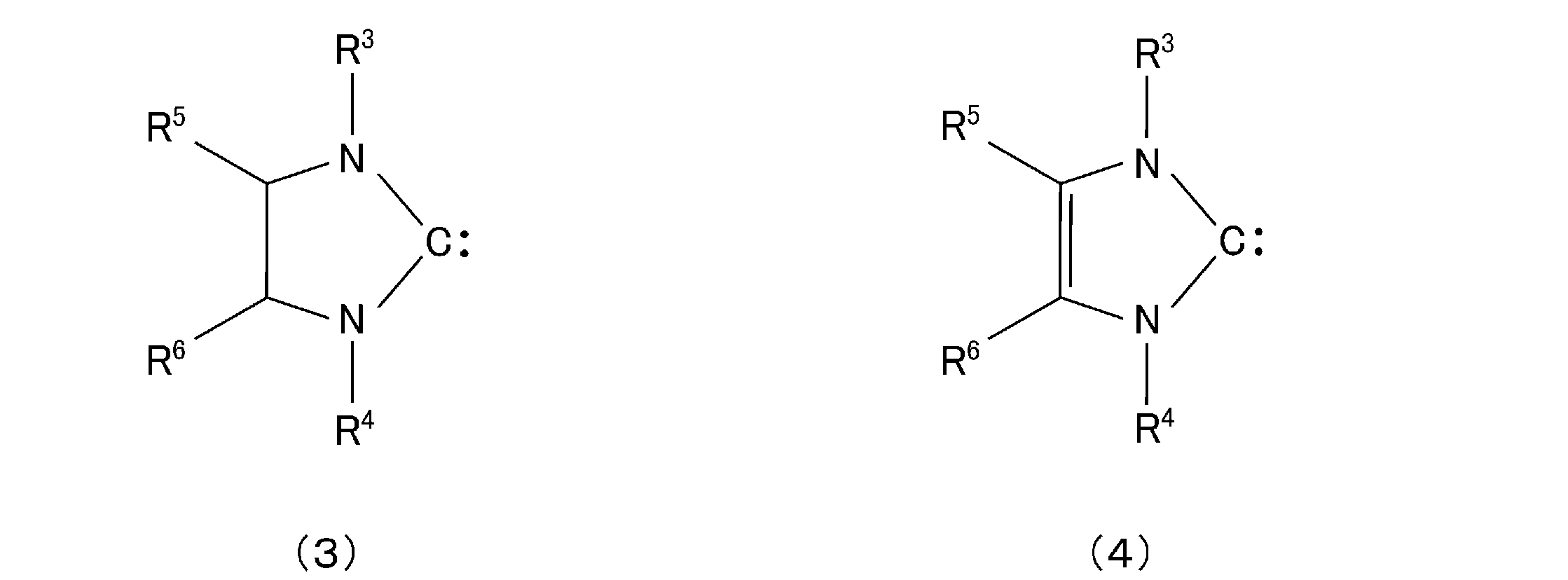
また、R3、R4、R5及びR6は任意の組合せで互いに結合して環を形成していてもよい。

また、ハロゲン原子、酸素原子、窒素原子、硫黄原子、リン原子又は珪素原子を含んでいてもよい炭素数1~20の有機基の具体例としては、上記一般式(1)及び(2)の場合と同様である。


本発明者等が、シクロオレフィン系樹脂硬化物を半導体の封止材料等に好適に用いるために、高い酸素バリア性を実現すべく鋭意検討を行ったところ、シクロオレフィン系樹脂硬化物を形成するために、通常、用いられる酸化防止剤に着目し、酸化防止剤の使用量を増やすのではなく、逆に特定量以下として酸化されやすいものとした結果、酸化により酸化膜が形成され、意外にも酸素透過性を顕著に低下させることができ、これにより、長期間に渡り高い酸素バリア性を実現できるものとすることができることを見出した。
これらの化合物は、それぞれ単独で、あるいは2種以上を組み合わせて用いることができる。
本発明で用いる重合性組成物中のノルボルネン構造を有する炭化水素基を少なくとも1つ有するシランカップリング剤の含有量としては、好ましくは0.1~5質量%であり、より好ましくは0.3~2質量%であり、さらに好ましくは0.5~1質量%である。
本発明の酸素バリア性シクロオレフィン系樹脂硬化物は、上記した重合性組成物を、塊状重合させることで得られるものであり、23℃における酸素透過度が、50mL/m2・day・atm(100μm)未満であるものである。すなわち、本発明のシクロオレフィン系樹脂硬化物は、厚み100μmに換算した場合における、23℃における酸素透過度が、50mL/m2・day・atm未満であるものであり、好ましくは、15mL/m2・day・atm以下であり、より好ましくは10mL/m2・day・atm以下である。
フィルム状のシクロオレフィン系樹脂硬化物について、JIS K7126-2に準拠した差圧法により、酸素透過率測定装置(MOCON酸素透過率測定装置 OX-TRAN2/21、日立ハイテクサイエンス社製)を用いて、温度23℃、相対湿度0%、1気圧の条件で、透過面の形状:直径4.4cmの円の条件で測定を行い、測定結果を、厚さ100μmに換算することで、酸素透過度(単位は、「mL/m2・day・atm(100μm)」)を測定した。なお、酸素透過度は、下記式にしたがって算出した。
酸素透過度[mL/m2・day・atm(100μm)]={酸素透過率測定装置による測定値[mL/m2・day・atm]×測定サンプルの厚み[μm]}÷100
フィルム状のシクロオレフィン系樹脂硬化物を、170℃、190時間の条件で加熱し、加熱後のフィルム状のシクロオレフィン系樹脂硬化物について、上記と同様の方法において、酸素透過度(単位は、「mL/m2・day・atm(100μm)」)を測定した。
フィルム状のシクロオレフィン系樹脂硬化物について、JIS K 7129-2008 A法に準拠し、水蒸気透過度測定装置(製品名「Lyssy L80-5000」、SYSTECH社製)を用いて、温度40℃、湿度90%RH、1気圧の条件で、透過面の形状:直径4.4cmの円の条件で測定を行い、測定結果を、厚さ100μmに換算することで、水蒸気透過度(単位は、「g/m2・24h(100μm)」)を測定した。なお、水蒸気透過度は、下記式にしたがって算出した。
水蒸気透過度[g/m2・24h(100μm)]={水蒸気透過度測定装置による測定値[g/m2・24h]×測定サンプルの厚み[μm]}÷100
ノルボルネン系モノマーとして、90部のジシクロペンタジエン及び10部のトリシクロペンタジエンを含有するRIMモノマー(日本ゼオン株式会社製)100部を予備配合液(i)とした。
予備配合液(i)として、RIMモノマーに代え93部のジシクロペンタジエン及び7部のエチリデンノルボルネンを含有するノルボルネン系モノマー100部を用いた以外は、実施例1と同様にして、フィルム状のシクロオレフィン系樹脂硬化物を得て、同様に評価を行った。結果を表1に示す。なお、得られたフィルム形状のシクロオレフィン系樹脂硬化物の加熱後の酸化膜の厚みは30μmであった。
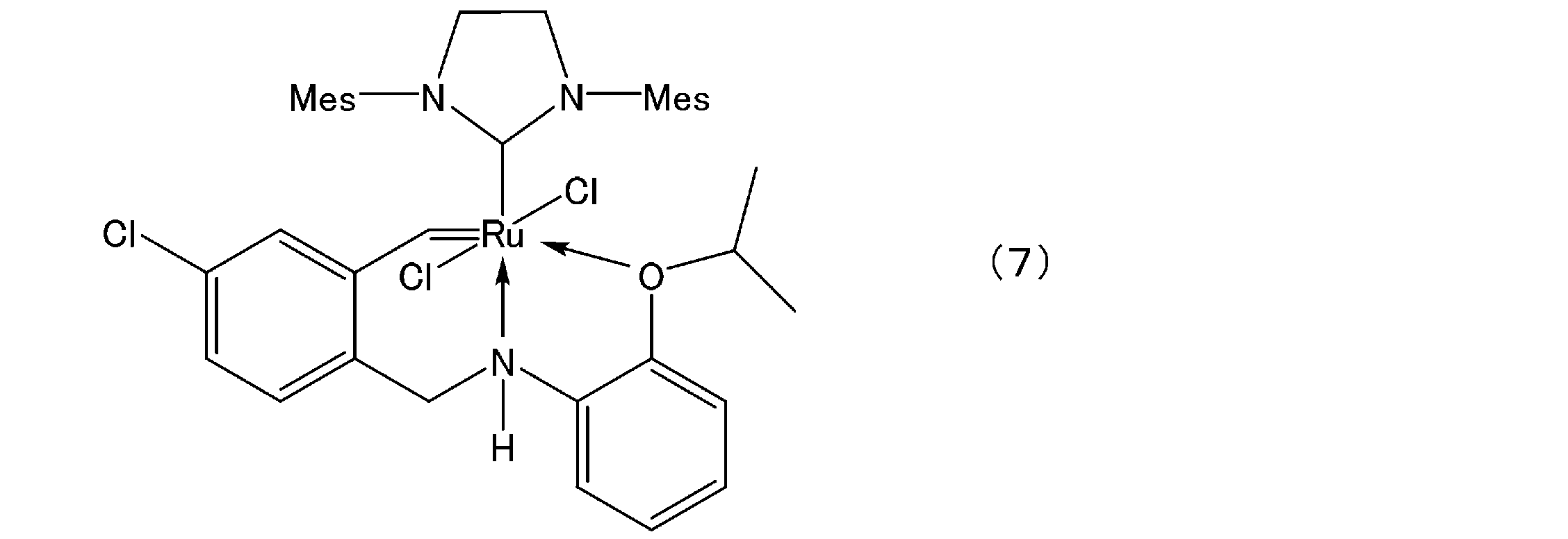
予備配合液(ii)として、式(7)で示すルテニウム触媒(Zhan1N)0.4部、2,6-ジ-t-ブチル-p-クレゾール(BHT、老化防止剤)14部、及びトリフェニルホスフィン43部を、シクロペンタノン42.6部に溶解させたものを使用した以外は、実施例1と同様にして、フィルム状のシクロオレフィン系樹脂硬化物を得て、同様に評価を行った。結果を表1に示す。なお、比較例1においては、予備配合液(i):予備配合液(ii)=100:2.5(質量比)の割合で混合した際に、混合により得られる重合性組成物中における、2,6-ジ-t-ブチル-p-クレゾール(BHT、老化防止剤)の含有割合は、0.33質量%であった。
予備配合液(i)として、RIMモノマーに代え93部のジシクロペンタジエン及び7部のエチリデンノルボルネンを含有するノルボルネン系モノマー100部を用いた以外は、比較例1と同様にして、フィルム状のシクロオレフィン系樹脂硬化物を得て、同様に評価を行った。結果を表1に示す。
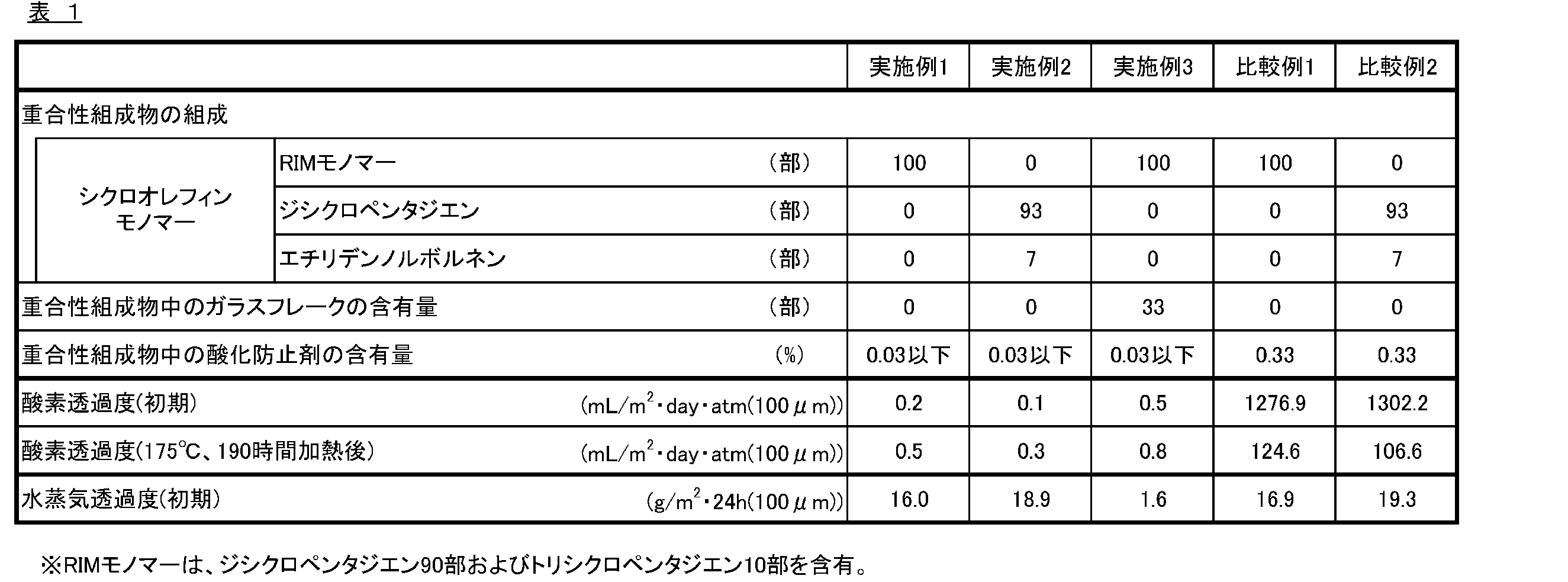
一方、重合性組成物として、酸化防止剤の含有量が0.3質量%を超えるものを用いた場合には、酸素透過度(初期及び175℃、190時間加熱後)のいずれも高く、酸素バリア性に劣るものであった(比較例1~2)。
予備配合液(i)を調製する際に、板状充填材として、アスペクト比20であるガラスフレークを、ノルボルネン系モノマー100部に対して、33部の割合で配合した以外は、実施例1と同様にして、フィルム状のシクロオレフィン系樹脂硬化物を得て、同様に評価を行ったところ、酸素透過度(初期)は、0.5mL/m2・day・atm(100μm)であり、酸素透過度(175℃、190時間の条件で加熱した後)は、0.8mL/m2・day・atm(100μm)であり、酸素バリア性に優れるものであった。
また、得られたフィルム状のシクロオレフィン系樹脂硬化物について、温度40℃、湿度90%RHの条件で、水蒸気透過度を測定したところ、水蒸気透過度は、1.6g/m2・24h(100μm)であり、水蒸気バリア性にも優れるものであった。
Claims (12)
- シクロオレフィンモノマー及びメタセシス重合触媒を含む重合性組成物を塊状重合してなる酸素バリア性シクロオレフィン系樹脂硬化物であって、
前記シクロオレフィンモノマーが、ノルボルネン系モノマー(a)を含有し、
前記重合性組成物中における酸化防止剤の含有量が0.3質量%以下であり、
23℃における酸素透過度が、50mL/m2・day・atm(100μm)未満である、酸素バリア性シクロオレフィン系樹脂硬化物。 - 23℃における酸素透過度が、15mL/m2・day・atm(100μm)以下である、請求項1に記載の酸素バリア性シクロオレフィン系樹脂硬化物。
- 前記シクロオレフィンモノマーが、単環シクロオレフィンをさらに含有する請求項1または2に記載の酸素バリア性シクロオレフィン系樹脂硬化物。
- 前記重合性組成物が、充填材を含有する請求項1~3のいずれかに記載の酸素バリア性シクロオレフィン系樹脂硬化物。
- 前記充填材が、板状充填材である請求項1~4のいずれかに記載の酸素バリア性シクロオレフィン系樹脂硬化物。
- 表面の少なくとも一部に酸化膜を有する請求項1~5のいずれかに記載の酸素バリア性シクロオレフィン系樹脂硬化物。
- 請求項1~5のいずれかに記載の酸素バリア性シクロオレフィン系樹脂硬化物を成形してなる酸素バリア性フィルム。
- 少なくとも一方の表面の少なくとも一部に酸化膜を有する請求項7に記載の酸素バリア性フィルム。
- 請求項1~5のいずれかに記載の酸素バリア性シクロオレフィン系樹脂硬化物からなる層と、他の樹脂からなる層または金属層と、を備える積層体。
- シクロオレフィンモノマー及びメタセシス重合触媒を含む重合性組成物であって、
前記シクロオレフィンモノマーが、ノルボルネン系モノマー(a)であり、前記重合性組成物中における酸化防止剤の含有量が0.3質量%以下である、
請求項1に記載の酸素バリア性シクロオレフィン系樹脂硬化物形成用の重合性組成物。 - 前記シクロオレフィンモノマーが、単環シクロオレフィンをさらに含有する請求項10に記載の重合性組成物。
- 単独では重合反応を生じない2以上の予備配合液からなり、前記予備配合液を合わせることで前記重合性組成物を形成しうる請求項10または11に記載の重合性組成物。
Priority Applications (4)
| Application Number | Priority Date | Filing Date | Title |
|---|---|---|---|
| CN202180055981.8A CN116157262A (zh) | 2020-08-28 | 2021-08-25 | 阻氧性环烯烃系树脂固化物 |
| EP21861627.4A EP4205968A4 (en) | 2020-08-28 | 2021-08-25 | CYCLOOLEFIN RESIN-CURED PRODUCT WITH OXYGEN BARRIER PROPERTIES |
| JP2022545677A JP7737380B2 (ja) | 2020-08-28 | 2021-08-25 | 酸素バリア性シクロオレフィン系樹脂硬化物 |
| US18/021,214 US12570774B2 (en) | 2020-08-28 | 2021-08-25 | Cycloolefin resin cured product having oxygen barrier properties |
Applications Claiming Priority (2)
| Application Number | Priority Date | Filing Date | Title |
|---|---|---|---|
| JP2020144572 | 2020-08-28 | ||
| JP2020-144572 | 2020-08-28 |
Publications (1)
| Publication Number | Publication Date |
|---|---|
| WO2022045204A1 true WO2022045204A1 (ja) | 2022-03-03 |
Family
ID=80355348
Family Applications (1)
| Application Number | Title | Priority Date | Filing Date |
|---|---|---|---|
| PCT/JP2021/031191 Ceased WO2022045204A1 (ja) | 2020-08-28 | 2021-08-25 | 酸素バリア性シクロオレフィン系樹脂硬化物 |
Country Status (5)
| Country | Link |
|---|---|
| US (1) | US12570774B2 (ja) |
| EP (1) | EP4205968A4 (ja) |
| JP (1) | JP7737380B2 (ja) |
| CN (1) | CN116157262A (ja) |
| WO (1) | WO2022045204A1 (ja) |
Citations (10)
| Publication number | Priority date | Publication date | Assignee | Title |
|---|---|---|---|---|
| JPH08143767A (ja) | 1994-11-24 | 1996-06-04 | Toppan Printing Co Ltd | 酸素バリア性及び水蒸気透過性樹脂組成物 |
| JP2001302888A (ja) * | 2000-02-14 | 2001-10-31 | Sekisui Chem Co Ltd | 層状珪酸塩強化オレフィンメタセシス重合体及びその製造方法 |
| WO2003062253A1 (en) | 2002-01-22 | 2003-07-31 | Universiteit Gent | Metal complexes for use in metathesis |
| WO2008032743A1 (en) * | 2006-09-12 | 2008-03-20 | Kuraray Co., Ltd. | Oxygen-absorbing resin composition |
| JP2009263575A (ja) * | 2008-04-28 | 2009-11-12 | Rimtec Kk | 複合成形体 |
| JP2010235699A (ja) * | 2009-03-30 | 2010-10-21 | Nippon Zeon Co Ltd | 高分子成形用配合液、高分子成形体、及び複合高分子成形体 |
| WO2011079799A1 (en) | 2009-12-30 | 2011-07-07 | Zannan Scitech Co., Ltd. | Highly active metathesis catalysis selective for romp and rcm |
| US20120058332A1 (en) * | 2010-09-03 | 2012-03-08 | Basf Se | Barrier coating made of cycloolefin copolymers |
| JP2013048295A (ja) | 2012-11-21 | 2013-03-07 | Sumitomo Bakelite Co Ltd | 樹脂封止型半導体装置 |
| CN109943024A (zh) * | 2019-03-19 | 2019-06-28 | 上海化工研究院有限公司 | 一种用于制备碳纤维复合材料的固化树脂及其应用 |
Family Cites Families (18)
| Publication number | Priority date | Publication date | Assignee | Title |
|---|---|---|---|---|
| US4701510A (en) * | 1985-12-16 | 1987-10-20 | The B.F. Goodrich Company | Polycycloolefins resistant to solvents |
| CA1296836C (en) * | 1987-03-13 | 1992-03-03 | Zen-Ichiro Endo | Metathesis polymerized copolymer |
| US5002827A (en) * | 1987-10-26 | 1991-03-26 | Nippon Glass Fiber Co., Ltd. | Agglomerated glass flakes |
| EP0930326A4 (en) * | 1996-09-30 | 1999-12-15 | Nippon Zeon Co | NORBORNENE POLYMER AND PROCESS FOR PREPARING THE SAME |
| ES2209185T3 (es) * | 1997-06-27 | 2004-06-16 | Ciba Specialty Chemicals Holding Inc. | Catalizadores de rutenio y osmio. |
| JP2001118963A (ja) | 1999-10-20 | 2001-04-27 | Hitachi Chem Co Ltd | 電気・電子部品 |
| JP2003003046A (ja) | 2001-06-25 | 2003-01-08 | Hitachi Chem Co Ltd | メタセシス重合性樹脂材料及びその組成物 |
| US6866949B2 (en) * | 2002-03-08 | 2005-03-15 | Dai Nippon Printing Co., Ltd. | Substrate film, gas barrier film, and display using the same |
| KR101129739B1 (ko) * | 2003-08-13 | 2012-03-23 | 니폰 제온 가부시키가이샤 | 중합성 조성물, 및 이것을 이용하여 제조된 성형체 |
| GB0608126D0 (en) * | 2006-04-24 | 2006-06-07 | Imerys Minerals Ltd | Barrier compositions |
| US8080623B2 (en) * | 2006-10-20 | 2011-12-20 | Zeon Corporation | Polymerizable composition, crosslinkable resin, and manufacture methods and applications thereof |
| GB0718472D0 (en) * | 2007-09-24 | 2007-10-31 | Glassflake Ltd | Glass flakes |
| JP5270755B2 (ja) * | 2008-06-02 | 2013-08-21 | スリーエム イノベイティブ プロパティズ カンパニー | 接着剤封入組成物及びそれで作られた電子デバイス |
| JP5892002B2 (ja) | 2011-12-16 | 2016-03-23 | Jsr株式会社 | 環状オレフィン系開環共重合体 |
| TW201347974A (zh) * | 2012-05-21 | 2013-12-01 | Zeon Corp | 交聯環狀烯烴樹脂薄膜、積層體及彼等製造方法 |
| JP2014136728A (ja) * | 2013-01-16 | 2014-07-28 | Nippon Zeon Co Ltd | 架橋環状オレフィン樹脂フィルム、積層体及びその製造方法 |
| JP6634085B2 (ja) * | 2015-07-31 | 2020-01-22 | 日本板硝子株式会社 | フレーク状ガラス及び樹脂組成物 |
| CN105924908A (zh) * | 2016-06-13 | 2016-09-07 | 深圳王子新材料股份有限公司 | 生物降解材料及其制备方法 |
-
2021
- 2021-08-25 CN CN202180055981.8A patent/CN116157262A/zh active Pending
- 2021-08-25 US US18/021,214 patent/US12570774B2/en active Active
- 2021-08-25 EP EP21861627.4A patent/EP4205968A4/en active Pending
- 2021-08-25 WO PCT/JP2021/031191 patent/WO2022045204A1/ja not_active Ceased
- 2021-08-25 JP JP2022545677A patent/JP7737380B2/ja active Active
Patent Citations (12)
| Publication number | Priority date | Publication date | Assignee | Title |
|---|---|---|---|---|
| JPH08143767A (ja) | 1994-11-24 | 1996-06-04 | Toppan Printing Co Ltd | 酸素バリア性及び水蒸気透過性樹脂組成物 |
| JP2001302888A (ja) * | 2000-02-14 | 2001-10-31 | Sekisui Chem Co Ltd | 層状珪酸塩強化オレフィンメタセシス重合体及びその製造方法 |
| WO2003062253A1 (en) | 2002-01-22 | 2003-07-31 | Universiteit Gent | Metal complexes for use in metathesis |
| JP2005515260A (ja) | 2002-01-22 | 2005-05-26 | ウニベルズィタイト・ヘント | 複分解に使用される金属錯体 |
| WO2008032743A1 (en) * | 2006-09-12 | 2008-03-20 | Kuraray Co., Ltd. | Oxygen-absorbing resin composition |
| JP2009263575A (ja) * | 2008-04-28 | 2009-11-12 | Rimtec Kk | 複合成形体 |
| JP2010235699A (ja) * | 2009-03-30 | 2010-10-21 | Nippon Zeon Co Ltd | 高分子成形用配合液、高分子成形体、及び複合高分子成形体 |
| WO2011079799A1 (en) | 2009-12-30 | 2011-07-07 | Zannan Scitech Co., Ltd. | Highly active metathesis catalysis selective for romp and rcm |
| JP2013516392A (ja) | 2009-12-30 | 2013-05-13 | ザンナン・サイテック・カンパニー・リミテッド | Rompとrcm反応に対する高効率複分解触媒 |
| US20120058332A1 (en) * | 2010-09-03 | 2012-03-08 | Basf Se | Barrier coating made of cycloolefin copolymers |
| JP2013048295A (ja) | 2012-11-21 | 2013-03-07 | Sumitomo Bakelite Co Ltd | 樹脂封止型半導体装置 |
| CN109943024A (zh) * | 2019-03-19 | 2019-06-28 | 上海化工研究院有限公司 | 一种用于制备碳纤维复合材料的固化树脂及其应用 |
Non-Patent Citations (1)
| Title |
|---|
| See also references of EP4205968A4 |
Also Published As
| Publication number | Publication date |
|---|---|
| EP4205968A1 (en) | 2023-07-05 |
| EP4205968A4 (en) | 2024-10-23 |
| CN116157262A (zh) | 2023-05-23 |
| US20230322978A1 (en) | 2023-10-12 |
| JP7737380B2 (ja) | 2025-09-10 |
| US12570774B2 (en) | 2026-03-10 |
| JPWO2022045204A1 (ja) | 2022-03-03 |
Similar Documents
| Publication | Publication Date | Title |
|---|---|---|
| JP7792907B2 (ja) | シクロオレフィン系樹脂硬化物 | |
| US10611866B2 (en) | Norbornene cross-linked polymer and method for producing same | |
| JP6708410B2 (ja) | 複合成形体の製造方法 | |
| WO2021074749A1 (en) | Methods, articles and adhesive composition comprising unpolymerized cyclic olefin, catalyst, and adhesion promoter polymer | |
| EP3275649B1 (en) | Resin molded body and method for producing same | |
| US11879029B2 (en) | Polymerizable composition, cycloolefin-based polymer, and metal/resin composite | |
| KR20190015303A (ko) | 복합재료 성형체의 제조방법 | |
| WO2022045204A1 (ja) | 酸素バリア性シクロオレフィン系樹脂硬化物 | |
| WO2025013577A1 (ja) | 重合性組成物及び樹脂含浸超電導コイル | |
| EP3415545B1 (en) | Polymerizable composition and composite material | |
| WO2022230803A1 (ja) | 金属樹脂積層体及び金属樹脂積層体の製造方法 | |
| US7217600B2 (en) | Cyclic olefin polymers and catalyst for semiconductor applications | |
| JP2025103847A (ja) | 吐出方法、成形体の製造方法および吐出装置 | |
| JP2022180216A (ja) | 重合性組成物及びフッ素含有ノルボルネン系樹脂 | |
| WO2024224997A1 (ja) | 重合性組成物および成形体 | |
| JP2024154793A (ja) | 複合材料 | |
| JP2025180677A (ja) | 成形体および成形体の製造方法 | |
| JP2025103835A (ja) | 重合性オリゴマー組成物の製造方法および成形体の製造方法 | |
| WO2026048498A1 (ja) | 重合性組成物及び樹脂含浸超電導コイル | |
| CN119923426A (zh) | 催化剂溶液和聚合性组合物 |
Legal Events
| Date | Code | Title | Description |
|---|---|---|---|
| 121 | Ep: the epo has been informed by wipo that ep was designated in this application |
Ref document number: 21861627 Country of ref document: EP Kind code of ref document: A1 |
|
| ENP | Entry into the national phase |
Ref document number: 2022545677 Country of ref document: JP Kind code of ref document: A |
|
| NENP | Non-entry into the national phase |
Ref country code: DE |
|
| ENP | Entry into the national phase |
Ref document number: 2021861627 Country of ref document: EP Effective date: 20230328 |
|
| WWG | Wipo information: grant in national office |
Ref document number: 18021214 Country of ref document: US |