WO2022054893A1 - 樹脂混練用添加剤 - Google Patents
樹脂混練用添加剤 Download PDFInfo
- Publication number
- WO2022054893A1 WO2022054893A1 PCT/JP2021/033243 JP2021033243W WO2022054893A1 WO 2022054893 A1 WO2022054893 A1 WO 2022054893A1 JP 2021033243 W JP2021033243 W JP 2021033243W WO 2022054893 A1 WO2022054893 A1 WO 2022054893A1
- Authority
- WO
- WIPO (PCT)
- Prior art keywords
- resin
- mass
- vinyl monomer
- additive
- radical scavenger
- Prior art date
- Legal status (The legal status is an assumption and is not a legal conclusion. Google has not performed a legal analysis and makes no representation as to the accuracy of the status listed.)
- Ceased
Links
Images


Classifications
-
- C—CHEMISTRY; METALLURGY
- C08—ORGANIC MACROMOLECULAR COMPOUNDS; THEIR PREPARATION OR CHEMICAL WORKING-UP; COMPOSITIONS BASED THEREON
- C08J—WORKING-UP; GENERAL PROCESSES OF COMPOUNDING; AFTER-TREATMENT NOT COVERED BY SUBCLASSES C08B, C08C, C08F, C08G or C08H
- C08J3/00—Processes of treating or compounding macromolecular substances
- C08J3/20—Compounding polymers with additives, e.g. colouring
- C08J3/205—Compounding polymers with additives, e.g. colouring in the presence of a continuous liquid phase
-
- C—CHEMISTRY; METALLURGY
- C08—ORGANIC MACROMOLECULAR COMPOUNDS; THEIR PREPARATION OR CHEMICAL WORKING-UP; COMPOSITIONS BASED THEREON
- C08J—WORKING-UP; GENERAL PROCESSES OF COMPOUNDING; AFTER-TREATMENT NOT COVERED BY SUBCLASSES C08B, C08C, C08F, C08G or C08H
- C08J3/00—Processes of treating or compounding macromolecular substances
- C08J3/20—Compounding polymers with additives, e.g. colouring
- C08J3/205—Compounding polymers with additives, e.g. colouring in the presence of a continuous liquid phase
- C08J3/2053—Compounding polymers with additives, e.g. colouring in the presence of a continuous liquid phase the additives only being premixed with a liquid phase
-
- C—CHEMISTRY; METALLURGY
- C08—ORGANIC MACROMOLECULAR COMPOUNDS; THEIR PREPARATION OR CHEMICAL WORKING-UP; COMPOSITIONS BASED THEREON
- C08F—MACROMOLECULAR COMPOUNDS OBTAINED BY REACTIONS ONLY INVOLVING CARBON-TO-CARBON UNSATURATED BONDS
- C08F2/00—Processes of polymerisation
- C08F2/44—Polymerisation in the presence of compounding ingredients, e.g. plasticisers, dyestuffs, fillers
-
- C—CHEMISTRY; METALLURGY
- C08—ORGANIC MACROMOLECULAR COMPOUNDS; THEIR PREPARATION OR CHEMICAL WORKING-UP; COMPOSITIONS BASED THEREON
- C08F—MACROMOLECULAR COMPOUNDS OBTAINED BY REACTIONS ONLY INVOLVING CARBON-TO-CARBON UNSATURATED BONDS
- C08F212/00—Copolymers of compounds having one or more unsaturated aliphatic radicals, each having only one carbon-to-carbon double bond, and at least one being terminated by an aromatic carbocyclic ring
- C08F212/02—Monomers containing only one unsaturated aliphatic radical
- C08F212/04—Monomers containing only one unsaturated aliphatic radical containing one ring
- C08F212/06—Hydrocarbons
- C08F212/08—Styrene
-
- C—CHEMISTRY; METALLURGY
- C08—ORGANIC MACROMOLECULAR COMPOUNDS; THEIR PREPARATION OR CHEMICAL WORKING-UP; COMPOSITIONS BASED THEREON
- C08F—MACROMOLECULAR COMPOUNDS OBTAINED BY REACTIONS ONLY INVOLVING CARBON-TO-CARBON UNSATURATED BONDS
- C08F220/00—Copolymers of compounds having one or more unsaturated aliphatic radicals, each having only one carbon-to-carbon double bond, and only one being terminated by only one carboxyl radical or a salt, anhydride ester, amide, imide or nitrile thereof
- C08F220/02—Monocarboxylic acids having less than ten carbon atoms; Derivatives thereof
- C08F220/10—Esters
- C08F220/12—Esters of monohydric alcohols or phenols
- C08F220/14—Methyl esters, e.g. methyl (meth)acrylate
-
- C—CHEMISTRY; METALLURGY
- C08—ORGANIC MACROMOLECULAR COMPOUNDS; THEIR PREPARATION OR CHEMICAL WORKING-UP; COMPOSITIONS BASED THEREON
- C08F—MACROMOLECULAR COMPOUNDS OBTAINED BY REACTIONS ONLY INVOLVING CARBON-TO-CARBON UNSATURATED BONDS
- C08F222/00—Copolymers of compounds having one or more unsaturated aliphatic radicals, each having only one carbon-to-carbon double bond, and at least one being terminated by a carboxyl radical and containing at least one other carboxyl radical in the molecule; Salts, anhydrides, esters, amides, imides, or nitriles thereof
- C08F222/10—Esters
- C08F222/1006—Esters of polyhydric alcohols or polyhydric phenols
- C08F222/102—Esters of polyhydric alcohols or polyhydric phenols of dialcohols, e.g. ethylene glycol di(meth)acrylate or 1,4-butanediol dimethacrylate
-
- C—CHEMISTRY; METALLURGY
- C08—ORGANIC MACROMOLECULAR COMPOUNDS; THEIR PREPARATION OR CHEMICAL WORKING-UP; COMPOSITIONS BASED THEREON
- C08J—WORKING-UP; GENERAL PROCESSES OF COMPOUNDING; AFTER-TREATMENT NOT COVERED BY SUBCLASSES C08B, C08C, C08F, C08G or C08H
- C08J3/00—Processes of treating or compounding macromolecular substances
- C08J3/20—Compounding polymers with additives, e.g. colouring
- C08J3/203—Solid polymers with solid and/or liquid additives
-
- C—CHEMISTRY; METALLURGY
- C08—ORGANIC MACROMOLECULAR COMPOUNDS; THEIR PREPARATION OR CHEMICAL WORKING-UP; COMPOSITIONS BASED THEREON
- C08K—Use of inorganic or non-macromolecular organic substances as compounding ingredients
- C08K5/00—Use of organic ingredients
- C08K5/0008—Organic ingredients according to more than one of the "one dot" groups of C08K5/01 - C08K5/59
- C08K5/005—Stabilisers against oxidation, heat, light, ozone
-
- C—CHEMISTRY; METALLURGY
- C08—ORGANIC MACROMOLECULAR COMPOUNDS; THEIR PREPARATION OR CHEMICAL WORKING-UP; COMPOSITIONS BASED THEREON
- C08F—MACROMOLECULAR COMPOUNDS OBTAINED BY REACTIONS ONLY INVOLVING CARBON-TO-CARBON UNSATURATED BONDS
- C08F2800/00—Copolymer characterised by the proportions of the comonomers expressed
- C08F2800/20—Copolymer characterised by the proportions of the comonomers expressed as weight or mass percentages
-
- C—CHEMISTRY; METALLURGY
- C08—ORGANIC MACROMOLECULAR COMPOUNDS; THEIR PREPARATION OR CHEMICAL WORKING-UP; COMPOSITIONS BASED THEREON
- C08J—WORKING-UP; GENERAL PROCESSES OF COMPOUNDING; AFTER-TREATMENT NOT COVERED BY SUBCLASSES C08B, C08C, C08F, C08G or C08H
- C08J2323/00—Characterised by the use of homopolymers or copolymers of unsaturated aliphatic hydrocarbons having only one carbon-to-carbon double bond; Derivatives of such polymers
- C08J2323/02—Characterised by the use of homopolymers or copolymers of unsaturated aliphatic hydrocarbons having only one carbon-to-carbon double bond; Derivatives of such polymers not modified by chemical after treatment
- C08J2323/04—Homopolymers or copolymers of ethene
- C08J2323/06—Polyethene
-
- C—CHEMISTRY; METALLURGY
- C08—ORGANIC MACROMOLECULAR COMPOUNDS; THEIR PREPARATION OR CHEMICAL WORKING-UP; COMPOSITIONS BASED THEREON
- C08J—WORKING-UP; GENERAL PROCESSES OF COMPOUNDING; AFTER-TREATMENT NOT COVERED BY SUBCLASSES C08B, C08C, C08F, C08G or C08H
- C08J2325/00—Characterised by the use of homopolymers or copolymers of compounds having one or more unsaturated aliphatic radicals, each having only one carbon-to-carbon double bond, and at least one being terminated by an aromatic carbocyclic ring; Derivatives of such polymers
- C08J2325/02—Homopolymers or copolymers of hydrocarbons
- C08J2325/04—Homopolymers or copolymers of styrene
- C08J2325/08—Copolymers of styrene
-
- C—CHEMISTRY; METALLURGY
- C08—ORGANIC MACROMOLECULAR COMPOUNDS; THEIR PREPARATION OR CHEMICAL WORKING-UP; COMPOSITIONS BASED THEREON
- C08J—WORKING-UP; GENERAL PROCESSES OF COMPOUNDING; AFTER-TREATMENT NOT COVERED BY SUBCLASSES C08B, C08C, C08F, C08G or C08H
- C08J2333/00—Characterised by the use of homopolymers or copolymers of compounds having one or more unsaturated aliphatic radicals, each having only one carbon-to-carbon double bond, and only one being terminated by only one carboxyl radical, or of salts, anhydrides, esters, amides, imides, or nitriles thereof; Derivatives of such polymers
- C08J2333/04—Characterised by the use of homopolymers or copolymers of compounds having one or more unsaturated aliphatic radicals, each having only one carbon-to-carbon double bond, and only one being terminated by only one carboxyl radical, or of salts, anhydrides, esters, amides, imides, or nitriles thereof; Derivatives of such polymers esters
- C08J2333/06—Characterised by the use of homopolymers or copolymers of compounds having one or more unsaturated aliphatic radicals, each having only one carbon-to-carbon double bond, and only one being terminated by only one carboxyl radical, or of salts, anhydrides, esters, amides, imides, or nitriles thereof; Derivatives of such polymers esters of esters containing only carbon, hydrogen, and oxygen, the oxygen atom being present only as part of the carboxyl radical
- C08J2333/10—Homopolymers or copolymers of methacrylic acid esters
- C08J2333/12—Homopolymers or copolymers of methyl methacrylate
-
- C—CHEMISTRY; METALLURGY
- C08—ORGANIC MACROMOLECULAR COMPOUNDS; THEIR PREPARATION OR CHEMICAL WORKING-UP; COMPOSITIONS BASED THEREON
- C08J—WORKING-UP; GENERAL PROCESSES OF COMPOUNDING; AFTER-TREATMENT NOT COVERED BY SUBCLASSES C08B, C08C, C08F, C08G or C08H
- C08J2335/00—Characterised by the use of homopolymers or copolymers of compounds having one or more unsaturated aliphatic radicals, each having only one carbon-to-carbon double bond, and at least one being terminated by a carboxyl radical, and containing at least one other carboxyl radical in the molecule, or of salts, anhydrides, esters, amides, imides or nitriles thereof; Derivatives of such polymers
- C08J2335/02—Characterised by the use of homopolymers or copolymers of esters
-
- C—CHEMISTRY; METALLURGY
- C08—ORGANIC MACROMOLECULAR COMPOUNDS; THEIR PREPARATION OR CHEMICAL WORKING-UP; COMPOSITIONS BASED THEREON
- C08J—WORKING-UP; GENERAL PROCESSES OF COMPOUNDING; AFTER-TREATMENT NOT COVERED BY SUBCLASSES C08B, C08C, C08F, C08G or C08H
- C08J2425/00—Characterised by the use of homopolymers or copolymers of compounds having one or more unsaturated aliphatic radicals, each having only one carbon-to-carbon double bond, and at least one being terminated by an aromatic carbocyclic ring; Derivatives of such polymers
- C08J2425/02—Homopolymers or copolymers of hydrocarbons
- C08J2425/04—Homopolymers or copolymers of styrene
- C08J2425/08—Copolymers of styrene
-
- C—CHEMISTRY; METALLURGY
- C08—ORGANIC MACROMOLECULAR COMPOUNDS; THEIR PREPARATION OR CHEMICAL WORKING-UP; COMPOSITIONS BASED THEREON
- C08J—WORKING-UP; GENERAL PROCESSES OF COMPOUNDING; AFTER-TREATMENT NOT COVERED BY SUBCLASSES C08B, C08C, C08F, C08G or C08H
- C08J2433/00—Characterised by the use of homopolymers or copolymers of compounds having one or more unsaturated aliphatic radicals, each having only one carbon-to-carbon double bond, and only one being terminated by only one carboxyl radical, or of salts, anhydrides, esters, amides, imides, or nitriles thereof; Derivatives of such polymers
- C08J2433/04—Characterised by the use of homopolymers or copolymers of compounds having one or more unsaturated aliphatic radicals, each having only one carbon-to-carbon double bond, and only one being terminated by only one carboxyl radical, or of salts, anhydrides, esters, amides, imides, or nitriles thereof; Derivatives of such polymers esters
- C08J2433/06—Characterised by the use of homopolymers or copolymers of compounds having one or more unsaturated aliphatic radicals, each having only one carbon-to-carbon double bond, and only one being terminated by only one carboxyl radical, or of salts, anhydrides, esters, amides, imides, or nitriles thereof; Derivatives of such polymers esters of esters containing only carbon, hydrogen, and oxygen, the oxygen atom being present only as part of the carboxyl radical
- C08J2433/10—Homopolymers or copolymers of methacrylic acid esters
- C08J2433/12—Homopolymers or copolymers of methyl methacrylate
-
- C—CHEMISTRY; METALLURGY
- C08—ORGANIC MACROMOLECULAR COMPOUNDS; THEIR PREPARATION OR CHEMICAL WORKING-UP; COMPOSITIONS BASED THEREON
- C08K—Use of inorganic or non-macromolecular organic substances as compounding ingredients
- C08K2201/00—Specific properties of additives
- C08K2201/002—Physical properties
- C08K2201/005—Additives being defined by their particle size in general
-
- C—CHEMISTRY; METALLURGY
- C08—ORGANIC MACROMOLECULAR COMPOUNDS; THEIR PREPARATION OR CHEMICAL WORKING-UP; COMPOSITIONS BASED THEREON
- C08K—Use of inorganic or non-macromolecular organic substances as compounding ingredients
- C08K5/00—Use of organic ingredients
- C08K5/04—Oxygen-containing compounds
- C08K5/13—Phenols; Phenolates
- C08K5/132—Phenols containing keto groups, e.g. benzophenones
-
- C—CHEMISTRY; METALLURGY
- C08—ORGANIC MACROMOLECULAR COMPOUNDS; THEIR PREPARATION OR CHEMICAL WORKING-UP; COMPOSITIONS BASED THEREON
- C08K—Use of inorganic or non-macromolecular organic substances as compounding ingredients
- C08K5/00—Use of organic ingredients
- C08K5/04—Oxygen-containing compounds
- C08K5/13—Phenols; Phenolates
- C08K5/134—Phenols containing ester groups
-
- C—CHEMISTRY; METALLURGY
- C08—ORGANIC MACROMOLECULAR COMPOUNDS; THEIR PREPARATION OR CHEMICAL WORKING-UP; COMPOSITIONS BASED THEREON
- C08K—Use of inorganic or non-macromolecular organic substances as compounding ingredients
- C08K5/00—Use of organic ingredients
- C08K5/16—Nitrogen-containing compounds
- C08K5/315—Compounds containing carbon-to-nitrogen triple bonds
-
- C—CHEMISTRY; METALLURGY
- C08—ORGANIC MACROMOLECULAR COMPOUNDS; THEIR PREPARATION OR CHEMICAL WORKING-UP; COMPOSITIONS BASED THEREON
- C08K—Use of inorganic or non-macromolecular organic substances as compounding ingredients
- C08K5/00—Use of organic ingredients
- C08K5/16—Nitrogen-containing compounds
- C08K5/34—Heterocyclic compounds having nitrogen in the ring
- C08K5/3467—Heterocyclic compounds having nitrogen in the ring having more than two nitrogen atoms in the ring
- C08K5/3472—Five-membered rings
- C08K5/3475—Five-membered rings condensed with carbocyclic rings
-
- C—CHEMISTRY; METALLURGY
- C08—ORGANIC MACROMOLECULAR COMPOUNDS; THEIR PREPARATION OR CHEMICAL WORKING-UP; COMPOSITIONS BASED THEREON
- C08K—Use of inorganic or non-macromolecular organic substances as compounding ingredients
- C08K5/00—Use of organic ingredients
- C08K5/16—Nitrogen-containing compounds
- C08K5/34—Heterocyclic compounds having nitrogen in the ring
- C08K5/3467—Heterocyclic compounds having nitrogen in the ring having more than two nitrogen atoms in the ring
- C08K5/3477—Six-membered rings
- C08K5/3492—Triazines
Definitions
- the present invention relates to an additive for resin kneading.
- Patent Document 1 Particles having an ultraviolet absorber and a polymer that disperses it are known (see, for example, Patent Document 1 below).
- the particles of Patent Document 1 are dispersed in water and prepared as an aqueous polymer dispersion.
- the particles of Patent Document 1 have an average particle size of less than 1000 nm.
- the ultraviolet absorber of Patent Document 1 is, for example, solid at room temperature (25 ° C.), and specifically contains 2- (2'-hydroxyphenyl) benzotriazole. Further, the particles of Patent Document 1 are added to the paint.
- the average particle size of the particles is less than 1000 nm, so that the particles are strongly aggregated during drying. Even if the agglomerated particles after drying are added to the resin, the agglomeration is difficult to be eliminated. Therefore, there is a problem that the light resistance of the resin molded product cannot be sufficiently improved.
- Bleed is a phenomenon in which an ultraviolet absorber leaks (releases) to the outside of a resin molded product.
- the present invention provides an additive for resin kneading, which suppresses aggregation, has excellent ultraviolet absorption and / or deterioration suppression property of the resin molded body, and can suppress a decrease in strength and bleeding of the resin molded body.
- the present invention (1) is a resin kneading additive containing an organic ultraviolet absorber and / or a radical trapping agent and a polymer that disperses the organic ultraviolet absorber and / or the radical trapping agent.
- the additive is a powder particle, has a median diameter of 1 ⁇ m or more and 100 ⁇ m or less, and the percentage of the total amount of the organic ultraviolet absorber and the radical trapping agent in the resin kneading additive is 20% by mass or more. , 70% by mass or less, and the polymer has a monofunctional vinyl monomer containing only one polymerizable carbon-carbon double bond in the molecule and two polymerizable carbon-carbon double bonds in the molecule.
- the present invention (2) includes the resin kneading additive according to (1), wherein the monofunctional vinyl monomer has a percentage of 55% by mass or more.
- the present invention (3) includes the resin kneading additive according to (1) or (2), wherein the median diameter is 5 ⁇ m or more and 30 ⁇ m or less.
- the additive for resin kneading of the present invention suppresses aggregation, is excellent in ultraviolet absorption and / or deterioration suppression property of the resin molded body, and can suppress a decrease in strength and bleeding of the resin molded body.
- FIG. 1 is an image processing diagram of an SEM photograph of the additive for resin kneading of Example 1.
- FIG. 2 is an image processing diagram of an SEM photograph of the additive for resin kneading of Comparative Example 6.
- FIG. 3 is an image processing diagram of an SEM photograph of the additive for resin kneading of Comparative Example 7.
- the resin kneading additive of the present invention is powder particles. That is, it is not a water-dispersible particle dispersed in water.
- the resin kneading additive is powder particles obtained by drying an aqueous dispersion in which water-dispersible particles are dispersed.
- the shape of the resin kneading additive is not particularly limited.
- the shape of the resin kneading additive includes, for example, a substantially spherical shape and an irregular shape.
- Approximate spherical shapes include, for example, true spherical shapes and spheroidal shapes.
- the spherical shape includes a shape having an uneven surface.
- the resin kneading additive has a median diameter of 1 ⁇ m or more and 100 ⁇ m or less.
- the median diameter of the resin kneading additive is preferably 3 ⁇ m or more, more preferably 5 ⁇ m or more, still more preferably 10 ⁇ m or more, and particularly preferably 15 ⁇ m or more.
- the median diameter of the resin kneading additive is preferably 90 ⁇ m or less, more preferably 75 ⁇ m or less, still more preferably 50 ⁇ m or less, and particularly preferably 30 ⁇ m or less.
- the median diameter of the resin kneading additive does not meet the above lower limit, it tends to aggregate. Even if the agglomerated resin kneading additive is added to the resin, the agglomeration is difficult to be eliminated. Therefore, the light resistance of the resin molded product cannot be sufficiently improved.
- the median diameter of the resin kneading additive exceeds the above-mentioned upper limit, when the resin kneading additive is added to the resin, the stress applied to the resin molded body is extremely concentrated, and therefore, the resin molded body Insufficient strength.
- the median diameter of the resin kneading additive is measured with a particle size distribution measuring device.
- the median diameter of the resin kneading additive can be obtained by measuring the aqueous dispersion (including the suspension) containing the resin kneading additive with a laser diffraction / scattering type particle size distribution measuring device.
- the median diameter of the resin kneading additive can be measured without using water, and is measured by, for example, a particle image analysis system.
- This resin kneading additive contains an organic ultraviolet absorber and / or a radical scavenger and a polymer.
- Organic UV absorbers and radical scavengers do not have polymerizable functional groups.
- each of the organic UV absorber and the radical scavenger does not contain a polymerizable carbon-carbon double bond in the molecule.
- the organic ultraviolet absorber and the radical scavenger may be copolymerized with a vinyl monomer component described later and incorporated into the polymer chain to reduce the release property.
- the organic ultraviolet absorber and the radical scavenger do not have a polymerizable functional group, it is possible to suppress the decrease in release due to incorporation into the polymer chain as described above.
- the organic UV absorber absorbs UV rays and reduces the amount of UV rays directly applied to the resin.
- the properties of the organic ultraviolet absorber at 25 ° C. are not particularly limited. Examples of the properties of the organic ultraviolet absorber at 25 ° C. include solid and liquid. The properties of the organic ultraviolet absorber at 25 ° C. are preferably solid from the viewpoint of suppressing excessive release of the organic ultraviolet absorber to the resin and improving the long-term light resistance of the resin molded product. ..
- Examples of the organic ultraviolet absorber include a benzophenone-based ultraviolet absorber, a benzotriazole-based ultraviolet absorber, a triazine-based ultraviolet absorber, a salicylate ester-based ultraviolet absorber, and a cyanoacrylate-based ultraviolet absorber. These can be used alone or in combination.
- benzophenone-based ultraviolet absorber examples include dihydroxybenzophenone, tetrahydroxybenzophenone, 2-hydroxy-4-methoxybenzophenone, dihydroxydimethoxybenzophenone, 2-hydroxy-4-n-octyloxybenzophenone (ADEKA STUB 1413, manufactured by ADEKA). Examples thereof include 2-hydroxy-4-n-dodecyloxybenzophenone, 2,2'-dihydroxy-4-octyroxybenzophenone, and 2,2'-dihydroxy-4-butyloxybenzophenone.
- Adecastab 1413 is preferably mentioned from the viewpoint of high versatility.
- benzotriazole-based ultraviolet absorber examples include 2- (2'-hydroxy-5'-methylphenyl) benzotriazole and 2- (2H-benzotriazole-2-yl) -4,6-bis (1-methyl-methyl-).
- Tinuvin99-2 and JF-79 are preferably mentioned from the viewpoint of high versatility.
- Examples of the triazine-based ultraviolet absorber include 2,4,6-tris (2-hydroxy-4-hexaloyloxy-3-methylphenyl) -1,3,5-triazine and 2- (4,6-diphenyl). -1,3,5-triazine-2-yl) -5- [2- (2-ethylhexanoyloxy) ethoxy] phenol, 2,4-bis (2-hydroxy-4-butyloxyphenyl) -6 -(2,4-Bis-butyloxyphenyl) -1,3,5-triazine (Tinuvin 460, manufactured by BASF) and 2-hydroxyphenyl-s-triazine (Tinuvin 477, manufactured by BASF) can be mentioned.
- the triazine-based ultraviolet absorber preferably, from the viewpoint of high versatility, Tinuvin 460 and Tinuvin 477 can be mentioned.
- salicylic acid ester-based ultraviolet absorber examples include 4-octylphenyl salicylate, bisphenol A-disalicylate, 4-t-butylphenyl salicylate, and phenylsalicylate.
- Examples of the cyanoacrylate-based ultraviolet absorber include ethyl-2-cyano-3,3-diphenylacrylate and 2-ethylhexyl-2-cyano-3,3-diphenylacrylate.
- organic ultraviolet absorber examples include a benzophenone-based ultraviolet absorber, a benzotriazole-based ultraviolet absorber, and a triazine-based ultraviolet absorber.
- the radical scavenger captures alkyl radicals and / or peroxy radicals generated by the resin receiving ultraviolet rays.
- the properties of the radical scavenger at 25 ° C. are not particularly limited. Examples of the properties of the radical scavenger at 25 ° C. include solid and liquid. The properties of the radical scavenger at 25 ° C. are preferably solid from the viewpoint of suppressing excessive release of the radical scavenger to the resin and improving the light resistance of the resin molded product over a long period of time.
- the radical scavenger include a hindered amine-based radical scavenger (HALS) (Hindered amino light stabilizers) and a hindered phenol-based radical scavenger. These can be used alone or in combination.
- hindered amine radical trapping agent examples include 1,2,3,4-butanetetracarboxylic acid, 1,2,2,6,6-pentamethyl-4-piperidinol and ⁇ , ⁇ , ⁇ ', ⁇ '-. Tetramethyl-2,4,8,10-tetraoxaspiro [5.5] Ester with undecane-3,9-diethanol (ADEKA STAB LA-63P, manufactured by ADEKA), bis sebacate (1,2,2) 6,6-Pentamethyl-4-piperidinyl) (Tinuvin292, manufactured by BASF), Bissebacate (2,2,6,6-tetramethyl-4-piperidyl) (JF-90, manufactured by Johoku Chemical Industry Co., Ltd.), ( Tetrakiss (1,2,2,6,6-pentamethyl-4-piperidyl) Butane-1,2,3,4-tetracarboxylate (ADEKA STAB LA-52, manufactured by ADEKA), and Tetrakiss (2,2) 6,6-T
- hindered phenol-based radical trapping agent examples include 2,6-di (tert-butyl) -4-methylphenol (also known as dibutylhydroxytoluene, hereinafter abbreviated as BHT), pentaerythritol tetrakis [. 3- (3,5-di-tert-butyl-4-hydroxyphenyl) propionate] (Irganox1010, manufactured by BASF) and octadecyl 3- (3,5-di-tert-butyl-4-hydroxyphenyl) propionate. (Irganox 1076, manufactured by BASF).
- Irganox 1010 is preferably used from the viewpoint of high versatility.
- the percentage of the total amount of the organic ultraviolet absorber and the radical scavenger in the resin kneading additive is 20% by mass or more and 70% by mass or less.
- the percentage of the total amount of the organic ultraviolet absorber and the radical scavenger in the resin kneading additive is preferably 22.5% by mass or more, more preferably 25% by mass or more, and preferably 65% by mass or less. , More preferably 60% by mass or less, still more preferably 55% by mass or less, and particularly preferably 50% by mass or less.
- the total mass of the organic ultraviolet absorber and the radical scavenger with respect to 100 parts by mass of the polymer is, for example, 25 parts by mass or more, preferably 33 parts by mass or more, and for example, 233 parts by mass or less, preferably 233 parts by mass or more. It is 200 parts by mass or less.
- the percentage and / or the total mass part of the total amount of the organic UV absorber and the radical scavenger does not meet the above lower limit, a large amount is used to secure the UV absorption ability and / or the radical scavenger ability in the resin molded product.
- the organic UV absorber and the radical scavenger are solid at 25 ° C., they cannot be sufficiently compatible with the vinyl monomer component described below, so that the polymerization stability is low and a copolymer is formed. Can not. Therefore, it is not possible to obtain an additive for resin kneading.
- the percentage of the total amount of the organic UV absorber and the radical scavenger is obtained by extracting the total amount of the organic UV absorber and the radical scavenger from the resin kneading additive using a solvent and quantifying the total amount. Extraction and quantification operations will be described in detail in later examples.
- the polymer is a copolymer of vinyl monomer components.
- the vinyl monomer component contains a monofunctional vinyl monomer and a polyfunctional vinyl monomer.
- the monofunctional vinyl monomer contains only one polymerizable carbon-carbon double bond in the molecule.
- Examples of the monofunctional vinyl monomer include (meth) acrylic acid ester monomer, aromatic vinyl monomer, nitrile monomer, vinyl ester monomer, maleic acid ester monomer, and vinyl halide.
- the monofunctional vinyl monomer can be used alone or in combination.
- Preferred examples of the monofunctional vinyl monomer include a (meth) acrylic acid ester monomer and an aromatic vinyl monomer.
- the (meth) acrylic acid ester monomer is a methacrylic acid ester and / or an acrylic acid ester.
- (meta) are the same as above.
- Examples of the (meth) acrylic acid ester monomer include linear, branched or cyclic (meth) acrylic acid alkyl esters having an alkyl moiety having 1 to 20 carbon atoms. Preferred are (meth) acrylic acid alkyl esters having an alkyl moiety having 1 to 6 carbon atoms.
- the (meth) acrylic acid ester monomer for example, methyl (meth) acrylic acid, ethyl (meth) acrylic acid, n-propyl (meth) acrylic acid, iso-propyl (meth) acrylic acid, (meth).
- N-butyl acrylate iso-butyl (meth) acrylate, sec-butyl (meth) acrylate, tert-butyl (meth) acrylate, n-pentyl (meth) acrylate, n- (meth) acrylate Hexil, n-heptyl (meth) acrylate, 2-ethylhexyl (meth) acrylate, n-octyl (meth) acrylate, iso-nonyl (meth) acrylate, n-dodecyl (meth) acrylate, (meth) Examples thereof include n-octadecyl acrylate and cyclohexyl (meth) acrylate.
- the (meth) acrylate ester monomer is preferably methyl (meth) acrylate, and more preferably methyl methacrylate (MMA).
- aromatic vinyl monomer examples include styrene, p-methylstyrene, o-methylstyrene, and ⁇ -methylstyrene.
- the aromatic vinyl monomer is preferably styrene.
- nitrile monomer examples include acrylonitrile and methacrylonitrile.
- Examples of the vinyl ester monomer include vinyl acetate and vinyl propionate.
- Examples of the maleic acid ester monomer include dimethyl maleate, diethyl maleate, and dibutyl maleate.
- Examples of vinyl halides include vinyl chloride and vinyl fluoride.
- the percentage of the monofunctional vinyl monomer in the total amount of the monofunctional vinyl monomer and the polyfunctional vinyl monomer is 10% by mass or more and 95% by mass or less.
- the percentage of the monofunctional vinyl monomer in the total amount of the monofunctional vinyl monomer and the polyfunctional vinyl monomer is preferably 55% by mass or more, more preferably 60% by mass or more, still more preferably 70% by mass or more, in particular. It is preferably 75% by mass or more.
- the percentage of the monofunctional vinyl monomer in the total amount of the monofunctional vinyl monomer and the polyfunctional vinyl monomer is preferably 90% by mass or less, more preferably 85% by mass or less.
- the percentage of the monofunctional vinyl monomer does not meet the above lower limit, the degree of cross-linking becomes excessively high. Therefore, the degree of freedom of the polymer chain is lost at the initial stage of polymerization, and voids are easily generated. Therefore, the release rate of the organic ultraviolet absorber and the radical scavenger in the resin molded product becomes excessively high.
- the percentage of the monofunctional vinyl monomer is 0% by mass, the vinyl monomer component does not contain the monofunctional vinyl monomer but contains only the polyfunctional vinyl monomer. Therefore, the degree of cross-linking becomes excessively high, and the release rate of the organic ultraviolet absorber and the radical scavenger in the resin molded product becomes excessively high.
- the resin kneading additive is deformed or disintegrated in the molding of the resin composition (described later). That is, in the molding of the resin molded product, the organic ultraviolet absorber and / or the radical scavenger is released to the outside of the resin kneading additive. That is, it causes bleeding of organic UV absorbers and / or radical scavengers. As a result, the resin molded product cannot exhibit ultraviolet absorption and / or deterioration suppression.
- the vinyl monomer component does not contain the polyfunctional vinyl monomer but contains only the monofunctional vinyl monomer. Therefore, the organic UV absorber and / or the radical scavenger easily bleeds without cross-linking.
- the polyfunctional vinyl monomer contains two or more polymerizable carbon-carbon double bonds in the molecule.
- the polyfunctional vinyl monomer contains two polymerizable carbon-carbon double bonds in the molecule.
- the polyfunctional vinyl monomer can be referred to as a crosslinkable vinyl monomer.
- examples of the polyfunctional vinyl monomer include poly (meth) acrylate, divinyl monomer, and allyl monomer. These can be used alone or in combination.
- Examples of the poly (meth) acrylate include di (meth) acrylate and poly (meth) acrylate having three or more (meth) acrylates.
- di (meth) acrylate examples include ethylene glycol di (meth) acrylate, diethylene glycol di (meth) acrylate, dipropylene glycol di (meth) acrylate, 1,3-propanediol di (meth) acrylate, and 1,4-.
- examples thereof include butanediol di (meth) acrylate and 1,5-pentanediol di (meth) acrylate.
- Preferred is ethylene glycol di (meth) acrylate, and more preferably ethylene glycol dimethacrylate (EGDMA).
- Examples of the poly (meth) acrylate having three or more (meth) acrylates include trimethylolpropane tri (meth) acrylate and pentaerythritol tetra (meth) acrylate.
- divinyl monomer examples include divinylbenzene (DVB).
- allyl monomer examples include allyl (meth) acrylate and triallyl (iso) cyanurate.
- Preferred examples of the polyfunctional vinyl monomer include poly (meth) acrylate and divinyl monomer from the viewpoint of uniform crosslinkability.
- the percentage of the polyfunctional vinyl monomer in the total amount of the monofunctional vinyl monomer and the polyfunctional vinyl monomer is, for example, 5% by mass or more, preferably 10% by mass or more, and more preferably 15% by mass or more.
- the percentage of the polyfunctional vinyl monomer in the total amount of the monofunctional vinyl monomer and the polyfunctional vinyl monomer is, for example, 90% by mass or less, preferably 45% by mass or less, more preferably 40% by mass or less, still more preferably 30. By mass or less, particularly preferably 25% by mass or less.
- the number of parts by mass of the polyfunctional vinyl monomer with respect to 100 parts by mass of the monofunctional vinyl monomer is, for example, 5 parts by mass or more, and for example, 90 parts by mass or less, preferably less than 50 parts by mass.
- the percentage and / or the number of parts by mass of the polyfunctional vinyl monomer is at least the above-mentioned lower limit, it is possible to suppress the degree of cross-linking from becoming excessively low, and it is possible to suppress the bleeding of the organic ultraviolet absorber and / or the radical scavenger.
- the percentage and / or the number of parts by mass of the polyfunctional vinyl monomer is not more than the above upper limit, it is possible to suppress the excessively high degree of cross-linking, and the release rate of the organic ultraviolet absorber and the radical scavenger in the resin molded product is excessive. The rise can be suppressed.
- the method for producing the resin kneading additive is not particularly limited.
- examples of the polymerization method include suspension polymerization.
- the operation in suspension polymerization and the polymerization initiator, dispersant and emulsifier used therein are described in detail in, for example, JP-A-2012-20712, JP-A-2012-207313, and JP-A-2016-011299. Described in.
- a hydrophobic solution containing an organic ultraviolet absorber and / or a radical scavenger, a vinyl monomer component, and a polymerization initiator For example, prepare a hydrophobic solution containing an organic ultraviolet absorber and / or a radical scavenger, a vinyl monomer component, and a polymerization initiator. Separately, a liquid containing a dispersant, an emulsifier, and water is prepared. Then, the hydrophobic solution is water-dispersed in the liquid. This prepares an aqueous dispersion. Then, the aqueous dispersion is heated. Thereby, suspension polymerization is carried out. Then, the reaction solution is cooled. Then, the reaction solution is dried.
- a disperser such as a homomixer (homogenizer), an ultrasonic homogenizer, a pressurized homogenizer, a milder, or a porous membrane press-fit disperser is used, and a homomixer is preferably used.
- drying examples include spray drying (spray drying), vacuum drying, and leaving at room temperature (25 ° C). Preferred is spray drying.
- the solid content extraction process can be performed before vacuum drying and leaving at room temperature.
- the solid content extraction step for example, centrifugal dehydration, filter press and the like are carried out.
- the crushing process can be carried out after vacuum drying and leaving at room temperature.
- the aggregated resin kneading additive is loosened.
- vacuum drying and room temperature drying can include fluid drying. After performing fluid drying, it is not necessary to carry out the crushing step.
- the resin kneading additive can be obtained as powder particles.
- the resin kneading additive is added to the resin and molded into a resin molded body.
- the resin is not particularly limited.
- the resin include thermoplastic resins.
- the thermoplastic resin include polyolefin resins and elastomers, silicone resins, fluororesins, polystyrene resins, modified polyphenylene ether resins, ABS resins, vinyl chloride resins, acrylic resins, vinyl acetate resins, thermoplastic polyester resins, and thermoplastic urethanes.
- examples thereof include resins, polyamide resins, and polycarbonate resins. These can be used alone or in combination of two or more.
- Preferred examples include polyolefin resins and elastomers.
- polyolefin resin examples include low density polyethylene (including linear low density polyethylene), high density polyethylene, paraffin, polypropylene, polyolefin resins such as ethylene propylene copolymer resin, ethylene propylene diene copolymer resin, and butadiene copolymer.
- polyolefins of olefins and diene such as thermoplastic elastomers (including SBS and SEBS) and isoprene copolymers (including SIS and SEPS), ethylene vinyl acetate copolymer resins, ethylene vinyl chloride copolymer resins, ionomers.
- examples thereof include a copolymer resin of an olefin such as a resin and a vinyl monomer.
- Preferred examples of the polyolefin resin and elastomer include polyolefin resins.
- the percentage of the resin additive in the resin molded body is, for example, 0.1% by mass or more, preferably 1% by mass or more, and for example, 50% by mass or less, preferably 30% by mass or less, more preferably. Is 25% by mass or less, more preferably 20% by mass or less.
- the total number of parts by mass of the organic ultraviolet absorber and the radical scavenger with respect to the resin is, for example, 0.01 part by mass or more, preferably 0.1 part by mass or more, and for example, 5 parts by mass or less, preferably 5 parts by mass or more. It is 1 part by mass or less.
- a resin additive and a resin are dry-blended (blended) and melt-kneaded to prepare the resin composition as a compound.
- the resin additive and the resin are melt-kneaded to prepare a masterbatch having a high ratio of the resin additive to the resin, then the masterbatch and the resin are melt-kneaded to form a resin composition. You may prepare the thing.
- the leaching rate of the total amount of the organic ultraviolet absorber and the radical scavenger in the resin kneading additive contained in the resin composition is, for example, 50% by mass or less, preferably 50% by mass or less. 40% by mass or less, more preferably 35% by mass or less, still more preferably 30% by mass or less, particularly preferably 20% by mass or less, and for example, 1% by mass or more, preferably 2% by mass or more. Is.
- the leaching rate is not more than the above-mentioned upper limit, excessive release of the organic ultraviolet absorber and the radical scavenger to the resin can be suppressed. Therefore, the resin molded product has excellent light resistance for a long period of time.
- the leaching rate is equal to or higher than the above-mentioned lower limit, it can be released to the resin of the organic ultraviolet absorber and the radical scavenger. Therefore, the resin molded body has excellent light resistance.
- a method for measuring the leaching rate of the total amount of the organic ultraviolet absorber and the radical scavenger is described in Examples.
- the molding method is not particularly limited.
- a molding method for example, extrusion molding for molding pipes, tubes, coated electric wires, sheets, films, rods, ropes, threads, etc., injection molding, transfer molding, vacuum molding, blow molding, inflation molding, press molding, calendar molding, etc.
- foam molding powder molding, profile molding, and casting molding.
- the resin molded body is not particularly limited.
- the resin molded body include a housing of a home electric appliance, a housing of an electronic device, a housing of an image display device, and an automobile interior product.
- building materials such as exterior materials (particularly, housing exterior materials), interior materials (including wallpaper), ceiling materials, floor materials, etc.
- paper products for example, wood materials, for example, Wood products, such as plastic products, such as films, sheets, such as cables, pipes, such as containers, packaging, such as threads, ropes, pulp, nets, clothing, non-woven fabrics, such as filters, etc.
- a disc such as a lens, such as a fastener, such as a medical device, such as a veneer.
- the powder particles can be applied to applications other than the resin kneading additive.
- the powder particles can be directly added to an industrial product other than the resin molded product without kneading with the resin.
- industrial products include, for example, paints, such as adhesives, such as inks, such as fillers such as sealants, caulks, etc., such as resin emulsions, such as coating agents.
- this additive for resin kneading suppresses aggregation, is excellent in suppressing deterioration of the resin molded product due to ultraviolet rays, and can suppress a decrease in strength and bleeding of the resin molded product.
- the median diameter of the resin kneading additive is 1 ⁇ m or more, it is difficult to aggregate. Therefore, the light resistance of the resin molded product can be sufficiently enhanced. Since the median diameter of the resin kneading additive is 100 ⁇ m or less, even if the resin kneading additive is added to the resin, the stress applied to the resin molded product can be suppressed from being extremely concentrated. Therefore, the strength of the resin molded body is excellent.
- the percentage of the total amount of the organic ultraviolet absorber and the radical scavenger in the resin kneading additive is 20% by mass or more, a small amount is used to secure the ultraviolet absorption ability and / or the radical scavenger ability in the resin molded body.
- the resin kneading additive may be added to the resin. Then, it is possible to suppress a decrease in the proportion of the resin in the resin molded product. Therefore, the resin molded product can sufficiently exhibit the performance peculiar to the resin.
- the percentage of the monofunctional vinyl monomer in the total amount of the monofunctional vinyl monomer and the polyfunctional vinyl monomer is 10% by mass or more. Therefore, it is possible to suppress an excessive increase in the degree of cross-linking. Therefore, the degree of freedom of the polymer can be ensured at the initial stage of polymerization. Then, the formation of voids can be suppressed. As a result, it is possible to suppress an excessive increase in the release rate of the organic ultraviolet absorber and the radical scavenger in the resin molded product.
- the percentage of the monofunctional vinyl monomer in the total amount of the monofunctional vinyl monomer and the polyfunctional vinyl monomer is 95% by mass or less. Therefore, it is possible to suppress deformation and disintegration of the resin kneading addition in molding after the resin composition is formed. As a result, bleeding of the organic UV absorber and / or the radical scavenger can be suppressed.
- -Adecastab 1413 benzophenone-based ultraviolet absorber, solid at 25 ° C, manufactured by ADEKA-Tinuvin99-2: benzotriazole-based ultraviolet absorber, purity 95%, liquid at 25 ° C, manufactured by BASF-Tinuvin460: triazine-based ultraviolet absorber Agent, solid at 25 ° C, manufactured by BASF ⁇
- Adecastab LA-63P hindered amine radical trapping agent, solid at 25 ° C, manufactured by Adeca ⁇
- Monomer 292 monomeric radical trapping agent, liquid at 25 ° C, manufactured by BASF ⁇ Irganox 1010: Hindered phenolic radical trapping agent, solid at 25 ° C, manufactured by BASF, MMA: methyl methacrylate, monofunctional vinyl monomer, trade name "light ester M" (light ester is a registered trademark), Kyoeisha Chemical Co., Ltd.
- styrene styrene monomer, monofunctional vinyl monomer, Wako special grade reagent, manufactured by Fujifilm Wako Junyaku Co., Ltd.
- EGDMA ethylene glycol dimethacrylate, polyfunctional vinyl monomer, trade name "light ester EG" (light ester is a registered trademark) ), Kyoeisha Chemical Co., Ltd.
- DVB divinylbenzene, polyfunctional vinyl monomer, isomer mixture, purity 93% or more, manufactured by Fujifilm Wako Junyaku Co., Ltd.
- Parloyl L trade name, dilauroyl peroxide, polymerization initiator, date Made by Yuyu Co., Ltd.
- ⁇ Perhexyl O trade name, t-hexylperoxy-2-ethylhexanoate, polymerization initiator, manufactured by Nichiyu Co., Ltd.
- ⁇ Pronon 208 trade name, polyoxyethylene polyoxypropylene block copolymer, emulsifier, Nichiyu ⁇ Poval 22-88: trade name, partially saponified polyvinyl alcohol, dispersant, manufactured by Klaret Co., Ltd.
- ⁇ Demor NL trade name, 41% aqueous solution of ⁇ -naphthalene sulfonic acid former condensate sodium salt, dispersant, manufactured by Kao Co., Ltd.
- Adekastab 1413 15.63 parts by mass, Adekastab LA-63P 15.63 parts by mass, MMA25.00 parts by mass, EGDMA 6.25 parts by mass and Parloyl L 0.25 parts by mass are charged in a container and stirred at room temperature (25 ° C.). To prepare a uniform hydrophobic solution.
- a beaker was charged with 161.23 parts by mass of deionized water, 0.15 parts by mass of Demol NL, 0.63 parts by mass of a 1% aqueous solution of Pronon 208, and 25.00 parts by mass of a 10% aqueous solution of Poval 22-88.
- a uniform aqueous solution was prepared by stirring at room temperature.
- hydrophobic solution was added to the aqueous solution of the beaker, and T.I. K.
- a hydrophobic solution was dispersed in an aqueous solution by stirring with a homomixer MARK 2.5 type (manufactured by Primix Corporation) at a rotation speed of 3500 min -1 for 5 minutes to prepare an aqueous dispersion.
- the aqueous dispersion was transferred to a 4-necked flask equipped with a stirrer, a reflux condenser, a thermometer and a nitrogen introduction tube, and agitated at a peripheral speed of 18.9 m / min with a 6 cm diameter stirrer under a nitrogen stream.
- the temperature of the four-necked flask was raised using a water bath to carry out suspension polymerization. Suspension polymerization was started at the time when the temperature reached 55 ° C., and then continuously carried out at 60 ⁇ 2 ° C. for 1 hour and at 70 ⁇ 2 ° C. for 4 hours.
- the temperature of the water bath was raised to raise the temperature of the reaction solution to 80 ⁇ 2 ° C., and the mixture was aged for 2 hours. Then, the reaction solution was cooled to 30 ° C. or lower to obtain a suspension containing the resin kneading additive.
- the suspension was spray-dried using a spray dryer (L-8i manufactured by Okawara Kakoki) to obtain an additive for resin kneading as powder particles.
- the atomizer rotation speed under the setting conditions of the spray dryer is 24000 min -1 , and the inlet temperature is 120 ° C.
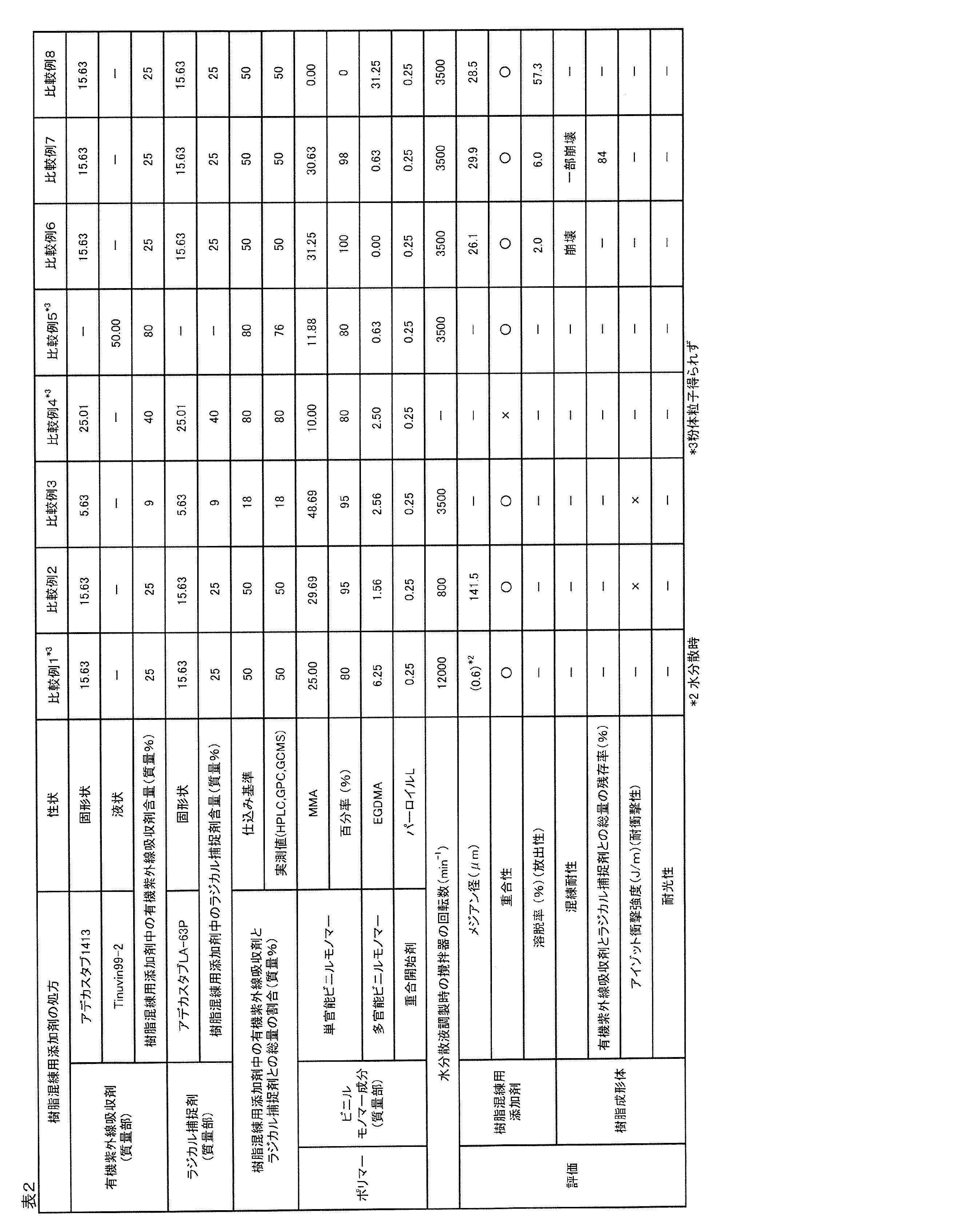
- Example 2 to Example 11 and Comparative Example 1 to Comparative Example 8 The same treatment as in Example 1 was carried out to obtain an additive for resin kneading. However, the formulation and treatment were changed according to the description in Tables 1 and 2.
- Comparative Example 1 when the suspension was dried, the resin kneading additive aggregated and fused. Even if this resin kneading additive was loosened, it could not be prepared as powder particles suitable for blending with a resin described later. Further, in Comparative Example 4, Adecastab 1413 and Adecastab LA-63P did not dissolve in the vinyl monomer component, and a hydrophobic solution could not be prepared. Therefore, suspension polymerization could not be carried out and powder particles could not be obtained. In Comparative Example 5, powder particles could not be obtained due to the fusion of the resins due to the liquid Tinuvin99-2.
- the suspension was measured with a laser diffraction / scattering type particle size distribution measuring device LA-960V2 (manufactured by HORIBA, Ltd.) to determine the median diameter of the resin kneading additive.
- ⁇ Ratio of total amount of organic UV absorbers and radical scavengers in powder particles The ratio of the total amount of the organic ultraviolet absorber and the radical scavenger in the powder particles was determined. Specifically, the total amount of the organic UV absorber and radical scavenger of the powder particles is extracted with tetrahydrofuran, and the organic UV absorber and radical scavenger are used by using at least one selected from HPLC, GPC and GCMS. The mass percentage of the agent was measured respectively.
- the conditions of the mobile phase and the measuring device are as follows.
- a resin composition is obtained by dry-blending a resin kneading additive and a low-density polyethylene resin (“Novatec LD” LF441MD1, MFR: 2.0 g / 10 min, density: 0.924 g / cm 3 , manufactured by Japan Polyethylene Corporation).
- Novatec LD Low-density polyethylene resin
- MFR 2.0 g / 10 min
- density 0.924 g / cm 3
- the resin composition was kneaded at 160 ° C. using a twin-screw extruder (Process 11 desktop twin-screw extruder manufactured by Thermo Scientific Co., Ltd.) to form pellets (resin molded product).
- the resin kneading additive of Example 1 maintained the shape of the powder particles.
- the resin kneading additive of Example 3 also maintained the shape of the powder particles.
- the pellets were melted again through the above twin-screw extruder and molded into a rod-shaped resin molded body having a length of 80 mm, a width of 10 mm and a thickness of 4 mm by the injection molding machine MiniJet Pro of the same company.
- a notch was formed in the resin molded body with a notch processing machine (manufactured by Yasuda Seiki Seisakusho).
- the notch had a size with a depth of cut of 2 mm in the central portion in the longitudinal direction.
- the Izod impact strength was measured at ⁇ 40 ° C. in accordance with JIS K7110.
- the impact resistance of the resin molded product was evaluated based on the following criteria.
- the Izod impact strength was 35.0 J / m or more.
- X The Izod impact strength was less than 35.0 J / m.
- Each test piece was subjected to a light resistance promotion test of 180 W / m 2 , 1600 hours with a super xenon weather meter SX75 (manufactured by Suga Test Instruments Co., Ltd.), and the light resistance was evaluated according to the following criteria.
- Comparative Example 1 it is considered that the median diameter of the resin kneading additive is small. Therefore, the particles are strongly aggregated with each other during drying. As a result, it is presumed that the light resistance of the resin molded product cannot be sufficiently enhanced even if it is blended with the resin.
- the percentage of the total amount of the organic ultraviolet absorber and the radical scavenger in the resin kneading additive is less than 20% by mass. Therefore, in order to secure the ultraviolet absorbing ability and the radical scavenging ability in the resin molded body, a large amount of resin kneading additive must be added to the low density polyethylene resin. Then, the ratio of the low-density polyethylene resin in the resin molded body decreases, and the strength peculiar to the low-density polyethylene resin cannot be sufficiently exhibited.
- the ratio of the total amount of the organic ultraviolet absorber and the radical scavenger to the total amount of the vinyl monomer component, the organic ultraviolet absorber and the radical scavenger exceeds 80% by mass, and the organic ultraviolet absorber and the organic ultraviolet absorber
- the radical scavenger is liquid at 25 ° C. Therefore, it is not possible to obtain an additive for resin kneading as powder particles due to the fusion of particles based on a large amount of organic ultraviolet absorbers and radical scavengers.
- the resin kneading additive is added to the resin and molded into a resin molded body.
Landscapes
- Chemical & Material Sciences (AREA)
- Health & Medical Sciences (AREA)
- Chemical Kinetics & Catalysis (AREA)
- Medicinal Chemistry (AREA)
- Polymers & Plastics (AREA)
- Organic Chemistry (AREA)
- Compositions Of Macromolecular Compounds (AREA)
- Polymerisation Methods In General (AREA)
Abstract
Description
・Tinuvin99-2:ベンゾトリアゾール系紫外線吸収剤、純度95%、25℃で液状、BASF社製
・Tinuvin460:トリアジン系紫外線吸収剤、25℃で固形状、BASF社製
・アデカスタブLA-63P:ヒンダードアミン系ラジカル捕捉剤、25℃で固形状、アデカ社製
・Tinuvin292:ヒンダードアミン系ラジカル捕捉剤、25℃で液状、BASF社製
・Irganox1010:ヒンダードフェノール系ラジカル捕捉剤、25℃で固形状、BASF社製
・MMA:メタクリル酸メチル、単官能性ビニルモノマー、商品名「ライトエステルM」(ライトエステルは登録商標)、共栄社化学社製
スチレン:スチレンモノマー、単官能性ビニルモノマー、和光特級試薬、富士フイルム和光純薬社製
・EGDMA:エチレングリコールジメタクリレート、多官能性ビニルモノマー、商品名「ライトエステルEG」(ライトエステルは登録商標)、共栄社化学社製
・DVB:ジビニルベンゼン、多官能ビニルモノマー、異性体混合物、純度93%以上、富士フイルム和光純薬社製
・パーロイルL:商品名、ジラウロイルパーオキシド、重合開始剤、日油社製
・パーヘキシルO:商品名、t-ヘキシルペルオキシ-2-エチルヘキサノエイト、重合開始剤、日油社製
・プロノン208:商品名、ポリオキシエチレンポリオキシプロピレンブロックコポリマー、乳化剤、日油社製
・ポバール22―88:商品名、部分鹸化ポリビニルアルコール、分散剤、クラレ社製
・デモールNL:商品名、β-ナフタレンスルホン酸ホルムアルデヒド縮合物ナトリウム塩の41%水溶液、分散剤、花王社製
実施例1と同様に処理して、樹脂混練用添加剤を得た。但し、配合処方および処理は、表1および表2の記載に従って変更した。比較例1では、懸濁液の乾燥時に、樹脂混練用添加剤が凝集して融着した。この樹脂混練用添加剤をほぐしても、後述する樹脂との配合に適する粉体粒子として調製することができなかった。また、比較例4では、アデカスタブ1413およびアデカスタブLA-63Pがビニルモノマー成分に溶解せず、疎水性溶液を調製できなった。そのため、懸濁重合を実施できず、粉体粒子を得ることができなかった。比較例5では、液状のTinuvin99-2に起因する樹脂同士の融着により、粉体粒子を得ることができなかった。
各実施例および比較例の樹脂混練用添加剤と、それを含む樹脂成形体とのそれぞれについて、下記評価を実施した。それらの結果を表1および表2に記載する。
<重合性>
比較例4は、疎水性溶液を調製できなった。そのため、懸濁重合を実施できなかった。そのため、重合性を「×」と評価した。一方、それ以外の比較例と、全ての実施例は、懸濁重合を実施できた。そのため、重合性を「○」と評価した。
懸濁液をレーザー回折散乱式粒子径分布測定装置LA-960V2(堀場製作所社製)で測定して、樹脂混練用添加剤のメジアン径を求めた。
粉体粒子における有機紫外線吸収剤およびラジカル捕捉剤の総量の割合を求めた。具体的には、テトラヒドロフランで粉体粒子の有機紫外線吸収剤およびラジカル捕捉剤の総量を抽出し、HPLC、GPCおよびGCMSのうちから選択される少なくとも1つを用いて、有機紫外線吸収剤およびラジカル捕捉剤の質量百分率をそれぞれ測定した。移動相および測定装置の条件は、以下の通りである。
移動相:アセトニトリル/水=8/2(質量基準)
カラム:YMC-Pack ODS-A(ワイエムシィ社製)
カラム温度:40℃
検出器:フォトダイオードアレイ検出器(SPD-M20A、島津製作所社製)
移動相:テトラヒドロフラン
カラム:KF-801(昭和電工社製)
カラム温度:40℃
検出器:示差屈折率検出器(RID-M20A、島津製作所社製)
移動相:高純度He
カラム:Rtx-5 Amine(Restek社製)
カラム温度:300℃
検出器:質量分析計(GCMS-QP2010Ultra、島津製作所社製)
樹脂混練用添加剤0.1gを1Kビンに測り取り、そこへ流動パラフィン(モレスコホワイトP-70、平均分子量:323、動粘度:12.56mm2/s(40℃)、密度:0.843g/cm3(15℃)、MORESCO社製)を2.5g加えた。1日静置後、0.45μmフィルターでろ過し、流動パラフィン中に放出された有機紫外線吸収剤およびラジカル捕捉剤の合計量をHPLC、GPCおよびGCMSのうちから選択される少なくとも1つを用いて測定した。これにより、有機紫外線吸収剤およびラジカル捕捉剤の合計の溶脱率を求めた。
ペレットを評価するために、まず、樹脂混練用添加剤と樹脂とを配合した。配合は、以下の通りである。
樹脂成形体における樹脂添加剤を、簡易卓上SEM(日立ハイテクノロジーズ社製Miniscope TM-3000)で状態を観察した。図1から図3のそれぞれに、実施例1、比較例6および比較例7のSEM写真の画像処理図を示す。
ペレットにおける有機紫外線吸収剤およびラジカル捕捉剤の総量をテトラヒドロフランで抽出した。抽出液中の有機紫外線吸収剤およびラジカル捕捉剤の合計をHPLC、GPCおよびGCMSのうちから選択される少なくとも1つを用いて測定し、有機紫外線吸収剤およびラジカル捕捉剤の総量の残存率を評価した。具体的な抽出条件は、以下の通りである。
テトラヒドロフラン量:5mL
抽出時間:3日間
×:アイゾット衝撃強度が35.0J/m未満であった。
ペレットと、低密度ポリエチレン樹脂(「ノバテックLD」LF441MD)とをドライブレンドし、二軸押出機(サーモサイエンティフィック社製MiniCTW)を通して溶融し、同社の射出成形機MiniJetで、長さ50mm、幅10mm、厚み1mmの試験片を成形した。有機紫外線吸収剤と、ラジカル捕捉剤との質量部数を、低密度ポリエチレン樹脂100質量部に対して、それぞれ、0.2質量部に調整した。各試験片を、スーパーキセノンウェザーメーターSX75(スガ試験機社製)で180W/m2、1600時間の耐光促進試験を実施し、下記の基準で、耐光性を評価した。
×:目視にて試験片にひび割れを確認できた。
その結果、樹脂組成物を組成した後の混練成形において変形または崩壊する。従って、樹脂成形体においてブリードを生じる。

Claims (4)
- 有機紫外線吸収剤および/またはラジカル捕捉剤と、前記有機紫外線吸収剤および/または前記ラジカル捕捉剤を分散するポリマーとを含有する樹脂混練用添加剤であり、
前記樹脂混練用添加剤は、粉体粒子であり、
1μm以上、100μm以下のメジアン径を有し、
前記樹脂混練用添加剤における前記有機紫外線吸収剤および前記ラジカル捕捉剤の総量の百分率が、20質量%以上、70質量%以下であり、
前記ポリマーは、重合性の炭素-炭素二重結合を分子内に1つのみ含有する単官能ビニルモノマーと、重合性の炭素-炭素二重結合を分子内に2つ以上含有する多官能ビニルモノマーとを含有するビニルモノマー成分の共重合体であり、
前記単官能ビニルモノマーと前記多官能ビニルモノマーとの総量における前記単官能ビニルモノマーの百分率が、10質量%以上、95質量%以下であることを特徴とする、樹脂混練用添加剤。 - 前記単官能ビニルモノマーの百分率が、55質量%以上であることを特徴とする、請求項1に記載の樹脂混練用添加剤。
- 前記メジアン径が、5μm以上、30μm以下であることを特徴とする、請求項1に記載の樹脂混練用添加剤。
- 前記メジアン径が、5μm以上、30μm以下であることを特徴とする、請求項2に記載の樹脂混練用添加剤。
Priority Applications (3)
| Application Number | Priority Date | Filing Date | Title |
|---|---|---|---|
| JP2021572614A JP7030252B1 (ja) | 2020-09-11 | 2021-09-10 | 樹脂混練用添加剤 |
| EP21866850.7A EP4212577A4 (en) | 2020-09-11 | 2021-09-10 | ADDITIVE FOR RESIN MIXING |
| US18/044,437 US20230365761A1 (en) | 2020-09-11 | 2021-09-10 | Additive for resin kneading |
Applications Claiming Priority (2)
| Application Number | Priority Date | Filing Date | Title |
|---|---|---|---|
| JP2020153318 | 2020-09-11 | ||
| JP2020-153318 | 2020-09-11 |
Publications (1)
| Publication Number | Publication Date |
|---|---|
| WO2022054893A1 true WO2022054893A1 (ja) | 2022-03-17 |
Family
ID=80632182
Family Applications (1)
| Application Number | Title | Priority Date | Filing Date |
|---|---|---|---|
| PCT/JP2021/033243 Ceased WO2022054893A1 (ja) | 2020-09-11 | 2021-09-10 | 樹脂混練用添加剤 |
Country Status (4)
| Country | Link |
|---|---|
| US (1) | US20230365761A1 (ja) |
| EP (1) | EP4212577A4 (ja) |
| JP (1) | JP7030252B1 (ja) |
| WO (1) | WO2022054893A1 (ja) |
Citations (8)
| Publication number | Priority date | Publication date | Assignee | Title |
|---|---|---|---|---|
| JPS5815502A (ja) * | 1981-07-21 | 1983-01-28 | Dainippon Ink & Chem Inc | 重合体分散液の製造法 |
| JPH07292009A (ja) * | 1994-04-22 | 1995-11-07 | Dainippon Ink & Chem Inc | 樹脂水性分散液の製造方法 |
| JP2012207013A (ja) | 2011-03-11 | 2012-10-25 | Japan Enviro Chemicals Ltd | 徐放性粒子およびその製造方法 |
| JP2012207012A (ja) | 2011-03-11 | 2012-10-25 | Japan Enviro Chemicals Ltd | 徐放性粒子 |
| WO2014010492A1 (ja) * | 2012-07-10 | 2014-01-16 | 株式会社Adeka | 混合ペレット |
| JP2015091980A (ja) | 2003-09-11 | 2015-05-14 | チバ ホールディング インコーポレーテッドCiba Holding Inc. | ヘテロフェーズ重合技術によって製造された光安定剤の水性濃厚生成物形態 |
| JP2016011299A (ja) | 2014-06-05 | 2016-01-21 | 大阪ガスケミカル株式会社 | 処理剤、木材保存剤および塗料 |
| WO2019042999A1 (en) * | 2017-09-01 | 2019-03-07 | Basf Se | FORMS OF CONCENTRATED WATER-BASED PRODUCT OF OIL-SOLUBLE ORGANIC UV-ABSORBS |
Family Cites Families (4)
| Publication number | Priority date | Publication date | Assignee | Title |
|---|---|---|---|---|
| US5274016A (en) * | 1985-12-06 | 1993-12-28 | Ciba-Geigy Corporation | Light-stabilized polymer microparticles |
| DE10254548A1 (de) * | 2002-11-21 | 2004-06-17 | Basf Ag | Verwendung UV-Absorber enthaltender Polymerpulver zur Stabilisierung von Polymeren gegen die Einwirkung von UV-Strahlung |
| DE102004012576A1 (de) * | 2004-03-12 | 2005-09-29 | Basf Ag | Effektstoffe enthaltende wässrige Polymerdispersionen, Verfahren zu ihrer Herstellung und ihre Verwendung |
| US20090318617A1 (en) * | 2006-03-16 | 2009-12-24 | Basf Se | Polymer dispersions comprising effect substances and use thereof |
-
2021
- 2021-09-10 JP JP2021572614A patent/JP7030252B1/ja active Active
- 2021-09-10 WO PCT/JP2021/033243 patent/WO2022054893A1/ja not_active Ceased
- 2021-09-10 US US18/044,437 patent/US20230365761A1/en active Pending
- 2021-09-10 EP EP21866850.7A patent/EP4212577A4/en not_active Withdrawn
Patent Citations (8)
| Publication number | Priority date | Publication date | Assignee | Title |
|---|---|---|---|---|
| JPS5815502A (ja) * | 1981-07-21 | 1983-01-28 | Dainippon Ink & Chem Inc | 重合体分散液の製造法 |
| JPH07292009A (ja) * | 1994-04-22 | 1995-11-07 | Dainippon Ink & Chem Inc | 樹脂水性分散液の製造方法 |
| JP2015091980A (ja) | 2003-09-11 | 2015-05-14 | チバ ホールディング インコーポレーテッドCiba Holding Inc. | ヘテロフェーズ重合技術によって製造された光安定剤の水性濃厚生成物形態 |
| JP2012207013A (ja) | 2011-03-11 | 2012-10-25 | Japan Enviro Chemicals Ltd | 徐放性粒子およびその製造方法 |
| JP2012207012A (ja) | 2011-03-11 | 2012-10-25 | Japan Enviro Chemicals Ltd | 徐放性粒子 |
| WO2014010492A1 (ja) * | 2012-07-10 | 2014-01-16 | 株式会社Adeka | 混合ペレット |
| JP2016011299A (ja) | 2014-06-05 | 2016-01-21 | 大阪ガスケミカル株式会社 | 処理剤、木材保存剤および塗料 |
| WO2019042999A1 (en) * | 2017-09-01 | 2019-03-07 | Basf Se | FORMS OF CONCENTRATED WATER-BASED PRODUCT OF OIL-SOLUBLE ORGANIC UV-ABSORBS |
Non-Patent Citations (1)
| Title |
|---|
| See also references of EP4212577A4 |
Also Published As
| Publication number | Publication date |
|---|---|
| JP7030252B1 (ja) | 2022-03-04 |
| EP4212577A1 (en) | 2023-07-19 |
| JPWO2022054893A1 (ja) | 2022-03-17 |
| EP4212577A4 (en) | 2024-09-18 |
| US20230365761A1 (en) | 2023-11-16 |
Similar Documents
| Publication | Publication Date | Title |
|---|---|---|
| CN111662414B (zh) | 橡胶质聚合物、接枝共聚物和热塑性树脂组合物 | |
| Liu et al. | Preparation of nanosilica-immobilized antioxidant and the antioxidative behavior in low density polyethylene | |
| CN105683229A (zh) | 聚烯烃/(甲基)丙烯酸冲击改性剂和其制备方法 | |
| JP5794146B2 (ja) | ポリオレフィン系樹脂用添加剤のための分散剤、ポリオレフィン系樹脂組成物及び成形体 | |
| CN106232648A (zh) | 具有最佳残余单体含量的热塑性成型化合物 | |
| CN101133088B (zh) | 聚合物粒子、含有它的树脂组合物、成型体 | |
| JP7030252B1 (ja) | 樹脂混練用添加剤 | |
| CN109790346B (zh) | 抗电离辐射的热塑性树脂组合物以及包含其的模制品 | |
| JP2015017221A5 (ja) | ||
| JP2008231365A (ja) | ポリ乳酸系樹脂組成物、およびそれを成形してなる成形体 | |
| JP2019065059A (ja) | グラフト共重合体からなる粉末及びその製造方法 | |
| JP7592619B2 (ja) | Asa系樹脂組成物、それを含む成形品及びその成形品の製造方法 | |
| JP2014189617A (ja) | 水性エマルション | |
| TWI865622B (zh) | 丙烯酸酯化合物-苯乙烯-丙烯腈(asa)系樹脂組成物、含有asa系樹脂組成物之模製物品及製造模製物品之方法 | |
| JP2024075401A (ja) | 粒子の水分散液の製造方法 | |
| KR101540542B1 (ko) | 메틸메타크릴레이트-부타디엔-스티렌계 충격보강제 및 이를 포함하는 폴리카보네이트 수지 조성물 | |
| WO2013147313A1 (ja) | 太陽電池封止材用ペレットの互着防止方法 | |
| JP2016117867A (ja) | ポリブチレンテレフタレート樹脂組成物及び成形体 | |
| WO2020218398A1 (ja) | 樹脂組成物、樹脂組成物の製造方法、セルロース繊維組成物、補強材および成形品 | |
| KR20160141810A (ko) | 개선된 기계적 특성을 지닌 열가소성 성형 조성물의 제조 방법 | |
| CN113087997A (zh) | 包含具有可水解硅烷基团的可交联聚烯烃和催化剂的聚合物组合物 | |
| CN103282431A (zh) | 具有优良的耐热性和耐候性的低光泽度热塑性树脂组合物 | |
| AU2006320634B2 (en) | Weatherable, high modulus polymer compositions and method | |
| JPH10310684A (ja) | エポキシ樹脂組成物 | |
| CN115260646A (zh) | 一种阻燃抗菌热塑性树脂组合物及其制备方法和应用 |
Legal Events
| Date | Code | Title | Description |
|---|---|---|---|
| ENP | Entry into the national phase |
Ref document number: 2021572614 Country of ref document: JP Kind code of ref document: A |
|
| 121 | Ep: the epo has been informed by wipo that ep was designated in this application |
Ref document number: 21866850 Country of ref document: EP Kind code of ref document: A1 |
|
| NENP | Non-entry into the national phase |
Ref country code: DE |
|
| ENP | Entry into the national phase |
Ref document number: 2021866850 Country of ref document: EP Effective date: 20230411 |
|
| WWW | Wipo information: withdrawn in national office |
Ref document number: 2021866850 Country of ref document: EP |