WO2022056238A1 - Solid dispersion formulations of an fxr agonist - Google Patents
Solid dispersion formulations of an fxr agonist Download PDFInfo
- Publication number
- WO2022056238A1 WO2022056238A1 PCT/US2021/049826 US2021049826W WO2022056238A1 WO 2022056238 A1 WO2022056238 A1 WO 2022056238A1 US 2021049826 W US2021049826 W US 2021049826W WO 2022056238 A1 WO2022056238 A1 WO 2022056238A1
- Authority
- WO
- WIPO (PCT)
- Prior art keywords
- compound
- pharmaceutical composition
- formula
- weight
- polymer
- Prior art date
- Legal status (The legal status is an assumption and is not a legal conclusion. Google has not performed a legal analysis and makes no representation as to the accuracy of the status listed.)
- Ceased
Links
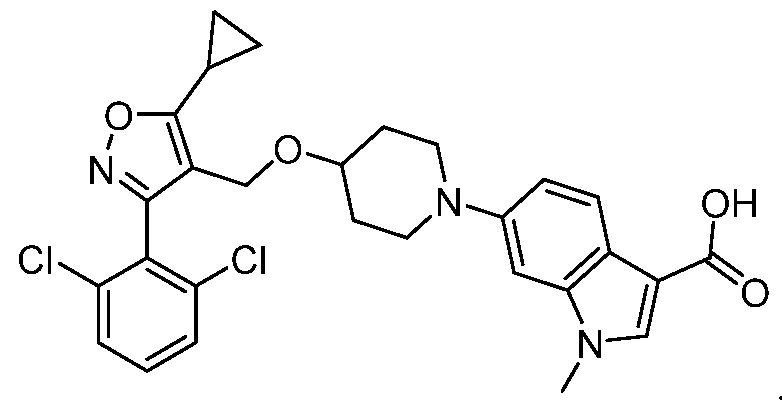
- RPVDFHPBGBMWID-UHFFFAOYSA-N C[n]1c(cc(cc2)N(CC3)CCC3OCc3c(C4CC4)[o]nc3-c(c(Cl)ccc3)c3Cl)c2c(C(O)=O)c1 Chemical compound C[n]1c(cc(cc2)N(CC3)CCC3OCc3c(C4CC4)[o]nc3-c(c(Cl)ccc3)c3Cl)c2c(C(O)=O)c1 RPVDFHPBGBMWID-UHFFFAOYSA-N 0.000 description 1
Classifications
-
- A—HUMAN NECESSITIES
- A61—MEDICAL OR VETERINARY SCIENCE; HYGIENE
- A61K—PREPARATIONS FOR MEDICAL, DENTAL OR TOILETRY PURPOSES
- A61K31/00—Medicinal preparations containing organic active ingredients
- A61K31/33—Heterocyclic compounds
- A61K31/395—Heterocyclic compounds having nitrogen as a ring hetero atom, e.g. guanethidine or rifamycins
- A61K31/435—Heterocyclic compounds having nitrogen as a ring hetero atom, e.g. guanethidine or rifamycins having six-membered rings with one nitrogen as the only ring hetero atom
- A61K31/44—Non condensed pyridines; Hydrogenated derivatives thereof
- A61K31/445—Non condensed piperidines, e.g. piperocaine
- A61K31/4523—Non condensed piperidines, e.g. piperocaine containing further heterocyclic ring systems
- A61K31/454—Non condensed piperidines, e.g. piperocaine containing further heterocyclic ring systems containing a five-membered ring with nitrogen as a ring hetero atom, e.g. pimozide, domperidone
-
- A—HUMAN NECESSITIES
- A61—MEDICAL OR VETERINARY SCIENCE; HYGIENE
- A61K—PREPARATIONS FOR MEDICAL, DENTAL OR TOILETRY PURPOSES
- A61K47/00—Medicinal preparations characterised by the non-active ingredients used, e.g. carriers or inert additives; Targeting or modifying agents chemically bound to the active ingredient
- A61K47/30—Macromolecular organic or inorganic compounds, e.g. inorganic polyphosphates
- A61K47/32—Macromolecular compounds obtained by reactions only involving carbon-to-carbon unsaturated bonds, e.g. carbomers, poly(meth)acrylates, or polyvinyl pyrrolidone
-
- A—HUMAN NECESSITIES
- A61—MEDICAL OR VETERINARY SCIENCE; HYGIENE
- A61K—PREPARATIONS FOR MEDICAL, DENTAL OR TOILETRY PURPOSES
- A61K9/00—Medicinal preparations characterised by special physical form
- A61K9/14—Particulate form, e.g. powders, Processes for size reducing of pure drugs or the resulting products, Pure drug nanoparticles
- A61K9/141—Intimate drug-carrier mixtures characterised by the carrier, e.g. ordered mixtures, adsorbates, solid solutions, eutectica, co-dried, co-solubilised, co-kneaded, co-milled, co-ground products, co-precipitates, co-evaporates, co-extrudates, co-melts; Drug nanoparticles with adsorbed surface modifiers
- A61K9/146—Intimate drug-carrier mixtures characterised by the carrier, e.g. ordered mixtures, adsorbates, solid solutions, eutectica, co-dried, co-solubilised, co-kneaded, co-milled, co-ground products, co-precipitates, co-evaporates, co-extrudates, co-melts; Drug nanoparticles with adsorbed surface modifiers with organic macromolecular compounds
-
- A—HUMAN NECESSITIES
- A61—MEDICAL OR VETERINARY SCIENCE; HYGIENE
- A61K—PREPARATIONS FOR MEDICAL, DENTAL OR TOILETRY PURPOSES
- A61K9/00—Medicinal preparations characterised by special physical form
- A61K9/14—Particulate form, e.g. powders, Processes for size reducing of pure drugs or the resulting products, Pure drug nanoparticles
- A61K9/16—Agglomerates; Granulates; Microbeadlets ; Microspheres; Pellets; Solid products obtained by spray drying, spray freeze drying, spray congealing,(multiple) emulsion solvent evaporation or extraction
- A61K9/1605—Excipients; Inactive ingredients
- A61K9/1629—Organic macromolecular compounds
- A61K9/1635—Organic macromolecular compounds obtained by reactions only involving carbon-to-carbon unsaturated bonds, e.g. polyvinyl pyrrolidone, poly(meth)acrylates
-
- A—HUMAN NECESSITIES
- A61—MEDICAL OR VETERINARY SCIENCE; HYGIENE
- A61K—PREPARATIONS FOR MEDICAL, DENTAL OR TOILETRY PURPOSES
- A61K9/00—Medicinal preparations characterised by special physical form
- A61K9/14—Particulate form, e.g. powders, Processes for size reducing of pure drugs or the resulting products, Pure drug nanoparticles
- A61K9/16—Agglomerates; Granulates; Microbeadlets ; Microspheres; Pellets; Solid products obtained by spray drying, spray freeze drying, spray congealing,(multiple) emulsion solvent evaporation or extraction
- A61K9/1605—Excipients; Inactive ingredients
- A61K9/1629—Organic macromolecular compounds
- A61K9/1641—Organic macromolecular compounds obtained otherwise than by reactions only involving carbon-to-carbon unsaturated bonds, e.g. polyethylene glycol, poloxamers
-
- A—HUMAN NECESSITIES
- A61—MEDICAL OR VETERINARY SCIENCE; HYGIENE
- A61K—PREPARATIONS FOR MEDICAL, DENTAL OR TOILETRY PURPOSES
- A61K9/00—Medicinal preparations characterised by special physical form
- A61K9/20—Pills, tablets, discs, rods
- A61K9/2004—Excipients; Inactive ingredients
- A61K9/2022—Organic macromolecular compounds
- A61K9/2027—Organic macromolecular compounds obtained by reactions only involving carbon-to-carbon unsaturated bonds, e.g. polyvinyl pyrrolidone, poly(meth)acrylates
-
- A—HUMAN NECESSITIES
- A61—MEDICAL OR VETERINARY SCIENCE; HYGIENE
- A61K—PREPARATIONS FOR MEDICAL, DENTAL OR TOILETRY PURPOSES
- A61K9/00—Medicinal preparations characterised by special physical form
- A61K9/20—Pills, tablets, discs, rods
- A61K9/2004—Excipients; Inactive ingredients
- A61K9/2022—Organic macromolecular compounds
- A61K9/2031—Organic macromolecular compounds obtained otherwise than by reactions only involving carbon-to-carbon unsaturated bonds, e.g. polyethylene glycol, polyethylene oxide, poloxamers
- A61K9/2045—Polyamides; Polyaminoacids, e.g. polylysine
-
- A—HUMAN NECESSITIES
- A61—MEDICAL OR VETERINARY SCIENCE; HYGIENE
- A61K—PREPARATIONS FOR MEDICAL, DENTAL OR TOILETRY PURPOSES
- A61K9/00—Medicinal preparations characterised by special physical form
- A61K9/48—Preparations in capsules, e.g. of gelatin, of chocolate
- A61K9/4816—Wall or shell material
- A61K9/4825—Proteins, e.g. gelatin
-
- A—HUMAN NECESSITIES
- A61—MEDICAL OR VETERINARY SCIENCE; HYGIENE
- A61K—PREPARATIONS FOR MEDICAL, DENTAL OR TOILETRY PURPOSES
- A61K9/00—Medicinal preparations characterised by special physical form
- A61K9/48—Preparations in capsules, e.g. of gelatin, of chocolate
- A61K9/4841—Filling excipients; Inactive ingredients
- A61K9/4866—Organic macromolecular compounds
-
- C—CHEMISTRY; METALLURGY
- C07—ORGANIC CHEMISTRY
- C07D—HETEROCYCLIC COMPOUNDS
- C07D413/00—Heterocyclic compounds containing two or more hetero rings, at least one ring having nitrogen and oxygen atoms as the only ring hetero atoms
- C07D413/14—Heterocyclic compounds containing two or more hetero rings, at least one ring having nitrogen and oxygen atoms as the only ring hetero atoms containing three or more hetero rings
Definitions
- Therapeutic agents that function as famesoid X receptor (FXR) agonists have the potential to remedy or improve the lives of patients in need of treatment of liver disorders such as liver inflammation, liver fibrosis, alcohol induced fibrosis, steatosis, alcoholic steatosis, primary sclerosing cholangitis (PSC), primary biliary cirrhosis (PBC), nonalcoholic fatty liver disease (NAFLD), and non-alcoholic steatohepatitis (NASH).
- FXR famesoid X receptor
- Compound I is a potent FXR agonist being developed as a therapeutic for liver disorders.
- Compound I is a BCS class II compound with low aqueous solubility. Therefore, there remains a need for Compound I formulations with improved pharmacokinetic properties.
- solid dispersions comprising Compound I.
- Special fed Dogs were fed with standard canine food 30 minutes prior to test article dosing; fasted: dogs were fasted overnight, and food returned about 4 hour post-dose;
- pentagastrin treatment intramuscular injection of pentagastrin at 6 pg/kg 15 minuets prior to test article dosing;
- famotidine treatment famotidine was administered at 20 mg/dog 30 minutes prior to test article dosing.
- the terms “about” and “approximately,” when used in connection with a value contemplate a variation within ⁇ 15%, within ⁇ 10%, within ⁇ 5%, within ⁇ 4%, within ⁇ 3%, within ⁇ 2%, within ⁇ 1%, or within ⁇ 0.5% of the specified value.
- Reference to “about” a value or parameter herein includes (and describes) embodiments that are directed to that value or parameter per se. For example, description referring to “about X” includes description of “X”.
- solid dispersion refers to a composition in a solid state comprising at least two components, wherein one component is dispersed in the other component or components.
- a therapeutic agent may be dispersed in a matrix comprising a polymer.
- pharmaceutically acceptable or “pharmacologically acceptable” is meant a material that is not biologically or otherwise undesirable, e.g., the material may be incorporated into a pharmaceutical composition administered to a patient without causing any significant undesirable biological effects or interacting in a deleterious manner with any of the other components of the composition in which it is contained.
- Pharmaceutically acceptable carriers or excipients have preferably met the required standards of toxicological and manufacturing testing and/or are included on the Inactive Ingredient Guide prepared by the U.S. Food and Drug administration.
- excipient refers to an inactive substance with which the active ingredient is administered.
- excipients include, but are not limited to, glidants, diluents, disintegrants, lubricants, or vehicles.
- treatment is an approach for obtaining beneficial or desired results including clinical results.
- beneficial or desired results include, but are not limited to, one or more of the following: decreasing one or more symptoms resulting from the disease or disorder, diminishing the extent of the disease or disorder, stabilizing the disease or disorder (e.g., preventing or delaying the worsening of the disease or disorder), delaying the occurrence or recurrence of the disease or disorder, delaying or slowing the progression of the disease or disorder, ameliorating the disease or disorder state, providing a remission (whether partial or total) of the disease or disorder, decreasing the dose of one or more other medications required to treat the disease or disorder, enhancing the effect of another medication used to treat the disease or disorder, delaying the progression of the disease or disorder, increasing the quality of life, and/or prolonging survival of a patient.
- treatment is a reduction of pathological consequence of the disease or disorder.
- the methods of this disclosure contemplate any one or more of
- the term “subject” refers to an animal, including, but are not limited to, a primate (e.g., human), monkey, cow, pig, sheep, goat, horse, dog, cat, rabbit, rat, or mouse.
- a primate e.g., human
- monkey cow, pig, sheep, goat
- horse dog, cat, rabbit, rat
- patient are used interchangeably herein in reference, for example, to a mammalian subject, such as a human.
- the term “therapeutically effective amount” refers to an amount of a compound or composition sufficient to treat a specified disorder, condition or disease such as to ameliorate, to palliate, to lessen, and/or to delay one or more of its symptoms.
- the term “substantially free of’ means that the composition contains the indicated substance or substances in an amount of less than about 25%, less than about 20%, less than about 15%, less than about 10%, less than about 5%, less than about 4%, less than about 3%, less than about 2%, or less than about 1% by weight.
- a solid dispersion comprising Compound I having the formula: wherein the compound is substantially amorphous and is dispersed in a polymer.
- the term “substantially amorphous” means that more than about 50%, more than about 60%, more than about 70%, more than about 75%, more than about 80%, more than about 85%, more than about 90%, more than about 95%, more than about 96%, more than about 97%, more than about 98%, more than about 99%, or more than about 99.9% by weight of Compound I in the solid dispersion is amorphous. In some embodiments, more than about 90% of Compound I in the solid dispersion is amorphous. In some embodiments, more than about 95% by weight of Compound I in the solid dispersion is amorphous.
- more than about 96% by weight of Compound I in the solid dispersion is amorphous. In some embodiments, more than about 97% by weight of Compound I in the solid dispersion is amorphous. In some embodiments, more than about 98% by weight of Compound I in the solid dispersion is amorphous. In some embodiments, more than about 99% by weight of Compound I in the solid dispersion is amorphous. In some embodiments, more than about 99.9% by weight of Compound I in the solid dispersion is amorphous. In some embodiments, the solid dispersion is substantially free of a crystalline form of Compound I.
- the polymer is a hydrophilic polymer.
- hydrophilic polymers include, but are not limited to, homopolymers and copolymers of vinyl lactams (e.g, homopolymers and copolymers of vinylpyrrolidone or vinylcaprolactam); polyethylene glycols; celluloses, cellulose esters and cellulose ethers (e.g, methylcellulose, hydroxypropyl methylcellulose, hydroxypropyl methylcellulose acetate succinate, and hydroxypropyl methylcellulose phthalate); polyacrylates (e.g, ammonio methacrylate copolymer and polyacrylic acid); and mixtures thereof.
- vinyl lactams e.g, homopolymers and copolymers of vinylpyrrolidone or vinylcaprolactam
- polyethylene glycols celluloses, cellulose esters and cellulose ethers (e.g, methylcellulose, hydroxypropyl methylcellulose, hydroxypropyl methylcellulose acetate succinate, and
- the polymer is a homopolymer or a copolymer of a vinyl lactam. In some embodiments, the polymer is a homopolymer or a copolymer of vinylpyrrolidone or vinylcaprolactam. In some embodiments, the polymer is a homopolymer or a copolymer of vinylpyrrolidone (e.g., poly(vinylpyrrolidone) or vinyl pyrrolidone-vinyl acetate copolymer). In some embodiments, the polymer is a vinylpyrrolidone-vinyl acetate copolymer (e.g., the product sold under the trademark Kollidon® VA64).
- vinylpyrrolidone-vinyl acetate copolymer e.g., the product sold under the trademark Kollidon® VA64.
- the polymer is a homopolymer or a copolymer of vinylcaprolactam (e.g., poly(vinylcaprolactam) or vinylcaprolactam-vinyl acetate-ethylene glycol copolymer).
- the polymer is vinylcaprolactam-vinyl acetate-ethylene glycol copolymer (e.g., the product sold under the trademark Soluplus®).
- the polymer is vinylpyrrolidone-vinyl acetate copolymer or vinylcaprolactam-vinyl acetate- ethylene glycol copolymer.
- the vinylcaprolactam-vinyl acetate- ethylene glycol copolymer is a vinylcaprolactam-vinyl acetate-ethylene glycol graft copolymer.
- the weight ratio of Compound I to the polymer is between about 1 : 1 and about 1 :20, between about 1 : 1 and about 1:15, between about 1 : 1 and about 1:10, between about 1 : 1 and about 1 : 9, between about 1 : 1 and about 1:8, between about 1 : 1 and about 1:7, between about 1:1 and about 1:6, between about 1:1 and about 1:5, between about 1:1 and about 1:4, between about 1:1 and about 1:3, or between about 1:1 and about 1:2.
- the weight ratio of Compound I to the polymer is about 1:1, about 1:2, about 1:3, about 1:4, about 1:5, about 1:6, about 1:7, about 1:8, about 1:9, about 1:10, about 1:15, or about 1:20. In some embodiments, the weight ratio of Compound I to the polymer is between about 1:1 and about 1:10. In some embodiments, the weight ratio of Compound I to the polymer is about 1:3.
- composition comprising a solid dispersion disclosed herein and a pharmaceutically acceptable excipient.
- the pharmaceutical composition disclosed herein is administered by oral administration.
- the pharmaceutical composition is formulated for immediate release.
- the pharmaceutical composition is formulated for sustained release.
- the pharmaceutical composition is in the form of a tablet or a capsule.
- the pharmaceutical composition is in the form of a tablet.
- the tablet is coated.
- the pharmaceutical composition is in the form of a capsule.
- the pharmaceutically acceptable excipient comprises a diluent.
- diluent refers to a substance that is used to dilute an active ingredient prior to delivery. Diluents can also serve to stabilize the active ingredient.
- diluents include, but are not limited to, starch, saccharides, disaccharides, sucrose, lactose, polysaccharides, cellulose, cellulose ethers, hydroxypropyl cellulose, sugar alcohols, xylitol, sorbitol, maltitol, microcrystalline cellulose, calcium or sodium carbonate, lactose monohydrate, dicalcium phosphate, compressible sugars, dibasic calcium phosphate dehydrate, mannitol, and tribasic calcium phosphate.
- the diluent comprises microcrystalline cellulose.
- the pharmaceutical composition comprises the diluent in the amount of between about 10% and about 90%, between about 10% and about 80%, between about 10% and about 70%, between about 10% and about 60%, between about 10% and about 50%, between about 10% and about 40%, between about 10% and about 30%, between about 10% and about 20%, between about 20% and about 90%, between about 20% and about 80%, between about 20% and about 70%, between about 20% and about 60%, between about 20% and about 50%, between about 20% and about 40%, between about 20% and about 30%, between about 30% and about 90%, between about 30% and about 80%, between about 30% and about 70%, between about 30% and about 60%, between about 30% and about 50%, between about 30% and about 40%, between about 40% and about 90%, between about 40% and about 80%, between about 40% and about 70%, between about 40% and about 60%, between about 40% and about 50%, between about 50% and about 60%, between about 60% and about 90%, between about 60% and about 80%, between about 60% and about 50%, between about 50% and about 60%, between about 60% and about 80%, between about 60% and about 70%, between about 60%
- the pharmaceutical composition comprises the diluent in the amount of about 10%, about 15%, about 20%, about 25%, about 30%, about 35%, about 40%, about 45%, about 50%, about 55%, about 60%, about 65%, about 70%, about 75%, about 80%, about 85%, or about 90% by weight.
- the pharmaceutical composition comprises the diluent in the amount of about 10% by weight.
- the pharmaceutical composition comprises the diluent in the amount of about 15% by weight.
- the pharmaceutical composition comprises the diluent in the amount of about 20% by weight.
- the pharmaceutical composition comprises the diluent in the amount of about 25% by weight.
- the pharmaceutical composition comprises the diluent in the amount of about 30% by weight. In some embodiments, the pharmaceutical composition comprises the diluent in the amount of about 35% by weight. In some embodiments, the pharmaceutical composition comprises the diluent in the amount of about 40% by weight. In some embodiments, the pharmaceutical composition comprises the diluent in the amount of about 45% by weight. In some embodiments, the pharmaceutical composition comprises the diluent in the amount of about 50% by weight. In some embodiments, the pharmaceutical composition comprises the diluent in the amount of about 55% by weight. In some embodiments, the pharmaceutical composition comprises the diluent in the amount of about 60% by weight.
- the pharmaceutical composition comprises the diluent in the amount of about 65% by weight. In some embodiments, the pharmaceutical composition comprises the diluent in the amount of about 70% by weight. In some embodiments, the pharmaceutical composition comprises the diluent in the amount of about 75% by weight. In some embodiments, the pharmaceutical composition comprises the diluent in the amount of about 80% by weight. In some embodiments, the pharmaceutical composition comprises the diluent in the amount of about 85% by weight. In some embodiments, the pharmaceutical composition comprises the diluent in the amount of about 90% by weight.
- the pharmaceutically acceptable excipient comprises a disintegrant.
- disintegrant refers to a substance which, upon addition to a solid formulation, facilitates its break-up or disintegration after administration and permits the release of an active ingredient as efficiently as possible to allow for its rapid dissolution.
- disintegrants include, but are not limited to, maize starch, sodium starch glycolate, croscarmellose sodium, crospovidone, microcrystalline cellulose, modified com starch, sodium carboxymethyl starch, povidone, pregelatinized starch, and alginic acid.
- the disintegrant comprises crospovidone.
- the pharmaceutical composition comprises the disintegrant in the amount of between about 10% and about 50%, between about 10% and about 40%, between about 10% and about 30%, between about 10% and about 20%, between about 20% and about 50%, between about 20% and about 40%, between about 20% and about 30%, between about 30% and about 50%, between about 30% and about 40%, or between about 40% and about 50% by weight.
- the pharmaceutical composition comprises the disintegrant in the amount of about 10%, about 15%, about 20%, about 25%, about 30%, about 35%, about 40%, about 45%, or about 50% by weight.
- the pharmaceutical composition comprises the disintegrant in the amount of about 10% by weight.
- the pharmaceutical composition comprises the disintegrant in the amount of about 15% by weight.
- the pharmaceutical composition comprises the disintegrant in the amount of about 20% by weight. In some embodiments, the pharmaceutical composition comprises the disintegrant in the amount of about 25% by weight. In some embodiments, the pharmaceutical composition comprises the disintegrant in the amount of about 30% by weight. In some embodiments, the pharmaceutical composition comprises the disintegrant in the amount of about 35% by weight. In some embodiments, the pharmaceutical composition comprises the disintegrant in the amount of about 40% by weight. In some embodiments, the pharmaceutical composition comprises the disintegrant in the amount of about 45% by weight. In some embodiments, the pharmaceutical composition comprises the disintegrant in the amount of about 50% by weight.
- the pharmaceutically acceptable excipient comprises a glidant.
- glidant refers to a substance used in tablet and capsule formulations to improve flow-properties during tablet compression and to produce an anticaking effect. Examples of glidants include, but are not limited to, colloidal silicon dioxide, talc, fumed silica, starch, starch derivatives, and bentonite. In some embodiments, the glidant comprises colloidal silicon dioxide. In some embodiments, the pharmaceutical composition comprises the glident in the amount of about 0.1% and about 1% by weight.
- the pharmaceutical composition comprises the glident in the amount of about 0.1%, about 0.2%, about 0.3%, about 0.4%, about 0.5%, about 0.6%, about 0.7%, about 0.8%, about 0.9%, or about 1% by weight. In some embodiments, the pharmaceutical composition comprises the glident in the amount of about 0.1% by weight. In some embodiments, the pharmaceutical composition comprises the glident in the amount of about 0.2% by weight. In some embodiments, the pharmaceutical composition comprises the glident in the amount of about 0.3% by weight. In some embodiments, the pharmaceutical composition comprises the glident in the amount of about 0.4% by weight. In some embodiments, the pharmaceutical composition comprises the glident in the amount of about 0.5% by weight.
- the pharmaceutical composition comprises the glident in the amount of about 0.6% by weight. In some embodiments, the pharmaceutical composition comprises the glident in the amount of about 0.7% by weight. In some embodiments, the pharmaceutical composition comprises the glident in the amount of about 0.8% by weight. In some embodiments, the pharmaceutical composition comprises the glident in the amount of about 0.9% by weight. In some embodiments, the pharmaceutical composition comprises the glident in the amount of about 1% by weight.
- the pharmaceutically acceptable excipient comprises a lubricant.
- lubricant refers to a substance which is added to a powder blend to prevent the compacted powder mass from sticking to the equipment during the tableting or encapsulation process.
- examples of lubricants include, but are not limited to, magnesium stearate, stearic acid, silica, fats, talc, solubilizers such as fatty acids (e.g., lauric acid and oleic acid).
- the lubricant comprises magnesium stearate.
- the pharmaceutical composition comprises the lubricant in the amount of about 0.1% and about 1% by weight.
- the pharmaceutical composition comprises the lubricant in the amount of about 0.1%, about 0.2%, about 0.3%, about 0.4%, about 0.5%, about 0.6%, about 0.7%, about 0.8%, about 0.9%, or about 1% by weight. In some embodiments, the pharmaceutical composition comprises the lubricant in the amount of about 0.1% by weight. In some embodiments, the pharmaceutical composition comprises the lubricant in the amount of about 0.2% by weight. In some embodiments, the pharmaceutical composition comprises the lubricant in the amount of about 0.3% by weight. In some embodiments, the pharmaceutical composition comprises the lubricant in the amount of about 0.4% by weight. In some embodiments, the pharmaceutical composition comprises the lubricant in the amount of about 0.5% by weight.
- the pharmaceutical composition comprises the lubricant in the amount of about 0.6% by weight. In some embodiments, the pharmaceutical composition comprises the lubricant in the amount of about 0.7% by weight. In some embodiments, the pharmaceutical composition comprises the lubricant in the amount of about 0.8% by weight. In some embodiments, the pharmaceutical composition comprises the lubricant in the amount of about 0.9% by weight. In some embodiments, the pharmaceutical composition comprises the lubricant in the amount of about 1% by weight.
- a pharmaceutically acceptable excipient may contain a diluent, a disintegrant, a glidant, and/or a lubricant.
- the pharmaceutical composition comprises a solid dispersion disclosed herein, a diluent such as microcrystalline cellulose, a disintegrant such as crospovidone, a glidant such as colloidal silicon dioxide, and a lubricant such as magnesium stearate.
- the pharmaceutical composition comprises Compound I in the amount of between about 1 mg and about 30 mg, between about 1 mg and about 25 mg, between about 1 mg and about 20 mg, between about 1 mg and about 15 mg, between about 1 mg and about 10 mg, between about 1 mg and about 5 mg, between about 5 mg and about 30 mg, between about 5 mg and about 25 mg, between about 5 mg and about 20 mg, between about 5 mg and about 15 mg, between about 5 mg and about 10 mg, between about 10 mg and about 30 mg, between about 10 mg and about 25 mg, between about 10 mg and about 20 mg, between about 10 mg and about 15 mg, between about 15 mg and about 30 mg, between about 15 mg and about 25 mg, between about 15 mg and about 20 mg, between about 20 mg and about 30 mg, or between about 25 mg and about 30 mg.
- the pharmaceutical composition comprises about 1 mg, about 2 mg, about 3 mg, about 4 mg, about 5 mg, about 6 mg, about 7 mg, about 8 mg, about 9 mg, about 10 mg, about 15 mg, about 20 mg, about 25 mg, or about 30 mg of Compound I. In some embodiments, the pharmaceutical composition comprises about 5 mg or about 25 mg of Compound I. In some embodiments, the pharmaceutical composition comprises about 5 mg of Compound I. In some embodiments, the pharmaceutical composition comprises about 25 mg of Compound I.
- the pharmaceutical composition comprises a solid dispersion disclosed herein in the amount of between about 1% and about 50%, between about 1% and about 40%, between about 1% and about 30%, between about 1% and about 20%, between about 1% and about 10%, between about 1% and about 5%, between about 10% and about 50%, between about 10% and about 40%, between about 10% and about 30%, between about 10% and about 20%, between about 20% and about 50%, between about 20% and about 40%, between about 20% and about 30%, between about 30% and about 50%, between about 30% and about 40%, or between about 40% and about 50% by weight.
- the pharmaceutical composition comprises a solid dispersion disclosed herein in the amount of about 1%, about 2%, about 3%, about 4%, about 5%, about 6%, about 7%, about 8%, about 9%, about 10%, about 15%, about 20%, about 25%, about 30%, about 35%, about 40%, about 45%, or about 50% by weight.
- the pharmaceutical composition comprises the solid dispersion in the amount of about 1% by weight.
- the pharmaceutical composition comprises the solid dispersion in the amount of about 2% by weight.
- the pharmaceutical composition comprises the solid dispersion in the amount of about 3% by weight.
- the pharmaceutical composition comprises the solid dispersion in the amount of about 4% by weight.
- the pharmaceutical composition comprises the solid dispersion in the amount of about 5% by weight. In some embodiments, the pharmaceutical composition comprises the solid dispersion in the amount of about 6% by weight. In some embodiments, the pharmaceutical composition comprises the solid dispersion in the amount of about 7% by weight. In some embodiments, the pharmaceutical composition comprises the solid dispersion in the amount of about 8% by weight. In some embodiments, the pharmaceutical composition comprises the solid dispersion in the amount of about 9% by weight. In some embodiments, the pharmaceutical composition comprises the solid dispersion in the amount of about 10% by weight. In some embodiments, the pharmaceutical composition comprises the solid dispersion in the amount of about 15% by weight. In some embodiments, the pharmaceutical composition comprises the solid dispersion in the amount of about 20% by weight.
- the pharmaceutical composition comprises the solid dispersion in the amount of about 25% by weight. In some embodiments, the pharmaceutical composition comprises the solid dispersion in the amount of about 30% by weight. In some embodiments, the pharmaceutical composition comprises the solid dispersion in the amount of about 35% by weight. In some embodiments, the pharmaceutical composition comprises the solid dispersion in the amount of about 40% by weight. In some embodiments, the pharmaceutical composition comprises the solid dispersion in the amount of about 45% by weight. In some embodiments, the pharmaceutical composition comprises the solid dispersion in the amount of about 50% by weight.
- any weight percentage value for the solid dispersion may be combined with any weight percentage value for the diluent, any weight percentage value for the disintegrant, any weight percentage value for the glidant, any weight percentage value for the lubricant as if each and every combination were specifically and individually listed.
- a method of preparing a solid dispersion disclosed herein is a method of preparing a solid dispersion disclosed herein.
- Techniques known in the art for preparing solid dispersions may be used. Examples of techniques that can be used include, but are not limited to, hot-melt extrusion and spray-drying.
- a method of preparing a solid dispersion disclosed herein comprising hot-melt extruding a mixture of Compound I and a polymer.
- Compound I is in a crystalline form before extrusion.
- Compound I is in a non-crystalline form before extrusion.
- the polymer is a homopolymer or a copolymer of vinylpyrrolidone or vinylcaprolactam.
- the polymer is a homopolymer or a copolymer of vinylpyrrolidone (e.g., poly(vinylpyrrolidone) or vinyl pyrrolidone-vinyl acetate copolymer). In some embodiments, the polymer is vinylpyrrolidone- vinyl acetate copolymer. In some embodiments, the polymer is a homopolymer or a copolymer of vinylcaprolactam (e.g., poly(vinylcaprolactam) or vinylcaprolactam-vinyl acetate-ethylene glycol copolymer). In some embodiments, the polymer is vinylcaprolactam-vinyl acetate-ethylene glycol copolymer.
- vinylpyrrolidone e.g., poly(vinylpyrrolidone) or vinyl pyrrolidone-vinyl acetate copolymer.
- the polymer is vinylpyrrolidone- vinyl acetate copolymer.
- the vinylcaprolactam-vinyl acetate-ethylene glycol copolymer is a vinylcaprolactam-vinyl acetate-ethylene glycol graft copolymer.
- the hot-melt extrusion is performed at a temperature of between about 120 °C and about 180 °C. In some embodiments, the hot-melt extrusion is performed at a temperature of about 120 °C, about 125 °C, about 130 °C, about 135 °C, about 140 °C, about 145 °C, about 150 °C, about 155 °C, about 160 °C, about 165 °C, about 170 °C, about 175 °C, or about 180 °C.
- a method of treating a liver disorder in a patient comprising administering a therapeutically effective amount of a solid dispersion disclosed herein.
- the liver disorder is selected from liver inflammation, liver fibrosis, alcohol induced fibrosis, steatosis, alcoholic steatosis, primary sclerosing cholangitis (PSC), primary biliary cirrhosis (PBC), non-alcoholic fatty liver disease (NAFLD), and non-alcoholic steatohepatitis (NASH).
- the liver disorder is NAFLD or NASH.
- the liver disorder is NAFLD.
- the liver disorder is NASH.
- the patient has had a liver biopsy.
- the method further comprises obtaining the results of a liver biopsy.
- a method of impeding or slowing the progression of NAFLD to NASH in a patient comprising administering a therapeutically effective amount of a solid dispersion disclosed herein.
- Compound I is preferentially distributed to the liver, which, without being bound by theory, would allow the compound to reach its FXR target in the liver with fewer off- target adverse effects.
- Compound I has an approximately 20-fold higher concentration in the liver than in the plasma, kidney, lungs, heart, and skin. This trait would likely be particularly beneficial for vulnerable populations, such as children, the elderly, and people with comorbidities.
- pruritus is a well -documented adverse effect of several FXR agonists and can result in patient discomfort, a decrease in patient quality of life, and an increased likelihood of ceasing treatment. Pruritus is particularly burdensome for indications, such as those described herein, including NASH, for which chronic drug administration is likely.
- the tissue specificity of Compound I, in particular the preference for liver over skin tissue is a striking and unpredicted observation that makes it more likely that the compound will not cause pruritus in the skin, a theory that has been substantiated by human trials thus far.
- a liver disorder in a patient in need thereof e.g., a human patient
- Compound I that preferentially distributes in liver tissue over one or more of kidney, lung, heart, and skin tissues
- the method comprising administering a therapeutically effective amount of Compound I, wherein Compound I is formulated as a solid dispersion disclosed herein.
- a method of treating a liver disorder in a patient in need thereof comprising administering a therapeutically effective amount of Compound I, wherein Compound I is formulated as a solid dispersion disclosed herein and wherein Compound I does not activate TGR5 signaling.
- the level of an FXR-regulated gene is increased.
- the level of small heterodimer partner (SHP), bile salt export pump (BSEP) and fibroblast growth factor 19 (FGF-19) is increased.
- the liver disorder is NASH.
- provided herein is a method of reducing liver damage comprising administering a therapeutically effective amount of Compound I, wherein Compound I is formulated as a solid dispersion disclosed herein, to an individual in need thereof.
- fibrosis is reduced.
- the level of expression of one or more markers for fibrosis is reduced.
- the level of Ccr2, Collal, Colla2, Colla3, Cxcr3, Den, Hgf, Illa, Inhbe, Lox, Loxll, Loxl2, Loxl3, Mmp2, pdgfb, Plau, Serpinel, Perpinhl, Snai, Tgfbl, Tgfb3, Thbsl, Thbs2, Timp2, and/or Timp3 expression is reduced.
- the level of collagen is reduced.
- the level of collagen fragments is reduced.
- the level of expression of the fibrosis marker is reduced at least 2, at least 3, at least 4, or at least 5-fold.
- the level of expression of the fibrosis marker is reduced about 2-fold, about 3-fold, about 4-fold, or about 5-fold.
- a method of reducing liver damage comprising administering a therapeutically effective amount of Compound I, wherein Compound I is formulated as a solid dispersion disclosed herein, to an individual in need thereof.
- inflammation is reduced.
- one or more markers of inflammation are reduced.
- the level of expression of Adgrel, Ccr2, Ccr5, 111A, and/or Tlr4 is reduced.
- the level of expression of the inflammation marker is reduced at least 2-, at least 3-, at least 4-, or at least 5-fold.
- the level of expression of the fibrosis marker is reduced about 2-fold, about 3-fold, about 4-fold, or about 5-fold.
- the administration does not result in pruritus in the patient greater than Grade 2 in severity. In some embodiments, the administration does not result in pruritus in the patient greater than Grade 1 in severity. In some embodiments, the administration does not result in pruritus in the patient.
- the grading of adverse effects is known.
- Grade 1 pruritus is characterized as “Mild or localized; topical intervention indicated.”
- Grade 2 pruritus is characterized as “Widespread and intermittent; skin changes from scratching (e.g., edema, papulation, excoriations, lichenification, oozing/crusts); oral intervention indicated; limiting instrumental ADL.”
- Grade 3 pruritus is characterized as “Widespread and constant; limiting self care ADL or sleep; systemic corticosteroid or immunosuppressive therapy indicated.” Activities of daily living (ADL) are divided into two categories: “Instrumental ADL refer to preparing meals, shopping for groceries or clothes, using the telephone, managing money, etc.,” and “Self care ADL refer to bathing, dressing and undressing, feeding self, using the toilet, taking medications, and not bedridden.”
- a method of treating a liver disorder in a patient comprising administering to the patient in need thereof a therapeutically effective amount of Compound I, wherein Compound I is formulated as a solid dispersion disclosed herein.
- the patient is a human.
- Obesity is highly correlated with NAFLD and NASH, but lean people can also be affected by NAFLD and NASH.
- the patient is obese.
- the patient is not obese.
- Obesity can be correlated with or cause other diseases as well, such as diabetes mellitus or cardiovascular disorders.
- the patient also has diabetes mellitus and/or a cardiovascular disorder.
- comorbidities such as obesity, diabetes mellitus, and cardiovascular disorders can make NAFLD and NASH more difficult to treat.
- weight loss which would likely have little to no effect on a lean patient.
- the risk for NAFLD and NASH increases with age, but children can also suffer from NAFLD and NASH, with literature reporting of children as young as 2 years old (Schwimmer, et al., Pediatrics, 2006, 118:1388-1393).
- the patient is 2- 17 years old, such as 2-10, 2-6, 2-4, 4-15, 4-8, 6-15, 6-10, 8-17, 8-15, 8-12, 10-17, or 13-17 years old.
- the patient is 18-64 years old, such as 18-55, 18-40, 18-30, 18-26, 18-21, 21-64, 21-55, 21-40, 21-30, 21-26, 26-64, 26-55, 26-40, 26-30, 30-64, 30-55, 30-40, 40-64, 40-55, or 55-64 years old.
- the patient is 65 or more years old, such as 70 or more, 80 or more, or 90 or more.
- NAFLD and NASH are common causes of liver transplantation, but patients that already received one liver transplant often develop NAFLD and/or NASH again. Accordingly, in some embodiments, the patient has had a liver transplant.
- the patient’s alkaline phosphatase, gamma-glutamyl transferase (GGT), alanine aminotransferase (ALT) and/or aspartate aminotransferase (AST) levels are elevated.
- the GGT, ALT, and/or AST levels are elevated prior to treatment with a solid dispersion disclosed herein.
- the patient’s ALT level is about 2-4-fold greater than the upper limit of normal levels.
- the patient’s AST level is about 2-4-fold greater than the upper limit of normal levels.
- the patient’s GGT level is about 1.5-3-fold greater than the upper limit of normal levels.
- the patient’s alkaline phosphatase level is about 1.5-3-fold greater than the upper limit of normal levels.
- Normal levels of ALT in the blood range from about 7-56 units/liter.
- Normal levels of AST in the blood range from about 10-40 units/liter.
- Normal levels of GGT in the blood range from about 9-48 units/liter.
- Normal levels of alkaline phosphatase in the blood range from about 53-128 units/liter for a 20- to 50-year-old man and about 42-98 units/liter for a 20- to 50-year-old woman.
- a solid dispersion disclosed herein reduces level of AST, ALT, and/or GGT in an individual having elevated AST, ALT, and/or GGT levels.
- the level of ALT is reduced at least 2-, at least 3-, at least 4-, or at least 5-fold.
- the level of ALT is reduced about 2- to about 5-fold.
- the level of AST is reduced at least 2-, at least 3-, at least 4-, or at least 5-fold.
- the level of AST is reduced about 1.5 to about 3-fold.
- the level of GGT is reduced at least 2, at least 3, at least 4, or at least 5-fold.
- the level of GGT is reduced about 1.5 to about 3-fold.
- NAS NAFLD Activity Score
- steatosis, inflammation, and/or ballooning is reduced upon treatment.
- the compounds disclosed herein reduce liver fibrosis.
- the compounds reduce serum triglycerides.
- the compounds reduce liver triglycerides.
- the patient is at risk of developing an adverse effect prior to administering a solid dispersion disclosed herein.
- the adverse effect is an adverse effect which affects the kidney, lung, heart, and/or skin.
- the adverse effect is pruritus.
- the patient has had one or more prior therapies.
- the liver disorder progressed during the therapy.
- the patient has had one or more prior therapies with another FXR agonist other that Compound I.
- the therapeutically effective amount is below the level that induces an adverse effect in the patient, such as below the level that induces pruritus, such as grade 2 or grade 3 pruritus.
- a solid dispersion comprising a compound having the formula: wherein the compound is substantially amorphous and is dispersed in a polymer. 2. The solid dispersion of embodiment 1, wherein the polymer is a hydrophilic polymer.
- a pharmaceutical composition comprising the solid dispersion of any one of embodiments 1-9 and a pharmaceutically acceptable excipient.
- composition of embodiment 10, wherein the pharmaceutically acceptable excipient comprises a diluent.
- composition of embodiment 11, wherein the diluent comprises microcrystalline cellulose.
- composition of any one of embodiments 10-18, wherein the composition comprises between about 1 mg and about 30 mg of the compound.
- composition of embodiment 19, wherein the composition comprises about 5mg or about 25 mg of the compound.
- compositions of any one of embodiments 10-20, wherein the composition is in the form of a tablet.
- a method of treating a liver disorder in a subject in need thereof comprising administering a therapeutically effective amount of the solid dispersion of any one of embodiments 1-9 or the pharmaceutical composition of any one of claims 10-21.
- liver disorder is liver inflammation, liver fibrosis, alcohol induced fibrosis, steatosis, alcoholic steatosis, primary sclerosing cholangitis (PSC), primary biliary cirrhosis (PBC), non-alcoholic fatty liver disease (NAFLD), or nonalcoholic steatohepatitis (NASH).
- PSC primary sclerosing cholangitis
- PBC primary biliary cirrhosis
- NAFLD non-alcoholic fatty liver disease
- NASH nonalcoholic steatohepatitis
- Compound I/Kollidon® VA 64 solid dispersion prepared according to Example 1 was blended with excipients. The mixture was compressed to manufacture tablets of 5-mg and 25-mg strengths. Compound I, which was not in a solid dispersion, was also blended with excipients to manufacture capsules of 25-mg strength. Both types of tablets showed good stability under accelerated and long-term conditions and dissolution results were well within the immediate release requirements of NLT 70% of the label claim of Compound I in 45 minutes. Tablets of 25-mg strength and capsules containing 25 mg of Compound I were tested in dog pharmacokinetic study. The results are shown in FIG. 1. Mean percent bioavailability (F%) of the tablet was between 30% and 40% under different pHs and feeding conditions; while the bioavailability (F%) of the capsule was only between 1.5% and 3%.
- PK samples of Compound I were obtained up to 72 hours after single oral administration of: 1) 5- mg strength and 25-mg strength tablets (prepared according to Example 3) in 16 fasted subjects ; 2) 25-mg strength capsule (containing 25 mg Compound I not in a solid dispersion) in 8 fasted subjects; and 3) 5-mg strength tablet (prepared according to Example 3) in 8 subjects after a high-fat, high calorie meal. Safety and tolerability of the tablets and capsule were also assessed.
- Compound I tablet was rapidly absorbed under the fasted condition; absorption was more gradual for Compound I capsule.
- Plasma Cmax and AUC increased approximately dose proportionally in the range of 5 mg to 25 mg for the tablets.
- Systemic exposure of Compound I in fasted subjects was ⁇ 4-fold higher for 25-mg strength tablet vs. 25-mg strength capsule.
- AE adverse events
- Compound I solid dispersion tablets achieved faster absorption and higher systemic exposure compared to capsules containing Compound I. They can be administered without regard to food. Compound I was safe and well tolerated in all treatment groups.
Landscapes
- Health & Medical Sciences (AREA)
- Chemical & Material Sciences (AREA)
- Public Health (AREA)
- Veterinary Medicine (AREA)
- Epidemiology (AREA)
- Life Sciences & Earth Sciences (AREA)
- Animal Behavior & Ethology (AREA)
- General Health & Medical Sciences (AREA)
- Medicinal Chemistry (AREA)
- Pharmacology & Pharmacy (AREA)
- Organic Chemistry (AREA)
- Engineering & Computer Science (AREA)
- Bioinformatics & Cheminformatics (AREA)
- Inorganic Chemistry (AREA)
- Pharmaceuticals Containing Other Organic And Inorganic Compounds (AREA)
- Medicinal Preparation (AREA)
- Plural Heterocyclic Compounds (AREA)
Abstract
Description



Claims


Priority Applications (10)
| Application Number | Priority Date | Filing Date | Title |
|---|---|---|---|
| CN202180069227.XA CN116761800A (en) | 2020-09-11 | 2021-09-10 | Solid dispersion formulations of FXR agonists |
| JP2023516256A JP2023541423A (en) | 2020-09-11 | 2021-09-10 | Solid dispersion formulation of FXR agonist |
| PE2023001138A PE20231857A1 (en) | 2020-09-11 | 2021-09-10 | SOLID DISPERSION FORMULATIONS OF AN FXR AGONIST |
| IL301238A IL301238A (en) | 2020-09-11 | 2021-09-10 | Solid dispersible formulations of an FXR agonist |
| MX2023002799A MX2023002799A (en) | 2020-09-11 | 2021-09-10 | Solid dispersion formulations of an fxr agonist. |
| AU2021342144A AU2021342144A1 (en) | 2020-09-11 | 2021-09-10 | Solid dispersion formulations of an fxr agonist |
| CA3194336A CA3194336A1 (en) | 2020-09-11 | 2021-09-10 | Solid dispersion formulations of an fxr agonist |
| EP21867661.7A EP4210705A4 (en) | 2020-09-11 | 2021-09-10 | Solid dispersion formulations of an fxr agonist |
| KR1020237011796A KR20230066399A (en) | 2020-09-11 | 2021-09-10 | Solid Dispersion Formulations of FXR Agonists |
| CONC2023/0004375A CO2023004375A2 (en) | 2020-09-11 | 2023-04-05 | Solid dispersion formulations of an fxr agonist |
Applications Claiming Priority (2)
| Application Number | Priority Date | Filing Date | Title |
|---|---|---|---|
| CN2020114782 | 2020-09-11 | ||
| CNPCT/CN2020/114782 | 2020-09-11 |
Publications (1)
| Publication Number | Publication Date |
|---|---|
| WO2022056238A1 true WO2022056238A1 (en) | 2022-03-17 |
Family
ID=80631923
Family Applications (1)
| Application Number | Title | Priority Date | Filing Date |
|---|---|---|---|
| PCT/US2021/049826 Ceased WO2022056238A1 (en) | 2020-09-11 | 2021-09-10 | Solid dispersion formulations of an fxr agonist |
Country Status (13)
| Country | Link |
|---|---|
| US (1) | US20220098184A1 (en) |
| EP (1) | EP4210705A4 (en) |
| JP (1) | JP2023541423A (en) |
| KR (1) | KR20230066399A (en) |
| CN (1) | CN116761800A (en) |
| AU (1) | AU2021342144A1 (en) |
| CA (1) | CA3194336A1 (en) |
| CO (1) | CO2023004375A2 (en) |
| IL (1) | IL301238A (en) |
| MX (1) | MX2023002799A (en) |
| PE (1) | PE20231857A1 (en) |
| TW (1) | TW202227070A (en) |
| WO (1) | WO2022056238A1 (en) |
Citations (4)
| Publication number | Priority date | Publication date | Assignee | Title |
|---|---|---|---|---|
| US20100152166A1 (en) * | 2007-07-16 | 2010-06-17 | Eli Lilly And Company | Compounds and methods for modulating fxr |
| US20170306303A1 (en) * | 2016-01-08 | 2017-10-26 | The Regents Of The University Of California | Conditionally active heterodimeric polypeptides and methods of use thereof |
| US20200054589A1 (en) * | 2017-02-21 | 2020-02-20 | Genfit | Combination of a ppar agonist with a fxr agonist |
| WO2021009332A1 (en) * | 2019-07-18 | 2021-01-21 | Enyo Pharma | Method for decreasing adverse-effects of interferon |
Family Cites Families (2)
| Publication number | Priority date | Publication date | Assignee | Title |
|---|---|---|---|---|
| MX2018011813A (en) * | 2016-03-28 | 2019-01-24 | Intercept Pharmaceuticals Inc | Medicine obtained by combining fxr agonist and arb. |
| KR20210002573A (en) * | 2018-04-24 | 2021-01-08 | 주식회사 피에이치파마 | Use of neutrophil elastase inhibitors in liver disease |
-
2021
- 2021-09-10 EP EP21867661.7A patent/EP4210705A4/en not_active Withdrawn
- 2021-09-10 JP JP2023516256A patent/JP2023541423A/en not_active Withdrawn
- 2021-09-10 WO PCT/US2021/049826 patent/WO2022056238A1/en not_active Ceased
- 2021-09-10 US US17/447,397 patent/US20220098184A1/en not_active Abandoned
- 2021-09-10 IL IL301238A patent/IL301238A/en unknown
- 2021-09-10 AU AU2021342144A patent/AU2021342144A1/en not_active Abandoned
- 2021-09-10 MX MX2023002799A patent/MX2023002799A/en unknown
- 2021-09-10 CA CA3194336A patent/CA3194336A1/en active Pending
- 2021-09-10 KR KR1020237011796A patent/KR20230066399A/en not_active Ceased
- 2021-09-10 TW TW110133859A patent/TW202227070A/en unknown
- 2021-09-10 PE PE2023001138A patent/PE20231857A1/en unknown
- 2021-09-10 CN CN202180069227.XA patent/CN116761800A/en active Pending
-
2023
- 2023-04-05 CO CONC2023/0004375A patent/CO2023004375A2/en unknown
Patent Citations (4)
| Publication number | Priority date | Publication date | Assignee | Title |
|---|---|---|---|---|
| US20100152166A1 (en) * | 2007-07-16 | 2010-06-17 | Eli Lilly And Company | Compounds and methods for modulating fxr |
| US20170306303A1 (en) * | 2016-01-08 | 2017-10-26 | The Regents Of The University Of California | Conditionally active heterodimeric polypeptides and methods of use thereof |
| US20200054589A1 (en) * | 2017-02-21 | 2020-02-20 | Genfit | Combination of a ppar agonist with a fxr agonist |
| WO2021009332A1 (en) * | 2019-07-18 | 2021-01-21 | Enyo Pharma | Method for decreasing adverse-effects of interferon |
Non-Patent Citations (1)
| Title |
|---|
| See also references of EP4210705A4 * |
Also Published As
| Publication number | Publication date |
|---|---|
| CO2023004375A2 (en) | 2023-06-30 |
| CA3194336A1 (en) | 2022-03-17 |
| EP4210705A1 (en) | 2023-07-19 |
| PE20231857A1 (en) | 2023-11-21 |
| US20220098184A1 (en) | 2022-03-31 |
| TW202227070A (en) | 2022-07-16 |
| MX2023002799A (en) | 2023-05-26 |
| CN116761800A (en) | 2023-09-15 |
| IL301238A (en) | 2023-05-01 |
| AU2021342144A1 (en) | 2023-05-25 |
| JP2023541423A (en) | 2023-10-02 |
| KR20230066399A (en) | 2023-05-15 |
| EP4210705A4 (en) | 2024-11-13 |
Similar Documents
| Publication | Publication Date | Title |
|---|---|---|
| US4708868A (en) | Oral anti-diabetic pharmaceutical forms and the preparation thereof | |
| US6326360B1 (en) | Bubbling enteric coated preparations | |
| CA2470703C (en) | Oral pharmaceutical products containing 17.beta.-estradiol-3-lower alkanoate, method of administering the same and process of preparation | |
| US10786507B2 (en) | Pharmaceutical composition containing JAK kinase inhibitor or pharmaceutically acceptable salt thereof | |
| EP4094766A1 (en) | Methods of treating uterine fibroids and endometriosis | |
| US12102637B2 (en) | Pharmaceutical formulations for treating endometriosis, uterine fibroids, polycystic ovary syndrome or adenomyosis | |
| EA018257B1 (en) | Use of a hydrophilic matrix comprising a polyacrylic acid derivative, a cellulose ether and a disintegrant for treating female genital disorders | |
| JP4048024B2 (en) | New oral formulation | |
| US20190054088A1 (en) | Pharmaceutical Formulations for Treating Endometriosis, Uterine Fibroids, Polycystic Ovary Syndrome or Adenomyosis | |
| AU2017334035B2 (en) | Treatment of prostate cancer | |
| US6207696B1 (en) | Compositions and methods for the prophylaxis and treatment of dysmenorrhea, endometriosis, and pre-term labor, using histidine | |
| KR100623788B1 (en) | Hormone Compositions and Uses thereof | |
| US20050118256A1 (en) | Extended release alpha-2 agonist pharmaceutical dosage forms | |
| AU2021342144A1 (en) | Solid dispersion formulations of an fxr agonist | |
| EP1714648A1 (en) | Combination drug | |
| EP1560568B1 (en) | Controlled release pharmaceutical compositions containing sodium alginate and sodium calcium alginate | |
| US20240156736A1 (en) | Lacosamide pharmaceutical composition preparation method and applications thereof | |
| WO2023051780A1 (en) | Oral pharmaceutical composition | |
| WO2024231312A2 (en) | Combination therapy | |
| WO2023080854A1 (en) | Lurasidone hydrochloride compositions | |
| KR20100077959A (en) | Controlled release pharmaceutical formulation for oral administration of anxiolytic drug | |
| EA046645B1 (en) | PHARMACEUTICALS FOR THE TREATMENT OF ENDOMETRIOSIS, UTERINE FIBROIDS, POLYCYSTIC OVARIAN SYNDROME OR ADENOMYOSIS | |
| HK1132908A (en) | Drug formulation containing fibrate medicament and process for producing the same |
Legal Events
| Date | Code | Title | Description |
|---|---|---|---|
| 121 | Ep: the epo has been informed by wipo that ep was designated in this application |
Ref document number: 21867661 Country of ref document: EP Kind code of ref document: A1 |
|
| ENP | Entry into the national phase |
Ref document number: 3194336 Country of ref document: CA |
|
| ENP | Entry into the national phase |
Ref document number: 2023516256 Country of ref document: JP Kind code of ref document: A |
|
| REG | Reference to national code |
Ref country code: BR Ref legal event code: B01A Ref document number: 112023004431 Country of ref document: BR |
|
| WWE | Wipo information: entry into national phase |
Ref document number: 202317025475 Country of ref document: IN |
|
| WWE | Wipo information: entry into national phase |
Ref document number: NC2023/0004375 Country of ref document: CO |
|
| ENP | Entry into the national phase |
Ref document number: 20237011796 Country of ref document: KR Kind code of ref document: A |
|
| WWE | Wipo information: entry into national phase |
Ref document number: 202180069227.X Country of ref document: CN |
|
| NENP | Non-entry into the national phase |
Ref country code: DE |
|
| ENP | Entry into the national phase |
Ref document number: 2021867661 Country of ref document: EP Effective date: 20230411 |
|
| ENP | Entry into the national phase |
Ref document number: 2021342144 Country of ref document: AU Date of ref document: 20210910 Kind code of ref document: A |
|
| WWP | Wipo information: published in national office |
Ref document number: NC2023/0004375 Country of ref document: CO |
|
| ENP | Entry into the national phase |
Ref document number: 112023004431 Country of ref document: BR Kind code of ref document: A2 Effective date: 20230309 |
|
| WWW | Wipo information: withdrawn in national office |
Ref document number: 202390845 Country of ref document: EA |
|
| WWW | Wipo information: withdrawn in national office |
Ref document number: 2021867661 Country of ref document: EP |
|
| WWW | Wipo information: withdrawn in national office |
Ref document number: 2023108921 Country of ref document: RU |
|
| WWW | Wipo information: withdrawn in national office |
Ref document number: 301238 Country of ref document: IL |
|
| WWW | Wipo information: withdrawn in national office |
Ref document number: 798866 Country of ref document: NZ |
|
| WWR | Wipo information: refused in national office |
Ref document number: 1020237011796 Country of ref document: KR |