WO2022056434A1 - Open time additive - Google Patents
Open time additive Download PDFInfo
- Publication number
- WO2022056434A1 WO2022056434A1 PCT/US2021/050173 US2021050173W WO2022056434A1 WO 2022056434 A1 WO2022056434 A1 WO 2022056434A1 US 2021050173 W US2021050173 W US 2021050173W WO 2022056434 A1 WO2022056434 A1 WO 2022056434A1
- Authority
- WO
- WIPO (PCT)
- Prior art keywords
- open time
- time additive
- additive
- composition
- architectural paint
- Prior art date
- Legal status (The legal status is an assumption and is not a legal conclusion. Google has not performed a legal analysis and makes no representation as to the accuracy of the status listed.)
- Ceased
Links
- 0 CCC(CC(C)C)(CC(C)C*)N Chemical compound CCC(CC(C)C)(CC(C)C*)N 0.000 description 2
- BUJFTKPQXSIZFX-UHFFFAOYSA-N CCC(C)(C)NC Chemical compound CCC(C)(C)NC BUJFTKPQXSIZFX-UHFFFAOYSA-N 0.000 description 1
Classifications
-
- C—CHEMISTRY; METALLURGY
- C07—ORGANIC CHEMISTRY
- C07D—HETEROCYCLIC COMPOUNDS
- C07D233/00—Heterocyclic compounds containing 1,3-diazole or hydrogenated 1,3-diazole rings, not condensed with other rings
- C07D233/54—Heterocyclic compounds containing 1,3-diazole or hydrogenated 1,3-diazole rings, not condensed with other rings having two double bonds between ring members or between ring members and non-ring members
- C07D233/66—Heterocyclic compounds containing 1,3-diazole or hydrogenated 1,3-diazole rings, not condensed with other rings having two double bonds between ring members or between ring members and non-ring members with hetero atoms or with carbon atoms having three bonds to hetero atoms with at the most one bond to halogen, e.g. ester or nitrile radicals, directly attached to ring carbon atoms
- C07D233/72—Two oxygen atoms, e.g. hydantoin
- C07D233/74—Two oxygen atoms, e.g. hydantoin with only hydrogen atoms or radicals containing only hydrogen and carbon atoms, attached to other ring members
-
- C—CHEMISTRY; METALLURGY
- C07—ORGANIC CHEMISTRY
- C07D—HETEROCYCLIC COMPOUNDS
- C07D233/00—Heterocyclic compounds containing 1,3-diazole or hydrogenated 1,3-diazole rings, not condensed with other rings
- C07D233/54—Heterocyclic compounds containing 1,3-diazole or hydrogenated 1,3-diazole rings, not condensed with other rings having two double bonds between ring members or between ring members and non-ring members
- C07D233/66—Heterocyclic compounds containing 1,3-diazole or hydrogenated 1,3-diazole rings, not condensed with other rings having two double bonds between ring members or between ring members and non-ring members with hetero atoms or with carbon atoms having three bonds to hetero atoms with at the most one bond to halogen, e.g. ester or nitrile radicals, directly attached to ring carbon atoms
- C07D233/72—Two oxygen atoms, e.g. hydantoin
- C07D233/76—Two oxygen atoms, e.g. hydantoin with substituted hydrocarbon radicals attached to the third ring carbon atom
- C07D233/78—Radicals substituted by oxygen atoms
-
- C—CHEMISTRY; METALLURGY
- C09—DYES; PAINTS; POLISHES; NATURAL RESINS; ADHESIVES; COMPOSITIONS NOT OTHERWISE PROVIDED FOR; APPLICATIONS OF MATERIALS NOT OTHERWISE PROVIDED FOR
- C09D—COATING COMPOSITIONS, e.g. PAINTS, VARNISHES OR LACQUERS; FILLING PASTES; CHEMICAL PAINT OR INK REMOVERS; INKS; CORRECTING FLUIDS; WOODSTAINS; PASTES OR SOLIDS FOR COLOURING OR PRINTING; USE OF MATERIALS THEREFOR
- C09D11/00—Inks
- C09D11/02—Printing inks
- C09D11/023—Emulsion inks
-
- C—CHEMISTRY; METALLURGY
- C09—DYES; PAINTS; POLISHES; NATURAL RESINS; ADHESIVES; COMPOSITIONS NOT OTHERWISE PROVIDED FOR; APPLICATIONS OF MATERIALS NOT OTHERWISE PROVIDED FOR
- C09D—COATING COMPOSITIONS, e.g. PAINTS, VARNISHES OR LACQUERS; FILLING PASTES; CHEMICAL PAINT OR INK REMOVERS; INKS; CORRECTING FLUIDS; WOODSTAINS; PASTES OR SOLIDS FOR COLOURING OR PRINTING; USE OF MATERIALS THEREFOR
- C09D11/00—Inks
- C09D11/02—Printing inks
- C09D11/03—Printing inks characterised by features other than the chemical nature of the binder
- C09D11/033—Printing inks characterised by features other than the chemical nature of the binder characterised by the solvent
-
- C—CHEMISTRY; METALLURGY
- C09—DYES; PAINTS; POLISHES; NATURAL RESINS; ADHESIVES; COMPOSITIONS NOT OTHERWISE PROVIDED FOR; APPLICATIONS OF MATERIALS NOT OTHERWISE PROVIDED FOR
- C09D—COATING COMPOSITIONS, e.g. PAINTS, VARNISHES OR LACQUERS; FILLING PASTES; CHEMICAL PAINT OR INK REMOVERS; INKS; CORRECTING FLUIDS; WOODSTAINS; PASTES OR SOLIDS FOR COLOURING OR PRINTING; USE OF MATERIALS THEREFOR
- C09D5/00—Coating compositions, e.g. paints, varnishes or lacquers, characterised by their physical nature or the effects produced; Filling pastes
- C09D5/02—Emulsion paints including aerosols
- C09D5/024—Emulsion paints including aerosols characterised by the additives
-
- C—CHEMISTRY; METALLURGY
- C09—DYES; PAINTS; POLISHES; NATURAL RESINS; ADHESIVES; COMPOSITIONS NOT OTHERWISE PROVIDED FOR; APPLICATIONS OF MATERIALS NOT OTHERWISE PROVIDED FOR
- C09D—COATING COMPOSITIONS, e.g. PAINTS, VARNISHES OR LACQUERS; FILLING PASTES; CHEMICAL PAINT OR INK REMOVERS; INKS; CORRECTING FLUIDS; WOODSTAINS; PASTES OR SOLIDS FOR COLOURING OR PRINTING; USE OF MATERIALS THEREFOR
- C09D7/00—Features of coating compositions, not provided for in group C09D5/00; Processes for incorporating ingredients in coating compositions
- C09D7/40—Additives
- C09D7/65—Additives macromolecular
-
- C—CHEMISTRY; METALLURGY
- C08—ORGANIC MACROMOLECULAR COMPOUNDS; THEIR PREPARATION OR CHEMICAL WORKING-UP; COMPOSITIONS BASED THEREON
- C08K—Use of inorganic or non-macromolecular organic substances as compounding ingredients
- C08K5/00—Use of organic ingredients
- C08K5/16—Nitrogen-containing compounds
- C08K5/34—Heterocyclic compounds having nitrogen in the ring
- C08K5/3442—Heterocyclic compounds having nitrogen in the ring having two nitrogen atoms in the ring
- C08K5/3445—Five-membered rings
Definitions
- Paints are widely used across many industries and may generally be understood to encompass a carrier that includes a pigment. However, this general view neglects that paint, especially architectural paints, also provide a protective barrier or cover to surfaces.
- paints may benefit from improved workability (e.g., open time) where the paint has yet to dry and may be spread further (e.g., using a brush or roller).
- paint compositions can vary widely depending on the application.
- open time can be defined in a number of ways, the term is generally used to indicate the time a paint film allows for smooth integration of subsequently applied paint and/or the time a coating remains workably wet before setting.
- open time can be an important aspect in characterizing paints since the open time can lead to reduced overlapping of coating defects, reduced labor costs, and/or reduced material costs for fixing defects.
- VOC volatile organic compound
- paints that include an open time additive in an effective amount to maintain workability under various conditions. Additionally, due to variations in environmental conditions (e.g., humidity), paints that include an open time additive that can be modified to adjust the workability may provide additional benefits for manufacturers and consumers. For instance, customizing paint formulations by adjusting the open time additive may lead to cost savings, especially in large construction projects.
- the present disclosure is directed to an open time additive composition, e.g., for use with architectural paints.
- Architectural paints may be considered as different from other paints, dyes or compositions including pigments in that architectural paints can provide a coating for covering a surface and/or a material.
- architectural paints can be used without the architectural paints modifying the surface and/or the material to which they are applied.
- dyes or other pigment compositions may be used to incorporate the dye or a portion of the dye (e.g., the pigment/colorant) into the material. Due at least in part to these differences, architectural paints may benefit from additives that can act to increase the open time of the architectural paint.
- Example implementations of the present disclosure can include an open time additive composition that includes at least two, different open time additives, namely a first open time additive and a second open time additive, having the formula of Compound I:
- R1 and R2 are independently a branched or linear carbon chain having no less than one (1) and no more than forty (40) carbon atoms
- each carbon atom in R1 and R2 is independently substituted with one or more hydrogen atom, one or more hydroxyl group, one or more other carbon atom in the branched or linear carbon chain, an aryl group, or a combination thereof
- each of R3 and R4 are independently a hydrogen atom or an ester group, such as an oleate group,
- m may be an integer no less than five and no greater than one hundred for the second open time additive.
- n may be zero for the first open time additive.
- n may be no greater than five, and m is no greater than five.
- R3, R4, or both may be the ester group for one or both of the first and second open time additives.
- R1 and R2 may both be methyl groups for one or both of the first and second open time additives.
- the ester group may be the oleate group having the formula of: (oleate group).
- a weight ratio of the first open time additive to the second open time additive may be from 1 :9 to 9: 1.
- a weight ratio of the first open time additive to the second open time additive may be from 1 :3 to 3 : 1.
- a weight ratio of the first open time additive to the second open time additive may be from 1 :2 to 2: 1.
- the open time additive concentrate may be incorporated into an architectural paint composition that includes a solvent and a latex binder.
- the latex binder may include an acrylate.
- the solvent may be water.
- a concentration of the open time additive in the architectural paint composition may be no less than about a tenth of a percent and no greater than about five percent based on the total weight of the architectural paint composition.
- the architectural paint may have a solids content no less than about ten percent and no greater than about seventy percent based on the total weight of the architectural paint composition.
- the open time additive and the latex binder may have a weight ratio of 1 :999 to about 100:900 based on the total weight of the open time additive to the total weight of the latex binder.
- the architectural paint may display an increased open time of no less than ten percent compared to a baseline open time displayed for a baseline architectural paint.
- the baseline architectural paint may not include the open time additive and has a relative composition for other components included in the architectural paint that is approximately the same, and the open time may be determined according to OTA test ASTM D7488-11 “Standard Test Method for Open Time of Latex Paints”.
- the architectural paint may have a volatile organic compound, VOC, content of less than one thousandth of a percent based on the total weight of the architectural paint, and the VOC content may be determined according to EPA Method 24.
- VOC volatile organic compound
- Each of the example aspects recited above may be combined with one or more of the other example aspects recited above in certain embodiments. For instance, all of the eighteen example aspects recited above may be combined with one another in some embodiments. As another example, any combination of two, three, four, five, or more of the eighteen example aspects recited above may be combined in other embodiments. Thus, the example aspects recited above may be utilized in combination with one another in some example embodiments. Alternatively, the example aspects recited above may be individually implemented in other example embodiments. Accordingly, it will be understood that various example embodiments may be realized utilizing the example aspects recited above.
- the present disclosure is generally directed to an open time additive having the structure of Compound I, a salt thereof, or both.
- Compound I has the following formula:
- An open time additive composition may include at least two, different open time additives, namely a first open time additive and a second open time additive, having the formula of Compound I.
- first and second open time additives m is an integer no less than zero (0)
- n is an integer no less than zero (0)
- R1 and R2 are independently a branched or linear carbon chain having no less than one (1) and no more than forty (40) carbon atoms
- each carbon atom in R1 and R2 is independently substituted with one or more hydrogen atom, one or more hydroxyl group, one or more other carbon atom in the branched or linear carbon chain, an aryl group, or a combination thereof
- each of R3 and R4 are independently a hydrogen atom or an ester group, such as an oleate group.
- a sum of m and n is no greater than five (5).
- the sum of m and n is no less than fifteen (15).
- the ester group may be an oleate group having the following formula: (oleate group).
- the ester group may be a saturated or unsaturated C6 to C22 ester group, such as stearate (Cl 8, saturated), oleate (Cl 8, unsaturated), linoleate (Cl 8, unsaturated), palmitate (Cl 6, saturated), laurate (Cl 2 saturated), decanoate (CIO, saturated), or octanoate (C8, saturated).
- stearate Cl 8, saturated
- oleate Cl 8, unsaturated
- linoleate Cl 8, unsaturated
- palmitate Cl 6, saturated
- laurate Cl 2 saturated
- decanoate CIO, saturated
- octanoate C8, saturated
- aspects of some implementations of the present disclosure can include a weight ratio of the first open time additive to the second open time additive.
- the weight ratio of the first open time additive to the second open time additive may be from 1 :9 to 9: 1, such as from 1 :3 to 3 : 1, such as from 1 :2 to 2: 1.
- Such weight ratios may advantageously increase open time when the open time additive composition is added to an architectural paint, e.g., a twenty percent (20%) increase in open time relative to an untreated control, without negatively impacting scrub resistance and with suitable stain resistance relative to a single open time additive.
- the open time additive composition may be incorporated into an architectural paint.
- the architectural paint includes a solvent, a latex binder (e.g., a polymer including one or more acrylate, vinyl acetate, vinyl chloride, and/or styrene butadiene monomers), and the open time additive.
- the architectural paint can further include a dispersant and/or surfactant to improve distribution of the latex binder throughout the architectural paint. In this manner, the dispersant and/or surfactant can be used to produce a more homogenous mixture that can provide a more even coating of the architectural paint.
- the architectural paint can include a thickening agent to adjust the viscosity of the architectural paint to improve adhesion of the wet paint to an applicator (e.g., a brush or roller).
- the architectural paint can include one or more pigments (e.g., TiO2) for providing a color to the architectural paint.
- the architectural paint can include a cosolvent (e.g., ethylene glycol) that can improve solubility of components of the architectural paint.
- An example aspect of implementations according to the present disclosure can include a low volatile organic compounds (VOCs) content.
- VOCs volatile organic compounds
- High VOCs are recognized as environmental hazards as well as demonstrating personal hazards to painters who work in confined and/or unventilated spaces. In these spaces, VOCs can collect in the air which may cause breathing issues for painters and possible health concerns.
- Many known paint additives that are used to modify the paint open time are known high VOCs which has posed challenges. Poor open time performance can require increased working time to correct mistakes, such as streaking that are inherent to the paint composition.
- improving open time while also mitigating VOC content can provide a great advantage in the cost and efficiency of paint projects as well as the health of painters.
- the latex binder can include various polymers suitable for architectural paints such as an acrylates (e.g., polymethylmethacrylate), that can be formed as a homopolymer or co-polymer.
- a co-polymer can include incorporation of another monomer (e.g., butadiene styrene).
- the acrylate can be modified to include one or more nitrile groups.
- latex binders can include various acrylates, acrylate butadiene styrene copolymers, and acrylonitrile butadiene styrene copolymers.
- an implementation of the present disclosure can include an architectural paint including a latex binder with an acrylate.
- the acrylate can include a polymer or copolymer that includes one or more acrylate monomers.
- Example aspects of the acrylate polymer or copolymer can include a mass fraction of an acrylate monomer.
- the acrylate can include a copolymer that includes an acrylate monomer (e.g., methyl methacrylate) and a second monomer (e.g., butadiene styrene).
- the mass fraction of the acrylate monomer to the total weight of the copolymer can define the mass fraction.
- the mass fraction of acrylate monomer to the total weight of the copolymer can be no less than about twenty (20) wt% and no greater than about one hundred (100) wt% such as no less than about thirty (30) wt% and no greater than about eighty (80) wt%, no less than about forty (40) wt% and no greater than about seventy (70) wt%, or no less than about forty five (45) wt% and no greater than about sixty (60) wt% (e.g., one hundred (100) wt%, ninety five (95) wt%, ninety (90) wt%, eighty five (85) wt%, eighty (80) wt%, seventy five (75) wt%, seventy (70) wt%, sixty five (65) wt%, sixty (60)
- the open time additive can include two or more of l,3-Bis(2-(hydroxypolyethoxy)ethyl)-5,5-dimethylimidazolidine-2,4- dione, l,3-Bis(2-(hydroxypolyethoxy)ethyl)-5,5-dimethylimidzaolidine-2, 4-dione monoester, and l,3-Bis(2-(hydroxypolyethoxy)ethyl)-5,5-dimethylimidzaolidine-2, 4-dione diester.
- Each of these compounds can be derived from the formula of Compound I, respectively, as follows: n is no less than one (1) and no greater than one hundred (100) and m is no less than one (1) and no greater than one hundred (100), R1 and R2 are each linear carbon chains including one (1) carbon atom substituted with three (3) hydrogen atoms (e.g., a methyl group); R1 and R2 are each linear carbon chains including one (1) carbon atom substituted with three (3) hydrogen atoms (e.g., a methyl group) and R4 or R3 is an ester group; and R1 and R2 are each linear carbon chains including one (1) carbon atom substituted with three (3) hydrogen atoms (e.g., a methyl group) and both R4 and R3 are an ester group.
- the open time additive includes the oleate group
- the oleate group is bound such that the carbonyl carbon is linked to the terminal oxygen (at R3 and/or R4) to form an ester.
- the oleate group is illustrated to display the fatty acid carbon chain (seventeen (17) carbon, mono-unsaturated group) bound to the carbonyl carbon and a second bond to indicate the attachment position of Compound I to the oleate group.
- the polymerization degrees n and m can be different (e.g., n and m may have different values such as n is four and m is five) or the same (e.g., n is four and m is four).
- certain implementations may include combinations of open time additives based on Compound I such as an architectural paint including both 1,3-Bis(2- (hydroxypolyethoxy)ethyl)-5,5-dimethylimidazolidine-2, 4-dione and 1,3-Bis(2- (hydroxypolyethoxy)ethyl)-5,5-dimethylimidzaolidine-2, 4-dione monooleate.
- Compound I such as an architectural paint including both 1,3-Bis(2- (hydroxypolyethoxy)ethyl)-5,5-dimethylimidazolidine-2, 4-dione and 1,3-Bis(2- (hydroxypolyethoxy)ethyl)-5,5-dimethylimidzaolidine-2, 4-dione monooleate.
- Example implementations formulated according to the present disclosure may provide additional benefits for formulating low VOC architectural paints.
- example implementations may include a solvent that can be considered low or no VOC.
- water is not an organic compound and so is preferably incorporated in architectural paints of the present disclosure.
- a co-solvent can be included to improve solubility of components of the architectural paint (e.g., the open time additive, surfactants, pigments, etc.).
- Example co-solvents may be VOC exempt (e.g., acetone, dimethyl carbonate, methyl acetate, parachlorobenzotrifluoride, tert-butyl acetate, and propylene carbonate) or be included in lower concentrations (e.g., lower weight percentages) to limit the VOC concentration of the architectural paint.
- VOC exempt e.g., acetone, dimethyl carbonate, methyl acetate, parachlorobenzotrifluoride, tert-butyl acetate, and propylene carbonate
- lower concentrations e.g., lower weight percentages
- certain implementations of the present disclosure can include architectural paints having a VOC content of less than one thousandth of a percent ( ⁇ 0.001%) based on the total weight of the architectural paint.
- VOC content can be determined using various methods, preferably example implementations can include specific VOC content determined according to EPA Method 24 for surface coatings.
- VOC content may also be used to determine VOC content in some example implementations.
- ASTM D6886-14 does not specifically define what constitutes a VOC ingredient based on chemical properties, but rather, implies that any components that produce a peak in a gas chromatogram are considered VOC (exempt or non-exempt).
- IOS 11890-2 can be used to determine VOC content based on a pre-defined boiling point limit. As an example, if the term “VOC” is being used for compounds whose boiling points are below the boiling point limit, a marker compound of known purity and with a boiling point (BP) within ⁇ 3°C of the defined maximum is used. So, if the EU definition for VOC is being employed (i.e.
- Example implementations in accordance with the present disclosure may include a VOC content, as determined using one of the methods disclosed herein (e.g., EPA Method 24), of no less than one hundred thousandth of a percent (0.00001%) and no greater than one thousandths of a percent (0.001%), such as a VOC content no less than five hundred thousandths of a percent (0.00005%) and no greater than eight ten thousandths of a percent (0.0008%), or no less than on ten thousandth of a percent (0.0001%) and no greater than five ten thousandths of a percent (0.0005%).
- the VOC content can be substantially zero
- the open time additive can be included in the architectural paint in an effective amount to produce reduced streaking, even in environments that have low humidity.
- the open time additive can be included at a concentration of no less than about a tenth of a percent (0.1%) and no greater than about five percent (5%) based the weight of the open time additive to the total weight of the architectural paint, such as no less than about one half of a percent (0.5%) and no greater than about four and one half percent (4.5%), no less than about one percent (1.0%) and no greater than about four percent (4.0%), no less than about one and two tenths of a percent (1.2%) and no greater than about three and one half percent (3.5%), and no less than about two percent (2%) and no greater than about three percent (3%).
- Example aspects of the open time additive can include substructures of Compound I.
- Some example substructures can include compounds where m is no less than five (5) and no greater than one hundred (100).
- Another example substructure can include compounds where n is zero (0).
- Additional example substructures can include compounds where n is no greater than ten (10) and m is no greater than ten (10).
- further example substructures can include compounds where R3 and/or R4 are an oleate group.
- Another aspect of some implementations according to the present disclosure can include a solids content no less than five percent (5% ) and no greater than seventy percent (70%), such as no less than eight percent (8%) and no greater than fifty percent (50%) or no less than ten percent (10%) and no greater than thirty percent (30%) [e.g., twelve percent (12%), fourteen percent (14%), fifteen percent (15%), sixteen percent (16%), or eighteen percent (18%)] based on the total weight of the open time additive to the total weight of the latex binder.
- a solids content no less than five percent (5% ) and no greater than seventy percent (70%), such as no less than eight percent (8%) and no greater than fifty percent (50%) or no less than ten percent (10%) and no greater than thirty percent (30%) [e.g., twelve percent (12%), fourteen percent (14%), fifteen percent (15%), sixteen percent (16%), or eighteen percent (18%)] based on the total weight of the open time additive to the total weight of the latex binder.
- aspects of some implementations of the present disclosure can include a weight ratio of the open time additive to the latex binder.
- the weight ratio of the open time additive to the latex binder is no greater than 1 :999 and no less than 1 :9 such as no greater than 1 :900 and no less than 1 :9, no greater than 1 :800 and no less than 1 :9, no greater than 1 :800 and no less than 1 :90, or no greater than 1 :800 and no less than 1 :200 (e.g., 1 :900, 1 :800: 1 :700 1 :600, 1 :500, 1 :400, 1 :300, 1 :200, or 1 : 100).
- the weight ratio of the open time additive to the latex binder should be understood on the basis of the open time additive. As such, no greater than 1 :999 should be read as for every one (1) weight unit of the open time additive, there is no greater than nine- hundred and ninety-nine (999) weight units of the latex binder. As another example for illustration, no less than 1 :9 should be read as for every one (1) weight unit of the open time additive, there is no less than nine (9) weight units of the latex binder.
- the architectural paint can include or may be formulated to include an amount of pigment.
- certain example architectural paints can include a pigment, the pigment including titanium dioxide (TiCh) at a concentration of no less than fifteen (15) wt% TiCh and no greater than sixty (60) wt% TiCh based on the total weight of the architectural paint.
- TiCb can be used to impart whiteness and/or opacity to example implementations and may also be included to build viscosity.
- example implementations can include no less than fifteen (15) wt% and no greater than sixty (60) wt% TiCh such as no less than eighteen (18) wt% and no greater than fifty five (55) wt% TiCh, no less than twenty (20) wt% and no greater than fifty (50) wt% TiCh, or no less than twenty five (25) wt% and no greater than forty five (45) wt% TiCb.
- One example aspect of certain implementations can include an increase in open time resulting from the addition of the open time additive to the paint composition.
- a base paint having a composition that does not include the open time additive can be modified to produce the architectural paint, by adding an effective amount of the open time additive to the base paint.
- the addition of the effective amount of the open time additive to the base paint can produce an increase in the open time determined for the architectural paint, relative to the base paint alone, of no less than ten percent (10%), such as no less than twenty percent (20%).
- Open time can be determined using a variety of methods, preferably implementations according to the present disclosure can determine open time according to OTA test ASTM D7488-11 “Standard Test Method for Open Time of Latex Paints”.
- another example aspect of certain implementations can include an increase in scrub resistance resulting from the addition of the open time additive to the paint composition.
- a testing method such as ASTM D 2486 can be used to compare number of scrubs to failure and/or exposure of a substrate material after a number of scrubs.
- a first coating can be applied to the substrate material using a base paint and a second coating applied to the substrate material using an architectural paint, the architectural paint having been formulated by adding an effective amount of the open time additive to the base paint.
- an abrasive force e.g., a scrub
- the scrub resistance can be determined based at least in part on removal of the coating and/or exposure of the substrate material.
- addition of an effective amount of the open time additive can produce an increase in scrub resistance (relative to the base paint) of no less than a quarter of a percent (0.25%) and no greater than sixty percent (60%), such as no less than ten percent (10%) and no greater than fifty percent (50%), no less than twelve percent (12%) and no greater than forty (40%), or no less than fifteen (15%) and no greater than thirty (30%).
- Implementations of the present disclosure can also include methods for adjusting the open time of a base paint (e.g., an aqueous latex paint).
- the method may include forming an aqueous latex paint (e.g., a water-based acrylate) with an open time additive having the structure of Compound I or a substructure of Compound I as described herein.
- One example aspect forming the aqueous latex paint with the open time additive can include homogenizing the aqueous latex paint while adding the open time additive.
- Homogenizing can include various forms of mixing to facilitate incorporation of the open time additive with the aqueous latex paint.
- homogenizing can include mixing at a specified rotation per minute (RPM) the aqueous latex paint, sonicating the aqueous latex paint at a specified frequency, and/or vortexing the aqueous latex paint.
- RPM rotation per minute
- example implementations can further include methods for producing architectural paints, such as example architectural paints of the disclosure using example methods of the disclosure.
- Another aspect of methods for producing an architectural paint can include determining a solids content for the base paint (e.g., the aqueous latex paint), and, based at least in part on the solids content, adding an amount of Compound I to the base paint.
- the solids content can determine a basis for including an effective amount of the open time additive.
- the amount of latex binder can be determined based on the solids content and an effective amount of the open time additive can be determined according to the ratio of the open time additive to the latex binder disclosed in example implementations herein.
- Certain methods for producing an architectural paint according to the present disclosure can further include modifying Compound I by adjusting the extent of polymerization (e.g., by selecting m and/or n) to modify the open time of the aqueous latex paint.
- phrases “effective amount” means an amount of a compound that promotes, improves, stimulates, or encourages a response to the particular condition or disorder or the particular symptom of the condition or disorder.
- DS 7034 was an open time additive according to the present disclosure with a long chain ester, namely an oleate group
- DS 7036 was an open time additive according to the present disclosure with an intermediate chain ester, namely shorter than the oleate group of DS 7034.
- Table 1 Open time measurements of paints treated with open time additives with a three mil (3 mil) wet film thickness at twenty degrees Celsius (20° C) and thirty-five percent (35%) relative humidity.
- wet edge lines can be visually identified near the edge of the paint surface, and values determined based at least in part on reapplication time subtracted from the time the edge of paint can no longer be worked into body of paint.
- open time can be visually identified by streaking, and values determined based on repair time subtracted from the time an “X” is visible after a paint cycle. As shown in Tables 1 and 2, all of the open time additives according to example aspects of the present disclosure extended the open time compared to the standard paint by at least one of the evaluated standards.
- example methods ISO 11890-2, ASTM D6886-14 and EPA Method 24 were performed to compare the results of each method on example open time additives (OTA) DS 7034 and DS 7036.
- the results are collected in Table 4, which also includes thermal properties such as melting point and boiling point.
- the boiling point was determined based on the onset temperatures of the large endothermic event observed using dynamic scanning calorimetry (DSC) analysis and the significant weight loss that occurred in the thermogravimetric analysis (TGA) scans.
- DSC dynamic scanning calorimetry
- TGA thermogravimetric analysis
- criteria for VOC was based on weight loss (corrected for water content) after 1 hour in a 110 °C oven.
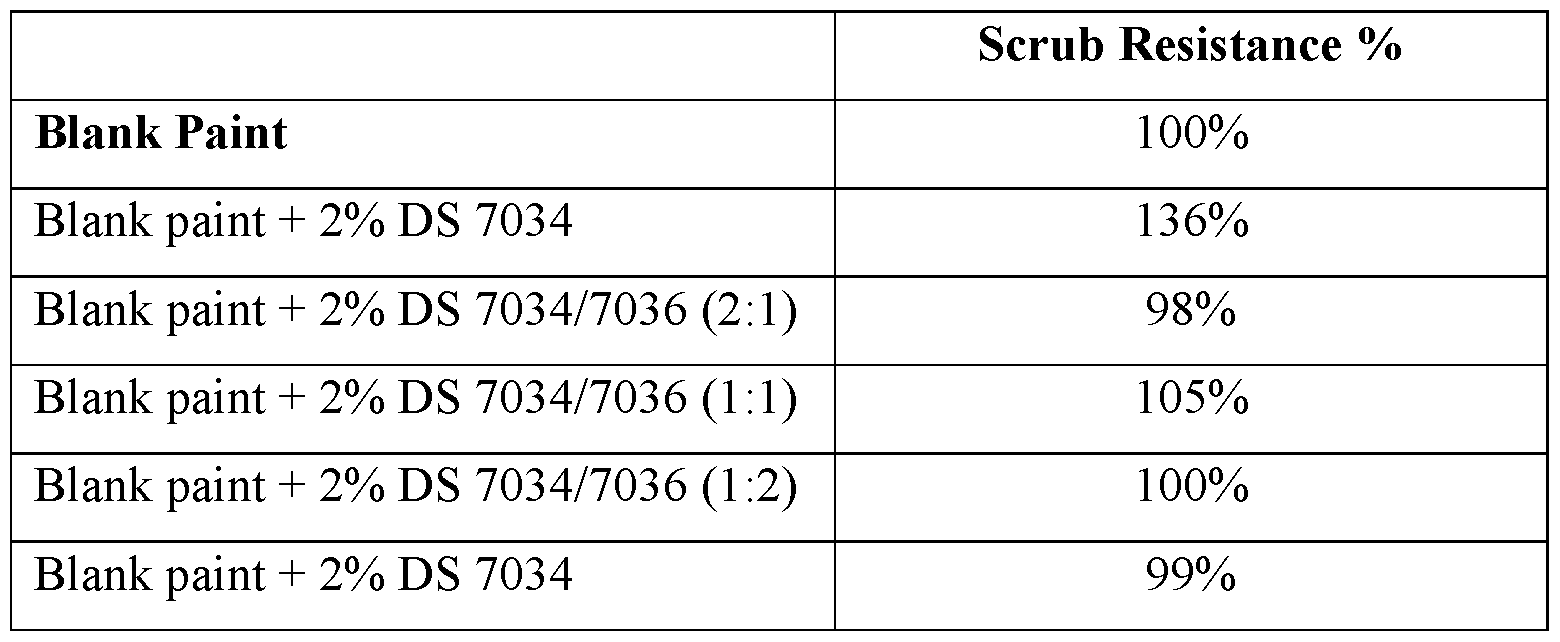
- Example open time additives were also tested to determine the impact of the open time additives on scrub resistance.
- a standard method ASTM D 2486, was used to determine the increase in scrub resistance with respect to a blank paint (i.e., a paint not including the open time additive).
- the open time additives were found to produce an increase or no decrease in scrub resistance (e.g., removal of the architectural paint from a surface).
- a commercial paint was tested. A blank sample including only the commercial paint and test samples including two percent (2%) of various open time additives were compared using a freshly formulated paint. Example results are presented in Table 5, which demonstrates increases in scrub resistant with respect to the blank paint.
- Example open time additives were also tested to determine the impact of the open time additives on stain resistance. To determine stain resistance, a standard method, ASTM D 4828, was used to determine the increase in stain resistance. To understand the impact of the open time additives, a commercial paint with various open time additives was tested. Example results are presented in Table 6, which demonstrates changes in stain resistance.
- DS 7034 had a negative impact on pen, purple crayon, grape juice, and coffee during stain testing
- DS 7036 had a slightly negative impact on coffee only
- the DS 7034/DS7036 (1 :2) was able to prevent the staining effects of DS7034.
Landscapes
- Chemical & Material Sciences (AREA)
- Organic Chemistry (AREA)
- Life Sciences & Earth Sciences (AREA)
- Engineering & Computer Science (AREA)
- Materials Engineering (AREA)
- Wood Science & Technology (AREA)
- Dispersion Chemistry (AREA)
- Chemical Kinetics & Catalysis (AREA)
- General Chemical & Material Sciences (AREA)
- Paints Or Removers (AREA)
- Compositions Of Macromolecular Compounds (AREA)
Abstract
Description



Claims


Priority Applications (4)
| Application Number | Priority Date | Filing Date | Title |
|---|---|---|---|
| JP2023516835A JP7719175B2 (en) | 2020-09-14 | 2021-09-14 | Open Time Additive |
| EP21867799.5A EP4196539A4 (en) | 2020-09-14 | 2021-09-14 | OPEN TIME ADDITIVE |
| US18/026,236 US20230365508A1 (en) | 2020-09-14 | 2021-09-14 | Open Time Additive |
| CN202180072574.8A CN116438266B (en) | 2020-09-14 | 2021-09-14 | Open time additives |
Applications Claiming Priority (4)
| Application Number | Priority Date | Filing Date | Title |
|---|---|---|---|
| US202063077818P | 2020-09-14 | 2020-09-14 | |
| US63/077,818 | 2020-09-14 | ||
| US202163232851P | 2021-08-13 | 2021-08-13 | |
| US63/232,851 | 2021-08-13 |
Publications (1)
| Publication Number | Publication Date |
|---|---|
| WO2022056434A1 true WO2022056434A1 (en) | 2022-03-17 |
Family
ID=80629932
Family Applications (1)
| Application Number | Title | Priority Date | Filing Date |
|---|---|---|---|
| PCT/US2021/050173 Ceased WO2022056434A1 (en) | 2020-09-14 | 2021-09-14 | Open time additive |
Country Status (5)
| Country | Link |
|---|---|
| US (1) | US20230365508A1 (en) |
| EP (1) | EP4196539A4 (en) |
| JP (1) | JP7719175B2 (en) |
| CN (1) | CN116438266B (en) |
| WO (1) | WO2022056434A1 (en) |
Citations (4)
| Publication number | Priority date | Publication date | Assignee | Title |
|---|---|---|---|---|
| US4102867A (en) * | 1976-11-15 | 1978-07-25 | Akzona Incorporated | Copolyesters of phthalic acids and hydantoins |
| US5795695A (en) * | 1996-09-30 | 1998-08-18 | Xerox Corporation | Recording and backing sheets containing linear and cross-linked polyester resins |
| US20020058685A1 (en) * | 1999-12-21 | 2002-05-16 | Hamilton Gregory S. | Hydantoin derivative compounds, pharmace utical compositions, and methods of using same |
| WO2019240744A1 (en) * | 2018-06-11 | 2019-12-19 | Hewlett-Packard Development Company, L.P. | Ink compositions |
Family Cites Families (16)
| Publication number | Priority date | Publication date | Assignee | Title |
|---|---|---|---|---|
| US4028378A (en) * | 1973-11-27 | 1977-06-07 | Glyco Chemicals, Inc. | Fatty and benzoic acid esters of ethoxylated hydantoins substituted or not in the 5-position |
| CA1206687A (en) * | 1982-02-08 | 1986-06-24 | Celanese Corporation | Polyol/imidazole curing agents for epoxy resins |
| US5100907A (en) * | 1990-05-02 | 1992-03-31 | Lonza, Inc. | Hydantoin esters |
| US5205861A (en) * | 1991-10-09 | 1993-04-27 | E. I. Du Pont De Nemours And Company | Aqueous ink jet inks containing alkylene oxide condensates of certain nitrogen heterocyclic compounds as cosolvents |
| KR100393056B1 (en) * | 2000-09-20 | 2003-07-31 | 삼성전자주식회사 | Ink composition for ink jet printer |
| US7744205B2 (en) * | 2006-03-17 | 2010-06-29 | Hewlett-Packard Development Company, L.P. | Solvent/latex binder system for heated inkjet printing |
| US9388323B2 (en) * | 2008-01-18 | 2016-07-12 | Rhodia Operations | Latex binders, aqueous coatings and paints having freeze-thaw ability and methods for using same |
| US20090292058A1 (en) * | 2008-05-23 | 2009-11-26 | Velsicol Chemical Corporation | Aqueous Polymer Compositions Exhibiting Increased Open Time With Reduced Levels Of Volatile Organic Compounds |
| EP2194081B1 (en) * | 2008-12-02 | 2011-09-07 | Sika Technology AG | Polyurethane composition comprising hydroxyaldimines |
| CN102652163B (en) * | 2009-12-11 | 2015-07-15 | 罗地亚管理公司 | Methods and systems for improving open time and drying time of latex binders and aqueous coatings |
| KR102068850B1 (en) * | 2011-10-07 | 2020-01-21 | 알넥스 네덜란드 비. 브이. | Crosslinkable composition crosslinkable by real michael addition(rma) reaction |
| JP6272882B2 (en) * | 2012-10-11 | 2018-01-31 | ビーエーエスエフ エスイー | Surfactant for aqueous coating |
| US9873802B2 (en) * | 2013-12-09 | 2018-01-23 | Angus Chemical Company | Low VOC isoxazolidine as open time extenders in water borne paints |
| DE102015105987A1 (en) * | 2015-04-20 | 2016-10-20 | Mankiewicz Gebr. & Co. Gmbh & Co. Kg | Improved coating systems, their use for coating components as well as coated components for rail and aircraft |
| DE102015105979A1 (en) * | 2015-04-20 | 2016-10-20 | Mankiewicz Gebr. & Co. Gmbh & Co. Kg | Improved coating systems, their use for coating components as well as coated components for wind turbines |
| EP3702423A1 (en) * | 2019-02-26 | 2020-09-02 | Allnex Netherlands B.V. | A coating system for rma crosslinkable coating compositions |
-
2021
- 2021-09-14 JP JP2023516835A patent/JP7719175B2/en active Active
- 2021-09-14 US US18/026,236 patent/US20230365508A1/en active Pending
- 2021-09-14 CN CN202180072574.8A patent/CN116438266B/en active Active
- 2021-09-14 EP EP21867799.5A patent/EP4196539A4/en not_active Withdrawn
- 2021-09-14 WO PCT/US2021/050173 patent/WO2022056434A1/en not_active Ceased
Patent Citations (4)
| Publication number | Priority date | Publication date | Assignee | Title |
|---|---|---|---|---|
| US4102867A (en) * | 1976-11-15 | 1978-07-25 | Akzona Incorporated | Copolyesters of phthalic acids and hydantoins |
| US5795695A (en) * | 1996-09-30 | 1998-08-18 | Xerox Corporation | Recording and backing sheets containing linear and cross-linked polyester resins |
| US20020058685A1 (en) * | 1999-12-21 | 2002-05-16 | Hamilton Gregory S. | Hydantoin derivative compounds, pharmace utical compositions, and methods of using same |
| WO2019240744A1 (en) * | 2018-06-11 | 2019-12-19 | Hewlett-Packard Development Company, L.P. | Ink compositions |
Non-Patent Citations (2)
| Title |
|---|
| ANONYMOUS: "PEG DEDM Hydantoin Oleate", SAAPEDIA, 29 December 2019 (2019-12-29), pages 1 - 4, XP055917297, Retrieved from the Internet <URL:http://www.saapedia.org/en/saa/?type=detail&id=3412> [retrieved on 20220503] * |
| See also references of EP4196539A4 * |
Also Published As
| Publication number | Publication date |
|---|---|
| CN116438266B (en) | 2025-07-25 |
| US20230365508A1 (en) | 2023-11-16 |
| JP2023541196A (en) | 2023-09-28 |
| JP7719175B2 (en) | 2025-08-05 |
| CN116438266A (en) | 2023-07-14 |
| EP4196539A1 (en) | 2023-06-21 |
| EP4196539A4 (en) | 2024-10-30 |
Similar Documents
| Publication | Publication Date | Title |
|---|---|---|
| RU2566765C2 (en) | Novel mixtures of dibenzoate plasticisers/coalescent additives for coatings with low content of volatile organic compounds | |
| KR101626123B1 (en) | Monobenzoate useful as a plasticizer/coalescent in polymeric dispersions | |
| CN113811287B (en) | Low VOC multifunctional additive for improving waterborne polymer membrane properties | |
| CN101516981B (en) | Film-forming composition containing a mixture of benzoates | |
| Izzo et al. | A preliminary study of the composition of commercial oil, acrylic and vinyl paints and their behaviour after accelerated ageing conditions | |
| CN110894395A (en) | Oleyl polyether-2 phosphate modified alkyd resin water-based paint | |
| JP6189938B2 (en) | Low VOC glycol ether film-forming aid for water-based coatings | |
| WO2022056434A1 (en) | Open time additive | |
| EP4196536A1 (en) | Open time additive | |
| CA3135399C (en) | Low voc multifunctional additives to improve waterborne polymer film properties | |
| HK40057670A (en) | Low voc multifunctional additives to improve waterborne polymer film properties | |
| HK40057670B (en) | Low voc multifunctional additives to improve waterborne polymer film properties | |
| JP2018504478A (en) | Weatherproof waterborne wood coating | |
| RU2472827C1 (en) | Polystryrene paint composition | |
| CN115975450A (en) | Flame-retardant and antirust water-based paint | |
| RU2021132160A (en) | LOW VOC MULTIFUNCTIONAL ADDITIVES FOR IMPROVING WATER-SOLUBLE POLYMER FILM PROPERTIES | |
| CZ29457U1 (en) | Flexible nitrocellulose coating compositions |
Legal Events
| Date | Code | Title | Description |
|---|---|---|---|
| 121 | Ep: the epo has been informed by wipo that ep was designated in this application |
Ref document number: 21867799 Country of ref document: EP Kind code of ref document: A1 |
|
| ENP | Entry into the national phase |
Ref document number: 2023516835 Country of ref document: JP Kind code of ref document: A |
|
| ENP | Entry into the national phase |
Ref document number: 2021867799 Country of ref document: EP Effective date: 20230314 |
|
| NENP | Non-entry into the national phase |
Ref country code: DE |
|
| WWW | Wipo information: withdrawn in national office |
Ref document number: 2021867799 Country of ref document: EP |
|
| WWG | Wipo information: grant in national office |
Ref document number: 202180072574.8 Country of ref document: CN |