WO2022059301A1 - オクタフルオロシクロブタンの精製方法 - Google Patents
オクタフルオロシクロブタンの精製方法 Download PDFInfo
- Publication number
- WO2022059301A1 WO2022059301A1 PCT/JP2021/025486 JP2021025486W WO2022059301A1 WO 2022059301 A1 WO2022059301 A1 WO 2022059301A1 JP 2021025486 W JP2021025486 W JP 2021025486W WO 2022059301 A1 WO2022059301 A1 WO 2022059301A1
- Authority
- WO
- WIPO (PCT)
- Prior art keywords
- octafluorocyclobutane
- fluorocarbon
- concentration
- crude
- gas
- Prior art date
- Legal status (The legal status is an assumption and is not a legal conclusion. Google has not performed a legal analysis and makes no representation as to the accuracy of the status listed.)
- Ceased
Links
Images
Classifications
-
- C—CHEMISTRY; METALLURGY
- C07—ORGANIC CHEMISTRY
- C07C—ACYCLIC OR CARBOCYCLIC COMPOUNDS
- C07C17/00—Preparation of halogenated hydrocarbons
- C07C17/38—Separation; Purification; Stabilisation; Use of additives
- C07C17/395—Separation; Purification; Stabilisation; Use of additives by treatment giving rise to a chemical modification of at least one compound
-
- C—CHEMISTRY; METALLURGY
- C07—ORGANIC CHEMISTRY
- C07C—ACYCLIC OR CARBOCYCLIC COMPOUNDS
- C07C17/00—Preparation of halogenated hydrocarbons
- C07C17/38—Separation; Purification; Stabilisation; Use of additives
- C07C17/383—Separation; Purification; Stabilisation; Use of additives by distillation
-
- C—CHEMISTRY; METALLURGY
- C07—ORGANIC CHEMISTRY
- C07C—ACYCLIC OR CARBOCYCLIC COMPOUNDS
- C07C23/00—Compounds containing at least one halogen atom bound to a ring other than a six-membered aromatic ring
- C07C23/02—Monocyclic halogenated hydrocarbons
- C07C23/06—Monocyclic halogenated hydrocarbons with a four-membered ring
-
- C—CHEMISTRY; METALLURGY
- C07—ORGANIC CHEMISTRY
- C07C—ACYCLIC OR CARBOCYCLIC COMPOUNDS
- C07C2601/00—Systems containing only non-condensed rings
- C07C2601/04—Systems containing only non-condensed rings with a four-membered ring
-
- Y—GENERAL TAGGING OF NEW TECHNOLOGICAL DEVELOPMENTS; GENERAL TAGGING OF CROSS-SECTIONAL TECHNOLOGIES SPANNING OVER SEVERAL SECTIONS OF THE IPC; TECHNICAL SUBJECTS COVERED BY FORMER USPC CROSS-REFERENCE ART COLLECTIONS [XRACs] AND DIGESTS
- Y02—TECHNOLOGIES OR APPLICATIONS FOR MITIGATION OR ADAPTATION AGAINST CLIMATE CHANGE
- Y02C—CAPTURE, STORAGE, SEQUESTRATION OR DISPOSAL OF GREENHOUSE GASES [GHG]
- Y02C20/00—Capture or disposal of greenhouse gases
- Y02C20/30—Capture or disposal of greenhouse gases of perfluorocarbons [PFC], hydrofluorocarbons [HFC] or sulfur hexafluoride [SF6]
Definitions
- the present invention relates to a method for purifying octafluorocyclobutane.
- Octafluorocyclobutane (FC-C318) is a colorless gas having a boiling point of ⁇ 5.8 ° C., and can be suitably used as a semiconductor material gas such as an etching gas and a cleaning gas.
- a semiconductor material gas such as an etching gas and a cleaning gas.
- high-purity etching gas from which impurities have been removed as much as possible has been required in order to form a circuit pattern by etching or the like with higher accuracy.
- Examples of the method for producing octafluorocyclobutane include a method for purifying octafluorocyclobutane produced as a by-product in the production of tetrafluoroethylene or hexafluoropropene.
- Octafluorocyclobutane before purification usually contains impurities such as oxygen gas, nitrogen gas, carbon dioxide, and water vapor, but most of these impurities can be removed by distillation.
- Octafluorocyclobutane before purification includes perfluorobutane (FC-3110, boiling point -2 ° C), decafluoroisobutane (FC-i3110, boiling point 0 ° C), perfluorocyclobutene (FC-C316, boiling point 5 ° C), and hexa. Fluorocarbons such as fluorobutadiene (FC-316, boiling point 6 ° C.) are further mixed as impurities.
- fluorocarbon means an organic compound having a carbon-fluorine bond other than octafluorocyclobutane.
- Patent Document 1 discloses a technique for decomposing fluorocarbons using a decomposition reactant.
- Patent Document 1 discloses a technique for decomposing fluorocarbons using a decomposition reactant.
- Patent Document 1 discloses a technique for decomposing fluorocarbons using a decomposition reactant.
- Patent Document 2 discloses a technique for decomposing fluorocarbons using a decomposition reactant.
- an impurity decomposition agent composed of iron oxide and an alkaline earth metal compound under heating to decompose fluorocarbon to decompose the crude octa.
- An object of the present invention is to provide a method for purifying octafluorocyclobutane, which can obtain high-purity octafluorocyclobutane by removing the mixed fluorocarbon.
- one aspect of the present invention is as follows [1] to [7].
- [1] A method for purifying octafluorocyclobutane, which removes the fluorocarbon from crude octafluorocyclobutane containing octafluorocyclobutane and fluorocarbon as an impurity.
- Oxygen gas or air is mixed with the crude octafluorocyclobutane to obtain a mixed gas having a concentration of the oxygen gas or air of 1% by volume or more and 90% by volume or less, and contains alumina and an alkaline earth metal compound and the fluorocarbon.
- a method for purifying octafluorocyclobutane is a method for purifying octafluorocyclobutane.
- the alkaline earth metal compound is at least one carbonate among magnesium, calcium, strontium, and barium, and the mass ratio of the alumina to the alkaline earth metal compound is 1: 9 to 1: 1.
- the impurity decomposing agent further contains an oxide of at least one of copper, tin, nickel, cobalt, chromium, molybdenum, tungsten, and vanadium, and the total amount of the oxide and the alumina and the alkaline soil.
- the fluorocarbon is at least one of perfluorobutane, decafluoroisobutane, perfluorocyclobutene, hexafluorobutadiene, tetrafluoromethane, hexafluoroethane, hexafluoropropene, octafluoropropane, octafluorocyclopentene, and fluoroform.
- the method for purifying octafluorocyclobutane according to any one of [1] to [4], which is one type.
- fluorocarbon in crude octafluorocyclobutane can be removed to obtain high-purity octafluorocyclobutane.
- Octafluorocyclobutane (C 4 F 8 ), which has a cyclic structure, has relatively high chemical stability.
- the present inventors have found that it is possible to obtain high-purity octafluorocyclobutane by removing the mixed fluorocarbon by utilizing the chemical stability of octafluorocyclobutane, and complete the present invention. It came to.
- the method for purifying octafluorocyclobutane is a method for purifying octafluorocyclobutane that removes fluorocarbon from crude octafluorocyclobutane containing octafluorocyclobutane and fluorocarbon as an impurity. It is provided with a decomposition step for decomposing the above and a concentration step for increasing the concentration of octafluorocyclobutane.
- oxygen gas (O 2 ) or air is mixed with crude octafluorocyclobutane to obtain a mixed gas having a concentration of oxygen gas or air of 1% by volume or more and 90% by volume or less, and then an impurity that decomposes fluorocarbon.
- This impurity decomposing agent contains alumina and an alkaline earth metal compound.
- the concentration step is a step of removing oxygen gas or a gas containing air (excluding octafluorocyclobutane) from the mixed gas obtained by decomposing fluorocarbon in the decomposition step to increase the concentration of octafluorocyclobutane.
- Fluorocarbon may be mixed in octafluorocyclobutane as an impurity.
- the crude octafluorocyclobutane containing octafluorocyclobutane and fluorocarbon is purified by the method for purifying octafluorocyclobutane according to the present embodiment, the impurities are decomposed. Since fluorocarbon can be selectively decomposed while suppressing the decomposition of octafluorocyclobutane by the agent, high-purity octafluorocyclobutane (hereinafter, also referred to as "purified octafluorocyclobutane”) can be obtained. ..
- the concentration of fluorocarbon in purified octafluorocyclobutane can be reduced to less than 1% by mass while suppressing the decomposition rate of octafluorocyclobutane to 1% by mass or less. That is, the purity of purified octafluorocyclobutane can be 99.999% by mass or more.
- perfluorobutane (C 4 F 10 ) and decafluoroisobutane (C 4 F 10 ) which were difficult to sufficiently remove by conventional purification methods such as distillation and adsorption methods, can be effectively removed. It can be removed.
- the purity of octafluorocyclobutane can be analyzed by gas chromatography using a thermal conductivity type detector (TCD) and a hydrogen flame ionization type detector (FID) as detectors.
- TCD thermal conductivity type detector
- FID hydrogen flame ionization type detector
- the high-purity octafluorocyclobutane obtained by the method for purifying octafluorocyclobutane according to the present embodiment is useful as, for example, an etching gas, a cleaning gas, or the like used in a semiconductor manufacturing process.
- the method for purifying octafluorocyclobutane according to the present embodiment will be described in more detail below.
- the concentration of fluorocarbon in the crude octafluorocyclobutane is preferably 1 mass ppm or more and 10000 mass ppm or less, more preferably 1 mass ppm or more and 1000 mass ppm or less, and 1 mass ppm or more and 100 mass ppm or less. Is more preferable.
- the concentration of fluorocarbon in the crude octafluorocyclobutane is within the above range, the fluorocarbon can be decomposed at a temperature at which the decomposition of octafluorocyclobutane is less likely to occur.
- the concentration of octafluorocyclobutane in the crude octafluorocyclobutane is preferably 10% by volume or more, more preferably 20% by volume or more, and further preferably 50% by volume or more.
- concentration of octafluorocyclobutane in the crude octafluorocyclobutane is within the above range, the effect of suppressing the heat of reaction is exhibited.
- examples of the components other than octafluorocyclobutane and fluorocarbon include oxygen gas and nitrogen gas (N 2 ).
- the fluorocarbon contained as an impurity in the crude octafluorocyclobutane is not particularly limited as long as it is an organic compound having a carbon-fluorine bond other than octafluorocyclobutane, but the octafluorocyclobutane according to the present embodiment is not particularly limited.
- the purification method is particularly suitable for removing the following fluorocarbons.
- perfluorobutane decafluoroisobutane, perfluorocyclobutene (C 4 F 6 ), hexafluorobutadiene (C 4 F 6 ), tetrafluoromethane (FC-14, CF 4 ), hexafluoroethane (FC-116,).
- C 2 F 6 Hexafluoropropene (FC-216, C 3 F 6 ), Octafluoropropane (FC-218, C 3 F 8 ), Octafluorocyclopentene (FC-418, C 5 F 8 ), and Fluoro Holm (HFC-23, CHF 3 ).
- the fluorocarbon contained in the crude octafluorocyclobutane may be one kind or two or more kinds.
- the impurity decomposing agent used in the method for purifying octafluorocyclobutane according to the present embodiment contains alumina and an alkaline earth metal compound. Since the impurity decomposing agent contains alumina and an alkaline earth metal compound, the decomposition of octafluorocyclobutane is suppressed and the fluorocarbon is selectively and efficiently decomposed.
- the type of alumina is not particularly limited, but in order to increase the amount of adsorbed gas, it is preferable to have a specific surface area of 50 m 2 / g or more, and a ratio of 100 m 2 / g or more and 300 m 2 / g or less. Those having a surface area are more preferable.
- the alumina is preferably in the form of powder, and in order to be uniformly mixed with other substances, the average particle size of the alumina particles is preferably more than 0.1 ⁇ m and 100 ⁇ m or less, and the upper limit is 30 ⁇ m or less. It is more preferably 5 ⁇ m or less.
- the average particle size in the present invention is a d50 value in the volume distribution, corresponds to the median value that bisects the area under the frequency curve, and can be obtained by measuring the particle size by laser diffraction.
- the content of the alkali metal (for example, sodium, potassium) contained as an impurity in alumina is preferably 0.1% by mass or less, preferably 0.01% by mass, in order to secure the reactivity with fluorocarbon. % Or less, more preferably 0.001% by mass or less.
- the type of the alkaline earth metal compound is not particularly limited, but it is preferably a carbonate of at least one of magnesium, calcium, strontium, and barium, and more preferably a carbonate of calcium.
- the alkaline earth metal compound is calcium carbonate (CaCO 3 )
- the fluorine gas generated by the decomposition of fluorocarbon reacts with calcium carbonate and is fixed as calcium fluoride (CaF 2 ), so that alumina is fluorinated. Is suppressed.
- the ability (activity) of decomposing fluorocarbon of alumina is easily maintained.
- the alkaline earth metal compound is preferably in the form of powder, and in order to be uniformly mixed with other substances, the average particle size of the alkaline earth metal compound particles is preferably 1 ⁇ m or more and 100 ⁇ m or less.
- the upper limit is more preferably 30 ⁇ m or less, further preferably 5 ⁇ m or less.
- the content of the alkali metal (for example, sodium and potassium) contained as an impurity in the alkaline earth metal compound is preferably 0.1% by mass or less in order to secure the reactivity with fluorocarbon. It is more preferably 0.01% by mass or less, and further preferably 0.001% by mass or less.
- the amount of the alkaline earth metal compound in the impurity decomposing agent can be the same as the amount of alumina or larger than the amount of alumina, and the mass ratio of alumina to the alkaline earth metal compound is 1: 9 to 1: 1. It is preferably 1 and more preferably 1: 4 to 2: 3.
- the ratio of the amount of alumina to the total amount of alumina and the alkaline earth metal compound is 10% by mass or more, the number of active points of the catalyst increases, so that the ability to decompose fluorocarbon becomes higher.
- the ratio of the amount of alumina to the total amount of alumina and the alkaline earth metal compound is 50% by mass or less, the amount of the alkaline earth metal compound is 50% by mass or more, so that the impurity decomposing agent can be effectively used.
- the coefficient becomes high.
- the impurity decomposing agent used in the method for purifying octafluorocyclobutane according to the present embodiment further contains at least one oxide of copper, tin, nickel, cobalt, chromium, molybdenum, tungsten, and vanadium, if desired. You may. Among these metal oxides, copper oxide (Cu 2 O, CuO), tin oxide (SnO, SnO 2 ) and vanadium oxide (V 2 O 5 ) are more preferable, and copper oxide and tin oxide are further preferable.
- the impurity decomposing agent has the above oxide, the above oxide functions as a co-catalyst, so that the ability of the impurity decomposing agent to decompose fluorocarbon is improved. Further, since carbon monoxide produced by the decomposition of fluorocarbon is oxidized to carbon dioxide, the amount of carbon monoxide produced can be reduced.
- the oxide is preferably in the form of powder, and in order to be uniformly mixed with other substances, the average particle size of the oxide particles is preferably 1 ⁇ m or more and 100 ⁇ m or less, and the upper limit is 30 ⁇ m. It is more preferably 5 ⁇ m or less, and further preferably 5 ⁇ m or less.
- the content of the alkali metal (for example, sodium and potassium) contained as an impurity in the oxide is preferably 0.1% by mass or less in order to secure the reactivity with fluorocarbon, and 0. It is more preferably 01% by mass or less, and further preferably 0.001% by mass or less.
- the total amount of the above oxides may be smaller than the total amount of alumina and the alkaline earth metal compound, and may be the total amount of the above oxides contained in the impurity decomposing agent.
- the mass ratio to the total amount of alumina and the alkaline earth metal compound is preferably 1:99 to 5:95.
- the ratio of the amount of the oxide to the total amount of the oxide, alumina and the alkaline earth metal compound is 1% by mass or more, the effect of adding the oxide is sufficiently exhibited. Further, even if the ratio of the amount of the oxide to the total amount of the oxide, alumina and the alkaline earth metal compound exceeds 5% by mass, the effect of adding the oxide is saturated, and if it is 5% by mass or less. Since the total amount of the alumina and the alkaline earth metal compound is 95% by mass or more, the effective utilization coefficient of the impurity decomposing agent becomes high.
- the shape of the impurity decomposing agent is not particularly limited, but it is preferably powdery, particulate, pelletal, spherical or the like.
- the average particle size of the impurity decomposing agent having such a shape is preferably 0.5 mm or more and 10 mm or less, and more preferably 1 mm or more and 5 mm or less. When the average particle size is within the above range, the surface area involved in the adsorption and diffusion of the mixed gas becomes an appropriate size, so that the diffusion rate of the mixed gas to be purified tends to be suitable.
- the method for producing the impurity decomposing agent is not particularly limited, but it can be produced by mixing an alumina powder and an alkaline earth metal compound powder. By adding a binder when mixing the two powders, it becomes easy to granulate even if the average particle sizes of the two powders are different.
- the type of binder is not particularly limited, but for example, fine powdery alumina and alum are preferable.
- the average particle size of the fine powdery alumina as a binder is preferably 0.1 ⁇ m or less, and more preferably 0.05 ⁇ m or less.
- alum is preferably in the form of powder, and its average particle size is preferably 0.1 ⁇ m or less. Furthermore, the content of alkali metals (eg sodium, potassium) contained as impurities in alum suppresses the decrease in the number of reactive sites on the surface of alumina and reduces the ability of the impurity decomposing agent to decompose fluorocarbon. In order to suppress it, it is preferably 0.1% by mass or less, and more preferably 0.01% by mass or less.
- alkali metals eg sodium, potassium
- an impurity decomposing agent When producing an impurity decomposing agent by mixing alumina powder and alkaline earth metal compound powder, first, water is added to both of the above powders, kneaded, and then pulverized to granulate the particles. To get. Next, the particulate matter is dried at a temperature of 100 ° C. or higher and 200 ° C. or lower in an inert gas such as nitrogen or in air to remove water from the particulate matter. Then, the dried particulate matter is calcined to obtain a particulate impurity decomposing agent.
- the firing temperature is preferably 400 ° C. or higher and 1000 ° C. or lower, more preferably 400 ° C. or higher and 700 ° C. or lower, and further preferably 500 ° C. or higher and 700 ° C. or lower.
- the decomposition step first, oxygen gas or air is mixed with crude octafluorocyclobutane to obtain a mixed gas.
- the concentration of oxygen gas or air in the mixed gas is 1% by volume or more and 90% by volume or less, preferably 10% by volume or more and 90% by volume or less.
- the decomposition reaction formula when the fluorocarbon contained as an impurity in the crude octafluorocyclobutane is perfluorobutane and the alkaline earth metal compound in the impurity decomposing agent is calcium carbonate is as follows.
- carbon monoxide may be produced in addition to carbon dioxide, but as described above, carbon monoxide is converted to carbon dioxide due to the presence of the oxide.
- the carbon dioxide gas generated in this reaction is removed in the subsequent concentration step, and calcium fluoride is removed as a solid precipitate. 5CaCO 3 + C 4 F 10 + (3/2) O 2 ⁇ 5CaCO 2 + 9CO 2
- the concentration of oxygen gas or air in the mixed gas is 1% by volume or more, the heat of reaction when the fluorocarbon decomposes does not become excessively large, and the activity of the impurity decomposition agent becomes sufficiently high, so that the fluorocarbon is sufficient. Can be disassembled into. Further, when the content is 90% by volume or less, the concentration of the crude octafluorocyclobutane in the mixed gas becomes high, so that the crude octafluorocyclobutane can be efficiently purified. If the concentration of oxygen gas or air in the mixed gas exceeds 90% by volume, the decomposition of octafluorocyclobutane is likely to occur, which is not preferable.
- the mixed gas is brought into contact with the impurity decomposing agent at a temperature of 100 ° C. or higher and 500 ° C. or lower to decompose the fluorocarbon.
- the temperature at which the mixed gas is brought into contact with the impurity decomposing agent is 100 ° C. or higher, the activity of the impurity decomposing agent becomes sufficiently high, so that fluorocarbon can be sufficiently decomposed.
- the temperature is 500 ° C. or lower, the decomposition of octafluorocyclobutane by the impurity decomposing agent is suppressed.
- the temperature at which the mixed gas is brought into contact with the impurity decomposing agent needs to be 100 ° C. or higher and 500 ° C. or lower, but is preferably 250 ° C. or higher and 500 ° C. or lower.
- the pressure conditions when the mixed gas is brought into contact with the impurity decomposing agent are not particularly limited, and may be under atmospheric pressure conditions, pressurized conditions, or reduced pressure conditions, but may be -0.1 MPaG or more and 0.3 MPaG or less. It is preferably 0 MPaG or more and 0.2 MPaG or less, more preferably. If it is 0.3 MPaG or less, liquefaction of octafluorocyclobutane is unlikely to occur.
- the purification treatment rate of crude octafluorocyclobutane can be expressed as the space rate of the mixed gas in contact with the impurity decomposing agent.
- the space velocity of the mixed gas in contact with the impurity decomposing agent is preferably 1h -1 or more and 300h -1 or less, and more preferably 10h -1 or more and 150h -1 or less.
- fluorocarbon can be efficiently decomposed, and it becomes easier to reduce the concentration of fluorocarbon in purified octafluorocyclobutane to less than 1 mass ppm.
- the method of contacting the mixed gas with the impurity decomposing agent is not particularly limited, and examples thereof include a method of supplying crude octafluorocyclobutane to a reactor filled with the impurity decomposing agent.
- a method of continuously distributing the mixed gas to a fixed bed provided with an impurity decomposing agent can be adopted.
- the concentration step is a step of removing oxygen gas or a gas containing air (excluding octafluorocyclobutane) from the mixed gas obtained by decomposing fluorocarbon in the decomposition step to increase the concentration of octafluorocyclobutane.
- the mixed gas obtained by decomposing fluorocarbon in the decomposition step contains nitrogen gas, oxygen gas, carbon dioxide, and in some cases, water vapor, etc., so these are removed in the concentration step to remove octafluorocyclobutane.
- purified octafluorocyclobutane having a purity of 99.999% by mass or more is obtained.
- the method for removing nitrogen gas, oxygen gas, carbon dioxide and the like is not particularly limited, but a distillation method and a membrane separation method can be adopted.
- the temperature of the low boiling cut distillation column is ⁇ 80 ° C. or higher and 70 ° C. or lower, and the operating pressure is ⁇ 0.1 MPaG or higher and 1.0 MPaG or lower.
- the type of separation membrane used in the membrane separation method may be a membrane in which nitrogen gas, oxygen gas, carbon dioxide, etc. are easily permeated and octafluorocyclobutane is difficult to permeate (more preferably, octafluorocyclobutane is hardly permeated).
- the film is not particularly limited, but for example, a film formed of aromatic polyimide, silicone hollow fiber, and porous carbon fiber is preferable.
- the environmental temperature at the time of separation in the membrane separation method is preferably 0 ° C. or higher and 100 ° C. or lower, and more preferably 20 ° C. or higher and 80 ° C. or lower.
- the temperature is 0 ° C. or higher, the vapor pressure of octafluorocyclobutane is high, so that the concentration rate of octafluorocyclobutane becomes high.
- the temperature is 100 ° C. or lower, deterioration of the separation membrane is unlikely to occur.
- the pressure at which the mixed gas obtained by decomposing the fluorocarbon in the decomposition step is supplied to the separation membrane is preferably 0 MPaG or more and 1 MPaG or less, and more preferably 0 MPaG or more and 0.5 MPaG or less. When it is 1 MPaG or less, it is not necessary to raise the temperature to prevent liquefaction of octafluorocyclobutane, so that deterioration of the separation membrane is unlikely to occur.
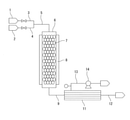
- Example 1 Crude octafluorocyclobutane composed of octafluorocyclobutane and perfluorobutane, which is an impurity, was purified using the purification treatment apparatus of FIG. 1, which is subjected to a concentration step by a membrane separation method.
- the concentration of perfluorobutane in the crude octafluorocyclobutane is 100 mass ppm.
- Example 1 the impurity decomposing agent used in Example 1 will be described.
- 30 parts by mass of alumina (average particle size 5 ⁇ m)
- 70 parts by mass of calcium carbonate 5 parts by mass of copper oxide
- 0.1 part by mass of fine powdery alumina (average particle size 0.1 ⁇ m) were mixed so as to have a total of 30 g. , Mixed with a Henshell mixer.
- the purification treatment apparatus of FIG. 1 reacts with a crude octafluorocyclobutane container 1 filled with crude octafluorocyclobutane, an air container 2 filled with air, and a tubular reactor 6 containing an impurity decomposing agent 7.
- a heating device 8 for heating the vessel 6 and a membrane separation device 11 provided with a separation film (not shown) are provided.
- the reactor 6 is a quartz tube having an inner diameter of 38 mm and a length of 1000 mm, and contains 350 g of an impurity decomposing agent 7. Then, the impurity decomposing agent 7 is calcined in the reactor 6 before being used for purifying the crude octafluorocyclobutane. That is, the impurity decomposing agent 7 was calcined by heating at 350 ° C. for 12 hours and then at 600 ° C. for 3 hours while flowing nitrogen gas through the reactor 6. Nitrogen gas was introduced from the upper side of the reactor 6 and exhausted from the lower side (not shown).
- the crude octafluorocyclobutane in the crude octafluorocyclobutane container 1 was supplied to the mixed gas supply pipe 5 via the crude octafluorocyclobutane pipe 3 while controlling the flow rate by a mass flow controller or the like. Further, the air in the air container 2 was supplied to the mixed gas supply pipe 5 via the air pipe 4 while controlling the flow rate by a mass flow controller or the like.
- crude octafluorocyclobutane and air are mixed in the mixed gas supply pipe 5, and the volume ratio of crude octafluorocyclobutane to air is 50/50 (the concentration of air in the mixed gas is 50 volumes). %, And the volume ratio and concentration are shown together in Table 1).
- This mixed gas was supplied to the reactor 6 via the mixed gas supply pipe 5 and brought into contact with the impurity decomposing agent 7 controlled at 400 ° C. by the heating device 8.
- the pressure in the reactor 6 was normal pressure (0 MPaG).
- the spatial velocity of the mixed gas was 15 Hh -1 , the linear velocity was 0.074 m / min, and the residence time was 4 minutes.
- the perfluorobutane contained in the crude octafluorocyclobutane was decomposed (decomposition step).
- the mixed gas in which perfluorobutane was decomposed was supplied to the membrane separation device 11 via the decomposition gas pipe 9, and was distributed to a tubular separation membrane (not shown) at room temperature.
- This separation membrane is made of aromatic polyimide and has a length of 1 m.
- the octafluorocyclobutane did not permeate through the separation membrane and flowed out to the non-permeable side pipe 12.
- the concentration of perfluorobutane in the octafluorocyclobutane emitted from the non-permeable side pipe 12 was measured by gas chromatography and found to be less than 0.1 mass ppm.
- the ratio (decomposition rate) of octafluorocyclobutane decomposed during purification was measured by gas chromatography and found to be less than 1% by mass.
- the decomposition rate of octafluorocyclobutane decomposed during purification was calculated by the following formula.
- Decomposition rate (%) 100 ⁇ ⁇ (molar amount of octafluorocyclobutane before purification step)-(molar amount of octafluorocyclobutane after purification step) ⁇ / (molar amount of octafluorocyclobutane before purification step)
- Examples 2 to 8 and Comparative Examples 1 and 2 Except for the fact that the mass ratio of alumina / calcium carbonate in the impurity decomposition agent, the volume ratio of crude octafluorocyclobutane to air, the concentration of perfluorobutane in crude octafluorocyclobutane, and the decomposition temperature are as shown in Table 1.
- the crude octafluorocyclobutane was purified in the same manner as in Example 1.
- the results concentration of perfluorobutane in purified octafluorocyclobutane and decomposition rate of octafluorocyclobutane are shown in Table 1.
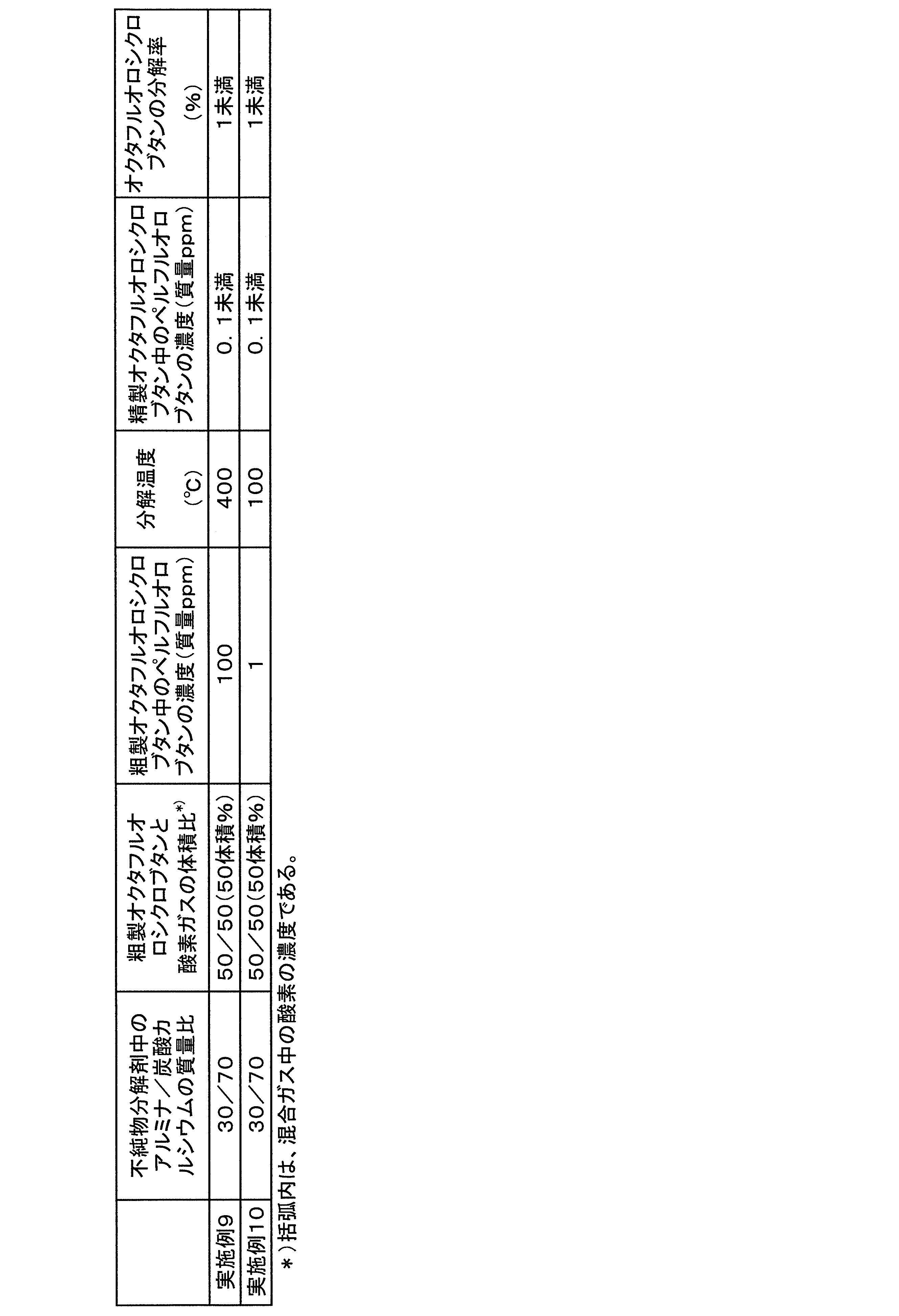
- Example 9 The crude octafluorocyclobutane was purified in the same manner as in Example 1 except that oxygen gas was mixed with the crude octafluorocyclobutane instead of air to obtain a mixed gas.
- the results concentration of perfluorobutane in purified octafluorocyclobutane and decomposition rate of octafluorocyclobutane are shown in Table 2.
- Example 10 The crude octafluorocyclobutane was purified in the same manner as in Example 4 except that oxygen gas was mixed with the crude octafluorocyclobutane instead of air to obtain a mixed gas.
- the results concentration of perfluorobutane in purified octafluorocyclobutane and decomposition rate of octafluorocyclobutane are shown in Table 2.
- Example 11 The crude octafluorocyclobutane was purified in the same manner as in Example 1 except that the fluorocarbon, which is an impurity in the crude octafluorocyclobutane, was decafluoroisobutane.
- the concentration of decafluoroisobutane in the purified octafluorocyclobutane was less than 0.1% by mass, and the decomposition rate of octafluorocyclobutane was less than 1% by mass.
- Example 12 The crude octafluorocyclobutane was purified in the same manner as in Example 1 except that the fluorocarbon, which is an impurity in the crude octafluorocyclobutane, was perfluorocyclobutene.
- the concentration of perfluorocyclobutene in the purified octafluorocyclobutane was less than 0.1% by mass, and the decomposition rate of octafluorocyclobutane was less than 1% by mass.
- Example 13 The crude octafluorocyclobutane was purified in the same manner as in Example 1 except that the fluorocarbon, which is an impurity in the crude octafluorocyclobutane, was hexafluorobutadiene.
- the concentration of hexafluorobutadiene in the purified octafluorocyclobutane was less than 0.1% by mass, and the decomposition rate of octafluorocyclobutane was less than 1% by mass.
- Example 14 The crude octafluorocyclobutane was purified in the same manner as in Example 1 except that fluorocarbon, which is an impurity in the crude octafluorocyclobutane, was tetrafluoromethane.
- fluorocarbon which is an impurity in the crude octafluorocyclobutane
- the concentration of tetrafluoromethane in the purified octafluorocyclobutane was less than 0.1% by mass, and the decomposition rate of octafluorocyclobutane was less than 1% by mass.
- Example 15 The crude octafluorocyclobutane was purified in the same manner as in Example 1 except that the fluorocarbon, which is an impurity in the crude octafluorocyclobutane, was hexafluoroethane.
- the concentration of hexafluoroethane in the purified octafluorocyclobutane was less than 0.1% by mass, and the decomposition rate of octafluorocyclobutane was less than 1% by mass.
- Example 16 The crude octafluorocyclobutane was purified in the same manner as in Example 1 except that the fluorocarbon, which is an impurity in the crude octafluorocyclobutane, was hexafluoropropene.
- the concentration of hexafluoropropene in the purified octafluorocyclobutane was less than 0.1% by mass, and the decomposition rate of octafluorocyclobutane was less than 1% by mass.
- Example 17 The crude octafluorocyclobutane was purified in the same manner as in Example 1 except that the fluorocarbon, which is an impurity in the crude octafluorocyclobutane, was octafluoropropane.
- the concentration of octafluoropropane in the purified octafluorocyclobutane was less than 0.1% by mass, and the decomposition rate of octafluorocyclobutane was less than 1% by mass.
- Example 18 The crude octafluorocyclobutane was purified in the same manner as in Example 1 except that the fluorocarbon, which is an impurity in the crude octafluorocyclobutane, was octafluorocyclopentene.
- the concentration of octafluorocyclopentene in the purified octafluorocyclobutane was less than 0.1% by mass, and the decomposition rate of octafluorocyclobutane was less than 1% by mass.
- Example 19 The crude octafluorocyclobutane was purified in the same manner as in Example 1 except that the fluorocarbon, which is an impurity in the crude octafluorocyclobutane, was fluoroform. As a result, the concentration of fluoroform in the purified octafluorocyclobutane was less than 0.1% by mass, and the decomposition rate of octafluorocyclobutane was less than 1% by mass.
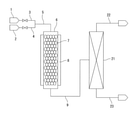
- Example 20 The crude octafluorocyclobutane was purified in the same manner as in Example 1 except that the concentration step by the distillation method was carried out instead of the concentration step by the membrane separation method.
- the results (purity of purified octafluorocyclobutane) are shown in Table 3.
- the decomposition step was carried out in the same manner as in Example 1 to decompose perfluorobutane contained in the crude octafluorocyclobutane. Then, the mixed gas in which perfluorobutane was decomposed was supplied to the distillation column 21 via the decomposition gas pipe 9, and distillation was performed.
- the diameter of the distillation column 21 is 100 mm, and the number of stages is 10.
- the filler filled in the distillation column 21 is Cascade Mini Ring (registered trademark) No. 1 manufactured by Matsui Machine Co., Ltd. It is 0P and the filling height is 2m.
- the conditions for distillation are a filling temperature of 1 ° C., an operating pressure of 0.05 MPaG, and a cut rate of 5% by mass.
- the low boiling component flowed out to the low boiling side pipe 22 connected to the top of the tower, and the high boiling component flowed out to the high boiling side pipe 23 connected to the bottom of the tower.
- the high boiling component from the high boiling side pipe 23 was purified octafluorocyclobutane, and the concentration of perfluorobutane in the purified octafluorocyclobutane was measured by gas chromatography and found to be less than 0.1 mass ppm. That is, the purity of purified octafluorocyclobutane was 99.999% by mass.
Landscapes
- Chemical & Material Sciences (AREA)
- Organic Chemistry (AREA)
- Chemical Kinetics & Catalysis (AREA)
- General Chemical & Material Sciences (AREA)
- Organic Low-Molecular-Weight Compounds And Preparation Thereof (AREA)
Abstract
Description
オクタフルオロシクロブタンの製造方法としては、例えば、テトラフルオロエチレン又はヘキサフルオロプロペンを製造する際に副生物として生成したオクタフルオロシクロブタンを精製する方法が挙げられる。精製前のオクタフルオロシクロブタンには、通常は酸素ガス、窒素ガス、二酸化炭素、水蒸気等の不純物が混在しているが、それらの不純物の多くは蒸留によって除去することができる。
また、特許文献2には、フルオロカーボンを不純物として含有する粗オクタフルオロシクロブタンを、酸化鉄及びアルカリ土類金属化合物からなる不純物分解剤に加熱下で接触させることにより、フルオロカーボンを分解して、粗オクタフルオロシクロブタンからフルオロカーボンを除去する技術が開示されている。しかしながら、特許文献2に開示の技術では、ペルフルオロブタンやデカフルオロイソブタンを十分に除去できないおそれがあった。
本発明は、混入しているフルオロカーボンを除去して高純度のオクタフルオロシクロブタンを得ることができるオクタフルオロシクロブタンの精製方法を提供することを課題とする。
[1] オクタフルオロシクロブタンと不純物であるフルオロカーボンとを含有する粗製オクタフルオロシクロブタンから前記フルオロカーボンを除去するオクタフルオロシクロブタンの精製方法であって、
前記粗製オクタフルオロシクロブタンに酸素ガス又は空気を混合して、前記酸素ガス又は空気の濃度が1体積%以上90体積%以下である混合ガスとし、アルミナ及びアルカリ土類金属化合物を含有し且つ前記フルオロカーボンを分解する不純物分解剤に、前記混合ガスを100℃以上500℃以下の温度下で接触させて、前記フルオロカーボンを分解する分解工程と、
前記分解工程で前記フルオロカーボンを分解した前記混合ガスから前記酸素ガス又は空気を含有するガス(ただし、オクタフルオロシクロブタンを除く)を除去して、前記オクタフルオロシクロブタンの濃度を高める濃縮工程と、
を備えるオクタフルオロシクロブタンの精製方法。
[4] 前記粗製オクタフルオロシクロブタン中の前記フルオロカーボンの濃度が1質量ppm以上10000質量ppm以下である[1]~[3]のいずれか一項に記載のオクタフルオロシクロブタンの精製方法。
[7] 前記濃縮工程においては、蒸留法及び膜分離法の少なくとも一方により、前記酸素ガス又は空気を含有するガス(ただし、オクタフルオロシクロブタンを除く)を除去する[1]~[6]のいずれか一項に記載のオクタフルオロシクロブタンの精製方法。
濃縮工程は、分解工程でフルオロカーボンを分解した混合ガスから酸素ガス又は空気を含有するガス(ただし、オクタフルオロシクロブタンを除く)を除去して、オクタフルオロシクロブタンの濃度を高める工程である。
本実施形態に係るオクタフルオロシクロブタンの精製方法について、以下にさらに詳細に説明する。
本実施形態に係るオクタフルオロシクロブタンの精製方法を適用し得る粗製オクタフルオロシクロブタンは、フルオロカーボンを不純物として含有するものであれば特に限定されるものではなく、公知の方法で製造されたオクタフルオロシクロブタンや市販のオクタフルオロシクロブタンに対して、本実施形態に係るオクタフルオロシクロブタンの精製方法を適用することができる。
粗製オクタフルオロシクロブタンに不純物として含有されるフルオロカーボンは、炭素-フッ素結合を有する有機化合物のうちオクタフルオロシクロブタン以外のものであれば特に限定されるものではないが、本実施形態に係るオクタフルオロシクロブタンの精製方法は、下記のフルオロカーボンの除去に特に好適である。
粗製オクタフルオロシクロブタンに含有されるフルオロカーボンは、1種類でもよいし、2種類以上でもよい。
本実施形態に係るオクタフルオロシクロブタンの精製方法において使用される不純物分解剤は、アルミナ及びアルカリ土類金属化合物を含有する。不純物分解剤がアルミナ及びアルカリ土類金属化合物を含有することにより、オクタフルオロシクロブタンの分解が抑制されつつフルオロカーボンが選択的且つ効率的に分解される。
また、アルミナは粉体状であることが好ましく、他の物質と均一に混合するためには、アルミナ粒子の平均粒径は0.1μm超過100μm以下であることが好ましく、上限値については30μm以下であることがより好ましく、5μm以下であることがさらに好ましい。なお、本発明における平均粒径とは、体積分布におけるd50値であって、頻度曲線下の面積を二等分する中央値に相当し、レーザー回折による粒径測定によって得ることができる。
アルカリ土類金属化合物が炭酸カルシウム(CaCO3)である場合は、フルオロカーボンの分解により生成したフッ素ガスが、炭酸カルシウムと反応してフッ化カルシウム(CaF2)として固定されるので、アルミナのフッ素化が抑制される。その結果、アルミナのフルオロカーボンを分解する性能(活性)が維持されやすい。
焼成の温度は、400℃以上1000℃以下とすることが好ましく、400℃以上700℃以下とすることがより好ましく、500℃以上700℃以下とすることがさらに好ましい。このような温度での焼成により、アルミナは擬似ベーマイトアルミナとなる。この温度範囲内であれば、アルカリ土類金属化合物の分解や不純物分解剤の活性の低下が生じにくい。
分解工程においては、まず、粗製オクタフルオロシクロブタンに酸素ガス又は空気を混合して、混合ガスとする。このとき、混合ガス中の酸素ガス又は空気の濃度は1体積%以上90体積%以下、好ましくは10体積%以上90体積%以下とする。
5CaCO3 + C4F10 + (3/2)O2 → 5CaF2 + 9CO2
濃縮工程は、分解工程でフルオロカーボンを分解した混合ガスから酸素ガス又は空気を含有するガス(ただし、オクタフルオロシクロブタンを除く)を除去して、オクタフルオロシクロブタンの濃度を高める工程である。
分解工程でフルオロカーボンを分解した混合ガスには、窒素ガス、酸素ガス、二酸化炭素が含有されており、場合によっては水蒸気等も含有されているので、濃縮工程においてこれらを除去してオクタフルオロシクロブタンの濃度を高めることにより、例えば純度99.999質量%以上の精製オクタフルオロシクロブタンを得る。
窒素ガス、酸素ガス、二酸化炭素等を除去する方法は特に限定されるものではないが、蒸留法、膜分離法を採用することができる。
膜分離法において使用する分離膜の種類は、窒素ガス、酸素ガス、二酸化炭素等が透過しやすく、且つ、オクタフルオロシクロブタンが透過しにくい(より好ましくはオクタフルオロシクロブタンがほとんど透過できない)膜であれば特に限定されないが、例えば、芳香族ポリイミド、シリコーン中空糸、多孔質炭素繊維で形成された膜が好ましい。
〔実施例1〕
膜分離法によって濃縮工程を行う図1の精製処理装置を用いて、オクタフルオロシクロブタンと不純物であるペルフルオロブタンとからなる粗製オクタフルオロシクロブタンの精製を行った。なお、粗製オクタフルオロシクロブタン中のペルフルオロブタンの濃度は、100質量ppmである。
図1の精製処理装置は、粗製オクタフルオロシクロブタンが充填された粗製オクタフルオロシクロブタン容器1と、空気が充填された空気容器2と、不純物分解剤7が収容された管状の反応器6と、反応器6を加熱する加熱装置8と、分離膜(図示せず)を備えた膜分離装置11と、を備えている。
分解率(%)=100×{(精製工程前のオクタフルオロシクロブタンのモル量)-(精製工程後のオクタフルオロシクロブタンのモル量)}/(精製工程前のオクタフルオロシクロブタンのモル量)

不純物分解剤中のアルミナ/炭酸カルシウムの質量比、粗製オクタフルオロシクロブタンと空気の体積比、粗製オクタフルオロシクロブタン中のペルフルオロブタンの濃度、及び分解温度を表1に記載のとおりとした点以外は、実施例1と同様にして、粗製オクタフルオロシクロブタンの精製を行った。結果(精製オクタフルオロシクロブタン中のペルフルオロブタンの濃度、及び、オクタフルオロシクロブタンの分解率)を表1に示す。
空気に代えて酸素ガスを粗製オクタフルオロシクロブタンに混合して混合ガスとした点以外は、実施例1と同様にして、粗製オクタフルオロシクロブタンの精製を行った。結果(精製オクタフルオロシクロブタン中のペルフルオロブタンの濃度、及び、オクタフルオロシクロブタンの分解率)を表2に示す。
空気に代えて酸素ガスを粗製オクタフルオロシクロブタンに混合して混合ガスとした点以外は、実施例4と同様にして、粗製オクタフルオロシクロブタンの精製を行った。結果(精製オクタフルオロシクロブタン中のペルフルオロブタンの濃度、及び、オクタフルオロシクロブタンの分解率)を表2に示す。
粗製オクタフルオロシクロブタン中の不純物であるフルオロカーボンがデカフルオロイソブタンである点以外は、実施例1と同様にして、粗製オクタフルオロシクロブタンの精製を行った。その結果、精製オクタフルオロシクロブタン中のデカフルオロイソブタンの濃度は0.1質量ppm未満であり、オクタフルオロシクロブタンの分解率は1質量%未満であった。
粗製オクタフルオロシクロブタン中の不純物であるフルオロカーボンがパーフルオロシクロブテンである点以外は、実施例1と同様にして、粗製オクタフルオロシクロブタンの精製を行った。その結果、精製オクタフルオロシクロブタン中のパーフルオロシクロブテンの濃度は0.1質量ppm未満であり、オクタフルオロシクロブタンの分解率は1質量%未満であった。
粗製オクタフルオロシクロブタン中の不純物であるフルオロカーボンがヘキサフルオロブタジエンである点以外は、実施例1と同様にして、粗製オクタフルオロシクロブタンの精製を行った。その結果、精製オクタフルオロシクロブタン中のヘキサフルオロブタジエンの濃度は0.1質量ppm未満であり、オクタフルオロシクロブタンの分解率は1質量%未満であった。
粗製オクタフルオロシクロブタン中の不純物であるフルオロカーボンがテトラフルオロメタンである点以外は、実施例1と同様にして、粗製オクタフルオロシクロブタンの精製を行った。その結果、精製オクタフルオロシクロブタン中のテトラフルオロメタンの濃度は0.1質量ppm未満であり、オクタフルオロシクロブタンの分解率は1質量%未満であった。
粗製オクタフルオロシクロブタン中の不純物であるフルオロカーボンがヘキサフルオロエタンである点以外は、実施例1と同様にして、粗製オクタフルオロシクロブタンの精製を行った。その結果、精製オクタフルオロシクロブタン中のヘキサフルオロエタンの濃度は0.1質量ppm未満であり、オクタフルオロシクロブタンの分解率は1質量%未満であった。
粗製オクタフルオロシクロブタン中の不純物であるフルオロカーボンがヘキサフルオロプロペンである点以外は、実施例1と同様にして、粗製オクタフルオロシクロブタンの精製を行った。その結果、精製オクタフルオロシクロブタン中のヘキサフルオロプロペンの濃度は0.1質量ppm未満であり、オクタフルオロシクロブタンの分解率は1質量%未満であった。
粗製オクタフルオロシクロブタン中の不純物であるフルオロカーボンがオクタフルオロプロパンである点以外は、実施例1と同様にして、粗製オクタフルオロシクロブタンの精製を行った。その結果、精製オクタフルオロシクロブタン中のオクタフルオロプロパンの濃度は0.1質量ppm未満であり、オクタフルオロシクロブタンの分解率は1質量%未満であった。
粗製オクタフルオロシクロブタン中の不純物であるフルオロカーボンがオクタフルオロシクロペンテンである点以外は、実施例1と同様にして、粗製オクタフルオロシクロブタンの精製を行った。その結果、精製オクタフルオロシクロブタン中のオクタフルオロシクロペンテンの濃度は0.1質量ppm未満であり、オクタフルオロシクロブタンの分解率は1質量%未満であった。
粗製オクタフルオロシクロブタン中の不純物であるフルオロカーボンがフルオロホルムである点以外は、実施例1と同様にして、粗製オクタフルオロシクロブタンの精製を行った。その結果、精製オクタフルオロシクロブタン中のフルオロホルムの濃度は0.1質量ppm未満であり、オクタフルオロシクロブタンの分解率は1質量%未満であった。
膜分離法による濃縮工程に代えて蒸留法による濃縮工程を実施した点以外は、実施例1と同様にして、粗製オクタフルオロシクロブタンの精製を行った。結果(精製オクタフルオロシクロブタンの純度)を表3に示す。

膜分離法による濃縮工程を実施しない点以外は、実施例1と同様にして、粗製オクタフルオロシクロブタンの精製を行った。結果(精製オクタフルオロシクロブタンの純度)を表3に示す。
2・・・空気容器
6・・・反応器
7・・・不純物分解剤
11・・・膜分離装置
21・・・蒸留塔
Claims (7)
- オクタフルオロシクロブタンと不純物であるフルオロカーボンとを含有する粗製オクタフルオロシクロブタンから前記フルオロカーボンを除去するオクタフルオロシクロブタンの精製方法であって、
前記粗製オクタフルオロシクロブタンに酸素ガス又は空気を混合して、前記酸素ガス又は空気の濃度が1体積%以上90体積%以下である混合ガスとし、アルミナ及びアルカリ土類金属化合物を含有し且つ前記フルオロカーボンを分解する不純物分解剤に、前記混合ガスを100℃以上500℃以下の温度下で接触させて、前記フルオロカーボンを分解する分解工程と、
前記分解工程で前記フルオロカーボンを分解した前記混合ガスから前記酸素ガス又は空気を含有するガス(ただし、オクタフルオロシクロブタンを除く)を除去して、前記オクタフルオロシクロブタンの濃度を高める濃縮工程と、
を備えるオクタフルオロシクロブタンの精製方法。 - 前記アルカリ土類金属化合物が、マグネシウム、カルシウム、ストロンチウム、及びバリウムのうち少なくとも一種の炭酸塩であり、前記アルミナと前記アルカリ土類金属化合物との質量比が1:9~1:1である請求項1に記載のオクタフルオロシクロブタンの精製方法。
- 前記不純物分解剤が、銅、錫、ニッケル、コバルト、クロム、モリブデン、タングステン、及びバナジウムのうち少なくとも一種の酸化物をさらに含有し、前記酸化物の合計量と前記アルミナ及び前記アルカリ土類金属化合物の合計量との質量比が1:99~5:95である請求項1又は請求項2に記載のオクタフルオロシクロブタンの精製方法。
- 前記粗製オクタフルオロシクロブタン中の前記フルオロカーボンの濃度が1質量ppm以上10000質量ppm以下である請求項1~3のいずれか一項に記載のオクタフルオロシクロブタンの精製方法。
- 前記フルオロカーボンが、ペルフルオロブタン、デカフルオロイソブタン、パーフルオロシクロブテン、ヘキサフルオロブタジエン、テトラフルオロメタン、ヘキサフルオロエタン、ヘキサフルオロプロペン、オクタフルオロプロパン、オクタフルオロシクロペンテン、及びフルオロホルムのうちの少なくとも1種である請求項1~4のいずれか一項に記載のオクタフルオロシクロブタンの精製方法。
- 前記粗製オクタフルオロシクロブタン中の前記オクタフルオロシクロブタンの濃度は10体積%以上である請求項1~5のいずれか一項に記載のオクタフルオロシクロブタンの精製方法。
- 前記濃縮工程においては、蒸留法及び膜分離法の少なくとも一方により、前記酸素ガス又は空気を含有するガス(ただし、オクタフルオロシクロブタンを除く)を除去する請求項1~6のいずれか一項に記載のオクタフルオロシクロブタンの精製方法。
Priority Applications (5)
| Application Number | Priority Date | Filing Date | Title |
|---|---|---|---|
| US18/245,686 US20230348346A1 (en) | 2020-09-17 | 2021-07-06 | Octafluorocyclobutane purification method |
| CN202180063233.4A CN116390903A (zh) | 2020-09-17 | 2021-07-06 | 八氟环丁烷的纯化方法 |
| JP2022550365A JP7700797B2 (ja) | 2020-09-17 | 2021-07-06 | オクタフルオロシクロブタンの精製方法 |
| EP21868988.3A EP4215516A4 (en) | 2020-09-17 | 2021-07-06 | Octafluorocyclobutane purification method |
| KR1020237008922A KR20230050443A (ko) | 2020-09-17 | 2021-07-06 | 옥타플루오로시클로부탄의 정제 방법 |
Applications Claiming Priority (2)
| Application Number | Priority Date | Filing Date | Title |
|---|---|---|---|
| JP2020156607 | 2020-09-17 | ||
| JP2020-156607 | 2020-09-17 |
Publications (1)
| Publication Number | Publication Date |
|---|---|
| WO2022059301A1 true WO2022059301A1 (ja) | 2022-03-24 |
Family
ID=80776048
Family Applications (1)
| Application Number | Title | Priority Date | Filing Date |
|---|---|---|---|
| PCT/JP2021/025486 Ceased WO2022059301A1 (ja) | 2020-09-17 | 2021-07-06 | オクタフルオロシクロブタンの精製方法 |
Country Status (7)
| Country | Link |
|---|---|
| US (1) | US20230348346A1 (ja) |
| EP (1) | EP4215516A4 (ja) |
| JP (1) | JP7700797B2 (ja) |
| KR (1) | KR20230050443A (ja) |
| CN (1) | CN116390903A (ja) |
| TW (1) | TWI818287B (ja) |
| WO (1) | WO2022059301A1 (ja) |
Cited By (2)
| Publication number | Priority date | Publication date | Assignee | Title |
|---|---|---|---|---|
| CN115073262A (zh) * | 2022-07-27 | 2022-09-20 | 苏州金宏气体股份有限公司 | 一种八氟环丁烷尾气处理工艺及处理装置 |
| WO2026084016A1 (ja) * | 2024-10-17 | 2026-04-23 | ダイキン工業株式会社 | 高純度オクタフルオロシクロブタン |
Families Citing this family (1)
| Publication number | Priority date | Publication date | Assignee | Title |
|---|---|---|---|---|
| CN121159361B (zh) * | 2025-11-21 | 2026-07-21 | 山东东岳绿冷科技有限公司 | 全氟气体的纯化方法 |
Citations (6)
| Publication number | Priority date | Publication date | Assignee | Title |
|---|---|---|---|---|
| US3696156A (en) * | 1970-04-03 | 1972-10-03 | Du Pont | Process for purification of fluoroperhalocarbons |
| JP2002505311A (ja) * | 1998-03-05 | 2002-02-19 | イー・アイ・デュポン・ドウ・ヌムール・アンド・カンパニー | パーフルオロシクロブタンを精製する方法 |
| JP2002087808A (ja) * | 2000-09-14 | 2002-03-27 | Showa Denko Kk | パーフルオロカーボンの精製用吸着剤、その製造方法、高純度オクタフルオロシクロブタン、その精製方法及び製造方法並びにその用途 |
| JP2002212118A (ja) * | 2001-01-15 | 2002-07-31 | Showa Denko Kk | オクタフルオロシクロブタンの精製方法および製造方法並びにその用途 |
| JP2011136955A (ja) * | 2009-12-28 | 2011-07-14 | Union Showa Kk | 高純度含フッ素化合物の製造方法及びその方法で得られた高純度含フッ素化合物 |
| CN104529691A (zh) * | 2014-12-30 | 2015-04-22 | 中国船舶重工集团公司第七一八研究所 | 一种全氟烷烃中杂质的催化转化方法 |
Family Cites Families (7)
| Publication number | Priority date | Publication date | Assignee | Title |
|---|---|---|---|---|
| JPH05104053A (ja) | 1991-10-11 | 1993-04-27 | Konica Corp | 塗布装置 |
| KR100190959B1 (ko) | 1996-05-29 | 1999-06-15 | 전주범 | 칼라 버어스트신호 위치 판별장치 |
| US6069291A (en) * | 1996-06-12 | 2000-05-30 | Guild Associates, Inc. | Catalytic process for the decomposition of perfluoroalkanes |
| JP3789277B2 (ja) * | 1999-04-28 | 2006-06-21 | 昭和電工株式会社 | フッ素化合物の分解用反応剤、分解方法及びその用途 |
| US6630421B1 (en) * | 1999-04-28 | 2003-10-07 | Showa Denko Kabushiki Kaisha | Reactive agent and process for decomposing fluorine compounds and use thereof |
| RU2245316C2 (ru) * | 2001-01-15 | 2005-01-27 | Шоува Денко К.К. | Способ очистки октафторциклобутана, способ его получения и его применения |
| GB0103718D0 (en) * | 2001-02-14 | 2001-04-04 | Ineos Fluor Ltd | Recovery of fluorine containing compounds |
-
2021
- 2021-07-06 US US18/245,686 patent/US20230348346A1/en not_active Abandoned
- 2021-07-06 CN CN202180063233.4A patent/CN116390903A/zh active Pending
- 2021-07-06 WO PCT/JP2021/025486 patent/WO2022059301A1/ja not_active Ceased
- 2021-07-06 EP EP21868988.3A patent/EP4215516A4/en not_active Withdrawn
- 2021-07-06 JP JP2022550365A patent/JP7700797B2/ja active Active
- 2021-07-06 KR KR1020237008922A patent/KR20230050443A/ko active Pending
- 2021-07-19 TW TW110126402A patent/TWI818287B/zh not_active IP Right Cessation
Patent Citations (6)
| Publication number | Priority date | Publication date | Assignee | Title |
|---|---|---|---|---|
| US3696156A (en) * | 1970-04-03 | 1972-10-03 | Du Pont | Process for purification of fluoroperhalocarbons |
| JP2002505311A (ja) * | 1998-03-05 | 2002-02-19 | イー・アイ・デュポン・ドウ・ヌムール・アンド・カンパニー | パーフルオロシクロブタンを精製する方法 |
| JP2002087808A (ja) * | 2000-09-14 | 2002-03-27 | Showa Denko Kk | パーフルオロカーボンの精製用吸着剤、その製造方法、高純度オクタフルオロシクロブタン、その精製方法及び製造方法並びにその用途 |
| JP2002212118A (ja) * | 2001-01-15 | 2002-07-31 | Showa Denko Kk | オクタフルオロシクロブタンの精製方法および製造方法並びにその用途 |
| JP2011136955A (ja) * | 2009-12-28 | 2011-07-14 | Union Showa Kk | 高純度含フッ素化合物の製造方法及びその方法で得られた高純度含フッ素化合物 |
| CN104529691A (zh) * | 2014-12-30 | 2015-04-22 | 中国船舶重工集团公司第七一八研究所 | 一种全氟烷烃中杂质的催化转化方法 |
Non-Patent Citations (1)
| Title |
|---|
| See also references of EP4215516A4 * |
Cited By (3)
| Publication number | Priority date | Publication date | Assignee | Title |
|---|---|---|---|---|
| CN115073262A (zh) * | 2022-07-27 | 2022-09-20 | 苏州金宏气体股份有限公司 | 一种八氟环丁烷尾气处理工艺及处理装置 |
| WO2026084016A1 (ja) * | 2024-10-17 | 2026-04-23 | ダイキン工業株式会社 | 高純度オクタフルオロシクロブタン |
| JP2026071746A (ja) * | 2024-10-17 | 2026-04-30 | ダイキン工業株式会社 | 高純度オクタフルオロシクロブタン |
Also Published As
| Publication number | Publication date |
|---|---|
| TWI818287B (zh) | 2023-10-11 |
| CN116390903A (zh) | 2023-07-04 |
| TW202212303A (zh) | 2022-04-01 |
| JP7700797B2 (ja) | 2025-07-01 |
| KR20230050443A (ko) | 2023-04-14 |
| JPWO2022059301A1 (ja) | 2022-03-24 |
| EP4215516A4 (en) | 2025-02-19 |
| EP4215516A1 (en) | 2023-07-26 |
| US20230348346A1 (en) | 2023-11-02 |
Similar Documents
| Publication | Publication Date | Title |
|---|---|---|
| JP5132555B2 (ja) | 高純度ヘキサフルオロプロピレンの製造方法及びクリーニングガス | |
| JP7700797B2 (ja) | オクタフルオロシクロブタンの精製方法 | |
| EP1307416B1 (en) | Process for preparing octafluorocyclobutane | |
| WO2014185499A1 (ja) | 塩化水素の精製方法 | |
| RU2251448C2 (ru) | Адсорбент для очистки перфторуглерода, способ получения адсорбента, октафторпропан высокой чистоты и его применение | |
| KR100516683B1 (ko) | 옥타플루오로프로판의 정제방법, 그 제조방법, 및 그것의 용도 | |
| US7208644B2 (en) | Production and use of hexafluoroethane | |
| EP1587604B1 (en) | Process for decomposing fluorine compounds | |
| WO2001083412A2 (en) | Method for purification of tetrafluoromethane and use thereof | |
| JPWO2021117610A1 (ja) | 高純度塩化水素ガスの製造方法 | |
| KR20030038792A (ko) | 헥사플루오로에탄의 제조방법 및 용도 | |
| CN104548927A (zh) | 一种四氟化碳中微量三氟化氮的去除工艺 | |
| CN104211013A (zh) | 一种高纯盐酸的制备方法 | |
| JP3650588B2 (ja) | パーフルオロコンパウンドのリサイクル利用方法 | |
| JP3463873B2 (ja) | パーフルオロコンパウンドのリサイクル利用方法 | |
| RU2245317C2 (ru) | Способ очистки октафторпропана | |
| KR20080031978A (ko) | 펜타플루오로에탄의 회수 방법 및 상기 방법을 포함하는펜타플루오로에탄의 제조 방법 | |
| CN120359077A (zh) | 排气处理方法和排气处理装置 | |
| JP2003055278A (ja) | ヘキサフルオロエタンの製造方法およびその用途 | |
| WO2002064236A1 (en) | Recovery of fluorine containing compounds |
Legal Events
| Date | Code | Title | Description |
|---|---|---|---|
| 121 | Ep: the epo has been informed by wipo that ep was designated in this application |
Ref document number: 21868988 Country of ref document: EP Kind code of ref document: A1 |
|
| ENP | Entry into the national phase |
Ref document number: 2022550365 Country of ref document: JP Kind code of ref document: A |
|
| ENP | Entry into the national phase |
Ref document number: 20237008922 Country of ref document: KR Kind code of ref document: A |
|
| NENP | Non-entry into the national phase |
Ref country code: DE |
|
| ENP | Entry into the national phase |
Ref document number: 2021868988 Country of ref document: EP Effective date: 20230417 |
|
| WWW | Wipo information: withdrawn in national office |
Ref document number: 2021868988 Country of ref document: EP |