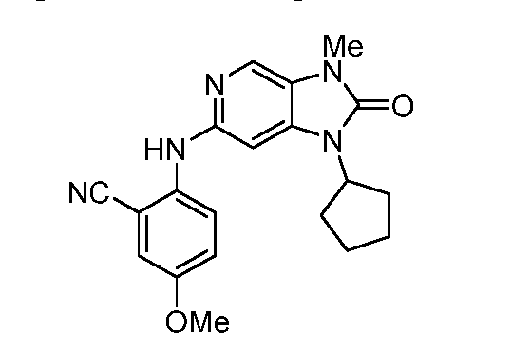
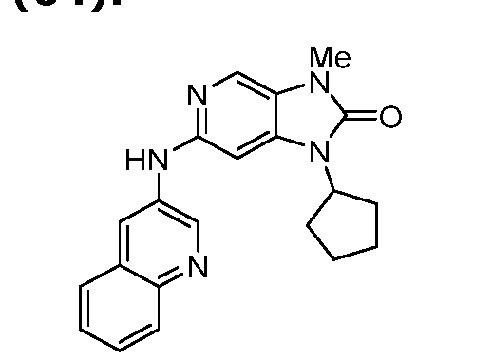
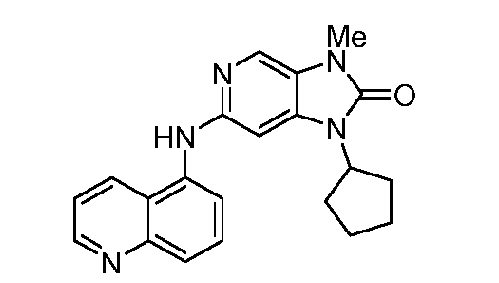
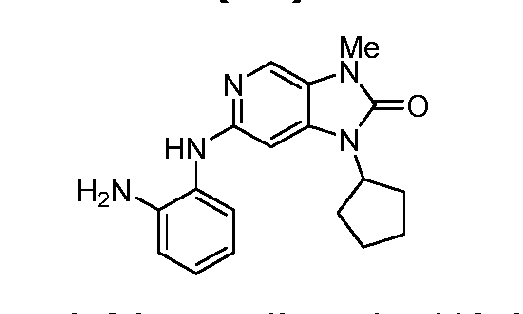
Reduction of the nitro-substituted compounds 14-16 with Pd/C under hydrogen gave the corresponding anilines 82-84, respectively (Scheme 3).
Table 2: Compounds 82-84
Reduction of the benzyl ethers 34–36 with Pd/C under hydrogen gave the corresponding phenols 85–87, respectively (Scheme 4). Similarly, reduction of benzyl ether 51 gave phenol 88. Scheme 4
Reagents: a) H
2, Pd/C, EtOH Table 3: Compounds 85-88
Alkylation of imidazolone 5 with NaH and various alkyl halides gave the chlorides 89–93 (Scheme 5). Displacement of chlorides 89-93 under Buchwald conditions gave the corresponding imidazopyridinones 94–98. Reduction of benzyl ether 98 gave alcohol 99. Scheme 5
Reagents: a) NaH, alkyl halide, DMF; b) 4-methoxy-2-methylaniline, Pd(dba)
3, XPhos, Cs
2CO
3, dioxane; c) H
2, Pd/C, EtOH. Table 4: Compounds 94-99
Displacement of the chloride 2 with 2-methoxyethylamine gave nitroamine 100 and reduction of 100 with tin chloride dihydrate gave the diamine 101 (Scheme 6). Reaction of 101 with carbonyldiimidazole provided the pyridoimidazolone 102 which was alkylated using sodium hydride and methyl iodide to give chloride 103. Displacement of the chloride of 103 with 4- methoxy-2-methylaniline or 4-chloro-2-methylaniline using Buchwald conditions provided the compounds 104 (SN39478) and 105 (SN39551), respectively. Scheme 6 Reagent MeCN; d
Displacement of the chloride 2 with oxetan-3-amine gave nitroamine 106 and reduction of 106 with tin chloride dihydrate gave the diamine 107 (Scheme 7). Reaction of 107 with carbonyldiimidazole provided the pyridoimidazolone 108 which was alkylated using sodium hydride and methyl iodide to give chloride 109. Displacement of the chloride of 109 with 4- methoxy-2-methylaniline using Buchwald conditions provided the compound 110. Scheme 7 Reagent N; d) NaH, xane.
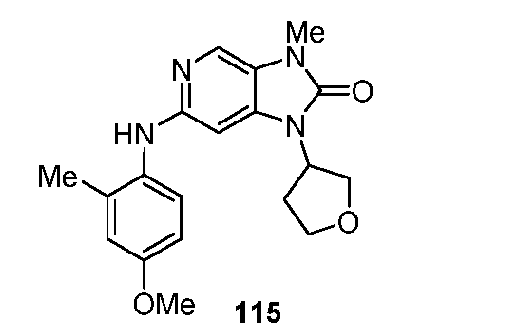
Displacement of the chloride 2 with tetrahydrofuran-3-amine gave nitroamine 111 and reduction of 111 with tin chloride dihydrate gave the diamine 112 (Scheme 8). Reaction of 112 with carbonyldiimidazole provided the pyridoimidazolone 113 which was alkylated using sodium hydride and methyl iodide to give chloride 114. Displacement of the chloride of 114 with 4-methoxy-2-methylaniline or 4-chloro-2-methylaniline using Buchwald conditions provided the compounds 115 (SN39878) and 116 (SN39881), respectively. Scheme 8 Reagen
) y ) c) CDI, MeCN; d) NaH, MeI, DMF; e) substituted aniline, Pd(dba)
3, XPhos, Cs
2CO
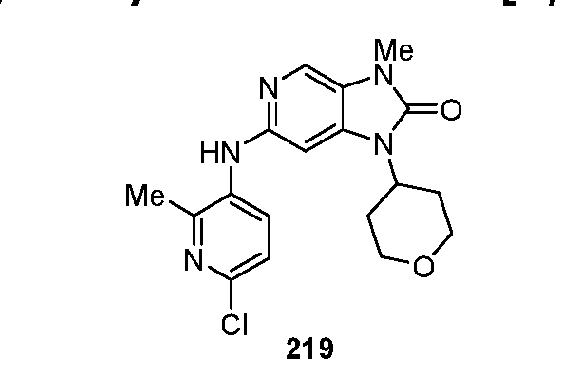
3, dioxane. Displacement of the chloride 2 with tetrahydro-2H-pyran-4-amine gave nitroamine 117 and reduction of 117 with tin chloride dihydrate gave the diamine 118 (Scheme 9). Reaction of 118 with carbonyldiimidazole provided the pyridoimidazolone 119 which was alkylated using sodium hydride and methyl iodide to give chloride 120. Displacement of the chloride of 120 with various amines using Buchwald conditions provided the compounds 121–132. Scheme 9 Reagen , EtOAc; c) CDI, M
eCN; d) NaH, MeI, DMF; e) substituted aniline, Pd(dba)
3, XPhos, Cs
2CO
3, dioxane or aniline, BrettPhos G3 precatalyst, Cs
2CO
3, MeCN.
T bl 5 C d 121 132
Reaction of imidazopyridinones 121 and 122 with benzyl chloroformate and iPr
2NEt gave the corresponding carbamates 133 (SN39689) and 134 (SN39690)(Scheme 10). Scheme 10
Reagents: a) BnOCOCl, iPr
2NEt, THF. Reduction of the benzyl ether 124 with Pd/C under hydrogen gave the corresponding phenol 135 (SN39872) (Scheme 11). Scheme 11 Reagents: a)
H
2, Pd/C, EtOH.
Scheme 12
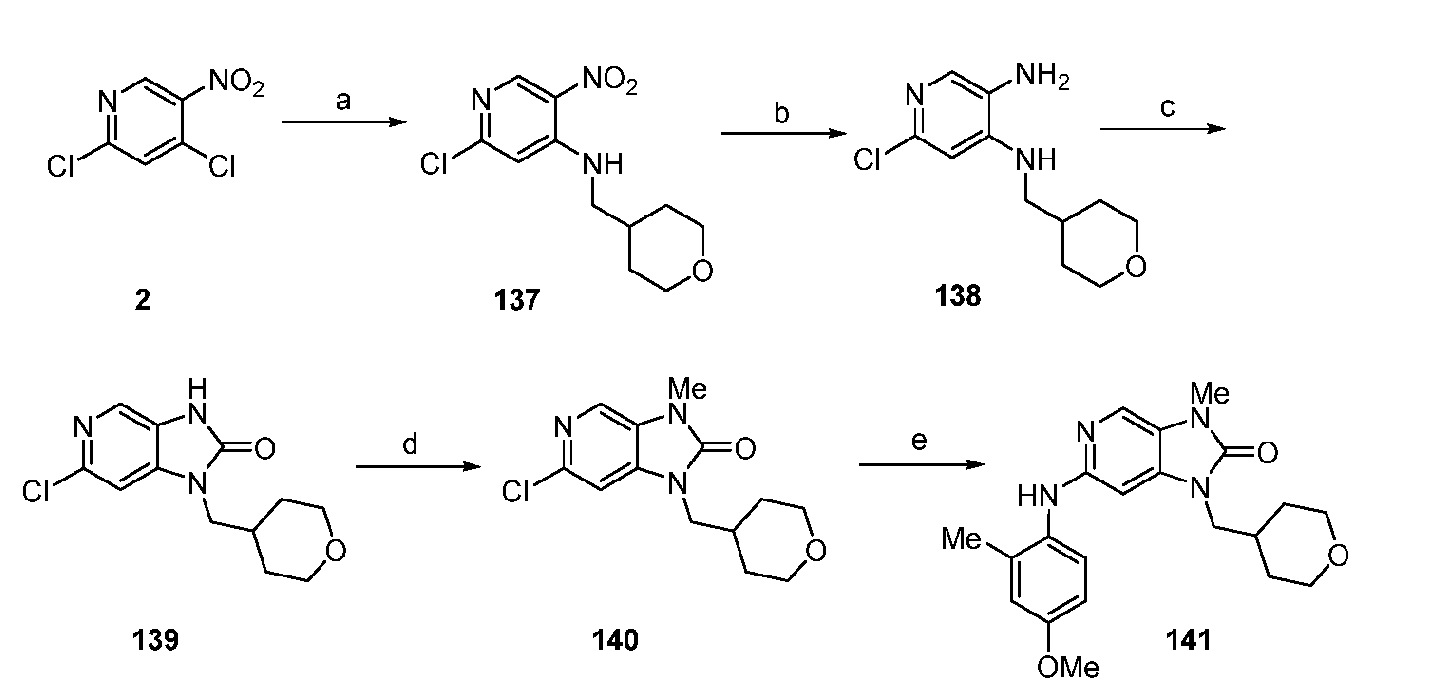
Reagents: a) KOH, MeOH, water. Displacement of the chloride 2 with (tetrahydro-2H-pyran-4-yl)methanamine gave nitroamine 137 and reduction of 137 with zinc powder and ammonium chloride gave the diamine 138 (Scheme 13). Reaction of 138 with carbonyldiimidazole provided the pyridoimidazolone 139 which was alkylated using sodium hydride and methyl iodide to give chloride 140. Displacement of the chloride of 140 with 4-methoxy-2-methylaniline, using Buchwald conditions, provided the compound 141 (SN39667). Scheme 13
Reagents: a) (tetrahydro-2H-pyran-4-yl)methanamine, iPr
2NEt, DCM; b) Zn, NH
4Cl, MeOH, THF; c) CDI, MeCN; d) NaH, MeI, DMF; e) 4-methoxy-2-methylaniline, Pd(dba)
3, XPhos, Cs
2CO
3, dioxane. Displacement of the chloride 2 with 2-(tetrahydro-2H-pyran-4-yl)ethan-1-amine gave nitroamine 142 and reduction of 142 with zinc powder and ammonium chloride gave the diamine 143 (Scheme 14). Reaction of 143 with carbonyldiimidazole provided the pyridoimidazolone 144 which was alkylated using sodium hydride and methyl iodide to give chloride 145. Displacement of the chloride of 145 with 4-methoxy-2-methylaniline or 4-chloro- 2-methylaniline, using Buchwald conditions, provided the compounds 146 (SN39550) and 147 (SN39552), respectively.
Scheme 14
Reagents: a) (tetrahydro-2H-pyran-4-yl)methanamine, iPr
2NEt, DCM; b) Zn, NH4Cl, MeOH, THF; c) CDI, MeCN; d) NaH, MeI, DMF; e) substituted aniline, Pd(dba)
3, XPhos, Cs
2CO
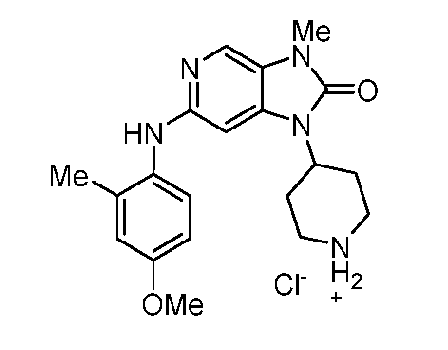
3, dioxane. Displacement of the chloride 2 with tert-butyl 4-aminopiperidine-1-carboxylate gave nitroamine 148 and reduction of 148 with zinc powder and ammonium chloride gave the diamine 149 (Scheme 15). Reaction of 149 with carbonyldiimidazole provided the pyridoimidazolone 150 which was alkylated using sodium hydride and methyl iodide to give chloride 151. Displacement of the chloride of 151 with 4-methoxy-2-methylaniline, using Buchwald conditions, provided carbamate 152 (SN39598). Hydrolysis of carbamate 152 under acidic conditions gave the compound 153 (SN39600) as the hydrochloride salt. Scheme 15
Reagents: a) tert-butyl 4-aminopiperidine-1-carboxylate, iPr
2NEt, DCM; b) Zn, NH4Cl, MeOH, THF; c) CDI, MeCN; d) NaH, MeI, DMF; e) 4-methoxy-2- methylaniline, Pd(dba)
3, XPhos, Cs
2CO
3, dioxane; f) 4 M HCl, dioxane. Reaction of imidazopyridinone 152 with benzoyl chloroformate gave the carbamate 154 (Scheme 16). Acid hydrolysis of 154 gave the amine 155. Reductive amination of 155 with
formaldehyde and sodium triacetoxyborohydride gave amine 156 which was converted to compound 157 (SN39686) under reductive conditions. Scheme 16
Reagents a) BnOCOCl, iPr
2NEt, THF; b) 4 M HCl, dioxane; c) aq. HCHO, NaBH(OAc)
3, DCM; d) H
2, Pd/C, EtOH. Displacement of the chloride 2 with tert-butyl 4-(aminomethyl)piperidine-1-carboxylate gave nitroamine 158 and reduction of 158 with zinc powder and ammonium chloride gave the diamine 159 (Scheme 17). Reaction of 159 with carbonyldiimidazole provided the pyridoimidazolone 160 which was alkylated using sodium hydride and methyl iodide to give chloride 161. Displacement of the chloride of 161 with 4-methoxy-2-methylaniline, using Buchwald conditions, provided carbamate 162 (SN39627). Hydrolysis of carbamate 162 gave amine 163 (SN39628) as the hydrochloride salt. Scheme 17
Pd(dba)
3, XPhos, Cs
2CO
3, dioxane; f) 4 M HCl, dioxane.
Reaction of imidazopyridinone 162 with benzoyl chloroformate gave the carbamate 164 (Scheme 18). Acid hydrolysis of 164 gave the amine 165. Reductive amination of 165 with formaldehyde and sodium triacetoxyborohydride gave amine 166 which was converted to compound 167 (SN39687) under reductive conditions. Scheme 18
Reagents a) BnOCOCl, iPr
2NEt, THF; b) 4 M HCl, dioxane; c) aq. HCHO, NaBH(OAc)
3, DCM; d) H
2, Pd/C, EtOH. Displacement of the chloride 2 with 4-methoxycyclohexan-1-amine gave nitroamine 168 and reduction of 168 with tin chloride dihydrate gave the diamine 169 (Scheme 19). Reaction of 169 with carbonyldiimidazole provided the pyridoimidazolone 170 which was alkylated using sodium hydride and methyl iodide to give chloride 171. Displacement of the chloride of 171 with 4-methoxy-2-methylaniline or 4-chloro-2-methylaniline, using Buchwald conditions, provided the compounds 172 (SN39540) and 173 (SN39539), respectively. Scheme 19 R Ac; c) C
DI, MeCN; d) NaH, MeI, DMF; e) substituted aniline, Pd(dba)
3, XPhos, Cs
2CO
3, dioxane.
Displacement of the chloride 2 with 4-(benzyloxy)cyclohexan-1-amine gave nitroamine 174 and reduction of 174 with tin chloride dihydrate gave the diamine 175 (Scheme 20). Reaction of 175 with carbonyldiimidazole provided the pyridoimidazolone 176 which was alkylated using sodium hydride and methyl iodide to give chloride 177. Displacement of the chloride of 177 with 4-methoxy-2-methylaniline, using Buchwald conditions, provided the compound 178 (SN39581). Hydrogenolysis of the benzyl ether 178 gave the alcohol 179 (SN39584). Scheme 20 Rea
gents: a) 4 (benzyloxy)cyclohexan 1 amine, iPr
2NEt, DCM; b) SnCl
2 2H
2O, EtOAc; c) CDI, MeCN; d) NaH, MeI, DMF; e) 4-methoxy-2-methylaniline, Pd(dba)
3, XPhos, Cs
2CO
3, dioxane; f) H
2, Pd/C, EtOH. Displacement of the chloride 2 with tert-butyl (4-aminocyclohexyl)carbamate gave nitroamine 180 and reduction of 180 with zinc powder and ammonium formate gave the diamine 181 (Scheme 21). Reaction of 181 with carbonyldiimidazole provided the pyridoimidazolone 182 which was alkylated using sodium hydride and methyl iodide to give chloride 183. Displacement of the chloride of 183 with 4-methoxy-2-methylaniline, using Buchwald conditions, provided the compound 184. Acid hydrolysis of the carbamate 184 (SN40297) gave the amine 185 (SN39695). Scheme 21
Reagents: a) tert-butyl (4-aminocyclohexyl)carbamate, iPr
2NEt, DCM; b) Zn, NH
4Cl, MeOH, THF; c) CDI, MeCN; d) NaH, MeI, DMF; e) 4-methoxy-2-methylaniline, Pd(dba)
3, XPhos, Cs
2CO
3, dioxane; f) 1.25 M HCl, MeOH. Displacement of the chloride 2 with aniline gave nitroamine 186 and reduction of 186 with tin chloride dihydrate gave the diamine 187 (Scheme 22). Reaction of 187 with carbonyldiimidazole provided the pyridoimidazolone 188 which was alkylated using sodium hydride and methyl iodide to give chloride 189. Displacement of the chloride of 189 with 4- methoxy-2-methylaniline, using Buchwald conditions, provided the compound 190 (SN39623). Scheme 22 Reagent
s: a) aniline, iPr
2NEt, DCM; b) SnCl
2·2H
2O, EtOAc; c) CDI, MeCN; d) NaH, MeI, DMF; e) 4-methoxy-2-methylaniline, Pd(dba)
3, XPhos, Cs
2CO
3, dioxane. Displacement of the chloride 2 with anisidine gave nitroamine 191 and reduction of 191 with tin chloride dihydrate gave the diamine 192 (Scheme 23). Reaction of 192 with carbonyldiimidazole provided the pyridoimidazolone 193 which was alkylated using sodium hydride and methyl iodide to give chloride 194. Displacement of the chloride of 194 with various anilines, using Buchwald conditions, provided the compounds 195–199. Scheme 23 N
NO2
N a N NO 2 H2 b
N c Reagent CN; d) NaH Me
) ( )
Table 6: Compounds 195-199
Reduction of the benzyl ether 199 with Pd/C under hydrogen gave the corresponding phenol 200 (SN39530)(Scheme 24). Scheme 24 Reagents: a) H
2, Pd/C, EtOH. Displacement of the chloride 2 with 4-(benzyloxy)aniline gave nitroamine 201 and reduction of 201 with tin chloride dihydrate gave the diamine 202 (Scheme 25). Reaction of 202 with carbonyldiimidazole provided the pyridoimidazolone 203 which was alkylated using sodium hydride and methyl iodide to give chloride 204. Displacement of the chloride of 204 with 4- methoxy-2-methylaniline, using Buchwald conditions, provided the compound 205 (SN39525). Reduction of the benzyl ether 205 with Pd/C under hydrogen gave the corresponding phenol 206 (SN39528). Scheme 25
Reagents: a) 4-(benzyloxy)aniline, iPr
2NEt, DCM; b) SnCl
2·2H
2O, EtOAc; c) CDI, MeCN; d) NaH, MeI, DMF; e) 4-methoxy-2-methylaniline, Pd(dba)
3, XPhos, Cs
2CO
3, dioxane; f) H
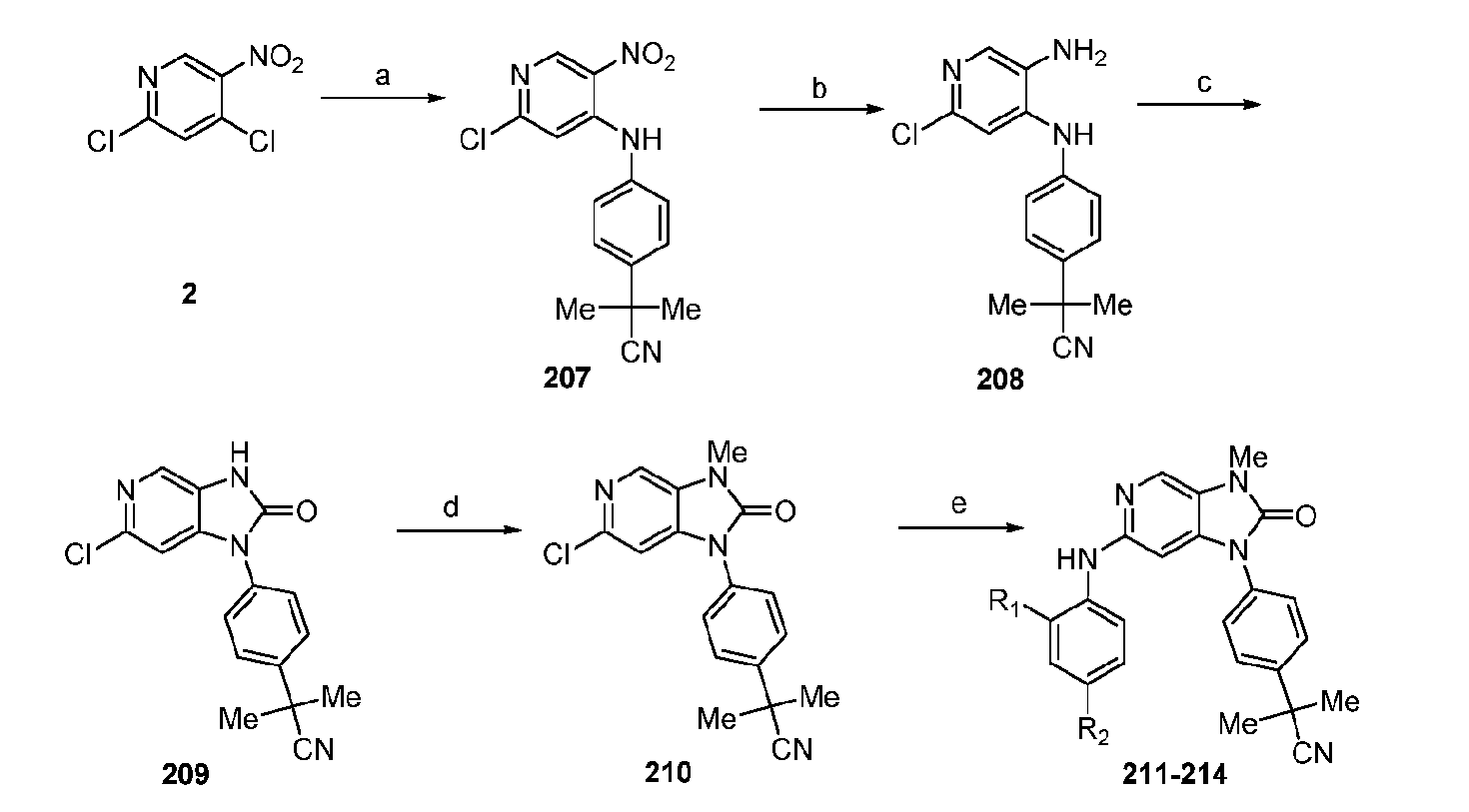
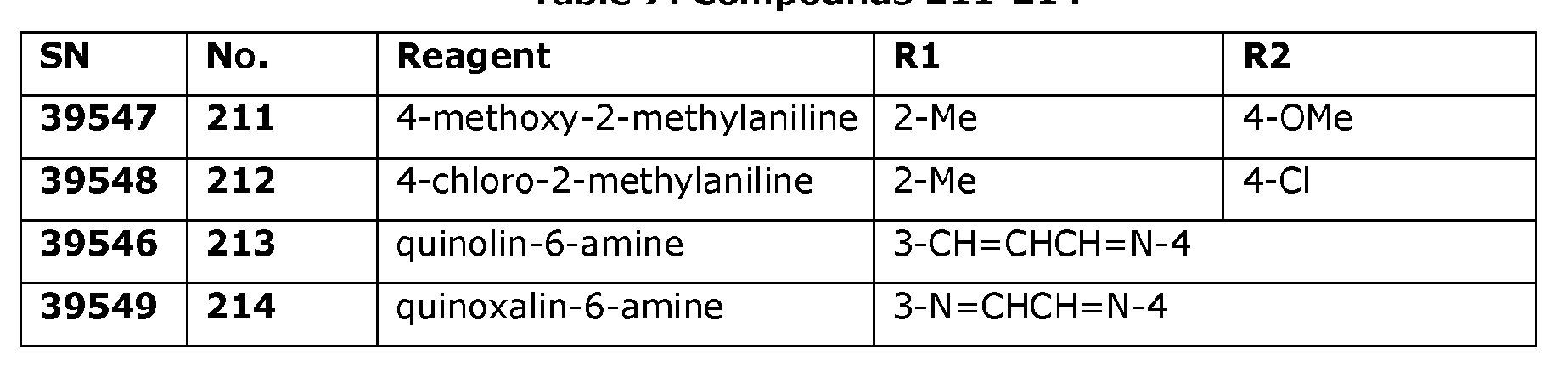
2, Pd/C, EtOH. Displacement of the chloride 2 with 2-(4-aminophenyl)-2-methylpropanenitrile gave nitroamine 207 and reduction of 207 with tin chloride dihydrate gave the diamine 208 (Scheme 26). Reaction of 208 with carbonyldiimidazole provided the pyridoimidazolone 209 which was alkylated using sodium hydride and methyl iodide to give chloride 210. Displacement of the chloride of 210 with various anilines, using Buchwald conditions, provided the compounds 211–214. Scheme 26
Reagents: a) 2-(4-aminophenyl)-2-methylpropanenitrile, iPr
2NEt, DCM; b) SnCl
2·2H
2O, EtOAc; c) CDI, MeCN; d) NaH, MeI, DMF; e) substituted aniline, Pd(dba)
3, XPhos, Cs
2CO
3, dioxane. Table 7: Compounds 211-214
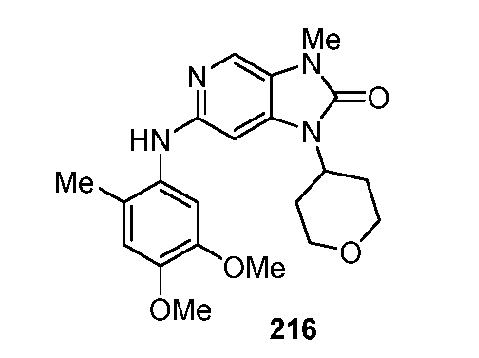
Chloride 120 (Scheme 9) was displaced with a further set of anilines using modified Buchwald conditions to provide the compounds 215–226 (Scheme 27).
Scheme 27
Reagents: a) substituted aniline, Pd(dba)
3, XPhos, Cs
2CO
3, dioxane or substituted aniline, BrettPhos Pd(II) G3, Cs
2CO
3.
Reaction of the imidazopyridinone 124 with di-tert-butyldicarbonate gave the carbamate 227 (Scheme 28). Hydrogenolysis of 227 gave the phenol 228. Alkylation of 228 with 2-chloro- N,N-dimethylethan-1-aminium chloride under basic conditions gave the ether 229 which was deprotected under acidic conditions to give imidazopyridinone 230 (SN40558).
Scheme 28
Reagents: a) BOC
2O, iPr
2NEt, DMAP, THF; b) H
2, Pd/C, EtOH, EtOAc; c) 2-chloro-N,N- dimethylethan-1-aminium chloride, Cs
2CO
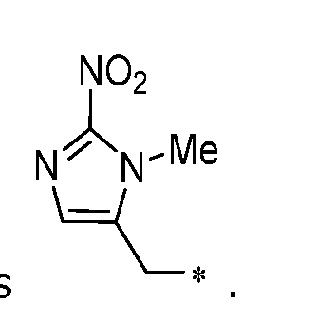
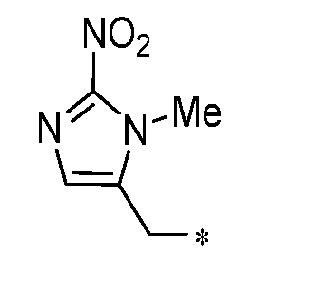
3, DMF; d) HCl, dioxane. Reaction of the imidazopyridinone 51 with di-tert-butyldicarbonate gave the carbamate 231 (Scheme 29). Hydrogenolysis of 231 gave the phenol 232. Alkylation of 232 with 5- (bromomethyl)-1-methyl-2-nitro-1H-imidazole under basic conditions gave the ether 233 which was deprotected under acidic conditions to give prodrug 234 (SN39586). Scheme 29
Reagents: a) BOC
2O, iPr
2NEt, DMAP, THF; b) H
2, Pd/C, EtOH, EtOAc; c) 5- (bromomethyl)-1-methyl-2-nitro-1H-imidazole, Cs
2CO
3, DMF; d) TFA, DCM. Phenol 228 (Scheme 28) was alkylated with 5-(chloromethyl)-1-methyl-2-nitro-1H-imidazole, 5-(1-chloroethyl)-1-methyl-2-nitro-1H-imidazole or (1-methyl-5-nitro-1H-imidazol-2- yl)methanol under basic conditions to give ethers 235, 237 and 238. Phenol 228 was also alkylated with (5-nitrothiophen-2-yl)methanol under Mitsunobu conditions to give ether 241. Esters 235, 237, 239 and 241 were deprotected under acidic conditions to give prodrugs 236, 238 and 240 (Scheme 30).
Scheme 30
Reagents: a) 5-(chloromethyl)-1-methyl-2-nitro-1H-imidazole (235) or 5-(1- chloroethyl)-1-methyl-2-nitro-1H-imidazole (237) or (1-methyl-5-nitro-1H- imidazol-2-yl)methanol (239), Cs
2CO
3, DMF; b) DEAD, PPh3, (5-nitrothiophen-2- yl)methanol, THF c) TFA, DCM. Table 9: Compounds 252-254
Reaction of the imidazopyridinone 199 with di-tert-butyldicarbonate gave the carbamate 243 (Scheme 31). Hydrogenolysis of 243 gave the phenol 244. Alkylation of 244 with 5- (chloromethyl)-1-methyl-2-nitro-1H-imidazole under basic conditions gave the ether 245 which was deprotected under acidic conditions to give prodrug 246 (SN39591). Scheme 31
Reagents: a) BOC2O, iPr
2NEt, DMAP, THF; b) H
2, Pd/C, EtOH, EtOAc; c) 5- (bromomethyl)-1-methyl-2-nitro-1H-imidazole, Cs
2CO
3, DMF; d) TFA, DCM. Reaction of imidazopyridinone 48 with triphosgene and NaHCO
3 formed the intermediate carbamoyl chloride and subsequent reaction with 5-(hydroxymethyl)-1-methyl-2-nitro-1H- imidazole gave prodrug 247 (SN39725)(Scheme 32).
Scheme 32
Reagents: a) a) triphosgene, NaHCO
3, then 5-(hydroxymethyl)-1-methyl-2-nitro- 1H-imidazole, DCM. Reaction of imidazopyridinone 121 with triphosgene and NaHCO
3 formed the intermediate carbamoyl chloride and subsequent reaction with 5-(hydroxymethyl)-1-methyl-2-nitro-1H- imidazole, DMAP and K
2CO
3 gave prodrug 248 (SN39884)(Scheme 33). Optimisation of this procedure involved isolating intermediate carbamoyl chloride 249 before reaction with 1-(1- methyl-2-nitro-1H-imidazol-5-yl)ethan-1-ol or (1-methyl-5-nitro-1H-imidazol-2-yl)methanol to form prodrugs 250 (SN40425) and 251 (SN40353). Scheme 33
Reagents: a) triphosgene, NaHCO
3, 5-(hydroxymethyl)-1-methyl-2-nitro-1H- imidazole, DMAP, K
2CO
3, DCM or b) triphosgene, NaHCO
3, c) 1-(1-methyl-2-nitro- 1H-imidazol-5-yl)ethan-1-ol or (1-methyl-5-nitro-1H-imidazol-2-yl)methanol, Cs
2CO
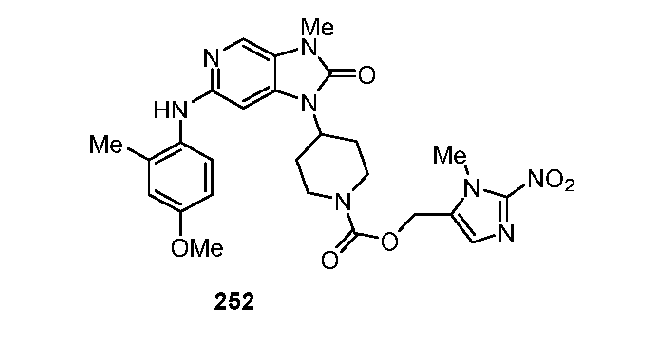
3, DMF. Reaction of imidazopyridinone 153 with (1-methyl-2-nitro-1H-imidazol-5-yl)methyl (4- nitrophenyl) carbonate gave prodrug 252 (SN40275)(Scheme 34). Scheme 34
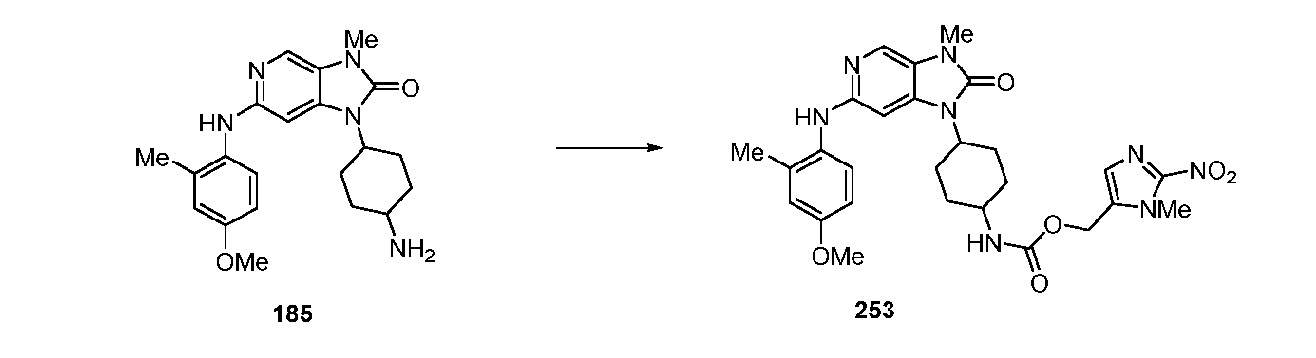
Reagents: a) (1-methyl-2-nitro-1H-imidazol-5-yl)methyl (4-nitrophenyl) carbonate, pyridine. Reaction of imidazopyridinone 185 with (1-methyl-2-nitro-1H-imidazol-5-yl)methyl (4- nitrophenyl) carbonate gave prodrug 253 (SN40302)(Scheme 35).
Scheme 35
Reagents: a) (1-methyl-2-nitro-1H-imidazol-5-yl)methyl (4-nitrophenyl) carbonate, pyridine. Reaction of imidazopyridinones 129, 225 and 130 with triphosgene and NaHCO
3 formed the intermediate carbamoyl chloride and subsequent reaction with 5-(hydroxymethyl)-1-methyl-2- nitro-1H-imidazole and Cs
2CO
3 gave prodrugs 254-256 (Scheme 36). Scheme 36 Reagent
s: a) triphosgene, NaHCO
3, DCM; then 5-(hydroxymethyl)-1-methyl-2-nitro-1H- imidazole, Cs
2CO
3, DMF. Table 10: Compounds 252-254 SN No R1 R2 Reaction of imi HCO
3 formed the
intermediate carbamoyl chloride and subsequent reaction with 5-(hydroxymethyl)-1-methyl-2- nitro-1H-imidazole and Cs
2CO
3 gave prodrugs 257-259 (Scheme 37). Scheme 37
Reagents: a) triphosgene, NaHCO
3, DCM; then 5-(hydroxymethyl)-1-methyl-2- nitro-1H-imidazole, Cs
2CO
3, DMF. Table 11: Compounds 254-257
Imidazopyridione 230 was converted to a free base then reaction with 5-(bromomethyl)-1- methyl-4-nitro-1H-imidazole gave quaternary ammonium salt (SN40564) 260 (Scheme 38). Scheme 38

Reagents: a) 5-(bromomethyl)-1-methyl-4-nitro-1H-imidazole, NMP. 5.4 Uses of the compounds of the invention in treating cancer The demonstrated DNA-PK inhibitory activity of the compounds of the invention makes them useful therapeutics against a range of diseases including cancer. In particular, the compounds of the invention are useful as anti-tumour agents. Without wishing to be bound by theory, the inventors believe that the DNA-PK inhibitor compounds described herein may act as anti- proliferative, apoptotic and/or anti-invasive agents in the treatment or prevention of solid and liquid tumours that are sensitive to the inhibition of DNA-PK, or mediated at least in part by DNA-PK. Accordingly in one aspect the invention provides a method for treating a disease in which inhibition of DNA-PK is beneficial in a subject in need thereof, the method comprising administering to the subject a therapeutically effective amount of a compound of Formula I, II, III, IV, V, VI or VII or a pharmaceutically acceptable salt thereof. In another aspect the invention provides a use of a compound of Formula I, II, III, IV, V, VI or VII, or a pharmaceutically acceptable salt thereof, in the manufacture of a medicament for the treatment of a disease in which inhibition of DNA-PK is beneficial.
In another aspect the invention provides a compound of Formula I, II, III, IV, V, VI or VII, or a pharmaceutically acceptable salt thereof, for use in the treatment of a disease in which inhibition of DNA-PK is beneficial. In one embodiment, the disease is cancer. In one embodiment the cancer is a solid tumour including, but not limited to, carcinoma, sarcoma, leukaemia and lymphoid malignancy. In one embodiment the cancer is selected from the group consisting of haematologic malignancies including leukaemia (including chronic lymphocytic leukaemia, acute lymphoctic leukaemia, chronic myelogenous leukaemia, multiple myeloma) lymphomas such as Hodgkin’s disease, non-Hodgkin’s lymphomas (including mantle cell lymphoma), and myelodysplastic syndromes, and also solid tumours and their metastases such as breast breast cancer, lung cancer (non-small small cell lung cancer (NSCLC), small cell lung cancer (SCLC), squamous cell carcinoma), endometrial cancer, tumours of the central nervous system such as gliomas, dysembryoplastic neuroepithelial tumour, glioblastoma multiforme, mixed glioms, medulloblastoma, retinoblastoma, neuroblastoma, germinoma and teratoma, cancers of the gastrointestinal tract such as gastric gastric cancer, oesophageal cancer, hepatocellular (liver) carcinoma, cholangiocarcinomas, colon and rectal carcinomas, cancers of the small intestine, pancreatic, cancers of the skin such as melanomas (in particular metastatic melanoma), thyroid cancers, cancers of the head and neck and cancers of the salivary glands, bile duct, bone, prostate, testis, ovary, cervix, uterus, vulva, bladder, kidney (including renal cell carcinoma, clear cell and renal oncocytoma), squamous cell carcinomas, sarcomas such as osteosarcoma, chondrosarcoma, leiomyosarcoma, soft tissue sarcoma Ewing’s sarcoma, gastrointestinal stromal tumour (GIST), Kaposi’s sarcoma, and paediatric cancers such as rhabdomyosarcomas and neuroblastomas. In one embodiment the cancer is a tumour that includes significant hypoxic fractions. In one embodiment, the cancer is selected from squamous cell carcinoma (including head and neck squamous cell carcinoma (HNSCC) and non-small cell lung cancer (NSCLC)), pancreatic ductal adenocarcinoma, cervical and prostate cancer. In the methods of the invention, a therapeutically effective amount of a compound of Formula I, II, III, IV, V, VI or VII or a pharmaceutically acceptable salt or solvate thereof, is administered to a subject in need thereof. A therapeutically effective amount may cause any of the changes observable or measurable in a subject as described in the definition of “therapy”, “treatment” and “prophylaxis” above. For example, in the treatment of cancer, a therapeutically effective amount of a compound of the invention may reduce the number of cancer or tumour cells; reduce the overall tumour size; inhibit or stop tumour cell infiltration into peripheral organs including, for example, the
relieve to some extent one or more of the symptoms associated with the cancer; reduce morbidity and mortality; improve quality of life; or a combination of such effects. The efficacy of the treatment can be measured by assessing the duration of survival, time to disease progression (TTP), the response rates (RR), duration of response, and/or quality of life. Therapeutically effective amounts may vary depending on route of administration, excipient usage, and co-usage with other agents. For example, where a combination therapy is used, the amount of the compound of the invention or pharmaceutically acceptable salt described in this specification and the amount of the other pharmaceutically active agent(s) are, when combined, jointly effective to treat the targeted disease in the subject. Anti-cancer effects which are accordingly useful in the treatment of cancer in a subject include, but are not limited to anti-tumour effects, the response rate, the time to disease progression and the survival rate. Anti-tumour effects of a method of treatment of the present invention include but are not limited to, inhibition of tumour growth, tumour growth delay, regression of tumour, shrinkage of tumour, increased time to regrowth of tumour on cessation of treatment, slowing of disease progression. Anti-cancer effects include prophylactic treatment as well as treatment of existing disease. In addition to administration of a compound of the invention, the methods of treatment of the invention may include other therapy including, but not limited to, radiotherapy and/or chemotherapy. Radiotherapy may include one or more of the following categories of therapy: (a) External radiation therapy using electromagnetic radiation, and intraoperative radiation therapy using electromagnetic radiation; (b) Internal radiation therapy or brachytherapy; including interstitial radiation therapy or intraluminal radiation therapy; and (c) Systemic radiation therapy, including but not limited to iodine 131 and strontium 89. Modern radiotherapy is typically delivered by linear accelerators that generate high energy X- rays that can be collimated to shape the treatment field. Intensity modulated radiation therapy (IMRT) uses non-uniform computer-controlled radiation fields to optimise delivery to the tumour tissue rather than surrounding normal tissue. Standard fractionated radiotherapy (FRT) is typically delivered with small (1.8-2.0 Gy) fractions over 4-7 weeks for a total dose of 30-70 Gy. Improvements in treatment planning and delivery have allowed the delivery of hypo- fractionated radiotherapy where a small number of high (15-20 Gy) doses can be delivered to tumours. This is known as stereotactic body radiation therapy (SBRT) or stereotactic ablative brain radiation (SABR). High energy charged particles such as protons and carbon ions may also be used to treat tumours and have the advantage of delivering most of the particle energy within the tumour. Brachytherapy uses radioactive implants to deliver radiation therapy
Chemotherapy may include one or more of the following categories of anti-tumour substances: (a) Antineoplastic agents and combinations thereof, such as DNA alkylating agents (for example cisplatin, oxaliplatin, carboplatin, cyclophosphamide, nitrogen mustards like ifosfamide, bendamustine, melphalan, chlorambucil, busulphan, temozolamide and nitrosoureas like carmustine); antimetabolites (for example gemcitabine and antifolates such as fluoropyrimidines like 5-fluorouracil and tegafur, raltitrexed, methotrexate, cytosine arabinoside, and hydroxyurea); anti-tumour antibiotics (for example anthracyclines like adriamycin, bleomycin, doxorubicin, liposomal doxorubicin, pirarubicin, daunomycin, valrubicin, epirubicin, idarubicin, mitomycin-C, dactinomycin, amrubicin and mithramycin); antimitotic agents (for example vinca alkaloids like vincristine, vinblastine, vindesine and vinorelbine and taxoids like taxol and taxotere and polokinase inhibitors); and topoisomerase inhibitors (for example epipodophyllotoxins like etoposide and teniposide, amsacrine, irinotecan, topotecan and camptothecin); inhibitors of DNA repair mechanisms such as CHK kinase; ATM inhibitors (such as AZD0156 and AZD1390); inhibitors of poly (ADP-ribose) polymerase (PARP inhibitors, including olaparib); and Hsp90 inhibitors such as tanespimycin and retaspimycin, inhibitors of ATR kinase (such as AZD6738); and inhibitors of WEE1 kinase (such as AZD1775/MK-1775); and (b) Immunotherapy approaches, including for example ex-vivo and in-vivo approaches to increase the immunogenicity of patient tumour cells, such as transfection with cytokines such as interleukin 2, interleukin 4 or granulocyte-macrophage colony stimulating factor; approaches to decrease T-cell anergy or regulatory T-cell function; approaches that enhance T-cell responses to tumours, such as blocking antibodies to CTLA4 (for example ipilimumab and tremelimumab), B7H1, PD-1 (for example BMS-936558 or AMP-514), PD-L1 (for example MEDI4736 (durvalumab)) and agonist antibodies to CD 137; approaches using transfected immune cells such as cytokine-transfected dendritic cells; approaches using cytokine-transfected tumour cell lines, approaches using antibodies to tumour associated antigens, and antibodies that deplete target cell types (e.g., unconjugated anti-CD20 antibodies such as Rituximab, radiolabeled anti-CD20 antibodies Bexxar and Zevalin, and anti-CD54 antibody Campath); approaches using anti-idiotypic antibodies; approaches that enhance Natural Killer cell function; and approaches that utilize antibody-toxin conjugates (e.g. anti-CD33 antibody Mylotarg);immuno toxins such as moxetumumab pasudotox; a
gonists of toll-like receptor 7 or toll-like receptor 9. In one embodiment, the invention provides a method for treating cancer, the method comprising administering to the subject a therapeutically effective amount of a compound of Formula I, II, III, IV, V, VI or VII, or a pharmaceutically acceptable salt or solvate thereof, in combination with radiotherapy, wherein the compound of Formula I, II, III, IV, V, VI or VII, or a pharmaceutically acceptable salt or solvate thereof, is administered simultaneously, separately or sequentially with the radiotherapy.
In one embodiment, radiotherapy is administered to the subject before, during or after administration of the compound of Formula I, II, III, IV, V, VI or VII or pharmaceutically acceptable salt or solvate thereof. In one embodiment, the invention provides a use of a compound of Formula I, II, III, IV, V, VI or VII, or a pharmaceutically acceptable salt or solvate thereof, in the manufacture of a medicament for the treatment of cancer. In one embodiment, the medicament is for simultaneous, separate or sequential administration with radiotherapy. In one embodiment the radiotherapy is selected from the group consisting of IMRT, FRT, SBRT, SABR and IORT. In one embodiment, the invention provides a method for treating cancer, the method comprising administering to the subject a therapeutically effective amount of a compound of Formula I, II, III, IV, V, VI or VII, or a pharmaceutically acceptable salt or solvate thereof, in combination with chemotherapy, wherein the compound of Formula I, II, III, IV, V, VI or VII, or a pharmaceutically acceptable salt or solvate thereof, is administered simultaneously, separately or sequentially with the chemotherapy. In one embodiment, chemotherapy is administered to the subject before, during or after administration of the compound of Formula I, II, III, IV, V, VI or VII or pharmaceutically acceptable salt or solvate thereof. In one embodiment, the invention provides a use of a compound of Formula I, II, III, IV, V, VI or VII, or a pharmaceutically acceptable salt or solvate thereof, in the manufacture of a medicament for the treatment of cancer. In one embodiment, the medicament is for simultaneous, separate or sequential administration with chemotherapy. The compound of Formula I, II, III, IV, V, VI or VII or pharmaceutically acceptable salt or solvate thereof, will normally be administered to the subject at a unit dose within the range 2.5-5000 mg/m
2 body area of the animal, or approximately 0.05-100 mg/kg. A unit dose form such as a tablet or capsule will usually contain, for example 0.1-250 mg of active agent. The dosage to be administered will necessarily be varied depending upon the subject to be treated, the particular route of administration, any co-administered therapies, and the severity of the disease being treated. The optimum dosage will be determined by the practitioner who is treating the subject. The compounds of the invention may be administered to a subject by any of a number of routes of administration including, for example, orally (for example, drenches as in aqueous or non-aqueous solutions or suspensions, tablets, boluses, powders, granules, pastes for application to the tongue); sublingually; anally, rectally, or vaginally (for example, as a
subcutaneously, or intrathecally as, for example, a sterile solution or suspension); nasally; intraperitoneally; subcutaneously; transdermally (for example as a patch applied to the skin); or topically (for example, as a cream, ointment or spray applied to the skin). At least one compound and/or salt as described herein may also be formulated for inhalation. In another aspect the invention provides a pharmaceutical composition comprising a compound of Formula I, II, III, IV, V, VI or VII or a pharmaceutically acceptable salt or solvate thereof, in combination with one or more pharmaceutically acceptable exipients. The pharmaceutical composition of the invention may be formulated to be administered orally, topically, parenterally, by inhalation or spray or rectally in dosage unit formulations. The term ‘administration by injection’ includes intravenous, intramuscular, subcutaneous and parenteral injections, as well as use of infusion techniques. One or more compounds may be present in association with one or more non-toxic pharmaceutically acceptable carriers and if desired other active ingredients. A “pharmaceutically acceptable carrier” is a pharmaceutically acceptable material, composition or vehicle, such as a liquid, diluent, excipient, filler, solvent or encapsulating material involved in transporting the subject compound around the body. Each carrier is “acceptable” in that it is compatible with the other ingredients of the formulation and is not harmful to the subject. The pharmaceutically acceptable compositions of the invention may also include other active agents providing additional therapeutic functions. Examples of materials that may serve as pharmaceutically acceptable carriers include but are not limited to: (1) sugars, such as lactose, glucose and sucrose; (2) starches, such as corn starch and potato starch; (3) cellulose, and its derivatives, such as sodium carboxymethyl cellulose, ethyl cellulose and cellulose acetate; (4) powdered tragacanth; (5) malt; (6) gelatin; (7) talc; (8) excipients, such as cocoa butter and suppository waxes; (9) oils, such as peanut oil, cottonseed oil, safflower oil, sesame oil, olive oil, corn oil and soybean oil; (10) glycols, such as propylene glycol; (11) polyols, such as glycerin, sorbitol, mannitol and polyethylene glycol; (12) esters, such as ethyl oleate and ethyl laurate; (13) agar; (14) buffering agents, such as magnesium hydroxide and aluminum hydroxide; (15) alginic acid; (16) pyrogen-free water; (17) isotonic saline; (18) Ringer's solution; (19) ethyl alcohol; (20) phosphate buffer solutions; and (21) other non-toxic compatible substances employed in pharmaceutical formulations. See Remington: The Science and Practice of Pharmacy, 20th ed. (Alfonso R. Gennaro ed.), 2000. Pharmaceutical compositions intended for oral use may be prepared according to any suitable method known to the art. Such compositions may contain one or more agents selected from the group consisting of diluents, sweetening agents, flavouring agents, colouring agents and preserving agents in order to provide palatable preparations. Tablets contain the active ingredient in admixture with non-toxic pharmaceutically acceptable excipients which are
such as calcium carbonate, sodium carbonate, lactose, calcium phosphate or sodium phosphate; granulating and disintegrating agents, for example, corn starch, or alginic acid; and binding agents, for example magnesium stearate, stearic acid or talc. The tablets may be uncoated or they may be coated by known techniques to delay disintegration and adsorption in the gastrointestinal tract and thereby provide a sustained action over a longer period. For example, a time delay material such as glyceryl monostearate or glyceryl distearate may be employed. These compounds may also be prepared in solid, rapidly released form. Formulations for oral use may also be presented as hard gelatin capsules wherein the active ingredient is mixed with an inert solid diluent, for example, calcium carbonate, calcium phosphate or kaolin, or as soft gelatin capsules wherein the active ingredient is mixed with water or an oil medium, for example peanut oil, liquid paraffin or olive oil. Aqueous suspensions contain the active materials in admixture with excipients suitable for the manufacture of aqueous suspensions. Such excipients are suspending agents, for example sodium carboxymethylcellulose, methylcellulose, hydroxypropyl methylcellulose, sodium alginate, polyvinylpyrrolidone, gum tragacanth and gum acacia; dispersing or wetting agents may be a naturally occurring phosphatide, for example, lecithin, or condensation products or an alkylene oxide with fatty acids, for example polyoxyethylene stearate, or condensation products of ethylene oxide with long chain aliphatic alcohols, for example heptadecaethylene oxycetanol, or condensation products of ethylene oxide with partial esters derived from fatty acids and hexitol such as polyoxyethylene sorbitol monooleate, or condensation products of ethylene oxide with partial esters derived from fatty acids and hexitol anhydrides, for example polyethylene sorbitan monooleate. The aqueous suspensions may also contain one or more preservatives, for example ethyl, or n-propyl p-hydroxybenzoate, one or more colouring agents, one or more flavouring agents, and one or more sweetening agents, such as sucrose or saccharin. Dispersible powders and granules suitable for preparation of an aqueous suspension by the addition of water provide the active ingredient in admixture with a dispersing or wetting agent, suspending agent and one or more preservatives. Suitable dispersing or wetting agents and suspending agents are exemplified by those already mentioned above. Additional excipients, for example, sweetening, flavouring and colouring agents, may also be present. The pharmaceutical compositions of the invention may also be in the form of non-aqueous liquid formulations, e.g., oily suspensions which may be formulated by suspending the active ingredients in a vegetable oil, for example arachis oil, olive oil, sesame oil or peanut oil, or in a mineral oil such as liquid paraffin. The oily suspensions may contain a thickening agent, for example beeswax, hard paraffin or cetyl alcohol. Sweetening agents such as those set forth above, and flavoring agents may be added to provide palatable oral preparations. These compositions may be preserved by the addition of an anti-oxidant such as ascorbic acid.
Pharmaceutical compositions of the invention may also be in the form of oil-in-water emulsions. The oily phase may be a vegetable oil, for example olive oil or arachis oil, or a mineral oil, for example liquid paraffin or mixtures of these. Suitable emulsifying agents may be naturally- occurring gums, for example gum acacia or gum tragacanth, naturally-occurring phosphatides, for example soy bean, lecithin, and esters or partial esters derived from fatty acids and hexitol anhydrides, for example sorbitan monooleate, and condensation products of the said partial esters with ethylene oxide, for example polyoxyethylene sorbitan monooleate. The emulsions may also contain sweetening and flavouring agents. Pharmaceutical compositions as described herein for rectal, vaginal, or urethral administration may be presented as a suppository, which may be prepared by mixing one or more compounds or salts as described herein with one or more suitable non-irritating excipients or carriers comprising, for example, cocoa butter, polyethylene glycol, a suppository wax or a salicylate, and which is solid at room temperature, but liquid at body temperature and, therefore, will melt in the rectum or vaginal cavity and release the active compound. The pharmaceutical compositions described herein may be formulated for delivery via a catheter, stent, wire, or other intraluminal device. Delivery via such devices may be especially useful for delivery to the bladder, urethra, ureter, rectum, or intestine. Dosage forms for the topical or transdermal administration include powders, sprays, ointments, pastes, creams, lotions, gels, solutions, patches, and inhalants. The active compound may be mixed under sterile conditions with a pharmaceutically acceptable carrier, and with any preservatives, buffers, or propellants that may be required. The ointments, pastes, creams, and gels may comprise excipients, such as animal and vegetable fats, oils, waxes, paraffins, starch, tragacanth, cellulose derivatives, polyethylene glycols, silicones, bentonites, silicic acid, talc and zinc oxide, or mixtures thereof. Powders and sprays may contain, in addition to a compound as described herein, excipients such as lactose, talc, silicic acid, aluminum hydroxide, calcium silicates, and polyamide powder, or mixtures of these substances. Sprays may additionally contain customary propellants, such as chlorofluorohydrocarbons and volatile unsubstituted hydrocarbons, such as butane and propane. Transdermal patches have the added advantage of providing controlled delivery to the body. Such dosage forms may be made by dissolving or dispersing the compound in the proper medium. Absorption enhancers may also be used to increase the flux across the skin. The rate of such flux may be controlled by either providing a rate controlling membrane or dispersing the compound in a polymer matrix or gel. Ophthalmic formulations, eye ointments, powders, solutions, and the like, may also comprise at least one of the compounds or salts as described herein.
The pharmaceutical compositions as described herein that are suitable for parenteral administration comprise at least one compound of the invention or a pharmaceutically acceptable salt thereof, in combination with one or more pharmaceutically acceptable sterile isotonic aqueous or nonaqueous solutions, dispersions, suspensions, or emulsions, or sterile powders which may be reconstituted into sterile injectable solutions or dispersions just prior to use, which may contain antioxidants, buffers, bacteriostats, solutes which render the formulation isotonic with the blood of the intended recipient or suspending or thickening agents. Examples of suitable aqueous and nonaqueous carriers that may be employed in the pharmaceutical compositions include water, ethanol, polyols (such as glycerol, propylene glycol, polyethylene glycol, and the like), and suitable mixtures thereof, vegetable oils, such as olive oil, and injectable organic esters, such as ethyl oleate. Proper fluidity may be maintained, for example, by the use of coating materials, such as lecithin, by the maintenance of the required particle size in the case of dispersions, and by the use of surfactants. These compositions may also contain adjuvants such as preservatives, wetting agents, emulsifying agents, and dispersing agents. Prevention of the action of microorganisms may be ensured by the inclusion of various antibacterial and antifungal agents, for example, paraben, chlorobutanol, phenol sorbic acid, chelators and the like. In some embodiments, isotonic agents, such as sugars, sodium chloride, and the like may be included into the compositions. In addition, prolonged absorption of the injectable pharmaceutical form may be brought about by the inclusion of agents that delay absorption such as aluminum mono stearate and gelatin. 6. EXAMPLES The following examples are representative of the invention and the detailed methods for preparing these compounds; however, the scope of the invention is not limited to these examples. All final products were analysed by reverse-phase HPLC, (ZORBAX Eclipse XDB C8 5 μm column, 4.6 × 150 mm; Agilent Technologies) using an Agilent Technologies 1260 Infinity equipped with a diode-array detector. Mobile phases were gradients of 80% acetonitrile/20% H
2O (v/v) in 45 mM ammonium formate at pH 3.5 and 0.8 mL/min. Final compound purity was determined by monitoring at 330 ± 50 nM and was >95%. Melting points were determined on an Electrothermal 2300 Melting Point Apparatus. NMR spectra were obtained on a Bruker Avance 400 spectrometer at 400 MHz for
1H spectra. Chemical shifts and coupling constants were recorded in units of ppm and Hz, respectively. Low resolution mass spectra were gathered by direct injection of methanolic solutions into an Agilent 6120 mass spectrometer using an atmospheric pressure chemical ionization (APCI) mode with a fragmentor voltage of 50 V and a
Agilent Technologies 6530 Accurate-Mass Quadrupole Time of Flight (Q-TOF) LC / MS interfaced with an Agilent Jet Stream Electrospray Ionization (ESI) source allowing positive or negative ions detection. Organic solutions were dried over MgSO
4 or Na
2SO
4 and solvents were evaporated under reduced pressure on a rotary evaporator. Thin-layer chromatography was carried out on aluminium-backed silica gel plates (Merck 60 F
254) with visualization of components by UV light (254 nm) or exposure to I2. Column chromatography was carried out on silica gel (Merck 230–400 mesh). BrettPhos G3 refers to [(2-di-cyclohexylphosphino-3,6- dimethoxy-2ʹ,4ʹ,6ʹ- triisopropyl-1,1ʹ-biphenyl)-2-(2ʹ-amino-1,1ʹ -biphenyl)]palladium(II) methanesulfonate methanesulfonate, CDI refers to carbonyldiimidazole, Cs
2CO
3 refers to caesium carbonate, DCM refers to dichloromethane, DIPEA refers to diisopropylethylamine, DMAP refers to 4-dimethylaminopyridine, DMF refers to dimethylformamide, DMSO refers to dimethyl sulfoxide, EtOAc refers to ethyl acetate, EtOH refers to ethanol, MeOH refers to methanol, MeCN refers to acetonitrile, MgSO
4 refers to magnesium sulfate, NMP refers to N- methylpyrrolidone, Pd
2dba
3 refers to tris(dibenzylideneacetone)dipalladium(0), pet. ether refers to petroleum ether boiling fraction 40–60 °C, THF refers to tetrahydrofuran, XPhos refers to 2- dicyclohexylphosphino-2ʹ,4ʹ,6ʹ-triisopropylbiphenyl. Example 1: SN39228 1-Cyclopentyl-3-methyl-6-(phenylamino)-1,3-dihydro-2H- imidazo[4,5-c]pyridin-2-one (7).
2,4-Dichloro-5-nitropyridine (2). A mixture of 4-chloro-5-nitropyridin-2-ol (1) (5.38 g, 30.8 mmol), POCl
3 (60 mL) and tetramethylammonium chloride (10.1 g, 32.5 mmol) was stirred at 120 °C for 3 h. The mixture was cooled, poured into ice/water (500 mL) and stirred for 1 h at 0–10 °C. The mixture was extracted with DCM (3 × 100 mL) and the combined organic extract dried (MgSO
4). The solution was filtered through a short column of neutral alumina, washing with DCM (50 mL). The solvent was evaporated to give nitropyridine 2 as a clear oil (5.43 g, 91%):
1H NMR (CDCl
3) δ 8.97 (s, 1 H, H-6), 7.59 (s, 1 H, H-3); MS m/z 192.9 (MH
+, 100%), 194.9 (MH
+, 70%). 2-Chloro-N-cyclopentyl-5-nitropyridin-4-amine (3). A solution of cyclopentylamine (0.95 mL, 9.6 mmol) in dry DCM (5 mL) was added dropwise to a stirred solution of nitropyridine 2 (1.76 g, 9.12 mmol) and iPr
2NEt (1.87 mL, 10.94 mmol) in dry DCM (50 mL) at 5 °C. The mixture was stirred at 20 °C for 16 h before being diluted with DCM (100 mL), washed with water (3 × 50 mL), dried (MgSO
4) and the solvent evaporated. The residue was purified by chromatography, eluting with 10% EtOAc/pet. ether, to give amine 3 (2.25 g, 100%) as a yellow oil:
1H NMR (CDCl
3) δ 9.01 (s, 1 H, H-6), 8.17 (br s, 1 H, 4-NH), 6.76 (s, 1 H, H-3), 3.93 (br dpent, J = 6.7, 5.3 Hz, 1 H, NCH), 2.10–2.18 (m, 2 H, CH
2), 1.70–1.88 (m, 4 H, 2 × CH
2), 1.59–1.69 (m, 2 H, CH
2); MS m/z 242.1 (MH
+, 100%), 244.1 (MH
+, 35%).
6-Chloro-N
4-cyclopentylpyridine-3,4-diamine (4). A solution of nitropyridine 3 (1.92 g, 7.93 mmol) in EtOAc (20 ml) was added dropwise to a stirred suspension of SnCl
2·2H
2O (7.16 g, 31.7 mmol) in EtOAc (100 mL) at 50 °C while maintaining the temperature below 60 °C. The mixture was stirred at 60 °C for 2 h and then cooled to 5 °C and conc. aq. NH
3 solution added until the solution was basic (pH 9). The precipitate was filtered and washed with EtOAc (100 mL). The combined organic fraction was dried (MgSO
4), filtered and the solvent evaporated to give diamine 4 as a white powder: mp 103–105 °C;
1H NMR [(CD
3)
2SO] δ 7.35 (s, 1 H, H-2), 6.29 (s, 1 H, H-5), 5.48 (d, J = 6.2 Hz, 1 H, 4-NH), 4.78 (br s, 2 H, 3-NH
2), 3.75 (br dpent, J = 6.7, 5.3 Hz, 1 H, NCH), 1.90–1.98 (m, 2 H, CH
2), 1.62–1.72 (m, 2 H, CH
2), 1.42–1.60 (m, 4 H, 2 × CH
2); MS m/z 212.2 (MH
+, 100%), 214.2 (MH
+, 35%). Anal calcd for C
10H
14ClN
3·0.1 EtOAc: C, 56.65; H, 6.77; N, 19.06. Found: C, 56.66; H, 6.84; N, 19.20%. 6-Chloro-1-cyclopentyl-1,3-dihydro-2H-imidazo[4,5-c]pyridin-2-one (5). CDI (1.36 g, 8.38 mmol) was added to a stirred solution of diamine 4 (1.69 g, 7.98 mmol) in dry MeCN (80 mL) at 20 °C. The mixture was stirred at 20 °C for 96 h. The solvent was evaporated and the residue partitioned between CHCl
3 (150 mL) and water (100 mL). The organic fraction was washed with water (2 × 50 mL), washed with brine (50 mL), dried (MgSO
4), filtered and the solvent evaporated. The residue was precipitated from 50% EtOAc/pet. ether, to give the pyridinone 5 (1.80 g, 95%) as a white powder: mp 222–224 °C;
1H NMR (CDCl
3) δ 9.76 (br s, 1 H, 3-NH), 8.13 (s, 1 H, H-4), 7.01 (s, 1 H, H-7), 4.79 (pent, J = 8.7 Hz, 1 H, 1-CH), 1.94– 2.12 (m, 6 H, 3 × CH
2), 1.72–1.81 (m, 2 H, CH
2); MS m/z 238.2 (MH
+, 100%), 240.2 (MH
+, 35%). Anal calcd for C
11H
12ClN
3O: C, 55.59; H, 5.09; N, 17.68. Found: C, 55.31; H, 5.16; N, 17.61%. 6-Chloro-1-cyclopentyl-3-methyl-1,3-dihydro-2H-imidazo[4,5-c]pyridin-2-one (6). NaH (60% dispersion, 312 mg, 7.8 mmol) was added to a stirred solution of pyridinone 5 (1.68 g, 7.1 mmol) and MeI (0.57 mL, 9.2 mmol) in dry DMF (20 mL) at 5 °C. The mixture was stirred at 20 °C for 16 h and then quenched with ice/water (5 mL). The solvent was evaporated and the residue was partitioned between EtOAc (100 mL) and water (50 ml). The organic fraction was washed with water (2 × 50 mL), washed with brine (50 mL), dried (MgSO
4), filtered and the solvent evaporated. The residue was purified by chromatography, eluting with a gradient (40–50%) of EtOAc/pet. ether, to give chloride 6 (1.49 g, 83%) as white crystals: mp 141–142 °C;
1H NMR (CDCl
3) δ 7.98 (s, 1 H, H-4), 6.98 (s, 1 H, H-7), 4.81 (pent, J = 8.8 Hz, 1 H, 1-CH), 3.44 (s, 3 H, 3-CH
3), 1.92–2.07 (m, 6 H, 3 × CH
2), 1.69–1.79 (m, 2 H, CH
2); MS m/z 252.2 (MH
+, 100%), 254.2 (MH
+, 35%). Anal calcd for C
12H
14ClN
3O: C, 56.26; H, 5.61; N, 16.69. Found: C, 57.26; H, 5.68; N, 16.86%. 1-Cyclopentyl-3-methyl-6-(phenylamino)-1,3-dihydro-2H-imidazo[4,5-c]pyridin-2- one (7). A degassed mixture of chloride 6 (120 mg, 0.48 mmol), aniline (53 mg, 0.57 mmol), Pd
2dba
3 (22 mg, 24 µmol), XPhos (46 mg, 96 µmol) and Cs
2CO
3 (313 mg, 0.96 mmol) in dioxane (6 mL) was stirred in a sealed tube at 120 °C for 16 h. The mixture was cooled, diluted with EtOAc (30 mL), filtered through diatomaceous earth and the filtrate was evaporated. The
residue was partitioned between EtOAc (50 mL) and water (50 mL). The organic fraction was washed with water (30 mL), washed with brine (30 mL), dried (MgSO
4), filtered and the solvent evaporated. The residue was purified by chromatography, eluting with a gradient (40– 60%) of EtOAc/pet. ether, to give imidazopyridinone 7 (84 mg, 57%) as a tan powder: mp (EtOAc/pet ether) 168–170 °C;
1H NMR (CDCl
3) δ 7.83 (s, 1 H, H-4), 7.33 (br dd, J = 8.6, 7.2 Hz, 2 H, H-3ʹ, H-5ʹ), 7.26 (br d, J = 8.6 Hz, 2 H, H-2ʹ, H-6ʹ), 7.01 (tt, J = 7.2, 1.2 Hz, 1 H, H- 4ʹ), 6.64 (s, 1 H, H-7), 6.48 (s, 1 H, 6-NH), 4.77 (pent, J = 8.8 Hz, 1 H, 1-CH), 3.40 (s, 3 H, 3- CH
3), 1.95–2.05 (m, 4 H, 2 × CH
2), 1.81–1.90 (m, 2 H, CH
2), 1.63–1.72 (m, 2 H, CH
2); MS m/z 309.2 (MH
+, 100%). Anal calcd for C
18H
20N
4O: C, 70.11; H, 6.54; N, 18.17. Found: C, 70.06; H, 6.64; N, 18.23%. HPLC purity 100.0% Example 2: SN39229 1-Cyclopentyl-3-methyl-6-(4-methylphenylamino)-1,3-dihydro- 2H-imidazo[4,5-c]pyridin-2-one (8).
A degassed mixture of chloride 6 (120 mg, 0.48 mmol), 4-methylaniline (61 mg, 0.57 mmol), Pd
2dba
3 (22 mg, 24 µmol), XPhos (46 mg, 96 µmol) and Cs
2CO
3 (313 mg, 0.96 mmol) in dioxane (6 mL) was stirred in a sealed tube at 120 °C for 16 h. The mixture was cooled, diluted with EtOAc (30 mL), filtered through diatomaceous earth and the filtrate was evaporated. The residue was partitioned between EtOAc (50 ml) and water (50 mL). The organic fraction was washed with water (30 mL), washed with brine (30 mL), dried (MgSO
4), filtered and the solvent evaporated. The residue was purified by chromatography, eluting with a gradient (40– 60%) of EtOAc/pet. ether, to give imidazopyridinone 8 (99 mg, 64%) as a tan powder: mp (EtOAc/pet ether) 153–154 °C;
1H NMR (CDCl
3) δ 7.80 (s, 1 H, H-4), 7.12–7.17 (m, 4 H, H-2ʹ, H-3ʹ, H-5ʹ, H-6ʹ), 6.58 (d, J = 0.6 Hz, 1 H, H-7), 6.39 (s, 1 H, 6-NH), 4.75 (pent, J = 8.8 Hz, 1 H, 1-CH), 3.38 (s, 3 H, 3-CH
3), 2.33 (s, 3 H, 4ʹ-CH
3), 1.95–2.03 (m, 4 H, 2 × CH
2), 1.82–1.90 (m, 2 H, CH
2), 1.66–1.72 (m, 2 H, CH
2). Anal calcd for C
19H
22N
4O: C, 70.78; H, 6.88; N, 17.38. Found: C, 70.39; H, 7.21; N, 17.43%. HPLC purity 98.5%. Example 3: SN39231 1-Cyclopentyl-3-methyl-6-(3-methylphenylamino)-1,3-dihydro- 2H-imidazo[4,5-c]pyridin-2-one (9).
A degassed mixture of chloride 6 (120 mg, 0.48 mmol), 3-methylaniline (61 mg, 0.57 mmol), Pd
2dba
3 (22 mg, 24 µmol), XPhos (46 mg, 96 µmol) and Cs
2CO
3 (311 mg, 0.96 mmol) in
dioxane (6 mL) was stirred in a sealed tube at 120 °C for 16 h. The mixture was cooled, diluted with EtOAc (30 mL), filtered through diatomaceous earth and the filtrate was evaporated. The residue was partitioned between EtOAc (50 ml) and water (50 mL). The organic fraction was washed with water (30 mL), washed with brine (30 mL), dried (MgSO
4), filtered and the solvent evaporated. The residue was purified by chromatography, eluting with a gradient (50– 70%) of EtOAc/pet. ether, to give imidazopyridinone 9 (131 mg, 85%) as a tan powder: mp (EtOAc/pet ether) 124–126 °C;
1H NMR (CDCl
3) δ 7.82 (d, J = 0.6 Hz, 1 H, H-4), 7.21 (br t, J = 7.7 Hz, 1 H, H-5ʹ), 7.03–7.10 (m, 2 H, H-2ʹ, H-6ʹ), 6.85 (d, J = 7.5 Hz, 1 H, H-4ʹ), 6.68 (d, J = 0.6 Hz, 1 H, H-7), 6.44 (s, 1 H, 6-NH), 4.80 (pent, J = 8.8 Hz, 1 H, 1-CH), 3.97 (s, 3 H, 3- CH
3), 2.34 (s, 3 H, 3ʹ-CH
3), 1.94–2.05 (m, 4 H, 2 × CH
2), 1.82–1.90 (m, 2 H, CH
2), 1.66–1.74 (m, 2 H, CH
2). Anal calcd for C
19H
22N
4O: C, 70.78; H, 6.88; N, 17.38. Found: C, 70.50; H, 6.99; N, 17.56%. HPLC purity 99.7% Example 4: SN39232 1-Cyclopentyl-3-methyl-6-(2-methylphenylamino)-1,3-dihydro- 2H-imidazo[4,5-c]pyridin-2-one (10).
A degassed mixture of chloride 6 (120 mg, 0.48 mmol), 2-methylaniline (61 mg, 0.57 mmol), Pd
2dba
3 (22 mg, 24 µmol), XPhos (46 mg, 96 µmol) and Cs
2CO
3 (311 mg, 0.96 mmol) in dioxane (6 mL) was stirred in a sealed tube at 120 °C for 16 h. The mixture was cooled, diluted with EtOAc (30 mL), filtered through diatomaceous earth and the filtrate was evaporated. The residue was partitioned between EtOAc (50 ml) and water (50 mL). The organic fraction was washed with water (30 mL), washed with brine (30 mL), dried (MgSO
4), filtered and the solvent evaporated. The residue was purified by chromatography, eluting with a gradient (50– 70%) of EtOAc/pet. ether, to give imidazopyridinone 10 (131 mg, 85%) as a tan foam:
1H NMR (CDCl
3) δ 7.81 (d, J = 0.6 Hz, 1 H, H-4), 7.39 (d, J = 7.6 Hz, 1 H, H-3ʹ), 7.24 (d, J = 7.4 Hz, 1 H, H-6ʹ), 7.20 (br t, J = 7.7 Hz, 1 H, H-4ʹ), 7.02 (dt, J = 7.4, 1.1 Hz, 1 H, H-5ʹ), 6.45 (d, J = 0.6 Hz, 1 H, H-7), 6.13 (s, 1 H, 6-NH), 4.73 (pent, J = 8.8 Hz, 1 H, 1-CH), 3.39 (s, 3 H, 3- CH
3), 2.29 (s, 3 H, 3ʹ-CH
3), 1.92–2.02 (m, 4 H, 2 × CH
2), 1.74–1.84 (m, 2 H, CH
2), 1.62–1.70 (m, 2 H, CH
2); MS m/z 323.2 (MH
+, 100%). Anal calcd for C
19H
22N
4O·¼EtOAc: C, 70.35; H, 6.94; N, 16.92. Found: C, 70.34; H, 7.10; N, 16.77%. HPLC purity 97.7%. Example 5: SN39236 1-Cyclopentyl-6-((4-methoxyphenyl)amino)-3-methyl-1,3- dihydro-2H-imidazo[4,5-c]pyridin-2-one (11).
A degassed mixture of chloride 6 (128 mg, 0.51 mmol), 4-methoxyaniline (75 mg, 0.61 mmol), Pd
2dba
3 (23 mg, 25 µmol), XPhos (48 mg, 102 µmol) and Cs
2CO
3 (331 mg, 1.02 mmol) in dioxane (6 mL) was stirred in a sealed tube at 120 °C for 16 h. The mixture was cooled, diluted with EtOAc (30 mL), filtered through diatomaceous earth and the filtrate was evaporated. The residue was partitioned between EtOAc (50 ml) and water (50 mL). The organic fraction was washed with water (30 mL), washed with brine (30 mL), dried (MgSO
4), filtered and the solvent evaporated. The residue was purified by chromatography, eluting with a gradient (50– 100%) of EtOAc/ pet. ether, to give imidazopyridinone 11 (72 mg, 42%) as a brown powder: mp (EtOAc/pet ether) 159–161 °C;
1H NMR (CDCl
3) δ 7.77 (s, 1 H, H-4), 7.21 (ddd, J = 8.9, 3.5, 2.2 Hz, 2 H, H-2ʹ, H-6ʹ), 6.91 (ddd, J = 8.9, 3.5, 2.2 Hz, 2 H, H-3ʹ, H-5ʹ), 6.42 (s, 1 H, H- 7), 6.27 (br s, 1 H, 6-NH), 4.72 (pent, J = 8.8 Hz, 1 H, 1-CH), 3.82 (s, 3 H, 4ʹ-OCH
3), 3.38 (s, 3 H, 3-CH
3), 1.93–2.02 (m, 4 H, 2 × CH
2), 1.78–1.88 (m, 2 H, CH
2), 1.63–1.72 (m, 2 H, CH
2); MS m/z 339.2 (MH
+, 100%). Anal calcd for C
19H
22N
4O
2·¼EtOAc: C, 66.65; H, 6.71; N, 15.54. Found: C, 66.29; H, 6.57; N, 15.90%. HPLC purity 98.1%. Example 6: SN39239 1-Cyclopentyl-6-((3-methoxyphenyl)amino)-3-methyl-1,3- dihydro-2H-imidazo[4,5-c]pyridin-2-one (12).
A degassed mixture of chloride 6 (126 mg, 0.50 mmol), 3-methoxyaniline (74 mg, 0.60 mmol), Pd
2dba
3 (23 mg, 25 µmol), XPhos (47 mg, 102 µmol) and Cs
2CO
3 (326 mg, 1.02 mmol) in dioxane (6 mL) was stirred in a sealed tube at 120 °C for 16 h. The mixture was cooled, diluted with EtOAc (30 mL), filtered through diatomaceous earth and the filtrate was evaporated. The residue was partitioned between EtOAc (50 ml) and water (50 mL). The organic fraction was washed with water (30 mL), washed with brine (30 mL), dried (MgSO
4), filtered and the solvent evaporated. The residue was purified by chromatography, eluting with EtOAc, to give imidazopyridinone 12 (136 mg, 80%) as a tan powder: mp (EtOAc/pet ether) 66–69 °C;
1H NMR (CDCl
3) δ 7.83 (d, J = 0.4 Hz, 1 H, H-4), 7.22 (t, J = 8.1 Hz, 1 H, H-5ʹ), 6.89 (t, J = 2.3 Hz, 1 H, H-2ʹ), 6.82 (dd, J = 8.0, 1.4 Hz, 1 H, H-6ʹ), 6.68 (d, J = 0.6 Hz, 1 H, H-7), 6.57 (ddd, J = 8.2, 2.4, 0.7 Hz, 1 H, H-4ʹ), 6.49 (s, 1 H, 6-NH), 4.79 (pent, J = 8.8 Hz, 1 H, 1-CH), 3.80 (s, 3 H, 3ʹ-OCH
3), 3.40 (s, 3 H, 3-CH
3), 1.95–2.06 (m, 4 H, 2 × CH
2), 1.80–1.92 (m, 2 H, CH
2), 1.62–1.72 (m, 2 H, CH
2); MS m/z 339.2 (MH
+, 100%). Anal calcd for C
19H
22N
4O·½H
2O: C, 65.69; H, 6.67; N, 16.13. Found: C, 65.42; H, 6.36; N, 15.92%. HPLC purity 99.7%.
Example 7: SN39240 1-Cyclopentyl -6-(2-methoxyphenylamino)-3-methyl-1,3- dihydro-2H-imidazo[4,5-c]pyridin-2-one (13).
A degassed mixture of chloride 6 (110 mg, 0.44 mmol), 2-methoxyaniline (65 mg, 0.52 mmol), Pd
2dba
3 (20 mg, 22 µmol), XPhos (42 mg, 88 µmol) and Cs
2CO
3 (285 mg, 0.88 mmol) in dioxane (6 mL) was stirred in a sealed tube at 120 °C for 16 h. The mixture was cooled, diluted with EtOAc (30 mL), filtered through diatomaceous earth and the filtrate was evaporated. The residue was partitioned between EtOAc (50 ml) and water (50 mL). The organic fraction was washed with water (30 mL), washed with brine (30 mL), dried (MgSO
4), filtered and the solvent evaporated. The residue was purified by chromatography, eluting with a gradient (60– 100%) of EtOAc/pet. ether, to give imidazopyridinone 13 (135 mg, 91%) as a tan powder:
1H NMR (CDCl
3) δ 7.83–7.90 (m, 2 H, H-4, H-6ʹ), 7.89–6.98 (m, 3 H, H-3ʹ, H-4ʹ, H-5ʹ), 6.83 (s, 1 H, 6-NH), 6.61 (s, 1 H, H-7), 4.78 (pent, J = 8.8 Hz, 1 H, 1-CH), 3.90 (s, 3 H, 2ʹ-OCH
3), 3.40 (s, 3 H, 3-CH
3), 1.98–2.08 (m, 4 H, 2 × CH
2), 1.85–1.95 (m, 2 H, CH
2), 1.63–1.75 (m, 2 H, CH
2); MS m/z 338.4 (MH
+, 100%); HRMS calcd for C
19H
23N
4O
2 (MH
+) m/z 339.1816, found 339. 1819 (-1.0 ppm). HPLC purity 99.9%. Example 8: SN39241 6-((4-Chlorophenyl)amino)-1-cyclopentyl-3-methyl-1,3- dihydro-2H-imidazo[4,5-c]pyridin-2-one (14). A degassed mixture of chloride 6 (119
mg, 0.47 mmol), 4-chloroaniline (72 mg, 0.57 mmol), Pd
2dba
3 (22 mg, 24 µmol), XPhos (45 mg, 95 µmol) and Cs
2CO
3 (308 mg, 0.95 mmol) in dioxane (6 mL) was stirred in a sealed tube at 120 °C for 16 h. The mixture was cooled, diluted with EtOAc (30 mL), filtered through diatomaceous earth and the filtrate was evaporated. The residue was partitioned between EtOAc (50 ml) and water (50 mL). The organic fraction was washed with water (30 mL), washed with brine (30 mL), dried (MgSO
4), filtered and the solvent evaporated. The residue was purified by chromatography, eluting with a gradient (40– 60%) of EtOAc/pet. ether, to give imidazopyridinone 14 (80 mg, 49%) as a brown powder: mp (EtOAc/pet ether) 179–181 °C;
1H NMR (CDCl
3) δ 7.83 (s, 1 H, H-4), 7.22–7.18 (m, 4 H, H-2ʹ, H-3ʹ, H-5ʹ, H-6ʹ), 6.54 (s, 1 H, H-7), 6.43 (s, 1 H, 6-NH), 4.76 (pent, J = 8.8 Hz, 1 H, 1-CH), 3.40 (s, 3 H, 3-CH
3), 1.95–2.05 (m, 4 H, 2 × CH
2), 1.82–1.92 (m, 2 H, CH
2), 1.63–1.75 (m, 2 H, CH
2); MS m/z 343.2 (MH
+, 100%), 345.2 (MH
+, 35%). Anal calcd for C
18H
19ClN
4O·0.1EtOAc: C, 62.65; H, 5.76; N, 15.54. Found: C, 62.56; H, 5.62; N, 15.84%. HPLC purity 99.0%.
Example 9: SN39242 6-((3-Chlorophenyl)amino)-1-cyclopentyl-3-methyl-1,3- dihydro-2H-imidazo[4,5-c]pyridin-2-one (15).
A degassed mixture of chloride 6 (132 mg, 0.52 mmol), 3-chloroaniline (80 mg, 0.63 mmol), Pd
2dba
3 (24 mg, 26 µmol), XPhos (50 mg, 104 µmol) and Cs
2CO
3 (339 mg, 1.04 mmol) in dioxane (6 mL) was stirred in a sealed tube at 120 °C for 16 h. The mixture was cooled, diluted with EtOAc (30 mL), filtered through diatomaceous earth and the filtrate was evaporated. The residue was partitioned between EtOAc (50 ml) and water (50 mL). The organic fraction was washed with water (30 mL), washed with brine (30 mL), dried (MgSO
4), filtered and the solvent evaporated. The residue was purified by chromatography, eluting with a gradient (50– 75%) of EtOAc/pet. ether, to give imidazopyridinone 15 (110 mg, 62%) as a tan powder: mp (EtOAc/pet ether) 145–147 °C;
1H NMR (CDCl
3) δ 7.86 (d, J = 0.6 Hz, 1 H, H-4), 7.40 (t, J = 2.1 Hz, 1 H, H-2ʹ), 7.22 (t, J = 8.0 Hz, 1 H, H-5ʹ), 7.11 (ddd, J = 8.2, 2.1, 0.9 Hz, 1 H, H-6ʹ), 6.95 (ddd, J = 7.9, 2.0, 1.0 Hz, 1 H, H-4ʹ), 6.62 (d, J = 0.6 Hz, 1 H, H-7), 6.51 (s, 1 H, 6-NH), 4.81 (pent, J = 8.8 Hz, 1 H, 1-CH), 3.41 (s, 3 H, 3-CH
3), 1.97–2.08 (m, 4 H, 2 × CH
2), 1.84– 1.94 (m, 2 H, CH
2), 1.68–1.76 (m, 2 H, CH
2); MS m/z 343.2 (MH
+, 100%), 345.2 (MH
+, 35%). Anal calcd for C
18H
19ClN
4O·0.1EtOAc: C, 62.85; H, 5.68; N, 15.93. Found: C, 62.73; H, 5.54; N, 15.94%. HPLC purity 99.9%. Example 10: SN39245 6-((2-Chlorophenyl)amino)-1-cyclopentyl-3-methyl-1,3- dihydro-2H-imidazo[4,5-c]pyridin-2-one (16).
A degassed mixture of chloride 6 (130 mg, 0.52 mmol), 2-chloroaniline (80 mg, 0.62 mmol), Pd
2dba
3 (24 mg, 26 µmol), XPhos (50 mg, 104 µmol) and Cs
2CO
3 (339 mg, 1.04 mmol) in dioxane (6 mL) was stirred in a sealed tube at 120 °C for 16 h. The mixture was cooled, diluted with EtOAc (30 mL), filtered through diatomaceous earth and the filtrate was evaporated. The residue was partitioned between EtOAc (50 ml) and water (50 mL). The organic fraction was washed with water (30 mL), washed with brine (30 mL), dried (MgSO
4), filtered and the solvent evaporated. The residue was purified by chromatography, eluting with a gradient (5– 10%) of EtOAc/DCM, to give imidazopyridinone 16 (79 mg, 45%) as a brown foam:
1H NMR (CDCl
3) δ 7.90 (dd, J = 8.3, 1.5 Hz, 1 H, H-6ʹ), 7.87 (s, 1 H, H-4), 7.39 (dd, J = 8.0, 1.5 Hz, 1 H, H-3ʹ), 7.23 (dt, J = 8.5, 1.5 Hz, 1 H, H-5ʹ), 6.90 (dt, J = 7.9, 1.5 Hz, 1 H, H-4ʹ), 6.74 (br s, 1 H, 6-NH), 6.61 (s, 1 H, H-7), 4.77 (pent, J = 8.8 Hz, 1 H, 1-CH), 3.41 (s, 3 H, 3-CH
3), 1.98– 2.08 (m, 4 H, 2 × CH
2), 1.86–1.96 (m, 2 H, CH
2), 1.68–1.77 (m, 2 H, CH
2); MS m/z 343.2
(MH
+, 100%), 345.2 (MH
+, 35%); HRMS calcd for C
18H
20ClN
4O (MH
+) m/z 343.1320, found 343.1318 (0.5 ppm). HPLC purity 98.4%. Example 11: SN39246 1-Cyclopentyl-3-methyl-6-(4-nitrophenylamino)-1,3-dihydro- 2H-imidazo[4,5-c]pyridin-2-one (17).
A degassed mixture of chloride 6 (131 mg, 0.52 mmol), 4-nitroaniline (86 mg, 0.63 mmol), Pd
2dba
3 (24 mg, 26 µmol), XPhos (50 mg, 104 µmol) and Cs
2CO
3 (339 mg, 1.04 mmol) in dioxane (6 mL) was stirred in a sealed tube at 120 °C for 16 h. The mixture was cooled, diluted with EtOAc (30 mL), filtered through diatomaceous earth and the filtrate was evaporated. The residue was partitioned between EtOAc (50 ml) and water (50 mL). The organic fraction was washed with water (30 mL), washed with brine (30 mL), dried (MgSO
4), filtered and the solvent evaporated. The residue was purified by chromatography, eluting with a gradient (50– 100%) of EtOAc/ pet. ether, to give imidazopyridinone 17 (127 mg, 69%) as a red crystals: mp (EtOAc/pet ether) 270–272 °C;
1H NMR (CDCl
3) δ 8.18 (ddd, J = 9.2, 3.1, 2.1 Hz, 2 H, H-3ʹ, H-5ʹ), 7.94 (s, 1 H, H-4), 7.46 (ddd, J = 9.2, 3.1, 2.1 Hz, 2 H, H-2ʹ, H-6ʹ), 6.94 (br s, 1 H, 6- NH), 6.64 (d, J = 0.5 Hz, 1 H, H-7), 4.82 (pent, J = 8.8 Hz, 1 H, 1-CH), 3.44 (s, 3 H, 3-CH
3), 2.02–2.10 (m, 4 H, 2 × CH
2), 1.88–1.98 (m, 2 H, CH
2), 1.70–1.80 (m, 2 H, CH
2); MS m/z 354.2 (MH
+, 100%). Anal calcd for C
18H
19N
5O
3: C, 61.18; H, 5.42; N, 19.82. Found: C, 61.29; H, 5.29; N, 19.94%. HPLC purity 100.0%. Example 12: SN39247 1-Cyclopentyl-3-methyl-6-(3-nitrophenylamino)-1,3-dihydro- 2H-imidazo[4,5-c]pyridin-2-one (18).
A degassed mixture of chloride 6 (131 mg, 0.52 mmol), 3-nitroaniline (86 mg, 0.63 mmol), Pd
2dba
3 (24 mg, 26 µmol), XPhos (50 mg, 104 µmol) and Cs
2CO
3 (339 mg, 1.04 mmol) in dioxane (6 mL) was stirred in a sealed tube at 120 °C for 16 h. The mixture was cooled, diluted with EtOAc (30 mL), filtered through diatomaceous earth and the filtrate was evaporated. The residue was partitioned between EtOAc (50 ml) and water (50 mL). The organic fraction was washed with water (30 mL), washed with brine (30 mL), dried (MgSO
4), filtered and the solvent evaporated. The residue was purified by chromatography, eluting with a gradient (50– 80%) of EtOAc/pet. ether, to give imidazopyridinone 18 (147 mg, 80%) as a yellow powder: mp (EtOAc/pet ether) 184–186 °C;
1H NMR (CDCl
3) δ 8.36 (t, J = 2.2 Hz, 1 H, H-2ʹ), 7.91 (s, 1 H H-4) 7 78 (ddd J = 8 1 2 1 0 8 Hz 1 H H-6ʹ) 7 59 (ddd J = 8 1 2 0 0 8 Hz 1 H H-4ʹ)
7.43 (t, J = 8.1 Hz, 1 H, H-5ʹ), 6.75 (s, 1 H, 6-NH), 6.61 (d, J = 0.4 Hz, 1 H, H-7), 4.83 (pent, J = 8.8 Hz, 1 H, 1-CH), 3.43 (s, 3 H, 3-CH
3), 2.00–2.08 (m, 4 H, 2 × CH
2), 1.87–1.97 (m, 2 H, CH
2), 1.70–1.78 (m, 2 H, CH
2); MS m/z 354.2 (MH
+, 100%). Anal. calcd for C
18H
19N
5O
3: C, 61.18; H, 5.42; N, 19.82. Found: C, 60.98; H, 5.29; N, 19.82%. HPLC purity 99.9%. Example 13: SN39263 1-Cyclopentyl-3-methyl-6-(2-nitrophenylamino)-1,3-dihydro- 2H-imidazo[4,5-c]pyridin-2-one (19).
A degassed mixture of chloride 6 (131 mg, 0.52 mmol), 2-nitroaniline (86 mg, 0.63 mmol), Pd
2dba
3 (24 mg, 26 µmol), XPhos (50 mg, 104 µmol) and Cs
2CO
3 (339 mg, 1.04 mmol) in dioxane (6 mL) was stirred in a sealed tube at 120 °C for 16 h. The mixture was cooled, diluted with EtOAc (30 mL), filtered through diatomaceous earth and the filtrate was evaporated. The residue was partitioned between EtOAc (50 ml) and water (50 mL). The organic fraction was washed with water (30 mL), washed with brine (30 mL), dried (MgSO
4), filtered and the solvent evaporated. The residue was purified by chromatography, eluting with 40% EtOAc/pet. ether, to give imidazopyridinone 19 (161 mg, 88%) as red crystals:
1H NMR (CDCl
3) δ 10.10 (br s, 1 H, 6-NH), 8.42 (dd, J = 8.8, 1.2 Hz, 1 H, H-3ʹ), 8.32 (dd, J = 8.6, 1.6 Hz, 1 H, H-6ʹ), 7.97 (s, 1 H, H-4), 7.51 (ddd, J = 8.4, 7.1, 1.4 Hz, 1 H, H-5ʹ), 6.90 (ddd, J = 8.4, 7.1, 1.4 Hz, 1 H, H-4ʹ), 6.68 (s, 1 H, H-7), 4.81 (pent, J = 8.8 Hz, 1 H, 1-CH), 3.45 (s, 3 H, 3-CH
3), 1.92– 2.10 (m, 6 H, 3 × CH
2), 1.70–1.80 (m, 2 H, CH
2); MS m/z 354.2 (MH
+, 100%). Anal calcd for C
18H
19N
5O
3: C, 61.18; H, 5.42; N, 19.82. Found: C, 60.89; H, 5.34; N, 19.61%. HPLC purity 99.9%. Example 14: SN39273 N-(4-((1-Cyclopentyl-3-methyl-2-oxo-2,3-dihydro-1H- imidazo[4,5-c]pyridin-6-yl)amino)phenyl)acetamide (20).
A degassed mixture of chloride 6 (118 mg, 0.47 mmol), N-(4-aminophenyl)acetamide (85 mg, 0.56 mmol), Pd
2dba
3 (22 mg, 24 µmol), XPhos (45 mg, 94 µmol) and Cs
2CO
3 (306 mg, 0.94 mmol) in dioxane (6 mL) was stirred in a sealed tube at 120 °C for 16 h. The mixture was cooled, diluted with EtOAc (30 mL), filtered through diatomaceous earth and the filtrate was evaporated. The residue was partitioned between EtOAc (50 ml) and water (50 mL). The organic fraction was washed with water (30 mL), washed with brine (30 mL), dried (MgSO
4), filtered and the solvent evaporated. The residue was purified by chromatography, eluting with a gradient (0–10%) of MeOH/EtOAc, to give imidazopyridinone 20 (136 mg, 75%) as a cream
= 8.8 Hz, 2 H, H-2ʹ, H-6ʹ), 7.20–7.30 (m, 3 H, CONH, H-3ʹ, H-5ʹ), 6.55 (s, 1 H, H-7ʺ), 6.43 (s, 1 H, 4ʹ-NH), 4.74 (pent, J = 8.8 Hz, 1 H, 1ʺ-CH), 3.39 (s, 3 H, 3ʺ-CH
3), 2.17 (s, 3 H, COCH
3), 1.95–2.04 (m, 4 H, 2 × CH
2), 1.82–1.92 (m, 2 H, CH
2), 1.63–1.73 (m, 2 H, CH
2); MS m/z 366.2 (MH
+, 100%). Anal calcd for C
20H
23N
5O
2: C, 65.73; H, 6.34; N, 19.16. Found: C, 65.88; H, 6.44; N, 18.81%. HPLC purity 100.0%. Example 15: SN39280 N-(3-((1-Cyclopentyl-3-methyl-2-oxo-2,3-dihydro-1H- imidazo[4,5-c]pyridin-6-yl)amino)phenyl)acetamide (21). M
A degassed mixture of chloride 6 (110 mg, 0.44 mmol), N-(3-aminophenyl)acetamide (80 mg, 0.53 mmol), Pd
2dba
3 (20 mg, 22 µmol), XPhos (42 mg, 88 µmol) and Cs
2CO
3 (289 mg, 0.88 mmol) in dioxane (6 mL) was stirred in a sealed tube at 120 °C for 16 h. The mixture was cooled, diluted with EtOAc (30 mL), filtered through diatomaceous earth and the filtrate was evaporated. The residue was partitioned between EtOAc (50 ml) and water (50 mL). The organic fraction was washed with water (30 mL), washed with brine (30 mL), dried (MgSO
4), filtered and the solvent evaporated. The residue was purified by chromatography (0–10% MeOH/EtOAc) gave imidazopyridinone 21 (130 mg, 81%) as tan crystals: mp (EtOAc) 215–217 °C;
1H NMR (CDCl
3) δ 7.83 (s, 1 H, H-4ʹ), 7.78 (br s, 1 H, H-2), 7.38 (br s, 1 H, CONH), 7.22 (t, J = 8.0 Hz, 1 H, H-5), 7.04 (br dd, J = 8.0, 1.3 Hz, 1 H, H-6), 6.93 (d, J = 7.9 Hz, 1 H, H- 4), 6.66 (s, 1 H, H-7ʹ), 6.62 (s, 1 H, 3-NH), 4.78 (pent, J = 8.8 Hz, 1 H, 1ʹ-CH), 3.39 (s, 3 H, 3ʹ-CH
3), 2.16 (s, 3 H, COCH
3), 1.98–2.07 (m, 4 H, 2 × CH
2), 1.84–1.92 (m, 2 H, CH
2), 1.65– 1.74 (m, 2 H, CH
2); MS m/z 366.2 (MH
+, 100%); HRMS calcd for C
20H
24N
5O
2 (MH
+) m/z 366.1925, found 366.1920 (1.3 ppm). HPLC purity 99.3%. Example 16: SN39301 N-(2-((1-Cyclopentyl-3-methyl-2-oxo-2,3-dihydro-1H- imidazo[4,5-c]pyridin-6-yl)amino)phenyl)acetamide (22).
A degassed mixture of chloride 6 (133 mg, 0.53 mmol), N-(2-aminophenyl)acetamide (95 mg, 0.63 mmol), Pd
2dba
3 (24 mg, 27 µmol), XPhos (50 mg, 106 µmol) and Cs
2CO
3 (345 mg, 1.06 mmol) in dioxane (6 mL) was stirred in a sealed tube at 120 °C for 16 h. The mixture was cooled, diluted with EtOAc (30 mL), filtered through diatomaceous earth and the filtrate was evaporated. The residue was partitioned between EtOAc (50 ml) and water (50 mL). The organic fraction was washed with water (30 mL), washed with brine (30 mL), dried (MgSO
4), filtered and the solvent evaporated. The residue was purified by chromatography, eluting with a gradient (0–5%) of MeOH/EtOAc, to give imidazopyridinone 22 (185 mg, 96%) as a tan
powder: mp (MeOH/EtOAc) 181–183 °C;
1H NMR (CDCl
3) δ 8.11 (br s, 1 H, CONH), 7.95 (d, J = 7.4 Hz, 1 H, H-6), 7.78 (s, 1 H, H-4ʹ), 7.30 (d, J = 7.2 Hz, 1 H, H-3), 7.18 (br dd, J = 7.6, 6.6 Hz, 1 H, H-5), 7.13 (br dd, J = 7.7, 6.4 Hz, 1 H, H-4), 6.39 (br s, 1 H, 6ʹ-NH), 6.18 (s, 1 H, H-7ʹ), 4.68 (pent, J = 8.7 Hz, 1 H, 1-CH), 3.38 (s, 3 H, 3-CH
3), 2.12 (s, 3 H, COCH
3), 1.89– 2.00 (m, 4 H, 2 × CH
2), 1.75–1.85 (m, 2 H, CH
2), 1.60–1.68 (m, 2 H, CH
2); MS m/z 366.2 (MH
+, 100%); HRMS calcd for C
20H
24N
5O
2 (MH
+) m/z 365.1852, found 365.1872 (-5.4 ppm). HPLC purity 98.9%. Example 17: SN39275 4-((1-Cyclopentyl-3-methyl-2-oxo-2,3-dihydro-1H- imidazo[4,5-c]pyridin-6-yl)amino)benzonitrile (23).
A degassed mixture of chloride 6 (122 mg, 0.49 mmol), 4-aminobenzonitrile (69 mg, 0.58 mmol), Pd
2dba
3 (22 mg, 25 µmol), XPhos (47 mg, 98 µmol) and Cs
2CO
3 (319 mg, 0.98 mmol) in dioxane (6 mL) was stirred in a sealed tube at 120 °C for 16 h. The mixture was cooled, diluted with EtOAc (30 mL), filtered through diatomaceous earth and the filtrate was evaporated. The residue was partitioned between EtOAc (50 ml) and water (50 mL). The organic fraction was washed with wate39278 mL), washed with brine (30 mL), dried (MgSO
4), filtered and the solvent evaporated. The residue was purified by chromatography (60–80% EtOAc/pet. ether) to give 23 (131 mg, 81%) as a cream powder: mp (EtOAc/pet ether) 236–238 °C;
1H NMR (CDCl
3) δ 7.91 (s, 1 H, H-4ʹ), 7.45 (ddd, J = 8.8, 2.3, 2.0 Hz, 2 H, H-3, H-5), 7.43 (ddd, J = 8.8, 2.3, 2.0 Hz, 2 H, H-2, H-6), 6.77 (s, 1 H, 4-NH), 6.60 (s, 1 H, H-7ʹ), 4.81 (pent, J = 8.8 Hz, 1 H, 1ʹ-CH), 3.43 (s, 3 H, 3ʹ- CH
3), 1.88–2.09 (m, 6 H, 3 × CH
2), 1.68–1.78 (m, 2 H, CH
2); MS m/z 351.2 (MH
+, 100%). Anal calcd for C
19H
19N
5O: C, 68.45; H, 5.74; N, 21.01. Found: C, 68.24; H, 5.84; N, 20.86%. HPLC purity 100.0%. Example 18: SN39291 3-((1-Cyclopentyl-3-methyl-2-oxo-2,3-dihydro-1H- imidazo[4,5-c]pyridin-6-yl)amino)benzonitrile (24).
A degassed mixture of chloride 6 (122 mg, 0.49 mmol), 3-aminobenzonitrile (69 mg, 0.58 mmol), Pd
2dba
3 (22 mg, 25 µmol), XPhos (47 mg, 98 µmol) and Cs
2CO
3 (319 mg, 0.98 mmol) in dioxane (6 mL) was stirred in a sealed tube at 120 °C for 16 h. The mixture was cooled, diluted with EtOAc (30 mL), filtered through diatomaceous earth and the filtrate was evaporated The residue was partitioned between EtOAc (50 ml) and water (50 mL) The
organic fraction was washed with water (30 mL), washed with brine (30 mL), dried (MgSO
4), filtered and the solvent evaporated. The residue was purified by chromatography, eluting with a gradient (50–60%) of EtOAc/pet. ether, to give imidazopyridinone 24 (120 mg, 74%) as a cream powder: mp (EtOAc/pet ether) 233–235 °C;
1H NMR (CDCl
3) δ 7.88 (s, 1 H, H-4), 7.85 (t, J = 1.8 Hz, 1 H, H-2ʹ), 7.50 (ddd, J = 8.3, 2.3, 1.0 Hz, 1 H, H-6ʹ), 7.36 (t, J = 8.0 Hz, 1 H, H-5ʹ), 7.22 (dt, J = 7.6, 1.2 Hz, 1 H, H-4ʹ), 6.61 (br s, 1 H, 6-NH), 6.53 (s, 1 H, H-7), 4.81 (pent, J = 8.8 Hz, 1 H, 1-CH), 3.42 (s, 3 H, 3-CH
3), 1.98–2.08 (m, 4 H, 2 × CH
2), 1.87–1.97 (m, 2 H, CH
2), 1.69–1.79 (m, 2 H, CH
2); MS m/z 334.2 (MH
+, 100%). Anal calcd for C
19H
19N
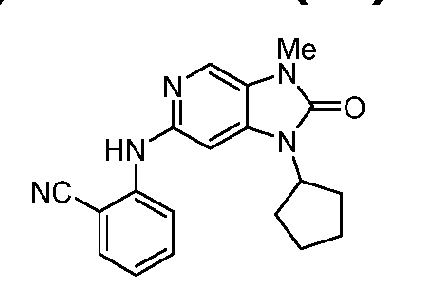
5O·0.1EtOAc: C, 68.09; H, 5.83; N, 20.47. Found: C, 67.93; H, 6.05; N, 20.47%. HPLC purity 100.0%. Example 19: SN39297 2-((1-Cyclopentyl-3-methyl-2-oxo-2,3-dihydro-1H- imidazo[4,5-c]pyridin-6-yl)amino)benzonitrile (25).
A degassed mixture of chloride 6 (120 mg, 0.48 mmol), 2-aminobenzonitrile (68 mg, 0.57 mmol), Pd
2dba
3 (22 mg, 24 µmol), XPhos (46 mg, 96 µmol) and Cs
2CO
3 (313 mg, 0.96 mmol) in dioxane (6 mL) was stirred in a sealed tube at 120 °C for 16 h. The mixture was cooled, diluted with EtOAc (30 mL), filtered through diatomaceous earth and the filtrate was evaporated. The residue was partitioned between EtOAc (50 ml) and water (50 mL). The organic fraction was washed with water (30 mL), washed with brine (30 mL), dried (MgSO
4), filtered and the solvent evaporated. The residue was purified by chromatography, eluting with EtOAc, to give imidazopyridinone 25 (101 mg, 64%) as orange crystals: mp (MeOH/EtOAc) 171–173 °C;
1H NMR (CDCl
3) δ 8.83 (s, 1 H, H-4), 8.13 (br s, 1 H, 6-NH), 7.90 (dd, J = 8.2, 1.0 Hz, 1 H, H-6ʹ), 7.63 (ddd, J = 8.3, 6.9, 1.3 Hz, 1 H, H-4ʹ), 7.55 (dd, J = 8.3, 1.0 Hz, 1 H, H-3ʹ), 7.30 (ddd, J = 8.2, 6.9, 1.2 Hz, 1 H, H-5ʹ), 6.76 (s, 1 H, H-7), 4.82 (pent, J = 8.8 Hz, 1 H, 1-CH), 3.49 (s, 3 H, 3-CH
3), 1.95–2.15 (m, 6 H, 3 × CH
2), 1.68–1.80 (m, 2 H, CH
2); MS m/z 334.2 (MH
+, 100%). Anal. calcd for C
19H
19N
5O·1.3CH
3OH: C, 65.01; H, 6.50; N, 18.67. Found C, 64.71; H, 6.41; N, 18.99%. HPLC purity 98.8%. Example 20: SN39278 1-Cyclopentyl-3-methyl-6-((4-(trifluoromethyl)phenyl)amino)- 1,3-dihydro-2H-imidazo[4,5-c]pyridin-2-one (26).
A degassed mixture of chloride 6 (111 mg, 0.44 mmol), 4-(trifluoromethyl)aniline (85 mg, 0.53 mmol), Pd
2dba
3 (20 mg, 22 µmol), XPhos (42 mg, 88 µmol) and Cs
2CO
3 (289 mg, 0.88 mmol) in dioxane (6 mL) was stirred in a sealed tube at 120 °C for 16 h. The mixture was cooled,
diluted with EtOAc (30 mL), filtered through diatomaceous earth and the filtrate was evaporated. The residue was partitioned between EtOAc (50 ml) and water (50 mL). The organic fraction was washed with water (30 mL), washed with brine (30 mL), dried (MgSO
4), filtered and the solvent evaporated. The residue was purified by chromatography (50–70% EtOAc/pet. ether) to give 26 (125 mg, 75%) as a cream powder: mp (EtOAc/pet ether) 196– 199 °C;
1H NMR (CDCl
3) δ 7.88 (d, J = 0.4 Hz, 1 H, H-4), 7.53 (d, J = 8.6 Hz, 2 H, H-3ʹ, H-5ʹ), 7.39 (d, J = 8.5 Hz, 2 H, H-2ʹ, H-6ʹ), 6.66 (br s, 1 H, 6-NH), 6.63 (s, 1 H, H-7), 4.80 (pent, J = 8.8 Hz, 1 H, 1-CH), 3.42 (s, 3 H, 3-CH
3), 1.99–2.07 (m, 4 H, 2 × CH
2), 1.87–1.95 (m, 2 H, CH
2), 1.68–1.78 (m, 2 H, CH
2);
13C NMR (CDCl
3) δ 154.2, 149.4, 145.0, 137.0, 126.8 (q, J = 3.8 Hz), 125.9 (2), 124.7 (q, J = 233.6 Hz), 123.7, 123.0 (q, J = 32.8 Hz), 117.1 (2), 91.2, 53.9, 29.1 (2), 27.6, 25.3 (2); MS m/z 377.2 (MH
+, 100%). Anal. calcd for C
19H
19F
3N
4O: C, 60.63; H, 5.09; N, 14.89. Found: C, 60.68; H, 5.30; N, 15.02%. HPLC purity 99.7%. Example 21: SN39290 1-Cyclopentyl-3-methyl-6-((3-(trifluoromethyl)phenyl)amino)- 1,3-dihydro-2H-imidazo[4,5-c]pyridin-2-one (27).
A degassed mixture of chloride 6 (125 mg, 0.50 mmol), 3-(trifluoromethyl)aniline (96 mg, 0.60 mmol), Pd
2dba
3 (23 mg, 25 µmol), XPhos (48 mg, 100 µmol) and Cs
2CO
3 (326 mg, 1.00 mmol) in dioxane (6 mL) was stirred in a sealed tube at 120 °C for 16 h. The mixture was cooled, diluted with EtOAc (30 mL), filtered through diatomaceous earth and the filtrate was evaporated. The residue was partitioned between EtOAc (50 ml) and water (50 mL). The organic fraction was washed with water (30 mL), washed with brine (30 mL), dried (MgSO
4), filtered and the solvent evaporated. The residue was purified by chromatography (40–50% EtOAc/pet. ether) gave imidazopyridinone 27 (146 mg, 78%) as cream needles: mp (EtOAc) 162–163 °C;
1H NMR (CDCl
3) δ 7.87 (s, 1 H, H-4), 7.78 (s, 1 H, H-2ʹ), 7.40–7.43 (m, 2 H, H-5ʹ, H-6ʹ), 7.21–7.23 (m, 1 H, H-4ʹ), 6.68 (br s, 1 H, 6-NH), 6.63 (d, J = 0.4 Hz, 1 H, H-7), 4.83 (pent, J = 8.8 Hz, 1 H, 1-CH), 3.42 (s, 3 H, 3-CH
3), 1.96–2.07 (m, 4 H, 2 × CH
2), 1.83–1.92 (m, 2 H, CH
2), 1.68–1.76 (m, 2 H, CH
2);
13C NMR (CDCl
3) δ 154.3, 149.8, 142.4, 136.9, 131.8 (q, J = 32.1 Hz), 130.0, 126.1, 124.3 (q, J = 272.3), 123.5, 121.6, 118.2 (q, J = 3.8 Hz), 114.5 (q, J = 3.9 Hz), 90.4, 53.7, 29.2 (2), 27.6, 25.3 (2); MS m/z 377.2 (MH
+, 100%); HRMS calcd for C
19H
20F
3N
4O (MH
+) m/z 377.1584, found 377.1585 (-0.4 ppm). HPLC purity 99.3%. Example 22: SN39283 1-Cyclopentyl-3-methyl-6-((2-(trifluoromethyl)phenyl)amino)- 1,3-dihydro-2H-imidazo[4,5-c]pyridin-2-one (28).
A degassed mixture of chloride 6 (114 mg, 0.45 mmol), 2-trifluoroaniline (88 mg, 0.54 mmol), Pd
2dba
3 (21 mg, 23 µmol), XPhos (43 mg, 90 µmol) and Cs
2CO
3 (293 mg, 0.90 mmol) in dioxane (6 mL) was stirred in a sealed tube at 120 °C for 16 h. The mixture was cooled, diluted with EtOAc (30 mL), filtered through diatomaceous earth and the filtrate was evaporated. The residue was partitioned between EtOAc (50 ml) and water (50 mL). The organic fraction was washed with water (30 mL), washed with brine (30 mL), dried (MgSO
4), filtered and the solvent evaporated. The residue was purified by chromatography, eluting with a gradient (10– 50%) of EtOAc/pet. ether, to give imidazopyridinone 28 (110 mg, 65%) as a grey foam:
1H NMR (CDCl
3) δ 7.87 (s, 1 H, H-4), 7.76 (d, J = 8.3 Hz, 1 H, H-3ʹ), 7.62 (dd, J = 7.8, 0.7 Hz, 1 H, H-6ʹ), 7.47 (br dd, J = 8.0, 7.6 Hz, 1 H, H-4ʹ), 7.07 (br dd, J = 7.7, 765 Hz, 1 H, H-5ʹ), 6.63 (br s, 1 H, 6-NH), 6.58 (d, J = 0.5 Hz, 1 H, H-7), 4.76 (pent, J = 8.8 Hz, 1 H, 1-CH), 3.41 (s, 3 H, 3-CH
3), 1.97–2.06 (m, 4 H, 2 × CH
2), 1.83–1.93 (m, 2 H, CH
2), 1.62–1.74 (m, 2 H, CH
2); MS m/z 377.2 (MH
+, 100%); HRMS calcd for C
19H
19F
3N
4O (MH
+) m/z 376.1511, found 376.1535 (6.3 ppm). HPLC purity 99.7%. Example 23: SN39274 6-((4-Acetylphenyl)amino)-1-cyclopentyl-3-methyl-1,3- dihydro-2H-imidazo[4,5-c]pyridin-2-one (29). A degassed mixture of chloride 6 (117
mg, 0.47 mmol), 1-(4-aminophenyl)ethan-1-one (75 mg, 0.56 mmol), Pd
2dba
3 (22 mg, 24 µmol), XPhos (45 mg, 94 µmol) and Cs
2CO
3 (326 mg, 0.94 mmol) in dioxane (6 mL) was stirred in a sealed tube at 120 °C for 16 h. The mixture was cooled, diluted with EtOAc (30 mL), filtered through diatomaceous earth and the filtrate was evaporated. The residue was partitioned between EtOAc (50 ml) and water (50 mL). The organic fraction was washed with water (30 mL), washed with brine (30 mL), dried (MgSO
4), filtered and the solvent evaporated. The residue was purified by chromatography (60–100% EtOAc/pet. ether) to give imidazopyridinone 29 (131 mg, 80%) as a lemon powder: mp (EtOAc/pet ether) 181–183 °C;
1H NMR (CDCl
3) δ 7.89–7.95 (m, 3 H, H-4, H-3ʹ, H-5ʹ), 7.36 (ddd, J = 8.8, 2.6, 1.9 Hz, 2 H, H-2ʹ, H-6ʹ), 6.82 (s, 1 H, 6-NH), 6.69 (d, J = 0.5 Hz, 1 H, H- 7ʺ), 4.81 (pent, J = 8.8 Hz, 1 H, 1-CH), 3.43 (s, 3 H, 3-CH
3), 2.56 (s, 3 H, COCH
3), 2.00–2.08 (m, 4 H, 2 × CH
2), 1.87–1.97 (m, 2 H, CH
2), 1.70–1.78 (m, 2 H, CH
2); MS m/z 351.2 (MH
+, 100%). Anal calcd for C
20H
22N
4O
2·0.1EtOAc: C, 68.21; H, 6.40; N, 15.60. Found: C, 68.09; H, 6.52; N, 15.37%. HPLC purity 97.9%.
Example 24: SN39279 6-((3-Acetylphenyl)amino)-1-cyclopentyl-3-methyl-1,3- dihydro-2H-imidazo[4,5-c]pyridin-2-one (30).
A degassed mixture of chloride 6 (110 mg, 0.44 mmol), 1-(3-aminophenyl)ethan-1-one (71 mg, 0.53 mmol), Pd
2dba
3 (22 mg, 20 µmol), XPhos (42 mg, 88 µmol) and Cs
2CO
3 (287 mg, 0.88 mmol) in dioxane (6 mL) was stirred in a sealed tube at 120 °C for 16 h. The mixture was cooled, diluted with EtOAc (30 mL), filtered through diatomaceous earth and the filtrate was evaporated. The residue was partitioned between EtOAc (50 ml) and water (50 mL). The organic fraction was washed with water (30 mL), washed with brine (30 mL), dried (MgSO
4), filtered and the solvent evaporated. The residue was purified by chromatography (50–100% EtOAc/pet. ether) to give imidazopyridinone 30 (147 mg, 80%) as a cream powder: mp (EtOAc/pet ether) 125–127 °C;
1H NMR (CDCl
3) δ 7.93 (t, J = 1.9 Hz, 1 H, H-2ʹ), 7.86 (s, 1 H, H-4), 7.56 (ddd, J = 7.6, 1.4, 1.1 Hz, 1 H, H-6ʹ), 7.53 (ddd, J = 8.1, 2.3, 0.9 Hz, 1 H, H-4ʹ), 7.40 (t, J = 7.8 Hz, 1 H, H-5ʹ), 6.63 (s, 1 H, H-7), 6.61 (br s, 1 H, 6-NH), 4.81 (pent, J = 8.8 Hz, 1 H, 1-CH), 3.41 (s, 3 H, 3-CH
3), 2.60 (s, 3 H, COCH
3), 1.98–2.07 (m, 4 H, 2 × CH
2), 1.83–1.93 (m, 2 H, CH
2), 1.67–1.76 (m, 2 H, CH
2); MS m/z 351.2 (MH
+, 100%). Anal. calcd for C
20H
22N
4O
2: C, 68.55; H, 6.33; N, 15.99. Found: C, 68.54; H, 6.52; N, 16.03%. HPLC purity 99.6%. Example 25: SN39304 1-Cyclopentyl-3-methyl-6-((4-(methylsulfonyl)phenyl)amino)- 1,3-dihydro-2H-imidazo[4,5-c]pyridin-2-one (31).
A degassed mixture of chloride 6 (125 mg, 0.50 mmol), 4-(methylsulfonyl)aniline (102 mg, 0.60 mmol), Pd
2dba
3 (23 mg, 25 µmol), XPhos (48 mg, 100 µmol) and Cs
2CO
3 (326 mg, 1.00 mmol) in dioxane (6 mL) was stirred in a sealed tube at 120 °C for 16 h. The mixture was cooled, diluted with EtOAc (30 mL), filtered through diatomaceous earth and the filtrate was evaporated. The residue was partitioned between EtOAc (50 ml) and water (50 mL). The organic fraction was washed with water (30 mL), washed with brine (30 mL), dried (MgSO
4), filtered and the solvent evaporated. The residue was purified by chromatography, eluting with a gradient (60–100%) of EtOAc/pet. ether, to give imidazopyridinone 31 (154 mg, 80%) as cream needles: mp (EtOAc/pet ether) 161–164 °C;
1H NMR (CDCl
3) δ 7.92 (s, 1 H, H-4), 7.82 (ddd, J = 8.8, 2.6, 1.9 Hz, 2 H, H-2ʹ, H-6ʹ), 7.51 (ddd, J = 8.8, 2.6, 1.9 Hz, 2 H, H-3ʹ, H-5ʹ), 6.86 (s, 1 H, 6-NH), 6.63 (d, J = 0.3 Hz, 1 H, H-7), 4.81 (pent, J = 8.8 Hz, 1 H, 1-CH), 3.43 (s, 3 H, 3-CH
3), 3.04 (s, 3 H, SO
2CH
3), 2.00–2.08 (m, 4 H, 2 × CH
2), 1.88–1.98 (m, 2 H, CH
2),
1.88–1.98 (m, 2 H, CH
2); MS m/z 387.2 (MH
+, 100%). Anal. calcd for C
19H
22N
4O
3S·½EtOAc: C, 58.59; H, 6.09; N, 13.01. Found: C, 58.86; H, 6.30; N, 13.20%. HPLC purity 99.9%. Example 26: SN39308 1-Cyclopentyl-3-methyl-6-((3-(methylsulfonyl)phenyl)amino)- 1,3-dihydro-2H-imidazo[4,5-c]pyridin-2-one (32).
A degassed mixture of chloride 6 (112 mg, 0.45 mmol), 3-(methylsulfonyl)aniline.HCl (111 mg, 0.53 mmol), Pd
2dba
3 (21 mg, 23 µmol), XPhos (43 mg, 90 µmol) and Cs
2CO
3 (484 mg, 1.49 mmol) in dioxane (6 mL) was stirred in a sealed tube at 120 °C for 16 h. The mixture was cooled, diluted with EtOAc (30 mL), filtered through diatomaceous earth and the filtrate was evaporated. The residue was partitioned between EtOAc (50 ml) and water (50 mL). The organic fraction was washed with water (30 mL), washed with brine (30 mL), dried (MgSO
4), filtered and the solvent evaporated. The residue was purified by chromatography, eluting with a gradient (80–100%) of EtOAc/pet. ether, to give imidazopyridinone 32 (154 mg, 90%) as a white powder: mp (EtOAc/pet ether) 208–211 °C;
1H NMR (CDCl
3) δ 8.00 (d, J = 2.8 Hz, 1 H, H-2ʹ), 7.89 (s, 1 H, H-4), 7.61–7.66 (m, 1 H, H-5ʹ), 7.44–7.49 (m, 2 H, H-4ʹ, H-6ʹ), 6.84 (s, 1 H, 6-NH), 6.60 (d, J = 0.5 Hz, 1 H, H-7), 4.82 (pent, J = 8.8 Hz, 1 H, 1-CH), 3.42 (s, 3 H, 3- CH
3), 3.07 (s, 3 H, SO
2CH
3), 2.00–2.08 (m, 4 H, 2 × CH
2), 1.87–1.97 (m, 2 H, CH
2), 1.68–1.77 (m, 2 H, CH
2); MS m/z 387.2 (MH
+, 100%). Anal. calcd for C
19H
22N
4O
3S·½EtOAc: C, 58.59; H, 6.09; N, 13.01. Found: C, 58.73; H, 6.25; N, 13.28%. HPLC purity 99.8%. Example 27: SN39330 1-Cyclopentyl-3-methyl-6-((2-(methylsulfonyl)phenyl)amino)- 1,3-dihydro-2H-imidazo[4,5-c]pyridin-2-one (33).
A degassed mixture of chloride 6 (126 mg, 0.50 mmol), 2-(methylsulfonyl)aniline (103 mg, 0.60 mmol), Pd
2dba
3 (23 mg, 25 µmol), XPhos (48 mg, 100 µmol) and Cs
2CO
3 (358 mg, 1.10 mmol) in dioxane (6 mL) was stirred in a sealed tube at 120 °C for 16 h. The mixture was cooled, diluted with EtOAc (30 mL), filtered through diatomaceous earth and the filtrate was evaporated. The residue was partitioned between EtOAc (50 ml) and water (50 mL). The organic fraction was washed with water (30 mL), washed with brine (30 mL), dried (MgSO
4), filtered and the solvent evaporated. The residue was purified by chromatography, eluting with a gradient (60–80%) of EtOAc/pet. ether, to give imidazopyridinone 33 (168 mg, 87%) as a white powder: mp (EtOAc/pet. ether) 178–181 °C;
1H NMR (CDCl
3) δ 8.42 (br s, 1 H, 6-NH), 8.11 (dd, J = 8.4, 0.7 Hz, 1 H, H-3ʹ), 7.87–7.92 (m, 2 H, H-4, H-6ʹ), 7.53 (ddd, J = 8.6, 7.1, 1.6 Hz, 1 H, H-5ʹ), 7.04 (ddd, J = 8.2, 7.1, 1.0 Hz, 1 H, H-4ʹ), 6.55 (d, J = 0.5 Hz, 1 H, H-7),
4.78 (pent, J = 8.8 Hz, 1 H, 1-CH), 3.43 (s, 3 H, 3-CH
3), 3.12 (s, 3 H, 2ʹ-SO
2CH
3), 1.93–2.10 (m, 6 H, 3 × CH
2), 1.70–1.80 (m, 2 H, CH
2); MS m/z 387.2 (MH
+, 100%); HRMS calcd for C
19H
23N
4O
3 (MH
+) m/z 387.1485, found 387.1493 (-1.9 ppm). HPLC purity 100.0%. Example 28: SN39302 6-((4-(Benzyloxy)phenyl)amino)-1-cyclopentyl-3-methyl-1,3- dihydro-2H-imidazo[4,5-c]pyridin-2-one (34).
A degassed mixture of chloride 6 (200 mg, 0.80 mmol), 4-(benzyloxy)aniline.HCl (225 mg, 0.95 mmol), Pd
2dba
3 (37 mg, 40 µmol), XPhos (76 mg, 160 µmol) and Cs
2CO
3 (860 mg, 2.64 mmol) in dioxane (8 mL) was stirred in a sealed tube at 120 °C for 16 h. The mixture was cooled, diluted with EtOAc (30 mL), filtered through diatomaceous earth and the filtrate was evaporated. The residue was partitioned between EtOAc (50 ml) and water (50 mL). The organic fraction was washed with water (30 mL), washed with brine (30 mL), dried (MgSO
4), filtered and the solvent evaporated. The residue was purified by chromatography, eluting with a gradient (50–80%) of EtOAc/pet. ether, to give imidazopyridinone 34 (215 mg, 65%) as tan crystals: mp (EtOAc/pet ether) 144–147 °C;
1H NMR (CDCl
3) δ 7.77 (s, 1 H, H-4), 7.45 (br d, J = 7.2 Hz, 2 H, H-2ʺ, H-6ʺ), 7.39 (br dd, J = 7.6, 7.1 Hz, 2 H, H-3ʺ, H-5ʺ), 7.33 (br t, J = 7.1 Hz, 1 H, H-4ʺ), 7.20 (ddd, J = 8.9, 3.5, 2.2 Hz, 2 H, H-2ʹ, H-6ʹ), 6.97 (ddd, J = 8.9, 3.5, 2.2 Hz, 2 H, H-3ʹ, H-5ʹ), 6.42 (d, J = 0.5 Hz, 1 H, H-7), 6.29 (s, 1 H, 6-NH), 5.07 (s, 2 H, CH
2O), 4.73 (pent, J = 8.8 Hz, 1 H, 1-CH), 3.38 (s, 3 H, 3-CH
3), 1.93–2.01 (m, 4 H, 2 × CH
2), 1.76– 1.86 (m, 2 H, CH
2), 1.60–1.70 (m, 2 H, CH
2); MS m/z 415.2 (MH
+, 100%). Anal calcd for C
25H
26N
4O
2·¼EtOAc: C, 71.54; H, 6.47; N, 12.83. Found: C, 71.26; H, 6.44; N, 12.72%. HPLC purity 99.9%. Example 29: SN39303 6-((3(Benzyloxy)phenyl)amino)-1-cyclopentyl-3-methyl-1,3- dihydro-2H-imidazo[4,5-c]pyridin-2-one (35).
A degassed mixture of chloride 6 (203 mg, 0.81 mmol), 3-(benzyloxy)aniline (193 mg, 0.97 mmol), Pd
2dba
3 (37 mg, 40 µmol), XPhos (77 mg, 162 µmol) and Cs
2CO
3 (528 mg, 1.62 mmol) in dioxane (8 mL) was stirred in a sealed tube at 120 °C for 16 h. The mixture was cooled, diluted with EtOAc (30 mL), filtered through diatomaceous earth and the filtrate was evaporated. The residue was partitioned between EtOAc (50 ml) and water (50 mL). The organic fraction was washed with water (30 mL), washed with brine (30 mL), dried (MgSO
4), filtered and the solvent evaporated The residue was purified by chromatography eluting with
a gradient (50–80%) of EtOAc/pet. ether, to give imidazopyridinone 35 (246 mg, 74%) as white needles: mp (EtOAc/pet ether) 110–112 °C;
1H NMR (CDCl
3) δ 7.85 (d, J = 0.4 Hz, 1 H, H-4), 7.38–7.46 (m, 4 H, H-2ʺ, H-3ʺ, H-5ʺ, H-6ʺ), 7.36 (br tt, J = 7.0, 1.5 Hz, 1 H, H-4ʺ), 7.24 (t, J = 8.1 Hz, 1 H, H-5ʹ), 7.01 (t, J = 2.2 Hz, 1 H, H-2ʹ), 6.86 (dd, J = 8.0, 1.0 Hz, 1 H, H-6ʹ), 6.71 (d, J = 0.6 Hz, 1 H, H-7), 6.65 (ddd, J = 8.2, 2.4, 0.7 Hz, 1 H, H-4ʹ), 6.51 (br s, 1 H, 6- NH), 5.08 (s, 2 H, CH
2O), 4.81 (pent, J = 8.8 Hz, 1 H, 1-CH), 3.42 (s, 3 H, 3-CH
3), 1.99–2.08 (m, 4 H, 2 × CH
2), 1.85–1.96 (m, 2 H, CH
2), 1.67–1.77 (m, 2 H, CH
2); MS m/z 415.2 (MH
+, 100%). Anal calcd for C
25H
26N
4O
2: C, 72.44; H, 6.32; N, 13.52. Found: C, 71.16; H, 6.36; N, 13.19%. HPLC purity 100.0%. Example 30: SN39328 6-((2-(Benzyloxy)phenyl)amino)-1-cyclopentyl-3-methyl-1,3- dihydro-2H-imidazo[4,5-c]pyridin-2-one (36).
A degassed mixture of chloride 6 (164 mg, 0.65 mmol), 2-(benzyloxy)aniline (156 mg, 0.78 mmol), Pd
2dba
3 (30 mg, 33 µmol), XPhos (63 mg, 130 µmol) and Cs
2CO
3 (466 mg, 1.43 mmol) in dioxane (10 mL) was stirred in a sealed tube at 120 °C for 16 h. The mixture was cooled, diluted with EtOAc (30 mL), filtered through diatomaceous earth and the filtrate was evaporated. The residue was partitioned between EtOAc (50 ml) and water (50 mL). The organic fraction was washed with water (30 mL), washed with brine (30 mL), dried (MgSO
4), filtered and the solvent evaporated. The residue was purified by chromatography, eluting with a gradient (40–50%) of EtOAc/pet. ether, to give imidazopyridinone 36 (166 mg, 61%) as a white powder: mp (EtOAc/pet. ether) 170–173 °C;
1H NMR (CDCl
3) δ 7.84–7.88 (m, 2 H, H-4, H-6ʹ), 7.42–7.46 (m, 2 H, H-2ʺ, H-6ʺ), 7.32–7.40 (m, 3 H, H-3ʺ, H-4ʺ, H-5ʺ), 6.94–6.99 (m, 2 H, H-3ʹ, H-4ʹ), 6.87–6.89 (m, 1 H, H-5ʹ), 6.85 (br s, 1 H, 6-NH), 6.61 (d, J = 0.5 Hz, 1 H, H-7), 5.15 (s, 2 H, CH
2O), 4.77 (pent, J = 8.8 Hz, 1 H, 1-CH), 3.39 (s, 3 H, 3-CH
3), 1.97–2.05 (m, 4 H, 2 × CH
2), 1.84–1.93 (m, 2 H, CH
2), 1.67–1.75 (m, 2 H, CH
2); MS m/z 415.2 (MH
+, 100%); HRMS calcd for C
25H
27N
4O
2 (MH
+) m/z 415.2129, found 415.2135 (-1.7 ppm). HPLC purity 99.6%. Example 31: SN39309 2-(4-((1-Cyclopentyl-3-methyl-2-oxo-2,3-dihydro-1H- imidazo[4,5-c]pyridin-6-yl)amino)phenyl)-2-methylpropanenitrile (37).
A degassed mixture of chloride 6 (126 mg, 0.50 mmol), 2-(4-aminophenyl)-2- methylpropanenitrile (96 mg, 0.60 mmol), Pd
2dba
3 (23 mg, 25 µmol), XPhos (48 mg, 100
µmol) and Cs
2CO
3 (358 mg, 1.10 mmol) in dioxane (6 mL) was stirred in a sealed tube at 120 °C for 16 h. The mixture was cooled, diluted with EtOAc (30 mL), filtered through diatomaceous earth and the filtrate was evaporated. The residue was partitioned between EtOAc (50 ml) and water (50 mL). The organic fraction was washed with water (30 mL), washed with brine (30 mL), dried (MgSO
4), filtered and the solvent evaporated. The residue was purified by chromatography, eluting with a gradient (60–100%) of EtOAc/pet. ether, to give imidazopyridinone 37 (160 mg, 85%) as a tan powder: mp (MeOH/EtOAc) 144–146 °C;
1H NMR (CDCl
3) δ 7.84 (d, J = 0.5 Hz, 1 H, H-4ʺ), 7.41 (ddd, J = 8.8, 2.7, 2.1 Hz, 2 H, H-3ʹ, H-5ʹ), 7.32 (ddd, J = 8.8, 2.7, 2.1 Hz, 2 H, H-2ʹ, H-6ʹ), 6.58 (d, J = 0.6 Hz, 1 H, H-7ʺ), 6.50 (s, 1 H, 6ʺ-NH), 4.78 (pent, J = 8.8 Hz, 1 H, 1-CH), 3.40 (s, 3 H, 3ʺ-CH
3), 1.99–2.07 (m, 4 H, 2 × CH
2), 1.86–1.95 (m, 2 H, CH
2), 1.68–1.77 (m, 8 H, 2-CH
3, H-3, CH
2); MS m/z 376.2 (MH
+, 100%). Anal. calcd for C
19H
25N
5O·¼CH
3OH: C, 69.69; H, 6.83; N, 18.26. Found: C, 69.37; H, 6.37; N, 18.20%. HPLC purity 99.4%. Example 32: SN39385 1-Cyclopentyl-6-((2,4-dimethylphenyl)amino)-3-methyl-1,3- dihydro-2H-imidazo[4,5-c]pyridin-2-one (38).
A degassed mixture of chloride 6 (128 mg, 0.51 mmol), 2,4-dimethylaniline (74 mg, 0.61 mmol), Pd
2dba
3 (23 mg, 25 µmol), XPhos (49 mg, 102 µmol) and Cs
2CO
3 (366 mg, 1.12 mmol) in dioxane (6 mL) was stirred in a sealed tube at 120 °C for 16 h. The mixture was cooled, diluted with EtOAc (30 mL), filtered through diatomaceous earth and the filtrate was evaporated. The residue was partitioned between EtOAc (50 ml) and water (50 mL). The organic fraction was washed with water (30 mL), washed with brine (30 mL), dried (MgSO
4), filtered and the solvent evaporated. The residue was purified by chromatography, eluting with a gradient (60–100%) of EtOAc/pet. ether, to give imidazopyridinone 38 (58 mg, 34%) as a white powder: mp (EtOAc/pet ether) 173–175 °C;
1H NMR (CDCl
3) δ 7.78 (d, J = 0.6 Hz, 1 H, H-4), 7.24 (d, J = 8.0 Hz, 1 H, H-6ʹ), 7.08 (s, 1 H, H-3ʹ), 7.01 (d, J = 8.0 Hz, 1 H, H-5ʹ), 6.34 (d, J = 0.6 Hz, 1 H, H-7), 6.06 (br s, 1 H, 6-NH), 4.70 (pent, J = 8.8 Hz, 1 H, 1-CH), 3.38 (s, 3 H, 3-CH
3), 2.34 (s, 3 H, 4ʹ-CH
3), 2.24 (s, 3 H, 2ʹ-CH
3), 1.92–1.98 (m, 4 H, 2 × CH
2), 1.75–1.85 (m, 2 H, CH
2), 1.58–1.68 (m, 2 H, CH
2); MS m/z 337.2 (MH
+, 100%); HRMS calcd for C
20H
25N
4O (MH
+) m/z 337.2010, found 337.2008 (0.4 ppm). HPLC purity 99.6%.
Example 33: SN393901-Cyclopentyl-6-((2,3-dimethylphenyl)amino)-3-methyl-1,3- dihydro-2H-imidazo[4,5-c]pyridin-2-one (39).
A degassed mixture of chloride 6 (126 mg, 0.50 mmol), 2,3-dimethylaniline (73 mg, 0.60 mmol), Pd
2dba
3 (23 mg, 25 µmol), XPhos (48 mg, 100 µmol) and Cs
2CO
3 (358 mg, 1.10 mmol) in dioxane (6 mL) was stirred in a sealed tube at 120 °C for 16 h. The mixture was cooled, diluted with EtOAc (30 mL), filtered through diatomaceous earth and the filtrate was evaporated. The residue was partitioned between EtOAc (50 ml) and water (50 mL). The organic fraction was washed with water (30 mL), washed with brine (30 mL), dried (MgSO
4), filtered and the solvent evaporated. The residue was purified by chromatography, eluting with a gradient (60–100%) of EtOAc/pet. ether, to give imidazopyridinone 39 (47 mg, 28%) as a tan foam:
1H NMR (CDCl
3) δ 7.79 (s, 1 H, H-4), 7.20 (d, J = 7.9 Hz, 1 H, H-6ʹ), 7.10 (dd, J = 7.8, 7.6 Hz, 1 H, H-5ʹ), 6.98 (d, J = 7.4 Hz, 1 H, H-4ʹ), 6.31 (d, J = 0.4 Hz, 1 H, H-7), 6.20 (br s, 1 H, 6-NH), 4.71 (pent, J = 8.8 Hz, 1 H, 1-CH), 3.38 (s, 3 H, 3-CH
3), 2.34 (s, 3 H, 3ʹ-CH
3), 2.19 (s, 3 H, 2ʹ-CH
3), 1.89–1.98 (m, 4 H, 2 × CH
2), 1.70–1.80 (m, 2 H, CH
2), 1.58–1.67 (m, 2 H, CH
2); MS m/z 337.2 (MH
+, 100%). HRMS calcd for C
20H
25N
4O (MH
+) m/z 337.2023, found 337.2017 (1.7 ppm). HPLC purity 99.1%. Example 34: SN393931-Cyclopentyl-6-((3,4-dimethylphenyl)amino)-3-methyl-1,3- dihydro-2H-imidazo[4,5-c]pyridin-2-one (40).
A degassed mixture of chloride 6 (129 mg, 0.51 mmol), 3,4-dimethylaniline (75 mg, 0.61 mmol), Pd
2dba
3 (23 mg, 25 µmol), XPhos (49 mg, 102 µmol) and Cs
2CO
3 (366 mg, 1.12 mmol) in dioxane (6 mL) was stirred in a sealed tube at 120 °C for 16 h. The mixture was cooled, diluted with EtOAc (30 mL), filtered through diatomaceous earth and the filtrate was evaporated. The residue was partitioned between EtOAc (50 ml) and water (50 mL). The organic fraction was washed with water (30 mL), washed with brine (30 mL), dried (MgSO
4), filtered and the solvent evaporated. The residue was purified by chromatography, eluting with a gradient (60–100%) of EtOAc/pet. ether, to give imidazopyridinone 40 (99 mg, 57%) as brown cubes: mp (EtOAc/pet ether) 150–151 °C;
1H NMR (CDCl
3) δ 7.80 (d, J = 0.5 Hz, 1 H, H-4), 7.08 (d, J = 8.0 Hz, 1 H, H-5ʹ), 7.04 (d, J = 2.3 Hz, 1 H, H-2ʹ), 6.99 (dd, J = 8.0, 2.3 Hz, 1 H, H-6ʹ), 6.64 (d, J = 0.7 Hz, 1 H, H-7), 6.40 (br s, 1 H, 6-NH), 4.78 (pent, J = 8.8 Hz, 1 H, 1-CH), 3.39 (s, 3 H, 3-CH
3), 2.25 (s, 3 H, 3ʹ-CH
3), 2.24 (s, 3 H, 2ʹ-CH
3), 1.96–2.04 (m, 4 H, 2 × CH
2), 1.80–1.90 (m, 2 H, CH
2), 1.64–1.74 (m, 2 H, CH
2); MS m/z 337.2 (MH
+, 100%);.
HRMS calcd for C
20H
25N
4O (MH
+) m/z 337.2023, found 337.2017 (1.7 ppm). HPLC purity 99.9%. Example 35: SN39378 6-((3-Chloro-2-methylphenyl)amino)-1-cyclopentyl-3-methyl- 1,3-dihydro-2H-imidazo[4,5-c]pyridin-2-one (41).
A degassed mixture of chloride 6 (127 mg, 0.50 mmol), 3-chloro-2-methylaniline (86 mg, 0.61 mmol), Pd
2dba
3 (23 mg, 25 µmol), XPhos (48 mg, 100 µmol) and Cs
2CO
3 (358 mg, 1.10 mmol) in dioxane (6 mL) was stirred in a sealed tube at 120 °C for 16 h. The mixture was cooled, diluted with EtOAc (30 mL), filtered through diatomaceous earth and the filtrate was evaporated. The residue was partitioned between EtOAc (50 ml) and water (50 mL). The organic fraction was washed with water (30 mL), washed with brine (30 mL), dried (MgSO
4), filtered and the solvent evaporated. The residue was purified by chromatography, eluting with a gradient (60–80%) of EtOAc/pet. ether, to give imidazopyridinone 41 (42 mg, 23%) as cream needles: mp (EtOAc/pet ether) 173–175 °C;
1H NMR (CDCl
3) δ 7.81 (d, J = 0.4 Hz, 1 H, H-4), 7.31 (dd, J = 7.5, 1.6 Hz, 1 H, H-4ʹ), 7.09–7.16 (m, 2 H, H-5ʹ, H-4ʹ), 6.38 (s, 1 H, H-7), 6.19 (br s, 1 H, 6-NH), 4.74 (pent, J = 8.7 Hz, 1 H, 1-CH), 3.39 (s, 3 H, 3-CH
3), 2.34 (s, 3 H, 2ʹ-CH
3), 1.90–2.02 (m, 4 H, 2 × CH
2), 1.75–1.83 (m, 2 H, CH
2), 1.63–1.70 (m, 2 H, CH
2); MS m/z 357.2 (MH
+, 100%), 359.2 (MH
+, 35%); HRMS calcd for C
19H
22ClN
4O (MH
+) m/z 357.1477, found 357.1480 (-1.0 ppm). HPLC purity 98.0%. Example 36: SN39376 6-((4-Chloro-2-methylphenyl)amino)-1-cyclopentyl-3-methyl- 1,3-dihydro-2H-imidazo[4,5-c]pyridin-2-one (42).
A degassed mixture of chloride 6 (126 mg, 0.50 mmol), 4-chloro-2-methylaniline (85 mg, 0.60 mmol), Pd
2dba
3 (23 mg, 25 µmol), XPhos (48 mg, 100 µmol) and Cs
2CO
3 (358 mg, 1.10 mmol) in dioxane (6 mL) was stirred in a sealed tube at 120 °C for 16 h. The mixture was cooled, diluted with EtOAc (30 mL), filtered through diatomaceous earth and the filtrate was evaporated. The residue was partitioned between EtOAc (50 ml) and water (50 mL). The organic fraction was washed with water (30 mL), washed with brine (30 mL), dried (MgSO
4), filtered and the solvent evaporated. The residue was purified by chromatography, eluting with a gradient (60–100%) of EtOAc/pet. ether, to give imidazopyridinone 42 (85 mg, 48%) as a brown foam:
1H NMR (CDCl
3) δ 7.81 (s, 1 H, H-4), 7.36 (d, J = 8.6 Hz, 1 H, H-6ʹ), 7.23 (d, J = 2 4 Hz 1 H H-3ʹ) 7 15 (dd J = 8 6 2 5 Hz 1 H H-5ʹ) 6 40 (s 1 H H-7) 6 06 (br s 1 H 6-
NH), 4.73 (pent, J = 8.8 Hz, 1 H, 1-CH), 3.39 (s, 3 H, 3-CH
3), 2.26 (s, 3 H, 2ʹ-CH
3), 1.93–2.02 (m, 4 H, 2 × CH
2), 1.78–1.88 (m, 2 H, CH
2), 1.63–1.72 (m, 2 H, CH
2); MS m/z 357.2 (MH
+, 100%), 359.2 (MH
+, 35%); HRMS calcd for C
19H
22ClN
4O (MH
+) m/z 357.1477, found 357.1476 (0.1 ppm). HPLC purity 97.5%. Example 37: SN39379 6-((5-Chloro-2-methylphenyl)amino)-1-cyclopentyl-3-methyl- 1,3-dihydro-2H-imidazo[4,5-c]pyridin-2-one (43).
A degassed mixture of chloride 6 (131 mg, 0.52 mmol), 5-chloro-2-methylaniline (88 mg, 0.62 mmol), Pd
2dba
3 (24 mg, 26 µmol), XPhos (50 mg, 104 µmol) and Cs
2CO
3 (373 mg, 1.14 mmol) in dioxane (6 mL) was stirred in a sealed tube at 120 °C for 16 h. The mixture was cooled, diluted with EtOAc (30 mL), filtered through diatomaceous earth and the filtrate was evaporated. The residue was partitioned between EtOAc (50 ml) and water (50 mL). The organic fraction was washed with water (30 mL), washed with brine (30 mL), dried (MgSO
4), filtered and the solvent evaporated. The residue was purified by chromatography, eluting with a gradient (60–80%) of EtOAc/pet. ether, to give imidazopyridinone 43 (73 mg, 39%) as a tan foam:
1H NMR (CDCl
3) δ 7.84 (s, 1 H, H-4), 7.50 (d, J = 2.1 Hz, 1 H, H-6ʹ), 7.14 (d, J = 8.1 Hz, 1 H, H-3ʹ), 6.94 (dd, J = 8.1, 2.1 Hz, 1 H, H-4ʹ), 6.58 (s, 1 H, H-7), 6.15 (br s, 1 H, 6-NH), 4.81 (pent, J = 8.8 Hz, 1 H, 1-CH), 3.39 (s, 3 H, 3-CH
3), 2.54 (s, 3 H, 2ʹ-CH
3), 1.83–2.08 (m, 6 H, 3 × CH
2), 1.66–1.75 (m, 2 H, CH
2); MS m/z 357.2 (MH
+, 100%), 359.2 (MH
+, 35%); HRMS calcd for C
19H
22ClN
4O (MH
+) m/z 357.1477, found 357.147180 (1.6 ppm). HPLC purity 98.0%. Example 38: SN39396 1-Cyclopentyl-3-methyl-6-((2-methyl-4- (methylsulfonyl)phenyl)amino)-1,3-dihydro-2H-imidazo[4,5-c]pyridin-2-one (44).
A degassed mixture of chloride 6 (126 mg, 0.50 mmol), 2-methyl-4-(methylsulfonyl)aniline (110 mg, 0.60 mmol), Pd
2dba
3 (23 mg, 25 µmol), XPhos (48 mg, 100 µmol) and Cs
2CO
3 (358 mg, 1.10 mmol) in dioxane (6 mL) was stirred in a sealed tube at 120 °C for 16 h. The mixture was cooled, diluted with EtOAc (30 mL), filtered through diatomaceous earth and the filtrate was evaporated. The residue was partitioned between EtOAc (50 ml) and water (50 mL). The organic fraction was washed with water (30 mL), washed with brine (30 mL), dried (MgSO
4), filtered and the solvent evaporated. The residue was purified by chromatography, eluting with a gradient (70–100%) of EtOAc/pet ether to give imidazopyridinone 44 (134 mg 67%) as a
tan powder: mp (EtOAc/pet ether) 201–203 °C;
1H NMR (CDCl
3) δ 7.92 (d, J = 0.6 Hz, 1 H, H- 4), 7.78 (d, J = 8.5 Hz, 1 H, H-6ʹ), 7.69–7.75 (m, 2 H, H-3ʹ, H-5ʹ), 6.70 (d, J = 0.6 Hz, 1 H, H- 7), 6.40 (br s, 1 H, 6-NH), 4.79 (pent, J = 8.8 Hz, 1 H, 1-CH), 3.44 (s, 3 H, 3-CH
3), 3.04 (s, 3 H, 4ʹ-SO
2CH
3), 2.37 (s, 3 H, 2ʹ-CH
3), 2.00–2.08 (m, 4 H, 2 × CH
2), 1.87–1.96 (m, 2 H, CH
2), 1.70–1.78 (m, 2 H, CH
2); MS m/z 401.2 (MH
+, 100%); HRMS calcd for C
20H
25N
4O
3S (MH
+) m/z 401.1642, found 401.1635 (1.8 ppm). HPLC purity 98.7%. Example 39: SN39397 1-Cyclopentyl-3-methyl-6-((2-methyl-5- (methylsulfonyl)phenyl)amino)-1,3-dihydro-2H-imidazo[4,5-c]pyridin-2-one (45).
A degassed mixture of chloride 6 (126 mg, 0.50 mmol), 2-methyl-5-(methylsulfonyl)aniline (111 mg, 0.60 mmol), Pd
2dba
3 (23 mg, 25 µmol), XPhos (48 mg, 100 µmol) and Cs
2CO
3 (358 mg, 1.10 mmol) in dioxane (6 mL) was stirred in a sealed tube at 120 °C for 16 h. The mixture was cooled, diluted with EtOAc (30 mL), filtered through diatomaceous earth and the filtrate was evaporated. The residue was partitioned between EtOAc (50 ml) and water (50 mL). The organic fraction was washed with water (30 mL), washed with brine (30 mL), dried (MgSO
4), filtered and the solvent evaporated. The residue was purified by chromatography, eluting with a gradient (70–100%) of EtOAc/pet. ether, to give imidazopyridinone 45 (156 mg, 78%) as a tan powder: mp (EtOAc/pet ether) 170–172 °C;
1H NMR (CDCl
3) δ 8.15 (d, J = 1.8 Hz, 1 H, H- 6ʹ), 7.88 (s, 1 H, H-4), 7.46 (dd, J = 7.8, 1.8 Hz, 1 H, H-4ʹ), 7.38 (d, J = 7.8 Hz, 1 H, H-3ʹ), 6.66 (d, J = 0.6 Hz, 1 H, H-7), 6.26 (br s, 1 H, 6-NH), 4.82 (pent, J = 8.8 Hz, 1 H, 1-CH), 3.42 (s, 3 H, 3-CH
3), 3.02 (s, 3 H, 5ʹ-SO
2CH
3), 2.38 (s, 3 H, 2ʹ-CH
3), 1.98–2.07 (m, 4 H, 2 × CH
2), 1.84–1.94 (m, 2 H, CH
2), 1.65–1.75 (m, 2 H, CH
2); MS m/z 401.2 (MH
+, 100%); HRMS calcd for C
20H
25N
4O
3S (MH
+) m/z 401.1642, found 401.1638 (1.0 ppm). HPLC purity 99.7%. Example 40: SN39398 4-((1-Cyclopentyl-3-methyl-2-oxo-2,3-dihydro-1H- imidazo[4,5-c]pyridin-6-yl)amino)-3-methylbenzonitrile (46).
A degassed mixture of chloride 6 (129 mg, 0.51 mmol), 4-amino-3-methylbenzonitrile (81 mg, 0.61 mmol), Pd
2dba
3 (23 mg, 26 µmol), XPhos (49 mg, 102 µmol) and Cs
2CO
3 (366 mg, 1.12 mmol) in dioxane (6 mL) was stirred in a sealed tube at 120 °C for 16 h. The mixture was cooled, diluted with EtOAc (30 mL), filtered through diatomaceous earth and the filtrate was evaporated. The residue was partitioned between EtOAc (50 ml) and water (50 mL). The organic fraction was washed with water (30 mL), washed with brine (30 mL), dried (MgSO
4), filtered and the solvent evaporated. The residue was purified by chromatography (50–100%
EtOAc/pet. ether) to give nitrile 50 (43 mg, 24%) as tan crystals:
1H NMR (CDCl
3) δ 7.91 (d, J = 0.4 Hz, 1 H, H-4ʹ), 7.70 (d, J = 8.7 Hz, 1 H, H-5), 7.43–7.47 (m, 2 H, H-2, H-6), 6.67 (d, J = 0.4 Hz, 1 H, H-7ʹ), 6.36 (br s, 1 H, 4-NH), 4.80 (pent, J = 8.8 Hz, 1 H, 1ʹ-CH), 3.43 (s, 3 H, 3ʹ- CH
3), 2.32 (s, 3 H, 3-CH
3), 1.99–2.08 (m, 4 H, 2 × CH
2), 1.86–1.96 (m, 2 H, CH
2), 1.70–1.79 (m, 2 H, CH
2); MS m/z 348.2 (MH
+, 100%); HRMS calcd for C
20H
22N
5O (MH
+) m/z 348.1819, found 348.1812 (2.0 ppm). HPLC purity 99.9%. Example 41: SN39401 4-((1-Cyclopentyl-3-methyl-2-oxo-2,3-dihydro-1H- imidazo[4,5-c]pyridin-6-yl)amino)-2-methylbenzonitrile (47).
A degassed mixture of chloride 6 (129 mg, 0.51 mmol), 4-amino-2-methylbenzonitrile (81 mg, 0.62 mmol), Pd
2dba
3 (26 mg, 23 µmol), XPhos (49 mg, 102 µmol) and Cs
2CO
3 (366 mg, 1.12 mmol) in dioxane (6 mL) was stirred in a sealed tube at 120 °C for 16 h. The mixture was cooled, diluted with EtOAc (30 mL), filtered through diatomaceous earth and the filtrate was evaporated. The residue was partitioned between EtOAc (50 ml) and water (50 mL). The organic fraction was washed with water (30 mL), washed with brine (30 mL), dried (MgSO
4), filtered and the solvent evaporated. The residue was purified by chromatography (50–60% EtOAc/pet. ether) to give nitrile 47 (66 mg, 37%) as cream crystals:
1H NMR (CDCl
3) δ 7.91 (s, 1 H, H-4ʹ), 7.49 (d, J = 8.5 Hz, 1 H, H-6), 7.29 (d, J = 2.2 Hz, 1 H, H-3), 7.20 (dd, J = 8.5, 2.2 Hz, 1 H, H-5), 6.71 (br s, 1 H, 4-NH), 6.63 (s, 1 H, H-7ʹ), 4.83 (pent, J = 8.7 Hz, 1 H, 1ʹ-CH), 3.42 (s, 3 H, 3ʹ-CH
3), 2.50 (s, 3 H, 2-CH
3), 1.99–2.09 (m, 4 H, 2 × CH
2), 1.86–1.95 (m, 2 H, CH
2), 1.70–1.78 (m, 2 H, CH
2); MS m/z 348.2 (MH
+, 100%); HRMS calcd for C
20H
22N
5O (MH
+) m/z 348.1819, found 348.1812 (2.0 ppm). HPLC purity 100.0%. Example 42: SN393691-Cyclopentyl-6-((4-methoxy-2-methylphenyl)amino)-3- methyl-1,3-dihydro-2H-imidazo[4,5-c]pyridin-2-one (48).
A degassed mixture of chloride 6 (128 mg, 0.51 mmol), 4-methoxy-2-methylaniline (84 mg, 0.61 mmol), Pd
2dba
3 (23 mg, 25 µmol), XPhos (49 mg, 102 µmol) and Cs
2CO
3 (366 mg, 1.12 mmol) in dioxane (6 mL) was stirred in a sealed tube at 120 °C for 16 h. The mixture was cooled, diluted with EtOAc (30 mL), filtered through diatomaceous earth and the filtrate was evaporated. The residue was partitioned between EtOAc (50 ml) and water (50 mL). The organic fraction was washed with water (30 mL), washed with brine (30 mL), dried (MgSO
4), filtered and the solvent evaporated. The residue was purified by chromatography, eluting with a gradient (70–100%) of EtOAc/pet. ether, to give imidazopyridinone 48 (84 mg, 47%) as a
tan gum:
1H NMR (CDCl
3) δ 7.75 (d, J = 0.4 Hz, 1 H, H-4), 7.23 (d, J = 8.6 Hz, 1 H, H-6ʹ), 6.84 (d, J = 2.9 Hz, 1 H, H-3ʹ), 6.77 (d, J = 8.6, 2.9 Hz, 1 H, H-5ʹ), 6.10 (s, 1 H, H-7), 5.99 (br s, 1 H, 6-NH), 4.67 (pent, J = 8.7 Hz, 1 H, 1-CH), 3.82 (s, 3 H, 4ʹ-OCH
3), 3.37 (s, 3 H, 3-CH
3), 2.50 (s, 3 H, 2ʹ-CH
3), 1.87–1.97 (m, 4 H, 2 × CH
2), 1.70–1.80 (m, 2 H, CH
2), 1.57–1.67 (m, 2 H, CH
2); MS m/z 353.2 (MH
+, 100%); HRMS HRMS calcd for C
20H
25N
4O
2 (MH
+) m/z 353.1972, found 353.1979 (-2.0 ppm). HPLC purity 99.4%. Example 43: SN393821-Cyclopentyl-6-((5-methoxy-2-methylphenyl)amino)-3- methyl-1,3-dihydro-2H-imidazo[4,5-c]pyridin-2-one (49).
A degassed mixture of chloride 6 (128 mg, 0.51 mmol), 5-methoxy-2-methylaniline (84 mg, 0.61 mmol), Pd
2dba
3 (23 mg, 26 µmol), XPhos (41 mg, 102 µmol) and Cs
2CO
3 (366 mg, 1.12 mmol) in dioxane (6 mL) was stirred in a sealed tube at 120 °C for 16 h. The mixture was cooled, diluted with EtOAc (30 mL), filtered through diatomaceous earth and the filtrate was evaporated. The residue was partitioned between EtOAc (50 ml) and water (50 mL). The organic fraction was washed with water (30 mL), washed with brine (30 mL), dried (MgSO
4), filtered and the solvent evaporated. The residue was purified by chromatography, eluting with a gradient (50–100%) of EtOAc/pet. ether, to give imidazopyridinone 49 (93 mg, 52%) as a brown foam:
1H NMR (CDCl
3) δ 7.82 (s, 1 H, H-4), 7.13 (d, J = 8.3 Hz, 1 H, H-3ʹ), 7.03 (d, J = 2.6 Hz, 1 H, H-6ʹ), 6.57 (dd, J = 8.3, 2.6 Hz, 1 H, H-4ʹ), 6.54 (d, J = 0.6 Hz, 1 H, H-7), 6.15 (br s, 1 H, 6-NH), 4.76 (pent, J = 8.8 Hz, 1 H, 1-CH), 3.76 (s, 3 H, 5ʹ-OCH
3), 3.40 (s, 3 H, 3- CH
3), 2.21 (s, 3 H, 2ʹ-CH
3), 1.96–2.04 (m, 4 H, 2 × CH
2), 1.78–1.88 (m, 2 H, CH
2), 1.62–1.72 (m, 2 H, CH
2); MS m/z 353.2 (MH
+, 100%); HRMS calcd for C
20H
25N
4O
2 (MH
+) m/z 353.1972, found 352.1964 (2.2 ppm). HPLC purity 99.0%. Example 44: SN39474 1-Cyclopentyl-6-((4-methoxy-2- methylphenyl)(methyl)amino)-3-methyl-1,3-dihydro-2H-imidazo[4,5-c]pyridin-2-one (50).
NaH (60% dispersion, 13 mg, 0.33 mmol) was added to a stirred solution of imidazopyridinone 44 (105 mg, 0.30 mmol) and MeI (28 μL, 0.45 mmol) in dry DMF (5 mL) at 5 °C. The mixture was stirred at 20 °C for 16 h and then quenched with ice/water (2 mL). The mixture was partitioned between EtOAc (50 mL) and water (30 ml). The organic fraction was washed with water (2 × 30 mL), washed with brine (30 mL), dried (MgSO
4), filtered and the solvent evaporated. The residue was purified by chromatography, eluting with a gradient (50–80%) of
EtOAc/pet. ether, to give imidazopyridinone 50 (69 mg, 66%) as a clear gum:
1H NMR (CDCl
3) δ 7.81 (s, 1 H, H-4), 7.09 (d, J = 8.5 Hz, 1 H, H-6ʹ), 6.86 (d, J = 2.9 Hz, 1 H, H-3ʹ), 6.82 (d, J = 8.5, 2.9 Hz, 1 H, H-5ʹ), 5.69 (s, 1 H, H-7), 4.62 (pent, J = 8.6 Hz, 1 H, 1-CH), 3.83 (s, 3 H, 4ʹ-OCH
3), 3.36 (s, 3 H, 6-NCH
3), 3.34 (s, 3 H, 3-CH
3), 2.05 (s, 3 H, 2ʹ-CH
3), 1.76–1.90 (m, 4 H, 2 × CH
2), 1.50–1.60 (m, 4 H, 2 × CH
2); MS m/z 367.2 (MH
+, 100%); HRMS calcd for C
21H
27N
4O
2 (MH
+) m/z 367.2129, found 367.2124 (1.2 ppm). HPLC purity 97.2%. Example 45: SN39370 6-((4-(Benzyloxy)-2-methylphenyl)amino)-1-cyclopentyl-3- methyl-1,3-dihydro-2H-imidazo[4,5-c]pyridin-2-one (51).
A degassed mixture of chloride 6 (281 mg, 1.12 mmol), 4-benzyoxy-2-methylaniline (286 mg, 1.34 mmol), Pd
2dba
3 (51 mg, 56 µmol), XPhos (107 mg, 224 µmol) and Cs
2CO
3 (803 mg, 2.46 mmol) in dioxane (10 mL) was stirred in a sealed tube at 120 °C for 16 h. The mixture was cooled, diluted with EtOAc (30 mL), filtered through diatomaceous earth and the filtrate was evaporated. The residue was partitioned between EtOAc (50 ml) and water (50 mL). The organic fraction was washed with water (30 mL), washed with brine (30 mL), dried (MgSO
4), filtered and the solvent evaporated. The residue was purified by chromatography, eluting with a gradient (60–100%) of EtOAc/pet. ether, to give imidazopyridinone 51 (219 mg, 46%) as a tan foam:
1H NMR (CDCl
3) δ 7.76 (s, 1 H, H-4), 7.45 (br d, J = 8.9 Hz, 2 H, H-2ʺ, H-6ʺ), 7.36– 7.43 (m, 2 H, H-3ʺ, H-5ʺ), 7.33 (br t, J = 7.2 Hz, 1 H, H-4ʺ), 7.23 (d, J = 8.6 Hz, 1 H, H-6ʹ), 6.92 (d, J = 2.9 Hz, 1 H, H-3ʹ), 6.83 (dd, J = 8.6, 2.9 Hz, 1 H, H-5ʹ), 6.12 (d, J = 0.5 Hz, 1 H, H-7), 5.98 (br s, 1 H, 6-NH), 5.07 (s, 2 H, CH
2O), 4.67 (pent, J = 8.8 Hz, 1 H, 1-CH), 3.37 (s, 3 H, 3-CH
3), 2.24 (s, 3 H, 2ʹ-CH
3), 1.88–1.97 (m, 4 H, 2 × CH
2), 1.68–1.78 (m, 2 H, CH
2), 1.57–1.65 (m, 2 H, CH
2); MS m/z 429.2 (MH
+, 100%); HRMS calcd for C
26H
29N
4O
2 (MH
+) m/z 429.2285, found 429.2292 (-1.6 ppm). HPLC purity 99.0%. Example 46: SN39642 1-Cyclopentyl-6-((4-fluoro-2-methylphenyl)amino)-3-methyl- 1,3-dihydro-2H-imidazo[4,5-c]pyridin-2-one (52).
A degassed mixture of chloride 6 (404 mg, 1.61 mmol), 4-fluoro-2-methylaniline (241 mg, 1.93 mmol), Pd
2dba
3 (74 mg, 81 µmol), XPhos (154 mg, 154 µmol) and Cs
2CO
3 (1.154 mg, 3.54 mmol) in dioxane (20 mL) was stirred in a sealed tube at 120 °C for 16 h. The mixture was cooled, diluted with EtOAc (80 mL), filtered through diatomaceous earth and the filtrate was evaporated. The residue was partitioned between EtOAc (80 ml) and water (80 mL). The
organic fraction was washed with water (50 mL), washed with brine (50 mL), dried (MgSO
4), filtered and the solvent evaporated. The residue was purified by chromatography, eluting with a gradient (50–100%) of EtOAc/pet. ether, to give imidazopyridinone 52 (368 mg, 67%) as a tan gum:
1H NMR (CDCl
3) δ 7.77 (d, J = 0.5 Hz, 1 H, H-4), 7.31 (dd, J = 8.7, 5.3 Hz, 1 H, H- 6ʹ), 6.98 (dd, J = 9.2, 2.9 Hz, 1 H, H-3ʹ), 6.92 (dt, J = 8.4, 2.9 Hz, 1 H, H-5ʹ), 6.19 (d, J = 0.6 Hz, 1 H, H-7), 6.15 (br s, 1 H, 6-NH), 4.70 (pent, J = 8.7 Hz, 1 H, 1-CH), 3.38 (s, 3 H, 3-CH
3), 2.27 (s, 3 H, 2ʹ-CH
3), 1.88–2.00 (m, 4 H, 2 × CH
2), 1.73–1.82 (m, 2 H, CH
2), 1.60–1.70 (m, 2 H, CH
2); MS m/z 341.2 (MH
+, 100%). HRMS calcd for C
19H
22FN
4O (MH
+) m/z 341.1772, found 341.1776 (-1.1 ppm). HPLC purity 97.9%. Example 47: SN39748 1-Cyclopentyl-3-methyl-6-((2-methyl-4- (trifluoromethoxy)phenyl)amino)-1,3-dihydro-2H-imidazo[4,5-c]pyridin-2-one (53).
A degassed mixture of chloride 6 (136 mg, 0.54 mmol), 2-methyl-4-(trifluoromethoxy)aniline (124 mg, 0.65 mmol), Pd
2dba
3 (25 mg, 27 µmol), XPhos (51 mg, 108 µmol) and Cs
2CO
3 (387 mg, 1.19 mmol) in MeCN (6 mL) was stirred in a sealed tube at 120 °C for 16 h. The mixture was cooled, diluted with EtOAc (30 mL), filtered through diatomaceous earth and the filtrate was evaporated. The residue was partitioned between EtOAc (50 ml) and water (50 mL). The organic fraction was washed with water (30 mL), washed with brine (30 mL), dried (MgSO
4), filtered and the solvent evaporated. The residue was purified by chromatography, eluting with a gradient (70–100%) of EtOAc/pet. ether, to give imidazopyridinone 53 (96 mg, 44%) as a tan gum:
1H NMR (CDCl
3) δ 7.84 (s, 1 H, H-4), 7.46 (d, J = 8.7 Hz, 1 H, H-6ʹ), 7.13 (br s, 1 H, H-3ʹ), 7.08 (br d, J = 8.6 Hz, 1 H, H-5ʹ), 6.40 (d, J = 0.3 Hz, 1 H, H-7), 6.10 (br s, 1 H, 6-NH), 4.77 (pent, J = 8.8 Hz, 1 H, 1-CH), 3.41 (s, 3 H, 3-CH
3), 2.31 (s, 3 H, 2ʹ-CH
3), 1.94–2.04 (m, 4 H, 2 × CH
2), 1.78–1.87 (m, 2 H, CH
2), 1.66–1.76 (m, 2 H, CH
2); MS m/z 407.2 (MH
+, 100%). HRMS calcd for C
20H
22F
3N
4O
2 (MH
+) m/z 407.1689, found 407.1692 (-0.5 ppm). HPLC purity 98.2%. Example 48: SN3976 1-Cyclopentyl-6-((4-(difluoromethoxy)-2- methylphenyl)amino)-3-methyl-1,3-dihydro-2H-imidazo[4,5-c]pyridin-2-one (54).
A degassed mixture of chloride 6 (136 mg, 0.54 mmol), 4-(difluoromethoxy)-2- methylaniline HCl (136 mg 0 65 mmol) Pd
2dba
3 (25 mg 27 µmol) XPhos (52 mg 108 µmol)
and Cs
2CO
3 (563 mg, 1.73 mmol) in MeCN (6 mL) was stirred in a sealed tube at 120 °C for 16 h. The mixture was cooled, diluted with EtOAc (30 mL), filtered through diatomaceous earth and the filtrate was evaporated. The residue was partitioned between EtOAc (50 ml) and water 50 mL). The organic fraction was washed with water (30 mL), washed with brine (30 mL), dried (MgSO
4), filtered and the solvent evaporated. The residue was purified by chromatography, eluting with a gradient (70–100%) of EtOAc/pet. ether, to givemidazopyridinone 54 (105 mg, 50%) as a tan gum:
1H NMR (CDCl
3) δ 7.80 (s, 1 H, H-4), 7.39 (d, J = 8.7 Hz, 1 H, H-6ʹ), 7.03 (d, J = 2.7 Hz, 1 H, H-3ʹ), 6.98 (dd, J = 8.7, 2.7 Hz, 1 H, H-5ʹ), 6.48 (t, J = 74.2 Hz, 1 H, 4ʹ-OCHF
2), 6.33 (d, J = 0.6 Hz, 1 H, H-7), 6.07 (br s, 1 H, 6-NH), 4.73 (pent, J = 8.7 Hz, 1 H, 1-CH), 3.39 (s, 3 H, 3-CH
3), 2.28 (s, 3 H, 2ʹ-CH
3), 1.98–2.04 (m, 4 H, 2 × CH
2), 1.73–1.84 (m, 2 H, CH
2), 1.62–1.70 (m, 2 H, CH
2); MS m/z 389.2 (MH
+, 100%). HRMS calcd for C
20H
23F
2N
4O
2 (MH
+) m/z 389.1784, found 389.1783 (0.1 ppm). HPLC purity 99.9%. Example 49: SN39764 1-Cyclopentyl-6-((4-ethoxy-2-methylphenyl)amino)-3-methyl- 1,3-dihydro-2H-imidazo[4,5-c]pyridin-2-one (55).
4-Ethoxy-2-methyl-1-nitrobenzene. Diethyl sulfate (0.94 mL, 7.2 mmol) was added to a stirred suspension of 3-methyl-4-nitrophenol (1.00 g, 6.5 mmol) and K
2CO
3 (2.26 g, 16.3 mmol) in methyl ethyl ketone (50 mL) and the mixture was stirred at 70 °C for 4 h. The mixture was cooled to 20 °C and cNH
4OH solution (2 mL) added and the mixture stirred at 20 °C for 16 h. The mixture was partitioned between EtOAc (100 mL) and water (100 ml). The organic fraction was washed with water (2 × 50 mL), washed with brine (50 mL), dried MgSO
4), filtered and the solvent evaporated. The residue was purified by chromatography, eluting with a gradient (5–10%) of EtOAc/pet. ether, to give nitrobenzene (1.14 g, 96%) as a white solid: mp 50–51 °C (lit.
1 mp 50–52 °C);
1H NMR (CDCl
3) δ 8.08 (d, J = 8.6 Hz, 1 H, H-6), 6.76–6.80 (m, 2 H, H-3, H-5), 4.10 (q, J = 7.0 Hz, 2 H, CH
2O), 2.63 (s, 3 H, 2-CH
3), 1.45 (t, J = 7.0 Hz, 3 H, CH
3); MS m/z 182.2 (MH
+, 100%). 4-Ethoxy-2-methylaniline. A mixture of nitrobenzene (413 mg, 2.3 mmol) and Pd/C (5%, 50 mg) in EtOH (100 mL) was stirred vigorously under H
2 (50 psi) for 6 h. The mixture wasiltered through diatomaceous earth and the pad washed with EtOH (10 mL). The solvent was evaporated to give the aniline (329 mg, 95%) as a clear oil:
1H NMR (CDCl
3) δ 6.35–6.68 (m, 1 H, H-6), 6.60–6.62 (m, 2 H, H-3, H-5), 3.95 (q, J = 7.0 Hz, 2 H, CH
2O), 3.34 (br s, 2 H, NH
2), 2.16 (s, 3 H, 2-CH
3), 1.36 (t, J = 7.0 Hz, 3 H, CH
3); MS m/z 152.2 (MH
+, 100%). 1-Cyclopentyl-6-((4-ethoxy-2-methylphenyl)amino)-3-methyl-1,3-dihydro-2H-midazo[4,5-c]pyridin-2-one (55). A degassed mixture of chloride 6 (127 mg, 0.50 mmol), 4-ethoxy-2-methylaniline (92 mg, 0.61 mmol), Pd
2dba
3 (23 mg, 25 µmol), XPhos (48 mg, 100
µmol) and Cs
2CO
3 (358 mg, 1.10 mmol) in MeCN (8 mL) was stirred in a sealed tube at 120 °C for 16 h. The mixture was cooled, diluted with EtOAc (50 mL), filtered through diatomaceous earth and the filtrate was evaporated. The residue was partitioned between EtOAc (100 ml) and water (50 mL). The organic fraction was washed with water (30 mL), washed with brine (30 mL), dried (MgSO
4), filtered and the solvent evaporated. The residue was purified by chromatography, eluting with a gradient (60–100%) of EtOAc/pet. ether, to givemidazopyridinone 55 (123 mg, 67%) as a tan foam: mp 192–194 °C;
1H NMR (CDCl
3) δ 7.75 (d, J = 0.3 Hz, 1 H, H-4), 7.21 (d, J = 8.6 Hz, 1 H, H-6ʹ), 6.83 (d, J = 2.9 Hz, 1 H, H-3ʹ), 6.76 (dd, J = 8.6, 2.9 Hz, 1 H, H-5ʹ), 6.10 (d, J = 0.5 Hz, 1 H, H-7), 5.99 (br s, 1 H, 6-NH), 4.67 (p, J = 8.7 Hz, 1 H, 1-CH), 4.04 (q, J = 7.0 Hz, 2 H, 4ʹ-OCH
2), 3.37 (s, 3 H, 3-CH
3), 2.24 (s, 3 H, 2ʹ-CH
3), 1.90–1.96 (m, 4 H, 2 × CH
2), 1.70–1.80 (m, 2 H, CH
2), 1.57–1.66 (m, 2 H, CH
2), 1.42 (t, J = 7.0 Hz, 3 H, CH
3); MS m/z 367.2 (MH
+, 100%). HRMS calcd for C
21H
27N
4O
2 (MH
+) m/z 367.2129, found 367.2141 (-3.5 ppm). HPLC purity 98.2%. Example 50: SN39673 1-Cyclopentyl-6-((4-((2-(dimethylamino)ethyl)amino)-2- methylphenyl)amino)-3-methyl-1,3-dihydro-2H-imidazo[4,5-c]pyridin-2-one (56).
N,N-Dimethyl-2-(3-methyl-4-nitrophenoxy)ethan-1-amine. A mixture of 4-fluoro-2- methyl-1-nitrobenzene (2.00 g, 12.9 mmol), K
2CO
3 (5.35 g, 38.7 mmol) and 2- (dimethylamino)ethan-1-ol (1.61 g, 18.1 mmol) in DMF (30 mL) was stirred at 60 °C for 16 h. The mixture was partitioned between EtOAc (200 mL) and water (100 mL). The organic fraction was washed with water (3 × 100 mL), brine (50 mL) and dried (MgSO
4)and the solvent was evaporated. The residue was purified by chromatography, eluting with a gradient (0-5%) of MeOH/DCM, to give amine (0.58 g, 20%) as a red oil:
1H NMR (CDCl
3) δ 8.07 (dd, J = 7.8, 1.7 Hz, 1 H, H-6ʹ), 6.79–6.83 (m, 2 H, H-2ʹ, H-5ʹ), 4.13 (br t, J = 5.6 Hz, 2 H, H-2), 2.76 (br t, J = 5.6 Hz, 2 H, H-1), 2.62 (s, 3 H, 3ʹ-CH
3), 2.36 [s, 6 H, N(CH
3)
2]; MS m/z 225.1 (MH
+, 100%). 4-(2-(Dimethylamino)ethoxy)-2-methylaniline. A mixture of nitroaniline (0.58 g, 2.59 mmol) and Pd/C (100 mg) in EtOH (100 mL) and EtOAc (100 mL) was stirred under H
2 (60 psi) for 4 h. The mixture was filtered through a pad of diatomaceous earth, washed with EtOH (50 mL) and the solvent evaporated to give the aniline (0.44 g, 87%) as a beige solid:
1H NMR [(CD
3)
2SO] δ 6.56 (d, J = 1.2 Hz, 1 H, H-3), 6.48–6.53 (m, 2 H, H-5, H-6), 4.35 (br s, 2 H, 1- NH
2), 3.84 (br t, J = 6.0 Hz, 2 H, H-1ʹ), 2.53 (br t, J = 6.0 Hz, 2 H, H-2ʹ), 2.18 [s, 6 H, N(CH
3)
2], 2.02 (s, 3 H, 2-CH
3); MS m/z 195.1 (MH
+, 100%). 1-Cyclopentyl-6-((4-((2-(dimethylamino)ethyl)amino)-2-methylphenyl)amino)-3- methyl-1,3-dihydro-2H-imidazo[4,5-c]pyridin-2-one (56). A degassed mixture of chloride 6 (148 mg, 0.59 mmol), 4-(2-(dimethylamino)ethoxy)-2-methylaniline (91 mg, 0.47
mmol), Pd
2dba
3 (27 mg, 30 µmol), XPhos (56 mg, 118 µmol) and Cs
2CO
3 (432 mg, 1.30 mmol) in MeCN (8 mL) was stirred in a sealed tube at 120 °C for 16 h. The mixture was cooled, diluted with EtOAc (30 mL), filtered through diatomaceous earth and the filtrate was evaporated. The residue was partitioned between EtOAc (50 ml) and water (50 mL). The organic fraction was washed with water (30 mL), washed with brine (30 mL), dried (MgSO
4), filtered and the solvent evaporated. The residue was purified by chromatography, eluting with a gradient (0–10%) of MeOH/DCM, to give imidazopyridinone 56 (80 mg, 33%) as a tan powder:
1H NMR (CDCl
3) δ 7.74 (s, 1 H, H-4), 7.23 (d, J = 8.6 Hz, 1 H, H-6ʹ), 6.86 (d, J = 2.9 Hz, 1 H, H-3ʹ), 6.78 (d, J = 8.6, 2.9 Hz, 1 H, H-5ʹ), 6.16 (br s, 1 H, 6-NH), 6.10 (s, 1 H, H-7), 4.67 (pent, J = 8.7 Hz, 1 H, 1-CH), 4.10 (br t, J = 5.6 Hz, 2 H, CH
2O), 3.37 (s, 3 H, 3-CH
3), 2.80 (br t, J = 5.6, 2 H, CH
2N), 2.40 [s, 6 H, N(CH
3)
2], 2.14 (s, 3 H, 2ʹ-CH
3), 1.90–1.98 (m, 4 H, 2 × CH
2), 1.70–1.80 (m, 2 H, CH
2), 1.60–1.66 (m, 2 H, CH
2); MS m/z 410.2 (MH
+, 100%). HRMS calcd for C
23H
32N
5O
2 (MH
+) m/z 410.2551, found 410.2557 (-1.7 ppm). HPLC purity 97.4%. Example 51: SN396631-Cyclopentyl-3-methyl-6-((2-methyl-4- morpholinophenyl)amino)-1,3-dihydro-2H-imidazo[4,5-c]pyridin-2-one (57).
4-(3-Methyl-4-nitrophenyl)morpholine. A mixture of 4-fluoro-2-methyl-1-nitrobenzene (1.92 g, 12.4 mmol), K
2CO
3 (2.05 g, 14.9 mmol) and morpholine (2.16 g, 24.8 mmol) in DMF (20 mL) was stirred at 60 °C for 72 h. The mixture was partitioned between EtOAc (200 mL) and water (100 mL). The organic fraction was washed with water (3 × 100 mL), brine (50 mL) and dried (MgSO
4)and the solvent was evaporated. The residue was purified by chromatography, eluting with 20% EtOAc/pet. ether, to give morpholide (2.40 g, 87%) as yellow needles: mp 140–142 °C;
1H NMR (CDCl
3) δ 8.09 (d, J = 9.2 Hz, 1 H, H-5ʹ), 6.71 (dd, J = 9.2, 2.9 Hz, 1 H, H-6ʹ), 6.65 (d, J = 2.9 Hz, 1 H, H-2ʹ), 3.86 (br dd, J = 5.0, 4.9 Hz, 4 H, H- 2, H-6), 3.34 (br dd, J = 5.0, 4.9 Hz, 4 H, H-3, H-5), 2.64 (s, 3 H, 3ʹ-CH
3); MS m/z 223.1 (MH
+, 100%). 2-Methyl-4-morpholinoaniline. A mixture of nitroaniline (1.30 g, 5.85 mmol) and Pd/C (100 mg) in EtOH (100 mL) and EtOAc (100 mL) was stirred under H
2 (60 psi) for 4 h. The mixture was filtered through a pad of diatomaceous earth, washed with EtOH (50 mL) and the solvent evaporated to give the aniline (1.12 g, 99%) as a beige solid: mp 84–86 °C;
1H NMR (CDCl
3) δ 6.71 (d, J = 2.6 Hz, 1 H, H-3), 6.67 (dd, J = 8.4, 2.6 Hz, 1 H, H-5), 6.63 (d, J = 8.4 Hz, 1 H, H-6), 3.84 (br dd, J = 4.8, 4.7 Hz, 4 H, H-2ʹ, H-6ʹ), 3.38 (br s, 2 H, NH
2), 3.34 (br dd, J = 4.8, 4.7 Hz, 4 H, H-3ʹ, H-5ʹ), 2.64 (s, 3 H, 3-CH
3); MS m/z 223.1 (MH
+, 100%).
1-Cyclopentyl-3-methyl-6-((2-methyl-4-morpholinophenyl)amino)-1,3-dihydro-2H-midazo[4,5-c]pyridin-2-one (57). A degassed mixture of chloride 6 (133 mg, 0.53 mmol), 2-methyl-4-morpholinoaniline (122 mg, 0.63 mmol), Pd
2dba
3 (24 mg, 27 µmol), XPhos (51 mg, 106 µmol) and Cs
2CO
3 (380 mg, 1.17 mmol) in MeCN (6 mL) was stirred in a sealed tube at 120 °C for 16 h. The mixture was cooled, diluted with EtOAc (30 mL), filtered through diatomaceous earth and the filtrate was evaporated. The residue was partitioned between EtOAc (50 ml) and water (50 mL). The organic fraction was washed with water (30 mL), washed with brine (30 mL), dried (MgSO
4), filtered and the solvent evaporated. The residue was purified by chromatography, eluting with a gradient (70–100%) of EtOAc/pet. ether, to give imidazopyridinone 57 (110 mg, 51%) as a tan powder:
1H NMR (CDCl
3) δ 7.75 (d, J = 0.5 Hz, 1 H, H-4), 7.23 (d, J = 8.6 Hz, 1 H, H-6ʹ), 6.84 (d, J = 2.8 Hz, 1 H, H-3ʹ), 6.78 (d, J = 8.6, 2.9 Hz, 1 H, H-5ʹ), 6.15 (d, J = 0.6 Hz, 1 H, H-7), 6.07 (br s, 1 H, 6-NH), 4.66 (pent, J = 8.7 Hz, 1 H, 1-CH), 3.88 (br dd, J = 4.9, 4.7 Hz, 4 H, H-2ʺ, H-6ʺ), 3.47 (s, 3 H, 3-CH
3), 3.14 (br dd, J = 4.9, 4.7 Hz, 4 H, H-3ʺ, H-5ʺ), 2.25 (s, 3 H, 2ʹ-CH
3), 1.90–1.98 (m, 4 H, 2 × CH
2), 1.72– 1.82 (m, 2 H, CH
2), 1.55–1.65 (m, 2 H, CH
2); MS m/z 408.2 (MH
+, 100%). HRMS HRMS calcdor C
23H
30N
5O
2 (MH
+) m/z 408.2394, found 408.2396 (-0.4 ppm). HPLC purity 98.1%. Example 52: SN39637 1-Cyclopentyl-3-methyl-6-((2-methyl-4-(4-methylpiperazin-1- yl)phenyl)amino)-1,3-dihydro-2H-imidazo[4,5-c]pyridin-2-one (58).
1-Methyl-4-(3-methyl-4-nitrophenyl)piperazine. A mixture of 4-fluoro-2-methyl-1- nitrobenzene (2.28 g, 14.7 mmol), K2CO
3 (4.06 g, 29.4 mmol) and 1-methylpiperazine (2.20 g, 22.1 mmol) in DMF (50 mL) was stirred at 80 °C for 16 h. The mixture was partitioned between EtOAc (200 mL) and water (100 mL). The organic fraction was washed with water (3 × 100 mL), brine (50 mL) and dried (MgSO
4)and the solvent was evaporated. The residue was purified by chromatography, eluting with a gradient (0–5%) of MeH/DCM, to give piperazine (3.22 g, 93%) as yellow plates: mp 63–65 °C;
1H NMR (CDCl
3) δ 8.08 (d, J = 9.3 Hz, 1 H, H- 5ʹ), 6.70 (dd, J = 9.3, 2.8 Hz, 1 H, H-6ʹ), 6.64 (d, J = 2.8 Hz, 1 H, H-2ʹ), 3.04 (br dd, J = 5.2, 5.1 Hz, 4 H, H-3, H-5), 2.63 (s, 3 H, 1-CH
3), 2.55 (br dd, J = 5.2, 5.1 Hz, 4 H, H-2, H-6), 2.35 (s, 3 H, 3ʹ-CH
3); MS m/z 236.1 (MH
+, 100%). 2-Methyl-4-(4-methylpiperazin-1-yl)aniline. A mixture of nitroaniline (0.42 g, 1.79 mmol) and Pd/C (50 mg) in EtOH (50 mL) and EtOAc (50 mL) was stirred under H
2 (50 psi) for 4 h. The mixture was filtered through a pad of diatomaceous earth, washed with EtOH (50 mL) and the solvent evaporated to give the aniline (0.35 g, 96%) as a white solid: mp 100–102 °C;
1H NMR (CDCl
3) δ 6.73 (d, J = 2.7 Hz, 1 H, H-3), 6.69 (dd, J = 8.4, 2.7 Hz, 1 H, H-5), 6.62 (d, J =
8.4 Hz, 1 H, H-6), 3.37 (br s, 2 H, NH
2), 3.07 (br dd, J = 5.0, 4.9 Hz, 4 H, H-3ʹ, H-5ʹ), 2.57 (br dd, J = 5.0, 4.9 Hz, 4 H, H-2ʹ, H-6ʹ), 2.34 (s, 3 H, 4ʹ-CH
3), 2.16 (s, 3 H, 3-CH
3); MS m/z 206.1 (MH
+, 100%). 1-Cyclopentyl-3-methyl-6-((2-methyl-4-(4-methylpiperazin-1-yl)phenyl)amino)-1,3- dihydro-2H-imidazo[4,5-c]pyridin-2-one (58). A degassed mixture of chloride 6 (136 mg, 0.54 mmol), 2-methyl-4-(4-methylpiperazin-1-yl)aniline (133 mg, 0.65 mmol), Pd
2dba
3 (25 mg, 27 µmol), XPhos (51 mg, 108 µmol) and Cs
2CO
3 (387 mg, 1.19 mmol) in MeCN (6 mL) was stirred in a sealed tube at 120 °C for 16 h. The mixture was cooled, diluted with EtOAc (30 mL), filtered through diatomaceous earth and the filtrate was evaporated. The residue was partitioned between EtOAc (50 ml) and water (50 mL). The organic fraction was washed with water (30 mL), washed with brine (30 mL), dried (MgSO
4), filtered and the solvent evaporated. The residue was purified by chromatography, eluting with a gradient (0–5%) of MeOH/DCM, to give imidazopyridinone 58 (167 mg, 67%) as a tan gum:
1H NMR (CDCl
3) δ 7.75 (s, 1 H, H-4), 7.21 (d, J = 8.6 Hz, 1 H, H-6ʹ), 6.86 (d, J = 2.7 Hz, 1 H, H-3ʹ), 6.80 (d, J = 8.6, 2.7 Hz, 1 H, H-5ʹ), 6.13 (d, J = 0.5 Hz, 1 H, H-7), 6.02 (br s, 1 H, 6-NH), 4.65 (pent, J = 8.7 Hz, 1 H, 1- CH), 3.37 (s, 3 H, 3-CH
3), 3.21 (br dd, J = 5.1, 4.9 Hz, 4 H, H-3ʺ, H-5ʺ), 2.61 (br dd, J = 5.1, 4.9 Hz, 4 H, H-2ʺ, H-6ʺ), 2.37 (s, 3 H, 4ʹ-CH
3), 2.23 (s, 3 H, 2ʹ-CH
3), 1.89–1.97 (m, 4 H, 2 × CH
2), 1.71–1.80 (m, 2 H, CH
2), 1.57–1.67 (m, 2 H, CH
2); MS m/z 421.2 (MH
+, 100%); HRMS calcd for C
24H
33N
6O (MH
+) m/z 421.2710, found 421.2718 (-1.7 ppm). HPLC purity 99.2%. Example 53: SN39758 1-Cyclopentyl-6-((4-methoxy-2- (trifluoromethyl)phenyl)amino)-3-methyl-1,3-dihydro-2H-imidazo[4,5-c]pyridin-2- one (59).
A degassed mixture of chloride 6 (137 mg, 0.54 mmol), 4-methoxy-2-(trifluoromethyl)aniline (124 mg, 0.65 mmol), Pd
2dba
3 (25 mg, 27 µmol), XPhos (51 mg, 108 µmol) and Cs
2CO
3 (387 mg, 1.19 mmol) in MeCN (6 mL) was stirred in a sealed tube at 120 °C for 16 h. The mixture was cooled, diluted with EtOAc (30 mL), filtered through diatomaceous earth and the filtrate was evaporated. The residue was partitioned between EtOAc (50 ml) and water (50 mL). The organic fraction was washed with water (30 mL), washed with brine (30 mL), dried (MgSO
4), filtered and the solvent evaporated. The residue was purified by chromatography, eluting with a gradient (50–100%) of EtOAc/pet. ether, to give imidazopyridinone 59 (101 mg, 46%) as a tan gum:
1H NMR (CDCl
3) δ 7.80 (s, 1 H, H-4), 7.58 (d, J = 8.9 Hz, 1 H, H-6ʹ), 7.18 (d, J = 2.9 Hz, 1 H, H-3ʹ), 7.06 (dd, J = 8.9, 2.9 Hz, 1 H, H-5ʹ), 6.34 (s, 1 H, H-7), 6.31 (br s, 1 H, 6-NH), 4.71 (pent, J = 8.8 Hz, 1 H, 1-CH), 3.85 (s, 3 H, 4ʹ-OCH
3), 3.38 (s, 3 H, 3-CH
3), 1.94–2.02 (m, 4 H, 2 × CH
2), 1.78–1.88 (m, 2 H, CH
2), 1.63–1.72 (m, 2 H, CH
2); MS m/z 407.2 (MH
+,
100%). HRMS calcd for C
20H
22F
3N
4O
2 (MH
+) m/z 407.1689, found 407.1689 (0.1 ppm). HPLC purity 99.6%. Example 54: SN39762 2-((1-Cyclopentyl-3-methyl-2-oxo-2,3-dihydro-1H- imidazo[4,5-c]pyridin-6-yl)amino)-5-methoxybenzonitrile (60). 5 A degassed mixture of chloride 6 (12 mino-5-methoxybenzonitrile (90 mg, 0.61 mmol), Pd
2dba
3 (23 mg, 26
µmol), XPhos (49 mg, 102 µmol) and Cs
2CO
3 (366 mg, 1.12 mmol) in MeCN (6 mL) was stirred in a sealed tube at 120 °C for 16 h. The mixture was cooled, diluted with EtOAc (30 mL), filtered through diatomaceous earth and the filtrate was 10 evaporated. The residue was partitioned between EtOAc (50 ml) and water (50 mL). The organic fraction was washed with water (30 mL), washed with brine (30 mL), dried (MgSO
4), filtered and the solvent evaporated. The residue was purified by chromatography, eluting with a gradient (50–100%) of EtOAc/pet. ether, to give imidazopyridinone 60 (85 mg, 46%) as a yellow powder: mp (EtOAc/pet ether) 197–200 °C;
1H NMR [(CD
3)2SO] δ 9.16 (br s, 1 H, 6ʹ- 15 NH), 8.81 (s, 1 H, H-4ʹ), 7.92 (d, J = 2.8 Hz, 1 H, H-3), 7.38 (d, J = 8.9 Hz, 1 H, H-6), 7.25 (dd, J = 8.9, 2.8 Hz, 1 H, H-5), 6.75 (s, 1 H, H-7ʹ), 4.72 (pent, J = 8.5 Hz, 1 H, 1ʹ-CH), 3.87 (s, 3 H, 4-OCH3), 3.30 (s, 3 H, 3ʹ-CH3), 2.00–2.08 (m, 4 H, 2 × CH2), 1.86–1.95 (m, 2 H, CH2), 1.60–1.70 (m, 2 H, CH
2); MS m/z 364.2 (MH
+, 100%). HRMS calcd for C
20H
22N
5O
2 (MH
+) m/z 364.1768, found 364.1766 (0.5 ppm). HPLC purity 98.8%. 20 Example 55: SN39759 6-((2-Chloro-4-methoxyphenyl)amino)-1-cyclopentyl-3- methyl-1,3-dihydro-2H-imidazo[4,5-c]pyridin-2-one (61). A degassed mixture of chloride 6 (130
mg, 0.52 mmol), 2-chloro-4-methoxyaniline (98 mg, 0.62 mmol), Pd2dba3 (24 mg, 26 µmol), XPhos (50 mg, 104 µmol) and Cs2CO3 (373 mg, 1.14 25 mmol) in MeCN (8 mL) was stirred in a sealed tube at 120 °C for 16 h. The mixture was cooled, diluted with EtOAc (50 mL), filtered through diatomaceous earth and the filtrate was evaporated. The residue was partitioned between EtOAc (100 ml) and water (50 mL). The organic fraction was washed with water (30 mL), washed with brine (30 mL), dried (MgSO4), filtered and the solvent evaporated. The residue was purified by chromatography, eluting with 30 50% EtOAc/pet. ether, to give imidazopyridinone 61 (108 mg, 56%) as a grey foam:
1H NMR (CDCl3) δ 7.82 (d, J = 0.3 Hz, 1 H, H-4), 7.67 (d, J = 9.0 Hz, 1 H, H-6ʹ), 7.00 (d, J = 2.9 Hz, 1 H, H-3ʹ), 6.83 (dd, J = 9.0, 2.9 Hz, 1 H, H-5ʹ), 6.40 (br s, 2 H, 6-NH, H-7), 4.75 (p, J = 8.8 Hz, 99
1 H, 1-CH), 3.81 (s, 3 H, 4ʹ-OCH
3), 3.39 (s, 3 H, 3-CH
3), 1.95–2.05 (m, 4 H, 2 × CH
2), 1.81– 1.91 (m, 2 H, CH
2), 1.64–1.72 (m, 2 H, CH
2); MS m/z 373.2 (MH
+, 100%). HRMS calcd for C
19H
22 35ClN
4O
2 (MH
+) m/z 373.1426, found 373.1426 (-0.5 ppm); calcd for C
19H
22 37ClN
4O
2 (MH
+) m/z 375.1403, found 375.1407 (-1.0 ppm). HPLC purity 99.3%. Example 56: SN39717 1-Cyclopentyl-6-((2,4-dimethoxyphenyl)amino)-3-methyl-1,3- dihydro-2H-imidazo[4,5-c]pyridin-2-one (62).
A degassed mixture of chloride 6 (1330 mg, 0.532 mmol), 2,4-dimethoxyaniline (97 mg, 0.63 mmol), Pd
2dba
3 (24 mg, 27 µmol), XPhos (51 mg, 106 µmol) and Cs
2CO
3 (380 mg, 1.17 mmol)n MeCN (8 mL) was stirred in a sealed tube at 120 °C for 16 h. The mixture was cooled, diluted with EtOAc (50 mL), filtered through diatomaceous earth and the filtrate was evaporated. The residue was partitioned between EtOAc (100 ml) and water (50 mL). The organic fraction was washed with water (30 mL), washed with brine (30 mL), dried (MgSO
4), filtered and the solvent evaporated. The residue was purified by chromatography, eluting with a gradient (80–100%) of EtOAc/pet. ether, to give imidazopyridinone 62 (162 mg, 83%) as a pink foam:
1H NMR (CDCl
3) δ 7.80 (d, J = 0.5 Hz, 1 H, H-4), 7.64 (d, J = 8.7 Hz, 1 H, H-6ʹ), 6.55 (d, J = 2.7 Hz, 1 H, H-3ʹ), 6.50 (dd, J = 8.7, 2.7 Hz, 1 H, H-5ʹ), 6.46 (br s, 1 H, 6-NH), 6.43 (d, J = 0.6 Hz, 1 H, H-7), 4.76 (p, J = 8.8 Hz, 1 H, 1-CH), 3.85 (s, 3 H, 2ʹ-OCH
3), 3.82 (s, 3 H, 4ʹ-OCH
3), 3.54 (s, 3 H, 3-CH
3), 1.96–2.03 (m, 4 H, 2 × CH
2), 1.81–1.91 (m, 2 H, CH
2), 1.64–1.72 (m, 2 H, CH
2); MS m/z 369.2 (MH
+, 100%). HRMS calcd for C
20H
25N
4O
3 (MH
+) m/z 369.1921, found 369.1926 (-0.2 ppm). HPLC purity 99.6%. Example 57: SN39313 1-Cyclopentyl-3-methyl-6-(quinolin-6-ylamino)-1,3-dihydro- 2H-imidazo[4,5-c]pyridin-2-one (63). A degassed mixture of chloride 6 (121
mg, 0.48 mmol), quinolin-6-amine (83 mg, 0.58 mmol), Pd
2dba
3 (22 mg, 24 µmol), XPhos (46 mg, 96 µmol) and Cs
2CO
3 (344 mg, 1.06 mmol) in dioxane (6 mL) was stirred in a sealed tube at 120 °C for 16 h. The mixture was cooled, diluted with EtOAc (30 mL), filtered through diatomaceous earth and the filtrate was evaporated. The residue was partitioned between EtOAc (50 ml) and water (50 mL). The organic fraction was washed with water (30 mL), washed with brine (30 mL), dried (MgSO
4), filtered and the solvent evaporated. The residue was purified by chromatography, eluting with a gradient (50– 100%) of EtOAc/ pet. ether, to give imidazopyridinone 63 (126 mg, 73%) as a yellow powder:
mp (EtOAc/pet ether) 260–263 °C;
1H NMR (CDCl
3) δ 8.76 (dd, J = 4.2, 1.6 Hz, 1 H, H-2ʹ), 7.98–8.05 (m, 2 H, H-4ʹ, H-8ʹ), 7.92 (s, 1 H, H-4), 7.87 (d, J = 2.5 Hz, 1 H, H-5ʹ), 7.56 (dd, J = 9.1, 2.5 Hz, 1 H, H-7ʹ), 7.34 (dd, J = 8.3, 4.2 Hz, 1 H, H-3ʹ), 6.81 (br s, 1 H, 6-NH), 6.72 (s, 1 H, H-7), 4.82 (pent, J = 8.8 Hz, 1 H, 1-CH), 3.43 (s, 3 H, 3-CH
3), 1.97–2.08 (m, 4 H, 2 × CH
2), 1.82–1.92 (m, 2 H, CH
2), 1.65–1.75 (m, 2 H, CH
2); MS m/z 360.2 (MH
+, 100%). Anal calcd for C
21H
21N
5O·¼H
2O: C, 69.31; H, 5.95; N, 19.24. Found: C, 69.06; H, 5.62; N, 19.38%. HPLC purity 100.0%. Example 58: SN39316 1-Cyclopentyl-3-methyl-6-(quinolin-3-ylamino)-1,3-dihydro- 2H-imidazo[4,5-c]pyridin-2-one (64).
A degassed mixture of chloride 6 (126 mg, 0.50 mmol), quinolin-3-amine (87 mg, 0.60 mmol), Pd
2dba
3 (24 mg, 25 µmol), XPhos (47 mg, 100 µmol) and Cs
2CO
3 (358 mg, 1.10 mmol) in dioxane (6 mL) was stirred in a sealed tube at 120 °C for 16 h. The mixture was cooled, diluted with EtOAc (30 mL), filtered through diatomaceous earth and the filtrate was evaporated. The residue was partitioned between EtOAc (50 ml) and water (50 mL). The organic fraction was washed with water (30 mL), washed with brine (30 mL), dried (MgSO
4), filtered and the solvent evaporated. The residue was purified by chromatography, eluting with EtOAc, to give imidazopyridinone 64 (143 mg, 79%) as a tan powder: mp (EtOAc/pet ether) 207–210 °C;
1H NMR (CDCl
3) δ 8.80 (d, J = 2.7 Hz, 1 H, H-2ʹ), 8.40 (d, J = 2.6 Hz, 1 H, H-4ʹ), 8.02 (d, J = 8.2 Hz, 1 H, H-5ʹ), 7.92 (s, 1 H, H-4), 7.72 (dd, J = 8.3, 1.5 Hz, 1 H, H-8ʹ), 7.56 (dd, J = 8.3, 1.5 Hz, 1 H, H-7ʹ), 7.50 (ddd, J = 8.2, 6.9, 1.3 Hz, 1 H, H-6ʹ), 6.83 (br s, 1 H, 6-NH), 6.62 (d, J = 0.5 Hz, 1 H, H-7), 4.80 (pent, J = 8.8 Hz, 1 H, 1-CH), 3.43 (s, 3 H, 3-CH
3), 1.98–2.08 (m, 4 H, 2 × CH
2), 1.84–1.94 (m, 2 H, CH
2), 1.66–1.76 (m, 2 H, CH
2); MS m/z 360.2 (MH
+, 100%); HRMS calcd for C
21H
22N
5O (MH
+) m/z 360.1819, found 360.1822 (-0.9 ppm). HPLC purity 99.9%. Example 59: SN39322 1-Cyclopentyl-3-methyl-6-(quinolin-5-ylamino)-1,3-dihydro- 2H-imidazo[4,5-c]pyridin-2-one (65).
A degassed mixture of chloride 6 (120 mg, 0.48 mmol), quinolin-5-amine (83 mg, 0.57 mmol), Pd
2dba
3 (22 mg, 24 µmol), XPhos (46 mg, 96 µmol) and Cs
2CO
3 (344 mg, 1.06 mmol) in dioxane (6 mL) was stirred in a sealed tube at 120 °C for 16 h. The mixture was cooled, diluted with EtOAc (30 mL) filtered through diatomaceous earth and the filtrate was evaporated The
residue was partitioned between EtOAc (50 ml) and water (50 mL). The organic fraction was washed with water (30 mL), washed with brine (30 mL), dried (MgSO
4), filtered and the solvent evaporated. The residue was purified by chromatography, eluting with EtOAc, to give imidazopyridinone 65 (94 mg, 55%) as tan crystals: mp (EtOAc/pet ether) 150–152 °C;
1H NMR (CDCl
3) δ 8.95 (dd, J = 4.2, 1.6 Hz, 1 H, H-2ʹ), 8.40 (ddd, J = 8.5, 1.4, 0.8 Hz, 1 H, H-4ʹ), 7.94 (d, J = 8.5 Hz, 1 H, H-6ʹ), 7.82 (s, 1 H, H-4), 7.71 (dd, J = 8.4, 7.6 Hz, 1 H, H-7ʹ), 7.57 (d, J = 7.4 Hz, 1 H, H-8ʹ), 7.40 (dd, J = 8.5, 4.2 Hz, 1 H, H-3ʹ), 6.85 (br s, 1 H, 6-NH), 6.36 (s, 1 H, H-7), 4.68 (pent, J = 8.8 Hz, 1 H, 1-CH), 3.40 (s, 3 H, 3-CH
3), 1.79–1.96 (m, 4 H, 2 × CH
2), 1.52–1.63 (m, 4 H, 2 × CH
2); MS m/z 360.2 (MH
+, 100%); HRMS calcd for C
21H
22N
5O (MH
+) m/z 360.1819, found 360.1824 (-1.3 ppm). HPLC purity 99.8%. Example 60: SN39323 1-Cyclopentyl-6-(isoquinolin-5-ylamino)-3-methyl-1,3- dihydro-2H-imidazo[4,5-c]pyridin-2-one (66).
A degassed mixture of chloride 6 (120 mg, 0.48 mmol), isoquinolin-5-amine (83 mg, 0.57 mmol), Pd
2dba
3 (22 mg, 24 µmol), XPhos (46 mg, 96 µmol) and Cs
2CO
3 (344 mg, 1.06 mmol) in dioxane (6 mL) was stirred in a sealed tube at 120 °C for 16 h. The mixture was cooled, diluted with EtOAc (30 mL), filtered through diatomaceous earth and the filtrate was evaporated. The residue was partitioned between EtOAc (50 ml) and water (50 mL). The organic fraction was washed with water (30 mL), washed with brine (30 mL), dried (MgSO
4), filtered and the solvent evaporated. The residue was purified by chromatography, eluting with EtOAc, to give imidazopyridinone 66 (73 mg, 43%) as a cream powder: mp (EtOAc/MeOH) 234–237 °C;
1H NMR (CDCl
3) δ 9.28 (d, J = 0.6 Hz, 1 H, H-1ʹ), 8.53 (d, J = 6.0 Hz, 1 H, H-3ʹ), 7.86 (s, 1 H, H-4), 7.73–7.82 (m, 3 H, H-4ʹ, H-6ʹ, H-8ʹ), 7.58 (dd, J = 7.9, 7.8 Hz, 1 H, H-7ʹ), 6.83 (br s, 1 H, 6-NH), 6.44 (d, J = 0.6 Hz, 1 H, H-7), 4.74 (pent, J = 8.8 Hz, 1 H, 1-CH), 3.41 (s, 3 H, 3-CH
3), 1.83–1.99 (m, 4 H, 2 × CH
2), 1.54–1.67 (m, 4 H, 2 × CH
2); MS m/z 360.2 (MH
+, 100%); HRMS calcd for C
21H
22N
5O (MH
+) m/z 360.1819, found 360.1822 (-0.9 ppm). HPLC purity 93.6%. Example 61: SN39325 1-Cyclopentyl-3-methyl-6-((2-methylquinolin-4-yl)amino)-1,3- dihydro-2H-imidazo[4,5-c]pyridin-2-one (67). A degassed mixture of chloride 6 (12
8 mg, 0.51 mmol), 2-methylquinolin-4-amine (97 mg, 0.61 mmol), Pd
2dba
3 (23 mg, 26 µmol), XPhos (48 mg, 102 µmol) and Cs
2CO
3 (366 mg, 1.12 mmol) in dioxane (6 mL) was stirred in a sealed tube at 120 °C for 16 h. The mixture was
cooled, diluted with EtOAc (30 mL), filtered through diatomaceous earth and the filtrate was evaporated. The residue was partitioned between EtOAc (50 ml) and water (50 mL). The organic fraction was washed with water (30 mL), washed with brine (30 mL), dried (MgSO
4), filtered and the solvent evaporated. The residue was purified by chromatography, eluting with a gradient (0–10%) of MeOH/EtOAc, to give imidazopyridinone 67 (134 mg, 71%) as tan crystals: mp (EtOAc/MeOH) 233–236 °C;
1H NMR (CDCl
3) δ 8.01 (dd, J = 8.4, 0.6 Hz, 1 H, H- 5ʹ), 7.98 (s, 1 H, H-3ʹ), 7.94 (dd, J = 8.3, 0.6 Hz, 1 H, H-8ʹ), 7.68 (ddd, J = 8.3, 7.0, 1.2 Hz, 1 H, H-7ʹ), 7.44–7.50 (m, 2 H, H-4, H-6ʹ), 7.27 (br s, 1 H, 6-NH), 6.92 (s, 1 H, H-7), 4.87 (pent, J = 8.8 Hz, 1 H, 1-CH), 3.46 (s, 3 H, 3-CH
3), 2.65 (s, 3 H, 2ʹ-CH
3), 1.95–2.10 (m, 4 H, 2 × CH
2), 1.80–1.90 (m, 2 H, CH
2), 1.68–1.75 (m, 2 H, CH
2); MS m/z 374.2 (MH
+, 100%); HRMS calcd for C
22H
24N
5O (MH
+) m/z 374.1975, found 374.1986 (-2.8 ppm). HPLC purity 100.0%. Example 62: SN39326 1-Cyclopentyl-3-methyl-6-(quinoxalin-6-ylamino)-1,3-dihydro- 2H-imidazo[4,5-c]pyridin-2-one (68).
A degassed mixture of chloride 6 (121 mg, 0.48 mmol), quinoxalin-6-amine (83 mg, 0.58 mmol), Pd
2dba
3 (22 mg, 24 µmol), XPhos (46 mg, 96 µmol) and Cs
2CO
3 (344 mg, 1.06 mmol) in dioxane (8 mL) was stirred in a sealed tube at 120 °C for 16 h. The mixture was cooled, diluted with EtOAc (30 mL), filtered through diatomaceous earth and the filtrate was evaporated. The residue was partitioned between EtOAc (50 ml) and water (50 mL). The organic fraction was washed with water (30 mL), washed with brine (30 mL), dried (MgSO
4), filtered and the solvent evaporated. The residue was purified by chromatography, eluting with EtOAc, to give imidazopyridinone 68 (146 mg, 84%) as a yellow powder: mp (EtOAc/pet. ether) 230–232 °C;
1H NMR (CDCl
3) δ 8.74 (d, J = 1.9 Hz, 1 H, H-2ʹ), 8.65 (d, J = 1.9 Hz, 1 H, H-3ʹ), 8.13 (d, J = 2.5 Hz, 1 H, H-5ʹ), 8.00 (d, J = 9.1 Hz, 1 H, H-8ʹ), 7.93 (s, 1 H, H-4), 7.67 (dd, J = 9.1, 2.5 Hz, 1 H, H-7ʹ), 6.99 (br s, 1 H, 6-NH), 6.77 (s, 1 H, H-7), 4.81 (pent, J = 8.8 Hz, 1 H, 1-CH), 3.44 (s, 3 H, 3-CH
3), 2.01–2.10 (m, 4 H, 2 × CH
2), 1.86–1.96 (m, 2 H, CH
2), 1.66–1.76 (m, 2 H, CH
2); MS m/z 361.2 (MH
+, 100%); HRMS calcd for C
20H
21N
6O (MH
+) m/z 361.1761, found 361.1778 (-1.8 ppm). HPLC purity 100.0%. Example 63: SN39402 6-(Benzo[d][1,3]dioxol-5-ylamino)-1-cyclopentyl-3-methyl- 1,3-dihydro-2H-imidazo[4,5-c]pyridin-2-one (69).
A degassed mixture of chloride 6 (133 mg, 0.53 mmol), benzo[d][1,3]dioxol-5-amine (87 mg, 0.63 mmol), Pd
2dba
3 (24 mg, 24 µmol), XPhos (51 mg, 106 µmol) and Cs
2CO
3 (380 mg, 1.17 mmol) in dioxane (6 mL) was stirred in a sealed tube at 120 °C for 16 h. The mixture was cooled, diluted with EtOAc (30 mL), filtered through diatomaceous earth and the filtrate was evaporated. The residue was partitioned between EtOAc (50 ml) and water (50 mL). The organic fraction was washed with water (30 mL), washed with brine (30 mL), dried (MgSO
4), filtered and the solvent evaporated. The residue was purified by chromatography (50–70% EtOAc/pet. ether) to give imidazopyridinone 69 (130 mg, 70%) as a tan powder:
1H NMR (CDCl
3) δ 7.78 (s, 1 H, H-4), 6.88 (d, J = 2.1 Hz, 1 H, H-4ʹ), 6.78 (d, J = 8.2 Hz, 1 H, H-7ʹ), 6.69 (dd, J = 8.2, 2.2 Hz, 1 H, H-6ʹ), 6.45 (d, J = 0.4 Hz, 1 H, H-7), 6.31 (br s, 1 H, 6-NH), 5.96 (s, 2 H, H-2ʹ), 4.73 (pent, J = 8.8 Hz, 1 H, 1-CH), 3.38 (s, 3 H, 3-CH
3), 1.95–2.04 (m, 4 H, 2 × CH
2), 1.80–1.90 (m, 2 H, CH
2), 1.62–1.70 (m, 2 H, CH
2); MS m/z 353.2 (MH
+, 100%). HPLC purity 99.8%. Example 64: SN394416-(Benzo[d]thiazol-6-ylamino)-1-cyclopentyl-3-methyl-1,3- dihydro-2H-imidazo[4,5-c]pyridin-2-one (70).
A degassed mixture of chloride 6 (126 mg, 0.50 mmol), benzo[d]thiazol-6-amine (90 mg, 0.60 mmol), Pd
2dba
3 (23 mg, 25 µmol), XPhos (48 mg, 100 µmol) and Cs
2CO
3 (358 mg, 1.10 mmol) in dioxane (6 mL) was stirred in a sealed tube at 120 °C for 16 h. The mixture was cooled, diluted with EtOAc (30 mL), filtered through diatomaceous earth and the filtrate was evaporated. The residue was partitioned between EtOAc (50 ml) and water (50 mL). The organic fraction was washed with water (30 mL), washed with brine (30 mL), dried (MgSO
4), filtered and the solvent evaporated. The residue was purified by chromatography (50–100% EtOAc/pet. ether) to give imidazopyridinone 70 (12 mg, 7%) as a gum:
1H NMR (CDCl
3) δ 8.84 (s, 1 H, H-2ʹ), 8.12 (d, J = 2.2 Hz, 1 H, H-7ʹ), 8.03 (d, J = 8.8 Hz, 1 H, H-4ʹ), 7.87 (s, 1 H, H- 4), 7.33 (dd, J = 8.8, 2.2 Hz, 1 H, H-5ʹ), 6.65 (br s, 1 H, 6-NH), 6.61 (s, 1 H, H-7), 4.79 (pent, J = 8.7 Hz, 1 H, 1-CH), 3.41 (s, 3 H, 3-CH
3), 1.98–2.04 (m, 4 H, 2 × CH
2), 1.82–1.90 (m, 2 H, CH
2), 1.65–1.74 (m, 2 H, CH
2); MS m/z 366.2 (MH
+, 100%); HRMS calcd for C
19H
20N
5OS (MH
+) m/z 366.1370, found 366.1374 (-1.2 ppm). HPLC purity 96.3%. Example 65: SN39333 1-Cyclopentyl-3-methyl-6-(pyridin-4-ylamino)-1,3-dihydro-2H- imidazo[4,5-c]pyridin-2-one (71).
A degassed mixture of chloride 6 (124 mg, 0.49 mmol), 4-aminopyridine (56 mg, 0.59 mmol), Pd
2dba
3 (22 mg, 25 µmol), XPhos (47 mg, 98 µmol) and Cs
2CO
3 (351 mg, 1.08 mmol) in dioxane (6 mL) was stirred in a sealed tube at 120 °C for 16 h. The mixture was cooled, diluted with EtOAc (30 mL), filtered through diatomaceous earth and the filtrate was evaporated. The residue was partitioned between EtOAc (50 ml) and water (50 mL). The organic fraction was washed with water (30 mL), washed with brine (30 mL), dried (MgSO
4), filtered and the solvent evaporated. The residue was purified by chromatography, eluting with a gradient (0– 20%) of MeOH/EtOAc, to give imidazopyridinone 71 (54 mg, 35%) as a white powder: mp (EtOAc) 250–252 °C;
1H NMR (CDCl
3) δ 8.37 (dd, J = 4.9, 1.4 Hz, 2 H, H-2ʹ, H-6ʹ), 7.93 (s, 1 H, H-4), 7.28 (dd, J = 4.9, 1.5 Hz, 2 H, H-3ʹ, H-5ʹ), 7.00 (br s, 1 H, 6-NH), 6.67 (d, J = 0.4 Hz, 1 H, H-7), 4.81 (pent, J = 8.8 Hz, 1 H, 1-CH), 3.43 (s, 3 H, 3-CH
3), 1.99–2.09 (m, 4 H, 2 × CH
2), 1.87–1.97 (m, 2 H, CH
2), 1.68–1.78 (m, 2 H, CH
2); MS m/z 310.2 (MH
+, 100%); HRMS calcd for C
17H
20N
5O (MH
+) m/z 310.1662, found 310.1668 (-1.8 ppm). HPLC purity 98.0%. Example 66: SN39334 1-Cyclopentyl-3-methyl-6-(pyridin-3-ylamino)-1,3-dihydro-2H- imidazo[4,5-c]pyridin-2-one (72).
A degassed mixture of chloride 6 (117 mg, 0.47 mmol), 3-aminopyridine (53 mg, 0.56 mmol), Pd
2dba
3 (22 mg, 25 µmol), XPhos (45 mg, 94 µmol) and Cs
2CO
3 (337 mg, 1.03 mmol) in dioxane (6 mL) was stirred in a sealed tube at 120 °C for 16 h. The mixture was cooled, diluted with EtOAc (30 mL), filtered through diatomaceous earth and the filtrate was evaporated. The residue was partitioned between EtOAc (50 ml) and water (50 mL). The organic fraction was washed with water (30 mL), washed with brine (30 mL), dried (MgSO
4), filtered and the solvent evaporated. The residue was purified by chromatography, eluting with a gradient (0– 10%) of MeOH/EtOAc, to give imidazopyridinone 72 (121 mg, 84%) as a white powder: mp (EtOAc) 203–206 °C;
1H NMR (CDCl
3) δ 8.57 (d, J = 2.5 Hz, 1 H, H-2ʹ), 8.23 (dd, J = 4.7, 1.4 Hz, 1 H, H-6ʹ), 7.88 (ddd, J = 8.3, 2.7, 1.4 Hz, 1 H, H-5ʹ), 7.84 (s, 1 H, H-4), 7.23 (dd, J = 8.3, 4.7 Hz, 1 H, H-4ʹ), 6.50–6.55 (m, 2 H, 6-NH, H-7), 4.79 (pent, J = 8.8 Hz, 1 H, 1-CH), 3.40 (s, 3 H, 3-CH
3), 1.97–2.07 (m, 4 H, 2 × CH
2), 1.83–1.95 (m, 2 H, CH
2), 1.65–1.68 (m, 2 H, CH
2); MS m/z 310.2 (MH
+, 100%); HRMS calcd for C
17H
20N
5O (MH
+) m/z 310.1662, found 310.1668 (-1.9 ppm). HPLC purity 98.5%. Example 67: SN39341 1-Cyclopentyl-3-methyl-6-(pyridin-2-ylamino)-1,3-dihydro-2H- imidazo[4,5-c]pyridin-2-one (73).
A degassed mixture of chloride 6 (122 mg, 0.49 mmol), 2-aminopyridine (55 mg, 0.58 mmol), Pd
2dba
3 (22 mg, 25 µmol), XPhos (47 mg, 98 µmol) and Cs
2CO
3 (351 mg, 1.08 mmol) in dioxane (6 mL) was stirred in a sealed tube at 120 °C for 16 h. The mixture was cooled, diluted with EtOAc (30 mL), filtered through diatomaceous earth and the filtrate was evaporated. The residue was partitioned between EtOAc (50 ml) and water (50 mL). The organic fraction was washed with water (30 mL), washed with brine (30 mL), dried (MgSO
4), filtered and the solvent evaporated. The residue was purified by chromatography, eluting with a gradient (0– 5%) of MeOH/EtOAc, to give imidazopyridinone 73 (112 mg, 75%) as a tan powder: mp (EtOAc) 151–153 °C;
1H NMR (CDCl
3) δ 8.25 (ddd, J = 5.0, 1.8, 0.7 Hz, 1 H, H-6ʹ), 7.93 (s, 1 H, H-4), 7.86 (s, 1 H, H-7), 7.56 (ddd, J = 8.4, 7.2, 1.9 Hz, 1 H, H-4ʹ), 7.49 (br s, 1 H, 6-NH), 7.10 (d, J = 8.4 Hz, 1 H, H-3ʹ), 6.81 (ddd, J = 7.2, 5.0, 0.8 Hz, 1 H, H-5ʹ), 4.87 (pent, J = 8.4 Hz, 1 H, 1-CH), 3.41 (s, 3 H, 3-CH
3), 1.98–2.13 (m, 6 H, 3 × CH
2), 1.70–1.80 (m, 2 H, CH
2); MS m/z 310.2 (MH
+, 100%); HRMS calcd for C
17H
20N
5O (MH
+) m/z 310.1662, found 310.1665 (-0.8 ppm). HPLC purity 99.9%. Example 68: SN39344 1-Cyclopentyl-3-methyl-6-((3-methylpyridin-4-yl)amino)-1,3- dihydro-2H-imidazo[4,5-c]pyridin-2-one (74).
A degassed mixture of chloride 6 (137 mg, 0.54 mmol), 3-methylpyridin-4-amine (71 mg, 0.65 mmol), Pd
2dba
3 (25 mg, 27 µmol), XPhos (51 mg, 108 µmol) and Cs
2CO
3 (387 mg, 1.19 mmol) in dioxane (6 mL) was stirred in a sealed tube at 120 °C for 16 h. The mixture was cooled, diluted with EtOAc (30 mL), filtered through diatomaceous earth and the filtrate was evaporated. The residue was partitioned between EtOAc (50 ml) and water (50 mL). The organic fraction was washed with water (30 mL), washed with brine (30 mL), dried (MgSO
4), filtered and the solvent evaporated. The residue was purified by chromatography, eluting with a gradient (0–20%) of MeOH/EtOAc, to give imidazopyridinone 74 (150 mg, 85%) as brown cubes: mp (EtOAc) 217–220 °C;
1H NMR (CDCl
3) δ 8.27–8.31 (m, 2 H, H-2ʹ, H-6ʹ), 7.93 (s, 1 H, H-4), 7.52 (d, J = 5.7 Hz, 1 H, H-5ʹ), 6.76 (d, J = 0.4 Hz, 1 H, H-7), 6.40 (br s, 1 H, 6-NH), 4.81 (pent, J = 8.8 Hz, 1 H, 1-CH), 3.44 (s, 3 H, 3-CH
3), 2.74 (s, 3 H, 3ʹ-CH
3), 2.00–2.09 (m, 4 H, 2 × CH
2), 1.78–1.85 (m, 2 H, CH
2), 1.70–1.78 (m, 2 H, CH
2); MS m/z 324.2 (MH
+, 100%); HRMS calcd for C
18H
22N
5O (MH
+) m/z 324.1819, found 324.1825 (-1.9 ppm). HPLC purity 99.5%.
Example 69: SN39361 1-Cyclopentyl-3-methyl-6-((2-methylpyridin-4-yl)amino)-1,3- dihydro-2H-imidazo[4,5-c]pyridin-2-one (75).
A degassed mixture of chloride 6 (129 mg, 0.51 mmol), 2-methylpyridin-4-amine (67 mg, 0.61 mmol), Pd
2dba
3 (23 mg, 25 µmol), XPhos (49 mg, 102 µmol) and Cs
2CO
3 (366 mg, 1.12 mmol) in dioxane (6 mL) was stirred in a sealed tube at 120 °C for 16 h. The mixture was cooled, diluted with EtOAc (30 mL), filtered through diatomaceous earth and the filtrate was evaporated. The residue was partitioned between EtOAc (50 ml) and water (50 mL). The organic fraction was washed with water (30 mL), washed with brine (30 mL), dried (MgSO
4), filtered and the solvent evaporated. The residue was purified by chromatography, eluting with a gradient (0–10%) of MeOH/EtOAc, to give imidazopyridinone 75 (127 mg, 77%) as a cream powder: mp (EtOAc) 214–216 °C;
1H NMR (CDCl
3) δ 8.25 (d, J = 5.8 Hz, 1 H, H-6ʹ), 7.93 (s, 1 H, H-4), 7.16 (d, J = 2.1 Hz, 1 H, H-3ʹ), 7.06 (dd, J = 5.8, 2.2 Hz, 1 H, H-5ʹ), 7.03 (br s, 1 H, 6-NH), 6.70 (s, 1 H, H-7), 4.83 (pent, J = 8.7 Hz, 1 H, 1-CH), 3.43 (s, 3 H, 3-CH
3), 2.49 (s, 3 H, 2ʹ-CH
3), 2.00–2.10 (m, 4 H, 2 × CH
2), 1.87–1.96 (m, 2 H, CH
2), 1.70–1.78 (m, 2 H, CH
2); MS m/z 324.2 (MH
+, 100%); HRMS calcd for C
18H
22N
5O (MH
+) m/z 324.1819, found 324.1820 (-0.2 ppm). HPLC purity 99.0%. Example 70: SN39346 1-Cyclopentyl-3-methyl-6-((2-methylpyridin-3-yl)amino)-1,3- dihydro-2H-imidazo[4,5-c]pyridin-2-one (76).
A degassed mixture of chloride 6 (125 mg, 0.50 mmol), 2-methylpyridin-3-amine (64 mg, 0.60 mmol), Pd
2dba
3 (23 mg, 25 µmol), XPhos (48 mg, 100 µmol) and Cs
2CO
3 (358 mg, 1.10 mmol) in dioxane (6 mL) was stirred in a sealed tube at 120 °C for 16 h. The mixture was cooled, diluted with EtOAc (30 mL), filtered through diatomaceous earth and the filtrate was evaporated. The residue was partitioned between EtOAc (50 ml) and water (50 mL). The organic fraction was washed with water (30 mL), washed with brine (30 mL), dried (MgSO
4), filtered and the solvent evaporated. The residue was purified by chromatography, eluting with EtOAc, to give imidazopyridinone 76 (103 mg, 64%) as tan crystals: mp (EtOAc) 144–146 °C;
1H NMR (CDCl
3) δ 8.22 (dd, J = 4.8, 1.4 Hz, 1 H, H-6ʹ), 7.82–7.86 (m, 2 H, H-4, H-4ʹ), 7.14 (dd, J = 8.1, 4.8 Hz, 1 H, H-5ʹ), 6.41 (d, J = 0.6 Hz, 1 H, H-7), 6.14 (br s, 1 H, 6-NH), 4.75 (pent, J = 8.8 Hz, 1 H, 1-CH), 3.41 (s, 3 H, 3-CH
3), 2.55 (s, 3 H, 2ʹ-CH
3), 1.95–2.05 (m, 4 H, 2 × CH
2), 1.80–1.88 (m, 2 H, CH
2), 1.64–1.72 (m, 2 H, CH
2); MS m/z 324.2 (MH
+, 100%); HRMS calcd for C
18H
22N
5O (MH
+) m/z 324.1819, found 324.1819 (-0.1 ppm). HPLC purity 99.7%.
Example 71: SN393621-Cyclopentyl-3-methyl-6-((5-methylpyridin-3-yl)amino)-1,3- dihydro-2H-imidazo[4,5-c]pyridin-2-one (77).
A degassed mixture of chloride 6 (118 mg, 0.47 mmol), 5-methylpyridin-3-amine (61 mg, 0.56 mmol), Pd
2dba
3 (22 mg, 24 µmol), XPhos (45 mg, 94 µmol) and Cs
2CO
3 (337 mg, 1.03 mmol) in dioxane (6 mL) was stirred in a sealed tube at 120 °C for 16 h. The mixture was cooled, diluted with EtOAc (30 mL), filtered through diatomaceous earth and the filtrate was evaporated. The residue was partitioned between EtOAc (50 ml) and water (50 mL). The organic fraction was washed with water (30 mL), washed with brine (30 mL), dried (MgSO
4), filtered and the solvent evaporated. The residue was purified by chromatography, eluting with a gradient (0–10%) of MeOH/EtOAc, to give imidazopyridinone 77 (129 mg, 78%) as a cream powder: mp (EtOAc) 182–185 °C;
1H NMR (CDCl
3) δ 8.37 (d, J = 2.5 Hz, 1 H, H-6ʹ), 8.07 (d, J = 1.2 Hz, 1 H, H-2ʹ), 7.85 (s, 1 H, H-4), 7.69 (br s, 1 H, H-4ʹ), 6.62 (br s, 1 H, 6-NH), 6.55 (d, J = 0.5 Hz, 1 H, H-7), 4.79 (pent, J = 8.8 Hz, 1 H, 1-CH), 3.40 (s, 3 H, 3-CH
3), 2.33 (s, 3 H, 5ʹ-CH
3), 1.96–2.07 (m, 4 H, 2 × CH
2), 1.84–1.92 (m, 2 H, CH
2), 1.68–1.75 (m, 2 H, CH
2); MS m/z 324.2 (MH
+, 100%); HRMS calcd for C
18H
22N
5O (MH
+) m/z 324.1819, found 324.1821 (- 0.6 ppm). HPLC purity 94.3%. Example 72: SN393421-Cyclopentyl-3-methyl-6-((4-methylpyridin-3-yl)amino)-1,3- dihydro-2H-imidazo[4,5-c]pyridin-2-one (78).
A degassed mixture of chloride 6 (127 mg, 0.51 mmol), 4-methylpyridin-3-amine (66 mg, 0.61 mmol), Pd
2dba
3 (23 mg, 26 µmol), XPhos (49 mg, 102 µmol) and Cs
2CO
3 (366 mg, 1.12 mmol) in dioxane (6 mL) was stirred in a sealed tube at 120 °C for 16 h. The mixture was cooled, diluted with EtOAc (30 mL), filtered through diatomaceous earth and the filtrate was evaporated. The residue was partitioned between EtOAc (50 ml) and water (50 mL). The organic fraction was washed with water (30 mL), washed with brine (30 mL), dried (MgSO
4), filtered and the solvent evaporated. The residue was purified by chromatography, eluting with a gradient (0–10%) of MeOH/EtOAc, to give imidazopyridinone 78 (99 mg, 61%) as a brown foam:
1H NMR (CDCl
3) δ 8.69 (s, 1 H, H-2ʹ), 8.25 (d, J = 4.8 Hz, 1 H, H-6ʹ), 7.81 (s, 1 H, H-4), 7.17 (d, J = 4.8 Hz, 1 H, H-5ʹ), 6.39 (d, J = 0.5 Hz, 1 H, H-7), 6.14 (br s, 1 H, 6-NH), 4.70 (pent, J = 8.8 Hz, 1 H, 1-CH), 3.40 (s, 3 H, 3-CH
3), 2.30 (s, 3 H, 4ʹ-CH
3), 1.95–2.02 (m, 4 H, 2 × CH
2), 1.80–1.90 (m, 2 H, CH
2), 1.63–1.72 (m, 2 H, CH
2); MS m/z 324.2 (MH
+, 100%);
HRMS calcd for C
18H
22N
5O (MH
+) m/z 324.1819, found 324.1816 (1.0 ppm). HPLC purity 98.6%. Example 73: SN39360 1-Cyclopentyl-3-methyl-6-((3-methylpyridin-2-yl)amino)-1,3- dihydro-2H-imidazo[4,5-c]pyridin-2-one (79).
A degassed mixture of chloride 6 (125 mg, 0.50 mmol), 3-methylpyridin-2-amine (64 mg, 0.60 mmol), Pd
2dba
3 (23 mg, 25 µmol), XPhos (48 mg, 100 µmol) and Cs
2CO
3 (358 mg, 1.10 mmol)n dioxane (6 mL) was stirred in a sealed tube at 120 °C for 16 h. The mixture was cooled, diluted with EtOAc (30 mL), filtered through diatomaceous earth and the filtrate was evaporated. The residue was partitioned between EtOAc (50 ml) and water (50 mL). The organic fraction was washed with water (30 mL), washed with brine (30 mL), dried (MgSO
4), filtered and the solvent evaporated. The residue was purified by chromatography (70–100% EA/pet.ether) to give imidazopyridinone 79 (149 mg, 93%) as a tan powder: mp (EtOAc/pet ether) 169–172 °C;
1H NMR (CDCl
3) δ 8.04 (d, J = 0.5 Hz, 1 H, H-4), 7.85 (s, 1 H, H-7), 7.45 (dd, J = 8.2, 7.4 Hz, 1 H, H-5ʹ), 7.28 (s, 1 H, 6-NH), 6.79 (d, J = 8.2 Hz, 1 H, H-6ʹ), 6.67 (d, J = 7.4 Hz, 1 H, H-4ʹ), 4.92 (pent, J = 8.7 Hz, 1 H, 1-CH), 3.41 (s, 3 H, 3-CH
3), 2.48 (s, 3 H, 3ʹ- CH
3), 1.98–2.16 (m, 6 H, 3 × CH
2), 1.72–1.80 (m, 2 H, CH
2); MS m/z 324.2 (MH
+, 100%); HRMS calcd for C
18H
22N
5O (MH
+) m/z 324.1819, found 324.1818 (0.4 ppm). HPLC purity 99.6%. Example 74: SN39405 1-Cyclopentyl-6-((6-methoxy-4-methylpyridin-3-yl)amino)-3- methyl-1,3-dihydro-2H-imidazo[4,5-c]pyridin-2-one (80).
A degassed mixture of chloride 6 (129 mg, 0.51 mmol), 5-methoxy-3-methylpyridin-2-amine (85 mg, 0.61 mmol), Pd
2dba
3 (23 mg, 26 µmol), XPhos (49 mg, 102 µmol) and Cs
2CO
3 (366 mg, 1.12 mmol) in dioxane (6 mL) was stirred in a sealed tube at 120 °C for 16 h. The mixture was cooled, diluted with EtOAc (30 mL), filtered through diatomaceous earth and the filtrate was evaporated. The residue was partitioned between EtOAc (50 ml) and water (50 mL). The organic fraction was washed with water (30 mL), washed with brine (30 mL), dried (MgSO
4), filtered and the solvent evaporated. The residue was purified by chromatography (70–100% EtOAc/pet. ether) to give imidazopyridinone 80 (4 mg, 2%) as a clear oil:
1H NMR (CDCl
3) δ 8.11 (s, 1 H, H-2ʹ), 7.45 (s, 1 H, H-4), 6.69 (s, 1 H, H-5ʹ), 6.03 (s, 1 H, H-7), 5.97 (br s, 1 H, 6-NH), 4.64 (pent, J = 8.7 Hz, 1 H, 1-CH), 3.93 (s, 3 H, 6ʹ-OCH
3), 3.37 (s, 3 H, 3-CH
3), 2.16 (s, 3 H, 4ʹ-CH
3), 1.74–1.82 (m, 4 H, 2 × CH
2), 1.57–1.67 (m, 2 H, CH
2), 1.58–1.67 (m, 2 H,
CH
2); MS m/z 354.2 (MH
+, 100%); HRMS calcd for C
19H
24N
5O
2 (MH
+) m/z 354.1925, found 354.1922 (0.6 ppm). Example 75: SN39395 1-Cyclopentyl-6-((6-methoxypyrimidin-4-yl)amino)-3-methyl- 1,3-dihydro-2H-imidazo[4,5-c]pyridin-2-one (81).
A degassed mixture of chloride 6 (128 mg, 0.51 mmol), 6-methoxypyrimidin-4-amine (76 mg, 0.61 mmol), Pd
2dba
3 (23 mg, 25 µmol), XPhos (49 mg, 102 µmol) and Cs
2CO
3 (366 mg, 1.12 mmol) in dioxane (6 mL) was stirred in a sealed tube at 120 °C for 16 h. The mixture was cooled, diluted with EtOAc (30 mL), filtered through diatomaceous earth and the filtrate was evaporated. The residue was partitioned between EtOAc (50 ml) and water (50 mL). The organic fraction was washed with water (30 mL), washed with brine (30 mL), dried (MgSO
4), filtered and the solvent evaporated. The residue was purified by chromatography, eluting with a gradient (60–100%) of EtOAc/pet. ether, to give imidazopyridinone 81 (88 mg, 51%) as white crystals: mp (EtOAc/pet ether) 180–182 °C;
1H NMR (CDCl
3) δ 8.44 (d, J = 0.8 Hz, 1 H, H-2ʹ), 7.90 (d, J = 0.4 Hz, 1 H, H-4), 7.82 (br s, 1 H, 6-NH), 7.43 (s, 1 H, H-5ʹ), 6.76 (d, J = 0.7 Hz, 1 H, H-7), 4.85 (pent, J = 8.8 Hz, 1 H, 1-CH), 3.96 (s, 3 H, 6ʹ-OCH
3), 3.43 (s, 3 H, 3- CH
3), 1.94–2.10 (m, 6 H, 3 × CH
2), 1.72–1.80 (m, 2 H, CH
2); HRMS calcd for C
17H
21N
6O
2 (MH
+) m/z 341.1721, found 371.1711 (2.7 ppm). HPLC purity 99.8%. Example 76: SN39258 6-((4-Aminophenyl)amino)-1-cyclopentyl-3-methyl-1,3- dihydro-2H-imidazo[4,5-c]pyridin-2-one (82).
A mixture of nitroaniline 17 (66 mg, 0.19 mmol) and Pd/C (10 mg) in EtOH/EtOAc (1:1, 30 mL) was stirred under H
2 (50 psi) for 3 h. The mixture was filtered through diatomaceous earth, the pad was washed with EtOH (20 mL) and the combined filtrate evaporated. The residue was crystallized to give imidazopyridinone 82 (40 mg, 66%) as a brown powder: mp (EtOAc/pet ether) 171–173 °C;
1H NMR (CDCl
3) δ 7.74 (d, J = 0.4 Hz, 1 H, H-4), 7.08 (ddd, J = 8.6, 3.1, 2.1 Hz, 2 H, H-2ʹ, H-6ʹ), 6.71 (ddd, J = 8.6, 3.1, 2.1 Hz, 2 H, H-3ʹ, H-5ʹ), 6.37 (d, J = 0.6 Hz, 1 H, H-7), 6.21 (s, 1 H, 6-NH), 4.70 (pent, J = 8.7 Hz, 1 H, 1-CH), 3.62 (br s, 2 H, 4ʹ- NH
2), 3.37 (s, 3 H, 3-CH
3), 1.92–1.98 (m, 4 H, 2 × CH
2), 1.76–1.86 (m, 2 H, CH
2), 1.59–1.60 (m, 2 H, CH
2); MS m/z 324.2 (MH
+, 100%). Anal calcd for C
18H
21N
5O·¼H
2O: C, 65.93; H, 6.61; N, 21.36. Found: C, 65.90; H, 6.37; N, 21.47%. HPLC purity 99.3%.
Example 77: SN39259 6-((3-Aminophenyl)amino)-1-cyclopentyl-3-methyl-1,3- dihydro-2H-imidazo[4,5-c]pyridin-2-one (83).
A mixture of nitroaniline 18 (80 mg, 0.23 mmol) and Pd/C (10 mg) in EtOH/EtOAc (1:1, 30 mL) was stirred under H
2 (50 psi) for 3 h. The mixture was filtered through diatomaceous earth, the pad was washed with EtOH (20 mL) and the combined filtrate evaporated. The residue was crystallized to give imidazopyridinone 83 (40 mg, 54%) as a tan powder: mp (EtOAc/pet ether) 151–153 °C;
1H NMR (CDCl
3) δ 7.81 (s, 1 H, H-4), 7.10 (d, J = 7.9 Hz, 1 H, H-5ʹ), 6.67 (d, J = 0.6 Hz, 1 H, H-7), 6.61–6.65 (m, 2 H, H-2ʹ, H-6ʹ), 6.39 (br s, 1 H, 6-NH), 7.35 (ddd, J = 7.9, 2.1, 0.9 Hz, 1 H, H-4ʹ), 4.77 (pent, J = 8.7 Hz, 1 H, 1-CH), 3.68 (br s, 2 H, 3ʹ-NH
2), 3.39 (s, 3 H, 3-CH
3), 1.97–2.05 (m, 4 H, 2 × CH
2), 1.83–1.93 (m, 2 H, CH
2), 1.64– 1.74 (m, 2 H, CH
2); MS m/z 324.2 (MH
+, 100%). Anal calcd for C
18H
21N
5O: C, 66.85; H, 6.55; N, 21.66. Found: C, 66.93; H, 6.56; N, 21.57%. HPLC purity 97.9%. Example 78: SN39272 6-((2-Aminophenyl)amino)-1-cyclopentyl-3-methyl-1,3- dihydro-2H-imidazo[4,5-c]pyridin-2-one (84). A mixture of nitroaniline 19 (100 mg
, 0.28 mmol) and Pd/C (10 mg) in EtOH/EtOAc (1:1, 30 mL) was stirred under H
2 (50 psi) for 3 h. The mixture was filtered through diatomaceous earth, the pad was washed with EtOH (20 mL) and the combined filtrate evaporated. The residue was crystallized to give imidazopyridinone 84 (56 mg, 62%) as pink needles: mp (EtOAc/pet ether) 150–151 °C;
1H NMR (CDCl
3) δ 7.77 (s, 1 H, H-4), 7.18 (dd, J = 7.8, 1.3 Hz, 1 H, H-6ʹ), 7.07 (ddd, J = 7.7, 7.6, 1.4 Hz, 1 H, H-4ʹ), 6.83 (dd, J = 7.9, 1.4 Hz, 1 H, H-3ʹ), 6.78 (dt, J = 7.6, 1.4 Hz, 1 H, H-5ʹ), 6.14 (d, J = 0.6 Hz, 1 H, H-7), 6.03 (br s, 1 H, 6-NH), 4.68 (pent, J = 8.7 Hz, 1 H, 1-CH), 3.86 (br s, 2 H, 2ʹ-NH
2), 3.39 (s, 3 H, 3-CH
3), 1.89–1.97 (m, 4 H, 2 × CH
2), 1.70–1.80 (m, 2 H, CH
2), 1.56–1.66 (m, 2 H, CH
2); MS m/z 324.2 (MH
+, 100%). Anal calcd for C
18H
21N
5O: C, 66.85; H, 6.55; N, 21.66. Found: C, 66.97; H, 6.57; N, 21.44%. HPLC purity 99.6%. Example 79: SN39305 1-Cyclopentyl-6-((4-hydroxyphenyl)amino)-3-methyl-1,3- dihydro-2H-imidazo[4,5-c]pyridin-2-one (85).
A mixture of benzyl ether 34 (130 mg, 0.31 mmol) and Pd/C (25 mg) in a mixture of EtOAc (25 mL) and EtOH (25 mL) was stirred under H
2 (50 psi) at 20 °C for 16 h. The mixture wasiltered through diatomaceous earth and the filtrate was evaporated. The residue was purified by chromatography, eluting with a gradient (80–100%) of EtOAc/pet. ether, to givemidazopyridinone 85 (73 mg, 72%) as cream crystals: mp (EtOAc/pet ether) 257–260 °C;
1H NMR [(CD
3)
2SO] δ 8.84 (s, 1 H, 4ʹ-OH), 8.34 (s, 1 H, 6-NH), 7.83 (s, 1 H, H-4), 7.36 (ddd, J = 8.9, 3.4, 2.1 Hz, 2 H, H-2ʹ, H-6ʹ), 6.65 (ddd, J = 8.9, 3.4, 2.1 Hz, 2 H, H-3ʹ, H-5ʹ), 6.50 (s, 1 H, H-7), 4.70 (pent, J = 8.4 Hz, 1 H, 1-CH), 3.27 (s, 3 H, 3-CH
3), 1.85–1.96 (m, 6 H, 3 × CH
2), 1.63–1.70 (m, 2 H, CH
2); MS m/z 325.2 (MH
+, 100%). Anal. calcd for C
18H
20N
4O
2·0.2EtOAc: C, 66.02; H, 6.38; N, 16.38. Found: C, 66.10; H, 6.61; N, 16.73%. HPLC purity 99.9%. Example 80: SN39306 1-Cyclopentyl-6-((3-hydroxyphenyl)amino)-3-methyl-1,3- dihydro-2H-imidazo[4,5-c]pyridin-2-one (86). A mixture of benzyl ether 35 (198 mg
, 0.31 mmol) and Pd/C (25 mg) in a mixture of EtOAc (25 mL) and EtOH (25 mL) was stirred under H
2 (50 psi) at 20 °C for 16 h. The mixture wasiltered through diatomaceous earth and the filtrate was evaporated. The residue was purified by chromatography, eluting with a gradient (80–100%) of EtOAc/pet. ether, to givemidazopyridinone 86 (97 mg, 63%) as white crystals: mp (EtOAc/pet ether) 216–218 °C;
1H NMR [(CD
3)
2SO] δ 9.11 (s, 1 H, 4ʹ-OH), 8.64 (s, 1 H, 6-NH), 7.92 (s, 1 H, H-4), 7.20 (d, J = 2.0 Hz, 1 H, H-2ʹ), 7.93–7.01 (m, 2 H, H-5ʹ, H-6ʹ), 6.64 (s, 1 H, H-7), 6.24 (dt, J = 6.9, 2.2 Hz, 1 H, H-4ʹ), 4.72 (pent, J = 8.8 Hz, 1 H, 1-CH), 3.30 (s, 3 H, 3-CH
3), 1.87–1.97 (m, 6 H, 3 × CH
2), 1.65–1.72 (m, 2 H, CH
2); MS m/z 325.2 (MH
+, 100%). Anal. calcd for C
18H
20N
4O
2·0.2EtOAc: C, 66.02; H, 6.37; N, 16.38. Found: C, 65.91; H, 6.50; N, 16.38%. HPLC purity 99.2%. Example 81: SN39329 1-Cyclopentyl-6-((2-hydroxyphenyl)amino)-3-methyl-1,3- dihydro-2H-imidazo[4,5-c]pyridin-2-one (87).
A mixture of benzyl ether 36 (108 mg, 0.26 mmol) and Pd/C (20 mg) in a mixture of EtOAc (25 mL) and EtOH (25 mL) was stirred under H
2 (50 psi) at 20 °C for 16 h. The mixture wasiltered through diatomaceous earth and the filtrate was evaporated. The residue was purified by chromatography, eluting with a gradient (50–100%) of EtOAc/pet. ether, to givemidazopyridinone 87 (46 mg, 55%) as a white powder: mp (EtOAc/pet. ether) 160–163 °C;
1H NMR [(CD
3)
2SO] δ 10.53 (s, 1 H, OH), 8.14 (br s, 1 H, 6-NH), 7.88 (s, 1 H, H-4), 7.78 (dd, J =
7.7, 1.8 Hz, 1 H, H-6ʹ), 6.88 (s, 1 H, H-7), 6.82 (dd, J = 7.7, 1.8 Hz, 1 H, H-3ʹ), 6.77 (ddd, J = 7.7, 7.2, 1.8 Hz, 1 H, H-4ʹ), 6.72 (ddd, J = 7.7, 7.2, 1.8 Hz, 1 H, H-5ʹ), 4.70 (pent, J = 8.6 Hz, 1 H, 1-CH), 3.29 (s, 3 H, 3-CH
3), 1.89–1.99 (m, 6 H, 3 × CH
2), 1.60–1.70 (m, 2 H, CH
2); MS m/z 325.2 (MH
+, 100%); HRMS calcd for C
18H
21N
4O
2 (MH
+) m/z 325.1659, found 325.1666 (- 2.2 ppm). HPLC purity 99.0%. Example 82: SN39375 1-Cyclopentyl-6-((4-hydroxy-2-methylphenyl)amino)-3- methyl-1,3-dihydro-2H-imidazo[4,5-c]pyridin-2-one (88).
A mixture of benzyl ether 51 (172 mg, 0.40 mmol) and Pd/C (20 mg) in a mixture of EtOAc (25 mL) and EtOH (25 mL) was stirred under H
2 (50 psi) at 20 °C for 16 h. The mixture was filtered through diatomaceous earth and the filtrate was evaporated. The residue was purified by chromatography, eluting with a gradient (50–100%) of EtOAc/pet. ether, to give imidazopyridinone 88 (44 mg, 32%) as a pink powder: mp (EtOAc/pet. ether) 244–246 °C;
1H NMR [(CD
3)
2SO] δ 9.03 (s, 1 H, 4ʹ-OH), 7.76 (br s, 1 H, 6-NH), 7.57 (s, 1 H, H-4), 7.14 (d, J = 8.5 Hz, 1 H, H-6ʹ), 6.54 (dd, J = 8.5, 2.8 Hz, 1 H, H-5ʹ), 6.62 (d, J = 2.7 Hz, 1 H, H-3ʹ), 6.25 (s, 1 H, H-7), 4.64 (pent, J = 8.7 Hz, 1 H, 1-CH), 3.25 (s, 3 H, 3-CH
3), 2.09 (s, 3 H, 2ʹ-CH
3), 1.82–1.89 (m, 4 H, 2 × CH
2), 1.72–1.82 (m, 2 H, CH
2), 1.58–1.68 (m, 2 H, CH
2); MS m/z 339.2 (MH
+, 100%); HRMS calcd for C
19H
23N
4O
2 (MH
+) m/z 339.1816, found 339.1811 (1.3 ppm). HPLC purity 99.2%. Example 83: SN39777 3-Benzyl-1-cyclopentyl-6-((4-methoxy-2- methylphenyl)amino)-1,3-dihydro-2H-imidazo[4,5-c]pyridin-2-one (94).
3-Benzyl-6-chloro-1-cyclopentyl-1,3-dihydro-2H-imidazo[4,5-c]pyridin-2-one (89). NaH (60% dispersion, 65 mg, 1.62 mmol) was added to a stirred solution of imidazopyridinone 5 (321 mg, 1.35 mmol) and benzyl bromide (0.24 mL, 2.03 mmol) in dry DMF (5 mL) at 5 °C. The mixture was stirred at 20 °C for 16 h and then quenched with ice/water (5 mL) and the mixture was partitioned between EtOAc (100 mL) and water (50 ml). The organic fraction was washed with water (2 × 50 mL), washed with brine (50 mL), dried (MgSO
4), filtered and the solvent evaporated. The residue was purified by chromatography, eluting with a gradient (10– 20%) of EtOAc/pet. ether, to give chloride 89 (352 mg, 80%) as a tan oil:
1H NMR (CDCl
3) δ 7.83 (d, J = 0.5 Hz, 1 H, H-4), 7.27–7.38 (m, 5 H, aryl-H), 6.98 (d, J = 0.5 Hz, 1 H, H-7), 5.05
(s, 2 H, 3-CH
2), 4.82 (pent, J = 8.7 Hz, 1 H, 1-CH), 1.93–2.10 (m, 6 H, 3 × CH
2), 1.70–1.80 (m, 2 H, CH
2); MS m/z 328.2 (MH
+, 100%), 330.2 (MH
+, 35%). HRMS calcd for C
18H
19 35ClN
3O (MH
+) m/z 328.1211, found 328.1223 (-3.7 ppm). 3-Benzyl-1-cyclopentyl-6-((4-methoxy-2-methylphenyl)amino)-1,3-dihydro-2H- imidazo[4,5-c]pyridin-2-one (94). A degassed mixture of chloride 89 (170 mg, 0.52 mmol), 4-methoxy-2-methylaniline (85 mg, 0.62 mmol), Pd
2dba
3 (24 mg, 26 µmol), XPhos (50 mg, 104 µmol) and Cs
2CO
3 (373 mg, 1.14 mmol) in MeCN (8 mL) was stirred in a sealed tube at 120 °C for 16 h. The mixture was cooled, diluted with EtOAc (50 mL), filtered through diatomaceous earth and the filtrate was evaporated. The residue was partitioned between EtOAc (100 ml) and water (50 mL). The organic fraction was washed with water (30 mL), washed with brine (30 mL), dried (MgSO
4), filtered and the solvent evaporated. The residue was purified by chromatography, eluting with a gradient (40–50%) of EtOAc/pet. ether, to give imidazopyridinone 94 (70 mg, 31%) as a tan foam:
1H NMR (CDCl
3) δ 7.62 (d, J = 0.4 Hz, 1 H, H-4), 7.27–7.34 (m, 5 H, aryl-H), 7.20 (d, J = 8.6 Hz, 1 H, H-6ʹ), 6.82 (d, J = 2.9 Hz, 1 H, H- 3ʹ), 6.75 (dd, J = 8.6, 2.9 Hz, 1 H, H-5ʹ), 6.10 (d, J = 0.5 Hz, 1 H, H-7), 5.94 (br s, 1 H, 6-NH), 4.98 (s, 2 H, 3-CH
2), 4.70 (pent, J = 8.7 Hz, 1 H, 1-CH), 3.81 (s, 3 H, 4ʹ-OCH
3), 2.23 (s, 3 H, 2ʹ-CH
3), 1.92–1.98 (m, 4 H, 2 × CH
2), 1.70–1.80 (m, 2 H, CH
2), 1.56–1.66 (m, 2 H, CH
2); MS m/z 429.2 (MH
+, 100%). HRMS calcd for C
26H
29N
4O
2 (MH
+) m/z 429.2285, found 429.2298 (- 3.0 ppm). HPLC purity 98.7%. Example 84: SN39778 1,3-Dicyclopentyl-6-((4-methoxy-2-methylphenyl)amino)-1,3- dihydro-2H-imidazo[4,5-c]pyridin-2-one (95). 6-Chloro-1,3-dicyclopentyl-1,3-dih
ydro-2H-imidazo[4,5-c]pyridin-2-one (90). NaH (60% dispersion, 61 mg, 1.51 mmol) was added to a stirred solution of pyridinone 5 (300 mg, 1.26 mmol) and iodocyclopentane (0.22 mL, 1.89 mmol) in dry DMF (5 mL) at 5 °C. The mixture was stirred at 20 °C for 16 h and then quenched with ice/water (5 mL) and the mixture was partitioned between EtOAc (100 mL) and water (50 ml). The organic fraction was washed with water (2 × 50 mL), washed with brine (50 mL), dried (MgSO
4), filtered and the solvent evaporated. The residue was purified by chromatography, eluting with a gradient (10– 20%) of EtOAc/pet. ether, to give chloride 90 (215 mg, 56%) as a tan oil:
1H NMR (CDCl
3) δ 8.04 (d, J = 0.4 Hz, 1 H, H-4), 6.98 (d, J = 0.4 Hz, 1 H, H-7), 4.75–4.87 (m, 2 H, 1-CH, 3-CH), 1.91–2.08 (m, 12 H, 6 × CH
2), 1.70–1.78 (m, 4 H, 2 × CH
2); MS m/z 306.2 (MH
+, 100%), 308.2 (MH
+, 35%). HRMS calcd for C
16H
21 35ClN
3O (MH
+) m/z 306.1368, found 306.1374 (-2.2 ppm).
1,3-Dicyclopentyl-6-((4-methoxy-2-methylphenyl)amino)-1,3-dihydro-2H- imidazo[4,5-c]pyridin-2-one (95). A degassed mixture of chloride 90 (190 mg, 0.62 mmol), 4-methoxy-2-methylaniline (103 mg, 0.75 mmol), Pd
2dba
3 (28 mg, 31 µmol), XPhos (59 mg, 124 µmol) and Cs
2CO
3 (444 mg, 1.36 mmol) in MeCN (8 mL) was stirred in a sealed tube at 120 °C for 16 h. The mixture was cooled, diluted with EtOAc (50 mL), filtered through diatomaceous earth and the filtrate was evaporated. The residue was partitioned between EtOAc (100 ml) and water (50 mL). The organic fraction was washed with water (30 mL), washed with brine (30 mL), dried (MgSO
4), filtered and the solvent evaporated. The residue was purified by chromatography, eluting with a gradient (25–30%) of EtOAc/pet. ether, to give imidazopyridinone 95 (51 mg, 20%) as a tan powder: mp 163–165 °C;
1H NMR (CDCl
3) δ 7.84 (d, J = 0.5 Hz, 1 H, H-4), 7.23 (d, J = 8.6 Hz, 1 H, H-6ʹ), 6.84 (d, J = 2.9 Hz, 1 H, H-3ʹ), 6.77 (dd, J = 8.6, 2.9 Hz, 1 H, H-5ʹ), 6.12 (d, J = 0.5 Hz, 1 H, H-7), 5.96 (br s, 1 H, 6-NH), 4.81 (pent, J = 8.8 Hz, 1 H, 3-CH), 4.68 (pent, J = 8.8 Hz, 1 H, 1-CH), 3.82 (s, 3 H, 4ʹ-OCH
3), 2.25 (s, 3 H, 2ʹ-CH
3), 2.00–2.07 (m, 4 H, 2 × CH
2), 1.88–1.97 (m, 6 H, 3 × CH
2), 1.69–1.78 (m, 4 H, 2 × CH
2), 1.57–1.67 (m, 2 H, CH
2); MS m/z 407.2 (MH
+, 100%). HRMS calcd for C
24H
31N
4O
2 (MH
+) m/z 407.2441, found 407.2437 (-1.2 ppm). HPLC purity 99.4%. Example 85: SN397901-Cyclopentyl-3-isopropyl-6-((4-methoxy-2- methylphenyl)amino)-1,3-dihydro-2H-imidazo[4,5-c]pyridin-2-one (96).
6-Chloro-1-cyclopentyl-3-isopropyl-1,3-dihydro-2H-imidazo[4,5-c]pyridin-2-one (91). NaH (60% dispersion, 61 mg, 1.5 mmol) was added to a stirred solution of pyridinone 5 (0.30 g, 1.3 mmol) and isopropyl bromide (0.18 mL, 1.9 mmol) in dry DMF (5 mL) at 5 °C. The mixture was stirred at 20 °C for 16 h and then quenched with ice/water (5 mL) and the mixture was partitioned between EtOAc (100 mL) and water (50 ml). The organic fraction was washed with water (2 × 50 mL), washed with brine (50 mL), dried (MgSO
4), filtered and the solvent evaporated. The residue was purified by chromatography, eluting with 20% EtOAc/pet. ether, to give chloride 91 (235 mg, 67%) as a white solid: mp 129–131 °C;
1H NMR (CDCl
3) δ 8.12 (d, J = 0.4 Hz, 1 H, H-4), 6.98 (d, J = 0.4 Hz, 1 H, H-7), 4.78 (pent, J = 8.7 Hz, 1 H, 1- CH), 4.72 (sept, J = 7.0 Hz, 1 H, 3-CH), 1.93–2.07 (m, 6 H, 3 × CH
2), 1.72–1.78 (m, 2 H, CH
2), 1.52 (d, J = 7.0 Hz, 6 H, 2 × CH
3); MS m/z 280.2 (MH
+, 100%), 282.2 (MH
+, 35%). HRMS calcd for C
14H
19 35ClN
3O (MH
+) m/z 280.1211, found 280.1217 (-2.1 ppm). 1-Cyclopentyl-3-isopropyl-6-((4-methoxy-2-methylphenyl)amino)-1,3-dihydro-2H- imidazo[4,5-c]pyridin-2-one (96). A degassed mixture of chloride 91 (123 mg, 0.44 mmol), 4-methoxy-2-methylaniline (72 mg, 0.53 mmol), Pd
2dba
3 (20 mg, 22 µmol), XPhos (42 mg, 88 µmol) and Cs
2CO
3 (315 mg, 0.97 mmol) in MeCN (8 mL) was stirred in a sealed tube at
120 °C for 16 h. The mixture was cooled, diluted with EtOAc (50 mL), filtered through diatomaceous earth and the filtrate was evaporated. The residue was partitioned between EtOAc (100 ml) and water (50 mL). The organic fraction was washed with water (30 mL), washed with brine (30 mL), dried (MgSO
4), filtered and the solvent evaporated. The residue was purified by chromatography, eluting with 50% EtOAc/pet. ether, to give imidazopyridinone 96 (46 mg, 12%) as a red solid: mp 140–142 °C;
1H NMR (CDCl
3) δ 7.93 (d, J = 0.5 Hz, 1 H, H-4), 7.22 (d, J = 8.6 Hz, 1 H, H-6ʹ), 6.84 (d, J = 2.9 Hz, 1 H, H-3ʹ), 6.77 (dd, J = 8.6, 2.9 Hz, 1 H, H-5ʹ), 6.11 (d, J = 0.5 Hz, 1 H, H-7), 5.98 (br s, 1 H, 6-NH), 4.63–4.70 (m, 2 H, 1-CH, 3- CH), 3.82 (s, 3 H, 4ʹ-OCH
3), 2.26 (s, 3 H, 2ʹ-CH
3), 1.88–1.96 (m, 4 H, 2 × CH
2), 1.70–1.78 (m, 2 H, CH
2), 1.57–1.66 (m, 2 H, CH
2), 1.51 (d, J = 7.0 Hz, 6 H, 2 × CH
3); MS m/z 381.2 (MH
+, 100%). HRMS calcd for C
22H
28N
4O
2 (MH
+) m/z 381.2285, found 381.2295 (-2.7 ppm). HPLC purity 97.7%. Example 86: SN397891-Cyclopentyl-6-((4-methoxy-2-methylphenyl)amino)-3-(2- methoxyethyl)-1,3-dihydro-2H-imidazo[4,5-c]pyridin-2-one (97).
6-Chloro-1-cyclopentyl-3-(2-methoxyethyl)-1,3-dihydro-2H-imidazo[4,5-c]pyridin-2- one (92). NaH (60% dispersion, 65 mg, 1.6 mmol) was added to a stirred solution of pyridinone 5 (0.32 g, 1.4 mmol) and 1-bromo-2-methoxyethane (0.19 mL, 2.0 mmol) in dry DMF (5 mL) at 5 °C. The mixture was stirred at 20 °C for 16 h and then quenched withce/water (5 mL) and the mixture was partitioned between EtOAc (100 mL) and water (50 ml). The organic fraction was washed with water (2 × 50 mL), washed with brine (50 mL), dried (MgSO
4), filtered and the solvent evaporated. The residue was purified by chromatography, eluting with a gradient (40–50%) of EtOAc/pet. ether, to give chloride 92 (301 mg, 75%) as a white solid: mp 80–83 °C;
1H NMR (CDCl
3) δ 8.14 (s, 1 H, H-4), 6.97 (d, J = 0.4 Hz, 1 H, H-7), 4.80 (pent, J = 8.7 Hz, 1 H, 1-CH), 4.05 (dd, J = 5.3, 5.0 Hz, 2 H, CH
2O), 3.66 (dd, J = 5.3, 5.0 Hz, 2 H, 3-CH
2), 3.33 (s, 3 H, OCH
3), 1.91–2.09 (m, 6 H, 3 × CH
2), 1.69–1.79 (m, 2 H, CH
2); MS m/z 296.2 (MH
+, 100%), 298.2 (MH
+, 35%). HRMS calcd for C
14H
19 35ClN
3O
2 (MH
+) m/z 296.1160, found 296.1166 (-1.9 ppm). 1-Cyclopentyl-6-((4-methoxy-2-methylphenyl)amino)-3-(2-methoxyethyl)-1,3- dihydro-2H-imidazo[4,5-c]pyridin-2-one (97). A degassed mixture of chloride 92 (217 mg, 0.73 mmol), 4-methoxy-2-methylaniline (120 mg, 0.88 mmol), Pd
2dba
3 (33 mg, 37 µmol), XPhos (70 mg, 146 µmol) and Cs
2CO
3 (523 mg, 1.61 mmol) in MeCN (8 mL) was stirred in a sealed tube at 120 °C for 16 h. The mixture was cooled, diluted with EtOAc (50 mL), filtered hrough diatomaceous earth and the filtrate was evaporated. The residue was partitioned between EtOAc (100 ml) and water (50 mL). The organic fraction was washed with water (30
mL), washed with brine (30 mL), dried (MgSO
4), filtered and the solvent evaporated. The esidue was purified by chromatography, eluting with a gradient (60–100%) of EtOAc/pet. ether, to give imidazopyridinone 97 (122 mg, 42%) as a red foam:
1H NMR (CDCl
3) δ 7.90 (d, J = 0.5 Hz, 1 H, H-4), 7.22 (d, J = 8.6 Hz, 1 H, H-6ʹ), 6.83 (d, J = 2.9 Hz, 1 H, H-3ʹ), 6.76 (dd, J = 8.6, 3.0 Hz, 1 H, H-5ʹ), 6.10 (d, J = 0.5 Hz, 1 H, H-7), 5.98 (br s, 1 H, 6-NH), 4.67 (pent, J = 8.7 Hz, 1 H, 1-CH), 3.99 (dd, J = 5.4, 5.3 Hz, 2 H, CH
2O), 3.82 (s, 3 H, 4ʹ-OCH
3), 3.66 (dd, J = 5.4, 5.3 Hz, 2 H, 3-CH
2), 3.34 (s, 3 H, OCH
3), 2.25 (s, 3 H, 2ʹ-CH
3), 1.89–1.97 (m, 4 H, 2 × CH
2), 1.70–1.79 (m, 2 H, CH
2), 1.57–1.67 (m, 2 H, CH
2); MS m/z 397.2 (MH
+, 100%); HRMS calcd for C
22H
29N
4O
3 (MH
+) m/z 397.2234, found 397.2244 (-2.5 ppm). HPLC purity 96.8%. Example 87: SN39793 3-(2-(Benzyloxy)ethyl)-1-cyclopentyl-6-((4-methoxy-2- methylphenyl)amino)-1,3-dihydro-2H-imidazo[4,5-c]pyridin-2-one (98).
3-(2-(Benzyloxy)ethyl)-6-chloro-1-cyclopentyl-1,3-dihydro-2H-imidazo[4,5- c]pyridin-2-one (93). NaH (60% dispersion, 90 mg, 2.3 mmol) was added to a stirred solution of pyridinone 5 (0.45 g, 1.9 mmol) and benzyl 2-bromoethyl ether (0.45 mL, 2.8 mmol) in dry DMF (5 mL) at 5 °C. The mixture was stirred at 20 °C for 16 h and then quenched with ice/water (5 mL) and the mixture was partitioned between EtOAc (100 mL) and water (50 ml). The organic fraction was washed with water (2 × 50 mL), washed with brine (50 mL), dried (MgSO
4), filtered and the solvent evaporated. The residue was purified by chromatography, eluting with a gradient (20–50%) of EtOAc/pet. ether, to give chloride 93 (656 mg, 94%) as white crystals: mp 133–135 °C;
1H NMR (CDCl
3) δ 8.14 (d, J = 0.5 Hz, 1 H, H-4), 7.24–7.31 (m, 3 H, aryl-H), 7.17–7.20 (m, 2 H, aryl-H), 6.97 (d, J = 0.5 Hz, 1 H, H-7), 4.78 (pent, J = 8.7 Hz, 1 H, 1-CH), 4.49 (s, 3 H, CH
2O), 4.07 (dd, J = 5.3, 5.0 Hz, 2 H, CH
2O), 3.75 (dd, J = 5.3, 5.0 Hz, 2 H, 3-CH
2), 1.92–2.07 (m, 6 H, 3 × CH
2), 1.70–1.78 (m, 2 H, CH
2); MS m/z 372.2 (MH
+, 100%), 374.2 (MH
+, 35%). HRMS calcd for C
20H
23 35ClN
3O
2 (MH
+) m/z 372.1473, found 372.1477 (-1.0 ppm). 3-(2-(Benzyloxy)ethyl)-1-cyclopentyl-6-((4-methoxy-2-methylphenyl)amino)-1,3- dihydro-2H-imidazo[4,5-c]pyridin-2-one (98). A degassed mixture of chloride 93 (614 mg, 1.65 mmol), 4-methoxy-2-methylaniline (272 mg, 1.98 mmol), Pd
2dba
3 (75 mg, 82 µmol), XPhos (157 mg, 330 µmol) and Cs
2CO
3 (1.18 g, 3.63 mmol) in MeCN (12 mL) was stirred in a sealed tube at 120 °C for 16 h. The mixture was cooled, diluted with EtOAc (50 mL), filtered hrough diatomaceous earth and the filtrate was evaporated. The residue was partitioned between EtOAc (100 ml) and water (50 mL). The organic fraction was washed with water (30 mL), washed with brine (30 mL), dried (MgSO
4), filtered and the solvent evaporated. The esidue was purified by chromatography, eluting with a gradient (40–60%) of EtOAc/pet. ether,
to give imidazopyridinone 98 (308 mg, 39%) as a tan powder: mp (EtOAc/pet ether) 126–127 °C;
1H NMR (CDCl
3) δ 7.90 (d, J = 0.5 Hz, 1 H, H-4), 7.21–7.35 (m, 6 H, H-6ʹ, 5 × aryl-H), 6.84 (d, J = 2.9 Hz, 1 H, H-3ʹ), 6.77 (dd, J = 8.6, 3.0 Hz, 1 H, H-5ʹ), 6.10 (d, J = 0.6 Hz, 1 H, H-7), 5.98 (br s, 1 H, 6-NH), 4.67 (pent, J = 8.7 Hz, 1 H, 1-CH), 4.52 (s, 2 H, CH
2O), 4.02 (t, J = 5.5 Hz, 2 H, CH
2O), 3.81 (s, 3 H, 4ʹ-OCH
3), 3.74 (t, J = 5.5 Hz, 2 H, 3-CH
2), 2.26 (s, 3 H, 2ʹ- CH
3), 1.89–1.97 (m, 4 H, 2 × CH
2), 1.70–1.80 (m, 2 H, CH
2), 1.57–1.66 (m, 2 H, CH
2); MS m/z 473.2 (MH
+, 100%). HRMS calcd for C
28H
33N
4O
3 (MH
+) m/z 473.2547, found 473.2557 (- 2.0 ppm). HPLC purity 99.7%. Example 88: SN39794 1-Cyclopentyl-3-(2-hydroxyethyl)-6-((4-methoxy-2- methylphenyl)amino)-1,3-dihydro-2H-imidazo[4,5-c]pyridin-2-one (99).
A mixture of benzyl ether 98 (255 mg, 0.54 mmol) and Pd/C (30 mg) in HOAc (50 mL) was stirred vigorously under H
2 (60 psi) for 24 h. The mixture was filtered through diatomaceous earth, washed with EtOAc (20 mL). The solvent was evaporated and the residue was dissolvedn EtOAc (80 mL) and washed sequentially with NaHCO
3 (50 mL), water (50 mL) and brine (30 mL). The organic fraction was dried (MgSO
4) and the solvent evaporated. The residue was purified by chromatography, eluting with EtOAc, to give alcohol 99 (179 mg, 87%) as a white powder: mp 159–161 °C
1H NMR (CDCl
3) δ 7.85 (d, J = 0.5 Hz, 1 H, H-4), 7.12 (d, J = 8.6 Hz, 1 H, H-6ʹ), 6.84 (d, J = 2.9 Hz, 1 H, H-3ʹ), 6.77 (d, J = 8.6, 2.9 Hz, 1 H, H-5ʹ), 6.09 (d, J = 0.6 Hz, 1 H, H-7), 6.04 (br s, 1 H, 6-NH), 4.67 (pent, J = 8.7 Hz, 1 H, 1-CH), 3.95–4.00 (m, 4 H, 3-CH
2, CH
2O), 3.82 (s, 3 H, 4ʹ-OCH
3), 2.24 (s, 3 H, 2ʹ-CH
3), 1.88–1.98 (m, 4 H, 2 × CH
2), 1.70–1.78 (m, 2 H, CH
2), 1.58–1.68 (m, 2 H, CH
2), OH not observed; MS m/z 383.2 (MH
+, 100%). HRMS calcd for C
21H
27N
4O
3 (MH
+) m/z 383.2078, found 383.2082 (-1.7 ppm). HPLC purity 99.4%. Example 89: SN39478 6-((4-Methoxy-2-methylphenyl)amino)-1-(2-methoxyethyl)-3- methyl-1,3-dihydro-2H-imidazo[4,5-c]pyridin-2-one (104).
2-Chloro-N-(2-methoxyethyl)-5-nitropyridin-4-amine (100). A solution of 2- methoxyethylamine (0.49 mL, 5.66 mmol) in dry DCM (5 mL) was added dropwise to a stirred solution of nitropyridine 2 (1.04 g, 5.39 mmol) and iPr
2NEt (1.00 mL, 5.93 mmol) in dry DCM (50 mL) at 5 °C. The mixture was stirred at 20 °C for 16 h before being diluted with DCM (100
mL) and washed with water (3 × 50 mL), dried (MgSO
4) and the solvent evaporated. The residue was purified by chromatography, eluting with a gradient (10–20%) of EtOAc/pet. ether, to give chloride 100 (1.19 g, 95%) as yellow needles: mp 84–86 °C;
1H NMR (CDCl
3) δ 9.02 (s, 1 H, H-6), 8.36 (br s, 1 H, 4-NH), 6.77 (s, 1 H, H-3), 3.67 (dd, J = 5.4, 5.0 Hz, 2 H, H-2ʹ), 3.49 (dt, J = 5.3, 5.1 Hz, 2 H, H-1ʹ), 3.44 (s, 3 H, 2ʹ-OCH
3); MS m/z 232.2 (MH
+, 100%), 234.2 (MH
+, 35%). Analysis calcd for C
8H
10ClN
3O
3: C, 41.48; H, 4.35; N, 18.18. Found: C, 41.65; H, 4.24; N, 18.18%. 6-Chloro-N
4-(2-methoxyethyl)pyridine-3,4-diamine (101). A solution of nitropyridine 100 (1.14 g, 4.95 mmol) in EtOAc (50 ml) was added dropwise to a stirred suspension of SnCl
2·2H
2O (4.47 g, 19.8 mmol) in EtOAc (100 mL) at 50 °C while maintaining the temperature below 60 °C. The mixture was stirred at 60 °C for 2 h and then cooled to 5 °C and conc. aq. NH
3 solution added until the solution was basic (pH 9). The resulting precipitate was filtered and washed with EtOAc (100 mL). The combined organic fraction was dried (MgSO
4), filtered and the solvent evaporated to give diamine 101 as a white powder: mp 130–131 °C;
1H NMR (CDCl
3) δ 7.65 (s, 1 H, H-2), 6.45 (s, 1 H, H-5), 4.60 (br s, 1 H, 4-NH), 3.64 (dd, J = 5.3, 5.0 Hz, 2 H, H-2ʹ), 3.40 (s, 3 H, 2ʹ-OCH
3), 3.31 (dt, J = 5.3, 5.1 Hz, 2 H, H-1ʹ), 3.06 (br s, 2 H, 3- NH
2); MS m/z 202.2 (MH
+, 100%), 204.1 (MH
+, 35%). Analysis calcd for C
8H
12ClN
3O: C, 47.65; H, 6.00; N, 20.84. Found: C, 47.42; H, 6.03; N, 21.10%. 6-Chloro-1-(2-methoxyethyl)-1,3-dihydro-2H-imidazo[4,5-c]pyridin-2-one (102). CDI (0.96 g, 5.89 mmol) was added to a stirred solution of diamine 101 (0.99 g, 4.90 mmol) in dry MeCN (50 mL) at 20 °C. The mixture was stirred at 20 °C for 48 h. The solvent was evaporated and the residue partitioned between CHCl
3 (100 mL) and water (100 mL). The organic fraction was washed with water (2 × 50 mL), washed with brine (50 mL), dried (MgSO
4), filtered and the solvent evaporated. The residue was precipitated from 50% EtOAc/pet. ether, to give the pyridinone 102 (0.75 g, 67%) as a white powder: mp 170–171 °C;
1H NMR (CDCl
3) δ 9.52 (br s, 1 H, 3-H), 8.10 (d, J = 0.5 Hz, 1 H, H-4), 7.12 (d, J = 0.5 Hz, 1 H, H-7), 4.03 (dd, J = 5.2, 4.9 Hz, 2 H, H-2ʹ), 3.68 (dd, J = 5.2, 4.9 Hz, 2 H, H-1ʹ), 3.34 (s, 3 H, 2ʹ-OCH
3); MS m/z 228.1 (MH
+, 100%), 230.1 (MH
+, 35%). Anal calcd for C
9H10ClN
3O
2: C, 47.49; H, 4.43; N, 18.46. Found: C, 47.54; H, 4.28; N, 18.57%. 6-Chloro-1-(2-methoxyethyl)-3-methyl-1,3-dihydro-2H-imidazo[4,5-c]pyridin-2-one (103). NaH (60% dispersion, 152 mg, 3.80 mmol) was added to a stirred solution of pyridinone 102 (0.72 g, 3.16 mmol) and MeI (0.30 mL, 4.74 mmol) in dry DMF (20 mL) at 5 °C. The mixture was stirred at 20 °C for 16 h and then quenched with ice/water (5 mL). The solvent was evaporated and the residue was partitioned between EtOAc (100 mL) and water (50 ml). The organic fraction was washed with water (2 × 50 mL), washed with brine (50 mL), dried (MgSO
4), filtered and the solvent evaporated. The residue was purified by chromatography, eluting with a gradient (50–100%) of EtOAc/pet. ether, to give chloride 103 (0.43 g, 56%) as white powder: mp (DCM) 80–82 °C;
1H NMR (CDCl
3) δ 7.96 (s, 1 H, H-4), 7.09 (d, J = 0.5 Hz, 1 H, H-7), 4.02 (dd, J = 5.3, 4.9 Hz, 1 H, H-2ʹ), 3.65 (dd, J = 5.2, 4.9 Hz, 2 H, H-1ʹ), 3.45 (s, 3 H, 3-CH
3), 3.34 (s, 3 H, 2ʹ-OCH
3); MS m/z 242.2 (MH
+, 100%), 244.1
(MH
+, 35%). Anal calcd for C
10H
12ClN
3O
2·0.1CH
2Cl
2: C, 48.49; H, 4.92; N, 116.80 Found: C, 48.66; H, 4.95; N, 16.89%. 6-((4-Methoxy-2-methylphenyl)amino)-1-(2-methoxyethyl)-3-methyl-1,3-dihydro- 2H-imidazo[4,5-c]pyridin-2-one (104). A degassed mixture of chloride 103 (117 mg, 0.48 mmol), aniline (80 mg, 0.58 mmol), Pd
2dba
3 (22 mg, 24 µmol), XPhos (46 mg, 96 µmol) and Cs
2CO
3 (344 mg, 1.06 mmol) in MeCN (6 mL) was stirred in a sealed tube at 120 °C for 16 h. The mixture was cooled, diluted with EtOAc (30 mL), filtered through diatomaceous earth and the filtrate was evaporated. The residue was partitioned between EtOAc (50 ml) and water (50 mL). The organic fraction was washed with water (30 mL), washed with brine (30 mL), dried (MgSO
4), filtered and the solvent evaporated. The residue was purified by chromatography, eluting with EtOAc/pet. ether, to give imidazopyridinone 104 (84 mg, 51%) as white needles: mp (EtOAc/pet ether) 133–135 °C;
1H NMR (CDCl
3) δ 7.74 (d, J = 0.4 Hz, 1 H, H-4), 7.22 (d, J = 8.6 Hz, 1 H, H-6ʺ), 6.83 (d, J = 2.9 Hz, 1 H, H-3ʺ), 6.76 (dd, J = 8.6, 2.9 Hz, 1 H, H-5ʺ), 6.15 (d, J = 0.4 Hz, 1 H, H-7), 5.98 (s, 1 H, 6-NH), 3.88 (t, J = 5.3 Hz, 1 H, H-2ʹ), 3.82 (s, 3 H, 4ʺ-OCH
3), 3.57 (t, J = 5.3 Hz, 2 H, H-1ʹ), 3.39 (s, 3 H, 3-CH
3), 3.26 (s, 3 H, 2ʹ-OCH
3), 2.24 (s, 3 H, 2ʺ-CH
3); MS m/z 343.2 (MH
+, 100%). Anal calcd for C
18H
22N
4O
3: C, 63.14; H, 6.48; N, 16.36. Found: C, 63.25; H, 6.38; N, 16.45%. HPLC purity 99.8%. Example 90: SN39551 6-((4-Chloro-2-methylphenyl)amino)-1-(2-methoxyethyl)-3- methyl-1,3-dihydro-2H-imidazo[4,5-c]pyridin-2-one (105).
A degassed mixture of chloride 103 (110 mg, 0.46 mmol), 4-chloro-2-methylaniline (77 mg, 0.55 mmol), Pd
2dba
3 (21 mg, 23 µmol), XPhos (44 mg, 92 µmol) and Cs
2CO
3 (330 mg, 1.01 mmol) in dioxane (6 mL) was stirred in a sealed tube at 120 °C for 16 h. The mixture was cooled, diluted with EtOAc (30 mL), filtered through diatomaceous earth and the filtrate was evaporated. The residue was partitioned between EtOAc (50 ml) and water (50 mL). The organic fraction was washed with water (30 mL), washed with brine (30 mL), dried (MgSO
4), filtered and the solvent evaporated. The residue was purified by chromatography (80–100% EtOAc/pet. ether) to give imidazopyridinone 105 (107 mg, 68%) as a cream powder: mp (EtOAc/pet ether) 92–95 °C;
1H NMR (CDCl
3) δ 7.79 (d, J = 0.6 Hz, 1 H, H-4), 7.36 (d, J = 8.5 Hz, 1 H, H-6ʺ), 7.22 (d, J = 2.5 Hz, 1 H, H-3ʺ), 7.15 (dd, J = 8.5, 2.5 Hz, 1 H, H-5ʺ), 6.47 (d, J = 0.6 Hz, 1 H, H-7), 6.08 (s, 1 H, 6-NH), 3.94 (dd, J = 5.3, 5.0 Hz, 2 H, H-2ʹ), 3.61 (dd, J = 5.3, 5.0 Hz, 2 H, H-1ʹ), 3.41 (s, 3 H, 2ʹ-OCH
3), 3.30 (s, 3 H, 3-CH ), 2.26 (s, 3 H, 2ʺ-CH ); MS
3 3 m/z 347.1 (MH
+, 100%), 349.2 (MH
+, 35%). HRMS calcd for C
17H
20 35ClN
4O
2 (MH
+) m/z 347.1269, found 347.1276 (-1.9 ppm); calcd for C
17H
20 37ClN
4O
2 (MH
+) m/z 349.1246, found 349.1249 (-1.0 ppm). HPLC purity 96.9%.
Example 91: SN39887 6-((4-Methoxy-2-methylphenyl)amino)-3-methyl-1-(oxetan-3- yl)-1,3-dihydro-2H-imidazo[4,5-c]pyridin-2-one (110).
2-Chloro-5-nitro-N-(oxetan-3-yl)pyridin-4-amine (106). A solution of oxetan-3-amine (0.36 g, 5.0 mmol) in dry DCM (5 mL) was added dropwise to a stirred solution of nitropyridine 2 (0.87 g, 4.50 mmol) and iPr
2NEt (1.18 mL, 6.75 mmol) in dry DCM (100 mL) at 5 °C. The mixture was stirred at 20 °C for 16 h before being diluted with DCM (100 mL) and washed with water (3 × 50 mL), dried (MgSO
4) and the solvent evaporated. The residue was purified by chromatography, eluting with a gradient (20–40%) of EtOAc/pet. ether, to give chloride 106 (1.17 g, 90%) as a yellow powder: mp 139–141 °C;
1H NMR (CDCl
3) δ 9.06 (s, 1 H, H-6), 8.52 (br s, 1 H, 4-NH), 6.42 (s, 1 H, H-3), 5.08 (dd, J = 7.2, 6.7 Hz, 2 H, H-2ʹ, H-4ʹ), 4.73–4.78 (m, 1 H, H-3ʹ), 4.67 (dd, J = 6.4, 6.2 Hz, 2 H, H-2ʹ, H-4ʹ); MS m/z 230.1 (MH
+, 100%), 232.0 (MH
+, 35%); HRMS calcd for C
8H
9 35ClN
3O
3 (MH
+) m/z 230.0327, found 230.0321 (2.5 ppm). 6-Chloro-N
4-(oxetan-3-yl)pyridine-3,4-diamine (107). A solution of nitropyridine 106 (1.17 g, 5.10 mmol) in EtOAc (50 ml) was added dropwise to a stirred suspension of SnCl
2·2H
2O (4.60 g, 20.4 mmol) in EtOAc (100 mL) at 50 °C while maintaining the temperature below 60 °C. The mixture was stirred at 60 °C for 2 h and then cooled to 5 °C and conc. aq. NH
3 solution added until the solution was basic (pH 9). The resulting precipitate was filtered and washed with EtOAc (100 mL). The combined organic fraction was dried (MgSO
4), filtered and the solvent evaporated to give diamine 107 (1.01 g, 99%) as a white powder: mp 183– 186 °C;
1H NMR [(CD
3)
2SO] δ 7.25 (s, 1 H, H-2), 6.71 (br s, 1 H, 3-NH
2), 6.34 (s, 1 H, H-5), 5.57 (br s, 1 H, 3-NH
2), 3.33–3.40 (m, 4 H, 4-NH, H-2ʹ, H-3ʹ, H-4ʹ), 3.13 (dt, J = 9.1, 2.3 Hz, 1 H, H-2ʹ), 2.95 (ddd, J = 11.1, 4.7, 2.0 Hz, 1 H, H-4ʹ); MS m/z 200.1 (MH
+, 100%), 202.1 (MH
+, 35%); HRMS calcd for C8H
11 35ClN
3O (MH
+) m/z 200.0585, found 200.0589 (-2.1 ppm). 6-Chloro-1-(oxetan-3-yl)-1,3-dihydro-2H-imidazo[4,5-c]pyridin-2-one (108). CDI (0.97 g, 6.00 mmol) was added to a stirred solution of diamine 107 (1.00 g, 5.01 mmol) in dry MeCN (50 mL) at 20 °C. The mixture was stirred at 20 °C for 96 h. The solvent was evaporated and the residue partitioned between CHCl
3 (150 mL) and water (100 mL). The organic fraction was washed with water (2 × 50 mL), washed with brine (50 mL), dried (MgSO
4), filtered and the solvent evaporated. The residue was purified by chromatography, eluting with a gradient (80–100%) of EtOAc/pet. ether, to give the pyridinone 108 (0.24 g, 22%) as white crystals: mp 234 °C (decomp);
1H NMR [(CD
3)
2SO] δ 7.74 (s, 1 H, H-4), 7.69 (s, 1 H, H-7), 6.55 (br d, J = 4.0 Hz, 1 H, 3-NH), 4.60–4.67 (m, 1 H, H-3ʹ), 4.12–4.22 (m, 2 H, H-2ʹ, H-4ʹ), 3.62 (ddd, J = 11.4, 4.3, 3 1Hz, 1 H, H-2ʹ), 3.97–3.05 (m, 1 H, H-4ʹ); MS m/z 226.1 (MH
+, 100%), 228.1 (MH
+, 35%); HRMS calcd for C
9H
9 35ClN
3O
2 (MH
+) m/z 226.0378, found 226.0374 (1.8 ppm).
6-Chloro-3-methyl-1-(oxetan-3-yl)-1,3-dihydro-2H-imidazo[4,5-c]pyridin-2-one (109). NaH (60% dispersion, 64 mg, 1.60 mmol) was added to a stirred solution of pyridinone 108 (0.30 g, 1.33 mmol) and MeI (0.12 mL, 2.00 mmol) in dry DMF (10 mL) at 5 °C. The mixture was stirred at 20 °C for 16 h and then quenched with ice/water (5 mL). The solvent was evaporated and the residue was partitioned between EtOAc (100 mL) and water (50 ml). The organic fraction was washed with water (2 × 50 mL), washed with brine (50 mL), dried (MgSO
4), filtered and the solvent evaporated. The residue was purified by chromatography, eluting with a gradient (50–100%) of EtOAc/pet. ether, to give chloride 109 (0.16 g, 49%) as a white powder: mp 192–194 °C;
1H NMR (CDCl
3) δ 7.98 (s, 1 H, H-4), 7.75 (s, 1 H, H-7), 4.66 (t, J = 8.6 Hz, 1 H, H-2ʹ), 4.34–4.43 (m, 1 H, H-3ʺ), 4.12 (t, J = 8.6 Hz, 1 H, H-4ʹ), 3.47 (dd, J = 11.1, 3.3 Hz, 1 H, H-2ʹ), 3.15 (dd, J = 11.1, 9.7 Hz, 1 H, H-4ʹ), 3.00 (s, 3 H, 3-CH
3); MS m/z 240.0 (MH
+, 100%), 242.0 (MH
+, 35%); HRMS calcd for C
10H
11 35ClN
3O
2 (MH
+) m/z 240.0534,ound 240.0543 (-3.7 ppm). 6-((4-Methoxy-2-methylphenyl)amino)-3-methyl-1-(oxetan-3-yl)-1,3-dihydro-2H-midazo[4,5-c]pyridin-2-one (110). A degassed mixture of chloride 109 (148 mg, 0.62 mmol), 4-methoxy-2-methylaniline (102 mg, 0.74 mmol), Pd
2dba
3 (28 mg, 31 µmol), XPhos (59 mg, 124 µmol) and Cs
2CO
3 (444 mg, 1.36 mmol) in MeCN (10 mL) was stirred in a sealed tube at 120 °C for 16 h. The mixture was cooled, diluted with EtOAc (30 mL), filtered through diatomaceous earth and the filtrate was evaporated. The residue was partitioned between EtOAc (50 ml) and water (50 mL). The organic fraction was washed with water (30 mL), washed with brine (30 mL), dried (MgSO
4), filtered and the solvent evaporated. The residue was purified by chromatography, eluting with EtOAc, to give imidazopyridinone 110 (101 mg, 48%) as a pink foam: mp (EtOAc/pet ether) 77–80 °C;
1H NMR (CDCl
3) δ 7.63 (s, 1 H, H-4), 7.31 (s, 1 H, H-7), 7.30 (d, J = 8.6 Hz, 1 H, H-6ʺ), 6.78 (d, J = 2.9 Hz, 1 H, H-3ʺ), 6.74 (dd, J = 8.6, 2.9 Hz, 1 H, H-5ʺ), 5.81 (s, 1 H, 6-NH), 4.58 (t, J = 8.6 Hz, 1 H, H-2ʹ or H-4ʹ), 4.38 (dq, J = 8.5, 3.1 Hz, 1 H, 1-CH), 4.05 (t, J = 8.6 Hz, 1 H, H-2ʹ or H-4ʹ), 3.81 (s, 3 H, 4ʺ-OCH
3), 3.33 (dd, J = 10.9, 3.2 Hz, 1 H, H-2ʹ or H-4ʹ), 3.00 (dd, J = 10.8, 10.0 Hz, 1 H, H-2ʹ or H-4ʹ), 2.90 (s, 3 H, 3-CH
3), 2.24 (s, 3 H, 2ʺ-CH
3); MS m/z 341.2 (MH
+, 100%); HRMS calcd for C
18H
21N
4O
3 (MH
+) m/z 341.1608, found 341.1612 (-1.0 ppm). HPLC purity 98.0%. Example 92: SN39878 6-((4-Methoxy-2-methylphenyl)amino)-3-methyl-1- (tetrahydrofuran-3-yl)-1,3-dihydro-2H-imidazo[4,5-c]pyridin-2-one (115).
2-Chloro-5-nitro-N-(tetrahydrofuran-3-yl)pyridin-4-amine (111). iPr
2NEt (2.62 mL, 15.1 mmol) was added dropwise to a stirred solution of nitropyridine 2 (1.17 g, 6.02 mmol) and tetrahydrofuran-3-amine.HCl (0.78 g, 6.3 mmol) in dry DCM (80 mL) at 5 °C. The mixture was stirred at 20 °C for 16 h before being diluted with DCM (100 mL) and washed with water
(3 × 50 mL), dried (MgSO
4) and the solvent evaporated. The residue was purified by chromatography, eluting with a gradient (40–50%) of EtOAc/pet. ether, to give chloride 111 (1.37 g, 93%) as yellow crystals: mp 132–134 °C;
1H NMR (CDCl
3) δ 9.03 (s, 1 H, H-6), 8.27 (br s, 1 H, 4-NH), 6.73 (s, 1 H, H-3), 4.18–4.25 (m, 1 H, H-3ʹ), 4.00–4.08 (m, 2 H, H-2ʹ), 3.93 (ddd, J = 8.8, 8.6, 5.4 Hz, 1 H, H-5ʹ), 3.84 (dd, J = 9.7, 2.8 Hz, 1 H, H-5ʹ), 2.39–2.49 (m, 1 H, H-4ʹ), 1.95–2.03 (m, 1 H, H-4ʹ); MS m/z 244.1 (MH
+, 100%), 246.1 (MH
+, 35%); HRMS calcd for C
9H
11 35ClN
3O
3 (MH
+) m/z 244.0484, found 244.04387(-1.3 ppm). 6-Chloro-N
4-(tetrahydrofuran-3-yl)pyridine-3,4-diamine (112). A solution of nitropyridine 111 (1.36 g, 5.80 mmol) in EtOAc (50 ml) was added dropwise to a stirred suspension of SnCl
2·2H
2O (5.05 g, 22.4 mmol) in EtOAc (100 mL) at 50 °C while maintaining the temperature below 60 °C. The mixture was stirred at 60 °C for 2 h and then cooled to 5 °C and conc. aq. NH
3 solution added until the solution was basic (pH 9). The resulting precipitate was filtered and washed with EtOAc (100 mL). The combined organic fraction was dried (MgSO
4), filtered and the solvent evaporated to give diamine 112 (1.17 g, 94%) as a white powder:
1H NMR [(CD
3)
2SO] δ 7.66 (s, 1 H, H-2), 6.43 (s, 1 H, H-5), 4.46 (br d, J = 5.3 Hz, 1 H, 3-NH), 4.04–4.10 (m, 1 H, H-3ʹ), 3.94–4.02 (m, 2 H, H-2ʹ), 3.88 (dt, J = 8.6, 5.4 Hz, 1 H, H-5ʹ), 3.78 (dd, J = 9.4, 2.4 Hz, 1 H, H-5ʹ), 3.04 (br s, 2 H, 4-NH
2), 2.29–2.38 (m, 1 H, H-4ʹ), 1.87–1.95 (m, 1 H, H-4ʹ); MS m/z 214.1 (MH
+, 100%), 216.1 (MH
+, 35%); HRMS calcd for C
9H
13 35ClN
3O (MH
+) m/z 214.0742, found 214.0739 (1.2 ppm). 6-Chloro-1-(tetrahydrofuran-3-yl)-1,3-dihydro-2H-imidazo[4,5-c]pyridin-2-one (113). CDI (0.44 g, 2.71 mmol) was added to a stirred solution of diamine 112 (0.48 g, 2.25 mmol) in dry MeCN (50 mL) at 20 °C. The mixture was stirred at 20 °C for 96 h. The solvent was evaporated and the residue partitioned between CHCl
3 (150 mL) and water (100 mL). The organic fraction was washed with water (2 × 50 mL), washed with brine (50 mL), dried (MgSO
4), filtered and the solvent evaporated. The residue was precipitated from 50% EtOAc/pet. ether, to give the pyridinone 113 (0.45 g, 83%) as a white powder: mp 254–256 °C;
1H NMR [(CD
3)
2SO] δ 11.42 (br s, 1 H, 3-H), 7.97 (s, 1 H, H-4), 7.28 (s, 1 H, H-7), 5.02– 5.10 (m, 1 H, H-3ʹ), 4.18 (dt, J = 8.5, 4.3 Hz, 1 H, H-5ʹ), 3.98 (dd, J = 9.9, 3.6 Hz, 1 H, H-2ʹ), 3.82 (dd, J = 9.9, 7.5 Hz, 1 H, H-2ʹ), 3.66 (q, J = 8.3 Hz, 1 H, H-5ʹ), 2.27–2.40 (m, 1 H, H-4ʹ), 2.00–2.10 (m, 1 H, H-4ʹ); MS m/z 240.1 (MH
+, 100%), 242.1 (MH
+, 35%); HRMS calcd for C
10H
11 35ClN
3O
2 (MH
+) m/z 240.0534, found 240.0535 (-0.3 ppm). 6-Chloro-3-methyl-1-(tetrahydrofuran-3-yl)-1,3-dihydro-2H-imidazo[4,5-c]pyridin-2- one (114). NaH (60% dispersion, 151 mg, 3.78 mmol) was added to a stirred solution of pyridinone 113 (0.76 g, 3.15 mmol) and MeI (0.29 mL, 4.73 mmol) in dry DMF (10 mL) at 5 °C. The mixture was stirred at 20 °C for 16 h and then quenched with ice/water (5 mL). The solvent was evaporated and the residue was partitioned between EtOAc (100 mL) and water (50 ml). The organic fraction was washed with water (2 × 50 mL), washed with brine (50 mL), dried (MgSO
4), filtered and the solvent evaporated. The residue was purified by chromatography, eluting with EtOAc, to give chloride 114 (0.54 g, 68%) as a white powder: mp 154–156 °C;
1H NMR (CDCl
3) δ 8.00 (s, 1 H, H-4), 7.32 (d, J = 0.4 Hz, 1 H, H-7), 5.23–
5.29 (m, 1 H, H-3ʹ), 4.33 (dt, J = 8.8, 3.5 Hz, 1 H, H-5ʹ), 4.09 (dd, J = 10.4, 3.0 Hz, 1 H, H- 2ʹ), 3.92 (dd, J = 10.4, 7.5 Hz, 1 H, H-2ʹ), 3.76 (dt, J = 9.2, 7.4 Hz, 1 H, H-5ʹ), 3.45 (s, 3 H, 3- CH
3), 2.42–2.52 (m, 1 H, H-4ʹ), 2.03–2.14 (m, 1 H, H-4ʹ); MS m/z 254.0 (MH
+, 100%), 256.0 (MH
+, 35%); HRMS calcd for C
11H
13 35ClN
3O
2 (MH
+) m/z 254.0691, found 254.0686 (1.9 ppm). 6-((4-Methoxy-2-methylphenyl)amino)-3-methyl-1-(tetrahydrofuran-3-yl)-1,3- dihydro-2H-imidazo[4,5-c]pyridin-2-one (115). A degassed mixture of chloride 114 (112 mg, 0.41 mmol), 4-methoxy-2-methylaniline (73 mg, 0.53 mmol), Pd
2dba
3 (19 mg, 21 µmol), XPhos (39 mg, 82 µmol) and Cs
2CO
3 (294 mg, 0.90 mmol) in MeCN (6 mL) was stirred in a sealed tube at 120 °C for 16 h. The mixture was cooled, diluted with EtOAc (30 mL), filtered through diatomaceous earth and the filtrate was evaporated. The residue was partitioned between EtOAc (50 ml) and water (50 mL). The organic fraction was washed with water (30 mL), washed with brine (30 mL), dried (MgSO
4), filtered and the solvent evaporated. The residue was purified by chromatography, eluting with EtOAc, to give imidazopyridinone 115 (104 mg, 66%) as a tan foam: mp 113–116 °C;
1H NMR [(CD
3)
2SO] δ 7.78 (s, 1 H, H-4), 7.73 (s, 1 H, 6-NH), 7.27 (d, J = 8.7 Hz, 1 H, H-6ʺ), 6.79 (d, J = 2.9 Hz, 1 H, H-3ʺ), 6.70 (dd, J = 8.7, 2.9 Hz, 1 H, H-5ʺ), 6.51 (s, 1 H, H-7), 5.00–5.07 (m, 1 H, H-3ʹ), 4.04 (dt, J = 8.5, 4.4 Hz, 1 H, H-5ʹ), 3.88 (dd, J = 9.7, 4.0 Hz, 1 H, H-2ʹ), 3.80 (dd, J = 9.7, 7.6 Hz, 1 H, H-2ʹ), 3.72 (s, 3 H, 4ʺ-OCH
3), 3.66 (q, J = 8.2 Hz, 1 H, H-5ʹ), 3.35 (s, 3 H, 3-CH
3), 2.25–2.35 (m, 1 H, H-4ʹ), 2.16 (s, 3 H, 2ʺ-CH
3), 2.00–2.08 (m, 1 H, H-4ʹ); MS m/z 355.2 (MH
+, 100%); HRMS calcd for C
19H
23N
4O
3 (MH
+) m/z 355.1765, found 355.1785 (-5.7 ppm). HPLC purity 99.4%. Example 93: SN39881 6-((4-Chloro-2-methylphenyl)amino)-3-methyl-1- (tetrahydrofuran-3-yl)-1,3-dihydro-2H-imidazo[4,5-c]pyridin-2-one (116).
A degassed mixture of chloride 114 (118 mg, 0.47 mmol), 4-chloro-2-methylaniline (79 mg, 0.56 mmol), Pd
2dba
3 (21 mg, 23 µmol), XPhos (44 mg, 93 µmol) and Cs
2CO
3 (333 mg, 1.02 mmol) in MeCN (8 mL) was stirred in a sealed tube at 120 °C for 16 h. The mixture was cooled, diluted with EtOAc (30 mL), filtered through diatomaceous earth and the filtrate was evaporated. The residue was partitioned between EtOAc (50 ml) and water (50 mL). The organic fraction was washed with water (30 mL), washed with brine (30 mL), dried (MgSO
4), filtered and the solvent evaporated. The residue was purified by chromatography, eluting with EtOAc, to give imidazopyridinone 116 (134 mg, 80%) as a white powder: mp (EtOAc/pet ether) 153–156 °C;
1H NMR [(CD
3)
2SO] δ 7.94 (s, 1 H, H-4), 7.87 (s, 1 H, 6-NH), 7.65 (d, J = 8.7 Hz, 1 H, H-6ʺ), 7.21 (d, J = 2.6 Hz, 1 H, H-3ʺ), 7.13 (dd, J = 8.7, 2.6 Hz, 1 H, H-5ʺ), 6.79 (s, 1 H, H-7), 5.03–5.10 (m, 1 H, H-3ʹ), 4.13 (dt, J = 8.5, 4.3 Hz, 1 H, H-5ʹ), 3.92 (dd, J = 9.7, 4.1 Hz, 1 H, H-2ʹ), 3.84 (dd, J = 9.7, 7.7 Hz, 1 H, H-2ʹ), 3.69 (q, J = 8.2 Hz, 1 H, H-5ʹ), 3.28 (s, 3 H, 3-CH
3), 2.27–2.37 (m, 1 H, H-4ʹ), 2.22 (s, 3 H, 2ʺ-CH
3), 2.02–2.12 (m, 1 H, H-4ʹ); MS
m/z 359.2 (MH
+, 100%), MS m/z 361.2 (MH
+, 35%); HRMS calcd for C
18H
20 35ClN
4O
2 (MH
+) m/z 359.1269, found 359.1290 (-5.7 ppm). HPLC purity 94.4% Example 94: SN39536 6-((4-Methoxy-2-methylphenyl)amino)-3-methyl-1- (tetrahydro-2H-pyran-4-yl)-1,3-dihydro-2H-imidazo[4,5-c]pyridin-2-one (121).
2,4-Dichloro-5-nitropyridine (2). A mixture of 4-chloro-5-nitropyridin-2-ol (5.38 g, 30.8 mmol), POCl
3 (60 mL) and tetramethylammonium chloride (10.1 g, 32.5 mmol) was stirred at 120 °C for 3 h. The mixture was cooled, poured into ice/water (500 mL) and stirred for 1 h at 0–10 °C. The mixture was extracted with DCM (3 × 100 mL), the combined organic extract dried (MgSO
4). The solution was filtered through a short column of neutral alumina, washing with DCM (50 mL). The solvent was evaporated to give nitropyridine 2 as a clear oil (5.43 g, 91%):
1H NMR (CDCl
3) δ 8.97 (s, 1 H, H-6), 7.59 (s, 1 H, H-3); MS m/z 192.9 (MH
+, 100%), 194.9 (MH
+, 70%). 2-Chloro-5-nitro-N-(tetrahydro-2H-pyran-4-yl)pyridin-4-amine (117). A solution of tetrahydro-2H-pyran-4-amine (0.55 g, 5.4 mmol) in dry DCM (5 mL) was added dropwise to a stirred solution of nitropyridine 2 (1.00 g, 5.18 mmol) and iPr
2NEt (1.15 mL, 6.22 mmol) in dry DCM (50 mL) at 5 °C. The mixture was stirred at 20 °C for 16 h before being diluted with DCM (100 mL) and washed with water (3 × 50 mL), dried (MgSO
4) and the solvent evaporated. The residue was purified by chromatography, eluting with a gradient (30–50%) of EtOAc/pet. ether, to give chloride 117 (1.12 g, 84%) as yellow needles: mp 169–171 °C;
1H NMR (CDCl
3) δ 9.04 (s, 1 H, H-6), 8.19 (br s, 1 H, 4-NH), 6.75 (s, 1 H, H-3), 4.04 (ddd, J = 12.0, 3.8, 3.6 Hz, 2 H, H-2ʹ, H-6ʹ), 3.65–3.76 (m, 1 H, H-4ʹ), 3.58 (dt, J = 10.9, 2.3 Hz, 2 H, H-2ʹ, H-6ʹ), 2.06 (br d, J = 11.6 Hz, 2 H, H-3ʹ, H-5ʹ), 1.70 (ddd, J = 10.5, 4.2, 3.0 Hz, 2 H, H-3ʹ, H-5ʹ); MS m/z 256.0 (MH
+, 100%), 258.0 (MH
+, 35%); HRMS calcd for C
10H
13 35ClN
3O
3 (MH
+) m/z 256.0640, found 256.0638 (0.8 ppm). 6-Chloro-N
4-(tetrahydro-2H-pyran-4-yl)pyridine-3,4-diamine (118). A solution of nitropyridine 117 (1.08 g, 4.19 mmol) in EtOAc (30 ml) was added dropwise to a stirred suspension of SnCl
2·2H
2O (3.78 g, 16.8 mmol) in EtOAc (100 mL) at 50 °C while maintaining the temperature below 60 °C. The mixture was stirred at 60 °C for 2 h and then cooled to 5 °C and conc. aq. NH
3 solution added until the solution was basic (pH 9). The resulting precipitate was filtered and washed with EtOAc (100 mL). The combined organic fraction was dried (MgSO
4), filtered and the solvent evaporated to give diamine 118 as a white powder: mp 139– 141 °C;
1H NMR [(CD
3)
2SO] δ 7.67 (s, 1 H, H-2), 6.46 (s, 1 H, H-5), 4.27 (br d, J = 6.8 Hz, 1 H, 4-NH), 4.03 (ddd, J = 11.7, 3.6, 3.3 Hz, 2 H, H-2ʹ, H-6ʹ), 3.46–3.57 (m, 3 H, H-2ʹ, H-4ʹ, H- 6ʹ), 2.99 (br s, 2 H, 3-NH
2), 2.02 (br d, J = 12.4 Hz, 2 H, H-3ʹ, H-5ʹ), 1.50–1.61 (m, 2 H, H-3ʹ,
H-5ʹ); MS m/z 228.1 (MH
+, 100%), 230.1 (MH
+, 35%); HRMS calcd for C
10H
15 35ClN
3O (MH
+) m/z 228.0898, found 258.0896 (1.1 ppm). Anal. calcd for C
10H
14ClN
3O·¼EtOAc: C, 52.91; H, 6.46; N, 16.83. Found: C, 52.91; H, 6.58; N, 16.90%. 6-Chloro-1-(tetrahydro-2H-pyran-4-yl)-1,3-dihydro-2H-imidazo[4,5-c]pyridin-2-one (119). CDI (0.74 g, 4.54 mmol) was added to a stirred solution of diamine 118 (0.94 g, 4.13 mmol) in dry MeCN (50 mL) at 20 °C. The mixture was stirred at 20 °C for 96 h. The solvent was evaporated and the residue partitioned between CHCl
3 (150 mL) and water (100 mL). The organic fraction was washed with water (2 × 50 mL), washed with brine (50 mL), dried (MgSO
4), filtered and the solvent evaporated. The residue was precipitated from 50% EtOAc/pet. ether, to give the pyridinone 119 (0.83 g, 84%) as a white powder: mp 281–283 °C;
1H NMR (CDCl
3) δ 9.13 (br s, 1 H, 3-H), 8.13 (s, 1 H, H-4), 7.19 (s, 1 H, H-7), 4.54 (tt, J = 12.5, 4.4 Hz, 1 H, H-4ʹ), 4.17 (dd, J = 11.7, 4.6 Hz, 2 H, H-2ʹ, H-6ʹ), 3.56 (dt, J = 12.0, 1.8 Hz, 2 H, H-2ʹ, H-6ʹ), 2.40 (dq, J = 12.6, 4.6 Hz, 2 H, H-3ʹ, H-5ʹ), 1.86 (ddd, J = 12.6, 3.9, 1.3 Hz, 2 H, H-3ʹ, H-5ʹ); MS m/z 254.1 (MH
+, 100%), 256.1 (MH
+, 35%). Anal calcd for C
11H
12ClN
3O
2: C, 52.08; H, 4.77; N, 16.56. Found: C, 52.16; H, 4.77; N, 16.23%. 6-Chloro-3-methyl-1-(tetrahydro-2H-pyran-4-yl)-1,3-dihydro-2H-imidazo[4,5- c]pyridin-2-one (120). NaH (60% dispersion, 163 mg, 4.07 mmol) was added to a stirred solution of pyridinone 119 (0.86 g, 3.39 mmol) and MeI (0.32 mL, 5.09 mmol) in dry DMF (20 mL) at 5 °C. The mixture was stirred at 20 °C for 16 h and then quenched with ice/water (5 mL). The solvent was evaporated and the residue was partitioned between EtOAc (100 mL) and water (50 ml). The organic fraction was washed with water (2 × 50 mL), washed with brine (50 mL), dried (MgSO
4), filtered and the solvent evaporated. The residue was purified by chromatography, eluting with a gradient (50–100%) of EtOAc/pet. ether, to give chloride 120 (0.43 g, 47%) as white crystals: mp 190–192 °C;
1H NMR (CDCl
3) δ 7.99 (s, 1 H, H-4), 7.15 (d, J = 0.5 Hz, 1 H, H-7), 4.54 (tt, J = 12.5, 4.4 Hz, 1 H, H-4ʹ), 4.15 (dd, J = 11.7, 4.7 Hz, 2 H, H-2ʹ, H-6ʹ), 3.55 (dt, J = 12.0, 1.9 Hz, 2 H, H-2ʹ, H-6ʹ), 3.45 (s, 3 H, 3-CH
3), 2.38 (dq, J = 12.5, 4.7 Hz, 2 H, H-3ʹ, H-5ʹ), 1.77 (ddd, J = 12.4, 4.0, 1.5 Hz, 2 H, H-3ʹ, H-5ʹ); MS m/z 268.0 (MH
+, 100%), 270.0 (MH
+, 35%); HRMS calcd for C
12H
15 35ClN
3O
2 (MH
+) m/z 268.0847, found 268.0854 (-2.6 ppm). 6-((4-Methoxy-2-methylphenyl)amino)-3-methyl-1-(tetrahydro-2H-pyran-4-yl)-1,3- dihydro-2H-imidazo[4,5-c]pyridin-2-one (121). A degassed mixture of chloride 120 (125 mg, 0.47 mmol), aniline (77 mg, 0.56 mmol), Pd
2dba
3 (21 mg, 24 µmol), XPhos (45 mg, 94 µmol) and Cs
2CO
3 (337 mg, 1.03 mmol) in MeCN (6 mL) was stirred in a sealed tube at 120 °Cor 16 h. The mixture was cooled, diluted with EtOAc (30 mL), filtered through diatomaceous earth and the filtrate was evaporated. The residue was partitioned between EtOAc (50 ml) and water (50 mL). The organic fraction was washed with water (30 mL), washed with brine (30 mL), dried (MgSO
4), filtered and the solvent evaporated. The residue was purified by chromatography, eluting with a gradient (80–100%) of EtOAc/pet. ether, to givemidazopyridinone 121 (122 mg, 70%) as pink crystals: mp (EtOAc/pet ether) 176–178 °C;
1H NMR (CDCl
3) δ 7.77 (s, 1 H, H-4), 7.25 (d, J = 8.6 Hz, 1 H, H-6ʺ), 6.85 (d, J = 2.9 Hz, 1 H, H-
3ʺ), 6.78 (dd, J = 8.6, 2.9 Hz, 1 H, H-5ʺ), 6.24 (d, J = 0.5 Hz, 1 H, H-7), 5.95 (s, 1 H, 6-NH), 4.41 (tt, J = 12.4, 4.2 Hz, 1 H, H-4ʹ), 4.07 (dd, J = 11.6, 4.4 Hz, 2 H, H-2ʹ, H-6ʹ), 3.83 (s, 3 H, 4ʺ-OCH
3), 3.50 (dt, J = 12.0, 1.6 Hz, 2 H, H-2ʹ, H-6ʹ), 3.38 (s, 3 H, 3-CH
3), 2.20–2.33 (m, 5 H, 2ʺ-CH
3, H-3ʹ, H-5ʹ), 1.69 (dd, J = 12.4, 2.4 Hz, 2 H, H-3ʹ, H-5ʹ); MS m/z 369.2 (MH
+, 100%). Anal calcd for C
20H
24N
4O
3·¼EtOAc: C, 64.60; H, 6.71; N, 14.35. Found: C, 64.76; H, 6.74; N, 14.48%. HPLC purity 99.4%. Example 95: SN39537 6-((4-Chloro-2-methylphenyl)amino)-3-methyl-1-(tetrahydro- 2H-pyran-4-yl)-1,3-dihydro-2H-imidazo[4,5-c]pyridin-2-one (122).
A degassed mixture of chloride 120 (107 mg, 0.40 mmol), 4-chloro-2-methylaniline (68 mg, 0.48 mmol), Pd
2dba
3 (18 mg, 20 µmol), XPhos (38 mg, 80 µmol) and Cs
2CO
3 (287 mg, 0.88 mmol) in dioxane (6 mL) was stirred in a sealed tube at 120 °C for 16 h. The mixture was cooled, diluted with EtOAc (30 mL), filtered through diatomaceous earth and the filtrate was evaporated. The residue was partitioned between EtOAc (50 ml) and water (50 mL). The organic fraction was washed with water (30 mL), washed with brine (30 mL), dried (MgSO
4), filtered and the solvent evaporated. The residue was purified by chromatography (80–100% EtOAc/pet. ether) to give imidazopyridinone 122 (111 mg, 74%) as grey crystals: mp (EtOAc/pet ether) 203–205 °C;
1H NMR (CDCl
3) δ 7.83 (s, 1 H, H-4), 7.43 (d, J = 8.5 Hz, 1 H, H-6ʺ), 7.22 (d, J = 2.5 Hz, 1 H, H-3ʺ), 7.17 (dd, J = 8.5, 2.5 Hz, 1 H, H-5ʺ), 6.52 (d, J = 0.6 Hz, 1 H, H-7), 6.02 (s, 1 H, 6-NH), 4.48 (tt, J = 12.4, 4.3 Hz, 1 H, H-4ʹ), 4.10 (dd, J = 11.8, 4.4 Hz, 2 H, H-2ʹ, H-6ʹ), 3.52 (dt, J = 12.0, 1.7 Hz, 2 H, H-2ʹ, H-6ʹ), 3.40 (s, 3 H, 3-CH
3), 2.33 (dq, J = 12.7, 4.7 Hz, 2 H, H-3ʹ, H-5ʹ), 2.27 (s, 3 H, 2ʺ-CH
3), 1.73 (dd, J = 12.5, 2.5 Hz, 2 H, H-3ʹ, H-5ʹ); MS m/z 373.2 (MH
+, 100%). Anal calcd for C
19H
21ClN
4O
2: C, 61.21; H, 5.68; N, 15.03. Found: C, 61.24; H, 5.84; N, 15.01%. HPLC purity 98.4%. Example 96: SN39538 3-Methyl-6-((2-methyl-5-(methylsulfonyl)phenyl)amino)-1- (tetrahydro-2H-pyran-4-yl)-1,3-dihydro-2H-imidazo[4,5-c]pyridin-2-one (123).
A degassed mixture of chloride 120 (104 mg, 0.39 mmol), 2-methyl-5-(methylsulfonyl)aniline (86 mg, 0.47 mmol), Pd
2dba
3 (18 mg, 20 µmol), XPhos (37 mg, 78 µmol) and Cs
2CO
3 (280 mg, 0.86 mmol) in dioxane (6 mL) was stirred in a sealed tube at 120 °C for 16 h. The mixture was cooled, diluted with EtOAc (30 mL), filtered through diatomaceous earth and the filtrate was e aporated The resid e as partitioned bet een EtOAc (50 ml) and ater (50 mL) The
organic fraction was washed with water (30 mL), washed with brine (30 mL), dried (MgSO
4), filtered and the solvent evaporated. The residue was purified by chromatography (EtOAc/pet. ether) to give imidazopyridinone 123 (8 mg, 5%) as a tan powder: mp (EtOAc/pet ether) 302– 305 °C;
1H NMR (CDCl
3) δ 8.23 (d, J = 1.8 Hz, 1 H, H-6ʺ), 7.90 (s, 1 H, H-4), 7.51 (dd, J = 7.9, 1.8 Hz, 1 H, H-5ʺ), 7.39 (d, J = 7.9 Hz, 1 H, H-3ʺ), 6.83 (s, 1 H, H-7), 6.30 (s, 1 H, 6-NH), 4.58 (tt, J = 12.5, 4.4 Hz, 1 H, H-4ʹ), 4.11 (dd, J = 11.6, 4.4 Hz, 2 H, H-2ʹ, H-6ʹ), 3.53 (dt, J = 12.0, 1.6 Hz, 2 H, H-2ʹ, H-6ʹ), 3.44 (s, 3 H, 5ʺ-SO
2CH
3), 3.04 (s, 3 H, 3-CH
3), 2.31–2.40 (m, 5 H, H-3ʹ, H-5ʹ, 2ʺ-CH
3), 1.79 (dd, J = 12.6, 2.8 Hz, 2 H, H-3ʹ, H-5ʹ); MS m/z 417.2 (MH
+, 100%). HRMS calcd for C
20H
25N
4O
4S (MH
+) m/z 417.1591, found 417.1589 (0.5 ppm). HPLC purity 89.0%. Example 97: SN39871 6-((4-(Benzyloxy)-2-methylphenyl)amino)-3-methyl-1- (tetrahydro-2H-pyran-4-yl)-1,3-dihydro-2H-imidazo[4,5-c]pyridin-2-one (124).
A degassed mixture of chloride 120 (415 mg, 1.55 mmol), 4-(benzyloxy)-2-methylaniline (397 mg, 1.86 mmol), Pd
2dba
3 (71 mg, 78 µmol), XPhos (148 mg, 310 µmol) and Cs
2CO
3 (1.10 g, 3.41 mmol) in MeCN (8 mL) was stirred in a sealed tube at 120 °C for 16 h. The mixture was cooled, diluted with EtOAc (30 mL), filtered through diatomaceous earth and the filtrate was evaporated. The residue was partitioned between EtOAc (50 ml) and water (50 mL). The organic fraction was washed with water (30 mL), washed with brine (30 mL), dried (MgSO
4), filtered and the solvent evaporated. The residue was purified by chromatography, eluting with EtOAc, to give imidazopyridinone 124 (538 mg, 78%) as white needles: mp (EtOAc/pet ether) 179–181 °C;
1H NMR (CDCl
3) δ 7.78 (s, 1 H, H-4), 7.47 (br d, J = 7.0 Hz, 2 H, H-2ʺʹ, H-6ʺʹ), 7.40 (br dd, J = 7.5, 7.1 Hz, 2 H, H-3ʺʹ, H-5ʺʹ), 7.34 (br t, J = 7.2 Hz, 1 H, H-4ʺʹ), 7.26 (d, J = 8.6 Hz, 1 H, H-6ʺ), 6.93 (d, J = 2.9 Hz, 1 H, H-3ʺ), 6.84 (dd, J = 8.6, 2.9 Hz, 1 H, H-5ʺ), 6.26 (d, J = 0.5 Hz, 1 H, H-7), 5.94 (s, 1 H, 6-NH), 5.08 (s, 2 H CH
2O), 4.41 (tt, J = 12.4, 4.2 Hz, 1 H, H-4ʹ), 4.07 (dd, J = 11.6, 4.4 Hz, 2 H, H-2ʹ, H-6ʹ), 3.50 (dt, J = 11.9, 1.6 Hz, 2 H, H-2ʹ, H- 6ʹ), 3.33 (s, 3 H, 3-CH
3), 2.20–2.35 (m, 5 H, 2ʺ-CH
3, H-3ʹ, H-5ʹ), 1.69 (dd, J = 12.4, 2.5 Hz, 2 H, H-3ʹ, H-5ʹ); MS m/z 445.2 (MH
+, 100%); HRMS calcd for C
26H
29N
4O
3 (MH
+) m/z 445.2234, found 445.2250 (-3.6 ppm). HPLC purity 98.9%.
Example 98: SN40019 3-Methyl-6-((7-methyl-[1,2,4]triazolo[1,5-a]pyridin-6- yl)amino)-1-(tetrahydro-2H-pyran-4-yl)-1,3-dihydro-2H-imidazo[4,5-c]pyridin-2-one (125).
A degassed mixture of chloride 120 (133 mg, 0.50 mmol), 7-methyl-[1,2,4]triazolo[1,5- a]pyridin-6-amine (74 mg, 0.50 mmol), BrettPhos G3 (27 mg, 50 µmol) and Cs
2CO
3 (358 mg, 1.10 mmol) in dioxane (8 mL) was stirred in a sealed tube at 120 °C for 4 h. The mixture was cooled, diluted with EtOAc (30 mL), filtered through diatomaceous earth and the filtrate was evaporated. The residue was partitioned between EtOAc (50 ml) and water (50 mL). The organic fraction was washed with water (30 mL), washed with brine (30 mL), dried (MgSO
4),iltered and the solvent evaporated. The residue was purified by chromatography, eluting with a gradient (0–10%) of MeOH/EtOAc, to give imidazopyridinone 125 (88 mg, 46%) as a tan solid: mp 260–263 °C;
1H NMR (CDCl
3) δ 9.40 (s, 1 H, H-5ʺ), 8.26 (s, 1 H, H-2ʺ), 7.87 (s, 1 H, H-4), 7.59 (s, 1 H, H-8ʺ), 6.53 (s, 1 H, H-7), 6.10 (s, 1 H, 6-NH), 4.53 (tt, J = 12.4, 4.4 Hz, 1 H, H-4ʹ), 4.12 (dd, J = 11.7, 4.5 Hz, 2 H, H-2ʹ, H-6ʹ), 3.55 (dt, J = 12.0, 1.7 Hz, 2 H, H-2ʹ, H- 6ʹ), 3.43 (s, 3 H, 3-CH
3), 2.47 (s, 3 H, 7ʺ-CH
3), 2.39 (dq, J =12.6, 4.7 Hz, 2 H, H-3ʹ, H-5ʹ), 1.77 (dd, J = 12.5, 2.8 Hz, 2 H, H-3ʹ, H-5ʹ); MS m/z 380.2 (MH
+, 100%); HRMS calcd for C
19H
22N
7O
2 (MH
+) m/z 380.1829, found 380.1833 (-0.9 ppm). HPLC purity 97.3%. Example 99: SN40037 6-((6-Methoxy-4-methylpyridin-3-yl)amino)-3-methyl-1- (tetrahydro-2H-pyran-4-yl)-1,3-dihydro-2H-imidazo[4,5-c]pyridin-2-one (126).
A degassed mixture of chloride 120 (130 mg, 0.49 mmol), 6-methoxy-4-methylpyridin-3- amine (67 mg, 0.49 mmol), BrettPhos G3 (26 mg, 49 µmol) and Cs
2CO
3 (335 mg, 1.03 mmol)n dioxane (6 mL) was stirred in a sealed tube at 120 °C for 4 h. The mixture was cooled, diluted with EtOAc (30 mL), filtered through diatomaceous earth and the filtrate was evaporated. The residue was partitioned between EtOAc (50 ml) and water (50 mL). The organic fraction was washed with water (30 mL), washed with brine (30 mL), dried (MgSO
4),iltered and the solvent evaporated. The residue was purified by chromatography, eluting with a gradient (0–10%) of MeOH/EtOAc, to give imidazopyridinone 126 (132 mg, 73%) as a tan powder:
1H NMR (CDCl
3) δ 8.14 (s, 1 H, H-2ʺ), 7.77 (s, 1 H, H-4), 6.69 (s, 1 H, H-5ʺ), 6.20 (d, J = 0.5 Hz, 1 H, H-7), 5.92 (br s, 1 H, 6-NH), 4.40 (tt, J = 12.4, 4.3 Hz, 1 H, H-4ʹ), 4.08 (dd, J = 11.6, 4.5 Hz, 2 H, H-2ʹ, H-6ʹ), 3.95 (s, 3 H, 6ʺ-OCH
3), 3.50 (dt, J = 12.0, 1.7 Hz, 2 H, H-2ʹ,
H-6ʹ), 3.38 (s, 3 H, 3-CH
3), 2.30 (dq, J =12.6, 4.6 Hz, 2 H, H-3ʹ, H-5ʹ), 2.22 (s, 3 H, 4ʺ-CH
3), 1.68 (dd, J = 12.5, 2.5 Hz, 2 H, H-3ʹ, H-5ʹ); MS m/z 370.2 (MH
+, 100%); HRMS calcd for C
19H
24N
5O
3 (MH
+) m/z 370.1874, found 370.1877 (-0.8 ppm). HPLC purity 98.1%. Example 100: SN40046 6-((2,5-Dimethylbenzo[d]thiazol-6-yl)amino)-3-methyl-1- (tetrahydro-2H-pyran-4-yl)-1,3-dihydro-2H-imidazo[4,5-c]pyridin-2-one (127).
2,5-Dimethyl-6-nitrobenzo[d]thiazole. A mixture of KNO
3 (1.36 g, 13.5 mmol) and 2,5- dimethylbenzo[d]thiazole (2.0 g, 12.3 mmol) was added in portions to stirred cH
2SO
4 (25 mL) at -5 °C. The mixture was allowed to warm to 20 °C over 4 and then poured onto ice (300 mL). The mixture was stirred for 10 min, then filtered and the solid dried. The residue was purified by chromatography, eluting with a gradient (10–20%) of EtOAc/pet. ether, to give: a) 2,5- dimethyl-4-nitrobenzo[d]thiazole (1.19 g, 95%) as white plates: mp (EtOAc/pet ether) 126– 128 °C;
1H NMR (CD
3Cl) δ 8.72 (d, J = 8.2 Hz, 1 H, H-7), 7.29 (d, J = 8.2 Hz, 1 H, H-6), 2.87 s, 3 H, 2-CH
3), 2.50 (s, 3 H, 5-CH
3); MS m/z 208.1 (MH
+, 100%); and b) 2,5-dimethyl-6- nitrobenzo[d]thiazole (1.22 g, 48%) as a cream powder: mp (EtOAc/pet ether) 152–154 °C;
1H NMR (CD
3Cl) δ 8.53 (s, 1 H, H-7), 7.86 (s, 1 H, H-4), 2.89 (s, 3 H, 2-CH
3), 2.73 (s, 3 H, 5- CH
3); MS m/z 208.1 (MH
+, 100%). 2,5-Dimethylbenzo[d]thiazol-6-amine. A solution of 2,5-dimethyl-6-nitrobenzo[d]thiazole 0.73 g, 3.51 mmol) in EtOAc (30 ml) was added dropwise to a stirred suspension of SnCl
2·2H
2O (3.16 g, 14.0 mmol) in EtOAc (100 mL) at 50 °C while maintaining the temperature below 60 °C. The mixture was stirred at 60 °C for 2 h and then cooled to 5 °C and conc. aq. NH
3 solution added until the solution was basic (pH 9). The resulting precipitate was filtered and washed with EtOAc (100 mL). The combined organic fraction was dried (MgSO
4), filtered and the solvent evaporated. The residue was purified by chromatography, eluting with a gradient (30–50%) of EtOAc/pet. ether, to give amine (0.31 g, 50%) as a white powder: mp 167–170 °C;
1H NMR (CD
3Cl) δ 7.62 (s, 1 H, H-4), 7.03 (s, 1 H, H-7), 3.71 (br s, 2 H, 6-NH
2), 2.75 (s, 3 H, 2-CH
3), 2.28 (s, 3 H, 5-CH
3); MS m/z 179.1 (MH
+, 100%). 6-((2,5-Dimethylbenzo[d]thiazol-6-yl)amino)-3-methyl-1-(tetrahydro-2H-pyran-4- yl)-1,3-dihydro-2H-imidazo[4,5-c]pyridin-2-one (127). A degassed mixture of chloride 120 (120 mg, 0.45 mmol), 2,5-dimethylbenzo[d]thiazol-6-amine (80 mg, 0.45 mmol), BrettPhos G3 (24 mg, 46 µmol) and Cs
2CO
3 (308 mg, 0.95 mmol) in dioxane (6 mL) was tirred in a sealed tube at 120 °C for 4 h. The mixture was cooled, diluted with EtOAc (30 mL), iltered through diatomaceous earth and the filtrate was evaporated. The residue was partitioned between EtOAc (50 ml) and water (50 mL). The organic fraction was washed with water (30 mL), washed with brine (30 mL), dried (MgSO
4), filtered and the solvent evaporated.
The residue was purified by chromatography, eluting with a gradient (0–10%) of MeOH/EtOAc, to give imidazopyridinone 127 (125 mg, 68%) as a tan powder: mp (EtOAc/pet ether) 288– 291 °C;
1H NMR [(CD
3)
2SO] δ 8.57 (br s, 1 H, 6-NH), 7.93 (s, 1 H, H-7ʺ), 7.90 (s, 1 H, H-4), 7.70 (s, 1 H, H-4ʺ), 7.08 (s, 1 H, H-7), 4.41 (tt, J = 12.3, 4.1 Hz, 1 H, H-4ʹ), 4.00 (dd, J = 11.4, 4.1 Hz, 2 H, H-2ʹ, H-6ʹ), 3.48 (br t, J = 11.7, Hz, 2 H, H-2ʹ, H-6ʹ), 3.30 (s, 3 H, 3-CH
3), 2.73 (s, 3 H, 2ʺ-CH
3), 2.39 (s, 3 H, 5ʺ-CH
3), 2.28 (dq, J =12.5, 4.5 Hz, 2 H, H-3ʹ, H-5ʹ), 1.68 (br dd, J = 12.3, 2.8 Hz, 2 H, H-3ʹ, H-5ʹ); MS m/z 410.2 (MH
+, 100%); HRMS calcd for C
21H
24N
5O
2S (MH
+) m/z 410.1645, found 410.1655 (-2.3 ppm). HPLC purity 97.0%. Example 101: SN40050 3-Methyl-6-((2-methylbenzo[d]oxazol-6-yl)amino)-1- (tetrahydro-2H-pyran-4-yl)-1,3-dihydro-2H-imidazo[4,5-c]pyridin-2-one (128).
A degassed mixture of chloride 120 (120 mg, 0.45 mmol), 2-methylbenzo[d]oxazol-6-amine (64 mg, 0.43 mmol), BrettPhos G3 (24 mg, 46 µmol) and Cs
2CO
3 (296 mg, 0.91 mmol) in dioxane (6 mL) was stirred in a sealed tube at 120 °C for 4 h. The mixture was cooled, diluted with EtOAc (30 mL), filtered through diatomaceous earth and the filtrate was evaporated. The residue was partitioned between EtOAc (50 ml) and water (50 mL). The organic fraction was washed with water (30 mL), washed with brine (30 mL), dried (MgSO
4), filtered and the solvent evaporated. The residue was purified by chromatography, eluting with a gradient (0– 10%) of MeOH/EtOAc, to give imidazopyridinone 128 (126 mg, 77%) as a white powder: mp (EtOAc/pet ether) 274–276 °C;
1H NMR [(CD
3)
2SO] δ 9.04 (br s, 1 H, 6-NH), 8.35 (d, J = 1.8 Hz, 1 H, H-7ʺ), 7.98 (s, 1 H, H-4), 7.46 (d, J = 8.6 Hz, 1 H, H-4ʺ), 7.24 (dd, J = 8.6, 1.9 Hz, 1 H, H-5ʺ), 6.84 (s, 1 H, H-7), 4.42 (tt, J = 12.3, 4.2 Hz, 1 H, H-4ʹ), 4.00 (dd, J = 11.3, 4.1 Hz, 2 H, H-2ʹ, H-6ʹ), 3.48 (br dd, J = 11.5, 11.1 Hz, 2 H, H-2ʹ, H-6ʹ), 3.31 (s, 3 H, 3-CH
3), 2.55 (s, 3 H, 2ʺ-CH
3), 2.26 (dq, J =12.5, 4.5 Hz, 2 H, H-3ʹ, H-5ʹ), 1.69 (br dd, J = 12.5, 2.7 Hz, 2 H, H-3ʹ, H-5ʹ); MS m/z 380.2 (MH
+, 100%); HRMS calcd for C
20H
22N
5O
3 (MH
+) m/z 380.1717, found 380.1721 (-0.9 ppm). HPLC purity 98.4%. Example 102: SN40070 Ethyl 7-Methyl-6-((3-methyl-2-oxo-1-(tetrahydro-2H-pyran- 4-yl)-2,3-dihydro-1H-imidazo[4,5-c]pyridin-6-yl)amino)imidazo[1,2-a]pyridine-3- carboxylate (129).
Ethyl 7-Methyl-6-nitroimidazo[1,2-a]pyridine-2-carboxylate. Ethyl bromopyruvate (1.90 g, 9.80 mmol) in dioxane (2 mL) was added to a stirred suspension of 4-methyl-5-nitropyridin- 2-amine (1.0 g, 6.53 mmol) and NaHCO
3 (1.1 g, 13.1 mmol) in dioxane (25 mL) at 20 °C. The mixture was stirred at 100 °C for 16 h. The solvent was evaporated. The residue was suspended in water (100 mL) filtered and washed with pet. ether and dried to give ester (1.10 g, 68%) as a tan powder: mp (water) 160–162 °C;
1H NMR [(CD
3)
2SO] δ 9.71 (s, 1 H, H-5), 8.64 (d, J = 0.6 Hz, 1 H, H-3), 7.67 (d, J = 0.9 Hz, 1 H, H-8), 4.33 (q, J = 7.1 Hz, 2 H, CH
2O), 2.39 (d, J = 0.9 Hz, 3 H, 7-CH
3), 1.33 (t, J = 7.1 Hz, 3 H, CH
3); MS m/z 250.1 (MH
+, 100%); HRMS calcd for C
11H
12N
3O
4 (MH
+) m/z 250.0822, found 250.0818 (1.8 ppm). Ethyl 6-Amino-7-methylimidazo[1,2-a]pyridine-3-carboxylate. A mixture of nitropyridine (1.00 g, 4.01 mmol) Pd/C (100 mg) and NH4HCO
2 (1.26 g, 20.1 mmol) in EtOH (50 ml) was stirred at 80 °C. The mixture was cooled to 20 °C and filtered through a pad of diatomaceous earth and the pad was washed with EtOH (20 mL). The solvent was evaporated. The residue was purified by chromatography, eluting with a gradient (70–100%) of EtOAc/pet. ether, to give amine (0.22 g, 25%) as a tan solid:
1H NMR (CD
3Cl) δ 8.90 (s, 1 H, H-5), 8.00 (s, 1 H, H-3), 7.44 (s, 1 H, H-8), 5.14 (br s, 2 H, 6-NH
2), 4.30 (q, J = 7.1 Hz, 2 H, CH
2O), 2.24 (d, J = 0.7 Hz, 3 H, 7-CH
3), 1.32 (t, J = 7.1 Hz, 3 H, CH
3); MS m/z 220.1 (MH
+, 100%); HRMS calcd for C
11H
14N
3O
2 (MH
+) m/z 220.1081, found 220.1074 (3.0 ppm). Ethyl 7-Methyl-6-((3-methyl-2-oxo-1-(tetrahydro-2H-pyran-4-yl)-2,3-dihydro-1H- imidazo[4,5-c]pyridin-6-yl)amino)imidazo[1,2-a]pyridine-3-carboxylate (129). A degassed mixture of chloride 120 (239 mg, 0.89 mmol), ethyl 6-amino-7-methylimidazo[1,2- a]pyridine-3-carboxylate (196 mg, 0.89 mmol), BrettPhos G3 (48 mg, 89 µmol) and Cs
2CO
3 (640 mg, 1.87 mmol) in dioxane (8 mL) was stirred in a sealed tube at 120 °C for 4 h. The mixture was cooled, diluted with EtOAc (30 mL), filtered through diatomaceous earth and the filtrate was evaporated. The residue was partitioned between EtOAc (50 ml) and water (50 mL). The organic fraction was washed with water (30 mL), washed with brine (30 mL), dried (MgSO
4), filtered and the solvent evaporated. The residue was purified by chromatography, eluting with a gradient (0–10%) of MeOH/EtOAc, to give imidazopyridinone 129 (264 mg, 66%) as a tan powder: mp (EtOAc/pet ether) 240–243 °C;
1H NMR [(CD
3)
2SO] δ 10.15 (br s, 1 H, 6ʹ-NH), 8.14 (s, 1 H, H-5), 7.98 (s, 1 H, H-3), 7.97 (s, 1 H, H-4ʹ), 7.63 (s, 1 H, H-8), 7.17 (s, 1 H, H-7ʹ), 4.43 (tt, J = 12.3, 4.1 Hz, 1 H, H-4ʺ), 4.32 (q, J = 7.1 Hz, 2 H, CH
2O), 4.02 (dd, J = 11.2, 4.0 Hz, 2 H, H-2ʺ, H-6ʺ), 3.49 (br dd, J = 11.7, 10.7 Hz, 2 H, H-2ʺ, H-6ʺ), 3.35 (s, 3 H, 3ʹ-CH
3), 2.31 (dq, J =12.4, 4.4 Hz, 2 H, H-3ʺ, H-5ʺ), 2.44 (d, J = 0.5 Hz, 3 H, 7-CH
3), 1.61 (ddd, J = 12.3, 11.8, 2.8 Hz, 2 H, H-3ʺ, H-5ʺ), 1.33 (t, J = 7.1 Hz, 3 H, CH
3); MS m/z 410.2 (MH
+, 100%); HRMS calcd for C
23H
26N
6O
4 (MH
+) m/z 451.2088, found 451.2087 (0.3 ppm). HPLC purity 97.4%.
Example 104: SN40092 3-Methyl-6-((6-methylbenzo[d][1,3]dioxol-5-yl)amino)-1- (tetrahydro-2H-pyran-4-yl)-1,3-dihydro-2H-imidazo[4,5-c]pyridin-2-one (130).
5-Methyl-6-nitrobenzo[d][1,3]dioxole. 70% HNO
3 (2.2 mL) was added dropwise to a stirred solution of 5-methylbenzo[d][1,3]dioxole (2.15 g, 15.8 mmol) in HOAc (10 mL) at 10 °C and the mixture was stirred at 20 °C for 1 h. then diluted with ice/water (100 mL). The mixture was stirred for 30 min, then filtered and the solid washed with water (5 mL) and dried to give nitrobenzodioxole (2.72 g, 95%) as a white powder: mp (water) 81–82 °C;
1H NMR (CD
3Cl) δ 7.55 (s, 1 H, H-7), 6.72 (s, 1 H, H-4), 6.08 (s, 2 H, H-2), 2.57 (s, 3 H, 5-CH
3); MS m/z 182.1 (MH
+, 100%). 6-Methylbenzo[d][1,3]dioxol-5-amine. A solution of 5-methyl-6-nitrobenzo[d][1,3]dioxole (0.98 g, 5.38 mmol) in EtOH (50 ml) was stirred vigorously with Pd/C (50 mg) under H
2 (50 psi) for 6 h. The mixture was filtered through a pad of diatomaceous earth and the pad washed with EtOH (10 mL). The filtrate was evaporated to give 6-methylbenzo[d][1,3]dioxol-5-amine (0.82 g, 100%) as a tan powder: mp 83–85 °C;
1H NMR (CD
3Cl) δ 6.56 (s, 1 H, H-7), 6.29 (s, 1 H, H-4), 5.82 (s, 2 H, H-2), 3.77 (br s, 2 H, 5-NH
2), 2.09 (s, 3 H, 6-CH
3); MS m/z 152.1 (MH
+, 100%). 3-Methyl-6-((6-methylbenzo[d][1,3]dioxol-5-yl)amino)-1-(tetrahydro-2H-pyran-4- yl)-1,3-dihydro-2H-imidazo[4,5-c]pyridin-2-one (130). A degassed mixture of chloride 120 (126 mg, 0.47 mmol), 6-methylbenzo[d][1,3]dioxol-5-amine (71 mg, 0.47 mmol),
BrettPhos G3 (25 mg, 47 µmol) and Cs
2CO
3 (322 mg, 0.99 mmol) in dioxane (6 mL) was stirred in a sealed tube at 120 °C for 4 h. The mixture was cooled, diluted with EtOAc (30 mL), filtered through diatomaceous earth and the filtrate was evaporated. The residue was partitioned between EtOAc (50 ml) and water (50 mL). The organic fraction was washed with water (30 mL), washed with brine (30 mL), dried (MgSO
4), filtered and the solvent evaporated. The residue was purified by chromatography, eluting with EtOAc, to give imidazopyridinone 130 (126 mg, 70%) as a tan powder: mp (EtOAc/pet ether) 186–188 °C;
1H NMR (CD
3Cl) δ 7.78 (s, 1 H, H-4), 6.89 (s, 1 H, H-7ʺ), 6.75 (s, 1 H, H-4ʺ), 6.26 (s, 1 H, H-7), 5.96 (s, 1 H, H- 2ʺ), 5.90 (br s, 1 H, 6-NH), 4.44 (tt, J = 12.4, 4.2 Hz, 1 H, H-4ʹ), 4.10 (dd, J = 11.5, 4.6 Hz, 2 H, H-2ʹ, H-6ʹ), 3.51 (br dt, J = 11.7, Hz, 1.7 Hz, 2 H, H-2ʹ, H-6ʹ), 3.39 (s, 3 H, 3-CH
3), 2.30 (dq, J =12.6, 4.6 Hz, 2 H, H-3ʹ, H-5ʹ), 2.19 (s, 3 H, 6ʹ-CH
3), 1.71 (br dd, J = 12.4, 2.5 Hz, 2 H, H-3ʹ, H-5ʹ); MS m/z 383.2 (MH
+, 100%); HRMS calcd for C
20H
23N
4O
4 (MH
+) m/z 383.1714, found 383.1721 (-1.9 ppm). HPLC purity 99.3%.
Example 105: SN40151 6-((2,6-Dimethylbenzo[d]oxazol-5-yl)amino)-3-methyl-1- (tetrahydro-2H-pyran-4-yl)-1,3-dihydro-2H-imidazo[4,5-c]pyridin-2-one (131).
2-Amino-5-methylphenol. A mixture of 5-methyl-2-nitrophenol (4.36 g, 28.5 mmol) and Pd/C (200 mg) in EtOH (100 ml) was stirred vigorously with under H
2 (50 psi) for 2 h. The mixture was filtered through a pad of diatomaceous earth and the pad washed with EtOH (50 mL). The filtrate was evaporated to give amine (3.48 g, 99%) as a yellow solid: mp 154–157 °C;
1H NMR (CD
3Cl) δ 8.80 (br s, 1 H, OH), 6.44 (m, 2 H, H-3, H-6), 6.34 (ddd, J = 7.8, 1.9, 0.7 Hz, 1 H, H-4), 4.24 (br s, 2 H, 2-NH
2), 2.08 (s, 3 H, 5-CH
3); MS m/z 124.1 (MH
+, 100%). 2,6-Dimethylbenzo[d]oxazole. Ac
2O (12.9 mL, 136.4 mmol) was added to a stirred solution of phenol (3.36 g, 27.3 mmol) and p-toluenesulfonic acid (0.52 g, 2.7 mmol) in dry toluene and the mixture was stirred at 60 °C for 1 h. More p-toluenesulfonic acid (5.71 g, 30.0 mmol) was added and the mixture stirred at 120 °C for 2 h. The reaction was cooled to 20 °C and quenched with ice/water (150 mL), diluted with EtOAc (100 mL) and the mixture washed with water (2 × 50 mL), washed with brine (50 mL) and dried (MgSO
4). The solvent was evaporated and the residue was purified by chromatography, eluting with 30% EtOAc/pet. ether, to give benzoxazole (3.50 g, 87%) as a clear oil:
1H NMR (CD
3Cl) δ 7.51 (d, J = 8.1 Hz, 1 H, H-4), 7.27 (t, J = 0.7 Hz, 1 H, H-7), 7.10 (ddd, J = 8.1, 1.5, 0.6 Hz, 1 H, H-5), 2.61 (s, 3 H, 2-CH
3), 2.47 (s, 3 H, 6-CH
3); MS m/z 148.1 (MH
+, 100%). 2,6-Dimethyl-5-nitrobenzo[d]oxazole. 70% HNO
3 (1.8 mL, 23.4 mmol) was added dropwise to a stirred solution of 2,6-dimethylbenzo[d]oxazole (3.50 g, 23.4 mmol) in cH
2SO
4 (20 mL) at 5 °C and the mixture was stirred at 20 °C for 1 h. The reaction was poured into ice/water (100 mL) and the mixture was stirred for 30 min, then filtered and the solid washed with water (50 mL) and dried. The solid was purified by chromatography, eluting with 30% EtOAc/pet. ether, to give nitrobenzoxazole (3.24 g, 72%) as a white powder: mp 137–139 °C;
1H NMR (CD
3Cl) δ 8.30 (s, 1 H, H-4), 7.41 (s, 1 H, H-7), 2.70 (s, 3 H, 2-CH
3), 2.68 (s, 3 H, 6- CH
3); MS m/z 193.1 (MH
+, 100%). 2,6-Dimethylbenzo[d]oxazol-5-amine. A mixture of 2,6-dimethyl-5-nitrobenzo[d]oxazole (0.92 g, 4.79 mmol), NH4HCO
2 (1.51 g, 23.9 mmol) and Pd/C (100 mg) in EtOH (50 ml) was stirred vigorously at 85 °C for 2 h. The mixture was cooled to 20 °C and filtered through a pad of diatomaceous earth and the pad washed with EtOH (10 mL). The filtrate was evaporated and the residue was purified by chromatography, eluting with a gradient (0–10%) of MeOH/EtOAc, to give 2,6-dimethylbenzo[d]oxazol-5-amine (0.77 g, 100%) as a grey powder: mp 120–121 °C;
1H NMR (CD
3Cl) δ 7.16 (s, 1 H, H-7), 6.93 (s, 1 H, H-4), 3.49 (br s, 2 H, 5-NH
2), 2.51 (s, 3 H, 2-CH
3), 2.62 (s, 3 H, 6-CH
3); MS m/z 163.1 (MH
+, 100%).
6-((2,6-Dimethylbenzo[d]oxazol-5-yl)amino)-3-methyl-1-(tetrahydro-2H-pyran-4- yl)-1,3-dihydro-2H-imidazo[4,5-c]pyridin-2-one (131). A degassed mixture of chloride 120 (103 mg, 0.39 mmol), 2,6-dimethylbenzo[d]oxazol-5-amine (62 mg, 0.39 mmol), BrettPhos G3 (21 mg, 39 µmol) and Cs
2CO
3 (267 mg, 0.82 mmol) in dioxane (6 mL) was stirred in a sealed tube at 120 °C for 4 h. The mixture was cooled, diluted with EtOAc (30 mL), filtered through diatomaceous earth and the filtrate was evaporated. The residue was partitioned between EtOAc (50 ml) and water (50 mL). The organic fraction was washed with water (30 mL), washed with brine (30 mL), dried (MgSO
4), filtered and the solvent evaporated. The residue was purified by chromatography, eluting with a gradient (0–10%) of MeOH/EtOAc, to give imidazopyridinone 131 (82 mg, 53%) as a tan powder: mp (EtOAc/pet ether) 250–252 °C;
1H NMR (CD
3Cl) δ 7.81 (s, 1 H, H-4), 7.66 (s, 1 H, H-7ʺ), 7.38 (s, 1 H, H-4ʺ), 6.39 (s, 1 H, H-7), 6.17 (br s, 1 H, 6-NH), 4.51 (tt, J = 12.5, 4.2 Hz, 1 H, H-4ʹ), 4.05 (dd, J = 11.6, 4.2 Hz, 2 H, H-2ʹ, H-6ʹ), 3.46 (br dt, J = 12.1, 1.6 Hz, 2 H, H-2ʹ, H-6ʹ), 3.40 (s, 3 H, 3-CH
3), 2.63 (s, 3 H, 2ʺ-CH
3), 2.38 (s, 3 H, 6ʺ-CH
3), 2.27 (dq, J =12.6, 4.6 Hz, 2 H, H-3ʹ, H-5ʹ), 1.70 (br dd, J = 12.5, 2.5 Hz, 2 H, H-3ʹ, H-5ʹ); MS m/z 394.2 (MH
+, 100%); HRMS calcd for C
21H
24N
5O
3 (MH
+) m/z 394.1874, found 394.1874 (-0.1 ppm). HPLC purity 98.0%. Example 106: SN40152 6-((2,5-Dimethylbenzo[d]oxazol-6-yl)amino)-3-methyl-1- (tetrahydro-2H-pyran-4-yl)-1,3-dihydro-2H-imidazo[4,5-c]pyridin-2-one (132).
2-Amino-4-methylphenol. A mixture of 4-methyl-2-nitrophenol (3.24 g, 21.2 mmol) and Pd/C (200 mg) in EtOH (100 ml) was stirred vigorously with under H
2 (50 psi) for 2 h. The mixture was filtered through a pad of diatomaceous earth and the pad washed with EtOH (50 mL). The filtrate was evaporated to give amine (2.59 g, 99%) as a tan solid: MS m/z 124.1 (MH
+, 100%). 2,5-Dimethylbenzo[d]oxazole. Ac
2O (9.9 mL, 105.0 mmol) was added to a stirred solution of 2-amino-4-methylphenol (2.59 g, 21.0 mmol) and p-toluenesulfonic acid (0.40 g, 2.1 mmol) in dry toluene and the mixture was stirred at 60 °C for 1 h. More p-toluenesulfonic acid (4.40 g, 23.1 mmol) was added and the mixture stirred at 120 °C for 2 h. The reaction was cooled to 20 °C and quenched with ice/water (150 mL), diluted with EtOAc (100 mL) and the mixture washed with water (2 × 50 mL), washed with brine (50 mL) and dried (MgSO
4). The solvent was evaporated and the residue was purified by chromatography, eluting with 50% EtOAc/pet. ether, to give benzoxazole (3.09 g, 100%) as a clear oil:
1H NMR (CD
3Cl) δ 7.43 (s, 1 H, H-4), 7.33 (d, J = 8.3 Hz, 1 H, H-7), 7.09 (dd, J = 8.3, 1.1 Hz, 1 H, H-6), 2.62 (s, 3 H, 2-CH
3), 2.45 (s, 3 H, 5-CH
3); MS m/z 148.1 (MH
+, 100%).
2,5-Dimethyl-6-nitrobenzo[d]oxazole. 70% HNO
3 (1.5 mL, 21.0 mmol) was added dropwise to a stirred solution of 2,5-dimethylbenzo[d]oxazole (3.09 g, 21.0 mmol) in cH
2SO
4 (20 mL) at 5 °C and the mixture was stirred at 20 °C for 1 h. The reaction was poured into ice/water (100 mL) and the mixture was stirred for 30 min, then filtered and the solid washed with water (50 mL) and dried. The solid was purified by chromatography, eluting with 30% EtOAc/pet. ether, to give nitrobenzoxazole (3.09 g, 76%) as a cream powder: mp 130–132 °C;
1H NMR (CD
3Cl) δ 8.18 (s, 1 H, H-7), 7.57 (s, 1 H, H-4), 2.70 (s, 3 H, 2-CH
3), 2.69 (s, 3 H, 5- CH
3); MS m/z 193.1 (MH
+, 100%). 2,5-Dimethylbenzo[d]oxazol-6-amine. A mixture of 2,5-dimethyl-6-nitrobenzo[d]oxazole (0.99 g, 5.15 mmol), NH4HCO
2 (1.62 g, 25.6 mmol) and Pd/C (100 mg) in EtOH (50 ml) was stirred vigorously at 85 °C for 2 h. The mixture was cooled to 20 °C and filtered through a pad of diatomaceous earth and the pad washed with EtOH (10 mL). The filtrate was evaporated and the residue was purified by chromatography, eluting with a gradient (0–10%) of MeOH/EtOAc, to give 2,5-dimethylbenzo[d]oxazol-6-amine (0.77 g, 100%) as a grey powder: mp 120–121 °C;
1H NMR (CD
3Cl) δ 7.30 (s, 1 H, H-4), 6.78 (s, 1 H, H-7), 3.68 (br s, 2 H, 6-NH
2), 2.55 (s, 3 H, 2-CH
3), 2.24 (s, 3 H, 5-CH
3); MS m/z 163.1 (MH
+, 100%). 6-((2,5-Dimethylbenzo[d]oxazol-6-yl)amino)-3-methyl-1-(tetrahydro-2H-pyran-4- yl)-1,3-dihydro-2H-imidazo[4,5-c]pyridin-2-one (132). A degassed mixture of chloride 120 (38 mg, 0.14 mmol), 2,5-dimethylbenzo[d]oxazol-6-amine (25 mg, 0.16 mmol), BrettPhos G3 (8 mg, 14 µmol) and Cs
2CO
3 (97 mg, 0.30 mmol) in dioxane (6 mL) was stirred in a sealed tube at 120 °C for 4 h. The mixture was d with EtOAc (30 mL), filtered through diatomaceous earth and the filtrate was ev residue was partitioned between EtOAc (50 ml) and water (50 mL). The org was washed with water (30 mL), washed with brine (30 mL), dried (MgSO
4), filt solvent evaporated. The residue was purified by chromatography, eluting wi 0–10%) of MeOH/EtOAc, to give imidazopyridinone 132 (15 mg, 27%) as a tan EtOAc/pet ether) 243–245 °C;
1H NMR (CD
3Cl) δ 7.85 (s, 1 H, H-4), 7.70 (s, 1 0 (s, 1 H, H-7ʺ), 6.52 (d, J = 0.5 Hz, 1 H, H-7), 6.17 (br s, 1 H, 6-NH), 4.48 (tt, Hz, 1 H, H-4ʹ), 4.09 (dd, J = 11.8, 4.4 Hz, 2 H, H-2ʹ, H-6ʹ), 3.52 (br dt, J = 12.0, H-2ʹ, H-6ʹ), 3.42 (s, 3 H, 3- CH
3), 2.62 (s, 3 H, 2ʺ-CH
3), 2.38 (s, 3 H, 5ʺ-CH
3), 2 2.5, 4.6 Hz, 2 H, H-3ʹ, H-5ʹ), 1.74 (br dd, J = 12.5, 2.5 Hz, 2 H, H-3ʹ, H-5ʹ); MS m H
+, 100%); HRMS calcd for C
21H
24N
5O
3 (MH
+) m/z 394.1874, found 394.1870 (0 C purity 98.9%. Example 107: SN39689 Benzyl (4-Methoxy-2-m l)(3-methyl-2-oxo-1- (tetrahydro-2H-pyran-4-yl)-2,3-dihydro-1H-im ]pyridin-6-yl)carbamate (133).
A solution of benzyl chloroformate (19 µL, 0.13 mmol) in dry THF (2 mL) was added to a stirred solution of imidazopyridinone 121 (41 mg, 0.11 mmol) and iPr
2NEt (27 µL, 150 µmol) in dry THF (5 mL) and the mixture at 20 °C for 16 h. The solvent was evaporated and the residue was partitioned between EtOAc (20 ml) and water (20 mL). The organic fraction was washed with water (20 mL), washed with brine (10 mL), dried (MgSO
4), filtered and the solvent evaporated. The residue was purified by chromatography, eluting with 70% EtOAc/pet. ether, to give carbamate 133 (52 mg, 93%) as a clear gum:
1H NMR (CDCl
3) δ 7.93 (s, 1 H, H-4ʹ), 7.55 (s, 1 H, H-7ʹ), 7.22–7.33 (m, 5 H, H-2ʺʺ, H-3ʺʺ, H-4ʺʺ, H-5ʺʺ, H-6ʺʺ), 7.13 (d, J = 8.5 Hz, 1 H, H-6ʺʹ), 6.79 (d, J = 2.9 Hz, 1 H, H-3ʺʹ), 6.75 (dd, J = 8.5, 2.9 Hz, 1 H, H-5ʺʹ), 5.22 (s, 2 H, CH
2O), 4.51 (tt, J = 12.4, 4.2 Hz, 1 H, H-4ʺ), 4.12 (dd, J = 11.6, 4.2 Hz, 2 H, H-2ʺ, H-6ʺ), 3.80 (s, 3 H, 4ʺʹ-OCH
3), 3.56 (dt, J = 11.9, 1.5 Hz, 2 H, H-2ʺ, H-6ʺ), 3.38 (s, 3 H, 3ʹ-CH
3), 2.42 (dq, J = 12.5, 4.6 Hz, 2 H, H-3ʺ, H-5ʺ), 2.17 (s, 3 H, 2ʺʹ-CH
3), 1.75 (dd, J = 12.5, 2.6 Hz, 2 H, H-3ʺ, H-5ʺ); MS m/z 503.2 (MH
+, 100%); HRMS calcd for C
28H
31N
4O
5 (MH
+) m/z 503.2302, found 503.2302 (0.7 ppm). HPLC purity 99.6%. Example 108: SN39690 Benzyl (4-Chloro-2-methylphenyl)(3-methyl-2-oxo-1- (tetrahydro-2H-pyran-4-yl)-2,3-dihydro-1H-imidazo[4,5-c]pyridin-6-yl)carbamate (134).
A solution of benzyl chloroformate (18 µL, 0.13 mmol) in dry THF (2 mL) was added to a stirred solution of imidazopyridinone 122 (40 mg, 0.11 mmol) and iPr
2NEt (26 µL, 150 µmol) in dry THF (5 mL) and the mixture at 20 °C for 16 h. The solvent was evaporated and the residue was partitioned between EtOAc (20 ml) and water (20 mL). The organic fraction was washed with water (20 mL), washed with brine (10 mL), dried (MgSO
4), filtered and the solvent evaporated. The residue was purified by chromatography, eluting with 70% EtOAc/pet. ether, to give carbamate 134 (53 mg, 98%) as a clear glass: mp (EtOAc/pet. ether) 151–154 °C;
1H NMR (CDCl
3) δ 7.90 (s, 1 H, H-4ʹ), 7.59 (s, 1 H, H-7ʹ), 7.30–7.36 (m, 3 H, H-3ʺʺ, H-4ʺʺ, H-5ʺʺ), 7.17–7.27 (m, 4 H, H-3ʺʹ, H-5ʺʹ, H-2ʺʺ, H-6ʺʺ), 7.12 (d, J = 8.4 Hz, 1 H, H-6ʺʹ), 5.22 (s, 2 H, CH
2O), 4.52 (tt, J = 12.4, 4.2 Hz, 1 H, H-4ʺ), 4.13 (dd, J = 11.6, 4.4 Hz, 2 H, H-2ʺ, H-6ʺ), 3.55 (br t, J = 11.9 Hz, 2 H, H-2ʺ, H-6ʺ), 3.39 (s, 3 H, 3ʹ-CH
3), 2.42 (dq, J = 12.5, 4.5 Hz, 2 H, H-3ʺ, H-5ʺ), 2.14 (s, 3 H, 2ʺʹ-CH
3), 1.75 (dd, J = 12.5, 2.5 Hz, 2 H, H-3ʺ, H-5ʺ); MS m/z 507.2 (MH
+, 100%), 509.2 (MH
+, 35%); HRMS calcd for C
27H
28N
4O
4 (MH
+) m/z 507.1807, found 507.1803 (0.8 ppm). HPLC purity 99.1%.
Example 109: SN39872 6-((4-Hydroxy-2-methylphenyl)amino)-3-methyl-1- (tetrahydro-2H-pyran-4-yl)-1,3-dihydro-2H-imidazo[4,5-c]pyridin-2-one (135).
A mixture of benzyl ether 124 (172 mg, 0.40 mmol) and Pd/C (20 mg) in a mixture of EtOAc 25 mL) and EtOH (25 mL) was stirred under H
2 (50 psi) at 20 °C for 6 h. The mixture wasiltered through diatomaceous earth and the filtrate was evaporated. The residue was purified by chromatography, eluting with a gradient (50–100%) of EtOAc/pet. ether, to givemidazopyridinone 135 (44 mg, 32%) as a cream powder: mp (EtOAc/pet ether) 258–261 °C; H NMR (CDCl
3) δ 9.00 (s, 1 H, 4ʺ-OH), 7.76 (s, 1 H, H-4), 7.56 (s, 1 H, 6-NH), 7.22 (d, J = 8.5 Hz, 1 H, H-6ʺ), 6.16 (d, J = 2.7 Hz, 1 H, H-3ʺ), 6.54 (dd, J = 8.5, 2.8 Hz, 1 H, H-5ʺ), 6.51 (s, 1 H, H-7), 4.33 (tt, J = 12.3, 4.2 Hz, 1 H, H-4ʹ), 3.96 (br dd, J = 11.4, 4.2 Hz, 2 H, H-2ʹ, H- 6ʹ), 3.44 (br t, J = 11.3 Hz, 2 H, H-2ʹ, H-6ʹ), 3.25 (s, 3 H, 3-CH
3), 2.25 (dq, J = 12.4, 4.5 Hz, 2 H, H-3ʹ, H-5ʹ), 2.20 (s, 3 H, 2ʺ-CH
3), 1.63 (dd, J = 12.4, 2.9 Hz, 2 H, H-3ʹ, H-5ʹ); MS m/z 355.2 (MH
+, 100%); HRMS calcd for C
19H
23N
4O
3 (MH
+) m/z 355.1765, found 355.1782 (-4.9 ppm). HPLC purity 99.4%. Example 110: SN40071 7-Methyl-6-((3-methyl-2-oxo-1-(tetrahydro-2H-pyran-4-yl)- 2,3-dihydro-1H-imidazo[4,5-c]pyridin-6-yl)amino)imidazo[1,2-a]pyridine-3- carboxylic acid (136).
A solution of KOH (130 mg, 2.32 mmol) in water (5 mL) was added to a stirred solution of ethyl 7-methyl-6-((3-methyl-2-oxo-1-(tetrahydro-2H-pyran-4-yl)-2,3-dihydro-1H-imidazo[4,5- c]pyridin-6-yl)amino)imidazo[1,2-a]pyridine-3-carboxylate (129) (209 mg, 0.46 mmol) in MeOH (5 mL) and the mixture was stirred at 40 °C for 4 h. The organic solvent was evaporated and the mixture was cooled at 5 °C and the pH adjusted to 4 with 1 M HCl solution. The esulting precipitate was filtered, washed with cold water (2 mL) and dried to give acid 136 (61 mg, 31%) as a tan powder:
1H NMR [(CD
3)
2SO] δ 12.66 (br s, 1 H, CO
2H), 9.91 (br s, 1 H, 6- NH), 8.11 (s, 1 H, H-5), 8.01 (s, 1 H, H-3), 7.91 (s, 1 H, H-4ʹ), 7.62 (s, 1 H, H-8), 7.06 (s, 1 H, H-7ʹ), 4.42 (tt, J = 12.3, 4.2 Hz, 1 H, H-4ʺ), 4.00 (dd, J = 11.4, 4.0 Hz, 2 H, H-2ʺ, H-6ʺ), 3.48 (br t, J = 11.2 Hz, 2 H, H-2ʺ, H-6ʺ), 3.31 (s, 3 H, 3ʹ-CH
3), 2.40 (dq, J =12.5, 4.5 Hz, 2 H, H-3ʺ, H-5ʺ), 2.40 (s, 3 H, 7-CH
3), 1.68 (br dd, J = 12.2, 2.6 Hz, 2 H, H-3ʺ, H-5ʺ); MS m/z 423.2 (MH
+, 100%); HRMS calcd for C
21H
23N
6O
4 (MH
+) m/z 423.1775, found 423.1783 (-1.8 ppm). HPLC purity 98.2%.
Example 111: SN39667 6-((4-Methoxy-2-methylphenyl)amino)-3-methyl-1- ((tetrahydro-2H-pyran-4-yl)methyl)-1,3-dihydro-2H-imidazo[4,5-c]pyridin-2-one (141).
2-Chloro-5-nitro-N-((tetrahydro-2H-pyran-4-yl)methyl)pyridin-4-amine (137). A solution of (tetrahydro-2H-pyran-4-yl)methanamine (0.73 g, 6.3 mmol) in dry DCM (5 mL) was added dropwise to a stirred solution of nitropyridine 2 (1.02 g, 5.29 mmol) and iPr
2NEt (1.38 mL, 7.94 mmol) in dry DCM (50 mL) at 5 °C. The mixture was stirred at 20 °C for 48 h before being diluted with DCM (100 mL) and washed with water (3 × 50 mL), dried (MgSO
4) and the solvent evaporated. The residue was purified by chromatography, eluting with a gradient (30– 50%) of EtOAc/pet. ether, to give chloride 137 (1.39 g, 96%) as yellow crystals: mp 132–134 °C;
1H NMR (CDCl
3) δ 9.03 (s, 1 H, H-6), 8.24 (br s, 1 H, 4-NH), 6.74 (s, 1 H, H-3), 4.04 (dd, J = 11.6, 4.6 Hz, 2 H, H-2ʺ, H-6ʺ), 3.43 (dt, J = 11.9, 2.1 Hz, 2 H, H-2ʺ, H-6ʺ), 3.22 (dd, J = 6.8, 5.6 Hz, 2 H, H-1ʹ), 1.90–2.02 (m, 1 H, H-4ʺ), 1.73 (br d, J = 12.9 Hz, 2 H, H-3ʺ, H-5ʺ), 1.43 (ddd, J = 13.2, 12.0, 4.6 Hz, 2 H, H-3ʺ, H-5ʺ); MS m/z 272.1 (MH
+, 100%), 274.1 (MH
+, 35%); HRMS calcd for C
11H
15 35ClN
3O (MH
+) m/z 272.0797, found 272.0770 (2.2 ppm). 6-Chloro-N
4-((tetrahydro-2H-pyran-4-yl)methyl)pyridine-3,4-diamine (138). A solution of nitropyridine 137 (1.30 g, 4.78 mmol) in EtOAc (50 ml) was added dropwise to a stirred suspension of SnCl
2·2H
2O (4.31 g, 19.1 mmol) in EtOAc (100 mL) at 50 °C while maintaining the temperature below 60 °C. The mixture was stirred at 60 °C for 2 h and then cooled to 5 °C and conc. aq. NH
3 solution added until the solution was basic (pH 9). The resulting precipitate was filtered and washed with EtOAc (100 mL). The combined organic fraction was dried (MgSO
4), filtered and the solvent evaporated to give diamine 138 (1.10 g, 95%) as a white powder: mp 178–180 °C;
1H NMR (CDCl
3) δ 7.66 (s, 1 H, H-2), 6.45 (s, 1 H, H-5), 4.43 (br s, 1 H, 4-NH), 4.01 (dd, J = 10.8, 3.6 Hz, 2 H, H-2ʺ, H-6ʺ), 3.41 (dt, J = 11.8, 2.0 Hz, 2 H, H-2ʺ, H-6ʺ), 3.07 (t, J = 6.3 Hz, 2 H, H-1ʹ), 2.97 (br s, 2 H, 3-NH
2), 1.84–1.92 (m, 1 H, H-4ʺ), 1.70 (dd, J = 13.0, 1.8 Hz, 2 H, H-3ʺ, H-5ʺ), 1.38–1.45 (ddd, J = 13.1, 12.1, 4.5 Hz, 2 H, H-3ʺ, H-5ʺ); MS m/z 228.1 (MH
+, 100%), 230.1 (MH
+, 35%); HRMS calcd for C
11H
17 35ClN
3O (MH
+) m/z 242.1055, found 242.1051 (1.5 ppm). 6-Chloro-1-((tetrahydro-2H-pyran-4-yl)methyl)-1,3-dihydro-2H-imidazo[4,5- c]pyridin-2-one (139). CDI (0.69 g, 4.26 mmol) was added to a stirred solution of diamine 138 (0.86 g, 3.55 mmol) in dry MeCN (50 mL) at 20 °C. The mixture was stirred at 20 °C for 96 h. The solvent was evaporated and the residue partitioned between CHCl
3 (150 mL) and water (100 mL). The organic fraction was washed with water (2 × 50 mL), washed with brine (50 mL), dried (MgSO
4), filtered and the solvent evaporated. The residue was precipitated from 50% EtOAc/pet. ether, to give the pyridinone 139 (0.66 g, 70%) as a white powder: mp 262–
264 °C;
1H NMR [(CD
3)
2SO] δ 11.34 (br s, 1 H, 3-H), 7.95 (s, 1 H, H-4), 7.46 (s, 1 H, H-7), 3.82 (dd, J = 11.4, 2.8 Hz, 2 H, H-2ʺ, H-6ʺ), 3.68 (t, J = 7.3 Hz, 2 H, H-1ʹ), 3.23 (dt, J = 11.6, 1.9 Hz, 2 H, H-2ʺ, H-6ʺ), 1.95–2.05 (m, 1 H, H-4ʺ), 1.45 (br dd, J = 12.6, 1.9 Hz, 2 H, H-3ʺ, H- 5ʺ), 1.27 (ddd, J = 12.6, 11.9, 4.4 Hz, 2 H, H-3ʺ, H-5ʺ); MS m/z 268.1 (MH
+, 100%), 256.1 (MH
+, 35%); HRMS calcd for C
12H
15 35ClN
3O
2 (MH
+) m/z 268.0847, found 268.0842 (1.9 ppm). 6-Chloro-3-methyl-1-((tetrahydro-2H-pyran-4-yl)methyl)-1,3-dihydro-2H- imidazo[4,5-c]pyridin-2-one (140). NaH (60% dispersion, 111 mg, 2.78 mmol) was added to a stirred solution of pyridinone 139 (0.62 g, 2.32 mmol) and MeI (0.23 mL, 3.48 mmol) in dry DMF (10 mL) at 5 °C. The mixture was stirred at 20 °C for 16 h and then quenched with ice/water (5 mL). The solvent was evaporated and the residue was partitioned between EtOAc (100 mL) and water (50 ml). The organic fraction was washed with water (2 × 50 mL), washed with brine (50 mL), dried (MgSO
4), filtered and the solvent evaporated. The residue was purified by chromatography, eluting with a gradient (50–100%) of EtOAc/pet. ether, to give chloride 140 (245 mg, 37%) as a white powder: mp 185–188 °C;
1H NMR (CDCl
3) δ 7.98 (s, 1 H, H-4), 6.94 (d, J = 0.4 Hz, 1 H, H-7), 3.98 (dd, J = 11.6, 2.7 Hz, 2 H, H-2ʺ, H-6ʺ), 3.73 (d, J = 7.3 Hz, 2 H, H-1ʹ), 3.46 (s, 3 H, 3-CH
3), 3.34 (dt, J = 11.7, 2.2 Hz, 2 H, H-2ʺ, H-6ʺ), 2.04– 2.14 (m, 1 H, H-4ʺ), 1.56 (br d, J = 13.2 Hz, 2 H, H-3ʺ, H-5ʺ), 1.44 (ddd, J = 13.2, 11.8, 4.5 Hz, 2 H, H-3ʺ, H-5ʺ); MS m/z 282.1 (MH
+, 100%), 284.1 (MH
+, 35%); HRMS calcd for C
13H
17 35ClN
3O
2 (MH
+) m/z 282.1004, found 282.1003 (0.3 ppm). 6-((4-Methoxy-2-methylphenyl)amino)-3-methyl-1-((tetrahydro-2H-pyran-4- yl)methyl)-1,3-dihydro-2H-imidazo[4,5-c]pyridin-2-one (141). A degassed mixture of chloride 140 (134 mg, 0.48 mmol), 4-methoxy-2-methylaniline (78 mg, 0.57 mmol), Pd
2dba
3 (22 mg, 24 µmol), XPhos (46 mg, 96 µmol) and Cs
2CO
3 (344 mg, 1.06 mmol) in MeCN (6 mL) was stirred in a sealed tube at 120 °C for 16 h. The mixture was cooled, diluted with EtOAc (30 mL), filtered through diatomaceous earth and the filtrate was evaporated. The residue was partitioned between EtOAc (50 ml) and water (50 mL). The organic fraction was washed with water (30 mL), washed with brine (30 mL), dried (MgSO
4), filtered and the solvent evaporated. The residue was purified by chromatography, eluting with EtOAc, to give imidazopyridinone 141 (55 mg, 30%) as a tan powder: mp (EtOAc/pet ether) 137–139 °C;
1H NMR (CDCl
3) δ 7.75 (s, 1 H, H-4), 7.21 (d, J = 8.6 Hz, 1 H, H-6ʺ), 6.84 (d, J = 2.9 Hz, 1 H, H-3ʺ), 6.78 (dd, J = 8.6, 2.9 Hz, 1 H, H-5ʺ), 6.00 (d, J = 0.4 Hz, 1 H, H-7), 5.98 (s, 1 H, 6-NH), 3.93 (br dd, J = 11.4, 2.9 Hz, 2 H, H-2ʺ, H-6ʺ), 3.83 (s, 3 H, 4ʺ-OCH
3), 3.58 (d, J = 7.73 Hz, 2 H, H-1ʹ), 3.39 (s, 3 H, 3-CH
3), 3.30 (dt, J = 11.8, 2.0 Hz, 2 H, H-2ʺ, H-6ʺ), 2.24–2.33 (s, 3 H, 2ʺ-CH
3), 1.96–2.06 (m, 1 H, H-4ʺ), 1.52 (br d, J = 11.9 Hz, 2 H, H-3ʺ, H-5ʺ), 1.35 (dq, J = 11.9, 4.4 Hz, 2 H, H-3ʺ, H-5ʺ); MS m/z 383.2 (MH
+, 100%); HRMS calcd for C
21H
27N
4O
3 (MH
+) m/z 383.2078, found 383.2082 (-1.1 ppm). HPLC purity 99.6%.
Example 112: SN39550 6-((4-Methoxy-2-methylphenyl)amino)-3-methyl-1-(2- (tetrahydro-2H-pyran-4-yl)ethyl)-1,3-dihydro-2H-imidazo[4,5-c]pyridin-2-one (146).
2-Chloro-5-nitro-N-(2-(tetrahydro-2H-pyran-4-yl)ethyl)pyridin-4-amine (142). A solution of 2-(tetrahydro-2H-pyran-4-yl)ethan-1-amine (0.61 g, 4.69 mmol) in dry DCM (5 mL) was added dropwise to a stirred solution of nitropyridine 2 (0.82 g, 4.27 mmol) and iPr
2NEt 0.97 mL, 5.55 mmol) in dry DCM (50 mL) at 5 °C. The mixture was stirred at 20 °C for 16 h before being diluted with DCM (100 mL) and washed with water (3 × 50 mL), dried (MgSO
4) and the solvent evaporated. The residue was purified by chromatography, eluting with a gradient (30–50%) of EtOAc/pet. ether, to give chloride 142 (1.16 g, 95%) as yellow crystals: mp 94–95 °C;
1H NMR (CDCl
3) δ 9.02 (s, 1 H, H-6), 8.11 (br s, 1 H, 4-NH), 6.72 (s, 1 H, H-3), 4.00 (br dd, J = 11.6, 4.4 Hz, 2 H, H-2ʺ, H-6ʺ), 3.38 (dt, J = 11.8, 1.9 Hz, 2 H, H-2ʺ, H-6ʺ), 1.32–1.36 (m, 2 H, H-1ʹ), 1.62–1.74 (m, 5 H, H-1ʺ, H-3ʺ, H-5ʺ), 1.32–1.44 (m, 2 H, H-3ʺ, H- 5ʺ); MS m/z 286.0 (MH
+, 100%), 288.0 (MH
+, 35%). 6-Chloro-N
4-(2-(tetrahydro-2H-pyran-4-yl)ethyl)pyridine-3,4-diamine (143). A solution of nitropyridine 142 (1.13 g, 3.94 mmol) in EtOAc (50 ml) was added dropwise to a stirred suspension of SnCl
2·2H
2O (3.56 g, 15.8 mmol) in EtOAc (100 mL) at 50 °C while maintaining the temperature below 60 °C. The mixture was stirred at 60 °C for 2 h and then cooled to 5 °C and conc. aq. NH
3 solution added until the solution was basic (pH 9). The esulting precipitate was filtered and washed with EtOAc (100 mL). The combined organic raction was dried (MgSO
4), filtered and the solvent evaporated to give diamine 143 as a white powder: mp 162–164 °C;
1H NMR (CDCl
3) δ 7.65 (s, 1 H, H-2), 6.44 (s, 1 H, H-5), 4.24 (br s, 1 H, 4-NH), 3.98 (br dd, J = 11.4, 4.3 Hz, 2 H, H-2ʺ, H-6ʺ), 3.40 (dt, J = 11.7, 1.8 Hz, 2 H, H-2ʺ, H-6ʺ), 3.18 (dt, J =6.7, 5.8 Hz, 2 H, H-1ʹ), 3.00 (br s, 2 H, 3-NH
2), 1.57–1.70 (m, 5 H, H-1ʺ, H- 3ʺ, H-5ʺ), 1.32–1.42 (m, 2 H, H-3ʺ, H-5ʺ); MS m/z 256.1 (MH
+, 100%), 258.1 (MH
+, 35%). 6-Chloro-1-(2-(tetrahydro-2H-pyran-4-yl)ethyl)-1,3-dihydro-2H-imidazo[4,5- c]pyridin-2-one (144). CDI (0.47 g, 2.87 mmol) was added to a stirred solution of diamine 143 (0.67 g, 2.60 mmol) in dry MeCN (30 mL) at 20 °C. The mixture was stirred at 20 °C for 96 h. The solvent was evaporated and the residue partitioned between CHCl
3 (100 mL) and water (50 mL). The organic fraction was washed with water (2 × 50 mL), washed with brine 50 mL), dried (MgSO
4), filtered and the solvent evaporated. The residue was precipitated from 50% EtOAc/pet. ether, to give the pyridinone 144 (0.67 g, 92%) as a white powder: mp 212– 215 °C;
1H NMR (CDCl
3) δ 9.42 (br s, 1 H, 3-H), 8.12 (s, 1 H, H-4), 6.95 (s, 1 H, H-7), 3.98 (br dd, J = 11.1, 3.6 Hz, 2 H, H-2ʺ, H-6ʺ), 3.90 (t, J =7.6 Hz, 2 H, H-1ʹ), 3.38 (dt, J = 11.7, 1.9 Hz, 2 H, H-2ʺ, H-6ʺ), 1.67–1.76 (m, 4 H, H-2ʹ, H-3ʺ, H-5ʺ), 1.52–1.62 (m, 1 H, H-4ʺ), 1.38 (br dq, J = 12.2, 4.4 Hz, 2 H, H-3ʺ, H-5ʺ); MS m/z 282.0 (MH
+, 100%), 284.0 (MH
+, 35%).
6-Chloro-3-methyl-1-(2-(tetrahydro-2H-pyran-4-yl)ethyl)-1,3-dihydro-2H- imidazo[4,5-c]pyridin-2-one (145). NaH (60% dispersion, 109 mg, 2.72 mmol) was added to a stirred solution of pyridinone 144 (0.64 g, 2.27 mmol) and MeI (0.22 mL, 3.41 mmol) in dry DMF (10 mL) at 5 °C. The mixture was stirred at 20 °C for 16 h and then quenched withce/water (5 mL). The solvent was evaporated and the residue was partitioned between EtOAc (100 mL) and water (50 ml). The organic fraction was washed with water (2 × 50 mL), washed with brine (50 mL), dried (MgSO
4), filtered and the solvent evaporated. The residue was purified by chromatography, eluting with a gradient (50–100%) of EtOAc/pet. ether, to give chloride 145 (0.51 g, 75%) as a cream powder: mp 138–141 °C;
1H NMR (CDCl
3) δ 7.99 (s, 1 H, H-4), 6.93 (s, 1 H, H-7), 3.98 (br dd, J = 11.7, 4.4 Hz, 2 H, H-2ʺ, H-6ʺ), 3.89 (t, J =7.5 Hz, 2 H, H-1ʹ), 3.45 (s, 3 H, 3-CH
3), 3.37 (dt, J = 11.7, 1.9 Hz, 2 H, H-2ʺ, H-6ʺ), 1.65–1.72 (m, 4 H, H-2ʹ, H-3ʺ, H-5ʺ), 1.52–1.62 (m, 1 H, H-4ʺ), 1.36 (ddd, J = 12.5, 11.9, 4.4 Hz, 2 H, H-3ʺ, H- 5ʺ); MS m/z 296.0 (MH
+, 100%), 298.0 (MH
+, 35%). 6-((4-Methoxy-2-methylphenyl)amino)-3-methyl-1-(2-(tetrahydro-2H-pyran-4- yl)ethyl)-1,3-dihydro-2H-imidazo[4,5-c]pyridin-2-one (146). A degassed mixture of chloride 145 (140 mg, 0.47 mmol), aniline (78 mg, 0.57 mmol), Pd
2dba
3 (22 mg, 24 µmol), XPhos (45 mg, 94 µmol) and Cs
2CO
3 (337 mg, 1.03 mmol) in MeCN (6 mL) was stirred in a sealed tube at 120 °C for 16 h. The mixture was cooled, diluted with EtOAc (30 mL), filtered through diatomaceous earth and the filtrate was evaporated. The residue was partitioned between EtOAc (50 ml) and water (50 mL). The organic fraction was washed with water (30 mL), washed with brine (30 mL), dried (MgSO
4), filtered and the solvent evaporated. The residue was purified by chromatography, eluting with a gradient (80–100%) of EtOAc/pet. ether, to give imidazopyridinone 146 (53 mg, 28%) as a clear gum:
1H NMR (CDCl
3) δ 7.75 (s, 1 H, H-4), 7.21 (d, J = 8.6 Hz, 1 H, H-6ʺʹ), 6.84 (d, J = 2.8 Hz, 1 H, H-3ʺʹ), 6.77 (dd, J = 8.6, 2.9 Hz, 1 H, H-5ʺʹ), 6.03 (s, 1 H, 6-NH), 5.97 (d, J = 0.6 Hz, 1 H, H-7), 3.92 (br dd, J = 11.0, 3.0 Hz, 2 H, H-2ʺ, H-6ʺ), 3.82 (s, 3 H, 4ʺʹ-OCH
3), 3.74 (t, J = 7.2 Hz, 2 H, H-1ʹ), 3.39 (s, 3 H, 3-CH
3), 3.31 (dt, J = 11.8, 1.9 Hz, 2 H, H-2ʺ, H-6ʺ), 2.24 (s, 3 H, 2ʺʹ-CH
3), 1.54–1.63 (m, 4 H, H-2ʹ, H-3ʺ, H-5ʺ), 1.40–1.48 (m, 1 H, H-4ʺ), 1.27 (dq, J = 12.1, 4.0 Hz, 2 H, H-3ʺ, H-5ʺ); MS m/z 397.2 (MH
+, 100%); HRMS calcd for C
22H
29N
4O
3 (MH
+) m/z 397.2234, found 397.2241 (- 1.8 ppm). HPLC purity 98.9%. Example 113: SN39552 6-((4-Chloro-2-methylphenyl)amino)-3-methyl-1-(2- (tetrahydro-2H-pyran-4-yl)ethyl)-1,3-dihydro-2H-imidazo[4,5-c]pyridin-2-one (147).
A degassed mixture of chloride 145 (124 mg, 0.42 mmol), 4-chloro-2-methylaniline (71 mg, 0.50 mmol), Pd
2dba
3 (19 mg, 21 µmol), XPhos (40 mg, 84 µmol) and Cs
2CO
3 (301 mg, 0.92 mmol) in dioxane (6 mL) was stirred in a sealed tube at 120 °C for 16 h. The mixture was
cooled, diluted with EtOAc (30 mL), filtered through diatomaceous earth and the filtrate was evaporated. The residue was partitioned between EtOAc (50 ml) and water (50 mL). The organic fraction was washed with water (30 mL), washed with brine (30 mL), dried (MgSO
4), filtered and the solvent evaporated. The residue was purified by chromatography (80–100% EtOAc/pet. ether) to give imidazopyridinone 147 (110 mg, 65%) as grey crystals:
1H NMR (CDCl
3) δ 7.81 (d, J = 0.6 Hz, 1 H, H-4), 7.36 (d, J = 8.5 Hz, 1 H, H-6ʺʹ), 7.24 (d, J = 2.4 Hz, 1 H, H-3ʺʹ), 7.16 (dd, J = 8.5, 2.4 Hz, 1 H, H-5ʺʹ), 6.26 (d, J = 0.6 Hz, 1 H, H-7), 6.07 (s, 1 H, 6- NH), 3.94 (br dd, J = 11.0, 3.3 Hz, 2 H, H-2ʺ, H-6ʺ), 3.80 (dd, J = 7.4, 7.0 Hz, 2 H, H-1ʹ), 3.40 (s, 3 H, 3-CH
3), 3.34 (dt, J = 11.8, 2.0 Hz, 2 H, H-2ʺ, H-6ʺ), 2.26 (s, 3 H, 2ʺʹ-CH
3), 1.59–1.70 (m, 4 H, H-2ʹ, H-3ʺ, H-5ʺ), 1.46–1.56 (m, 1 H, H-4ʺ), 1.30 (dq, J = 12.3, 4.4 Hz, 2 H, H-3ʺ, H- 5ʺ); MS m/z 401.2 (MH
+, 100%), 403.1 (MH
+, 35%); HRMS calcd for C
21H
26 35ClN
4O
2 (MH
+) m/z 401.1739, found 347.1744 (-1.3 ppm). HPLC purity 97.1%. Example 114: SN39598 tert-Butyl 4-(6-((4-Methoxy-2-methylphenyl)amino)-3- methyl-2-oxo-2,3-dihydro-1H-imidazo[4,5-c]pyridin-1-yl)piperidine-1-carboxylate (152).
tert-Butyl 4-((2-Chloro-5-nitropyridin-4-yl)amino)piperidine-1-carboxylate (148). A solution of tert-butyl 4-aminopiperidine-1-carboxylate (1.28 g, 6.37 mmol) in dry DCM (20 mL) was added dropwise to a stirred solution of nitropyridine 2 (1.17 g, 6.06 mmol) and iPr
2NEt (1.27 mL, 7.27 mmol) in dry DCM (50 mL) at 5 °C. The mixture was stirred at 20 °C for 16 h before being diluted with DCM (100 mL) and washed with water (3 × 50 mL), dried (MgSO
4) and the solvent evaporated. The residue was purified by chromatography, eluting with 20% EtOAc/pet. ether, to give chloride 148 (1.87 g, 86%) as a yellow powder: mp 146–148 °C;
1H NMR (CDCl
3) δ 9.04 (s, 1 H, H-6ʹ), 8.18 (br d, J = 7.3 Hz, 1 H, 4-NH), 6.75 (s, 1 H, H-3ʹ), 4.07 (br d, J = 10.2 Hz, 2 H, H-2, H-6), 3.58–3.70 (m, 1 H, H-4), 3.04 (br d, J = 11.5 Hz, 2 H, H-2, H-6), 2.04 (br dd, J = 12.8, 2.9 Hz, 2 H, H-3, H-5), 1.52–1.63 (m, 2 H, H-3, H-5), 1.48 (s, 9 H, CO
2tBu); MS m/z 257.1 (MH
+, 100%), 259.1 (MH
+, 35%). tert-Butyl 4-((5-Amino-2-chloropyridin-4-yl)amino)piperidine-1-carboxylate (149). A mixture of nitropyridine 148 (2.09 g, 5.86 mmol), Zn powder (3.83 g, 58.6 mmol) and NH4Cl (3.13 g, 58.6 mmol) in MeOH/THF (1:1, 100 mL) at 20 °C for 2 h. The mixture was filtered through a pad of diatomaceous earth and washed with EtOAc (40 mL). The combined organic fraction was dried (MgSO
4), filtered and the solvent evaporated to give diamine 149 (1.47 g, 69%) as a red powder: mp 171–173 °C;
1H NMR [(CD
3)
2SO] δ 7.67 (s, 1 H, H-6ʹ), 6.45 (s, 1 H, H-3ʹ), 4.27 (br d, J = 7.2 Hz, 1 H, 4ʹ-NH), 4.08 (br s, 2 H, 5ʹ-NH
2), 3.39–3.48 (m, 1 H, H-4), 2.90–3.04 (m, 4 H, H-2, H-6), 1.98–2.08 (m, 2 H, H-3, H-5), 1.35–1.48 (m, 11 H, H-3, H-5,
CO
2tBu); MS m/z 327.1 (MH
+, 100%), 329.1 (MH
+, 35%); HRMS calcd for C
15H
24 35ClN
4O
2 (MH
+) m/z 327.1582, found 327.1584 (-0.4 ppm). tert-Butyl 4-(6-Chloro-2-oxo-2,3-dihydro-1H-imidazo[4,5-c]pyridin-1-yl)piperidine- 1-carboxylate (150). CDI (0.79 g, 4.85 mmol) was added to a stirred solution of diamine 149 (1.44 g, 4.41 mmol) in dry MeCN (50 mL) at 20 °C. The mixture was stirred at 20 °C for 96 h. The solvent was evaporated and the residue partitioned between CHCl
3 (150 mL) and water (100 mL). The organic fraction was washed with water (2 × 50 mL), washed with brine (50 mL), dried (MgSO
4), filtered and the solvent evaporated. The residue was purified by chromatography, eluting with a gradient (60–100%) of EtOAc/pet. ether, to give pyridinone 150 (1.07 g, 69%) as a white powder: mp 210–212 °C;
1H NMR (CDCl
3) δ 11.35 (br s, 1 H, 3ʹ- H), 7.95 (d, J = 0.4 Hz, 1 H, H-4ʹ), 7.44 (d, J = 0.4 Hz, 1 H, H-7ʹ), 4.33 (tt, J = 12.2, 4.0 Hz, 1 H, H-4), 4.07 (br d, J = 11.0 Hz, 2 H, H-2, H-6), 2.73–2.90 (m, 2 H, H-2, H-6), 2.16 (dq, J = 12.5, 4.4 Hz, 2 H, H-3, H-5), 1.70 (br d, J = 11.8 Hz, 2 H, H-3, H-5), 1.48 (s, 9 H, CO
2tBu); MS m/z 353.1 (MH
+, 100%), 355.1 (MH
+, 35%); HRMS calcd for C
16H
22 35ClN
4O
3 (MH
+) m/z 353.1375, found 353.1374 (-0.2 ppm). tert-Butyl 4-(6-Chloro-3-methyl-2-oxo-2,3-dihydro-1H-imidazo[4,5-c]pyridin-1- yl)piperidine-1-carboxylate (151). NaH (60% dispersion, 214 mg, 5.34 mmol) was added to a stirred solution of pyridinone 150 (1.57 g, 4.45 mmol) and MeI (0.42 mL, 6.68 mmol) in dry DMF (20 mL) at 5 °C. The mixture was stirred at 20 °C for 16 h and then quenched withce/water (5 mL). The solvent was evaporated and the residue was partitioned between EtOAc (100 mL) and water (50 ml). The organic fraction was washed with water (2 × 50 mL), washed with brine (50 mL), dried (MgSO
4), filtered and the solvent evaporated. The residue was purified by chromatography, eluting with a gradient (50–100%) of EtOAc/pet. ether, to give chloride 151 (1.51 g, 92%) as a white powder: mp 218–220 °C;
1H NMR (CDCl
3) δ 7.99 (s, 1 H, H-4ʹ), 7.05 (d, J = 0.4 Hz, 1 H, H-7), 4.42 (tt, J = 12.6, 4.2 Hz, 1 H, H-4), 4.32 (br s, 2 H, H-2, H-6), 3.45 (s, 3 H, 3-CH
3), 2.85 (br dd, J = 12.5, 11.8 Hz, 2 H, H-2, H-6), 2.20 (dq, J = 12.7, 4.6 Hz, 2 H, H-3, H-5), 1.81 (br d, J = 12.1 Hz, 2 H, H-3, H-5), 1.51 (s, 9 H, CO
2tBu); MS m/z 367.0 (MH
+, 100%), 369.0 (MH
+, 35%); HRMS calcd for C
17H
24 35ClN
4O
3 (MH
+) m/z 367.1531, found 367.1535 (-0.9 ppm). tert-Butyl 4-(6-((4-Methoxy-2-methylphenyl)amino)-3-methyl-2-oxo-2,3-dihydro- 1H-imidazo[4,5-c]pyridin-1-yl)piperidine-1-carboxylate (152). A degassed mixture of chloride 151 (185 mg, 0.50 mmol), 4-methoxy-2-methylaniline (83 mg, 0.61 mmol), Pd
2dba
3 (23 mg, 25 µmol), XPhos (48 mg, 100 µmol) and Cs
2CO
3 (358 mg, 1.10 mmol) in MeCN (6 mL) was stirred in a sealed tube at 120 °C for 16 h. The mixture was cooled, diluted with EtOAc (30 mL), filtered through diatomaceous earth and the filtrate was evaporated. The residue was partitioned between EtOAc (50 ml) and water (50 mL). The organic fraction was washed with water (30 mL), washed with brine (30 mL), dried (MgSO
4), filtered and the solvent evaporated. The residue was purified by chromatography, eluting with EtOAc, to give imidazopyridinone 152 (177 mg, 76%) as a brown gum:
1H NMR (CDCl
3) δ 7.77 (s, 1 H, H-4ʹ), 7.23 (d, J = 8.6 Hz, 1 H, H-6ʺ), 6.82 (d, J = 2.9 Hz, 1 H, H-3ʺ), 6.76 (dd, J = 8.6, 2.9 Hz, 1 H, H-5ʺ), 6.17 (s, 1
H, H-7ʹ), 5.95 (br s, 1 H, 6ʹ-NH), 4.20–4.30 (m, 3 H, H-2, H-4, H-6), 3.80 (s, 3 H, 4ʺ-OCH
3), 3.38 (s, 3 H, 3ʹ-CH
3), 2.75–2.82 (m, 2 H, H-2, H-6), 2.25 (s, 3 H, 2ʺ-CH
3), 2.10 (dq, J = 12.6, 4.5 Hz, 2 H, H-3, H-5), 1.74 (br d, J = 12.6 Hz, 2 H, H-3, H-5), 1.45 (s, 9 H, CO
2tBu); MS m/z 468.2 (MH
+, 100%); HRMS calcd for C
25H
34N
5O
4 (MH
+) m/z 468.2605, found 468.2612 (-1.5 ppm). HPLC purity 97.8%. Example 115: SN39600 6-((4-Methoxy-2-methylphenyl)amino)-3-methyl-1- (piperidin-4-yl)-1,3-dihydro-2H-imidazo[4,5-c]pyridin-2-one hydrochloride (153). A mixture of carbamate 152 (114 mg, M HCl in dioxane (0.61 mL, 2.44 mmol) in MeOH (2 mL) was stirred at
20 °C for 16 h. The mixture was cooled, diluted with water (10 mL) and the pH adjusted to 7 with aqueous NaHCO
3 solution and chilled for 1 h. The precipitate was filtered and washed with water (2 mL) and dried to give imidazopyridinone 153 (109 mg, 81%) as a tan powder:
1H NMR (CDCl
3) δ 7.76 (s, 1 H, H-4), 7.28 (d, J = 8.6 Hz, 1 H, H-6ʺ), 6.83 (d, J = 2.9 Hz, 1 H, H-3ʺ), 6.78 (dd, J = 8.6, 2.9 Hz, 1 H, H-5ʺ), 6.31 (s, 1 H, H- 7), 5.93 (br s, 1 H, 6-NH), 4.24 (tt, J = 12.4, 4.1 Hz, 1 H, H-4ʹ, 3.82 (s, 3 H, 4ʺ-OCH
3), 3.38 (s, 3 H, 3-CH
3), 3.20 (br d, J = 12.4 Hz, 2 H, H-2ʹ, H-6ʹ), 2.73 (dt, J = 12.5, 2.3 Hz, 2 H, H-2ʹ, H-6ʹ), 2.26 (s, 3 H, 2ʺ-CH
3), 2.13 (dq, J = 12.5, 4.2 Hz, 2 H, H-3ʹ, H-5ʹ), 1.76 (br d, J = 11.9 Hz, 2 H, H-3ʹ, H-5ʹ), 1ʹ-NH not observed; MS m/z 468.2 (MH
+, 100%); HRMS calcd for C
20H
26N
5O
2 (MH
+) m/z 368.2081, found 368.2077 (1.1 ppm). HPLC purity 97.0%. Example 116: SN39686 6-((4-Methoxy-2-methylphenyl)amino)-3-methyl-1-(1- methylpiperidin-4-yl)-1,3-dihydro-2H-imidazo[4,5-c]pyridin-2-one hydrochloride (157).
tert-Butyl 4-(6-(((Benzyloxy)carbonyl)(4-methoxy-2-methylphenyl)amino)-3- methyl-2-oxo-2,3-dihydro-1H-imidazo[4,5-c]pyridin-1-yl)piperidine-1-carboxylate (154). A solution of benzyl chloroformate (142 µL, 1.00 mmol) in dry THF (2 mL) was added to a stirred solution of imidazopyridinone 152 (424 mg, 0.91 mmol) and iPr
2NEt (190 µL, 1.09 mmol) in dry THF (20 mL) and the mixture at 20 °C for 16 h. The solvent was evaporated and the residue was partitioned between EtOAc (100 ml) and water (100 mL). The organic fraction was washed with water (20 mL), washed with brine (10 mL), dried (MgSO
4), filtered and the sol ent e aporated The resid e as p rified b chromatograph el ting ith a gradient (80
100%) of EtOAc/pet. ether, to give carbamate 154 (510 mg, 93%) as a clear gum:
1H NMR (CDCl
3) δ 7.92 (s, 1 H, H-4ʹ), 7.52 (s, 1 H, H-7ʹ), 7.26–7.34 (m, 3 H, H-2ʺʹ, H-4ʺʹ, H-6ʺʹ), 7.18– 7.23 (m 2 H, H-3ʺʹ, H-5ʺʹ), 7.11 (d, J = 8.5 Hz, 1 H, H-6ʺ), 6.79 (d, J = 2.9 Hz, 1 H, H-3ʺ), 6.75 (dd, J = 8.5, 2.9 Hz, 1 H, H-5ʺ), 5.20 (s, 2 H, CH
2O), 4.27–4.40 (m, 3 H, H-2, H-4, H-6), 3.81 (s, 3 H, 4ʺ-OCH
3), 3.38 (s, 3 H, 3ʹ-CH
3), 2.84 (br t, J = 11.8 Hz, 2 H, H-2, H-6), 2.27 (dq, J = 12.5, 4.5 Hz, 2 H, H-3, H-5), 2.15 (s, 3 H, 2ʺ-CH
3), 1.79 (br d, J = 12.4 Hz, 2 H, H-3, H-5), 1.52 (s, 9 H, CO
2tBu); MS m/z 602.2 (MH
+, 100%). Benzyl (4-Methoxy-2-methylphenyl)(3-methyl-2-oxo-1-(piperidin-4-yl)-2,3-dihydro- 1H-imidazo[4,5-c]pyridin-6-yl)carbamate (155). A mixture of carbamate 154 (510 mg, 0.85 mmol) and 1.25 M HCl in MeOH (6.9 mL, 8.5 mmol) in MeOH (10 mL) was stirred at 20 °C for 16 h. The mixture was cooled, diluted with water (10 mL) and the pH adjusted to 7 with aqueous NaHCO
3 solution and extracted with CHCl
3 (3 × 20 mL). The combined organic fraction was dried (MgSO
4) and the solvent evaporated to give carbamate 155 (109 mg, 81%) as a tan powder:
1H NMR (CDCl
3) δ 7.92 (s, 1 H, H-4ʹ), 7.59 (s, 1 H, H-7ʹ), 7.20–7.32 (m, 3 H, H-2ʺʹ, H- 4ʺʹ, H-6ʺʹ), 7.20–7.24 (m 2 H, H-3ʺʹ, H-5ʺʹ), 7.13 (d, J = 8.5 Hz, 1 H, H-6ʺ), 6.78 (d, J = 2.9 Hz, 1 H, H-3ʺ), 6.75 (dd, J = 8.5, 2.9 Hz, 1 H, H-5ʺ), 5.22 (s, 2 H, CH
2O), 4.36 (tt, J = 12.4, 4.1 Hz, 1 H, H-4ʹ), 3.80 (s, 3 H, 4ʺ-OCH
3), 3.38 (s, 3 H, 3-CH
3), 3.26 (br d, J = 12.2 Hz, 2 H, H-2, H-6), 2.77 (dt, J = 12.4, 2.1 Hz, 2 H, H-2, H-6), 2.24 (dq, J = 12.5, 4.1 Hz, 2 H, H-3, H-5), 2.17 (s, 3 H, 2ʺ-CH
3), 1.81 (br dd, J = 11.9, 2.1 Hz, 2 H, H-3, H-5), 1-NH not observed; MS m/z 502.2 (MH
+, 100%). Benzyl (4-Methoxy-2-methylphenyl)(3-methyl-1-(1-methylpiperidin-4-yl)-2-oxo-2,3- dihydro-1H-imidazo[4,5-c]pyridin-6-yl)carbamate (156). NaBH(OAc)
3 (550 mg, 2.58 mmol) was added to a stirred mixture of amine 155 (430 mg, 0.86 mmol) and formaldehyde (37%, 0.13 mL, 1.71 mmol) in DCM (10 mL) and the mixture was stirred at 20 °C for 16 h. The mixture was partitioned between aqueous NaHCO
3 solution (30 mL) and DCM (80 mL). The organic fraction was washed with aqueous NaHCO
3 (2 × 20 mL), brine (30 mL) and dried (MgSO
4) and the solvent evaporated. The residue was purified by chromatography, eluting with EtOAc, to give imidazopyridinone 156 (177 mg, 76%) as a tan powder:
1H NMR (CDCl
3) δ 7.92 (s, 1 H, H-4ʹ), 7.59 (s, 1 H, H-7ʹ), 7.27–7.32 (m, 5 H, H-2ʺʺ, H-3ʺʺ, H-4ʺʺ, H-5ʺʺ, H-6ʺʺ), 7.14 (d, J = 8.5 Hz, 1 H, H-6ʺʹ), 6.78 (d, J = 2.9 Hz, 1 H, H-3ʺʹ), 6.74 (dd, J = 8.5, 2.9 Hz, 1 H, H-5ʺʹ), 5.21 (s, 2 H, CH
2O), 4.31 (tt, J = 12.5, 4.2 Hz, 1 H, H-4ʺ), 3.80 (s, 3 H, 4ʺʹ-OCH
3), 3.38 (s, 3 H, 3ʹ-CH
3), 3.02 (br d, J = 11.7 Hz, 2 H, H-2ʺ, H-6ʺ), 2.33–2.45 (m, 5 H, H-2ʺ, H-6ʺ, 4ʺ-CH
3), 2.10–2.19 (m, 5 H, H-3ʺ, H-5ʺ, 2ʺʹ-CH
3), 1.79 (br d, J = 11.9 Hz, 2 H, H-3ʺ, H-5ʺ); MS m/z 516.2 (MH
+, 100%). HRMS calcd for C
29H
34N
5O
4 (MH
+) m/z 516.2605, found 516.2610 (-1.0 ppm). 6-((4-Methoxy-2-methylphenyl)amino)-3-methyl-1-(1-methylpiperidin-4-yl)-1,3- dihydro-2H-imidazo[4,5-c]pyridin-2-one (157). A mixture of benzyl ether 156 (350 mg, 0.68 mmol) and Pd/C (50 mg) in EtOH (50 mL) was stirred under H
2 (50 psi) at 20 °C for 4 h. The mixture was filtered through diatomaceous earth and the filtrate was evaporated. The residue was purified by chromatography, eluting with a gradient (50–100%) of EtOAc/pet.
ether, to give imidazopyridinone 157 (250 mg, 97%) as a white powder: mp (EtOAc/pet ether) 128–131 °C;
1H NMR (CDCl
3) δ 7.76 (d, J = 0.4 Hz, 1 H, H-4), 7.29 (d, J = 8.4 Hz, 1 H, H-6ʺ), 6.82 (d, J = 2.9 Hz, 1 H, H-3ʺ), 6.77 (dd, J = 8.4, 2.9 Hz, 1 H, H-5ʺ), 6.35 (s, 1 H, H-7), 5.81 (br s, 1 H, 6-NH), 4.20 (tt, J = 12.5, 4.2 Hz, 1 H, H-4ʹ), 3.82 (s, 3 H, 4ʺ-OCH
3), 3.38 (s, 3 H, 3- CH
3), 2.95 (br d, J = 11.7 Hz, 2 H, H-2ʹ, H-6ʹ), 2.22–2.34 (m, 8 H, 1ʹ-CH
3, H-2ʹ, H-6ʹ, 2ʺ-CH
3), 2.10 (dq, J = 12.0, 2.1 Hz, 2 H, H-3ʹ, H-5ʹ), 1.74 (br d, J = 11.9 Hz, 2 H, H-3ʹ, H-5ʹ); MS m/z 382.2 (MH
+, 100%). HRMS calcd for C
21H
28N
5O
2 (MH
+) m/z 382.2238, found 382.2236 (0.5 ppm). Example 117: SN39627 tert-Butyl 4-((6-((4-Methoxy-2-methylphenyl)amino)-3- methyl-2-oxo-2,3-dihydro-1H-imidazo[4,5-c]pyridin-1-yl)methyl)piperidine-1- carboxylate (162).
tert-Butyl 4-(((2-Chloro-5-nitropyridin-4-yl)amino)methyl)piperidine-1-carboxylate (158). A solution of tert-butyl 4-(aminomethyl)piperidine-1-carboxylate (1.35 g, 6.28 mmol)n dry DCM (20 mL) was added dropwise to a stirred solution of nitropyridine 2 (1.10 g, 5.71 mmol) and iPr
2NEt (1.29 mL, 7.42 mmol) in dry DCM (50 mL) at 5 °C. The mixture was stirred at 20 °C for 16 h before being diluted with DCM (100 mL) and washed with water (3 × 50 mL), dried (MgSO
4) and the solvent evaporated. The residue was purified by chromatography, eluting with a gradient (20–40%) of EtOAc/pet. ether, to give chloride 158 (2.04 g, 96%) as a yellow powder: mp 145–147 °C;
1H NMR (CDCl
3) δ 9.03 (s, 1 H, H-6ʺ), 8.25 (br s, 1 H, 4ʺ-NH), 6.73 (s, 1 H, H-3ʺ), 4.18 (br s, 2 H, H-2, H-6), 3.22 (dd, J = 6.3, 6.0 Hz, 2 H, H-1ʹ), 2.47 (br t, J = 12.4 Hz, 2 H, H-2, H-6), 1.83–1.90 (m, 1 H, H-4), 1.78 (br d, J = 13.9 Hz, 2 H, H-3, H-5), 1.47 (s, 9 H, CO
2tBu), 1.20–1.30 (m, 2 H, H-3, H-5); MS m/z 371.1 (MH
+, 100%), 373.1 (MH
+, 35%); HRMS calcd for C
16H
24 35ClN
4O
4 (MH
+) m/z 371.1494, found 371.1494 (0.6 ppm). tert-Butyl 4-(((5-Amino-2-chloropyridin-4-yl)amino)methyl)piperidine-1-carboxylate (159). A mixture of nitropyridine 158 (1.19 g, 3.21 mmol), Zn powder (2.10 g, 32.1 mmol) and NH
4Cl (1.72 g, 32.1 mmol) in MeOH/THF (1:1, 100 mL) at 20 °C for 4 h. The mixture wasiltered through a pad of diatomaceous earth and washed with EtOAc (50 mL). The combined organic fraction was dried (MgSO
4), filtered and the solvent evaporated to give diamine 159 (1.09 g, 100%) as a brown oil:
1H NMR (CDCl
3) δ 7.76 (s, 1 H, H-6ʺ), 6.41 (s, 1 H, H-3ʺ), 4.60 (br s, 1 H, 4ʺ-NH), 4.08–4.20 (m, 2 H, H-2, H-6), 3.07 (br t, J = 6.1 Hz, 2 H, H-1ʹ), 2.72 (br dd, J = 12.0, 11.5 Hz, 2 H, H-2, H-6), 1.73–1.86 (m, 5 H, H-3, H-4, H-5, 5ʺ-NH
2), 1.47 (s, 9 H, CO
2tBu), 1.15–1.26 (m, 2 H, H-3, H-5); MS m/z 341.1 (MH
+, 100%), 343.1 (MH
+, 35%); HRMS calcd for C
16H
26 35ClN
4O
2 (MH
+) m/z 341.1739, found 341.1747 (-2.4 ppm). tert-Butyl 4-((6-Chloro-2-oxo-2,3-dihydro-1H-imidazo[4,5-c]pyridin-1- yl)methyl)piperidine-1-carboxylate (160). CDI (1.04 g, 6.41 mmol) was added to a stirred
solution of diamine 159 (1.09 g, 4.41 mmol) in dry MeCN (60 mL) at 20 °C. The mixture was stirred at 20 °C for 96 h. The solvent was evaporated and the residue partitioned between CHCl
3 (150 mL) and water (100 mL). The organic fraction was washed with water (2 × 50 mL), washed with brine (50 mL), dried (MgSO
4), filtered and the solvent evaporated. The residue was purified by chromatography, eluting with a gradient (0–5%) of MeOH/DCM, to give pyridinone 160 (1.71 g, 87%) as a white powder: mp 240–242 °C;
1H NMR (CDCl
3) δ 11.33 (br s, 1 H, 3ʺ-H), 7.95 (s, 1 H, H-4ʺ), 7.46 (s, 1 H, H-7ʺ), 3.92 (br d, J = 11.6 Hz, 2 H, H-2, H-6), 3.68 (d, J = 7.3 Hz, 2 H, H-1ʹ), 2.60–2.70 (m, 2 H, H-2, H-6), 1.90–2.00 (m, 1 H, H-4), 1.51 (br d, J = 11.3 Hz, 2 H, H-3, H-5), 1.38 (s, 9 H, CO
2tBu), 1.14 (dq, J = 12.4, 4.3 Hz, 2 H, H-3, H-5); MS m/z 367.1 (MH
+, 100%), 369.1 (MH
+, 35%); HRMS calcd for C
17H
24 35ClN
4O
3 (MH
+) m/z 367.1531, found 367.1537 (-1.6 ppm). tert-Butyl 4-((6-Chloro-3-methyl-2-oxo-2,3-dihydro-1H-imidazo[4,5-c]pyridin-1- yl)methyl)piperidine-1-carboxylate (161). NaH (60% dispersion, 80 mg, 2.00 mmol) was added to a stirred solution of pyridinone 160 (0.61 g, 1.66 mmol) and MeI (0.16 mL, 2.49 mmol) in dry DMF (5 mL) at 5 °C. The mixture was stirred at 20 °C for 16 h and then quenched with ice/water (5 mL). The solvent was evaporated and the residue was partitioned between EtOAc (100 mL) and water (50 ml). The organic fraction was washed with water (2 × 50 mL), washed with brine (50 mL), dried (MgSO
4), filtered and the solvent evaporated. The residue was purified by chromatography, eluting with a gradient (50–100%) of EtOAc/pet. ether, to give chloride 161 (0.56 g, 89%) as a white powder: mp 194–196 °C;
1H NMR (CDCl
3) δ 7.98 (s, 1 H, H-4ʺ), 6.93 (s, 1 H, H-7ʺ), 4.08–4.18 (m, 2 H, H-2, H-6), 3.72 (d, J = 7.3 Hz, 2 H, H- 1ʹ), 2.66 (br t, J = 12.4 Hz, 2 H, H-2, H-6), 3.46 (s, 3 H, 3ʺ-CH
3), 2.66 (br t, J = 12.4 Hz, 2 H, H-2, H-6), 1.96–2.04 (m, 1 H, H-4), 1.62 (br d, J = 12.2 Hz, 2 H, H-3, H-5), 1.45 (s, 9 H, CO
2tBu), 1.25 (dq, J = 12.4, 4.3 Hz, 2 H, H-3, H-5); MS m/z 381.0 (MH
+, 100%), 381.0 (MH
+, 35%); HRMS calcd for C
18H
26 35ClN
4O
3 (MH
+) m/z 381.1688, found 381.1698 (-2.7 ppm). tert-Butyl 4-((6-((4-Methoxy-2-methylphenyl)amino)-3-methyl-2-oxo-2,3-dihydro- 1H-imidazo[4,5-c]pyridin-1-yl)methyl)piperidine-1-carboxylate (162). A degassed mixture of chloride 161 (674 mg, 1.77 mmol), 4-methoxy-2-methylaniline (291 mg, 2.12 mmol), Pd
2dba
3 (81 mg, 89 µmol), XPhos (169 mg, 350 µmol) and Cs
2CO
3 (1.27 g, 3.89 mmol)n MeCN (20 mL) was stirred in a sealed tube at 120 °C for 16 h. The mixture was cooled, diluted with EtOAc (80 mL), filtered through diatomaceous earth and the filtrate was evaporated. The residue was partitioned between EtOAc (80 ml) and water (80 mL). The organic fraction was washed with water (50 mL), washed with brine (50 mL), dried (MgSO
4), filtered and the solvent evaporated. The residue was purified by chromatography, eluting with EtOAc, to give imidazopyridinone 162 (470 mg, 55%) as a tan foam: mp 86–89 °C;
1H NMR (CDCl
3) δ 7.76 (d, J = 0.5 Hz, 1 H, H-4ʺ), 7.22 (d, J = 8.6 Hz, 1 H, H-6ʺʹ), 6.84 (d, J = 2.9 Hz, 1 H, H-3ʺʹ), 6.78 (dd, J = 8.6, 2.9 Hz, 1 H, H-5ʺʹ), 5.99 (d, J = 0.5 Hz, 1 H, H-7ʺ), 5.98 (br s, 1 H, 6ʺ-NH), 4.03–4.10 (m, 2 H, H-2, H-6), 3.82 (s, 3 H, 4ʺʹ-OCH
3), 3.58 (d, J = 7.0 Hz, 2 H, H- 1ʹ), 3.39 (s, 3 H, 3ʺ-CH
3), 2.62 (br t, J = 12.1 Hz, 2 H, H-2, H-6), 2.24 (s, 3 H, 2ʺʹ-CH
3), 1.87– 1.94 (m, 1 H, H-4), 1.56 (br d, J = 13.4 Hz, 2 H, H-3, H-5), 1.45 (s, 9 H, CO
2tBu), 1.15 (dq, J
= 12.4, 4.2 Hz, 2 H, H-3, H-5); MS m/z 482.2 (MH
+, 100%); HRMS calcd for C
26H
36N
5O
4 (MH
+) m/z 482.2762, found 482.2765 (-0.6 ppm). HPLC purity 99.0%. Example 118: SN396286-((4-Methoxy-2-methylphenyl)amino)-3-methyl-1- (piperidin-4-ylmethyl)-1,3-dihydro-2H-imidazo[4,5-c]pyridin-2-one dihydrochloride (163).
A mixture of carbamate 162 (124 mg, 0.23 mmol) and 4 M HCl in dioxane (0.60 mL, 2.32 mmol) in MeOH (2 mL) was stirred at 20 °C for 16 h. The solvent was evaporated to givemidazopyridinone dihydrochloride 163 (105 mg, 100%) as a tan powder:
1H NMR [(CD
3)
2SO] δ 13.10 (br s, 1 H, NH
2 +Cl-), 9.85 (br s, 1 H, NH
2 +Cl-), 9.16 (br s, 1 H, NH
2 +Cl-), 8.91 (br s, 1 H, NH
2 +Cl-), 7.86 (s, 1 H, H-4), 7.20 (d, J = 8.6 Hz, 1 H, H-6ʺʹ), 6.98 (d, J = 2.8 Hz, 1 H, H-3ʺʹ), 6.89 (dd, J = 8.6, 2.9 Hz, 1 H, H-5ʺʹ), 6.68 (s, 1 H, H-7), 3.80 (s, 3 H, 4ʺʹ-OCH
3), 3.74 (br d, J = 6.3 Hz, 2 H, H-1ʺ), 3.38 (s, 3 H, 3-CH
3), 3.22 (br d, J = 12.3 Hz, 2 H, H-2ʹ, H-6ʹ), 2.73–2.83 m, 2 H, H-2ʹ, H-6ʹ), 2.18 (s, 3 H, 2ʺʹ-CH
3), 1.77–1.84 (m, 1 H, H-4), 1.73 (br d, J = 11.9 Hz, 2 H, H-3ʹ, H-5ʹ), 1.38–1.49 (m, 2 H, H-3ʹ, H-5ʹ); MS m/z 382.2 (MH
+, 100%); HRMS calcd for C
21H
28N
5O
2 (MH
+) m/z 382.2238, found 382.2235 (0.7 ppm). HPLC purity 99.2%. Example 119: SN396876-((4-Methoxy-2-methylphenyl)amino)-3-methyl-1-((1- methylpiperidin-4-yl)methyl)-1,3-dihydro-2H-imidazo[4,5-c]pyridin-2-one (167). ert-Butyl 4-((6-(((benzyloxy)
carbonyl)(4-methoxy-2-methylphenyl)amino)-3- methyl-2-oxo-2,3-dihydro-1H-imidazo[4,5-c]pyridin-1-yl)methyl)piperidine-1- carboxylate (164). A solution of benzyl chloroformate (109 µL, 0.77 mmol) in dry THF (2 mL) was added to a stirred solution of imidazopyridinone 162 (336 mg, 0.70 mmol) and iPr
2NEt 146 µL, 0.84 mmol) in dry THF (25 mL) and the mixture at 20 °C for 16 h. The solvent was evaporated and the residue was partitioned between EtOAc (100 ml) and water (100 mL). The organic fraction was washed with water (20 mL), washed with brine (10 mL), dried (MgSO
4),iltered and the solvent evaporated. The residue was purified by chromatography, eluting with a gradient (70–100%) of EtOAc/pet. ether, to give carbamate 164 (378 mg, 88%) as a tan gum:
1H NMR (CDCl
3) δ 7.91 (s, 1 H, H-4ʺ), 7.52 (s, 1 H, H-7ʺ), 7.28–7.33 (m, 3 H, H-2ʺʺ, H- 4ʺʺ, H-6ʺʺ), 7.20–7.24 (m 2 H, H-3ʺʺ, H-5ʺʺ), 7.11 (d, J = 8.5 Hz, 1 H, H-6ʺʹ), 6.80 (d, J = 2.9 Hz, 1 H, H-3ʺʹ), 6.75 (dd, J = 8.5, 2.9 Hz, 1 H, H-5ʺʹ), 5.22 (s, 2 H, CH
2O), 4.05–4.16 (m, 2 H,
H-2, H-6), 3.81 (s, 3 H, 4ʺʹ-OCH
3), 3.71 (br d, J = 7.0 Hz, 2 H, H-1ʹ), 3.398 (s, 3 H, 3ʺ-CH
3), 2.67 (br t, J = 12.0 Hz, 2 H, H-2, H-6), 2.22 (s, 3 H, 2ʺʹ-CH
3), 1.95–2.04 (m, 1 H, H-4), 1.62 (br d, J = 12.1 Hz, 2 H, H-3, H-5), 1.45 (s, 9 H, CO
2tBu), 1.25 (dq, J = 12.4, 4.0 Hz, 2 H, H-3, H-5); MS m/z 616.1 (MH
+, 100%). Benzyl (4-Methoxy-2-methylphenyl)(3-methyl-2-oxo-1-(piperidin-4-ylmethyl)-2,3- dihydro-1H-imidazo[4,5-c]pyridin-6-yl)carbamate (165). A mixture of carbamate 164 (450 mg, 0.61 mmol) and 1.25 M HCl in MeOH (10 mL, 12.5 mmol) was stirred at 20 °C for 16 h. The mixture was cooled, diluted with water (10 mL) and the pH adjusted to 7 with aqueous NaHCO
3 solution and extracted with CHCl
3 (3 × 20 mL). The combined organic fraction was dried (MgSO
4) and the solvent evaporated to give carbamate 165 (316 mg, 100%) as a tan powder:
1H NMR (CDCl
3) δ 7.91 (s, 1 H, H-4), 7.35 (s, 1 H, H-7), 7.28–7.34 (m, 3 H, H-2ʺʺ, H- 4ʺʺ, H-6ʺʺ), 7.30–7.33 (m, 2 H, H-3ʺʺ, H-5ʺʺ), 7.12 (d, J = 8.5 Hz, 1 H, H-6ʺʹ), 6.78 (d, J = 2.9 Hz, 1 H, H-3ʺʹ), 6.75 (dd, J = 8.5, 2.9 Hz, 1 H, H-5ʺʹ), 5.20 (s, 2 H, CH
2O), 3.81 (s, 3 H, 4ʺʹ- OCH
3), 3.71 (d, J = 7.2 Hz, 2 H, H-1ʹ), 3.38 (s, 3 H, 3-CH
3), 3.10 (br d, J = 12.3 Hz, 2 H, H-2ʺ, H-6ʺ), 2.57 (dt, J = 12.2, 2.3 Hz, 2 H, H-2ʺ, H-6ʺ), 2.13 (s, 3 H, 2ʺʹ-CH
3), 1.93–2.03 (m, 1 H, H-4ʺ), 1.65 (br d, J = 13.0 Hz, 2 H, H-3ʺ, H-5ʺ) 1.27 (dq, J = 12.2, 3.9 Hz, 2 H, H-3ʺ, H-5ʺ), 1ʺ- NH not observed; MS m/z 516.2 (MH
+, 100%); HRMS calcd for C
29H
36N
5O
4 (MH
+) m/z 516.2605, found 516.2612 (-1.3 ppm). Benzyl (4-Methoxy-2-methylphenyl)(3-methyl-1-((1-methylpiperidin-4-yl)methyl)-2- oxo-2,3-dihydro-1H-imidazo[4,5-c]pyridin-6-yl)carbamate (166). NaBH(OAc)
3 (381 mg, 1.80 mmol) was added to a stirred mixture of amine 165 (310 mg, 0.60 mmol) andormaldehyde (37%, 0.09 mL, 1.20 mmol) in DCM (10 mL) and the mixture was stirred at 20 °C for 16 h. The mixture was partitioned between aqueous NaHCO
3 solution (30 mL) and DCM (80 mL). The organic fraction was washed with aqueous NaHCO
3 (2 × 20 mL), brine (30 mL) and dried (MgSO
4) and the solvent evaporated. The residue was purified by chromatography, eluting with a gradient (0–10%) of MeOH/DCM, to give imidazopyridinone 166 (286 mg, 90%) as a clear oil:
1H NMR (CDCl
3) δ 7.92 (d, J = 0.3 Hz, 1 H, H-4), 7.33 (s, 1 H, H-7), 7.28–7.32 (m, 3 H, H-2ʺʺ, H-2ʺʺ, H-6ʺʺ), 7.28–7.32 (m, 2 H, H-3ʺʺ, H-5ʺʺ), 7.12 (d, J = 8.5 Hz, 1 H, H-6ʺʹ), 6.79 (d, J = 2.9 Hz, 1 H, H-3ʺʹ), 6.75 (dd, J = 8.5, 2.9 Hz, 1 H, H-5ʺʹ), 5.21 (s, 2 H, CH
2O), 3.81 (s, 3 H, 4ʺʹ-OCH
3), 3.74 (d, J = 7.1 Hz, 2 H, H-1ʹ), 3.39 (s, 3 H, 3-CH
3), 2.97 (br d, J = 9.4 Hz, 2 H, H-2ʺ, H-6ʺ), 2.37 (s, 3 H, 1ʺ-CH
3), 2.04–2.13 (m, 5 H, H-2ʺ, H-6ʺ, 2ʺʹ-CH
3), 3.74 (d, J = 7.1 Hz, 2 H, H-1ʹ), 1.88–1.94 (m, 1 H, H-4ʺ), 1.72 (br d, J = 12.3 Hz, 2 H, H-3ʺ, H-5ʺ), 1.28 (br d, J = 10.6 Hz, 2 H, H-3ʺ, H-5ʺ); MS m/z 530.2 (MH
+, 100%); HRMS calcd for C
30H
36N
5O
4 (MH
+) m/z 530.2762, found 530.2768 (-1.1 ppm). 6-((4-Methoxy-2-methylphenyl)amino)-3-methyl-1-((1-methylpiperidin-4- yl)methyl)-1,3-dihydro-2H-imidazo[4,5-c]pyridin-2-one (167). A mixture of carbamate 166 (280 mg, 0.53 mmol) and Pd/C (50 mg) in EtOH (80 mL) was stirred under H
2 (50 psi) at 20 °C for 4 h. The mixture was filtered through diatomaceous earth and the filtrate was evaporated to give imidazopyridinone 167 (210 mg, 100%) as a clear glass:
1H NMR (CDCl
3) δ 7.74 (d, J = 0.5 Hz, 1 H, H-4), 7.21 (d, J = 8.6 Hz, 1 H, H-6ʺʹ), 6.84 (d, J = 2.9 Hz, 1 H, H-3ʺʹ),
6.78 (dd, J = 8.6, 2.9 Hz, 1 H, H-5ʺʹ), 6.03 (br s, 1 H, 6-NH), 6.00 (s, 1 H, H-7), 3.83 (s, 3 H, 4ʺʹ-OCH
3), 3.58 (d, J = 7.21 Hz, 2 H, H-1ʹ), 3.38 (s, 3 H, 3-CH
3), 2.94 (br d, J = 11.8 Hz, 2 H, H-2ʺ, H-6ʺ), 2.34 (s, 3 H, 1ʺ-CH
3), 2.24 (s, 3 H, 2ʺʹ-CH
3), 2.03 (br t, J = 11.2 Hz, 2 H, H-2ʺ, H- 6ʺ), 1.78–1.88 (m, 1 H, H-4ʺ), 1.66 (br d, J = 12.1 Hz, 2 H, H-3ʺ, H-5ʺ), 1.42 (dq, J = 12.0, 3.7 Hz, 2 H, H-3ʺ, H-5ʺ); MS m/z 396.2 (MH
+, 100%). HRMS calcd for C
22H
30N
5O
2 (MH
+) m/z 396.2394, found 396.2396 (-0.6 ppm). Example 120: SN39540 6-((4-Methoxy-2-methylphenyl)amino)-1-(4- methoxycyclohexyl)-3-methyl-1,3-dihydro-2H-imidazo[4,5-c]pyridin-2-one (172).
2-Chloro-N-(4-methoxycyclohexyl)-5-nitropyridin-4-amine (168). A solution of 4- methoxycyclohexan-1-amine hydrochloride (0.82 g, 4.95 mmol) and iPr
2NEt (0.99 mL, 5.66 mmol) in dry DCM (5 mL) was added dropwise to a stirred solution of nitropyridine 2 (0.91 g, 4.72 mmol) and iPr
2NEt (0.99 mL, 5.66 mmol) in dry DCM (50 mL) at 5 °C. The mixture was stirred at 20 °C for 16 h before being diluted with DCM (100 mL) and washed with water (3 × 50 mL), dried (MgSO
4) and the solvent evaporated. The residue was purified by chromatography, eluting with a gradient (30–80%) of EtOAc/pet. ether, to give chloride 168 (1.21 g, 99%) as a yellow powder: mp 170–172 °C;
1H NMR (CDCl
3) δ 9.02 (s, 1 H, H-6), 8.16 (br d, J = 6.8 Hz, 1 H, 4-NH), 6.74 (s, 1 H, H-3), 3.45–3.54 (m, 1 H, H-4ʹ), 3.38 (s, 3 H, 4ʹ- OCH
3), 3.21–3.30 (m, 1 H, H-1ʹ), 2.07–2.20 (m, 4 H, 2 × CH
2), 1.40–1.50 (m, 4 H, 2 × CH
2); MS m/z 286.0 (MH
+, 100%), 288.0 (MH
+, 35%). 6-Chloro-N
4-(4-methoxycyclohexyl)pyridine-3,4-diamine (169). A solution of nitropyridine 168 (1.20 g, 4.66 mmol) in EtOAc (30 ml) was added dropwise to a stirred suspension of SnCl
2·2H
2O (4.20 g, 18.6 mmol) in EtOAc (100 mL) at 50 °C while maintaining the temperature below 60 °C. The mixture was stirred at 60 °C for 2 h and then cooled to 5 °C and conc. aq. NH
3 solution added until the solution was basic (pH 9). The resulting precipitate was filtered and washed with EtOAc (100 mL). The combined organic fraction was dried (MgSO
4), filtered and the solvent evaporated to give diamine 169 as a white foam:
1H NMR (CDCl
3) δ 7.64 (s, 1 H, H-2), 6.44 (s, 1 H, H-5), 4.21 (br d, J = 7.0 Hz, 1 H, 4-NH), 3.37 (s, 3 H, 4ʹ-OCH
3), 3.24–3.30 (m, 1 H, H-4ʹ), 3.20 (tt, J = 10.1, 3.3 Hz, 1 H, H-1ʹ), 2.95 (br s, 2 H, 3- NH
2), 2.07–2.18 (m, 4 H, 2 × CH
2), 1.35–1.44 (m, 4 H, 2 × CH
2); MS m/z 256.0 (MH
+, 100%), 258.1 (MH
+, 35%). 6-Chloro-1-(4-methoxycyclohexyl)-1,3-dihydro-2H-imidazo[4,5-c]pyridin-2-one (170). CDI (0.76 g, 4.70 mmol) was added to a stirred solution of diamine 169 (1.02 g, 4.48 mmol) in dry MeCN (50 mL) at 20 °C. The mixture was stirred at 20 °C for 24 h. The solvent was evaporated and the residue partitioned between CHCl
3 (150 mL) and water (100 mL). The
organic fraction was washed with water (2 × 50 mL), washed with brine (50 mL), dried (MgSO
4), filtered and the solvent evaporated. The residue was precipitated from 20% EtOAc/pet. ether, to give the pyridinone 170 (0.99 g, 79%) as a white powder: mp 218–220 °C;
1H NMR (CDCl
3) δ 9.33 (br s, 1 H, 3-H), 8.11 (s, 1 H, H-4), 7.07 (s, 1 H, H-7), 4.24 (tt, J = 12.3, 4.1 Hz, 1 H, H-1ʹ), 3.40 (s, 3 H, 4ʹ-OCH
3), 3.31 (tt, J = 11.0, 4.1 Hz, 1 H, H-4ʹ), 2.27 (br d, J = 12.9 Hz, 2 H, CH
2), 2.17 (br dt, J = 13.0, 3.2 Hz, 2 H, CH
2), 1.93 (br d, J = 12.6 Hz, 2 H, CH
2), 1.43 (ddd, J = 13.0, 11.2, 3.2 Hz, 2 H, CH
2); MS m/z 282.0 (MH
+, 100%), 284.0 (MH
+, 35%). 6-Chloro-1-(4-methoxycyclohexyl)-3-methyl-1,3-dihydro-2H-imidazo[4,5-c]pyridin- 2-one (171). NaH (60% dispersion, 167 mg, 4.18 mmol) was added to a stirred solution of pyridinone 170 (0.98 g, 3.48 mmol) and MeI (0.33 mL, 5.22 mmol) in dry DMF (20 mL) at 5 °C. The mixture was stirred at 20 °C for 16 h and then quenched with ice/water (5 mL). The solvent was evaporated and the residue was partitioned between EtOAc (100 mL) and water (50 ml). The organic fraction was washed with water (2 × 50 mL), washed with brine (50 mL), dried (MgSO
4), filtered and the solvent evaporated. The residue was purified by chromatography, eluting with a gradient (30–50%) of EtOAc/pet. ether, to give chloride 171 (0.68 g, 66%) as white needles: mp 140–143 °C;
1H NMR (CDCl
3) δ 7.97 (s, 1 H, H-4), 7.03 (d, J = 0.4 Hz, 1 H, H-7), 4.23 (tt, J = 12.4, 4.1 Hz, 1 H, H-1ʹ), 3.43 (s, 3 H, 3-CH
3), 3.40 (s, 3 H, 4ʹ-OCH
3), 3.29 (tt, J = 11.0, 4.1 Hz, 1 H, H-4ʹ), 2.22 (m, 2 H, CH
2), 2.15 (ddd, J = 13.2, 12.7, 3.5 Hz, 2 H, CH
2), 1.86–1.94 (m, 2 H, CH
2), 1.62 (ddd, J = 13.1, 11.2, 3.5 Hz, 2 H, CH
2); MS m/z 268.0 (MH
+, 100%), 270.0 (MH
+, 35%). 6-((4-Methoxy-2-methylphenyl)amino)-1-(4-methoxycyclohexyl)-3-methyl-1,3- dihydro-2H-imidazo[4,5-c]pyridin-2-one (172). A degassed mixture of chloride 171 (136 mg, 0.46 mmol), aniline (76 mg, 0.55 mmol), Pd
2dba
3 (21 mg, 23 µmol), XPhos (44 mg, 92 µmol) and Cs
2CO
3 (330 mg, 1.01 mmol) in MeCN (6 mL) was stirred in a sealed tube at 120 °C for 16 h. The mixture was cooled, diluted with EtOAc (30 mL), filtered through diatomaceous earth and the filtrate was evaporated. The residue was partitioned between EtOAc (50 mL) and water (50 mL). The organic fraction was washed with water (30 mL), washed with brine (30 mL), dried (MgSO
4), filtered and the solvent evaporated. The residue was purified by chromatography, eluting with EtOAc, to give imidazopyridinone 172 (96 mg, 53%) as tan needles: mp (EtOAc/pet ether) 146–148 °C;
1H NMR (CDCl
3) δ 7.72 (s, 1 H, H-4), 7.22 (d, J = 8.6 Hz, 1 H, H-6ʺ), 6.82 (d, J = 2.9 Hz, 1 H, H-3ʺ), 6.76 (dd, J = 8.6, 2.9 Hz, 1 H, H-5ʺ), 6.11 (d, J = 0.5 Hz, 1 H, H-7), 5.92 (s, 1 H, 6-NH), 4.01 (tt, J = 12.2, 4.0 Hz, 1 H, H-4ʹ), 3.83 (s, 3 H, 4ʺ-OCH
3), 3.34 (s, 3 H, 4ʹ-OCH
3), 3.32 (s, 3 H, 3-CH
3), 3.15 (tt, J = 11.0, 4.0 Hz, 1 H, H-1ʹ), 2.23 (s, 3 H, 2ʺ-CH
3), 2.17 (br d, J = 12.7 Hz, 2 H, CH
2), 2.09 (dq, J = 12.8, 3.4 Hz, 2 H, CH
2), 1.82 (br d, J = 12.8 Hz, 2 H, CH
2), 1.38–1.40 (m, 2 H, CH
2); MS m/z 397.2 (MH
+, 100%); HRMS calcd for C
22H
29N
4O
3 (MH
+) m/z 397.2234, found 397.2237 (-0.6 ppm). HPLC purity 99.7%.
Example 121: SN39539 6-((4-Chloro-2-methylphenyl)amino)-1-(4- methoxycyclohexyl)-3-methyl-1,3-dihydro-2H-imidazo[4,5-c]pyridin-2-one (173).
A degassed mixture of chloride 171 (128 mg, 0.43 mmol), 4-chloro-2-methylaniline (74 mg, 0.52 mmol), Pd
2dba
3 (22 mg, 20 µmol), XPhos (41 mg, 86 µmol) and Cs
2CO
3 (300 mg, 0.95 mmol) in dioxane (6 mL) was stirred in a sealed tube at 120 °C for 16 h. The mixture was cooled, diluted with EtOAc (30 mL), filtered through diatomaceous earth and the filtrate was evaporated. The residue was partitioned between EtOAc (50 ml) and water (50 mL). The organic fraction was washed with water (30 mL), washed with brine (30 mL), dried (MgSO
4),iltered and the solvent evaporated. The residue was purified by chromatography (EtOAc) gavemidazopyridinone 173 (121 mg, 70%) as red needles: mp (EtOAc/pet ether) 181–183 °C;
1H NMR (CDCl
3) δ 7.81 (s, 1 H, H-4), 7.39 (d, J = 8.6 Hz, 1 H, H-6ʺ), 7.23 (d, J = 2.4 Hz, 1 H, H- 3ʺ), 7.17 (dd, J = 8.6, 2.4 Hz, 1 H, H-5ʺ), 6.42 (s, 1 H, H-7), 6.02 (s, 1 H, 6-NH), 4.12 (tt, J = 12.3, 4.0 Hz, 1 H, H-4ʹ), 3.38(s, 3 H, 4ʹ-OCH
3), 3.35 (s, 3 H, 3-CH
3), 3.20 (tt, J = 12.3, 4.0 Hz, 1 H, H-1ʹ), 2.27 (s, 3 H, 2ʺ-CH
3), 2.06–2.22 (m, 4 H, 2 × CH
2), 1.86 (br d, J = 13.0 Hz, 2 H, CH
2), 1.38 (ddd, J = 13.0, 11.2, 3.4 Hz, 2 H, CH
2); MS m/z 401.2 (MH
+, 100%); HRMS calcdor C
21H
26ClN
4O
2 (MH
+) m/z 401.1739, found 401.1736 (0.7 ppm). HPLC purity 95.2%. Example 122: SN39581 1-(4-(Benzyloxy)cyclohexyl)-6-((4-methoxy-2- methylphenyl)amino)-3-methyl-1,3-dihydro-2H-imidazo[4,5-c]pyridin-2-one (178).
N-(4-(Benzyloxy)cyclohexyl)-2-chloro-5-nitropyridin-4-amine (174). iPr
2NEt (1.87 mL, 10.7 mmol) was added to a stirred suspension of nitropyridine 2 (0.94 g, 4.88 mmol) and 4- (benzyloxy)cyclohexan-1-amine hydrochloride (1.24 g, 4.95 mmol) in dry DCM (50 mL) at 5 °C. The mixture was stirred at 20 °C for 16 h before being diluted with DCM (100 mL) and washed with water (3 × 50 mL), dried (MgSO
4) and the solvent evaporated. The residue was purified by chromatography, eluting with a gradient (10–20%) of EtOAc/pet. ether, to give chloride 174 (1.36 g, 77%) as yellow crystals: mp 131–133 °C;
1H NMR (CDCl
3) δ 9.01 (s, 1 H, H-6), 8.15 (br d, J = 7.4 Hz, 1 H, 4-NH), 7.34–7.38 (m, 4 H, H-2ʺ, H-3ʺ, H-5ʺ, H-6ʺ), 7.27– 7.32 (m, 1 H, H-4ʺ), 6.73 (s, 1 H, H-3), 4.58 (s, 2 H, CH
2O), 3.44–3.54 (m, 2 H, H-1ʹ, H-4ʹ), 2.12–2.19 (m, 4 H, 2 × CH
2), 1.52–1.60 (m, 2 H, CH
2), 1.43–1.48 (m, 2 H, CH
2); MS m/z 262.1 (MH
+, 100%), 262.1 (MH
+, 35%); HRMS calcd for C
18H
21 35ClN
3O
3 (MH
+) m/z 362.1266,ound 362.1275 (-2.5 ppm).
N
4-(4-(Benzyloxy)cyclohexyl)-6-chloropyridine-3,4-diamine (175). A solution of nitropyridine 174 (1.28 g, 3.55 mmol) in EtOAc (30 ml) was added dropwise to a stirred suspension of SnCl
2·2H
2O (3.20 g, 14.2 mmol) in EtOAc (100 mL) at 50 °C while maintaining the temperature below 60 °C. The mixture was stirred at 60 °C for 2 h and then cooled to 5 °C and conc. aq. NH
3 solution added until the solution was basic (pH 9). The resulting precipitate was filtered and washed with EtOAc (100 mL). The combined organic fraction was dried (MgSO
4), filtered and the solvent evaporated. The residue was purified by chromatography, eluting with EtOAc, to give diamine 175 as a white powder: mp 164–166 °C;
1H NMR (CDCl
3) δ 7.64 (s, 1 H, H-2), 7.33–7.38 (m, 4 H, H-2ʺ, H-3ʺ, H-5ʺ, H-6ʺ), 7.27–7.31 (m, 1 H, H-4ʺ), 6.44 (s, 1 H, H-5), 4.58 (s, 2 H, CH
2O), 4.20 (br d, J = 7.2 Hz, 1 H, 4-NH), 3.37–3.46 (m, 1 H, H- 1ʹ), 3.23–3.33 (m, 1 H, H-4ʹ), 2.93 (br s, 2 H, 3-NH
2), 2.10–2.19 (m, 4 H, 2 × CH
2), 1.44–1.56 (m, 2 H, CH
2), 1.22–1.31 (m, 2 H, CH
2); MS m/z 332.1 (MH
+, 100%), 334.1 (MH
+, 35%); HRMS calcd for C
18H
23 35ClN
3O (MH
+) m/z 332.1524, found 332.1535 (-3.3 ppm). 1-(4-(Benzyloxy)cyclohexyl)-6-chloro-1,3-dihydro-2H-imidazo[4,5-c]pyridin-2-one (176). CDI (0.55 g, 3.42 mmol) was added to a stirred solution of diamine 175 (1.03 g, 3.11 mmol) in dry MeCN (50 mL) at 20 °C. The mixture was stirred at 20 °C for 24 h. The solvent was evaporated and the residue partitioned between CHCl
3 (150 mL) and water (100 mL). The organic fraction was washed with water (2 × 50 mL), washed with brine (50 mL), dried (MgSO
4), filtered and the solvent evaporated. The residue was precipitated from 20% EtOAc/pet. ether, to give the pyridinone 176 (0.75 g, 67%) as a white powder: mp 228–231 °C;
1H NMR (CDCl
3) δ 9.46 (br s, 1 H, 3-H), 8.11 (s, 1 H, H-4), 7.36–7.40 (m, 4 H, H-2ʺ, H-3ʺ, H-5ʺ, H-6ʺ), 7.28–7.33 (m, 1 H, H-4ʺ), 7.05 (s, 1 H, H-7), 4.58 (s, 2 H, CH
2O), 4.25 (tt, J = 12.4, 4.0 Hz, 1 H, H-1ʹ), 3.51 (tt, J = 11.0, 4.1 Hz, 1 H, H-4ʹ), 2.30 (br d, J = 12.3 Hz, 2 H, CH
2), 2.25 (ddd, J = 13.1, 12.9, 3.2 Hz, 2 H, CH
2), 1.93 (br d, J = 11.9 Hz, 2 H, CH
2), 1.54 (ddd, J = 13.1, 11.2, 3.2 Hz, 2 H, CH
2); MS m/z 358.0 (MH
+, 100%), 360.0 (MH
+, 35%); HRMS calcd for C
19H
21 35ClN
3O
2 (MH
+) m/z 358.1317, found 358.1327 (-2.9 ppm). 1-(4-(Benzyloxy)cyclohexyl)-6-chloro-3-methyl-1,3-dihydro-2H-imidazo[4,5- c]pyridin-2-one (177). NaH (60% dispersion, 96 mg, 2.40 mmol) was added to a stirred solution of pyridinone 176 (0.72 g, 2.00 mmol) and MeI (0.19 mL, 3.00 mmol) in dry DMF (10 mL) at 5 °C. The mixture was stirred at 20 °C for 16 h and then quenched with ice/water (5 mL). The solvent was evaporated and the residue was partitioned between EtOAc (100 mL) and water (50 ml). The organic fraction was washed with water (2 × 50 mL), washed with brine (50 mL), dried (MgSO
4), filtered and the solvent evaporated. The residue was purified by chromatography, eluting with 40% EtOAc/pet. ether, to give chloride 177 (0.68 g, 92%) as a white powder: mp 176–178 °C;
1H NMR (CDCl
3) δ 7.97 (s, 1 H, H-4), 7.34–7.39 (m, 4 H, H-2ʺ, H-3ʺ, H-5ʺ, H-6ʺ), 7.28–7.32 (m, 1 H, H-4ʺ), 7.01 (d, J = 0.4 Hz, 1 H, H-7), 4.60 (s, 2 H, CH
2O), 4.24 (tt, J = 12.5, 4.1 Hz, 1 H, H-1ʹ), 3.49 (tt, J = 11.0, 4.1 Hz, 1 H, H-4ʹ), 3.42 (s, 3 H, 3-CH
3), 2.27 (br d, J = 12.9 Hz, 2 H, CH
2), 2.15 (ddd, J = 13.2, 12.7, 3.4 Hz, 2 H, CH
2), 1.89 (br d, J = 12.7 Hz, 2 H, CH
2), 1.53 (ddd, J = 13.1, 11.2, 3.4 Hz, 2 H, CH
2); MS m/z 372.1
(MH
+, 100%), 374.1 (MH
+, 35%); HRMS calcd for C
20H
23 35ClN
3O
2 (MH
+) m/z 372.1473, found 372.1483 (-2.7 ppm). 1-(4-(Benzyloxy)cyclohexyl)-6-((4-methoxy-2-methylphenyl)amino)-3-methyl-1,3- dihydro-2H-imidazo[4,5-c]pyridin-2-one (178). A degassed mixture of chloride 177 (212 mg, 0.57 mmol), 4-methoxy-2-methylaniline (94 mg, 0.68 mmol), Pd
2dba
3 (26 mg, 29 µmol), XPhos (54 mg, 114 µmol) and Cs
2CO
3 (409 mg, 1.25 mmol) in MeCN (10 mL) was stirred in a sealed tube at 120 °C for 16 h. The mixture was cooled, diluted with EtOAc (30 mL), filtered through diatomaceous earth and the filtrate was evaporated. The residue was partitioned between EtOAc (50 mL) and water (50 mL). The organic fraction was washed with water (30 mL), washed with brine (30 mL), dried (MgSO
4), filtered and the solvent evaporated. The residue was purified by chromatography, eluting with EtOAc, to give imidazopyridinone 178 (188 mg, 70%) as cream needles: mp (EtOAc/pet ether) 154–156 °C;
1H NMR (CDCl
3) δ 7.75 (s, 1 H, H-4), 7.32–7.38 (m, 4 H, H-2ʺʹ, H-3ʺʹ, H-5ʺʹ, H-6ʺʹ), 7.26–7.30 (m, 1 H, H-4ʺʹ), 7.23 (d, J = 8.6 Hz, 1 H, H-6ʹ), 6.83 (d, J = 2.9 Hz, 1 H, H-3ʹ), 6.78 (dd, J = 8.6, 2.9 Hz, 1 H, H-5ʹ), 6.14 (d, J = 0.4 Hz, 1 H, H-7), 5.93 (s, 1 H, 6-NH), 4.56 (s, 2 H, CH
2O), 4.05 (tt, J = 12.3, 4.0 Hz, 1 H, H-1ʺ), 3.82 (s, 3 H, 4ʹ-OCH
3), 3.33–3.40 (m, 4 H, H-4ʺ, 3-CH
3), 2.25 (s, 3 H, 2ʹ-CH
3), 2.20 (br d, J = 12.2 Hz, 2 H, CH
2), 2.10 (ddd, J = 13.1, 12.8, 3.4 Hz, 2 H, CH
2), 1.81 (br d, J = 12.4 Hz, 2 H, CH
2), 1.45 (ddd, J = 13.1, 11.2, 3.4 Hz, 2 H, CH
2); MS m/z 473.2 (MH
+, 100%); HRMS calcd for C
28H
33
35ClN
4O
3 (MH
+) m/z 473.2547, found 473.2563 (-3.4 ppm). HPLC purity 99.6%. Example 123: SN39584 1-(4-Hydroxycyclohexyl)-6-((4-methoxy-2- methylphenyl)amino)-3-methyl-1,3-dihydro-2H-imidazo[4,5-c]pyridin-2-one (179).
A mixture of benzyl ether 178 (129 mg, 0.27 mmol) and Pd/C (20 mg) in EtOH/EtOAc (2:1, 50 mL) was stirred under H
2 (50 psi) for 16 h. The mixture was filtered through diatomaceous earth and the pad washed with EtOH (25 mL). The solvent was evaporated and the residue purified by chromatography, eluting with a gradient (0–5%) of MeOH/DCM, to give imidazopyridinone 179 (62 mg, 60%) as white crystals: mp 209–211 °C;
1H NMR (CDCl
3) δ 7.75 (s, 1 H, H-4), 7.23 (d, J = 8.6 Hz, 1 H, H-6ʹ), 6.84 (d, J = 2.9 Hz, 1 H, H-3ʹ), 6.78 (dd, J = 8.6, 2.9 Hz, 1 H, H-5ʹ), 6.13 (d, J = 0.5 Hz, 1 H, H-7), 5.99 (br s, 1 H, 6-NH), 4.06 (tt, J = 12.2, 4.0 Hz, 1 H, H-1ʺ), 3.83 (s, 3 H, 4ʹ-OCH
3), 3.63 (tt, J = 11.0, 4.0 Hz, 1 H, H-4ʺ), 3.36 (s, 3 H, 3-CH
3), 2.25 (s, 3 H, 2ʹ-CH
3), 2.03–2.17 (m, 4 H, 2 × CH
2), 1.79 (br d, J = 11.0 Hz, 2 H, CH
2), 1.38–1.49 (m, 2 H, CH
2), OH not observed; MS m/z 383.2 (MH
+, 100%); HRMS calcd for C
21H
27N
4O
3 (MH
+) m/z 383.2078, found 383.2085 (-1.9 ppm). HPLC purity 99.0%.
Example 124: SN40297 tert-Butyl (4-(6-((4-Methoxy-2-methylphenyl)amino)-3- methyl-2-oxo-2,3-dihydro-1H-imidazo[4,5-c]pyridin-1-yl)cyclohexyl)carbamate (184).
tert-Butyl (4-((2-Chloro-5-nitropyridin-4-yl)amino)cyclohexyl)carbamate (180). iPr
2NEt (1.41 mL, 8.09 mmol) was added dropwise to a stirred solution of nitropyridine 2 (1.20 g, 6.22 mmol) and tert-butyl (4-aminocyclohexyl)carbamate (1.47 g, 6.84 mmol) in dry dioxane (50 mL) at 5 °C. The mixture was stirred at 20 °C for 16 h before being diluted with EtOAc (150 mL) and washed with water (3 × 50 mL), dried (MgSO
4) and the solvent evaporated. The residue was purified by chromatography, eluting with a gradient (20–50%) of EtOAc/pet. ether, to give chloride 180 (1.48 g, 64%) as a yellow powder: mp 199–201 °C;
1H NMR (CDCl
3) δ 9.04 (s, 1 H, H-6ʺ), 8.10 (br d, J = 7.5 Hz, 1 H, 4ʹ-NH), 6.73 (s, 1 H, H-3ʺ), 4.35–4.50 (m, 1 H, 1ʹ-NH), 3.48–3.60 (m, 1 H, H-1ʹ), 3.38–3.48 (m, 1 H, H-4ʹ), 2.19 and 2.04 (2 × br d, J = 12.3 Hz, 4 H, 2 × CH
2),1.48–1.58 (m, 2 H, CH
2), 1.47 and 1.45 (2 × s, 9 H, CO
2tBu), 1.33 and 1.22 (2 br q, J = 11.4 Hz, 2 H, CH
2); MS m/z 271.1 (MH
+, 100%), 273.1 (MH
+, 35%); HRMS calcd for C
16H
24 35ClN
4O
4 (MH
+) m/z 371.1494, found 371.1490 (-1.0 ppm). tert-Butyl (4-((5-Amino-2-chloropyridin-4-yl)amino)cyclohexyl)carbamate (181). A mixture of nitropyridine 180 (1.44 g, 3.87 mmol), Zn powder (2.53 g, 38.7 mmol) and NH4Cl (2.07 g, 38.7 mmol) in MeOH/THF (1:1, 100 mL) at 20 °C for 2 h. The mixture was filtered through a pad of diatomaceous earth and washed with EtOAc (40 mL). The combined organic fraction was dried (MgSO
4), filtered and the solvent evaporated to give diamine 181 (1.32 g, 100%) as a red gum:
1H NMR (CDCl
3) δ 7.74 (s, 1 H, H-6ʺ), 6.42 (s, 1 H, H-3ʺ), 4.30–4.45 (m, 2 H, 1ʹ-NH, 4ʹ-NH), 3.43–3.53 (m, 2 H, 5ʺ-NH
2), 3.18–3.25 (m, 2 H, H-1ʹ, H-4ʹ), 2.07–2.17 (m, 4 H, 2 × CH
2), 1.53–1.62 (m, 2 H, CH
2), 1.43 and 1.45 (2 × s, 9 H, CO
2tBu), 1.28–1.38 and 1.16–1.26 (2 × m, 2 H, CH
2); MS m/z 341.1 (MH
+, 100%), 343.1 (MH
+, 35%); HRMS calcd for C
16H
26 35ClN
4O
2 (MH
+) m/z 341.1739, found 341.1745 (-1.9 ppm). tert-Butyl (4-(6-Chloro-2-oxo-2,3-dihydro-1H-imidazo[4,5-c]pyridin-1- yl)cyclohexyl)carbamate (182). CDI (0.75 g, 4.64 mmol) was added to a stirred solution of diamine 181 (1.32 g, 3.87 mmol) in dry MeCN (50 mL) at 20 °C. The mixture was stirred at 20 °C for 96 h. The solvent was evaporated and the residue partitioned between CHCl
3 (150 mL) and water (100 mL). The organic fraction was washed with water (2 × 50 mL), washed with brine (50 mL), dried (MgSO
4), filtered and the solvent evaporated. The residue was purified by chromatography, eluting with a gradient (60–100%) of EtOAc/pet. ether, to give pyridinone 182 (1.23 g, 86%) as a white powder: mp 244–247 °C;
1H NMR (CDCl
3) δ 11.32 (br s, 1 H, 3ʺ- H), 7.94 (s, 1 H, H-4ʺ), 7.61 (s, 1 H, H-7ʺ), 6.77 (d, J = 7.9 Hz, 1 H, 1ʹ-NH), 4.12 (tt, J = 12.4, 3.8 Hz, 1 H, H-4ʹ), 3.40–3.48 (m, 1 H, H-1ʹ), 2.18 (dq, J = 12.7, 2.8 Hz, 2 H, CH
2), 1.87 (br d,
J = 11.0 Hz, 2 H, CH
2), 1.66 (br d, J = 10.8 Hz, 2 H, CH
2), 1.28–1.40 (m, 11 H, CO
2tBu, CH
2); MS m/z 367.1 (MH
+, 100%), 369.1 (MH
+, 35%); HRMS calcd for C
17H
24 35ClN
4O
3 (MH
+) m/z 367.1531, found 367.1534 (-0.6 ppm). tert-Butyl (4-(6-chloro-3-methyl-2-oxo-2,3-dihydro-1H-imidazo[4,5-c]pyridin-1- yl)cyclohexyl)carbamate (183). NaH (60% dispersion, 161 mg, 4.02 mmol) was added to a stirred solution of pyridinone 182 (1.23 g, 3.35 mmol) and MeI (0.32 mL, 5.03 mmol) in dry DMF (20 mL) at 5 °C. The mixture was stirred at 20 °C for 16 h and then quenched with ice/water (5 mL). The solvent was evaporated and the residue was partitioned between EtOAc (100 mL) and water (50 ml). The organic fraction was washed with water (2 × 50 mL), washed with brine (50 mL), dried (MgSO
4), filtered and the solvent evaporated. The residue was purified by chromatography, eluting with a gradient (50–100%) of EtOAc/pet. ether, to give chloride 183 (0.92 g, 72%) as a white powder: mp 247–249 °C;
1H NMR (CDCl
3) δ 7.97 (s, 1 H, H-4ʺ), 7.04 (d, J = 0.4 Hz, 1 H, H-7ʺ), 4.35–4.50 (m, 1 H, H-1ʹ), 4.20–4.30 (m, 1 H, H-4ʹ) 3.35–3.63 (m, 4 H, 1ʹ-NH, 3ʺ-CH
3), 2.14–2.26 (m, 4 H, 2 × CH
2), 1.98–2.03 and 1.85–1.94 (2 × m, 2 H, CH
2), 1.43 and 1.46 (2 × s, 9 H, CO
2tBu), 1.15–1.23 and 1.30–1.39 (2 × m, 2 H, CH
2); MS m/z 381.0 (MH
+, 100%), 383.0 (MH
+, 35%); HRMS calcd for C
18H
26 35ClN
4O
3 (MH
+) m/z 381.1688, found 381.1697 (-2.3 ppm). tert-Butyl (4-(6-((4-Methoxy-2-methylphenyl)amino)-3-methyl-2-oxo-2,3-dihydro- 1H-imidazo[4,5-c]pyridin-1-yl)cyclohexyl)carbamate (184). A degassed mixture of chloride 183 (235 mg, 0.49 mmol), 4-methoxy-2-methylaniline (80 mg, 0.59 mmol), Pd
2dba
3 (22 mg, 25 µmol), XPhos (47 mg, 98 µmol) and Cs
2CO
3 (351 mg, 1.08 mmol) in MeCN (8 mL) was stirred in a sealed tube at 120 °C for 16 h. The mixture was cooled, diluted with EtOAc (30 mL), filtered through diatomaceous earth and the filtrate was evaporated. The residue was partitioned between EtOAc (50 ml) and water (50 mL). The organic fraction was washed with water (30 mL), washed with brine (30 mL), dried (MgSO
4), filtered and the solvent evaporated. The residue was purified by chromatography, eluting with EtOAc, to give imidazopyridinone 184 (99 mg, 33%) as a white powder:
1H NMR (CDCl
3) δ 7.75 (s, 1 H, H-4ʺ), 7.25 (d, J = 8.6 Hz, 1 H, H-6ʺʹ), 6.85 (d, J = 2.9 Hz, 1 H, H-3ʺʹ), 6.79 (dd, J = 8.6, 2.9 Hz, 1 H, H-5ʺʹ), 6.16 (s, 1 H, H-7ʺ), 5.90 (br s, 1 H, 6ʺ-NH), 4.35–4.41 (m, 1 H, H-1ʹ), 4.08–4.18 (m, 1 H, H-4ʹ), 3.84 (s, 3 H, 4ʺʹ-OCH
3), 3.36–3.48 (m, 4 H, 1ʹ-NH, 3ʺ-CH
3), 2.26 (s, 3 H, 2ʺ-CH
3), 2.03–2.15 (m, 4 H, 2 × CH
2), 1.76–1.85 (m, 2 H, CH
2), 1.44 (s, 9 H, CO
2tBu), 1.31–1.42 (m, 2 H, CH
2); MS m/z 482.2 (MH
+, 100%); HRMS calcd for C
26H
36N
5O
4 (MH
+) m/z 482.2762, found 482.2770 (- 1.6 ppm).
Example 125: SN39695 1-(4-Aminocyclohexyl)-6-((4-methoxy-2- methylphenyl)amino)-3-methyl-1,3-dihydro-2H-imidazo[4,5-c]pyridin-2-one (185).
A mixture of carbamate 184 (84 mg, 0.17 mmol) and 4 M HCl in dioxane (1.0 mL, 4 mmol) in MeOH (5 mL) was stirred at 20 °C for 16 h. The solvent was evaporated and the residue triturated with EtOAc (10 mL) and dried to give imidazopyridinone 185 (74 mg, 100%) as a white powder:
1H NMR [(CD
3)
2SO] δ 9.83 (br s, 1 H, 6-NH), 8.25 (br s, 3 H, NH
2·HCl), 7.76 (s, 1 H, H-4), 7.23 (d, J = 8.7 Hz, 1 H, H-6ʹ), 7.08 (s, 1 H, H-7), 6.98 (d, J = 2.9 Hz, 1 H, H-3ʹ), 6.89 (dd, J = 8.7, 2.9 Hz, 1 H, H-5ʹ), 4.07–4.13 (m, 1 H, H-1ʺ), 3.80 (s, 3 H, 4ʹ-OCH
3), 3.28 (s, 3 H, 3-CH
3), 3.00–3.08 (m, 1 H, H-4ʺ), 2.20 (s, 3 H, 2ʺ-CH
3), 2.05–2.16 (m, 4 H, 2 × CH
2), 1.80–1.88 (m, 2 H, CH
2), 1.50–1.62 (m, 2 H, CH
2); MS m/z 382.2 (MH
+, 100%); HRMS calcd for C
21H
28N
5O
2 (MH
+) m/z 382.2238, found 382.2241 (-0.9 ppm). HPLC purity 98.3%. Example 126: SN39623 6-((4-Methoxy-2-methylphenyl)amino)-3-methyl-1-phenyl- 1,3-dihydro-2H-imidazo[4,5-c]pyrid
in-2-one (190).
2-Chloro-5-nitro-N-phenylpyridin-4-amine (186). A solution of aniline (0.35 mL, 3.82 mmol) in dry DCM (10 mL) was added to a stirred solution of nitropyridine 2 (0.67 g, 3.47 mmol) and iPr
2NEt (0.91 mL, 5.21 mmol) in dry DCM (50 mL) at 20 °C. The mixture was stirred at 20 °C for 16 h before being diluted with DCM (100 mL) and washed with water (3 × 100 mL), dried (MgSO
4) and the solvent evaporated. The residue was purified by chromatography, eluting with 10% EtOAc/pet. ether, to give chloride 186 (787 mg, 91%) as yellow plates: mp 149–150 °C;
1H NMR (CDCl
3) δ 9.66 (br s, 1 H, 4-NH), 9.10 (s, 1 H, H-6), 7.49–7.53 (m, 2 H, H-3ʹ, H-5ʹ), 7.39 (br t, J = 7.5 Hz, 1 H, H-4ʹ), 7.29 (br d, J = 7.4 Hz, 2 H, H-2ʹ, H-6ʹ), 6.92 (s, 1 H, H-3); MS m/z 250.0 (MH
+, 100%), 252.1 (MH
+, 35%); HRMS calcd for C
11H
9 35ClN
3O
2 (MH
+) m/z 250.0378, found 250.0372 (2.5 ppm). 6-Chloro-N
4-phenylpyridine-3,4-diamine (187). A mixture of nitropyridine 186 (0.75 g, 3.00 mmol), Zn powder (1.96 g, 30.0 mmol) and NH
4Cl (1.60 g, 30.0 mmol) in MeOH/THF (1:1, 50 mL) at 20 °C for 2 h. The mixture was filtered through a pad of diatomaceous earth and washed with EtOAc (40 mL). The combined organic fraction was dried (MgSO
4), filtered and the solvent evaporated. The residue was purified by chromatography, eluting with a gradient (30–100%) of EtOAc/pet. ether, to give diamine 187 as a purple oil:
1H NMR (CDCl
3) δ
7.80 (s, 1 H, H-6), 7.38 (br dd, J = 8.9, 7.0 Hz, 2 H, H-3ʹ, H-5ʹ), 7.10–7.17 (m, 3 H, H-3ʹ, H-4ʹ, H-5ʹ), 6.96 (s, 1 H, H-3), 6.00 (br s, 1 H, 4-NH), 3.26 (br s, 2 H, 5-NH
2); MS m/z 220.1 (MH
+, 100%), 222.2 (MH
+, 35%); HRMS calcd for C
11H
11 35ClN
3 (MH
+) m/z calcd 220.0636, found 220.0633 (1.5 ppm). 6-Chloro-1-phenyl-1,3-dihydro-2H-imidazo[4,5-c]pyridin-2-one (188). CDI (0.27 g, 1.65 mmol) was added to a stirred solution of diamine 187 (0.33 g, 1.50 mmol) in dry MeCN (30 mL) at 20 °C. The mixture was stirred at 20 °C for 48 h. The solvent was evaporated and the residue partitioned between CHCl
3 (200 mL) and water (100 mL). The organic fraction was washed with water (2 × 50 mL), washed with brine (50 mL), dried (MgSO
4), filtered and the solvent evaporated. The residue was precipitated from 20% EtOAc/pet. ether, to give the pyridinone 188 (0.20 g, 55%) as pink needles: mp 284–288 °C;
1H NMR [(CD
3)
2SO] δ 11.64 (br s, 1 H, 3-H), 8.07 (s, 1 H, H-4), 7.53–7.61 (m, 4 H, H-2ʹ, H-3ʹ, H-5ʹ, H-6ʹ), 7.44–7.50 (m, 1 H, H-4ʹ), 6.74 (s, 1 H, H-7); MS m/z 246.1 (MH
+, 100%), 248.1 (MH
+, 35%); HRMS calcd for C
12H
9 35ClN
3O (MH
+) m/z calcd 246.0429, found 246.0432 (-1.5 ppm). 6-Chloro-3-methyl-1-phenyl-1,3-dihydro-2H-imidazo[4,5-c]pyridin-2-one (189). NaH (60% dispersion, 37 mg, 0.92 mmol) was added to a stirred solution of pyridinone 188 (188 mg, 0.77 mmol) and MeI (72 µL, 1.12 mmol) in dry DMF (5 mL) at 5 °C. The mixture was stirred at 20 °C for 16 h and then quenched with ice/water (5 mL). The solvent was evaporated and the residue was partitioned between EtOAc (50 mL) and water (50 ml). The organic fraction was washed with water (2 × 50 mL), washed with brine (50 mL), dried (MgSO
4), filtered and the solvent evaporated. The residue was purified by chromatography, eluting with 50% EtOAc/pet. ether, to give chloride 189 (152 mg, 76%) as white powder: mp 170–172 °C;
1H NMR (CDCl
3) δ 8.07 (s, 1 H, H-4), 7.54–7.60 (m, 2 H, H-2ʹ, H-6ʹ), 7.44–7.59 (m, 3 H, H-3ʹ, H-4ʹ, H-5ʹ), 7.02 (d, J = 0.4 Hz, 1 H, H-7), 3.32 (s, 3 H, 3-CH
3); MS m/z 260.1 (MH
+, 100%), 262.1 (MH
+, 35%); HRMS calcd for C
13H
11 35ClN
3O (MH
+) m/z calcd 260.0585, found 260.0589 (-1.5 ppm). 6-((4-Methoxy-2-methylphenyl)amino)-3-methyl-1-phenyl-1,3-dihydro-2H- imidazo[4,5-c]pyridin-2-one (190). A degassed mixture of chloride 189 (120 mg, 0.46 mmol), 4-methoxy-2-methylaniline (76 mg, 0.55 mmol), Pd
2dba
3 (21 mg, 23 µmol), XPhos (44 mg, 92 µmol) and Cs
2CO
3 (330 mg, 1.01 mmol) in MeCN (6 mL) was stirred in a sealed tube at 120 °C for 16 h. The mixture was cooled, diluted with EtOAc (30 mL), filtered through diatomaceous earth and the filtrate was evaporated. The residue was partitioned between EtOAc (50 mL) and water (50 mL). The organic fraction was washed with water (30 mL), washed with brine (30 mL), dried (MgSO
4), filtered and the solvent evaporated. The residue was purified by chromatography, eluting with EtOAc, to give imidazopyridinone 190 (80 mg, 48%) as a tan solid: mp 70–73 °C;
1H NMR (CDCl
3) δ 7.84 (d, J = 0.5 Hz, 1 H, H-4), 7.46– 7.50 (m, 2 H, H-3ʹ, H-5ʹ), 7.33–7.42 (m, 3 H, H-2ʹ, H-4ʹ, H-6ʹ), 7.18 (d, J = 8.6 Hz, 1 H, H-6ʺ), 6.77 (d, J = 2.9 Hz, 1 H, H-3ʺ), 6.70 (dd, J = 8.6, 2.9 Hz,1 H, H-5ʺ), 6.15 (d, J = 0.6 Hz, 1 H, H-7), 5.99 (br s, 1 H, 6-NH), 3.78 (s, 3 H, 4ʺ-OCH
3), 3.46 (s, 3 H, 3-CH
3), 2.22 (s, 3 H, 2ʺ-
CH
3); MS m/z 361.2 (MH
+, 100%); HRMS calcd for C
21H
21N
4O
2 (MH
+) m/z calcd 361.1659, found 361.1664 (-1.6 ppm). HPLC purity 97.0%. Example 127: SN39519 6-((4-Methoxy-2-methylphenyl)amino)-1-(4- methoxyphenyl)-3-methyl-1,3-dihydro-2H-imidazo[4,5-c]pyridin-2-one (195).
2-Chloro-N-(4-methoxyphenyl)-5-nitropyridin-4-amine (191). A solution of anisidine (1.46 g, 11.8 mmol) in dry DCM (10 mL) was added to a stirred solution of nitropyridine 2 (2.17 g, 11.3 mmol) and iPr
2NEt (2.36 mL, 13.5 mmol) in dry DCM (100 mL) at 20 °C. The mixture was stirred at 20 °C for 16 h before being diluted with DCM (100 mL) and washed with water (3 × 100 mL), dried (MgSO
4) and the solvent evaporated. The residue was purified by chromatography, eluting with 10% EtOAc/pet. ether, to give chloride 191 (2.90 g, 92%) as yellow plates: mp 137–140 °C;
1H NMR (CDCl
3) δ 9.52 (br s, 1 H, 4-NH), 9.08 (s, 1 H, H-6), 7.19 (ddd, J = 8.8, 3.3, 2.2 Hz, 2 H, H-2ʹ, H-6ʹ), 7.01 (ddd, J = 8.8, 3.3, 2.2 Hz, 2 H, H-3ʹ, H- 5ʹ), 6.77 (s, 1 H, H-3), 3.87 (s, 3 H, 4ʹ-OCH
3); MS m/z 280.0 (MH
+, 100%), 282.1 (MH
+, 35%). Analysis calcd for C
12H
10ClN
3O
3: C, 51.53; H, 3.60; N, 15.02. Found: C, 51.68; H, 3.72; N, 15.23%. 6-Chloro-N
4-(4-methoxyphenyl)pyridine-3,4-diamine (192). A solution of nitropyridine 191 (2.90 g, 10.4 mmol) in EtOAc (50 ml) was added drop wise to a stirred suspension of SnCl
2·2H
2O (9.36 g, 41.48 mmol) in EtOAc (100 mL) at 50 °C while maintaining the temperature below 60 °C. The mixture was stirred at 60 °C for 2 h and then cooled to 5 °C and conc. aq. NH
3 solution added until the solution was basic (pH 9). The resulting precipitate was filtered and washed with EtOAc (100 mL). The combined organic fraction was dried (MgSO
4), filtered and the solvent evaporated to give diamine 192 as white needles: mp 129–131 °C;
1H NMR (CDCl
3) δ 7.75 (s, 1 H, H-2), 7.10 (ddd, J = 8.9, 3.4, 2.0 Hz, 2 H, H-2ʹ, H-6ʹ), 6.93 (ddd, J = 8.9, 3.4, 2.0 Hz, 2 H, H-3ʹ, H-5ʹ), 6.69 (s, 1 H, H-5), 5.92 (br s, 1 H, 4-NH), 3.83 (s, 3 H, 4ʹ- OCH
3), 3.20 (br s, 2 H, 5-NH
2); MS m/z 250.1 (MH
+, 100%), 252.2 (MH
+, 35%). 6-Chloro-1-(4-methoxyphenyl)-1,3-dihydro-2H-imidazo[4,5-c]pyridin-2-one (193). CDI (1.66 g, 10.2 mmol) was added to a stirred solution of diamine 192 (2.42 g, 9.72 mmol) in dry MeCN (80 mL) at 20 °C. The mixture was stirred at 20 °C for 48 h. The solvent was evaporated and the residue partitioned between CHCl
3 (200 mL) and water (100 mL). The organic fraction was washed with water (2 × 50 mL), washed with brine (50 mL), dried (MgSO
4), filtered and the solvent evaporated. The residue was precipitated from 20% EtOAc/pet. ether, to give the pyridinone 193 (2.29 g, 85%) as a white powder: mp 291–293 °C;
1H NMR [(CD
3)
2SO] δ 11.56 (br s, 1 H, 3-H), 8.05 (s, 1 H, H-4), 7.45 (ddd, J = 9.0, 3.4, 2.2 Hz, 2 H, H-2ʹ, H-6ʹ), 7.12 (ddd, J = 9.0, 3.4, 2.2 Hz, 2 H, H-3ʹ, H-5ʹ), 6.45 (s, 1 H, H-7),
3.82 (s, 3 H, 4ʹ-OCH
3); MS m/z 276.1 (MH
+, 100%), 278.1 (MH
+, 35%). Analysis calcd for C
13H
10ClN
3O
2: C, 56.64; H, 3.66; N, 15.24. Found: C, 56.77; H, 3.66; N, 15.37%. 6-Chloro-1-(4-methoxyphenyl)-3-methyl-1,3-dihydro-2H-imidazo[4,5-c]pyridin-2- one (194). NaH (60% dispersion, 360 mg, 9.06 mmol) was added to a stirred solution of pyridinone 193 (2.27 g, 8.23 mmol) and MeI (0.67 mL, 10.7 mmol) in dry DMF (20 mL) at 5 °C. The mixture was stirred at 20 °C for 16 h and then quenched with ice/water (5 mL). The solvent was evaporated and the residue was partitioned between EtOAc (100 mL) and water (50 ml). The organic fraction was washed with water (2 × 50 mL), washed with brine (50 mL), dried (MgSO
4), filtered and the solvent evaporated. The residue was triturated with pet. ether and dried to give chloride 194 (2.08 g, 87%) as white powder: mp 176–178 °C;
1H NMR (CDCl
3) δ 8.05 (s, 1 H, H-4), 7.36 (ddd, J = 9.0, 3.4, 2.2 Hz, 2 H, H-2ʹ, H-6ʹ), 7.06 (ddd, J = 9.0, 3.4, 2.2 Hz, 2 H, H-3ʹ, H-5ʹ), 6.94 (s, 1 H, H-7), 3.88 (s, 3 H, 4ʹ-OCH
3), 3.52 (s, 3 H, 3- CH
3); MS m/z 290.1 (MH
+, 100%), 292.1 (MH
+, 35%). Anal. calcd for C
14H
12ClN
3O
2·0.15EtOAc: C, 57.89; H, 4.39; N, 13.87. Found: C, 57.81; H, 4.03; N, 13.49%. 6-((4-Methoxy-2-methylphenyl)amino)-1-(4-methoxyphenyl)-3-methyl-1,3-dihydro- 2H-imidazo[4,5-c]pyridin-2-one (195). A degassed mixture of chloride 194 (129 mg, 0.45 mmol), 4-methoxy-2-methylaniline (73 mg, 0.53 mmol), Pd
2dba
3 (23 mg, 20 µmol), XPhos (43 mg, 80 µmol) and Cs
2CO
3 (322 mg, 0.99 mmol) in dioxane (6 mL) was stirred in a sealed tube at 120 °C for 16 h. The mixture was cooled, diluted with EtOAc (30 mL), filtered through diatomaceous earth and the filtrate was evaporated. The residue was partitioned between EtOAc (50 ml) and water (50 mL). The organic fraction was washed with water (30 mL), washed with brine (30 mL), dried (MgSO
4), filtered and the solvent evaporated. The residue was purified by chromatography (EtOAc/pet. ether) to give imidazopyridinone 195 (110 mg, 63%) as a tan powder: mp (EtOAc/pet. ether) 139–141 °C;
1H NMR (CDCl
3) δ 7.82 (d, J = 0.6 Hz, 1 H, H-4), 7.29 (ddd, J = 9.0, 3.4, 2.2 Hz, 2 H, H-2ʹ, H-6ʹ), 7.17 (d, J = 8.6 Hz, 1 H, H-6ʺ), 6.97 (ddd, J = 9.0, 3.4, 2.2 Hz, 2 H, H-3ʹ, H-5ʹ), 6.77 (d, J = 2.9 Hz, 1 H, H-3ʺ), 6.69 (dd, J = 8.6, 2.9 Hz,1 H, H-5ʺ), 6.06 (d, J = 0.6 Hz, 1 H, H-7), 5.97 (br s, 1 H, 6-NH), 3.83 (s, 3 H, 4ʹ- OCH
3), 3.78 (s, 3 H, 4ʺ-OCH
3), 3.45 (s, 3 H, 3-CH
3), 2.21 (s, 3 H, 2ʺ-CH
3); MS m/z 391.2 (MH
+, 100%); HRMS calcd for C
22H
23N
4O
3 (MH
+) m/z 391.1765, found 391.1757 (2.0 ppm). HPLC purity 99.8%. Example 128: SN39529 6-((4-Chloro-2-methylphenyl)amino)-1-(4-methoxyphenyl)- 3-methyl-1,3-dihydro-2H-imidazo[4,5-c]pyridin-2-one (196).
A degassed mixture of chloride 194 (164 mg, 0.57 mmol), 4-chloro-2-methylaniline (89 mg, 0.62 mmol), Pd
2dba
3 (24 mg, 26 µmol), XPhos (50 mg, 104 µmol) and Cs
2CO
3 (373 mg, 1.14 mmol) in dioxane (6 mL) was stirred in a sealed tube at 120 °C for 16 h. The mixture was
cooled, diluted with EtOAc (30 mL), filtered through diatomaceous earth and the filtrate was evaporated. The residue was partitioned between EtOAc (50 ml) and water (50 mL). The organic fraction was washed with water (30 mL), washed with brine (30 mL), dried (MgSO
4), filtered and the solvent evaporated. The residue was purified by chromatography (50–60% EtOAc/pet. ether) to give imidazopyridinone 196 (153 mg, 74%) as a white powder;
1H NMR (CDCl
3) δ 7.87 (d, J = 0.5 Hz, 1 H, H-4), 7.35 (d, J = 8.5 Hz, 1 H, H-6ʺ), 7.32 (ddd, J = 9.0, 3.4, 2.2 Hz, 2 H, H-2ʹ, H-6ʹ), 7.17 (d, J = 2.5 Hz, 1 H, H-3ʺ), 7.10 (dd, J = 8.5, 2.5 Hz,1 H, H- 5ʺ), 6.99 (ddd, J = 9.0, 3.4, 2.2 Hz, 2 H, H-3ʹ, H-5ʹ), 6.32 (d, J = 0.6 Hz, 1 H, H-7), 6.02 (br s, 1 H, 6-NH), 3.85 (s, 3 H, 4ʹ-OCH
3), 3.47 (s, 3 H, 3-CH
3), 2.22 (s, 3 H, 2ʺ-CH
3); MS m/z 395.1 (MH
+, 100%). HRMS calcd for C
21H
20 35ClN
4O
2 (MH
+) m/z 395.1269, found 395.1276 (-1.7 ppm); calcd for C
21H
20 37ClN
4O
2 (MH
+) m/z 397.1248, found 397.1251 (-0.7 ppm). HPLC purity 98.3%. Example 129: SN39522 1-(4-Methoxyphenyl)-3-methyl-6-((2-methyl-5- (methylsulfonyl)phenyl)amino)-1,3-dihydro-2H-imidazo[4,5-c]pyridin-2-one (197).
A degassed mixture of chloride 194 (124 mg, 0.43 mmol), 2-methyl-5-(methylsulfonyl)aniline (95 mg, 0.51 mmol), Pd
2dba
3 (20 mg, 22 µmol), XPhos (41 mg, 86 µmol) and Cs
2CO
3 (308 mg, 0.95 mmol) in dioxane (6 mL) was stirred in a sealed tube at 120 °C for 16 h. The mixture was cooled, diluted with EtOAc (30 mL), filtered through diatomaceous earth and the filtrate was evaporated. The residue was partitioned between EtOAc (50 ml) and water (50 mL). The organic fraction was washed with water (30 mL), washed with brine (30 mL), dried (MgSO
4), filtered and the solvent evaporated. The residue was purified by chromatography (EtOAc/pet. ether) to give imidazopyridinone 197 (34 mg, 18%) as a tan powder: mp (EtOAc/pet. ether) 252–255 °C;
1H NMR (CDCl
3) δ 8.20 (d, J = 1.8 Hz, 1 H, H-6ʹ), 7.94 (s, 1 H, H-4), 7.44 (dd, J = 7.9, 1.8 Hz, 1 H, H-4ʹ), 7.40 (ddd, J = 9.0, 3.4, 2.2 Hz, 2 H, H-2ʺ, H-6ʺ), 7.34 (d, J = 7.9 Hz, 1 H, H-3ʹ), 7.04 (ddd, J = 9.0, 3.4, 2.2 Hz, 2 H, H-3ʺ, H-5ʺ), 6.58 (s, 1 H, H-7), 6.22 (br s, 1 H, 6-NH), 3.84 (s, 3 H, 4ʺ-OCH
3), 3.50 (s, 3 H, 3-CH
3), 3.00 (s, 3 H, 5ʹ-SO
2CH
3), 2.33 (s, 3 H, 2ʹ- CH
3); MS m/z 439.2 (MH
+, 100%); HRMS calcd for C
22H
23N
4O
4S (MH
+) m/z 439.1435, found 439.1429 (1.2 ppm). HPLC purity 97.4%. Example 130: SN39520 1-(4-Methoxyphenyl)-3-methyl-6-((2-methyl-4- (methylsulfonyl)phenyl)amino)-1,3-dihydro-2H-imidazo[4,5-c]pyridin-2-one (198).
A degassed mixture of chloride 194 (158 mg, 0.55 mmol), 2-methyl-4-(methylsulfonyl)aniline (121 mg, 0.65 mmol), Pd
2dba
3 (25 mg, 28 µmol), XPhos (52 mg, 110 µmol) and Cs
2CO
3 (394 mg, 1.21 mmol) in dioxane (6 mL) was stirred in a sealed tube at 120 °C for 16 h. The mixture was cooled, diluted with EtOAc (30 mL), filtered through diatomaceous earth and the filtrate was evaporated. The residue was partitioned between EtOAc (50 ml) and water (50 mL). The organic fraction was washed with water (30 mL), washed with brine (30 mL), dried (MgSO
4), filtered and the solvent evaporated. The residue was purified by chromatography (EtOAc/pet. ether) to give imidazopyridinone 198 (216 mg, 90%) as a white powder: mp (EtOAc/pet. ether) 236–239 °C;
1H NMR (CDCl
3) δ 7.98 (s, 1 H, H-4), 7.82 (d, J = 8.5 Hz, 1 H, H-6ʹ), 7.36 (ddd, J = 9.0, 3.4, 2.2 Hz, 2 H, H-2ʺ, H-6ʺ), 7.04 (ddd, J = 9.0, 3.4, 2.2 Hz, 2 H, H-3ʺ, H-5ʺ), 7.66–7.72 (m, 2 H, H-3ʹ, H-5ʹ), 6.60 (s, 1 H, H-7), 6.36 (br s, 1 H, 6-NH), 3.86 (s, 3 H, 4ʺ- OCH
3), 3.52 (s, 3 H, 3-CH
3), 3.02 (s, 3 H, 4ʹ-SO
2CH
3), 2.32 (s, 3 H, 2ʹ-CH
3); MS m/z 439.2 (MH
+, 100%); HRMS calcd for C
22H
23N
4O
4S (MH
+) m/z 439.1435, found 439.1428 (1.5 ppm). HPLC purity 99.0%. Example 131: SN39526 6-((4-(Benzyloxy)-2-methylphenyl)amino)-1-(4- methoxyphenyl)-3-methyl-1,3-dihydro-2H-imidazo[4,5-c]pyridin-2-one (199).
(*). A degassed mixture of chloride 194 (164 mg, 0.57 mmol), 4-(benzyloxy)-2-methylaniline (145 mg, 0.68 mmol), Pd
2dba
3 (26 mg, 29 µmol), XPhos (54 mg, 114 µmol) and Cs
2CO
3 (409 mg, 1.25 mmol) in dioxane (6 mL) was stirred in a sealed tube at 120 °C for 16 h. The mixture was cooled, diluted with EtOAc (30 mL), filtered through diatomaceous earth and the filtrate was evaporated. The residue was partitioned between EtOAc (50 ml) and water (50 mL). The organic fraction was washed with water (30 mL), washed with brine (30 mL), dried (MgSO
4), filtered and the solvent evaporated. The residue was purified by chromatography (60–100% EtOAc/pet. ether) to give (i) starting material 194 (65 mg, 40%); and imidazopyridinone 199 (ii) (106 mg, 40%) as a purple foam:
1H NMR (CDCl
3) δ 7.82 (s, 1 H, H-4), 7.36–7.44 (m, 4 H, H-2ʺʹ, H-3ʺʹ, H-5ʺʹ, H-6ʺʹ), 7.32–7.35 (m, 1 H, H-4ʺʹ), 7.29 (ddd, J = 9.0, 3.3, 2.2 Hz, 2 H, H-2ʹ, H-6ʹ), 7.18 (d, J = 8.7 Hz, 1 H, H-6ʺ), 6.97 (ddd, J = 9.0, 3.3, 2.2 Hz, 2 H, H-3ʹ, H-5ʹ), 6.86 (d, J = 2.9 Hz, 1 H, H-3ʺ), 6.77 (dd, J = 8.7, 2.9 Hz,1 H, H-5ʺ), 6.08 (d, J = 0.6 Hz, 1 H, H-7), 5.96 (br s, 1 H, 6-NH), 5.03 (s, 2 H, CH
2O), 3.84 (s, 3 H, 4ʹ-OCH
3), 3.45 (s, 3 H, 3-CH
3), 2.21 (s, 3 H, 2ʺ-CH
3); MS m/z 467.2 (MH
+, 100%); HRMS calcd for C
28H
27N
4O
3 (MH
+) m/z 467.2028, found 467.2071 (1.4 ppm). HPLC purity 98.4%.
Example 132: SN39530 6-((4-Hydroxy-2-methylphenyl)amino)-1-(4- methoxyphenyl)-3-methyl-1,3-dihydro-2H-imidazo[4,5-c]pyridin-2-one (200).
A mixture of benzyl ether 199 (90 mg) and Pd/C (20 mg) in EtOH/EtOAc (2:1, 75 mL) was stirred under H
2 (50 psi) for 16 h. The mixture was filtered through diatomaceous earth and the pad washed with EtOH (25 mL). The solvent was evaporated and the residue purified by chromatography, eluting with a gradient of (50–100% EtOAc/pet. ether), to givemidazopyridinone 200 (40 mg, 56%) as a brown foam;
1H NMR (CDCl
3) δ 7.81 (d, J = 0.4 Hz, 1 H, H-4), 7.28 (ddd, J = 9.0, 3.4, 2.2 Hz, 2 H, H-2ʹ, H-6ʹ), 7.06 (d, J = 8.5 Hz, 1 H, H-6ʺ), 6.95 (ddd, J = 9.0, 3.4, 2.2 Hz, 2 H, H-3ʹ, H-5ʹ), 6.68 (d, J = 2.8 Hz, 1 H, H-3ʺ), 6.61 (dd, J = 8.5, 2.8 Hz,1 H, H-5ʺ), 6.03 (d, J = 0.6 Hz, 1 H, H-7), 5.99 (br s, 1 H, 6-NH), 3.81 (s, 3 H, 4ʹ- OCH
3), 3.45 (s, 3 H, 3-CH
3), 2.13 (s, 3 H, 2ʺ-CH
3); MS m/z 377.2 (MH
+, 100%). HRMS calcd for C
21H
21N
4O
3 (MH
+) m/z 377.1608, found 377.1611 (-0.8 ppm). HPLC purity 96.4%. Example 133: SN39525 1-(4-(Benzyloxy)phenyl)-6-((4-methoxy-2- methylphenyl)amino)-3-methyl-1,3-dihydro-2H-imidazo[4,5-c]pyridin-2-one (205).
N-(4-(Benzyloxy)phenyl)-2-chloro-5-nitropyridin-4-amine (201). A solution of 4- (benzyloxy)aniline (1.32 g, 5.61 mmol) in dry DCM (10 mL) was added to a stirred solution of nitropyridine 2 (1.03 g, 5.34 mmol) and iPr
2NEt (2.09 mL, 12.0 mmol) in dry DCM (50 mL) at 20 °C. The mixture was stirred at 20 °C for 16 h before being diluted with DCM (100 mL) and washed with water (3 × 100 mL), dried (MgSO
4) and the solvent evaporated. The residue was purified by chromatography, eluting with a gradient (10-100%) of EtOAc/pet. ether, to give chloride 201 (1.86 g, 97%) as yellow crystals: mp 189–191 °C;
1H NMR (CDCl
3) δ 9.52 (br s, 1 H, 4-NH), 9.08 (s, 1 H, H-6), 7.44–7.47 (m, 2 H, H-3ʺ, H-5ʺ), 7.41 (br dd, J = 7.7, 1.7 Hz, 2 H, H-2ʺ, H-6ʺ), 7.37 (br t, J = 7.0, 1.7 Hz, 1 H, H-4ʺ), 7.19 (ddd, J = 8.8, 3.3, 2.1 Hz, 2 H, H-2ʹ, H-6ʹ), 7.08 (ddd, J = 8.8, 3.3, 2.2 Hz, 2 H, H-3ʹ, H-5ʹ), 6.78 (s, 1 H, H-3) 5.12 (s, 2 H, CH
2O); MS m/z 256.1 (MH
+, 100%), 258.1 (MH
+, 35%). N
4-(4-(Benzyloxy)phenyl)-6-chloropyridine-3,4-diamine (202). A solution of nitropyridine 201 (1.75 g, 4.93 mmol) in EtOAc (50 ml) was added drop wise to a stirred suspension of SnCl
2·2H
2O (4.45 g, 19.7 mmol) in EtOAc (100 mL) at 50 °C while maintaining the temperature below 60 °C. The mixture was stirred at 60 °C for 2 h and then cooled to 5 °C and conc. aq. NH
3 solution added until the solution was basic (pH 9). The resulting precipitate
was filtered and washed with EtOAc (100 mL). The combined organic fraction was dried (MgSO
4), filtered and the solvent evaporated to give diamine 202 (1.61 g, 100%) as a greyoam:
1H NMR (CDCl
3) δ 7.74 (s, 1 H, H-2), 7.41–7.47 (m, 2 H, H-3ʺ, H-5ʺ), 7.39 (br dd, J = 7.6, 1.6 Hz, 2 H, H-2ʺ, H-6ʺ), 7.34 (br t, J = 7.1 Hz, 1 H, H-4ʺ), 7.09 (ddd, J = 8.9, 3.3, 2.3 Hz, 2 H, H-2ʹ, H-6ʹ), 7.00 (ddd, J = 8.9, 3.3, 2.3 Hz, 2 H, H-3ʹ, H-5ʹ), 6.71 (s, 1 H, H-5), 5.93 (br s, 1 H, 4-NH), 5.08 (s, 2 H, CH
2O), 3.20 (br s, 2 H, 3-NH
2); MS m/z 326.1 (MH
+, 100%), 228.1 (MH
+, 35%). 1-(4-(Benzyloxy)phenyl)-6-chloro-1,3-dihydro-2H-imidazo[4,5-c]pyridin-2-one (203). CDI (0.88 g, 5.42 mmol) was added to a stirred solution of diamine 202 (1.60 g, 4.90 mmol) in dry MeCN (50 mL) at 20 °C. The mixture was stirred at 20 °C for 48 h. The solvent was evaporated and the residue partitioned between CHCl
3 (200 mL) and water (100 mL). The organic fraction was washed with water (2 × 50 mL), washed with brine (50 mL), dried (MgSO
4), filtered and the solvent evaporated. The residue was precipitated from 20% EtOAc/pet. ether, to give the pyridinone 203 (1.73 g, 100%) as a grey powder: mp 301–303 °C;
1H NMR (CDCl
3) δ 11.57 (br s, 1 H, 3-H), 8.05 (s, 1 H, H-4), 7.39–7.50 (m, 6 H, H-2ʹ, H-6ʹ, H-2ʺ, H-3ʺ, H-5ʺ, H-6ʺ), 7.35 (br t, J = 7.2 Hz, 1 H, H-4ʺ), 7.18 (ddd, J = 9.0, 3.2, 2.0 Hz, 2 H, H-3ʹ, H-5ʹ), 6.92 (s, 1 H, H-7), 5.18 (s, 2 H, CH
2O); MS m/z 352.1 (MH
+, 100%), 354.1 (MH
+, 35%). 1-(4-(Benzyloxy)phenyl)-6-chloro-3-methyl-1,3-dihydro-2H-imidazo[4,5-c]pyridin-2- one (204). NaH (60% dispersion, 131 mg, 3.27 mmol) was added to a stirred solution of pyridinone 203 (0.96 g, 2.73 mmol) and MeI (0.26 mL, 4.10 mmol) in dry DMF (20 mL) at 5 °C. The mixture was stirred at 20 °C for 16 h and then quenched with ice/water (5 mL). The solvent was evaporated and the residue was partitioned between EtOAc (100 mL) and water (50 ml). The organic fraction was washed with water (2 × 50 mL), washed with brine (50 mL), dried (MgSO
4), filtered and the solvent evaporated. The residue was triturated with pet. ether and dried to give chloride 204 (0.90 g, 90%) as white powder: mp 201–203 °C;
1H NMR (CDCl
3) δ 8.04 (s, 1 H, H-4), 7.39–7.47 (m, 4 H, H-2ʺ, H-3ʺ, H-5ʺ, H-6ʺ), 7.33–7.38 (m, 3 H, H- 2ʹ, H-6ʹ, H-4ʺ), 7.13 (ddd, J = 9.0, 3.3, 2.2 Hz, 2 H, H-3ʹ, H-5ʹ), 6.95 (s, 1 H, H-7), 5.13 (s, 2 H, CH
2O), 3.52 (s, 3 H, 3-CH
3); MS m/z 366.1 (MH
+, 100%), 368.1 (MH
+, 35%). 1-(4-(Benzyloxy)phenyl)-6-((4-methoxy-2-methylphenyl)amino)-3-methyl-1,3- dihydro-2H-imidazo[4,5-c]pyridin-2-one (205). A degassed mixture of chloride 204 (149 mg, 0.41 mmol), 4-methoxy-2-methylaniline (67 mg, 0.49 mmol), Pd
2dba
3 (19 mg, 21 µmol), XPhos (39 mg, 82 µmol) and Cs
2CO
3 (294 mg, 0.90 mmol) in MeCN (6 mL) was stirred in a sealed tube at 120 °C for 16 h. The mixture was cooled, diluted with EtOAc (30 mL), filtered hrough diatomaceous earth and the filtrate was evaporated. The residue was partitioned between EtOAc (50 mL) and water (50 mL). The organic fraction was washed with water (30 mL), washed with brine (30 mL), dried (MgSO
4), filtered and the solvent evaporated. The esidue was purified by chromatography, eluting with EtOAc, to give (i) starting material 204 (69 mg, 46%); and (ii) imidazopyridinone 205 (52 mg, 27%) as a tan foam:
1H NMR (CDCl
3) δ 7.82 (d, J = 0.4 Hz, 1 H, H-4), 7.38–7.46 (m, 4 H, H-2ʺʹ, H-3ʺʹ, H-5ʺʹ, H-6ʺʹ), 7.32–7.36 (m, 1
H, H-4ʺʹ), 7.29 (ddd, J = 9.0, 3.3, 2.2 Hz, 2 H, H-2ʺ, H-6ʺ), 7.17 (d, J = 8.6 Hz, 1 H, H-6ʹ), 7.05 (ddd, J = 9.0, 3.4, 2.2 Hz, 2 H, H-3ʺ, H-5ʺ), 6.77 (d, J = 2.9 Hz, 1 H, H-3ʹ), 6.70 (dd, J = 8.6, 2.9 Hz,1 H, H-5ʹ), 6.07 (d, J = 0.5 Hz, 1 H, H-7), 5.96 (br s, 1 H, 6-NH), 5.08 (s, 2 H, CH
2O), 3.78 (s, 3 H, 4ʹ-OCH
3), 3.45 (s, 3 H, 3-CH
3), 2.21 (s, 3 H, 2ʹ-CH
3); MS m/z 467.2 (MH
+, 100%). HRMS calcd for C
28H
27N
4O
3 (MH
+) m/z 467.2078, found 467.2087 (-1.9 ppm). HPLC purity 97.9%. Example 134: SN39528 1-(4-Hydroxyphenyl)-6-((4-methoxy-2- methylphenyl)amino)-3-methyl-1,3-dihydro-2H-imidazo[4,5-c]pyridin-2-one (206).
A mixture of benzyl ether 205 (30 mg) and Pd/C (10 mg) in EtOH/EtOAc (2:1, 60 mL) was stirred under H
2 (50 psi) for 6 h. The mixture was filtered through diatomaceous earth and the pad washed with EtOH (25 mL). The solvent was evaporated and the residue purified by chromatography, eluting with a gradient of (50–100% EtOAc/pet. ether), to givemidazopyridinone 206 (20 mg, 83%) as a brown solid: mp (EtOAc/pet. ether) 246–249 °C;
1H NMR (CDCl
3) δ 7.83 (d, J = 0.4 Hz, 1 H, H-4), 7.15 (d, J = 8.6 Hz, 1 H, H-6ʹ), 7.00 (ddd, J = 8.8, 3.4, 2.2 Hz, 2 H, H-2ʺ, H-6ʺ), 6.74–6.80 (m, 3 H, H-3ʹ, H-3ʺ, H-5ʺ), 6.68 (dd, J = 8.6, 2.9 Hz,1 H, H-5ʹ), 6.05 (br s, 1 H, 6-NH), 6.00 (d, J = 0.5 Hz, 1 H, H-7), 3.77 (s, 3 H, 4ʹ-OCH
3), 3.47 (s, 3 H, 3-CH
3), 2.17 (s, 3 H, 2ʹ-CH
3), 4ʺ-OH not observed; MS m/z 377.2 (MH
+, 100%). HRMS calcd for C
21H
21N
4O
3 (MH
+) m/z 377.1608, found 377.1612 (-1.0 ppm). HPLC purity 98.1%. Example 135: SN39547 2-(4-(6-((4-Methoxy-2-methylphenyl)amino)-3-methyl-2- oxo-2,3-dihydro-1H-imidazo[4,5-c]pyridin-1-yl)phenyl)-2-methylpropanenitrile (211).
2-(4-((2-Chloro-5-nitropyridin-4-yl)amino)phenyl)-2-methylpropanenitrile (207). A solution of 2-(4-aminophenyl)-2-methylpropanenitrile (0.92 g, 5.71 mmol) in dry dioxane (10 mL) was added to a stirred solution of nitropyridine 2 (1.05 g, 5.44 mmol) and iPr
2NEt (1.14 mL, 6.53 mmol) in dry dioxane (50 mL) at 20 °C. The mixture was stirred at 100 °C for 16 h before being diluted with dioxane (100 mL) and washed with water (3 × 100 mL), dried (MgSO
4) and the solvent evaporated. The residue was purified by chromatography, eluting with a gradient (10–30%) of EtOAc/pet. ether, to give chloride 207 (1.67 g, 97%) as yellow plates:
mp 160–161 °C;
1H NMR (CDCl
3) δ 9.64 (br s, 1 H, 4ʹ-NH), 9.11 (s, 1 H, H-6ʺ), 7.62 (br d, J = 8.6 Hz, 2 H, H-3ʹ, H-5ʹ), 7.32 (br d, J = 8.6 Hz, 2 H, H-2ʹ, H-6ʹ), 6.94 (s, 1 H, H-3ʺ), 1.78 (s, 6 H, 2 × CH
3); MS m/z 317.1 (MH
+, 100%), 319.1 (MH
+, 35%). 2-(4-((5-Amino-2-chloropyridin-4-yl)amino)phenyl)-2-methylpropanenitrile (208). A solution of nitropyridine 207 (1.61 g, 5.09 mmol) in EtOAc (50 ml) was added drop wise to a stirred suspension of SnCl
2·2H
2O (4.60 g, 20.37mmol) in EtOAc (100 mL) at 50 °C while maintaining the temperature below 60 °C. The mixture was stirred at 60 °C for 2 h and then cooled to 5 °C and conc. aq. NH
3 solution added until the solution was basic (pH 9). The resulting precipitate was filtered and washed with EtOAc (100 mL). The combined organic fraction was dried (MgSO
4), filtered and the solvent evaporated to give diamine 208 as tan plates: mp 222–225 °C;
1H NMR (CDCl
3) δ 7.38 (br s, 1 H, 4ʹ-NH), 7.64 (s, 1 H, H-6ʺ), 7.48 (dd, J = 8.7, 2.0 Hz, 2 H, H-3ʹ, H-5ʹ), 7.21 (dd, J = 8.7, 2.0 Hz, 2 H, H-2ʹ, H-6ʹ), 6.80 (s, 1 H, H-3ʺ), 5.05 (br s, 2 H, 5ʺ-NH
2), 1.68 (s, 6 H, 2 × CH
3); MS m/z 287.1 (MH
+, 100%), 289.2 (MH
+, 35%). 2-(4-(6-Chloro-2-oxo-2,3-dihydro-1H-imidazo[4,5-c]pyridin-1-yl)phenyl)-2- methylpropanenitrile (209). CDI (0.78 g, 4.82 mmol) was added to a stirred solution of diamine 208 (1.26 g, 4.38 mmol) in dry MeCN (100 mL) at 20 °C. The mixture was stirred at 20 °C for 48 h. The solvent was evaporated and the residue partitioned between CHCl
3 (100 mL) and water (100 mL). The organic fraction was washed with water (2 × 50 mL), washed with brine (50 mL), dried (MgSO
4), filtered and the solvent evaporated. The residue was precipitated from 20% EtOAc/pet. ether, to give the pyridinone 209 (1.36 g, 100%) as a cream powder: mp 292–295 °C;
1H NMR [(CD
3)
2SO] δ 8.07 (d, J = 0.5 Hz, 1 H, H-4ʺ), 7.72 (ddd, J = 8.7, 2.5, 2.1 Hz, 2 H, H-3ʹ, H-5ʹ), 7.62 (ddd, J = 8.7, 2.5, 2.1 Hz, 2 H, H-2ʹ, H-6ʹ), 7.08 (d, J = 0.5 Hz, 1 H, H-7ʺ), 1.76 (s, 6 H, 2 × CH
3), 3-H not observed; MS m/z 313.1 (MH
+, 100%), 315.1 (MH
+, 35%). 2-(4-(6-Chloro-3-methyl-2-oxo-2,3-dihydro-1H-imidazo[4,5-c]pyridin-1-yl)phenyl)- 2-methylpropanenitrile (210). NaH (60% dispersion, 186 mg, 4.64 mmol) was added to a stirred solution of pyridinone 209 (1.32 g, 4.22 mmol) and MeI (0.34 mL, 5.49 mmol) in dry DMF (40 mL) at 5 °C. The mixture was stirred at 20 °C for 16 h and then quenched with ice/water (5 mL). The solvent was evaporated and the residue was partitioned between EtOAc (100 mL) and water (50 ml). The organic fraction was washed with water (2 × 50 mL), washed with brine (50 mL), dried (MgSO
4), filtered and the solvent evaporated. The residue was triturated with pet. ether and dried to give chloride 210 (1.08 g, 78%) as white powder: mp 229–231 °C;
1H NMR (CDCl
3) δ 8.07 (d, J = 0.6 Hz, 1 H, H-4ʺ), 7.68 (dd, J = 8.8, 2.1 Hz, 2 H, H-3ʹ, H-5ʹ), 7.52 (dd, J = 8.8, 2.1 Hz, 2 H, H-2ʹ, H-6ʹ), 7.03 (d, J = 0.6 Hz, 1 H, H-7ʺ), 3.53 (s, 3 H, 3-CH
3), 1.79 (s, 6 H, 2 × CH
3); MS m/z 327.1 (MH
+, 100%), 329.1 (MH
+, 35%). 2-(4-(6-((4-Methoxy-2-methylphenyl)amino)-3-methyl-2-oxo-2,3-dihydro-1H- imidazo[4,5-c]pyridin-1-yl)phenyl)-2-methylpropanenitrile (211). A degassed mixture of chloride 210 (108 mg, 0.33 mmol), 4-methoxy-2-methylaniline (54 mg, 0.40 mmol), Pd
2dba
3 (15 mg, 17 µmol), XPhos (31 mg, 66 µmol) and Cs
2CO
3 (237 mg, 0.73 mmol) in MeCN
(6 mL) was stirred in a sealed tube at 120 °C for 16 h. The mixture was cooled, diluted with EtOAc (30 mL), filtered through diatomaceous earth and the filtrate was evaporated. The residue was partitioned between EtOAc (50 mL) and water (50 mL). The organic fraction was washed with water (30 mL), washed with brine (30 mL), dried (MgSO
4), filtered and the solvent evaporated. The residue was purified by chromatography, eluting with a gradient (70– 100%) of EtOAc/pet. ether) to give imidazopyridinone 211 (95 mg, 67%) as tan crystals: mp (EtOAc/pet. ether) 210–211 °C;
1H NMR (CDCl
3) δ 7.82 (d, J = 0.6 Hz, 1 H, H-4ʺ), 7.55 (ddd, J = 8.7, 2.6, 2.1 Hz, 2 H, H-2ʹ, H-6ʹ), 7.42 (ddd, J = 8.7, 2.6, 2.1 Hz, 2 H, H-3ʹ, H-5ʹ), 7.18 (d, J = 8.6 Hz, 1 H, H-6ʺʹ), 6.77 (d, J = 2.9 Hz, 1 H, H-3ʺʹ), 6.71 (dd, J = 8.6, 2.9 Hz,1 H, H-5ʺʹ), 6.15 (d, J = 0.6 Hz, 1 H, H-7ʺ), 5.96 (br s, 1 H, 6ʺ-NH), 3.76 (s, 3 H, 4ʺʹ-OCH
3), 3.44 (s, 3 H, 3ʺ-CH
3), 2.20 (s, 3 H, 2ʺʹ-CH
3), 1.73 (s, 6 H, 2 × CH
3); MS m/z 428.2 (MH
+, 100%); HRMS calcd for C
25H
26N
5O
2 (MH
+) m/z 428.2081, found 428.2088 (-1.5 ppm). HPLC purity 99.3%. Example 136: SN39548 2-(4-(6-((4-Chloro-2-methylphenyl)amino)-3-methyl-2-oxo- 2,3-dihydro-1H-imidazo[4,5-c]pyridin-1-yl)phenyl)-2-methylpropanenitrile (212).
A degassed mixture of chloride 210 (120 mg, 0.37 mmol), 4-chloro-2-methylaniline (62 mg, 0.44 mmol), Pd
2dba
3 (17 mg, 19 µmol), XPhos (35 mg, 74 µmol) and Cs
2CO
3 (265 mg, 0.81 mmol) in MeCN (6 mL) was stirred in a sealed tube at 120 °C for 16 h. The mixture was cooled, diluted with EtOAc (30 mL), filtered through diatomaceous earth and the filtrate was evaporated. The residue was partitioned between EtOAc (50 mL) and water (50 mL). The organic fraction was washed with water (30 mL), washed with brine (30 mL), dried (MgSO
4), filtered and the solvent evaporated. The residue was purified by chromatography, eluting with a gradient (50–100%) of EtOAc/pet. ether, to give imidazopyridinone 212 (92 mg, 58%) as tan needles: mp (EtOAc/pet. ether) 229–231 °C;
1H NMR (CDCl
3) δ 7.82 (s, 1 H, H-4ʺ), 7.60 (ddd, J = 8.7, 2.6, 2.1 Hz, 2 H, H-2ʹ, H-6ʹ), 7.46 (ddd, J = 8.7, 2.6, 2.1 Hz, 2 H, H-3ʹ, H-5ʹ), 7.36 (d, J = 8.6 Hz, 1 H, H-6ʺʹ), 7.17 (d, J = 2.2 Hz, 1 H, H-3ʺʹ), 6.71 (dd, J = 8.6, 2.4 Hz,1 H, H-5ʺʹ), 6.40 (d, J = 0.6 Hz, 1 H, H-7ʺ), 6.02 (br s, 1 H, 6ʺ-NH), 3.47 (s, 3 H, 3ʺ-CH
3), 2.20 (s, 3 H, 2ʺʹ-CH
3), 1.75 (s, 6 H, 2 × CH
3); MS m/z 432.2 (MH
+, 100%), 434.2 (MH
+, 100%); HRMS calcd for C
24H
23ClN
5O (MH
+) m/z 432.1586, found 432.1590 (-1.1 ppm). HPLC purity 97.5%.
Example 137: SN39546 2-Methyl-2-(4-(3-methyl-2-oxo-6-(quinolin-6-ylamino)-2,3- dihydro-1H-imidazo[4,5-c]pyridin-1-yl)phenyl)propanenitrile (213).
A degassed mixture of chloride 210 (106 mg, 0.32 mmol), quinolin-6-amine (56 mg, 0.39 mmol), Pd
2dba
3 (15 mg, 16 µmol), XPhos (31 mg, 64 µmol) and Cs
2CO
3 (229 mg, 0.70 mmol) in MeCN (6 mL) was stirred in a sealed tube at 120 °C for 16 h. The mixture was cooled, diluted with EtOAc (30 mL), filtered through diatomaceous earth and the filtrate was evaporated. The residue was partitioned between EtOAc (50 mL) and water (50 mL). The organic fraction was washed with water (30 mL), washed with brine (30 mL), dried (MgSO
4), filtered and the solvent evaporated. The residue was purified by chromatography, eluting with EtOAc, to give imidazopyridinone 213 (107 mg, 69%) as a cream powder: mp (EtOAc/pet. ether) 280–282 °C;
1H NMR (CDCl
3) δ 8.71 (dd, J = 4.2, 1.6 Hz, 1 H, H-2ʺʹ), 7.97–8.05 (m, 3 H, H-4ʺ, H-4ʺʹ, H-7ʺʹ), 7.91 (d, J = 2.4 Hz, 1 H, H-5ʺʹ), 7.63 (ddd, J = 8.7, 2.4, 2.1 Hz, 2 H, H- 2ʹ, H-6ʹ), 7.52–7.56 (m, 3 H, H-3ʹ, H-5ʹ, H-3ʺʹ), 7.30 (dd, J = 8.3, 4.2 Hz, 1 H, H-8ʺʹ), 6.68 (br s, 1 H, 6ʺ-NH), 6.62 (s, 1 H, H-7ʺ), 3.49 (s, 3 H, 3ʺ-CH
3), 1.72 (s, 6 H, 2 × CH
3); MS m/z 435.2 (MH
+, 100%); HRMS calcd for C
26H
23N
6O (MH
+) m/z 435.1928, found 435.1929 (-0.2 ppm). HPLC purity 99.9%. Example 138: SN39549 2-Methyl-2-(4-(3-methyl-2-oxo-6-(quinoxalin-6-ylamino)- 2,3-dihydro-1H-imidazo[4,5-c]pyridin-1-yl)phenyl)propanenitrile (214).
A degassed mixture of chloride 210 (112 mg, 0.34 mmol), quinoxalin-6-amine (60 mg, 0.41 mmol), Pd
2dba
3 (16 mg, 17 µmol), XPhos (32 mg, 68 µmol) and Cs
2CO
3 (244 mg, 0.75 mmol) in MeCN (6 mL) was stirred in a sealed tube at 120 °C for 16 h. The mixture was cooled, diluted with EtOAc (30 mL), filtered through diatomaceous earth and the filtrate was evaporated. The residue was partitioned between EtOAc (50 mL) and water (50 mL). The organic fraction was washed with water (30 mL), washed with brine (30 mL), dried (MgSO
4), filtered and the solvent evaporated. The residue was purified by chromatography, eluting with EtOAc, to give imidazopyridinone 214 (5 mg, 3%) as a yellow powder:
1H NMR (CDCl
3) δ 8.72 (d, J = 1.9 Hz, 1 H, H-2ʺʹ), 8.64 (d, J = 1.9 Hz, 1 H, H-3ʺʹ), 8.15 (d, J = 2.0 Hz, 1 H, H-5ʺʹ), 8.03 (s, 1 H, H-4ʺ), 7.96 (d, J = 9.1 Hz, 1 H, H-8ʺʹ), 7.60 (m, 3 H, H-3ʹ, H-5ʹ, H-7ʺ), 7.54 (br ddd, J = 8.7, 2.5, 2.0 Hz, 2 H, H-2ʹ, H-6ʹ), 6.85 (br s, 1 H, 6ʺ-NH), 6.76 (s, 1 H, H-7ʺ), 3.53 (s,
3 H, 3ʺ-CH
3), 1.75 (s, 6 H, 2-CH
3, H-3); MS m/z 436.2 (MH
+, 100%). HRMS calcd for C
25H
22N
7O (MH
+) m/z 436.1897, found 436.1897 (-0.0 ppm). HPLC purity 94.3%. Example 139: SN40230 6-((4-Methoxyphenyl)amino)-3-methyl-1-(tetrahydro-2H- pyran-4-yl)-1,3-dihydro-2H-imidazo[4,5-c]pyridin-2-one (215).
A degassed mixture of chloride 120 (100 mg, 0.37 mmol), 4-methoxyaniline (50 mg, 0.44 mmol), Pd
2dba
3 (20 mg, 19 µmol), XPhos (35 mg, 74 µmol) and Cs
2CO
3 (270 mg, 0.81 mmol)n dioxane (3 mL) was stirred in a sealed tube at 120 °C for 16 h. The mixture was cooled, diluted with EtOAc (30 mL) and filtered through diatomaceous earth and the filtrate was evaporated. The residue was purified by chromatography, eluting with a gradient (50–100%) of EtOAc/pet. ether, to give imidazopyridinone 215 (69 mg, 53%) as a tan solid: mp 216 - 219 °C;
1H NMR (CDCl
3) δ 7.80 (s, 1 H, 4-H), 7.22 (m, 2 H, H-3ʺ, H-5ʺ), 6.91 (m, 2 H, H-2ʺ, H-6ʺ), 6.52 (d, J = 0.6 Hz, 1 H, H-7), 6.25 (s, 1 H, NH), 4.46 (tt, J = 12.4, 4.2 Hz, 1 H, H-4ʹ), 4.09 (br dd, J = 11.5, 4.4 Hz, 2 H, H-2ʹa, H-6ʹa), 3.83 (s, 3 H, OCH
3), 3.51 (td, J = 12.1, 1.7 Hz, 2 H, H-2ʹa, H-6ʹa), 3.39 (s, 3 H, NCH
3), 2.39 – 2.25 (app. qd, J = 12.6, 4.7, 2 H, H-3ʹb, H-5ʹb), 1.72 (dd, J = 12.5, 2.4 Hz, 2 H, H-3ʹb, H-5ʹb). HRMS calcd for C
19H
23N
4O
3 (MH
+) m/z 355.1765, found 355.1768 (+0.84 ppm). HPLC purity 98.6% Example 140: SN40284 6-((4,5-Dimethoxy-2-methylphenyl)amino)-3-methyl-1- (tetrahydro-2H-pyran-4-yl)-1,3-dihydro-2H-imidazo[4,5-c]pyridin-2-one (216).
4,5-Dimethoxy-2-methylaniline. To 2-amino-4,5-dimethoxybenzoic acid (0.6 g, 3.03 mmol)n dioxane (45 mL) at 0 °C was added LiAlH
4 (0.93 g, 24.3 mmol) and the resulting mixture was heated at reflux for 4 days, then quenched by careful addition of ice-water. The resulting slurry was filtered through diatomaceous earth and evaporated. The residue was purified by chromatography, eluting with 50% EtOAc/pet. ether to give a semi-pure residue which was further purified with chromatography, eluting with a gradient (0 – 5%) of EtOAc/
iPr
2O followed by trituration with
iPr
2O to give 4,5-dimethoxy-2-methylaniline (80 mg, 16%) as a red-tinged solid which was used without further characterisation; MS m/z 167.0 (MH
+, 100%). 6-((4,5-Dimethoxy-2-methylphenyl)amino)-3-methyl-1-(tetrahydro-2H-pyran-4-yl)- 1,3-dihydro-2H-imidazo[4,5-c]pyridin-2-one (216). A degassed mixture of chloride 120 (100 mg, 0.37 mmol), 4,5-dimethoxy-2-methylaniline (62 mg, 0.44 mmol), BrettPhos Pd(II)
G3 (20 mg, 19 µmol) and Cs
2CO
3 (270 mg, 0.81 mmol) in dioxane (3 mL) was stirred in a sealed tube at 120 °C for 16 h. The mixture was cooled, diluted with EtOAc (30 mL) and filtered through diatomaceous earth and the filtrate was evaporated. The residue was purified by chromatography, eluting with a gradient (50–100%) of EtOAc/pet. ether, followed by trituration with EtOAc/iPr
2O to give imidazopyridinone 216 (55 mg, 37%) as a cream solid: mp 180–181 °C;
1H NMR [(CD
3)
2SO] δ 7.83 (s, 1 H, 4-H), 7.66 (s, 1 H, NH), 7.29 (s, 1 H, H-6ʺ), 6.79 (s, 1 H, H-2ʺ), 6.71 (s, 1 H, H-7), 4.37 (tt, J = 12.3, 4.2 Hz, 1 H, H-4ʹ), 3.97 (br dd, J = 11.4, 4.2 Hz, 2 H, H-2ʹa, H-6ʹa), 3.72 (s, 3 H, 5ʺ-OCH
3), 3.67 (s, 3 H, 4ʺ-OCH
3), 3.46 (t, J = 10.9 Hz, 2 H, H-2ʹb, H-6ʹb), 3.28 (s, 3 H, NCH
3), 2.23 (app. qd, J = 12.5, 4.6, 2 H, H-3ʹa, H- 5ʹa), 1.65 (dd, J = 12.3, 2.8 Hz, 2 H, H-3ʹb, H-5ʹb), 2.15 (s, 3 H, 2ʺ-CH
3). HRMS calcd for C
21H
27N
4O
4 (MH
+) m/z 399.2027, found 399.2049 (+5.48 ppm). HPLC purity 96.0% Example 141: SN40249 6-((5-Chloro-3-methylpyridin-2-yl)amino)-3-methyl-1- (tetrahydro-2H-pyran-4-yl)-1,3-dihydro-2H-imidazo[4,5-c]pyridin-2-one (217).
A degassed mixture of chloride 120 (150 mg, 0.56 mmol), 5-chloro-3-methylpyridin-2-amine (100 mg, 0.67 mmol), BrettPhos Pd(II) G3 (30 mg, 28 µmol) and Cs
2CO
3 (400 mg, 1.2 mmol)n dioxane (5 mL) was stirred in a sealed tube at 120 °C for 16 h. The mixture was cooled, diluted with EtOAc (30 mL) and filtered through diatomaceous earth and the filtrate was evaporated. The residue was purified by chromatography, eluting with a gradient (50–100%) of EtOAc/pet. ether, followed by trituration with EtOAc to give imidazopyridinone 217 (90 mg, 43%) as a tan solid: mp 238 - 240 °C;
1H NMR [(CD
3)
2SO] δ 8.30 (s, 1 H, NH), 8.08 – 8.05 (br m, 1 H, H-6ʺ), 8.04 (s, 1 H, H-4), 7.85 (s, 1 H, H-7), 7.64 – 7.61 (br m, 1 H, H-4ʺ), 4.40 (tt, J = 12.3, 4.2 Hz, 1 H, H-4ʹ), 3.99 (br dd, J = 11.4, 4.0 Hz, 2 H, H-2ʹa, H-6ʹa), 3.47 (t, J = 11.6 Hz, 2 H, H-2ʹb, H-6ʹb), 3.34 (s, 3 H, NCH
3), 2.35 – 2.23 (m, 2 H, H-3ʹa, H-5ʹa), 2.28 (s, 3H 3ʺ- CCH
3), 1.68 (d, J = 12.6, 3.0 Hz, 2 H, H-3ʹb, H-5ʹb). HRMS calcd for C
18H
21ClN
5O
2 (MH
+) m/z 374.1378, found 374.1391 (+3.47 ppm). HPLC purity 98.9% Example 142: SN40250 6-((6-Chloro-4-methylpyridin-3-yl)amino)-3-methyl-1- (tetrahydro-2H-pyran-4-yl)-1,3-dihydro-2H-imidazo[4,5-c]pyridin-2-one (218). M
6-Chloro-4-methylpyridin-3-amine. To 2-chloro-4-methyl-5-nitropyridine (0.6 g, 3.48 mmol) in EtOH (40 mL) was added SnCl
2 .2H
2O (1.98 g, 10.44 mmol) and the mixture was
heated to reflux for 18 hours, cooled and poured over 1M NaOH. The mixture was extracted with DCM (3 × 50 mL), dried (Na
2SO
4) and filtered through diatomaceous earth, then solvent evaporated. The residue was purified by chromatography, eluting with a gradient (10% - 40%) of EtOAc/pet. ether to give 6-chloro-4-methylpyridin-3-amine (0.28 g, 70%):
1H NMR (CDCl
3) 7.78 (s, 1 H, H-5), 7.00 (s, 1 H, H-2), 3.61 (br s, 2 H, NH
2), 2.16 (d, J = 0.7 Hz, 3 H, 2-CH
3). 6-((6-Chloro-4-methylpyridin-3-yl)amino)-3-methyl-1-(tetrahydro-2H-pyran-4-yl)- 1,3-dihydro-2H-imidazo[4,5-c]pyridin-2-one (218). A degassed mixture of chloride 120 (150 mg, 0.56 mmol), 6-chloro-4-methylpyridin-3-amine (100 mg, 0.67 mmol), BrettPhos Pd(II) G3 (30 mg, 28 µmol) and Cs
2CO
3 (400 mg, 1.2 mmol) in dioxane (5 mL) was stirred in a sealed tube at 120 °C for 16 h. The mixture was cooled, diluted with EtOAc (30 mL) and filtered through diatomaceous earth and the filtrate was evaporated. The residue was purified by chromatography, eluting with a gradient (50–100%) of EtOAc/pet. ether, followed by trituration with EtOAc to give imidazopyridinone 219 (20 mg, 10%) as a tan solid: mp 211 - 213 °C;
1H NMR [(CD
3)
2SO] δ 8.97 (s, 1 H, H-2ʺ), 8.04 (s, 1 H, NH), 7.92 (s, 1 H, H-4), 7.31 (s, 1 H, H-5ʺ), 7.06 (s, 1 H, H-7), 4.42 (tt, J = 12.2, 4.1 Hz, 1 H, H-4ʹ), 4.01 (br dd, J = 11.4, 4.21 Hz, 2 H, H-2ʹa, H-6ʹa), 3.49 (t, J = 11.3 Hz, 2 H, H-2ʹb, H-6ʹb), 3.31 (s, 3 H, NCH
3), 2.35 – 2.22 (m, 2 H, H-3ʹa, H-5ʹa), 2.28 (s, 3 H, 4ʺ-CCH
3), 1.69 (dd, J = 12.4, 2.8 Hz, 2 H, H-3ʹb, H- 5ʹb). HRMS calcd for C
18H
21ClN
5O
2 (MH
+) m/z 374.1378, found 374.1389 (+2.94 ppm). HPLC purity 98.7% Example 143: SN40251 6-((6-Chloro-2-methylpyridin-3-yl)amino)-3-methyl-1- (tetrahydro-2H-pyran-4-yl)-1,3-dihydro-2H-imidazo[4,5-c]pyridin-2-one (219).
6-Chloro-2-methylpyridin-3-amine. To 6-chloro-2-methyl-3-nitropyridine (600 mg, 3.48 mmol) in EtOH (40 mL) was added SnCl
2 .2H
2O (1.98 g, 10.44 mmol) and the mixture was heated to reflux for 18 hours, cooled and poured over 1M NaOH. The mixture was extracted with DCM (3 × 50 mL), dried (Na
2SO
4 and filtered through diatomaceous earth, then solvent evaporated. The residue was purified by chromatography, eluting with a gradient (10% - 50%) of EtOAc/pet. ether to give 6-chloro-2-methylpyridin-3-amine (280 mg, 50%);
1H NMR (CDCl
3) 6.98 (d, J = 8.2 Hz, 1 H, H-4), 6.90 (d, J = 8.3 Hz, 1 H, H-5), 3.61 (br s, 2 H, NH
2), 2.38 (s, 3 H, 2-CH
3). 6-((6-Chloro-2-methylpyridin-3-yl)amino)-3-methyl-1-(tetrahydro-2H-pyran-4-yl)- 1,3-dihydro-2H-imidazo[4,5-c]pyridin-2-one (219). A degassed mixture of chloride 120 (150 mg, 0.56 mmol), 6-chloro-2-methylpyridin-3-amine (100 mg, 0.67 mmol), Pd
2dba
3 (30 mg, 28 µmol), XPhos (50 mg, 110 µmol) and Cs
2CO
3 (400 mg, 1.2 mmol) in dioxane (5 mL) was stirred in a sealed tube at 120 °C for 16 h The mixture was cooled diluted with EtOAc (30
mL) and filtered through diatomaceous earth and the filtrate was evaporated. The residue was purified by chromatography, eluting with a gradient (50–100%) of EtOAc/pet. ether, followed by trituration with EtOAc to give imidazopyridinone 219 (20 mg, 10%) as a brown solid: mp 230–232 °C;
1H NMR [(CD
3)
2SO] δ 8.49 (d, J = 8.8 Hz, 1 H, H-4ʺ), 8.08 (s, 1 H, H-4), 7.92 (s, 1 H, NH), 7.22 (d, J = 8.6 Hz, 1 H, H-5ʺ), 7.12 (s, 1 H, H-7), 4.42 (tt, J = 12.2, 4.2 Hz, 1 H, H- 4ʹ), 4.01 (br dd, J = 11.5, 4.1 Hz, 2 H, H-2ʹa, H-6ʹa), 3.49 (t, J = 11.8 Hz, 2 H, H-2ʹb, H-6ʹb), 3.31 (s, 3 H, NCH
3), 2.45 (s, 3 H, 3ʺ-CCH
3), 2.29 (ddd, J = 24.8, 12.6, 4.6 Hz, 2 H, H-3ʹa, H- 5ʹa), 1.69 (dd, J = 12.3, 3.0 Hz, 2 H, H-3ʹb, H-5ʹb). HRMS calcd for C
18H
21ClN
5O
2 (MH
+) m/z 374.1378, found 374.1393 (+4.01 ppm). HPLC purity 99.5% Example 144: SN40253 6-((5-Methoxy-3-methylpyridin-2-yl)amino)-3-methyl-1- (tetrahydro-2H-pyran-4-yl)-1,3-dihydro-2H-imidazo[4,5-c]pyridin-2-one (220).
5-Methoxy-3-methylpyridin-2-amine. Sodium (180 mg, 8.03 mmol) was added to anhydrous methanol (10 mL) in a sealed tube and stirred until consumed. 5-Bromo-3- methylpyridin-2-amine (1.0 g, 5.35 mmol) was added, then copper powder (150 mg, 2.36 mmol) and the mixture was heated to 130 °C for 18 h. The resulting slurry was filtered through diatomaceous earth, washing with ethyl acetate and the filtrate evaporated. The residue was purified by chromatography, eluting with a gradient (10–100%) of EtOAc/pet. ether to give 5- methoxy-3-methylpyridin-2-amine (280 mg, 38%):
1H NMR (CDCl
3) δ 7.66 (br s, 1 H, H-6), 6.92 (d, J = 2.0 Hz, 1 H, H-4), 4.18 (br s, 2 H, NH
2), 3.77 (s, 3 H, OCH
3), 2.13 (s, 3 H, 3-CH
3). 6-((5-Methoxy-3-methylpyridin-2-yl)amino)-3-methyl-1-(tetrahydro-2H-pyran-4-yl)- 1,3-dihydro-2H-imidazo[4,5-c]pyridin-2-one (220). A degassed mixture of chloride 120 (150 mg, 0.56 mmol), 5-methoxy-3-methylpyridin-2-amine (90 mg, 0.67 mmol), BrettPhos Pd(II) G3 (30 mg, 28 µmol) and Cs
2CO
3 (400 mg, 1.2 mmol) in dioxane (5 mL) was stirred in a sealed tube at 120 °C for 16 h. The mixture was cooled, diluted with EtOAc (30 mL) and filtered through diatomaceous earth and the filtrate was evaporated. The residue was purified by chromatography, eluting with a gradient (50–100%) of EtOAc/pet. ether, followed by trituration with EtOAc to give imidazopyridinone 220 (63 mg, 30%) as a white solid: mp 228– 232 °C;
1H NMR [(CD
3)
2SO] δ 7.98 (s, 1 H, NH), 7.94 (s, 1 H, H-4), 7.81 (d, J = 3.1 Hz, 1 H, H-6ʺ), 7.66 (s, 1 H, H-7), 7.25 (dd, J = 3.0, 0.6 Hz, 1 H, H-4ʺ), 4.38 (tt, J = 12.2, 3.9 Hz, 1 H, H-4ʹ), 3.99 (br dd, J = 11.4, 4.3 Hz, 2 H, H-2ʹa, H-6ʹa) 3.78 (s, 3 H, OCH
3), 3.47 (t, J = 11.0 Hz, 2 H, H-2ʹb, H-6ʹb), 3.31 (s, 3 H, NCH
3), 2.36–2.21 (m, 2 H, H-3ʹa, H-5ʹa), 2.25 (s, 3 H, 3ʺ- CCH
3), 1.68 (dd, J = 12.6, 3.0 Hz, 2 H, H-3ʹb, H-5ʹb). HRMS calcd for C
19H
24N
5O
3 (MH
+) m/z 370.1874, found 370.1886 (+3.24 ppm). HPLC purity 99.4%
Example 145: SN40252 6-((6-Methoxy-2-methylpyridin-3-yl)amino)-3-methyl-1- (tetrahydro-2H-pyran-4-yl)-1,3-dihydro-2H-imidazo[4,5-c]pyridin-2-one (221).
6-Methoxy-2-methyl-3-nitropyridine. Sodium (140 mg, 6.1 mmol) was added to anhydrous methanol (10 mL) and stirred until consumed. 6-Chloro-2-methyl-3-nitropyridine (0.70 g, 4.06 mmol) was added portionwise and the resulting mixture stirred for 18 h at room temperature. The mixture was poured onto ice-water with vigorous stirring, filtered and dried in vacuo to give 6-methoxy-2-methyl-3-nitropyridine (0.52 g, 76%) as a white solid;
1H NMR (CDCl
3) 8.27 (d, J = 9.0 Hz, 1 H, H-4), 6.67 (d, J = 9.0 Hz, 1 H, H-5), 4.02 (s, 3 H, OCH
3), 2.82 (s, 3 H, 2- CH
3). 6-Methoxy-2-methylpyridin-3-amine. To 6-methoxy-2-methyl-3-nitropyridine (500 mg, 2.97 mmol) in EtOH (40 mL) added SnCl
2 .2H
2O (1.69 g, 8.91 mmol) and heated to reflux for 18 hours, cooled and poured over 1M NaOH. The mixture was extracted with DCM (3 × 50 mL), dried (Na
2SO
4) and filtered through diatomaceous earth, then solvent evaporated. The residue was purified by chromatography, eluting with a gradient (50–100%) of EtOAc/pet. ether to give 6-methoxy-2-methylpyridin-3-amine (260 mg, 63%) as a red oil:
1H NMR (CDCl
3) 6.95 (d, J = 8.5 Hz, 1 H, H-4), 6.46 (dd, J = 8.4, 0.5 Hz, 1 H, 5-H), 3.86 (s, 3 H, OCH
3), 3.26 (s, 2 H, NH
2), 2.34 (s, 3 H, 2-CH
3). 6-((6-Methoxy-2-methylpyridin-3-yl)amino)-3-methyl-1-(tetrahydro-2H-pyran-4-yl)- 1,3-dihydro-2H-imidazo[4,5-c]pyridin-2-one (221). A degassed mixture of chloride 120 (150 mg, 0.56 mmol), 6-methoxy-2-methylpyridin-3-amine (90 mg, 0.67 mmol), BrettPhos Pd(II) G3 (30 mg, 28 µmol) and Cs
2CO
3 (400 mg, 1.2 mmol) in dioxane (5 mL) was stirred in a sealed tube at 120 °C for 16 h. The mixture was cooled, diluted with EtOAc (30 mL) and filtered through diatomaceous earth and the filtrate was evaporated. The residue was purified by chromatography, eluting with a gradient (50–100%) of EtOAc/pet. ether, followed by trituration with EtOAc to give imidazopyridinone 221 (70 mg, 30%) as a white solid: mp 160– 162 °C;
1H NMR [(CD
3)
2SO] δ 7.88 (d, J = 8.7 Hz, 1 H, H-4ʺ), 7.82 (s, 1 H, NH), 7.78 (s, 1 H, H-4), 6.74 (s, 1 H, 7-H), 6.60 (d, J = 8.7 Hz, 1 H, H-5ʺ), 4.38 (tt, J = 12.2, 4.2 Hz, 1 H, H-4ʹ), 3.99 (br dd, J = 11.3, 4.2 Hz, 2 H, H-2ʹa, H-6ʹa) 3.81 (s, 3 H, OCH
3), 3.47 (t, J = 11.0 Hz, 2 H, H-2ʹb, H-6ʹb), 3.27 (s, 3 H, NCH
3), 2.34 (s, 3 H, 2ʺ-CCH
3), 2.33–2.20 (m, 2 H, H-3ʹa, H-5ʹa), 1.67 (dd, J = 12.3, 2.7 Hz, 2 H, H-3ʹb, H-5ʹb). HRMS calcd for C
19H
24N
5O
3 (MH
+) m/z 370.1874, found 370.1886 (+3.24 ppm). HPLC purity 91.4%
Example 146: SN40262 6-((2-Methoxy-4-methylpyrimidin-5-yl)amino)-3-methyl-1- (tetrahydro-2H-pyran-4-yl)-1,3-dihydro-2H-imidazo[4,5-c]pyridin-2-one (222).
2-Chloro-4-methylpyrimidin-5-amine. To 2,4-dichloro-6-methyl-5-nitropyrimidine (3.0 g, 14.4 mmol) and ammonium chloride (9.43 g, 144.2 mmol) in methanol (30 mL) was added Zn dust (7.71 g, 144.2 mmol) and the resulting slurry stirred at 70 °C for 48 hours, cooled, filtered through diatomaceous earth and solvent evaporated. The residue was purified by chromatography, eluting with a gradient (50–100%) of EtOAc/pet. ether, then the resulting solid was recrystallized from EtOAc to give 2-chloro-4-methylpyrimidin-5-amine (0.80 g, 39%) as a white solid:
1H NMR (CDCl
3) δ 8.00 (s, 1 H, H-6), 3.67 (br s, 2 H, NH
2), 2.41 (s, 3 H, 4- CH
3). 2-Methoxy-4-methylpyrimidin-5-amine. Sodium (240 g, 10.4 mmol) was added to anhydrous methanol (20 mL) in a sealed tube and stirred until consumed. 2-Chloro-4- methylpyrimidin-5-amine (300 mg, 2.08 mmol) was added and the mixture stirred at 100 °C for 18 h, cooled and evaporated. The residue was purified by chromatography, eluting with a gradient (0–5%) DCM/MeOH to give 2-methoxy-4-methylpyrimidin-5-amine (130 mg, 46%) as a yellow solid:
1H NMR (CDCl
3) δ 7.84 (s, 1 H, H-6), 4.73 (br s, 2 H, NH
2), 3.75 (s, 3 H, OCH
3), 2.23 (s, 3 H, 4-CH
3). 6-((2-Methoxy-4-methylpyrimidin-5-yl)amino)-3-methyl-1-(tetrahydro-2H-pyran-4- yl)-1,3-dihydro-2H-imidazo[4,5-c]pyridin-2-one (222). A degassed mixture of chloride 120 (150 mg, 0.56 mmol), 2-methoxy-4-methylpyrimidin-5-amine (90 mg, 0.67 mmol), BrettPhos Pd(II) G3 (30 mg, 28 µmol) and Cs
2CO
3 (400 mg, 1.2 mmol) in dioxane (5 mL) was stirred in a sealed tube at 120 °C for 16 h. The mixture was cooled, diluted with EtOAc (30 mL) and filtered through diatomaceous earth and the filtrate was evaporated. The residue was purified by chromatography, eluting with a gradient (50–100%) of EtOAc/pet. ether, followed by trituration with EtOAc to give imidazopyridinone 222 (110 mg, 52%) as a cream solid: mp 212–215 °C;
1H NMR [(CD
3)
2SO] δ 8.75 (s, 1 H, H-6ʺ), 8.00 (s, 1 H, NH), 7.81 (s, 1 H, H-4), 6.83 (s, 1 H, H-7), 4.40 (tt, J = 12.3, 4.2 Hz, 1 H, H-4ʹ), 4.00 (br dd, J = 11.3, 4.1 Hz, 2 H, H- 2ʹa, H-6ʹa) 3.87 (s, 3 H, OCH
3), 3.48 (t, J = 11.7 Hz, 2 H, H-2ʹb, H-6ʹb), 3.28 (s, 3 H, NCH
3), 2.36 (s, 3 H, 4ʺ-CCH
3), 2.28 (ddd, J = 24.2, 11.6, 4.5 Hz, 2 H, H-3ʹa, H-5ʹa), 1.68 (dd, J = 13.2, 2.8 Hz, 2 H, H-3ʹb, H-5ʹb). HRMS calcd for C
18H
23N
6O
3 (MH
+) m/z 371.1826, found 371.1841 (+4.04 ppm). HPLC purity 100%
Example 147: SN40266 6-((4-(6-Methoxypyridin-3-yl)phenyl)amino)-3-methyl-1- (tetrahydro-2H-pyran-4-yl)-1,3-dihydro-2H-imidazo[4,5-c]pyridin-2-one (223).
4-(6-Methoxypyridin-3-yl)aniline. 4-Bromoaniline (510 mg, 2.94 mmol) and (6- methoxypyridin-3-yl)boronic acid (500 mg, 3.27 mmol) were dissolved in dioxane (20 mL) and the mixture was thoroughly degassed. Bis(triphenylphosphine)palladium chloride (110 mg, 0.16 mmol) and a degassed solution of Na2CO
3 (1M, 7.8 mL) were added and the mixture heated to reflux for 18 h. Solvent was evaporated and the residue taken up in EtOAc, the aqueous layer extracted with EtOAc (2 × 50 mL) and the organic layers were washed with brine, dried (Na
2SO
4) and evaporated. The residue was purified by chromatography, eluting with a gradient (5–40%) of EtOAc/pet. ether, followed by recrystallisation from Et2O/pet. ether to give 4-(6-methoxypyridin-3-yl)aniline (140 mg, 22%) as a brown solid:
1H NMR [(CD
3)
2SO] δ 8.32 (dd, J = 2.6, 0.6 Hz, 1 H, H-2ʹ), 7.85 (dd, J = 8.6, 2.6 Hz, 1 H, H-4ʹ), 7.31 (d, J = 8.5 Hz, 2 H, H-3, H-5), 6.81 (dd, J = 8.6, 0.6 Hz, 1 H, H-5ʹ), 6.63 (d, J = 8.6 Hz, 2 H, H-2, H-6), 5.21 (br s, 2 H, NH
2), 3.85 (s, 3 H, OCH
3). 6-((4-(6-Methoxypyridin-3-yl)phenyl)amino)-3-methyl-1-(tetrahydro-2H-pyran-4- yl)-1,3-dihydro-2H-imidazo[4,5-c]pyridin-2-one (223). A degassed mixture of chloride 120 (150 mg, 0.56 mmol), 4-(6-methoxypyridin-3-yl)aniline (130 mg, 0.67 mmol), BrettPhos Pd(II) G3 (30 mg, 28 µmol) and Cs
2CO
3 (400 mg, 1.2 mmol) in dioxane (5 mL) was stirred in a sealed tube at 120 °C for 16 h. The mixture was cooled, diluted with EtOAc (30 mL) and filtered through diatomaceous earth and the filtrate was evaporated. The residue was purified by chromatography, eluting with a gradient (50–100%) of EtOAc/pet. ether, followed by trituration with EtOAc to give imidazopyridinone 223 (70 mg, 29%) as a tan solid: mp 254– 257 °C;
1H NMR [(CD
3)
2SO] δ 8.95 (s, 1 H, NH), 8.43 (dd, J = 2.5, 0.5 Hz, 1 H, H-2ʺʹ), 7.97 (s, 1 H, H-4), 7.95 (dd, J = 8.7, 2.5 Hz, 1 H, H-4ʺʹ), 7.74 (d, J = 8.8 Hz, 2 H, H-2ʺ, H-6ʺ), 7.54 (d, J = 8.8 Hz, 2 H, H-3ʺ, H-5ʺ), 6.87 (dd, J = 8.6, 0.5 Hz, 1 H, H-5ʺʹ), 6.84 (s, 1 H, H-7), 4.42 (tt, J = 12.2, 4.3 Hz, 1 H, H-4ʹ), 4.01 (br dd, J = 12.3, 3.3 Hz, 2 H, H-2ʹa, H-6ʹa) 3.88 (s, 3 H, OCH
3), 3.49 (t, J = 11.7 Hz, 2 H, H-2ʹb, H-6ʹb), 3.32 (s, 3 H, NCH
3), 2.28 (ddd, J = 25.0, 12.7, 4.4 Hz, 2 H, H-3ʹa, H-5ʹa), 1.70 (dd, J = 12.3, 2.7 Hz, 2 H, H-3ʹb, H-5ʹb). HRMS calcd for C
24H
26N
5O
3 (MH
+) m/z 432.2030, found 432.2048 (+4.06 ppm). HPLC purity 98.7%
Example 148: SN40291 6-((4-(2-Methoxypyrimidin-5-yl)phenyl)amino)-3-methyl-1- (tetrahydro-2H-pyran-4-yl)-1,3-dihydro-2H-imidazo[4,5-c]pyridin-2-one (224).
4-(2-Methoxypyrimidin-5-yl)aniline. 4-Bromoaniline (560 mg, 3.25 mmol) and (2- methoxypyrimidin-5-yl)boronic acid (500 mg, 3.25 mmol) were dissolved in dioxane (20 mL) and the mixture was thoroughly degassed. Bis(triphenylphosphine)palladium chloride (110 mg, 0.16 mmol) and a degassed solution of Na
2CO
3 (1M, 7.8 mL) were added and the mixture heated to 120 °C for 18 h. The resulting slurry was filtered through diatomaceous earth and he filtrate evaporated. The residue was purified by chromatography, eluting with a gradient 0–20%) of EtOAc/DCM, to give 4-(2-methoxypyrimidin-5-yl)aniline (100 mg, 15%) as a brownoam:
1H NMR (CDCl
3) δ 8.64 (s, 2 H, H-6ʹ, H-4ʹ), 7.32 (d, J = 8.5 Hz, H-3, H-5), 6.78 (d, J = 8.6 Hz, H-2, H-6), 4.04 (s, 3 H, OCH
3), 3.01 (br s, 2 H, NH
2). 6-((4-(2-Methoxypyrimidin-5-yl)phenyl)amino)-3-methyl-1-(tetrahydro-2H-pyran-4- yl)-1,3-dihydro-2H-imidazo[4,5-c]pyridin-2-one (224). A degassed mixture of chloride 120 (100 mg, 0.37 mmol), 4-(2-methoxypyrimidin-5-yl)aniline (90 mg, 0.44 mmol), BrettPhos Pd(II) G3 (20 mg, 19 µmol) and Cs
2CO
3 (270 mg, 1.2 mmol) in dioxane (5 mL) was stirred in a sealed tube at 120 °C for 16 h. The mixture was cooled and the mixture diluted with EtOAc (30 mL) and filtered through diatomaceous earth and the filtrate was evaporated. The residue was purified by chromatography, eluting with a gradient (50–100%) of EtOAc/pet. ether, followed by trituration with EtOAc to give imidazopyridinone 224 (20 mg, 13%) as a tan solid:
1H NMR (CD
3)
2SO] δ 9.05 (s, 1 H, NH), 8.89 (s, 2 H, H-4ʺʹ, H-6ʺʹ), 7.98 (s, 1 H, H-4), 7.78 (d, J = 8.8 Hz, 2 H, H-2ʺ, H-6ʺ), 7.61 (d, J = 8.8 Hz, 2 H, H-3ʺ, H-5ʺ), 6.85 (s, 1 H, H-7), 4.42 (tt, J = 12.3, 4.2 Hz, 1 H, H-4ʹ), 4.01 (br dd, J = 11.4, 4.1 Hz, 2 H, H-2ʹa, H-6ʹa) 3.95 (s, 3 H, OCH
3), 3.49 (t, J = 10.6 Hz, 2 H, H-2ʹb, H-6ʹb), 3.30 (s, 3 H, NCH
3), 2.28 (ddd, J = 25.0, 12.6, 4.6 Hz, 2 H, H-3ʹa, H-5ʹa), 1.70 (dd, J = 12.4, 2.7 Hz, 2 H, H-3ʹb, H-5ʹb). HPLC purity 95.6% Example 149: SN40318 3-Methyl-6-((7-methylquinoxalin-6-yl)amino)-1-(tetrahydro- 2H-pyran-4-yl)-1,3-dihydro-2H-imidazo[4,5-c]pyridin-2-one (225).
5-Methyl-2,4-dinitroaniline. To conc. sulfuric acid (18 mL) at 0 °C was added conc. nitric acid (3mL) followed by N-(m-tolyl)acetamide (5.0 g, 33.5 mmol) and the mixture stirred for 6
h at room temperature, then poured over ice (200 g) and stirred a further 18 h at room temperature. The aqueous mixture was extracted with DCM (3 × 80 mL) then the combined organic fractions were washed with saturated aqueous NaHCO
3 (200 mL), dried over Na
2SO
4 and solvent was removed in vacuo. The residue was taken up in conc. H
2SO
4 (35 mL) and stirred for 4 h at 80 °C, cooled and carefully diluted with water (110 mL), and stirred 18 h. The resulting precipitate was collected by filtration, suspended in EtOAc (200 mL), filtered and the mother liquor evaporated. The residue was purified by chromatography, eluting with a gradient (0–25%) of EtOAc/pet. ether, to give 5-methyl-2,4-dinitroaniline (280 mg, 4%):
1H NMR [(CD
3)
2SO] δ 8.78 (s, 1 H, H-3), 8.16 (br s, 2 H, NH
2), 6.92 (d, J = 0.7 Hz, H-6), 2.52 (d, J = 0.6 Hz, 3 H, CH
3). 4-Methyl-5-nitrobenzene-1,2-diamine. To 5-methyl-2,4-dinitroaniline (200 mg, 1.01 mmol) in EtOH (10 mL) under vigorous reflux conditions, was added Na2S (350 mg, 4.54 mmol) in water (10 mL) and the temperature allowed to rise to 100 °C before cooling slowly to room temperature and stirring a further 2 h. The resulting mixture was diluted with water (20 mL), extracted with EtOAc (3 x 20 mL) the combined organic fractions were dried over Na
2SO
4 and solvent was removed in vacuo. The resulting residue was purified by chromatography eluting with 50% EtOAc/pet. ether to give 4-methyl-5-nitrobenzene-1,2-diamine (140 mg, 82%):
1H NMR [(CD
3)
2SO] δ 7.38 (s, 1 H, H-6), 6.37 (s, 1 H, H-3), 5.90 (br s, 2 H, 2-NH
2), 4.88 (br s, 2 H, 1-NH
2), 2.38 (s, 3 H, CH
3). 6-Methyl-7-nitroquinoxaline. To 4-methyl-5-nitrobenzene-1,2-diamine (0.2 g, 1.2 mmol) in EtOH (10 mL) added a 40% solution of glyoxal (0.21 mL, 1.44 mmol) and the resulting mixture was stirred at reflux for 18 hours, then solvent was removed in vacuo. The residue was purified by chromatography, eluting with a gradient (5–50%) EtOAc/pet. ether and the resulting product recrystallised from EtOH to give 6-methyl-7-nitroquinoxaline (140 mg, 61%);
1H NMR (CDCl
3) δ 8.95 (d, J = 1.8 Hz, 1 H, H-2), 8.93 (d, J 1.7 Hz, 1 H, H-3), 8.70 (s, 1 H, H-8), 8.08 (br s, 1 H, H-5), 2.79 (d, J = 0.7 Hz, 3 H, CH
3). 7-Methylquinoxalin-6-amine. To 6-methyl-7-nitroquinoxaline (140 mg, 0.74 mmol) in EtOH (5 mL) and water (1 mL) added iron dust (250 mg, 4.44 mmol) and ammonium chloride (40 mg, 0.74 mmol) and the resulting mixture was stirred at reflux for 0.5 h, cooled, filtered through a plug of diatomaceous earth and solvent was removed in vacuo to yield amino 7-methylquinoxalin-6-amine (120 mg, quant.):
1H NMR (CDCl
3) δ 8.62 (d, J = 1.9 Hz, 1 H, H- 2), 8.54 (d, J = 2.0 Hz, 1 H, H-3), 7.77 (br s, 1 H, H-8), 7.16 (s, 1 H, H-5), 4.19 (br s, 2 H, NH
2), 2.42 (d, J = 0.6 Hz, 3 H, CH
3). 3-Methyl-6-((7-methylquinoxalin-6-yl)amino)-1-(tetrahydro-2H-pyran-4-yl)-1,3- dihydro-2H-imidazo[4,5-c]pyridin-2-one (225). A degassed mixture of chloride 120 (150 mg, 0.56 mmol), 7-methylquinoxalin-6-amine (110 mg, 0.67 mmol), BrettPhos Pd(II) G3 (30 mg, 28 µmol) and Cs
2CO
3 (400 mg, 1.23 mmol) in dioxane (5 mL) was stirred in a sealed tube at 120 °C for 16 h. The mixture was cooled, diluted with EtOAc (30 mL) and filtered through diatomaceous earth and the filtrate was evaporated. The residue was purified by chromatography, eluting with a gradient (0–1.5%) of MeOH/DCM to give imidazopyridinone
225 (83 mg, 69%) as a yellow solid: mp 272–274 °C;
1H NMR [(CD
3)
2SO] δ 8.93 (s, 1 H, H- 5ʺ), 8.72 (d, J = 1.9 Hz, 1 H, H-3ʺ), 8.63 (d, J = 1.9 Hz, 1 H, H-2ʺ), 8.19 (s, 1 H, NH), 8.11 (s, 1 H, H-4), 7.85 (d, J = 0.8 Hz, 1 H, C-8ʺ), 7.39 (s, 1 H, H-7), 4.46 (tt, J = 12.4, 4.1 Hz, 1 H, H-4ʹ), 4.04 (br dd, J = 11.5, 4.1 Hz, 2 H, H-2ʹa, H-6ʹa), 3.51 (t, J = 11.6 Hz, 2 H, H-2ʹb, H-6ʹb), 3.37 (s, 3 H, NCH
3), 2.59 (s, 3 H, 7-CH
3), 2.34 (ddd, J = 25.0, 12.7, 4.6 Hz, 2 H, H-3ʹa, H-5ʹa), 1.72 (dd, J = 12.4, 2.6 Hz, 2 H, H-3ʹb, H-5ʹb). HRMS calcd for C
21H
23N
6O
2 (MH
+) m/z 391.1877, found 391.1881 (1.12 ppm). HPLC purity 96.1% Example 150: SN40528 Ethyl 7-methyl-6-((3-methyl-2-oxo-1-(tetrahydro-2H-pyran- 4-yl)-2,3-dihydro-1H-imidazo[4,5-c]pyridin-6-yl)amino)imidazo[1,2-a]pyridine-2- carboxylate (226).
Ethyl 6-amino-7-methylimidazo[1,2-a]pyridine-2-carboxylate. To ethyl 7-methyl-6- nitroimidazo[1,2-a]pyridine-2-carboxylate (1.00 g, 4.01 mmol) in MeOH (30 mL) added 5% Pd/C (100 mg, 10% w/w) and the resulting slurry stirred under H
2 (1 atm.) for 12 h, filtered through a plug of diatomaceous earth, washing with MeOH and then solvent was removed in vacuo. The crude product was purified by chromatography eluting with a gradient (1–5%) MeOH/DCM to give ethyl 6-amino-7-methylimidazo[1,2-a]pyridine-2-carboxylate (170 mg, 19%) as a semi-pure brown solid which was used without further purification:
1H NMR [(CD
3)
2SO] 8.28 (d, J = 0.6 Hz, 1 H, H-5), 7.72 (s, 1 H, H-3), 7.25 (s, 1 H, H-8), 4.89 (s, 2 H, NH
2), 4.25 (q, J = 7.1 Hz, 2 H, CH2CH
3), 2.20 (d, J = 0.8 Hz, 7-CCH
3), 1.29 (t, J = 7.1 Hz, 3 H, CH
2CH
3). Ethyl 7-methyl-6-((3-methyl-2-oxo-1-(tetrahydro-2H-pyran-4-yl)-2,3-dihydro-1H- imidazo[4,5-c]pyridin-6-yl)amino)imidazo[1,2-a]pyridine-2-carboxylate (226). A degassed mixture of chloride 120 (170 mg, 0.64 mmol), ethyl 6-amino-7-methylimidazo[1,2- a]pyridine-2-carboxylate (168 mg, 0.77 mmol), BrettPhos Pd(II) G3 (29 mg, 32 µmol) and Cs
2CO
3 (460 mg, 1.4 mmol) in dioxane (5 mL) was stirred in a sealed tube at 120 °C for 16 h. The mixture was cooled and the mixture diluted with EtOAc (30 mL) and filtered through diatomaceous earth and the filtrate was evaporated. The residue was purified by chromatography, eluting with a gradient (0.5–2%) of MeOH/DCM to give imidazopyridinone 226 (18 mg, 6%) as a brown solid:
1H NMR [(CD
3)
2SO] δ 9.22 (s, 1 H, H-5), 8.45 (s, 1 H, H- 3), 7.92 (H-4ʹ), 7.87 (s, 1 H, NH), 7.43 (s, 1 H, H-8), 7.09 (s, 1 H, H-7ʹ), 4.42 (tt, J = 12.3, 4.2 Hz, 1 H, H-4ʺ), 4.28 (q, J = 7.1 Hz, 2 H, OCH
2CH
3), 4.01 (dd, J = 11.3, 4.1 Hz, 2 H, H-2ʺa, H-6ʺa), 3.49 (t, J = 11.3 Hz, H-2ʺb, H-6ʺb), 3.31 (s, 3 H, NCH
3), 2.37 (s, 3 H, 7-CH
3), 2.36– 2.24 (m, 2 H, H-3ʺa, H-5ʺa), 1.69 (d, J = 12.3, 2.7 Hz, H-3ʺb, H-5ʺb), 1.31 (t, J = 7.1 Hz,
OCH
2CH
3). HRMS calcd for C
23H
27N
6O
4 (MH
+) m/z 451.2088, found 451.2092 (+0.85 ppm). HPLC purity 94.5% Example 151: SN40558 6-((4-(2-(Dimethylammonio)ethoxy)-2- methylphenyl)amino)-3-methyl-2-oxo-1-(tetrahydro-2H-pyran-4-yl)-2,3-dihydro-1H-midazo[4,5-c]pyridin-5-ium dichloride (230).
tert-Butyl (4-(benzyloxy)-2-methylphenyl)(3-methyl-2-oxo-1-(tetrahydro-2H-pyran- 4-yl)-2,3-dihydro-1H-imidazo[4,5-c]pyridin-6-yl)carbamate (227). A mixture of aniline 124 (416 mg, 0.89 mmol), iPr
2NEt (0.23 mL, 1.34 mmol), DMAP (11 mg, 0.09 mmol) and BOC
2O (388 mg, 1.78 mmol) in dry THF (25 ml) was stirred at 70 °C for 16 h. The mixture was cooled to 20 °C, diluted with EtOAc (100 mL) and washed with water (2 × 25 mL), brine (30 mL), dried (MgSO
4) and the solvent evaporated. The residue was purified by chromatography, eluting with a gradient (75–100%) of EtOAc/pet. ether, to give carbamate 227 (511 mg, 100%) as a white foam:
1H NMR (CDCl
3) δ 7.93 (s, 1 H, H-4ʹ), 7.50 (s, 1 H, H-7ʹ), 7.43 (br d, J = 8.4 Hz, 2 H, H-2ʺʺ, H-6ʺʺ), 7.38 (ddd, J = 8.2, 7.1, 1.5 Hz, 2 H, H-3ʺʺ, H-5ʺʺ), 7.32 (tt, J = 7.1, 1.5 Hz, 1 H, H-4ʺʺ), 7.09 (d, J = 8.6 Hz, 1 H, H-6ʺʹ), 6.88 (d, J = 2.9 Hz, 1 H, H-3ʺʹ), 6.80 (dd, J = 8.6, 2.9 Hz, 1 H, H-5ʺʹ), 5.04 (s, 2 H, CH
2O), 4.54 (tt, J = 12.4, 4.2 Hz, 1 H, 1ʹ-CH), 4.16 (br dd, J = 11.6, 4.3 Hz, 2 H, H-2ʺ, H-6ʺ), 3.57 (br dt, J = 11.9, 1.5 Hz, 2 H, H-2ʺ, H-6ʺ), 3.38 (s, 3 H, 3ʹ-CH
3), 2.47 (dq, J =12.6, 4.6 Hz, 2 H, H-3ʺ, H-5ʺ), 2.23 (s, 3 H, 2ʺʹ-CH
3), 1.78 (br dd, J = 12.4, 2.4 Hz, 2 H, H-3ʹ, H-5ʹ), 1.44 (s, 9 H, CO
2tBu); MS m/z 545.2 (MH
+, 100%); HRMS calcd for C
31H
37N
4O
5 (MH
+) m/z 545.2758, found 545.2780 (-4.0 ppm). tert-Butyl (4-hydroxy-2-methylphenyl)(3-methyl-2-oxo-1-(tetrahydro-2H-pyran-4- yl)-2,3-dihydro-1H-imidazo[4,5-c]pyridin-6-yl)carbamate (228). A mixture of benzyl ether 227 (498 mg, 0.91 mmol) and Pd/C (50 mg) in EtOH (50 mL) was stirred under H
2 (50 psi) at 20 °C for 16 h. The mixture was filtered through diatomaceous earth and the filtrate was evaporated. The residue was purified by chromatography, eluting with a gradient (50– 100%) of EtOAc/pet. ether, to give phenol 228 (402 mg, 97%) as a white powder: mp 223 °C (dec.);
1H NMR (CDCl
3) δ 7.93 (s, 1 H, H-4ʹ), 7.52 (s, 1 H, H-7ʹ), 6.97 (dd, J = 6.4, 2.7 Hz, 1 H, H-5ʺʹ), 6.53–6.57 (m, 2 H, H-3ʺʹ, H-6ʺʹ), 6.07 (s, 1 H, 4ʺʹ-OH), 4.54 (tt, J = 12.4, 4.3 Hz, 1 H, 1ʹ-CH), 4.16 (br dd, J = 11.5, 4.4 Hz, 2 H, H-2ʺ, H-6ʺ), 3.58 (br dt, J = 12.0, 1.5 Hz, 2 H, H- 2ʺ, H-6ʺ), 3.39 (s, 3 H, 3ʹ-CH
3), 2.47 (dq, J =12.5, 4.6 Hz, 2 H, H-3ʺ, H-5ʺ), 2.17 (s, 3 H, 2ʺʹ- CH
3), 1.80 (br dd, J = 12.4, 2.4 Hz, 2 H, H-3ʹ, H-5ʹ), 1.44 (s, 9 H, CO
2tBu); MS m/z 455.2 (MH
+, 100%); HRMS calcd for C
24H
31N
4O
5 (MH
+) m/z 455.2302, found 455.2314 (-2.5 ppm). tert-Butyl (4-(2-(dimethylamino)ethoxy)-2-methylphenyl)(3-methyl-2-oxo-1- (tetrahydro-2H-pyran-4-yl)-2,3-dihydro-1H-imidazo[4,5-c]pyridin-6-yl)carbamate
(229). To phenol 228 (500 mg, 1.10 mmol) in DMF (10 mL) added 2-chloro-N,N- dimethylethan-1-aminium chloride (170 mg, 1.21 mmol) and Cs
2CO
3 (1.08 g, 3.30 mmol) and the mixture was stirred at 40–50 °C for 18 h, diluted with water (50 mL), extracted with EtOAc (2 × 25 mL), and the combined organic fractions washed with water (3 × 20 mL), dried and solvent removed in vacuo. The crude residue was purified by chromatography, eluting with 5% MeOH/DCM to give 229 (390 mg, 67%) as a brown foam. 6-((4-(2-(Dimethylammonio)ethoxy)-2-methylphenyl)amino)-3-methyl-2-oxo-1- (tetrahydro-2H-pyran-4-yl)-2,3-dihydro-1H-imidazo[4,5-c]pyridin-5-ium chloride (230). To 229 (45 mg, 0.038 mmol) was added 4 M HCl in dioxane (1 mL) and the mixture was stirred for 5 h, then solvent was removed in vacuo to give imidazopyridinone 230 (49 mg, quant.) as a brown solid:
1H NMR [(CD
3)
2SO] δ 12.96 (br s, 1 H, NH), 10.88 (br s, 1 H, NH), 9.72 (br s, 1 H, NH), 7.80 (s, 1 H, H-4), 7.27 (d, J = 8.4 Hz, 1 H, H-6ʺ), 7.06 (s, 1 H, H-3ʺ), 6.97 (br d, J = 7.6 Hz, H-5ʺ), 6.84 (s, 1 H, H-7), 4.49–4.35 (m, 3 H, H-4ʹ, OCH
2CH
2N), 3.97 (br d, 2 H, 7.8 Hz, H-2ʹa, H-6ʹa), 3.64–3.37 (m, 4 H, H-2ʹb, H-6ʹb, OCH
2CH
2N), 3.30 (s, 3 H, 3-NCH
3), 2.84 (d, J = 4.0 Hz, 6 H, N(CH
3)
2), 2.32–2.14 (m, 5 H, H-3ʹa, H-5ʹa, 2ʺ-CCH3), 1.71 (d, J = 10.9 Hz, 2 H, H-3ʹb, H-5ʹb). HRMS calcd for C
23H
32N
5O
3 (MH
+) m/z 426.2500, found 426.2503 (+0.79 ppm). HPLC purity 99.8% Example 152: SN39586 1-Cyclopentyl-3-methyl-6-((2-methyl-4-((1-methyl-2-nitro- 1H-imidazol-5-yl)methoxy)phenyl)amino)-1,3-dihydro-2H-imidazo[4,5-c]pyridin-2- one (234).
tert-Butyl (4-(benzyloxy)-2-methylphenyl)(1-cyclopentyl-3-methyl-2-oxo-2,3- dihydro-1H-imidazo[4,5-c]pyridin-6-yl)carbamate (231). A mixture of aniline 51 (454 mg, 1.06 mmol), iPr
2NEt (0.28 mL, 1.59 mmol), DMAP (13 mg, 0.11 mmol) and BOC
2O (347 mg, 1.59 mmol) in dry THF (25 ml) was stirred at 70 °C for 16 h. The mixture was cooled to 20 °C, diluted with EtOAc (100 mL) and washed with water (2 × 25 mL), brine (30 mL), dried (MgSO
4) and the solvent evaporated. The residue was purified by chromatography, eluting with a gradient (40–70%) of EtOAc/pet. ether, to give carbamate 231 (512 mg, 91%) as a tan foam:
1H NMR (CDCl
3) δ 7.76 (s, 1 H, H-4), 7.36–7.45 (m, 4 H, H-2ʺ, H-3ʺ, H-5ʺ, H-6ʺ), 7.29– 7.34 (m, 2 H, H-7, H-4ʺ), 7.08 (d, J = 8.6 Hz, 1 H, H-6ʹ), 6.87 (d, J = 2.9 Hz, 1 H, H-3ʹ), 6.79 (dd, J = 8.6, 2.9 Hz, 1 H, H-5ʹ), 5.04 (s, 2 H, CH
2O), 4.78 (pent, J = 8.7 Hz, 1 H, 1-CH), 3.37 (s, 3 H, 3-CH
3), 2.23 (s, 3 H, 2ʹ-CH
3), 2.02–2.10 (m, 4 H, 2 × CH
2), 1.93–2.00 (m, 2 H, CH
2), 1.70–1.78 (m, 2 H, CH
2), 1.43 (s, 9 H, CO
2tBu); MS m/z 529.2 (MH
+, 100%). tert-Butyl (1-cyclopentyl-3-methyl-2-oxo-2,3-dihydro-1H-imidazo[4,5-c]pyridin-6- yl)(4-hydroxy-2-methylphenyl)carbamate (232). A mixture of benzyl ether 231 (495 mg,
0.94 mmol) and Pd/C (50 mg) in EtOH (50 mL) was stirred under H
2 (50 psi) at 20 °C for 16 h. The mixture was filtered through diatomaceous earth and the filtrate was evaporated. The residue was purified by chromatography, eluting with a gradient (50–100%) of EtOAc/pet. ether, to give phenol 232 (429 mg, 100%) as a clear gum:
1H NMR (CDCl
3) δ 7.91 (s, 1 H, H- 4ʺ), 7.57 (s, 1 H, H-7ʺ), 6.92 (d, J = 8.4 Hz, 1 H, H-6ʹ), 6.73 (br s, 1 H, 4ʹ-OH), 6.46 (m, 2 H, H-3ʹ, H-5ʹ), 4.81 (pent, J = 8.7 Hz, 1 H, 1ʺ-CH), 3.39 (s, 3 H, 3ʺ-CH
3), 2.15 (s, 3 H, 2ʹ-CH
3), 2.05–2.32 (m, 4 H, 2 × CH
2), 1.93–2.02 (m, 2 H, CH
2), 1.74–1.80 (m, 2 H, CH
2), 1.44 (s, 9 H, CO
2tBu); MS m/z 439.2 (MH
+, 100%). HRMS calcd for C
24H
31N
4O
4 (MH
+) m/z 439.2353, found 439.2358 (-1.1 ppm). tert-Butyl (1-cyclopentyl-3-methyl-2-oxo-2,3-dihydro-1H-imidazo[4,5-c]pyridin-6- yl)(2-methyl-4-((1-methyl-2-nitro-1H-imidazol-5-yl)methoxy)phenyl)carbamate (233). A mixture of phenol 232 (422 mg, 0.96 mmol), 5-(bromomethyl)-1-methyl-2-nitro-1H- imidazole
2 (255 mg, 1.15 mmol) and Cs
2CO
3 (407 mg, 1.25 mmol) in dry DMF (20 mL) was stirred at 60 °C for 3 h. The mixture was cooled and diluted with EtOAc (100 mL). The organic fraction was washed with water (3 × 50 mL), washed with brine (30 mL), dried (MgSO
4), filtered and the solvent evaporated. The residue was purified by chromatography, eluting with a gradient (80–100%) of EtOAc/pet. ether, to give carbamate 233 (554 mg, 100%) as a clear oil:
1H NMR (CDCl
3) δ 7.89 (s, 1 H, H-4ʺʹ), 7.39 (s, 1 H, H-4ʺ), 7.21 (s, 1 H, H-7ʺʹ), 7.13 (d, J = 8.6 Hz, 1 H, H-6ʹ), 6.85 (d, J = 2.9 Hz, 1 H, H-3ʹ), 6.79 (dd, J = 8.6, 2.9 Hz, 1 H, H-5ʹ), 5.04 (s, 2 H, CH
2O), 4.81 (pent, J = 8.8 Hz, 1 H, 1ʺʹ-CH), 4.06 (s, 3 H, 1ʺ-CH
3), 3.55 (s, 3 H, 3ʺʹ- CH
3), 2.25 (s, 3 H, 2ʺ-CH
3), 2.05–2.12 (m, 4 H, 2 × CH
2), 1.94–2.02 (m, 2 H, CH
2), 1.72–1.79 (m, 2 H, CH
2), 1.44 (s, 9 H, CO
2tBu); MS m/z 578.2 (MH
+, 100%). HRMS calcd for C
29H
36N
7O
6 (MH
+) m/z 578.2748, found 578.2743 (0.9 ppm). 1-Cyclopentyl-3-methyl-6-((2-methyl-4-((1-methyl-2-nitro-1H-imidazol-5- yl)methoxy)phenyl)amino)-1,3-dihydro-2H-imidazo[4,5-c]pyridin-2-one (234). TFA (1.5 mL, 19.4 mmol) was added to a stirred solution of carbamate 233 (0.56 g, 0.97 mmol) in DCM (10 mL) and the mixture was stirred at 20 °C for 24 h. The solvent was evaporated and the residue was partitioned between EtOAc (50 ml) and aqueous NaHCO
3 (50 mL). The organic fraction was washed with water (30 mL), washed with brine (30 mL), dried (MgSO
4), filtered and the solvent evaporated. The residue was purified by chromatography, eluting with a gradient (0–3%) of MeOH/DCM, to give imidazopyridinone 234 (354 mg, 76%) as an orange solid: mp 168–170 °C;
1H NMR (CDCl
3) δ 7.77 (s, 1 H, H-4), 7.32 (d, J = 8.6 Hz, 1 H, H-6ʹ), 7.23 (s, 1 H, H-4ʺ), 6.89 (d, J = 2.9 Hz, 1 H, H-3ʹ), 6.83 (dd, J = 8.6, 2.9 Hz, 1 H, H-5ʹ), 6.21 (d, J = 0.4 Hz, 1 H, H-7), 5.98 (br s, 1 H, 6-NH), 5.06 (s, 2 H, CH
2O), 4.71 (pent, J = 8.8 Hz, 1 H, 1-CH), 4.09 (s, 3 H, H-1ʺ), 3.38 (s, 3 H, 3-CH
3), 2.27 (s, 3 H, 2ʹ-CH
3), 1.92–1.99 (m, 4 H, 2 × CH
2), 1.73–1.82 (m, 2 H, CH
2), 1.61–1.68 (m, 2 H, CH
2); MS m/z 478.2 (MH
+, 100%); HRMS calcd for C
24H
28N
7O
4 (MH
+) m/z 478.2197, found 478.2206 (-1.9 ppm). HPLC purity 99.4%.
Example 153: SN39897 3-Methyl-6-((2-methyl-4-((1-methyl-2-nitro-1H-imidazol-5- yl)methoxy)phenyl)amino)-1-(tetrahydro-2H-pyran-4-yl)-1,3-dihydro-2H- imidazo[4,5-c]pyridin-2-one (236).
tert-Butyl (3-methyl-2-oxo-1-(tetrahydro-2H-pyran-4-yl)-2,3-dihydro-1H- imidazo[4,5-c]pyridin-6-yl)(2-methyl-4-((1-methyl-2-nitro-1H-imidazol-5- yl)methoxy)phenyl)carbamate (235). A mixture of phenol 228 (395 mg, 0.87 mmol), 5- (chloromethyl)-1-methyl-2-nitro-1H-imidazole
3 (168 mg, 0.96 mmol) and Cs
2CO
3 (369 mg, 1.13 mmol) in dry DMF (20 mL) was stirred at 60 °C for 3 h. The mixture was cooled and diluted with EtOAc (100 mL). The organic fraction was washed with water (3 × 50 mL), washed with brine (30 mL), dried (MgSO
4), filtered and the solvent evaporated. The residue was purified by chromatography, eluting with a gradient (80–100%) of EtOAc/pet. ether, to give carbamate 235 (185 mg, 36%) as a clear oil:
1H NMR (CDCl
3) δ 7.91 (s, 1 H, H-4ʺʹ), 7.54 (s, 1 H, H-4ʺ), 7.21 (s, 1 H, H-7ʺʹ), 7.15 (d, J = 8.6 Hz, 1 H, H-6ʹ), 6.87 (d, J = 2.9 Hz, 1 H, H-3ʹ), 6.80 (dd, J = 8.6, 2.9 Hz, 1 H, H-5ʹ), 5.04 (s, 2 H, CH
2O), 4.54 (tt, J = 12.4, 4.2 Hz, 1 H, 1ʺʹ- CH), 4.18 (br dd, J = 11.6, 4.2 Hz, 2 H, H-2ʺʺ, H-6ʺʺ), 4.05 (s, 3 H, 1ʺʹ-CH
3), 3.58 (br t, J = 11.9 Hz, 2 H, H-2ʺʺ, H-6ʺʺ), 3.38 (s, 3 H, 3ʺʹ-CH
3), 2.48 (dq, J =12.6, 4.6 Hz, 2 H, H-3ʺʹ, H-5ʺʹ), 2.17 (s, 3 H, 2ʺʹ-CH
3), 1.80 (br dd, J = 12.6, 2.6 Hz, 2 H, H-3ʺʺ, H-5ʺʺ), 1.43 (s, 9 H, CO
2tBu); MS m/z 594.2 (MH
+, 100%). 3-Methyl-6-((2-methyl-4-((1-methyl-2-nitro-1H-imidazol-5- yl)methoxy)phenyl)amino)-1-(tetrahydro-2H-pyran-4-yl)-1,3-dihydro-2H- imidazo[4,5-c]pyridin-2-one (236). TFA (0.5 mL, 6.2 mmol) was added to a stirred solution of carbamate 235 (185 mg, 0.31 mmol) in DCM (10 mL) and the mixture was stirred at 20 °C for 24 h. The solvent was evaporated and the residue was partitioned between EtOAc (50 mL) and aqueous NaHCO
3 (50 mL). The organic fraction was washed with water (30 mL), washed with brine (30 mL), dried (MgSO
4), filtered and the solvent evaporated. The residue was purified by chromatography, eluting with a gradient (0–5%) of MeOH/DCM, to give imidazopyridinone 236 (65 mg, 42%) as an clear glass:
1H NMR (CDCl
3) δ 7.78 (s, 1 H, H-4), 7.33 (d, J = 8.7 Hz, 1 H, H-6ʺ), 7.24 (s, 1 H, H-4ʺʹ), 6.90 (d, J = 2.9 Hz, 1 H, H-3ʺ), 6.82 (dd, J = 8.7, 2.8 Hz, 1 H, H-5ʺ), 6.33 (s, 1 H, H-7), 6.14 (br s, 1 H, 6-NH), 5.07 (s, 2 H, CH
2O), 4.49 (tt, J = 12.4, 4.2 Hz, 1 H, 1-CH), 4.03–4.15 (m, 5 H, H-2ʹ, H-6ʹ, 1ʺʹ-CH
3), 3.51 (br t, J = 11.9 Hz, 2 H, H-2ʹ, H-6ʹ), 3.40 (s, 3 H, 3-CH
3), 2.20–2.32 (m, 5 H, H-3ʹ, H-5ʹ, 2ʺʹ-CH
3), 1.72 (br dd, J = 12.4, 2.5 Hz, 2 H, H-3ʹ, H-5ʹ); MS m/z 494.2 (MH
+, 100%); HRMS calcd for C
24H
28N
7O
5 (MH
+) m/z 494.2416, found 494.2151 (-0.9 ppm). HPLC purity 99.4%.
Example 154: SN40458 3-Methyl-6-((2-methyl-4-(1-(1-methyl-2-nitro-1H-imidazol- 5-yl)ethoxy)phenyl)amino)-1-(tetrahydro-2H-pyran-4-yl)-1,3-dihydro-2H- imidazo[4,5-c]pyridin-2-one (238).
tert-Butyl (3-methyl-2-oxo-1-(tetrahydro-2H-pyran-4-yl)-2,3-dihydro-1H- imidazo[4,5-c]pyridin-6-yl)(2-methyl-4-(1-(1-methyl-2-nitro-1H-imidazol-5- yl)ethoxy)phenyl)carbamate (237). To phenol 228 (180 mg, 0.40 mmol) in DMF (2 mL) was added 5-(1-chloroethyl)-1-methyl-2-nitro-1H-imidazole (83 mg, 0.44 mmol) in DMF (1 mL) and Cs
2CO
3 (170 mg, 0.52 mmol) and the mixture was stirred 18 h, cooled to 0 °C and diluted with water (5 mL). The aqueous mixture was extracted with EtOAc (3 × 5 mL), the combined organic fractions were washed with water (2 × 10 mL), dried over Na
2SO
4 and solvent was removed in vacuo. The resulting residue was purified by chromatography, eluting with EtOAc to give carbamate 237 (240 mg, quant.):
1H NMR (CDCl
3) δ 7.91 (s, 1 H, H-4), 7.52 (s, 1 H, H-7), 7.18 (s, 1 H, H-4ʺʹ), 7.11 (d, J = 8.6 Hz, 1 H, H-6ʺ), 6.82 (d, J = 2.8 Hz, 1 H, H-3ʺ), 6.76 (dd, J = 8.8, 2.9 Hz, 1 H, H-5ʺ), 5.43 (q, J = 6.5 Hz, 1 H, 5ʺʹ-CCH(CH
3)), 4.56 (tt, J = 12.5, 4.2 Hz, 1 H, H-4ʹ), 4.17 (dd, J = 11.6, 4.2 Hz, 2 H, H-2ʹa, H-6ʹa), 4.01 (1ʺʹ-NCH
3), 3.58 (td, J = 12.0, 1.5 Hz, 2 H, H-2ʹb, H-6ʹb), 3.39 (s, 3 H, 3-NCH
3), 2.46 (app. qd, J = 12.6, 4.6 Hz, H-3ʹa, H-5ʹa), 2.23 (s, 3 H, 2ʺ-CCH
3), 1.84–1.74 (5H, m, 5ʺʹ-CCH(CH
3), H-3ʹb, H-5ʹb), 1.44 (s, 9 H, N(O)OC(CH
3)
3). 3-Methyl-6-((2-methyl-4-(1-(1-methyl-2-nitro-1H-imidazol-5- yl)ethoxy)phenyl)amino)-1-(tetrahydro-2H-pyran-4-yl)-1,3-dihydro-2H-imidazo[4,5- c]pyridin-2-one (238). To carbamate 237 (200 mg, 0.33 mmol) in DCM (10 mL) was added TFA (0.51 mL, 6.6 mmol) and the resulting mixture was stirred for 24 h, solvent removed in vacuo and the residue purified by chromatography, eluting with 100% EtOAc, to give ether 238 (100 mg, 59%) as a yellow solid: mp 229-231 °C;
1H NMR [(CD
3)
2SO] δ 7.78 (s, 1 H, H- 4), 7.68 (s, 1 H, NH), 7.55 (d, J = 8.8 Hz, 1 H, H-6ʺ), 7.27 (s, 1 H, H-4ʺʹ), 6.90 (d, J = 2.8 Hz, 1 H, H-3ʺ), 6.82 (dd, J = 8.8, 2.9 Hz, 1 H, H-5ʺ), 6.75 (s, 1 H, H-7), 5.68 (q, J = 6.4 Hz, 1 H, 5ʺʹ-CCH), 4.37 (tt, J = 12.3, 4.2 Hz, 1 H, H-4ʹ), 3.99 (dd, J = 11.4, 4.1, 2 H, H-2ʹa, H-6ʹa), 3.95 (s, 3 H, 1ʺʹ-NCH
3), 3.46 (t, J = 11.4 Hz, 2 H, H-2ʹb, H-6ʹb), 3.27 (s, 3 H, 3-NCH
3), 2.31–2.18 (m, 2 H, H-3ʹa, H-5ʹa), 2.19 (s, 3 H, 2ʺ-CCH
3), 1.70–1.61 (m, 2 H, H-3ʹb, H-5ʹb), 1.64 (d, J = 6.4 Hz, 3 H, 5ʺʹ-CCH(CH
3)). HRMS calcd for C
25H
30N
7O
5 (MH
+) m/z 508.2303, 508.2314 (+2.15 ppm). HPLC purity 99.9%
Example 155: SN40459 3-Methyl-6-((2-methyl-4-((1-methyl-5-nitro-1H-imidazol-2- yl)methoxy)phenyl)amino)-1-(tetrahydro-2H-pyran-4-yl)-1,3-dihydro-2H- imidazo[4,5-c]pyridin-2-one (240).
tert-Butyl (3-methyl-2-oxo-1-(tetrahydro-2H-pyran-4-yl)-2,3-dihydro-1H- imidazo[4,5-c]pyridin-6-yl)(2-methyl-4-((1-methyl-5-nitro-1H-imidazol-2- yl)methoxy)phenyl)carbamate (239). To phenol 228 (200 mg, 0.44 mmol) in DMF (3 mL) was added (1-methyl-5-nitro-1H-imidazol-2-yl)methanol (102 mg, 0.57 mmol) and Cs
2CO
3 (190 mg, 0.57 mmol) and the mixture was stirred 24 h, cooled to 0 °C and diluted with water (5 mL). The aqueous mixture was extracted with EtOAc (3 × 5 mL), the combined organic fractions were washed with water (2 × 10 mL), dried over Na
2SO
4 and solvent was removed in vacuo. The resulting residue was purified by chromatography, eluting with a gradient of (50– 100%) EtOAc/pet. ether to give carbamate 239 (190 mg, 73%):
1H NMR (CDCl
3) δ 7.97 (s, 1 H, H-4ʺʹ), 7.91 (s, 1 H, H-4), 7.52 (s, 1 H, H-7), 7.11 (d, J = 8.6 Hz, 1 H, H-6ʺ), 6.89 (d, J = 2.9, 1 H, H-3ʺ), 6.84 (dd, J = 8.6, 3.0 Hz, 1 H, H-5ʺ), 5.19 (s, 2 H, 2ʺʹ-CCH2), 4.55 (tt, J = 12.4, 4.3 Hz, 1 H, H-4ʹ), 4.16 (dd, J = 11.6, 4.3 Hz, 2 H, H-2ʹa, H-6ʹa), 4.06 (s, 3 H, 1ʺʹ-NCH
3), 3.57 (td, J = 11.9, 1.5 Hz, 2 H, H-2ʹb, H-6ʹb), 3.38 (s, 3 H, 3-NCH
3), 2.47 (app. qd, J = 12.6, 4.5 Hz, 2 H, H-3ʹa, H-5ʹa), 2.24 (s, 3 H, 2ʺ-CCH
3), 1.79 (dd, J = 12.4, 2.6 Hz, 2 H, H-3ʹb, H- 5ʹb), 1.44 (s, 9 H, N(O)OC(CH
3)
3). 3-Methyl-6-((2-methyl-4-((1-methyl-5-nitro-1H-imidazol-2- yl)methoxy)phenyl)amino)-1-(tetrahydro-2H-pyran-4-yl)-1,3-dihydro-2H- imidazo[4,5-c]pyridin-2-one (240). To carbamate 239 (150 mg, 0.25 mmol) in DCM (8 mL) was added TFA (0.38 mL, 5.0 mmol) and the resulting mixture was stirred for 24 h, solvent removed in vacuo and the residue taken up in EtOAc (10 mL), washed with saturated NaHCO
3 (10 mL), water (10 mL), saturated NaCl (10 mL) and dried over Na
2SO
4. Solvent was removed in vacuo and the residue was purified by chromatography, eluting with 100% EtOAc, to give ether 240 (110 mg, 92%) as a yellow solid: mp 196–198 °C;
1H NMR [(CD
3)
2SO] δ 8.08 (s, 1 H, H-4ʺʹ), 7.79 (s, 1 H, H-4), 7.70 (s, 1 H, NH), 7.55 (d, J = 8.8 Hz, 1 H, H-6ʺ), 6.93 (d, J = 2.9 Hz, 1 H, H-3ʺ), 6.85 (dd, J = 8.8, 3.0 Hz, 1 H, H-5ʺ), 6.74 (s, 1 H, H-7), 5.23 (s, 2 H, 2ʺʹ-CCH
2), 4.37 (tt, J = 12.3, 4.2 Hz, 1 H, H-4ʹ), 4.03–3.94 (m, 2 H, H-2ʹa, H-6ʹa), 3.96 (s, 3 H, 1ʺʹ-NCH
3), 3.46 (t, J = 11.3 Hz, H-2ʹb, H-6ʹb), 3.27 (s, 3 H, 3-NCH
3), 2.32–2.16 (m, 2 H, H- 3ʹa, H-5ʹa), 2.19 (s, 3 H, 2ʺ-CCH
3), 1.66 (dd, J = 12.2, 2.2 Hz, H-3ʹb, H-5ʹb). HRMS calcd for C
24H
28N
7O
5 (MH
+) m/z 494.2146, found 494.2155 (+1.67 ppm). HPLC purity 99.9%
Example 156: SN40588 3-Methyl-6-((2-methyl-4-((5-nitrothiophen-2- yl)methoxy)phenyl)amino)-1-(tetrahydro-2H-pyran-4-yl)-1,3-dihydro-2H- imidazo[4,5-c]pyridin-2-one (242).

tert-Butyl (3-methyl-2-oxo-1-(tetrahydro-2H-pyran-4-yl)-2,3-dihydro-1H- imidazo[4,5-c]pyridin-6-yl)(2-methyl-4-((5-nitrothiophen-2- yl)methoxy)phenyl)carbamate (241). To polymer-supported triphenylphosphine (150 mg, 3 mmol/g, 0.44 mmol) in THF (2 mL) at 0 °C was added diethyl azodicarboxylate (86 µL, 0.44 mmol) dropwise and the resulting solution was stirred at 0 °C for 10 minutes. Phenol 228 (100 mg, 0.22 mmol) and (5-nitrothiophen-2-yl)methanol (37 mg, 0.23 mmol) were combined in THF (2 mL) and this resulting mixture was added dropwise to the triphenylphospine, diethyl azodicarboxylate mixture then the resulting mixture was stirred for 24 hours, volatiles removed in vacuo and the resulting residue purified by chromatography, eluting with a gradient (0– 50%) EtOAc/DCM to give carbamate 241 (60 mg, 46%): MS (M+H) 596.0;
1H NMR [(CD
3)
2SO] δ 8.07 (d, J = 4.2 Hz, 1 H, H-4), 8.01 (s, 1 H, H-4ʹ), 7.56 (1H, s, H-7ʹ), 7.30 (d, J = 4.2 Hz, 1 H, H-3), 7.12 (d, J = 8.6 Hz, 1 H, H-6ʺʹ), 6.95 (d, J = 2.8 Hz, 1 H, H-3ʺʹ), 6.83 (dd, J = 8.6, 2.9 Hz, 1 H, H-5ʺʹ), 5.39 (s, 2 H, 2-CCH2), 4.48 (tt, J = 12.2, 4.2 Hz, 1 H, H-4ʺ), 4.00 (d, J = 11.8, 4.2 Hz, 2 H, H-2ʹa, H-6ʹa), 3.50 (t, J = 11.3 Hz, 2 H, H-2ʹb, H-6ʹb), 3.30 (s, 3 H, 3ʹ-NCH
3), 2.43 – 2.28 (m, 2 H, H-3ʹa, H-5ʹa), 2.20 (s, 3 H, 2ʺʹ-CCH
3), 1.68 (br d, J = 9.9 Hz, 2 H, H-3ʹb, H- 5ʹb), 1.37 (s, 9 H, OC(CH
3)
3). 3-Methyl-6-((2-methyl-4-((5-nitrothiophen-2-yl)methoxy)phenyl)amino)-1- (tetrahydro-2H-pyran-4-yl)-1,3-dihydro-2H-imidazo[4,5-c]pyridin-2-one (242) To carbamate 241 (60 mg, 0.1 mmol) in DCM (1 mL) was added TFA (1 mL) and the resulting mixture was stirred for 5 h, solvent removed in vacuo and the residue taken up in DCM (10 mL), washed with saturated NaHCO
3 (2 × 10 mL), saturated NaCl (1 × 10 mL), dried over Na
2SO
4 and solvent removed in vacuo to give imidazopyridinone 242: MS (M+H) 496.0. Example 157: SN39591 1-(4-Methoxyphenyl)-3-methyl-6-((2-methyl-4-((1-methyl-2- nitro-1H-imidazol-5-yl)methoxy)phenyl)amino)-1,3-dihydro-2H-imidazo[4,5- c]pyridin-2-one (246).
tert-Butyl (4-(Benzyloxy)-2-methylphenyl)(1-(4-methoxyphenyl)-3-methyl-2-oxo- 2,3-dihydro-1H-imidazo[4,5-c]pyridin-6-yl)carbamate (243). A mixture of aniline 199 (338 mg, 0.72 mmol), iPr
2NEt (0.19 mL, 1.09 mmol), DMAP (9 mg, 0.07 mmol) and BOC
2O (235 mg, 1.09 mmol) in dry THF (25 ml) was stirred at 70 °C for 16 h. The mixture was cooled to 20 °C, diluted with EtOAc (100 mL) and washed with water (2 × 25 mL), brine (30 mL), dried (MgSO
4) and the solvent evaporated. The residue was purified by chromatography, eluting with a gradient (50–80%) of EtOAc/pet. ether, to give carbamate 243 (381 mg, 93%) as a pink foam:
1H NMR (CDCl
3) δ 7.98 (d, J = 0.4 Hz, 1 H, H-4ʹ), 7.35–7.45 (m, 6 H, H-2ʺ, H- 6ʺ, H-2ʺʺ, H-3ʺʺ, H-5ʺʺ, H-6ʺʺ), 7.30–7.34 (m, 1 H, H-4ʺʺ), 7.28 (s, 1 H, H-7ʹ), 7.03–7.08 (m, 3 H, H-3ʺ, H-5ʺ, H-6ʺʹ), 6.86 (d, J = 2.8 Hz, 1 H, H-3ʺʹ), 6.78 (dd, J = 8.6, 2.8 Hz, 1 H, H-5ʺʹ), 5.03 (s, 2 H, CH
2O), 3.88 (s, 3 H, 4ʺ-OCH
3), 3.46 (s, 3 H, 3ʹ-CH
3), 2.20 (s, 3 H, 2ʺʹ-CH
3), 1.39 (s, 9 H, CO
2tBu); MS m/z 567.2 (MH
+, 100%); HRMS calcd for C
33H
35N
4O
5 (MH
+) m/z 567.2615, found 567.2627 (-2.1 ppm). tert-Butyl (4-Hydroxy-2-methylphenyl)(1-(4-methoxyphenyl)-3-methyl-2-oxo-2,3- dihydro-1H-imidazo[4,5-c]pyridin-6-yl)carbamate (244). A mixture of benzyl ether 243 (380 mg, 0.67 mmol) and Pd/C (30 mg) in EtOH (25 mL) and EtOAc (25 mL) was stirred under H
2 (50 psi) at 20 °C for 6 h. The mixture was filtered through diatomaceous earth and the filtrate was evaporated to give phenol 244 (320 mg, 100%) as a white powder: mp 148–151 °C;
1H NMR (CDCl
3) δ 7.98 (d, J = 0.6 Hz, 1 H, H-4ʹ), 7.41 (ddd, J = 9.0, 3.2, 2.2 Hz, 2 H, H- 2ʺ, H-6ʺ), 7.30 (s, 1 H, H-7ʹ), 7.07 (ddd, J = 9.0, 3.2, 2.2 Hz, 2 H, H-3ʺ, H-5ʺ), 6.91 (m, 1 H, H-5ʺʹ), 6.48–6.53 (m, 2 H, H-3ʺʹ, H-6ʺʹ), 6.30 (br s, 1 H, 4ʺʹ-OH), 3.88 (s, 3 H, 4ʺ-OCH
3), 3.47 (s, 3 H, 3ʹ-CH
3), 2.12 (s, 3 H, 2ʺʹ-CH
3), 1.39 (s, 9 H, CO
2tBu); MS m/z 477.2 (MH
+, 100%); HRMS calcd for C
26H
29N
4O
5 (MH
+) m/z 477.2146, found 477.2139 (1.5 ppm). tert-Butyl (1-(4-Methoxyphenyl)-3-methyl-2-oxo-2,3-dihydro-1H-imidazo[4,5- c]pyridin-6-yl)(2-methyl-4-((1-methyl-2-nitro-1H-imidazol-5- yl)methoxy)phenyl)carbamate (245). A mixture of phenol 244 (308 mg, 0.65 mmol), 5- (bromomethyl)-1-methyl-2-nitro-1H-imidazole
2 (156 mg, 0.71 mmol) and Cs
2CO
3 (254 mg, 0.78 mmol) in dry DMF (10 mL) was stirred at 60 °C for 3 h. The mixture was cooled and diluted with EtOAc (100 mL). The organic fraction was washed with water (3 × 50 mL), washed with brine (30 mL), dried (MgSO
4), filtered and the solvent evaporated. The residue was purified by chromatography, eluting with a gradient (80–100%) of EtOAc/pet. ether, to give carbamate 245 (210 mg, 52%) as a clear gum:
1H NMR (CDCl
3) δ 7.96 (s, 1 H, H-4ʺʹ), 7.41 (ddd, J = 9.0, 3.4, 2.2 Hz, 2 H, H-2ʺʺ, H-6ʺʺ), 7.31 (s, 1 H, H-4ʺ), 7.20 (s, 1 H, H-7ʺʹ), 7.10 (d, J = 8.6 Hz, 1 H, H-6ʹ), 7.07 (ddd, J = 9.0, 3.4, 2.2 Hz, 2 H, H-3ʺʺ, H-5ʺʺ), 6.84 (d, J = 2.9 Hz, 1 H, H-3ʹ), 6.78 (dd, J = 8.6, 2.9 Hz, 1 H, H-5ʹ), 5.03 (s, 2 H, CH
2O), 4.06 (s, 3 H, 1ʺ-CH
3), 3.89 (s, 3 H, 4ʺʺ-OCH
3), 3.46 (s, 3 H, 3ʺʹ-CH
3), 2.21 (s, 3 H, 2ʹ-CH
3), 1.39 (s, 9 H, CO
2tBu); MS m/z 616.2 (MH
+, 100%); HRMS calcd for C31H
34N
7O7 (MH
+) m/z 616.2528, found 616.2500 (1.2 ppm). 1-(4-Methoxyphenyl)-3-methyl-6-((2-methyl-4-((1-methyl-2-nitro-1H-imidazol-5- yl)methoxy)phenyl)amino)-1,3-dihydro-2H-imidazo[4,5-c]pyridin-2-one (246). TFA
(0.5 mL, 6.66 mmol) was added to a stirred solution of carbamate 245 (210 mg, 0.33 mmol) in DCM (10 mL) and the mixture was stirred at 20 °C for 24 h. The solvent was evaporated and the residue was partitioned between EtOAc (50 ml) and aqueous NaHCO
3 (50 mL). The organic fraction was washed with water (30 mL), washed with brine (30 mL), dried (MgSO
4), filtered and the solvent evaporated. The residue was purified by chromatography, eluting with a gradient (0–3%) of MeOH/DCM, to give imidazopyridinone 246 (175 mg, 100%) as a yellow powder: mp (EtOAc/pet. ether) 244–247 °C;
1H NMR (CDCl
3) δ 7.84 (d, J = 0.6 Hz, 1 H, H-4), 7.31 (ddd, J = 9.0, 3.3, 2.2 Hz, 2 H, H-2ʺʹ, H-6ʺʹ), 7.28 (d, J = 8.6 Hz, 1 H, H-6ʹ), 7.20 (s, 1 H, H-4ʺ), 6.99 (ddd, J = 9.0, 3.3, 2.2 Hz, 2 H, H-3ʺʹ, H-5ʺʹ), 6.83 (d, J = 2.9 Hz, 1 H, H-3ʹ), 6.75 (dd, J = 8.6, 2.9 Hz, 1 H, H-5ʹ), 6.15 (d, J = 0.6 Hz, 1 H, H-7), 5.95 (br s, 1 H, 6-NH), 5.02 (s, 2 H, CH
2O), 4.07 (s, 3 H, 1ʺ-CH
3), 3.85 (s, 3 H, 4ʺʹ-OCH
3), 3.48 (s, 3 H, 3-CH
3), 2.23 (s, 3 H, 2ʹ-CH
3); MS m/z 516.2 (MH
+, 100%); HRMS calcd for C
26H
26N
7O
5 (MH
+) m/z 516.2003, found 516.2000 (0.6 ppm). HPLC purity 99.5%. Example 158: SN39725 (1-Methyl-2-nitro-1H-imidazol-5-yl)methyl (1-cyclopentyl-3- methyl-2-oxo-2,3-dihydro-1H-imidazo[4,5-c]pyridin-6-yl)(4-methoxy-2- methylphenyl)carbamate (247).
A solution of triphosgene (151 mg, 0.51 mmol) in dry DCM (5 mL) was added to a mixture of aniline 48 (179 mg, 0.51 mmol) and NaHCO
3 (214 mg, 2.55 mmol) in dry DCM (20 mL) at 0 °C and the mixture was stirred at 20 °C for 24 h. A solution of (1-methyl-2-nitro-1H-imidazol-5- yl)methanol
3 (160 mg, 1.02 mmol) in dry DCM (5 ml) was added and the mixture was stirred at 20 °C for 72 h. The solvent was evaporated and the residue suspended in EtOAc (50 mL) and washed with water (2 × 25 mL), brine (30 mL), dried (MgSO
4) and the solvent evaporated. The residue was purified by chromatography, eluting with a gradient (75–100%) of EtOAc/pet. ether, and the product was crystallised from EtOAc/pet. ether to give carbamate 247 (30 mg, 11%) as a clear gum:
1H NMR (CDCl
3) δ 7.93 (s, 1 H, H-4ʺ), 7.52 (s, 1 H, H-4ʺʹ), 7.16 (s, 1 H, H-7ʺ), 7.09 (d, J = 8.6 Hz, 1 H, H-6ʹ), 6.79 (d, J = 2.9 Hz, 1 H, H-3ʹ), 6.75 (dd, J = 8.5, 2.9 Hz, 1 H, H-5ʹ), 5.21 (s, 2 H, CH
2O), 4.77 (pent, J = 8.7 Hz, 1 H, 1ʺ-CH), 3.80 (s, 6 H, 4ʹ-OCH
3, 1ʺʹ- CH
3), 3.39 (s, 3 H, 3ʺ-CH
3), 2.15 (s, 3 H, 2ʹ-CH
3), 2.00–2.08 (m, 4 H, 2 × CH
2), 1.92–1.98 (m, 2 H, CH
2), 1.70–1.78 (m, 2 H, CH
2); MS m/z 534.2 (MH
+, 100%); HRMS calcd for C
26H
30N
7O
6 (MH
+) m/z 536.2252, found 536.2254 (-0.3 ppm). HPLC purity 97.7%.
Example 159: SN39884 (1-Methyl-2-nitro-1H-imidazol-5-yl)methyl (4-methoxy-2- methylphenyl)(3-methyl-2-oxo-1-(tetrahydro-2H-pyran-4-yl)-2,3-dihydro-1H- imidazo[4,5-c]pyridin-6-yl)carbamate (248).
A solution of triphosgene (193 mg, 0.65 mmol) in dry DCM (5 mL) was added to a mixture of aniline 121 (239 mg, 0.65 mmol) and NaHCO
3 (273 mg, 3.25 mmol) in dry DCM (20 mL) at 0 °C and the mixture was stirred at 20 °C for 24 h. A solution of (1-methyl-2-nitro-1H-imidazol- 5-yl)methanol
2 (204 mg, 1.30 mmol) in dry DCM (5 ml), DMAP (79 mg, 0.65 mmol) and K
2CO
3 (90 mg, 0.65 mmol) were added and the mixture was stirred at 20 °C for 72 h. The solvent was evaporated and the residue suspended in EtOAc (50 mL) and washed with water (2 × 25 mL), brine (30 mL), dried (MgSO
4) and the solvent evaporated. The residue was purified by chromatography, eluting with a gradient (75–100%) of EtOAc/pet. ether, and the product was crystallised from EtOAc/pet. ether to give carbamate 248 (163 mg, 45%) as a white powder: mp 142–144 °C (dec.);
1H NMR (CDCl
3) δ 7.94 (s, 1 H, H-4), 7.47 (s, 1 H, H-4ʺʹ), 7.16 (s, 1 H, H-7), 7.10 (d, J = 8.5 Hz, 1 H, H-6ʺ), 6.78 (d, J = 2.9 Hz, 1 H, H-3ʺ), 6.74 (dd, J = 8.5, 2.9 Hz, 1 H, H-5ʺ), 5.12 (s, 2 H, CH
2O), 4.55 (tt, J = 12.5, 4.3 Hz, 1 H, 1-CH), 4.15 (br dd, J = 11.5, 4.3 Hz, 2 H, H-2ʹ, H-6ʹ), 3.80 (s, 6 H, 4ʺ-OCH
3, 1ʺʹ-CH
3), 3.56 (br dt, J = 12.0, 1.5 Hz, 2 H, H- 2ʹ, H-6ʹ), 3.40 (s, 3 H, 3-CH
3), 2.40 (dq, J =12.6, 4.6 Hz, 2 H, H-3ʹ, H-5ʹ), 2.15 (s, 3 H, 2ʺ- CH
3), 1.78 (br dd, J = 12.5, 2.6 Hz, 2 H, H-3ʹ, H-5ʹ); MS m/z 552.2 (MH
+, 100%). HRMS calcd for C
26H
30N
7O
7 (MH
+) m/z 522.2201, found 522.2215 (-2.5 ppm). HPLC purity 99.4%. Example 160: SN40425 1-(1-Methyl-2-nitro-1H-imidazol-5-yl)ethyl (4-methoxy-2- methylphenyl)(3-methyl-2-oxo-1-(tetrahydro-2H-pyran-4-yl)-2,3-dihydro-1H- imidazo[4,5-c]pyridin-6-yl)carbamate (250).
(4-Methoxy-2-methylphenyl)(3-methyl-2-oxo-1-(tetrahydro-2H-pyran-4-yl)-2,3- dihydro-1H-imidazo[4,5-c]pyridin-6-yl)carbamic chloride (249). To imidazopyridinone 121 (400 mg, 1.09 mmol) and NaHCO
3 (180 mg, 2.18 mmol) in dry THF (20 mL) was added triphosgene (320 mg, 1.09 mmol) and the resulting mixture was stirred at room temperature for 24 h, then dry N
2 was bubbled through the reaction mixture for 10 minutes, water (0.2 mL) was added the mixture filtered through diatomaceous earth and solvent removed in vacuo. The product was purified by chromatography eluting with a gradient (50–100%) of EtOAc/pet.
ether to give carbamic chloride 249 (250 mg, 53%) pale yellow foam which was used directly without further characterisation:
1H NMR [(CD
3)
2SO] δ 8.17 (s, 1 H, H-4), 7.86 (s, 1 H, H-7), 7.44 (d, J = 8.7 Hz, 1 H, H-6ʺ), 6.89 (d, J = 2.8 Hz, 1 H, H-3ʺ), 6.81 (dd, J = 8.7, 2.9 Hz, 1 H, H-5ʺ), 4.49 (tt, J = 12.3, 4.1 Hz, 1 H, H-4ʹ), 4.01 (dd, J = 12.1, 4.4 Hz, 2 H, H-2ʹa, H-6ʹa), 3.74 (s, 3 H, OCH
3), 3.49 (t, J = 11.2 Hz, 2 H, H-2ʹb, H-6ʹb), 3.37 (s, 3 H, 3-NCH
3), 2.44–2.31 (5H, m, 2ʺ-CCH
3, H-3ʹa, H-5ʹa), 1.68 (dd, J = 12.0, 2.3 Hz, H-3ʹb, H-5ʹb). 1-(1-methyl-2-nitro-1H-imidazol-5-yl)ethyl (4-methoxy-2-methylphenyl)(3-methyl- 2-oxo-1-(tetrahydro-2H-pyran-4-yl)-2,3-dihydro-1H-imidazo[4,5-c]pyridin-6- yl)carbamate (250). To carbamoyl chloride 249 (100 mg, 0.23 mmol) in DMF (2 mL) was added 1-(1-methyl-2-nitro-1H-imidazol-5-yl)ethan-1-ol (47 mg, 0.28 mmol) and Cs
2CO
3 (90 mg, 0.28 mmol) at 0 °C and the resulting mixture was stirred at room temperature for 24 h, diluted with water (10 mL) and the resulting residues were extracted with EtOAc (3 × 10 mL), then the combined organic fractions were washed with water (2 × 10 mL), dried over Na
2SO
4 and solvent removed in vacuo. The product was purified by chromatography eluting with 1% MeOH/DCM to give carbamate 250 (24 mg, 18%) as a pale yellow solid: mp 172–175 °C;
1H NMR [(CD
3)
2SO] δ 8.06 (s, 1 H, H-4), 7.61 (s, 1 H, H-7), 7.19 (d, J = 8.7 Hz, H-6ʺ), 7.14 (s, 1 H, H-4ʺʹ), 6.83 (d, J = 2.8 Hz, H-3ʺ), 6.74 (dd, J = 8.6, 2.9 Hz, H-5ʺ), 6.04 (q, J = 6.6 Hz, 5ʺʹ- CCH), 4.50 – 4.38 (m, 1 H, H-4ʹ), 4.05–3.93 (m, 2 H, H-3ʹa, H-5ʹa), 3.84 (s, 3 H, 1ʺʹ-NCH
3), 3.73 (s, 3 H, 4ʺ-OCH
3), 3.54–3.41 (m, 3 H, H-3ʹb, H-5ʹb), 3.31 (s, 3 H, 3-NCH
3), 2.39–2.25 (m, 2 H, H-2ʹa, H-6ʹa), 2.21 (s, 3 H, 2ʺ-CCH
3), 1.70–1.61 (m, 2 H, H-2ʹb, H-6ʹb), 1.58 (d, J = 6.6 Hz, 3 H, 5ʺʹ-CCH(CH
3). HRMS calcd for C
27H
32N
7O
7 (MH
+) m/z 566.2358, 566.2350 (-1.32 ppm). HPLC purity 97.8% Example 161: SN40353 (1-Methyl-5-nitro-1H-imidazol-2-yl)methyl (4-methoxy-2- methylphenyl)(3-methyl-2-oxo-1-(tetrahydro-2H-pyran-4-yl)-2,3-dihydro-1H- imidazo[4,5-c]pyridin-6-yl)carbamate (251).
To carbamoyl chloride 249 (30 mg, 0.07 mmol) in DMF (3 mL) was added (1-methyl-5-nitro- 1H-imidazol-2-yl)methanol (13 mg, 0.084 mmol) and Cs
2CO
3 (30 mg, 0.084 mmol) and the resulting mixture stirred for 24 h, diluted with water (10 mL) and the resulting residues were extracted with EtOAc (3 × 10 mL), then the combined organic fractions were washed with water (2 × 10 mL), dried over Na
2SO
4 and solvent removed in vacuo. The product was purified by chromatography eluting with EtOAc and then triturated with Et2O to give carbamate 251 (16 mg, 40%) as an off-white solid: mp 153–156 °C;
1H NMR CDCl
3 δ 7.96 (s, 1 H, H-4ʺʹ), 7.94 (s, 1 H, H-4), 7.52 (s, 1 H, H-7), 7.13 (d, J = 8.6 Hz, 1 H, H-6ʺ), 6.78 (d, J = 2.9 Hz, 1 H, H- 3ʺ), 6.74 (dd, J = 8.5, 2.9 Hz, 1 H, H-5ʺ), 5.29 (s, 2 H, 2ʺ-CCH2), 4.54 (tt,, J = 12.4, 4.3 Hz, 1 H, H-4ʹ), 4.15 (dd, J = 11.6, 4.3 Hz, 2 H, H-2ʹa, H-6ʹa), 3.83 (s, 3 H, 3ʺʹ-NCH3), 3.80 (s, 3 H,
4ʺ-OCH
3), 3.55 (dd, J = 11.9, 1.6 Hz, 2 H, H-2ʹb, H-6ʹb), 3.40 (s, 3 H, 2-NCH
3), 2.44 (dq, J = 12.6, 4.7 Hz, 2 H, H-3ʹa, H-5ʹa), 2.20 (s, 3 H, CH
2-2ʺ), 1.77 (dd, J = 12.4, 2.6 Hz, 2 H, H-3ʹb, H-5ʹb). HRMS calcd for C
26H
30N
7O
7 (MH
+) m/z 552.2201, found 552.2216 (+2.63 ppm). HPLC purity 99.3% Example 162: SN40275 (1-Methyl-2-nitro-1H-imidazol-5-yl)methyl 4-(6-((4- methoxy-2-methylphenyl)amino)-3-methyl-2-oxo-2,3-dihydro-1H-imidazo[4,5- c]pyridin-1-yl)piperidine-1-carboxylate (252). A solution of (1-methyl-2-nitro-1 rophenyl) carbonate
3 (143 mg, 0.44 mmol) in pyridine (2 mL) w
as added to a solution of amine 153 (136 mg, 0.37 mmol) in pyridine (5 mL) and the solution was stirred at 20 °C for 48 h. The solvent was evaporated and the residue was partitioned between EtOAc (80 mL) and water (80 mL). The organic fraction was washed sequentially with 0.1 M citric acid solution (40 mL), water (40 mL) and brine (40 mL) and dried (MgSO
4). The solvent was evaporated and the residue purified by column chromatography, eluting with a gradient (0–10%) of MeOH/EtOAc, to give carbamate 252 (52 mg, 26%) as a tan powder:
1H NMR (CDCl
3) δ 8.14 (s, 1 H, H-4ʹ), 7.22–7.25 (m, 2 H, H-6ʺ, H- 4ʺʹ), 6.83 (d, J = 2.9 Hz, 1 H, H-3ʺ), 6.78 (dd, J = 8.6, 2.9 Hz, 1 H, H-5ʺ), 6.09 (s, 1 H, H-7ʹ), 6.03 (br s, 1 H, 6ʹ-NH), 5.18 (br s, 1 H, CH
2O), 5.10 (br s, 1 H, CH
2O), 4.15–4.35 (m, 3 H, H- 2, H-4, H-6), 4.10 (s, 3 H, 1ʺʹ-CH
3), 3.81 (s, 3 H, 4ʺ-OCH
3), 3.38 (s, 3 H, 3ʹ-CH
3), 2.70–2.83 (m, 2 H, H-2, H-6), 2.12–2.30 (m, 5 H, H-3, H-5, 2ʺ-CH
3), 1.70–1.82 (m, 2 H, H-3, H-5); MS m/z 551.2 (MH
+, 100%); HRMS calcd for C
26H
31N
8O
6 (MH
+) m/z 551.2361, found 551.2366 (- 1.0 ppm). HPLC purity 97.6%. Example 163: SN40302 (1-Methyl-2-nitro-1H-imidazol-5-yl)methyl (4-(6-((4- methoxy-2-methylphenyl)amino)-3-methyl-2-oxo-2,3-dihydro-1H-imidazo[4,5- c]pyridin-1-yl)cyclohexyl)carbamate (253).
A solution of (1-methyl-2-nitro-1H-imidazol-5-yl)methyl (4-nitrophenyl) carbonate
4 (320 mg, 0.98 mmol) in pyridine (2 mL) was added to a solution of amine 185 (310 mg, 0.82 mmol) in pyridine (5 mL) and the solution was stirred at 20 °C for 24 h. The solvent was evaporated and the residue was partitioned between EtOAc (80 mL) and water (80 mL). The organic fraction was washed sequentially with 0.1 M citric acid solution (40 mL), water (40 mL) and brine (40 mL) and dried (MgSO
4). The solvent was evaporated and the residue purified by
chromatography, eluting with a gradient (0-10%) of MeOH/EtOAc, to give carbamate 253 (391 mg, 84%) as a tan powder:
1H NMR (CDCl
3) δ 7.75 (s, 1 H, H-4ʹ), 7.22 (d, J = 8.6 Hz, 1 H, H- 6ʺ), 7.20 (s, 1 H, H-4ʺʹ), 6.84 (d, J = 2.9 Hz, 1 H, H-3ʺ), 6.78 (dd, J = 8.6, 2.9 Hz, 1 H, H-5ʺ), 6.16 (s, 1 H, H-7ʹ), 6.00 (br s, 1 H, 6ʹ-NH), 5.12 (br s, 2 H, CH
2O), 4.71 (br d, J = 7.8 Hz, 1 H, 1-NH), 4.02–4.12 (m, 4 H, H-4, 1ʺʹ-CH
3), 3.83 (s, 3 H, 4ʺ-OCH
3), 3.43–3.55 (m, 1 H, H-1), 3.36 (s, 3 H, 3ʹ-CH
3), 2.25 (s, 3 H, 2ʺ-CH
3), 2.07–2.17 (m, 4 H, 2 × CH
2), 1.79–1.88 (m, 2 H, CH
2), 1.52–1.62 (m, 2 H, CH
2); MS m/z 565.2 (MH
+, 100%); HRMS calcd for C
27H
33N
8O
6 (MH
+) m/z 565.2518, found 565.2527 (-1.6 ppm). HPLC purity 98.6%. Example 164: SN40527 Ethyl 7-methyl-6-((((1-methyl-2-nitro-1H-imidazol-5- yl)methoxy)carbonyl)(3-methyl-2-oxo-1-(tetrahydro-2H-pyran-4-yl)-2,3-dihydro-1H- imidazo[4,5-c]pyridin-6-yl)amino)imidazo[1,2-a]pyridine-3-carboxylate (254).
To imidazopyridinone 129 (65 mg, 0.14 mmol) and NaHCO
3 (24 mg, 0.28 mmol) in dry THF (5 mL) was added triphosgene (42 mg, 0.14 mmol) and the resulting mixture was stirred at room temperature for 18 h, then dry N
2 was bubbled through the reaction mixture for 10 minutes and the resulting mixture was purified by chromatography eluting with a gradient (1–2%) of MeOH/DCM to give ethyl 6-((chlorocarbonyl)(3-methyl-2-oxo-1-(tetrahydro-2H-pyran-4-yl)- 2,3-dihydro-1H-imidazo[4,5-c]pyridin-6-yl)amino)-7-methylimidazo[1,2-a]pyridine-3- carboxylate (38 mg, 54%) which was used directly without characterisation. To ethyl 6- ((chlorocarbonyl)(3-methyl-2-oxo-1-(tetrahydro-2H-pyran-4-yl)-2,3-dihydro-1H-imidazo[4,5- c]pyridin-6-yl)amino)-7-methylimidazo[1,2-a]pyridine-3-carboxylate (38 mg, 0.07 mmol) in DMF (5 mL) was added (1-methyl-2-nitro-1H-imidazol-5-yl)methanol (13 mg, 0.084 mmol) and Cs
2CO
3 (27 mg, 0.084 mmol) and the resulting mixture stirred for 24 h, and then solvent was removed in vacuo. The product was purified by chromatography eluting with 1% MeOH/DCM to give carbamate 254 (6.6 mg, 17%) as an off-white solid;
1H NMR (CDCl
3) δ 9.21 (s, 1 H, H-5), 8.27 (s, 1 H, H-2), 7.85 (s, 1 H, H-4ʹ), 7.66 (s, 1 H, H-7ʹ), 7.60 (s, 1 H, 8), 7.22 (s, 1 H, 4ʺʹ), 5.26 (s, 2 H, 5ʺʹ-CH
2), 4.58 (tt, J = 12.4, 4.3 Hz, 1 H, H-4ʺ), 4.36 (q, J = 7.1 Hz, 2 H, CH
2CH
3), 4.18 (dd, J = 11.7, 4.2 Hz, 2 H, H-2ʺa, H-6ʺa), 3.82 (s, 3 H, 1ʺʹ-NCH
3), 3.59 (td, J = 11.9, 1.5 Hz, H-2ʺb, H-6ʺb), 3.40 (s, 3 H, 3ʹ-NCH
3), 2.54 – 2.38 (m, 2 H, H-3ʺa, H-5ʺa), 2.27 (s, 3 H, 7- CH
3), 1.81 (dd, J = 12.4, 2.7 Hz, 2 H, H-3ʺb, H-5ʺb). HRMS calcd for C
29H
32N
9O
8 (MH
+) m/z 634.2368, found 634.2370 (+0.30 ppm). HPLC purity 91.0%
Example 165: SN40536 (1-Methyl-2-nitro-1H-imidazol-5-yl)methyl (3-methyl-2-oxo- 1-(tetrahydro-2H-pyran-4-yl)-2,3-dihydro-1H-imidazo[4,5-c]pyridin-6-yl)(7- methylquinoxalin-6-yl)carbamate (255).
To imidazopyridinone 225 (50 mg, 0.13 mmol) and NaHCO
3 (20 mg, 0.26 mmol) in dry THF (5 mL) was added triphosgene (40 mg, 0.13 mmol) and the resulting mixture was stirred at room temperature for 18 h, then dry N
2 was bubbled through the reaction mixture for 10 minutes and the resulting mixture was purified by chromatography eluting with a gradient (1–2%) of MeOH/DCM to give (3-methyl-2-oxo-1-(tetrahydro-2H-pyran-4-yl)-2,3-dihydro-1H- imidazo[4,5-c]pyridin-6-yl)(7-methylquinoxalin-6-yl)carbamic chloride (28 mg, 47%) which was used directly without characterisation. To (3-methyl-2-oxo-1-(tetrahydro-2H-pyran-4-yl)- 2,3-dihydro-1H-imidazo[4,5-c]pyridin-6-yl)(7-methylquinoxalin-6-yl)carbamic chloride (28 mg, 0.06 mmol) in DMF (1 mL) was added (1-methyl-2-nitro-1H-imidazol-5-yl)methanol (11m g, 0.072 mmol) and Cs
2CO
3 (23 mg, 0.072 mmol) and the resulting mixture stirred for 24 h, and then solvent was removed in vacuo. The product was purified by chromatography eluting with 0.5% MeOH/DCM to give semi-pure product which was further purified by preparative HPLC (eluting with a gradient of 45mM NH4CO
2H 20–98% ; 90% MeCN/H
2O 80–2%) to give carbamate 255 (9.2 mg, 27%) as a white solid;
1H NMR [(CD
3)
2SO] δ 8.93 (d, J = 1.8 Hz, 1 H, H-2), 8.88 (d, J = 1.8 Hz,1H, H-3), 8.04 (s, 1 H, H-5), 8.03, (m, 2 H, H-4ʹ, H-8), 7.89 (s, 1 H, H-7ʹ), 7.22 (s, 1 H, H-4ʺʹ), 5.36 (s, 2 H, 5ʺʹ-CCH
2), 4.79 (tt, J = 12.1, 4.3 Hz, 1 H, H-4ʺ), 4.02 (dd, J = 11.5, 4.2 Hz, 2 H, H-2ʺa, H-6ʺa), 3.71 (s, 3 H, 1ʺʹ-NCH
3), 3.50 (t, J = 11.3 Hz, 3 H, H- 2ʺb, H-6ʺb), 3.30 (s, 3 H, 3ʹ-NCH
3), 2.45 (s, 3 H, 7ʺʹ-CCH
3), 2.42–2.26 (m, 2 H, H-3ʺa, H-5ʺa), 1.69 (br d, J = 9.3 Hz, H-3ʺb, H-6ʺb). HRMS calcd for C
27H
28N
9O
6 (MH
+) m/z 574.2157, found 574.2153 (-0.66 ppm). HPLC purity 99.4% Example 166: SN40537 (1-Methyl-2-nitro-1H-imidazol-5-yl)methyl (3-methyl-2-oxo- 1-(tetrahydro-2H-pyran-4-yl)-2,3-dihydro-1H-imidazo[4,5-c]pyridin-6-yl)(6- methylbenzo[d][1,3]dioxol-5-yl)carbamate (256).
To imidazopyridinone 130 (90 mg, 0.24 mmol) and NaHCO
3 (40 mg, 0.48 mmol) in dry THF (5 mL) was added triphosgene (71 mg, 0.243 mmol) and the resulting mixture was stirred at room temperature for 18 h, then dry N2 was bubbled through the reaction mixture for 10 minutes and the resulting mixture was purified by chromatography eluting with EtOAc to give
(3-methyl-2-oxo-1-(tetrahydro-2H-pyran-4-yl)-2,3-dihydro-1H-imidazo[4,5-c]pyridin-6-yl)(6- methylbenzo[d][1,3]dioxol-5-yl)carbamic chloride (57 mg, 52%) which was used directly without characterisation. To (3-methyl-2-oxo-1-(tetrahydro-2H-pyran-4-yl)-2,3-dihydro-1H- imidazo[4,5-c]pyridin-6-yl)(6-methylbenzo[d][1,3]dioxol-5-yl)carbamic chloride (40 mg, 0.09 mmol) in DMF (1 mL) was added (1-methyl-2-nitro-1H-imidazol-5-yl)methanol (17 mg, 0.108 mmol) and Cs
2CO
3 (35 mg, 0.108 mmol) and the resulting mixture stirred for 24 h, and then solvent was removed in vacuo. The product was purified by preparative HPLC (eluting with a gradient of 45mM NH
4CO
2H 20–98% ; 90% MeCN/H
2O 80–2%) to give carbamate 256 (12.9 mg, 26%) as a white solid;
1H NMR [(CD
3)
2SO] δ 8.07 (s, 1 H, H-4ʹ), 7.67 (s, 1 H, H-7ʹ), 7.21 (s, 1 H, H-4ʺʹ), 6.92 (s, 1 H, H-4), 6.82 (s, 1 H, H-7), 5.99 (s, 2 H, 5ʺʹ-CCH2), 5.29 (s, 2 H, H- 2), 4.44 (tt, J = 12.2, 4.0 Hz, 1 H, H-4ʺ), 3.99 (dd, J = 11.2, 4.2 Hz, 2 H, H-2ʺa, H-6ʺa), 3.76 (s, 3 H, 1ʺʹ-NCH3) 3.48 (t, J = 11.3 Hz, 2 H, H-2ʺb, H-6ʺb), 3.31 (s, 3 H, 3ʹ-NCH3), 2.40–2.23 (m, 2 H, H-3ʺa, H-5ʺa), 2.10 (s, 3 H, 6-CCH
3), 1.66 (dd, J = 12.1, 2.5 Hz, 2 H, H-3ʺb, H-5ʺb). HRMS calcd for C
26H
28N
7O
8 (MH
+) m/z 566.1994, found 566.1989 (-0.82 ppm). HPLC purity 99.3% Example 167: SN40316 (1-Methyl-2-nitro-1H-imidazol-5-yl)methyl (4-chloro-2- methylphenyl)(3-methyl-2-oxo-1-(tetrahydro-2H-pyran-4-yl)-2,3-dihydro-1H- imidazo[4,5-c]pyridin-6-yl)carbamate (257).
A solution of triphosgene (296 mg, 1.00 mmol) in dry DCM (5 mL) was added to a mixture of aniline 122 (375 mg, 1.00 mmol) and NaHCO
3 (420 mg, 5.00 mmol) in dry DCM (20 mL) at 0 °C and the mixture was stirred at 20 °C for 24 h. A solution of (1-methyl-2-nitro-1H-imidazol- 5-yl)methanol (237 mg, 1.51 mmol) in dry DCM (5 ml) and Cs
2CO
3 (652 mg, 2.00 mmol) were added and the mixture was stirred at 20 °C for 10 days. The solvent was evaporated and the residue suspended in EtOAc (100 mL) and washed with water (3 × 40 mL), brine (30 mL), dried (MgSO
4) and the solvent evaporated. The residue was purified by chromatography, eluting with a gradient (0–5%) of MeOH/DCM, and the product was crystallised from EtOAc/pet. ether to give carbamate 257 (22 mg, 4%) as a white powder:
1H NMR (CDCl
3) δ 7.91 (s, 1 H, H-4), 7.51 (s, 1 H, H-4ʺʹ), 7.27 (m, 1 H, H-3ʺ), 7.21 (dd, J = 8.4, 2.3 Hz, 1 H, H- 5ʺ), 7.18 (s, 1 H, H-7), 7.12 (d, J = 8.4 Hz, 1 H, H-6ʺ), 5.22 (s, 2 H, 5ʺʹ-CCH2), 4.54 (tt, J = 18.6, 4.3 Hz, 1H H-4ʹ), 4.16 (dd, J = 11.7, 4.3 Hz, 2 H, H-2ʹa, H-6ʹa), 3.82 (1ʺʹ-NCH
3), 3.57 (td, J = 11.9, 1.0 Hz, 2 H, H-2ʹb, H-6ʹb), 3.41 (s, 3 H, 3-NCH
3), 2.41 (app. qd, J = 12.5, 4.6 Hz, 2 H, H-3ʹa, H-5ʹa), 2.16 (s, 3 H, 2ʺ-CCH
3), 1.78 (dd, J = 12.5, 2.7 Hz, 2 H, H-3ʹb, H-5ʹb); HRMS calcd for C
25H
26ClN
7O
6 (MH
+) 556.1733, found 556.1719 (2.5 ppm). HPLC purity 94.1%.
Example 168: SN40317 (1-Methyl-2-nitro-1H-imidazol-5-yl)methyl (4-methoxy-2- methylphenyl)(1-(4-methoxycyclohexyl)-3-methyl-2-oxo-2,3-dihydro-1H- imidazo[4,5-c]pyridin-6-yl)carbamate (258).
A solution of triphosgene (243 mg, 0.82 mmol) in dry DCM (5 mL) was added to a mixture of aniline 172 (326 mg, 0.82 mmol) and NaHCO
3 (344 mg, 4.10 mmol) in dry DCM (20 mL) at 0 °C and the mixture was stirred at 20 °C for 24 h. A solution of (1-methyl-2-nitro-1H-imidazol- 5-yl)methanol (194 mg, 1.23 mmol) in dry DCM (5 ml) and Cs
2CO
3 (534 mg, 1.64 mmol) were added and the mixture was stirred at 20 °C for 2 days. The solvent was evaporated and the residue suspended in EtOAc (100 mL) and washed with water (3 × 40 mL), brine (30 mL), dried (MgSO
4) and the solvent evaporated. The residue was purified by chromatography, eluting with EtOAc and the product was crystallised from EtOAc/pet. ether to give carbamate 258 (128 mg, 27%) as a white powder:
1H NMR (CDCl
3) δ 7.92 (s, 1 H, H-4), 7.38 (s, 1 H, H- 4ʺʹ), 7.16 (s, 1 H, H-7), 7.09 (d, J = 8.6 Hz, 1 H, H-6ʺ), 6.79 (d, J = 2.9 Hz, 1 H, H-3ʺ), 6.75 (dd, J = 8.6, 2.9 Hz, 1 H, H-5ʺ), 5.21 (s, 2 H, 5ʺʹ-CCH
2), 4.20 (tt, J = 12.1, 3.9 Hz, 1 H, H-1ʹ), 3.81 (s, 3 H, 1ʺʹ-NCH
3), 3.79 (s, 3 H, 4ʺ-OCH
3), 3.41 (s, 3 H, 3-NCH
3), 3.39 4ʹ-CHOCH
3), 3.29 (tt, J = 10.9, 3.9 Hz, 1 H, H-4ʹ) 2.30–2.17 (m, 4 H, H-2ʹa, H-3ʹa, H-5ʹa, H-6ʹa), 2.15 (s, 3 H, 2ʺ- CCH
3), 1.48 – 1.34 (m, 4 H, H-2ʹb, H-3ʹb, H-5ʹb, H-6ʹb). HPLC purity 98.1%. Example 169: SN40427 (1-Methyl-2-nitro-1H-imidazol-5-yl)methyl (4-methoxy-2- methylphenyl)(1-(4-methoxyphenyl)-3-methyl-2-oxo-2,3-dihydro-1H-imidazo[4,5- c]pyridin-6-yl)carbamate (259).
A solution of triphosgene (341 mg, 1.15 mmol) in dry DCM (5 mL) was added to a mixture of aniline 195 (449 mg, 1.15 mmol) and NaHCO
3 (290 mg, 3.00 mmol) in dry DCM (20 mL) at 0 °C and the mixture was stirred at 20 °C for 24 h. A solution of (1-methyl-2-nitro-1H-imidazol- 5-yl)methanol (235 mg, 1.51 mmol) in dry DCM (5 ml) and Cs
2CO
3 (749 mg, 2.00 mmol) were added and the mixture was stirred at 20 °C for 2 days. The solvent was evaporated and the residue suspended in EtOAc (100 mL) and washed with water (3 × 40 mL), brine (30 mL), dried (MgSO
4) and the solvent evaporated. The residue was purified by chromatography, eluting with a gradient (0–5%) of MeOH/DCM, and the product was crystallised from EtOAc/pet. ether to give carbamate 259 (120 mg, 18%) as a white powder:
1H NMR (CDCl
3) δ 8.01 (s, 1 H, H-4), 7.37 (dd, J = 6.8, 2.2 Hz, 2 H, H-4ʹ, H-5ʹ), 7.72 (s, 1 H, H-4ʺʹ), 7.12 (s, 1 H,
H-7), 7.09 – 7.03 (m, 3 H, H-6ʺ, H-2ʹ, H-5ʹ), 6.77 (d, J = 2.8 Hz, H-3ʺ), 6.72 (dd, J = 8.5, 2.9 Hz, H-5ʺ), 5.16 (s, 2 H, 5ʺʹ-CCH
2), 3.88 (s, 3 H, 1ʺʹ-NCH
3), 3.79 (s, 3 H, OCH
3), 3.77 (s, 3 H, OCH
3), 3.47 (s, 3 H, 3-NCH
3), 2.13 (s, 3 H, 2ʺ-CCH
3). HPLC purity 99.8%. Example 170: SN40564 N,N-Dimethyl-2-(3-methyl-4-((3-methyl-2-oxo-1- (tetrahydro-2H-pyran-4-yl)-2,3-dihydro-1H-imidazo[4,5-c]pyridin-6- yl)amino)phenoxy)-N-((1-methyl-4-nitro-1H-imidazol-5-yl)methyl)ethan-1-aminium bromide (260).
To aniline 230 (100 mg, 0.24 mmol) in N-methylpyrrolidine (0.8 mL) under N2 was added 5-(bromomethyl)-1-methyl-4-nitro-1H-imidazole (50 mg, 0.23 mmol) in N-methylpyrrolidine (0.2 mL) dropwise and the resulting mixture was stirred for 18 h. A further portion of 5- (bromomethyl)-1-methyl-4-nitro-1H-imidazole (10 mg, 0.046 mmol) in N-methylpyrrolidine (0.1 mL) was added dropwise and the solution was stirred a further 18 h. Et2O (2 mL) was added to the reaction mixture and the N-methylpyrrolidine was decanted from the resulting amorphous gum, which was then dissolved in minimal MeCN and precipitated with a further addition of Et
2O (5 mL), then collected by filtration to give quaternary salt 260 (130 mg, 87%) as a brown solid;
1H NMR [(CD
3)
2SO] δ 8.14 (s, 1 H, H-2), 7.85 (br s, 1 H, NH), 7.79 (s, 1 H, H-4ʺ), 7.56 (d, J = 8.7 Hz, 1 H, H-5ʹ), 6.92 (d, J = 2.1 Hz, 1 H, H-2ʹ), 6.84 (dd, J = 8.7, 2.3 Hz, 1 H, 6ʹ-H), 6.75 (s, 1 H, H-7ʺ), 5.16 (br s, 2 H, 5-CH
2), 4.53 (m, 2 H, OCH
2CH
2N), 4.38 (tt, J = 12.2, 3.7 Hz, H-4ʺʹ), 4.07 – 3.94 (m, 4 H, H-2ʺʹa, H-6ʺʹa, OCH
2CH
2N), 3.88 (s, 3 H, 1-NCH
3), 3.47 (t, J = 11.5 Hz, 2 H, H-2ʺʹb, H-6ʺʹb), 3.28 (s, 3 H, 3ʺ-NCH3), 3.19 (s, 6 H, N(CH3)
2), 2.31– 2.13 (m, 5 H, H-3ʺʹa, H-5ʺʹa, 3ʹ-CCH3), 1.67 (br d, J = 10.0 Hz, H-3ʺʹb, H-5ʺʹb). HRMS calcd for C
28H
38N
8O
5 (MH
+) m/z 565.2881, found 565.2864 (-3.14 ppm). HPLC purity 96.0% Example 171: Inhibition of DNA-PKcs kinase activity. Inhibition of DNA-PKcs kinase activity by compounds of the invention was evaluated by Reaction Biology Corporation (Malvern, PA) with the HotSpot assay platform, quantifying [γ-
33P]-ATP phosphorylation of a peptide substrate [EPPLSQEAFADLWKK, 20 μM] by human DNA- PK in the presence of 10 μg/ml DNA and 10 μM ATP. Inhibition of PI3Kα kinase activity was evaluated by Reaction Biology Corporation (Malvern, PA) using the ADP-Glo Assay quantifying the phosphorylation of 1-phosphatidyl-1D-myo-inositol 4,5-bisphosphate (10 µM) by human PI3Kα (p110α/p85α) in the presence of ATP (10 µM). Inhibition of mTOR kinase activity using the HotSpot assay platform, quantifying [γ-
33P]-ATP phosphorylation of eukaryotic translation initiation factor 4E-binding protein 1 (4EPB1, 1 μM) by human mTOR in the presence of ATP (10 μM). The results are shown in Table 12 below and entries are the mean of two replicates.
Table 12. Inhibition of kinase activity (as IC50) SN number DNA-PK (nM) PI3K (nM) mTOR (nM) 39228 7 4340 14600 >100000
SN number DNA-PK (nM) PI3K (nM) mTOR (nM) 39758 59 >1000 2710 ND
SN number DNA-PK (nM) PI3K (nM) mTOR (nM) 39689 133 >10000 >10000 ND
Example 172: Selectivity of Compound 48 for DNA-PK compared to other human kinases. Inhibition of kinase activity by compound 48 (1 µM) was evaluated by Reaction Biology Corporation (Malvern PA) with the HotSpot assay platform, against a panel of 397 protein kinases and 20 lipid kinases. The results are shown in Table 13 and Figure 1. Table 13. Inhibition of kinase activity by compound 48 against a panel of human kinases. Kinase % inhibition at 1 Kinase % inhibition at 1 µM 48* µM 48* DNA-PK 84.4 NEK9 15.0
Kinase % inhibition at 1 Kinase % inhibition at 1 µM 48* µM 48*
Kinase % inhibition at 1 Kinase % inhibition at 1 µM 48* µM 48*
Kinase % inhibition at 1 Kinase % inhibition at 1 µM 48* µM 48*