WO2022070778A1 - 導電性接着剤 - Google Patents
導電性接着剤 Download PDFInfo
- Publication number
- WO2022070778A1 WO2022070778A1 PCT/JP2021/032519 JP2021032519W WO2022070778A1 WO 2022070778 A1 WO2022070778 A1 WO 2022070778A1 JP 2021032519 W JP2021032519 W JP 2021032519W WO 2022070778 A1 WO2022070778 A1 WO 2022070778A1
- Authority
- WO
- WIPO (PCT)
- Prior art keywords
- conductive adhesive
- silver particles
- sintered body
- solvent
- less
- Prior art date
- Legal status (The legal status is an assumption and is not a legal conclusion. Google has not performed a legal analysis and makes no representation as to the accuracy of the status listed.)
- Ceased
Links
Images



Classifications
-
- C—CHEMISTRY; METALLURGY
- C09—DYES; PAINTS; POLISHES; NATURAL RESINS; ADHESIVES; COMPOSITIONS NOT OTHERWISE PROVIDED FOR; APPLICATIONS OF MATERIALS NOT OTHERWISE PROVIDED FOR
- C09J—ADHESIVES; NON-MECHANICAL ASPECTS OF ADHESIVE PROCESSES IN GENERAL; ADHESIVE PROCESSES NOT PROVIDED FOR ELSEWHERE; USE OF MATERIALS AS ADHESIVES
- C09J9/00—Adhesives characterised by their physical nature or the effects produced, e.g. glue sticks
- C09J9/02—Electrically-conducting adhesives
-
- H—ELECTRICITY
- H01—ELECTRIC ELEMENTS
- H01B—CABLES; CONDUCTORS; INSULATORS; SELECTION OF MATERIALS FOR THEIR CONDUCTIVE, INSULATING OR DIELECTRIC PROPERTIES
- H01B1/00—Conductors or conductive bodies characterised by the conductive materials; Selection of materials as conductors
- H01B1/20—Conductive material dispersed in non-conductive organic material
- H01B1/22—Conductive material dispersed in non-conductive organic material the conductive material comprising metals or alloys
-
- B—PERFORMING OPERATIONS; TRANSPORTING
- B22—CASTING; POWDER METALLURGY
- B22F—WORKING METALLIC POWDER; MANUFACTURE OF ARTICLES FROM METALLIC POWDER; MAKING METALLIC POWDER; APPARATUS OR DEVICES SPECIALLY ADAPTED FOR METALLIC POWDER
- B22F1/00—Metallic powder; Treatment of metallic powder, e.g. to facilitate working or to improve properties
- B22F1/05—Metallic powder characterised by the size or surface area of the particles
- B22F1/054—Nanosized particles
- B22F1/0545—Dispersions or suspensions of nanosized particles
-
- B—PERFORMING OPERATIONS; TRANSPORTING
- B22—CASTING; POWDER METALLURGY
- B22F—WORKING METALLIC POWDER; MANUFACTURE OF ARTICLES FROM METALLIC POWDER; MAKING METALLIC POWDER; APPARATUS OR DEVICES SPECIALLY ADAPTED FOR METALLIC POWDER
- B22F1/00—Metallic powder; Treatment of metallic powder, e.g. to facilitate working or to improve properties
- B22F1/10—Metallic powder containing lubricating or binding agents; Metallic powder containing organic material
- B22F1/102—Metallic powder coated with organic material
-
- B—PERFORMING OPERATIONS; TRANSPORTING
- B22—CASTING; POWDER METALLURGY
- B22F—WORKING METALLIC POWDER; MANUFACTURE OF ARTICLES FROM METALLIC POWDER; MAKING METALLIC POWDER; APPARATUS OR DEVICES SPECIALLY ADAPTED FOR METALLIC POWDER
- B22F7/00—Manufacture of composite layers, workpieces, or articles, comprising metallic powder, by sintering the powder, with or without compacting wherein at least one part is obtained by sintering or compression
- B22F7/06—Manufacture of composite layers, workpieces, or articles, comprising metallic powder, by sintering the powder, with or without compacting wherein at least one part is obtained by sintering or compression of composite workpieces or articles from parts, e.g. to form tipped tools
- B22F7/062—Manufacture of composite layers, workpieces, or articles, comprising metallic powder, by sintering the powder, with or without compacting wherein at least one part is obtained by sintering or compression of composite workpieces or articles from parts, e.g. to form tipped tools involving the connection or repairing of preformed parts
- B22F7/064—Manufacture of composite layers, workpieces, or articles, comprising metallic powder, by sintering the powder, with or without compacting wherein at least one part is obtained by sintering or compression of composite workpieces or articles from parts, e.g. to form tipped tools involving the connection or repairing of preformed parts using an intermediate powder layer
-
- B—PERFORMING OPERATIONS; TRANSPORTING
- B22—CASTING; POWDER METALLURGY
- B22F—WORKING METALLIC POWDER; MANUFACTURE OF ARTICLES FROM METALLIC POWDER; MAKING METALLIC POWDER; APPARATUS OR DEVICES SPECIALLY ADAPTED FOR METALLIC POWDER
- B22F7/00—Manufacture of composite layers, workpieces, or articles, comprising metallic powder, by sintering the powder, with or without compacting wherein at least one part is obtained by sintering or compression
- B22F7/06—Manufacture of composite layers, workpieces, or articles, comprising metallic powder, by sintering the powder, with or without compacting wherein at least one part is obtained by sintering or compression of composite workpieces or articles from parts, e.g. to form tipped tools
- B22F7/08—Manufacture of composite layers, workpieces, or articles, comprising metallic powder, by sintering the powder, with or without compacting wherein at least one part is obtained by sintering or compression of composite workpieces or articles from parts, e.g. to form tipped tools with one or more parts not made from powder
-
- B—PERFORMING OPERATIONS; TRANSPORTING
- B22—CASTING; POWDER METALLURGY
- B22F—WORKING METALLIC POWDER; MANUFACTURE OF ARTICLES FROM METALLIC POWDER; MAKING METALLIC POWDER; APPARATUS OR DEVICES SPECIALLY ADAPTED FOR METALLIC POWDER
- B22F9/00—Making metallic powder or suspensions thereof
- B22F9/16—Making metallic powder or suspensions thereof using chemical processes
- B22F9/30—Making metallic powder or suspensions thereof using chemical processes with decomposition of metal compounds, e.g. by pyrolysis
-
- C—CHEMISTRY; METALLURGY
- C08—ORGANIC MACROMOLECULAR COMPOUNDS; THEIR PREPARATION OR CHEMICAL WORKING-UP; COMPOSITIONS BASED THEREON
- C08K—Use of inorganic or non-macromolecular organic substances as compounding ingredients
- C08K3/00—Use of inorganic substances as compounding ingredients
- C08K3/02—Elements
- C08K3/08—Metals
-
- C—CHEMISTRY; METALLURGY
- C09—DYES; PAINTS; POLISHES; NATURAL RESINS; ADHESIVES; COMPOSITIONS NOT OTHERWISE PROVIDED FOR; APPLICATIONS OF MATERIALS NOT OTHERWISE PROVIDED FOR
- C09J—ADHESIVES; NON-MECHANICAL ASPECTS OF ADHESIVE PROCESSES IN GENERAL; ADHESIVE PROCESSES NOT PROVIDED FOR ELSEWHERE; USE OF MATERIALS AS ADHESIVES
- C09J11/00—Features of adhesives not provided for in group C09J9/00, e.g. additives
- C09J11/02—Non-macromolecular additives
- C09J11/04—Non-macromolecular additives inorganic
-
- C—CHEMISTRY; METALLURGY
- C22—METALLURGY; FERROUS OR NON-FERROUS ALLOYS; TREATMENT OF ALLOYS OR NON-FERROUS METALS
- C22C—ALLOYS
- C22C1/00—Making non-ferrous alloys
- C22C1/04—Making non-ferrous alloys by powder metallurgy
- C22C1/0466—Alloys based on noble metals
-
- C—CHEMISTRY; METALLURGY
- C08—ORGANIC MACROMOLECULAR COMPOUNDS; THEIR PREPARATION OR CHEMICAL WORKING-UP; COMPOSITIONS BASED THEREON
- C08K—Use of inorganic or non-macromolecular organic substances as compounding ingredients
- C08K3/00—Use of inorganic substances as compounding ingredients
- C08K3/02—Elements
- C08K3/08—Metals
- C08K2003/0806—Silver
-
- C—CHEMISTRY; METALLURGY
- C08—ORGANIC MACROMOLECULAR COMPOUNDS; THEIR PREPARATION OR CHEMICAL WORKING-UP; COMPOSITIONS BASED THEREON
- C08K—Use of inorganic or non-macromolecular organic substances as compounding ingredients
- C08K2201/00—Specific properties of additives
- C08K2201/002—Physical properties
- C08K2201/005—Additives being defined by their particle size in general
-
- C—CHEMISTRY; METALLURGY
- C08—ORGANIC MACROMOLECULAR COMPOUNDS; THEIR PREPARATION OR CHEMICAL WORKING-UP; COMPOSITIONS BASED THEREON
- C08K—Use of inorganic or non-macromolecular organic substances as compounding ingredients
- C08K2201/00—Specific properties of additives
- C08K2201/011—Nanostructured additives
-
- C—CHEMISTRY; METALLURGY
- C08—ORGANIC MACROMOLECULAR COMPOUNDS; THEIR PREPARATION OR CHEMICAL WORKING-UP; COMPOSITIONS BASED THEREON
- C08K—Use of inorganic or non-macromolecular organic substances as compounding ingredients
- C08K9/00—Use of pretreated ingredients
- C08K9/04—Ingredients treated with organic substances
-
- C—CHEMISTRY; METALLURGY
- C09—DYES; PAINTS; POLISHES; NATURAL RESINS; ADHESIVES; COMPOSITIONS NOT OTHERWISE PROVIDED FOR; APPLICATIONS OF MATERIALS NOT OTHERWISE PROVIDED FOR
- C09J—ADHESIVES; NON-MECHANICAL ASPECTS OF ADHESIVE PROCESSES IN GENERAL; ADHESIVE PROCESSES NOT PROVIDED FOR ELSEWHERE; USE OF MATERIALS AS ADHESIVES
- C09J2203/00—Applications of adhesives in processes or use of adhesives in the form of films or foils
- C09J2203/326—Applications of adhesives in processes or use of adhesives in the form of films or foils for bonding electronic components such as wafers, chips or semiconductors
-
- C—CHEMISTRY; METALLURGY
- C09—DYES; PAINTS; POLISHES; NATURAL RESINS; ADHESIVES; COMPOSITIONS NOT OTHERWISE PROVIDED FOR; APPLICATIONS OF MATERIALS NOT OTHERWISE PROVIDED FOR
- C09J—ADHESIVES; NON-MECHANICAL ASPECTS OF ADHESIVE PROCESSES IN GENERAL; ADHESIVE PROCESSES NOT PROVIDED FOR ELSEWHERE; USE OF MATERIALS AS ADHESIVES
- C09J2400/00—Presence of inorganic and organic materials
- C09J2400/10—Presence of inorganic materials
- C09J2400/16—Metal
Definitions
- the present invention relates to a conductive adhesive, a sintered body of the conductive adhesive, and an electronic component having the sintered body between members.
- Conductive adhesives such as die-bonding agents are bonding materials used for electronic components such as semiconductors, LEDs, and power semiconductors.
- a joining method it is generally known to join with a base material by joining by pressurization and heating, or by sintering by heating or the like without pressurization.
- the development of non-pressurized joining materials has been progressing from the viewpoint of the simplicity and efficiency of the manufacturing process.
- One of the non-pressurized joining materials is a conductive adhesive containing an epoxy resin.
- This bonding material is used by curing the epoxy resin by low-temperature treatment, and can suppress the generation of voids and improve the bonding strength with the substrate (Patent Document 1).
- Patent Document 1 the epoxy resin itself becomes a resistor, the obtained conductivity and thermal conductivity are lowered.
- silver particles have been developed in recent years as a joining material that does not contain a thermosetting resin such as an epoxy resin.
- Silver particles are characterized by being easily sintered at a low temperature by a short heat treatment.
- the solid content contains 30% or more of silver particles having a particle size of 100 to 200 nm based on the number of particles.
- the silver particles constituting the solid content are disclosed as a metal paste to which an amine compound having a total carbon number of 4 to 8 is bonded as a protective agent. According to the metal paste, silver particles can be sintered in a low temperature range, and a sintered body having low resistance or a sintered body having excellent thermal conductivity can be formed on the silver particles.
- the voids in the sintered body obtained by applying a conductive adhesive to a member for example, a substrate used for an electronic component, a semiconductor chip, etc.
- a member for example, a substrate used for an electronic component, a semiconductor chip, etc.
- pressure is, for example, about 10 to 30 MPa.
- the conductive adhesive is generally sintered at a sintering temperature of about 300 ° C., but can be sintered at a lower temperature (for example, the sintering temperature is 250 ° C. or lower), and voids, cracks, and internal cracks.
- a sintering temperature of about 300 ° C.
- the sintering temperature is 250 ° C. or lower
- voids, cracks, and internal cracks There is a demand for the development of a conductive adhesive that is less likely to cause defective parts such as.
- a bonded body having high density and mechanical strength is formed by suitablely sintering at a low temperature without applying pressure when sintering a conductive adhesive.
- the main purpose is to provide the agent.
- Another object of the present invention is to provide a conductive adhesive which is less likely to be cracked, cracked, voided or cracked during low temperature sintering. Further, it is also an object of the present invention to provide a sintered body of the conductive adhesive and an electronic component having the sintered body between members.
- the present inventor has made diligent studies to solve the above problems.
- the sintered body is suitably sintered at a low temperature without pressure, and further, a sintered body having high density and mechanical strength (shear strength) is formed. It was also found that a sintered body is formed, which is less likely to cause cracks, cracks, voids and internal cracks.
- some solvents in the conductive adhesive containing silver particles and a solvent have a water content reduced to 1300 ppm or less immediately after the purchase of a commercially available product. Some have not been reduced to such a water content. Even when a solvent having a water content reduced to 1300 ppm or less is used, the solvent absorbs the water in the atmosphere in a short time during the production of the conductive adhesive, and the water content becomes high. Almost exceeds 1300 ppm. Furthermore, even after the production of the conductive adhesive, the moisture in the atmosphere is easily absorbed during storage and transportation of the conductive adhesive, and when the conductive adhesive is used, and the moisture of the solvent in the conductive adhesive is present. The content easily exceeds 1300 ppm.
- the present inventor is aware of these points, and when using a conductive adhesive, it is very important to set the water content in the solvent of the conductive adhesive to 1300 ppm or less in order to solve the above-mentioned problems. Found to be important.
- the present invention has been completed by further studies based on such findings.
- Item 1 A conductive adhesive containing silver particles 1 having an average particle diameter in the range of 20 nm or more and less than 500 nm and a solvent. A conductive adhesive having a water content of the solvent of 1300 ppm or less in the conductive adhesive. Item 2. Item 2. The conductive adhesive according to Item 1, wherein an amine compound is attached to the surface of the silver particles 1. Item 3. Item 2. The sintered body of the conductive adhesive according to Item 1 or 2. Item 4. An electronic component in which members are joined by the sintered body according to Item 3. Item 5.
- a method for producing a sintered body which comprises a step of sintering the conductive adhesive according to Item 1 or 2 at a temperature of 200 ° C. or higher and 250 ° C. or lower.
- Item 6. It is a manufacturing method of electronic parts in which members are joined by a sintered body. The step of arranging the conductive adhesive according to Item 1 or 2 between the members, and A step of sintering the conductive adhesive at a temperature of 200 ° C. or higher and 250 ° C. or lower, A method of manufacturing electronic components.
- a conductive adhesive when used, it is suitably sintered at a low temperature without being pressed during sintering of the conductive adhesive, and has a high density and mechanical strength (shear strength). It is possible to provide a novel conductive adhesive that forms a high sintered body. Further, according to the present invention, it is possible to form a good sintered body in which outgas is smoothly released during sintering and defect layers (cracks, cracks, voids and internal cracks) are unlikely to occur. Further, according to the present invention, there is provided a conductive adhesive containing silver particles and a solvent, a sintered body of the conductive adhesive, and an electronic component having the sintered body between members. You can also.
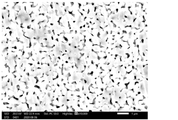
- the SEM image of the silver particle 1 is shown.
- the SEM cross-sectional photograph of the sintered body of Example 1 is shown.
- the SEM cross-sectional photograph of the sintered body of the comparative example 1 is shown.
- the cross-sectional SEM photograph of the sintered body of Example 3 is shown.
- a cross-sectional SEM photograph of the sintered body of Comparative Example 3 is shown.
- the cross-sectional SEM photograph of the sintered body after carrying out the thermal shock test of Example 3 for 300 cycles is shown.
- the cross-sectional SEM photograph of the sintered body after carrying out the thermal shock test of the comparative example 3 for 300 cycles is shown.
- the conductive adhesive of the present invention is a conductive adhesive containing silver particles 1 having an average particle diameter in the range of 20 nm or more and less than 500 nm and a solvent, and the water content of the solvent in the conductive adhesive is 1300 ppm. It is characterized by the following. Since the conductive adhesive of the present invention has such characteristics, it is suitably sintered at a low temperature without pressure when sintering the conductive adhesive, and has a high density and mechanical strength. It is possible to provide a novel conductive adhesive that forms a sintered body having high (shear strength).
- the conductive adhesive of the present invention the sintered body of the conductive adhesive, and the electronic components provided with the sintered body between the members will be described in detail.
- the numerical value connected by "-" means a numerical range including the numerical values before and after "-" as the lower limit value and the upper limit value.
- any lower limit value and upper limit value can be selected and connected by " ⁇ ".
- the conductive adhesive of the present invention is characterized by containing silver particles 1 having an average particle diameter in the range of 20 nm or more and less than 500 nm, and a solvent.
- the conductive adhesive contains a solvent, the fluidity of the conductive adhesive is increased, and the conductive adhesive of the present invention can be easily placed in a desired place. Details of the silver particles contained in the conductive adhesive of the present invention are as described below.
- the water content of the solvent in the conductive adhesive may be 1300 ppm or less.
- the water content of the solvent in the conductive adhesive may be 1300 ppm or less, preferably 1200 ppm or less, more preferably 1100 ppm or less, and even more preferably 1000 ppm or less.
- the lower limit of the water content of the solvent in the conductive adhesive may be not less than or equal to the measurement limit value of the method for measuring the water content, and may be, for example, 10 ppm or more.
- the above-mentioned effect can be obtained by setting the water content of the solvent in the conductive adhesive within the above range.
- the water content of the solvent in the conductive adhesive can be measured by gas chromatography, Karl Fischer method, or the like. Specifically, the water content of the solvent used for the conductive adhesive may be measured by the Karl Fischer method, and a solvent within the above range may be used.
- the water content in the solvent used for the conductive adhesive is adjusted to the conductive adhesive by using distillation, molecular sieve, alumina or the like. Those adjusted to 1300 ppm or less before addition can be used.
- some solvents in the conductive adhesive containing silver particles and a solvent have a water content reduced to 1300 ppm or less immediately after the purchase of a commercially available product. Such a water content Some have not been reduced to. Even when a solvent having a water content reduced to 1300 ppm or less is used, the solvent absorbs the water in the atmosphere in a short time during the production of the conductive adhesive, and the water content becomes high.
- the conductive adhesive of the present invention has a water content of 1300 ppm or less in the solvent in the conductive adhesive not only during production but also during use (specifically, when subjected to sintering). You are required to be.
- the water content of a conductive adhesive containing silver particles has not been strictly controlled so far, and a commercially available solvent having a water content adjusted to 1300 ppm or less has been used for producing the conductive adhesive.
- a solvent or a conductive adhesive may be sealed with dry air or nitrogen cylinder air during manufacturing, storage, distribution, or use. Further, the humidity of the living room at the time of use may be controlled.
- the silver particle 1 is in the range of 20 nm to 500 nm.
- the average particle size of the silver particles 1 may be in the range of 20 nm to 500 nm, but from the viewpoint of more preferably achieving the effect of the present invention, the lower limit is preferably 25 nm or more, more preferably 30 nm or more.
- the upper limit is preferably 500 nm or less, more preferably 450 nm or less, still more preferably 400 nm or less, and preferred ranges are 20 to 500 nm, 25 to 500 nm, 30 to 500 nm, 25 to 450 nm, 25 to 400 nm. Examples thereof include 30 to 450 nm and 30 to 400 nm.
- the average particle size of the silver particles 1 is a volume-based average particle measured for 200 randomly selected particles using image analysis software (for example, Macview (manufactured by Mountech)) for SEM images.
- image analysis software for example, Macview (manufactured by Mountech)
- the diameter For SEM observation, an SED mode (secondary electron detector) is used, and the acceleration voltage is 20 kV, and the observation magnification is 5000 to 30000 times, and the width is observed in the range of 1 to 20 ⁇ m. In the vertical direction of the SEM image, the width is set to include 200 or more (usually about 200 to 300) silver particles in a width range of 1 to 20 ⁇ m.
- the volume-based average particle diameter is a value measured on the assumption that the particles observed in the SEM image are spherical having the diameter. The specific measurement method is as described in the examples.
- the dry powder of the silver particles 1 preferably has a weight loss rate of 1.5% by weight or less when heated from 30 ° C. to 500 ° C. by thermogravimetric differential thermal analysis, preferably 0.05 to 1.3% by weight. % Is more preferable.
- the method of thermogravimetric differential thermal analysis is as follows.
- TG-DTA Thermogravimetric differential thermal analysis
- the silver particles 1 are preferably surface-treated silver particles.
- the amine compound is attached to the surface of the silver particles 1.
- the amine compound can adhere to the surface of the silver particles 1 to form a protective layer.
- the amine compound is not particularly limited, but from the viewpoint of more preferably exerting the effect of the present invention, a primary amine, a secondary amine, a tertiary amine, and two amino groups in one compound are used. Examples thereof include diamine compounds having.
- Primary amines include ethylamine, n-propylamine, isopropylamine, 1,2-dimethylpropylamine, n-butylamine, isobutylamine, sec-butylamine, tert-butylamine, isoamylamine, n-hexylamine, n- Octylamine, 2-octylamine, tert-octylamine, 2-ethylhexylamine, n-nonylamine, n-aminodecane, n-aminoundecane, n-dodecylamine, n-tridecylamine, 2-tridecylamine, n- Tetradecylamine, n-pentadecylamine, n-hexadecylamine, n-heptadecylamine, n-octadecylamine, n-oleylamine, 3-methoxypropy
- cyclopropylamine, cyclobutylamine, cyclopropylamine, cyclohexylamine, cycloheptylamine, cyclooctylamine which are alicyclic amines, aniline which is an aromatic amine and the like can also be exemplified.
- ether amines such as 3-isopropoxypropylamine and isobutoxypropylamine can also be exemplified.
- Secondary amines include N, N-dipropylamine, N, N-dibutylamine, N, N-dipentylamine, N, N-dihexylamine, N, N-dipeptylamine, N, N-dioctylamine, N.
- N-dinonylamine N, N-didecylamine, N, N-diundecylamine, N, N-didodecylamine, N, N-dystearylamine, N-methyl-N-propylamine, N-ethyl-N- Dialkyl monoamines such as propylamine and N-propyl-N-butylamine, and cyclic amines such as piperidine can be exemplified.
- tertiary amine examples include triethylamine, tributylamine, trihexylamine, dimethyloctylamine, dimethyldecylamine, dimethyllaurylamine, dimethylmyristylamine, dimethylpalmitylamine, dimethylstearylamine, dilaurylmonomethylamine and the like.
- amine compound a diamine compound having two amino groups in one compound can also be used.
- diamine compound include ethylenediamine, N, N-dimethylethylenediamine, N, N'-dimethylethylenediamine, N, N-diethylethylenediamine, N, N'-diethylethylenediamine, 1,3-propanediamine, and 2,2-dimethyl-.
- 1,3-Propanediamine N, N-dimethyl-1,3-propanediamine, N, N'-dimethyl-1,3-propanediamine, N, N-diethyl-1,3-propanediamine, N, N '-Diethyl-1,3-propanediamine, 1,4-butanediamine, N, N-dimethyl-1,4-butanediamine, N, N'-dimethyl-1,4-butanediamine, N, N-diamine -1,4-butanediamine, N, N'-diethyl-1,4-butanediamine, 1,5-pentanediamine, 1,5-diamino-2-methylpentane, 1,6-hexanediamine, N, N Examples thereof include -dimethyl-1,6-hexanediamine, N, N'-dimethyl-1,6-hexanediamine, 1,7-heptanediamine, 1,8-octanediamine and the like.
- the amount of the amine compound attached to the silver particles 1 is not particularly limited, but the mass of the silver particles 1 is 100% by mass, preferably 1.5% by mass or less, more preferably 1.3% by mass or less, and the lower limit. Is preferably 0.05% by mass or more.
- the content of the amine compound adhering to the silver particles 1 can be measured by thermogravimetric differential thermal analysis.
- fatty acids, hydroxy fatty acids and the like may be attached to the surface of the silver particles 1.
- the fatty acid is not particularly limited, but preferably includes a fatty acid having an alkyl group having 3 or more and 18 or less carbon atoms, and more preferably a fatty acid having an alkyl group having 4 or more and 18 or less carbon atoms.
- Preferred specific examples of fatty acids include acetic acid, propionic acid, butyric acid, valeric acid, caproic acid, caprylic acid, 2-ethylhexanoic acid, caproic acid, lauric acid, myristic acid, palmitic acid, stearic acid, oleic acid and linoleic acid.
- Examples thereof include acid, ⁇ -linolenic acid and the like.
- specific examples of the fatty acid include cyclic alkylcarboxylic acids such as cyclohexanecarboxylic acid.
- a compound having 3 to 24 carbon atoms and having one or more hydroxyl groups can be used.
- examples of the hydroxy fatty acid include 2-hydroxydecanoic acid, 2-hydroxydodecanoic acid, 2-hydroxytetradecanoic acid, 2-hydroxyhexadecanoic acid, 2-hydroxyoctadecanoic acid, 2-hydroxyeicosanoic acid and 2-hydroxydocosan.
- hydroxy fatty acids having 4 to 18 carbon atoms and having one hydroxyl group other than the ⁇ -position are preferable, and ricino-lic acid, 12-hydroxystearic acid, and oleic acid are more preferable.
- the fatty acid and the hydroxy fatty acid may be used individually by 1 type, or may be used in combination of 2 or more types.
- the amount of fatty acid or hydroxy fatty acid attached to the silver particles 1 of the present invention is appropriately adjusted as in the case of the amine compound.
- the specific amount of the fatty acid or hydroxy fatty acid attached is not particularly limited, but the mass of the silver particles 1 is 100% by mass, preferably 1.5% by mass or less, more preferably 1.3% by mass or less, and is preferable. Is 0.01% by mass or more.
- the content of fatty acid and hydroxy fatty acid adhering to the silver particles 1 can be measured by differential thermal analysis.
- the amine compound, fatty acid, and hydroxy fatty acid may be used in combination as long as the silver particles 1 of the present invention satisfy the above average particle size, and other compounds different from these may be used as silver particles 1. It may be attached to the surface of. It is particularly preferable that an amine compound is attached to the surface of the silver particles 1 of the present invention.
- silver particles having an average particle diameter of 20 to 500 nm may be used alone, or a plurality of silver particles having an average particle diameter of 20 to 500 nm may be used in combination.
- the ratio when a plurality of silver particles having an average particle diameter of 20 to 500 nm are used in combination may be appropriately adjusted so as to obtain the desired physical properties.
- the average particle diameter is in the range of 20 to 500 nm.
- silver particles 1a having a small size and silver particles 1b having a large average particle size are used, the ratio of the silver particles 1a to the silver particles 1b may be in the range of 1 to 30:70 to 99.
- the conductive adhesive of the present invention may contain silver particles 2 having an average particle diameter of 20 to 500 nm as described above, as well as silver particles 2 having an average particle diameter of 0.5 to 5.5 ⁇ m, if necessary. good.
- the average particle size of the silver particles 2 is preferably 0.6 ⁇ m or more as the lower limit and preferably 3.0 ⁇ m or less, more preferably as the upper limit, from the viewpoint of more preferably exerting the effect of the present invention. 2.5 ⁇ m or less, more preferably 2.0 ⁇ m or less, and preferred ranges of 0.5 to 3.0 ⁇ m, 0.5 to 2.5 ⁇ m, 0.5 to 2.0 ⁇ m, and 0.6 to 3 Examples thereof include 0.0 ⁇ m, 0.6 to 2.5 ⁇ m, and 0.6 to 2.0 ⁇ m.
- the average particle size of the silver particles 2 can be measured by a laser diffraction / scattering method particle size distribution measuring device, or can be actually measured from an electron micrograph, and further, an image from the electron micrograph. It can also be calculated using a processing device. Generally, the average particle size is measured by a laser diffraction method or image analysis of an SEM image (for example, Macview (manufactured by Mountech)).
- silver particles 2 in the present invention commercially available ones may be used, or those synthesized by a known synthesis method may be used.
- the silver particles 1 may be used alone or the silver particles 1 and the silver particles 2 may be used in combination as the silver particles.
- the ratio of silver particles 1 to silver particles 2 may be in the range of (silver particles 1: silver particles 2) 30 to 70: 70 to 30, and 35 to 35.
- the range of 65:65 to 35 is preferable, and the range of 40 to 60:60 to 40 is more preferable.
- the solvent is not particularly limited as long as it can have a water content of 1300 ppm or less and can disperse silver particles, but it is preferable to include a polar organic solvent.
- the polar organic solvent include ketones such as acetone, acetylacetone and methyl ethyl ketone; ethers such as diethyl ether, dipropyl ether, dibutyl ether, tetrahydrofuran and 1,4-dioxane; 1,2-propanediol.
- Glycols or glycolethers such as; N, N-dimethylformamide; dimethylsulfoxide; terpenes such as terpineol; acetonitrile; ⁇ -butyrolactone; 2-pyrrolidone; N-methylpyrrolidone; N- (2). -Aminoethyl) Piperazine and the like.
- linear or branched alcohol having 3 to 5 carbon atoms, 3-methoxy-3-methyl-1-butanol, 3-methoxy.
- the solvent may further contain a non-polar or hydrophobic solvent in addition to the polar organic solvent.
- Non-polar organic solvents include linear, branched, or cyclic saturated hydrocarbons such as hexane, heptane, octane, nonane, decane, 2-ethylhexane, cyclohexane; linear or branched alcohols with 6 or more carbon atoms.
- -Alcohols such as benzene; aromatic compounds such as benzene, toluene and benzonitrile; halogenated hydrocarbons such as dichloromethane, chloroform and dichloroethane; methyl-n-amylketone; methylethylketone oxime; triacetin and the like.
- saturated hydrocarbons and straight-chain or branched-chain alcohols having 6 or more carbon atoms are preferable, and hexane, octane, decane, octanol, decanol, and dodecanol are more preferable.
- the solvent one type can be used alone, or two or more types can be mixed and used.
- the ratio of the polar organic solvent is preferably 5% by volume or more, more preferably 10% by volume or more, and further preferably 15% by volume or more with respect to the total amount of the solvent. More preferred. Further, it can be 60% by volume or less, 55% by volume or less, or 50% by volume or less.
- the solvent may be composed of only a polar organic solvent.
- the conductive adhesive of the present invention has good dispersibility of silver particles even when it contains a large amount of polar organic solvent as described above.
- the ratio of the solvent is not particularly limited, but is preferably 20% by mass or less, and more preferably about 5% by mass to 15% by mass.
- the content of silver particles contained in the conductive adhesive of the present invention is preferably 80% by mass or more, more preferably 85% by mass or more.
- the conductive adhesive of the present invention can be produced by a method including a step of mixing each silver particle and a solvent.
- the silver particles of the present invention produced in a solvent are used together with the solvent as the conductive adhesive of the present invention. May be good.
- the shear strength of the sintered body obtained by heating the conductive adhesive at 200 ° C. is preferably 35 MPa or more, more preferably 40 MPa or more, still more preferably 45 MPa or more. be.
- the upper limit of the shear strength is, for example, 200 MPa or less.
- the shear strength of the sintered body obtained by heating the conductive adhesive at 250 ° C. is preferably 30 MPa or more, more preferably 35 MPa or more. Yes, more preferably 40 MPa or more.
- the upper limit of the shear strength is, for example, 200 MPa or less.
- the method for measuring the shear strength of the sintered body is as follows, and specifically, it is measured by the method described in Examples.
- a substrate having electroless silver plating of 0.5 ⁇ m on a copper plate is prepared.
- Conductive adhesive (90% by mass of silver particles, solvent (for example, diethylene glycol mono-2-ethylhexyl ether, texanol, etc.) 10% by mass of silver particle dispersion on the base material (surface on which silver plating is formed)) Is uniformly applied so that the coating thickness is 50 to 100 ⁇ m (adjusted by the thickness of the bonded body after plating).
- a silicon wafer size 2 mm ⁇ 2 mm
- gold plating on the back surface the surface in contact with the conductive adhesive
- the obtained laminate is heated at a predetermined sintering temperature (200 ° C. or 250 ° C.) under sintering conditions for 60 minutes, and is placed between the substrate and the silicon wafer.
- a predetermined sintering temperature 200 ° C. or 250 ° C.
- Each conductive adhesive is sintered, and nine laminated bodies in which a base material and a silicon wafer are bonded via a sintered body are produced.
- the thickness of the bonded body is 30 to 90 ⁇ m, and the film thicknesses of the conductive adhesives to be compared are made uniform and compared.
- a bond tester for example, SS30-WD manufactured by Seishin Shoji
- SS30-WD manufactured by Seishin Shoji
- a die share test of each laminate was performed.
- the shear strength value is obtained by dividing the maximum load thus obtained by the joint area.
- the measurement result is an average value of nine gold-plated silicon wafers whose shear strength was measured.
- the sintering time at a predetermined sintering temperature may be 60 minutes or more, and pre-baking may be performed at 50 to 100 ° C. for 2 hours or less before the main sintering at a predetermined sintering temperature. ..
- the density of the sintered body obtained by heating the conductive adhesive at 200 ° C. is preferably 80% or more, more preferably 85% or more.
- the upper limit of the density is, for example, 95% or less.
- the density of the sintered body obtained by heating the conductive adhesive at 250 ° C. is preferably 83% or more, more preferably 85%. That is all.
- the upper limit of the density is, for example, 97% or less.
- the method for measuring the density of the sintered body is as follows, and specifically, it is measured by the method described in Examples.
- ⁇ Denseness> In the same manner as described in the column of ⁇ shear strength>, a laminated body in which a base material and a silicon wafer are bonded via a sintered body is obtained. Next, the sintered body is embedded with an epoxy resin (for example, manufactured by Buehler) together with the laminated body, and allowed to stand for 24 hours to cure the resin. Next, the resin-embedded laminate is cut with a precision low-speed cutting machine (for example, TechCut4 manufactured by ALLIED) and ion milling (for example, IM4000PLUS manufactured by Hitachi High-Technologies Corporation) (for example, IM4000PLUS manufactured by Hitachi High-Technologies Corporation). , Perform cross-section milling.
- a precision low-speed cutting machine for example, TechCut4 manufactured by ALLIED
- ion milling for example, IM4000PLUS manufactured by Hitachi High-Technologies Corporation
- IM4000PLUS manufactured by Hitachi High-Technologies Corporation for example, IM
- the cross-sectional milling is carried out by irradiating an ion beam with an argon gas flow rate of 0.07 cm 3 / min and a swing of ⁇ 30 ° at a discharge voltage of 1.5 kV and an acceleration voltage of 6 kV.
- the cross section of the sintered body obtained by cross-section milling is observed with a scanning electron microscope to obtain an SEM image.
- the SED mode secondary electron detector
- the vertical direction of the SEM image shall be in the range of the vertical width of the silver sintered layer of 30 ⁇ m or more and 200 ⁇ m or less.
- Dense density (%) Sintered silver area (number of white pixels) ⁇ Total area of sintered body ⁇ Sintered silver area (number of white pixels) + pore area (number of black pixels) ⁇ x 100
- the void portion is a pore portion generated by outgas or particle growth, which is different from voids and cracks, and the pore portion has a diameter of 50 nm or more and 10 ⁇ m or less. Holes having a diameter of more than 10 ⁇ m and having a connected size due to continuous voids are called voids or cracks, and are converted by excluding the void portion.
- the voids of the sintered body obtained by heating the conductive adhesive at 200 ° C. have, for example, the following characteristics.
- the sintered body is formed by the method described in the column of ⁇ shear strength>.
- the average size of the number of voids is, for example, 0.3 to 1.1 ⁇ m.
- the specific surface area of the void is, for example, 0.15 to 1.0 ⁇ m 2 .
- the size of the number average is calculated by the image processing method using Macview.
- a composition for producing silver particles (a composition for preparing silver particles) is prepared.
- a silver compound as a raw material for silver particles, an amine compound to be adhered to the surface of silver particles, and a solvent are prepared, if necessary.
- preferred silver compounds include silver nitrate, silver oxalate and the like, and silver oxalate is particularly preferable.
- the solvent the same solvent as that exemplified as the solvent to be blended in the conductive adhesive described later is exemplified.
- each of these components is mixed to obtain a composition for preparing silver particles. The ratio of each component in the composition is appropriately adjusted.
- the content of silver oxalate in the composition is preferably about 20 to 70% by mass with respect to the total amount of the composition.
- the content of the amine compound is preferably about 5% by mass to 55% by mass with respect to the total amount of the composition.
- the fatty acid content is preferably about 0.1% by mass to 20% by mass with respect to the total amount of the composition.
- the content of the hydroxy fatty acid is preferably about 0.1% by mass to 15% by mass with respect to the total amount of the composition.
- silver particles are once synthesized using a composition for preparing silver particles adjusted so that the content of the amine compound or the like is out of the above range, and the type and the amount of the amine compound or the like are determined by the method described later. It is also possible to adjust (substitute the amine compound) so as to have the above physical properties.
- the mixing means of each component is not particularly limited, and for example, a mechanical star, a magnetic star, a vortex mixer, a planetary mill, a ball mill, a triple roll, a line mixer, and a planetary. It can be mixed with a general-purpose device such as a mixer or a dissolver.
- a general-purpose device such as a mixer or a dissolver.
- the temperature of the composition is set to, for example, 60 ° C. or lower, particularly 40 ° C. It is preferable to mix while suppressing the following.
- the composition for preparing silver particles by subjecting the composition for preparing silver particles to a reaction in a reaction vessel, usually a reaction by heating, a thermal decomposition reaction of the silver compound occurs and silver particles are generated.
- the composition may be introduced into a reaction vessel that has been preheated, or the composition may be introduced into the reaction vessel and then heated.
- the reaction temperature may be any temperature as long as the thermal decomposition reaction proceeds and silver particles are generated, and examples thereof include about 50 to 250 ° C. Further, the reaction time may be appropriately selected according to the desired average particle size and the composition of the composition accordingly. Examples of the reaction time include 1 minute to 100 hours.
- the silver particles produced by the thermal decomposition reaction are obtained as a mixture containing unreacted raw materials, it is preferable to purify the silver particles.
- the purification method include a solid-liquid separation method, a precipitation method using a difference in specific gravity between silver particles and an unreacted raw material such as an organic solvent, and the like.
- the solid-liquid separation method include filter-filtration, centrifugation, cyclone method, decanter and the like.
- the viscosity of the mixture containing silver particles may be adjusted by diluting the mixture containing silver particles with a low boiling point solvent such as acetone or methanol for ease of handling during purification.
- the average particle size of the obtained silver particles can be adjusted by adjusting the composition and reaction conditions of the composition for producing silver particles.
- Silver particles (with an amine compound attached to the surface) once synthesized by the above method are prepared and dispersed in a solvent.
- a solvent the same solvent as that exemplified as the solvent to be blended in the conductive adhesive described later is exemplified.
- another amine compound is added in a range of 0.1 to 5 times the mass of the silver particles, and the mixture is subjected to a step of stirring at room temperature to 80 ° C. for 1 minute to 24 hours.
- the type of amine compound adhering to the surface of the silver particles can be replaced, and the amount of adhering can be adjusted.
- the silver particles substituted with the amine compound can be recovered by the above-mentioned solid-liquid separation method or the like.
- the sintered body of the conductive adhesive of the present invention can be obtained by sintering the conductive adhesive of the present invention described in detail in "1. Conductive adhesive" described above. .. In the sintered body of the conductive adhesive of the present invention, most of the components (amine compounds, etc.) and solvents adhering to the surface of the silver particles are separated due to the high heat during sintering, and the sintering is performed.
- the body is essentially composed of silver.
- the sintering temperature is not particularly limited, but is, for example, 250 ° C. or lower, preferably about 150 ° C. to 250 ° C., from the viewpoint of increasing the shear strength and the density of the obtained sintered body while suitably sintering at a low temperature. More preferably, it is about 200 ° C. to 250 ° C. From the same viewpoint, the sintering time is preferably about 0.4 hours to 2.0 hours, more preferably about 0.5 hours to 1.5 hours.
- the sintering time refers to the main sintering (maintained at the predetermined temperature after reaching the predetermined temperature) time, and other than that, pre-baking (before reaching the predetermined temperature, 100 ° C. or less).
- the conductive adhesive contains silver particles 1 having an average particle diameter in the range of 20 to 500 nm and a solvent, and the water content of the solvent in the conductive adhesive is 1300 ppm or less.
- it is suitably sintered at a low temperature of 250 ° C. or lower without pressurizing when sintering the conductive adhesive, and a sintered body having high density and mechanical strength (shear strength) is formed. Will be done. Therefore, it is not essential to pressurize when sintering the conductive adhesive of the present invention. That is, the conductive adhesive of the present invention can be suitably used for applications in which it is used without pressure during sintering.
- the pressure may be applied during the sintering of the conductive adhesive of the present invention, and the pressure when the pressure is applied is, for example, about 10 to 30 MPa.
- Sintering can be performed in an atmosphere such as an atmosphere or an inert gas (nitrogen gas, argon gas).
- the sintering means is not particularly limited, and examples thereof include an oven, a hot air drying oven, an infrared drying oven, laser irradiation, flash lamp irradiation, and microwave.
- the sintered body of the conductive adhesive of the present invention can be obtained by uniformly coating a substrate on a substrate and sintering it at a predetermined temperature, but the film thickness when coated on the substrate depends on the purpose. It can be adjusted as appropriate, and may be, for example, a thickness of about 10 to 100 ⁇ m. Further, when a large-sized (for example, about 10 mm ⁇ 10 mm) semiconductor chip is used, a thicker one is preferred. Therefore, the film thickness when applied to the substrate may be, for example, 30 ⁇ m or more, and 40 ⁇ m. The above is preferable, and 50 ⁇ m or more is more preferable. In this case, the upper limit of the film thickness may be 200 ⁇ m or less, preferably 100 ⁇ m or less.
- the sintered body of the present invention preferably satisfies at least one of the shear strength and the density shown in the column of "1.
- Conductive adhesive These measuring methods are as described in the columns of ⁇ shear strength> and ⁇ dense density> described above.
- the electronic components of the present invention include a portion in which the members are adhered to each other by the sintered body of the present invention. That is, in the electronic component of the present invention, the conductive adhesive of the present invention described in detail in the above-mentioned "1. Conductive adhesive" is arranged between the members of the electronic component (for example, between the members included in the circuit). , The conductive adhesive is sintered and the members are bonded together.
- the sintered body of the present invention has high precision density and shear strength, the shear strength between the members is also high even in the electronic component provided with the sintered body. Further, the resistivity value of the electronic component of the present invention can also be low.
- Solvent 1 Texanol (manufactured by Fujifilm Wako Pure Chemical Industries, Ltd.) Solvent 2) ⁇ -Tarpineol (manufactured by Fujifilm Wako Pure Chemical Industries, Ltd.) Solvent 3) Diethylene glycol mono-2-ethylhexyl ether (manufactured by Fujifilm Wako Pure Chemical Industries, Ltd.) Solvent 4) Butyl carbitol (manufactured by Fujifilm Wako Pure Chemical Industries, Ltd.) Solvent 5) Hexylcarbitol (manufactured by Fujifilm Wako Pure Chemical Industries, Ltd.) Solvent 6) 2-Ethyl-1,3-hexanediol (manufactured by Fujifilm Wako Pure Chemical Industries, Ltd.)
- Silver particles 1 (average particle diameter 68 nm) in which the protective layer adhering to the surface of silver particles was replaced with n-hexylamine by repeating the steps of adding 15 g of metalnol, stirring, centrifuging, and removing the supernatant twice. was recovered.
- FIG. 1 shows an SEM image of silver particles 1.
- Silver particles 3 (average particle diameter 440 nm) in which the protective layer adhering to the surface of the silver particles was replaced with n-hexylamine by repeating the steps of adding 15 g of metalnol, stirring, centrifuging, and removing the supernatant twice. was recovered.
- a conductive adhesive was prepared by mixing silver particles 1 and a solvent (diethylene glycol mono-2-ethylhexyl ether, texanol, or hexylcarbitol) so as to have the composition (mass ratio) shown in Table 2. .. Specifically, first, for silver particles 1, 10% by mass of diethylene glycol mono-2-ethylhexyl ether, texanol, or hexylcarbitol is added to each silver particle dispersion having a concentration of 90% by mass (1).
- a solvent diethylene glycol mono-2-ethylhexyl ether, texanol, or hexylcarbitol
- Silver particle dispersion 1-1 diethylene glycol mono-2-ethylhexyl ether, silver particle dispersion 1-2: texanol, silver particle dispersion 1-3: hexylcarbitol) were prepared, respectively.
- a Mazelstar manufactured by Kurabo Industries Ltd. was used, and the mixture was mixed in the two-time stirring priority mode.
- each conductive adhesive having the compositions of Examples 1 to 2 and 4 and Comparative Examples 1 to 2 and 4 was obtained.
- a solvent diethylene glycol mono-2-ethylhexyl ether; water content of 150 ppm or less, texanol; water content of 100 ppm or less; Hexylcarbitol; water content of 100 ppm or less
- a solvent whose water content was not adjusted diethylene glycol mono-2-ethylhexyl ether; water content of 1700 ppm or less, texanol; water content of 1360 ppm
- hexylcarbitol a water content of 2000 ppm or less
- the water content of the solvent used in the examples was measured by the method described later.
- composition (mass ratio) shown in Table 2 is such that silver particles 1, silver particles 2 having an average particle diameter of 0.65 ⁇ m (product name AG2-1C manufactured by DOWA Electronics Co., Ltd.), and a solvent (texano-). Lu) was mixed to prepare a conductive adhesive. Specifically, first, for each of the silver particles 1 and the silver particles 2, 10% by mass of texanol is added, and each silver particle dispersion having a concentration of 90% by mass (silver particle dispersion 1-2, A silver particle dispersion 2) was prepared. For mixing, a Mazelstar manufactured by Kurabo Industries Ltd. was used, and the mixture was mixed in the two-time stirring priority mode.
- each silver particle dispersion and texanol are mixed so as to have the composition (mass ratio) shown in Table 2, and each conductive adhesive having the composition of Example 3 and Comparative Example 3 is prepared. Obtained.
- 100 g of a molecular sieve was used with respect to 1000 g of the solvent, a solvent having an adjusted water content (texanol; a water content of 100 ppm or less) was used, and in the comparative example, a solvent having no adjusted water content. (Texanol; water content of 1360 ppm or less) was used. The water content of the solvent used in the examples was measured by the method described later.
- ⁇ Measuring method of water content of solvent in conductive adhesive The moisture content of the solvent in the conductive adhesive was measured using a Karl Fischer type moisture meter CA-21 (manufactured by Nittoseiko Analytec). Specifically, 0.200 g of the solvent is directly injected into the moisture meter cell, and the water content detected when the detected amount is less than 0.30 ⁇ g / s is set as the end point, and the water content of the solvent is calculated from the water detected amount / solvent injection amount. The content was calculated.
- a substrate having electroless silver plating of 0.5 ⁇ m on a copper plate was prepared.
- Each conductive adhesive was uniformly applied onto the substrate (the surface on which silver plating or gold plating was formed) so that the coating film thickness was 50 to 100 ⁇ m.
- a silicon wafer (size 2 mm ⁇ 2 mm) having gold plating on the back surface (the surface in contact with the conductive adhesive) was laminated on the coating film to obtain a laminate.
- the obtained laminate is heated at a predetermined sintering temperature (200 ° C.) under sintering conditions for 60 minutes, and each conductivity between the substrate and the silicon wafer is obtained.
- the adhesive was sintered, and nine laminates were obtained in which the base material and the silicon wafer were bonded via the sintered body.
- the thickness of the sintered body after sintering was 30 ⁇ m to 90 ⁇ m.
- Table 3 shows the results of Example 1, Comparative Example 1, Table 4 shows the results of Example 2, Comparative Example 2, Table 5 shows the results of Example 3, Comparative Example 3, and Table 6 shows the results of Example 4 and Comparative Example 4.
- the cross-sectional milling was carried out by irradiating an ion beam with an argon gas flow rate of 0.07 cm 3 / min and a swing of ⁇ 30 ° at a discharge voltage of 1.5 kV and an acceleration voltage of 6 kV.
- the cross section of the sintered body obtained by cross-section milling was observed with a scanning electron microscope JSM-IT500HR (manufactured by JEOL Ltd.) to obtain an SEM image.
- the SED mode secondary electron detector
- the range of the width of 10 ⁇ m was observed in the field of view of the acceleration voltage of 20 kV and 10000 times.
- Dense density (%) Sintered silver area (number of white pixels) ⁇ Total area of sintered body ⁇ Sintered silver area (number of white pixels) + pore area (number of black pixels) ⁇ x 100
- FIG. 2 shows a cross-sectional SEM photograph of the sintered body of Example 1
- FIG. 3 shows a cross-sectional SEM photograph of the sintered body of Comparative Example 1
- FIG. 4 shows the sintered body of Example 3.
- a cross-sectional SEM photograph of the above, and FIG. 5 shows a cross-sectional SEM photograph of the sintered body of Comparative Example 3.
- the conductive adhesive of Example 1 in which the water content of the solvent in the conductive adhesive is controlled to 1300 ppm or less is at a low temperature even if it is not pressed during sintering of the conductive adhesive.
- a sintered body having high density and mechanical strength (shear strength) was formed.
- the conductive adhesive of Comparative Example 1 in which the water content of the solvent in the conductive adhesive exceeds 1300 ppm has a lower shear strength of the obtained sintered body as compared with Example 1, and is baked. Cracks and chips were found in the body, and voids and cracks were observed. It is considered that this is largely due to the decrease in the fineness of the sintered body and the deterioration of the sinterability of the silver particles 1.
- the sintered body of Comparative Example 1 had many cracks and chips and had a low density.
- the conductive adhesive of Example 2 in which the water content of the solvent in the conductive adhesive is controlled to 1300 ppm or less is at a low temperature even if it is not pressed during sintering of the conductive adhesive. A sintered body having high density and mechanical strength (shear strength) was formed.
- the conductive adhesive of Comparative Example 2 in which the water content of the solvent in the conductive adhesive exceeds 1300 ppm has a lower shear strength of the obtained sintered body as compared with Example 2, and is baked. Cracks and chips were found in the body, and voids and cracks were observed.
- Example 3 ⁇ Cold heat impact test of sintered body>
- the laminates obtained in Example 3 and Comparative Example 3 were subjected to a thermal shock test in which they were held at ⁇ 65 ° C. to 150 ° C. for 10 minutes, respectively, for 300 cycles.
- Table 5 shows the results of shear strength measurements before and after the test.
- the bonding state of the interface between the sintered body and the silicon wafer was observed from the SEM cross section of the sintered body after the test. Those with a good interface bonding state were rated as ⁇ , and those with a poor interface bonding state were rated as x.
- FIG. 6 shows a cross-sectional SEM photograph of the sintered body after 300 cycles of the cold shock test of Example 3
- FIG. 7 shows a cross-sectional SEM photograph of the sintered body after 300 cycles of the cold shock test of Comparative Example 3.
- the sintered body of Example 3 did not crack and chipped, and the bonded state at the interface between the sintered body and the silicon wafer after the thermal impact test was good.
- the sintered body of Comparative Example 3 had cracks and chips, and the bonding state at the interface between the sintered body and the silicon wafer after the thermal impact test was poor.
- Even in a system in which silver particles 2 are mixed it has a great influence on the formation of the sintered body and lowers the initial shear strength and the shear strength after the thermal impact test. It is considered that this is because the density of the interface between the silver sintered body and the silicon wafer was particularly low.
- the conductive adhesive of Example 4 in which the water content of the solvent in the conductive adhesive is controlled to 1300 ppm or less is at a low temperature even if it is not pressed during sintering of the conductive adhesive.
- a sintered body having high density and mechanical strength (shear strength) was formed.
- the conductive adhesive of Comparative Example 4 in which the water content of the solvent in the conductive adhesive exceeds 1300 ppm is found in the case where the obtained sintered body also has a large amount of water as compared with Example 4. The shear strength decreased, and cracks and chips were generated in the sintered body, and voids and cracks were observed.
- a conductive adhesive is prepared by mixing silver particles 3 (average particle diameter 440 nm) and a solvent (diethylene glycol mono-2-ethylhexyl ether or texanol) so as to have the composition (mass ratio) shown in Table 7.
- a solvent diethylene glycol mono-2-ethylhexyl ether or texanol
- Dispersion 3-1 diethylene glycol mono-2-ethylhexyl ether
- silver particle dispersion 3-2 texanol
- each conductive adhesive having the compositions of Examples 5 to 6 and Comparative Examples 5 to 6 was obtained.
- 100 g of a molecular sieve was used with respect to 1000 g of the solvent, and the water content was adjusted (diethylene glycol mono-2-ethylhexyl ether; water content 130 ppm or less, texanol; water content 130 ppm or less).
- a solvent having no adjusted water content (diethylene glycol mono-2-ethylhexyl ether; water content of 5000 ppm or less, texanol; water content of 5400 ppm or less) was used.
- the water content of the solvent used in the examples was measured by the method described above.
- a sintered body was produced from each conductive adhesive by the same method as in Example 1 and Comparative Example 1.
- Various physical properties of each sintered body obtained from the conductive adhesive were measured under the above-mentioned measurement conditions.
- Table 8 shows the results of Example 5, Comparative Example 5, and Table 9 shows the results of Example 6 and Comparative Example 6.
- the conductive adhesive of Example 5 in which the water content of the solvent in the conductive adhesive is controlled to 1300 ppm or less is at a low temperature even if it is not pressed during sintering of the conductive adhesive. A sintered body having high density and mechanical strength (shear strength) was formed.
- the conductive adhesive of Comparative Example 5 in which the water content of the solvent in the conductive adhesive exceeds 1300 ppm has a lower shear strength of the obtained sintered body as compared with Example 2, and is baked. Cracks and chips were found in the body, and voids and cracks were observed.
- the conductive adhesive of Example 6 in which the water content of the solvent in the conductive adhesive was controlled to 1300 ppm or less is at a low temperature even if it is not pressed during sintering of the conductive adhesive. A sintered body having high density and mechanical strength (shear strength) was formed.
- the conductive adhesive of Comparative Example 6 in which the water content of the solvent in the conductive adhesive exceeds 1300 ppm has a lower shear strength of the obtained sintered body as compared with Example 6, and is baked. Cracks and chips were found in the body, and voids and cracks were observed.
Landscapes
- Chemical & Material Sciences (AREA)
- Organic Chemistry (AREA)
- Engineering & Computer Science (AREA)
- Inorganic Chemistry (AREA)
- Mechanical Engineering (AREA)
- Materials Engineering (AREA)
- Chemical Kinetics & Catalysis (AREA)
- Nanotechnology (AREA)
- Dispersion Chemistry (AREA)
- Composite Materials (AREA)
- Manufacturing & Machinery (AREA)
- Medicinal Chemistry (AREA)
- Polymers & Plastics (AREA)
- Health & Medical Sciences (AREA)
- Metallurgy (AREA)
- General Chemical & Material Sciences (AREA)
- Physics & Mathematics (AREA)
- Spectroscopy & Molecular Physics (AREA)
- Conductive Materials (AREA)
- Powder Metallurgy (AREA)
Abstract
Description
項1. 平均粒子径が20nm以上500nm未満の範囲である銀粒子1と、溶媒とを含む、導電性接着剤であって、
前記導電性接着剤における前記溶媒の水分含有量が1300ppm以下である、導電性接着剤。
項2.前記銀粒子1の表面には、アミン化合物が付着している、項1に記載の導電性接着剤。
項3.項1又は2に記載の導電性接着剤の焼結体。
項4.項3に記載の焼結体によって部材間が接合されてなる電子部品。
項5.項1又は2に記載の導電性接着剤を200℃以上250℃以下の温度で焼結させる工程を含む、焼結体の製造方法。
項6. 焼結体によって部材間が接合されてなる電子部品の製造方法であって、
前記部材間に項1又は2に記載の導電性接着剤を配置する工程と、
前記導電性接着剤を200℃以上250℃以下の温度で焼結させる工程と、
を備える、電子部品の製造方法。
本発明の導電性接着剤は、平均粒子径が20nm以上500nm未満の範囲である銀粒子1と、溶媒とを含むことを特徴としている。導電性接着剤が溶媒を含むことにより、導電性接着剤の流動性が高まり、本発明の導電性接着剤を所望の場所に配置しやすくなる。本発明の導電性接着剤に含まれる銀粒子の詳細については、以下に記載する通りである。
また、導電性接着剤における溶媒の水分含有量の下限値は、水分含有量の測定方法の測定限界値以下であればよく、例えば、10ppm以上であればよい。導電性接着剤における溶媒の水分含有量を上記範囲とすることで、上述した効果を得ることができる。
銀粒子1は、20nm~500nmの範囲である。銀粒子1の平均粒子径は、20nm~500nmの範囲であればよいが、本発明の効果をより一層好適に奏する観点から、下限については、好ましくは25nm以上、より好ましくは30nm以上が挙げられ、上限については、好ましくは500nm以下、より好ましくは450nm以下、さらに好ましくは400nm以下が挙げられ、好ましい範囲としては、20~500nm、25~500nm、30~500nm、25~450nm、25~400nm、30~450nm、30~400nm等が挙げられる。
まず、風乾した銀粒子1を用意する。例えば、導電性接着剤から銀粒子1を取得して分析する場合には、各導電性接着剤1gに対し、メタノ-ル2gを加えてよく分散させたのち、銀粒子1をろ取、風乾して銀粒子1乾燥粉末を得て、分析対象とする。銀粒子1の乾燥粉末のTG-DTAを熱重量示差熱分析装置(例えば、HITACHI G300 AST-2)で測定する。測定条件は、雰囲気:空気、測定温度:30~500℃、昇温速度:10℃/minとする。得られたTG-DTAチャ-トから、TG-DTA分析における銀粒子1の結合に起因する発熱ピ-クと、熱分析によって30℃から500℃まで加熱したときの重量減少率を得る。
また、3-イソプロポキシプロピルアミン、イソブトキシプロピルアミン等のエーテルアミンも例示できる。
溶媒としては、水分含有量を1300ppm以下とすることができ、かつ、銀粒子を分散できるものであれば、特に制限されないが、極性有機溶媒を含むことが好ましい。極性有機溶媒としては、アセトン、アセチルアセトン、メチルエチルケトン等のケトン類;ジエチルエ-テル、ジプロピルエ-テル、ジブチルエ-テル、テトラヒドロフラン、1,4-ジオキサン等のエ-テル類;1,2-プロパンジオ-ル、1,2-ブタンジオ-ル、1,3-ブタンジオ-ル、1,4-ブタンジオ-ル、2,3-ブタンジオ-ル、1,2-ヘキサンジオ-ル、1,6-ヘキサンジオ-ル、1,2-ペンタンジオ-ル、1,5-ペンタンジオ-ル、2-メチル-2,4-ペンタンジオ-ル、3-メチル-1,5-ペンタンジオ-ル、1,2-オクタンジオ-ル、1,8-オクタンジオ-ル、2-エチル-1,3-ヘキサンジオ-ル等のジオ-ル類;グリセロ-ル;炭素数1~5の直鎖又は分岐鎖のアルコ-ル、シクロヘキサノ-ル、3-メトキシ-3-メチル-1-ブタノ-ル、3-メトキシ-1-ブタノ-ル等のアルコ-ル類;酢酸エチル、酢酸ブチル、酪酸エチル、蟻酸エチル、テキサノール等の脂肪酸エステル類;ポリエチレングリコ-ル、トリエチレングリコ-ルモノメチルエ-テル、テトラエチレングリコ-ルモノメチルエ-テル、エチレングリコ-ルモノエチルエ-テル、ジエチレングリコ-ルモノエチルエ-テル、ジエチレングリコ-ルジメチルエ-テル、トリエチレングリコ-ルジメチルエ-テル、テトラエチレングリコ-ルジメチルエ-テル、3-メトキシブチルアセテ-ト、エチレングリコ-ルモノブチルエ-テル、エチレングリコ-ルモノブチルエ-テルアセテ-ト、エチレングリコ-ルモノヘキシルエ-テル、エチレングリコ-ルモノオクチルエ-テル、エチレングリコ-ルモノ-2-エチルヘキシルエ-テル、エチレングリコ-ルモノベンジルエ-テル、ジエチレングリコ-ルモノメチルエ-テル、ジエチレングリコ-ルモノメチルエ-テルアセテ-ト、ジエチレングリコ-ルモノエチルエ-テル、ジエチレングリコ-ルモノエチルエ-テルアセテ-ト、ジエチレングリコ-ルモノブチルエ-テル、ジエチレングリコ-ルモノブチルエ-テルアセテ-ト、ジエチレングリコールモノヘキシルエーテル、ジエチレングリコールモノ-2-エチルヘキシルエーテル、ポリプロピレングリコ-ル、プロピレングリコ-ルモノプロピルエ-テル、プロピレングリコ-ルモノブチルエ-テル、ジプロピレングリコ-ルモノメチルエ-テル、ジプロピレングリコ-ルモノエチルエ-テル、ジプロピレングリコ-ルモノプロピルエ-テル、ジプロピレングリコ-ルモノブチルエ-テル、トリプロピレングリコ-ルモノメチルエ-テル、トリプロピレングリコ-ルモノエチルエ-テル、トリプロピレングリコ-ルモノプロピルエ-テル、トリプロピレングリコ-ルモノブチルエ-テル等のグリコ-ル又はグリコ-ルエ-テル類;N,N-ジメチルホルムアミド;ジメチルスルホキシド;テルピネオ-ル等のテルペン類;アセトニトリル;γ-ブチロラクトン;2-ピロリドン;N-メチルピロリドン;N-(2-アミノエチル)ピペラジン等が挙げられる。これらの中でも、本発明の効果をより一層好適に奏する観点から、炭素数3~5の直鎖又は分岐鎖のアルコ-ル、3-メトキシ-3-メチル-1-ブタノ-ル、3-メトキシ-1-ブタノ-ル、ジエチレングリコ-ルモノブチルエ-テル、ジエチレングリコ-ルモノブチルエ-テルアセテ-ト、ジエチレングリコールモノヘキシルエーテル、ジエチレングリコールモノ-2-エチルヘキシルエーテル、テルピネオ-ル、テキサノールが好ましい。
まず、銅板上に無電解銀めっきを0.5μm施した基材を準備する。基材の上(銀めっきが形成された表面)に導電性接着剤(銀粒子90質量%、溶媒(例えば、ジエチレングリコールモノ-2-エチルヘキシルエーテル、又はテキサノール等)10質量%の銀粒子分散液)を塗膜厚みが50~100μmとなるように、均一に塗布する(焼結後の接合体厚みで調整する)。さらに、塗膜の上に、裏面(導電性接着剤と接する面)に金めっきが施されたシリコンウエハ(サイズ2mm×2mm)を積層して積層体を得る。次に、乾燥器(循環式)を用い、得られた積層体を所定の焼結温度(200℃又は250℃)で60分間の焼結条件で加熱し、基材とシリコンウエハとの間の各導電性接着剤が焼結し、基材とシリコンウエハとが焼結体を介して接合された積層体を9個作製する。接合体の厚みは30~90μmで、比較したい導電性接着剤同士の膜厚をそろえて比較する。得られた積層体について、それぞれ、室温でボンドテスター(例えば、西進商事製SS30-WD)を用い、0.120mm/sの条件で焼結体に負荷をかけ、各積層体のダイシェアテストを実施して破断時の最大荷重を測定する。このようにして得られた最大荷重を接合面積で除することでせん断強度値を得る。なお、測定結果は、せん断強度を測定した9個の金めっきシリコンウエハの平均値である。なお、所定の焼結温度での焼結時間は60分以上行ってもよく、所定の焼結温度での本焼結前に、50~100℃で2時間以下の予備焼成を行っても良い。
<せん断強度>の欄に記載の方法と同様にして、基材とシリコンウエハとが焼結体を介して接合された積層体を得る。次に、焼結体を、積層体ごとエポキシ樹脂(例えば、ビューラー社製)で樹脂包埋し、24時間静置して樹脂を硬化させる。次に、樹脂包埋された積層体を精密低速切断機(例えば、ALLIED社製TechCut4)で切断し、(例えば、日立ハイテクノロジーズ社製)イオンミリング(例えば、日立ハイテクノロジーズ社製のIM4000PLUS)により、断面ミリングを実施する。なお、断面ミリングは、放電電圧1.5kV、加速電圧6kVにて、アルゴンガス流量0.07cm3/min、±30°のスイングによってイオンビームを照射して実施する。断面ミリングによって得られた焼結体の断面を走査型電子顕微鏡で観察してSEM画像を取得する。SEMの観察にはSEDモード(二次電子検出器)を用いて、加速電圧20kV、2000倍の視野にて、横幅60μmの範囲を観察する。なお、SEM画像の縦方向については、銀の焼結層の縦幅30μm以上、200μm以下の範囲とする。これは銀の焼結層が10μm未満であると、接合体としての特性上、機械的強度を損なう恐れがあり、また、200μmを超えると、積層体の嵩が高くなることから、焼結時のアウトガスが均一に起こりづらいと想定され、信頼性の観点から不利であるからである。この観察範囲は2mm×2mmチップ等に限定せず、5mm×5mmチップあるいはそれ以上のサイズのチップであっても、同様の観察範囲とする。なお、焼結体構造の不均一性が高い場合は、横幅60μm、縦幅30μm以上の範囲の観察を複数回行い、その平均値を緻密度とする。緻密度の算出は、得られたSEM画像を二値化ソフト(Imagej)で濃淡を白と黒の二階調に画像変換し、以下の関係式で求める。
緻密度(%)=焼結銀面積(白色画素数)÷焼結体全面積{焼結銀面積(白色画素数)+空孔面積(黒色画素数)}×100
焼結体のSEM像を前記の<緻密度>の測定と同様にして取得した、Imagejを用いて2値化されたSEM画像について、(マウンテック社製)画像解析式粒度分布測定ソフトウェア(Macview)を用いて画像処理(色差の自動読み取りによって、2値化した画像の空隙部分を粒子として解析)し、焼結体の空隙を球形と仮定し、その空隙の個数平均の大きさを算出する。このとき、焼結体の比表面積は、前記球形の単位体積あたりの表面積から算出する。なお、空隙部分とは、ボイドやクラックとは異なる、アウトガスや粒子成長により発生した細孔部のことであり、細孔部とは直径が50nm以上、かつ10μm以下のもとする。連続した空隙により直径10μmを超える連結した大きさとなる孔はボイドやクラックと呼称し、空隙部分とは除外して換算する。こちらは断面SEM画像を前記のように2値化した際にあらわれる連結した空孔を計算した値とする。
本発明の導電性接着剤に含まれる銀粒子の製造方法の一例を以下に示す。
前記の方法で、一旦合成された銀粒子(表面にアミン化合物が付着)を用意し、これを溶媒中に分散させる。溶媒としては、後述の導電性接着剤に配合される溶媒として例示したものと同じものが例示される。次に、他のアミン化合物を銀粒子の質量に対して、0.1~5倍量の範囲で添加し、室温~80℃で、1分~24時間撹拌を行う工程に付することで、銀粒子の表面に付着しているアミン化合物の種類を置換したり、付着量を調整することができる。アミン化合物を置換した銀粒子は、前記の固液分離法等によって回収することができる。
本発明の導電性接着剤の焼結体は、前述の「1.導電性接着剤」で詳述した本発明の導電性接着剤を焼結することにより得られる。本発明の導電性接着剤の焼結体においては、銀粒子の表面に付着している成分(アミン化合物等)や溶媒は、焼結の際の高熱により、ほとんどが離脱しており、焼結体は、実質的に銀により構成されている。
本発明の電子部品は、本発明の焼結体により部材間が接着された部分を備えている。すなわち、本発明の電子部品は、前述の「1.導電性接着剤」で詳述した本発明の導電性接着剤を、電子部品の部材間(例えば、回路に含まれる部材間)に配置し、導電性接着剤を焼結させて、部材間を接着したものである。
・シュウ酸銀((COOAg)2)は、特許第5574761号公報に記載の方法で合成した。
・N,N-ジエチル-1,3-ジアミノプロパン(富士フイルム和光純薬株式会社製)
・n-ヘキシルアミン(富士フイルム和光純薬株式会社製)
・リシノ-ル酸(東京化成工業株式会社製)
・1-ブタノ-ル(富士フイルム和光純薬株式会社製)
・2-(2-アミノエチルアミノ)エタノール(東京化成工業株式会社製)
・メタノ-ル(富士フイルム和光純薬株式会社製)
・テキサノール(富士フイルム和光純薬株式会社製)
・ジエチレングリコールモノ-2-エチルヘキシルエーテル(富士フイルム和光純薬株式会社製)
・ヘキシルカルビトール(富士フイルム和光純薬株式会社製)
導電性接着剤に用いる各溶媒の吸湿性を測定するため、次の試験を行った。
ポリエチレン製の広口瓶300mlに表1に示す溶媒1~6をそれぞれ100gずつ添加し、モレキュラーシーブ20gを仕込み、一晩室温(25℃)で静置し、溶媒中の水分を脱水した。脱水した溶媒を相対湿度80%、室温(25℃)の環境で放置し、1時間、3時間、6時間後の各溶媒中の水分含有量を測定した。測定結果を表1に示す。なお、溶媒中の水分含有量の測定は後述する方法にて測定した。

溶媒2)α-ターピネオール(富士フイルム和光純薬株式会社製)
溶媒3)ジエチレングリコールモノ-2-エチルヘキシルエーテル(富士フイルム和光純薬株式会社製)
溶媒4)ブチルカルビトール(富士フイルム和光純薬株式会社製)
溶媒5)ヘキシルカルビトール(富士フイルム和光純薬株式会社製)
溶媒6)2-エチル-1,3-ヘキサンジオール(富士フイルム和光純薬株式会社製)
磁気撹拌子を入れた50mLガラス製遠沈管に、リシノ-ル酸(2.34g)、N,N-ジエチル-1,3-ジアミノプロパン(203g)、及び1-ブタノ-ル(375g)を投入し、1分間程度攪拌したのち、シュウ酸銀(250g)を投入し、約10分間攪拌することで、銀粒子1調製用組成物を得た。その後、アルミブロックを備えたホットスタ-ラ-(小池精密機器製作所製HHE-19G-U)上に、これらのガラス製遠沈管を立てて設置し、40℃で30分間攪拌し、さらに、90℃で30分間攪拌した。放冷後、磁気撹拌子を取り出し、各組成物にメタノ-ル15gを添加してボルテックスミキサ-で攪拌した後、遠心分離機(日立工機製CF7D2)にて3000rpm(約1600×G)で1分間の遠沈操作を実施し、遠沈管を傾けることにより上澄みを除去した。メタノ-ル15gの添加、撹拌、遠心分離、及び上澄み除去の工程を2回繰り返し、銀粒子を回収した。
銀粒子1について、走査型電子顕微鏡(SEM(日本電子製JSM-IT500HR))を用いて、SEM画像を取得した。図1に銀粒子1のSEM画像を示す。
磁気撹拌子を入れた50mLガラス製遠沈管に、2-(2-アミノエチルアミノ)エタノール(2.91g)、及び1-ブタノール(6.0g)を投入し、1分間程度攪拌したのち、シュウ酸銀(4.0g)を投入し、約10分間攪拌することで、銀ナノ粒子調製用組成物を得た。その後、アルミブロックを備えたホットスターラー(小池精密機器製作所製HHE-19G-U)上に、これらのガラス製遠沈管を立てて設置し、40℃で30分間攪拌し、さらに、90℃で30分間攪拌した。放冷後、磁気撹拌子を取り出し、各組成物にメタノール15gを添加してボルテックスミキサーで攪拌した後、遠心分離機(日立工機製CF7D2)にて3000rpm(約1600×G)で1分間の遠沈操作を実施し、遠沈管を傾けることにより上澄みを除去した。メタノール15gの添加、撹拌、遠心分離、及び上澄み除去の工程を2回繰り返し、製造された銀粒子3を回収した。
表2に示される組成(質量比)となるようにして銀粒子1、及び溶媒(ジエチレングリコールモノ-2-エチルヘキシルエーテル、テキサノ-ル、またはヘキシルカルビトール)を混合して導電性接着剤を調製した。具体的には、はじめに、銀粒子1について、10質量%相当のジエチレングリコールモノ-2-エチルヘキシルエーテル、テキサノ-ル、またはヘキシルカルビトールを添加して、濃度が90質量%の各銀粒子分散液(それぞれ、銀粒子分散液1-1:ジエチレングリコールモノ-2-エチルヘキシルエーテル、銀粒子分散液1-2:テキサノ-ル、銀粒子分散液1-3:ヘキシルカルビトール)を調製した。混合には、クラボウ社製のマゼルスタ-を用い、2回撹拌優先モ-ドにて混合を行った。これにより、実施例1~2、4、比較例1~2、4の組成を備える各導電性接着剤を得た。なお、実施例には溶媒1000gに対し、モレキュラーシーブ100gを使用し、水分含有量を調整した溶媒(ジエチレングリコールモノ-2-エチルヘキシルエーテル;水分含有量150ppm以下、テキサノ-ル;水分含有量100ppm以下、ヘキシルカルビトール;水分含有量100ppm以下)を用い、比較例には、水分含有量を調整していない溶媒(ジエチレングリコールモノ-2-エチルヘキシルエーテル;水分含有量1700ppm以下、テキサノ-ル;水分含有量1360ppm以下、ヘキシルカルビトール;水分含有量2000ppm以下)を用いた。実施例に用いた溶媒の水分含有量は後述する方法により測定した。
水分測定にはカールフィッシャー式水分計CA-21(日東精工アナリテック製)を用いて導電性接着剤における溶媒の水分含有量を測定した。具体的には溶媒0.200gを水分計セル内に直接注入し、検出量が0.30μg/s未満となった場合の水分検出量を終点とし、水分検出量/溶媒注入量から溶媒の水分含有量を算出した。

※2)テキサノール
※3)ヘキシルカルビトール
まず、銅板上に無電解銀めっきを0.5μm施した基材を準備した。基材の上(銀めっきもしくは金めっきが形成された表面)に各導電性接着剤を塗膜厚みが50-100μmとなるように、均一に塗布した。さらに、塗膜の上に、裏面(導電性接着剤と接する面)に金めっきが施されたシリコンウエハ(サイズ2mm×2mm)を積層して積層体を得た。次に、乾燥器(循環式)を用い、得られた積層体を所定の焼結温度(200℃)で60分間の焼結条件で加熱し、基材とシリコンウエハとの間の各導電性接着剤が焼結し、基材とシリコンウエハとが焼結体を介して接合された9個の積層体を得た。なお、焼結後の焼結体厚みは30μm~90μmとなるように作成した。
得られた積層体について、室温でボンドテスター(西進商事製SS30-WD)を用い、0.120mm/sの条件で焼結体に負荷をかけ、各積層体のダイシェアテストを実施して破断時の最大荷重を測定した。このようにして得られた最大荷重を接合面積で除することでせん断強度値を得た。なお、測定結果は、せん断強度を測定した9個の金めっきシリコンウエハの平均値である。
各焼結体を、前記の積層体ごとエポキシ樹脂(ビュ-ラ-社製)で樹脂包埋し、24時間静置して樹脂を硬化させた。次に、樹脂包埋された焼結体を(ALLIED社製)精密低速切断機TechCut4で切断し、(日立ハイテクノロジーズ社製)イオンミリング(IM4000PLUS)により、3時間断面ミリングを実施した。なお、断面ミリングは、放電電圧1.5kV、加速電圧6kVにて、アルゴンガス流量0.07cm3/min、±30°のスイングによってイオンビームを照射して実施した。断面ミリングによって得られた焼結体の断面を(日本電子製)走査型電子顕微鏡JSM-IT500HRで観察してSEM画像を取得した。なお、観察にはSEDモード(二次電子検出器)を用いて、加速電圧20kV、10000倍の視野にて、横幅10μmの範囲を観察した。緻密度の算出は、得られたSEM画像を2値化ソフト「image J」で濃淡を白と黒の二階調に画像変換し、以下の関係式で求めた。
緻密度(%)=焼結銀面積(白色画素数)÷焼結体全面積{焼結銀面積(白色画素数)+空孔面積(黒色画素数)}×100
得られた各焼結体の表面を目視で観察し、焼結体の割れや欠けの有無を評価した。また、得られた各焼結体の断面SEM画像において、50~2000倍の倍率で断面図全体を観察し、ボイドやクラックの有無を評価した。これらの膜不良の有無の結果を表3、4、5に示す。また、得られた焼結体について、図2に実施例1の焼結体の断面SEM写真、図3に比較例1の焼結体の断面SEM写真、図4に実施例3の焼結体の断面SEM写真、図5に比較例3の焼結体の断面SEM写真を示す。


実施例3及び比較例3で得られた積層体について、-65℃から150℃間でそれぞれ10分間保持させる冷熱衝撃試験を300サイクル実施した。試験前後のせん断強度測定を実施した結果を表5に示す。また、試験後の焼結体のSEM断面より、焼結体とシリコンウェハの界面の接合状態を観察した。界面の接合状態がよいものを〇、界面の接合状態が悪いものを×とした。図6に実施例3の冷熱衝撃試験を300サイクル実施後の焼結体の断面SEM写真、図7に比較例3の冷熱衝撃試験を300サイクル実施後の焼結体の断面SEM写真を示す。


表7に示される組成(質量比)となるようにして銀粒子3(平均粒子径440nm)、及び溶媒(ジエチレングリコールモノ-2-エチルヘキシルエーテル、またはテキサノ-ル)を混合して導電性接着剤を調製した。具体的には、はじめに、銀粒子3について、10質量%相当のジエチレングリコールモノ-2-エチルヘキシルエーテル、またはテキサノ-ルを添加して、濃度が90質量%の各銀粒子分散液(それぞれ、銀粒子分散液3-1:ジエチレングリコールモノ-2-エチルヘキシルエーテル、銀粒子分散液3-2:テキサノ-ル)を調製した。混合には、クラボウ社製のマゼルスタ-を用い、2回撹拌優先モ-ドにて混合を行った。これにより、実施例5~6、比較例5~6の組成を備える各導電性接着剤を得た。なお、実施例には溶媒1000gに対し、モレキュラーシーブ100gを使用し、水分含有量を調整した溶媒(ジエチレングリコールモノ-2-エチルヘキシルエーテル;水分含有量130ppm以下、テキサノ-ル;水分含有量130ppm以下)を用い、比較例には、水分含有量を調整していない溶媒(ジエチレングリコールモノ-2-エチルヘキシルエーテル;水分含有量5000ppm以下、テキサノ-ル;水分含有量5400ppm以下)を用いた。実施例に用いた溶媒の水分含有量は上述した方法により測定した。

※2)テキサノール


Claims (6)
- 平均粒子径が20nm以上500nm未満の範囲である銀粒子1と、溶媒とを含む、導電性接着剤であって、
前記導電性接着剤における前記溶媒の水分含有量が1300ppm以下である、導電性接着剤。 - 前記銀粒子1の表面には、アミン化合物が付着している、請求項1に記載の導電性接着剤。
- 請求項1又は2に記載の導電性接着剤の焼結体。
- 請求項3に記載の焼結体によって部材間が接合されてなる電子部品。
- 請求項1又は2に記載の導電性接着剤を150℃以上250℃以下の温度で焼結させる工程を含む、焼結体の製造方法。
- 焼結体によって部材間が接合されてなる電子部品の製造方法であって、
前記部材間に請求項1又は2に記載の導電性接着剤を配置する工程と、
前記導電性接着剤を150℃以上250℃以下の温度で焼結させる工程と、
を備える、電子部品の製造方法。
Priority Applications (4)
| Application Number | Priority Date | Filing Date | Title |
|---|---|---|---|
| CN202180052144.XA CN115989105A (zh) | 2020-09-30 | 2021-09-03 | 导电性粘接剂 |
| EP21875080.0A EP4223435A4 (en) | 2020-09-30 | 2021-09-03 | ELECTROCONDUCTIVE ADHESIVE |
| JP2022553721A JPWO2022070778A1 (ja) | 2020-09-30 | 2021-09-03 | |
| US18/040,624 US12441917B2 (en) | 2020-09-30 | 2021-09-03 | Electroconductive adhesive |
Applications Claiming Priority (2)
| Application Number | Priority Date | Filing Date | Title |
|---|---|---|---|
| JP2020164209 | 2020-09-30 | ||
| JP2020-164209 | 2020-09-30 |
Publications (1)
| Publication Number | Publication Date |
|---|---|
| WO2022070778A1 true WO2022070778A1 (ja) | 2022-04-07 |
Family
ID=80950195
Family Applications (1)
| Application Number | Title | Priority Date | Filing Date |
|---|---|---|---|
| PCT/JP2021/032519 Ceased WO2022070778A1 (ja) | 2020-09-30 | 2021-09-03 | 導電性接着剤 |
Country Status (5)
| Country | Link |
|---|---|
| US (1) | US12441917B2 (ja) |
| EP (1) | EP4223435A4 (ja) |
| JP (1) | JPWO2022070778A1 (ja) |
| CN (1) | CN115989105A (ja) |
| WO (1) | WO2022070778A1 (ja) |
Cited By (1)
| Publication number | Priority date | Publication date | Assignee | Title |
|---|---|---|---|---|
| WO2024154463A1 (ja) * | 2023-01-17 | 2024-07-25 | 富士フイルム株式会社 | 組成物、導電性接合材、デバイスおよび導電性接合材の製造方法 |
Families Citing this family (1)
| Publication number | Priority date | Publication date | Assignee | Title |
|---|---|---|---|---|
| KR102305794B1 (ko) * | 2016-05-26 | 2021-09-28 | 가부시키가이샤 오사카소다 | 도전성 접착체 |
Citations (8)
| Publication number | Priority date | Publication date | Assignee | Title |
|---|---|---|---|---|
| WO2010018712A1 (ja) | 2008-08-13 | 2010-02-18 | 住友電気工業株式会社 | 導電性接着剤およびそれを用いたled基板 |
| JP5574761B2 (ja) | 2009-04-17 | 2014-08-20 | 国立大学法人山形大学 | 被覆銀超微粒子とその製造方法 |
| JP2015159096A (ja) | 2014-02-25 | 2015-09-03 | 田中貴金属工業株式会社 | 低温焼結性に優れる銀ペースト及び該銀ペーストの製造方法 |
| WO2017204238A1 (ja) * | 2016-05-26 | 2017-11-30 | 株式会社大阪ソーダ | 導電性接着剤 |
| WO2020045111A1 (ja) * | 2018-08-30 | 2020-03-05 | 田中貴金属工業株式会社 | 低温焼成用の銀インク |
| WO2020050194A1 (ja) * | 2018-09-03 | 2020-03-12 | 株式会社大阪ソーダ | 銀ナノ粒子 |
| JP2020119700A (ja) * | 2019-01-22 | 2020-08-06 | 住友金属鉱山株式会社 | 導電性ペーストの製造方法 |
| JP2020136580A (ja) * | 2019-02-22 | 2020-08-31 | 株式会社大阪ソーダ | 導電性接着剤を用いる接合方法 |
Family Cites Families (5)
| Publication number | Priority date | Publication date | Assignee | Title |
|---|---|---|---|---|
| KR102321619B1 (ko) * | 2014-04-25 | 2021-11-05 | 주식회사 다이셀 | 은 입자 도료 조성물 |
| JP5941588B2 (ja) * | 2014-09-01 | 2016-06-29 | Dowaエレクトロニクス株式会社 | 接合材およびそれを用いた接合方法 |
| JP2017052668A (ja) | 2015-09-09 | 2017-03-16 | 三菱マテリアル株式会社 | 組成物、接合体の製造方法 |
| JP6837703B2 (ja) * | 2017-04-27 | 2021-03-03 | 御国色素株式会社 | 広分布な粒度分布を持つ銀ナノ粒子の製造方法及び銀ナノ粒子 |
| WO2019035246A1 (ja) * | 2017-08-18 | 2019-02-21 | 御国色素株式会社 | 広分布な粒度分布を持つ銀ナノ粒子の製造方法及び銀ナノ粒子 |
-
2021
- 2021-09-03 EP EP21875080.0A patent/EP4223435A4/en active Pending
- 2021-09-03 CN CN202180052144.XA patent/CN115989105A/zh active Pending
- 2021-09-03 US US18/040,624 patent/US12441917B2/en active Active
- 2021-09-03 WO PCT/JP2021/032519 patent/WO2022070778A1/ja not_active Ceased
- 2021-09-03 JP JP2022553721A patent/JPWO2022070778A1/ja active Pending
Patent Citations (8)
| Publication number | Priority date | Publication date | Assignee | Title |
|---|---|---|---|---|
| WO2010018712A1 (ja) | 2008-08-13 | 2010-02-18 | 住友電気工業株式会社 | 導電性接着剤およびそれを用いたled基板 |
| JP5574761B2 (ja) | 2009-04-17 | 2014-08-20 | 国立大学法人山形大学 | 被覆銀超微粒子とその製造方法 |
| JP2015159096A (ja) | 2014-02-25 | 2015-09-03 | 田中貴金属工業株式会社 | 低温焼結性に優れる銀ペースト及び該銀ペーストの製造方法 |
| WO2017204238A1 (ja) * | 2016-05-26 | 2017-11-30 | 株式会社大阪ソーダ | 導電性接着剤 |
| WO2020045111A1 (ja) * | 2018-08-30 | 2020-03-05 | 田中貴金属工業株式会社 | 低温焼成用の銀インク |
| WO2020050194A1 (ja) * | 2018-09-03 | 2020-03-12 | 株式会社大阪ソーダ | 銀ナノ粒子 |
| JP2020119700A (ja) * | 2019-01-22 | 2020-08-06 | 住友金属鉱山株式会社 | 導電性ペーストの製造方法 |
| JP2020136580A (ja) * | 2019-02-22 | 2020-08-31 | 株式会社大阪ソーダ | 導電性接着剤を用いる接合方法 |
Non-Patent Citations (1)
| Title |
|---|
| See also references of EP4223435A4 |
Cited By (1)
| Publication number | Priority date | Publication date | Assignee | Title |
|---|---|---|---|---|
| WO2024154463A1 (ja) * | 2023-01-17 | 2024-07-25 | 富士フイルム株式会社 | 組成物、導電性接合材、デバイスおよび導電性接合材の製造方法 |
Also Published As
| Publication number | Publication date |
|---|---|
| EP4223435A1 (en) | 2023-08-09 |
| JPWO2022070778A1 (ja) | 2022-04-07 |
| US20230303895A1 (en) | 2023-09-28 |
| CN115989105A (zh) | 2023-04-18 |
| EP4223435A4 (en) | 2025-09-03 |
| US12441917B2 (en) | 2025-10-14 |
Similar Documents
| Publication | Publication Date | Title |
|---|---|---|
| JP7170968B2 (ja) | 導電性接着剤を用いる接合方法 | |
| JP7635712B2 (ja) | 銀粒子 | |
| JP6962318B2 (ja) | 導電性接着剤 | |
| JP6962321B2 (ja) | 導電性接着剤 | |
| US12257631B2 (en) | Silver nanoparticles | |
| WO2022070778A1 (ja) | 導電性接着剤 | |
| WO2022045263A1 (ja) | 導電性接着剤 | |
| JP7706694B2 (ja) | 金属ナノ粒子の分散液の製造方法 | |
| JP7716173B2 (ja) | 銀粒子の焼結体 | |
| JP2021025117A (ja) | 導電性接着剤 | |
| US12534651B2 (en) | Electrically conductive adhesive, sintered body of electrically conductive adhesive, method for producing sintered body, electronic component, and method for producing electronic component | |
| CN121646516A (zh) | 银颗粒 | |
| WO2025249276A1 (ja) | 導電性接着剤 | |
| CN120129579A (zh) | 银颗粒 |
Legal Events
| Date | Code | Title | Description |
|---|---|---|---|
| 121 | Ep: the epo has been informed by wipo that ep was designated in this application |
Ref document number: 21875080 Country of ref document: EP Kind code of ref document: A1 |
|
| ENP | Entry into the national phase |
Ref document number: 2022553721 Country of ref document: JP Kind code of ref document: A |
|
| NENP | Non-entry into the national phase |
Ref country code: DE |
|
| ENP | Entry into the national phase |
Ref document number: 2021875080 Country of ref document: EP Effective date: 20230502 |
|
| WWG | Wipo information: grant in national office |
Ref document number: 18040624 Country of ref document: US |