WO2022074913A1 - 樹脂組成物、光ファイバ及び光ファイバの製造方法 - Google Patents
樹脂組成物、光ファイバ及び光ファイバの製造方法 Download PDFInfo
- Publication number
- WO2022074913A1 WO2022074913A1 PCT/JP2021/028643 JP2021028643W WO2022074913A1 WO 2022074913 A1 WO2022074913 A1 WO 2022074913A1 JP 2021028643 W JP2021028643 W JP 2021028643W WO 2022074913 A1 WO2022074913 A1 WO 2022074913A1
- Authority
- WO
- WIPO (PCT)
- Prior art keywords
- meth
- acrylamide
- urethane
- resin composition
- acrylate
- Prior art date
- Legal status (The legal status is an assumption and is not a legal conclusion. Google has not performed a legal analysis and makes no representation as to the accuracy of the status listed.)
- Ceased
Links
Images

Classifications
-
- C—CHEMISTRY; METALLURGY
- C08—ORGANIC MACROMOLECULAR COMPOUNDS; THEIR PREPARATION OR CHEMICAL WORKING-UP; COMPOSITIONS BASED THEREON
- C08F—MACROMOLECULAR COMPOUNDS OBTAINED BY REACTIONS ONLY INVOLVING CARBON-TO-CARBON UNSATURATED BONDS
- C08F290/00—Macromolecular compounds obtained by polymerising monomers on to polymers modified by introduction of aliphatic unsaturated end or side groups
- C08F290/02—Macromolecular compounds obtained by polymerising monomers on to polymers modified by introduction of aliphatic unsaturated end or side groups on to polymers modified by introduction of unsaturated end groups
- C08F290/06—Polymers provided for in subclass C08G
- C08F290/067—Polyurethanes; Polyureas
-
- C—CHEMISTRY; METALLURGY
- C08—ORGANIC MACROMOLECULAR COMPOUNDS; THEIR PREPARATION OR CHEMICAL WORKING-UP; COMPOSITIONS BASED THEREON
- C08G—MACROMOLECULAR COMPOUNDS OBTAINED OTHERWISE THAN BY REACTIONS ONLY INVOLVING UNSATURATED CARBON-TO-CARBON BONDS
- C08G18/00—Polymeric products of isocyanates or isothiocyanates
- C08G18/06—Polymeric products of isocyanates or isothiocyanates with compounds having active hydrogen
- C08G18/08—Processes
- C08G18/10—Prepolymer processes involving reaction of isocyanates or isothiocyanates with compounds having active hydrogen in a first reaction step
-
- C—CHEMISTRY; METALLURGY
- C03—GLASS; MINERAL OR SLAG WOOL
- C03C—CHEMICAL COMPOSITION OF GLASSES, GLAZES OR VITREOUS ENAMELS; SURFACE TREATMENT OF GLASS; SURFACE TREATMENT OF FIBRES OR FILAMENTS MADE FROM GLASS, MINERALS OR SLAGS; JOINING GLASS TO GLASS OR OTHER MATERIALS
- C03C25/00—Surface treatment of fibres or filaments made from glass, minerals or slags
- C03C25/10—Coating
- C03C25/104—Coating to obtain optical fibres
- C03C25/1065—Multiple coatings
-
- C—CHEMISTRY; METALLURGY
- C08—ORGANIC MACROMOLECULAR COMPOUNDS; THEIR PREPARATION OR CHEMICAL WORKING-UP; COMPOSITIONS BASED THEREON
- C08F—MACROMOLECULAR COMPOUNDS OBTAINED BY REACTIONS ONLY INVOLVING CARBON-TO-CARBON UNSATURATED BONDS
- C08F2/00—Processes of polymerisation
- C08F2/46—Polymerisation initiated by wave energy or particle radiation
- C08F2/48—Polymerisation initiated by wave energy or particle radiation by ultraviolet or visible light
- C08F2/50—Polymerisation initiated by wave energy or particle radiation by ultraviolet or visible light with sensitising agents
-
- C—CHEMISTRY; METALLURGY
- C08—ORGANIC MACROMOLECULAR COMPOUNDS; THEIR PREPARATION OR CHEMICAL WORKING-UP; COMPOSITIONS BASED THEREON
- C08G—MACROMOLECULAR COMPOUNDS OBTAINED OTHERWISE THAN BY REACTIONS ONLY INVOLVING UNSATURATED CARBON-TO-CARBON BONDS
- C08G18/00—Polymeric products of isocyanates or isothiocyanates
- C08G18/06—Polymeric products of isocyanates or isothiocyanates with compounds having active hydrogen
- C08G18/08—Processes
- C08G18/16—Catalysts
- C08G18/22—Catalysts containing metal compounds
- C08G18/24—Catalysts containing metal compounds of tin
- C08G18/244—Catalysts containing metal compounds of tin tin salts of carboxylic acids
- C08G18/246—Catalysts containing metal compounds of tin tin salts of carboxylic acids containing also tin-carbon bonds
-
- C—CHEMISTRY; METALLURGY
- C08—ORGANIC MACROMOLECULAR COMPOUNDS; THEIR PREPARATION OR CHEMICAL WORKING-UP; COMPOSITIONS BASED THEREON
- C08G—MACROMOLECULAR COMPOUNDS OBTAINED OTHERWISE THAN BY REACTIONS ONLY INVOLVING UNSATURATED CARBON-TO-CARBON BONDS
- C08G18/00—Polymeric products of isocyanates or isothiocyanates
- C08G18/06—Polymeric products of isocyanates or isothiocyanates with compounds having active hydrogen
- C08G18/28—Polymeric products of isocyanates or isothiocyanates with compounds having active hydrogen characterised by the compounds used containing active hydrogen
- C08G18/40—High-molecular-weight compounds
- C08G18/42—Polycondensates having carboxylic or carbonic ester groups in the main chain
- C08G18/44—Polycarbonates
-
- C—CHEMISTRY; METALLURGY
- C08—ORGANIC MACROMOLECULAR COMPOUNDS; THEIR PREPARATION OR CHEMICAL WORKING-UP; COMPOSITIONS BASED THEREON
- C08G—MACROMOLECULAR COMPOUNDS OBTAINED OTHERWISE THAN BY REACTIONS ONLY INVOLVING UNSATURATED CARBON-TO-CARBON BONDS
- C08G18/00—Polymeric products of isocyanates or isothiocyanates
- C08G18/06—Polymeric products of isocyanates or isothiocyanates with compounds having active hydrogen
- C08G18/28—Polymeric products of isocyanates or isothiocyanates with compounds having active hydrogen characterised by the compounds used containing active hydrogen
- C08G18/40—High-molecular-weight compounds
- C08G18/48—Polyethers
- C08G18/4825—Polyethers containing two hydroxy groups
-
- C—CHEMISTRY; METALLURGY
- C08—ORGANIC MACROMOLECULAR COMPOUNDS; THEIR PREPARATION OR CHEMICAL WORKING-UP; COMPOSITIONS BASED THEREON
- C08G—MACROMOLECULAR COMPOUNDS OBTAINED OTHERWISE THAN BY REACTIONS ONLY INVOLVING UNSATURATED CARBON-TO-CARBON BONDS
- C08G18/00—Polymeric products of isocyanates or isothiocyanates
- C08G18/06—Polymeric products of isocyanates or isothiocyanates with compounds having active hydrogen
- C08G18/28—Polymeric products of isocyanates or isothiocyanates with compounds having active hydrogen characterised by the compounds used containing active hydrogen
- C08G18/40—High-molecular-weight compounds
- C08G18/48—Polyethers
- C08G18/4854—Polyethers containing oxyalkylene groups having four carbon atoms in the alkylene group
-
- C—CHEMISTRY; METALLURGY
- C08—ORGANIC MACROMOLECULAR COMPOUNDS; THEIR PREPARATION OR CHEMICAL WORKING-UP; COMPOSITIONS BASED THEREON
- C08G—MACROMOLECULAR COMPOUNDS OBTAINED OTHERWISE THAN BY REACTIONS ONLY INVOLVING UNSATURATED CARBON-TO-CARBON BONDS
- C08G18/00—Polymeric products of isocyanates or isothiocyanates
- C08G18/06—Polymeric products of isocyanates or isothiocyanates with compounds having active hydrogen
- C08G18/28—Polymeric products of isocyanates or isothiocyanates with compounds having active hydrogen characterised by the compounds used containing active hydrogen
- C08G18/67—Unsaturated compounds having active hydrogen
- C08G18/675—Low-molecular-weight compounds
- C08G18/677—Low-molecular-weight compounds containing heteroatoms other than oxygen and the nitrogen of primary or secondary amino groups
- C08G18/678—Low-molecular-weight compounds containing heteroatoms other than oxygen and the nitrogen of primary or secondary amino groups containing nitrogen
-
- C—CHEMISTRY; METALLURGY
- C08—ORGANIC MACROMOLECULAR COMPOUNDS; THEIR PREPARATION OR CHEMICAL WORKING-UP; COMPOSITIONS BASED THEREON
- C08G—MACROMOLECULAR COMPOUNDS OBTAINED OTHERWISE THAN BY REACTIONS ONLY INVOLVING UNSATURATED CARBON-TO-CARBON BONDS
- C08G18/00—Polymeric products of isocyanates or isothiocyanates
- C08G18/06—Polymeric products of isocyanates or isothiocyanates with compounds having active hydrogen
- C08G18/70—Polymeric products of isocyanates or isothiocyanates with compounds having active hydrogen characterised by the isocyanates or isothiocyanates used
- C08G18/72—Polyisocyanates or polyisothiocyanates
- C08G18/74—Polyisocyanates or polyisothiocyanates cyclic
- C08G18/76—Polyisocyanates or polyisothiocyanates cyclic aromatic
- C08G18/7614—Polyisocyanates or polyisothiocyanates cyclic aromatic containing only one aromatic ring
- C08G18/7621—Polyisocyanates or polyisothiocyanates cyclic aromatic containing only one aromatic ring being toluene diisocyanate including isomer mixtures
-
- C—CHEMISTRY; METALLURGY
- C08—ORGANIC MACROMOLECULAR COMPOUNDS; THEIR PREPARATION OR CHEMICAL WORKING-UP; COMPOSITIONS BASED THEREON
- C08L—COMPOSITIONS OF MACROMOLECULAR COMPOUNDS
- C08L51/00—Compositions of graft polymers in which the grafted component is obtained by reactions only involving carbon-to-carbon unsaturated bonds; Compositions of derivatives of such polymers
- C08L51/08—Compositions of graft polymers in which the grafted component is obtained by reactions only involving carbon-to-carbon unsaturated bonds; Compositions of derivatives of such polymers grafted on to macromolecular compounds obtained otherwise than by reactions only involving unsaturated carbon-to-carbon bonds
-
- C—CHEMISTRY; METALLURGY
- C09—DYES; PAINTS; POLISHES; NATURAL RESINS; ADHESIVES; COMPOSITIONS NOT OTHERWISE PROVIDED FOR; APPLICATIONS OF MATERIALS NOT OTHERWISE PROVIDED FOR
- C09D—COATING COMPOSITIONS, e.g. PAINTS, VARNISHES OR LACQUERS; FILLING PASTES; CHEMICAL PAINT OR INK REMOVERS; INKS; CORRECTING FLUIDS; WOODSTAINS; PASTES OR SOLIDS FOR COLOURING OR PRINTING; USE OF MATERIALS THEREFOR
- C09D175/00—Coating compositions based on polyureas or polyurethanes; Coating compositions based on derivatives of such polymers
- C09D175/04—Polyurethanes
- C09D175/14—Polyurethanes having carbon-to-carbon unsaturated bonds
- C09D175/16—Polyurethanes having carbon-to-carbon unsaturated bonds having terminal carbon-to-carbon unsaturated bonds
-
- G—PHYSICS
- G02—OPTICS
- G02B—OPTICAL ELEMENTS, SYSTEMS OR APPARATUS
- G02B6/00—Light guides; Structural details of arrangements comprising light guides and other optical elements, e.g. couplings
- G02B6/02—Optical fibres with cladding with or without a coating
- G02B6/02395—Glass optical fibre with a protective coating, e.g. two layer polymer coating deposited directly on a silica cladding surface during fibre manufacture
Definitions
- the present disclosure relates to a resin composition for primary coating of an optical fiber, an optical fiber and a method for producing the optical fiber.
- This application claims priority based on Japanese Application No. 2020-168494 and Japanese Application No. 2020-168496 filed on October 5, 2020, and incorporates all the contents described in the Japanese application. Is.
- the optical fiber is provided with a coating resin layer for protecting the glass fiber which is an optical transmitter.
- the coating resin layer is composed of, for example, two layers, a primary resin layer in contact with the glass fiber and a secondary resin layer formed on the outer layer of the primary resin layer.
- urethane (meth) acrylate which is a reaction product of a polyol, a diisocyanate, and a hydroxyl group-containing (meth) acrylate
- Patent Documents 1 to 5 describe resin compositions for primary coating containing urethane (meth) acrylate as an oligomer.
- the resin composition for primary coating of an optical fiber contains a photopolymerizable compound containing urethane (meth) acrylamide and a photopolymerization initiator, and urethane (meth) acrylamide is urethane-bonded. Has a (meth) acrylamide group at at least one end of the.
- FIG. 1 is a schematic cross-sectional view showing an example of an optical fiber according to the present embodiment.
- the resin composition for the primary coating tends to have a slower curing rate than the resin composition for the secondary coating, and in order to improve the productivity of the optical fiber, the curing rate of the resin composition for the primary coating tends to be slower. Is required to improve. If the primary resin layer is not sufficiently cured, defects (voids) may occur in the primary resin layer, or peeling may occur between the glass fiber and the primary resin layer, which tends to cause an increase in transmission loss.
- the resin composition for primary coating of an optical fiber contains a photopolymerizable compound containing urethane (meth) acrylamide and a photopolymerization initiator, and urethane (meth) acrylamide is urethane-bonded. It has a (meth) acrylamide group at at least one end.
- Such a resin composition has a high curing rate and does not cause defects in the primary resin layer and peeling between the glass fiber and the primary resin layer, so that a resin layer suitable for the primary coating of the optical fiber is formed. It is possible to improve the productivity of the optical fiber.
- urethane (meth) acrylamide is a urethane oligomer having a (meth) acrylamide group at one end of the urethane bond and a urethane oligomer having a (meth) acrylamide group at both ends of the urethane bond. , Or a mixture thereof.
- a urethane oligomer having a (meth) acrylamide group at one end of the urethane bond has a (meth) acrylamide group at one end of the urethane bond, and the other end has a (meth) acrylamide group. It may contain a urethane oligomer having a (meth) acryloyloxy group.
- Urethane (meth) acrylamide has a urethane oligomer having (meth) acrylamide groups at both ends of the urethane bond and a (meth) acrylamide group at one end of the urethane bond, and a monohydric alcohol and active hydrogen at the other end. It may contain a urethane oligomer having a group based on at least one compound selected from the contained silane compounds. This makes it easy to adjust the balance between the curing rate of the resin composition and the Young's modulus of the primary resin layer.
- the content of urethane (meth) acrylamide may be 10 parts by mass or more and 90 parts by mass or less based on 100 parts by mass of the total amount of the resin composition.
- the number average molecular weight of urethane (meth) acrylamide may be 10,000 or more and 37,000 or less.
- the photopolymerizable compound may further contain a (meth) acrylic acid ester.
- the photopolymerizable compound may further contain an N-vinyl compound or may further contain a (meth) acrylamide compound.
- the optical fiber according to one aspect of the present disclosure includes a glass fiber including a core and a clad, a primary resin layer that is in contact with the glass fiber and coats the glass fiber, and a secondary resin layer that coats the primary resin layer.
- the layer contains a cured product of the above resin composition.
- the method for producing an optical fiber according to one aspect of the present disclosure includes a coating step of applying the above resin composition to the outer periphery of a glass fiber including a core and a clad, and a coating step of applying ultraviolet rays after the coating step to apply the resin composition. Includes a curing step to cure. This makes it possible to manufacture an optical fiber having excellent productivity.
- (meth) acrylamide means acrylamide or its corresponding methacrylamide. The same applies to other similar expressions such as (meth) acryloyloxy and (meth) acrylate.
- the resin composition according to the present embodiment contains a photopolymerizable compound containing urethane (meth) acrylamide and a photopolymerization initiator.
- Urethane (meth) acrylamide is a urethane oligomer having a (meth) acrylamide group at at least one end of the urethane bond. Since (meth) acrylamide groups are more photopolymerizable than (meth) acryloyloxy groups, urethane (meth) acrylamide cures faster than urethane (meth) acrylates that do not have (meth) acrylamide groups. , The productivity of the optical fiber can be improved.
- Urethane (meth) acrylamide may be a urethane oligomer having a (meth) acrylamide group at one end of the urethane bond, or may be a urethane oligomer having a (meth) acrylamide group at both ends of the urethane bond. That is, the urethane (meth) acrylamide according to the present embodiment is a urethane oligomer having a (meth) acrylamide group at one end of the urethane bond, a urethane oligomer having a (meth) acrylamide group at both ends of the urethane bond, or a urethane oligomer thereof. It can contain a mixture.
- the urethane (meth) acrylamide according to the present embodiment can contain a urethane oligomer having (meth) acrylamide groups at both ends of the urethane bond from the viewpoint of further increasing the curing rate of the resin composition.
- the urethane oligomer having (meth) acrylamide groups at both ends of the urethane bond may be a reaction product of a polyol, a diisocyanate, and N-hydroxyalkyl (meth) acrylamide.
- polyol examples include a polyether polyol, a polyester polyol, a polycaprolactone polyol, a polycarbonate polyol, a polybutadiene polyol, and a bisphenol A / ethylene oxide-added diol.
- polyether polyol examples include polytetramethylene ether glycol, polyethylene glycol, and polypropylene glycol. Since it is easy to adjust the Young's modulus and the elongation at break of the resin layer, it is preferable to use polypropylene glycol, polytetramethylene ether glycol, or polycarbonate polyol as the polyol.
- the number average molecular weight (Mn) of the polyol is preferably 2000 or more and 20,000 or less, more preferably 2400 or more and 19000 or less, and 2800 or more and 18,000 or less. Is even more preferable.
- diisocyanate examples include 2,4-tolylene diisocyanate, 2,6-tolylene diisocyanate, isophorone diisocyanate, dicyclohexylmethane diisocyanate, diphenylmethane diisocyanate, hexamethylene diisocyanate, xylylene diisocyanate, hydrogenated xylylene diisocyanate, 1, Examples thereof include 5-naphthalenedi isocyanate, norbornene diisocyanate, 1,5-pentamethylene diisocyanate, tetramethylxylylene diisocyanate, and trimethylhexamethylene diisocyanate.
- N-hydroxyalkyl (meth) acrylamide examples include N-hydroxymethyl (meth) acrylamide, N-hydroxyethyl (meth) acrylamide, and N, N-dimethylol (meth) acrylamide. It is preferable to use N-hydroxyethyl acrylamide as the N-hydroxyalkyl (meth) acrylamide.
- Urethane (meth) acrylamide may further have a group based on at least one compound selected from monohydric alcohols and active hydrogen-containing silane compounds from the viewpoint of adjusting the Young's modulus of the primary resin layer.
- Such urethane (meth) acrylamide is a reaction product of a polyol, a diisocyanate, an N-hydroxyalkyl (meth) acrylamide, and at least one compound selected from a monohydric alcohol and an active hydrogen-containing silane compound. May be good.
- Urethane (meth) acrylamide has a (meth) acrylamide group at one end of the urethane bond and 1 at the other end from the viewpoint of adjusting the balance between the curing rate of the resin composition and the young ratio of the primary resin layer. It may further contain a urethane oligomer having a group based on at least one compound selected from a valent alcohol and an active hydrogen-containing silane compound.
- the proportion of the (meth) acrylamide group, which is a photopolymerizable group, can be reduced, and the Young's modulus of the primary resin layer can be reduced.
- the resin composition according to the present embodiment contains a urethane oligomer having a (meth) acrylamide group at one end of the urethane bond and a group based on a monohydric alcohol at the other end, whereby a photopolymerizable group is contained.
- the ratio of the above is reduced, and the young ratio of the primary resin layer can be easily reduced.
- the urethane oligomer having a (meth) acrylamide group and a group based on a monohydric alcohol is a reaction product of a polyol, a diisocyanate, N-hydroxyalkyl (meth) acrylamide, and a monohydric alcohol.
- Examples of the monohydric alcohol include methanol, ethanol, 1-propanol, 2-propanol, 1-butanol, 2-butanol, 2-methyl-2-propanol, 1-pentanol, 2-pentanol and 3-pentanol. , 2-Methyl-1-butanol, 3-methyl-1-butanol, 2-methyl-2-butanol, and 3-methyl-2-butanol.
- the resin composition according to this embodiment is a primary resin by containing a urethane oligomer having a (meth) acrylamide group at one end of a urethane bond and a group based on an active hydrogen-containing silane compound at the other end.
- the Young's modulus of the layer can be reduced, and the adhesion with the glass fiber can be improved.
- the urethane oligomer having a (meth) acrylamide group and a group based on an active hydrogen-containing silane compound is a reaction product of a polyol, a diisocyanate, N-hydroxyalkyl (meth) acrylamide, and an active hydrogen-containing silane compound.
- Examples of the active hydrogen-containing silane compound include N-2- (aminoethyl) -3-aminopropylmethyldimethoxysilane, N-2- (aminoethyl) -3-aminopropyltrimethoxysilane, and 3-aminopropyltrimethoxy.
- N-hydroxyalkyl (meth) acrylamide (monohydric alcohol or active hydrogen-containing silane compound, if necessary) is reacted.
- Method Method of reacting diisocyanate with N-hydroxyalkyl (meth) acrylamide (monohydric alcohol or active hydrogen-containing silane compound, if necessary) and then reacting the polyol; polyol, diisocyanate, and N-hydroxyalkyl. Examples thereof include a method of simultaneously reacting (meth) acrylamide (a monohydric alcohol or an active hydrogen-containing compound, if necessary).
- N-hydroxyalkyl (meth) acrylamide monohydric alcohol or active hydrogen, if necessary.
- the method of reacting the contained silane compound is preferable.
- a trifunctional or higher functional polyol a method of reacting the diisocyanate with N-hydroxyalkyl (meth) acrylamide (if necessary, a monohydric alcohol or an active hydrogen-containing silane compound) and then reacting the polyol is preferable. ..
- urethane (meth) acrylamide urethane (meth) acrylamide
- a bifunctional polypropylene polyol polypropylene glycol
- 2,4-tolylene diisocyanate as a diisocyanate
- N-hydroxyethyl acrylamide as an N-hydroxyalkyl (meth) acrylamide
- methanol as a monohydric alcohol
- an active hydrogen-containing compound as a monohydric alcohol.
- 3-Mercaptopropyltrimethoxysilane is used.
- Urethane acrylamide can be represented as a mixture of the following (1) to (3).
- Am is a residue of N-hydroxyethylacrylamide
- M is a residue of methanol
- SC is a residue of 3-mercaptopropyltrimethoxysilane
- U is a (thio) urethane bond
- I is 2
- the residue of 4-tolylene diisocyanate is represented by P
- the residue of polypropylene glycol is represented by P
- n is an integer of 1 or more.
- the reaction product for synthesizing urethane acrylamide may contain the following (4) to (6) as by-products. (4) to (6) are called adducts and function as one kind of monomer.
- Am-U-I-U-I-U-Am (4) Am-U-I-U-I-U-M (5) Am-U-I-U-I-U-SC (6)
- the reaction product for synthesizing urethane acrylamide may contain the following (7) to (12) as by-products. Since (7) to (12) do not have a photopolymerizable group, it is desirable not to generate them.
- the molar ratio (NCO / OH) of NCO and OH when the polyol and diisocyanate are reacted is preferably 1.1 or more and 4.0 or less, more preferably 1.2 or more and 3.5 or less, and 1.4 or more and 3 It is more preferably 0.0 or less.
- the total molar ratio of N-hydroxyalkyl (meth) acrylamide, monohydric alcohol, and active hydrogen-containing silane compound to NCO of the NCO-terminated prepolymer is preferably 1.00 or more and 1.15 or less, and 1.03 or more and 1 .10 or less is more preferable.
- the total molar ratio of the monohydric alcohol and the active hydrogen-containing silane compound to the NCO of the NCO-terminated prepolymer is preferably 0 or more and 0.5 or less.
- urethane (meth) acrylamide is composed of a urethane oligomer having (meth) acrylamide groups at both ends of the urethane bond and one of the urethane bonds. It may contain a urethane oligomer having a (meth) acrylamide group at the terminal and a group based on at least one selected from a monohydric alcohol and an active hydrogen-containing silane compound at the other end.
- the content of urethane (meth) acrylamide is preferably 10 parts by mass or more and 90 parts by mass or less, preferably 20 parts by mass or more and 80 parts by mass, based on 100 parts by mass of the total amount of the resin composition from the viewpoint of enhancing the photocurability of the resin composition. It is more preferably 3 parts by mass or less, and further preferably 30 parts by mass or more and 75 parts by mass or less.
- a urethane oligomer having a (meth) acrylamide group at one end of a urethane bond comprises a urethane oligomer having a (meth) acrylamide group at one end of the urethane bond and a (meth) acryloyloxy group at the other end.
- Urethane oligomers having (meth) acrylamide group and (meth) acryloyloxy group as photopolymerizable groups have a faster curing rate than urethane oligomers having only (meth) acryloyloxy group, and improve the productivity of optical fibers. can do.
- the urethane oligomer having a (meth) acrylamide group and a (meth) acryloyloxy group is a reaction product of a polyol, a diisocyanate, an N-hydroxyalkyl (meth) acrylamide, and a hydroxyl group-containing (meth) acrylate.
- hydroxyl group-containing (meth) acrylate examples include 2-hydroxyethyl (meth) acrylate, 2-hydroxypropyl (meth) acrylate, 2-hydroxybutyl (meth) acrylate, caprolactone (meth) acrylate, and 2-hydroxy-3-.
- propandi (meth) acrylate and pentaerythritol tri (meth) acrylate examples include propandi (meth) acrylate and pentaerythritol tri (meth) acrylate.
- urethane (meth) acrylamide when a hydroxyl group-containing (meth) acrylate is used as an essential component, for example, after reacting a polyol with a diisocyanate, N-hydroxyalkyl (meth) acrylamide and a hydroxyl group-containing (meth) acrylamide are contained.
- a method of simultaneously reacting a hydrogen-containing silane compound) can be mentioned.
- N-hydroxyalkyl (meth) acrylamide and hydroxyl group-containing (meth) acrylate if necessary.
- a method of reacting with a monohydric alcohol or an active hydrogen-containing silane compound) is preferable.
- a trifunctional or higher functional polyol it is reacted with diisocyanate, N-hydroxyalkyl (meth) acrylamide and a hydroxyl group-containing (meth) acrylate (if necessary, a monohydric alcohol or an active hydrogen-containing silane compound), and then the polyol. Is preferred.
- urethane oligomer having a (meth) acrylamide group and a (meth) acryloyloxy group will be described with reference to specific examples.
- a bifunctional polypropylene polyol polypropylene glycol
- 2,4-tolylene diisocyanate as a diisocyanate
- N-hydroxyethylacrylamide as an N-hydroxyalkyl (meth) acrylamide
- 2-hydroxy as a hydroxyl group-containing (meth) acrylate.
- Ethyl acrylate uses methanol as the monohydric alcohol and 3-mercaptopropyltrimethoxysilane as the active hydrogen-containing silane compound.
- polypropylene glycol is reacted with 2,4-tolylene diisocyanate to synthesize an NCO-terminated prepolymer.
- N-hydroxyethyl acrylamide, 2-hydroxyethyl acrylate, methanol, and 3-mercaptopropyltrimethoxysilane are reacted with the NCO-terminated prepolymer to synthesize a urethane oligomer.
- the urethane oligomer can be represented as a mixture of the following formulas (21) to (27).
- Am- (U-I-U-P) n-U-I-U-Ac (21) Am- (U-I-U-P) n-U-I-U-Am (22) Ac- (U-I-U-P) n-U-I-U-Ac (23) Am- (U-I-U-P) n-U-I-U-M (24) Am- (U-I-U-P) n-U-I-U-SC (25) Ac- (U-I-U-P) n-U-I-U-M (26) Ac- (U-I-U-P) n-U-I-U-SC (27)
- Am is a residue of N-hydroxyethyl acrylamide
- Ac is a residue of 2-hydroxyethyl acrylate
- M is a residue of methanol
- SC is a residue of 3-mercaptopropyltrimethoxysilane
- U is a (thio) urethane bond
- I is a residue of 2,4-tolylene diisocyanate
- P is a residue of polypropylene glycol
- n is an integer of 1 or more.
- the reaction product for synthesizing the urethane oligomer may contain the following (28) to (34) as by-products. (28) to (34) are called adduct bodies and function as one kind of monomer.
- Am-U-I-U-Ac (28) Am-U-I-U-Am (29) Ac-U-I-U-Ac (30) Am-U-I-U-M (31) Am-U-I-U-SC (32) Ac-U-I-U-M (33) Ac-U-I-U-SC (34)
- the reaction product for synthesizing the urethane oligomer may contain the following (35) to (40) as by-products. Since (35) to (40) do not have a photopolymerizable group, it is desirable not to generate them.
- M- (U-I-U-P) n-U-I-U-SC 37)
- the molar ratio (NCO / OH) of NCO and OH when the polyol and diisocyanate are reacted is preferably 1.1 or more and 4.0 or less, more preferably 1.2 or more and 3.5 or less, and 1.4 or more and 3 It is more preferably 0.0 or less.
- the molar ratio of N-hydroxyalkyl (meth) acrylamide to NCO of the NCO-terminated prepolymer is preferably 0.1 or more and 0.95 or less, and more preferably 0.2 or more and 0.8 or less.
- the molar ratio of the hydroxyl group-containing (meth) acrylate to the NCO of the NCO-terminated prepolymer is preferably 0.1 or more and 0.95 or less, and more preferably 0.2 or more and 0.9 or less.
- the total molar ratio of N-hydroxyalkyl (meth) acrylamide, hydroxyl group-containing (meth) acrylate, monohydric alcohol, and active hydrogen-containing silane compound to NCO of the NCO-terminated prepolymer is preferably 1.00 or more and 1.15 or less. , 1.03 or more and 1.10 or less are more preferable.
- the total molar ratio of the monohydric alcohol and the active hydrogen-containing silane compound to the NCO of the NCO-terminated prepolymer is preferably 0 or more and 0.5 or less.
- the content of urethane (meth) acrylamide containing a urethane oligomer having a (meth) acrylamide group and a (meth) acryloyloxy group is based on 100 parts by mass of the total amount of the resin composition from the viewpoint of enhancing the photocurability of the resin composition. It is preferably 30 parts by mass or more and 90 parts by mass or less, more preferably 40 parts by mass or more and 80 parts by mass or less, and further preferably 45 parts by mass or more and 75 parts by mass or less.
- the number average molecular weight (Mn) of urethane (meth) acrylamide is preferably 6000 or more and 40,000 or less, more preferably 8,000 or more and 38,000 or less, and more preferably 10,000 or more, from the viewpoint of obtaining a Young's modulus suitable for the primary resin layer. It is more preferably 37,000 or less.
- the photopolymerizable compound according to this embodiment may further contain urethane (meth) acrylate.
- Urethane (meth) acrylate is a urethane oligomer having a (meth) acryloyloxy group and no (meth) acrylamide group.
- Urethane (meth) acrylate can be obtained by reacting a polyol, a diisocyanate, and a hydroxyl group-containing (meth) acrylate by a conventional method.
- the polyol and diisocyanate used for the synthesis of urethane (meth) acrylate are not particularly limited, but may be selected and used from the compounds exemplified in the above-mentioned synthesis of urethane (meth) acrylamide.
- Examples of the hydroxyl group-containing (meth) acrylate include 2-hydroxyethyl (meth) acrylate, 2-hydroxypropyl (meth) acrylate, 2-hydroxybutyl (meth) acrylate, caprolactone (meth) acrylate, and 2-hydroxy-3-.
- Examples thereof include propandi (meth) acrylate and pentaerythritol tri (meth) acrylate.
- the Mn of the urethane (meth) acrylate may be 5000 or more and 30,000 or less, 6000 or more and 20000 or less, or 8000 or more and 15000 or less, from the viewpoint of obtaining a Young's modulus suitable for the primary resin layer.
- the total content of urethane (meth) acrylamide and urethane (meth) acrylate may be 40 parts by mass or more and 90 parts by mass or less based on the total amount of the resin composition.
- An organotin compound or an amine compound is used as a catalyst for synthesizing urethane (meth) acrylamide and urethane (meth) acrylate.
- the organotin compound include dibutyltin dilaurate, dibutyltin diacetate, dibutyltinmalate, dibutyltinbis (2-ethylhexyl mercaptoacetate), dibutyltinbis (isooctyl mercaptoacetate), and dibutyltin oxide. From the viewpoint of easy availability or catalytic performance, it is preferable to use dibutyltin dilaurate or dibutyltin diacetate as the catalyst.
- the photopolymerizable compound according to the present embodiment may further contain a photopolymerizable compound having no urethane bond (hereinafter referred to as "monomer").
- the monomer include (meth) acrylic acid ester, N-vinyl compound, and (meth) acrylamide compound.
- the monomer may be a monofunctional monomer having one photopolymerizable ethylenically unsaturated group, or may be a polyfunctional monomer having two or more ethylenically unsaturated groups.
- Examples of the monofunctional (meth) acrylic acid ester include methyl (meth) acrylate, ethyl (meth) acrylate, propyl (meth) acrylate, n-butyl (meth) acrylate, s-butyl (meth) acrylate, and t-.
- polyfunctional (meth) acrylic acid ester examples include ethylene glycol di (meth) acrylate, polyethylene glycol di (meth) acrylate, polypropylene glycol di (meth) acrylate, neopentyl glycol di (meth) acrylate, and tripropylene glycol.
- the Young's modulus of the resin layer can be adjusted by including the (meth) acrylic acid ester in the photopolymerizable compound.
- the content of the (meth) acrylic acid ester is 1 part by mass or more and 60 parts by mass or less, 5 parts by mass or more and 50 parts by mass or less, or 10 parts by mass or more and 40 parts by mass or less, based on 100 parts by mass of the total amount of the resin composition. May be.
- N-vinyl compound examples include N-vinylpyrrolidone, N-vinylcaprolactam, N-vinylmethyloxazolidinone, N-vinylimidazole, and N-vinyl-N-methylacetamide.
- the curing rate of the resin composition can be further improved.
- the content of the N-vinyl compound is 1 part by mass or more and 30 parts by mass or less, 2 parts by mass or more and 20 parts by mass or less, or 5 parts by mass or more and 15 parts by mass or less, based on 100 parts by mass of the total amount of the resin composition. You may.
- Examples of the (meth) acrylamide compound include dimethyl (meth) acrylamide, diethyl (meth) acrylamide, (meth) acryloylmorpholin, hydroxymethyl (meth) acrylamide, hydroxyethyl (meth) acrylamide, isopropyl (meth) acrylamide, and dimethylamino.
- the curing rate of the resin composition can be further improved.
- the content of the (meth) acrylamide compound is 1 part by mass or more and 30 parts by mass or less, 2 parts by mass or more and 20 parts by mass or less, or 5 parts by mass or more and 15 parts by mass or less, based on 100 parts by mass of the total amount of the resin composition. There may be.
- the photopolymerization initiator can be appropriately selected from known radical photopolymerization initiators and used.
- Examples of the photopolymerization initiator include 1-hydroxycyclohexylphenylketone (Omnirad 184, manufactured by IGM Resins), 2,2-dimethoxy-2-phenylacetophenone (Omnirad 651, manufactured by IGM Resins), 2,4,6.
- the photopolymerization initiator may be used as a mixture of two or more.
- the photopolymerization initiator preferably contains 2,4,6-trimethylbenzoyldiphenylphosphine oxide because the resin composition is excellent in quick-curing property.
- the content of the photopolymerization initiator is preferably 0.2 parts by mass or more and 5 parts by mass or less, more preferably 0.3 parts by mass or more and 4 parts by mass or less, and 0.4 parts by mass or more, based on the total amount of the resin composition. More preferably, it is 3 parts by mass or less.
- the resin composition according to the present embodiment may further contain a photoacid generator, a silane coupling agent, a leveling agent, an antifoaming agent, an antioxidant, an ultraviolet absorber and the like.
- an onium salt having an A + B - structure may be used.
- the photoacid generator include sulfonium salts such as CPI-100P, 110P (manufactured by Sun Appro Co., Ltd.), Omnicat 270, 290 (manufactured by IGM Resins), Omnicat 250 (manufactured by IGM Resins), WPI-113, 116. , 124, 169, 170 (manufactured by Fujifilm Wako Pure Chemical Industries, Ltd.) and the like.
- silane coupling agent examples include tetramethylsilicate, tetraethylsilicate, mercaptopropyltrimethoxysilane, vinyltrichlorosilane, vinyltriethoxysilane, vinyltris ( ⁇ -methoxy-ethoxy) silane, and ⁇ - (3,4-epyloxycyclohexyl).
- the viscosity of the resin composition according to the present embodiment at 25 ° C. is preferably 0.5 Pa ⁇ s or more and 10 Pa ⁇ s or less, preferably 0.8 Pa ⁇ s or more and 9 Pa ⁇ s or less, from the viewpoint of coatability. It is more preferable that there is, and it is further preferable that it is 1 Pa ⁇ s or more and 8 Pa ⁇ s or less.
- the viscosity of the resin composition at 25 ° C. was determined by using a B-type viscometer (“Digital Viscometer DV-II” manufactured by Brookfield). It can be measured under the conditions of 18. and the rotation speed of 10 rpm.
- FIG. 1 is a schematic cross-sectional view showing an example of an optical fiber according to the present embodiment.
- the optical fiber 10 includes a glass fiber 13 including a core 11 and a clad 12, and a coated resin layer 16 including a primary resin layer 14 and a secondary resin layer 15 provided on the outer periphery of the glass fiber 13.
- the clad 12 surrounds the core 11.
- the core 11 and the clad 12 mainly contain glass such as quartz glass.
- glass such as quartz glass.
- quartz glass or pure quartz glass to which germanium is added can be used for the core 11, and pure quartz glass or pure quartz glass or pure quartz glass can be used for the clad 12. Quartz glass to which fluorine is added can be used.
- the outer diameter (D2) of the glass fiber 13 is about 100 ⁇ m to 125 ⁇ m, and the diameter (D1) of the core 11 constituting the glass fiber 13 is about 7 ⁇ m to 15 ⁇ m.
- the thickness of the coating resin layer 16 is usually about 22 ⁇ m to 70 ⁇ m.
- the thickness of each of the primary resin layer 14 and the secondary resin layer 15 may be about 5 ⁇ m to 50 ⁇ m.
- the thickness of each layer of the primary resin layer 14 and the secondary resin layer 15 may be about 10 ⁇ m to 50 ⁇ m.
- the thickness of the primary resin layer 14 may be 35 ⁇ m
- the thickness of the secondary resin layer 15 may be 25 ⁇ m.
- the outer diameter of the optical fiber 10 may be about 245 ⁇ m to 265 ⁇ m.
- the thickness of each layer of the primary resin layer 14 and the secondary resin layer 15 may be about 8 ⁇ m to 38 ⁇ m.
- the thickness of the primary resin layer 14 may be 25 ⁇ m
- the thickness of the secondary resin layer 15 may be 10 ⁇ m.
- the outer diameter of the optical fiber 10 may be about 173 ⁇ m to 221 ⁇ m.
- the thickness of each layer of the primary resin layer 14 and the secondary resin layer 15 may be about 5 ⁇ m to 32 ⁇ m.
- the thickness of the primary resin layer 14 may be 25 ⁇ m
- the thickness of the secondary resin layer 15 may be 10 ⁇ m.
- the outer diameter of the optical fiber 10 may be about 144 ⁇ m to 174 ⁇ m.
- the method for producing an optical fiber according to the present embodiment is a coating step of applying the above resin composition to the outer periphery of a glass fiber including a core and a clad, and a coating step of applying ultraviolet rays after the coating step to cure the resin composition. Including a curing step.
- the Young's modulus of the primary resin layer is preferably 0.8 MPa or less at 23 ° C. ⁇ 2 ° C., and more preferably 0.5 MPa or less, from the viewpoint of improving the microbend resistance of the optical fiber. If the Young's modulus of the primary resin layer exceeds 0.8 MPa, an external force is likely to be transmitted to the glass fiber, and the increase in transmission loss due to microbend may increase.
- the Young's modulus of the primary resin layer can be measured by the Pullout Modulus (POM) method at 23 ° C.
- POM Pullout Modulus
- Two points of the optical fiber are fixed by two chuck devices, the coated resin layer (primary resin layer and secondary resin layer) portion between the two chuck devices is removed, and then one chuck device is fixed and the other. Gently move the chuck device in the opposite direction of the fixed chuck device.
- the length of the part sandwiched between the moving chuck devices in the optical fiber is L
- the moving amount of the chuck is Z
- the outer diameter of the primary resin layer is Dp
- the outer diameter of the glass fiber is Df
- the Poisson's ratio of the primary resin layer is n.
- the secondary resin layer 15 can be formed by curing, for example, a resin composition containing a photopolymerizable compound containing urethane (meth) acrylate, a photopolymerization initiator, and the like.
- the resin composition forming the secondary resin layer has a composition different from that of the resin composition for primary coating.
- the resin composition for the secondary coating can be prepared by using a conventionally known technique.
- the resin composition for the secondary coating may contain urethane (meth) acrylamide, may contain urethane (meth) acrylate, and may contain urethane (meth) acrylamide and urethane (meth) acrylate.
- the Young's modulus of the secondary resin layer is preferably 800 MPa or more at 23 ° C. ⁇ 2 ° C., more preferably 1000 MPa or more, still more preferably 1200 MPa or more.
- the upper limit of the Young's modulus of the secondary resin layer is not particularly limited, but may be 3000 MPa or less, 2500 MPa or less, or 2000 MPa or less at 23 ° C. ⁇ 2 ° C. from the viewpoint of imparting appropriate toughness to the secondary resin layer.
- the Young's modulus of the secondary resin layer can be measured by the following method. First, the optical fiber is immersed in a mixed solvent of acetone and ethanol, and only the coating resin layer is extracted in a tubular shape. At this time, the primary resin layer and the secondary resin layer are integrated, but the Young's modulus of the primary resin layer is 1/1000 or more and 1/10000 or less of the secondary resin layer, so that the Young's modulus of the primary resin layer is Can be ignored. Next, after removing the solvent from the coated resin layer by vacuum drying, a tensile test (tensile speed is 1 mm / min) is performed at 23 ° C., and the Young's modulus can be obtained by a secant type with a 2.5% strain.
- the Tg of the secondary resin layer is preferably 70 ° C. or higher, more preferably 75 ° C. or higher.
- the temperature is preferably 105 ° C. or lower, more preferably 95 ° C. or lower.
- the optical fiber manufacturing method according to the present embodiment can manufacture an optical fiber having excellent productivity by using the resin composition according to the present embodiment as the resin composition for primary coating.
- HEAA N-hydroxyethylacrylamide
- (A-2) PP-3000 and TDI were reacted at NCO / OH of 1.5 at 60 ° C. for 1 hour to prepare an NCO-terminated prepolymer.
- 200 ppm of dibutyltin dilaurate was added to the final total charge.
- methanol was added to the NCO of the NCO-terminated prepolymer so that the molar ratio of OH was 0.4, and HEAA was added so that the molar ratio of OH was 0.65, and the temperature was 60 ° C. for 1 hour.
- the reaction was carried out to obtain urethane acrylamide (A-2) of Mn11300.
- A-4) Mn4000 polypropylene glycol (trade name "PP-4000” manufactured by Sanyo Chemical Industries, Ltd.) and TDI were reacted at NCO / OH of 1.5 at 60 ° C. for 1 hour to prepare an NCO-terminated prepolymer.
- 200 ppm of dibutyltin dilaurate was added to the final total charge.
- MPTS was added to the NCO of the NCO-terminated prepolymer so that the molar ratio of SH was 0.05
- methanol was added so that the molar ratio of OH was 0.2
- HEAA was added so as to be 8, and the mixture was reacted at 60 ° C. for 1 hour to obtain urethane acrylamide (A-4) of Mn15900.
- A-7) Mn12000 polypropylene glycol (trade name "PREMINOL S4013F” manufactured by AGC Inc.) and TDI were reacted at NCO / OH of 2.0 at 60 ° C. for 1 hour to prepare an NCO-terminated prepolymer. 200 ppm of dibutyltin dilaurate was added to the final total charge. Next, MPTS was added to the NCO of the NCO-terminated prepolymer so that the molar ratio of SH was 0.05, methanol was added so that the molar ratio of OH was 0.2, and the molar ratio of OH was 0. HEAA was added so as to be 8, and the mixture was reacted at 60 ° C. for 1 hour to obtain urethane acrylamide (A-7) of Mn23400.
- PREMINOL S4013F trade name "PREMINOL S4013F” manufactured by AGC Inc.
- B-1 Mn3000 polypropylene glycol (trade name "Sannicks PP-3000” manufactured by Sanyo Kasei Kogyo Co., Ltd.) and 2,4-toluene diisocyanate (TDI) have a molar ratio of NCO to OH (NCO / OH) of 1. At 5, the reaction was carried out at 60 ° C. for 1 hour to prepare an NCO-terminated prepolymer. As a catalyst, 200 ppm of dibutyltin dilaurate was added to the final total charge.
- N-hydroxyethylacrylamide (HEAA) is used so that the molar ratio of OH is 0.9 with respect to NCO of the NCO-terminated prepolymer, and 2-hydroxy is used so that the molar ratio of OH is 0.15.
- Ethyl acrylate (HEA) was added and reacted at 60 ° C. for 1 hour to obtain urethane acrylamide (B-1) of Mn11400.
- (B-2) PP-3000 and TDI were reacted at NCO / OH of 1.5 at 60 ° C. for 1 hour to prepare an NCO-terminated prepolymer.
- As a catalyst 200 ppm of dibutyltin dilaurate was added to the final total charge.
- HEAA was added to the NCO of the NCO-terminated prepolymer so that the molar ratio of OH was 0.3, and HEA was added so that the molar ratio of OH was 0.75, and the temperature was 60 ° C. for 1 hour.
- the reaction was carried out to obtain urethane acrylamide (B-2) of Mn11400.
- (B-3) PP-3000 and TDI were reacted at NCO / OH of 1.5 at 60 ° C. for 1 hour to prepare an NCO-terminated prepolymer.
- As a catalyst 200 ppm of dibutyltin dilaurate was added to the final total charge.
- HEAA is used so that the molar ratio of OH is 0.5 with respect to NCO of the NCO-terminated prepolymer
- HEA is used so that the molar ratio of OH is 0.15
- the molar ratio of OH is 0. Methanol was added so as to be No. 4, and the mixture was reacted at 60 ° C. for 1 hour to obtain urethane acrylamide (B-3) of Mn11300.
- Methanol was added so as to be 2, and 3-mercaptopropyltrimethoxysilane (MPTS) was added so that the molar ratio of SH was 0.05, and the mixture was reacted at 60 ° C. for 1 hour to obtain Mn15900 urethane acrylamide B-4. ) was obtained.
- MPTS 3-mercaptopropyltrimethoxysilane
- (Y-2) PP-3000 and TDI were reacted at NCO / OH of 1.5 at 60 ° C. for 1 hour to prepare an NCO-terminated prepolymer.
- 200 ppm of dibutyltin dilaurate was added to the final total charge.
- methanol was added to the NCO of the NCO-terminated prepolymer so that the molar ratio of OH was 0.4, and HEA was added so that the molar ratio of OH was 0.65, and the mixture was added at 60 ° C. for 1 hour.
- the reaction was carried out to obtain a urethane acrylate (Y-2) of Mn11200.
- Mn of the polyol is the value described in the catalog of each product.
- Mn of urethane acrylamide and urethane acrylate ACQUITY APC RI system manufactured by Waters was used, sample concentration: 0.2% by mass THF solution, injection amount: 20 ⁇ L, sample temperature: 15 ° C., mobile phase: THF, XT for organic solvent.
- nonylphenol polyethylene glycol acrylate (trade name "Aronix M-113" manufactured by Toa Synthetic Co., Ltd.), 2- (2-ethoxyethoxy) ethyl acrylate (EOEOEA), trimethylolpropane triacrylate (TMPTA), Prepare N-vinylcaprolactam (NVCL), acryloylmorpholine (ACMO), bisphenol A epoxydi (meth) acrylate (trade name "Viscort # 540" manufactured by Osaka Organic Chemical Industry Co., Ltd.), and tripropylene glycol diacrylate (TPGDA). bottom.
- a resin composition for secondary coating by mixing 25 parts by mass of urethane acrylate (Z-1), 36 parts by mass of TPGTA, 37 parts by mass of Viscoat # 540, 1 part by mass of Omnirad TPO, and 1 part by mass of Omnirad 184.
- a resin composition for primary coating and a resin composition for secondary coating were applied to the outer peripheral surface of the glass fiber 13 having a diameter of 125 ⁇ m, respectively.
- each resin composition was cured by irradiating with ultraviolet rays to form a coated resin layer 16 including a primary resin layer 14 and a secondary resin layer 15, and an optical fiber 10 was produced.
- the thickness of the primary resin layer 14 was 35 ⁇ m
- the thickness of the secondary resin layer 15 was 25 ⁇ m.
- the optical fiber was manufactured by changing the linear velocity to 2500 m / min, 3000 m / min, and 3500 m / min, respectively.
- the Young's modulus of the primary resin layer was measured by the Pullout Modulus (POM) method at 23 ° C.
Landscapes
- Chemical & Material Sciences (AREA)
- Organic Chemistry (AREA)
- Chemical Kinetics & Catalysis (AREA)
- Health & Medical Sciences (AREA)
- Polymers & Plastics (AREA)
- Medicinal Chemistry (AREA)
- Physics & Mathematics (AREA)
- Life Sciences & Earth Sciences (AREA)
- Engineering & Computer Science (AREA)
- Optics & Photonics (AREA)
- General Physics & Mathematics (AREA)
- Materials Engineering (AREA)
- General Life Sciences & Earth Sciences (AREA)
- General Chemical & Material Sciences (AREA)
- Geochemistry & Mineralogy (AREA)
- Wood Science & Technology (AREA)
- Macromonomer-Based Addition Polymer (AREA)
Abstract
光ファイバのプライマリ被覆用の樹脂組成物は、ウレタン(メタ)アクリルアミドを含む光重合性化合物と、光重合開始剤とを含有し、ウレタン(メタ)アクリルアミドが、ウレタン結合の少なくとも一方の末端に(メタ)アクリルアミド基を有する。
Description
本開示は、光ファイバのプライマリ被覆用の樹脂組成物、光ファイバ及び光ファイバの製造方法に関する。
本出願は、2020年10月5日出願の日本出願第2020-168494号及び日本出願第2020-168496号に基づく優先権を主張し、前記日本出願に記載された全ての記載内容を援用するものである。
本出願は、2020年10月5日出願の日本出願第2020-168494号及び日本出願第2020-168496号に基づく優先権を主張し、前記日本出願に記載された全ての記載内容を援用するものである。
一般的に、光ファイバは、光伝送体であるガラスファイバを保護するための被覆樹脂層を備えている。被覆樹脂層は、例えば、ガラスファイバと接するプライマリ樹脂層と、プライマリ樹脂層の外層に形成されるセカンダリ樹脂層の2層から構成される。光ファイバのプライマリ被覆用の樹脂組成物には、ポリオールと、ジイソシアネートと、水酸基含有(メタ)アクリレートとの反応物であるウレタン(メタ)アクリレートを用いることが知られている。例えば、特許文献1~5には、オリゴマーとしてウレタン(メタ)アクリレートを含有するプライマリ被覆用の樹脂組成物が記載されている。
本開示の一態様に係る光ファイバのプライマリ被覆用の樹脂組成物は、ウレタン(メタ)アクリルアミドを含む光重合性化合物と、光重合開始剤とを含有し、ウレタン(メタ)アクリルアミドが、ウレタン結合の少なくとも一方の末端に(メタ)アクリルアミド基を有する。
[本開示が解決しようとする課題]
プライマリ被覆用の樹脂組成物は、セカンダリ被覆用の樹脂組成物に比べて、硬化速度が遅い傾向があり、光ファイバの生産性を向上するためには、プライマリ被覆用の樹脂組成物の硬化速度を向上することが求められている。プライマリ樹脂層の硬化が不十分であると、プライマリ樹脂層に欠陥(ボイド)が生じたり、ガラスファイバとプライマリ樹脂層間で剥離が生じたりする場合があり、伝送損失の増加を招き易くなる。
プライマリ被覆用の樹脂組成物は、セカンダリ被覆用の樹脂組成物に比べて、硬化速度が遅い傾向があり、光ファイバの生産性を向上するためには、プライマリ被覆用の樹脂組成物の硬化速度を向上することが求められている。プライマリ樹脂層の硬化が不十分であると、プライマリ樹脂層に欠陥(ボイド)が生じたり、ガラスファイバとプライマリ樹脂層間で剥離が生じたりする場合があり、伝送損失の増加を招き易くなる。
本開示は、硬化速度が速く、光ファイバのプライマリ被覆に好適な樹脂層を形成することができる樹脂組成物、及び生産性に優れる光ファイバを提供することを目的とする。
[本開示の効果]
本開示によれば、硬化速度が速く、光ファイバのプライマリ被覆に好適な樹脂層を形成することができる樹脂組成物、及び生産性に優れる光ファイバを提供することができる。
本開示によれば、硬化速度が速く、光ファイバのプライマリ被覆に好適な樹脂層を形成することができる樹脂組成物、及び生産性に優れる光ファイバを提供することができる。
[本開示の実施形態の説明]
最初に、本開示の実施形態の内容を列記して説明する。本開示の一態様に係る光ファイバのプライマリ被覆用樹脂組成物は、ウレタン(メタ)アクリルアミドを含む光重合性化合物と、光重合開始剤とを含有し、ウレタン(メタ)アクリルアミドが、ウレタン結合の少なくとも一方の末端に(メタ)アクリルアミド基を有する。
最初に、本開示の実施形態の内容を列記して説明する。本開示の一態様に係る光ファイバのプライマリ被覆用樹脂組成物は、ウレタン(メタ)アクリルアミドを含む光重合性化合物と、光重合開始剤とを含有し、ウレタン(メタ)アクリルアミドが、ウレタン結合の少なくとも一方の末端に(メタ)アクリルアミド基を有する。
このような樹脂組成物は、硬化速度が速く、プライマリ樹脂層内の欠陥及びガラスファイバとプライマリ樹脂層間での剥離を生じることがないため、光ファイバのプライマリ被覆に好適な樹脂層を形成することができ、光ファイバの生産性を向上することができる。
プライマリ樹脂層の硬化速度を高める観点から、ウレタン(メタ)アクリルアミドは、ウレタン結合の一方の末端に(メタ)アクリルアミド基を有するウレタンオリゴマー、ウレタン結合の両末端に(メタ)アクリルアミド基を有するウレタンオリゴマー、又はこれらの混合物を含んでもよい。
プライマリ樹脂層の硬化速度をより高める観点から、ウレタン結合の一方の末端に(メタ)アクリルアミド基を有するウレタンオリゴマーが、ウレタン結合の一方の末端に(メタ)アクリルアミド基を有し、他方の末端に(メタ)アクリロイルオキシ基を有するウレタンオリゴマーを含んでもよい。
ウレタン(メタ)アクリルアミドは、ウレタン結合の両末端に(メタ)アクリルアミド基を有するウレタンオリゴマーと、ウレタン結合の一方の末端に(メタ)アクリルアミド基を有し、他方の末端に1価アルコール及び活性水素含有シラン化合物から選ばれる少なくとも1種の化合物に基づく基を有するウレタンオリゴマーと、を含んでもよい。これにより、樹脂組成物の硬化速度とプライマリ樹脂層のヤング率とのバランスを調整し易くなる。
樹脂組成物の光硬化性を高める観点から、ウレタン(メタ)アクリルアミドの含有量は、樹脂組成物の総量100質量部を基準として、10質量部以上90質量部以下であってもよい。
樹脂組成物のヤング率を低くする観点から、ウレタン(メタ)アクリルアミドの数平均分子量は、10000以上37000以下であってもよい。
プライマリ樹脂層のヤング率を調整するために、光重合性化合物は、(メタ)アクリル酸エステルを更に含んでもよい。
樹脂組成物の硬化速度を更に向上するために、光重合性化合物は、N-ビニル化合物を更に含んでもよく、(メタ)アクリルアミド化合物を更に含んでもよい。
本開示の一態様に係る光ファイバは、コア及びクラッドを含むガラスファイバと、ガラスファイバに接してガラスファイバを被覆するプライマリ樹脂層と、プライマリ樹脂層を被覆するセカンダリ樹脂層とを備え、プライマリ樹脂層が、上記樹脂組成物の硬化物を含む。このような光ファイバは、プライマリ樹脂層の欠陥や、ガラスファイバとプライマリ樹脂層間の剥離を生じることなく、生産性に優れる。
本開示の一態様に係る光ファイバの製造方法は、コア及びクラッドを含むガラスファイバの外周に、上記樹脂組成物を塗布する塗布工程と、塗布工程の後に紫外線を照射することにより樹脂組成物を硬化させる硬化工程と、を含む。これにより、生産性に優れる光ファイバを作製することができる。
[本開示の実施形態の詳細]
本実施形態に係る樹脂組成物及び光ファイバの具体例を、必要により図面を参照しつつ説明する。なお、本開示はこれらの例示に限定されず、請求の範囲によって示され、特許請求の範囲と均等の意味及び範囲内でのすべての変更が含まれることが意図される。以下の説明では、図面の説明において同一の要素には同一の符号を付し、重複する説明を省略する。本明細書における(メタ)アクリルアミドとは、アクリルアミド又はそれに対応するメタクリルアミドを意味する。(メタ)アクリロイルオキシ、(メタ)アクリレート等の他の類似表現についても同様である。
本実施形態に係る樹脂組成物及び光ファイバの具体例を、必要により図面を参照しつつ説明する。なお、本開示はこれらの例示に限定されず、請求の範囲によって示され、特許請求の範囲と均等の意味及び範囲内でのすべての変更が含まれることが意図される。以下の説明では、図面の説明において同一の要素には同一の符号を付し、重複する説明を省略する。本明細書における(メタ)アクリルアミドとは、アクリルアミド又はそれに対応するメタクリルアミドを意味する。(メタ)アクリロイルオキシ、(メタ)アクリレート等の他の類似表現についても同様である。
(樹脂組成物)
本実施形態に係る樹脂組成物は、ウレタン(メタ)アクリルアミドを含む光重合性化合物と、光重合開始剤とを含有する。ウレタン(メタ)アクリルアミドは、ウレタン結合の少なくとも一方の末端に(メタ)アクリルアミド基を有するウレタンオリゴマーである。(メタ)アクリルアミド基は、(メタ)アクリロイルオキシ基よりも光重合性に優れることから、ウレタン(メタ)アクリルアミドは、(メタ)アクリルアミド基を有しないウレタン(メタ)アクリレートに比べて硬化速度が速く、光ファイバの生産性を向上することができる。
本実施形態に係る樹脂組成物は、ウレタン(メタ)アクリルアミドを含む光重合性化合物と、光重合開始剤とを含有する。ウレタン(メタ)アクリルアミドは、ウレタン結合の少なくとも一方の末端に(メタ)アクリルアミド基を有するウレタンオリゴマーである。(メタ)アクリルアミド基は、(メタ)アクリロイルオキシ基よりも光重合性に優れることから、ウレタン(メタ)アクリルアミドは、(メタ)アクリルアミド基を有しないウレタン(メタ)アクリレートに比べて硬化速度が速く、光ファイバの生産性を向上することができる。
ウレタン(メタ)アクリルアミドは、ウレタン結合の一方の末端に(メタ)アクリルアミド基を有するウレタンオリゴマーであってもよく、ウレタン結合の両末端に(メタ)アクリルアミド基を有するウレタンオリゴマーであってもよい。すなわち、本実施形態に係るウレタン(メタ)アクリルアミドは、ウレタン結合の一方の末端に(メタ)アクリルアミド基を有するウレタンオリゴマー、ウレタン結合の両末端に(メタ)アクリルアミド基を有するウレタンオリゴマー、又はこれらの混合物を含むことができる。
本実施形態に係るウレタン(メタ)アクリルアミドは、樹脂組成物の硬化速度をより高める観点から、ウレタン結合の両末端に(メタ)アクリルアミド基を有するウレタンオリゴマーを含むことができる。ウレタン結合の両末端に(メタ)アクリルアミド基を有するウレタンオリゴマーは、ポリオールと、ジイソシアネートと、N-ヒドロキシアルキル(メタ)アクリルアミドとの反応物であってもよい。
ポリオールとしては、例えば、ポリエーテルポリオール、ポリエステルポリオール、ポリカプロラクトンポリオール、ポリカーボネートポリオール、ポリブタジエンポリオール、及びビスフェノールA・エチレンオキサイド付加ジオールが挙げられる。ポリエーテルポリオールとしては、例えば、ポリテトラメチレンエーテルグリコール、ポリエチレングリコール、及びポリプロピレングリコールが挙げられる。樹脂層のヤング率と破断伸びを調整し易いことから、ポリオールとして、ポリプロピレングリコールル、ポリテトラメチレンエーテルグリコール、又はポリカーボネートポリオールを用いることが好ましい。
プライマリ樹脂層に適したヤング率を得る観点から、ポリオールの数平均分子量(Mn)は、2000以上20000以下であることが好ましく、2400以上19000以下であることがより好ましく、2800以上18000以下であることが更に好ましい。
ジイソシアネートとしては、例えば、2,4-トリレンジイソシアネート、2,6-トリレンジイソシアネート、イソホロンジイソシアネート、ジシクロヘキシルメタンジイソシアナート、ジフェニルメタンジイソシアネート、ヘキサメチレンジイソシアネート、キシリレンジイソシアネート、水添キシリレンジイソシアネート、1,5-ナフタレンジイソシアネート、ノルボルネンジイソシアネート、1,5-ペンタメチレンジイソシアネート、テトラメチルキシリレンジイソシアネート、及びトリメチルヘキサメチレンジイソシアネートが挙げられる。
N-ヒドロキシアルキル(メタ)アクリルアミドとしては、例えば、N-ヒドロキシメチル(メタ)アクリルアミド、N-ヒドロキシエチル(メタ)アクリルアミド、及びN,N-ジメチロール(メタ)アクリルアミドが挙げられる。N-ヒドロキシアルキル(メタ)アクリルアミドとして、N-ヒドロキシエチルアクリルアミドを用いることが好ましい。
ウレタン(メタ)アクリルアミドは、プライマリ樹脂層のヤング率を調整する観点から、1価アルコール及び活性水素含有シラン化合物から選ばれる少なくとも1種の化合物に基づく基を更に有していてもよい。このようなウレタン(メタ)アクリルアミドは、ポリオールと、ジイソシアネートと、N-ヒドロキシアルキル(メタ)アクリルアミドと、1価アルコール及び活性水素含有シラン化合物から選ばれる少なくとも1種の化合物との反応物であってもよい。
ウレタン(メタ)アクリルアミドは、樹脂組成物の硬化速度とプライマリ樹脂層のヤング率とのバランスを調整する観点から、ウレタン結合の一方の末端に(メタ)アクリルアミド基を有し、他方の末端に1価アルコール及び活性水素含有シラン化合物から選ばれる少なくとも1種の化合物に基づく基を有するウレタンオリゴマーを更に含んでもよい。
ウレタン(メタ)アクリルアミドに、1価アルコールに基づく基を導入することで、光重合性基である(メタ)アクリルアミド基の割合を低減し、プライマリ樹脂層のヤング率を低減することができる。
本実施形態に係る樹脂組成物は、ウレタン結合の一方の末端に(メタ)アクリルアミド基を有し、他方の末端に1価アルコールに基づく基を有するウレタンオリゴマーを含有することで、光重合性基の割合を低減し、プライマリ樹脂層のヤング率を低減し易くなる。(メタ)アクリルアミド基及び1価アルコールに基づく基を有するウレタンオリゴマーは、ポリオールと、ジイソシアネートと、N-ヒドロキシアルキル(メタ)アクリルアミドと、1価アルコールとの反応物である。
1価アルコールとしては、例えば、メタノール、エタノール、1-プロパノール、2-プロパノール、1-ブタノール、2-ブタノール、2-メチル-2-プロパノール、1-ペンタノール、2-ペンタノール、3-ペンタノール、2-メチル-1-ブタノール、3-メチル-1-ブタノール、2-メチル-2-ブタノール、及び3-メチル-2-ブタノールが挙げられる。
ウレタン(メタ)アクリルアミドに、活性水素含有シラン化合物に基づく基を導入することで、光重合性基である(メタ)アクリルアミド基の割合を低減し、プライマリ樹脂層のヤング率を低減することができ、ガラスファイバとの密着力を向上することができる。
本実施形態に係る樹脂組成物は、ウレタン結合の一方の末端に(メタ)アクリルアミド基を有し、他方の末端に活性水素含有シラン化合物に基づく基を有するウレタンオリゴマーを含有することで、プライマリ樹脂層のヤング率を低減することができ、ガラスファイバとの密着力を向上することができる。(メタ)アクリルアミド基及び活性水素含有シラン化合物に基づく基を有するウレタンオリゴマーは、ポリオールと、ジイソシアネートと、N-ヒドロキシアルキル(メタ)アクリルアミドと、活性水素含有シラン化合物との反応物である。
活性水素含有シラン化合物としては、例えば、N-2-(アミノエチル)-3-アミノプロピルメチルジメトキシシラン、N-2-(アミノエチル)-3-アミノプロピルトリメトキシシラン、3-アミノプロピルトリメトキシシラン、3-アミノプロピルトリエトキシシラン、3-トリエトキシシリル-N-(1,3-ジメチル-ブチリデン)プロピルアミン、N-フェニル-3-アミノプロピルトリメトキシシラン、3-メルカプトプロピルメチルジメトキシシラン、及び3-メルカプトプロピルトリメトキシシランが挙げられる。
ウレタン(メタ)アクリルアミドの合成方法としては、例えば、ポリオールとジイソシアネートとを反応させた後、N-ヒドロキシアルキル(メタ)アクリルアミド(必要に応じて、1価アルコール又は活性水素含有シラン化合物)を反応させる方法;ジイソシアネートと、N-ヒドロキシアルキル(メタ)アクリルアミド(必要に応じて、1価アルコール又は活性水素含有シラン化合物)を反応させた後、ポリオールを反応させる方法;ポリオールとジイソシアネートと、N-ヒドロキシアルキル(メタ)アクリルアミド(必要に応じて、1価アルコール又は活性水素含有化合物)を同時に反応させる方法が挙げられる。
2官能のポリオールを用いる場合は、ポリオールの水酸基(OH)とジイソシアネートのイソシアネート基(NCO)とを反応させた後、N-ヒドロキシアルキル(メタ)アクリルアミド(必要に応じて、1価アルコール又は活性水素含有シラン化合物)を反応させる方法が好ましい。3官能以上のポリオールを用いる場合は、ジイソシアネートと、N-ヒドロキシアルキル(メタ)アクリルアミド(必要に応じて、1価アルコール又は活性水素含有シラン化合物)を反応させた後、ポリオールを反応させる方法が好ましい。
以下、ウレタン(メタ)アクリルアミドの調製について、具体例を挙げて説明する。例えば、ポリオールとして2官能のポリプロピレンポリオール(ポリプロピレングリコール)、ジイソシアネートとして2,4-トリレンジイソシアネート、N-ヒドロキシアルキル(メタ)アクリルアミドとしてN-ヒドロキシエチルアクリルアミド、1価アルコールとしてメタノール、活性水素含有化合物として、3-メルカプトプロピルトリメトキシシランを使用する。
まず、ポリプロピレングリコールと2,4-トリレンジイソシアネートを反応させ、NCO末端プレポリマーを合成する。次いで、NCO末端プレポリマーに、N-ヒドロキシエチルアクリルアミド、メタノール、及び3-メルカプトプロピルトリメトキシシランを反応させ、ウレタンアクリルアミドを合成する。ウレタンアクリルアミドは、以下の(1)~(3)の混合物として表すことができる。
Am-(U-I-U-P)n-U-I-U-Am (1)
Am-(U-I-U-P)n-U-I-U―M (2)
Am-(U-I-U-P)n-U-I-U-SC (3)
Am-(U-I-U-P)n-U-I-U-Am (1)
Am-(U-I-U-P)n-U-I-U―M (2)
Am-(U-I-U-P)n-U-I-U-SC (3)
ここで、AmはN-ヒドロキシエチルアクリルアミドの残基を、Mはメタノールの残基を、SCは3-メルカプトプロピルトリメトキシシランの残基を、Uは(チオ)ウレタン結合を、Iは2,4-トリレンジイソシアネートの残基を、Pはポリプロピレングリコールの残基を表し、nは1以上の整数である。
ウレタンアクリルアミドを合成する際の反応物には、副生成物として以下の(4)~(6)が含まれることがある。(4)~(6)はアダクト体と呼ばれ、1種のモノマーとして機能する。
Am-U-I-U-I-U―Am (4)
Am-U-I-U-I-U-M (5)
Am-U-I-U-I-U-SC (6)
Am-U-I-U-I-U―Am (4)
Am-U-I-U-I-U-M (5)
Am-U-I-U-I-U-SC (6)
ウレタンアクリルアミドを合成する際の反応物には、副生成物として以下の(7)~(12)が含まれる可能性もある。(7)~(12)は、光重合性基を有しないため、生成しないことが望ましい。
M-(U-I-U-P)n-U-I-U-M (7)
Sc-(U-I-U-P)n-U-I-U-SC (8)
M-(U-I-U-P)n-U-I-U-SC (9)
M-U-I-U-M (10)
M-U-I-U-SC (11)
SC-U-I-U-SC (12)
M-(U-I-U-P)n-U-I-U-M (7)
Sc-(U-I-U-P)n-U-I-U-SC (8)
M-(U-I-U-P)n-U-I-U-SC (9)
M-U-I-U-M (10)
M-U-I-U-SC (11)
SC-U-I-U-SC (12)
ウレタン(メタ)アクリルアミドを調製する際に、メタノール及び3-メルカプトプロピルトリメトキシシランの添加は任意であり、メタノール及び3-メルカプトプロピルトリメトキシシランを添加しないときは、主成分として(1)が生成し、副生成物として(4)が生成する。
ポリオールとジイソシアネートとを反応させる際のNCOとOHのモル比(NCO/OH)は、1.1以上4.0以下が好ましく、1.2以上3.5以下がより好ましく、1.4以上3.0以下が更に好ましい。NCO末端プレポリマーのNCOに対する、N-ヒドロキシアルキル(メタ)アクリルアミド、1価アルコール、及び活性水素含有シラン化合物の合計のモル比は、1.00以上1.15以下が好ましく、1.03以上1.10以下がより好ましい。NCO末端プレポリマーのNCOに対する、1価アルコール及び活性水素含有シラン化合物の合計のモル比は、0以上0.5以下であることが好ましい。
樹脂組成物の硬化速度と樹脂層のヤング率とのバランスを調整する観点から、ウレタン(メタ)アクリルアミドは、ウレタン結合の両末端に(メタ)アクリルアミド基を有するウレタンオリゴマーと、ウレタン結合の一方の末端に(メタ)アクリルアミド基を有し、他方の末端に1価アルコール及び活性水素含有シラン化合物から選ばれる少なくとも1種に基づく基を有するウレタンオリゴマーと、を含んでもよい。
ウレタン(メタ)アクリルアミドの含有量は、樹脂組成物の光硬化性を高める観点から、樹脂組成物の総量100質量部を基準として、10質量部以上90質量部以下が好ましく、20質量部以上80質量部以下がより好ましく、30質量部以上75質量部以下が更に好ましい。
ウレタン結合の一方の末端に(メタ)アクリルアミド基を有するウレタンオリゴマーは、ウレタン結合の一方の末端に(メタ)アクリルアミド基を有し、他方の末端に(メタ)アクリロイルオキシ基を有するウレタンオリゴマーを含んでもよい。光重合性基として、(メタ)アクリルアミド基及び(メタ)アクリロイルオキシ基を有するウレタンオリゴマーは、(メタ)アクリロイルオキシ基のみを有するウレタンオリゴマーに比べて硬化速度が速く、光ファイバの生産性を向上することができる。
(メタ)アクリルアミド基及び(メタ)アクリロイルオキシ基を有するウレタンオリゴマーは、ポリオールと、ジイソシアネートと、N-ヒドロキシアルキル(メタ)アクリルアミドと、水酸基含有(メタ)アクリレートとの反応物である。
水酸基含有(メタ)アクリレートとしては、例えば、2-ヒドロキシエチル(メタ)アクリレート、2-ヒドロキシプロピル(メタ)アクリレート、2-ヒドロキシブチル(メタ)アクリレート、カプロラクトン(メタ)アクリレート、2-ヒドロキシ-3-フェノキシプロピル(メタ)アクリレート、2-(メタ)アクリロイロキシエチル-2-ヒドロキシエチルフタル酸、2-ヒドロキシ-O-フェニルフェノールプロピル(メタ)アクリレート、2-ヒドロキシ-3-メタクリルプロピルアクリレート、トリメチロールプロパンジ(メタ)アクリレート、及びペンタエリスリトールトリ(メタ)アクリレートが挙げられる。水酸基含有(メタ)アクリレートとして、2-ヒドロキシエチル(メタ)アクリレート、2-ヒドロキシプロピル(メタ)アクリレート、又は2-ヒドロキシブチル(メタ)アクリレートを用いることが好ましい。
水酸基含有(メタ)アクリレートを必須成分として用いる場合のウレタン(メタ)アクリルアミドの他の合成方法としては、例えば、ポリオールとジイソシアネートとを反応させた後、N-ヒドロキシアルキル(メタ)アクリルアミド及び水酸基含有(メタ)アクリレート(必要に応じて、1価アルコール又は活性水素含有シラン化合物)を反応させる方法;ジイソシアネート、N-ヒドロキシアルキル(メタ)アクリルアミド及び水酸基含有(メタ)アクリレート(必要に応じて、1価アルコール又は活性水素含有シラン化合物)を反応させた後、ポリオールを反応させる方法;ポリオール、ジイソシアネート、N-ヒドロキシアルキル(メタ)アクリルアミド、及び水酸基含有(メタ)アクリレート(必要に応じて、1価アルコール又は活性水素含有シラン化合物)を同時に反応させる方法が挙げられる。
2官能のポリオールを用いる場合は、ポリオールの水酸基(OH)とジイソシアネートのイソシアネート基(NCO)とを反応させた後、N-ヒドロキシアルキル(メタ)アクリルアミド及び水酸基含有(メタ)アクリレート(必要に応じて、1価アルコール又は活性水素含有シラン化合物)を反応させる方法が好ましい。3官能以上のポリオールを用いる場合は、ジイソシアネート、N-ヒドロキシアルキル(メタ)アクリルアミド及び水酸基含有(メタ)アクリレート(必要に応じて、1価アルコール又は活性水素含有シラン化合物)を反応させた後、ポリオールを反応させる方法が好ましい。
以下、(メタ)アクリルアミド基及び(メタ)アクリロイルオキシ基を有するウレタンオリゴマーの調製について、具体例を挙げて説明する。例えば、ポリオールとして2官能のポリプロピレンポリオール(ポリプロピレングリコール)、ジイソシアネートとして2,4-トリレンジイソシアネート、N-ヒドロキシアルキル(メタ)アクリルアミドとしてN-ヒドロキシエチルアクリルアミド、水酸基含有(メタ)アクリレートとして、2-ヒドロキシエチルアクリレート、1価アルコールとしてメタノール、活性水素含有シラン化合物として、3-メルカプトプロピルトリメトキシシランを使用する。
まず、ポリプロピレングリコールと2,4-トリレンジイソシアネートとを反応させ、NCO末端プレポリマーを合成する。次いで、NCO末端プレポリマーに、N-ヒドロキシエチルアクリルアミド、2-ヒドロキシエチルアクリレート、メタノール、及び3-メルカプトプロピルトリメトキシシランを反応させ、ウレタンオリゴマーを合成する。ウレタンオリゴマーは、以下の式(21)~(27)の混合物として表すことができる。
Am-(U-I-U-P)n-U-I-U-Ac (21)
Am-(U-I-U-P)n-U-I-U-Am (22)
Ac-(U-I-U-P)n-U-I-U-Ac (23)
Am-(U-I-U-P)n-U-I-U-M (24)
Am-(U-I-U-P)n-U-I-U-SC (25)
Ac-(U-I-U-P)n-U-I-U-M (26)
Ac-(U-I-U-P)n-U-I-U-SC (27)
Am-(U-I-U-P)n-U-I-U-Ac (21)
Am-(U-I-U-P)n-U-I-U-Am (22)
Ac-(U-I-U-P)n-U-I-U-Ac (23)
Am-(U-I-U-P)n-U-I-U-M (24)
Am-(U-I-U-P)n-U-I-U-SC (25)
Ac-(U-I-U-P)n-U-I-U-M (26)
Ac-(U-I-U-P)n-U-I-U-SC (27)
ここで、AmはN-ヒドロキシエチルアクリルアミドの残基を、Acは2-ヒドロキシエチルアクリレートの残基を、Mはメタノールの残基を、SCは3-メルカプトプロピルトリメトキシシランの残基を、Uは(チオ)ウレタン結合を、Iは2,4-トリレンジイソシアネートの残基を、Pはポリプロピレングリコールの残基を表し、nは1以上の整数である。
ウレタンオリゴマーを合成する際の反応物には、副生成物として、以下の(28)~(34)が含まれることがある。(28)~(34)はアダクト体と呼ばれ、1種のモノマーとして機能する。
Am-U-I-U-Ac (28)
Am-U-I-U-Am (29)
Ac-U-I-U-Ac (30)
Am-U-I-U-M (31)
Am-U-I-U-SC (32)
Ac-U-I-U-M (33)
Ac-U-I-U-SC (34)
Am-U-I-U-Ac (28)
Am-U-I-U-Am (29)
Ac-U-I-U-Ac (30)
Am-U-I-U-M (31)
Am-U-I-U-SC (32)
Ac-U-I-U-M (33)
Ac-U-I-U-SC (34)
ウレタンオリゴマーを合成する際の反応物には、副生成物として以下の(35)~(40)が含まれる可能性もある。(35)~(40)は、光重合性基を有しないため、生成しないことが望ましい。
M-(U-I-U-P)n-U-I-U-M (35)
SC-(U-I-U-P)n-U―I-U-SC (36)
M-(U-I-U-P)n-U-I-U-SC (37)
M-U-I-U-M (38)
M-U-I-U-SC (39)
SC-U-I-U-SC (40)
M-(U-I-U-P)n-U-I-U-M (35)
SC-(U-I-U-P)n-U―I-U-SC (36)
M-(U-I-U-P)n-U-I-U-SC (37)
M-U-I-U-M (38)
M-U-I-U-SC (39)
SC-U-I-U-SC (40)
ウレタンオリゴマーを調製する際に、メタノール及び3-メルカプトプロピルトリメトキシシランの添加は任意であり、メタノール及び3-メルカプトプロピルトリメトキシシランを添加しないときは、(21)~(23)と(28)~(30)の混合物が生成する。
ポリオールとジイソシアネートとを反応させる際のNCOとOHのモル比(NCO/OH)は、1.1以上4.0以下が好ましく、1.2以上3.5以下がより好ましく、1.4以上3.0以下が更に好ましい。NCO末端プレポリマーのNCOに対する、N-ヒドロキシアルキル(メタ)アクリルアミドのモル比は0.1以上0.95以下が好ましく、0.2以上0.8以下がより好ましい。NCO末端プレポリマーのNCOに対する、水酸基含有(メタ)アクリレートのモル比は0.1以上0.95以下が好ましく、0.2以上0.9以下がより好ましい。NCO末端プレポリマーのNCOに対する、N-ヒドロキシアルキル(メタ)アクリルアミド、水酸基含有(メタ)アクリレート、1価アルコール、及び活性水素含有シラン化合物の合計のモル比は1.00以上1.15以下が好ましく、1.03以上1.10以下がより好ましい。NCO末端プレポリマーのNCOに対する、1価アルコール及び活性水素含有シラン化合物の合計のモル比は0以上0.5以下であることが好ましい。
(メタ)アクリルアミド基及び(メタ)アクリロイルオキシ基を有するウレタンオリゴマーを含むウレタン(メタ)アクリルアミドの含有量は、樹脂組成物の光硬化性を高める観点から、樹脂組成物の総量100質量部を基準として、30質量部以上90質量部以下が好ましく、40質量部以上80質量部以下がより好ましく、45質量部以上75質量部以下が更に好ましい。
ウレタン(メタ)アクリルアミドの数平均分子量(Mn)は、プライマリ樹脂層に適したヤング率を得る観点から、6000以上40000以下であることが好ましく、8000以上38000以下であることがより好ましく、10000以上37000以下であることが更に好ましい。
本実施形態に係る光重合性化合物は、ウレタン(メタ)アクリレートを更に含んでもよい。ウレタン(メタ)アクリレートは、(メタ)アクリロイルオキシ基を有し、(メタ)アクリルアミド基を有しないウレタンオリゴマーである。ウレタン(メタ)アクリレートは、従来の方法により、ポリオールと、ジイソシアネートと、水酸基含有(メタ)アクリレートとを反応させることで得られる。
ウレタン(メタ)アクリレートの合成に用いるポリオール及びジイソシアネートは、特定に限定されないが、上述のウレタン(メタ)アクリルアミドの合成で例示した化合物から選択して用いてもよい。
水酸基含有(メタ)アクリレートとしては、例えば、2-ヒドロキシエチル(メタ)アクリレート、2-ヒドロキシプロピル(メタ)アクリレート、2-ヒドロキシブチル(メタ)アクリレート、カプロラクトン(メタ)アクリレート、2-ヒドロキシ-3-フェノキシプロピル(メタ)アクリレート、2-(メタ)アクリロイロキシエチル-2-ヒドロキシエチルフタル酸、2-ヒドロキシ-O-フェニルフェノールプロピル(メタ)アクリレート、2-ヒドロキシ-3-メタクリルプロピルアクリレート、トリメチロールプロパンジ(メタ)アクリレート、及びペンタエリスリトールトリ(メタ)アクリレートが挙げられる。
ウレタン(メタ)アクリレートのMnは、プライマリ樹脂層に適したヤング率を得る観点から、5000以上30000以下、6000以上20000以下、又は8000以上15000以下であってもよい。
ウレタン(メタ)アクリルアミド及びウレタン(メタ)アクリレートの合計の含有量は、樹脂組成物の総量を基準として、40質量部以上90質量部以下であってもよい。
ウレタン(メタ)アクリルアミド及びウレタン(メタ)アクリレートを合成する際の触媒として、有機スズ化合物又はアミン化合物が使用される。有機スズ化合物としては、例えば、ジブチルスズジラウレート、ジブチルスズジアセテート、ジブチルスズマレート、ジブチルスズビス(メルカプト酢酸2-エチルヘキシル)、ジブチルスズビス(メルカプト酢酸イソオクチル)、及びジブチルスズオキシドが挙げられる。易入手性又は触媒性能の点から、触媒としてジブチルスズジラウレート又はジブチルスズジアセテートを使用することが好ましい。
本実施形態に係る光重合性化合物は、ウレタン結合を有しない光重合性化合物(以下、「モノマー」という。)を更に含んでもよい。モノマーとしては、例えば、(メタ)アクリル酸エステル、N-ビニル化合物、及び(メタ)アクリルアミド化合物が挙げられる。モノマーは、光重合性のエチレン性不飽和基を1つ有する単官能モノマーであってもよく、エチレン性不飽和基を2つ以上有する多官能モノマーであってもよい。
単官能の(メタ)アクリル酸エステルとしては、例えば、メチル(メタ)アクリレート、エチル(メタ)アクリレート、プロピル(メタ)アクリレート、n-ブチル(メタ)アクリレート、s-ブチル(メタ)アクリレート、t-ブチル(メタ)アクリレート、イソブチル(メタ)アクリレート、n-ペンチル(メタ)アクリレート、イソペンチル(メタ)アクリレート、へキシル(メタ)アクリレート、ヘプチル(メタ)アクリレート、イソアミル(メタ)アクリレート、2-エチルヘキシル(メタ)アクリレート、n-オクチル(メタ)アクリレート、イソオクチル(メタ)アクリレート、イソデシル(メタ)アクリレート、ラウリル(メタ)アクリレート、フェノキシエチル(メタ)アクリレート、テトラヒドロフルフリル(メタ)アクリレート、ベンジル(メタ)アクリレート、ジシクロペンテニル(メタ)アクリレート、ジシクロペンテニルオキシエチル(メタ)アクリレート、ジシクロペンタニル(メタ)アクリレート、ノニルフェノールポリエチレングリコール(メタ)アクリレート、ノニルフェノキシポリエチレングリコール(メタ)アクリレート、イソボルニル(メタ)アクリレート、3-フェノキシベンジル(メタ)アクリレート、メチルフェノキシエチル(メタ)アクリレート、フェノキシジエチレングリコール(メタ)アクリレート、フェノキシポリエチレングリコール(メタ)アクリレート、m-フェノキシベンジル(メタ)アクリレート、2-(2-エトキシエトキシ)エチル(メタ)アクリレート、2-ヒドロキシ-3-フェノキシプロピルアクリレート、カルボキシエチル(メタ)アクリレート、カルボキシペンチル(メタ)アクリレート、及びω-カルボキシ-ポリカプロラクトン(メタ)アクリレートが挙げられる。
多官能の(メタ)アクリル酸エステルとしては、例えば、エチレングリコールジ(メタ)アクリレート、ポリエチレングリコールジ(メタ)アクリレート、ポリプロピレングリコールジ(メタ)アクリレート、ネオペンチルグリコールジ(メタ)アクリレート、トリプロピレングリコールジ(メタ)アクリレート、トリエチレングリコールジ(メタ)アクリレート、シクロヘキサンジメタノールジ(メタ)アクリレート、ジプロピレングリコールジ(メタ)アクリレート、テトラエチレングリコールジ(メタ)アクリレート、ヒドロキシピバリン酸ネオペンチルグリコールジ(メタ)アクリレート、1,3-ブチレングリコールジ(メタ)アクリレート、1,4-ブタンジオールジ(メタ)アクリレート、ジエチレングリコールジ(メタ)アクリレート、1,6-ヘキサンジオールジ(メタ)アクリレート、1,9-ノナンジオールジ(メタ)アクリレート、1,12-ドデカンジオールジ(メタ)アクリレート、1,14-テトラデカンジオールジ(メタ)アクリレート、1,16-ヘキサデカンジオールジ(メタ)アクリレート、1,20-エイコサンジオールジ(メタ)アクリレート、イソペンチルジオールジ(メタ)アクリレート、3-エチル-1,8-オクタンジオールジ(メタ)アクリレート、トリシクロデカノールジ(メタ)アクリレート、9,9-ビス[4-(2-ヒドロキシエトキシ)フェニル]フルオレンジ(メタ)アクリレート、ビスフェノールAエポキシジ(メタ)アクリレート、ビスフェノールFエポキシジ(メタ)アクリレート、ビスフェノールAのEO付加物ジ(メタ)アクリレート、ビスフェノールFのEO付加物ジ(メタ)アクリレート、ビスフェノールAのPO付加物ジ(メタ)アクリレート、ビスフェノールFのPO付加物ジ(メタ)アクリレート等の2官能モノマー;トリメチロールプロパントリ(メタ)アクリレート、トリメチロールオクタントリ(メタ)アクリレート、トリメチロールプロパンポリエトキシトリ(メタ)アクリレート、トリメチロールプロパンポリプロポキシトリ(メタ)アクリレート、トリメチロールプロパンポリエトキシポリプロポキシトリ(メタ)アクリレート、トリス[(メタ)アクリロイルオキシエチル]イソシアヌレート、ペンタエリスリトールトリ(メタ)アクリレート、ペンタエリスリトールポリエトキシテトラ(メタ)アクリレート、ペンタエリスリトールポリプロポキシテトラ(メタ)アクリレート、ペンタエリスリトールテトラ(メタ)アクリレート、ジトリメチロールプロパンテトラ(メタ)アクリレート、ジペンタエリスリトールテトラ(メタ)アクリレート、ジペンタエリスリトールペンタ(メタ)アクリレート、ジペンタエリスリトールヘキサ(メタ)アクリレート、カプロラクトン変性トリス[(メタ)アクリロイルオキシエチル]イソシアヌレート等の3官能以上のモノマーが挙げられる。
光重合性化合物が(メタ)アクリル酸エステルを含むことで、樹脂層のヤング率を調整することができる。(メタ)アクリル酸エステルの含有量は、樹脂組成物の総量100質量部を基準として、1質量部以上60質量部以下、5質量部以上50質量部以下、又は10質量部以上40質量部以下であってもよい。
N-ビニル化合物としては、例えば、N-ビニルピロリドン、N-ビニルカプロラクタム、N-ビニルメチルオキサゾリジノン、N-ビニルイミダゾール、及びN-ビニル-N-メチルアセトアミドが挙げられる。
光重合性化合物がN-ビニル化合物を含むことで、樹脂組成物の硬化速度を更に向上させることができる。N-ビニル化合物の含有量は、樹脂組成物の総量100質量部を基準として、1質量部以上30質量部以下、2質量部以上20質量部以下、又は5質量部以上15質量部以下であってもよい。
(メタ)アクリルアミド化合物としては、例えば、ジメチル(メタ)アクリルアミド、ジエチル(メタ)アクリルアミド、(メタ)アクリロイルモルホリン、ヒドロキシメチル(メタ)アクリルアミド、ヒドロキシエチル(メタ)アクリルアミド、イソプロピル(メタ)アクリルアミド、ジメチルアミノプロピル(メタ)アクリルアミド、ジメチルアミノプロピルアクリルアミド・塩化メチル塩、ダイアセトンアクリルアミド、(メタ)アクリロイルピペリジン、(メタ)アクリロイルピロリジン、(メタ)アクリルアミド、N-ヘキシル(メタ)アクリルアミド、N-メチル(メタ)アクリルアミド、N-ブチル(メタ)アクリルアミド、N-メチロール(メタ)アクリルアミド、及びN-メチロールプロパン(メタ)アクリルアミドが挙げられる。
光重合性化合物が(メタ)アクリルアミド化合物を含むことで、樹脂組成物の硬化速度を更に向上させることができる。(メタ)アクリルアミド化合物の含有量は、樹脂組成物の総量100質量部を基準として、1質量部以上30質量部以下、2質量部以上20質量部以下、又は5質量部以上15質量部以下であってもよい。
光重合開始剤は、公知のラジカル光重合開始剤の中から適宜選択して使用することができる。光重合開始剤としては、例えば、1-ヒドロキシシクロヘキシルフェニルケトン(Omnirad 184、IGM Resins社製)、2,2-ジメトキシ-2-フェニルアセトフェノン(Omnirad 651、IGM Resins社製)、2,4,6-トリメチルベンゾイルジフェニルホスフィンオキシド(Omnirad TPO、IGM Resins社製)、エチル(2,4,6-トリメチルベンゾイル)-フェニルホスフィネート(Omnirad TPO-L、IGM Resins社製)、2-ベンジル-2-ジメチルアミノ-4’-モルホリノブチロフェノン(Omnirad 369、IGM Resins社製)、2-ジメチルアミノ-2-(4-メチル-ベンジル)-1-(4-モルホリン-4-イル-フェニル)-ブタン-1-オン(Omnirad 379、IGM Resins社製)、ビス(2,4,6-トリメチルベンゾイル)フェニルホスフィンオキシド(Omnirad 819、IGM Resins社製)、及び2-メチル-1-[4-(メチルチオ)フェニル]-2-モルホリノプロパン-1-オン(Omnirad 907、IGM Resins社製)が挙げられる。
光重合開始剤は、2種以上を混合して用いてもよい。樹脂組成物の速硬化性に優れることから、光重合開始剤は、2,4,6-トリメチルベンゾイルジフェニルホスフィンオキシドを含むことが好ましい。
光重合開始剤の含有量は、樹脂組成物の総量を基準として0.2質量部以上5質量部以下が好ましく、0.3質量部以上4質量部以下がより好ましく、0.4質量部以上3質量部以下が更に好ましい。
本実施形態に係る樹脂組成物は、光酸発生剤、シランカップリング剤、レベリング剤、消泡剤、酸化防止剤、紫外線吸収剤等を更に含有してもよい。
光酸発生剤としては、A+B-の構造をしたオニウム塩を用いてもよい。光酸発生剤としては、例えば、CPI-100P、110P(サンアプロ株式会社製)、Omnicat 270、290(IGM Resins社製)等のスルホニウム塩、Omnicat 250(IGM Resins社製)、WPI-113、116、124、169、170(富士フイルム和光純薬株式会社製)等のヨードニウム塩が挙げられる。
シランカップリング剤としては、例えば、テトラメチルシリケート、テトラエチルシリケート、メルカプトプロピルトリメトキシシラン、ビニルトリクロロシラン、ビニルトリエトキシシラン、ビニルトリス(β-メトキシ-エトキシ)シラン、β-(3,4-エポキシシクロヘキシル)-エチルトリメトキシシラン、ジメトキシジメチルシラン、ジエトキシジメチルシラン、3-アクリロキシプロピルトリメトキシシラン、γ-グリシドキシプロピルトリメトキシシラン、γ-グリシドキシプロピルメチルジエトキシシラン、γ-メタクリロキシプロピルトリメトキシシラン、N-(β-アミノエチル)-γ-アミノプロピルトリメトキシシラン、N-(β-アミノエチル)-γ-アミノプロピルトリメチルジメトキシシラン、N-フェニル-γ-アミノプロピルトリメトキシシラン、γ-クロロプロピルトリメトキシシラン、γ-メルカプトプロピルトリメトキシシラン、γ-アミノプロピルトリメトキシシラン、ビス-[3-(トリエトキシシリル)プロピル]テトラスルフィド、ビス-[3-(トリエトキシシリル)プロピル]ジスルフィド、γ-トリメトキシシリルプロピルジメチルチオカルバミルテトラスルフィド、及びγ-トリメトキシシリルプロピルベンゾチアジルテトラスルフィドが挙げられる。
本実施形態に係る樹脂組成物の25℃での粘度は、塗工性の観点から、0.5Pa・s以上10Pa・s以下であることが好ましく、0.8Pa・s以上9Pa・s以下であることがより好ましく、1Pa・s以上8Pa・s以下であることが更に好ましい。樹脂組成物の25℃における粘度は、B型粘度計(ブルックフィールド社製の「デジタル粘度計DV-II」)を用いて、スピンドル:No.18、回転数10rpmの条件で測定することができる。
(光ファイバ)
図1は、本実施形態に係る光ファイバの一例を示す概略断面図である。光ファイバ10は、コア11及びクラッド12を含むガラスファイバ13と、ガラスファイバ13の外周に設けられたプライマリ樹脂層14及びセカンダリ樹脂層15を含む被覆樹脂層16とを備えている。
図1は、本実施形態に係る光ファイバの一例を示す概略断面図である。光ファイバ10は、コア11及びクラッド12を含むガラスファイバ13と、ガラスファイバ13の外周に設けられたプライマリ樹脂層14及びセカンダリ樹脂層15を含む被覆樹脂層16とを備えている。
クラッド12はコア11を取り囲んでいる。コア11及びクラッド12は石英ガラス等のガラスを主に含み、例えば、コア11にはゲルマニウムを添加した石英ガラス、又は、純石英ガラスを用いることができ、クラッド12には純石英ガラス、又は、フッ素が添加された石英ガラスを用いることができる。
図1において、例えば、ガラスファイバ13の外径(D2)は100μmから125μm程度であり、ガラスファイバ13を構成するコア11の直径(D1)は、7μmから15μm程度である。被覆樹脂層16の厚さは、通常、22μmから70μm程度である。プライマリ樹脂層14及びセカンダリ樹脂層15の各層の厚さは、5μmから50μm程度であってもよい。
ガラスファイバ13の外径が125μm程度で、被覆樹脂層16の厚さが60μm以上70μm以下の場合、プライマリ樹脂層14及びセカンダリ樹脂層15の各層の厚さは、10μmから50μm程度であってよく、例えば、プライマリ樹脂層14の厚さが35μmで、セカンダリ樹脂層15の厚さが25μmであってよい。光ファイバ10の外径は、245μmから265μm程度であってよい。
ガラスファイバ13の外径が125μm程度で、被覆樹脂層16の厚さが24μm以上48μm以下の場合、プライマリ樹脂層14及びセカンダリ樹脂層15の各層の厚さは、8μmから38μm程度であってよく、例えば、プライマリ樹脂層14の厚さが25μmで、セカンダリ樹脂層15の厚さが10μmであってよい。光ファイバ10の外径は、173μmから221μm程度であってよい。
ガラスファイバ13の外径が100μm程度で、被覆樹脂層16の厚さが22μm以上37μm以下の場合、プライマリ樹脂層14及びセカンダリ樹脂層15の各層の厚さは、5μmから32μm程度であってよく、例えば、プライマリ樹脂層14の厚さが25μmで、セカンダリ樹脂層15の厚さが10μmであってよい。光ファイバ10の外径は、144μmから174μm程度であってよい。
本実施形態に係る樹脂組成物は、プライマリ樹脂層に適用することで、生産性に優れる光ファイバを作製することができる。
本実施形態に係る光ファイバの製造方法は、コア及びクラッドを含むガラスファイバの外周に、上記樹脂組成物を塗布する塗布工程と、塗布工程の後に紫外線を照射することにより樹脂組成物を硬化させる硬化工程と、を含む。
プライマリ樹脂層のヤング率は、光ファイバの耐マイクロベンド特性を向上する観点から、23℃±2℃で0.8MPa以下であることが好ましく、0.5MPa以下であることがより好ましい。プライマリ樹脂層のヤング率が0.8MPaを超えると、外力がガラスファイバに伝わり易くなり、マイクロベンドによる伝送損失増が大きくなる場合がある。
プライマリ樹脂層のヤング率は、23℃でのPullout Modulus(POM)法により測定できる。光ファイバの2箇所を2つのチャック装置で固定し、2つのチャック装置の間の被覆樹脂層(プライマリ樹脂層及びセカンダリ樹脂層)部分を除去し、次いで、一方のチャック装置を固定し、他方のチャック装置を固定したチャック装置の反対方向に緩やかに移動させる。光ファイバにおける移動させるチャック装置に挟まれている部分の長さをL、チャックの移動量をZ、プライマリ樹脂層の外径をDp、ガラスファイバの外径をDf、プライマリ樹脂層のポアソン比をn、チャック装置の移動時の荷重をWとした場合、下記式からプライマリ樹脂層のヤング率を求めることができる。
ヤング率(MPa)=((1+n)W/πLZ)×ln(Dp/Df)
ヤング率(MPa)=((1+n)W/πLZ)×ln(Dp/Df)
セカンダリ樹脂層15は、例えば、ウレタン(メタ)アクリレートを含む光重合性化合物、光重合開始剤等を含有する樹脂組成物を硬化させて形成することができる。セカンダリ樹脂層を形成する樹脂組成物は、プライマリ被覆用の樹脂組成物と異なる組成を有している。セカンダリ被覆用の樹脂組成物は、従来公知の技術を用いて調製することができる。セカンダリ被覆用の樹脂組成物は、ウレタン(メタ)アクリルアミドを含有してもよく、ウレタン(メタ)アクリレートを含有してよく、ウレタン(メタ)アクリルアミド及びウレタン(メタ)アクリレートを含有してよい。
光ファイバの耐マイクロベンド特性を向上する観点から、セカンダリ樹脂層のヤング率は、23℃±2℃で800MPa以上が好ましく、1000MPa以上がより好ましく、1200MPa以上が更に好ましい。セカンダリ樹脂層のヤング率の上限値は特に制限されないが、セカンダリ樹脂層に適度の靱性を付与する観点から、23℃±2℃で3000MPa以下、2500MPa以下、又は2000MPa以下であってもよい。
セカンダリ樹脂層のヤング率は、以下の方法で測定することができる。まず、光ファイバをアセトンとエタノールの混合溶剤に浸漬し、被覆樹脂層のみを筒状に抜き出す。この際、プライマリ樹脂層とセカンダリ樹脂層は一体となっているが、プライマリ樹脂層のヤング率はセカンダリ樹脂層の1/1000以上1/10000以下のヤング率であるため、プライマリ樹脂層のヤング率は無視することができる。次に、被覆樹脂層から真空乾燥により溶剤を除いた後、23℃で引張試験(引張速度は1mm/分)を行い、2.5%歪の割線式によりヤング率を求めることができる。
セカンダリ樹脂層の耐熱性を向上させる観点から、セカンダリ樹脂層のTgは、70℃以上であることが好ましく、75℃以上であることがより好ましい。光ファイバの低温時の伝送損失の増加を抑制する観点から、105℃以下であることが好ましく、95℃以下であることがより好ましい。
本実施形態に係る光ファイバの製造方法は、プライマリ被覆用の樹脂組成物として本実施形態に係る樹脂組成物を使用することにより、生産性に優れる光ファイバを製造することができる。
以下、本開示に係る実施例及び比較例を用いた評価試験の結果を示し、本開示を更に詳細に説明する。なお、本発明はこれら実施例に限定されない。
[ウレタンアクリルアミドの合成]
(A-1)
Mn3000のポリプロピレングリコール(三洋化成工業株式会社製の商品名「サンニックス PP-3000」)と2,4-トリレンジイソシアネート(TDI)とを、NCOとOHのモル比(NCO/OH)が1.5で、60℃で1時間反応させ、NCO末端プレポリマーを調製した。触媒として、ジブチルスズジラウレートを最終的な全仕込み量に対して、200ppm添加した。次に、NCO末端プレポリマーのNCOに対して、N-ヒドロキシエチルアクリルアミド(HEAA)のOHのモル比が1.05となるようにHEAAを添加し、60℃で1時間反応させて、Mn11400のウレタンアクリルアミド(A-1)を得た。
(A-1)
Mn3000のポリプロピレングリコール(三洋化成工業株式会社製の商品名「サンニックス PP-3000」)と2,4-トリレンジイソシアネート(TDI)とを、NCOとOHのモル比(NCO/OH)が1.5で、60℃で1時間反応させ、NCO末端プレポリマーを調製した。触媒として、ジブチルスズジラウレートを最終的な全仕込み量に対して、200ppm添加した。次に、NCO末端プレポリマーのNCOに対して、N-ヒドロキシエチルアクリルアミド(HEAA)のOHのモル比が1.05となるようにHEAAを添加し、60℃で1時間反応させて、Mn11400のウレタンアクリルアミド(A-1)を得た。
(A-2)
PP-3000とTDIとをNCO/OHが1.5で、60℃で1時間反応させ、NCO末端プレポリマーを調製した。ジブチルスズジラウレートを最終的な全仕込み量に対して、200ppm添加した。次に、NCO末端プレポリマーのNCOに対して、OHのモル比が0.4となるようにメタノールを、OHのモル比が0.65となるようにHEAAを添加し、60℃で1時間反応させて、Mn11300のウレタンアクリルアミド(A-2)を得た。
PP-3000とTDIとをNCO/OHが1.5で、60℃で1時間反応させ、NCO末端プレポリマーを調製した。ジブチルスズジラウレートを最終的な全仕込み量に対して、200ppm添加した。次に、NCO末端プレポリマーのNCOに対して、OHのモル比が0.4となるようにメタノールを、OHのモル比が0.65となるようにHEAAを添加し、60℃で1時間反応させて、Mn11300のウレタンアクリルアミド(A-2)を得た。
(A-3)
PP-3000とTDIとをNCO/OHが1.5で、60℃で1時間反応させ、NCO末端プレポリマーを調製した。ジブチルスズジラウレートを最終的な全仕込み量に対して、200ppm添加した。次に、NCO末端プレポリマーのNCOに対して、SHのモル比が0.1となるように3-メルカプトプロピルトリメトキシシラン(MPTS)を、OHのモル比が0.95となるようにHEAAを添加し、60℃で1時間反応させて、Mn11400のウレタンアクリルアミド(A-3)を得た。
PP-3000とTDIとをNCO/OHが1.5で、60℃で1時間反応させ、NCO末端プレポリマーを調製した。ジブチルスズジラウレートを最終的な全仕込み量に対して、200ppm添加した。次に、NCO末端プレポリマーのNCOに対して、SHのモル比が0.1となるように3-メルカプトプロピルトリメトキシシラン(MPTS)を、OHのモル比が0.95となるようにHEAAを添加し、60℃で1時間反応させて、Mn11400のウレタンアクリルアミド(A-3)を得た。
(A-4)
Mn4000のポリプロピレングリコール(三洋化成工業株式会社製の商品名「PP-4000」)とTDIとを、NCO/OHが1.5で、60℃で1時間反応させ、NCO末端プレポリマーを調製した。ジブチルスズジラウレートを最終的な全仕込み量に対して、200ppm添加した。次に、NCO末端プレポリマーのNCOに対して、SHのモル比が0.05となるようにMPTSを、OHのモル比が0.2となるようにメタノールを、OHのモル比が0.8となるようにHEAAを添加し、60℃で1時間反応させて、Mn15900のウレタンアクリルアミド(A-4)を得た。
Mn4000のポリプロピレングリコール(三洋化成工業株式会社製の商品名「PP-4000」)とTDIとを、NCO/OHが1.5で、60℃で1時間反応させ、NCO末端プレポリマーを調製した。ジブチルスズジラウレートを最終的な全仕込み量に対して、200ppm添加した。次に、NCO末端プレポリマーのNCOに対して、SHのモル比が0.05となるようにMPTSを、OHのモル比が0.2となるようにメタノールを、OHのモル比が0.8となるようにHEAAを添加し、60℃で1時間反応させて、Mn15900のウレタンアクリルアミド(A-4)を得た。
(A-5)
Mn3000のポリカーボネートジオール(宇部興産株式会社製の商品名「ETERNACOLL PH-300」)とTDIとを、NCO/OHが1.5で、60℃で1時間反応させ、NCO末端プレポリマーを調製した。ジブチルスズジラウレートを最終的な全仕込み量に対して、200ppm添加した。次に、NCO末端プレポリマーのNCOに対して、OHのモル比が0.4となるようにメタノールを、OHのモル比が0.65となるようにHEAAを添加し、60℃で1時間反応させて、Mn11600のウレタンアクリルアミド(A-5)を得た。
Mn3000のポリカーボネートジオール(宇部興産株式会社製の商品名「ETERNACOLL PH-300」)とTDIとを、NCO/OHが1.5で、60℃で1時間反応させ、NCO末端プレポリマーを調製した。ジブチルスズジラウレートを最終的な全仕込み量に対して、200ppm添加した。次に、NCO末端プレポリマーのNCOに対して、OHのモル比が0.4となるようにメタノールを、OHのモル比が0.65となるようにHEAAを添加し、60℃で1時間反応させて、Mn11600のウレタンアクリルアミド(A-5)を得た。
(A-6)
Mn3000のポリテトラメチレングリコール(保土谷化学工業株式会社製の商品名「PTG-L」)とTDIとを、NCO/OHが1.5で、60℃で1時間反応させ、NCO末端プレポリマーを調製した。ジブチルスズジラウレートを最終的な全仕込み量に対して、200ppm添加した。次に、NCO末端プレポリマーのNCOに対して、OHのモル比が0.4となるようにメタノールを、OHのモル比が0.65となるようにHEAAを添加し、60℃で1時間反応させて、Mn11500のウレタンアクリルアミド(A-6)を得た。
Mn3000のポリテトラメチレングリコール(保土谷化学工業株式会社製の商品名「PTG-L」)とTDIとを、NCO/OHが1.5で、60℃で1時間反応させ、NCO末端プレポリマーを調製した。ジブチルスズジラウレートを最終的な全仕込み量に対して、200ppm添加した。次に、NCO末端プレポリマーのNCOに対して、OHのモル比が0.4となるようにメタノールを、OHのモル比が0.65となるようにHEAAを添加し、60℃で1時間反応させて、Mn11500のウレタンアクリルアミド(A-6)を得た。
(A-7)
Mn12000のポリプロピレングリコール(AGC株式会社製の商品名「PREMINOL S4013F」)とTDIとを、NCO/OHが2.0で、60℃で1時間反応させ、NCO末端プレポリマーを調製した。ジブチルスズジラウレートを最終的な全仕込み量に対して、200ppm添加した。次に、NCO末端プレポリマーのNCOに対して、SHのモル比が0.05となるようにMPTSを、OHのモル比が0.2となるようにメタノールを、OHのモル比が0.8となるようにHEAAを添加し、60℃で1時間反応させて、Mn23400のウレタンアクリルアミド(A-7)を得た。
Mn12000のポリプロピレングリコール(AGC株式会社製の商品名「PREMINOL S4013F」)とTDIとを、NCO/OHが2.0で、60℃で1時間反応させ、NCO末端プレポリマーを調製した。ジブチルスズジラウレートを最終的な全仕込み量に対して、200ppm添加した。次に、NCO末端プレポリマーのNCOに対して、SHのモル比が0.05となるようにMPTSを、OHのモル比が0.2となるようにメタノールを、OHのモル比が0.8となるようにHEAAを添加し、60℃で1時間反応させて、Mn23400のウレタンアクリルアミド(A-7)を得た。
(A-8)
Mn18000のポリプロピレングリコール(AGC株式会社製の商品名「PREMINOL S4318F」)とTDIとを、NCO/OHが2.0で、60℃で1時間反応させ、NCO末端プレポリマーを調製した。ジブチルスズジラウレートを最終的な全仕込み量に対して、200ppm添加した。次に、NCO末端プレポリマーのNCOに対して、OHのモル比が1.05となるようにHEAA添加し、60℃で1時間反応させて、Mn36500のウレタンアクリルアミド(A-8)を得た。
Mn18000のポリプロピレングリコール(AGC株式会社製の商品名「PREMINOL S4318F」)とTDIとを、NCO/OHが2.0で、60℃で1時間反応させ、NCO末端プレポリマーを調製した。ジブチルスズジラウレートを最終的な全仕込み量に対して、200ppm添加した。次に、NCO末端プレポリマーのNCOに対して、OHのモル比が1.05となるようにHEAA添加し、60℃で1時間反応させて、Mn36500のウレタンアクリルアミド(A-8)を得た。
(B-1)
Mn3000のポリプロピレングリコール(三洋化成工業株式会社製の商品名「サンニックス PP-3000」)と2,4-トリレンジイソシアネート(TDI)とを、NCOとOHのモル比(NCO/OH)が1.5で、60℃で1時間反応させ、NCO末端プレポリマーを調製した。触媒として、ジブチルスズジラウレートを最終的な全仕込み量に対して、200ppm添加した。次に、NCO末端プレポリマーのNCOに対して、OHのモル比が0.9となるようにN-ヒドロキシエチルアクリルアミド(HEAA)を、OHのモル比が0.15となるように2-ヒドロキシエチルアクリレート(HEA)を添加し、60℃で1時間反応させて、Mn11400のウレタンアクリルアミド(B-1)を得た。
Mn3000のポリプロピレングリコール(三洋化成工業株式会社製の商品名「サンニックス PP-3000」)と2,4-トリレンジイソシアネート(TDI)とを、NCOとOHのモル比(NCO/OH)が1.5で、60℃で1時間反応させ、NCO末端プレポリマーを調製した。触媒として、ジブチルスズジラウレートを最終的な全仕込み量に対して、200ppm添加した。次に、NCO末端プレポリマーのNCOに対して、OHのモル比が0.9となるようにN-ヒドロキシエチルアクリルアミド(HEAA)を、OHのモル比が0.15となるように2-ヒドロキシエチルアクリレート(HEA)を添加し、60℃で1時間反応させて、Mn11400のウレタンアクリルアミド(B-1)を得た。
(B-2)
PP-3000とTDIとをNCO/OHが1.5で、60℃で1時間反応させ、NCO末端プレポリマーを調製した。触媒として、ジブチルスズジラウレートを最終的な全仕込み量に対して、200ppm添加した。次に、NCO末端プレポリマーのNCOに対して、OHのモル比が0.3となるようにHEAAを、OHのモル比が0.75となるようにHEAを添加し、60℃で1時間反応させて、Mn11400のウレタンアクリルアミド(B-2)を得た。
PP-3000とTDIとをNCO/OHが1.5で、60℃で1時間反応させ、NCO末端プレポリマーを調製した。触媒として、ジブチルスズジラウレートを最終的な全仕込み量に対して、200ppm添加した。次に、NCO末端プレポリマーのNCOに対して、OHのモル比が0.3となるようにHEAAを、OHのモル比が0.75となるようにHEAを添加し、60℃で1時間反応させて、Mn11400のウレタンアクリルアミド(B-2)を得た。
(B-3)
PP-3000とTDIとをNCO/OHが1.5で、60℃で1時間反応させ、NCO末端プレポリマーを調製した。触媒として、ジブチルスズジラウレートを最終的な全仕込み量に対して、200ppm添加した。次に、NCO末端プレポリマーのNCOに対して、OHのモル比が0.5となるようにHEAAを、OHのモル比が0.15となるようにHEAを、OHのモル比が0.4となるようにメタノールを添加し、60℃で1時間反応させて、Mn11300のウレタンアクリルアミド(B-3)を得た。
PP-3000とTDIとをNCO/OHが1.5で、60℃で1時間反応させ、NCO末端プレポリマーを調製した。触媒として、ジブチルスズジラウレートを最終的な全仕込み量に対して、200ppm添加した。次に、NCO末端プレポリマーのNCOに対して、OHのモル比が0.5となるようにHEAAを、OHのモル比が0.15となるようにHEAを、OHのモル比が0.4となるようにメタノールを添加し、60℃で1時間反応させて、Mn11300のウレタンアクリルアミド(B-3)を得た。
(B-4)
Mn4000のポリプロピレングリコール(三洋化成工業株式会社製の商品名「サンニックス PP-4000」)とTDIとを、NCO/OHが1.5で、60℃で1時間反応させ、NCO末端プレポリマーを調製した。触媒として、ジブチルスズジラウレートを最終的な全仕込み量に対して、200ppm添加した。次に、NCO末端プレポリマーのNCOに対して、OHのモル比が0.6となるようにHEAAを、OHのモル比が0.2となるようにHEAを、OHのモル比が0.2となるようにメタノールを、SHのモル比が0.05となるように3-メルカプトプロピルトリメトキシシラン(MPTS)を添加し、60℃で1時間反応させて、Mn15900のウレタンアクリルアミドB-4)を得た。
Mn4000のポリプロピレングリコール(三洋化成工業株式会社製の商品名「サンニックス PP-4000」)とTDIとを、NCO/OHが1.5で、60℃で1時間反応させ、NCO末端プレポリマーを調製した。触媒として、ジブチルスズジラウレートを最終的な全仕込み量に対して、200ppm添加した。次に、NCO末端プレポリマーのNCOに対して、OHのモル比が0.6となるようにHEAAを、OHのモル比が0.2となるようにHEAを、OHのモル比が0.2となるようにメタノールを、SHのモル比が0.05となるように3-メルカプトプロピルトリメトキシシラン(MPTS)を添加し、60℃で1時間反応させて、Mn15900のウレタンアクリルアミドB-4)を得た。
(B-5)
Mn3000のポリカーボネートジオール(宇部興産株式会社製の商品名「ETERCOLL PH-300」)とTDIとを、NCO/OHが1.5で、60℃で1時間反応させ、NCO末端プレポリマーを調製した。触媒として、ジブチルスズジラウレートを最終的な全仕込み量に対して、200ppm添加した。次に、NCO末端プレポリマーのNCOに対して、OHのモル比が0.5となるようにHEAAを、OHのモル比が0.15となるようにHEAを、OHのモル比が0.4となるようにメタノールを添加し、60℃で1時間反応させて、Mn11500のウレタンアクリルアミド(B-5)を得た。
Mn3000のポリカーボネートジオール(宇部興産株式会社製の商品名「ETERCOLL PH-300」)とTDIとを、NCO/OHが1.5で、60℃で1時間反応させ、NCO末端プレポリマーを調製した。触媒として、ジブチルスズジラウレートを最終的な全仕込み量に対して、200ppm添加した。次に、NCO末端プレポリマーのNCOに対して、OHのモル比が0.5となるようにHEAAを、OHのモル比が0.15となるようにHEAを、OHのモル比が0.4となるようにメタノールを添加し、60℃で1時間反応させて、Mn11500のウレタンアクリルアミド(B-5)を得た。
(B-6)
Mn3000のポリテトラメチレングリコール(保土谷化学工業株式会社製の商品名「PTG-L」)とTDIとを、NCO/OHが1.5で、60℃で1時間反応させ、NCO末端プレポリマーを調製した。触媒として、ジブチルスズジラウレートを最終的な全仕込み量に対して、200ppm添加した。次に、NCO末端プレポリマーのNCOに対して、OHのモル比が0.5となるようにHEAAを、OHのモル比が0.15となるようにHEAを、OHのモル比が0.4となるようにメタノールを添加し、60℃で1時間反応させて、Mn11500のウレタンアクリルアミド(B-6)を得た。
Mn3000のポリテトラメチレングリコール(保土谷化学工業株式会社製の商品名「PTG-L」)とTDIとを、NCO/OHが1.5で、60℃で1時間反応させ、NCO末端プレポリマーを調製した。触媒として、ジブチルスズジラウレートを最終的な全仕込み量に対して、200ppm添加した。次に、NCO末端プレポリマーのNCOに対して、OHのモル比が0.5となるようにHEAAを、OHのモル比が0.15となるようにHEAを、OHのモル比が0.4となるようにメタノールを添加し、60℃で1時間反応させて、Mn11500のウレタンアクリルアミド(B-6)を得た。
(B-7)
Mn12000のポリプロピレングリコール(AGC株式会社製の商品名「PREMINOL S4013F」)とTDIとを、NCO/OHが2.0で、60℃で1時間反応させ、NCO末端プレポリマーを調製した。触媒として、ジブチルスズジラウレートを最終的な全仕込み量に対して、200ppm添加した。次に、NCO末端プレポリマーのNCOに対して、OHのモル比が0.6となるようにHEAAを、OHのモル比が0.2となるようにHEAを、OHのモル比が0.2となるようにメタノールを、SHのモル比が0.05となるように3-メルカプトプロピルトリメトキシシランを添加し、60℃で1時間反応させて、Mn23300のウレタンアクリルアミド(B-7)を得た。
Mn12000のポリプロピレングリコール(AGC株式会社製の商品名「PREMINOL S4013F」)とTDIとを、NCO/OHが2.0で、60℃で1時間反応させ、NCO末端プレポリマーを調製した。触媒として、ジブチルスズジラウレートを最終的な全仕込み量に対して、200ppm添加した。次に、NCO末端プレポリマーのNCOに対して、OHのモル比が0.6となるようにHEAAを、OHのモル比が0.2となるようにHEAを、OHのモル比が0.2となるようにメタノールを、SHのモル比が0.05となるように3-メルカプトプロピルトリメトキシシランを添加し、60℃で1時間反応させて、Mn23300のウレタンアクリルアミド(B-7)を得た。
(B-8)
Mn18000のポリプロピレングリコール(AGC株式会社製の商品名「PREMINOL S4318F」)とTDIとを、NCO/OHが2.0で、60℃で1時間反応させ、NCO末端プレポリマーを調製した。触媒として、ジブチルスズジラウレートを最終的な全仕込み量に対して、200ppm添加した。次に、NCO末端プレポリマーのNCOに対して、OHのモル比が0.6となるようにHEAAを、OHのモル比が0.2となるようにHEAを、SHのモル比が0.25となるように3-メルカプトプロピルトリメトキシシランを添加し、60℃で1時間反応させて、Mn36600のウレタンアクリルアミド(B-8)を得た。
Mn18000のポリプロピレングリコール(AGC株式会社製の商品名「PREMINOL S4318F」)とTDIとを、NCO/OHが2.0で、60℃で1時間反応させ、NCO末端プレポリマーを調製した。触媒として、ジブチルスズジラウレートを最終的な全仕込み量に対して、200ppm添加した。次に、NCO末端プレポリマーのNCOに対して、OHのモル比が0.6となるようにHEAAを、OHのモル比が0.2となるようにHEAを、SHのモル比が0.25となるように3-メルカプトプロピルトリメトキシシランを添加し、60℃で1時間反応させて、Mn36600のウレタンアクリルアミド(B-8)を得た。
[ウレタンアクリレートの合成]
(Y-1)
PP-3000とTDIとをNCO/OHが1.5で、60℃で1時間反応させ、NCO末端プレポリマーを調製した。ジブチルスズジラウレートを最終的な全仕込み量に対して、200ppm添加した。次に、NCO末端プレポリマーのNCOに対して、OHのモル比が1.05となるようにHEAを添加し、60℃で1時間反応させて、Mn11300のウレタンアクリレート(Y-1)を得た。
(Y-1)
PP-3000とTDIとをNCO/OHが1.5で、60℃で1時間反応させ、NCO末端プレポリマーを調製した。ジブチルスズジラウレートを最終的な全仕込み量に対して、200ppm添加した。次に、NCO末端プレポリマーのNCOに対して、OHのモル比が1.05となるようにHEAを添加し、60℃で1時間反応させて、Mn11300のウレタンアクリレート(Y-1)を得た。
(Y-2)
PP-3000とTDIとをNCO/OHが1.5で、60℃で1時間反応させ、NCO末端プレポリマーを調製した。ジブチルスズジラウレートを最終的な全仕込み量に対して、200ppm添加した。次に、NCO末端プレポリマーのNCOに対して、OHのモル比が0.4となるようにメタノールを、OHのモル比が0.65となるようにHEAを添加し、60℃で1時間反応させて、Mn11200のウレタンアクリレート(Y-2)を得た。
PP-3000とTDIとをNCO/OHが1.5で、60℃で1時間反応させ、NCO末端プレポリマーを調製した。ジブチルスズジラウレートを最終的な全仕込み量に対して、200ppm添加した。次に、NCO末端プレポリマーのNCOに対して、OHのモル比が0.4となるようにメタノールを、OHのモル比が0.65となるようにHEAを添加し、60℃で1時間反応させて、Mn11200のウレタンアクリレート(Y-2)を得た。
(Z-1)
Mn600のポリプロピレングリコール(三洋化成工業株式会社製の商品名「PP-600」)とTDIとをNCO/OHが2.0で反応させ、NCO末端プレポリマーを調製した以外は(Y-1)の合成と同様にして、Mn2200のウレタンアクリレート(Z-1)を得た。
Mn600のポリプロピレングリコール(三洋化成工業株式会社製の商品名「PP-600」)とTDIとをNCO/OHが2.0で反応させ、NCO末端プレポリマーを調製した以外は(Y-1)の合成と同様にして、Mn2200のウレタンアクリレート(Z-1)を得た。
ポリオールのMnは各商品のカタログに記載された値である。ウレタンアクリルアミド及びウレタンアクリレートのMnは、Waters製のACQUITY APC RIシステムを用い、サンプル濃度:0.2質量%THF溶液、注入量:20μL、サンプル温度:15℃、移動相:THF、有機溶媒用XTカラム:粒子径2.5μm、ポアサイズ450Å、カラム内径4.6×カラム長150mm+粒子径2.5μm、ポアサイズ125Å、カラム内径4.6×カラム長150mm+粒子径1.7μm、ポアサイズ45Å、カラム内径4.6×カラム長150mm、カラム温度:40℃、流速:0.8mL/分の条件で測定した。
光重合性化合物として、ノニルフェノールポリエチレングリコールアクリレート(東亞合成株式会社製の商品名「アロニックス M-113」)、2-(2-エトキシエトキシ)エチルアクリレート(EOEOEA)、トリメチロールプロパントリアクリレート(TMPTA)、N-ビニルカプロラクタム(NVCL)、アクリロイルモルホリン(ACMO)、ビスフェノールAエポキシジ(メタ)アクリレート(大阪有機化学工業株式会社製の商品名「ビスコート#540」)、及びトリプロピレングリコールジアクリレート(TPGDA)を準備した。光重合開始剤として、2,4,6-トリメチルベンゾイルジフェニルホスフィンオキシド(Omnirad TPO)及び1-ヒドロキシシクロヘキシルフェニルケトン(Omnirad 184)を準備した。シランカップリング剤として、3-アクリロキシプロピルトリメトキシシラン(APTMS)を準備した。
[プライマリ被覆用の樹脂組成物]
表1、表2又は表3に示す配合量(質量部)で、光重合性化合物、光重合開始剤、及びシランカップリング剤を混合して、各実施例及び比較例のプライマリ被覆用の樹脂組成物を作製した。
表1、表2又は表3に示す配合量(質量部)で、光重合性化合物、光重合開始剤、及びシランカップリング剤を混合して、各実施例及び比較例のプライマリ被覆用の樹脂組成物を作製した。
[セカンダリ被覆用の樹脂組成物]
ウレタンアクリレート(Z-1)を25質量部、TPGTAを36質量部、ビスコート#540を37質量部、Omnirad TPOを1質量部、Omnirad 184を1質量部混合して、セカンダリ被覆用の樹脂組成物を得た。
ウレタンアクリレート(Z-1)を25質量部、TPGTAを36質量部、ビスコート#540を37質量部、Omnirad TPOを1質量部、Omnirad 184を1質量部混合して、セカンダリ被覆用の樹脂組成物を得た。
[光ファイバの作製]
直径125μmのガラスファイバ13の外周面に、プライマリ被覆用の樹脂組成物とセカンダリ被覆用の樹脂組成物とをそれぞれ塗布した。次いで、紫外線を照射することでそれぞれの樹脂組成物を硬化し、プライマリ樹脂層14及びセカンダリ樹脂層15を備える被覆樹脂層16を形成し、光ファイバ10を作製した。プライマリ樹脂層14の厚さを35μm、セカンダリ樹脂層15の厚さを25μmとした。光ファイバの作製は、線速を2500m/分、3000m/分、3500m/分に変更してそれぞれ行った。
直径125μmのガラスファイバ13の外周面に、プライマリ被覆用の樹脂組成物とセカンダリ被覆用の樹脂組成物とをそれぞれ塗布した。次いで、紫外線を照射することでそれぞれの樹脂組成物を硬化し、プライマリ樹脂層14及びセカンダリ樹脂層15を備える被覆樹脂層16を形成し、光ファイバ10を作製した。プライマリ樹脂層14の厚さを35μm、セカンダリ樹脂層15の厚さを25μmとした。光ファイバの作製は、線速を2500m/分、3000m/分、3500m/分に変更してそれぞれ行った。
(プライマリ樹脂層のヤング率)
プライマリ樹脂層のヤング率は、23℃でのPullout Modulus(POM)法により測定した。
プライマリ樹脂層のヤング率は、23℃でのPullout Modulus(POM)法により測定した。
(ゲル分率)
光ファイバを60℃のメチルエチルケトンに12時間浸して、被覆樹脂層中の未硬化成分を抽出した。光ファイバを取出し後、真空乾燥機でメチルエチルケトンを除去し、以下の式よりゲル分率を求めた。
ゲル分率[%]=(抽出後の光ファイバの質量-ガラスファイバの質量)/(抽出前の光ファイバの質量-ガラスファイバの質量)×100
プライマリ樹脂層とセカンダリ樹脂層中の未硬化成分が抽出されるが、セカンダリ樹脂層は同一の樹脂組成物を使用しているため、プライマリ樹脂層の硬化性を比較することができる。ゲル分率が80%超の場合を「A」、ゲル分率が70%以上80%以下の場合を「B」、70%未満の場合を「C」と評価した。
光ファイバを60℃のメチルエチルケトンに12時間浸して、被覆樹脂層中の未硬化成分を抽出した。光ファイバを取出し後、真空乾燥機でメチルエチルケトンを除去し、以下の式よりゲル分率を求めた。
ゲル分率[%]=(抽出後の光ファイバの質量-ガラスファイバの質量)/(抽出前の光ファイバの質量-ガラスファイバの質量)×100
プライマリ樹脂層とセカンダリ樹脂層中の未硬化成分が抽出されるが、セカンダリ樹脂層は同一の樹脂組成物を使用しているため、プライマリ樹脂層の硬化性を比較することができる。ゲル分率が80%超の場合を「A」、ゲル分率が70%以上80%以下の場合を「B」、70%未満の場合を「C」と評価した。
(低温特性)
ガラスボビンに張力50gで一層巻に光ファイバを巻き付け、23℃及び-40℃のそれぞれの温度条件下で、波長1550nmの信号光の伝送特性を測定し、23℃と-40℃とでの伝送損失を求めた。-40℃での伝送損失から23℃での伝送損失を引いた伝送損失差が0dB未満を「A」、0dB以上0.01dB/km以下の場合を「B」、0.01dB/km超の場合を「C」と評価した。
ガラスボビンに張力50gで一層巻に光ファイバを巻き付け、23℃及び-40℃のそれぞれの温度条件下で、波長1550nmの信号光の伝送特性を測定し、23℃と-40℃とでの伝送損失を求めた。-40℃での伝送損失から23℃での伝送損失を引いた伝送損失差が0dB未満を「A」、0dB以上0.01dB/km以下の場合を「B」、0.01dB/km超の場合を「C」と評価した。

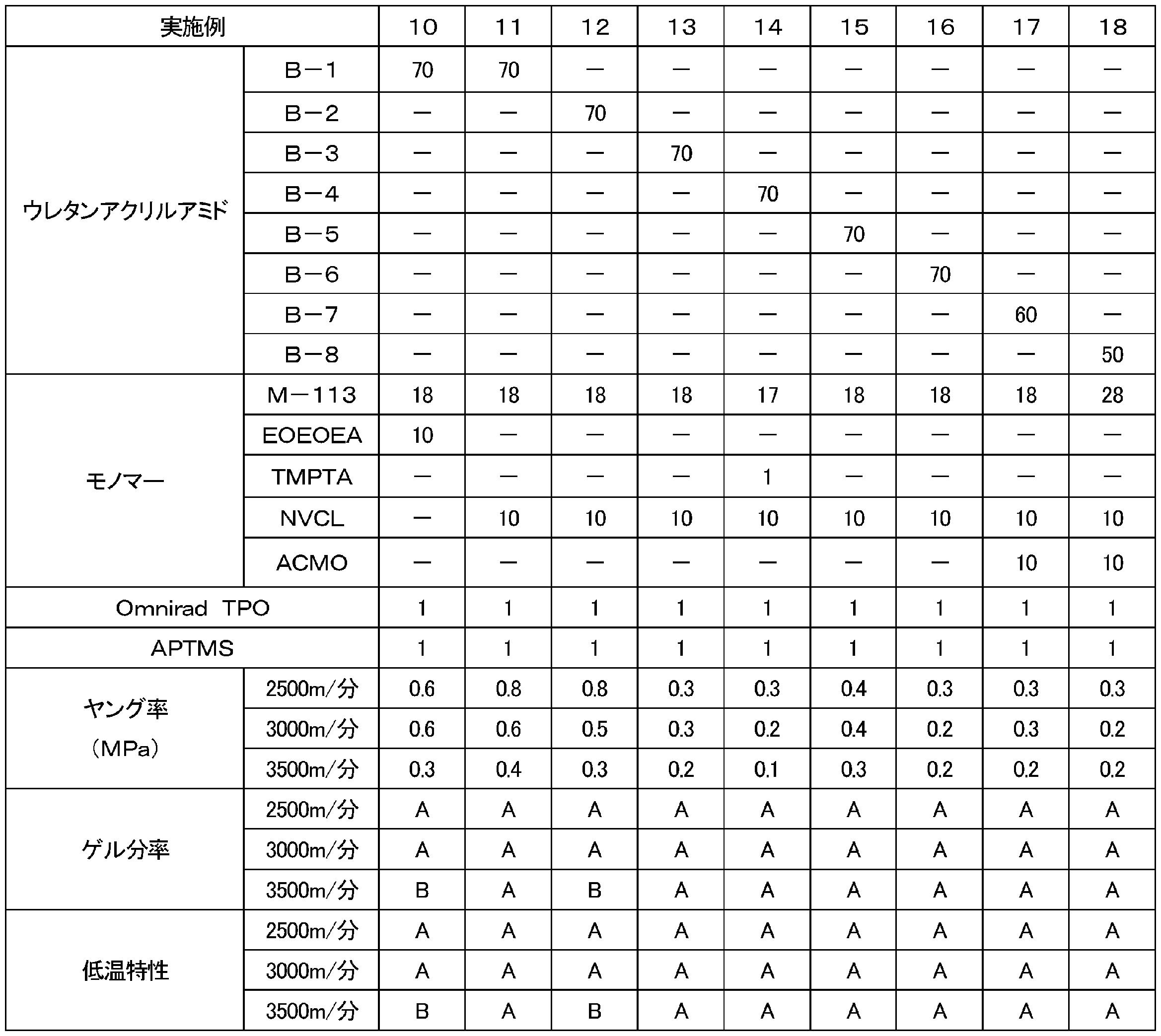
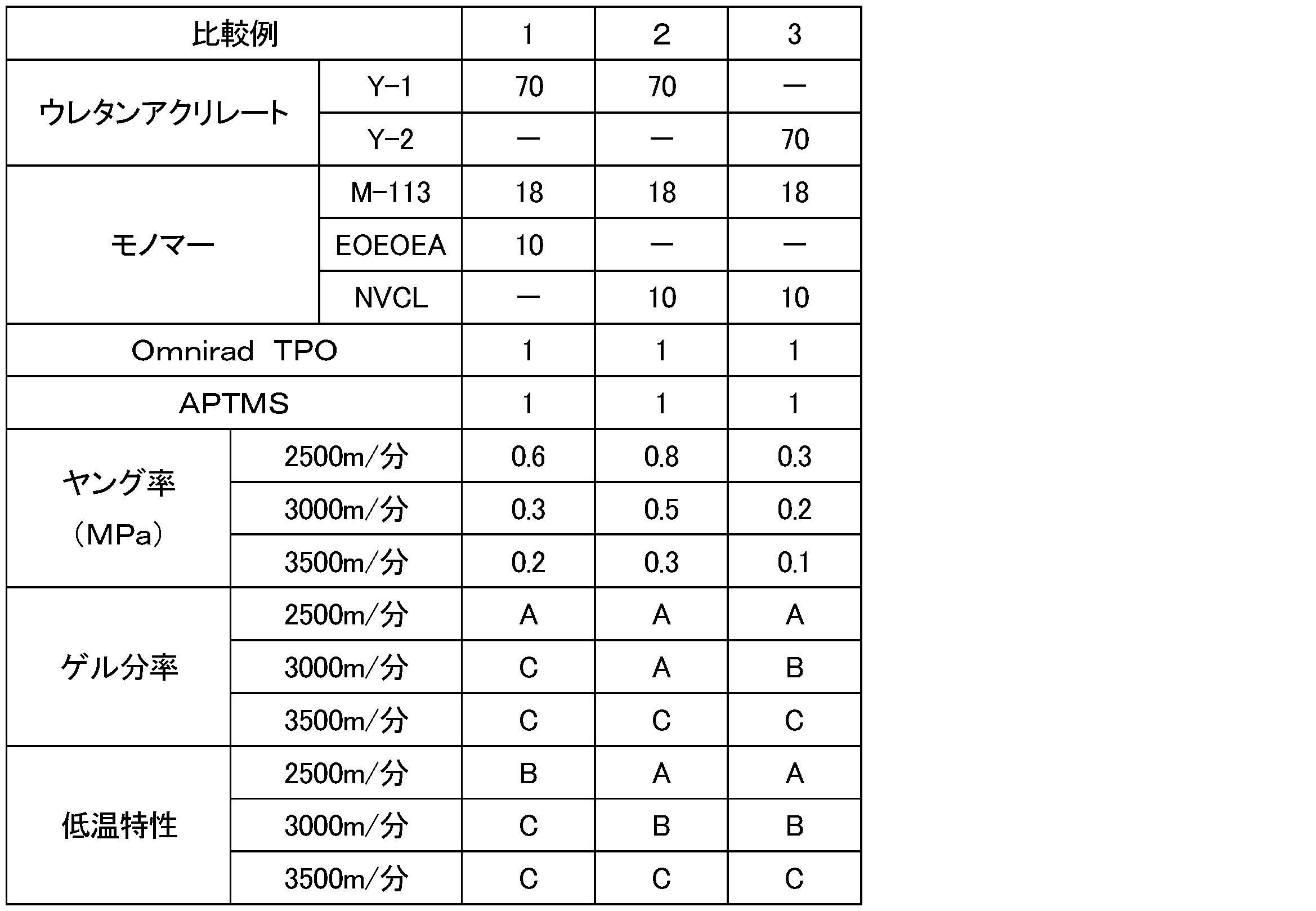
10 光ファイバ
11 コア
12 クラッド
13 ガラスファイバ
14 プライマリ樹脂層
15 セカンダリ樹脂層
16 被覆樹脂層
11 コア
12 クラッド
13 ガラスファイバ
14 プライマリ樹脂層
15 セカンダリ樹脂層
16 被覆樹脂層
Claims (11)
- ウレタン(メタ)アクリルアミドを含む光重合性化合物と、光重合開始剤とを含有し、
前記ウレタン(メタ)アクリルアミドが、ウレタン結合の少なくとも一方の末端に(メタ)アクリルアミド基を有する、光ファイバのプライマリ被覆用の樹脂組成物。 - 前記ウレタン(メタ)アクリルアミドが、ウレタン結合の一方の末端に(メタ)アクリルアミド基を有するウレタンオリゴマー、ウレタン結合の両末端に(メタ)アクリルアミド基を有するウレタンオリゴマー、又はこれらの混合物を含む、請求項1に記載の樹脂組成物。
- 前記ウレタン結合の一方の末端に(メタ)アクリルアミド基を有するウレタンオリゴマーが、ウレタン結合の一方の末端に(メタ)アクリルアミド基を有し、他方の末端に(メタ)アクリロイルオキシ基を有するウレタンオリゴマーを含む、請求項2に記載の樹脂組成物。
- 前記ウレタン(メタ)アクリルアミドが、ウレタン結合の両末端に(メタ)アクリルアミド基を有するウレタンオリゴマーと、ウレタン結合の一方の末端に(メタ)アクリルアミド基を有し、他方の末端に1価アルコール及び活性水素含有シラン化合物から選ばれる少なくとも1種の化合物に基づく基を有するウレタンオリゴマーと、を含む、請求項1から請求項3のいずれか一項に記載の樹脂組成物。
- 前記ウレタン(メタ)アクリルアミドの含有量が、前記樹脂組成物の総量100質量部を基準として、10質量部以上90質量部以下である、請求項1から請求項4のいずれか一項に記載の樹脂組成物。
- 前記ウレタン(メタ)アクリルアミドの数平均分子量が、10000以上37000以下である、請求項1から請求項5のいずれか一項に記載の樹脂組成物。
- 前記光重合性化合物が、(メタ)アクリル酸エステルを更に含む、請求項1から請求項6のいずれか一項に記載の樹脂組成物。
- 前記光重合性化合物が、N-ビニル化合物を更に含む、請求項1から請求項7のいずれか一項に記載の樹脂組成物。
- 前記光重合性化合物が、(メタ)アクリルアミド化合物を更に含む、請求項1から請求項8のいずれか一項に記載の樹脂組成物。
- コア及びクラッドを含むガラスファイバと、
前記ガラスファイバに接して前記ガラスファイバを被覆するプライマリ樹脂層と、
前記プライマリ樹脂層を被覆するセカンダリ樹脂層と、を備え、
前記プライマリ樹脂層が、請求項1から請求項9のいずれか一項に記載の樹脂組成物の硬化物を含む、光ファイバ。 - コア及びクラッドを含むガラスファイバの外周に、請求項1から請求項9のいずれか一項に記載の樹脂組成物を塗布する塗布工程と、
前記塗布工程の後に紫外線を照射することにより前記樹脂組成物を硬化させる硬化工程と、
を含む、光ファイバの製造方法。
Priority Applications (4)
| Application Number | Priority Date | Filing Date | Title |
|---|---|---|---|
| JP2022555279A JP7697474B2 (ja) | 2020-10-05 | 2021-08-02 | 樹脂組成物、光ファイバ及び光ファイバの製造方法 |
| CN202180061862.3A CN116348512B (zh) | 2020-10-05 | 2021-08-02 | 树脂组合物、光纤以及光纤的制造方法 |
| US18/026,180 US20230365735A1 (en) | 2020-10-05 | 2021-08-02 | Resin composition, optical fiber, and method for manufacturing optical fiber |
| EP21877217.6A EP4227333A4 (en) | 2020-10-05 | 2021-08-02 | Resin composition, optical fiber, and method for manufacturing optical fiber |
Applications Claiming Priority (4)
| Application Number | Priority Date | Filing Date | Title |
|---|---|---|---|
| JP2020-168494 | 2020-10-05 | ||
| JP2020168494 | 2020-10-05 | ||
| JP2020168496 | 2020-10-05 | ||
| JP2020-168496 | 2020-10-05 |
Publications (1)
| Publication Number | Publication Date |
|---|---|
| WO2022074913A1 true WO2022074913A1 (ja) | 2022-04-14 |
Family
ID=81126408
Family Applications (1)
| Application Number | Title | Priority Date | Filing Date |
|---|---|---|---|
| PCT/JP2021/028643 Ceased WO2022074913A1 (ja) | 2020-10-05 | 2021-08-02 | 樹脂組成物、光ファイバ及び光ファイバの製造方法 |
Country Status (6)
| Country | Link |
|---|---|
| US (1) | US20230365735A1 (ja) |
| EP (1) | EP4227333A4 (ja) |
| JP (1) | JP7697474B2 (ja) |
| CN (1) | CN116348512B (ja) |
| TW (1) | TW202225346A (ja) |
| WO (1) | WO2022074913A1 (ja) |
Families Citing this family (2)
| Publication number | Priority date | Publication date | Assignee | Title |
|---|---|---|---|---|
| JP7658371B2 (ja) * | 2020-06-24 | 2025-04-08 | 住友電気工業株式会社 | 樹脂組成物、光ファイバ及び光ファイバの製造方法 |
| CN120641144A (zh) * | 2022-11-25 | 2025-09-12 | 波士顿科学医学有限公司 | 由高纯度聚氨酯形成的医疗装置 |
Citations (6)
| Publication number | Priority date | Publication date | Assignee | Title |
|---|---|---|---|---|
| JPS63239139A (ja) * | 1987-03-26 | 1988-10-05 | Nitto Electric Ind Co Ltd | 光学ガラスフアイバ用被覆材料 |
| JP2009203360A (ja) * | 2008-02-28 | 2009-09-10 | Jsr Corp | ケーブル被覆材用液状硬化性組成物 |
| JP2009237284A (ja) * | 2008-03-27 | 2009-10-15 | Jsr Corp | 液状硬化性樹脂組成物 |
| JP2016522428A (ja) * | 2013-04-15 | 2016-07-28 | コーニング インコーポレイテッド | 小さい直径の光ファイバ |
| JP2020168496A (ja) | 2020-07-13 | 2020-10-15 | 株式会社三共 | 遊技機 |
| JP2020168494A (ja) | 2020-07-13 | 2020-10-15 | 株式会社三洋物産 | 遊技機 |
Family Cites Families (11)
| Publication number | Priority date | Publication date | Assignee | Title |
|---|---|---|---|---|
| JPH07113104B2 (ja) * | 1987-11-13 | 1995-12-06 | 日本合成ゴム株式会社 | 光フアイバー用硬化性バンドリング材 |
| US5656241A (en) * | 1995-09-07 | 1997-08-12 | Optical Sensors Incorporated | Method for manufacturing fiber optic sensors |
| CN1259146A (zh) * | 1997-04-08 | 2000-07-05 | Dsm有限公司 | 固化后具有高伸长和韧性的可辐射硬化的粘合剂组合物 |
| KR20070023667A (ko) * | 2004-03-11 | 2007-02-28 | 제이에스알 가부시끼가이샤 | 방사선 경화성 조성물 |
| CN101675089B (zh) * | 2007-04-27 | 2015-06-17 | 日本化药株式会社 | (甲基)丙烯酸酯化合物、含有该化合物的树脂组合物及其固化物以及光学透镜片用能量射线固化型树脂组合物及其固化物 |
| JP2009235246A (ja) * | 2008-03-27 | 2009-10-15 | Jsr Corp | 液状硬化性樹脂組成物 |
| JP4547642B2 (ja) * | 2008-04-30 | 2010-09-22 | Dic株式会社 | 活性エネルギー線硬化型塗料組成物、その硬化物、及び新規硬化性樹脂 |
| US9738748B2 (en) * | 2014-03-17 | 2017-08-22 | Kj Chemicals Corporation | Urethane oligomer and active energy ray curable resin composition containing same |
| CN108350141B (zh) * | 2015-09-16 | 2021-06-25 | 科巨希化学股份有限公司 | (甲基)丙烯酰胺系氨基甲酸酯低聚物及含有该低聚物的活性能量射线固化性树脂组合物 |
| JP7152183B2 (ja) * | 2017-05-25 | 2022-10-12 | 三洋化成工業株式会社 | 硬化性組成物及び硬化物 |
| JPWO2020071544A1 (ja) * | 2018-10-04 | 2021-09-02 | 住友電気工業株式会社 | 樹脂組成物及び光ファイバ |
-
2021
- 2021-08-02 US US18/026,180 patent/US20230365735A1/en active Pending
- 2021-08-02 WO PCT/JP2021/028643 patent/WO2022074913A1/ja not_active Ceased
- 2021-08-02 EP EP21877217.6A patent/EP4227333A4/en active Pending
- 2021-08-02 CN CN202180061862.3A patent/CN116348512B/zh active Active
- 2021-08-02 JP JP2022555279A patent/JP7697474B2/ja active Active
- 2021-09-06 TW TW110133017A patent/TW202225346A/zh unknown
Patent Citations (6)
| Publication number | Priority date | Publication date | Assignee | Title |
|---|---|---|---|---|
| JPS63239139A (ja) * | 1987-03-26 | 1988-10-05 | Nitto Electric Ind Co Ltd | 光学ガラスフアイバ用被覆材料 |
| JP2009203360A (ja) * | 2008-02-28 | 2009-09-10 | Jsr Corp | ケーブル被覆材用液状硬化性組成物 |
| JP2009237284A (ja) * | 2008-03-27 | 2009-10-15 | Jsr Corp | 液状硬化性樹脂組成物 |
| JP2016522428A (ja) * | 2013-04-15 | 2016-07-28 | コーニング インコーポレイテッド | 小さい直径の光ファイバ |
| JP2020168496A (ja) | 2020-07-13 | 2020-10-15 | 株式会社三共 | 遊技機 |
| JP2020168494A (ja) | 2020-07-13 | 2020-10-15 | 株式会社三洋物産 | 遊技機 |
Non-Patent Citations (1)
| Title |
|---|
| See also references of EP4227333A4 |
Also Published As
| Publication number | Publication date |
|---|---|
| US20230365735A1 (en) | 2023-11-16 |
| CN116348512B (zh) | 2024-12-06 |
| CN116348512A (zh) | 2023-06-27 |
| EP4227333A4 (en) | 2024-04-10 |
| JPWO2022074913A1 (ja) | 2022-04-14 |
| JP7697474B2 (ja) | 2025-06-24 |
| EP4227333A1 (en) | 2023-08-16 |
| TW202225346A (zh) | 2022-07-01 |
Similar Documents
| Publication | Publication Date | Title |
|---|---|---|
| KR102669759B1 (ko) | 광섬유 | |
| KR102666777B1 (ko) | 수지 조성물, 광섬유의 세컨더리 피복 재료 및 광섬유 | |
| JP7582209B2 (ja) | 樹脂組成物、光ファイバ及び光ファイバの製造方法 | |
| JP7367696B2 (ja) | 樹脂組成物、光ファイバ及び光ファイバの製造方法 | |
| JP7658371B2 (ja) | 樹脂組成物、光ファイバ及び光ファイバの製造方法 | |
| JP7779263B2 (ja) | 樹脂組成物、光ファイバ及び光ファイバの製造方法 | |
| JP7697474B2 (ja) | 樹脂組成物、光ファイバ及び光ファイバの製造方法 | |
| WO2022123969A1 (ja) | 樹脂組成物、光ファイバ及び光ファイバの製造方法 | |
| JP7582208B2 (ja) | 樹脂組成物、光ファイバ及び光ファイバの製造方法 | |
| JP7786397B2 (ja) | 樹脂組成物、樹脂組成物の製造方法、光ファイバ、光ファイバの製造方法、光ファイバリボン、及び光ファイバケーブル | |
| EP4177283A1 (en) | Resin composition, optical fiber, and method for producing optical fiber | |
| JP7582207B2 (ja) | 樹脂組成物、光ファイバ及び光ファイバの製造方法 | |
| JP7852503B2 (ja) | 樹脂組成物、光ファイバ及び光ファイバの製造方法 | |
| JP7677327B2 (ja) | 樹脂組成物、樹脂組成物の製造方法、光ファイバ及び光ファイバの製造方法 | |
| JP7582210B2 (ja) | 樹脂組成物、光ファイバ及び光ファイバの製造方法 | |
| WO2023162570A1 (ja) | 樹脂組成物、光ファイバ、光ファイバの製造方法、光ファイバリボン、及び光ファイバケーブル | |
| WO2023162569A1 (ja) | 樹脂組成物、光ファイバ、光ファイバの製造方法、光ファイバリボン、及び光ファイバケーブル |
Legal Events
| Date | Code | Title | Description |
|---|---|---|---|
| 121 | Ep: the epo has been informed by wipo that ep was designated in this application |
Ref document number: 21877217 Country of ref document: EP Kind code of ref document: A1 |
|
| ENP | Entry into the national phase |
Ref document number: 2022555279 Country of ref document: JP Kind code of ref document: A |
|
| NENP | Non-entry into the national phase |
Ref country code: DE |
|
| ENP | Entry into the national phase |
Ref document number: 2021877217 Country of ref document: EP Effective date: 20230508 |