WO2022075227A1 - 組成物、硬化体及び金属ベース基板 - Google Patents
組成物、硬化体及び金属ベース基板 Download PDFInfo
- Publication number
- WO2022075227A1 WO2022075227A1 PCT/JP2021/036483 JP2021036483W WO2022075227A1 WO 2022075227 A1 WO2022075227 A1 WO 2022075227A1 JP 2021036483 W JP2021036483 W JP 2021036483W WO 2022075227 A1 WO2022075227 A1 WO 2022075227A1
- Authority
- WO
- WIPO (PCT)
- Prior art keywords
- group
- meth
- acrylic monomer
- less
- mol
- Prior art date
- Legal status (The legal status is an assumption and is not a legal conclusion. Google has not performed a legal analysis and makes no representation as to the accuracy of the status listed.)
- Ceased
Links
Images

Classifications
-
- H—ELECTRICITY
- H10—SEMICONDUCTOR DEVICES; ELECTRIC SOLID-STATE DEVICES NOT OTHERWISE PROVIDED FOR
- H10W—GENERIC PACKAGES, INTERCONNECTIONS, CONNECTORS OR OTHER CONSTRUCTIONAL DETAILS OF DEVICES COVERED BY CLASS H10
- H10W40/00—Arrangements for thermal protection or thermal control
- H10W40/20—Arrangements for cooling
- H10W40/25—Arrangements for cooling characterised by their materials
- H10W40/255—Arrangements for cooling characterised by their materials having a laminate or multilayered structure, e.g. direct bond copper [DBC] ceramic substrates
-
- C—CHEMISTRY; METALLURGY
- C08—ORGANIC MACROMOLECULAR COMPOUNDS; THEIR PREPARATION OR CHEMICAL WORKING-UP; COMPOSITIONS BASED THEREON
- C08F—MACROMOLECULAR COMPOUNDS OBTAINED BY REACTIONS ONLY INVOLVING CARBON-TO-CARBON UNSATURATED BONDS
- C08F220/00—Copolymers of compounds having one or more unsaturated aliphatic radicals, each having only one carbon-to-carbon double bond, and only one being terminated by only one carboxyl radical or a salt, anhydride ester, amide, imide or nitrile thereof
- C08F220/02—Monocarboxylic acids having less than ten carbon atoms; Derivatives thereof
- C08F220/10—Esters
- C08F220/12—Esters of monohydric alcohols or phenols
- C08F220/16—Esters of monohydric alcohols or phenols of phenols or of alcohols containing two or more carbon atoms
- C08F220/18—Esters of monohydric alcohols or phenols of phenols or of alcohols containing two or more carbon atoms with acrylic or methacrylic acids
- C08F220/1807—C7-(meth)acrylate, e.g. heptyl (meth)acrylate or benzyl (meth)acrylate
-
- C—CHEMISTRY; METALLURGY
- C08—ORGANIC MACROMOLECULAR COMPOUNDS; THEIR PREPARATION OR CHEMICAL WORKING-UP; COMPOSITIONS BASED THEREON
- C08L—COMPOSITIONS OF MACROMOLECULAR COMPOUNDS
- C08L33/00—Compositions of homopolymers or copolymers of compounds having one or more unsaturated aliphatic radicals, each having only one carbon-to-carbon double bond, and only one being terminated by only one carboxyl radical, or of salts, anhydrides, esters, amides, imides or nitriles thereof; Compositions of derivatives of such polymers
- C08L33/04—Homopolymers or copolymers of esters
- C08L33/06—Homopolymers or copolymers of esters of esters containing only carbon, hydrogen and oxygen, which oxygen atoms are present only as part of the carboxyl radical
- C08L33/062—Copolymers with monomers not covered by C08L33/06
- C08L33/064—Copolymers with monomers not covered by C08L33/06 containing anhydride, COOH or COOM groups, with M being metal or onium-cation
-
- C—CHEMISTRY; METALLURGY
- C08—ORGANIC MACROMOLECULAR COMPOUNDS; THEIR PREPARATION OR CHEMICAL WORKING-UP; COMPOSITIONS BASED THEREON
- C08L—COMPOSITIONS OF MACROMOLECULAR COMPOUNDS
- C08L33/00—Compositions of homopolymers or copolymers of compounds having one or more unsaturated aliphatic radicals, each having only one carbon-to-carbon double bond, and only one being terminated by only one carboxyl radical, or of salts, anhydrides, esters, amides, imides or nitriles thereof; Compositions of derivatives of such polymers
- C08L33/04—Homopolymers or copolymers of esters
- C08L33/14—Homopolymers or copolymers of esters of esters containing halogen, nitrogen, sulfur, or oxygen atoms in addition to the carboxy oxygen
-
- H—ELECTRICITY
- H05—ELECTRIC TECHNIQUES NOT OTHERWISE PROVIDED FOR
- H05K—PRINTED CIRCUITS; CASINGS OR CONSTRUCTIONAL DETAILS OF ELECTRIC APPARATUS; MANUFACTURE OF ASSEMBLAGES OF ELECTRICAL COMPONENTS
- H05K1/00—Printed circuits
- H05K1/02—Details
- H05K1/03—Use of materials for the substrate
- H05K1/05—Insulated conductive substrates, e.g. insulated metal substrate
- H05K1/056—Insulated conductive substrates, e.g. insulated metal substrate the metal substrate being covered by an organic insulating layer
-
- H—ELECTRICITY
- H10—SEMICONDUCTOR DEVICES; ELECTRIC SOLID-STATE DEVICES NOT OTHERWISE PROVIDED FOR
- H10W—GENERIC PACKAGES, INTERCONNECTIONS, CONNECTORS OR OTHER CONSTRUCTIONAL DETAILS OF DEVICES COVERED BY CLASS H10
- H10W40/00—Arrangements for thermal protection or thermal control
- H10W40/20—Arrangements for cooling
- H10W40/25—Arrangements for cooling characterised by their materials
- H10W40/251—Organics
-
- C—CHEMISTRY; METALLURGY
- C08—ORGANIC MACROMOLECULAR COMPOUNDS; THEIR PREPARATION OR CHEMICAL WORKING-UP; COMPOSITIONS BASED THEREON
- C08K—Use of inorganic or non-macromolecular organic substances as compounding ingredients
- C08K3/00—Use of inorganic substances as compounding ingredients
- C08K3/38—Boron-containing compounds
- C08K2003/382—Boron-containing compounds and nitrogen
- C08K2003/385—Binary compounds of nitrogen with boron
-
- H—ELECTRICITY
- H05—ELECTRIC TECHNIQUES NOT OTHERWISE PROVIDED FOR
- H05K—PRINTED CIRCUITS; CASINGS OR CONSTRUCTIONAL DETAILS OF ELECTRIC APPARATUS; MANUFACTURE OF ASSEMBLAGES OF ELECTRICAL COMPONENTS
- H05K1/00—Printed circuits
- H05K1/02—Details
- H05K1/0213—Electrical arrangements not otherwise provided for
- H05K1/0254—High voltage adaptations; Electrical insulation details; Overvoltage or electrostatic discharge protection ; Arrangements for regulating voltages or for using plural voltages
- H05K1/0256—Electrical insulation details, e.g. around high voltage areas
-
- H—ELECTRICITY
- H05—ELECTRIC TECHNIQUES NOT OTHERWISE PROVIDED FOR
- H05K—PRINTED CIRCUITS; CASINGS OR CONSTRUCTIONAL DETAILS OF ELECTRIC APPARATUS; MANUFACTURE OF ASSEMBLAGES OF ELECTRICAL COMPONENTS
- H05K2201/00—Indexing scheme relating to printed circuits covered by H05K1/00
- H05K2201/02—Fillers; Particles; Fibers; Reinforcement materials
- H05K2201/0203—Fillers and particles
- H05K2201/0206—Materials
- H05K2201/0209—Inorganic, non-metallic particles
Definitions
- the present disclosure relates to compositions, cured products and metal-based substrates.
- Inorganic fillers made of boron nitride, aluminum nitride, aluminum oxide, silicon nitride, silicon oxide, etc. are used in various fields for the purpose of improving insulation, thermal conductivity, and the like.
- the inorganic filler is generally used dispersed in a resin or the like.
- the inorganic filler may be used in a composition for forming an insulating layer in a metal-based substrate (metal-based circuit board).
- Patent Document 1 provides a composition made of a curable resin containing an inorganic filler having a low elastic modulus and excellent adhesiveness, heat resistance, and moisture resistance, and can be used as a metal plate and a conductive circuit.
- a circuit board with excellent heat resistance, moisture resistance, and heat dissipation, which has excellent adhesion to and stress relief, does not cause abnormalities when cracks occur in or near solder even when subjected to rapid heating / cooling.
- a composition for a circuit board containing a specific epoxy resin and a curing agent and an inorganic filler as essential components is disclosed.
- the above-mentioned metal base substrate is required to ensure insulation reliability even when a higher voltage is applied than before, and improvement of insulation reliability is particularly desired in a high temperature or high temperature and high humidity environment.
- one aspect of the present invention is to obtain a metal base substrate having excellent insulation reliability against a high voltage in a high temperature or high temperature and high humidity environment.
- the present inventors use a copolymer having a specific structure in combination with an inorganic filler in a specific amount to obtain high temperature or high temperature and high humidity. We have found that a metal base substrate with excellent insulation reliability against high voltage in an environment can be obtained.
- the present invention provides the following [1] to [10] in some aspects.
- Inorganic filler (meth) acrylic monomer unit A having an anionic group, (meth) acrylic monomer unit B having a cationic group, and (meth) acrylic monomer unit. It contains a copolymer having (meth) acrylic monomer unit C other than A and (meth) acrylic monomer unit B, and the content of the copolymer is 100 parts by mass of the inorganic filler.
- the composition which is 0.01 to 10 parts by mass with respect to.
- the composition according to [1], wherein the anionic group comprises one or more selected from the group consisting of a carboxy group, a phosphoric acid group, and a phenolic hydroxy group.
- the cationic group comprises one or more selected from the group consisting of a primary amino group, a secondary amino group, a tertiary amino group, and a quaternary ammonium base [1] to [3].
- the composition according to any one of. [5] The composition according to any one of [1] to [4], wherein the (meth) acrylic monomer unit B further has an electron-donating group bonded to a cationic group.
- a metal base substrate having excellent insulation reliability against a high voltage in a high temperature or high temperature and high humidity environment.
- One embodiment of the present invention is a composition containing an inorganic filler and a copolymer.
- the inorganic filler may be, for example, a known inorganic filler used in applications that require insulation and thermal conductivity.
- the inorganic filler may contain, for example, one or more selected from the group consisting of aluminum oxide (alumina), silicon oxide, silicon nitride, boron nitride, aluminum nitride, and magnesium oxide, for insulation reliability in a high humidity environment. From a more excellent point of view, it may contain one or more selected from the group consisting of aluminum oxide, silicon oxide, silicon nitride, boron nitride, and aluminum nitride, and one or more selected from the group consisting of aluminum oxide, boron nitride, and aluminum nitride. May include.
- the shape of the inorganic filler may be, for example, a particle shape, a scale shape, a polygonal shape, or the like.
- the average particle size of the inorganic filler may be 0.05 ⁇ m or more, 0.1 ⁇ m or more, 5 ⁇ m or more, 10 ⁇ m or more, 20 ⁇ m or more, or 30 ⁇ m or more from the viewpoint of improving thermal conductivity, and further improving the insulating property. From the viewpoint of, it may be 200 ⁇ m or less, 150 ⁇ m or less, 100 ⁇ m or less, or 80 ⁇ m or less.
- the average particle size of the inorganic filler means the d50 diameter in the volume-based particle size distribution of the inorganic filler.
- the volume-based particle size distribution of the inorganic filler is measured by a laser diffraction type particle size distribution measuring device.
- the inorganic filler may contain two or more kinds of inorganic fillers having different average particle diameters from each other.
- the inorganic filler may include a first inorganic filler having an average particle size of 25 ⁇ m or more and a second inorganic filler having an average particle size of 4 ⁇ m or less. According to such an inorganic filler, the filling density is increased and the thermal conductivity is improved by filling the gap between the first inorganic fillers with the second inorganic filler.
- the average particle size of the first inorganic filler may be 30 ⁇ m or more or 40 ⁇ m or more, and may be 200 ⁇ m or less or 150 ⁇ m or less.
- the average particle size of the second inorganic filler may be 3.5 ⁇ m or less or 3 ⁇ m or less, and may be 0.05 ⁇ m or more or 0.1 ⁇ m or more.
- the content of the inorganic filler may be 20% by volume or more, 30% by volume or more, 40% by volume or more, or 50% by volume or more based on the total volume of the composition from the viewpoint of improving thermal conductivity.
- the content of the inorganic filler may be 80% by volume or less, 70% by volume or less, or 60% by volume or less, based on the total volume of the composition, from the viewpoint of further improving the insulating property, and may be high temperature or high temperature. From the viewpoint of obtaining a metal base substrate having further excellent insulation reliability against a high voltage in a humidity environment, it may be preferably 55% by volume or less.
- the copolymer is cationic with a (meth) acrylic monomer unit A having an anionic group (hereinafter, also referred to as “unit A”, and a monomer giving the unit A is also referred to as “monomer A”).
- a (meth) acrylic monomer unit B having a group hereinafter, also referred to as “unit B”, a monomer giving the unit B is also referred to as “monomer B”
- a (meth) acrylic monomer unit C other than A and the (meth) acrylic monomer unit B hereinafter, also referred to as “unit C”, and the monomer giving the unit C is also referred to as “monomer C”).
- the copolymer may have a (meth) acrylic monomer unit (unit X) having both an anionic group and a cationic group.
- unit X is considered to correspond to the unit A and also to the unit B.
- a copolymer having the unit X is considered to have both the unit A and the unit B.
- “monomer” means a monomer having a polymerizable group before polymerization.
- the “monomer unit” means a structural unit derived from the monomer and constituting the copolymer.
- “(Meta) acrylic monomer” means a monomer having a (meth) acryloyl group.
- (Meta) acrylic monomer” means an acrylic monomer and a corresponding methacrylic monomer, and similar expressions such as "(meth) acryloyl group” have the same meaning.
- the copolymer has one or more units A, B, and C, respectively.
- the copolymer may have only units A, B and C in one embodiment.
- the copolymer may be a random copolymer or a block copolymer.
- the monomer A, the monomer B, and the monomer C may each be a monomer having one (meth) acryloyl group (monofunctional (meth) acrylic monomer), and may be (1). It may be a monomer having two or more (meth) acryloyl groups (polyfunctional (meth) acrylic monomer), and is preferably a monofunctional (meth) acrylic monomer.
- the anionic group possessed by the unit A is, for example, one or more selected from the group consisting of a carboxy group, a phosphoric acid group, a phenolic hydroxy group, and a sulfonic acid group.
- the anionic group is preferably one or more selected from the group consisting of a carboxy group, a phosphoric acid group, and a phenolic hydroxy group from the viewpoint of further improving the dispersibility of the inorganic filler.
- the unit A preferably further has an electron-withdrawing group bonded to an anionic group from the viewpoint of further improving the dispersibility of the inorganic filler.
- the electron-withdrawing group has an action of stabilizing the anion of the anionic group.
- the electron-withdrawing group include a halogen group (also referred to as a halogeno group).
- the anionic group to which the electron-withdrawing group is bonded include a group in which a halogen group is bonded to the carbon atom at the ⁇ -position of the carboxy group.
- the unit A does not have to have an electron donating group bonded to an anionic group.
- the electron donating group may destabilize the anion of the anionic group. Examples of the electron donating group include a methyl group.
- Examples of the monomer A include acrylic acid, methacrylic acid, acid phospoxypropyl methacrylate, acid phospoxypolyoxyethylene glycol monomethacrylate, acid phospoxypolyoxypropylene glycol monomethacrylate, and phosphoric acid-modified epoxy acrylate.
- Monomer A is preferably from acrylic acid, 2-methacryloyloxyethyl phosphate, 4-hydroxyphenylmecrilate, and 2-acrylamide-2-methylpropanesulfonic acid from the viewpoint of further improving the dispersibility of the inorganic filler. It is one or more selected from the group, and more preferably acrylic acid.
- the cationic group possessed by the unit B is, for example, one or more selected from the group consisting of a primary amino group, a secondary amino group, a tertiary amino group, and a quaternary ammonium base.
- the cationic group is preferably a tertiary amino group from the viewpoint of further improving the dispersibility of the inorganic filler.
- the unit B preferably further has an electron donating group bonded to a cationic group from the viewpoint of further improving the dispersibility of the inorganic filler.
- the electron donating group has an action of stabilizing the cation of the cationic group.
- Examples of the electron donating group include a methyl group.
- Examples of the cationic group to which the electron donating group is bonded include a group in which a methyl group is bonded to the carbon atom at the ⁇ -position of the amino group.
- the unit B does not have to have an electron-withdrawing group bonded to a cationic group.
- the electron-withdrawing group may destabilize the cation of the cationic group.
- Examples of the electron-withdrawing group include a carboxy group.
- Examples of the monomer B include 1-aminoethyl acrylate, 1-aminopropyl acrylate, 1-aminoethyl methacrylate, 1-aminopropyl methacrylate, dimethylaminoethyl methacrylate, diethylaminoethyl methacrylate, and t-butylaminoethyl (meth).
- the monomer B is preferably 1,2,2,6,6-pentamethyl-4-piperidylmethacrylate and 2,2,6,6-tetramethyl-4 from the viewpoint of further improving the dispersibility of the inorganic filler.
- - One or more selected from the group consisting of piperidyl methacrylate, more preferably 1,2,2,6,6-pentamethyl-4-piperidyl methacrylate.
- Monomer C is a (meth) acrylic monomer that does not contain either a cationic group or an anionic group.
- the monomer C may have an amphipathic group, a hydrophobic group, or a hydrophilic group in addition to the (meth) acryloyl group. That is, the unit C may have an amphipathic group, a hydrophobic group, or a hydrophilic group.
- the amphipathic group include an oxyalkylene group.
- Examples of the hydrophobic group include a siloxane group and a hydrocarbon group.
- Examples of the hydrophilic group include a phosphoric acid ester group.
- the hydrocarbon group referred to here does not include a methyl group constituting a methacryloyl group (hereinafter, the same applies to the hydrocarbon group in the monomer C and the unit C).
- the unit C is one or more selected from the group consisting of an oxyalkylene group, a siloxane group, and a hydrocarbon group from the viewpoint of affinity or compatibility between the copolymer and the resin when the composition further contains a resin. It has, more preferably, one or more selected from the group consisting of a siloxane group and a hydrocarbon group.
- Examples of the (meth) acrylic monomer having an oxyalkylene group include ethoxycarbonylmethyl (meth) acrylate, phenolethylene oxide-modified (meth) acrylate, phenol (ethyleneoxide 2 mol-modified) (meth) acrylate, and phenol (meth).
- Examples of the (meth) acrylic monomer having a siloxane group include ⁇ -butyl- ⁇ - (3-methacryloxypropyl) polydimethylsiloxane.
- Examples of the (meth) acrylic monomer having a hydrocarbon group include methyl (meth) acrylate, ethyl (meth) acrylate, propyl (meth) acrylate, butyl (meth) acrylate, and 2-ethylhexyl (meth) acrylate.
- Examples of the (meth) acrylic monomer having a phosphoric acid ester group include (meth) acryloyl oxyethyl dialkyl phosphate.
- the monomer C may be, for example, a (meth) acrylic monomer having a hydroxy group.
- the (meth) acrylic monomer having a hydroxy group include 2-hydroxyethyl (meth) acrylate, 2-hydroxypropyl (meth) acrylate, 3-hydroxypropyl (meth) acrylate, and 4-hydroxybutyl (meth). ) Acrylate, 2-hydroxy-3-phenoxypropyl (meth) acrylate, and 3-chloro-2-hydroxypropyl (meth) acrylate.
- the monomer C may be, for example, a (meth) acrylic monomer having an amide bond.
- the (meth) acrylic monomer having an amide bond include N, N-dimethyl (meth) acrylamide, N, N-diethyl (meth) acrylamide, N-isopropyl (meth) acrylamide, and diacetone (meth).
- Acrylamide and acryloylmorpholine can be mentioned.
- the monomer C may be, for example, a polyfunctional (meth) acrylic monomer.
- the polyfunctional (meth) acrylic monomer include 1,3-butylene glycol di (meth) acrylate, 1,4-butanediol di (meth) acrylate, and 1,6-hexadiol di (meth).
- the content of unit A is 0.03 mol% or more, 0.1 mol% or more, 0.5 mol% or more, 1 mol% or more with respect to a total of 100 mol% of unit A, unit B, and unit C. 2 mol% or more, 3 mol% or more, 4 mol% or more, or 5 mol% or more, 70 mol% or less, 60 mol% or less, 50 mol% or less, 40 mol% or less, 30 mol% or less. , 20 mol% or less, or 15 mol% or less.
- the content of the unit A may be within the above range with respect to the total of 100 mol% of all the monomer units of the copolymer.
- the content of the unit A When the content of the unit A is 0.03 mol% or more, the dispersibility of the inorganic filler tends to be further improved. When the content of the unit A is 70 mol% or less, the viscosity of the composition tends to be further lowered, and the handleability of the composition tends to be further improved.
- the content of unit B is 0.02 mol% or more, 0.05 mol% or more, 0.07 mol% or more, or 0.1 with respect to a total of 100 mol% of unit A, unit B, and unit C. It may be 20 mol% or less, 10 mol% or less, 5 mol% or less, 3 mol% or less, or 1 mol% or less.
- the content of the unit B may be within the above range with respect to the total of 100 mol% of all the monomer units of the copolymer.
- the content of the unit B is 0.02 mol% or more, the affinity of the copolymer with the inorganic filler tends to be better.
- the content of the unit B is 20 mol% or less, the viscosity of the composition tends to be further lowered, and the handleability of the composition tends to be further improved.
- the content of the unit C is 10 mol% or more, 20 mol% or more, 30 mol% or more, 40 mol% or more, 50 mol% or more, based on 100 mol% of the total of the unit A, the unit B, and the unit C. It may be 60 mol% or more, 70 mol% or more, 80 mol% or more, or 90 mol% or more, 99.8 mol% or less, 99 mol% or less, 98 mol% or less, 97 mol% or less, or 96 mol. It may be less than or equal to%. The content of the unit C may be within the above range with respect to the total of 100 mol% of all the monomer units of the copolymer.
- the content of the unit C When the content of the unit C is 10 mol% or more, the viscosity of the composition tends to be further lowered, and the handleability of the composition tends to be further improved. When the content of the unit C is 99.8 mol% or less, the affinity of the copolymer with the inorganic filler tends to be better.
- the total content of unit A and unit B is 0.05 mol% or more, 0.2 mol% or more, 1 mol% or more, and 2 with respect to the total 100 mol% of unit A, unit B, and unit C. It may be 90 mol% or more, 3 mol% or more, 4 mol% or more, or 5 mol% or more, 90 mol% or less, 80 mol% or less, 70 mol% or less, 60 mol% or less, 50 mol% or less, 40. It may be mol% or less, 30 mol% or less, 20 mol% or less, or 10 mol% or less.
- the total content of the unit A and the unit B may be within the above range with respect to the total of 100 mol% of all the monomer units of the copolymer.
- the total content of the unit A and the unit B is 0.05 mol% or more, the dispersibility of the inorganic filler tends to be further improved.
- the handleability of the composition tends to be further improved.
- the molar ratio of unit A to unit B may be 0.01 or more, 0.9 or more, 1 or more, 5 or more, 10 or more, 20 or more, or 30 or more, and 200 or less. It may be 150 or less, 100 or less, 90 or less, 80 or less, 70 or less, 60 or less, 50 or less, 40 or less, 30 or less, 20 or less, 15 or less, or 10 or less.
- the molar ratio of the unit A to the unit B is within the above range, the dispersibility of the inorganic filler tends to be further improved.
- the weight average molecular weight of the copolymer is 1,000 or more, 5,000 or more, 7,000 or more, 10,000 or more, 20,000 or more, 30,000 or more, 40,000 or more, or 50,000 or more. It may be 1,000,000 or less, 500,000 or less, 300,000 or less, 100,000 or less, 90,000 or less, 80,000 or less, 70,000 or less, or 60,000 or less. .. Since the weight average molecular weight of the copolymer is 1,000 or more, the dispersibility of the inorganic filler is maintained and the hardness of the composition is increased even when the composition is stored for a long time in a high temperature environment. It can be suppressed.
- the shape retention of the composition is improved, and when the composition is applied to a slope or a vertical surface, the composition is suppressed from slipping or dripping.
- the weight average molecular weight of the copolymer is 1,000,000 or less, the viscosity of the composition tends to be further lowered, and the handleability of the composition tends to be further improved.
- the weight average molecular weight of the copolymer is determined as a standard polystyrene-equivalent weight average molecular weight using a GPC (gel permeation chromatography) method.
- the content of the copolymer is 0.1 to 10 parts by mass with respect to 100 parts by mass of the inorganic filler.
- the content of the copolymer is within this range, when the insulating layer of the metal base substrate is formed by using the composition, the metal has excellent insulation reliability against high voltage in a high temperature or high temperature and high humidity environment. A base substrate is obtained.
- the lower limit of the content of the copolymer is preferably set with respect to 100 parts by mass of the inorganic filler from the viewpoint of obtaining a metal base substrate having further excellent insulation reliability against high voltage in a high temperature or high temperature and high humidity environment. It may be 0.5 parts by mass or more or 1 part by mass or more, and more preferably 2 parts by mass or more, 2.5 parts by mass or more, 3 parts by mass or more, 4 parts by mass or more, or 5 parts by mass or more. You may.
- the upper limit of the content of the copolymer is preferably set with respect to 100 parts by mass of the inorganic filler from the viewpoint of obtaining a metal base substrate having further excellent insulation reliability against high voltage in a high temperature or high temperature and high humidity environment. It may be 9.5 parts by mass or less or 9 parts by mass or less, and more preferably 8 parts by mass or less, 7.5 parts by mass or less, 7 parts by mass or less, 6 parts by mass or less, or 5 parts by mass or less. You may.
- the composition may further contain a resin.
- the resin referred to here is different from the above-mentioned copolymer.
- the resin is preferably a thermosetting resin.
- the thermosetting resin include silicone resin, epoxy resin, phenol resin, cyanate resin, melamine resin, urea resin, thermosetting polyimide resin, and unsaturated polyester resin.
- the resin is preferably an epoxy resin.
- the resin may be used alone or in combination of two or more.
- the content of the resin may be 20% by volume or more, 30% by volume or more, or 40% by volume or more based on the total volume of the composition from the viewpoint of further improving the insulating property.
- the content of the resin may be 80% by volume or less, 70% by volume or less, 60% by volume or less, or 50% by volume or less based on the total volume of the composition from the viewpoint of improving thermal conductivity.
- the composition may further contain a curing agent that cures the resin.
- the curing agent is appropriately selected according to the type of resin.
- examples of the curing agent when the resin is an epoxy resin include an amine-based resin, an acid anhydride-based resin, and a phenol-based resin.
- the curing agent may be used alone or in combination of two or more.
- the content of the curing agent may be 1% by volume or more and may be 10% by volume or less based on the total volume of the composition.
- composition may further contain other components.
- Other components include, for example, curing accelerators, coupling agents, leveling agents, antioxidants, antifoaming agents, wetting agents, and stabilizers.
- the composition is obtained by mixing an inorganic filler and a copolymer (further, a resin, a curing agent, and other components used as necessary). Mixing may be performed using, for example, a planetary stirrer, a universal mixing stirrer, a kneader, a hybrid mixer, or the like.
- the copolymer is obtained by polymerizing monomer A, monomer B, and monomer C by a known polymerization method.
- the polymerization method include radical polymerization and anionic polymerization.
- the polymerization method is preferably radical polymerization.
- the polymerization initiator used for radical polymerization may be a thermal polymerization initiator or a photopolymerization initiator.
- the thermal polymerization initiator include azo compounds such as azobisisobutyronitrile and organic peroxides such as benzoyl peroxide, tert-butyl hydroperoxide and di-tert-butyl peroxide.
- the photopolymerization initiator include benzoin derivatives.
- the polymerization initiator may be a known polymerization initiator used for living radical polymerization such as ATRP and RAFT.
- the polymerization conditions can be appropriately adjusted according to the type of monomer, the polymerization initiator, and the like.
- each monomer may be mixed in advance and polymerized.
- each monomer may be sequentially added to the polymerization system.
- composition described above is cured and used, especially when the composition contains a resin and a curing agent. That is, one embodiment of the present invention is a cured product of the above-mentioned composition.
- the cured product may be in a semi-cured state (B stage) or may be in a completely cured state (C stage).
- the cured product can be obtained, for example, by heat-treating and curing the above-mentioned composition.
- the heat treatment conditions (heating temperature, heating time, etc.) are appropriately set according to the types of the resin and the curing agent, the desired curing state, and the like.
- the heat treatment may be performed in one step or in two steps.
- the cured product may be in the form of a sheet, for example.
- the sheet-shaped cured product can be obtained, for example, by applying the above-mentioned composition on a substrate and heating (and pressurizing if necessary).
- the sheet-shaped cured product may be a semi-cured B-stage sheet or a completely cured C-stage sheet.
- composition and cured product are suitably used for forming an insulating layer of a metal base substrate. That is, the above composition and the cured product can also be said to be a composition for a metal-based substrate and a cured product for a metal-based substrate, respectively.
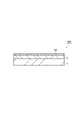
- FIG. 1 is a schematic cross-sectional view showing an embodiment of a metal base substrate.
- the metal base substrate 10A according to the embodiment is arranged on the metal plate 1, the cured body (cured body of the above-mentioned composition) 2 arranged on the metal plate, and the cured body 2. It is provided with a metal leaf 3A and the like.
- the metal plate 1 and the metal foil 3A are separated by the cured body 2 and are electrically insulated from each other. That is, the cured body 2 functions as an insulating layer.
- Examples of the metal material constituting the metal plate 1 include aluminum, aluminum alloy, copper, copper alloy, iron, and stainless steel.
- the metal plate 1 may be made of one kind of metal material, or may be made of two or more kinds of metal materials.
- the metal plate 1 may have a single-layer structure or a multi-layer structure.
- Examples of the metal material constituting the metal leaf 3A include copper, aluminum, and nickel.
- the metal leaf 3A may be made of one kind of metal material, or may be made of two or more kinds of metal materials.
- the metal leaf 3A may have a single-layer structure or a multi-layer structure.
- the thickness of the metal plate 1 may be, for example, 0.5 mm or more, and may be 3 mm or less.
- the thickness of the cured body 2 may be, for example, 50 ⁇ m or more, and may be 300 ⁇ m or less.
- the thickness of the metal leaf 3A may be, for example, 5 ⁇ m or more, and may be 1 mm or less.
- FIG. 2 is a schematic cross-sectional view showing another embodiment of the metal base substrate.
- the metal base substrate 10B according to another embodiment has a metal plate 1, a cured body (cured body of the above-mentioned composition) 2 arranged on the metal plate, and a cured body 2. It is provided with a metal foil 3B arranged in.
- the metal foil 3B is processed into, for example, a predetermined pattern (for example, etching processing) to form a circuit. That is, it can be said that the metal base substrate 10B includes a metal plate 1, a cured body 2 arranged on the metal plate, and a metal circuit arranged on the cured body 2.
- the autoclave was heated in an oil bath at 65 ° C. for 20 hours to carry out radical polymerization. After completion of the polymerization, the mixture was degassed at 120 ° C. for 1 hour under reduced pressure to obtain copolymers 1 to 5.
- the polymerization rate with respect to 100% of the charged amount of the monomer was 98% or more as analyzed by gas chromatography analysis. From this, it was estimated that the ratio of each monomer unit contained in the copolymer was about the same as the charging ratio of the monomers.
- the weight average molecular weight of the obtained copolymers 1 to 5 was determined as a standard polystyrene-equivalent weight average molecular weight using a GPC (gel permeation chromatography) method.
- the results are shown in Table 1.
- the measurement conditions are as follows.
- High-speed GPC device "HLC-8020" manufactured by Tosoh Corporation
- Developing solvent Tetrahydrofuran detector: RI (differential refractometer)
- a curing agent in which a curing agent is dissolved, and as an inorganic filler (1), a boron nitride filler (manufactured by Denka, FP-40, average particle diameter 40 ⁇ m) 50.5% by volume, copolymer 1 1.0% by volume, curing acceleration
- 0.4% by volume of imidazole compound 1B2PZ manufactured by Shikoku Kasei Kogyo Co., Ltd., specific gravity 1.1 g / cm 3
- a planetary mixer for 15 minutes to prepare a composition.
- ⁇ Preparation of cured product> The obtained composition was applied onto a film made of polyethylene terephthalate (PET) having a thickness of 0.038 mm so as to have a thickness after curing of 0.20 mm, and dried by heating at 100 ° C. for 50 minutes. A cured product (B stage sheet) in a semi-cured state was produced.
- PET polyethylene terephthalate
- the obtained cured product (B stage sheet) was peeled off from the PET film and placed on the roughened surface of a metal plate (copper plate having a thickness of 2.0 mm). Next, after arranging the roughened surface of the metal foil (copper foil having a thickness of 0.5 mm) on the cured body, it was heat-cured at 180 ° C. for 410 minutes while applying a surface pressure of 10 MPa by a press machine.
- the copper foil was etched using a sulfuric acid-hydrogen peroxide mixed solution as an etching solution.
- the etching resist was removed, washed and dried to obtain a metal base substrate having a circular electrode (copper foil) having a diameter of 20 mm.
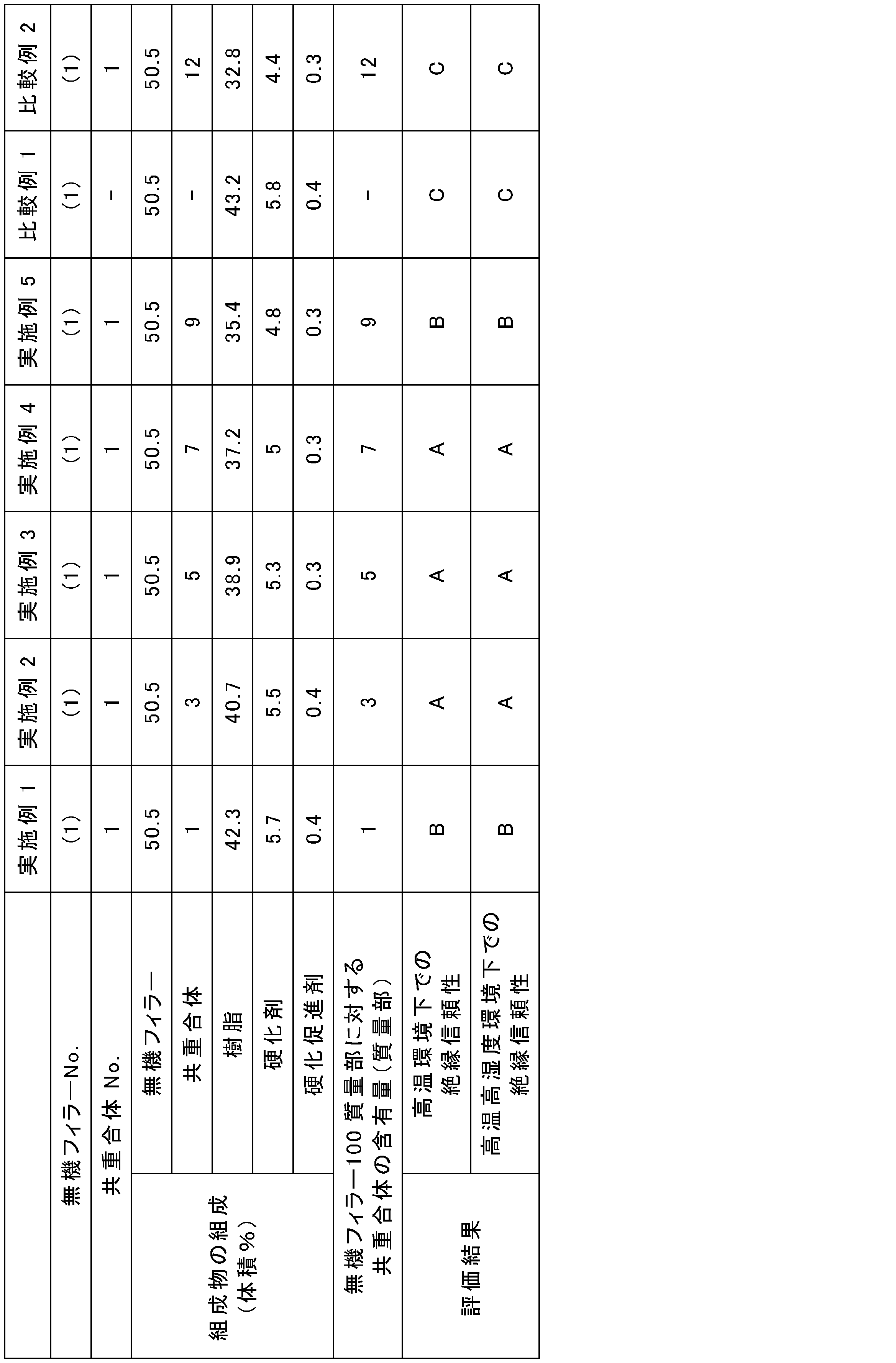
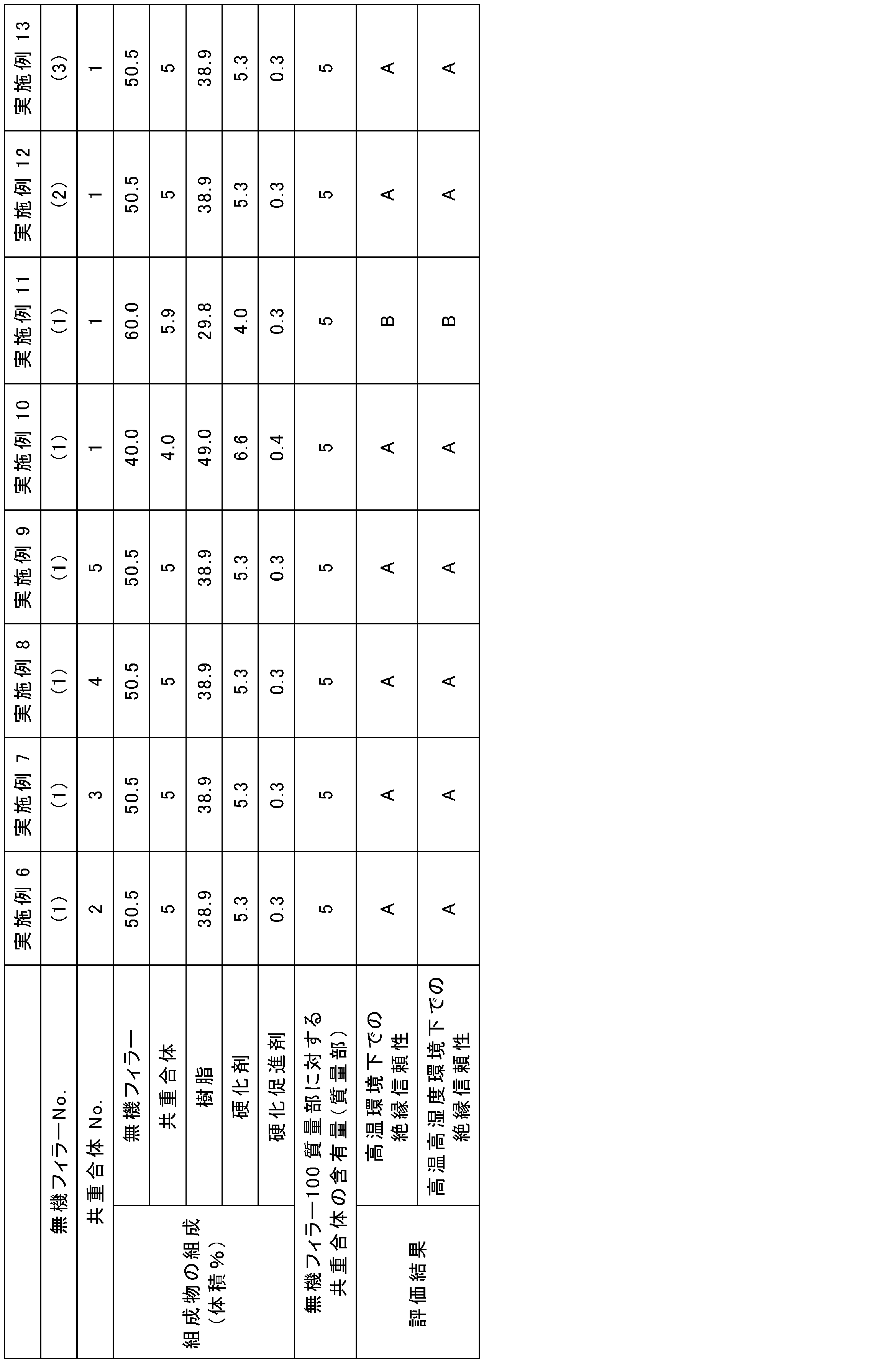
- Examples 2 to 13 and Comparative Examples 1 to 2 A composition, a cured product, and a metal-based substrate were prepared by the same method as in Example 1 except that the composition of the composition was changed as shown in Tables 2 and 3.
- the inorganic filler (2) and the inorganic filler (3) are as follows.
- Inorganic filler (2) Alumina filler (Denka, DAS-45, average particle size 40 ⁇ m)
- Aluminum nitride filler (Denka, AlN-32, average particle size 32 ⁇ m)
- the obtained metal base substrate was subjected to a high-temperature high-voltage bias test (Vt) under a test condition in which a voltage of DC 10 kV was applied between the metal foil and the metal plate in an environment of 125 ° C.
- the endurance time was defined as the time from the start of voltage application to the time when the leakage current value measured by the withstand voltage tester became 10 mA or more.
- the durability time was 200 minutes or more, it was evaluated as A, when it was less than 200 minutes and 100 minutes or more, it was evaluated as B, and when it was less than 100 minutes, it was evaluated as C. If the evaluation is A or B, it can be said that the metal base substrate has excellent insulation reliability in a high temperature environment.
- Tables 2 and 3 The results are shown in Tables 2 and 3.
- the obtained metal base substrate was subjected to a high temperature and high voltage bias test (THB) under test conditions in which a voltage of 1.2 kV DC was applied between the metal foil and the metal plate in an environment of 85 ° C. and 85% humidity.
- the endurance time was defined as the time from the start of voltage application to the time when the leakage current value measured by the withstand voltage tester became 10 mA or more.
- the durability time was 250 hours or more, it was evaluated as A, when it was less than 250 hours and 100 hours or more, it was evaluated as B, and when it was less than 100 hours, it was evaluated as C. If the evaluation is A or B, it can be said that the metal-based substrate has excellent insulation reliability in a high-temperature and high-humidity environment.
- Tables 2 and 3 The results are shown in Tables 2 and 3.
- Metal plate 1 ... Metal plate, 2 ... Hardened body, 3A, 3B ... Metal foil, 10A, 10B ... Metal base substrate.
Landscapes
- Chemical & Material Sciences (AREA)
- Health & Medical Sciences (AREA)
- Chemical Kinetics & Catalysis (AREA)
- Medicinal Chemistry (AREA)
- Polymers & Plastics (AREA)
- Organic Chemistry (AREA)
- Engineering & Computer Science (AREA)
- Microelectronics & Electronic Packaging (AREA)
- Compositions Of Macromolecular Compounds (AREA)
Abstract
Description
[1] 無機フィラーと、アニオン性基を有する(メタ)アクリル系単量体単位Aと、カチオン性基を有する(メタ)アクリル系単量体単位Bと、(メタ)アクリル系単量体単位A及び(メタ)アクリル系単量体単位B以外の(メタ)アクリル系単量体単位Cと、を有する共重合体と、を含有し、共重合体の含有量が、無機フィラー100質量部に対して0.01~10質量部である、組成物。
[2] アニオン性基が、カルボキシ基、リン酸基、及びフェノール性ヒドロキシ基からなる群より選ばれる一種以上を含む、[1]に記載の組成物。
[3] (メタ)アクリル系単量体単位Aが、アニオン性基に結合した電子吸引性基を更に有する、[1]又は[2]に記載の組成物。
[4] カチオン性基が、第一級アミノ基、第二級アミノ基、第三級アミノ基、及び第四級アンモニウム塩基からなる群より選ばれる一種以上を含む、[1]~[3]のいずれかに記載の組成物。
[5] (メタ)アクリル系単量体単位Bが、カチオン性基に結合した電子供与性基を更に有する、[1]~[4]のいずれかに記載の組成物。
[6] (メタ)アクリル系単量体単位Cが、オキシアルキレン基、シロキサン基、炭化水素基、及びリン酸エステル基からなる群より選ばれる一種以上を含む、[1]~[5]のいずれかに記載の組成物。
[7] 樹脂を更に含有する、[1]~[6]のいずれかに記載の組成物。
[8] 樹脂を硬化させる硬化剤を更に含有する、[7]に記載の組成物。
[9] [8]に記載の組成物の硬化体。
[10] 金属板と、金属板上に配置された[9]に記載の硬化体と、硬化体上に配置された金属箔と、を備える、金属ベース基板。
共重合体の合成に用いた単量体を以下に示す。
(アニオン性基を有する(メタ)アクリル系単量体A)
・アクリル酸(東亞合成株式会社製)
(カチオン性基を有する(メタ)アクリル系単量体B)
・メタクリル酸1,2,2,6,6-ペンタメチル-4-ピペリジル(ADEKA株式会社製「アデカスタブLA-82」)
((メタ)アクリル系単量体C)
・ベンジルメタクリレート(共栄社化学株式会社製「ライトエステルBZ」)
高速GPC装置:東ソー社製「HLC-8020」
カラム :東ソー社製「TSK guardcolumn MP(×L)」6.0mmID×4.0cm1本、及び東ソー社製「TSK-GELMULTIPOREHXL-M」7.8mmID×30.0cm(理論段数16,000段)2本、計3本(全体として理論段数32,000段)
展開溶媒 :テトラヒドロフラン
ディテクター :RI(示差屈折率計)

(実施例1)
樹脂としてナフタレン型エポキシ樹脂HP-4032D(DIC株式会社製、比重1.2g/cm3)42.3体積%と、硬化剤としてフェノールノボラック樹脂VH-4150(DIC株式会社製、比重1.1g/cm3)5.7体積%とを170℃で攪拌し、樹脂に硬化剤を溶解させた。硬化剤を溶解させた樹脂と、無機フィラー(1)として窒化ホウ素フィラー(デンカ社製、FP-40、平均粒子径40μm)50.5体積%、共重合体1 1.0体積%、硬化促進剤としてイミダゾール化合物1B2PZ(四国化成工業社製、比重1.1g/cm3)0.4体積%を、プラネタリーミキサーで15分間攪拌混合し、組成物を作製した。
得られた組成物を、厚さ0.038mmのポリエチレンテレフタレート(PET)製のフィルム上に、硬化後の厚さが0.20mmになるように塗布し、100℃50分加熱乾燥させ、これにより半硬化状態の硬化体(Bステージシート)を作製した。
得られた硬化体(Bステージシート)をPETフィルムからはがし、金属板(厚さ2.0mmの銅板)の粗化面上に配置した。次いで、硬化体上に金属箔(厚さ0.5mmの銅箔)の粗化面を配置した後、プレス機によって面圧10MPaをかけながら、180℃で410分間加熱硬化した。
組成物の組成を表2,3に示すとおりに変更した以外は、実施例1と同様の方法により、組成物、硬化体、及び金属ベース基板を作製した。なお、表2,3中、無機フィラー(2)及び無機フィラー(3)は、以下のとおりである。
無機フィラー(2)
アルミナフィラー(デンカ社製、DAS-45、平均粒子径40μm)
無機フィラー(3)
窒化アルミニウムフィラー(デンカ社製、AlN-32、平均粒子径32μm)
得られた金属ベース基板について、125℃環境下で、金属箔-金属板間に直流10kVの電圧を印加する試験条件で、高温高圧バイアス試験(V-t)を行った。電圧印加開始時から、耐電圧試験機で測定した漏れ電流値が10mA以上となった時点までの時間を耐久時間とした。耐久時間が200分以上であった場合をA、200分未満100分以上であった場合をB、100分未満であった場合をCとして評価した。評価がA、Bであれば、高温環境下での絶縁信頼性が優れた金属ベース基板であるといえる。結果を表2,3に示す。
得られた金属ベース基板について、85℃85湿度%環境下で、金属箔-金属板間に直流1.2kVの電圧を印加する試験条件で、高温高圧バイアス試験(THB)を行った。電圧印加開始時から、耐電圧試験機で測定した漏れ電流値が10mA以上となった時点までの時間を耐久時間とした。耐久時間が250時間以上であった場合をA、250時間未満100時間以上であった場合をB、100時間未満であった場合をCとして評価した。評価がA、Bであれば、高温高湿度環境下での絶縁信頼性が優れた金属ベース基板であるといえる。結果を表2,3に示す。
Claims (10)
- 無機フィラーと、
アニオン性基を有する(メタ)アクリル系単量体単位Aと、カチオン性基を有する(メタ)アクリル系単量体単位Bと、前記(メタ)アクリル系単量体単位A及び前記(メタ)アクリル系単量体単位B以外の(メタ)アクリル系単量体単位Cと、を有する共重合体と、
を含有し、
前記共重合体の含有量が、前記無機フィラー100質量部に対して0.01~10質量部である、組成物。 - 前記アニオン性基が、カルボキシ基、リン酸基、及びフェノール性ヒドロキシ基からなる群より選ばれる一種以上を含む、請求項1に記載の組成物。
- 前記(メタ)アクリル系単量体単位Aが、前記アニオン性基に結合した電子吸引性基を更に有する、請求項1又は2に記載の組成物。
- 前記カチオン性基が、第一級アミノ基、第二級アミノ基、第三級アミノ基、及び第四級アンモニウム塩基からなる群より選ばれる一種以上を含む、請求項1~3のいずれか一項に記載の組成物。
- 前記(メタ)アクリル系単量体単位Bが、前記カチオン性基に結合した電子供与性基を更に有する、請求項1~4のいずれか一項に記載の組成物。
- 前記(メタ)アクリル系単量体単位Cが、オキシアルキレン基、シロキサン基、炭化水素基、及びリン酸エステル基からなる群より選ばれる一種以上を含む、請求項1~5のいずれか一項に記載の組成物。
- 樹脂を更に含有する、請求項1~6のいずれか一項に記載の組成物。
- 前記樹脂を硬化させる硬化剤を更に含有する、請求項7に記載の組成物。
- 請求項8に記載の組成物の硬化体。
- 金属板と、
前記金属板上に配置された請求項9に記載の硬化体と、
前記硬化体上に配置された金属箔と、
を備える、金属ベース基板。
Priority Applications (3)
| Application Number | Priority Date | Filing Date | Title |
|---|---|---|---|
| CN202180065604.2A CN116234841A (zh) | 2020-10-06 | 2021-10-01 | 组合物、固化体及金属基底基板 |
| EP21877526.0A EP4219621A4 (en) | 2020-10-06 | 2021-10-01 | COMPOSITION, HARDENED BODY, AND METAL BASE SUBSTRATE |
| JP2022555447A JP7644137B2 (ja) | 2020-10-06 | 2021-10-01 | 組成物、硬化体及び金属ベース基板 |
Applications Claiming Priority (2)
| Application Number | Priority Date | Filing Date | Title |
|---|---|---|---|
| JP2020169121 | 2020-10-06 | ||
| JP2020-169121 | 2020-10-06 |
Publications (1)
| Publication Number | Publication Date |
|---|---|
| WO2022075227A1 true WO2022075227A1 (ja) | 2022-04-14 |
Family
ID=81126879
Family Applications (1)
| Application Number | Title | Priority Date | Filing Date |
|---|---|---|---|
| PCT/JP2021/036483 Ceased WO2022075227A1 (ja) | 2020-10-06 | 2021-10-01 | 組成物、硬化体及び金属ベース基板 |
Country Status (4)
| Country | Link |
|---|---|
| EP (1) | EP4219621A4 (ja) |
| JP (1) | JP7644137B2 (ja) |
| CN (1) | CN116234841A (ja) |
| WO (1) | WO2022075227A1 (ja) |
Cited By (1)
| Publication number | Priority date | Publication date | Assignee | Title |
|---|---|---|---|---|
| WO2026071101A1 (ja) * | 2024-09-30 | 2026-04-02 | デンカ株式会社 | 積層体及び回路基板 |
Citations (5)
| Publication number | Priority date | Publication date | Assignee | Title |
|---|---|---|---|---|
| JP2008266535A (ja) | 2007-04-25 | 2008-11-06 | Denki Kagaku Kogyo Kk | 回路基板用組成物とそれを用いた回路基板 |
| WO2012039324A1 (ja) * | 2010-09-22 | 2012-03-29 | 日立化成工業株式会社 | 熱伝導性樹脂組成物、樹脂シート、樹脂付金属箔、樹脂シート硬化物及び放熱部材 |
| JP2016104862A (ja) * | 2015-12-04 | 2016-06-09 | 日立化成株式会社 | 樹脂組成物、樹脂シート、金属箔付き樹脂シート、樹脂硬化物シート、構造体、および動力用又は光源用半導体デバイス |
| JP2016155985A (ja) * | 2015-02-26 | 2016-09-01 | 日立化成株式会社 | エポキシ樹脂組成物、半硬化エポキシ樹脂組成物、硬化エポキシ樹脂組成物、及びそれらを用いた樹脂シート、プリプレグ、積層板、金属基板、配線板、パワー半導体装置 |
| JP2017160440A (ja) * | 2011-11-02 | 2017-09-14 | 日立化成株式会社 | エポキシ樹脂組成物、半硬化エポキシ樹脂組成物、硬化エポキシ樹脂組成物、樹脂シート、プリプレグ、積層板、金属基板、配線板、半硬化エポキシ樹脂組成物の製造方法及び硬化エポキシ樹脂組成物の製造方法 |
Family Cites Families (6)
| Publication number | Priority date | Publication date | Assignee | Title |
|---|---|---|---|---|
| US7091273B2 (en) * | 2002-05-07 | 2006-08-15 | Akzo Nobel N.V. | Process for preparing a polymer dispersion |
| JP5315923B2 (ja) * | 2007-11-05 | 2013-10-16 | 日立化成株式会社 | アクリル系エラストマー及びこれを用いた組成物 |
| TWI520973B (zh) * | 2010-09-01 | 2016-02-11 | Kaneka Corp | 電氣、電子元件材料用組合物及其硬化物 |
| KR20140074289A (ko) * | 2011-09-08 | 2014-06-17 | 히타치가세이가부시끼가이샤 | 수지 조성물, 수지 시트, 수지 시트 경화물, 수지 부착 금속박 및 방열 부재 |
| JP7608329B2 (ja) * | 2019-04-11 | 2025-01-06 | デンカ株式会社 | 共重合体、分散剤、及び樹脂組成物 |
| CN116057092A (zh) * | 2020-10-05 | 2023-05-02 | 电化株式会社 | 导热性树脂组合物及电子设备 |
-
2021
- 2021-10-01 EP EP21877526.0A patent/EP4219621A4/en not_active Withdrawn
- 2021-10-01 WO PCT/JP2021/036483 patent/WO2022075227A1/ja not_active Ceased
- 2021-10-01 CN CN202180065604.2A patent/CN116234841A/zh active Pending
- 2021-10-01 JP JP2022555447A patent/JP7644137B2/ja active Active
Patent Citations (5)
| Publication number | Priority date | Publication date | Assignee | Title |
|---|---|---|---|---|
| JP2008266535A (ja) | 2007-04-25 | 2008-11-06 | Denki Kagaku Kogyo Kk | 回路基板用組成物とそれを用いた回路基板 |
| WO2012039324A1 (ja) * | 2010-09-22 | 2012-03-29 | 日立化成工業株式会社 | 熱伝導性樹脂組成物、樹脂シート、樹脂付金属箔、樹脂シート硬化物及び放熱部材 |
| JP2017160440A (ja) * | 2011-11-02 | 2017-09-14 | 日立化成株式会社 | エポキシ樹脂組成物、半硬化エポキシ樹脂組成物、硬化エポキシ樹脂組成物、樹脂シート、プリプレグ、積層板、金属基板、配線板、半硬化エポキシ樹脂組成物の製造方法及び硬化エポキシ樹脂組成物の製造方法 |
| JP2016155985A (ja) * | 2015-02-26 | 2016-09-01 | 日立化成株式会社 | エポキシ樹脂組成物、半硬化エポキシ樹脂組成物、硬化エポキシ樹脂組成物、及びそれらを用いた樹脂シート、プリプレグ、積層板、金属基板、配線板、パワー半導体装置 |
| JP2016104862A (ja) * | 2015-12-04 | 2016-06-09 | 日立化成株式会社 | 樹脂組成物、樹脂シート、金属箔付き樹脂シート、樹脂硬化物シート、構造体、および動力用又は光源用半導体デバイス |
Non-Patent Citations (1)
| Title |
|---|
| See also references of EP4219621A4 |
Cited By (1)
| Publication number | Priority date | Publication date | Assignee | Title |
|---|---|---|---|---|
| WO2026071101A1 (ja) * | 2024-09-30 | 2026-04-02 | デンカ株式会社 | 積層体及び回路基板 |
Also Published As
| Publication number | Publication date |
|---|---|
| JP7644137B2 (ja) | 2025-03-11 |
| EP4219621A1 (en) | 2023-08-02 |
| JPWO2022075227A1 (ja) | 2022-04-14 |
| CN116234841A (zh) | 2023-06-06 |
| EP4219621A4 (en) | 2024-03-06 |
Similar Documents
| Publication | Publication Date | Title |
|---|---|---|
| US11691389B2 (en) | Resin composition, prepreg, metal foil with resin, laminate, printed wiring board, and method for producing resin composition | |
| US20220186089A1 (en) | Copolymer, dispersant, and resin composition | |
| JP2011017000A (ja) | 粘着剤組成物および粘着剤、ならびに光学部材用粘着剤、それを用いて得られる粘着剤層付き光学部材 | |
| JP7769955B2 (ja) | 樹脂組成物、並びに、それを用いた樹脂フィルム、樹脂付金属箔、金属張積層板、及び配線基板 | |
| JP7589255B2 (ja) | 組成物及びその製造方法、硬化体、並びに金属ベース基板 | |
| JP7644137B2 (ja) | 組成物、硬化体及び金属ベース基板 | |
| EP4497787A1 (en) | Resin composition, insulating resin cured body, laminate, and circuit substrate | |
| EP4497788A1 (en) | Resin composition, insulating resin cured body, laminate, and circuit substrate | |
| WO2025075098A1 (ja) | 樹脂組成物、絶縁性樹脂硬化体、積層体、及び回路基板 | |
| JP2011111498A (ja) | 樹脂シート及び積層体 | |
| JP2008277759A (ja) | 絶縁性熱伝導シート | |
| JP4987374B2 (ja) | 接着シート用樹脂組成物、並びに該組成物を用いたフレキシブルプリント配線板用接着シート | |
| JP2003313526A (ja) | フレキシブルプリント配線板積層用接着剤組成物および接着フィルム | |
| WO2025075099A1 (ja) | 樹脂組成物、絶縁性樹脂硬化体、積層体、及び回路基板 | |
| JP2026061871A (ja) | 積層体及び回路基板 | |
| JP2026061734A (ja) | 積層体及び回路基板 | |
| JP2026061710A (ja) | 積層体及び回路基板 | |
| JP2026061773A (ja) | 積層体及び回路基板 | |
| WO2026071032A1 (ja) | 積層体及び回路基板 | |
| JP2026052369A (ja) | ドライフィルム、発光型電子部品および発光型電子部品の製造方法 | |
| JPWO2017090637A1 (ja) | 接着剤組成物、偏光板用接着剤組成物、及びそれを用いる偏光板 |
Legal Events
| Date | Code | Title | Description |
|---|---|---|---|
| 121 | Ep: the epo has been informed by wipo that ep was designated in this application |
Ref document number: 21877526 Country of ref document: EP Kind code of ref document: A1 |
|
| ENP | Entry into the national phase |
Ref document number: 2022555447 Country of ref document: JP Kind code of ref document: A |
|
| ENP | Entry into the national phase |
Ref document number: 2021877526 Country of ref document: EP Effective date: 20230426 |
|
| NENP | Non-entry into the national phase |
Ref country code: DE |
|
| WWW | Wipo information: withdrawn in national office |
Ref document number: 2021877526 Country of ref document: EP |