WO2022075331A1 - 不織布及びそれを備えた吸収性物品用の防漏シート - Google Patents
不織布及びそれを備えた吸収性物品用の防漏シート Download PDFInfo
- Publication number
- WO2022075331A1 WO2022075331A1 PCT/JP2021/036872 JP2021036872W WO2022075331A1 WO 2022075331 A1 WO2022075331 A1 WO 2022075331A1 JP 2021036872 W JP2021036872 W JP 2021036872W WO 2022075331 A1 WO2022075331 A1 WO 2022075331A1
- Authority
- WO
- WIPO (PCT)
- Prior art keywords
- mass
- triglyceride
- fatty acid
- carbon atoms
- group derived
- Prior art date
- Legal status (The legal status is an assumption and is not a legal conclusion. Google has not performed a legal analysis and makes no representation as to the accuracy of the status listed.)
- Ceased
Links
Classifications
-
- D—TEXTILES; PAPER
- D01—NATURAL OR MAN-MADE THREADS OR FIBRES; SPINNING
- D01F—CHEMICAL FEATURES IN THE MANUFACTURE OF ARTIFICIAL FILAMENTS, THREADS, FIBRES, BRISTLES OR RIBBONS; APPARATUS SPECIALLY ADAPTED FOR THE MANUFACTURE OF CARBON FILAMENTS
- D01F6/00—Monocomponent artificial filaments or the like of synthetic polymers; Manufacture thereof
- D01F6/44—Monocomponent artificial filaments or the like of synthetic polymers; Manufacture thereof from mixtures of polymers obtained by reactions only involving carbon-to-carbon unsaturated bonds as major constituent with other polymers or low-molecular-weight compounds
- D01F6/46—Monocomponent artificial filaments or the like of synthetic polymers; Manufacture thereof from mixtures of polymers obtained by reactions only involving carbon-to-carbon unsaturated bonds as major constituent with other polymers or low-molecular-weight compounds of polyolefins
-
- A—HUMAN NECESSITIES
- A61—MEDICAL OR VETERINARY SCIENCE; HYGIENE
- A61F—FILTERS IMPLANTABLE INTO BLOOD VESSELS; PROSTHESES; DEVICES PROVIDING PATENCY TO, OR PREVENTING COLLAPSING OF, TUBULAR STRUCTURES OF THE BODY, e.g. STENTS; ORTHOPAEDIC, NURSING OR CONTRACEPTIVE DEVICES; FOMENTATION; TREATMENT OR PROTECTION OF EYES OR EARS; BANDAGES, DRESSINGS OR ABSORBENT PADS; FIRST-AID KITS
- A61F13/00—Bandages or dressings; Absorbent pads
- A61F13/15—Absorbent pads, e.g. sanitary towels, swabs or tampons for external or internal application to the body; Supporting or fastening means therefor; Tampon applicators
- A61F13/51—Absorbent pads, e.g. sanitary towels, swabs or tampons for external or internal application to the body; Supporting or fastening means therefor; Tampon applicators characterised by the outer layers of the pads
- A61F13/514—Backsheet, i.e. the impermeable cover or layer furthest from the skin
-
- A—HUMAN NECESSITIES
- A61—MEDICAL OR VETERINARY SCIENCE; HYGIENE
- A61F—FILTERS IMPLANTABLE INTO BLOOD VESSELS; PROSTHESES; DEVICES PROVIDING PATENCY TO, OR PREVENTING COLLAPSING OF, TUBULAR STRUCTURES OF THE BODY, e.g. STENTS; ORTHOPAEDIC, NURSING OR CONTRACEPTIVE DEVICES; FOMENTATION; TREATMENT OR PROTECTION OF EYES OR EARS; BANDAGES, DRESSINGS OR ABSORBENT PADS; FIRST-AID KITS
- A61F13/00—Bandages or dressings; Absorbent pads
- A61F13/15—Absorbent pads, e.g. sanitary towels, swabs or tampons for external or internal application to the body; Supporting or fastening means therefor; Tampon applicators
- A61F13/51—Absorbent pads, e.g. sanitary towels, swabs or tampons for external or internal application to the body; Supporting or fastening means therefor; Tampon applicators characterised by the outer layers of the pads
- A61F13/514—Backsheet, i.e. the impermeable cover or layer furthest from the skin
- A61F13/51401—Backsheet, i.e. the impermeable cover or layer furthest from the skin characterised by the material
-
- A—HUMAN NECESSITIES
- A61—MEDICAL OR VETERINARY SCIENCE; HYGIENE
- A61L—METHODS OR APPARATUS FOR STERILISING MATERIALS OR OBJECTS IN GENERAL; DISINFECTION, STERILISATION OR DEODORISATION OF AIR; CHEMICAL ASPECTS OF BANDAGES, DRESSINGS, ABSORBENT PADS OR SURGICAL ARTICLES; MATERIALS FOR BANDAGES, DRESSINGS, ABSORBENT PADS OR SURGICAL ARTICLES
- A61L15/00—Chemical aspects of, or use of materials for, bandages, dressings or absorbent pads
- A61L15/16—Bandages, dressings or absorbent pads for physiological fluids such as urine or blood, e.g. sanitary towels, tampons
- A61L15/22—Bandages, dressings or absorbent pads for physiological fluids such as urine or blood, e.g. sanitary towels, tampons containing macromolecular materials
- A61L15/24—Macromolecular compounds obtained by reactions only involving carbon-to-carbon unsaturated bonds; Derivatives thereof
-
- A—HUMAN NECESSITIES
- A61—MEDICAL OR VETERINARY SCIENCE; HYGIENE
- A61L—METHODS OR APPARATUS FOR STERILISING MATERIALS OR OBJECTS IN GENERAL; DISINFECTION, STERILISATION OR DEODORISATION OF AIR; CHEMICAL ASPECTS OF BANDAGES, DRESSINGS, ABSORBENT PADS OR SURGICAL ARTICLES; MATERIALS FOR BANDAGES, DRESSINGS, ABSORBENT PADS OR SURGICAL ARTICLES
- A61L15/00—Chemical aspects of, or use of materials for, bandages, dressings or absorbent pads
- A61L15/16—Bandages, dressings or absorbent pads for physiological fluids such as urine or blood, e.g. sanitary towels, tampons
- A61L15/22—Bandages, dressings or absorbent pads for physiological fluids such as urine or blood, e.g. sanitary towels, tampons containing macromolecular materials
- A61L15/34—Oils, fats, waxes or natural resins
-
- A—HUMAN NECESSITIES
- A61—MEDICAL OR VETERINARY SCIENCE; HYGIENE
- A61L—METHODS OR APPARATUS FOR STERILISING MATERIALS OR OBJECTS IN GENERAL; DISINFECTION, STERILISATION OR DEODORISATION OF AIR; CHEMICAL ASPECTS OF BANDAGES, DRESSINGS, ABSORBENT PADS OR SURGICAL ARTICLES; MATERIALS FOR BANDAGES, DRESSINGS, ABSORBENT PADS OR SURGICAL ARTICLES
- A61L15/00—Chemical aspects of, or use of materials for, bandages, dressings or absorbent pads
- A61L15/16—Bandages, dressings or absorbent pads for physiological fluids such as urine or blood, e.g. sanitary towels, tampons
- A61L15/42—Use of materials characterised by their function or physical properties
- A61L15/52—Water-repellants
-
- B—PERFORMING OPERATIONS; TRANSPORTING
- B32—LAYERED PRODUCTS
- B32B—LAYERED PRODUCTS, i.e. PRODUCTS BUILT-UP OF STRATA OF FLAT OR NON-FLAT, e.g. CELLULAR OR HONEYCOMB, FORM
- B32B5/00—Layered products characterised by the non- homogeneity or physical structure, i.e. comprising a fibrous, filamentary, particulate or foam layer; Layered products characterised by having a layer differing constitutionally or physically in different parts
- B32B5/02—Layered products characterised by the non- homogeneity or physical structure, i.e. comprising a fibrous, filamentary, particulate or foam layer; Layered products characterised by having a layer differing constitutionally or physically in different parts characterised by structural features of a fibrous or filamentary layer
- B32B5/022—Non-woven fabric
-
- B—PERFORMING OPERATIONS; TRANSPORTING
- B32—LAYERED PRODUCTS
- B32B—LAYERED PRODUCTS, i.e. PRODUCTS BUILT-UP OF STRATA OF FLAT OR NON-FLAT, e.g. CELLULAR OR HONEYCOMB, FORM
- B32B5/00—Layered products characterised by the non- homogeneity or physical structure, i.e. comprising a fibrous, filamentary, particulate or foam layer; Layered products characterised by having a layer differing constitutionally or physically in different parts
- B32B5/22—Layered products characterised by the non- homogeneity or physical structure, i.e. comprising a fibrous, filamentary, particulate or foam layer; Layered products characterised by having a layer differing constitutionally or physically in different parts characterised by the presence of two or more layers which are next to each other and are fibrous, filamentary, formed of particles or foamed
- B32B5/24—Layered products characterised by the non- homogeneity or physical structure, i.e. comprising a fibrous, filamentary, particulate or foam layer; Layered products characterised by having a layer differing constitutionally or physically in different parts characterised by the presence of two or more layers which are next to each other and are fibrous, filamentary, formed of particles or foamed one layer being a fibrous or filamentary layer
- B32B5/26—Layered products characterised by the non- homogeneity or physical structure, i.e. comprising a fibrous, filamentary, particulate or foam layer; Layered products characterised by having a layer differing constitutionally or physically in different parts characterised by the presence of two or more layers which are next to each other and are fibrous, filamentary, formed of particles or foamed one layer being a fibrous or filamentary layer another layer next to it also being fibrous or filamentary
- B32B5/265—Layered products characterised by the non- homogeneity or physical structure, i.e. comprising a fibrous, filamentary, particulate or foam layer; Layered products characterised by having a layer differing constitutionally or physically in different parts characterised by the presence of two or more layers which are next to each other and are fibrous, filamentary, formed of particles or foamed one layer being a fibrous or filamentary layer another layer next to it also being fibrous or filamentary characterised by one fibrous or filamentary layer being a non-woven fabric layer
- B32B5/266—Layered products characterised by the non- homogeneity or physical structure, i.e. comprising a fibrous, filamentary, particulate or foam layer; Layered products characterised by having a layer differing constitutionally or physically in different parts characterised by the presence of two or more layers which are next to each other and are fibrous, filamentary, formed of particles or foamed one layer being a fibrous or filamentary layer another layer next to it also being fibrous or filamentary characterised by one fibrous or filamentary layer being a non-woven fabric layer next to one or more non-woven fabric layers
- B32B5/268—Layered products characterised by the non- homogeneity or physical structure, i.e. comprising a fibrous, filamentary, particulate or foam layer; Layered products characterised by having a layer differing constitutionally or physically in different parts characterised by the presence of two or more layers which are next to each other and are fibrous, filamentary, formed of particles or foamed one layer being a fibrous or filamentary layer another layer next to it also being fibrous or filamentary characterised by one fibrous or filamentary layer being a non-woven fabric layer next to one or more non-woven fabric layers characterised by at least one non-woven fabric layer that is a melt-blown fabric
- B32B5/269—Layered products characterised by the non- homogeneity or physical structure, i.e. comprising a fibrous, filamentary, particulate or foam layer; Layered products characterised by having a layer differing constitutionally or physically in different parts characterised by the presence of two or more layers which are next to each other and are fibrous, filamentary, formed of particles or foamed one layer being a fibrous or filamentary layer another layer next to it also being fibrous or filamentary characterised by one fibrous or filamentary layer being a non-woven fabric layer next to one or more non-woven fabric layers characterised by at least one non-woven fabric layer that is a melt-blown fabric characterised by at least one non-woven fabric layer that is a melt-blown fabric next to a non-woven fabric layer that is a spunbonded fabric
-
- D—TEXTILES; PAPER
- D04—BRAIDING; LACE-MAKING; KNITTING; TRIMMINGS; NON-WOVEN FABRICS
- D04H—MAKING TEXTILE FABRICS, e.g. FROM FIBRES OR FILAMENTARY MATERIAL; FABRICS MADE BY SUCH PROCESSES OR APPARATUS, e.g. FELTS, NON-WOVEN FABRICS; COTTON-WOOL; WADDING ; NON-WOVEN FABRICS FROM STAPLE FIBRES, FILAMENTS OR YARNS, BONDED WITH AT LEAST ONE WEB-LIKE MATERIAL DURING THEIR CONSOLIDATION
- D04H1/00—Non-woven fabrics formed wholly or mainly of staple fibres or like relatively short fibres
- D04H1/40—Non-woven fabrics formed wholly or mainly of staple fibres or like relatively short fibres from fleeces or layers composed of fibres without existing or potential cohesive properties
- D04H1/42—Non-woven fabrics formed wholly or mainly of staple fibres or like relatively short fibres from fleeces or layers composed of fibres without existing or potential cohesive properties characterised by the use of certain kinds of fibres insofar as this use has no preponderant influence on the consolidation of the fleece
- D04H1/4282—Addition polymers
- D04H1/4291—Olefin series
-
- D—TEXTILES; PAPER
- D04—BRAIDING; LACE-MAKING; KNITTING; TRIMMINGS; NON-WOVEN FABRICS
- D04H—MAKING TEXTILE FABRICS, e.g. FROM FIBRES OR FILAMENTARY MATERIAL; FABRICS MADE BY SUCH PROCESSES OR APPARATUS, e.g. FELTS, NON-WOVEN FABRICS; COTTON-WOOL; WADDING ; NON-WOVEN FABRICS FROM STAPLE FIBRES, FILAMENTS OR YARNS, BONDED WITH AT LEAST ONE WEB-LIKE MATERIAL DURING THEIR CONSOLIDATION
- D04H1/00—Non-woven fabrics formed wholly or mainly of staple fibres or like relatively short fibres
- D04H1/40—Non-woven fabrics formed wholly or mainly of staple fibres or like relatively short fibres from fleeces or layers composed of fibres without existing or potential cohesive properties
- D04H1/54—Non-woven fabrics formed wholly or mainly of staple fibres or like relatively short fibres from fleeces or layers composed of fibres without existing or potential cohesive properties by welding together the fibres, e.g. by partially melting or dissolving
- D04H1/56—Non-woven fabrics formed wholly or mainly of staple fibres or like relatively short fibres from fleeces or layers composed of fibres without existing or potential cohesive properties by welding together the fibres, e.g. by partially melting or dissolving in association with fibre formation, e.g. immediately following extrusion of staple fibres
-
- D—TEXTILES; PAPER
- D04—BRAIDING; LACE-MAKING; KNITTING; TRIMMINGS; NON-WOVEN FABRICS
- D04H—MAKING TEXTILE FABRICS, e.g. FROM FIBRES OR FILAMENTARY MATERIAL; FABRICS MADE BY SUCH PROCESSES OR APPARATUS, e.g. FELTS, NON-WOVEN FABRICS; COTTON-WOOL; WADDING ; NON-WOVEN FABRICS FROM STAPLE FIBRES, FILAMENTS OR YARNS, BONDED WITH AT LEAST ONE WEB-LIKE MATERIAL DURING THEIR CONSOLIDATION
- D04H3/00—Non-woven fabrics formed wholly or mainly of yarns or like filamentary material of substantial length
- D04H3/005—Synthetic yarns or filaments
- D04H3/007—Addition polymers
-
- D—TEXTILES; PAPER
- D04—BRAIDING; LACE-MAKING; KNITTING; TRIMMINGS; NON-WOVEN FABRICS
- D04H—MAKING TEXTILE FABRICS, e.g. FROM FIBRES OR FILAMENTARY MATERIAL; FABRICS MADE BY SUCH PROCESSES OR APPARATUS, e.g. FELTS, NON-WOVEN FABRICS; COTTON-WOOL; WADDING ; NON-WOVEN FABRICS FROM STAPLE FIBRES, FILAMENTS OR YARNS, BONDED WITH AT LEAST ONE WEB-LIKE MATERIAL DURING THEIR CONSOLIDATION
- D04H3/00—Non-woven fabrics formed wholly or mainly of yarns or like filamentary material of substantial length
- D04H3/08—Non-woven fabrics formed wholly or mainly of yarns or like filamentary material of substantial length characterised by the method of strengthening or consolidating
- D04H3/16—Non-woven fabrics formed wholly or mainly of yarns or like filamentary material of substantial length characterised by the method of strengthening or consolidating with bonds between thermoplastic filaments produced in association with filament formation, e.g. immediately following extrusion
-
- A—HUMAN NECESSITIES
- A61—MEDICAL OR VETERINARY SCIENCE; HYGIENE
- A61F—FILTERS IMPLANTABLE INTO BLOOD VESSELS; PROSTHESES; DEVICES PROVIDING PATENCY TO, OR PREVENTING COLLAPSING OF, TUBULAR STRUCTURES OF THE BODY, e.g. STENTS; ORTHOPAEDIC, NURSING OR CONTRACEPTIVE DEVICES; FOMENTATION; TREATMENT OR PROTECTION OF EYES OR EARS; BANDAGES, DRESSINGS OR ABSORBENT PADS; FIRST-AID KITS
- A61F13/00—Bandages or dressings; Absorbent pads
- A61F13/15—Absorbent pads, e.g. sanitary towels, swabs or tampons for external or internal application to the body; Supporting or fastening means therefor; Tampon applicators
- A61F13/51—Absorbent pads, e.g. sanitary towels, swabs or tampons for external or internal application to the body; Supporting or fastening means therefor; Tampon applicators characterised by the outer layers of the pads
- A61F13/514—Backsheet, i.e. the impermeable cover or layer furthest from the skin
- A61F13/51401—Backsheet, i.e. the impermeable cover or layer furthest from the skin characterised by the material
- A61F2013/51441—Backsheet, i.e. the impermeable cover or layer furthest from the skin characterised by the material being a fibrous material
- A61F2013/51452—Backsheet, i.e. the impermeable cover or layer furthest from the skin characterised by the material being a fibrous material being nonwovens
-
- B—PERFORMING OPERATIONS; TRANSPORTING
- B32—LAYERED PRODUCTS
- B32B—LAYERED PRODUCTS, i.e. PRODUCTS BUILT-UP OF STRATA OF FLAT OR NON-FLAT, e.g. CELLULAR OR HONEYCOMB, FORM
- B32B2250/00—Layers arrangement
- B32B2250/20—All layers being fibrous or filamentary
-
- B—PERFORMING OPERATIONS; TRANSPORTING
- B32—LAYERED PRODUCTS
- B32B—LAYERED PRODUCTS, i.e. PRODUCTS BUILT-UP OF STRATA OF FLAT OR NON-FLAT, e.g. CELLULAR OR HONEYCOMB, FORM
- B32B2262/00—Composition or structural features of fibres which form a fibrous or filamentary layer or are present as additives
- B32B2262/02—Synthetic macromolecular fibres
- B32B2262/0253—Polyolefin fibres
-
- B—PERFORMING OPERATIONS; TRANSPORTING
- B32—LAYERED PRODUCTS
- B32B—LAYERED PRODUCTS, i.e. PRODUCTS BUILT-UP OF STRATA OF FLAT OR NON-FLAT, e.g. CELLULAR OR HONEYCOMB, FORM
- B32B2307/00—Properties of the layers or laminate
- B32B2307/70—Other properties
- B32B2307/718—Weight, e.g. weight per square meter
-
- B—PERFORMING OPERATIONS; TRANSPORTING
- B32—LAYERED PRODUCTS
- B32B—LAYERED PRODUCTS, i.e. PRODUCTS BUILT-UP OF STRATA OF FLAT OR NON-FLAT, e.g. CELLULAR OR HONEYCOMB, FORM
- B32B2307/00—Properties of the layers or laminate
- B32B2307/70—Other properties
- B32B2307/726—Permeability to liquids, absorption
- B32B2307/7265—Non-permeable
-
- D—TEXTILES; PAPER
- D01—NATURAL OR MAN-MADE THREADS OR FIBRES; SPINNING
- D01F—CHEMICAL FEATURES IN THE MANUFACTURE OF ARTIFICIAL FILAMENTS, THREADS, FIBRES, BRISTLES OR RIBBONS; APPARATUS SPECIALLY ADAPTED FOR THE MANUFACTURE OF CARBON FILAMENTS
- D01F1/00—General methods for the manufacture of artificial filaments or the like
- D01F1/02—Addition of substances to the spinning solution or to the melt
- D01F1/10—Other agents for modifying properties
Definitions
- the present invention relates to a non-woven fabric.
- the present invention also relates to a leak-proof sheet for an absorbent article provided with the nonwoven fabric.
- Nonwoven fabrics are generally used as barrier materials for body fluids such as urine and blood in absorbent articles such as diapers and napkins, wound dressings, and sanitary products such as medical gowns. It is generally known that the smaller the fiber diameter of the non-woven fabric and the smaller the gap between the fibers, the higher the characteristics of the non-woven fabric as a barrier material. Although this method is effective for liquids with relatively high surface tension, it may not be sufficient for liquids with low surface tension such as loose stools. In order to further enhance the barrier property of the non-woven fabric, it is effective to reduce the surface tension of the fiber.
- the present invention provides a nonwoven fabric containing fibers containing a thermoplastic resin having a fiber forming ability and triglyceride. It is preferable that the thermoplastic resin contains a polyolefin resin.
- the triglyceride (A) A mixture of a triglyceride containing at least a group derived from a fatty acid having 16 carbon atoms in one molecule and a triglyceride containing at least a group derived from a fatty acid having 18 carbon atoms in one molecule, or (b) carbon. It is preferable to contain a triglyceride containing at least a group derived from a fatty acid having 16 atoms and a group derived from a fatty acid having 18 carbon atoms in one molecule.
- the present invention also provides a water repellent composition for resin internal use containing triglyceride.
- the triglyceride (A) A mixture of a triglyceride containing at least a group derived from a fatty acid having 16 carbon atoms in one molecule and a triglyceride containing at least a group derived from a fatty acid having 18 carbon atoms in one molecule, or (b) carbon. It is preferable to contain a triglyceride containing at least a group derived from a fatty acid having 16 atoms and a group derived from a fatty acid having 18 carbon atoms in one molecule.
- the non-woven fabric containing fibers to which triglyceride is added has a problem that the liquid having low surface tension exudes from the non-woven fabric when a large amount of liquid having low surface tension is in contact with the non-woven fabric or when the non-woven fabric is in contact with the non-woven fabric for a long time. Therefore, the present invention relates to a non-woven fabric having a higher barrier property against a liquid than before.
- the present invention relates to a non-woven fabric.
- the nonwoven fabric of the present invention broadly includes those produced by various methods.
- Various known methods for producing a non-woven fabric include, for example, a melt blown method, a spunbond method, an air-through method, an airlaid method, a spunlace method, a needle punching method, an electrospinning method, a chemical bond method, and a thermal bond method.
- the nonwoven fabric of the present invention includes those produced by these methods.
- the present invention is not limited to these, and non-woven fabrics produced by methods other than these and non-woven fabrics produced by any combination of these methods are also included in the present invention.
- the nonwoven fabric of the present invention has a high barrier property against liquids as described later, it is particularly advantageous to use a meltblown nonwoven fabric which is a nonwoven fabric which easily exhibits the properties or a composite nonwoven fabric having a meltblown layer.
- a meltblown nonwoven fabric having a meltblown layer include meltblown-spunbond composite nonwoven fabrics and spunbond-meltblown-spunbond composite nonwoven fabrics.
- the mass ratio of the spanbond layer to the total mass of the nonwoven fabric is 50% by mass or more and 95% by mass or less, which is a barrier to liquid. It is preferable from the viewpoint of improving the sex. From the viewpoint of further enhancing this advantage, the mass ratio of the spunbond layer to the total mass of the nonwoven fabric is more preferably 50% by mass or more and 90% by mass or less, and more preferably 50% by mass or more and 85% by mass or less. Is more preferable.
- the mass ratio of the melt blown layer to the total mass of the nonwoven fabric is preferably 5% by mass or more and 50% by mass or less from the viewpoint of improving the barrier property against the liquid. From the viewpoint of further enhancing this advantage, the mass ratio of the melt blown layer to the total mass of the nonwoven fabric is more preferably 10% by mass or more and 50% by mass or less, and more preferably 15% by mass or more and 50% by mass or less. More preferred.
- the non-woven fabric of the present invention has one of the characteristics of its constituent fibers.
- the fibers constituting the nonwoven fabric of the present invention contain a thermoplastic resin having a fiber forming ability and triglyceride.
- thermoplastic resins having a fiber-forming ability are known in the art, and in the present invention, using a polyolefin resin as the thermoplastic resin is from the viewpoint of obtaining a nonwoven fabric having a high barrier property against liquids. preferable.
- polystyrene resin for example, a homopolymer or a copolymer of a lower olefin such as ethylene or propylene can be used.
- a homopolymer or a copolymer of a lower olefin such as ethylene or propylene
- ethylene or propylene can be used.
- Specific examples thereof include polyethylene, polypropylene and ethylene- ⁇ -olefin copolymers.
- polyethylene include high-density polyethylene, low-density polyethylene and linear low-density polyethylene.
- polypropylene include isotactic polypropylene and syndiotactic polypropylene. Further, as the polypropylene, low stereoregular homopolypropylene can also be used.
- the low stereoregular homopolypropylene is a homopolypropylene having a mesopentad fraction (mmmm [%]) measured by 13 C-NMR, which is an index of stereoregularity, of 90% or less.
- the ethylene- ⁇ -olefin copolymer include a polymer of ⁇ -olefin such as propylene, 1-butene, 1-pentene and 1-hexene and ethylene.
- the copolymer include a random copolymer, a block copolymer, a graft copolymer and the like.
- a random copolymer of ethylene and propylene (hereinafter, also referred to as "random propylene copolymer").
- the proportion of ethylene in the random propylene copolymer is preferably 2% by mass or more and 70% by mass or less, more preferably 4% by mass or more and 60% by mass or less, from the viewpoint of increasing the barrier property to the liquid of the nonwoven fabric. It is more preferably 6% by mass or more and 50% by mass or less.
- polypropylene and a polyolefin containing propylene as a copolymerization component are preferably used from the viewpoint of high fiber forming ability and high barrier property against the liquid of the obtained nonwoven fabric.
- the polyolefin resin is preferably a blend of a random propylene copolymer or a low stereoregular homopolypropylene and a homopolypropylene other than the low stereoregular homopolypropylene (hereinafter, unless otherwise specified, the low stereoregular homopolypropylene). Homopolypropylene other than polypropylene is simply referred to as "homopolypropylene").
- the polyolefin resin is preferably a blend of a random propylene copolymer and homopolypropylene.
- the ratio of the random propylene copolymer or the low stereoregular homopolypropylene is the fiber constituting the nonwoven fabric of the present invention (when the nonwoven fabric of the present invention has a melt blown nonwoven fabric as described later, the fibers constituting the melt blown nonwoven fabric).
- 5% by mass or more is preferable from the viewpoint of further increasing the barrier property to the liquid of the nonwoven fabric, further preferably 7% by mass or more, further preferably 9% by mass or more, further preferably from the viewpoint of further increasing the barrier property. More preferably, it is 15% by mass or more.
- the ratio is preferably less than 60% by mass, preferably from the viewpoint of enhancing the spinnability of the fiber, further preferably 45% by mass or less, still more preferably 30% by mass or less from the viewpoint of further enhancing the spinnability.
- the fibers constituting the nonwoven fabric of the present invention may contain only one type of the above-mentioned polyolefin resin, or may contain two or more types of the above-mentioned polyolefin resin.
- the fibers constituting the nonwoven fabric of the present invention may contain only the above-mentioned polyolefin resin as the constituent resin, or may contain other thermoplastic resins in addition to the polyolefin resin. In the latter case, it is preferable that the constituent resin of the fiber contains 50% by mass or more of the above-mentioned polyolefin resin.
- Triglyceride which is another component contained in the fibers constituting the nonwoven fabric of the present invention, is used to reduce the surface tension of the fibers constituting the nonwoven fabric of the present invention and enhance the barrier property of the nonwoven fabric against liquid.
- the triglyceride may be present in a state of being attached to the surface of the fiber, or may be kneaded into the resin constituting the fiber.
- a triglyceride derived from a saturated fatty acid a triglyceride derived from an unsaturated fatty acid, a triglyceride derived from a saturated fatty acid and an unsaturated fatty acid, and the like can be used.
- the number of carbon atoms of the fatty acid can be, for example, 12 or more and 24 or less.
- the number of carbon atoms of the fatty acid is preferably 14 or more and 22 or less, and more preferably 16 or more and 20 or less.
- the triglyceride may be used alone or as a mixture of a plurality of triglycerides.
- the fibers constituting the nonwoven fabric of the present invention may contain only triglyceride as a glyceride, or may contain monoglyceride and / or diglyceride in addition to triglyceride to the extent that the desired effect of the present invention is exhibited. May be. However, from the viewpoint of increasing the barrier property of the nonwoven fabric of the present invention to the liquid, it is preferable to use only triglyceride as the glyceride.
- the triglyceride used in the present invention is characterized in that the carbon number of the fatty acid residue is adjusted. By using such triglyceride, the barrier property of the nonwoven fabric against the liquid can be enhanced. Specifically, it is preferable to use the following (a) or (b) as the triglyceride.
- triglycerides two or more kinds are used.
- at least one contains at least one group derived from a fatty acid having 16 carbon atoms (that is, a saturated fatty acid or an unsaturated fatty acid) in one molecule (this triglyceride is referred to as "triglyceride").
- triglyceride also called “16”).
- the triglyceride 16 preferably contains at least one group derived from a fatty acid having 16 carbon atoms in one molecule.
- the triglyceride 16 may contain one group derived from a fatty acid having 16 carbon atoms in one molecule (this triglyceride is also referred to as "triglyceride P") and may contain two (this triglyceride P).
- the triglyceride is also referred to as “triglyceride PP”), or may contain three (this triglyceride is also referred to as "triglyceride PPP").
- the type of the remaining fatty acid residue in the triglyceride P and the triglyceride PP is not particularly limited, and may be, for example, a residue of a saturated fatty acid or an unsaturated fatty acid having 12 or more and 24 or less carbon atoms.
- the triglyceride 16 may be composed only of triglyceride P, may be composed of only triglyceride PP, or may be composed of only triglyceride PPP.
- the triglyceride 16 may be a combination of two or more selected from triglyceride P, triglyceride PP and triglyceride PPP.
- triglyceride 16 can be a combination of triglyceride P and triglyceride PP, a combination of triglyceride P and triglyceride PPP, a combination of triglyceride PP and triglyceride PPP, or a combination of triglyceride P, triglyceride PP and triglyceride PPP.
- At least one type contains at least one group derived from a fatty acid having 18 carbon atoms (that is, a saturated fatty acid or an unsaturated fatty acid) in one molecule (this).
- Triglyceride is also referred to as "triglyceride 18").
- the triglyceride 18 preferably contains at least one group derived from a fatty acid having 18 carbon atoms in one molecule.
- the triglyceride 18 may contain one group derived from a fatty acid having 18 carbon atoms in one molecule (this triglyceride is also referred to as "triglyceride S”) and may contain two (this triglyceride S).
- the triglyceride is also referred to as “triglyceride SS"), or may contain three (this triglyceride is also referred to as “triglyceride SSS").
- the types of remaining fatty acid residues in triglyceride S and triglyceride SS are not particularly limited, and may be, for example, residues of saturated fatty acid or unsaturated fatty acid having 12 or more and 24 or less carbon atoms.
- the triglyceride 18 may be composed only of triglyceride S, may be composed of only triglyceride SS, or may be composed of only triglyceride SSS.
- the triglyceride 18 may be a combination of two or more selected from triglyceride S, triglyceride SS and triglyceride SSS.
- the triglyceride 18 may be a combination of triglyceride S and triglyceride SS, a combination of triglyceride S and triglyceride SSS, a combination of triglyceride SS and triglyceride SSS, or a combination of triglyceride S, triglyceride SS and triglyceride SSS.
- the triglyceride may be composed of only triglyceride 16 and triglyceride 18, or may be composed of other triglycerides in addition to triglyceride 16 and triglyceride 18.
- examples of other triglycerides include triglycerides having neither a group derived from a fatty acid having 16 carbon atoms nor a group derived from a fatty acid having 18 carbon atoms.
- the group derived from the fatty acid having 16 carbon atoms was designated as "P"
- the group derived from the fatty acid having 18 carbon atoms was designated as “S”
- the groups derived from other fatty acids were designated as "X” and "Y”.
- the combination of groups derived from the fatty acids constituting the triglyceride is one of PPX (that is, triglyceride PP), SSX (that is, triglyceride SS), PXY (that is, triglyceride P) and SXY (that is, triglyceride S).
- the structures of triglycerides represented by PPX, SSX, PXY and SXY are as follows (A) to (J).
- triglyceride composed of only triglyceride 16 and triglyceride 18.
- At least one kind of triglyceride can be used.
- This triglyceride contains at least one group derived from a fatty acid having 16 carbon atoms (that is, a saturated fatty acid or an unsaturated fatty acid) in one molecule and is derived from a fatty acid having 18 carbon atoms (that is, a saturated fatty acid or an unsaturated fatty acid). It contains at least one group.
- the triglyceride contains at least one group derived from a saturated fatty acid having 16 carbon atoms and at least one group derived from a saturated fatty acid having 18 carbon atoms in one molecule, which is a barrier to liquid. It is preferable in that a non-woven fabric having higher properties can be obtained.
- the group derived from the fatty acid having 16 carbon atoms is designated as "P”
- the group derived from the fatty acid having 18 carbon atoms is designated as "S”
- the group derived from other fatty acids is designated as "S”.
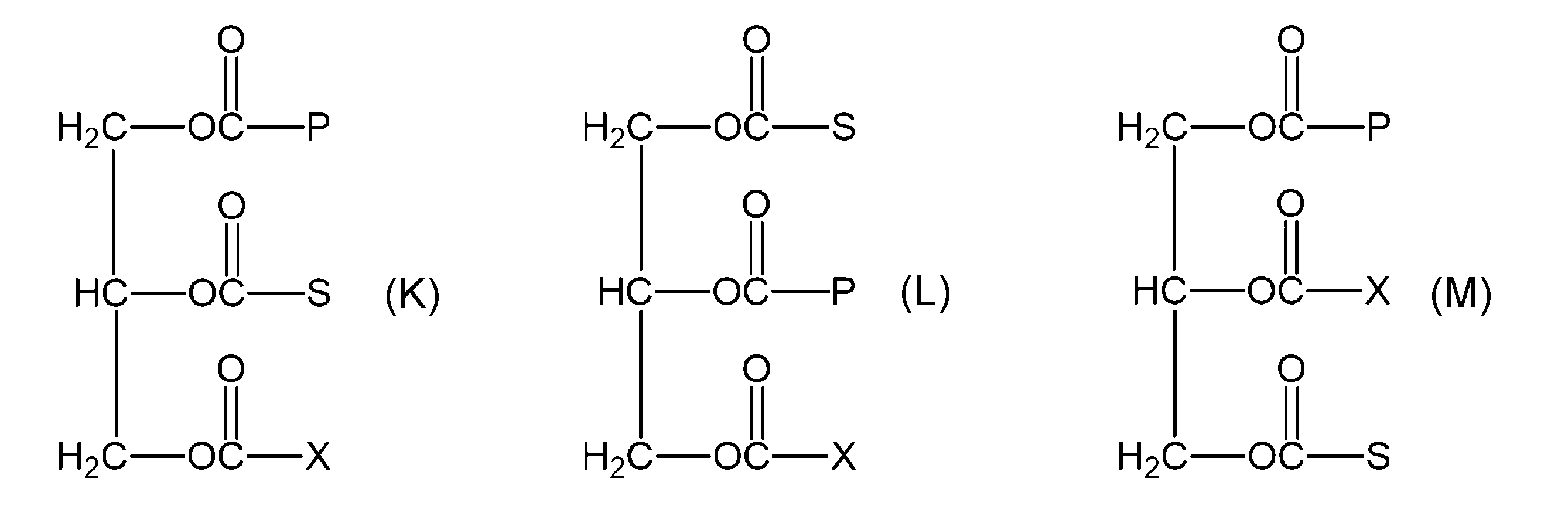
- the combination of aliphatic groups constituting triglyceride is any of SSP, SPP, and SPX.
- the structure of the triglyceride represented by SPX is one of the following (K) to (M). The same applies to SSP and SPP.
- the triglyceride contains at least one group derived from a fatty acid having 16 carbon atoms and at least one group derived from a fatty acid having 18 carbon atoms in one molecule. It may be composed of. Alternatively, the triglyceride may be composed of a triglyceride containing at least one group derived from a fatty acid having 16 carbon atoms and at least one group derived from a fatty acid having 18 carbon atoms, and other glycerides. good.
- triglycerides examples include triglycerides having neither a group derived from a fatty acid having 16 carbon atoms nor a group derived from a fatty acid having 18 carbon atoms in one molecule. From the viewpoint of obtaining a non-woven fabric having a higher barrier property against a liquid, one molecule contains at least one group derived from a fatty acid having 16 carbon atoms and at least one group derived from a fatty acid having 18 carbon atoms. It is preferable to use only triglyceride.
- a combination of (a) and (b) can also be used.
- a combination of triglyceride PPP, triglyceride SSS, and SPX can be used.
- a combination of triglyceride PPP, triglyceride SSS and SSP, or a combination of triglyceride PPP, triglyceride SSS and SPP can also be used.
- a combination of triglyceride PPX, triglyceride SSX and triglyceride SPX a combination of triglyceride PPX, triglyceride SSX and triglyceride SSP, a combination of triglyceride PPX, triglyceride SSX and triglyceride SPP, and triglyceride PXY.
- a combination of triglyceride SXY and triglyceride SPX, a combination of triglyceride PXY, triglyceride SXY and triglyceride SSP, and a combination of triglyceride PXY, triglyceride SXY and triglyceride SPP can also be used.
- the triglyceride used in the present invention does not contain a group derived from an unsaturated fatty acid, so that the non-woven fabric of the present invention has a high barrier property to the liquid. It is preferable from the viewpoint of The absence of groups derived from unsaturated fatty acids includes both cases where no groups are derived from unsaturated fatty acids and cases where a small amount of unsaturated fatty acids is inevitably contained. When a small amount of unsaturated fatty acid is inevitably contained, for example, the ratio of the group derived from the unsaturated fatty acid is based on the total amount of the group derived from the fatty acid contained in all the triglycerides contained in the fiber. This is the case when it is 2% by mass or less.
- the present invention it is possible to adjust the ratio of the group derived from the fatty acid having 16 carbon atoms and the ratio of the group derived from the fatty acid having 18 carbon atoms to all the triglycerides contained in the constituent fibers of the non-woven fabric. It is preferable from the viewpoint of further increasing the barrier property against the liquid.
- the liquid of the nonwoven fabric should be 1% by mass or more based on the total amount of the groups derived from the fatty acid for all the triglycerides contained in the constituent fibers of the nonwoven fabric. It is preferable from the viewpoint of further increasing the barrier property, more preferably 10% by mass or more, further preferably 15% by mass or more, still more preferably 20% by mass or more, and particularly preferably 25% by mass from the viewpoint of further enhancing the barrier property. % Or more.
- the ratio is preferably less than 55% by mass, preferably from the viewpoint of further increasing the barrier property of the nonwoven fabric to the liquid, further preferably 50% by mass or less, still more preferably 45% by mass from the viewpoint of further increasing the barrier property. % Or less.
- the ratio is preferably 1% by mass or more and less than 55% by mass, more preferably 10% by mass or more and less than 55% by mass, further preferably 15% by mass or more and less than 55% by mass, and 20% by mass. It is even more preferably% or more and 50% by mass or less, and particularly preferably 25% by mass or more and 45% by mass or less.
- the liquid of the non-woven fabric should be 5% by mass or more based on the total amount of the groups derived from the fatty acid for all the triglycerides contained in the constituent fibers of the non-woven fabric. It is preferable from the viewpoint of further enhancing the barrier property, more preferably 35% by mass or more, still more preferably 45% by mass or more from the viewpoint of further enhancing the barrier property. Even more preferably, it is 50% by mass or more, and particularly preferably 55% by mass or more.
- the ratio is preferably less than 90% by mass, preferably from the viewpoint of further increasing the barrier property of the nonwoven fabric to the liquid, further preferably 70% by mass or less, still more preferably 65% by mass from the viewpoint of further increasing the barrier property. % Or less.
- the ratio is preferably 5% by mass or more and less than 90% by mass, more preferably 35% by mass or more and less than 90% by mass, further preferably 45% by mass or more and less than 90% by mass, and 50% by mass. It is even more preferably% or more and 70% by mass or less, and even more preferably 55% by mass or more and 65% by mass or less.
- the group derived from the fatty acid having 16 carbon atoms contained in all the triglycerides contained in the fiber is preferable that the mass ratio (C18 / C16) of the group derived from the fatty acid having 18 carbon atoms to the above is 1.0 or more and 15.0 or less from the viewpoint of further enhancing the barrier property of the non-woven fabric to the liquid. From the viewpoint of further enhancing this advantage, the mass ratio (C18 / C16) of the group derived from the fatty acid having 18 carbon atoms to the group derived from the fatty acid having 16 carbon atoms is 1.2 or more. It is more preferably 0 or less, more preferably 1.3 or more and 5.0 or less, and even more preferably 1.3 or more and 2.7 or less.
- the ratio of the group derived from the fatty acid having 16 carbon atoms and the group derived from the fatty acid having 18 carbon atoms is based on the total amount of the fatty acid-derived groups contained in all the triglycerides contained in the fiber. It is measured by the following method.
- a good solvent for triglyceride for example, toluene, is used to extract the triglyceride present on the surface of the fibers constituting the non-woven fabric.
- the ester bond in the extracted triglyceride is hydrolyzed with an alkali, and the methyl esterified fatty acid is quantitatively analyzed by gas chromatography.
- Whether or not an alkyl chain having a different carbon number is present in one molecule of triglyceride can be determined by TOF-MS (time-of-flight mass spectrometry). Specifically, the molecular weight distribution of triglyceride is measured by TOF-MS, and it is determined from the molecular weight of one molecule whether or not an alkyl group having a different carbon number is contained in the molecule. Whether or not an alkyl chain having the same molecular weight and having a different number of carbon atoms exists in one molecule can be determined by a tandem mass spectrometer (MS / MS) as a mass spectrometer. A specific ion is selected in the first mass separation section, and fragment ions generated by collision with the inactivating gas are separated and detected in the second mass separation section for discrimination.
- TOF-MS time-of-flight mass spectrometry
- the triglyceride satisfying (a) and / or the triglyceride satisfying (b) described above is contained in an amount of 1% by mass or more with respect to the fiber containing the triglyceride, thereby providing a barrier property to the liquid of the nonwoven fabric. It is preferable from the viewpoint of further increasing the height, more preferably 5% by mass or more, still more preferably 9% by mass or more from the viewpoint of further increasing the barrier property.
- the ratio of the triglyceride to the fiber containing the triglyceride is preferably 30% by mass or less, preferably from the viewpoint of improving the spinnability and the texture of the non-woven fabric, and more preferably 20% by mass or less.
- the ratio of the triglyceride to the fiber containing triglyceride is preferably 1% by mass or more and less than 30% by mass, more preferably 5% by mass or more and 20% by mass or less, and 9% by mass or more and 15% by mass or less. It is more preferably 9% by mass or more and 14% by mass or less.
- thermoplastic resin constituting the fiber and triglyceride a method of melt-kneading the thermoplastic resin constituting the fiber and triglyceride and kneading the triglyceride into the thermoplastic resin can be mentioned as an example. That is, according to the present invention, there is provided a nonwoven fabric containing fibers obtained by spinning a melt obtained by melt-kneading a thermoplastic resin and triglyceride.
- the method for producing a nonwoven fabric of the present invention is not limited to this method, and the fiber may contain triglyceride by another method.
- the fibers constituting the non-woven fabric preferably have a relaxation time of 10 ⁇ s (microseconds) or more in pulse NMR measured for the fibers. Since the triglyceride easily bleeds out from the inside of the fiber having such a relaxation time, the non-woven fabric containing the fiber has a high barrier property against liquid. In order to improve the bleed-out property, a method of changing the crystallinity is generally used, but on the other hand, it has been confirmed that the bleed-out property is different even if the crystallinity is the same. As a result of diligent studies by the present inventor, it was found that relaxation time is important in addition to the crystallinity as a factor affecting the bleed-out property.
- the relaxation time is more preferably 12 ⁇ s or more, further preferably 15 ⁇ s or more, and even more preferably 20 ⁇ s or more.
- the longer the relaxation time the more the bleed-out of triglyceride is promoted, which is desirable. Therefore, the upper limit of the relaxation time is not limited, but if the relaxation time is as long as about 80 ⁇ s, the desired effect of the present invention can be sufficiently achieved. In the present invention, even if the proportion of the triglyceride contained in the fiber is small, the barrier property of the nonwoven fabric to the liquid can be enhanced, so that the harmful effect due to the bleed-out of the triglyceride is unlikely to occur.
- a random propylene copolymer or a low stereoregular homopolypropylene may be blended and used.
- the crystallinity and the relaxation time of pulse NMR are measured by the methods described in Examples described later.
- the thickness of the fibers constituting the nonwoven fabric of the present invention is preferably 40 ⁇ m or less, more preferably 30 ⁇ m or less, still more preferably 20 ⁇ m or less, from the viewpoint of increasing the barrier property against the liquid of the nonwoven fabric. ..
- the thickness of the fiber shall be the average value (effective number 2 digits) obtained by directly measuring the fiber diameter of 70 randomly selected fibers by collecting a small sample from the non-woven fabric and using a scanning electron microscope. ..
- the texture of the nonwoven fabric of the present invention is preferably 0.2 g / m 2 or more, more preferably 0.6 g / m 2 or more, and 1.0 g, from the viewpoint of increasing the barrier property of the nonwoven fabric against liquid. It is more preferable that it is / m 2 or more.
- the basis weight of the nonwoven fabric is a value obtained by dividing the weight of the nonwoven fabric by the area of the nonwoven fabric. It is preferable to calculate the basis weight using a sample having an area of at least 1 cm 2 or more, and it is possible to measure three or more samples of one type in consideration of the texture of the non-woven fabric and use the average value as the basis weight of the sample. More preferred.
- the nonwoven fabric of the present invention may be composed only of a polyolefin resin and the above-mentioned triglyceride-containing fiber, or may be composed of the fiber and other fibers.
- the nonwoven fabric of the present invention may be composed of a mixed cotton product of the fiber and other fibers, or may be composed of a laminate containing only the fiber and a layer containing only the other fiber. You can also do it.
- a nonwoven fabric can be composed of a laminate of a melt blown layer containing only the fibers and a spunbond layer arranged on each surface of the melt blown layer and containing only the other fibers.
- the nonwoven fabric of the present invention has a melt blown layer and a spunbond layer, and the melt blown layer is from the viewpoint of enhancing the barrier property against the liquid, particularly from the viewpoint of effectively suppressing the exudation of the liquid under pressure.
- the melt blown layer is from the viewpoint of enhancing the barrier property against the liquid, particularly from the viewpoint of effectively suppressing the exudation of the liquid under pressure.
- it is preferably composed of a fiber containing a random propylene copolymer or a low stereoregular homopolypropylene, a homopolypropylene, and the above-mentioned triglyceride.
- the spunbond layer since the spunbond layer has a low degree of contribution to the barrier property, it is not necessary for the constituent fibers to contain the above-mentioned triglyceride, and the spunbond layer may be composed of fibers not containing the triglyceride. good.
- the nonwoven fabric of the present invention is composed of the fibers and other fibers, it is particularly added from the viewpoint of enhancing the barrier property of the nonwoven fabric against liquid regardless of the form of the nonwoven fabric.
- the ratio of the fiber to the nonwoven fabric is preferably 3% by mass or more, more preferably 5% by mass or more, and 10% by mass or more. It is more preferably 50% by mass or less, further preferably 45% by mass or less, and even more preferably 40% by mass or less.
- the nonwoven fabric of the present invention has a high barrier property against liquids, particularly water, it is suitably used for applications requiring waterproofness.
- backsheets for absorbent items such as disposable diapers and menstrual napkins, leakproof sheets such as leg cuffs and wings, waterproof sheets such as rain gear, bandages, wound dressings, medical isolation gowns, surgical gowns, surgical drapes.
- the non-woven fabric of the present invention can be applied to covers, surgical caps and the like.
- the nonwoven fabric of the present invention is used as a leak-proof sheet for an absorbent article, the nonwoven fabric itself may be used as a leak-proof sheet, or the nonwoven fabric may be used in combination with another sheet material.
- the nonwoven fabric of the present invention may be used as, or part of, a filtration medium for various fluids. Further, the nonwoven fabric of the present invention may be used as a filter such as a mask.
- a water repellent composition for resin internal use containing a specific triglyceride is also provided.
- This water repellent composition is kneaded into a molten resin and used to impart water repellency to a molded product molded from the resin.
- This water repellent composition contains triglyceride, and the triglyceride contains the following (a) or (b).
- A A mixture of a triglyceride containing at least a group derived from a fatty acid having 16 carbon atoms in one molecule and a triglyceride containing at least a group derived from a fatty acid having 18 carbon atoms in one molecule.
- B A triglyceride containing at least a group derived from a fatty acid having 16 carbon atoms and a group derived from a fatty acid having 18 carbon atoms in one molecule.
- the water repellent composition of the present invention is contained in a fiber and is used for the purpose of imparting water repellency to the fiber.
- a molded product such as a fiber or a film composed of a resin in which the water repellent composition for resin internal use of the present invention is added
- the water repellent agent present on the surface of the molded product due to scratching or the like. Even if the composition falls off, the water-repellent composition bleeds out from the inside of the molded product to the surface to restore the desired water repellency, so that the water repellency of the surface of the molded product is maintained for a long period of time. be able to.
- the resin constituting the molded product is a polyolefin resin containing a random propylene copolymer or a low stereoregular homopolypropylene and homopolypropylene, particularly when it is a polyolefin resin containing a random propylene copolymer and homopolypropylene. Since the bleed-out of the water-repellent composition occurs more reliably, the water repellency of the molded product is more reliably ensured.
- the water repellent composition of the present invention includes rain gear, bandages, wound dressings, medical isolation gowns, surgical gowns, surgical drapes and covers, surgical gowns, surgical caps, artificial leather, and the like.
- the water-repellent composition of the present invention is preferably for fibers made of a thermoplastic resin having a fiber-forming ability, and particularly preferably for fibers containing a polyolefin resin.
- the polyolefin resin contains a random propylene copolymer or a low stereoregular homopolypropylene and a homopolypropylene, particularly a random propylene copolymer and a homopolypropylene. It is preferable because the out will occur more reliably.
- the details of the triglyceride contained in the water-repellent composition of the present invention are the same as those of the triglyceride contained in the nonwoven fabric of the present invention described above, and the description of the triglyceride contained in the nonwoven fabric is appropriately applied.
- the present invention further discloses the following nonwoven fabrics.
- ⁇ 1> Contains fibers containing a thermoplastic resin capable of forming fibers and triglyceride,
- the thermoplastic resin contains a polyolefin resin and contains
- the triglyceride A mixture of a triglyceride containing at least a group derived from a fatty acid having 16 carbon atoms in one molecule and a triglyceride containing at least a group derived from a fatty acid having 18 carbon atoms in one molecule, or (b) carbon.
- a non-woven fabric comprising a triglyceride containing at least a group derived from a fatty acid having 16 atoms and a group derived from a fatty acid having 18 carbon atoms in one molecule.
- ⁇ 2> The nonwoven fabric according to ⁇ 1>, wherein the triglyceride does not contain a group derived from an unsaturated fatty acid.
- ⁇ 3> The nonwoven fabric according to ⁇ 1> or ⁇ 2>, wherein the triglyceride contains at least a group derived from a fatty acid having 16 carbon atoms and a group derived from a fatty acid having 18 carbon atoms in one molecule.
- ⁇ 4> The non-woven fabric according to ⁇ 3>, wherein the triglyceride contains at least a group derived from a saturated fatty acid having 16 carbon atoms and a group derived from a saturated fatty acid having 18 carbon atoms in one molecule.
- ⁇ 5> Based on the total amount of fatty acid-derived groups contained in all the triglycerides contained in the fiber, the proportion of fatty acid-derived groups having 16 carbon atoms is 1% by mass or more and less than 55% by mass, and carbon.
- ⁇ 6> Based on the total amount of fatty acid-derived groups contained in all the triglycerides contained in the fiber, the proportion of fatty acid-derived groups having 16 carbon atoms is 10% by mass or more and less than 55% by mass, and carbon.
- ⁇ 7> Based on the total amount of fatty acid-derived groups contained in all the triglycerides contained in the fiber, the proportion of fatty acid-derived groups having 16 carbon atoms is 20% by mass or more and 50% by mass or less, and carbon.
- ⁇ 8> Based on the total amount of fatty acid-derived groups contained in all the triglycerides contained in the fiber, the proportion of fatty acid-derived groups having 16 carbon atoms is 25% by mass or more and 45% by mass or less, and carbon.
- the triglyceride (A) Is it composed only of a mixture of a triglyceride containing at least a group derived from a fatty acid having 16 carbon atoms in one molecule and a triglyceride containing at least a group derived from a fatty acid having 18 carbon atoms in one molecule?
- the mass ratio of the group derived from the fatty acid having 18 carbon atoms to the group derived from the fatty acid having 16 carbon atoms contained in all the triglycerides contained in the fiber is 1.3 or more and 5.0 or less.
- ⁇ 12> The nonwoven fabric according to any one of ⁇ 1> to ⁇ 11>, wherein the relaxation time of pulse NMR measured for the fiber is 10 ⁇ s or more.
- ⁇ 13> The nonwoven fabric according to any one of ⁇ 1> to ⁇ 12>, wherein the fiber diameter is 0.1 ⁇ m or more and 40 ⁇ m or less.
- ⁇ 14> The nonwoven fabric according to any one of ⁇ 1> to ⁇ 13>, wherein the basis weight is 0.2 g / m 2 or more and 50 g / m 2 or less.
- ⁇ 15> The nonwoven fabric according to any one of ⁇ 1> to ⁇ 14>, which is a meltblown nonwoven fabric or a composite nonwoven fabric having a meltblown layer.
- the nonwoven fabric comprises at least a spunbond layer and a meltblown layer.
- the mass ratio of the spunbond layer to the total mass of the nonwoven fabric is 50% by mass or more and 95% by mass or less.
- ⁇ 17> The nonwoven fabric according to any one of ⁇ 1> to ⁇ 16>, wherein the polyolefin resin is polypropylene.
- ⁇ 18> The nonwoven fabric according to any one of ⁇ 1> to ⁇ 17>, wherein the triglyceride is contained in an amount of 1% by mass or more and 30% by mass or less with respect to the fiber containing the triglyceride.
- ⁇ 19> The nonwoven fabric according to ⁇ 18>, wherein the triglyceride is contained in an amount of 9% by mass or more and 14% by mass or less based on the fiber containing the triglyceride.
- ⁇ 20> The nonwoven fabric according to any one of ⁇ 1> to ⁇ 19>, wherein the proportion of the fibers containing the triglyceride in the nonwoven fabric is 3% by mass or more.
- the polyolefin resin contains a random propylene copolymer or a low stereoregular homopolypropylene and homopolypropylene.
- the ratio of the random propylene copolymer or the low stereoregular homopolypropylene to the fibers is 5% by mass or more and less than 60% by mass.
- the polyolefin resin comprises a random propylene copolymer or a low stereoregular homopolypropylene and a homopolypropylene. Based on the total amount of fatty acid-derived groups contained in all the triglycerides contained in the fiber, the ratio of the fatty acid-derived groups having 16 carbon atoms is 20% by mass or more and 50% by mass or less, and carbon.
- the polyolefin resin comprises a random propylene copolymer or a low stereoregular homopolypropylene and a homopolypropylene.
- the ratio of the random propylene copolymer or the low stereoregular homopolypropylene to the fibers is 5% by mass or more and less than 60% by mass.
- ⁇ 28> The nonwoven fabric according to ⁇ 26> or ⁇ 27>, wherein the triglyceride is contained in an amount of 9% by mass or more and 14% by mass or less based on the fiber containing the triglyceride.
- ⁇ 29> The nonwoven fabric according to ⁇ 26> or ⁇ 27>, wherein the ratio of the random propylene copolymer or the low stereoregular homopolypropylene to the fibers is 9% by mass or more and less than 30% by mass.
- the polyolefin resin comprises the random propylene copolymer and the homopolypropylene. The ratio of the random propylene copolymer to the fiber is 5% by mass or more and less than 60% by mass.
- the nonwoven fabric according to ⁇ 26> wherein the triglyceride is contained in an amount of 1% by mass or more and 30% by mass or less with respect to the fiber containing the triglyceride.
- ⁇ 31> It has a melt blown layer and a spunbond layer,
- ⁇ 32> The nonwoven fabric according to ⁇ 31>, wherein the melt blown layer is composed of a fiber containing the random propylene copolymer, the homopolypropylene, and the triglyceride.
- ⁇ 33> A non-woven fabric containing fibers obtained by spinning a melt obtained by melt-kneading a thermoplastic resin and triglyceride.
- ⁇ 34> A leak-proof sheet for an absorbent article, comprising the nonwoven fabric according to any one of ⁇ 1> to ⁇ 33>.
- ⁇ 35> An absorbent article comprising the nonwoven fabric according to any one of ⁇ 1> to ⁇ 33>.
- ⁇ 36> A water repellent composition for resin internal use containing triglyceride.
- the triglyceride (A) A mixture of a triglyceride containing at least a group derived from a fatty acid having 16 carbon atoms in one molecule and a triglyceride containing at least a group derived from a fatty acid having 18 carbon atoms in one molecule, or (b) carbon.
- a water repellent composition for internal resin inclusion which comprises a triglyceride containing at least a group derived from a fatty acid having 16 atoms and a group derived from a fatty acid having 18 carbon atoms in one molecule.
- the proportion of the group derived from the fatty acid having 16 carbon atoms is 10% by mass or more and less than 55% by mass, and the fatty acid is derived from 18 carbon atoms.
- the water repellent composition for resin internal use according to any one of ⁇ 36> to ⁇ 40>, which is internally added to a polyolefin resin containing a random propylene copolymer and homopolypropylene.
- ⁇ 42> It is used as a water repellent composition for resin internal use of a composition containing triglyceride.
- the triglyceride (A) A mixture of a triglyceride containing at least a group derived from a fatty acid having 16 carbon atoms in one molecule and a triglyceride containing at least a group derived from a fatty acid having 18 carbon atoms in one molecule, or (b) carbon.
- the above-mentioned use comprising a triglyceride containing at least a group derived from a fatty acid having 16 atoms and a group derived from a fatty acid having 18 carbon atoms in one molecule.
- a triglyceride containing at least a group derived from a fatty acid having 16 atoms and a group derived from a fatty acid having 18 carbon atoms in one molecule.
- ⁇ 45> Based on the total amount of fatty acid-derived groups contained in the triglyceride, the proportion of the group derived from the fatty acid having 16 carbon atoms is 10% by mass or more and less than 55% by mass, and the fatty acid is derived from 18 carbon atoms.
- ⁇ 46> The use according to any one of ⁇ 42> to ⁇ 45>, which is encapsulated in a polyolefin resin containing a random propylene copolymer or a low stereoregular homopolypropylene and the homopolypropylene.
- ⁇ 47> The use according to any one of ⁇ 42> to ⁇ 46>, which is encapsulated in a polyolefin resin containing a random propylene copolymer and homopolypropylene.
- Example 1-1 the water repellency of the water repellent composition containing triglyceride was evaluated by the following method for a film containing triglyceride. The results are shown in Table 1 below.
- the mass ratio of propylene homopolymer manufactured by Lyondelbasel, HP461Y, hereinafter referred to as "homo PP”
- random propylene copolymer manufactured by ExxonMobil, Vistamaxx8880, hereinafter referred to as "random PP”
- homo PP propylene homopolymer
- random propylene copolymer manufactured by ExxonMobil, Vistamaxx8880, hereinafter referred to as "random PP
- Sessile drop method-Evaluation solution Wet tension test solution (Surface tension at 25 ° C: 35.0 mN / m manufactured by Kanto Chemical Co., Inc.) ⁇ Drop volume: 2 ⁇ L The contact angle 10 seconds after the drop was measured at 5 points per sample piece, and the average value of the 5 drops was taken as the contact angle value.
- Example 1-2 Palmitic acid triglyceride and stearic acid triglyceride were used in the mixing ratio shown in Table 1. A film was produced in the same manner as in Example 1-1 except for the above, and its water repellency was evaluated.
- Example 1-3 Palm extremely hydrogenated oil (manufactured by Ueda Oil Co., Ltd.) was used as the triglyceride. A film was produced in the same manner as in Example 1-1 except for the above, and its water repellency was evaluated.
- This triglyceride is a mixture of a plurality of triglycerides, and the carbon number distribution of the group derived from the fatty acid in this triglyceride is as shown in Table 1.
- Example 1-4 Glyceryl tristearate technical grade (manufactured by Sigma-Aldrich) was used as the triglyceride.
- the ratio of the group derived from the fatty acid having 16 carbon atoms and the group derived from the fatty acid having 18 carbon atoms in this triglyceride is as shown in Table 1.
- a film was produced in the same manner as in Example 1-1 except for the above, and its water repellency was evaluated.
- Example 1-5 Hyelsin rapeseed hydrogenated oil (manufactured by Yokoseki Oil & Fat Co., Ltd.) was used as the triglyceride. A film was produced in the same manner as in Example 1-1 except for the above, and its water repellency was evaluated.
- This triglyceride is a mixture of a plurality of triglycerides, and the carbon number distribution of the group derived from the fatty acid in this triglyceride is as shown in Table 1.
- Palmitic acid triglyceride was used as the triglyceride.
- a film was produced in the same manner as in Example 1-1 except for the above, and its water repellency was evaluated.
- Example 2-1 (1) Production of masterbatch Weighed the homo-PP and triglyceride so that the mass ratio was 90/10, put them into a twin-screw extruder (manufactured by Toyo Seiki), and kneaded them to prepare a masterbatch. .. The triglyceride used was the same as that used in Examples 1-3.
- the basis weight of the meltblown non-woven fabric was the value obtained by dividing the average value of the mass measured for 10 measuring pieces of 16 cm ⁇ 16 cm randomly collected from the non-woven fabric by 0.0256.
- the spunbonded nonwoven fabric shown in Table 2 was superposed on each surface of the meltblown nonwoven fabric thus obtained to obtain an SMS nonwoven fabric.
- Example 2-2 to 2-12 Homo PP and random PP were used as the polyolefin resin. The ratios of homo-PP, random PP, and triglyceride were as shown in Tables 2 and 3. As for Example 2-6, the triglyceride used in Example 1-4 was used. For Example 2-7, the triglyceride used in Example 1-5 was used. For Examples 2-8, soybean extremely hydrogenated oil was used as the triglyceride. Except for these, the SMS nonwoven fabric was produced in the same manner as in Example 2-1.
- Example 2-1 Homo PP and random PP were used as the polyolefin resin. No triglycerides were used. The ratios of homo-PP and random PP are as shown in Table 3. Other than that, the SMS nonwoven fabric was produced in the same manner as in Example 2-1.
- the SMS nonwoven fabric obtained in each example has an enhanced barrier property against a liquid having a low surface tension by adding a small amount of triglyceride.
- homo-PP can be obtained by using a combination of homo-PP and random PP as the polyolefin resin constituting the melt-blown nonwoven fabric. It can be seen that the barrier property against a liquid having a low surface tension is enhanced as compared with the case of using it alone.
- a triglyceride having a group content of 20% by mass or more and 50% by mass or less and a group derived from a fatty acid having 18 carbon atoms of 50% by mass or more and 70% by mass or less By blending a triglyceride having a group content of 20% by mass or more and 50% by mass or less and a group derived from a fatty acid having 18 carbon atoms of 50% by mass or more and 70% by mass or less, the barrier property against a liquid having a low surface tension is extremely enhanced. I understand.
- a nonwoven fabric having a higher barrier property against a liquid than before is provided.
Landscapes
- Health & Medical Sciences (AREA)
- Engineering & Computer Science (AREA)
- Textile Engineering (AREA)
- Chemical & Material Sciences (AREA)
- Epidemiology (AREA)
- Life Sciences & Earth Sciences (AREA)
- Animal Behavior & Ethology (AREA)
- General Health & Medical Sciences (AREA)
- Public Health (AREA)
- Veterinary Medicine (AREA)
- Hematology (AREA)
- Materials Engineering (AREA)
- Chemical Kinetics & Catalysis (AREA)
- Vascular Medicine (AREA)
- Heart & Thoracic Surgery (AREA)
- Biomedical Technology (AREA)
- Dermatology (AREA)
- General Chemical & Material Sciences (AREA)
- Oil, Petroleum & Natural Gas (AREA)
- Nonwoven Fabrics (AREA)
- Absorbent Articles And Supports Therefor (AREA)
- Artificial Filaments (AREA)
Abstract
Description
前記熱可塑性樹脂がポリオレフィン樹脂を含むことが好ましい。
前記トリグリセリドが、
(a)炭素原子数16の脂肪酸に由来する基を一分子内に少なくとも含むトリグリセリドと、炭素原子数18の脂肪酸に由来する基を一分子内に少なくとも含むトリグリセリドとの混合物、又は
(b)炭素原子数16の脂肪酸に由来する基及び炭素原子数18の脂肪酸に由来する基を一分子内に少なくとも含むトリグリセリド、を含むことが好ましい。
前記トリグリセリドが、
(a)炭素原子数16の脂肪酸に由来する基を一分子内に少なくとも含むトリグリセリドと、炭素原子数18の脂肪酸に由来する基を一分子内に少なくとも含むトリグリセリドとの混合物、又は
(b)炭素原子数16の脂肪酸に由来する基及び炭素原子数18の脂肪酸に由来する基を一分子内に少なくとも含むトリグリセリド、を含むことが好ましい。
一方、不織布の全質量に対するメルトブローン層の質量比率は5質量%以上 50質量%以下であることが、液体に対するバリア性の向上の点から好ましい。この利点を一層顕著なものとする観点から、不織布の全質量に対するメルトブローン層の質量比率は10質量%以上50質量%以下であることが更に好ましく、15質量%以上50質量%以下であることが一層好ましい。
ポリエチレンとしては、高密度ポリエチレン、低密度ポリエチレン及び直鎖状低密度ポリエチレンなどが挙げられる。
ポリプロピレンとしては、アイソタクチックポリプロピレン及びシンジオタクチックポリプロピレンなどが挙げられる。またポリプロピレンとして、低立体規則性ホモポリプロピレンを用いることもできる。低立体規則性ホモポリプロピレンは、立体規則性の指標である、13C-NMRで測定されるメソペンタッド分率(mmmm[%])が90%以下であるホモポリプロピレンのことである。
エチレン-αオレフィン共重合体としては、プロピレン、1-ブテン、1-ペンテン及び1-ヘキセン等のαオレフィンと、エチレンとの共重合体が挙げられる。共重合体の態様としては、ランダム共重合体、ブロック共重合体及びグラフト共重合体などが挙げられる。特にエチレンとプロピレンとのランダムコポリマー(以下「ランダムプロピレンコポリマー」ともいう。)を用いることが好ましい。
ランダムプロピレンコポリマーにおけるエチレンの割合は、不織布の液体に対するバリア性を高くする観点から、2質量%以上70質量%以下であることが好ましく、4質量%以上60質量%以下であることが更に好ましく、6質量%以上50質量%以下であることが一層好ましい。
これらのポリオレフィン樹脂のうち、繊維形成能の高さや、得られる不織布の液体に対するバリア性の高さの観点から、ポリプロピレン、及びプロピレンを共重合成分として含むポリオレフィンを用いることが好ましい。
また、ポリオレフィン樹脂は、ランダムプロピレンコポリマー又は低立体規則性ホモポリプロピレンと、低立体規則性ホモポリプロピレン以外のホモポリプロピレンとのブレンド物であることも好ましい(以下、特に断らない限り、低立体規則性ホモポリプロピレン以外のホモポリプロピレンのことを単に「ホモポリプロピレン」という。)。特に、不織布の液体に対するバリア性の高さの観点から、ポリオレフィン樹脂は、ランダムプロピレンコポリマーと、ホモポリプロピレンとのブレンド物であることが好ましい。
ランダムプロピレンコポリマー又は低立体規則性ホモポリプロピレンの割合は、本発明の不織布を構成する繊維(本発明の不織布が、後述するとおりメルトブローン不織布を有する場合には、該メルトブローン不織布を構成する繊維)に対して5質量%以上であることが、不織布の液体に対するバリア性を一層高くする観点から好ましく、バリア性を更に一層高くする観点から更に好ましくは7質量%以上、一層好ましくは9質量%以上、更に一層好ましくは15質量%以上である。
また前記割合は、60質量%未満であることが、繊維の紡糸性を高める観点から好ましく、紡糸性を更に一層高める観点から更に好ましくは45質量%以下、一層好ましくは30質量%以下である。
本発明の不織布を構成する繊維は、その構成樹脂として、上述したポリオレフィン樹脂のみを含んでいてもよく、あるいはポリオレフィン樹脂に加えて他の熱可塑性樹脂を含んでいてもよい。後者の場合、繊維の構成樹脂として、上述したポリオレフィン樹脂を50質量%以上含むことが好ましい。
トリグリセリドは、1種のみを用いてもよく、あるいは複数種のトリグリセリドの混合物として用いてもよい。
本発明の不織布を構成する繊維には、グリセリドとしてトリグリセリドのみが含まれていてもよく、あるいは本発明の所期の効果が奏される範囲においてトリグリセリドに加えてモノグリセリド及び/又はジグリセリドが含まれていてもよい。尤も、本発明の不織布の液体に対するバリア性を高くする観点からは、グリセリドとしてトリグリセリドのみを用いることが好ましい。
(a)炭素原子数16の脂肪酸に由来する基を一分子内に少なくとも含むトリグリセリドと、炭素原子数18の脂肪酸に由来する基を一分子内に少なくとも含むトリグリセリドとの混合物を含むトリグリセリド。
(b)炭素原子数16の脂肪酸に由来する基及び炭素原子数18の脂肪酸に由来する基を一分子内に少なくとも含むトリグリセリドを含むトリグリセリド。
なお、トリグリセリドP及びトリグリセリドPPにおける残りの脂肪酸残基の種類に特に制限はなく、例えば炭素数12以上24以下の飽和脂肪酸又は不飽和脂肪酸の残基であり得る。
トリグリセリド16は、トリグリセリドP、トリグリセリドPP及びトリグリセリドPPPから選択される2種以上の組み合わせであってもよい。例えばトリグリセリド16は、トリグリセリドPとトリグリセリドPPとの組み合わせ、トリグリセリドPとトリグリセリドPPPとの組み合わせ、トリグリセリドPPとトリグリセリドPPPとの組み合わせ、あるいはトリグリセリドPと、トリグリセリドPPとトリグリセリドPPPとの組み合わせであり得る。
なお、トリグリセリドS及びトリグリセリドSSにおける残りの脂肪酸残基の種類に特に制限はなく、例えば炭素数12以上24以下の飽和脂肪酸又は不飽和脂肪酸の残基であり得る。
トリグリセリド18は、トリグリセリドS、トリグリセリドSS及びトリグリセリドSSSから選択される2種以上の組み合わせであってもよい。例えばトリグリセリド18は、トリグリセリドSとトリグリセリドSSとの組み合わせ、トリグリセリドSとトリグリセリドSSSとの組み合わせ、トリグリセリドSSとトリグリセリドSSSとの組み合わせ、あるいはトリグリセリドSと、トリグリセリドSSとトリグリセリドSSSとの組み合わせであり得る。


また前記割合は、55質量%未満であることが、不織布の液体に対するバリア性を一層高くする観点から好ましく、バリア性を更に一層高くする観点から更に好ましくは50質量%以下、一層好ましくは45質量%以下である。
前記割合は、1質量%以上55質量%未満であることが好ましく、10質量%以上55質量%未満であることが更に好ましく、15質量%以上55量%未満であることが更に好ましく、20質量%以上50質量%以下であることが更に一層好ましく、25質量%以上45質量%以下であることが特に好ましい。
また前記割合は、90質量%未満であることが、不織布の液体に対するバリア性を一層高くする観点から好ましく、バリア性を更に一層高くする観点から更に好ましくは70質量%以下、一層好ましくは65質量%以下である。
前記割合は、5質量%以上90質量%未満であることが好ましく、35質量%以上90質量%未満であることが更に好ましく、45質量%以上90質量%未満であることが一層好ましく、50質量%以上70質量%以下であることが更に一層好ましく、55質量%以上65質量%以下であることが一層好ましい。
トリグリセリドの良溶媒、例えばトルエンを用いて不織布を構成する繊維の表面に存在するトリグリセリドを抽出する。
抽出されたトリグリセリドにおけるエステル結合をアルカリで加水分解させ、メチルエステル化した脂肪酸をガスクロマトグラフィーで定量分析する。
トリグリセリドを含有する繊維に対する前記トリグリセリドの割合は、30質量%以下であることが、紡糸性を良好にする観点及び不織布の地合いを良好にする観点から好ましく、更に好ましくは20質量%以下、一層好ましくは15質量%以下であり、更に一層好ましくは14質量%以下である。
トリグリセリドを含有する繊維に対する前記トリグリセリドの割合は、1質量%以上30質量%未満であることが好ましく、5質量%以上20質量%以下であることが更に好ましく、9質量%以上15質量%以下であることが一層好ましく、9質量%以上14質量%以下であることが更に一層好ましい。
なお本発明においては繊維にトリグリセリドを含有させる割合が少なくても、液体に対する不織布のバリア性を高くできるので、トリグリセリドがブリードアウトすることによる弊害は生じにくい。
パルスNMRの緩和時間を上述した範囲に設定するには、例えばランダムプロピレンコポリマーや低立体規則性ホモポリプロピレンをブレンドして使用すればよい。
結晶化度、及びパルスNMRの緩和時間は、後述する実施例に記載の方法で測定される。
繊維は細いほど液体に対するバリア性が高くなるが、不織布の製造が困難になったり、不織布の製造効率が低下したりする場合があることから、現実的な下限値は0.1μm以上であることが好ましく、0.3μm以上であることが更に好ましく、0.5μm以上であることが一層好ましい。
繊維の太さは、不織布から小片サンプルを採取し、走査型電子顕微鏡を用いて、無作為に選出した70本の繊維を対象として繊維径を直接測定した平均値(有効数字2桁)とする。
目付はその値が大きいほど液体に対するバリア性が高くなるが、風合いが低下したり、あるいは経済性が低下したりする場合があることから、現実的な上限値は50g/m2以下であることが好ましく、35g/m2以下であることが更に好ましく、20g/m2以下であることが一層好ましい。
不織布の目付は、不織布の重量を不織布の面積で除した値である。少なくとも1cm2以上の面積を持つサンプルを用いて目付を算出することが好ましく、不織布の地合いも考慮して、1種類のサンプルを3個以上測定し、平均値をそのサンプルの目付とすることがより好ましい。
特に本発明の不織布は、メルトブローン層とスパンボンド層とを有し、液体に対するバリア性を高める観点、特に、加圧状態での液体の滲み出しが効果的に抑制される観点から、該メルトブローン層が、ランダムプロピレンコポリマー又は低立体規則性ホモポリプロピレンと、ホモポリプロピレンと、上述のトリグリセリドとを含む繊維から構成されることが好ましい。一方、該スパンボンド層はバリア性に寄与する程度が低いことから、その構成繊維が上述のトリグリセリドを含むことを要せず、該スパンボンド層は該トリグリセリドを含まない繊維から構成されていてもよい。
本発明の不織布が当該繊維及びそれ以外の繊維を含んで構成されている場合には、該不織布の形態がどのようなものであっても、液体に対する不織布のバリア性を高める観点から、特に加圧状態での液体の滲み出し防止性を高める観点から、不織布に占める当該繊維の割合は3質量%以上であることが好ましく、5質量%以上であることが更に好ましく、10質量%以上であることが一層好ましく、また50質量%以下であることが好ましく、45質量%以下であることが更に好ましく、40質量%以下であることが一層好ましい。
本発明の不織布を吸収性物品用の防漏シートとして用いる場合には、該不織布そのものを防漏シートとして用いてもよく、あるいは該不織布を他のシート材料と組み合わせて用いてもよい。
ある実施形態では、本発明の不織布を、種々の流体を対象としたろ過媒体、又はその一部として用いてもよい。また本発明の不織布を、マスクなどのフィルタとして用いてもよい。
(a)炭素原子数16の脂肪酸に由来する基を一分子内に少なくとも含むトリグリセリドと、炭素原子数18の脂肪酸に由来する基を一分子内に少なくとも含むトリグリセリドとの混合物。
(b)炭素原子数16の脂肪酸に由来する基及び炭素原子数18の脂肪酸に由来する基を一分子内に少なくとも含むトリグリセリド。
詳細には、本発明の樹脂内添用撥水剤組成物が内添された樹脂から構成される繊維やフィルムなどの成形体においては、擦過等で該成形体の表面に存在する撥水剤組成物が脱落した場合でも、該撥水剤組成物が成形体の内部から表面へブリードアウトすることで、所望の撥水性が回復することから、該成形体表面の撥水性を長期間持続させることができる。特に、成形体を構成する樹脂が、ランダムプロピレンコポリマー又は低立体規則性ホモポリプロピレンと、ホモポリプロピレンとを含むポリオレフィン樹脂である場合、とりわけランダムプロピレンコポリマーと、ホモポリプロピレンとを含むポリオレフィン樹脂である場合には、前記撥水剤組成物のブリードアウトが一層確実に生じるので、該成形体の撥水性が一層確実に担保される。
また、本発明の撥水剤組成物は、別の実施形態として、雨具、包帯、創傷被覆材、医療用隔離ガウン、手術用ガウン、手術用ドレープ及びカバー、手術着、手術帽、人工皮革、合成皮革、スエード、傘、テント、アウトドアウエアなどを構成する樹脂に内添され、これらに撥水性を付与する目的で用いられる。
特に、本発明の撥水剤組成物は、繊維形成能を有する熱可塑性樹脂からなる繊維用であることが好ましく、とりわけ前記熱可塑性樹脂がポリオレフィン樹脂を含む繊維用であることが好ましい。特に、ポリオレフィン樹脂がランダムプロピレンコポリマー又は低立体規則性ホモポリプロピレンと、ホモポリプロピレンとを含むこと、とりわけランダムプロピレンコポリマーと、ホモポリプロピレンとを含むことが、上述のとおり、該撥水剤組成物のブリードアウトが一層確実に生じるので好ましい。
なお、本発明の撥水剤組成物に含まれるトリグリセリドの詳細については、上述した本発明の不織布に含まれるトリグリセリドと同様であり、該不織布に含まれるトリグリセリドについての説明が適宜適用される。
<1>
繊維形成能を有する熱可塑性樹脂とトリグリセリドとを含有する繊維を含み、
前記熱可塑性樹脂がポリオレフィン樹脂を含み、
前記トリグリセリドが、
(a)炭素原子数16の脂肪酸に由来する基を一分子内に少なくとも含むトリグリセリドと、炭素原子数18の脂肪酸に由来する基を一分子内に少なくとも含むトリグリセリドとの混合物、又は
(b)炭素原子数16の脂肪酸に由来する基及び炭素原子数18の脂肪酸に由来する基を一分子内に少なくとも含むトリグリセリド、を含む、不織布。
前記トリグリセリドが不飽和脂肪酸に由来する基を含まない、前記<1>に記載の不織布。
<3>
前記トリグリセリドが、炭素原子数16の脂肪酸に由来する基及び炭素原子数18の脂肪酸に由来する基を一分子内に少なくとも含むものである、前記<1>又は<2>に記載の不織布。
<4>
前記トリグリセリドが、炭素原子数16の飽和脂肪酸に由来する基及び炭素原子数18の飽和脂肪酸に由来する基を一分子内に少なくとも含むものである、前記<3>に記載の不織布。
<5>
前記繊維に含有されるすべての前記トリグリセリドに含まれる、脂肪酸に由来する基の総量を基準として、炭素原子数16の脂肪酸に由来する基の割合が1質量%以上55質量%未満であり、炭素原子数18の脂肪酸に由来する基の割合が5質量%以上90質量%未満である、前記<1>ないし<4>のいずれか一に記載の不織布。
<6>
前記繊維に含有されるすべての前記トリグリセリドに含まれる、脂肪酸に由来する基の総量を基準として、炭素原子数16の脂肪酸に由来する基の割合が10質量%以上55質量%未満であり、炭素原子数18の脂肪酸に由来する基の割合が45質量%以上90質量%未満である、前記<1>ないし<5>のいずれか一に記載の不織布。
前記繊維に含有されるすべての前記トリグリセリドに含まれる、脂肪酸に由来する基の総量を基準として、炭素原子数16の脂肪酸に由来する基の割合が20質量%以上50質量%以下であり、炭素原子数18の脂肪酸に由来する基の割合が50質量%以上70質量%以下である、前記<1>ないし<6>のいずれか一に記載の不織布。
<8>
前記繊維に含有されるすべての前記トリグリセリドに含まれる、脂肪酸に由来する基の総量を基準として、炭素原子数16の脂肪酸に由来する基の割合が25質量%以上45質量%以下であり、炭素原子数18の脂肪酸に由来する基の割合が55質量%以上65質量%以下である、前記<1>ないし<7>のいずれか一に記載の不織布。
<9>
前記トリグリセリドが、
(a)炭素原子数16の脂肪酸に由来する基を一分子内に少なくとも含むトリグリセリドと、炭素原子数18の脂肪酸に由来する基を一分子内に少なくとも含むトリグリセリドとの混合物のみから構成されているか、又は
(b)炭素原子数16の脂肪酸に由来する基及び炭素原子数18の脂肪酸に由来する基を一分子内に少なくとも含むトリグリセリドのみから構成されている、前記<1>ないし<8>のいずれか一に記載の不織布。
<10>
前記繊維に含有されるすべての前記トリグリセリドに含まれる、炭素原子数16の脂肪酸に由来する基に対する、炭素原子数18の脂肪酸に由来する基の質量比率が1.0以上15.0以下である、前記<1>ないし<9>のいずれか一に記載の不織布。
<11>
前記繊維に含有されるすべての前記トリグリセリドに含まれる、炭素原子数16の脂肪酸に由来する基に対する、炭素原子数18の脂肪酸に由来する基の質量比率が1.3以上5.0以下である、前記<1>ないし<10>のいずれか一に記載の不織布。
前記繊維を対象として測定されたパルスNMRの緩和時間が10μs以上である、前記<1>ないし<11>のいずれか一に記載の不織布。
<13>
前記繊維の繊維径が0.1μm以上40μm以下である、前記<1>ないし<12>のいずれか一に記載の不織布。
<14>
目付が0.2g/m2以上50g/m2以下である、前記<1>ないし<13>のいずれか一に記載の不織布。
<15>
メルトブローン不織布又はメルトブローン層を有する複合不織布である、前記<1>ないし<14>のいずれか一に記載の不織布。
<16>
前記不織布が、少なくともスパンボンド層とメルトブローン層とを含み、
前記不織布の全質量に対する前記スパンボンド層の質量比率が50質量%以上95質量%以下であり、
前記不織布の全質量に対する前記メルトブローン層の質量比率が5質量%以上50質量%以下である、前記<1>ないし<15>のいずれか一に記載の不織布。
前記ポリオレフィン樹脂がポリプロピレンである前記<1>ないし<16>のいずれか一に記載の不織布。
<18>
前記トリグリセリドは、該トリグリセリドを含む繊維に対して1質量%以上30質量%以下含まれる、前記<1>ないし<17>のいずれか一に記載の不織布。
<19>
前記トリグリセリドは、該トリグリセリドを含む繊維に対して9質量%以上14質量%以下含まれる、前記<18>に記載の不織布。
<20>
前記不織布に占める前記トリグリセリドを含む繊維の割合が3質量%以上である、前記<1>ないし<19>のいずれか一に記載の不織布。
<21>
前記ポリオレフィン樹脂が、ランダムプロピレンコポリマー又は低立体規則性ホモポリプロピレンと、ホモポリプロピレンとを含む、前記<1>ないし<20>のいずれか一に記載の不織布。
<22>
前記繊維に対する前記ランダムプロピレンコポリマー又は前記低立体規則性ホモポリプロピレンの割合が5質量%以上60質量%未満である、前記<21>に記載の不織布。
<23>
前記繊維に対する前記ランダムプロピレンコポリマー又は前記低立体規則性ホモポリプロピレンの割合が9質量%以上30質量%未満である、前記<22>に記載の不織布。
<24>
メルトブローン層とスパンボンド層とを有し、
前記メルトブローン層が、ランダムプロピレンコポリマー又は低立体規則性ホモポリプロピレンと、ホモポリプロピレンと、前記トリグリセリドとを含む繊維から構成される、前記<1>ないし<23>のいずれか一に記載の不織布。
<25>
前記ポリオレフィン樹脂が、ランダムプロピレンコポリマー又は低立体規則性ホモポリプロピレンと、ホモポリプロピレンとを含み、
前記繊維に含有されるすべての前記トリグリセリドに含まれる、脂肪酸に由来する基の総量を基準として、炭素原子数16の脂肪酸に由来する基の割合が20質量%以上50質量%以下であり、炭素原子数18の脂肪酸に由来する基の割合が50質量%以上70質量%以下である、前記<1>に記載の不織布。
<26>
前記ポリオレフィン樹脂が、ランダムプロピレンコポリマー又は低立体規則性ホモポリプロピレンと、ホモポリプロピレンとを含み、
前記トリグリセリドがパーム極度硬化油である、前記<1>に記載の不織布。
<27>
前記繊維に対する前記ランダムプロピレンコポリマー又は前記低立体規則性ホモポリプロピレンの割合が5質量%以上60質量%未満であり、
前記トリグリセリドは、該トリグリセリドを含む繊維に対して1質量%以上30質量%以下含まれる、前記<26>に記載の不織布。
<28>
前記トリグリセリドは、該トリグリセリドを含む繊維に対して9質量%以上14質量%以下含まれる、前記<26>又は<27>に記載の不織布。
<29>
前記繊維に対する前記ランダムプロピレンコポリマー又は前記低立体規則性ホモポリプロピレンの割合が9質量%以上30質量%未満である、前記<26>又は<27>に記載の不織布。
<30>
前記ポリオレフィン樹脂が、前記ランダムプロピレンコポリマーと、前記ホモポリプロピレンとを含み、
前記繊維に対する前記ランダムプロピレンコポリマーの割合が5質量%以上60質量%未満であり、
前記トリグリセリドは、該トリグリセリドを含む繊維に対して1質量%以上30質量%以下含まれる、前記<26>に記載の不織布。
<31>
メルトブローン層とスパンボンド層とを有し、
前記メルトブローン層が、前記ランダムプロピレンコポリマー又は前記低立体規則性ホモポリプロピレンと、前記ホモポリプロピレンと、前記トリグリセリドとを含む繊維から構成される、前記<28>又は<29>に記載の不織布。
<32>
前記メルトブローン層が、前記ランダムプロピレンコポリマーと、前記ホモポリプロピレンと、前記トリグリセリドとを含む繊維から構成される、前記<31>に記載の不織布。
<33>
熱可塑性樹脂とトリグリセリドとを溶融混練してなる溶融物を紡糸して得られた繊維を含む不織布。
<34>
前記<1>ないし<33>のいずれか一項に記載の不織布を含んでなる、吸収性物品用の防漏シート。
前記<1>ないし<33>のいずれか一に記載の不織布を含んでなる、吸収性物品。
<36>
トリグリセリドを含有する樹脂内添用撥水剤組成物であって、
前記トリグリセリドが、
(a)炭素原子数16の脂肪酸に由来する基を一分子内に少なくとも含むトリグリセリドと、炭素原子数18の脂肪酸に由来する基を一分子内に少なくとも含むトリグリセリドとの混合物、又は
(b)炭素原子数16の脂肪酸に由来する基及び炭素原子数18の脂肪酸に由来する基を一分子内に少なくとも含むトリグリセリド、を含む、樹脂内添用撥水剤組成物。
<37>
前記トリグリセリドが不飽和脂肪酸に由来する基を含まない、前記<36>に記載の樹脂内添用撥水剤組成物。
<38>
前記トリグリセリドが、炭素原子数16の脂肪酸に由来する基及び炭素原子数18の脂肪酸に由来する基を一分子内に少なくとも含むものである、前記<36>又は<37>に記載の樹脂内添用撥水剤組成物。
<39>
前記トリグリセリドに含まれる、脂肪酸に由来する基の総量を基準として、炭素原子数16の脂肪酸に由来する基の割合が10質量%以上55質量%未満であり、炭素原子数18の脂肪酸に由来する基の割合が45質量%以上90質量%未満である、前記<36>ないし<38>のいずれか一に記載の樹脂内添用撥水剤組成物。
<40>
ランダムプロピレンコポリマー又は低立体規則性ホモポリプロピレンと、ホモポリプロピレンとを含むポリオレフィン樹脂に内添される、前記<36>ないし<39>のいずれか一に記載の樹脂内添用撥水剤組成物。
<41>
ランダムプロピレンコポリマーと、ホモポリプロピレンとを含むポリオレフィン樹脂に内添される、前記<36>ないし<40>のいずれか一に記載の樹脂内添用撥水剤組成物。
<42>
トリグリセリドを含有する組成物の樹脂内添用撥水剤組成物としての使用であって、
前記トリグリセリドが、
(a)炭素原子数16の脂肪酸に由来する基を一分子内に少なくとも含むトリグリセリドと、炭素原子数18の脂肪酸に由来する基を一分子内に少なくとも含むトリグリセリドとの混合物、又は
(b)炭素原子数16の脂肪酸に由来する基及び炭素原子数18の脂肪酸に由来する基を一分子内に少なくとも含むトリグリセリド、を含む、前記使用。
<43>
前記トリグリセリドが不飽和脂肪酸に由来する基を含まない、前記<42>に記載の使用。
<44>
前記トリグリセリドが、炭素原子数16の脂肪酸に由来する基及び炭素原子数18の脂肪酸に由来する基を一分子内に少なくとも含むものである、前記<42>又は<43>に記載の使用。
<45>
前記トリグリセリドに含まれる、脂肪酸に由来する基の総量を基準として、炭素原子数16の脂肪酸に由来する基の割合が10質量%以上55質量%未満であり、炭素原子数18の脂肪酸に由来する基の割合が45質量%以上90質量%未満である、前記<42>ないし<44>のいずれか一に記載の使用。
<46>
ランダムプロピレンコポリマー又は低立体規則性ホモポリプロピレンと、ホモポリプロピレンとを含むポリオレフィン樹脂に内添される、前記<42>ないし<45>のいずれか一に記載の使用。
<47>
ランダムプロピレンコポリマーと、ホモポリプロピレンとを含むポリオレフィン樹脂に内添される、前記<42>ないし<46>のいずれか一に記載の使用。
本実施例では、トリグリセリドを含有する撥水剤組成物の撥水性を、トリグリセリドを含むフィルムを対象として、以下の方法で評価した。その結果を以下の表1に示す。
(1)樹脂の製造
プロピレンのホモポリマー(Lyondelbasel製、HP461Y、以下「ホモPP」という。)と、ランダムプロピレンコポリマー(Exxonmobil製、Vistamaxx8880、以下「ランダムPP」という。)と、トリグリセリドの質量比が63/27/10となるようにこれらを計量し、ラボプラストミル(東洋精機製)に投入し、180℃、30rpmで10分間混練した。混練後、樹脂塊を回収した。なお、ランダムPPにおけるエチレンの割合は8%であった。
使用したトリグリセリドは、パルミチン酸トリグリセリドと、ステアリン酸トリグリセリドとの混合物であった。混合比は以下の表1に示すとおりとした。
(2)フィルムの製造
ラボプレス(東洋精機製)にて、樹脂塊を180℃、100kgfで1分間プレスした後、更に常温、100kgfで冷却プレスを1分間行い、フィルムを作製した。0.5mmのスペーサーを入れることで、フィルム厚みを0.5mmに調整した。
(3)撥水性の評価
作製したフィルムをトルエン溶液50mLに浸した後、フィルム表面をティッシュペーパーで拭き取り、洗浄した。洗浄後のフィルムを電気乾燥機に入れ、40℃で7日間保管した。保管後、フィルム表面の接触角を接触角計(Drop Master500、協和界面科学製)を用いて測定した。
・測定法:液滴法
・評価液:ぬれ張力試験液(25℃の表面張力:35.0mN/m関東化学製)
・液滴量:2μL
・着滴10秒後の接触角を、試料片1枚につき5箇所で測定し、5滴の平均値を接触角値とした。
パルミチン酸トリグリセリドと、ステアリン酸トリグリセリドとを、表1に示す混合比で用いた。それ以外は実施例1-1と同様にしてフィルムを製造し、その撥水性を評価した。
トリグリセリドとしてパーム極度硬化油(植田製油株式会社製)を使用した。それ以外は実施例1-1と同様にしてフィルムを製造し、その撥水性を評価した。このトリグリセリドは複数のトリグリセリドの混合物であり、このトリグリセリドにおける脂肪酸に由来する基の炭素数分布は表1に示すとおりであった。
トリグリセリドとしてトリステアリン酸グリセリル テクニカルグレード(シグマアルドリッチ製)を使用した。このトリグリセリドにおける炭素原子数16の脂肪酸に由来する基、及び、炭素原子数18の脂肪酸に由来する基の割合は、表1に示すとおりであった。それ以外は実施例1-1と同様にしてフィルムを製造し、その撥水性を評価した。
トリグリセリドとしてハイエルシン菜種硬化油(横関油脂株式会社製)を使用した。それ以外は実施例1-1と同様にしてフィルムを製造し、その撥水性を評価した。このトリグリセリドは複数のトリグリセリドの混合物であり、このトリグリセリドにおける脂肪酸に由来する基の炭素数分布は表1に示すとおりであった。
トリグリセリドとしてパルミチン酸トリグリセリドを使用した。それ以外は実施例1-1と同様にしてフィルムを製造し、その撥水性を評価した。
トリグリセリドとしてステアリン酸トリグリセリドを使用した。それ以外は実施例1-1と同様にしてフィルムを製造し、その撥水性を評価した。
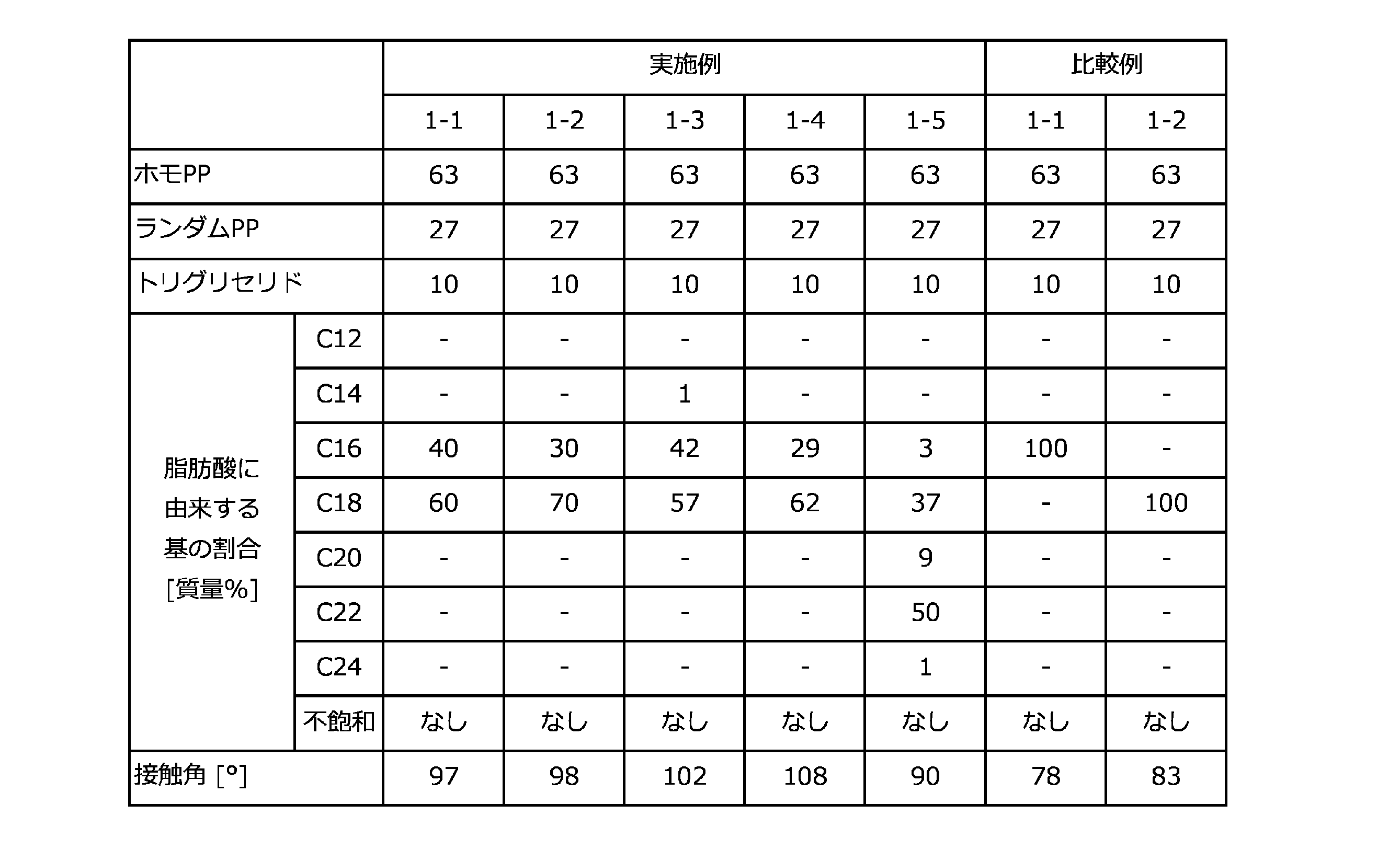
(1)マスターバッチの製造
ホモPPと、トリグリセリドとの質量比が90/10となるようにこれらを計量し、二軸押出機(東洋精機製)に投入して混練し、マスターバッチを作製した。
使用したトリグリセリドは、実施例1-3で用いたものと同様とした。
(2)メルトブローン不織布の製造
得られたマスターバッチを原料に、メルトブローン不織布を製造した。
得られたメルトブローン不織布の目付及び構成繊維の繊維径は表2に示すとおりであった。
メルトブローン不織布の目付は、該不織布から無作為に採取した16cm×16cmの測定片10枚を対象として測定された質量の平均値を0.0256で除した値とした。
このようにして得られたメルトブローン不織布の各面に、表2に示すスパンボンド不織布を重ね合わせ、SMS不織布を得た。
ポリオレフィン樹脂としてホモPP及びランダムPPを用いた。ホモPPと、ランダムPPと、トリグリセリドとの割合は表2及び表3に示すとおりとした。
実施例2-6についてはトリグリセリドとして実施例1-4で使用したものを用いた。
実施例2-7についてはトリグリセリドとして実施例1-5で使用したものを用いた。
実施例2-8についてはトリグリセリドとして大豆極度硬化油を用いた。
これら以外は実施例2-1と同様にしてSMS不織布を製造した。
ポリオレフィン樹脂としてホモPP及びランダムPPを用いた。トリグリセリドは用いなかった。ホモPPと、ランダムPPとの割合は表3に示すとおりとした。それ以外は実施例2-1と同様にしてSMS不織布を製造した。
実施例2-1、2-4、2-6及び2-7並びに比較例2-1で得られたSMS不織布のメルトブローン層について、パルスNMRの緩和時間を以下の方法で測定した。その結果を以下の表2に示す。
・使用装置:Brukar製 the minispec mq20
・測定法:Solid-echo法
・90°パルス幅:2.1マイクロ秒
・繰り返し時間:1秒
・積算回数32回
・測定温度:30℃
・解析方法:非線形最小二乗法
試料を試料管に充填し、1HのT2緩和時間を測定した。試料を測定して得られた1つの緩和時間ピークに対して、緩和時間が異なる成分を波形分離して、緩和時間が短い成分(S)と長い成分(L)の2成分に分けて検出し、それぞれの成分のプロトン割合H(S)[%]、H(L)[%]及び、緩和時間T2(S)、T2(L)を求めた。測定は4回繰り返し、それらの平均値を測定結果とした。測定した2成分のプロトン割合及び緩和時間を用いて、以下の式により、各試料の緩和時間とした。
緩和時間[マイクロ秒]={<H(S)÷100>×T2(S)}+{<H(L)÷100>×T2(L)}
実施例及び比較例で得られたSMS不織布について、液の染み出しの程度を以下の方法で評価した。その結果を以下の表2及び表3に示す。
ろ紙(アドバンテック東洋株式会社製、No.2、直径70mm)の上に、SMS不織布を8cm×8cmに裁断したものを載置した。載置した不織布の上に、乾式パルプシート(ライオン株式会社製、リードヘルシークッキングペーパーダブル(商品名)、目付40g/m2)を8cm×8cmに裁断したものを載置した。
乾式パルプシートの中央部に、1gのぬれ張力試験液(25℃における表面張力:35.0mN/m)をスポイトによって注入した。注入後、直径60mmのアクリルプレートを重ね、その上に錘を載置して7kPaで1時間加圧した。
1時間経過後、錘を取り除き、ろ紙へ染み出た液の面積を画像解析装置によって測定した。2回測定を行い、ろ紙へ染み出た液の面積の合計を各サンプルの染み出し面積とした。
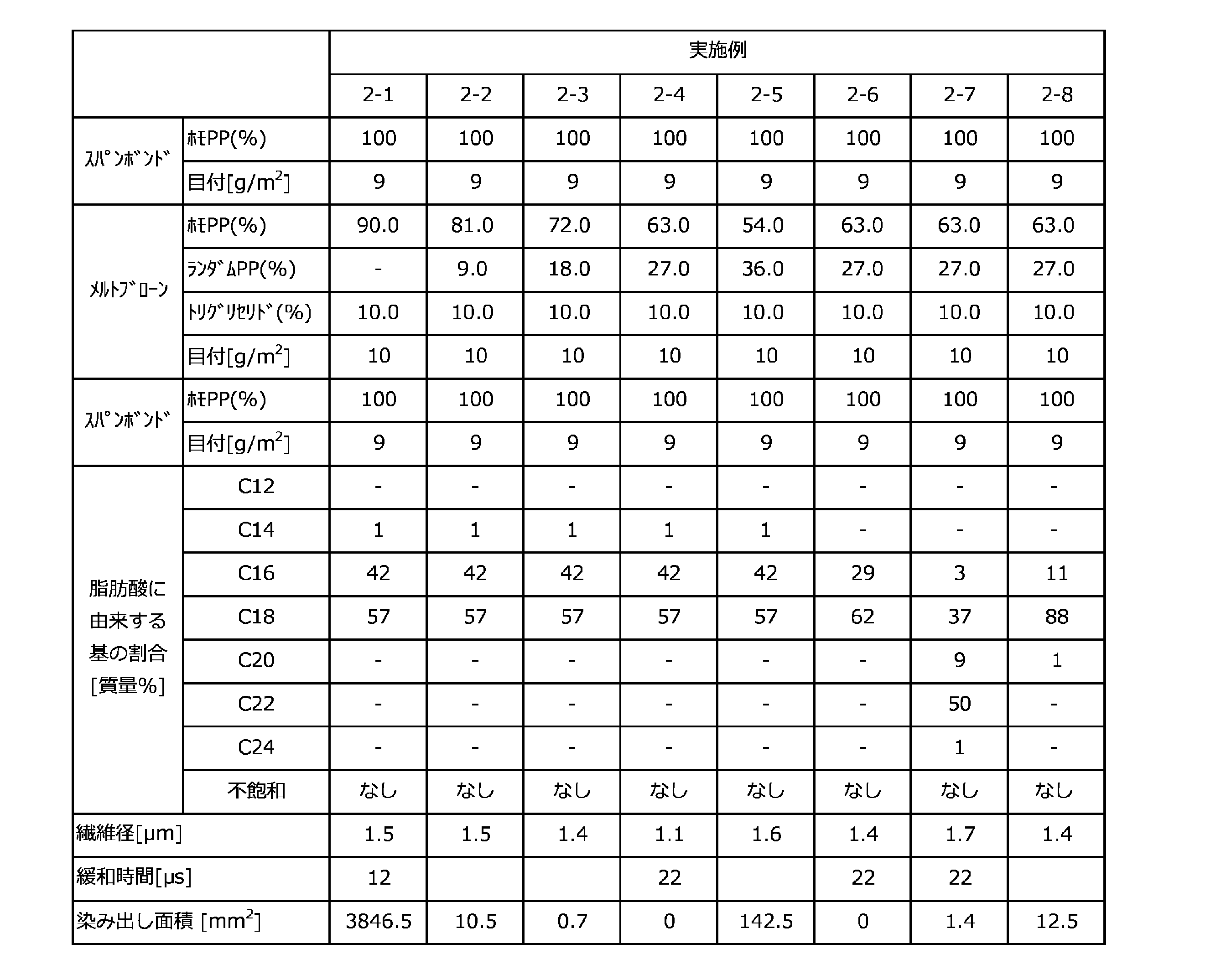

特に、実施例2-1と実施例2-2~2-5との対比から明らかなとおり、メルトブローン不織布を構成するポリオレフィン樹脂として、ホモPPとランダムPPとの組み合わせを用いることで、ホモPPを単独で用いた場合に比べて、表面張力が低い液体に対するバリア性が高まることが分かる。特に、メルトブローン不織布を構成する繊維に対してランダムPPの質量比を15質量%以上30質量%以下配合することで、表面張力が低い液体に対するバリア性が極めて高まることが分かる。
更に、実施例2-9~実施例2-12から明らかなとおり、メルトブローン不織布を構成する繊維にトリグリセリドを8質量%以上18質量%以下配合することで、表面張力が低い液体に対するバリア性が高まることが分かる。特に、トリグリセリドを9質量%以上14質量%以下配合することで、表面張力が低い液体に対するバリア性が極めて高まることが分かる。
また、実施例2-1及び2-4に示す結果から、トリグリセリドの種類が同じ場合でも、繊維の緩和時間が長くなることで不織布のバリア性が高まることが分かる。
また、実施例2-4と実施例2-6~2-8との対比から、トリグリセリドに含まれる脂肪酸に由来する基の総量を基準として、炭素原子数16の脂肪酸に由来する基の割合が20質量%以上50質量%以下、炭素原子数18の脂肪酸に由来する基の割合が50質量%以上70質量%以下のトリグリセリドを配合することで、表面張力が低い液体に対するバリア性が極めて高まることが分かる。
Claims (43)
- 繊維形成能を有する熱可塑性樹脂とトリグリセリドとを含有する繊維を含み、
前記熱可塑性樹脂がポリオレフィン樹脂を含み、
前記トリグリセリドが、
(a)炭素原子数16の脂肪酸に由来する基を一分子内に少なくとも含むトリグリセリドと、炭素原子数18の脂肪酸に由来する基を一分子内に少なくとも含むトリグリセリドとの混合物、又は
(b)炭素原子数16の脂肪酸に由来する基及び炭素原子数18の脂肪酸に由来する基を一分子内に少なくとも含むトリグリセリド、を含む、不織布。 - 前記トリグリセリドが不飽和脂肪酸に由来する基を含まない、請求の範囲第1項に記載の不織布。
- 前記トリグリセリドが、炭素原子数16の脂肪酸に由来する基及び炭素原子数18の脂肪酸に由来する基を一分子内に少なくとも含むものである、請求の範囲第1項又は第2項に記載の不織布。
- 前記トリグリセリドが、炭素原子数16の飽和脂肪酸に由来する基及び炭素原子数18の飽和脂肪酸に由来する基を一分子内に少なくとも含むものである、請求の範囲第3項に記載の不織布。
- 前記繊維に含有されるすべての前記トリグリセリドに含まれる、脂肪酸に由来する基の総量を基準として、炭素原子数16の脂肪酸に由来する基の割合が1質量%以上55質量%未満であり、炭素原子数18の脂肪酸に由来する基の割合が5質量%以上90質量%未満である、請求の範囲第1項ないし第4項のいずれか一項に記載の不織布。
- 前記繊維に含有されるすべての前記トリグリセリドに含まれる、脂肪酸に由来する基の総量を基準として、炭素原子数16の脂肪酸に由来する基の割合が10質量%以上55質量%未満であり、炭素原子数18の脂肪酸に由来する基の割合が45質量%以上90質量%未満である、請求の範囲第1項ないし第5項のいずれか一項に記載の不織布。
- 前記繊維に含有されるすべての前記トリグリセリドに含まれる、脂肪酸に由来する基の総量を基準として、炭素原子数16の脂肪酸に由来する基の割合が20質量%以上50質量%以下であり、炭素原子数18の脂肪酸に由来する基の割合が50質量%以上70質量%以下である、請求の範囲第1項ないし第6項のいずれか一項に記載の不織布。
- 前記繊維に含有されるすべての前記トリグリセリドに含まれる、脂肪酸に由来する基の総量を基準として、炭素原子数16の脂肪酸に由来する基の割合が25質量%以上45質量%以下であり、炭素原子数18の脂肪酸に由来する基の割合が55質量%以上65質量%以下である、請求の範囲第1項ないし第7項のいずれか一項に記載の不織布。
- 前記トリグリセリドが、
(a)炭素原子数16の脂肪酸に由来する基を一分子内に少なくとも含むトリグリセリドと、炭素原子数18の脂肪酸に由来する基を一分子内に少なくとも含むトリグリセリドとの混合物のみから構成されているか、又は
(b)炭素原子数16の脂肪酸に由来する基及び炭素原子数18の脂肪酸に由来する基を一分子内に少なくとも含むトリグリセリドのみから構成されている、請求の範囲第1項ないし第8項のいずれか一項に記載の不織布。 - 前記繊維に含有されるすべての前記トリグリセリドに含まれる、炭素原子数16の脂肪酸に由来する基に対する、炭素原子数18の脂肪酸に由来する基の質量比率が1.0以上15.0以下である、請求の範囲第1項ないし第9項のいずれか一項に記載の不織布。
- 前記繊維に含有されるすべての前記トリグリセリドに含まれる、炭素原子数16の脂肪酸に由来する基に対する、炭素原子数18の脂肪酸に由来する基の質量比率が1.3以上5.0以下である、請求の範囲第1項ないし第10項のいずれか一項に記載の不織布。
- 前記繊維を対象として測定されたパルスNMRの緩和時間が10μs以上である、請求の範囲第1項ないし第11項のいずれか一項に記載の不織布。
- 前記繊維の繊維径が0.1μm以上40μm以下である、請求の範囲第1項ないし第12項のいずれか一項に記載の不織布。
- 目付が0.2g/m2以上50g/m2以下である、請求の範囲第1項ないし第13項のいずれか一項に記載の不織布。
- メルトブローン不織布又はメルトブローン層を有する複合不織布である、請求の範囲第1項ないし第14項のいずれか一項に記載の不織布。
- 前記不織布が、少なくともスパンボンド層とメルトブローン層とを含み、
前記不織布の全質量に対する前記スパンボンド層の質量比率が50質量%以上95質量%以下であり、
前記不織布の全質量に対する前記メルトブローン層の質量比率が5質量%以上50質量%以下である、請求の範囲第1項ないし第15項のいずれか一項に記載の不織布。 - 前記ポリオレフィン樹脂がポリプロピレンである請求の範囲第1項ないし第16項のいずれか一項に記載の不織布。
- 前記トリグリセリドは、該トリグリセリドを含む繊維に対して1質量%以上30質量%以下含まれる、請求の範囲第1項ないし第17項のいずれか一項に記載の不織布。
- 前記トリグリセリドは、該トリグリセリドを含む繊維に対して9質量%以上14質量%以下含まれる、請求の範囲第18項に記載の不織布。
- 前記不織布に占める前記トリグリセリドを含む繊維の割合が3質量%以上である、請求の範囲第1項ないし第19項のいずれか一項に記載の不織布。
- 前記ポリオレフィン樹脂が、ランダムプロピレンコポリマー又は低立体規則性ホモポリプロピレンと、ホモポリプロピレンとを含む、請求の範囲第1項ないし第20項のいずれか一項に記載の不織布。
- 前記繊維に対する前記ランダムプロピレンコポリマー又は前記低立体規則性ホモポリプロピレンの割合が5質量%以上60質量%未満である、請求の範囲第21項に記載の不織布。
- 前記繊維に対する前記ランダムプロピレンコポリマー又は前記低立体規則性ホモポリプロピレンの割合が9質量%以上30質量%未満である、請求の範囲第22項に記載の不織布。
- メルトブローン層とスパンボンド層とを有し、
前記メルトブローン層が、ランダムプロピレンコポリマー又は低立体規則性ホモポリプロピレンと、ホモポリプロピレンと、前記トリグリセリドとを含む繊維から構成される、請求の範囲第1項ないし第23項のいずれか一項に記載の不織布。 - 前記ポリオレフィン樹脂が、ランダムプロピレンコポリマー又は低立体規則性ホモポリプロピレンと、ホモポリプロピレンとを含み、
前記繊維に含有されるすべての前記トリグリセリドに含まれる、脂肪酸に由来する基の総量を基準として、炭素原子数16の脂肪酸に由来する基の割合が20質量%以上50質量%以下であり、炭素原子数18の脂肪酸に由来する基の割合が50質量%以上70質量%以下である、請求の範囲第1項に記載の不織布。 - 前記ポリオレフィン樹脂が、ランダムプロピレンコポリマー又は低立体規則性ホモポリプロピレンと、ホモポリプロピレンとを含み、
前記トリグリセリドがパーム極度硬化油である、請求の範囲第1項に記載の不織布。 - 前記繊維に対する前記ランダムプロピレンコポリマー又は前記低立体規則性ホモポリプロピレンの割合が5質量%以上60質量%未満であり、
前記トリグリセリドは、該トリグリセリドを含む繊維に対して1質量%以上30質量%以下含まれる、請求の範囲第26項に記載の不織布。 - 前記トリグリセリドは、該トリグリセリドを含む繊維に対して9質量%以上14質量%以下含まれる、請求の範囲第27項に記載の不織布。
- 前記繊維に対する前記ランダムプロピレンコポリマー又は前記低立体規則性ホモポリプロピレンの割合が9質量%以上30質量%未満である、請求の範囲第26項又は第27項に記載の不織布。
- メルトブローン層とスパンボンド層とを有し、
前記メルトブローン層が、前記ランダムプロピレンコポリマー又は前記低立体規則性ホモポリプロピレンと、前記ホモポリプロピレンと、前記トリグリセリドとを含む繊維から構成される、請求の範囲第26項ないし第29項のいずれか一項に記載の不織布。 - 前記ポリオレフィン樹脂が、ランダムプロピレンコポリマーと、ホモポリプロピレンとを含む、請求の範囲第1項ないし第30項のいずれか一項に記載の不織布。
- トリグリセリドを含有する樹脂内添用撥水剤組成物であって、
前記トリグリセリドが、
(a)炭素原子数16の脂肪酸に由来する基を一分子内に少なくとも含むトリグリセリドと、炭素原子数18の脂肪酸に由来する基を一分子内に少なくとも含むトリグリセリドとの混合物、又は
(b)炭素原子数16の脂肪酸に由来する基及び炭素原子数18の脂肪酸に由来する基を一分子内に少なくとも含むトリグリセリド、を含む、樹脂内添用撥水剤組成物。 - 前記トリグリセリドが不飽和脂肪酸に由来する基を含まない、請求の範囲第32項に記載の樹脂内添用撥水剤組成物。
- 前記トリグリセリドが、炭素原子数16の脂肪酸に由来する基及び炭素原子数18の脂肪酸に由来する基を一分子内に少なくとも含むものである、請求の範囲第32項又は第33項に記載の樹脂内添用撥水剤組成物。
- 前記トリグリセリドに含まれる、脂肪酸に由来する基の総量を基準として、炭素原子数16の脂肪酸に由来する基の割合が10質量%以上55質量%未満であり、炭素原子数18の脂肪酸に由来する基の割合が45質量%以上90質量%未満である、請求の範囲第32項ないし第34項のいずれか一項に記載の樹脂内添用撥水剤組成物。
- ランダムプロピレンコポリマー又は低立体規則性ホモポリプロピレンと、ホモポリプロピレンとを含むポリオレフィン樹脂に内添される、請求の範囲第32項ないし第35項のいずれか一項に記載の樹脂内添用撥水剤組成物。
- ランダムプロピレンコポリマーと、ホモポリプロピレンとを含むポリオレフィン樹脂に内添される、請求の範囲第32項ないし第36項のいずれか一項に記載の樹脂内添用撥水剤組成物。
- トリグリセリドを含有する組成物の樹脂内添用撥水剤組成物としての使用であって、
前記トリグリセリドが、
(a)炭素原子数16の脂肪酸に由来する基を一分子内に少なくとも含むトリグリセリドと、炭素原子数18の脂肪酸に由来する基を一分子内に少なくとも含むトリグリセリドとの混合物、又は
(b)炭素原子数16の脂肪酸に由来する基及び炭素原子数18の脂肪酸に由来する基を一分子内に少なくとも含むトリグリセリド、を含む、前記使用。 - 前記トリグリセリドが不飽和脂肪酸に由来する基を含まない、請求の範囲第38項に記載の使用。
- 前記トリグリセリドが、炭素原子数16の脂肪酸に由来する基及び炭素原子数18の脂肪酸に由来する基を一分子内に少なくとも含むものである、請求の範囲第38項又は第39項に記載の使用。
- 前記トリグリセリドに含まれる、脂肪酸に由来する基の総量を基準として、炭素原子数16の脂肪酸に由来する基の割合が10質量%以上55質量%未満であり、炭素原子数18の脂肪酸に由来する基の割合が45質量%以上90質量%未満である、請求の範囲第38項ないし第40項のいずれか一項に記載の使用。
- ランダムプロピレンコポリマー又は低立体規則性ホモポリプロピレンと、ホモポリプロピレンとを含むポリオレフィン樹脂に内添される、請求の範囲第38項ないし第41項のいずれか一項に記載の使用。
- ランダムプロピレンコポリマーと、ホモポリプロピレンとを含むポリオレフィン樹脂に内添される、請求の範囲第38項ないし第42項のいずれか一項に記載の使用。
Priority Applications (5)
| Application Number | Priority Date | Filing Date | Title |
|---|---|---|---|
| JP2022502864A JP7058378B1 (ja) | 2020-10-06 | 2021-10-05 | 不織布及びそれを備えた吸収性物品用の防漏シート |
| EP21877630.0A EP4227451B1 (en) | 2020-10-06 | 2021-10-05 | Nonwoven fabric, and leakproof sheet for absorbent article comprising same |
| CN202180067999.XA CN116324058B (zh) | 2020-10-06 | 2021-10-05 | 无纺布及具备其的吸收性物品用的防漏片材 |
| KR1020237011043A KR20230080412A (ko) | 2020-10-06 | 2021-10-05 | 부직포 및 그것을 구비한 흡수성 물품용의 방루 시트 |
| MYPI2023001878A MY203873A (en) | 2020-10-06 | 2021-10-05 | Nonwoven fabric, and leakproof sheet for absorbent article comprising same |
Applications Claiming Priority (4)
| Application Number | Priority Date | Filing Date | Title |
|---|---|---|---|
| JP2020169389 | 2020-10-06 | ||
| JP2020-169389 | 2020-10-06 | ||
| JP2021-046894 | 2021-03-22 | ||
| JP2021046894 | 2021-03-22 |
Publications (1)
| Publication Number | Publication Date |
|---|---|
| WO2022075331A1 true WO2022075331A1 (ja) | 2022-04-14 |
Family
ID=81126928
Family Applications (1)
| Application Number | Title | Priority Date | Filing Date |
|---|---|---|---|
| PCT/JP2021/036872 Ceased WO2022075331A1 (ja) | 2020-10-06 | 2021-10-05 | 不織布及びそれを備えた吸収性物品用の防漏シート |
Country Status (7)
| Country | Link |
|---|---|
| EP (1) | EP4227451B1 (ja) |
| JP (1) | JP7058378B1 (ja) |
| KR (1) | KR20230080412A (ja) |
| CN (1) | CN116324058B (ja) |
| MY (1) | MY203873A (ja) |
| TW (1) | TW202231948A (ja) |
| WO (1) | WO2022075331A1 (ja) |
Families Citing this family (1)
| Publication number | Priority date | Publication date | Assignee | Title |
|---|---|---|---|---|
| WO2025059061A1 (en) * | 2023-09-11 | 2025-03-20 | Berry Global, Inc. | Liquid barrier and air-permeable backsheet |
Citations (11)
| Publication number | Priority date | Publication date | Assignee | Title |
|---|---|---|---|---|
| JPS478932B1 (ja) * | 1967-11-04 | 1972-03-15 | ||
| JP2004277467A (ja) * | 2003-03-13 | 2004-10-07 | Toray Ind Inc | トレイ用熱可塑性樹脂組成物およびそれからなるトレイ |
| JP2009227931A (ja) * | 2008-03-25 | 2009-10-08 | Toray Ind Inc | 熱可塑性樹脂組成物及びそれから成る成形品 |
| US20120100772A1 (en) | 2009-06-25 | 2012-04-26 | Fibertex A/S | High barrier nonwoven |
| JP2012531530A (ja) * | 2009-06-25 | 2012-12-10 | テクマー ピーエム,エルエルシー | 織物、繊維及び薄膜とともに使用するための疎水性添加剤 |
| JP2013159884A (ja) * | 2012-02-07 | 2013-08-19 | Asahi Kasei Fibers Corp | 柔軟性に優れる長繊維不織布 |
| US20140272223A1 (en) | 2013-03-15 | 2014-09-18 | The Procter & Gamble Company | Packages for articles of commerce |
| JP2016089009A (ja) * | 2014-11-04 | 2016-05-23 | 三菱樹脂株式会社 | 透湿性フィルムおよび透湿性フィルム積層体 |
| JP2018503751A (ja) * | 2014-11-06 | 2018-02-08 | ザ プロクター アンド ギャンブルカンパニー | 捲縮繊維スパンボンド不織布ウェブ/積層体 |
| US20190070045A1 (en) | 2016-03-09 | 2019-03-07 | Fibertex Personal Care A/S | High barrier nonwoven fabric |
| US20200129345A1 (en) | 2014-09-10 | 2020-04-30 | The Procter & Gamble Company | Nonwoven Webs With Hydrophobic And Hydrophilic Layers |
Family Cites Families (5)
| Publication number | Priority date | Publication date | Assignee | Title |
|---|---|---|---|---|
| US9345802B2 (en) * | 2009-06-25 | 2016-05-24 | The Procter & Gamble Company | Absorbent article with barrier component |
| EP2266514A1 (en) * | 2009-06-25 | 2010-12-29 | The Procter & Gamble Company | Absorbent article with barrier component |
| JP6063277B2 (ja) * | 2012-03-27 | 2017-01-18 | 花王株式会社 | 油脂組成物 |
| JP6112816B2 (ja) * | 2012-09-28 | 2017-04-12 | ユニ・チャーム株式会社 | 吸収性物品 |
| JP5988810B2 (ja) * | 2012-09-28 | 2016-09-07 | ユニ・チャーム株式会社 | 吸収性物品 |
-
2021
- 2021-10-05 MY MYPI2023001878A patent/MY203873A/en unknown
- 2021-10-05 CN CN202180067999.XA patent/CN116324058B/zh active Active
- 2021-10-05 KR KR1020237011043A patent/KR20230080412A/ko active Pending
- 2021-10-05 WO PCT/JP2021/036872 patent/WO2022075331A1/ja not_active Ceased
- 2021-10-05 JP JP2022502864A patent/JP7058378B1/ja active Active
- 2021-10-05 EP EP21877630.0A patent/EP4227451B1/en active Active
- 2021-10-06 TW TW110137152A patent/TW202231948A/zh unknown
Patent Citations (13)
| Publication number | Priority date | Publication date | Assignee | Title |
|---|---|---|---|---|
| JPS478932B1 (ja) * | 1967-11-04 | 1972-03-15 | ||
| JP2004277467A (ja) * | 2003-03-13 | 2004-10-07 | Toray Ind Inc | トレイ用熱可塑性樹脂組成物およびそれからなるトレイ |
| JP2009227931A (ja) * | 2008-03-25 | 2009-10-08 | Toray Ind Inc | 熱可塑性樹脂組成物及びそれから成る成形品 |
| US20120100772A1 (en) | 2009-06-25 | 2012-04-26 | Fibertex A/S | High barrier nonwoven |
| JP2012530855A (ja) * | 2009-06-25 | 2012-12-06 | ファイバーテックス エー/エス | 高バリア性不織布 |
| JP2012531530A (ja) * | 2009-06-25 | 2012-12-10 | テクマー ピーエム,エルエルシー | 織物、繊維及び薄膜とともに使用するための疎水性添加剤 |
| JP2013159884A (ja) * | 2012-02-07 | 2013-08-19 | Asahi Kasei Fibers Corp | 柔軟性に優れる長繊維不織布 |
| US20140272223A1 (en) | 2013-03-15 | 2014-09-18 | The Procter & Gamble Company | Packages for articles of commerce |
| US20200129345A1 (en) | 2014-09-10 | 2020-04-30 | The Procter & Gamble Company | Nonwoven Webs With Hydrophobic And Hydrophilic Layers |
| JP2016089009A (ja) * | 2014-11-04 | 2016-05-23 | 三菱樹脂株式会社 | 透湿性フィルムおよび透湿性フィルム積層体 |
| JP2018503751A (ja) * | 2014-11-06 | 2018-02-08 | ザ プロクター アンド ギャンブルカンパニー | 捲縮繊維スパンボンド不織布ウェブ/積層体 |
| US20190070045A1 (en) | 2016-03-09 | 2019-03-07 | Fibertex Personal Care A/S | High barrier nonwoven fabric |
| JP2019509406A (ja) * | 2016-03-09 | 2019-04-04 | ファイバーテクス・パーソナル・ケア・アクティーゼルスカブ | 高バリア不織布 |
Non-Patent Citations (1)
| Title |
|---|
| See also references of EP4227451A4 |
Also Published As
| Publication number | Publication date |
|---|---|
| EP4227451A4 (en) | 2024-10-30 |
| EP4227451B1 (en) | 2026-02-25 |
| JP7058378B1 (ja) | 2022-04-21 |
| EP4227451A1 (en) | 2023-08-16 |
| KR20230080412A (ko) | 2023-06-07 |
| CN116324058B (zh) | 2025-09-19 |
| CN116324058A (zh) | 2023-06-23 |
| JPWO2022075331A1 (ja) | 2022-04-14 |
| MY203873A (en) | 2024-07-23 |
| TW202231948A (zh) | 2022-08-16 |
Similar Documents
| Publication | Publication Date | Title |
|---|---|---|
| DE60012526T2 (de) | Hydrophile polypropylenfasern mit antimikrobieller wirkung | |
| DE69618174T2 (de) | Schaumstoffe hergestellt durch wasser-in-öl emulsionspolymerisation verwendbar als absorbierendes material für damenbinde | |
| US9074303B2 (en) | Fibers, nonwoven fabric and uses thereof | |
| KR101581521B1 (ko) | 섬유, 부직포 및 그의 용도 | |
| DE102014103393A1 (de) | Vliessubstrate | |
| KR102106115B1 (ko) | 폴리올레핀 섬유를 영구적으로 친수화하기 위한 조성물 및 이의 용도 | |
| JP7100504B2 (ja) | 親水化剤 | |
| RU2719524C1 (ru) | Фильерный нетканый материал, лист и впитывающее изделие | |
| JP5127690B2 (ja) | 繊維及び不織布 | |
| JP7058378B1 (ja) | 不織布及びそれを備えた吸収性物品用の防漏シート | |
| CN108095901A (zh) | 吸收性物品 | |
| US10017898B2 (en) | Use of a surfactant composition for the hydrophilic finishing of textile fibers and textile products manufactured therefrom | |
| WO2016102469A1 (de) | Zusammensetzung zur permanent-hydrophilen ausrüstung von textilfasern und textilerzeugnissen | |
| EP3237675B1 (de) | Zusammensetzung zur permanent-hydrophilen ausrüstung von textilfasern und textilerzeugnissen | |
| DE102006006396A1 (de) | Verwendung von Triglyceriden als Weichmacher für Polyolefine | |
| JP2009138311A (ja) | 柔軟性のある長繊維不織布 | |
| DE10034232A1 (de) | Faser mit dauerhafter Hydrophilizität und diese enthaltende Textilien | |
| DE102004020083A1 (de) | Polyolefinhaltige Wischtücher | |
| KR20200062370A (ko) | 폴리올레핀계 수지용 첨가제, 폴리올레핀계 수지 조성물, 폴리올레핀계 합성 섬유 부직포 및 폴리올레핀계 합성 섬유 부직포의 제조 방법 | |
| JP3250016U (ja) | 吸収性物品 | |
| KR101427192B1 (ko) | 내변색성이 뛰어난 내구 친수성 섬유 및 이로 구성되어 있는 섬유 성형체 및 흡수성 물품 | |
| CN1288196C (zh) | 含聚烯烃物品的增柔整理 | |
| CN118871515B (zh) | 多孔质膜 | |
| DK2549000T3 (en) | Fiber, nonwoven fabric and its use | |
| WO2023068013A1 (ja) | 吸収性物品 |
Legal Events
| Date | Code | Title | Description |
|---|---|---|---|
| ENP | Entry into the national phase |
Ref document number: 2022502864 Country of ref document: JP Kind code of ref document: A |
|
| 121 | Ep: the epo has been informed by wipo that ep was designated in this application |
Ref document number: 21877630 Country of ref document: EP Kind code of ref document: A1 |
|
| WWE | Wipo information: entry into national phase |
Ref document number: 202317027013 Country of ref document: IN |
|
| NENP | Non-entry into the national phase |
Ref country code: DE |
|
| ENP | Entry into the national phase |
Ref document number: 2021877630 Country of ref document: EP Effective date: 20230508 |
|
| WWW | Wipo information: withdrawn in national office |
Ref document number: 2023111511 Country of ref document: RU |
|
| WWG | Wipo information: grant in national office |
Ref document number: 202180067999.X Country of ref document: CN |
|
| WWG | Wipo information: grant in national office |
Ref document number: 2021877630 Country of ref document: EP |