WO2022075372A1 - カルボン酸共変性オルガノポリシロキサンおよびその用途 - Google Patents
カルボン酸共変性オルガノポリシロキサンおよびその用途 Download PDFInfo
- Publication number
- WO2022075372A1 WO2022075372A1 PCT/JP2021/037020 JP2021037020W WO2022075372A1 WO 2022075372 A1 WO2022075372 A1 WO 2022075372A1 JP 2021037020 W JP2021037020 W JP 2021037020W WO 2022075372 A1 WO2022075372 A1 WO 2022075372A1
- Authority
- WO
- WIPO (PCT)
- Prior art keywords
- group
- carboxylic acid
- range
- powder
- modified organopolysiloxane
- Prior art date
- Legal status (The legal status is an assumption and is not a legal conclusion. Google has not performed a legal analysis and makes no representation as to the accuracy of the status listed.)
- Ceased
Links
Classifications
-
- A—HUMAN NECESSITIES
- A61—MEDICAL OR VETERINARY SCIENCE; HYGIENE
- A61K—PREPARATIONS FOR MEDICAL, DENTAL OR TOILETRY PURPOSES
- A61K8/00—Cosmetics or similar toiletry preparations
- A61K8/18—Cosmetics or similar toiletry preparations characterised by the composition
- A61K8/19—Cosmetics or similar toiletry preparations characterised by the composition containing inorganic ingredients
- A61K8/29—Titanium; Compounds thereof
-
- A—HUMAN NECESSITIES
- A61—MEDICAL OR VETERINARY SCIENCE; HYGIENE
- A61K—PREPARATIONS FOR MEDICAL, DENTAL OR TOILETRY PURPOSES
- A61K8/00—Cosmetics or similar toiletry preparations
- A61K8/18—Cosmetics or similar toiletry preparations characterised by the composition
- A61K8/30—Cosmetics or similar toiletry preparations characterised by the composition containing organic compounds
- A61K8/33—Cosmetics or similar toiletry preparations characterised by the composition containing organic compounds containing oxygen
- A61K8/34—Alcohols
-
- A—HUMAN NECESSITIES
- A61—MEDICAL OR VETERINARY SCIENCE; HYGIENE
- A61K—PREPARATIONS FOR MEDICAL, DENTAL OR TOILETRY PURPOSES
- A61K8/00—Cosmetics or similar toiletry preparations
- A61K8/18—Cosmetics or similar toiletry preparations characterised by the composition
- A61K8/30—Cosmetics or similar toiletry preparations characterised by the composition containing organic compounds
- A61K8/33—Cosmetics or similar toiletry preparations characterised by the composition containing organic compounds containing oxygen
- A61K8/34—Alcohols
- A61K8/345—Alcohols containing more than one hydroxy group
-
- A—HUMAN NECESSITIES
- A61—MEDICAL OR VETERINARY SCIENCE; HYGIENE
- A61K—PREPARATIONS FOR MEDICAL, DENTAL OR TOILETRY PURPOSES
- A61K8/00—Cosmetics or similar toiletry preparations
- A61K8/18—Cosmetics or similar toiletry preparations characterised by the composition
- A61K8/72—Cosmetics or similar toiletry preparations characterised by the composition containing organic macromolecular compounds
- A61K8/84—Cosmetics or similar toiletry preparations characterised by the composition containing organic macromolecular compounds obtained by reactions otherwise than those involving only carbon-carbon unsaturated bonds
- A61K8/89—Polysiloxanes
- A61K8/891—Polysiloxanes saturated, e.g. dimethicone, phenyl trimethicone, C24-C28 methicone or stearyl dimethicone
-
- A—HUMAN NECESSITIES
- A61—MEDICAL OR VETERINARY SCIENCE; HYGIENE
- A61Q—SPECIFIC USE OF COSMETICS OR SIMILAR TOILETRY PREPARATIONS
- A61Q1/00—Make-up preparations; Body powders; Preparations for removing make-up
-
- A—HUMAN NECESSITIES
- A61—MEDICAL OR VETERINARY SCIENCE; HYGIENE
- A61Q—SPECIFIC USE OF COSMETICS OR SIMILAR TOILETRY PREPARATIONS
- A61Q19/00—Preparations for care of the skin
-
- C—CHEMISTRY; METALLURGY
- C08—ORGANIC MACROMOLECULAR COMPOUNDS; THEIR PREPARATION OR CHEMICAL WORKING-UP; COMPOSITIONS BASED THEREON
- C08G—MACROMOLECULAR COMPOUNDS OBTAINED OTHERWISE THAN BY REACTIONS ONLY INVOLVING UNSATURATED CARBON-TO-CARBON BONDS
- C08G77/00—Macromolecular compounds obtained by reactions forming a linkage containing silicon with or without sulfur, nitrogen, oxygen or carbon in the main chain of the macromolecule
- C08G77/04—Polysiloxanes
- C08G77/045—Polysiloxanes containing less than 25 silicon atoms
-
- C—CHEMISTRY; METALLURGY
- C08—ORGANIC MACROMOLECULAR COMPOUNDS; THEIR PREPARATION OR CHEMICAL WORKING-UP; COMPOSITIONS BASED THEREON
- C08G—MACROMOLECULAR COMPOUNDS OBTAINED OTHERWISE THAN BY REACTIONS ONLY INVOLVING UNSATURATED CARBON-TO-CARBON BONDS
- C08G77/00—Macromolecular compounds obtained by reactions forming a linkage containing silicon with or without sulfur, nitrogen, oxygen or carbon in the main chain of the macromolecule
- C08G77/04—Polysiloxanes
- C08G77/14—Polysiloxanes containing silicon bound to oxygen-containing groups
-
- C—CHEMISTRY; METALLURGY
- C08—ORGANIC MACROMOLECULAR COMPOUNDS; THEIR PREPARATION OR CHEMICAL WORKING-UP; COMPOSITIONS BASED THEREON
- C08G—MACROMOLECULAR COMPOUNDS OBTAINED OTHERWISE THAN BY REACTIONS ONLY INVOLVING UNSATURATED CARBON-TO-CARBON BONDS
- C08G77/00—Macromolecular compounds obtained by reactions forming a linkage containing silicon with or without sulfur, nitrogen, oxygen or carbon in the main chain of the macromolecule
- C08G77/04—Polysiloxanes
- C08G77/38—Polysiloxanes modified by chemical after-treatment
-
- C—CHEMISTRY; METALLURGY
- C08—ORGANIC MACROMOLECULAR COMPOUNDS; THEIR PREPARATION OR CHEMICAL WORKING-UP; COMPOSITIONS BASED THEREON
- C08G—MACROMOLECULAR COMPOUNDS OBTAINED OTHERWISE THAN BY REACTIONS ONLY INVOLVING UNSATURATED CARBON-TO-CARBON BONDS
- C08G77/00—Macromolecular compounds obtained by reactions forming a linkage containing silicon with or without sulfur, nitrogen, oxygen or carbon in the main chain of the macromolecule
- C08G77/48—Macromolecular compounds obtained by reactions forming a linkage containing silicon with or without sulfur, nitrogen, oxygen or carbon in the main chain of the macromolecule in which at least two but not all the silicon atoms are connected by linkages other than oxygen atoms
- C08G77/50—Macromolecular compounds obtained by reactions forming a linkage containing silicon with or without sulfur, nitrogen, oxygen or carbon in the main chain of the macromolecule in which at least two but not all the silicon atoms are connected by linkages other than oxygen atoms by carbon linkages
-
- C—CHEMISTRY; METALLURGY
- C08—ORGANIC MACROMOLECULAR COMPOUNDS; THEIR PREPARATION OR CHEMICAL WORKING-UP; COMPOSITIONS BASED THEREON
- C08K—Use of inorganic or non-macromolecular organic substances as compounding ingredients
- C08K3/00—Use of inorganic substances as compounding ingredients
- C08K3/18—Oxygen-containing compounds, e.g. metal carbonyls
- C08K3/20—Oxides; Hydroxides
- C08K3/22—Oxides; Hydroxides of metals
-
- C—CHEMISTRY; METALLURGY
- C08—ORGANIC MACROMOLECULAR COMPOUNDS; THEIR PREPARATION OR CHEMICAL WORKING-UP; COMPOSITIONS BASED THEREON
- C08L—COMPOSITIONS OF MACROMOLECULAR COMPOUNDS
- C08L83/00—Compositions of macromolecular compounds obtained by reactions forming in the main chain of the macromolecule a linkage containing silicon with or without sulfur, nitrogen, oxygen or carbon only; Compositions of derivatives of such polymers
- C08L83/10—Block- or graft-copolymers containing polysiloxane sequences
-
- C—CHEMISTRY; METALLURGY
- C08—ORGANIC MACROMOLECULAR COMPOUNDS; THEIR PREPARATION OR CHEMICAL WORKING-UP; COMPOSITIONS BASED THEREON
- C08L—COMPOSITIONS OF MACROMOLECULAR COMPOUNDS
- C08L83/00—Compositions of macromolecular compounds obtained by reactions forming in the main chain of the macromolecule a linkage containing silicon with or without sulfur, nitrogen, oxygen or carbon only; Compositions of derivatives of such polymers
- C08L83/14—Compositions of macromolecular compounds obtained by reactions forming in the main chain of the macromolecule a linkage containing silicon with or without sulfur, nitrogen, oxygen or carbon only; Compositions of derivatives of such polymers in which at least two but not all the silicon atoms are connected by linkages other than oxygen atoms
-
- C—CHEMISTRY; METALLURGY
- C09—DYES; PAINTS; POLISHES; NATURAL RESINS; ADHESIVES; COMPOSITIONS NOT OTHERWISE PROVIDED FOR; APPLICATIONS OF MATERIALS NOT OTHERWISE PROVIDED FOR
- C09D—COATING COMPOSITIONS, e.g. PAINTS, VARNISHES OR LACQUERS; FILLING PASTES; CHEMICAL PAINT OR INK REMOVERS; INKS; CORRECTING FLUIDS; WOODSTAINS; PASTES OR SOLIDS FOR COLOURING OR PRINTING; USE OF MATERIALS THEREFOR
- C09D183/00—Coating compositions based on macromolecular compounds obtained by reactions forming in the main chain of the macromolecule a linkage containing silicon, with or without sulfur, nitrogen, oxygen, or carbon only; Coating compositions based on derivatives of such polymers
- C09D183/04—Polysiloxanes
- C09D183/06—Polysiloxanes containing silicon bound to oxygen-containing groups
-
- C—CHEMISTRY; METALLURGY
- C09—DYES; PAINTS; POLISHES; NATURAL RESINS; ADHESIVES; COMPOSITIONS NOT OTHERWISE PROVIDED FOR; APPLICATIONS OF MATERIALS NOT OTHERWISE PROVIDED FOR
- C09D—COATING COMPOSITIONS, e.g. PAINTS, VARNISHES OR LACQUERS; FILLING PASTES; CHEMICAL PAINT OR INK REMOVERS; INKS; CORRECTING FLUIDS; WOODSTAINS; PASTES OR SOLIDS FOR COLOURING OR PRINTING; USE OF MATERIALS THEREFOR
- C09D183/00—Coating compositions based on macromolecular compounds obtained by reactions forming in the main chain of the macromolecule a linkage containing silicon, with or without sulfur, nitrogen, oxygen, or carbon only; Coating compositions based on derivatives of such polymers
- C09D183/14—Coating compositions based on macromolecular compounds obtained by reactions forming in the main chain of the macromolecule a linkage containing silicon, with or without sulfur, nitrogen, oxygen, or carbon only; Coating compositions based on derivatives of such polymers in which at least two but not all the silicon atoms are connected by linkages other than oxygen atoms
-
- C—CHEMISTRY; METALLURGY
- C09—DYES; PAINTS; POLISHES; NATURAL RESINS; ADHESIVES; COMPOSITIONS NOT OTHERWISE PROVIDED FOR; APPLICATIONS OF MATERIALS NOT OTHERWISE PROVIDED FOR
- C09K—MATERIALS FOR MISCELLANEOUS APPLICATIONS, NOT PROVIDED FOR ELSEWHERE
- C09K3/00—Materials not provided for elsewhere
- C09K3/18—Materials not provided for elsewhere for application to surfaces to minimize adherence of ice, mist or water thereto; Thawing or antifreeze materials for application to surfaces
-
- A—HUMAN NECESSITIES
- A61—MEDICAL OR VETERINARY SCIENCE; HYGIENE
- A61K—PREPARATIONS FOR MEDICAL, DENTAL OR TOILETRY PURPOSES
- A61K2800/00—Properties of cosmetic compositions or active ingredients thereof or formulation aids used therein and process related aspects
- A61K2800/10—General cosmetic use
-
- A—HUMAN NECESSITIES
- A61—MEDICAL OR VETERINARY SCIENCE; HYGIENE
- A61K—PREPARATIONS FOR MEDICAL, DENTAL OR TOILETRY PURPOSES
- A61K2800/00—Properties of cosmetic compositions or active ingredients thereof or formulation aids used therein and process related aspects
- A61K2800/40—Chemical, physico-chemical or functional or structural properties of particular ingredients
- A61K2800/42—Colour properties
- A61K2800/43—Pigments; Dyes
-
- C—CHEMISTRY; METALLURGY
- C08—ORGANIC MACROMOLECULAR COMPOUNDS; THEIR PREPARATION OR CHEMICAL WORKING-UP; COMPOSITIONS BASED THEREON
- C08K—Use of inorganic or non-macromolecular organic substances as compounding ingredients
- C08K3/00—Use of inorganic substances as compounding ingredients
- C08K3/18—Oxygen-containing compounds, e.g. metal carbonyls
- C08K3/20—Oxides; Hydroxides
- C08K3/22—Oxides; Hydroxides of metals
- C08K2003/2237—Oxides; Hydroxides of metals of titanium
-
- C—CHEMISTRY; METALLURGY
- C08—ORGANIC MACROMOLECULAR COMPOUNDS; THEIR PREPARATION OR CHEMICAL WORKING-UP; COMPOSITIONS BASED THEREON
- C08K—Use of inorganic or non-macromolecular organic substances as compounding ingredients
- C08K3/00—Use of inorganic substances as compounding ingredients
- C08K3/18—Oxygen-containing compounds, e.g. metal carbonyls
- C08K3/20—Oxides; Hydroxides
- C08K3/22—Oxides; Hydroxides of metals
- C08K2003/2296—Oxides; Hydroxides of metals of zinc
-
- C—CHEMISTRY; METALLURGY
- C08—ORGANIC MACROMOLECULAR COMPOUNDS; THEIR PREPARATION OR CHEMICAL WORKING-UP; COMPOSITIONS BASED THEREON
- C08K—Use of inorganic or non-macromolecular organic substances as compounding ingredients
- C08K2201/00—Specific properties of additives
- C08K2201/002—Physical properties
- C08K2201/003—Additives being defined by their diameter
-
- C—CHEMISTRY; METALLURGY
- C08—ORGANIC MACROMOLECULAR COMPOUNDS; THEIR PREPARATION OR CHEMICAL WORKING-UP; COMPOSITIONS BASED THEREON
- C08K—Use of inorganic or non-macromolecular organic substances as compounding ingredients
- C08K2201/00—Specific properties of additives
- C08K2201/011—Nanostructured additives
Definitions
- the present invention has a specific carboxyl group-containing organic group (hereinafter, may be referred to as "carboxylic acid modifying group”) and a specific silicon-containing organic group in the molecule, and is highly useful as a powder treatment agent.
- the present invention relates to an acid co-modified organopolysiloxane and its use, particularly an aqueous powder dispersion (slurry).
- Cosmetics containing an aqueous phase as a continuous phase give a fresh and refreshing feeling. Therefore, for example, basic cosmetics such as milky lotion, base cosmetics, sunscreens, foundations, and make-up cosmetics such as eye shadow. Widely used as.
- SPF Sun Protection Factor
- the oil-in-water emulsified cosmetic has a problem that the cosmetic film obtained by applying the cosmetic is usually inferior in water resistance, and Patent Document 1 and Patent Document 1 and the patent for the purpose of imparting water resistance to the cosmetic film.
- carboxylic acid-modified silicone is used under alkaline conditions to satisfactorily disperse hydrophobic powder in an aqueous phase to stabilize cosmetics and to prepare an aqueous slurry as a raw material for cosmetics. It is proposed to do.
- Patent Document 2 proposes a carboxylic acid-modified silicone which may optionally have a siloxane-modifying group and a carboxyl group-containing organic group.
- the carboxylic acid-modified silicone specifically proposed in Patent Document 1 and Patent Document 2 may not be able to form a long-term stable aqueous slurry for some hydrophobic powders such as hydrophobic fine particle zinc oxide. , There is room for improvement in its powder dispersibility.
- Patent Document 3 the applicants have proposed to use a neutralized salt of a modified silicone having a carbosiloxane dendrimer structure and a carboxylic acid modifying group in an oil-in-water emulsified cosmetic, but it is linear.
- a carboxylic acid co-modified organopolysiloxane which is a co-modified siloxane molecule and has an organic silicon-containing organic group such as a carbosiloxane dendrimer structure in the side chain portion and has a carboxylic acid modifying group in the molecule. Furthermore, it is neither described nor suggested that the neutralized product of the carboxylic acid co-modified organopolysiloxane is used as an aqueous dispersant for the hydrophobic powder.
- Patent Document 4 discloses a water-repellent cosmetic powder obtained by treating the powder with a metal cation salt of a carboxylic acid-modified organopolysiloxane, but similarly, a specific organic silicon.
- the present inventors are selected from a silylalkyl group having a carboxyl group in the molecule and having a carbyloxydendron structure and a group having a siloxane macromonomer structure, which are liquid at 50 ° C.1
- a linear carboxylic acid co-modified organopolysiloxane having more than one kind of organic silicon-containing organic group (L1) in the side chain portion in a specific ratio and reached the present invention. bottom.
- L1 organic silicon-containing organic group
- R2 is a substituted or unsubstituted, linear or branched monovalent hydrocarbon group having 6 to 30 carbon atoms, which may be optionally contained in the molecule, and is a hydrocarbon-based oil (cosmetics). It may be possible to improve the affinity with non-silicone oils such as raw materials).
- R 2 is an alkyl group having 6 to 30 carbon atoms, and examples thereof include a hexyl group, a heptyl group, an octyl group, a decyl group, a dodecyl group, undecyl, and a hexadecyl group, and in particular, the number of carbon atoms is 8. Up to 20 alkyl groups are preferred.
- L 1 is a silicon-containing organic group selected from a silylalkyl group having a carbosiloxydendron structure and a group having a siloxane macromonoxane structure, and is specified to be Rc in the molecule of the carboxylic acid co-modified organopolysiloxane according to the present invention.
- the presence of the carboxyl group-containing organic group and L 1 having at least one in the side chain portion in a constant ratio realizes excellent powder dispersion performance particularly in the aqueous phase.
- R 1 is the same group as described above, RC is an alkyl group or a phenyl group having 1 to 6 carbon atoms, Z is a divalent organic group, and i is a silyl represented by Li. It indicates the layer of the alkyl group, and when the number of layers which is the number of repetitions of the silylalkyl group is c, it is an integer of 1 to c, the number of layers c is an integer of 1 to 10, and Li + 1 is i less than c.
- Ai is a number in the range of 0 to 3
- a silylalkyl group having a siloxane dendron structure The following general formula (2'): (2') (In the formula, R 11 is an independently substituted or unsubstituted monovalent hydrocarbon group having 1 to 30 carbon atoms, a hydroxyl group or a hydrogen atom, and at least one of R 11 is the monovalent hydrocarbon group.
- T is a number in the range of 2 to 10
- r is a number in the range of 1 to 500
- (2') In the formula, R 11 and r are as described above), which is one or more groups selected from the chain-like organosiloxane groups.
- the groups represented by L 1 may be the same or different.
- a silylalkyl group having a carbosiloxydendron structure and a group having a siloxane macromonomer structure may be contained in the same molecule, and the silylalkyl group has an organic silicon-containing organic group having a different degree of branching (generation).
- the group having a siloxane macromonomer structure it may be a combination of organic silicon-containing organic groups having different degrees of polymerization.
- RC is an alkyl group or a phenyl group having 1 to 6 carbon atoms, and industrially, it is preferably a methyl group or a phenyl group.
- the number of layers c is preferably an integer of 1 to 3, and more preferably 1 or 2.
- the group represented by L1 is represented as follows.
- R2 and Z are the same groups as described above.
- ai is a number in the range of 0 to 3 independently, and in the structure represented by the formulas (2-1) to (2-3) when the number of layers is 1 to 3, a1 and a1 a2 and a3 are independently numbers in the range 0-3. These ai are particularly preferably in the range of 0 to 1, and particularly preferably 0.
- Z is an independently divalent organic group, and specifically, a functional group having a silicon-bonded hydrogen atom and an unsaturated hydrocarbon group such as an alkenyl group, an acryloxy group, or a methacrylate group at the end.
- a functional group having a silicon-bonded hydrogen atom and an unsaturated hydrocarbon group such as an alkenyl group, an acryloxy group, or a methacrylate group at the end.
- Examples thereof include a divalent organic group formed by the addition reaction of the above, and the group is not limited to these functional groups and can be appropriately selected depending on the method for introducing a silylalkyl group having a carbosiloxane dendrimer structure.
- Z in the present invention is preferably an alkylene group having 2 to 10 carbon atoms, and most preferably an ethylene group.
- the group represented by L 1 may be a siloxane macromonomer structure-containing group bonded to a silicon atom constituting the main chain via an oxygen or an alkylene group, is hydrophobic, and exhibits a certain water repellency / oil resistance. It is a functional group and realizes a high degree of powder dispersibility for the carboxylic acid co-modified organopolysiloxane according to the present application without impairing the feel derived from the hydrophilic functional group.
- the group represented by L 1 may be a functional group represented by the above general formula (2') and general formula (2'').
- R 11 is industrially particularly preferably a long-chain alkyl group in which a methyl group, a phenyl group or a hydroxyl group is raised, a part of R 11 is a methyl group, and a part is a long-chain alkyl group having 8 to 30 carbon atoms.
- at least one of R 11 is a monovalent hydrocarbon group such as a methyl group
- t is a number in the range of 2 to 10
- r is in the range of 1 to 500. It is a number, and from the viewpoint of compatibility with various oils, r is preferably a number in the range of 1 to 100, and particularly preferably a number in the range of 2 to 30.
- Rc is a general formula: -Rc 1- (ORc 2 ) p- (O) w-Rc 3 -COOH
- Rc 1 represents a linear or branched alkylene group having 2 to 22 carbon atoms
- Rc 2 is a carbon number.
- Rc 3 is a bond (-) or a linear or branched alkylene group having 1 to 22 carbon atoms
- p is a number from 0 to 200.
- W is a carboxyl group-containing organic group represented by (representing a number of 0 or 1 ), and is present in the molecule together with the specific silicon-containing organic group which is L1 described above, particularly depending on the basic substance thereof.
- the neutralized salt can achieve excellent powder dispersibility in the aqueous phase.
- Rc 1 is a linear or branched alkylene group having 2 to 22 carbon atoms, preferably a linear alkylene group having 2 to 12 carbon atoms, particularly preferably 2 to 10 carbon atoms.
- a decamethylene group and the like can be mentioned.
- n is preferably a number of 3 to 20, and particularly preferably a number of 3 to 16.
- R' is a group independently selected from the above-mentioned R 1 , R 2 , L 1 and Rc, and if R'is L 1 , it has a structure having a silicon-containing organic group at the end of the molecular chain.
- R'is Rc the structure has a carboxyl group-containing organic group at the end of the molecular chain, but it is preferably a methyl group.
- n4 which will be described later, is 0, at least one of R'is Rc because the carboxylic acid covariant organopolysiloxane according to the present invention has 1 or more Rc.
- n1 to n4 representing the average degree of polymerization of each diorganosiloxy unit
- (n1 + n2 + n3 + n4) is a number in the range of 1 to 1000, preferably 2 to 50, and particularly preferably. It is 2 to 20. That is, the carboxylic acid co-modified organopolysiloxane according to the present invention is preferably relatively low in polymerization, especially from the viewpoint of powder dispersion performance in the aqueous phase. In particular, when the polymerization is relatively low, it is liquid and has a low viscosity at room temperature (25 ° C.), which is advantageous for producing an aqueous slurry.
- n1 to n4 are the numbers in the range in which the carboxylic acid co-modified organopolysiloxane according to the present invention becomes liquid at room temperature (25 ° C.), and in particular, the viscosity is low. Is preferable.
- the carboxylic acid co-modified organopolysiloxane which is liquid at room temperature (25 ° C) and has a low viscosity, has an excellent dispersion effect on hydrophobic powders, and does not require a heating operation when forming an aqueous dispersion composition. There are advantages.
- the carboxylic acid co-modified organopolysiloxane according to the present invention has (n1 + n2 + n3 + n4) in the range of 2 to 20 in the above structural formula (1).
- n3 is a number in the range of 1 to 10
- n4 is a number in the range of 1 to 10
- (n1 + n2 + n3) / n4 is a number in the range of 0.1 to 5.0.
- the carboxylic acid co-modified organopolysiloxane having such a structure has a structure having a silicon-containing organic group of L1 and a carboxyl group-containing organic group of Rc in a certain ratio in the molecular chain side chain, and thus is a powder.
- the treatment effect is excellent, and the uniform dispersibility of the hydrophobic powder in the aqueous phase is further improved.
- an aqueous dispersion composition containing the carboxylic acid co-modified organopolysiloxane is used as a raw material for cosmetics.
- functions such as sufficient water repellency, water resistance, and skin oil resistance can be effectively realized.
- the uniform dispersion state of the hydrophobic powder in the aqueous phase is maintained for a long period of time.
- the carboxylic acid co-modified organopolysiloxane according to the present invention is an organic silicon having one carbon-carbon double bond at one end of the molecular chain with respect to the organopolysiloxane having a reactive functional group such as Si—H.
- a compound having a contained organic group for example, the above-mentioned silylalkyl group
- an unsaturated carboxylic acid ester compound, an unsaturated carboxylic acid silyl ester or an allyloxycarboxylic acid silyl ester is added and reacted under a platinum catalyst. Further, it can be produced by a method of obtaining a desired product by saponification or hydrolysis after the reaction.
- the novel carboxylic acid co-modified organopolysiloxane according to the present invention has a silicon-containing organic group exhibiting high water repellency and a hydrophilic carboxyl group-containing organic group in the same molecule, and is preferably low in viscosity.
- it is useful as various treatment agents and ingredients for cosmetic raw materials because it has excellent handleability, work efficiency, and compounding stability with various cosmetic raw materials.
- it is useful for surface treatment and powder of hydrophobic powder used for cosmetics. It is extremely useful as a surface treatment agent, surfactant or powder dispersant for powders used for dispersion in the aqueous phase of the body.
- the carboxylic acid co-modified organopolysiloxane according to the present invention functions as a surface treatment agent or dispersant for powders, particularly hydrophobic powders, and is preferably used in combination with a basic substance for hydrophobic powders. Therefore, it is possible to form an aqueous powder composition in which the hydrophobic powder is uniformly and stably dispersed in the aqueous phase.
- a carboxylic acid containing (A) a carboxylic acid co-modified organopolysiloxane according to the present invention, (B) a basic compound, and (C) one or more hydrophilic media selected from water, polyhydric alcohols and lower alcohols.
- the acid co-modified organopolysiloxane composition forms a carboxylic acid salt structure in which carboxylic acid residues are partially neutralized in a hydrophilic medium, and thus is particularly a powder surface that is a dispersant for hydrophobic powders. It is particularly useful as a treatment agent, surfactant or surface treatment agent.
- the present invention comprises (A) one or more hydrophilic media selected from (A) carboxylic acid co-modified organopolysiloxanes according to the present invention, (B) basic compounds, (C) water, polyhydric alcohols and lower alcohols, and ( D)
- the present invention relates to a powder composition containing a powder or a colorant.
- the powder composition preferably contains (D1) a hydrophobic powder or a colorant, and has a structure in which the component (D1) is dispersed in an aqueous phase.
- the powder composition containing the carboxylic acid co-modified organopolysiloxane according to the present invention can be suitably used as an external preparation composition, particularly as a cosmetic or a cosmetic raw material.
- the powder composition according to the present invention is an aqueous dispersion composition preferably having an aqueous phase composed of a hydrophilic medium as a continuous layer, and a powder or a colorant, particularly hydrophobic, is contained in the hydrophilic medium. It is a composition in which powders or colorants are dispersed, and is generally called a "hydrophilic slurry" because it has fluidity.
- the hydrophilic medium in the present invention is an aqueous dispersion containing water, one or more alcohols selected from lower alcohols such as polyhydric alcohols that can be uniformly miscible with water, and lower alcohols such as ethyl alcohol, and salts such as basic substances. It refers to a medium, and it is particularly preferable that it does not substantially contain an oil agent / oil-based cosmetic raw material capable of forming an independent oil phase without being miscible with water such as an oil agent.
- the carboxylic acid co-modified organopolysiloxane according to the present invention can be used in the same manner as the carboxylic acid-modified silicone specifically disclosed in Patent Document 1 or Patent Document 2, but these are conventionally known.
- Carboxylic acid-modified silicone is useful in that it can easily prepare an aqueous slurry having low viscosity and excellent long-term storage stability even if it is an inorganic powder such as zinc oxide that cannot be sufficiently treated.
- the powder composition of the present invention preferably contains at least one (B) basic substance.
- the component (B) can anionize the carboxylic acid-modified site of the carboxylic acid co-modified organopolysiloxane according to the present invention (A), and improve its function as a surfactant / powder dispersant.
- the aqueous dispersion composition of the present invention contains (D) a powder or a colorant, preferably (D1) a hydrophobic powder or a colorant, and the above-mentioned component (A) and the component ( By using B) in combination, the component (D) can be dispersed better in the aqueous phase as compared with the component (A) alone, and only the uniform dispersibility and stability of the aqueous dispersion composition object are improved.
- cosmetics or the like containing the aqueous dispersion composition as a cosmetic raw material contribute to achieving sufficient water repellency, water resistance, and skin oil resistance.
- the basic substance used in the present invention is not particularly limited as long as it is a compound that exhibits basicity when dissolved in water, and various inorganic compounds and organic compounds can be used. One kind or two or more kinds of basic substances may be blended.
- Organic compounds include monoethanolamine, triethanolamine, 2-amino-2-methyl-1,3-propanediol, aminomethylpropanol, aminomethylpropanol, 2-amino-2-hydroxymethyl-1,3-propane. Examples thereof include diol, arginine and guanidine.
- the pH of the aqueous dispersion composition of the present invention may be acidic or alkaline, but the above-mentioned (A carboxylic acid co-modified organopolysiloxane carboxylic acid-modified site is anionized and a powder or colorant as a component (D)) is used.
- a carboxylic acid co-modified organopolysiloxane carboxylic acid-modified site is anionized and a powder or colorant as a component (D)) is used.
- the pH of the entire composition is preferably in the range of 6.5 to 14.0, and the pH is 7.1 to 10. It may be in the range of 0.0, more preferably in the range of 7.2 to 9.5.
- the hydrophilic medium in the present invention preferably contains water.
- (A) carboxylic acid co-modified organopolysiloxane has a silicon-containing organic group and a carboxyl group-containing organic group that exhibit high water repellency in the same molecule, and therefore, unlike the conventionally known carboxylic acid-modified silicone, a polyhydric alcohol. And even when one selected from lower alcohols (particularly ethyl alcohol) is not contained, the aqueous dispersion of the powder or colorant as the component (D) having excellent uniform dispersibility and stability in the aqueous phase. Body composition It may be possible to form an object.
- the hydrophilic medium in the present invention contains a polyhydric alcohol and a lower alcohol (particularly ethyl alcohol), similarly, the uniform dispersibility and stability of the powder or colorant as the component (D) in the aqueous phase.
- the aqueous dispersion composition of the present invention is used as a raw material for cosmetics, it may be possible to adjust the moisturizing feeling and the feeling of use.
- the hydrophilic medium as the component (C) in the powder composition preferably contains water, but the component (C) is (C1) water and (C2). It may be a mixture consisting of one or more selected from polyhydric alcohols and lower alcohols (preferably ethanol).
- polyhydric alcohol examples include sorbitol, xylitol, propylene glycol, dipropylene glycol, 1,3-butylene glycol, glycerin, diglycerin, polyethylene glycol and the like, and these polyhydric alcohols may be used alone or. Two or more types can be used in combination.
- typical lower alcohols are methyl alcohol and ethyl alcohol, but non-toxic ethyl alcohol is particularly preferable from the viewpoint of use as a raw material for cosmetics.
- the lower alcohol can be used alone or in combination with the polyhydric alcohol described above.
- the ethyl alcohol and the polyhydric alcohol can be mixed or used alone in the present invention at an arbitrary mass ratio of 100: 0 to 0: 100, even if they further contain water. Well, it doesn't have to be included.
- the (D) powder or colorant used in the powder composition (particularly an aqueous slurry) according to the present invention is generally used as a component of cosmetics, and contains white and colored pigments and extender pigments.
- white and colored pigments are used for coloring cosmetics and the like, while extender pigments are used for improving the feel of cosmetics and the like.
- white and colored pigments usually used in cosmetics and extender pigments can be used without particular limitation. In the present invention, it is preferable to mix one kind or two or more kinds of powders.
- Powder shape (spherical, rod-shaped, needle-shaped, plate-shaped, indefinite shape, spindle-shaped, cocoon-shaped, etc.), particle size (fumes, fine particles, pigment grade, etc.), and particle structure (porous, non-porous, etc.) Etc.) is not limited in any way, but it is preferable that the average primary particle size is in the range of 1 nm to 100 ⁇ m.
- these powders or colorants are blended as pigments, one or more selected from inorganic pigment powders, organic pigment powders, and resin powders having an average particle size in the range of 1 nm to 20 ⁇ m. Is preferably blended.
- the surface of the hydrophobic powder is hydrophobic, it is difficult to disperse in the aqueous phase.
- a large amount of hydrophobic powder is present in the aqueous phase. It is possible to realize a composition (including use as a cosmetic raw material or an external preparation composition) in which a sex powder or a colorant is uniformly and stably dispersed, and the same conditions as those of a conventional carboxylic acid-modified silicone are sufficient. Even an inorganic powder such as zinc oxide whose dispersibility cannot be realized has an advantage that a low-viscosity aqueous slurry can be prepared.
- the powder composition of the present invention preferably does not contain components other than the above-mentioned components in a proportion exceeding 20% by mass of the whole, as long as the performance of the dispersion is not impaired. It may contain other components in a proportion of 10% by mass or less. However, it is preferable not to add a compound or the like that may impair the stability of the dispersion. In particular, the addition of an oil agent is not preferable.
- the powder composition obtained in the present invention can also be applied to form a thin film.
- a zinc oxide film fixed with silica can be produced by applying a zinc oxide dispersion treated with silicone and heat-treating it with high heat or plasma.
- a dispersant such as a polyether or a polyether alkyl ether
- the silicone can be easily heated by heating at a temperature lower than the decomposition temperature of the zinc oxide-coated silicone.
- a coated zinc oxide coating can also be prepared. Needless to say, it is possible to form a coating film with other powders.
- the above-mentioned cosmetics can be in any form of oil-based cosmetics, water-based cosmetics, O / W-type cosmetics, and W / O-type cosmetics.
- an inorganic ultraviolet protective agent can be blended in a large amount and stably, it can be particularly preferably used in sunscreen cosmetics (including sunscreen agents).
- the external preparation composition according to the present invention contains the above-mentioned components (A), (B), (C) and (D), and the component (D) which is a powder or a colorant is an aqueous phase. It is preferable to have a structure dispersed therein. As described above, by using the carboxylic acid co-modified organopolysiloxane according to the present invention, (D1) hydrophobic powder or colorant can be stably dispersed in the aqueous phase, which is particularly useful as an inorganic ultraviolet protective agent.
- Hydrophobic fine particle titanium oxide or hydrophobic fine particle zinc oxide having an average particle diameter in the range of 1 to 200 nm can be stably and uniformly dispersed in the aqueous phase in a large amount, and thus has an external preparation composition. It is possible to provide an external preparation composition which has high storage stability and ultraviolet protection performance of an object, does not impair its feel and usability as much as possible, and has excellent water resistance of a film (decorative film).
- the carboxylic acid co-modified organopolysiloxane according to the present invention the degree of freedom in formulation design is further increased, and sunburn having performance such as water resistance, usability and ultraviolet protection typified by SPF value. It is expected that we can provide sunscreen cosmetics and the like.
- the external preparation composition according to the present invention is not particularly limited as long as it is a composition applied to the human body as a cosmetic or a pharmaceutical.
- Specific products of the present invention include skin cosmetics such as skin cleaning products, skin care products, makeup products, antiperspirant products, and UV protection products; hair cleaning products, hair styling products, etc. Hair cosmetics such as hair coloring products, hair nourishing products, hair rinsing products, hair conditioner products, and hair treatment products; bath cosmetics are exemplified.
- the pharmaceutical of the present invention include, but are not limited to, hair growth agents, hair growth agents, analgesics, bactericides, anti-inflammatory agents, refreshing agents, and skin antiaging agents.
- the external preparation composition according to the present invention is selected from an oil agent, a carboxylic acid-modified silicone other than the above component (A), a salt of a higher fatty acid, and various surfactants (anionic, cationic, nonionic, amphoteric).
- Specific examples of these components are the same components as those proposed by the applicant in the international patent application (PCT / JP19 / 029957) in addition to the above-mentioned Patent Document 1 (WO2015 / 159773). It's okay.
- the combined use of these components may further improve the dispersibility of the powder or the like in the aqueous phase and realize the effect of improving the SPF value of the entire cosmetic. ..
- the external preparation composition according to the present invention includes other components used in ordinary cosmetics, for example, hydrophilic powders, moisturizers other than the component (C), gels, as long as the effects of the present invention are not impaired.
- Agents preservatives, antibacterial agents, fragrances, salts, antioxidants, pH regulators other than ingredient (B), chelating agents, refreshing agents, anti-inflammatory agents, physiologically active ingredients (whitening agents, cell activators, rough skin improvement) Agents, blood circulation promoters, skin astringents, anti-lipids, etc.), vitamins, amino acids, nucleic acids, hormones, inclusion compounds, etc. can be added.
- Other components are not particularly limited.
- the carboxylic acid co-modified organopolysiloxane according to the present invention is a cosmetic proposed by the applicant in the above-mentioned Patent Document 1 (International Publication Patent WO2015 / 159773) and Patent Document 2 (International Publication Patent WO2020 / 036065). It can be used for common purposes with carboxylic acid-modified silicones, and can be used by replacing part or all of it.
- the carboxylic acid co-modified organopolysiloxane according to the present invention is used for common purposes with the carboxylic acid-modified silicone product marketed by the applicant under the trade name ES-5800 Formulation Aid (manufactured by Dow Toray Co., Ltd.). be able to.
- the Applicant expressly teaches here that a part or all of the carboxylic acid-modified silicone product is used in place of the method and formulation of cosmetics, etc. disclosed for the carboxylic acid-modified silicone product. It is something to do.
- the blending amount of each component represents “mass%” ("weight%”).
- Me is a methyl group and Bu is a butyl group.
- trimethylsilylundecylate 44.54 g
- Bu- (OSiMe 2 ) 6 -CH CH 2
- macromonomer raw material 52.29 g platinum-1
- 3-Divinyl-1, 1, 3, 3-Tetramethyldisiloxane complex is added in an amount of 0.018 g, and the methylhydr
- Example 3 In a flask equipped with a stirrer, a reflux condenser, a dropping funnel and a thermometer, 235.52 g of trimethylsilyl undesyleneate, 45.92 g of tristrimethylsiloxyvinylsilane, platinum-1, 3-divinyl-1, 1, 3, 3-tetramethyl. 0.078 g of the disiloxane complex was added, and 68.57 g of methylhydrogenpolysiloxane represented by the following general formula was added dropwise so as to maintain the range of 70 to 80 ° C. After aging at 110 ° C for 3 hours after the completion of the dropping, it was confirmed that the reaction was completed by the hydrogen generation method.
- trimethylsilylundecylate 120.58 g
- Bu- (OSiMe 2 ) 6 -CH CH 2
- macromonomer raw material 44.24 g platinum-1.
- 3-Divinyl-1, 1, 3, 3-Tetramethyldisiloxane complex is added in an amount of 0.044 g, and the
- the carboxylic acid-modified silicone (Comparative Compound 1 to Comparative Compound 3) used in the comparative experiment was synthesized by the following method.
- [Comparative synthesis example 1] In a flask equipped with a stirrer, a reflux condenser, a dropping funnel and a thermometer, 230.67 g of trimethylsilylundecylate, 0.042 g of platinum-1,3-divinyl-1, 1, 3, 3, 3-tetramethyldisiloxane complex was placed. In addition, 129.33 g of methylhydrogenpolysiloxane represented by the following general formula was added dropwise so as to maintain the range of 70 to 80 ° C.
- Comparative Compound 3 represented by the following chemical structural formula.
- Comparative Compound 4 represented by the following chemical structural formula.
- aqueous dispersion Examples 5 to 8, Comparative Examples 1 to 12
- Each component shown in Table 1 and Table 2 below was placed in a mayonnaise bottle, and 160 g of zirconia beads (YTZ ball, ⁇ 0.8 mm) were further added. After dispersing with a paint shaker and separating the beads, aqueous dispersions of Examples 5 to 6 and Comparative Examples 1 to 5 were obtained.
- Each aqueous dispersion was evaluated by the following method, and the results are shown in Table 1.
- the viscosity of each aqueous dispersion was measured using an EMD type viscometer (manufactured by Tokyo Keiki) immediately after preparation (initial), after standing at room temperature for 4 days, and after standing at room temperature for 4 months. A five-level evaluation was performed based on the following criteria. When the dispersion was not stable and phase separation occurred, it was evaluated as "separation".
- some of the carboxylic acid-modified silicones and higher fatty acids according to the comparative examples can obtain a powder composition which is a low-viscosity aqueous slurry (aqueous dispersion) having a certain degree of stability with respect to hydrophobic titanium oxide, but are hydrophobic.
- aqueous dispersion aqueous dispersion
- the aqueous slurry rapidly thickened and phase separation occurred immediately after preparation to 4 days. Therefore, with the known carboxylic acid-modified silicones and higher fatty acids according to the comparative examples, sufficient dispersion performance cannot be realized for some hydrophobic fine particles, and stable aqueous slurry and external preparation compositions such as sunscreen cosmetics can be obtained. It may not be realized, the degree of freedom in prescription design is insufficient, and there is a concern that the stability of the obtained cosmetic raw material and the performance of the external preparation composition such as cosmetics will be insufficient.
- the carboxylic acid co-modified organopolysiloxane according to the present invention can be used by replacing a part or all of the carboxylic acid-modified silicone in a known formulation example of an external preparation composition for a carboxylic acid-modified silicone.
- Patent Document 1 International Publication Patent WO2015 / 159773
- Patent Document 2 International Publication Patent WO2020 / 036065
- International Patent Application PCT / JP19 / 029957, PCT / JP19 / 029927
- Carvone-modified silicone according to the examples or formulations disclosed in International Patent WO / 2020/036064, International Patent WO / 2020/036061, International Patent WO / 2020/036062, International Patent WO / 2020/036063 Is replaced with the carboxylic acid co-modified organopolysiloxane (Compounds 1 to 4) according to Examples 1 to 4, which is included in the scope of the present invention as a prescription example of the cosmetic according to the present invention.
- Applicants expressly teach such use and formulation design.
Landscapes
- Chemical & Material Sciences (AREA)
- Health & Medical Sciences (AREA)
- Life Sciences & Earth Sciences (AREA)
- Organic Chemistry (AREA)
- Chemical Kinetics & Catalysis (AREA)
- Polymers & Plastics (AREA)
- Medicinal Chemistry (AREA)
- Animal Behavior & Ethology (AREA)
- Veterinary Medicine (AREA)
- General Health & Medical Sciences (AREA)
- Public Health (AREA)
- Birds (AREA)
- Epidemiology (AREA)
- Engineering & Computer Science (AREA)
- Materials Engineering (AREA)
- General Chemical & Material Sciences (AREA)
- Combustion & Propulsion (AREA)
- Wood Science & Technology (AREA)
- Emergency Medicine (AREA)
- Inorganic Chemistry (AREA)
- Dermatology (AREA)
- Cosmetics (AREA)
- Compositions Of Macromolecular Compounds (AREA)
- Silicon Polymers (AREA)
Abstract
Description
を有し、かつ、カルボシロキシデンドロン構造を有するシリルアルキル基およびシロキサンマクロモノマー構造を有する基から選ばれる1種類以上の有機ケイ素含有有機基(L1)を特定の比率で側鎖部分に有する、直鎖状のカルボン酸共変性オルガノポリシロキサンにより、上記課題を解決可能であることを見出し、本発明に到達した。また、当該共変性オルガノポリシロキサンの粉体処理剤としての使用により、上記課題を解決可能であることを見出し、本発明に到達した。さらに、当該共変性オルガノポリシロキサン、塩基性物質、親水性媒体および粉体を用いることで、粉体が水相に均一分散した水系の粉体組成物、これらを含有してなる外用剤組成物(特に化粧料)およびその製造方法により上記課題を解決できることを見出し、本発明に到達した。特に、前記のカルボン酸共変性オルガノポリシロキサンが、後述する特定の重合度等を有し、室温(25℃)で液状である場合、上記課題は、極めて好適に解決されうる。

で表される。
i=1のときの下記一般式(2):

(式中、R1は前記同様の基であり、RCは炭素原子数1~6のアルキル基またはフェニル基であり、Zは二価の有機基である。iはLiで示されるシリルアルキル基の階層を示し、該シリルアルキル基の繰り返し数である階層数がcのとき1~cの整数であり、階層数cは1~10の整数であり、Li+1はiがc未満のときは該シリルアルキル基であり、i=cのときはメチル基またはフェニル基である。aiは0~3の範囲の数である)で示されるシロキサンデンドロン構造を有するシリルアルキル基、
下記一般式(2´):
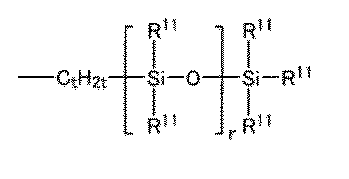
(式中、R11はそれぞれ独立して置換若しくは非置換の炭素原子数1~30の一価炭化水素基、水酸基又は水素原子であり、R11のうち少なくとも一つは前記一価炭化水素基である。tは2~10の範囲の数であり、rは1~500の範囲の数である)で示される鎖状のオルガノシロキサン基、および
下記一般式(2´´):

(式中、R11及びrは上記のとおりである)で示される鎖状のオルガノシロキサン基から選ばれる1種以上の基である。
2である。各階層数において、L1で示される基は以下のように表される。式中、R2お
よびZは前記同様の基である。


本発明に係る新規なカルボン酸共変性オルガノポリシロキサンは、高撥水性を呈するケイ素含有有機基と親水性のカルボキシル基含有有機基を同一分子内に有し、かつ好適には低粘度であるために、取り扱い性、作業効率、各種化粧料原料との配合安定性に優れるため、各種処理剤および化粧料原料成分として有用であり、特に、化粧料に使用する疎水性粉体の表面処理や粉体の水相中への分散に用いられる粉体の表面処理剤、界面活性剤または粉体分散剤として極めて有用である。
本発明に係るカルボン酸共変性オルガノポリシロキサンは、粉体、特に疎水性粉体の表面処理剤または分散剤として機能し、疎水性粉体に対して、好適には塩基性物質と併用することで、水相中に疎水性粉体が均一かつ安定に分散した水性の粉体組成物を形成可能である。特に、(A)本発明に係るカルボン酸共変性オルガノポリシロキサン、(B)塩基性化合物、および(C)水、多価アルコールおよび低級アルコールから選ばれる1種類以上の親水性媒体を含有するカルボン酸共変性オルガノポリシロキサン組成物は、親水性媒体中で、カルボン酸残基が部分的に中和されたカルボン酸塩構造を形成するので、特に疎水性粉体の分散剤である粉体表面処理剤、界面活性剤または表面処理剤として特に有用である。
本発明は、(A)本発明に係るカルボン酸共変性オルガノポリシロキサン、(B)塩基性化合物、(C)水、多価アルコールおよび低級アルコールから選ばれる1種類以上の親水性媒体、及び(D)粉体又は着色剤を含有してなる粉体組成物に関する。当該粉体組成物は、好適には、(D1)疎水性の粉体又は着色剤を含み、当該成分(D1)が水相中に分散した構造を有する。本発明に係るカルボン酸共変性オルガノポリシロキサンを含有する粉体組成物は、外用剤組成物や、特に化粧料または化粧料原料として好適に使用することができる。
本発明の粉体組成物は少なくとも1種の(B)塩基性物質を含むことが好ましい。成分(B)は、(A)本発明に係るカルボン酸共変性オルガノポリシロキサンのカルボン酸変性部位をアニオン化することができ、その界面活性剤/粉体分散剤としての機能を向上させる。特に、本発明の水性分散体組成物は、(D)粉体又は着色剤、好適には、(D1)疎水性の粉体又は着色剤を含むものであるが、前記の成分(A)と成分(B)を併用することで、成分(A)単独に比べて、成分(D)を水相中に良好に分散することができ、水性分散体組成物体の均一分散性および安定性を改善するだけでなく、化粧料原料として当該水性分散体組成物を配合した化粧料等が十分な撥水性、耐水性、耐皮脂性を実現することに貢献する。
親水性媒体は、本発明の粉体組成物の主たる分散媒であり、水、多価アルコールおよび低級アルコールから選ばれる1種類以上であり、組成物の水相を形成する。本発明の粉体組成物は好適には、水性分散体であり、前記の成分(A)および成分(B)の存在下において、成分(D)である粉体または着色剤が水相中に安定して分散した構造を形成することが好ましい。
本発明に係る粉体組成物(特に水性スラリー)等に用いる、(D)粉体又は着色剤は、化粧料の成分として一般に使用されるものであり、白色及び着色顔料、並びに、体質顔料を含む。白色及び着色顔料は化粧料の着色等に使用され、一方、体質顔料は、化粧料の感触改良等に使用される。本発明における「粉体」としては、化粧料に通常使用される白色及び着色顔料、並びに、体質顔料を特に制限なく使用することができる。本発明において、1種類又は2種類以上の粉体を配合することが好ましい。粉体の形状(球状、棒状、針状、板状、不定形状、紡錘状、繭状等)、粒子径(煙霧状、微粒子、顔料級等)、及び、粒子構造(多孔質、無孔質等)は何ら限定されるものではないが、平均一次粒子径が1nm~100μmの範囲にあることが好ましい。特に、これらの粉体又は着色剤を顔料として配合する場合、平均粒子径が1nm~20μmの範囲にある無機顔料粉体、有機顔料粉体、樹脂粉体から選択される1種類又は2種類以上を配合することが好ましい。
本発明のカルボン酸共変性オルガノポリシロキサンおよび粉体又は着色剤を含む粉体組成物は、好適には親水性媒体からなる水相を連続層とする水性分散体組成物であり、親水性媒体中に、粉体または着色剤、特に、疎水性の粉体又は着色剤が分散した組成物であり、化粧料・塗料・インキ等(以下、「化粧料等」)の組成物において使用する原料として使用することができる。
また、本発明の水性分散体組成物はそのまま化粧料、塗料、インキに配合することもできる。その場合、分散体と、化粧料、塗料、インキ等において使用される各種成分を混合することによって化粧料組成物、水性塗料、インキ組成物を得ることができる。特に、本発明の水性分散体組成物は、化粧料に直接配合する、化粧料原料として好適である。
上記の通り、本発明に係るカルボン酸共変性オルガノポリシロキサン、およびそれを含む組成物等は化粧料原料として、外用剤組成物に配合して使用することができる。このような外用剤組成物は、上記のカルボン酸共変性オルガノポリシロキサン(=成分(A))を含んでよく、上記の成分(A),(B)および(C)を含み、親水性媒体中でカルボン酸変性基が部分的に中和された構造を有するカルボン酸共変性オルガノポリシロキサン組成物を含んでもよく、上記の成分(A),(B),(C)および(D)を含み、親水性媒体中に粉体または着色剤である成分(D)が分散された構造を有するカルボン酸共変性オルガノポリシロキサン組成物を含んでもよい。
本発明に係るカルボン酸共変性オルガノポリシロキサンは、本件出願人が上記の特許文献1(国際公開特許 WO2015/159773号公報)、特許文献2(国際公開特許 WO2020/036065号公報)において提案する化粧料等において、カルボン酸変性シリコーンと共通の用途に使用でき、その一部または全部を置き換えて使用することができる。同様に、本発明に係るカルボン酸共変性オルガノポリシロキサンは、本件出願人が国際特許出願(PCT/JP19/029957,PCT/JP19/029927)、国際公開特許 WO/2020/036064,国際公開特許 WO/2020/036061,国際公開特許 WO/2020/036062,国際公開特許 WO/2020/036063において提案する化粧料等において、処方中におけるカルボン酸変性シリコーンと共通の用途に使用でき、その一部または全部を置き換えて使用することができ、これらのカルボン酸変性シリコーンを含む化粧料等の有利な技術的効果、使用感および感触を損なうことなく、処方中の疎水性の粉体または着色剤の均一分散性、保存安定性等をさらに改善できる場合がある。
本発明にかかるカルボン酸共変性オルガノポリシロキサン(化合物1~4)は以下の方法で合成した。
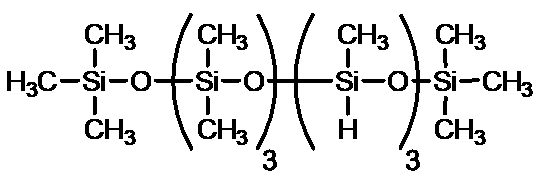
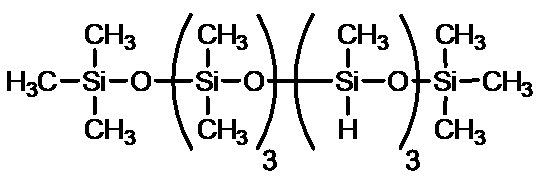
撹拌機、還流冷却器、滴下ロート及び温度計を備えたフラスコにウンデシレン酸トリメチルシリル126.90g , トリストリメチルシロキシビニルシラン78.90g,白金- 1 , 3 - ジビニル- 1 , 1 , 3 , 3 - テトラメチルジシロキサン錯体の0.025g を加え、7 0 - 8 0 ℃ の範囲を保つように、下記一般式で表されるメチルハイドロジェンポリシロキサン94.20g を滴下した。

撹拌機、還流冷却器、滴下ロート及び温度計を備えたフラスコにウンデシレン酸トリメチルシリル44.54g , Bu-(OSiMe2)6-CH=CH2で表されるマクロモノマー原料52.29g,白金- 1 , 3 - ジビニル- 1 , 1 , 3 , 3 - テトラメチルジシロキサン錯体の0.018g を加え、7 0 - 8 0 ℃ の範囲を保つように、下記一般式で表されるメチルハイドロジェンポリシロキサン33.18g を滴下した。


撹拌機、還流冷却器、滴下ロート及び温度計を備えたフラスコにウンデシレン酸トリメチルシリル235.52g , トリストリメチルシロキシビニルシラン45.92g,白金- 1 , 3 - ジビニル- 1 , 1 , 3 , 3 - テトラメチルジシロキサン錯体の0.078g を加え、7 0 - 8 0 ℃ の範囲を保つように、下記一般式で表されるメチルハイドロジェンポリシロキサン68.57g を滴下した。


撹拌機、還流冷却器、滴下ロート及び温度計を備えたフラスコにウンデシレン酸トリメチルシリル120.58g , Bu-(OSiMe2)6-CH=CH2で表されるマクロモノマー原料44.24g,白金- 1 , 3 - ジビニル- 1 , 1 , 3 , 3 - テトラメチルジシロキサン錯体の0.044g を加え、7 0 - 8 0 ℃ の範囲を保つように、下記一般式で表されるメチルハイドロジェンポリシロキサン35.18g を滴下した。


[比較合成例1]
撹拌機、還流冷却器、滴下ロート及び温度計を備えたフラスコにウンデシレン酸トリメチルシリル230.67g , 白金- 1 , 3 - ジビニル- 1 , 1 , 3 , 3 - テトラメチルジシロキサン錯体の0.042g を加え、7 0 - 8 0 ℃ の範囲を保つように、下記一般式で表されるメチルハイドロジェンポリシロキサン129.33g を滴下した。

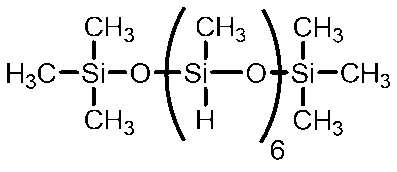
撹拌機、還流冷却器、滴下ロート及び温度計を備えたフラスコに1,1,1,3,5,5,5-ヘプタメチルトリシロキサン100g、白金-1,3-ジビニル-1,1,3,3-テトラメチルジシロキサン錯体のトルエン溶液0.02gを加え、70-100℃の範囲を保つように、ウンデシレン酸トリメチルシリル105gを滴下した。滴下終了後、2時間、110℃で熟成した後、水素発生法に反応が完結していることを確認した。低沸点分を減圧下、留去した。その後、水を加え、還流下4時間熟成し、脱保護を行った。その後再び低沸点分を減圧下除去し、比較化合物2を得た。分析の結果、比較化合物2の化学構造は下記化学式で示されることが確認された。

撹拌機、還流冷却器、滴下ロート及び温度計を備えたフラスコにウンデシレン酸トリメチルシリル581.78g , 白金- 1 , 3 - ジビニル- 1 , 1 , 3 , 3 - テトラメチルジシロキサン錯体の0.087g を加え、7 0 - 8 0 ℃ の範囲を保つように、下記一般式で表されるメチルハイドロジェンポリシロキサン168.23g を滴下した。

撹拌機、還流冷却器、滴下ロート及び温度計を備えたフラスコにウンデシレン酸トリメチルシリル304.20g , 白金- 1 , 3 - ジビニル- 1 , 1 , 3 , 3 - テトラメチルジシロキサン錯体の0.092g を加え、7 0 - 8 0 ℃ の範囲を保つように、下記一般式で表されるメチルハイドロジェンポリシロキサン304.20g を滴下した。


マヨネーズ瓶に下記表1および下表2に示す各成分を入れ、さらにジルコニアビーズ(YTZボール、φ0.8mm)160gを投入した。ペイントシェーカーで分散し、ビーズを分離したのち、実施例5~6、比較例1~5の水性分散体を得た。各水性分散体は以下の方法で評価を行い、結果を表1に示した。なお、各水性分散体の粘度はEMD型粘度計(東京計器製)を用いて調製直後(初期)、室温4日静置後、室温4か月静置後のタイミングで測定し、その時点における以下の基準で5段階評価を行った。なお、分散体が安定せず、相分離が起きた場合、「分離」と評価した。
調製直後に水性分散体の外観を観察した。
○:分散状態が良好であり、低粘度の分散体が得られた
×:分散状態が悪く、クリーム状になった
[4か月静置後の水性分散体の評価]
1:化粧品原料として非常に不向き
2:化粧品原料として不向き
3:化粧品原料として使用可能
4:化粧品原料として有用
5:化粧品原料として非常に有用

(注1)商品名:イソステアリン酸EX(高級アルコール工業社製)
(注2)商品名:STR-100A-LP(堺化学工業株式会社製)
*高粘度となり、測定不能

(注1)商品名:イソステアリン酸EX(高級アルコール工業社製)
(注3)商品名:FINEX 30S-LPT(堺化学工業株式会社製)
*高粘度となり、測定不能
本発明に係るカルボン酸共変性オルガノポリシロキサンは、公知のカルボン酸変性シリコーンに係る外用剤組成物の処方例において、カルボン酸変性シリコーンの一部または全部を置き換えて使用することができる。具体的には、特許文献1(国際公開特許 WO2015/159773号公報)、特許文献2(国際公開特許 WO2020/036065号公報)、国際特許出願(PCT/JP19/029957,PCT/JP19/029927)、国際公開特許 WO/2020/036064,国際公開特許 WO/2020/036061,国際公開特許 WO/2020/036062,国際公開特許 WO/2020/036063に開示された実施例または処方例に係るカルボン酸変性シリコーンを、上記の実施例1~4に係るカルボン酸共変性オルガノポリシロキサン(化合物1~4)で置き換えたものは本願発明に係る化粧料の処方例として、本願発明の範囲に包含されるものであり、本件出願人は、そのような使用および処方設計を明示的に教示するものである。
Claims (15)
- 下記構造式(1)で表され、50℃において液状である、カルボン酸共変性オルガノポリシロキサン。
構造式(1):

R1は置換もしくは非置換の炭素原子数1~6の一価炭化水素基または水素原子であり、
R2は、炭素原子数6~30の、置換もしくは非置換の、直鎖状もしくは分岐状の一価炭化水素基を表し、
L1はi=1のときの下記一般式(2):

(式中、R1は前記同様の基であり、RCは炭素原子数1~6のアルキル基またはフェニル基であり、Zは二価の有機基である。iはLiで示されるシリルアルキル基の階層を示し、該シリルアルキル基の繰り返し数である階層数がcのとき1~cの整数であり、階層数cは1~10の整数であり、Li+1はiがc未満のときは該シリルアルキル基であり、i=cのときはメチル基またはフェニル基である。aiは0~3の範囲の数である)で示されるシロキサンデンドロン構造を有するシリルアルキル基、
下記一般式(2´):

(式中、R11はそれぞれ独立して置換若しくは非置換の炭素原子数1~30の一価炭化水素基、水酸基又は水素原子であり、R11のうち少なくとも一つは前記一価炭化水素基である。tは2~10の範囲の数であり、rは1~500の範囲の数である)で示される鎖状のオルガノシロキサン基、および
下記一般式(2´´):

(式中、R11及びrは上記のとおりである)で示される鎖状のオルガノシロキサン基から選ばれる1種以上の基であり、
Rcは一般式:-Rc1-(ORc2)p-(O)w-Rc3-COOH(Rc1 は炭素数2~22の直鎖又は分岐鎖のアルキレン基を表し、Rc2 は炭素数2~4の直鎖又は分岐鎖のアルキレン基を表し、Rc3 は結合手(-)又は炭素数1~22の直鎖若しくは分岐鎖のアルキレン基を表し、pは0~200の数を表し、wは0又は1の数を表す)で示されるカルボキシル基含有有機基であり、
R´は、独立して前記のR1,R2,L1およびRcから選ばれる基であり、
(n1+n2+n3+n4)は1~1000の範囲の数であり、n1は0~999、n2は0~100、n3は1~100、n4は0~100の範囲の数であり、n4=0のとき、R´の少なくとも一方はRcである。} - 式(1)において、L1が下記一般式(2-1)、一般式(2-2)または一般式(2´)で表される官能基である、請求項1に記載のカルボン酸共変性オルガノポリシロキサン。
一般式(2-1):

一般式(2-2):

(式中、R1,RCおよびZは前記同様の基であり、a1およびa2は各々独立に0~3の範囲の数である。)
一般式(2´):

(式中、R11はそれぞれ独立しては前記同様の基であり、tは2~10の範囲の数であり、rは1~500の範囲の数である) - 上記構造式(1)において、(n1+n2+n3+n4)が2~50の範囲の数であり、n1は0~49、n2は0~10、n3は1~10、n4は0~10の範囲の数であり、n4=0のとき、R´の少なくとも一方はRcであることを特徴とする、請求項1または請求項2に記載のカルボン酸共変性オルガノポリシロキサン。
- 室温(25℃)で液状であり、上記構造式(1)において、(n1+n2+n3+n4)が2~20の範囲の数であり、n3が1~10の範囲の数であり、n4が1~10の範囲の数であり、(n1+n2+n3)/n4が0.1~5.0の範囲であることを特徴とする、請求項1~請求項3のいずれか1項に記載のカルボン酸共変性オルガノポリシロキサン。
- (A)請求項1~請求項4のいずれか1項に記載のカルボン酸共変性オルガノポリシロキサン
(B)塩基性化合物、及び
(C)水、多価アルコールおよび低級アルコールから選ばれる1種類以上の親水性媒体
を含有する、カルボン酸共変性オルガノポリシロキサン組成物。 - 請求項1~請求項4のいずれか1項に記載のカルボン酸共変性オルガノポリシロキサンまたは請求項5に記載のカルボン酸共変性オルガノポリシロキサン組成物を含有する粉体処理剤。
- 請求項1~請求項4のいずれか1項に記載のカルボン酸共変性オルガノポリシロキサンまたは請求項5に記載のカルボン酸共変性オルガノポリシロキサン組成物を含有する界面活性剤または表面処理剤。
- (A)請求項1~請求項4のいずれか1項に記載のカルボン酸共変性オルガノポリシロキサン
(B)塩基性化合物、
(C)水、多価アルコールおよび低級アルコールから選ばれる1種類以上の親水性媒体、及び
(D)粉体又は着色剤
を含有してなる粉体組成物。 - 上記の成分(D)が、(D1)疎水性の粉体又は着色剤であり、成分(D)が水相中に分散した構造を有することを特徴とする、請求項8に記載の粉体組成物。
- 上記の成分(D)が、(D1-1)平均粒子径が1~200nmの範囲である、疎水化微粒子酸化チタン又は疎水化微粒子酸化亜鉛であり、成分(D)が水相中に分散した構造を有することを特徴とする、請求項8に記載の粉体組成物。
- 請求項1~請求項4のいずれか1項に記載のカルボン酸共変性オルガノポリシロキサンまたは請求項5に記載のカルボン酸共変性オルガノポリシロキサン組成物を含有する外用剤組成物。
- (A)請求項1~請求項4のいずれか1項に記載のカルボン酸共変性オルガノポリシロキサン
(B)塩基性化合物、
(C)水、多価アルコールおよび低級アルコールから選ばれる1種類以上の親水性媒体、及び
(D)粉体又は着色剤
を含有してなり、成分(D)が水相中に分散した構造を有する、外用剤組成物。 - 請求項8~請求項10のいずれか1項に記載の粉体組成物を含有する外用剤組成物。
- 化粧料または医薬である請求項11~請求項13のいずれか1項に記載の外用剤組成物。
- (A)請求項1~請求項4のいずれか1項に記載のカルボン酸共変性オルガノポリシロキサン、(B)塩基性化合物、(C)水、多価アルコールおよび低級アルコールから選ばれる1種類以上の親水性媒体、および(D)粉体又は着色剤を事前に混合し、成分(D)の水性分散物の形態で配合する工程を有する、請求項12~請求項14のいずれか1項に記載の外用剤組成物の製造方法。
Priority Applications (5)
| Application Number | Priority Date | Filing Date | Title |
|---|---|---|---|
| US18/030,264 US20230372228A1 (en) | 2020-10-09 | 2021-10-06 | Carboxylic acid co-modified organopolysiloxane and use thereof |
| EP21877671.4A EP4227347A4 (en) | 2020-10-09 | 2021-10-06 | COMODIFIED ORGANOPOLYSILOXANE BASED ON CARBOXYLIC ACID AND ITS USE |
| CN202180062538.3A CN116096786B (zh) | 2020-10-09 | 2021-10-06 | 羧酸共改性聚有机硅氧烷及其用途 |
| KR1020237015172A KR20230084532A (ko) | 2020-10-09 | 2021-10-06 | 카복실산 공변성 오가노폴리실록산 및 그의 용도 |
| JP2022555538A JP7827398B2 (ja) | 2020-10-09 | 2021-10-06 | カルボン酸共変性オルガノポリシロキサンおよびその用途 |
Applications Claiming Priority (2)
| Application Number | Priority Date | Filing Date | Title |
|---|---|---|---|
| JP2020171043 | 2020-10-09 | ||
| JP2020-171043 | 2020-10-09 |
Publications (1)
| Publication Number | Publication Date |
|---|---|
| WO2022075372A1 true WO2022075372A1 (ja) | 2022-04-14 |
Family
ID=81126091
Family Applications (1)
| Application Number | Title | Priority Date | Filing Date |
|---|---|---|---|
| PCT/JP2021/037020 Ceased WO2022075372A1 (ja) | 2020-10-09 | 2021-10-06 | カルボン酸共変性オルガノポリシロキサンおよびその用途 |
Country Status (6)
| Country | Link |
|---|---|
| US (1) | US20230372228A1 (ja) |
| EP (1) | EP4227347A4 (ja) |
| JP (1) | JP7827398B2 (ja) |
| KR (1) | KR20230084532A (ja) |
| CN (1) | CN116096786B (ja) |
| WO (1) | WO2022075372A1 (ja) |
Cited By (2)
| Publication number | Priority date | Publication date | Assignee | Title |
|---|---|---|---|---|
| WO2024171990A1 (ja) * | 2023-02-15 | 2024-08-22 | 信越化学工業株式会社 | (ポリ)グリセリン基又はポリオキシアルキレン基を有するカルボキシ基変性オルガノポリシロキサン及び化粧料 |
| WO2024204558A1 (ja) * | 2023-03-31 | 2024-10-03 | ダウ・東レ株式会社 | 分岐状カルボン酸変性シリコーンおよびそれを含むダイカスト用離型剤組成物 |
Families Citing this family (1)
| Publication number | Priority date | Publication date | Assignee | Title |
|---|---|---|---|---|
| JP7667643B2 (ja) * | 2020-09-25 | 2025-04-23 | ダウ・東レ株式会社 | 共変性オルガノポリシロキサンおよびその用途 |
Citations (11)
| Publication number | Priority date | Publication date | Assignee | Title |
|---|---|---|---|---|
| JPH0543697A (ja) * | 1991-08-16 | 1993-02-23 | Nippon Unicar Co Ltd | 反応性オルガノポリシロキサン |
| JPH0959125A (ja) | 1995-08-24 | 1997-03-04 | Kao Corp | 化粧料用粉体及びこれを含有する化粧料 |
| JP2002179548A (ja) * | 2000-12-11 | 2002-06-26 | Shin Etsu Chem Co Ltd | 化粧料 |
| WO2009022621A1 (ja) | 2007-08-10 | 2009-02-19 | Shiseido Company Ltd. | 表面処理剤、表面処理粉体及び化粧料 |
| JP2009263213A (ja) * | 2008-04-03 | 2009-11-12 | Shin Etsu Chem Co Ltd | カルボキシル基を有するオルガノポリシロキサンで表面処理された粉体、該粉体の分散物および該粉体を含む化粧料 |
| WO2015159773A1 (ja) | 2014-04-15 | 2015-10-22 | 東レ・ダウコーニング株式会社 | 化粧料 |
| WO2020036062A1 (ja) | 2018-08-15 | 2020-02-20 | ダウ・東レ株式会社 | 水中油型乳化化粧料 |
| WO2020036063A1 (ja) | 2018-08-15 | 2020-02-20 | ダウ・東レ株式会社 | 化粧料 |
| WO2020036061A1 (ja) | 2018-08-15 | 2020-02-20 | ダウ・東レ株式会社 | 水中油型乳化化粧料 |
| WO2020036065A1 (ja) | 2018-08-15 | 2020-02-20 | ダウ・東レ株式会社 | 水性分散体組成物およびその使用 |
| WO2020036064A1 (ja) | 2018-08-15 | 2020-02-20 | ダウ・東レ株式会社 | 水中油型乳化化粧料 |
Family Cites Families (7)
| Publication number | Priority date | Publication date | Assignee | Title |
|---|---|---|---|---|
| KR101925354B1 (ko) * | 2009-10-23 | 2018-12-05 | 다우 코닝 도레이 캄파니 리미티드 | 공동-개질된 오가노폴리실록산 |
| JP5809849B2 (ja) * | 2011-05-30 | 2015-11-11 | 東レ・ダウコーニング株式会社 | 低臭性糖アルコール変性シリコーンの製造方法 |
| JP6369887B2 (ja) * | 2011-12-27 | 2018-08-08 | 東レ・ダウコーニング株式会社 | 新規な共変性オルガノポリシロキサン、それを含有してなる処理剤および外用剤 |
| JP6105920B2 (ja) * | 2011-12-27 | 2017-03-29 | 東レ・ダウコーニング株式会社 | 共変性オルガノポリシロキサン、それを含有してなる油中水型エマルション用乳化剤、外用剤および化粧料 |
| JP6063197B2 (ja) * | 2012-10-02 | 2017-01-18 | 東レ・ダウコーニング株式会社 | 新規な共変性オルガノポリシロキサン、それを含有してなる粉体処理剤および粉体組成物 |
| CN106414557A (zh) * | 2014-04-21 | 2017-02-15 | 道康宁东丽株式会社 | 液态高纯度多元醇衍生物改性的有机硅或其组合物的制造方法 |
| JP6876684B2 (ja) * | 2016-04-27 | 2021-05-26 | ダウ シリコーンズ コーポレーション | 新規オルガノポリシロキサン又はその酸中和塩、およびそれらの用途 |
-
2021
- 2021-10-06 CN CN202180062538.3A patent/CN116096786B/zh active Active
- 2021-10-06 KR KR1020237015172A patent/KR20230084532A/ko active Pending
- 2021-10-06 JP JP2022555538A patent/JP7827398B2/ja active Active
- 2021-10-06 WO PCT/JP2021/037020 patent/WO2022075372A1/ja not_active Ceased
- 2021-10-06 US US18/030,264 patent/US20230372228A1/en active Pending
- 2021-10-06 EP EP21877671.4A patent/EP4227347A4/en active Pending
Patent Citations (11)
| Publication number | Priority date | Publication date | Assignee | Title |
|---|---|---|---|---|
| JPH0543697A (ja) * | 1991-08-16 | 1993-02-23 | Nippon Unicar Co Ltd | 反応性オルガノポリシロキサン |
| JPH0959125A (ja) | 1995-08-24 | 1997-03-04 | Kao Corp | 化粧料用粉体及びこれを含有する化粧料 |
| JP2002179548A (ja) * | 2000-12-11 | 2002-06-26 | Shin Etsu Chem Co Ltd | 化粧料 |
| WO2009022621A1 (ja) | 2007-08-10 | 2009-02-19 | Shiseido Company Ltd. | 表面処理剤、表面処理粉体及び化粧料 |
| JP2009263213A (ja) * | 2008-04-03 | 2009-11-12 | Shin Etsu Chem Co Ltd | カルボキシル基を有するオルガノポリシロキサンで表面処理された粉体、該粉体の分散物および該粉体を含む化粧料 |
| WO2015159773A1 (ja) | 2014-04-15 | 2015-10-22 | 東レ・ダウコーニング株式会社 | 化粧料 |
| WO2020036062A1 (ja) | 2018-08-15 | 2020-02-20 | ダウ・東レ株式会社 | 水中油型乳化化粧料 |
| WO2020036063A1 (ja) | 2018-08-15 | 2020-02-20 | ダウ・東レ株式会社 | 化粧料 |
| WO2020036061A1 (ja) | 2018-08-15 | 2020-02-20 | ダウ・東レ株式会社 | 水中油型乳化化粧料 |
| WO2020036065A1 (ja) | 2018-08-15 | 2020-02-20 | ダウ・東レ株式会社 | 水性分散体組成物およびその使用 |
| WO2020036064A1 (ja) | 2018-08-15 | 2020-02-20 | ダウ・東レ株式会社 | 水中油型乳化化粧料 |
Non-Patent Citations (1)
| Title |
|---|
| See also references of EP4227347A4 |
Cited By (3)
| Publication number | Priority date | Publication date | Assignee | Title |
|---|---|---|---|---|
| WO2024171990A1 (ja) * | 2023-02-15 | 2024-08-22 | 信越化学工業株式会社 | (ポリ)グリセリン基又はポリオキシアルキレン基を有するカルボキシ基変性オルガノポリシロキサン及び化粧料 |
| JPWO2024171990A1 (ja) * | 2023-02-15 | 2024-08-22 | ||
| WO2024204558A1 (ja) * | 2023-03-31 | 2024-10-03 | ダウ・東レ株式会社 | 分岐状カルボン酸変性シリコーンおよびそれを含むダイカスト用離型剤組成物 |
Also Published As
| Publication number | Publication date |
|---|---|
| KR20230084532A (ko) | 2023-06-13 |
| US20230372228A1 (en) | 2023-11-23 |
| EP4227347A4 (en) | 2024-11-13 |
| JPWO2022075372A1 (ja) | 2022-04-14 |
| CN116096786A (zh) | 2023-05-09 |
| EP4227347A1 (en) | 2023-08-16 |
| JP7827398B2 (ja) | 2026-03-10 |
| CN116096786B (zh) | 2024-10-18 |
Similar Documents
| Publication | Publication Date | Title |
|---|---|---|
| CN104136499B (zh) | 新型共改性的有机聚硅氧烷以及包含所述有机聚硅氧烷的处理剂和外用制剂 | |
| JP6486384B2 (ja) | 新規シリコーン界面活性剤、油中水型エマルジョン組成物、粉体組成物、及びそれらの化粧/医療用途 | |
| JP6313540B2 (ja) | ジグリセリン誘導体変性シリコーン、それを含有してなる油中水型エマルション用乳化剤、外用剤および化粧料 | |
| JP7306786B2 (ja) | 水性分散体組成物およびその使用 | |
| JP6566476B2 (ja) | 長鎖炭化水素基含有ジグリセリン誘導体変性シリコーン及びその利用 | |
| WO2014054686A1 (ja) | 新規な共変性オルガノポリシロキサン、それを含有してなる粉体処理剤および粉体組成物 | |
| JP7827398B2 (ja) | カルボン酸共変性オルガノポリシロキサンおよびその用途 | |
| JP6392669B2 (ja) | 透明乃至半透明の液状のグリセリン誘導体変性シリコーン組成物の製造方法 | |
| CN104755577B (zh) | 包含共改性的有机聚硅氧烷的处理剂和化妆品组合物 | |
| JP6243355B2 (ja) | 高純度モノアルケニル含有グリセリン誘導体及びその製造方法 | |
| JP7667643B2 (ja) | 共変性オルガノポリシロキサンおよびその用途 | |
| WO2023026999A1 (ja) | 粉体含有組成物 |
Legal Events
| Date | Code | Title | Description |
|---|---|---|---|
| 121 | Ep: the epo has been informed by wipo that ep was designated in this application |
Ref document number: 21877671 Country of ref document: EP Kind code of ref document: A1 |
|
| ENP | Entry into the national phase |
Ref document number: 2022555538 Country of ref document: JP Kind code of ref document: A |
|
| ENP | Entry into the national phase |
Ref document number: 20237015172 Country of ref document: KR Kind code of ref document: A |
|
| NENP | Non-entry into the national phase |
Ref country code: DE |
|
| ENP | Entry into the national phase |
Ref document number: 2021877671 Country of ref document: EP Effective date: 20230509 |