WO2022075419A1 - Crisprタイプi-dシステムを利用した標的ヌクレオチド配列改変技術 - Google Patents
Crisprタイプi-dシステムを利用した標的ヌクレオチド配列改変技術 Download PDFInfo
- Publication number
- WO2022075419A1 WO2022075419A1 PCT/JP2021/037194 JP2021037194W WO2022075419A1 WO 2022075419 A1 WO2022075419 A1 WO 2022075419A1 JP 2021037194 W JP2021037194 W JP 2021037194W WO 2022075419 A1 WO2022075419 A1 WO 2022075419A1
- Authority
- WO
- WIPO (PCT)
- Prior art keywords
- sequence
- cas10d
- terminal
- nucleotide sequence
- crrna
- Prior art date
- Legal status (The legal status is an assumption and is not a legal conclusion. Google has not performed a legal analysis and makes no representation as to the accuracy of the status listed.)
- Ceased
Links
Images


Classifications
-
- C—CHEMISTRY; METALLURGY
- C12—BIOCHEMISTRY; BEER; SPIRITS; WINE; VINEGAR; MICROBIOLOGY; ENZYMOLOGY; MUTATION OR GENETIC ENGINEERING
- C12N—MICROORGANISMS OR ENZYMES; COMPOSITIONS THEREOF; PROPAGATING, PRESERVING, OR MAINTAINING MICROORGANISMS; MUTATION OR GENETIC ENGINEERING; CULTURE MEDIA
- C12N9/00—Enzymes; Proenzymes; Compositions thereof; Processes for preparing, activating, inhibiting, separating or purifying enzymes
- C12N9/14—Hydrolases (3)
- C12N9/16—Hydrolases (3) acting on ester bonds (3.1)
- C12N9/22—Ribonucleases [RNase]; Deoxyribonucleases [DNase]
-
- C—CHEMISTRY; METALLURGY
- C12—BIOCHEMISTRY; BEER; SPIRITS; WINE; VINEGAR; MICROBIOLOGY; ENZYMOLOGY; MUTATION OR GENETIC ENGINEERING
- C12N—MICROORGANISMS OR ENZYMES; COMPOSITIONS THEREOF; PROPAGATING, PRESERVING, OR MAINTAINING MICROORGANISMS; MUTATION OR GENETIC ENGINEERING; CULTURE MEDIA
- C12N15/00—Mutation or genetic engineering; DNA or RNA concerning genetic engineering, vectors, e.g. plasmids, or their isolation, preparation or purification; Use of hosts therefor
- C12N15/09—Recombinant DNA-technology
- C12N15/10—Processes for the isolation, preparation or purification of DNA or RNA
- C12N15/102—Mutagenizing nucleic acids
-
- C—CHEMISTRY; METALLURGY
- C12—BIOCHEMISTRY; BEER; SPIRITS; WINE; VINEGAR; MICROBIOLOGY; ENZYMOLOGY; MUTATION OR GENETIC ENGINEERING
- C12N—MICROORGANISMS OR ENZYMES; COMPOSITIONS THEREOF; PROPAGATING, PRESERVING, OR MAINTAINING MICROORGANISMS; MUTATION OR GENETIC ENGINEERING; CULTURE MEDIA
- C12N15/00—Mutation or genetic engineering; DNA or RNA concerning genetic engineering, vectors, e.g. plasmids, or their isolation, preparation or purification; Use of hosts therefor
- C12N15/09—Recombinant DNA-technology
- C12N15/63—Introduction of foreign genetic material using vectors; Vectors; Use of hosts therefor; Regulation of expression
-
- C—CHEMISTRY; METALLURGY
- C12—BIOCHEMISTRY; BEER; SPIRITS; WINE; VINEGAR; MICROBIOLOGY; ENZYMOLOGY; MUTATION OR GENETIC ENGINEERING
- C12N—MICROORGANISMS OR ENZYMES; COMPOSITIONS THEREOF; PROPAGATING, PRESERVING, OR MAINTAINING MICROORGANISMS; MUTATION OR GENETIC ENGINEERING; CULTURE MEDIA
- C12N2310/00—Structure or type of the nucleic acid
- C12N2310/10—Type of nucleic acid
- C12N2310/20—Type of nucleic acid involving clustered regularly interspaced short palindromic repeats [CRISPR]
-
- C—CHEMISTRY; METALLURGY
- C12—BIOCHEMISTRY; BEER; SPIRITS; WINE; VINEGAR; MICROBIOLOGY; ENZYMOLOGY; MUTATION OR GENETIC ENGINEERING
- C12N—MICROORGANISMS OR ENZYMES; COMPOSITIONS THEREOF; PROPAGATING, PRESERVING, OR MAINTAINING MICROORGANISMS; MUTATION OR GENETIC ENGINEERING; CULTURE MEDIA
- C12N2750/00—MICROORGANISMS OR ENZYMES; COMPOSITIONS THEREOF; PROPAGATING, PRESERVING, OR MAINTAINING MICROORGANISMS; MUTATION OR GENETIC ENGINEERING; CULTURE MEDIA ssDNA viruses
- C12N2750/00011—Details
- C12N2750/14011—Parvoviridae
- C12N2750/14111—Dependovirus, e.g. adenoassociated viruses
- C12N2750/14141—Use of virus, viral particle or viral elements as a vector
- C12N2750/14143—Use of virus, viral particle or viral elements as a vector viral genome or elements thereof as genetic vector
-
- C—CHEMISTRY; METALLURGY
- C12—BIOCHEMISTRY; BEER; SPIRITS; WINE; VINEGAR; MICROBIOLOGY; ENZYMOLOGY; MUTATION OR GENETIC ENGINEERING
- C12R—INDEXING SCHEME ASSOCIATED WITH SUBCLASSES C12C - C12Q, RELATING TO MICROORGANISMS
- C12R2001/00—Microorganisms ; Processes using microorganisms
- C12R2001/89—Algae ; Processes using algae
Definitions
- the present invention uses a CRISPR (Clustered Regularly Interspaced Short Palindromic Repeats) type ID system to target a target nucleotide sequence, specifically modify a target nucleotide sequence, and suppress expression of a target gene.
- CRISPR Clustered Regularly Interspaced Short Palindromic Repeats
- complexes and kits containing Cas (CRISPR-associated) protein and crRNA (CRISPRRNA) used in the method used in the method.
- the CRISPR-Cas system is an acquired immune system found in bacteria and archaea that protects bacteria and archaea from viruses, plasmids and other foreign genetic elements.
- CRISPR-Cas systems are classified into two classes, six different types (I-VI), and at least 34 subtypes, depending on the Cas proteins and molecular mechanisms that make up the system.
- the complex of crRNA and Cas effector protein recognizes short (typically 3-5 base length) sequence elements called protospacer flanking motifs (PAMs) in foreign DNA. do.
- PAMs protospacer flanking motifs
- the complex of type I or II crRNA and Cas effector protein locally disrupts the DNA pair to form an R-loop structure, and the crRNA guide element base pairs with the complementary target strand. It forms and replaces non-target DNA strands. Binding and unwinding of double-stranded DNA targets by the crRNA-Cas complex is required for DNA cleavage and degradation by type-specific Cas effector nucleases such as Cas3, Cas9 and Cas12 nucleases.
- CRISPR type I there are various subtypes of CRISPR type I.
- target recognition modules such as Cas5, Cas6, Cas7 and Cas8 called Cascade (CRISPR-assisted-complex for experimental defense) and DNA cleavage modules such as Cas3
- Patent Document 2 In genome editing technology, the Class 1 CRISPR system is less common than Class 2, but as a genome editing tool, with Cas9 and Cpf1, for example, long region genomic deletions and diverse mutation profiles involving long gRNA sequences. It was suggested that it may have some advantages in comparison (Non-Patent Document 1, Patent Document 1).
- the class 1 CRISPR type IE system studied so far it has been reported that a base deletion of 2-300b to 100kb occurs mainly on the 5'upstream side of the PAM sequence (Non-Patent Document 3).
- the class 1 CRISPR type IE system studied so far consists of six Cas proteins (Cas3e, Cas5e, Cas6e, Cas7e, Cas8e and Cas11e) and a targeting crRNA.
- Cas8e and Cas11e are called a large subunit and a small subunit, respectively, and have the function of a support protein that stably maintains the binding between the Cas protein complex and the target DNA. It is considered (Non-Patent Document 1).
- CRISPR type ID (hereinafter referred to as "TiD") system, which is Cas3d, Cas5d. It has been found that genome editing can be realized by the five Cas proteins Cas6d, Cas7d, and Cas10d and the targeting crRNA (Patent Documents 1 and 2). Here, no gene corresponding to Cas11e, which is a small subunit of the CRISPR type IE system, was found at the TiD locus.
- An object of the present invention is to improve the target sequence targeting and modification efficiency by TiD.
- the inventors surprisingly found that, in addition to the previously reported expression of the five Cas proteins constituting the TiD system, a polypeptide containing a partial amino acid sequence containing the C-terminal region of Cas10d. It was found that the target nucleotide sequence can be modified with high efficiency by separately expressing. Thus, the present invention was completed.
- a method for targeting a target nucleotide sequence in a cell comprising: (I) CRISPR type I-D Cas proteins Cas5d, Cas6d, and Cas7d, and polypeptides containing the N-terminal HD domain of Cas10d, or nucleic acids encoding these proteins and polypeptides. (Ii) A polypeptide that does not contain the N-terminal HD domain of Cas10d and contains a C-terminal partial sequence of Cas10d, or a nucleic acid encoding the polypeptide, and (iii) a sequence that forms a base pair with the target nucleotide sequence.
- [6] The method according to any one of [2] to [5] above, wherein the modification is a deletion, insertion, or substitution of a base.
- [7] (i) CRISPR type I-D Cas proteins Cas5d, Cas6d, and Cas7d, and a polypeptide containing the N-terminal HD domain of Cas10d, (Ii) A polypeptide that does not contain the N-terminal HD domain of Cas10d and contains a C-terminal partial sequence of Cas10d, and (iii) a crRNA that contains a sequence that forms a base pair with the target nucleotide sequence.
- Complex containing [8] The complex according to the above [7], further comprising Cas3d.
- DNA encoding Vector containing. [11] The vector according to the above [10], further comprising a nucleic acid encoding Cas3d. [12] The above [10] or [11], wherein the nucleic acids (i) to (iii), or the nucleic acids (i) to (iii) and the nucleic acid encoding Cas3d are contained in one or more vectors. ] The expression vector described. [13] The vector according to the above [11] or [12], wherein the C-terminal partial sequence of Cas10d is a sequence consisting of 100 to 400 amino acids. [14] A DNA molecule encoding the complex according to any one of the above [7] to [9].
- a kit for targeting a target nucleotide sequence (I) CRISPR type I-D Cas proteins Cas5d, Cas6d, and Cas7d, and polypeptides containing the N-terminal HD domain of Cas10d, or nucleic acids encoding these proteins and polypeptides. (Ii) A polypeptide that does not contain the N-terminal HD domain of Cas10d and contains a C-terminal partial sequence of Cas10d, or a nucleic acid encoding the polypeptide, and (iii) a sequence that forms a base pair with the target nucleotide sequence. CrRNA containing, or DNA encoding the crRNA Kit including.
- a kit for modifying a target nucleotide sequence (I) CRISPR Type I-D Cas Proteins Cas3d, Cas5d, Cas6d, and Cas7d, and polypeptides containing the N-terminal HD domain of Cas10d, or nucleic acids encoding these proteins and polypeptides. (Ii) A polypeptide that does not contain the N-terminal HD domain of Cas10d and contains a C-terminal partial sequence of Cas10d, or a nucleic acid encoding the polypeptide, and (iii) a sequence that forms a base pair with the target nucleotide sequence. CrRNA containing, or DNA encoding the crRNA The kit.
- kits according to the above [15] or [16], wherein the C-terminal partial sequence of Cas10d is a sequence consisting of 100 to 400 amino acids.
- a method for improving targeting efficiency in targeting a target nucleotide sequence using a CRISPR type ID system which is a poly that does not contain the HD domain on the N-terminal side of Cas10d and contains the C-terminal partial sequence of Cas10d.
- a method for improving the modification efficiency in modifying a target nucleotide sequence using a CRISPR type ID system which is a polypeptide that does not contain the HD domain on the N-terminal side of Cas10d and contains the C-terminal partial sequence of Cas10d.
- a method comprising using a nucleic acid encoding the polypeptide Alternatively, a method comprising using a nucleic acid encoding the polypeptide.
- a composition for improving the modification efficiency in modifying a target nucleotide sequence using a CRISPR type ID system which does not contain the HD domain on the N-terminal side of Cas10d and contains the C-terminal partial sequence of Cas10d.
- a composition comprising a polypeptide or a nucleic acid encoding the polypeptide.
- CrRNA contained, or DNA encoding the crRNA A method for producing a cell having a modified target nucleotide sequence, which comprises introducing a cell.
- a method for producing a plant having a modified target nucleotide sequence which comprises producing a plant cell having a modified target nucleotide sequence by the method according to the above [22].
- a method for producing a non-human animal having a modified target nucleotide sequence which comprises producing a non-human animal cell having a modified target nucleotide sequence by the method according to the above [22].
- a method for targeting a target nucleotide sequence wherein the isolated nucleic acid containing the target nucleotide sequence is used.
- the present invention it is possible to efficiently induce site-specific mutations in cells, preferably animal and plant cells, by using a TiD system containing TiD crRNA engineered to target a particular DNA.
- a TiD system containing TiD crRNA engineered to target a particular DNA can.
- the C-terminal partial sequence of Cas10d (hereinafter, also referred to as "Cas10d C-ter"). ) Can increase the efficiency of targeting and modifying the target sequence by the TiD system several times.
- the techniques of the invention result in longer deletions as a mutation mode near the target sequence.
- Various types ID Cas10d C-ter were compared with Cas11e by alignment analysis.
- Various types I-D Cas10d C-ter were compared with Cas11e by alignment analysis (continued from FIG. 1-1).
- Various types I-D Cas10d C-ter were compared with Cas11e by alignment analysis (continued in FIG. 1-2).
- the effect on genome editing activity by overexpression of Cas10d C-ter protein in animal cells is shown. Detection of long-chain region deletion mutations in the AAVS gene induced by CRISPR TiD.
- A) Human AAVS gene structure, gRNA positions (white triangles), and various primer sets for amplifying mutations (black arrows) are shown.
- a TiD-induced long-chain region deletion pattern containing a Cas11d expression vector indicates the deletion in the 5'upstream region from the target sequence, and the gray bar indicates the deletion in the 3'downstream region from the target sequence. The number on the left side of the bar indicates the total base deletion length.
- the TiD system includes Cas3d, Cas5d, Cas6d, Cas7d and Cas10d, and TiD crRNA as Cas effector proteins among TiD Cas proteins.
- Cas5d, Cas6d and Cas7d are known to constitute a target recognition module (Cascade)
- Cas3d and Cas10d are known to constitute a polynucleotide cleavage module (Patent Document 1).
- previous studies by the inventors have revealed that Cas10d among the components of the cleavage module has a polynucleotide-degrading action (nuclease activity) and Cas3d has no nuclease activity.
- the TiD crRNA and the target recognition module target the target nucleotide sequence and guide the polynucleotide cleavage module to the vicinity of the target nucleotide sequence, and the target nucleotide sequence is cleaved by the action of Cas10d.
- the TiD crRNA comprises a sequence that base pairs with the target nucleotide sequence (eg, a sequence complementary to the target nucleotide sequence).
- the present invention is a method for targeting a target nucleotide sequence using a TiD system (hereinafter, also referred to as “target sequence targeting method of the present invention”), a method for modifying a target nucleotide sequence (hereinafter, “target sequence modification of the present invention”).
- a method also referred to as “method”
- a method for controlling the expression of the target gene hereinafter, also referred to as “the method for controlling the expression of the target gene of the present invention”
- the present invention is a complex containing a CRISPR type ID-related Cas protein and crRNA used in these methods (hereinafter, also referred to as “complex of the present invention”), and a nucleic acid encoding the complex.
- a vector containing a molecule hereinafter, also referred to as “vector of the present invention”
- kit of the present invention hereinafter, also referred to as “kit of the present invention”.
- the present invention is characterized in that a polypeptide containing the C-terminal partial sequence of Cas10d is used in addition to the Cas protein in the TiD system.
- a polypeptide containing the C-terminal partial sequence of Cas10d conserved the ⁇ -helix region common to Cas11e (Example 1). It was considered that the C-terminus of Cas10d fulfilled the function of Cas11e, and therefore TiD did not require the expression of Cas11e as in CRISPR type IE.
- expressing a polypeptide containing the C-terminal partial sequence of Cas10d improves the effectiveness of the TiD system.
- the present invention further provides a method for improving the efficiency of targeting and modification of a target nucleotide sequence utilizing the TiD system by using a polypeptide containing the C-terminal partial sequence of Cas10d, and a C-terminal partial sequence of Cas10d.
- a composition comprising a polypeptide comprising, improving the efficiency of targeting and modifying a target nucleotide sequence utilizing the TiD system.
- the cell may be either a prokaryotic cell or a eukaryotic cell, and is not particularly limited.
- eukaryotic cells are used.
- a "cell” is a cell isolated from an organism, a cell present in an organism (eg, in an animal or plant), an organism (eg, an animal, or). Includes either plants) or cultured cells.
- the method of the present invention may be applied to cells isolated from a living body, cells existing in the living body, or cells derived from any organ and tissue of the living body.
- it may be applied to cells existing in the body of a non-human animal or a non-human animal body.
- animal cells include, but are not limited to, germ cells, fertilized eggs, embryonic cells, stem cells (including, for example, iPS cells, embryonic stem cells, somatic stem cells, etc.), somatic cells, and the like.
- plant cells include, but are not limited to, germ cells, fertilized eggs, embryonic cells, somatic cells, and the like, and protoplasts may be used.
- the Cas effector protein used in the present invention is Cas3d, Cas5d, Cas6d, Cas7d, and Cas10d among the Cas proteins of TiD.
- Cas3d, Cas5d, Cas6d, Cas7d, and Cas10d may be derived from any bacteria or archaea, for example, Microcystis aeruginosa, Acetohalobium arabaticum, Ammonifex degensii, Anabaena cylindrica, Anabaena variabilis, Caldicellulosiruptor lactoaceticus, Caldilinea aerophila, Bacteria epipsimmum, Cyanothece Sp.
- Cas3d, Cas5d, Cas6d, Cas7d, and Cas10d may be derived from two or more bacterial species, or may be derived from the same bacterial species. Preferably, those derived from the same bacterial species are used.
- the amino acid sequence and nucleotide sequence information of the Cas protein is available from a public database such as, for example, NCBI GenBank.
- NCBI GenBank a public database
- BLAST program from microbial genome data obtained by metagenomic analysis or the like, it is possible to acquire sequences from new microbial species.
- the Cas protein can be obtained by a known method, for example, chemically synthesized based on amino acid sequence information, or a nucleic acid encoding the Cas protein is introduced into a cell via an appropriate vector or the like, and the cell is used. It may be produced in.
- the nucleic acid encoding the Cas protein can be obtained by a known method. For example, based on the amino acid sequence information, a codon optimized for translation in the host cell into which the nucleic acid is introduced is selected, and by chemical synthesis or the like. You may build it. By using codons that are frequently used in host cells, the expression level of the protein can be increased. Examples of the nucleic acid include RNA such as mRNA or DNA.
- Cas10d has an HD (histidine-aspartic acid) domain in the N-terminal region, and it is known that the domain functions in DNA cleavage (Patent Document 2). Further, in the present invention, it was found that a plurality of ⁇ -helix regions exist on the C-terminal side of Cas10d (Example 1). Therefore, in the present invention, Cas10d may be a polypeptide containing at least the N-terminal HD domain.
- Cas10d is a full-length Cas10d protein, a polypeptide containing one or more ⁇ -helix regions on the C-terminal side from the N-terminal HD domain of Cas10d, or the N-terminal HD domain of Cas10d.
- Cas10d may be a polypeptide containing, and lacking one or more ⁇ -helix regions on the C-terminal side.
- Cas10d may lack all ⁇ -helix regions on the C-terminal side.
- the term "Cas10d" includes both the full-length Cas10d polypeptide and the Cas10d fragment containing the N-terminal HD domain as described above.
- the Cas proteins of Cas3d, Cas5d, Cas6d, Cas7d, and Cas10d or the nucleic acids encoding them are one or more, eg, 1 to, as long as the complex of Cas protein and crRNA targets or modifies the target sequence. It may have several amino acid mutations, or one or more, eg, one to several nucleotide mutations.
- "several pieces” means about 2 to 10 pieces, for example, 3, 4, 5, 6, 7, 8 or 9 pieces.
- “mutation” includes deletions, substitutions, insertions or additions of amino acids or nucleotides as compared to the native sequence.
- Cas3d SEQ ID NO: 1
- Cas5d SEQ ID NO: 2
- Cas6d SEQ ID NO: 3
- Cas7d derived from Microcystis aeruginosa hereinafter referred to as M. aeruginosa
- SEQ ID NO: 4 Cas10d
- Cas3d a protein containing the amino acid sequence shown in SEQ ID NO: 1
- Cas5d a protein containing the amino acid sequence shown in SEQ ID NO: 2
- Cas6d SEQ ID NO: 3
- Cas7d derived from Microcystis aeruginosa hereinafter referred to as M. aeruginosa
- Cas10d SEQ ID NO: 5
- Examples of the protein comprising the amino acid sequence shown, Cas7d include the protein comprising the amino acid sequence set forth in SEQ ID NO: 4, and examples of Cas10d include the protein comprising the amino acid sequence set forth in SEQ ID NO: 5.
- a protein consisting of the amino acid sequence shown in SEQ ID NO: 1 as an example of Cas5d, a protein consisting of the amino acid sequence shown in SEQ ID NO: 2, and as an example of Cas6d, SEQ ID NO: 3
- Cas7d includes a protein consisting of the amino acid sequence shown in SEQ ID NO: 4
- an example of Cas10d includes a protein consisting of the amino acid sequence shown in SEQ ID NO: 5.
- Cas protein used in the present invention 30% or more, 40% or more, and 60%, respectively, with respect to SEQ ID NO: 1, SEQ ID NO: 2, SEQ ID NO: 3, SEQ ID NO: 4, and SEQ ID NO: 5, respectively. 50% or more, 70% or more, or 80% or more, preferably 90% or more, more preferably 95% or more, still more preferably 96% or more, still more preferably 97% or more, still more preferably 98% or more, or More preferably, a protein containing an amino acid sequence having 99% or more sequence identity can be mentioned.
- the Cas protein used in the present invention 30% or more, 40% or more, and 60 with respect to SEQ ID NO: 1, SEQ ID NO: 2, SEQ ID NO: 3, SEQ ID NO: 4, and SEQ ID NO: 5, respectively.
- % Or more 50% or more, 70% or more, or 80% or more, preferably 90% or more, more preferably 95% or more, still more preferably 96% or more, still more preferably 97% or more, still more preferably 98% or more,
- a protein consisting of an amino acid sequence having 99% or more sequence identity can be mentioned more preferably. Any of the above Cas proteins is capable of targeting or modifying the target sequence when complexed with the other Cas proteins and crRNA described above.
- a nuclear localization signal may be preferably added to the end of the Cas protein.
- the nuclear localization signal is known in the art and can be appropriately selected depending on the species from which the cell to be introduced is derived.
- two or more nuclear localization signals may be arranged in tandem and added to the Cas protein. Further, the nuclear localization signal may be added to either or both of the N-terminal side and the C-terminal side of the Cas protein.
- nucleic acid encoding Cas3d used in the present invention, a nucleic acid containing a nucleotide sequence encoding a protein containing the amino acid sequence shown in SEQ ID NO: 1, and as an example of a nucleic acid encoding Cas5d, the nucleic acid represented by SEQ ID NO: 2.
- a nucleic acid encoding Cas6d a nucleic acid containing a nucleotide sequence encoding a protein containing a sequence, as an example of a nucleic acid containing a nucleotide sequence encoding a protein containing the amino acid sequence set forth in SEQ ID NO: 3, a nucleic acid encoding Cas7d.
- a nucleic acid comprising a nucleotide sequence encoding a protein comprising the amino acid sequence set forth in SEQ ID NO: 4 and a nucleic acid comprising a nucleotide sequence encoding a protein comprising the amino acid sequence set forth in SEQ ID NO: 5, as an example of a nucleic acid encoding Cas10d.
- a nucleic acid encoding Cas3d used in the present invention a nucleic acid containing a nucleotide sequence encoding a protein consisting of the amino acid sequence shown in SEQ ID NO: 1, and as an example of a nucleic acid encoding Cas5d, in SEQ ID NO: 2.
- nucleic acid encoding Cas6d a nucleic acid containing a nucleotide sequence encoding a protein consisting of the indicated amino acid sequence, a nucleic acid containing a nucleotide sequence encoding a protein consisting of the amino acid sequence shown in SEQ ID NO: 3, a nucleic acid encoding Cas7d.
- nucleic acid containing the nucleotide sequence encoding the protein consisting of the amino acid sequence shown in SEQ ID NO: 4 and as an example of the nucleic acid encoding Cas10d, the nucleotide sequence encoding the protein consisting of the amino acid sequence shown in SEQ ID NO: 5.
- nucleic acid encoding Cas3d used in the present invention, a nucleic acid consisting of a nucleotide sequence encoding a protein consisting of the amino acid sequence shown in SEQ ID NO: 1, and an example of a nucleic acid encoding Cas5d, SEQ ID NO: 2
- a nucleic acid encoding Cas6d a nucleic acid consisting of a nucleotide sequence encoding a protein consisting of the amino acid sequence shown in, Cas7d, a nucleic acid consisting of a nucleotide sequence encoding a protein consisting of the amino acid sequence shown by SEQ ID NO: 3, is encoded.
- nucleic acid a nucleic acid consisting of a nucleotide sequence encoding a protein consisting of the amino acid sequence shown in SEQ ID NO: 4, and as an example of a nucleic acid encoding Cas10d, a nucleotide encoding a protein consisting of the amino acid sequence shown in SEQ ID NO: 5. Nucleic acid consisting of sequences can be mentioned.
- nucleic acid encoding the Cas protein used in the present invention 30% or more and 40%, respectively, with respect to SEQ ID NO: 1, SEQ ID NO: 2, SEQ ID NO: 3, SEQ ID NO: 4, and SEQ ID NO: 5, respectively. 60% or more, 50% or more, 70% or more, or 80% or more, preferably 90% or more, more preferably 95% or more, still more preferably 96% or more, still more preferably 97% or more, still more preferably 98. Included are nucleic acids comprising a nucleotide sequence encoding a protein comprising an amino acid sequence having greater than or equal to, or even more preferably greater than or equal to 99% sequence identity.
- nucleic acid encoding the Cas protein used in the present invention 30% or more and 40, respectively, with respect to SEQ ID NO: 1, SEQ ID NO: 2, SEQ ID NO: 3, SEQ ID NO: 4, and SEQ ID NO: 5, respectively.
- % Or more 60% or more, 50% or more, 70% or more, or 80% or more, preferably 90% or more, more preferably 95% or more, still more preferably 96% or more, still more preferably 97% or more, still more preferably.
- nucleic acid encoding the Cas protein used in the present invention 30% or more of each of SEQ ID NO: 1, SEQ ID NO: 2, SEQ ID NO: 3, SEQ ID NO: 4, and SEQ ID NO: 5 are used. 40% or more, 60% or more, 50% or more, 70% or more, or 80% or more, preferably 90% or more, more preferably 95% or more, still more preferably 96% or more, still more preferably 97% or more, still more preferable.
- the Cas protein expressed from any of the above nucleic acids has the ability to target or modify the target sequence when complexed with the Cas protein and crRNA expressed from the other nucleic acids described above.
- a nucleotide sequence encoding a nuclear translocation signal may be added to the end of the nucleic acid encoding the Cas protein.
- the nuclear localization signal sequence is known in the art and can be appropriately selected depending on the species from which the cell to be introduced is derived.
- two or more nuclear localization signal sequences may be arranged in tandem and added to the nucleic acid encoding the Cas protein.
- the nuclear localization signal sequence may be added to either or both of the 5'-terminal side and the 3'-terminal side of the nucleic acid encoding the Cas protein.
- the C-terminal partial sequence of Cas10d (Cas10d C-ter) is on the N-terminal side of Cas10d. It is a sequence that does not contain the HD domain of the above and contains one or more ⁇ -helix regions on the C-terminal side.
- the polypeptide containing Cas10d C-ter (hereinafter, also referred to as “Cas11d”) does not contain the HD domain on the N-terminal side of Cas10d.
- the sequence length of Cas10d C-ter is not particularly limited as long as the effects of the present invention are achieved, that is, as long as efficient targeting and modification of the target nucleotide sequence by the TiD system is achieved, but for example, about. Even if it is 100 amino acids long to about 400 amino acids long, preferably about 120 amino acids long to about 270 amino acids long, more preferably about 130 amino acids long to about 180 amino acids long, and even more preferably about 135 amino acids long to about 170 amino acids long. good.
- Cas10d C-ter about 100 amino acid length to about 400 amino acid length, preferably about 120 amino acid length to about 270 amino acid length, more preferably about 130 amino acid length to about 180 amino acid length from the C end of the full length amino acid sequence of Cas10d.
- a length, more preferably about 135 amino acids to about 170 amino acids, can be used, and for example, as a nucleic acid encoding Cas10d C-ter, a sequence length of about 0.3 kb upstream from the stop codon of the Cas10d gene is about 0.3 kb.
- Cas11d is, for example, about 100 amino acids to about 400 amino acids, preferably about 120 amino acids to about 270 amino acids, more preferably about 130 amino acids to about 180 amino acids, and even more preferably about 135 amino acids from the C-terminus of the full-length amino acid sequence of Cas10d. Contains amino acids to about 170 amino acids.
- Cas11d about 100 amino acids to about 400 amino acids, preferably about 120 amino acids to about 270 amino acids, more preferably about 130 amino acids to about 180 amino acids, still more preferably about 135 amino acids from the C-terminus of the full-length amino acid sequence of Cas10d. Examples thereof include polypeptides consisting of up to about 170 amino acids.
- the nucleic acid encoding Cas11d is, for example, about 0.3 kb to about 1.2 kb upstream of the stop codon of the Cas10d gene, preferably about 0.36 kb to about 0.81 kb, and more preferably about 0.39 kb to about.
- Cas11d contains 0.54 kb, more preferably about 0.41 kb to about 0.51 kb.
- a preferred example of a nucleic acid encoding Cas11d is from about 0.3 kb to about 1.2 kb upstream of the stop codon of the Cas10d gene, preferably from about 0.36 kb to about 0.81 kb, more preferably from about 0.39 kb.
- Nucleic acids consisting of about 0.54 kb, more preferably about 0.41 kb to about 0.51 kb can be mentioned.
- Cas11d is not the full length Cas10d.
- Nucleic acids encoding Cas11d and Cas11d can be obtained by known methods.
- Cas11d may be chemically synthesized based on amino acid sequence information, or a nucleic acid encoding Cas11d may be introduced into cells via an appropriate vector or the like and produced in the cells.
- a nucleic acid encoding Cas11d for example, a codon optimized for translation in the host cell into which the nucleic acid is introduced may be selected based on the amino acid sequence information and constructed by chemical synthesis or the like. By using codons that are frequently used in host cells, the expression level of the protein can be increased.
- the nucleic acid include RNA such as mRNA or DNA.
- the nucleic acid encoding Cas11d or Cas11d is 1 as long as the effects of the present invention are achieved, i.e., as long as the complex of Cas11d with the Cas protein and crRNA results in efficient targeting and modification of the target sequence. It may have the above, for example, one to several amino acid mutations, or one or more, for example, one to several nucleotide mutations.
- Cas11d although not limited to, M.D.
- examples thereof include a polypeptide containing Cas10d C-ter derived from Cas10d (SEQ ID NO: 5) of aeruginosa. Therefore, as an example of Cas11d used in the present invention, about 100 amino acids to about 400 amino acids, preferably about 120 amino acids to about 270 amino acids, and more preferably about 130 amino acids to about 130 amino acids to about 400 amino acids from the C-terminal of the amino acid sequence shown in SEQ ID NO: 5.
- Polypeptides comprising 180 amino acids, more preferably from about 135 amino acids to about 170 amino acids.
- Cas11d used in the present invention, about 100 amino acids to about 400 amino acids, preferably about 120 amino acids to about 270 amino acids, and more preferably about 130 amino acids to the C-terminal of the amino acid sequence shown in SEQ ID NO: 5.
- Examples thereof include polypeptides consisting of about 180 amino acids, more preferably about 135 amino acids to about 170 amino acids.
- M As an example of Cas11d derived from aeruginosa, a polypeptide containing a sequence consisting of the amino acids at positions 997 to 1156 of the amino acid sequence shown in SEQ ID NO: 5 (SEQ ID NO: 6) can be mentioned, and more preferably, it is shown by SEQ ID NO: 6.
- Examples include a polypeptide consisting of an amino acid sequence.
- Cas11d derived from PCC6803 include polypeptides containing the amino acid sequences shown in SEQ ID NOs: 8 to 19, respectively.
- Cas11d may contain Cas10d C-ter having a bacterial species different from or derived from the same bacterial species as the Cas protein (Cas3d, Cas5d, Cas6d, Cas7d, and / or Cas10d).
- Cas11d a polypeptide containing Cas10d C-ter derived from the same strain as any of the above Cas proteins is used as Cas11d.
- Cas11d used in the present invention, about 100 amino acids to about 400 amino acids, preferably about 120 amino acids to about 270 amino acids, and more preferably about 130 amino acids to the C-terminal of the amino acid sequence shown in SEQ ID NO: 5. 30% or more, 40% or more, 60% or more, 50% or more, 70% or more, or 80% or more, preferably 90% with respect to a sequence consisting of about 180 amino acids, more preferably about 135 amino acids to about 170 amino acids.
- a polypeptide containing an amino acid sequence having a sequence identity of 95% or more, more preferably 96% or more, still more preferably 97% or more, still more preferably 98% or more, or even more preferably 99% or more Can be mentioned.
- Cas11d used in the present invention, about 100 amino acids to about 400 amino acids, preferably about 120 amino acids to about 270 amino acids, more preferably about 130 amino acids from the C-terminal of the amino acid sequence shown in SEQ ID NO: 5. 30% or more, 40% or more, 60% or more, 50% or more, 70% or more, or 80% or more, preferably 90% or more, preferably 90% or more, with respect to a sequence consisting of about 180 amino acids, more preferably about 135 amino acids to about 170 amino acids.
- Cas11d 30% or more, 40% or more, 60% or more, 50% or more, 70% or more, or 80 with respect to the amino acid sequence represented by any of SEQ ID NOs: 6 and SEQ ID NOs: 8 to 19.
- Examples include polypeptides containing an amino acid sequence.
- Cas11d 30% or more, 40% or more, 60% or more, 50% or more, 70% or more, or 80% with respect to the amino acid sequence represented by any one of SEQ ID NO: 6 and SEQ ID NOs: 8 to 19.
- Examples include a polypeptide consisting of a sequence. Any of the above Cas11d is capable of resulting in efficient targeting and modification of the target sequence when complexed with the above Cas protein and crRNA.
- a nuclear localization signal may be preferably added to the end of Cas11d.
- the nuclear localization signal is known in the art and can be appropriately selected depending on the species from which the cell to be introduced is derived. Further, two or more nuclear localization signals may be added to Cas11d side by side in tandem. Further, the nuclear localization signal may be added to either or both of the N-terminal side and the C-terminal side of Cas11d.
- nucleic acid encoding Cas11d used in the present invention, about 0.3 kb to about 1.2 kb upstream of the stop codon of the nucleotide sequence encoding the protein containing the amino acid sequence shown in SEQ ID NO: 5, preferably about 1.2 kb.
- Nucleic acids comprising from about 0.36 kb to about 0.81 kb, more preferably from about 0.39 kb to about 0.54 kb, even more preferably from about 0.41 kb to about 0.51 kb.
- nucleic acid encoding Cas11d used in the present invention, about 0.3 kb to about 1.2 kb upstream of the stop codon of the nucleotide sequence encoding the protein consisting of the amino acid sequence shown in SEQ ID NO: 5.
- Nucleic acids comprising, preferably from about 0.36 kb to about 0.81 kb, more preferably from about 0.39 kb to about 0.54 kb, and even more preferably from about 0.41 kb to about 0.51 kb.
- nucleic acid encoding Cas11d used in the present invention, about 0.3 kb to about 0.3 kb upstream of the stop codon of the nucleotide sequence encoding the protein consisting of the amino acid sequence shown in SEQ ID NO: 5.
- nucleic acids consisting of 2 kb, preferably about 0.36 kb to about 0.81 kb, more preferably about 0.39 kb to about 0.54 kb, and even more preferably about 0.41 kb to about 0.51 kb.
- nucleic acid encoding Cas11d a nucleic acid containing a nucleotide sequence encoding a polypeptide containing the amino acid sequence shown in SEQ ID NO: 6 can be mentioned, and more preferably, a polypeptide consisting of the amino acid sequence shown in SEQ ID NO: 6 can be used.
- examples thereof include nucleic acids containing the encoding nucleotide sequence, and more preferably, nucleic acid consisting of the nucleotide sequence encoding the polypeptide consisting of the amino acid sequence set forth in SEQ ID NO: 6.
- nucleic acids encoding Cas11d include nucleic acids comprising a nucleotide sequence encoding a polypeptide comprising the amino acid sequences set forth in SEQ ID NOs: 8-19, more preferably the amino acids set forth in SEQ ID NOs: 8-19.
- nucleic acids comprising a nucleotide sequence encoding a polypeptide consisting of a sequence and more preferably nucleic acid comprising a nucleotide sequence encoding a polypeptide consisting of the amino acid sequences set forth in SEQ ID NOs: 8-19.
- nucleic acid encoding Cas11d used in the present invention about 0.3 kb to about 1.2 kb upstream of the stop codon of the nucleotide sequence encoding the protein containing the amino acid sequence shown in SEQ ID NO: 5. 30% or more, 40, with respect to a sequence consisting of preferably from about 0.36 kb to about 0.81 kb, more preferably from about 0.39 kb to about 0.54 kb, and even more preferably from about 0.41 kb to about 0.51 kb.
- nucleic acids containing a nucleotide sequence having 98% or more, or more preferably 99% or more, sequence identity Preferably, as an example of the nucleic acid encoding Cas11d used in the present invention, about 0.3 kb to about 1.2 kb upstream of the stop codon of the nucleotide sequence encoding the protein consisting of the amino acid sequence shown in SEQ ID NO: 5.
- nucleic acid encoding Cas11d used in the present invention, about 0.3 kb to about 0.3 kb upstream of the stop codon of the nucleotide sequence encoding the protein consisting of the amino acid sequence shown in SEQ ID NO: 5. 30% or more of a sequence consisting of 2 kb, preferably about 0.36 kb to about 0.81 kb, more preferably about 0.39 kb to about 0.54 kb, and even more preferably about 0.41 kb to about 0.51 kb.
- nucleic acids consisting of nucleotide sequences having 98% or more, or even more preferably 99% or more sequence identity.
- nucleic acid encoding Cas11d 30% or more, 40% or more, 60 with respect to the nucleotide sequence encoding the polypeptide containing the amino acid sequence represented by any of SEQ ID NOs: 6 and SEQ ID NOs: 8-19.
- nucleic acid containing a nucleotide sequence having 99% or more sequence identity can be mentioned more preferably.
- nucleic acid encoding Cas11d 30% or more, 40% or more, with respect to the nucleotide sequence encoding the polypeptide consisting of the amino acid sequence represented by any one of SEQ ID NOs: 6 and SEQ ID NOs: 8-19.
- nucleic acids containing a nucleotide sequence having 99% or more sequence identity As another example of the nucleic acid encoding Cas11d, 30% or more, 40% or more, with respect to the nucleotide sequence encoding the polypeptide consisting of the amino acid sequence represented by any one of SEQ ID NOs: 6 and SEQ ID NOs: 8-19.
- nucleic acid consisting of a nucleotide sequence having 99% or more sequence identity.
- the Cas11d polypeptide expressed from any of the above nucleic acids is capable of resulting in efficient targeting and modification of the target sequence when complexed with the above Cas protein and crRNA.
- a nucleotide sequence encoding a nuclear translocation signal may be added to the end of the nucleic acid encoding Cas11d.
- the nuclear localization signal sequence is known in the art and can be appropriately selected depending on the species from which the cell to be introduced is derived.
- two or more nuclear localization signal sequences may be arranged in tandem and added to the nucleic acid encoding Cas11d.
- the nuclear localization signal sequence may be added to either or both of the 5'-terminal side and the 3'-terminal side of the nucleic acid encoding Cas11d.
- the crRNA comprises one or more structural units (“repeat-spacer-repeat”) consisting of a repeat sequence derived from the CRISPR locus and a spacer sequence sandwiched between the repeat sequences.
- the repeat sequence preferably comprises a palindrome-like sequence.
- the crRNA contributes to target recognition of the CRISPR-Cas system by including an RNA sequence (ie, a protospacer sequence) that binds to the target nucleotide sequence as a spacer sequence.
- An RNA molecule containing a structure consisting of a repeat sequence of crRNA and a protospacer sequence sandwiched between the repeat sequences is also referred to as a guide RNA (gRNA).
- gRNA guide RNA
- the crRNA is processed by the action of the Cas effector protein to cleave the repeat sequence, resulting in a mature crRNA consisting of a partial sequence of the repeat sequence and a protospacer sequence sandwiched between the partial sequences of the repeat sequence.
- the pre-processed crRNA is called a pre-mature crRNA.
- the crRNA used in the present invention contains a repeat sequence derived from the CRISPR type ID locus and a sequence forming a base pair with the target nucleotide sequence as a protospacer sequence sandwiched between the repeat sequences.
- the crRNA used in the present invention is preferably a premature crRNA.
- the pre-mature crRNA is processed by Cas6d before being incorporated into Cascade (complex of Cas5d, Cas6d, and Cas7d) to become a mature crRNA. If the premature crRNA contains more than one "repeat-spacer-repeat" structural unit, the premature crRNA may contain more than one protospacer sequence. Premature crRNAs containing two or more protospacer sequences yield two or more mature crRNAs, which are then individually incorporated into Cascade.
- the protospacer sequence contained in crRNA is a sequence that forms a base pair with the target nucleotide sequence.
- the "sequence forming a base pair with the target nucleotide sequence” is, for example, a sequence complementary to the target nucleotide sequence or a sequence substantially complementary to the target nucleotide sequence.
- substantially complementary includes sequences that are not completely complementary to the target sequence but can bind to the target sequence (form a base pair with the target sequence).
- a sequence that is substantially complementary to the target nucleotide sequence may contain a mismatch with the target sequence as long as it base pairs with the target sequence.
- the repeat sequence portion of crRNA may have at least one hairpin structure.
- the repeat sequence portion on the 5'end side of the protospacer sequence may have a hairpin structure, and the repeat sequence portion on the 3'end side of the protospacer sequence may be single-stranded.
- crRNA preferably has one hairpin structure.
- the repeat sequence derived from the CRISPR type ID locus can be found from the crRNA gene sequence region adjacent to the type I-D gene cluster using a tandem repeat search program.
- the repeat sequence from the Type I-D locus may be from any bacterium or archaea, for example from the bacteria and archaea exemplified for the Cas effector protein described above. ..
- the base length of the repeat sequence contained in crRNA is not particularly limited as long as the purpose of interacting with Cascade to target the target nucleotide sequence is achieved.
- the repeat sequences before and after the protospacer sequence may each be about 10 to 70 bases long, for example, about 30 to 50 bases long, preferably about 35 to 45 bases long. May be good.
- the crRNA used in the present invention can contain a protospacer sequence having a length of about 10 to 70 bases.
- the protospacer sequence contained in the crRNA is preferably a sequence consisting of 20 to 50 bases, more preferably a sequence consisting of 25 bases to 45 bases, and further preferably a sequence consisting of 30 bases to 40 bases, for example, 31 bases and 32 bases. It is a sequence consisting of 33 bases, 34 bases, 35 bases, 36 bases, 37 bases, 38 bases, or 39 bases.
- the longer the targetable sequence the greater the sequence specificity of target recognition by crRNA.
- the longer the targetable sequence the higher the Tm value of the base pair formed between the crRNA and the target sequence, and the more stable the target recognition.
- the length of the sequence that crRNA can target is about 20 to 24 bases, so in the present invention, the sequence is more specific than the conventional method. Excellent in sex and stability.
- crRNA used in the present invention examples thereof include those containing a repeat sequence of crRNA derived from aeruginosa.
- a premature crRNA comprising a sequence represented by GUUCCAAUUAAUCUUAAGCCCUAUUAGGGAUUGAAACNNNNNNNNNNNNNNNNNNNNNNNNNNNNNGUUCCAAUUAAUCUUAAGCCCUAUUAGGGAUUGAAAC (SEQ ID NO: 7; N is any nucleotide constituting the sequence forming a base pair with the target nucleotide sequence).
- the number of N may be changed in the range of 10 to 70, preferably 20 to 50, more preferably 25 to 45, and further preferably 30 to 40.
- the crRNA may be introduced into cells as RNA or as DNA encoding crRNA.
- the DNA encoding the crRNA may be contained, for example, in a vector or expression cassette, the DNA sequence being operably linked to regulatory sequences such as promoters and terminators.
- the vector and the regulatory sequence can be appropriately selected by those skilled in the art based on, for example, a host cell or the like.
- a pol III promoter eg, SNR6, SNR52, SCR1, RPR1, U6, H1 promoter, etc.
- a pol II promoter eg, T6 sequence
- T6 sequence eg, T6 sequence
- human U6 snRNA promoter can be used.
- the DNA encoding the crRNA may be contained in the same vector or in the same expression cassette as any of the nucleic acids encoding the Cas protein and the Cas11d polypeptide, or the nucleic acid encoding the Cas protein and the Cas11d polypeptide. Any of these may be contained in another vector or in another expression cassette.
- the target nucleotide sequence (also simply referred to as “target sequence” in the present specification) is a sequence of an arbitrary nucleic acid and is located in the vicinity of the protospacer proximity motif (PAM) of the TiD system. It is not particularly limited except that the located sequence is selected as the target sequence.
- the nucleic acid may be a nucleic acid in a living body or a cell, or a nucleic acid isolated from a living body or a cell.
- the target nucleotide sequence may be either a double-stranded DNA sequence, a single-stranded DNA sequence, or an RNA sequence.
- the target nucleotide sequence is preferably a sequence on genomic DNA. Therefore, in the sense strand of the target nucleic acid, a sequence located near the PAM sequence, preferably a sequence located near the 3'side downstream of the PAM sequence, and more preferably a sequence adjacent to the 3'side downstream of the PAM sequence. Is selected as the target nucleotide sequence.
- the target nucleotide sequence is a sequence located near the PAM sequence, preferably a sequence located near the 5'side of the PAM sequence, and more preferably adjacent to the 5'side of the PAM sequence. It is selected from the array to be used.
- “located in the vicinity” includes both being adjacent and being close to each other.
- the term “neighborhood” includes both adjacent or near positions. In this specification, unless otherwise specified, it is described based on the sense strand of nucleic acid.
- the PAM sequence used for target recognition of the CRISPR system differs depending on the type of the CRISPR system. For example, M.
- the target nucleotide sequence may be a sequence located in the vicinity of the PAM sequence and existing in the intron, coding region, non-coding region, or control region of the target gene.
- the target gene is an arbitrary gene and may be arbitrarily selected.
- the length of the target nucleotide sequence is, for example, in the range of 10 to 70 bases, preferably 20 to 50 bases, more preferably 25 to 45 bases, and even more preferably 30 to 40 bases.
- Targeting sequence targeting method of the present invention comprises a polypeptide containing Cas5d, Cas6d, Cas7d, and Cas10d, Cas10d C-ter, and crRNA among the Cas effector proteins of TiD. It is characterized by introducing and into cells. That is, the target sequence targeting method of the present invention comprises (i) Cas5d, Cas6d, Cas7d, and Cas10d, or a nucleic acid encoding these proteins, (ii) a Cas11d polypeptide, or a nucleic acid encoding the polypeptide, and (i).
- a crRNA containing a sequence forming a base pair with a target nucleotide sequence or a DNA encoding the crRNA is introduced into the above cells.
- the target sequence targeting method of the present invention may be performed in vitro, in vivo, or ex vivo.
- the target sequence targeting method of the present invention can also be applied to the target nucleotide sequence of the isolated nucleic acid, in which case the method is the Cas protein of (i) above, the Cas11d polypeptide of (ii) above.
- the above-mentioned crRNA of (iii) is contacted with an isolated nucleic acid containing a target nucleotide sequence.
- the Cas protein is contained in cells as an isolated complex containing two or more of Cas5d, Cas6d, Cas7d, and Cas10d, for example, an isolated complex containing four.
- An isolated nucleic acid containing an isolated nucleic acid containing an introduced or target nucleotide sequence may be contacted, or each of Cas5d, Cas6d, Cas7d, and Cas10d is introduced into a cell alone as an isolated protein or containing an isolated nucleic acid containing a target nucleotide sequence. May be in contact with.
- the Cas protein may be introduced into cells as a nucleic acid encoding the Cas proteins Cas5d, Cas6d, Cas7d, and Cas10d.
- the nucleic acid include RNA such as mRNA or DNA.
- Cas11d may be introduced into cells as a complex with the Cas protein or contacted with an isolated nucleic acid containing the target nucleotide sequence, or Cas11d may be as an isolated polypeptide. It may be introduced into cells alone or contacted with an isolated nucleic acid containing a target nucleotide sequence. Further, in the target sequence targeting method of the present invention, Cas11d may be introduced into cells as a nucleic acid encoding Cas11d. Examples of the nucleic acid include RNA such as mRNA or DNA.
- the Cas protein and the nucleic acid encoding Cas11d may be contained, for example, in a vector, and the nucleic acid sequence is preferably operably linked to a regulatory sequence such as a promoter and a terminator.
- a nuclear translocation signal sequence is preferably added to the nucleic acid sequence encoding the Cas protein and Cas11d.
- Two or more or all of the nucleic acids encoding the Cas proteins Cas5d, Cas6dCas7d and Cas10d, and Cas11d may be contained in a single vector or expression cassette, or may be contained in separate vectors or expression cassettes. May be good. There are no restrictions on the number of vectors or expression cassettes, and the types and combinations of nucleic acids incorporated into each vector or expression cassette.
- these nucleic acid sequences may be expressed polycistronically, for example, a sequence encoding a self-cleaving peptide, or the like. They may be connected to each other via.
- the order in which the Cas protein and two or more nucleic acids encoding Cas11d are linked may be any order.
- the crRNA may be introduced into cells as RNA or as DNA encoding crRNA.
- the crRNA may also be introduced into cells as a complex with the Cas protein and / or Cas11d or contacted with an isolated nucleic acid containing a target nucleotide sequence.
- the crRNA or DNA encoding the crRNA may be contained, for example, in a vector, the RNA or DNA sequence being operably linked to regulatory sequences such as promoters and terminators.
- the crRNA or the DNA encoding the crRNA may be contained in the same vector or expression cassette as the nucleic acid encoding the Cas protein and / or the nucleic acid encoding Cas11d, or may be contained in a separate vector or expression cassette. May be.
- the vector is an expression vector for carrying a nucleic acid encoding a target protein into a target cell and expressing the target protein in the cell.
- the expression cassette means a nucleic acid molecule that directs transcription and / or translation of the nucleic acid encoding the protein of interest to allow expression of the protein of interest.
- the expression cassette may be included in the vector.
- various vectors generally used in the art can be used, and the vector is not particularly limited and may be appropriately selected depending on the cell to be introduced or the method of introduction. For example, but not limited to, plasmid vectors, viral vectors, retroviral vectors, phages, phagemids, cosmids, artificial / minichromosomes, transposons and the like can be mentioned.
- Examples of the regulatory sequence include promoters, enhancers, terminators, internal ribosome entry sites (IRES), polyadenylation signals, poly U sequences, translation enhancers and the like.
- the regulatory sequence is not particularly limited and can be appropriately selected by those skilled in the art based on the host cell and the like.
- examples of the promoter include CaMV35S promoter, 2xCaMV35S promoter, CaMV19S promoter, NOS promoter, etc. when the host is a plant cell, and SR ⁇ promoter, SV40 promoter, LTR promoter, CMV promoter, etc. when the host is an animal cell. Examples thereof include RSV promoter, MoMuLV LTR promoter, HSV-TS promoter, human translation elongation factor gene promoter, CAG chimera synthesis promoter and the like.
- the nuclear localization signal sequence is known in the art and can be appropriately selected depending on the species from which the cells into which the Cas protein, Cas11d and crRNA are introduced are derived. For example, a monopartite nuclear localization signal or a vipartite nuclear localization signal may be used.
- the introduction of the Cas protein, Cas11d, and crRNA into cells can be performed by various means known in the art.
- transfection for example, calcium phosphate mediated transfection, electroporation, liposome transfection, etc., virus transduction, lipofection, gene gun, microinjection, agrobacterium method, agroinfiltration method, PEG-calcium method, etc.
- transfection for example, calcium phosphate mediated transfection, electroporation, liposome transfection, etc.
- the Cas protein, Cas11d, and crRNA, or nucleic acids encoding these may be introduced into cells simultaneously or continuously.
- the Cas proteins Cas5d, Cas6d, Cas7d and Cas10d, or nucleic acids encoding each of these Cas proteins may be introduced into cells simultaneously or continuously.
- the above Cas proteins Cas5d, Cas6d, Cas7d and Cas10d, and Cas11d synthesized in in vitro or in vivo, respectively, and crRNA synthesized in in vitro or in vivo are incubated in in vitro to form a complex. Can be introduced into the cell.
- the cells Upon introduction of the Cas protein, Cas11d, and crRNA, the cells are cultured under conditions suitable for targeting the target nucleotide sequence. The cells are then cultured under conditions suitable for cell proliferation and maintenance.
- the culture conditions may be any culture conditions suitable for the species from which the cells to be introduced are derived, and can be appropriately determined by those skilled in the art based on, for example, known cell culture techniques.
- a fusion protein containing the Cas protein and a functional polypeptide may be used.
- the action of the Cas protein and crRNA induces the functional polypeptide into the target nucleotide sequence in the cell, and the action of the functional polypeptide modifies or modifies the target nucleotide sequence.
- the invention further provides a method of modifying or modifying a target nucleotide sequence, comprising introducing the fusion proteins, Cas11d and crRNA into a cell or contacting an isolated nucleic acid comprising the target nucleotide sequence.
- a functional polypeptide is a polypeptide that exhibits some function with respect to a target sequence.
- Functional polypeptides include, for example, but not limited to, restriction enzymes, transcription factors, DNA methylases, histone acetylases, fluorescent proteins, and restriction enzyme nucleotide cleavage modules, genes as polynucleotide cleavage modules.
- restriction enzymes transcription factors, DNA methylases, histone acetylases, fluorescent proteins
- restriction enzyme nucleotide cleavage modules genes as polynucleotide cleavage modules.
- transcriptional activation and transcriptional repression modules of transcription factors as epigenome modification modules, DNA methylation enzyme methylation module and histone acetylase acetylation module, and nucleotide substitution-inducing modules
- cytosine deaminase and Examples include adenine deaminase.
- the fluorescent protein include GFP.
- the target sequence targeting method of the present invention the target sequence can be efficiently targeted due to the presence of Cas11d.
- Target sequence modification method of the present invention cells containing Cas effector proteins Cas5d, Cas6d, Cas7d, Cas3d and Cas10d, a polypeptide containing Cas10d C-ter (Cas11d), and crRNA are used. It is characterized by being introduced inside. That is, the target sequence modification method of the present invention comprises (i) Cas3d, Cas5d, Cas6d, Cas7d, and Cas10d, or a nucleic acid encoding these proteins, (ii) Cas11d polypeptide, or the polypeptide thereof, in a cell.
- the target sequence modification method of the present invention comprises cleaving the nucleotide sequence targeted by the target sequence targeting method of the present invention by the action of Cas3d and Cas10d.
- the target sequence modification method of the present invention may be performed in vitro, in vivo, or ex vivo.
- modifications include deletion, insertion, or substitution of at least one nucleotide, or a combination thereof.
- the target sequence modification method of the present invention can also be applied to the target nucleotide sequence of an isolated nucleic acid, in which case the method is the Cas protein of (i) above and the Cas11d polypeptide of (ii) above. And the above-mentioned crRNA of (iii) is contacted with an isolated nucleic acid containing a target nucleotide sequence.
- a method for cleaving the target nucleotide sequence is preferably provided.
- Cas5d, Cas6d, Cas7d, Cas3d, and Cas10d are isolated complexes containing two or more of these five Cas proteins, for example, an isolated complex containing five. Even if the body or an isolated complex containing Cas5d, Cas6d, and Cas7d and / or an isolated complex containing Cas3d and Cas10d is introduced into cells or contacted with an isolated nucleic acid containing a target nucleotide sequence.
- each of Cas5d, Cas6d, Cas7d, Cas3d, and Cas10d may be introduced into cells alone as an isolated protein or contacted with an isolated nucleic acid containing a target nucleotide sequence. Alternatively, it may be introduced into cells as a nucleic acid encoding the Cas proteins Cas5d, Cas6d, Cas7d, Cas3d, and Cas10d. Examples of the nucleic acid include RNA such as mRNA or DNA.
- Cas11d may be introduced into cells as a complex with the Cas protein or contacted with an isolated nucleic acid containing a target nucleotide sequence, or Cas11d may be used as an isolated polypeptide. It may be introduced into cells alone or contacted with an isolated nucleic acid containing a target nucleotide sequence. Further, in the target sequence modification method of the present invention, Cas11d may be introduced into cells as a nucleic acid encoding Cas11d. Examples of the nucleic acid include RNA such as mRNA or DNA.
- the Cas protein and the nucleic acid encoding Cas11d may be contained, for example, in a vector, and the nucleic acid sequence is preferably operably linked to a regulatory sequence such as a promoter and a terminator.
- a nuclear localization signal sequence is preferably added to the Cas protein and the nucleic acid encoding Cas11d.
- Two or more or all of the nucleic acids encoding the Cas proteins Cas5d, Cas6d, Cas7d, Cas3d and Cas10d, and Cas11d may be contained in a single vector or expression cassette, or in separate vectors or expression cassettes. It may be included.
- nucleic acids incorporated into each vector or expression cassette there are no restrictions on the number of vectors or expression cassettes, and the types and combinations of nucleic acids incorporated into each vector or expression cassette.
- these nucleic acid sequences may be expressed polycistronically, for example, a sequence encoding a self-cleaving peptide, or the like. They may be connected to each other via.
- the order in which the Cas protein and two or more nucleic acids encoding Cas11d are linked may be any order.
- the crRNA may be introduced into cells as RNA or as DNA encoding crRNA.
- the crRNA may also be introduced into cells as a complex with the Cas protein and / or Cas11d or contacted with an isolated nucleic acid containing a target nucleotide sequence.
- the crRNA or DNA encoding the crRNA may be contained, for example, in a vector, the RNA or DNA sequence being operably linked to regulatory sequences such as promoters and terminators.
- the crRNA or the DNA encoding the crRNA may be contained in the same vector or expression cassette as the nucleic acid encoding the Cas protein and / or the nucleic acid encoding Cas11d, or may be contained in a separate vector or expression cassette. May be.
- vector various vectors generally used in the art can be used, and the vector is not particularly limited and can be appropriately selected depending on the cell to be introduced or the method of introduction.
- plasmid vectors viral vectors, retroviral vectors, phages, phagemids, cosmids, artificial / minichromosomes, transposons and the like can be mentioned.
- Examples of the regulatory sequence include promoters, enhancers, terminators, internal ribosome entry sites (IRES), polyadenylation signals, poly U sequences, translation enhancers and the like.
- the regulatory sequence is not particularly limited and can be appropriately selected by those skilled in the art based on the host cell and the like.
- examples of the promoter include CaMV35S promoter, 2xCaMV35S promoter, CaMV19S promoter, NOS promoter, etc. when the host is a plant cell, and SR ⁇ promoter, SV40 promoter, LTR promoter, CMV promoter, etc. when the host is an animal cell. Examples thereof include RSV promoter, MoMuLV LTR promoter, HSV-TS promoter, human translation elongation factor gene promoter, CAG chimera synthesis promoter and the like.
- the nuclear localization signal sequence is known in the art and can be appropriately selected depending on the species from which the cells into which the Cas protein, Cas11d and crRNA are introduced are derived. For example, a monopartite nuclear localization signal or a vipartite nuclear localization signal may be used.
- a donor polynucleotide in addition to the Cas protein, Cas11d, and crRNA described above, a donor polynucleotide may be introduced into cells or contacted with an isolated nucleic acid containing the target nucleotide sequence.
- the donor polynucleotide comprises at least one donor sequence containing the modification desired to be introduced at the target site.
- the donor polynucleotide is a sequence that is highly homologous to the sequences upstream and downstream of the target sequence at both ends of the donor sequence (preferably, substantially the same sequence as the sequences upstream and downstream of the target sequence. ) May be included.
- the donor polynucleotide may be single-stranded or double-stranded DNA. Donor polynucleotides can be appropriately designed by those skilled in the art based on techniques known in the art.
- cleavage in the target nucleotide sequence can be repaired by non-homologous end binding (NHEJ).
- NHEJ non-homologous end binding
- deletions, insertions, or substitutions of at least one nucleotide, or combinations thereof, can occur during repair of the cleavage.
- the sequence is modified at the target sequence site, thereby inducing frameshifts and immature stop codons, which can inactivate or knock out the expression of the gene encoded by the target sequence region.
- the donor sequence of the donor polynucleotide is inserted into or inserted into the target sequence site by homologous recombinant repair (HDR) of the cleaved target nucleotide sequence.
- HDR homologous recombinant repair
- the introduction of the Cas protein, Cas11d, and crRNA into cells can be performed by various means known in the art.
- the donor polynucleotide may also be introduced into the cell by various means known in the art.
- transfection for example, calcium phosphate mediated transfection, electroporation, liposome transfection, etc., virus transduction, lipofection, gene gun, microinjection, agrobacterium method, agroinfiltration method, PEG-calcium method, etc. Can be mentioned.
- the Cas protein, Cas11d, and crRNA, or a nucleic acid encoding these, or a complex such as the Cas protein may be introduced into the cell simultaneously or continuously.
- the donor polynucleotide is also introduced into the cell simultaneously or continuously with the Cas protein, Cas11d, and crRNA, or a nucleic acid encoding them, or a complex such as the Cas protein. Just do it.
- the cells Upon introduction of the Cas protein, Cas11d and crRNA, the cells are cultured under conditions suitable for cleavage at the target sequence site. The cells are then cultured under conditions suitable for cell proliferation and maintenance. The same applies when introducing a donor polynucleotide.
- the culture conditions may be any culture conditions suitable for the species from which the cells to be introduced are derived, and can be appropriately determined by those skilled in the art based on, for example, known cell culture techniques.
- the site on the target nucleotide sequence is cleaved by the TiD system introduced into the cell, and the target sequence is modified when the cleaved sequence is repaired.
- the method for modifying a target sequence of the present invention can be used for modifying a target nucleotide sequence on the genome, in which the double-stranded DNA on the genome is cleaved and the target site is modified.
- cells in which the target sequence has been modified are produced.
- the cell having the modified target sequence is a plant cell, a plant having the modified target sequence can be produced from the cell.
- the plants include plant bodies, tissues, organs (eg, roots, stems, leaves, etc.), reproductive materials (eg, seeds, tubers, etc.), progeny plants, cloned plants and the like.
- a plant in which the target sequence has been modified can be produced.
- Regeneration of plants from plant cells can be carried out by methods known in the art.
- tissues, organs, reproductive materials, progeny plants, clones and the like having a modified target sequence can be obtained from the plant. It is also possible to produce an animal cell having a modified target sequence using the method for modifying a target sequence of the present invention, and to produce an animal having a modified target sequence using the animal cell.
- the animals also include individual animals, tissues, organs, offspring, cloned animals and the like.
- the animal is preferably a non-human animal.
- a method for producing an animal from animal cells a method known in the art can be used.
- animal cells for example, germ cells, fertilized eggs, or pluripotent stem cells are used.
- the TiD system of the present invention may be introduced into a fertilized egg, and the fertilized egg may be transplanted into the uterus of a non-human animal to obtain pups to produce an individual animal having a modified target sequence.
- tissues, organs, offspring, clones and the like having a modified target sequence can be obtained from the individual animal.
- the target sequence modification method of the present invention not only the insertion and / or deletion of a short chain region of several bases to several tens of bases is introduced into the target sequence, but also a long chain of several kilobases to several tens of kilobases is introduced. Base deletions in the region can also be introduced.
- the base of several kilos to several tens of kilos is not limited, but is, for example, 1000 to 90,000 bases long, preferably 2000 to 80,000 bases long, more preferably 2000 to 70,000 bases long, and even more preferably 2000 to 60,000 bases long. , 2000 to 50,000 base lengths, 2000 to 40,000 base lengths, 2000 to 30,000 base lengths, or 2000 to 20000 base lengths.
- the target sequence modification method of the present invention it is possible to delete an entire locus by designing one guide RNA.
- the target sequence modification method of the present invention it is possible to completely eliminate a specific exon even in the presence of a long intron such as an animal gene.
- the target sequence modification method of the present invention it is possible to result in a base deletion in the upstream or downstream direction of the PAM sequence, or both upstream and downstream (that is, bidirectional) of the PAM sequence.
- the target gene sequence or the transcriptional regulatory sequence of the target gene (for example, a transcription factor binding sequence) is used as the target nucleotide sequence.
- a transcriptional regulatory sequence of the target gene is used as the target nucleotide sequence.
- a sequence of at least a part of the transcriptional regulatory sequence of the target gene is selected as the target nucleotide sequence, and a Cas protein and a gene expression regulatory module (for example, a transcriptional activation module or transcription of a transcription factor) are selected.
- the transcription of the target gene can be regulated (activated or inactivated), whereby the expression of the target gene can be regulated (amplified or suppressed).
- the present invention provides a method for controlling target gene expression.
- the target gene expression control method of the present invention as the target nucleotide sequence, at least a part of the sequence of the target gene or the transcriptional regulatory sequence is selected, and crRNA containing a sequence forming a base pair with the sequence is used.
- the complex of Cas protein and crRNA binds to the target sequence to cause transcription of the target gene. Including being suppressed.
- the target gene sequence is not cleaved, but the binding of the complex of Cas protein and crRNA to the target nucleotide sequence inhibits the function of the target gene region or the transcription or expression of the gene.
- the method for controlling the expression of a target gene of the present invention comprises targeting and cleaving a nucleotide sequence in the method for modifying a target sequence of the present invention, thereby suppressing transcription of the target gene.
- the target gene expression control method of the present invention may be performed in vitro, in vivo or ex vivo.
- Target sequence targeting method of the present invention and “(7) The present invention. It is the same as described in "Method for modifying the target sequence of”.
- the complex of the present invention contains the Cas protein, Cas11d, and crRNA described above.
- the present invention specifically provides a complex comprising Cas5d, Cas6d, Cas7d, Cas10d, Cas11d, and crRNA, and a complex comprising Cas5d, Cas6d, Cas7d, Cas3d, Cas10d, Cas11d, and crRNA.
- the present invention also provides a complex comprising a fusion protein comprising Cas5d, Cas6d, Cas7d, Cas10d and a functional polypeptide, and Cas11d, and crRNA.
- a DNA molecule encoding the complex is also provided.
- the complex of the present invention can be used in the target sequence targeting method, the target sequence modification method, and the target gene expression control method of the present invention.
- a complex containing Cas5d, Cas6d, Cas7d, Cas3d and Cas10d, a complex containing Cas11d, and crRNA into a cell and allowing the complex to function within the cell, the complex is placed on the genome of the cell.
- the target sequence can be modified.
- a complex containing Cas5d, Cas6d, Cas7d and Cas10d, a complex containing Cas11d and crRNA is introduced into a cell, and the complex is made to function in the cell to target a target sequence in the cell. And can control the expression of the target gene.
- the complex of the present invention can be produced in vitro, in vivo or ex vivo by a conventional method.
- the nucleic acid encoding the Cas protein, the nucleic acid encoding Cas11d, and the crRNA or the DNA encoding the crRNA may be introduced into the cell to form a complex in the cell.
- Examples of the complex of the present invention are, but are not limited to, Cas5d (SEQ ID NO: 2), Cas6d (SEQ ID NO: 3), Cas7d (SEQ ID NO: 4), Cas10d (SEQ ID NO: 5), and Cas11d (SEQ ID NO: 2) of Microcystis aeruginosa.
- SEQ ID NO: 6 SEQ ID NO: 6 and arc sisCr (SEQ ID NO: 2), Cas6d (SEQ ID NO: 3), Cas7d (SEQ ID NO: 4), Cas3d (SEQ ID NO: 1) and Cas10d (SEQ ID NO: 5), Cas11d (SEQ ID NO: 6), and GUUCCAAUUAAUCUUAAGCCCUAUUGGAUUGAAACNNNNNNNNNNNNNNAUC Is any nucleotide that constitutes a sequence complementary to the target nucleotide sequence), and examples thereof include a complex containing crRNA consisting of the sequence represented by.
- the number of N may be changed in the range of 10 to 70, preferably 20 to 50, more preferably 25 to 45, still more preferably 30 to 40, and even more preferably 32 to 37. It may be changed within the range.
- the present invention further comprises an expression vector comprising the above-mentioned Cas proteins Cas5d, Cas6d, Cas7d and the above-mentioned nucleic acid encoding Cas10d, the above-mentioned nucleic acid encoding the Cas11d, and the above-mentioned crRNA or the above-mentioned DNA encoding the crRNA. Also provided are an expression vector comprising the nucleic acids encoding the Cas proteins Cas3d, Cas5d, Cas6d, Cas7d and Cas10d, the nucleic acids encoding Cas11d, and the crRNA or DNA encoding the crRNA.
- the vector of the present invention is described in the above-mentioned "(6) Targeting sequence targeting method of the present invention", “(7) Target sequence modification method of the present invention", and “(8) Target gene expression control method of the present invention”. It is a vector for introducing the above-mentioned Cas protein, Cas11d and crRNA into cells as described above. After introduction of the vector, the Cas protein, Cas11d and crRNA are expressed in the cells.
- the vector of the present invention may also be a vector in which the target sequence contained in the above crRNA is replaced with an arbitrary sequence containing a restriction site. Such a vector is used by incorporating the desired target nucleotide sequence into the arbitrary sequence site.
- the arbitrary sequence may be, for example, a spacer sequence at a CRISPR type ID locus or a part thereof.
- each Cas protein, the nucleic acid encoding Cas11d, and the crRNA or the DNA encoding crRNA may be contained in the same vector, or may be separately contained in two or more vectors.
- Kit of the present invention is a kit for use in the above-mentioned target sequence targeting method, target sequence modification method, and target gene expression control method of the present invention, and the Cas proteins Cas5d, Cas6d, and the above-mentioned Cas proteins Cas5d and Cas6d.
- the nucleic acid encoding the protein of, Cas11d or the nucleic acid encoding Cas11d, and the above-mentioned crRNA or DNA encoding crRNA may be contained in a vector system or an expression cassette system.
- the components of the kit of the present invention are as described in (2) to (7) above.
- a method for improving the efficiency of targeting and modifying a target nucleotide sequence using a TiD system which comprises using Cas11d, and targeting and modifying a target nucleotide sequence using a TiD system, including Cas11d.
- Compositions that improve efficiency are provided.
- Cas11d is introduced into cells containing the target sequence.
- the implementation and constituent components of the above method and composition are as described in (1) to (7) above.
- M.I Gene clusters (Cas3d, Cas5d, Cas6d, Cas7d, Cas10d) derived from the TiD locus derived from aeruginosa were cloned and used.
- M. Based on the amino acid sequence information (SEQ ID NOs: 1 to 5) of Cas3d, Cas5d, Cas6d, Cas7d, and Cas10d derived from aeruginosa, a DNA sequence encoding each Cas protein was artificially synthesized.
- any one of artificial gene chemical synthesis, PCR method, restriction enzyme treatment, ligation, and Gibson Assembly method was used.
- the Sanger method or the next-generation sequencing method was used to determine the base sequence.
- the region of 483 bases 5'upstream from the stop codon of Cas10d was cloned and used.
- PAM is GTC. AAVS1_GTC_70-107 (+): cctagtggcccccactgtggggtggggggagacat (SEQ ID NO: 20)
- a DNA fragment containing a repeat-spacer-repeat sequence (SEQ ID NO: 22) was artificially synthesized and cloned under the human U6 promoter in pEX-A2J1 (Eurofins Genomics) to obtain pAEX-hU6 crRNA. Obtained.
- pEX-A2J1 Eurofins Genomics
- pAEX-hU6 crRNA Obtained.
- two oligonucleotides containing the target sequence were annealed and cloned into a crRNA expression vector using Golden Gate cloning with the restriction enzyme BsaI (NEB).
- NLUxxUC_Block1 contains the first 351 bp and multi-cloning site of the NanoLUC TM® gene (Promega) sequence. The XbaI site was added to the 5'end of the NanoLUC gene.
- NLUxxUC_Block2 contains 465 bp at the 3'end of the NanoLUC gene. The XhoI site was added to the 3'end of the NanoLUC gene.
- Each split-type NLUxxUC reporter was constructed by removing NLUxxUC_Block1 from the pCAG-NLUxxUC vector by XbaI and BamHI digestion and NLUxxUC_Block2 by XbaI and EcoRI digestion, respectively. Each digestion vector was assembled with a multicloning site to give pCAG-NLUxxUC_Block1 and pCAG-NLUxxUC_Block2.
- HEK293T cells were seeded on 96-well plates (Corning) at a density of 2.0x10 4 cells / well. Cells were transfected using TurboFect Transfection Reagent (Thermo Fisher Scientific) according to the protocol recommended by the manufacturer. For each well of the 96-well plate, (1) the pGL4.53 vector (Promega, USA) encoding the Fluc gene, (2) the pCAG-nLUxxUC vector interrupted by the insertion of the target DNA fragment, and (3) the TiD component. A total of 200 ng of plasmid DNA containing the encoding plasmid DNA was used.
- NanoLuc and Flucluciferase activities were measured 3 days after transfection using the Nano-Glo® Dual-Luciferase® Reporter Assay System (Promega). Firefly (Fluc) activity was used as an internal control. The NanoLuc / Fluc ratio was calculated for each sample and compared to the NanoLuc / Fluc ratio of the control sample transfected with untargeted gRNA. Relative NanoLuc / Fluc activity was used to assess gRNA activity. The experiment was independently repeated 3 times with similar results.
- the first PCR reaction was performed using KOD ONE Master Mix (TOYOBO, Osaka, Japan) under the following conditions. 35 cycles of 10 seconds 98 ° C, 5 seconds 60 ° C and 50 seconds (amplicon: 15-20 kb) or 150 seconds (amplicon: 10-15 kb) or 200 seconds (amplicon: ⁇ 10 kb) 68 ° C.
- the PCR product was then diluted 100-10,000 times and used as a template for nested PCR. Nested PCR was also performed under the same conditions as above. PCR products were separated by electrophoresis on a 1% agarose gel and visualized by staining with GelRed® Nucleic Acid Gel Stein (Biotium).
- Nested PCR products were pooled and purified using Monofas® DNA purification Kit I (GL Sciences, Japan). A purified mixture of PCR products was cloned into a pMD20-T vector using a Mighty TA-cloning Kit (Takara Bio, Japan). Clones were picked up and sequenced by Sanger using M13 Uni and M13 RV primers. The results of the Sanger sequencing were analyzed using the BLATN search and the ClustalW program to identify DNA deletions.
- Example 1 Identification of the Cas11e-like sequence (Cas11d) in the Cas10d sequence M.
- Cas11e sequence of CRISPR type I-E Escherichia coli, Acetobacter pasteurianus, Acidimicrobium ferrooxidans, Amycolatopsis mediterranei, Bifidobacterium animalis, Cellulomonas fimi, Coriobacterium glomerans, Cyanothece (Gloeothece proteiniformis) PCC7424, Desulfococcus oleovorans, Erwinia amylovora, Francia alni, Geobacter sulfurreducens, Kitasatospora cate was found to be preserved in several places (Fig.
- Example 2 Analysis of the effect of Cas10d C-ter (Cas11d) expression on the genome editing activity in cells
- Cas10d C-ter (Cas11d) expression was cloned to construct an animal cell expression vector, which was used as a Cas11d expression vector.
- the Cas11d expression vector was simultaneously introduced into HEK293 cells together with the Cas3d, Cas5d, Cas6d, Cas7d, Cas10d and gRNA expression vectors, and the genome editing activity was analyzed by the Luc reporter assay.
- NanoLuc luciferase containing a human AAVS1 gene fragment containing a 300 bp homology arm separated by a stop codon and a TiD target site was used as a recombinant reporter.
- Each single Cas expression vector, TiD crRNA expression vector, and LUC reporter vector into which the target sequence was introduced were co-transfected into HEK293T cells, and endonuclease cleavage was detected by luminescence 72 hours after transfection.
- Example 3 Analysis of Human Genome Editing by Expression of Cas10d C-ter (Cas11d) It was analyzed what kind of mutation is induced in the target on the human genome as the expression effect of Cas11d.
- the Cas11d expression vector was transfected into HEK293T cells with a gRNA expression vector incorporating the targeted gRNA AAVS GTC_70-107 (35b) of the human AAVS gene used in the Luc reporter assay and each single Cas expression vector.
- a DNA fragment was PCR amplified from the total DNA of TiD vector-introduced HEK293T cells using a primer set that amplifies 10-19 kb including the vicinity of the AAVS target site, and the obtained PCR product was cloned and sequenced by the Sanger method. ..
- F1 SEQ ID NO: 24: 5'-CTTAGCATATGTCCTCAAGATACATCTAC-3'
- R1 SEQ ID NO: 25: 5'-GAATATGTAACCATTATTATTCATAGGCATTG-3'
- primers F2 SEQ ID NO: 26: 5'-GGGTCCAAGGGAAAGGAGT
- R2 SEQ ID NO: 27: 5'-ATAAACACAAACTCATAAACAACATACATC-3'
- Lane 1 is a PCR product using DNA derived from wild-type HEK293 cells that does not express TiD.
- Lanes 2 and 3 are the result of an experiment in which a TiD containing no Cas11d expression vector was introduced, and lane 2 corresponds to a non-specific sequence (SEQ ID NO: 28: 5'-AAATAAAATAGCGGGTCGGGTGCCCCGAATTTCACT-3') instead of the target sequence.
- Lane 3 is the result of using a gRNA containing a sequence and using a gRNA containing a sequence corresponding to the target sequence AAVS GTC_70-107 (35b).
- Lanes 4 and 5 are the results of an experiment in which a TiD containing a Cas11d expression vector was introduced, lane 4 uses a gRNA containing a sequence corresponding to a non-specific sequence instead of the target sequence, and lane 5 uses AAVS GTC_70-. It is a result using a gRNA containing a sequence corresponding to 107 (35b).
- SEQ ID NO: 1 Microcystis aeruginosa Cas3d amino acid sequence SEQ ID NO: 2; Microcystis aeruginosa Cas5d amino acid sequence SEQ ID NO: 3; Microcystis aeruginosa Cas6d amino acid sequence SEQ ID NO: 4; Microcystis aeruginosa Cas7d amino acid sequence SEQ ID NO: 5; Microcystis aeruginosa Cas10d amino acid sequence SEQ ID NO: 6; Microcystis aeruginosa Cas11d amino acid sequence SEQ ID NO: 7; TiDcrRNA containing repeat (37b) and spacer (35b of N).
- N is any nucleotides a sequence that forms base pairs with a target nucleotide sequence SEQ ID NO: 8; Anabaena cylindrica Cas11d amino acid sequence SEQ ID NO: 9; Calothrix PCC6303 (Calothrix parietina) Cas11d amino acid sequence SEQ ID NO: 10; Crinalium epipsammum Cas11d amino acid sequence SEQ ID NO: 11; Cyanothece PCC7424 (Gloeothece citriformis) Cas11d amino acid sequence SEQ ID NO: 12; Gloeobacter kilaueensis Cas11d amino acid sequence SEQ ID NO: 13; Gloeocapsa sp.
- PCC6803 Cas11d amino acid sequence SEQ ID NO: 20; Target sequence (35b) SEQ ID NO: 21; Monopartite nuclear localizing signal (NLS) amino acid sequence SEQ ID NO: 22; DNA fragment for pre-mature crRNA SEQ ID NO: 23; Target sequence (30b) SEQ ID NO: 24; Primer F1 SEQ ID NO: 25; Primer R1 SEQ ID NO: 26; Primer F2 SEQ ID NO: 27; Primer R2 SEQ ID NO: 28; Non-specific sequence SEQ ID NO: 29; Escherichia coli Cas11e amino acid sequence SEQ ID NO: 30; Acetobacter pasteurianus Cas11e amino acid sequence SEQ ID NO: 31; Acidimicrobium ferrooxidans Cas11e amino acid sequence SEQ ID NO: 32; Amycolatopsis mediterranei Cas11e amino acid sequence SEQ ID NO: 33; Bifidobacterium animalis Cas11e amino acid sequence SEQ ID NO: 34; Cellulomona
Landscapes
- Health & Medical Sciences (AREA)
- Life Sciences & Earth Sciences (AREA)
- Genetics & Genomics (AREA)
- Chemical & Material Sciences (AREA)
- Engineering & Computer Science (AREA)
- Zoology (AREA)
- Organic Chemistry (AREA)
- Bioinformatics & Cheminformatics (AREA)
- Wood Science & Technology (AREA)
- Biotechnology (AREA)
- General Engineering & Computer Science (AREA)
- Biomedical Technology (AREA)
- Molecular Biology (AREA)
- Microbiology (AREA)
- Biochemistry (AREA)
- General Health & Medical Sciences (AREA)
- Plant Pathology (AREA)
- Physics & Mathematics (AREA)
- Biophysics (AREA)
- Medicinal Chemistry (AREA)
- Crystallography & Structural Chemistry (AREA)
- Micro-Organisms Or Cultivation Processes Thereof (AREA)
- Peptides Or Proteins (AREA)
- Breeding Of Plants And Reproduction By Means Of Culturing (AREA)
- Preparation Of Compounds By Using Micro-Organisms (AREA)
- Saccharide Compounds (AREA)
- Enzymes And Modification Thereof (AREA)
Abstract
Description
[1]標的ヌクレオチド配列を標的化する方法であって、細胞中に、
(i)CRISPRタイプI-DのCasタンパク質 Cas5d、Cas6d、およびCas7d、およびCas10dのN末端側のHDドメインを含むポリペプチド、またはこれらのタンパク質およびポリペプチドをコードする核酸、
(ii)Cas10dのN末端側のHDドメインを含まず、Cas10dのC末端部分配列を含むポリペプチド、または該ポリペプチドをコードする核酸、および
(iii)前記標的ヌクレオチド配列と塩基対を形成する配列を含むcrRNA、または該crRNAをコードするDNA
を導入することを含む方法。
[2]標的ヌクレオチド配列を改変する方法であって、細胞中に、
(i)CRISPRタイプI-DのCasタンパク質 Cas3d、Cas5d、Cas6d、およびCas7d、およびCas10dのN末端側のHDドメインを含むポリペプチド、またはこれらのタンパク質およびポリペプチドをコードする核酸、
(ii)Cas10dのN末端側のHDドメインを含まず、Cas10dのC末端部分配列を含むポリペプチド、または該ポリペプチドをコードする核酸、および
(iii)前記標的ヌクレオチド配列と塩基対を形成する配列を含むcrRNA、または該crRNAをコードするDNA
を導入することを含む方法。
[3]標的遺伝子の転写を制御する方法であって、前記標的ヌクレオチド配列が標的遺伝子の少なくとも一部のヌクレオチド配列である、上記[1]または[2]記載の方法。
[4]前記Cas10dのC末端部分配列が100~400アミノ酸からなる配列である、上記[1]~[3]のいずれか1項記載の方法。
[5]前記細胞が真核細胞である、上記[1]~[4]のいずれか1項記載の方法。
[6]改変が塩基の欠失、挿入、又は置換である、上記[2]~[5]のいずれか1項記載の方法。
[7](i)CRISPRタイプI-DのCasタンパク質 Cas5d、Cas6d、およびCas7d、およびCas10dのN末端側のHDドメインを含むポリペプチド、
(ii)Cas10dのN末端側のHDドメインを含まず、Cas10dのC末端部分配列を含むポリペプチド、および
(iii)標的ヌクレオチド配列と塩基対を形成する配列を含むcrRNA
を含む複合体。
[8]Cas3dをさらに含む、上記[7]記載の複合体。
[9]前記Cas10dのC末端部分配列が100~400アミノ酸からなる配列である、上記[7]または[8]記載の複合体。
[10](i)CRISPRタイプI-DのCasタンパク質 Cas5d、Cas6d、およびCas7d、およびCas10dのN末端側のHDドメインを含むポリペプチドをコードする核酸、
(ii)Cas10dのN末端側のHDドメインを含まず、Cas10dのC末端部分配列を含むポリペプチドをコードする核酸、および
(iii)標的ヌクレオチド配列と塩基対を形成する配列を含むcrRNAまたは該crRNAをコードするDNA
を含むベクター。
[11]Cas3dをコードする核酸をさらに含む、上記[10]記載のベクター。
[12]前記(i)~(iii)の核酸、または前記(i)~(iii)の核酸およびCas3dをコードする核酸が1つまたは2以上のベクターに含まれる、上記[10]または[11]記載の発現ベクター。
[13]前記Cas10dのC末端部分配列が100~400アミノ酸からなる配列である、上記[11]または[12]記載のベクター。
[14]上記[7]~[9]のいずれか1項記載の複合体をコードするDNA分子。
[15]標的ヌクレオチド配列を標的化するためのキットであって、
(i)CRISPRタイプI-DのCasタンパク質 Cas5d、Cas6d、およびCas7d、およびCas10dのN末端側のHDドメインを含むポリペプチド、またはこれらのタンパク質およびポリペプチドをコードする核酸、
(ii)Cas10dのN末端側のHDドメインを含まず、Cas10dのC末端部分配列を含むポリペプチド、または該ポリペプチドをコードする核酸、および
(iii)前記標的ヌクレオチド配列と塩基対を形成する配列を含むcrRNA、または該crRNAをコードするDNA
を含むキット。
[16]標的ヌクレオチド配列を改変するためのキットであって、
(i)CRISPRタイプI-DのCasタンパク質 Cas3d、Cas5d、Cas6d、およびCas7d、およびCas10dのN末端側のHDドメインを含むポリペプチド、またはこれらのタンパク質およびポリペプチドをコードする核酸、
(ii)Cas10dのN末端側のHDドメインを含まず、Cas10dのC末端部分配列を含むポリペプチド、または該ポリペプチドをコードする核酸、および
(iii)前記標的ヌクレオチド配列と塩基対を形成する配列を含むcrRNA、または該crRNAをコードするDNA
をキット。
[17]前記Cas10dのC末端部分配列が100~400アミノ酸からなる配列である、上記[15]または[16]記載のキット。
[18]CRISPRタイプI-Dシステムを用いる標的ヌクレオチド配列の標的化において標的化効率を改善する方法であって、Cas10dのN末端側のHDドメインを含まず、Cas10dのC末端部分配列を含むポリペプチド、または該ポリペプチドをコードする核酸を用いることを含む方法。
[19]CRISPRタイプI-Dシステムを用いる標的ヌクレオチド配列の改変において改変効率を改善する方法であって、Cas10dのN末端側のHDドメインを含まず、Cas10dのC末端部分配列を含むポリペプチド、または該ポリペプチドをコードする核酸を用いることを含む方法。
[20]CRISPRタイプI-Dシステムを用いる標的ヌクレオチド配列の標的化において標的化効率を改善するための組成物であって、Cas10dのN末端側のHDドメインを含まず、Cas10dのC末端部分配列を含むポリペプチド、または該ポリペプチドをコードする核酸を含む組成物。
[21]CRISPRタイプI-Dシステムを用いる標的ヌクレオチド配列の改変において改変効率を改善するための組成物であって、Cas10dのN末端側のHDドメインを含まず、Cas10dのC末端部分配列を含むポリペプチド、または該ポリペプチドをコードする核酸を含む組成物。
[22]細胞中に、
(i)CRISPRタイプI-DのCasタンパク質 Cas3d、Cas5d、Cas6d、およびCas7d、およびCas10dのN末端側のHDドメインを含むポリペプチド、またはこれらのタンパク質およびポリペプチドをコードする核酸、
(ii)Cas10dのN末端側のHDドメインを含まず、Cas10dのC末端部分配列を含むポリペプチド、または該ポリペプチドをコードする核酸、および
(iii)標的ヌクレオチド配列と塩基対を形成する配列を含むcrRNA、または該crRNAをコードするDNA
を導入することを含む、標的ヌクレオチド配列が改変された細胞の製造方法。
[23]上記[22]に記載の方法によって標的ヌクレオチド配列が改変された植物細胞を製造することを含む、標的ヌクレオチド配列が改変された植物の製造方法。
[24]上記[22]に記載の方法によって標的ヌクレオチド配列が改変された非ヒト動物細胞を製造することを含む、標的ヌクレオチド配列が改変された非ヒト動物の製造方法。
[25]標的ヌクレオチド配列を標的化する方法であって、標的ヌクレオチド配列を含む単離核酸に、
(i)CRISPRタイプI-DのCasタンパク質 Cas5d、Cas6d、およびCas7d、およびCas10dのN末端側のHDドメインを含むポリペプチド、
(ii)Cas10dのN末端側のHDドメインを含まず、Cas10dのC末端部分配列を含むポリペプチド、および
(iii)前記標的ヌクレオチド配列と塩基対を形成する配列を含むcrRNA、または該crRNAをコードするDNA
を接触させることを含む方法。
[26]標的ヌクレオチド配列を改変する方法であって、標的ヌクレオチド配列を含む単離核酸に、
(i)CRISPRタイプI-DのCasタンパク質 Cas3d、Cas5d、Cas6d、およびCas7d、およびCas10dのN末端側のHDドメインを含むポリペプチド、
(ii)Cas10dのN末端側のHDドメインを含まず、Cas10dのC末端部分配列を含むポリペプチド、および
(iii)前記標的ヌクレオチド配列と塩基対を形成する配列を含むcrRNA、または該crRNAをコードするDNA
を接触させことを含む方法。
本発明において、細胞は、原核細胞または真核細胞のいずれの細胞であってもよく、特に限定されない。例えば、細菌、古細菌、真菌類(例えば、糸状菌、酵母等)、植物細胞、昆虫細胞、動物細胞(例えば、ヒト細胞、非ヒト動物細胞、哺乳類動物細胞、非哺乳動物脊椎動物細胞、無脊椎動物細胞等)が挙げられる。好ましくは、真核細胞が使用される。本明細書において使用される場合、「細胞」とは、生体から単離された細胞、生体内(例えば、動物体または植物の体内)に存在している細胞、生体(例えば、動物体、または植物体)、または培養細胞のいずれも包含する。本発明の方法は、生体から単離された細胞、生体内に存在する細胞、または生体のいずれの器官および組織に由来する細胞に適用してもよい。例えば、ヒト以外の動物の体内に存在する細胞またはヒト以外動物体に適用してもよい。例えば、動物細胞には、限定するものではないが、生殖細胞、受精卵、胚細胞、幹細胞(例えば、iPS細胞、胚性幹細胞、体性幹細胞等も含む)、体細胞などが包含される。例えば、植物細胞には、限定するものではないが、生殖細胞、受精卵、胚細胞、体細胞などが包含され、プロトプラストを用いてもよい。
本発明で使用されるCasエフェクタータンパク質は、TiDのCasタンパク質のうち、Cas3d、Cas5d、Cas6d、Cas7d、およびCas10dである。Cas3d、Cas5d、Cas6d、Cas7d、およびCas10dは、いずれの細菌または古細菌由来のものであってもよく、例えば、Microcystis aeruginosa、Acetohalobium arabaticum、Ammonifex degensii、Anabaena cylindrica、Anabaena variabilis、Caldicellulosiruptor lactoaceticus、Caldilinea aerophila、Crinalium epipsammum、Cyanothece Sp.、Cylindrospermum stagnale、Haloquadratum walsbyi、Halorubrum lacusprofundi、Methanocaldococcus vulcanius、Methanospirillum hungatei、Natrialba asiatica、Natronomonas pharaonis、Nostoc punctiforme、Phormidesmis priestleyi、Oscillatoria acuminata、Picrophilus torridus、Spirochaeta thermophila、Stanieria cyanosphaera、Sulfolobus acidocaldarius、Sulfolobus islandicus、Synechocystis Sp.、Thermacetogenium phaeum、Thermofilum pendens、Calothrix parietina、Gloeothece citriformis、Gloeobacter kilaueensis、Gloeocapsa sp.、Halothece sp.、Nostoc sp.、Rivularia sp.などの菌株由来のものであってもよい。本発明において、Cas3d、Cas5d、Cas6d、Cas7d、およびCas10dは、2種以上の菌種由来のものであってもよく、または同じ菌種由来のものであってもよい。好ましくは同じ菌種由来のものが用いられる。上記Casタンパク質のアミノ酸配列およびヌクレオチド配列情報は、例えば、NCBI GenBank等の公開されたデータベースから入手可能である。また、メタゲノム解析などにより得られた微生物ゲノムデータからBLASTプログラムを利用することで、新規の微生物種からの配列取得も可能である。
本発明において、Cas10dのC末端部分配列(Cas10d C-ter)は、Cas10dのN末端側のHDドメインを含まず、かつ、C末端側の1以上のα-ヘリックス領域を含む配列である。また、本発明において、Cas10d C-terを含むポリペプチド(以下、「Cas11d」ともいう)は、Cas10dのN末端側のHDドメインを含まない。
crRNAは、CRISPR遺伝子座に由来するリピート配列および該リピート配列に挟まれたスペーサー配列からなる1以上の構造単位(「リピート-スペーサー-リピート」)を含む。リピート配列は、好ましくは、パリンドローム様配列を含む。crRNAは、スペーサー配列として標的ヌクレオチド配列に結合するRNA配列(すなわち、プロトスペーサー配列)を含むことによって、CRISPR-Casシステムの標的認識に寄与する。crRNAのリピート配列および該リピート配列に挟まれたプロトスペーサー配列からなる構造を含むRNA分子は、ガイドRNA(gRNA)とも呼ばれる。crRNAは、Casエフェクタータンパク質の作用によりプロセッシングされてそのリピート配列が切断され、リピート配列の部分配列と該リピート配列の部分配列に挟まれたプロトスペーサー配列からなる成熟型(mature)crRNAになる。プロセッシングされる前のcrRNAはプレ成熟型(pre-mature)crRNAと呼ばれる。
本発明において、標的ヌクレオチド配列(本明細書において、単に「標的配列」ともいう)は、任意の核酸の配列であり、TiDシステムのプロトスペーサー近接モチーフ(PAM)の近傍に位置する配列を標的配列として選択することを除き、特に限定されない。該核酸は、生体内または細胞内における核酸、または生体または細胞から単離された核酸であってもよい。標的ヌクレオチド配列は、二本鎖DNA配列、一本鎖DNA配列、またはRNA配列のいずれであってもよい。DNAとしては、例えば、真核生物核ゲノムDNA、ミトコンドリアDNA、プラスチドDNA、原核生物ゲノムDNA、ファージDNA、あるいはプラスミドDNA等が挙げられる。本発明において、標的ヌクレオチド配列は、好ましくは、ゲノムDNA上の配列である。したがって、標的とする核酸のセンス鎖において、PAM配列の近傍に位置する配列、好ましくはPAM配列の3’側下流の近傍に位置する配列、さらに好ましくはPAM配列の3’側下流に隣接する配列を標的ヌクレオチド配列として選択する。また、標的核酸のアンチセンス鎖において、標的ヌクレオチド配列は、PAM配列の近傍に位置する配列、好ましくはPAM配列の5’側の近傍に位置する配列、さらに好ましくはPAM配列の5’側に隣接する配列から選択される。なお、本明細書において、「近傍に位置する」とは、隣接すること、および近くにあることの両方を包含する。また、本明細書において、「近傍」とは、隣接する位置または近くの位置の両方を包含する。なお、本明細書においては、特記しないかぎり、核酸のセンス鎖に基づいて記載される。
本発明の標的配列ターゲティング方法は、TiDのCasエフェクタータンパク質のうちCas5d、Cas6d、Cas7d、およびCas10dと、Cas10d C-terを含むポリペプチド(Cas11d)と、crRNAとを細胞中に導入することを特徴とする。すなわち、本発明の標的配列ターゲティング方法は、(i)Cas5d、Cas6d、Cas7d、およびCas10d、またはこれらのタンパク質をコードする核酸、(ii)Cas11dポリペプチド、または該ポリペプチドをコードする核酸、および(iii)標的ヌクレオチド配列と塩基対を形成する配列を含むcrRNA、または該crRNAをコードするDNAを上記細胞中に導入することを特徴とする。本発明の標的配列ターゲティング方法は、イン・ビトロ、イン・ビボ、またはエクス・ビボのいずれで行ってもよい。また、本発明の標的配列ターゲティング方法は、単離された核酸の標的ヌクレオチド配列に適用することもでき、この場合、該方法は、上記(i)のCasタンパク質、上記(ii)のCas11dポリペプチドおよび上記(iii)のcrRNAを、標的ヌクレオチド配列を含む単離核酸に接触させることを含む。
本発明の標的配列改変方法は、Casエフェクタータンパク質Cas5d、Cas6d、Cas7d、Cas3dおよびCas10dと、Cas10d C-terを含むポリペプチド(Cas11d)と、crRNAとを細胞中に導入することを特徴とする。すなわち、本発明の標的配列改変方法は、細胞中に、(i)Cas3d、Cas5d、Cas6d、Cas7d、およびCas10d、またはこれらのタンパク質をコードする核酸、(ii)Cas11dポリペプチド、または該ポリペプチドをコードする核酸、および(iii)標的ヌクレオチド配列と塩基対を形成する配列を含むcrRNA、または該crRNAをコードするDNAを上記細胞中に導入することを特徴とする。本発明の標的配列改変方法は、本発明の標的配列ターゲティング方法により標的化したヌクレオチド配列を、Cas3dおよびCas10dの作用により切断することを含む。本発明の標的配列改変方法は、イン・ビトロ、イン・ビボ、またはエクス・ビボのいずれで行ってもよい。本発明において、改変には、少なくとも1つのヌクレオチドの欠失、挿入、または置換、あるいはそれらの組み合わせが含まれる。また、本発明の標的配列改変方法は、単離された核酸の標的ヌクレオチド配列に適用することもでき、この場合、該方法は、上記(i)のCasタンパク質、上記(ii)のCas11dポリペプチドおよび上記(iii)のcrRNAを、標的ヌクレオチド配列を含む単離核酸に接触させることを含む。本発明の標的配列改変方法は、単離された核酸の標的ヌクレオチド配列に適用する場合、好ましくは、標的ヌクレオチド配列の切断方法が提供される。
さらに、本発明の標的配列ターゲティング方法または標的配列改変方法において、標的ヌクレオチド配列として、標的遺伝子の配列または標的遺伝子の転写調節配列(例えば、転写因子結合配列、プロモーター配列、エンハンサー配列など)の少なくとも一部の配列を選択することにより、標的遺伝子の転写を抑制し、それにより当該標的遺伝子の発現を抑制することができる。また、本発明の標的配列ターゲティング方法において、標的ヌクレオチド配列として標的遺伝子の転写調節配列の少なくとも一部の配列を選択し、Casタンパク質と遺伝子発現調節モジュール(例えば、転写因子の転写活性化モジュールまたは転写抑制モジュール)とを含む融合タンパク質を用いることにより、当該標的遺伝子の転写を制御(活性化または不活性化)し、それにより標的遺伝子の発現を制御(増幅または抑制)することができる。かくして、本発明は、標的遺伝子発現制御方法を提供する。
本発明の複合体は、上記Casタンパク質、Cas11d、およびcrRNAを含む。本発明は、特に、Cas5d、Cas6d、Cas7d、Cas10d、Cas11d、およびcrRNAを含む複合体、およびCas5d、Cas6d、Cas7d、Cas3d、Cas10d、Cas11d、およびcrRNAを含む複合体を提供する。さらに、本発明では、Cas5d、Cas6d、Cas7d、Cas10dおよび機能性ポリペプチドを含む融合タンパク質と、Cas11d、およびcrRNAを含む複合体も提供される。さらに、上記複合体をコードするDNA分子も提供される。本発明の複合体は、本発明の標的配列ターゲティング方法、標的配列改変方法、および標的遺伝子発現制御方法に使用することができる。例えば、Cas5d、Cas6d、Cas7d、Cas3dおよびCas10dを含む複合体、Cas11d、およびcrRNAを含む複合体を細胞に導入して、該細胞内で該複合体を機能させることにより、該細胞のゲノム上の標的配列を改変することができる。また、Cas5d、Cas6d、Cas7dおよびCas10dを含む複合体、Cas11dおよびcrRNAを含む複合体を細胞に導入して、該細胞内で該複合体を機能させることにより、該細胞中の標的配列を標的化することができ、また、標的遺伝子の発現を制御することができる。
本発明はさらに、上記Casタンパク質Cas5d、Cas6d、Cas7dおよびCas10dをコードする核酸、上記Cas11dをコードする核酸、および上記crRNAまたは上記crRNAをコードするDNAを含む発現ベクター、ならびに上記Casタンパク質Cas3d、Cas5d、Cas6d、Cas7dおよびCas10dをコードする核酸、上記Cas11dをコードする核酸、および上記crRNAまたは上記crRNAをコードするDNAを含む発現ベクターを提供する。
本発明のキットは、上記した本発明の標的配列ターゲティング方法、標的配列改変方法、および標的遺伝子発現制御方法に使用するためのキットであり、上記Casタンパク質Cas5d、Cas6d、Cas7dおよびCas10d、またはこれらのタンパク質をコードする核酸、Cas11dまたはCas11dをコードする核酸、および上記crRNAまたはcrRNAをコードするDNAを含むか、あるいは上記Casタンパク質Cas3d、Cas5d、Cas6d、Cas7d、およびCas10dまたはこれらのタンパク質をコードする核酸、Cas11dまたはCas11dをコードする核酸、および上記crRNAまたはcrRNAをコードするDNAを含む。上記Casタンパク質およびCas11dをコードする核酸、および/またはcrRNAをコードするDNAはベクター系または発現カセット系に含まれていてもよい。本発明のキットの構成成分については、上記(2)~(7)に記載のとおりである。
AAVS1_GTC_70-107(+): cctagtggccccactgtggggtggaggggacagat(配列番号20)
(1)ベクターの構築
遺伝子フラグメントのクローニングのためのPCR増幅は、PrimeSTAR Max(TaKaRa)を用いて行た。アセンブリングのためのクローニングは、Quick ligation kit(NEB)、NEBuilder HiFi DNA Assembly(NEB)、およびMultisite gateway Pro(Thermo Fisher Scientific)を用いて行った。
ヒトコドンに最適化したCasエフェクター遺伝子(Cas3d、Cas5d、Cas6d、Cas7d、およびCas10d)、およびCas11dをN末端のSV40核移行シグナル(NLS)(配列番号21:KKKKRK)と共に合成し(gBlocks(登録商標))(IDT)、アセンブルし、pEFsベクター(Lopez-Perrote et al,(2016), Nucleic Acids Res, 44:1909-1923. doi:10.1093/nar/gkv1527)中に別々にクローン化して、単一Cas発現ベクター pEFs-myc-SV40NLS-Cas3d、pEFs-myc-SV40NLS-Cas5d、pEFs-myc-SV40NLS-Cas6d、pEFs-myc-SV40NLS-Cas7d、pEFs-myc-SV40NLS-Cas10d、およびpEFs-myc-SV40NLS-Cas11dを得た。各Casタンパク質にはmycタグを融合した。
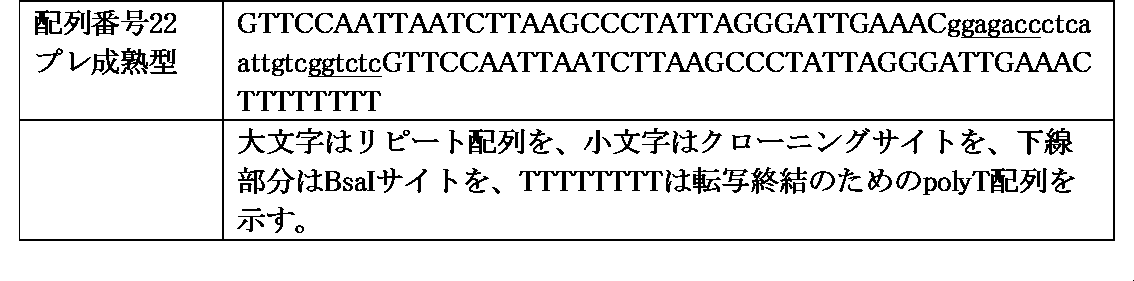
ルシフェラーゼ(luc)レポーターアッセイのために、NanoLUxxUC発現ベクターを構築した。まず、NLUxxUC_Block1およびNLUxxUC_Block2 DNAフラグメントを合成した(IDT社製)。NLUxxUC_Block1は、NanoLUCTM(登録商標)遺伝子(Promega社製)配列の最初の351bpおよびマルチクローニングサイトを含む。XbaI部位をNanoLUC遺伝子の5’末端に付加した。NLUxxUC_Block2は、NanoLUC遺伝子の3’末端の465bpを含む。XhoI部位をNanoLUC遺伝子の3’末端に付加した。これらのフラグメントをアセンブルし、pCAG-EGxxFPベクター(addgene、#50716)中にクローン化した。NLUxxUC_Block1をXbaIおよびBamHI消化によって、NLUxxUC_Block2をXbaIおよびEcoRI消化によって、pCAG-NLUxxUCベクターからそれぞれ除去することによって、各スプリットタイプNLUxxUCレポーターを構築した。各消化ベクターをマルチクローニングサイトと共にアセンブルし、pCAG-NLUxxUC_Block1およびpCAG-NLUxxUC_Block2を得た。
ヒト胚性腎細胞株293T(HEK293T,RIKEN BRC)を、10%胎仔ウシ血清(Thermo Fisher Scientific)、GlutalMAX(登録商標)サプリメント(Thermo Fisher Scientific)、100単位/mLペニシリン、および100μg/mLストレプトマイシンを補足したダルベッコ改変イーグル培地(DMEM)中、37℃で60分、5%CO2インキュベーションで培養した。トランスフェクションの前日にHEK293T細胞を6ウェルプレート(Corning, USA)に播種した。TurboFect Transfection Reagent(Thermo Fisher Scientific)を製造者の推奨プロトコルに従って用いて、細胞をトランスフェクトした。6ウェルプレートの各ウェルについて、NucleoSpin(登録商標)Plasmid Transfection-gradeキット(Macherey-Nagel, Germany)を用いて抽出された全4μgのプラスミドを用いた。変異分析のために、48時間後にトランスフェクト細胞を回収した。
トランスフェクションの前日に、HEK293T細胞を96ウェルプレート(Corning)に、密度2.0x10⁴細胞/ウェルで播種した。TurboFect Transfection Reagent(Thermo Fisher Scientific)を製造者の推奨するプロトコルに従って用いて、細胞をトランスフェクトした。96ウェルプレートの各ウェルについて、(1)Fluc遺伝子をコードするpGL4.53ベクター(Promega,USA)、(2)標的DNAフラグメントの挿入により中断されたpCAG-nLUxxUCベクター、および(3)TiD成分をコードしているプラスミドDNAを含む全200ngのプラスミドDNAを用いた。NanoLucおよびFlucルシフェラーゼ活性は、トランスフェクションの3日後に、Nano-Glo(登録商標)Dual-Luciferase(登録商標)Reporter Assay System(Promega)を用いて測定した。ホタル(Fluc)活性を内部対照として用いた。NanoLuc/Fluc比を各サンプルについて計算し、非標的化gRNAでトランスフェクトした対照サンプルのNanoLuc/Fluc比と比較した。相対的NanoLuc/Fluc活性を用いて、gRNA活性を評価した。実験は独立して3回繰り返し、同様の結果を得た。
HEK293T細胞中のDNA欠失を検出するために、長鎖DNA領域PCRおよび長鎖DNA領域PCR産物のプールのクローニングを行った。最初に、Geno Plus(登録商標)Genomic DNA Extraction Miniprep System (Viogene-BioTek, Taiwan)を用いて、ゲノムDNAをHEK293T細胞から抽出した。次に、ネステッドPCRを行って、長鎖DNA領域を特異的に増幅した。まず、抽出したゲノムDNAを鋳型として用い、種々の長さ(10kb~19kb)の標的DNA領域を増幅するように設計された、長鎖DNA領域PCR用の特異的プライマーセットを用いて、標的DNA領域を増幅した。最初のPCR反応は、KOD ONE Master Mix(TOYOBO, Osaka, Japan)を用いて、下記の条件下で行った。10秒98℃、5秒60℃および50秒(アンプリコン:15-20kb)または150秒(アンプリコン:10-15kb)または200秒(アンプリコン:<10kb)68℃を35サイクル。次いで、PCR産物を100~10,000倍に希釈し、ネステッドPCRの鋳型として用いた。ネステッドPCRは、また、上記と同じ条件下で行った。PCR産物を1%アガロースゲル上の電気泳動によって分離し、GelRed(登録商標)Nucleic Acid Gel Stain(Biotium)での染色によって視覚化した。ネステッドPCR産物をプールし、Monofas(登録商標)DNA purification Kit I(GL Sciences, Japan)を用いて精製した。PCR産物の精製混合物を、Mighty TA-cloning Kit(Takara Bio, Japan)を用いてpMD20-Tベクター中にクローン化した。クローンをピックアップし、M13 UniおよびM13 RVプライマーを用いてサンガー配列決定した。サンガー配列決定の結果をBLATNサーチおよびClustalWプログラムを用いて分析して、DNA欠失を同定した。
M.aeruginosa由来のCasエフェクタータンパク質のうち、Cas10d配列についてCLASTAL Wプログラムを用いて、CRISPR type I-EのCas11e配列(Escherichia coli、Acetobacter pasteurianus、Acidimicrobium ferrooxidans、Amycolatopsis mediterranei、Bifidobacterium animalis、Cellulomonas fimi、Coriobacterium glomerans、Cyanothece (Gloeothece citriformis) PCC7424、Desulfococcus oleovorans、Erwinia amylovora、Frankia alni、Geobacter sulfurreducens、Kitasatospora setae、Lactobacillus fermentum由来)とのアラインメント解析を行ったところ、Cas10dのC末端領域にはCas11eに特徴的なα-ヘリックス領域が数カ所保存されていることが見出された(図1)。さらに、各種type I-D Cas10d C-ter(Anabaena cylindrica、Calothrix PCC6303 (Calothrix parietina)、Crinalium epipsammum、Cyanothece PCC7424 (Gloeothece citriformis)、Gloeobacter kilaueensis、Gloeocapsa sp. PCC7428、Halothece PCC7418、Methanospirillum hungatei、Nostoc sp. NIES-2111、Rivularia sp. PCC7116、Stanieria cyanosphaera、Synechocystis sp. PCC6803由来)をCas11eとアラインメント解析により比較した。
Cas11dの発現が真核生物におけるTiDのゲノム編集活性に及ぼす影響を解析するため、Microcystis aeruginosa PC9808株のCas10d遺伝子から、Cas11d配列に相当すると考えられる遺伝子配列領域(Cas10d遺伝子のストップコドンより483b上流まで)をクローン化し動物細胞発現ベクターを構築し、Cas11d発現ベクターとした。Cas3d、Cas5d、Cas6d、Cas7d、Cas10d及びgRNAの各発現ベクターと共に、Cas11d発現ベクターを同時にHEK293細胞に導入し、Lucレポーターアッセイによりゲノム編集活性を解析した。終止コドンによって分離される300bp相同性アームならびにTiD標的部位を含有するヒトAAVS1遺伝子フラグメントを含有するNanoLucルシフェラーゼを組換えレポーターとして用いた。各単一Cas発現ベクター、TiD crRNA発現ベクター、および標的配列が導入されたLUCレポーターベクターをHEK293T細胞中に同時トランスフェクトし、トランスフェクション後72時間、ルミネッセンスによりエンドヌクレアーゼ切断を検出した。
Cas11dの発現効果として、ヒトゲノム上の標的にどのような変異が誘導されるか解析した。Lucレポーターアッセイに用いたヒトAAVS遺伝子の標的化gRNA AAVS GTC_70-107(35b)を組み込んだgRNA発現ベクターおよび各単一Cas発現ベクターと共に、Cas11d発現ベクターをHEK293T細胞中にトランスフェクトした。AAVS標的部位付近を含む10-19kbを増幅するプライマーセットを用いて、TiDベクター導入HEK293T細胞の全DNAから、DNAフラグメントをPCR増幅し、得られたPCR産物をクローン化し、サンガー法によって配列決定した。
SEQ ID NO:2; Microcystis aeruginosa Cas5d amino acid sequence
SEQ ID NO:3; Microcystis aeruginosa Cas6d amino acid sequence
SEQ ID NO:4; Microcystis aeruginosa Cas7d amino acid sequence
SEQ ID NO:5; Microcystis aeruginosa Cas10d amino acid sequence
SEQ ID NO:6; Microcystis aeruginosa Cas11d amino acid sequence
SEQ ID NO:7; TiDcrRNA containing repeat (37b) and spacer (35b of N). N is any nucleotide constituting a sequence that forms base pairs with a target nucleotide sequence
SEQ ID NO:8; Anabaena cylindrica Cas11d amino acid sequence
SEQ ID NO:9; Calothrix PCC6303 (Calothrix parietina) Cas11d amino acid sequence
SEQ ID NO:10; Crinalium epipsammum Cas11d amino acid sequence
SEQ ID NO:11; Cyanothece PCC7424 (Gloeothece citriformis) Cas11d amino acid sequence
SEQ ID NO:12; Gloeobacter kilaueensis Cas11d amino acid sequence
SEQ ID NO:13; Gloeocapsa sp. PCC7428 Cas11d amino acid sequence
SEQ ID NO:14; Halothece PCC7418 Cas11d amino acid sequence
SEQ ID NO:15; Methanospirillum hungatei Cas11d amino acid sequence
SEQ ID NO:16; Nostoc sp. NIES-2111 Cas11d amino acid sequence
SEQ ID NO:17; Rivularia sp. PCC7116 Cas11d amino acid sequence
SEQ ID NO:18; Stanieria cyanosphaera Cas11d amino acid sequence
SEQ ID NO:19; Synechocystis sp. PCC6803 Cas11d amino acid sequence
SEQ ID NO:20; Target sequence (35b)
SEQ ID NO:21; Monopartite nuclear localizing signal (NLS) amino acid sequence
SEQ ID NO:22; DNA fragment for pre-mature crRNA
SEQ ID NO:23; Target sequence (30b)
SEQ ID NO:24; Primer F1
SEQ ID NO:25; Primer R1
SEQ ID NO:26; Primer F2
SEQ ID NO:27; Primer R2
SEQ ID NO:28; Non-specific sequence
SEQ ID NO:29; Escherichia coli Cas11e amino acid sequence
SEQ ID NO:30; Acetobacter pasteurianus Cas11e amino acid sequence
SEQ ID NO:31; Acidimicrobium ferrooxidans Cas11e amino acid sequence
SEQ ID NO:32; Amycolatopsis mediterranei Cas11e amino acid sequence
SEQ ID NO:33; Bifidobacterium animalis Cas11e amino acid sequence
SEQ ID NO:34; Cellulomonas fimi Cas11e amino acid sequence
SEQ ID NO:35; Coriobacterium glomerans Cas11e amino acid sequence
SEQ ID NO:36; Cyanothece (Gloeothece citriformis) PCC7424 Cas11e amino acid sequence
SEQ ID NO:37; Desulfococcus oleovorans Cas11e amino acid sequence
SEQ ID NO:38; Erwinia amylovora Cas11e amino acid sequence
SEQ ID NO:39; Frankia alni Cas11e amino acid sequence
SEQ ID NO:40; Geobacter sulfurreducens Cas11e amino acid sequence
SEQ ID NO:41; Kitasatospora setae Cas11e amino acid sequence
SEQ ID NO:42; Lactobacillus fermentum Cas11e amino acid sequence
Claims (26)
- 標的ヌクレオチド配列を標的化する方法であって、細胞中に、
(i)CRISPRタイプI-DのCasタンパク質 Cas5d、Cas6d、およびCas7d、およびCas10dのN末端側のHDドメインを含むポリペプチド、またはこれらのタンパク質およびポリペプチドをコードする核酸、
(ii)Cas10dのN末端側のHDドメインを含まず、Cas10dのC末端部分配列を含むポリペプチド、または該ポリペプチドをコードする核酸、および
(iii)前記標的ヌクレオチド配列と塩基対を形成する配列を含むcrRNA、または該crRNAをコードするDNA
を導入することを含む方法。 - 標的ヌクレオチド配列を改変する方法であって、細胞中に、
(i)CRISPRタイプI-DのCasタンパク質 Cas3d、Cas5d、Cas6d、およびCas7d、およびCas10dのN末端側のHDドメインを含むポリペプチド、またはこれらのタンパク質およびポリペプチドをコードする核酸、
(ii)Cas10dのN末端側のHDドメインを含まず、Cas10dのC末端部分配列を含むポリペプチド、または該ポリペプチドをコードする核酸、および
(iii)前記標的ヌクレオチド配列と塩基対を形成する配列を含むcrRNA、または該crRNAをコードするDNA
を導入することを含む方法。 - 標的遺伝子の転写を制御する方法であって、前記標的ヌクレオチド配列が標的遺伝子の少なくとも一部のヌクレオチド配列である、請求項1または2記載の方法。
- 前記Cas10dのC末端部分配列が100~400アミノ酸からなる配列である、請求項1~3のいずれか1項記載の方法。
- 前記細胞が真核細胞である、請求項1~4のいずれか1項記載の方法。
- 改変が塩基の欠失、挿入、又は置換である、請求項2~5のいずれか1項記載の方法。
- (i)CRISPRタイプI-DのCasタンパク質 Cas5d、Cas6d、およびCas7d、およびCas10dのN末端側のHDドメインを含むポリペプチド、
(ii)Cas10dのN末端側のHDドメインを含まず、Cas10dのC末端部分配列を含むポリペプチド、および
(iii)標的ヌクレオチド配列と塩基対を形成する配列を含むcrRNA
を含む複合体。 - Cas3dをさらに含む、請求項7記載の複合体。
- 前記Cas10dのC末端部分配列が100~400アミノ酸からなる配列である、請求項7または8記載の複合体。
- (i)CRISPRタイプI-DのCasタンパク質 Cas5d、Cas6d、およびCas7d、およびCas10dのN末端側のHDドメインを含むポリペプチドをコードする核酸、
(ii)Cas10dのN末端側のHDドメインを含まず、Cas10dのC末端部分配列を含むポリペプチドをコードする核酸、および
(iii)標的ヌクレオチド配列と塩基対を形成する配列を含むcrRNAまたは該crRNAをコードするDNA
を含むベクター。 - Cas3dをコードする核酸をさらに含む、請求項10記載のベクター。
- 前記(i)~(iii)の核酸、または前記(i)~(iii)の核酸およびCas3dをコードする核酸が1つまたは2以上のベクターに含まれる、請求項10または11記載の発現ベクター。
- 前記Cas10dのC末端部分配列が100~400アミノ酸からなる配列である、請求項11または12記載のベクター。
- 請求項7~9のいずれか1項記載の複合体をコードするDNA分子。
- 標的ヌクレオチド配列を標的化するためのキットであって、
(i)CRISPRタイプI-DのCasタンパク質 Cas5d、Cas6d、およびCas7d、およびCas10dのN末端側のHDドメインを含むポリペプチド、またはこれらのタンパク質またはポリペプチドをコードする核酸、
(ii)Cas10dのN末端側のHDドメインを含まず、Cas10dのC末端部分配列を含むポリペプチド、または該ポリペプチドをコードする核酸、および
(iii)前記標的ヌクレオチド配列と塩基対を形成する配列を含むcrRNA、または該crRNAをコードするDNA
を含むキット。 - 標的ヌクレオチド配列を改変するためのキットであって、
(i)CRISPRタイプI-DのCasタンパク質 Cas3d、Cas5d、Cas6d、およびCas7d、およびCas10dのN末端側のHDドメインを含むポリペプチド、またはこれらのタンパク質およびポリペプチドをコードする核酸、
(ii)Cas10dのN末端側のHDドメインを含まず、Cas10dのC末端部分配列を含むポリペプチド、または該ポリペプチドをコードする核酸、および
(iii)前記標的ヌクレオチド配列と塩基対を形成する配列を含むcrRNA、または該crRNAをコードするDNA
をキット。 - 前記Cas10dのC末端部分配列が100~400アミノ酸からなる配列である、請求項15または16記載のキット。
- CRISPRタイプI-Dシステムを用いる標的ヌクレオチド配列の標的化において標的化効率を改善する方法であって、Cas10dのN末端側のHDドメインを含まず、Cas10dのC末端部分配列を含むポリペプチド、または該ポリペプチドをコードする核酸を用いることを含む方法。
- CRISPRタイプI-Dシステムを用いる標的ヌクレオチド配列の改変において改変効率を改善する方法であって、Cas10dのN末端側のHDドメインを含まず、Cas10dのC末端部分配列を含むポリペプチド、または該ポリペプチドをコードする核酸を用いることを含む方法。
- CRISPRタイプI-Dシステムを用いる標的ヌクレオチド配列の標的化において標的化効率を改善するための組成物であって、Cas10dのN末端側のHDドメインを含まず、Cas10dのC末端部分配列を含むポリペプチド、または該ポリペプチドをコードする核酸を含む組成物。
- CRISPRタイプI-Dシステムを用いる標的ヌクレオチド配列の改変において改変効率を改善するための組成物であって、Cas10dのN末端側のHDドメインを含まず、Cas10dのC末端部分配列を含むポリペプチド、または該ポリペプチドをコードする核酸を含む組成物。
- 細胞中に、
(i)CRISPRタイプI-DのCasタンパク質 Cas3d、Cas5d、Cas6d、およびCas7d、およびCas10dのN末端側のHDドメインを含むポリペプチド、またはこれらのタンパク質およびポリペプチドをコードする核酸、
(ii)Cas10dのN末端側のHDドメインを含まず、Cas10dのC末端部分配列を含むポリペプチド、または該ポリペプチドをコードする核酸、および
(iii)標的ヌクレオチド配列と塩基対を形成する配列を含むcrRNA、または該crRNAをコードするDNA
を導入することを含む、標的ヌクレオチド配列が改変された細胞の製造方法。 - 請求項22に記載の方法によって標的ヌクレオチド配列が改変された植物細胞を製造することを含む、標的ヌクレオチド配列が改変された植物の製造方法。
- 請求項22に記載の方法によって標的ヌクレオチド配列が改変された非ヒト動物細胞を製造することを含む、標的ヌクレオチド配列が改変された非ヒト動物の製造方法。
- 標的ヌクレオチド配列を標的化する方法であって、標的ヌクレオチド配列を含む単離核酸に、
(i)CRISPRタイプI-DのCasタンパク質 Cas5d、Cas6d、およびCas7d、およびCas10dのN末端側のHDドメインを含むポリペプチド、
(ii)Cas10dのN末端側のHDドメインを含まず、Cas10dのC末端部分配列を含むポリペプチド、および
(iii)前記標的ヌクレオチド配列と塩基対を形成する配列を含むcrRNA、または該crRNAをコードするDNA
を接触させることを含む方法。 - 標的ヌクレオチド配列を改変する方法であって、標的ヌクレオチド配列を含む単離核酸に、
(i)CRISPRタイプI-DのCasタンパク質 Cas3d、Cas5d、Cas6d、およびCas7d、およびCas10dのN末端側のHDドメインを含むポリペプチド、
(ii)Cas10dのN末端側のHDドメインを含まず、Cas10dのC末端部分配列を含むポリペプチド、および
(iii)前記標的ヌクレオチド配列と塩基対を形成する配列を含むcrRNA、または該crRNAをコードするDNA
を接触させことを含む方法。
Priority Applications (4)
| Application Number | Priority Date | Filing Date | Title |
|---|---|---|---|
| JP2022555567A JP7454881B2 (ja) | 2020-10-08 | 2021-10-07 | Crisprタイプi-dシステムを利用した標的ヌクレオチド配列改変技術 |
| US18/030,704 US20230374479A1 (en) | 2020-10-08 | 2021-10-07 | Technique for modifying target nucleotide sequence using crispr-type i-d system |
| AU2021355838A AU2021355838A1 (en) | 2020-10-08 | 2021-10-07 | Technique for modifying target nucleotide sequence using crispr-type i-d system |
| EP21877718.3A EP4227409A4 (en) | 2020-10-08 | 2021-10-07 | TARGET SEQUENCE MODIFICATION TECHNIQUE USING CRISPR-LIKE I-D SYSTEM |
Applications Claiming Priority (2)
| Application Number | Priority Date | Filing Date | Title |
|---|---|---|---|
| JP2020170714 | 2020-10-08 | ||
| JP2020-170714 | 2020-10-08 |
Publications (1)
| Publication Number | Publication Date |
|---|---|
| WO2022075419A1 true WO2022075419A1 (ja) | 2022-04-14 |
Family
ID=81126973
Family Applications (1)
| Application Number | Title | Priority Date | Filing Date |
|---|---|---|---|
| PCT/JP2021/037194 Ceased WO2022075419A1 (ja) | 2020-10-08 | 2021-10-07 | Crisprタイプi-dシステムを利用した標的ヌクレオチド配列改変技術 |
Country Status (5)
| Country | Link |
|---|---|
| US (1) | US20230374479A1 (ja) |
| EP (1) | EP4227409A4 (ja) |
| JP (1) | JP7454881B2 (ja) |
| AU (1) | AU2021355838A1 (ja) |
| WO (1) | WO2022075419A1 (ja) |
Cited By (1)
| Publication number | Priority date | Publication date | Assignee | Title |
|---|---|---|---|---|
| WO2023177310A1 (en) * | 2022-03-18 | 2023-09-21 | Board Of Regents, The University Of Texas System | Type i-d crispr-cas systems and uses thereof |
Citations (2)
| Publication number | Priority date | Publication date | Assignee | Title |
|---|---|---|---|---|
| WO2019039417A1 (ja) | 2017-08-21 | 2019-02-28 | 国立大学法人徳島大学 | ヌクレオチド標的認識を利用した標的配列特異的改変技術 |
| WO2020184723A1 (ja) | 2019-03-14 | 2020-09-17 | 国立大学法人徳島大学 | Crisprタイプi-dシステムを利用した標的配列改変技術 |
-
2021
- 2021-10-07 JP JP2022555567A patent/JP7454881B2/ja active Active
- 2021-10-07 WO PCT/JP2021/037194 patent/WO2022075419A1/ja not_active Ceased
- 2021-10-07 EP EP21877718.3A patent/EP4227409A4/en active Pending
- 2021-10-07 US US18/030,704 patent/US20230374479A1/en active Pending
- 2021-10-07 AU AU2021355838A patent/AU2021355838A1/en active Pending
Patent Citations (2)
| Publication number | Priority date | Publication date | Assignee | Title |
|---|---|---|---|---|
| WO2019039417A1 (ja) | 2017-08-21 | 2019-02-28 | 国立大学法人徳島大学 | ヌクレオチド標的認識を利用した標的配列特異的改変技術 |
| WO2020184723A1 (ja) | 2019-03-14 | 2020-09-17 | 国立大学法人徳島大学 | Crisprタイプi-dシステムを利用した標的配列改変技術 |
Non-Patent Citations (7)
| Title |
|---|
| DOLAN, A.E., MOL CELL, vol. 74, 2019, pages 936 - 950 |
| LOPEZ-PERROTE ET AL., NUCLEIC ACIDS RES, vol. 44, 2016, pages 1909 - 1923 |
| MAKAROVA K.S., REV. MICROBIOL., vol. 13, 2015, pages 722 - 736 |
| MAKAROVA, K.S. ET AL., CELL, vol. 168, 2017, pages 946 - 946 |
| MCBRIDE TESS M.; SCHWARTZ EVAN A.; KUMAR ABHISHEK; TAYLOR DAVID W.; FINERAN PETER C.; FAGERLUND ROBERT D.: "Diverse CRISPR-Cas Complexes Require Independent Translation of Small and Large Subunits from a Single Gene", MOLECULAR CELL, ELSEVIER, AMSTERDAM, NL, vol. 80, no. 6, 27 November 2020 (2020-11-27), AMSTERDAM, NL, pages 971, XP086414326, ISSN: 1097-2765, DOI: 10.1016/j.molcel.2020.11.003 * |
| MCBRIDE, T.M. ET AL., BIORXIV, 2020, pages 045682 |
| OSAKABE KEISHI, WADA NAOKI, MIYAJI TOMOKO, MURAKAMI EMI, MARUI KAZUYA, UETA RISA, HASHIMOTO RYOSUKE, ABE-HARA CHIHIRO, KONG BIHE, : "Genome editing in mammals and plants using CRISPR type I-D nuclease", COMMUNICATIONS BIOLOGY, vol. 3, no. 1, 1 December 2020 (2020-12-01), XP055791658, DOI: 10.1038/s42003-020-01366-6 * |
Cited By (1)
| Publication number | Priority date | Publication date | Assignee | Title |
|---|---|---|---|---|
| WO2023177310A1 (en) * | 2022-03-18 | 2023-09-21 | Board Of Regents, The University Of Texas System | Type i-d crispr-cas systems and uses thereof |
Also Published As
| Publication number | Publication date |
|---|---|
| EP4227409A4 (en) | 2024-12-11 |
| EP4227409A1 (en) | 2023-08-16 |
| AU2021355838A1 (en) | 2023-06-01 |
| US20230374479A1 (en) | 2023-11-23 |
| JPWO2022075419A1 (ja) | 2022-04-14 |
| JP7454881B2 (ja) | 2024-03-25 |
Similar Documents
| Publication | Publication Date | Title |
|---|---|---|
| AU2021231074B2 (en) | Class II, type V CRISPR systems | |
| US20230049124A1 (en) | Improved methods for modification of target nucleic acids | |
| KR102929494B1 (ko) | 신규 CRISPR/Cas12f 효소 및 시스템 | |
| CN111373041B (zh) | 用于基因组编辑和调节转录的crispr/cas系统和方法 | |
| EP1291420B1 (en) | Novel DNA cloning method relying on the E.coli RECE/RECT recombination system | |
| KR20240082384A (ko) | 원형 rna 및 이의 제조방법 | |
| CN113015798B (zh) | CRISPR-Cas12a酶和系统 | |
| JP2022520428A (ja) | Ruvcドメインを有する酵素 | |
| JP7138712B2 (ja) | ゲノム編集のためのシステム及び方法 | |
| KR102626503B1 (ko) | 뉴클레오타이드 표적 인식을 이용한 표적 서열 특이적 개변 기술 | |
| CN107488649A (zh) | 一种Cpf1和p300核心结构域的融合蛋白、相应的DNA靶向激活系统和应用 | |
| KR20240055073A (ko) | 클래스 ii, v형 crispr 시스템 | |
| CN107794272A (zh) | 一种高特异性的crispr基因组编辑体系 | |
| JP2023517890A (ja) | 改善されたシトシン塩基編集システム | |
| JP7250349B2 (ja) | 細胞の有する二本鎖dnaの標的部位を改変する方法 | |
| CN102653755A (zh) | 一种大丽轮枝菌基因敲除的方法 | |
| JP7489112B2 (ja) | Crisprタイプi-dシステムを利用した標的配列改変技術 | |
| WO2023030340A1 (en) | Novel design of guide rna and uses thereof | |
| JP7454881B2 (ja) | Crisprタイプi-dシステムを利用した標的ヌクレオチド配列改変技術 | |
| WO2021004456A1 (zh) | 改进的基因组编辑系统及其应用 | |
| JP2024501892A (ja) | 新規の核酸誘導型ヌクレアーゼ | |
| EP4484558A1 (en) | Optimized cas protein and use thereof | |
| US20250059568A1 (en) | Class ii, type v crispr systems | |
| Penewit et al. | Recombineering in Staphylococcus aureus | |
| WO2025201316A1 (zh) | 一种CRISPR-Cas系统 |
Legal Events
| Date | Code | Title | Description |
|---|---|---|---|
| 121 | Ep: the epo has been informed by wipo that ep was designated in this application |
Ref document number: 21877718 Country of ref document: EP Kind code of ref document: A1 |
|
| ENP | Entry into the national phase |
Ref document number: 2022555567 Country of ref document: JP Kind code of ref document: A |
|
| NENP | Non-entry into the national phase |
Ref country code: DE |
|
| ENP | Entry into the national phase |
Ref document number: 2021877718 Country of ref document: EP Effective date: 20230508 |
|
| ENP | Entry into the national phase |
Ref document number: 2021355838 Country of ref document: AU Date of ref document: 20211007 Kind code of ref document: A |