WO2022085143A1 - 遠心送風機及び空気調和装置 - Google Patents
遠心送風機及び空気調和装置 Download PDFInfo
- Publication number
- WO2022085143A1 WO2022085143A1 PCT/JP2020/039665 JP2020039665W WO2022085143A1 WO 2022085143 A1 WO2022085143 A1 WO 2022085143A1 JP 2020039665 W JP2020039665 W JP 2020039665W WO 2022085143 A1 WO2022085143 A1 WO 2022085143A1
- Authority
- WO
- WIPO (PCT)
- Prior art keywords
- blade
- impeller
- centrifugal blower
- region
- blades
- Prior art date
- Legal status (The legal status is an assumption and is not a legal conclusion. Google has not performed a legal analysis and makes no representation as to the accuracy of the status listed.)
- Ceased
Links
Images








Classifications
-
- F—MECHANICAL ENGINEERING; LIGHTING; HEATING; WEAPONS; BLASTING
- F04—POSITIVE - DISPLACEMENT MACHINES FOR LIQUIDS; PUMPS FOR LIQUIDS OR ELASTIC FLUIDS
- F04D—NON-POSITIVE-DISPLACEMENT PUMPS
- F04D29/00—Details, component parts, or accessories
- F04D29/26—Rotors specially for elastic fluids
- F04D29/28—Rotors specially for elastic fluids for centrifugal or helico-centrifugal pumps for radial-flow or helico-centrifugal pumps
- F04D29/281—Rotors specially for elastic fluids for centrifugal or helico-centrifugal pumps for radial-flow or helico-centrifugal pumps for fans or blowers
-
- F—MECHANICAL ENGINEERING; LIGHTING; HEATING; WEAPONS; BLASTING
- F04—POSITIVE - DISPLACEMENT MACHINES FOR LIQUIDS; PUMPS FOR LIQUIDS OR ELASTIC FLUIDS
- F04D—NON-POSITIVE-DISPLACEMENT PUMPS
- F04D17/00—Radial-flow pumps, e.g. centrifugal pumps; Helico-centrifugal pumps
- F04D17/08—Centrifugal pumps
-
- F—MECHANICAL ENGINEERING; LIGHTING; HEATING; WEAPONS; BLASTING
- F04—POSITIVE - DISPLACEMENT MACHINES FOR LIQUIDS; PUMPS FOR LIQUIDS OR ELASTIC FLUIDS
- F04D—NON-POSITIVE-DISPLACEMENT PUMPS
- F04D17/00—Radial-flow pumps, e.g. centrifugal pumps; Helico-centrifugal pumps
- F04D17/08—Centrifugal pumps
- F04D17/16—Centrifugal pumps for displacing without appreciable compression
- F04D17/162—Double suction pumps
-
- F—MECHANICAL ENGINEERING; LIGHTING; HEATING; WEAPONS; BLASTING
- F04—POSITIVE - DISPLACEMENT MACHINES FOR LIQUIDS; PUMPS FOR LIQUIDS OR ELASTIC FLUIDS
- F04D—NON-POSITIVE-DISPLACEMENT PUMPS
- F04D29/00—Details, component parts, or accessories
- F04D29/26—Rotors specially for elastic fluids
- F04D29/28—Rotors specially for elastic fluids for centrifugal or helico-centrifugal pumps for radial-flow or helico-centrifugal pumps
- F04D29/30—Vanes
-
- F—MECHANICAL ENGINEERING; LIGHTING; HEATING; WEAPONS; BLASTING
- F04—POSITIVE - DISPLACEMENT MACHINES FOR LIQUIDS; PUMPS FOR LIQUIDS OR ELASTIC FLUIDS
- F04D—NON-POSITIVE-DISPLACEMENT PUMPS
- F04D29/00—Details, component parts, or accessories
- F04D29/40—Casings; Connections of working fluid
- F04D29/42—Casings; Connections of working fluid for radial or helico-centrifugal pumps
- F04D29/4206—Casings; Connections of working fluid for radial or helico-centrifugal pumps especially adapted for elastic fluid pumps
-
- F—MECHANICAL ENGINEERING; LIGHTING; HEATING; WEAPONS; BLASTING
- F04—POSITIVE - DISPLACEMENT MACHINES FOR LIQUIDS; PUMPS FOR LIQUIDS OR ELASTIC FLUIDS
- F04D—NON-POSITIVE-DISPLACEMENT PUMPS
- F04D29/00—Details, component parts, or accessories
- F04D29/40—Casings; Connections of working fluid
- F04D29/42—Casings; Connections of working fluid for radial or helico-centrifugal pumps
- F04D29/4206—Casings; Connections of working fluid for radial or helico-centrifugal pumps especially adapted for elastic fluid pumps
- F04D29/4213—Casings; Connections of working fluid for radial or helico-centrifugal pumps especially adapted for elastic fluid pumps suction ports
-
- F—MECHANICAL ENGINEERING; LIGHTING; HEATING; WEAPONS; BLASTING
- F04—POSITIVE - DISPLACEMENT MACHINES FOR LIQUIDS; PUMPS FOR LIQUIDS OR ELASTIC FLUIDS
- F04D—NON-POSITIVE-DISPLACEMENT PUMPS
- F04D29/00—Details, component parts, or accessories
- F04D29/40—Casings; Connections of working fluid
- F04D29/42—Casings; Connections of working fluid for radial or helico-centrifugal pumps
- F04D29/4206—Casings; Connections of working fluid for radial or helico-centrifugal pumps especially adapted for elastic fluid pumps
- F04D29/4226—Fan casings
- F04D29/424—Double entry casings
-
- F—MECHANICAL ENGINEERING; LIGHTING; HEATING; WEAPONS; BLASTING
- F04—POSITIVE - DISPLACEMENT MACHINES FOR LIQUIDS; PUMPS FOR LIQUIDS OR ELASTIC FLUIDS
- F04D—NON-POSITIVE-DISPLACEMENT PUMPS
- F04D29/00—Details, component parts, or accessories
- F04D29/58—Cooling; Heating; Diminishing heat transfer
- F04D29/582—Cooling; Heating; Diminishing heat transfer specially adapted for elastic fluid pumps
-
- F—MECHANICAL ENGINEERING; LIGHTING; HEATING; WEAPONS; BLASTING
- F24—HEATING; RANGES; VENTILATING
- F24F—AIR-CONDITIONING; AIR-HUMIDIFICATION; VENTILATION; USE OF AIR CURRENTS FOR SCREENING
- F24F1/00—Room units for air-conditioning, e.g. separate or self-contained units or units receiving primary air from a central station
- F24F1/0007—Indoor units, e.g. fan coil units
- F24F1/0018—Indoor units, e.g. fan coil units characterised by fans
- F24F1/0022—Centrifugal or radial fans
-
- F—MECHANICAL ENGINEERING; LIGHTING; HEATING; WEAPONS; BLASTING
- F05—INDEXING SCHEMES RELATING TO ENGINES OR PUMPS IN VARIOUS SUBCLASSES OF CLASSES F01-F04
- F05D—INDEXING SCHEME FOR ASPECTS RELATING TO NON-POSITIVE-DISPLACEMENT MACHINES OR ENGINES, GAS-TURBINES OR JET-PROPULSION PLANTS
- F05D2240/00—Components
- F05D2240/20—Rotors
- F05D2240/30—Characteristics of rotor blades, i.e. of any element transforming dynamic fluid energy to or from rotational energy and being attached to a rotor
- F05D2240/301—Cross-sectional characteristics
-
- F—MECHANICAL ENGINEERING; LIGHTING; HEATING; WEAPONS; BLASTING
- F05—INDEXING SCHEMES RELATING TO ENGINES OR PUMPS IN VARIOUS SUBCLASSES OF CLASSES F01-F04
- F05D—INDEXING SCHEME FOR ASPECTS RELATING TO NON-POSITIVE-DISPLACEMENT MACHINES OR ENGINES, GAS-TURBINES OR JET-PROPULSION PLANTS
- F05D2240/00—Components
- F05D2240/20—Rotors
- F05D2240/30—Characteristics of rotor blades, i.e. of any element transforming dynamic fluid energy to or from rotational energy and being attached to a rotor
- F05D2240/303—Characteristics of rotor blades, i.e. of any element transforming dynamic fluid energy to or from rotational energy and being attached to a rotor related to the leading edge of a rotor blade
-
- F—MECHANICAL ENGINEERING; LIGHTING; HEATING; WEAPONS; BLASTING
- F05—INDEXING SCHEMES RELATING TO ENGINES OR PUMPS IN VARIOUS SUBCLASSES OF CLASSES F01-F04
- F05D—INDEXING SCHEME FOR ASPECTS RELATING TO NON-POSITIVE-DISPLACEMENT MACHINES OR ENGINES, GAS-TURBINES OR JET-PROPULSION PLANTS
- F05D2240/00—Components
- F05D2240/20—Rotors
- F05D2240/30—Characteristics of rotor blades, i.e. of any element transforming dynamic fluid energy to or from rotational energy and being attached to a rotor
- F05D2240/304—Characteristics of rotor blades, i.e. of any element transforming dynamic fluid energy to or from rotational energy and being attached to a rotor related to the trailing edge of a rotor blade
-
- F—MECHANICAL ENGINEERING; LIGHTING; HEATING; WEAPONS; BLASTING
- F05—INDEXING SCHEMES RELATING TO ENGINES OR PUMPS IN VARIOUS SUBCLASSES OF CLASSES F01-F04
- F05D—INDEXING SCHEME FOR ASPECTS RELATING TO NON-POSITIVE-DISPLACEMENT MACHINES OR ENGINES, GAS-TURBINES OR JET-PROPULSION PLANTS
- F05D2250/00—Geometry
- F05D2250/70—Shape
Definitions
- the present disclosure relates to a centrifugal blower equipped with an impeller and an air conditioner equipped with the centrifugal blower.
- a centrifugal blower is a spiral-shaped scroll casing having a scroll casing in which a bell mouth is formed at an air suction port, and an impeller installed inside the scroll casing and rotating around an axis.
- the impeller constituting the centrifugal blower of Patent Document 1 has a disk-shaped main plate, an annular side plate, and blades arranged radially.
- the blades constituting this impeller are sirocco blades (forward blades) in which the inner diameter increases from the main plate to the side plate and the outlet angle of the blades is 100 ° or more. It is equipped with an inducer part of the turbo blade (rear blade) on the inner peripheral side.
- the side plate is provided in an annular shape on the outer peripheral side surface of the impeller to prevent the side plate from coming off the mold.
- the airflow blown out in the radial direction of the impeller may circulate outward around the side plate and re-inflow into the impeller along the inner side surface of the bell mouth.
- the portion of the blade located outside the inner peripheral side end portion of the bell mouth is composed of only the portion forming the sirocco wing portion.
- the airflow blown out from the impeller and along the inner wall surface of the bell mouth collides with the sirocco wing where the exit angle is large and the inflow velocity of the airflow is large when re-inflowing into the impeller. , It causes noise generated from the centrifugal blower, and also causes deterioration of input.
- the present disclosure is for solving the above-mentioned problems, and when the airflow along the inner wall surface of the bell mouth re-flows into the inside of the impeller, the noise and the input deterioration caused by the airflow are suppressed. It is an object of the present invention to provide an air conditioner equipped with a blower and the centrifugal blower.
- the centrifugal blower has a main plate that is rotationally driven, an annular side plate that is arranged facing the main plate, one end connected to the main plate, and the other end connected to the side plate, and the virtual rotation of the main plate.
- the outer peripheral end located on the outer peripheral side of the inner peripheral end in the direction, the sirocco wing portion including the outer peripheral end and forming the forward blade formed at an angle larger than 90 degrees, and the rear including the inner peripheral end.
- the turbo blade portion constituting the facing blade, the first region located closer to the main plate than the intermediate position between the main plate and the side plate in the axial direction of the rotation axis, and the first region located closer to the side plate than the first region.
- Each of the plurality of blades has two regions, and the blade length in the first region is formed longer than the blade length in the second region, and the turbo blades in the radial direction are formed in the first region and the second region.
- the proportion occupied by the portion is formed to be larger than the proportion occupied by the sirocco blade portion, and at the end portion on the side plate side of the plurality of blades in the axial direction, from the inner diameter of the blade composed of the inner peripheral ends of the plurality of blades.
- the outer peripheral blades are formed so that the blade thickness becomes thinner from the inner peripheral side to the outer peripheral side in the radial direction. It is what has been done.
- the air conditioner according to the present disclosure is equipped with a centrifugal blower having the above configuration.
- the outer peripheral side blade portion of the centrifugal blower is formed so that the blade thickness of the blade becomes thinner from the inner peripheral side to the outer peripheral side in the radial direction. Therefore, in the centrifugal blower, the space between the blades is gradually expanded in the impeller, and the opening area between the blades is expanded toward the blowout side of the blade.
- a centrifugal blower having this configuration suppresses sudden pressure fluctuations when air is blown from the impeller, and increases the amount of air blown from the impeller, as compared to a centrifugal blower that does not have this configuration. Can be made to.
- FIG. 5 is an external view schematically showing a configuration in which the centrifugal blower according to the first embodiment is viewed in parallel with the axis of rotation. It is sectional drawing which shows typically the AA line cross section of the centrifugal blower shown in FIG. It is a perspective view of the impeller which constitutes the centrifugal blower which concerns on Embodiment 1.
- FIG. It is a perspective view of the opposite side of the impeller shown in FIG. It is a top view of the impeller on one side of the main plate of the centrifugal blower which concerns on Embodiment 1.
- FIG. 5 is an external view schematically showing a configuration in which the centrifugal blower according to the first embodiment is viewed in parallel with the axis of rotation. It is sectional drawing which shows typically the AA line cross section of the centrifugal blower shown in FIG. It is a perspective view of the impeller which constitutes the centrifugal blower which concerns on Embodiment 1.
- FIG. It is a perspective
- FIG. It is a top view of the impeller on the other side of the main plate of the centrifugal blower which concerns on Embodiment 1.
- FIG. It is sectional drawing of the BB line position of the impeller shown in FIG. It is a side view of the impeller shown in FIG.
- It is a schematic diagram which shows the vane in the CC line cross section of the impeller shown in FIG.
- It is a schematic diagram which shows the relationship between the impeller and the scroll casing in the AA line cross section of the centrifugal blower shown in FIG.
- FIG. It is a top view of the impeller on the other side of the main plate of the centrifugal blower which concerns on Embodiment 1.
- FIG. It is sectional drawing of the BB line position of the impeller shown in FIG.
- FIG. 13 it is a schematic diagram showing the relationship between the blade and the bell mouth when viewed in parallel with the axis of rotation. It is a schematic diagram which shows the relationship between the impeller and the scroll casing in more detail in the AA line cross section of the centrifugal blower shown in FIG.
- the impeller shown in FIG. 15 it is a schematic diagram showing the relationship between the blade and the bell mouth when viewed in parallel with the axis of rotation.
- FIG. 15 it is a schematic diagram which shows the relationship between an impeller and a bell mouth in the AA line cross section of the centrifugal blower shown in FIG.
- FIG. 1 It is sectional drawing of the centrifugal blower which concerns on a comparative example. It is a partial cross-sectional view of the impeller in the range E of the impeller shown in FIG. 6 of the centrifugal blower according to the second embodiment. It is a conceptual diagram which shows the relationship between the impeller of the centrifugal blower which concerns on Embodiment 3 and a bell mouth. It is sectional drawing which shows typically the centrifugal blower which concerns on Embodiment 4.
- FIG. It is a partially enlarged view of the impeller in the range E of the impeller shown in FIG. 6 of the centrifugal blower according to the fourth embodiment. It is sectional drawing which shows typically the centrifugal blower which concerns on Embodiment 5.
- FIG. 1 It is a partially enlarged view of the impeller in the range E of the impeller shown in FIG. 6 of the centrifugal blower according to the fourth embodiment. It is sectional drawing which shows typically the centrifugal blower which concerns on Em
- FIG. 5 is a partially enlarged view of the impeller in the range E of the impeller shown in FIG. 6 of the centrifugal blower according to the fifth embodiment. It is a perspective view which shows an example of the air conditioner which concerns on Embodiment 6. It is a perspective view which shows an example of the internal structure of the air conditioner which concerns on Embodiment 6. It is a side view which conceptually shows an example of the internal structure of the air conditioner which concerns on Embodiment 6. It is sectional drawing of the FF line position of the centrifugal blower shown in FIG. 28. It is a side view which conceptually shows an example of the internal structure of the air conditioner which concerns on Embodiment 7.
- FIG. 1 is a perspective view schematically showing the centrifugal blower 100 according to the first embodiment.
- FIG. 2 is an external view schematically showing a configuration in which the centrifugal blower 100 according to the first embodiment is viewed in parallel with the rotation axis RS.
- FIG. 3 is a cross-sectional view schematically showing a cross section taken along line AA of the centrifugal blower 100 shown in FIG. The basic structure of the centrifugal blower 100 will be described with reference to FIGS. 1 to 3.
- the centrifugal blower 100 is a multi-blade centrifugal blower, and has an impeller 10 for generating an air flow and a scroll casing 40 for accommodating the impeller 10 inside.
- the centrifugal blower 100 is a double suction type centrifugal blower in which air is sucked from both sides of the scroll casing 40 in the axial direction of the virtual rotation axis RS of the impeller 10.
- the scroll casing 40 houses the impeller 10 for the centrifugal blower 100 inside, and rectifies the air blown out from the impeller 10.
- the scroll casing 40 has a scroll portion 41 and a discharge portion 42.
- the scroll portion 41 forms an air passage that converts the dynamic pressure of the air flow generated by the impeller 10 into static pressure.
- the scroll portion 41 has a side wall 44a having a suction port 45 that covers the impeller 10 and takes in air from the axial direction of the rotation shaft RS of the boss portion 11b constituting the impeller 10, and the impeller 10 is rotated by the boss portion 11b. It has a peripheral wall 44c surrounding the impeller 10 from the radial direction of the shaft RS.
- the scroll portion 41 is located between the discharge portion 42 and the winding start portion 41a of the peripheral wall 44c to form a curved surface, and the airflow generated by the impeller 10 is sent to the discharge port 42a via the scroll portion 41. It has a guiding tongue portion 43.
- the radial direction of the rotating shaft RS is a direction perpendicular to the axial direction of the rotating shaft RS.
- the internal space of the scroll portion 41 composed of the peripheral wall 44c and the side wall 44a is a space in which the air blown from the impeller 10 flows along the peripheral wall 44c.
- the side walls 44a are arranged on both sides of the impeller 10 in the axial direction of the rotation axis RS of the impeller 10.
- a suction port 45 is formed on the side wall 44a of the scroll casing 40 so that air can flow between the impeller 10 and the outside of the scroll casing 40.
- the suction port 45 is formed in a circular shape, and the impeller 10 is arranged so that the center of the suction port 45 and the center of the boss portion 11b of the impeller 10 substantially coincide with each other.
- the shape of the suction port 45 is not limited to a circular shape, and may be another shape such as an elliptical shape.
- the scroll casing 40 of the centrifugal blower 100 is a double suction type casing having side walls 44a having suction ports 45 formed on both sides of the main plate 11 in the axial direction of the rotation axis RS of the boss portion 11b.
- the centrifugal blower 100 has two side walls 44a in the scroll casing 40.
- the two side walls 44a are formed so as to face each other via the peripheral wall 44c. More specifically, as shown in FIG. 3, the scroll casing 40 has a first side wall 44a1 and a second side wall 44a2 as the side wall 44a.
- a first suction port 45a is formed on the first side wall 44a1.
- the first suction port 45a faces the plate surface of the main plate 11 on the side where the first side plate 13a, which will be described later, is arranged.
- a second suction port 45b is formed on the second side wall 44a2.
- the second suction port 45b faces the plate surface of the main plate 11 on the side where the second side plate 13b, which will be described later, is arranged.
- the above-mentioned suction port 45 is a general term for the first suction port 45a and the second suction port 45b.
- the suction port 45 provided on the side wall 44a is formed by a bell mouth 46.
- the bell mouth 46 forms a suction port 45 that communicates with the space formed by the main plate 11 and the plurality of blades 12.
- the bell mouth 46 rectifies the gas sucked into the impeller 10 and causes it to flow into the suction port 10e of the impeller 10.
- the bell mouth 46 is formed so that the opening diameter gradually decreases from the outside to the inside of the scroll casing 40. Due to the configuration of the side wall 44a, the air in the vicinity of the suction port 45 smoothly flows along the bell mouth 46 and efficiently flows into the impeller 10 from the suction port 45.
- the peripheral wall 44c is a wall that guides the airflow generated by the impeller 10 to the discharge port 42a along the curved wall surface.
- the peripheral wall 44c is a wall provided between the side walls 44a facing each other, and constitutes a curved surface along the rotation direction R of the impeller 10.
- the peripheral wall 44c is arranged in parallel with the axial direction of the rotation axis RS of the impeller 10, for example, and covers the impeller 10.
- the peripheral wall 44c may be inclined with respect to the axial direction of the rotating shaft RS of the impeller 10, and is not limited to the form arranged in parallel with the axial direction of the rotating shaft RS.
- the peripheral wall 44c covers the impeller 10 from the radial direction of the boss portion 11b, and constitutes an inner peripheral surface facing a plurality of blades 12 described later.
- the peripheral wall 44c faces the air blowing side of the blade 12 of the impeller 10.
- the peripheral wall 44c is located at the boundary between the discharge portion 42 and the scroll portion 41 on the side away from the tongue portion 43 from the winding start portion 41a located at the boundary between the peripheral wall 44c and the tongue portion 43. It is provided along the rotation direction R of the impeller 10 up to the winding end 41b.
- the winding start portion 41a is an upstream end portion of the peripheral wall 44c constituting the curved surface in the direction in which the gas flowing along the peripheral wall 44c flows through the internal space of the scroll casing 40 due to the rotation of the impeller 10.
- the winding end portion 41b is a downstream end portion of the peripheral wall 44c constituting the curved surface in the direction in which the gas flowing along the peripheral wall 44c flows through the internal space of the scroll casing 40 due to the rotation of the impeller 10.
- the peripheral wall 44c is formed in a spiral shape.
- the spiral shape for example, there is a shape based on a logarithmic spiral, an Archimedes spiral, an involute curve, or the like.
- the inner peripheral surface of the peripheral wall 44c constitutes a curved surface that smoothly curves along the circumferential direction of the impeller 10 from the winding start portion 41a, which is the start of the spiral shape, to the winding end portion 41b, which is the end of the spiral shape. ..
- the air sent out from the impeller 10 smoothly flows in the gap between the impeller 10 and the peripheral wall 44c in the direction of the discharge portion 42. Therefore, in the scroll casing 40, the static pressure of air efficiently increases from the tongue portion 43 toward the discharge portion 42.
- the discharge unit 42 forms a discharge port 42a generated by the impeller 10 and discharged from the airflow that has passed through the scroll unit 41.
- the discharge portion 42 is composed of a hollow pipe having a rectangular cross section orthogonal to the flow direction of the air flowing along the peripheral wall 44c.
- the cross-sectional shape of the discharge portion 42 is not limited to a rectangle.
- the discharge unit 42 forms a flow path for guiding the air discharged from the impeller 10 and flowing in the gap between the peripheral wall 44c and the impeller 10 to the outside of the scroll casing 40.
- the discharge portion 42 includes an extension plate 42b, a diffuser plate 42c, a first side plate portion 42d, a second side plate portion 42e, and the like.
- the extending plate 42b is formed integrally with the peripheral wall 44c so as to be smoothly continuous with the winding end portion 41b on the downstream side of the peripheral wall 44c.
- the diffuser plate 42c is integrally formed with the tongue portion 43 of the scroll casing 40 and faces the extending plate 42b.
- the diffuser plate 42c is formed at a predetermined angle with respect to the extending plate 42b so that the cross-sectional area of the flow path gradually expands along the direction of air flow in the discharge portion 42.
- the first side plate portion 42d is integrally formed with the first side wall 44a1 of the scroll casing 40
- the second side plate portion 42e is integrally formed with the second side wall 44a2 on the opposite side of the scroll casing 40.
- the first side plate portion 42d and the second side plate portion 42e are formed between the extension plate 42b and the diffuser plate 42c.
- the discharge portion 42 has a flow path having a rectangular cross section formed by the extending plate 42b, the diffuser plate 42c, the first side plate portion 42d, and the second side plate portion 42e.
- the tongue portion 43 is formed between the diffuser plate 42c of the discharge portion 42 and the winding start portion 41a of the peripheral wall 44c.
- the tongue portion 43 is formed with a predetermined radius of curvature, and the peripheral wall 44c is smoothly connected to the diffuser plate 42c via the tongue portion 43.
- the tongue portion 43 suppresses the inflow of air from the end of winding to the beginning of winding of the spiral flow path.
- the tongue portion 43 is provided in the upstream portion of the ventilation passage, and separates the air flow in the rotation direction R of the impeller 10 and the air flow in the discharge direction from the downstream portion of the ventilation passage toward the discharge port 42a.
- the static pressure of the air flow flowing into the discharge portion 42 increases while passing through the scroll casing 40, and the pressure becomes higher than that in the scroll casing 40. Therefore, the tongue portion 43 has a function of partitioning such a pressure difference.
- FIG. 4 is a perspective view of the impeller 10 constituting the centrifugal blower 100 according to the first embodiment.
- FIG. 5 is a perspective view of the opposite side of the impeller 10 shown in FIG.
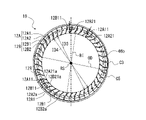
- FIG. 6 is a plan view of the impeller 10 on one surface side of the main plate 11 of the centrifugal blower 100 according to the first embodiment.
- FIG. 7 is a plan view of the impeller 10 on the other side of the main plate 11 of the centrifugal blower 100 according to the first embodiment.
- FIG. 8 is a cross-sectional view taken along the line BB of the impeller 10 shown in FIG. The impeller 10 will be described with reference to FIGS. 4 to 8.
- the impeller 10 is a centrifugal fan.
- the impeller 10 is connected to a motor having a drive shaft (not shown).
- the impeller 10 is rotationally driven by a motor, and the centrifugal force generated by the rotation forcibly sends air outward in the radial direction.
- the impeller 10 is rotated in the rotation direction R indicated by the arrow by a motor or the like.
- the impeller 10 includes a disk-shaped main plate 11, an annular side plate 13, and a plurality of blades 12 radially arranged around a rotation axis RS at the peripheral edge of the main plate 11. , Have.
- the main plate 11 may have a plate shape, and may have a shape other than a disk shape, such as a polygonal shape. As shown in FIG. 3, the thickness of the main plate 11 may be formed so that the wall thickness becomes thicker toward the center in the radial direction centered on the rotation axis RS, with the rotation axis RS as the center. It may be formed to have a constant thickness in the radial direction. Further, the main plate 11 is not limited to one composed of one plate-shaped member, and may be configured by integrally fixing a plurality of plate-shaped members.
- a boss portion 11b to which the drive shaft of the motor is connected is provided at the center of the main plate 11.
- the boss portion 11b is formed with a shaft hole 11b1 into which the drive shaft of the motor is inserted.
- the boss portion 11b is formed in a cylindrical shape, but the shape of the boss portion 11b is not limited to the cylindrical shape.
- the boss portion 11b may be formed in a columnar shape, and may be formed in a polygonal columnar shape, for example.
- the main plate 11 is rotationally driven by a motor via the boss portion 11b.
- the impeller 10 has an annular side plate 13 attached to an end portion of the plurality of blades 12 opposite to the main plate 11 in the axial direction of the rotation shaft RS of the boss portion 11b.
- the side plate 13 is provided on the outer peripheral side surface 10a of the impeller 10, and is arranged in the impeller 10 so as to face the main plate 11.
- the side plate 13 is provided on the outer side of the blade 12 in the radial direction about the rotation axis RS.
- the side plate 13 forms a gas suction port 10e in the impeller 10.
- the side plate 13 maintains the positional relationship of the tips of the respective blades 12 by connecting the plurality of blades 12, and reinforces the plurality of blades 12.
- the side plate 13 is arranged so as to face the main plate 11 on the side opposite to the side where the first side plate 13a is arranged with respect to the annular first side plate 13a which is arranged so as to face the main plate 11. It has an annular second side plate 13b.
- the side plate 13 is a general term for the first side plate 13a and the second side plate 13b, and the impeller 10 has the first side plate 13a on one side with respect to the main plate 11 in the axial direction of the rotary shaft RS, and the other. It has a second side plate 13b on the side of.
- the plurality of blades 12 have one end connected to the main plate 11 and the other end connected to the side plate 13, and are arranged on a circumferential CD centered on the virtual rotation axis RS of the main plate 11. Has been done.
- Each of the plurality of blades 12 is arranged between the main plate 11 and the side plate 13.
- the plurality of blades 12 are provided on both sides of the main plate 11 in the axial direction of the rotation axis RS of the boss portion 11b.
- the blades 12 are arranged at a certain interval from each other on the peripheral edge of the main plate 11.
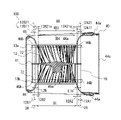
- FIG. 9 is a side view of the impeller 10 shown in FIG.
- the impeller 10 has a first wing portion 112a and a second wing portion 112b.
- the first wing portion 112a and the second wing portion 112b are composed of a plurality of blades 12 and side plates 13. More specifically, the first wing portion 112a is composed of an annular first side plate 13a and a plurality of blades 12 arranged between the main plate 11 and the first side plate 13a.
- the second wing portion 112b is composed of an annular second side plate 13b and a plurality of blades 12 arranged between the main plate 11 and the second side plate 13b.
- the first wing portion 112a is arranged on one plate surface side of the main plate 11, and the second wing portion 112b is arranged on the other plate surface side of the main plate 11. That is, the plurality of blades 12 are provided on both sides of the main plate 11 in the axial direction of the rotation axis RS, and the first wing portion 112a and the second wing portion 112b are provided back to back via the main plate 11. ing.
- the first wing portion 112a is arranged on the left side of the main plate 11, and the second wing portion 112b is arranged on the right side of the main plate 11.
- first wing portion 112a and the second wing portion 112b may be provided back to back via the main plate 11, and the first wing portion 112a is arranged on the right side of the main plate 11 and is provided on the main plate 11.
- the second wing portion 112b may be arranged on the left side.
- the blade 12 is described as a general term for the blade 12 constituting the first blade portion 112a and the blade 12 constituting the second blade portion 112b.
- the impeller 10 is formed in a tubular shape by a plurality of blades 12 arranged on the main plate 11.
- the impeller 10 is used to allow gas to flow into the space surrounded by the main plate 11 and the plurality of blades 12 on the side plate 13 side opposite to the main plate 11 in the axial direction of the rotation axis RS of the boss portion 11b.
- the suction port 10e is formed.
- blades 12 and side plates 13 are arranged on both sides of a plate surface constituting the main plate 11, and suction ports 10e of the impeller 10 are formed on both sides of the plate surface constituting the main plate 11.
- the impeller 10 is rotationally driven around the rotary shaft RS by being driven by a motor (not shown). As the impeller 10 rotates, the gas outside the centrifugal blower 100 passes through the suction port 45 formed in the scroll casing 40 shown in FIG. 1 and the suction port 10e of the impeller 10, and the main plate 11 and a plurality of them. It is sucked into the space surrounded by the blade 12. Then, as the impeller 10 rotates, the air sucked into the space surrounded by the main plate 11 and the plurality of blades 12 passes through the space between the blades 12 and the adjacent blades 12, and the diameter of the impeller 10 is increased. It is sent out of the direction.
- FIG. 10 is a schematic view showing the blade 12 in the CC line cross section of the impeller 10 shown in FIG.
- FIG. 11 is a schematic view showing the blade 12 in the DD line cross section of the impeller 10 shown in FIG.
- the intermediate position MP of the impeller 10 shown in FIG. 9 indicates an intermediate position in the axial direction of the rotation axis RS in the plurality of blades 12 constituting the first blade portion 112a. Further, the intermediate position MP of the impeller 10 shown in FIG. 9 indicates an intermediate position between the main plate 11 and the side plate 13 in the axial direction of the rotation axis RS in the plurality of blades 12 constituting the second blade portion 112b. ing.
- each of the plurality of blades 12 has a first region located on the main plate 11 side of the intermediate position MP in the axial direction of the rotation axis RS and a second region located on the side plate 13 side of the first region.
- the CC line cross section shown in FIG. 9 is a cross section of a plurality of blades 12 in the main plate 11 side of the impeller 10, that is, the main plate side blade region 122a which is the first region.
- the cross section of the blade 12 on the main plate 11 side is the first plane 71 perpendicular to the rotation axis RS, and is the first cross section of the impeller 10 in which the portion of the impeller 10 near the main plate 11 is cut off.
- the portion of the impeller 10 closer to the main plate 11 is, for example, a portion closer to the main plate 11 than the intermediate position of the main plate side blade region 122a in the axial direction of the rotary shaft RS, or a blade in the axial direction of the rotary shaft RS. It is a portion where the end portion of the main plate 12 on the 11 side is located.
- the DD line cross section shown in FIG. 9 is a cross section of a plurality of blades 12 on the side plate 13 side of the impeller 10, that is, the side plate side blade region 122b which is the second region.
- the cross section of the blade 12 on the side plate 13 side is a second plane 72 perpendicular to the rotation axis RS, and is a second cross section of the impeller 10 in which the portion of the impeller 10 near the side plate 13 is cut off.
- the portion of the impeller 10 closer to the side plate 13 is, for example, a portion closer to the side plate 13 than the intermediate position of the side plate side blade region 122b in the axial direction of the rotary shaft RS, or a blade in the axial direction of the rotary shaft RS. It is a portion where the end portion on the side plate 13 side of the 12 is located.
- the basic configuration of the blade 12 in the second wing portion 112b is the same as the basic configuration of the blade 12 in the first wing portion 112a. That is, in the plurality of blades 12 constituting the second blade portion 112b, the region from the intermediate position MP in the axial direction of the rotation shaft RS to the main plate 11 is defined as the main plate side blade region 122a which is the first region of the impeller 10. Further, in the plurality of blades 12 constituting the second blade portion 112b, the region from the intermediate position MP in the axial direction of the rotary shaft RS to the end portion on the second side plate 13b side is the side plate side which is the second region of the impeller 10. The blade region 122b.
- first wing portion 112a and the basic configuration of the second wing portion 112b are the same, but the configuration of the impeller 10 is limited to this configuration. Instead, the first wing portion 112a and the second wing portion 112b may have different configurations.
- the configuration of the blade 12 described below may be possessed by both the first blade portion 112a and the second blade portion 112b, or may be possessed by either one.
- the plurality of blades 12 have a plurality of first blades 12A and a plurality of second blades 12B.
- the plurality of blades 12 alternately arrange the first blade 12A and one or a plurality of second blades 12B in the circumferential direction CD of the impeller 10.
- two second blades 12B are arranged between the first blade 12A and the first blade 12A arranged adjacent to each other in the rotation direction R.
- the number of the second blades 12B arranged between the first blade 12A and the first blade 12A arranged adjacent to each other in the rotation direction R is not limited to two, and one or three or more. May be. That is, at least one second blade 12B of the plurality of second blades 12B is arranged between the two first blades 12A adjacent to each other in the circumferential direction CD among the plurality of first blades 12A.
- the first blade 12A has an inner peripheral end 14A and an outer peripheral end 15A in the first cross section of the impeller 10 cut by the first plane 71 perpendicular to the rotation axis RS.
- the inner peripheral end 14A is located on the rotating shaft RS side in the radial direction centered on the rotating shaft RS, and the outer peripheral end 15A is located on the outer peripheral side of the inner peripheral end 14A in the radial direction.
- the inner peripheral end 14A is arranged in front of the outer peripheral end 15A in the rotation direction R of the impeller 10.
- the inner peripheral end 14A is the leading edge 14A1 of the first blade 12A
- the outer peripheral end 15A is the trailing edge 15A1 of the first blade 12A.
- 14 first blades 12A are arranged on the impeller 10, but the number of the first blades 12A is not limited to 14, and may be less than 14. Well, it may be more than 14.
- the second blade 12B has an inner peripheral end 14B and an outer peripheral end 15B in the first cross section of the impeller 10 cut by the first plane 71 perpendicular to the rotation axis RS.
- the inner peripheral end 14B is located on the rotating shaft RS side in the radial direction centered on the rotating shaft RS, and the outer peripheral end 15B is located on the outer peripheral side of the inner peripheral end 14B in the radial direction.
- the inner peripheral end 14B is arranged in front of the outer peripheral end 15B in the rotation direction R of the impeller 10.
- the inner peripheral end 14B is the leading edge 14B1 of the second blade 12B
- the outer peripheral end 15B is the trailing edge 15B1 of the second blade 12B.
- 28 second blades 12B are arranged on the impeller 10, but the number of the second blades 12B is not limited to 28, and may be less than 28. Well, it may be more than 28 sheets.
- the relationship between the first blade 12A and the second blade 12B will be described. As shown in FIGS. 4 and 11, as the blade length of the first blade 12A becomes closer to the first side plate 13a and the second side plate 13b than the intermediate position MP in the direction along the rotation axis RS, the blade length of the first blade 12A becomes the blade of the second blade 12B. It is formed to be equal to the length.
- the wingspan of the first blade 12A is longer than the blade length of the second blade 12B in the portion closer to the main plate 11 than the intermediate position MP in the direction along the rotation axis RS. And the closer it is to the main plate 11, the longer it becomes.
- the wingspan of the first blade 12A is longer than the blade length of the second blade 12B at least in a part of the direction along the rotation axis RS.
- the blade length used here is the length of the first blade 12A in the radial direction of the impeller 10 and the length of the second blade 12B in the radial direction of the impeller 10.
- the diameter of the circle C1 passing through the inner peripheral ends 14A of the plurality of first blades 12A centered on the rotation axis RS That is, the inner diameter of the first blade 12A is defined as the inner diameter ID1.
- the diameter of the circle C3 passing through the outer peripheral ends 15A of the plurality of first blades 12A centered on the rotation axis RS, that is, the outer diameter of the first blade 12A is defined as the outer diameter OD1.
- the ratio of the inner diameter of the first blade 12A to the outer diameter of the first blade 12A is 0.7 or less. That is, the plurality of first blades 12A has an inner diameter ID1 composed of the inner peripheral ends 14A of each of the plurality of first blades 12A and an outer diameter OD1 composed of the outer peripheral ends 15A of each of the plurality of first blades 12A.
- the ratio with is 0.7 or less.
- the blade length in the cross section perpendicular to the rotation axis is shorter than the width dimension of the blade in the rotation axis direction.
- the maximum blade length of the first blade 12A that is, the blade length at the end of the first blade 12A near the main plate 11, is the width dimension W in the rotation axis direction of the first blade 12A (see FIG. 9). Is shorter than.
- the diameter of the circle C2 passing through the inner peripheral ends 14B of the plurality of second blades 12B centered on the rotation axis RS, that is, the inner diameter of the second blade 12B is defined as the inner diameter ID2 larger than the inner diameter ID1.
- Blade length L2a (outer diameter OD2-inner diameter ID2) / 2).
- the wingspan L2a of the second blade 12B in the first cross section is shorter than the wingspan L1a of the first blade 12A in the same cross section (wing length L2a ⁇ wing length L1a).
- the ratio of the inner diameter of the second blade 12B to the outer diameter of the second blade 12B is 0.7 or less. That is, the plurality of second blades 12B have an inner diameter ID2 composed of the inner peripheral ends 14B of each of the plurality of second blades 12B and an outer diameter OD2 composed of the outer peripheral ends 15B of each of the plurality of second blades 12B.
- the ratio with is 0.7 or less.
- the diameter of the circle C7 passing through the inner peripheral end 14A of the first blade 12A centered on the rotation axis RS is defined.
- Inner diameter ID3 is larger than the inner diameter ID1 of the first cross section (inner diameter ID3> inner diameter ID1).
- the diameter of the circle C8 passing through the outer peripheral end 15A of the first blade 12A centered on the rotation axis RS is defined as the outer diameter OD3.
- the diameter of the circle C7 passing through the inner peripheral end 14B of the second blade 12B centered on the rotation axis RS is defined as the inner diameter ID4.
- the diameter of the circle C8 passing through the outer peripheral end 15B of the second blade 12B centered on the rotation axis RS is defined as the outer diameter OD4.
- Blade length L2b (outer diameter OD4-inner diameter ID4) / 2).
- the inner diameter of the plurality of blades 12 is composed of the inner peripheral ends of the plurality of blades 12. That is, the blade inner diameter of the plurality of blades 12 is composed of the leading edges 14A1 of the plurality of blades 12. Further, the blade outer diameter of the plurality of blades 12 is composed of the outer peripheral ends of the plurality of blades 12. That is, the blade outer diameter of the plurality of blades 12 is composed of the trailing edge 15A1 and the trailing edge 15B1 of the plurality of blades 12.
- the first blade 12A has a relationship of blade length L1a> blade length L1b in comparison between the first cross section shown in FIG. 10 and the second cross section shown in FIG. That is, each of the plurality of blades 12 has a portion in which the blade length in the first region is formed longer than the blade length in the second region. More specifically, the first blade 12A has a portion formed so that the blade length becomes smaller from the main plate 11 side to the side plate 13 side in the axial direction of the rotation axis RS.
- the second blade 12B has a relationship of blade length L2a> blade length L2b in comparison between the first cross section shown in FIG. 10 and the second cross section shown in FIG. That is, the second blade 12B has a portion formed so that the blade length becomes smaller from the main plate 11 side to the side plate 13 side in the axial direction of the rotation axis RS.
- the leading edges of the first blade 12A and the second blade 12B are inclined so that the inner diameter of the blade increases from the main plate 11 side to the side plate 13 side. That is, the plurality of blades 12 are formed so that the inner diameter of the blades increases toward the side plate 13 side from the main plate 11 side, and the inner peripheral end 14A constituting the leading edge 14A1 is inclined so as to be separated from the rotation axis RS. It has an inclined portion 141A. Similarly, the plurality of blades 12 are formed so that the inner diameter of the blades increases toward the side plate 13 side from the main plate 11 side, so that the inner peripheral end 14B constituting the leading edge 14B1 is separated from the rotation axis RS. It has an inclined inclined portion 141B.
- the first blade 12A includes the first sirocco wing portion 12A1 including the outer peripheral end 15A and configured as a forward blade, and the first blade 12A including the inner peripheral end 14A and configured as a backward blade. It has one turbo blade portion 12A2.
- the first sirocco blade portion 12A1 constitutes the outer peripheral side of the first blade 12A
- the first turbo blade portion 12A2 constitutes the inner peripheral side of the first blade 12A. That is, the first blade 12A is configured in the order of the first turbo blade portion 12A2 and the first sirocco blade portion 12A1 from the rotation axis RS toward the outer peripheral side in the radial direction of the impeller 10.
- the first turbo blade portion 12A2 and the first sirocco blade portion 12A1 are integrally formed.
- the first turbo blade portion 12A2 constitutes the leading edge 14A1 of the first blade 12A
- the first sirocco blade portion 12A1 constitutes the trailing edge 15A1 of the first blade 12A.
- the first turbo blade portion 12A2 extends linearly from the inner peripheral end 14A constituting the leading edge 14A1 toward the outer peripheral side in the radial direction of the impeller 10.
- the region constituting the first sirocco blade portion 12A1 of the first blade 12A is defined as the first sirocco region 12A11, and the region constituting the first turbo blade portion 12A2 of the first blade 12A is defined as the first region. It is defined as 1 turbo region 12A21.
- the first turbo region 12A21 is formed larger than the first sirocco region 12A11 in the radial direction of the impeller 10.
- the impeller 10 has a first sirocco region 12A11 ⁇ first turbo in the radial direction of the impeller 10 in the region of the main plate side blade region 122a which is the first region and the side plate side blade region 122b which is the second region shown in FIG. It has a relationship of regions 12A21.
- the impeller 10 and the first blade 12A are occupied by the first turbo blade portion 12A2 in the radial direction of the impeller 10 in the region of the main plate side blade region 122a which is the first region and the side plate side blade region 122b which is the second region.
- the ratio is larger than the ratio occupied by the first sirocco wing portion 12A1.
- the second blade 12B includes the second sirocco blade portion 12B1 including the outer peripheral end 15B and configured as a forward blade, and the inner peripheral end 14B as a backward blade. It has a second turbo blade portion 12B2 that has been made.
- the second sirocco blade portion 12B1 constitutes the outer peripheral side of the second blade 12B
- the second turbo blade portion 12B2 constitutes the inner peripheral side of the second blade 12B. That is, the second blade 12B is configured in the order of the second turbo blade portion 12B2 and the second sirocco blade portion 12B1 from the rotation axis RS toward the outer peripheral side in the radial direction of the impeller 10.
- the second turbo blade portion 12B2 and the second sirocco blade portion 12B1 are integrally formed.
- the second turbo blade portion 12B2 constitutes the leading edge 14B1 of the second blade 12B
- the second sirocco blade portion 12B1 constitutes the trailing edge 15B1 of the second blade 12B.
- the second turbo blade portion 12B2 extends linearly from the inner peripheral end 14B constituting the leading edge 14B1 toward the outer peripheral side in the radial direction of the impeller 10.
- the region constituting the second sirocco blade portion 12B1 of the second blade 12B is defined as the second sirocco region 12B11, and the region constituting the second turbo blade portion 12B2 of the second blade 12B is defined as the second.
- 2 Turbo region 12B21 is defined.
- the second turbo region 12B21 is larger than the second sirocco region 12B11 in the radial direction of the impeller 10.
- the impeller 10 has a second sirocco region 12B11 ⁇ second turbo region 12B21 in the radial direction of the impeller 10 in the main plate side blade region 122a which is the first region and the side plate side blade region 122b which is the second region shown in FIG. It is provided with a part having a relationship of.
- the impeller 10 and the second blade 12B are occupied by the second turbo blade portion 12B2 in the radial direction of the impeller 10 in the region of the main plate side blade region 122a which is the first region and the side plate side blade region 122b which is the second region.
- the ratio is larger than the ratio occupied by the second sirocco wing portion 12B1.
- the region of the turbo blade portion is larger than the region of the sirocco blade portion in the radial direction of the impeller 10. That is, in the regions of the main plate side blade region 122a and the side plate side blade region 122b, the ratio of the turbo blade portion to the plurality of blades 12 in the radial direction of the impeller 10 is larger than the ratio occupied by the sirocco blade portion, and the sirocco region.
- the ratio of the turbo blade portion in the radial direction is larger than the ratio of the sirocco blade portion in the first region and the second region.
- the relationship of the occupancy ratio between the sirocco blade portion and the turbo blade portion in the radial direction of the rotation axis RS is established in all the regions of the main plate side blade region 122a which is the first region and the side plate side blade region 122b which is the second region. You may.
- the ratio of the turbo blade portion in the radial direction of the impeller 10 is larger than the ratio occupied by the sirocco blade portion in all the regions of the main plate side blade region 122a and the side plate side blade region 122b. It is not limited to those having a relationship of region ⁇ turbo region.
- the ratio of the turbo blade portion in the radial direction may be equal to the ratio occupied by the sirocco blade portion or smaller than the ratio occupied by the sirocco blade portion in the first region and the second region. ..
- the outlet angle of the first sirocco blade portion 12A1 of the first blade 12A in the first cross section is defined as the exit angle ⁇ 1.
- the exit angle ⁇ 1 is the angle formed by the tangent line TL1 of the circle and the center line CL1 of the first sirocco wing portion 12A1 at the outer peripheral end 15A at the intersection of the arc of the circle C3 centered on the rotation axis RS and the outer peripheral end 15A. Define.
- This exit angle ⁇ 1 is an angle larger than 90 degrees.
- the outlet angle of the second sirocco blade portion 12B1 of the second blade 12B in the same cross section is defined as the outlet angle ⁇ 2.
- the exit angle ⁇ 2 is the angle formed by the tangent line TL2 of the circle and the center line CL2 of the second sirocco wing portion 12B1 at the outer peripheral end 15B at the intersection of the arc of the circle C3 centered on the rotation axis RS and the outer peripheral end 15B. Define.
- the exit angle ⁇ 2 is an angle larger than 90 degrees.
- the first sirocco wing portion 12A1 and the second sirocco wing portion 12B1 are formed in an arc shape so as to be convex in the direction opposite to the rotation direction R when viewed in parallel with the rotation axis RS.
- the outlet angle ⁇ 1 of the first sirocco wing portion 12A1 and the exit angle ⁇ 2 of the second sirocco wing portion 12B1 are equal even in the second cross section. That is, the plurality of blades 12 have sirocco blades constituting forward blades formed at an exit angle larger than 90 degrees from the main plate 11 to the side plates 13.
- the outlet angle of the first turbo blade portion 12A2 of the first blade 12A in the first cross section is defined as the exit angle ⁇ 1.
- the exit angle ⁇ 1 is defined as the angle formed by the tangent line TL3 of the circle and the center line CL3 of the first turbo blade portion 12A2 at the intersection of the arc of the circle C4 centered on the rotation axis RS and the first turbo blade portion 12A2. do.
- This exit angle ⁇ 1 is an angle smaller than 90 degrees.
- the outlet angle of the second turbo blade portion 12B2 of the second blade 12B in the same cross section is defined as the outlet angle ⁇ 2.
- the exit angle ⁇ 2 is defined as the angle formed by the tangent line TL4 of the circle and the center line CL4 of the second turbo blade portion 12B2 at the intersection of the arc of the circle C4 centered on the rotation axis RS and the second turbo blade portion 12B2. do.
- the exit angle ⁇ 2 is an angle smaller than 90 degrees.
- the outlet angle ⁇ 1 of the first turbo blade portion 12A2 and the outlet angle ⁇ 2 of the second turbo blade portion 12B2 are equal even in the second cross section. Further, the exit angle ⁇ 1 and the exit angle ⁇ 2 are angles smaller than 90 degrees.
- the first blade 12A has a first radial blade portion 12A3 as a connecting portion between the first turbo blade portion 12A2 and the first sirocco blade portion 12A1.
- the first radial blade portion 12A3 is a portion configured as a radial blade extending linearly in the radial direction of the impeller 10.
- the second blade 12B has a second radial wing portion 12B3 as a connecting portion between the second turbo wing portion 12B2 and the second sirocco wing portion 12B1.
- the second radial blade portion 12B3 is a portion configured as a radial blade extending linearly in the radial direction of the impeller 10.
- the blade angle of the first radial blade portion 12A3 and the second radial blade portion 12B3 is 90 degrees. More specifically, the angle between the tangent line at the intersection of the center line of the first radial wing portion 12A3 and the circle C5 centered on the rotation axis RS and the center line of the first radial wing portion 12A3 is 90 degrees. Further, the angle formed by the tangent line at the intersection of the center line of the second radial wing portion 12B3 and the circle C5 centered on the rotation axis RS and the center line of the second radial wing portion 12B3 is 90 degrees.
- the space between the blades in the turbo blade portion composed of the first turbo blade portion 12A2 and the second turbo blade portion 12B2 extends from the inner peripheral side to the outer peripheral side. That is, in the impeller 10, the space between the blades of the turbo blade portion extends from the inner peripheral side to the outer peripheral side. Further, the space between the blades in the sirocco blade portion composed of the first sirocco blade portion 12A1 and the second sirocco blade portion 12B1 is wider than the space between the blades of the turbo blade portion, and extends from the inner peripheral side to the outer peripheral side.
- the space between the blades between the first turbo blade 12A2 and the second turbo blade 12B2, or the space between the adjacent second turbo blades 12B2, extends from the inner peripheral side to the outer peripheral side. .. Further, the distance between the blades of the first sirocco blade portion 12A1 and the second sirocco blade portion 12B1 or the distance between the adjacent second sirocco blade portions 12B1 is wider and the inner circumference than the distance between the blades of the turbo blade portion. It spreads from the side to the outer peripheral side.
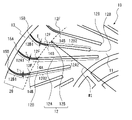
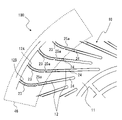
- FIG. 12 is a partially enlarged view of the impeller 10 in the range E of the impeller 10 shown in FIG.
- the blade thickness T of the blade 12 will be described with reference to FIG.
- FIG. 12 is an enlarged plan view of the impeller 10 when viewed in the direction of the viewpoint V indicated by the white arrow in FIG.
- the blade inner diameter WI composed of the inner peripheral ends of the plurality of blades 12 respectively.
- the portion of the plurality of blades 12 located on the outer peripheral side is defined as the outer peripheral side blade portion 28.
- the end portion 12F of the plurality of blades 12 on the side plate 13 side in the axial direction of the rotating shaft RS is a portion indicated by hatching of diagonal lines in the blade 12.
- the inner peripheral end of each of the plurality of blades 12 is the inner peripheral end 14A of the first blade 12A and the inner peripheral end 14B of the second blade 12B.
- the outer peripheral side blade portion 28 is formed so that the blade thickness T of the blade 12 becomes thinner from the inner peripheral side to the outer peripheral side of the impeller 10 in the radial direction about the rotation axis RS.
- the outer peripheral side blade portion 28 only the sirocco blade portion composed of the first sirocco blade portion 12A1 and the second sirocco blade portion 12B1 has a thinner blade thickness T of the blade 12 from the inner peripheral side to the outer peripheral side in the radial direction. It may be formed so as to be.
- the blade thickness T is the thickness of the blade 12 in the direction perpendicular to the center line of the blade 12 when the blade 12 is viewed in the axial direction of the rotation axis RS.
- FIG. 13 is a schematic view showing the relationship between the impeller 10 and the scroll casing 40 in the AA line cross section of the centrifugal blower 100 shown in FIG.
- FIG. 14 is a schematic view showing the relationship between the blade 12 and the bell mouth 46 when viewed in parallel with the rotation axis RS in the impeller 10 shown in FIG.
- the blade outer diameter OD composed of the outer peripheral ends of the plurality of blades 12 is larger than the inner diameter BI of the bell mouth 46 constituting the scroll casing 40.
- the impeller 10 has a portion in which the first turbo region 12A21 is larger than the first sirocco region 12A11 in the radial direction with respect to the rotating shaft RS. That is, in the impeller 10 and the first blade 12A, the ratio of the first turbo blade portion 12A2 to the rotation axis RS is larger than the ratio occupied by the first sirocco blade portion 12A1, and the ratio of the first sirocco blade portion 12A1 ⁇ A portion having a relationship with the first turbo blade portion 12A2 is provided.
- the relationship between the occupancy ratios of the first sirocco blade portion 12A1 and the first turbo blade portion 12A2 in the radial direction of the rotation axis RS is that of the main plate side blade region 122a which is the first region and the side plate side blade region 122b which is the second region. It may be established in all areas.
- the ratio of the first turbo blade portion 12A2 to the rotation axis RS is larger than the ratio occupied by the first sirocco blade portion 12A1, and the ratio of the first sirocco blade portion 12A1 ⁇ It is not limited to the one having the relationship of the first turbo blade portion 12A2.
- the ratio occupied by the first turbo blade portion 12A2 is equal to the ratio occupied by the first sirocco blade portion 12A1 in the radial direction with respect to the rotation axis RS, or the ratio occupied by the first sirocco blade portion 12A1. It may be formed so as to be smaller than the ratio.
- the impeller 10 has a portion in which the second turbo region 12B21 is larger than the second sirocco region 12B11 in the radial direction with respect to the rotation shaft RS. That is, in the impeller 10 and the second blade 12B, the ratio occupied by the second turbo blade portion 12B2 is larger than the ratio occupied by the second sirocco blade portion 12B1 in the radial direction with respect to the rotation axis RS, and the second sirocco blade portion 12B1 ⁇ A portion having a relationship with the second turbo blade portion 12B2 is provided.
- the relationship of the occupancy ratio between the second sirocco blade portion 12B1 and the second turbo blade portion 12B2 in the radial direction of the rotation axis RS is the relationship between the main plate side blade region 122a which is the first region and the side plate side blade region 122b which is the second region. It may be established in all areas.
- the ratio occupied by the second turbo blade portion 12B2 is larger than the ratio occupied by the second sirocco blade portion 12B1 in the radial direction with respect to the rotation axis RS, and the second sirocco blade portion 12B1 ⁇ It is not limited to the one having the relationship of the second turbo blade portion 12B2.
- the ratio occupied by the second turbo blade portion 12B2 is equal to the ratio occupied by the second sirocco blade portion 12B1 in the radial direction with respect to the rotation axis RS, or the ratio occupied by the second sirocco blade portion 12B1. It may be formed smaller than the ratio.
- FIG. 15 is a schematic diagram showing in more detail the relationship between the impeller 10 and the scroll casing 40 in the AA line cross section of the centrifugal blower 100 shown in FIG.
- FIG. 16 is a schematic view showing the relationship between the blade 12 and the bell mouth 46 when viewed in parallel with the rotation axis RS in the impeller 10 shown in FIG.
- the white arrow L shown in FIG. 15 indicates the direction when the impeller 10 is viewed in parallel with the rotation axis RS.
- the circle passing through the end 14A is defined as the circle C1a.
- the diameter of the circle C1a that is, the inner diameter of the first blade 12A at the connection position between the first blade 12A and the main plate 11, is defined as the inner diameter ID1a.
- the circle C2a passes through the inner peripheral ends 14B of the plurality of second blades 12B centered on the rotation axis RS at the connection position between the second blade 12B and the main plate 11. Is defined as. Then, the diameter of the circle C2a, that is, the inner diameter of the second blade 12B at the connection position between the first blade 12A and the main plate 11, is defined as the inner diameter ID2a.
- the inner diameter ID2a is larger than the inner diameter ID1a (inner diameter ID2a> inner diameter ID1a).
- the outer diameter of the blade 12 is defined as the blade outer diameter OD.
- the circle C7a passes through the inner peripheral ends 14A of the plurality of first blades 12A centered on the rotation axis RS at the connection position between the first blade 12A and the side plate 13. Is defined as. Then, the diameter of the circle C7a, that is, the inner diameter of the first blade 12A at the connection position between the first blade 12A and the side plate 13, is defined as the inner diameter ID3a.
- the circle passing through the inner peripheral ends 14B of the plurality of second blades 12B centered on the rotation axis RS is a circle C7a. It becomes. Then, the diameter of the circle C7a, that is, the inner diameter of the second blade 12B at the connection position between the second blade 12B and the side plate 13, is defined as the inner diameter ID 4a.
- the positions of the inner diameter BI of the bell mouth 46 are the inner diameter ID1a on the main plate 11 side of the first blade 12A and the inner diameter ID3a on the side plate 13 side. It is located in the region of the first turbo blade portion 12A2 and the second turbo blade portion 12B2 between and. More specifically, the inner diameter BI of the bell mouth 46 is larger than the inner diameter ID1a on the main plate 11 side of the first blade 12A and smaller than the inner diameter ID3a on the side plate 13 side.
- the inner diameter BI of the bell mouth 46 is formed to be larger than the inner diameter of the blades on the main plate 11 side of the plurality of blades 12 and smaller than the inner diameter of the blades on the side plate 13 side.
- the inner peripheral edge portion 46a forming the inner diameter BI of the bell mouth 46 is the first turbo wing portion 12A2 and the second turbo wing between the circle C1a and the circle C7a when viewed in parallel with the rotation axis RS. Located in the area of portion 12B2.
- the positions of the inner diameter BI of the bell mouth 46 when viewed in parallel with the rotation axis RS are the inner diameter ID2a on the main plate 11 side of the second blade 12B and the inner diameter on the side plate 13 side. It is located in the region of the first turbo blade portion 12A2 and the second turbo blade portion 12B2 between the ID 4a and the first turbo blade portion 12A2. More specifically, the inner diameter BI of the bell mouth 46 is larger than the inner diameter ID2a on the main plate 11 side of the second blade 12B and smaller than the inner diameter ID4a on the side plate 13 side.
- the inner diameter BI of the bell mouth 46 is formed to be larger than the inner diameter of the blades on the main plate 11 side of the plurality of blades 12 and smaller than the inner diameter of the blades on the side plate 13 side. More specifically, the inner diameter BI of the bell mouth 46 is larger than the inner diameter of the blades composed of the inner peripheral ends of the plurality of blades 12 in the first region, and the inner circumferences of the plurality of blades 12 in the second region are each larger. It is formed smaller than the inner diameter of the blade composed of the ends.
- the inner peripheral edge portion 46a forming the inner diameter BI of the bell mouth 46 is the first turbo wing portion 12A2 and the second turbo wing between the circle C2a and the circle C7a when viewed in parallel with the rotation axis RS. Located in the area of portion 12B2.
- the radial lengths of the first sirocco wing portion 12A1 and the second sirocco wing portion 12B1 are defined as the distance SL.
- the closest distance between the plurality of blades 12 of the impeller 10 and the peripheral wall 44c of the scroll casing 40 is defined as the distance MS.
- the distance MS is larger than twice the distance SL (distance MS> distance SL ⁇ 2).
- the distance MS is shown in the centrifugal blower 100 having an AA line cross section in FIG. 15, but the distance MS is the closest distance between the scroll casing 40 and the peripheral wall 44c, and is not necessarily the AA line cross section. It is not represented above.
- FIG. 17 is a schematic view showing the relationship between the impeller 10 and the bell mouth 46 in the AA line cross section of the centrifugal blower 100 shown in FIG.
- FIG. 18 is a schematic view showing the relationship between the blade 12 and the bell mouth 46 when viewed in parallel with the rotation axis RS in the second cross section of the impeller 10 shown in FIG.
- the blade 12 located outside the inner diameter BI of the bell mouth 46 is composed of a first sirocco blade portion 12A1 and a first turbo blade portion 12A2. Further, the blade 12 located outside the inner diameter BI of the bell mouth 46 is composed of a second sirocco blade portion 12B1 and a second turbo blade portion 12B2.
- portions of the plurality of blades 12 located on the outer peripheral side of the inner peripheral side end portion 46b, which is the inner peripheral side end portion of the bell mouth 46, in the radial direction with respect to the rotation axis RS. Is defined as the outer peripheral side region portion 26.
- the ratio of the first sirocco blade portion 12A1 in the outer peripheral side region portion 26 is larger than the ratio occupied by the first turbo blade portion 12A2.
- the outer peripheral side region portion 26 of the impeller 10 located on the outer peripheral side of the inner peripheral side end portion 46b of the bell mouth 46 is the first sirocco in the radial direction with respect to the rotation axis RS.
- the region 12A11 is larger than the first turbo region 12A21a.
- the inner peripheral side end portion 46b is provided in an annular shape around the rotation axis RS to form an inner peripheral edge portion 46a.
- the first turbo region 12A21a is a region of the first turbo region 12A21 located on the outer peripheral side of the inner peripheral side end portion 46b of the bell mouth 46 when viewed in parallel with the rotation axis RS.
- the ratio of the first sirocco wing portion 12A1 to the outer peripheral side region portion 26 of the impeller 10 is first. It is desirable that it is larger than the ratio occupied by the turbo blade portion 12A2a.
- the relationship between the ratio of the first sirocco blade portion 12A1 and the first turbo blade portion 12A2a in the outer peripheral side region portion 26 is the entire main plate side blade region 122a which is the first region and the side plate side blade region 122b which is the second region. It may be established in the area of.
- the ratio of the second sirocco blade portion 12B1 to the outer peripheral side region portion 26 is larger than the ratio occupied by the second turbo blade portion 12B2. That is, when viewed in parallel with the rotation axis RS, the outer peripheral side region portion 26 of the impeller 10 located on the outer peripheral side of the inner peripheral side end portion 46b of the bell mouth 46 has a second sirocco in the radial direction with respect to the rotation axis RS.
- the region 12B11 is larger than the second turbo region 12B21a.
- the second turbo region 12B21a is a region of the second turbo region 12B21 located on the outer peripheral side of the inner peripheral side end portion 46b of the bell mouth 46 when viewed in parallel with the rotation axis RS.
- the ratio of the second sirocco blade portion 12B1 to the outer peripheral side region portion 26 of the impeller 10 is second. It is desirable that it is larger than the proportion occupied by the turbo blade portion 12B2a.
- the relationship between the occupancy ratios of the second sirocco blade portion 12B1 and the second turbo blade portion 12B2a in the outer peripheral side region portion 26 is all of the main plate side blade region 122a which is the first region and the side plate side blade region 122b which is the second region. It may be established in the area of.
- centrifugal blower 100 The operation of the centrifugal blower will be described with reference to FIG.
- the centrifugal blower 100 when a motor (not shown) is driven, the main plate 11 to which the motor shaft is connected rotates, and the plurality of blades 12 rotate around the rotation shaft RS via the main plate 11.
- the air outside the scroll casing 40 is sucked into the impeller 10 from the suction port 45, and is blown out from the impeller 10 into the scroll casing 40 by the pressurizing action of the impeller 10. ..
- the air blown from the impeller 10 into the scroll casing 40 is decelerated by the expanded air passage formed by the peripheral wall 44c of the scroll casing 40 to recover the static pressure, and is blown out from the discharge port 42a shown in FIG. Will be done.
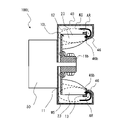
- FIG. 19 is a cross-sectional view of a centrifugal blower 100L according to a comparative example.
- the impeller 10L is connected to a drive source 50 such as a motor.
- the portion of the blade 12 located outside the inner peripheral side end portion 46b of the bell mouth 46 shown in the range WS is only the portion forming the sirocco wing portion 23. Therefore, the airflow AR blown out from the impeller 10L and along the inner wall surface of the bell mouth 46 has a large outlet angle and a large inflow velocity of the airflow when re-inflowing into the impeller 10L.
- the airflow AR that collides with the sirocco wing portion 23 causes noise generated from the centrifugal blower 100L, and also causes deterioration of the input.
- the input deterioration means that, for example, the collision between the air flow and the blade 12 becomes resistance to the rotation of the impeller 10L, and the electric power required for the centrifugal blower 100L increases.
- the outer peripheral side blade portion 28 of the centrifugal blower 100 of the first embodiment is formed so that the blade thickness T of the blade 12 becomes thinner from the inner peripheral side to the outer peripheral side in the radial direction. Therefore, in the centrifugal blower 100, the space between the blades of the impeller 10 is gradually expanded, and the opening area between the blades is expanded toward the blowout side of the blade 12.
- the centrifugal blower 100 having the above configuration suppresses sudden pressure fluctuations when air is blown from the impeller 10 as compared with the centrifugal blower 100L without the configuration, and the air blown out from the impeller 10 is suppressed.
- the air volume can be increased.
- a large amount of air blown from the impeller 10 of the centrifugal blower 100 having the configuration flows into the inner peripheral side of the impeller 10 along the inner wall surface of the bell mouth 46, the outlet angle is small, and the airflow It collides with the turbo wing where the inflow speed decreases.
- the centrifugal blower 100 of the first embodiment has a turbo blade portion in which the outlet angle is small and the inflow speed of the airflow is small when the airflow along the inner wall surface of the bell mouth 46 re-flows into the impeller 10. Since the collision occurs, the noise generated by the airflow is suppressed, and the input deterioration is suppressed.
- FIG. 20 is a partial cross-sectional view of the impeller 10 in the range E of the impeller 10 shown in FIG. 6 of the centrifugal blower 100 according to the second embodiment.
- the parts having the same configuration as the centrifugal blower 100 and the like shown in FIGS. 1 to 19 are designated by the same reference numerals, and the description thereof will be omitted.
- the centrifugal blower 100 according to the second embodiment further specifies the blade thickness T of the blade 12 of the centrifugal blower 100 according to the first embodiment.
- the plurality of blades 12 of the centrifugal blower 100 have a first turbo blade portion 12A2 and a second turbo blade portion from the inner peripheral side to the outer peripheral side of the impeller 10 in each cross section in the axial direction of the rotary shaft RS.
- the blade thickness T of the blades 12 constituting the 12B2 is formed to have a constant thickness.
- the blade thickness T of the blades 12 constituting the turbo blade portion is constant from the inner peripheral side to the outer peripheral side of the impeller 10 in each cross section in the axial direction of the rotary shaft RS. It is formed to a thickness. Therefore, the centrifugal blower 100 having the configuration suppresses sudden pressure fluctuations when air is blown from the impeller, and is blown out from the impeller 10 as compared with the centrifugal blower 100L not having the configuration. The air volume of air can be increased.
- the centrifugal blower 100 of the second embodiment has a turbo blade portion in which the outlet angle is small and the inflow speed of the airflow is small when the airflow along the inner wall surface of the bell mouth 46 re-flows into the impeller 10. Since the collision occurs, the noise generated by the airflow is suppressed, and the input deterioration is suppressed. Further, since the centrifugal blower 100 according to the second embodiment has the configuration of the centrifugal blower 100 according to the first embodiment, the same effect as the centrifugal blower 100 according to the first embodiment can be exhibited.
- the blade thickness T of the blade 12 constituting the turbo blade portion is formed to a constant thickness from the inner peripheral side to the outer peripheral side of the impeller 10.
- the impeller 10 has good manufacturability and the mold cost for manufacturing the impeller 10 is low.
- FIG. 21 is a conceptual diagram showing the relationship between the impeller 10 of the centrifugal blower 100 according to the third embodiment and the bell mouth 46.
- the parts having the same configuration as the centrifugal blower 100 and the like shown in FIGS. 1 to 20 are designated by the same reference numerals, and the description thereof will be omitted.
- the centrifugal blower 100 according to the third embodiment further specifies the relationship between the impeller 10 of the centrifugal blower 100 according to the first embodiment and the second embodiment and the scroll casing 40.
- the impeller 10 is connected to a drive source 50 such as a motor via an output shaft 51.
- the blade 12 has an inner blade portion 22 protruding inward from the inner peripheral side end portion 46b of the bell mouth 46 in the radial direction centered on the rotation axis RS.
- the inner blade portion 22 is a portion located in the formation region of the inner diameter BI of the bell mouth 46.
- Each of the plurality of blades 12 is formed so that the blade length in the first region is longer than the blade length in the second region. Further, in the plurality of blades 12, the ratio of the turbo blade portion 24 in the radial direction to the blade length of the blade 12 in the radial direction in both the first region and the second region is occupied by the sirocco blade portion 23. It has a portion that is formed larger than the proportion. As described above, the first region is the main plate side blade region 122a, and the second region is the side plate side blade region 122b.
- the outer peripheral side region portion 26 is formed so that the ratio of the sirocco blade portion 23 in the radial direction is larger than the ratio of the turbo blade portion 24 in both the first region and the second region. .. That is, as shown in FIG. 21, in the length of the blade 12 in the radial direction, the ratio of the outer sirocco wing portion 23a outside the outer diameter of the inner peripheral side end portion 46b of the bell mouth 46 is the outer turbo wing portion. It is formed so as to be larger than the proportion occupied by 24a.
- the sirocco wing portion 23 shown in FIG. 21 is a general term for the first sirocco wing portion 12A1 and the second sirocco wing portion 12B1, and the turbo wing portion 24 is a general term for the first turbo wing portion 12A2 and the second turbo wing portion 12B2.
- the outer sirocco wing portion 23a shown in FIG. 21 is a first sirocco wing portion 12A1 and a second sirocco wing located on the outer peripheral side of the inner peripheral side end portion 46b of the bell mouth 46 when viewed in parallel with the rotation axis RS. It is a general term for the part 12B1.
- outer turbo wing portion 24a is a first turbo wing portion 12A2 and a second turbo wing portion 12B2 located on the outer peripheral side of the inner peripheral side end portion 46b of the bell mouth 46 when viewed in parallel with the rotation axis RS.
- the ratio of the sirocco blade portion 23 in the radial direction is formed to be larger than the ratio occupied by the turbo blade portion 24 in the first region and the second region.
- the centrifugal blower 100 having the configuration can increase the pressure of the airflow blown from the impeller 10 and increase the air volume as compared with the centrifugal blower 100L not having the configuration.
- the airflow AR that re-flows into the impeller 10 along the inner wall surface of the bell mouth 46 is formed in the turbo blade portion 24 having a small outlet angle and a small inflow speed of the airflow. collide.
- the noise generated by the airflow is suppressed, and the input deterioration is suppressed.
- the ratio of the sirocco wing portion 23 to the portion of the plurality of blades 12 located outside the inner peripheral side end portion 46b of the bell mouth 46 is occupied by the turbo wing portion 24.
- the pressure can be increased and the air volume can be increased.
- FIG. 22 is a cross-sectional view schematically showing the centrifugal blower 100 according to the fourth embodiment.
- FIG. 23 is a partially enlarged view of the impeller 10 in the range E of the impeller 10 shown in FIG. 6 of the centrifugal blower 100 according to the fourth embodiment.
- the parts having the same configuration as the centrifugal blower 100 and the like shown in FIGS. 1 to 21 are designated by the same reference numerals, and the description thereof will be omitted.
- the centrifugal blower 100 according to the fourth embodiment further specifies the configuration of the impeller 10 of the centrifugal blower 100 according to the first to third embodiments.
- the turbo blade portion 24 and the sirocco blade portion 23 are separated from each other in the side plate side blade region 122b, which is the second region.
- the blade 12 is provided with a separation portion 25 between the turbo blade portion 24 and the sirocco blade portion 23.
- the separation portion 25 is a through hole that penetrates the blade 12 in the radial direction centered on the rotation shaft RS, and is toward the main plate 11 side from the end portion of the blade 12 on the side plate 13 side in the axial direction of the rotation shaft RS. It is a dented part.
- the separation portion 25 is formed only in the side plate side blade region 122b, which is the second region.
- centrifugal blower 100 In the centrifugal blower 100 according to the fourth embodiment, since the turbo blade portion 24 and the sirocco blade portion 23 are separated, the loss due to the inflow of the air flow into the sirocco blade portion 23 can be reduced. The loss can be reduced by collecting the airflow leaking from the separated turbo wing portion 24 to the rear side of the turbo wing portion 24 and then collecting it by the sirocco wing portion 23 arranged on the rear side of the turbo wing portion 24. Further, since the centrifugal blower 100 according to the fourth embodiment has the same configuration as the centrifugal blower 100 according to the first to third embodiments, the centrifugal blower according to the first to third embodiments has the same configuration. The same effect as 100 can be exhibited.
- FIG. 24 is a cross-sectional view schematically showing the centrifugal blower 100 according to the fifth embodiment.
- FIG. 25 is a partially enlarged view of the impeller 10 in the range E of the impeller 10 shown in FIG. 6 of the centrifugal blower 100 according to the fifth embodiment.
- the parts having the same configuration as the centrifugal blower 100 and the like shown in FIGS. 1 to 23 are designated by the same reference numerals, and the description thereof will be omitted.
- the centrifugal blower 100 according to the fifth embodiment further specifies the configuration of the impeller 10 of the centrifugal blower 100 according to the fourth embodiment.
- the turbo blade portion 24 and the sirocco blade portion 23 are separated from each other in the main plate side blade region 122a which is the first region and the side plate side blade region 122b which is the second region. ing. In the radial direction centered on the rotation axis RS, the blade 12 is provided with a separation portion 25a between the turbo blade portion 24 and the sirocco blade portion 23.
- the separation portion 25a is a through hole that penetrates the blade 12 in the radial direction centered on the rotary shaft RS, and is toward the main plate 11 side from the end of the blade 12 on the side plate 13 side in the axial direction of the rotary shaft RS. It is a dented part.
- the separation portion 25a is formed in the main plate side blade region 122a, which is the first region, and the side plate side blade region 122b, which is the second region. In the axial direction of the rotation axis RS, the bottom portion of the separation portion 25a may be the main plate 11.
- centrifugal blower 100 In the centrifugal blower 100 according to the fifth embodiment, since the turbo blade portion 24 and the sirocco blade portion 23 are separated, the loss due to the inflow of the air flow into the sirocco blade portion 23 can be reduced. After the airflow leaking from the separated turbo wing portion 24 escapes to the rear side of the turbo wing portion 24, the loss can be reduced by being collected by the sirocco wing portion 23 arranged on the rear side of the turbo wing portion 24. Further, since the centrifugal blower 100 according to the fifth embodiment has the same configuration as the centrifugal blower 100 according to the first to fourth embodiments, the centrifugal blower according to the first to fourth embodiments has the same configuration. The same effect as 100 can be exhibited.
- the centrifugal blower 100 provided with the double suction type impeller 10 having a plurality of blades 12 formed on both of the main plates 11 is taken as an example.
- the first to fifth embodiments can also be applied to the centrifugal blower 100 provided with the single suction type impeller 10 in which a plurality of blades 12 are formed only on one side of the main plate 11.
- FIG. 26 is a perspective view showing an example of the air conditioner 140 according to the sixth embodiment.
- FIG. 27 is a perspective view showing an example of the internal configuration of the air conditioner 140 according to the sixth embodiment.
- FIG. 28 is a side view conceptually showing an example of the internal configuration of the air conditioner 140 according to the sixth embodiment.
- the centrifugal blower 100 used in the air conditioner 140 according to the sixth embodiment the same reference numerals are given to the portions having the same configuration as the centrifugal blower 100 of FIGS. 1 to 25, and the description thereof is omitted. do.
- the upper surface portion 16a is omitted in order to show the internal configuration of the air conditioner 140.
- the air conditioner 140 provided with the centrifugal blower 100 will be described with reference to FIGS. 26 to 28.
- the air conditioning device 140 is a device that harmonizes the air in the air-conditioned space, adjusts the temperature and humidity of the sucked air, and discharges the air into the air-conditioned space.
- the air conditioner 140 is a ceiling-suspended device suspended from the ceiling, but the air conditioner 140 is not limited to the ceiling-suspended device.
- the air conditioner 140 is located at a position facing the centrifugal blower 100, the drive source 50 for applying a driving force to the impeller 10 of the centrifugal blower 100, and the air discharge port 42a formed in the scroll casing 40 of the centrifugal blower 100. It comprises an arranged heat exchanger 15. Further, the air conditioner 140 includes a housing 16 that houses the centrifugal blower 100, the drive source 50, and the heat exchanger 15 inside, and is installed in the air-conditioned space. The heat exchanger 15 may be arranged between the centrifugal blower 100 and the housing outlet 17, which will be described later, in the air passage in the housing 16 through which the air discharged from the centrifugal blower 100 flows, and is not always required. It does not have to face the discharge port 42a.
- the housing 16 is formed in a box shape, and is formed in a rectangular parallelepiped shape including an upper surface portion 16a, a lower surface portion 16b, and a side surface portion 16c.
- the shape of the housing 16 is not limited to a rectangular parallelepiped shape, and other shapes such as a cylindrical shape, a prismatic shape, a conical shape, a shape having a plurality of corners, and a shape having a plurality of curved surfaces. It may be.
- the air conditioner 140 is a ceiling-suspended device, the housing 16 is installed on the ceiling.
- the housing 16 has an inlet wall portion 16c1 in which the housing suction port 18 is formed as one of the side surface portions 16c.
- a filter for removing dust in the air may be arranged at the housing suction port 18.
- the housing 16 has an outlet wall portion 16c2 in which the housing outlet 17 is formed as one of the side surface portions 16c.
- the inlet wall portion 16c1 and the outlet wall portion 16c2 form side wall surfaces located on opposite sides to each other via the heat exchanger 15 and the centrifugal blower 100.
- the housing suction port 18 may be formed at a position perpendicular to the axial direction of the rotation axis RS of the centrifugal blower 100.
- the housing suction port 18 may be formed on the lower surface portion 16b.
- the housing suction port 18 of the housing 16 is a portion through which air sucked into the centrifugal blower 100 flows from the outside of the housing 16 and the air flowing into the blower chamber 31 described later passes through.
- the arrow IR shown in FIG. 28 indicates the air sucked into the housing suction port 18.
- the housing outlet 17 of the housing 16 is a portion through which the air discharged from the centrifugal blower 100 and passing through the heat exchanger 15 flows out and the air flowing out from the heat exchange chamber 32 described later passes through.
- the arrow OR shown in FIG. 28 indicates the air blown out from the housing outlet 17.
- the shapes of the housing outlet 17 and the housing suction port 18 are formed in a rectangular shape as shown in FIGS. 26 and 27.
- the shapes of the housing outlet 17 and the housing suction port 18 are not limited to a rectangular shape, and may be, for example, a circular shape, an oval shape, or any other shape.
- the air blowing chamber 31 which is the space on the suction side of the scroll casing 40 and the heat exchange chamber 32 which is the space on the blowout side of the scroll casing 40 are separated by a partition plate 19.
- the partition plate 19 divides the internal space of the housing 16 into a blower chamber 31 in which the impeller 10 is arranged and a heat exchange chamber 32 in which the heat exchanger 15 is arranged.
- the drive source 50 is, for example, a motor.
- the drive source 50 is supported by a motor support 9a fixed to the housing 16.
- the drive source 50 has an output shaft 51.
- the output shaft 51 is a motor shaft and is arranged so as to extend parallel to the inlet wall portion 16c1 in which the housing suction port 18 is formed and the outlet wall portion 16c2 in which the housing outlet 17 is formed. ..
- the centrifugal blower 100 includes an impeller 10 and a scroll casing 40 on which a bell mouth 46 is formed.
- the centrifugal blower 100 is the centrifugal blower 100 of the first to fifth embodiments.
- the scroll casing 40 is fixed to the partition plate 19
- the discharge portion 42 is arranged in the heat exchange chamber 32
- the scroll portion 41 is arranged in the blower chamber 31.
- 43 is arranged near the partition plate 19.
- the portion constituting the tongue portion 43 and the partition plate 19 may be fixed, or the portion between the tongue portion 43 and the discharge port 42a and the partition plate 19 May be fixed.
- each impeller 10 of the two centrifugal blowers 100 is attached to the output shaft 51.
- the centrifugal blower 100 having the impeller 10 forms a flow of air that is sucked into the housing 16 from the housing suction port 18 and blown out from the housing outlet 17 to the air-conditioned space.
- the centrifugal blower 100 arranged in the housing 16 is not limited to two, and may be one or three or more.
- the scroll casing 40 has a peripheral wall 44c facing the housing suction port 18. No other constituent members are provided between the peripheral wall 44c facing the housing suction port 18 and the housing suction port 18, and the peripheral wall 44c and the housing suction port 18 directly face each other.
- the heat exchanger 15 is arranged at a position facing the discharge port 42a of the centrifugal blower 100, and is arranged in the housing 16 on the air passage of the air discharged by the centrifugal blower 100.
- the heat exchanger 15 adjusts the temperature of the air that is sucked into the housing 16 from the housing suction port 18 and blown out from the housing outlet 17 into the air-conditioned space.
- a heat exchanger 15 having a known structure can be applied as the heat exchanger 15, a heat exchanger 15 having a known structure can be applied.
- the air conditioner 140 is directed from the housing suction port 18 of the air conditioner 140 toward the housing outlet 17, the housing suction port 18, the scroll casing 40 of the centrifugal blower 100, the heat exchanger 15, and the housing outlet 17. They are arranged in the order of. In the case of the ceiling-suspended air conditioner 140, these components are arranged in the horizontal direction.
- FIG. 29 is a cross-sectional view of the FF line position of the centrifugal blower 100 shown in FIG. 28.
- the configuration of the centrifugal blower 100 arranged inside the air conditioner 140 will be described in more detail with reference to FIGS. 28 and 29.
- the formation side of the tongue portion 43 with respect to the rotation axis RS is defined as the tongue formation side SD, and the rotation axis RS is relative to the formation side.
- the forming side of the housing suction port 18 is defined as the suction port forming side SU.
- the distance between the inner peripheral edge portion 46a and the outer peripheral edge portion 46c of the bell mouth 46 in the radial direction of the rotation axis RS on the tongue forming side SD is defined as the first distance BL1. do.
- the distance between the inner peripheral edge portion 46a and the outer peripheral edge portion 46c of the bell mouth 46 in the radial direction of the rotation axis RS is defined as the second distance BL2.
- the inner peripheral edge portion 46a is an edge portion on the inner peripheral side of the bell mouth 46 formed in an annular shape.
- the outer peripheral edge portion 46c is an outer peripheral edge portion of the bell mouth 46 formed in an annular shape.
- the first distance BL1 is the distance between the inner peripheral edge portion 46a and the outer peripheral edge portion 46c of the bell mouth 46 at the position where the rotation axis RS and the entrance wall portion 16c1 are the minimum distances.
- the second distance BL2 is the distance between the inner peripheral edge portion 46a and the outer peripheral edge portion 46c of the bell mouth 46 at the position where the rotation axis RS and the partition plate 19 are the minimum distances.
- the scroll casing 40 of the centrifugal blower 100 is formed so that the first distance BL1 is smaller than the second distance BL2.
- the scroll casing 40 of the centrifugal blower 100 is formed so that the maximum value of the first distance BL1 is smaller than the maximum value of the second distance BL2.
- the air blown out from the impeller 10 is boosted while passing through the inside of the scroll casing 40.
- the boosted air is blown out from the discharge port 42a of the scroll casing 40 and supplied to the heat exchanger 15.
- a heat exchange medium such as a refrigerant flowing inside the heat exchanger 15, and the temperature and humidity are adjusted.
- the air that has passed through the heat exchanger 15 is blown out from the housing outlet 17 into the air-conditioned space.
- the air conditioner 140 is formed so that the first distance BL1 of the scroll casing 40 is smaller than the second distance BL2. Since the length of the radial wall surface of the bell mouth 46 is formed to be long on the suction port forming side SU of the bell mouth 46, the centrifugal blower 100 causes an air flow having a high wind speed to flow along the wall surface of the bell mouth 46. be able to. Since the centrifugal blower 100 can flow an air flow having a high wind speed along the wall surface of the bell mouth 46, it is possible to reduce the separation of the air flow having a high wind speed as compared with the centrifugal blower not provided with the above configuration. ..
- the turbo wing portion 24 has a smaller outlet angle than the sirocco wing portion 23, and the inflow velocity of the airflow is smaller. Therefore, in the centrifugal blower 100, the turbo blade portion 24 allows the airflow to flow into the impeller 10 with low loss, and the power consumption can be reduced and the efficiency can be improved.
- the centrifugal blower 100 can improve the static pressure efficiency by adjusting the inflow angle of the airflow by the turbo blade portion 24 and reducing the collision between the airflow and the blade 12.
- the air conditioner 140 according to the sixth embodiment includes the centrifugal blower 100 according to the first to fifth embodiments. Therefore, the air conditioner 140 can obtain the same effect as the centrifugal blower 100 of the first to fifth embodiments.
- FIG. 30 is a side view conceptually showing an example of the internal configuration of the air conditioner 140 according to the seventh embodiment.
- the centrifugal blower 100 used in the air conditioner 140 according to the seventh embodiment the same reference numerals are given to the portions having the same configuration as the centrifugal blower 100 of FIGS. 1 to 29, and the description thereof is omitted. do.
- the air conditioner 140 according to the seventh embodiment may have the same configuration as the air conditioner 140 according to the sixth embodiment.
- the air conditioner 140 according to the seventh embodiment will be described with reference to FIG. 30.
- magnification the scroll enlargement ratio in the scroll casing 40a of the tongue forming side SD
- the scroll enlargement ratio in the scroll casing 40b of the suction port forming side SU is defined as the second enlargement ratio ER2.
- the scroll casing 40 of the air conditioner 140 according to the seventh embodiment is formed so that the second enlargement ratio ER2 is larger than the first enlargement ratio ER1.
- the scroll casing 40 of the air conditioner 140 according to the seventh embodiment is formed so that the second enlargement ratio ER2 is larger than the first enlargement ratio ER1. That is, in the air conditioner 140, the scroll enlargement ratio of the scroll casing 40 located on the housing suction port 18 side is larger than the scroll enlargement ratio of the scroll casing 40 located on the tongue portion 43 side.
- the air conditioner 140 has a configuration in which the scroll enlargement ratio on the housing suction port 18 side is larger than the scroll enlargement ratio on the tongue portion 43 side with respect to such an air flow rate relationship. Pressure recovery can be increased compared to air conditioners that do not have. Further, the air conditioner 140 has a configuration in which the scroll enlargement ratio on the housing suction port 18 side is larger than the scroll enlargement ratio on the tongue portion 43 side, so that the turbo wing projecting to the inner peripheral side of the bell mouth 46.
- the unit 24 can promote the inflow of airflow and further improve efficiency.
- the turbo wing portion 24 has a smaller outlet angle than the sirocco wing portion 23, and the inflow velocity of the airflow is smaller. Therefore, in the centrifugal blower 100, the turbo blade portion 24 allows the airflow to flow into the impeller 10 with low loss, and the power consumption can be reduced and the efficiency can be improved.
- the air conditioner 140 according to the seventh embodiment includes the centrifugal blower 100 according to the first to fifth embodiments. Therefore, the air conditioner 140 can obtain the same effect as the centrifugal blower 100 of the first to fifth embodiments.
- each of the above embodiments 1 to 7 can be implemented in combination with each other.
- the configuration shown in the above embodiment is an example, and can be combined with another known technique, and a part of the configuration is omitted or changed without departing from the gist. It is also possible.
- the blade length is continuously changed from the main plate 11 side to the side plate 13 side, but a portion where the blade length is partially constant between the main plate 11 and the side plate 13, that is, the inner diameter. It may have a portion where the ID is constant and is not inclined with respect to the rotation axis RS.
Landscapes
- Engineering & Computer Science (AREA)
- Mechanical Engineering (AREA)
- General Engineering & Computer Science (AREA)
- Physics & Mathematics (AREA)
- Thermal Sciences (AREA)
- Chemical & Material Sciences (AREA)
- Combustion & Propulsion (AREA)
- Structures Of Non-Positive Displacement Pumps (AREA)
- Wind Motors (AREA)
Abstract
Description
[遠心送風機100]
図1は、実施の形態1に係る遠心送風機100を模式的に示す斜視図である。図2は、実施の形態1に係る遠心送風機100を回転軸RSと平行に見た構成を模式的に示す外観図である。図3は、図2に示す遠心送風機100のA-A線断面を模式的に示した断面図である。図1~図3を用いて、遠心送風機100の基本的な構造について説明する。
スクロールケーシング40は、遠心送風機100用の羽根車10を内部に収納し、羽根車10から吹き出された空気を整流する。スクロールケーシング40は、スクロール部41と、吐出部42と、を有する。
スクロール部41は、羽根車10が発生させた気流の動圧を静圧に変換する風路を形成する。スクロール部41は、羽根車10を構成するボス部11bの回転軸RSの軸方向から羽根車10を覆い空気を取り込む吸込口45が形成された側壁44aと、羽根車10をボス部11bの回転軸RSの径方向から羽根車10を囲む周壁44cと、を有する。
側壁44aは、羽根車10の回転軸RSの軸方向において、羽根車10の両側に配置されている。スクロールケーシング40の側壁44aには、羽根車10とスクロールケーシング40の外部との間を空気が流通できるように、吸込口45が形成されている。
周壁44cは、羽根車10が発生させた気流を、湾曲する壁面に沿わせて吐出口42aに導く壁である。周壁44cは、互いに対向する側壁44aの間に設けられた壁であり、羽根車10の回転方向Rに沿った湾曲面を構成する。周壁44cは、例えば、羽根車10の回転軸RSの軸方向と平行に配置されて羽根車10を覆う。なお、周壁44cは、羽根車10の回転軸RSの軸方向に対して傾斜した形態であってもよく、回転軸RSの軸方向と平行に配置される形態に限定されるものではない。
吐出部42は、羽根車10が発生させ、スクロール部41を通過した気流が吐き出される吐出口42aを形成する。吐出部42は、周壁44cに沿って流動する空気の流れる方向に直交する断面が、矩形状となる中空の管で構成されている。なお、吐出部42の断面形状は、矩形に限定されるものではない。吐出部42は、羽根車10から送り出されて周壁44cと羽根車10との間隙を流動する空気を、スクロールケーシング40の外部へ排出するように案内する流路を形成する。
スクロールケーシング40において、吐出部42のディフューザ板42cと、周壁44cの巻始部41aとの間に舌部43が形成されている。舌部43は、所定の曲率半径で形成されており、周壁44cは、舌部43を介してディフューザ板42cと滑らかに接続されている。
図4は、実施の形態1に係る遠心送風機100を構成する羽根車10の斜視図である。図5は、図4に示す羽根車10の反対側の斜視図である。図6は、実施の形態1に係る遠心送風機100の、主板11の一方の面側における羽根車10の平面図である。図7は、実施の形態1に係る遠心送風機100の、主板11の他方の面側における羽根車10の平面図である。図8は、図6に示す羽根車10のB-B線位置の断面図である。図4~図8を用いて羽根車10について説明する。
主板11は板状であればよく、例えば多角形状等、円盤状以外の形状であってもよい。主板11の厚さは、回転軸RSを中心とする径方向において、図3に示すように、中心に向かって壁の厚さが厚くなるように形成されてもよく、回転軸RSを中心とする径方向において一定の厚さに形成されてもよい。また、主板11は一枚の板状部材で構成されたものに限らず、複数枚の板状部材を一体的に固定して構成されたものでもよい。
羽根車10は、ボス部11bの回転軸RSの軸方向において、複数の羽根12の主板11と反対側の端部に取り付けられた環状の側板13を有している。側板13は、羽根車10の外周側面10aに設けられており、羽根車10において、主板11と対向して配置されている。側板13は、回転軸RSを中心とする径方向において羽根12の外側に設けられている。側板13は、羽根車10における気体の吸込口10eを形成する。側板13は、複数の羽根12を連結することで、各羽根12の先端の位置関係を維持し、かつ、複数の羽根12を補強している。
複数の羽根12は、図4に示すように、一端が主板11と接続され、他端が側板13と接続されており、主板11の仮想の回転軸RSを中心とする周方向CD上に配列されている。複数の羽根12のそれぞれは、主板11と側板13との間に配置されている。複数の羽根12は、ボス部11bの回転軸RSの軸方向において、主板11の両側に設けられている。各羽根12は、主板11の周縁部において、互いに一定の間隔をあけて配置されている。
図10は、図9に示す羽根車10のC-C線断面における羽根12を表す模式図である。図11は、図9に示す羽根車10のD-D線断面における羽根12を示す模式図である。なお、図9に示す羽根車10の中間位置MPは、第1翼部112aを構成する複数の羽根12において、回転軸RSの軸方向における中間の位置を示している。また、図9に示す羽根車10の中間位置MPは、第2翼部112bを構成する複数の羽根12において、回転軸RSの軸方向における主板11と側板13との間の中間の位置を示している。
第1羽根12Aは、図10に示す第1断面と図11に示す第2断面との比較において、翼長L1a>翼長L1bの関係を有する。すなわち、複数の羽根12のそれぞれは、第1領域における翼長が第2領域における翼長よりも長く形成されている部分を有する。より具体的には、第1羽根12Aは、回転軸RSの軸方向において、主板11側から側板13側に向かって、翼長が小さくなるように形成されている部分を有する。
第1羽根12Aは、図10及び図11に示すように、外周端15Aを含み前向羽根として構成された第1シロッコ翼部12A1と、内周端14Aを含み後向羽根として構成された第1ターボ翼部12A2とを有する。羽根車10の径方向において、第1シロッコ翼部12A1は第1羽根12Aの外周側を構成し、第1ターボ翼部12A2は、第1羽根12Aの内周側を構成する。すなわち、第1羽根12Aは、羽根車10の径方向において、回転軸RSから外周側に向かって、第1ターボ翼部12A2、第1シロッコ翼部12A1の順に構成されている。
図10に示すように、第1断面における第1羽根12Aの第1シロッコ翼部12A1の出口角を出口角α1とする。出口角α1は、回転軸RSを中心とする円C3の円弧と外周端15Aとの交点において、円の接線TL1と、外周端15Aにおける第1シロッコ翼部12A1の中心線CL1とがなす角度と定義する。この出口角α1は、90度よりも大きい角度である。
第1羽根12Aは、図10及び図11に示すように、第1ターボ翼部12A2と第1シロッコ翼部12A1との間の繋ぎの部分として第1ラジアル翼部12A3を有している。第1ラジアル翼部12A3は、羽根車10の径方向に直線状に延びるラジアル翼として構成されている部分である。
複数の羽根12のうち周方向CDで互いに隣り合う2つの羽根12の間隔を翼間と定義したときに、図10及び図11に示すように、複数の羽根12の翼間は、前縁14A1側から後縁15A1側に向かうにしたがって広がっている。同様に、複数の羽根12の翼間は、前縁14B1側から後縁15B1側に向かうにしたがって広がっている。
図12は、図6に示す羽根車10の範囲Eにおける羽根車10の部分拡大図である。図12を用いて羽根12の翼厚Tについて説明する。図12は、図8の白抜き矢印で示した視点Vの方向に見た場合の羽根車10の拡大した平面図である。
図13は、図2に示す遠心送風機100のA-A線断面において羽根車10とスクロールケーシング40との関係を示す模式図である。図14は、図13に示す羽根車10において、回転軸RSと平行に見たときの羽根12とベルマウス46との関係を示す模式図である。図13及び図14に示すように、複数の羽根12のそれぞれの外周端により構成される羽根外径ODは、スクロールケーシング40を構成するベルマウス46の内径BIよりも大きい。なお、複数の羽根12の羽根外径ODは、図10及び図11に示す第1羽根12Aの外径OD1及び外径OD2、並びに、第2羽根12Bの外径OD3及び外径OD4と等しい(羽根外径OD=外径OD1=外径OD2=外径OD3=外径OD4)。
図1を用いて遠心送風機の動作について説明する。遠心送風機100は、モータ(図示は省略)が駆動すると、モータシャフトが接続された主板11が回転し、主板11を介して、複数の羽根12が回転軸RSを中心に回転する。これにより、遠心送風機100は、スクロールケーシング40の外部にある空気が吸込口45から羽根車10の内部に吸い込まれ、羽根車10の昇圧作用により羽根車10からスクロールケーシング40の内部に吹き出される。羽根車10からスクロールケーシング40の内部に吹き出された空気は、スクロールケーシング40の周壁44cによって形成される拡大風路で減速されて静圧を回復し、図1に示す吐出口42aから外部に吹き出される。
図19は、比較例に係る遠心送風機100Lの断面図である。遠心送風機100Lは、羽根車10Lがモータ等の駆動源50に接続されている。比較例に係る遠心送風機100Lは、範囲WSで示すベルマウス46の内周側端部46bよりも外側に位置する羽根12の部分が、シロッコ翼部23を形成する部分だけである。そのため、羽根車10Lから吹き出されてベルマウス46の内側壁面に沿う気流ARは、羽根車10Lの内部に再流入の際に、出口角が大きく、また、気流の流入速度が大きくなるシロッコ翼部23の部分に衝突する。シロッコ翼部23に衝突する気流ARは、遠心送風機100Lから生じる騒音の原因となり、また、入力悪化の原因となる。入力悪化とは、例えば気流と羽根12との衝突が羽根車10Lの回転に対する抵抗となり遠心送風機100Lに必要な電力が増大すること等をいう。
図20は、実施の形態2に係る遠心送風機100の図6に示す羽根車10の範囲Eにおける羽根車10の部分断面図である。なお、図1~図19の遠心送風機100等と同一の構成を有する部位には同一の符号を付してその説明を省略する。実施の形態2に係る遠心送風機100は、実施の形態1に係る遠心送風機100の羽根12の翼厚Tを更に特定するものである。
実施の形態2に係る遠心送風機100は、回転軸RSの軸方向の各断面において、羽根車10の内周側から外周側に向かうにつれてターボ翼部を構成する羽根12の翼厚Tが一定の厚さに形成されている。そのため、当該構成を有する遠心送風機100は、当該構成を有さない遠心送風機100Lと比較して、羽根車から空気が吹き出される際の急な圧力変動が抑制され、羽根車10から吹き出される空気の風量を増大させることができる。その結果、当該構成を有する遠心送風機100の羽根車10から吹き出される空気は、ベルマウス46の内側壁面に沿って羽根車10の内周側に多く流れ込み、出口角が小さく、また、気流の流入速度が小さくなるターボ翼部に衝突する。
図21は、実施の形態3に係る遠心送風機100の羽根車10とベルマウス46との関係を示す概念図である。なお、図1~図20の遠心送風機100等と同一の構成を有する部位には同一の符号を付してその説明を省略する。実施の形態3に係る遠心送風機100は、実施の形態1及び実施の形態2に係る遠心送風機100の羽根車10とスクロールケーシング40との関係を更に特定するものである。遠心送風機100は、羽根車10が出力軸51を介してモータ等の駆動源50に接続されている。
実施の形態3の遠心送風機100の外周側領域部26は、第1領域及び第2領域において、径方向におけるシロッコ翼部23の占める割合が、ターボ翼部24の占める割合よりも大きく形成されている。当該構成有する遠心送風機100は、当該構成を有さない遠心送風機100Lと比較して、羽根車10から吹き出される気流の圧力を上げ、風量を増やすことができる。そのため、当該構成を有する遠心送風機100は、ベルマウス46の内側壁面に沿って羽根車10に再流入する気流ARが、出口角が小さく、また、気流の流入速度が小さくなるターボ翼部24に衝突する。その結果、遠心送風機100は、ベルマウス46の内側壁面に沿う気流が羽根車10の内部に再流入する際に、気流によって生じる騒音が抑制され、また、入力悪化が抑制される。
図22は、実施の形態4に係る遠心送風機100を模式的に示す断面図である。図23は、実施の形態4に係る遠心送風機100の図6に示す羽根車10の範囲Eにおける羽根車10の部分拡大図である。なお、図1~図21の遠心送風機100等と同一の構成を有する部位には同一の符号を付してその説明を省略する。実施の形態4に係る遠心送風機100は、実施の形態1~実施の形態3に係る遠心送風機100の羽根車10の構成を更に特定するものである。
実施の形態4に係る遠心送風機100は、ターボ翼部24とシロッコ翼部23とが分離されていることで、シロッコ翼部23への気流の流入に伴う損失を低減できる。分離されたターボ翼部24から漏れた気流がターボ翼部24の後ろ側に抜けた後に、ターボ翼部24の後側に配置されたシロッコ翼部23で回収されることによって損失を低減できる。また、実施の形態4に係る遠心送風機100は、実施の形態1~実施の形態3に係る遠心送風機100と同様の構成を備えているため、実施の形態1~実施の形態3に係る遠心送風機100と同様の効果を発揮させることができる。
図24は、実施の形態5に係る遠心送風機100を模式的に示す断面図である。図25は、実施の形態5に係る遠心送風機100の図6に示す羽根車10の範囲Eにおける羽根車10の部分拡大図である。なお、図1~図23の遠心送風機100等と同一の構成を有する部位には同一の符号を付してその説明を省略する。実施の形態5に係る遠心送風機100は、実施の形態4に係る遠心送風機100の羽根車10の構成を更に特定するものである。
実施の形態5に係る遠心送風機100は、ターボ翼部24とシロッコ翼部23とが分離されていることで、シロッコ翼部23への気流の流入に伴う損失を低減できる。分離されたターボ翼部24から漏れた気流がターボ翼部24の後ろ側に抜けた後に、ターボ翼部24の後側に配置されたシロッコ翼部23で回収されることで損失を低減できる。また、実施の形態5に係る遠心送風機100は、実施の形態1~実施の形態4に係る遠心送風機100と同様の構成を備えているため、実施の形態1~実施の形態4に係る遠心送風機100と同様の効果を発揮させることができる。
[空気調和装置140]
図26は、実施の形態6に係る空気調和装置140の一例を示す斜視図である。図27は、実施の形態6に係る空気調和装置140の内部構成の一例を示す斜視図である。図28は、実施の形態6に係る空気調和装置140の内部構成の一例を概念的に示す側面図である。なお、実施の形態6に係る空気調和装置140に用いられる遠心送風機100については、図1~図25の遠心送風機100と同一の構成を有する部位には同一の符号を付してその説明を省略する。また、図27では、空気調和装置140の内部構成を示すために、上面部16aは省略している。図26~図28を用いて遠心送風機100を備えた空気調和装置140について説明する。
筐体16は、図26に示すように、箱状に形成されており、上面部16a、下面部16b及び側面部16cを含む直方体状に形成されている。なお、筐体16の形状は、直方体状に限定されるものではなく、例えば、円柱形状、角柱状、円錐状、複数の角部を有する形状、複数の曲面部を有する形状等、他の形状であってもよい。空気調和装置140が天井吊り下げ型の装置である場合には、筐体16は天井に設置される。
駆動源50は、例えば、モータである。駆動源50は、筐体16に固定されたモータサポート9aによって支持されている。駆動源50は、出力軸51を有する。出力軸51は、モータシャフトであって、筐体吸入口18が形成された入口壁部16c1及び筐体吹出口17が形成された出口壁部16c2に対して平行に延びるように配置されている。
遠心送風機100は、羽根車10と、ベルマウス46が形成されたスクロールケーシング40とを備えている。遠心送風機100は、実施の形態1~実施の形態5の遠心送風機100である。遠心送風機100は、図28に示すように、スクロールケーシング40が仕切板19に固定されており、吐出部42が熱交換室32に配置され、スクロール部41が送風室31に配置されている。
熱交換器15は、上述したように遠心送風機100の吐出口42aと対向する位置に配置され、筐体16内において、遠心送風機100が吐出する空気の風路上に配置されている。熱交換器15は、筐体吸入口18から筐体16内に吸い込まれ、筐体吹出口17から空調対象空間へと吹き出される空気の温度を調整する。なお、熱交換器15は、公知の構造のものを適用できる。
駆動源50の駆動によって、羽根車10が回転すると、空調対象空間の空気は、筐体吸入口18を通じて筐体16の内部に吸い込まれる。筐体16の内部に吸い込まれた空気は、ベルマウス46に沿って流れ、羽根車10の内部に吸い込まれる。羽根車10に吸い込まれた空気は、羽根車10の径方向外側に向かって吹き出される。
ベルマウス46の吸入口形成側SUは、筐体吸入口18に面しているため、舌部形成側SDよりも風速の速い気流がベルマウス46の壁面に沿って流れる。風速の速い気流は、風速の遅い気流よりもベルマウス46の壁面から剥離しやすくなる。
[空気調和装置140]
図30は、実施の形態7に係る空気調和装置140の内部構成の一例を概念的に示す側面図である。なお、実施の形態7に係る空気調和装置140に用いられる遠心送風機100については、図1~図29の遠心送風機100と同一の構成を有する部位には同一の符号を付してその説明を省略する。また、実施の形態7に係る空気調和装置140は、実施の形態6の空気調和装置140と同様の構成を有していてもよい。図30を用いて実施の形態7に係る空気調和装置140について説明する。
実施の形態7に係る空気調和装置140のスクロールケーシング40は、第2拡大率ER2が第1拡大率ER1よりも大きくなるように形成されている。すなわち、空気調和装置140は、舌部43側に位置するスクロールケーシング40のスクロール拡大率よりも、筐体吸入口18側に位置するスクロールケーシング40のスクロール拡大率が大きい。
Claims (9)
- 回転駆動される主板と、前記主板と対向して配置される環状の側板と、一端が前記主板と接続され、他端が前記側板と接続されており、前記主板の仮想の回転軸を中心とする周方向に配列した複数の羽根と、を有する羽根車と、
渦巻形状に形成された周壁と、前記主板と前記複数の羽根とによって形成される空間に連通する吸込口を形成するベルマウスを有する側壁と、を有し、前記羽根車を収納するスクロールケーシングと、
を備え、
前記複数の羽根のそれぞれは、
前記回転軸を中心とする径方向において前記回転軸側に位置する内周端と、
前記径方向において前記内周端よりも外周側に位置する外周端と、
前記外周端を含み出口角が90度よりも大きい角度に形成された前向羽根を構成するシロッコ翼部と、
前記内周端を含み後向羽根を構成するターボ翼部と、
前記回転軸の軸方向における前記主板と前記側板との間の中間位置よりも前記主板側に位置する第1領域と、
前記第1領域よりも前記側板側に位置する第2領域と、
を有し、
前記複数の羽根のそれぞれは、
前記第1領域における翼長が前記第2領域における翼長よりも長く形成されており、
前記第1領域及び前記第2領域において、前記径方向における前記ターボ翼部の占める割合が、前記シロッコ翼部の占める割合よりも大きく形成されており、
前記軸方向における前記複数の羽根の前記側板側の端部において、前記複数の羽根のそれぞれの前記内周端により構成される羽根内径よりも外周側に位置する前記複数の羽根の部分を外周側羽根部と定義した場合に、
前記外周側羽根部は、
前記径方向において内周側から外周側に向かうにつれて前記羽根の翼厚が薄くなるように形成されている遠心送風機。 - 前記シロッコ翼部のみが、前記径方向において内周側から外周側に向かうにつれて前記羽根の翼厚が薄くなるように形成されている請求項1に記載の遠心送風機。
- 前記複数の羽根は、
前記軸方向の各断面において、前記羽根車の内周側から外周側にかけて前記ターボ翼部を構成する前記羽根の翼厚が一定の厚さに形成されている請求項1又は2に記載の遠心送風機。 - 前記複数の羽根のそれぞれは、
前記径方向において、前記ターボ翼部と前記シロッコ翼部とが分離している請求項1~3のいずれか1項に記載の遠心送風機。 - 前記複数の羽根は、
それぞれの前記外周端により構成される羽根外径が、前記ベルマウスの内径よりも大きく形成されており、
前記径方向において前記ベルマウスの内周側の端部である内周側端部よりも外周側に位置する前記複数の羽根の部分を外周側領域部と定義した場合に、
前記外周側領域部は、
前記第1領域及び前記第2領域において、前記径方向における前記シロッコ翼部の占める割合が、前記ターボ翼部の占める割合よりも大きく形成されている請求項1~4のいずれか1項に記載の遠心送風機。 - 請求項1~5のいずれか1項に記載の遠心送風機を備えた、空気調和装置。
- 請求項1~5のいずれか1項に記載の遠心送風機と、
前記遠心送風機と対向するように配置された熱交換器と、
前記遠心送風機及び前記熱交換器を収納し、前記遠心送風機に吸い込まれる空気が流入する筐体吸入口と、前記遠心送風機から吐出されて前記熱交換器を通過した空気が流出する筐体吹出口とが形成された筐体と、
を有し、
前記スクロールケーシングは、
前記羽根車から吹き出された空気の流れを分流させる舌部を有し、
前記遠心送風機を前記回転軸の軸方向に見た場合に、前記回転軸に対して前記舌部の形成側を舌部形成側と定義し、前記回転軸に対して前記筐体吸入口の形成側を吸入口形成側と定義し、前記舌部形成側において、前記径方向における前記ベルマウスの内周縁部と外周縁部との間の距離を第1距離と定義し、前記吸入口形成側において、前記径方向における前記ベルマウスの内周縁部と外周縁部との間の距離を第2距離と定義した場合に、前記第1距離が前記第2距離よりも小さくなるように形成された空気調和装置。 - 前記羽根車と前記周壁との間を流れる空気の流れる方向において、前記空気の流れる方向の上流側から下流側に向かう場合の前記羽根車と前記周壁との間の距離が拡大する割合をスクロール拡大率と定義し、前記舌部形成側の前記スクロールケーシングにおける前記スクロール拡大率を第1拡大率と定義し、前記吸入口形成側の前記スクロールケーシングにおける前記スクロール拡大率を第2拡大率と定義した場合に、
前記スクロールケーシングは、
前記第2拡大率が前記第1拡大率よりも大きくなるように形成された請求項7に記載の空気調和装置。 - 請求項1~5のいずれか1項に記載の遠心送風機と、
前記遠心送風機と対向するように配置された熱交換器と、
前記遠心送風機及び前記熱交換器を収納し、前記遠心送風機に吸い込まれる空気が流入する筐体吸入口と、前記遠心送風機から吐出されて前記熱交換器を通過した空気が流出する筐体吹出口とが形成された筐体と、
を有し、
前記スクロールケーシングは、
前記羽根車から吹き出された空気の流れを分流させる舌部を有し、
前記遠心送風機を前記回転軸の軸方向に見た場合に、前記回転軸に対して前記舌部の形成側を舌部形成側と定義し、前記回転軸に対して前記筐体吸入口の形成側を吸入口形成側と定義し、前記羽根車と前記周壁との間を流れる空気の流れる方向において、前記空気の流れる方向の上流側から下流側に向かう場合の前記羽根車と前記周壁との間の距離が拡大する割合をスクロール拡大率と定義し、前記舌部形成側の前記スクロールケーシングにおける前記スクロール拡大率を第1拡大率と定義し、前記吸入口形成側の前記スクロールケーシングにおける前記スクロール拡大率を第2拡大率と定義した場合に、
前記スクロールケーシングは、
前記第2拡大率が前記第1拡大率よりも大きくなるように形成された空気調和装置。
Priority Applications (6)
| Application Number | Priority Date | Filing Date | Title |
|---|---|---|---|
| PCT/JP2020/039665 WO2022085143A1 (ja) | 2020-10-22 | 2020-10-22 | 遠心送風機及び空気調和装置 |
| EP20958695.7A EP4234944A4 (en) | 2020-10-22 | 2020-10-22 | CENTRIFUGAL BLOWER AND AIR CONDITIONING |
| US18/044,091 US12320363B2 (en) | 2020-10-22 | 2020-10-22 | Centrifugal air-sending device and air-conditioning apparatus |
| CN202080106264.9A CN116324181A (zh) | 2020-10-22 | 2020-10-22 | 离心送风机以及空调装置 |
| JP2022556320A JP7493608B2 (ja) | 2020-10-22 | 2020-10-22 | 遠心送風機及び空気調和装置 |
| TW110114081A TWI819295B (zh) | 2020-10-22 | 2021-04-20 | 離心式送風機以及空調裝置 |
Applications Claiming Priority (1)
| Application Number | Priority Date | Filing Date | Title |
|---|---|---|---|
| PCT/JP2020/039665 WO2022085143A1 (ja) | 2020-10-22 | 2020-10-22 | 遠心送風機及び空気調和装置 |
Publications (1)
| Publication Number | Publication Date |
|---|---|
| WO2022085143A1 true WO2022085143A1 (ja) | 2022-04-28 |
Family
ID=81289747
Family Applications (1)
| Application Number | Title | Priority Date | Filing Date |
|---|---|---|---|
| PCT/JP2020/039665 Ceased WO2022085143A1 (ja) | 2020-10-22 | 2020-10-22 | 遠心送風機及び空気調和装置 |
Country Status (6)
| Country | Link |
|---|---|
| US (1) | US12320363B2 (ja) |
| EP (1) | EP4234944A4 (ja) |
| JP (1) | JP7493608B2 (ja) |
| CN (1) | CN116324181A (ja) |
| TW (1) | TWI819295B (ja) |
| WO (1) | WO2022085143A1 (ja) |
Cited By (1)
| Publication number | Priority date | Publication date | Assignee | Title |
|---|---|---|---|---|
| CN120798878A (zh) * | 2025-09-16 | 2025-10-17 | 广东顺威精密塑料股份有限公司 | 一种大风量高能效比的畜牧风叶及应用其的风轮 |
Families Citing this family (1)
| Publication number | Priority date | Publication date | Assignee | Title |
|---|---|---|---|---|
| USD1032822S1 (en) * | 2022-11-30 | 2024-06-25 | Vornado Air, Llc | Fan |
Citations (7)
| Publication number | Priority date | Publication date | Assignee | Title |
|---|---|---|---|---|
| JPH10306796A (ja) * | 1996-05-17 | 1998-11-17 | Calsonic Corp | 遠心多翼ファン |
| JP2000240590A (ja) | 1999-02-23 | 2000-09-05 | Hitachi Ltd | 多翼前向ファン |
| JP2005155580A (ja) * | 2003-11-28 | 2005-06-16 | Sanden Corp | 遠心式多翼ファン |
| JP2007127089A (ja) * | 2005-11-07 | 2007-05-24 | Daikin Ind Ltd | 遠心送風機及びこれを備えた空気調和装置 |
| WO2008111368A1 (ja) * | 2007-03-14 | 2008-09-18 | Mitsubishi Electric Corporation | 遠心ファン、空気調和機 |
| JP2009203897A (ja) * | 2008-02-28 | 2009-09-10 | Daikin Ind Ltd | 多翼送風機 |
| JP2012202368A (ja) * | 2011-03-28 | 2012-10-22 | Minebea Co Ltd | 羽根車、およびそれを備えた遠心式ファン |
Family Cites Families (18)
| Publication number | Priority date | Publication date | Assignee | Title |
|---|---|---|---|---|
| EP0807760B1 (en) * | 1996-05-17 | 2003-09-17 | Calsonic Kansei Corporation | Centrifugal multiblade fan |
| US5964576A (en) * | 1996-07-26 | 1999-10-12 | Japan Servo Co., Ltd. | Impeller of centrifugal fan |
| JPH1037894A (ja) | 1996-07-26 | 1998-02-13 | Japan Servo Co Ltd | 遠心ファン |
| JP2006063812A (ja) * | 2004-08-24 | 2006-03-09 | Nidec Shibaura Corp | シロッコファンとアウターロータ型送風機 |
| JP5140986B2 (ja) * | 2006-03-15 | 2013-02-13 | 株式会社デンソー | 遠心式多翼ファン |
| CN101463831B (zh) * | 2007-12-19 | 2011-07-27 | 富准精密工业(深圳)有限公司 | 散热风扇及其风扇扇叶 |
| JP2011226410A (ja) * | 2010-04-21 | 2011-11-10 | Daikin Industries Ltd | 多翼ファン |
| CN103958900B (zh) * | 2011-11-28 | 2017-05-03 | 江森自控日立空调技术(香港)有限公司 | 多叶片风扇及具备该多叶片风扇的空气调节器 |
| JP6143596B2 (ja) * | 2013-07-30 | 2017-06-07 | サンデンホールディングス株式会社 | 遠心送風機及び該遠心送風機を備えた車両用空調装置 |
| US10100839B2 (en) * | 2013-12-11 | 2018-10-16 | Keihin Corporation | Centrifugal fan |
| US10527054B2 (en) * | 2016-05-24 | 2020-01-07 | Mohammad Hassan Orangi | Impeller for centrifugal fans |
| WO2019082392A1 (ja) * | 2017-10-27 | 2019-05-02 | 三菱電機株式会社 | 遠心送風機、送風装置、空気調和装置及び冷凍サイクル装置 |
| WO2019087298A1 (ja) * | 2017-10-31 | 2019-05-09 | 三菱電機株式会社 | 遠心送風機、送風装置、空気調和装置及び冷凍サイクル装置 |
| CN112352108B (zh) * | 2018-07-03 | 2022-07-19 | 三菱电机株式会社 | 多叶片送风机以及空调装置 |
| CN111237251A (zh) * | 2020-01-10 | 2020-06-05 | 珠海格力电器股份有限公司 | 一种风轮结构和吸油烟机 |
| WO2021210127A1 (ja) * | 2020-04-16 | 2021-10-21 | 三菱電機株式会社 | 羽根車、遠心送風機、及び空気調和装置 |
| CN115380169B (zh) * | 2020-04-23 | 2026-02-17 | 三菱重工船用机械株式会社 | 叶轮及离心压缩机 |
| KR20220072522A (ko) * | 2020-11-25 | 2022-06-02 | 엘지전자 주식회사 | 임펠러 |
-
2020
- 2020-10-22 EP EP20958695.7A patent/EP4234944A4/en active Pending
- 2020-10-22 CN CN202080106264.9A patent/CN116324181A/zh not_active Withdrawn
- 2020-10-22 US US18/044,091 patent/US12320363B2/en active Active
- 2020-10-22 JP JP2022556320A patent/JP7493608B2/ja active Active
- 2020-10-22 WO PCT/JP2020/039665 patent/WO2022085143A1/ja not_active Ceased
-
2021
- 2021-04-20 TW TW110114081A patent/TWI819295B/zh active
Patent Citations (7)
| Publication number | Priority date | Publication date | Assignee | Title |
|---|---|---|---|---|
| JPH10306796A (ja) * | 1996-05-17 | 1998-11-17 | Calsonic Corp | 遠心多翼ファン |
| JP2000240590A (ja) | 1999-02-23 | 2000-09-05 | Hitachi Ltd | 多翼前向ファン |
| JP2005155580A (ja) * | 2003-11-28 | 2005-06-16 | Sanden Corp | 遠心式多翼ファン |
| JP2007127089A (ja) * | 2005-11-07 | 2007-05-24 | Daikin Ind Ltd | 遠心送風機及びこれを備えた空気調和装置 |
| WO2008111368A1 (ja) * | 2007-03-14 | 2008-09-18 | Mitsubishi Electric Corporation | 遠心ファン、空気調和機 |
| JP2009203897A (ja) * | 2008-02-28 | 2009-09-10 | Daikin Ind Ltd | 多翼送風機 |
| JP2012202368A (ja) * | 2011-03-28 | 2012-10-22 | Minebea Co Ltd | 羽根車、およびそれを備えた遠心式ファン |
Non-Patent Citations (1)
| Title |
|---|
| See also references of EP4234944A4 |
Cited By (1)
| Publication number | Priority date | Publication date | Assignee | Title |
|---|---|---|---|---|
| CN120798878A (zh) * | 2025-09-16 | 2025-10-17 | 广东顺威精密塑料股份有限公司 | 一种大风量高能效比的畜牧风叶及应用其的风轮 |
Also Published As
| Publication number | Publication date |
|---|---|
| TW202217153A (zh) | 2022-05-01 |
| TWI819295B (zh) | 2023-10-21 |
| US12320363B2 (en) | 2025-06-03 |
| JP7493608B2 (ja) | 2024-05-31 |
| EP4234944A4 (en) | 2023-12-13 |
| CN116324181A (zh) | 2023-06-23 |
| JPWO2022085143A1 (ja) | 2022-04-28 |
| US20230323892A1 (en) | 2023-10-12 |
| EP4234944A1 (en) | 2023-08-30 |
Similar Documents
| Publication | Publication Date | Title |
|---|---|---|
| JP6987940B2 (ja) | 羽根車、多翼送風機、及び空気調和装置 | |
| JP6786007B1 (ja) | 羽根車、多翼送風機、及び空気調和装置 | |
| JP7391193B2 (ja) | 羽根車、遠心送風機、及び空気調和装置 | |
| JP7471319B2 (ja) | 多翼送風機、及び空気調和装置 | |
| WO2022085143A1 (ja) | 遠心送風機及び空気調和装置 | |
| TWI794779B (zh) | 空調裝置 | |
| TW202316034A (zh) | 離心送風機、空氣調和裝置及冷凍循環裝置 | |
| JP7374296B2 (ja) | 羽根車、多翼送風機、及び空気調和装置 | |
| JP7204865B2 (ja) | 多翼送風機、及び空気調和装置 | |
| JP7493609B2 (ja) | 遠心送風機及び空気調和装置 | |
| JP6044165B2 (ja) | 多翼ファン及びこれを備える空気調和機の室内機 | |
| HK40085940A (en) | Centrifugal blower and air conditioning device | |
| CN118525151A (zh) | 离心送风机和空调装置 |
Legal Events
| Date | Code | Title | Description |
|---|---|---|---|
| 121 | Ep: the epo has been informed by wipo that ep was designated in this application |
Ref document number: 20958695 Country of ref document: EP Kind code of ref document: A1 |
|
| ENP | Entry into the national phase |
Ref document number: 2022556320 Country of ref document: JP Kind code of ref document: A |
|
| WWE | Wipo information: entry into national phase |
Ref document number: 202327015700 Country of ref document: IN |
|
| NENP | Non-entry into the national phase |
Ref country code: DE |
|
| ENP | Entry into the national phase |
Ref document number: 2020958695 Country of ref document: EP Effective date: 20230522 |
|
| WWG | Wipo information: grant in national office |
Ref document number: 18044091 Country of ref document: US |