WO2022088099A1 - 一种定位方法、定位设备及定位系统 - Google Patents
一种定位方法、定位设备及定位系统 Download PDFInfo
- Publication number
- WO2022088099A1 WO2022088099A1 PCT/CN2020/125504 CN2020125504W WO2022088099A1 WO 2022088099 A1 WO2022088099 A1 WO 2022088099A1 CN 2020125504 W CN2020125504 W CN 2020125504W WO 2022088099 A1 WO2022088099 A1 WO 2022088099A1
- Authority
- WO
- WIPO (PCT)
- Prior art keywords
- electronic tag
- item
- electronic
- rssi
- positioning
- Prior art date
- Legal status (The legal status is an assumption and is not a legal conclusion. Google has not performed a legal analysis and makes no representation as to the accuracy of the status listed.)
- Ceased
Links
Images




Classifications
-
- G—PHYSICS
- G06—COMPUTING OR CALCULATING; COUNTING
- G06K—GRAPHICAL DATA READING; PRESENTATION OF DATA; RECORD CARRIERS; HANDLING RECORD CARRIERS
- G06K17/00—Methods or arrangements for effecting co-operative working between equipments covered by two or more of main groups G06K1/00 - G06K15/00, e.g. automatic card files incorporating conveying and reading operations
- G06K17/0022—Methods or arrangements for effecting co-operative working between equipments covered by two or more of main groups G06K1/00 - G06K15/00, e.g. automatic card files incorporating conveying and reading operations arrangements or provisions for transferring data to distant stations, e.g. from a sensing device
-
- G—PHYSICS
- G01—MEASURING; TESTING
- G01S—RADIO DIRECTION-FINDING; RADIO NAVIGATION; DETERMINING DISTANCE OR VELOCITY BY USE OF RADIO WAVES; LOCATING OR PRESENCE-DETECTING BY USE OF THE REFLECTION OR RERADIATION OF RADIO WAVES; ANALOGOUS ARRANGEMENTS USING OTHER WAVES
- G01S5/00—Position-fixing by co-ordinating two or more direction or position line determinations; Position-fixing by co-ordinating two or more distance determinations
- G01S5/02—Position-fixing by co-ordinating two or more direction or position line determinations; Position-fixing by co-ordinating two or more distance determinations using radio waves
- G01S5/0284—Relative positioning
-
- G—PHYSICS
- G01—MEASURING; TESTING
- G01S—RADIO DIRECTION-FINDING; RADIO NAVIGATION; DETERMINING DISTANCE OR VELOCITY BY USE OF RADIO WAVES; LOCATING OR PRESENCE-DETECTING BY USE OF THE REFLECTION OR RERADIATION OF RADIO WAVES; ANALOGOUS ARRANGEMENTS USING OTHER WAVES
- G01S5/00—Position-fixing by co-ordinating two or more direction or position line determinations; Position-fixing by co-ordinating two or more distance determinations
- G01S5/02—Position-fixing by co-ordinating two or more direction or position line determinations; Position-fixing by co-ordinating two or more distance determinations using radio waves
- G01S5/0295—Proximity-based methods, e.g. position inferred from reception of particular signals
-
- H—ELECTRICITY
- H04—ELECTRIC COMMUNICATION TECHNIQUE
- H04B—TRANSMISSION
- H04B17/00—Monitoring; Testing
- H04B17/30—Monitoring; Testing of propagation channels
- H04B17/309—Measuring or estimating channel quality parameters
- H04B17/318—Received signal strength
-
- H—ELECTRICITY
- H04—ELECTRIC COMMUNICATION TECHNIQUE
- H04W—WIRELESS COMMUNICATION NETWORKS
- H04W4/00—Services specially adapted for wireless communication networks; Facilities therefor
- H04W4/02—Services making use of location information
- H04W4/029—Location-based management or tracking services
Definitions
- the present invention relates to the field of communication technologies, and in particular, to a positioning method, a positioning device and a positioning system.
- the existing positioning technology aims to calculate the exact coordinates of the object to be located, for example: the coordinate (x, y, z) information of the object to be located, and then combine the known coordinates with the physical location (such as a map) to realize the object physics location positioning.
- the coordinate (x, y, z) information cannot be directly understood by the user, so that it is difficult for the user to locate the position of the item in the indoor scene using the existing positioning technology.
- Embodiments of the present invention provide a positioning method, a positioning device, and a positioning system, which can locate the first item through a target electronic tag within a preset distance from the first item, so that the solution can be used to locate the first item in an indoor scene out the item location.
- a positioning method including:
- the positioning instruction is used to indicate the positioning of a first item, and the first item is provided with a first electronic label;
- the first item is located by at least one third electronic tag.
- a positioning device including:
- a receiving module configured to receive a positioning instruction, the positioning instruction is used to indicate the positioning of a first item, and the first item is provided with a first electronic tag; acquire RSSI of a plurality of second electronic tags, the plurality of second electronic tags The label includes the first electronic label;
- the processing module is configured to determine at least one third electronic tag according to the RSSIs of the plurality of second electronic tags; and locate the first item through the at least one third electronic tag.
- a positioning device including:
- a receiver configured to receive a positioning instruction, where the positioning instruction is used to indicate the positioning of a first item, the first item is provided with a first electronic tag; acquire RSSI of a plurality of second electronic tags, the plurality of second electronic tags The label includes the first electronic label;
- a processor configured to determine at least one third electronic tag according to the RSSIs of the plurality of second electronic tags
- the first item is located by the at least one third electronic tag.
- a positioning system including:
- a plurality of electronic tags, and the positioning device as described in the second aspect are provided.
- a plurality of electronic tags, and the positioning device according to the third aspect are identical to the third aspect.
- a terminal device including: a plurality of electronic tags, the positioning device according to the second aspect or the third aspect, an intelligent terminal, and a cloud server.
- a computer-readable storage medium comprising: computer instructions that, when executed on a computer, cause the computer to perform the method of the first aspect or any of the optional implementations of the first aspect.
- a seventh aspect provides a computer program product, including computer instructions, when the computer program product runs on a computer, the computer executes the computer instructions, so that the computer executes the first aspect or any one of the optional aspects of the first aspect. method of implementation.
- a chip is provided, wherein the chip is coupled to a memory in a terminal device, so that the chip invokes program instructions stored in the memory when running, so that the terminal device executes any of the above-mentioned first aspect or the first aspect. method of implementation.
- a positioning instruction can be received, and the positioning instruction is used to indicate the positioning of a first item, and the first item is provided with a first electronic label; the RSSI of the received signal strength of a plurality of second electronic tags is obtained, and the plurality of second electronic tags The first electronic tag is included; at least one third electronic tag is determined according to the RSSI of the plurality of second electronic tags; the first item is located by the at least one third electronic tag.
- the RSSI of the electronic tag within its coverage can be obtained by the positioning device, and the obtained RSSI and the RSSI of the first item to be located can be used to determine that the distance to the first item is within the preset distance range At least one target electronic tag inside, so that the first item can be located according to the at least one target electronic tag or at least one second item corresponding to it as a reference, so that the user can output an effective output for the user by providing the reference item. location information.
- FIG. 1 is a schematic structural diagram of an electronic tag provided by an embodiment of the present invention.
- FIG. 2 is a schematic structural diagram of a card reader provided by an embodiment of the present invention.
- FIG. 3 is a schematic structural diagram of a positioning system according to an embodiment of the present invention.
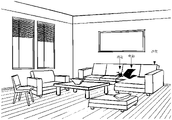
- FIG. 4 is a schematic diagram of an indoor scene provided by an embodiment of the present invention.
- 5A is a schematic diagram of a representation form of positioning execution information provided by an embodiment of the present invention.
- FIG. 5B is a schematic representation of a positioning result according to an embodiment of the present invention.
- FIG. 6 is a schematic diagram 1 of a positioning method according to an embodiment of the present invention.
- FIG. 7 is a schematic diagram of a positioning scenario of a single antenna according to an embodiment of the present invention.
- FIG. 8 is a schematic diagram of a dual-antenna positioning scenario according to an embodiment of the present invention.
- FIG. 9 is a schematic diagram of a three-antenna positioning scenario according to an embodiment of the present invention.
- FIG. 10 is a schematic diagram of a positioning scenario of a hybrid antenna according to an embodiment of the present invention.
- FIG. 11 is a schematic diagram of a multi-card reader scenario provided by an embodiment of the present invention.
- FIG. 12 is a second schematic diagram of a positioning method according to an embodiment of the present invention.
- FIG. 13 is a schematic diagram 3 of a positioning method according to an embodiment of the present invention.
- FIG. 14 is a schematic structural diagram 1 of a positioning device
- FIG. 15 is a second structural schematic diagram of a positioning device.
- words such as “exemplary” or “for example” are used to mean serving as an example, illustration or illustration. Any embodiments or designs described as “exemplary” or “such as” in the embodiments of the present invention should not be construed as preferred or advantageous over other embodiments or designs. Rather, the use of words such as “exemplary” or “such as” is intended to present the related concepts in a specific manner.
- Radio Frequency (RF) positioning technology is widely used in daily life.
- the global navigation satellite system (GNSS) is a technology specially used for positioning through communication with satellites.
- a GNSS system such as the global positioning system (GPS)
- GPS global positioning system
- some wireless technologies specially used for communication can also realize simple positioning functions, such as Bluetooth, WIFI, and cellular network.
- the principle is to determine the relative position of the device to be positioned and the base station, and the physical coordinates (x, y, z) of the positioned object can be calculated when the position of the base station is known.
- Received signal strength indicator also known as received signal strength indicator
- RSSI can roughly determine the distance between the transmitting source and the receiving device; the signal strength is inversely proportional to the distance, which can be called backscattering technology;
- AOA Angle of arrival
- Time of flight the distance between the transmitting source and the receiving device can be calculated by calculating the electromagnetic wave transmission time.
- the purpose is to calculate the exact coordinates (x, y, z) of the device to be positioned, and then combine the known coordinates with the physical position comparison (such as map) to realize the positioning of the physical location of the object.
- the physical position comparison Such as map
- the coordinate information has no practical meaning to the user.
- Finding items in an indoor environment is a common problem that people encounter.
- the technical means of related positioning technologies cannot effectively assist users to find items indoors. For example, if you often forget where to put your "remote control" or “mobile phone” in your life, there is often no clue in the search process.
- Embodiments of the present invention provide a positioning method, device, and system, which can use backscattering technology to locate indoor objects. Since the cost of positioning by using backscattering technology is far lower than that of existing positioning technologies such as WIFI, Bluetooth, and UWB, Therefore, when applied to finding items in an indoor environment, this solution satisfies the user's needs for finding items to the greatest extent. Backscattering technology can realize positioning function through algorithm and hardware design.
- a backscattering label (referred to as an electronic label in the embodiment of the present invention) can be set for indoor articles (including the articles to be positioned and reference articles).
- indoor articles including the articles to be positioned and reference articles.
- wallets, keys, remote controls and mobile phones can be common objects that need to be located; tables, sofas, beds, vases, lamps and other infrequently moving objects can be reference objects.
- the electronic label of the item to be positioned is exactly the same as that of the reference item.
- the positioning method provided by the embodiment of the present invention is applied to a positioning system including at least a positioning device and an electronic label.
- the number of positioning devices in the positioning system may be one or more, and the number of electronic labels may also be one or more.
- the positioning device may be the card reader mentioned below.
- the electronic label can be attached to the surface of the object to be positioned by sticking.
- the electronic tag can be embedded inside the item.
- the electronic tag can be integrated into the electronic system of the item.
- the tag chip can be integrated into the circuit board of the item and share the original antenna of the circuit board of the item.
- the electronic tag may include a backscattering module, that is, the electronic tag is an electronic tag (such as a passive RFID tag) that uses backscattering to realize communication.
- the electronic tag is an electronic tag (such as a passive RFID tag) that uses backscattering to realize communication.
- FIG. 1 is a schematic structural diagram of an electronic tag.
- the electronic tag consists of two parts, namely the chip 11 and the antenna 12 in FIG. 1 .
- the electronic tag itself does not carry a battery or power supply, and the chip of the electronic tag can run on the radio frequency energy collected by the antenna.
- the chip of the electronic label is provided with an electronic product code (EPC), the EPC is composed of n-bit bit characters, and an EPC can independently identify an electronic label.
- EPC electronic product code
- the electronic tag in addition to using EPC to identify the electronic tag, the electronic tag may also be identified by other identifiers that can have a unique identification function, which is not specifically limited in the embodiment of the present invention.
- the positioning device may be a card reader.
- Figure 2 shows a schematic diagram of the structure of a card reader, which includes a radio frequency front-end, a backscatter modem, a microprocessor, a wireless network management (such as WIFI), and a power supply (which may also include a power management chip), etc.
- the card reader may include one or more radio frequency ports, and these radio frequency ports may be connected with antennas.
- the radio frequency front end is used to receive and transmit signals
- the backscatter modem is used to modulate and demodulate the received signal, obtain the RSSI of the electronic tag, and provide it to the microprocessor, which is used to obtain the RSSI according to the The RSSI of the electronic tag, combined with the positioning algorithm of this scheme, determines the positioning information.
- the wireless gateway is used to provide WIFI access, or other network access.
- the card reader can receive the received signal of the electronic tag through the antenna, and use the positioning algorithm to determine the reference object near the positioning object through the microprocessor according to the received RSSI, so as to realize the positioning function.
- the card reader can obtain the RSSIs of multiple electronic tags within its coverage. If the RSSI obtained includes the RSSI of the first electronic tag of the first item, it can The RSSI of the tag is compared with the RSSI of the first electronic tag, and one or more electronic tags (that is, the third electronic tag) whose distance from the first electronic tag is within the preset distance range is determined from these other electronic tags. ) to locate the first item through the one or more electronic tags.
- the items corresponding to the one or more electronic tags can be determined, and the first item can be located through these items.
- the card reader may include one receiving antenna, or may include multiple receiving antennas.
- the antenna of the card reader may adopt various modes. Such as dipole antenna (dipole antenna), patch antenna (patch antenna), Yagi antenna (yagi-Uda antenna), monopole antenna (monopole antenna), transmission line antenna (microstrip antenna), inverted F antenna (pifa antenna) Wait.
- dipole antenna dipole antenna
- patch antenna patch antenna
- Yagi antenna yagi-Uda antenna
- monopole antenna monopole antenna
- transmission line antenna microwavestrip antenna
- inverted F antenna pifa antenna
- the antenna of the card reader may flexibly select antennas of different modes.
- the card reader is provided with four radio frequency interfaces, and the four radio frequency interfaces can be connected to four identical patch antennas. It is also possible to connect two RF ports to connect the patch antenna, and the other two ports to connect the monopole antenna.
- antennas of different modes can also be used between the card readers, that is, in the same positioning system, the antenna types set by different card readers can be the same or different. .
- the positioning system provided in this embodiment of the present invention may further include a narrow system and a broad system.
- the system in the narrow sense may include a plurality of electronic tags (two electronic tags are shown in FIG. 1 , there may be more in practice), a card reader and a cloud server.
- the generalized system may include other intelligent terminals or intelligent terminal API interfaces in addition to the above-mentioned narrow-sense system, so as to realize the communication between the devices in the narrow-sense system and these other intelligent terminals.
- the number of electronic tags may be multiple, the number of card readers may be one or more, and the number of intelligent terminals may also be one or more.
- the number of electronic tags and the number of card readers are not specifically limited.
- the above-mentioned smart terminal may be a smart phone, a tablet computer, a learning machine, a smart home appliance (such as a smart speaker), a wearable device, a robot or other electronic devices.
- the intelligent terminal may have a voice function, a function of surfing the Internet, and the like.
- the user can initiate an instruction (which may be a voice instruction) to find the key to the intelligent terminal in FIG. 3 through voice input.
- an instruction which may be a voice instruction
- the user can Say "Where is my key”
- the smart terminal sends the voice command to the cloud server, and the cloud server can perform voice semantic analysis on the voice command, extract the key information "find” and "key”, and then generate and locate the key information Command information for the key.
- the cloud server can send the instruction information to the card reader, and the card reader can store the corresponding table of item name and electronic label EPC (as shown in Table 1 below), and the card reader can obtain the information within the coverage of the card reader.
- the RSSI of all electronic tags is collected in the microprocessor of the card reader, and the microprocessor can determine the distance to the first electronic tag of the key according to the collected RSSI of the electronic tags
- One or more second electronic tags that are less than the preset distance, and the EPC of the one or more second electronic tags can be fed back to the cloud server, and the cloud server can determine the corresponding relationship between the item name and the EPC. item name, and feed back the determined item name near the key to the smart terminal 1, and the smart terminal 1 can generate positioning information according to these item names, and output the positioning information to the user.
- the voice "the key is next to the sofa and the computer” can be output.
- the positioning information in the form of positioning information can be provided to the user, so that effective positioning information can be provided for the user by providing a reference.
- the information fed back by the card reader can be uploaded to the cloud server for voice semantic analysis, and the server processes the information into human-comprehensible language information before feeding it back to the smart terminal.
- the smart terminal can play the positioning information to the user through the speaker.
- the RSSI of the electronic tag is inversely proportional to the distance, that is, the RSSI is weaker with longer distance.
- the distance is the distance between the electronic tag antenna and the card reader antenna.
- the above-mentioned instruction information may be as shown in FIG. 5A, and Query is used to indicate that the instruction information is used for inquiry.
- the "cmd" variable is "find” which means to search
- the "item_name” variable is the item to be found.
- the command information shown in FIG. 5A is for finding a key.
- Table 1 there is a correspondence table between the item name and the electronic label EPC, and the table can be established when the user uses the label for the first time, or at any time before positioning the item.
- the cloud server may also store a correspondence table between the item name and the electronic label EPC, and the generated instruction information may include the EPC corresponding to the item key and the key information of "find".
- the positioning result can be in the form shown in Figure 5B, where Response identifies the result as a reply to the above-mentioned Figure 5A, the variable "EPC” is the label EPC, the variable “mob-item” is the item to be located, " ref-item” is the reference item; the parameters "mob-item” and “ref-item” are the item names corresponding to the EPC in Fig. 5B.
- the variable “dist” has no actual physical meaning and is only a blank for extended functions.
- the positioning method provided by the embodiment of the present invention does not need to know the actual physical location of the item, but only needs to provide the name or identifier of the reference item near the item to be positioned.
- the functions of the smart terminal and the cloud server in the above FIG. 3 may be integrated into one device.
- the intelligent terminal in FIG. 3 may also integrate the speech semantic analysis function of the cloud server.
- the functions of the smart terminal, the cloud server and the card reader in the foregoing FIG. 3 may also be integrated into one device.
- the card reader in FIG. 3 may also integrate the functions of an intelligent terminal and a cloud server.
- the first possibility is that the positioning system includes a card reader.
- the second possible situation is that the positioning system includes multiple card readers.
- the following describes the positioning method provided by the embodiment of the present invention by way of example in combination with the above two possible situations.
- a positioning method including:
- the positioning indication is used to indicate the positioning of the first article, and the first article is provided with a first electronic label.
- the card reader receiving the location indication can include the following:
- the card reader may receive voice information instructing the user to find the first item. For example, "Where is the key?".
- the card reader receives the positioning indication sent by other devices.
- the terminal sends the voice command to the cloud server shown in FIG. 3 for voice semantic analysis, generates a positioning instruction, and sends the positioning instruction to the card reader.
- the above-mentioned user input may include input in at least one of the following forms:
- Voice form text form and action form (which may include gestures or body movements, etc.), etc.
- the card reader can start to search for the electronic tag after receiving the positioning instruction, and the electronic tag within the coverage of the card reader antenna will send a signal to the card reader, and the card reader can obtain the RSSI of the electronic tag.
- the card reader can turn on and off different antennas in chronological order to avoid interference between the antennas, so that the card reader can learn the electronic tags read by each antenna. And the RSSI of the electronic label.
- the plurality of second electronic tags may be all electronic tags within the coverage area of the card reader, or may be part of the electronic tags within the coverage area of the card reader.
- the electronic label may be indicated by an identification of the electronic label, where the identification of the electronic label may be EPC.
- acquiring RSSIs of multiple second electronic tags may be acquiring RSSIs of multiple EPCs.
- the RSSI of the seven second electronic tags can be obtained as shown in Table 2 below:
- first electronic tag is included in the plurality of second electronic tags, execute the following 604 and 605; if the first electronic tag is not included in the plurality of second electronic tags, return to execution 602.
- the RSSI of the at least one fourth electronic tag may be compared with the RSSI of the first electronic tag, and at least one third electronic tag may be determined from the at least one fourth electronic tag;
- the at least one fourth electronic tag is an electronic tag other than the first electronic tag among the plurality of second electronic tags.
- the EPC of the first electronic tag can be AA01 (which can be obtained in conjunction with Table 1)
- the card reader obtains the RSSIs of the seven second electronic tags shown in Table 2, it can know which The RSSI with the first electronic tag is included.
- the RSSIs of AA02 to AA07 with AA01 respectively, it can be seen that the RSSIs of AA06 and AA07 are relatively close to AA01, and the electronic tags indicated by AA06 and AA07 are the third electronic tags mentioned above.
- the card reader includes one or more receiving antennas.
- the above-mentioned 604 may be different according to the different receiving antennas of the RSSIs of the plurality of second electronic tags, which will be introduced separately below.
- At least one first distance parameter according to the RSSI of the at least one fourth electronic tag and the RSSI of the first electronic tag, where the at least one first distance parameter is used to indicate the distance between the at least one fourth electronic tag and the first tag;
- comparing the RSSI of the at least one fourth electronic tag with the RSSI of the first electronic tag, and determining the at least one third electronic tag from the at least one fourth electronic tag includes:
- the RSSIs of the above-mentioned multiple second electronic tags are set by the same receiving antenna, which means that the RSSIs of the multiple second electronic tags are set by the card reader.
- the one receiving antenna receives.
- the RSSIs of the above-mentioned multiple second electronic tags are set by the same receiving antenna, which means that the RSSIs of the multiple second electronic tags are set by the card reader. At least two of the plurality of antennas receive.
- some card readers may include only one receiving antenna, and the receiving antenna may be an omnidirectional antenna (such as a dipole antenna, a monopole antenna) or a directional antenna (such as a patch antenna).
- the receiving antenna may be an omnidirectional antenna (such as a dipole antenna, a monopole antenna) or a directional antenna (such as a patch antenna).
- the antenna is an omnidirectional receiving antenna.
- the RSSI of reference item 2 is relatively weak because it is far away from the receiving antenna of the card reader. By comparing the RSSI of the item to be positioned and other reference items, the card reader can determine that the reference item 1 is near the item to be positioned.
- the card reader does not need to determine the actual distance between the item and the receiving antenna of the card reader, but only needs to determine whether an item is near the item to be positioned (ie, the RSSI value is the same or similar).
- the second case including multiple receiving antennas, the RSSIs of the multiple second electronic tags are received by multiple first receiving antennas, and the RSSI of the at least one fourth electronic tag is combined with the first electronic tag.
- the RSSI comparison, the at least one third electronic tag is determined from the at least one fourth electronic tag, including:
- the RSSI received by at least one second receiving antenna includes the RSSI of the first electronic tag, and the at least one second receiving antenna is an antenna in the plurality of first receiving antennas;
- the at least one third electronic tag is determined according to the at least one second distance parameter.
- comparing the RSSI of the at least one fourth electronic tag with the RSSI of the first electronic tag, and determining at least one third electronic tag from the at least one fourth electronic tag including:
- the RSSI received by the at least one second antenna includes the RSSI of the first electronic tag, and the at least one second receiving antenna is an antenna among the plurality of first antennas;
- At least one third electronic tag is determined according to the G second difference values, where G is greater than or equal to 2.
- not every receiving antenna in the card reader antenna may receive the RSSI of the electronic tag.
- the receiving antennas of the card reader antenna that receive the RSSI of the electronic tag not the RSSI of the electronic tag received by each receiving antenna includes the RSSI of the first electronic tag.
- the RSSI received by 2 of the 4 receiving antennas in the card reader antenna (it is assumed to be Antenna 1 and Antenna 2) includes the RSSI of the first electronic tag
- the RSSI received by Antenna 1 can be calculated.
- the second difference between the RSSI of the electronic tag and the RSSI of the first electronic tag is calculated, and the second difference between the RSSI of the electronic tag received by the antenna 2 and the RSSI of the first electronic tag is calculated, and according to all the obtained differences, determine
- a third electronic tag ie, an electronic tag whose distance from the card reader is within a preset distance range
- Determining the at least one third electronic tag according to the at least one second distance parameter includes: one second distance parameter for H different fourth electronic tags exists in the at least one second distance parameter, and The I second distance parameters correspond to the J second receiving antennas, and the I is the product of H and J;
- the first target difference is the second distance parameter corresponding to the other third distance parameters except the smallest first n third distance parameters among the H third distance parameters, and n is greater than or equal to 1, and less than H.
- a first optional implementation manner determining at least one third electronic tag according to the G second difference values, including:
- the first target difference value is the second difference value corresponding to the square sums other than the smallest first n square sums among the H square sums, and n is greater than or equal to 1 and less than H;
- the first target difference is the second difference corresponding to other square sums except the smallest first n square sums among the H square sums, and n is greater than or equal to 1 and less than H.
- the above-mentioned second difference is 4 differences between the RSSIs of 2 different electronic tags and the first electronic tag, and these 4 differences are obtained by 2 receiving antennas, Then for the electronic tag A, you can find the sum of the squares of 5 and 9 to get 106, and for the electronic tag B, you can find the sum of the squares of -6 and 8 to get 100, 106 and 100 are the target values, and 100 is less than 106, then you can put Differences 5 and 9 corresponding to 106 are discarded.
- the second optional implementation manner determining at least one third third electronic tag according to the G second difference values, including:
- the second target difference is the second difference corresponding to other target values except the smallest first m target values among the H target values;
- the first target difference is the second difference corresponding to other square sums except the smallest first n square sums among the H square sums, and n is greater than or equal to 1 and less than H.
- the second optional implementation manner is similar to the above-mentioned first optional implementation manner, and no exemplary explanation is given here.
- the following is an exemplary description for the case of two or more than two receiving antennas respectively.
- both items will be defined as "nearby".
- the RSSI of the reference object 1 is close to the RSSI of the object to be located, while the RSSI of the reference object 2 is relatively weak. or the second optional implementation determines that the reference item 1 is in the vicinity of the item to be positioned.
- the multi-antenna positioning method can be used to further improve the accuracy of the positioning range.
- the actual position of the item to be located and the reference item will change, and the proposal system needs to take into account the change in the position of the item.
- FIG. 9 using three omnidirectional antennas, it can still be determined through the above first possible implementation manner or the second optional implementation manner that in case 1, in case 2, only the reference item 1 is The range of items to be located.
- the mode using single antenna or dual antenna will produce obvious error in some cases, the error can be tolerated according to the actual situation. If only the object needs to be located in a certain room (here the room is a reference), the embodiment of the present invention does not emphasize the specific card reader antenna and the number of antennas, but emphasizes the importance of the relative position.
- the number of antennas can be freely selected, and the types of antennas can be matched to cope with different scenarios and meet different positioning accuracy requirements.
- Two polarized antennas are used as shown in Figure 10, as well as an omnidirectional antenna.
- the omnidirectional antenna has a wide coverage area and can effectively read more electronic tags within the coverage area, and the polarized antenna can assist in judging the orientation of the item.
- At least one second item information corresponding to at least one third electronic tag may be determined, and the first item is located according to the at least one second item information.
- locating the first item according to the at least one second item information includes: determining the positioning information of the first item according to the at least one second item information, where the positioning information is used to indicate that the first item is located in the at least one second item information in the vicinity of the indicated at least one second item.
- locating the first item according to the at least one second item information includes: determining and outputting the positioning information of the first item according to the at least one second item information.
- the user when the positioning information is output, the user may interact with the user in a voice manner in combination with the voice semantic API in the smart terminal.
- word order logic can be intelligently recognized by analyzing speech semantics. If you need to locate the item "key”, the feedback reference is "bedroom”, “bed”, “purse”, “remote control”. Then the word order algorithm can judge the master-slave relationship of the reference noun, and output it according to the master-slave relationship.
- “bedroom” may be the highest level
- “bed” may be the second level
- “wallet” and “remote control” may be the second level. Therefore, the generated sentence can be "the key is near the [bedroom] and the [bed], and there are also [wallet] and [remote control] nearby”.
- a positioning instruction can be received, and the positioning instruction is used to indicate the positioning of a first item, and the first item is provided with a first electronic label; the RSSI of the received signal strength of a plurality of second electronic tags is obtained, and the plurality of second electronic tags The first electronic tag is included; at least one third electronic tag is determined according to the RSSI of the plurality of second electronic tags; the first item is located by the at least one third electronic tag.
- the RSSI of the electronic tag within its coverage can be obtained by the positioning device, and the obtained RSSI and the RSSI of the first item to be located can be used to determine that the distance to the first item is within the preset distance range At least one target electronic tag inside, so that the first item can be located according to the at least one target electronic tag or at least one second item corresponding to it as a reference, so that the user can output an effective output by providing a reference item. location information.
- the cost of the electronic label using the backscattering technology is lower, the economic burden of the consumer is reduced, and the feasibility of the positioning method is improved.
- Indoor positioning can be effectively carried out by attaching a large number of electronic tags.
- the concept of relative position positioning is proposed, that is, it is not necessary to obtain the exact position of the item to be positioned, but only the nearby reference objects need to be provided. Real scenarios in real life. Improves user experience while reducing hardware costs.
- FIG. 11 it is a schematic diagram of the structure of a positioning system with multiple card readers, including a master card reader 1101 , and three slave card readers 1102 , slave card readers 1103 and slave readers.
- each slave card reader can obtain the RSSI of the electronic tags within its own coverage, and after determining the third electronic tag, report it to the main card reader.
- an embodiment of the present invention further provides a positioning method, which is applied to a slave card reader.
- a positioning method which is applied to a slave card reader.
- it can be applied to the slave card reader 1102 , the slave card reader 1103 and the slave card reader as shown in FIG. 11 .
- the positioning indication is used to indicate the positioning of the first article, and the first article is provided with a first electronic label.
- A is greater than or equal to 2.
- first electronic tag is included in the plurality of second electronic tags, execute the following 1204 to 1206; if the first electronic tag is not included in the plurality of second electronic tags, return to execution 1202.
- the at least one fourth electronic tag is an electronic tag other than the first electronic tag among the plurality of second electronic tags.
- the main card reader can determine the name of the corresponding second item according to the received identifiers of the third electronic tags, and Based on the names of these second items, positioning information is output.
- the main card reader 1101 shown in FIG. 11 receives the identity of the electronic label A and the identity of the electronic label B sent from the card reader 1102, the identity of the electronic label B sent from the card reader 1103,
- the card reader 1104 sends the identification of the electronic label A and the identification of the electronic label C to you, then the main card reader 1101 can determine the corresponding item according to the identification of the electronic label A, the identification of the electronic label B and the identification of the electronic label C A, item B, and item C, then it can be determined that the first item is near item A, item B, and item C, and positioning information such as "the first item is near item A, item B, and item C" can be output.
- the identification of at least one third electronic tag is sent from the card reader to the main card reader, so that the main card reader determines r pieces of second item information corresponding to the identification of the at least one electronic tag according to the identification of the at least one electronic tag, And according to r pieces of second item information, locate the first item.
- the second item information may be the identifier of the second item or the name of the second item.
- the slave card reader may not receive the above positioning indication, that is, the above 1201 is not executed, and the RSSI of the electronic tag within the coverage area of the spontaneous receiver is reported to the master card reader device.
- the main card reader device determines the third electronic tag according to the positioning algorithm provided by the embodiment of the present invention, so as to locate the first item according to the determined third electronic tag.
- a positioning method applicable to each slave card reading device is provided. Through the positioning of each card reading device, in a scene with a large indoor area, Realize effective positioning when finding items.
- an embodiment of the present invention further provides a positioning method, which is applied to a main card reader, which can be exemplarily applied to the main card reader 1101 in FIG. 11 .
- the positioning indication is used to indicate the positioning of the first article, and the first article is provided with a first electronic label.
- the RSSIs of the plurality of second electronic tags are received from at least one slave device.
- the RSSI of a plurality of second electronic tags includes: the RSSI of at least one second electronic tag received from at least one slave device, and the RSSI of at least one second electronic tag acquired by the master device. RSSI.
- 1302 can be replaced with 1302a.
- first electronic tag is included in the plurality of second electronic tags, execute the following 1204 to 1206; if the first electronic tag is not included in the plurality of second electronic tags, return to execution 1202.
- all the RSSI information of the electronic tags obtained from the card reader can be aggregated to the main card reader, and the aggregated tag information as shown in Table 4 can be obtained in the main card reader.
- a positioning method applicable to the main card reader by receiving and summarizing the RSSI of each electronic tag obtained from the card reader, Positioning can achieve effective positioning when searching for items in large indoor scenes.
- an embodiment of the present invention provides a positioning device, including:
- the receiving module 1401 is used to receive a positioning instruction, and the positioning instruction is used to indicate the positioning of a first item, and the first item is provided with a first electronic tag; obtain RSSI of a plurality of second electronic tags, and the plurality of second electronic tags include the first electronic tag.
- Electronic tags ;
- the processing module 1402 is configured to determine at least one third electronic tag according to the RSSIs of the plurality of second electronic tags; and locate the first item by using the at least one third electronic tag.
- the processing module 1402 is specifically configured to compare the RSSI of the at least one fourth electronic tag with the RSSI of the first electronic tag, and determine at least one third electronic tag from the at least one fourth electronic tag;
- the at least one fourth electronic tag is an electronic tag other than the first electronic tag among the plurality of second electronic tags.
- one or more receive antennas are included.
- the RSSIs of multiple second electronic tags are received by the same receiving antenna, and the processing module 1402 is specifically configured to obtain at least one first distance parameter according to the RSSI of at least one fourth electronic tag and the RSSI of the first electronic tag , at least one first distance parameter is used to indicate the distance between at least one fourth electronic tag and the first tag;
- it includes multiple receiving antennas, and the RSSIs of multiple second electronic tags are received by multiple first receiving antennas,
- the processing module 1402 is specifically configured to include the RSSI of the first electronic tag in the RSSI received by at least one second receiving antenna, and the at least one second receiving antenna is an antenna among multiple first receiving antennas;
- At least one third electronic tag is determined according to the at least one second distance parameter.
- the processing module 1402 is specifically used for at least one second distance parameter to have 1 second distance parameter for H different fourth electronic tags, and 1 second distance parameter corresponds to J second distance parameters.
- Antenna, I is the product of H and J;
- the first target difference is the second distance parameter corresponding to the other third distance parameters except the smallest first n third distance parameters among the H third distance parameters, and n is greater than or equal to 1 and less than H.
- the processing module 1402 is specifically configured to determine at least one second item information corresponding to the at least one third electronic tag, and locate the first item according to the at least one second item information.
- the processing module 1402 is specifically configured to determine the positioning information of the first item according to at least one second item information, where the positioning information is used to indicate that the first item is located at at least one second item indicated by the at least one second item information nearby.
- the positioning device further includes:
- the sending module 1403 is configured to send at least one second item information corresponding to the at least one third electronic tag to the master device, so that the master device locates the first item according to the at least one second item information.
- applied to slave devices also includes:
- the sending module 1403 is configured to send the identification of the at least one third electronic tag to the master device, so that the master device determines at least one second item corresponding to the identification of the at least one third electronic tag according to the identification of the at least one third electronic tag information, and locate the first item based on at least one second item information.
- the second item information includes: a name of the second item, and/or an identifier of the second item.
- the identifier of the third electronic label includes: an item electronic code EPC.
- the RSSIs of the multiple second electronic tags are received from multiple slave devices.
- the RSSI of the plurality of second electronic tags includes: the RSSI of at least one second electronic tag received from at least one slave device, and the RSSI of at least one second electronic tag acquired by the master device.
- the electronic tag includes a backscattering module.
- An embodiment of the present invention further provides a positioning device, including: a memory storing executable program codes;
- a processor coupled to the memory
- the processor invokes the executable program code stored in the memory to execute the positioning method executed by the card reader in the embodiment of the present invention.
- the positioning device may be a card reader as shown in FIG. 2 above, wherein the radio frequency front end of the card reader is used to receive a positioning indication, and the positioning indication is used to indicate the positioning of the first item, and the first The article is provided with a first electronic tag; the RSSI of a plurality of second electronic tags is obtained, and the plurality of second electronic tags includes the first electronic tag;
- the microprocessor of the card reader is used to determine at least one third electronic tag according to the RSSIs of the plurality of second electronic tags; and locate the first item through the at least one third electronic tag.
- the microprocessor is specifically configured to compare the RSSI of the at least one fourth electronic tag with the RSSI of the first electronic tag, and determine at least one third electronic tag from the at least one fourth electronic tag;
- the at least one fourth electronic tag is an electronic tag other than the first electronic tag among the plurality of second electronic tags.
- the card reader includes one or more receiving antennas.
- the RSSIs of multiple second electronic tags are received by the same receiving antenna, and the microprocessor is specifically used for
- At least one first distance parameter is used to indicate the distance between the at least one fourth electronic tag and the first tag.
- it includes multiple receiving antennas, and the RSSIs of multiple second electronic tags are received by multiple first receiving antennas,
- the microprocessor is specifically configured to include the RSSI of the first electronic tag in the RSSI received by at least one second receiving antenna, and the at least one second receiving antenna is an antenna among the plurality of first receiving antennas;
- At least one third electronic tag is determined according to the at least one second distance parameter.
- the microprocessor specifically for the at least one second distance parameter, there is one second distance parameter for H different fourth electronic tags, and one second distance parameter corresponds to J second receiving Antenna, I is the product of H and J;
- the first target difference is the second distance parameter corresponding to the other third distance parameters except the smallest first n third distance parameters among the H third distance parameters, and n is greater than or equal to 1 and less than H.
- the microprocessor is specifically configured to determine at least one second item information corresponding to the at least one third electronic tag, and locate the first item according to the at least one second item information.
- the microprocessor is specifically configured to determine the positioning information of the first item according to at least one second item information, and the positioning information is used to indicate that the first item is located at at least one second item indicated by the at least one second item information. nearby.
- the slave card reader applies to the slave device, that is, the slave card reader, and also includes:
- the radio frequency front end is configured to send at least one second item information corresponding to the at least one third electronic tag to the master device, so that the master device locates the first item according to the at least one second item information.
- the slave card reader applies to the slave device, that is, the slave card reader, and also includes:
- the radio frequency front end is used to send the identification of the at least one third electronic tag to the master device, so that the master device determines at least one second item information corresponding to the identification of the at least one third electronic tag according to the identification of the at least one third electronic tag , and locate the first item according to at least one second item information.
- the second item information includes: a name of the second item, and/or an identifier of the second item.
- the identifier of the third electronic label includes: an item electronic code EPC.
- the RSSIs of the multiple second electronic tags are received from multiple slave devices.
- the RSSI of the plurality of second electronic tags includes: the RSSI of at least one second electronic tag received from at least one slave device, and the RSSI of at least one second electronic tag acquired by the master device.
- the electronic tag includes a backscattering module.
- An embodiment of the present invention provides a terminal device, including: a positioning device (such as a card reader) in the embodiment of the present invention.
- An embodiment of the present invention provides a positioning system, including: a plurality of electronic tags, and a positioning device (such as a card reader) in the embodiment of the present invention.
- An embodiment of the present invention provides a positioning system, including: a plurality of electronic tags, a positioning device in the embodiment of the present invention, an intelligent terminal, and a cloud server.
- Embodiments of the present invention further provide a computer-readable storage medium, including: computer instructions, which, when executed on a computer, cause the computer to execute various processes performed by the card reader in the foregoing method embodiments.
- Embodiments of the present invention further provide a computer program product, including computer instructions.
- the computer program product runs on a computer
- the computer executes the computer instructions, so that the computer executes various processes of the card reader in the above method embodiments.
- Embodiments of the present invention further provide a computer program product, including computer instructions.
- the computer program product runs on a computer
- the computer executes the computer instructions, so that the computer executes various processes of the network device in the above method embodiments.
- Embodiments of the present invention further provide a chip, where the chip is coupled to a memory in a terminal device, so that the chip invokes program instructions stored in the memory when running, so that the terminal device performs various processes of the terminal device in the above method embodiments.
- Embodiments of the present invention further provide a chip, where the chip is coupled to a memory in a network device, so that the chip invokes program instructions stored in the memory when running, so that the network device executes various processes of the network device in the foregoing method embodiments.
- a computer program product includes one or more computer instructions.
- the computer may be a general purpose computer, a special purpose computer, a computer network, or other programmable device.
- Computer instructions may be stored on or transmitted from one computer-readable storage medium to another computer-readable storage medium, for example, the computer instructions may be transmitted from a website site, computer, server, or data center over a wire (e.g.
- the computer-readable storage medium can be any available medium that can be stored by a computer or a data storage device such as a server, a data center, etc. that includes one or more available media integrated.
- Useful media may be magnetic media (eg, floppy disks, hard disks, magnetic tapes), optical media (eg, DVD), or semiconductor media (eg, Solid State Disk (SSD)), among others.
Landscapes
- Engineering & Computer Science (AREA)
- Physics & Mathematics (AREA)
- General Physics & Mathematics (AREA)
- Computer Networks & Wireless Communication (AREA)
- Signal Processing (AREA)
- Radar, Positioning & Navigation (AREA)
- Remote Sensing (AREA)
- Quality & Reliability (AREA)
- Electromagnetism (AREA)
- General Engineering & Computer Science (AREA)
- Theoretical Computer Science (AREA)
- Radar Systems Or Details Thereof (AREA)
- Position Fixing By Use Of Radio Waves (AREA)
Abstract
本发明实施例提供一种定位方法、终端设备及网络设备,应用于通信技术领域,本发明实施例包括:接收定位指示,定位指示用于指示定位第一物品,第一物品设有第一电子标签;获取多个第二电子标签的接收信号强度RSSI,多个第二电子标签中包括第一电子标签;根据多个第二电子标签的RSSI,确定至少一个第三电子标签;通过至少一个第三电子标签,定位第一物品。
Description
本发明涉及通信技术领域,尤其涉及一种定位方法、定位设备及定位系统。
目前,现有定位技术旨在计算被定位物品的准确坐标,例如:被定位物品的坐标(x,y,z)信息,然后再结合已知坐标与物理位置的对照(如地图)实现物体物理位置的定位。在室内居家环境中定位物品时,坐标(x,y,z)信息无法被用户直接理解,从而用户难以利用现有的定位技术的在室内场景定位出物品位置。
发明内容
本发明实施例提供了一种定位方法、定位设备及定位系统,可以通过与第一物品之间处于预设距离范围内的目标电子标签,定位第一物品,从而通过该方案可以在室内场景定位出物品位置。
第一方面,提供一种定位方法,包括:
接收定位指示,定位指示用于指示定位第一物品,第一物品设有第一电子标签;
获取多个第二电子标签的RSSI,多个第二电子标签中包括第一电子标签;
根据多个第二电子标签的RSSI,确定至少一个第三电子标签;
通过至少一个第三电子标签,定位第一物品。
第二方面,提供一种定位设备,包括:
接收模块,用于接收定位指示,所述定位指示用于指示定位第一物品,所述第一物品设有第一电子标签;获取多个第二电子标签的RSSI,所述多个第二电子标签中包括所述第一电子标签;
处理模块,用于根据所述多个第二电子标签的RSSI,确定至少一个第三电子标签;通过所述至少一个第三电子标签,定位所述第一物品。
第三方面,提供一种定位设备,包括:
接收器,用于接收定位指示,所述定位指示用于指示定位第一物品,所述第一物品设有第一电子标签;获取多个第二电子标签的RSSI,所述多个第二电子标签中包括所述第一电子标签;
处理器,用于根据所述多个第二电子标签的RSSI,确定至少一个第三电子标签;
通过所述至少一个第三电子标签,定位所述第一物品。
第四方面,提供一种定位系统,包括:
多个电子标签,以及如第二方面所述的定位设备;
或者,
多个电子标签,以及如第三方面所述的定位设备。
第五方面,提供一种终端设备,包括:多个电子标签、如第二方面或第三方面所述的定位设备、智能终端和云端服务器。
第六方面,提供一种计算机可读存储介质,包括:计算机指令,当其在计算机上运行时,使得计算机执行如上述第一方面或第一方面的任一种可选的实现方式的方法。
第七方面,提供一种计算机程序产品,包括,计算机指令,当计算机程序产品在计算机上运行时,计算机运行计算机指令,使得计算机执行如上述第一方面或第一方面的任一种可选的实现方式的方法。
第八方面,提供一种芯片,芯片与终端设备中的存储器耦合,使得芯片在运行时调用存储器中存储的程序指令,使得终端设备执行如上述第一方面或第一方面的任一种可选的实现方式的方法。
本发明实施例中,可以接收定位指示,定位指示用于指示定位第一物品,第一物品设有第一电子标签;获取多个第二电子标签的接收信号强度RSSI,多个第二电子标签中包括第一电子标签;根据多个第二电子标签的RSSI,确定至少一个第三电子标签;通过至少一个第三电子标签,定位第一物品。通过该方案,可以通过定位设备获取其覆盖范围内的电子标签的RSSI,并通过获取的RSSI与要定位的第一物品的RSSI,来确定出与第一物品之间的距离处于预设距离范围内至少一个目标电子标签,这样就可以根据这至少一个目标电子标签或其所对应的至少一个第二物品作为参考,来定位第一物品,从而可以通过提供参考物品的方式,为用户输出有效的定位信息。
图1为本发明实施例提供的一种电子标签的结构示意图;
图2为本发明实施例提供的一种读卡器的结构示意图;
图3为本发明实施例提供的一种定位系统的架构示意图;
图4为本发明实施例提供的一种室内场景示意图;
图5A为本发明实施例提供的一种定位执行信息的表示形式示意图;
图5B为本发明实施例提供的一种定位结果的表示形式示意图;
图6为本发明实施例提供的一种定位方法示意图一;
图7为本发明实施例提供的一种单天线的定位场景示意图;
图8为本发明实施例提供的一种双天线的定位场景示意图;
图9为本发明实施例提供的一种三天线的定位场景示意图;
图10为本发明实施例提供的一种混合天线的定位场景示意图;
图11为本发明实施例提供的一种多读卡器场景示意图;
图12为本发明实施例提供的一种定位方法示意图二;
图13为本发明实施例提供的一种定位方法示意图三;
图14为一种定位设备的结构示意图一;
图15为一种定位设备的结构示意图二。
下面将结合本发明实施例中的附图,对本发明实施例中的技术方案进行描述,显然,所描述的实施例仅仅是本发明一部分实施例,而不是全部的实施例。基于本发明中的实施例,本领域技术人员在没有作出创造性劳动前提下所获得的所有其他实施例,都属于本发明保护的范围。
在本发明实施例中,“示例性的”或者“例如”等词用于表示作例子、例证或说明。本发明实施例中被描述为“示例性的”或者“例如”的任何实施例或设计方案不应被解释为比其它实施例或设计方案更优选或更具优势。确切而言,使用“示例性的”或者“例如”等词旨在以具体方式呈现相关概念。
本文中术语“和/或”,仅仅是一种描述关联对象的关联关系,表示可以存在三种关系,例如,A和/或B,可以表示:单独存在A,同时存在A和B,单独存在B这三种情况。本文中符号“/”表示关联对象是或者的关系,例如A/B表示A或者B。
射频(Radio Frequency,RF)定位技术在生活中得到广泛使用。其中,全球导航卫星系统(global navigation satellite system,GNSS)是通过与卫星通讯的专门用于定位的技术。一个GNSS系统,例如全球定位系统(global positioning system,GPS)可以输出被定位仪器的精准坐标(x,y,z),通过联合地图可以显示出被定位设备的准确地理位置。
另外,有些专业用于通讯的无线技术也可以实现简易的定位功能,如蓝牙,WIFI,以及蜂窝网。其原理为判断被定位设备与基站的相对位置,在基站位置已知的情况下可以计算出被定位物体的物理坐标(x,y,z)。
无论使用何种无线通讯技术,定位的原理主要应用有以下几种:
1、接收信号强度(Received signal strength indicator,RSSI),也称为接收信号强度指示,可以粗略的判断出发射源与接收设备的距离;信号强度与距离成反比,可以称为反向散射技术;
2、入射角(Angle of arrival,AOA)即入射角度,可以定位出发射源与接收设备的相对角度;
3、飞行时间(Time of flight,TOF),可以通过计算电磁波传输时间计算出发射源与接收设备的距离。
如上所述,相关技术中无论采用上述3种(RSSI,AOA和TOF)无线通信技术旨在计算被定位设备的准确坐标(x,y,z),再结合已知坐标与物理位置的对照(如地图)实现物体物理位置的定位。对于 大范围精确导航这样的做法有明显的优势,然而对于局限环境(如办公室,居家环境)这样的做法并不能提供好的用户体验。
一方面,坐标信息对用户来说没有实际意义。在居家环境中寻找物品,确定出的物品的坐标(x,y,z)并不能被用户直接利用。如被定位物品为“遥控器”,如果定位算法回馈的信息为“遥控器”的位置为“x=5米,y=3米,z=4米”,这样的信息对用户来说没有实际意义,用户不能通过这样的信息寻找到“遥控器”。
另一方面,建立地图复杂。GNSS系统使用含有坐标系的地图,然而室内环境建立地图十分繁琐复杂,需要对室内环境进行准确的测量,由于操作手法复杂,普通用户无法自行完成,并且由于室内环境种类繁多,需求多样,专业的测绘公司不足以产生有经济效益的工作,因此对于室内环境建立地图在实际应用中难以实现。
此外,目前WIFI、蓝牙、超宽带(Ultra wide bandwidth,UWB)虽然可以实现有限的室内定位,然而由于要应用AOA或TOF等技术,这些技术均需要专业设备,成本较高给消费者造成经济负担。
室内环境中寻找物品是人们普遍遇到的问题,目前相关定位技术的技术手段无法有效的辅助用户在室内寻找物品。例如,如生活中经常忘记了“遥控器”或“手机”等放在何处,寻找过程往往没有头绪。
综上,目前无法提供一种低成本的室内定位技术,满足用户对室内定位的需求。
结合5G与物联网(The Internet of Things,IOT)科技趋势,持续研究反向散射技术的实际应用。本发明实施例提供一种定位方法、设备及系统,可以利用反向散射技术进行室内物品定位,由于利用采用反向散射技术定位的成本远远低于WIFI、蓝牙以及UWB等现有定位技术,因此在应用于室内环境中物品的寻找时,此方案最大程度满足了用户对于物品寻找的需求。反向散射技术可以通过算法,硬件设计实现定位功能。
本发明实施例提供的技术方法,在应用在室内环境中时,可以给室内物品(包括需被定位物品和参考物品)设置反向散射标签(本发明实施例中简称电子标签)。如,钱包、钥匙、遥控器和手机等可以为常见需被定位物品;桌子,沙发,床,花瓶,台灯等不常移动的物品可以为参考物品,。其中,需被定位物品与参考物品的电子标签完全相同。
可以理解的是,这里提出“需被定位物品”与“参考物品”的概念是易于读者理解,实际上所有物品都可以被理解为要被定位的物品,所有物品也都可以被理解为参考物品。
本发明实施例提供的定位方法,应用于至少包括定位设备和电子标签的定位系统,该定位系统中定位设备的数量可以为1个或多个,电子标签的数量也可以为一个或多个。其中,定位设备可以为下文提到的读卡器。
可选的,在某些实施例中,电子标签可以通过粘贴的方式附着于被定位物品表面。
可选的,在某些实施例中,可以将电子标签嵌入到物品内部。
可选的,在某些实施例中,可以将电子标签集成于物品电子系统。如,物品的电路板含有天线,可以将标签芯片集成于该物品的电路板中并且共用该物品的电路板原有天线。
本发明实施例中,电子标签可以包括反向散射模块,也即电子标签为利用反向散射实现通讯的电子标签(如无源RFID标签)。示例性的,如图1所示为一种电子标签的结构示意图。其中,电子标签由两部分组成,即图1中芯片11与天线12。该电子标签本身不携带电池或电源,电子标签的芯片可以依靠通过天线收集到的射频能量运行。
其中,电子标签的芯片设有物品电子码(electronic product code,EPC),EPC由n位的比特字符组成,一个EPC可以独立识别一个电子标签。
需要说明的是,本发明实施例中,除了采用EPC标识电子标签以外,还可以通过其他可以具有唯一标识作用的标识来标识电子标签,本发明实施例不作具体限定。
本发明实施例中,定位设备可以为读卡器。如图2所示为一种读卡器的结构示意图,该读卡器包括射频前端、反向散射调制解调器、微处理器、无线网管(如WIFI),以及电源(还可以包括电源管理芯片)等,该读卡器可以包括有1个或多个射频端口,这些射频端口可以连接有天线。
其中,射频前端用于接收和发送信号,反向散射调制解调器,用于对接收到的信号进行调制解调处理,获取电子标签的RSSI,并将其提供给微处理器,微处理器用于根据获取的电子标签的RSSI,结合本方案的定位算法,确定定位信息。无线网关用于提供WIFI接入,或者其他网络接入。
本发明实施例中,读卡器可以通过天线接收电子标签的接收信号,并通过微处理器根据接收到的RSSI利用定位算法,确定出定位物品附近的参考物品,以实现定位功能。读卡器获取定位第一物品的指令后,可以获取其覆盖范围内的多个电子标签的RSSI,在获取的RSSI中包括第一物品的第一电子标签的RSSI的情况下,可以将其他电子标签的RSSI与该第一电子标签的RSSI进行对比,从这些其他电子标签中确定出与第一电子标签之间的距离处于预设距离范围内的一个或多个电子标签(即第三电子标签),通过这一个或多个电子标签去定位第一物品。其中,可以确定这一个或多个电子标签所对应的物品,通过这些物品去定位第一物品。
本发明实施例中,读卡器可以包括一个接收天线,或者包括多个接收天线。
本发明实施例中,读卡器的天线可采用多种模式。如偶极子天线(dipole antenna),贴片天线(patch antenna),八木天线(yagi-Uda antenna),单极天线(monopole antenna),传输线天线(microstrip antenna),倒F型天线(pifa antenna)等。
可选的,本发明实施例中,读卡器的天线可以灵活选取不同模式的天线。例如,定位系统中有一个读卡器,该读卡器设置有四个射频接口,这四个射频接口可以连接四个相同的贴片天线。也可以连接两个射频接口连接贴片天线,另外两个接口连接单极天线。
可以理解,对于定位系统中含有多个读卡器的情况,读卡器之间也可以采用不同模式的天线,即同一定位系统中,不同读卡器所设置的天线类型可以相同,也可以不同。
可选的,本发明实施例提供的定位系统,还可以包括狭义系统与广义系统。示例性的,如图3所示,狭义系统可以包括多个电子标签(图1中示出了2个电子标签,实际中还可以有更多)、读卡器与云端服务器。
进一步的,如图3所示,广义系统除包含上述狭义系统外还可以包括其他智能终端或智能终端API接口,实现狭义系统中设备与这些其他智能终端通信。
需要说明的是,图3所示的定位系统中,电子标签的个数可以为多个,读卡器的数量可以为一个或多个,智能终端的数量也可以为一个或多个,对于系统中电子标签的个数,以及读卡器的数量不作具体限定。
其中,上述智能终端可以为智能手机、平板电脑、学习机、智能家电(如智能音箱)、可穿戴设备、机器人或其他电子设备。其中,该智能终端可以具有语音功能,以及上网功能等。
在通过图3所示的定位系统来实现本发明实施例提供的定位方法时,用户可以通过语音输入,向图3中的智能终端发起寻找钥匙的指令(可以为语音指令),例如,用户可以说“我的钥匙在哪里”,智能终端将该语音指令发送至云端服务器,云端服务器可以对该语音指令进行语音语义分析,提取出关键信息“寻找”与“钥匙”之后,将关键信息生成定位钥匙的指令信息。云端服务器可以将该指令信息发送给读卡器,读卡器内部可以保存有物品名称与电子标签EPC的对应表格(如下表1所示),并且读卡器可以获取读卡器覆盖范围内的所有电子标签的RSSI,将收集到的电子标签的RSSI汇集在读卡器的微处理器中,微处理器可以根据收集到的电子标签的RSSI,确定出与钥匙的第一电子标签之间的距离小于预设距离的一个或多个第二电子标签,并且可以将这一个或多个第二电子标签的EPC反馈给云端服务器,云端服务器通过物品名称与EPC的对应关系,确定出处于钥匙附近的物品名称,并将确定出的处于钥匙附近的物品名称反馈给智能终端1,智能终端1则可以根据这些物品名称生成定位信息,并将定位信息输出给用户。
示例性的,将上述系统应用在如图4所示的室内场景中时,确定假设确定出的物品名称为“沙发”和“电脑”时,可以输出“钥匙在沙发和电脑旁边”这一语音形式的定位信息给用户,从而可以通过提供参考物的方式为用户提供有效的定位信息。
可选的,上述定位信息如果使用语音的形式,可以先将读卡器反馈的信息上传至云端服务器,进行 语音语义分析,服务器将信息处理成人类可理解的语言信息之后再反馈给智能终端。智能终端可以通过扬声器将定位信息播放给用户。
本发明实施例中,由于电子标签采用反向散射技术,电子标签的RSSI与距离成反比,即距离越长RSSI约弱。该距离为电子标签天线与读卡器天线的距离。通过对比需被定位物品与其他物品的RSSI,可以找出与需被定位物品RSSI最接近的其他参考物品,并把这些参考物品的名称反馈至智能终端。
可选的,上述指令信息可以如图5A所示,Query用于指示该指令信息用于询问,在图5A中,“cmd”变量为“find”意为寻找,“item_name”变量为要寻找物品的名称。图5A所示的指令信息为用于寻找钥匙的。
可选的,如表1所示为物品名称与电子标签EPC的对应表格,该表格可以在用户初次使用标签时建立,或者在进行物品定位之前的任意时间建立。
表1
| 物品名称 | EPC |
| 钥匙 | AA01 |
| 遥控器 | AA02 |
| 水杯 | AA03 |
| 钱包 | AA04 |
| 眼镜 | AA05 |
| 沙发 | AA06 |
| 电脑 | AA07 |
可选的,上述云端服务器也可以保存有物品名称与电子标签EPC的对应表格,上述生成的指令信息中可以包括钥匙这个物品所对应的EPC,以及“寻找”这一关键信息。
进一步的,读卡器中微处理器计算完成定位结果后,将该结果反馈给云端,最后再反馈给于智能终端。该定位结果可以为如图5B所示的形式,其中,Response标识该结果为针对上述图5A所示的回复,变量“EPC”为标签EPC,变量“mob-item”为需被定位物品,“ref-item”为参考物品;“mob-item”与“ref-item”参数为根据图5B中EPC对应的物品名称。变量“dist”不含有实际物理意义,只作为扩展功能的留白。从图5B中可见,本发明实施例提供的定位方法无需获知物品实际物理位置,只需提供被定位物品附近参考物品的名称或标识。
可选的,上述图3中的智能终端和云端服务器的功能可以均集成在一个设备中。例如,图3中的智能终端除上述描述的功能之外,还可以集成有该云端服务器的语音语义解析功能。
可选的,上述图3中的智能终端、云端服务器和读卡器的功能也可以集成在一个设备中。例如,图3中的读卡器除上述描述的功能之外,还可以集成有智能终端和云端服务器的功能。
本发明实施例中的定位系统,可以包括以下几种可能的情况:
第一种可能的情况为:定位系统中包括一个读卡器。
第二种可能的情况为:定位系统中包括多个读卡器。下面结合上述两种可能的情况,分别对本发明实施例提供的定位方法进行实例性的说明。
实施例一
对应于定位系统中包括一个读卡器的情况。
如图6所示,提供一种定位方法,包括:
601、接收定位指示。
其中,该定位指示用于指示定位第一物品,该第一物品设有第一电子标签。
读卡器接收该定位指示可以包括以下情况:
(1)直接接收用户针对读卡器的输入,获取该定位指示。可选的,读卡器可以接收用户指示寻找第一物品的语音信息。例如,“钥匙在哪里?”。
(2)读卡器接收其他设备发送的该定位指示,例如,在图3所示的系统中,智能终端可以接收用 户的输入,生成定位指示,并将定位指示发送给读卡器,或者智能终端接收用户语音指令之后,将语音指令发送至图3所示的云端服务器进行语音语义解析,生成定位指示,并将该定位指示发送至读卡器。
可选的,上述用户的输入可以包括以下至少一种形式的输入:
语音形式、文字形式和动作形式(可以包括手势或者肢体动作等)等。
读卡器在接收到定位指示可以开始对电子标签进行搜索,在读卡器天线覆盖范围内的电子标签会向读卡器发送信号,读卡器可以获取电子标签的RSSI。
可选的,如果读卡器使用多支天线,读卡器可以按照时间顺序轮流开启和关闭不同天线,以避免天线间的干扰,这样读卡器可以获知每个天线所读取到的电子标签以及电子标签的RSSI。
602、获取多个第二电子标签的RSSI。
可选的,该多个第二电子标签可以为读卡器覆盖范围内的所有电子标签,或者,可以为读卡器覆盖范围内的部分电子标签。
本发明实施例中,电子标签可以通过电子标签的标识来指示,其中该电子标签的标识可以为EPC。
可选的,获取多个第二电子标签的RSSI可以为获取多个EPC的RSSI。
示例性的,获取7个第二电子标签的RSSI可以如下表2所示:
表2
| EPC | RSSI |
| AA01 | 120 |
| AA02 | 80 |
| AA03 | 96 |
| AA04 | 95 |
| AA05 | 105 |
| AA06 | 119 |
| AA07 | 120 |
603、判断多个第二电子标签中是否包括第一电子标签。
若多个第二电子标签中包括第一电子标签,则执行下述604和605;若多个第二电子标签中不包括第一电子标签,则返回执行602。
604、根据所述多个第二电子标签的RSSI,确定至少一个第三电子标签。
可选的,可以将至少一个第四电子标签的RSSI与第一电子标签的RSSI对比,从至少一个第四电子标签中确定至少一个第三电子标签;
其中,至少一个第四电子标签为多个第二电子标签中除第一电子标签以外的电子标签。
假设,第一物品为钥匙,第一电子标签的EPC可以为AA01(可以结合表1得到),那么在读卡器获取到如表2所示的7个第二电子标签的RSSI之后,可以获知其中包括有第一电子标签的RSSI。通过将AA02至AA07的RSSI分别与AA01对比,可以看出AA06和AA07与AA01的RSSI比较接近,则AA06和AA07指示的电子标签即为上述第三电子标签。
进一步的,可以结合AA06、AA07和表1所示的物品名称与EPC的对应关系,确定出钥匙在电脑和沙发附近。
可选的,读卡器包括一个或多个接收天线,上述604在具体实现时,根据多个第二电子标签的RSSI的接收天线的不同,可能有所不同,下面分别进行介绍。
第一种情况:多个第二电子标签的RSSI由同一支接收天线接收,将至少一个第四电子标签的RSSI与第一电子标签的RSSI对比,从至少一个第四电子标签中确定至少一个第三电子标签,包括:
根据至少一个第四电子标签的RSSI与第一电子标签的RSSI,获取至少一个第一距离参数,至少一个第一距离参数用于指示至少一个第四电子标签与第一标签之间的距离;
从至少一个第四电子标签中,确定第一距离参数小于或等于距离阈值的至少一个第三电子标签。
可选的,所述将所述至少一个第四电子标签的RSSI与所述第一电子标签的RSSI对比,从所述至少一个第四电子标签中确定所述至少一个第三电子标签,包括:
获取所述至少一个第四电子标签的RSSI与所述第一电子标签的RSSI的第一差值;从至少一个第四电子标签中,确定第一差值小于或等于第一预设差值的至少一个第三电子标签。
可选的,针对于读卡器设有一个支接收天线的情况,上述多个第二电子标签的RSSI由同一支接收天线,是指多个第二电子标签的RSSI由该读卡器设置的该一支接收天线接收。
可选的,针对与读卡器设有多支接收天线的情况,上述多个第二电子标签的RSSI由同一支接收天线,是指多个第二电子标签的RSSI由该读卡器设置的多个天线中的至少两个天线接收。
可选的,有的读卡器可以只包括一支接收天线,该接收天线种类可选择全向型天线(如偶极子天线,单极子天线)或方向性天线(如贴片天线)。
示例性的,如图7中为使用单天线的读卡器,该天线为全向型接收天线。需被定位物品与读卡器接收天线之间为第一距离,以及参考物品1与读卡器天线之间为第二距离,第一距离与第二距离相同或相近的情况下,其RSSI值也相同或相近(即差值小于预设强度差值)。参考物品2由于距离读卡器接收天线较远,其RSSI较弱,通过对比需被定位物品与其他参考物品的RSSI,读卡器可以确定参考物品1在需被定位物品附近。
可选的,读卡器无需确定物品与读卡器接收天线之间的实际距离,只需判断某物品是否在需被定位物品附近(即RSSI值相同或相近)。
第二种情况:包括多支接收天线,所述多个第二电子标签的RSSI由多支第一接收天线接收,所述将所述至少一个第四电子标签的RSSI与所述第一电子标签的RSSI对比,从所述至少一个第四电子标签中确定所述至少一个第三电子标签,包括:
由至少一支第二接收天线接收的RSSI中包括所述第一电子标签的RSSI,所述至少一支第二接收天线为所述多支第一接收天线中的天线;
获取每支第二接收天线接收到的至少一个第四电子标签的RSSI与所述第一电子标签的RSSI,获取至少一个第二距离参数;
根据所述至少一个第二距离参数,确定所述至少一个第三电子标签。
可选的,将至少一个第四电子标签的RSSI与第一电子标签的RSSI对比,从至少一个第四电子标签中确定至少一个第三电子标签,包括:
由至少一支第二天线接收的RSSI中包括第一电子标签的RSSI,至少一支第二接收天线为多支第一天线中的天线;
获取每支第二接收天线接收到的至少一个第四电子标签的RSSI与第一电子标签的RSSI的第二差值,得到G个第二差值;
根据G个第二差值,确定至少一个第三电子标签,其中G大于或等于2。
可选的,读卡器天线中可能并不是每支接收天线都接收电子标签的RSSI。并且读卡器天线中接收电子标签的RSSI的接收天线中,并不是每支接收天线接收到的电子标签的RSSI中均包括第一电子标签的RSSI。
示例性的,假设读卡器天线中的4支接收天线中有2支接收天线(假设为天线1和天线2)接收的RSSI中包括第一电子标签的RSSI,那么可以计算天线1接收到的电子标签的RSSI与第一电子标签的RSSI的第二差值,并计算天线2接收到的电子标签的RSSI与第一电子标签的RSSI的第二差值,并根据得到的所有差值,确定出第三电子标签(即与读卡器之间的距离处于预设距离范围内的电子标签)。
根据所述至少一个第二距离参数,确定所述至少一个第三电子标签,包括:所述至少一个第二距离参数中存在针对H个不同的第四电子标签的I个第二距离参数,且所述I个第二距离参数对应于J个第二接收天线,所述I为H与J的乘积;
针对每个相同的第四电子标签,根据所述J个第二接收天线对应的J个第二距离参数获取对应的第三距离参数,以得到H个第三距离参数;
丢弃所述J个第二距离参数中的第一目标距离参数,根据剩余的第二距离参数确定所述至少一个第三电子标签;
其中,所述第一目标差值为所述H个第三距离参数中除最小的前n个第三距离参数以外的其他第三距离参数所对应的第二距离参数,n大于或等于1,且小于H。
第一种可选的实现方式:根据上述G个第二差值,确定至少一个第三电子标签,包括:
若第二差值中存在针对H个不同的第四电子标签的I个第二差值,且I个第二差值对应于J个第二接收天线,I为H与J的乘积;
则针对每个相同的第四电子标签,计算J个第二接收天线对应的J个第二差值的平方和,得到H个平方和;
丢弃J个第二差值中的第一目标差值,第一目标差值为H个平方和中除最小的前n个平方和以外的其他平方和所对应的第二差值,n大于或等于1,且小于H;
根据剩余的第二差值确定至少一个第三电子标签;
其中,第一目标差值为H个平方和中除最小的前n个平方和以外的其他平方和所对应的第二差值,n大于或等于1,且小于H。
示例性的,假设如下表3所示,上述第二差值为针对2个不同电子标签与第一电子标签的RSSI的4个差值,且这4个差值为2个接收天线获取的,那么对于电子标签A可以求5和9的平方和,得到106,对于电子标签B,可以求-6和8的平方和,得到100,106和100即为目标值,100小于106,那么可以将106对应的差值5和9丢弃。
表3

第二种可选的实现方式:根据G个第二差值,确定至少一个第三第三电子标签,包括:
若第二差值中存在针对H个不同的第四电子标签的I个第二差值,且I个第二差值对应于J个第二接收天线,I为H与J的乘积;
则针对每个相同的第四电子标签,计算J个第二接收天线对应的J个第二差值的绝对值的和,得到H个目标值;
丢弃J个第二差值中的第二目标差值,第二目标差值为H个目标值中除最小的前m个目标值以外的其他目标值所对应的第二差值;
根据剩余的第二差值确定至少一个第三电子标签;
其中,第一目标差值为H个平方和中除最小的前n个平方和以外的其他平方和所对应的第二差值,n大于或等于1,且小于H。
第二种可选的实现方式,与上述第一种可选的实现方式类似,此处不再进行示例性解释。下面分别针对两个或两个以上接收天线的情况进行示例性说明。
(1)双天线
采用双天线定位可以更精确定位范围。如图8所示,如只使用一支全向型天线,由于参考物品1,参考物品2与读卡器的天线1距离相同,两个物品都会被定义为在“附近”。当使用读卡器的天线2,在天线2收集到的EPC以及对应RSSI中,参考物品1与需被定位物品的RSSI接近,而参考物2的RSSI相对较弱,可以通过上述第一种可能的实现方式或第二种可选的实现方式确定出参考物品1在需被定位物品附近。
(2)多天线
可以采用多天线定位的方式,进一步提高定位范围精确程度。在真实场景中需被定位的物品与参考物品的实际位置会发生变化,提案系统需要考虑到物品位置变化。如图图9中所示,利用三个全向型天线,仍然可以通过上述第一种可能的实现方式或第二种可选的实现方式确定出在情况1,情况2中只有参考物品1在需被定位的物品范围。
虽然利用单天线或双天线的模式在某些情况下会产生较明显误差,但是根据实际情况误差可以被容忍。如只需要定位物品在某一个房间(此处房间为参考物),因此本发明实施例中并不强调具体的读卡器天线以及天线数量,而是着重突出相对位置的重要性。
(3)混合型天线
本发明实施例中,可以自由选取天线的数量,匹配天线种类以应对不同场景,满足不同定位精度要求。如图10中使用了两个极化型天线,以及一个全向型天线。全向型天线覆盖范围广,可以有效读取覆盖范围内的更多电子标签,极化型天线则可以辅助判断物品的方位。在该图10所示场景中,仍然可以上述第一种可能的实现方式或第二种可选的实现方式确定出参考物品1在需被定位物品附近。
605、通过至少一个第三电子标签,定位第一物品。
可选的,可以确定与至少一个第三电子标签对应的至少一个第二物品信息,根据至少一个第二物品信息,定位第一物品。
可选的,根据至少一个第二物品信息,定位第一物品,包括:根据至少一个第二物品信息,确定第一物品的定位信息,定位信息用于指示第一物品位于至少一个第二物品信息所指示的至少一个第二物品附近。
可选的,根据至少一个第二物品信息,定位第一物品,包括:根据至少一个第二物品信息,确定并输出第一物品的定位信息。
本发明实施例中,在输出定位信息时,可以结合智能终端中语音语义API通过语音的方式与用户进行交互。
例如,在采用语音输出的情况下,可以通过分析语音语义智能识别语序逻辑。如需定位物品为“钥匙”,反馈的参考物为“卧室”,“床”,“钱包”,“遥控器”。则语序算法可以判断参考物名词的主从级关系,并根据主从级关系输出。
示例性的,“卧室”可以为最高级,“床”为次级,“钱包”与“遥控器”为次次级。因此所生成的语句可以为“钥匙在【卧室】【床】的附近,附近还有【钱包】和【遥控器】”。
本发明实施例中,可以接收定位指示,定位指示用于指示定位第一物品,第一物品设有第一电子标签;获取多个第二电子标签的接收信号强度RSSI,多个第二电子标签中包括第一电子标签;根据多个第二电子标签的RSSI,确定至少一个第三电子标签;通过至少一个第三电子标签,定位第一物品。通过该方案,可以通过定位设备获取其覆盖范围内的电子标签的RSSI,并通过获取的RSSI与要定位的第一物品的RSSI,来确定出与第一物品之间的距离处于预设距离范围内至少一个目标电子标签,这样就可以根据这至少一个目标电子标签或其所对应的至少一个第二物品作为参考,来定位第一物品,从而可以通过提供参考物品的方式,为用户输出有效的定位信息。
采用反向散射技术的电子标签成本较低,降低了消费者的经济负担,提升了该定位方法使用的可行性。通过附着大量电子标签可以有效的进行室内定位。
进一步的,本发明实施例,依托反向散射电子标签的特性,提出了相对位置定位的概念,即无需获取需定位物品准确位置,只需提供附近的参考物,这种定位方式最大程度还原了现实生活中的真实场景。在降低硬件费用的同时提升了用户体验。
实施例二
对应于定位系统中包括多个读卡器的情况。
定位系统中的多个读卡器中可以设有一个主设备(即主读卡器),以及多个从设备(即从读卡器),对于主读器与从读卡器来说,其实现方式也有所不同,下面分别进行说明。如图11所示,为一种定位系统中存在多个读卡器的架构示意图,其中,包括有一个主读卡器1101,以及三个从读卡器1102、从读卡器1103和从读卡器1104,每个从读卡器可以获取自身覆盖范围内的电子标签的RSSI,并确定出第三电子标签后,上报至主读卡器。
如图12所示,本发明实施例还提供一种定位方法,应用于从读卡器,示例性的,可以应用于如图11中的从读卡器1102、从读卡器1103和从读卡器1104中的任意一个读卡器。
1201、接收定位指示。
其中,该定位指示用于指示定位第一物品,该第一物品设有第一电子标签。
1202、获取多个第二电子标签的RSSI。
其中,A大于或等于2。
1203、判断多个第二电子标签中是否包括该第一电子标签。
若多个第二电子标签中包括第一电子标签,则执行下述1204至1206;若多个第二电子标签中不包括第一电子标签,则返回执行1202。
1204、将至少一个第四电子标签的RSSI分别与第一电子标签的RSSI进行对比。
其中,至少一个第四电子标签为多个第二电子标签中除第一电子标签以外的电子标签。
1205、从至少一个第四电子标签中确定出至少一个第三电子标签。
对于上述1201至1205的描述,可以参照与上述实施例一中的601至604相关的描述,此处不再赘述。
1206、向主读卡器发送至少一个第三电子标签的标识。
相应的,主读卡器在接收到一个或多个从读卡器发送的第三电子标签的标识之后,可以根据接收到的第三电子标签的标识,确定对应的第二物品的名称,并根据这些第二物品的名称,输出定位信息。
示例性的,假设图11所示的主读卡器1101接收到从读卡器1102发送的电子标签A的标识、电子标签B的标识,从读卡器1103发送的电子标签B的标识,从读卡器1104发送给你的电子标签A的标识和电子标签C的标识,那么主读卡器1101可以根据电子标签A的标识、电子标签B的标识以及电子标签C的标识,确定对应的物品A、物品B和物品C,那么可以确定第一物品处于物品A、物品B和物品C附近,可以输出“第一物品在物品A、物品B和物品C附近”这样的定位信息。
从读卡器向主读卡器发送至少一个第三电子标签的标识,以使得主读卡器根据至少一个电子标签的标识,确定与至少一个电子标签的标识对应的r个第二物品信息,并根据r个第二物品信息,定位第一物品。
其中,第二物品信息可以为第二物品的标识或者第二物品的名称。
上述120也可以替换为下述步骤实现:
(A)、确定与至少一个第三电子标签对应的至少一个第二物品信息。
(B)、向主设备发送至少一个第二物品信息,以使得主设备根据至少一个第二物品信息,定位第一物品。
可选的,对于从读卡器来说,从读卡器也可以不接收上述定位指示,即不执行上述1201,自发接收器覆盖范围内电子标签的RSSI,并将其上报给主读卡设备,由主读卡设备根据本发明实施例提供的定位算法,来确定出第三电子标签,从而根据确定出的第三电子标签来对第一物品进行定位。
本发明实施例中,对于存在多个读卡设备的情况,提供了可以适用于每个从读卡设备的定位方法,通过每个读卡设备的定位,可以在室内面积较大的场景中,实现物品寻找时有效的定位。
如图13所示,本发明实施例还提供一种定位方法,应用于主读卡器,示例性的,可以应用于如图11中的主读卡器1101。
1301、接收定位指示。
其中,该定位指示用于指示定位第一物品,该第一物品设有第一电子标签。
1302、从至少一个从设备接收多个电子标签的RSSI,以获取多个第二电子标签的接收信号强度RSSI。
可选的,多个第二电子标签的RSSI为从至少一个从设备接收的。
可选的,应用于主设备,多个第二电子标签的RSSI,包括:从至少一个从设备接收的至少一个第二电子标签的RSSI,以及所述主设备获取的至少一个第二电子标签的RSSI。
1302可以替换为1302a。
1302a、从至少一个从设备接收的至少一个第二电子标签的RSSI,以及所述主设备获取的至少一个第二电子标签的RSSI,以获取多个第二电子标签的接收信号强度RSSI。
1303、判断多个第二电子标签中是否包括该第一电子标签。
若多个第二电子标签中包括第一电子标签,则执行下述1204至1206;若多个第二电子标签中不包括第一电子标签,则返回执行1202。
1304、将至少一个第四电子标签的RSSI分别与第一电子标签的RSSI进行对比。
1305、从至少一个第四电子标签中确定出至少一个第三电子标签。
1306、确定与至少一个第三电子标签对应的至少一个第二物品信息,根据至少一个第二物品信息,定位第一物品。
对于上述1301,以及1303至1306的描述,可以参照上述实施例1中对于601,以及603至605的相关描述,此处不再赘述。
示例性的,所有从读卡器的获取的电子标签的RSSI信息,可以被汇总至主读卡器,主读卡器中可以得到如表4所示汇总的标签信息。
表4
| EPC | RSSI | 天线 | 读卡器 |
| XXXXX | 120 | 1 | A |
| XXXXX | 80 | 1 | A |
| XXXXX | 96 | 2 | A |
| XXXXX | 105 | 3 | A |
| XXXXX | 64 | 1 | B |
本发明实施例中,对于存在多个读卡其的情况,提供了可以适用于主读卡器的定位方法,通过接收汇总每个从读卡器获取的电子标签的RSSI,利用汇总后的信息进行定位,可以在室内面积较大的场景中,实现物品寻找时有效的定位。
如图14所示,本发明实施例提供一种定位设备,包括:
接收模块1401,用于接收定位指示,定位指示用于指示定位第一物品,第一物品设有第一电子标签;获取多个第二电子标签的RSSI,多个第二电子标签中包括第一电子标签;
处理模块1402,用于根据多个第二电子标签的RSSI,确定至少一个第三电子标签;通过至少一个第三电子标签,定位第一物品。
可选的,处理模块1402,具体用于将至少一个第四电子标签的RSSI与第一电子标签的RSSI对比,从至少一个第四电子标签中确定至少一个第三电子标签;
其中,至少一个第四电子标签为多个第二电子标签中除第一电子标签以外的电子标签。
可选的,包括一个或多个接收天线。
可选的,多个第二电子标签的RSSI由同一支接收天线接收,处理模块1402,具体用于根据至少一个第四电子标签的RSSI与第一电子标签的RSSI,获取至少一个第一距离参数,至少一个第一距离参数用于指示至少一个第四电子标签与第一标签之间的距离;
从至少一个第四电子标签中,确定第一距离参数小于或等于距离阈值的至少一个第三电子标签。
可选的,包括多支接收天线,多个第二电子标签的RSSI由多支第一接收天线接收,
处理模块1402,具体用于由至少一支第二接收天线接收的RSSI中包括第一电子标签的RSSI,至少一支第二接收天线为多支第一接收天线中的天线;
获取每支第二接收天线接收到的至少一个第四电子标签的RSSI与第一电子标签的RSSI,获取至少一个第二距离参数;
根据至少一个第二距离参数,确定至少一个第三电子标签。
可选的,处理模块1402,具体用于至少一个第二距离参数中存在针对H个不同的第四电子标签的I个第二距离参数,且I个第二距离参数对应于J个第二接收天线,I为H与J的乘积;
针对每个相同的第四电子标签,根据J个第二接收天线对应的J个第二距离参数获取对应的第三距离参数,以得到H个第三距离参数;
丢弃J个第二距离参数中的第一目标距离参数,根据剩余的第二距离参数确定至少一个第三电子标签;
其中,第一目标差值为H个第三距离参数中除最小的前n个第三距离参数以外的其他第三距离参数所对应的第二距离参数,n大于或等于1,且小于H。
可选的,处理模块1402,具体用于确定与至少一个第三电子标签对应的至少一个第二物品信息, 根据至少一个第二物品信息,定位第一物品。
可选的,处理模块1402,具体用于根据至少一个第二物品信息,确定第一物品的定位信息,定位信息用于指示第一物品位于至少一个第二物品信息所指示的至少一个第二物品附近。
可选的,结合图14,如图15所示,应用于从设备,定位设备还包括:
发送模块1403,用于向主设备发送与至少一个第三电子标签对应的至少一个第二物品信息,以使得主设备根据至少一个第二物品信息,定位第一物品。
可选的,应用于从设备,还包括:
发送模块1403,用于向主设备发送至少一个第三电子标签的标识,以使得主设备根据至少一个第三电子标签的标识,确定与至少一个第三电子标签的标识对应的至少一个第二物品信息,并根据至少一个第二物品信息,定位第一物品。
可选的,第二物品信息包括:第二物品的名称,和/或,第二物品的标识。
可选的,第三电子标签的标识包括:物品电子码EPC。
可选的,应用于主设备,多个第二电子标签的RSSI为从多个从设备接收的。
可选的,应用于主设备,
多个第二电子标签的RSSI包括:从至少一个从设备接收的至少一个第二电子标签的RSSI,以及主设备获取的至少一个第二电子标签的RSSI。
可选的,电子标签包括反向散射模块。
本发明实施例还提供一种定位设备,包括:存储有可执行程序代码的存储器;
与存储器耦合的处理器;
处理器调用存储器中存储的可执行程序代码,执行本发明实施例中读卡器所执行的定位方法。
在本发明实施例中,该定位设备可以为如上述图2所示的读卡器,其中,读卡器的射频前端,用于接收定位指示,定位指示用于指示定位第一物品,第一物品设有第一电子标签;获取多个第二电子标签的RSSI,多个第二电子标签中包括第一电子标签;
读卡器的微处理器,用于根据多个第二电子标签的RSSI,确定至少一个第三电子标签;通过至少一个第三电子标签,定位第一物品。
可选的,微处理器,具体用于将至少一个第四电子标签的RSSI与第一电子标签的RSSI对比,从至少一个第四电子标签中确定至少一个第三电子标签;
其中,至少一个第四电子标签为多个第二电子标签中除第一电子标签以外的电子标签。
可选的,读卡器包括一个或多个接收天线。
可选的,多个第二电子标签的RSSI由同一支接收天线接收,微处理器,具体用于
具体用于根据至少一个第四电子标签的RSSI与第一电子标签的RSSI,获取至少一个第一距离参数,至少一个第一距离参数用于指示至少一个第四电子标签与第一标签之间的距离;
从至少一个第四电子标签中,确定第一距离参数小于或等于距离阈值的至少一个第三电子标签。
可选的,包括多支接收天线,多个第二电子标签的RSSI由多支第一接收天线接收,
微处理器,具体用于由至少一支第二接收天线接收的RSSI中包括第一电子标签的RSSI,至少一支第二接收天线为多支第一接收天线中的天线;
获取每支第二接收天线接收到的至少一个第四电子标签的RSSI与第一电子标签的RSSI,获取至少一个第二距离参数;
根据至少一个第二距离参数,确定至少一个第三电子标签。
可选的,微处理器,具体用于至少一个第二距离参数中存在针对H个不同的第四电子标签的I个第二距离参数,且I个第二距离参数对应于J个第二接收天线,I为H与J的乘积;
针对每个相同的第四电子标签,根据J个第二接收天线对应的J个第二距离参数获取对应的第三距离参数,以得到H个第三距离参数;
丢弃J个第二距离参数中的第一目标距离参数,根据剩余的第二距离参数确定至少一个第三电子标签;
其中,第一目标差值为H个第三距离参数中除最小的前n个第三距离参数以外的其他第三距离参数所对应的第二距离参数,n大于或等于1,且小于H。
可选的,微处理器,具体用于确定与至少一个第三电子标签对应的至少一个第二物品信息,根据至少一个第二物品信息,定位第一物品。
可选的,微处理器,具体用于根据至少一个第二物品信息,确定第一物品的定位信息,定位信息用于指示第一物品位于至少一个第二物品信息所指示的至少一个第二物品附近。
可选的,应用于从设备,即从读卡器,还包括:
射频前端,用于向主设备发送与至少一个第三电子标签对应的至少一个第二物品信息,以使得主设备根据至少一个第二物品信息,定位第一物品。
可选的,应用于从设备,即从读卡器,还包括:
射频前端,用于向主设备发送至少一个第三电子标签的标识,以使得主设备根据至少一个第三电子标签的标识,确定与至少一个第三电子标签的标识对应的至少一个第二物品信息,并根据至少一个第二物品信息,定位第一物品。
可选的,第二物品信息包括:第二物品的名称,和/或,第二物品的标识。
可选的,第三电子标签的标识包括:物品电子码EPC。
可选的,应用于主设备,多个第二电子标签的RSSI为从多个从设备接收的。
可选的,应用于主设备,
多个第二电子标签的RSSI包括:从至少一个从设备接收的至少一个第二电子标签的RSSI,以及主设备获取的至少一个第二电子标签的RSSI。
可选的,电子标签包括反向散射模块。
本发明实施例提供一种终端设备,包括:本发明实施例中的定位设备(如读卡器)。
本发明实施例提供一种定位系统,包括:多个电子标签,以及本发明实施例中的定位设备(如读卡器)。
本发明实施例提供一种定位系统,包括:多个电子标签、本发明实施例中的定位设备、智能终端和云端服务器。
本发明实施例还提供一种计算机可读存储介质,包括:计算机指令,当其在计算机上运行时,使得计算机执行如上述方法实施例中读卡器执行的各个过程。
本发明实施例还提供一种计算机程序产品,包括,计算机指令,当计算机程序产品在计算机上运行时,计算机运行计算机指令,使得计算机执行如上述方法实施例中读卡器的各个过程。
本发明实施例还提供一种计算机程序产品,包括,计算机指令,当计算机程序产品在计算机上运行时,计算机运行计算机指令,使得计算机执行如上述方法实施例中网络设备的各个过程。
本发明实施例还提供一种芯片,芯片与终端设备中的存储器耦合,使得芯片在运行时调用存储器中存储的程序指令,使得终端设备执行如上述方法实施例中终端设备的各个过程。
本发明实施例还提供一种芯片,芯片与网络设备中的存储器耦合,使得芯片在运行时调用存储器中存储的程序指令,使得网络设备执行如上述方法实施例中网络设备的各个过程。
在上述实施例中,可以全部或部分地通过软件、硬件、固件或者其任意组合来实现。当使用软件实现时,可以全部或部分地以计算机程序产品的形式实现。计算机程序产品包括一个或多个计算机指令。在计算机上加载和执行计算机程序指令时,全部或部分地产生按照本发明实施例的流程或功能。计算机可以是通用计算机、专用计算机、计算机网络、或者其他可编程装置。计算机指令可以存储在计算机可读存储介质中,或者从一个计算机可读存储介质向另一计算机可读存储介质传输,例如,计算机指令可以从一个网站站点、计算机、服务器或数据中心通过有线(例如同轴电缆、光纤、数字用户线(DSL))或无线(例如红外、无线、微波等)方式向另一个网站站点、计算机、服务器或数据中心进行传输。计算机可读存储介质可以是计算机能够存储的任何可用介质或者是包含一个或多个可用介质集成的服务器、数据中心等数据存储设备。可用介质可以是磁性介质,(例如,软盘、硬盘、磁带)、光介质(例如,DVD)、或者半导体介质(例如固态硬盘Solid State Disk(SSD))等。
本发明的说明书和权利要求书及上述附图中的术语“第一”、“第二”、“第三”、“第四”等(如果存在)是用于区别类似的对象,而不必用于描述特定的顺序或先后次序。应理解这样使用的数据在适当情况下可以互换,以便这里描述的实施例能够以除了在这里图示或描述的内容以外的顺序实施。此外,术语“包括”和“具有”以及他们的任何变形,意图在于覆盖不排他的包含,例如,包含了一系列步骤或单元的过程、方法、系统、产品或设备不必限于清楚地列出的那些步骤或单元,而是可包括没有清楚地列出的或对于这些过程、方法、产品或设备固有的其它步骤或单元。
Claims (49)
- 一种定位方法,其特征在于,包括:接收定位指示,所述定位指示用于指示定位第一物品,所述第一物品设有第一电子标签;获取多个第二电子标签的接收信号强度RSSI,所述多个第二电子标签中包括所述第一电子标签;根据所述多个第二电子标签的RSSI,确定至少一个第三电子标签;通过所述至少一个第三电子标签,定位所述第一物品。
- 根据权利要求1所述的方法,其特征在于,所述根据所述多个第二电子标签的RSSI,确定至少一个第三电子标签,包括:将所述至少一个第四电子标签的RSSI与所述第一电子标签的RSSI对比,从所述至少一个第四电子标签中确定所述至少一个第三电子标签;其中,所述至少一个第四电子标签为所述多个第二电子标签中除所述第一电子标签以外的电子标签。
- 根据权利要求1或2所述的方法,其特征在于,包括一个或多个接收天线。
- 根据权利要求3所述的方法,其特征在于,所述多个第二电子标签的RSSI由同一支接收天线接收,所述将所述至少一个第四电子标签的RSSI与所述第一电子标签的RSSI对比,从所述至少一个第四电子标签中确定所述至少一个第三电子标签,包括:根据所述至少一个第四电子标签的RSSI与所述第一电子标签的RSSI,获取至少一个第一距离参数,所述至少一个第一距离参数用于指示所述至少一个第四电子标签与所述第一标签之间的距离;从所述至少一个第四电子标签中,确定所述第一距离参数小于或等于距离阈值的所述至少一个第三电子标签。
- 根据权利要求3所述的方法,其特征在于,包括多支接收天线,所述多个第二电子标签的RSSI由多支第一接收天线接收,所述将所述至少一个第四电子标签的RSSI与所述第一电子标签的RSSI对比,从所述至少一个第四电子标签中确定所述至少一个第三电子标签,包括:由至少一支第二接收天线接收的RSSI中包括所述第一电子标签的RSSI,所述至少一支第二接收天线为所述多支第一接收天线中的天线;获取每支第二接收天线接收到的至少一个第四电子标签的RSSI与所述第一电子标签的RSSI,获取至少一个第二距离参数;根据所述至少一个第二距离参数,确定所述至少一个第三电子标签。
- 根据权利要求5所述的方法,其特征在于,所述根据所述至少一个第二距离参数,确定所述至少一个第三电子标签,包括:所述至少一个第二距离参数中存在针对H个不同的第四电子标签的I个第二距离参数,且所述I个第二距离参数对应于J个第二接收天线,所述I为H与J的乘积;针对每个相同的第四电子标签,根据所述J个第二接收天线对应的J个第二距离参数获取对应的第三距离参数,以得到H个第三距离参数;丢弃所述J个第二距离参数中的第一目标距离参数,根据剩余的第二距离参数确定所述至少一个第三电子标签;其中,所述第一目标差值为所述H个第三距离参数中除最小的前n个第三距离参数以外的其他第三距离参数所对应的第二距离参数,n大于或等于1,且小于H。
- 根据权利要求1至6任一项所述的方法,其特征在于,所述通过所述至少一个第三电子标签,定位所述第一物品,包括:确定与所述至少一个第三电子标签对应的至少一个第二物品信息,根据所述至少一个第二物品信息,定位所述第一物品。
- 根据权利要求7所述的方法,其特征在于,所述根据所述至少一个第二物品信息,定位所述第一物品,包括:根据所述至少一个第二物品信息,确定所述第一物品的定位信息,所述定位信息用于指示所述第一物品位于所述至少一个第二物品信息所指示的,至少一个第二物品附近。
- 根据权利要求1至8任一项所述的方法,其特征在于,应用于从设备,所述方法还包括:向主设备发送与所述至少一个第三电子标签对应的至少一个第二物品信息,以使得所述主设备根据所述至少一个第二物品信息,定位所述第一物品。
- 根据权利要求1至8任一项所述的方法,其特征在于,应用于从设备,所述方法还包括:向主设备发送所述至少一个第三电子标签的标识,以使得所述主设备根据所述至少一个第三电子标签的标识,确定与所述至少一个第三电子标签的标识对应的至少一个第二物品信息,并根据所述至少一个第二物品信息,定位所述第一物品。
- 根据权利要求9或10所述的方法,其特征在于,所述第二物品信息包括:所述第二物品的名称,和/或,所述第二物品的标识。
- 根据权利要求11所述的方法,其特征在于,所述第三电子标签的标识包括:物品电子码EPC。
- 根据权利要求1至8任一项所述的方法,其特征在于,应用于主设备,所述多个第二电子标签的RSSI为从多个从设备接收的。
- 根据权利要求1至8任一项所述的方法,其特征在于,应用于主设备,所述多个第二电子标签的RSSI,包括:从至少一个从设备接收的至少一个第二电子标签的RSSI,以及所述主设备获取的至少一个第二电子标签的RSSI,以获取所述多个第二电子标签的RSSI。
- 根据权利要求1至14任一项所述的方法,其特征在于,电子标签包括反向散射模块。
- 一种定位设备,其特征在于,包括:接收模块,用于接收定位指示,所述定位指示用于指示定位第一物品,所述第一物品设有第一电子标签;获取多个第二电子标签的RSSI,所述多个第二电子标签中包括所述第一电子标签;处理模块,用于根据所述多个第二电子标签的RSSI,确定至少一个第三电子标签;通过所述至少一个第三电子标签,定位所述第一物品。
- 根据权利要求16所述的定位设备,其特征在于,所述处理模块,具体用于将所述至少一个第四电子标签的RSSI与所述第一电子标签的RSSI对比,从所述至少一个第四电子标签中确定所述至少一个第三电子标签;其中,所述至少一个第四电子标签为所述多个第二电子标签中除所述第一电子标签以外的电子标签。
- 根据权利要求16或17所述的定位设备,其特征在于,包括一个或多个接收天线。
- 根据权利要求18所述的定位设备,其特征在于,所述多个第二电子标签的RSSI由同一支接收天线接收,所述处理模块,具体用于根据所述至少一个第四电子标签的RSSI与所述第一电子标签的RSSI,获取至少一个第一距离参数,所述至少一个第一距离参数用于指示所述至少一个第四电子标签与所述第一标签之间的距离;从所述至少一个第四电子标签中,确定所述第一距离参数小于或等于距离阈值的所述至少一个第三电子标签。
- 根据权利要求18所述的定位设备,其特征在于,包括多支接收天线,所述多个第二电子标签的RSSI由多支第一接收天线接收,所述处理模块,具体用于由至少一支第二接收天线接收的RSSI中包括所述第一电子标签的RSSI,所述至少一支第二接收天线为所述多支第一接收天线中的天线;获取每支第二接收天线接收到的至少一个第四电子标签的RSSI与所述第一电子标签的RSSI,获取至少一个第二距离参数;根据所述至少一个第二距离参数,确定所述至少一个第三电子标签。
- 根据权利要求20所述的定位设备,其特征在于,所述处理模块,具体用于所述至少一个第二距离参数中存在针对H个不同的第四电子标签的I个第二距离参数,且所述I个第二距离参数对应于J个第二接收天线,所述I为H与J的乘积;针对每个相同的第四电子标签,根据所述J个第二接收天线对应的J个第二距离参数获取对应的第三距离参数,以得到H个第三距离参数;丢弃所述J个第二距离参数中的第一目标距离参数,根据剩余的第二距离参数确定所述至少一个第三电子标签;其中,所述第一目标差值为所述H个第三距离参数中除最小的前n个第三距离参数以外的其他第三距离参数所对应的第二距离参数,n大于或等于1,且小于H。
- 根据权利要求16至21任一项所述的定位设备,其特征在于,所述处理模块,具体用于确定与所述至少一个第三电子标签对应的至少一个第二物品信息,根据所述至少一个第二物品信息,定位所述第一物品。
- 根据权利要求22所述的定位设备,其特征在于,所述处理模块,具体用于根据所述至少一个第二物品信息,确定所述第一物品的定位信息,所述定位信息用于指示所述第一物品位于所述至少一个 第二物品信息所指示的至少一个第二物品附近。
- 根据权利要求16至23任一项所述的定位设备,其特征在于,应用于从设备,所述定位设备还包括:发送模块,用于向主设备发送与所述至少一个第三电子标签对应的至少一个第二物品信息,以使得所述主设备根据所述至少一个第二物品信息,定位所述第一物品。
- 根据权利要求16至23任一项所述的定位设备,其特征在于,应用于从设备,还包括:发送模块,用于向主设备发送所述至少一个第三电子标签的标识,以使得所述主设备根据所述至少一个第三电子标签的标识,确定与所述至少一个第三电子标签的标识对应的至少一个第二物品信息,并根据所述至少一个第二物品信息,定位所述第一物品。
- 根据权利要求24或25所述的定位设备,其特征在于,所述第二物品信息包括:所述第二物品的名称,和/或,所述第二物品的标识。
- 根据权利要求26所述的定位设备,其特征在于,所述第三电子标签的标识包括:物品电子码EPC。
- 根据权利要求16至23任一项所述的定位设备,其特征在于,应用于主设备,所述多个第二电子标签的RSSI为从多个从设备接收的。
- 根据权利要求16至23任一项所述的定位设备,其特征在于,应用于主设备,所述多个第二电子标签的RSSI包括:从至少一个从设备接收的至少一个第二电子标签的RSSI,以及所述主设备获取的至少一个第二电子标签的RSSI。
- 根据权利要求16至29任一项所述的定位设备,其特征在于,电子标签包括反向散射模块。
- 一种定位设备,其特征在于,包括:接收器,用于接收定位指示,所述定位指示用于指示定位第一物品,所述第一物品设有第一电子标签;获取多个第二电子标签的RSSI,所述多个第二电子标签中包括所述第一电子标签;处理器,用于根据所述多个第二电子标签的RSSI,确定至少一个第三电子标签;通过所述至少一个第三电子标签,定位所述第一物品。
- 根据权利要求31所述的定位设备,其特征在于,所述处理器,具体用于将所述至少一个第四电子标签的RSSI与所述第一电子标签的RSSI对比,从所述至少一个第四电子标签中确定所述至少一个第三电子标签;其中,所述至少一个第四电子标签为所述多个第二电子标签中除所述第一电子标签以外的电子标签。
- 根据权利要求31或32所述的定位设备,其特征在于,包括一个或多个接收天线。
- 根据权利要求33所述的定位设备,其特征在于,所述多个第二电子标签的RSSI由同一支接收天线接收,所述处理器,具体用于根据所述至少一个第四电子标签的RSSI与所述第一电子标签的RSSI,获取至少一个第一距离参数,所述至少一个第一距离参数用于指示所述至少一个第四电子标签与所述第一标签之间的距离;从所述至少一个第四电子标签中,确定所述第一距离参数小于或等于距离阈值的所述至少一个第三电子标签。
- 根据权利要求33所述的定位设备,其特征在于,包括多支接收天线,所述多个第二电子标签的RSSI由多支第一接收天线接收,所述处理器,具体用于由至少一支第二接收天线接收的RSSI中包括所述第一电子标签的RSSI,所述至少一支第二接收天线为所述多支第一接收天线中的天线;获取每支第二接收天线接收到的至少一个第四电子标签的RSSI与所述第一电子标签的RSSI,获取至少一个第二距离参数;根据所述至少一个第二距离参数,确定所述至少一个第三电子标签。
- 根据权利要求35所述的定位设备,其特征在于,所述处理器,具体用于所述至少一个第二距离参数中存在针对H个不同的第四电子标签的I个第二距离参数,且所述I个第二距离参数对应于J个第二接收天线,所述I为H与J的乘积;针对每个相同的第四电子标签,根据所述J个第二接收天线对应的J个第二距离参数获取对应的第三距离参数,以得到H个第三距离参数;丢弃所述J个第二距离参数中的第一目标距离参数,根据剩余的第二距离参数确定所述至少一个第三电子标签;其中,所述第一目标差值为所述H个第三距离参数中除最小的前n个第三距离参数以外的其他第三 距离参数所对应的第二距离参数,n大于或等于1,且小于H。
- 根据权利要求31至36任一项所述的定位设备,其特征在于,所述处理器,具体用于确定与所述至少一个第三电子标签对应的至少一个第二物品信息,根据所述至少一个第二物品信息,定位所述第一物品。
- 根据权利要求37所述的定位设备,其特征在于,所述处理器,具体用于根据所述至少一个第二物品信息,确定所述第一物品的定位信息,所述定位信息用于指示所述第一物品位于所述至少一个第二物品信息所指示的至少一个第二物品附近。
- 根据权利要求31至38任一项所述的定位设备,其特征在于,应用于从设备,所述定位设备还包括:发送器,用于向主设备发送与所述至少一个第三电子标签对应的至少一个第二物品信息,以使得所述主设备根据所述至少一个第二物品信息,定位所述第一物品。
- 根据权利要求31至38任一项所述的定位设备,其特征在于,应用于从设备,还包括:发送器,用于向主设备发送所述至少一个第三电子标签的标识,以使得所述主设备根据所述至少一个第三电子标签的标识,确定与所述至少一个第三电子标签的标识对应的至少一个第二物品信息,并根据所述至少一个第二物品信息,定位所述第一物品。
- 根据权利要求39或40所述的定位设备,其特征在于,所述第二物品信息包括:所述第二物品的名称,和/或,所述第二物品的标识。
- 根据权利要求41所述的定位设备,其特征在于,所述第三电子标签的标识包括:物品电子码EPC。
- 根据权利要求31至38任一项所述的定位设备,其特征在于,应用于主设备,所述多个第二电子标签的RSSI为从多个从设备接收的。
- 根据权利要求31至38任一项所述的定位设备,其特征在于,应用于主设备,所述多个第二电子标签包括:从至少一个从设备接收的至少一个第二电子标签的RSSI,以及所述主设备获取的至少一个第二电子标签的RSSI。
- 根据权利要求31至44任一项所述的定位设备,其特征在于,电子标签包括反向散射器。
- 一种终端设备,其特征在于,包括:如权利要求16至30任一项所述的定位设备,或者,如权利要求31至45任一项所述的定位设备。
- 一种定位系统,其特征在于,包括:多个电子标签,以及如权利要求16至30任一项所述的定位设备;或者,多个电子标签,以及如权利要求31至45任一项所述的定位设备。
- 一种定位系统,其特征在于,包括:多个电子标签、如权利要求16至30任一项或如权利要求31至45任一项所述的定位设备、智能终端和云端服务器。
- 一种计算机可读存储介质,包括:计算机指令,当所述计算机指令在计算机上运行时,使得所述计算机执行如权利要求1至15中任一项所述的方法。
Priority Applications (4)
| Application Number | Priority Date | Filing Date | Title |
|---|---|---|---|
| PCT/CN2020/125504 WO2022088099A1 (zh) | 2020-10-30 | 2020-10-30 | 一种定位方法、定位设备及定位系统 |
| EP20959260.9A EP4160247A4 (en) | 2020-10-30 | 2020-10-30 | Positioning method, positioning device, and positioning system |
| CN202080101201.4A CN115698746A (zh) | 2020-10-30 | 2020-10-30 | 一种定位方法、定位设备及定位系统 |
| US18/090,135 US12367363B2 (en) | 2020-10-30 | 2022-12-28 | Method and device for positioning, and storage medium |
Applications Claiming Priority (1)
| Application Number | Priority Date | Filing Date | Title |
|---|---|---|---|
| PCT/CN2020/125504 WO2022088099A1 (zh) | 2020-10-30 | 2020-10-30 | 一种定位方法、定位设备及定位系统 |
Related Child Applications (1)
| Application Number | Title | Priority Date | Filing Date |
|---|---|---|---|
| US18/090,135 Continuation US12367363B2 (en) | 2020-10-30 | 2022-12-28 | Method and device for positioning, and storage medium |
Publications (1)
| Publication Number | Publication Date |
|---|---|
| WO2022088099A1 true WO2022088099A1 (zh) | 2022-05-05 |
Family
ID=81381624
Family Applications (1)
| Application Number | Title | Priority Date | Filing Date |
|---|---|---|---|
| PCT/CN2020/125504 Ceased WO2022088099A1 (zh) | 2020-10-30 | 2020-10-30 | 一种定位方法、定位设备及定位系统 |
Country Status (4)
| Country | Link |
|---|---|
| US (1) | US12367363B2 (zh) |
| EP (1) | EP4160247A4 (zh) |
| CN (1) | CN115698746A (zh) |
| WO (1) | WO2022088099A1 (zh) |
Cited By (2)
| Publication number | Priority date | Publication date | Assignee | Title |
|---|---|---|---|---|
| WO2024040458A1 (en) * | 2022-08-24 | 2024-02-29 | Qualcomm Incorporated | Mesh networking for positioning and navigation |
| WO2024138367A1 (en) * | 2022-12-27 | 2024-07-04 | Nokia Shanghai Bell Co., Ltd. | Methods, devices, apparatuses and computer-readable medium for communication |
Citations (8)
| Publication number | Priority date | Publication date | Assignee | Title |
|---|---|---|---|---|
| US20110057840A1 (en) * | 2008-09-09 | 2011-03-10 | National Pingtung University Of Science And Technology | Method of Positioning RFID Tags |
| CN102104660A (zh) * | 2009-12-22 | 2011-06-22 | 上海晨兴希姆通电子科技有限公司 | 手机及利用该手机搜索物品的方法 |
| CN102111876A (zh) * | 2011-02-24 | 2011-06-29 | 华为技术有限公司 | 一种选择用于定位的参考标签的方法及装置 |
| CN103969623A (zh) * | 2014-05-23 | 2014-08-06 | 中山达华智能科技股份有限公司 | 基于pso的rfid的室内定位方法 |
| US20160003932A1 (en) * | 2014-07-03 | 2016-01-07 | Lexmark International, Inc. | Method and System for Estimating Error in Predicted Distance Using RSSI Signature |
| CN105510908A (zh) * | 2015-11-27 | 2016-04-20 | 腾讯科技(深圳)有限公司 | 基于无线通信的定位方法和装置及系统 |
| CN106485296A (zh) * | 2016-09-30 | 2017-03-08 | 上海斐讯数据通信技术有限公司 | 一种物品查找设备、系统及方法 |
| CN109033908A (zh) * | 2018-06-27 | 2018-12-18 | 深圳市银河风云网络系统股份有限公司 | 一种仓储物品定位装置及系统 |
Family Cites Families (23)
| Publication number | Priority date | Publication date | Assignee | Title |
|---|---|---|---|---|
| US7116230B2 (en) * | 2004-07-14 | 2006-10-03 | Verichip Corporation | Asset location system |
| WO2006064651A1 (ja) * | 2004-12-15 | 2006-06-22 | Brother Kogyo Kabushiki Kaisha | 無線タグ通信装置及び無線タグ通信システム |
| AU2007229286A1 (en) * | 2006-03-23 | 2007-09-27 | Rfind Systems, Inc. | Wireless asset identification and location |
| US7589636B2 (en) * | 2006-10-27 | 2009-09-15 | The Boeing Company | Methods and systems for automated safety device inspection using radio frequency identification |
| CN100514084C (zh) * | 2007-09-18 | 2009-07-15 | 澳门科技大学 | 无线射频识别系统的定位方法及其装置 |
| CN101191833A (zh) * | 2007-12-12 | 2008-06-04 | 北京航空航天大学 | 一种基于接收信号强度的射频识别室内定位检测方法 |
| US8514056B2 (en) * | 2008-09-25 | 2013-08-20 | University of Pittsburgh—of the Commonwealth System of Higher Education | System and method for real time asset location and tracking |
| US20140327521A1 (en) * | 2013-05-01 | 2014-11-06 | Qualcomm Incorporated | Asset location using relays |
| US9366748B2 (en) * | 2013-06-12 | 2016-06-14 | Qualcomm Incorporated | Position location system architecture: peer to peer measurement mode |
| CN103389487B (zh) * | 2013-07-24 | 2016-01-20 | 北京科技大学 | 室内定位方法和装置 |
| US11775928B1 (en) * | 2015-06-11 | 2023-10-03 | Molocar, Inc. | Asset location system and method of use |
| US20230300565A1 (en) * | 2015-06-11 | 2023-09-21 | Molocar, Inc. | Asset location system and method of use |
| CN106486296B (zh) | 2016-11-22 | 2018-12-25 | 福州大学 | 一种氮/镍/钴共掺杂石墨毡电极材料的制备方法 |
| US10520580B2 (en) * | 2017-04-25 | 2019-12-31 | Haystack Magic Inc. | Method and system of determining an estimated position of a target electronically tagged object |
| CN107729956A (zh) * | 2017-09-04 | 2018-02-23 | 深圳市盛路物联通讯技术有限公司 | 一种基于多天线的商品定位方法及服务设备 |
| US10872311B2 (en) * | 2017-09-11 | 2020-12-22 | Walmart Apollo, Llc | Systems and methods of tracking objects in a retail store utilizing mobile RFID tag transmitter systems |
| US20190080280A1 (en) * | 2017-09-11 | 2019-03-14 | Walmart Apollo, Llc | Systems and methods of tracking objects in a retail store utilizing changes in reads from sets of product rfid tags |
| US10614271B2 (en) * | 2018-01-15 | 2020-04-07 | Universal City Studios Llc | Interactive systems and methods |
| WO2019204191A1 (en) * | 2018-04-20 | 2019-10-24 | Walmart Apollo, Llc | Systems and methods of establishing rfid null zones in detecting products in a retail environment |
| US10872209B2 (en) * | 2018-10-13 | 2020-12-22 | Massachusetts Institute Of Technology | Methods and apparatus for radio frequency sensing in diverse environments |
| AU2019428657B2 (en) * | 2019-02-08 | 2025-10-23 | Allflex Australia Pty Ltd | Determining the location of an animal |
| US10541764B1 (en) * | 2019-03-29 | 2020-01-21 | Amazon Technologies, Inc. | Automated RFID tag profiling at application |
| JP6803089B1 (ja) * | 2019-07-16 | 2020-12-23 | Rfルーカス株式会社 | 位置検出システム |
-
2020
- 2020-10-30 CN CN202080101201.4A patent/CN115698746A/zh active Pending
- 2020-10-30 WO PCT/CN2020/125504 patent/WO2022088099A1/zh not_active Ceased
- 2020-10-30 EP EP20959260.9A patent/EP4160247A4/en not_active Withdrawn
-
2022
- 2022-12-28 US US18/090,135 patent/US12367363B2/en active Active
Patent Citations (8)
| Publication number | Priority date | Publication date | Assignee | Title |
|---|---|---|---|---|
| US20110057840A1 (en) * | 2008-09-09 | 2011-03-10 | National Pingtung University Of Science And Technology | Method of Positioning RFID Tags |
| CN102104660A (zh) * | 2009-12-22 | 2011-06-22 | 上海晨兴希姆通电子科技有限公司 | 手机及利用该手机搜索物品的方法 |
| CN102111876A (zh) * | 2011-02-24 | 2011-06-29 | 华为技术有限公司 | 一种选择用于定位的参考标签的方法及装置 |
| CN103969623A (zh) * | 2014-05-23 | 2014-08-06 | 中山达华智能科技股份有限公司 | 基于pso的rfid的室内定位方法 |
| US20160003932A1 (en) * | 2014-07-03 | 2016-01-07 | Lexmark International, Inc. | Method and System for Estimating Error in Predicted Distance Using RSSI Signature |
| CN105510908A (zh) * | 2015-11-27 | 2016-04-20 | 腾讯科技(深圳)有限公司 | 基于无线通信的定位方法和装置及系统 |
| CN106485296A (zh) * | 2016-09-30 | 2017-03-08 | 上海斐讯数据通信技术有限公司 | 一种物品查找设备、系统及方法 |
| CN109033908A (zh) * | 2018-06-27 | 2018-12-18 | 深圳市银河风云网络系统股份有限公司 | 一种仓储物品定位装置及系统 |
Non-Patent Citations (1)
| Title |
|---|
| See also references of EP4160247A4 * |
Cited By (2)
| Publication number | Priority date | Publication date | Assignee | Title |
|---|---|---|---|---|
| WO2024040458A1 (en) * | 2022-08-24 | 2024-02-29 | Qualcomm Incorporated | Mesh networking for positioning and navigation |
| WO2024138367A1 (en) * | 2022-12-27 | 2024-07-04 | Nokia Shanghai Bell Co., Ltd. | Methods, devices, apparatuses and computer-readable medium for communication |
Also Published As
| Publication number | Publication date |
|---|---|
| EP4160247A1 (en) | 2023-04-05 |
| EP4160247A4 (en) | 2023-08-02 |
| CN115698746A (zh) | 2023-02-03 |
| US20230214620A1 (en) | 2023-07-06 |
| US12367363B2 (en) | 2025-07-22 |
Similar Documents
| Publication | Publication Date | Title |
|---|---|---|
| Sadowski et al. | Rssi-based indoor localization with the internet of things | |
| US11378641B2 (en) | Asset location using direction finding features | |
| Ma et al. | A multitag cooperative localization algorithm based on weighted multidimensional scaling for passive UHF RFID | |
| Zhang et al. | Real-time locating systems using active RFID for Internet of Things | |
| CN104837118B (zh) | 一种基于WiFi和BLUETOOTH的室内融合定位系统及方法 | |
| US12137388B2 (en) | Coverage extension for device localization through collaborative ranging | |
| CN102043151B (zh) | 基于射频识别用于定位的移动终端及定位方法 | |
| CN102682257A (zh) | 基于rfid和wifi技术的物品定位系统 | |
| US20110263273A1 (en) | Single point location tracking for a mobile device in a communication network | |
| US12367363B2 (en) | Method and device for positioning, and storage medium | |
| CN107144814B (zh) | 一种适于定向辐射场景的无源uhf rfid定位精度的评价方法 | |
| Pancham et al. | Evaluation of real time location system technologies in the health care sector | |
| KR20150130258A (ko) | 무선 노드들의 위치를 찾는 시스템 및 방법 | |
| CN109254264A (zh) | 一种改进的uhf-rfid定位方法 | |
| Chothani et al. | RFID-based location tracking system using a RSS and da | |
| Cinefra | An adaptive indoor positioning system based on Bluetooth Low Energy RSSI | |
| CN114339695A (zh) | 定位方法及相关装置 | |
| US12283122B2 (en) | Ultra-wideband location guided image classification of wireless devices for labeling | |
| Baha Aldin et al. | Advanced boundary virtual reference algorithm for an indoor system using an active RFID interrogator and transponder | |
| Kim et al. | A 3-axis orthogonal antenna for indoor localization | |
| CN104198986A (zh) | 一种基于rfid移动阅读器的精确定位系统和方法 | |
| US20260079227A1 (en) | Object location through media-playback devices | |
| CN206114912U (zh) | 一种北斗与rfid结合的定位系统 | |
| CN106153034A (zh) | 媒合系统与媒合方法 | |
| KR101547825B1 (ko) | RTT(round trip time)를 이용한 위치측위 방법 및 장치 |
Legal Events
| Date | Code | Title | Description |
|---|---|---|---|
| 121 | Ep: the epo has been informed by wipo that ep was designated in this application |
Ref document number: 20959260 Country of ref document: EP Kind code of ref document: A1 |
|
| ENP | Entry into the national phase |
Ref document number: 2020959260 Country of ref document: EP Effective date: 20221229 |
|
| NENP | Non-entry into the national phase |
Ref country code: DE |