WO2022089508A1 - 一种业务传输方法及装置 - Google Patents
一种业务传输方法及装置 Download PDFInfo
- Publication number
- WO2022089508A1 WO2022089508A1 PCT/CN2021/126891 CN2021126891W WO2022089508A1 WO 2022089508 A1 WO2022089508 A1 WO 2022089508A1 CN 2021126891 W CN2021126891 W CN 2021126891W WO 2022089508 A1 WO2022089508 A1 WO 2022089508A1
- Authority
- WO
- WIPO (PCT)
- Prior art keywords
- service queue
- priority service
- data
- highest priority
- ppdu
- Prior art date
- Legal status (The legal status is an assumption and is not a legal conclusion. Google has not performed a legal analysis and makes no representation as to the accuracy of the status listed.)
- Ceased
Links
Images




Classifications
-
- H—ELECTRICITY
- H04—ELECTRIC COMMUNICATION TECHNIQUE
- H04W—WIRELESS COMMUNICATION NETWORKS
- H04W74/00—Wireless channel access
- H04W74/08—Non-scheduled access, e.g. ALOHA
- H04W74/0808—Non-scheduled access, e.g. ALOHA using carrier sensing, e.g. carrier sense multiple access [CSMA]
- H04W74/0816—Non-scheduled access, e.g. ALOHA using carrier sensing, e.g. carrier sense multiple access [CSMA] with collision avoidance
-
- H—ELECTRICITY
- H04—ELECTRIC COMMUNICATION TECHNIQUE
- H04W—WIRELESS COMMUNICATION NETWORKS
- H04W74/00—Wireless channel access
- H04W74/08—Non-scheduled access, e.g. ALOHA
- H04W74/0808—Non-scheduled access, e.g. ALOHA using carrier sensing, e.g. carrier sense multiple access [CSMA]
-
- H—ELECTRICITY
- H04—ELECTRIC COMMUNICATION TECHNIQUE
- H04W—WIRELESS COMMUNICATION NETWORKS
- H04W28/00—Network traffic management; Network resource management
- H04W28/16—Central resource management; Negotiation of resources or communication parameters, e.g. negotiating bandwidth or QoS [Quality of Service]
- H04W28/24—Negotiating SLA [Service Level Agreement]; Negotiating QoS [Quality of Service]
-
- H—ELECTRICITY
- H04—ELECTRIC COMMUNICATION TECHNIQUE
- H04W—WIRELESS COMMUNICATION NETWORKS
- H04W74/00—Wireless channel access
- H04W74/08—Non-scheduled access, e.g. ALOHA
- H04W74/0866—Non-scheduled access, e.g. ALOHA using a dedicated channel for access
- H04W74/0875—Non-scheduled access, e.g. ALOHA using a dedicated channel for access with assigned priorities based access
-
- H—ELECTRICITY
- H04—ELECTRIC COMMUNICATION TECHNIQUE
- H04W—WIRELESS COMMUNICATION NETWORKS
- H04W72/00—Local resource management
- H04W72/50—Allocation or scheduling criteria for wireless resources
- H04W72/56—Allocation or scheduling criteria for wireless resources based on priority criteria
Definitions
- the present application relates to the field of communication technologies, and in particular, to a service transmission method and apparatus.
- IEEE 802.11 wireless local area networks also commonly referred to as Wi-Fi networks
- Wi-Fi networks have become a popular solution for last-hop access technology to the Internet.
- the most basic data transmission of IEEE802.11 follows the carrier sense multiple access with collision avoid (CSMA/CA) mechanism, also known as distributed coordination function (DCF). Since Wi-Fi systems use unlicensed spectrum, their transmission mechanisms follow basic CSMA/CA.
- CSMA/CA carrier sense multiple access with collision avoid
- DCF distributed coordination function
- Wi-Fi systems use unlicensed spectrum, their transmission mechanisms follow basic CSMA/CA.
- the existing Wi-Fi access and transmission methods are difficult to meet the service requirements of high priority and low latency, such as AR/VR, industrial control instructions, etc.
- Embodiments of the present application provide a service transmission method and apparatus.
- an embodiment of the present application provides a service transmission method, the method includes: a service queue of a first communication device competes for a channel, and the service queue obtains an opportunity to transmit data;
- the first communication device transmits the data of its highest priority service queue.
- the first communication device may be an access point (access point, AP) or a terminal (station).
- access point access point, AP
- terminal station
- a possible implementation method is that the service queue competing for the channel is a non-highest priority service queue. If the highest priority service queue has data to be transmitted at this time, the time window corresponding to the transmission opportunity , the data of the highest priority service queue is transmitted first, and the non-highest priority service queue re-competes for the channel, that is to say, the non-highest priority service queue gives the transmission opportunity to the highest priority service queue; If there is no data to be transmitted in the service queue, in the time window corresponding to the transmission opportunity, the data of the service queue with non-highest priority is transmitted.
- the non-highest priority service queue competes for the channel to obtain the opportunity to transmit data, but the highest priority service queue has data to be transmitted at this time, then the first communication device preferentially transmits the data of the highest priority service queue to ensure high Priority service queue data is transmitted first, reducing service delay.
- the highest priority service queue has a higher competition success probability and realizes the first transmission.
- the present application provides yet another service queue transmission method, the method comprising: in the process of the first communication device transmitting its non-highest-priority service queue data, the highest-priority service queue of the first communication device needs to be transmitted data, the data transmission of the current non-highest-priority service queue is interrupted, and the data transmission of the highest-priority service queue is performed.
- the first communication device may be an access point (access point, AP) or a terminal (station).
- access point access point, AP
- terminal station
- the above embodiment allows the highest priority service queue to interrupt the data transmission process of the non-highest priority service queue, and prioritizes the data transmission of the highest priority service queue, which can reduce the waiting time of the highest priority service queue for transmission and reduce service delay.
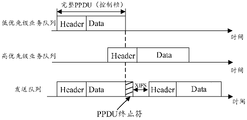
- the first communication device is in the stage of sending a non-highest-priority service queue physical layer protocol data unit PPDU data frame, and the highest-priority service queue has data to be transmitted, then interrupts the PPDU data frame.
- a PPDU terminator is added at the interruption of the PPDU data frame, and the PPDU terminator is used to indicate that the non-highest priority service queue ends the data transmission process, and the highest priority service queue performs data transmission.
- the above embodiment allows the highest priority service queue to immediately interrupt the data frame sending process of the non-highest priority service queue, reduces the waiting time of the highest priority service queue for sending, reduces service delay, and does not require peers to participate in negotiation and scheduling.
- the first communication device is in the stage of sending a non-highest-priority service queue PPDU control frame, and the highest-priority service queue has data to be transmitted, then add a PPDU to the end of the PPDU control frame.
- the PPDU terminator is used to indicate that the non-highest priority service queue ends the data transmission process, and the highest priority service queue performs data transmission after waiting for the completion of the transmission of the PPDU control frame.
- the above embodiment allows the transmission of non-highest priority service queue control frames, ensures the integrity of the non-highest priority service queue data transmission process to a certain extent, and allows the highest priority service queue to interrupt the non-highest priority service queue data exchange process, Therefore, the waiting time of the highest priority service queue for sending is reduced, and the service delay is reduced.
- the first communication device is in a non-highest-priority service queue data receiving stage, and the first communication device needs to send a PPDU control frame after receiving data, and the highest-priority service queue has data.
- To be transmitted add a PPDU terminator at the end of the PPDU control frame.
- the PPDU terminator is used to instruct the non-highest-priority service queue to end the data transmission process. After the transmission of the PPDU control frame is completed, the highest-priority service queue performs data transmission.
- the above embodiment allows the non-highest priority service queue to complete the transmission of control frames and ensures the integrity of the control frame, and informs the peer end of the occurrence of interruption through the PPDU terminator, so as to avoid affecting the peer end; at the same time, the highest priority service queue does not need to wait for non- The complete interaction process of the highest-priority service queue ends, and data can be sent in advance to reduce service delay.
- the first communication device is in the data receiving stage of the non-highest priority service queue, and the first communication device needs to send a PPDU data frame after receiving the data, and the highest priority service queue has data.
- a PPDU empty frame containing only the PPDU header and PPDU terminator is sent.
- the PPDU empty frame is used to indicate that the non-highest priority service queue ends the data transmission process, and the highest priority service queue performs data transmission.
- the first communication device stops sending the original PPDU data frame that needs to be sent, but sends an empty frame containing only the PPDU header and the PPDU terminator to interrupt the data transmission process of the non-highest priority service queue.
- the above embodiment allows the highest-priority service queue to preempt the transmission opportunity of data frames sent by the non-highest-priority service queue, without waiting for the non-highest-priority service queue to end the complete interaction process, and the highest-priority service queue can send data in advance, reducing service time. extension.
- the PPDU terminator may be a very high throughput long training field EHT-LTF sequence with a 90-degree phase rotation.
- the present application provides a communication device, the communication device having the functions of the first communication device in each possible design example of the first aspect or the first aspect, or having the function of realizing the second aspect or the second aspect.
- the above functions can be implemented by hardware, or by executing corresponding software by hardware.
- the hardware or software includes one or more modules corresponding to the above functions.
- the structure of the communication device includes a transceiver unit and a processing unit, and these units can perform the corresponding functions of the first communication device in the above-mentioned first aspect or each possible design example of the first aspect or the above-mentioned second communication device. Corresponding functions of the first communication device in each possible design example of the aspect or the second aspect.
- the transceiver unit is used for communication transmission, and the processing unit is used for a service queue to perform channel competition, and the service queue competes for a channel to obtain an opportunity to transmit data;
- the processing unit is further configured to control the transceiver unit to transmit the data of the highest priority service queue in the time window corresponding to the transmission opportunity.
- the non-highest priority service queue competes for a channel to obtain a transmission opportunity. If the highest priority service queue has data to be transmitted, in the time window corresponding to the transmission opportunity, the transceiver unit transmits all the data. data of the highest priority service queue, and the non-highest priority service queue performs channel competition again.
- the processing unit only allows the highest priority service queue to compete for the channel, and the non-highest priority service queue suspends channel competition.
- the transceiver unit transmits the data of the highest priority service queue, including:
- the non-highest-priority service queue obtains a transmission opportunity and performs data transmission. During the data transmission process of the non-highest-priority service queue, if the highest-priority service queue has data to be transmitted, the highest-priority service queue interrupts the non-highest-priority service. Queue data transmission, the transceiver unit transmits the data of the highest priority service queue.
- the highest priority service queue has data to be transmitted, the highest priority service queue interrupts the data transmission of the non-highest priority service queue, and performs data transmission of the highest priority service queue, specifically including:
- the transceiver unit is in the stage of sending the non-highest priority service queue physical layer protocol data unit PPDU data frame, the processing unit interrupts the PPDU data frame sending process, and adds a PPDU terminator at the interruption of the PPDU data frame.
- the PPDU terminator is used to indicate The non-highest priority service queue ends the data transmission process, and the transceiver unit transmits the data of the highest priority service queue.
- the highest priority service queue has data to be transmitted, the highest priority service queue interrupts the data transmission of the non-highest priority service queue, and performs data transmission of the highest priority service queue, specifically including:
- the transceiver unit is in the stage of sending the non-highest priority service queue PPDU control frame, and a PPDU terminator is added at the end of the PPDU control frame.
- the PPDU terminator is used to indicate that the non-highest priority service queue ends the data transmission process. After the PPDU control frame transmission is completed, The transceiver unit transmits the data of the highest priority service queue.
- the highest priority service queue has data to be transmitted, the highest priority service queue interrupts the data transmission of the non-highest priority service queue, and performs data transmission of the highest priority service queue, specifically including:
- the transceiver unit is in the data receiving stage of the non-highest priority service queue. After receiving the data, the transceiver unit sends a PPDU control frame, and adds a PPDU terminator at the end of the PPDU control frame. The PPDU terminator is used to indicate that the non-highest priority service queue ends the data transmission process. , After the transmission of the PPDU control frame is completed, the data of the highest priority service queue is transmitted.
- the highest priority service queue has data to be transmitted, the highest priority service queue interrupts the data transmission of the non-highest priority service queue, and performs data transmission of the highest priority service queue, specifically including:
- the transceiver unit is in the data receiving stage of the non-highest priority service queue. After receiving the data, the transceiver unit needs to send a PPDU data frame. If there is data to be transmitted in the highest priority service queue, it sends a PPDU empty frame containing only the PPDU header and the PPDU terminator. The PPDU empty frame is used to instruct the non-highest-priority service queue to end the data transmission process and transmit the data of the highest-priority service queue.
- the transceiver unit stops sending the original PPDU data frame that needs to be sent, but sends an empty frame containing only the PPDU header and the PPDU terminator to interrupt the data transmission process of the non-highest priority service queue.
- the PPDU terminator may be a very high throughput long training field EHT-LTF sequence after a 90-degree phase rotation.
- the structure of the communication device includes a transceiver and at least one processor, the transceiver is used to send and receive data, and to communicate and interact with other devices in the communication system,
- the at least one processor is configured to support the communication device to perform corresponding functions of the first communication device in the above-mentioned first aspect and each possible design example of the first aspect or each possible design of the above-mentioned second aspect and the second aspect
- For the corresponding functions of the first communication device in the example refer to the detailed description in the method example for details, and details are not repeated here.
- the communication device further includes a memory, which is coupled to the above-mentioned processor and stores necessary program instructions and data of the communication device.
- the embodiments of the present application provide a computer-readable storage medium, where program instructions are stored in the computer-readable storage medium, and when the program instructions are executed on a computer, the computer can execute the first aspect and any of the first aspect of the embodiments of the present application.
- an embodiment of the present application provides a communication system, which may include the above-mentioned first communication device and other communication devices that communicate with the first communication device, and the like.
- the embodiments of the present application provide a computer program product comprising computer program codes or instructions, which, when running on a computer, enables the computer to implement the first aspect and any possible design method in the first aspect. or any possible design method of the second aspect and the second aspect thereof.
- the present application also provides a chip system, the chip system includes a logic circuit and an input-output interface, wherein the input-output interface is used for inputting or outputting information, and the logic circuit is used to implement the above-mentioned first aspect and its first A method of any possible design in the aspect or a method of any possible design of the second aspect and the second aspect thereof.
- FIG. 1 is a schematic diagram of the architecture of a communication system provided by the present application.
- FIG. 2 is a schematic structural diagram of an AP or STA provided by the present application.
- FIG. 3 is a schematic diagram of a service queue transmission process provided by the present application.
- FIG. 4 is a schematic diagram of another service queue transmission process provided by the present application.
- FIG. 5 is a flowchart of a method for a service queue transmission process provided by the present application.
- FIG. 6 is a schematic diagram of a service queue transmission process provided by the present application.
- FIG. 7 is a schematic diagram of another service queue transmission process provided by the present application.
- FIG. 8 is a schematic diagram of another service queue transmission process provided by the present application.
- FIG. 9 is a schematic diagram of another service queue transmission process provided by the present application.
- FIG. 10 is a schematic flowchart of another service queue transmission process provided by the present application.
- FIG. 11 is a schematic structural diagram of a communication device provided by the application.
- FIG. 13 is a schematic structural diagram of another communication apparatus provided by the present application.
- Embodiments of the present application provide a service transmission method and apparatus.
- the methods and devices described in this application are based on the same technical concept. Since the methods and devices have similar principles for solving problems, the implementations of the devices and methods can be referred to each other, and repeated descriptions will not be repeated here.
- At least one refers to one or more, and “multiple” refers to two or more.
- And/or which describes the association relationship of the associated objects, means that there can be three kinds of relationships, for example, A and/or B, it can mean that A exists alone, A and B exist at the same time, and B exists alone, where A, B can be singular or plural.
- the character “/” generally indicates that the associated objects are an “or” relationship.
- At least one (item) of the following or its similar expression refers to any combination of these items, including any combination of single item (item) or plural item (item).
- At least one (a) of a, b or c may represent: a, b, c, a and b, a and c, b and c, or a, b and c, where a, b, c Can be single or multiple.
- FIG. 1 shows the architecture of a possible communication system to which the communication method provided by the embodiment of the present application is applicable.
- the architecture of the communication system includes at least one access point (access point, AP) (for example, AP 101 in FIG. 1 ) and at least one station (station, STA) (for example, STA1 102 and STA2 103 in FIG. 1 ).
- APs can include but are not limited to communication servers, routers, switches, bridges, etc.
- STAs can include but are not limited to mobile phones, tablet computers (Pad), computer notebooks, smart watches, smart TVs, etc.
- the STA may be either an AP, such as the router mentioned above, or a station that is not an access point (non-AP STA), such as the mobile phone mentioned above.
- an AP or STA may be as shown in the structure diagram shown in FIG. 2 , and may include a processor, a memory, a transmitter, a receiver, a signal detector, and a digital signal processor, and may optionally also include User Interface.
- the transmitter and the receiver may also be combined into a transceiver, which is not limited in this application.
- the method provided in this application can be applied to data communication between an AP and one or more STAs, can also be applied to data communication between an AP and an AP, and can also be applied to data communication between a STA and a STA, This application does not limit this.
- the most basic data transmission of IEEE802.11 follows the CSMA/CA mechanism (also known as the DCF mechanism), which stipulates that the node needs to compete for the channel before sending data, and the data transmission can be performed after successfully competing for the channel, so as to avoid conflicts.
- a data transmission can be divided into three steps. Specifically, the three steps include:
- EDCA enhanced distributed access
- HCCA hybrid controlled channel access
- EDCA defines 4 access types and supports 8 user priorities.
- the 4 access types are background (background, BK), best effort (best effort, BE), video (video, VI), voice (voice, VO), 8 priorities 0 to 8 and defined in 802.1D Consistent, there is a corresponding relationship between the access type and the user priority.
- BK background
- BE best effort
- BE video
- VI video
- voice voice
- VO voice
- 8 priorities 0 to 8 there is a corresponding relationship between the access type and the user priority.
- AIFS arbitration inter frame spacing
- the duration of AIFS can be configured with different values for different access types by the management plane;
- the size of the window is configured with different values for different access types by the management plane; in the data sending and receiving stage, multiple data exchanges can be performed within the transmission opportunity (TXOP) time, and the TXOP duration is given by the management plane to different access points. Configure different values for the input type.
- the EDCA access type parameters can be adjusted.
- the AP uses management frames, such as beacon frames (beacon), probe frame responses (probe response), and association frame responses (association response), to modify the STA's default EDCA access type parameters.
- STAs provide different contention parameters, so that the probability of some STAs competing to obtain air interface resources increases, while the probability of other STAs decreases.
- Figure 3 illustrates the process of channel access priority of STA1 and STA2.
- the parameters shown in Table 1 are set for STA1 and STA2, where AC is the access category (AC), and CWmin and CWmax are The minimum and maximum values of the contention window, AIFSN is the number of frame intervals of arbitration frames (AIFS Number, AIFSN).
- STA1 and STA2 have the same access type, both of which are VO type, but the AIFSN of STA1 is smaller and the contention window is smaller, so the VO type service of STA1 is easier to obtain TXOP and has a higher probability of transmission.
- the service data of AC_BE enters the queue at the earliest, and after AIFS and backoff window, TXOP is obtained at the time of BE_t, and data transmission starts; although AC_VO has the smallest value among all access types
- the idle waiting time is AIFS and the minimum contention window, but because the service data enters the queue later, the data can not be transmitted until VO_t at the earliest. Therefore, in this case, the high-priority VO type service in the STA is later than the low-priority BE type. type of business can be transmitted. Since Wi-Fi systems use unlicensed spectrum, their transmission mechanisms follow basic CSMA/CA. High-priority services in the Wi-Fi system need to wait for other services that have obtained the channel to complete data transmission before they may compete for the channel to send data. Therefore, the delay increases and it is difficult to meet the service requirements.
- the embodiment of the present application provides a service transmission method, which can interrupt the current low-priority service transmission process when a high-priority service occurs in an 802.11 system, so that the high-priority service can preferentially obtain access and transmission. Chance.
- the service transmission method provided in the embodiment of the present application can be applied to the communication system shown in FIG. 1 .
- the method includes:
- S501 A service queue of the first communication device competes for a channel, and data of the service queue obtains a transmission opportunity.
- the first communication device may be an AP or a STA, or may be a chip applied to the AP or the STA.
- the data of the highest priority service queue can be guaranteed to be transmitted first.
- a certain service queue competes for a channel to obtain a transmission opportunity, wherein the service queue competing for a channel may be a queue of each priority.
- a possible implementation is that the non-highest-priority service queue competes for the channel, and the data of the non-highest-priority service queue obtains a transmission opportunity. If the highest-priority service queue has data to be transmitted, it competes for the non-highest-priority channel of the channel. The traffic queue yields transmission opportunities to the highest priority traffic queue. In other words, if the non-highest-priority service queue competes for the channel before the highest-priority service queue, it is determined that the highest-priority service queue is the transmission queue, and the highest-priority service queue enters the data sending and receiving stage first. The queue reselects contention parameters for channel contention.
- the highest priority service queue data can be transmitted first, reducing service waiting delay.
- AC_VO can be considered as the highest priority according to the priority definition in the EDCA mechanism, or a new highest priority type, such as AC_CR, can be defined, and the competition parameter used by the newly defined highest priority type, For example AIFS, CW, TXOP limit.
- the highest priority service queue mentioned in the embodiment of the present application may be the absolute highest priority service queue, for example, AC_VO in the EDCA mechanism is the highest priority; it may also be the relatively highest priority service in all queues to be transmitted For example, if the priority types of services contained in the queue to be transmitted currently are AC_BK, AC_BE, and AC_VI, AC_VI is considered to be the highest priority service queue in the queue to be transmitted currently.
- the above embodiment ensures that the highest priority service queue obtains the transmission opportunity first in the channel contention stage. Even if the non-highest-priority service queue preempts the channel before the highest-priority service queue, the non-highest-priority service queue gives up the data transmission opportunity and gives the transmission opportunity to the highest-priority service queue, making the highest-priority service queue Have the opportunity to prioritize the transmission of data.
- the embodiment of the present application provides yet another service transmission method, which is used in a service queue data transmission process. Specifically, this method is used in the data transmission process of the non-highest priority service queue, and the highest priority service queue has data to be transmitted, then the highest priority service queue interrupts the data transmission of the non-highest priority service queue, and performs the highest priority service queue. Data transmission of the level service queue.
- the first communication device is in the data transmission phase of the non-highest-priority service queue, and is currently sending a physical layer protocol data unit PPDU data frame, and at this time, the highest-priority service queue has data to be transmitted , then interrupt the transmission of the non-highest priority service queue PPDU, and add a PPDU terminator at the interruption of the PPDU data frame, the terminator is used to indicate the non-highest priority service queue to end data transmission, that is, through the PPDU terminator to Notify the opposite end that the transmission is preempted by the highest priority service queue and terminated, and the data of the highest priority service queue obtains a transmission opportunity for data transmission.
- the transmission process of the highest priority service queue data is performed at an interval of XFIS (for example, SIFS) time after the PPDU terminator is sent.
- XFIS for example, SIFS
- the above embodiment allows the highest priority service queue to interrupt the transmission of data frames of non-highest priority service queues, which can reduce the waiting time of the highest priority service queue for sending and reduce service delay; in addition, the peer end does not need to participate in negotiation and scheduling.
- the first communication device is in the data transmission phase of the non-highest-priority service queue, and is currently sending a PPDU control frame.
- the highest-priority service queue has data to be transmitted, and then waits for the PPDU control frame to be sent.
- the terminator is used to instruct the non-highest priority service queue to interrupt data transmission and give the data transmission opportunity to the highest priority.
- Business queue the highest priority business queue for data transmission.
- the PPDU terminator is used to notify the opposite end that the transmission is preempted by the highest priority service queue and terminated, and the highest priority service queue data obtains a transmission opportunity for data transmission.
- the transmission process of the highest priority service queue data is carried out at an interval of XFIS (for example, SIFS) time after the PPDU terminator is sent.
- the above embodiment allows the highest priority service queue to interrupt the interaction process of the non-highest priority service queue, and ensures the integrity of the control frame sent by the non-highest priority service queue, and can also reduce the waiting time of the highest priority service queue for sending, reducing business delay.
- the first communication device is in the data receiving phase of the non-highest-priority service queue, and needs to send a PPDU control frame after receiving data. If the highest-priority service queue has data to be transmitted, the first communication device receives the data. After finishing the data of the non-highest priority service queue and sending the PPDU control frame, the data transmission process of the non-highest priority service queue is interrupted. Among them, a PPDU terminator is added at the end of the PPDU control frame, and the terminator is used to instruct the non-highest priority service queue to interrupt data transmission, and the data transmission opportunity is given to the highest priority service queue, and the highest priority service queue for data transmission.
- the PPDU terminator is attached to the end of the PPDU control frame and sent to the peer end.
- the peer end receives the PPDU terminator and knows that the transmission is preempted by the highest priority, so it stops responding to the control frame and interrupts the remaining interaction process.
- the transmission process of the highest priority service queue data is performed at an interval of XFIS (for example, SIFS) time after the PPDU terminator is sent.
- the above embodiment allows the non-highest priority service queue to complete the sending of control frames, and notifies the peer end of the occurrence of interruption, so as to avoid affecting the peer end, and at the same time, the highest priority service queue does not need to wait for the non-highest priority service queue to complete the entire interaction process, Data can be sent in advance to reduce service delay.
- the first communication device is in the data receiving stage of the non-highest-priority service queue, and needs to send a PPDU data frame after receiving data. If the highest-priority service queue has data to be transmitted, the first communication device receives After finishing the data of the non-highest priority service queue, send a PPDU empty frame containing only the PPDU header and PPDU terminator. The PPDU empty frame is used to instruct the non-highest priority service queue to interrupt data transmission and give the data transmission opportunity to the highest priority. The highest priority service queue is used for data transmission.
- the first communication device stops sending the original PPDU data frame that needs to be sent, but sends an empty frame containing only the PPDU header and the PPDU terminator to interrupt the data transmission process of the non-highest priority service queue.
- the PPDU empty frame is sent to the opposite end to notify the opposite end that the transmission is preempted by the highest priority, and the remaining interaction process is interrupted.
- the transmission process of the highest priority service queue data is performed at an interval of XFIS (eg, SIFS) time after the empty frame of the PPDU is sent.
- XFIS eg, SIFS
- the above embodiment allows the highest priority service queue to preempt the transmission opportunity of non-highest priority data frame transmission, without waiting for the non-highest priority service queue to complete the complete interaction process, sending data in advance, and reducing service delay.
- FIG. 6 to FIG. 9 in the embodiments of the present application are schematic diagrams of PPDUs transmitted by the physical layer, including a PPDU header (header) and a data (data) part.
- the PPDU control frame and the PPDU data frame are relative to the medium access control (Medium Access Control, MAC) layer. That is to say, if the MAC content contained in the data part of the PPDU is a data frame, then the PPDU can be understood as the PPDU data frame in the application; if the MAC content contained in the data part of the PPDU is a control frame, then the PPDU can be understood as in the application The PPDU control frame.
- MAC Medium Access Control
- the PPDU terminator may be a very high throughput long training field EHT-LTF sequence after a 90-degree phase rotation.
- the present application provides another service transmission method, which includes:
- a service queue of the first communication device competes for a channel, and data of the service queue obtains a transmission opportunity.
- each priority service queue of the first communication device may independently compete for a channel according to a priority competition method (for example, EDCA), and any service queue successfully competes for a channel, and the service queue obtains a transmission opportunity, Go to step S1002.
- a priority competition method for example, EDCA
- Another possible implementation is that only the highest priority service queues are allowed to compete for channels, and other non-highest priority service queues suspend channel competition.
- the highest priority service queue successfully competes for the channel, and directly enters the data sending and receiving stage of the highest priority service queue.
- S1002 Determine the service queue that obtains the transmission opportunity.
- the service queue is the service queue with the highest priority
- the data of the service queue with the highest priority is transmitted in the time window corresponding to the transmission opportunity.
- step 1003 If the service queue is not the highest priority service queue, then go to step 1003 .
- S1003 Determine whether the highest priority service queue has data to be transmitted.
- the non-highest-priority service queue gives the transmission opportunity to the highest-priority service queue, and transmits the data of the highest-priority service queue in the time window corresponding to the transmission opportunity.
- the data of the non-highest-priority service queue is transmitted in the time window corresponding to the transmission opportunity.
- non-highest priority service queue transmission it can be determined whether the highest priority service queue has data to be transmitted, and if the highest priority service queue has data to be transmitted, then the highest priority service queue.
- the data transmission process of the non-highest-priority service queue can be interrupted, and the data transmission of the highest-priority service queue can be performed. Specifically, for the data transmission process in which the highest priority service queue interrupts the non-highest priority service queue, reference may be made to the foregoing embodiments, which will not be repeated in this application. If the highest priority service queue has no data to be transmitted, the data transmission process of the non-highest priority service queue is continued.
- the communication apparatus 1100 may include a processing unit 1101 and a transceiver unit 1102 .
- the transceiver unit 1102 is used for the communication device 1100 to perform communication transmission, for example, receiving information (frame, message or data) or sending information (frame, message or data), and the processing unit 1101 is used for the The operation of the communication device 1100 is controlled and managed.
- the processing unit 1101 may also control the steps performed by the transceiver unit 1102 .
- the communication apparatus 1100 may be the first communication apparatus in the foregoing embodiment, and may specifically be a processor, or a chip, or a chip system, or a functional module in the first communication apparatus. Specifically, when the communication apparatus 1100 is used to implement the function of the first communication apparatus in the foregoing embodiment, it may specifically include:
- the processing unit 1101 is used for the service queue to perform channel competition, and the service queue competing for the channel obtains a transmission opportunity;
- the processing unit 1101 is further configured to control the transceiver unit 1102 to transmit the highest priority service queue in the time window corresponding to the transmission opportunity.
- processing unit 1101 may also be configured to determine whether the service queue that obtains the transmission opportunity is the highest priority service queue or the non-highest priority service queue.
- the transceiver unit 1102 is used for communication transmission.
- the non-highest-priority service queue competes for the channel, and in the time window corresponding to the transmission opportunity, the processing unit 1101 can determine whether the highest-priority service queue has data to be transmitted, and if the highest-priority service queue has waiting time To transmit data, the transceiver unit 1102 transmits the data of the highest-priority service queue, and the non-highest-priority service queue performs channel competition again; if the highest-priority service queue has no data to be transmitted, the transceiver unit 1102 transmits the non-highest-priority service queue. .
- the processing unit 1101 only allows the highest priority service queue to compete for the channel, and the non-highest priority service queue suspends channel competition.
- the processing unit 1101 interrupts the data transmission of the non-highest-priority service queue, and controls the transceiver unit 1102 to perform the transmission of the highest-priority service queue. data transmission.
- the transceiver unit 1102 is in the stage of sending a non-highest priority service queue physical layer protocol data unit PPDU data frame, the processing unit 1101 interrupts the PPDU data frame sending process, and adds PPDUs at the interrupted place of the PPDU data frame. Terminator, the PPDU terminator is used to indicate that the non-highest-priority service queue ends the data transmission process, and the transceiver unit 1102 transmits the data of the highest-priority service queue.
- the transceiver unit 1102 is in the stage of sending a non-highest priority service queue PPDU control frame, and a PPDU terminator is added at the end of the PPDU control frame. After the transmission of the PPDU control frame is completed, the transceiver unit 1102 transmits the highest priority. Business queue data.
- the transceiver unit 1102 is in the non-highest priority service queue data receiving stage, and the transceiver unit 1102 needs to send a PPDU control frame after receiving the data, then a PPDU terminator is added at the end of the PPDU control frame, and the PPDU control frame is waiting for the PPDU control frame. After the transmission is completed, the transceiver unit 1102 transmits the data of the highest priority service queue.
- the transceiver unit 1102 is in the non-highest priority service queue data receiving stage, and the transceiver unit 1102 needs to send a PPDU data frame after receiving the data, and then sends a PPDU empty frame that only includes the PPDU header and the PPDU terminator , the PPDU empty frame is used to indicate that the non-highest-priority service queue ends the data transmission process, and the transceiver unit 1102 transmits the data of the highest-priority service queue.
- the transceiver unit 1102 stops sending the original PPDU data frame that needs to be sent, but sends an empty frame containing only the PPDU header and the PPDU terminator to interrupt the data transmission process of the non-highest priority service queue.
- the PPDU terminator may be an extremely high throughput long training field (extremely high throughput-long training field, EHT-LTF) sequence after a 90-degree phase rotation.
- EHT-LTF extremely high throughput-long training field
- each functional unit in the embodiments of the present application may be integrated into one processing unit, or each unit may exist physically alone, or two or more units may be integrated into one unit.
- the above-mentioned integrated units may be implemented in the form of hardware, or may be implemented in the form of software functional units.
- the integrated unit if implemented in the form of a software functional unit and sold or used as an independent product, may be stored in a computer-readable storage medium.
- the technical solutions of the present application can be embodied in the form of software products in essence, or the parts that contribute to the prior art, or all or part of the technical solutions, and the computer software products are stored in a storage medium , including several instructions for causing a computer device (which may be a personal computer, a server, or a network device, etc.) or a processor (processor) to execute all or part of the steps of the methods described in the various embodiments of the present application.
- the aforementioned storage medium includes: U disk, mobile hard disk, read-only memory (ROM), random access memory (RAM), magnetic disk or optical disk and other media that can store program codes .
- the communication apparatus 1200 may include a transceiver 1201 and a processor 1202 .
- the communication apparatus 1200 may further include a memory 1203 .
- the memory 1203 may be disposed inside the communication device 1200 or outside the communication device 1200 .
- the processor 1202 may control the transceiver 1201 to receive and transmit data.
- the processor 1202 may be a central processing unit (central processing unit, CPU), a network processor (network processor, NP), or a combination of CPU and NP.
- the processor 1202 may further include a hardware chip.
- the above-mentioned hardware chip may be an application-specific integrated circuit (ASIC), a programmable logic device (PLD) or a combination thereof.
- the above-mentioned PLD can be a complex programmable logic device (CPLD), a field-programmable gate array (FPGA), a general-purpose array logic (generic array logic, GAL) or any combination thereof.
- the transceiver 1201, the processor 1202 and the memory 1203 are connected to each other.
- the transceiver 1201, the processor 1202 and the memory 1203 are connected to each other through a bus 1204;
- the bus 1204 may be a Peripheral Component Interconnect (PCI) bus or an extended industry standard Structure (Extended Industry Standard Architecture, EISA) bus, etc.
- PCI Peripheral Component Interconnect
- EISA Extended Industry Standard Architecture
- the bus can be divided into an address bus, a data bus, a control bus, and the like. For ease of representation, only one thick line is shown in FIG. 12, but it does not mean that there is only one bus or one type of bus.
- the memory 1203 is used to store programs and the like.
- the program may include program code, the program code including computer operation instructions.
- the memory 1203 may include RAM, and may also include non-volatile memory, such as one or more disk memories.
- the processor 1202 executes the application program stored in the memory 1203 to realize the above-mentioned functions, thereby realizing the functions of the communication device 1200 .
- the communication apparatus 1200 may be the above-mentioned first communication apparatus.
- the communication apparatus 1200 When the communication apparatus 1200 is configured to implement the functions of the first communication apparatus described in the foregoing embodiments, it may specifically include:
- the transceiver 1201 is used for communication transmission;
- the processor 1202 is used for the service queue to perform channel competition, and the data competing for the service queue of the channel obtains a transmission opportunity;
- the processor 1202 is configured to control the transceiver 1201 to transmit the data of the highest priority service queue in the time window corresponding to the transmission opportunity.
- processor 1202 may also be configured to determine whether the service queue that obtains the transmission opportunity is the highest priority service queue or the non-highest priority service queue.
- the non-highest-priority service queue competes for the channel, and in the time window corresponding to the transmission opportunity, the processor 1202 may determine whether the highest-priority service queue has data to be transmitted, and if the highest-priority service queue has waiting time To transmit data, the transceiver 1201 transmits the data of the highest-priority service queue, and the non-highest-priority service queue performs channel competition again; if the highest-priority service queue has no data to be transmitted, the transceiver 1201 transmits the non-highest-priority service queue The data.
- the processor 1202 only allows the highest priority service queue to compete for the channel, and the non-highest priority service queue suspends channel competition.
- the processor 1202 interrupts the data transmission of the non-highest priority service queue, and controls the transceiver 1201 to perform the transmission of the highest priority service queue. data transmission.
- the transceiver 1201 is in the stage of sending a non-highest priority service queue physical layer protocol data unit PPDU data frame, the processor 1202 interrupts the PPDU data frame sending process, and adds PPDUs at the PPDU data frame interruption Terminator, the PPDU terminator is used to indicate that the non-highest-priority service queue ends the transmission process, and the transceiver 1201 transmits the data of the highest-priority service queue.
- the transceiver 1201 is in the stage of sending a non-highest priority service queue PPDU control frame, and a PPDU terminator is added at the end of the PPDU control frame. After the transmission of the PPDU control frame is completed, the transceiver 1201 transmits the highest priority. Business queue data.
- the transceiver 1201 is in the non-highest priority service queue data receiving stage, the transceiver 1201 sends a PPDU control frame after receiving the data, adds a PPDU terminator at the end of the PPDU control frame, and waits until the transmission of the PPDU control frame is completed. Then, the transceiver 1201 transmits the data of the highest priority service queue.
- the transceiver 1201 is in the non-highest priority service queue data receiving stage, and after receiving the data, the transceiver 1201 sends a PPDU empty frame, the PPDU empty frame only contains the PPDU header and the PPDU terminator, the PPDU empty frame
- the empty frame is used to indicate that the non-highest priority service queue ends the data transmission process, and the transceiver 1201 transmits the data of the highest priority service queue. That is, after receiving the data, the transceiver 1201 stops sending the original PPDU data frame that needs to be sent, but sends an empty frame containing only the PPDU header and the PPDU terminator to interrupt the data transmission process of the non-highest priority service queue.
- the PPDU terminator may be an extremely high throughput long training field (extremely high throughput-long training field, EHT-LTF) sequence after a 90-degree phase rotation.
- EHT-LTF extremely high throughput-long training field
- an embodiment of the present application further provides a communication device, as shown in FIG. 13 .
- the device 1300 may be a communication device or a chip in the communication device.
- the device includes:
- the input-output interface 1301 may be an input-output circuit.
- the logic circuit 1302 can be a signal processor, a chip, or other integrated circuits that can implement the methods of the present application.
- the apparatus 1300 may also include at least one memory 1303 for storing program instructions and/or data.
- Memory 1303 and logic circuit 1302 are coupled.
- the coupling in the embodiments of the present application refers to indirect coupling or communication connection between devices, units or modules, which may be electrical, mechanical or other forms, and is used for information exchange between devices, units or modules.
- Logic circuit 1302 may cooperate with memory 1303 .
- Logic circuit 1302 may execute program instructions stored in memory 1303 .
- at least one of the at least one memory may be integrated with a logic circuit.
- the memory 1303 is located outside the apparatus 1300 .
- At least one input and output interface 1301 is used for input or output of signals or data.
- the communication device when used to implement the functions of the first communication device described in the above embodiments, it may specifically include: the input/output interface 1301 is used to input or output data or information, and the logic circuit 1302 is used to implement the above In the method described in the method embodiment, for example, the logic circuit 1302 is used for the service queue to compete for the channel, and the service queue competing for the channel obtains the transmission opportunity; the logic circuit 1302 is also used to control the input and output interface 1301 in the time window corresponding to the transmission opportunity Data transmission to the highest priority service queue is performed.
- logic circuit 1302 is configured to execute some or all of the steps of any method provided in the embodiments of the present application.
- the logic circuit may implement the functions implemented by the processing unit 1101 in the communication device 1100 and the processor 1202 in the communication device 1200 described above.
- an embodiment of the present application further provides a communication system, where the communication system may include the first communication device involved in the above embodiment, and other communication devices that communicate with the first communication device, and the like.
- Embodiments of the present application further provide a computer-readable storage medium, where the computer-readable storage medium is used to store computer programs or instructions.
- the computer programs or instructions are executed by a computer, the computer can implement the methods provided by the foregoing method embodiments. communication method.
- Embodiments of the present application further provide a computer program product, where the computer program product is used to store a computer program, and when the computer program is executed by a computer, the computer can implement the communication method provided by the above method embodiments.
- the embodiments of the present application may be provided as a method, a system, or a computer program product. Accordingly, the present application may take the form of an entirely hardware embodiment, an entirely software embodiment, or an embodiment combining software and hardware aspects. Furthermore, the present application may take the form of a computer program product embodied on one or more computer-usable storage media (including, but not limited to, disk storage, CD-ROM, optical storage, etc.) having computer-usable program code embodied therein.
- computer-usable storage media including, but not limited to, disk storage, CD-ROM, optical storage, etc.
- These computer program instructions may also be stored in a computer-readable memory capable of directing a computer or other programmable data processing apparatus to function in a particular manner, such that the instructions stored in the computer-readable memory result in an article of manufacture comprising instruction means, the instructions
- the apparatus implements the functions specified in the flow or flow of the flowcharts and/or the block or blocks of the block diagrams.
Landscapes
- Engineering & Computer Science (AREA)
- Computer Networks & Wireless Communication (AREA)
- Signal Processing (AREA)
- Quality & Reliability (AREA)
- Mobile Radio Communication Systems (AREA)
Abstract
本申请提供了一种业务传输方法及装置。第一通信装置的业务队列进行信道竞争,其中,某一业务队列竞争到信道,获得数据传输的机会,在传输机会对应的时间窗中,第一通信装置传输其最高优先级业务队列的数据。本申请提供的技术方案可以优先进行最高优先级业务队列的数据传输,减少最高优先级业务队列的等待时间,降低业务时延。
Description
本申请涉及通信技术领域,尤其涉及一种业务传输方法及装置。
IEEE 802.11无线局域网,通常也被称为Wi-Fi网络,已经成为针对互联网最后一跳接入技术的一个普遍的解决方案。IEEE802.11最基本的数据传输遵循冲突避免载波侦听多路访问(carrier sense multiple access with collision avoid,CSMA/CA)机制,也称为分布式协调功能(distributedcoordinationfunction,DCF)。Wi-Fi系统由于使用非授权频谱,其传输机制遵循基本的CSMA/CA。Wi-Fi现有的接入传输方式难以满足高优先级低时延要求的业务诉求,如AR/VR、工业控制指令等。
发明内容
本申请实施例提供一种业务传输方法及装置。
第一方面,本申请实施例提供一种业务传输方法,该方法包括:第一通信装置的一业务队列竞争到信道,该业务队列获得传输数据的机会;
在传输机会对应的时间窗中,第一通信装置传输其最高优先级业务队列的数据。
需要说明的是,第一通信装置可以是接入点(access point,AP),也可以是终端(station)。
上述实施例中,在传输机会对应的时间窗中,可以保证最高优先级业务队列的数据可以最先传输。
具体的,结合上述第一方面,一种可能的实现方式,竞争到信道的业务队列为非最高优先级业务队列,若此时最高优先级业务队列有待传输数据,则在传输机会对应的时间窗中,优先传输最高优先级业务队列的数据,非最高优先级业务队列重新进行信道竞争,也就是说,非最高优先级业务队列将传输机会让给最高优先级业务队列;若此时最高优先级业务队列无待传输数据,则在传输机会对应的时间窗中,传输非最高优先级业务队列的数据。
上述实施例中,非最高优先级业务队列竞争到信道获得传输数据的机会,但是最高优先级业务队列此时有待传输的数据,那么第一通信装置优先传输最高优先级业务队列的数据,保证高优先级业务队列数据获得最先传输,降低业务时延。
再一种可能的实现方式,只允许最高优先级业务队列竞争信道,非最高优先级业务队列暂停竞信道竞争。
上述实现方式中,最高优先级业务队列在信道竞争的过程中,具有更高的竞争成功概率,实现最先传输。
第二方面,本申请提供又一种业务队列传输方法,该方法包括:第一通信装置在传输 其非最高优先级业务队列数据的过程中,第一通信装置的最高优先级业务队列有待传输的数据,则中断当前非最高优先级业务队列的数据传输,进行最高优先级业务队列的数据传输。
其中,第一通信装置可以是接入点(access point,AP),也可以是终端(station)。
上述实施例允许最高优先级业务队列中断非最高优先级业务队列的数据传输过程,优先进行最高优先级业务队列的数据传输,可以减少最高优先级业务队列等待传输的时间,降低业务时延。
结合上述第二方面,一种可能的实现方式,第一通信装置处于发送非最高优先级业务队列物理层协议数据单元PPDU数据帧阶段,最高优先级业务队列有数据待传输,则中断PPDU数据帧发送过程,在该PPDU数据帧中断处增加PPDU终止符,该PPDU终止符用于指示非最高优先级业务队列结束数据传输过程,最高优先级业务队列进行数据传输。
上述实施例允许最高优先级业务队列立即中断非最高优先级业务队列的数据帧发送过程,减少最高优先级业务队列等待发送的时间,降低业务时延,并且无需对端参与协商和调度。
结合上述第二方面,另一种可能的实现方式,第一通信装置处于发送非最高优先级业务队列PPDU控制帧阶段,最高优先级业务队列有数据待传输,则在该PPDU控制帧尾部增加PPDU终止符,该PPDU终止符用于指示非最高优先级业务队列结束数据传输过程,等待PPDU控制帧传输完成后,该最高优先级业务队列进行数据传输。
上述实施例允许非最高优先级业务队列控制帧的传输,一定程度上保证非最高优先级业务队列数据传输过程的完整性,并且允许最高优先级业务队列中断非最高优先级业务队列数据交互流程,从而减少最高优先级业务队列等待发送的时间,降低业务时延。
结合上述第二方面,另一种可能的实现方式,第一通信装置处于非最高优先级业务队列数据接收阶段,且第一通信装置接收数据后需要发送PPDU控制帧,最高优先级业务队列有数据待传输,则在该PPDU控制帧尾部增加PPDU终止符,该PPDU终止符用于指示非最高优先级业务队列结束数据传输过程,等待PPDU控制帧传输完成后,最高优先级业务队列进行数据传输。
上述实施例允许非最高优先级业务队列完成控制帧发送并且保证控制帧的完整性,通过PPDU终止符通知对端中断的发生,避免对对端产生影响;同时,最高优先级业务队列无需等待非最高优先级业务队列完整交互流程结束,可以提前发送数据,降低业务时延。
结合上述第二方面,另一种可能的实现方式,第一通信装置处于非最高优先级业务队列数据接收阶段,且第一通信装置接收数据后需要发送PPDU数据帧,最高优先级业务队列有数据待传输,则发送只包含PPDU头部和PPDU终止符的PPDU空帧,该PPDU空帧用于指示非最高优先级业务队列结束数据传输过程,最高优先级业务队列进行数据传输。也就是说,第一通信装置接收数据后终止发送本来需要发送的PPDU数据帧,而是发送仅包含PPDU头部和PPDU终止符的空帧来中断非最高优先级业务队列的数据传输过程。
上述实施例允许最高优先级业务队列抢占非最高优先级业务队列数据帧发送的传输机会,无需等待非最高优先级业务队列结束完整的交互流程,最高优先级业务队列可以提前发送数据,降低业务时延。
在上述的实现方式中,PPDU终止符可以为90度相位旋转后的极高吞吐率长训练字段 EHT-LTF序列。
第三方面,本申请提供一种通信装置,该通信装置具有实现上述第一方面或第一方面的各个可能的设计示例中第一通信装置的功能或具有实现上述第二方面或第二方面的各个可能的设计示例中第一通信装置的功能。上述功能可以通过硬件实现,也可以通过硬件执行相应的软件实现。该硬件或软件包括一个或多个与上述功能相对应的模块。
在一个可能的设计中,该通信装置的结构中包括收发单元和处理单元,这些单元可以执行上述第一方面或第一方面的各个可能的设计示例中第一通信装置的相应功能或上述第二方面或第二方面的各个可能的设计示例中第一通信装置的相应功能。
具体的,一种可能的实现方式中,收发单元用于进行通信传输,处理单元用于业务队列进行信道竞争,该业务队列竞争到信道,获得传输数据的机会;
处理单元还用于在传输机会对应的时间窗中,控制收发单元传输最高优先级业务队列的数据。
又一种可能的实现方式中,非最高优先级业务队列竞争到信道获得传输机会,若最高优先级业务队列有待传输的数据,在所述传输机会对应的时间窗中,所述收发单元传输所述最高优先级业务队列的数据,所述非最高优先级业务队列重新进行信道竞争。
又一种可能的实现方式中,处理单元只允许最高优先级业务队列竞争信道,非最高优先级业务队列暂停信道竞争。
又一种可能的实现方式中,在传输机会对应的时间窗中,收发单元传输最高优先级业务队列的数据,包括:
非最高优先级业务队列获得传输机会并且进行数据传输,在非最高优先级业务队列进行数据传输的过程中,最高优先级业务队列有待传输的数据,则最高优先级业务队列中断非最高优先级业务队列的数据传输,收发单元传输最高优先级业务队列的数据。
又一种可能的实现方式中,最高优先级业务队列有待传输的数据,该最高优先级业务队列中断非最高优先级业务队列的数据传输,进行最高优先级业务队列的数据传输,具体包括:
收发单元处于发送非最高优先级业务队列物理层协议数据单元PPDU数据帧阶段,处理单元中断所述PPDU数据帧发送过程,在该PPDU数据帧中断处增加PPDU终止符,该PPDU终止符用于指示非最高优先级业务队列结束数据传输过程,收发单元传输最高优先级业务队列的数据。
又一种可能的实现方式中,最高优先级业务队列有待传输的数据,该最高优先级业务队列中断非最高优先级业务队列的数据传输,进行最高优先级业务队列的数据传输,具体包括:
收发单元处于发送非最高优先级业务队列PPDU控制帧阶段,在PPDU控制帧尾部增加PPDU终止符,该PPDU终止符用于指示非最高优先级业务队列结束数据传输过程,PPDU控制帧传输完成后,收发单元传输最高优先级业务队列的数据。
又一种可能的实现方式中,最高优先级业务队列有待传输的数据,该最高优先级业务队列中断非最高优先级业务队列的数据传输,进行最高优先级业务队列的数据传输,具体包括:
收发单元处于非最高优先级业务队列数据接收阶段,收发单元接收数据后发送PPDU控 制帧,在PPDU控制帧尾部增加PPDU终止符,该PPDU终止符用于指示非最高优先级业务队列结束数据传输过程,PPDU控制帧传输完成后,传输最高优先级业务队列的数据。
又一种可能的实现方式中,最高优先级业务队列有待传输的数据,该最高优先级业务队列中断非最高优先级业务队列的数据传输,进行最高优先级业务队列的数据传输,具体包括:
收发单元处于非最高优先级业务队列数据接收阶段,收发单元接收数据后需要发送PPDU数据帧,最高优先级业务队列有数据待传输,则发送仅包含PPDU头部和PPDU终止符的PPDU空帧,该PPDU空帧用于指示非最高优先级业务队列结束数据传输过程,传输最高优先级业务队列的数据。也就是说,收发单元接收数据后终止发送本来需要发送的PPDU数据帧,而是发送仅包含PPDU头部和PPDU终止符的空帧来中断非最高优先级业务队列的数据传输过程。
在上述的实现方式中,PPDU终止符可以为90度相位旋转后的极高吞吐率长训练字段EHT-LTF序列。
结合上述第三方面,在另一个可能的设计中,该通信装置的结构中包括收发器和至少一个处理器,该收发器用于收发数据,以及用于与通信系统中的其他设备进行通信交互,该至少一个处理器被配置为支持该通信装置执行上述第一方面及第一方面的各个可能的设计示例中第一通信装置的相应的功能或上述第二方面及第二方面的各个可能的设计示例中第一通信装置的相应功能,具体参见方法示例中的详细描述,此处不做赘述。
可选的,该通信装置还包括存储器,该存储器与上述处理器耦合,其保存该通信装置必要的程序指令和数据。
第四方面,本申请实施例提供一种计算机可读存储介质,该计算机可读存储介质存储有程序指令,当程序指令在计算机上运行时,使得计算机执行本申请实施例第一方面及其任一可能的设计或本申请实施例第二方面及其任一可能的设计。
第五方面,本申请实施例提供一种通信系统,可以包括上述提及的第一通信装置以及与该第一通信装置通信的其他通信装置等。
第六方面,本申请实施例提供一种包括计算机程序代码或指令的计算机程序产品,当其在计算机上运行时,使得计算机实现上述第一方面及其第一方面中任一可能的设计的方法或第二方面及其第二方面中任一可能的设计的方法。
第七方面,本申请还提供了一种芯片系统,该芯片系统包括逻辑电路和输入输出接口,其中,输入输出接口用于输入或输出信息,逻辑电路用于实现上述第一方面及其第一方面中任一可能的设计的方法或第二方面及其第二方面中任一可能的设计的方法。
其中,上述第三方面至第七方面中的各个方面以及各个方面可能达到的技术效果请参照上述针对第一方面及第二方面中的各种可能方案可以达到的技术效果说明,这里不再重复赘述。
图1为本申请提供的一种通信系统的架构示意图;
图2为本申请提供的一种AP或者STA的结构示意图;
图3为本申请提供的一种业务队列传输过程的示意图;
图4为本申请提供的另一种业务队列传输过程的示意图;
图5为本申请提供的一种业务队列传输过程的方法流程图;
图6为本申请提供的一种业务队列传输过程的示意图;
图7为本申请提供的另一种业务队列传输过程的示意图;
图8为本申请提供的另一种业务队列传输过程的示意图;
图9为本申请提供的另一种业务队列传输过程的示意图;
图10为本申请提供的另一种业务队列传输过程的流程示意图;
图11为本申请提供的一种通信装置的结构示意图;
图12为本申请提供的另一种通信装置的结构示意图;
图13为本申请提供的另一种通信装置的结构示意图。
下面将结合附图对本申请作进一步地详细描述。
本申请实施例提供一种业务传输方法及装置。其中,本申请所述方法和装置基于同一技术构思,由于方法及装置解决问题的原理相似,因此装置与方法的实施可以相互参见,重复之处不再赘述。
在本申请的描述中,“第一”、“第二”等词汇,仅用于区分描述的目的,而不能理解为指示或暗示相对重要性,也不能理解为指示或暗示顺序。
本申请实施例中“至少一个”是指一个或者多个,“多个”是指两个或两个以上。“和/或”,描述关联对象的关联关系,表示可以存在三种关系,例如,A和/或B,可以表示:单独存在A,同时存在A和B,单独存在B的情况,其中A、B可以是单数或者复数。字符“/”一般表示前后关联对象是一种“或”的关系。“以下至少一(项)个”或其类似表达,是指的这些项中的任意组合,包括单项(个)或复数项(个)的任意组合。例如,a、b或c中的至少一项(个),可以表示:a,b,c,a和b,a和c,b和c,或a、b和c,其中a、b、c可以是单个,也可以是多个。
为了更加清晰地描述本申请实施例的技术方案,下面结合附图,对本申请实施例提供的通信方法及装置进行详细说明。
图1示出了本申请实施例提供的通信方法适用的一种可能的通信系统的架构。该通信系统的架构中包括至少一个接入点(access point,AP)(例如图1中的AP 101)和至少一个站点(station,STA)(例如图1中的STA1 102和STA2 103)。其中:AP可以包括但不限于通信服务器、路由器、交换机、网桥等,STA可以但不限于包括手机(mobile phone)、平板电脑(Pad),电脑笔记本,智能手表,智能电视等。需要说明的是,通常STA既可以是AP,例如上述涉及的路由器等,也可以是非接入点的站点(non-AP STA),例如上述涉及的手机等。
示例性的,AP或者STA的具体结构可以如图2示出的结构图所示,可以包括处理器、存储器、发送器、接收器、信号检测器以及数字信号处理器,可选的还可以包括用户界面。其中,发送器和所述接收器还可以合为收发器,本申请对此不作限定。
需要说明的是,图1示出的设备的名称仅仅是一种示例,在未来的通信系统中还可以有其它名称,图1中的设备数量也仅仅是示例,还可以包括更多或更少的设备,本申请对 此不作限定。
在本申请提供的方法中,可以适用于AP与一个或多个STA之间的数据通信,也可以适用于AP与AP之间的数据通信,还可以适用于STA和STA之间的数据通信,本申请对此不作限定。
下面对本申请涉及的一些术语或概念进行描述,便于本领域技术人员理解。
(一)CSMA/CA机制下的数据传输
IEEE802.11最基本的数据传输遵循CSMA/CA机制(也称为DCF机制),该机制规定节点在发送数据前需要竞争信道,成功竞争到信道后才可以进行数据传输,从而避免冲突发生。一次数据传输可以分成三个步骤,具体的,这三个步骤包括:
(1)信道检测:当节点存在数据要发送,首先需要等待一个DCF帧间间隔(DCF inter frame spacing,DIFS),若在DIFS时间内,检测到信道始终保持空闲状态,则进入退避过程,否则继续等待。
(2)退避:节点按照退避计数器的值,每经过一个时隙时间(slot time),且在该时隙时间内检测到信道空闲,则计数器减1,不断重复这个过程,直至计数器为0,节点进入数据传输过程。若计数器倒数过程中,检测到信道被占用,则停止计数器倒数计数,保存计数器值退出退避过程,重新进入信道监测过程。进行退避时,如果是一次全新的退避过程,则节点从竞争窗口中选择随机数,作为退避计数器的值。其中,竞争窗口的大小对于不同的物理(physical,PHY)层技术有不同的固定值;如果退避是上一次被打断的退避,则退避计数器的值为打断时保存的值。
(3)数据收发:竞争获得信道后,完成信道接入,节点进行一次数据交互。
(二)EDCA
为了支持服务质量(quality of service,QoS),IEEE802.11e中新增加两种媒体介入控制(medium access control,MAC)机制用于数据收发,这两种机制分别为增强式分布接入(enhanced distributed channel access,EDCA)和混合控制接入(hybrid controlled channel access,HCCA)。其中,EDCA定义了4种接入类型,支持8个用户优先级。4种接入类型分别为背景(background,BK),尽力而为(best effort,BE),视频(video,VI),语音(voice,VO),8个优先级0~8与802.1D中定义一致,接入类型和用户优先级之间具有对应关系。在信道监测阶段,不同于DCF等待一个DIFS,EDCA等待一个仲裁帧帧间隔(arbitration inter frame spacing,AIFS),AIFS的时长可以由管理面给不同的接入类型配置不同的值;退避阶段,竞争窗口的大小由管理面给不同的接入类型配置不同的值;数据收发阶段,在传输机会(transmission opportunity,TXOP)的时间内,可以进行多次数据交互,TXOP时长由管理面给不同的接入类型配置不同的值。
EDCA接入类型参数可以进行调整,AP通过管理帧,例如信标帧(beacon),探测帧响应(probe response),关联帧响应(association response),修改STA默认的EDCA接入类型参数,为不同的STA提供不同的竞争参数,从而使得某些STA竞争获得空口资源的概率增大,而另一些STA的概率减小。
示例性的,图3示意了STA1和STA2信道接入优先级的过程,对STA1、STA2设置如表1所示的参数,其中,AC为接入类型(access category,AC),CWmin和CWmax为竞争窗口的最小值和最大值,AIFSN为仲裁帧帧间隔数(AIFS Number,AIFSN)。STA1与STA2接入 类型相同,均为VO类型,但STA1的AIFSN更小,竞争窗口也更小,因此STA1的VO类型业务更易获得TXOP,有更高概率的传输机会。
表1
| AC | CWmin | CWmax | AIFSN | TXOP | |
| STA1 | VO | 3 | 7 | 1 | 2.080ms |
| STA2 | VO | 15 | 30 | 2 | 2.080ms |
EDCA机制下通过接入类型参数来整体改变STA某一类业务的优先级,使得相同业务类型在不同STA上体现出优先级差异,实现用户的优先级区分,而不是不同业务之间的优先级区分。当STA存在多种不同的业务类型时,即使通过EDCA参数调整使得不同类型业务获得信道概率不同,宏观上提升优先级,但仍然会出现低优先级业务先到先传输,而高优先级业务在队列中等待的现象。图4为STA中不同类型业务之间传输竞争示意图,其中,AC_BE的业务数据最早进入队列,经过AIFS和退避窗口,在BE_t时刻获得TXOP,开始数据传输;尽管AC_VO在所有接入类型中拥有最小的空闲等待时间AIFS以及最小的竞争窗口,但由于业务数据进入队列较晚,最早要到VO_t才能传输数据,因此,在这个情况下,STA中高优先级的VO类型业务要晚于低优先级BE类型业务才能传输。由于Wi-Fi系统使用非授权频谱,其传输机制遵循基本的CSMA/CA。Wi-Fi系统中的高优先级业务需要等待当前已获得信道的其他业务完成数据传输才有可能竞争到信道发送数据,因此时延增大,难以满足业务诉求。
基于上述问题,本申请实施例提供一种业务传输方法,可以实现在802.11系统中有高优先级业务发生时,打断当前低优先级业务传输流程,使得高优先级业务优先获得接入传输的机会。
本申请实施例提供的业务传输方法可以适用于图1所示的通信系统,具体的,如图5所示,该方法包括:
S501:第一通信装置的一业务队列竞争到信道,该业务队列的数据获得传输机会。
其中,第一通信装置可以为AP或STA,也可以为应用于AP或STA上的芯片。
S502:在传输机会对应的时间窗中,第一通信装置传输其最高优先级业务队列的数据。
上述实施例中,在传输机会对应的时间窗中,可以保证最高优先级业务队列的数据最先传输。
其中,第一通信装置的业务队列进行信道竞争的过程中,某一业务队列竞争到信道,获得传输机会,其中,该竞争到信道的业务队列可以是各个优先级的队列。
一种可能的实现方式,非最高优先级业务队列竞争到信道,该非最高优先级业务队列的数据获得传输机会,如果最高优先级业务队列有待传输的数据,则竞争到信道的非最高优先级业务队列将传输机会让给最高优先级业务队列。换句话说,非最高优先级业务队列在最高优先级业务队列之前竞争到信道,则判决最高优先级业务队列为传输队列,由最高优先级业务队列先进入数据收发阶段,该非最高优先级业务队列重新选择竞争参数进行信道竞争。
基于上述方案,最高优先级业务队列数据可以最先进行传输,降低业务等待时延。
又一种可能的实现方式,第一通信装置的业务队列进行信道竞争的过程中,只允许最高优先级业务队列竞争信道,其他非最高优先级业务队列暂停信道竞争,最高优先级业务队列竞争到信道后,直接进入数据收发阶段。
需要说明的是,可以按照EDCA机制中的优先级定义,认为AC_VO是最高优先级,也可以定义一种新的最高优先级类型,例如AC_CR,以及新定义的最高优先级类型使用的竞争参数,例如AIFS、CW、TXOP limit。
另外,本申请实施例中所说的最高优先级业务队列可以是绝对的最高优先级业务队列,例如EDCA机制中的AC_VO为最高优先级;也可以是所有待传输队列中相对最高的优先级业务队列,例如当前待传输队列中包含的业务优先级类型为AC_BK,AC_BE,AC_VI,则认为AC_VI为当前待传输队列中的最高优先级业务队列。
上述实施例在信道竞争阶段保证最高优先级业务队列最先获得传输机会。即使非最高优先级业务队列在最高优先级业务队列之前抢占到信道的情况下,非最高优先级业务队列放弃数据传输机会,而将传输机会让给最高优先级业务队列,使得最高优先级业务队列具有优先传输数据的机会。
进一步的,本申请实施例提供又一种业务传输的方法,该方法用于业务队列数据传输过程。具体的,该方法用于非最高优先级业务队列在数据传输的过程中,最高优先级业务队列存在待传输数据,则最高优先级业务队列中断非最高优先级业务队列的数据传输,进行最高优先级业务队列的数据传输。
具体的,一种可能的实现方式,第一通信装置处于非最高优先级业务队列的数据发送阶段,且当前正在发送物理层协议数据单元PPDU数据帧,此时最高优先级业务队列有数据待传输,则中断非最高优先级业务队列PPDU的发送,在PPDU数据帧中断处增加PPDU终止符,该终止符用于指示非最高优先级业务队列结束数据传输,也就是说,通过该PPDU终止符来通知对端该次传输被最高优先级业务队列抢占而终止,最高优先级业务队列数据获得传输机会进行数据传输。示例性的,如图6所示,发送PPDU终止符后间隔XFIS(例如SIFS)时间,进行最高优先级业务队列数据的传输过程。
上述实施例允许最高优先级业务队列中断非最高优先级业务队列数据帧的发送,可以减少最高优先级业务队列等待发送的时间,降低业务时延;另外,也不需要对端参与协商和调度。
另一种可能的实现方式,第一通信装置处于非最高优先级业务队列的数据发送阶段,且当前正在发送PPDU控制帧,此时最高优先级业务队列有数据待传输,则等待PPDU控制帧发送完成后,中断非最高优先级业务队列的数据传输流程,在PPDU控制帧尾部增加PPDU终止符,该终止符用于指示非最高优先级业务队列中断数据传输,将数据传输机会让给最高优先级业务队列,最高优先级业务队列进行数据传输。也就是说,通过该PPDU终止符来通知对端该次传输被最高优先级业务队列抢占而终止,最高优先级业务队列数据获得传输机会进行数据传输。示例性的,如图7所示,发送PPDU终止符后间隔XFIS(例如SIFS)时间,进行最高优先级业务队列数据的传输过程。
上述实施例允许最高优先级业务队列中断非最高优先级业务队列的交互流程,并且保证非最高优先级业务队列发送控制帧的完整性,同时也可以减少最高优先级业务队列等待 发送的时间,降低业务时延。
另一种可能的实现方式,第一通信装置处于非最高优先级业务队列的数据接收阶段,且接收数据后需要发送PPDU控制帧,最高优先级业务队列有数据待传输,则第一通信装置接收完非最高优先级业务队列的数据,并且发送PPDU控制帧后,中断非最高优先级业务队列的数据传输流程。其中,在PPDU控制帧尾部增加PPDU终止符,该终止符用于指示非最高优先级业务队列中断数据传输,将数据传输机会让给最高优先级业务队列,最高优先级业务队列进行数据传输。换句话说,也就是在该PPDU控制帧尾部附着PPDU终止符发送给对端,对端收到PPDU终止符获知该次传输被最高优先级抢占,因此停止对控制帧的响应,中断剩余交互流程。示例性的,如图8所示,发送PPDU终止符后间隔XFIS(例如SIFS)时间,进行最高优先级业务队列数据的传输过程。
上述实施例允许非最高优先级业务队列完成控制帧发送,并且通知对端中断的发生,避免对对端造成影响,同时,最高优先级业务队列无需等待非最高优先级业务队列完成整个交互流程,可以提前发送数据,减少业务时延。
另一种可能的实现方式,第一通信装置处于非最高优先级业务队列的数据接收阶段,且接收数据后需要发送PPDU数据帧,最高优先级业务队列有数据待传输,则第一通信装置接收完非最高优先级业务队列的数据后,发送仅包含PPDU header和PPDU终止符的PPDU空帧,该PPDU空帧用于指示非最高优先级业务队列中断数据传输,将数据传输机会让给最高优先级业务队列,最高优先级业务队列进行数据传输。也就是说,第一通信装置接收数据后终止发送本来需要发送的PPDU数据帧,而是发送仅包含PPDU头部和PPDU终止符的空帧来中断非最高优先级业务队列的数据传输过程。换句话说,也就是将该PPDU空帧发送给对端通告对端该次传输被最高优先级抢占,中断剩余交互流程。示例性的,如图9所示,发送PPDU空帧后间隔XFIS(例如SIFS)时间,进行最高优先级业务队列数据的传输过程。
上述实施例允许最高优先级业务队列抢占非最高优先级数据帧发送的传输机会,无需等待非最高优先级业务队列结束完整的交互流程,提前发送数据,减少业务时延。
其中,本申请实施例中图6~图9示意的为物理层传输的PPDU,包含PPDU头部(header)和数据(data)部分。PPDU控制帧和PPDU数据帧是相对于媒体接入控制(Medium Access Control,MAC)层而言。也就是说,如果PPDU数据部分包含的MAC内容为数据帧,那么该PPDU可以理解为申请中的PPDU数据帧;如果PPDU数据部分包含的MAC内容为控制帧,那么该PPDU可以理解为本申请中的PPDU控制帧。为了说明书简洁,在此做统一说明,下文不再赘述。
在上述的实现方式中,PPDU终止符可以为90度相位旋转后的极高吞吐率长训练字段EHT-LTF序列。
进一步的,结合信道竞争和数据传输过程,本申请提供又一业务传输方法,该方法包括:
S1001:第一通信装置的一业务队列竞争到信道,该业务队列的数据获得传输机会。
一种可能的实现方式,第一通信装置的各个优先级业务队列可以按照优先级的竞争方式(例如,EDCA),分别独立竞争信道,任意一个业务队列竞争信道成功,该业务队列获得传输机会,转入步骤S1002。
另一种可能的实现方式,只允许最高优先级业务队列竞争信道,其他非最高优先级业 务队列暂停信道竞争。最高优先级业务队列竞争信道成功,直接进入最高优先级业务队列的数据收发阶段。
S1002:判决获得传输机会的业务队列。
如果该业务队列为最高优先级业务队列,则在传输机会对应的时间窗中,传输该最高优先级业务队列的数据。
如果该业务队列为非最高优先级业务队列,则进入步骤1003。
S1003:判断最高优先级业务队列是否有待传输数据。
如果最高优先级业务队列有待传输的数据,则非最高优先级业务队列将传输机会让给最高优先级业务队列,在传输机会对应的时间窗中,传输最高优先级业务队列的数据。
如果最高优先级业务队列没有待传输的数据,则在传输机会对应的时间窗中,传输非最高优先级业务队列的数据。
进一步的,在非最高优先级业务队列传输的过程中,如S1004所示,可以判断最高优先级业务队列是否有待传输的数据,如果最高优先级业务队列有待传输的数据,则最高优先级业务队列可以中断非最高优先级业务队列的数据传输过程,进行最高优先级业务队列的数据传输。具体的,最高优先级业务队列中断非最高优先级业务队列的数据传输过程可以参考前述实施例,本申请在此不再赘述。如果最高优先级业务队列没有待传输的数据,则继续进行非最高优先级业务队列的数据传输过程。
基于以上实施例,本申请实施例还提供了一种通信装置,参阅图11所示,通信装置1100可以包括处理单元1101和收发单元1102。其中,所述收发单元1102用于所述通信装置1100进行通信传输,例如,接收信息(帧、消息或数据)或发送信息(帧、消息或数据),所述处理单元1101用于对所述通信装置1100的动作进行控制管理。所述处理单元1101还可以控制所述收发单元1102执行的步骤。
示例性的,该通信装置1100可以是上述实施例中的第一通信装置,具体可以是第一通信装置中的处理器,或者芯片,或者芯片系统,或者是一个功能模块等。具体的,通信装置1100用于实现上述实施例中第一通信装置的功能时,具体可以包括:
处理单元1101用于业务队列进行信道竞争,竞争到信道的业务队列获得传输机会;
处理单元1101还用于控制收发单元1102在传输机会对应的时间窗中传输最高优先级业务队列。
另外,处理单元1101还可以用于判断获得传输机会的业务队列为最高优先级业务队列还是非最高优先级业务队列。
收发单元1102用于进行通信传输。
另一种可能的实现方式中,非最高优先级业务队列竞争到信道,在传输机会对应的时间窗中,处理单元1101可以判断最高优先级业务队列是否有待传输数据,若最高优先级业务队列有待传输数据,则收发单元1102传输该最高优先级业务队列的数据,非最高优先级业务队列重新进行信道竞争;若最高优先级业务队列无待传输数据,则收发单元1102传输非最高优先级业务队列。
在又一种可能的实现方式中,处理单元1101只允许最高优先级业务队列竞争信道,非最高优先级业务队列暂停信道竞争。
进一步的,在非最高优先级业务队列数据传输过程中,最高优先级业务队列有待传输 的数据,处理单元1101中断非最高优先级业务队列的数据传输,控制收发单元1102进行最高优先级业务队列的数据传输。
具体的,一种可能的实现方式中,收发单元1102处于发送非最高优先级业务队列物理层协议数据单元PPDU数据帧阶段,处理单元1101中断PPDU数据帧发送过程,在PPDU数据帧中断处增加PPDU终止符,该PPDU终止符用于指示非最高优先级业务队列结束数据传输过程,收发单元1102传输最高优先级业务队列的数据。
另一种可能的实现方式中,收发单元1102处于发送非最高优先级业务队列PPDU控制帧阶段,在PPDU控制帧尾部增加PPDU终止符,待PPDU控制帧传输完成后,收发单元1102传输最高优先级业务队列的数据。
另一种可能的实现方式中,收发单元1102处于非最高优先级业务队列数据接收阶段,收发单元1102接收数据后需要发送PPDU控制帧,则在PPDU控制帧尾部增加PPDU终止符,待PPDU控制帧传输完成后,收发单元1102传输最高优先级业务队列的数据。
另一种可能的实现方式中,收发单元1102处于非最高优先级业务队列数据接收阶段,收发单元1102接收数据后需要发送PPDU数据帧,则发送只包含PPDU头部和PPDU终止符的PPDU空帧,该PPDU空帧用于指示非最高优先级业务队列结束数据传输过程,收发单元1102传输最高优先级业务队列的数据。也就是说,收发单元1102接收数据后终止发送本来需要发送的PPDU数据帧,而是发送仅包含PPDU头部和PPDU终止符的空帧来中断非最高优先级业务队列的数据传输过程。
其中,PPDU终止符可以为90度相位旋转后的极高吞吐率长训练字段(extremely high throughput-long training field,EHT-LTF)序列。
需要说明的是,本申请实施例中对单元的划分是示意性的,仅仅为一种逻辑功能划分,实际实现时可以有另外的划分方式。在本申请的实施例中的各功能单元可以集成在一个处理单元中,也可以是各个单元单独物理存在,也可以两个或两个以上单元集成在一个单元中。上述集成的单元既可以采用硬件的形式实现,也可以采用软件功能单元的形式实现。
所述集成的单元如果以软件功能单元的形式实现并作为独立的产品销售或使用时,可以存储在一个计算机可读取存储介质中。基于这样的理解,本申请的技术方案本质上或者说对现有技术做出贡献的部分或者该技术方案的全部或部分可以以软件产品的形式体现出来,该计算机软件产品存储在一个存储介质中,包括若干指令用以使得一台计算机设备(可以是个人计算机,服务器,或者网络设备等)或处理器(processor)执行本申请各个实施例所述方法的全部或部分步骤。而前述的存储介质包括:U盘、移动硬盘、只读存储器(read-only memory,ROM)、随机存取存储器(random access memory,RAM)、磁碟或者光盘等各种可以存储程序代码的介质。
基于以上实施例,本申请实施例还提供了一种通信装置,参阅图12所示,通信装置1200可以包括收发器1201和处理器1202。可选的,所述通信装置1200中还可以包括存储器1203。其中,所述存储器1203可以设置于所述通信装置1200内部,还可以设置于所述通信装置1200外部。其中,所述处理器1202可以控制所述收发器1201接收和发送数据。
具体的,所述处理器1202可以是中央处理器(central processing unit,CPU),网络处理器(network processor,NP)或者CPU和NP的组合。所述处理器1202还可以进一步包括硬件芯片。上述硬件芯片可以是专用集成电路(application-specific integrated circuit,ASIC),可编程逻辑器件(programmable logic device,PLD)或其组合。上述PLD可以是复杂可编程逻辑器件(complex programmable logic device,CPLD),现场可编程逻辑门阵列(field-programmable gate array,FPGA),通用阵列逻辑(generic array logic,GAL)或其任意组合。
其中,所述收发器1201、所述处理器1202和所述存储器1203之间相互连接。可选的,所述收发器1201、所述处理器1202和所述存储器1203通过总线1204相互连接;所述总线1204可以是外设部件互连标准(Peripheral Component Interconnect,PCI)总线或扩展工业标准结构(Extended Industry Standard Architecture,EISA)总线等。所述总线可以分为地址总线、数据总线、控制总线等。为便于表示,图12中仅用一条粗线表示,但并不表示仅有一根总线或一种类型的总线。
在一种可选的实施方式中,所述存储器1203,用于存放程序等。具体地,程序可以包括程序代码,该程序代码包括计算机操作指令。所述存储器1203可能包括RAM,也可能还包括非易失性存储器(non-volatile memory),例如一个或多个磁盘存储器。所述处理器1202执行所述存储器1203所存放的应用程序,实现上述功能,从而实现通信装置1200的功能。
示例性的,该通信装置1200可以是上述第一通信装置。在通信装置1200用于实现上述实施例中所述第一通信装置的功能时,具体可以包括:
收发器1201用于进行通信传输;
处理器1202用于业务队列进行信道竞争,竞争到信道的业务队列的数据获得传输机会;
处理器1202用于控制收发器1201在传输机会对应的时间窗中传输最高优先级业务队列的数据。
另外,处理器1202还可以用于判断获得传输机会的业务队列为最高优先级业务队列还是非最高优先级业务队列。
在一种可能的实现方式中,非最高优先级业务队列竞争到信道,在传输机会对应的时间窗中,处理器1202可以判断最高优先级业务队列是否有待传输数据,若最高优先级业务队列有待传输数据,则收发器1201传输该最高优先级业务队列的数据,非最高优先级业务队列重新进行信道竞争;若最高优先级业务队列无待传输数据,则收发器1201传输非最高优先级业务队列的数据。
又一种可能的实现方式中,处理器1202只允许最高优先级业务队列竞争信道,非最高优先级业务队列暂停信道竞争。
进一步的,在非最高优先级业务队列数据传输过程中,最高优先级业务队列有待传输的数据,处理器1202中断非最高优先级业务队列的数据传输,控制收发器1201进行最高优先级业务队列的数据传输。
具体的,一种可能的实现方式中,收发器1201处于发送非最高优先级业务队列物理层协议数据单元PPDU数据帧阶段,处理器1202中断PPDU数据帧发送过程,在PPDU数据帧中断处增加PPDU终止符,该PPDU终止符用于指示非最高优先级业务队列结束传输过程,收发器1201传输最高优先级业务队列的数据。
另一种可能的实现方式中,收发器1201处于发送非最高优先级业务队列PPDU控制帧阶段,在PPDU控制帧尾部增加PPDU终止符,待PPDU控制帧传输完成后,收发器1201传 输最高优先级业务队列的数据。
另一种可能的实现方式中,收发器1201处于非最高优先级业务队列数据接收阶段,收发器1201接收数据后发送PPDU控制帧,在PPDU控制帧尾部增加PPDU终止符,待PPDU控制帧传输完成后,收发器1201传输最高优先级业务队列的数据。
另一种可能的实现方式中,收发器1201处于非最高优先级业务队列数据接收阶段,收发器1201接收数据后发送PPDU空帧,该PPDU空帧只包含PPDU头部和PPDU终止符,该PPDU空帧用于指示非最高优先级业务队列结束数据传输过程,收发器1201传输最高优先级业务队列的数据。也就是说,收发器1201接收数据后终止发送本来需要发送的PPDU数据帧,而是发送仅包含PPDU头部和PPDU终止符的空帧来中断非最高优先级业务队列的数据传输过程。
其中,PPDU终止符可以为90度相位旋转后的极高吞吐率长训练字段(extremely high throughput-long training field,EHT-LTF)序列。
基于以上实施例,本申请实施例还提供了一种通信装置,参阅图13所示。该装置1300可以是通信装置或者通信装置中的芯片。该装置包括:
至少一个输入输出接口1301和逻辑电路1302。输入输出接口1301可以是输入输出电路。逻辑电路1302可以是信号处理器、芯片,或其他可以实现本申请方法的集成电路。
装置1300还可以包括至少一个存储器1303,用于存储程序指令和/或数据。存储器1303和逻辑电路1302耦合。本申请实施例中的耦合是装置、单元或模块之间的间接耦合或通信连接,可以是电性、机械或其他形式,用于装置、单元或模块之间的信息交互。逻辑电路1302可能和存储器1303协同操作。逻辑电路1302可能执行存储器1303中存储的程序指令。在一种可能的实现方式中,至少一个存储器中的至少一个可以与逻辑电路集成在一起。在另一种可能的实现方式中,存储器1303位于装置1300之外。
其中,至少一个输入输出接口1301用于信号或数据的输入或输出。
举例来说,当该通信装置用于实现上述实施例中所述第一通信装置的功能时,具体可以包括:该输入输出接口1301用于输入或输出数据或信息,逻辑电路1302用于实现上述方法实施例所述的方法,例如,逻辑电路1302用于业务队列进行信道竞争,竞争到信道的业务队列获得传输机会;逻辑电路1302还用于控制输入输出接口1301在传输机会对应的时间窗中进行最高优先级业务队列的数据传输。
需要说明的是,逻辑电路1302用于执行本申请实施例提供的任意一种方法的部分或全部步骤。逻辑电路可以实现上述通信装置1100中的处理单元1101、通信装置1200中的处理器1202所实现的功能。
基于以上实施例,本申请实施例还提供了一种通信系统,该通信系统可以包括上述实施例涉及的第一通信装置以及与该第一通信装置通信的其他通信装置等。
本申请实施例还提供一种计算机可读存储介质,所述计算机可读存储介质用于存储计算机程序或指令,该计算机程序或指令被计算机执行时,所述计算机可以实现上述方法实施例提供的通信方法。
本申请实施例还提供一种计算机程序产品,所述计算机程序产品用于存储计算机程序,该计算机程序被计算机执行时,所述计算机可以实现上述方法实施例提供的通信方法。
本领域内的技术人员应明白,本申请的实施例可提供为方法、系统、或计算机程序产 品。因此,本申请可采用完全硬件实施例、完全软件实施例、或结合软件和硬件方面的实施例的形式。而且,本申请可采用在一个或多个其中包含有计算机可用程序代码的计算机可用存储介质(包括但不限于磁盘存储器、CD-ROM、光学存储器等)上实施的计算机程序产品的形式。
本申请是参照根据本申请的方法、设备(系统)、和计算机程序产品的流程图和/或方框图来描述的。应理解可由计算机程序指令实现流程图和/或方框图中的每一流程和/或方框、以及流程图和/或方框图中的流程和/或方框的结合。可提供这些计算机程序指令到通用计算机、专用计算机、嵌入式处理机或其他可编程数据处理设备的处理器以产生一个机器,使得通过计算机或其他可编程数据处理设备的处理器执行的指令产生用于实现在流程图一个流程或多个流程和/或方框图一个方框或多个方框中指定的功能的装置。
这些计算机程序指令也可存储在能引导计算机或其他可编程数据处理设备以特定方式工作的计算机可读存储器中,使得存储在该计算机可读存储器中的指令产生包括指令装置的制造品,该指令装置实现在流程图一个流程或多个流程和/或方框图一个方框或多个方框中指定的功能。
这些计算机程序指令也可装载到计算机或其他可编程数据处理设备上,使得在计算机或其他可编程设备上执行一系列操作步骤以产生计算机实现的处理,从而在计算机或其他可编程设备上执行的指令提供用于实现在流程图一个流程或多个流程和/或方框图一个方框或多个方框中指定的功能的步骤。
显然,本领域的技术人员可以对本申请进行各种改动和变型而不脱离本申请的保护范围。这样,倘若本申请的这些修改和变型属于本申请权利要求及其等同技术的范围之内,则本申请也意图包含这些改动和变型在内。
Claims (25)
- 一种业务传输方法,其特征在于,包括:第一通信装置的一业务队列竞争到信道,所述业务队列获得传输机会;在所述传输机会对应的时间窗中,所述第一通信装置传输其最高优先级业务队列的数据。
- 根据权利要求1所述的方法,其特征在于,非最高优先级业务队列竞争到信道获得传输机会,若最高优先级业务队列有待传输的数据,在所述传输机会对应的时间窗中,所述第一通信装置传输所述最高优先级业务队列的数据,所述非最高优先级业务队列重新进行信道竞争。
- 根据权利要求1所述的方法,其特征在于,所述第一通信装置只允许最高优先级业务队列竞争信道,非最高优先级业务队列暂停信道竞争。
- 根据权利要求1所述的方法,其特征在于,所述在传输机会对应的时间窗中,第一通信装置传输其最高优先级业务队列的数据,包括:所述第一通信装置的非最高优先级业务队列获得传输机会并且进行数据传输,若最高优先级业务队列有待传输的数据,则所述最高优先级业务队列中断所述非最高优先级业务队列的数据传输过程,所述第一通信装置传输所述最高优先级业务队列的数据。
- 一种业务传输方法,其特征在于,包括:第一通信装置的非最高优先级业务队列进行数据传输的过程中,若最高优先级业务队列有待传输的数据,则所述最高优先级业务队列中断所述非最高优先级业务队列的数据传输过程;所述第一通信装置传输所述最高优先级业务队列的数据。
- 根据权利要求4或5所述的方法,其特征在于,所述第一通信装置的最高优先级业务队列有待传输的数据,中断所述非最高优先级业务队列的数据传输,进行所述最高优先级业务队列的数据传输,具体包括:所述第一通信装置处于发送所述非最高优先级业务队列物理层协议数据单元PPDU数据帧阶段,中断所述PPDU数据帧发送过程,在所述PPDU数据帧中断处增加PPDU终止符,所述PPDU终止符用于指示所述非最高优先级业务队列结束数据传输过程,所述最高优先级业务队列进行数据传输。
- 根据权利要求4或5所述的方法,其特征在于,所述第一通信装置的最高优先级业务队列有待传输的数据,中断所述非最高优先级业务队列的数据传输,进行所述最高优先级业务队列的数据传输,具体包括:所述第一通信装置处于发送所述非最高优先级业务队列PPDU控制帧阶段,在所述PPDU 控制帧尾部增加PPDU终止符,所述PPDU终止符用于指示所述非最高优先级业务队列结束数据传输过程,所述PPDU控制帧传输完成后,所述最高优先级业务队列进行数据传输。
- 根据权利要求4或5所述的方法,其特征在于,所述第一通信装置的最高优先级业务队列有待传输的数据,中断所述非最高优先级业务队列的数据传输,进行所述最高优先级业务队列的数据传输,具体包括:所述第一通信装置处于所述非最高优先级业务队列数据接收阶段,所述第一通信装置接收数据后发送PPDU控制帧,在所述PPDU控制帧尾部增加PPDU终止符,所述PPDU终止符用于指示所述非最高优先级业务队列结束数据传输过程,所述PPDU控制帧传输完成后,所述最高优先级业务队列进行数据传输。
- 根据权利要求4或5所述的方法,其特征在于,所述第一通信装置的最高优先级业务队列有待传输的数据,中断所述非最高优先级业务队列的数据传输,进行所述最高优先级业务队列的数据传输,具体包括:所述第一通信装置处于所述非最高优先级业务队列数据接收阶段,所述第一通信装置接收数据后发送PPDU空帧,所述PPDU空帧仅包含PPDU头部和PPDU终止符,所述PPDU空帧用于指示所述非最高优先级业务队列结束数据传输过程,所述最高优先级业务队列进行数据传输。
- 根据权利要求6-9任一项所述的方法,其特征在于,所述PPDU终止符为90度相位旋转后的极高吞吐率长训练字段EHT-LTF序列。
- 一种通信装置,其特征在于,包括:收发单元,用于进行通信传输;处理单元,用于业务队列进行信道竞争,所述业务队列竞争到信道,所述业务队列获得传输机会;所述处理单元,还用于在所述传输机会对应的时间窗中,控制所述收发单元传输最高优先级业务队列的数据。
- 根据权利要求11所述的通信装置,其特征在于,非最高优先级业务队列竞争到信道获得传输机会,若最高优先级业务队列有待传输的数据,在所述传输机会对应的时间窗中,所述收发单元传输所述最高优先级业务队列的数据,所述非最高优先级业务队列重新进行信道竞争。
- 根据权利要求11所述的通信装置,其特征在于,所述处理单元只允许最高优先级业务队列竞争信道,非最高优先级业务队列暂停信道竞争。
- 根据权利要求11所述的通信装置,其特征在于,在所述传输机会对应的时间窗中,所述收发单元传输最高优先级业务队列的数据,包括:所述非最高优先级业务队列获得传输机会并且进行数据传输,若最高优先级业务队列有待传输的数据,则所述最高优先级业务队列中断所述非最高优先级业务队列的数据传输,所述收发单元传输所述最高优先级业务队列的数据。
- 一种通信装置,其特征在于,包括:处理单元,用于非最高优先级业务队列进行数据传输的过程中,若最高优先级业务队列有待传输的数据,则中断所述非最高优先级业务队列的数据传输过程;收发单元,用于传输所述最高优先级业务队列的数据。
- 根据权利要求14或15所述的通信装置,其特征在于,所述最高优先级业务队列有待传输的数据,所述最高优先级业务队列中断所述非最高优先级业务队列的数据传输,进行所述最高优先级业务队列的数据传输,具体包括:所述收发单元处于发送所述非最高优先级业务队列物理层协议数据单元PPDU数据帧阶段,所述处理单元中断所述PPDU数据帧发送过程,在所述PPDU数据帧中断处增加PPDU终止符,所述PPDU终止符用于指示所述非最高优先级业务队列结束数据传输过程,所述收发单元传输所述最高优先级业务队列的数据。
- 根据权利要求14或15所述的通信装置,其特征在于,所述最高优先级业务队列有待传输的数据,所述最高优先级业务队列中断所述非最高优先级业务队列的数据传输,进行所述最高优先级业务队列的数据传输,具体包括:所述收发单元处于发送所述非最高优先级业务队列PPDU控制帧阶段,在所述PPDU控制帧尾部增加PPDU终止符,所述PPDU终止符用于指示所述非最高优先级业务队列结束数据传输过程,所述PPDU控制帧传输完成后,所述收发单元传输所述最高优先级业务队列的数据。
- 根据权利要求14或15所述的通信装置,其特征在于,所述最高优先级业务队列有待传输的数据,所述最高优先级业务队列中断所述非最高优先级业务队列的数据传输,进行所述最高优先级业务队列的数据传输,具体包括:所述收发单元处于所述非最高优先级业务队列数据接收阶段,所述收发单元接收数据后发送PPDU控制帧,在所述PPDU控制帧尾部增加PPDU终止符,所述PPDU终止符用于指示所述非最高优先级业务队列结束数据传输过程,所述PPDU控制帧传输完成后,传输所述最高优先级业务队列的数据。
- 根据权利要求14或15所述的通信装置,其特征在于,所述最高优先级业务队列有待传输的数据,所述最高优先级业务队列中断所述非最高优先级业务队列的数据传输,所述收发单元进行所述最高优先级业务队列的数据传输,还包括:所述收发单元处于所述非最高优先级业务队列数据接收阶段,所述收发单元接收数据后发送PPDU空帧,所述PPDU空帧仅包含PPDU头部和PPDU终止符,所述PPDU空帧用于指示所述非最高优先级业务队列结束数据传输过程,传输所述最高优先级业务队列的数据。
- 根据权利要求16-19所述的通信装置,其特征在于,所述PPDU终止符为90度相位旋转后的极高吞吐率长训练字段EHT-LTF序列。
- 一种通信装置,其特征在于,包括:至少一个处理器和收发器,所述收发器用于接收或发送数据或信号;所述至少一个处理器用于执行动作以使得所述通信装置执行如权利要求1-10中任一项所述的方法。
- 根据权利要求21所述的通信装置,其特征在于,所述通信装置还包括存储器,所述存储器与所述处理器耦合,所述存储器用于存储计算机程序,当所述计算机程序被所述处理器执行时,使得权利要求1-10中任一项所述的方法被执行。
- 一种芯片系统,其特征在于,包括:逻辑电路和输入输出接口,所述输入输出接口用于输入或输出信息,所述逻辑电路用于执行如权利要求1-10中任一项所述的方法。
- 一种计算机可读存储介质,其特征在于,其上存储有计算机程序,当所述计算机程序被计算机执行时,使得权利要求1-10中任一项所述的方法被执行。
- 一种计算机程序产品,其特征在于,当其运行时,使得权利要求1-10中任一项所述的方法被执行。
Priority Applications (2)
| Application Number | Priority Date | Filing Date | Title |
|---|---|---|---|
| EP21885235.8A EP4224926A4 (en) | 2020-10-29 | 2021-10-28 | SERVICE TRANSMISSION METHOD AND APPARATUS |
| US18/307,322 US12550194B2 (en) | 2020-10-29 | 2023-04-26 | Service transmission method and apparatus |
Applications Claiming Priority (2)
| Application Number | Priority Date | Filing Date | Title |
|---|---|---|---|
| CN202011176022.5A CN114430575B (zh) | 2020-10-29 | 2020-10-29 | 一种业务传输方法及装置 |
| CN202011176022.5 | 2020-10-29 |
Related Child Applications (1)
| Application Number | Title | Priority Date | Filing Date |
|---|---|---|---|
| US18/307,322 Continuation US12550194B2 (en) | 2020-10-29 | 2023-04-26 | Service transmission method and apparatus |
Publications (1)
| Publication Number | Publication Date |
|---|---|
| WO2022089508A1 true WO2022089508A1 (zh) | 2022-05-05 |
Family
ID=81309202
Family Applications (1)
| Application Number | Title | Priority Date | Filing Date |
|---|---|---|---|
| PCT/CN2021/126891 Ceased WO2022089508A1 (zh) | 2020-10-29 | 2021-10-28 | 一种业务传输方法及装置 |
Country Status (4)
| Country | Link |
|---|---|
| US (1) | US12550194B2 (zh) |
| EP (1) | EP4224926A4 (zh) |
| CN (1) | CN114430575B (zh) |
| WO (1) | WO2022089508A1 (zh) |
Cited By (1)
| Publication number | Priority date | Publication date | Assignee | Title |
|---|---|---|---|---|
| CN115955519A (zh) * | 2023-03-10 | 2023-04-11 | 北京智芯微电子科技有限公司 | 多业务应用共享物理通信通道的方法、装置及系统 |
Families Citing this family (4)
| Publication number | Priority date | Publication date | Assignee | Title |
|---|---|---|---|---|
| EP4458095A1 (en) * | 2022-02-23 | 2024-11-06 | Sony Group Corporation | Dynamic edca in r-twt initial access |
| WO2024164233A1 (zh) * | 2023-02-09 | 2024-08-15 | Oppo广东移动通信有限公司 | 无线通信的方法、发送端设备和接收端设备 |
| CN116437486A (zh) * | 2023-04-14 | 2023-07-14 | 上海物骐微电子有限公司 | 数据传输方法、装置、系统及电子设备 |
| WO2024254790A1 (en) * | 2023-06-14 | 2024-12-19 | Nokia Shanghai Bell Co., Ltd. | Configuration information for determining whether to preempt |
Citations (4)
| Publication number | Priority date | Publication date | Assignee | Title |
|---|---|---|---|---|
| CN102547487A (zh) * | 2012-03-13 | 2012-07-04 | 耿直 | 基于无线局域网的专网对讲方法及专网对讲传输系统 |
| CN102857276A (zh) * | 2011-06-30 | 2013-01-02 | 株式会社电装 | 短程无线通信设备 |
| US8537999B1 (en) * | 2011-09-09 | 2013-09-17 | Cisco Technology, Inc. | Managing precedence call preemption in a communication environment |
| CN106817150A (zh) * | 2015-12-02 | 2017-06-09 | 江苏林洋能源股份有限公司 | 一种预防电力线载波通信网络拥塞控制的方法 |
Family Cites Families (14)
| Publication number | Priority date | Publication date | Assignee | Title |
|---|---|---|---|---|
| KR101169993B1 (ko) * | 2010-11-16 | 2012-07-31 | 국방과학연구소 | Csma/ca 경쟁기반 매체접근 제어 장치 및 방법 |
| US9204479B2 (en) * | 2012-09-11 | 2015-12-01 | Electronics And Telecommunications Research Institute | Method of transmitting and receiving data in talk-around direct communication network |
| US20150208404A1 (en) * | 2014-01-23 | 2015-07-23 | Humax Holdings Co., Ltd. | System and method for priority data transmission on lte dual connectivity |
| US10412764B2 (en) * | 2016-09-28 | 2019-09-10 | Frontside | Multiple frame transmission |
| CN107889257B (zh) * | 2016-09-30 | 2021-10-26 | 华为技术有限公司 | 一种数据传输方法及相关设备 |
| US10939382B2 (en) * | 2018-03-30 | 2021-03-02 | Comcast Cable Communications, Llc | Power control for wireless communications associated with preempted resources |
| WO2020020784A1 (en) * | 2018-07-25 | 2020-01-30 | Sony Corporation | Base station, user equipment, circuitry, mobile telecommunications system and method |
| WO2020040622A1 (ko) * | 2018-08-24 | 2020-02-27 | 엘지전자 주식회사 | 무선랜 시스템에서 프리앰블 펑처링이 수행된 광대역에서 ppdu를 전송하는 방법 및 장치 |
| US11683212B2 (en) * | 2018-08-27 | 2023-06-20 | Lg Electronics Inc. | Method and apparatus for applying phase rotation in broadband with 80MHz based preamble puncturing performed in WLAN system |
| US11109395B2 (en) * | 2019-02-28 | 2021-08-31 | Huawei Technologies Co., Ltd. | Data transmission preemption |
| US11510181B2 (en) * | 2019-03-04 | 2022-11-22 | Mediatek Singapore Pte. Ltd. | Method and apparatus for enhanced preamble punctured PPDU in a wireless network |
| CN111698067B (zh) * | 2019-03-15 | 2023-03-10 | 华为技术有限公司 | 数据传输方法及装置 |
| US20200367263A1 (en) * | 2019-08-01 | 2020-11-19 | Intel Corporation | Medium access control layer transmission opportunity preemption for wi-fi |
| US12598031B2 (en) * | 2020-06-12 | 2026-04-07 | Sony Group Corporation | Communication devices and methods |
-
2020
- 2020-10-29 CN CN202011176022.5A patent/CN114430575B/zh active Active
-
2021
- 2021-10-28 WO PCT/CN2021/126891 patent/WO2022089508A1/zh not_active Ceased
- 2021-10-28 EP EP21885235.8A patent/EP4224926A4/en active Pending
-
2023
- 2023-04-26 US US18/307,322 patent/US12550194B2/en active Active
Patent Citations (4)
| Publication number | Priority date | Publication date | Assignee | Title |
|---|---|---|---|---|
| CN102857276A (zh) * | 2011-06-30 | 2013-01-02 | 株式会社电装 | 短程无线通信设备 |
| US8537999B1 (en) * | 2011-09-09 | 2013-09-17 | Cisco Technology, Inc. | Managing precedence call preemption in a communication environment |
| CN102547487A (zh) * | 2012-03-13 | 2012-07-04 | 耿直 | 基于无线局域网的专网对讲方法及专网对讲传输系统 |
| CN106817150A (zh) * | 2015-12-02 | 2017-06-09 | 江苏林洋能源股份有限公司 | 一种预防电力线载波通信网络拥塞控制的方法 |
Non-Patent Citations (1)
| Title |
|---|
| See also references of EP4224926A4 * |
Cited By (2)
| Publication number | Priority date | Publication date | Assignee | Title |
|---|---|---|---|---|
| CN115955519A (zh) * | 2023-03-10 | 2023-04-11 | 北京智芯微电子科技有限公司 | 多业务应用共享物理通信通道的方法、装置及系统 |
| CN115955519B (zh) * | 2023-03-10 | 2023-05-26 | 北京智芯微电子科技有限公司 | 多业务应用共享物理通信通道的方法、装置及系统 |
Also Published As
| Publication number | Publication date |
|---|---|
| CN114430575A (zh) | 2022-05-03 |
| EP4224926A1 (en) | 2023-08-09 |
| US20230262773A1 (en) | 2023-08-17 |
| CN114430575B (zh) | 2025-07-18 |
| US12550194B2 (en) | 2026-02-10 |
| EP4224926A4 (en) | 2024-03-13 |
Similar Documents
| Publication | Publication Date | Title |
|---|---|---|
| WO2022089508A1 (zh) | 一种业务传输方法及装置 | |
| CN116367349B (zh) | 一种信道竞争方法及相关装置 | |
| CN102474883B (zh) | 在无线局域网中实现资源预留的半随机退避方法 | |
| JP4021862B2 (ja) | モバイルアドホックネットワークにおける移動端末機の媒体アクセス制御プロトコル階層モジュール及び媒体アクセス制御プロトコル階層モジュールのフレームを送受信する方法 | |
| US7315528B2 (en) | Management of frame bursting | |
| EP3998830B1 (en) | Communication method, apparatus, computer-readable medium and electronic device | |
| JP7758837B2 (ja) | マルチリンクデバイスのためのチャネルアクセス方法、および関連装置 | |
| US8705505B2 (en) | Distributed medium access scheduling with implicit ordering | |
| US20090154393A1 (en) | Data transmission method and communication system using the same | |
| CN102958185A (zh) | 一种竞争窗口的更新方法和一种接入点 | |
| WO2018107370A1 (zh) | 一种点到多点的信道分配方法、装置及系统 | |
| CN118786736A (zh) | 基站和无线终端装置 | |
| CN107637135B (zh) | 一种基于异构优先级的随机接入方法、装置、设备及系统 | |
| CN116471601A (zh) | 无线局域网中的时间资源调度方法、装置及可读存储介质 | |
| CN113747602B (zh) | 一种通信方法及装置 | |
| Burton et al. | 802.11 Arbitration | |
| JP7838656B2 (ja) | アクセスポイント及び端末 | |
| JP7794315B2 (ja) | アクセスポイント及び端末 | |
| WO2024034051A1 (ja) | アクセスポイント、無線端末装置、及び通信システム | |
| CN115734380A (zh) | 一种退避窗口的调整方法、装置、设备及存储介质 | |
| WO2018218590A1 (zh) | 用于处理业务的方法、接入点和站点 | |
| US20260082423A1 (en) | Mechanisms for dynamic structuring of transmission opportunity preemption opportunities | |
| WO2024034050A1 (ja) | アクセスポイント | |
| EP4391666A1 (en) | Transmission station and reception station | |
| TW202435655A (zh) | 通信方法和通信裝置 |
Legal Events
| Date | Code | Title | Description |
|---|---|---|---|
| 121 | Ep: the epo has been informed by wipo that ep was designated in this application |
Ref document number: 21885235 Country of ref document: EP Kind code of ref document: A1 |
|
| ENP | Entry into the national phase |
Ref document number: 2021885235 Country of ref document: EP Effective date: 20230505 |
|
| NENP | Non-entry into the national phase |
Ref country code: DE |