WO2022092282A1 - インク組成物 - Google Patents
インク組成物 Download PDFInfo
- Publication number
- WO2022092282A1 WO2022092282A1 PCT/JP2021/040085 JP2021040085W WO2022092282A1 WO 2022092282 A1 WO2022092282 A1 WO 2022092282A1 JP 2021040085 W JP2021040085 W JP 2021040085W WO 2022092282 A1 WO2022092282 A1 WO 2022092282A1
- Authority
- WO
- WIPO (PCT)
- Prior art keywords
- ink composition
- acrylate
- meth
- pigment
- less
- Prior art date
- Legal status (The legal status is an assumption and is not a legal conclusion. Google has not performed a legal analysis and makes no representation as to the accuracy of the status listed.)
- Ceased
Links
Images

Classifications
-
- C—CHEMISTRY; METALLURGY
- C09—DYES; PAINTS; POLISHES; NATURAL RESINS; ADHESIVES; COMPOSITIONS NOT OTHERWISE PROVIDED FOR; APPLICATIONS OF MATERIALS NOT OTHERWISE PROVIDED FOR
- C09D—COATING COMPOSITIONS, e.g. PAINTS, VARNISHES OR LACQUERS; FILLING PASTES; CHEMICAL PAINT OR INK REMOVERS; INKS; CORRECTING FLUIDS; WOODSTAINS; PASTES OR SOLIDS FOR COLOURING OR PRINTING; USE OF MATERIALS THEREFOR
- C09D11/00—Inks
- C09D11/02—Printing inks
- C09D11/10—Printing inks based on artificial resins
- C09D11/101—Inks specially adapted for printing processes involving curing by wave energy or particle radiation, e.g. with UV-curing following the printing
-
- C—CHEMISTRY; METALLURGY
- C09—DYES; PAINTS; POLISHES; NATURAL RESINS; ADHESIVES; COMPOSITIONS NOT OTHERWISE PROVIDED FOR; APPLICATIONS OF MATERIALS NOT OTHERWISE PROVIDED FOR
- C09D—COATING COMPOSITIONS, e.g. PAINTS, VARNISHES OR LACQUERS; FILLING PASTES; CHEMICAL PAINT OR INK REMOVERS; INKS; CORRECTING FLUIDS; WOODSTAINS; PASTES OR SOLIDS FOR COLOURING OR PRINTING; USE OF MATERIALS THEREFOR
- C09D11/00—Inks
- C09D11/30—Inkjet printing inks
- C09D11/32—Inkjet printing inks characterised by colouring agents
- C09D11/322—Pigment inks
-
- C—CHEMISTRY; METALLURGY
- C09—DYES; PAINTS; POLISHES; NATURAL RESINS; ADHESIVES; COMPOSITIONS NOT OTHERWISE PROVIDED FOR; APPLICATIONS OF MATERIALS NOT OTHERWISE PROVIDED FOR
- C09D—COATING COMPOSITIONS, e.g. PAINTS, VARNISHES OR LACQUERS; FILLING PASTES; CHEMICAL PAINT OR INK REMOVERS; INKS; CORRECTING FLUIDS; WOODSTAINS; PASTES OR SOLIDS FOR COLOURING OR PRINTING; USE OF MATERIALS THEREFOR
- C09D11/00—Inks
- C09D11/30—Inkjet printing inks
- C09D11/36—Inkjet printing inks based on non-aqueous solvents
-
- C—CHEMISTRY; METALLURGY
- C09—DYES; PAINTS; POLISHES; NATURAL RESINS; ADHESIVES; COMPOSITIONS NOT OTHERWISE PROVIDED FOR; APPLICATIONS OF MATERIALS NOT OTHERWISE PROVIDED FOR
- C09D—COATING COMPOSITIONS, e.g. PAINTS, VARNISHES OR LACQUERS; FILLING PASTES; CHEMICAL PAINT OR INK REMOVERS; INKS; CORRECTING FLUIDS; WOODSTAINS; PASTES OR SOLIDS FOR COLOURING OR PRINTING; USE OF MATERIALS THEREFOR
- C09D11/00—Inks
- C09D11/30—Inkjet printing inks
- C09D11/38—Inkjet printing inks characterised by non-macromolecular additives other than solvents, pigments or dyes
Definitions
- the present invention mainly relates to an ink composition for brilliant decorative printing ejected by an inkjet method.
- an inkjet printing method which is an on-demand printing method, is attracting attention as an alternative to the conventional offset printing method.
- the inkjet printing method is simpler than the conventional offset printing method, and has merits such as economy and energy saving.
- the inkjet method after minute droplets of ink ejected from a printer head land on a recording medium, they are fixed by drying, curing, permeation, etc. to form dots, and an image is formed by collecting a large number of these dots. The method.
- an image having a metallic tone may be expressed on an object such as a substrate (recording medium) or a printed matter having a colored layer formed on a part or the entire surface thereof.
- a method for imparting such metallic luster application of ink using metal powder made from brass, aluminum fine particles, etc., foil stamping printing using metal foil, thermal transfer method using metal foil, etc. are used. Has been used.
- Patent Document 1 discloses a non-aqueous ink composition characterized by containing a bright pigment and a predetermined organic solvent. According to Patent Document 1, this non-aqueous ink composition can obtain a recorded material having excellent scratch resistance of a metallic luster image.
- the ink composition ejected by the inkjet method is filled in an ink container in an ink cartridge provided in an inkjet recording device and stored for a long period of time.
- the ink composition contains a brilliant pigment
- the ink may be deteriorated due to the brilliant pigment.
- the bright pigment contains a metal component
- the ink composition may be deteriorated or the gloss of the printed matter may be deteriorated due to oxidation of the metal component or the like.
- An object of the present invention is to provide an ink composition having high storage stability capable of suppressing deterioration of each component contained in the ink composition.
- the present inventors have found that the above problems can be solved if the ink composition has a predetermined amount of hydrogen generated measured in a room temperature and normal pressure environment. ,
- the present invention has been completed. Specifically, the present invention provides the following.
- An ink composition ejected by an inkjet method wherein the ink composition contains a brilliant pigment, and the amount of hydrogen generated per 100 g of the ink composition measured in a room temperature and normal pressure environment is high.
- the ink composition according to (1) which is a non-aqueous ink composition containing an organic solvent.
- a method for manufacturing a printed matter that ejects an ink composition by an inkjet method A method for producing a printed matter, wherein the ink composition contains a brilliant pigment, and the amount of hydrogen generated per 100 g of the ink composition measured in a room temperature and normal pressure environment is 1 ml or less.
- an ink composition having high storage stability capable of suppressing deterioration of each component.
- the ink composition of the present invention is an ink composition ejected by an inkjet method. Then, when this ink composition is ejected to the subject by an inkjet method, a glittering layer containing a glittering pigment is formed on the surface of the subject to impart metallic luster to the subject. Can be done.
- the subject may be the surface of the recording medium itself, or may have a colored layer or a primer layer formed on a part or the entire surface of the recording medium, and is particularly limited. It's not something.
- the “colored layer” means a layer containing a coloring material (dye / pigment) such as that used in a normal ink composition different from a bright pigment. ..
- the ink composition of the present invention is characterized in that the amount of hydrogen generated per 100 g of the ink composition measured in a room temperature and normal pressure environment is 1 ml or less.
- Glitter pigments are particles mainly composed of metals such as aluminum and metal oxides thereof.
- metals such as aluminum are easily oxidized and hydrogen is generated when the metal contained in the bright pigment in the ink composition is oxidized.
- the amount of hydrogen generated per 100 g of the ink composition is 1 ml or less, the deterioration of each component contained in the ink composition is suppressed and the metallic luster imparted to the object is maintained. It becomes possible.
- the amount of hydrogen generated per 100 g of the ink composition is preferably 0.8 ml or less, and more preferably 0.6 ml or less.
- a method for measuring the amount of hydrogen generated per 100 g of the ink composition a method using a hydrogen detection detector tube (for example, manufactured by Komei Rikagaku Kogyo Co., Ltd .; Kitagawa type gas detector tube 137U type) can be mentioned. Specifically, 25 g of the ink composition and 200 ml of dry air are placed in a sample bag, sealed, and stored at 60 ° C. for 24 hours. Then, after storage, 20 ml of gas can be sampled from the sample bag, and the gas can be obtained by a gas sampler equipped with a hydrogen detector tube according to JIS K 0804.
- a hydrogen detection detector tube for example, manufactured by Komei Rikagaku Kogyo Co., Ltd .; Kitagawa type gas detector tube 137U type
- the ink composition of the present invention may be an active energy ray-curable ink composition containing a polymerizable compound, or a non-aqueous ink composition containing a solvent and not containing water.
- an active energy ray-curable ink composition and a non-aqueous ink composition will be described.
- the active energy ray-curable ink composition is an ink composition containing a polymerizable compound.
- the polymerizable compound is polymerized by irradiating electromagnetic waves such as far ultraviolet rays, ultraviolet rays, near ultraviolet rays, visible rays, infrared rays, X-rays, and ⁇ -rays, as well as active energy rays of electron beams, proton rays, and neutron rays. It is a compound having an ethylenically unsaturated double bond.
- the ink composition according to this embodiment is ejected onto the surface of the object by an inkjet method. Then, the ink composition ejected on the surface of the object is irradiated with active energy rays to polymerize the polymerizable compound. As a result, the ink composition ejected onto the surface of the object is cured to form a brilliant layer. At this time, the brilliant pigment contained in the ink composition becomes a brilliant pigment constituting the brilliant layer, and the polymerizable compound contained in the ink composition becomes a resin constituting the brilliant layer.
- the active energy ray-curable ink composition according to the present embodiment uses a brilliant pigment capable of reducing the generation of hydrogen
- the components such as the polymerization initiator contained in this ink composition are used. Deterioration can be suppressed. Further, since the discoloration of the brilliant pigment can be suppressed, it is possible to maintain the metallic luster imparted to the object.
- the bright pigment has a function of imparting a metallic luster to the object.
- the glitter pigment include those containing a pearl pigment and a metal-containing glitter pigment.
- the bright pigment preferably contains a metal-containing bright pigment. It is possible to impart a more suitable metallic luster to the object.
- the content of the metal-containing bright pigment is more preferably 30% by mass or more, and more preferably 50% by mass or more, based on the total amount of the bright pigment. It is preferably 70% by mass or more, and more preferably 70% by mass or more.
- the brilliant pigment is preferably a metal-containing brilliant pigment. Since the metal-containing bright pigment contains metal and is easily oxidized, hydrogen is easily generated. Therefore, the ink composition containing a metal-containing bright pigment as the bright pigment is particularly liable to cause the problem of the present invention. Since the ink composition according to the present embodiment uses a brilliant pigment capable of reducing the generation of hydrogen, each of them enjoys the effect of imparting a more suitable metallic luster to the object. It becomes possible to receive the effect of the present invention capable of suppressing the alteration of the components.
- pearl pigments examples include mica, fish scale foil, acidified bismuth, silicon dioxide, metal oxides, metal compounds, and pigments having pearl luster and interference luster such as laminates thereof.
- the metal-containing bright pigment examples include elemental metals such as aluminum, silver, gold, nickel, chromium, tin, zinc, indium, titanium, and copper; metal compounds; alloys and at least one mixture thereof.
- the metal-containing bright pigment it is preferable to use one containing aluminum and / or indium.
- a brilliant pigment containing aluminum and / or indium it is possible to impart a metallic luster more suitable for the object.
- aluminum is more easily oxidized than other metals, and the ink composition containing aluminum is particularly liable to cause the problem of the present invention. Since the ink composition according to the present embodiment uses a brilliant pigment capable of reducing the generation of hydrogen, each of them enjoys the effect of imparting a more suitable metallic luster to the object. It is possible to particularly receive the effect of the present invention capable of suppressing the alteration of the components.
- the lower limit of the content of the brilliant pigment is not particularly limited, but is preferably 0.3% by mass or more in the total amount of the ink composition. This makes it possible to impart a more suitable metallic luster to the object.
- the upper limit of the content of the glitter pigment is not particularly limited, but is preferably 5.0% by mass or less in the total amount of the ink composition. This improves the dispersibility of the bright pigment in the ink composition and the dispersion liquid.
- the volume-based 50% cumulative particle diameter (D50) (sometimes referred to as volume average particle diameter or median diameter) of the metal-containing bright pigment is 0.01 ⁇ m or more and 3.0 ⁇ m or less, and the volume-based 90% cumulative particle diameter (also referred to as volume average particle diameter or median diameter). It is preferable that D90) is 4.5 ⁇ m or less and the thickness is 10 nm or more and 1.0 ⁇ m or less. With such a shape, it is possible to impart a metallic luster more suitable for the object.
- the lower limit of the 50% cumulative particle diameter (D50) (which may also be referred to as volume average particle diameter or median diameter) based on the volume of the metal-containing bright pigment is more preferably 0.02 ⁇ m or more, and more preferably 0.03 ⁇ m or more. It is more preferable to have.
- the upper limit of the 50% cumulative particle diameter (D50) (which may also be referred to as volume average particle diameter or median diameter) based on the volume of the metal-containing bright pigment is more preferably 2.7 ⁇ m or less, and more preferably 2.5 ⁇ m or less. It is more preferable to have.
- the volume-based 90% cumulative particle size (D90) of the metal-containing bright pigment is more preferably 4.0 ⁇ m or less, and further preferably 3.5 ⁇ m or less.
- the thickness of the metal-containing brilliant pigment is 10 nm or more, the reflectivity and brilliance of the metal-containing brilliant pigment are improved, and it becomes possible to impart a more suitable metallic luster to the object.
- the thickness of the metal-containing bright pigment is 1.0 ⁇ m or less, the dispersibility of the metal-containing bright pigment in the ink composition or the dispersion liquid is improved.
- the lower limit of the thickness of the metal-containing bright pigment is more preferably 15 nm or more, further preferably 20 nm or more.
- the upper limit of the thickness of the metal-containing bright pigment is more preferably 0.8 ⁇ m or less, further preferably 0.5 ⁇ m or less.
- the volume standard 50% cumulative particle diameter (D50) (sometimes referred to as volume average particle diameter or median diameter) of the metal-containing bright pigment is 0.03 ⁇ m or more and the thickness of the metal-containing bright pigment is 20 nm or more.
- D50 volume standard 50% cumulative particle diameter
- the surface area of the metal-containing bright pigment becomes small, so that the oxidation of the metal-containing bright pigment can be suppressed, and the generation of hydrogen can be effectively suppressed.
- volume-based 50% cumulative particle size (D50) (sometimes referred to as volume average particle size or median diameter), volume-based 90% cumulative particle size (D90), and thickness of the brilliant pigment are, for example, Sysmex Corporation. It can be measured using "FPIA-3000S” manufactured by Shimadzu Corporation, laser diffraction type particle size distribution meter "SALD 7500 nano” manufactured by Shimadzu Corporation, scanning electron microscope (SEM), or the like.
- the brilliant pigment can be obtained by mechanically shaping the metal-containing particles, for example, by grinding them in a ball mill or an attrition mill.
- the metal-containing particles can also be obtained by a known atomization method.
- a metal-containing thin film having a size of 10 nm or more and 1.0 ⁇ m or less is formed on a flat substrate coated with a peeling resin layer by vacuum vapor deposition, ion plating, sputtering, or the like to form a metal.
- a method of peeling the contained thin film from the substrate and finely pulverizing it include a method of peeling the contained thin film from the substrate and finely pulverizing it.
- the term "metal-containing thin film” is used in the concept of including a metal compound-containing thin film such as a metal oxide.
- the lower limit of the thickness of the metal-containing thin film is more preferably 15 nm or more, further preferably 20 nm or more.
- the upper limit of the thickness of the metal-containing thin film is more preferably 0.9 ⁇ m or less, and further preferably 0.8 ⁇ m or less.
- the base material used for producing the glitter pigment include polytetrafluoroethylene film; polyethylene film; polypropylene film; polyester film such as polyethylene terephthalate; polyamide film such as 66 nylon and 6 nylon; polycarbonate film; triacetate film; It is a polyimide film.
- a preferred substrate is a film of polyethylene terephthalate or a copolymer thereof.
- the lower limit of the preferable thickness of the base material used for producing the bright pigment is not particularly limited, but is preferably 10 ⁇ m or more, more preferably 15 ⁇ m or more, and further preferably 20 ⁇ m or more. preferable. When the thickness of the base material is 10 ⁇ m or more, the handleability is good.
- the upper limit of the preferable thickness of the sheet-like substrate is not particularly limited, but is preferably 150 ⁇ m or less, more preferably 145 ⁇ m or less, and further preferably 140 ⁇ m or less. When the thickness of the substrate is 150 ⁇ m or less, the flexibility of the printed matter is improved, and rolling and peeling become easy.
- the resin used for the peeling resin layer coated on the base material include polyvinyl alcohol, polyvinyl butyral, polyethylene glycol, polyacrylic acid, polyacrylamide, cellulose derivatives, polyvinyl acetals, acrylic acid copolymers, and modified nylon resins.
- the resin solution is applied on a sheet-like substrate by gravure coating, roll coating, blade coating, extrusion coating, dip coating, spin coating coating, etc. for peeling. Form a resin layer.
- the lower limit of the thickness of the peeling resin layer is not particularly limited, but is preferably 0.1 ⁇ m or more, more preferably 0.3 ⁇ m or more, and further preferably 0.5 ⁇ m or more. preferable. When it is 0.1 ⁇ m or more, the metal-containing thin film can be easily peeled off from the substrate.
- the upper limit of the thickness of the peeling resin layer is not particularly limited, but is preferably 50 ⁇ m or less, more preferably 30 ⁇ m or less, still more preferably 10 ⁇ m or less. When the thickness is 50 ⁇ m or less, the metal-containing thin film can be easily peeled off from the substrate.
- a dispersion liquid used for producing an ink composition or an ink composition may be produced from a substrate on which a metal-containing thin film is formed. It is preferable to immerse the peeling resin in a solvent that can dissolve the peeling resin and does not react with the bright pigment, or to perform ultrasonic treatment at the same time as the immersing. Examples of such a solvent include polymerizable compounds and solvents constituting the ink composition.
- the peeling resin has a function as a dispersant for dispersing the brilliant pigment, and the dispersibility of the brilliant pigment is improved. In this case, the particle size and the film thickness of the bright pigment are adjusted by the conditions when the metal-containing thin film is formed and the ultrasonic dispersion time.
- the brilliant pigment may be precipitated and separated from the peeling resin-dissolved solution by centrifugation to recover the brilliant pigment, and the brilliant pigment may be dispersed in a polymerizable compound or solvent constituting the ink composition.
- a protective layer may be formed (coated) on the surface of the bright pigment.
- the protective layer is preferably a non-metallic protective layer.
- the non-metallic protective layer include a layer made of a hydrophobic compound such as a resin or a fatty acid compound.
- fatty acids, fatty acid esters, aromatic carboxylic acids, aromatic carboxylic acid esters, phosphoric acid esters, silicon-containing polymers, fluorine-containing polymers, polyester resins, acrylic resins, epoxy resins, urethane resins, cellulose ester resins and the like can be mentioned.
- the protective layer is preferably made of a hydrophobic compound, especially when the bright pigment contains aluminum.
- the hydrophobic compound include compounds having a structure of an alkyl group having 4 or more carbon atoms, an aromatic group, a trifluoro group, etc. and insoluble in water, a polyester resin, an acrylic resin, an epoxy resin, a urethane resin, and cellulose. Ester resin and the like can be mentioned.
- the polymerizable compound is a compound having an ethylenically unsaturated double bond that is polymerized by irradiation with active energy rays.
- the active energy rays include electromagnetic waves such as far ultraviolet rays, ultraviolet rays, near ultraviolet rays, visible rays, infrared rays, X-rays, and ⁇ -rays.
- the polymerizable compound may be a monofunctional polymerizable compound having one ethylenically unsaturated double bond in the compound, or a polyfunctional polymerization having two or more ethylenically unsaturated double bonds in the compound. It may be a sex compound.
- the polymerizable compound is a concept including a compound also called an oligomer or a polymer depending on its molecular weight.
- monofunctional monomers examples include tetrahydrofurfuryl acrylate (THFA), trimethylpropanformal acrylate (CTFA), (2-methyl-2-ethyl-1,3-dioxolan-4-yl) acrylate, (2-methyl).
- polyfunctional monomers examples include ethylene glycol di (meth) acrylate, diethylene glycol di (meth) acrylate, dipropylene glycol di (meth) acrylate, tripropylene glycol di (meth) acrylate, hexanediol di (meth) acrylate, and long chain.
- the ink composition according to this embodiment may contain a polymerization initiator, if necessary.
- the polymerization initiator is not particularly limited as long as it promotes the polymerization reaction of the polymerizable compound in the ink composition by irradiation with active energy rays.
- the polymerization initiator is not always essential, and for example, when an electron beam is used as the active energy ray, the polymerization initiator may not be used.
- polymerization initiator examples include aromatic ketones including thioxanthone, ⁇ -aminoalkylphenones, ⁇ -hydroxyketones, acylphosphine oxides, aromatic onium salts, organic peroxides, and thio compounds. , Hexaaryl biimidazole compound, ketooxime ester compound, borate compound, azinium compound, metallocene compound, active ester compound, compound having carbon halogen bond, alkylamine compound and the like.
- the amount of the polymerization initiator may be any amount as long as it can appropriately initiate the polymerization reaction of the polymerizable compound, and is preferably 1.0% by mass or more, preferably 3.0% by mass or more, based on the total amount of the ink composition. Is more preferable. Further, it is preferably 20.0% by mass or less, more preferably 18.0% by mass or less, and further preferably 15.0% by mass or less in the total amount of the ink composition.
- the ink composition according to this embodiment may contain a polymerization inhibitor, if necessary.
- the polymerization inhibitor is not particularly limited, and for example, diphenylpicrylhydrazide, tri-p-nitrophenylmethyl, p-benzoquinone, p-tert-butylcatechol, picric acid, copper chloride, methylhydroquinone, methquinone, tert- Polymerization inhibitors such as butylhydroquinone, phenothiazines and nitrosamines can be used.
- the ink composition according to this embodiment may contain a surface conditioner, if necessary.
- the surface conditioner is not particularly limited, but specific examples thereof include “BYK-306", “BYK-333", “BYK-371”, “BYK-377”, and Evonik Degussa Japan manufactured by Big Chemie, which has dimethylpolysiloxane. Examples thereof include “TegoRad2010”, “TegoRad2100”, “TegoRad2200N”, and “TegoRad2300” manufactured by the same company.
- the ink composition according to the present embodiment may contain various additives such as a solvent, a plasticizer, a light stabilizer, an antioxidant, and a resin component as other additives.
- the ink composition according to the present embodiment may contain a coloring material (dye / pigment) as used in a normal ink composition for inkjet, which is different from the glitter pigment.
- the coloring material is preferably 3.0% by mass or less, more preferably 1.0% by mass or less, still more preferably 0.5% by mass or less, and 0.2% by mass in the total amount of the ink composition. It is even more preferable that it is% or less.
- the ink composition according to this embodiment preferably does not contain water.
- Water-free means that water is not intentionally contained. Hydrogen may be generated by the interaction between the water contained in the ink composition and the bright pigment. By using an ink composition that does not contain water, the amount of hydrogen generated can be suppressed, so that an ink composition that exhibits the effects of the present invention can be obtained.
- the viscosity of the ink composition according to the present embodiment is preferably 30 mPa ⁇ s or less, preferably 25 mPa ⁇ s or less, at a discharge temperature (for example, 40 ° C.) from the viewpoint of inkjet ejection property and ejection stability. It is more preferable that the temperature is 22 mPa ⁇ s or less, and it is more preferable that the temperature is 22 mPa ⁇ s or less.
- the viscosity of the ink composition of the present embodiment is preferably 3 mPa ⁇ s or more, more preferably 5 mPa ⁇ s or more, and further preferably 7 mPa ⁇ s or more.
- the viscosity of the ink composition according to the present embodiment is preferably adjusted to an appropriate range of the inkjet head used in the inkjet recording device according to the temperature at which the ink composition is ejected.
- the viscosity can be measured with a vibration viscometer, a leometer, a falling ball viscometer, or the like.
- the surface tension of the ink composition according to the present embodiment has a surface tension of 20 mN / m at an ejection temperature (for example, 40 ° C.) from the viewpoint of inkjet ejection property, ejection stability, and leveling property to a substrate. It is preferably 23 mN / m or more, more preferably 25 mN / m or more, and further preferably 25 mN / m or more.
- the surface tension of the ink composition of the present embodiment is preferably 40 mN / m or less, more preferably 38 mN / m or less, and even more preferably 36 mN / m or less.
- the method for producing the ink composition is not particularly limited, and a conventionally known method can be used.
- the ink composition is dispersed with a polymerizable compound, a bright pigment, a dispersant, etc. using a disperser, and then, if necessary, a polymerization initiator, a polymerization inhibitor, a leveling agent, etc. are added uniformly.
- the mixture is obtained by stirring, and then a bright pigment is added and further filtered through a filter to obtain an ink composition.
- Non-aqueous ink composition is an ink composition that does not contain water and contains an organic solvent as a main component.
- water-free means an ink composition produced without intentionally containing water, and is contained in, for example, water vapor or the like contained in the atmosphere or additives. Water that is contained due to a cause not intended by the manufacturer, such as that caused by water vapor, is not considered.
- the non-aqueous ink composition according to the present embodiment contains an organic solvent and a brilliant pigment, and is ejected onto the surface of the object by an inkjet method. Then, when the organic solvent in the ink composition volatilizes, a brilliant layer containing a brilliant pigment is formed on the surface of the subject, and the subject can be imparted with metallic luster.
- the non-aqueous ink composition according to the present embodiment uses a brilliant pigment capable of reducing the generation of hydrogen, it is necessary to suppress deterioration of the organic solvent, resin, etc. contained in the ink composition. Can be done. Further, since the discoloration of the brilliant pigment can be suppressed, it is possible to maintain the metallic luster imparted to the object.
- the same kind of bright pigment as the bright pigment contained in the above-mentioned active energy ray-curable ink composition can be used.
- the preferred type of brilliant pigment, 50% cumulative particle diameter (D50) based on volume, 90% cumulative particle diameter (D90) based on volume, thickness, and content are also included in the above-mentioned active energy ray-curable ink composition. It is the same as the bright pigment, and the manufacturing method is also the same.
- Organic solvent the same organic solvent as the organic solvent contained in the non-aqueous ink composition ejected by the conventional inkjet method can be used.
- organic solvent include glycol ether dialkyl in which the OH groups at both ends of the glycol are alkyl-substituted, glycol ether monoalkyl in which one OH group of the glycol is alkyl-substituted, and a carbonic acid ester.
- glycol ether dialkyl examples include glycol ether dialkyl represented by the following formula (1).
- R 1 is an alkyl group having 1 or more and 8 or less carbon atoms which may be branched
- R 2 is an alkylene group which may be branched as having 1 or more and 4 or less carbon atoms
- R 3 is.
- N represents an integer of 1 or more and 4 or less.
- R 1 is an alkyl group having 1 or more carbon atoms and 4 or less carbon atoms which may be branched.
- R2 is preferably an alkylene group having 1 or more carbon atoms and 3 or less carbon atoms which may be branched.
- R 3 is preferably hydrogen or an alkyl group having 1 or more and 4 or less carbon atoms which may be branched.
- the organic solvent represented by the formula (1) is, for example, ethylene glycol mono-n-butyl ether, ethylene glycol mono-isobutyl ether, ethylene glycol mono-t-butyl ether, ethylene glycol mono-2-ethylhexyl ether, diethylene glycol monomethyl (or).
- alkylene glycol monoalkyl ethers ethylene glycol dibutyl ether, ethylene glycol dipropyl ether, diethylene glycol dimethyl ether, diethylene glycol diethyl ether, diethylene glycol methyl ethyl ether, Diethylene glycol dipropyl ether, diethylene glycol propylmethyl ether, diethylene glycol dibutyl ether, diethylene glycol butylmethyl ether, diethylene glycol butyl ethyl ether, diethylene glycol methyl-2-ethylhexyl ether, triethylene glycol dimethyl ether, triethylene glycol diethyl ether, triethylene glycol ethyl methyl ether, Tetraethylene glycol dimethyl ether, tetraethylene glycol diethyl ether, tetraethylene glycol ethyl methyl ether, propylene glycol diethyl ether, propylene glycol diethyl ether, propylene glycol diethyl
- an organic solvent in which two or more of these are mixed may be used.
- it contains a first organic solvent having a flash point of 70 ° C. or lower and represented by the general formula (1), and a second organic solvent having a flash point of 90 ° C. or higher and represented by the formula (1).
- examples thereof include non-aqueous ink compositions.
- Examples of the first organic solvent include diethylene glycol methyl ethyl ether, diethylene glycol dimethyl ether, dipropylene glycol dimethyl ether, and diethylene glycol isopropyl methyl ether.
- Examples of the second organic solvent include diethylene glycol diethyl ether, diethylene glycol butyl methyl ether, tetraethylene glycol monobutyl ether, diethylene glycol monomethyl ether, diethylene glycol monoethyl ether, diethylene glycol monoisopropyl ether, diethylene glycol monohexyl ether, diethylene glycol dibutyl ether, and dipropylene glycol monopropyl.
- Examples include ether, dipropylene glycol monobutyl ether, triethylene glycol monomethyl ether, triethylene glycol monobutyl ether, triethylene glycol dimethyl ether, tripropylene glycol monomethyl ether, tripropylene glycol monobutyl ether, tripropylene glycol dimethyl ether, and tetraethylene glycol dimethyl ether. Can be done.
- the organic solvent contained in the non-aqueous ink composition according to the present embodiment may contain an organic solvent other than the organic solvent represented by the following formula (1).
- alcohols such as methyl alcohol, ethyl alcohol, n-propyl alcohol, isopropyl alcohol, n-butyl alcohol, acetone, methyl ethyl ketone, methyl-n-propyl ketone, methyl isopropyl ketone, methyl-n-butyl ketone, methyl isobutyl ketone, etc.
- Methyl-n-amyl ketone methyl isoamyl ketone, diethyl ketone, ethyl-n-propyl ketone, ethyl isopropyl ketone, ethyl-n-butyl ketone, ethyl isobutyl ketone, di-n-propyl ketone, diisobutyl ketone, cyclohexanone, methylcyclohexanone, isophorone Ketones such as methyl acetate, ethyl acetate, -n-propyl acetate, isopropyl acetate, -n-butyl acetate, isobutyl acetate, hexyl acetate, octyl acetate and other acetates, methyl lactate, ethyl lactate, butyl lactate, lactic acid.
- Lactic acid esters such as propyl, ethylhexyl lactate, amyl lactate, isoamyl lactate, glycols such as ethylene glycol, diethylene glycol, triethylene glycol, propylene glycol, dipropylene glycol, ethylene glycol butyl ether acetate, diethylene glycol ethyl ether acetate, diethylene glycol methyl ether acetate.
- Saturated hydrocarbons 1-hexene, 1-hepten, 1-octene and other unsaturated hydrocarbons, cyclohexane, cycloheptane, cyclooctane, cyclodecane, decalin and other cyclic saturated hydrocarbons, cyclohexene, cyclohepten, cyclooctene.
- Cyclic unsaturated hydrocarbons such as 1,1,3,5,7-cyclooctatetraene and cyclododecene, aromatic hydrocarbons such as benzene, toluene and xylene, terpene solvents, ether solvents and cyclic imides.
- a general organic solvent can be mentioned.
- a heterocyclic compound such as a cyclic ester-based organic solvent or a cyclic amide-based organic solvent, and an amide-based organic solvent having one carboxylic acid amide structure in the molecular structure and an ether bond in the linear alkyl structure. You may.
- a lactone-based organic solvent can be exemplified.
- the lactone-based organic solvent include ⁇ -butyrolactone, ⁇ -valerolactone, ⁇ -hexalactone, ⁇ -heptalactone, ⁇ -octalactone, ⁇ -nonalactone, ⁇ -decalactone, ⁇ -undecalactone, and ⁇ -valero.
- the cyclic ester-based organic solvent may be a mixed cyclic ester in which two or more kinds are mixed.
- cyclic amide-based organic solvent examples include ⁇ -, ⁇ -, ⁇ -, ⁇ -, ⁇ -lactams, 2-pyrrolidone, N, N'-dimethylimidazolidinone, N-methylpyrrolidone, N-ethylpyrrolidone and the like. Can be mentioned.
- amide-based organic solvent examples include ⁇ -methoxypropionamide, ⁇ -butoxypropionamide, 3-methoxy-N, N-dimethylpropaneamide, 3-butoxy-N, N-dimethylpropaneamide, N, N-diethyl.
- Examples include formamide.
- the content of the cyclic ester-based organic solvent, the cyclic amide-based organic solvent, and the amide-based organic solvent is preferably 5% by mass or more, more preferably 10% by mass or more, based on the total amount of the non-aqueous ink composition. ..
- the content of the cyclic ester-based organic solvent, the cyclic amide-based organic solvent, and the amide-based organic solvent is preferably 30% by mass or less, more preferably 20% by mass or less, based on the total amount of the non-aqueous ink composition. ..
- the content of the cyclic ester-based organic solvent is within the above range, a part of the surface of the substrate (base material, colored layer, etc.) is dissolved to more effectively disperse the non-aqueous ink composition inside the substrate. Can be infiltrated.
- the non-aqueous ink composition according to this embodiment may contain a resin (binder resin), if necessary.
- a resin binder resin
- the resin is not particularly limited, and is, for example, acrylic resin, polystyrene resin, polyester resin, vinyl chloride resin, vinyl acetate resin, vinyl chloride vinyl acetate copolymer resin, polyethylene resin, urethane resin, rosin-modified resin, phenyl resin, terpen.
- the acrylic resin is particularly capable of improving ejection responsiveness during high-speed printing, and improving ejection stability, water resistance, and solvent resistance. It is preferable that it contains.
- the acrylic resin is not particularly limited as long as it is contained as the main component of the monomer constituting the (meth) acrylic acid ester monomer.
- the acrylic resin is not particularly limited as long as it is contained as the main component of the monomer constituting the (meth) acrylic acid ester monomer.
- As the (meth) acrylic acid ester monomer a known compound can be used, and a monofunctional (meth) acrylic acid ester can be preferably used.
- (meth) acrylic acid alkyl ester, (meth) acrylic acid aralkyl ester, (meth) acrylic acid alkoxyalkyl ester and the like can be mentioned.
- (meth) acrylic means both “acrylic” and “methacrylic”. These monomers can be obtained from Mitsubishi Rayon Co., Ltd., NOF Corporation, Mitsubishi Chemical Co., Ltd., Hitachi Kasei Kogyo Co., Ltd., and the like.
- the monomer constituting the acrylic resin may include an acid group-containing monomer having an acid group, a hydroxyl group-containing monomer having a hydroxyl group, and an amino group-containing monomer having an amino group.
- the acid group-containing monomer having an acid group include acrylic acid, methacrylic acid, itaconic acid, fumaric acid, maleic acid, crotonic acid, citraconic acid, maleic anhydride, maleic acid monomethyl ester, and maleic acid monobutyl ester.
- Carboxyl-containing aliphatic monomers such as itaconic acid monomethyl ester, itaconic acid monobutyl ester, vinyl benzoic acid, monohydroxyethyl oxalate (meth) acrylate, and carboxyl group-terminated caprolactone-modified (meth) acrylate
- examples thereof include a carboxyl group-containing monomer having a saturated double bond and a carboxyl group.
- the hydroxyl group-containing monomer containing a hydroxyl group is not particularly limited as long as it has an unsaturated double bond and a hydroxyl group, and is, for example, 2-hydroxyethyl (meth) acrylate or 2-hydroxypropyl (meth).
- the amino group-containing monomer is not particularly limited as long as it has an unsaturated double bond and an amino group, and is, for example, (meth) acrylamide N-monomethyl (meth) acrylamide and N-monoethyl (meth).
- Nitrogen atom-containing (meth) acrylate compounds such as meth) acrylate, N-vinylpyrrolidone, N-vinylpyridine, N-vinylimidazole, N-vinylpyrrole, N-vinyloxazolidone, N-vinylsuccinimide, N-vinylmethylcarbamate , N, N-methylvinylacetamide, (meth) acryloyloxyethyltrimethylammonium chloride, 2-isopropenyl-2-oxazoline, 2-vinyl-2-oxazoline, (meth) acrylonitrile and the like.
- the monomer constituting the acrylic resin in addition to the above-mentioned (meth) acrylic acid ester monomer and the like, other monomers may be contained, if necessary.
- Such other monomers are particularly limited as long as they can be copolymerized with the above (meth) acrylic acid ester monomer and have desired water resistance and solvent resistance. Instead, it may be a monofunctional monomer having one ethylenically unsaturated double bond or a polyfunctional monomer having two or more ethylenically unsaturated double bonds.
- vinyl monomers such as vinyl acetate, vinyl chloride, vinylidene chloride, vinyl fluoride, vinylidene fluoride, N-vinylpyrrolidone, vinylpyridine, N-vinylcarbazole, vinylimidazole, vinyl ether, vinylketone, vinylpyrrolidone; styrene, styrene Aromatic vinyl monomers such as ⁇ -, o-, m-, p-alkyl, nitro, cyano, amide, ester derivatives, vinyltoluene, chlorostyrene; olefin monomers such as ethylene, propylene, isopropylene; Diene monomer: A vinyl cyan compound monomer such as acrylonitrile or methacrylonitrile can be used.
- diacrylate compounds such as polyethaneglycol diacrylate, triethylene glycol diacrylate, and 1,3 monobutylene glycol diacrylate; triacrylate compounds such as trimethylolpropane triacrylate, trimethylolethanetriacrylate, and tetramethylolmethanetriacrylate.
- Dimethacrylate compounds such as ethylene glycol dimethacrylate, diethylene glycol dimethacrylate and triethylene glycol dimethacrylate; trimethacrylate compounds such as trimethylolpropane trimethacrylate and trimethylolethane trimethacrylate; divinylbenzene and the like can be used.
- the acrylic resin can be formed by using these monomers, but the form of the copolymerization of the monomers is not particularly limited, and may be, for example, a block copolymer, a random copolymer, a graft copolymer or the like. Can be done.
- the acrylic resin may be a homopolymer of one kind of radically polymerizable monomer, or may be any of a copolymers in which two or more kinds of radically polymerizable monomers are selected and used.
- the acrylic resin preferable as the non-aqueous ink composition according to the above form is a polymer of methyl methacrylate alone, or at least selected from the group consisting of methyl methacrylate, butyl methacrylate, ethoxyethyl methacrylate, and benzyl methacrylate. It is a copolymer with one or more compounds.
- Such an acrylic resin can provide a non-aqueous ink composition which exhibits good compatibility with an organic solvent in a non-aqueous ink composition and has ink storage stability and image reproducibility.
- the acrylic resin preferably has a mass average molecular weight of 5000 or more.
- the acrylic resin used in the non-aqueous ink composition according to the present embodiment preferably has a mass average molecular weight of 10,000 or more, and preferably 12,000 or more, from the viewpoint of abrasion resistance and blocking resistance. More preferably, it is more preferably 15,000 or more.
- the acrylic resin used in the non-aqueous ink composition according to the present embodiment is preferably 100,000 or less, more preferably 50,000 or less, and further preferably 50,000 or less, from the viewpoint of high ejection stability during high-speed printing. It is more preferably 35,000 or less, and even more preferably 30,000 or less. Further, the acrylic resin used in the non-aqueous ink composition according to the present embodiment preferably has a glass transition temperature (Tg) of 80 ° C. or higher and 110 ° C. or lower. When Tg is within the above range, the effect of obtaining good print-drying property becomes remarkable.
- Tg glass transition temperature
- Examples of commercially available (meth) acrylic resins include “Paraloid B99N” (methyl methacrylate / butyl methacrylate copolymer) Tg 82 ° C., mass average molecular weight 15,000) and “Paraloid B60” (Paraloid B60) manufactured by Roam & Haas. Methyl methacrylate / butyl methacrylate copolymer) Tg 75 ° C., mass average molecular weight 50,000) and the like are exemplified.
- Examples of the vinyl chloride vinyl acetate-based copolymer resin that can be used in the non-aqueous ink composition according to the present embodiment include vinyl chloride vinyl acetate copolymer, vinyl chloride / vinyl acetate / maleic acid copolymer, and chloride. Examples include vinyl / vinyl acetate / vinyl alcohol copolymers, vinyl chloride / vinyl acetate / hydroxyalkyl acrylate copolymers, and mixtures thereof.
- As the above-mentioned vinyl chloride-based copolymer resin chloride "Solvine C (number average molecular weight (Mn), 31000), CL (Mn, 25000), CNL (Mn, 12000),” from Nisshin Chemical Industry Co., Ltd.
- CLL (Mn, 18000), C5R (Mn, 27000), TA2 (Mn, 33000), TA3 (Mn, 24000), A (Mn, 30000), AL (Mn, 22000), TA5R (Mn, 28000), M5 It can be obtained and used under a trade name such as (Mn, 32000).
- the content (% by mass) of the resin contained in 100% by mass of the non-aqueous ink composition is not particularly limited.
- the lower limit of the resin content is preferably 0.05% by mass or more, more preferably 0.1% by mass or more, and further 0.5% by mass in the total amount of the non-aqueous ink composition. % Or more, more preferably 1.0% by mass or more.
- the upper limit of the resin content is preferably 5.0% by mass or less, more preferably 3.0% by mass or less, and particularly preferably 2.0% by mass or less in the total amount of the non-aqueous ink composition. preferable.
- the non-aqueous ink composition according to the present embodiment has, as other additives, a viscosity regulator, a pH regulator, a defoamer, an antioxidant, a preservative, a fungicide, a charge regulator, a wetting agent, and a wax. Etc., various additives may be contained.
- the non-aqueous ink composition according to the present embodiment may contain a coloring material (dye / pigment) as used in a normal non-aqueous ink composition for inkjet, which is different from the bright pigment. ..
- the coloring material is preferably 3.0% by mass or less, more preferably 1.0% by mass or less, still more preferably 0.5% by mass or less, and 0. It is even more preferable that it is 2% by mass or less.
- the viscosity of the non-aqueous ink composition according to the present embodiment is preferably 30 mPa ⁇ s or less, preferably 20 mPa ⁇ s or less, at 25 ° C. from the viewpoint of inkjet ejection property and ejection stability. More preferably, it is more preferably 15 mPa ⁇ s or less. Further, the viscosity of the non-aqueous ink composition according to the present embodiment is preferably 3 mPa ⁇ s or more, more preferably 4 mPa ⁇ s or more, and further preferably 5 mPa ⁇ s or more.
- the surface tension of the non-aqueous ink composition according to the present embodiment is 20 mN / m or more at 25 ° C. from the viewpoint of inkjet ejection property, ejection stability, and leveling property to a substrate. It is preferably 22 mN / m or more, more preferably 24 mN / m or more, and even more preferably 24 mN / m or more.
- the surface tension of the non-aqueous ink composition according to the present embodiment is preferably 40 mN / m or less, more preferably 37 mN / m or less, and further preferably 35 mN / m or less.
- Examples of the method for producing a non-aqueous ink composition according to the present embodiment include a production method for producing a non-aqueous ink composition by mixing a bright pigment and an organic solvent.
- a method of preparing by adding an organic solvent, a brilliant pigment, and a resin, a surfactant, etc. as necessary a method of preparing by adding a brilliant pigment and a dispersant to the organic solvent, and then dispersing the resin and the surfactant.
- the method and the like can be mentioned.
- the printed matter obtained by using the ink composition according to the above embodiment includes a base material (recording medium) and a brilliant layer formed on the surface of the base material (recording medium).
- the brilliant layer contains a brilliant pigment contained in the ink composition according to the above embodiment, and can impart metallic luster to the object.
- this ink composition uses a brilliant pigment that can reduce the generation of hydrogen, it is possible to maintain the metallic luster given to the object.
- the base material (recording medium) is not particularly limited, and the receiving layer may be a non-absorbent base material such as a resin base material or metal plate glass, or an absorbent base material such as paper or cloth.
- a base material having a surface coating such as a provided base material may be used, and various base materials can be used.
- non-absorbent base material examples include resin base materials such as polyester resin, polypropylene synthetic paper, vinyl chloride resin, and polyimide resin, metal, metal leaf coated paper, glass, synthetic rubber, and natural rubber. ..
- absorbent base material examples include wood-free paper, medium-quality paper, wood-free paper, cotton, synthetic fiber woven fabric, silk, linen, cloth, non-woven fabric, and leather.
- Examples of the surface-coated base material include coated paper, art paper, cast paper, lightweight coated paper, and finely coated paper.
- the printed matter may include a primer layer.
- the primer layer is formed on the surface of the base material (recording medium) and has a function of improving the adhesiveness with the colored layer and the brilliant layer.
- the primer agent capable of forming the primer layer whether it is an active energy ray-curable ink composition or a solvent-containing solvent-type ink composition, a water-based ink composition containing water is used. It may be a thing.
- the primer agent is, for example, an ink composition for forming a colored layer, which will be described later, which contains a resin component or a polymerizable compound as a main component and is adjusted so that the color is not visible by excluding or reducing the amount of the coloring material. It may be a composition. By using a primer having the same composition as that of the colored layer, the adhesion to the colored layer can be improved. Further, the primer agent may be, for example, a conventionally known primer agent.
- any method may be used for applying the primer agent to the surface of the base material (recording medium), for example, spray application, application using a towel, sponge, non-woven fabric, tissue, etc., dispenser, brush application, etc. Any of gravure printing, flexographic printing, silk screen printing, inkjet printing, thermal transfer method and the like may be used.
- the printed matter may include a colored layer.
- the colored layer is a layer containing a coloring material (dye / pigment) such as that used in a normal ink composition different from a bright pigment, and is mainly formed on the surface of a base material or the surface of a base material. It is a layer formed by an ink composition applied to the surface of a layer (primer layer, coating layer, receiving solution layer, etc.). Further, the ink composition forming the colored layer may be an active energy ray-curable ink composition or a solvent-type non-aqueous ink composition containing a coloring material and containing a solvent. It may be a water-based ink composition containing a coloring material and containing water.
- a plurality of ink compositions may be used. Since the brilliant layer formed by the ink composition according to the above embodiment can suppress the deterioration of each component, the image formed from such a plurality of ink compositions can be used. It is a printed matter with extremely excellent design that makes the image stand out due to its glossiness.
- the colored layer may contain a resin.
- the binder resin or the polymer dispersant contained in the ink composition may be used as it is as the resin of the ink layer, or the polymerizable compound contained in the ink composition may be used as it is.
- the method of applying the ink composition for forming the colored layer is not particularly limited.
- a spray method, a coater method, an inkjet method, a gravure method, a flexographic method and the like can be mentioned.
- the inkjet method it is easy to eject (apply) to an arbitrary place on the substrate or to eject (apply) to the entire surface of the substrate.
- the coloring material of the ink composition forming the coloring layer is not particularly limited, and may be dye-based or pigment-based. It is preferable to use a pigment-based ink composition having good resistance such as water resistance and light resistance of the colored layer.
- the pigment that can be used in the ink composition that forms the colored layer is not particularly limited. Examples thereof include organic pigments and inorganic pigments used in conventional ink compositions. These may be used alone or in combination of two or more.
- organic pigments include, for example, insoluble azo pigments, soluble azo pigments, derivatives from dyes, phthalocyanine-based organic pigments, quinacridone-based organic pigments, perylene-based organic pigments, dioxazine-based organic pigments, nickel-azo pigments, and isoindolinone.
- Organics such as organic pigments, pyranthron organic pigments, thioindigo organic pigments, condensed azo organic pigments, benzimidazolone organic pigments, quinophthalone organic pigments, isoindolin organic pigments, quinacridone solid solution pigments, perylene solid solution pigments, etc.
- inorganic pigments such as solid solution pigments include titanium oxide and zinc oxide, and examples of other pigments include carbon black and the like.
- the pigment that can be used in the ink composition may be a combination of a plurality of organic pigments and inorganic pigments, and is a combination of a pigment dispersion dispersed in a water-soluble solvent with a pigment dispersant and a self-dispersion type pigment. There may be.
- the brilliant layer is a layer formed by an ink composition containing a brilliant pigment.
- an active energy ray-curable ink composition containing a polymerizable compound, a bright pigment, and a polymerization initiator is ejected onto the surface of an object by an inkjet method and irradiated with active energy rays.
- a non-aqueous ink composition which is a layer containing a brilliant pigment formed by the above, or contains an organic solvent and a brilliant pigment is ejected onto the surface of the object by an inkjet method, and the organic solvent is discharged. It is a layer containing a brilliant pigment formed by volatilization.
- the brilliant layer may contain the brilliant pigment in a proportion of 99.5% by mass or less in the total amount of the brilliant layer. It is preferably contained in a proportion of 99.0% by mass or less.
- the brilliant layer preferably contains a brilliant pigment in a proportion of 45.0% by mass or more in the total amount of the brilliant layer, more preferably 50.0% by mass or more. It is preferably contained in a proportion of% or more.
- the brilliant layer preferably contains a brilliant pigment in a proportion of 5.0% by mass or less in the total amount of the brilliant layer. It is more preferably contained in a proportion of 4.5% by mass or less, and more preferably in a proportion of 4.0% by mass or less.
- the brilliant layer preferably contains the brilliant pigment in a proportion of 0.3% by mass or more, more preferably 0.5% by mass or more, and 1.0 mass by mass in the total amount of the brilliant layer. It is preferably contained in a proportion of% or more.
- the printed matter may include an overcoat layer.
- the overcoat layer is formed on the uppermost surface of the printed matter (for example, the surface of the brilliant layer or the colored layer) and has a function of improving the durability of the printed matter.
- the overcoating agent capable of forming the overcoat layer whether it is an active energy ray-curable ink composition or a solvent-containing solvent-type ink composition, a water-based ink composition containing water is used. It may be an ink composition.
- the overcoat agent is, for example, an ink composition for forming the above-mentioned colored layer, which contains a resin component or a polymerizable compound as a main component, and is adjusted by excluding or reducing the amount of a coloring material so that the color is not visible. It may be an ink composition.
- the overcoating agent may be, for example, a conventionally known overcoating agent.
- any method may be used for applying the overcoat agent to the surface of the brilliant layer or the colored layer, for example, spray application, application using a towel, sponge, non-woven fabric, tissue or the like, a dispenser, or brush coating. , Gravure printing, flexographic printing, silk screen printing, inkjet printing, thermal transfer method, or the like.
- the recording method for recording on the surface of the base material (recording medium) using the ink composition according to the above embodiment is a recording method for ejecting the ink composition by an inkjet method. By ejecting the ink composition by the inkjet method, it becomes possible to manufacture small lots of printed matter.
- the inkjet recording device can be applied to any of the inkjet recording devices such as the piezo method, the thermal method, and the electrostatic method.
- This inkjet recording device may or may not have an ink circulation mechanism.
- the ink composition ejected by the inkjet method is irradiated with active energy rays.
- active energy ray include electromagnetic waves such as far ultraviolet rays, ultraviolet rays, near ultraviolet rays, visible rays, infrared rays, X-rays, and ⁇ rays, as well as active energy rays of electron beams, proton rays, and neutron rays.
- the light source that irradiates the active energy ray is not particularly limited, and examples thereof include a high-pressure mercury lamp, a metal halide lamp, a low-pressure mercury lamp, an ultra-high-pressure mercury lamp, an ultraviolet laser, sunlight, and an LED lamp. It is more preferable to use an LED lamp as a light source from the viewpoint of energy saving and a high degree of freedom in the design equipment of the printing apparatus.
- the inkjet recording device may be provided with a drying mechanism in order to dry the non-aqueous ink composition ejected by the inkjet method.
- the recording method for ejecting the ink composition according to the above embodiment onto the surface of the substrate can also be defined as a method for producing a printed matter.
- Ink composition inspection method As a method for inspecting an ink composition that is an ink composition ejected by an inkjet method and contains a brilliant pigment, an inspection method using the amount of hydrogen generated in the ink composition as a guideline can be mentioned.
- this inspection method measures the amount of hydrogen generated in the ink composition under a room temperature and normal pressure environment. Then, an ink composition in which the amount of hydrogen generated per 100 g of the ink composition measured in a room temperature and normal pressure environment is 1 ml or less is judged to be good.
- the ink composition containing the brilliant pigment judged to be good is an ink composition having high storage stability that can suppress the deterioration of each component.
- Bright pigment S1 A resin layer coating solution consisting of 3.0% by mass of cellulose acetate butyrate (butylation ratio 35 to 39%, manufactured by Kanto Chemical Co., Inc.) and 97% by mass of isopropanol was uniformly applied on a PET film having a thickness of 100 ⁇ m by the bar coating method. And dried at 60 ° C. for 10 minutes to form a resin layer thin film on the PET film. Next, a metal-containing thin film (aluminum) having an average film thickness of 20 nm was formed on the resin layer by using a vacuum vapor deposition apparatus (VE-1010 type vacuum vapor deposition apparatus manufactured by Vacuum Device Co., Ltd.).
- a vacuum vapor deposition apparatus VE-1010 type vacuum vapor deposition apparatus manufactured by Vacuum Device Co., Ltd.
- the laminate formed by the above method was simultaneously peeled, refined, and dispersed in diethylene glycol diethyl ether using a VS-150 ultrasonic disperser (manufactured by AS ONE), and the integrated ultrasonic dispersion treatment was performed.
- a glittering pigment dispersion having a time of 12 hours was obtained.
- the obtained metallic pigment dispersion was filtered with a SUS mesh filter having an opening of 5 ⁇ m to remove coarse particles.
- the filtrate was then placed in a round bottom flask and diethylene glycol diethyl ether was distilled off using a rotary evaporator. Thereby, the brilliant pigment dispersion liquid was concentrated, and then the concentration of the brilliant pigment dispersion liquid was adjusted to prepare the brilliant pigment dispersion liquid S1 containing the brilliant pigment S1.
- the volume-based 50% cumulative particle diameter (D50) of the bright pigment S1 was 1.1 ⁇ m
- the volume-based 90% cumulative particle diameter (D90) was 1.9 ⁇ m
- the thickness was 20 nm.
- Bright pigment S2 A bright pigment dispersion is produced in the same manner as above, and 5 g of aromatic phosphate ester (CR-741 manufactured by Daihachi Chemical Industry Co., Ltd.) is dissolved in 100 g of acetone in 200 g of the bright pigment dispersion. After adding the above-mentioned material and stirring for 1 hour, the above-mentioned centrifugation and washing operations were performed to replace acetone with diethylene glycol diethyl ether to prepare a bright pigment dispersion S2 containing the surface-protected bright pigment S2. bottom.
- the volume-based 50% cumulative particle diameter (D50) of the bright pigment S2 was 1.2 ⁇ m
- the volume-based 90% cumulative particle diameter (D90) was 2.0 ⁇ m
- the thickness was 25 nm.
- Bright pigment S3 In the production of the above-mentioned bright pigment S2, the aromatic phosphoric acid ester was replaced with 1 g of stearyl stearate, and the same operation was carried out to prepare a bright pigment dispersion S3 containing the surface-protected bright pigment S3. ..
- the volume-based 50% cumulative particle diameter (D50) of the bright pigment S3 was 1.2 ⁇ m
- the volume-based 90% cumulative particle diameter (D90) was 2.0 ⁇ m
- the thickness was 20 nm.
- Bright pigment S4 In the production of the bright pigment S1, a metal-containing thin film (indium) having an average thickness of 20 nm is formed on the resin layer by using a vacuum vapor deposition apparatus (VE-1010 type vacuum vapor deposition apparatus manufactured by Vacuum Device Co., Ltd.). , A brilliant pigment dispersion liquid S4 containing indium as the brilliant pigment S4 was prepared.
- the volume-based 50% cumulative particle diameter (D50) of the bright pigment S4 was 0.3 ⁇ m
- the volume-based 90% cumulative particle diameter (D90) was 0.9 ⁇ m
- the thickness was 10 nm.
- the brilliant pigment dispersion liquid S5 containing the brilliant pigment S5 was prepared by changing the miniaturization treatment and the opening of the mesh filter.
- the volume-based 50% cumulative particle diameter (D50) of the bright pigment S5 was 0.5 ⁇ m
- the volume-based 90% cumulative particle diameter (D90) was 0.9 ⁇ m
- the thickness was 10 nm.
- Bright pigment S6 In the production of the above-mentioned bright pigment S2, the aromatic phosphoric acid ester was replaced with a water-soluble triethyl phosphate (manufactured by Daihachi Chemical Industry Co., Ltd.), and the same operation was performed to protect the surface with the water-soluble compound.
- a brilliant pigment dispersion S6 containing the brilliant pigment S6 was prepared.
- the volume-based 50% cumulative particle size (D50) of the brilliant pigment S6 was 1.1 ⁇ m, and the volume-based 90% cumulative particle size (D90) was 1. It was 1.9 ⁇ m and had a thickness of 20 nm.
- Bright pigment S7 In the same manner as the above-mentioned bright pigment S6, the triethyl phosphate is replaced with a water-soluble C 12 H 25 (O) P (OH) (OCH 2 CH 3 ) to perform an operation, and the surface is protected with a water-soluble compound.
- a brilliant pigment dispersion S7 containing the brilliant pigment S7 was prepared.
- the volume-based 50% cumulative particle diameter (D50) of the bright pigment S7 was 0.8 ⁇ m
- the volume-based 90% cumulative particle diameter (D90) was 2.3 ⁇ m
- the thickness was 20 nm.
- Bright pigment S8 In the production of the above-mentioned bright pigment S7, C 12 H 25 (O) P (OH) (OCH 2 CH 3 ) was replaced with a water-soluble 2- (perfluorohexyl) ethylphosphonic acid, and the same operation was performed. A brilliant pigment dispersion S8 containing the brilliant pigment S6 surface-protected with a water-soluble compound was prepared.
- the volume-based 50% cumulative particle diameter (D50) of the bright pigment S8 was 0.8 ⁇ m
- the volume-based 90% cumulative particle diameter (D90) was 2.3 ⁇ m
- the thickness was 20 nm.
- the obtained laminate was immersed in isopropanol and peeled, pulverized, and finely dispersed at the same time using "VS-150 ultrasonic disperser” manufactured by AS ONE Co., Ltd. for 12 hours to make a bright pigment (made of aluminum).
- a brilliant pigment dispersion containing a metal-containing brilliant pigment) was obtained.
- a bright pigment dispersion U1 containing 5% by mass was prepared.
- the volume-based 50% cumulative particle diameter (D50) of the bright pigment U1 was 2.3 ⁇ m
- the volume-based 90% cumulative particle diameter (D90) was 3.0 ⁇ m
- the thickness was 30 nm.
- the obtained laminate was immersed in diethylene glycol diethyl ether, and peeled, pulverized, and finely dispersed at the same time using "VS-150 ultrasonic disperser” manufactured by AS ONE Co., Ltd. for 12 hours to obtain a bright pigment (aluminum).
- a brilliant pigment dispersion liquid containing a metal-containing brilliant pigment made of the above material was obtained.
- the volume-based 50% cumulative particle diameter (D50) of the bright pigment U5 was 2.0 ⁇ m
- the volume-based 90% cumulative particle diameter (D90) was 2.5 ⁇ m
- the thickness was 20 nm.
- Bright pigment U7 In the production of the above-mentioned brilliant pigment S8, the diethylene glycol diethyl ether was replaced with phenoxyethyl acrylate and the same operation was carried out to obtain a brilliant pigment dispersion U7 containing the brilliant pigment U7 surface-protected with a water-soluble compound. Prepared.
- the volume-based 50% cumulative particle diameter (D50) of the bright pigment U7 was 0.8 ⁇ m
- the volume-based 90% cumulative particle diameter (D90) was 1.8 ⁇ m
- the thickness was 20 nm.
- ink composition of an experimental example was produced using the above-mentioned "brilliant pigment dispersion". Specifically, the above-mentioned bright pigment dispersion, the polymerizable compound, the polymerization initiator, the polymerization inhibitor, various organic solvents, the resin, and the surfactant are used in the ratios shown in the table below. The ink compositions of Examples and Comparative Examples were adjusted so as to be. The unit is mass%.
- DEGDME diethylene glycol dimethyl ether
- DEGDEE diethylene glycol diethyl ether
- PG propylene glycol
- GBL is ⁇ -butyrolactone
- ECL is ⁇ -caprolactone
- resin is a cellulose acetate butyrate resin (CAB manufactured by Kanto Chemical Co., Inc.).
- the "surfactant” is a silicone-based surfactant (KF-96-2cs manufactured by Shinetsu Silicone Co., Ltd.).
- PHEA phenoxyethyl acrylate (Kyoeisha Chemical Co., Ltd.).
- 19NDA is 1,9-nonanediol diacrylate (Kyoeisha Chemical Co., Ltd.).
- IBXA is isobornyl acrylate (Kyoeisha Chemical Co., Ltd.).
- 16HDA is 1,6-hexanediol diacrylate (Kyoeisha Chemical Co., Ltd.).
- HOA hydroxyethyl acrylate
- the "polymerization inhibitor” is phenothiazine (manufactured by Kawaguchi Chemical Industry Co., Ltd., ANTAGE TDP).
- polymerization initiator 1 is 2,4,6-trimethylbenzoyl-diphenyl-phosphinoxide (IRGACURE TPO manufactured by BASF).
- polymerization initiator 2 refers to 2-dimethylamino-2- (4-methylbenzyl) -1- (4-morpholine-4-yl-phenyl) -butane-1-one (IGM Resins). It is made by Omnirad 379EG).
- polymerization initiator 3 is 2,4-diethylthioxanthone (SpeedcureDETX manufactured by Rambson).
- the hydrogen generation amount was measured for the ink compositions of Examples and Comparative Examples. Specifically, 25 g of the ink compositions of Examples and Comparative Examples and 200 ml of dry air were placed in a sample bag for gas collection made of an aluminum laminated 5-layer structural material, sealed, and stored at 60 ° C. for 24 hours. .. Then, 20 ml of gas was sampled from the sample bag by a gas sampler equipped with a hydrogen detector tube, and the amount of hydrogen generated per 100 g of ink was measured from the display on the detector tube (“hydrogen generation amount (ml” in the table). ) ”).
- the hydrogen generation amount during water content was measured for the ink compositions of Examples and Comparative Examples. Specifically, 25 g of the ink compositions of Examples and Comparative Examples, 10 g of water (ion-exchanged water), and 200 ml of dry air are placed in a sample bag for gas collection, which is made of an aluminum laminated five-layer structural material, and sealed. , Stored at 60 ° C. for 24 hours. Then, 20 ml of gas was sampled from the sample bag by a gas sampler equipped with a hydrogen detector tube, and the amount of hydrogen generated per 100 g of the ink composition was measured from the display on the detector tube (“hydrogen at water content” in the table). Generated amount (ml) ").
- Ink storage stability test 1 The storage stability of the ink compositions of Examples and Comparative Examples (active energy ray-curable ink compositions) was evaluated. Specifically, the ink compositions of Examples and Comparative Examples were stored at 40 ° C. for 2 weeks, and the viscosity of the ink composition after the test was measured. The viscosity was measured at 40 ° C. using a falling ball viscometer based on DIN EN ISO 12058-1. The viscosity change rate (Vb-Va) / Va ⁇ 100 when the initial viscosity was Va and the viscosity after standing for 2 weeks was Vb was determined (indicated as “ink storage stability 1” in the table). Evaluation Criteria A: Viscosity change rate was less than 5% B: Viscosity change rate was 5% or more and less than 10%. C: The viscosity change rate was 10% or more. A and B are within the usable range.
- Ink storage stability test 2 The storage stability of the ink compositions of Examples and Comparative Examples was evaluated. Specifically, the ink compositions of Examples and Comparative Examples were stored at 60 ° C. for 2 weeks, and the viscosity of the ink composition after the test was measured. Viscosity was 25 ° C. for Examples 1-6 and Comparative Examples 1-3 using a falling ball viscometer, and 40 ° C. for Examples 7-12 and Comparative Examples 4-6, based on DIN EN ISO 12058-1. , The viscosity was measured.
- Viscosity change rate (Vb-Va) / Va ⁇ 100 when the initial viscosity was Va and the viscosity after standing for 2 weeks was Vb was determined (indicated as “ink storage stability 2” in the table). Evaluation Criteria A: Viscosity change rate was less than 5% B: Viscosity change rate was 5% or more and less than 10%. C: The viscosity change rate was 10% or more. A and B are within the actual usable range.
- the ink composition of the example in which the amount of hydrogen generated per 100 g of the ink composition measured under normal temperature and pressure environment is 1 ml or less has good glossiness of the printed matter and storage stability. It turns out that it is a high one.
- the ink composition of the comparative example in which the amount of hydrogen generated per 100 g of the ink composition is more than 1 ml has deteriorated storage stability and does not exert the effect of the present invention.
- the amount of hydrogen generated per 100 g of the ink composition is more than 1 ml, and the surface of the glitter pigment is covered.
- the protective layer is a layer made of a hydrophobic compound, so that the amount of hydrogen generated per 100 g of the ink composition can be reduced. I understand.
Landscapes
- Chemical & Material Sciences (AREA)
- Life Sciences & Earth Sciences (AREA)
- Engineering & Computer Science (AREA)
- Materials Engineering (AREA)
- Wood Science & Technology (AREA)
- Organic Chemistry (AREA)
- Inks, Pencil-Leads, Or Crayons (AREA)
- Ink Jet (AREA)
- Ink Jet Recording Methods And Recording Media Thereof (AREA)
Abstract
インク組成物に含まれる各成分の変質を抑制することのできる保存安定性の高いインク組成物を提供する。 インクジェット法によって吐出されるインク組成物であって、前記インク組成物は、光輝性顔料を含有し、室温常圧環境下で測定されたインク組成物100g当たりの水素の発生量が1ml以下であるインク組成物である。このインク組成物は活性エネルギー線硬化型のインク組成物であっても有機溶剤を含有する非水性のインク組成物であってもよい。
Description
本発明は、主にインクジェット法によって吐出される光輝性加飾印刷用のインク組成物に関する。
近年、印刷物の小ロット多品種化が進んでおり、従来のオフセット方式の印刷方法の代替として、オンデマンドプリントであるインクジェット方式の印刷方法が注目されている。インクジェット方式の印刷方法は、従来のオフセット方式の印刷方法と比較して、簡便であり、経済性や省エネルギー性等のメリットを有する。インクジェット方式は、プリンタヘッドから吐出したインクの微小液滴が記録媒体に着弾した後、乾燥、硬化、浸透等により定着してドットを形成し、このドットが多数集まることによって画像が形成される印刷方法である。
また、基材(記録媒体)やその表面の一部又は全面に着色層が形成された印刷物等の被体に金属調を有する画像を表現することが行われることがある。このような金属調の光沢性を付与する手法として、真鍮、アルミニウム微粒子等から作製された金属粉を用いたインキの塗布や、金属箔を用いた箔押し印刷、金属箔を用いた熱転写方式等が用いられてきた。
そして、近年、金属光沢を有する塗膜を形成する上記の方法の他に、インクジェット方式の印刷方法への応用例が数多く見受けられ、その一つとして光輝性加飾印刷がある。インクジェット方式を用いた光輝性加飾印刷は、主としてインクジェットプリンター等を用いて行われる。
例えば、特許文献1には、光輝性顔料と、所定の有機溶剤と、を含有することを特徴とする非水系インク組成物が開示されている。特許文献1によれば、この非水性インク組成物は、金属光沢画像の耐擦性に優れた記録物が得られるものである。
さて、インクジェット法によって吐出されるインク組成物は、インクジェット記録装置に備えられるインクカートリッジ内のインク用容器に充填され長期間保管される。
ところが、インク組成物に光輝性顔料が含有されていると、その光輝性顔料に起因してインクが変質する場合があることが本発明者らの研究により明らかとなった。特に、光輝性顔料に金属成分が含有される場合には、金属成分の酸化等によってインク組成物が変質したり、印刷物の光沢が悪化したりすることがあることが分かった。
本発明は、インク組成物に含まれる各成分の変質を抑制することのできる保存安定性の高いインク組成物を提供することを目的とする。
本発明者らは、上記課題を解決するために鋭意検討をした結果、室温常圧環境下で測定された水素の発生量が所定量であるインク組成物であれば上記課題を解決できることを見出し、本発明を完成するに至った。具体的には、本発明では、以下のようなものを提供する。
(1)インクジェット法によって吐出されるインク組成物であって、前記インク組成物は、光輝性顔料を含有し、室温常圧環境下で測定された前記インク組成物100g当たりの水素の発生量が1ml以下であるインク組成物。
(2)活性エネルギー線硬化型のインク組成物である(1)に記載のインク組成物。
(3)有機溶剤を含有する非水性のインク組成物である(1)に記載のインク組成物。
(4)前記光輝性顔料は、金属含有光輝性顔料である(1)から(3)のいずれかに記載のインク組成物。
(5)前記金属含有光輝性顔料は、アルミニウム及び/又はインジウムを含有する
(4)に記載のインク組成物。
(4)に記載のインク組成物。
(6)インクジェット法によってインク組成物を吐出する記録方法であって、前記インク組成物は、金属含有光輝性顔料を含有し、室温常圧環境下で測定された前記インク組成物100g当たりの水素の発生量が1ml以下である記録方法。
(7)インクジェット法によってインク組成物を吐出する印刷物の製造方法であって、
前記インク組成物は、光輝性顔料を含有し、室温常圧環境下で測定された前記インク組成物100g当たりの水素の発生量が1ml以下である印刷物の製造方法。
前記インク組成物は、光輝性顔料を含有し、室温常圧環境下で測定された前記インク組成物100g当たりの水素の発生量が1ml以下である印刷物の製造方法。
(8)インクジェット法によって吐出されるインク組成物の検査方法であって、前記インク組成物は光輝性顔料を含有し、室温常圧環境下で測定された前記インク組成物100g当たりの水素の発生量が1ml以下であるインク組成物を良と判定するインク組成物の検査方法。
本発明によれば、各成分の変質を抑制することのできる保存安定性の高いインク組成物を提供することができる。
以下、本発明の具体的な実施形態について、詳細に説明するが、本発明は、以下の実施形態に何ら限定されるものではなく、本発明の目的の範囲内において、適宜変更を加えて実施することができる。
<1.概要>
本発明のインク組成物は、インクジェット法によって吐出されるインク組成物である。そして、このインク組成物はインクジェット法によって被体に吐出されると、被体の表面に光輝性顔料を含有する光輝性層を形成することで、被体に金属調の光沢性を付与することができる。なお、本明細書において被体とは、記録媒体の表面そのものであっても、記録媒体の表面の一部又は全面に着色層やプライマー層が形成されたものであってもよく、特に限定されるものではない。また、詳しくは後述するが、本明細書において「着色層」とは、光輝性顔料とは異なる通常のインク組成物の使用されるような色材(染料・顔料)を含有する層を意味する。
本発明のインク組成物は、インクジェット法によって吐出されるインク組成物である。そして、このインク組成物はインクジェット法によって被体に吐出されると、被体の表面に光輝性顔料を含有する光輝性層を形成することで、被体に金属調の光沢性を付与することができる。なお、本明細書において被体とは、記録媒体の表面そのものであっても、記録媒体の表面の一部又は全面に着色層やプライマー層が形成されたものであってもよく、特に限定されるものではない。また、詳しくは後述するが、本明細書において「着色層」とは、光輝性顔料とは異なる通常のインク組成物の使用されるような色材(染料・顔料)を含有する層を意味する。
そして、本発明のインク組成物は、室温常圧環境下で測定されたインク組成物100g当たりの水素の発生量が1ml以下であることを特徴としている。光輝性顔料は主にアルミニウム等の金属や、その金属酸化物からなる粒子である。ところが、アルミニウム等の金属は酸化されやすく、インク組成物中の光輝性顔料に含まれる金属が酸化すると水素が発生することが本発明者らの研究により明らかとなった。
そこで、インク組成物100g当たりの水素の発生量が1ml以下のインク組成物であれば、インク組成物に含まれる各成分の変質が抑制されて被体に付与する金属調の光沢性も維持することが可能となる。
なお、インク組成物100g当たりの水素の発生量が0.8ml以下のインク組成物であることが好ましく、0.6ml以下のインク組成物であることがより好ましい。
インク組成物100g当たりの水素の発生量を測定する方法は、水素検知用の検知管(例えば、光明理化学工業(株)製;北川式ガス検知管137U型)を使用する方法が挙げられる。具体的には、サンプルバッグに、インク組成物25g、乾燥空気200mlを入れて密封し、60℃で24時間保管する。そして、保管後、サンプルバッグから20mlの気体を採取し、JIS K 0804に従い水素用検知管を装着したガス採取器により求めることができる。
また、本発明のインク組成物は、重合性化合物を含有する活性エネルギー線硬化型のインク組成物であっても、溶剤を含有し、水を含有しない非水性インク組成物であってもよい。以下、本発明の実施形態として、活性エネルギー線硬化型のインク組成物及び非水性インク組成物それぞれについて説明する。
<2-1.活性エネルギー線硬化型のインク組成物>
活性エネルギー線硬化型のインク組成物とは、重合性化合物を含有するインク組成物である。重合性化合物とは、遠紫外線、紫外線、近紫外線、可視光線、赤外線、X線、γ線等の電磁波のほか、電子線、プロトン線、中性子線の活性エネルギー線を照射することにより重合されるエチレン性不飽和二重結合を有する化合物である。
活性エネルギー線硬化型のインク組成物とは、重合性化合物を含有するインク組成物である。重合性化合物とは、遠紫外線、紫外線、近紫外線、可視光線、赤外線、X線、γ線等の電磁波のほか、電子線、プロトン線、中性子線の活性エネルギー線を照射することにより重合されるエチレン性不飽和二重結合を有する化合物である。
本実施の形態に係るインク組成物はインクジェット法によって被体の表面に吐出される。そして、被体の表面に吐出されたインク組成物に活性エネルギー線を照射して重合性化合物が重合される。これにより、被体の表面に吐出されたインク組成物は硬化して光輝性層となる。この際、インク組成物に含まれる光輝性顔料は、光輝性層を構成する光輝性顔料となり、インク組成物に含まれる重合性化合物は、光輝性層を構成する樹脂となる。
そして、本実施の形態に係る活性エネルギー線硬化型のインク組成物は、水素の発生が低減可能な光輝性顔料を使用しているので、このインク組成物に含まれる重合開始剤等の成分の変質を抑制することができる。また、光輝性顔料の変色を抑制できるので、被体に付与する金属調の光沢性も維持することが可能となる。
以下、本実施の形態に係る活性エネルギー線硬化型のインク組成物に含まれる各成分について各々説明する。
[光輝性顔料]
光輝性顔料は、被体に金属調の光沢性を付与する機能を有する。光輝性顔料としては、たとえばパール顔料や金属含有光輝性顔料を含むものが挙げられる。中でも光輝性顔料は金属含有光輝性顔料を含有することが好ましい。被体により好適な金属調の光沢性を付与することができる。
光輝性顔料は、被体に金属調の光沢性を付与する機能を有する。光輝性顔料としては、たとえばパール顔料や金属含有光輝性顔料を含むものが挙げられる。中でも光輝性顔料は金属含有光輝性顔料を含有することが好ましい。被体により好適な金属調の光沢性を付与することができる。
なお、光輝性顔料は金属含有光輝性顔料を含有する場合、金属含有光輝性顔料の含有量が光輝性顔料全量中30質量%以上であることがより好ましく、50質量%以上であることがより好ましく、70量%以上であることがさらに好ましい。
特に、光輝性顔料は、金属含有光輝性顔料であることが好ましい。金属含有光輝性顔料は、金属を含み酸化されやすいものであるので水素が発生しやすい。そのため光輝性顔料として金属含有光輝性顔料を含有するインク組成物は、本発明の課題が特に発生しやすいものである。本実施の形態に係るインク組成物は、水素の発生が低減可能な光輝性顔料を使用するものであるので、被体により好適な金属調の光沢性を付与するという効果を享受しつつ、各成分の変質を抑制することのできる本発明の効果を受けることが可能となる。
パール顔料としては、雲母、魚鱗箔、酸塩化ビスマス、二酸化ケイ素、金属酸化物、金属化合物、およびそれらの積層等の真珠光沢や干渉光沢を有する顔料が挙げられる。
金属含有光輝性顔料としては、アルミニウム、銀、金、ニッケル、クロム、錫、亜鉛、インジウム、チタン、銅等の単体金属;金属化合物;合金およびそれら混合物の少なくとも1種を挙げることができる。金属含有光輝性顔料としてはアルミニウム及び/又はインジウムを含むものを使用することが好ましい。光輝性顔料としてアルミニウム及び/又はインジウムを含むものを用いることで、被体により好適な金属調の光沢性を付与することができる。特に、アルミニウムは、他の金属と比べても酸化されやすく、アルミニウムを含有するインク組成物は、本発明の課題が特に発生しやすいものである。本実施の形態に係るインク組成物は、水素の発生が低減可能な光輝性顔料を使用するものであるので、被体により好適な金属調の光沢性を付与するという効果を享受しつつ、各成分の変質を抑制することのできる本発明の効果を特に受けることが可能となる。
光輝性顔料の含有量の下限は、特に限定されるものではないが、インク組成物全量中0.3質量%以上であることが好ましい。これにより、被体により好適な金属調の光沢性を付与することができるようになる。光輝性顔料の含有量の上限は、特に限定されるものではないが、インク組成物全量中5.0質量%以下であることが好ましい。これにより、インク組成物や分散液中での光輝性顔料の分散性が向上する。
金属含有光輝性顔料の体積基準50%累計粒子径(D50)(体積平均粒子径またはメジアン径ともいうことがある)が0.01μm以上3.0μm以下であり、体積基準90%累計粒子径(D90)が4.5μm以下であり、厚みが10nm以上1.0μm以下であることが好ましい。このような形状であることで、被体により好適な金属調の光沢性を付与することができる。
金属含有光輝性顔料の体積基準50%累計粒子径(D50)(体積平均粒子径またはメジアン径ともいうことがある)の下限は、0.02μm以上であることがより好ましく、0.03μm以上であることがさらに好ましい。金属含有光輝性顔料の体積基準50%累計粒子径(D50)(体積平均粒子径またはメジアン径ともいうことがある)の上限は、2.7μm以下であることがより好ましく、2.5μm以下であることがさらに好ましい。金属含有光輝性顔料の体積基準90%累計粒子径(D90)は、4.0μm以下であることがより好ましく、3.5μm以下であることがさらに好ましい。
金属含有光輝性顔料の厚みが10nm以上であることで、金属含有光輝性顔料の反射性、光輝性が向上し、被体により好適な金属調の光沢性を付与することができるようになる。金属含有光輝性顔料の厚みが1.0μm以下であることで、インク組成物や分散液中での金属含有光輝性顔料の分散性が向上する。金属含有光輝性顔料の厚みの下限は、15nm以上であることがより好ましく、20nm以上であることがさらに好ましい。金属含有光輝性顔料の厚みの上限は、0.8μm以下であることがより好ましく、0.5μm以下であることがさらに好ましい。
特に、金属含有光輝性顔料の体積基準50%累計粒子径(D50)(体積平均粒子径またはメジアン径ともいうことがある)が0.03μm以上であり金属含有光輝性顔料の厚みが20nm以上であることで、金属含有光輝性顔料の表面積が小さくなるので、金属含有光輝性顔料の酸化を抑制することが可能となり、水素の発生を効果的に抑制できるようになる。
なお、光輝性顔料の体積基準50%累計粒子径(D50)(体積平均粒子径またはメジアン径ともいうことがある)、体積基準90%累計粒子径(D90)及び厚みは、例えばシスメックス(株)製の「FPIA-3000S」、(株)島津製作所製レーザー回折式粒度分布計「SALD 7500nano」、走査電子顕微鏡(SEM)等を使用して測定することができる。
光輝性顔料は、金属含有粒子を機械的に造形することによって、たとえばボールミルまたはアトリションミルの中で磨砕することによって得ることができる。金属含有粒子は、公知のアトマイズ法によって得ることもできる。
また、光輝性顔料を製造する別な方法として、基材上に形成された金属含有薄膜を微粉砕することもまた可能である。そのような方法として、例えば、剥離用樹脂層を被覆した平坦な基材の上に、真空蒸着、イオンプレーティングまたはスパッタリング法等によって10nm以上1.0μm以下程度の金属含有薄膜を形成して金属含有薄膜を基材から剥離させて微粉砕する方法が挙げられる。なお、金属含有薄膜との文言は、金属酸化物等の金属化合物含有薄膜も含む概念で使用される。金属含有薄膜の厚さの下限は、15nm以上であることがより好ましく、20nm以上であることがさらに好ましい。金属含有薄膜の厚さの上限は、0.9μm以下であることがより好ましく、0.8μm以下であることがさらに好ましい。
光輝性顔料の製造に用いられる基材の具体例は、ポリテトラフルオロエチレンフィルム;ポリエチレンフィルム;ポリプロピレンフィルム;ポリエチレンテレフタレート等のポリエステルフィルム;66ナイロン、6ナイロン等のポリアミドフィルム;ポリカーボネートフィルム;トリアセテートフィルム;ポリイミドフィルムである。好ましい基材は、ポリエチレンテレフタレートまたはその共重合体のフィルムである。
光輝性顔料の製造に用いられる基材の好ましい厚さの下限は、特に限定されるものではないが10μm以上であることが好ましく、15μm以上であることがより好ましく、20μm以上であることがさらに好ましい。基材の厚みが10μm以上であることで取り扱い性が良好となる。シート状基材の好ましい厚さの上限は、特に限定されるものではないが、150μm以下であることが好ましく、145μm以下であることがより好ましく、140μm以下であることがさらに好ましい。基材の厚みが150μm以下であることで、印刷物の柔軟性を向上させて、ロール化や剥離が容易となる。
基材に被覆される剥離用樹脂層に用いる樹脂の具体例は、ポリビニルアルコール、ポリビニルブチラール、ポリエチレングリコール、ポリアクリル酸、ポリアクリルアミド、セルロース誘導体、ポリビニルアセタール、アクリル酸共重合体、変性ナイロン樹脂である。剥離用樹脂層に用いる樹脂を樹脂層とするには、樹脂溶液をシート状基材上にグラビア塗布、ロール塗布、ブレード塗布、エクストルージョン塗布、ディップ塗布、スピンコート塗布等の塗布により、剥離用樹脂層を形成する。
剥離用樹脂層の厚さの下限は、特に限定されるものではないが、0.1μm以上であることが好ましく、0.3μm以上であることがより好ましく、0.5μm以上であることがさらに好ましい。0.1μm以上であることで金属含有薄膜を基材から容易に剥離させることが可能となる。剥離用樹脂層の厚さの上限は、特に限定されるものではないが、50μm以下が好ましく、30μm以下がより好ましく、10μm以下がさらに好ましい。50μm以下であることで金属含有薄膜を基材から容易に剥離させることが可能となる。
なお、金属含有薄膜が形成された基材から、インク組成物やインク組成物の製造に用いられる分散液を製造してもよい。剥離用樹脂を溶解しうると共に光輝性顔料と反応しない溶媒中に浸漬するか、または浸漬と同時に超音波処理を行うとよい。このような溶媒としてはインク組成物を構成する重合性化合物や溶媒等が挙げられる。剥離用樹脂が光輝性顔料を分散させる分散剤としての機能を有し光輝性顔料の分散性が向上する。この場合、光輝性顔料の粒径及び膜厚は、金属含有薄膜を形成したときの条件や超音波分散時間により調整される。なお、剥離用樹脂溶解溶液から光輝性顔料を遠心分離により沈降分離させて光輝性顔料を回収し、インク組成物を構成する重合性化合物や溶媒等に光輝性顔料を分散させてもよい。
光輝性顔料の表面には保護層が形成(被覆)されていてもよい。保護層は非金属性保護層であることが好ましい。非金属性保護層は、例えば、樹脂や脂肪酸類化合物等の疎水性化合物からなる層を挙げられる。例えば、脂肪酸、脂肪酸エステル、芳香族カルボン酸、芳香族カルボン酸エステル、リン酸エステル、含ケイ素ポリマー、含フッ素ポリマー、ポリエステル樹脂、アクリル樹脂、エポキシ樹脂、ウレタン樹脂、セルロースエステル樹脂等が挙げられる。光輝性顔料の表面には保護層が形成されることによって、光輝性顔料の酸化を抑制することが可能となり、水素の発生を効果的に抑制できるようになる。これにより、インク組成物に含まれる各成分の変質を抑制し、さらに保存安定性の高いインク組成物となる。光輝性顔料が、アルミニウムを含有する場合は特に、保護層は疎水性化合物からなるものであることが好ましい。疎水性化合物としては、例えば、炭素数4以上のアルキル基、芳香族基、トリフルオロ基、等の構造を有し、水に溶解しない化合物、ポリエステル樹脂、アクリル樹脂、エポキシ樹脂、ウレタン樹脂、セルロースエステル樹脂等が挙げられる。光輝性顔料が、アルミニウムを含有する場合は、疎水性化合物からなる保護層を表面に有することにより、酸化を抑制することが可能となり、水素の発生を効果的に抑制できるようになる。
[重合性化合物]
重合性化合物とは、活性エネルギー線を照射することにより重合されるエチレン性不飽和二重結合を有する化合物である。活性エネルギー線とは、遠紫外線、紫外線、近紫外線、可視光線、赤外線、X線、γ線等の電磁波が含まれる。
重合性化合物とは、活性エネルギー線を照射することにより重合されるエチレン性不飽和二重結合を有する化合物である。活性エネルギー線とは、遠紫外線、紫外線、近紫外線、可視光線、赤外線、X線、γ線等の電磁波が含まれる。
重合性化合物としては、エチレン性不飽和二重結合が化合物中に1個有する単官能重合性化合物であってもよいし、エチレン性不飽和二重結合が化合物中に2個以上有する多官能重合性化合物であってもよい。なお、重合性化合物は、その分子量によってはオリゴマーやポリマーとも称される化合物をも含む概念である。
単官能モノマーの例として、テトラヒドロフルフリルアクリレート(THFA)、トリメチロールプロパンフォルマルアクリレート(CTFA)、(2-メチル-2-エチル-1,3-ジオキソラン-4-イル)アクリレート、(2-メチル-2-イソブチル-1,3-ジオキソラン-4-イル)(メタ)アクリレート、(シクロヘキサンスピロ-2-(1,3-ジオキソラン-4-イル))(メタ)アクリレート、アルキルシクロアルキルアクリレートである4-t-ブチルシクロヘキシルアクリレート、ベンジルアクリレート、2-フェノキシエチルアクリレート、イソボルニルアクリレート、ジシクロペンタニルアクリレート、ジシクロペンテニルアクリレート、ジシクロペンテニルオキシエチルアクリレート、γ-ブチロラクトンアクリレート、クレゾールアクリレート、2-アクリロイロキシエチルフタレート、2-アクリロイロキシエチル-2-ヒドロキシエチルフタレート、2-アクリロイロキシエチルヘキサヒドロフタレート、2-アクリロイロキシプロピルフタレート、パラクミルフェノキシエチレングリコールアクリレート、ノニルフェノキシポリエチレングリコールアクリレート、1-アダマンチルアクリレート、シクロヘキシルアクリレート、3-3-5-トリメチルシクロヘキシルアクリレート、2-ヒドロキシ-3-フェノキシプロピルアクリレート、アクリロイルモルフォリン、N-ビニルカプロラクタム、イミドアクリレート、イソオクチルアクリレート、トリデシルアクリレート、ラウリルアクリレート、ヒドロキシエチルアクリレート、ステアリルアクリレート、イソデシルアクリレート、カプロラクトンアクリレート、メトキシポリエチレングリコールアクリレート、メトキシポリプロピレングリコールアクリレート、2-メトキシエチルアクリレート、エチルカルビトールアクリレート、2-エチルヘキシルアクリレート、及び、これらのアクリレートにアルコキシ変性、及びカプロラクトン変性等の各種変性を有するもの、を挙げることができる。
多官能モノマーの例として、エチレングリコールジ(メタ)アクリレート、ジエチレングリコールジ(メタ)アクリレート、ジプロピレングリコールジ(メタ)アクリレート、トリプロピレングリコールジ(メタ)アクリレート、ヘキサンジオールジ(メタ)アクリレート、長鎖脂肪族ジ(メタ)アクリレート、1,4-ブタンジオールジ(メタ)アクリレート、1,6-ヘキサンジオールジ(メタ)アクリレート、1,9-ノナンジオールジ(メタ)アクリレート、ネオペンチルグリコールジ(メタ)アクリレート、ヒドロキシピバリン酸ネオペンチルグリコールジ(メタ)アクリレート、ステアリン酸変性ペンタエリスリトールジ(メタ)アクリレート、プロピレングリコールジ(メタ)アクリレート、グリセロールジ(メタ)アクリレート、トリエチレングリコールジ(メタ)アクリレート、アクリル酸2-(2-ビニロキシエトキシ)エチル、テトラエチレングリコールジ(メタ)アクリレート、テトラメチレングリコールジ(メタ)アクリレート、ブチレングリコールジ(メタ)アクリレート、プロポキシ化ネオペンチルグリコールジ(メタ)アクリレート、ポリエチレングリコールジ(メタ)アクリレート、ポリプロピレンジ(メタ)アクリレート、トリグリセロールジ(メタ)アクリレート、ネオペンチルグリコール変性トリメチロールプロパンジ(メタ)アクリレート、アリル化シクロヘキシルジ(メタ)アクリレート、メトキシ化シクロヘキシルジ(メタ)アクリレート、アクリル化イソシアヌレート、ビス(アクリロキシネオペンチルグリコール)アジペート、ビスフェノールAジ(メタ)アクリレート、テトラブロモビスフェノールAジ(メタ)アクリレート、ビスフェノールSジ(メタ)アクリレート、ブタンジオールジ(メタ)アクリレート、フタル酸ジ(メタ)アクリレート、リン酸ジ(メタ)アクリレート、亜鉛ジ(メタ)アクリレート、ペンタエリスリトールテトラアクリレート、ジトリメチロールプロパンテトラアクリレート、ジペンタエリスリトールペンタアクリレート、ジペンタエリスリトールヘキサアクリレート、トリメチロールプロパントリ(メタ)アクリレート、ペンタエリスリトールトリ(メタ)アクリレート、グリセリントリ(メタ)アクリレート及びこれらの変性数違い、変性種違い、構造違いの(メタ)アクリレート等が挙げられる。
[重合開始剤]
本実施の形態に係るインク組成物は必要に応じて重合開始剤を含有してもよい。重合開始剤は、活性エネルギー線の照射によりインク組成物中の重合性化合物の重合反応を促進するものであれば特に限定されない。なお、本実施の形態に係るインク組成物においては、重合開始剤は必ずしも必須でなく、例えば活性エネルギー線として電子線を用いる場合には重合開始剤は用いなくてもよい。
本実施の形態に係るインク組成物は必要に応じて重合開始剤を含有してもよい。重合開始剤は、活性エネルギー線の照射によりインク組成物中の重合性化合物の重合反応を促進するものであれば特に限定されない。なお、本実施の形態に係るインク組成物においては、重合開始剤は必ずしも必須でなく、例えば活性エネルギー線として電子線を用いる場合には重合開始剤は用いなくてもよい。
重合開始剤の具体例として、例えば、チオキサントン等を含む芳香族ケトン類、α-アミノアルキルフェノン類、α-ヒドロキシケトン類、アシルフォスフィンオキサイド類、芳香族オニウム塩類、有機過酸化物、チオ化合物、ヘキサアリールビイミダゾール化合物、ケトオキシムエステル化合物、ボレート化合物、アジニウム化合物、メタロセン化合物、活性エステル化合物、炭素ハロゲン結合を有する化合物、及びアルキルアミン化合物等が挙げられる。
重合開始剤の量は、重合性化合物の重合反応を適切に開始できる量であればよく、インク組成物全量中1.0質量%以上であることが好ましく、3.0質量%以上であることがより好ましい。又、インク組成物全量中20.0質量%以下であることが好ましく、18.0質量%以下であることがより好ましく、15.0質量%以下であることがさらに好ましい。
[重合禁止剤]
本実施の形態に係るインク組成物は、必要に応じて重合禁止剤を含有してもよい。重合禁止剤としては、特に限定されず、例えば、ジフェニルピクリルヒドラジド、トリ-p-ニトロフェニルメチル,p-ベンゾキノン、p-tert-ブチルカテコール、ピクリン酸、塩化銅、メチルハイドロキノン、メトキノン、tert-ブチルハイドロキノン、フェノチアジン類、ニトロソアミン類等の重合禁止剤を用いることができる。
本実施の形態に係るインク組成物は、必要に応じて重合禁止剤を含有してもよい。重合禁止剤としては、特に限定されず、例えば、ジフェニルピクリルヒドラジド、トリ-p-ニトロフェニルメチル,p-ベンゾキノン、p-tert-ブチルカテコール、ピクリン酸、塩化銅、メチルハイドロキノン、メトキノン、tert-ブチルハイドロキノン、フェノチアジン類、ニトロソアミン類等の重合禁止剤を用いることができる。
[表面調整剤]
本実施の形態に係るインク組成物は、必要に応じて表面調整剤を含有してもよい。表面調整剤としては特に限定されないが、具体例としては、ジメチルポリシロキサンを有するビックケミー社製「BYK-306」、「BYK-333」、「BYK-371」、「BYK-377」、エボニックデグサジャパン社製「TegoRad2010」「TegoRad2100」、「TegoRad2200N」、「TegoRad2300」等が挙げられる。
本実施の形態に係るインク組成物は、必要に応じて表面調整剤を含有してもよい。表面調整剤としては特に限定されないが、具体例としては、ジメチルポリシロキサンを有するビックケミー社製「BYK-306」、「BYK-333」、「BYK-371」、「BYK-377」、エボニックデグサジャパン社製「TegoRad2010」「TegoRad2100」、「TegoRad2200N」、「TegoRad2300」等が挙げられる。
[その他の添加剤]
本実施の形態に係るインク組成物は、その他の添加剤として、溶剤、可塑剤、光安定化剤、酸化防止剤、樹脂成分等、種々の添加剤を含有していても良い。
本実施の形態に係るインク組成物は、その他の添加剤として、溶剤、可塑剤、光安定化剤、酸化防止剤、樹脂成分等、種々の添加剤を含有していても良い。
なお、本実施の形態に係るインク組成物は、光輝性顔料とは異なる通常のインクジェット用のインク組成物の使用されるような色材(染料・顔料)を含有してもよい。色材はインク組成物全量中3.0質量%以下であることが好ましく、1.0質量%以下であることがより好ましく、0.5質量%以下であることが更に好ましく、0.2質量%以下であることが更になお好ましい。
本実施の形態に係るインク組成物は、水を含まないことが好ましい。「水を含まない」とは、水を意図的に含有させない、という意味である。インク組成物に含まれる水と光輝性顔料との相互作用によって、水素が発生することがある。水を含まないインク組成物とすることで、水素の発生量を抑制できるようになるので、本発明の効果を奏するインク組成物とすることができる。
(インク組成物の粘度及び表面張力)
本実施の形態に係るインク組成物の粘度は、インクジェット吐出性、吐出安定性の点から、吐出温度(例えば40℃)での粘度が30mPa・s以下であることが好ましく、25mPa・s以下であることがより好ましく、22mPa・s以下であることがさらに好ましい。又、本実施形態のインク組成物の粘度は、3mPa・s以上であることが好ましく、5mPa・s以上であることがより好ましく、7mPa・s以上であることがさらに好ましい。なお、本実施の形態に係るインク組成物の粘度は、そのインク組成物が吐出される温度に応じて、インクジェット記録装置に使用されているインクジェットヘッドの適正範囲に調整されることが好ましい。粘度は、振動式粘度計、レオメーター、落球式粘度計等で測定することができる。
本実施の形態に係るインク組成物の粘度は、インクジェット吐出性、吐出安定性の点から、吐出温度(例えば40℃)での粘度が30mPa・s以下であることが好ましく、25mPa・s以下であることがより好ましく、22mPa・s以下であることがさらに好ましい。又、本実施形態のインク組成物の粘度は、3mPa・s以上であることが好ましく、5mPa・s以上であることがより好ましく、7mPa・s以上であることがさらに好ましい。なお、本実施の形態に係るインク組成物の粘度は、そのインク組成物が吐出される温度に応じて、インクジェット記録装置に使用されているインクジェットヘッドの適正範囲に調整されることが好ましい。粘度は、振動式粘度計、レオメーター、落球式粘度計等で測定することができる。
又、本実施の形態に係るインク組成物の表面張力は、インクジェットの吐出性、吐出安定性、基材へのレベリング性の点から、吐出温度(例えば40℃)での表面張力が20mN/m以上であることが好ましく、23mN/m以上であることがより好ましく、25mN/m以上あることがさらに好ましい。又、本実施形態のインク組成物の表面張力は、40mN/m以下であることが好ましく、38mN/m以下であることがより好ましく、36mN/m以下であることがさらに好ましい。
(インク組成物の製造方法)
インク組成物の製造方法は、特に限定されるものではなく、従来公知の方法を用いることができる。インク組成物には、分散機を用いて、重合性化合物、光輝性顔料、分散剤等で分散し、その後、必要に応じて重合開始剤、重合禁止剤、レベリング剤等を添加して均一に撹拌することにより、混合物を得て、その後光輝性顔料を添加して更にフィルターで濾過することによってインク組成物が得られる。
インク組成物の製造方法は、特に限定されるものではなく、従来公知の方法を用いることができる。インク組成物には、分散機を用いて、重合性化合物、光輝性顔料、分散剤等で分散し、その後、必要に応じて重合開始剤、重合禁止剤、レベリング剤等を添加して均一に撹拌することにより、混合物を得て、その後光輝性顔料を添加して更にフィルターで濾過することによってインク組成物が得られる。
<2-2.非水性インク組成物>
非水性インク組成物とは、水を含有せず、有機溶剤を主成分とするインク組成物である。本明細書において、「水を含有しない」とは、水を意図的に含有させずに製造されたインク組成物であることを意味し、例えば大気中等に含有される水蒸気等や添加剤に含有される水等に起因するような製造者が意図しないような原因により含有されてしまうような水は考慮しない。
非水性インク組成物とは、水を含有せず、有機溶剤を主成分とするインク組成物である。本明細書において、「水を含有しない」とは、水を意図的に含有させずに製造されたインク組成物であることを意味し、例えば大気中等に含有される水蒸気等や添加剤に含有される水等に起因するような製造者が意図しないような原因により含有されてしまうような水は考慮しない。
本実施の形態に係る非水性インク組成物は、有機溶剤と、光輝性顔料と、を含有しており、被体の表面にインクジェット法によって吐出される。そして、このインク組成物中の有機溶剤が揮発すると、被体の表面に光輝性顔料を含有する光輝性層が形成されて、被体に金属調の光沢性を付与することができる。
そして、本実施の形態に係る非水性インク組成物は、水素の発生が低減可能な光輝性顔料を使用しているので、このインク組成物に含まれる有機溶剤や樹脂等の変質を抑制することができる。また、光輝性顔料の変色を抑制できるので、被体に付与する金属調の光沢性も維持することが可能となる。
本実施の形態に係る非水性インク組成物に含まれる光輝性顔料は、上述した活性エネルギー線硬化型のインク組成物に含まれる光輝性顔料と同一種類の光輝性顔料を使用することができる。又、好ましい光輝性顔料の種類、体積基準50%累計粒子径(D50)、体積基準90%累計粒子径(D90)、厚み、含有量、も上述した活性エネルギー線硬化型のインク組成物に含まれる光輝性顔料と同様であり、製造方法も同様である。
以下、非水性インク組成物に含まれる光輝性顔料以外の各成分について各々説明する。
[有機溶剤]
有機溶剤としては、従来のインクジェット法によって吐出される非水性インク組成物に含有される有機溶剤と同様の有機溶剤を使用することができる。具体的には、グリコールの両末端のOH基がアルキル置換されたグリコールエーテルジアルキルやグリコールの片方のOH基がアルキル置換されたグリコールエーテルモノアルキルや炭酸エステルなどが挙げられる。
有機溶剤としては、従来のインクジェット法によって吐出される非水性インク組成物に含有される有機溶剤と同様の有機溶剤を使用することができる。具体的には、グリコールの両末端のOH基がアルキル置換されたグリコールエーテルジアルキルやグリコールの片方のOH基がアルキル置換されたグリコールエーテルモノアルキルや炭酸エステルなどが挙げられる。
グリコールエーテルジアルキルは、例えば、下記式(1)で表されるグリコールエーテルジアルキルを挙げることができる。

なお、R1は、炭素数1以上4以下の分岐してもよいアルキル基であることが好ましい。R2は、炭素数1以上3以下の分岐してもよいアルキレン基であることが好ましい。R3は、水素又は炭素数1以上4以下の分岐してもよいアルキル基であることが好ましい。
式(1)で表される有機溶剤は、例えば、エチレングリコールモノ-n-ブチルエーテル、エチレングリコールモノ-イソブチルエーテル、エチレングリコールモノ-t-ブチルエーテル、エチレングリコールモノ-2-エチルヘキシルエーテル、ジエチレングリコールモノメチル(又はエチル、プロピル、イソプロピル、n-ブチル、イソブチル、t-ブチル、2-エチルヘキシル)エーテル、トリエチレングリコールモノメチル(又はエチル、プロピル、イソプロピル、n-ブチル、イソブチル、t-ブチル、2-エチルヘキシル)エーテル、テトラエチレングリコールモノメチルエーエル、プロピレングリコールモノ-n-ブチルエーテル、プロピレングリコールモノ-イソブチルエーテル、プロピレングリコールモノ-t-ブチルエーテル、プロピレングリコールモノ-2-エチルヘキシルエーテル、ジプロピレングリコールモノメチル(又はエチル、プロピル、イソプロピル、n-ブチル、イソブチル、t-ブチル、2-エチルヘキシル)エーテル、トリプロピレングリコールモノメチル(又はエチル、プロピル、イソプロピル、n-ブチル、イソブチル、t-ブチル)エーテル、テトラプロピレングリコールモノメチルエーエル(又はエチル、プロピル、イソプロピル、n-ブチル、イソブチル、t-ブチル、2-エチルヘキシル)、等のアルキレングリコールモノアルキルエーテル類;エチレングリコールジブチルエーテル、エチレングリコールジプロピルエーテル、ジエチレングリコールジメチルエーテル、ジエチレングリコールジエチルエーテル、ジエチレングリコールメチルエチルエーテル、ジエチレングリコールジプロピルエーテル、ジエチレングリコールプロピルメチルエーテル、ジエチレングリコールジブチルエーテル、ジエチレングリコールブチルメチルエーテル、ジエチレングリコールブチルエチルエーテル、ジエチレングリコールメチル-2-エチルヘキシルエーテル、トリエチレングリコールジメチルエーテル、トリエチレングリコールジエチルエーテル、トリエチレングリコールエチルメチルエーテル、テトラエチレングリコールジメチルエーテル、テトラエチレングリコールジエチルエーテル、テトラエチレングリコールエチルメチルエーテル、プロピレングリコールジエチルエーテル、プロピレングリコールエチルメチルエーテル、プロピレングリコールメチルプロピルエーテル、プロピレングリコールメチルブチルエーテル、プロピレングリコールメチル-2-エチルヘキシルエーテル、ジプロピレングリコールジメチルエーテル、ジプロピレングリコールジエチルエーテル、ジプロピレングリコールエチルメチルエーテル、ジプロピレングリコールメチルプロピルエーテル、ジプロピレングリコールジプロピルエーテル、ジプロピレングリコールメチルブチルエーテル、トリプロピレングリコールジメチルエーテル、トリプロピレングリコールジエチルエーテル、トリプロピレングリコールエチルメチルエーテル等の多価アルコールのジアルキルエーテル類を挙げることができる。
非水性インク組成物が吐出された基材への浸透性、基材表面でのレベリング性、乾燥性、の観点からは、ジエチレングリコールジメチルエーテル、ジエチレングリコールジエチルエーテル、ジエチレングリコールエチルメチルエーテル、ジエチレングリコールジプロピルエーテル、ジエチレングリコールプロピルメチルエーテル、ジエチレングリコールジブチルエーテル、ジエチレングリコールブチルメチルエーテル、ジエチレングリコールブチルエチルエーテル、ジエチレングリコールメチル-2-エチルヘキシルエーテル、トリエチレングリコールジメチルエーテル、トリエチレングリコールジエチルエーテル、トリエチレングリコールエチルメチルエーテル、テトラエチレングリコールジメチルエーテル、プロピレングリコールジエチルエーテル、プロピレングリコールエチルメチルエーテル、プロピレングリコールメチルプロピルエーテル、プロピレングリコールメチルブチルエーテル、プロピレングリコールメチル-2-エチルヘキシルエーテル、ジプロピレングリコールジメチルエーテル、ジプロピレングリコールジエチルエーテル、ジプロピレングリコールエチルメチルエーテル、ジプロピレングリコールメチルプロピルエーテル、ジプロピレングリコールジプロピルエーテル、トリプロピレングリコールジメチルエーテル、トリプロピレングリコールエチルメチルエーテル等が、好ましいものとして挙げられる。
又、これらを2種以上混ぜた混合した有機溶剤であってもよい。例えば、引火点が70℃以下であって一般式(1)で表される第1有機溶剤と、引火点が90℃以上あって式(1)で表される第2有機溶剤と、を含有する非水性インク組成物を挙げることができる。このような第1有機溶剤と第2有機溶剤とを含有することにより、非水性インク組成物の乾燥性と基材における非水性インク組成物の濡れ広がり性を好ましいものとすることで、被体により好適な金属調の光沢性を付与することができる。
第1有機溶剤としては、ジエチレングルコールメチルエチルエーテル、ジエチレングリコールジメチルエーテル、ジプロピレングリコールジメチルエーテル、ジエチレングリコールイソプロピルメチルエーテルを挙げることができる。第2有機溶剤としては、ジエチレングリコールジエチルエーテル、ジエチレングリコールブチルメチルエーテル、テトラエチレングリコールモノブチルエーテル、ジエチレングリコールモノメチルエーテル、ジエチレングリコールモノエチルエーテル、ジエチレングリコールモノイソプロピルエーテル、ジエチレングリコールモノヘキシルエーテル、ジエチレングリコールジブチルエーテル、ジプロピレングリコールモノプロピルエーテル、ジプロピレングリコールモノブチルエーテル、トリエチレングリコールモノメチルエーテル、トリエチレングリコールモノブチルエーテル、トリエチレングリコールジメチルエーテル、トリプロピレングリコールモノメチルエーテル、トリプロピレングリコールモノブチルエーテル、トリプロピレングリコールジメチルエーテル、テトラエチレングリコールジメチルエーテル、を挙げることができる。
また、本実施の形態に係る非水性インク組成物に含有される有機溶剤は、下記式(1)で表される有機溶剤以外の有機溶剤を含有してもよい。例えば、メチルアルコール、エチルアルコール、n-プロピルアルコール、イソプロピルアルコール、n-ブチルアルコール等のアルコール類、アセトン、メチルエチルケトン、メチル-n-プロピルケトン、メチルイソプロピルケトン、メチル-n-ブチルケトン、メチルイソブチルケトン、メチル-n-アミルケトン、メチルイソアミルケトン、ジエチルケトン、エチル-n-プロピルケトン、エチルイソプロピルケトン、エチル-n-ブチルケトン、エチルイソブチルケトン、ジ-n-プロピルケトン、ジイソブチルケトン、シクロヘキサノン、メチルシクロヘキサノン、イソホロン等のケトン類、酢酸メチル、酢酸エチル、酢酸-n-プロピル、酢酸イソプロピル、酢酸-n-ブチル、酢酸イソブチル、酢酸ヘキシル、酢酸オクチル等の酢酸エステル類、乳酸メチル、乳酸エチル、乳酸ブチル、乳酸プロピル、乳酸エチルヘキシル、乳酸アミル、乳酸イソアミル等の乳酸エステル類、エチレングリコール、ジエチレングリコール、トリエチレングリコール、プロピレングリコール、ジプロピレングリコール等のグリコール類、エチレングリコールブチルエーテルアセテート、ジエチレングリコールエチルエーテルアセテート、ジエチレングリコールメチルエーテルアセテート、ジエチレングリコールブチルエーテルアセテート、プロピレングリコールメチルエーテルアセテート、ジプロピレングリコールメチルエーテルアセテート、1-メトキシ-2-プロピルアセテ-ト、等のアセテート類、n-ヘキサン、イソヘキサン、n-ノナン、イソノナン、ドデカン、イソドデカン等の飽和炭水素類、1-ヘキセン、1-ヘプテン、1-オクテン等の不飽和炭化水素類、シクロヘキサン、シクロヘプタン、シクロオクタン、シクロデカン、デカリン等の環状飽和炭化水素類、シクロヘキセン、シクロヘプテン、シクロオクテン、1,1,3,5,7-シクロオクタテトラエン、シクロドデセン等の環状不飽和炭化水素類、ベンゼン、トルエン、キシレン等の芳香族炭化水素類、テルペン系溶剤、エーテル系溶剤、および環状イミドなど、一般的な有機溶剤を挙げることができる。
また、環状エステル系有機溶剤や環状アミド系有機溶剤等の複素環化合物、分子構造中に1つのカルボン酸アミド構造を含み、直鎖アルキル構造中にエーテル結合を有するアミド系有機溶剤を含有していてもよい。
環状エステル系有機溶剤としては、ラクトン系有機溶剤を例示することができる。ラクトン系有機溶剤としては、例えば、γ-ブチロラクトン、γ-バレロラクトン、γ-ヘキサラクトン、γ-ヘプタラクトン、γ-オクタラクトン、γ-ノナラクトン、γ-デカラクトン、γ-ウンデカラクトン、δ-バレロラクトン、δ-ヘキサラクトン、δ-ヘプタラクトン、δ-オクタラクトン、δ-ノナラクトン、δ-デカラクトン、δ-ウンデカラクトン、ε-カプロラクトン、エチレンカーボネート、プロピレンカーボネート等が挙げられる。なお、環状エステル系有機溶剤は、2種以上混ぜた混合した環状エステルであってもよい。
環状アミド系有機溶剤としては、α-、β-、γ-、δ-、ε-ラクタム類、2-ピロリドン、N,N'-ジメチルイミダゾリジノン、N-メチルピロリドン、N-エチルピロリドン等が挙げられる。
アミド系有機溶剤としては、例えば、β-メトキシプロピオンアミド、β-ブトキシプロピオンアミド、3-メトキシ-N,N-ジメチルプロパンアミド、3-ブトキシ-N,N-ジメチルプロパンアミド、N,N-ジエチルホルムアミド等が挙げられる。
環状エステル系有機溶剤、環状アミド系有機溶剤、アミド系有機溶剤の含有量は、非水性インク組成物全量に対して5質量%以上であることが好ましく、10質量%以上であることがより好ましい。環状エステル系有機溶剤、環状アミド系有機溶剤、アミド系有機溶剤の含有量は、非水性インク組成物全量に対して30質量%以下であることが好ましく、20質量%以下であることがより好ましい。環状エステル系有機溶剤の含有量が上記範囲であることにより、被体(基材や着色層等)の表面の一部を溶解して被体の内部に非水性インク組成物をより効果的に浸透させることができる。
[樹脂]
本実施の形態に係る非水性インク組成物は、必要に応じて樹脂(バインダー樹脂)を含有してもよい。本実施の形態に係る非水性インク組成物に樹脂を含有することで、耐擦過性がより良好な印刷物を得ることができる。樹脂としては、特に限定はなく、例えば、アクリル樹脂、ポリスチレン樹脂、ポリエステル樹脂、塩化ビニル樹脂、酢酸ビニル樹脂、塩化ビニル酢酸ビニル共重合樹脂、ポリエチレン樹脂、ウレタン樹脂、ロジン変性樹脂、フエノール樹脂、テルペン系樹脂、ポリアミド樹脂、ビニルトルエン-α-メチルスチレン共重合体、エチレン-酢酸ビニル系共重合体、セルロースアセテートブチレート、シリコーン(シリコン)樹脂、アクリルアミド樹脂、エポキシ樹脂、あるいはこれらの共重合樹脂や混合物を用いることができる。
本実施の形態に係る非水性インク組成物は、必要に応じて樹脂(バインダー樹脂)を含有してもよい。本実施の形態に係る非水性インク組成物に樹脂を含有することで、耐擦過性がより良好な印刷物を得ることができる。樹脂としては、特に限定はなく、例えば、アクリル樹脂、ポリスチレン樹脂、ポリエステル樹脂、塩化ビニル樹脂、酢酸ビニル樹脂、塩化ビニル酢酸ビニル共重合樹脂、ポリエチレン樹脂、ウレタン樹脂、ロジン変性樹脂、フエノール樹脂、テルペン系樹脂、ポリアミド樹脂、ビニルトルエン-α-メチルスチレン共重合体、エチレン-酢酸ビニル系共重合体、セルロースアセテートブチレート、シリコーン(シリコン)樹脂、アクリルアミド樹脂、エポキシ樹脂、あるいはこれらの共重合樹脂や混合物を用いることができる。
本実施の形態に係る非水性インク組成物においては、中でも、高速印刷時の吐出応答性を向上する点、及び、吐出安定性、耐水性及び耐溶剤性を向上させることができることから、アクリル樹脂を含むものであることが好ましい。
アクリル樹脂は、(メタ)アクリル酸エステルモノマーを構成するモノマーの主成分として含むものであれば特に限定されるものではない。アクリル樹脂としては、(メタ)アクリル酸エステルモノマーを構成するモノマーの主成分として含むものであれば特に限定されるものではない。(メタ)アクリル酸エステルモノマーとしては、公知の化合物を使用することができ、単官能の(メタ)アクリル酸エステルを好ましく用いることができる。例えば、(メタ)アクリル酸アルキルエステル、(メタ)アクリル酸アラルキルエステル、(メタ)アクリル酸アルコキシアルキルエステル等を挙げることができる。具体的には、例えば、(メタ)アクリル酸メチル、(メタ)アクリル酸エチル、(メタ)アクリル酸-n-プロピル、(メタ)アクリル酸-iso-プロピル、(メタ)アクリル酸-n-ブチル、(メタ)アクリル酸-sec-ブチル、(メタ)アクリル酸-iso-ブチル、(メタ)アクリル酸-tert-ブチル、(メタ)アクリル酸ペンチル、(メタ)アクリル酸ネオペンチル、(メタ)アクリル酸ヘキシル、(メタ)アクリル酸-2-エチルヘキシル、(メタ)アクリル酸オクチル、(メタ)アクリル酸-iso-オクチル、(メタ)アクリル酸ノニル、(メタ)アクリル酸-iso-ノニル、(メタ)アクリル酸ドデシル、(メタ)アクリル酸トリデシル、(メタ)アクリル酸ステアリル、(メタ)アクリル酸シクロペンチル、(メタ)アクリル酸シクロヘキシル、(メタ)アクリル酸-2-メチルシクロヘキシル、(メタ)アクリル酸ジシクロペンタニル、(メタ)アクリル酸ジシクロペンテニル、(メタ)アクリル酸ジシクロペンタニルオキシエチル、(メタ)アクリル酸ジシクロペンテニルオキシエチル、(メタ)アクリル酸ジシクロヘキシル、(メタ)アクリル酸イソボルニル、(メタ)アクリル酸アダマンチル、(メタ)アクリル酸アリル、(メタ)アクリル酸プロパギル、(メタ)アクリル酸フェニル、(メタ)アクリル酸ナフチル、(メタ)アクリル酸アントラセニル、(メタ)アクリル酸アントラニノニル、(メタ)アクリル酸ピペロニル、(メタ)アクリル酸サリチル、(メタ)アクリル酸フリル、(メタ)アクリル酸フルフリル、(メタ)アクリル酸テトラヒドロフリル、(メタ)アクリル酸テトラヒドロフルフリル、(メタ)アクリル酸ピラニル、(メタ)アクリル酸ベンジル、(メタ)アクリル酸フェネチル、(メタ)アクリル酸クレジル、(メタ)アクリル酸グリシジル、(メタ)アクリル酸-3,4-エポキシシクロヘキシルメチル、(メタ)アクリル酸-3,4-エポキシシクロヘキシルエチル、(メタ)アクリル酸-1,1,1-トリフルオロエチル、(メタ)アクリル酸パーフルオルエチル、(メタ)アクリル酸パーフルオロ-n-プロピル、(メタ)アクリル酸パーフルオロ-iso-プロピル、(メタ)アクリル酸ヘプタデカフルオロデシル、(メタ)アクリル酸トリフェニルメチル、(メタ)アクリル酸クミル、(メタ)アクリル酸-3-(N,N-ジメチルアミノ)プロピル、(メタ)アクリル酸メトキシエチル、(メタ)アクリル酸エトキシエチル、(メタ)アクリル酸ブトキシエチル、(メタ)アクリル酸-2-シアノエチル、(メタ)アクリル酸ジメチルアミノエチル、(メタ)アクリル酸ジエチルアミノエチル、(メタ)アクリル酸トリメトキシシリルプロピル、(メタ)アクリル酸トリエトキシシリルプロピル、3-メタクリロキシプロピルメチルジエトキシシラン、3-メタクリロキシプロピルメチルジメトキシシラン等の(メタ)アクリル酸エステル類、等が挙げられる。なお、「(メタ)アクリル」とは、「アクリル」及び「メタクリル」の両者を意味するものである。これらのモノマーは、三菱レイヨン(株)、日本油脂(株)、三菱化学(株)、日立化成工業(株)等から入手することができる。
アクリル樹脂を構成するモノマーとしては、酸基を有する酸基含有モノマーや水酸基を有する水酸基含有モノマー、及びアミノ基を有するアミノ基含有モノマーを含むものであってもよい。上記酸基を有する酸基含有モノマーとしては、例えば、アクリル酸、メタクリル酸、イタコン酸、フマル酸、マレイン酸、クロトン酸、シトラコン酸、無水マレイン酸、マレイン酸モノメチルエステル、マレイン酸モノブチルエステル、イタコン酸モノメチルエステル、イタコン酸モノブチルエステル、ビニル安息香酸、シュウ酸モノヒドロキシエチル(メタ)アクリレート、カルボキシル基末端カプロラクトン変性(メタ)アクリレート等のカルボキシル基含有脂肪族系単量体等のエチレン性不飽和二重結合及びカルボキシル基を有するカルボキシル基含有モノマーを挙げることができる。上記水酸基を含有する水酸基含有モノマーとしては、不飽和二重結合及び水酸基を有するものであれば特に限定されるものではないが、例えば、2-ヒドロキシエチル(メタ)アクリレート、2-ヒドロキシプロピル(メタ)アクリレート、3-ヒドロキシエチル(メタ)アクリレート、3-ヒドロキシプロピル(メタ)アクリレート、2-ヒドロキシブチル(メタ)アクリレート、4-ヒドロキシブチル(メタ)アクリレート、カプロラクトン変性ヒドロキシ(メタ)アクリレート、メチルα-(ヒドロキシメチル)(メタ)アクリレート、エチルα-(ヒドロキシメチル)(メタ)アクリレート、n-ブチルα-(ヒドロキシメチル)(メタ)アクリレート、1,4-シクロヘキサンジメタノールモノ(メタ)アクリレート、4-ヒドロキシブチル(メタ)アクリレート等を挙げることができる。上記アミノ基含有モノマーとしては、不飽和二重結合及びアミノ基を有するものであれば特に限定されるものではないが、例えば、(メタ)アクリルアミドN-モノメチル(メタ)アクリルアミド、N-モノエチル(メタ)アクリルアミド、N,N-ジメチル(メタ)アクリルアミド、N-n-プロピル(メタ)アクリルアミド、N-イソプロピル(メタ)アクリルアミド、メチレンビス(メタ)アクリルアミド、N-メチロール(メタ)アクリルアミド、N-ブトキシメチル(メタ)アクリルアミド、ジメチルアミノエチル(メタ)アクリルアミド、N,N-ジメチルアミノプロピルアクリルアミド、ジアセトンアクリルアミド等のアクリルアミド化合物、ジメチルアミノエチル(メタ)アクリレート、ジエチルアミノエチル(メタ)アクリレート、モルホリンのエチレンオキサイド付加(メタ)アクリレート等の窒素原子含有(メタ)アクリレート化合物、N-ビニルピロリドン、N-ビニルピリジン、N-ビニルイミダゾール、N-ビニルピロール、N-ビニルオキサゾリドン、N-ビニルサクシンイミド、N-ビニルメチルカルバメート、N,N-メチルビニルアセトアミド、(メタ)アクリロイルオキシエチルトリメチルアンモニウムクロライド、2-イソプロペニル-2-オキサゾリン、2-ビニル-2-オキサゾリン、(メタ)アクリロニトリル等を挙げることができる。
又、アクリル樹脂を構成するモノマーとしては、上記(メタ)アクリル酸エステルモノマー等以外に、必要に応じてその他のモノマーを有するものであってもよい。このようなその他のモノマーとしては、上記(メタ)アクリル酸エステルモノマーと共重合が可能であり、所望の耐水性及び耐溶剤性を有するものとすることができるものであれば特に限定されるものではなく、エチレン性不飽和二重結合の数が1つである単官能モノマーであっても、2以上である多官能モノマーであってもよい。例えば、酢酸ビニル、塩化ビニル、塩化ビニリデン、フッ化ビニル、フッ化ビニリデン、N-ビニルピロリドン、ビニルピリジン、N-ビニルカルバゾール、ビニルイミダゾール、ビニルエーテル、ビニルケトン、ビニルピロリドン等のビニルモノマー;スチレン、スチレンのα-、o-、m-、p-アルキル、ニトロ、シアノ、アミド、エステル誘導体、ビニルトルエン、クロルスチレン等の芳香族ビニルモノマー;エチレン、プロピレン、イソプロピレン等のオレフィンモノマー;ブタジエン、クロロプレン等のジエンモノマー;アクリロニトリル、メタクリロニトリル等のビニルシアン化合物モノマー等を用いることができる。又、ポリエテレングリコールジアクリレート、トリエチレングリコールジアクリレート、1,3一ブチレングリコールジアクリレート等のジアクリレート化合物;トリメチロールプロパントリアクリレート、トリメチロールエタントリアクリレート、テトラメチロールメタントリアクリレート等のトリアクリレート化合物;エチレングリコールジメタクリレート、ジエチレングリコールジメタクリレート、トリエチレングリコールジメタクリレート等のジメタクリレート化合物;トリメチロールプロパントリメタクリレート、トリメチロールエタントリメタクリレート等のトリメタクリレート化合物;ジビニルベンゼン等を用いることができる。なお、アクリル樹脂は、これらのモノマーを用いて形成可能なものであるが、モノマーの共重合の形態については、特に限定されるものではなく、例えばブロックコポリマー、ランダムコポリマー、グラフトコポリマー等とすることができる。
アクリル樹脂は、1種のラジカル重合性モノマーの単独重合体であってもよいし、ラジカル重合性モノマーを2種以上選択して用いた共重合体のいずれであってもよく、特に、本実施の形態に係る非水性インク組成物として好ましいアクリル樹脂は、メタクリル酸メチル単独の重合体、或いは、メタクリル酸メチルと、メタクリル酸ブチル、メタクリル酸エトキシエチル、及びメタクリル酸ベンジルよりなる群から選ばれる少なくとも1つ以上の化合物との共重合体である。
このようなアクリル樹脂は、特に非水性インク組成物中の有機溶剤と良好な相溶性を示し、インクの保存安定性と画像再現性を有する非水性インク組成物を提供することができる。アクリル樹脂は、質量平均分子量が5000以上であるものが好ましい。中でも、本実施の形態に係る非水性インク組成物で用いられるアクリル樹脂は、耐擦性及び耐ブロッキング性の観点から、中でも質量平均分子量が10000以上であることが好ましく、12000以上であることがより好ましく、15000以上であることがより更に好ましい。一方、本実施の形態に係る非水性インク組成物で用いられるアクリル樹脂は、高速印刷時の高い吐出安定性の点から、100000以下であることが好ましく、50000以下であることがより好ましく、更に35000以下であることが更に好ましく、より更に30000以下であることが好ましい。又、本実施の形態に係る非水性インク組成物物で用いられるアクリル樹脂は、ガラス転移温度(Tg)が80℃以上、110℃以下であるものが好ましい。Tgが上記範囲内であることにより、良好な印刷乾燥性が得られるという効果が顕著になる。又、市販の(メタ)アクリル樹脂としては、例えばロームアンドハース社の「パラロイドB99N」(メチルメタアクリレート/ブチルメタアクリレート共重合体)Tg82℃、質量平均分子量15,000)、「パラロイドB60」(メチルメタアクリレート/ブチルメタアクリレート共重合体)Tg75℃、質量平均分子量50,000)等が例示される。
本実施の形態に係る非水性インク組成物に用いることのできる塩化ビニル酢酸ビニル系共重合樹脂としては、例えば、塩化ビニル酢酸ビニル共重合体、塩化ビニル/酢酸ビニル/マレイン酸共重合体、塩化ビニル/酢酸ビニル/ビニルアルコール共重合体、塩化ビニル/酢酸ビニル/ヒドロキシアルキルアクリレート共重合体など、及びそれらの混合物が挙げられる。上記の塩化ビニル酢酸ビニル系共重合樹脂としては、日信化学工業(株)社から「ソルバインC(数平均分子量(Mn)、31000)、CL(Mn、25000)、CNL(Mn、12000)、CLL(Mn、18000)、C5R(Mn、27000)、TA2(Mn、33000)、TA3(Mn、24000)、A(Mn、30000)、AL(Mn、22000)、TA5R(Mn、28000)、M5(Mn、32000)等の商品名で入手して使用することができる。
本実施の形態に係る非水性インク組成物において、非水性インク組成物100質量%中に含まれる樹脂の含有量(質量%)は、特に限定されるものではない。そのなかでも、樹脂の含有量の下限は、非水性インク組成物全量中0.05質量%以上であることが好ましく、中でも、0.1質量%以上であることが好ましく、更に0.5質量%以上であることが好ましく、1.0質量%以上であることがより好ましい。樹脂の含有量の上限は、非水性インク組成物全量中5.0質量%以下であることが好ましく、3.0質量%以下であることがより好ましく2.0質量%以下であることが特に好ましい。
[その他の添加剤]
本実施の形態に係る非水性インク組成物は、その他の添加剤として、粘度調整剤、pH調整剤、消泡剤、酸化防止剤、防腐剤、防黴剤、電荷調整剤、湿潤剤、ワックス等、種々の添加剤を含有していてもよい。
本実施の形態に係る非水性インク組成物は、その他の添加剤として、粘度調整剤、pH調整剤、消泡剤、酸化防止剤、防腐剤、防黴剤、電荷調整剤、湿潤剤、ワックス等、種々の添加剤を含有していてもよい。
なお、本実施の形態に係る非水性インク組成物は、光輝性顔料とは異なる通常のインクジェット用の非水性インク組成物の使用されるような色材(染料・顔料)を含有してもよい。色材は非水性インク組成物全量中3.0質量%以下であることが好ましく、1.0質量%以下であることがより好ましく、0.5質量%以下であることが更に好ましく、0.2質量%以下であることが更になお好ましい。
(非水性インク組成物の粘度及び表面張力)
本実施の形態に係る非水性インク組成物の粘度は、インクジェット吐出性、吐出安定性の点から、25℃での粘度が30mPa・s以下であることが好ましく、20mPa・s以下であることがより好ましく、15mPa・s以下であることがより更に好ましい。又、本実施の形態に係る非水性インク組成物の粘度は、3mPa・s以上であることが好ましく、4mPa・s以上であることがより好ましく、5mPa・s以上であることがさらに好ましい。
本実施の形態に係る非水性インク組成物の粘度は、インクジェット吐出性、吐出安定性の点から、25℃での粘度が30mPa・s以下であることが好ましく、20mPa・s以下であることがより好ましく、15mPa・s以下であることがより更に好ましい。又、本実施の形態に係る非水性インク組成物の粘度は、3mPa・s以上であることが好ましく、4mPa・s以上であることがより好ましく、5mPa・s以上であることがさらに好ましい。
又、本実施の形態に係る非水性インク組成物の表面張力は、インクジェットの吐出性、吐出安定性、基材へのレベリング性の点から、25℃での表面張力が20mN/m以上であることが好ましく、22mN/m以上であることがより好ましく、24mN/m以上あることがさらに好ましい。又、本実施の形態に係る非水性インク組成物の表面張力は、40mN/m以下であることが好ましく、37mN/m以下であることがより好ましく、35mN/m以下であることがさらに好ましい。
(非水性インク組成物の製造方法)
本実施の形態に係る非水性インク組成物を製造する方法は、光輝性顔料と、有機溶剤と、を混合することにより非水性インク組成物を製造する製造方法を挙げることができる。
本実施の形態に係る非水性インク組成物を製造する方法は、光輝性顔料と、有機溶剤と、を混合することにより非水性インク組成物を製造する製造方法を挙げることができる。
例えば、有機溶剤、光輝性顔料、及び必要に応じて樹脂、界面活性剤等を添加して調製する方法、有機溶剤に、光輝性顔料と分散剤を加えて分散した後、樹脂、界面活性剤及び必要に応じてその他の成分を添加して調製する方法、有機溶剤に光輝性顔料と樹脂と界面活性剤と必要に応じてその他の成分を添加した後、光輝性顔料を分散して調製する方法等が挙げられる。
次に、活性エネルギー線硬化型のインク組成物及び非水性インク組成物により得られる印刷物について説明する。
<3.印刷物>
上記の実施形態に係るインク組成物を使用して得られる印刷物は、基材(記録媒体)と、この基材(記録媒体)の表面に形成された光輝性層と、を備える。そして、この光輝性層は、上記の実施形態に係るインク組成物に含有される光輝性顔料を含有しており、被体に金属調の光沢性を付与することができる。
上記の実施形態に係るインク組成物を使用して得られる印刷物は、基材(記録媒体)と、この基材(記録媒体)の表面に形成された光輝性層と、を備える。そして、この光輝性層は、上記の実施形態に係るインク組成物に含有される光輝性顔料を含有しており、被体に金属調の光沢性を付与することができる。
そしてこのインク組成物は、水素の発生が低減可能な光輝性顔料を使用しているので、被体に付与する金属調の光沢性も維持することが可能となる。
以下、印刷物を構成する各層について説明する。
[基材(記録媒体)]
基材(記録媒体)としては、特に限定はされず、樹脂基材、金属板ガラスなどの非吸収性基材であっても、紙や布帛などの吸収性基材であっても、受容層を備える基材のような表面塗工が施された基材であってもよく、種々の基材を使用することができる。
基材(記録媒体)としては、特に限定はされず、樹脂基材、金属板ガラスなどの非吸収性基材であっても、紙や布帛などの吸収性基材であっても、受容層を備える基材のような表面塗工が施された基材であってもよく、種々の基材を使用することができる。
非吸収性基材としては、ポリエステル系樹脂、ポリプロピレン系合成紙、塩化ビニル樹脂、ポリイミド樹脂等の樹脂基材や、金属、金属箔コート紙、ガラス、合成ゴム、天然ゴム等を挙げることができる。
吸収性基材としては、更紙、中質紙、上質紙、綿、化繊織物、絹、麻、布帛、不織布、皮革等を挙げることができる。
表面塗工が施された基材としてはコート紙、アート紙、キャスト紙、軽量コート紙、微塗工紙等を挙げることができる。
[プライマー層]
印刷物はプライマー層を備えていてもよい。プライマー層は、基材(記録媒体)の表面に形成され、着色層や光輝性層との接着性を向上させる機能を有する。
印刷物はプライマー層を備えていてもよい。プライマー層は、基材(記録媒体)の表面に形成され、着色層や光輝性層との接着性を向上させる機能を有する。
プライマー層を形成することのできるプライマー剤としては活性エネルギー線硬化型のインク組成物であっても、溶剤を含有する溶剤型のインク組成物であっても、水を含有する水性型のインク組成物であってもよい。プライマー剤は、例えば、後述する着色層を形成するインク組成物であって、樹脂成分や重合性化合物を主成分とし、色材を除外又は減量して色彩を視認しないように調整したようなインク組成物であってもよい。着色層と同様の組成のプライマー剤を使用することで着色層との密着性を向上させることができる。また、プライマー剤は、例えば、従来公知のプライマー剤であってもよい。
プライマー剤を基材(記録媒体)の表面を塗布する方法としてはどのような方法であってもよく、例えば、スプレー塗布、タオル、スポンジ、不織布、ティッシュ等を用いた塗布、ディスペンサー、刷毛塗り、グラビア印刷、フレキソ印刷、シルクスクリーン印刷、インクジェット、熱転写方式等のいずれであってもよい。
[着色層]
印刷物は着色層を備えていてもよい。着色層とは、光輝性顔料とは異なる通常のインク組成物の使用されるような色材(染料・顔料)を含有する層であり、主に基材の表面又は基材の表面に形成された層(プライマー層、コーティング層や受理溶液の層等)の表面に塗布されたインク組成物により形成される層である。又、この着色層を形成するインク組成物は、活性エネルギー線硬化型のインク組成物であっても、色材を含有し、溶剤を含有する溶剤型の非水性インク組成物であっても、色材を含有し、水を含有する水性インク組成物であってもよい。また、複数のインク組成物(例えば、イエローインク、マゼンタインク、シアンインク、ブラックインクを含む複数の層の場合等)であってもよい。上記の実施形態に係るインク組成物により形成される光輝性層は、各成分の変質を抑制することのできるものであるため、このような複数のインク組成物から形成された画像であることで光沢性によりその画像を際立たせる極めて意匠性に優れた印刷物となる。
印刷物は着色層を備えていてもよい。着色層とは、光輝性顔料とは異なる通常のインク組成物の使用されるような色材(染料・顔料)を含有する層であり、主に基材の表面又は基材の表面に形成された層(プライマー層、コーティング層や受理溶液の層等)の表面に塗布されたインク組成物により形成される層である。又、この着色層を形成するインク組成物は、活性エネルギー線硬化型のインク組成物であっても、色材を含有し、溶剤を含有する溶剤型の非水性インク組成物であっても、色材を含有し、水を含有する水性インク組成物であってもよい。また、複数のインク組成物(例えば、イエローインク、マゼンタインク、シアンインク、ブラックインクを含む複数の層の場合等)であってもよい。上記の実施形態に係るインク組成物により形成される光輝性層は、各成分の変質を抑制することのできるものであるため、このような複数のインク組成物から形成された画像であることで光沢性によりその画像を際立たせる極めて意匠性に優れた印刷物となる。
着色層には樹脂が含有されていてもよい。着色層に樹脂が含有される場合、この樹脂は、インク組成物に含まれるバインダー樹脂や高分子分散剤がそのままこのインク層の樹脂となってもよいし、インク組成物に含まれる重合性化合物が基材(記録媒体)の表面に吐出された後に活性エネルギー線を照射して重合されて形成された硬化物であってもよい。
又、この着色層を形成するためのインク組成物の塗布方法は、特に限定されるものではない。例えば、スプレー法、コーター法、インクジェット法、グラビア法、フレキソ法等を挙げることができる。中でもインクジェット法により吐出(塗布)されることが好ましい。インクジェット法であれば、基材の任意の場所に吐出(塗布)することも、基材全面に吐出(塗布)することも容易である。
着色層を形成するインク組成物の色材は、特に限定されるものではなく、染料系であってもよいし、顔料系であってもよい。着色層の耐水性や耐光性等の耐性が良好である顔料系インク組成物を使用することが好ましい。着色層を形成するインク組成物に用いることのできる顔料は特に限定されない。従来のインク組成物に使用されている有機顔料又は無機顔料等が挙げられる。これらは1種単独で用いても、2種以上を組み合わせて用いてもよい。具体的な有機顔料としては、例えば、不溶性アゾ顔料、溶性アゾ顔料、染料からの誘導体、フタロシアニン系有機顔料、キナクリドン系有機顔料、ペリレン系有機顔料、ジオキサジン系有機顔料、ニッケルアゾ系顔料、イソインドリノン系有機顔料、ピランスロン系有機顔料、チオインジゴ系有機顔料、縮合アゾ系有機顔料、ベンズイミダゾロン系有機顔料、キノフタロン系有機顔料、イソインドリン系有機顔料、キナクリドン系固溶体顔料、ペリレン系固溶体顔料等の有機固溶体顔料等、無機顔料としては、酸化チタン、酸化亜鉛等、その他の顔料として、カーボンブラック等が挙げられる。インク組成物に用いることのできる顔料は、複数の有機顔料や無機顔料を併用してもよく、顔料分散剤によって水溶性溶媒中に分散させた顔料分散体と自己分散型顔料を併用したものであってもよい。
[光輝性層]
光輝性層は、光輝性顔料を含有するインク組成物により形成される層である。具体的には、重合性化合物と、光輝性顔料と、重合開始剤と、を含有する活性エネルギー線硬化型のインク組成物が被体の表面にインクジェット法によって吐出され、活性エネルギー線を照射することで形成される光輝性顔料を含有する層であるか、又は、有機溶剤と、光輝性顔料と、を含有する非水性インク組成物が被体の表面にインクジェット法によって吐出され、有機溶剤が揮発することで形成される光輝性顔料を含有する層である。
光輝性層は、光輝性顔料を含有するインク組成物により形成される層である。具体的には、重合性化合物と、光輝性顔料と、重合開始剤と、を含有する活性エネルギー線硬化型のインク組成物が被体の表面にインクジェット法によって吐出され、活性エネルギー線を照射することで形成される光輝性顔料を含有する層であるか、又は、有機溶剤と、光輝性顔料と、を含有する非水性インク組成物が被体の表面にインクジェット法によって吐出され、有機溶剤が揮発することで形成される光輝性顔料を含有する層である。
光輝性顔料を含有する光輝性層であれば、被体に金属調の光沢性を付与することができる。
インク組成物として、有機溶剤を含有する非水性のインク組成物を使用する場合には、光輝性層は、光輝性顔料を光輝性層全量中99.5質量%以下の割合で含有することが好ましく、99.0質量%以下の割合で含有することがより好ましい。この光輝性層は、光輝性顔料を光輝性層全量中45.0質量%以上の割合で含有することが好ましく、50.0質量%以上の割合で含有することがより好ましく、55.0質量%以上の割合で含有することが好ましい。
インク組成物として、活性エネルギー線硬化型のインク組成物を使用する場合には、光輝性層は、光輝性顔料を光輝性層全量中5.0質量%以下の割合で含有することが好ましく、4.5質量%以下の割合で含有することがより好ましく、4.0質量%以下の割合で含有することが好ましい。この光輝性層は、光輝性顔料を光輝性層全量中0.3質量%以上の割合で含有することが好ましく、0.5質量%以上の割合で含有することがより好ましく、1.0質量%以上の割合で含有することが好ましい。
[オーバーコート層]
印刷物はオーバーコート層を備えていてもよい。オーバーコート層は、印刷物の最上面(例えば光輝性層や着色層の表面)に形成され、印刷物の耐久性を向上させる機能を有する。
印刷物はオーバーコート層を備えていてもよい。オーバーコート層は、印刷物の最上面(例えば光輝性層や着色層の表面)に形成され、印刷物の耐久性を向上させる機能を有する。
オーバーコート層を形成することのできるオーバーコート剤としては活性エネルギー線硬化型のインク組成物であっても、溶剤を含有する溶剤型のインク組成物であっても、水を含有する水性型のインク組成物であってもよい。オーバーコート剤は、例えば、上述した着色層を形成するインク組成物であって、樹脂成分や重合性化合物を主成分とし、色材を除外又は減量して色彩を視認しないように調整したようなインク組成物であってもよい。着色層と同様の組成のオーバーコート剤を使用することで着色層との密着性を向上させることができる。また、オーバーコート剤は、例えば、従来公知のオーバーコート剤であってもよい。
オーバーコート剤を光輝性層や着色層の表面に塗布する方法としてはどのような方法であってもよく、例えば、スプレー塗布、タオル、スポンジ、不織布、ティッシュ等を用いた塗布、ディスペンサー、刷毛塗り、グラビア印刷、フレキソ印刷、シルクスクリーン印刷、インクジェット、熱転写方式等のいずれであってもよい。
<4.記録方法>
上記の実施形態に係るインク組成物を用いて基材(記録媒体)の表面に記録する記録方法は、インクジェット法によってインク組成物を吐出する記録方法である。インクジェット法によってインク組成物を吐出することで小ロットの印刷物の製造に対応可能となる。
上記の実施形態に係るインク組成物を用いて基材(記録媒体)の表面に記録する記録方法は、インクジェット法によってインク組成物を吐出する記録方法である。インクジェット法によってインク組成物を吐出することで小ロットの印刷物の製造に対応可能となる。
インクジェット記録装置は、ピエゾ方式、サーマル方式、静電方式等のいずれのインクジェット記録装置にも適用することができる。このインクジェット記録装置はインクの循環機構を備えていても備えていなくともよい。
そして、インク組成物が活性エネルギー線硬化型のインク組成物である場合には、インクジェット法によって吐出されたインク組成物に活性エネルギー線を照射する。活性エネルギー線は、遠紫外線、紫外線、近紫外線、可視光線、赤外線、X線、γ線等の電磁波のほか、電子線、プロトン線、中性子線の活性エネルギー線を挙げることができる。活性エネルギー線を照射する光源は特に限定されるものではなく、例えば、高圧水銀ランプ、メタルハライドランプ、低圧水銀ランプ、超高圧水銀ランプ、紫外線レーザー、太陽光、LEDランプ等が挙げられる。省エネルギーであり、印刷装置の設計設備の自由度が高いという観点から光源としてLEDランプを用いることがより好ましい。
そして、インク組成物が非水性インク組成物である場合には、インクジェット法によって吐出された非水性インク組成物中を乾燥させるためにインクジェット記録装置に乾燥機構を備えていてもよい。
<5.印刷物の製造方法>
上記の実施形態に係るインク組成物を基材の表面に吐出する記録方法は、印刷物の製造方法として定義することもできる。
上記の実施形態に係るインク組成物を基材の表面に吐出する記録方法は、印刷物の製造方法として定義することもできる。
<6.インク組成物の検査方法>
インクジェット法によって吐出されるインク組成物であって、光輝性顔料を含有するインク組成物の検査方法として、インク組成物その水素の発生量を指針とする検査方法を挙げることができる。
インクジェット法によって吐出されるインク組成物であって、光輝性顔料を含有するインク組成物の検査方法として、インク組成物その水素の発生量を指針とする検査方法を挙げることができる。
具体的には、この検査方法は、室温常圧環境下でのインク組成物中の水素の発生量を測定する。そして、室温常圧環境下で測定された前記インク組成物100g当たりの水素の発生量が1ml以下であるインク組成物を良と判定する。
良と判定された光輝性顔料を含有するインク組成物は、各成分の変質を抑制することのできる保存安定性の高いインク組成物となる。
以下、実施例により、本発明を更に詳細に説明するが、本発明はこれらの記載に何ら制限を受けるものではない。
1.光輝性顔料の作成
(1)光輝性顔料S1
膜厚100μmのPETフィルム上に、セルロースアセテートブチレート(ブチル化率35~39%、関東化学社製)3.0質量%及びイソプロパノール97質量%からなる樹脂層塗工液をバーコート法によって均一に塗布し、60℃、10分間乾燥する事で、PETフィルム上に樹脂層薄膜を形成した。次に、真空蒸着装置(真空デバイス社製VE-1010型真空蒸着装置)を用いて、上記の樹脂層上に平均膜厚20nmの金属含有薄膜(アルミニウム)を形成した。
(1)光輝性顔料S1
膜厚100μmのPETフィルム上に、セルロースアセテートブチレート(ブチル化率35~39%、関東化学社製)3.0質量%及びイソプロパノール97質量%からなる樹脂層塗工液をバーコート法によって均一に塗布し、60℃、10分間乾燥する事で、PETフィルム上に樹脂層薄膜を形成した。次に、真空蒸着装置(真空デバイス社製VE-1010型真空蒸着装置)を用いて、上記の樹脂層上に平均膜厚20nmの金属含有薄膜(アルミニウム)を形成した。
次に、上記方法にて形成した積層体を、ジエチレングリコールジエチルエーテル中、VS-150超音波分散機(アズワン社製)を用いて剥離・微細化・分散処理を同時に行い、積算の超音波分散処理時間が12時間である光輝性顔料分散液を得た。
得られたメタリック顔料分散液を、開き目5μmのSUSメッシュフィルターにてろ過処理を行い、粗大粒子を除去した。次いで、ろ液を丸底フラスコに入れ、ロータリーエバポレターを用いてジエチレングリコールジエチルエーテルを留去した。これにより、光輝性顔料分散液を濃縮し、その後、その光輝性顔料分散液の濃度調整を行って、光輝性顔料S1を含有する光輝性顔料分散液S1を調製した。この光輝性顔料S1の体積基準50%累計粒子径(D50)は1.1μm、体積基準90%累計粒子径(D90)は1.9μm、厚みは20nmであった。
(2)光輝性顔料S2
上記と同様に光輝性顔料分散液を製造し、光輝性顔料分散液200gに対し、5gの芳香族リン酸エステル(大八化学工業(株)製 CR-741)を、100gのアセトンに溶解させたものを加えて1時間撹拌した後、上述の遠心分離と洗浄の操作を行い、アセトンをジエチレングリコールジエチルエーテルに置き換え、表面保護処理された光輝性顔料S2を含有する光輝性顔料分散液S2を調製した。この光輝性顔料S2の体積基準50%累計粒子径(D50)は1.2μm、体積基準90%累計粒子径(D90)は2.0μm、厚みは25nmであった。
上記と同様に光輝性顔料分散液を製造し、光輝性顔料分散液200gに対し、5gの芳香族リン酸エステル(大八化学工業(株)製 CR-741)を、100gのアセトンに溶解させたものを加えて1時間撹拌した後、上述の遠心分離と洗浄の操作を行い、アセトンをジエチレングリコールジエチルエーテルに置き換え、表面保護処理された光輝性顔料S2を含有する光輝性顔料分散液S2を調製した。この光輝性顔料S2の体積基準50%累計粒子径(D50)は1.2μm、体積基準90%累計粒子径(D90)は2.0μm、厚みは25nmであった。
(3)光輝性顔料S3
上記の光輝性顔料S2の製造において、芳香族リン酸エステルをステアリン酸ステアリル1gに置き換えて同様の操作を行い、表面保護処理された光輝性顔料S3を含有する光輝性顔料分散液S3を調製した。この光輝性顔料S3の体積基準50%累計粒子径(D50)は1.2μm、体積基準90%累計粒子径(D90)は2.0μm、厚みは20nmであった。
上記の光輝性顔料S2の製造において、芳香族リン酸エステルをステアリン酸ステアリル1gに置き換えて同様の操作を行い、表面保護処理された光輝性顔料S3を含有する光輝性顔料分散液S3を調製した。この光輝性顔料S3の体積基準50%累計粒子径(D50)は1.2μm、体積基準90%累計粒子径(D90)は2.0μm、厚みは20nmであった。
(4)光輝性顔料S4
上記の光輝性顔料S1の製造において、真空蒸着装置(真空デバイス社製VE-1010型真空蒸着装置)を用いて、上記の樹脂層上に平均膜厚20nmの金属含有薄膜(インジウム)を形成し、光輝性顔料S4としてインジウムを含有する光輝性顔料分散液S4を調製した。この光輝性顔料S4の体積基準50%累計粒子径(D50)は0.3μm、体積基準90%累計粒子径(D90)は0.9μm、厚みは10nmであった。
上記の光輝性顔料S1の製造において、真空蒸着装置(真空デバイス社製VE-1010型真空蒸着装置)を用いて、上記の樹脂層上に平均膜厚20nmの金属含有薄膜(インジウム)を形成し、光輝性顔料S4としてインジウムを含有する光輝性顔料分散液S4を調製した。この光輝性顔料S4の体積基準50%累計粒子径(D50)は0.3μm、体積基準90%累計粒子径(D90)は0.9μm、厚みは10nmであった。
(5)光輝性顔料S5
上記の光輝性顔料S1の製造において、微細化処理やメッシュフィルターの開き目を変更して光輝性顔料S5を含有する光輝性顔料分散液S5を調製した。この光輝性顔料S5の体積基準50%累計粒子径(D50)は0.5μm、体積基準90%累計粒子径(D90)は0.9μm、厚みは10nmであった。
上記の光輝性顔料S1の製造において、微細化処理やメッシュフィルターの開き目を変更して光輝性顔料S5を含有する光輝性顔料分散液S5を調製した。この光輝性顔料S5の体積基準50%累計粒子径(D50)は0.5μm、体積基準90%累計粒子径(D90)は0.9μm、厚みは10nmであった。
(6)光輝性顔料S6
上記の光輝性顔料S2の製造において、芳香族リン酸エステルを水溶性のトリエチルホスフェート((大八化学工業(株)製)に置き換えて同様の操作を行い、水溶性の化合物により表面保護処理された光輝性顔料S6を含有する光輝性顔料分散液S6を調製した。この光輝性顔料S6の体積基準50%累計粒子径(D50)は1.1μm、体積基準90%累計粒子径(D90)は1.9μm、厚みは20nmであった。
上記の光輝性顔料S2の製造において、芳香族リン酸エステルを水溶性のトリエチルホスフェート((大八化学工業(株)製)に置き換えて同様の操作を行い、水溶性の化合物により表面保護処理された光輝性顔料S6を含有する光輝性顔料分散液S6を調製した。この光輝性顔料S6の体積基準50%累計粒子径(D50)は1.1μm、体積基準90%累計粒子径(D90)は1.9μm、厚みは20nmであった。
(7)光輝性顔料S7
上記の光輝性顔料S6と同様にして、トリエチルホスフェートを水溶性のC12H25(O)P(OH)(OCH2CH3)に置き換えて操作を行い、水溶性の化合物により表面保護処理された光輝性顔料S7を含有する光輝性顔料分散液S7を調製した。この光輝性顔料S7の体積基準50%累計粒子径(D50)は0.8μm、体積基準90%累計粒子径(D90)は2.3μm、厚みは20nmであった。
上記の光輝性顔料S6と同様にして、トリエチルホスフェートを水溶性のC12H25(O)P(OH)(OCH2CH3)に置き換えて操作を行い、水溶性の化合物により表面保護処理された光輝性顔料S7を含有する光輝性顔料分散液S7を調製した。この光輝性顔料S7の体積基準50%累計粒子径(D50)は0.8μm、体積基準90%累計粒子径(D90)は2.3μm、厚みは20nmであった。
(8)光輝性顔料S8
上記の光輝性顔料S7の製造において、C12H25(O)P(OH)(OCH2CH3)を水溶性の2-(パーフルオロヘキシル)エチルホスホン酸に置き換えて同様の操作を行い、水溶性の化合物により表面保護処理された光輝性顔料S6を含有する光輝性顔料分散液S8を調製した。この光輝性顔料S8の体積基準50%累計粒子径(D50)は0.8μm、体積基準90%累計粒子径(D90)は2.3μm、厚みは20nmであった。
上記の光輝性顔料S7の製造において、C12H25(O)P(OH)(OCH2CH3)を水溶性の2-(パーフルオロヘキシル)エチルホスホン酸に置き換えて同様の操作を行い、水溶性の化合物により表面保護処理された光輝性顔料S6を含有する光輝性顔料分散液S8を調製した。この光輝性顔料S8の体積基準50%累計粒子径(D50)は0.8μm、体積基準90%累計粒子径(D90)は2.3μm、厚みは20nmであった。
(9)光輝性顔料U1
膜厚100μmのPETフィルム上に、セルロースアセテートブチレート(ブチル化率35~39%、関東化学社製)3.0質量%及びイソプロパノール97質量%からなる樹脂層塗工液をバーコート法によって均一に塗布し、60℃、10分間乾燥する事で、PETフィルム上に樹脂層薄膜を形成した。次に、真空蒸着装置(真空デバイス社製VE-1010型真空蒸着装置)を用いて、上記の樹脂層上に平均膜厚20nmの金属含有薄膜(アルミニウム)を形成した。
膜厚100μmのPETフィルム上に、セルロースアセテートブチレート(ブチル化率35~39%、関東化学社製)3.0質量%及びイソプロパノール97質量%からなる樹脂層塗工液をバーコート法によって均一に塗布し、60℃、10分間乾燥する事で、PETフィルム上に樹脂層薄膜を形成した。次に、真空蒸着装置(真空デバイス社製VE-1010型真空蒸着装置)を用いて、上記の樹脂層上に平均膜厚20nmの金属含有薄膜(アルミニウム)を形成した。
得られた積層体をイソプロパノール中に浸漬すると共に、(株)アズワン製「VS-150超音波分散機」を用いて剥離、粉砕、微分散処理を同時に12時間行い、光輝性顔料(アルミニウムからなる金属含有光輝性顔料)を含有する光輝性顔料分散液を得た。
得られた光輝性顔料分散液200gに対し、5gの酸価70のポリエステル樹脂(Crylcoat340、ベルギー国のUCBにより供給)および5gのエポキシ当量750のエポキシ樹脂(Araldit GT6063ES、スイス国のVanticoにより供給)を、100gのアセトンに溶解させたものを加えて1時間撹拌した後、上述の遠心分離と洗浄の操作を行い、イソプロパノール及びアセトンをフェノキシエチルアクリレートに置き換え、表面保護処理された光輝性顔料U1を5質量%含有する光輝性顔料分散液U1を調製した。この光輝性顔料U1の体積基準50%累計粒子径(D50)は2.3μm、体積基準90%累計粒子径(D90)は3.0μm、厚みは30nmであった。
(10)光輝性顔料U2
上記の光輝性顔料S2の製造において、ジエチレングリコールジエチルエーテルをフェノキシエチルアクリレートに置き換えて同様の操作を行い、疎水性の芳香族リン酸エステルにより表面保護処理された光輝性顔料U2を含有する光輝性顔料分散液U2を調製した。この光輝性顔料U2の体積基準50%累計粒子径(D50)は2.1μm、体積基準90%累計粒子径(D90)は2.7μm、厚みは25nmであった。
上記の光輝性顔料S2の製造において、ジエチレングリコールジエチルエーテルをフェノキシエチルアクリレートに置き換えて同様の操作を行い、疎水性の芳香族リン酸エステルにより表面保護処理された光輝性顔料U2を含有する光輝性顔料分散液U2を調製した。この光輝性顔料U2の体積基準50%累計粒子径(D50)は2.1μm、体積基準90%累計粒子径(D90)は2.7μm、厚みは25nmであった。
(11)光輝性顔料U3
上記の光輝性顔料S4の製造と同様に、平均膜厚20nmの金属含有薄膜(インジウム)を形成し、ジエチレングリコールジエチルエーテルをフェノキシエチルアクリレートに置き換えて同様の操作を行い、光輝性顔料U3としてインジウムを含有する光輝性顔料分散液U3を調製した。この光輝性顔料U3の体積基準50%累計粒子径(D50)は0.3μm、体積基準90%累計粒子径(D90)は0.9μm、厚みは10nmであった。
上記の光輝性顔料S4の製造と同様に、平均膜厚20nmの金属含有薄膜(インジウム)を形成し、ジエチレングリコールジエチルエーテルをフェノキシエチルアクリレートに置き換えて同様の操作を行い、光輝性顔料U3としてインジウムを含有する光輝性顔料分散液U3を調製した。この光輝性顔料U3の体積基準50%累計粒子径(D50)は0.3μm、体積基準90%累計粒子径(D90)は0.9μm、厚みは10nmであった。
(12)光輝性顔料U4
上記の光輝性顔料S6の製造において、ジエチレングリコールジエチルエーテルをフェノキシエチルアクリレートに置き換えて同様の操作を行い、水溶性の化合物により表面保護処理された光輝性顔料U4を含有する光輝性顔料分散液U4を調製した。この光輝性顔料U4の体積基準50%累計粒子径(D50)は2.0μm、体積基準90%累計粒子径(D90)は2.5μm、厚みは20nmであった。
上記の光輝性顔料S6の製造において、ジエチレングリコールジエチルエーテルをフェノキシエチルアクリレートに置き換えて同様の操作を行い、水溶性の化合物により表面保護処理された光輝性顔料U4を含有する光輝性顔料分散液U4を調製した。この光輝性顔料U4の体積基準50%累計粒子径(D50)は2.0μm、体積基準90%累計粒子径(D90)は2.5μm、厚みは20nmであった。
(13)光輝性顔料U5
膜厚100μmのPETフィルム上に、セルロースアセテートブチレート(ブチル化率35~39%、関東化学社製)3.0質量%及びイソプロパノール97質量%からなる樹脂層塗工液をバーコート法によって均一に塗布し、60℃、10分間乾燥する事で、PETフィルム上に樹脂層薄膜を形成した。次に、真空蒸着装置(真空デバイス社製VE-1010型真空蒸着装置)を用いて、上記の樹脂層上に平均膜厚20nmの金属含有薄膜(アルミニウム)を形成した。
膜厚100μmのPETフィルム上に、セルロースアセテートブチレート(ブチル化率35~39%、関東化学社製)3.0質量%及びイソプロパノール97質量%からなる樹脂層塗工液をバーコート法によって均一に塗布し、60℃、10分間乾燥する事で、PETフィルム上に樹脂層薄膜を形成した。次に、真空蒸着装置(真空デバイス社製VE-1010型真空蒸着装置)を用いて、上記の樹脂層上に平均膜厚20nmの金属含有薄膜(アルミニウム)を形成した。
得られた積層体をジエチレングリコールジエチルエーテル中に浸漬すると共に、(株)アズワン製「VS-150超音波分散機」を用いて剥離、粉砕、微分散処理を同時に12時間行い、光輝性顔料(アルミニウムからなる金属含有光輝性顔料)を含有する光輝性顔料分散液を得た。この光輝性顔料U5の体積基準50%累計粒子径(D50)は2.0μm、体積基準90%累計粒子径(D90)は2.5μm、厚みは20nmであった。
(14)光輝性顔料U6
上記の光輝性顔料S7の製造において、ジエチレングリコールジエチルエーテルをフェノキシエチルアクリレートに置き換えて同様の操作を行い、水溶性の化合物により表面保護処理された光輝性顔料U6を含有する光輝性顔料分散液U6を調製した。この光輝性顔料U6の体積基準50%累計粒子径(D50)は0.8μm、体積基準90%累計粒子径(D90)は2.3μm、厚みは25nmであった。
上記の光輝性顔料S7の製造において、ジエチレングリコールジエチルエーテルをフェノキシエチルアクリレートに置き換えて同様の操作を行い、水溶性の化合物により表面保護処理された光輝性顔料U6を含有する光輝性顔料分散液U6を調製した。この光輝性顔料U6の体積基準50%累計粒子径(D50)は0.8μm、体積基準90%累計粒子径(D90)は2.3μm、厚みは25nmであった。
(15)光輝性顔料U7
上記の光輝性顔料S8の製造において、ジエチレングリコールジエチルエーテルをフェノキシエチルアクリレートに置き換えて同様の操作を行い、水溶性の化合物により表面保護処理された光輝性顔料U7を含有する光輝性顔料分散液U7を調製した。この光輝性顔料U7の体積基準50%累計粒子径(D50)は0.8μm、体積基準90%累計粒子径(D90)は1.8μm、厚みは20nmであった。
上記の光輝性顔料S8の製造において、ジエチレングリコールジエチルエーテルをフェノキシエチルアクリレートに置き換えて同様の操作を行い、水溶性の化合物により表面保護処理された光輝性顔料U7を含有する光輝性顔料分散液U7を調製した。この光輝性顔料U7の体積基準50%累計粒子径(D50)は0.8μm、体積基準90%累計粒子径(D90)は1.8μm、厚みは20nmであった。
2.インク組成物の製造
上記の「光輝性顔料分散液」を使用して実験例のインク組成物を製造した。具体的には、上記の光輝性顔料分散液と、重合性化合物と、重合開始剤と、重合禁止剤と、各種有機溶剤と、樹脂と、界面活性剤と、を用いて下記表の割合になるように実施例、比較例のインク組成物を調整した。単位は質量%である。
上記の「光輝性顔料分散液」を使用して実験例のインク組成物を製造した。具体的には、上記の光輝性顔料分散液と、重合性化合物と、重合開始剤と、重合禁止剤と、各種有機溶剤と、樹脂と、界面活性剤と、を用いて下記表の割合になるように実施例、比較例のインク組成物を調整した。単位は質量%である。
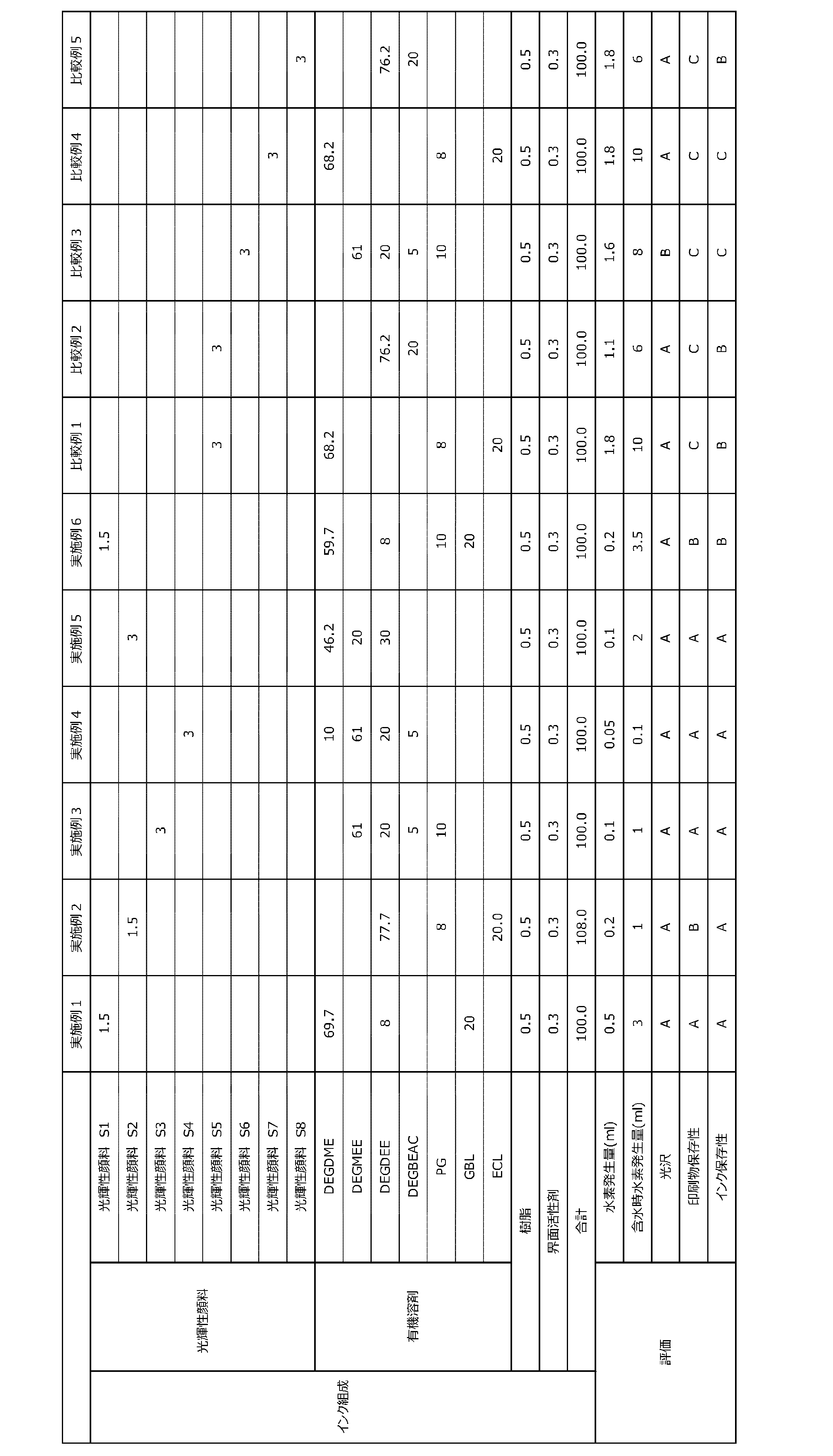
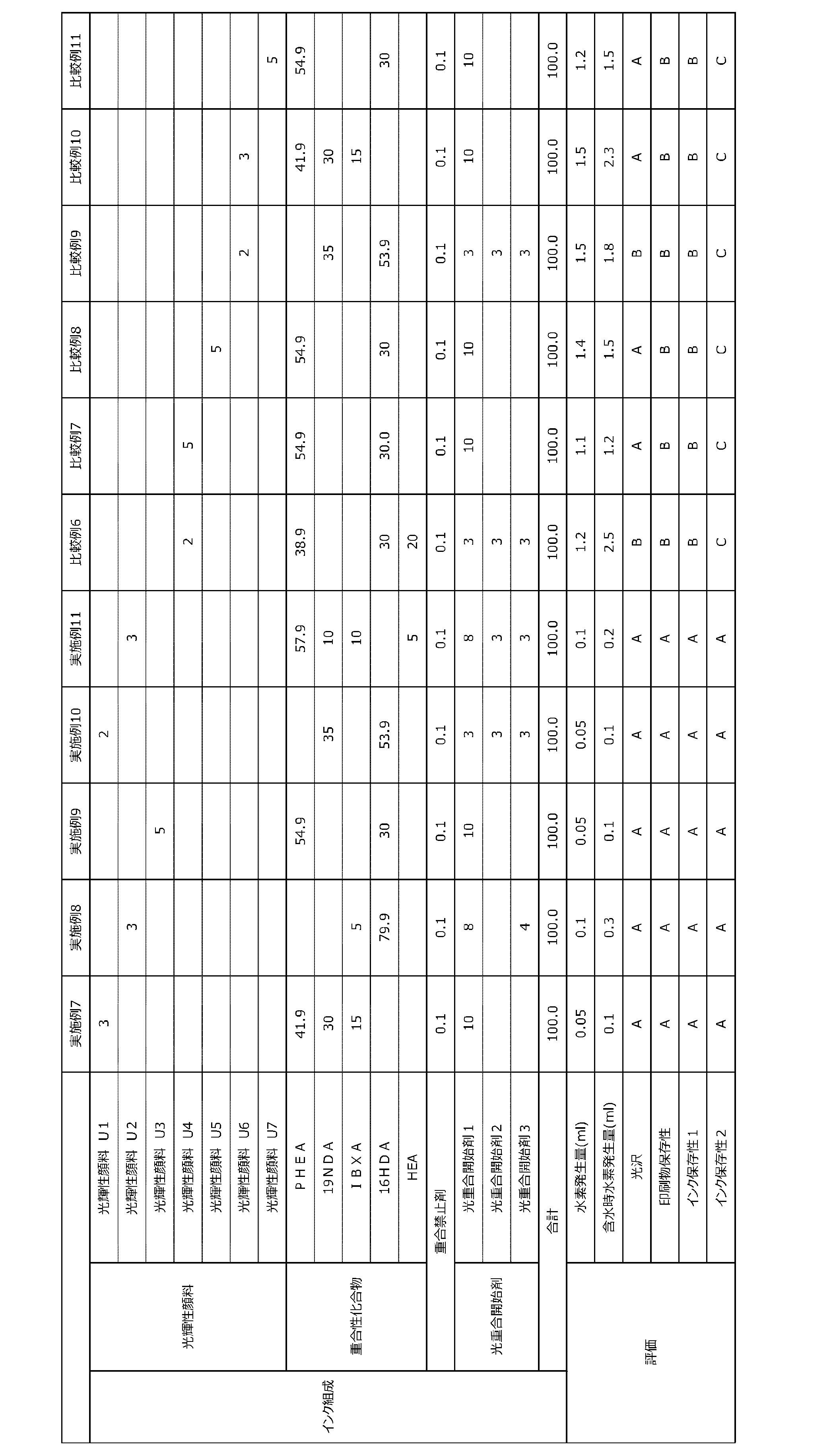
表1中、「DEGDME」とは、ジエチレングリコールジメチルエーテルである。
表1中、「DEGMEE」とは、ジエチレングリコールメチルエチルエーテルである。
表1中、「DEGDEE」とは、ジエチレングリコールジエチルエーテルである。
表1中、「DEGBEAC」とは、ジエチレングリコールジエチルエーテルアセテートである。
表1中、「PG」とは、プロピレングリコールである。
表1中、「GBL」とは、γ-ブチロラクトンである。
表1中、「ECL」とは、ε-カプロラクトンである。
表1中、「樹脂」とは、セルロースアセテートブチレート樹脂(CAB 関東化学社製)である。
表1中、「界面活性剤」とは、シリコーン系界面活性剤(信越シリコーン社製 KF-96-2cs)である。
表2中、「PHEA」とは、フェノキシエチルアクリレート(共栄社化学(株))である。
表2中、「19NDA」とは、1,9-ノナンジオールジアクリレート(共栄社化学(株))である。
表2中、「IBXA」とは、イソボルニルアクリレート(共栄社化学(株))である。
表2中、「16HDA」とは、1,6-ヘキサンジオールジアクリレート(共栄社化学(株))である。
表2中、「HEA」とは、ヒドロキシエチルアクリレート(大阪有機化学工業(株))である。
表2中、「重合禁止剤」とは、フェノチアジン(川口化学薬品工業社製、ANTAGE TDP)である。
表2中、「重合開始剤1」とは、2,4,6-トリメチルベンゾイル-ジフェニル-フォスフィンオキサイド(BASF社製 IRGACURE TPO)である。
表2中、「重合開始剤2」とは、2-ジメチルアミノ-2-(4-メチルベンジル)-1-(4-モルホリン-4-イル-フェニル)-ブタン-1-オン(IGM Resins社製のOmnirad 379EG)である。
表2中、「重合開始剤3」とは、2,4-ジエチルチオキサントン(Lambson社製、SpeedcureDETX)である。
3.評価
(1)水素発生量の測定
実施例及び比較例のインク組成物について水素発生量を測定した。具体的には、アルミラミネート5層構造材料からなる、ガス捕集用のサンプルバッグに、実施例及び比較例のインク組成物25g、乾燥空気200mlを入れて密封し、60℃で24時間保管した。そして、水素用検知管を装着したガス採取器により、上記サンプルバッグから、20mlの気体を採取し、検知管の表示からインク100g当たりの水素発生量を測定した(表中「水素発生量(ml)」と表記)。
(1)水素発生量の測定
実施例及び比較例のインク組成物について水素発生量を測定した。具体的には、アルミラミネート5層構造材料からなる、ガス捕集用のサンプルバッグに、実施例及び比較例のインク組成物25g、乾燥空気200mlを入れて密封し、60℃で24時間保管した。そして、水素用検知管を装着したガス採取器により、上記サンプルバッグから、20mlの気体を採取し、検知管の表示からインク100g当たりの水素発生量を測定した(表中「水素発生量(ml)」と表記)。
(2)含水時水素発生量の測定
実施例及び比較例のインク組成物について含水時水素発生量を測定した。具体的には、アルミラミネート5層構造材料からなる、ガス捕集用のサンプルバッグに、実施例及び比較例のインク組成物25g、水(イオン交換水)10g、乾燥空気200mlを入れて密封し、60℃で24時間保管した。そして、水素用検知管を装着したガス採取器により、上記サンプルバッグから、20mlの気体を採取し、検知管の表示からインク組成物100g当たりの水素発生量を測定した(表中「含水時水素発生量(ml)」と表記)。
実施例及び比較例のインク組成物について含水時水素発生量を測定した。具体的には、アルミラミネート5層構造材料からなる、ガス捕集用のサンプルバッグに、実施例及び比較例のインク組成物25g、水(イオン交換水)10g、乾燥空気200mlを入れて密封し、60℃で24時間保管した。そして、水素用検知管を装着したガス採取器により、上記サンプルバッグから、20mlの気体を採取し、検知管の表示からインク組成物100g当たりの水素発生量を測定した(表中「含水時水素発生量(ml)」と表記)。
(3)光沢評価
実施例及び比較例の非水性インク組成物を用いて得られた印刷物の光沢を評価した。具体的には、具体的には、実施例及び比較例の非水性インク組成物をインクジェット記録装置、富士フイルム(株)製「マテリアルプリンター DMP-2850」によって、PETフィルム(東洋紡(株)コスモシャインA4300)の表面に吐出し、活性エネルギー線硬化型インク組成物の場合は385nmLEDランプを照射して硬化を行い、非水性インク組成物の場合は印刷物を60℃に加温して乾燥することにより、印刷物を製造した。得られた印刷物について、コニカミノルタ社製マルチアングル測色系CM-M6を使用して図1に示すように、印刷面から45°の入射角で入射光を光輝性層に対して入射させ、その入射角に対する反射角から法線方向に15°角度を変更させた角度を測定角度として、その測定角度でのL*a*b*表色系におけるL*値を測定し、以下の評価基準により光沢を評価した(表中「光沢」と表記)。
評価基準
A:L*値が130以上であった。
B:L*値が110以上130未満であった。
C:L*値が110未満であった。
A、Bは実使用可能範囲内である。
実施例及び比較例の非水性インク組成物を用いて得られた印刷物の光沢を評価した。具体的には、具体的には、実施例及び比較例の非水性インク組成物をインクジェット記録装置、富士フイルム(株)製「マテリアルプリンター DMP-2850」によって、PETフィルム(東洋紡(株)コスモシャインA4300)の表面に吐出し、活性エネルギー線硬化型インク組成物の場合は385nmLEDランプを照射して硬化を行い、非水性インク組成物の場合は印刷物を60℃に加温して乾燥することにより、印刷物を製造した。得られた印刷物について、コニカミノルタ社製マルチアングル測色系CM-M6を使用して図1に示すように、印刷面から45°の入射角で入射光を光輝性層に対して入射させ、その入射角に対する反射角から法線方向に15°角度を変更させた角度を測定角度として、その測定角度でのL*a*b*表色系におけるL*値を測定し、以下の評価基準により光沢を評価した(表中「光沢」と表記)。
評価基準
A:L*値が130以上であった。
B:L*値が110以上130未満であった。
C:L*値が110未満であった。
A、Bは実使用可能範囲内である。
(4)印刷物保存性試験
実施例及び比較例のインク組成物を用いて得られた印刷物の印刷物保存性を評価した。具体的には、上記で得られた印刷物について温度60℃、湿度95%で500時間保管し、保管後の光沢を上記と同様に方法で測定し、L*値の差を求めた(表中「印刷物保存性」と表記)。
評価基準
A:L*値の差が10未満であった
B:L*値が10以上20未満であった。
C:L*値が20以上であった。
A、Bは実使用可能範囲内である。
実施例及び比較例のインク組成物を用いて得られた印刷物の印刷物保存性を評価した。具体的には、上記で得られた印刷物について温度60℃、湿度95%で500時間保管し、保管後の光沢を上記と同様に方法で測定し、L*値の差を求めた(表中「印刷物保存性」と表記)。
評価基準
A:L*値の差が10未満であった
B:L*値が10以上20未満であった。
C:L*値が20以上であった。
A、Bは実使用可能範囲内である。
(5)インク保存性試験1
実施例及び比較例のインク組成物(活性エネルギー線硬化型のインク組成物)の保存性を評価した。具体的には、実施例及び比較例のインク組成物を40℃で2週間静置保管し、試験後のインク組成物の粘度を測定した。粘度は、DIN EN ISO 12058-1に基づいて、落球粘度計を用いて40℃で粘度を測定した。初期の粘度をVa、2週間静置後の粘度をVbとしたときの粘度変化率(Vb-Va)/Va×100を求めた(表中「インク保存性1」と表記)。
評価基準
A:粘度変化率が5%未満であった
B:粘度変化率が5%以上10%未満であった。
C:粘度変化率が10%以上であった。
A、Bは使用可能範囲内である。
実施例及び比較例のインク組成物(活性エネルギー線硬化型のインク組成物)の保存性を評価した。具体的には、実施例及び比較例のインク組成物を40℃で2週間静置保管し、試験後のインク組成物の粘度を測定した。粘度は、DIN EN ISO 12058-1に基づいて、落球粘度計を用いて40℃で粘度を測定した。初期の粘度をVa、2週間静置後の粘度をVbとしたときの粘度変化率(Vb-Va)/Va×100を求めた(表中「インク保存性1」と表記)。
評価基準
A:粘度変化率が5%未満であった
B:粘度変化率が5%以上10%未満であった。
C:粘度変化率が10%以上であった。
A、Bは使用可能範囲内である。
(6)インク保存性試験2
実施例及び比較例のインク組成物の保存性を評価した。具体的には、実施例及び比較例のインク組成物を60℃で2週間静置保管し、試験後のインク組成物の粘度を測定した。粘度は、DIN EN ISO 12058-1に基づいて、落球粘度計を用いて実施例1~6及び比較例1~3は25℃で、実施例7~12及び比較例4~6は40℃で、粘度を測定した。初期の粘度をVa、2週間静置後の粘度をVbとしたときの粘度変化率(Vb-Va)/Va×100を求めた(表中「インク保存性2」と表記)。
評価基準
A:粘度変化率が5%未満であった
B:粘度変化率が5%以上10%未満であった。
C:粘度変化率が10%以上であった。
A、Bは実使用可能範囲内である。
実施例及び比較例のインク組成物の保存性を評価した。具体的には、実施例及び比較例のインク組成物を60℃で2週間静置保管し、試験後のインク組成物の粘度を測定した。粘度は、DIN EN ISO 12058-1に基づいて、落球粘度計を用いて実施例1~6及び比較例1~3は25℃で、実施例7~12及び比較例4~6は40℃で、粘度を測定した。初期の粘度をVa、2週間静置後の粘度をVbとしたときの粘度変化率(Vb-Va)/Va×100を求めた(表中「インク保存性2」と表記)。
評価基準
A:粘度変化率が5%未満であった
B:粘度変化率が5%以上10%未満であった。
C:粘度変化率が10%以上であった。
A、Bは実使用可能範囲内である。
上記表から分かるように、室温常圧環境下で測定されたインク組成物100g当たりの水素の発生量が1ml以下である実施例のインク組成物は、印刷物の光沢性が良好であり保存安定性の高いものであることが分かる。
一方、インク組成物100g当たりの水素の発生量が1ml超である比較例のインク組成物は、保存安定性が悪化しており、本発明の効果を奏するものとはなっていない。
また、水溶性の化合物により表面保護処理された光輝性顔料を含有する比較例のインク組成物では、インク組成物100g当たりの水素の発生量が1ml超となっており、光輝性顔料の表面を保護する保護層として水溶性の化合物を使用した場合には、光輝性顔料の酸化を抑制することができず、水素の発生を効果的に抑制できるものとなっていない。このことから、光輝性顔料の表面には保護層が形成(被覆)する場合には、保護層が疎水性化合物からなる層であることで、インク組成物100g当たりの水素の発生量を低減できることがわかる。
このように、光輝性顔料の種類を選択するか、光輝性顔料の表面を保護する保護層を設けるか、さらにその保護層を疎水性化合物からなる層にすることのいずれかの1つ以上の手段により、光輝性顔料を含有するインク組成物の水素の発生量を低減することが可能であるので、本明細書に接した当業者であれば、インク組成物の100g当たりの水素の発生量を1ml以下とするための技術的手段を明確に理解することが可能であり、当業者の通常の実験を行うことで水素の発生量を1ml以下となるようなインク組成物を調製することは可能である。水素の発生量を1ml以下に調整することにより、インクの保管安定性が良好で、且つ、印刷物の保存性が良好である、光輝性インク組成物とすることが可能である。
1 印刷物
Claims (8)
- インクジェット法によって吐出されるインク組成物であって、
前記インク組成物は、光輝性顔料を含有し、
室温常圧環境下で測定された前記インク組成物100g当たりの水素の発生量が1ml以下である
インク組成物。 - 活性エネルギー線硬化型のインク組成物である
請求項1に記載のインク組成物。 - 有機溶剤を含有する非水性のインク組成物である
請求項1に記載のインク組成物。 - 前記光輝性顔料は、金属含有光輝性顔料である
請求項1から3のいずれかに記載のインク組成物。 - 前記金属含有光輝性顔料は、アルミニウム及び/又はインジウムを含有する
請求項4に記載のインク組成物。 - インクジェット法によってインク組成物を吐出する記録方法であって、
前記インク組成物は、金属含有光輝性顔料を含有し、
室温常圧環境下で測定された前記インク組成物100g当たりの水素の発生量が1ml以下である
記録方法。 - インクジェット法によってインク組成物を吐出する印刷物の製造方法であって、
前記インク組成物は、光輝性顔料を含有し、
室温常圧環境下で測定された前記インク組成物100g当たりの水素の発生量が1ml以下である
印刷物の製造方法。 - インクジェット法によって吐出されるインク組成物の検査方法であって、
前記インク組成物は光輝性顔料を含有し、
室温常圧環境下で測定された前記インク組成物100g当たりの水素の発生量が1ml以下であるインク組成物を良と判定する
インク組成物の検査方法。
Priority Applications (2)
| Application Number | Priority Date | Filing Date | Title |
|---|---|---|---|
| EP21886399.1A EP4238770A4 (en) | 2020-10-30 | 2021-10-29 | INK COMPOSITION |
| US18/032,434 US12522739B2 (en) | 2020-10-30 | 2021-10-29 | Ink composition |
Applications Claiming Priority (4)
| Application Number | Priority Date | Filing Date | Title |
|---|---|---|---|
| JP2020-183013 | 2020-10-30 | ||
| JP2020183013 | 2020-10-30 | ||
| JP2020188816 | 2020-11-12 | ||
| JP2020-188816 | 2020-11-12 |
Publications (1)
| Publication Number | Publication Date |
|---|---|
| WO2022092282A1 true WO2022092282A1 (ja) | 2022-05-05 |
Family
ID=81213623
Family Applications (1)
| Application Number | Title | Priority Date | Filing Date |
|---|---|---|---|
| PCT/JP2021/040085 Ceased WO2022092282A1 (ja) | 2020-10-30 | 2021-10-29 | インク組成物 |
Country Status (4)
| Country | Link |
|---|---|
| US (1) | US12522739B2 (ja) |
| EP (1) | EP4238770A4 (ja) |
| JP (3) | JP7079873B2 (ja) |
| WO (1) | WO2022092282A1 (ja) |
Families Citing this family (1)
| Publication number | Priority date | Publication date | Assignee | Title |
|---|---|---|---|---|
| JP2024097097A (ja) * | 2021-04-28 | 2024-07-18 | ナトコ株式会社 | インクジェットインク、印刷物の製造方法、印刷物および金属顔料分散液 |
Citations (6)
| Publication number | Priority date | Publication date | Assignee | Title |
|---|---|---|---|---|
| JP2007126643A (ja) * | 2005-10-03 | 2007-05-24 | Dainichiseika Color & Chem Mfg Co Ltd | 真珠光沢顔料、その製造方法、塗料組成物および塗膜組成物 |
| JP2011157516A (ja) * | 2010-02-03 | 2011-08-18 | Showa Aluminum Powder Kk | 樹脂被覆金属顔料の製造方法 |
| JP2012162638A (ja) * | 2011-02-07 | 2012-08-30 | Toyo Aluminium Kk | 金属顔料組成物及びその製造方法 |
| JP2012207119A (ja) | 2011-03-29 | 2012-10-25 | Seiko Epson Corp | インクジェット用非水系インク組成物およびインクジェット記録方法 |
| JP2014141587A (ja) * | 2013-01-24 | 2014-08-07 | Seiko Epson Corp | 紫外線硬化型インクジェット用組成物および記録物 |
| JP2015108110A (ja) * | 2013-10-23 | 2015-06-11 | セイコーエプソン株式会社 | 顔料分散液及びそれを含有する溶剤系インク組成物 |
Family Cites Families (21)
| Publication number | Priority date | Publication date | Assignee | Title |
|---|---|---|---|---|
| JPS5345331A (en) | 1977-10-20 | 1978-04-24 | Asahi Chem Ind Co Ltd | Stabilization to leafing |
| US5322560A (en) * | 1993-08-31 | 1994-06-21 | Basf Corporation | Aluminum flake pigment treated with time release corrosion inhibiting compounds and coatings containing the same |
| JP2002121423A (ja) | 2000-10-12 | 2002-04-23 | Showa Aluminum Powder Kk | 樹脂被覆アルミニウム顔料およびその製造方法 |
| JP3581339B2 (ja) | 2001-08-02 | 2004-10-27 | メルク株式会社 | 高耐腐食性薄片状金属顔料、その製造方法、およびそれをベースとする金属光沢干渉発色顔料 |
| JP5475210B2 (ja) | 2004-12-24 | 2014-04-16 | メルク株式会社 | 高耐腐食性薄片状金属顔料、その製造方法、およびそれをベースとする金属光沢干渉発色顔料 |
| CN101278015B (zh) | 2005-10-03 | 2012-09-05 | 大日精化工业株式会社 | 珠光颜料及其制造方法、涂料组合物和多层涂层 |
| JP5435192B2 (ja) | 2008-07-29 | 2014-03-05 | セイコーエプソン株式会社 | 記録方法、記録物、インクジェット記録装置および識別方法 |
| JP5445730B2 (ja) * | 2008-08-11 | 2014-03-19 | セイコーエプソン株式会社 | インクジェット記録用光硬化型インク組成物 |
| JP2011140609A (ja) | 2009-04-07 | 2011-07-21 | Seiko Epson Corp | 耐水化アルミニウム顔料および耐水化アルミニウム顔料分散液、それらを含有する水性インク組成物、ならびに耐水化アルミニウム顔料分散液の製造方法 |
| DE102010020507A1 (de) * | 2010-05-14 | 2011-11-17 | Eckart Gmbh | Metall-Kationen und phosphor- und/oder schwefelhaltige Anionen aufweisende Metalleffektpigmente, Verfahren zur Herstellung dieser Metalleffektpigmente und Verwendung |
| JP5729005B2 (ja) | 2011-02-22 | 2015-06-03 | セイコーエプソン株式会社 | 光硬化型インク |
| WO2012117905A1 (ja) * | 2011-02-28 | 2012-09-07 | 富士フイルム株式会社 | インクジェット記録方法及び印刷物 |
| JP2013064053A (ja) | 2011-09-16 | 2013-04-11 | Seiko Epson Corp | 耐水化アルミニウム顔料分散液及びその製造方法、並びに水性インク組成物 |
| JP6191812B2 (ja) * | 2012-12-18 | 2017-09-06 | セイコーエプソン株式会社 | 液体収容体および液体収容体セット |
| JP5752201B2 (ja) * | 2013-09-30 | 2015-07-22 | 大日本塗料株式会社 | ポリ塩化ビニル基材用インクジェット印刷用メタリックインク組成物 |
| JP2016221771A (ja) | 2015-05-28 | 2016-12-28 | キヤノン株式会社 | 金属光沢画像記録方法 |
| JP6808917B2 (ja) | 2015-08-27 | 2021-01-06 | セイコーエプソン株式会社 | インクジェット組成物、収容体、及びインクジェット方法 |
| JP6580248B2 (ja) * | 2016-02-29 | 2019-09-25 | 富士フイルム株式会社 | インク組成物及び画像形成方法 |
| JP6580742B1 (ja) | 2018-03-29 | 2019-09-25 | 大日本塗料株式会社 | インク組成物 |
| US11203690B2 (en) | 2019-02-21 | 2021-12-21 | Oike & Co., Ltd. | Thin leaf-like indium particles and method for producing same, glitter pigment, and water-based paint and coating film |
| JP6754882B1 (ja) | 2019-11-14 | 2020-09-16 | 東洋インキScホールディングス株式会社 | 非水系インクジェットインキおよびその印刷物 |
-
2021
- 2021-04-16 JP JP2021069825A patent/JP7079873B2/ja active Active
- 2021-10-29 EP EP21886399.1A patent/EP4238770A4/en active Pending
- 2021-10-29 JP JP2021177792A patent/JP7038248B1/ja active Active
- 2021-10-29 US US18/032,434 patent/US12522739B2/en active Active
- 2021-10-29 WO PCT/JP2021/040085 patent/WO2022092282A1/ja not_active Ceased
-
2022
- 2022-02-07 JP JP2022017086A patent/JP7038268B1/ja active Active
Patent Citations (6)
| Publication number | Priority date | Publication date | Assignee | Title |
|---|---|---|---|---|
| JP2007126643A (ja) * | 2005-10-03 | 2007-05-24 | Dainichiseika Color & Chem Mfg Co Ltd | 真珠光沢顔料、その製造方法、塗料組成物および塗膜組成物 |
| JP2011157516A (ja) * | 2010-02-03 | 2011-08-18 | Showa Aluminum Powder Kk | 樹脂被覆金属顔料の製造方法 |
| JP2012162638A (ja) * | 2011-02-07 | 2012-08-30 | Toyo Aluminium Kk | 金属顔料組成物及びその製造方法 |
| JP2012207119A (ja) | 2011-03-29 | 2012-10-25 | Seiko Epson Corp | インクジェット用非水系インク組成物およびインクジェット記録方法 |
| JP2014141587A (ja) * | 2013-01-24 | 2014-08-07 | Seiko Epson Corp | 紫外線硬化型インクジェット用組成物および記録物 |
| JP2015108110A (ja) * | 2013-10-23 | 2015-06-11 | セイコーエプソン株式会社 | 顔料分散液及びそれを含有する溶剤系インク組成物 |
Non-Patent Citations (1)
| Title |
|---|
| See also references of EP4238770A4 |
Also Published As
| Publication number | Publication date |
|---|---|
| JP7038268B1 (ja) | 2022-03-17 |
| EP4238770A1 (en) | 2023-09-06 |
| EP4238770A4 (en) | 2024-09-04 |
| JP7079873B2 (ja) | 2022-06-02 |
| JP2022074155A (ja) | 2022-05-17 |
| JP2022074128A (ja) | 2022-05-17 |
| JP2022073899A (ja) | 2022-05-17 |
| US12522739B2 (en) | 2026-01-13 |
| JP7038248B1 (ja) | 2022-03-17 |
| US20230392031A1 (en) | 2023-12-07 |
Similar Documents
| Publication | Publication Date | Title |
|---|---|---|
| US9296908B2 (en) | Aqueous inkjet ink composition | |
| US8227539B2 (en) | Photocurable ink composition and inkjet recording method | |
| JP5644208B2 (ja) | インクジェット用記録媒体 | |
| JP5170384B2 (ja) | インクジェット記録方法 | |
| JP6366669B2 (ja) | インクジェットインクセット、プリント物の製造方法およびプリント物 | |
| JP7038268B1 (ja) | インク組成物 | |
| JP7029015B1 (ja) | 非水性インク組成物 | |
| JP7029014B1 (ja) | インク組成物 | |
| JP6992207B1 (ja) | 印刷物及びインク組成物 | |
| WO2022092280A1 (ja) | インク組成物 | |
| JP7847441B2 (ja) | 水性分散体ならびに水性インク | |
| JP7501295B2 (ja) | 画像形成方法 | |
| JP7406364B2 (ja) | 紫外線硬化型インクジェットインクセットおよびプリント物の製造方法 | |
| US20230227679A1 (en) | Yellow ink for ink jet, image recording method, and image recorded article | |
| JP7166104B2 (ja) | インクジェットインクセット、プリント物およびプリント物の製造方法 | |
| WO2022092272A1 (ja) | インク組成物 | |
| JP7853523B1 (ja) | インク組成物、顔料分散液、インクセット、印刷物、インクジェット記録装置、記録方法、及び印刷物の製造方法 | |
| JP7145270B2 (ja) | インク組成物 | |
| JP2022097872A (ja) | 積層体の製造方法 | |
| JP2024176916A (ja) | インク組成物、印刷物、インクジェット記録装置、記録方法、及び印刷物の製造方法 | |
| JP2025167711A (ja) | インクセット |
Legal Events
| Date | Code | Title | Description |
|---|---|---|---|
| 121 | Ep: the epo has been informed by wipo that ep was designated in this application |
Ref document number: 21886399 Country of ref document: EP Kind code of ref document: A1 |
|
| NENP | Non-entry into the national phase |
Ref country code: DE |
|
| ENP | Entry into the national phase |
Ref document number: 2021886399 Country of ref document: EP Effective date: 20230530 |
|
| WWG | Wipo information: grant in national office |
Ref document number: 18032434 Country of ref document: US |