WO2022094319A1 - Stat-activated macrophages, compositions, and uses thereof - Google Patents
Stat-activated macrophages, compositions, and uses thereof Download PDFInfo
- Publication number
- WO2022094319A1 WO2022094319A1 PCT/US2021/057418 US2021057418W WO2022094319A1 WO 2022094319 A1 WO2022094319 A1 WO 2022094319A1 US 2021057418 W US2021057418 W US 2021057418W WO 2022094319 A1 WO2022094319 A1 WO 2022094319A1
- Authority
- WO
- WIPO (PCT)
- Prior art keywords
- macrophages
- inhibitor
- stat
- another aspect
- subject
- Prior art date
- Legal status (The legal status is an assumption and is not a legal conclusion. Google has not performed a legal analysis and makes no representation as to the accuracy of the status listed.)
- Ceased
Links
Classifications
-
- A—HUMAN NECESSITIES
- A61—MEDICAL OR VETERINARY SCIENCE; HYGIENE
- A61K—PREPARATIONS FOR MEDICAL, DENTAL OR TOILETRY PURPOSES
- A61K40/00—Cellular immunotherapy
- A61K40/10—Cellular immunotherapy characterised by the cell type used
- A61K40/17—Monocytes; Macrophages
-
- A—HUMAN NECESSITIES
- A61—MEDICAL OR VETERINARY SCIENCE; HYGIENE
- A61P—SPECIFIC THERAPEUTIC ACTIVITY OF CHEMICAL COMPOUNDS OR MEDICINAL PREPARATIONS
- A61P35/00—Antineoplastic agents
-
- A—HUMAN NECESSITIES
- A61—MEDICAL OR VETERINARY SCIENCE; HYGIENE
- A61K—PREPARATIONS FOR MEDICAL, DENTAL OR TOILETRY PURPOSES
- A61K31/00—Medicinal preparations containing organic active ingredients
- A61K31/33—Heterocyclic compounds
- A61K31/395—Heterocyclic compounds having nitrogen as a ring hetero atom, e.g. guanethidine or rifamycins
- A61K31/41—Heterocyclic compounds having nitrogen as a ring hetero atom, e.g. guanethidine or rifamycins having five-membered rings with two or more ring hetero atoms, at least one of which being nitrogen, e.g. tetrazole
- A61K31/42—Oxazoles
-
- A—HUMAN NECESSITIES
- A61—MEDICAL OR VETERINARY SCIENCE; HYGIENE
- A61K—PREPARATIONS FOR MEDICAL, DENTAL OR TOILETRY PURPOSES
- A61K31/00—Medicinal preparations containing organic active ingredients
- A61K31/33—Heterocyclic compounds
- A61K31/395—Heterocyclic compounds having nitrogen as a ring hetero atom, e.g. guanethidine or rifamycins
- A61K31/435—Heterocyclic compounds having nitrogen as a ring hetero atom, e.g. guanethidine or rifamycins having six-membered rings with one nitrogen as the only ring hetero atom
- A61K31/47—Quinolines; Isoquinolines
- A61K31/4709—Non-condensed quinolines and containing further heterocyclic rings
-
- A—HUMAN NECESSITIES
- A61—MEDICAL OR VETERINARY SCIENCE; HYGIENE
- A61K—PREPARATIONS FOR MEDICAL, DENTAL OR TOILETRY PURPOSES
- A61K31/00—Medicinal preparations containing organic active ingredients
- A61K31/33—Heterocyclic compounds
- A61K31/395—Heterocyclic compounds having nitrogen as a ring hetero atom, e.g. guanethidine or rifamycins
- A61K31/55—Heterocyclic compounds having nitrogen as a ring hetero atom, e.g. guanethidine or rifamycins having seven-membered rings, e.g. azelastine, pentylenetetrazole
-
- A—HUMAN NECESSITIES
- A61—MEDICAL OR VETERINARY SCIENCE; HYGIENE
- A61K—PREPARATIONS FOR MEDICAL, DENTAL OR TOILETRY PURPOSES
- A61K35/00—Medicinal preparations containing materials or reaction products thereof with undetermined constitution
- A61K35/12—Materials from mammals; Compositions comprising non-specified tissues or cells; Compositions comprising non-embryonic stem cells; Genetically modified cells
- A61K35/14—Blood; Artificial blood
- A61K35/15—Cells of the myeloid line, e.g. granulocytes, basophils, eosinophils, neutrophils, leucocytes, monocytes, macrophages or mast cells; Myeloid precursor cells; Antigen-presenting cells, e.g. dendritic cells
-
- A—HUMAN NECESSITIES
- A61—MEDICAL OR VETERINARY SCIENCE; HYGIENE
- A61K—PREPARATIONS FOR MEDICAL, DENTAL OR TOILETRY PURPOSES
- A61K40/00—Cellular immunotherapy
- A61K40/40—Cellular immunotherapy characterised by antigens that are targeted or presented by cells of the immune system
- A61K40/41—Vertebrate antigens
- A61K40/42—Cancer antigens
-
- A—HUMAN NECESSITIES
- A61—MEDICAL OR VETERINARY SCIENCE; HYGIENE
- A61K—PREPARATIONS FOR MEDICAL, DENTAL OR TOILETRY PURPOSES
- A61K40/00—Cellular immunotherapy
- A61K40/40—Cellular immunotherapy characterised by antigens that are targeted or presented by cells of the immune system
- A61K40/41—Vertebrate antigens
- A61K40/42—Cancer antigens
- A61K40/4238—Regulators of development
- A61K40/424—Apoptosis related proteins, e.g. survivin or livin
- A61K40/4241—Apoptosis related proteins, e.g. survivin or livin p53
-
- A—HUMAN NECESSITIES
- A61—MEDICAL OR VETERINARY SCIENCE; HYGIENE
- A61K—PREPARATIONS FOR MEDICAL, DENTAL OR TOILETRY PURPOSES
- A61K40/00—Cellular immunotherapy
- A61K40/40—Cellular immunotherapy characterised by antigens that are targeted or presented by cells of the immune system
- A61K40/41—Vertebrate antigens
- A61K40/42—Cancer antigens
- A61K40/4244—Enzymes
- A61K40/4245—Tyrosinase or tyrosinase related proteinases [TRP-1 or TRP-2]
-
- A—HUMAN NECESSITIES
- A61—MEDICAL OR VETERINARY SCIENCE; HYGIENE
- A61K—PREPARATIONS FOR MEDICAL, DENTAL OR TOILETRY PURPOSES
- A61K40/00—Cellular immunotherapy
- A61K40/40—Cellular immunotherapy characterised by antigens that are targeted or presented by cells of the immune system
- A61K40/41—Vertebrate antigens
- A61K40/42—Cancer antigens
- A61K40/4256—Tumor associated carbohydrates
- A61K40/4257—Mucins, e.g. MUC-1
-
- A—HUMAN NECESSITIES
- A61—MEDICAL OR VETERINARY SCIENCE; HYGIENE
- A61K—PREPARATIONS FOR MEDICAL, DENTAL OR TOILETRY PURPOSES
- A61K40/00—Cellular immunotherapy
- A61K40/40—Cellular immunotherapy characterised by antigens that are targeted or presented by cells of the immune system
- A61K40/41—Vertebrate antigens
- A61K40/42—Cancer antigens
- A61K40/4264—Cancer antigens from embryonic or fetal origin
- A61K40/4265—Alpha-feto protein
-
- A—HUMAN NECESSITIES
- A61—MEDICAL OR VETERINARY SCIENCE; HYGIENE
- A61K—PREPARATIONS FOR MEDICAL, DENTAL OR TOILETRY PURPOSES
- A61K40/00—Cellular immunotherapy
- A61K40/40—Cellular immunotherapy characterised by antigens that are targeted or presented by cells of the immune system
- A61K40/41—Vertebrate antigens
- A61K40/42—Cancer antigens
- A61K40/4264—Cancer antigens from embryonic or fetal origin
- A61K40/4266—Carcinoembryonic antigen [CEA]
-
- A—HUMAN NECESSITIES
- A61—MEDICAL OR VETERINARY SCIENCE; HYGIENE
- A61K—PREPARATIONS FOR MEDICAL, DENTAL OR TOILETRY PURPOSES
- A61K40/00—Cellular immunotherapy
- A61K40/40—Cellular immunotherapy characterised by antigens that are targeted or presented by cells of the immune system
- A61K40/41—Vertebrate antigens
- A61K40/42—Cancer antigens
- A61K40/4267—Cancer testis antigens, e.g. SSX, BAGE, GAGE or SAGE
- A61K40/4268—MAGE
-
- A—HUMAN NECESSITIES
- A61—MEDICAL OR VETERINARY SCIENCE; HYGIENE
- A61K—PREPARATIONS FOR MEDICAL, DENTAL OR TOILETRY PURPOSES
- A61K40/00—Cellular immunotherapy
- A61K40/40—Cellular immunotherapy characterised by antigens that are targeted or presented by cells of the immune system
- A61K40/41—Vertebrate antigens
- A61K40/42—Cancer antigens
- A61K40/4267—Cancer testis antigens, e.g. SSX, BAGE, GAGE or SAGE
- A61K40/4269—NY-ESO
-
- A—HUMAN NECESSITIES
- A61—MEDICAL OR VETERINARY SCIENCE; HYGIENE
- A61K—PREPARATIONS FOR MEDICAL, DENTAL OR TOILETRY PURPOSES
- A61K40/00—Cellular immunotherapy
- A61K40/40—Cellular immunotherapy characterised by antigens that are targeted or presented by cells of the immune system
- A61K40/41—Vertebrate antigens
- A61K40/42—Cancer antigens
- A61K40/4271—Melanoma antigens
-
- A—HUMAN NECESSITIES
- A61—MEDICAL OR VETERINARY SCIENCE; HYGIENE
- A61K—PREPARATIONS FOR MEDICAL, DENTAL OR TOILETRY PURPOSES
- A61K40/00—Cellular immunotherapy
- A61K40/40—Cellular immunotherapy characterised by antigens that are targeted or presented by cells of the immune system
- A61K40/41—Vertebrate antigens
- A61K40/42—Cancer antigens
- A61K40/4271—Melanoma antigens
- A61K40/4272—Melan-A/MART
-
- A—HUMAN NECESSITIES
- A61—MEDICAL OR VETERINARY SCIENCE; HYGIENE
- A61K—PREPARATIONS FOR MEDICAL, DENTAL OR TOILETRY PURPOSES
- A61K40/00—Cellular immunotherapy
- A61K40/40—Cellular immunotherapy characterised by antigens that are targeted or presented by cells of the immune system
- A61K40/41—Vertebrate antigens
- A61K40/42—Cancer antigens
- A61K40/4274—Prostate associated antigens e.g. Prostate stem cell antigen [PSCA]; Prostate carcinoma tumor antigen [PCTA]; Prostatic acid phosphatase [PAP]; Prostate-specific G-protein-coupled receptor [PSGR]
- A61K40/4276—Prostate specific membrane antigen [PSMA]
-
- A—HUMAN NECESSITIES
- A61—MEDICAL OR VETERINARY SCIENCE; HYGIENE
- A61K—PREPARATIONS FOR MEDICAL, DENTAL OR TOILETRY PURPOSES
- A61K45/00—Medicinal preparations containing active ingredients not provided for in groups A61K31/00 - A61K41/00
- A61K45/06—Mixtures of active ingredients without chemical characterisation, e.g. antiphlogistics and cardiaca
-
- C—CHEMISTRY; METALLURGY
- C12—BIOCHEMISTRY; BEER; SPIRITS; WINE; VINEGAR; MICROBIOLOGY; ENZYMOLOGY; MUTATION OR GENETIC ENGINEERING
- C12N—MICROORGANISMS OR ENZYMES; COMPOSITIONS THEREOF; PROPAGATING, PRESERVING, OR MAINTAINING MICROORGANISMS; MUTATION OR GENETIC ENGINEERING; CULTURE MEDIA
- C12N5/00—Undifferentiated human, animal or plant cells, e.g. cell lines; Tissues; Cultivation or maintenance thereof; Culture media therefor
- C12N5/06—Animal cells or tissues; Human cells or tissues
- C12N5/0602—Vertebrate cells
- C12N5/0634—Cells from the blood or the immune system
- C12N5/0645—Macrophages, e.g. Kuepfer cells in the liver; Monocytes
-
- A—HUMAN NECESSITIES
- A61—MEDICAL OR VETERINARY SCIENCE; HYGIENE
- A61K—PREPARATIONS FOR MEDICAL, DENTAL OR TOILETRY PURPOSES
- A61K39/00—Medicinal preparations containing antigens or antibodies
- A61K2039/51—Medicinal preparations containing antigens or antibodies comprising whole cells, viruses or DNA/RNA
- A61K2039/515—Animal cells
- A61K2039/5154—Antigen presenting cells [APCs], e.g. dendritic cells or macrophages
-
- C—CHEMISTRY; METALLURGY
- C12—BIOCHEMISTRY; BEER; SPIRITS; WINE; VINEGAR; MICROBIOLOGY; ENZYMOLOGY; MUTATION OR GENETIC ENGINEERING
- C12N—MICROORGANISMS OR ENZYMES; COMPOSITIONS THEREOF; PROPAGATING, PRESERVING, OR MAINTAINING MICROORGANISMS; MUTATION OR GENETIC ENGINEERING; CULTURE MEDIA
- C12N2501/00—Active agents used in cell culture processes, e.g. differentation
- C12N2501/20—Cytokines; Chemokines
- C12N2501/23—Interleukins [IL]
- C12N2501/2304—Interleukin-4 (IL-4)
-
- C—CHEMISTRY; METALLURGY
- C12—BIOCHEMISTRY; BEER; SPIRITS; WINE; VINEGAR; MICROBIOLOGY; ENZYMOLOGY; MUTATION OR GENETIC ENGINEERING
- C12N—MICROORGANISMS OR ENZYMES; COMPOSITIONS THEREOF; PROPAGATING, PRESERVING, OR MAINTAINING MICROORGANISMS; MUTATION OR GENETIC ENGINEERING; CULTURE MEDIA
- C12N2501/00—Active agents used in cell culture processes, e.g. differentation
- C12N2501/20—Cytokines; Chemokines
- C12N2501/23—Interleukins [IL]
- C12N2501/2313—Interleukin-13 (IL-13)
Definitions
- This disclosure provides signal transducer and activator of transcription (STAT)-activated macrophages, compositions comprising STAT-activated macrophages, methods of making STAT-activated macrophages, and methods of treating diseases, e.g., cancer, by administering a therapeutically effective amount of STAT-activated macrophages or a pharmaceutical composition comprising STAT-activated macrophages.
- STAT signal transducer and activator of transcription
- Ml macrophages also actively scan the tumor microenvironment (TME) for tumor-associated antigens (TAA) and present them to CD8 T-cells to elicit anti-tumor immunity.
- TME tumor microenvironment
- TAA tumor-associated antigens
- the present disclosure provides a method of treating a subject in need thereof comprising administering to the subject a therapeutically effective amount of STAT-activated macrophages or a composition comprising STAT-activated macrophages, wherein the subject has cancer, pulmonary fibrosis, liver fibrosis, or heart fibrosis.
- the present disclosure provides STAT-activated macrophages.
- STAT-activated macrophages are produced from naive macrophages that have been isolated from a subject and treated ex vivo one time with a STAT inhibitor.
- the STAT-activated macrophages are produced from naive macrophages that have been isolated from a subject and treated ex vivo with a STAT inhibitor and a selective HDAC6 inhibitor.
- the isolated naive macrophages are treated with the STAT inhibitor before treatment with the selective HDAC6 inhibitor.
- the isolated naive macrophages are treated with the STAT inhibitor after treatment with the selective HDAC6 inhibitor.
- the isolated naive macrophages are simultaneously treated with the STAT inhibitor and the selective HDAC6 inhibitor.
- the ex vivo treatment with selective HDAC6 inhibitor is for 72 hours or less, e.g., 48 hours or less, 36 hours or less, 24 hours or less, 12 hours or less, 8 hours or less, 6 hours or less, 5 hours or less, 4 hours or less, 3 hours or less, 2 hours or less, 1 hour or less, or 30 minutes or less.
- composition may be formulated for parenteral, systemic, intracavitary, intravenous, intra-arterial, intramuscular, intrathecal, intraocular, intraconjunctival, intratumoral, subcutaneous, intradermal, intrathecal, oral or transdermal routes of administration which may include injection or infusion.
- compositions comprising STAT-activated macrophages are formulated for intratumoral or intravenous administration, e.g., for macrophage-directed cancer immunotherapy. See, e.g., Mills et al., Cancer Research 76:513-516 (2016); Lee et al., J Control Release 240'.521 -540 (2016).
- methods are provided for the production of pharmaceutically useful compositions, such methods of production may comprise one or more steps selected from isolating/purifying STAT-activated macrophages produced according to the methods described herein; and/or mixing STAT-activated macrophages produced according with a pharmaceutically acceptable carrier, adjuvant, excipient or diluent.
- the present disclosure provides methods of producing STAT-activated macrophages, the methods comprising isolating naive macrophages from a subject and treating the isolated naive macrophages ex vivo with a STAT inhibitor.
- the subject is a mammal.
- the subject is a human.
- the naive macrophages are allogeneic macrophages, autologous macrophages, or a combination of allogeneic macrophages and autologous macrophages.
- the naive macrophages are allogeneic macrophages.
- the naive macrophages are autologous macrophages.
- the STAT3 inhibitor is 6-nitrobenzo[b]thiophene- 1,1 -di oxide (Stattic).
- the STAT-activated macrophages are produced from naive macrophages that have been isolated from a subject and treated ex vivo with a STAT inhibitor and a macrophage polarizing agent.
- the macrophage polarizing agent comprises lipopolysaccharide (LPS), interferon-gamma, interleukin-4, or interleukin-13, or a combination thereof.
- the isolated naive macrophages are treated with the STAT inhibitor before treatment with the macrophage polarizing agent.
- the isolated naive macrophages are treated with the STAT inhibitor after treatment with the macrophage polarizing agent.
- the STAT-activated macrophages are produced from naive macrophages that have been isolated from a subject and treated ex vivo with a STAT inhibitor and a tumor antigen.
- the antigen comprises alphafetoprotein (AFP), carcinoembryonic antigen (CEA), cancer antigen 125 (CA-125), cancer antigen 15- 3 (CA 15-3), cancer antigen 19-9 (CA 19-9), mucin 1 (MUC-1), epithelial tumor antigen (ETA), tyrosinase, or melanoma-associated antigen (MAGE), B melanoma antigen (BAGE), CAGE, New York esophageal squamous cell carcinoma 1 (NY-ESO-1), melanoma antigen recognized by T cells 1 (MART-1), prostate specific antigen (PSA), human epidermal growth factor receptor 2 (HER2), calcitonin, p53, or a combination thereof.
- AFP alphafetoprotein
- CEA car
- the antigen comprises alphafetoprotein (AFP), carcinoembryonic antigen (CEA), CA-125, MUC-1, epithelial tumor antigen (ETA), tyrosinase, Melanoma-associated antigen (MAGE), or p53, or a combination thereof.
- the isolated naive macrophages are treated with the STAT inhibitor before treatment with the tumor antigen.
- the isolated naive macrophages are treated with the STAT inhibitor after treatment with the tumor antigen.
- the isolated naive macrophages are simultaneously treated with the STAT inhibitor and the tumor antigen.
- the isolated naive macrophages are treated with the tumor antigen for 72 hours or less, e.g., 48 hours or less, 36 hours or less, 24 hours or less, 12 hours or less, 8 hours or less, 6 hours or less, 5 hours or less, 4 hours or less, 3 hours or less, 2 hours or less, 1 hour or less, or 30 minutes or less.
- the selective HDAC6 inhibitor is a compound of Formula I, or a pharmaceutically acceptable salt thereof. See above.
- R 6a , R 6b , R 6c , R 6d , and R 6e are each independently selected from the group consisting of hydrogen, halogen, cyano, Ci-4 alkyl, and Ci-4 alkoxy.
- n is 1.
- n is 2.
- n can be 3.
- R 7a , R 7b , R 7c , R 7d , and R 7e are each independently selected from the group consisting of hydrogen, halogen, cyano, Ci-4 alkyl, and Ci-4 alkoxy.
- n is 1. In another aspect, n is 2. In another aspect, n is 3.
- the selective HDAC6 inhibitor is at least 20-fold selective over one or more other HDAC isoforms, e g., HDAC1, HDAC2, HDAC3, HDAC4, HDAC5, HDAC7, HDAC8, HDAC9, HDAC 10, or HDACl l.
- the present disclosure provides methods of treating or preventing a disease or disorder in a subject in need thereof, the methods comprising:
- the present disclosure provides methods of treating or preventing a disease or disorder in a subject in need thereof, the methods comprising:
- the subject from which the naive macrophages are isolated is the subject administered with STAT-activated macrophages, i.e., adoptive transfer is of autologous cells.
- the subject from which the naive macrophages are isolated is a different subject than the subject to which the STAT-activated macrophages are administered, i.e., adoptive transfer is of allogenic cells.
- methods of treating or preventing a disease or disorder in a subject comprise one or more of the following steps: taking a biological sample from the subject; isolating naive macrophages from the biological sample; treating the naive macrophages ex vivo with a STAT inhibitor; treating the treated macrophages with a macrophage polarizing agent; treating the treated macrophages with a tumor antigen; treating the treated macrophages with a selective HDAC6 inhibitor; collecting the STAT-activated macrophages; mixing the STAT-activated macrophages with an adjuvant, diluent, or carrier; administering the STAT-activated macrophages or composition thereof to the subject.
- the disease or disorder to be treated/prevented is pulmonary fibrosis.
- the disease or disorder to be treated/prevented is liver fibrosis.
- the disease or disorder to be treated/prevented is heart fibrosis.
- the disease or disorder to be treated/prevented is cancer.
- STAT-activated macrophages and pharmaceutical compositions comprising STAT-activated macrophages are capable of treating or preventing a cancer, e.g. inhibit the development/progression of the cancer, delay/prevent onset of the cancer, reduce/delay/prevent tumor growth, reduce/delay/prevent metastasis, reduce the severity of the symptoms of the cancer, reduce the number of cancer cells, reduce tumor size/volume, and/or increase survival (e.g. progression free survival).
- Exemplary hematological cancers include, but are not limited to, the cancers listed in Table 4.
- the hematological cancer is acute lymphocytic leukemia, chronic lymphocytic leukemia (including B-cell chronic lymphocytic leukemia), or acute myeloid leukemia.
- Multiple doses may be separated by a predetermined time interval, which may be selected to be one of 1, 2, 3, 4, 5, 6, 7, 8, 9, 10, 11, 12,13, 14, 15, 16, 17, 18, 19, 20, 21, 22, 23, 24, 25, 26, 27, 28, 29, 30, or 31 days, or 1, 2, 3, 4, 5, 6, 7, 8, 9, 10, 11, or 12 months.
- doses may be given once every 7, 14, 21 or 28 days (plus or minus 3, 2, or 1 days).
- the present disclosure provides the method further comprising administering to a subject one or more of local radiation therapy, immune checkpoint blockade therapy, photothermal therapy, or chemotherapy.
- HDAC6 inhibitors are included in the present disclosure.
- R a and R b taken together with the nitrogen atom to which they are attached form a 3- to 10-membered heterocyclo
- R 6a , R 6b , R 6c , R 6d , and R 6e are each independently selected from the group consisting of hydrogen, halogen, cyano, Ci-4 alkyl, and Ci-4 alkoxy.
- the present disclosure provides that the selective HDAC6 inhibitor is a compound of Formula I, or a pharmaceutically acceptable salt thereof, wherein n is 1. In another aspect, n is 2. In another aspect, n is 3.
- R 4C and R 4d are independently selected from the group consisting of hydrogen and methyl; m is 0 or 1; n is 1, 2, or 3; and represents a single or double bond.
- the source of radiation can be external or internal to the subject.
- External radiation therapy is most common and involves directing a beam of high-energy radiation to a tumor site through the skin using, for instance, a linear accelerator. While the beam of radiation is localized to the tumor site, it is nearly impossible to avoid exposure of normal, healthy tissue. However, external radiation is usually well tolerated by subjects.
- Internal radiation therapy involves implanting a radiation-emitting source, such as beads, wires, pellets, capsules, particles, and the like, inside the body at or near the tumor site including the use of delivery systems that specifically target cancer cells e.g., using particles attached to cancer cell binding ligands). Such implants can be removed following treatment, or left in the body inactive.
- Types of internal radiation therapy include, but are not limited to, brachytherapy, interstitial irradiation, intracavity irradiation, radioimmunotherapy, and the like.
- any type of radiation can be administered to a subject, so long as the dose of radiation is tolerated by the subject without unacceptable negative side-effects.
- Suitable types of radiotherapy include, for example, ionizing (electromagnetic) radiotherapy (e.g., X-rays or gamma rays) or particle beam radiation therapy (e.g., high linear energy radiation).
- Ionizing radiation is defined as radiation comprising particles or photons that have sufficient energy to produce ionization, i.e., gain or loss of electrons (as described in, for example, U.S. 5,770,581 incorporated herein by reference in its entirety).
- the effects of radiation can be at least partially controlled by the clinician.
- the dose of radiation is fractionated for maximal target cell exposure and reduced toxicity.
- the total dose of radiation administered to a subject is about .01 Gray (Gy) to about 100 Gy.
- about 10 Gy to about 65 Gy e.g., about 15 Gy, 20 Gy, 25 Gy, 30 Gy, 35 Gy, 40 Gy, 45 Gy, 50 Gy, 55 Gy, or 60 Gy
- a complete dose of radiation can be administered over the course of one day
- the total dose is ideally fractionated and administered over several days.
- radiotherapy is administered over the course of at least about 3 days, e.g, at least 3, 4, 5, 7, 10, 14, 17, 21, 25, 28, 32, 35, 38, 42, 46, 52, or 56 days (about 1-8 weeks).
- radiation is administered 1 day/week, 2 days/week, 3 days/week, 4 days/week, 5 days/week, 6 days/week, or all 7 days/week, depending on the mammal's responsiveness and any potential side effects.
- Radiation therapy can be initiated at any time in the therapeutic period.
- radiation is initiated in week 1 or week 2, and is administered for the remaining duration of the therapeutic period.
- radiation is administered in weeks 1-6 or in weeks 2-6 of a therapeutic period comprising 6 weeks for treating, for instance, a solid tumor.
- radiation is administered in weeks 1-5 or weeks 2-5 of a therapeutic period comprising 5 weeks.
- the modulation of immune system pathways may involve changing the expression or the functional activity of at least one component of the pathway to then modulate the response by the immune system.
- immune checkpoint inhibitors include PD-1 inhibitors, PD-L1 inhibitors, CTLA-4 inhibitors, LAG3 inhibitors, TIM3 inhibitors, cd47 inhibitors, and B7-H1 inhibitors.
- the immune checkpoint inhibitor is selected from the group consisting of a PD-1 inhibitor, a PD-L1 inhibitor, a CTLA-4 inhibitor, a LAG3 inhibitor, a TIM3 inhibitor, and a cd47 inhibitor.
- the immune checkpoint inhibitor is a programmed cell death protein (PD-1) inhibitor.
- PD-1 is a T-cell coinhibitory receptor that plays a pivotal role in the ability of tumor cells to evade the host's immune system. Blockage of interactions between PD-1 and PD-L1, a ligand of PD-1, enhances immune function and mediates antitumor activity.
- PD-1 inhibitors include antibodies that specifically bind to PD-1. Particular anti-PD-1 antibodies include, but are not limited to, nivolumab, pembrolizumab, STI-A1014, and pidilzumab.
- the immune checkpoint inhibitor is a CTLA-4 inhibitor.
- CTLA-4 also known as cytotoxic T-lymphocyte antigen 4
- CTLA-4 is a protein receptor that downregulates the immune system.
- CTLA-4 is characterized as a "brake” that binds costimulatory molecules on antigen-presenting cells, which prevents interaction with CD28 on T cells and also generates an overtly inhibitory signal that constrains T cell activation.
- CTLA-4 inhibitors include antibodies that specifically bind to CTLA-4.
- Particular anti- CTLA-4 antibodies include, but are not limited to, ipilimumab and tremelimumab.
- Another class of immune checkpoint inhibitors include polypeptides that bind to and block PD-1 receptors on T-cells without triggering inhibitor signal transduction.
- Such peptides include B7-DC polypeptides, B7-H1 polypeptides, B7-1 polypeptides and B7-2 polypeptides, and soluble fragments thereof, as disclosed in U.S. Pat. 8,114,845.
- the STAT-activated macrophages are produced from naive macrophages that have been isolated from a subject and treated ex vivo with a STAT1 inhibitor.
- the STAT-activated macrophages are produced from naive macrophages that have been isolated from a subject and treated ex vivo with a STAT2 inhibitor.
- the STAT-activated macrophages are produced from naive macrophages that have been isolated from a subject and treated ex vivo with a STAT6 inhibitor.
- the selective HDAC6 inhibitor is at least about 750-fold more selective over one or more other HDAC isoforms. In another aspect, the selective HDAC6 inhibitor is at least about 1000-fold more selective over one or more other HDAC isoforms. In another aspect, the selective HDAC6 inhibitor is at least about 2000-fold more selective over one or more other HDAC isoforms. In another aspect, the selective HDAC6 inhibitor is at least about 3000-fold more selective over one or more other HDAC isoforms. HDAC6 selectivity over the other HDAC isoforms in cell-based assays can be determined using methods known in the art.
- the selective HDAC6 inhibitor is at about 10-fold to about 3000-fold more selective over one or more other HDAC isoforms. In another aspect, the selective HDAC6 inhibitor is at about 20-fold to about 3000-fold more selective over one or more other HDAC isoforms. In another aspect, the selective HDAC6 inhibitor is at about 50-fold to about 3000-fold more selective over one or more other HDAC isoforms. In another aspect, the selective HDAC6 inhibitor is at about 100-fold to about 3000-fold more selective over one or more other HDAC isoforms. In another aspect, the selective HDAC6 inhibitor is at about 500-fold to about 3000-fold more selective over one or more other HDAC isoforms.
- the reaction buffer is made up of 50 mM Tris-HCl pH 8.0, 127 mM NaCl, 2.7 mM KC1, 1 mM MgCh, 1 mg/mL BSA, and a final concentration of 1% DMSO.
- the test compound is delivered in DMSO to the enzyme mixture with a pre-incubation of 5-10 min followed by substrate addition and incubation for 2 h at 30 °C.
- Trichostatin A and developer are added to quench the reaction and generate fluorescence, respectively.
- a dose-response curve is generated and the ICso value is determined from the resulting plot. See Bergman et a ⁇ ., J Med Chem. 55:9891-9899 (2012).
- the selective HD AC6 inhibitor is meant to include the parent compound and any pharmaceutically acceptable salts or solvates thereof.
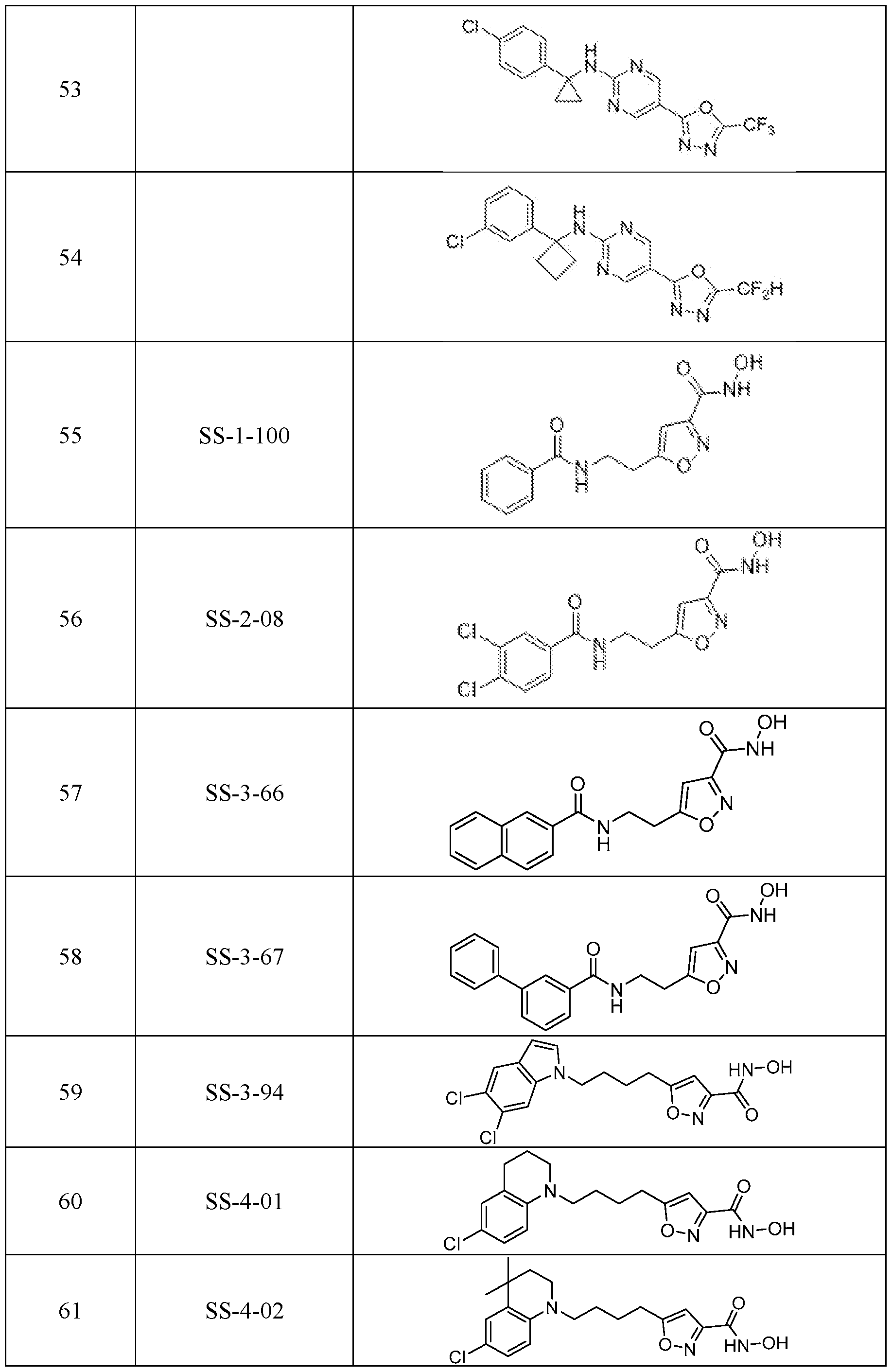
- the selective HDAC6 inhibitor is a compound disclosed in
- the selective HDAC6 inhibitor is a compound disclosed in
- the selective HDAC6 inhibitor is a compound disclosed in
- the selective HDAC6 inhibitor is a compound disclosed in
- the selective HDAC6 inhibitor is a compound disclosed in
- the selective HDAC6 inhibitor is a compound disclosed in
- the selective HDAC6 inhibitor is a compound disclosed in
- the selective HDAC6 inhibitor is a compound disclosed in
- the selective HDAC6 inhibitor is a compound disclosed in
- the selective HDAC6 inhibitor is a compound disclosed in
- the selective HDAC6 inhibitor is a compound disclosed in
- the selective HDAC6 inhibitor is a compound disclosed in
- the selective HDAC6 inhibitor is a compound disclosed in
- the selective HDAC6 inhibitor is a compound disclosed in
- the selective HDAC6 inhibitor is a compound disclosed in
- the selective HDAC6 inhibitor is compound disclosed in
- the selective HDAC6 inhibitor is a compound disclosed in
- the selective HDAC6 inhibitor is a compound disclosed in
- the selective HDAC6 inhibitor is a compound disclosed in
- the selective HDAC6 inhibitor is a compound disclosed in
- the selective HDAC6 inhibitor is compound disclosed in
- the selective HDAC6 inhibitor is a compound disclosed in
- the selective HDAC6 inhibitor is a compound disclosed in
- the selective HDAC6 inhibitor is a compound disclosed in
- the selective HDAC6 inhibitor is a compound disclosed in
- the selective HDAC6 inhibitor is compound disclosed in
- the selective HDAC6 inhibitor is a compound having Formula V: wherein:
- R 1 is selected from the group consisting of hydrogen and Ci-4 alkyl
- R 2 is selected from the group consisting of optionally substituted Ce-Ci4 aryl and aralkyl
- R 4C and R 4d are independently selected from the group consisting of hydrogen and Ci-4 alkyl; or
- R 8 is selected from the group consisting of hydrogen, Ci-4 alkyl, optionally substituted C3-6 cycloalkyl, optionally substituted Ce-Cu aryl, aralkyl, optionally substituted 5- to 14-membered heteroaryl, and heteroaralkyl; m is 0, 1, or 2; n is 1, 2, 3, 4, 5, or 6;
- ⁇ represents a single or double bond
- R a , R b , R d , and R e are independently selected from the group consisting of hydrogen, C1-6 alkyl, optionally substituted C3-6 cycloalkyl, optionally substituted Ce-Cu aryl, optionally substituted 5- to 14-membered heteroaryl; or
- R a and R b taken together with the nitrogen atom to which they are attached form an optionally substituted 3- to 12-membered heterocyclo;
- R c is Ci-4 alkyl.
- Z is -O-
- R 1 is selected from the group consisting of hydrogen and Ci-4 alkyl
- R 2 is optionally substituted Ce-Cu aryl
- R 3 is selected from the group consisting of optionally substituted Ce-Cu aryl and optionally substituted 5- to 14-membered heteroaryl;
- R 4C and R 4d are independently selected from the group consisting of hydrogen and C1-4 alkyl;
- R a and R b taken together with the nitrogen atom to which they are attached form a 3- to 7-membered heterocyclo
- R c is Ci-4 alkyl.
- the selective HDAC6 inhibitor is a compound having Formula V, wherein X is X-l.
- R 1 is hydrogen.
- R 2 is optionally substituted phenyl.
- R 2 is optionally substituted 1-naphthyl.
- R 2 is optionally substituted 2-naphthyl.
- R 2 is aralkyl.
- the selective HDAC6 inhibitor is a compound having Formula V, wherein X is X-2.
- Z is -O-.
- Z is -N(R 8 )-
- R 3 is optionally substituted C6-C14 aryl.
- R 3 is optionally substituted 5- to 14-membered heteroaryl.
- the selective HDAC6 inhibitor is a compound having Formula V, wherein X is X-5.
- R a and R b are independently selected from the group consisting of hydrogen and Ci- 4 alkyl; or
- R a and R b taken together with the nitrogen atom to which they are attached form a 3- to 7-membered heterocyclo
- R c is Ci-4 alkyl; and n is 1, 2, or 3.
- R 6a , R 6b , R 6c , R 6d , and R 6e are each independently selected from the group consisting of hydrogen, halogen, cyano, Ci-4 alkyl, and Ci-4 alkoxy.
- the selective HDAC6 inhibitor is a compound having Formula II: or a pharmaceutically acceptable salt thereof, wherein:
- R 7a , R 7b , R 7c , R 7d , and R 7e are each independently selected from the group consisting of hydrogen, halogen, cyano, Ci-4 alkyl, and Ci-4 alkoxy.
- the selective HDAC6 inhibitor is a compound having Formula II, wherein n is 1. In another aspect, n is 2. In another aspect, n is 3.
- the selective HDAC6 inhibitor is a compound having Formula III: or a pharmaceutically acceptable salt thereof, wherein:
- R 4a and R 4b are independently selected from the group consisting of hydrogen, halogen, cyano, Ci-4 alkyl, and Ci-4 alkoxy;
- R 4C and R 4d are independently selected from the group consisting of hydrogen and methyl; m is 0 or 1; n is 1, 2, or 3; and
- ⁇ represents a single or double bond.
- the selective HDAC6 inhibitor is a compound having Formula III, wherein m is 0 and ⁇ represents a double bond.
- the selective HDAC6 inhibitor is a compound having Formula III, wherein m is 1 and ⁇ represents a single bond.
- the selective HDAC6 inhibitor is a compound having
- n is 1. In another aspect, n is 2. In another aspect, n is 3. [0214] In another aspect, the selective HDAC6 inhibitor is a compound having
- R 5a and R 5c are independently selected from the group consisting of hydrogen, halogen, cyano, Ci-4 alkyl, and Ci-4 alkoxy; and n is 1, 2, or 3.
- the selective HDAC6 inhibitor is a compound having Formula IV, wherein n is 1. In another aspect, n is 2. In another aspect, n is 3.
- Non-limiting exemplary macrophage polarizing agent include, but are not limited to, lipopolysaccharide (LPS), interferon-gamma (IFN-y), interleukin-2, interleukin-3, interleukin-4, interleukin-5, interleukin-6, interleukin- 10, interleukin- 12, interleukin- 13, interleukin- 18, interleukin-23, transforming growth factor beta (TGF- ?), glucocorticoids, lipoteichoic acid (LTA), granulocyte-macrophage colonystimulating factor (GM-CSF), tumor necrosis factor (TNF), immune complexes (IC), interleukin- 1/5, adenosines, or the combination thereof.
- LPS lipopolysaccharide
- IFN-y interferon-gamma
- IFN-y interleukin-2
- interleukin-3 interleukin-4
- interleukin-5 interleukin
- tumor antigen refers to an antigenic substance that can be produced in tumor cells and trigger an immune response in the host.
- Tumor antigens can be classified into two categories. One category is products of mutated oncogenes and tumor suppressor genes, and the other category is products of other mutated genes which include overexpressed or aberrantly expressed cellular proteins, tumor antigens produced by oncogenic viruses, oncofetal antigens, altered cell surface glycolipids and glycoproteins, and cell type-specific differentiation antigens.
- halo or "halogen” as used by itself or as part of another group refers to -Cl, -F, -Br, or -I. In one aspect, the halo is -Cl or -F. In one aspect, the halo is -Cl.
- the alkyl is a C1-6 alkyl. In another aspect, the alkyl is a Ci-4 alkyl. In another aspect, the alkyl is a straight chain C1-10 alkyl. In another aspect, the alkyl is a branched chain C3-10 alkyl. In another aspect, the alkyl is a straight chain C1-6 alkyl. In another aspect, the alkyl is a branched chain C3-6 alkyl. In another aspect, the alkyl is a straight chain Ci-4 alkyl. In another aspect, the alkyl is a branched chain C3-4 alkyl. In another aspect, the alkyl is a straight or branched chain C3-4 alkyl.
- cycloalkyl refers to saturated and partially unsaturated (containing one or two double bonds) cyclic aliphatic hydrocarbons containing one to three rings having from three to twelve carbon atoms, i.e., C3-12 cycloalkyl, or the number of carbons designated.
- the cycloalkyl group has two rings.
- the cycloalkyl group has one ring.
- the cycloalkyl group is chosen from a C3-8 cycloalkyl group.
- the cycloalkyl group is chosen from a C3-6 cycloalkyl group.
- Non-limiting exemplary cycloalkyl groups include cyclopropyl, cyclobutyl, cyclopentyl, cyclohexyl, cycloheptyl, cyclooctyl, norbornyl, decalin, adamantyl, cyclohexenyl, cyclopentenyl, and cyclohexenyl.
- the optionally substituted cycloalkyl is substituted with two substituents.
- the optionally substituted cycloalkyl is substituted with one
- alkenyl refers to an alkyl group as defined above containing one, two or three carbon-to- carbon double bonds.
- the alkenyl group is chosen from a C2-6 alkenyl group.
- the alkenyl group is chosen from a C2-4 alkenyl group.
- Non-limiting exemplary alkenyl groups include ethenyl, propenyl, isopropenyl, butenyl, ec-butenyl, pentenyl, and hexenyl.
- haloalkyl refers to an alkyl group substituted by one or more fluorine, chlorine, bromine and/or iodine atoms.
- the alkyl group is substituted by one, two, or three fluorine and/or chlorine atoms.
- the haloalkyl group is a Ci-6 haloalkyl group.
- the haloalkyl group is a Ci-4 haloalkyl group.
- Non-limiting exemplary haloalkyl groups include fluoromethyl, 2-fluoroethyl, difluoromethyl, trifluoromethyl, pentafluoroethyl, 1,1-difluoroethyl, 2,2-difluoroethyl, 2,2,2-trifluoroethyl, 3,3,3- trifluoropropyl, 4,4,4-trifluorobutyl, and trichloromethyl groups.
- alkoxy refers to an optionally substituted alkyl, optionally substituted cycloalkyl, optionally substituted alkenyl or optionally substituted alkynyl attached to a terminal oxygen atom.
- the alkoxy group is chosen from a Ci-4 alkoxy group.
- the alkoxy group is chosen from a Ci-6 alkoxy group.
- the alkoxy group is chosen from a Ci-4 alkyl attached to a terminal oxygen atom, e.g., methoxy, ethoxy, and ter /-butoxy.
- haloalkoxy as used by itself or as part of another group refers to a Ci-4 haloalkyl attached to a terminal oxygen atom.
- Non-limiting exemplary haloalkoxy groups include fluoromethoxy, difluoromethoxy, trifluoromethoxy, and 2,2,2-trifluoroethoxy.
- heteroaryl refers to monocyclic, bicyclic, and tricyclic aromatic ring systems having 5 to 14 ring atoms, i.e., a 5- to 14-membered heteroaryl, wherein at least one carbon atom of one of the rings is replaced with a heteroatom independently selected from the group consisting of oxygen, nitrogen and sulfur.
- the heteroaryl contains 1, 2, 3, or 4 heteroatoms independently selected from the group consisting of oxygen, nitrogen and sulfur.
- the heteroaryl has three heteroatoms.
- the heteroaryl has two heteroatoms.
- the heteroaryl has one heteroatom.
- Non-limiting exemplary heteroaryl groups include thienyl, benzo[b]thienyl, naphtho[2,3-b]thienyl, thianthrenyl, furyl, benzofuryl, pyranyl, isobenzofuranyl, benzooxazonyl, chromenyl, xanthenyl, 2//-pyrrolyl, pyrrolyl, imidazolyl, pyrazolyl, pyridyl, pyrazinyl, pyrimidinyl, pyridazinyl, isoindolyl, 3/7-indolyl, indolyl, indazolyl, purinyl, isoquinolyl, quinolyl, phthalazinyl, naphthyridinyl, cinnolinyl, quinazolinyl, pteridinyl, 4a7/-carbazolyl, carbazolyl, P-carbolin
- the heteroaryl is chosen from thienyl (e.g., thien-2-yl and thien-3-yl), furyl (e.g., 2-furyl and 3- furyl), pyrrolyl (e.g., lH-pyrrol-2-yl and lH-pyrrol-3-yl), imidazolyl (e.g., 2H-imidazol-2- yl and 2H-imidazol-4-yl), pyrazolyl (e.g., lH-pyrazol-3-yl, lH-pyrazol-4-yl, and 1H- pyrazol-5-yl), pyridyl (e.g., pyridin-2-yl, pyridin-3-yl, and pyridin-4-yl), pyrimidinyl (e.g., pyrimidin-2-yl, pyrimidin-4-yl, and pyrimidin-5-yl), thiazo
- heteroaryl is also meant to include possible N-oxides.
- a non-limiting exemplary N-oxide is pyridyl N-oxide.
- the heteroaryl is a 5- or 6-membered heteroaryl.
- the heteroaryl is a 5-membered heteroaryl, i.e., the heteroaryl is a monocyclic aromatic ring system having 5 ring atoms wherein at least one carbon atom of the ring is replaced with a heteroatom independently selected from nitrogen, oxygen, and sulfur.
- Non-limiting exemplary 5-membered heteroaryl groups include thienyl, furyl, pyrrolyl, oxazolyl, pyrazolyl, imidazolyl, thiazolyl, isothiazolyl, and isoxazolyl.
- the heteroaryl is a 6-membered heteroaryl, e.g., the heteroaryl is a monocyclic aromatic ring system having 6 ring atoms wherein at least one carbon atom of the ring is replaced with a nitrogen atom.
- Non-limiting exemplary 6 membered heteroaryl groups include pyridyl, pyrazinyl, pyrimidinyl, and pyridazinyl.
- the heteroaryl is a 9- to 14-membered bicyclic aromatic ring system, wherein at least one carbon atom of one of the rings is replaced with a heteroatom independently selected from the group consisting of oxygen, nitrogen and sulfur.
- Nonlimiting exemplary 9- to 14-membered bicyclic aromatic ring systems include:
- heterocycle or “heterocyclo” as used by itself or as part of another group refers to saturated and partially unsaturated, e.g., containing one or two double bonds, cyclic groups containing one, two, or three rings having from three to fourteen ring members, i.e., a 3- to 14-membered heterocyclo, wherein at least one carbon atom of one of the rings is replaced with a heteroatom.
- Each heteroatom is independently selected from the group consisting of oxygen, sulfur, including sulfoxide and sulfone, and/or nitrogen atoms, which can be oxidized or quaternized.
- heterocyclo can be optionally linked to the rest of the molecule through any available carbon or nitrogen atom.
- Non-limiting exemplary heterocyclo groups include dioxanyl, tetrahydropyranyl, 2-oxopyrrolidin-3-yl, piperazin-2-one, piperazine-2, 6-dione, 2-imidazolidinone, piperidinyl, morpholinyl, piperazinyl, pyrrolidinyl, and indolinyl.
- the term "aralkyl” as used by itself or as part of another group refers to an alkyl group substituted with one, two, or three optionally substituted aryl groups.
- the optionally substituted aralkyl group is a Ci-4 alkyl substituted with one optionally substituted aryl group.
- the aralkyl group is a Ci or C2 alkyl substituted with one optionally substituted aryl group.
- the aralkyl group is a Ci or C2 alkyl substituted with one optionally substituted phenyl group.
- Non-limiting exemplary aralkyl groups include benzyl, phenethyl, -CHPI12, -CH2(4-F-Ph), -CH2(4-Me- Ph), -CH 2 (4-CF3-Ph), and -CH(4-F-Ph) 2 .
- the term "heteroaralkyl” as used by itself or as part of another group refers to an alkyl group substituted with one, two, or three optionally substituted heteroaryl groups.
- the heteroaralkyl group is a Ci-4 alkyl substituted with one optionally substituted heteroaryl group.
- the aralkyl group is a Ci or C2 alkyl substituted with one optionally substituted heteroaryl group.
- the heteroaralkyl group is a Ci or C2 alkyl substituted with one optionally substituted heteroaryl group.
- Non-limiting exemplary heteroaralkyl groups include:
- HD AC refers to a family of enzymes that remove acetyl groups from a protein, for example, the s-amino groups of lysine residues at the N-terminus of a histone.
- the HDAC can be any human HDAC isoform including, HDAC1, HDAC2, HDAC3, HDAC4, HDAC5, HDAC6, HDAC7, HDAC8, HDAC9, HDAC10, and HDAC11.
- the HDAC also can be derived from a protozoal or fungal source.
- treat refers to eliminating, reducing, relieving, reversing, and/or ameliorating a disease or condition and/or symptoms associated therewith. Although not precluded, treating a disease or condition does not require that the disease, condition, or symptoms associated therewith be completely eliminated, including the treatment of acute or chronic signs, symptoms and/or malfunctions.
- the terms “treat,” “treating,” “treatment,” and the like may include “prophylactic treatment,” which refers to reducing the probability of redeveloping a disease or condition, or of a recurrence of a previously-controlled disease or condition, in a subject who does not have, but is at risk of or is susceptible to, redeveloping a disease or condition or a recurrence of the disease or condition, "treatment” therefore also includes relapse prophylaxis or phase prophylaxis.
- treat and synonyms contemplate administering a therapeutically effective amount of a compound of the disclosure to an individual, e.g., a mammalian patient including, but not limited to, humans and veterinary animals, in need of such treatment.
- a treatment can be orientated symptomatically, for example, to suppress symptoms. It can be effected over a short period, be oriented over a medium term, or can be a long-term treatment, for example within the context of a maintenance therapy.
- terapéuticaally effective amount refers to an amount of the active ingredient(s) that, when administered, is (are) sufficient, to efficaciously deliver the active ingredient(s) for the treatment of condition or disease of interest to an individual, e.g., human patient, in need thereof.
- the therapeutically effective amount of the agent may reduce (i.e., retard to some extent and preferably stop) unwanted cellular proliferation; reduce the number of cancer cells; reduce the tumor size; inhibit (i.e., retard to some extent and preferably stop) cancer cell infiltration into peripheral organs; inhibit (i.e., retard to some extent and preferably stop) tumor metastasis; inhibit, to some extent, tumor growth; reduce HDAC signaling in the target cells; and/or relieve, to some extent, one or more of the symptoms associated with the cancer.
- the administered compound or composition prevents growth and/or kills existing cancer cells, it may be cytostatic and/or cytotoxic.
- subject refers to any human or mammal that is in need of or might benefit from treatment with STAT-activated macrophages. Foremost among such subjects are humans, although the methods and compositions provided herein are not intended to be so limited. Other subjects include veterinary animals, e.g., cows, sheep, pigs, horses, dogs, cats and the like. In one embodiment, the subject is a human. In one embodiment, the subject is a mammal.
- Selective HDAC6 inhibitors can exist as salts.
- pharmaceutically acceptable salt refers to salts or zwitterionic forms of the present compounds. Salts of the present compounds can be prepared during the final isolation and purification of the compounds or separately by reacting the compound with an acid having a suitable cation.
- the pharmaceutically acceptable salts of the present compounds can be acid addition salts formed with pharmaceutically acceptable acids. Examples of acids which can be employed to form pharmaceutically acceptable salts include inorganic acids such as nitric, boric, hydrochloric, hydrobromic, sulfuric, and phosphoric, and organic acids such as oxalic, maleic, succinic, tartaric, and citric.
- Nonlimiting examples of salts of selective HDAC6 inhibitors include, but are not limited to, the hydrochloride, hydrobromide, hydroiodide, sulfate, bisulfate, 2-hydroxyethansulfonate, phosphate, hydrogen phosphate, acetate, adipate, alginate, aspartate, benzoate, bisulfate, butyrate, camphorate, camphorsulfonate, di gluconate, glycerolphosphate, hemi sulfate, heptanoate, hexanoate, formate, succinate, fumarate, maleate, ascorbate, isethionate, salicylate, methanesulfonate, mesitylenesulfonate, naphthylenesulfonate, nicotinate, 2- naphthalenesulfonate, oxalate, pamoate, pectinate, persulfate, 3-phenylproprionate,
- available amino groups present in selective HDAC6 inhibitors can be quaternized with methyl, ethyl, propyl, and butyl chlorides, bromides, and iodides; dimethyl, diethyl, dibutyl, and diamyl sulfates; decyl, lauryl, myristyl, and stearyl chlorides, bromides, and iodides; and benzyl and phenethyl bromides.
- Any reference to compounds of the present disclosure appearing herein is intended to include selective HDAC6 inhibitors as well as pharmaceutically acceptable salts, solvates, or hydrates thereof.
- Flow cytometry was performed following the protocol described previously. Knox et al., SciRep. 2019 Oct 10;9(l): 14824. doi: 10.1038/s41598-019-51403- 6. Briefly, mice were euthanized following the IACUC protocol, and tumor cells were processed into a single cell suspension for analysis by flow cytometry with tumor digestion buffer. The following antibodies were used to stain cell surface markers expressed by different immune cells. All the antibodies were purchased from Biolegend (San Diego, CA) unless otherwise specified.
- Myeloid cell surface markers are as follows: APC anti-mouse CD80 (clone 16-10A1), PE/Cy7 anti-mouse CD206 (MMR) (clone C068C2), APC/FireTM 750 anti-mouse CD45.2 (clone 104), FITC anti-mouse H-2 (clone MI/42), Brilliant Violet 785TM anti-mouse F4/80 (clone BM8), and Alexa Fluor® 700 anti-mouse CD3 (clone 17A2).
- APC antimouse H-2Kb bound to SIFNFEKL antibody clone 25-D1.16
- Multi-color flow data acquisition was performed on BD Celesta, and data analysis was performed with FlowJo software (version 10.3).
- Statistical analyses were performed with GraphPad Prism Software (version 7.03).
- BMDMs Bone marrow derived macrophages
- M-CSF bone marrow derived macrophages
- NextA Nexturastat A
- Stattic 6-nitrobenzo[b]thiophene- 1,1 -di oxide
- Pre-treatment with NextA and Stattic decreased polarization of M2 macrophages as indicated by flow cytometry. See Fig. 1.
Landscapes
- Health & Medical Sciences (AREA)
- Life Sciences & Earth Sciences (AREA)
- General Health & Medical Sciences (AREA)
- Veterinary Medicine (AREA)
- Animal Behavior & Ethology (AREA)
- Public Health (AREA)
- Epidemiology (AREA)
- Chemical & Material Sciences (AREA)
- Pharmacology & Pharmacy (AREA)
- Medicinal Chemistry (AREA)
- Engineering & Computer Science (AREA)
- Immunology (AREA)
- Biomedical Technology (AREA)
- Zoology (AREA)
- Biotechnology (AREA)
- Hematology (AREA)
- Organic Chemistry (AREA)
- Genetics & Genomics (AREA)
- Bioinformatics & Cheminformatics (AREA)
- Wood Science & Technology (AREA)
- Cell Biology (AREA)
- Gastroenterology & Hepatology (AREA)
- General Engineering & Computer Science (AREA)
- Biochemistry (AREA)
- Microbiology (AREA)
- Developmental Biology & Embryology (AREA)
- Virology (AREA)
- General Chemical & Material Sciences (AREA)
- Chemical Kinetics & Catalysis (AREA)
- Nuclear Medicine, Radiotherapy & Molecular Imaging (AREA)
- Medicines That Contain Protein Lipid Enzymes And Other Medicines (AREA)
- Pharmaceuticals Containing Other Organic And Inorganic Compounds (AREA)
- Medicines Containing Material From Animals Or Micro-Organisms (AREA)
- Medicinal Preparation (AREA)
- Micro-Organisms Or Cultivation Processes Thereof (AREA)
- Oncology (AREA)
Abstract
Description




Claims


Priority Applications (7)
| Application Number | Priority Date | Filing Date | Title |
|---|---|---|---|
| BR112023004235A BR112023004235A2 (en) | 2020-10-30 | 2021-10-29 | STAT-ACTIVATED MACROPHAGES, COMPOSITIONS AND USES THEREOF |
| US18/251,060 US20230405118A1 (en) | 2020-10-30 | 2021-10-29 | Stat-activated macrophages, compositions, and uses thereof |
| EP21887660.5A EP4237092A4 (en) | 2020-10-30 | 2021-10-29 | STAT-ACTIVATED MACROPHAGES, COMPOSITIONS AND USES THEREOF |
| AU2021368746A AU2021368746A1 (en) | 2020-10-30 | 2021-10-29 | Stat-activated macrophages, compositions, and uses thereof |
| CN202180071215.0A CN116507323A (en) | 2020-10-30 | 2021-10-29 | STAT-activated macrophages, compositions and uses thereof |
| JP2023516508A JP2023547985A (en) | 2020-10-30 | 2021-10-29 | STAT-activated macrophages, compositions, and uses thereof |
| CA3191515A CA3191515A1 (en) | 2020-10-30 | 2021-10-29 | Stat-activated macrophages, compositions, and uses thereof |
Applications Claiming Priority (2)
| Application Number | Priority Date | Filing Date | Title |
|---|---|---|---|
| US202063108027P | 2020-10-30 | 2020-10-30 | |
| US63/108,027 | 2020-10-30 |
Publications (1)
| Publication Number | Publication Date |
|---|---|
| WO2022094319A1 true WO2022094319A1 (en) | 2022-05-05 |
Family
ID=81383317
Family Applications (1)
| Application Number | Title | Priority Date | Filing Date |
|---|---|---|---|
| PCT/US2021/057418 Ceased WO2022094319A1 (en) | 2020-10-30 | 2021-10-29 | Stat-activated macrophages, compositions, and uses thereof |
Country Status (8)
| Country | Link |
|---|---|
| US (1) | US20230405118A1 (en) |
| EP (1) | EP4237092A4 (en) |
| JP (1) | JP2023547985A (en) |
| CN (1) | CN116507323A (en) |
| AU (1) | AU2021368746A1 (en) |
| BR (1) | BR112023004235A2 (en) |
| CA (1) | CA3191515A1 (en) |
| WO (1) | WO2022094319A1 (en) |
Cited By (1)
| Publication number | Priority date | Publication date | Assignee | Title |
|---|---|---|---|---|
| CN116036285A (en) * | 2023-02-07 | 2023-05-02 | 河北大学附属医院 | Application of Substances Inhibiting STAT6 Site Ubiquitination in Regulating Macrophage Polarization |
Families Citing this family (1)
| Publication number | Priority date | Publication date | Assignee | Title |
|---|---|---|---|---|
| CN117070570A (en) * | 2023-08-28 | 2023-11-17 | 南通大学 | Methods to improve transfection efficiency of lipofectamine transfection reagent |
Citations (2)
| Publication number | Priority date | Publication date | Assignee | Title |
|---|---|---|---|---|
| US20070060521A1 (en) * | 1999-01-27 | 2007-03-15 | The University Of South Florida, A Public Corporation Of The State Of Florida Corporation | Inhibition of STAT3 signal transduction for human cancer therapy |
| US20200222557A1 (en) * | 2017-06-30 | 2020-07-16 | City Of Hope | Compositions and methods of modulating macrophage activity |
Family Cites Families (9)
| Publication number | Priority date | Publication date | Assignee | Title |
|---|---|---|---|---|
| US6001351A (en) * | 1993-05-18 | 1999-12-14 | I.D.M. Immuno-Designed Molecules | Macrophages, process for preparing the same and their use as active substances of pharmaceutical compositions |
| US7638122B2 (en) * | 2003-03-07 | 2009-12-29 | University Of South Florida | Stat3 antagonists and their use as vaccines against cancer |
| US20180044635A1 (en) * | 2016-08-10 | 2018-02-15 | University Of Massachusetts | Surface-modified macrophages for cell-based delivery |
| JP2018111681A (en) * | 2017-01-06 | 2018-07-19 | 永喜 廣澤 | Composition from component produced at time of germination of seeds |
| EP3638690A4 (en) * | 2017-06-15 | 2020-07-01 | Mayo Foundation for Medical Education and Research | METHOD FOR TREATING GLIOMAS WITH A STAT3 INHIBITOR |
| RU2020124144A (en) * | 2017-12-22 | 2022-01-24 | Атосса Терапьютикс, Инк. | INTRADUCTAL METHODS OF TREATMENT OF BREAST DISEASES |
| AU2019218991A1 (en) * | 2018-02-12 | 2020-07-09 | Lonza Sales Ag | Methods and compositions for macrophage polarization |
| GB2572005A (en) * | 2018-03-16 | 2019-09-18 | Univ Court Univ Of Edinburgh | Macrophage-based therapy |
| CA3106796A1 (en) * | 2018-07-19 | 2020-01-23 | Oncohost Ltd | Il-31 improves efficacy of macrophage-based adoptive cell therapy for cancer |
-
2021
- 2021-10-29 US US18/251,060 patent/US20230405118A1/en active Pending
- 2021-10-29 EP EP21887660.5A patent/EP4237092A4/en not_active Withdrawn
- 2021-10-29 CN CN202180071215.0A patent/CN116507323A/en active Pending
- 2021-10-29 WO PCT/US2021/057418 patent/WO2022094319A1/en not_active Ceased
- 2021-10-29 JP JP2023516508A patent/JP2023547985A/en active Pending
- 2021-10-29 AU AU2021368746A patent/AU2021368746A1/en not_active Abandoned
- 2021-10-29 CA CA3191515A patent/CA3191515A1/en active Pending
- 2021-10-29 BR BR112023004235A patent/BR112023004235A2/en not_active IP Right Cessation
Patent Citations (2)
| Publication number | Priority date | Publication date | Assignee | Title |
|---|---|---|---|---|
| US20070060521A1 (en) * | 1999-01-27 | 2007-03-15 | The University Of South Florida, A Public Corporation Of The State Of Florida Corporation | Inhibition of STAT3 signal transduction for human cancer therapy |
| US20200222557A1 (en) * | 2017-06-30 | 2020-07-16 | City Of Hope | Compositions and methods of modulating macrophage activity |
Non-Patent Citations (5)
| Title |
|---|
| IREY EMILY A., LASSITER CHELSEA M., BRADY NICHOLAS J., CHUNTOVA PAVLINA, WANG YING, KNUTSON TODD P., HENZLER CHRISTINE, CHAFFEE TH: "JAK/STAT inhibition in macrophages promotes therapeutic resistance by inducing expression of protumorigenic factors", PROCEEDINGS OF THE NATIONAL ACADEMY OF SCIENCES, NATIONAL ACADEMY OF SCIENCES, vol. 116, no. 25, 18 June 2019 (2019-06-18), pages 12442 - 12451, XP055939473, ISSN: 0027-8424, DOI: 10.1073/pnas.1816410116 * |
| LEE ET AL.: "Macrophage-Based Cell Therapies: The Long and Winding Road", J CONTROL RELEASE., vol. 240, 28 October 2016 (2016-10-28), pages 527 - 540, XP029759381, DOI: 10.1016/j.jconrel.2016.07.018 * |
| MANO YOHEI, AISHIMA SHINICHI, FUJITA NOBUHIRO, TANAKA YUKI, KUBO YUICHIRO, MOTOMURA TAKASHI, TAKETOMI AKINOBU, SHIRABE KEN, MAEHAR: "Tumor-Associated Macrophage Promotes Tumor Progression via STAT3 Signaling in Hepatocellular Carcinoma", PATHOBIOLOGY., KARGER, BASEL, CH, vol. 80, no. 3, 1 January 2013 (2013-01-01), CH , pages 146 - 154, XP055939471, ISSN: 1015-2008, DOI: 10.1159/000346196 * |
| PLATANITIS EKATERINI, DECKER THOMAS: "Regulatory Networks Involving STATs, IRFs, and NFκB in Inflammation", FRONTIERS IN IMMUNOLOGY, vol. 9, 13 November 2018 (2018-11-13), XP055939472, DOI: 10.3389/fimmu.2018.02542 * |
| See also references of EP4237092A4 * |
Cited By (2)
| Publication number | Priority date | Publication date | Assignee | Title |
|---|---|---|---|---|
| CN116036285A (en) * | 2023-02-07 | 2023-05-02 | 河北大学附属医院 | Application of Substances Inhibiting STAT6 Site Ubiquitination in Regulating Macrophage Polarization |
| CN116036285B (en) * | 2023-02-07 | 2024-02-02 | 河北大学附属医院 | Application of substances that inhibit ubiquitination of STAT6 site in regulating macrophage polarization |
Also Published As
| Publication number | Publication date |
|---|---|
| EP4237092A4 (en) | 2024-08-28 |
| AU2021368746A1 (en) | 2023-06-01 |
| US20230405118A1 (en) | 2023-12-21 |
| BR112023004235A2 (en) | 2023-05-09 |
| CN116507323A (en) | 2023-07-28 |
| JP2023547985A (en) | 2023-11-15 |
| EP4237092A1 (en) | 2023-09-06 |
| CA3191515A1 (en) | 2022-05-05 |
| AU2021368746A9 (en) | 2024-07-11 |
Similar Documents
| Publication | Publication Date | Title |
|---|---|---|
| EP3990618A1 (en) | Hdac6-activated macrophages, compositions, and uses thereof | |
| JP2020075934A (en) | Combination of WT1 antigen peptide and immunomodulator | |
| US20100055111A1 (en) | Indoleamine 2,3-dioxygenase, pd-1/pd-l pathways, and ctla4 pathways in the activation of regulatory t cells | |
| KR20160093012A (en) | Combinations of checkpoint inhibitors and therapeutics to treat cancer | |
| BR112020017303A2 (en) | COMPOSITIONS AND METHODS FOR CANCER TREATMENT | |
| US11976072B2 (en) | Diacylglycerol kinase modulating compounds | |
| CA3054572A1 (en) | Compounds and methods for treating cancer | |
| JP7246309B2 (en) | Oxabicycloheptane for modulating immune responses | |
| US11331304B2 (en) | YAP1 inhibitors and methods | |
| US10039825B2 (en) | Combination therapy with CD4 lymphocyte depletion and MTOR inhibitors | |
| US20200399377A1 (en) | Combination cancer therapy with anti-cancer agents and antibodies targeting a complex comprising non-classical hla-i and neoantigen | |
| EP4041239A1 (en) | A pyrazolopyrimidine derivative as a hck inhibitor for use in therapy, in particular myd88 mutated diseases | |
| EP4237092A1 (en) | Stat-activated macrophages, compositions, and uses thereof | |
| WO2019076269A1 (en) | Mevalonic acid pathway inhibitor and pharmaceutical composition thereof | |
| US20260015419A1 (en) | Combination of macrophage-directed immunotherapy and cytokines for treatment of cancer | |
| KR20070086663A (en) | Alpha thymosin peptides as cancer vaccine adjuvant | |
| JP7763192B2 (en) | Pharmaceutical composition for enhancing radiation therapy, comprising a fusion protein containing an IL-2 protein and a CD80 protein | |
| JP2022534412A (en) | Activation of procaspase-3 and immunotherapy for the treatment of cancer | |
| WO2024037572A1 (en) | Interleukin-2 variants and their uses in treating cancers | |
| WO2025165908A1 (en) | Bifunctional tead degraders | |
| HK40129616A (en) | Toll-like receptor 7 agonists as immune-stimulators to elicit the innate antitumor immunity | |
| EA042139B1 (en) | PHARMACEUTICAL COMPOSITIONS AND METHODS FOR CANCER TREATMENT |
Legal Events
| Date | Code | Title | Description |
|---|---|---|---|
| 121 | Ep: the epo has been informed by wipo that ep was designated in this application |
Ref document number: 21887660 Country of ref document: EP Kind code of ref document: A1 |
|
| ENP | Entry into the national phase |
Ref document number: 3191515 Country of ref document: CA |
|
| WWE | Wipo information: entry into national phase |
Ref document number: 2023516508 Country of ref document: JP |
|
| REG | Reference to national code |
Ref country code: BR Ref legal event code: B01A Ref document number: 112023004235 Country of ref document: BR |
|
| WWE | Wipo information: entry into national phase |
Ref document number: 202180071215.0 Country of ref document: CN |
|
| ENP | Entry into the national phase |
Ref document number: 112023004235 Country of ref document: BR Kind code of ref document: A2 Effective date: 20230307 |
|
| WWE | Wipo information: entry into national phase |
Ref document number: 202317036927 Country of ref document: IN |
|
| NENP | Non-entry into the national phase |
Ref country code: DE |
|
| ENP | Entry into the national phase |
Ref document number: 2021368746 Country of ref document: AU Date of ref document: 20211029 Kind code of ref document: A |
|
| ENP | Entry into the national phase |
Ref document number: 2021887660 Country of ref document: EP Effective date: 20230530 |
|
| WWW | Wipo information: withdrawn in national office |
Ref document number: 2021887660 Country of ref document: EP |