WO2022102438A1 - 情報提示装置 - Google Patents
情報提示装置 Download PDFInfo
- Publication number
- WO2022102438A1 WO2022102438A1 PCT/JP2021/040063 JP2021040063W WO2022102438A1 WO 2022102438 A1 WO2022102438 A1 WO 2022102438A1 JP 2021040063 W JP2021040063 W JP 2021040063W WO 2022102438 A1 WO2022102438 A1 WO 2022102438A1
- Authority
- WO
- WIPO (PCT)
- Prior art keywords
- information
- route
- facility
- destination
- stop
- Prior art date
- Legal status (The legal status is an assumption and is not a legal conclusion. Google has not performed a legal analysis and makes no representation as to the accuracy of the status listed.)
- Ceased
Links
Images



Classifications
-
- G—PHYSICS
- G01—MEASURING; TESTING
- G01C—MEASURING DISTANCES, LEVELS OR BEARINGS; SURVEYING; NAVIGATION; GYROSCOPIC INSTRUMENTS; PHOTOGRAMMETRY OR VIDEOGRAMMETRY
- G01C21/00—Navigation; Navigational instruments not provided for in groups G01C1/00 - G01C19/00
- G01C21/26—Navigation; Navigational instruments not provided for in groups G01C1/00 - G01C19/00 specially adapted for navigation in a road network
- G01C21/34—Route searching; Route guidance
- G01C21/36—Input/output arrangements for on-board computers
- G01C21/3679—Retrieval, searching and output of POI information, e.g. hotels, restaurants, shops, filling stations, parking facilities
-
- G—PHYSICS
- G01—MEASURING; TESTING
- G01C—MEASURING DISTANCES, LEVELS OR BEARINGS; SURVEYING; NAVIGATION; GYROSCOPIC INSTRUMENTS; PHOTOGRAMMETRY OR VIDEOGRAMMETRY
- G01C21/00—Navigation; Navigational instruments not provided for in groups G01C1/00 - G01C19/00
- G01C21/26—Navigation; Navigational instruments not provided for in groups G01C1/00 - G01C19/00 specially adapted for navigation in a road network
- G01C21/34—Route searching; Route guidance
- G01C21/36—Input/output arrangements for on-board computers
- G01C21/3605—Destination input or retrieval
- G01C21/3617—Destination input or retrieval using user history, behaviour, conditions or preferences, e.g. predicted or inferred from previous use or current movement
Definitions
- the present invention relates to an information presenting device that presents predetermined information.
- the navigation device that guides the vehicle to the destination searches for the route to the point designated by the user as the destination, displays the search result together with the map around the vehicle position, and guides the user to the destination.
- the navigation device it is proposed to present the user with a stop-by place other than the destination based on the departure place and the destination.
- a stop-by place other than the destination based on the departure place and the destination.
- candidates for stop-off points are extracted, and the distance between the registered point such as a home and the current position, or the distance between the registered point and the destination, and the margin for the extracted stop-by place. Weighting is done based on time. Then, it is described that the proposal information of the stop-off place is generated based on the weighting result, and the route when the stop-off place is stopped is searched based on the generated stop-by place proposal information.
- Patent Document 1 In the invention described in Patent Document 1, the route when the stop is stopped is searched based on the departure place, the destination, and the like. However, in Patent Document 1, when departing from a departure place such as a home, it is premised that the destination is the destination from the departure place such as a company or an accommodation place.
- Patent Document 1 when returning home from the destination, the proposal information of the stop-by place will be generated again with the destination as the departure point and the home as the destination. That is, in Patent Document 1, there is no concept of an outward route or a return route, and it is not possible to know a facility that can stop in the return route in advance on the outward route.
- the problem to be solved by the present invention is to present information such as a stop-by facility on the return trip.
- the invention according to claim 1 is determined to be an outward route by a determination unit for determining whether the current travel condition corresponds to the outward route based on the past travel history and the determination unit.
- the case is characterized in that it includes a presentation unit that presents information about a facility that is expected to stop by on the return route based on the travel history.
- the invention according to claim 8 is an information presenting method executed by an information presenting device that presents predetermined information, and determines whether or not the current traveling condition corresponds to an outward route based on a past traveling history. It is characterized by including a step and a presentation step of presenting information about a facility where a stop-off is predicted on the return route based on the travel history when the determination step is determined to be an outward route.
- the invention according to claim 9 is characterized in that the information presentation method according to claim 8 is executed by a computer as an information presentation program.
- the invention according to claim 10 is characterized in that the information presentation program according to claim 9 is stored in a storage medium readable by a computer.
- the determination unit determines whether the current travel condition corresponds to the outward route based on the past travel history, and when the determination unit determines that the current travel condition corresponds to the outward route, , Presents information about facilities that are expected to stop by on the return trip based on the driving history. By doing so, when the current traveling condition is determined to be the outward route, it is possible to present information such as a stop-by facility on the return route. By presenting information such as drop-in facilities on the return trip on the outward trip, it is possible to make a schedule on the return trip in advance and improve the convenience of the user.
- the information about the facility where the stop-by is expected may include the facility name and the estimated arrival time at the facility. By doing so, it becomes easy to make a schedule when the user or the like actually stops by.
- the information about the facility where the stop-by is expected may include incidental information about the facility or the route to the facility. By doing so, it is possible to present in advance incidental information such as time sale information of a supermarket, time zone regulation information of a route to a stop-by facility, and congestion forecast information.
- the presentation unit may present information on facilities that are expected to stop by on the outbound route as well as information on facilities that are expected to stop by on the return route. By doing so, it is possible to present a facility that is expected to stop by on both the outbound and inbound routes, and it is possible to further improve the convenience of the user.
- the travel history may be added with information on the base, the main destination, the outbound route or the inbound route for each arrival place, based on the history information including the information on the departure place, the arrival place, and the staying time at the arrival place.
- the travel history may be added with information on the base, the main destination, the outbound route or the inbound route for each arrival place, based on the history information including the information on the departure place, the arrival place, and the staying time at the arrival place.
- the determination unit may determine that the current driving condition is the outbound route if the vehicle has not passed the main destination after leaving the base. By doing so, if a point such as a base or a main destination is identified, it can be easily determined that the route is an outbound route.
- the estimated arrival time may be predicted at least in consideration of the staying time of the main destination. By doing so, for example, when the main destination is a company, the arrival time on the way back from the company can be predicted. Therefore, it is possible to make a schedule for the return trip in advance.
- the information presentation method it is determined in the determination process whether the current travel condition corresponds to the outward route based on the past travel history, and in the presentation process, it is determined to be the outward route. If so, provide information about facilities that are expected to stop by on the return trip based on the travel history. By doing so, when the current traveling condition is determined to be the outward route, it is possible to present information such as a stop-by facility on the return route. By presenting information such as drop-in facilities on the return trip on the outward trip, it is possible to make a schedule on the return trip in advance and improve the convenience of the user.
- the above-mentioned information presentation method may be executed by a computer as an information presentation program. By doing so, it is possible to present information such as a stop-by facility on the return route when the current traveling condition is determined to be the outward route by using the computer. By presenting information such as drop-in facilities on the return trip on the outward trip, it is possible to make a schedule on the return trip in advance and improve the convenience of the user.
- the above-mentioned information presentation program may be stored in a computer-readable storage medium.
- the program can be distributed as a single unit in addition to being incorporated in the device, and version upgrades and the like can be easily performed.
- FIG. 1 is a schematic configuration diagram of an information presentation device according to this embodiment.
- the information presenting device 1 includes a drive connecting unit 2, a learning data generation unit 3, an outward return route determination unit 4, a destination prediction unit 5, an ETA calculation unit 6, and related information addition.
- a unit 7 and a display device 8 are provided. Further, the information presenting device 1 has each data of the travel history D1, the drive history D2, and the learning data D3.
- the information presentation device 1 can be configured by a well-known computer.
- the travel history D1, the drive history D2, and the learning data D3, which are data, are stored in the storage device.
- the other functional blocks are realized by a computer program (information presentation program) executed by the computer. Further, the configuration shown in FIG. 1 does not have to be configured by one device.
- the information presenting device may include at least an outward / return determination unit 4 and a display device 8, and other components may be configured by a server device or the like via a network or the like.
- the drive connection unit 2 generates the drive history D2 by performing a process of adding information on the outward route / return route, the main destination, the base, and the drive group based on the travel history D1.
- the travel history D1 is history information including information such as a departure place, an arrival place (visit place), a departure time, an arrival time, and a staying time.
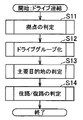
- FIG. 2 is a flowchart of the drive connection operation.
- the base is determined (step S11).
- the base in this embodiment is the point where the average nighttime stay time at home or the like is above a certain level and is the highest.
- drive grouping is performed (step S12).
- the grouping of drives in this embodiment is a process of grouping the data from the base to the arrival at the base.
- the main destination is determined (step S13).
- the main destination in this embodiment is the point in the drive group having the longest stay time excluding the base.
- the outward / return route is determined (step S14). In the determination of the outbound / inbound route, the route from the base to the arrival at the main destination is the outbound route, and the route from the main destination to the arrival at the base is the inbound route.
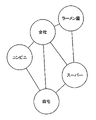
- FIG. 3 An example of a traveling point and a route between the points is shown in FIG. 3, and an example of history information included in the traveling history D1 corresponding to FIG. 3 is shown in FIG.
- Fig. 3 there are facilities such as a home, a convenience store (convenience store), a company, a ramen shop, and a supermarket (supermarket) as points, and the routes traveled are the route from home to the convenience store, the route from the convenience store to the office, and the company.
- a route from the ramen shop to the supermarket a route from the supermarket to the home, a route from the home to the office, and a route from the office to the supermarket.
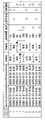
- FIG. 4 shows an example of the history information of the actual travel history D1 that received
- FIG. 4 shows the ACC (accessory switch) ON time (accon_timestop) of the vehicle, the ACCOFF time (acoff_timestamp) of the vehicle, the departure place, the arrival place (visit place), and the staying time.
- the ACCON time is the departure time and the ACCOFF time is the arrival time.
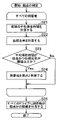
- FIG. 5 is a flowchart for determining the base.
- the flowchart of FIG. 5 repeats the following steps S21 to S24 for all destinations.
- the average nighttime stay time for the destination to be evaluated is calculated (step S21). For example, in the case of FIG. 4, since the convenience store does not stay at night, the average stay time is 0 minutes. On the other hand, the average staying time is long because the home stays for a long time at night.
- the time zone for nighttime may be set as appropriate.
- the appearance ratio is the frequency with which the arrival place to be evaluated appears as the arrival place. This is a process for excluding an inn, etc., who stayed on a trip, from the base because it is not appropriate to treat it as a place where the night stay is long but the night stay frequency is high, such as home. Then, it is determined whether the average staying time of the arrival place to be evaluated is the longest and the appearance ratio is equal to or more than the threshold value (step S23). If the result of the determination in step S23 is Yes, the destination to be evaluated is determined to be the base (step S24). On the other hand, if the result of the determination in step S23 is No, the arrival place to be evaluated is not determined as the base.
- FIG. 9 shows an example in which information on the base is added.
- FIG. 9 shows information (marked with ⁇ ) such as a base added to FIG. As shown in FIG. 9, in the example of FIG. 4, the home is the base.
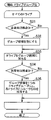
- FIG. 6 is a flowchart of the drive grouping operation.
- the flowchart of FIG. 6 repeats the following steps S31 to S35 for all drives.
- drive grouping is a process in which the data from the base to the arrival at the base is made into one group, so if the departure place is the base, the group candidates are emptied as the start of a new group. do.
- the drive to be evaluated is added to the group candidate (step S33).
- step S31 determines whether the drive to be evaluated is added to the group candidate (step S33).
- the starting point of the drive to be evaluated is a point other than the base, so it is added to the group candidates for grouping.
- step S34 it is determined whether the destination of the drive to be evaluated is the base (step S34). If the result of the determination in step S34 is Yes, the group candidates are set to one drive group, and an ID or the like common to each drive in the same group is assigned (step S35). That is, since the arrival place of the drive to be evaluated is the base at the end of the drive to be grouped, the drive to be evaluated is grouped as one group.
- step S34 determines whether the destination of the drive to be evaluated is not the base, so the next drive is used as the drive to be evaluated and is executed again from step S31 without assigning an ID or the like.
- the drive where the home of the first line is the departure place and the convenience store is the arrival place except for the line where the item name etc. are described is the departure place as the base. Since there is, empty the group candidate and add it to the group candidate.
- the convenience store on the second line is the departure point and the company is the arrival point, the departure point is not the base, so only the operation of adding to the group candidate is performed.
- the third and fourth lines are the same as the second line.
- Drives where the supermarket on the 5th line is the departure point and the home is the arrival point are added to the group candidates because the departure point is not the base, and the drives in the group candidates are combined into one group because the arrival point is the base.
- a unique ID is given to the drive (see the group column in FIG. 9). The same operation is repeated from the sixth line onward in FIG. 4, and a unique ID is assigned to each group such as “2” and “3” as shown in FIG.
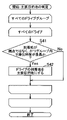
- FIG. 7 is a flowchart of the determination operation of the main destination.
- the flowchart of FIG. 7 repeats the following steps S41 and S42 for all the drives in all the drive groups.
- step S41 If the result of the determination in step S41 is Yes, the destination of the drive is set as the main destination (step S42). On the other hand, if the result of the determination in step S41 is Yes, the next drive is evaluated without setting the destination of the drive as the main destination.
- FIG. 9 shows an example in which information on the main destination (marked with ⁇ ) is given. As shown in FIG. 9, in the example of FIG. 4, the company is the main destination.
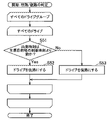
- FIG. 8 is a flowchart of the outbound / inbound determination operation.
- the flowchart of FIG. 8 repeats the following steps S51 to S53 for all drives in all drive groups.
- FIG. 9 shows an example in which information on the outward / return route is added. As shown in FIG. 9, the drive to the company, which is the main destination, is determined as the outbound route, and thereafter, the inbound route is determined.
- the drive history D2 as shown in FIG. 9 is created.
- the drive history D2 travel history
- the travel history D1 including information on the departure place, the arrival place, and the staying time at the arrival place, and the base and the main destination for each arrival place.
- Outbound or inbound information is added.
- the learning data generation unit 3 generates learning data D3 based on the drive history generated by the drive connection unit 2.
- the outbound / inbound route determination unit 4 determines whether the current driving condition is the outbound route or the inbound route based on the drive history D2. That is, the outward route return determination unit 4 functions as a determination unit for determining whether the current travel condition corresponds to the outward route based on the past travel history.
- the current running condition means a state in which the vehicle or the information presenting device 1 mounted on the vehicle can be operated, such as from when the ACC is turned on to when the ACC is turned off, and the vehicle is actually running. Not exclusively.
- the determination of whether the outbound route or the inbound route is performed by the outbound route / inbound route determination unit 4 is based on the drive history D2, and is determined to be the outbound route in the case of an action that does not pass through the main destination and leaves the base after leaving the base. Whether the behavior is to leave the base can be determined by calculating the distance to the base and ETA (estimated time of arrival) at regular intervals and determining whether the time average is increasing. Alternatively, it may be determined whether the route is an outward route or a return route only by not passing through the main destination after leaving the base without determining the behavior of leaving the base. If it is not determined to be the outward route, it may be determined to be the return route.
- the destination prediction unit 5 predicts the destination (facility) in the current driving situation based on the learning data D3.
- a context base or a link base can be used as the prediction method of the destination prediction unit 5.
- Context-based predictions are made, for example, in order of frequency of places leaving and arriving at home at 8 am.
- the link base predicts by, for example, the frequency order of the place where the person arrives by following the link in front of the house.
- the outbound and inbound routes, the day of the week, the weather, and the like may be taken into consideration.
- the ETA calculation unit 6 calculates the ETA (estimated time of arrival) for the destination predicted by the destination prediction unit, and outputs it for each predicted destination (facility).
- the ETA calculation unit 6 is currently on the outbound route
- the ETA of the predicted destination whose outbound / inbound label is the inbound route is the time required to travel the route via the current location and the main destination having the highest score.
- Calculate (estimate) in consideration of the estimated staying time at the main destination.
- the estimated staying time the average staying time in the past history or the average staying time for each time zone may be used.
- the links after the main destination may be weighted, and the information used in that case may be the current time + the link weight of the time zone after the staying time.
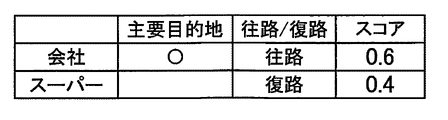
- the score indicates the probability of going to the predicted destination, and is a value based on the frequency used by the destination prediction unit 5.
- the score is good. Calculated based on frequency. In the case of FIG. 10, if the target is only two points (facility), the numerical value is such that the total of the two points is “1”.
- FIG. 11 is an image diagram of the route in the example of FIG. FIG. 11 shows, for example, when leaving home at 8 am and heading for the office, the time required from the home to the office at 8 o'clock, the average staying time at the office (for example, 10 hours), and the office at 18:00.
- the time required to reach the supermarket and the estimated arrival time at the supermarket are calculated from.
- the related information giving unit 7 displays information (accompanying information) related to the predicted destination that displays the ETA calculated in the predicted destination name (facility name) output by the ETA calculation unit 6 and the ETA for each predicted destination. It is given and output as information about facilities that are expected to stop by. As related information, for example, leaflet information may be taken in from a supermarket website or the like and time sale information may be given, or time zone regulation or congestion forecast information may be given from road information of the route to the predicted facility. ..
- the display device 8 presents the information about the facility where the stop-by is expected, which is output by the related information giving unit 7. That is, when the determination unit determines that the route is outward, the display device 8 functions as a presentation unit that presents information about a facility that is expected to stop by on the return route based on the travel history.
- the display device 8 is not limited to a device that displays only information about a facility that is expected to stop by, but may be a display unit of a device such as a navigation device, a display audio, or an in-vehicle meter.
- a mobile device such as a smartphone may function as the display device 8.
- the mobile device can function as the outward / return determination unit 4, the mobile device can function as the information presenting device 1.
- the display device 8 will be described as the presentation unit, but the presentation of information about the facility where the stop-by is expected is not limited to the display, and may be presented by voice.
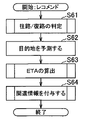
- FIG. 12 is a flowchart of the information presentation operation (recommendation operation).
- the current traveling state is the outward route or the return route (step S61).
- the determination of the outward route or the inbound route is performed by the outward route inbound route determination unit 4 by the method described above.
- the destination is predicted (step S62).
- the destination is predicted by the method described above in the destination prediction unit 5.
- ETA is calculated (step S63).
- the ETA is calculated by the ETA calculation unit 6 by the method described above.
- related information is added and displayed on the display device 8 (step S64).
- the related information is given by the method described above in the related information giving unit 7. That is, step S61 functions as a determination step, and step S64 functions as a presentation step.
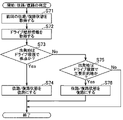
- FIG. 13 is a flowchart of the operation of the outward / return determination unit 4.
- the previous outbound / inbound state is acquired (step S71).
- the previous time of this step does not mean the previous run, but the result of the judgment immediately before. Since the recommendation of the predicted destination and the like is updated at any time while the information presenting device 1 is in operation, the determination of the outward route / return route is performed at any time.
- the drive history D2 is acquired (step S72), and it is determined whether the departure point in the current driving is the base in the drive history D2 (step S73). If it is a base (step S73; Yes), the outbound / inbound state is set to the outbound route (step S74). It can be said that the fact that the departure point is the base does not mean that the main destination has passed because the main destination is not the departure point. Also, it is clear that the fact that the place of departure is the base is an action to leave the base. Therefore, after leaving the above-mentioned base, the condition that the action of leaving the base without passing through the main destination is regarded as the outbound route is satisfied.
- step S73 determines whether the departure place is the main destination in the drive history D2 (step S75).
- step S73 indicates a case where the departure place is a main destination or a point that is neither a base nor a main destination.
- step S76 the outbound / inbound state is set to the inbound route (step S76). This is because the fact that the main destination is the starting point is the return trip.
- step S75 if the departure place is not the main destination in the drive history D2 (step S75; No), it corresponds to the case where the departure place is neither the base nor the main destination (convenience store, supermarket, etc. in FIG. 3). / The return route condition remains unchanged.
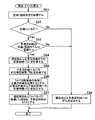
- FIG. 14 is a flowchart of the operation of the ETA calculation unit 6.
- the outbound / inbound state set by the outbound / inbound determination unit 4 is acquired (step S81), and it is determined whether or not the outbound route is in the outbound route (step S82).
- step S82 if the user is on the outward route (step S82; Yes), it is determined whether the outward / inbound label of the predicted destination for which ETA is calculated is the inbound route (step S83).
- step S83 it is determined whether or not the predicted destination for which the ETA is calculated is predicted to stop at the return route.
- the main destination here is a destination that is considered to pass through the predicted destination for which the ETA is calculated from the drive history D2.
- Step S85 calculate the average staying time (TB) at the main destination (step S85). Then, the time required from the main destination to the predicted destination (TC) when departing from the main destination at the time after the lapse of TA + TB is calculated (step S86). Step S86 calculates the time required for arriving at the main destination from the current location, staying at the main destination, and then heading for the predicted destination. For example, in the case of FIG. 11, the time required for going to the supermarket at 18:00 instead of 8 o'clock is calculated.
- the time when TA + TB + TC has elapsed from the current time is set as the ETA of the predicted destination (step S87).
- step S88 the ETA from the current location to the predicted destination is calculated. Since this case is not the case of staying at the main destination for a long time, the ETA from the current location to the predicted destination may be calculated.
- the information presenting device 1 is determined to be an outward route by the outward route return determination unit 4 for determining whether the current traveling condition corresponds to the outward route based on the drive history D2, and the outward route return determination unit 4.
- a display device 8 that presents information about a facility that is expected to stop by on the return route based on the drive history D2.
- the information about the facility where the stop-by is expected includes the facility name and the estimated arrival time at the facility.
- the information about the facility that is expected to stop by includes incidental information about the facility or the route to the facility. By doing so, it is possible to present in advance incidental information such as time sale information of a supermarket, time zone regulation information of a route to a stop-by facility, and congestion forecast information.
- the drive history D2 is added with information on the base, the main destination, the outbound route, or the return route for each arrival place based on the travel history D1 including the information on the departure place, the arrival place, and the staying time at the arrival place.
- the travel history D1 including the information on the departure place, the arrival place, and the staying time at the arrival place.
- the outbound and inbound route determination unit 4 determines that the current traveling condition is the outbound route when the vehicle has not passed the main destination after leaving the base. By doing so, if a point such as a base or a main destination is identified, it can be easily determined that the route is an outbound route.
- the estimated arrival time is predicted at least in consideration of the staying time at the main destination. By doing so, for example, when the main destination is a company, the arrival time on the way back from the company can be predicted. Therefore, it is possible to make a schedule for the return trip in advance.
- the display device 8 may present information on facilities that are expected to stop by on the outbound route as well as information on facilities that are expected to stop by on the return route. It is clear from the above explanation that the destination prediction unit 5 can predict not only the predicted destination (stop-by point) on the return route but also the predicted destination on the outward route. By doing so, it is possible to present a facility that is expected to stop by on both the outbound and inbound routes, and it is possible to further improve the convenience of the user.
- the present invention is not limited to the above embodiment. That is, those skilled in the art can carry out various modifications according to conventionally known knowledge within a range that does not deviate from the gist of the present invention. Even with such a modification, as long as the information presenting device of the present invention is provided, it is, of course, included in the category of the present invention.
Landscapes
- Engineering & Computer Science (AREA)
- Radar, Positioning & Navigation (AREA)
- Remote Sensing (AREA)
- Automation & Control Theory (AREA)
- Physics & Mathematics (AREA)
- General Physics & Mathematics (AREA)
- Health & Medical Sciences (AREA)
- General Health & Medical Sciences (AREA)
- Social Psychology (AREA)
- Navigation (AREA)
- Instructional Devices (AREA)
Abstract
Description
2 ドライブ連結部
3 学習データ生成部
4 往路復路判定部(判定部)
5 目的地予測部
6 ETA算出部
7 関連情報付与部
8 表示装置(提示部)
D1 走行履歴
D2 ドライブ履歴
D3 学習データ
Claims (10)
- 過去の走行履歴に基づいて現在の走行状況が往路に該当するかを判定する判定部と、
前記判定部において往路と判定された場合は、前記走行履歴に基づいて復路において立ち寄りが予測される施設に関する情報を提示する提示部と、
を備えることを特徴とする情報提示装置。 - 前記立ち寄りが予測される施設に関する情報には、施設名及び当該施設への到着予測時刻を含むことを特徴とする請求項1に記載の情報提示装置。
- 前記立ち寄りが予測される施設に関する情報には、さらに、当該施設又は当該施設への経路についての付随情報を含むことを特徴とする請求項2に記載の情報提示装置。
- 前記提示部は、復路において立ち寄りが予測される施設に関する情報とともに、往路に立ち寄りが予測される施設に関する情報も提示することを特徴とする請求項1から3のうちいずれか一項に記載の情報提示装置。
- 前記走行履歴は、出発地、到着地、前記到着地における滞在時間の情報を含む履歴情報に基づいて、前記到着地毎に拠点、主要目的地、往路又は復路の情報が付加されていることを特徴とする請求項1から4のうちいずれか一項に記載の情報提示装置。
- 前記判定部は、前記拠点を出発後、前記主要目的地を通過していない場合に前記現在の走行状況は往路と判定することを特徴とする請求項5に記載の情報提示装置。
- 前記到着予測時刻は、少なくとも前記主要目的地の滞在時間を考慮して予測されていることを特徴とする請求項5または6に記載の情報提示装置。
- 所定の情報を提示する情報提示装置で実行される情報提示方法であって、
過去の走行履歴に基づいて現在の走行状況が往路に該当するかを判定する判定工程と、
前記判定工程において往路と判定された場合は、前記走行履歴に基づいて復路において立ち寄りが予測される施設に関する情報を提示する提示工程と、
を備えることを特徴とする情報提示方法。 - 請求項8に記載の情報提示方法をコンピュータにより実行させることを特徴とする情報提示プログラム。
- 請求項9に記載の情報提示プログラムを格納したことを特徴とするコンピュータにより読み取り可能な記憶媒体。
Priority Applications (4)
| Application Number | Priority Date | Filing Date | Title |
|---|---|---|---|
| EP21891685.6A EP4246497A4 (en) | 2020-11-11 | 2021-10-29 | INFORMATION PROVISION DEVICE |
| US18/252,114 US20230408281A1 (en) | 2020-11-11 | 2021-10-29 | Information presentation device |
| JP2022561825A JP7521003B2 (ja) | 2020-11-11 | 2021-10-29 | 情報提示装置 |
| JP2024110367A JP2024124553A (ja) | 2020-11-11 | 2024-07-09 | 情報提示装置 |
Applications Claiming Priority (2)
| Application Number | Priority Date | Filing Date | Title |
|---|---|---|---|
| JP2020187885 | 2020-11-11 | ||
| JP2020-187885 | 2020-11-11 |
Publications (1)
| Publication Number | Publication Date |
|---|---|
| WO2022102438A1 true WO2022102438A1 (ja) | 2022-05-19 |
Family
ID=81602224
Family Applications (1)
| Application Number | Title | Priority Date | Filing Date |
|---|---|---|---|
| PCT/JP2021/040063 Ceased WO2022102438A1 (ja) | 2020-11-11 | 2021-10-29 | 情報提示装置 |
Country Status (4)
| Country | Link |
|---|---|
| US (1) | US20230408281A1 (ja) |
| EP (1) | EP4246497A4 (ja) |
| JP (2) | JP7521003B2 (ja) |
| WO (1) | WO2022102438A1 (ja) |
Cited By (1)
| Publication number | Priority date | Publication date | Assignee | Title |
|---|---|---|---|---|
| JPWO2024166408A1 (ja) * | 2023-02-08 | 2024-08-15 |
Citations (5)
| Publication number | Priority date | Publication date | Assignee | Title |
|---|---|---|---|---|
| JP2012112826A (ja) * | 2010-11-25 | 2012-06-14 | Alpine Electronics Inc | ナビゲーション装置 |
| JP2016126355A (ja) * | 2014-12-26 | 2016-07-11 | 富士通株式会社 | プログラム、情報配信装置、移動体端末、および方法 |
| JP2019168277A (ja) | 2018-03-22 | 2019-10-03 | 株式会社Jvcケンウッド | ナビゲーション装置およびナビゲーション方法、ならびにプログラム |
| JP2020085462A (ja) * | 2018-11-15 | 2020-06-04 | トヨタ自動車株式会社 | 情報処理装置及び情報処理プログラム |
| JP2020085570A (ja) * | 2018-11-20 | 2020-06-04 | トヨタ自動車株式会社 | 立ち寄り場所提案装置 |
Family Cites Families (4)
| Publication number | Priority date | Publication date | Assignee | Title |
|---|---|---|---|---|
| WO2008041480A1 (en) * | 2006-09-28 | 2008-04-10 | Panasonic Corporation | Device and method for predicting destination |
| CN101578497A (zh) * | 2007-07-12 | 2009-11-11 | 松下电器产业株式会社 | 旅程提示装置以及旅程提示方法 |
| US11087291B2 (en) * | 2015-11-24 | 2021-08-10 | Honda Motor Co., Ltd.. | Action planning and execution support device |
| DE102018214986A1 (de) * | 2018-09-04 | 2020-03-05 | Zf Friedrichshafen Ag | Vorrichtung, Verfahren und System zur Routenplanung eines Elektromobils |
-
2021
- 2021-10-29 WO PCT/JP2021/040063 patent/WO2022102438A1/ja not_active Ceased
- 2021-10-29 US US18/252,114 patent/US20230408281A1/en active Pending
- 2021-10-29 EP EP21891685.6A patent/EP4246497A4/en not_active Withdrawn
- 2021-10-29 JP JP2022561825A patent/JP7521003B2/ja active Active
-
2024
- 2024-07-09 JP JP2024110367A patent/JP2024124553A/ja active Pending
Patent Citations (5)
| Publication number | Priority date | Publication date | Assignee | Title |
|---|---|---|---|---|
| JP2012112826A (ja) * | 2010-11-25 | 2012-06-14 | Alpine Electronics Inc | ナビゲーション装置 |
| JP2016126355A (ja) * | 2014-12-26 | 2016-07-11 | 富士通株式会社 | プログラム、情報配信装置、移動体端末、および方法 |
| JP2019168277A (ja) | 2018-03-22 | 2019-10-03 | 株式会社Jvcケンウッド | ナビゲーション装置およびナビゲーション方法、ならびにプログラム |
| JP2020085462A (ja) * | 2018-11-15 | 2020-06-04 | トヨタ自動車株式会社 | 情報処理装置及び情報処理プログラム |
| JP2020085570A (ja) * | 2018-11-20 | 2020-06-04 | トヨタ自動車株式会社 | 立ち寄り場所提案装置 |
Non-Patent Citations (1)
| Title |
|---|
| See also references of EP4246497A4 |
Cited By (1)
| Publication number | Priority date | Publication date | Assignee | Title |
|---|---|---|---|---|
| JPWO2024166408A1 (ja) * | 2023-02-08 | 2024-08-15 |
Also Published As
| Publication number | Publication date |
|---|---|
| US20230408281A1 (en) | 2023-12-21 |
| EP4246497A1 (en) | 2023-09-20 |
| JP2024124553A (ja) | 2024-09-12 |
| JPWO2022102438A1 (ja) | 2022-05-19 |
| JP7521003B2 (ja) | 2024-07-23 |
| EP4246497A4 (en) | 2024-11-06 |
Similar Documents
| Publication | Publication Date | Title |
|---|---|---|
| CN101622653B (zh) | 适应于用户旅行的交通信息 | |
| JP5608185B2 (ja) | ナビゲーション装置、方法及びシステム | |
| CN104937375B (zh) | 目的地预测装置 | |
| US20200264608A1 (en) | Driving mode decision support | |
| JP5831290B2 (ja) | 分岐確率予測装置 | |
| US20140188788A1 (en) | Multi-modal journey planner | |
| JP2006337182A (ja) | カーナビゲーションシステム、交通情報提供装置、カーナビゲーション装置、交通情報提供方法および交通情報提供プログラム | |
| TW201309512A (zh) | 車載裝置及其行車輔助系統與行車輔助資訊提供方法 | |
| JP2015114112A (ja) | 移動案内装置及び移動案内方法 | |
| JP2017072440A (ja) | 運転快適度算出装置、運転快適度算出方法、および運転快適度算出システム | |
| KR20160059091A (ko) | 광고 제공 시스템 및 그 방법 | |
| JP5162978B2 (ja) | 経路探索方法、経路探索システム、及び、プログラム | |
| JP5114254B2 (ja) | 地図表示システム、経路探索サーバおよび経路探索方法ならびに端末装置 | |
| KR102242422B1 (ko) | 대중교통 경로 탐색 서버 및 방법 | |
| JP2024124553A (ja) | 情報提示装置 | |
| US20200051197A1 (en) | Information processing apparatus, information processing method, and non-transitory storage medium | |
| US20240296428A1 (en) | Repair site transmission device and repair site transmission method | |
| JP2007271283A (ja) | ナビゲーションシステム、経路探索サーバ、端末装置および広告表示方法 | |
| JP2012073205A (ja) | 経路探索装置及び経路探索方法 | |
| JP2016183901A (ja) | ナビゲーション装置、ナビゲーション方法及びナビゲーションプログラム | |
| JP2015087353A (ja) | 経路探索システム、経路管理サーバおよび経路探索端末 | |
| JP2025000909A (ja) | 情報処理装置、情報処理方法及びプログラム | |
| Neto et al. | A user-personalized model for real time destination and route prediction | |
| JP7613600B2 (ja) | 修理地点送信装置及び修理地点送信方法 | |
| JP4761582B2 (ja) | 経路探索システム、経路探索サーバおよび経路案内方法 |
Legal Events
| Date | Code | Title | Description |
|---|---|---|---|
| 121 | Ep: the epo has been informed by wipo that ep was designated in this application |
Ref document number: 21891685 Country of ref document: EP Kind code of ref document: A1 |
|
| ENP | Entry into the national phase |
Ref document number: 2022561825 Country of ref document: JP Kind code of ref document: A |
|
| WWE | Wipo information: entry into national phase |
Ref document number: 18252114 Country of ref document: US |
|
| NENP | Non-entry into the national phase |
Ref country code: DE |
|
| ENP | Entry into the national phase |
Ref document number: 2021891685 Country of ref document: EP Effective date: 20230612 |
|
| WWW | Wipo information: withdrawn in national office |
Ref document number: 2021891685 Country of ref document: EP |