WO2022102635A1 - 3-ヒドロキシアジピン酸および/またはα-ヒドロムコン酸を生産するための遺伝子改変微生物および当該化学品の製造方法 - Google Patents
3-ヒドロキシアジピン酸および/またはα-ヒドロムコン酸を生産するための遺伝子改変微生物および当該化学品の製造方法 Download PDFInfo
- Publication number
- WO2022102635A1 WO2022102635A1 PCT/JP2021/041257 JP2021041257W WO2022102635A1 WO 2022102635 A1 WO2022102635 A1 WO 2022102635A1 JP 2021041257 W JP2021041257 W JP 2021041257W WO 2022102635 A1 WO2022102635 A1 WO 2022102635A1
- Authority
- WO
- WIPO (PCT)
- Prior art keywords
- acid
- coa
- gene
- reaction
- pyruvate
- Prior art date
- Legal status (The legal status is an assumption and is not a legal conclusion. Google has not performed a legal analysis and makes no representation as to the accuracy of the status listed.)
- Ceased
Links
Classifications
-
- C—CHEMISTRY; METALLURGY
- C12—BIOCHEMISTRY; BEER; SPIRITS; WINE; VINEGAR; MICROBIOLOGY; ENZYMOLOGY; MUTATION OR GENETIC ENGINEERING
- C12N—MICROORGANISMS OR ENZYMES; COMPOSITIONS THEREOF; PROPAGATING, PRESERVING, OR MAINTAINING MICROORGANISMS; MUTATION OR GENETIC ENGINEERING; CULTURE MEDIA
- C12N15/00—Mutation or genetic engineering; DNA or RNA concerning genetic engineering, vectors, e.g. plasmids, or their isolation, preparation or purification; Use of hosts therefor
- C12N15/09—Recombinant DNA-technology
- C12N15/11—DNA or RNA fragments; Modified forms thereof; Non-coding nucleic acids having a biological activity
- C12N15/52—Genes encoding for enzymes or proenzymes
-
- C—CHEMISTRY; METALLURGY
- C12—BIOCHEMISTRY; BEER; SPIRITS; WINE; VINEGAR; MICROBIOLOGY; ENZYMOLOGY; MUTATION OR GENETIC ENGINEERING
- C12N—MICROORGANISMS OR ENZYMES; COMPOSITIONS THEREOF; PROPAGATING, PRESERVING, OR MAINTAINING MICROORGANISMS; MUTATION OR GENETIC ENGINEERING; CULTURE MEDIA
- C12N1/00—Microorganisms; Compositions thereof; Processes of propagating, maintaining or preserving microorganisms or compositions thereof; Processes of preparing or isolating a composition containing a microorganism; Culture media therefor
- C12N1/20—Bacteria; Culture media therefor
- C12N1/205—Bacterial isolates
-
- C—CHEMISTRY; METALLURGY
- C12—BIOCHEMISTRY; BEER; SPIRITS; WINE; VINEGAR; MICROBIOLOGY; ENZYMOLOGY; MUTATION OR GENETIC ENGINEERING
- C12N—MICROORGANISMS OR ENZYMES; COMPOSITIONS THEREOF; PROPAGATING, PRESERVING, OR MAINTAINING MICROORGANISMS; MUTATION OR GENETIC ENGINEERING; CULTURE MEDIA
- C12N15/00—Mutation or genetic engineering; DNA or RNA concerning genetic engineering, vectors, e.g. plasmids, or their isolation, preparation or purification; Use of hosts therefor
- C12N15/09—Recombinant DNA-technology
- C12N15/63—Introduction of foreign genetic material using vectors; Vectors; Use of hosts therefor; Regulation of expression
- C12N15/70—Vectors or expression systems specially adapted for E. coli
-
- C—CHEMISTRY; METALLURGY
- C12—BIOCHEMISTRY; BEER; SPIRITS; WINE; VINEGAR; MICROBIOLOGY; ENZYMOLOGY; MUTATION OR GENETIC ENGINEERING
- C12N—MICROORGANISMS OR ENZYMES; COMPOSITIONS THEREOF; PROPAGATING, PRESERVING, OR MAINTAINING MICROORGANISMS; MUTATION OR GENETIC ENGINEERING; CULTURE MEDIA
- C12N15/00—Mutation or genetic engineering; DNA or RNA concerning genetic engineering, vectors, e.g. plasmids, or their isolation, preparation or purification; Use of hosts therefor
- C12N15/09—Recombinant DNA-technology
- C12N15/63—Introduction of foreign genetic material using vectors; Vectors; Use of hosts therefor; Regulation of expression
- C12N15/74—Vectors or expression systems specially adapted for prokaryotic hosts other than E. coli, e.g. Lactobacillus, Micromonospora
-
- C—CHEMISTRY; METALLURGY
- C12—BIOCHEMISTRY; BEER; SPIRITS; WINE; VINEGAR; MICROBIOLOGY; ENZYMOLOGY; MUTATION OR GENETIC ENGINEERING
- C12N—MICROORGANISMS OR ENZYMES; COMPOSITIONS THEREOF; PROPAGATING, PRESERVING, OR MAINTAINING MICROORGANISMS; MUTATION OR GENETIC ENGINEERING; CULTURE MEDIA
- C12N9/00—Enzymes; Proenzymes; Compositions thereof; Processes for preparing, activating, inhibiting, separating or purifying enzymes
- C12N9/0004—Oxidoreductases (1.)
- C12N9/0008—Oxidoreductases (1.) acting on the aldehyde or oxo group of donors (1.2)
-
- C—CHEMISTRY; METALLURGY
- C12—BIOCHEMISTRY; BEER; SPIRITS; WINE; VINEGAR; MICROBIOLOGY; ENZYMOLOGY; MUTATION OR GENETIC ENGINEERING
- C12N—MICROORGANISMS OR ENZYMES; COMPOSITIONS THEREOF; PROPAGATING, PRESERVING, OR MAINTAINING MICROORGANISMS; MUTATION OR GENETIC ENGINEERING; CULTURE MEDIA
- C12N9/00—Enzymes; Proenzymes; Compositions thereof; Processes for preparing, activating, inhibiting, separating or purifying enzymes
- C12N9/0004—Oxidoreductases (1.)
- C12N9/0051—Oxidoreductases (1.) acting on a sulfur group of donors (1.8)
-
- C—CHEMISTRY; METALLURGY
- C12—BIOCHEMISTRY; BEER; SPIRITS; WINE; VINEGAR; MICROBIOLOGY; ENZYMOLOGY; MUTATION OR GENETIC ENGINEERING
- C12N—MICROORGANISMS OR ENZYMES; COMPOSITIONS THEREOF; PROPAGATING, PRESERVING, OR MAINTAINING MICROORGANISMS; MUTATION OR GENETIC ENGINEERING; CULTURE MEDIA
- C12N9/00—Enzymes; Proenzymes; Compositions thereof; Processes for preparing, activating, inhibiting, separating or purifying enzymes
- C12N9/10—Transferases (2.)
- C12N9/12—Transferases (2.) transferring phosphorus containing groups, e.g. kinases (2.7)
- C12N9/1205—Phosphotransferases with an alcohol group as acceptor (2.7.1), e.g. protein kinases
-
- C—CHEMISTRY; METALLURGY
- C12—BIOCHEMISTRY; BEER; SPIRITS; WINE; VINEGAR; MICROBIOLOGY; ENZYMOLOGY; MUTATION OR GENETIC ENGINEERING
- C12P—FERMENTATION OR ENZYME-USING PROCESSES TO SYNTHESISE A DESIRED CHEMICAL COMPOUND OR COMPOSITION OR TO SEPARATE OPTICAL ISOMERS FROM A RACEMIC MIXTURE
- C12P7/00—Preparation of oxygen-containing organic compounds
- C12P7/40—Preparation of oxygen-containing organic compounds containing a carboxyl group including Peroxycarboxylic acids
- C12P7/44—Polycarboxylic acids
-
- C—CHEMISTRY; METALLURGY
- C12—BIOCHEMISTRY; BEER; SPIRITS; WINE; VINEGAR; MICROBIOLOGY; ENZYMOLOGY; MUTATION OR GENETIC ENGINEERING
- C12Y—ENZYMES
- C12Y102/00—Oxidoreductases acting on the aldehyde or oxo group of donors (1.2)
- C12Y102/04—Oxidoreductases acting on the aldehyde or oxo group of donors (1.2) with a disulfide as acceptor (1.2.4)
- C12Y102/04001—Pyruvate dehydrogenase (acetyl-transferring) (1.2.4.1)
-
- C—CHEMISTRY; METALLURGY
- C12—BIOCHEMISTRY; BEER; SPIRITS; WINE; VINEGAR; MICROBIOLOGY; ENZYMOLOGY; MUTATION OR GENETIC ENGINEERING
- C12Y—ENZYMES
- C12Y108/00—Oxidoreductases acting on sulfur groups as donors (1.8)
- C12Y108/01—Oxidoreductases acting on sulfur groups as donors (1.8) with NAD+ or NADP+ as acceptor (1.8.1)
- C12Y108/01004—Dihydrolipoyl dehydrogenase (1.8.1.4), i.e. lipoamide-dehydrogenase
-
- C—CHEMISTRY; METALLURGY
- C12—BIOCHEMISTRY; BEER; SPIRITS; WINE; VINEGAR; MICROBIOLOGY; ENZYMOLOGY; MUTATION OR GENETIC ENGINEERING
- C12Y—ENZYMES
- C12Y203/00—Acyltransferases (2.3)
- C12Y203/01—Acyltransferases (2.3) transferring groups other than amino-acyl groups (2.3.1)
- C12Y203/01012—Dihydrolipoyllysine-residue acetyltransferase (2.3.1.12)
-
- C—CHEMISTRY; METALLURGY
- C12—BIOCHEMISTRY; BEER; SPIRITS; WINE; VINEGAR; MICROBIOLOGY; ENZYMOLOGY; MUTATION OR GENETIC ENGINEERING
- C12Y—ENZYMES
- C12Y203/00—Acyltransferases (2.3)
- C12Y203/01—Acyltransferases (2.3) transferring groups other than amino-acyl groups (2.3.1)
- C12Y203/01054—Formate C-acetyltransferase (2.3.1.54), i.e. pyruvate formate-lyase or PFL
-
- C—CHEMISTRY; METALLURGY
- C12—BIOCHEMISTRY; BEER; SPIRITS; WINE; VINEGAR; MICROBIOLOGY; ENZYMOLOGY; MUTATION OR GENETIC ENGINEERING
- C12Y—ENZYMES
- C12Y207/00—Transferases transferring phosphorus-containing groups (2.7)
- C12Y207/01—Phosphotransferases with an alcohol group as acceptor (2.7.1)
- C12Y207/0104—Pyruvate kinase (2.7.1.40)
-
- C—CHEMISTRY; METALLURGY
- C12—BIOCHEMISTRY; BEER; SPIRITS; WINE; VINEGAR; MICROBIOLOGY; ENZYMOLOGY; MUTATION OR GENETIC ENGINEERING
- C12R—INDEXING SCHEME ASSOCIATED WITH SUBCLASSES C12C - C12Q, RELATING TO MICROORGANISMS
- C12R2001/00—Microorganisms ; Processes using microorganisms
- C12R2001/01—Bacteria or Actinomycetales ; using bacteria or Actinomycetales
- C12R2001/185—Escherichia
- C12R2001/19—Escherichia coli
-
- C—CHEMISTRY; METALLURGY
- C12—BIOCHEMISTRY; BEER; SPIRITS; WINE; VINEGAR; MICROBIOLOGY; ENZYMOLOGY; MUTATION OR GENETIC ENGINEERING
- C12R—INDEXING SCHEME ASSOCIATED WITH SUBCLASSES C12C - C12Q, RELATING TO MICROORGANISMS
- C12R2001/00—Microorganisms ; Processes using microorganisms
- C12R2001/01—Bacteria or Actinomycetales ; using bacteria or Actinomycetales
- C12R2001/425—Serratia
- C12R2001/43—Serratia marcescens
Definitions
- the present invention relates to a gene-modified microorganism that highly produces 3-hydroxyadipic acid and / or ⁇ -hydromuconic acid, and a method for producing 3-hydroxyadipic acid and / or ⁇ -hydromuconic acid using the gene-modified microorganism.
- 3-Hydroxyadipic acid (IUPAC name: 3-hydroxyhexanedioic acid) and ⁇ -hydromuconic acid (IUPAC name: (E) -hex-2-endioic acid) are dicarboxylic acids having 6 carbon atoms. These can be used as polyester by polymerizing with a polyhydric alcohol and as a raw material for polyamide by polymerizing with a polyvalent amine. Further, a compound obtained by adding ammonia to these terminals to form a lactam can also be used as a raw material for the polyamide.
- Patent Document 1 describes a poly having excellent activity of catalyzing a reduction reaction from 3-oxoadipyl-CoA to 3-hydroxyadipyl-CoA.
- Methods for producing 3-hydroxyadipic acid, ⁇ -hydromuconic acid and / or adipic acid using peptides have been described, and 3-oxoadipyl-CoA is converted to 3-hydroxyadipyl-CoA as a biosynthetic pathway for these substances.
- 3-oxoadipyl-CoA is converted to 3-hydroxyadipyl-CoA as a biosynthetic pathway for these substances.
- all of the genes modified in Patent Document 1 are limited to the reactions on the biosynthetic pathway in the cell, and there is no description about the decrease or enhancement of the enzyme activity in the metabolic pathway upstream of them.
- Patent Document 2 describes a method for producing 1,3-butadiene using a microorganism having a modified metabolic pathway, in which 1,3-butadiene is biosynthesized from acetyl-CoA and succinyl-CoA.
- 3-Hydroxyadipic acid (3-hydroxyadipate) has been described as a metabolic intermediate in the metabolic pathways involved.
- Patent Document 3 describes a method for producing muconic acid using a microorganism having a modified metabolic pathway, in which trans and trans-muconic acid are biosynthesized from acetyl-CoA and succinyl-CoA.
- ⁇ -Hydromconic acid (2,3-dehydroadipate) has been described as a metabolic intermediate in the metabolic pathway.
- Patent Documents 4 and 5 describe methods for producing adipic acid and hexamethylenediamine (HMDA) using unnatural microorganisms, in which these substances are acetyl-CoA and succinyl-CoA.
- 3-oxoadipyl-CoA is synthesized from the biosynthetic pathway in common, but there is another biosynthetic pathway from 3-oxoadipyl-CoA to 3-hydroxyadipic acid or ⁇ -hydromuconic acid. Have been described.
- Patent Document 4 describes pyruvate kinase as an additional gene deletion to improve proliferation-coupled HMDA formation in the production of HMDA, and phospho as an additional gene deletion to improve yield.
- Kinase enzymes have been described.
- phosphotransferase is described as an additional gene deletion for improving the formation of adipic acid coupled with proliferation, but pyruvate kinase is not described.
- Patent Document 5 describes the attenuation or elimination of phosphotransferase and pyruvate kinase activities in the production of adipic acid using an unnatural microorganism having a phosphoketolase. Also described are genetic modifications involving the enhancement of the reaction to produce acetyl-CoA from pyruvate for NADH production in the presence of phosphoketolase.
- Patent Document 6 discloses a method for improving a microorganism based on incilico analysis, in which the genes encoding pyruvate kinase and phosphotransferase of Escherichia coli, pykF, pykA, and ptsG, are deleted and cultured under anaerobic conditions. It is disclosed that this increases the production of succinic acid.
- Non-Patent Document 1 discloses that the production of 2-oxoglutaric acid is increased by deleting pdhR, which is a gene encoding a transcriptional repressor of the pyruvate dehydrogenase complex of Escherichia coli.
- Patent Document 1 discloses enhanced expression of enzyme genes involved in improving the productivity of 3-hydroxyadipic acid or ⁇ -hydromuconic acid, but all of the enzyme genes that enhance expression are acetyls in the biosynthetic pathway. -Limited to reactions downstream of CoA and succinyl-CoA, there is no description of enhanced enzyme activity in metabolic pathways upstream of them.
- Patent Document 2 or 3 describes a metabolic pathway in which 3-hydroxyadipic acid or ⁇ -hydromuconic acid can be produced in a microorganism, but the metabolism is stopped with 3-hydroxyadipic acid or ⁇ -hydromuconic acid, and the culture medium is used. There is no description that it is secreted inside.
- Patent Document 6 and Non-Patent Document 1 do not describe 3-hydroxyadipic acid or ⁇ -hydromuconic acid.
- a gene encoding 3-oxoadipyl-CoA reductase is introduced, or the upstream metabolic pathway is further modified based on a gene-modified microorganism in which the expression of the gene is enhanced and the enzyme activity is enhanced.
- 3-Hydroxyadipic acid and / or ⁇ -hydromuconic acid, and / or a gene-modified microorganism for producing ⁇ -hydromuconic acid in a high yield and a method for producing a substance using the modified microorganism.
- the present inventor has the ability to produce 3-hydroxyadipic acid and / or ⁇ -hydromuconic acid, enhances the reaction to produce acetyl-CoA from pyruvic acid, and pyruvate.
- genetically modified microorganisms with reduced function of acid kinase and / or phosphotransferase have excellent ability to produce 3-hydroxyadipic acid and / or ⁇ -hydromuconic acid, and have completed the present invention. ..
- the present invention provides the following. (1) Intensify the reaction to produce acetyl-CoA from pyruvate and enhance the function of pyruvate kinase and / or phosphotransferase enzymes in microorganisms capable of producing 3-hydroxyadipic acid and / or ⁇ -hydromuconic acid. Reduced, genetically modified microorganisms.
- the enhancement of the reaction for producing acetyl-CoA from pyruvate is the enhancement of the reaction catalyzed by the pyruvate dehydrogenase complex and / or the enhancement of the reaction catalyzed by pyruvate formic acid lyase, according to (1). Genetically modified microorganism.
- the gene-modified microorganism according to any one of (1) to (7) further enhancing the reaction of phosphoenolpyruvate carboxykinase.
- the gene-modified microorganism according to any one of (1) to (8) which is a microorganism that does not metabolize glucose by the phosphoketolase pathway.
- a method for producing 3-hydroxyadipic acid and / or ⁇ -hydromuconic acid which comprises the step of culturing the genetically modified microorganism according to any one of (1) to (9).
- a method for producing a genetically modified microorganism having the ability to produce 3-hydroxyadipyruvic acid and / or ⁇ -hydromuconic acid which comprises a step of enhancing or reducing the function inherent in the microorganism by genetic modification, as the step.
- a method comprising, step (a) to enhance the reaction to produce acetyl-CoA from pyruvate, and step (b) to reduce the function of pyruvate kinase and / or phosphotransferase enzyme.
- the modification can produce 3-hydroxyadipyruvic acid and / or ⁇ -hydromuconic acid in higher yields as compared to the parent strain microorganism in which the gene has not been modified.
- the reaction of producing acetyl-CoA from pyruvate of the microorganism is enhanced, and pyruvate kinase and / or phosphotransferase. It has been found that by reducing the function of the enzyme, 3-hydroxyadipyruvic acid and / or ⁇ -hydromuconic acid can be produced in high yield.
- 3-hydroxyadipic acid may be abbreviated as 3HA
- ⁇ -hydromuconic acid may be abbreviated as HMA
- 3-oxoadipyl-CoA may be abbreviated as 3OA-CoA
- 3-hydroxyadipyl-CoA may be abbreviated as 3HA-CoA
- 2,3-dehydroadipyl-CoA may be abbreviated as HMA-CoA
- phosphoenolpyruvate may be abbreviated as PEP.
- the enzyme that catalyzes the reaction of reducing 3-oxoadipyl-CoA to produce 3-hydroxyadipyl-CoA may be described as "3-oxoadipyl-CoA reductase”.
- the complex of proteins encoded by the aceE, aceF and lpd genes in the presence of a single promoter is described as a pyruvate dehydrogenase complex and may be abbreviated as PDHc.
- aceE, aceF and lpd genes may be collectively referred to as PDHc gene cluster.
- pyruvate formic acid lyase and pyruvate formic acid lyase activating enzyme are collectively referred to as pyruvate formic acid lyase, and may be abbreviated as PFL or Pfl.
- pyruvate kinase may be abbreviated as Pyk
- phosphotransferase enzyme may be abbreviated as PTS.
- a nucleic acid encoding a polypeptide having a function may be described as a gene.
- the gene-modified microorganism of the present invention can biosynthesize 3-hydroxyadipic acid and / or ⁇ -hydromuconic acid using acetyl-CoA and succinyl-CoA as intermediates as shown in the following metabolic pathways.
- the metabolic pathway from glucose to acetyl-CoA is well known as glycolysis, and the metabolic pathway from succinyl-CoA is well known as the TCA cycle.
- reaction A shows a reaction for producing 3-oxoadipyl-CoA from acetyl-CoA and succinyl-CoA.
- reaction B shows a reaction of reducing 3-oxoadipyl-CoA to produce 3-hydroxyadipyl-CoA.
- reaction C shows a reaction that produces 2,3-dehydroadipyl-CoA from 3-hydroxyadipyl-CoA.
- Reaction D shows a reaction for producing 3-hydroxyadipic acid from 3-hydroxyadipyl-CoA.
- Reaction E shows a reaction that produces ⁇ -hydromuconic acid from 2,3-dehydroadipyl-CoA.
- a method for creating an enzyme that catalyzes each reaction in the following metabolic pathways and a microorganism capable of producing 3-hydroxyadipic acid and / or ⁇ -hydromuconic acid using the following metabolic pathways is described in International Publication No. 2019. It is detailed in / 107516.
- PDHc pyruvate dehydrogenase complex
- PDHc which is the target of fortification, is not particularly limited as long as it has a catalytic activity for producing acetyl-CoA from pyruvate. .4.1), dihydrolipoyl transactylase (E2, EC2.3.1.12), and dihydrolipoyl dehydrogenase (E3, EC1.8.1.4), which are encoded by the aceE, aceF, and lpd genes, respectively. ..
- E Escherichia coli str. K-12 substr.
- AceE NCBI-ProteinID: NP_414656
- AceF NCBI-ProteinID: NP_414657
- Lpd NCBI-ProteinID: NP_414658
- Serratia grimesisi NBRC13537) sequence number (NBRC13537).
- Lpd SEQ ID NO: 3
- Klebsiella pneumoniae subsp. Examples include LpdA (NCBI-ProteinID: ABR75580) derived from the pneumoniae MGH 78578 strain.
- Whether or not the polypeptide encoded by the gene of the microorganism used in the present invention is PDHc is determined by searching a public database such as NCBI (National Center for Biotechnology Information) or KEGG (Kyoto Encyclopedia of Genes and Genomes) on the ST line. good.
- PDHc As a method for enhancing the reaction catalyzed by PDHc, for example, increasing the expression level of at least one enzyme constituting PDHc can be mentioned.
- a method for increasing the expression level of at least one enzyme constituting PDHc for example, at least one gene constituting the PDHc gene cluster may be introduced from outside the cell of the host microorganism into the cell. Examples thereof include a method of increasing the number of copies of the gene cluster and modifying the promoter region and ribosome binding sequence upstream of the coding region of the gene cluster. These methods may be performed alone or in combination.
- the expression level of PDHc can also be increased by reducing the function of the PDHc transcription inhibitor.
- enhancing the activity of PDHc can be mentioned.
- the catalytic activity of at least one enzyme constituting PDHc may be enhanced.
- Specific methods for enhancing PDHc activity include, for example, reducing sensitivity to NADH.
- the reduced susceptibility to NADH means, for example, that the Ki value of the enzyme for NADH is more than twice as high as that of the control.
- PDHc with reduced susceptibility to NADH was described by Kim et al., J. Mol. Bacteriol. 190: 3851-3858 (2008)) Escherichia coli str.
- E354K and / or H322Y mutants in K-12-derived Lpd (NCBI-ProteinID: NP_414658), Klebsiella pneumoniae-derived Lpd (NCBI-ProteinID: ABR75580) or a portion thereof, which are known to function in an anaerobic environment. Can be obtained by using.
- the enzyme gene with enhanced catalytic activity may be replaced with a wild-type gene originally possessed by the microorganism used for production, or may be allowed to coexist. Further, the number of copies of the enzyme gene may be increased, or the promoter region or ribosome binding sequence upstream of the coding region of the enzyme gene may be modified. These methods may be performed alone or in combination.
- Another method for enhancing the reaction for producing acetyl-CoA from pyruvate in the present invention is to enhance the reaction catalyzed by pyruvate formic acid lyase.
- the pyruvate formic acid lyase to be fortified is not particularly limited as long as it has a catalytic activity for producing acetyl CoA from pyruvate, but for bacteria such as the genus Escherichia and the genus Serratia, the pyruvate formate for example.
- -Lyase EC2.3.1.54
- pyruvate format-lyase activating enzyme EC1.97.1.1.4
- pflB and pflA genes, respectively.
- Formic acid lyase pyruvate catalyzes the reaction that produces acetyl-CoA and formic acid from pyruvate and coenzyme A.
- pflB and pflA form an operon.
- pyruvate formic acid lyase Escherichia coli str. K-12 substr. PflB (NCBI-ProteinID: NP_415423) derived from MG1655 strain, PflA (NCBI-ProteinID: NP_415422), PflB derived from Serratia grimesi NBRC13537 strain (SEQ ID NO: 5), PflA (SEQ ID NO: 6) and the like.
- Whether or not the polypeptide encoded by the gene of the microorganism used in the present invention is pyruvate formic acid lyase may be determined by BLAST search on a public database such as NCBI or KEGG.
- Examples of the method for enhancing the reaction catalyzed by pyruvate formic acid lyase include enhancing the catalytic activity of pyruvate formic acid lyase itself and increasing the expression level of pyruvate formic acid lyase. It is preferable to increase the expression level of lyase.
- the pyruvate formic acid lyase gene is introduced from outside the cell of the host microorganism into the cell, the number of copies of the gene is increased, or the gene is used. Examples thereof include a method of modifying the promoter region upstream of the coding region and the ribosome binding sequence. These methods may be performed alone or in combination.
- Japanese Patent Application Publication No. 2017/0298363A1 describes that adipic acid is produced using an unnatural microorganism that modifies the metabolism of a microorganism having a phosphoketolase pathway and improves energy efficiency. ..
- NADH is produced in glycolytic pathway, whereas sugar metabolism in phosphoketolase pathway does not produce NADH. Therefore, when a reducing compound is produced using a microorganism having a phosphoketolase pathway.
- adipic acid is a compound in a more reduced state than 3-hydroxyadipic acid and ⁇ -hydromuconic acid
- those skilled in the art may use it when producing 3-hydroxyadipic acid and / or ⁇ -hydromuconic acid. It is expected that enhancing the reaction of PDHc and / or pyruvate formic acid lyase will lead to an imbalance in the redox balance and reduce the yield of the compound.
- reducing the function of pyruvate kinase and / or phosphotransferase enzyme means reducing the activity of these enzymes.
- the method for reducing the function is not particularly limited, but for example, the gene encoding the enzyme is subjected to gene mutation treatment by a gene mutagen, ultraviolet irradiation, etc., or partial or total deletion treatment of the base sequence by a site-specific mutation method or the like. , It can be reduced by introducing a frame shift mutation into the base sequence, inserting a stop codon into the base sequence, or the like. It can also be reduced by removing all or part of the base sequence or replacing it with another base sequence by using a gene recombination technique. Among these, a method of removing a part or the whole of the base sequence is preferable.
- Pyruvate kinase is classified as EC2.7.1.40 and is an enzyme that catalyzes the reaction of dephosphorylating phosphoenolpyruvate and converting it to pyruvate and ATP.
- Escherichia coli str. K-12 substr. PykF NCBI-ProteinID: NP_416191
- PykA NCBI-ProteinID: NP_416368
- PykF SEQ ID NO: 7
- PykA SEQ ID NO: 7
- the microorganism used in the present invention has two or more genes encoding pyruvate kinase, it is preferable to reduce the function of all pyruvate kinases. Whether or not the polypeptide encoded by the gene of the microorganism used in the present invention is pyruvate kinase may be checked by BLAST search on a public database such as NCBI or KEGG.
- Phosphotransferase enzyme is the main mechanism for taking up carbohydrates such as hexose, hexitol, and disaccharide into the cell.
- carbohydrates are taken up into cells and at the same time converted to phosphate esters, while the phosphate donor phosphoenolpyruvate (PEP) is converted to pyruvate.
- PPS phosphate donor phosphoenolpyruvate
- the PTS enzyme is composed of two common enzymes, phosphoenolpyruvate sugar phosphotransferase enzymeI and phosphocarrier protein HPr, which function regardless of the type of carbohydrate, and a membrane-beneze-bone spices which is specific to a specific carbohydrate.
- enzameII is further composed of sugar-specific IIA, IIB, and IIC component.
- the enzyme II enzyme exists in a state of being linked individually or as a multi-domain protein depending on the species.
- phosphoenolpyrubate sugar phosphotransferase enzaimeI is the ptsI gene
- phosphocarrier protein HPr is the ptsH gene
- glucose-specific IIA is the crr gene
- glucose-specific IIB and IIC are also coded for glucose-specific IIB and IIC.
- the enzyme encoded by the ptsG gene is classified into EC2.7.1.199, and is called protein-Npi-phosphohistidine-D-glucose phosphotransferase, and is called Escherichia coli str. K-12 substr. Examples thereof include PtsG (NCBI-ProteinID: NP_415619) derived from the MG1655 strain, PtsG (SEQ ID NO: 9) derived from the Serratia grimesi NBRC13537 strain, and the like.
- a BLAST search may be performed on a website such as NCBI or KEGG.
- one of the above-mentioned PTS enzymes may be reduced in function, or a plurality of functions may be reduced. Any of the above PTS enzyme functions may be reduced, but it is preferable to reduce the enzyme function involved in glucose uptake, and it is particularly preferable to reduce the function of PtsG.
- Specific examples of the ptsG gene include Escherichia coli str. K-12 substr. Examples thereof include ptsG (NCBI-GeneID: 945651) derived from the MG1655 strain and ptsG (SEQ ID NO: 10) derived from the Serratia grimesi NBRC13537 strain.
- Escherichia coli is a microorganism capable of producing 3-hydroxyadipic acid and ⁇ -hydromuconic acid.
- a mutant strain lacking the ptsG gene encoding the enzyme was prepared, and when the mutant strain was cultured under anaerobic conditions, the yield of succinic acid could be increased and the yield of acetic acid and ethanol could be decreased.
- acetic acid and ethanol are compounds metabolized from acetyl-CoA, as shown in the metabolic pathway of Scheme 2 above. That is, in Japanese Patent Publication No.
- 3-hydroxyadipic acid and / or ⁇ -hydromuconic acid produced by the method of the present invention is prepared from 3-oxoadipyl-CoA produced from acetyl-CoA and succinyl-CoA via a plurality of reactions as described above. It is a compound that is metabolized. Therefore, from the description in Japanese Patent Publication No. 2008-527991, when the genes of pyruvate kinase and phosphotransferase enzyme are deleted, 3-hydroxyadipic acid and / or ⁇ -hydromuconic acid is produced due to a decrease in the supply amount of acetyl-CoA. It is expected that the yield will also decrease.
- Enhancing the reaction of PEP carboxykinase includes, for example, enhancing the activity of the enzyme that catalyzes this reaction.
- the gene of this enzyme is introduced from outside the cell of the host microorganism into the cell, the number of copies of the gene is increased, or the promoter region upstream of the coding region of the gene is used. And a method of modifying the ribosome binding sequence.
- PEP carboxykinase is classified as EC4.1.1.49 and is an enzyme that catalyzes the reaction to produce oxaloacetate and ATP from PEP, carbon dioxide and ADP.
- PEP carboxykinase is physiologically responsible for the major reaction in the production of glucose from fatty acids in gluconeogenesis.
- the reaction catalyzed by phosphoenolpyruvate carboxykinase is a reversible reaction, but in the production of 3-hydroxyadipic acid and / or ⁇ -hydromuconic acid, the reaction is directed to convert phosphoenolpyruvate and carbon dioxide to oxaloacetate. Proceed to.
- polypeptide encoded by the enzyme gene used in the present invention is phosphoenolpyruvate carboxykinase can be checked by BLAST search on websites such as NCBI and KEGG.
- Japanese Patent Application Laid-Open No. 2015-146810 states that a deficiency of the PEP carboxykinase gene is effective in producing a microbial strain that produces adipic acid from acetyl-CoA and succinyl-CoA in high yield in Incilico using a metabolic network model. It is stated that. Further, Japanese Patent Application Laid-Open No. 2015-504688 describes that the activity of PEP carboxykinase is enhanced for the purpose of increasing the PEP pool in the production of muconic acid biosynthesized via PEP. In addition, US Patent Application Publication No.
- 2017/0298363A1 describes enhancing the activity of PEP carboxykinase to improve the availability of PEP in the production of adipic acid biosynthesized via PEP. Has been done. That is, from the description that the reaction catalyzed by PEP carboxykinase proceeds in the direction of producing PEP from oxaloacetate, those skilled in the art can enhance the activity of the enzyme by enhancing the expression of the PEP carboxykinase gene. It is expected to reduce the yield of -hydroxyadipic acid and / or ⁇ -hydromuconic acid.
- the present invention enhances the reaction to produce acetyl-CoA from pyruvic acid in microorganisms capable of producing 3-hydroxyadipic acid and / or ⁇ -hydromuconic acid, thereby enhancing 3-oxoadipyl.
- Reducing 3-oxoadipyl-CoA to enhance the reaction to produce 3-hydroxyadipyl-CoA includes, for example, enhancing the activity of the enzyme that catalyzes this reaction.
- the gene of this enzyme is introduced from outside the cell of the host microorganism into the cell, the number of copies of the gene is increased, or the promoter region upstream of the coding region of the gene is used. And a method of modifying the ribosome binding sequence.
- 3-oxoadipyl-CoA reductase catalyzing the reaction of reducing 3-oxoadipyl-CoA to produce 3-hydroxyadipyl-CoA include EC1.1.1.35 as 3-hydroxyacyl-CoA dehydrogenase. Enzymes classified as 3-Hydroxybutyryl-CoA dehydrogenase, and Enzymes classified as EC1.1.1.157, and International Publication No. 2019/107516 (US Patent Application Publication No. 2020/291435A1). Examples thereof include enzymes having 70% or more sequence identity to any of the disclosed amino acid sequences of SEQ ID NOs: 1 to 6 and 213 and having 3-oxoadipyl-CoA reductase activity.
- PaaH (NCBI-ProteinID: NP_745425.1) derived from Pseudomonas putida KT2440 strain, Escherichia coli str. K-12 substr.
- PaaH (NCBI-ProteinID: NP_415913.1) derived from MG1655 strain, DCAH (NCBI-ProteinID: CAG6853.1) derived from ACItainobacter baylyi ADP1 strain, Serratia marcesc1Ccer1Cers1Cerss1Cerss3 A strain-derived polypeptide (NCBI-ProteinID: KFD1173.2.1.)
- DCAH NCBI-ProteinID: CAG6853.1 derived from ACItainobacter baylyi ADP1 strain
- Serratia marcesc1Ccer1Cers1Cerss1Cerss3 A strain-derived polypeptide (NCBI-ProteinID: KFD1173.2.1.)
- the gene-modified microorganism of the present invention is preferably a microorganism that does not metabolize sugar by the phosphoketolase pathway from the viewpoint of productivity of 3-hydroxyadipic acid and / or ⁇ -hydromuconic acid.
- Such microorganisms exist in nature and can be preferably used as a host for creating the gene microorganism of the present invention that does not metabolize glucose by the phosphoketolase pathway.
- a microorganism that does not metabolize sugar by the phosphoketolase pathway may be created by a method of knocking out the phosphoketolase gene of the microorganism by a method well known to those skilled in the art.
- microorganisms originally having the ability to produce 3-hydroxyadipic acid include the following microorganisms.
- Escherichia genus such as Escherichia fergusonii, Escherichia coli.
- Serratia grimesii Serratia ficaria, Serratia phonticola, Serratia odorifera, Serratia plymutica, Serratia entomophila or Serratia genus Serratia.
- Pseudomonas chlorophilis Pseudomonas putida, Pseudomonas azotoformans, Pseudomonas chlororaphis subsp.
- the genus Psuedomonas, such as aureofaciens.
- Hafnia genus such as Hafnia alvei.
- Corynebacterium such as Corynebacterium glutamicium, Corynebacterium glutamicum, Corynebacterium glutamicenes, and Corynebacterium glutamicum.
- Bacillus genus such as Bacillus badius, Bacillus megaterium, Bacillus roseus.
- the genus Streptomyces such as Streptomyces vinaceus, Streptomyces karnatakensis, and Streptomyces olivaceus.
- Cupriavidus genus such as Cupriavidus metallicidurans, Cupriavidus necator, Cupriavidus oxalaticus.
- the genus Acinetobacter such as Acinetobacter baylyi and Acinetobacter radioresistens.
- Alcaligenes genus such as Alcaligenes faecalis.
- the genus Nocardioides such as Nocardioides albus. Brevibacterium genus such as iodinum.
- the genus Delftia such as Delftia acidovorans.
- the genus Simwellia such as Simwellia blattae.
- the genus Enterobacter such as Enterobacter cloacae.
- Rhizobium genus such as Rhizobium radiobacter.
- Escherichia, Serratia, Hafnia, Corynebacterium, Corynebacterium, Corynebacterium acetolum which are microorganisms that do not metabolize sugar by the phosphoketrase pathway.
- the genus Corynebacterium, the genus Brevibacterium, the genus Simwellia, the genus Aerobacter, such as Corynebacterium glutamicum, are preferable, and the microorganisms belonging to the genus Escherichia or the genus Serratia are more preferably used.
- microorganisms that are presumed to originally have the ability to produce ⁇ -hydromucon acid include the following microorganisms.
- Escherichia genus such as Escherichia fergusonii, Escherichia coli.
- Serratia grimesii Serratia ficaria, Serratia phonticola, Serratia odorifera, Serratia plymutica, Serratia entomophila or Serratia genus Serratia.
- Pseudomonas fluororescens Pseudomonas putida, Pseudomonas azotoformans, Pseudomonas chlororaphis subsp.
- the genus Psuedomonas, such as aureofaciens.
- Hafnia genus such as Hafnia alvei.
- Bacillus The genus Bacillus such as badius.
- the genus Cupriavidus such as Cupriavidus metallicidurans, Cupriavidus numazuensis, Cupriavidus oxalaticus.
- the genus Acinetobacter such as Acinetobacter baylyi and Acinetobacter radioresistens.
- Alcaligenes genus such as Alcaligenes faecalis.
- the genus Delftia such as Delftia acidovorans.
- the genus Simwellia such as Simwellia blattae.
- the genera Escherichia, Serratia, Hafnia, and Simwellia which are microorganisms that do not metabolize sugar by the phosphoketrase pathway, are preferable, and the genus Escherichia or Serratia is preferable.
- the microorganisms belonging to the genus are more preferably used.
- a nucleic acid encoding an enzyme that catalyzes reactions A, B, and D is appropriately combined and introduced into the microorganism. By doing so, these production abilities can be imparted, and if the ability to produce ⁇ -hydromucon acid is not originally possessed, an enzyme that catalyzes the reactions A, B, C, and E is encoded. By appropriately combining the nucleic acids to be introduced into the microorganism, the ability to produce them can be imparted.
- the microorganism that can be used as a host for obtaining the genetically modified microorganism in the present invention is not particularly limited as long as it is a genetically modifying microorganism, and has the ability to produce 3-hydroxyadipic acid and / or ⁇ -hydromuconic acid.
- genus Escherichia a genus Serratia, a genus Hafnia, a genus Psudedomonas, a genus Corynebacterium, a genus Bacillus, a genus Streptomyces, a genus Cupriavidius Genus, Simwellia, Aerobacter, Rhizobium, Thermobifida, Clostridium, Schizoccharomyces, Kluyveromyces, Pichia and Candida
- microorganisms belonging to the genus Escherichia or the genus Serratia are particularly preferred.
- the method for introducing a gene to create the genetically modified microorganism of the present invention is not particularly limited, and the method for incorporating the gene into an expression vector capable of autonomous replication in the microorganism and introducing the gene into the host microorganism, or the method for introducing the gene into the genome of the microorganism.
- a method of incorporating a gene or the like can be used.
- the gene to be introduced may be one type or multiple types. Further, the introduction of a gene and the enhancement of expression may be combined.
- the expression vector or genome integration nucleic acid is preferably composed of a promoter, a ribosome binding sequence, an expressed gene, and a transcription termination sequence. It may also contain a gene that controls promoter activity.
- the promoter used in the present invention is not particularly limited as long as it can express a gene in a host microorganism, and examples thereof include a gap promoter, a trp promoter, a lac promoter, a tac promoter, and a T7 promoter.
- the case of introducing a gene or enhancing the expression of a gene using an expression vector is not particularly limited as long as it can autonomously replicate in the microorganism, but for example, pBBR1MCS vector, pBR322 vector, pMW vector, pET vector. , PRSF vector, pCDF vector, pACYC vector, and derivative forms of the above-mentioned vectors.
- the gene is introduced using site-specific homologous recombination.
- the method of partial homologous recombination is not particularly limited, but for example, a method using ⁇ Red recombinase and FLP recombinase (Proc Natl Acad Sci USA. 2000 Jun 6; 97 (12): 6640-6645.), ⁇ Red recombinase and sacB gene. (Biosci Biotechnol Biochem. 2007 Dec; 71 (12): 2905-11.) Can be mentioned.
- the method for introducing the expression vector or the nucleic acid for genome integration is not particularly limited as long as it is a method for introducing the nucleic acid into a microorganism, and for example, a calcium ion method (Journal of Molecular Biology, 53,159 (1970)), an electroporation method ( NM Calvin, PC Hanawald.J. Vector, 170 (1988), pp. 2796-2801) and the like can be mentioned.
- the genetically modified microorganism of the present invention is cultured in a medium containing a carbon source that can be used by ordinary microorganisms as a fermentation raw material, preferably in a liquid medium.
- a medium containing a nitrogen source, an inorganic salt and, if necessary, organic micronutrients such as amino acids and vitamins is used.
- it can be used in either a natural medium or a synthetic medium.
- Fermentation raw material is a raw material that can be metabolized by the genetically modified microorganism.
- “Metabolism” refers to the conversion of one chemical compound, which is taken from outside the cell by a microorganism or generated from another chemical compound inside the cell, into another chemical compound by an enzymatic reaction.
- saccharides can be preferably used as the carbon source. Specific examples of saccharides include monosaccharides such as glucose, sucrose, fructose, galactose, mannose, xylose, and arabinose, disaccharides and polysaccharides to which these monosaccharides are bound, and starch saccharified liquid containing these, sugar syrup, and cellulose. Examples include the contained biomass saccharified liquid.
- the carbon sources listed above may be used alone or in combination, but it is particularly preferable to culture in a medium containing glucose.
- the concentration of the carbon source in the medium is not particularly limited and can be appropriately set according to the type of the carbon source and the like.
- the preferred concentration of glucose is 5 to 300 g / L.
- Examples of the nitrogen source used for culturing the genetically modified microorganism include ammonia gas, aqueous ammonia, ammonium salts, urea, nitrates, and other auxiliary organic nitrogen sources such as oil cakes and soybean hydrolysate. Casein degradation products, other amino acids, vitamins, corn steep liquor, yeast or yeast extract, meat extract, peptides such as peptone, various fermented cells and their hydrolyzates can be used.
- the concentration of the nitrogen source in the medium is not particularly limited, but is preferably 0.1 to 50 g / L.
- inorganic salts used for culturing the genetically modified microorganism for example, phosphates, magnesium salts, calcium salts, iron salts, manganese salts and the like can be appropriately added and used.
- the culture conditions of the genetically modified microorganism for producing 3-hydroxyadipic acid and / or ⁇ -hydromuconic acid include the medium, culture temperature, stirring speed, pH, aeration amount, inoculum amount, etc. of the component composition. It is appropriately adjusted or selected and set according to the type of modified microorganism and external conditions.
- the pH range in the culture is not particularly limited as long as the genetically modified microorganism can grow, but is preferably pH 5 to 8, more preferably pH 5.5 to 6.8.
- the range of aeration conditions in the culture is not particularly limited as long as it can produce 3-hydroxyadipic acid and / or ⁇ -hydromuconic acid, but in order to grow the microbial variant well, the culture vessel is at least at the start of the culture. It is preferable that oxygen remains in the gas phase and / or the liquid phase inside.
- a defoaming agent such as mineral oil, silicone oil and a surfactant can be appropriately added to the medium.
- the produced product can be recovered.
- the recovery for example, isolation of the produced product can be carried out according to a general method in which the culture is stopped when the accumulated amount is moderately increased and the fermentation product is collected from the culture. .. Specifically, after separating the cells by centrifugation, filtration, etc., the product is isolated from the culture by column chromatography, ion exchange chromatography, activated carbon treatment, crystallization, membrane separation, distillation, etc. be able to.
- a method of adding an acid component to the salt of the product to recover the precipitate, and a concentration operation of the culture using a back-penetrating membrane or an evaporator to remove water to remove water to concentrate the product Then, the crystals of the product and / or the salt of the product are precipitated by cooling crystallization or adiabatic crystallization, and the crystals of the salt of the product and / or the product are obtained by centrifugation, filtration, or the like. Examples thereof include a method of obtaining the product, a method of adding alcohol to the culture to make the product into an ester, recovering the ester of the product by a distillation operation, and then hydrolyzing the product to obtain the product. Not limited. Further, these recovery methods can be appropriately selected and optimized depending on the physical characteristics of the product and the like.
- Reference example 1 An enzyme that catalyzes the reaction that produces 3OA-CoA and coenzyme A from acetyl-CoA and succinyl-CoA (reaction A), the reaction that produces 3HA-CoA from 3OA-CoA (reaction B), and 3 from 3HA-CoA.
- reaction A an enzyme that catalyzes the reaction that produces 3OA-CoA and coenzyme A from acetyl-CoA and succinyl-CoA
- reaction B the reaction that produces 3HA-CoA from 3OA-CoA
- 3 3HA-CoA
- the vector pBBR1MCS-2 (ME Kovach, (1995), Gene 166: 175-176) capable of autonomous replication in Escherichia coli was cleaved with XhoI to obtain pBBR1MCS-2 / XhoI.
- Escherichia coli str. K-12 substr In order to incorporate a constitutive expression promoter into the vector, Escherichia coli str. K-12 substr.
- a primer for PCR amplification of the upstream region 200b (SEQ ID NO: 13) of gapA (NCBI-GeneID: NC_000913.3) was designed (SEQ ID NOs: 14 and 15), and the PCR reaction was carried out according to a conventional method. gone.
- the obtained fragment and pBBR1MCS-2 / XhoI were ligated using In-Fusion HD Cloning Kit (manufactured by Takara Bio Inc.) and introduced into Escherichia coli strain DH5 ⁇ .
- the plasmid was extracted from the obtained recombinant Escherichia coli strain, and the plasmid whose nucleotide sequence was confirmed by a conventional method was designated as pBBR1MCS-2 :: Pgap.
- pBBR1MCS-2 :: Pgap was cleaved with ScaI to obtain pBBR1MCS-2 :: Pgap / ScaI.
- pBBR1MCS-2 AT was extracted from the obtained recombinant strain, and the plasmid whose nucleotide sequence was confirmed by a conventional method was designated as pBBR1MCS-2 :: AT. Subsequently, pBBR1MCS-2 :: AT was cleaved with HpaI to obtain pBBR1MCS-2 :: AT / HpaI.
- Primers for PCR amplification of the sequence were designed (SEQ ID NOs: 18 and 19), and the PCR reaction was carried out according to a conventional method.
- the obtained fragment and pBBR1MCS-2 :: AT / HpaI were ligated using In-Fusion HD Cloning Kit and introduced into Escherichia coli strain DH5 ⁇ .
- the plasmid was extracted from the obtained recombinant strain, and the plasmid whose nucleotide sequence was confirmed by a conventional method was designated as pBBR1MCS-2 :: ATCT.
- PBBR1MCS-2 ATCT was cleaved with ScaI to obtain pBBR1MCS-2 :: ATCT / ScaI.
- primers for amplifying the nucleic acid set forth in SEQ ID NO: 20 were designed (SEQ ID NOs: 21 and 22), and a PCR reaction was carried out according to a conventional method.
- the obtained fragment and pBBR1MCS-2 :: ATCT / ScaI were ligated using In-Fusion HD Cloning Kit (manufactured by Takara Bio Inc.) and introduced into Escherichia coli strain DH5 ⁇ .
- the plasmid was extracted from the obtained recombinant strain, and the plasmid whose nucleotide sequence was confirmed by a conventional method was designated as pBBR1MCS-2 :: ATCTL.
- Example 1 Preparation of a microbial variant of the genus Pyruvate kinase in which the function of pyruvate kinase is reduced. bottom.
- PCR was performed using the oligo DNAs of SEQ ID NOs: 23 and 24 using pKD4 as a template and the oligo DNAs of SEQ ID NOs: 23 and 24 to obtain PCR fragments for pykF deficiency.
- the FRT recombinase expression plasmid, pKD46 was introduced into the Serratia grimesis NBRC13537 strain to obtain an ampicillin-resistant strain.
- the obtained strain was inoculated into 5 mL of LB medium containing 500 ⁇ g / mL of ampicillin and cultured with shaking at 30 ° C. for 1 day.
- the kanamycin-resistant strain was inoculated into 5 mL of LB medium, and pKD46 was shed by subculturing twice at 37 ° C. to obtain an ampicillin-sensitive strain.
- PCP20 was introduced into an ampicillin-sensitive strain, and an ampicillin-resistant strain was obtained again.
- colony direct PCR was performed, and the loss of the kanamycin resistance gene was confirmed from the band length.
- the primers used were oligo DNAs of SEQ ID NOs: 26 and 27.
- the kanamycin-sensitive strain was inoculated into 5 mL of LB medium and subcultured twice at 37 ° C. to shed pCP20. The obtained strain was designated as Sg ⁇ Pf.
- PCR was performed using the oligo DNAs of SEQ ID NOs: 28 and 29 as primers using pkyA-deficient pKD4 as a template to obtain a PCR fragment for pykA-deficiency.
- the pykA of the Serratia grimesi NBRC13537 ⁇ pykF strain was deleted by the same method as in the preparation of the pykF-deficient strain. After introducing pKD46 into the strain, a PCR fragment for pykA deficiency was introduced. Colony direct PCR was performed using the obtained kanamycin-resistant strain, and deletion of the target gene and insertion of the kanamycin resistance gene were confirmed from the band length.
- the primers used were oligo DNAs of SEQ ID NOs: 25 and 31.
- PCP20 was introduced into an ampicillin-sensitive strain, and an ampicillin-resistant strain was obtained again. Colony direct PCR was performed using the obtained strain, and the loss of the kanamycin resistance gene was confirmed from the band length.
- the primers used were oligo DNAs of SEQ ID NOs: 30 and 31. PCP20 was shed from the kanamycin-sensitive strain. The obtained strain was designated as Sg ⁇ PP.
- Example 2 Preparation of Serratia genus microbial variant having reduced phosphotransferase function By deleting ptsG, which is a gene encoding phosphotransferase of Serratia genus microorganism, a Serratia genus microbial variant having reduced phosphotransferase function was prepared.
- PCR was performed using pKD4 as a template and the oligo DNAs of SEQ ID NOs: 32 and 33 as primers to obtain PCR fragments for ptsG deficiency.
- pKD46 into Serratia grimesi NBRC13537 and Sg ⁇ PP
- Colony direct PCR was performed using the obtained kanamycin-resistant strain, and deletion of the target gene and insertion of the kanamycin resistance gene were confirmed from the band length.
- the primers used were oligo DNAs of SEQ ID NOs: 25 and 35.
- PCP20 was introduced into an ampicillin-sensitive strain, and an ampicillin-resistant strain was obtained again. Colony direct PCR was performed using the obtained strain, and the loss of the kanamycin resistance gene was confirmed from the band length.
- the primers used were oligo DNAs of SEQ ID NOs: 34 and 35.
- PCP20 was shed from the kanamycin-sensitive strain.
- the obtained strains were designated as Sg ⁇ G and Sg ⁇ PPG, respectively.
- Example 3 Preparation of a microbial variant of the genus Pyruvate dehydrogenase complex with reduced function of the transcriptional repressor of the pyruvate dehydrogenase complex A microbial variant of the genus Serratia with increased expression was prepared.
- PCR was performed using pKD4 as a template and the oligo DNAs of SEQ ID NOs: 37 and 38 as primers to obtain PCR fragments for pdhR deficiency.
- pKD46 a PCR fragment for pdhR deficiency was introduced.
- Colony direct PCR was performed using the obtained kanamycin-resistant strain, and deletion of the target gene and insertion of the kanamycin resistance gene were confirmed from the band length.
- the primers used were oligo DNAs of SEQ ID NOs: 25 and 40.
- PCP20 was introduced into an ampicillin-sensitive strain, and an ampicillin-resistant strain was obtained again. Colony direct PCR was performed using the obtained strain, and the loss of the kanamycin resistance gene was confirmed from the band length.
- the primers used were oligo DNAs of SEQ ID NOs: 39 and 40.
- PCP20 was shed from the kanamycin-sensitive strain.
- the obtained strains were designated as Sg ⁇ PPR, Sg ⁇ GR, and Sg ⁇ GPPR, respectively.
- Example 4 Preparation of Serratia microbial variant into which a plasmid expressing an enzyme that reduces the function of the pyruvate dehydrogenase complex transcriptional repressor and catalyzes reactions A, B, D, and E is introduced. Then, the plasmids prepared in Reference Example 1 were introduced to prepare Serratia microbial variants.
- Sg ⁇ PPR, Sg ⁇ GR, and Sg ⁇ GPPR were inoculated into 5 mL of LB medium and cultured at 30 ° C. with shaking for 1 day.
- 0.5 mL of the culture solution was inoculated into 5 mL of LB medium and cultured at 30 ° C. for 2 hours with shaking.
- the culture was ice-cooled for 20 minutes and then the cells were washed 3 times with 10% (w / w) glycerol.
- the washed pellet was suspended in 100 ⁇ L of 10% (w / w) glycerol, mixed with 1 ⁇ L of pBBR1MCS-2 :: ATCTL, and then ice-cooled in an electroporation cuvette for 10 minutes.
- Example 5 3-Hydroxyadipic acid and ⁇ - using a microbial variant of the genus Serratia into which a plasmid was introduced that reduced the function of the pyruvate dehydrogenase complex transcriptional repressor and expressed an enzyme that catalyzes reactions A, B, D and E.
- Production test of hydromucon acid The production test of 3-hydroxyadipic acid and ⁇ -hydromucon acid was performed using the microbial mutant of the genus Serratia prepared in Example 4.
- Medium II (glucose 50 g / L, ammonium sulfate 1 g / L, potassium phosphate 50 mM, magnesium sulfate 0.025 g / L, iron sulfate 0.0625 mg / L, manganese sulfate 2) in which 0.25 mL of the culture solution was adjusted to pH 6.5. .7 mg / L, calcium chloride 0.33 mg / L, sodium chloride 1.25 g / L, Bacto trypton 2.5 g / L, Bacto yeast extract 1.25 g / L, canamycin 25 ⁇ g / mL) 5 mL ( ⁇ 18 mm glass test tube, It was added to an aluminum stopper) and cultured with shaking at 30 ° C.
- Reference example 2 Preparation of Serratia microbial mutants in which the function of the pyruvate dehydrogenase complex transcriptional repressor is not reduced and a plasmid expressing an enzyme that catalyzes reactions A, B, D and E is introduced In Examples 1 and 2.
- the plasmid prepared in Reference Example 1 was introduced into each of the prepared strains by the same method as in Example 4, and a Serratia microbial variant was prepared.
- the obtained strains were designated as Sg ⁇ PP / 3HA, Sg ⁇ G / 3HA, and Sg ⁇ GPP / 3HA, respectively.
- Example 6 Preparation of Echericia genus microbial mutant with reduced pyruvate kinase function Pyruvate is deleted by deleting pykF (NCBI-GeneID: 946179) and pykA (NCBI-GeneID: 946527), which are genes encoding pyruvate kinase of Echericia genus microorganisms. Echerichia genus microbial variants with reduced acid kinase function were produced.
- PCR was performed using the oligo DNAs of SEQ ID NOs: 41 and 42 using pKD4 as a template and the oligo DNAs of SEQ ID NOs: 41 and 42 to obtain PCR fragments for pykF deficiency.
- the FRT recombinase expression plasmid, pKD46 was introduced in Escherichia coli str. K-12 substr. It was introduced into the MG1655 strain to obtain an ampicillin-resistant strain. The obtained strain was inoculated into 5 mL of LB medium containing 100 ⁇ g / mL of ampicillin and cultured with shaking at 30 ° C. for 1 day.
- 0.5 mL of the culture solution was inoculated into 50 mL of LB medium containing 100 ⁇ g / mL of ampicillin and 50 mM of arabinose, and cultivated in rotation at 30 ° C. for 2 hours.
- the culture was ice-cooled for 20 minutes and then the cells were washed 3 times with 10% (w / w) glycerol.
- the washed pellet was suspended in 100 ⁇ L of 10% (w / w) glycerol, mixed with 5 ⁇ L of PCR fragments, and then ice-cooled in an electroporation cuvette for 10 minutes.
- PCR was performed using the oligo DNAs of SEQ ID NOs: 45 and 46 as primers using pkyA-deficient pKD4 as a template to obtain a PCR fragment for pykA-deficiency.
- the pykA of the MG1655 ⁇ pykF strain was deleted.
- a PCR fragment for pykA deficiency was introduced.
- Colony direct PCR was performed using the obtained kanamycin-resistant strain, and deletion of the target gene and insertion of the kanamycin resistance gene were confirmed from the band length.
- Primers used were oligo DNAs of SEQ ID NOs: 25 and 48.
- PCR was performed using pKD4 as a template and oligo DNAs of SEQ ID NOs: 49 and 50 as primers to obtain PCR fragments for ptsG deficiency. Escherichia coli str. K-12 substr. After introducing pKD46 into MG1655 and Ec ⁇ PP, a PCR fragment for ptsG deficiency was introduced. Colony direct PCR was performed using the obtained kanamycin-resistant strain, and deletion of the target gene and insertion of the kanamycin resistance gene were confirmed from the band length. The primers used were oligo DNAs of SEQ ID NOs: 25 and 52.
- PCP20 was introduced into an ampicillin-sensitive strain, and an ampicillin-resistant strain was obtained again. Colony direct PCR was performed using the obtained strain, and the loss of the kanamycin resistance gene was confirmed from the band length.
- the primers used were oligo DNAs of SEQ ID NOs: 51 and 52.
- PCP20 was shed from the kanamycin-sensitive strain. The obtained strains were designated as Ec ⁇ G and Ec ⁇ PPG, respectively.
- Example 8 Preparation of a microbial variant of the genus Escherichia in which the function of the pyruvate dehydrogenase complex transcriptional repressor is reduced. A microbial variant of the genus Escherichia with increased expression of PDHc was prepared.
- PCR was performed using pKD4 as a template and the oligo DNAs of SEQ ID NOs: 53 and 54 as primers to obtain PCR fragments for pdhR deficiency.
- pKD46 into each of Ec ⁇ PP, Ec ⁇ G, and Ec ⁇ GPP, a PCR fragment for pdhR deficiency was introduced.
- Colony direct PCR was performed using the obtained kanamycin-resistant strain, and deletion of the target gene and insertion of the kanamycin resistance gene were confirmed from the band length.
- the primers used were oligo DNAs of SEQ ID NOs: 25 and 56.
- pKD46 was shed to obtain an ampicillin-sensitive strain.
- PCP20 was introduced into an ampicillin-sensitive strain, and an ampicillin-resistant strain was obtained again. Colony direct PCR was performed using the obtained strain, and the loss of the kanamycin resistance gene was confirmed from the band length.
- the primers used were oligo DNAs of SEQ ID NOs: 55 and 56.
- PCP20 was shed from the kanamycin-sensitive strain.
- the obtained strains were designated as Ec ⁇ PPR, Ec ⁇ GR, and Ec ⁇ GPPR, respectively.
- Example 9 Preparation of Escherichia microbial variant into which a plasmid was introduced in which the function of the pyruvate dehydrogenase complex transcriptional repressor was reduced and an enzyme expressing an enzyme that catalyzes reactions A, B, D and E was introduced. Then, the plasmids prepared in Reference Example 1 were introduced to prepare Escherichia microbial variants.
- Ec ⁇ PPR, Ec ⁇ GR, and Ec ⁇ GPPR were inoculated into 5 mL of LB medium and cultured at 30 ° C. with shaking for 1 day.
- 0.5 mL of the culture solution was inoculated into 5 mL of LB medium and cultured at 30 ° C. for 2 hours with shaking.
- the culture was ice-cooled for 20 minutes and then the cells were washed 3 times with 10% (w / w) glycerol.
- the washed pellet was suspended in 100 ⁇ L of 10% (w / w) glycerol, mixed with 1 ⁇ L of pBBR1MCS-2 :: ATCTL, and then ice-cooled in an electroporation cuvette for 10 minutes.
- Example 10 3-Hydroxyadipic acid and ⁇ - using Escherichia microbial variants introduced with a plasmid that impairs the function of the pyruvate dehydrogenase complex transcriptional repressor and expresses enzymes that catalyze reactions A, B, D and E. Hydromuconic acid production test
- the Escherichia microbial variant prepared in Example 9 was cultured in the same manner as in Example 5.
- the concentrations of 3-hydroxyadipic acid and ⁇ -hydromuconic acid accumulated in the culture supernatant, other products, and sugar remaining unused in the medium were quantified.
- Table 2 shows the yields of 3-hydroxyadipic acid and ⁇ -hydromuconic acid calculated using the formula (1) based on the results.
- Reference example 3 Preparation of Escherichia microbial mutants in which the function of the pyruvate dehydrogenase complex transcriptional repressor is not reduced and a plasmid expressing an enzyme that catalyzes reactions A, B, D and E is introduced In Examples 6 and 7.
- the plasmid prepared in Reference Example 1 was introduced into each of the prepared strains by the same method as in Example 9 to prepare a microbial variant of the genus Escherichia.
- the obtained strains were designated as Ec ⁇ PP / 3HA, Ec ⁇ G / 3HA, and Ec ⁇ GPP / 3HA, respectively.
- Reference example 4 Preparation of a microbial variant of the genus Escherichia in which only the function of the pyruvate dehydrogenase complex transcriptional repressor was reduced. K-12 substr. The pdhR gene of MG1655 was deleted. The obtained strain was designated as Ec ⁇ R.
- Reference example 5 Escherichia microbial variants and Escherichia microbial variants into which only the function of the pyruvate dehydrogenase complex transcriptional repressor is reduced and which expresses an enzyme that catalyzes reactions A, B, D and E, and reactions A, B, D and E Preparation of Escherichia microbial variant into which a plasmid expressing an enzyme that catalyzes Escherichia coli str. K-12 substr.
- the plasmids prepared in Reference Example 1 were introduced into MG1655 in the same manner as in Example 9 to prepare Escherichia microbial variants.
- the obtained strains were designated as EcWT / 3HA and Ec ⁇ R / 3HA, respectively.
- Reference example 6 Escherichia microbial variants, and reactions A, B, D and E, into which plasmids have been introduced that reduce only the function of the pyruvate dehydrogenase complex transcriptional repressor and express enzymes that catalyze reactions A, B, D and E.
- Reference example 7 Preparation of plasmid for expressing PDHc
- An expression vector pMW119 (manufactured by Nippon Gene Co., Ltd.) capable of autonomous replication in Escherichia coli was cleaved with SacI to obtain pMW119 / SacI.
- Escherichia coli str. K-12 substr To incorporate a constitutive expression promoter into the vector, Escherichia coli str. K-12 substr.
- a primer for PCR amplification of the upstream region 200b (SEQ ID NO: 13) of gapA (NCBI-GeneID: NC_000913.3) was designed (SEQ ID NO: 57, 58), and the PCR reaction was carried out according to a conventional method. gone.
- the obtained fragment and pMW119 / SacI were ligated using In-Fusion HD Cloning Kit (manufactured by Takara Bio Inc.) and introduced into Escherichia coli strain DH5 ⁇ .
- the plasmid was extracted from the obtained recombinant Escherichia coli strain, and the plasmid whose nucleotide sequence was confirmed by a conventional method was designated as pMW119 :: Pgap.
- pMW119 :: Pgap was cleaved with SphI to obtain pMW119 :: Pgap / SphI.
- the obtained fragment and pMW119 :: Pgap / SphI were ligated using In-Fusion HD Cloning Kit (manufactured by Takara Bio Inc.) and introduced into Escherichia coli strain DH5 ⁇ .
- the plasmid was extracted from the obtained ampicillin-resistant strain, and the nucleotide sequence was confirmed by a conventional method.
- the obtained plasmid was designated as "pMW119 :: PDHc".
- Reference example 8 Preparation of plasmid for expressing PFL To amplify the gene encoding PFL, Escherichia coli str. K-12 substr. Primers were designed for PCR amplification of the region containing the full length of pflB (NCBI-GeneID: 945514) and pflA (NCBI-GeneID: 945517) using the genomic DNA of MG1655 as a template (SEQ ID NOs: 61 and 62), and PCR was carried out according to a conventional method. The reaction was carried out.
- the obtained fragment and pMW119 :: Pgap / SphI were ligated using In-Fusion HD Cloning Kit (manufactured by Takara Bio Inc.) and introduced into Escherichia coli strain DH5 ⁇ .
- the plasmid was extracted from the obtained recombinant strain, and the nucleotide sequence was confirmed by a conventional method.
- the obtained plasmid was designated as "pMW119 :: PFL".
- Example 11 Preparation of Serratia microbial variant introduced with a plasmid that increases the expression level of PDHc or PFL and expresses an enzyme that catalyzes reactions A, B, D, and E.
- the plasmids prepared in 7 and 8 were introduced, respectively, to prepare Serratia microbial variants.
- Sg ⁇ PP / 3HA, Sg ⁇ G / 3HA, and Sg ⁇ GPP / 3HA were inoculated into 5 mL of LB medium containing 25 ⁇ g / mL of kanamycin and cultured with shaking at 30 ° C. for 1 day.
- 0.5 mL of the culture solution was inoculated into 5 mL of LB medium containing 25 ⁇ g / mL of kanamycin, and cultured at 30 ° C. for 2 hours with shaking.
- the culture was ice-cooled for 20 minutes and then the cells were washed 3 times with 10% (w / w) glycerol.
- the washed pellet was suspended in 100 ⁇ L of 10% (w / w) glycerol, mixed with 1 ⁇ L of pMW119 :: PDHc or pMW119 :: PFL, and then ice-cooled in an electroporation cuvette for 10 minutes. After electroporation was performed using Gene pulper (manufactured by Bio-rad) (3 kV, 200 ⁇ , 25 ⁇ F), 1 mL of SOC medium was immediately added, and the cells were shaken and cultured at 30 ° C. for 1 hour. 50 ⁇ L was applied to LB agar medium containing 25 ⁇ g / mL of kanamycin and 500 ⁇ g / mL of ampicillin and incubated at 30 ° C.
- Gene pulper manufactured by Bio-rad
- the obtained pMW119 :: PDHc-introduced strains were designated as Sg ⁇ PP / 3HAPDHc, Sg ⁇ G / 3HAPDHc, and Sg ⁇ GPP / 3HAPDHc, respectively. Further, the obtained pMW119 :: PFL-introduced strains were designated as Sg ⁇ PP / 3HAPFL, Sg ⁇ G / 3HAPFL, and Sg ⁇ GPP / 3HAPFL, respectively.
- Example 12 Production of 3-hydroxyadipic acid and ⁇ -hydromuconic acid using Serratia microbial variants introduced with plasmids that increase PDHc or PFL expression and express enzymes that catalyze reactions A, B, D and E. Test
- the Serratia microbial variant prepared in Example 11 was cultured in the same manner as in Example 5 except that the medium contained an additional 500 ⁇ g / mL of ampicillin.
- the concentrations of 3-hydroxyadipic acid and ⁇ -hydromuconic acid accumulated in the culture supernatant, other products, and sugar remaining unused in the medium were quantified.
- Table 4 shows the yields of 3-hydroxyadipic acid and ⁇ -hydromuconic acid calculated using the formula (1) based on the results.
- PMW119 was introduced into Sg ⁇ PP / 3HA, Sg ⁇ G / 3HA, and Sg ⁇ GPP / 3HA by the same method as in Example 11.
- the obtained strains were designated as Sg ⁇ PP / 3HApMW, Sg ⁇ G / 3HApMW, and Sg ⁇ GPP / 3HApMW, respectively.
- Example 13 Preparation of Escherichia microbial variant introduced with a plasmid that increases the expression level of PFL and expresses an enzyme that catalyzes reactions A, B, D, and E.
- Each of the plasmids prepared in No. 8 was introduced to prepare a microbial variant of the genus Escherichia.
- Ec ⁇ PP / 3HA, Ec ⁇ G / 3HA, and Ec ⁇ GPP / 3HA were inoculated into 5 mL of LB medium containing 25 ⁇ g / mL of kanamycin and cultured with shaking at 30 ° C. for 1 day.
- 0.5 mL of the culture solution was inoculated into 5 mL of LB medium containing 25 ⁇ g / mL of kanamycin, and cultured at 30 ° C. for 2 hours with shaking.
- the culture was ice-cooled for 20 minutes and then the cells were washed 3 times with 10% (w / w) glycerol.
- the washed pellet was suspended in 100 ⁇ L of 10% (w / w) glycerol, mixed with 1 ⁇ L of pMW119 :: PFL, and then ice-cooled in an electroporation cuvette for 10 minutes. After electroporation was performed using Gene pulper (manufactured by Bio-rad) (3 kV, 200 ⁇ , 25 ⁇ F), 1 mL of SOC medium was immediately added, and the cells were shaken and cultured at 30 ° C. for 1 hour. 50 ⁇ L was applied to LB agar medium containing 25 ⁇ g / mL of kanamycin and 100 ⁇ g / mL of ampicillin and incubated at 30 ° C. for 1 day.
- the obtained pMW119 :: PFL-introduced strains were designated as Ec ⁇ PP / 3HAPFL, Ec ⁇ G / 3HAPFL, and Ec ⁇ GPP / 3HAPFL, respectively.
- Example 14 Production test of 3-hydroxyadipic acid and ⁇ -hydromuconic acid using Escherichia microbial mutant introduced with a plasmid in which the expression level of PFL is increased and the enzyme that catalyzes the reactions A, B, D and E is introduced.
- the Escherichia microbial variant prepared in Example 13 was cultured in the same manner as in Example 5 except that the medium contained an additional 100 ⁇ g / mL of ampicillin.
- the concentrations of 3-hydroxyadipic acid and ⁇ -hydromuconic acid accumulated in the culture supernatant, other products, and sugar remaining unused in the medium were quantified. Further, Table 5 shows the yields of 3-hydroxyadipic acid and ⁇ -hydromuconic acid calculated using the formula (1) based on the results.
- Reference example 10 Preparation of Escherichia microbial variant introduced with a plasmid that does not increase the expression level of PDHc or PFL and expresses an enzyme that catalyzes reactions A, B, D and E. , A microbial variant of the genus Serratia into which pMW119 was introduced as a negative control was prepared.
- Reference example 11 Preparation of plasmids expressing Pck and enzymes that catalyze reactions A, B, D and E
- gapA NCBI Gene
- Primers for PCR amplification of the upstream region 200b SEQ ID NO: 63) of ID: NC_000913.3
- SEQ ID NOs: 64 and 65 were designed (SEQ ID NOs: 64 and 65), and the PCR reaction was carried out according to a conventional method.
- the obtained fragment and the fragment obtained by cleaving pBBR1MCS-2 :: ATCTL prepared in Reference Example 1 with SacI were ligated using an In-Fusion HD Cloning Kit and introduced into Escherichia coli strain DH5 ⁇ .
- the plasmid was extracted from the obtained recombinant strain, and the plasmid whose nucleotide sequence was confirmed by a conventional method was designated as pBBR1MCS-2 :: ATCTLPgap.
- a primer for PCR amplification of a continuous sequence containing the entire length of the pck gene (SEQ ID NO: 66) using the genomic DNA of the Serratia grimesi NBRC13537 strain as a template was designed (SEQ ID NO: 67, 68), the PCR reaction was carried out according to a conventional method.
- the obtained fragment and the fragment obtained by cleaving pBBR1MCS-2 :: ATCTLPgap with SacI were ligated using an In-Fusion HD Cloning Kit and introduced into Escherichia coli strain DH5 ⁇ .
- the plasmid was extracted from the obtained recombinant strain, and the plasmid whose nucleotide sequence was confirmed by a conventional method was designated as pBBR1MCS-2 :: ATCTLPCK.
- Example 15 Preparation of Escherichia microbial variant having a plasmid that increases the expression level of Pck and expresses an enzyme that catalyzes reactions A, B, D, and E.
- PMW119 :: ATCTLPCK or pMW119 as a control was introduced into Ec ⁇ PPR / 3HA and Ec ⁇ GR / 3HA.
- the obtained strains were designated as Ec ⁇ PPR / 3HAPCK, Ec ⁇ GR / 3HAPCK, Ec ⁇ PPR / 3HApMW, and Ec ⁇ GR / 3HApMW, respectively.
- Example 16 Production test of 3-hydroxyadipic acid and ⁇ -hydromuconic acid using Escherichia microbial mutant introduced with a plasmid in which the expression level of Pck is increased and the enzyme that catalyzes the reactions A, B, D and E is introduced.
- the Ec ⁇ PPR / 3HAPCK, Ec ⁇ GR / 3HAPCK, Ec ⁇ PPR / 3HApMW, and Ec ⁇ GR / 3HApMW prepared in Example 15 were cultured in the same manner as in Example 14.
- the concentrations of 3-hydroxyadipic acid and ⁇ -hydromuconic acid accumulated in the culture supernatant, other products, and sugar remaining unused in the medium were quantified.
- Table 6 shows the yields of 3-hydroxyadipic acid and ⁇ -hydromuconic acid calculated using the formula (1) based on the results.
- Reference example 12 Preparation of plasmid for expressing Lpd derived from Escherichia coli or LpdA derived from Klebsiella pneumoniae
- An expression vector pMW119 (manufactured by Nippon Gene Co., Ltd.) capable of autonomous replication in Escherichia coli was cleaved with SacI and KpnI to obtain pMW119 / SacI, Kpn. rice field.
- the obtained fragment and pMW119 / SacI, KpnI were ligated using In-Fusion HD Cloning Kit (manufactured by Takara Bio Inc.) and introduced into Escherichia coli strain DH5 ⁇ .
- the plasmid was extracted from the obtained recombinant strain, and the nucleotide sequence was confirmed by a conventional method.
- the obtained plasmid was designated as "pMW119 :: EcLPD".
- the obtained fragment and pMW119 / SacI, KpnI were ligated using In-Fusion HD Cloning Kit (manufactured by Takara Bio Inc.) and introduced into Escherichia coli strain DH5 ⁇ .
- the plasmid was extracted from the obtained recombinant strain, and the nucleotide sequence was confirmed by a conventional method.
- the obtained plasmid was designated as "pMW119 :: KpLPD".
- Example 17 Preparation of Escherichia microbial variant introduced with a plasmid that increases the expression level of Lpd and expresses an enzyme that catalyzes reactions A, B, D, and E.
- Each of the prepared plasmids was introduced to prepare a microbial variant of the genus Escherichia.
- Example 18 Production test of 3-hydroxyadipic acid and ⁇ -hydromuconic acid using Escherichia microbial mutant introduced with a plasmid in which the expression level of Lpd is increased and the enzyme that catalyzes the reactions A, B, D and E is introduced.
- the Escherichia microbial variant prepared in Example 17 was cultured in the same manner as in Example 5 except that the medium contained an additional 100 ⁇ g / mL of ampicillin.
- the concentrations of 3-hydroxyadipic acid and ⁇ -hydromuconic acid accumulated in the culture supernatant, other products, and sugar remaining unused in the medium were quantified. Further, Table 7 shows the yields of 3-hydroxyadipic acid and ⁇ -hydromuconic acid calculated using the formula (1) based on the results.
- pMW119 EcLPD was used as a template, and the oligonucleotides of SEQ ID NOs: 74 and 75 were used as primers to replace the 322nd histidine (H) with tyrosine (Y).
- the obtained plasmid was designated as pMW119 :: EcLPDH322Y.
- Example 19 Preparation of Escherichia microbial variant introduced with a plasmid expressing Lpd with reduced susceptibility to NADH and an enzyme that catalyzes reactions A, B, D and E.
- Reference Example 13 with respect to the strain prepared in Reference Example 3.
- Each of the plasmids prepared in the above was introduced to prepare a microbial variant of the genus Escherichia.
- Example 20 Production test of 3-hydroxyadipic acid and ⁇ -hydromuconic acid using Escherichia microbial mutant introduced with a plasmid expressing Lpd with reduced sensitivity to NADH and an enzyme that catalyzes reactions A, B, D and E.
- the Escherichia microbial variant prepared in Example 19 was cultured in the same manner as in Example 5 except that the medium contained an additional 100 ⁇ g / mL of plasmid.
- the concentrations of 3-hydroxyadipic acid and ⁇ -hydromuconic acid accumulated in the culture supernatant, other products, and sugar remaining unused in the medium were quantified.
- Table 8 shows the yields of 3-hydroxyadipic acid and ⁇ -hydromuconic acid calculated using the formula (1) based on the results.
- Example 21 Preparation of Serratia microbial variant into which one type of pyruvate kinase is deficient, the expression level of Lpd is increased, and a plasmid expressing an enzyme that catalyzes reactions A, B, D, and E is introduced.
- PBBR1MCS-2 ATCTL was introduced into the prepared Sg ⁇ Pf by the same method as in Example 4, and pMW119 :: EcLPD was introduced into the prepared Sg ⁇ Pf by the same method as in Example 11. The obtained strain was designated as Sg ⁇ Pf / 3HAEcLPD.
- Example 22 Preparation of Escherichia microbial variant into which one type of pyruvate kinase is deficient, the expression level of Lpd is increased, and a plasmid expressing an enzyme that catalyzes reactions A, B, D, and E is introduced.
- pBBR1MCS-2 ATCTL was introduced in the same manner as in Example 9, and pMW119 :: EcLPD was introduced in the same manner as in Example 17. The obtained strain was designated as Ec ⁇ Pf / 3HAEcLPD.
- Example 23 Serratia or Escherichia microbial variants introduced with plasmids lacking one pyruvate kinase, increased Lpd expression, and expressing enzymes that catalyze reactions A, B, D and E were used.
- Reference example 14 Preparation of Escherichia microbial variant having a plasmid that increases only the expression level of PFL and expresses an enzyme that catalyzes reactions A, B, D, and E.
- the obtained strains were designated as EcWT / 3HAPFL and EcWT / 3HApMW.
- Reference example 15 Production test of 3-hydroxyadipic acid and ⁇ -hydromuconic acid using Escherychia microbial mutant introduced with a plasmid in which only the expression level of PFL is increased and the enzyme that catalyzes the reactions A, B, D and E is introduced.
- the EcWT / 3HAPFL and EcWT / 3HApMW prepared in Reference Example 14 were cultured in the same manner as in Example 5 except that the medium contained an additional 100 ⁇ g / mL of ampicillin.
- the concentrations of 3-hydroxyadipic acid and ⁇ -hydromuconic acid accumulated in the culture supernatant, other products, and sugar remaining unused in the medium were quantified. Further, Table 10 shows the yields of 3-hydroxyadipic acid and ⁇ -hydromuconic acid calculated using the formula (1) based on the results.
Landscapes
- Health & Medical Sciences (AREA)
- Chemical & Material Sciences (AREA)
- Life Sciences & Earth Sciences (AREA)
- Genetics & Genomics (AREA)
- Organic Chemistry (AREA)
- Engineering & Computer Science (AREA)
- Zoology (AREA)
- Wood Science & Technology (AREA)
- Bioinformatics & Cheminformatics (AREA)
- General Engineering & Computer Science (AREA)
- Biotechnology (AREA)
- Biochemistry (AREA)
- General Health & Medical Sciences (AREA)
- Biomedical Technology (AREA)
- Microbiology (AREA)
- Molecular Biology (AREA)
- Plant Pathology (AREA)
- Physics & Mathematics (AREA)
- Biophysics (AREA)
- Medicinal Chemistry (AREA)
- Chemical Kinetics & Catalysis (AREA)
- General Chemical & Material Sciences (AREA)
- Tropical Medicine & Parasitology (AREA)
- Virology (AREA)
- Preparation Of Compounds By Using Micro-Organisms (AREA)
- Micro-Organisms Or Cultivation Processes Thereof (AREA)
Abstract
Description
(1)3-ヒドロキシアジピン酸および/またはα-ヒドロムコン酸を製造する能力を有する微生物において、ピルビン酸からアセチルCoAを生成する反応を強化し、ならびにピルビン酸キナーゼおよび/またはホスホトランスフェラーゼ酵素の機能を低下させた、遺伝子改変微生物。
(2)前記ピルビン酸からアセチルCoAを生成する反応の強化が、ピルビン酸デヒドロゲナーゼ複合体が触媒する反応の強化および/またはピルビン酸ギ酸リアーゼが触媒する反応の強化である、(1)に記載の遺伝子改変微生物。
(3)前記ピルビン酸デヒドロゲナーゼ複合体が触媒する反応の強化が、ピルビン酸デヒドロゲナーゼ複合体の発現量の増大および/またはピルビン酸デヒドロゲナーゼ複合体の活性増強による強化である、(2)に記載の遺伝子改変微生物。
(4)前記ピルビン酸デヒドロゲナーゼ複合体の発現量の増大が、ピルビン酸デヒドロゲナーゼ複合体転写抑制因子の機能を低下させることにより行われる、(3)に記載の遺伝子改変微生物。
(5)前記ピルビン酸デヒドロゲナーゼ複合体の活性増強が、ピルビン酸デヒドロゲナーゼ複合体のNADHへの感受性を低減させることにより行われる、(3)に記載の遺伝子改変微生物。
(6)前記ピルビン酸ギ酸リアーゼが触媒する反応の強化が、ピルビン酸ギ酸リアーゼの発現量の増大による強化により行われる、(2)に記載の遺伝子改変微生物。
(7)さらに3-オキソアジピル-CoAを還元して3-ヒドロキシアジピル-CoAを生成する反応を強化した、(1)から(6)のいずれかに記載の遺伝子改変微生物。
(8)さらにホスホエノールピルビン酸カルボキシキナーゼの反応を強化した、(1)から(7)のいずれかに記載の遺伝子改変微生物。
(9)ホスホケトラーゼ経路による糖代謝をしない微生物である、(1)から(8)のいずれかに記載の遺伝子改変微生物。
(10)(1)から(9)のいずれかに記載の遺伝子改変微生物を培養する工程を含む、3-ヒドロキシアジピン酸および/またはα-ヒドロムコン酸の製造方法。
(11)遺伝子改変により微生物に内在する機能を強化または低下させる工程を含む3-ヒドロキシアジピン酸および/またはα-ヒドロムコン酸を製造する能力を有する遺伝子改変微生物の製造方法であって、前記工程として、ピルビン酸からアセチルCoAを生成する反応を強化する工程(a)、ならびにピルビン酸キナーゼおよび/またはホスホトランスフェラーゼ酵素の機能を低下させる工程(b)を含む、方法。
(12)さらに3-オキソアジピル-CoAを還元して3-ヒドロキシアジピル-CoAを生成する反応を強化する工程(c)を含む、(11)に記載の方法。
(13)さらにホスホエノールピルビン酸カルボキシキナーゼの反応を強化する工程(d)を含む、(11)または(12)に記載の方法。

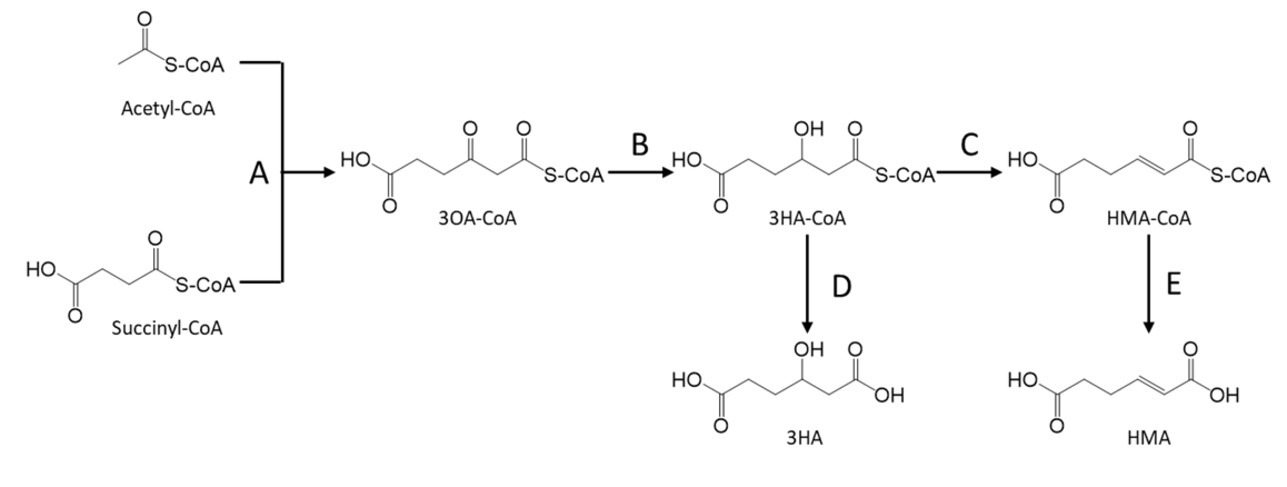
Serratia grimesii、Serratia ficaria、Serratia fonticola、Serratia odorifera、Serratia plymuthica、Serratia entomophilaまたはSerratia nematodiphilaなどのSerratia属。
Pseudomonas chlororaphis、Pseudomonas putida、Pseudomonas azotoformans、Pseudomonas chlororaphis subsp. aureofaciensなどのPsuedomonas属。
Hafnia alveiなどのHafnia属。
Corynebacterium acetoacidophilum、Corynebacterium acetoglutamicum、Corynebacterium ammoniagenes、Corynebacterium glutamicumなどのCorynebacterium属。
Bacillus badius、Bacillus megaterium、Bacillus roseusなどのBacillus属。
Streptomyces vinaceus、Streptomyces karnatakensis、Streptomyces olivaceusなどのStreptomyces属。
Cupriavidus metallidurans、Cupriavidus necator、Cupriavidus oxalaticusなどのCupriavidus属。
Acinetobacter baylyi、Acinetobacter radioresistensなどのAcinetobacter属。
Alcaligenes faecalisなどのAlcaligenes属。
Nocardioides albusなどのNocardioides属。
Brevibacterium iodinumなどのBrevibacterium属。
Delftia acidovoransなどのDelftia属。
Shimwellia blattaeなどのShimwellia属。
Aerobacter cloacaeなどのAerobacter属。
Rhizobium radiobacterなどのRhizobium属。
Serratia grimesii、Serratia ficaria、Serratia fonticola、Serratia odorifera、Serratia plymuthica、Serratia entomophilaまたはSerratia nematodiphilaなどのSerratia属。
Pseudomonas fluorescens、Pseudomonas putida、Pseudomonas azotoformans、Pseudomonas chlororaphis subsp. aureofaciensなどのPsuedomonas属。
Hafnia alveiなどのHafnia属。
Bacillus badiusなどのBacillus属。
Cupriavidus metallidurans、Cupriavidus numazuensis、Cupriavidus oxalaticusなどのCupriavidus属。
Acinetobacter baylyi、Acinetobacter radioresistensなどのAcinetobacter属。
Alcaligenes faecalisなどのAlcaligenes属。
Delftia acidovoransなどのDelftia属。
Shimwellia blattaeなどのShimwellia属。
アセチル-CoAおよびスクシニル-CoAから3OA-CoAおよび補酵素Aを生成する反応(反応A)を触媒する酵素、3OA-CoAから3HA-CoAを生成する反応(反応B)、および3HA-CoAから3-ヒドロキシアジピン酸を生成する反応(反応D)かつHMA-CoAからα-ヒドロムコン酸を生成する反応(反応E)を触媒する酵素を発現するプラスミドの作製
ピルビン酸キナーゼの機能が低下したSerratia属微生物変異体の作製
Serratia属微生物のピルビン酸キナーゼをコードする遺伝子であるpykFおよびpykAを欠損させ、ピルビン酸キナーゼの機能が低下したSerratia属微生物変異体を作製した。
pKD4を鋳型として、プライマーとして配列番号23および24のオリゴDNAを用いてPCRを行い、pykF欠損のためのPCR断片を得た。FRT recombinase発現プラスミドであるpKD46を、Serratia grimesii NBRC13537株に導入し、アンピシリン耐性株を取得した。得られた株をアンピシリン500μg/mLを含む5mLのLB培地に植菌し、30℃で1日振とう培養した。培養液0.5mLをアンピシリン500μg/mLおよびアラビノース50mMを含む50mLのLB培地に植菌し、30℃で2時間、回旋培養した。培養液を20分間氷冷したのち、菌体を10%(w/w)グリセロールで3回洗浄した。洗浄後のペレットを100μLの10%(w/w)グリセロールで懸濁し、5μLのPCR断片と混合したのちエレクトロポレーションキュベット内で10分間氷冷した。Gene pulser(Bio-rad社製)を用いてエレクトロポレーションを実施した(3kV、200Ω、25μF)後、即座に1mLのSOC培地を添加し、30℃で2時間振とう培養した。全量をカナマイシン25μg/mLを含むLB寒天培地に塗布し、30℃で1日インキュベートした。得られたカナマイシン耐性株を用いてコロニーダイレクトPCRを行い、バンド長より目的遺伝子の欠損およびカナマイシン耐性遺伝子の挿入を確認した。プライマーは配列番号25および27のオリゴDNAを使用した。
pKD4を鋳型として、プライマーとして配列番号28および29のオリゴDNAを用いてPCRを行い、pykA欠損用PCR断片を得た。
ホスホトランスフェラーゼ酵素の機能が低下したSerratia属微生物変異体の作製
Serratia属微生物のホスホトランスフェラーゼをコードする遺伝子であるptsGを欠損させ、ホスホトランスフェラーゼ酵素の機能が低下したSerratia属微生物変異体を作製した。
ピルビン酸デヒドロゲナーゼ複合体転写抑制因子の機能が低下したSerratia属微生物変異体の作製
Serratia属微生物のピルビン酸デヒドロゲナーゼ複合体転写抑制因子をコードする遺伝子であるpdhR(配列番号36)を欠損させ、PDHcの発現量が増大したSerratia属微生物変異体を作製した。
ピルビン酸デヒドロゲナーゼ複合体転写抑制因子の機能が低下し、かつ反応A、B、DおよびEを触媒する酵素を発現するプラスミドを導入したSerratia属微生物変異体の作製
実施例3で作製した株に対して、参考例1で作製したプラスミドをそれぞれ導入し、Serratia属微生物変異体を作製した。
ピルビン酸デヒドロゲナーゼ複合体転写抑制因子の機能が低下し、かつ反応A、B、DおよびEを触媒する酵素を発現するプラスミドを導入したSerratia属微生物変異体を用いた3-ヒドロキシアジピン酸およびα-ヒドロムコン酸の生産試験
実施例4で作製したSerratia属微生物変異体を用いて、3-ヒドロキシアジピン酸およびα-ヒドロムコン酸の生産試験を行った。
当該培養液より菌体を遠心分離した上清をMillex-GV(0.22μm、PVDF、Merck社製)を用いて膜処理し、透過液を以下の方法で分析することで培養上清中に蓄積した3-ヒドロキシアジピン酸およびα-ヒドロムコン酸、他の生成物、培地中に利用されずに残存している糖の濃度を定量した。さらに、その結果を元に以下の式(1)を用いて算出した3-ヒドロキシアジピン酸およびα-ヒドロムコン酸の収率を表1に示す。
(LC-MS/MSによる3-ヒドロキシアジピン酸およびα-ヒドロムコン酸の定量分析)
・HPLC:1290Infinity(Agilent Technologies社製)
カラム:Synergi hydro-RP(Phenomenex社製)、長さ100mm、内径3mm、粒径2.5μm
移動相:0.1%ギ酸水溶液/メタノール=70/30
流速:0.3mL/分
カラム温度:40℃
LC検出器:1260DAD VL+(210nm)
・MS/MS:Triple-Quad LC/MS(Agilent Technologies社製)
イオン化法:ESI ネガティブモード。
・HPLC:LC-10A(株式会社島津製作所製)
カラム: Shim-pack SPR-H(株式会社島津ジーエルシー製)、長さ250mm、内径7.8mm、粒径8μm
Shim-pack SCR-101H(株式会社島津ジーエルシー製)長さ250mm、内径7.8mm、粒径10μm
移動相: 5mM p-トルエンスルホン酸
反応液:5mM p-トルエンスルホン酸、0.1mM EDTA、20mM Bis-Tris
流速:0.8mL/min
カラム温度:45℃
検出器:CDD-10Avp(株式会社島津製作所製)。
・HPLC:Shimazu Prominence(株式会社島津製作所製)
カラム:Shodex Sugar SH1011(昭和電工株式会社製)、長さ300 mm、内径8 mm、粒径6μm
移動相:0.05M 硫酸水溶液
流速:0.6mL/min
カラム温度:65℃
検出器:RID-10A(株式会社島津製作所製)。
ピルビン酸デヒドロゲナーゼ複合体転写抑制因子の機能が低下しておらず、かつ反応A、B、DおよびEを触媒する酵素を発現するプラスミドを導入したSerratia属微生物変異体の作製
実施例1、2で作製した株に対して、実施例4と同様の方法にて、参考例1で作製したプラスミドをそれぞれ導入し、Serratia属微生物変異体を作製した。得られた株をそれぞれSgΔPP/3HA、SgΔG/3HA、SgΔGPP/3HAとした。
ピルビン酸デヒドロゲナーゼ複合体転写抑制因子の機能が低下しておらず、かつ反応A、B、DおよびEを触媒する酵素を発現するプラスミドを導入したSerratia属微生物変異体を用いた3-ヒドロキシアジピン酸およびα-ヒドロムコン酸の生産試験
参考例2で作製したSerratia属微生物変異体を、実施例5と同様の方法にて培養した。培養上清中に蓄積した3-ヒドロキシアジピン酸およびα-ヒドロムコン酸、他の生成物、培地中に利用されずに残存している糖の濃度を定量した。さらに、その結果を元に式(1)を用いて算出した3-ヒドロキシアジピン酸およびα-ヒドロムコン酸の収率を表1に示す。

ピルビン酸キナーゼの機能が低下したEcherichia属微生物変異体の作製
Echerichia属微生物のピルビン酸キナーゼをコードする遺伝子であるpykF(NCBI-GeneID:946179)およびpykA(NCBI-GeneID:946527)を欠損させ、ピルビン酸キナーゼの機能が低下したEcherichia属微生物変異体を作製した。
pKD4を鋳型として、プライマーとして配列番号41および42のオリゴDNAを用いてPCRを行い、pykF欠損のためのPCR断片を得た。FRT recombinase発現プラスミドであるpKD46を、Escherichia coli str. K-12 substr. MG1655株に導入し、アンピシリン耐性株を取得した。得られた株をアンピシリン100μg/mLを含む5mLのLB培地に植菌し、30℃で1日振とう培養した。培養液0.5mLをアンピシリン100μg/mLおよびアラビノース50mMを含む50mLのLB培地に植菌し、30℃で2時間、回旋培養した。培養液を20分間氷冷したのち、菌体を10%(w/w)グリセロールで3回洗浄した。洗浄後のペレットを100μLの10%(w/w)グリセロールで懸濁し、5μLのPCR断片と混合したのちエレクトロポレーションキュベット内で10分間氷冷した。Gene pulser(Bio-rad社製)を用いてエレクトロポレーションを実施した(3kV、200Ω、25μF)後、即座に1mLのSOC培地を添加し、30℃で2時間振とう培養した。全量をカナマイシン25μg/mLを含むLB寒天培地に塗布し、30℃で1日インキュベートした。得られたカナマイシン耐性株を用いてコロニーダイレクトPCRを行い、バンド長より目的遺伝子の欠損およびカナマイシン耐性遺伝子の挿入を確認した。プライマーは配列番号25および44のオリゴDNAを使用した。
pKD4を鋳型として、プライマーとして配列番号45および46のオリゴDNAを用いてPCRを行い、pykA欠損用PCR断片を得た。
ホスホトランスフェラーゼ酵素の機能が低下したEscherichia属微生物変異体の作製
Escherichia属微生物のホスホトランスフェラーゼをコードする遺伝子であるptsGを欠損させ、ホスホトランスフェラーゼ酵素の機能が低下したEscherichia属微生物変異体を作製した。
ピルビン酸デヒドロゲナーゼ複合体転写抑制因子の機能が低下したEscherichia属微生物変異体の作製
Escherichia属微生物のピルビン酸デヒドロゲナーゼ複合体転写抑制因子をコードする遺伝子であるpdhR(NCBI-GeneID:944827)を欠損させ、PDHcの発現量が増大したEscherichia属微生物変異体を作製した。
ピルビン酸デヒドロゲナーゼ複合体転写抑制因子の機能が低下し、かつ反応A、B、DおよびEを触媒する酵素を発現するプラスミドを導入したEscherichia属微生物変異体の作製
実施例8で作製した株に対して、参考例1で作製したプラスミドをそれぞれ導入し、Escherichia属微生物変異体を作製した。
ピルビン酸デヒドロゲナーゼ複合体転写抑制因子の機能が低下し、かつ反応A、B、DおよびEを触媒する酵素を発現するプラスミドを導入したEscherichia属微生物変異体を用いた3-ヒドロキシアジピン酸およびα-ヒドロムコン酸の生産試験
実施例9で作製したEscherichia属微生物変異体を、実施例5と同様の方法にて培養した。培養上清中に蓄積した3-ヒドロキシアジピン酸およびα-ヒドロムコン酸、他の生成物、培地中に利用されずに残存している糖の濃度を定量した。さらに、その結果を元に式(1)を用いて算出した3-ヒドロキシアジピン酸およびα-ヒドロムコン酸の収率を表2に示す。
ピルビン酸デヒドロゲナーゼ複合体転写抑制因子の機能が低下しておらず、かつ反応A、B、DおよびEを触媒する酵素を発現するプラスミドを導入したEscherichia属微生物変異体の作製
実施例6、7で作製した株に対して、実施例9と同様の方法にて、参考例1で作製したプラスミドをそれぞれ導入し、Escherichia属微生物変異体を作製した。得られた株をそれぞれEcΔPP/3HA、EcΔG/3HA、EcΔGPP/3HAとした。
ピルビン酸デヒドロゲナーゼ複合体転写抑制因子の機能が低下しておらず、かつ反応A、B、DおよびEを触媒する酵素を発現するプラスミドを導入したEscherichia属微生物変異体を用いた3-ヒドロキシアジピン酸およびα-ヒドロムコン酸の生産試験
参考例3で作製したEscherichia属微生物変異体を、実施例5と同様の方法にて培養した。培養上清中に蓄積した3-ヒドロキシアジピン酸およびα-ヒドロムコン酸、他の生成物、培地中に利用されずに残存している糖の濃度を定量した。さらに、その結果を元に式(1)を用いて算出した3-ヒドロキシアジピン酸およびα-ヒドロムコン酸の収率を表2に示す。
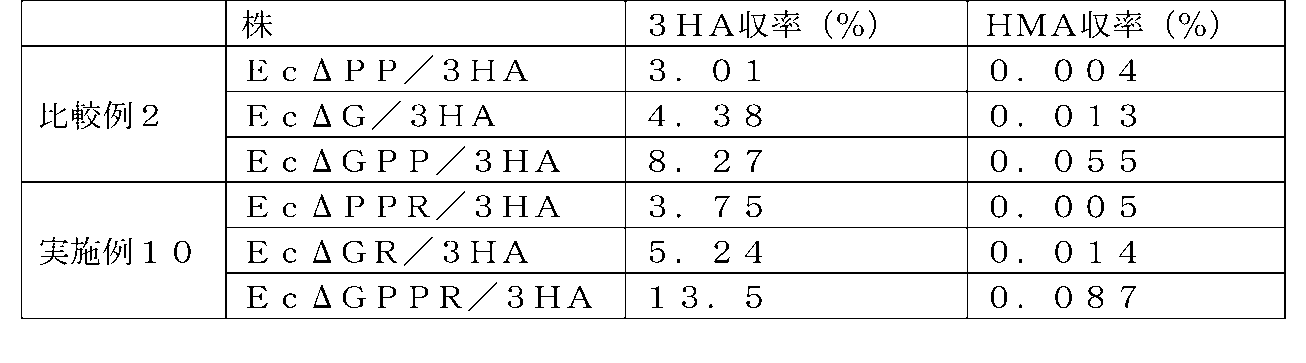
ピルビン酸デヒドロゲナーゼ複合体転写抑制因子の機能のみが低下したEscherichia属微生物変異体の作製
実施例8と同様の方法にて、Escherichia coli str. K-12 substr. MG1655のpdhR遺伝子を欠損させた。得られた株をEcΔRとした。
ピルビン酸デヒドロゲナーゼ複合体転写抑制因子の機能のみが低下し、かつ反応A、B、DおよびEを触媒する酵素を発現するプラスミドを導入したEscherichia属微生物変異体、および反応A、B、DおよびEを触媒する酵素を発現するプラスミドを導入したEscherichia属微生物変異体の作製
EcΔR株およびEscherichia coli str. K-12 substr. MG1655に対して、実施例9と同様の方法にて、参考例1で作製したプラスミドをそれぞれ導入し、Escherichia属微生物変異体を作製した。得られた株をそれぞれEcWT/3HA、EcΔR/3HAとした。
ピルビン酸デヒドロゲナーゼ複合体転写抑制因子の機能のみが低下し、かつ反応A、B、DおよびEを触媒する酵素を発現するプラスミドを導入したEscherichia属微生物変異体、および反応A、B、DおよびEを触媒する酵素を発現するプラスミドを導入したEscherichia属微生物変異体を用いた3-ヒドロキシアジピン酸およびα-ヒドロムコン酸の生産試験
参考例5で作製したEscherichia属微生物変異体を、実施例5と同様の方法にて培養した。培養上清中に蓄積した3-ヒドロキシアジピン酸およびα-ヒドロムコン酸、他の生成物、培地中に利用されずに残存している糖の濃度を定量した。さらに、その結果を元に式(1)を用いて算出した3-ヒドロキシアジピン酸およびα-ヒドロムコン酸の収率を表3に示す。

PDHcを発現するためのプラスミドの作製
大腸菌内で自律複製可能な発現ベクターpMW119(株式会社ニッポンジーン製)をSacIで切断し、pMW119/SacIを得た。当該ベクターに構成的な発現プロモーターを組み込むために、Escherichia coli str. K-12 substr. MG1655のゲノムDNAを鋳型としてgapA(NCBI-GeneID: NC_000913.3)の上流域200b(配列番号13)をPCR増幅するためのプライマーを設計し(配列番号57、58)、常法に従ってPCR反応を行った。得られた断片およびpMW119/SacIを、In-Fusion HD Cloning Kit(タカラバイオ株式会社製)を用いて連結し、大腸菌株DH5αに導入した。得られた組換え大腸菌株から当該プラスミドを抽出し、常法により塩基配列を確認したプラスミドをpMW119::Pgapとした。続いてpMW119::PgapをSphIで切断し、pMW119::Pgap/SphIを得た。ピルビン酸デヒドロゲナーゼ複合体をコードする遺伝子を増幅するために、Escherichia coli str. K-12 substr. MG1655のゲノムDNAを鋳型としてaceE(NCBI-GeneID:944834)、aceF(NCBI-GeneID:944794)およびlpd(NCBI-GeneID:944854)全長を含む領域をPCR増幅するためのプライマーを設計し(配列番号59、60)、常法に従ってPCR反応を行った。得られた断片およびpMW119::Pgap/SphIを、In-Fusion HD Cloning Kit(タカラバイオ株式会社製)を用いて連結し、大腸菌株DH5αに導入した。得られたアンピシリン耐性株から当該プラスミドを抽出し、常法により塩基配列を確認した。得られたプラスミドを「pMW119::PDHc」とした。
PFLを発現するためのプラスミドの作製
PFLをコードする遺伝子を増幅するために、Escherichia coli str. K-12 substr. MG1655のゲノムDNAを鋳型としてpflB(NCBI-GeneID:945514)およびpflA(NCBI-GeneID:945517)全長を含む領域をPCR増幅するためのプライマーを設計し(配列番号61、62)、常法に従ってPCR反応を行った。得られた断片およびpMW119::Pgap/SphIを、In-Fusion HD Cloning Kit(タカラバイオ株式会社製)を用いて連結し、大腸菌株DH5αに導入した。得られた組換え株から当該プラスミドを抽出し、常法により塩基配列を確認した。得られたプラスミドを「pMW119::PFL」とした。
PDHcまたはPFLの発現量が増大し、かつ反応A、B、DおよびEを触媒する酵素を発現するプラスミドを導入したSerratia属微生物変異体の作製
参考例2で作製した株に対して、参考例7、8で作製したプラスミドをそれぞれ導入し、Serratia属微生物変異体を作製した。
PDHcまたはPFLの発現量が増大し、かつ反応A、B、DおよびEを触媒する酵素を発現するプラスミドを導入したSerratia属微生物変異体を用いた3-ヒドロキシアジピン酸およびα-ヒドロムコン酸の生産試験
実施例11で作製したSerratia属微生物変異体を、培地にアンピシリン500μg/mLを追加で含む以外は実施例5と同様の方法にて培養した。培養上清中に蓄積した3-ヒドロキシアジピン酸およびα-ヒドロムコン酸、他の生成物、培地中に利用されずに残存している糖の濃度を定量した。さらに、その結果を元に式(1)を用いて算出した3-ヒドロキシアジピン酸およびα-ヒドロムコン酸の収率を表4に示す。
PDHcまたはPFLの発現量が増大しておらず、かつ反応A、B、DおよびEを触媒する酵素を発現するプラスミドを導入したSerratia属微生物変異体の作製
参考例3で作製した株に対して、ネガティブコントールとしてpMW119を導入したSerratia属微生物変異体を作製した。
PDHcまたはPFLの発現量が増大しておらず、かつ反応A、B、DおよびEを触媒する酵素を発現するプラスミドを導入したSerratia属微生物変異体を用いた3-ヒドロキシアジピン酸およびα-ヒドロムコン酸の生産試験
参考例9で作製したSerratia属微生物変異体を、培地にアンピシリン500μg/mLを追加で含む以外は実施例5と同様の方法にて培養した。培養上清中に蓄積した3-ヒドロキシアジピン酸およびα-ヒドロムコン酸、他の生成物、培地中に利用されずに残存している糖の濃度を定量した。さらに、その結果を元に式(1)を用いて算出した3-ヒドロキシアジピン酸およびα-ヒドロムコン酸の収率を表4に示す。

PFLの発現量が増大し、かつ反応A、B、DおよびEを触媒する酵素を発現するプラスミドを導入したEscherichia属微生物変異体の作製
参考例3で作製した株に対して、参考例7、8で作製したプラスミドをそれぞれ導入し、Escherichia属微生物変異体を作製した。
PFLの発現量が増大し、かつ反応A、B、DおよびEを触媒する酵素を発現するプラスミドを導入したEscherichia属微生物変異体を用いた3-ヒドロキシアジピン酸およびα-ヒドロムコン酸の生産試験
実施例13で作製したEscherichia属微生物変異体を、培地にアンピシリン100μg/mLを追加で含む以外は実施例5と同様の方法にて培養した。培養上清中に蓄積した3-ヒドロキシアジピン酸およびα-ヒドロムコン酸、他の生成物、培地中に利用されずに残存している糖の濃度を定量した。さらに、その結果を元に式(1)を用いて算出した3-ヒドロキシアジピン酸およびα-ヒドロムコン酸の収率を表5に示す。
PDHcまたはPFLの発現量が増大しておらず、かつ反応A、B、DおよびEを触媒する酵素を発現するプラスミドを導入したEscherichia属微生物変異体の作製
参考例3で作製した株に対して、ネガティブコントールとしてpMW119を導入したSerratia属微生物変異体を作製した。
PDHcまたはPFLの発現量が増大しておらず、かつ反応A、B、DおよびEを触媒する酵素を発現するプラスミドを導入したEscherichia属微生物変異体を用いた3-ヒドロキシアジピン酸およびα-ヒドロムコン酸の生産試験
参考例10で作製したEscherichia属微生物変異体を、培地にアンピシリン100μg/mLを追加で含む以外は実施例5と同様の方法にて培養した。培養上清中に蓄積した3-ヒドロキシアジピン酸およびα-ヒドロムコン酸、他の生成物、培地中に利用されずに残存している糖の濃度を定量した。さらに、その結果を元に式(1)を用いて算出した3-ヒドロキシアジピン酸およびα-ヒドロムコン酸の収率を表5に示す。
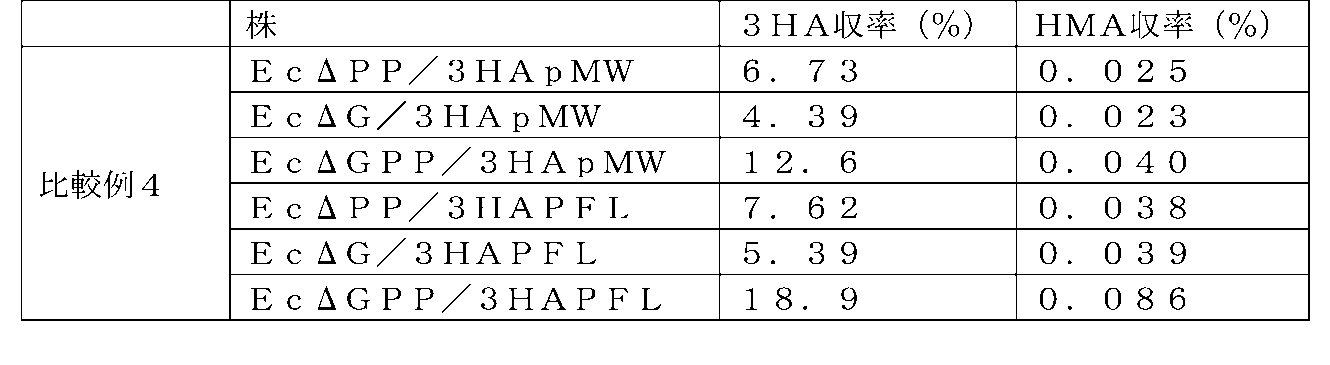
Pck、かつ反応A、B、DおよびEを触媒する酵素を発現するプラスミドの作製
Pckを構成的に発現させるプロモーターを組み込むために、Escherichia coli K-12 MG1655のゲノムDNAを鋳型としてgapA(NCBI Gene ID: NC_000913.3)の上流域200b(配列番号63)をPCR増幅するためのプライマーを設計し(配列番号64、65)、常法に従ってPCR反応を行った。得られた断片および参考例1で作製したpBBR1MCS-2::ATCTORをSacIで切断して得られる断片を、In-Fusion HD Cloning Kitを用いて連結し、大腸菌株DH5αに導入した。得られた組換え株から当該プラスミドを抽出し、常法により塩基配列を確認したプラスミドをpBBR1MCS-2::ATCTORPgapとした。続いてPckをコードする遺伝子を増幅するために、Serratia grimesii NBRC13537株のゲノムDNAを鋳型としてpck遺伝子(配列番号66)の全長を含む連続した配列をPCR増幅するためのプライマーを設計し(配列番号67、68)、常法に従ってPCR反応を行った。得られた断片およびpBBR1MCS-2::ATCTORPgapをSacIで切断して得られる断片を、In-Fusion HD Cloning Kitを用いて連結し、大腸菌株DH5αに導入した。得られた組換え株から当該プラスミドを抽出し、常法により塩基配列を確認したプラスミドをpBBR1MCS-2::ATCTORPCKとした。
Pckの発現量が増大し、かつ反応A、B、DおよびEを触媒する酵素を発現するプラスミドを導入したEscherichia属微生物変異体の作製
実施例13と同様の方法にて、実施例9で作製したEcΔPPR/3HA、EcΔGR/3HAにpMW119::ATCTORPCKあるいはコントロールとしてpMW119を導入した。得られた株をそれぞれEcΔPPR/3HAPCK、EcΔGR/3HAPCK、EcΔPPR/3HApMW、EcΔGR/3HApMWとした。
Pckの発現量が増大し、かつ反応A、B、DおよびEを触媒する酵素を発現するプラスミドを導入したEscherichia属微生物変異体を用いた3-ヒドロキシアジピン酸およびα-ヒドロムコン酸の生産試験
実施例15で作製したEcΔPPR/3HAPCK、EcΔGR/3HAPCK、EcΔPPR/3HApMW、EcΔGR/3HApMWを、実施例14と同様の方法にて培養した。培養上清中に蓄積した3-ヒドロキシアジピン酸およびα-ヒドロムコン酸、他の生成物、培地中に利用されずに残存している糖の濃度を定量した。さらに、その結果を元に式(1)を用いて算出した3-ヒドロキシアジピン酸およびα-ヒドロムコン酸の収率を表6に示す。

Escherichia coli由来のLpdあるいはKlebsiella pneumoniae由来のLpdAを発現するためのプラスミドの作製
大腸菌内で自律複製可能な発現ベクターpMW119(株式会社ニッポンジーン製)をSacIおよびKpnIで切断し、pMW119/SacI、KpnIを得た。
Lpdの発現量が増大し、かつ反応A、B、DおよびEを触媒する酵素を発現するプラスミドを導入したEscherichia属微生物変異体の作製
参考例3で作製した株に対して、参考例12で作製したプラスミドをそれぞれ導入し、Escherichia属微生物変異体を作製した。
Lpdの発現量が増大し、かつ反応A、B、DおよびEを触媒する酵素を発現するプラスミドを導入したEscherichia属微生物変異体を用いた3-ヒドロキシアジピン酸およびα-ヒドロムコン酸の生産試験
実施例17で作製したEscherichia属微生物変異体を、培地にアンピシリン100μg/mLを追加で含む以外は実施例5と同様の方法にて培養した。培養上清中に蓄積した3-ヒドロキシアジピン酸およびα-ヒドロムコン酸、他の生成物、培地中に利用されずに残存している糖の濃度を定量した。さらに、その結果を元に式(1)を用いて算出した3-ヒドロキシアジピン酸およびα-ヒドロムコン酸の収率を表7に示す。

NADHに対する感受性が低減されたLpdを発現するためのプラスミドの作製
参考例12で得られたpMW119::EcLPDのアミノ酸変異体を作製した。Q5 Site-Directed Mutagenesis Kit(New England Biolabs社製)を用いて、pMW119::EcLPDを鋳型、配列番号72、73のオリゴヌクレオチドをプライマーとして354番目のグルタミン酸(E)をリジン(K)に置換させた。得られたプラスミドをpMW119::EcLPDE354Kとした。
NADHに対する感受性が低減されたLpd、かつ反応A、B、DおよびEを触媒する酵素を発現するプラスミドを導入したEscherichia属微生物変異体の作製
参考例3で作製した株に対して、参考例13で作製したプラスミドをそれぞれ導入し、Escherichia属微生物変異体を作製した。
NADHに対する感受性が低減されたLpd、かつ反応A、B、DおよびEを触媒する酵素を発現するプラスミドを導入したEscherichia属微生物変異体を用いた3-ヒドロキシアジピン酸およびα-ヒドロムコン酸の生産試験
実施例19で作製したEscherichia属微生物変異体を、培地にアンピシリン100μg/mLを追加で含む以外は実施例5と同様の方法にて培養した。培養上清中に蓄積した3-ヒドロキシアジピン酸およびα-ヒドロムコン酸、他の生成物、培地中に利用されずに残存している糖の濃度を定量した。さらに、その結果を元に式(1)を用いて算出した3-ヒドロキシアジピン酸およびα-ヒドロムコン酸の収率を表8に示す。

1種類のピルビン酸キナーゼが欠損し、かつLpdの発現量が増大し、かつ反応A、B、DおよびEを触媒する酵素を発現するプラスミドを導入したSerratia属微生物変異体の作製
実施例1で作製したSgΔPfに、実施例4と同様の方法にてpBBR1MCS-2::ATCTORを、また実施例11と同様の方法にてpMW119::EcLPDを導入した。得られた株をSgΔPf/3HAEcLPDとした。
1種類のピルビン酸キナーゼが欠損し、かつLpdの発現量が増大し、かつ反応A、B、DおよびEを触媒する酵素を発現するプラスミドを導入したEscherichia属微生物変異体の作製
実施例6で作製したEcΔPfに、実施例9と同様の方法にてpBBR1MCS-2::ATCTORを、また実施例17と同様の方法にてpMW119::EcLPDを導入した。得られた株をEcΔPf/3HAEcLPDとした。
1種類のピルビン酸キナーゼが欠損し、かつLpdの発現量が増大し、かつ反応A、B、DおよびEを触媒する酵素を発現するプラスミドを導入したSerratia属あるいはEscherichia属微生物変異体を用いた3-ヒドロキシアジピン酸およびα-ヒドロムコン酸の生産試験
実施例21、22で作製したSerratia属あるいはEscherichia属微生物変異体を、培地にアンピシリン500μg/mLあるいは100μg/mLを追加で含む以外は実施例5と同様の方法にて培養した。培養上清中に蓄積した3-ヒドロキシアジピン酸およびα-ヒドロムコン酸、他の生成物、培地中に利用されずに残存している糖の濃度を定量した。さらに、その結果を元に式(1)を用いて算出した3-ヒドロキシアジピン酸およびα-ヒドロムコン酸の収率を表9に示す。
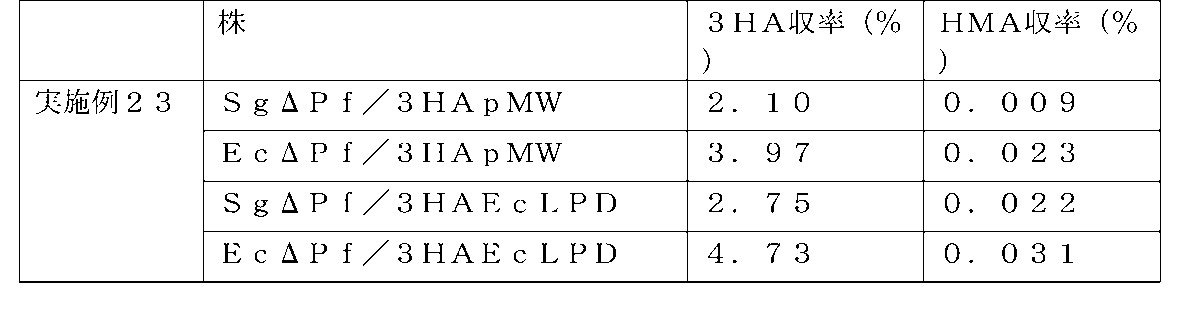
PFLの発現量のみが増大し、かつ反応A、B、DおよびEを触媒する酵素を発現するプラスミドを導入したEscherichia属微生物変異体の作製
参考例5で作製したEcWT/3HAに、参考例8で作製したpMW119::PFLあるいはコントロールとしてpMW119を実施例13と同様の方法にて導入した。得られた株をEcWT/3HAPFL、EcWT/3HApMWとした。
PFLの発現量のみが増大し、かつ反応A、B、DおよびEを触媒する酵素を発現するプラスミドを導入したEscherichia属微生物変異体を用いた3-ヒドロキシアジピン酸およびα-ヒドロムコン酸の生産試験
参考例14で作製したEcWT/3HAPFL、EcWT/3HApMWを、培地にアンピシリン100μg/mLを追加で含む以外は実施例5と同様の方法にて培養した。培養上清中に蓄積した3-ヒドロキシアジピン酸およびα-ヒドロムコン酸、他の生成物、培地中に利用されずに残存している糖の濃度を定量した。さらに、その結果を元に式(1)を用いて算出した3-ヒドロキシアジピン酸およびα-ヒドロムコン酸の収率を表10に示す。

Claims (13)
- 3-ヒドロキシアジピン酸および/またはα-ヒドロムコン酸を製造する能力を有する微生物において、ピルビン酸からアセチルCoAを生成する反応を強化し、ならびにピルビン酸キナーゼおよび/またはホスホトランスフェラーゼ酵素の機能を低下させた、遺伝子改変微生物。
- 前記ピルビン酸からアセチルCoAを生成する反応の強化が、ピルビン酸デヒドロゲナーゼ複合体が触媒する反応の強化および/またはピルビン酸ギ酸リアーゼが触媒する反応の強化である、請求項1に記載の遺伝子改変微生物。
- 前記ピルビン酸デヒドロゲナーゼ複合体が触媒する反応の強化が、ピルビン酸デヒドロゲナーゼ複合体の発現量の増大および/またはピルビン酸デヒドロゲナーゼ複合体の活性増強による強化である、請求項2に記載の遺伝子改変微生物。
- 前記ピルビン酸デヒドロゲナーゼ複合体の発現量の増大が、ピルビン酸デヒドロゲナーゼ複合体転写抑制因子の機能を低下させることにより行われる、請求項3に記載の遺伝子改変微生物。
- 前記ピルビン酸デヒドロゲナーゼ複合体の活性増強が、ピルビン酸デヒドロゲナーゼ複合体のNADHへの感受性を低減させることにより行われる、請求項3に記載の遺伝子改変微生物。
- 前記ピルビン酸ギ酸リアーゼが触媒する反応の強化が、ピルビン酸ギ酸リアーゼの発現量の増大による強化により行われる、請求項2に記載の遺伝子改変微生物。
- さらに3-オキソアジピル-CoAを還元して3-ヒドロキシアジピル-CoAを生成する反応を強化した、請求項1から6のいずれか1項に記載の遺伝子改変微生物。
- さらにホスホエノールピルビン酸カルボキシキナーゼの反応を強化した、請求項1から7のいずれか1項に記載の遺伝子改変微生物。
- ホスホケトラーゼ経路による糖代謝をしない微生物である、請求項1から8のいずれか1項に記載の遺伝子改変微生物。
- 請求項1から9のいずれか1項に記載の遺伝子改変微生物を培養する工程を含む、3-ヒドロキシアジピン酸および/またはα-ヒドロムコン酸の製造方法。
- 遺伝子改変により微生物に内在する機能を強化または低下させる工程を含む3-ヒドロキシアジピン酸および/またはα-ヒドロムコン酸を製造する能力を有する遺伝子改変微生物の製造方法であって、前記工程として、ピルビン酸からアセチルCoAを生成する反応を強化する工程(a)、ならびにピルビン酸キナーゼおよび/またはホスホトランスフェラーゼ酵素の機能を低下させる工程(b)を含む、方法。
- さらに3-オキソアジピル-CoAを還元して3-ヒドロキシアジピル-CoAを生成する反応を強化する工程(c)を含む、請求項11に記載の方法。
- さらにホスホエノールピルビン酸カルボキシキナーゼの反応を強化する工程(d)を含む、請求項11または12に記載の方法。
Priority Applications (4)
| Application Number | Priority Date | Filing Date | Title |
|---|---|---|---|
| CN202180074525.8A CN116406420A (zh) | 2020-11-11 | 2021-11-10 | 用于生产3-羟基己二酸和/或α-氢化己二烯二酸的基因修饰微生物以及该化学品的制造方法 |
| JP2021569321A JPWO2022102635A1 (ja) | 2020-11-11 | 2021-11-10 | |
| EP21891881.1A EP4245844A4 (en) | 2020-11-11 | 2021-11-10 | GENETICALLY MODIFIED MICROORGANISM FOR THE PRODUCTION OF 3-HYDROXYADIPIC ACID AND/OR ?-HYDROMUCONIC ACID, AND METHOD FOR PRODUCING A CHEMICAL PRODUCT |
| US18/034,102 US20230392112A1 (en) | 2020-11-11 | 2021-11-10 | Genetically modified microorganism for producing 3-hydroxyadipic acid and/or alpha-hydromuconic acid, and method for producing chemical product |
Applications Claiming Priority (2)
| Application Number | Priority Date | Filing Date | Title |
|---|---|---|---|
| JP2020-187848 | 2020-11-11 | ||
| JP2020187848 | 2020-11-11 |
Publications (1)
| Publication Number | Publication Date |
|---|---|
| WO2022102635A1 true WO2022102635A1 (ja) | 2022-05-19 |
Family
ID=81602326
Family Applications (1)
| Application Number | Title | Priority Date | Filing Date |
|---|---|---|---|
| PCT/JP2021/041257 Ceased WO2022102635A1 (ja) | 2020-11-11 | 2021-11-10 | 3-ヒドロキシアジピン酸および/またはα-ヒドロムコン酸を生産するための遺伝子改変微生物および当該化学品の製造方法 |
Country Status (5)
| Country | Link |
|---|---|
| US (1) | US20230392112A1 (ja) |
| EP (1) | EP4245844A4 (ja) |
| JP (1) | JPWO2022102635A1 (ja) |
| CN (1) | CN116406420A (ja) |
| WO (1) | WO2022102635A1 (ja) |
Cited By (3)
| Publication number | Priority date | Publication date | Assignee | Title |
|---|---|---|---|---|
| JP2023105728A (ja) * | 2022-01-19 | 2023-07-31 | 旭化成株式会社 | 改変微生物及び化合物の製造方法 |
| WO2023157816A1 (ja) * | 2022-02-15 | 2023-08-24 | 東レ株式会社 | 3-ヒドロキシアジピン酸および/またはα-ヒドロムコン酸を生産するための遺伝子改変微生物および当該化学品の製造方法 |
| WO2024242124A1 (ja) * | 2023-05-23 | 2024-11-28 | 東レ株式会社 | 3-ヒドロキシアジピン酸、α-ヒドロムコン酸および/またはアジピン酸を生産するための遺伝子改変微生物および当該化学品の製造方法 |
Citations (14)
| Publication number | Priority date | Publication date | Assignee | Title |
|---|---|---|---|---|
| JP2008527991A (ja) | 2005-04-08 | 2008-07-31 | コリア アドバンスド インスティチュート オブ サイエンス アンド テクノロジィ | インシリコ分析に基づく菌株の改良方法 |
| JP2011515111A (ja) * | 2008-03-27 | 2011-05-19 | ジェノマティカ, インコーポレイテッド | アジピン酸および他の化合物を生成するための微生物 |
| US20110124911A1 (en) | 2009-08-05 | 2011-05-26 | Burk Mark J | Semi-synthetic terephthalic acid via microorganisms that produce muconic acid |
| JP2013535203A (ja) | 2010-07-26 | 2013-09-12 | ジェノマティカ・インコーポレイテッド | 芳香族、2,4−ペンタジエノエートおよび1,3−ブタジエンを生合成するための微生物および方法 |
| WO2013163292A2 (en) * | 2012-04-27 | 2013-10-31 | Bioamber Inc. | Methods and microorganisms for increasing the biological synthesis of difunctional alkanes |
| WO2014099725A1 (en) * | 2012-12-17 | 2014-06-26 | Genomatica, Inc. | Microorganisms and methods for enhancing the availability of reducing equivalents in the presence of methanol, and for producing adipate, 6-aminocaproate, hexamethylenediamine or caprolactam related thereto |
| JP2015504688A (ja) | 2012-01-30 | 2015-02-16 | ミリアント・コーポレイションMyriant Corporation | 遺伝子操作された微生物からのムコン酸の生成 |
| JP2015146810A (ja) | 2009-05-07 | 2015-08-20 | ゲノマチカ, インク. | アジペート、ヘキサメチレンジアミン、及び6−アミノカプロン酸の生合成のための微生物及び方法 |
| WO2017033965A1 (ja) * | 2015-08-24 | 2017-03-02 | 国立研究開発法人理化学研究所 | 芳香族化合物及びその誘導体の製造方法 |
| US20170298363A1 (en) | 2014-09-18 | 2017-10-19 | Genomatica, Inc | Non-natural microbial organisms with improved energetic efficiency |
| WO2019022083A1 (ja) * | 2017-07-24 | 2019-01-31 | 国立研究開発法人理化学研究所 | デカルボキシラーゼ、及びそれを用いた不飽和炭化水素化合物の製造方法 |
| WO2019107516A1 (ja) | 2017-11-30 | 2019-06-06 | 東レ株式会社 | 3-ヒドロキシアジピン酸、α-ヒドロムコン酸および/またはアジピン酸を生産するための遺伝子改変微生物および当該化学品の製造方法 |
| WO2020230718A1 (ja) * | 2019-05-10 | 2020-11-19 | 東レ株式会社 | 3-ヒドロキシアジピン酸、α-ヒドロムコン酸および/またはアジピン酸を生産するための遺伝子改変微生物および当該化学品の製造方法 |
| WO2020230719A1 (ja) * | 2019-05-10 | 2020-11-19 | 東レ株式会社 | 3-ヒドロキシアジピン酸、α-ヒドロムコン酸および/またはアジピン酸を生産するための遺伝子改変微生物および当該化学品の製造方法 |
-
2021
- 2021-11-10 WO PCT/JP2021/041257 patent/WO2022102635A1/ja not_active Ceased
- 2021-11-10 JP JP2021569321A patent/JPWO2022102635A1/ja active Pending
- 2021-11-10 US US18/034,102 patent/US20230392112A1/en active Pending
- 2021-11-10 EP EP21891881.1A patent/EP4245844A4/en active Pending
- 2021-11-10 CN CN202180074525.8A patent/CN116406420A/zh active Pending
Patent Citations (16)
| Publication number | Priority date | Publication date | Assignee | Title |
|---|---|---|---|---|
| JP2008527991A (ja) | 2005-04-08 | 2008-07-31 | コリア アドバンスド インスティチュート オブ サイエンス アンド テクノロジィ | インシリコ分析に基づく菌株の改良方法 |
| JP2011515111A (ja) * | 2008-03-27 | 2011-05-19 | ジェノマティカ, インコーポレイテッド | アジピン酸および他の化合物を生成するための微生物 |
| JP2015146810A (ja) | 2009-05-07 | 2015-08-20 | ゲノマチカ, インク. | アジペート、ヘキサメチレンジアミン、及び6−アミノカプロン酸の生合成のための微生物及び方法 |
| US20110124911A1 (en) | 2009-08-05 | 2011-05-26 | Burk Mark J | Semi-synthetic terephthalic acid via microorganisms that produce muconic acid |
| JP2013535203A (ja) | 2010-07-26 | 2013-09-12 | ジェノマティカ・インコーポレイテッド | 芳香族、2,4−ペンタジエノエートおよび1,3−ブタジエンを生合成するための微生物および方法 |
| JP2015504688A (ja) | 2012-01-30 | 2015-02-16 | ミリアント・コーポレイションMyriant Corporation | 遺伝子操作された微生物からのムコン酸の生成 |
| JP2017184746A (ja) * | 2012-01-30 | 2017-10-12 | ミリアント・コーポレイションMyriant Corporation | 遺伝子操作された微生物からのムコン酸の生成 |
| WO2013163292A2 (en) * | 2012-04-27 | 2013-10-31 | Bioamber Inc. | Methods and microorganisms for increasing the biological synthesis of difunctional alkanes |
| WO2014099725A1 (en) * | 2012-12-17 | 2014-06-26 | Genomatica, Inc. | Microorganisms and methods for enhancing the availability of reducing equivalents in the presence of methanol, and for producing adipate, 6-aminocaproate, hexamethylenediamine or caprolactam related thereto |
| US20170298363A1 (en) | 2014-09-18 | 2017-10-19 | Genomatica, Inc | Non-natural microbial organisms with improved energetic efficiency |
| WO2017033965A1 (ja) * | 2015-08-24 | 2017-03-02 | 国立研究開発法人理化学研究所 | 芳香族化合物及びその誘導体の製造方法 |
| WO2019022083A1 (ja) * | 2017-07-24 | 2019-01-31 | 国立研究開発法人理化学研究所 | デカルボキシラーゼ、及びそれを用いた不飽和炭化水素化合物の製造方法 |
| WO2019107516A1 (ja) | 2017-11-30 | 2019-06-06 | 東レ株式会社 | 3-ヒドロキシアジピン酸、α-ヒドロムコン酸および/またはアジピン酸を生産するための遺伝子改変微生物および当該化学品の製造方法 |
| US20200291435A1 (en) | 2017-11-30 | 2020-09-17 | Toray Industries, Inc. | Gene-modified microorganism for producing 3-hydroxyadipic acid, alpha-hydromuconic acid, and/or adipic acid, and production method for said chemical products |
| WO2020230718A1 (ja) * | 2019-05-10 | 2020-11-19 | 東レ株式会社 | 3-ヒドロキシアジピン酸、α-ヒドロムコン酸および/またはアジピン酸を生産するための遺伝子改変微生物および当該化学品の製造方法 |
| WO2020230719A1 (ja) * | 2019-05-10 | 2020-11-19 | 東レ株式会社 | 3-ヒドロキシアジピン酸、α-ヒドロムコン酸および/またはアジピン酸を生産するための遺伝子改変微生物および当該化学品の製造方法 |
Non-Patent Citations (10)
| Title |
|---|
| "NCBI", Database accession no. ID: NP_414658 |
| 1 BIOSCI BIOENG, vol. 123, no. 4, April 2017 (2017-04-01), pages 437 - 443 |
| BIOSCI BIOTECHNOL BIOCHEM., vol. 71, no. 12, December 2007 (2007-12-01), pages 2905 - 11 |
| JOURNAL OF MOLECULAR BIOLOGY, vol. 53, 1970, pages 159 |
| KIM ET AL., J. BACTERIOL, vol. 190, 2008, pages 3851 - 3858 |
| ME KOVACH, GENE, vol. 166, 1995, pages 175 - 176 |
| NM CALVINPC HANAWALT, J. BACTERIOL, vol. 170, 1988, pages 2796 - 2801 |
| PROC NATL ACAD SCI U.S.A., vol. 97, no. 12, 6 June 2000 (2000-06-06), pages 6640 - 6645 |
| PROC NATL ACAD SCI USA., vol. 97, no. 12, 6 June 2000 (2000-06-06), pages 6640 - 6645 |
| See also references of EP4245844A4 |
Cited By (4)
| Publication number | Priority date | Publication date | Assignee | Title |
|---|---|---|---|---|
| JP2023105728A (ja) * | 2022-01-19 | 2023-07-31 | 旭化成株式会社 | 改変微生物及び化合物の製造方法 |
| JP7827466B2 (ja) | 2022-01-19 | 2026-03-10 | 旭化成株式会社 | 改変微生物及び化合物の製造方法 |
| WO2023157816A1 (ja) * | 2022-02-15 | 2023-08-24 | 東レ株式会社 | 3-ヒドロキシアジピン酸および/またはα-ヒドロムコン酸を生産するための遺伝子改変微生物および当該化学品の製造方法 |
| WO2024242124A1 (ja) * | 2023-05-23 | 2024-11-28 | 東レ株式会社 | 3-ヒドロキシアジピン酸、α-ヒドロムコン酸および/またはアジピン酸を生産するための遺伝子改変微生物および当該化学品の製造方法 |
Also Published As
| Publication number | Publication date |
|---|---|
| EP4245844A1 (en) | 2023-09-20 |
| EP4245844A4 (en) | 2025-10-01 |
| US20230392112A1 (en) | 2023-12-07 |
| CN116406420A (zh) | 2023-07-07 |
| JPWO2022102635A1 (ja) | 2022-05-19 |
Similar Documents
| Publication | Publication Date | Title |
|---|---|---|
| JP7331691B2 (ja) | 3-ヒドロキシアジピン酸、α-ヒドロムコン酸および/またはアジピン酸を生産するための遺伝子改変微生物および当該化学品の製造方法 | |
| US9121041B2 (en) | Method for the preparation of diols | |
| US12600991B2 (en) | Genetically modified microorganism for production of aspartic acid and downstream metabolites from aspartic acid as target substance, and method for producing target substance using same | |
| JP7530554B2 (ja) | 3-ヒドロキシアジピン酸、α-ヒドロムコン酸および/またはアジピン酸を生産するための遺伝子改変微生物および当該化学品の製造方法 | |
| JP5420798B2 (ja) | スクロースから1,3−プロパンジオールを調製する方法 | |
| JP2023532784A (ja) | グアニジノ酢酸の発酵産生方法 | |
| US20230392112A1 (en) | Genetically modified microorganism for producing 3-hydroxyadipic acid and/or alpha-hydromuconic acid, and method for producing chemical product | |
| JP7784060B2 (ja) | 3-ヒドロキシアジピン酸および/またはα-ヒドロムコン酸を生産するための遺伝子改変微生物および当該化学品の製造方法 | |
| JP7646119B2 (ja) | 3-ヒドロキシアジピン酸、α-ヒドロムコン酸および/またはアジピン酸を生産するための遺伝子改変微生物および当該化学品の製造方法 | |
| WO2023157816A1 (ja) | 3-ヒドロキシアジピン酸および/またはα-ヒドロムコン酸を生産するための遺伝子改変微生物および当該化学品の製造方法 | |
| WO2023182322A1 (ja) | 3-ヒドロキシアジピン酸および/または3-オキソアジピン酸を生産するための遺伝子改変微生物および当該化学品の製造方法 | |
| US20150111261A1 (en) | L-threonine-producing escherichia coli and method for producing l-threonine using the same | |
| KR20250137042A (ko) | 증대된 갈산(gallic acid) 생산능을 갖는 재조합 에스케리키아속 미생물 및 이를 이용한 갈산의 생산방법 | |
| JP7769868B2 (ja) | 遺伝子改変微生物および有機酸の製造方法 | |
| JP2023144366A (ja) | 3-ヒドロキシアジピン酸および/またはα-ヒドロムコン酸を生産するための遺伝子改変微生物および当該化学品の製造方法 | |
| JP2024090463A (ja) | 3-ヒドロキシアジピン酸および/またはα-ヒドロムコン酸を生産するための遺伝子改変微生物および当該化学品の製造方法 | |
| WO2024242124A1 (ja) | 3-ヒドロキシアジピン酸、α-ヒドロムコン酸および/またはアジピン酸を生産するための遺伝子改変微生物および当該化学品の製造方法 | |
| WO2025063258A1 (ja) | α-ヒドロムコン酸および/またはアジピン酸を生産するための遺伝子改変微生物および当該化学品の製造方法 | |
| WO2022181654A1 (ja) | 変異型アシル-CoAヒドロラーゼ |
Legal Events
| Date | Code | Title | Description |
|---|---|---|---|
| ENP | Entry into the national phase |
Ref document number: 2021569321 Country of ref document: JP Kind code of ref document: A |
|
| 121 | Ep: the epo has been informed by wipo that ep was designated in this application |
Ref document number: 21891881 Country of ref document: EP Kind code of ref document: A1 |
|
| WWE | Wipo information: entry into national phase |
Ref document number: 18034102 Country of ref document: US |
|
| REG | Reference to national code |
Ref country code: BR Ref legal event code: B01A Ref document number: 112023007956 Country of ref document: BR |
|
| WWE | Wipo information: entry into national phase |
Ref document number: 202347037725 Country of ref document: IN |
|
| ENP | Entry into the national phase |
Ref document number: 112023007956 Country of ref document: BR Kind code of ref document: A2 Effective date: 20230426 |
|
| NENP | Non-entry into the national phase |
Ref country code: DE |
|
| ENP | Entry into the national phase |
Ref document number: 2021891881 Country of ref document: EP Effective date: 20230612 |