WO2022104245A2 - Cannabinoid emulsifier - Google Patents

Cannabinoid emulsifier Download PDF

Info

Publication number
WO2022104245A2
WO2022104245A2 PCT/US2021/059476 US2021059476W WO2022104245A2 WO 2022104245 A2 WO2022104245 A2 WO 2022104245A2 US 2021059476 W US2021059476 W US 2021059476W WO 2022104245 A2 WO2022104245 A2 WO 2022104245A2
Authority
WO
WIPO (PCT)
Prior art keywords
acid
carbons
compound
independently
formulation
Prior art date
Legal status (The legal status is an assumption and is not a legal conclusion. Google has not performed a legal analysis and makes no representation as to the accuracy of the status listed.)
Ceased
Application number
PCT/US2021/059476
Other languages
French (fr)
Other versions
WO2022104245A3 (en
Inventor
Chris D. GERLACH
Paul F. Sullivan
Charles F. Palmer, Jr.
Andrew K. TOBIAS, Jr.
Edward T. Borish
Brad P. KEOWN
Nora E. H. BRIDENSTINE
James T. Tanner
Current Assignee (The listed assignees may be inaccurate. Google has not performed a legal analysis and makes no representation or warranty as to the accuracy of the list.)
Synergy Life Science Inc
Ethox Chemicals LLC
Original Assignee
Synergy Life Science Inc
Ethox Chemicals LLC
Priority date (The priority date is an assumption and is not a legal conclusion. Google has not performed a legal analysis and makes no representation as to the accuracy of the date listed.)
Filing date
Publication date
Application filed by Synergy Life Science Inc, Ethox Chemicals LLC filed Critical Synergy Life Science Inc
Priority to EP21893008.9A priority Critical patent/EP4243774A4/en
Priority to CA3201666A priority patent/CA3201666A1/en
Publication of WO2022104245A2 publication Critical patent/WO2022104245A2/en
Publication of WO2022104245A3 publication Critical patent/WO2022104245A3/en
Anticipated expiration legal-status Critical
Ceased legal-status Critical Current

Links

Classifications

    • CCHEMISTRY; METALLURGY
    • C07ORGANIC CHEMISTRY
    • C07CACYCLIC OR CARBOCYCLIC COMPOUNDS
    • C07C43/00Ethers; Compounds having groups, groups or groups
    • C07C43/02Ethers
    • C07C43/257Ethers having an ether-oxygen atom bound to carbon atoms both belonging to six-membered aromatic rings
    • C07C43/285Ethers having an ether-oxygen atom bound to carbon atoms both belonging to six-membered aromatic rings having unsaturation outside the six-membered aromatic rings
    • AHUMAN NECESSITIES
    • A61MEDICAL OR VETERINARY SCIENCE; HYGIENE
    • A61PSPECIFIC THERAPEUTIC ACTIVITY OF CHEMICAL COMPOUNDS OR MEDICINAL PREPARATIONS
    • A61P29/00Non-central analgesic, antipyretic or antiinflammatory agents, e.g. antirheumatic agents; Non-steroidal antiinflammatory drugs [NSAID]
    • AHUMAN NECESSITIES
    • A61MEDICAL OR VETERINARY SCIENCE; HYGIENE
    • A61KPREPARATIONS FOR MEDICAL, DENTAL OR TOILETRY PURPOSES
    • A61K36/00Medicinal preparations of undetermined constitution containing material from algae, lichens, fungi or plants, or derivatives thereof, e.g. traditional herbal medicines
    • A61K36/18Magnoliophyta (angiosperms)
    • A61K36/185Magnoliopsida (dicotyledons)
    • A61K36/348Cannabaceae
    • A61K36/3482Cannabis
    • AHUMAN NECESSITIES
    • A61MEDICAL OR VETERINARY SCIENCE; HYGIENE
    • A61KPREPARATIONS FOR MEDICAL, DENTAL OR TOILETRY PURPOSES
    • A61K9/00Medicinal preparations characterised by special physical form
    • A61K9/0012Galenical forms characterised by the site of application
    • A61K9/0014Skin, i.e. galenical aspects of topical compositions
    • CCHEMISTRY; METALLURGY
    • C07ORGANIC CHEMISTRY
    • C07CACYCLIC OR CARBOCYCLIC COMPOUNDS
    • C07C43/00Ethers; Compounds having groups, groups or groups
    • C07C43/02Ethers
    • C07C43/20Ethers having an ether-oxygen atom bound to a carbon atom of a six-membered aromatic ring
    • C07C43/23Ethers having an ether-oxygen atom bound to a carbon atom of a six-membered aromatic ring containing hydroxy or O-metal groups
    • CCHEMISTRY; METALLURGY
    • C07ORGANIC CHEMISTRY
    • C07CACYCLIC OR CARBOCYCLIC COMPOUNDS
    • C07C69/00Esters of carboxylic acids; Esters of carbonic or haloformic acids
    • C07C69/02Esters of acyclic saturated monocarboxylic acids having the carboxyl group bound to an acyclic carbon atom or to hydrogen
    • C07C69/22Esters of acyclic saturated monocarboxylic acids having the carboxyl group bound to an acyclic carbon atom or to hydrogen having three or more carbon atoms in the acid moiety
    • C07C69/28Esters of acyclic saturated monocarboxylic acids having the carboxyl group bound to an acyclic carbon atom or to hydrogen having three or more carbon atoms in the acid moiety esterified with dihydroxylic compounds
    • CCHEMISTRY; METALLURGY
    • C07ORGANIC CHEMISTRY
    • C07DHETEROCYCLIC COMPOUNDS
    • C07D311/00Heterocyclic compounds containing six-membered rings having one oxygen atom as the only hetero atom, condensed with other rings
    • C07D311/02Heterocyclic compounds containing six-membered rings having one oxygen atom as the only hetero atom, condensed with other rings ortho- or peri-condensed with carbocyclic rings or ring systems
    • C07D311/78Ring systems having three or more relevant rings
    • C07D311/80Dibenzopyrans; Hydrogenated dibenzopyrans
    • AHUMAN NECESSITIES
    • A61MEDICAL OR VETERINARY SCIENCE; HYGIENE
    • A61KPREPARATIONS FOR MEDICAL, DENTAL OR TOILETRY PURPOSES
    • A61K47/00Medicinal preparations characterised by the non-active ingredients used, e.g. carriers or inert additives; Targeting or modifying agents chemically bound to the active ingredient
    • A61K47/06Organic compounds, e.g. natural or synthetic hydrocarbons, polyolefins, mineral oil, petrolatum or ozokerite
    • A61K47/08Organic compounds, e.g. natural or synthetic hydrocarbons, polyolefins, mineral oil, petrolatum or ozokerite containing oxygen, e.g. ethers, acetals, ketones, quinones, aldehydes, peroxides
    • AHUMAN NECESSITIES
    • A61MEDICAL OR VETERINARY SCIENCE; HYGIENE
    • A61KPREPARATIONS FOR MEDICAL, DENTAL OR TOILETRY PURPOSES
    • A61K47/00Medicinal preparations characterised by the non-active ingredients used, e.g. carriers or inert additives; Targeting or modifying agents chemically bound to the active ingredient
    • A61K47/06Organic compounds, e.g. natural or synthetic hydrocarbons, polyolefins, mineral oil, petrolatum or ozokerite
    • A61K47/22Heterocyclic compounds, e.g. ascorbic acid, tocopherol or pyrrolidones
    • CCHEMISTRY; METALLURGY
    • C07ORGANIC CHEMISTRY
    • C07CACYCLIC OR CARBOCYCLIC COMPOUNDS
    • C07C2601/00Systems containing only non-condensed rings
    • C07C2601/12Systems containing only non-condensed rings with a six-membered ring
    • C07C2601/16Systems containing only non-condensed rings with a six-membered ring the ring being unsaturated

Definitions

  • the present invention is related to an improved cannabinoid emulsifier, particularly cannabidiol (CBD). More specifically, the present invention is related to an ethoxylated cannabinoid emulsifier which is particularly suitable for emulsifying cannabinoids and particularly CBD.
  • CBD cannabidiol
  • CBD cannabidiol
  • THC tetrahydrocannabinol
  • CBD as most cannabinoids, has very low water solubility. Therefore, to incorporate CBD into a water-based formulations, such as cosmetic formulations, an emulsifier system must be used.
  • a water-based formulations such as cosmetic formulations
  • an emulsifier system must be used.
  • the art contains a number of examples of CBD formulations. Relevant references are discussed herein.
  • US Publ. Appl. No. 2019298683 which is incorporated herein by reference, teaches a high concentration self-emulsifying formulation comprising: (i) about 20% to about 90% by weight of a cannabinoid or mixture of cannabinoids; (ii) about 5% to about 50% by weight of a terpene or terpene mixture, and (iii) about 5% to about 50% by weight of an emulsifier or emulsifier mixture.
  • the teachings are specific to a pharmaceutical composition or mixture that self-emulsifies in an aqueous medium to produce a plurality of particles having an average particle size of about 100 microns to about 10 nm.
  • the emulsifier includes polysorbate 80, oleoyl polyoxyl-6 glyceride, polyoxyl 35 hydrogenated castor oil, sucrose distearate, tocopherol polyethylene glycol 1000 succinate, lauroyl polyoxyl-32 glyceride, sorbitan monooleate, salts thereof and derivatives thereof.
  • US Publ. Appl. No. 20100273895 which is incorporate herein by reference, teaches cannabidiol formulations and methods of use.
  • a pharmaceutical composition comprising: (A) 1-10% (wt/wt) cannabidiol based on the composition; (B) 40% to 61% (wt/wt) ethanol relative to the composition; (C) 2.5% to 10% (wt/wt) diethylene glycol monoethyl ether relative to the composition; (D) 5% to 20% (wt/wt) propylene glycol based on the composition; (E) 0.1% to 3% (wt/wt) isopropyl myristate relative to the composition; and (f) an amount of water sufficient to bring the composition to a total of 100% (wt/wt).
  • US Publ. Appl. No. 2015342902 which is incorporated herein by reference, teaches specific cannabinoid formulations. Specifically taught is an oral pharmaceutical formulation comprising: cannabidiol and caprylic/capric triglyceride, wherein the formulation provides a greater cannabidiol Cmax, AUC(O-inf) and/or AUC (0-t) when administered to a subject in a fed condition than when administered to a subject in a fasted condition.
  • U.S. Publ. App. No. 20180042845 which is incorporated herein by reference, is specific to preparations of cannabis emulsions and methods thereof. More specifically taught is a composition comprising phospholipids, or derivatives thereof, and an oily fraction. The composition is formulated as an emulsion; wherein the oily fraction contains about 50% cannabinoids.
  • WO 2019135225A1 which is incorporated herein by reference, teaches solid self-emulsifying cannabinoid compositions. More specifically, the teachings are directed to a solid self-emulsifying cannabinoid composition, comprising: a) from about 0.1% to about 30% by weight of at least one cannabinoid or a mixture thereof, b) from about 1 .0% to about 5% by weight of at least one essential oil or at least one terpene or a mixture thereof, c) from about 1% to about 40% of at least two emulsifiers, and d) from about 40% to about 90% of at least one adsorbing powder.
  • At least one cannabinoid is essentially solubilized in the mixture of the at least one terpene, at least one essential oil and at least two emulsifiers.
  • the resulting mixture is adsorbed onto the at least one adsorbing powder affording a solid self-emulsifying composition.
  • the solid composition self emulsifies upon contact with water or mammal’s body fluids to produce an oil-in- water sub-micron emulsion comprising a plurality of particles having a mean particle size of from about 10 nm to about 1 ,000 nm.
  • WO 2019135225A1 also teaches that at least one of the emulsifiers is selected from non-ionic surfactants with HLB of about 10 to about 16 and the other(s) emulsifier is selected from non-ionic hydrophilic or hydrophobic surfactants having a HLB value of about 2 to about 12.
  • WO 2019135225A1 also teaches that the hydrophilic emulsifier has an HLB from about 10 to about 16 and is selected from the group consisting of sucrose ester, sucrose stearate, sucrose laurate, sucrose oleate, polysorbate, polyoxyl hydrogenated castor oil, polyoxyl castor oil, tocopherol polyethylene glycol 1000 succinate, poly glyceryl fatty acid ester and combinations thereof and mixtures thereof, in a concentration of from about 1% w/w to about 20% w/w, preferably from about 2% w/w to about 10% w/w.
  • WO 2019135225A1 also teaches that at least one emulsifier has an HLB from about 2 to about 12 and is selected from the group consisting of sorbitan fatty acid esters, sorbitan monooleate, sorbitan stearate, sorbitan oleate, sucrose ester, sucrose di and tri stearate, polyglyceryl fatty acid esters, polyglyceryl-3 dioleate, fatty acids esters and ethers, steareth-2, oleth-2, ceteth-2, salts thereof, derivatives thereof, and combinations thereof.
  • the present invention is related to an improved emulsifier which can provide the biological benefits of a cannabinoid.
  • a particular feature of the present invention is the ability to emulsify cannabinoids thereby providing for formulations, and particularly aqueous formulations, comprising cannabinoids.
  • R 1 -R 10 are independently selected from H or an alkyl of 1-10 carbons; alkenyl of up to
  • R 11 and R 12 are independently H or -(CH2CHR 16 O) x -R 17 with the proviso that at least one of R 11 or R 12 represents -(CH2CHR 16 O) X R 17 -; R 11 and R 10 may be taken together to represent -C(R 19 ) 2 -;
  • R 13 -R 15 independently represent H or an alkyl of 1-8 carbons; each R 16 independently represents H or an alkyl of 1-3 carbons; each R 17 independently represents H, an alkyl or substituted alkyl of 1-22 carbons, aryl or substituted aryl or the ester of an acid; each R 19 independently represents H or an alkyl of 1-5 carbons; and each x is independently an integer of 1-100.
  • R 1 -R 10 are independently selected from H or an alkyl of 1-10 carbons; alkenyl of up to
  • R 11 and R 12 are independently H or -(CH2CHR 16 O) x -R 17 with the proviso that at least one of R 11 or R 12 represents -(CH2CHR 16 O) X R 17 -; R 11 and R 10 may be taken together to represent -C(R 19 ) 2 -;
  • R 13 -R 15 independently represent H or an alkyl of 1-8 carbons; each R 16 independently represents H or an alkyl of 1-3 carbons; each R 17 independently represents H, an alkyl or substituted alkyl of 1-22 carbons, aryl or substituted aryl or the ester of an acid; each R 19 independently represents H or an alkyl of 1-5 carbons; and each x is independently an integer of 1-100; and a cannabinoid.
  • R 1 -R 10 are independently selected from H or an alkyl of 1-10 carbons; alkenyl of up to
  • R 11 and R 12 are independently H or -(CH2CHR 16 O) x -R 17 with the proviso that at least one of R 11 or R 12 represents -(CH2CHR 16 O) X R 17 -;
  • R 11 and R 10 may be taken together to represent -C(R 19 ) 2 -;
  • R 13 -R 15 independently represent H or an alkyl of 1-8 carbons;
  • each R 16 independently represents H or an alkyl of 1-3 carbons;
  • each R 17 independently represents H, an alkyl or substituted alkyl of 1-22 carbons, aryl or substituted aryl or the ester of an acid;
  • each R 19 independently represents H or an alkyl of 1-5 carbons; and
  • each x is independently an integer of 1-100; and a cannabinoid.
  • the instant invention is specific to an emulsifier which is the poly(alkyleneoxide) ethers of cannabinoids, represented by the General Formula.
  • the emulsifier is formed from the reaction of preferably, ethylene oxide (EO) or propylene oxide (PO) with a cannabinoid and particularly CBD.
  • EO ethylene oxide
  • PO propylene oxide
  • the resulting emulsifier is nonionic in character.
  • the water solubility can be adjusted higher or lower. More EO will make the resulting emulsifier more water soluble and adjust its emulsifying power.
  • CBD as the representative hydrophobe of the emulsifier ensures excellent compatibility with the native compound or free CBD oil.
  • the ether linkages of the emulsifier are resistant to hydrolysis and thus the emulsifier is indefinitely stable in water and in the presence of other formulation components.
  • the emulsifier is represented by General Formula:
  • R 1 -R 10 are independently selected from H or an alkyl of 1-10 carbons; alkenyl of up to 10 carbons; or groups on adjacent carbons may be taken together to form an alkene;
  • R 11 and R 12 are independently H or -(CH2CHR 16 O) x -R 17 with the proviso that at least one of R 11 or R 12 represents -(CH2CHR 16 O) X R 17 -; R 11 and R 10 may be taken together to represent -C(R 19 ) 2 -;
  • R 13 -R 15 independently represent H or an alkyl of 1-8 carbons; R 13 and R 14 are preferably H; R 15 is preferably an alkyl of 1-8 carbons and more preferably -(CFh ⁇ CHs; each R 16 independently represents H or an alkyl of 1-3 carbons; each R 16 preferably independently represents H or -CH3; each R 17 independently represents H, an alkyl or substituted alkyl of 1-22 carbons, aryl or substituted aryl; alternatively R 17 is the ester of an acid, -C(O)-R 18 , wherein each R 18 preferably represents the remnant of an acid or ester preferably salicylic acid, methyl salicylate, a carboxylic acid of 5 to 10 carbons, cinnamic acid, citric acid, retinoic acid, and ascorbic acid.
  • R 18 represents the remnant of a C1-C22 organic acid or ester wherein C1-C22 represents 1-22 carbons which are preferably alkyl carbons.
  • each R 19 independently represents H or an alkyl of 1-5 carbons; each R 19 is preferably -CH 3 ; each x is independently an integer of 1-100 and preferably 3-13
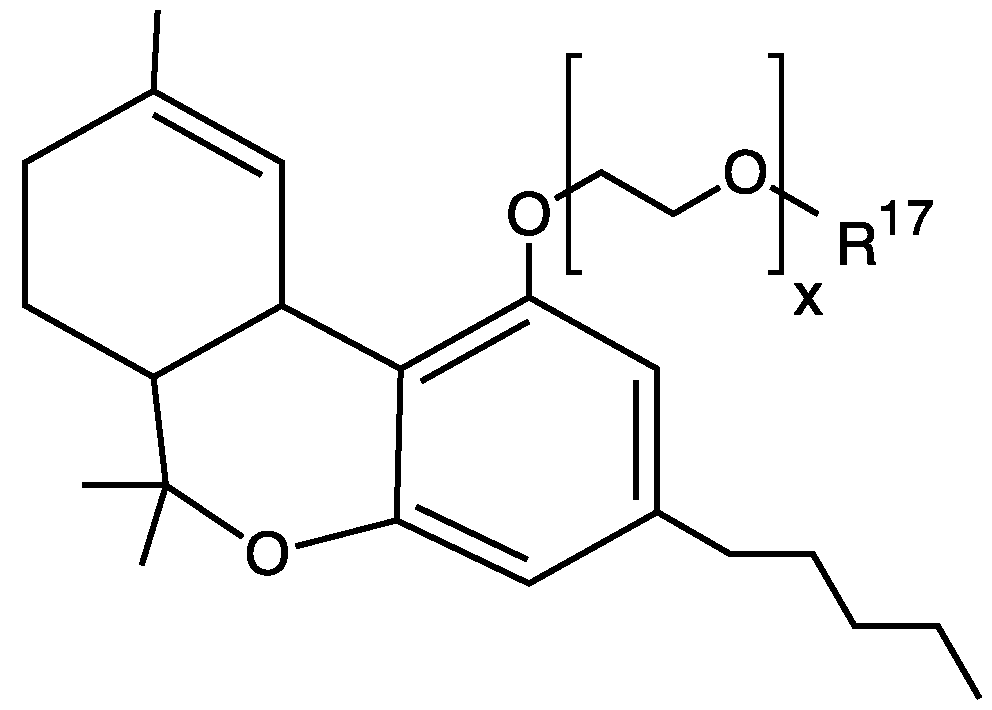
  • a particularly preferred emulsifier of the General Formula is represented by Formula I:
  • each R 18 preferably represents the remnant of an acid or ester.
  • R-C(O)OX wherein X is H or an alkyl
  • R 18 would be the remnant, R, remaining after esterification.
  • Other acids or ester suitable for demonstration of the invention are C1-C22 organic carboxylic acids.
  • HLB hydrophilic-lipophilic balance
  • An HLB of at least 8 is preferred with and HLB of 12-16 being more preferred.
  • the emulsifier is particularly suitable for emulsifying cannabinoid in a formulation and particularly an aqueous formulation comprising cannabinoids. Cannabinoids are marginally soluble, if soluble at all, in aqueous solutions and the instant emulsifier allows the cannabinoid to be utilized in an aqueous formulation.
  • a preferred formulation comprises at least 1 wt% to 99 w% emulsifier with the balance being selected from solvents, oils, surfactants, cannabinoid.
  • a preferred solvent is water with other solvents being suitable for demonstration of the invention.
  • Other suitable solvents include alcohols.
  • Oils particularly natural oils or their alkyl esters, are particularly suitable for use with the invention.
  • Particularly suitable oils include glycerides such as monoglycerides, diglycerides and particularly triglycerides.
  • Particularly preferred oils include coconut oil, olive oil and hempseed oil.
  • the emulsifier is particularly suitable for use in a cosmeceutical for use in acne regulation, cell renewal and regeneration, epidermal barrier formulations, extracellular matrix integrity formulations, pigmentation regulation or melanogenesis, for skin hydration, tissue remodeling, wound healing, insulin signaling, pain treatment, inflammation mitigation, immune response, circadian rhythm treatments, anti-oxidant stress relief, CB1 partial agonist, emollient or humectant, skin brightening, as a barrier cream, as a skin protectant, and as a sun protection factor (SPF) enhancer, as a film former, or as a fragrance fixative.
  • SPF sun protection factor
  • a particularly preferred formulation comprises the emulsifier and a cannabinoid obtained from cannabis.
  • Particularly preferred cannabinoids are selected from the group consisting of CBD, THC, cannabichromene (CBC), cannabichromevarin (CBCV), cannabidiphorol (CBDP), cannabidivarinic acid (CBDVA), cannabielsoin (CBEA), cannabigerolic acid (CBCA), cannabigerolic acid monomethyl ether (CBGAM), cannabigerovarinic acid (CBGVA), cannabicyclolic acid (CBLA), cannabinolic acid (CBNA), cannabicitranic acid (CBTA), cannabivarinic acid (CBVA), tetrahydrocannabinolic acid (THCA), tetrahydrocannabiorcolic acid (THCCA), tetrahydrocannabiphorolic acid (THCPA), tetrahydrocannabinolic
  • the emulsifier is specifically suitable for use in treating tissue, and particularly skin applications and oral applications wherein a formulation is applied to the skin or administered orally.
  • a preferred formulation comprises water, a compound of the General Formula, a cannabinoid with cannabidiol or tetrahydrocannabinol being particularly preferred, and optional additives such as surfactants, emollients, lubricants, fragrances, colorants, flavorants, medications and the like.
  • the method of applying the formulation is not limited herein.
  • the formulation may be applied by spraying, dripping, dipping or pouring the formulation onto the tissue to be treated.
  • the formulation may be applied by an applicator such as by painting or wiping.
  • the term native compound refers to a compound of the General Formula wherein R 11 and R 12 are H.
  • Formula I with x being zero and R 17 being H is CBD and Formula II with x being zero and R 17 being H is THC.
  • the emulsifier By increasing the hydrophilicity of the native compound, to form the emulsifier, the emulsifier is better able to cross various mucosal membranes or the blood-brain barrier, thereby altering the biological effect.
  • the emulsifier is therefore suitable to be used alone or the emulsifier can be used in combination with the native compound or a different cannabinoid.
  • the method of forming the emulsifier is not particularly limited with each step being well within the range of knowledge of those of skill in the art.
  • the polyether groups are formed by typical ring opening reaction of ethylene oxide, or a derivative, in the presence of a catalyst as is well known in the art.
  • the formation of the ester by the reaction of an alcohol and carboxylic acid is well known chemistry which is very familiar to those of skill in the art.
  • the reaction was conducted in a 3000 mL reaction flask, equipped with a heating mantle, temperature probe, overhead agitation, nitrogen sparge and a condenser.
  • a typical reaction 1 ,279 g of CBD ethoxylate, 719 g trans-cinnamic acid and 2.0 g of hypophosphorous acid were added to the reaction flask. Under agitation and nitrogen sparge, the reaction was heated to 220 °C and held under constant agitation overnight. The reaction was then cooled to room temperature.
  • the reaction was conducted in a 3000 mL reaction flask, equipped with a heating mantle, temperature probe, overhead agitation, nitrogen sparge and a condenser.
  • a typical reaction 1 ,575 g of CBD ethoxylate, 922 g Capric/Caprylic acid and 2.5 g of hypophosphorous acid were added to the reaction flask. Under agitation and nitrogen sparge, the reaction was heated to 190 °C and held, under constant agitation overnight. The reaction was then cooled to room temperature.
  • the reaction was conducted in a 3000 mL reaction flask, equipped with a heating mantle, temperature probe, overhead agitation, nitrogen sparge and a condenser.
  • a typical reaction 1 ,208 g (2.1 moles) of CBD ethoxylate, 791 g methyl salicylate (5.2 moles) and 1.0 g of titanium (IV) butoxide were added to the reaction flask. Under agitation and nitrogen sparge, the reaction was heated to 170 °C and held under constant agitation overnight. The reaction was then cooled to room temperature. Synthesis of retinoate-ester of CBD ethoxylate
  • the reaction would be conducted in a 3000 mL reaction flask, equipped with a heating mantle, temperature probe, overhead agitation, nitrogen sparge and a condenser.
  • a heating mantle, temperature probe, overhead agitation, nitrogen sparge and a condenser For a typical reaction, 1 ,208 g (2.1 moles) of CBD ethoxylate, 1 ,352 g retinoic acid (4.5 moles) and 2.5 g of hypophosphorous acid would be added to the reaction flask. Under agitation and nitrogen sparge, the reaction would be heated to 170 °C and held, under constant agitation overnight. The reaction would then be cooled to room temperature.
  • the reaction would be conducted in a 3000 mL reaction flask, equipped with a heating mantle, temperature probe, overhead agitation, nitrogen sparge and a condenser.
  • a heating mantle, temperature probe, overhead agitation, nitrogen sparge and a condenser For a typical reaction, 1 ,208 g (2.1 moles) of CBD ethoxylate, 864 g citric acid (4.5 moles) and 2.5 g of hypophosphorous acid would be added to the reaction flask. Under agitation and nitrogen sparge, the reaction would be heated to 170 °C and held, under constant agitation overnight. The reaction would then be cooled to room temperature.
  • CBD isolate 300 g was charged to a pressure vessel and 0.1% KOH catalyst was added. After removing all water and air, the mixture was heated to 110- 120°C and 900 g of ethylene oxide (EO) was added over 7-8 hours. After EO addition was complete, the reactor was held at temperature until all of the EO was consumed. Trace EO and 1 ,4-dioxane were then removed using vacuum. The reactor contents were cooled and acetic acid was added to neutralize the catalyst and bring the pH into the 6 - 7 range. The resulting product was polyoxyethylene (21) CBD.
  • EO ethylene oxide
  • CBD 10 g of CBD and 1.5 g of the product obtained by Example 1 were combined and the mixture added to 90 g of water with stirring.
  • the CBD was emulsified and formed a clear emulsion.
  • a first vessel was charged with deionized water (88.0 wt%), caprylyl glycol (1 .0 wt%) and CannaSorb CBD-Active (1 .0 wt%) followed by heating to 80°C.
  • a second vessel was charged with Cannasorb LC (1 .5 wt%) and Cannasol CBD-S (1 .5 wt%) followed by heating to 80°C with mixing until uniform. Using a homomixer at slow spead the components of the first vessel were added to the second vessel resulting in a lotion which thickened with increased addition of the water phase.
  • the lotion was cooled to 35°C followed by addition of a mixture of an Essential Oil Blend (0.3 wt%) comprising Eucalyptus Oil, Thyme Oil and Rosemary Oil and Vitacon ACE (0.2 wt%) comprising Vitamins A, C and E to obtain a formulation.
  • Caprylyl glycol was obtained from Inolex.
  • CannaSorb CBD-Active, Cannasorb LC and Cannasol CBD-S were obtained from Synergy Life Sciences Inc.
  • the essential oil blend was obtained from Essential Ingredients Inc.
  • Example 3 The formulation of Example 3 provided reduced pain and inflammation while providing skin rejuvenation.
  • the invention has been described with reference to preferred embodiments without limit thereto. One of skill in the art would realize additional embodiments which are described and set forth in the claims appended hereto.

Landscapes

  • Health & Medical Sciences (AREA)
  • Chemical & Material Sciences (AREA)
  • Organic Chemistry (AREA)
  • Life Sciences & Earth Sciences (AREA)
  • General Health & Medical Sciences (AREA)
  • Medicinal Chemistry (AREA)
  • Pharmacology & Pharmacy (AREA)
  • Animal Behavior & Ethology (AREA)
  • Public Health (AREA)
  • Veterinary Medicine (AREA)
  • Natural Medicines & Medicinal Plants (AREA)
  • Epidemiology (AREA)
  • General Chemical & Material Sciences (AREA)
  • Chemical Kinetics & Catalysis (AREA)
  • Engineering & Computer Science (AREA)
  • Oil, Petroleum & Natural Gas (AREA)
  • Nuclear Medicine, Radiotherapy & Molecular Imaging (AREA)
  • Medical Informatics (AREA)
  • Mycology (AREA)
  • Pain & Pain Management (AREA)
  • Alternative & Traditional Medicine (AREA)
  • Biotechnology (AREA)
  • Botany (AREA)
  • Rheumatology (AREA)
  • Microbiology (AREA)
  • Dermatology (AREA)
  • Pharmaceuticals Containing Other Organic And Inorganic Compounds (AREA)
  • Saccharide Compounds (AREA)
  • Organic Low-Molecular-Weight Compounds And Preparation Thereof (AREA)
  • Medicinal Preparation (AREA)
  • Pyrane Compounds (AREA)

Abstract

Provided herein is a compound which is particularly suitable for use as a cannabinoid, as an emulsifier for a cannabinoid, in a formulation comprising the compound and in a method of treatment using the compound. The compound is defined by the General Formula wherein: R1-R10 are independently selected from H or an alkyl of 1-10 carbons; alkenyl of up to 10 carbons; or groups on adjacent carbons may be taken together to form an alkene; R11 and R12 are independently H or -(CH2CHR16O)x-R17 with the proviso that at least one of R11 or R12 represents -(CH2CHR16O)xR17-; R11 and R10 may be taken together to represent -C(R19)2-; R13-R15 independently represent H or an alkyl of 1-8 carbons; each R16 independently represents H or an alkyl of 1-3 carbons; each R17 independently represents H, an alkyl or substituted alkyl of 1-22 carbons, aryl or substituted aryl or the ester of an acid; each R19 independently represents H or an alkyl of 1-5 carbons; and each x is independently an integer of 1-100.

Description

CANNABINOID EMULSIFIER
CROSS-REFERENCE TO RELATED APPLICATIONS
[0001] This application claims the priority of pending U.S. Provisional Application No. 63/114,010 filed November 16, 2020 which is incorporated herein by reference.
FIELD OF THE INVENTION
[0002] The present invention is related to an improved cannabinoid emulsifier, particularly cannabidiol (CBD). More specifically, the present invention is related to an ethoxylated cannabinoid emulsifier which is particularly suitable for emulsifying cannabinoids and particularly CBD.
BACKGROUND
[0003] Cannabidiol (CBD) is an oily cannabinoid first discovered in Cannabis extracts in 1940. CBD is produced from the flowers, leaves, and stalks of the Cannabis sativa plant. CBD accounts for up to 40% of the plant extract but does not contain tetrahydrocannabinol (THC). This extract is frequently diluted with hemp seed oil, olive oil, or other types of carrier oils. CBD enriched oil products are non-psychoactive and typically contain -20% CBD.
[0004] In 2012, Israeli scientists identified more than 1,200 human genes affected by CBD wherein 600 gene transcripts were upregulated by CBD and 524 were downregulated. CBD has also been shown to regulate the expression of 491 genes with 165 of the genes being in skin.
[0005] CBD, as most cannabinoids, has very low water solubility. Therefore, to incorporate CBD into a water-based formulations, such as cosmetic formulations, an emulsifier system must be used. The art contains a number of examples of CBD formulations. Relevant references are discussed herein.
[0006] US Publ. Appl. No. 2019298683, which is incorporated herein by reference, teaches a high concentration self-emulsifying formulation comprising: (i) about 20% to about 90% by weight of a cannabinoid or mixture of cannabinoids; (ii) about 5% to about 50% by weight of a terpene or terpene mixture, and (iii) about 5% to about 50% by weight of an emulsifier or emulsifier mixture. The teachings are specific to a pharmaceutical composition or mixture that self-emulsifies in an aqueous medium to produce a plurality of particles having an average particle size of about 100 microns to about 10 nm. The emulsifier includes polysorbate 80, oleoyl polyoxyl-6 glyceride, polyoxyl 35 hydrogenated castor oil, sucrose distearate, tocopherol polyethylene glycol 1000 succinate, lauroyl polyoxyl-32 glyceride, sorbitan monooleate, salts thereof and derivatives thereof.
[0007] US Publ. Appl. No. 20100273895, which is incorporate herein by reference, teaches cannabidiol formulations and methods of use. Specifically taught is a pharmaceutical composition comprising: (A) 1-10% (wt/wt) cannabidiol based on the composition; (B) 40% to 61% (wt/wt) ethanol relative to the composition; (C) 2.5% to 10% (wt/wt) diethylene glycol monoethyl ether relative to the composition; (D) 5% to 20% (wt/wt) propylene glycol based on the composition; (E) 0.1% to 3% (wt/wt) isopropyl myristate relative to the composition; and (f) an amount of water sufficient to bring the composition to a total of 100% (wt/wt).
[0008] US Publ. Appl. No. 2015342902, which is incorporated herein by reference, teaches specific cannabinoid formulations. Specifically taught is an oral pharmaceutical formulation comprising: cannabidiol and caprylic/capric triglyceride, wherein the formulation provides a greater cannabidiol Cmax, AUC(O-inf) and/or AUC (0-t) when administered to a subject in a fed condition than when administered to a subject in a fasted condition.
[0009] U.S. Publ. App. No. 20180042845, which is incorporated herein by reference, is specific to preparations of cannabis emulsions and methods thereof. More specifically taught is a composition comprising phospholipids, or derivatives thereof, and an oily fraction. The composition is formulated as an emulsion; wherein the oily fraction contains about 50% cannabinoids.
[0010] WO 2019135225A1, which is incorporated herein by reference, teaches solid self-emulsifying cannabinoid compositions. More specifically, the teachings are directed to a solid self-emulsifying cannabinoid composition, comprising: a) from about 0.1% to about 30% by weight of at least one cannabinoid or a mixture thereof, b) from about 1 .0% to about 5% by weight of at least one essential oil or at least one terpene or a mixture thereof, c) from about 1% to about 40% of at least two emulsifiers, and d) from about 40% to about 90% of at least one adsorbing powder. At least one cannabinoid is essentially solubilized in the mixture of the at least one terpene, at least one essential oil and at least two emulsifiers. The resulting mixture is adsorbed onto the at least one adsorbing powder affording a solid self-emulsifying composition. The solid composition self emulsifies upon contact with water or mammal’s body fluids to produce an oil-in- water sub-micron emulsion comprising a plurality of particles having a mean particle size of from about 10 nm to about 1 ,000 nm. WO 2019135225A1 also teaches that at least one of the emulsifiers is selected from non-ionic surfactants with HLB of about 10 to about 16 and the other(s) emulsifier is selected from non-ionic hydrophilic or hydrophobic surfactants having a HLB value of about 2 to about 12. WO 2019135225A1 also teaches that the hydrophilic emulsifier has an HLB from about 10 to about 16 and is selected from the group consisting of sucrose ester, sucrose stearate, sucrose laurate, sucrose oleate, polysorbate, polyoxyl hydrogenated castor oil, polyoxyl castor oil, tocopherol polyethylene glycol 1000 succinate, poly glyceryl fatty acid ester and combinations thereof and mixtures thereof, in a concentration of from about 1% w/w to about 20% w/w, preferably from about 2% w/w to about 10% w/w. WO 2019135225A1 also teaches that at least one emulsifier has an HLB from about 2 to about 12 and is selected from the group consisting of sorbitan fatty acid esters, sorbitan monooleate, sorbitan stearate, sorbitan oleate, sucrose ester, sucrose di and tri stearate, polyglyceryl fatty acid esters, polyglyceryl-3 dioleate, fatty acids esters and ethers, steareth-2, oleth-2, ceteth-2, salts thereof, derivatives thereof, and combinations thereof.
[0011] In spite of the extensive efforts, there is still a need for a better emulsifier for liquid cannabinoid, particularly CBD, formulations. The ideal emulsifier would be highly compatible with CBD, be nonionic in nature so it will be compatible with either anionic or cationic components in a skin care formulation, and be unaffected by the presence of water or other formulation components. An improved emulsifier, based on ethoxylated cannabinoids, is provided herein.
SUMMARY OF THE INVENTION
[0012] The present invention is related to an improved emulsifier which can provide the biological benefits of a cannabinoid. [0013] A particular feature of the present invention is the ability to emulsify cannabinoids thereby providing for formulations, and particularly aqueous formulations, comprising cannabinoids.
[0014] These and other advantages, as will be realized, are provided in a compound defined by the General Formula:
Figure imgf000006_0001
General Formula wherein:
R1-R10 are independently selected from H or an alkyl of 1-10 carbons; alkenyl of up to
10 carbons; or groups on adjacent carbons may be taken together to form an alkene; R11 and R12 are independently H or -(CH2CHR16O)x-R17 with the proviso that at least one of R11 or R12 represents -(CH2CHR16O)XR17-; R11 and R10 may be taken together to represent -C(R19)2-;
R13-R15 independently represent H or an alkyl of 1-8 carbons; each R16 independently represents H or an alkyl of 1-3 carbons; each R17 independently represents H, an alkyl or substituted alkyl of 1-22 carbons, aryl or substituted aryl or the ester of an acid; each R19 independently represents H or an alkyl of 1-5 carbons; and each x is independently an integer of 1-100.
[0015] Yet another embodiment is provide in formulation comprising: a compound defined by General Formula:
Figure imgf000007_0001
General Formula wherein:
R1-R10 are independently selected from H or an alkyl of 1-10 carbons; alkenyl of up to
10 carbons; or groups on adjacent carbons may be taken together to form an alkene; R11 and R12 are independently H or -(CH2CHR16O)x-R17 with the proviso that at least one of R11 or R12 represents -(CH2CHR16O)XR17-; R11 and R10 may be taken together to represent -C(R19)2-;
R13-R15 independently represent H or an alkyl of 1-8 carbons; each R16 independently represents H or an alkyl of 1-3 carbons; each R17 independently represents H, an alkyl or substituted alkyl of 1-22 carbons, aryl or substituted aryl or the ester of an acid; each R19 independently represents H or an alkyl of 1-5 carbons; and each x is independently an integer of 1-100; and a cannabinoid.
[0016] Yet another embodiment is provided in a method for treating tissue comprising applying a formulation comprising: a compound defined by General Formula:
Figure imgf000008_0001
General Formula wherein:
R1-R10 are independently selected from H or an alkyl of 1-10 carbons; alkenyl of up to
10 carbons; or groups on adjacent carbons may be taken together to form an alkene; R11 and R12 are independently H or -(CH2CHR16O)x-R17 with the proviso that at least one of R11 or R12 represents -(CH2CHR16O)XR17-; R11 and R10 may be taken together to represent -C(R19)2-; R13-R15 independently represent H or an alkyl of 1-8 carbons; each R16 independently represents H or an alkyl of 1-3 carbons; each R17 independently represents H, an alkyl or substituted alkyl of 1-22 carbons, aryl or substituted aryl or the ester of an acid; each R19 independently represents H or an alkyl of 1-5 carbons; and each x is independently an integer of 1-100; and a cannabinoid.
DESCRIPTION
[0017] The instant invention is specific to an emulsifier which is the poly(alkyleneoxide) ethers of cannabinoids, represented by the General Formula. The emulsifier is formed from the reaction of preferably, ethylene oxide (EO) or propylene oxide (PO) with a cannabinoid and particularly CBD. The resulting emulsifier is nonionic in character. Depending on the ratio of EO and PO to CBD, as a representative cannabinoid, the water solubility can be adjusted higher or lower. More EO will make the resulting emulsifier more water soluble and adjust its emulsifying power. Using CBD as the representative hydrophobe of the emulsifier ensures excellent compatibility with the native compound or free CBD oil. The ether linkages of the emulsifier are resistant to hydrolysis and thus the emulsifier is indefinitely stable in water and in the presence of other formulation components.
[0018] The emulsifier is represented by General Formula:
Figure imgf000010_0001
General Formula wherein:
R1-R10 are independently selected from H or an alkyl of 1-10 carbons; alkenyl of up to 10 carbons; or groups on adjacent carbons may be taken together to form an alkene;
R1, R5, R6, R7, R8 and R9 are preferably H; R2 and R3 are preferably taken together to form an alkene; R4 is preferably -CH3; R10 is preferably -C(=CH2)CH3;
R11 and R12 are independently H or -(CH2CHR16O)x-R17 with the proviso that at least one of R11 or R12 represents -(CH2CHR16O)XR17-; R11 and R10 may be taken together to represent -C(R19)2-;
R13-R15 independently represent H or an alkyl of 1-8 carbons; R13 and R14 are preferably H; R15 is preferably an alkyl of 1-8 carbons and more preferably -(CFh^CHs; each R16 independently represents H or an alkyl of 1-3 carbons; each R16 preferably independently represents H or -CH3; each R17 independently represents H, an alkyl or substituted alkyl of 1-22 carbons, aryl or substituted aryl; alternatively R17 is the ester of an acid, -C(O)-R18, wherein each R18 preferably represents the remnant of an acid or ester preferably salicylic acid, methyl salicylate, a carboxylic acid of 5 to 10 carbons, cinnamic acid, citric acid, retinoic acid, and ascorbic acid. In an embodiment R18 represents the remnant of a C1-C22 organic acid or ester wherein C1-C22 represents 1-22 carbons which are preferably alkyl carbons. each R19 independently represents H or an alkyl of 1-5 carbons; each R19 is preferably -CH3; each x is independently an integer of 1-100 and preferably 3-13
[0019] A particularly preferred emulsifier of the General Formula is represented by Formula I:
Figure imgf000011_0001
Formula I
[0020] In a particularly preferred embodiment of Formula I, each x is independently 3-13 and each R17 is independently selected from H, C(O)CeH4OH, -C(O)CH=CHC6H5, - C(O)(CH2)ZCH3, or -C(O)(CH2)gCH3 and preferably both R17 groups are the same.
[0021] Another particularly preferred embodiment of the General Formula is represented by Formula II:
Figure imgf000012_0001
[0022] In a particularly preferred embodiment of Formula II, each x is independently 3-13 and each R17 is independently selected from H, C(O)CeH4OH, -C(O)CH=CHC6H5, -C(O)(CH2)ZCH3, or -C(O)(CH2)gCH3 and preferably both R17 groups are the same.
[0023] For substituent -C(O)-R18, each R18 preferably represents the remnant of an acid or ester. By way of a clarifying non-limiting example, for an acid or ester, generally represented by R-C(O)OX wherein X is H or an alkyl, R18 would be the remnant, R, remaining after esterification. Particularly preferred acids or esters include salicylic acid or methyl salicylate wherein R17 is -C(O)CeH4OH, a carboxylic acid of 6 to 10 carbons wherein R17 is -C(O)(CH2)s-9CH3 or cinnamic acid wherein R17 is -C(O)CH=CHC6H5. Other acids or ester suitable for demonstration of the invention are C1-C22 organic carboxylic acids.
[0024] The ether groups, -(CH2CHR16O)XR17-, alter the hydrophilic-lipophilic balance (HLB) of the emulsifier with a higher number of -CH2CHR16O- groups being consistent with a higher HLB. An HLB of at least 8 is preferred with and HLB of 12-16 being more preferred. [0025] The emulsifier is particularly suitable for emulsifying cannabinoid in a formulation and particularly an aqueous formulation comprising cannabinoids. Cannabinoids are marginally soluble, if soluble at all, in aqueous solutions and the instant emulsifier allows the cannabinoid to be utilized in an aqueous formulation. A preferred formulation comprises at least 1 wt% to 99 w% emulsifier with the balance being selected from solvents, oils, surfactants, cannabinoid.
[0026] A preferred solvent is water with other solvents being suitable for demonstration of the invention. Other suitable solvents include alcohols.
[0027] Oils, particularly natural oils or their alkyl esters, are particularly suitable for use with the invention. Particularly suitable oils include glycerides such as monoglycerides, diglycerides and particularly triglycerides. Particularly preferred oils include coconut oil, olive oil and hempseed oil.
[0028] The emulsifier is particularly suitable for use in a cosmeceutical for use in acne regulation, cell renewal and regeneration, epidermal barrier formulations, extracellular matrix integrity formulations, pigmentation regulation or melanogenesis, for skin hydration, tissue remodeling, wound healing, insulin signaling, pain treatment, inflammation mitigation, immune response, circadian rhythm treatments, anti-oxidant stress relief, CB1 partial agonist, emollient or humectant, skin brightening, as a barrier cream, as a skin protectant, and as a sun protection factor (SPF) enhancer, as a film former, or as a fragrance fixative.
[0029] A particularly preferred formulation comprises the emulsifier and a cannabinoid obtained from cannabis. Particularly preferred cannabinoids are selected from the group consisting of CBD, THC, cannabichromene (CBC), cannabichromevarin (CBCV), cannabidiphorol (CBDP), cannabidivarinic acid (CBDVA), cannabielsoin (CBEA), cannabigerolic acid (CBCA), cannabigerolic acid monomethyl ether (CBGAM), cannabigerovarinic acid (CBGVA), cannabicyclolic acid (CBLA), cannabinolic acid (CBNA), cannabicitranic acid (CBTA), cannabivarinic acid (CBVA), tetrahydrocannabinolic acid (THCA), tetrahydrocannabiorcolic acid (THCCA), tetrahydrocannabiphorolic acid (THCPA), tetrahydrocannabinolic acid (THCA), tetrahydrocannabivarinic acid (THCVA), cannadibiphorol (CBDP), cannabidivarin (CBDV), cannabielsoin (CBE), cannabigerol (CBG), cannabigerol monomethylether (CBGM), cannabigerovarin (CBG), cannabigerol monomethylether (CBGM), cannabigerovarin (CBGV), cannabicyclol (CBL), cannabinol (CBN), cannabicitran (CBTC), cannabivarin (CBV), tetrahydrocannabiorcol (THCC), tetrahydrocannabiphorol (THCP) or tetrahydrocannabivarin (TNCV). Other products from cannabis may be used in combination with the emulsifier such as hemp.
[0030] The emulsifier is specifically suitable for use in treating tissue, and particularly skin applications and oral applications wherein a formulation is applied to the skin or administered orally. A preferred formulation comprises water, a compound of the General Formula, a cannabinoid with cannabidiol or tetrahydrocannabinol being particularly preferred, and optional additives such as surfactants, emollients, lubricants, fragrances, colorants, flavorants, medications and the like.
[0031] The method of applying the formulation is not limited herein. The formulation may be applied by spraying, dripping, dipping or pouring the formulation onto the tissue to be treated. Alternatively, the formulation may be applied by an applicator such as by painting or wiping. [0032] While not limited to theory, it is hypothesized that the emulsifier has similar biological activity to the native compound. For the purposes of this invention, the term native compound refers to a compound of the General Formula wherein R11 and R12 are H. By way of example, Formula I with x being zero and R17 being H is CBD and Formula II with x being zero and R17 being H is THC. By increasing the hydrophilicity of the native compound, to form the emulsifier, the emulsifier is better able to cross various mucosal membranes or the blood-brain barrier, thereby altering the biological effect. The emulsifier is therefore suitable to be used alone or the emulsifier can be used in combination with the native compound or a different cannabinoid.
[0033] The method of forming the emulsifier is not particularly limited with each step being well within the range of knowledge of those of skill in the art. The polyether groups are formed by typical ring opening reaction of ethylene oxide, or a derivative, in the presence of a catalyst as is well known in the art. The formation of the ester by the reaction of an alcohol and carboxylic acid is well known chemistry which is very familiar to those of skill in the art.
EXAMPLES
General Reaction Scheme
[0034] The esterification of CBD ethoxylate, as a representative cannabinoid, was conducted with a nitrogen sparge at elevated temperatures (> 170 °C). Two catalysts were employed for these reactions, either hypophosphorous acid, particularly for cinnamate and capric/caprylate, or titanium (IV) butoxide, particularly for salicylate. CBD has two free hydroxyls, which were ethoxylated and subsequently esterified. Therefore, the reactions were conducted in a 2:1 molar ratio, with the acid to be esterified in excess. It should be noted that the salicylate ester was prepared via transesterification with methyl salicylate, producing methanol as a by-product. One of skill in the art would realize the adjustments in molar ratios and conditions for other cannabinoids and acids. Synthesis of Cinnamate-ester of CBD ethoxylate
[0035] The reaction was conducted in a 3000 mL reaction flask, equipped with a heating mantle, temperature probe, overhead agitation, nitrogen sparge and a condenser. For a typical reaction, 1 ,279 g of CBD ethoxylate, 719 g trans-cinnamic acid and 2.0 g of hypophosphorous acid were added to the reaction flask. Under agitation and nitrogen sparge, the reaction was heated to 220 °C and held under constant agitation overnight. The reaction was then cooled to room temperature.
Synthesis of Caorate/Caorylate-ester of CBD ethoxylate
[0036] The reaction was conducted in a 3000 mL reaction flask, equipped with a heating mantle, temperature probe, overhead agitation, nitrogen sparge and a condenser. For a typical reaction, 1 ,575 g of CBD ethoxylate, 922 g Capric/Caprylic acid and 2.5 g of hypophosphorous acid were added to the reaction flask. Under agitation and nitrogen sparge, the reaction was heated to 190 °C and held, under constant agitation overnight. The reaction was then cooled to room temperature.
Synthesis of Salicylate-ester of CBD ethoxylate
[0037] The reaction was conducted in a 3000 mL reaction flask, equipped with a heating mantle, temperature probe, overhead agitation, nitrogen sparge and a condenser. For a typical reaction, 1 ,208 g (2.1 moles) of CBD ethoxylate, 791 g methyl salicylate (5.2 moles) and 1.0 g of titanium (IV) butoxide were added to the reaction flask. Under agitation and nitrogen sparge, the reaction was heated to 170 °C and held under constant agitation overnight. The reaction was then cooled to room temperature. Synthesis of retinoate-ester of CBD ethoxylate
[0038] The reaction would be conducted in a 3000 mL reaction flask, equipped with a heating mantle, temperature probe, overhead agitation, nitrogen sparge and a condenser. For a typical reaction, 1 ,208 g (2.1 moles) of CBD ethoxylate, 1 ,352 g retinoic acid (4.5 moles) and 2.5 g of hypophosphorous acid would be added to the reaction flask. Under agitation and nitrogen sparge, the reaction would be heated to 170 °C and held, under constant agitation overnight. The reaction would then be cooled to room temperature.
Synthesis of citrate-ester of CBD ethoxylate
[0039] The reaction would be conducted in a 3000 mL reaction flask, equipped with a heating mantle, temperature probe, overhead agitation, nitrogen sparge and a condenser. For a typical reaction, 1 ,208 g (2.1 moles) of CBD ethoxylate, 864 g citric acid (4.5 moles) and 2.5 g of hypophosphorous acid would be added to the reaction flask. Under agitation and nitrogen sparge, the reaction would be heated to 170 °C and held, under constant agitation overnight. The reaction would then be cooled to room temperature.
Example 1
[0040] 300 g of CBD isolate was charged to a pressure vessel and 0.1% KOH catalyst was added. After removing all water and air, the mixture was heated to 110- 120°C and 900 g of ethylene oxide (EO) was added over 7-8 hours. After EO addition was complete, the reactor was held at temperature until all of the EO was consumed. Trace EO and 1 ,4-dioxane were then removed using vacuum. The reactor contents were cooled and acetic acid was added to neutralize the catalyst and bring the pH into the 6 - 7 range. The resulting product was polyoxyethylene (21) CBD. Example 2
[0041] 10 g of CBD and 1.5 g of the product obtained by Example 1 were combined and the mixture added to 90 g of water with stirring. The CBD was emulsified and formed a clear emulsion.
Example 3
[0042] A first vessel was charged with deionized water (88.0 wt%), caprylyl glycol (1 .0 wt%) and CannaSorb CBD-Active (1 .0 wt%) followed by heating to 80°C. A second vessel was charged with Cannasorb LC (1 .5 wt%) and Cannasol CBD-S (1 .5 wt%) followed by heating to 80°C with mixing until uniform. Using a homomixer at slow spead the components of the first vessel were added to the second vessel resulting in a lotion which thickened with increased addition of the water phase. The lotion was cooled to 35°C followed by addition of a mixture of an Essential Oil Blend (0.3 wt%) comprising Eucalyptus Oil, Thyme Oil and Rosemary Oil and Vitacon ACE (0.2 wt%) comprising Vitamins A, C and E to obtain a formulation. Caprylyl glycol was obtained from Inolex. CannaSorb CBD-Active, Cannasorb LC and Cannasol CBD-S were obtained from Synergy Life Sciences Inc. The essential oil blend was obtained from Essential Ingredients Inc.
[0043] The formulation of Example 3 provided reduced pain and inflammation while providing skin rejuvenation. [0044] The invention has been described with reference to preferred embodiments without limit thereto. One of skill in the art would realize additional embodiments which are described and set forth in the claims appended hereto.

Claims

Claimed is:
1 . A compound defined by the General Formula:
Figure imgf000020_0001
General Formula wherein:
R1-R10 are independently selected from H or an alkyl of 1-10 carbons; alkenyl of up to 10 carbons; or groups on adjacent carbons may be taken together to form an alkene;
R11 and R12 are independently H or -(CH2CHR16O)x-R17 with the proviso that at least one of R11 or R12 represents -(CH2CHR16O)XR17-; R11 and R10 may be taken together to represent -C(R19)2-;
R13-R15 independently represent H or an alkyl of 1-8 carbons; each R16 independently represents H or an alkyl of 1-3 carbons; each R17 independently represents H, an alkyl or substituted alkyl of 1-22 carbons, aryl or substituted aryl or the ester of an acid; each R19 independently represents H or an alkyl of 1-5 carbons; and each x is independently an integer of 1-100. The compound of claim 1 wherein R1, R5, R6, R7, R8 and R9 are H. The compound of claim 1 wherein R2 and R3 are taken together to form an alkene. The compound of claim 1 wherein R4 is -CH3. The compound of claim 1 wherein R10 is -C(CH2)CH3. The compound of claim 1 wherein R13 and R14 are H; The compound of claim 1 wherein R15 is an alkyl of 1-8 carbons. The compound of claim 7 wherein R15 is-(CH2)4CH3. The compound of claim 1 wherein each R16 independently represents H or -CH3. The compound of claim 1 wherein R17 is C(O)R18 wherein R18 represents the remnant of an acid or ester. The compound of claim 10 wherein R18 represents the remnant of salicylic acid, methyl salicylate, a carboxylic acid of 5 to 10 carbons, cinnamic acid, citric acid, retinoic acid, acetic acid, ascorbic acid, capric acid, and caprylic acid. The compound of claim 1 wherein each R19 is -CH3. The compound of claim 1 wherein each x is independently an integer of 3-13. The compound of claim 1 wherein said compound is defined by Formula I:
Figure imgf000022_0001
Formula I The compound of claim 14 wherein each x is independently 3-13 and each R17 is independently selected from H, C(O)CeH4OH, -C(O)CH=CHC6H5,- C(O)(CH2)7CH3, or-(O)(CH2)9CH3. The compound of claim 15 wherein both R17 groups are the same. The compound of claim 1 wherein said compound is defined by Formula II:
Figure imgf000022_0002
Formula II The compound of claim 17 wherein each x is independently 3-13 and each R17 is independently selected from H, C(O)CeH4OH, -C(O)CH=CHC6H5,- C(O)(CH2)7CH3 or-(O)(CH2)9CH3. The compound of claim 18 wherein both R17 groups are the same. The compound of claim 1 having an HLB of at least 8. The compound of claim 20 wherein said HLB of 12-16. A formulation comprising: a compound defined by General Formula:
Figure imgf000023_0001
General Formula wherein:
R1-R10 are independently selected from H or an alkyl of 1-10 carbons; alkenyl of up to 10 carbons; or groups on adjacent carbons may be taken together to form an alkene; R11 and R12 are independently H or -(CH2CHR16O)x-R17 with the proviso that at least one of R11 or R12 represents -(CH2CHR16O)XR17-; R11 and R10 may be taken together to represent -C(R19)2-;
R13-R15 independently represent H or an alkyl of 1-8 carbons; each R16 independently represents H or an alkyl of 1-3 carbons; each R17 independently represents H, an alkyl or substituted alkyl of 1-22 carbons, aryl or substituted aryl or the ester of an acid; each R19 independently represents H or an alkyl of 1-5 carbons; and each x is independently an integer of 1-100; and a cannabinoid. The formulation of claim 22 wherein R1, R5, R6, R7, R8 and R9 are H. The formulation of claim 22 wherein R2 and R3 are taken together to form an alkene. The formulation of claim 22 wherein R4 is -CH3. The formulation of claim 22 wherein R10 is -C(CH2)CH3. The formulation of claim 22 wherein R13 and R14 are H; The formulation of claim 22 wherein R15 is an alkyl of 1-8 carbons. The formulation of claim 28 wherein R15 is-(CH2)4CH3. The formulation of claim 22 wherein each R16 independently represents H or - CH3. The formulation of claim 22 wherein R17 is C(O)R18 wherein R18 represents the remnant of an acid or ester.
23 The formulation of claim 31 wherein R18 represents the remnant of salicylic acid, methyl salicylate, a carboxylic acid of 5 to 10 carbons, cinnamic acid, citric acid, retinoic acid, acetic acid, ascorbic acid, capric acid, and caprylic acid. The formulation of claim 22 wherein each R19 is -CH3. The formulation of claim 22 wherein each x is independently an integer of 3-13. The formulation of claim 22 wherein said compound is defined by Formula I:
Figure imgf000025_0001
Formula I The formulation of claim 35 wherein each x is independently 3-13 and each R17 is independently selected from H, C(O)CeH4OH, -C(O)CH=CHC6H5,- C(O)(CH2)7CH3, or -(O)(CH2)9CH3. The formulation of claim 36 wherein both R17 groups are the same. The formulation of claim 22 wherein said compound is defined by Formula II:
Figure imgf000026_0001
Formula II The formulation of claim 38 wherein each x is independently 3-13 and each R17 is independently selected from H, C(O)CeH4OH, -C(O)CH=CHC6H5,- C(O)(CH2)7CH3, or -(O)(CH2)9CH3. The formulation of claim 39 wherein both R17 groups are the same. The formulation of claim 22 wherein said compound has an HLB of at least 8. The formulation of claim 41 wherein said HLB is 12-16. The formulation of claim 22 further comprising water. The formulation of claim 22 wherein said cannabinoid is selected from the the group consisting of CBD, THC, cannabichromene (CBC), cannabichromevarin (CBCV), cannabidiphorol (CBDP), cannabidivarinic acid (CBDVA), cannabielsoin (CBEA), cannabigerolic acid (CBCA), cannabigerolic acid monomethyl ether (CBGAM), cannabigerovarinic acid (CBGVA), cannabicyclolic acid (CBLA), cannabinolic acid (CBNA), cannabicitranic acid (CBTA), cannabivarinic acid (CBVA), tetrahydrocannabinolic acid (THCA), tetrahydrocannabiorcolic acid (THCCA), tetrahydrocannabiphorolic acid (THCPA), tetrahydrocannabinolic acid
25 (THCA), tetrahydrocannabivarinic acid (THCVA), cannadibiphorol (CBDP), cannabidivarin (CBDV), cannabielsoin (CBE), cannabigerol (CBG), cannabigerol monomethylether (CBGM), cannabigerovarin (CBG), cannabigerol monomethylether (CBGM), cannabigerovarin (CBGV), cannabicyclol (CBL), cannabinol (CBN), cannabicitran (CBTC), cannabivarin (CBV), tetrahydrocannabiorcol (THCC), tetrahydrocannabiphorol (THCP) or tetrahydrocannabivarin (TNCV). The formulation of claim 22 wherein comprising hemp. The formulation of claim 22 further comprising at least one additive selected from the group consisting of surfactants, emollients, lubricants, fragrances, colorants, flavorants, medications and natural oils. The formulation of claim 46 further comprising at least one additive selected from the group consisting of coconut oil, olive oil, monoglycerides, diglycerides and triglycerides. A method for treating tissue comprising applying a formulation comprising: a compound defined by General Formula:
26
Figure imgf000028_0001
General Formula wherein:
R1-R10 are independently selected from H or an alkyl of 1-10 carbons; alkenyl of up to 10 carbons; or groups on adjacent carbons may be taken together to form an alkene;
R11 and R12 are independently H or -(CH2CHR16O)x-R17 with the proviso that at least one of R11 or R12 represents -(CH2CHR16O)XR17-; R11 and R10 may be taken together to represent -C(R19)2-;
R13-R15 independently represent H or an alkyl of 1-8 carbons; each R16 independently represents H or an alkyl of 1-3 carbons; each R17 independently represents H, an alkyl or substituted alkyl of 1-22 carbons, aryl or substituted aryl or the ester of an acid; each R19 independently represents H or an alkyl of 1-5 carbons; and each x is independently an integer of 1-100; and a cannabinoid. The method for treating tissue of claim 48 wherein R1, R5, R6, R7, R8 and R9 are H. The method for treating tissue of claim 48 wherein R2 and R3 are taken together to form an alkene. The method for treating tissue of claim 48 wherein R4 is -CH3. The method for treating tissue of claim 48 wherein R10 is -C(CH2)CH3. The method for treating tissue of claim 48 wherein R13 and R14 are H; The method for treating tissue of claim 48 wherein R15 is an alkyl of 1-8 carbons. The method for treating tissue of claim 54 wherein R15 is-(CH2)4CH3. The method for treating tissue of claim 48 wherein each R16 independently represents H or -CH3. The method for treating tissue of claim 48 wherein R17 is C(O)R18 wherein R18 represents the remnant of an acid or ester. The method for treating tissue of claim 57 wherein R18 represents the remnant of salicylic acid, methyl salicylate, a carboxylic acid of 5 to 10 carbons, cinnamic acid, citric acid, retinoic acid, acetic acid, ascorbic acid, capric acid, and caprylic acid. The method for treating tissue of claim 48 wherein each R19 is -CH3. The method for treating tissue of claim 48 wherein each x is independently an integer of 3-13. The method for treating tissue of claim 48 wherein said compound is defined by
Formula I:
28
Figure imgf000030_0001
Formula I The method for treating tissue of claim 61 wherein each x is 3-13 and each R17 is independently selected from H, C(O)CeH4OH, -C(O)CH=CHC6H5,- C(O)(CH2)7CH3, or -(O)(CH2)9CH3. The method for treating tissue of claim 62 wherein both R17 groups are the same. The method for treating tissue of claim 48 wherein said compound is defined by Formula II:
Figure imgf000030_0002
Formula II The method for treating tissue of claim 17 wherein each x is 3-13 and each R17 is independently selected from H, C(O)CeH4OH, -C(O)CH=CHC6H5 or - C(O)(CH2)zCH3. The method for treating tissue of claim 65 wherein both R17 groups are the same. The method for treating tissue of claim 48 wherein said compound has an HLB of at least 8. The method for treating tissue of claim 67 wherein said HLB is 12-16. The method for treating tissue of claim 48 further comprising water. The method for treating tissue of claim 48 wherein said cannabinoid is selected from the the group consisting of CBD, THC, cannabichromene (CBC), cannabichromevarin (CBCV), cannabidiphorol (CBDP), cannabidivarinic acid (CBDVA), cannabielsoin (CBEA), cannabigerolic acid (CBCA), cannabigerolic acid monomethyl ether (CBGAM), cannabigerovarinic acid (CBGVA), cannabicyclolic acid (CBLA), cannabinolic acid (CBNA), cannabicitranic acid (CBTA), cannabivarinic acid (CBVA), tetrahydrocannabinolic acid (THCA), tetrahydrocannabiorcolic acid (THCCA), tetrahydrocannabiphorolic acid (THCPA), tetrahydrocannabinolic acid (THCA), tetrahydrocannabivarinic acid (THCVA), cannadibiphorol (CBDP), cannabidivarin (CBDV), cannabielsoin (CBE), cannabigerol (CBG), cannabigerol monomethylether (CBGM), cannabigerovarin (CBG), cannabigerol monomethylether (CBGM), cannabigerovarin (CBGV), cannabicyclol (CBL), cannabinol (CBN), cannabicitran (CBTC), cannabivarin (CBV), tetrahydrocannabiorcol (THCC), tetrahydrocannabiphorol (THCP) or tetrahydrocannabivarin (TNCV).
30 The method for treating tissue of claim 48 wherein comprising hemp. The method for treating tissue of claim 48 further comprising at least one additive selected from the group consisting of surfactants, emollients, lubricants, fragrances, colorants, flavorants, medications and natural oils. The method for treating tissue of claim 72 further comprising at least one additive selected from the group consisting of coconut oil, olive oil, monoglycerides, diglycerides and triglycerides. The method for treating tissue of claim 72 wherein said treatment is for acne regulation, cell renewal and regeneration, epidermal barrier formulations, extracellular matrix integrity formulations, pigmentation regulation or melanogenesis, for skin hydration, tissue remodeling, wound healing, insulin signaling, pain treatment, inflammation mitigation, immune response, circadian rhythm treatments, anti-oxidant stress relief, CB1 partial agonist, emmolient or humectant, skin brightening, as a barrier cream, as a skin protectant, and an sun protection factor (SPF) enhancer, as a film former or as a fragrance fixative.
31
PCT/US2021/059476 2020-11-16 2021-11-16 Cannabinoid emulsifier Ceased WO2022104245A2 (en)

Priority Applications (2)

Application Number Priority Date Filing Date Title
EP21893008.9A EP4243774A4 (en) 2020-11-16 2021-11-16 CANNABINOID EMULSIFIER
CA3201666A CA3201666A1 (en) 2020-11-16 2021-11-16 Cannabinoid emulsifier

Applications Claiming Priority (2)

Application Number Priority Date Filing Date Title
US202063114010P 2020-11-16 2020-11-16
US63/114,010 2020-11-16

Publications (2)

Publication Number Publication Date
WO2022104245A2 true WO2022104245A2 (en) 2022-05-19
WO2022104245A3 WO2022104245A3 (en) 2022-06-23

Family

ID=81587496

Family Applications (1)

Application Number Title Priority Date Filing Date
PCT/US2021/059476 Ceased WO2022104245A2 (en) 2020-11-16 2021-11-16 Cannabinoid emulsifier

Country Status (4)

Country Link
US (1) US12269795B2 (en)
EP (1) EP4243774A4 (en)
CA (1) CA3201666A1 (en)
WO (1) WO2022104245A2 (en)

Families Citing this family (1)

* Cited by examiner, † Cited by third party
Publication number Priority date Publication date Assignee Title
AU2022324615A1 (en) 2021-08-04 2024-02-15 Demeetra Agbio, Inc. Cannabinoid derivatives and their use

Citations (8)

* Cited by examiner, † Cited by third party
Publication number Priority date Publication date Assignee Title
FR2854896A1 (en) 2003-05-16 2004-11-19 Mayoly Spindler Lab New surfactants used for preparation of liposomes and cosmetic and/or dermatological compositions comprise polar saccharidal heads, spacer group and lipophilic residue
WO2009018389A1 (en) 2007-07-30 2009-02-05 Alltranz Inc. Prodrugs of cannabidiol, compositions comprising prodrugs of cannabidiol and methods of using the same
US20100273895A1 (en) 2009-04-28 2010-10-28 Alltranz Inc. Formulations of cannabidiol and prodrugs of cannabidiol and methods of using the same
US20150342902A1 (en) 2014-05-29 2015-12-03 Insys Pharma, Inc. Stable cannabinoid formulations
US20180042845A1 (en) 2015-03-19 2018-02-15 One World Cannabis Ltd. Preparations of cannabis emulsions and methods thereof
WO2018091551A1 (en) 2016-11-15 2018-05-24 Full Spectrum Laboratories Ltd Bio-stable cannabinoid compounds and methods for enhancing their physiological concentration
WO2019135225A1 (en) 2018-01-03 2019-07-11 Icdpharma Ltd. Solid self-emuslifying cannabinoid compositions
US20190298683A1 (en) 2016-07-14 2019-10-03 Icdpharma Ltd High-strength oral cannabinoid dosage forms

Family Cites Families (4)

* Cited by examiner, † Cited by third party
Publication number Priority date Publication date Assignee Title
WO2008107879A1 (en) 2007-03-05 2008-09-12 Yissum Research Development Company Of The Hebrew University Of Jerusalem Novel cannabidiol derivatives and their use as anti-inflammatory agents
EP2424568A1 (en) 2009-04-29 2012-03-07 University Of Kentucky Research Foundation Cannabinoid-containing compositions and methods for their use
EA201992247A1 (en) * 2017-03-23 2020-03-24 Ресептор Холдингз, Инк. FAST AND CONTROLLED DELIVERY OF COMPOSITIONS WITH RESTORED ANTURUZH EFFECT
US10661749B2 (en) 2017-11-08 2020-05-26 Hoon Y. Kim Adjustable restraint system

Patent Citations (8)

* Cited by examiner, † Cited by third party
Publication number Priority date Publication date Assignee Title
FR2854896A1 (en) 2003-05-16 2004-11-19 Mayoly Spindler Lab New surfactants used for preparation of liposomes and cosmetic and/or dermatological compositions comprise polar saccharidal heads, spacer group and lipophilic residue
WO2009018389A1 (en) 2007-07-30 2009-02-05 Alltranz Inc. Prodrugs of cannabidiol, compositions comprising prodrugs of cannabidiol and methods of using the same
US20100273895A1 (en) 2009-04-28 2010-10-28 Alltranz Inc. Formulations of cannabidiol and prodrugs of cannabidiol and methods of using the same
US20150342902A1 (en) 2014-05-29 2015-12-03 Insys Pharma, Inc. Stable cannabinoid formulations
US20180042845A1 (en) 2015-03-19 2018-02-15 One World Cannabis Ltd. Preparations of cannabis emulsions and methods thereof
US20190298683A1 (en) 2016-07-14 2019-10-03 Icdpharma Ltd High-strength oral cannabinoid dosage forms
WO2018091551A1 (en) 2016-11-15 2018-05-24 Full Spectrum Laboratories Ltd Bio-stable cannabinoid compounds and methods for enhancing their physiological concentration
WO2019135225A1 (en) 2018-01-03 2019-07-11 Icdpharma Ltd. Solid self-emuslifying cannabinoid compositions

Non-Patent Citations (1)

* Cited by examiner, † Cited by third party
Title
See also references of EP4243774A4

Also Published As

Publication number Publication date
EP4243774A2 (en) 2023-09-20
US12269795B2 (en) 2025-04-08
EP4243774A4 (en) 2024-11-06
US20220153670A1 (en) 2022-05-19
WO2022104245A3 (en) 2022-06-23
CA3201666A1 (en) 2022-05-19

Similar Documents

Publication Publication Date Title
DE4320871C2 (en) Cosmetic and dermatological preparations containing delta-aminolevulinic acid
EP1216696B1 (en) Method for reducing the appearance of dark circles under the eyes
EP2316412A2 (en) High-clarity aqueous concentrates of 4-hexylresorcinol
MXPA00003830A (en) Coloring agent-containing sunless tanning compositions.
US20070172436A1 (en) Nonaqueous ascorbic acid compositions and methods for preparing same
DE4305788C2 (en) Cosmetic and dermatological formulations to protect the skin against oxidation processes
MXPA06005587A (en) Sprayable composition for the administration of vitamin d derivatives.
US20060029623A1 (en) Invert emulsions comprising at least one active agent sensitive to water and cosmetic/dermatological applications thereof
US12269795B2 (en) Cannabinoid emulsifier
FR2754454A1 (en) USE OF AT LEAST ONE GLYCOL AS A SOLUBILIZING AGENT FOR MELATONIN IN WATER AND COMPOSITIONS OBTAINED
JP2002161027A (en) Methods and compositions for reducing inflammation and erythema
GB2599660A (en) A nano-emulsion composition for skin care application
JP2003342159A (en) Cosmetic for preventing aging of skin
EP1486202B1 (en) Water-in-oil emulsified composition comprising a sphingosine and a fatty acid
EP1420757B1 (en) Cosmetic microemulsions comprising ectoine or derivatives
CN107028774B (en) Heat stable suspension cosmetic composition
JP6918548B2 (en) Topical skin or cosmetics
US20010029266A1 (en) Composition containing a pentacyclic triterpenic acid, method
KR100517728B1 (en) Cosmetic Composition Comprising Triple-Stabilized Tocopherol and Method for Preparing the Same
JP2000237570A (en) Emulsifier
US20040186085A1 (en) Composition containing a steroid and a glycol
JP2023020034A (en) External preparation for skin
JPH0543446A (en) Beautifying and whitening skin medicine for external use
JP2018070529A (en) Solubilizer
JP7423867B1 (en) Cosmetic composition

Legal Events

Date Code Title Description
121 Ep: the epo has been informed by wipo that ep was designated in this application

Ref document number: 21893008

Country of ref document: EP

Kind code of ref document: A2

ENP Entry into the national phase

Ref document number: 3201666

Country of ref document: CA

NENP Non-entry into the national phase

Ref country code: DE

ENP Entry into the national phase

Ref document number: 2021893008

Country of ref document: EP

Effective date: 20230616

121 Ep: the epo has been informed by wipo that ep was designated in this application

Ref document number: 21893008

Country of ref document: EP

Kind code of ref document: A2