WO2022107871A1 - 粘着剤組成物 - Google Patents
粘着剤組成物 Download PDFInfo
- Publication number
- WO2022107871A1 WO2022107871A1 PCT/JP2021/042516 JP2021042516W WO2022107871A1 WO 2022107871 A1 WO2022107871 A1 WO 2022107871A1 JP 2021042516 W JP2021042516 W JP 2021042516W WO 2022107871 A1 WO2022107871 A1 WO 2022107871A1
- Authority
- WO
- WIPO (PCT)
- Prior art keywords
- pressure
- sensitive adhesive
- adhesive composition
- weight
- wax
- Prior art date
- Legal status (The legal status is an assumption and is not a legal conclusion. Google has not performed a legal analysis and makes no representation as to the accuracy of the status listed.)
- Ceased
Links
Classifications
-
- C—CHEMISTRY; METALLURGY
- C09—DYES; PAINTS; POLISHES; NATURAL RESINS; ADHESIVES; COMPOSITIONS NOT OTHERWISE PROVIDED FOR; APPLICATIONS OF MATERIALS NOT OTHERWISE PROVIDED FOR
- C09J—ADHESIVES; NON-MECHANICAL ASPECTS OF ADHESIVE PROCESSES IN GENERAL; ADHESIVE PROCESSES NOT PROVIDED FOR ELSEWHERE; USE OF MATERIALS AS ADHESIVES
- C09J123/00—Adhesives based on homopolymers or copolymers of unsaturated aliphatic hydrocarbons having only one carbon-to-carbon double bond; Adhesives based on derivatives of such polymers
- C09J123/02—Adhesives based on homopolymers or copolymers of unsaturated aliphatic hydrocarbons having only one carbon-to-carbon double bond; Adhesives based on derivatives of such polymers not modified by chemical after-treatment
- C09J123/10—Homopolymers or copolymers of propene
- C09J123/14—Copolymers of propene
-
- C—CHEMISTRY; METALLURGY
- C09—DYES; PAINTS; POLISHES; NATURAL RESINS; ADHESIVES; COMPOSITIONS NOT OTHERWISE PROVIDED FOR; APPLICATIONS OF MATERIALS NOT OTHERWISE PROVIDED FOR
- C09J—ADHESIVES; NON-MECHANICAL ASPECTS OF ADHESIVE PROCESSES IN GENERAL; ADHESIVE PROCESSES NOT PROVIDED FOR ELSEWHERE; USE OF MATERIALS AS ADHESIVES
- C09J123/00—Adhesives based on homopolymers or copolymers of unsaturated aliphatic hydrocarbons having only one carbon-to-carbon double bond; Adhesives based on derivatives of such polymers
- C09J123/02—Adhesives based on homopolymers or copolymers of unsaturated aliphatic hydrocarbons having only one carbon-to-carbon double bond; Adhesives based on derivatives of such polymers not modified by chemical after-treatment
- C09J123/04—Homopolymers or copolymers of ethene
- C09J123/08—Copolymers of ethene
-
- C—CHEMISTRY; METALLURGY
- C09—DYES; PAINTS; POLISHES; NATURAL RESINS; ADHESIVES; COMPOSITIONS NOT OTHERWISE PROVIDED FOR; APPLICATIONS OF MATERIALS NOT OTHERWISE PROVIDED FOR
- C09J—ADHESIVES; NON-MECHANICAL ASPECTS OF ADHESIVE PROCESSES IN GENERAL; ADHESIVE PROCESSES NOT PROVIDED FOR ELSEWHERE; USE OF MATERIALS AS ADHESIVES
- C09J123/00—Adhesives based on homopolymers or copolymers of unsaturated aliphatic hydrocarbons having only one carbon-to-carbon double bond; Adhesives based on derivatives of such polymers
- C09J123/02—Adhesives based on homopolymers or copolymers of unsaturated aliphatic hydrocarbons having only one carbon-to-carbon double bond; Adhesives based on derivatives of such polymers not modified by chemical after-treatment
- C09J123/18—Homopolymers or copolymers of hydrocarbons having four or more carbon atoms
- C09J123/20—Homopolymers or copolymers of hydrocarbons having four or more carbon atoms having four to nine carbon atoms
Definitions
- the present invention relates to a pressure-sensitive adhesive composition.
- Such a self-adhesive adhesive does not require a device such as a heat seal and a heat source, is easy to work with, and does not require release paper covering the adhesive surface and mold release processing on the back surface of the tape. For this reason, self-adhesive adhesives are widely used for binding tapes for binding various articles such as fresh vegetables, fresh flowers, documents, newspapers, magazines, and ad-hair type envelopes.
- Patent Document 1 describes a pressure-sensitive adhesive solution containing fine particles having a large particle size and a pressure-sensitive adhesive component such as a rubber-based pressure-sensitive adhesive on the base material as a pressure-sensitive adhesive having a self-adhesive force larger than the pressure-sensitive adhesive force to a SUS base material.
- a solvent-type adhesive adheresive tape obtained by applying and drying is disclosed.
- such a solvent-type pressure-sensitive adhesive cannot increase productivity because it takes time to dry the solvent after application, and a large-scale facility such as a drying furnace is required to manufacture the solvent-type pressure-sensitive adhesive. It was what I needed.
- the solvent-type adhesive is used for a binding tape for bundling vegetables and the like, the residual solvent may become a problem.
- Patent Document 2 describes, as a pressure-sensitive adhesive composition having a large self-adhesive force, a low tack on the pressure-sensitive adhesive surface, and almost no residual solvent, a styrene-diene-based block copolymer, a specific pressure-sensitive adhesive, and a specific one.
- a hot melt type pressure-sensitive adhesive composition containing an inorganic filler having a particle size and a plasticizer is disclosed.
- Japanese Patent Publication Japanese Patent Laid-Open No. 2004-161962
- Japanese Patent Publication Japanese Patent Laid-Open No. 2017-149938
- an object of the embodiment of the present invention is to provide a pressure-sensitive adhesive composition which does not contain a solvent and has excellent productivity and self-adhesiveness.
- the pressure-sensitive adhesive composition according to one aspect of the present invention includes the following constitution.
- a pressure-sensitive adhesive composition that does not contain a solvent and has excellent productivity and self-adhesiveness.
- the inventors of the present invention used an olefin-based polymer as a raw material for the pressure-sensitive adhesive composition, surprisingly, even if an inorganic filler was not blended, the self-adhesiveness was excellent and the material was different from other materials. We have found that it is possible to realize a pressure-sensitive adhesive composition having low adhesive strength to the other materials when they are bonded together, and have completed the present invention.
- the pressure-sensitive adhesive composition according to the embodiment of the present invention is a pressure-sensitive adhesive composition containing an olefin polymer and not containing inorganic particles, and has a storage elastic modulus of 0 to 1.5 ⁇ at 20 ° C. It is a pressure-sensitive adhesive composition having a storage elastic modulus of 10 7 Pa and a storage elastic modulus of 40 ° C. of 5.3 ⁇ 10 5 to 1.0 ⁇ 10 9 Pa.
- the olefin-based polymer used in the present invention may contain a monomer component other than the olefin component as a constituent component, but the content ratio of the olefin component in the olefin-based polymer is preferably 80% by weight or more, more preferably 90. It is more than% by weight.
- the olefin-based polymer more preferably contains 100% by weight of the olefin component. That is, the olefin-based polymer is preferably polyolefin.
- the olefin is not limited to this, but is preferably an olefin having 2 to 10 carbon atoms, and more preferably an olefin having 2 to 4 carbon atoms. More specifically, the olefin includes, for example, ethylene, propylene, 1-butene, 2-butene, 1-pentene, 2-pentene, 4-methyl-1-pentene, 1-hexene, 1-octene, 1 -Nonene, 1-decene, etc. can be mentioned.
- the olefin-based polymer may be a homopolymer of these olefins, or may be a copolymer containing at least two kinds of olefins selected from these olefins.
- the olefin-based polymer contains ethylene or an ⁇ -olefin having 3 to 10 carbon atoms as a constituent component.
- the ⁇ -olefin include propylene, 1-butene, 4-methyl-1-pentene, 1-hexene, 1-octene, 1-nonene and 1-decene.
- Further preferred examples of the olefin polymer are, for example, ethylene, propylene, 1-butene, 4-methyl-1-pentene, 1-hexene, and 1-octene copolymers, or ethylene, propylene, 1-.
- a copolymer obtained by copolymerizing two or more kinds selected from butene, 4-methyl-1-pentene, 1-hexene, and 1-octene for example, ethylene-propylene copolymer, propylene-1 butene copolymer weight.
- 1-octene for example, ethylene-propylene copolymer, propylene-1 butene copolymer weight.
- Combination, ternary copolymer of ethylene-propylene-1 butene, ethylene-1-octene copolymer, etc. can be mentioned. Further, these olefin polymers may be used alone or in combination of two or more.
- olefin polymer a commercially available product can also be used.
- examples of commercially available olefin polymers include REXtac, LLC.
- REXTAC® series eg, REXTAC® 2304, REXTAC® 2385, REXTAC® 2585, REXTAC® 2880
- Evonik Industries AG VESTOPLAST® Series (eg, VESTOPLAST® 408, VESTOPLAST® 703, VESTOPLAST® 704, VESTOPLAST® 750, VESTOPLAST® 828, VESTOPLAST® 888); Eastman Chemical Co.
- the pressure-sensitive adhesive composition according to the embodiment of the present invention preferably contains 45% by weight or more of the olefin polymer, more preferably 55% by weight or more, and further preferably 60% by weight or more.
- a pressure-sensitive adhesive composition having better self-adhesiveness can be provided.
- the upper limit of the content of the olefin polymer in the pressure-sensitive adhesive composition according to the embodiment of the present invention may be 100% by weight, more preferably 95% by weight or less, still more preferably 90% by weight. It is as follows.
- the olefin polymer used in the pressure-sensitive adhesive composition according to the embodiment of the present invention preferably has a storage elastic modulus (G') at 20 ° C. of 1.0 ⁇ 107 Pa or less.
- the storage elastic modulus (G') of the olefin polymer at 20 ° C. is 1.0 ⁇ 107 Pa or less, it is preferable because a pressure-sensitive adhesive composition having excellent self-adhesiveness can be provided.
- the storage elastic modulus (G') of the olefin polymer at 20 ° C. is not particularly limited and may be 0 or more.
- the storage elastic modulus (G') of the mixture of the two or more types of olefin-based polymers at 20 ° C. is determined.
- the storage elastic modulus (G') of the olefin polymer in the pressure-sensitive adhesive composition at 20 ° C. is used.
- the storage elastic modulus (G') is a value measured by the method described in Examples.
- the weight average molecular weight of the olefin polymer is preferably more than 40,000.
- the weight average molecular weight of the olefin polymer is more preferably 50,000 or more, still more preferably 60,000 or more.
- the upper limit of the weight average molecular weight of the olefin polymer is not particularly limited, but may be, for example, 200,000 or less.
- the olefin polymer preferably has a melt viscosity at 190 ° C. of 400 mPa ⁇ s to 120,000 mPa ⁇ s.
- the melt viscosity of the olefin polymer at 190 ° C. is 400 mPa ⁇ s or more, the fluidity can be easily controlled, and it can be suitably used as a base polymer for a pressure-sensitive adhesive composition. Further, when it is 120,000 mPa ⁇ s or less, the melt viscosity of the pressure-sensitive adhesive composition does not become too high, so that the coating of the pressure-sensitive adhesive composition becomes easy.
- melt viscosity of the olefin polymer at 190 ° C. is more preferably 1,000 mPa ⁇ s to 100,000 mPa ⁇ s, further preferably 10,000 mPa ⁇ s to 50,000 mPa ⁇ s.
- melt viscosity is a value measured by the method described in Example.
- the pressure-sensitive adhesive composition according to the embodiment of the present invention may not contain inorganic particles. Therefore, the pressure-sensitive adhesive composition according to the embodiment of the present invention includes, for example, trace amounts of inorganic particles (for example, polymerization catalyst residue, etc.) that can be contained as impurities in the components constituting the pressure-sensitive adhesive composition, and the pressure-sensitive adhesive. In order to prevent blocking of the olefin-based polymer constituting the composition, a small amount of inorganic particles that are not intentionally blended in the pressure-sensitive adhesive composition, such as the dusting agent contained in the olefin-based polymer itself, are contained. May be good. Therefore, the amount of the inorganic particles contained in the pressure-sensitive adhesive composition is preferably 1.0% by weight or less, more preferably 0.1% by weight or less, and particularly preferably 0.
- the pressure-sensitive adhesive composition according to one embodiment of the present invention may contain wax.
- the pressure-sensitive adhesive composition according to the embodiment of the present invention contains wax, it has an advantage that it is possible to provide a pressure-sensitive adhesive composition with reduced stickiness (tack).
- the pressure-sensitive adhesive composition according to one embodiment of the present invention preferably contains the wax in an amount of 0 to 25% by weight, more preferably 1 to 25% by weight, still more preferably 5 to 20% by weight, and 15 to 20% by weight. It is particularly preferable to contain 20% by weight.
- the wax content in the pressure-sensitive adhesive composition is 25% by weight or less, there is no possibility that the self-adhesiveness of the pressure-sensitive adhesive composition becomes insufficient, and when it is 1% by weight or more, the pressure-sensitive adhesive composition It has the advantage that the tack can be adjusted to the desired range.
- the transition temperature of the wax is preferably 50 ° C. to 160 ° C., more preferably 80 ° C. to 160 ° C., and even more preferably 100 ° C. to 160 ° C. If the transition temperature of the wax is 50 ° C. or higher, stickiness does not occur even in a high temperature environment, and if it is 160 ° C. or lower, the melting temperature of the pressure-sensitive adhesive composition does not become too high, so that thermal deterioration occurs. There is no risk of letting it.
- the wax preferably has a transition heat of 60 J / g to 330 J / g, and more preferably a transition heat of 100 J / g to 200 J / g.
- the transfer heat of the wax is 60 J / g or more, the cohesive force of the pressure-sensitive adhesive composition does not decrease, so that there is no possibility that blocking will occur when the pressure-sensitive adhesive composition is attached to another material, and 330 J. If it is / g or less, there is no possibility that the adhesive strength is lowered when the pressure-sensitive adhesive compositions are bonded to each other.
- High Wax NP805 manufactured by Mitsui Chemicals Co., Ltd.
- Ricowax PP230 manufactured by Mitsui Chemicals Co., Ltd.
- Ricowax PE130 manufactured by Clariant AG
- Clariant AG manufactured by Clariant AG
- paraffin wax examples include Paraffin WAX-130 (manufactured by Nippon Seiro Co., Ltd.).
- microcrystalline wax examples include WARXREX2480 (manufactured by ExxonMobil Inc.); Unilin series (manufactured by Toyo Adre); Hi-Mic series (manufactured by Nippon Seiro Co., Ltd.).
- Examples of the commercially available product of the Fischer-Tropsch wax include SX105 (manufactured by Nippon Seiro Co., Ltd.).
- the pressure-sensitive adhesive composition according to one embodiment of the present invention may contain a pressure-sensitive adhesive resin.
- the pressure-sensitive adhesive composition according to the embodiment of the present invention contains a tack-imparting resin, it has an advantage that a pressure-sensitive adhesive composition having excellent adhesiveness (self-adhesiveness) can be provided.
- the pressure-sensitive adhesive composition according to the embodiment of the present invention preferably contains 0 to 30% by weight of the tackifier resin, more preferably 1 to 30% by weight, and more preferably 5 to 25% by weight. It is more preferably contained in an amount of 15 to 25% by weight.
- the content of the tackifier resin in the pressure-sensitive adhesive composition is 30% by weight or less, there is no possibility that the tack of the pressure-sensitive adhesive composition becomes excessive, and when it is 1% by weight or more, the pressure-sensitive adhesive composition It has the advantage that the adhesiveness of the adhesive can be adjusted to a desired range.
- the tackifier resin may be a natural-based resin, a petroleum-based resin, or a combination thereof, and for example, a rosin acid, a rosin ester, a hydrocarbon resin, a synthetic polyterpene resin, a natural terpene resin, and the like. Examples thereof include the hydrogenated substances thereof and a combination of a plurality of resins.
- Modified rosin Polyterpene-based resins such as ⁇ -pinene polymer, ⁇ -pinene polymer, dipentene polymer; terpene-modified products such as terpene-phenol copolymer and ⁇ -pinen-phenol copolymer; aliphatic petroleum Resin; alicyclic petroleum resin; cyclopentadiene resin; aromatic petroleum resin; phenol resin; alkylphenol-acetylene resin; styrene resin; xylene resin; kumaron inden resin; vinyl toluene and ⁇ -methyl styrene
- the rosin and the like can be mentioned. One of these types may be used alone, or two or more types may be used in combination.
- a commercially available product can also be used as the tackifier resin.
- tackifying resins include Idemitsu Kosan's Imarve (registered trademark) P-100, Kraton's Cyclolite (registered trademark) RE-100L, and Arakawa Chemical Industry's Archon (registered trademark) P-100. ..
- One of these types may be used alone, or two or more types may be used in combination.
- a commercially available tackifier resin and other tackifier resins may be used in combination.
- the pressure-sensitive adhesive composition according to one embodiment of the present invention may further contain additives other than the above-mentioned components, if necessary, as long as the effects of the present invention are not impaired.
- additives include stabilizers, fluorescent agents, antioxidants, ultraviolet absorbers, colorants and the like.
- the content of the other additives contained in the pressure-sensitive adhesive composition may be as long as the effect of the present invention is not impaired, but is, for example, 1% by weight or less.
- the pressure-sensitive adhesive composition according to an embodiment of the present invention may contain a liquid component at room temperature, if necessary, but the pressure-sensitive adhesive composition does not contain a liquid component such as an oil or a liquid resin. There is no risk of the liquid component of the above oozing out to the base material.
- the pressure-sensitive adhesive composition according to one embodiment of the present invention is obtained by heating and kneading an olefin polymer,, if necessary, a wax and a pressure-sensitive adhesive resin at 170 ° C. to 200 ° C., preferably 185 ° C. Can be manufactured.
- the method of heat kneading is not particularly limited, and for example, a kneader luder, an extruder, a Banbury mixer, a roll, or the like can be used.
- the crystals contained in the olefin polymer are melted and uniformly dispersed to exhibit stable performance, and when the temperature is 200 ° C or lower, the olefin polymer is formed. There is no risk of thermal deterioration.
- the pressure-sensitive adhesive composition according to one embodiment of the present invention has a storage elastic modulus (G') at 20 ° C. of 0 to 1.5 ⁇ 10 7 Pa, and is 6.4 ⁇ 10 5 to 1.0 ⁇ 10 7 Pa. It is more preferably 7.0 ⁇ 10 5 to 1.0 ⁇ 10 7 Pa, and particularly preferably 1.4 ⁇ 10 6 to 9.1 ⁇ 10 6 Pa. According to this structure, it is possible to provide a pressure-sensitive adhesive composition having excellent self-adhesiveness.
- G' storage elastic modulus
- the pressure-sensitive adhesive composition according to one embodiment of the present invention has a storage elastic modulus (G') at 40 ° C. of 5.3 ⁇ 10 5 Pa to 1.0 ⁇ 10 9 Pa, and 8.4 ⁇ 10 5 Pa to It is preferably 1.0 ⁇ 10 9 Pa, more preferably 1.5 ⁇ 10 6 to 1.0 ⁇ 10 9 Pa, and more preferably 1.5 ⁇ 10 6 to 8.5 ⁇ 10 6 Pa. Is even more preferable. According to this structure, it is possible to provide a pressure-sensitive adhesive composition that does not destroy the base material (for example, paper) when the pressure-sensitive adhesive composition is peeled off.
- G' storage elastic modulus
- the pressure-sensitive adhesive composition according to the embodiment of the present invention adheres to woodfree paper, is pressurized at 40 ° C. and 3.6 kPa, and is left for 24 hours, and then peeled from the woodfree paper at 20 ° C. (hereinafter referred to as “peeling strength”).
- peel strength is preferably 0.5 N / cm or less, more preferably 0.3 N / cm or less, and even more preferably 0.1 N / cm or less.
- peel strength of the pressure-sensitive adhesive composition is 0.5 N / cm or less, the pressure-sensitive adhesive composition can be easily peeled off without destroying the base material (for example, paper). In other words, it has the advantage of excellent blocking resistance.
- the pressure-sensitive adhesive composition according to the embodiment of the present invention does not contain a solvent.
- the solvent does not need to evaporate after the pressure-sensitive adhesive composition is applied, so that the productivity can be improved and a large-scale facility such as a drying furnace can be used. do not need.
- the residual solvent does not pose a problem, it can be suitably used as a self-adhesive pressure-sensitive adhesive for foods.
- solvent-free is intended to mean that the amount of solvent contained in the pressure-sensitive adhesive composition is 1% by weight or less.
- the amount of the solvent (also referred to as the residual solvent amount) contained in the pressure-sensitive adhesive composition is more preferably 0.1% by weight or less, and particularly preferably 0.
- the amount of solvent contained in the pressure-sensitive adhesive composition can be determined, for example, by gas chromatography.
- the pressure-sensitive adhesive composition according to the embodiment of the present invention is excellent in self-adhesiveness and blocking resistance because it has the above-mentioned constitution. Therefore, it can be particularly suitably used as a self-adhesive pressure-sensitive adhesive.
- one embodiment of the present invention is as follows.
- a pressure-sensitive adhesive composition having a ratio of 5.3 ⁇ 10 5 to 1.0 ⁇ 10 9 Pa.
- the pressure-sensitive adhesive composition according to any one of [1] to [6], wherein the peel strength at ° C. is 0.5 N / cm or less.
- REXtac, LLC Made by REXTAC® RT2304 [Ethylene Copolymer] Storage elastic modulus at 20 ° C (G'): 2.2 ⁇ 10 6 Pa, melt viscosity at 190 ° C: 400 mPa ⁇ s REXtac, LLC.
- REXTAC® RT2880 [1-butylene copolymer] Storage elastic modulus at 20 ° C (G'): 1.0 ⁇ 107 Pa, melt viscosity at 190 ° C: 8,000 mPa ⁇ s VESTOPLAST® 408, manufactured by Evonik Industries AG Storage elastic modulus at 20 ° C (G'): 1.5 ⁇ 107 Pa, melt viscosity at 190 ° C: 8,000 mPa ⁇ s VESTOPLAST® 828, manufactured by Evonik Industries AG Storage modulus at 20 ° C (G'): 1.9 ⁇ 10 6 Pa, melt viscosity at 190 ° C: 25,000 mPa ⁇ s Evonik Industries AG, VESTOPLAST® 888 Storage elastic modulus (G') at 20 ° C.: 3.7 ⁇ 10 6 Pa, melt viscosity at 190 ° C.: 120,000 mPa ⁇ s (wax) Biscol (registered trademark)
- Transition temperature 153 ° C, transition heat 105 J / g ExxonMobil Inc. WAXREX® 2480 [Microcrystalline Wax] Transition temperature: 55 ° C, transition heat 133 J / g SX105 [Fisher-Tropsch Wax] manufactured by Nippon Seiro Co., Ltd.
- Transition temperature 114 ° C, transition heat 322 J / g Made by Clariant AG, Rico Wax PP230 [Polypropylene Wax] Transition temperature: 157 ° C, transition heat 64 J / g (Adhesive-imparting resin) Idemitsu Kosan Co., Ltd., Imarve (registered trademark) P-100 [hydrogenated petroleum resin] Kraton, Sylvalite® RE-100L [Rosin Ester] Kraton, Sylvares® TP2040HM [Terpene Phenol] ZEON CORPORATION, Quintone (registered trademark) S-195 [aliphatic hydrocarbon resin] (Styrene-based elastomer) ZEON CORPORATION, Quintac® 3433N [Styrene / isoprene block copolymer] (Plasticizer) DINA [diisononyl adipate] manufactured by Daihachi Chemical Industry Co.,
- the sample was heated to 150 ° C. in a temperature lamp mode with a frequency of 1 Hz, a strain of 0.1%, and a temperature of 10 ° C./min, and the storage elastic modulus at a predetermined temperature was measured.
- ⁇ Self-adhesiveness of adhesive composition> The self-adhesiveness of the pressure-sensitive adhesive composition was measured and evaluated according to the following procedures (1) to (4).
- (1) The sample prepared in ⁇ Preparation of sample> was cut out to a size of 120 mm ⁇ 30 mm, and the surface (paper surface) opposite to the surface to which the pressure-sensitive adhesive composition was applied was bonded to a PP resin plate.
- the self-adhesiveness of the pressure-sensitive adhesive composition was evaluated based on the following criteria.
- the peel strength was set to 6 N / cm or more.
- ⁇ (excellent) The peel strength is 6 N / cm or more, and the wood-free paper of the base material breaks the base material.
- ⁇ (Good) The peel strength is 6 N / cm or more, or the wood-free paper of the base material breaks the base material.
- the sample prepared in (1) ⁇ Preparation of sample> was cut out to a size of 120 mm ⁇ 30 mm, and the surface (paper surface) opposite to the surface to which the pressure-sensitive adhesive composition was applied was bonded to a PP resin plate.
- the blocking resistance of the pressure-sensitive adhesive composition was evaluated based on the following criteria. ⁇ (Good): Peeling strength is less than 0.5 N / cm and peeling is performed at the interface between the woodfree paper and the adhesive surface. ⁇ (Defective): Peeling strength is 0.5 N / cm or more, or high-quality paper breaks the substrate.
- melt viscosity of olefin polymer was measured at the temperature described using a Brookfield viscometer (H3 rotor) using the method described in JIS K6862.
- ⁇ Wax transition temperature and transition heat> The transition temperature and heat of the wax were measured using a differential scanning calorimeter (DSC) by the method described in JIS K 7120. Specifically, the transition temperature and the transition heat of the wax were measured according to the following procedures (1) to (3).
- transition temperature and transition heat were calculated from the measured transition peak temperature and peak area after heating at a rate of 10 ° C./min. If there were multiple transition peaks, the temperature and area of the transition peak with the largest area was used.
- Example 1 65% by weight of olefin polymer (REXTAC (registered trademark) RT2304), 15% by weight of aliphatic hydrocarbon wax (Viscol (registered trademark) 330P), 20% by weight of tackifying resin (Imarb (registered trademark) P-100) was kneaded at 185 ° C. in a heat kneader (SV1-1GH-E type kneader manufactured by Moriyama Co., Ltd.) to prepare a 100% by weight pressure-sensitive adhesive composition.
- REXTAC registered trademark
- Viscol registered trademark
- tackifying resin Imarb (registered trademark) P-100
- Example 2 A pressure-sensitive adhesive composition was prepared in the same manner as in Example 1 except that the olefin polymer was changed to VESTOPLAST® 828 65% by weight.
- Example 3 A pressure-sensitive adhesive composition was prepared in the same manner as in Example 1 except that the olefin polymer was changed to VESTOPLAST® 888 65% by weight.
- Example 4 A pressure-sensitive adhesive composition was prepared in the same manner as in Example 1 except that the olefin polymer was changed to REXTAC® RT2880 65% by weight.
- Example 5 A pressure-sensitive adhesive composition was prepared in the same manner as in Example 1 except that the olefin polymer was changed to a mixture of VESTOPLAST® 408 52% by weight and VESTOPLAST® 828 13% by weight.
- Example 6 A pressure-sensitive adhesive composition was prepared in the same manner as in Example 2 except that the aliphatic hydrocarbon wax was changed to WAXREX (registered trademark) 2480 15% by weight.
- Example 7 An adhesive composition was prepared in the same manner as in Example 2 except that the aliphatic hydrocarbon wax was changed to SX-105 15% by weight.
- Example 9 A pressure-sensitive adhesive composition was prepared in the same manner as in Example 2 except that the pressure-sensitive adhesive resin was changed to Sylvalite® RE-100L 15% by weight.
- Example 11 The olefin polymer was changed to VESTOPLAST (registered trademark) 828 80% by weight, the aliphatic hydrocarbon wax (Viscol (registered trademark) 330P) was changed to 5% by weight, and the tackifying resin (Imarb (registered trademark) P- A pressure-sensitive adhesive composition was prepared in the same manner as in Example 1 except that 100) was changed to 15% by weight.
- the obtained pressure-sensitive adhesive compositions, Examples 1 to 11, were measured and evaluated for a storage elastic modulus at 20 ° C., a storage elastic modulus at 40 ° C., self-adhesiveness, blocking resistance, and the presence or absence of separation and sedimentation.
- the results are shown in Table 1.
- the numerical value of each component in Table 1 indicates the weight% of each component in the pressure-sensitive adhesive composition.
- Example 2 A pressure-sensitive adhesive composition was prepared in the same manner as in Example 1 except that the olefin polymer was changed to a mixture of VESTOPLAST® 408 58% by weight and VESTOPLAST® 8287% by weight.
- Example 3 A pressure-sensitive adhesive composition was prepared in the same manner as in Example 2 except that the pressure-sensitive adhesive resin (Imarb (registered trademark) P-100) was changed to 35% by weight and no wax was added.
- Comparative Example 4 An pressure-sensitive adhesive composition was prepared in the same manner as in Example 2 except that the aliphatic hydrocarbon wax (Viscol (registered trademark) 330P) was changed to 35% by weight and no tack-imparting resin was added.
- Comparative Example 5 A pressure-sensitive adhesive composition was prepared in the same manner as in Example 2 except that 15% by weight of an inorganic filler (CARBITAL® S), which is an inorganic particle, was added and no wax was added.
- CARBITAL® S an inorganic filler
- the pressure-sensitive adhesive composition having a storage elastic modulus at 20 ° C. and a storage elastic modulus at 40 ° C. within a predetermined range and does not contain inorganic particles is excellent in self-adhesiveness and blocking resistance, and is efficiently produced. It was shown to be possible.
- the pressure-sensitive adhesive composition according to the embodiment of the present invention does not contain a solvent and is excellent in productivity and self-adhesiveness. Therefore, it can be suitably used as a self-adhesive adhesive. Specifically, it can be suitably used for binding tapes for foods such as vegetables and ad-hair type envelopes.
Landscapes
- Chemical & Material Sciences (AREA)
- Organic Chemistry (AREA)
- Adhesives Or Adhesive Processes (AREA)
Abstract
Description
オレフィン系ポリマーを含み、無機粒子が配合されていない粘着剤組成物であって、20℃の貯蔵弾性率が0~1.5×10⁷Paであり、かつ、40℃の貯蔵弾性率が5.3×10⁵~1.0×10⁹Paである、粘着剤組成物。
本発明の発明者らは、前記課題を解決するために、鋭意検討した結果、粘着剤組成物の原料としてオレフィン系ポリマーを使用することにより、塗布装置の閉塞の原因となる無機フィラーを使用することなく、溶剤を含まず、かつ生産性に優れた自着性の粘着剤組成物を実現できることを見出した。特許文献2に記載のように、従来のホットメルト型の自着性粘着剤においては、自着力が大きく、粘着剤面のタックが低い粘着剤組成物を実現するために、無機フィラーが配合されていた。本発明の発明者らは、粘着剤組成物の原料として、オレフィン系ポリマーを使用したところ、驚くべきことに、無機フィラーが配合されていなくても、自着力に優れ、かつ、他の素材と貼り合わせた場合に当該他の素材に対する粘着力が低い粘着剤組成物を実現することができることを見出し、本発明を完成するに至った。
本発明の一実施形態に係る粘着剤組成物はオレフィン系ポリマーを含む。本明細書において、オレフィン系ポリマーとは、1種類以上のオレフィンと必要に応じてオレフィン以外のモノマーとを重合することにより得られる重合体を意味する。オレフィン系ポリマーは、オレフィンに由来する構成成分(オレフィン成分)を含むポリマーであるとも言える。本発明に用いられるオレフィン系ポリマーは、オレフィン成分以外のモノマー成分を構成成分として含み得るが、前記オレフィン系ポリマーにおける、オレフィン成分の含有割合は、好ましくは80重量%以上であり、より好ましくは90重量%以上である。前記オレフィン系ポリマーは、より好ましくはオレフィン成分の含有割合が100重量%である。すなわち、前記オレフィン系ポリマーは、ポリオレフィンであることが好ましい。
本発明の一実施形態に係る粘着剤組成物は、無機粒子が配合されていない。前述したように、従来のホットメルト型の自着性粘着剤においては、自着力が大きく、粘着剤面のタックが低い粘着剤組成物を実現するために、無機フィラーが配合されていた。本発明の一実施形態に係る粘着剤組成物は、無機フィラーを始めとする無機粒子、例えば、炭酸カルシウム、亜鉛華(酸化亜鉛)、シリカ、けい酸アルミニウム、タルク、けい藻土、けい砂、軽石粉、スレート粉、雲母粉、アスベスト、アルミニウムゾル、アルミナホワイト、硫酸アルミニウム、硫酸バリウム、リトポン、硫酸カルシウム、二流化モリブデン、グラファイト、ガラス繊維、ガラス球、単結晶チタン酸カリ、カーボン繊維、活性亜鉛華、炭酸亜鉛、酸化マグネシウム、塩基性炭酸マグネシウム、リサージ、鉛丹、鉛白、水酸化カルシウム、活性化水酸化カルシウム、酸化チタン等が配合されていない。それゆえ、本発明の一実施形態に係る粘着剤組成物の構成成分の分離(凝集)や沈降が発生しないため、生産性に優れた粘着剤組成物を提供し得る。
本発明の一実施形態に係る粘着剤組成物はワックスを含んでもよい。本発明の一実施形態に係る粘着剤組成物がワックスを含む場合、べたつき(タック)を低減した粘着剤組成物を提供し得るという利点を有する。
本発明の一実施形態に係る粘着剤組成物は、粘着付与樹脂を含んでもよい。本発明の一実施形態に係る粘着剤組成物が粘着付与樹脂を含む場合、粘着性(自着性)に優れた粘着剤組成物を提供し得るという利点を有する。
本発明の一実施形態に係る粘着剤組成物は、本発明の効果を損なわない範囲であれば、必要に応じて、上述した成分以外の添加剤をさらに含有していてもよい。かかる添加剤としては、例えば、安定剤、蛍光剤、酸化防止剤、紫外線吸収剤および着色剤等が挙げられる。
本発明の一実施形態に係る粘着剤組成物はオレフィン系ポリマーと、必要に応じて、ワックスと、粘着付与樹脂とを170℃~200℃で、好ましくは185℃で、加熱混錬することにより製造することができる。加熱混錬する方法は特に限定されず、例えば、ニーダールーダー、押出機、バンバリーミキサー、ロール等を用いることができる。混錬する際の温度が170℃以上であるとオレフィン系ポリマーが含有している結晶が溶融し、均一に分散されることで安定した性能を発揮でき、200℃以下であるとオレフィン系ポリマーが熱劣化する虞がない。
(オレフィン系ポリマー)
オレフィン系ポリマーとして以下のポリマーを使用した。
20℃の貯蔵弾性率(G´):2.2×10⁶Pa、190℃における溶融粘度:400mPa・s
REXtac, LLC.製、REXTAC(登録商標)RT2880〔1-ブチレンコポリマー〕
20℃の貯蔵弾性率(G´):1.0×10⁷Pa、190℃における溶融粘度:8,000mPa・s
Evonik Industries AG製、VESTOPLAST(登録商標)408
20℃の貯蔵弾性率(G´):1.5×10⁷Pa、190℃における溶融粘度:8,000mPa・s
Evonik Industries AG製、VESTOPLAST(登録商標)828
20℃の貯蔵弾性率(G´):1.9×10⁶Pa、190℃における溶融粘度:25,000mPa・s
Evonik Industries AG社製、VESTOPLAST(登録商標)888
20℃の貯蔵弾性率(G´):3.7×10⁶Pa、190℃における溶融粘度:120,000mPa・s
(ワックス)
三洋化成工業株式会社製、ビスコール(登録商標)330P〔ポリプロピレンワックス〕
転移温度:153℃、転移熱105J/g
Exxon Mobile Inc.製、WAXREX(登録商標)2480〔マイクロクリスタリンワックス〕
転移温度:55℃、転移熱133J/g
日本精蝋株式会社製、SX105〔フィッシャートロプシュワックス〕
転移温度:114℃、転移熱322J/g
Clariant AG 製、リコワックスPP230〔ポリプロピレンワックス〕
転移温度:157℃、転移熱64J/g
(粘着付与樹脂)
出光興産株式会社製、アイマーブ(登録商標)P-100〔水添石油系樹脂〕
Kraton社製、Sylvalite(登録商標)RE-100L〔ロジンエステル〕
Kraton社製、Sylvares(登録商標)TP2040HM〔テルペンフェノール〕
日本ゼオン株式会社製、Quintone(登録商標)S-195〔脂肪族系炭化水素系樹脂〕
(スチレン系エラストマー)
日本ゼオン株式会社製、Quintac(登録商標)3433N〔スチレン・イソプレンブロック共重合体〕
(可塑剤)
大八化学工業株式会社製、DINA〔アジピン酸ジイソノニル〕
(無機フィラー)
株式会社イメリス ミネラルズ・ジャパン製、CARBITAL(登録商標)S〔炭酸カルシウム〕
〔評価方法〕
(オレフィン系ポリマーおよび粘着剤組成物の貯蔵弾性率)
オレフィン系ポリマーまたは粘着剤組成物の貯蔵弾性率は、動的粘弾性測定装置(ティー・エイ・インスツルメント・ジャパン社製:レオメーターARES-RDA)を用いて測定した。測定手順を下記(1)~(3)に示す。
<試料の作製>
自着性および耐ブロッキング性測定用の試料は、スロットコーター(株式会社サンツール製)を用いて、基材として上質紙(OKH-55、王子製紙株式会社製)に50μmの膜厚で粘着剤組成物を塗布して作製した。
粘着剤組成物の自着性は、以下の(1)~(4)の手順に従い、測定および評価した。(1)<試料の作製>で作成した試料を120mm×30mmに切り出し、粘着剤組成物を塗布した面と反対側の面(紙面)をPP樹脂板に貼り合わせた。
◎(優れる):剥離強度が6N/cm以上かつ基材の上質紙が基材破壊。
〇(良好):剥離強度が6N/cm以上または基材の上質紙が基材破壊。
×(不良):剥離強度が6N/cm未満かつ基材の上質紙が基材破壊しない。
粘着剤組成物の耐ブロッキング性は、以下の(1)~(4)の手順に従い、測定、評価した。
〇(良好):剥離強度が0.5N/cm未満かつ上質紙と粘着剤面との界面で剥離。
×(不良):剥離強度が0.5N/cm以上または上質紙が基材破壊。
粘着剤組成物50gをガラス瓶(磯矢硝子工業株式会社製、M140)に入れ、180℃で24時間静置した。静置後、目視で成分の分離および沈降を確認した。
〇(良好):分離および沈降は目視では確認されなかった。
×(不良):分離または沈降が目視で確認された。
オレフィン系ポリマーの溶融粘度は、JIS K6862に記載の方法を用い、ブルックフィールド型粘度計(H3ローター)を使用して、記載した温度で測定した。
ワックスの転移温度および転移熱は、JIS K 7120に記載の方法で、示差走査熱量計(DSC)を用いて測定した。具体的には、以下の(1)~(3)の手順に従い、ワックスの転移温度および転移熱を測定した。
(実施例1)
オレフィン系ポリマー(REXTAC(登録商標)RT2304)65重量%と、脂肪族炭化水素系ワックス(ビスコール(登録商標)330P)15重量%、粘着付与樹脂(アイマーブ(登録商標)P-100)20重量%を、加熱混練機(モリヤマ社製SV1-1GH-E型ニーダー)内にて185℃で混練し、100重量%の粘着剤組成物を作製した。
オレフィン系ポリマーをVESTOPLAST(登録商標)828 65重量%に変更した以外は実施例1と同様の方法で粘着剤組成物を作製した。
オレフィン系ポリマーをVESTOPLAST(登録商標)888 65重量%に変更した以外は実施例1と同様の方法で粘着剤組成物を作製した。
オレフィン系ポリマーをREXTAC(登録商標)RT2880 65重量%に変更した以外は実施例1と同様の方法で粘着剤組成物を作製した。
オレフィン系ポリマーをVESTOPLAST(登録商標)408 52重量%と、VESTOPLAST(登録商標)828 13重量%との混合物に変更した以外は実施例1と同様の方法で粘着剤組成物を作製した。
脂肪族炭化水素系ワックスをWAXREX(登録商標)2480 15重量%に変更した以外は実施例2と同様の方法で粘着剤組成物を作製した。
脂肪族炭化水素系ワックスをSX-105 15重量%に変更した以外は実施例2と同様の方法で粘着剤組成物を作製した。
脂肪族炭化水素系ワックスをリコワックス(登録商標)PP230 15重量%に変更した以外は実施例2と同様の方法で粘着剤組成物を作製した。
粘着付与樹脂をSylvalite(登録商標)RE-100L 15重量%に変更した以外は実施例2と同様の方法で粘着剤組成物を作製した。
オレフィン系ポリマーをVESTOPLAST(登録商標)828 45重量%に変更し、脂肪族炭化水素系ワックス(ビスコール(登録商標)330P)を25重量%に変更し、粘着付与樹脂(アイマーブ(登録商標)P-100)を30重量%に変更した以外は実施例1と同様の方法で粘着剤組成物を作製した。
オレフィン系ポリマーをVESTOPLAST(登録商標)828 80重量%に変更し、脂肪族炭化水素系ワックス(ビスコール(登録商標)330P)を5重量%に変更し、粘着付与樹脂(アイマーブ(登録商標)P-100)を15重量%に変更した以外は実施例1と同様の方法で粘着剤組成物を作製した。

(比較例1)
オレフィン系ポリマーをVESTOPLAST(登録商標)408 65重量%に変更した以外は実施例1と同様の方法で粘着剤組成物を作製した。
オレフィン系ポリマーをVESTOPLAST(登録商標)408 58重量%と、VESTOPLAST(登録商標)828 7重量%との混合物に変更した以外は実施例1と同様の方法で粘着剤組成物を作製した。
粘着付与樹脂(アイマーブ(登録商標)P-100)を35重量%に変更し、ワックスを加えなかったこと以外は、実施例2と同様の方法で粘着剤組成物を作製した。 (比較例4)
脂肪族炭化水素系ワックス(ビスコール(登録商標)330P)を35重量%に変更し、粘着付与樹脂を加えなかったこと以外は、実施例2と同様の方法で粘着剤組成物を作製した。 (比較例5)
無機粒子である無機フィラー(CARBITAL(登録商標)S)15重量%を加え、ワックスを加えなかったこと以外は、実施例2と同様の方法で粘着剤組成物を作製した。 (比較例6)
粘着付与樹脂であるQuintone(登録商標)S-195 20重量%、スチレン系エラストマーQuintac(登録商標)3433N 40重量%、Sylvares(登録商標)HP2040HM 20重量%、DINA4重量%と、無機フィラーであるCARBITAL(登録商標)S16重量%とを、加熱混練機(モリヤマ社製SV1-1GH-E型ニーダー)内にて185℃で混錬し、100重量%の粘着剤組成物を作製した。
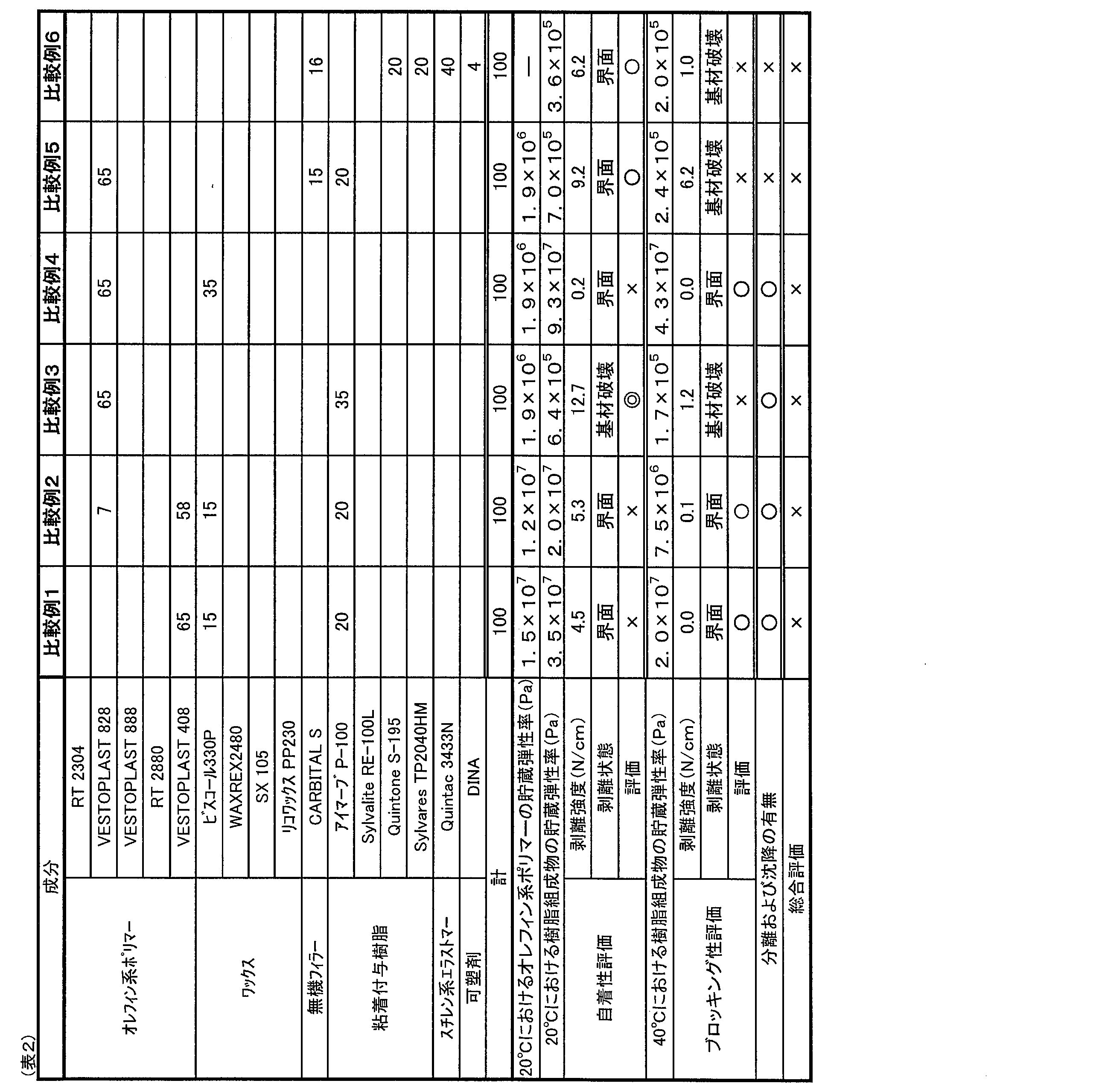
表1と表2の比較より明らかなように、実施例1~11と比較例1、2および4との比較より、粘着剤組成物の20℃の貯蔵弾性率が1.5×10⁷Pa超の場合、得られる粘着剤組成物の自着性が不良となった。また、実施例1~11と比較例3、5の比較より、粘着剤組成物の40℃の貯蔵弾性率が5.3×10⁵Pa未満の場合、得られる粘着剤組成物の耐ブロッキング性が不良となった。さらに、実施例1~11と比較例5、6の比較により、粘着剤組成物に無機粒子を配合した場合、分離または沈降が発生し、生産性が不良となった。
Claims (7)
- オレフィン系ポリマーを含み、無機粒子が配合されていない粘着剤組成物であって、20℃の貯蔵弾性率が0~1.5×10⁷Paであり、かつ、40℃の貯蔵弾性率が5.3×10⁵~1.0×10⁹Paである、粘着剤組成物。
- 前記オレフィン系ポリマーは、20℃の貯蔵弾性率が1.0×10⁷Pa以下である、請求項1に記載の粘着剤組成物。
- 前記オレフィン系ポリマーの190℃における溶融粘度が400~120,000mPa・sである、請求項1または2に記載の粘着剤組成物。
- 前記オレフィン系ポリマーを45~100重量%、ワックスを0~25重量%、および、粘着付与樹脂を0~30重量%含む、請求項1~3のいずれか1項に記載の粘着剤組成物。
- 前記ワックスの転移温度が50~160℃であり、かつ転移熱が60~330J/gである、請求項4に記載の粘着剤組成物。
- 前記粘着剤組成物からなる粘着剤層面同士を接着し、20℃で24時間静置させた後の20℃の剥離強度が6N/cm以上である、請求項1~5のいずれか1項に記載の粘着剤組成物。
- 前記粘着剤組成物からなる粘着剤層と、上質紙とを、40℃、3.6kPa加圧下で、24時間密着させた後の、前記粘着剤層と、前記上質紙との20℃の剥離強度が、0.5N/cm以下である、請求項1~6のいずれか1項に記載の粘着剤組成物。
Priority Applications (4)
| Application Number | Priority Date | Filing Date | Title |
|---|---|---|---|
| CN202180077819.6A CN116472322A (zh) | 2020-11-19 | 2021-11-19 | 粘接剂组合物 |
| US18/037,144 US20240228838A1 (en) | 2020-11-19 | 2021-11-19 | Adhesive composition |
| JP2022563837A JP7476348B2 (ja) | 2020-11-19 | 2021-11-19 | 粘着剤組成物 |
| EP21894742.2A EP4249567B1 (en) | 2020-11-19 | 2021-11-19 | Adhesive composition |
Applications Claiming Priority (2)
| Application Number | Priority Date | Filing Date | Title |
|---|---|---|---|
| JP2020-192639 | 2020-11-19 | ||
| JP2020192639 | 2020-11-19 |
Publications (1)
| Publication Number | Publication Date |
|---|---|
| WO2022107871A1 true WO2022107871A1 (ja) | 2022-05-27 |
Family
ID=81708014
Family Applications (1)
| Application Number | Title | Priority Date | Filing Date |
|---|---|---|---|
| PCT/JP2021/042516 Ceased WO2022107871A1 (ja) | 2020-11-19 | 2021-11-19 | 粘着剤組成物 |
Country Status (5)
| Country | Link |
|---|---|
| US (1) | US20240228838A1 (ja) |
| EP (1) | EP4249567B1 (ja) |
| JP (1) | JP7476348B2 (ja) |
| CN (1) | CN116472322A (ja) |
| WO (1) | WO2022107871A1 (ja) |
Cited By (1)
| Publication number | Priority date | Publication date | Assignee | Title |
|---|---|---|---|---|
| WO2025173713A1 (ja) * | 2024-02-16 | 2025-08-21 | ヤスハラケミカル株式会社 | コールドシール用接着剤組成物 |
Citations (10)
| Publication number | Priority date | Publication date | Assignee | Title |
|---|---|---|---|---|
| JPS5496539A (en) * | 1978-01-17 | 1979-07-31 | Nichiban Kk | Pressure sensitive adhesive composition having weak tack and strong selffadhesivity |
| JPS5911120A (ja) * | 1982-07-12 | 1984-01-20 | 三井東圧化学株式会社 | 接木方法 |
| JPH01266175A (ja) * | 1988-04-19 | 1989-10-24 | Ube Ind Ltd | ホットメルト接着剤組成物 |
| JPH0539469A (ja) * | 1991-08-06 | 1993-02-19 | Sekisui Chem Co Ltd | 巻物用フイルムもしくはシートと巻芯との接着用接着剤 |
| JPH05148465A (ja) * | 1991-09-30 | 1993-06-15 | Sekisui Chem Co Ltd | オレフイン系ホツトメルト接着剤 |
| JPH0625620A (ja) * | 1991-08-16 | 1994-02-01 | Okura Ind Co Ltd | 自己粘着性フィルム |
| JPH07314623A (ja) * | 1994-05-30 | 1995-12-05 | Ube Rekisen Kk | ポリオレフィン系シュリンク積層フィルムおよびその 製造方法 |
| JP2003165963A (ja) * | 2001-11-30 | 2003-06-10 | Yazaki Corp | 自己粘着性テープ |
| JP2004161962A (ja) | 2002-11-15 | 2004-06-10 | Nichiban Co Ltd | 粘着テープ |
| JP2017149938A (ja) | 2016-02-24 | 2017-08-31 | デンカ株式会社 | 粘着剤組成物およびそれを用いた粘着テープ |
Family Cites Families (12)
| Publication number | Priority date | Publication date | Assignee | Title |
|---|---|---|---|---|
| DE3375340D1 (en) * | 1982-11-22 | 1988-02-18 | Ibm | Magnetic recording disk |
| US7550528B2 (en) * | 2002-10-15 | 2009-06-23 | Exxonmobil Chemical Patents Inc. | Functionalized olefin polymers |
| JP2005089575A (ja) * | 2003-09-16 | 2005-04-07 | Sekisui Chem Co Ltd | カード又はタグ用接着シート |
| WO2007008765A2 (en) * | 2005-07-11 | 2007-01-18 | Dow Global Technologies Inc. | Silane-grafted olefin polymers, compositions and articles prepared therefrom, and methods for making the same |
| DE102008045802A1 (de) * | 2008-09-05 | 2010-03-11 | Henkel Ag & Co. Kgaa | Schmelzklebstoff auf Basis von Metallocene-katalysierten Olefin-α-Olefin Copolymeren |
| WO2014069606A1 (ja) * | 2012-11-02 | 2014-05-08 | 出光興産株式会社 | ポリオレフィン、これを含む粘接着剤組成物及びこれを用いた粘着テープ |
| WO2015111488A1 (ja) * | 2014-01-22 | 2015-07-30 | 株式会社カネカ | ホットメルト接着剤用ポリオレフィン系樹脂組成物、ホットメルト接着フィルムおよび積層体 |
| US20170073556A1 (en) * | 2014-04-22 | 2017-03-16 | Exxonmobil Chemical Patents Inc. | Hydrocarbon Tackifiers for Adhesive Compositions |
| JP6478102B2 (ja) * | 2015-01-29 | 2019-03-06 | 日立化成株式会社 | ホットメルト接着剤組成物 |
| EP3124567A1 (en) * | 2015-07-30 | 2017-02-01 | Borealis AG | Polypropylene based hot-melt adhesive composition |
| EP3498799B1 (en) * | 2017-12-14 | 2020-11-04 | Borealis AG | Polyethylene and propylene wax for hot melt adhesive |
| WO2020047031A1 (en) * | 2018-08-29 | 2020-03-05 | Henkel IP & Holding GmbH | Hot melt adhesive containing phase changing materials |
-
2021
- 2021-11-19 US US18/037,144 patent/US20240228838A1/en active Pending
- 2021-11-19 WO PCT/JP2021/042516 patent/WO2022107871A1/ja not_active Ceased
- 2021-11-19 JP JP2022563837A patent/JP7476348B2/ja active Active
- 2021-11-19 CN CN202180077819.6A patent/CN116472322A/zh active Pending
- 2021-11-19 EP EP21894742.2A patent/EP4249567B1/en active Active
Patent Citations (10)
| Publication number | Priority date | Publication date | Assignee | Title |
|---|---|---|---|---|
| JPS5496539A (en) * | 1978-01-17 | 1979-07-31 | Nichiban Kk | Pressure sensitive adhesive composition having weak tack and strong selffadhesivity |
| JPS5911120A (ja) * | 1982-07-12 | 1984-01-20 | 三井東圧化学株式会社 | 接木方法 |
| JPH01266175A (ja) * | 1988-04-19 | 1989-10-24 | Ube Ind Ltd | ホットメルト接着剤組成物 |
| JPH0539469A (ja) * | 1991-08-06 | 1993-02-19 | Sekisui Chem Co Ltd | 巻物用フイルムもしくはシートと巻芯との接着用接着剤 |
| JPH0625620A (ja) * | 1991-08-16 | 1994-02-01 | Okura Ind Co Ltd | 自己粘着性フィルム |
| JPH05148465A (ja) * | 1991-09-30 | 1993-06-15 | Sekisui Chem Co Ltd | オレフイン系ホツトメルト接着剤 |
| JPH07314623A (ja) * | 1994-05-30 | 1995-12-05 | Ube Rekisen Kk | ポリオレフィン系シュリンク積層フィルムおよびその 製造方法 |
| JP2003165963A (ja) * | 2001-11-30 | 2003-06-10 | Yazaki Corp | 自己粘着性テープ |
| JP2004161962A (ja) | 2002-11-15 | 2004-06-10 | Nichiban Co Ltd | 粘着テープ |
| JP2017149938A (ja) | 2016-02-24 | 2017-08-31 | デンカ株式会社 | 粘着剤組成物およびそれを用いた粘着テープ |
Non-Patent Citations (1)
| Title |
|---|
| See also references of EP4249567A4 |
Cited By (1)
| Publication number | Priority date | Publication date | Assignee | Title |
|---|---|---|---|---|
| WO2025173713A1 (ja) * | 2024-02-16 | 2025-08-21 | ヤスハラケミカル株式会社 | コールドシール用接着剤組成物 |
Also Published As
| Publication number | Publication date |
|---|---|
| EP4249567A1 (en) | 2023-09-27 |
| EP4249567B1 (en) | 2025-06-04 |
| CN116472322A (zh) | 2023-07-21 |
| EP4249567A4 (en) | 2024-04-10 |
| JP7476348B2 (ja) | 2024-04-30 |
| JPWO2022107871A1 (ja) | 2022-05-27 |
| US20240228838A1 (en) | 2024-07-11 |
Similar Documents
| Publication | Publication Date | Title |
|---|---|---|
| KR101831485B1 (ko) | 핫 멜트 접착제 | |
| JP6152385B2 (ja) | オレフィンブロックコポリマーおよびスチレンブロックコポリマーを含有するpsa | |
| JP6184412B2 (ja) | ワセリンを含有する瓶ラベル貼付用ホットメルト接着剤 | |
| EP2756036B1 (en) | Hot melt adhesive | |
| CN106795404B (zh) | 具有改进的加工和粘合性能的基于聚烯烃的热熔性粘合剂 | |
| CN106471086A (zh) | 内聚失效的无污染热熔性粘合剂 | |
| JP6958992B2 (ja) | ストロー付容器用ホットメルト接着剤 | |
| CN105637055B (zh) | 热熔粘接剂 | |
| CN110809617A (zh) | 热熔粘合剂 | |
| JP2006188580A (ja) | ホットメルト接着剤組成物 | |
| US12305095B2 (en) | Adhesive articles and methods | |
| JP2001279212A (ja) | ホットメルト接着剤組成物 | |
| JP6891288B2 (ja) | 粘着剤組成物 | |
| JP7476348B2 (ja) | 粘着剤組成物 | |
| WO2022181690A1 (ja) | ホットメルト接着剤 | |
| TW201906973A (zh) | 熱熔接著劑 | |
| JP7229003B2 (ja) | ホットメルト接着剤 | |
| WO2025173713A1 (ja) | コールドシール用接着剤組成物 | |
| WO2023065311A1 (en) | Hot melt adhesive composition and use thereof | |
| JP2024168981A (ja) | アルカリ分散型ホットメルト粘着剤 | |
| JP2023085798A (ja) | ホットメルト接着剤 | |
| JP2019178346A (ja) | ホットメルト接着剤 |
Legal Events
| Date | Code | Title | Description |
|---|---|---|---|
| 121 | Ep: the epo has been informed by wipo that ep was designated in this application |
Ref document number: 21894742 Country of ref document: EP Kind code of ref document: A1 |
|
| ENP | Entry into the national phase |
Ref document number: 2022563837 Country of ref document: JP Kind code of ref document: A |
|
| WWE | Wipo information: entry into national phase |
Ref document number: 18037144 Country of ref document: US |
|
| WWE | Wipo information: entry into national phase |
Ref document number: 202180077819.6 Country of ref document: CN |
|
| WWE | Wipo information: entry into national phase |
Ref document number: 202317035562 Country of ref document: IN |
|
| NENP | Non-entry into the national phase |
Ref country code: DE |
|
| ENP | Entry into the national phase |
Ref document number: 2021894742 Country of ref document: EP Effective date: 20230619 |
|
| WWG | Wipo information: grant in national office |
Ref document number: 2021894742 Country of ref document: EP |