WO2022116815A1 - 一种慢病毒稳定包装细胞系及其制备方法 - Google Patents
一种慢病毒稳定包装细胞系及其制备方法 Download PDFInfo
- Publication number
- WO2022116815A1 WO2022116815A1 PCT/CN2021/130967 CN2021130967W WO2022116815A1 WO 2022116815 A1 WO2022116815 A1 WO 2022116815A1 CN 2021130967 W CN2021130967 W CN 2021130967W WO 2022116815 A1 WO2022116815 A1 WO 2022116815A1
- Authority
- WO
- WIPO (PCT)
- Prior art keywords
- plasmid
- cotetr
- cell line
- cells
- pgagpol
- Prior art date
- Legal status (The legal status is an assumption and is not a legal conclusion. Google has not performed a legal analysis and makes no representation as to the accuracy of the status listed.)
- Ceased
Links
Images




Classifications
-
- C—CHEMISTRY; METALLURGY
- C12—BIOCHEMISTRY; BEER; SPIRITS; WINE; VINEGAR; MICROBIOLOGY; ENZYMOLOGY; MUTATION OR GENETIC ENGINEERING
- C12N—MICROORGANISMS OR ENZYMES; COMPOSITIONS THEREOF; PROPAGATING, PRESERVING, OR MAINTAINING MICROORGANISMS; MUTATION OR GENETIC ENGINEERING; CULTURE MEDIA
- C12N15/00—Mutation or genetic engineering; DNA or RNA concerning genetic engineering, vectors, e.g. plasmids, or their isolation, preparation or purification; Use of hosts therefor
- C12N15/09—Recombinant DNA-technology
- C12N15/63—Introduction of foreign genetic material using vectors; Vectors; Use of hosts therefor; Regulation of expression
- C12N15/79—Vectors or expression systems specially adapted for eukaryotic hosts
- C12N15/85—Vectors or expression systems specially adapted for eukaryotic hosts for animal cells
- C12N15/86—Viral vectors
-
- C—CHEMISTRY; METALLURGY
- C12—BIOCHEMISTRY; BEER; SPIRITS; WINE; VINEGAR; MICROBIOLOGY; ENZYMOLOGY; MUTATION OR GENETIC ENGINEERING
- C12N—MICROORGANISMS OR ENZYMES; COMPOSITIONS THEREOF; PROPAGATING, PRESERVING, OR MAINTAINING MICROORGANISMS; MUTATION OR GENETIC ENGINEERING; CULTURE MEDIA
- C12N15/00—Mutation or genetic engineering; DNA or RNA concerning genetic engineering, vectors, e.g. plasmids, or their isolation, preparation or purification; Use of hosts therefor
- C12N15/09—Recombinant DNA-technology
- C12N15/63—Introduction of foreign genetic material using vectors; Vectors; Use of hosts therefor; Regulation of expression
- C12N15/79—Vectors or expression systems specially adapted for eukaryotic hosts
- C12N15/85—Vectors or expression systems specially adapted for eukaryotic hosts for animal cells
-
- C—CHEMISTRY; METALLURGY
- C12—BIOCHEMISTRY; BEER; SPIRITS; WINE; VINEGAR; MICROBIOLOGY; ENZYMOLOGY; MUTATION OR GENETIC ENGINEERING
- C12N—MICROORGANISMS OR ENZYMES; COMPOSITIONS THEREOF; PROPAGATING, PRESERVING, OR MAINTAINING MICROORGANISMS; MUTATION OR GENETIC ENGINEERING; CULTURE MEDIA
- C12N7/00—Viruses; Bacteriophages; Compositions thereof; Preparation or purification thereof
-
- C—CHEMISTRY; METALLURGY
- C12—BIOCHEMISTRY; BEER; SPIRITS; WINE; VINEGAR; MICROBIOLOGY; ENZYMOLOGY; MUTATION OR GENETIC ENGINEERING
- C12N—MICROORGANISMS OR ENZYMES; COMPOSITIONS THEREOF; PROPAGATING, PRESERVING, OR MAINTAINING MICROORGANISMS; MUTATION OR GENETIC ENGINEERING; CULTURE MEDIA
- C12N2740/00—Reverse transcribing RNA viruses
- C12N2740/00011—Details
- C12N2740/10011—Retroviridae
- C12N2740/15011—Lentivirus, not HIV, e.g. FIV, SIV
- C12N2740/15021—Viruses as such, e.g. new isolates, mutants or their genomic sequences
-
- C—CHEMISTRY; METALLURGY
- C12—BIOCHEMISTRY; BEER; SPIRITS; WINE; VINEGAR; MICROBIOLOGY; ENZYMOLOGY; MUTATION OR GENETIC ENGINEERING
- C12N—MICROORGANISMS OR ENZYMES; COMPOSITIONS THEREOF; PROPAGATING, PRESERVING, OR MAINTAINING MICROORGANISMS; MUTATION OR GENETIC ENGINEERING; CULTURE MEDIA
- C12N2740/00—Reverse transcribing RNA viruses
- C12N2740/00011—Details
- C12N2740/10011—Retroviridae
- C12N2740/15011—Lentivirus, not HIV, e.g. FIV, SIV
- C12N2740/15041—Use of virus, viral particle or viral elements as a vector
- C12N2740/15043—Use of virus, viral particle or viral elements as a vector viral genome or elements thereof as genetic vector
-
- C—CHEMISTRY; METALLURGY
- C12—BIOCHEMISTRY; BEER; SPIRITS; WINE; VINEGAR; MICROBIOLOGY; ENZYMOLOGY; MUTATION OR GENETIC ENGINEERING
- C12N—MICROORGANISMS OR ENZYMES; COMPOSITIONS THEREOF; PROPAGATING, PRESERVING, OR MAINTAINING MICROORGANISMS; MUTATION OR GENETIC ENGINEERING; CULTURE MEDIA
- C12N2740/00—Reverse transcribing RNA viruses
- C12N2740/00011—Details
- C12N2740/10011—Retroviridae
- C12N2740/15011—Lentivirus, not HIV, e.g. FIV, SIV
- C12N2740/15051—Methods of production or purification of viral material
- C12N2740/15052—Methods of production or purification of viral material relating to complementing cells and packaging systems for producing virus or viral particles
-
- C—CHEMISTRY; METALLURGY
- C12—BIOCHEMISTRY; BEER; SPIRITS; WINE; VINEGAR; MICROBIOLOGY; ENZYMOLOGY; MUTATION OR GENETIC ENGINEERING
- C12N—MICROORGANISMS OR ENZYMES; COMPOSITIONS THEREOF; PROPAGATING, PRESERVING, OR MAINTAINING MICROORGANISMS; MUTATION OR GENETIC ENGINEERING; CULTURE MEDIA
- C12N2740/00—Reverse transcribing RNA viruses
- C12N2740/00011—Details
- C12N2740/10011—Retroviridae
- C12N2740/16011—Human Immunodeficiency Virus, HIV
- C12N2740/16041—Use of virus, viral particle or viral elements as a vector
- C12N2740/16043—Use of virus, viral particle or viral elements as a vector viral genome or elements thereof as genetic vector
-
- C—CHEMISTRY; METALLURGY
- C12—BIOCHEMISTRY; BEER; SPIRITS; WINE; VINEGAR; MICROBIOLOGY; ENZYMOLOGY; MUTATION OR GENETIC ENGINEERING
- C12N—MICROORGANISMS OR ENZYMES; COMPOSITIONS THEREOF; PROPAGATING, PRESERVING, OR MAINTAINING MICROORGANISMS; MUTATION OR GENETIC ENGINEERING; CULTURE MEDIA
- C12N2740/00—Reverse transcribing RNA viruses
- C12N2740/00011—Details
- C12N2740/10011—Retroviridae
- C12N2740/16011—Human Immunodeficiency Virus, HIV
- C12N2740/16051—Methods of production or purification of viral material
- C12N2740/16052—Methods of production or purification of viral material relating to complementing cells and packaging systems for producing virus or viral particles
-
- C—CHEMISTRY; METALLURGY
- C12—BIOCHEMISTRY; BEER; SPIRITS; WINE; VINEGAR; MICROBIOLOGY; ENZYMOLOGY; MUTATION OR GENETIC ENGINEERING
- C12N—MICROORGANISMS OR ENZYMES; COMPOSITIONS THEREOF; PROPAGATING, PRESERVING, OR MAINTAINING MICROORGANISMS; MUTATION OR GENETIC ENGINEERING; CULTURE MEDIA
- C12N2830/00—Vector systems having a special element relevant for transcription
- C12N2830/001—Vector systems having a special element relevant for transcription controllable enhancer/promoter combination
- C12N2830/005—Vector systems having a special element relevant for transcription controllable enhancer/promoter combination repressible enhancer/promoter combination, e.g. KRAB
- C12N2830/006—Vector systems having a special element relevant for transcription controllable enhancer/promoter combination repressible enhancer/promoter combination, e.g. KRAB tet repressible
Definitions
- the invention relates to the fields of immunology and molecular biology, mainly to the field of cell therapy, and in particular to a lentivirus stable packaging cell line and a preparation method thereof.
- Lentivirus is a gene therapy vector, including human immunodeficiency virus (HIV), equine infectious anemia virus (EIA), simian immunodeficiency virus (SIV), feline immunodeficiency virus (FIV), etc.
- Lentiviral vectors unlike other retroviral vectors, can infect both dividing and non-dividing cells. Lentivirus can infect cardiomyocytes, tumor cells, neuronal cells, stem cells, hepatocytes, endothelial cells and other types of cells, accommodate large exogenous fragments, achieve stable expression of target genes, and have a small immune response, so as to achieve good gene expression. The therapeutic effect has broad application prospects.
- lentiviruses are produced in most cases by transiently transfecting cells with packaging and expression plasmids.
- the lentivirus produced by the current production process has a low titer, a large amount of residual impurities, and the amount of virus production between batches of viruses is also unstable. Therefore, it is necessary to construct a stable lentiviral packaging cell line, so that the produced lentivirus has a high titer and a low impurity content.
- the purpose of the present invention is to propose a lentiviral stable packaging cell line and a preparation method thereof.
- Stable packaging cell lines produce lentiviruses with high titers and low levels of impurities.
- one aspect of the present invention provides a lentiviral stable packaging cell line, which comprises a packaging plasmid group consisting of pPuro.coTetR plasmid, pVSVG plasmid and pGagPol-RRE-NES-cINT plasmid ;
- the pPuro.coTetR plasmid contains the CoTetR gene
- the pVSVG plasmid contains the VSVG gene
- the pGagPol-RRE-NES-cINT plasmid contains the GagPol and Rev genes.
- the pPuro.coTetR plasmid further comprises a CMV promoter, a chimeric intron, a SV40 promoter, a puromycin resistance gene and a polyadenylation signal;
- the pVSVG plasmid also comprises a hybrid promoter consisting of a CMV promoter and two tetracycline operons, an SV40 promoter, a bleomycin resistance gene and a polyadenylation signal;
- the pGagPol-RRE-NES-cINT plasmid also contains a hybrid promoter composed of a CMV promoter and two tetracycline operons, a chimeric intron, a SV40 promoter, a hygromycin resistance gene, and a cPPT/CTS element , RRE elements and polyadenylation signals.
- the sequence of the CoTetR gene is shown in SEQ ID NO: 1
- the sequence of the VSVG gene is shown in SEQ ID NO: 2
- the sequences of the GagPol and Rev genes As shown in SEQ ID NOs: 3 and 4, respectively.
- the sequence of the pPuro.coTetR plasmid is shown in SEQ ID NO: 5
- the sequence of the pVSVG plasmid is shown in SEQ ID NO: 6
- the pGagPol-RRE- The sequence of the NES-cINT plasmid is shown in SEQ ID NO:7.
- the cell line is selected from one of HEK293, HEK293-T, HEK293-SF, TE671, HT1080 or HeLa cell lines;
- the cell line is the HEK293 cell line.
- another aspect of the present invention provides a method for preparing the above-mentioned lentiviral stable packaging cell line, comprising the following steps:
- polyethyleneimine is also added during the co-transfection of the linearized pPuro.coTetR plasmid and pVSVG plasmid into cells.
- step 3 in the process of transfecting the linearized pGagPol-RRE-NES-cINT plasmid into the first positive monoclonal cell, polyethylenimine is also added, and the polyethylenimine and pGagPol-RRE -The mass ratio of NES-cINT plasmid is (1 ⁇ 8):1;
- the mass ratio of the polyethyleneimine to the pGagPol-RRE-NES-cINT plasmid is (2-5):1;
- the mass ratio of the polyethyleneimine to the pGagPol-RRE-NES-cINT plasmid is 4:1.
- the dosages of the pPuro.coTetR plasmid and the pVSVG plasmid are both (0.2-1.0) ⁇ g/10 6 cells;
- the dosages of the pPuro.coTetR plasmid and the pVSVG plasmid are both (0.4-0.9) ⁇ g/10 6 cells;
- the dosages of the pPuro.coTetR plasmid and the pVSVG plasmid are both 0.8 ⁇ g/10 6 cells;
- the dosage of the pGagPol-RRE-NES-cINT plasmid is (0.2-1.0) ⁇ g/10 6 first positive monoclonal cells;
- the dosage of the pGagPol-RRE-NES-cINT plasmid is (0.4-0.9) ⁇ g/10 6 first positive monoclonal cells;
- the dosage of the pGagPol-RRE-NES-cINT plasmid is 0.8 ⁇ g/10 6 first positive monoclonal cells.
- the first antibiotic is a combination of puromycin and bleomycin, and the dosages thereof are 1-5 ⁇ g/mL and 300-500 ⁇ g/mL, respectively ; More preferably, the consumption of described puromycin and bleomycin is 2 ⁇ g/mL and 400 ⁇ g/mL respectively;
- the second antibiotic is a combination of puromycin, bleomycin and hygromycin, and the dosages thereof are respectively 1 ⁇ 5 ⁇ g/mL, 300 ⁇ 500 ⁇ g/mL and 300 ⁇ 50 ⁇ g/mL. 500 ⁇ g/mL; more preferably, the dosages of the puromycin, bleomycin and hygromycin are 2 ⁇ g/mL, 400 ⁇ g/mL and 400 ⁇ g/mL, respectively.
- another aspect of the present invention provides a lentivirus production method, wherein the above-mentioned lentivirus stable packaging cell line is transfected with a target plasmid.
- the target plasmid was transfected into the lentiviral stable packaging cell line, and then an inducer was added to induce the lentiviral stable packaging cell line to produce lentivirus.
- the dosage of the target plasmid is (0.2-0.8) ⁇ g/10 6 lentiviral stable packaging cell lines;
- the dosage of the target plasmid is (0.3-0.5) ⁇ g/10 6 lentiviral stable packaging cell lines;
- the dosage of the target plasmid is 0.4 ⁇ g/10 6 lentiviral stable packaging cell lines.
- the inducer is doxycycline
- the addition time of the inducer is 20-30 hours after transfection; more preferably, the addition time of the inducer is 24 hours after transfection;
- the added concentration of the inducer is 1-5 ⁇ g/mL, more preferably, the added concentration of the inducer is 2 ⁇ g/mL.
- an enhancer is also added during the lentivirus production process to increase the expression level of the lentivirus
- Described enhancer is sodium butyrate
- the added concentration of the enhancer is 5-15 mM; more preferably, the added concentration of the enhancer is 10 mM;
- the adding time of the enhancer is 20-30h after transfection; more preferably, the adding time of the enhancer is 24h after transfection;
- the liquid exchange time of the enhancer is 6 to 8 hours after adding the enhancer
- the collection time of the lentivirus is 45-50 hours; preferably, the collection time of the lentivirus is 48 hours.
- Figure 1 is the plasmid map of the packaging cell line;
- Figure 1a is the plasmid map of the pPuro.coTetR plasmid
- Figure 1b is the plasmid map of the pVSVG plasmid
- Figure 1c is the plasmid map of the pGagPol-RRE-NES-cINT plasmid;
- Fig. 2 Agar for semi-quantitative PCR identification of CoTetR, VSVG and GagPol genes of monoclonal cells Clone1, 5, 6, 7, 14, 17, 18, 19, 23, 24, 26, 27, 28, 31, 32 and 33 Glycogel electrophoresis;
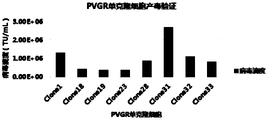
- Figure 3 is a bar graph of the target plasmid transfected into a lentiviral packaging cell line for verification of toxin production
- Figure 4 is a bar graph of the results of the optimization experiment of Clone31 for transfection and induction of toxin production
- Figure 5 is a bar graph of the results of the Clone31 passage stability experiment
- Fig. 6 is the bar graph of Clone31 toxigenic stability experiment result
- Figure 7 is a histogram of the results of the copy number stabilization experiment of Clone31 cells;
- Figure 7a is a histogram of the results of the Clone31 VSVG gene copy number stabilization experiment;
- Figure 7b is a histogram of the results of the Clone31 GagPol gene copy number stabilization experiment;
- Figure 7c is Clone31 Histogram of the results of the Rev gene copy number stabilization experiment;
- Figure 8 is a graph showing the comparison of virus titers between batches of Clone31 and 293 cells
- Fig. 9 is the comparison chart of Clone31 and 293 cell virus titer VP (P24);
- Figure 10 is an enlarged comparison diagram of Clone31 and 293 cells;
- Figure 10a is a comparison diagram of the viability of E1000 transfected 24h and 48h;
- Figure 10b is a comparison diagram of HCP residues transfected with E1000;
- Figure 10c is a comparison diagram of VP transfected with E1000.
- the experimental methods in the following examples are conventional methods unless otherwise specified.
- the culture medium, reagent materials and kits used in the following examples are all commercially available products unless otherwise specified.
- concentrations of antibiotics puromycin, bleomycin and hygromycin
- inducer dicycline
- enhancer sodium butyrate
- concentration in the medium the final concentration all refer to the concentration in the medium the final concentration.
- addition of sodium butyrate at a concentration of 5-15 mM means that the addition amount of sodium butyrate is such that the final concentration of sodium butyrate in the medium is 5-15 mM.
- the lentiviral vector system is developed with lentivirus as the backbone and has a packaging structure and a vector structure.
- the lentiviral packaging system generally consists of two parts: lentiviral packaging plasmid and lentiviral expression plasmid.
- Lentiviral packaging plasmids consist of sequences encoding viral proteins, and lentiviral expression plasmids contain long terminal repeats, packaging signals, and other genetic information required for packaging, transfection, and stable integration.
- the packaging plasmid and the expression plasmid are used to co-transfect cells, the virus is packaged in the cell and secreted into the extracellular medium to generate viral particles, which can be used for the infection of host cells.
- lentiviruses are produced by transiently transfecting packaging plasmids and expression plasmids into 293 or 293T cells cultured in cell factories; the packaging plasmids contain long terminal repeats, packaging signals, etc.
- the genetic information required for transfection and stable integration, and the expression plasmid contains the target gene.
- transient transfection of 293 cells for large-scale production of lentivirus is feasible and shows good promise.
- transient transfection requires further optimization in the production process.
- the main bottleneck is that the transfection process requires a large amount of plasmid DNA, so the production cost is expensive, it is not easy to scale up, and the virus cannot be produced sustainably.
- the virus produced by transient transfection has a lot of residual impurities, especially host protein and DNA residue, which increases the difficulty of the subsequent purification process, and the virus yield is also unstable between batches, which brings uncertainty to the downstream process arrangement. Therefore, it is necessary to construct a stable lentiviral packaging cell line, and stably integrate the vector elements required for packaging the virus into the genome of the host cell, so that it can be stably inherited, facilitated amplification, and achieve sustainable production.
- the purpose of the present invention is to construct a lentivirus stable packaging cell line, and realize the production of suspension cells (especially 293 cells) by amplifying process, so that the produced lentivirus has a high titer and a low impurity content.
- one aspect of the present invention provides a lentiviral stable packaging cell line, which comprises a packaging plasmid group consisting of pPuro.coTetR plasmid, pVSVG plasmid and pGagPol-RRE-NES-cINT plasmid ;
- the pPuro.coTetR plasmid contains the CoTetR gene
- the pVSVG plasmid contains the VSVG gene
- the pGagPol-RRE-NES-cINT plasmid contains the GagPol and Rev genes.
- the packaging plasmid and the expression plasmid are simultaneously transfected into cells (such as 293 or 293T cells).
- the amount of toxin produced between times is also unstable.
- the packaging plasmid is first transfected into the cell line to obtain the lentivirus stable packaging cell line, that is, the pPuro.coTetR plasmid, the pVSVG plasmid and the pGagPol-RRE-NES-cINT plasmid are transfected into the cell line to obtain the lentivirus stable packaging cell line, and then the The target plasmid is used to transfect the lentivirus stable packaging cell line, so that the produced lentivirus has a high titer and a low impurity content.
- the present invention conducts stability research on the constructed lentiviral stable packaging cell line, including passage stability, toxin production stability and copy number stability.
- the experimental results show that the constructed lentiviral stable packaging cell line has no screening pressure (no screening pressure).
- the viability rate can reach more than 97%, indicating that it can be passed on for more than 30 generations without screening pressure; cells without antibiotics can be passed on normally and have the ability to produce toxins; GagPol gene
- the copy numbers of , Rev gene and VSVG gene were relatively stable. That is, the lentivirus stable packaging cell line constructed by the present invention is relatively stable in terms of passage, toxin production and genetic gene copy number.
- the pPuro.coTetR plasmid, the pVSVG plasmid and the pGagPol-RRE-NES-cINT plasmid of the present invention are all constructed on the basis of the commercial plasmid backbone and then inserted into the target gene.
- the pPuro.coTetR plasmid is constructed based on the pIRESpuro3 plasmid and inserted into the CoTetR gene.
- the CoTetR gene is a codon-optimized TetR (tetracycline repressor) gene.
- the sequence of the CoTetR gene is shown in SEQ ID NO: 1.
- the pVSVG plasmid It is constructed by inserting VSVG gene on the basis of pcDNA4 plasmid.
- the sequence of VSVG (vesicular stomatitis virus glycoprotein) gene is shown in SEQ ID NO: 2.
- the pGagPol-RRE-NES-cINT plasmid is based on pcDNA5 plasmid. , constructed by inserting GagPol (Gag gene encodes viral capsid protein, Pol gene encodes viral reverse transcriptase and gene integrase) and Rev gene (which encodes viral particle protein expression regulator), the sequences of GagPol and Rev genes are respectively As shown in SEQ ID NOs: 3 and 4.
- the pPuro.coTetR plasmid also contains a human cytomegalovirus (CMV) promoter, a chimeric intron (which increases protein expression levels), a simian virus 40 (SV40) promoter, puromycin resistance gene (Puro R ) and polyadenylation signal, the SV40 promoter is required for expression of the puromycin resistance gene.
- CMV human cytomegalovirus
- SV40 simian virus 40
- Puro R puromycin resistance gene
- the pPuro.coTetR plasmid contains the puromycin resistance gene, and after selection with puromycin, nearly all surviving cells stably express the CoTetR gene, reducing the need to screen large numbers of cells for functional clones.
- the pVSVG plasmid also contains a hybrid promoter consisting of a human cytomegalovirus (CMV) promoter and two tetracycline operons (TetO 2 ), a simian virus 40 (SV40) promoter, bleomycin Resistance gene (Zeo R ) and polyadenylation signal, the SV40 promoter is required for expression of the bleomycin resistance gene.
- CMV human cytomegalovirus
- TetO 2 tetracycline operons
- SV40 simian virus 40
- Zeo R bleomycin Resistance gene
- polyadenylation signal the sequence of the pVSVG plasmid is shown in SEQ ID NO:6.
- the pGagPol-RRE-NES-cINT plasmid also contains a hybrid promoter composed of a human cytomegalovirus (CMV) promoter and two tetracycline operons (TetO 2 ), a chimeric intron (can Increase protein expression level), simian virus 40 (SV40) promoter, hygromycin resistance gene (Hygro R ), cPPT/CTS element, RRE element and polyadenylation signal, SV40 promoter is the expression of hygromycin resistance. Promoters required for sex genes.
- the sequence of the pGagPol-RRE-NES-cINT plasmid is shown in SEQ ID NO:7.
- the pGagPol-RRE-NES-cINT plasmid contains the Human Immunodeficiency Virus (HIV) rev response element (RRE), a retroviral export element that regulates the transport of RNA transcripts from the nucleus to the cytoplasm.
- HIV Human Immunodeficiency Virus
- RRE Human Immunodeficiency Virus
- the pGagPol-RRE-NES-cINT plasmid contains cis-acting elements—central polypurine region (cPPT) and central termination sequence (CTS).
- cPPT central polypurine region
- CTS central termination sequence
- the cPPT/CTS sequence can be the cPPT/CTS of HIV1, which can improve vector integration and transduction efficiency.
- a hybrid promoter consisting of a human cytomegalovirus (CMV) promoter and two tetracycline operons (TetO 2 ) means that two TetO 2 operon sequences are inserted into the CMV promoter, conferring tetracycline regulation function of the promoter.
- the TetO 2 sequence consists of 2 copies of the 19 nucleotide sequence (5'-TCCCTATCAGTGATAGAGA-3').
- another aspect of the present invention provides a method for preparing the above-mentioned lentiviral stable packaging cell line, comprising the following steps:
- the pPuro.coTetR plasmid and pVSVG plasmid of the present invention contain puromycin resistance gene and bleomycin resistance gene, respectively, in the process of screening the first positive cloned cells, puromycin and bleomycin are added to carry out resistance
- the pGagPol-RRE-NES-cINT plasmid contains the hygromycin resistance gene, so in the process of screening the second positive cloned cells, the resistance screening is carried out by adding puromycin, bleomycin and hygromycin .
- polyethyleneimine (PEI) needs to be added in the two transfection processes to improve the transfection efficiency, and the dosage of PEI and each plasmid can be controlled to obtain the lentivirus stable packaging cell line of the present invention.
- another aspect of the present invention provides a lentivirus production method, wherein the above-mentioned lentivirus stable packaging cell line is transfected with a target plasmid (an expression plasmid containing a target gene).
- the target plasmid was transfected into the lentiviral stable packaging cell line, and then an inducer was added to induce the lentiviral stable packaging cell line to produce lentivirus.
- the lentivirus stable packaging cell line of the present invention is an induction system.
- doxycycline (dox) needs to be added to induce toxin production, and it is found that adding sodium butyrate during toxin production can improve the yield of lentivirus.
- the invention also optimizes the conditions for transfecting the target plasmid into the lentivirus stable packaging cell line and inducing toxin production.
- dox doxycycline
- the target plasmid is not limited, and various target plasmids can be transfected as required.
- the target plasmid is a CAR expression plasmid.
- CAR Chimeric Antigen Receptor
- T cell immunotherapy which is a kind of adoptive immune cell therapy.
- 1BB and other transmembrane segments composed of a series of molecules involved in T cell activation, and then the gene segment is transfected into T cells extracted from the peripheral blood of patients by lentivirus or retroviral gene transduction; genetically modified T cells After the cells are infused back into the patient, the expressed CAR receptors are used to bind to molecules on the surface of tumor cells, thereby generating internal signals to activate T cells to rapidly destroy tumor cells.
- CAR-T cells integrate the recognition specificity of antibodies and the killing effect and memory function of T cells.
- the CAR expression plasmid can be transfected into the above lentiviral stable packaging cell line for the treatment of relapsed/refractory CD19-positive non-Hodgkin lymphoma.
- CAR chimeric antigen receptor
- the CAR expression plasmid is transfected into the above-mentioned lentivirus stable packaging cell line and the prior art four plasmid transient transfection (pPuro.coTetR plasmid, pVSVG plasmid, pGagPol-RRE-NES-cINT plasmid and CAR expression plasmid are simultaneously transfected into 293 cells ) for comparison, including cell viability, virus titer VP (P24), host protein residue and virus titer stability between batches, etc.
- the experimental results show that the virus titer VP of the lentivirus stable packaging cell line constructed by the present invention The high content and stable toxin production between batches are beneficial to the downstream purification process.
- the CAR expression plasmid transfection of the above lentiviral stable packaging cell line and the prior art four plasmid transient transfection were compared under the scale-up process, including cell viability, virus titer VP and HCP (host protein) residues.
- the experimental results show that the lentiviral stable packaging cell line has high cell viability after transfection, low residual virus HCP (host protein) and high virus titer VP, which can be amplified for virus production.
- the VP in virus titer VP refers to a method for determining the virus titer - the virus particle number (VP) method - which uses OD260 to detect the number of virus particles, and P24 refers to the virus coat protein-P24 protein.
- the P24 protein was assayed to detect virus titers.
- the lentiviral stable packaging cell line and the preparation method thereof provided by the present invention are relatively stable in terms of passage, toxin production and genetic gene copy number, and can be scaled up for production Virus.
- the lentiviral stable packaging cell line has high cell viability, high viral titer VP content, less host protein and stable toxin production between batches, which is beneficial to the downstream purification process.
- the lentiviral stable packaging cell line constructed in this example consists of three plasmids, pPuro.coTetR (containing CoTetR gene), pVSVG (containing VSVG gene), pGagPol-RRE-NES-cINT (containing GagPol and Rev genes), which are The plasmid maps of , see Figure 1a, Figure 1b and Figure 1c, respectively.
- the INT fragment (230bp) was obtained by primer TetR-WF-1F/TetR-1R-linker and template pIRESpuro3 (TaKaRa, Cat. No.: 631619), and the INT fragment (230bp) was obtained by primer TetR-2F-linker/TetR-2R-linker and template coTetR (the sequence of which is as follows: SEQ ID NO: 1) obtained the coTetR fragment (624bp), and obtained the PA+F1ori+SV40promoter fragment (1042bp) by using the primers TetR-3F-linker/TetR-WF-3R and the template pcDNA4 (Thermo, Cat. No.: V102020).
- the primer TetR-WF-1F/TetR-2R-linker was used to obtain the fragment TNT+coTetR
- the primer TetR-WF-1F/TetR-WF-3R was used to obtain the full-length fragment TNT+coTetR+PA+F1ori+SV40promoter.
- the full-length fragment prepared above was inserted into the HindIII site of the pIRESpuro3 vector by seamless cloning, and transformed into competent stbl3 (full gold, catalog number: CD521).
- the plasmid (Kangwei Century, product number: cw2105s) was extracted, and the constructed target plasmid was used for the subsequent experiment of packaging cell line construction.
- TetR-WF-1F 5 ACTCACTATAGGGAGACCCA GTGAGTACTCCCTCTCAAAA-3’
- TetR-1R-linker 5 TTGGACTTGTCCAGCCTAGACATCTGTGGAGAAAGGCAAAGTGGAT-3’
- TetR-2F-linker 5 ATCCACTTTGCCTTTCTCTCCACAGATGTCTAGGCTGGACAAGTCCAA-3’
- TetR-2R-linker 5 -ATGGCTGGCAACTAGAAGGCACAGTCAGCTGCCGCTTTCGCACTTGA-3’
- TetR-3F-linker 5 TetR-3F-linker 5’-TCAAGTGCGAAAGCGGCAGCTGACTGTGCCTTCTAGTTGCCAGCCAT-3’
- TetR-WF-3R 5 -CTTGTGGGTTGTGGCAAGCT TTTGCAAAAGCCTAGGCCTC-3’
- the VSVG fragment (1536bp) was obtained by primer VSVG-WF-F/VSVG-WF-R and template VS-SC (its sequence is shown in SEQ ID NO: 8), and the fragment prepared above was inserted into pcDNA4 vector by seamless cloning method
- the XhoI site was transformed into competent stbl3. After the sequencing was correct, the plasmid was extracted using the Kangwei endotoxin-free intermediate extraction kit, and the constructed target plasmid was used for subsequent packaging cell line construction experiments.
- Primer sequence VSVG-WF-F 5’-ATATCCAGCACAGTGGCGGCCGCATGAAGTGCCTTTTGTACTT-3’
- VSVG-WF-R 5 AACGGGGCCCTCTAGACTCGATTACTTTCCAAGTCGGTTCA-3’
- GagPol fragment (4307bp) was obtained by primer pGagPol-XhoI-WF/pGagPol-XhoI-WR and template MDK-SC (its sequence is shown in SEQ ID NO: 9), and the fragment prepared above was inserted into pcDNA5 by seamless cloning method
- the XhoI site of the vector (Thermo, catalog number: V103320) was transformed into competent stbl3. After the sequencing was correct, the plasmid was extracted using the Kangwei endotoxin-free intermediate extraction kit, and the constructed target plasmid pGagPol was used for subsequent vector construction.
- the RRE-NES fragment (1705 bp) was obtained by primers pGagPol-REV-Xba I-WF/pGagPol-REV-Xba I-WR and template AX (also known as psPAX2 vector, whose sequence is shown in SEQ ID NO: 10), The fragment prepared above was inserted into the XbaI site of the pGagPol vector by seamless cloning, and transformed into competent stbl3. NES was used for subsequent vector construction.
- the cINT fragment (1122bp) was obtained by primer pGagPol-RN-cINT--Not I-QF/pGagPol-INT-Not I-WR and template AX, and the fragment prepared above was inserted into pGagPol-RRE-NES vector by seamless cloning method
- the NotI site was transformed into competent stbl3.
- the plasmid was extracted using the Kangwei endotoxin-free middle extraction kit, and the constructed target plasmid pGagPol-RRE-NES-cINT was used for subsequent vector construction.
- Example 1 The three plasmids constructed in Example 1 were linearized with Fsp I (Thermo, Cat. No.: FD1224), and then dephosphorylated, and used to transfect 293 cells.
- Fsp I Thermo, Cat. No.: FD1224
- the linearized pPuro.coTetR and pVSVG plasmids were co-transfected with PEI (polyethyleneimine) (Polysciences, Cat. No. 23966) in 293 suspension cells.
- Polyclonal PV cells were plated by limiting dilution in 96-well plates (Thermo, Cat. No. 167008) with 200 ⁇ L of medium per well. Then microscopically, the wells with only single cells were picked out, labeled, and incubated in an incubator for about 20-30 days.
- the surviving monoclonal cells in the 96-well plate were expanded and cultured using 48-well plate, 24-well plate, 12-well plate, 6-well plate, and shake flask E125, respectively.
- the PV monoclonal cells were taken to extract RNA, and after reverse transcription into cDNA, semi-quantitative PCR was performed to identify whether the target genes CoTetR and VSVG were contained, and ⁇ -actin was used as the internal reference gene.
- the correctly identified PV monoclonal cells were transfected with PEI (polyethyleneimine) to the linearized plasmid pGagPol-RRE-NES-cINT, and the amount of pGagPol-RRE-NES-cINT plasmid was 0.8 ⁇ g/10 6 during transfection
- PEI amount: pGagPol-RRE-NES-cINT plasmid amount 4:1, after using 2 ⁇ g/mL Puro (puromycin), 400 ⁇ g/mL Zeo (bleomycin), 400 ⁇ g/mL mL HYG (hygromycin) (Invitrogen, product number: 10687010) antibiotics were subjected to pressurized screening for 2 weeks to obtain a drug-resistant positive stable cell pool, that is, polyclonal PVGR cells.
- Polyclonal PVGR cells were plated by limiting dilution in 96-well plates with 200 ⁇ L of medium per well. Then microscopically, the wells with only single cells were picked out, labeled, and incubated in an incubator for about 20-30 days. The monoclonal cells that survived in the 96-well plate were numbered Clone1, 5, 6, 7, 14, 17, 18, 19, 23, 24, 26, 27, 28, 31, 32 and 33.
- the surviving monoclonal cells in the 96-well plate were expanded and cultured using 48-well plate, 24-well plate, 12-well plate, 6-well plate, and shake flask E125, respectively.
- the PVGR monoclonal cells were taken to extract RNA, and after reverse transcribed into cDNA, semi-quantitative PCR was performed to identify whether they contained the target genes CoTetR, VSVG and GagPol.
- ⁇ -actin was used as an internal reference gene. Specific steps are as follows:
- the extracted RNA was reverse transcribed into cDNA with 2 ⁇ g each, and the first strand cDNA synthesis kit (Thermo Scientific TM , Cat: K1612) was used for the operation method as described in the instructions.
- PCR amplification of the target gene system add 10 ⁇ L of 2 ⁇ phanta Max master mix (Nanjing Novizan, product number: P515-02), add 1 ⁇ L of forward and reverse primers, add 7 ⁇ L of ddH 2 O, and add 1 ⁇ L of cDNA template.
- PCR reaction program 95°C for 10 min, 95°C for 30s, 56°C for 30s, 72°C for 30s, 72°C for 10 min, 30 cycles.
- the semi-quantitative PCR primers are as follows:
- VSVG forward primer 5'-ccgctcgagatgaagtgccttttgtactt-3'
- GagPol forward primer 5'-ccggccataaagcaagagtt-3'
- GagPol reverse primer 5'-ccgcagatttctatgagtat-3'
- ⁇ -actin forward primer 5′-CTCCATCCTGGCCTCGCTGT-3′
- ⁇ -actin reverse primer 5'-GCTGTCACCTTCACCGTTCC-3'
- the CAR molecule of this example comprises a signal peptide, an extracellular binding region, an optional hinge region, a transmembrane region, and an intracellular signal region.
- the nucleotide sequence of the extracellular binding region is in the antigen binding region of the anti-CD19 chimeric antigen receptor (named here as anti-CD19 scFv-S0, abbreviated as scFv-S0, which is derived from mice, see J. Immunother.2009September;32(7):689-702.) based on the nucleotide sequence obtained by humanization.
- the preparation steps of the nucleotide sequence of the CAR molecule are specifically described.
- primer sequences used in this example are as follows:
- 6-1 5'-CTAGACTAGTATGCTTCTCCTGGTGACAAGCC-3'
- the corresponding CAR molecular parts were cloned by PCR, which are GMCSF, CD28-TM+CD28-signal (the two parts are linked) and CD3 ⁇ -signal. Then, the GMCSF+scFv fragment was obtained by bridging primers 4-1 and 4-2, and the CD28-TM+CD28-signal+CD3 ⁇ -signal fragment was obtained by bridging primers 5-1 and 5-2, followed by bridging primers 6-1 and 6.
- -2 Obtain the nucleotide sequence of the complete CAR molecule, and the restriction sites are SpeI and MluI.
- the nucleotide sequence of the CAR molecule prepared above was double digested by SpeI (Fermentas) and MluI (Fermentas), ligated with T4 ligase (Fermentas) and inserted into the SpeI-MluI site of the lentiviral IM19 vector, and transformed into competent E. .coli (DH5 ⁇ ), after the sequencing was correct, the plasmid was extracted and purified using the plasmid purification kit of Qrigene Company, and the constructed target plasmid (CAR expression plasmid) was used for the subsequent toxin production experiments.
- the PVGR monoclonal cells identified correctly are used to verify the toxin production, that is, the PVGR monoclonal cells of Example 3 are transiently transfected with the target plasmid constructed in Example 4 to verify the toxin production. Specific steps are as follows:
- PVGR monoclonal cells were plated in a 12-well plate the day before, and 1 mL of SMM293 TI+0.1% F68 medium was used to plate 8 ⁇ 10 5 cells/mL per well, and the target plasmid was transfected the next day. 24h after transfection, the inducer dox (doxycycline) was added at a final concentration of 2 ⁇ g/mL. 48h after transfection, the virus was collected, centrifuged at 3000rpm, 4°C for 20min. The virus was infected with Jurkat cells, and the flow rate was detected after 48 h, and the virus titer (TU/mL) was calculated.
- inducer dox dioxycycline
- Example 6 Experiments on the optimization of conditions for transfection of target plasmids into stable packaging cell lines and induction of toxin production
- the monoclonal Clone31 with relatively high toxigenic titer was selected for further study.
- Clone31 was inoculated into E125 shake flasks (Corning, Cat: 431145), 8 ⁇ 10 5 cells/mL, 10 mL each, and 10 mL of SMM293 TI medium.
- the factors include: plasmid amount (target plasmid), PEI (polyethyleneimine) amount, concentration of sodium butyrate, time of adding sodium butyrate, sodium butyrate The time of medium change, time of addition of dox (doxycycline), concentration of added dox (doxycycline) and time of virus harvest, determine the effects of curvature and factors.
- the second time a central composite design was used to determine the optimal experimental scheme. 48h after transfection, the virus was collected, centrifuged at 3000rpm, 4°C for 20min, and the virus titer TU was detected.
- Example 7 Stable packaging cell line passage, toxin production, copy number stability verification
- the lentiviral stable packaging cell line Clone31 was used for further stability studies, including passage stability, toxigenic stability and copy number stability.
- the Clone31 monoclonal cells were passaged in E125 shake flasks with and without antibiotics, and cultured 10 mL each time, and the cell number and viability were counted.
- inoculate Clone31 in E125 shake flasks (Corning, Cat: 431145), respectively, inoculate 8 ⁇ 10 5 cells/mL, each with 10 mL, respectively use 10 mL SMM293 TI medium (without antibiotics), 10 mL SMM293 TI+ 0.6 ⁇ g/mL Puro + 50 ⁇ g/mL Zeo + 50 ⁇ g/mL Hyg. Passage every other day, and count the cell number and viability. Look at its generation stability.
- inoculate Clone31 into E125 shake flasks (Corning, Cat: 431145) respectively, inoculate 1.4 ⁇ 10 6 cells/mL each, 10 mL each, and use 10 mL SMM293 TI medium (without antibiotics), 10 mL SMM293 TI + 0.6 ⁇ g/mL Puro (puromycin) + 50 ⁇ g/mL Zeo (bleomycin) + 50 ⁇ g/mL Hyg (hygromycin).
- transfection with the target plasmid (constructed in Example 4) was performed. Toxicity was verified by transfection every few generations.
- Clone31 monoclonal cells were verified for copy number stability with and without antibiotics every few passages. Using the Cell Genome Extraction Kit (Tiangen Biochemical Technology Co., Ltd., Cat. No.: DP304-03), the genomic DNA of Clone31 monoclonal cells with and without antibiotics was extracted respectively, and then the Taqman-qPCR method was used to amplify the Clone31 monoclonal cells. Copy number of GagPol, Rev and VSVG in the genome of cloned cells.
- inoculate Clone31 in E125 shake flasks (Corning, Cat: 431145), respectively, inoculate 8 ⁇ 10 5 cells/mL, each with 10 mL, respectively use 10 mL SMM293 TI medium (without antibiotics), 10 mL SMM293 TI+ 0.6 ⁇ g/mL Puro (puromycin) + 50 ⁇ g/mL Zeo (bleomycin) + 50 ⁇ g/mL Hyg (hygromycin). Cellular genomic DNA was extracted every few generations.
- the logarithm of the standard copy number is the abscissa, and the CT value is the ordinate.
- the qPCR reaction system (Takara, product number: RR390A) is: 2 ⁇ Premix Ex Taq (Probe qPCR) plus 10 ⁇ L, F primer (10 ⁇ mol/L) plus 0.4 ⁇ L, R primer (10 ⁇ mol/L) plus 0.4 ⁇ L, TaqMan Probe (5 ⁇ mol/L) /L) add 0.4 ⁇ L, ROX Reference DyeII (50 ⁇ ) add 0.4 ⁇ L, template add 2 ⁇ L, ddH 2 O add 6.4 ⁇ L; the F primer and R primer are as follows:
- VSVG-q-R 5'-CCTGGGTTTTTAGGAGCAAGATAG-3'
- GagPol-q-F 5’-GCAGTTCATGTAGCCAGTGGATAT-3’
- GagPol-q-R 5’-TGGTGAAATTGCTGCCATTG-3’
- the qPCR reaction program was: 95°C for 30s, 95°C for 5s, 55°C for 15s, 72°C for 35s, 40 cycles. Substitute the obtained CT value into the scale to calculate the copy number, and then according to the mass, calculate the copy number per cell.
- the copy number of Clone31 VSVG gene is shown in Figure 7a
- the copy number of Clone31 GagPol gene is shown in Figure 7b
- the copy number of Clone31 Rev gene is shown in Figure 7c.
- the experimental results showed that the copy numbers of GagPol, Rev and VSVG genes in Clone31 monoclonal cells were relatively stable.
- Clone31 monoclonal cells were transfected and induced with optimized conditions.
- 293 cells were transfected with transient conditions: the pPuro.coTetR plasmid, pVSVG plasmid and pGagPol-RRE-NES-cINT plasmid constructed in Example 1 and the target plasmid constructed in Example 4 were simultaneously transfected into 293 cells, and the amount of transiently transfected plasmid It has little effect on the titer of the virus within a certain range.
- the total plasmid amount is 0.8 ⁇ g to 1.0 ⁇ g/10 6 cells.
- pVSVG The mass ratio of NES-cINT plasmid and target plasmid was 1:1:1: 2 , and the total plasmid amount was 0.8 ⁇ g/106 cells (i.e.
- Virus titer stability and virus titer VP(P24) were compared between batches after transfection (see Figures 8 and 9).
- the Clone31 monoclonal cells were expanded from E125 shake flasks to E1000 (Corning, Cat. No.: 431147), and then the target plasmid (constructed in Example 4) was transfected into Clone31 monoclonal cells for toxin production verification, and 293 cells were transfected for control, Clone31
- the transfection conditions of monoclonal cells and 293 cells were the same as in Example 8. Comparisons of cell viability, virus titer VP (Takara, Cat. No. 632200) and HCP (Host Protein) (Cygnus, Cat. No. F650) residues were performed (see Figure 10).
- the experimental results of Figure 10a show that the cell viability of Clone31 monoclonal cells is higher than that of 293 cells at 24h and 48h of transfection; the experimental results of Figure 10b show that the HCP (host protein) residue of Clone31 monoclonal cells is 1/3 of that of 293 cells, and that of Clone31 cells Monoclonal cells have less HCP (host protein) residues; the experimental results in Figure 10c show that the viral titer VP (P24) of Clone31 monoclonal cells is 10-20 times that of 293 cells, and the viral titer VP (P24) of Clone31 monoclonal cells ) high content.
Landscapes
- Health & Medical Sciences (AREA)
- Life Sciences & Earth Sciences (AREA)
- Genetics & Genomics (AREA)
- Engineering & Computer Science (AREA)
- Chemical & Material Sciences (AREA)
- Organic Chemistry (AREA)
- Zoology (AREA)
- Bioinformatics & Cheminformatics (AREA)
- Wood Science & Technology (AREA)
- General Engineering & Computer Science (AREA)
- Biomedical Technology (AREA)
- Biotechnology (AREA)
- General Health & Medical Sciences (AREA)
- Microbiology (AREA)
- Biochemistry (AREA)
- Virology (AREA)
- Physics & Mathematics (AREA)
- Biophysics (AREA)
- Molecular Biology (AREA)
- Plant Pathology (AREA)
- Medicinal Chemistry (AREA)
- Immunology (AREA)
- Micro-Organisms Or Cultivation Processes Thereof (AREA)
Abstract
Description
| 引物名称 | 引物序列 |
| TetR-WF-1F | 5’-ACTCACTATAGGGAGACCCA GTGAGTACTCCCTCTCAAAA-3’ |
| TetR-1R-linker | 5’-TTGGACTTGTCCAGCCTAGACATCTGTGGAGAGAAAGGCAAAGTGGAT-3’ |
| TetR-2F-linker | 5’-ATCCACTTTGCCTTTCTCTCCACAGATGTCTAGGCTGGACAAGTCCAA-3’ |
| TetR-2R-linker | 5’-ATGGCTGGCAACTAGAAGGCACAGTCAGCTGCCGCTTTCGCACTTGA-3’ |
| TetR-3F-linker | 5’-TCAAGTGCGAAAGCGGCAGCTGACTGTGCCTTCTAGTTGCCAGCCAT-3’ |
| TetR-WF-3R | 5’-CTTGTGGGTTGTGGCAAGCT TTTGCAAAAGCCTAGGCCTC-3’ |
| 引物名称 | 引物序列 |
| VSVG-WF-F | 5’-ATATCCAGCACAGTGGCGGCCGCATGAAGTGCCTTTTGTACTT-3’ |
| VSVG-WF-R | 5’-AACGGGCCCTCTAGACTCGATTACTTTCCAAGTCGGTTCA-3’ |
| 引物名称 | 引物序列 |
| pGagPol-XhoⅠ-WF | 5’-TCCAGCACAGTGGCGGCCGCATGGGTGCGAGAGCGTCAGT-3’ |
| pGagPol-XhoⅠ-WR | 5’-AACGGGCCCTCTAGACTCGATTAATCCTCATCCTGTCTAC-3’ |
| pGagPol-REV-XbaⅠ-WF | 5’-AGGATGAGGATTAATCGAGTCACATGGAATTCTGCAACAA-3’ |
| pGagPol-REV-XbaⅠ-WR | 5’-GGTTTAAACGGGCCCTCTAGAGCCAGAAGTCAGATGCTCA-3’ |
| pGagPol-RN-cINT--NotⅠ-QF | 5’-CAGATATCCAGCACAGTGGCGGAGTCGCTGCGCGCTGCCT-3’ |
| pGagPol-INT-NotⅠ-WR | 5’-GCTCTCGCACCCATGCGGCCCTCTCACCAGTCGCCGCC-3’ |
Claims (15)
- 一种慢病毒稳定包装细胞系,其中,包含包装质粒组,所述包装质粒组由pPuro.coTetR质粒、pVSVG质粒和pGagPol-RRE-NES-cINT质粒组成;所述pPuro.coTetR质粒包含CoTetR基因,所述pVSVG质粒包含VSVG基因,所述pGagPol-RRE-NES-cINT质粒包含GagPol和Rev基因。
- 根据权利要求1所述的慢病毒稳定包装细胞系,其中,所述pPuro.coTetR质粒还包含CMV启动子、嵌合体内含子、SV40启动子、嘌呤霉素抗性基因和多腺苷酸化信号;所述pVSVG质粒还包含由CMV启动子和两个四环素操纵子组成的杂合启动子、SV40启动子、博来霉素抗性基因和多腺苷酸化信号;所述pGagPol-RRE-NES-cINT质粒还包含由CMV启动子和两个四环素操纵子组成的杂合启动子、嵌合体内含子、SV40启动子、潮霉素抗性基因、cPPT/CTS元件、RRE元件和多腺苷酸化信号。
- 根据权利要求1或2所述的慢病毒稳定包装细胞系,其中,所述CoTetR基因的序列如SEQ ID NO:1所示,所述VSVG基因的序列如SEQ ID NO:2所示,所述GagPol和Rev基因的序列分别如SEQ ID NO:3和4所示。
- 根据权利要求1-3之一所述的慢病毒稳定包装细胞系,其中,所述pPuro.coTetR质粒的序列如SEQ ID NO:5所示,所述pVSVG质粒的序列如SEQ ID NO:6所示,所述pGagPol-RRE-NES-cINT质粒的序列如SEQ ID NO:7所示。
- 根据权利要求1-4之一所述的慢病毒稳定包装细胞系,其中,所述细胞系选自HEK293、HEK293-T、HEK293-SF、TE671、HT1080或HeLa细胞系中的一种;优选地,所述细胞系为HEK293细胞系。
- 一种制备如权利要求1-5任一项所述的慢病毒稳定包装细胞系的方法,其中,包括以下步骤:1)将pPuro.coTetR质粒、pVSVG质粒和pGagPol-RRE-NES-cINT质粒分别线性化酶切;2)将线性化的pPuro.coTetR质粒和pVSVG质粒共转染细胞,并加入第一抗生素进行筛选,得到第一阳性单克隆细胞;3)用线性化的pGagPol-RRE-NES-cINT质粒转染第一阳性单克隆细胞,并加入第二抗生素进行筛选,得到第二阳性单克隆细胞,即为慢病毒稳定包装细胞系。
- 根据权利要求6所述的方法,其中,在步骤2)中,将线性化的pPuro.coTetR质粒和pVSVG质粒共转染细胞的过程中还加入聚乙烯亚胺,所述聚乙烯亚胺与质粒的质量比为:聚乙烯亚胺:(pPuro.coTetR质粒+pVSVG质粒)=(1~8):1;优选地,所述聚乙烯亚胺与质粒的质量比为:聚乙烯亚胺:(pPuro.coTetR质粒+pVSVG质粒)=(2~5):1;更优选地,所述聚乙烯亚胺与质粒的质量比为:聚乙烯亚胺:(pPuro.coTetR质粒+pVSVG质粒)=4:1;和/或,在步骤3)中,将线性化的pGagPol-RRE-NES-cINT质粒转染第一阳性单克隆细胞的过程中还加入聚乙烯亚胺,所述聚乙烯亚胺与pGagPol-RRE-NES-cINT质粒的质量比为(1~8):1;优选地,所述聚乙烯亚胺与pGagPol-RRE-NES-cINT质粒的质量比为(2~5):1;更优选地,所述聚乙烯亚胺与pGagPol-RRE-NES-cINT质粒的质量比为4:1。
- 根据权利要求6或7所述的方法,其中,在步骤2)中,所述pPuro.coTetR质粒和pVSVG质粒的用量均为(0.2~1.0)μg/10 6个细胞;优选地,所述pPuro.coTetR质粒和pVSVG质粒的用量均为(0.4~0.9)μg/10 6个细胞;更优选地,所述pPuro.coTetR质粒和pVSVG质粒的用量均为0.8μg/10 6个细胞;和/或,在步骤3)中,所述pGagPol-RRE-NES-cINT质粒的用量为(0.2~1.0)μg/10 6个第一阳性单克隆细胞;优选地,所述pGagPol-RRE-NES-cINT质粒的用量为(0.4~0.9)μg/10 6个第一阳性单克隆细胞;更优选地,所述pGagPol-RRE-NES-cINT质粒的用量为0.8μg/10 6个第一阳性单克隆细胞。
- 根据权利要求6-8之一所述的方法,其中,在步骤2)中,所述第一抗生素为嘌呤霉素和博来霉素的组合物,其用量分别为1~5μg/mL和300~500μg/mL;更优选地,所述嘌呤霉素和博来霉素的用量分别为2μg/mL和400μg/mL;和/或,在步骤3)中,所述第二抗生素为嘌呤霉素、博来霉素和潮霉素的组合物,其用量分别为1~5μg/mL、300~500μg/mL和300~500μg/mL;更优选地,所述嘌呤霉素、博来霉素和潮霉素的用量分别为2μg/mL、400μg/mL和400μg/mL。
- 一种慢病毒的生产方法,其中,将目的质粒转染权利要求1-5之一所述的慢病毒稳定包装细胞系。
- 根据权利要求10所述的生产方法,其中,包括:将目的质粒转染慢病毒稳定包装细胞系,然后加入诱导剂诱导慢病毒稳定包装细胞系产生慢病毒。
- 根据权利要求10或11所述的方法,其中,将目的质粒转染慢病毒稳定包装细胞系的过程中还加入聚乙烯亚胺,所述聚乙烯亚胺与目的质粒的质量比为:聚乙烯亚胺:目的质粒=(1~8):1;优选地,所述聚乙烯亚胺与目的质粒的质量比为:聚乙烯亚胺:目的质粒=(2~5):1;更优选地,所述聚乙烯亚胺与目的质粒的质量比为:聚乙烯亚胺:目的质粒=4:1。
- 根据权利要求10-12之一所述的方法,其中,所述目的质粒的用量为(0.2~0.8)μg/10 6个慢病毒稳定包装细胞系;优选地,所述目的质粒的用量均为(0.3~0.5)μg/10 6个慢病毒稳定包装细胞系;更优选地,所述目的质粒的用量为0.4μg/10 6个慢病毒稳定包装细胞系。
- 根据权利要求10-13之一所述的方法,其中,所述诱导剂为强力霉素;优选地,所述诱导剂的加入时间为转染后20~30h;更优选地,所述诱导剂的加入时间为转染后24h;优选地,所述诱导剂的加入浓度为1~5μg/mL,更优选地,所述诱导剂的加入浓度为2μg/mL。
- 根据权利要求10-14之一所述的方法,其中,在慢病毒产生过程中还加入增强剂提高慢病毒的表达量;所述增强剂为丁酸钠;优选地,所述增强剂的加入浓度为5~15mM;更优选地,所述增强剂的加入浓度为10mM;优选地,所述增强剂的加入时间为转染后20~30h;更优选地,所述增强剂的加入时间为转染后24h;优选地,所述增强剂的换液时间为加入增强剂后6~8h;和/或,所述慢病毒收集的时间为45~50h;优选地,所述慢病毒收集的时间为48h。
Priority Applications (4)
| Application Number | Priority Date | Filing Date | Title |
|---|---|---|---|
| AU2021391330A AU2021391330B2 (en) | 2020-12-04 | 2021-11-16 | Stable lentivirus packaging cell line and preparation method therefor |
| EP21899849.0A EP4257677A4 (en) | 2020-12-04 | 2021-11-16 | STABLE LENTIVIRUS ENCAPSIDATION CELL LINE AND PREPARATION METHOD THEREOF |
| JP2023557474A JP7672114B2 (ja) | 2020-12-04 | 2021-11-16 | 安定したレンチウイルスパッケージング細胞株およびその作成方法 |
| US18/039,472 US20240124848A1 (en) | 2020-12-04 | 2021-11-16 | Stable lentivirus packaging cell line and preparation method therefor |
Applications Claiming Priority (2)
| Application Number | Priority Date | Filing Date | Title |
|---|---|---|---|
| CN202011403323.7A CN112430582B (zh) | 2020-12-04 | 2020-12-04 | 一种慢病毒稳定包装细胞系及其制备方法 |
| CN202011403323.7 | 2020-12-04 |
Publications (2)
| Publication Number | Publication Date |
|---|---|
| WO2022116815A1 true WO2022116815A1 (zh) | 2022-06-09 |
| WO2022116815A9 WO2022116815A9 (zh) | 2022-10-20 |
Family
ID=74691658
Family Applications (1)
| Application Number | Title | Priority Date | Filing Date |
|---|---|---|---|
| PCT/CN2021/130967 Ceased WO2022116815A1 (zh) | 2020-12-04 | 2021-11-16 | 一种慢病毒稳定包装细胞系及其制备方法 |
Country Status (6)
| Country | Link |
|---|---|
| US (1) | US20240124848A1 (zh) |
| EP (1) | EP4257677A4 (zh) |
| JP (1) | JP7672114B2 (zh) |
| CN (1) | CN112430582B (zh) |
| AU (1) | AU2021391330B2 (zh) |
| WO (1) | WO2022116815A1 (zh) |
Cited By (3)
| Publication number | Priority date | Publication date | Assignee | Title |
|---|---|---|---|---|
| CN114875071A (zh) * | 2022-06-20 | 2022-08-09 | 西安交通大学 | 一种epor高表达载体及基于其的重组hek293细胞及构建方法和应用 |
| CN114875070A (zh) * | 2022-06-20 | 2022-08-09 | 西安交通大学 | 一种glp-1r高表达载体及基于其的重组hek293细胞及构建方法和应用 |
| CN118547011A (zh) * | 2024-06-05 | 2024-08-27 | 广州达博生物制品有限公司 | 一种稳定高表达人源悬浮细胞系的构建方法 |
Families Citing this family (6)
| Publication number | Priority date | Publication date | Assignee | Title |
|---|---|---|---|---|
| CN112430582B (zh) * | 2020-12-04 | 2022-05-03 | 北京艺妙神州医药科技有限公司 | 一种慢病毒稳定包装细胞系及其制备方法 |
| CN112941039A (zh) * | 2021-02-01 | 2021-06-11 | 南京大学 | 一种新型类囊泡溶瘤病毒及其在制备抗肿瘤药物上的应用 |
| CN114591889A (zh) * | 2022-04-06 | 2022-06-07 | 湖南远泰生物技术有限公司 | 一种hek293t细胞的悬浮驯化方法及其在慢病毒生产中的应用 |
| CN115948470B (zh) * | 2022-07-01 | 2023-11-14 | 北京可瑞生物科技有限公司 | 重组慢病毒载体和293t-cd3细胞系及其构建方法与应用 |
| CN116837031B (zh) * | 2023-05-29 | 2024-04-09 | 皖南医学院第一附属医院(皖南医学院弋矶山医院) | 一种生产慢病毒的低背景稳定生产细胞株的构建及其应用 |
| CN116769721B (zh) * | 2023-06-13 | 2025-03-04 | 上海莱馥医疗科技有限公司 | 一种用于慢病毒生产的细胞系及其制备方法 |
Citations (3)
| Publication number | Priority date | Publication date | Assignee | Title |
|---|---|---|---|---|
| CN106029891A (zh) * | 2013-12-20 | 2016-10-12 | 牛津生物医学(英国)有限公司 | 病毒载体生产系统 |
| US20190211358A1 (en) * | 2017-12-22 | 2019-07-11 | Oxford Biomedica (Uk) Limited | Retroviral Vector |
| CN112430582A (zh) * | 2020-12-04 | 2021-03-02 | 北京艺妙神州医药科技有限公司 | 一种慢病毒稳定包装细胞系及其制备方法 |
Family Cites Families (7)
| Publication number | Priority date | Publication date | Assignee | Title |
|---|---|---|---|---|
| GB0009760D0 (en) * | 2000-04-19 | 2000-06-07 | Oxford Biomedica Ltd | Method |
| US20030134817A1 (en) * | 2000-05-30 | 2003-07-17 | University Of Rochester | SIV derived lentiviral vector systems |
| US20090162321A1 (en) * | 2007-12-20 | 2009-06-25 | Wyeth | Methods for packaging propagation-defective vesicular stomatitis virus vectors using a stable cell line that expresses g protein |
| GB2540786A (en) * | 2015-07-28 | 2017-02-01 | Glaxosmithkline Ip Dev Ltd | Codon optimised tet repressor proteins |
| JP7098521B2 (ja) * | 2015-11-24 | 2022-07-11 | グラクソスミスクライン、インテレクチュアル、プロパティー、ディベロップメント、リミテッド | レトロウイルス産生のための安定な細胞株 |
| GB201715052D0 (en) * | 2017-09-19 | 2017-11-01 | Oxford Genetics Ltd | Vectors |
| GB201814590D0 (en) * | 2018-09-07 | 2018-10-24 | Oxford Biomedica Ltd | Viral vector production system |
-
2020
- 2020-12-04 CN CN202011403323.7A patent/CN112430582B/zh active Active
-
2021
- 2021-11-16 JP JP2023557474A patent/JP7672114B2/ja active Active
- 2021-11-16 WO PCT/CN2021/130967 patent/WO2022116815A1/zh not_active Ceased
- 2021-11-16 EP EP21899849.0A patent/EP4257677A4/en active Pending
- 2021-11-16 AU AU2021391330A patent/AU2021391330B2/en active Active
- 2021-11-16 US US18/039,472 patent/US20240124848A1/en active Pending
Patent Citations (3)
| Publication number | Priority date | Publication date | Assignee | Title |
|---|---|---|---|---|
| CN106029891A (zh) * | 2013-12-20 | 2016-10-12 | 牛津生物医学(英国)有限公司 | 病毒载体生产系统 |
| US20190211358A1 (en) * | 2017-12-22 | 2019-07-11 | Oxford Biomedica (Uk) Limited | Retroviral Vector |
| CN112430582A (zh) * | 2020-12-04 | 2021-03-02 | 北京艺妙神州医药科技有限公司 | 一种慢病毒稳定包装细胞系及其制备方法 |
Non-Patent Citations (4)
| Title |
|---|
| J IMMUNOTHER., vol. 32, no. 7, September 2009 (2009-09-01), pages 689 - 702 |
| MENG FANRONG, CHEN CHEN, WAN HAISU, ZHOU QINGHUA: "Advances of Lentiviral Vectors", CHINESE JOURNAL OF LUNG CANCER, vol. 17, no. 12, 1 December 2014 (2014-12-01), pages 870 - 876, XP055642355, DOI: 10.3779/j.issn.1009-3419.2014.12.09 * |
| See also references of EP4257677A4 |
| STEWART H J; LEROUX-CARLUCCI M A; SION C J M; MITROPHANOUS K A; RADCLIFFE P A: "Development of inducible EIAV-based lentiviral vector packaging and producer cell lines", GENE THERAPY, NATURE PUBLISHING GROUP, LONDON, GB, vol. 16, no. 6, 5 March 2009 (2009-03-05), GB , pages 805 - 814, XP037771902, ISSN: 0969-7128, DOI: 10.1038/gt.2009.20 * |
Cited By (5)
| Publication number | Priority date | Publication date | Assignee | Title |
|---|---|---|---|---|
| CN114875071A (zh) * | 2022-06-20 | 2022-08-09 | 西安交通大学 | 一种epor高表达载体及基于其的重组hek293细胞及构建方法和应用 |
| CN114875070A (zh) * | 2022-06-20 | 2022-08-09 | 西安交通大学 | 一种glp-1r高表达载体及基于其的重组hek293细胞及构建方法和应用 |
| CN114875071B (zh) * | 2022-06-20 | 2024-05-03 | 西安交通大学 | 一种epor表达载体及基于其的重组hek293细胞及构建方法和应用 |
| CN114875070B (zh) * | 2022-06-20 | 2024-05-24 | 西安交通大学 | 一种glp-1r表达载体及基于其的重组hek293细胞及构建方法和应用 |
| CN118547011A (zh) * | 2024-06-05 | 2024-08-27 | 广州达博生物制品有限公司 | 一种稳定高表达人源悬浮细胞系的构建方法 |
Also Published As
| Publication number | Publication date |
|---|---|
| JP7672114B2 (ja) | 2025-05-07 |
| CN112430582A (zh) | 2021-03-02 |
| CN112430582B (zh) | 2022-05-03 |
| WO2022116815A9 (zh) | 2022-10-20 |
| EP4257677A1 (en) | 2023-10-11 |
| US20240124848A1 (en) | 2024-04-18 |
| JP2023552663A (ja) | 2023-12-18 |
| AU2021391330A1 (en) | 2023-06-29 |
| AU2021391330B2 (en) | 2025-09-11 |
| EP4257677A4 (en) | 2025-08-20 |
Similar Documents
| Publication | Publication Date | Title |
|---|---|---|
| WO2022116815A1 (zh) | 一种慢病毒稳定包装细胞系及其制备方法 | |
| JP4336371B2 (ja) | mRNAの阻害/不安定領域の除去方法 | |
| EP2333091B1 (en) | Vectors and methods for genetic immunization | |
| JP2020535805A (ja) | 細胞の遺伝子修飾のための非組込みdnaベクター | |
| JP6975643B2 (ja) | レンチウイルスベクターのバイオ生産法 | |
| KR20160102024A (ko) | 아데노바이러스 및 상응하는 플라스미드의 제조 방법 | |
| WO2023227124A1 (zh) | 一种构建mRNA体外转录模板的骨架 | |
| JP2024028802A (ja) | レンチウイルスパッケージングシステム、それにより製造されたレンチウイルス、及び、該レンチウイルスで形質導入された細胞、並びに、それを使用して宿主細胞のレンチウイルスの収率を向上させる方法 | |
| JP2024509123A (ja) | 合成リボ核酸(rna)からのタンパク質発現を向上させる組換え発現構築物 | |
| US8685407B2 (en) | Genetic constructs and compositions comprising RRE and CTE and uses thereof | |
| WO2024015803A9 (en) | Encrypted rna and methods of its use | |
| US20230416777A1 (en) | Moloney murine leukemia virus-based self-inactivating vector and applications thereof | |
| US20260048144A1 (en) | Secreted rna therapeutics for nuclear delivery | |
| WO2021070956A1 (ja) | siRNA発現ベクター | |
| CN121342932B (zh) | 许氏平鲉内源性逆转录病毒包膜蛋白P_env、慢病毒载体及其应用 | |
| WO2021212279A1 (zh) | 慢病毒的滴度提高型转移质粒 | |
| WO2024149284A1 (en) | Regulatory sequences and uses thereof | |
| CN104099370A (zh) | 肿瘤靶向治疗的非整合慢病毒载体系统及制备方法和应用 | |
| RU2697781C2 (ru) | Вспомогательный плазмидный лентивирусный экспрессионный вектор для получения высоких титров vpx-содержащих лентивирусных частиц, обеспечивающий эффективное заражение моноцитов и дендритных клеток человека | |
| JP2017000015A (ja) | 目的遺伝子の発現誘導可能なウイルスベクター | |
| KR20250024728A (ko) | 2개의 플라스미드를 포함하는 신규한 포미바이러스 및 이의 용도 | |
| WO2025158155A1 (en) | Retroviral vectors | |
| CN119685402A (zh) | 慢病毒包装系统及其应用 | |
| CN121405780A (zh) | 许氏平鲉内源性逆转录病毒包膜蛋白T_env、慢病毒载体及其应用 | |
| CN121717880A (zh) | 许氏平鲉内源性逆转录病毒包膜蛋白percomORF、慢病毒载体及其应用 |
Legal Events
| Date | Code | Title | Description |
|---|---|---|---|
| 121 | Ep: the epo has been informed by wipo that ep was designated in this application |
Ref document number: 21899849 Country of ref document: EP Kind code of ref document: A1 |
|
| WWE | Wipo information: entry into national phase |
Ref document number: 2023557474 Country of ref document: JP |
|
| ENP | Entry into the national phase |
Ref document number: 2021391330 Country of ref document: AU Date of ref document: 20211116 Kind code of ref document: A |
|
| NENP | Non-entry into the national phase |
Ref country code: DE |
|
| ENP | Entry into the national phase |
Ref document number: 2021899849 Country of ref document: EP Effective date: 20230704 |