WO2022138677A1 - 繊維処理剤 - Google Patents
繊維処理剤 Download PDFInfo
- Publication number
- WO2022138677A1 WO2022138677A1 PCT/JP2021/047434 JP2021047434W WO2022138677A1 WO 2022138677 A1 WO2022138677 A1 WO 2022138677A1 JP 2021047434 W JP2021047434 W JP 2021047434W WO 2022138677 A1 WO2022138677 A1 WO 2022138677A1
- Authority
- WO
- WIPO (PCT)
- Prior art keywords
- less
- mass
- group
- fiber
- human hair
- Prior art date
- Legal status (The legal status is an assumption and is not a legal conclusion. Google has not performed a legal analysis and makes no representation as to the accuracy of the status listed.)
- Ceased
Links
Classifications
-
- A—HUMAN NECESSITIES
- A61—MEDICAL OR VETERINARY SCIENCE; HYGIENE
- A61K—PREPARATIONS FOR MEDICAL, DENTAL OR TOILETRY PURPOSES
- A61K8/00—Cosmetics or similar toiletry preparations
- A61K8/18—Cosmetics or similar toiletry preparations characterised by the composition
- A61K8/30—Cosmetics or similar toiletry preparations characterised by the composition containing organic compounds
- A61K8/49—Cosmetics or similar toiletry preparations characterised by the composition containing organic compounds containing heterocyclic compounds
- A61K8/494—Cosmetics or similar toiletry preparations characterised by the composition containing organic compounds containing heterocyclic compounds with more than one nitrogen as the only hetero atom
- A61K8/4966—Triazines or their condensed derivatives
-
- A—HUMAN NECESSITIES
- A61—MEDICAL OR VETERINARY SCIENCE; HYGIENE
- A61K—PREPARATIONS FOR MEDICAL, DENTAL OR TOILETRY PURPOSES
- A61K8/00—Cosmetics or similar toiletry preparations
- A61K8/18—Cosmetics or similar toiletry preparations characterised by the composition
- A61K8/30—Cosmetics or similar toiletry preparations characterised by the composition containing organic compounds
- A61K8/33—Cosmetics or similar toiletry preparations characterised by the composition containing organic compounds containing oxygen
-
- A—HUMAN NECESSITIES
- A61—MEDICAL OR VETERINARY SCIENCE; HYGIENE
- A61K—PREPARATIONS FOR MEDICAL, DENTAL OR TOILETRY PURPOSES
- A61K8/00—Cosmetics or similar toiletry preparations
- A61K8/18—Cosmetics or similar toiletry preparations characterised by the composition
- A61K8/72—Cosmetics or similar toiletry preparations characterised by the composition containing organic macromolecular compounds
- A61K8/84—Cosmetics or similar toiletry preparations characterised by the composition containing organic macromolecular compounds obtained by reactions otherwise than those involving only carbon-carbon unsaturated bonds
- A61K8/86—Polyethers
-
- A—HUMAN NECESSITIES
- A61—MEDICAL OR VETERINARY SCIENCE; HYGIENE
- A61K—PREPARATIONS FOR MEDICAL, DENTAL OR TOILETRY PURPOSES
- A61K8/00—Cosmetics or similar toiletry preparations
- A61K8/18—Cosmetics or similar toiletry preparations characterised by the composition
- A61K8/72—Cosmetics or similar toiletry preparations characterised by the composition containing organic macromolecular compounds
- A61K8/84—Cosmetics or similar toiletry preparations characterised by the composition containing organic macromolecular compounds obtained by reactions otherwise than those involving only carbon-carbon unsaturated bonds
- A61K8/89—Polysiloxanes
- A61K8/891—Polysiloxanes saturated, e.g. dimethicone, phenyl trimethicone, C24-C28 methicone or stearyl dimethicone
- A61K8/893—Polysiloxanes saturated, e.g. dimethicone, phenyl trimethicone, C24-C28 methicone or stearyl dimethicone modified by an alkoxy or aryloxy group, e.g. behenoxy dimethicone or stearoxy dimethicone
-
- A—HUMAN NECESSITIES
- A61—MEDICAL OR VETERINARY SCIENCE; HYGIENE
- A61K—PREPARATIONS FOR MEDICAL, DENTAL OR TOILETRY PURPOSES
- A61K8/00—Cosmetics or similar toiletry preparations
- A61K8/18—Cosmetics or similar toiletry preparations characterised by the composition
- A61K8/72—Cosmetics or similar toiletry preparations characterised by the composition containing organic macromolecular compounds
- A61K8/84—Cosmetics or similar toiletry preparations characterised by the composition containing organic macromolecular compounds obtained by reactions otherwise than those involving only carbon-carbon unsaturated bonds
- A61K8/89—Polysiloxanes
- A61K8/896—Polysiloxanes containing atoms other than silicon, carbon, oxygen and hydrogen, e.g. dimethicone copolyol phosphate
- A61K8/898—Polysiloxanes containing atoms other than silicon, carbon, oxygen and hydrogen, e.g. dimethicone copolyol phosphate containing nitrogen, e.g. amodimethicone, trimethyl silyl amodimethicone or dimethicone propyl PG-betaine
-
- A—HUMAN NECESSITIES
- A61—MEDICAL OR VETERINARY SCIENCE; HYGIENE
- A61Q—SPECIFIC USE OF COSMETICS OR SIMILAR TOILETRY PREPARATIONS
- A61Q5/00—Preparations for care of the hair
- A61Q5/02—Preparations for cleaning the hair
-
- A—HUMAN NECESSITIES
- A61—MEDICAL OR VETERINARY SCIENCE; HYGIENE
- A61Q—SPECIFIC USE OF COSMETICS OR SIMILAR TOILETRY PREPARATIONS
- A61Q5/00—Preparations for care of the hair
- A61Q5/04—Preparations for permanent waving or straightening the hair
-
- A—HUMAN NECESSITIES
- A61—MEDICAL OR VETERINARY SCIENCE; HYGIENE
- A61Q—SPECIFIC USE OF COSMETICS OR SIMILAR TOILETRY PREPARATIONS
- A61Q5/00—Preparations for care of the hair
- A61Q5/06—Preparations for styling the hair, e.g. by temporary shaping or colouring
-
- D—TEXTILES; PAPER
- D06—TREATMENT OF TEXTILES OR THE LIKE; LAUNDERING; FLEXIBLE MATERIALS NOT OTHERWISE PROVIDED FOR
- D06M—TREATMENT, NOT PROVIDED FOR ELSEWHERE IN CLASS D06, OF FIBRES, THREADS, YARNS, FABRICS, FEATHERS OR FIBROUS GOODS MADE FROM SUCH MATERIALS
- D06M13/00—Treating fibres, threads, yarns, fabrics or fibrous goods made from such materials, with non-macromolecular organic compounds; Such treatment combined with mechanical treatment
- D06M13/10—Treating fibres, threads, yarns, fabrics or fibrous goods made from such materials, with non-macromolecular organic compounds; Such treatment combined with mechanical treatment with compounds containing oxygen
- D06M13/12—Aldehydes; Ketones
- D06M13/123—Polyaldehydes; Polyketones
-
- D—TEXTILES; PAPER
- D06—TREATMENT OF TEXTILES OR THE LIKE; LAUNDERING; FLEXIBLE MATERIALS NOT OTHERWISE PROVIDED FOR
- D06M—TREATMENT, NOT PROVIDED FOR ELSEWHERE IN CLASS D06, OF FIBRES, THREADS, YARNS, FABRICS, FEATHERS OR FIBROUS GOODS MADE FROM SUCH MATERIALS
- D06M13/00—Treating fibres, threads, yarns, fabrics or fibrous goods made from such materials, with non-macromolecular organic compounds; Such treatment combined with mechanical treatment
- D06M13/10—Treating fibres, threads, yarns, fabrics or fibrous goods made from such materials, with non-macromolecular organic compounds; Such treatment combined with mechanical treatment with compounds containing oxygen
- D06M13/184—Carboxylic acids; Anhydrides, halides or salts thereof
- D06M13/207—Substituted carboxylic acids, e.g. by hydroxy or keto groups; Anhydrides, halides or salts thereof
-
- D—TEXTILES; PAPER
- D06—TREATMENT OF TEXTILES OR THE LIKE; LAUNDERING; FLEXIBLE MATERIALS NOT OTHERWISE PROVIDED FOR
- D06M—TREATMENT, NOT PROVIDED FOR ELSEWHERE IN CLASS D06, OF FIBRES, THREADS, YARNS, FABRICS, FEATHERS OR FIBROUS GOODS MADE FROM SUCH MATERIALS
- D06M13/00—Treating fibres, threads, yarns, fabrics or fibrous goods made from such materials, with non-macromolecular organic compounds; Such treatment combined with mechanical treatment
- D06M13/50—Treating fibres, threads, yarns, fabrics or fibrous goods made from such materials, with non-macromolecular organic compounds; Such treatment combined with mechanical treatment with organometallic compounds; with organic compounds containing boron, silicon, selenium or tellurium atoms
- D06M13/51—Compounds with at least one carbon-metal or carbon-boron, carbon-silicon, carbon-selenium, or carbon-tellurium bond
- D06M13/513—Compounds with at least one carbon-metal or carbon-boron, carbon-silicon, carbon-selenium, or carbon-tellurium bond with at least one carbon-silicon bond
-
- D—TEXTILES; PAPER
- D06—TREATMENT OF TEXTILES OR THE LIKE; LAUNDERING; FLEXIBLE MATERIALS NOT OTHERWISE PROVIDED FOR
- D06M—TREATMENT, NOT PROVIDED FOR ELSEWHERE IN CLASS D06, OF FIBRES, THREADS, YARNS, FABRICS, FEATHERS OR FIBROUS GOODS MADE FROM SUCH MATERIALS
- D06M15/00—Treating fibres, threads, yarns, fabrics, or fibrous goods made from such materials, with macromolecular compounds; Such treatment combined with mechanical treatment
- D06M15/19—Treating fibres, threads, yarns, fabrics, or fibrous goods made from such materials, with macromolecular compounds; Such treatment combined with mechanical treatment with synthetic macromolecular compounds
- D06M15/37—Macromolecular compounds obtained otherwise than by reactions only involving carbon-to-carbon unsaturated bonds
- D06M15/39—Aldehyde resins; Ketone resins; Polyacetals
- D06M15/423—Amino-aldehyde resins
-
- D—TEXTILES; PAPER
- D06—TREATMENT OF TEXTILES OR THE LIKE; LAUNDERING; FLEXIBLE MATERIALS NOT OTHERWISE PROVIDED FOR
- D06M—TREATMENT, NOT PROVIDED FOR ELSEWHERE IN CLASS D06, OF FIBRES, THREADS, YARNS, FABRICS, FEATHERS OR FIBROUS GOODS MADE FROM SUCH MATERIALS
- D06M15/00—Treating fibres, threads, yarns, fabrics, or fibrous goods made from such materials, with macromolecular compounds; Such treatment combined with mechanical treatment
- D06M15/19—Treating fibres, threads, yarns, fabrics, or fibrous goods made from such materials, with macromolecular compounds; Such treatment combined with mechanical treatment with synthetic macromolecular compounds
- D06M15/37—Macromolecular compounds obtained otherwise than by reactions only involving carbon-to-carbon unsaturated bonds
- D06M15/643—Macromolecular compounds obtained otherwise than by reactions only involving carbon-to-carbon unsaturated bonds containing silicon in the main chain
-
- D—TEXTILES; PAPER
- D06—TREATMENT OF TEXTILES OR THE LIKE; LAUNDERING; FLEXIBLE MATERIALS NOT OTHERWISE PROVIDED FOR
- D06M—TREATMENT, NOT PROVIDED FOR ELSEWHERE IN CLASS D06, OF FIBRES, THREADS, YARNS, FABRICS, FEATHERS OR FIBROUS GOODS MADE FROM SUCH MATERIALS
- D06M15/00—Treating fibres, threads, yarns, fabrics, or fibrous goods made from such materials, with macromolecular compounds; Such treatment combined with mechanical treatment
- D06M15/19—Treating fibres, threads, yarns, fabrics, or fibrous goods made from such materials, with macromolecular compounds; Such treatment combined with mechanical treatment with synthetic macromolecular compounds
- D06M15/37—Macromolecular compounds obtained otherwise than by reactions only involving carbon-to-carbon unsaturated bonds
- D06M15/643—Macromolecular compounds obtained otherwise than by reactions only involving carbon-to-carbon unsaturated bonds containing silicon in the main chain
- D06M15/6433—Macromolecular compounds obtained otherwise than by reactions only involving carbon-to-carbon unsaturated bonds containing silicon in the main chain containing carboxylic groups
-
- D—TEXTILES; PAPER
- D06—TREATMENT OF TEXTILES OR THE LIKE; LAUNDERING; FLEXIBLE MATERIALS NOT OTHERWISE PROVIDED FOR
- D06M—TREATMENT, NOT PROVIDED FOR ELSEWHERE IN CLASS D06, OF FIBRES, THREADS, YARNS, FABRICS, FEATHERS OR FIBROUS GOODS MADE FROM SUCH MATERIALS
- D06M15/00—Treating fibres, threads, yarns, fabrics, or fibrous goods made from such materials, with macromolecular compounds; Such treatment combined with mechanical treatment
- D06M15/19—Treating fibres, threads, yarns, fabrics, or fibrous goods made from such materials, with macromolecular compounds; Such treatment combined with mechanical treatment with synthetic macromolecular compounds
- D06M15/37—Macromolecular compounds obtained otherwise than by reactions only involving carbon-to-carbon unsaturated bonds
- D06M15/643—Macromolecular compounds obtained otherwise than by reactions only involving carbon-to-carbon unsaturated bonds containing silicon in the main chain
- D06M15/6436—Macromolecular compounds obtained otherwise than by reactions only involving carbon-to-carbon unsaturated bonds containing silicon in the main chain containing amino groups
-
- A—HUMAN NECESSITIES
- A41—WEARING APPAREL
- A41G—ARTIFICIAL FLOWERS; WIGS; MASKS; FEATHERS
- A41G3/00—Wigs
- A41G3/0083—Filaments for making wigs
-
- A—HUMAN NECESSITIES
- A61—MEDICAL OR VETERINARY SCIENCE; HYGIENE
- A61K—PREPARATIONS FOR MEDICAL, DENTAL OR TOILETRY PURPOSES
- A61K2800/00—Properties of cosmetic compositions or active ingredients thereof or formulation aids used therein and process related aspects
- A61K2800/80—Process related aspects concerning the preparation of the cosmetic composition or the storage or application thereof
-
- D—TEXTILES; PAPER
- D06—TREATMENT OF TEXTILES OR THE LIKE; LAUNDERING; FLEXIBLE MATERIALS NOT OTHERWISE PROVIDED FOR
- D06M—TREATMENT, NOT PROVIDED FOR ELSEWHERE IN CLASS D06, OF FIBRES, THREADS, YARNS, FABRICS, FEATHERS OR FIBROUS GOODS MADE FROM SUCH MATERIALS
- D06M2200/00—Functionality of the treatment composition and/or properties imparted to the textile material
- D06M2200/20—Treatment influencing the crease behaviour, the wrinkle resistance, the crease recovery or the ironing ease
-
- D—TEXTILES; PAPER
- D06—TREATMENT OF TEXTILES OR THE LIKE; LAUNDERING; FLEXIBLE MATERIALS NOT OTHERWISE PROVIDED FOR
- D06M—TREATMENT, NOT PROVIDED FOR ELSEWHERE IN CLASS D06, OF FIBRES, THREADS, YARNS, FABRICS, FEATHERS OR FIBROUS GOODS MADE FROM SUCH MATERIALS
- D06M2200/00—Functionality of the treatment composition and/or properties imparted to the textile material
- D06M2200/50—Modified hand or grip properties; Softening compositions
Definitions
- the present invention relates to a fiber treatment agent that semi-permanently or permanently deforms the shape of human hair fiber as an industrial material.
- headdress products using artificial hair has high heat resistance and can easily form curls on straight hair or straighten curled hair with a heating device such as a curl iron (hereinafter, “shape”). It also has the ability to retain the curl or straight shape formed by a heating device (hereinafter referred to as “shape sustainability") even under high temperature and high humidity conditions such as bathing and hair washing. Furthermore, headdress products using artificial hair are also superior in that they are more rigid and stronger than human hair. On the other hand, headdress products using artificial hair have drawbacks, and because the surface is smooth, the gloss is strong, and the texture is unnatural, it is difficult to achieve the original purpose of the headdress products to dress hair naturally.
- headdress products using human hair is that the texture and luster are close to those of natural hair, and a natural appearance can be obtained when worn. Many people who wear headdress products do not want to know that they are wearing them, so it is a great advantage to get a natural appearance.
- headdress products using human hair also have drawbacks, and the human hair used in headdress products begins with the removal of cuticles by chemical treatment in order to give a uniform shape and color, and then decolorization. Since it undergoes many treatment steps such as dyeing, it may be damaged during that process (Patent Document 1), and it is known that there is a problem in durability (Patent Document 2). Also, in recent years, the number of people who place importance on appearance has increased due to the growing awareness of beauty, and the number of people who enjoy various hairstyles with one headdress product has increased.
- Patent Document 1 In order to make up for such defects of human hair, for example, in Patent Document 1, by mixing human hair with polyester fibers having specific physical properties, shape sustainability is achieved without impairing the excellent properties of human hair. A hair fiber bundle that improves the defects of inferior human hair is disclosed. Further, in Patent Document 2, by blending regenerated collagen fiber and human hair, the accumulation of fritz, which is a defect of human hair products, is improved, and the permanent wave performance, which is a defect of regenerated collagen fiber, is also provided. Headdress products are disclosed.
- Patent Document 1 International Publication No. 2005/037000 Pamphlet
- Patent Document 2 Japanese Patent Application Laid-Open No. 2007-177370
- Patent Document 3 Japanese Patent Application Laid-Open No. 2019-143282
- the present invention is a fiber treatment agent for treating human hair fibers separated from a human head, and contains a condensate produced from the following components (A) and (B), and a component (C). However, it provides a fiber treatment agent having a turbidity of 1000 NTU or less.
- R 1 to R 3 may be the same or different, and may be a hydrogen atom, a hydroxymethylamino group, an amino group, a hydroxyl group, a halogen atom, a phenyl group, a linear or branched chain having 1 or more and 6 or less carbon atoms.
- An alkyl group or an alkenyl group, or a linear or branched alkoxy group or an alkenyloxy group having 1 or more and 6 or less carbon atoms is shown.
- the present invention is a fiber treatment for treating human hair fibers separated from a human head, in which the composition containing the components (A) to (C) is heated until the turbidity becomes 1000 NTU or less. It provides a method for producing an agent.
- the present invention provides a fiber treatment method including the following step (i).
- step (i) A step of immersing human hair fibers separated from a human head in the fiber treatment agent and treating the treatment agent while maintaining the turbidity of 1000 NTU or less.
- the present invention provides a method for producing human hair fiber for headdress products, which comprises a step of treating human hair fiber by the above-mentioned fiber treatment method.
- the present invention provides a method for manufacturing a headdress product, which comprises a step of treating human hair fiber by the fiber treatment method.
- the present invention provides a human hair fiber for a headdress product containing a condensate produced from the above components (A) and (B).
- the present invention provides a headdress product containing human hair fiber containing a condensate produced from the above components (A) and (B) as a constituent element.
- Patent Documents 1 and 2 Since the techniques described in Patent Documents 1 and 2 are a mixture of human hair and artificial hair, they still have the drawback of being unnatural in appearance, and are not sufficient in terms of natural appearance. I wouldn't say it.
- Patent Document 3 describes a human hair fiber for wigs, which contains formaldehyde and a melamine derivative and has excellent shape durability and durability (elasticity) while maintaining the natural appearance of human hair.
- a fiber treatment agent for production and a human hair fiber treatment method are disclosed.
- the present invention provides human hair fibers for headdress products, which are excellent in shape durability and tensile elasticity while maintaining the natural appearance of human hair, and further maintain the elasticity (tenacity) of human hair fibers to a higher degree.
- the present invention relates to a fiber treatment agent and a fiber treatment method for manufacturing.
- the present inventor changes the composition in which the human hair fibers are immersed through three stages. I found out that I would go. That is, in Phase 1, formaldehyde and the melamine derivative are present in a free reaction with each other, and the composition is in a state of high turbidity. In Phase 2, the composition becomes transparent by reacting formaldehyde with the melamine derivative to form a water-soluble condensate. In Phase 3, the water-soluble condensates are further linked to form a water-insoluble condensate, and the turbidity of the composition increases again.
- the present inventor directly acts on the human hair fiber to crosslink the tissue, and the elasticity (tenacity) of the human hair fiber is obtained. I found it difficult to maintain. On the other hand, even when the human hair fiber is brought into contact with the composition of Phase 3, the formation of a hard resin layer on the surface of the human hair fiber limits the movement such as bending and stretching of the human hair fiber. It was found that it becomes difficult to maintain the elasticity (tenacity) of the human hair fiber, and further, the feel of the surface of the human hair fiber also deteriorates.
- the present inventors have turbidity of human hair fibers separated from a human head having a turbidity of 1000 or less, which contains a condensate of formaldehyde and a specific triazine derivative.
- human hair fibers for headdress products are excellent in shape durability and tensile elasticity while maintaining the natural appearance of human hair, and further maintain the original elasticity (tenacity) of human hair fibers to a high degree.
- the fiber treatment agent of the present invention contains formaldehyde of the component (A) or a hydrate thereof and a condensate of the triazine derivative represented by the general formula (1) of the component (B).
- this condensate also contains a water-insoluble condensate formed by further linking the water-soluble condensates to each other as long as the turbidity of the fiber treatment agent is 1000 NTU or less.
- the term "condensate" includes both water-soluble and water-insoluble substances.
- unreacted components (A) and components (B) may remain in addition to these condensates as long as the turbidity is 1000 NTU or less.
- formaldehyde hydrate examples include formaldehyde monohydrate (methanediol). Of these, formaldehyde is preferable from the viewpoint of imparting high shape durability and durability to the treated human hair fiber.
- the content of the component derived from the component (A) in the fiber treatment agent of the present invention is preferably 0.1% by mass or more, more preferably 0.1% by mass or more, from the viewpoint of imparting high shape durability and strength to the treated human hair fiber. Is 1% by mass or more, more preferably 2.5% by mass or more, still more preferably 5% by mass or more, and in addition to the above viewpoint, from the viewpoint of formulation compatibility, preferably 60% by mass or less, more preferably. It is 50% by mass or less, more preferably 40% by mass or less, still more preferably 35% by mass or less, still more preferably 30% by mass or less.
- the content of the component derived from the component (A) in the fiber treatment agent of the present invention is preferable from the viewpoint of imparting high shape durability and strength to the treated human hair fiber and from the viewpoint of formulation compatibility. Is 0.1 to 60% by mass, more preferably 1 to 50% by mass, still more preferably 2.5 to 40% by mass, still more preferably 5 to 35% by mass, still more preferably 5 to 30% by mass.
- the "component derived from the component (A)” means the total content of the component derived from the component (A) and the remaining component (A) in the condensate. do.
- the triazine derivative used in the present invention is represented by the following general formula (1).
- R 1 to R 3 may be the same or different, and may be a hydrogen atom, a hydroxymethylamino group, an amino group, a hydroxyl group, a halogen atom, a phenyl group, a linear or branched chain having 1 or more and 6 or less carbon atoms.
- An alkyl group or an alkenyl group, or a linear or branched alkoxy group or an alkenyloxy group having 1 or more and 6 or less carbon atoms is shown.
- Examples of the triazine derivative represented by the general formula (1) include melamine, monomethylol melamine, dimethylol melamine, trimethylol melamine, benzoguanamine, acetoguanamine, 2,4-diamino-1,3,5-triazine, ammerin, 2 -Chloro-4,6-diamino-1,3,5-triazine, etc., melamine, monomethylol melamine, dimethylol melamine from the viewpoint of imparting high shape durability and durability to human hair fibers after treatment. And at least one selected from trimethylol melamine, more preferably melamine.
- the component (B) can be used alone or in combination of two or more.
- the content of the component derived from the component (B) in the fiber treatment agent of the present invention is preferably 0.1% by mass or more, more preferably 0.1% by mass or more, from the viewpoint of imparting high shape durability and strength to the treated human hair fiber.
- it is more preferably 50% by mass or less, further preferably 40% by mass or less, still more preferably 35% by mass or less, still more preferably 30% by mass or less.
- the content of the component derived from the component (B) in the fiber treatment agent of the present invention improves the viewpoint of imparting high shape durability and strength to the treated human hair fiber and the feel of the surface of the human hair fiber.
- From the viewpoint of making the hair preferably 0.1 to 60% by mass, more preferably 1 to 50% by mass, still more preferably 2.5 to 40% by mass, still more preferably 5 to 35% by mass, still more preferably 5% by mass or more and 30% by mass. % Or less.
- the "component derived from the component (B)” means the total content of the component derived from the component (B) and the remaining component (B) in the condensate. do.
- the total content of the component derived from the component (A) and the component derived from the component (B) in the fiber treatment agent of the present invention imparts higher shape durability and strength to the treated human hair fiber. From the viewpoint, it is preferably more than 1% by mass, more preferably 2.5% by mass or more, further preferably 5% by mass or more, still more preferably 10% by mass or more, and from the viewpoint of improving the feel of the human hair fiber surface. It is preferably 80% by mass or less, more preferably 70% by mass or less, still more preferably 60% by mass or less, still more preferably 50% by mass or less, still more preferably 40% by mass or less.
- the molar ratio (A) / (B) of the component derived from the component (A) to the component derived from the component (B) in the fiber treatment agent of the present invention is such that the water-soluble condensates in the human hair fiber.
- it is preferably 0.005 or more, more preferably 0.01 or more, still more preferable.
- the molar ratio (A) / (B) of the component derived from the component (A) to the component derived from the component (B) is higher than that formed by condensing the water-soluble condensates in the human hair fiber.
- it is preferably 0.005 or more and less than 5, and more preferably 0.01 to 4. , More preferably 0.05 to 3, and even more preferably 0.1 to 2.
- the condensate of the component (A) and the component (B) can be produced in the composition by heating the composition containing the components (A) to (C).
- the component (A) and the component (B) are present in a free reaction with each other at the beginning of preparation, but by heating this composition, the composition is present. Both react to form a water-soluble condensate.
- the content of the condensate produced from the components (A) and (B) in the fiber treatment agent of the present invention is preferably 1% by mass from the viewpoint of imparting high shape durability and strength to the treated human hair fiber. Ultra, more preferably 1.5% by mass or more, still more preferably 2.5% by mass or more, still more preferably 5% by mass or more, still more preferably 10% by mass or more, and in addition to the above viewpoint, the surface of human hair fiber. From the viewpoint of improving the feel of the material, it is preferably 80% by mass or less, more preferably 70% by mass or less, still more preferably 60% by mass or less, still more preferably 50% by mass or less, still more preferably 40% by mass or less. ..
- the fiber treatment agent of the present invention uses water as a medium.
- the content of the component (C) in the fiber treatment agent of the present invention is preferably 10% by mass or more, more preferably 20% by mass or more, still more preferably 30% by mass or more, still more preferably 40% by mass or more. Further, it is preferably 99% by mass or less, more preferably 97% by mass or less, still more preferably 95% by mass or less, still more preferably 90% by mass or less. That is, the content of the component (C) in the fiber treatment agent of the present invention is preferably 10 to 99% by mass, more preferably 20 to 97% by mass, still more preferably 30 to 95% by mass, and even more preferably 40. ⁇ 90% by mass.
- Component (D) Organic compound having a Hansen solubility parameter SP value of 16-40 MPa 1/2 ]
- the water-soluble condensates produced from the components (A) and (B) are gradually linked to each other and the molecular weight increases, so that the water solubility decreases.
- a hard resin layer is formed on the surface of the human hair fiber, which limits movements such as bending and stretching of the human hair fiber and hinders the elasticity (tenacity) of the human hair fiber. Not only that, the feel of the surface of human hair fibers may also deteriorate.
- the fiber treatment agent of the present invention has a Hansen solubility parameter from the viewpoint of preventing the aggregation of the condensate oligomer composed of the components (A) and (B) produced in the reaction process and causing the increase in turbidity and facilitating the dissolution. It is preferable to contain an organic compound having an SP value of 16 MPa 1/2 or more and 40 MPa 1/2 or less (excluding an organic salt and a compound having a molecular weight of 150 or less having an aldehyde group).
- the SP value of the solubility parameter of Hansen is 25 in the DIY program using the software package HSPiP 4th Edition 4.1.07 based on Hansen Solubility Parameters: A User's Handbook, CRC Press, Boca Raton FL, 2007. It means ⁇ Tot (MPa 1/2 ) calculated at °C.
- Organic compounds having a SP value of Hansen's solubility parameter of component (D) of 16.0 MPa 1/2 or more and 40.0 MPa 1/2 or less include monohydric alcohols, dihydric alcohols, dihydric alcohol derivatives, and many trivalents or more.
- Valuable alcohols, lactams, imidazolidinones, pyrimidinones, lactones, alkylene carbonates, and other general-purpose organic solvents having an SP value within the above range can be mentioned.
- Examples of monohydric alcohols ethanol (25.4), 1-propanol (22.9), isopropyl alcohol (22.3), 1-butanol (22.9)
- Examples of dihydric alcohols ethylene glycol (31.6), diethylene glycol (29.2), triethylene glycol (26.1), tetraethylene glycol (24.3), pentaethylene glycol (23.1), hexaethylene glycol (22.2), propylene glycol (31.7) ), 1-Dipropylene glycol (26.0), Tripropylene glycol (23.4)
- Examples of dihydric alcohol derivatives dipropylene glycol monomethyl ether (21.1), dipropylene glycol dimethyl ether (17.8), dipropylene glycol diacetate (19.0), dipropylene glycol monomethyl ether acetate (18.5) ⁇
- Examples of trihydric alcohols dipropylene glycol monomethyl ether (21.1), dipropylene glycol dimethyl ether (17.8), dipropylene glycol diacetate (19.0), dipropylene glycol monomethyl
- the SP value of the Hansen solubility parameter is 35.8 from the viewpoint of preventing aggregation of the condensate oligomer composed of the components (A) and (B) generated in the reaction process and causing an increase in turbidity and facilitating dissolution.
- Those having a MPa of 1/2 or less are preferable, those having a MPa of 34.7 MPa 1/2 or less are more preferable, and those having a MPa of 29.2 MPa 1/2 or less are further preferable.
- those having 17.8 MPa 1/2 or more are preferable, those having 21.1 MPa 1/2 or more are more preferable, and those having 22.0 MPa 1/2 or more are further preferable.
- dihydric alcohol lactam and imidazolidinone are preferred, with diethylene glycol (29.2), triethylene glycol (26.1), N-methylpyrrolidone (22.0), 1,3-dimethyl-2-imidazolidinone (22.3) and At least one selected from DMDM hydantoin (28.1) is more preferred.
- Ingredient (D) can be used alone or in combination of two or more.
- the content of the component (D) in the fiber treatment agent of the present invention is preferably 10% by mass or more, more preferably 15% by mass, from the viewpoint of maintaining the turbidity of the fiber treatment agent at 1000 NTU or less for a longer period of time.
- the above is more preferably 25% by mass or more, and the condensed product having a larger molecular weight formed by binding the water-soluble condensates to each other in the human hair fiber by efficiently advancing the condensation reaction makes the human hair after treatment.
- it is preferably 80% by mass or less, more preferably 60% by mass or less, and further preferably 45% by mass or less.
- the fiber treatment agent of the present invention may contain a cationic surfactant as long as the effects of the present invention are not impaired.
- the cationic surfactant is preferably a monolong-chain alkyl quaternary ammonium salt having one alkyl group having 8 to 24 carbon atoms and three alkyl groups having 1 to 4 carbon atoms.
- At least one monolong-chain alkyl quaternary ammonium surfactant is selected from the compounds represented by the following general formula.
- R 4 is a saturated or unsaturated linear or branched alkyl group having 8 to 22 carbon atoms, R 8 -CO-NH- (CH 2 ) m- or R 8 -CO-O- (CH). 2 ) m- (R 8 indicates a saturated or unsaturated linear or branched alkyl chain having 7 to 21 carbon atoms, and m indicates an integer of 1 to 4), R 5 , R 6 and R.
- X- indicates a chloride ion, a bromide ion, a metosulfate ion or an etosulfate ion.
- Suitable cationic surfactants include, for example, long-chain quaternary ammonium compounds such as cetyltrimethylammonium chloride, myristyltrimethylammonium chloride, behentrimonium chloride, cetyltrimethylammonium bromide, stearamidopropyltrimonium chloride. These can be used alone or as a mixture thereof.
- the content of the cationic surfactant in the fiber treatment agent of the present invention is preferably 0.05% by mass or more, more preferably from the viewpoint of improving the feel of the human hair fiber after treatment and further improving the effect of the present invention. Is 0.10% by mass or more, preferably 10% by mass or less, and more preferably 5% by mass or less.
- the fiber treatment agent of the present invention may contain silicone from the viewpoint of improving the feel of human hair fibers after treatment and improving the cohesiveness.
- silicone one or more selected from dimethylpolysiloxane and amino-modified silicone are preferable.
- any cyclic or acyclic dimethylpolysiloxane polymer can be used, and examples thereof include SH200 series, BY22-019, BY22-020, BY11-026, B22-029, BY22-034, BY22. -050A, BY22-055, BY22-060, BY22-083, FZ-4188 (all from Toray Dow Corning Co., Ltd.), KF-9088, KM-900 series, MK-15H, MK-88 (all from Shin-Etsu Chemical) Industrial Co., Ltd.).
- any silicone having an amino group or an ammonium group can be used, and examples thereof include an amino-modified silicone oil in which all or part of the terminal hydroxyl groups are end-sealed with a methyl group or the like, and a terminal seal. Amodimethicone that has not been stopped can be mentioned. From the viewpoint of improving the feel of human hair fibers after treatment and improving the cohesiveness, preferable amino-modified silicones include compounds represented by the following formulas.
- R' represents a hydrogen atom, a hydroxyl group or RX
- R X represents a substituted or unsubstituted monovalent hydrocarbon group having 1 to 20 carbon atoms
- J represents R X , R "-(NHCH 2 ).
- CH 2 ) a Indicates NH 2 , OR X or hydroxyl group
- a indicates a number of 0 to 3
- b and c indicate the sum of the numbers.
- the number is 10 or more and less than 20000, preferably 20 or more and less than 3000, more preferably 30 or more and less than 1000, and further preferably 40 or more and less than 800.
- suitable commercially available amino-modified silicone products include SF8452C, SS3551 (all from Toray Dow Corning Co., Ltd.), KF-8004, KF-867S, KF-8015 (all from Shin-Etsu Chemical Co., Ltd.), etc.
- Examples include amodimethicone emulsions such as amino-modified silicone oil, SM8704C, SM8904, BY22-079, FZ-4671, and FZ4672 (all from Toray Dow Corning Co., Ltd.).
- the content of silicone in the fiber treatment agent of the present invention is preferably 0.1% by mass or more, more preferably 0.2% by mass, from the viewpoint of improving the feel of human hair fibers after treatment and further improving the effect of the present invention. As mentioned above, it is more preferably 0.5% by mass or more, preferably 20% by mass or less, more preferably 10% by mass or less, still more preferably 5% by mass or less.
- the fiber treatment agent of the present invention can contain a cationic polymer from the viewpoint of improving the feel of human hair fibers after treatment.
- the cationic polymer means a polymer having a cationic group or a group that can be ionized by the cationic group, and also includes an amphoteric polymer that becomes cationic as a whole. That is, an aqueous solution containing an amino group or an ammonium group in the side chain of the polymer chain or containing a diallyl quaternary ammonium salt as a constituent unit, for example, a cationized cellulose derivative, a cationic starch, a cationized guar gum derivative, or a diallyl quaternary ammonium salt. Examples thereof include a polymer or copolymer of an ammonium salt and a quaternary polyvinylpyrrolidone derivative.
- diallyl quaternary ammonium is used from the viewpoint of improving the softness, smoothness and finger passage during rinsing and shampooing, the cohesiveness and moisturizing properties during drying, and the stability of the agent.
- One or more selected from quaternary polyvinylpyrrolidone derivatives and cationized cellulose derivatives are preferable, and selected from polymers or copolymers of diallyl quaternary ammonium salts and cationized cellulose derivatives.
- One kind or two or more kinds are more preferable.
- polymer or copolymer of a suitable diallyl quaternary ammonium salt examples include dimethyldiallyl ammonium chloride polymer (polyquaternium-6, for example, Marcourt 100; Lubrizol Advanced Materials), dimethyldiallyl ammonium chloride /.
- Acrylic acid copolymer Polyquaternium-22, eg, Marcourt 280, 295; Lubrisol Advanced Materials
- Dimethyldiallyl ammonium chloride / acrylamide polymer Polyquaternium-7, eg, Marcourt 550; Lubrisol Advanced Materials. Materials Co., Ltd.) and the like.
- polyquaternium 11 a polymer obtained by polymerizing a vinylpyrrolidone copolymer and dimethylaminoethyl methacrylate (polyquaternium 11, for example, Gaffcut 734, Gaffcut 755, Gaffcut 755N (above, Ashland)).
- suitable cationized cellulose include polymers obtained by loading hydroxycellulose with glycidyltrimethylammonium chloride (polyquaternium 10, for example, Leoguard G, GP (above, Lion), polymers JR-125, JR-400, and the same. JR-30M, LR-400, LR-30M (above, Amercol), hydroxyethyl cellulose dimethyldiallylammonium chloride (polyquaternium-4, for example, Cellcoat H-100, L-200 (above, AkzoNobel)) ) Etc. can be mentioned.
- the content of the cationic polymer in the fiber treatment agent of the present invention is preferably 0.001% by mass or more, more preferably 0.01% by mass or more, still more preferably 0.05% by mass from the viewpoint of improving the feel of human hair fibers after treatment. % Or more, preferably 20% by mass or less, and more preferably 10% by mass or less.
- the fiber treatment agent of the present invention may contain an antioxidant such as ascorbic acid; a pH adjuster such as sodium hydroxide, potassium hydroxide, phosphoric acid and hydrochloric acid.
- an antioxidant such as ascorbic acid
- a pH adjuster such as sodium hydroxide, potassium hydroxide, phosphoric acid and hydrochloric acid.
- the fiber treatment agent of the present invention has as low a turbidity as possible from the viewpoint of maintaining a high degree of elasticity (tenacity) of the human hair fiber and improving the feel of the surface of the human hair fiber.
- the turbidity is 1000 NTU or less, preferably 500 NTU or less, more preferably 100 NTU or less, still more preferably 20 NTU or less.
- the turbidity of the above-mentioned fiber treatment agent refers to turbidity derived from the water-insoluble condensate formed by binding the component (B) and the water-soluble condensates to each other, and other causes of turbidity.
- the quantification of the water-insoluble condensate can be performed by, for example, a derivatized pyrolysis GC / MS method after filtering with a membrane filter having a hole diameter of 0.1 ⁇ m.
- NTU Nephelometric Turbidity Unit
- the turbidity of the fiber treatment agent can be measured at room temperature (25 ° C.) by putting the fiber treatment agent in the measuring cell of a digital turbidity meter (manufactured by AS ONE, model number: TB700) as it is.
- the pH of the fiber treatment agent of the present invention is preferably 6.0 or more, more preferably 6.5 or more, still more preferably 7.0 or more, and suppressing damage to human hair fibers, from the viewpoint of improving the permeability to human hair fibers. From the viewpoint of the above, it is preferably 12.0 or less, more preferably 11.5 or less, and further preferably 11.0 or less.
- the pH in the present invention is a value at 25 ° C. That is, the pH of the fiber treatment agent of the present invention is preferably 6.0 to 12.0, more preferably 6.5 to 11.5, and even more preferably, from the viewpoint of improving the permeability to human hair fibers and suppressing damage to human hair fibers. Is 7.0 to 11.0.
- the fiber treatment agent of the present invention can be produced by heating a composition containing the components (A) to (C) until the turbidity becomes 1000 NTU or less.
- the component (A) and the component (B) are present in a free reaction with each other at the beginning of preparation, and the turbidity is high.
- the two react to form a water-soluble condensate, which reduces the turbidity of the composition.
- the fiber treatment agent of the present invention is a composition in this state having a turbidity of 1000 NTU or less.
- the heating temperature for setting the turbidity of the composition containing the components (A) to (C) to 1000 NTU or less is a water-soluble condensate in which the component (A) and the component (B) in the fiber treatment agent react with each other. From the viewpoint of efficiently advancing the reaction to generate It is preferably 120 ° C. or lower, more preferably 115 ° C. or lower, still more preferably 110 ° C. or lower.
- the heating time is preferably 1 minute or longer, more preferably 5 minutes or longer, preferably 20 minutes or shorter, and more preferably 15 minutes or shorter. It is desirable to raise the temperature to the above temperature in a short time, and after confirming the transparency by heating and stirring, cool the temperature in a short time to lower the temperature to the fiber application temperature or the storage temperature of the fiber treatment agent described later. When it is difficult to raise the temperature rapidly due to scale-up, it is advantageous to raise the temperature in a state where the composition other than the component (B) is mixed and add the component (B) in the state where the temperature reaches the above temperature.
- the pH of the composition containing the components (A) to (C) at the time of heating is preferably 7.0 or more, more preferably 8.0 or more, and further, from the viewpoint of preventing the reaction from becoming too fast and entering Phase 3. It is preferably 9.0 or more, and is preferably 13.0 or less, more preferably 12.0 or less, still more preferably 11.0 or less, from the viewpoint of workability that facilitates pH adjustment at the time of application to human hair fibers. After the turbidity of the composition becomes 1000 NTU or less, the pH range of the above-mentioned fiber treatment agent can be adjusted as necessary.
- the storage temperature should be kept cold for the purpose of preventing unintended reaction progress during transport. It can also be.
- the storage temperature is preferably 1 ° C. or higher, more preferably 2 ° C. or higher, still more preferably 5 ° C. or higher from the viewpoint of preventing freezing or recrystallization, and from the viewpoint of preventing unintended reaction progress. It is preferably 25 ° C. or lower, more preferably 20 ° C. or lower, still more preferably 15 ° C. or lower.
- the pH of the fiber treatment agent during storage is preferably adjusted to the range of 9 to 11 where the condensation rate is slow.
- the human hair fiber is shaped into a human hair fiber while maintaining a high degree of elasticity (tenacity) of the human hair fiber. It can impart durability and high durability.
- the fiber treatment agent of the present invention produced as described above and having a turbidity of 1000 NTU or less may be applied to human hair fibers as it is, but the treatment agent is in Phase 3 and the turbidity is increased.
- the elasticity of the human hair fiber can be further enhanced by applying it to the human hair fiber after heating it for a certain period of time. Therefore, it is preferable to include the following step (0) before the step (i). (0) Step of heating the fiber treatment agent
- the heating temperature in the step (0) is preferably 40 ° C. or higher, more preferably 60 ° C. or higher, still more preferably 70 ° C. or higher, and the heating can be stopped at an appropriate point. From the viewpoint, it is preferably 120 ° C. or lower, more preferably 105 ° C. or lower, and further preferably 99 ° C. or lower.
- the heating time in step (0) is the case where the heating time until the treatment agent having a turbidity of 1000 NTU or less immediately after preparation is heated and the treatment agent enters Phase 3 and the turbidity exceeds 1000 NTU again is defined as T.
- T the heating time until the treatment agent having a turbidity of 1000 NTU or less immediately after preparation is heated and the treatment agent enters Phase 3 and the turbidity exceeds 1000 NTU again.
- it is preferably 0.2 T or more, more preferably 0.3 T or more, still more preferably 0.4 T or more
- the turbidity exceeds 1000 NTU in Phase 3.
- From the viewpoint of securing the time until, that is, the time during which the human hair fiber can be treated it is preferably 0.8 T or less, more preferably 0.7 T or less, still more preferably 0.6 T or less.
- the human hair fibers immersed in the fiber treatment agent may be dry or wet.
- the amount of the fiber treatment agent for immersing the human hair fiber is a bath ratio (mass of the fiber treatment agent / mass of the human hair fiber) with respect to the mass of the human hair fiber, and is preferably 2 or more, more preferably 3 or more, still more preferably. Is 5 or more, more preferably 10 or more, still more preferably 20 or more, still preferably 500 or less, more preferably 250 or less, still more preferably 100 or less. That is, the bath ratio is preferably 2 to 500, more preferably 3 to 250, still more preferably 5 to 100, still more preferably 10 to 100, and even more preferably 20 to 100.
- the human hair fiber may be fixed in advance with a curler or the like, and then immersed in the fiber treatment agent of the present invention under heating. By doing so, it is possible to simultaneously impart a desired shape to the human hair fiber in addition to shape durability and high durability.
- Immersion of human hair fibers in the fiber treatment agent in step (i) is performed under heating, and this heating is performed by heating the fiber treatment agent.
- This heating may be performed by immersing the human hair fiber in the heated fiber treatment agent, or by immersing the human hair fiber in the low-temperature fiber treatment agent and then heating the fiber.
- the temperature of the fiber treatment agent increases the interaction between the water-soluble condensate formed from the component (A) and the component (B) and the protein in the human hair fiber, and also increases the interaction with the component (A) in the human hair fiber.
- the temperature is preferably 30 ° C or higher, more preferably 40 ° C or higher, still more preferably 50 ° C or higher. Further, in order to suppress heat damage to human hair fibers, the temperature is preferably less than 95 ° C, more preferably 85 ° C or lower, still more preferably 75 ° C or lower.
- the immersion time in step (i) is the elasticity to human hair fibers when the heating time until the treatment agent has a turbidity of 1000 NTU or less immediately after preparation is defined as T. From the viewpoint of exhibiting the improving effect, it is preferably 0.3T or more, more preferably 0.4T or more, further preferably 0.45T or more, and preferably 0.95T or less, more preferably 0.95T or less in order to suppress damage to human hair fibers. It is 0.90T or less, more preferably 0.85T or less.
- the specific immersion time is appropriately adjusted depending on the heating temperature used, but for example, from the viewpoint of exhibiting the effect of improving elasticity on human hair fibers, it is preferably 15 minutes or more, more preferably 30 minutes or more, still more preferably. It is 1 hour or more, and is preferably 48 hours or less, more preferably 24 hours or less, still more preferably 12 hours or less in order to suppress damage to human hair fibers.
- Step (i) is preferably performed in an environment where evaporation of water is suppressed.
- a specific means for suppressing the evaporation of water a method of covering the container of the fiber treatment agent in which the human hair fiber is immersed with a film-like substance made of a material that does not allow water vapor to pass through, a cap, a lid, or the like can be mentioned.
- the human hair fibers may or may not be rinsed, but rinsing is preferable from the viewpoint of preventing the feeling of the human hair fibers from being deteriorated due to the excess polymer.
- these treatments allow the water-soluble condensates produced from the components (A) and (B) to permeate into the human hair fiber and cause an interaction with the protein in the human hair fiber. Further, in the human hair fiber, the water-soluble condensates are condensed with each other to gradually form a condensate having a larger molecular weight. Since these condensates remain in the human hair fibers even after the human hair fibers are washed, the shape of the human hair fibers treated by the method of the present invention does not collapse even after washing.
- a hard resin layer is formed on the surface of the human hair fiber, which makes it difficult to maintain the elasticity (tenacity) of the human hair fiber to a high degree. Since it is difficult to ensure a good feel on the surface of the human hair fiber, it is preferable to remove the human hair fiber from the treatment agent before the turbidity of the treatment agent exceeds 1000 NTU.
- the turbidity of the treatment agent can be confirmed by the above-mentioned turbidity measurement method by appropriately collecting a sample from the treatment agent. If the treated human hair fiber taken out is insufficiently treated, the process (i) may be performed again.
- step (i) is followed by the following step (ii), and the step (i) and the step (ii) are repeated two or more times.
- step (ii) The process of removing human hair fibers from the treatment agent before the turbidity of the treatment agent exceeds 1000 NTU.
- step (ii) After removing the human hair fiber from the treatment agent in the above step (ii), it is preferable to rinse the surface of the human hair fiber to wash away the insoluble condensate. That is, it is preferable to perform the following step (iii) after the step (ii). (iii) Rinse process of removed human hair fiber
- the rinsing composition may be composed of only the component (D), or may contain water in addition to the component (D).
- the content of the component (D) in the rinsing composition when water is contained is preferably 60% by mass or more, more preferably 80% by mass or more, and even more preferably 95% by mass or more.
- Step of immersing human hair fiber in a post-crosslinking agent containing components (E) and (C) (E): formaldehyde, hydrate of formaldehyde, glyoxic acid, hydrate of glyoxylic acid, glyoxate , Glyoxal, glyoxal hydrate, glutaraldehyde, and at least one formaldehyde derivative (C) selected from glutaraldehyde hydrate: water.
- the content of the component (E) in the post-crosslinking agent is preferably 0.01% by mass or more, more preferably 0.1% by mass or more, still more preferably 1% by mass or more, and preferably 60% by mass or less, more preferably. It is 40% by mass, more preferably 20% by mass or less. That is, the content of the component (E) in the post-crosslinking agent is preferably 0.01 to 60% by mass, more preferably 0.1 to 40% by mass, and further preferably 1 to 20% by mass.
- the post-crosslinking agent can contain a pH adjuster such as sodium hydroxide, potassium hydroxide, phosphoric acid, hydrochloric acid, and an organic acid.
- a pH adjuster such as sodium hydroxide, potassium hydroxide, phosphoric acid, hydrochloric acid, and an organic acid.
- the post-crosslinking agent does not contain the triazine derivative of the component (B) or the resorcin derivative of the component (F) described later.
- the pH of the post-crosslinking agent is preferably 6.0 or less, more preferably 5.0 or less, still more preferably 4.5 or less from the viewpoint of improving the permeability to human hair fibers, and from the viewpoint of suppressing damage to human hair fibers. It is preferably 0 or more, more preferably 0.5 or more, and further preferably 1.0 or more. That is, the pH of the post-crosslinking agent is preferably 0 to 6.0, more preferably 0.5 to 5.0, still more preferably 1.0 to 1.0, from the viewpoint of improving the permeability to human hair fibers and suppressing damage to human hair fibers. It is 4.5.
- the temperature of the post-crosslinking agent used in the step (iv) increases the interaction between the condensate of the component (A) and the component (B) produced in the human hair fiber and the protein in the human hair fiber, and the temperature of the present invention increases.
- the temperature is preferably 40 ° C or higher, more preferably 50 ° C or higher, still more preferably 60 ° C or higher, and the treatment agent being heated is violently boiled to human hair fiber.
- the temperature is preferably less than 100 ° C, more preferably 99 ° C or lower.
- the human hair fibers immersed in the post-crosslinking agent may be dry or wet.
- the amount of the post-crossing agent for immersing the human hair fiber is preferably a bath ratio to the mass of the human hair fiber (mass of the post-crossing agent / mass of the human hair fiber treated in steps (i) to (iii)). Is 2 or more, more preferably 3 or more, still more preferably 5 or more, still more preferably 10 or more, still more preferably 20 or more, still preferably 500 or less, more preferably 250 or less, still more preferably 100 or less. be. That is, the bath ratio is preferably 2 to 500, more preferably 3 to 250, still more preferably 5 to 100, still more preferably 10 to 100, and even more preferably 20 to 100.
- the immersion time of the human hair fiber in the post-crosslinking agent is preferably 1 minute or longer, more preferably 3 minutes or longer, still more preferably 5 in order to permeate and diffuse the post-crosslinking agent into the human hair fiber. It is more than a minute, preferably 5 hours or less, more preferably 3 hours or less, still more preferably 1 hour or less.
- step (v) may be further performed after the steps (i) to (iii) or after the step (iv), and by performing the step (v), the feel of the surface of the human hair fiber may be further performed. Can be significantly improved.
- step (v) Step of immersing human hair fiber in surface finish (I) containing components (F) and (C) (F): Resorcin derivative represented by general formula (2)
- a 1 to A 4 may be the same or different, and may be a hydrogen atom, a hydroxyl group, a halogen atom, a carboxyl group or a salt thereof, a sulfonic acid group or a salt thereof, a linear or branched alkyl group having 1 to 6 carbon atoms, or a branched chain alkyl group.
- An alkenyl group, or a linear or branched alkoxy group or alkenyloxy group having 1 to 6 carbon atoms is shown.
- Examples of the preferable component (F) in this case include resorcin, 2-methylresorcin, 4-chlororesorcin, pyrogallol and the like.
- the content of the component (F) in the surface finishing agent (I) is preferably 10% by mass or more, more preferably 20% by mass or more, still more preferably 30% by mass, from the viewpoint of improving the feel of the surface of human hair fibers.
- the above is even more preferably 40% by mass or more, still more preferably 50% by mass or more, still preferably 98% by mass or less, more preferably 97% by mass or less, still more preferably 95% by mass or less, still more preferably. It is 90% by mass or less, and more preferably 80% by mass or less.
- the surface finishing agent (I) can contain a pH adjuster such as sodium hydroxide, potassium hydroxide, phosphoric acid, hydrochloric acid, and an organic acid.
- a pH adjuster such as sodium hydroxide, potassium hydroxide, phosphoric acid, hydrochloric acid, and an organic acid.
- the surface finishing agent (I) does not contain the triazine derivative of the component (B) or the formaldehyde derivative of the component (E).
- the pH of the surface finishing agent (I) is preferably 7.0 or less, more preferably 6.8 or less, still more preferably 6.5 or less, and suppressing damage to human hair fibers from the viewpoint of improving the permeability to human hair fibers. From the viewpoint of the above, it is preferably 0 or more, more preferably 0.5 or more, and further preferably 1.0 or more. That is, the pH of the surface finishing agent (I) is preferably 0 to 7.0, more preferably 0.5 to 6.8, still more preferably, from the viewpoint of improving the permeability to human hair fibers and suppressing damage to human hair fibers. Is 1.0 to 6.5.
- the temperature of the surface finish agent (I) used in the step (v) is preferably 0 ° C. or higher from the viewpoint of efficiently permeating and diffusing the surface finish agent (I) into the human hair fiber and further enhancing the effect of improving the feel. , More preferably 20 ° C. or higher, further preferably 40 ° C. or higher, and preferably 80 ° C. or lower, more preferably 60 ° C. or lower.
- the human hair fibers immersed in the surface finishing agent (I) may be dry or wet.
- the amount of the surface finishing agent for immersing the human hair fiber is the bath ratio to the mass of the human hair fiber (the mass of the surface finishing agent (I) / the person treated in the steps (i) to (iii) or the step (iv).
- the mass of hair fibers) is preferably 2 or more, more preferably 3 or more, still more preferably 5 or more, still more preferably 10 or more, still more preferably 20 or more, and preferably 500 or less, more preferably 250 or more. Below, it is more preferably 100 or less. That is, the bath ratio is preferably 2 to 500, more preferably 3 to 250, still more preferably 5 to 100, still more preferably 10 to 100, and even more preferably 20 to 100.
- the immersion time of the human hair fiber in the surface finish agent (I) is preferably 1 hour or more, more preferably 3 hours because the surface finish agent (I) permeates and diffuses into the human hair fiber.
- the above is more preferably 6 hours or more, further preferably 24 hours or more, preferably 1 month or less, more preferably 2 weeks or less, still more preferably 10 days or less, still more preferably 168 hours or less. be.
- the fiber treatment method of the present invention further comprises one or more selected from cuticle removal, decolorization, hair dyeing, and surface finishing for imparting hydrophobicity and reducing friction. Each process may be added.
- the cuticle removal, bleaching, and hair dyeing treatments may be performed before or after the above-mentioned steps (i) to (v), and may be performed after the above steps (i) to (v). It may be performed during each step.
- the surface finish for imparting hydrophobicity and reducing friction is performed after the above-mentioned steps (i) to (iii), or when the post-step (iv) treatment with a cross-linking agent is also performed, the step (iv). ), If surface finishing to improve the feel of the process (v) is also performed, it is necessary to perform it after the process (v), and in particular, it is additionally performed after the process (v). Thereby, better results can be obtained.
- the cuticle on the surface of human hair fibers has a directional structure so that the scales fold over, so if human hair fibers with different directions are mixed in one fiber bundle, they will easily get caught and entangled with each other. , Workability is significantly impaired. Therefore, the cuticle removal is performed in order to remove the directionality of the human hair fiber and facilitate handling, and is performed by immersing the human hair fiber in the cuticle removing composition shown below.
- the cuticle removing composition contains a chlorine precursor having a cuticle peeling action and water.
- the chlorine precursor include sodium hypochlorite, potassium dichloroisocyanurate, sodium dichloroisocyanurate, trichloroisocyanuric acid and the like, and one or more chlorine precursors selected from these can be used.
- the content of the chlorine precursor in the cuticle removing composition is preferably 1% by mass or more, more preferably 2% by mass or more, and preferably 15% by mass or less, more preferably 12% by mass or less, and further. It is preferably 9% by mass or less.
- the pH of the cuticle removing composition at 25 ° C. is preferably 2.0 or more, more preferably 3.0 or more, still more preferably 4.5 or more, and preferably 10 or less, more preferably 8.0 or less, still more preferably 7.0 or less. be.
- Decolorization is performed by immersing human hair fibers in a decolorizing agent composition containing an alkaline agent, an oxidizing agent and water.
- the decolorizing agent composition is usually a two-dosage form, the first agent containing an alkaline agent and water, and the second agent containing an oxidizing agent and water.
- the two agents are usually stored separately and mixed prior to dipping the human hair fibers.
- Suitable alkaline agents include, for example, ammonia and salts thereof; alkanolamines (monoethanolamine, isopropanolamine, 2-amino-2-methylpropanol, 2-aminobutanol, etc.) and salts thereof; alcandiamine (1,3). -Propanediamine etc.) and salts thereof; and carbonates (guanidine carbonate, sodium carbonate, potassium carbonate, sodium hydrogencarbonate, potassium hydrogencarbonate, etc.); and mixtures thereof include, but are not limited to.
- the content of the alkaline agent in the decolorizing agent composition is preferably 0.1% by mass or more, more preferably 0.5% by mass or more, still more preferably 1% by mass. % Or more, preferably 15% by mass or less, more preferably 10% by mass or less, still more preferably 7.5% by mass or less.
- Suitable oxidizing agents include, but are not limited to, hydrogen peroxide, urea peroxide, melamine peroxide and sodium bromate. Among these oxidizing agents, hydrogen peroxide is preferable.
- the content of the oxidizing agent in the decolorizing agent composition is preferably 1% by mass or more, more preferably 2% by mass or more, and preferably 15% by mass or less, more preferably 12% by mass or less, still more preferably. It is 9% by mass or less.
- the pH of the second agent at 25 ° C. is preferably 2 or more, more preferably 2.5 or more, and preferably 6 or less, more preferably 4 or less. be. This pH can be adjusted with a suitable buffer.
- the pH of the decolorizing agent composition at 25 ° C. is preferably 6 or more, more preferably 6.5 or more, still more preferably 6.8 or more, and preferably 11 or less, more preferably 10.5 or less, still more preferably 10 or less. ..
- Hair dyeing is performed by immersing human hair fibers in the hair dye composition.
- the hair dye composition contains a dye, and may optionally contain an alkaline agent, an acid, an oxidizing agent, or the like.
- the dye include a direct dye, an oxidation dye and a combination thereof.
- direct dye is not particularly limited, and any direct dye suitable for hair dyeing can be used.
- direct dyes include anionic dyes, nitro dyes, disperse dyes, cationic dyes, and dyes having an azophenol structure selected from the group consisting of HC Red 18, HC Blue 18 and HC Yellow 16 below, and these. Examples include salts, as well as mixtures thereof.
- cationic dyes include basic blue 6, basic blue 7, basic blue 9, basic blue 26, basic blue 41, basic blue 99, basic brown 4, basic brown 16, basic brown 17, natural brown 7, and basic green 1.
- Examples include, but are not limited to, Yellow 87 and mixtures thereof.
- Basic Red 51, Basic Orange 31, Basic Yellow 87 and mixtures thereof are particularly preferred.
- anionic dyes include acid black 1, acid blue 1, acid blue 3, food blue 5, acid blue 7, acid blue 9, acid blue 74, acid orange 3, acid orange 4, acid orange 6, and acid orange 7.
- Acid Orange 10 Acid Red 1, Acid Red 14, Acid Red 18, Acid Red 27, Acid Red 33, Acid Red 50, Acid Red 52, Acid Red 73, Acid Red 87, Acid Red 88, Acid Red 92, Acid Red 155, Acid Red 180, Acid Violet 2, Acid Violet 9, Acid Violet 43, Acid Violet 49, Acid Yellow 1, Acid Yellow 10, Acid Yellow 23, Acid Yellow 3, Food Yellow No.8, D & C Brown No.1 , D & C Green No.5, D & C Green No.8, D & C Orange No.4, D & C Orange No.10, D & C Orange No.11, D & C Red No.21, D & C Red No.27, D & C Red No.33, D & C Violet 2, D & C Yellow No.7, D & C Yellow No.8, D & C Yellow No.10, FD & C Red 2, FD & C Red
- the preferred anionic dyes are Acid Black 1, Acid Red 52, Acid Violet 2, Acid Violet 43, Acid Red 33, Acid Orange 4, Acid Orange 7, Acid Red 27, Acid Yellow 3 and Acid Yellow 10 and these. It's salt. More preferred anionic dyes are Acid Red 52, Acid Violet 2, Acid Red 33, Acid Orange 4 and Acid Yellow 10, and salts and mixtures thereof.
- nitro dyes examples include HC Blue No. 2, HC Blue No. 4, HC Blue No. 5, HC Blue No. 6, HC Blue No. 7, HC Blue No. 8, HC Blue No. 9, and HC. Blue No.10, HC Blue No.11, HC Blue No.12, HC Blue No.13, HC Brown No.1, HC Brown No.2, HC Green No.1, HC Orange No.1, HC Orange No.
- disperse dye examples include, but are not limited to, Disperse Blue 1, Disperse Black 9, Disperse Violet 1 and mixtures thereof.
- direct dyes can be used alone or in combination of two or more, and direct dyes having different ionic properties can also be used in combination.
- the content of the direct dye in the hair dye composition is preferably 0.001% by mass or more, more preferably 0.01% by mass or more, still more preferably 0.05% by mass or more, and more preferably 0.05% by mass or more, from the viewpoint of obtaining sufficient hair dyeing property. From the viewpoint of compoundability, it is preferably 10% by mass or less, more preferably 7.5% by mass or less, still more preferably 5.0% by mass or less, still more preferably 3.0% by mass or less.
- the hair dye composition contains only the dye directly as the dye, no oxidant is needed to dye the human hair fibers, but if you want to lighten the color of the human hair fibers, add the oxidant to the composition. It can also be contained.
- the hair dye composition contains an oxidative dye
- the first agent contains an oxidative dye intermediate (precursor and coupler) and an alkaline agent
- the second agent is an oxidant such as hydrogen peroxide. including.
- the two agents are usually stored separately and mixed prior to dipping the human hair fibers.
- the oxidation dye intermediate is not particularly limited, and any known precursor or coupler usually used for hair dye products can be preferably used.
- Precursors include, for example, paraphenylenediamine, toluene-2,5-diamine, 2-chloro-paraphenylenediamine, N-methoxyethyl-paraphenylenediamine, N-phenylparaphenylenediamine, N, N-bis (2-).
- coupler examples include metaphenylenediamine, 2,4-diaminophenoxyethanol, 2-amino-4- (2-hydroxyethylamino) anisole, 2,4-diamino-5-methylphenetol, and 2,4-diamino-.
- the contents of the precursor and the coupler in the hair dye composition are preferably 0.01% by mass or more, more preferably 0.1% by mass or more, and preferably 10% by mass or less, more preferably 7.5% by mass or less, respectively. , More preferably 5% by mass or less.
- the hair dye composition contains an oxidative dye, it further contains an alkaline agent.
- alkaline agents include, for example, ammonia and salts thereof; alkanolamines (monoethanolamine, isopropanolamine, 2-amino-2-methylpropanol, 2-aminobutanol, etc.) and salts thereof; alcandiamine (1,3). -Propanediamine etc.) and salts thereof; and carbonates (guanidine carbonate, sodium carbonate, potassium carbonate, sodium hydrogencarbonate, potassium hydrogencarbonate, etc.); and mixtures thereof include, but are not limited to.
- the content of the alkaline agent in the hair dye composition is preferably 0.1% by mass or more, more preferably 0.5% by mass or more, still more preferably 1% by mass or more, and preferably 15% by mass or less, more preferably. Is 10% by mass or less, more preferably 7.5% by mass or less.
- the composition containing the oxidant is stored separately from the composition containing the oxidative dye (first agent), and before the human hair fiber is immersed.
- Suitable oxidizing agents include, but are not limited to, hydrogen peroxide, urea peroxide, melamine peroxide and sodium bromate. Among these oxidizing agents, hydrogen peroxide is preferable.
- the content of the oxidizing agent in the hair dye composition is preferably 1% by mass or more, more preferably 2% by mass or more, preferably 15% by mass or less, more preferably 12% by mass or less, still more preferably. Is 9% by mass or less.
- the pH of the second agent at 25 ° C. is preferably 2 or more, more preferably 2.5 or more, and preferably 6 or less, more preferably 4 or less. Is. This pH can be adjusted with a suitable buffer.
- the pH of the hair dye composition obtained by mixing the first agent and the second agent at 25 ° C. is preferably 6 or more, more preferably 6.5 or more, still more preferably 6.8 or more, and preferably 11 or less. It is more preferably 10.5 or less, still more preferably 10 or less.
- the hair dye composition contains an oxidative dye, it can further contain the direct dye exemplified above.
- the hair dye composition can preferably further contain the following surfactants, conditioning components and the like, and can preferably take the form of a solution, emulsion, cream, paste and mousse.
- the temperature of the hair dye composition is preferably 0 ° C. or higher, more preferably 10 ° C. or higher, from the viewpoint of efficiently permeating and diffusing the hair dye composition into the human hair fiber and further enhancing the effect of hair dyeing. It is more preferably 20 ° C. or higher, preferably 90 ° C. or lower, and more preferably 80 ° C. or lower.
- the surface finish for imparting hydrophobicity and reducing friction is a step after the above-mentioned steps (i) to (iii), and when the treatment with a cross-linking agent is performed after the step (iv), the step (iv) If the surface finish to improve the feel of step (v) is to be performed at a later stage, by immersing the human hair fiber in the surface finish agent (II) shown below at a later stage of step (v). It will be done.
- the surface finishing agent (II) contains the following components (G) and (C).
- G Epoxyaminosilane copolymer which is a reaction product of the following compounds (a) to (d)
- b Poly having at least two oxylanyl groups or oxetanyl groups
- Ether (c) Aminopropyltrialkoxysilane
- Component (G): Epoxy Aminosilane Copolymer The epoxy aminosilane copolymer of the component (G) is a reaction product of the compounds (a) to (d) shown below.
- the compound (a) is a polysiloxane containing at least two oxylanyl groups or oxetanyl groups, and examples thereof include those represented by the following general formula (5).
- R represents a hydrocarbon group having 1 to 6 carbon atoms which may contain a hetero atom and having an oxylanyl group or an oxetanyl group at the terminal, and x represents a number of 1 to 1000.
- the compound (b) is a polyether containing at least two oxylanyl groups or oxetanyl groups, and examples thereof include those represented by the following general formula (6).
- R has the same meaning as described above, y is 1 to 100, z is 0 to 100, and y + z is 1 to 200. ]
- R includes oxylanylmethyl group (glycidyl group), oxylanylmethoxy group (glycidyloxy group), oxylanylmethoxypropyl group (glycidyloxypropyl group), oxetanylmethyl group, oxetanylmethoxy group, oxetanylmethoxypropyl group, Examples thereof include 3-ethyloxetanylmethyl group, and among them, a hydrocarbon group having an oxylanyl group and which may contain a heterooxygen atom and having 1 to 4 carbon atoms is preferable, and an oxylanylmethyl group (glycidyl group) and an oxyla are preferable. At least one selected from an enylmethoxy group (glycidyloxy group) and an oxylanylmethoxypropyl group (glycidyloxypropyl group) is
- Compound (c) is aminopropyltrialkoxysilane.
- alkoxy group in the compound (c) include those having 1 to 6 carbon atoms, preferably those having 2 to 4 carbon atoms, and more preferably those having 3 carbon atoms, and among them, an isopropoxy group is preferable.
- Examples of the compound (c) include aminopropyltrimethoxysilane, aminopropyltriethoxysilane, aminopropyltripropoxysilane, aminopropyltriisopropoxysilane, aminopropyltributoxysilane, and aminopropyltritert-butoxysilane. However, aminopropyltriisopropoxysilane is preferable.
- Compound (c) can be used alone or in combination of two or more.
- Compound (d) is a compound selected from the group consisting of the following primary and secondary amines.
- -Primary amines methylamine, ethylamine, propyleneamine, ethanolamine, isopropylamine, butylamine, isobutylamine, hexylamine, dodecylamine, oleylamine, aniline, aminopropyltrimethylsilane, aminopropyltriethylsilane, aminomorpholin, aminoethyl Dimethylamine, aminoethyldiethylamine, aminoethyldibutylamine, aminopropyldimethylamine, aminopropyldibutylamine, aminopropyldibutylamine, benzylamine, naphthylamine, 3-amino-9-ethylcarbazole, 1-aminoheptafluorohexane, 2,2 , 3,3,4,4,5,5,6,6,7,7,8,8,8,
- primary amines are preferred, and one selected from aminopropyldiethylamine, aminopropyldimethylamine, and aminopropyldibutylamine is even more preferred.
- Compound (d) can be used alone or in combination of two or more.
- the reaction of compounds (a) to (d) is carried out by refluxing in a solvent such as isopropanol for a certain period of time.
- a solvent such as isopropanol
- the molar ratio of the oxylanyl group or the oxetanyl group of the compounds (a) and (b) to the amino group of the compound (c) is preferably 1 or more, more preferably 1.1 or more, still more preferably 1.2 or more, and also. It is preferably 4 or less, more preferably 3.9 or less, and further preferably 3.8 or less.
- component (G) examples include those having the INCI name of Polysilicone-29, and an example of a commercially available product thereof is Silsoft CLX-E (effective content 15% by mass, dipropylene) of Momentive Performance Materials. Glycol and water included).
- the content of the component (G) in the surface finishing agent (II) is preferably 0.01% by mass or more, more preferably 0.05% by mass or more, still more preferably 0.10% by mass from the viewpoint of imparting sufficient hydrophobicity to human hair fibers. % Or more, more preferably 0.20% by mass or more, and from the viewpoint of not giving a sticky feel, preferably 15.00% by mass or less, more preferably 10.00% by mass or less, still more preferably 8.00% by mass or less, still more preferably. It is 6.00% by mass or less.
- the pH of the surface finishing agent (II) at 25 ° C. is preferably in the following range from the viewpoint of increasing the reaction rate of the trialkoxysilane portion of the component (G) in the acidic region or the basic region.
- the surface finishing agent (II) is used as an acidic region, it is preferably 1.0 or more, more preferably 1.5 or more, still more preferably 2.0 or more, preferably 5.0 or less, more preferably 4.0 or less, still more preferably 3.5 or less. Is.
- the surface finishing agent (II) is used as a basic region, it is preferably 7.0 or more, more preferably 7.5 or more, still more preferably 8.0 or more, preferably 11.0 or less, more preferably 10.5 or less, still more preferable.
- the surface finishing agent (II) can appropriately contain a pH adjusting agent.
- a pH adjuster as an alkaline agent, an alkanolamine such as monoethanolamine, isopropanolamine, 2-amino-2-methylpropanol, 2-aminobutanol or a salt thereof; an alkanediamine such as 1,3-propanediamine or a salt thereof. Salts; carbonates such as guanidine carbonate, sodium carbonate, potassium carbonate, sodium hydrogen carbonate, potassium hydrogen carbonate and the like; hydroxides such as sodium hydroxide and potassium hydroxide can be used.
- an inorganic acid such as hydrochloric acid and phosphoric acid
- a hydrochloride such as monoethanolamine hydrochloride
- a phosphate such as monopotassium dihydrogen phosphate and disodium monohydrogen phosphate
- an organic acid such as lactic acid and malic acid. Acids and the like can be used.
- the amount of the surface finishing agent (II) for immersing the human hair fiber is a bath ratio (mass of the surface finishing agent (II) / mass of the human hair fiber) to the mass of the human hair fiber, and is preferably 2 or more, more preferably. It is 5 or more, more preferably 10 or more, preferably 100 or less, more preferably 50 or less, still more preferably 20 or less.
- the condensate produced from the components (A) and (B) is contained in the human hair fiber, so that the natural appearance of the human hair is maintained. It is possible to manufacture human hair fibers for headdress products that have excellent shape durability and tensile elasticity and maintain a high degree of elasticity (tenacity) inherent in human hair fibers, and also manufacture headdress products using the fibers. can do. Examples of the headdress product in the present invention include hair wigs, wigs, weaving, hair extensions, blade hairs, hair accessories, doll hairs and the like.
- a fiber treatment agent for treating human hair fibers separated from the human head which contains the following components (A) and condensates produced from (B) and the component (C), and has turbidity.
- R 1 to R 3 may be the same or different, and may be a hydrogen atom, a hydroxymethylamino group, an amino group, a hydroxyl group, a halogen atom, a phenyl group, a linear or branched chain having 1 or more and 6 or less carbon atoms.
- An alkyl group or an alkenyl group, or a linear or branched alkoxy group or an alkenyloxy group having 1 or more and 6 or less carbon atoms is shown.
- the content of the component derived from the component (A) in the fiber treatment agent is preferably 0.1% by mass or more, more preferably 1% by mass or more, still more preferably 2.5% by mass or more, still more preferably 5% by mass or more. It is preferably 60% by mass or less, more preferably 50% by mass or less, still more preferably 40% by mass or less, still more preferably 35% by mass or less, still more preferably 30% by mass or less, ⁇ 1.
- the fiber treatment agent is preferably 0.1% by mass or more, more preferably 1% by mass or more, still more preferably 2.5% by mass or more, still more preferably 5% by mass or more. It is preferably 60% by mass or less, more preferably 50% by mass or less, still more preferably 40% by mass or less, still more preferably 35% by mass or less, still more preferably 30% by mass or less, ⁇ 1.
- the fiber treatment agent is preferably 0.1% by mass or more, more preferably 1% by mass or more, still more preferably 2.5% by mass or more, still more
- Ingredient (B) is preferably melamine, monomethylol melamine, dimethylol melamine, trimethyl melamine, benzoguanamine, acetoguanamine, 2,4-diamino-1,3,5-triazine, ammerin, and 2-chloro-4, At least one selected from 6-diamino-1,3,5-triazine, more preferably at least one selected from melamine, monomethylol melamine, dimethylol melamine and trimethylol melamine, still more preferably melamine, ⁇ 1.
- the fiber treatment agent according to ⁇ 2> is preferably melamine, monomethylol melamine, dimethylol melamine, trimethyl melamine, benzoguanamine, acetoguanamine, 2,4-diamino-1,3,5-triazine, ammerin, and 2-chloro-4, At least one selected from 6-diamino-1,3,5-triazine, more preferably at least one selected
- the content of the component derived from the component (B) in the fiber treatment agent is preferably 0.1% by mass or more, more preferably 1% by mass or more, still more preferably 2.5% by mass or more, still more preferably 5% by mass or more. It is preferably 60% by mass or less, more preferably 50% by mass or less, still more preferably 40% by mass or less, still more preferably 35% by mass or less, still more preferably 30% by mass or less, ⁇ 1.
- the total content of the component derived from the component (A) and the content of the component derived from the component (B) in the fiber treatment agent is preferably more than 1% by mass, more preferably 2.5% by mass or more, and further. It is preferably 5% by mass or more, still more preferably 10% by mass or more, and preferably 80% by mass or less, more preferably 70% by mass or less, still more preferably 60% by mass or less, still more preferably 50% by mass.
- the fiber treatment agent according to any one of ⁇ 1> to ⁇ 4> which is even more preferably 40% by mass or less.
- the molar ratio (A) / (B) of the component derived from the component (A) to the component derived from the component (B) is preferably 0.005 or more, more preferably 0.01 or more, still more preferably 0.05 or more, and even more.
- Fiber treatment agent is preferably 0.1 or more, preferably less than 5, more preferably 4 or less, still more preferably 3 or less, still more preferably 2 or less.
- the content of the condensate produced from the components (A) and (B) is preferably more than 1% by mass, more preferably 1.5% by mass or more, still more preferably 2.5% by mass or more, still more preferably 5% by mass or more. Even more preferably 10% by mass or more, preferably 80% by mass or less, more preferably 70% by mass or less, still more preferably 60% by mass or less, still more preferably 50% by mass or less, still more preferably 40.
- the content of the component (C) is preferably 10% by mass or more, more preferably 20% by mass or more, still more preferably 30% by mass or more, still more preferably 40% by mass or more. Further, it is described in any one of ⁇ 1> to ⁇ 7>, preferably 99% by mass or less, more preferably 97% by mass or less, still more preferably 95% by mass or less, still more preferably 90% by mass or less. Fiber treatment agent.
- D Organic compounds having a Hansen solubility parameter SP value of 16 MPa 1/2 or more and 40 MPa 1/2 or less (excluding organic salts and compounds having a molecular weight of 150 or less having an aldehyde group).
- the component (D) is preferably at least one selected from monohydric alcohols, dihydric alcohols, dihydric alcohol derivatives, trihydric or higher polyhydric alcohols, lactam, imidazolidinone, pyrimidinone, lactones, alkylene carbonates and general purpose organic solvents. From species, more preferably at least one selected from dihydric alcohols, lactams and imidazolidinones, more preferably from diethylene glycol, triethylene glycol, N-methylpyrrolidone, 1,3-dimethyl-2-imidazolidinone and DMDM hydantin.
- the fiber treatment agent according to ⁇ 9> which is at least one selected.
- the SP value of the Hansen solubility parameter of the component (D) is preferably 35.8 MPa 1/2 or less, more preferably 34.7 MPa 1/2 or less, still more preferably 29.2 MPa 1/2 or less, and preferably 17.8.
- the fiber treatment agent according to ⁇ 9> or ⁇ 10> which has a MPa of 1/2 or more, more preferably 21.1 MPa 1/2 or more, and even more preferably 22.0 MPa 1/2 or more.
- the cationic surfactant is preferably a monolong-chain alkyl quaternary ammonium salt having one alkyl group having 8 to 24 carbon atoms and three alkyl groups having 1 to 4 carbon atoms, more preferably the following general formula.
- R 4 is a saturated or unsaturated linear or branched alkyl group having 8 to 22 carbon atoms, R 8 -CO-NH- (CH 2 ) m- or R 8 -CO-O- (CH). 2 ) m- (R 8 indicates a saturated or unsaturated linear or branched alkyl chain having 7 to 21 carbon atoms, and m indicates an integer of 1 to 4), R 5 , R 6 and R.
- X- indicates a chloride ion, a bromide ion, a metosulfate ion or an etosulfate ion.
- the content of the cationic surfactant is preferably 0.05% by mass or more, more preferably 0.10% by mass or more, and preferably 10% by mass or less, more preferably 5% by mass or less, ⁇ 12> or.
- the fiber treatment agent according to any one of ⁇ 1> to ⁇ 14> which further preferably further contains one or more selected from silicone, more preferably dimethylpolysiloxane and amino-modified silicone.
- the content of silicone is preferably 0.1% by mass or more, more preferably 0.2% by mass or more, still more preferably 0.5% by mass or more, and preferably 20% by mass or less, more preferably 10% by mass or less, still more preferably. Is 5% by mass or less, according to ⁇ 15>.
- the content of the cationic polymer is preferably 0.001% by mass or more, more preferably 0.01% by mass or more, further preferably 0.05% by mass or more, and preferably 20% by mass or less, more preferably 10% by mass or less.
- turbidity is preferably 500 NTU or less, more preferably 100 NTU or less, still more preferably 20 NTU or less.
- the pH is preferably 6.0 or more, more preferably 6.5 or more, still more preferably 7.0 or more, and preferably 12.0 or less, more preferably 11.5 or less, still more preferably 11.0 or less, ⁇ 1> to ⁇ 19>.
- the fiber treatment agent according to any one of the above items.
- a method for producing a fiber treatment agent for treating human hair fibers separated from a human head in which a composition containing the following components (A) to (C) is heated until the turbidity becomes 1000 NTU or less.
- R 1 to R 3 may be the same or different, and may be a hydrogen atom, a hydroxymethylamino group, an amino group, a hydroxyl group, a halogen atom, a phenyl group, a linear or branched chain having 1 or more and 6 or less carbon atoms.
- An alkyl group or an alkenyl group, or a linear or branched alkoxy group or an alkenyloxy group having 1 or more and 6 or less carbon atoms is shown.
- the heating temperature is preferably 85 ° C. or higher, more preferably 88 ° C. or higher, still more preferably 90 ° C. or higher, and preferably 120 ° C. or lower, more preferably 115 ° C. or lower, still more preferably 110 ° C. or lower.
- ⁇ 23> The method for producing a fiber treatment agent according to ⁇ 21> or ⁇ 22>, wherein the heating time is preferably 1 minute or more, more preferably 5 minutes or more, preferably 20 minutes or less, and more preferably 15 minutes or less. ..
- the pH at the time of heating is preferably 7.0 or more, more preferably 8.0 or more, still more preferably 9.0 or more, and preferably 13.0 or less, more preferably 12.0 or less, still more preferably 11.0 or less, ⁇ 21> to The method for producing a fiber treatment agent according to any one of ⁇ 23>.
- a fiber treatment method including the following step (i). (i) A state in which human hair fibers separated from a human head are immersed in the fiber treatment agent according to any one of ⁇ 1> to ⁇ 24>, and the turbidity of the treatment agent is 1000 NTU or less. Process of processing while maintaining
- the heating time in the step (0) is defined as T, which is the heating time for heating the treatment agent having a turbidity of 1000 NTU or less immediately after preparation until the treatment agent exceeds the turbidity of 1000 NTU, it is preferably 0.2 T or more, more preferably.
- the fiber treatment method according to ⁇ 26>, wherein is 0.3T or more, more preferably 0.4T or more, preferably 0.8T or less, more preferably 0.7T or less, still more preferably 0.6T or less.
- the amount of the fiber treatment agent for immersing the human hair fiber is preferably 2 or more, more preferably 2 or more, in terms of the bath ratio to the mass of the human hair fiber (mass of the fiber treatment agent / mass of the human hair fiber). 3 or more, more preferably 5 or more, still more preferably 10 or more, still more preferably 20 or more, still preferably 500 or less, more preferably 250 or less, still more preferably 100 or less, ⁇ 25> to ⁇
- the temperature of the fiber treatment agent in the step (i) is preferably 30 ° C. or higher, more preferably 40 ° C. or higher, still more preferably 50 ° C. or higher, and preferably less than 95 ° C., more preferably 85 ° C. or lower, further.
- the heating time in step (i) for heating the treatment agent having a turbidity of 1000 NTU or less immediately after preparation and the heating time until the treatment agent exceeds the turbidity of 1000 NTU is defined as T, it is preferably 0.3 T or more. Any one of ⁇ 25> to ⁇ 29>, preferably 0.4T or more, more preferably 0.45T or more, preferably 0.95T or less, more preferably 0.90T or less, still more preferably 0.85T or less.
- the fiber treatment method according to any one of ⁇ 25> to ⁇ 30>, wherein the following step (ii) is performed after the step (i), and the step (i) and the step (ii) are repeated two or more times. .. (ii)
- the process of removing human hair fibers from the treatment agent before the turbidity of the treatment agent exceeds 1000 NTU.
- the fiber treatment method according to ⁇ 31> wherein the following step (iii) is performed after the step (ii).
- step (iii) Rinse process of removed human hair fiber
- rinsing of the step (iii) is preferably carried out using a rinsing composition containing the component (D).
- D Organic compounds having a Hansen solubility parameter SP value of 16 MPa 1/2 or more and 40 MPa 1/2 or less (excluding organic salts and compounds having a molecular weight of 150 or less having an aldehyde group).
- the rinsing composition contains water in addition to the component (D), and the content of the component (D) in the rinsing composition is preferably 60% by mass or more, more preferably 80% by mass or more, and even more preferably.
- the fiber treatment method according to any one of ⁇ 25> to ⁇ 34>, wherein the following step (iv) is further performed after the steps (i) to (iii).
- Step of immersing human hair fiber in a post-crosslinking agent containing components (E) and (C) E): Formaldehyde, hydrate of formaldehyde, glyoxic acid, hydrate of glyoxylic acid, glyoxate , Glyoxal, glyoxal hydrate, glutaraldehyde, and at least one formaldehyde derivative (C) selected from glutaraldehyde hydrate: water.
- the content of the component (E) in the post-crosslinking agent is preferably 0.01% by mass or more, more preferably 0.1% by mass or more, still more preferably 1% by mass or more, and preferably 60% by mass or less, more preferably.
- the fiber treatment method according to ⁇ 35> which is 40% by mass, more preferably 20% by mass or less.
- the temperature of the post-crosslinking agent is preferably 40 ° C. or higher, more preferably 50 ° C. or higher, further preferably 60 ° C. or higher, and preferably less than 100 ° C., more preferably 99 ° C. or lower, ⁇ 35> or.
- Method. Step of immersing human hair fiber in surface finish (I) containing components (F) and (C) (F): Resorcin derivative represented by general formula (2)
- a 1 to A 4 may be the same or different, and may be a hydrogen atom, a hydroxyl group, a halogen atom, a carboxyl group or a salt thereof, a sulfonic acid group or a salt thereof, a linear or branched alkyl group having 1 to 6 carbon atoms, or a branched chain alkyl group.
- An alkenyl group, or a linear or branched alkoxy group or alkenyloxy group having 1 to 6 carbon atoms is shown.
- the content of the component (F) in the surface finishing agent (I) is preferably 10% by mass or more, more preferably 20% by mass or more, further preferably 30% by mass or more, still more preferably 40% by mass or more, and further. More preferably 50% by mass or more, and preferably 98% by mass or less, more preferably 97% by mass or less, still more preferably 95% by mass or less, still more preferably 90% by mass or less, still more preferably 80% by mass.
- the fiber treatment method according to ⁇ 38> which is described below.
- the temperature of the surface finishing agent (I) is preferably 0 ° C. or higher, more preferably 20 ° C. or higher, further preferably 40 ° C. or higher, and preferably 80 ° C. or lower, more preferably 60 ° C. or lower, ⁇
- the surface finishing agent (II) further containing the following components (G) and (C).
- the fiber treatment method according to any one of ⁇ 25> to ⁇ 40>, wherein the step of immersing the human hair fiber is performed.
- the content of the component (G) in the surface finishing agent (II) is preferably 0.01% by mass or more, more preferably 0.05% by mass or more, still more preferably 0.10% by mass or more, still more preferably 0.20% by mass or more.
- the fiber treatment method according to ⁇ 41> or ⁇ 42> which is preferably 15.00% by mass or less, more preferably 10.00% by mass or less, still more preferably 8.00% by mass or less, still more preferably 6.00% by mass or less.
- a method for producing human hair fibers for headdress products which comprises a step of treating human hair fibers by the fiber treatment method according to any one of ⁇ 25> to ⁇ 43>.
- a method for producing a headdress product which comprises a step of treating human hair fibers by the fiber treatment method according to any one of ⁇ 25> to ⁇ 43>.
- R 1 to R 3 may be the same or different, and may be a hydrogen atom, a hydroxymethylamino group, an amino group, a hydroxyl group, a halogen atom, a phenyl group, a linear or branched chain having 1 or more and 6 or less carbon atoms.
- An alkyl group or an alkenyl group, or a linear or branched alkoxy group or an alkenyloxy group having 1 or more and 6 or less carbon atoms is shown.
- R 1 to R 3 may be the same or different, and may be a hydrogen atom, a hydroxymethylamino group, an amino group, a hydroxyl group, a halogen atom, a phenyl group, a linear or branched chain having 1 or more and 6 or less carbon atoms.
- An alkyl group or an alkenyl group, or a linear or branched alkoxy group or an alkenyloxy group having 1 or more and 6 or less carbon atoms is shown.
- a human hair fiber treatment agent containing the following components (A) to (C).
- the human hair fiber treatment agent according to ⁇ 48> which further contains the following component (D).
- D One or more selected from diethylene glycol, triethylene glycol, N-methylpyrrolidone, 1,3-dimethyl-2-imidazolidinone and DMDM hydantoin 15-45% by mass
- a human hair fiber treatment agent kit comprising the human hair fiber treatment agent according to ⁇ 48> or ⁇ 49> and a post-crosslinking agent containing the components (E) and (C) and having a pH of 1.0 to 4.5.
- E Glyoxylic acid or formaldehyde 1-20% by mass
- C Remaining amount of water
- the human hair fiber treatment agent kit according to ⁇ 50> further comprising a surface finishing agent (II) containing the components (G) and (C).
- a surface finishing agent (II) containing the components (G) and (C).
- a human hair fiber treatment agent kit comprising the human hair fiber treatment agent according to ⁇ 48> or ⁇ 49> and a surface finish agent (II) containing the components (G) and (C).
- a surface finish agent (II) containing the components (G) and (C).
- Examples 1-10, Comparative Example 1 Using the compositions of the formulations shown in Tables 1 and 2, human hair fibers were treated according to the following method, and various evaluations were performed.
- the pH of each composition was measured by measuring the prepared composition at room temperature (25 ° C.) as it was with a pH meter (F-52, manufactured by HORIBA).
- the turbidity of the composition is such that the fiber treatment agent is used as it is at room temperature (25 ° C).
- the measurement was carried out in a measurement cell ( ⁇ 25 x 60 mm borosilicate glass) of a radiation diode (850 nm) / detector: crystalline silicon solar cell module).
- Human hair fiber cut from a commercially available 100% human hair wig
- 0.5 g of hair bundle with a length of 22 cm is dipped in a container containing 40 g of fiber treatment agent, the mouth of the container is sealed, and the container is used.
- Each was immersed in a water bath (manufacturer: Toyo Seisakusho Co., Ltd./model number: TBS221FA) at a predetermined temperature and heated for a predetermined time.
- the heating time (step (i)) at this time was unified to a time corresponding to about 0.45 T (T is as described above).
- T is as described above.
- the heating (step (0)) was performed for the time corresponding to about 0.30 T even before 1 above. 2.
- the container containing the hair bundle was removed from the water bath and returned to room temperature. 3. 3. Remove the hair bundle from the container, soak it in 50 g of triethylene glycol for 30 seconds, rinse it with tap water at 30 ° C for 30 seconds, whisk it with an evaluation shampoo for 60 seconds, and run it with tap water at 30 ° C for 30 seconds. After rinsing and lightly draining with a towel, the hair bundles were dried while combing with a warm air dryer (Nobby White NB3000 manufactured by Tescom). At this point, the tufts remained straight.
- a warm air dryer Nobby White NB3000 manufactured by Tescom
- ⁇ Post-crosslinking treatment> (Example 7 only) 4.
- a container containing 40 g of post-crosslinking agent seal the mouth of the container, and immerse the entire container in a water bath (manufacturer: Toyo Engineering Works, Ltd./model number: TBS221FA) at a predetermined temperature. And heated for a predetermined time.
- the container containing the hair bundle was removed from the water bath and returned to room temperature. 6.
- a warm air dryer Nobby White NB3000 manufactured by Tescom
- the difference in elasticity (toughness) at the time of fiber tension as compared with the untreated hair of Comparative Example 1 is described in the table as X (%).
- the numerical value of X can be either positive or negative. When X is positive, the larger the value of X, and when X is negative, the smaller the absolute value of X, the higher the elasticity, the better the tenacity, and the better the durability. That is, the average breaking elongation (B%) of the hair bundle after the treatment is untreated, based on the average breaking elongation (A%) at the time of fiber tension in the as-is state (untreated) cut from the commercial product.
- the degree of decrease (X%) from the state of (X%) is described in the table as "the amount of decrease in elasticity (toughness) during fiber tension is X (%)".
- X (%) B (%) -A (%)
- ⁇ Shape addition> The evaluation of the thermal shape memory ability was performed using the hair bundle immediately after being treated by the above ⁇ treatment method>( ⁇ treatmentmethod> and ⁇ post-crosslinking treatment> for Example 7).
- the hair bundle wrapped around the rod was immersed in a water bath (manufacturer: Toyo Engineering Works, Ltd./model number: TBS221FA) at 60 ° C. and heated for 1 minute.
- 3. The hair bundle was removed from the water bath, immersed in water at 25 ° C. for 1 minute, and returned to room temperature. 4. After removing the hair bundle from the rod and passing the comb three times, I hung it and took a picture from the side.
- ⁇ II Reshape (straight) 1.
- the hair bundle evaluated in I was entangled through a comb, and then slid 6 times at a speed of 5 cm / sec with a flat iron (manufactured by Miki Denki Sangyo Co., Ltd./model number: AHI-938) having an actual measurement temperature of 180 ° C. 2.
- 3. 3 The hair was dried while being vibrated so that the natural shape of the human hair fiber was obtained (without using a dryer), passed through a comb, and then hung and visually observed from the side.
- ⁇ III Reshape addition (curl)> 1.
- 1. After wetting the hair bundle evaluated in II with tap water at 30 ° C. for 30 seconds, the wet hair bundle was wrapped around a plastic rod having a diameter of 14 mm and fixed with a clip. 2.
- the hair bundle wrapped around the rod was immersed in a water bath (manufacturer: Toyo Engineering Works, Ltd./model number: TBS221FA) at 60 ° C. and heated for 1 minute. 3.
- the hair bundle was removed from the water bath, immersed in water at 25 ° C. for 1 minute, and returned to room temperature. 4. After removing the hair bundle from the rod and passing the comb three times, I hung it and took a picture from the side.
- Example 11 Comparative Example 2 Table 3 shows an example in which step (i) and step (ii) were repeated a plurality of times so that the turbidity of the composition did not exceed 1000 NTU in "1" of the above ⁇ treatment method>, and step (i).
- a comparative example is shown in which heating is continued as it is even after the turbidity of the composition exceeds 1000 NTU on the way.
- human hair fibers were taken out before the turbidity of the composition exceeded 1000 NTU in step (i), and further, the hair fibers were replaced with new similar compositions and subjected to the same heat treatment, and the turbidity of the composition was performed.
- the human hair fiber treatment was performed in the same manner as in the above ⁇ treatment method>, except that the human hair fiber was taken out before the degree exceeded 1000 NTU (a total of two heat treatments were performed).
- human hair fiber treatment was performed in the same manner as in the above ⁇ treatment method>, except that heating was continued with the composition remaining cloudy even after the turbidity of the composition exceeded 1000 NTU in step (i). rice field.
- Comparative Example 2 was inferior to Example 11 in that the amount of decrease in elasticity (toughness) during fiber tension was -21.4 and the surface feel was 8. In addition, the fiber tensile elasticity normalization rate is 112, which deviates greatly from the most preferable 100, which indicates that the formation of a hard resin layer on the surface makes the hair too hard compared to healthy hair.
- Example 12 (Surface finish treatment) The human hair fibers treated in Example 4 were treated with the surface finishing agents shown in Table 4 and various evaluations were performed.
- the hair bundle was immersed in a container containing 40 g of a surface finishing agent and allowed to stand at room temperature for 30 minutes. 2.
- the hair bundle was taken out of the container and dehydrated for 5 minutes with a household centrifugal dehydrator (ultra-high speed dehydrator Powerful Spin Dry APD-6.0 / manufactured by Aluminus) (spin coating method).
- 3. The hair bundle was removed from the dehydrator and heated in an oven set at 60 ° C. (forced convection dryer with stainless steel window; SOFW-450 manufactured by AS ONE Corporation) for 3 hours. 4.
- the tresses were removed from the oven and returned to room temperature. 5.
- the hair bundle was rinsed with running water at 30 ° C. for 30 seconds, drained lightly with a towel, and then dried while combing with a warm air dryer (Nobby White NB3000 manufactured by Tescom).
Landscapes
- Health & Medical Sciences (AREA)
- Life Sciences & Earth Sciences (AREA)
- Public Health (AREA)
- Veterinary Medicine (AREA)
- Animal Behavior & Ethology (AREA)
- General Health & Medical Sciences (AREA)
- Textile Engineering (AREA)
- Engineering & Computer Science (AREA)
- Epidemiology (AREA)
- Birds (AREA)
- Chemical & Material Sciences (AREA)
- Chemical Kinetics & Catalysis (AREA)
- Emergency Medicine (AREA)
- Inorganic Chemistry (AREA)
- Organic Chemistry (AREA)
- Treatments For Attaching Organic Compounds To Fibrous Goods (AREA)
- Cosmetics (AREA)
Abstract
Description
(特許文献2)特開2007-177370号公報
(特許文献3)特開2019-143282号公報
(A):ホルムアルデヒド又はその水和物
(B):一般式(1)で表されるトリアジン誘導体

(C):水
(i) 前記繊維処理剤に、人の頭部から分離された人毛繊維を浸漬し、前記処理剤の濁度が1000NTU以下である状態を維持したまま処理する工程
本発明の繊維処理剤には、成分(A)のホルムアルデヒド又はその水和物と成分(B)の一般式(1)で表されるトリアジン誘導体との縮合物を含有する。この縮合物には、前述した水溶性の縮合物のほか、繊維処理剤の濁度が1000NTU以下である限りにおいて、水溶性縮合物同士が更に連結して生成する水不溶性の縮合物も含まれてもよく、本明細書において、単に「縮合物」というときは、水溶性、水不溶性のいずれのものも含む。また、本発明の繊維処理剤中には、濁度が1000NTU以下である限りにおいて、これらの縮合物のほか、未反応の成分(A)、成分(B)が残存していてもよい。
ホルムアルデヒドの水和物としてはホルムアルデヒド一水和物(メタンジオール)が挙げられる。処理後の人毛繊維により高い形状持続性と耐久性を付与する観点から、これらのうちホルムアルデヒドが好ましい。
すなわち、本発明の繊維処理剤中における成分(A)に由来する構成要素の含有量は、処理後の人毛繊維により高い形状持続性と強度を付与する観点及び処方適合性の観点から、好ましくは0.1~60質量%、より好ましくは1~50質量%、更に好ましくは2.5~40質量%、更により好ましくは5~35質量%、更により好ましくは5~30質量%である。
なお、本明細書において、「成分(A)に由来する構成要素」とは、前記縮合物のうち成分(A)に由来する構成部分と残存する成分(A)の合計含有量をいうものとする。
本発明で用いられるトリアジン誘導体は次の一般式(1)で表される。

すなわち、本発明の繊維処理剤中における成分(B)に由来する構成要素の含有量は、処理後の人毛繊維により高い形状持続性と強度を付与する観点及び人毛繊維表面の感触を向上させる観点から、好ましくは0.1~60質量%、より好ましくは1~50質量%、更に好ましくは2.5~40質量%、更により好ましくは5~35質量%、更により好ましくは5質量%以上30質量%以下である。
なお、本明細書において、「成分(B)に由来する構成要素」とは、前記縮合物のうち成分(B)に由来する構成部分と残存する成分(B)の合計含有量をいうものとする。
すなわち、成分(B)に由来する構成要素に対する成分(A)に由来する構成要素のモル比(A)/(B)は、人毛繊維内で水溶性縮合物同士が縮合して形成するより分子量の大きな縮合物により、処理後の人毛繊維の形状持続性と強度をより一層優れたものとする観点、及び良好な感触の観点から、好ましくは0.005以上5未満、より好ましくは0.01~4、更に好ましくは0.05~3、更により好ましくは0.1~2である。
本発明の繊維処理剤は、水を媒体とする。本発明の繊維処理剤中における成分(C)の含有量は、好ましくは10質量%以上、より好ましくは20質量%以上、更に好ましくは30質量%以上、更により好ましくは40質量%以上であり、また好ましくは99質量%以下、より好ましくは97質量%以下、更に好ましくは95質量%以下、更により好ましくは90質量%以下である。
すなわち、本発明の繊維処理剤中における成分(C)の含有量は、好ましくは10~99質量%、より好ましくは20~97質量%、更に好ましくは30~95質量%、更により好ましくは40~90質量%である。
成分(A)及び(B)から生成した水溶性縮合物同士は徐々に連結して分子量が大きくなることで水溶性が低下していくが、本発明の繊維処理剤中に分子量の大きな不溶性の縮合物が生成すると、人毛繊維の表面に硬い樹脂の層が形成されることで、人毛繊維の屈曲や延伸といった運動が制限され、人毛繊維の伸縮性(粘り強さ)を妨げてしまうのみならず、人毛繊維表面の感触も悪化してしまう場合もある。本発明の繊維処理剤は、反応の過程で生成し濁度上昇の原因となる成分(A)及び(B)からなる縮合体オリゴマーの凝集を防ぎ溶解させやすくする観点から、ハンセンの溶解度パラメータのSP値が16MPa1/2以上40MPa1/2以下である有機化合物(ただし、有機塩及びアルデヒド基を有する分子量150以下の化合物を除く)を含有することが好ましい。電荷を有する有機塩は、系中に共存すると濁度が急上昇してしまい、またグルタルアルデヒドのようなアルデヒド基を有する化合物は、トリアジン誘導体同士を多点で架橋して濁度を急上昇させるため、成分(D)からは除外される。
・一価アルコールの例: エタノール(25.4)、1-プロパノール(22.9)、イソプロピルアルコール(22.3)、1-ブタノール(22.9)
・二価アルコールの例: エチレングリコール(31.6)、ジエチレングリコール(29.2)、トリエチレングリコール(26.1)、テトラエチレングリコール(24.3)、ペンタエチレングリコール(23.1)、ヘキサエチレングリコール(22.2)、プロピレングリコール(31.7)、1-ジプロピレングリコール(26.0)、トリプロピレングリコール(23.4)
・二価アルコール誘導体の例: ジプロピレングリコールモノメチルエーテル(21.1)、ジプロピレングリコールジメチルエーテル(17.8)、ジプロピレングリコールジアセテート(19.0)、ジプロピレングリコールモノメチルエーテルアセテート(18.5)
・三価以上の多価アルコールの例: グリセリン(35.7)、ソルビトール(35.8)
・ラクタムの例: 2-ピロリドン(24.8)、N-メチルピロリドン(22.0)
・イミダゾリジノンの例: エチレン尿素(28.5)、1,3-ジメチル-2-イミダゾリジノン(22.3)、ジヒドロキシメチルエチレン尿素(31.3)、N,N'-ジヒドロキシメチル-4,5-ジヒドロキシエチレン尿素(34.7)、DMDMヒダントイン(28.1)
・ピリミジノンの例: N,N'-ジメチルプロピレン尿素(21.3)
・ラクトンの例: γ-ブチロラクトン(24.6)
・アルキレンカーボネートの例: エチレンカーボネート(29.2)、プロピレンカーボネート(27.1)
・汎用有機溶剤の例: DMF(N,N-ジメチルホルムアミド)(24.2)、DMAc(N,N-ジメチルアセトアミド)(23.0)、DMSO(ジメチルスルホキシド)(23.6)、THF(テトラヒドロフラン)(18.2)、1,4-ジオキサン(20.5)、アセトニトリル(23.9)
本発明の繊維処理剤は、本発明の効果を損なわない範囲で、カチオン性界面活性剤を含有することができる。カチオン性界面活性剤は1個の炭素数8~24のアルキル基及び3個の炭素数1~4のアルキル基を有するモノ長鎖アルキル四級アンモニウム塩が好ましい。

また、本発明の繊維処理剤は、処理後の人毛繊維の感触を改善し、まとまりを良くする観点からシリコーンを含むことができる。シリコーンとしてはジメチルポリシロキサン、アミノ変性シリコーンから選ばれる1種以上が好ましい。

また、本発明の繊維処理剤は、処理後の人毛繊維の感触を改善する観点からカチオン性ポリマーを含有することができる。
本発明の繊維処理剤は、人毛繊維の伸縮性(粘り強さ)を高度に維持する観点及び人毛繊維表面の感触を向上する観点から、濁度ができるだけ低いことが望ましく、繊維処理剤の濁度は、1000NTU以下であって、好ましくは500NTU以下、より好ましくは100NTU以下、更に好ましくは20NTU以下である。なお、上記の繊維処理剤の濁度とは、成分(B)、及び水溶性縮合物同士が結合して形成する水不溶性縮合物に由来する濁りによるものを指し、これら以外に濁りの原因となる成分を含有する場合には、成分(B)、及び水不溶性縮合物に起因する濁りのみを考慮するものとする。この際、水不溶性縮合物の定量は、例えば、穴径0.1μmのメンブレンフィルターでろ過後、誘導体化熱分解GC/MS法により行うことができる。
本発明の繊維処理剤のpHは、人毛繊維への浸透性を向上させる観点から、好ましくは6.0以上、より好ましくは6.5以上、更に好ましくは7.0以上であり、また、人毛繊維のダメージ抑制の観点から、好ましくは12.0以下、より好ましくは11.5以下、更に好ましくは11.0以下である。なお、本発明におけるpHは25℃のときの値である。
すなわち、本発明の繊維処理剤のpHは、人毛繊維への浸透性を向上させる観点及び人毛繊維のダメージを抑制する観点から、好ましくは6.0~12.0、より好ましくは6.5~11.5、更に好ましくは7.0~11.0である。
本発明の繊維処理剤は、成分(A)~(C)を含有する組成物を、濁度が1000NTU以下となるまで加熱することによって製造することができる。成分(A)~(C)を含有する組成物は、調製した当初は成分(A)と成分(B)とが互いにフリーの反応で存在しており、濁度が高い状態にあるが、この組成物を加熱することによって、両者が反応し水溶性の縮合物をつくることで組成物の濁度が下がる。本発明の繊維処理剤は、この状態の組成物のうち、濁度が1000NTU以下となったものである。
以上のようにして製造された濁度1000NTU以下の処理剤を、人毛繊維に適用するまでに輸送・保管する場合には、輸送中の意図せぬ反応進行を防ぐ目的で、保管温度を冷温とすることもできる。保管温度は、凍結や再結晶が生ずるのを防ぐ観点から、好ましくは1℃以上、より好ましくは2℃以上、更に好ましくは5℃以上であり、また、意図せぬ反応進行を防止する観点から、好ましくは25℃以下、より好ましくは20℃以下、更に好ましくは15℃以下である。また、保管時の繊維処理剤のpHは、縮合速度が遅い9~11の範囲に調整することが好ましい。
(基本的処理)
本発明の繊維処理剤を用いて、下記工程(i)を含む方法で人毛繊維を処理することにより、人毛繊維の伸縮性(粘り強さ)を高度に維持したまま、人毛繊維に形状持続性と高い耐久性を付与することができる。
(i) 本発明の繊維処理剤に人の頭部から分離された人毛繊維を浸漬し、前記処理剤の濁度が1000NTU以下である状態を維持したまま処理する工程
(0) 繊維処理剤を加熱する工程
すなわち、上記浴比は、好ましくは2~500、より好ましくは3~250、更に好ましくは5~100、更により好ましくは10~100、更により好ましくは20~100である。
(ii) 処理剤の濁度が1000NTUを超える前に人毛繊維を処理剤から取り出す工程
(iii) 取り出した人毛繊維をすすぐ工程
工程(i)~(iii)の後で、更に下記工程(iv)を行ってもよく、これにより人毛繊維の形状持続性をより向上させることができる。
(iv) 成分(E)及び(C)を含有する後架橋剤に人毛繊維を浸漬するステップ
(E):ホルムアルデヒド、ホルムアルデヒドの水和物、グリオキシル酸、グリオキシル酸の水和物、グリオキシル酸塩、グリオキサール、グリオキサールの水和物、グルタルアルデヒド、及びグルタルアルデヒドの水和物から選ばれる少なくとも1種のホルムアルデヒド誘導体
(C):水
すなわち、後架橋剤中における成分(E)の含有量は、好ましくは0.01~60質量%、より好ましくは0.1~40質量%、更に好ましくは1~20質量%である。
すなわち、後架橋剤のpHは、人毛繊維への浸透性を向上させる観点及び人毛繊維のダメージを抑制する観点から、好ましくは0~6.0、より好ましくは0.5~5.0、更に好ましくは1.0~4.5である。
すなわち、上記浴比は、好ましくは2~500、より好ましくは3~250、更に好ましくは5~100、更により好ましくは10~100、更により好ましくは20~100である。
また、前記工程(i)~(iii)の後に、又は工程(iv)の後に、更に、下記工程(v)を行ってもよく、工程(v)を行うことにより、人毛繊維表面の感触を著しく向上させることができる。
(v) 成分(F)及び(C)を含有する表面仕上げ剤(I)に人毛繊維を浸漬するステップ
(F):一般式(2)で表されるレゾルシン誘導体

A1~A4は、同一でも異なってもよく、水素原子、水酸基、ハロゲン原子、カルボキシル基若しくはその塩、スルホン酸基若しくはその塩、炭素数1~6の直鎖若しくは分岐鎖のアルキル基若しくはアルケニル基、又は炭素数1~6の直鎖若しくは分岐鎖のアルコキシ基若しくはアルケニルオキシ基を示す。〕
(C):水
すなわち、表面仕上げ剤(I)のpHは、人毛繊維への浸透性を向上させる観点及び人毛繊維のダメージを抑制する観点から、好ましくは0~7.0、より好ましくは0.5~6.8、更に好ましくは1.0~6.5である。
すなわち、上記浴比は、好ましくは2~500、より好ましくは3~250、更に好ましくは5~100、更により好ましくは10~100、更により好ましくは20~100である。
本発明の繊維処理方法は、前述の工程(i)~(v)に加え、さらに、キューティクル除去、脱色、染毛、及び疎水性付与・低摩擦化のための表面仕上げから選ばれる1以上の各処理を追加して行ってもよい。
人毛繊維表面にあるキューティクルは鱗が折り重なるように方向性を持った構造をしているため、方向性の異なる人毛繊維同士が一つの繊維束の中に混在すると、互いに引っかかって絡まりやすくなり、作業性を著しく損ねてしまう。それゆえキューティクル除去は、人毛繊維の方向性を除去し取り扱いを容易にするために行われ、以下に示すキューティクル除去用組成物に人毛繊維を浸漬することによって行われる。
脱色は、アルカリ剤、酸化剤及び水を含有する脱色剤組成物に人毛繊維を浸漬することによって行われる。脱色剤組成物は通常2剤型であり、第1剤はアルカリ剤及び水を含有し、第2剤は酸化剤及び水を含有する。この2剤は、通常、別々に保管され、人毛繊維を浸漬する前に混合される。
染毛は、染毛剤組成物に人毛繊維を浸漬することによって行われる。染毛剤組成物は、染料を含有し、任意にアルカリ剤又は酸、酸化剤等を含有することができる。染料としては、直接染料、酸化染料及びこれらの組合せが挙げられる。

疎水性付与・低摩擦化のための表面仕上げは、前述の工程(i)~(iii)の後の段階で、工程(iv)の後架橋剤による処理を行う場合には工程(iv)の後の段階で、工程(v)の感触向上のための表面仕上げを行う場合には工程(v)の後の段階で、以下に示す表面仕上げ剤(II)に人毛繊維を浸漬することによって行われる。
(G) 以下の化合物(a)~(d)の反応産物であるエポキシアミノシランコポリマー
(a) 少なくとも二つのオキシラニル基又はオキセタニル基を有するポリシロキサン
(b) 少なくとも二つのオキシラニル基又はオキセタニル基を有するポリエーテル
(c) アミノプロピルトリアルコキシシラン
(d) 以下の第一級及び第二級アミンからなる群より選択される化合物
・第一級アミン:メチルアミン、エチルアミン、プロピレンアミン、エタノールアミン、イソプロピルアミン、ブチルアミン、イソブチルアミン、ヘキシルアミン、ドデシルアミン、オレイルアミン、アニリン、アミノプロピルトリメチルシラン、アミノプロピルトリエチルシラン、アミノモルホリン、アミノプロピルジエチルアミン、ベンジルアミン、ナフチルアミン、3-アミノ-9-エチルカルバゾール、1-アミノヘプタフロロヘキサン、2,2,3,3,4,4,5,5,6,6,7,7,8,8,8-ペンタデカフルオロ-1-オクタンアミン
・第二級アミン:メチルエチルアミン、メチルオクタデシルアミン、ジエタノールアミン、ジベンジルアミン、ジヘキシルアミン、ジシクロヘキシルアミン、ピペリジン、ピロリジンフタルイミド、ポリマーアミン
(C) 水
成分(G)のエポキシアミノシランコポリマーは、以下に示す化合物(a)~(d)の反応産物である。
化合物(a)は、少なくとも二つのオキシラニル基又はオキセタニル基を含有するポリシロキサンであり、例えば、次の一般式(5)で表されるものが挙げられる。


化合物(c)は、アミノプロピルトリアルコキシシランである。化合物(c)におけるアルコキシ基としては、炭素数1~6のものが挙げられ、炭素数2~4のもの、更には炭素数3のものが好ましく、なかでもイソプロポキシ基が好ましい。化合物(c)としては、アミノプロピルトリメトキシシラン、アミノプロピルトリエトキシシラン、アミノプロピルトリプロポキシシラン、アミノプロピルトリイソプロポキシシラン、アミノプロピルトリブトキシシラン、アミノプロピルトリtert-ブトキシシランが挙げられ、なかでもアミノプロピルトリイソプロポキシシランが好ましい。化合物(c)は、いずれかを単独で又は2種以上を組み合わせて使用することができる。
化合物(d)は、以下の第一級及び第二級アミンからなる群より選択される化合物である。
・第一級アミン:メチルアミン、エチルアミン、プロピレンアミン、エタノールアミン、イソプロピルアミン、ブチルアミン、イソブチルアミン、ヘキシルアミン、ドデシルアミン、オレイルアミン、アニリン、アミノプロピルトリメチルシラン、アミノプロピルトリエチルシラン、アミノモルホリン、アミノエチルジメチルアミン、アミノエチルジエチルアミン、アミノエチルジブチルアミン、アミノプロピルジメチルアミン、アミノプロピルジエチルアミン、アミノプロピルジブチルアミン、ベンジルアミン、ナフチルアミン、3-アミノ-9-エチルカルバゾール、1-アミノヘプタフロロヘキサン、2,2,3,3,4,4,5,5,6,6,7,7,8,8,8-ペンタデカフルオロ-1-オクタンアミン
・第二級アミン:メチルエチルアミン、メチルオクタデシルアミン、ジエタノールアミン、ジベンジルアミン、ジヘキシルアミン、ジシクロヘキシルアミン、ピペリジン、ピロリジンフタルイミド、ポリマーアミン
表面仕上げ剤(II)の25℃におけるpHは、酸性領域又は塩基性領域において成分(G)のトリアルコキシシラン部の反応速度を高める観点から、以下の範囲が好ましい。表面仕上げ剤(II)を酸性領域とする場合は、好ましくは1.0以上、より好ましくは1.5以上、更に好ましくは2.0以上であって、好ましくは5.0以下、より好ましくは4.0以下、更に好ましくは3.5以下である。また、表面仕上げ剤(II)を塩基性領域とする場合は、好ましくは7.0以上、より好ましくは7.5以上、更に好ましくは8.0以上であって、好ましくは11.0以下、より好ましくは10.5以下、更に好ましくは10.0以下である。表面仕上げ剤(II)のpHを上記範囲に調整するために、表面仕上げ剤(II)には、適宜pH調整剤を含有することができる。pH調整剤としては、アルカリ剤として、モノエタノールアミン、イソプロパノールアミン、2-アミノ-2-メチルプロパノール、2-アミノブタノール等のアルカノールアミン又はその塩;1,3-プロパンジアミン等のアルカンジアミン又はその塩;炭酸グアニジン、炭酸ナトリウム、炭酸カリウム、炭酸水素ナトリウム、炭酸水素カリウム等の炭酸塩;水酸化ナトリウム、水酸化カリウム等の水酸化物等を使用することができる。また、酸剤として、塩酸、リン酸等の無機酸、塩酸モノエタノールアミン等の塩酸塩;リン酸二水素一カリウム、リン酸一水素二ナトリウム等のリン酸塩、乳酸、リンゴ酸等の有機酸等を使用することができる。
なお、本発明において頭飾製品としては、例えば、ヘアーウィッグ、かつら、ウィービング、ヘアーエクステンション、ブレードヘアー、ヘアーアクセサリー、ドールヘアー等が挙げられる。
人の頭部から分離された人毛繊維を処理するための繊維処理剤であって、以下の成分(A)及び(B)から生成する縮合物、並びに成分(C)を含有し、濁度が1000NTU以下である、繊維処理剤。
(A):ホルムアルデヒド又はその水和物
(B):一般式(1)で表されるトリアジン誘導体

(C):水
繊維処理剤中における成分(A)に由来する構成要素の含有量が、好ましくは0.1質量%以上、より好ましくは1質量%以上、更に好ましくは2.5質量%以上、更により好ましくは5質量%以上であり、また、好ましくは60質量%以下、より好ましくは50質量%以下、更に好ましくは40質量%以下、更により好ましくは35質量%以下、更により好ましくは30質量%以下である、<1>に記載の繊維処理剤。
成分(B)が、好ましくはメラミン、モノメチロールメラミン、ジメチロールメラミン、トリメチロールメラミン、ベンゾグアナミン、アセトグアナミン、2,4-ジアミノ-1,3,5-トリアジン、アンメリン、及び2-クロロ-4,6-ジアミノ-1,3,5-トリアジンから選ばれる少なくとも1種、より好ましくはメラミン、モノメチロールメラミン、ジメチロールメラミン及びトリメチロールメラミンから選ばれる少なくとも1種、更に好ましくはメラミンである、<1>又は<2>に記載の繊維処理剤。
繊維処理剤中における成分(B)に由来する構成要素の含有量が、好ましくは0.1質量%以上、より好ましくは1質量%以上、更に好ましくは2.5質量%以上、更により好ましくは5質量%以上であり、また、好ましくは60質量%以下、より好ましくは50質量%以下、更に好ましくは40質量%以下、更により好ましくは35質量%以下、更により好ましくは30質量%以下である、<1>~<3>のいずれか1項に記載の繊維処理剤。
繊維処理剤中における成分(A)に由来する構成要素の含有量と成分(B)に由来する構成要素の含有量の合計が、好ましくは1質量%超、より好ましくは2.5質量%以上、更に好ましくは5質量%以上、更により好ましくは10質量%以上であり、また、好ましくは80質量%以下、より好ましくは70質量%以下、更に好ましくは60質量%以下、更により好ましくは50質量%以下、更により好ましくは40質量%以下である、<1>~<4>のいずれか1項に記載の繊維処理剤。
成分(B)に由来する構成要素に対する成分(A)に由来する構成要素のモル比(A)/(B)が、好ましくは0.005以上、より好ましくは0.01以上、更に好ましくは0.05以上、更により好ましくは0.1以上であり、また、好ましくは5未満、より好ましくは4以下、更に好ましくは3以下、更により好ましくは2以下である、<1>~<5>のいずれか1項に記載の繊維処理剤。
成分(A)及び(B)から生成する縮合物の含有量が、好ましくは1質量%超、より好ましくは1.5質量%以上、更に好ましくは2.5質量%以上、更により好ましくは5質量%以上、更により好ましくは10質量%以上であり、また、好ましくは80質量%以下、より好ましくは70質量%以下、更に好ましくは60質量%以下、更により好ましくは50質量%以下、更により好ましくは40質量%以下である、<1>~<6>のいずれか1項に記載の繊維処理剤。
(C)水を媒体とし、成分(C)の含有量が、好ましくは10質量%以上、より好ましくは20質量%以上、更に好ましくは30質量%以上、更により好ましくは40質量%以上であり、また好ましくは99質量%以下、より好ましくは97質量%以下、更に好ましくは95質量%以下、更により好ましくは90質量%以下である、<1>~<7>のいずれか1項に記載の繊維処理剤。
好ましくは、更に以下の成分(D)を含有する、<1>~<8>のいずれか1項に記載の繊維処理剤。
(D):ハンセンの溶解度パラメータのSP値が16MPa1/2以上40MPa1/2以下である有機化合物(ただし、有機塩及びアルデヒド基を有する分子量150以下の化合物を除く)
成分(D)が、好ましくは一価アルコール、二価アルコール、二価アルコール誘導体、三価以上の多価アルコール、ラクタム、イミダゾリジノン、ピリミジノン、ラクトン、アルキレンカーボネート及び汎用有機溶剤から選ばれる少なくとも1種、より好ましくは二価アルコール、ラクタム及びイミダゾリジノンから選ばれる少なくとも1種、更に好ましくはジエチレングリコール、トリエチレングリコール、N-メチルピロリドン、1,3-ジメチル-2-イミダゾリジノン及びDMDMヒダントインから選ばれる少なくとも1種である、<9>に記載の繊維処理剤。
成分(D)のハンセンの溶解度パラメータのSP値が、好ましくは35.8MPa1/2以下、より好ましくは34.7MPa1/2以下、更に好ましくは29.2MPa1/2以下であり、また、好ましくは17.8MPa1/2以上、より好ましくは21.1MPa1/2以上、更に好ましくは22.0MPa1/2以上である、<9>又は<10>に記載の繊維処理剤。
好ましくは、更にカチオン性界面活性剤を含有する、<1>~<11>のいずれか1項に記載の繊維処理剤。
カチオン性界面活性剤が、好ましくは1個の炭素数8~24のアルキル基及び3個の炭素数1~4のアルキル基を有するモノ長鎖アルキル四級アンモニウム塩、より好ましくは下記一般式

で表される化合物から選ばれる少なくとも1種、更に好ましくはセチルトリメチルアンモニウムクロリド、ミリスチルトリメチルアンモニウムクロリド、ベヘントリモニウムクロリド、セチルトリメチルアンモニウムブロミド及びステアラミドプロピルトリモニウムクロリドから選ばれる少なくとも1種である、<12>に記載の繊維処理剤。
カチオン性界面活性剤の含有量が、好ましくは0.05質量%以上、より好ましくは0.10質量%以上であり、また、好ましくは10質量%以下、より好ましくは5質量%以下である、<12>又は<13>に記載の繊維処理剤。
好ましくは、更にシリコーン、より好ましくはジメチルポリシロキサン及びアミノ変性シリコーンから選ばれる1種以上を含有する、<1>~<14>のいずれか1項に記載の繊維処理剤。
シリコーンの含有量が、好ましくは0.1質量%以上、より好ましくは0.2質量%以上、更に好ましくは0.5質量%以上であり、また、好ましくは20質量%以下、より好ましくは10質量%以下、更に好ましくは5質量%以下である、<15>に記載の繊維処理剤。
好ましくは、更にカチオン性ポリマーを含有する、<1>~<16>のいずれか1項に記載の繊維処理剤。
カチオン性ポリマーの含有量が、好ましくは0.001質量%以上、より好ましくは0.01質量%以上、更に好ましくは0.05質量%以上であり、また、好ましくは20質量%以下、より好ましくは10質量%以下である、<17>に記載の繊維処理剤。
濁度が、好ましくは500NTU以下、より好ましくは100NTU以下、更に好ましくは20NTU以下である、<1>~<18>のいずれか1項に記載の繊維処理剤。
pHが、好ましくは6.0以上、より好ましくは6.5以上、更に好ましくは7.0以上であり、また、好ましくは12.0以下、より好ましくは11.5以下、更に好ましくは11.0以下である、<1>~<19>のいずれか1項に記載の繊維処理剤。
以下の成分(A)~(C)を含有する組成物を、濁度が1000NTU以下となるまで加熱する、人の頭部から分離された人毛繊維を処理するための繊維処理剤の製造方法。
(A):ホルムアルデヒド又はその水和物
(B):一般式(1)で表されるトリアジン誘導体との縮合物

(C):水
加熱温度が、好ましくは85℃以上、より好ましくは88℃以上、更に好ましくは90℃以上であり、また、好ましくは120℃以下、より好ましくは115℃以下、更に好ましくは110℃以下である、<21>に記載の繊維処理剤の製造方法。
加熱時間が、好ましくは1分以上、より好ましくは5分以上、また、好ましくは20分以下、より好ましくは15分以下である、<21>又は<22>に記載の繊維処理剤の製造方法。
加熱時におけるpHが、好ましくは7.0以上、より好ましくは8.0以上、更に好ましくは9.0以上であり、また、好ましくは13.0以下、より好ましくは12.0以下、更に好ましくは11.0以下である、<21>~<23>のいずれか1項に記載の繊維処理剤の製造方法。
下記工程(i)を含む繊維処理方法。
(i) <1>~<24>のいずれか1項に記載の繊維処理剤に、人の頭部から分離された人毛繊維を浸漬し、前記処理剤の濁度が1000NTU以下である状態を維持したまま処理する工程
好ましくは工程(i)の前に下記工程(0)を行う、<25>に記載の繊維処理方法。
(0) 繊維処理剤を加熱する工程
工程(0)における加熱時間が、調製直後の濁度1000NTU以下の処理剤を加熱して処理剤が濁度1000NTUを超えるまでの加熱時間をTと定義した場合、好ましくは0.2T以上、より好ましくは0.3T以上、更に好ましくは0.4T以上であり、また、好ましくは0.8T以下、より好ましくは0.7T以下、更に好ましくは0.6T以下である、<26>に記載の繊維処理方法。
工程(i)において人毛繊維を浸漬する繊維処理剤の量が、人毛繊維の質量に対する浴比で(繊維処理剤の質量/人毛繊維の質量)で、好ましくは2以上、より好ましくは3以上、更に好ましくは5以上、更により好ましくは10以上、更により好ましくは20以上であり、また好ましくは500以下、より好ましくは250以下、更に好ましくは100以下である、<25>~<27>のいずれか1項に記載の繊維処理方法。
工程(i)における繊維処理剤の温度が、好ましくは30℃以上、より好ましくは40℃以上、更に好ましくは50℃以上であり、また、好ましくは95℃未満、より好ましくは85℃以下、更に好ましくは75℃以下である、<25>~<28>のいずれか1項に記載の繊維処理方法。
工程(i)における浸漬時間が、調製した直後の濁度1000NTU以下の処理剤を加熱して処理剤が濁度1000NTUを超えるまでの加熱時間をTと定義した場合、好ましくは0.3T以上、より好ましくは0.4T以上、更に好ましくは0.45T以上であり、また、好ましくは0.95T以下、より好ましくは0.90T以下、更に好ましくは0.85T以下である、<25>~<29>のいずれか1項に記載の繊維処理方法。
好ましくは、工程(i)の後に下記工程(ii)を行い、工程(i)と工程(ii)を2回以上繰り返す、<25>~<30>のいずれか1項に記載の繊維処理方法。
(ii) 処理剤の濁度が1000NTUを超える前に人毛繊維を処理剤から取り出す工程
好ましくは、工程(ii)の後に下記工程(iii)を行う、<31>に記載の繊維処理方法。
(iii) 取り出した人毛繊維をすすぐ工程
好ましくは、工程(iii)のすすぎが成分(D)を含有するすすぎ用組成物を用いて行われる、<32>に記載の繊維処理方法。
(D):ハンセンの溶解度パラメータのSP値が16MPa1/2以上40MPa1/2以下である有機化合物(ただし、有機塩及びアルデヒド基を有する分子量150以下の化合物を除く)
すすぎ用組成物が、成分(D)以外に水を含有し、すすぎ用組成物中における成分(D)の含有量が、好ましくは60質量%以上、より好ましくは80質量%以上、更により好ましくは95%質量%以上である、<33>に記載の繊維処理方法。
好ましくは、工程(i)~(iii)の後、更に下記工程(iv)を行う、<25>~<34>のいずれか1項に記載の繊維処理方法。
(iv) 成分(E)及び(C)を含有する後架橋剤に人毛繊維を浸漬する工程
(E):ホルムアルデヒド、ホルムアルデヒドの水和物、グリオキシル酸、グリオキシル酸の水和物、グリオキシル酸塩、グリオキサール、グリオキサールの水和物、グルタルアルデヒド、及びグルタルアルデヒドの水和物から選ばれる少なくとも1種のホルムアルデヒド誘導体
(C):水
後架橋剤中における成分(E)の含有量が、好ましくは0.01質量%以上、より好ましくは0.1質量%以上、更に好ましくは1質量%以上であり、また好ましくは60質量%以下、より好ましくは40質量%、更に好ましくは20質量%以下である、<35>に記載の繊維処理方法。
後架橋剤の温度が、好ましくは40℃以上、より好ましくは50℃以上、更に好ましくは60℃以上であり、また、好ましくは100℃未満、より好ましくは99℃以下である、<35>又は<36>に記載の繊維処理方法。
好ましくは、前記工程(i)~(iii)の後に、又は工程(iv)の後に、更に、下記工程(v)を行う、<25>~<37>のいずれか1項に記載の繊維処理方法。
(v) 成分(F)及び(C)を含有する表面仕上げ剤(I)に人毛繊維を浸漬するステップ
(F):一般式(2)で表されるレゾルシン誘導体

A1~A4は、同一でも異なってもよく、水素原子、水酸基、ハロゲン原子、カルボキシル基若しくはその塩、スルホン酸基若しくはその塩、炭素数1~6の直鎖若しくは分岐鎖のアルキル基若しくはアルケニル基、又は炭素数1~6の直鎖若しくは分岐鎖のアルコキシ基若しくはアルケニルオキシ基を示す。〕
(C):水
表面仕上げ剤(I)中における成分(F)の含有量が、好ましくは10質量%以上、より好ましくは20質量%以上、更に好ましくは30質量%以上、更により好ましくは40質量%以上、更により好ましくは50質量%以上であり、また好ましくは98質量%以下、より好ましくは97質量%以下、更に好ましくは95質量%以下、更により好ましくは90質量%以下、更により好ましくは80質量%以下である、<38>に記載の繊維処理方法。
表面仕上げ剤(I)の温度が、好ましくは0℃以上、より好ましくは20℃以上、更に好ましくは40℃以上であり、また、好ましくは80℃以下、より好ましくは60℃以下である、<38>又は<39>に記載の繊維処理方法。
好ましくは、工程(i)~(iii)の後に、又は工程(iv)の後に、又は工程(v)の後に、更に、以下の成分(G)及び(C)を含有する表面仕上げ剤(II)に人毛繊維を浸漬する工程を行う、<25>~<40>のいずれか1項に記載の繊維処理方法。
(G) 以下の化合物(a)~(d)の反応産物であるエポキシアミノシランコポリマー
(a) 少なくとも二つのオキシラニル基又はオキセタニル基を有するポリシロキサン
(b) 少なくとも二つのオキシラニル基又はオキセタニル基を有するポリエーテル
(c) アミノプロピルトリアルコキシシラン
(d) 以下の第一級及び第二級アミンからなる群より選択される化合物
・第一級アミン:メチルアミン、エチルアミン、プロピレンアミン、エタノールアミン、イソプロピルアミン、ブチルアミン、イソブチルアミン、ヘキシルアミン、ドデシルアミン、オレイルアミン、アニリン、アミノプロピルトリメチルシラン、アミノプロピルトリエチルシラン、アミノモルホリン、アミノプロピルジエチルアミン、ベンジルアミン、ナフチルアミン、3-アミノ-9-エチルカルバゾール、1-アミノヘプタフロロヘキサン、2,2,3,3,4,4,5,5,6,6,7,7,8,8,8-ペンタデカフルオロ-1-オクタンアミン
・第二級アミン:メチルエチルアミン、メチルオクタデシルアミン、ジエタノールアミン、ジベンジルアミン、ジヘキシルアミン、ジシクロヘキシルアミン、ピペリジン、ピロリジンフタルイミド、ポリマーアミン
(C) 水
好ましくは、成分(G)が、ポリシリコーン-29である、<41>に記載の繊維処理方法。
表面仕上げ剤(II)中における成分(G)の含有量が、好ましくは0.01質量%以上、より好ましくは0.05質量%以上、更に好ましくは0.10質量%以上、更に好ましくは0.20質量%以上であり、また、好ましくは15.00質量%以下、より好ましくは10.00質量%以下、更に好ましくは8.00質量%以下、更に好ましくは6.00質量%以下である、<41>又は<42>に記載の繊維処理方法。
<25>~<43>のいずれか1項に記載の繊維処理方法によって、人毛繊維を処理する工程を含む、頭飾製品用人毛繊維の製造方法。
<25>~<43>のいずれか1項に記載の繊維処理方法によって、人毛繊維を処理する工程を含む、頭飾製品の製造方法。
成分(A)及び(B)から生成する縮合物を含有する頭飾製品用人毛繊維。
(A):ホルムアルデヒド又はその水和物
(B):一般式(1)で表されるトリアジン誘導体

成分(A)及び(B)から生成する縮合物を含有する人毛繊維を構成要素とする頭飾製品。
(A):ホルムアルデヒド又はその水和物
(B):一般式(1)で表されるトリアジン誘導体

以下の成分(A)~(C)を含有する人毛繊維処理剤。
(A) ホルムアルデヒド 1~15質量%
(B) メラミン、モノメチロールメラミン、ジメチロールメラミン及びトリメチロールメラミンから選ばれる1種以上 5~30質量%
(C) 水
以下の成分(D)を更に含有する<48>に記載の人毛繊維処理剤。
(D) ジエチレングリコール、トリエチレングリコール、N-メチルピロリドン、1,3-ジメチル-2-イミダゾリジノン及びDMDMヒダントインから選ばれる1種以上 15~45質量%
<48>又は<49>に記載の人毛繊維処理剤と、成分(E)及び(C)を含有しpHが1.0~4.5である後架橋剤とを含む、人毛繊維処理剤キット。
(E) グリオキシル酸又はホルムアルデヒド1~20質量%
(C) 水 残量
好ましくは、更に、成分(G)及び(C)を含有する表面仕上げ剤(II)を含む、<50>に記載の人毛繊維処理剤キット。
(G) ポリシリコーン-29 0.1~15質量%
(C) 水 残量
<48>又は<49>に記載の人毛繊維処理剤と、成分(G)及び(C)を含有する表面仕上げ剤(II)とを含む、人毛繊維処理剤キット。
(G) ポリシリコーン-29 0.1~15質量%
(C) 水 残量
表1及び2に示す処方の組成物を用い、下記方法に従って人毛繊維を処理し、各種評価を行った。なお、各組成物のpHは、調製した組成物を室温(25℃)において、そのままpHメーター(HORIBA社製、F-52)で測定した。また、組成物の濁度は、室温(25℃)において、繊維処理剤をそのままデジタル濁度計(アズワン社製/型番:TB700/測定方法:ISO7027比濁法(90°)準拠/光源:赤外線放射ダイオード(850nm)/検出器:結晶シリコン太陽電池モジュール)の測定セル(φ25 x 60mmホウケイ酸ガラス)に入れて測定した。
1.人毛繊維(市販の一般的な人毛100%ウィッグから切り取ったもの)0.5gの長さ22cmの毛束を、繊維処理剤40gが入った容器に浸漬し、容器の口を密閉し、容器ごと所定温度のウォーターバス(製造元:株式会社東洋製作所/型番:TBS221FA)に浸漬し所定の時間加熱した。このときの加熱時間(工程(i))は、約0.45T(Tは前述のとおり)に相当する時間で統一した。
なお、実施例6及び7については、上記1の前にも、約0.30Tに相当する時間加熱(工程(0))した。
2.毛束の入った容器をウォーターバスから取り出し、室温に戻した。
3.毛束を容器から取り出し、トリエチレングリコール50gの中に30秒間浸漬した後、水道水の30℃流水にて30秒すすぎ、評価用シャンプーで60秒泡立て、水道水の30℃流水にて30秒すすぎ、タオルで軽く水気を切った後、毛束を温風ドライヤー(テスコム社製、Nobby ホワイトNB3000)でコーミングしながら乾かした。この時点で、毛束は直毛のままであった。
4.上記の処理を行った毛束を、後架橋剤40gが入った容器に浸漬し、容器の口を密閉し、容器ごと所定温度のウォーターバス(製造元:株式会社東洋製作所/型番:TBS221FA)に浸漬し所定の時間加熱した。
5.毛束の入った容器をウォーターバスから取り出し、室温に戻した。
6.毛束を容器から取り出し、水道水の30℃流水にて30秒すすぎ、評価用シャンプーで60秒泡立て、水道水の30℃流水にて30秒すすぎ、タオルで軽く水気を切った後、毛束を温風ドライヤー(テスコム社製、Nobby ホワイトNB3000)でコーミングしながら乾かした。この時点で、毛束は直毛のままであった。
<繊維引張時の伸縮性(粘り強さ)の維持>
繊維引張時の伸縮性(粘り強さ)の指標として、平均破断伸度、すなわち引張で繊維が延伸されていったときに元の繊維長に対して何%延伸されたところで破断が起こるか、を複数本(10本)の繊維で評価したときの平均値を用いた。評価は、上記<処理方法>(実施例7については<処理方法>及び<後架橋処理>)で処理された直後の毛束を用いて、以下の手順で行った。
1.毛束の根本から、繊維10本を切り取った。それぞれの繊維の根本と毛先の中間付近から3cmの繊維片を採取し、合計で10個の3cmの毛髪片を得た。これらの毛髪片を20℃65%RHの室内に12時間以上静置した。
2.繊維片をDIA-STRON limited社製「MTT690 繊維自動引張り試験機」にセットして自動測定を開始し、繊維が乾いた状態での平均破断伸度を求めた。数値が高いほど、伸縮性が高く粘り強さに優れ、耐久性にも優れることを示す。
比較例1の未処理毛と比較した、繊維引張時の伸縮性(粘り強さ)の差分をX(%)として表中に記載した。Xの数値は正負いずれの場合もありうる。Xが正の場合はXの数値が大きいほど、Xが負の場合はXの絶対値が小さいほど、伸縮性が高く粘り強さに優れ、耐久性にも優れることを示す。
すなわち、市販品から切り取ったそのままの状態(未処理)での繊維引張時の平均破断伸度(A%)を基準とし、処理後の毛束の平均破断伸度(B%)が、未処理の状態からどの程度(X%)減少したかを、表中に「繊維引張時の伸縮性(粘り強さ)減少量をX(%)」として記載した。
X(%)=B(%)-A(%)
繊維引張弾性率の評価は、上記<処理方法>で処理された直後の毛束を用いて行った。また、数値としては複数本(10本)の繊維で評価したときの平均値を用いた。評価は、以下の手順で行った。
1.毛束の根本から、繊維10本を切り取った。それぞれの繊維の根本と毛先の中間付近から3cmの繊維片を採取し、合計で10個の3cmの毛髪片を得た。これらの毛髪片を20℃65%RHの室内に12時間以上静置した。
2.繊維片をDIA-STRON limited社製「MTT690 繊維自動引張り試験機」にセットして自動測定を開始し、繊維が乾いた状態での繊維引張弾性率を求めた。
3.上記手順2までで求めた繊維引張弾性率をE1とし、健常毛(※)で同様に求めた繊維引張弾性率をE0としたときに、繊維引張弾性の指標として、
繊維引張弾性健常化率 E = (E1/E0) x 100 [%]
を定義する。Eの値が100%に近いほど、繊維が健常化されており、自然なハリコシがあって外力による延伸に強く、耐久性にも優れることを示す。
※ 健常毛としては、化学処理をしたことのない20歳日本人女性から採取した根元部分30cmの毛髪10本を使用し、上記と同様に繊維片を採取し測定を行った。一方、今回用いた人毛繊維(未処理毛)は、比較例1に示したとおり、弾性率が健常毛より低くなったが、これは市販ウィッグから採取したため、すでに損傷を受けていることによるものと考えられる。
熱形状記憶能の評価は、上記<処理方法>(実施例7については<処理方法>及び<後架橋処理>)で処理された直後の毛束を用いて行った。
・I:形状付与(カール)
1.人毛繊維0.5gの長さ22cmの毛束を30℃の水道水で30秒間濡らした後、濡れた毛束を直径14mmのプラスチック製ロッドに巻き付け、クリップで固定した。
2.ロッドに巻き付けられた毛束ごと60℃のウォーターバス(製造元:株式会社東洋製作所/型番:TBS221FA)に浸漬し1分間加熱した。
3.毛束をウォーターバスから取り出し、25℃の水に1分間浸漬し、室温に戻した。
4.毛束をロッドから外し、クシを3回通した後、吊して真横から写真を撮った。
未処理の毛束長さをL0(22cm)、処理後の毛束長さをLとして、次式に従って求められるカールアップ率=毛束長さ減少率(I)(%)をカールの巻き強さと定義した。
I=[(L0-L)/L0]×100
A:20 ≦ I
B:15 ≦ I < 20
C:10 ≦ I < 15
D:5 ≦ I < 10
E:I < 5
1.Iで評価した毛束に対し、クシを通して絡まりをとった後に、実測温度180℃のフラットアイロン(三木電器産業株式会社製/型番:AHI-938)で5cm/secの速度で6回スライドした。
2.水道水の30℃流水にて30秒すすぎ、評価用シャンプーで60秒泡立てた後、水道水の30℃流水にて30秒すすぎ、タオルドライした。
3.人毛繊維の自然な形状が出るよう振動を与えながら乾かし(ドライヤー不使用)、クシを通した後、吊して真横から目視観察した。
A:カールが残っておらず、完全に直毛化している
B:フラットアイロン処理前よりはカールは弱くなっているが、完全に直毛化はしていない
C:カール毛のままであり、処理前と形状の変化なし
1.IIで評価した毛束を30℃の水道水で30秒間濡らした後、濡れた毛束を直径14mmのプラスチック製ロッドに巻き付け、クリップで固定した。
2.ロッドに巻き付けられた毛束ごと60℃のウォーターバス(製造元:株式会社東洋製作所/型番:TBS221FA)に浸漬し1分間加熱した。
3.毛束をウォーターバスから取り出し、25℃の水に1分間浸漬し、室温に戻した。
4.毛束をロッドから外し、クシを3回通した後、吊して真横から写真を撮った。
未処理の毛束長さをL0(22cm)、処理後の毛束長さをLとして、次式に従って求められるカールアップ率=毛束長さ減少率(I)(%)をカールの巻き強さと定義した。
I=[(L0-L)/L0]×100
A:20 ≦ I
B:15 ≦ I < 20
C:10 ≦ I < 15
D:5 ≦ I < 10
E:I < 5
成分 (質量%)
ラウレス硫酸ナトリウム 15.5
ラウラミドDEA 1.5
安息香酸ナトリウム 0.5
EDTA-2Na 0.3
リン酸 pH7に調整する量
イオン交換水 バランス
合計 100
感触の評価は<形状持続性>の評価直後の毛束を用い、手で触れた際の感触の滑らかさについて、専門パネラー5名が下記基準によって評価し、5名の合計値を評価結果とした。
(評価基準)
5:未処理繊維に比べてきわめて滑らかな手触りである
4:未処理繊維に比べて滑らかな手触りである
3:未処理繊維に比べてわずかに滑らかな手触りである
2:未処理繊維の手触りと変わらない
1:未処理繊維よりもざらつき・きしみがあり手触りが劣る


表3に、前記<処理方法>の「1」において、組成物の濁度が1000NTUを超えないように工程(i)と工程(ii)を複数回繰り返した実施例と、工程(i)の途中で組成物の濁度が1000NTUを超えた後もそのまま加熱を継続した比較例を示す。
実施例11は、工程(i)で組成物の濁度が1000NTUを超える前に人毛繊維を取り出し、更に、新たな同様の組成物に交換して同様の加熱処理を行い、組成物の濁度が1000NTUを超える前に人毛繊維を取り出す、という操作を行った(合計2回の加熱処理を行った)以外は、前記<処理方法>と同様にして人毛繊維処理を行った。
比較例2は、工程(i)で組成物の濁度が1000NTUを超えた後も白濁した組成物のまま加熱を継続した以外は、前記<処理方法>と同様にして人毛繊維処理を行った。

実施例4で処理した後の人毛繊維に対し、表4に示す表面仕上げ剤を用いて処理を行い、各種評価を行った。
1.毛束を、表面仕上げ剤40gが入った容器に浸漬し、室温で30分間静置した。
2.毛束を容器から取り出し、家庭用の遠心脱水機(超高速脱水機 パワフルスピンドライAPD-6.0/アルミス社製)で5分間脱水した(スピンコート法)。
3.毛束を脱水機から取り出し、60℃設定のオーブン(ステンレス窓付強制対流乾燥器;アズワン社製、SOFW-450)にて3時間加熱した。
4.毛束をオーブンから取り出し、室温に戻した。
5.毛束を30℃流水にて30秒すすぎ、タオルで軽く水気を切った後、毛束を温風ドライヤー(テスコム社製、Nobby ホワイトNB3000)でコーミングしながら乾かした。
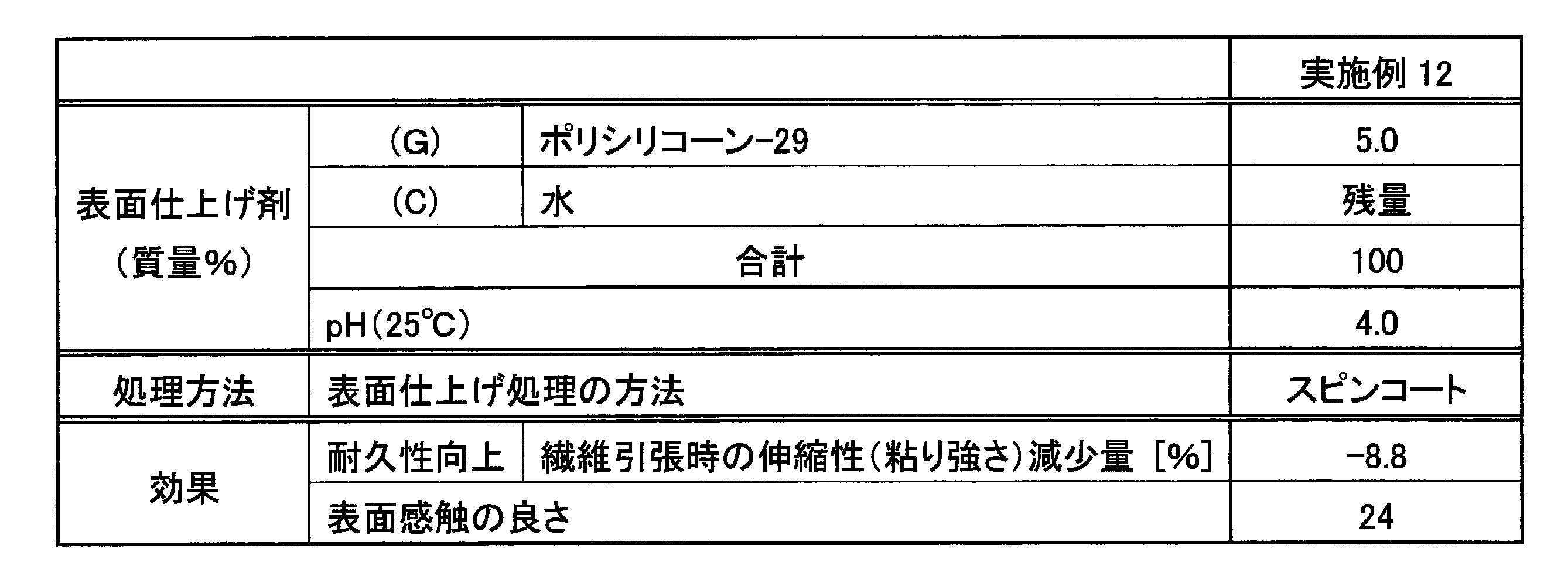
Claims (19)
- 人の頭部から分離された人毛繊維を処理するための繊維処理剤であって、以下の成分(A)及び(B)から生成する縮合物、並びに成分(C)を含有し、濁度が1000NTU以下である、繊維処理剤。
(A):ホルムアルデヒド又はその水和物
(B):一般式(1)で表されるトリアジン誘導体

(C):水 - 繊維処理剤中における成分(A)に由来する構成要素の含有量が0.1質量%以上60質量%以下である請求項1記載の繊維処理剤。
- 繊維処理剤中における成分(B)に由来する構成要素の含有量が0.1質量%以上60質量%以下である請求項1又は2に記載の繊維処理剤。
- 繊維処理剤中における成分(A)に由来する構成要素の含有量と成分(B)に由来する構成要素の含有量の合計が0.1質量%以上80質量%以下である請求項1~3のいずれか1項に記載の繊維処理剤。
- 成分(B)に由来する構成要素に対する成分(A)に由来する構成要素のモル比(A)/(B)が、5未満である請求項1~4のいずれか1項に記載の繊維処理剤。
- 更に以下の成分(D)を含有する請求項1~5のいずれか1項に記載の繊維処理剤。
(D):ハンセンの溶解度パラメータのSP値が16MPa1/2以上40MPa1/2以下である有機化合物(ただし、有機塩及びアルデヒド基を有する分子量150以下の化合物を除く) - 以下の成分(A)~(C)を含有する組成物を、濁度が1000NTU以下となるまで加熱する、人の頭部から分離された人毛繊維を処理するための繊維処理剤の製造方法。
(A):ホルムアルデヒド又はその水和物
(B):一般式(1)で表されるトリアジン誘導体との縮合物

(C):水 - 下記工程(i)を含む繊維処理方法。
(i) 請求項1~6のいずれか1項に記載の繊維処理剤に、人の頭部から分離された人毛繊維を浸漬し、前記処理剤の濁度が1000NTU以下である状態を維持したまま処理する工程 - 工程(i)の前に下記工程(0)を行う、請求項8に記載の繊維処理方法。
(0) 繊維処理剤を加熱する工程 - 工程(0)における加熱時間が、調製直後の濁度1000NTU以下の処理剤を加熱して処理剤が再び濁度1000NTUを超えるまでの加熱時間をTと定義した場合、0.2T以上0.8T以下である、請求項9に記載の繊維処理方法。
- 工程(i)の後に下記工程(ii)を行い、工程(i)と工程(ii)を2回以上繰り返す、請求項8~10のいずれか1項に記載の繊維処理方法。
(ii) 処理剤の濁度が1000NTUを超える前に人毛繊維を処理剤から取り出す工程 - 工程(ii)の後に下記工程(iii)を行う、請求項11に記載の繊維処理方法。
(iii) 取り出した人毛繊維をすすぐ工程 - 工程(iii)のすすぎが成分(D)を含有する組成物を用いて行われる、請求項12に記載の繊維処理方法。
(D):ハンセンの溶解度パラメータのSP値が16MPa1/2以上40MPa1/2以下である有機化合物(ただし、有機塩及びアルデヒド基を有する分子量150以下の化合物を除く) - 工程(i)~(iii)の後、更に下記工程(iv)を行う、請求項8~13のいずれか1項に記載の繊維処理方法。
(iv) 成分(E)及び(C)を含有する後架橋剤に人毛繊維を浸漬する工程
(E):ホルムアルデヒド、ホルムアルデヒドの水和物、グリオキシル酸、グリオキシル酸の水和物、グリオキシル酸塩、グリオキサール、グリオキサールの水和物、グルタルアルデヒド、及びグルタルアルデヒドの水和物から選ばれる少なくとも1種のホルムアルデヒド誘導体
(C):水 - 工程(i)~(iii)又は工程(iv)の後で、更に、以下の成分(G)及び(C)を含有する表面仕上げ剤に人毛繊維を浸漬する工程を行う、請求項8~14のいずれか1項に記載の繊維処理方法。
(G) 以下の化合物(a)~(d)の反応産物であるエポキシアミノシランコポリマー
(a) 少なくとも二つのオキシラニル基又はオキセタニル基を有するポリシロキサン
(b) 少なくとも二つのオキシラニル基又はオキセタニル基を有するポリエーテル
(c) アミノプロピルトリアルコキシシラン
(d) 以下の第一級及び第二級アミンからなる群より選択される化合物
・第一級アミン:メチルアミン、エチルアミン、プロピレンアミン、エタノールアミン、イソプロピルアミン、ブチルアミン、イソブチルアミン、ヘキシルアミン、ドデシルアミン、オレイルアミン、アニリン、アミノプロピルトリメチルシラン、アミノプロピルトリエチルシラン、アミノモルホリン、アミノプロピルジエチルアミン、ベンジルアミン、ナフチルアミン、3-アミノ-9-エチルカルバゾール、1-アミノヘプタフロロヘキサン、2,2,3,3,4,4,5,5,6,6,7,7,8,8,8-ペンタデカフルオロ-1-オクタンアミン
・第二級アミン:メチルエチルアミン、メチルオクタデシルアミン、ジエタノールアミン、ジベンジルアミン、ジヘキシルアミン、ジシクロヘキシルアミン、ピペリジン、ピロリジンフタルイミド、ポリマーアミン
(C) 水 - 請求項8~15のいずれか1項に記載の繊維処理方法によって、人毛繊維を処理する工程を含む、頭飾製品用人毛繊維の製造方法。
- 請求項8~15のいずれか1項に記載の繊維処理方法によって、人毛繊維を処理する工程を含む、頭飾製品の製造方法。
- 成分(A)及び(B)から生成する縮合物を含有する頭飾製品用人毛繊維。
(A):ホルムアルデヒド又はその水和物
(B):一般式(1)で表されるトリアジン誘導体

- 成分(A)及び(B)から生成する縮合物を含有する人毛繊維を構成要素とする頭飾製品。
(A):ホルムアルデヒド又はその水和物
(B):一般式(1)で表されるトリアジン誘導体

Priority Applications (3)
| Application Number | Priority Date | Filing Date | Title |
|---|---|---|---|
| EP21910817.2A EP4268650A4 (en) | 2020-12-25 | 2021-12-21 | FIBER TREATMENT AGENT |
| US18/259,109 US20240058249A1 (en) | 2020-12-25 | 2021-12-21 | Fiber-treating agent |
| CN202180087383.9A CN116745484A (zh) | 2020-12-25 | 2021-12-21 | 纤维处理剂 |
Applications Claiming Priority (2)
| Application Number | Priority Date | Filing Date | Title |
|---|---|---|---|
| JP2020-217990 | 2020-12-25 | ||
| JP2020217990 | 2020-12-25 |
Publications (1)
| Publication Number | Publication Date |
|---|---|
| WO2022138677A1 true WO2022138677A1 (ja) | 2022-06-30 |
Family
ID=82156979
Family Applications (1)
| Application Number | Title | Priority Date | Filing Date |
|---|---|---|---|
| PCT/JP2021/047434 Ceased WO2022138677A1 (ja) | 2020-12-25 | 2021-12-21 | 繊維処理剤 |
Country Status (5)
| Country | Link |
|---|---|
| US (1) | US20240058249A1 (ja) |
| EP (1) | EP4268650A4 (ja) |
| JP (1) | JP2022103112A (ja) |
| CN (1) | CN116745484A (ja) |
| WO (1) | WO2022138677A1 (ja) |
Cited By (1)
| Publication number | Priority date | Publication date | Assignee | Title |
|---|---|---|---|---|
| WO2025142737A1 (ja) * | 2023-12-26 | 2025-07-03 | デンカ株式会社 | 人工毛髪用繊維、頭髪装飾製品、及び人工毛髪用繊維の製造方法 |
Citations (6)
| Publication number | Priority date | Publication date | Assignee | Title |
|---|---|---|---|---|
| JPH11172073A (ja) * | 1997-11-03 | 1999-06-29 | Borden Chem Inc | 水に溶解可能で貯蔵安定性あるレゾール−メラミン樹脂 |
| WO2001006045A1 (fr) * | 1999-07-14 | 2001-01-25 | Kaneka Corporation | Fibre de collagene regeneree a excellente resistance thermique |
| WO2005037000A1 (ja) | 2003-10-17 | 2005-04-28 | Kaneka Corporation | カール特性の改善された毛髪用繊維およびそれからなる頭飾製品 |
| JP2007177370A (ja) | 2005-12-28 | 2007-07-12 | Kaneka Corp | 再生コラーゲン繊維と人毛からなる頭髪用繊維束及び頭飾製品 |
| WO2019159867A1 (ja) * | 2018-02-15 | 2019-08-22 | 花王株式会社 | 人毛繊維処理剤 |
| WO2019159866A1 (ja) * | 2018-02-15 | 2019-08-22 | 花王株式会社 | 人毛繊維処理剤 |
Family Cites Families (4)
| Publication number | Priority date | Publication date | Assignee | Title |
|---|---|---|---|---|
| US5411802A (en) * | 1993-10-29 | 1995-05-02 | Minnesota Mining And Manufacturing Company | Colorant compositions and processes |
| JPH11335563A (ja) * | 1998-05-28 | 1999-12-07 | Shin Etsu Chem Co Ltd | カルボキシル基含有シリコーンエマルジョン及びその製造方法並びに毛髪化粧料 |
| JP2004169015A (ja) * | 2002-11-01 | 2004-06-17 | Shin Etsu Chem Co Ltd | 粉体組成物及び油中粉体分散物.並びにそれらを有する化粧料 |
| CN106279589A (zh) * | 2015-09-25 | 2017-01-04 | 中国石油化工股份有限公司 | 一种三聚氰胺树脂的合成方法 |
-
2021
- 2021-12-21 JP JP2021207575A patent/JP2022103112A/ja not_active Withdrawn
- 2021-12-21 CN CN202180087383.9A patent/CN116745484A/zh active Pending
- 2021-12-21 WO PCT/JP2021/047434 patent/WO2022138677A1/ja not_active Ceased
- 2021-12-21 EP EP21910817.2A patent/EP4268650A4/en not_active Withdrawn
- 2021-12-21 US US18/259,109 patent/US20240058249A1/en not_active Abandoned
Patent Citations (7)
| Publication number | Priority date | Publication date | Assignee | Title |
|---|---|---|---|---|
| JPH11172073A (ja) * | 1997-11-03 | 1999-06-29 | Borden Chem Inc | 水に溶解可能で貯蔵安定性あるレゾール−メラミン樹脂 |
| WO2001006045A1 (fr) * | 1999-07-14 | 2001-01-25 | Kaneka Corporation | Fibre de collagene regeneree a excellente resistance thermique |
| WO2005037000A1 (ja) | 2003-10-17 | 2005-04-28 | Kaneka Corporation | カール特性の改善された毛髪用繊維およびそれからなる頭飾製品 |
| JP2007177370A (ja) | 2005-12-28 | 2007-07-12 | Kaneka Corp | 再生コラーゲン繊維と人毛からなる頭髪用繊維束及び頭飾製品 |
| WO2019159867A1 (ja) * | 2018-02-15 | 2019-08-22 | 花王株式会社 | 人毛繊維処理剤 |
| WO2019159866A1 (ja) * | 2018-02-15 | 2019-08-22 | 花王株式会社 | 人毛繊維処理剤 |
| JP2019143282A (ja) | 2018-02-15 | 2019-08-29 | 花王株式会社 | 人毛繊維処理剤 |
Non-Patent Citations (1)
| Title |
|---|
| "Hansen Solubility Parameters: A User's handbook", 2007, CRC PRESS, article "Software Package HSPiP" |
Cited By (1)
| Publication number | Priority date | Publication date | Assignee | Title |
|---|---|---|---|---|
| WO2025142737A1 (ja) * | 2023-12-26 | 2025-07-03 | デンカ株式会社 | 人工毛髪用繊維、頭髪装飾製品、及び人工毛髪用繊維の製造方法 |
Also Published As
| Publication number | Publication date |
|---|---|
| CN116745484A (zh) | 2023-09-12 |
| US20240058249A1 (en) | 2024-02-22 |
| EP4268650A4 (en) | 2024-12-18 |
| EP4268650A1 (en) | 2023-11-01 |
| JP2022103112A (ja) | 2022-07-07 |
Similar Documents
| Publication | Publication Date | Title |
|---|---|---|
| JP7281913B2 (ja) | 人毛繊維処理剤 | |
| JP7281914B2 (ja) | 人毛繊維処理剤 | |
| US20250305210A1 (en) | Fiber-treating agent | |
| WO2022138680A1 (ja) | 繊維処理剤 | |
| CN114341423B (zh) | 人发纤维处理剂 | |
| WO2022138677A1 (ja) | 繊維処理剤 | |
| WO2022138678A1 (ja) | 繊維処理剤 | |
| CN116710610B (zh) | 纤维处理剂 | |
| JP2022159180A (ja) | 繊維処理剤 | |
| CN116783347A (zh) | 纤维处理剂 | |
| US20250347050A1 (en) | Fiber-treating agent | |
| CN117120686A (zh) | 纤维处理剂 |
Legal Events
| Date | Code | Title | Description |
|---|---|---|---|
| 121 | Ep: the epo has been informed by wipo that ep was designated in this application |
Ref document number: 21910817 Country of ref document: EP Kind code of ref document: A1 |
|
| WWE | Wipo information: entry into national phase |
Ref document number: 18259109 Country of ref document: US |
|
| WWE | Wipo information: entry into national phase |
Ref document number: 202180087383.9 Country of ref document: CN |
|
| NENP | Non-entry into the national phase |
Ref country code: DE |
|
| ENP | Entry into the national phase |
Ref document number: 2021910817 Country of ref document: EP Effective date: 20230725 |
|
| WWW | Wipo information: withdrawn in national office |
Ref document number: 2021910817 Country of ref document: EP |