WO2022145121A1 - 空気入りタイヤ - Google Patents
空気入りタイヤ Download PDFInfo
- Publication number
- WO2022145121A1 WO2022145121A1 PCT/JP2021/039501 JP2021039501W WO2022145121A1 WO 2022145121 A1 WO2022145121 A1 WO 2022145121A1 JP 2021039501 W JP2021039501 W JP 2021039501W WO 2022145121 A1 WO2022145121 A1 WO 2022145121A1
- Authority
- WO
- WIPO (PCT)
- Prior art keywords
- tire
- less
- tread portion
- pneumatic tire
- belt layer
- Prior art date
- Legal status (The legal status is an assumption and is not a legal conclusion. Google has not performed a legal analysis and makes no representation as to the accuracy of the status listed.)
- Ceased
Links
Classifications
-
- B—PERFORMING OPERATIONS; TRANSPORTING
- B60—VEHICLES IN GENERAL
- B60C—VEHICLE TYRES; TYRE INFLATION; TYRE CHANGING; CONNECTING VALVES TO INFLATABLE ELASTIC BODIES IN GENERAL; DEVICES OR ARRANGEMENTS RELATED TO TYRES
- B60C3/00—Tyres characterised by the transverse section
- B60C3/04—Tyres characterised by the transverse section characterised by the relative dimensions of the section, e.g. low profile
-
- B—PERFORMING OPERATIONS; TRANSPORTING
- B60—VEHICLES IN GENERAL
- B60C—VEHICLE TYRES; TYRE INFLATION; TYRE CHANGING; CONNECTING VALVES TO INFLATABLE ELASTIC BODIES IN GENERAL; DEVICES OR ARRANGEMENTS RELATED TO TYRES
- B60C9/00—Reinforcements or ply arrangement of pneumatic tyres
- B60C9/0064—Reinforcements comprising monofilaments
-
- B—PERFORMING OPERATIONS; TRANSPORTING
- B60—VEHICLES IN GENERAL
- B60C—VEHICLE TYRES; TYRE INFLATION; TYRE CHANGING; CONNECTING VALVES TO INFLATABLE ELASTIC BODIES IN GENERAL; DEVICES OR ARRANGEMENTS RELATED TO TYRES
- B60C11/00—Tyre tread bands; Tread patterns; Anti-skid inserts
- B60C11/03—Tread patterns
- B60C11/0327—Tread patterns characterised by special properties of the tread pattern
- B60C11/033—Tread patterns characterised by special properties of the tread pattern by the void or net-to-gross ratios of the patterns
-
- B—PERFORMING OPERATIONS; TRANSPORTING
- B60—VEHICLES IN GENERAL
- B60C—VEHICLE TYRES; TYRE INFLATION; TYRE CHANGING; CONNECTING VALVES TO INFLATABLE ELASTIC BODIES IN GENERAL; DEVICES OR ARRANGEMENTS RELATED TO TYRES
- B60C11/00—Tyre tread bands; Tread patterns; Anti-skid inserts
- B60C11/03—Tread patterns
- B60C11/13—Tread patterns characterised by the groove cross-section, e.g. for buttressing or preventing stone-trapping
-
- B—PERFORMING OPERATIONS; TRANSPORTING
- B60—VEHICLES IN GENERAL
- B60C—VEHICLE TYRES; TYRE INFLATION; TYRE CHANGING; CONNECTING VALVES TO INFLATABLE ELASTIC BODIES IN GENERAL; DEVICES OR ARRANGEMENTS RELATED TO TYRES
- B60C9/00—Reinforcements or ply arrangement of pneumatic tyres
- B60C9/18—Structure or arrangement of belts or breakers, crown-reinforcing or cushioning layers
- B60C9/20—Structure or arrangement of belts or breakers, crown-reinforcing or cushioning layers built-up from rubberised plies each having all cords arranged substantially parallel
-
- B—PERFORMING OPERATIONS; TRANSPORTING
- B60—VEHICLES IN GENERAL
- B60C—VEHICLE TYRES; TYRE INFLATION; TYRE CHANGING; CONNECTING VALVES TO INFLATABLE ELASTIC BODIES IN GENERAL; DEVICES OR ARRANGEMENTS RELATED TO TYRES
- B60C1/00—Tyres characterised by the chemical composition or the physical arrangement or mixture of the composition
- B60C2001/0066—Compositions of the belt layers
-
- B—PERFORMING OPERATIONS; TRANSPORTING
- B60—VEHICLES IN GENERAL
- B60C—VEHICLE TYRES; TYRE INFLATION; TYRE CHANGING; CONNECTING VALVES TO INFLATABLE ELASTIC BODIES IN GENERAL; DEVICES OR ARRANGEMENTS RELATED TO TYRES
- B60C9/00—Reinforcements or ply arrangement of pneumatic tyres
- B60C9/18—Structure or arrangement of belts or breakers, crown-reinforcing or cushioning layers
- B60C9/20—Structure or arrangement of belts or breakers, crown-reinforcing or cushioning layers built-up from rubberised plies each having all cords arranged substantially parallel
- B60C2009/2012—Structure or arrangement of belts or breakers, crown-reinforcing or cushioning layers built-up from rubberised plies each having all cords arranged substantially parallel with particular configuration of the belt cords in the respective belt layers
- B60C2009/2016—Structure or arrangement of belts or breakers, crown-reinforcing or cushioning layers built-up from rubberised plies each having all cords arranged substantially parallel with particular configuration of the belt cords in the respective belt layers comprising cords at an angle of 10 to 30 degrees to the circumferential direction
-
- B—PERFORMING OPERATIONS; TRANSPORTING
- B60—VEHICLES IN GENERAL
- B60C—VEHICLE TYRES; TYRE INFLATION; TYRE CHANGING; CONNECTING VALVES TO INFLATABLE ELASTIC BODIES IN GENERAL; DEVICES OR ARRANGEMENTS RELATED TO TYRES
- B60C9/00—Reinforcements or ply arrangement of pneumatic tyres
- B60C9/18—Structure or arrangement of belts or breakers, crown-reinforcing or cushioning layers
- B60C9/20—Structure or arrangement of belts or breakers, crown-reinforcing or cushioning layers built-up from rubberised plies each having all cords arranged substantially parallel
- B60C2009/2012—Structure or arrangement of belts or breakers, crown-reinforcing or cushioning layers built-up from rubberised plies each having all cords arranged substantially parallel with particular configuration of the belt cords in the respective belt layers
- B60C2009/2019—Structure or arrangement of belts or breakers, crown-reinforcing or cushioning layers built-up from rubberised plies each having all cords arranged substantially parallel with particular configuration of the belt cords in the respective belt layers comprising cords at an angle of 30 to 60 degrees to the circumferential direction
-
- B—PERFORMING OPERATIONS; TRANSPORTING
- B60—VEHICLES IN GENERAL
- B60C—VEHICLE TYRES; TYRE INFLATION; TYRE CHANGING; CONNECTING VALVES TO INFLATABLE ELASTIC BODIES IN GENERAL; DEVICES OR ARRANGEMENTS RELATED TO TYRES
- B60C9/00—Reinforcements or ply arrangement of pneumatic tyres
- B60C9/18—Structure or arrangement of belts or breakers, crown-reinforcing or cushioning layers
- B60C9/20—Structure or arrangement of belts or breakers, crown-reinforcing or cushioning layers built-up from rubberised plies each having all cords arranged substantially parallel
- B60C2009/2012—Structure or arrangement of belts or breakers, crown-reinforcing or cushioning layers built-up from rubberised plies each having all cords arranged substantially parallel with particular configuration of the belt cords in the respective belt layers
- B60C2009/2022—Structure or arrangement of belts or breakers, crown-reinforcing or cushioning layers built-up from rubberised plies each having all cords arranged substantially parallel with particular configuration of the belt cords in the respective belt layers comprising cords at an angle of 60 to 90 degrees to the circumferential direction
-
- B—PERFORMING OPERATIONS; TRANSPORTING
- B60—VEHICLES IN GENERAL
- B60C—VEHICLE TYRES; TYRE INFLATION; TYRE CHANGING; CONNECTING VALVES TO INFLATABLE ELASTIC BODIES IN GENERAL; DEVICES OR ARRANGEMENTS RELATED TO TYRES
- B60C9/00—Reinforcements or ply arrangement of pneumatic tyres
- B60C9/18—Structure or arrangement of belts or breakers, crown-reinforcing or cushioning layers
- B60C9/20—Structure or arrangement of belts or breakers, crown-reinforcing or cushioning layers built-up from rubberised plies each having all cords arranged substantially parallel
- B60C2009/2061—Physical properties or dimensions of the belt coating rubber
-
- B—PERFORMING OPERATIONS; TRANSPORTING
- B60—VEHICLES IN GENERAL
- B60C—VEHICLE TYRES; TYRE INFLATION; TYRE CHANGING; CONNECTING VALVES TO INFLATABLE ELASTIC BODIES IN GENERAL; DEVICES OR ARRANGEMENTS RELATED TO TYRES
- B60C9/00—Reinforcements or ply arrangement of pneumatic tyres
- B60C9/18—Structure or arrangement of belts or breakers, crown-reinforcing or cushioning layers
- B60C9/20—Structure or arrangement of belts or breakers, crown-reinforcing or cushioning layers built-up from rubberised plies each having all cords arranged substantially parallel
- B60C2009/2061—Physical properties or dimensions of the belt coating rubber
- B60C2009/2064—Modulus; Hardness; Loss modulus or "tangens delta"
-
- B—PERFORMING OPERATIONS; TRANSPORTING
- B60—VEHICLES IN GENERAL
- B60C—VEHICLE TYRES; TYRE INFLATION; TYRE CHANGING; CONNECTING VALVES TO INFLATABLE ELASTIC BODIES IN GENERAL; DEVICES OR ARRANGEMENTS RELATED TO TYRES
- B60C9/00—Reinforcements or ply arrangement of pneumatic tyres
- B60C9/18—Structure or arrangement of belts or breakers, crown-reinforcing or cushioning layers
- B60C9/20—Structure or arrangement of belts or breakers, crown-reinforcing or cushioning layers built-up from rubberised plies each having all cords arranged substantially parallel
- B60C2009/2074—Physical properties or dimension of the belt cord
- B60C2009/2077—Diameters of the cords; Linear density thereof
-
- B—PERFORMING OPERATIONS; TRANSPORTING
- B60—VEHICLES IN GENERAL
- B60C—VEHICLE TYRES; TYRE INFLATION; TYRE CHANGING; CONNECTING VALVES TO INFLATABLE ELASTIC BODIES IN GENERAL; DEVICES OR ARRANGEMENTS RELATED TO TYRES
- B60C9/00—Reinforcements or ply arrangement of pneumatic tyres
- B60C9/18—Structure or arrangement of belts or breakers, crown-reinforcing or cushioning layers
- B60C9/20—Structure or arrangement of belts or breakers, crown-reinforcing or cushioning layers built-up from rubberised plies each having all cords arranged substantially parallel
- B60C2009/2074—Physical properties or dimension of the belt cord
- B60C2009/2083—Density in width direction
-
- B—PERFORMING OPERATIONS; TRANSPORTING
- B60—VEHICLES IN GENERAL
- B60C—VEHICLE TYRES; TYRE INFLATION; TYRE CHANGING; CONNECTING VALVES TO INFLATABLE ELASTIC BODIES IN GENERAL; DEVICES OR ARRANGEMENTS RELATED TO TYRES
- B60C11/00—Tyre tread bands; Tread patterns; Anti-skid inserts
- B60C11/03—Tread patterns
- B60C2011/0337—Tread patterns characterised by particular design features of the pattern
- B60C2011/0339—Grooves
- B60C2011/0341—Circumferential grooves
-
- B—PERFORMING OPERATIONS; TRANSPORTING
- B60—VEHICLES IN GENERAL
- B60C—VEHICLE TYRES; TYRE INFLATION; TYRE CHANGING; CONNECTING VALVES TO INFLATABLE ELASTIC BODIES IN GENERAL; DEVICES OR ARRANGEMENTS RELATED TO TYRES
- B60C11/00—Tyre tread bands; Tread patterns; Anti-skid inserts
- B60C11/03—Tread patterns
- B60C2011/0337—Tread patterns characterised by particular design features of the pattern
- B60C2011/0339—Grooves
- B60C2011/0341—Circumferential grooves
- B60C2011/0353—Circumferential grooves characterised by width
-
- B—PERFORMING OPERATIONS; TRANSPORTING
- B60—VEHICLES IN GENERAL
- B60C—VEHICLE TYRES; TYRE INFLATION; TYRE CHANGING; CONNECTING VALVES TO INFLATABLE ELASTIC BODIES IN GENERAL; DEVICES OR ARRANGEMENTS RELATED TO TYRES
- B60C11/00—Tyre tread bands; Tread patterns; Anti-skid inserts
- B60C11/03—Tread patterns
- B60C2011/0337—Tread patterns characterised by particular design features of the pattern
- B60C2011/0339—Grooves
- B60C2011/0341—Circumferential grooves
- B60C2011/0355—Circumferential grooves characterised by depth
-
- B—PERFORMING OPERATIONS; TRANSPORTING
- B60—VEHICLES IN GENERAL
- B60C—VEHICLE TYRES; TYRE INFLATION; TYRE CHANGING; CONNECTING VALVES TO INFLATABLE ELASTIC BODIES IN GENERAL; DEVICES OR ARRANGEMENTS RELATED TO TYRES
- B60C11/00—Tyre tread bands; Tread patterns; Anti-skid inserts
- B60C11/03—Tread patterns
- B60C2011/0337—Tread patterns characterised by particular design features of the pattern
- B60C2011/0339—Grooves
- B60C2011/0358—Lateral grooves, i.e. having an angle of 45 to 90 degees to the equatorial plane
-
- B—PERFORMING OPERATIONS; TRANSPORTING
- B60—VEHICLES IN GENERAL
- B60C—VEHICLE TYRES; TYRE INFLATION; TYRE CHANGING; CONNECTING VALVES TO INFLATABLE ELASTIC BODIES IN GENERAL; DEVICES OR ARRANGEMENTS RELATED TO TYRES
- B60C11/00—Tyre tread bands; Tread patterns; Anti-skid inserts
- B60C11/03—Tread patterns
- B60C2011/0337—Tread patterns characterised by particular design features of the pattern
- B60C2011/0339—Grooves
- B60C2011/0358—Lateral grooves, i.e. having an angle of 45 to 90 degees to the equatorial plane
- B60C2011/0365—Lateral grooves, i.e. having an angle of 45 to 90 degees to the equatorial plane characterised by width
-
- B—PERFORMING OPERATIONS; TRANSPORTING
- B60—VEHICLES IN GENERAL
- B60C—VEHICLE TYRES; TYRE INFLATION; TYRE CHANGING; CONNECTING VALVES TO INFLATABLE ELASTIC BODIES IN GENERAL; DEVICES OR ARRANGEMENTS RELATED TO TYRES
- B60C11/00—Tyre tread bands; Tread patterns; Anti-skid inserts
- B60C11/03—Tread patterns
- B60C2011/0337—Tread patterns characterised by particular design features of the pattern
- B60C2011/0339—Grooves
- B60C2011/0358—Lateral grooves, i.e. having an angle of 45 to 90 degees to the equatorial plane
- B60C2011/0367—Lateral grooves, i.e. having an angle of 45 to 90 degees to the equatorial plane characterised by depth
-
- B—PERFORMING OPERATIONS; TRANSPORTING
- B60—VEHICLES IN GENERAL
- B60C—VEHICLE TYRES; TYRE INFLATION; TYRE CHANGING; CONNECTING VALVES TO INFLATABLE ELASTIC BODIES IN GENERAL; DEVICES OR ARRANGEMENTS RELATED TO TYRES
- B60C11/00—Tyre tread bands; Tread patterns; Anti-skid inserts
- B60C11/03—Tread patterns
- B60C2011/0337—Tread patterns characterised by particular design features of the pattern
- B60C2011/0339—Grooves
- B60C2011/0374—Slant grooves, i.e. having an angle of about 5 to 35 degrees to the equatorial plane
- B60C2011/0376—Slant grooves, i.e. having an angle of about 5 to 35 degrees to the equatorial plane characterised by width
-
- B—PERFORMING OPERATIONS; TRANSPORTING
- B60—VEHICLES IN GENERAL
- B60C—VEHICLE TYRES; TYRE INFLATION; TYRE CHANGING; CONNECTING VALVES TO INFLATABLE ELASTIC BODIES IN GENERAL; DEVICES OR ARRANGEMENTS RELATED TO TYRES
- B60C11/00—Tyre tread bands; Tread patterns; Anti-skid inserts
- B60C11/03—Tread patterns
- B60C2011/0337—Tread patterns characterised by particular design features of the pattern
- B60C2011/0339—Grooves
- B60C2011/0374—Slant grooves, i.e. having an angle of about 5 to 35 degrees to the equatorial plane
- B60C2011/0379—Slant grooves, i.e. having an angle of about 5 to 35 degrees to the equatorial plane characterised by depth
-
- Y—GENERAL TAGGING OF NEW TECHNOLOGICAL DEVELOPMENTS; GENERAL TAGGING OF CROSS-SECTIONAL TECHNOLOGIES SPANNING OVER SEVERAL SECTIONS OF THE IPC; TECHNICAL SUBJECTS COVERED BY FORMER USPC CROSS-REFERENCE ART COLLECTIONS [XRACs] AND DIGESTS
- Y02—TECHNOLOGIES OR APPLICATIONS FOR MITIGATION OR ADAPTATION AGAINST CLIMATE CHANGE
- Y02T—CLIMATE CHANGE MITIGATION TECHNOLOGIES RELATED TO TRANSPORTATION
- Y02T10/00—Road transport of goods or passengers
- Y02T10/80—Technologies aiming to reduce greenhouse gasses emissions common to all road transportation technologies
- Y02T10/86—Optimisation of rolling resistance, e.g. weight reduction
Definitions
- This disclosure relates to pneumatic tires, more specifically to pneumatic tires with a belt layer.
- the fuel efficiency of a tire can be evaluated by rolling resistance, and it is known that the smaller the rolling resistance, the better the fuel efficiency of the tire.
- Patent Documents 1 to 4 it has been proposed to reduce the rolling resistance by devising the composition of the rubber composition constituting the tread portion of the tire.
- Japanese Unexamined Patent Publication No. 2018-178034 Japanese Unexamined Patent Publication No. 2019-089911 WO2018 / 186367 Gazette Japanese Unexamined Patent Publication No. 2019-206643
- a tire that has a tread and a belt layer.
- the reinforcing cord in the belt layer is composed of cords made of monofilaments arranged in 50 lines / 5 cm or more in the tire width direction in the tire radial cross section of the belt layer.
- a pneumatic tire that is incorporated in a regular rim and satisfies the following (Equation 1) when the cross-sectional width of the tire is Wt (mm) and the outer diameter is Dt (mm) when the internal pressure is 250 kPa. Is. 1500 ⁇ (Dt 2 ⁇ ⁇ / 4) / Wt ⁇ ⁇ ⁇ ⁇ ⁇ (Equation 1)
- the tire according to the present disclosure is a tire having a belt layer, and the reinforcing cord in the belt layer has 50 or more cords made of monofilament arranged in the tire width direction in the tire radial cross section of the belt layer. It is composed of.
- the tire according to the present disclosure is further incorporated into a regular rim, and when the cross-sectional width of the tire is Wt (mm) and the outer diameter is Dt (mm) when the internal pressure is 250 kPa, the following (Equation 1) I am satisfied. 1500 ⁇ (Dt 2 ⁇ ⁇ / 4) / Wt ⁇ ⁇ ⁇ ⁇ ⁇ (Equation 1)
- the "regular rim” is a rim defined for each tire in the standard system including the standard on which the tire is based.
- JATTA Joint Automobile Tire Association
- "JATTA” If it is a standard rim in the applicable size described in "YEAR BOOK”, ETRTO (The European Tire and Rim Technical Organization), "Measuring Rim”, TRA (The Tire Tire) described in “STANDARDS MANUAL” If it is.), It means “Design Rim” described in "YEAR BOOK”.
- the rim that can be assembled and can maintain internal pressure that is, the rim that does not cause air leakage from between the rim and the tire, has the smallest rim diameter, and then the rim. Refers to the one with the narrowest width.
- the outer diameter Dt of the tire is the outer diameter of the tire in a state where the tire is assembled to the regular rim and the internal pressure is 250 kPa to make no load
- the cross-sectional width Wt of the tire is the tire.
- the pattern and characters on the side of the tire are based on the straight distance between the sidewalls (total width of the tire) including all the patterns and characters on the side of the tire. It is the width excluding such things.
- the cross-sectional width Wt (mm) and the outer diameter Dt (mm) of the tire satisfy 1500 ⁇ (Dt 2 ⁇ ⁇ / 4) / Wt (Equation 1). There is.
- the above-mentioned (Dt 2 ⁇ ⁇ / 4) / Wt is more preferably 1541 or more, further preferably 1544 or more, further preferably 1546 or more, further preferably 1549 or more, and 1554 or more.
- the centrifugal force generally tends to be large, and at high speeds, the tread portion may be deformed into a round shape, which may lead to deterioration of rolling resistance. Further, when traveling at high speed, the outer diameter tends to grow large as the centrifugal force increases, which may lead to a decrease in steering stability.
- a cord made of monofilament (single wire) is used as a reinforcing cord instead of a cord made of stranded wire (stranded wire cord). Since the monofilament cord is not twisted, it is unlikely to be stretched and deformed, and has an excellent restraining function. Therefore, 50 or more such monofilament cords are arranged in a dense state with an interval of 1 mm or less per 5 cm.
- the outer diameter of the monofilament cord is preferably 0.1 mm or more and 0.5 mm or less. More preferably, it is 0.25 mm or more and 0.40 mm or less. If the outer diameter of the cord is too small, it may not be able to exert sufficient binding force even if it is arranged closely. On the other hand, if it is too thick, it will be difficult to cover the monofilament cord with rubber without gaps, and shear deformation will be less likely to occur, and there is a concern that it will be difficult to obtain sufficient steering stability during high-speed running.
- the rubber composition covering the reinforcing cords is used in the belt layer at a temperature of 70 ° C., an initial strain of 5%, and a dynamic motion. Under the conditions of strain: ⁇ 1%, frequency: 10 Hz, deformation mode: complex elastic modulus E * (MPa) measured by elongation, and deformation mode: loss tangent (tan ⁇ ) measured by tension, and the tread part of the reinforcing cord. It is preferable that the number of arrangements e (lines) per 5 cm in the tire width direction in the above satisfies [(tan ⁇ / E * ) / e] ⁇ 1000 ⁇ 0.2 (Equation 4).
- the belt layer When the tire rolls, if the tread part is deformed, the belt layer will generate heat. At this time, if the number of reinforcing cords arranged per 5 cm (hereinafter, also referred to as “ends”) is not appropriate, the coated rubber layer may be softened, resulting in a decrease in steering stability.
- the number of monofilaments arranged (ends) refers to the average number of cords arranged in the tire width direction under a normal rim with an internal pressure of 250 kPa and no load, and simply has a thickness of 2. It can be obtained by measuring the number of cords arranged in a width of 5 to 10 cm around the equatorial plane of the tire on a section cut out in the tire radial direction at about 4 cm and calculating the average number per 5 cm.
- the end e (lines / 5 cm) is more preferably 55 lines / 5 cm or more, further preferably 75 lines / 5 cm or more, and further preferably 90 lines / 5 cm or more.
- the complex elastic modulus E * (MPa) and the loss tangent (tan ⁇ ) can be measured using, for example, a viscoelasticity measuring device such as “Iplexer (registered trademark)” manufactured by GABO.
- the specific complex elastic modulus E * (MPa) is preferably 8.7 MPa or more, more preferably 9.4 MPa or more, and further preferably 10.5 MPa or more.
- the specific loss tangent (tan ⁇ ) is preferably 0.08 or more, more preferably 0.10 or more, and even more preferably 0.13 or more.
- (tan ⁇ / E * ) is preferably 0.002 or more and 0.017 or less, more preferably 0.015 or less, and further preferably 0.014 or less. It is more preferably 0.01 or less, and further preferably 0.009 or less.
- the average distance D (mm) between the cords is preferably 0.6 mm or less, more preferably 0.5 mm or less, further preferably 0.45 mm or less, and further preferably 0.22 mm or less. preferable.
- one set of belt layers can cooperate with each other to appropriately restrain the tread portion and suppress the amount of deformation of the tread portion during rolling, so that low rolling resistance and low rolling resistance during high-speed running can be suppressed. Steering stability can be maintained.
- At least one belt layer may satisfy the above-mentioned relationship with respect to the above-mentioned "[(tan ⁇ / E * ) / e] ⁇ 1000".
- the angle formed by the cords in each other's belt layers at the tread portion in the tire circumferential direction is 65. It is preferably ° or less, more preferably 60 ° or less, further preferably 58 ° or less, and even more preferably 46 ° or less.
- the above-mentioned (tan ⁇ / E * ) and the average distance D (mm) between the cords preferably satisfy (tan ⁇ / E * ) ⁇ D ⁇ 1000 ⁇ 8.0 (Equation 6).
- 6.2 or less is more preferable, 4.3 or less is further preferable, 4.1 or less is further preferable, and 3.0 or less is further preferable.
- the tire according to the present disclosure has a circumferential groove in the tread portion that extends continuously in the tire circumferential direction, and the circumferential groove with respect to the groove width L 0 of the circumferential groove on the ground contact surface of the tread portion.
- the ratio of the groove width L 80 (L 80 / L 0 ) at a depth of 80% of the maximum depth is preferably 0.2 or more and 0.7 or less.
- L 80 / L 0 is preferably 0.35 or more, more preferably 0.40 or more, and further preferably 0.45 or more. Further, it is preferably 0.65 or less, more preferably 0.60 or less, and further preferably 0.55 or less.
- L 0 and L 80 are the linear distance (L 0 ) of the groove end portion of the tread circumferential groove of the tire in which the internal pressure is 250 kPa and the tire is in a no-load state, and the groove. It refers to the minimum distance (L 80 ) of the groove wall at a depth of 80%.
- the rim width is between the bead parts of the section where the tire is cut out in the radial direction with a width of 2 to 4 cm. It can be obtained by pressing them together.
- the tread portion has a plurality of circumferential grooves and the total cross-sectional area of the plurality of circumferential grooves is 10% or more and 30% or less of the cross-sectional area of the tread portion.
- the movement of the tread portion can be suppressed, and uneven wear of the tread portion during high-speed running can be sufficiently suppressed and the durability can be sufficiently improved. It is more preferably 15% or more and 27% or less, further preferably 18% or more and 25% or less, and particularly preferably 21% or more and 23% or less.
- the cross-sectional area of the above-mentioned circumferential groove is the area composed of a straight line connecting the ends of the tread circumferential groove and a groove wall in a tire mounted on a regular rim and having an internal pressure of 250 kPa and in a no-load state. It refers to the total value of, and can be simply obtained by pressing the bead portion of the section cut out in the radial direction of the tire with a width of 2 to 4 cm according to the rim width.
- the cross-sectional area of the tread portion is formed by a straight line connecting the peripheral groove ends of the tread portion and the surface of the tread in the radial cross section of the tire mounted on a regular rim and having an internal pressure of 250 kPa and in a no-load state.
- the belt reinforcing layer using organic fibers and / or steel cords is provided on the outer side in the radial direction of the tire from the belt layer, the area is on the outer side in the radial direction from the belt reinforcing layer.
- the tread portion has a plurality of lateral grooves extending in the tire axial direction, and the total volume of the plurality of lateral grooves is 2.0% or more and 5.0% or less of the volume of the tread portion. Is preferable. As a result, it is possible to suppress the movement of the tread portion, suppress uneven wear of the tread portion, and sufficiently improve the durability. It is more preferably 2.2% or more and 4.0% or less, further preferably 2.5% or more and 3.5% or less, and particularly preferably 2.7% or more and 3.0% or less. ..
- the volume of the tread portion described above refers to the volume obtained by extending the area of the tread portion in the tire circumferential direction. It can be simply obtained by multiplying the area of the tread portion by the length of the outer circumference of the tire (Dt ⁇ ⁇ ), and the end portion in the width direction is the widest breaker end portion, which is the volume including the main groove and the lateral groove. ..
- the volume of the lateral groove refers to the total volume of the surface connected to the ends of the lateral groove and the groove wall in a tire mounted on a regular rim and having an internal pressure of 250 kPa and in a no-load state. To put it simply, calculate the volume of each lateral groove and multiply it by the number of grooves, with the bead portion of the section cut out in the radial direction with a width of 2 to 4 cm pressed down according to the rim width. Can be found at. Further, the volume of the tread portion can be calculated by calculating the area of the portion of the tread portion not including the lateral groove from the section and multiplying it by the outer diameter, and obtaining the difference from the volume of the lateral groove. ..
- these lateral grooves include lateral grooves in which the ratio (Gw / Gd) of the groove width Gw to the groove depth Gd is 0.50 or more and 0.80 or less. As mentioned above, 0.77 or less is more preferable, 0.55 or more and 0.75 or less are further preferable, and 0.60 or more and 0.70 or less are particularly preferable.
- the groove width and groove depth of the lateral groove described above are the straight lines connecting the tread surface ends of the lateral grooves, which are perpendicular to the groove direction and are the maximum in the tire with an internal pressure of 250 kPa and no load. , And the maximum depth of the lateral groove, and can be simply calculated from the state where the bead portion of the section where the tire is cut out in the radial direction with a width of 2 to 4 cm is pressed according to the rim width. ..
- the specific outer diameter Dt (mm) is preferably, for example, 515 mm or more, and more preferably 558 mm or more. It is preferable that it is 585 mm or more, more preferably 622 mm or more, further preferably 623 mm or more, further preferably 624 mm or more, further preferably 627 mm or more, still more preferably 628 mm or more. It is more preferably 629 mm or more, further preferably 640 mm or more, further preferably 658 mm or more, and further preferably 673 mm or more.
- the upper limit is not particularly limited, but is preferably less than 843 mm, more preferably less than 725 mm, further preferably less than 707 mm, still more preferably less than 685 mm. It is considered that by setting the outer diameter Dt in the above range, a good moment of inertia at the time of rolling can be obtained, and a reaction force is likely to be generated when the steering angle is adjusted.
- the specific cross-sectional width Wt (mm) is, for example, preferably 115 mm or more, more preferably 130 mm or more, further preferably 150 mm or more, further preferably 155 mm or more, and 170 mm or more. It is more preferably 175 mm or more, further preferably 183 mm or more, further preferably 184 mm or more, further preferably 185 mm or more, still more preferably 193 mm or more.
- the upper limit is not particularly limited, it is preferably less than 305 mm, more preferably less than 245 mm, further preferably less than 210 mm, further preferably less than 205 mm, further preferably 201 mm or less, still more preferably 200 mm.
- the specific cross-sectional height Ht (mm) is, for example, preferably 37 mm or more, more preferably 87 mm or more, and further preferably 95 mm or more. On the other hand, it is preferably less than 180 mm, more preferably less than 112 mm, and even more preferably less than 101 mm.
- (Dt-2 ⁇ Ht) is preferably 450 (mm) or more, more preferably 470 (mm) or more, and 480. It is more preferably (mm) or more.
- considering the deformation of the tread portion it is preferably less than 560 (mm), more preferably less than 530 (mm), and even more preferably less than 510 (mm).
- the rubber composition constituting the belt layer of the tire according to the present disclosure can be obtained from the rubber components described below and other blending materials.
- the rubber component is not particularly limited, and isoprene-based rubber, butadiene rubber (BR), styrene-butadiene rubber (SBR), diene-based rubber such as nitrile rubber (NBR), butyl rubber, and the like.
- Rubber (polymer) generally used in the manufacture of tires, such as butyl rubber, can be used.
- isoprene-based rubber is preferable, and NR is preferable because the cis structure of polyisoprene is close to 100% and the tensile strength is superior to other rubber components.
- BR and SBR may be used together.
- the content (total content) of isoprene-based rubber in 100 parts by mass of the rubber component is preferably 60 parts by mass or more, more preferably 80 parts by mass or more, and 90 parts by mass or more. Is more preferable.
- isoprene-based rubber examples include natural rubber (NR), isoprene rubber (IR), modified NR, modified NR, modified IR, etc., but NR is preferable from the viewpoint of excellent strength.
- NR for example, SIR20, RSS # 3, TSR20, etc., which are common in the tire industry, can be used.
- the IR is not particularly limited, and for example, an IR 2200 or the like, which is common in the tire industry, can be used.
- Modified NR includes deproteinized natural rubber (DPNR), high-purity natural rubber (UPNR), etc.
- modified NR includes epoxidized natural rubber (ENR), hydrogenated natural rubber (HNR), grafted natural rubber, etc.
- Examples of the modified IR include epoxidized isoprene rubber, hydrogenated isoprene rubber, grafted isoprene rubber and the like. These may be used alone or in combination of two or more.
- (B) BR In the present embodiment, as the rubber component, BR of 5 parts by mass or more and 25 parts by mass or less may be used together with NR, if necessary.
- the weight average molecular weight of BR is, for example, more than 100,000 and less than 2 million.
- the vinyl bond amount (1,2-bonded butadiene unit amount) of BR is, for example, more than 1% by mass and less than 30% by mass.
- the cis content of BR is, for example, more than 1% by mass and 98% by mass or less.
- the trans content of BR is, for example, more than 1% by weight and less than 60% by weight.
- the cis content can be measured by infrared absorption spectrum analysis.
- the BR is not particularly limited, and BR having a high cis content (cis content of 90% or more), BR having a low cis content, BR containing syndiotactic polybutadiene crystals, and the like can be used.
- the BR may be either a non-modified BR or a modified BR, and as the modified BR, for example, an S-modified BR modified with a compound (modifying agent) represented by the following formula can be used.
- R 1 , R 2 and R 3 are the same or different, and contain an alkyl group, an alkoxy group, a silyloxy group, an acetal group, a carboxyl group (-COOH), a mercapto group (-SH) or a derivative thereof.
- R 4 and R 5 represent the same or different hydrogen atoms or alkyl groups. R 4 and R 5 may be combined to form a ring structure with nitrogen atoms.
- n represents an integer.
- modified BR modified by the compound (modifying agent) represented by the above formula examples include BR having the polymerization terminal (active terminal) modified by the compound represented by the above formula.
- Alkoxy groups are suitable for R 1 , R 2 and R 3 (preferably an alkoxy group having 1 to 8 carbon atoms, and more preferably an alkoxy group having 1 to 4 carbon atoms).
- Alkyl groups (preferably alkyl groups having 1 to 3 carbon atoms) are suitable as R 4 and R 5 .
- n is preferably 1 to 5, more preferably 2 to 4, and even more preferably 3.
- R 4 and R 5 are bonded to form a ring structure together with a nitrogen atom, a 4- to 8-membered ring is preferable.
- the alkoxy group also includes a cycloalkoxy group (cyclohexyloxy group, etc.) and an aryloxy group (phenoxy group, benzyloxy group, etc.).
- modifiers include 2-dimethylaminoethyltrimethoxysilane, 3-dimethylaminopropyltrimethoxysilane, 2-dimethylaminoethyltriethoxysilane, 3-dimethylaminopropyltriethoxysilane, and 2-diethylaminoethyltri.
- examples thereof include methoxysilane, 3-diethylaminopropyltrimethoxysilane, 2-diethylaminoethyltriethoxysilane, and 3-diethylaminopropyltriethoxysilane. These may be used alone or in combination of two or more.
- a modified BR modified with the following compound (modifying agent) can also be used.
- the modifier include polyglycidyl ethers of polyhydric alcohols such as ethylene glycol diglycidyl ether, glycerin triglycidyl ether, trimethylolethanetriglycidyl ether, and trimethylolpropane triglycidyl ether; and two or more diglycidylated bisphenol A and the like.
- Tetraglycidylaminodiphenylmethane tetraglycidyl-p-phenylenediamine, diglycidylaminomethylcyclohexane, tetraglycidyl-1,3-bisaminomethylcyclohexane and other diglycidylamino compounds; bis- (1-methylpropyl) carbamate chloride, Amino group-containing acid chlorides such as 4-morpholincarbonyl chloride, 1-pyrrolidincarbonyl chloride, N, N-dimethylcarbamide acid chloride, N, N-diethylcarbamide acid chloride; 1,3-bis- (glycidyloxypropyl) -tetra Epoxy group-containing silane compounds such as methyldisiloxane, (3-glycidyloxypropyl) -pentamethyldisiloxane; (trimethylsilyl) [3- (trimethoxysilyl) propyl] sulfide, (trimethyl
- silane compound Containing silane compound; N-substituted aziridine compound such as ethyleneimine and propyleneimine; methyltrietoki Sisilane, N, N-bis (trimethylsilyl) -3-aminopropyltrimethoxysilane, N, N-bis (trimethylsilyl) -3-aminopropyltriethoxysilane, N, N-bis (trimethylsilyl) aminoethyltrimethoxysilane, Alkoxysilanes such as N, N-bis (trimethylsilyl) aminoethyltriethoxysilane; 4-N, N-dimethylaminobenzophenone, 4-N, N-di-t-butylaminobenzophenone, 4-N, N-diphenylamino Benzophenone, 4,4'-bis (dimethylamino) benzophenone, 4,4'-bis (diethylamino) benzophenone, 4,4
- Benzaldehyde compounds having an amino group and / or a substituted amino group such as benzaldehyde; N-methyl-2-pyrrolidone, N-vinyl-2-pyrrolidone, N-phenyl-2-pyrrolidone, Nt-butyl-2-pyrrolidone, N-substituted pyrrolidone such as N-methyl-5-methyl-2-pyrrolidone; N-substituted piperidone such as N-methyl-2-piperidone, N-vinyl-2-piperidone, N-phenyl-2-piperidone; N- Methyl- ⁇ -caprolactam, N-phenyl- ⁇ -caprolactam, N-methyl- ⁇ -laurilolactum, N-vinyl- ⁇ -laurilolactum, N-methyl- ⁇ -propiolactam, N-phenyl- ⁇ - In addition to N-substituted lactams such as propiolactam,
- tin-modified BR can also be used.
- the tin-modified BR is obtained by polymerizing 1,3-butadiene with a lithium initiator and then adding a tin compound, and the terminal of the tin-modified BR molecule is further bonded by a tin-carbon bond. The one is preferable.
- lithium initiator examples include lithium-based compounds such as alkyllithium, aryllithium, vinyllithium, organic tin lithium, and organic nitrogen lithium compounds, and lithium metals.
- the lithium initiator as an initiator for tin-modified BR, a tin-modified BR having a high vinyl content and a low cis content can be produced.
- tin compounds include tin tetrachloride, butyltin trichloride, dibutyltin dichloride, dioctyltin dichloride, tributyltin chloride, triphenyltin chloride, diphenyldibutyltin, triphenyltinethoxydo, diphenyldimethyltin, ditrilltinchloride, and diphenyltindioctano.
- examples thereof include ate, divinyldiethyl tin, tetrabenzyltin, dibutyltin distearate, tetraallyl tin, p-tributyltin styrene and the like.
- the content of tin atoms in the tin-modified BR is preferably 50 ppm or more, more preferably 60 ppm or more. On the other hand, 3000 ppm or less is preferable, 2500 ppm or less is more preferable, and 250 ppm or less is further preferable.
- the molecular weight distribution (Mw / Mn) of the tin-modified BR is preferably 2 or less, more preferably 1.5 or less.
- the vinyl bond amount in the tin-modified BR is preferably 5% by mass or more, more preferably 7% by mass or more.
- the vinyl bond amount of the tin-modified BR is preferably 50% by mass or less, more preferably 20% by mass or less.
- S-modified BR and tin-modified BR may be used alone or in combination of two or more.
- BR for example, products such as Ube Kosan Co., Ltd., JSR Co., Ltd., Asahi Kasei Co., Ltd., and Nippon Zeon Co., Ltd. can be used.
- (C) SBR Further, in the present embodiment, as the rubber component, 5 to 25 parts by mass of SBR may be used together with NR, or may be used in combination with the above-mentioned BR, if necessary.
- the weight average molecular weight of SBR is, for example, more than 100,000 and less than 2 million.
- the styrene content of SBR is, for example, preferably more than 5% by mass, more preferably more than 10% by mass, still more preferably more than 20% by mass. On the other hand, less than 50% by mass is preferable, less than 40% by mass is more preferable, and less than 35% by mass is further preferable.
- the vinyl bond amount of SBR is preferably more than 5% by mass and less than 70% by mass, for example.
- the structure identification of SBR (measurement of styrene content and vinyl bond amount) can be performed using, for example, an apparatus of the JNM-ECA series manufactured by JEOL Ltd.
- the SBR is not particularly limited, and for example, emulsion-polymerized styrene-butadiene rubber (E-SBR), solution-polymerized styrene-butadiene rubber (S-SBR), and the like can be used.
- E-SBR emulsion-polymerized styrene-butadiene rubber
- S-SBR solution-polymerized styrene-butadiene rubber
- the SBR may be either a non-modified SBR or a modified SBR, and these may be used alone or in combination of two or more.
- the modified SBR may be any SBR having a functional group that interacts with a filler such as silica.
- at least one end of the SBR is modified with a compound having the above functional group (modifying agent).
- SBR terminal modified SBR having the above functional group at the terminal
- main chain modified SBR having the functional group in the main chain
- main chain terminal modified SBR having the functional group at the main chain and the terminal (for example, to the main chain).
- Main chain terminal modified SBR having the above functional group and having at least one end modified with the above modifying agent or a polyfunctional compound having two or more epoxy groups in the molecule, which is modified (coupled) and has a hydroxyl group.
- SBR for example, SBR manufactured and sold by Sumitomo Chemical Co., Ltd., JSR Corporation, Asahi Kasei Co., Ltd., Nippon Zeon Co., Ltd., etc. can be used.
- the SBR may be used alone or in combination of two or more.
- rubber (polymer) generally used in the production of tires such as nitrile rubber (NBR) may be contained, if necessary.
- NBR nitrile rubber
- the rubber composition preferably contains a filler.
- the filler include carbon black, silica, graphite, calcium carbonate, talc, alumina, clay, aluminum hydroxide, mica and the like, and among these, carbon black can be preferably used as a reinforcing agent. .. Further, if necessary, silica is preferably used as a reinforcing agent, but in this case, it is preferable to use it in combination with a silane coupling agent.
- Carbon black The rubber composition preferably contains carbon black.
- the content of carbon black is preferably, for example, 10 parts by mass or more and 100 parts by mass or less, more preferably 40 parts by mass or more and 70 parts by mass or less, and 50 parts by mass with respect to 100 parts by mass of the rubber component. It is more preferably more than parts and 60 parts by mass or less.
- the carbon black is not particularly limited, and furnace black (furness carbon black) such as SAF, ISAF, HAF, MAF, FEF, SRF, GPF, APF, FF, CF, SCF and ECF; acetylene black (acetylene carbon black).
- furnace black furness carbon black
- thermal black thermal carbon black
- FT and MT channel black
- EPC EPC
- MPC MPC and CC
- the nitrogen adsorption specific surface area (N 2 SA) of carbon black is, for example, more than 30 m 2 / g and less than 250 m 2 / g.
- the amount of dibutyl phthalate (DBP) absorbed by carbon black is, for example, more than 50 ml / 100 g and less than 250 ml / 100 g.
- the nitrogen adsorption specific surface area of carbon black is measured according to ASTM D4820-93, and the amount of DBP absorbed is measured according to ASTM D2414-93.
- Specific carbon black is not particularly limited, and examples thereof include N134, N110, N220, N234, N219, N339, N330, N326, N351, N550, and N762.
- Commercially available products include, for example, Asahi Carbon Co., Ltd., Cabot Japan Co., Ltd., Tokai Carbon Co., Ltd., Mitsubishi Chemical Corporation, Lion Corporation, Shin Nikka Carbon Co., Ltd., Columbia Carbon Co., Ltd., etc. Can be used. These may be used alone or in combination of two or more.
- the rubber composition preferably further contains silica, if necessary.
- the BET specific surface area of silica is preferably more than 140 m 2 / g, more preferably more than 160 m 2 / g, from the viewpoint of obtaining good durability performance. On the other hand, from the viewpoint of obtaining good low rolling resistance, it is preferably less than 250 m 2 / g, and more preferably less than 220 m 2 / g.
- the content of the silica with respect to 100 parts by mass of the rubber component is preferably 3 parts by mass or more, more preferably 5 parts by mass or more when not used in combination with a silane coupling agent.
- 25 parts by mass or less is preferable, and 15 parts by mass or less is more preferable.
- 25 parts by mass or more is preferable.
- 50 parts by mass or less is preferable, 40 parts by mass or less is more preferable, and 30 parts by mass or less is further preferable.
- the above-mentioned BET specific surface area is the value of N 2 SA measured by the BET method according to ASTM D3037-93.
- silica examples include dry method silica (anhydrous silica) and wet method silica (hydrous silica). Of these, wet silica is preferable because it has a large number of silanol groups.
- silica for example, products such as Degussa, Rhodia, Tosoh Silica Co., Ltd., Solvay Japan Co., Ltd., Tokuyama Corporation can be used.
- silane coupling agent is not particularly limited, and for example, bis (3-triethoxysilylpropyl) tetrasulfide, bis (2-triethoxysilylethyl) tetrasulfide, bis (4-triethoxysilylbutyl) tetrasulfide, and the like.
- silane coupling agent for example, products such as Degussa, Momentive, Shinetsu Silicone Co., Ltd., Tokyo Chemical Industry Co., Ltd., Azumax Co., Ltd., Toray Dow Corning Co., Ltd. can be used.
- the content of the silane coupling agent is, for example, more than 3 parts by mass and less than 15 parts by mass with respect to 100 parts by mass of silica.
- the rubber composition is commonly used in the tire industry, for example, graphite, calcium carbonate, talc, alumina, clay and aluminum hydroxide. , Mica and the like may be further contained. These contents are, for example, more than 0.1 part by mass and less than 200 parts by mass with respect to 100 parts by mass of the rubber component.
- the rubber composition preferably contains a curable resin component such as a modified resorcin resin or a modified phenol resin.
- modified resorcin resin examples include Sumicanol 620 (modified resorcin resin) manufactured by Taoka Chemical Industry Co., Ltd., and examples of the modified phenol resin include PR12686 (cashew oil) manufactured by Sumitomo Bakelite Co., Ltd. Modified phenol resin) and the like.
- the content of the curable resin component is preferably 1 part by mass or more, preferably 2 parts by mass, from the viewpoint of sufficiently improving the complex elastic modulus and obtaining a large reaction force at the time of deformation with respect to 100 parts by mass of the rubber component.
- the above is more preferable.
- 10 parts by mass or less is preferable, and 8 parts by mass or less is more preferable.
- the modified resorcin resin it is preferable to also contain a methylene donor as a curing agent.
- a methylene donor include hexamethylenetetramine (HMT), hexamethoxymethylol melamine (HMMM), hexamethylol melamine pentamethyl ether (HMMPME), and the like, and examples thereof include 100 parts by mass of the curable resin component. It is preferably contained in an amount of 5 parts by mass or more and about 15 parts by mass. If it is too small, a sufficient complex elastic modulus may not be obtained. On the other hand, if the amount is too large, the viscosity of the rubber may increase and the workability may deteriorate.
- HMT hexamethylenetetramine
- HMMM hexamethoxymethylol melamine
- HMMPME hexamethylol melamine pentamethyl ether
- methylene donor for example, Sumikanol 507 manufactured by Taoka Chemical Industry Co., Ltd. can be used.
- the rubber composition preferably contains a resin component, if necessary, from the viewpoint of processability (imparting adhesiveness).
- the resin component may be solid or liquid at room temperature, and specific resin components include, for example, rosin-based resin, styrene-based resin, kumaron-based resin, terpene-based resin, C5 resin, and C9 resin. , C5C9 resin, acrylic resin and other resins, and two or more of them may be used in combination.
- the content of the resin component is more than 2 parts by mass, preferably less than 45 parts by mass, and more preferably less than 30 parts by mass with respect to 100 parts by mass of the rubber component.
- the rosin-based resin is a resin containing rosin acid as a main component, which is obtained by processing pine fat.
- This rosin-based resin (rosins) can be classified according to the presence or absence of modification, and can be classified into non-modified rosin (unmodified rosin) and rosin-modified form (rosin derivative).
- Non-modified rosins include tall rosins (also known as tall oil rosins), gum rosins, wood rosins, asymmetric rosins, polymerized rosins, hydrogenated rosins, and other chemically modified rosins.
- the rosin-modified form is a modified form of unmodified rosin, and examples thereof include rosin esters, unsaturated carboxylic acid-modified rosins, unsaturated carboxylic acid-modified rosin esters, rosin amide compounds, and rosin amine salts.
- the styrene-based resin is a polymer using a styrene-based monomer as a constituent monomer, and examples thereof include a polymer obtained by polymerizing a styrene-based monomer as a main component (50% by mass or more).
- styrene-based monomers styrene, o-methylstyrene, m-methylstyrene, p-methylstyrene, ⁇ -methylstyrene, p-methoxystyrene, p-tert-butylstyrene, p-phenylstyrene, o-Chlorostyrene, m-chlorostyrene, p-chlorostyrene, etc.
- styrene-based monomers are individually polymerized, and in addition to copolymers obtained by copolymerizing two or more styrene-based monomers, styrene-based monomers And other monomer copolymers that can be copolymerized with this.
- Examples of the other monomers include acrylonitriles such as acrylonitrile and methacrylate, unsaturated carboxylic acids such as acrylics and methacrylic acid, unsaturated carboxylic acid esters such as methyl acrylate and methyl methacrylate, chloroprene and butadiene.
- Examples thereof include dienes such as isoprene, olefins such as 1-butene and 1-pentene; ⁇ , ⁇ -unsaturated carboxylic acids such as maleic anhydride or acid anhydrides thereof.
- the kumaron inden resin is a resin containing kumaron and inden as monomer components constituting the skeleton (main chain) of the resin.
- Examples of the monomer component contained in the skeleton other than kumaron and indene include styrene, ⁇ -methylstyrene, methylindene, vinyltoluene and the like.
- the content of the Kumaron indene resin is, for example, more than 1.0 part by mass and less than 50.0 parts by mass with respect to 100 parts by mass of the rubber component.
- the hydroxyl value (OH value) of the Kumaron indene resin is, for example, more than 15 mgKOH / g and less than 150 mgKOH / g.
- the OH value is the amount of potassium hydroxide required to neutralize the acetic acid bonded to the hydroxyl group when acetylating 1 g of the resin in milligrams, and is represented by the potential difference titration method (JIS K 0070: It is a value measured by 1992).
- the softening point of the Kumaron inden resin is, for example, more than 30 ° C and less than 160 ° C.
- the softening point is the temperature at which the ball drops when the softening point defined in JIS K 6220-1: 2001 is measured by a ring-ball type softening point measuring device.
- terpene-based resin examples include polyterpenes, terpene phenols, aromatic-modified terpene resins and the like.
- Polyterpene is a resin obtained by polymerizing a terpene compound and a hydrogenated additive thereof.
- the terpene compound is a hydrocarbon having a composition of ( C 5 H 8 ) n and an oxygen - containing derivative thereof .
- Etc. which are compounds having a terpene as a basic skeleton, for example, ⁇ -pinene, ⁇ -pinene, dipentene, limonene, milsen, aloocimen, osimene, ⁇ -ferandrene, ⁇ -terpinene, ⁇ -terpinene, terpinene. , 1,8-Cineol, 1,4-Cineol, ⁇ -terpineol, ⁇ -terpineol, ⁇ -terpineol and the like.
- polyterpene examples include terpene resins such as ⁇ -pinene resin, ⁇ -pinene resin, limonene resin, dipentene resin, and ⁇ -pinene / limonene resin made from the above-mentioned terpene compound, as well as hydrogen obtained by hydrogenating the terpene resin.
- Additive terpene resin can also be mentioned.
- the terpene phenol include a resin obtained by copolymerizing the above-mentioned terpene compound and the phenol-based compound, and a resin obtained by hydrogenating the resin. Specifically, the above-mentioned terpene compound, the phenol-based compound and the formalin are condensed. Resin is mentioned.
- Examples of the phenolic compound include phenol, bisphenol A, cresol, xylenol and the like.
- examples of the aromatic-modified terpene resin include a resin obtained by modifying a terpene resin with an aromatic compound, and a resin obtained by hydrogenating the resin.
- the aromatic compound is not particularly limited as long as it is a compound having an aromatic ring, and for example, phenol compounds such as phenol, alkylphenol, alkoxyphenol, and unsaturated hydrocarbon group-containing phenol; naphthol, alkylnaphthol, alkoxynaphthol, and the like.
- Naftor compounds such as unsaturated hydrocarbon group-containing naphthol; styrene derivatives such as styrene, alkylstyrene, alkoxystyrene, and unsaturated hydrocarbon group-containing styrene; kumaron, inden and the like can be mentioned.
- C5 resin refers to a resin obtained by polymerizing a C5 fraction.
- the C5 fraction include petroleum distillates having 4 to 5 carbon atoms such as cyclopentadiene, pentene, pentadiene, and isoprene.
- a dicyclopentadiene resin DCPD resin
- DCPD resin dicyclopentadiene resin
- the "C9 resin” refers to a resin obtained by polymerizing a C9 fraction, and may be hydrogenated or modified.
- the C9 fraction include petroleum fractions having 8 to 10 carbon atoms such as vinyltoluene, alkylstyrene, indene, and methyl indene.
- a kumaron indene resin, a kumaron resin, an indene resin, and an aromatic vinyl-based resin are preferably used.
- aromatic vinyl-based resin a homopolymer of ⁇ -methylstyrene or styrene or a copolymer of ⁇ -methylstyrene and styrene is preferable because it is economical, easy to process, and excellent in heat generation. , A polymer of ⁇ -methylstyrene and styrene is more preferred.
- aromatic vinyl-based resin for example, those commercially available from Clayton, Eastman Chemical, etc. can be used.
- C5C9 resin refers to a resin obtained by copolymerizing the C5 fraction and the C9 fraction, and may be hydrogenated or modified.
- Examples of the C5 fraction and the C9 fraction include the above-mentioned petroleum fraction.
- As the C5C9 resin for example, those commercially available from Tosoh Corporation, LUHUA, etc. can be used.
- the acrylic resin is not particularly limited, but for example, a solvent-free acrylic resin can be used.
- the solvent-free acrylic resin is a high-temperature continuous polymerization method (high-temperature continuous lump polymerization method) (US Pat. No. 4,414,370) without using polymerization initiators, chain transfer agents, organic solvents, etc. as auxiliary raw materials as much as possible.
- Examples thereof include a (meth) acrylic resin (polymer) synthesized by the method described in ⁇ 45 and the like).
- (meth) acrylic means methacrylic and acrylic.
- Examples of the monomer component constituting the acrylic resin include (meth) acrylic acid, (meth) acrylic acid ester (alkyl ester, aryl ester, aralkyl ester, etc.), (meth) acrylamide, and (meth) acrylamide derivative.
- (Meta) acrylic acid derivatives such as.
- acrylic resin styrene, ⁇ -methylstyrene, vinyltoluene, vinylnaphthalene, divinylbenzene, trivinylbenzene, divinylnaphthalene, etc., together with (meth) acrylic acid and (meth) acrylic acid derivative, etc.
- Aromatic vinyl may be used as the monomer component constituting the acrylic resin.
- the acrylic resin may be a resin composed of only a (meth) acrylic component or a resin having a component other than the (meth) acrylic component as a component. Further, the acrylic resin may have a hydroxyl group, a carboxyl group, a silanol group, or the like.
- the resin component examples include Maruzen Petrochemical Co., Ltd., Sumitomo Bakelite Co., Ltd., Yasuhara Chemical Co., Ltd., Toso Co., Ltd., Rutgers Chemicals Co., Ltd., BASF Co., Ltd., Arizona Chemical Co., Ltd., Nikko Chemical Co., Ltd., Co., Ltd. ) Products such as Nippon Catalyst, JX Energy Co., Ltd., Arakawa Chemical Industry Co., Ltd., Taoka Chemical Industry Co., Ltd. can be used.
- the rubber composition preferably contains cobalt organic acid. Since cobalt organic acid serves to crosslink the cord and the rubber, the adhesiveness between the cord and the rubber can be improved by blending this component.
- organic cobalt acid examples include cobalt stearate, cobalt naphthenate, cobalt neodecanoate, and boron tricobalt neodecanoate.
- the content of the cobalt organic acid is preferably 500 ppm or more, more preferably 700 ppm or more, and further preferably 900 ppm or more as the cobalt concentration in the rubber composition. On the other hand, it is preferably 1500 ppm or less, and more preferably 1300 ppm or less. If the amount is too small, the adhesiveness between the plating layer of the steel cord and the rubber may not be sufficiently ensured. On the other hand, if the amount is too large, the oxidative deterioration of the rubber becomes remarkable, and the breaking characteristics may be deteriorated.
- the rubber composition preferably contains a reversion (vulcanization return) inhibitor, if necessary. As a result, reversion is suppressed and durability is improved.
- the content of the anti-reversion agent is preferably 0.1 part by mass or more and 3 parts by mass or less, and more preferably 0.2 parts by mass or more and 2.5 parts by mass or less with respect to 100 parts by mass of the rubber component. , 0.3 parts by mass or more, more preferably 2 parts by mass or less.
- a specific anti-version agent for example, Parkalink 900 (1,3-bis (citraconimidemethyl) benzene) manufactured by Flexis can be used.
- the rubber composition preferably contains an anti-aging agent.
- the content of the anti-aging agent is, for example, more than 1 part by mass and less than 10 parts by mass with respect to 100 parts by mass of the rubber component.
- antiaging agent examples include naphthylamine-based antiaging agents such as phenyl- ⁇ -naphthylamine; diphenylamine-based antiaging agents such as octylated diphenylamine and 4,4'-bis ( ⁇ , ⁇ '-dimethylbenzyl) diphenylamine; N. -Isopropyl-N'-phenyl-p-phenylenediamine, N- (1,3-dimethylbutyl) -N'-phenyl-p-phenylenediamine, N, N'-di-2-naphthyl-p-phenylenediamine, etc.
- P-Phenylenediamine-based antioxidants P-Phenylenediamine-based antioxidants; quinoline-based antioxidants such as polymers of 2,2,4-trimethyl-1,2-dihydroquinolin; 2,6-di-t-butyl-4-methylphenol, Monophenolic antioxidants such as styrenated phenol; tetrakis- [methylene-3- (3', 5'-di-t-butyl-4'-hydroxyphenyl) propionate] bis, tris, polyphenolic aging such as methane Examples include preventive agents. These may be used alone or in combination of two or more.
- anti-aging agent for example, products of Seiko Chemical Co., Ltd., Sumitomo Chemical Co., Ltd., Ouchi Shinko Chemical Industry Co., Ltd., Flexis Co., Ltd., etc. can be used.
- the rubber composition may contain stearic acid.
- the content of stearic acid is, for example, more than 0.5 parts by mass and less than 10.0 parts by mass with respect to 100 parts by mass of the rubber component.
- stearic acid conventionally known ones can be used, and for example, products such as NOF Corporation, NOF Corporation, Kao Corporation, Wako Pure Chemical Industries, Ltd., and Chiba Fatty Acid Co., Ltd. can be used.
- the rubber composition may contain zinc oxide.
- the content of zinc oxide is, for example, more than 0.5 parts by mass and less than 15 parts by mass with respect to 100 parts by mass of the rubber component.
- conventionally known products can be used, for example, products of Mitsui Metal Mining Co., Ltd., Toho Zinc Co., Ltd., Hakusui Tech Co., Ltd., Shodo Chemical Industry Co., Ltd., Sakai Chemical Industry Co., Ltd., etc. Can be used.
- the rubber composition preferably contains a crosslinking agent such as sulfur.
- the content of the cross-linking agent is, for example, more than 0.1 part by mass and less than 10.0 parts by mass with respect to 100 parts by mass of the rubber component.
- sulfur examples include powdered sulfur, precipitated sulfur, colloidal sulfur, insoluble sulfur, highly dispersible sulfur, and soluble sulfur, which are generally used in the rubber industry. These may be used alone or in combination of two or more.
- sulfur for example, products such as Tsurumi Chemical Industry Co., Ltd., Karuizawa Sulfur Co., Ltd., Shikoku Chemicals Corporation, Flexis Co., Ltd., Nippon Kanryo Kogyo Co., Ltd., Hosoi Chemical Industry Co., Ltd. can be used. ..
- cross-linking agent other than sulfur examples include Tackilol V200 manufactured by Taoka Chemical Industry Co., Ltd., Duralink HTS (1,6-hexamethylene-sodium dithiosulfate / dihydrate) manufactured by Flexis, and Rankses.
- examples thereof include a sulfurizing agent containing a sulfur atom such as KA9188 (1,6-bis (N, N'-dibenzylthiocarbamoyldithio) hexane) and an organic peroxide such as dicumyl peroxide.
- the rubber composition preferably contains a vulcanization accelerator.
- the content of the vulcanization accelerator is, for example, more than 0.3 parts by mass and less than 10.0 parts by mass with respect to 100 parts by mass of the rubber component.
- vulcanization accelerator examples include thiazole-based vulcanization accelerators such as 2-mercaptobenzothiazole, di-2-benzothiazolyl disulfide, and N-cyclohexyl-2-benzothiadylsulfenamide; tetramethylthiuram disulfide (TMTD).
- thiazole-based vulcanization accelerators such as 2-mercaptobenzothiazole, di-2-benzothiazolyl disulfide, and N-cyclohexyl-2-benzothiadylsulfenamide
- TMTD tetramethylthiuram disulfide
- TzTD Tetrabenzyltiuram disulfide
- TOT-N tetrakis (2-ethylhexyl) thiuram disulfide
- other thiuram-based vulcanization accelerators N-cyclohexyl-2-benzothiazolesulfenamide, Nt-butyl- 2-benzothiazolyl sulfenamide, N-oxyethylene-2-benzothiazolesulfenamide, N-oxyethylene-2-benzothiazolesulfenamide, N, N'-diisopropyl-2-benzothiazolesulfenamide, etc.
- Sulfenamide-based vulcanization accelerator Sulfenamide-based vulcanization accelerator
- guanidine-based vulcanization accelerators such as diphenylguanidine, dioltotrilguanidine, orthotrilviguanidine can be mentioned. These may be used alone or in combination of two or more.
- additives generally used in the tire industry such as fatty acid metal salts, carboxylic acid metal salts, and organic peroxides, may be further added to the rubber composition. good.
- the content of these additives is, for example, more than 0.1 part by mass and less than 200 parts by mass with respect to 100 parts by mass of the rubber component.
- the rubber composition is obtained by a general method, for example, a base kneading step of kneading a rubber component and a filler such as carbon black, and a cross-linking with the kneaded product obtained in the base kneading step. It is produced by a manufacturing method including a finishing kneading step of kneading with an agent.
- Kneading can be performed using a known (sealed) kneader such as a Banbury mixer, a kneader, or an open roll.
- a known (sealed) kneader such as a Banbury mixer, a kneader, or an open roll.
- the kneading temperature of the base kneading step is, for example, more than 50 ° C. and less than 200 ° C.
- the kneading time is, for example, more than 30 seconds and less than 30 minutes.
- compounding agents conventionally used in the rubber industry such as softeners such as oil, stearic acid, zinc oxide, antiaging agents, waxes, vulcanization accelerators, etc., are used as needed. May be added and kneaded as appropriate.
- the finish kneading step the kneaded product obtained in the base kneading step and the cross-linking agent are kneaded.
- the kneading temperature of the finish kneading step is, for example, above room temperature and less than 80 ° C.
- the kneading time is, for example, more than 1 minute and less than 15 minutes.
- a vulcanization accelerator, zinc oxide and the like may be appropriately added and kneaded as needed.
- the belt member is manufactured by topping the obtained rubber composition on both sides of a reinforcing cord (monofilament cord such as a steel cord) arranged in parallel (50 lines / 5 cm or more) at predetermined intervals. can do.
- a reinforcing cord monofilament cord such as a steel cord
- the tire of the present disclosure can be manufactured as an unvulcanized tire by molding the belt member obtained above together with other tire members by a usual method on a tire molding machine.
- the inner liner as a member to ensure the airtightness of the tire
- the carcass as a member to withstand the load, impact, and filling air pressure received by the tire
- the carcass as a member to withstand the filling air pressure
- a belt member or the like as a member to be raised is wound, both ends of the carcass are fixed to both side edges, and a bead part as a member for fixing the tire to the rim is arranged to form a tread shape, and then the outer circumference is formed.
- An unvulcanized tire is manufactured by attaching a tread to the central portion and a sidewall to the outside in the radial direction to form a side portion.
- the belt layer is provided with at least two layers from the viewpoint of increasing the binding force on the running tread and facilitating the suppression of the growth of the outer diameter.
- the average distance D (mm) between the belt layers of each other in the tread portion is preferably 0.6 mm or less.
- the angle formed by each other's belt layers in the tire circumferential direction in the tread portion is 65 ° or less.
- the angle of the steel cord is the angle of the steel cord with respect to the tire circumferential direction when the tire is not filled with air, and can be confirmed by peeling the tread portion from the outside in the radial direction of the tire. ..
- the vulcanization step can be carried out by applying a known vulcanization means.
- the vulcanization temperature is, for example, more than 120 ° C. and less than 200 ° C.
- the vulcanization time is, for example, more than 5 minutes and less than 15 minutes.
- the tire is incorporated into a regular rim, and when the internal pressure is 250 KPa, it is molded into a shape that satisfies the above (Equation 1).
- Specific tires that can satisfy the above (Equation 1) include 145 / 60R18, 145 / 60R19, 155 / 55R18, 155 / 55R19, 155 / 70R17, 155 / 70R19, 165 / 55R20, 165 / 55R21, and so on.
- Tires with size notation such as 165 / 60R19, 165 / 65R19, 165 / 70R18, 175 / 55R19, 175 / 55R20, 175 / 55R22, 175 / 60R18, 185 / 55R19, 185 / 60R20, 195 / 50R20, 195 / 55R20 Can be mentioned.
- the present embodiment can be used for various tires classified into passenger car tires, truck / bus tires, motorcycle tires, etc., and even among tires that can satisfy (Equation 1), passenger car air It is preferable to apply it to tires with tires, that is, tires that are mounted on automobiles traveling on four wheels and have a maximum load capacity of 1000 kg or less. By satisfying (Equation 1), both low rolling resistance and steering stability are compatible. However, it can more preferably contribute to the solution of the problem in the present disclosure of providing a well-designed pneumatic tire.
- the above-mentioned maximum load capacity is not particularly limited as long as it is 1000 kg or less, but generally, as the maximum load capacity increases, the tire weight tends to increase, and the heat generation of the tire tends to increase accordingly. , 900 kg or less, more preferably 800 kg or less, still more preferably 700 kg or less.
- the above-mentioned tire weight is preferably 20 kg or less, more preferably 15 kg or less, and further preferably 12 kg or less, 10 kg or less, and 8 kg or less from the viewpoint of reducing the heat generation of the tire.
- the tire weight referred to here is the weight of the entire tire, and is the weight including the sealant, the sponge, the three-dimensional network structure, the electronic parts, and the like when the tire cavity surface is provided. Further, the tire weight can be appropriately adjusted by the thickness and width of each member constituting the tire, the specific weight of the rubber composition, the number of steel cords arranged in the belt reinforcing layer, the configuration of the bead wire, and the like.
- Blending materials First, each blending material shown below was prepared.
- (B) Blending materials other than rubber components (a) Carbon black-1: Show black N326 manufactured by Cabot Japan Co., Ltd. (N 2 SA: 78m 2 / g) (B) Carbon Black-2: Show Black N550 manufactured by Cabot Japan Co., Ltd. (N 2 SA: 42m 2 / g) (C) Curable resin component-1: PR12686 manufactured by Sumitomo Bakelite Co., Ltd. (Cashew oil modified phenolic resin) (D) Curable resin component-2: Sumikanol 620 manufactured by Taoka Chemical Industry Co., Ltd. (Modified resorcin resin) (E) Hardener: Sumikanol 507 manufactured by Taoka Chemical Industry Co., Ltd.
- Stearic acid Stearic acid "Camellia” manufactured by NOF CORPORATION
- L Cross-linking agent, vulcanization accelerator, cross-linking aid
- Sulfur Powdered sulfur manufactured by Tsurumi Chemical Industry Co., Ltd.
- Vulcanization accelerator Noxeller DZ manufactured by Ouchi Shinko Chemical Industry Co., Ltd.
- N-dicyclohexyl-2-benzothiazolylsulfenamide Crosslinking aid: Duralink HTS manufactured by Flexis
- the above-mentioned (L 80 / L 0 ) is 0.5
- the total cross-sectional area of the circumferential groove is 22% of the cross-sectional area of the tread portion
- the groove width / groove depth is 0.
- the total volume of the lateral grooves including the lateral grooves of 65 was set to 3.5% of the volume of the tread portion.
- the present disclosure (1) is A tire that has a tread and a belt layer.
- the reinforcing cord in the belt layer is composed of cords made of monofilaments arranged in 50 lines / 5 cm or more in the tire width direction in the tire radial cross section of the belt layer.
- a pneumatic tire that is incorporated in a regular rim and satisfies the following (Equation 1) when the cross-sectional width of the tire is Wt (mm) and the outer diameter is Dt (mm) when the internal pressure is 250 kPa. Is. 1500 ⁇ (Dt 2 ⁇ ⁇ / 4) / Wt ⁇ ⁇ ⁇ ⁇ ⁇ (Equation 1)
- This disclosure (2) is based on The pneumatic tire according to the present disclosure (1), which is characterized by satisfying the following (formula 2). 1600 ⁇ (Dt 2 ⁇ ⁇ / 4) / Wt ⁇ ⁇ ⁇ ⁇ ⁇ (Equation 2)
- This disclosure (3) is The pneumatic tire according to the present disclosure (2), which is characterized by satisfying the following (formula 3). 1700 ⁇ (Dt 2 ⁇ ⁇ / 4) / Wt ⁇ ⁇ ⁇ ⁇ ⁇ (Equation 3)
- the present disclosure (4) is It is a pneumatic tire in any combination with any of the present disclosures (1) to (3), characterized in that the cord outer diameter of the cord made of the monofilament is 0.1 mm or more and 0.5 mm or less.
- the present disclosure (5) is The number e (line / 5 cm) of the monofilament cords arranged per 5 cm in the tire width direction is 75 lines / 5 cm or more, and is an arbitrary combination with any of the disclosures (1) to (4). It is a pneumatic tire.
- the present disclosure (6) is In the belt layer
- the reinforcing cord is coated with a rubber composition.
- the rubber composition was subjected to the conditions of temperature: 70 ° C., initial strain: 5%, kinetic strain: ⁇ 1%, frequency: 10 Hz, deformation mode: complex elastic modulus E * (MPa) measured by stretching, and deformation mode.
- Loss tangent measured by tension (tan ⁇ ) and The number e (lines) of the reinforcing cords arranged per 5 cm in the tire width direction in the tread portion is It is a pneumatic tire in any combination with any of the present disclosures (1) to (5), which is characterized by satisfying the following (formula 4). [(Tan ⁇ / E * ) / e] ⁇ 1000 ⁇ 0.2 ... (Equation 4)
- the present disclosure (7) is The pneumatic tire according to the present disclosure (6), which is characterized by satisfying the following (formula 5). [(Tan ⁇ / E * ) / e] ⁇ 1000 ⁇ 0.12 ... (Equation 5)
- the present disclosure (8) is The pneumatic tire according to the present disclosure (6) or (7), wherein the (tan ⁇ / E * ) is 0.002 or more and 0.017 or less.
- the present disclosure (9) is At least two belt layers are provided, and the belt layer is provided. In at least one set of belt layers adjacent to each other in the radial direction of the tire.
- the average distance D (mm) between the cords in the belt layers of each other in the tread portion is 0.6 mm or less, and the air in any combination with any of the disclosures (1) to (8) is disclosed. It is a tire with tread.
- the present disclosure (10) is At least two belt layers are provided, and the belt layer is provided. In at least one set of belt layers adjacent to each other in the radial direction of the tire.
- the angle formed by the cords in the belt layers of each other in the tread portion in the tire circumferential direction is 65 ° or less, and any combination of the above-disclosed (1) to (9) is inflated. It is a tire.
- the present disclosure (11) is At least two belt layers are provided, and the belt layer is provided. In at least one set of belt layers adjacent to each other in the radial direction of the tire.
- the rubber composition covering the reinforcing cord is subjected to a complex elastic modulus E * measured under the conditions of temperature: 70 ° C., initial strain: 5%, dynamic strain: ⁇ 1%, frequency: 10 Hz, and deformation mode: elongation. (MPa), and deformation mode: loss tangent tan ⁇ measured by tension,
- the average distance D (mm) between the cords in each other's belt layers in the tread portion is characterized by satisfying the following (Equation 6), and is arbitrary from any of the present disclosures (1) to (10).
- the present disclosure (12) is The rubber composition covering the reinforcing cord in the belt layer is characterized by containing 60 parts by mass or less of carbon black with respect to 100 parts by mass of the rubber component, according to the present disclosure (1).
- the present disclosure (13) is The tread portion has a circumferential groove that extends continuously in the tire circumferential direction.
- the ratio (L 80 / L 0 ) of the groove width L 80 at a depth of 80% of the maximum depth of the circumferential groove to the groove width L 0 of the circumferential groove on the ground plane of the tread portion is 0. It is a pneumatic tire of any combination with any of the present disclosures (1) to (12), characterized in that it is 2 or more and 0.7 or less.
- the present disclosure (14) is The tread portion has a plurality of circumferential grooves continuously extending in the circumferential direction of the tire.
- the total cross-sectional area of the plurality of circumferential grooves is 10% or more and 30% or less of the cross-sectional area of the tread portion, and is arbitrary from any of the present disclosures (1) to (13).
- the present disclosure is The tread portion has a plurality of lateral grooves extending in the tire axial direction.
- the total volume of the plurality of lateral grooves is 2.0% or more and 5.0% or less of the volume of the tread portion, which is arbitrary from any of the present disclosures (1) to (14).
- the tread portion has a plurality of lateral grooves extending in the tire axial direction.
- the present disclosure (1) is characterized in that the plurality of lateral grooves include lateral grooves in which the ratio (Gw / Gd) of the groove width Gw to the groove depth Gd is 0.50 or more and 0.80 or less. ) To (15) in any combination of pneumatic tires.
- the present disclosure (17) is The tire has a cross-sectional width Wt (mm) of less than 200 mm, and is a pneumatic tire in any combination with any of the disclosures (1) to (16).
- the present disclosure (19) is It is a pneumatic tire in any combination with any of the present disclosures (1) to (18), characterized by being a passenger car tire.
Landscapes
- Engineering & Computer Science (AREA)
- Mechanical Engineering (AREA)
- Tires In General (AREA)
Abstract
Description
トレッド部およびベルト層を有するタイヤであって、
前記ベルト層における補強コードは、モノフィラメントからなるコードが、前記ベルト層のタイヤ半径方向断面において、タイヤ幅方向に、50本/5cm以上配列されて構成されており、
正規リムに組み込まれ、内圧を250kPaとした際のタイヤの断面幅をWt(mm)、外径をDt(mm)としたとき、下記(式1)を満足することを特徴とする空気入りタイヤである。
1500≦(Dt2×π/4)/Wt・・・・・ (式1)
最初に、本開示に係るタイヤの特徴について説明する。
本開示に係るタイヤは、ベルト層を有するタイヤであって、ベルト層における補強コードは、モノフィラメントからなるコードが、ベルト層のタイヤ半径方向断面において、タイヤ幅方向に、50本/5cm以上配列されて構成されている。
1500≦(Dt2×π/4)/Wt・・・・・ (式1)
本開示に係るタイヤにおける効果発現のメカニズム、即ち、高速走行時における低転がり抵抗性がより向上すると共に、高速走行時における操縦安定性の低下がより抑制されるメカニズムについては、以下のように推測される。
本開示に係るタイヤは、以下の態様を取ることにより、さらに大きな効果を得ることができる。
本開示に係るタイヤは、ベルト層において、補強コードを被覆しているゴム組成物を、温度:70℃、初期歪:5%、動歪:±1%、周波数:10Hzの条件下、変形モード:伸張で測定した複素弾性率E*(MPa)、および変形モード:引張で測定した損失正接(tanδ)と、補強コードの、トレッド部におけるタイヤ幅方向5cmあたりの配列本数e(本)とが、[(tanδ/E*)/e]×1000≦0.2(式4)を満足していることが好ましい。
本開示において、ベルト層は少なくとも2層設けられて多層化されており、タイヤの半径方向に隣り合う1組のベルト層の少なくとも1組において、トレッド部における互いのベルト層内のコード間の平均距離D(mm)が、0.6mm以下であることが好ましく、0.5mm以下であるとより好ましく、0.45mm以下であるとさらに好ましく、0.22mm以下であるとさらに好ましい。
本開示に係るタイヤは、タイヤ周方向に連続して延びる周方向溝をトレッド部に有しており、トレッド部の接地面における周方向溝の溝幅L0に対する周方向溝の最大の深さの80%の深さにおける溝幅L80の比(L80/L0)が、0.2以上、0.7以下であることが好ましい。これにより、トレッド部の陸部の底面で陸部全体の動きを抑制して、高速走行におけるトレッド部の偏摩耗の抑制と耐久性の向上を十分に図ることができる。L80/L0は、0.35以上であることが好ましく、0.40以上であるとより好ましく、0.45以上であるとさらに好ましい。また、0.65以下であることが好ましく、0.60以下であるとより好ましく、0.55以下であるとさらに好ましい。
本開示に係るタイヤにおいて、正規リムに組み込み、内圧を250kPaとした際、具体的な外径Dt(mm)としては、例えば、515mm以上であることが好ましく、558mm以上であるとより好ましく、585mm以上であるとさらに好ましく、622mm以上であるとさらに好ましく、623mm以上であるとさらに好ましく、624mm以上であるとさらに好ましく、627mm以上であるとさらに好ましく、628mm以上であるとさらに好ましく、629mm以上であるとさらに好ましく、640mm以上であるとさらに好ましく、658mm以上であるとさらに好ましく、673mm以上であるとさらに好ましい。一方、上限は特に限定されないが、843mm未満であることが好ましく、725mm未満であるとより好ましく、707mm未満であるとさらに好ましく、685mm未満であるとさらに好ましい。外径Dtを上記範囲とすることにより、転動時の良好な慣性モーメントが得られ、舵角を付けた際に反力を生じさせ易くなると考えられる。
以下、実施の形態に基づいて、本開示を具体的に説明する。
(1)配合材料
本開示に係るタイヤのベルト層を構成するゴム組成物は、以下に記載するゴム成分、およびその他の配合材料から得ることができる。
本実施の形態において、ゴム成分としては特に限定されず、イソプレン系ゴム、ブタジエンゴム(BR)、スチレンブタジエンゴム(SBR)、ニトリルゴム(NBR)などのジエン系ゴム、ブチルゴムなどのブチル系ゴムなど、タイヤの製造に一般的に用いられるゴム(ポリマー)を用いることができる。これらの内でも、イソプレン系ゴムが好ましく、ポリイソプレンのシス構造が100%に近く、引張り強さが他のゴム成分より優れているという点で、NRを用いることが好ましい。なお、必要に応じて、BRやSBRを併せて使用してもよい。
ゴム成分100質量部中のイソプレン系ゴムの含有量(合計含有量)は、60質量部以上であることが好ましく、80質量部以上であるとより好ましく、90質量部以上であるとさらに好ましい。
本実施の形態において、ゴム成分には、必要に応じて、NRと共に、5質量部以上、25質量部以下のBRを使用してもよい。
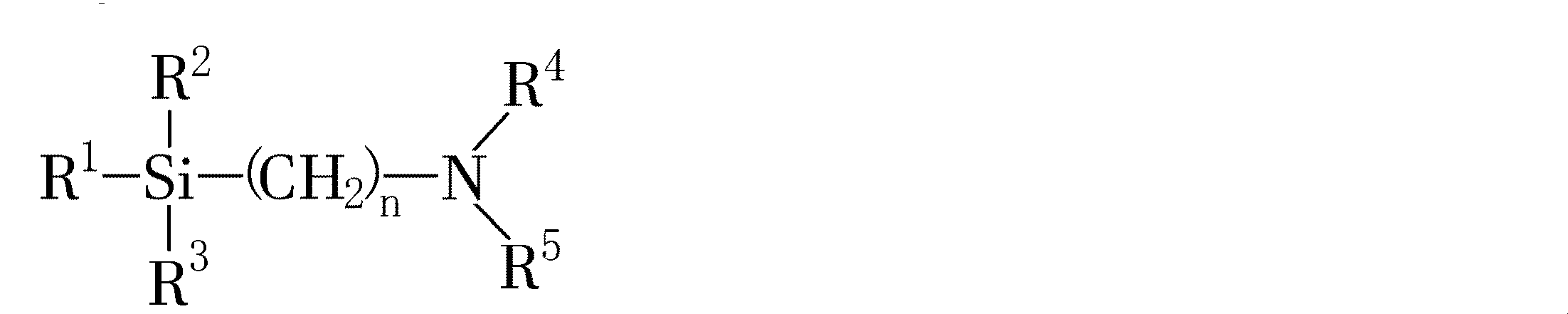
また、本実施の形態において、ゴム成分には、必要に応じて、NRと共に、5~25質量部のSBRを使用してもよく、上記したBRと併用してもよい。
また、その他のゴム成分として、必要に応じて、ニトリルゴム(NBR)などのタイヤの製造に一般的に用いられるゴム(ポリマー)を含んでもよい。
(イ)充填剤
本実施の形態において、ゴム組成物は、充填剤を含有することが好ましい。具体的な充填剤としては、例えば、カーボンブラック、シリカ、グラファイト、炭酸カルシウム、タルク、アルミナ、クレー、水酸化アルミニウム、マイカなどが挙げられ、この内でも、カーボンブラックが、補強剤として好ましく使用できる。また、必要に応じて、補強剤として、シリカを使用することも好ましいが、この場合には、シランカップリング剤と併用することが好ましい。
ゴム組成物は、カーボンブラックを含むことが好ましい。カーボンブラックの含有量は、ゴム成分100質量部に対して、例えば、10質量部以上、100質量部以下であることが好ましく、40質量部以上、70質量部以下であるとより好ましく、50質量部以上、60質量部以下であるとさらに好ましい。
ゴム組成物は、必要に応じて、さらに、シリカを含むことが好ましい。シリカのBET比表面積は、良好な耐久性能が得られる観点から140m2/g超が好ましく、160m2/g超がより好ましい。一方、良好な低転がり抵抗性が得られる観点からは250m2/g未満が好ましく、220m2/g未満であることがより好ましい。
前記したように、シリカの使用に際しては、シランカップリング剤を併用することも可能である。シランカップリング剤としては、特に限定されず、例えば、ビス(3-トリエトキシシリルプロピル)テトラスルフィド、ビス(2-トリエトキシシリルエチル)テトラスルフィド、ビス(4-トリエトキシシリルブチル)テトラスルフィド、ビス(3-トリメトキシシリルプロピル)テトラスルフィド、ビス(2-トリメトキシシリルエチル)テトラスルフィド、ビス(2-トリエトキシシリルエチル)トリスルフィド、ビス(4-トリメトキシシリルブチル)トリスルフィド、ビス(3-トリエトキシシリルプロピル)ジスルフィド、ビス(2-トリエトキシシリルエチル)ジスルフィド、ビス(4-トリエトキシシリルブチル)ジスルフィド、ビス(3-トリメトキシシリルプロピル)ジスルフィド、ビス(2-トリメトキシシリルエチル)ジスルフィド、ビス(4-トリメトキシシリルブチル)ジスルフィド、3-トリメトキシシリルプロピル-N,N-ジメチルチオカルバモイルテトラスルフィド、2-トリエトキシシリルエチル-N,N-ジメチルチオカルバモイルテトラスルフィド、3-トリエトキシシリルプロピルメタクリレートモノスルフィド、などのスルフィド系、3-メルカプトプロピルトリメトキシシラン、2-メルカプトエチルトリエトキシシラン、Momentive社製のNXT、NXT-Zなどのメルカプト系、ビニルトリエトキシシラン、ビニルトリメトキシシランなどのビニル系、3-アミノプロピルトリエトキシシラン、3-アミノプロピルトリメトキシシランなどのアミノ系、γ-グリシドキシプロピルトリエトキシシラン、γ-グリシドキシプロピルトリメトキシシランなどのグリシドキシ系、3-ニトロプロピルトリメトキシシラン、3-ニトロプロピルトリエトキシシランなどのニトロ系、3-クロロプロピルトリメトキシシラン、3-クロロプロピルトリエトキシシランなどのクロロ系などがあげられる。これらは、単独で用いてもよく、2種以上を併用してもよい。
ゴム組成物には、上記したカーボンブラック、シリカの他に、タイヤ工業において一般的に用いられている、例えば、グラファイト、炭酸カルシウム、タルク、アルミナ、クレー、水酸化アルミニウム、マイカ等の充填剤をさらに含有してもよい。これらの含有量は、ゴム成分100質量部に対して、例えば、0.1質量部超、200質量部未満である。
ゴム組成物は、変性レゾルシン樹脂、変性フェノール樹脂などの硬化性樹脂成分を含有することが好ましい。これにより、発熱性、破断時伸びを大きく悪化させることなく、スチールコードとの接着性を向上させ、ゴム、スチールコードで大きな反力を発生させやすくすることができる。
ゴム組成物は、加工性(粘着性付与)の観点から、必要に応じて、樹脂成分を含有することが好ましい。樹脂成分は、常温で固体であっても、液体であってもよく、具体的な樹脂成分としては、例えば、ロジン系樹脂、スチレン系樹脂、クマロン系樹脂、テルペン系樹脂、C5樹脂、C9樹脂、C5C9樹脂、アクリル系樹脂などの樹脂が挙げられ、2種以上を併用しても良い。樹脂成分の含有量は、ゴム成分100質量部に対して、2質量部超で、45質量部未満が好ましく、30質量部未満がより好ましい。
ゴム組成物は、有機酸コバルトを含有することが好ましい。有機酸コバルトは、コードとゴムとを架橋する役目を果たすため、この成分を配合することにより、コードとゴムとの接着性を向上させることができる。
ゴム組成物は、必要に応じて、リバージョン(加硫戻り)防止剤を含有していることが好ましい。これにより、リバージョンが抑制されて、耐久性が向上する。リバージョン防止剤の含有量は、ゴム成分100質量部に対して、0.1質量部以上、3質量部以下が好ましく、0.2質量部以上、2.5質量部以下であるとより好ましく、0.3質量部以上、2質量部以下であるとさらに好ましい。なお、具体的なリバージョン防止剤としては、例えばフレキシス社製のパーカリンク900(1,3-ビス(シトラコンイミドメチル)ベンゼン)などを使用できる。
ゴム組成物は、老化防止剤を含むことが好ましい。老化防止剤の含有量は、ゴム成分100質量部に対して、例えば、1質量部超、10質量部未満である。
ゴム組成物は、ステアリン酸を含んでもよい。ステアリン酸の含有量は、ゴム成分100質量部に対して、例えば、0.5質量部超、10.0質量部未満である。ステアリン酸としては、従来公知のものを使用でき、例えば、日油(株)、NOF社、花王(株)、富士フイルム和光純薬(株)、千葉脂肪酸(株)等の製品を使用できる。
ゴム組成物は、酸化亜鉛を含んでもよい。酸化亜鉛の含有量は、ゴム成分100質量部に対して、例えば、0.5質量部超、15質量部未満である。酸化亜鉛としては、従来公知のものを使用でき、例えば、三井金属鉱業(株)、東邦亜鉛(株)、ハクスイテック(株)、正同化学工業(株)、堺化学工業(株)等の製品を使用できる。
ゴム組成物は、硫黄等の架橋剤を含むことが好ましい。架橋剤の含有量は、ゴム成分100質量部に対して、例えば、0.1質量部超、10.0質量部未満である。
ゴム組成物には、前記成分の他、タイヤ工業において一般的に用いられている添加剤、例えば、脂肪酸金属塩、カルボン酸金属塩、有機過酸化物等を更に配合してもよい。これらの添加剤の含有量は、ゴム成分100質量部に対して、例えば、0.1質量部超、200質量部未満である。
前記ゴム組成物は、一般的な方法、例えば、ゴム成分とカーボンブラック等のフィラーとを混練するベース練り工程と、前記ベース練り工程で得られた混練物と架橋剤とを混練する仕上げ練り工程とを含む製造方法により作製される。
ベルト部材は、得られたゴム組成物を、所定の間隔で並列に配置(50本/5cm以上)された補強コード(スチールコードなどのモノフィラメントコード)の両面にトッピングすることにより製造することができる。
本開示のタイヤは、上記で得られたベルト部材を他のタイヤ部材と共に、タイヤ成型機上にて通常の方法で成形することにより、未加硫タイヤとして作製することができる。
V(mm3)={(Dt/2)2-(Dt/2-Ht)2}×π×Wt
WL(kg)=0.000011×V+175
最初に、ベルト用ゴム組成物の製造を行った。
まず、以下に示す各配合材料を準備した。
NR:RSS3
(イ)カーボンブラック-1:キャボットジャパン(株)製のショウブラックN326
(N2SA:78m2/g)
(ロ)カーボンブラック-2:キャボットジャパン(株)製のショウブラックN550
(N2SA:42m2/g)
(ハ)硬化性樹脂成分-1:住友ベークライト(株)製のPR12686
(カシューオイル変性フェノール樹脂)
(ニ)硬化性樹脂成分-2:田岡化学工業(株)製のスミカノール620
(変性レゾルシン樹脂)
(ホ)硬化剤:田岡化学工業(株)製のスミカノール507
(メチレン供与体)
(ヘ)有機酸コバルト:DIC(株)製のDICNATE NBC-2
(ネオデカン酸ホウ素コバルト、コバルト含有量22.5質量%)
(ト)酸化亜鉛:三井金属鉱業(株)製の亜鉛華1号
(チ)老化防止剤-1:大内新興化学工業(株)製のノクラック6C
(N-フェニル-N′-(1,3-ジメチルブチル)-p-フェニレンジアミン)
(リ)老化防止剤-2:川口化学工業(株)製のアンテージRD
(2,2,4-トリメチル-1,2-ジヒドロキノリン)
(ヌ)ステアリン酸:日油(株)製のステアリン酸「椿」
(ル)架橋剤および加硫促進剤、架橋助剤
硫黄:鶴見化学工業(株)製の粉末硫黄
加硫促進剤:大内新興化学工業(株)製のノクセラー DZ
(N,N-ジシクロヘキシル-2-べンゾチアゾリルスルフェンアミド)
架橋助剤:フレクシス社製のデュラリンクHTS
表1~表4に示す各配合内容に従い、バンバリーミキサーを用いて、硬化剤、硫黄および加硫促進剤以外の材料を150℃の条件下で5分間混練りして、混練物を得た。なお、各配合量は、質量部である。
まず、表1~表4に示す構成および外径のスチールコードを、表1~表4に示すエンズ(本/5cm)で配列させた後、先に得られたベルト用ゴム組成物をその両面に被覆してベルト部材を作製した。この時、ベルト部材の厚さ方向中央にスチールコードが配される様、上下に同量のゴムをトッピングさせ、加硫後のタイヤにおいて、1組のベルト層内のスチールコード間が、表1~4に示す平均距離Dとなるように厚さを適宜調整した。
その後、各試験用タイヤの外径Dt(mm)、断面幅Wt(mm)を求めた。併せて、各試験用タイヤのベルト層間からゴム組成物を切り出して、長さ40mm、幅4mmの粘弾性測定用ゴム試験片を作製し、GABO社製のイプレクサーシリーズを用いて、70℃、周波数10Hz、初期歪5%、動歪率1%の条件下でtanδおよびE*を測定した。結果を、表1~表4に示す。なお、同一のゴム組成物を用いているものについては、各仕様からゴム組成物の粘弾性を測定し、平均値を求めた結果を示している。
(1)低転がり抵抗性の評価
各試験用タイヤを車輌(国産のFF車、排気量2000cc)の全輪に装着させて、内圧が250kPaとなるように空気を充填した後、乾燥路面のテストコース上を、80km/hの速度で10km周回した後、アクセルを離し、アクセルをオフにしてから車両が止まるまでの距離を計測した。
低転がり抵抗性=
[(試験用タイヤの結果)/(比較例10の結果)]×100
各試験用タイヤを車輌(国産のFF車、排気量2000cc)の全輪に装着させて、内圧が250kPaとなるように空気を充填した後、乾燥路面のテストコース上を、40km/hおよび120km/hで走行し、走行速度を変えたことによるハンドリング性の変化を、1(大幅な変化を感じる)から5(殆ど変化を感じない)までの5段階で、ドライバーが官能にて評価した。そして、20人のドライバーによる評価の合計点を算出した。
操縦安定性=
[(試験用タイヤの結果)/(比較例10の結果)]×100
上記(1)、(2)の評価結果を合計して総合評価とした。
各評価の結果を、表1~表4に示す。
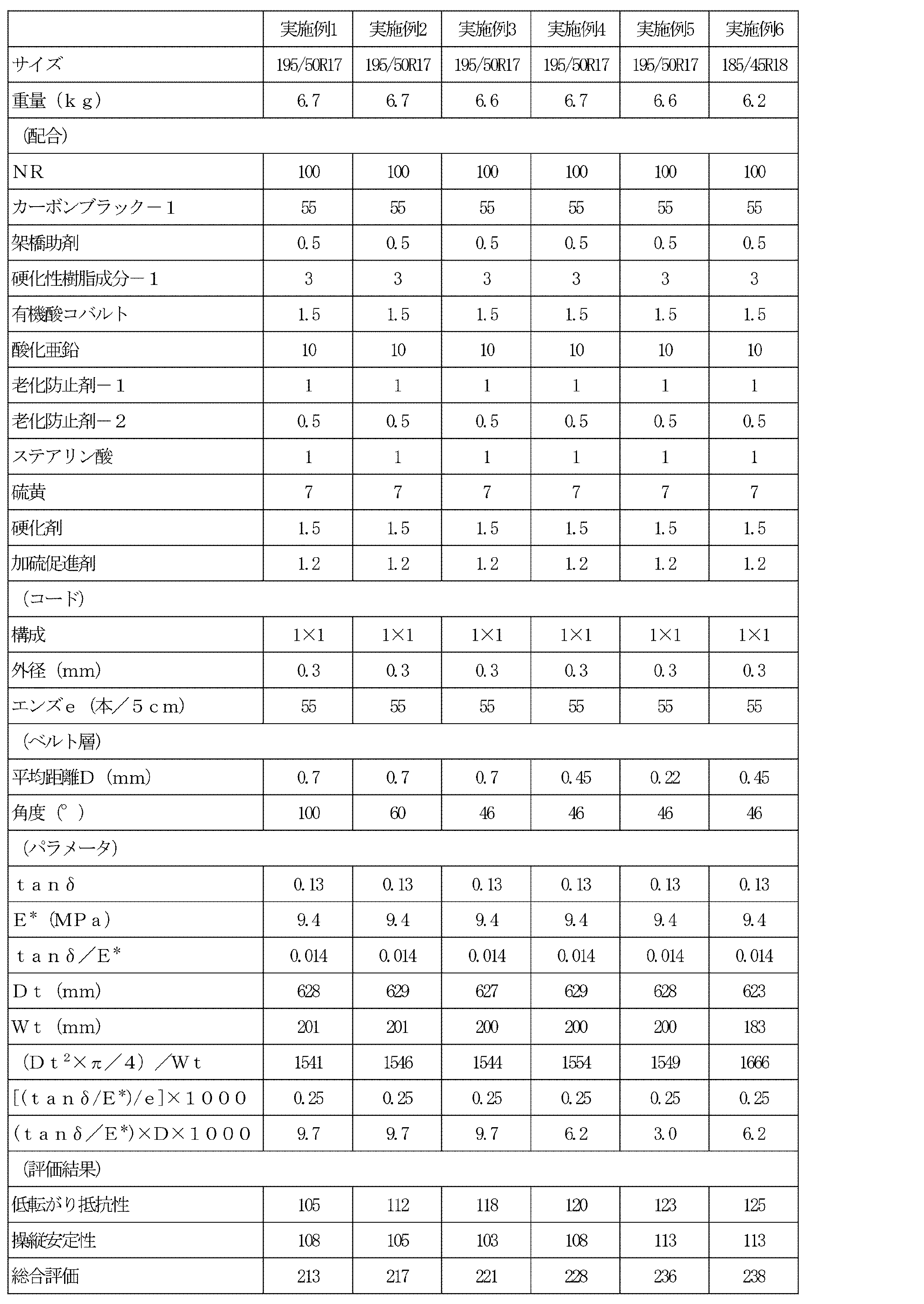
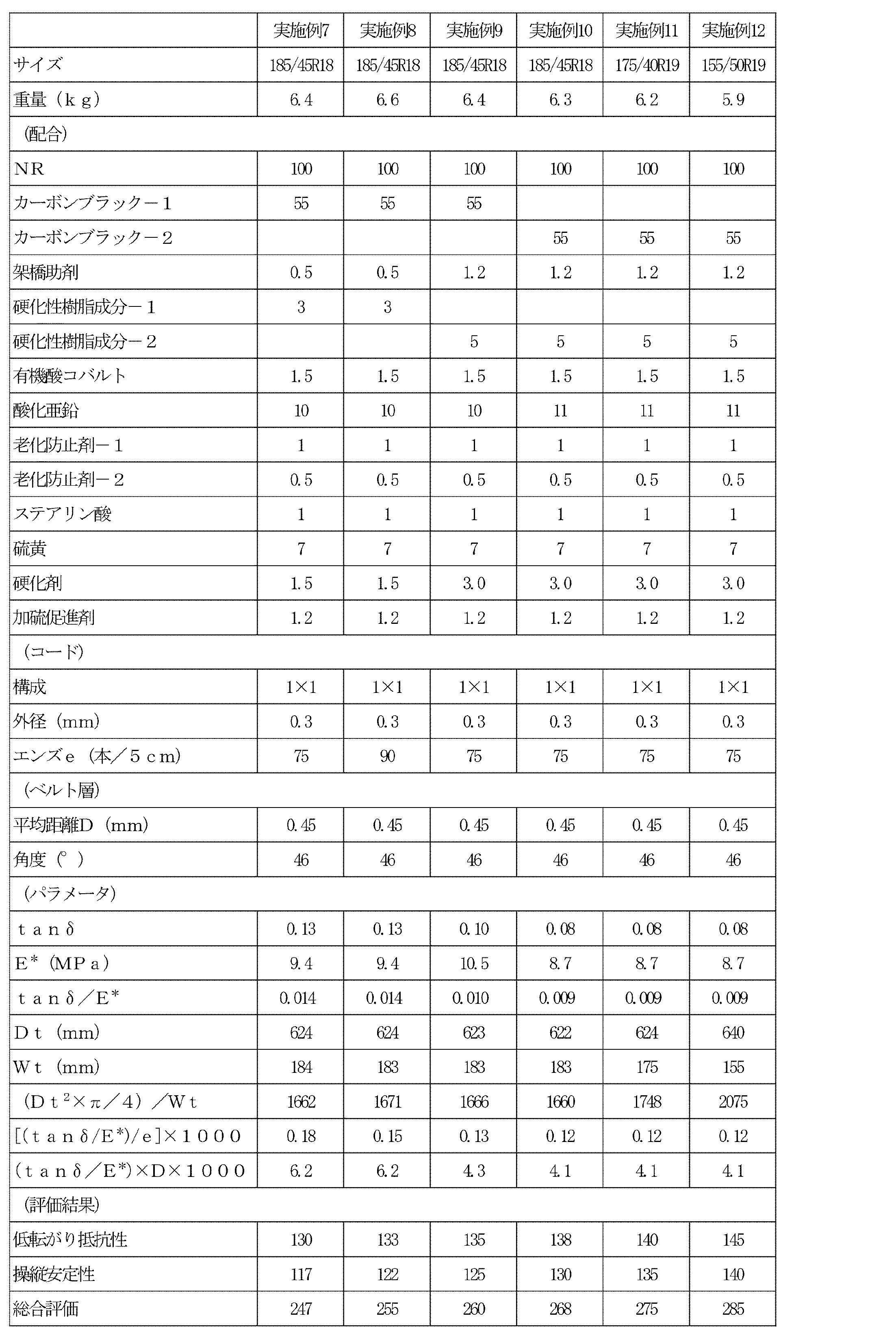


トレッド部およびベルト層を有するタイヤであって、
前記ベルト層における補強コードは、モノフィラメントからなるコードが、前記ベルト層のタイヤ半径方向断面において、タイヤ幅方向に、50本/5cm以上配列されて構成されており、
正規リムに組み込まれ、内圧を250kPaとした際のタイヤの断面幅をWt(mm)、外径をDt(mm)としたとき、下記(式1)を満足することを特徴とする空気入りタイヤである。
1500≦(Dt2×π/4)/Wt・・・・・ (式1)
下記(式2)を満足することを特徴とし、本開示(1)に記載の空気入りタイヤである。
1600≦(Dt2×π/4)/Wt・・・・・ (式2)
下記(式3)を満足することを特徴とし、本開示(2)に記載の空気入りタイヤである。
1700≦(Dt2×π/4)/Wt・・・・・ (式3)
前記モノフィラメントからなるコードのコード外径が、0.1mm以上、0.5mm以下であることを特徴とし、本開示(1)から(3)のいずれかとの任意の組合せの空気入りタイヤである。
前記タイヤ幅方向5cmあたりの前記モノフィラメントコードの配列本数e(本/5cm)が、75本/5cm以上であることを特徴とし、本開示(1)から(4)のいずれかとの任意の組合せの空気入りタイヤである。
前記ベルト層において、
前記補強コードは、ゴム組成物により被覆されており、
前記ゴム組成物を、温度:70℃、初期歪:5%、動歪:±1%、周波数:10Hzの条件下、変形モード:伸張で測定した複素弾性率E*(MPa)、および変形モード:引張で測定した損失正接(tanδ)と、
前記補強コードの、前記トレッド部におけるタイヤ幅方向5cmあたりの配列本数e(本)とが、
下記(式4)を満足することを特徴とし、本開示(1)から(5)のいずれかとの任意の組合せの空気入りタイヤである。
[(tanδ/E*)/e]×1000≦0.2・・・(式4)
下記(式5)を満足することを特徴とし、本開示(6)に記載の空気入りタイヤである。
[(tanδ/E*)/e]×1000≦0.12・・・(式5)
前記(tanδ/E*)が、0.002以上、0.017以下であることを特徴とし、本開示(6)または(7)に記載の空気入りタイヤである。
前記ベルト層が少なくとも2層設けられており、
前記タイヤの半径方向に隣り合う1組のベルト層の少なくとも1組において、
前記トレッド部における互いのベルト層内のコード間の平均距離D(mm)が、0.6mm以下であることを特徴とし、本開示(1)から(8)のいずれかとの任意の組合せの空気入りタイヤである。
前記ベルト層が少なくとも2層設けられており、
前記タイヤの半径方向に隣り合う1組のベルト層の少なくとも1組において、
前記トレッド部における互いのベルト層内のコードがタイヤ周方向上でなす角度が、65°以下であることを特徴とし、本開示(1)から(9)のいずれかとの任意の組合せの空気入りタイヤである。
前記ベルト層が少なくとも2層設けられており、
前記タイヤの半径方向に隣り合う1組のベルト層の少なくとも1組において、
前記補強コードを被覆しているゴム組成物を、温度:70℃、初期歪:5%、動歪:±1%、周波数:10Hzの条件下、変形モード:伸張で測定した複素弾性率E*(MPa)、および変形モード:引張で測定した損失正接tanδと、
前記トレッド部における互いのベルト層内のコード間の平均距離D(mm)とが、下記(式6)を満足することを特徴とし、本開示(1)から(10)のいずれかとの任意の組合せの空気入りタイヤである。
(tanδ/E*)×D×1000≦8.0・・・(式6)
前記ベルト層において、前記補強コードを被覆しているゴム組成物が、ゴム成分100質量部に対して、60質量部以下のカーボンブラックを含有していることを特徴とし、本開示(1)から(11)のいずれかとの任意の組合せの空気入りタイヤである。
タイヤ周方向に連続して延びる周方向溝を前記トレッド部に有しており、
前記トレッド部の接地面における前記周方向溝の溝幅L0に対する前記周方向溝の最大の深さの80%の深さにおける溝幅L80の比(L80/L0)が、0.2以上、0.7以下であることを特徴とし、本開示(1)から(12)のいずれかとの任意の組合せの空気入りタイヤである。
タイヤ周方向に連続して延びる複数本の周方向溝を前記トレッド部に有しており、
前記複数本の周方向溝の断面積の合計が、前記トレッド部の断面積の10%以上、30%以下であることを特徴とし、本開示(1)から(13)のいずれかとの任意の組合せの空気入りタイヤである。
タイヤ軸方向に延びる複数本の横溝を前記トレッド部に有しており、
前記複数本の横溝の容積の合計が、前記トレッド部の体積の2.0%以上、5.0%以下であることを特徴とし、本開示(1)から(14)のいずれかとの任意の組合せの空気入りタイヤである。
タイヤ軸方向に延びる複数本の横溝を前記トレッド部に有しており、
前記複数本の横溝に、溝深さGdに対する溝幅Gwの比(Gw/Gd)が、0.50以上、0.80以下である横溝が含まれていることを特徴とし、本開示(1)から(15)のいずれかとの任意の組合せの空気入りタイヤである。
前記タイヤの断面幅Wt(mm)が、200mm未満であることを特徴とし、本開示(1)から(16)のいずれかとの任意の組合せの空気入りタイヤである。
前記タイヤの外径をDt(mm)、断面高さをHt(mm)としたとき、(Dt-2×Ht)が、450(mm)以上、560(mm)未満であることを特徴とし、本開示(1)から(17)のいずれかとの任意の組合せの空気入りタイヤである。
乗用車用タイヤであることを特徴とし、本開示(1)から(18)のいずれかとの任意の組合せの空気入りタイヤである。
Claims (19)
- トレッド部およびベルト層を有するタイヤであって、
前記ベルト層における補強コードは、モノフィラメントからなるコードが、前記ベルト層のタイヤ半径方向断面において、タイヤ幅方向に、50本/5cm以上配列されて構成されており、
正規リムに組み込まれ、内圧を250kPaとした際のタイヤの断面幅をWt(mm)、外径をDt(mm)としたとき、下記(式1)を満足することを特徴とする空気入りタイヤ。
1500≦(Dt2×π/4)/Wt・・・・・ (式1) - 下記(式2)を満足することを特徴とする請求項1に記載の空気入りタイヤ。
1600≦(Dt2×π/4)/Wt・・・・・ (式2) - 下記(式3)を満足することを特徴とする請求項2に記載の空気入りタイヤ。
1700≦(Dt2×π/4)/Wt・・・・・ (式3) - 前記モノフィラメントからなるコードのコード外径が、0.1mm以上、0.5mm以下であることを特徴とする請求項1ないし請求項3のいずれか1項に記載の空気入りタイヤ。
- 前記タイヤ幅方向5cmあたりの前記モノフィラメントコードの配列本数e(本/5cm)が、75本/5cm以上であることを特徴とする請求項1ないし請求項4のいずれか1項に記載の空気入りタイヤ。
- 前記ベルト層において、
前記補強コードは、ゴム組成物により被覆されており、
前記ゴム組成物を、温度:70℃、初期歪:5%、動歪:±1%、周波数:10Hzの条件下、変形モード:伸張で測定した複素弾性率E*(MPa)、および変形モード:引張で測定した損失正接(tanδ)と、
前記補強コードの、前記トレッド部におけるタイヤ幅方向5cmあたりの配列本数e(本)とが、
下記(式4)を満足することを特徴とする請求項1ないし請求項5のいずれか1項に記載の空気入りタイヤ。
[(tanδ/E*)/e]×1000≦0.2・・・(式4) - 下記(式5)を満足することを特徴とする請求項6に記載の空気入りタイヤ。
[(tanδ/E*)/e]×1000≦0.12・・・(式5) - 前記(tanδ/E*)が、0.002以上、0.017以下であることを特徴とする請求項6または請求項7に記載の空気入りタイヤ。
- 前記ベルト層が少なくとも2層設けられており、
前記タイヤの半径方向に隣り合う1組のベルト層の少なくとも1組において、
前記トレッド部における互いのベルト層内のコード間の平均距離D(mm)が、0.6mm以下であることを特徴とする請求項1ないし請求項8のいずれか1項に記載の空気入りタイヤ。 - 前記ベルト層が少なくとも2層設けられており、
前記タイヤの半径方向に隣り合う1組のベルト層の少なくとも1組において、
前記トレッド部における互いのベルト層内のコードがタイヤ周方向上でなす角度が、65°以下であることを特徴とする請求項1ないし請求項9のいずれか1項に記載の空気入りタイヤ。 - 前記ベルト層が少なくとも2層設けられており、
前記タイヤの半径方向に隣り合う1組のベルト層の少なくとも1組において、
前記補強コードを被覆しているゴム組成物を、温度:70℃、初期歪:5%、動歪:±1%、周波数:10Hzの条件下、変形モード:伸張で測定した複素弾性率E*(MPa)、および変形モード:引張で測定した損失正接tanδと、
前記トレッド部における互いのベルト層内のコード間の平均距離D(mm)とが、下記(式6)を満足することを特徴とする請求項1ないし請求項10のいずれか1項に記載の空気入りタイヤ。
(tanδ/E*)×D×1000≦8.0・・・(式6) - 前記ベルト層において、前記補強コードを被覆しているゴム組成物が、ゴム成分100質量部に対して、60質量部以下のカーボンブラックを含有していることを特徴とする請求項1ないし請求項11のいずれか1項に記載の空気入りタイヤ。
- タイヤ周方向に連続して延びる周方向溝を前記トレッド部に有しており、
前記トレッド部の接地面における前記周方向溝の溝幅L0に対する前記周方向溝の最大の深さの80%の深さにおける溝幅L80の比(L80/L0)が、0.2以上、0.7以下であることを特徴とする請求項1ないし請求項12のいずれか1項に記載の空気入りタイヤ。 - タイヤ周方向に連続して延びる複数本の周方向溝を前記トレッド部に有しており、
前記複数本の周方向溝の断面積の合計が、前記トレッド部の断面積の10%以上、30%以下であることを特徴とする請求項1ないし請求項13のいずれか1項に記載の空気入りタイヤ。 - タイヤ軸方向に延びる複数本の横溝を前記トレッド部に有しており、
前記複数本の横溝の容積の合計が、前記トレッド部の体積の2.0%以上、5.0%以下であることを特徴とする請求項1ないし請求項14のいずれか1項に記載の空気入りタイヤ。 - タイヤ軸方向に延びる複数本の横溝を前記トレッド部に有しており、
前記複数本の横溝に、溝深さGdに対する溝幅Gwの比(Gw/Gd)が、0.50以上、0.80以下である横溝が含まれていることを特徴とする請求項1ないし請求項15のいずれか1項に記載の空気入りタイヤ。 - 前記タイヤの断面幅Wt(mm)が、200mm未満であることを特徴とする請求項1ないし請求項16のいずれか1項に記載の空気入りタイヤ。
- 前記タイヤの外径をDt(mm)、断面高さをHt(mm)としたとき、(Dt-2×Ht)が、450(mm)以上、560(mm)未満であることを特徴とする請求項1ないし請求項17のいずれか1項に記載の空気入りタイヤ。
- 乗用車用タイヤであることを特徴とする請求項1ないし請求項18のいずれか1項に記載の空気入りタイヤ。
Priority Applications (4)
| Application Number | Priority Date | Filing Date | Title |
|---|---|---|---|
| JP2022572923A JP7775841B2 (ja) | 2020-12-28 | 2021-10-26 | 空気入りタイヤ |
| US18/269,454 US20240051339A1 (en) | 2020-12-28 | 2021-10-26 | Pneumatic tire |
| EP21914982.0A EP4269130A4 (en) | 2020-12-28 | 2021-10-26 | TIRE |
| CN202180087149.6A CN116635246A (zh) | 2020-12-28 | 2021-10-26 | 充气轮胎 |
Applications Claiming Priority (2)
| Application Number | Priority Date | Filing Date | Title |
|---|---|---|---|
| JP2020218124 | 2020-12-28 | ||
| JP2020-218124 | 2020-12-28 |
Publications (1)
| Publication Number | Publication Date |
|---|---|
| WO2022145121A1 true WO2022145121A1 (ja) | 2022-07-07 |
Family
ID=82260337
Family Applications (1)
| Application Number | Title | Priority Date | Filing Date |
|---|---|---|---|
| PCT/JP2021/039501 Ceased WO2022145121A1 (ja) | 2020-12-28 | 2021-10-26 | 空気入りタイヤ |
Country Status (5)
| Country | Link |
|---|---|
| US (1) | US20240051339A1 (ja) |
| EP (1) | EP4269130A4 (ja) |
| JP (1) | JP7775841B2 (ja) |
| CN (1) | CN116635246A (ja) |
| WO (1) | WO2022145121A1 (ja) |
Cited By (2)
| Publication number | Priority date | Publication date | Assignee | Title |
|---|---|---|---|---|
| EP4385757A1 (en) * | 2022-12-16 | 2024-06-19 | Sumitomo Rubber Industries, Ltd. | Tire |
| EP4219192B1 (en) * | 2021-01-07 | 2024-12-04 | Sumitomo Rubber Industries, Ltd. | Pneumatic tire |
Families Citing this family (1)
| Publication number | Priority date | Publication date | Assignee | Title |
|---|---|---|---|---|
| JP7834270B2 (ja) * | 2020-12-28 | 2026-03-24 | 住友ゴム工業株式会社 | 空気入りタイヤ |
Citations (19)
| Publication number | Priority date | Publication date | Assignee | Title |
|---|---|---|---|---|
| US4414370A (en) | 1981-01-09 | 1983-11-08 | S. C. Johnson & Son, Inc. | Process for continuous bulk copolymerization of vinyl monomers |
| JPS596207A (ja) | 1982-06-15 | 1984-01-13 | エス・シ−・ジヨンソン・アンド・サン・インコ−ポレ−テツド | バルク重合方法とポリマ−生成物 |
| JPH01313522A (ja) | 1988-04-26 | 1989-12-19 | S C Johnson & Son Inc | 環状エステル修飾アクリル系ポリマーの触媒塊状製造方法 |
| US5010166A (en) | 1987-03-05 | 1991-04-23 | S. C. Johnson & Son, Inc. | Process and apparatus for producing polyol polymers and polyol polymers so produced |
| JPH0558005B2 (ja) | 1984-02-29 | 1993-08-25 | Johnson & Son Inc S C | |
| US5858137A (en) | 1996-03-06 | 1999-01-12 | The Goodyear Tire & Rubber Company | Radial tires having at least two belt plies reinforced with steel monofilaments |
| JP2001334809A (ja) * | 2000-05-24 | 2001-12-04 | Bridgestone Corp | 空気入りラジアルタイヤ |
| JP2007015638A (ja) * | 2005-07-11 | 2007-01-25 | Bridgestone Corp | 空気入りタイヤ |
| JP2008156418A (ja) * | 2006-12-21 | 2008-07-10 | Sumitomo Rubber Ind Ltd | スチールコード被覆用ゴム組成物、ならびにそれでスチールコードを被覆して得られるベルトまたはブレーカーを有するタイヤ |
| JP2010089727A (ja) * | 2008-10-10 | 2010-04-22 | Bridgestone Corp | 空気入りタイヤおよびその製造方法 |
| JP2013122038A (ja) * | 2011-11-08 | 2013-06-20 | Sumitomo Rubber Ind Ltd | タイヤコード被覆、ブレーカーエッジストリップ、ブレーカークッション又はコード隣接ストリップ用ゴム組成物、及び空気入りタイヤ |
| JP2015511197A (ja) * | 2012-02-09 | 2015-04-16 | コンパニー ゼネラール デ エタブリッスマン ミシュラン | 軽量化ベルト構造を有するタイヤ |
| JP2016210388A (ja) * | 2015-05-13 | 2016-12-15 | 株式会社ブリヂストン | 乗用車用空気入りタイヤ |
| JP2017052329A (ja) * | 2015-09-07 | 2017-03-16 | 株式会社ブリヂストン | 乗用車用空気入りタイヤ |
| WO2018186367A1 (ja) | 2017-04-06 | 2018-10-11 | 株式会社ブリヂストン | ゴム組成物及びタイヤ |
| JP2018178034A (ja) | 2017-04-19 | 2018-11-15 | 株式会社ブリヂストン | ゴム組成物およびそれを用いたタイヤ |
| JP2019089911A (ja) | 2017-11-13 | 2019-06-13 | 株式会社ブリヂストン | タイヤ用ゴム組成物およびタイヤ |
| JP2019206643A (ja) | 2018-05-29 | 2019-12-05 | 横浜ゴム株式会社 | タイヤ用ゴム組成物の製造方法 |
| JP6769573B1 (ja) * | 2020-02-28 | 2020-10-14 | 住友ゴム工業株式会社 | タイヤ |
Family Cites Families (17)
| Publication number | Priority date | Publication date | Assignee | Title |
|---|---|---|---|---|
| US4811771A (en) * | 1988-01-07 | 1989-03-14 | General Tire, Inc. | Aerodynamic profile tire |
| EP0422902B1 (en) * | 1989-10-12 | 1995-09-06 | Bridgestone Corporation | Pneumatic radial tires |
| JP2800944B2 (ja) * | 1989-10-12 | 1998-09-21 | 住友ゴム工業 株式会社 | 空気入りタイヤ |
| JPH07117407A (ja) * | 1993-10-25 | 1995-05-09 | Yokohama Rubber Co Ltd:The | 空気入りラジアルタイヤ |
| JP3391538B2 (ja) * | 1994-02-02 | 2003-03-31 | 住友ゴム工業株式会社 | スタッドレスタイヤ |
| JP3291114B2 (ja) * | 1994-03-28 | 2002-06-10 | 住友ゴム工業株式会社 | スチールベルト用ゴム組成物 |
| JPH11217005A (ja) * | 1997-11-26 | 1999-08-10 | Bridgestone Corp | 空気入りラジアルタイヤ |
| DE60113006T2 (de) * | 2000-05-12 | 2006-03-16 | Bridgestone Corp. | Radialer Reifen |
| US20020092591A1 (en) * | 2001-01-17 | 2002-07-18 | Max Cortes | Tapered tire groove configuration |
| JP2008143484A (ja) * | 2006-12-13 | 2008-06-26 | Bridgestone Corp | 空気入りタイヤ |
| JP2008189048A (ja) * | 2007-02-01 | 2008-08-21 | Bridgestone Corp | 空気入りタイヤ |
| WO2012176476A1 (ja) * | 2011-06-22 | 2012-12-27 | 株式会社ブリヂストン | 乗用車用空気入りラジアルタイヤ、該タイヤの使用方法及び、該タイヤを備えるタイヤ・リム組立体 |
| DE112012005462T5 (de) * | 2011-12-26 | 2014-09-11 | The Yokohama Rubber Co., Ltd | Radialluftreifen |
| BR102013028758A2 (pt) * | 2012-11-08 | 2017-07-11 | Sumitomo Rubber Industries, Ltd. | Rubber compositions for square axle, side wall sealing, base wheel band, brake shock, steel cabin coat, strip adjacent to steel cables, intermediate rubber and side wall and tires |
| JP6322283B2 (ja) * | 2013-07-30 | 2018-05-09 | コンパニー ゼネラール デ エタブリッスマン ミシュラン | 軽量ベルト構造体を有するラジアルタイヤ |
| JP7198071B2 (ja) * | 2018-12-13 | 2022-12-28 | 株式会社ブリヂストン | 乗用車用空気入りラジアルタイヤ |
| JP6800435B1 (ja) * | 2020-07-28 | 2020-12-16 | 住友ゴム工業株式会社 | 空気入りタイヤ |
-
2021
- 2021-10-26 EP EP21914982.0A patent/EP4269130A4/en active Pending
- 2021-10-26 JP JP2022572923A patent/JP7775841B2/ja active Active
- 2021-10-26 US US18/269,454 patent/US20240051339A1/en active Pending
- 2021-10-26 CN CN202180087149.6A patent/CN116635246A/zh active Pending
- 2021-10-26 WO PCT/JP2021/039501 patent/WO2022145121A1/ja not_active Ceased
Patent Citations (19)
| Publication number | Priority date | Publication date | Assignee | Title |
|---|---|---|---|---|
| US4414370A (en) | 1981-01-09 | 1983-11-08 | S. C. Johnson & Son, Inc. | Process for continuous bulk copolymerization of vinyl monomers |
| JPS596207A (ja) | 1982-06-15 | 1984-01-13 | エス・シ−・ジヨンソン・アンド・サン・インコ−ポレ−テツド | バルク重合方法とポリマ−生成物 |
| JPH0558005B2 (ja) | 1984-02-29 | 1993-08-25 | Johnson & Son Inc S C | |
| US5010166A (en) | 1987-03-05 | 1991-04-23 | S. C. Johnson & Son, Inc. | Process and apparatus for producing polyol polymers and polyol polymers so produced |
| JPH01313522A (ja) | 1988-04-26 | 1989-12-19 | S C Johnson & Son Inc | 環状エステル修飾アクリル系ポリマーの触媒塊状製造方法 |
| US5858137A (en) | 1996-03-06 | 1999-01-12 | The Goodyear Tire & Rubber Company | Radial tires having at least two belt plies reinforced with steel monofilaments |
| JP2001334809A (ja) * | 2000-05-24 | 2001-12-04 | Bridgestone Corp | 空気入りラジアルタイヤ |
| JP2007015638A (ja) * | 2005-07-11 | 2007-01-25 | Bridgestone Corp | 空気入りタイヤ |
| JP2008156418A (ja) * | 2006-12-21 | 2008-07-10 | Sumitomo Rubber Ind Ltd | スチールコード被覆用ゴム組成物、ならびにそれでスチールコードを被覆して得られるベルトまたはブレーカーを有するタイヤ |
| JP2010089727A (ja) * | 2008-10-10 | 2010-04-22 | Bridgestone Corp | 空気入りタイヤおよびその製造方法 |
| JP2013122038A (ja) * | 2011-11-08 | 2013-06-20 | Sumitomo Rubber Ind Ltd | タイヤコード被覆、ブレーカーエッジストリップ、ブレーカークッション又はコード隣接ストリップ用ゴム組成物、及び空気入りタイヤ |
| JP2015511197A (ja) * | 2012-02-09 | 2015-04-16 | コンパニー ゼネラール デ エタブリッスマン ミシュラン | 軽量化ベルト構造を有するタイヤ |
| JP2016210388A (ja) * | 2015-05-13 | 2016-12-15 | 株式会社ブリヂストン | 乗用車用空気入りタイヤ |
| JP2017052329A (ja) * | 2015-09-07 | 2017-03-16 | 株式会社ブリヂストン | 乗用車用空気入りタイヤ |
| WO2018186367A1 (ja) | 2017-04-06 | 2018-10-11 | 株式会社ブリヂストン | ゴム組成物及びタイヤ |
| JP2018178034A (ja) | 2017-04-19 | 2018-11-15 | 株式会社ブリヂストン | ゴム組成物およびそれを用いたタイヤ |
| JP2019089911A (ja) | 2017-11-13 | 2019-06-13 | 株式会社ブリヂストン | タイヤ用ゴム組成物およびタイヤ |
| JP2019206643A (ja) | 2018-05-29 | 2019-12-05 | 横浜ゴム株式会社 | タイヤ用ゴム組成物の製造方法 |
| JP6769573B1 (ja) * | 2020-02-28 | 2020-10-14 | 住友ゴム工業株式会社 | タイヤ |
Non-Patent Citations (2)
| Title |
|---|
| See also references of EP4269130A4 |
| TOAGOSEI ANNUAL REPORT TREND2000, vol. 3, pages 42 - 45 |
Cited By (2)
| Publication number | Priority date | Publication date | Assignee | Title |
|---|---|---|---|---|
| EP4219192B1 (en) * | 2021-01-07 | 2024-12-04 | Sumitomo Rubber Industries, Ltd. | Pneumatic tire |
| EP4385757A1 (en) * | 2022-12-16 | 2024-06-19 | Sumitomo Rubber Industries, Ltd. | Tire |
Also Published As
| Publication number | Publication date |
|---|---|
| CN116635246A (zh) | 2023-08-22 |
| EP4269130A1 (en) | 2023-11-01 |
| US20240051339A1 (en) | 2024-02-15 |
| JPWO2022145121A1 (ja) | 2022-07-07 |
| EP4269130A4 (en) | 2024-07-03 |
| JP7775841B2 (ja) | 2025-11-26 |
Similar Documents
| Publication | Publication Date | Title |
|---|---|---|
| EP3812174B1 (en) | Tire rubber composition and pneumatic tire | |
| WO2022025005A1 (ja) | 空気入りタイヤ | |
| JP6819028B1 (ja) | 空気入りタイヤ | |
| EP4219192B1 (en) | Pneumatic tire | |
| WO2022025006A1 (ja) | 空気入りタイヤ | |
| JP7775841B2 (ja) | 空気入りタイヤ | |
| EP4209360B1 (en) | Pneumatic tire | |
| EP4023462B1 (en) | Pneumatic tire | |
| EP4023463B1 (en) | Pneumatic tire | |
| EP4269494B1 (en) | Pneumatic tire | |
| EP4026706B1 (en) | Pneumatic tire | |
| EP4269132B1 (en) | Pneumatic tire | |
| WO2022049915A1 (ja) | 空気入りタイヤ | |
| WO2021079673A1 (ja) | タイヤ | |
| JP2022029210A (ja) | 乗用車用空気入りタイヤ |
Legal Events
| Date | Code | Title | Description |
|---|---|---|---|
| 121 | Ep: the epo has been informed by wipo that ep was designated in this application |
Ref document number: 21914982 Country of ref document: EP Kind code of ref document: A1 |
|
| ENP | Entry into the national phase |
Ref document number: 2022572923 Country of ref document: JP Kind code of ref document: A |
|
| WWE | Wipo information: entry into national phase |
Ref document number: 202180087149.6 Country of ref document: CN |
|
| WWE | Wipo information: entry into national phase |
Ref document number: 18269454 Country of ref document: US |
|
| WWE | Wipo information: entry into national phase |
Ref document number: 2021914982 Country of ref document: EP |
|
| NENP | Non-entry into the national phase |
Ref country code: DE |
|
| ENP | Entry into the national phase |
Ref document number: 2021914982 Country of ref document: EP Effective date: 20230728 |