WO2022145231A1 - 複合吸収体及び衛生用品 - Google Patents
複合吸収体及び衛生用品 Download PDFInfo
- Publication number
- WO2022145231A1 WO2022145231A1 PCT/JP2021/046266 JP2021046266W WO2022145231A1 WO 2022145231 A1 WO2022145231 A1 WO 2022145231A1 JP 2021046266 W JP2021046266 W JP 2021046266W WO 2022145231 A1 WO2022145231 A1 WO 2022145231A1
- Authority
- WO
- WIPO (PCT)
- Prior art keywords
- absorbent
- pore
- pores
- polymer
- pore radius
- Prior art date
- Legal status (The legal status is an assumption and is not a legal conclusion. Google has not performed a legal analysis and makes no representation as to the accuracy of the status listed.)
- Ceased
Links
Images




Classifications
-
- A—HUMAN NECESSITIES
- A61—MEDICAL OR VETERINARY SCIENCE; HYGIENE
- A61F—FILTERS IMPLANTABLE INTO BLOOD VESSELS; PROSTHESES; DEVICES PROVIDING PATENCY TO, OR PREVENTING COLLAPSING OF, TUBULAR STRUCTURES OF THE BODY, e.g. STENTS; ORTHOPAEDIC, NURSING OR CONTRACEPTIVE DEVICES; FOMENTATION; TREATMENT OR PROTECTION OF EYES OR EARS; BANDAGES, DRESSINGS OR ABSORBENT PADS; FIRST-AID KITS
- A61F13/00—Bandages or dressings; Absorbent pads
- A61F13/15—Absorbent pads, e.g. sanitary towels, swabs or tampons for external or internal application to the body; Supporting or fastening means therefor; Tampon applicators
- A61F13/15577—Apparatus or processes for manufacturing
- A61F13/15617—Making absorbent pads from fibres or pulverulent material with or without treatment of the fibres
-
- A—HUMAN NECESSITIES
- A61—MEDICAL OR VETERINARY SCIENCE; HYGIENE
- A61L—METHODS OR APPARATUS FOR STERILISING MATERIALS OR OBJECTS IN GENERAL; DISINFECTION, STERILISATION OR DEODORISATION OF AIR; CHEMICAL ASPECTS OF BANDAGES, DRESSINGS, ABSORBENT PADS OR SURGICAL ARTICLES; MATERIALS FOR BANDAGES, DRESSINGS, ABSORBENT PADS OR SURGICAL ARTICLES
- A61L15/00—Chemical aspects of, or use of materials for, bandages, dressings or absorbent pads
- A61L15/16—Bandages, dressings or absorbent pads for physiological fluids such as urine or blood, e.g. sanitary towels, tampons
- A61L15/42—Use of materials characterised by their function or physical properties
- A61L15/425—Porous materials, e.g. foams or sponges
-
- A—HUMAN NECESSITIES
- A61—MEDICAL OR VETERINARY SCIENCE; HYGIENE
- A61L—METHODS OR APPARATUS FOR STERILISING MATERIALS OR OBJECTS IN GENERAL; DISINFECTION, STERILISATION OR DEODORISATION OF AIR; CHEMICAL ASPECTS OF BANDAGES, DRESSINGS, ABSORBENT PADS OR SURGICAL ARTICLES; MATERIALS FOR BANDAGES, DRESSINGS, ABSORBENT PADS OR SURGICAL ARTICLES
- A61L15/00—Chemical aspects of, or use of materials for, bandages, dressings or absorbent pads
- A61L15/16—Bandages, dressings or absorbent pads for physiological fluids such as urine or blood, e.g. sanitary towels, tampons
- A61L15/42—Use of materials characterised by their function or physical properties
- A61L15/60—Liquid-swellable gel-forming materials, e.g. super-absorbents
-
- A—HUMAN NECESSITIES
- A61—MEDICAL OR VETERINARY SCIENCE; HYGIENE
- A61F—FILTERS IMPLANTABLE INTO BLOOD VESSELS; PROSTHESES; DEVICES PROVIDING PATENCY TO, OR PREVENTING COLLAPSING OF, TUBULAR STRUCTURES OF THE BODY, e.g. STENTS; ORTHOPAEDIC, NURSING OR CONTRACEPTIVE DEVICES; FOMENTATION; TREATMENT OR PROTECTION OF EYES OR EARS; BANDAGES, DRESSINGS OR ABSORBENT PADS; FIRST-AID KITS
- A61F13/00—Bandages or dressings; Absorbent pads
- A61F13/15—Absorbent pads, e.g. sanitary towels, swabs or tampons for external or internal application to the body; Supporting or fastening means therefor; Tampon applicators
- A61F2013/15008—Absorbent pads, e.g. sanitary towels, swabs or tampons for external or internal application to the body; Supporting or fastening means therefor; Tampon applicators characterized by the use
- A61F2013/15146—Absorbent pads, e.g. sanitary towels, swabs or tampons for external or internal application to the body; Supporting or fastening means therefor; Tampon applicators characterized by the use for urine collection
-
- A—HUMAN NECESSITIES
- A61—MEDICAL OR VETERINARY SCIENCE; HYGIENE
- A61F—FILTERS IMPLANTABLE INTO BLOOD VESSELS; PROSTHESES; DEVICES PROVIDING PATENCY TO, OR PREVENTING COLLAPSING OF, TUBULAR STRUCTURES OF THE BODY, e.g. STENTS; ORTHOPAEDIC, NURSING OR CONTRACEPTIVE DEVICES; FOMENTATION; TREATMENT OR PROTECTION OF EYES OR EARS; BANDAGES, DRESSINGS OR ABSORBENT PADS; FIRST-AID KITS
- A61F13/00—Bandages or dressings; Absorbent pads
- A61F13/15—Absorbent pads, e.g. sanitary towels, swabs or tampons for external or internal application to the body; Supporting or fastening means therefor; Tampon applicators
- A61F13/15203—Properties of the article, e.g. stiffness or absorbency
- A61F2013/15284—Properties of the article, e.g. stiffness or absorbency characterized by quantifiable properties
- A61F2013/15463—Absorbency
-
- A—HUMAN NECESSITIES
- A61—MEDICAL OR VETERINARY SCIENCE; HYGIENE
- A61F—FILTERS IMPLANTABLE INTO BLOOD VESSELS; PROSTHESES; DEVICES PROVIDING PATENCY TO, OR PREVENTING COLLAPSING OF, TUBULAR STRUCTURES OF THE BODY, e.g. STENTS; ORTHOPAEDIC, NURSING OR CONTRACEPTIVE DEVICES; FOMENTATION; TREATMENT OR PROTECTION OF EYES OR EARS; BANDAGES, DRESSINGS OR ABSORBENT PADS; FIRST-AID KITS
- A61F13/00—Bandages or dressings; Absorbent pads
- A61F13/15—Absorbent pads, e.g. sanitary towels, swabs or tampons for external or internal application to the body; Supporting or fastening means therefor; Tampon applicators
- A61F13/15203—Properties of the article, e.g. stiffness or absorbency
- A61F2013/15284—Properties of the article, e.g. stiffness or absorbency characterized by quantifiable properties
- A61F2013/15487—Capillary properties, e.g. wicking
- A61F2013/15495—Capillary properties, e.g. wicking pore dimension
-
- A—HUMAN NECESSITIES
- A61—MEDICAL OR VETERINARY SCIENCE; HYGIENE
- A61F—FILTERS IMPLANTABLE INTO BLOOD VESSELS; PROSTHESES; DEVICES PROVIDING PATENCY TO, OR PREVENTING COLLAPSING OF, TUBULAR STRUCTURES OF THE BODY, e.g. STENTS; ORTHOPAEDIC, NURSING OR CONTRACEPTIVE DEVICES; FOMENTATION; TREATMENT OR PROTECTION OF EYES OR EARS; BANDAGES, DRESSINGS OR ABSORBENT PADS; FIRST-AID KITS
- A61F13/00—Bandages or dressings; Absorbent pads
- A61F13/15—Absorbent pads, e.g. sanitary towels, swabs or tampons for external or internal application to the body; Supporting or fastening means therefor; Tampon applicators
- A61F13/15203—Properties of the article, e.g. stiffness or absorbency
- A61F2013/15284—Properties of the article, e.g. stiffness or absorbency characterized by quantifiable properties
- A61F2013/15487—Capillary properties, e.g. wicking
- A61F2013/15512—Capillary properties, e.g. wicking with specific hydrophilicity
Definitions
- the present invention relates to a composite absorber and a sanitary product having the same.
- Patent Document 1 discloses an absorbent article containing a polymer foam material composed of interconnected open-cell hydrophilic flexible structures.
- the present invention has been made in view of such a problem, and is a composite absorber for sanitary goods, which can suppress a decrease in water absorption amount with respect to a pore volume and has excellent absorption performance. And to provide hygiene products with it.
- One aspect (aspect 1) of the present invention is a composite absorbent for sanitary goods for absorbing body fluid, which comprises a polymer absorbent having a hydrophilic continuous skeleton and continuous pores, and the polymer.
- the composite absorbent is characterized in that the ratio of the pore volume of the pores having a pore radius of 1 ⁇ m or more is 90% or more of the pore volume of all the pores.
- the ratio of the pore volume due to the pores having a pore radius of 1 ⁇ m or more in the polymer absorbent is 90% or more of the pore volume of all the pores. Therefore, at the time of water absorption, it is difficult for water to enter the pores having a relatively small pore radius such as less than 1 ⁇ m, and even if water cannot enter, water enters the pores having a pore radius of 1 ⁇ m or more. And a sufficient amount of water absorption can be secured. Therefore, it is possible to suppress a decrease in the amount of water absorption as compared with the pore volume, and it is possible to obtain excellent absorption performance.
- the ratio of the pore volume due to the pores having a pore radius of 0.005 ⁇ m or less is the total. It is characterized by being less than 10% of the pore volume of the pores.
- the composite absorber of this embodiment has a very small pore radius such that the pore radius is 0.005 ⁇ m or less, and the proportion of the pore volume due to the pores that are difficult to absorb water is very small, and the pore radius is 1 ⁇ m.
- the ratio of the pore volume due to the pores having a large pore radius and capable of absorbing water is large.
- the pores of the polymer absorbent can be effectively used for water absorption, and a sufficient amount of water absorption can be secured.
- the pore radius at the maximum value of the pore volume is 500 ⁇ m or less. It is a feature.
- the composite absorber of this embodiment is excellent because it can suppress the structure of the continuous skeleton of the polymer absorbent from being broken (crushed) at the time of water absorption by setting the pore radius at the maximum value of the pore volume to 500 ⁇ m or less.
- the absorption rate can be easily obtained, and a stable and sufficient amount of water absorption can be secured (when the pore radius at the maximum value of the pore volume is 500 ⁇ m or more, the structure of the continuous skeleton cannot be maintained at the time of water absorption and may be crushed. There is).
- the polymer absorbent in the composite absorbent according to any one of the above aspects 1 to 3, has fine pores having a pore radius of 1 ⁇ m or more.
- the coefficient of variation of the pore distribution is 1.4 or less.
- the polymer absorbent can absorb water substantially uniformly from all directions and all surfaces. As a result, the pores of the polymer absorbent can be effectively used for water absorption, and a sufficient amount of water absorption can be secured.
- the polymer absorbent in the composite absorbent according to any one of the above aspects 1 to 3, has fine pores having a pore radius of 1 ⁇ m or more.
- the coefficient of variation of the pore distribution is more than 1.4.
- the polymer absorbent since the coefficient of variation of the pore distribution is more than 1.4, the variation of the pore radius with respect to the average value of the pore radius is large, and the pore distribution is close to the average value of the pore radius.
- the peak indicated by is broad. That is, the polymer absorbent has pores having a small pore radius and pores having a large pore radius. Therefore, in the pores having a small pore radius, the capillary force tends to work, so that the water absorption rate tends to increase, and in the pores having a large pore radius, the water absorption volume tends to increase. Therefore, due to the synergistic effect of the two, the polymer absorbent can instantly absorb a large amount of water inside the pores.
- the composite absorber of this embodiment has the above-mentioned structure, that is, a structure in which more pores having a large pore diameter are present than pores having a small pore radius. Since there are many pores having a large pore radius, the water absorption volume tends to be larger, and a larger amount of water can be absorbed inside the pores.
- the composite absorber of this embodiment has the above-mentioned structure, that is, a structure in which more pores having a small pore diameter are present than pores having a large pore radius. Since there are many pores having a small pore radius, the capillary force is more likely to work, so that the water absorption rate is more likely to be increased, and water can be absorbed more instantly inside the pores.
- the polymer absorbent has the above-mentioned structure, that is, a pore having a predetermined small pore radius and a pore radius in the vicinity thereof, and a pore having a predetermined large pore radius and the vicinity thereof.
- the two maximum values of the pore volume in the curve showing the pore distribution are relative. It is characterized in that the maximum value of the small pore radius is larger than the maximum value of the relatively large pore radius.
- the polymer absorbent has the above-mentioned structure, that is, more pores having a small pore diameter are present than pores having a large pore radius. Since there are many pores having a small pore radius, the capillary force is more likely to work, so that the water absorption rate is more likely to be increased, and water can be absorbed more instantly inside the pores.
- the two maximum values of the pore volume in the curve showing the pore distribution are relative. It is characterized in that the maximum value of the small pore radius is smaller than the maximum value of the relatively large pore radius.
- the polymer absorbent has the above-mentioned structure, that is, more pores having a large pore diameter are present than pores having a small pore radius. Since there are many pores having a large pore radius, the water absorption volume tends to be larger, and a larger amount of water can be absorbed inside the pores.
- the polymer absorbent in the composite absorbent according to any one of the above aspects 1 to 10, has a total pore volume of 0.9 mL / g or more. It is characterized by being.
- the total pore volume of the polymer absorbent is 0.9 mL / g or more, so that a sufficient pore volume can be secured for the polymer absorbent, and therefore a sufficient water absorption amount can be obtained. Can be secured.
- the space (vacancy) for taking in the absorption target liquid (body fluid) of the porous body can be made difficult to be crushed at the time of absorption, and the water absorption amount and the water absorption rate can be made difficult to decrease.
- the polymer absorbent in the composite absorbent according to any one of the above aspects 1 to 11, has a bulk density of 0.07 to 0.6 g / cm. It is characterized by being 3 .
- the bulk density of the polymer absorbent is 0.07 to 0.6 g / cm 3 , so that the water absorption rate (DW) performance is 6 mL / 30 sec.
- DW water absorption rate
- the polymer absorbent in the composite absorbent according to any one of the above aspects 1 to 12, is a monolithic absorbent. ..
- the composite absorber of this embodiment can quickly absorb water.
- the polymer absorbent in the composite absorber according to any one of the above aspects 1 to 13, is contained in one molecule with a (meth) acrylic acid ester. It is a hydrolyzate of a crosslinked polymer of a compound containing two or more vinyl groups, and is characterized by containing at least one -COONa group.
- the hydrophilic continuous skeleton is likely to be elongated and the continuous pores are likely to be expanded when the body fluid is absorbed.
- the body fluid can be taken into the continuous pores more quickly, and it can exhibit more excellent absorption performance as an absorber.
- Another aspect (aspect 15) of the present invention is a hygienic product characterized by having the complex absorber according to any one of the above aspects 1 to 14.
- the hygienic product of this embodiment has the composite absorber according to any one of the above-mentioned aspects 1 to 14, it can exhibit excellent absorption performance as a hygienic product.
- the present invention it is possible to suppress a decrease in water absorption amount as compared with the pore volume, and it is possible to provide a composite absorber having excellent absorption performance and a sanitary product having the same.
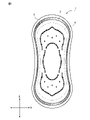
- FIG. 1 is a schematic plan view of the light incontinence pad 1 in the deployed state as viewed from the skin facing surface side in the thickness direction.
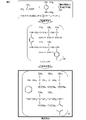
- FIG. 2 is a diagram illustrating a manufacturing process of the absorbent A, which is an example of the polymer absorbent.
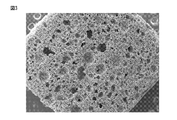
- FIG. 3 is an SEM photograph of the absorbent A at a magnification of 50 times.
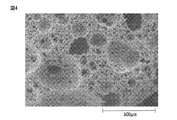
- FIG. 4 is an SEM photograph of the absorbent A at a magnification of 100 times.
- FIG. 5 is an SEM photograph of the absorbent A at a magnification of 500 times.
- FIG. 6 is an SEM photograph of the absorbent A at a magnification of 1000 times.
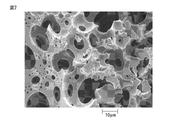
- FIG. 7 is an SEM photograph of the absorbent A at a magnification of 1500 times.
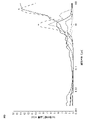
- FIG. 8 is a graph showing the relationship between the pore radius of the pores of the absorbent A and the cumulative pore volume.
- FIG. 9 is a graph showing the relationship between the pore radius of the pores of the absorbent A and the differential pore volume.
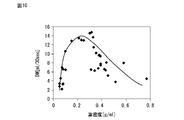
- FIG. 10 is a graph showing the relationship between the bulk density and the absorption performance (DW) in the absorbent A.
- FIG. 11 is a schematic view showing a measuring device used in the non-pressurized DW method.
- a preferred embodiment of the composite absorber of the present invention will be described in detail using a light incontinence pad 1 which is an example of a hygienic product to which the composite absorber is applied.
- a light incontinence pad 1 which is an example of a hygienic product to which the composite absorber is applied.
- an object placed on a horizontal plane in a deployed state for example, a light incontinence pad, a composite absorber, etc.
- the object is a sanitary product.
- looking in the thickness direction of the object from the surface sheet side is simply called "planar view”.
- the "longitudinal direction” refers to "the direction in which the length of a vertically long object (for example, a light incontinence pad in a deployed state, a composite absorber, etc.) in a plan view is long" and is “the width direction”.
- the short direction of the length of the vertically long object in the plan view and “the thickness direction” refers to "the direction perpendicular to the object placed on the horizontal plane in the unfolded state", and their longitudinal directions.
- the direction, width direction, and thickness direction are orthogonal to each other.
- skin is relatively proximal to the wearer's skin surface when the light incontinence pad 1 is worn in the thickness direction of the light incontinence pad 1. It is referred to as “opposing surface side", and "when the light incontinence pad 1 is worn, the side relatively distal to the wearer's skin surface” is referred to as “non-skin facing surface side”.
- FIG. 1 is a schematic plan view of a light incontinence pad 1 in a deployed state to which the composite absorber 4 according to the embodiment of the present invention is applied.
- the light incontinence pad 1 has a longitudinal direction L and a width direction W in a plan view, and two longitudinal end edges project in an arc shape toward the outward side in the longitudinal direction. It has a vertically long outer shape.
- the external shape of the light incontinence pad 1 is not limited to such a mode, and any shape (for example, oval shape, rectangular shape, etc.) according to various uses, usage modes, etc., as long as it is a vertically long shape. Hourglass shape, etc.) can be adopted.
- the light incontinence pad 1 has a liquid-permeable surface sheet 2 that forms the surface of the light incontinence pad 1 on the skin-facing surface side and a back surface that forms the surface of the light incontinence pad 1 on the non-skin-facing surface side.
- a sheet 3 and a composite absorber 4 located between these sheets are provided as a basic configuration.
- an adhesive portion (not shown) which is arranged on the surface of the back surface sheet 3 on the non-skin facing surface side and adhesively fixes the light incontinence pad 1 to the inner surface of clothing such as the wearer's underwear is further provided. I have.
- the light incontinence pad 1 is not limited to such a configuration, and is, for example, located at both ends of the light incontinence pad 1 in the width direction W at a position on the skin facing surface side of the surface sheet 2 and in the longitudinal direction.
- a pair of side sheets for forming a leak-proof wall arranged so as to extend to L, and a plurality of elastic members arranged along the longitudinal direction L in each of the pair of side sheets are provided. May be.
- the composite absorber 4 is located between the front surface sheet 2 and the back surface sheet 3 and absorbs body fluids such as urine and menstrual blood that have been discharged from the wearer and permeated through the front surface sheet 2.
- the composite absorbent 4 is formed of a possible water-absorbent member, and the composite absorbent 4 contains a polymer absorbent having a hydrophilic continuous skeleton and continuous pores, and in the present embodiment, a higher absorbent polymer (SAP). ) Is included. Further, this polymer absorbent exhibits a peculiar water absorption behavior in which, when absorbing water, the water is taken into the above-mentioned continuous skeleton and then taken into the continuous pores.
- the hydrophilic continuous skeleton instantly absorbs the body fluid by osmotic pressure.
- the volume of the continuous vacancies can be expanded, and the body fluid can be taken into the expanded continuous vacancies, so that a large amount of body fluid can be instantly absorbed.
- the absorbed body fluid can be further transferred to SAP having high water retention capacity and steadily retained in SAP.
- the composite absorber 4 can exhibit high absorption performance as an absorber.
- the light incontinence pad 1 provided with such a composite absorber 4 can also exhibit excellent absorption performance as a light incontinence pad.
- the surface sheet 2 extends from one side edge of the light incontinence pad 1 in the longitudinal direction L to the other side edge in a plan view, and
- the light incontinence pad 1 has a vertically long outer shape extending from the vicinity of one side edge of the width direction W to the vicinity of the other side edge.
- the surface sheet 2 is arranged at a position on the skin facing surface side in the thickness direction of the light incontinence pad 1 and forms a contact surface that can come into contact with the wearer's skin, that is, the surface of the light incontinence pad 1 on the skin facing surface side. It is composed of a liquid-permeable sheet-like member.
- the surface sheet 2 has a size slightly larger in the longitudinal direction L and the width direction W than the composite absorber 4 arranged on the non-skin facing surface side of the surface sheet 2. It is joined to the back surface sheet 3 located on the non-skin facing surface side in the peripheral portion.
- the outer shape, various dimensions, basis weight, etc. of the surface sheet are not particularly limited as long as they can be used as the surface sheet of sanitary products, depending on desired liquid permeability, touch, flexibility, strength, and the like. Any external shape, various dimensions, basis weight, etc. can be adopted.
- the back surface sheet 3 extends from one side edge of the light incontinence pad 1 in the longitudinal direction L to the other side edge and extends in the width direction W of the light incontinence pad 1 in a plan view. It has a vertically long outer shape extending from one side edge to the other side edge.
- the back sheet 3 is arranged at a position on the non-skin facing surface side in the thickness direction of the light incontinence pad 1 to form the non-skin facing surface of the light incontinence pad 1 and urine that has permeated the composite absorber 4. It is composed of a liquid-impermeable sheet-like member that prevents body fluids such as menstrual blood and menstrual blood from leaking to the outside of the light incontinence pad 1.
- the outer shape, various dimensions, basis weight, etc. of the back sheet are not particularly limited as long as they can be used as the back sheet of sanitary goods, and are arbitrary according to desired leakage-proof performance, breathability, strength, and the like. It is possible to adopt the outer shape, various dimensions, basis weight, etc.
- the composite absorber 4 is one of the longitudinal directions L centered on the central portion of the light incontinence pad 1 in the longitudinal direction L and the width direction W in a plan view. It extends over a wide area in the longitudinal direction L extending from the vicinity of the side edge to the vicinity of the other side edge, and also in the width direction W, a wide area extending from the vicinity of one side edge of the width direction W to the vicinity of the other side edge. Further, it has a vertically long outer shape in which two longitudinal end edges project in an arc shape toward the outward side in the longitudinal direction.
- the composite absorber 4 has a constricted portion in the central portion in the longitudinal direction in a plan view, which is relatively smaller in width direction than the other portions, and further, the constricted portion. It has a minimum width portion having a minimum width of the composite absorber 4 and a maximum width portion having a maximum width of the composite absorber 4 on the outer side in the longitudinal direction of the constricted portion.
- the composite absorber 4 is arranged between the front surface sheet 2 and the back surface sheet 3 in the thickness direction of the light incontinence pad 1 to absorb and retain body fluids such as urine and menstrual blood that have permeated the front surface sheet 2.
- the water-absorbent member to be obtained is formed of a predetermined water-absorbent member, and the water-absorbent member is composed of a water-absorbent material such as a polymer absorbent, a hydrophilic fiber, or a highly absorbent polymer, which will be described later, and a sheet such as a tissue holding the water-absorbent material.
- the composite absorber means a water-absorbent member composed of a water-absorbent material capable of absorbing and holding a body fluid and a sheet holding the water-absorbent material.
- the composite absorber 4 is bonded to each of the front surface sheet 2 and the back surface sheet 3 with an arbitrary adhesive such as a hot melt type adhesive.
- the composite absorber 4 contains a polymer absorbent having a hydrophilic continuous skeleton and continuous pores and exhibiting the above-mentioned peculiar water-absorbing behavior as described above, and further contains a highly absorbent polymer in the present embodiment. ..
- the polymer absorbent will be described later, but the superabsorbent polymer is a powder or granule made of a superabsorbent polymer such as a sodium acrylate copolymer known in the art, and is referred to as SAP (Super Absorbent Polymer). Is to be done.
- the composite absorbent 4 may contain only the above-mentioned polymer absorbent as a water-absorbing material, or may contain only a polymer absorbent and a highly absorbent polymer. In addition to these, the composite absorbent 4 is known in the art for water absorption. It may further contain a sex material. Examples of such a water-absorbent material include hydrophilic fibers, and more specifically, pulp fibers (for example, crushed pulp and the like), cellulosic fibers such as cotton, rayon, and acetate.
- the composite absorbent 4 has a structure in which such a polymer absorbent and a wrap sheet such as a tissue in which any water-absorbent material such as a highly absorbent polymer is hydrophilic are covered with a wrap sheet. May be good.
- the outer shape, various dimensions, basis weight, etc. of the composite absorber are not particularly limited as long as the effects of the present invention are not impaired, and any outer shape according to desired water absorption, flexibility, strength, etc. Various dimensions, basis weight, etc. can be adopted.
- the polymer absorbent has a hydrophilic continuous skeleton and continuous pores, and when absorbing water, it exhibits a peculiar water absorption behavior in which water is taken into the above-mentioned continuous skeleton and then taken into the continuous pores. It is not particularly limited as long as it is a thing.
- a polymer absorbent is, for example, a hydrolyzate of a crosslinked polymer of two or more monomers containing at least (meth) acrylic acid ester, and has a high functional group having at least one hydrophilic group. Molecular compounds can be mentioned.
- a hydrolyzate of a (meth) acrylic acid ester and a crosslinked polymer of a compound containing two or more vinyl groups in one molecule, and a polymer compound having at least a -COONa group can be mentioned.
- a polymer absorbent is an organic porous body having at least one -COONa group in one molecule, and may further have a -COOH group. -COONa groups are distributed substantially uniformly in the skeleton of the porous body.
- the polymer absorbent is a hydrolyzate of such a (meth) acrylic acid ester and a crosslinked polymer of a compound containing two or more vinyl groups in one molecule, and at least one -COONa.
- a group as will be described later, when absorbing body fluids such as urine and menstrual blood, the hydrophilic continuous skeleton tends to expand (that is, easily expands), and continuous pores also tend to expand. Therefore, more body fluid can be taken into the continuous pores more quickly, and more excellent absorption performance can be exhibited as an absorber.
- the (meth) acrylic acid ester means an acrylic acid ester or a methacrylic acid ester.
- a hydrophilic continuous skeleton is formed by an organic polymer having at least a -COONa group.
- It has a communication hole (continuous pore) that serves as an absorption site for the liquid to be absorbed (that is, body fluid such as urine and menstrual blood) between the skeletons. Since the hydrolysis treatment changes the -COOR group (that is, the carboxylic acid ester group) of the crosslinked polymer to a -COONa group or a -COOH group (see FIG. 2), the polymer absorbent is -COOR. It may have a group.
- FIG. 2 is a diagram illustrating a manufacturing process of the absorbent A, which is an example of the polymer absorbent.
- the upper figure shows the constituent raw materials of the polymerization
- the middle figure shows Monolith A which is a crosslinked polymer of (meth) acrylic acid ester and divinylbenzene
- the lower figure shows the hydrolysis and hydrolysis to Monolith A in the middle figure.
- the absorbent A obtained by the drying treatment is shown.
- an absorbent A formed by a hydrolyzate of a crosslinked polymer of (meth) acrylic acid ester and divinylbenzene, which is an example of a polymer absorbent, will be described.
- the polymer absorbent is not limited to such a absorbent A, but is a hydrolyzate of a (meth) acrylic acid ester and a crosslinked polymer of a compound having two or more vinyl groups in one molecule, or , It may be a hydrolyzate of a crosslinked polymer of two or more kinds of monomers containing at least (meth) acrylic acid ester.
- the polymer absorbent is a monolithic absorbent, the body fluid can be quickly absorbed and the body fluid temporarily held in the polymer absorbent can be more steadily delivered to the SAP.
- “monolith A” is an organic porous body composed of a crosslinked polymer of (meth) acrylic acid ester and divinylbenzene before hydrolysis treatment, and is “monolithic organic porous”. Sometimes referred to as “polymer”. Further, the “absorbent A” is a hydrolyzate of a crosslinked polymer (monolith A) of (meth) acrylic acid ester and divinylbenzene after being hydrolyzed and dried. In the following description, the absorbent A is in a dry state.
- the absorbent A has a hydrophilic continuous skeleton and continuous pores as described above.
- the absorbent A which is an organic polymer having a hydrophilic continuous skeleton, was obtained by cross-linking and polymerizing a (meth) acrylic acid ester as a polymerization monomer and divinylbenzene as a cross-linking monomer. It is obtained by further hydrolyzing the crosslinked polymer (Monolith A).
- the organic polymer forming a hydrophilic continuous skeleton has an ethylene group polymerization residue (hereinafter referred to as “constituent unit X”) and a crosslinked polymerization residue of divinylbenzene (hereinafter referred to as “constituent unit Y”) as constituent units. ”) And. Furthermore, the polymerization residue (constituent unit X) of the ethylene group in the organic polymer forming the hydrophilic continuous skeleton is the -COONa group or -COOH group and -COONa group generated by hydrolysis of the carboxylic acid ester group. It has both groups. When the polymerization monomer is a (meth) acrylic acid ester, the polymerization residue (constituent unit X) of the ethylene group has an —COONa group, a —COOH group and an ester group.
- the ratio of the crosslinked polymerization residue (constituent unit Y) of divinylbenzene in the organic polymer forming the hydrophilic continuous skeleton is, for example, 0.1 to 30 mol% with respect to all the constituent units. , Preferably 0.1 to 20 mol%.
- the ratio of the cross-linking polymerization residue (constituent unit Y) of divinylbenzene in the organic polymer forming a hydrophilic continuous skeleton is, for example, 0.1 to 30 mol% with respect to all the constituent units. , Preferably 0.1 to 20 mol%.
- the ratio of the cross-linking polymerization residue (constituent unit Y) of divinylbenzene in the organic polymer forming a hydrophilic continuous skeleton is, for example, 0.1 to 30 mol% with respect to all the constituent units. , Preferably 0.1 to 20 mol%.
- the ratio of the crosslinked polymerization residue of the divinylbenzene in the organic polymer forming the hydrophilic continuous skeleton is 0.1 mol% or more, the strength of the absorbent A is less likely to decrease, and the divinylbenzene is also difficult to decrease.
- the ratio of the crosslinked polymerization residue of the above is 30 mol% or less, the absorption amount of the liquid to be absorbed is less likely to decrease.
- the organic polymer forming the hydrophilic continuous skeleton may be composed of only the constituent unit X and the constituent unit Y, or in addition to the constituent unit X and the constituent unit Y, It may have a structural unit other than the structural unit X and the structural unit Y, that is, a polymerization residue of a monomer other than the (meth) acrylic acid ester and divinylbenzene.
- structural units other than the structural unit X and the structural unit Y for example, styrene, ⁇ -methylstyrene, vinyltoluene, vinylbenzyl chloride, glycidyl (meth) acrylate, isobutene, butadiene, isoprene, chloroprene, vinyl chloride, vinyl bromide, etc.
- examples thereof include polymerization residues of monomers such as vinylidene chloride, tetrafluoroethylene, (meth) acrylonitrile, vinyl acetate, ethylene glycol di (meth) acrylate, tripropylene glycol di (meth) acrylate, and trimethylolpropanetri (meth) acrylate. ..
- the ratio of the structural units other than the structural unit X and the structural unit Y in the organic polymer forming the hydrophilic continuous skeleton is, for example, 0 to 50 mol%, preferably 0 to 30 with respect to all the structural units. It is mol%.
- the absorbent A preferably has a hydrophilic continuous skeleton having a thickness of 0.1 to 100 ⁇ m.
- the thickness of the hydrophilic continuous skeleton of the absorbent A is 0.1 ⁇ m or more, the space (pores) for taking in the absorption target liquid (body fluid) in the porous body is less likely to be crushed during absorption, and the absorption amount is reduced. It becomes difficult to do.
- the thickness of the hydrophilic continuous skeleton is 100 ⁇ m or less, an excellent absorption rate can be easily obtained.
- the thickness of the continuous skeleton can be obtained from, for example, an SEM observation photograph of the absorbent A.
- the thickness of the continuous skeleton is measured by using the skeleton cross section appearing on the test piece for electron microscope measurement as the evaluation point of the thickness. ..
- the continuous skeleton is often formed in a polygonal shape because it is formed at intervals between water (water droplets) that are removed by dehydration / drying treatment after hydrolysis. Therefore, the thickness of the continuous skeleton is the average value of the diameters ( ⁇ m) of the circles circumscribing the polygonal cross section. Also, in rare cases, there may be a small hole in the polygon, in which case the circumscribed circle of the cross section of the polygon surrounding the small hole is measured.
- the absorbent A preferably has an average diameter of continuous pores of 1 to 1000 ⁇ m.
- the average diameter of the continuous pores of the absorbent A is 1 ⁇ m or more, the space (pores) for taking in the absorption target liquid (body fluid) of the porous body is less likely to be crushed during absorption, and the absorption rate is less likely to decrease. ..
- the average diameter of the continuous pores is 1000 ⁇ m or less, an excellent absorption rate can be easily obtained.
- the average diameter ( ⁇ m) of the continuous pores of the absorbent A can be measured by the mercury intrusion method, and the maximum value of the pore distribution curve obtained by the mercury intrusion method is adopted.
- a sample for measuring the average diameter of the continuous pores a sample dried for 18 hours or more in a vacuum dryer set at a temperature of 50 ° C. is used regardless of the ionic form of the absorbent A.
- the final ultimate pressure is 0 Torr.
- FIG. 3 is an SEM photograph having a magnification of 50 times for the absorbent A
- FIG. 4 is an SEM photograph having a magnification of 100 times for the absorbent A
- FIG. 5 is an SEM photograph having a magnification of 500 for the absorbent A. It is a double SEM photograph
- FIG. 6 is an SEM photograph having a magnification of 1000 times for the absorbent A
- FIG. 7 is an SEM photograph having a magnification of 1500 times for the absorbent A.
- the absorbent A shown in FIGS. 3 to 7 is an example of an absorbent having butyl methacrylate as a polymerization monomer and divinylbenzene as a cross-linking monomer, and each has a cubic structure of 2 mm square.
- the absorbent A shown in FIGS. 3 to 7 has a large number of bubble-shaped macropores, and further has a portion where these bubble-shaped macropores overlap each other.
- the absorbent A has an open cell structure in which the overlapping portions of the macropores have a common opening (mesopore), that is, an open cell structure (continuous macropore structure).
- the portion where the macropores overlap each other has a common opening (mesopore) having an average diameter of 1 to 1000 ⁇ m, preferably 10 to 200 ⁇ m, particularly preferably 20 to 100 ⁇ m in a dry state, and most of them have an open pore structure. It has become.
- the average diameter of the mesopore in a dry state is 1 ⁇ m or more, the absorption rate of the liquid to be absorbed becomes better.
- the average diameter of the mesopore in a dry state is 1000 ⁇ m or less, the absorbent A is less likely to become brittle. It should be noted that the number of such macropores overlapped with each other is about 1 to 12 for one macropore, and about 3 to 10 for most macropores.
- the absorbent A has such an open cell structure, the macropore group and the mesopore group can be uniformly formed, and the particle aggregation type as described in Japanese Patent Application Laid-Open No. 8-252579 etc. can be formed uniformly. Compared to the porous body, there is an advantage that the pore volume and the specific surface area can be significantly increased.
- the continuous pores included in the absorbent A are a plurality of pores (pores) communicating with each other.
- the total pore volume of the pores (pores) of the absorbent A is preferably 0.5 to 50 mL / g, more preferably 0.9 to 40 mL / g, and even more preferably 2 to 30 mL / g.
- a sufficient pore volume can be secured for the absorbent A, and therefore a sufficient water absorption amount can be secured.
- the space (vacancy) for taking in the absorption target liquid (body fluid) of the porous body can be made difficult to be crushed at the time of absorption, and the water absorption amount and the water absorption rate can be made difficult to decrease.
- the total pore volume of the absorbent A is 50 mL / g or less, the strength of the absorbent A can hardly be lowered.
- the total pore volume can be measured by the mercury intrusion method.
- a sample dried for 18 hours or more in a vacuum dryer set at a temperature of 50 ° C. is used regardless of the ionic form of the absorbent A.
- the final ultimate pressure is 0 Torr.
- the ratio (%), the fluctuation coefficient of the pore volume, and the like can be calculated.
- the maximum pore diameter ( ⁇ m) refers to the pore radius of the pores indicating the maximum value of the pore volume.
- the log differential pore volume (mL / g) in the log differential pore volume distribution is adopted as the pore volume (mL / g) at each pore radius.
- the ratio of the pore volume due to the pores having a pore radius of 1 ⁇ m or more is 90% or more of the pore volume (total pore volume) of all pores. Yes, 93% or more is preferable, and 95% or more is more preferable. Since the ratio of the pore volume of the pores having a pore radius of 1 ⁇ m or more is 90% or more, it is difficult for water to enter the pores having a relatively small pore radius such as a pore radius of less than 1 ⁇ m during water absorption. , Sufficient water absorption can be secured even if it cannot enter. As a result, it is possible to suppress a decrease in the amount of water absorption as compared with the pore volume, and it is possible to obtain excellent absorption performance.
- the ratio of the pore volume due to the pores having a pore radius of 0.005 ⁇ m or less is preferably less than 10% of the pore volume (total pore volume) of all pores, and the pore radius is preferable. It is more preferable that the ratio of the pore volume due to the pores having a diameter of 0.05 ⁇ m or less is less than 10% of the pore volume of all the pores (total pore volume).
- the ratio of the pore volume due to the pores having a very small pore radius and difficult to absorb water is very small, such that the pore radius is 0.005 ⁇ m or less, and the pore radius is 1 ⁇ m or more.
- the ratio of the pore volume due to the pores having a large pore radius and capable of absorbing water is large (90% or more). As a result, the pores of the absorbent A can be effectively used for water absorption, and a sufficient amount of water absorption can be secured.
- the pore radius in the pores showing the maximum value of the pore volume is preferably (0.5 ⁇ m or more,) 500 ⁇ m or less, more preferably 300 ⁇ m or less, and even more preferably 150 ⁇ m or less.
- the pore radius at the maximum value of the pore volume is 500 ⁇ m or less, it is possible to prevent the structure of the continuous skeleton of the absorbent A from being broken (crushed) during water absorption, and it is easy to obtain an excellent absorption rate and it is stable. Therefore, a sufficient amount of water absorption can be secured.
- the pore radius at the maximum value of the pore volume is 500 ⁇ m or more, the structure of the continuous skeleton cannot be maintained at the time of water absorption and may be crushed.
- the coefficient of variation of the pore distribution (pore volume) in the pores having a pore radius of 1 ⁇ m or more may be 1.4 or less.
- the coefficient of variation of the pore distribution is 1.4 or less, the variation of the pore radius with respect to the average value of the pore radius is small, and the peak indicated by the pore distribution becomes sharp near the average value of the pore radius. Therefore, the absorbent A can absorb water substantially uniformly from all directions and all surfaces. As a result, the pores of the polymer absorbent can be effectively used for water absorption, and a sufficient amount of water absorption can be secured.
- the coefficient of variation of the pore distribution (pore volume) in the pores having a pore radius of 1 ⁇ m or more may be more than 1.4.
- the coefficient of variation of the pore distribution is more than 1.4, the variation of the pore radius with respect to the average value of the pore radius is large, and the peak indicated by the pore distribution is broad near the average value of the pore radius. become. That is, the absorbent A has pores having a small pore radius and pores having a large pore radius.
- the absorbent A can instantly absorb a large amount of water inside the pores.
- the pore radius is smaller than the pore radius corresponding to the maximum value of the pore volume in the curve indicating the pore distribution.
- the portion on the side having a larger pore radius than the portion on the side may be broad.
- the absorbent A has a structure in which more pores having a large pore diameter are present than those having a small pore radius. Therefore, since there are many pores having a large pore radius, the water absorption volume tends to be larger, and a larger amount of water can be absorbed inside the pores.
- the pore radius is larger than the pore radius corresponding to the maximum value of the pore volume in the curve showing the pore distribution.
- the portion on the side where the pore radius is smaller than the portion on the side may be broad.
- the absorbent A has a structure in which more pores having a smaller pore diameter are present than those having a larger pore radius. Since there are many pores having a small pore radius, the capillary force is more likely to work, so that the water absorption rate is more likely to be increased, and water can be absorbed more instantly inside the pores.
- the pores of the absorbent A at least two maximum values of the pore volume in the curve showing the pore distribution may exist.
- the absorbent A there are pores having a predetermined small pore radius and a pore radius in the vicinity thereof, and pores having a predetermined large pore radius and a pore radius in the vicinity thereof. .. Therefore, in the pores having a relatively small pore radius, the capillary force tends to work, so that the water absorption rate tends to increase, and in the pores having a relatively large pore radius, the water absorption volume tends to increase. Therefore, due to the synergistic effect of the two, the polymer absorbent can instantly absorb a large amount of water inside the pores.
- the two maximum values of the pore volume in the curve showing the pore distribution are the maximum values of the relatively small pore radius.
- the value may be larger than the maximum value of the relatively large pore radius.
- the two maximum pore volumes in the curve showing the pore distribution are the maximum pore radii that are relatively small.
- the value may be smaller than the maximum value of the relatively large pore radius.
- the bulk density is preferably 0.07 to 0.6 g / cm 3 , more preferably 0.1 to 0.4 g / cm 3 , and 0.15 to 0.15 to 0.3 g / cm 3. It is more preferably 0.35 g / cm 3 .
- the water absorption rate (DW) performance is set to 6 mL / 30 sec. The above can be achieved, and more preferably 10 mL / 30 sec. The above can be achieved, and more preferably 12 mL / 30 sec. The above can be done. That is, since the water absorption rate becomes high, the polymer absorbent can instantly absorb water inside the pores.
- FIG. 11 is a schematic view showing a measuring device used in the non-pressurized DW method.
- a DW device (DemandWetability device, manufactured by Taiyo Create Co., Ltd.) 11 is used.
- the DW device 11 includes a burette 12 (scale capacity 50 ml, length 86 cm, inner diameter 1.05 cm), a rubber stopper 13, an air inflow thin tube (tip inner diameter 3 mm) 14, a cock 15, and a cock.
- a measuring table 17 It is provided with 16, a measuring table 17, a liquid outlet (inner diameter 3 mm) 18, a cylinder 19, and a test liquid 20.
- a conduit (inner diameter 7 mm) is attached from the burette 12 to the measuring table 17.
- a 0.9% aqueous sodium chloride solution is used as the test solution. The measurement is carried out in a 25 ° C. ⁇ 50% humidity RH atmosphere (constant temperature and humidity chamber).
- the measurement procedure is as follows. (1) With both cocks 15 and 16 of the DW device 11 closed, put the test solution 20 at 0 points (the top of the burette 12 scale (0 ml line)) or higher, and put a rubber stopper 13 on the upper part of the burette 12. , Seal. (2) After placing the filter paper on the liquid outlet 18 of the measuring table 17, open both cocks 15 and 16 and adjust the liquid level to 0 point while sucking the liquid discharged from the liquid outlet 18 with the filter paper. After the adjustment, the cocks 15 and 16 are closed.
- the test object begins to absorb the test liquid 20, and the first bubble introduced from the air inflow capillary 14 reaches the water surface of the test liquid 20 in the burette 12 (
- the measurement start time is defined as the time when the water level of the test solution 20 in the burette 12 is lowered).
- (6) Continuously read the reduced amount of the test solution 20 in the burette 12 (the amount of the test solution 20 absorbed by the test object) M (ml).
- the amount of the test object absorbed after a predetermined time has elapsed from the start of liquid absorption (in this embodiment, after 30 seconds have elapsed), the amount absorbed by the DW method (ml / g) M (ml) / (test). It is determined by the weight (g) of the object (polymer absorbent).
- body fluid a liquid such as a body fluid
- the mass of the absorbed body fluid is substantially proportional to the amount of the body fluid, the mass of the body fluid may be simply referred to as "the amount of the body fluid" in the following description.
- the continuous pores included in the absorbent A shown in FIGS. 3 to 7 are pores in which a plurality of pores (pores) communicate with each other, and a large number of pores are provided from the appearance. Can be visually recognized with the naked eye.
- the hydrophilic continuous skeleton first instantly takes in a part of the body fluid by osmotic pressure and elongates (that is, swells). do). This extension of the continuous skeleton occurs in almost all directions.
- the absorbent A which has been enlarged by absorbing a certain amount of body fluid in this way, can further absorb a predetermined amount of body fluid into the enlarged continuous pores by the capillary phenomenon.
- body fluid body fluid
- the absorbent A absorbs water (body fluid)
- it exhibits a peculiar water absorption behavior in which water is taken into a hydrophilic continuous skeleton and then taken into continuous pores to be absorbed.
- the body fluid absorbed in the hydrophilic continuous skeleton of the absorbent A is difficult to be released from the continuous skeleton (that is, it is difficult to separate water), while the body fluid absorbed in the continuous pores is easily separated from water, so that it is complexly absorbed.
- the body fluid absorbed in the continuous pores is separated from the water and transferred to the highly absorbent polymer (SAP) having a high water retention capacity, and is steadily retained in the SAP.
- SAP highly absorbent polymer
- the amount of body fluid absorbed in the continuous skeleton of the absorbent A and the amount of body fluid absorbed in the continuous pores are the total amount of the fluid absorbed by the absorbent A by centrifugation (150 G / 90 seconds).
- the amount of body fluid separated from the absorbent A becomes the amount of body fluid absorbed in the continuous pores, and the other body fluid volume (that is, the amount of body fluid not separated from the absorbent A by centrifugation) becomes. It is the amount of body fluid absorbed in the continuous skeleton.
- the amount of body fluid absorbed by the absorbent A is larger than that absorbed in the hydrophilic continuous skeleton. Since most of the absorption of body fluid by the absorbent A is performed by retaining the body fluid in the pores by capillarity, the porosity (absorbent A) which is the ratio of the volume of the voids in the pores (total pore volume). The larger the volume of the voids in the pores relative to the volume of the pores), the more body fluid can be absorbed.
- the porosity is preferably 85% or more.
- the porosity of the absorbent A shown in FIGS. 3 to 7 described above is as follows.
- the specific surface area of the absorbent A obtained by the mercury intrusion method is 400 m 2 / g, and the pore volume is 15.5 mL / g.
- This pore volume of 15.5 mL / g means that the volume of the pores in 1 g of the absorbent A is 15.5 mL.
- the specific gravity of the absorbent A is 1 g / mL
- the volume occupied by the pores in 1 g of the absorbent A that is, the pore volume is 15.5 mL
- the volume of 1 g of the absorbent A is 1 mL.
- the total volume (volume) of 1 g of the absorbent A becomes 15.5 + 1 (mL), and the ratio of the pore volume thereof becomes the porosity. Therefore, the porosity of the absorbent A is 15.5 / (. 15.5 + 1) ⁇ 100 ⁇ 94%.
- the absorbent A having such a hydrophilic continuous skeleton and continuous pores that is, the polymer absorbent is in the form of particles, sheets, etc., like the composite absorber 4 of the above-mentioned light incontinence pad 1. It is applied to complex absorbers for absorbing body fluids such as urine and menstrual blood. As described above, this polymer absorbent exhibits a peculiar water absorption behavior in which water is taken into a hydrophilic continuous skeleton and then taken into continuous pores when absorbing water, so that a large amount of water is absorbed. The body fluid can be absorbed instantly, and the absorbed body fluid (mainly the body fluid absorbed by continuous pores) can be transferred to a SAP having a high water retention capacity and steadily held in the SAP. Therefore, the composite absorber to which such a polymer absorbent is applied can exhibit high absorption performance as an absorber.
- the water absorption of the polymer absorbent can be measured according to the following ⁇ Measuring method of water absorption of the polymer absorbent>.
- ⁇ Measuring method of water absorption of polymer absorbent (1) Mesh bag obtained by cutting 1 g of a sample (polymer absorbent) for measurement into 10 cm squares (manufactured by NBC Meshtec Inc., N-NO255HD 115 (standard width: 115 cm, 255 mesh / 2.54 cm, opening:) Enclose in 57 ⁇ m, wire diameter: 43 ⁇ m, thickness: 75 ⁇ m)). The mass (g) of the mesh bag is measured in advance. Further, this measuring method is carried out under the conditions of a temperature of 25 ° C. and a humidity of 60%.
- the sample for measurement (polymer absorbent) is recovered from the product of sanitary goods and used, it can be obtained according to ⁇ Method for recovering sample for measurement (polymer absorbent) described later>.
- (2) Immerse the mesh bag containing the sample in physiological saline (0.9% sodium chloride aqueous solution) for 1 hour.
- (3) The mass (g) after hanging the mesh bag for 5 minutes and draining it is measured.
- the sample for measurement (polymer absorbent) is recovered from the product of sanitary goods and used, it can be obtained according to the following ⁇ method for recovering the sample for measurement (polymer absorbent)>.
- ⁇ Method of recovering sample (polymer absorbent) for measurement> Peel off the surface sheet or the like from the hygiene product to expose the absorber.
- the magnification of the simple loupe is not particularly limited as long as the pores of the porous body can be visually recognized, and examples thereof include a magnification of 25 to 50 times.
- (4) The measurement object thus recovered is used as a sample for measurement in various measurement methods.
- the above-mentioned absorbent A can be obtained by undergoing a cross-linking polymerization step and a hydrolysis step. Hereinafter, each of these steps will be described.
- Cross-link polymerization step First, an oil-soluble monomer for cross-linking polymerization, a cross-linking monomer, a surfactant, water, and, if necessary, a polymerization initiator are mixed to obtain a water-in-oil emulsion.
- This water-in-oil emulsion is an emulsion in which the oil phase becomes a continuous phase and water droplets are dispersed therein.
- butyl methacrylate which is a (meth) acrylic acid ester
- divinylbenzene is used as the crosslinkable monomer
- surfactant is used.
- Crosslink polymerization is carried out using sorbitan monooleate as an activator and isobutyronitrile as a polymerization initiator to obtain monolith A.
- this emulsion is immediately transferred to a reaction vessel, sealed, and polymerized at 60 ° C. for 24 hours under the static condition. After completion of the polymerization, the contents are taken out, extracted with methanol, and dried under reduced pressure to obtain Monolith A having a continuous macropore structure.
- the monolith A had an open cell structure and the thickness of the continuous skeleton was 5.4 ⁇ m.
- the average diameter of the continuous pores measured by the mercury intrusion method was 36.2 ⁇ m, and the total pore volume was 15.5 mL / g.
- the content of divinylbenzene with respect to all the monomers is preferably 0.3 to 10 mol%, more preferably 0.3 to 5 mol%. Further, the ratio of divinylbenzene to the total of butyl methacrylate and divinylbenzene is preferably 0.1 to 10 mol%, more preferably 0.3 to 8 mol%. In the above-mentioned absorbent A, the ratio of butyl methacrylate to the total of butyl methacrylate and divinylbenzene is 97.0 mol%, and the ratio of divinylbenzene is 3.0 mol%.
- the amount of the surfactant added can be set according to the type of the oil-soluble monomer and the size of the desired emulsion particles (macropores), and is about 2 to 70 with respect to the total amount of the oil-soluble monomer and the surfactant. It is preferably in the range of%.
- alcohols such as methanol and stearyl alcohol
- carboxylic acids such as stearic acid
- hydrocarbons such as octane, dodecane and toluene
- cyclic ethers such as tetrahydrofuran and dioxane are used. It may coexist in the polymerization system.
- the mixing method for forming the water-in-oil emulsion is not particularly limited.
- a method of mixing each component at once, an oil-soluble monomer, a surfactant, and an oil-soluble polymerization initiator, which are oil-soluble can be adopted.
- the mixing device for forming the emulsion is not particularly limited, and any device such as a normal mixer, a homogenizer, or a high-pressure homogenizer can be adopted depending on the desired emulsion particle size, and further, the object to be treated can be used.
- a so-called planetary stirrer or the like can also be used, in which an object is placed in a mixing container and the mixture is rotated while revolving around a revolving axis in an inclined state to stir and mix the object to be processed.
- the mixing conditions are not particularly limited, and the stirring rotation speed, stirring time, etc. can be arbitrarily set according to the desired emulsion particle size.
- water droplets in the W / O emulsion can be uniformly generated, and the average diameter thereof can be arbitrarily set in a wide range.
- Various conditions can be adopted for the polymerization conditions of the water-in-oil emulsion depending on the type of monomer and initiator.
- the polymerization is carried out by heating at a temperature of 30 to 100 ° C. for 1 to 48 hours in a sealed container under an inert atmosphere.
- hydrogen peroxide-ferrous chloride, sodium persulfate-sodium acid sulfite, etc. are used as the polymerization initiator, they should be placed in a sealed container under an inert atmosphere at a temperature of 0 to 30 ° C. for 1 to 48 hours. It may be polymerized.
- the unreacted monomer and the residual surfactant can be removed by taking out the contents and performing Soxhlet extraction with a solvent such as isopropanol to obtain Monolith A shown in the middle figure of FIG. ..
- monolith A was immersed in dichloroethane to which zinc bromide was added, stirred at 40 ° C. for 24 hours, and then contacted with methanol, 4% hydrochloric acid, 4% sodium hydroxide aqueous solution and water in this order for hydrolysis. , Dry to obtain a block-shaped absorber A. Further, the block-shaped absorbent A is pulverized to a predetermined size to obtain a particulate absorbent A.
- the form of the absorbent A is not limited to particles, and may be formed into a sheet during or after drying, for example.
- the method for hydrolyzing Monolith A is not particularly limited, and various methods can be adopted.
- aromatic solvents such as toluene and xylene
- halogen solvents such as chloroform and dichloroethane
- ether solvents such as tetrahydrofuran and isopropyl ether
- amide solvents such as dimethylformamide and dimethylacetamide
- alcohol solvents such as methanol and ethanol.
- P-solvented acid such as toluenesulfonic acid or Lewis acid such as zinc bromide, aluminum chloride, aluminum bromide, titanium chloride (IV), cerium chloride / sodium iodide, magnesium iodide, etc. Be done.
- the (meth) acrylic acid ester is not particularly limited, but the (meth) acrylic acid has C1 to C10 (that is, the number of carbon atoms).
- the alkyl esters of 1 to 10) are preferable, and the C4 (that is, 4 carbon atoms) alkyl ester of (meth) acrylic acid is particularly preferable.
- Examples of the C4 alkyl ester of (meth) acrylic acid include (meth) acrylic acid t-butyl ester, (meth) acrylic acid n-butyl ester, and (meth) acrylic acid iso-butyl ester.
- the monomer used for the cross-linking polymerization may be only (meth) acrylic acid ester and divinylbenzene, and in addition to (meth) acrylic acid ester and divinylbenzene, monomers other than (meth) acrylic acid ester and divinylbenzene may be used. May be contained.
- the other monomer is not particularly limited, but for example, styrene, ⁇ -methylstyrene, vinyltoluene, vinylbenzyl chloride, glycidyl (meth) acrylate, diethylhexyl (meth) acrylate, isobutene, butadiene, isobrene.
- the proportion of the monomers other than the (meth) acrylic acid ester and divinylbenzene in all the monomers used for the cross-linking polymerization is preferably 0 to 80 mol%, more preferably 0 to 50 mol%.
- the surfactant is not limited to the above-mentioned sorbitan monooleate, and may be any one that can form a water-in-oil (W / O) emulsion when the cross-linking polymerization monomer and water are mixed. ..
- surfactants include sorbitan monolaurate, sorbitan monopalmitate, sorbitan monostearate, sorbitan trioleate, polyoxyethylene group nonylphenyl ether, polyoxyethylene group stearyl ether, and polyoxyethylene group sorbitan.
- Nonionic surfactants such as monooleate, anionic surfactants such as potassium oleate, sodium dodecylbenzenesulfonate, sodium dioctyl sulfosuccinate, cationic surfactants such as distearyldimethylammonium chloride, lauryldimethylbetaine and the like. Androgynous surfactants can be mentioned. These surfactants may be used alone or in combination of two or more.
- the polymerization initiator a compound that generates radicals by heat and light irradiation is preferably used.
- the polymerization initiator may be water-soluble or oil-soluble, and may be, for example, azobis (4-methoxy-2,4-dimethylvaleronitrile), azobisisobutyronitrile, azobisdimethylvaleronitrile, azobiscyclohexanenitrile, etc.
- Azobiscyclohexanecarbonitrile azobis (2-methylpropionamidine) dihydrochloride
- benzoyl peroxide potassium persulfate, ammonium persulfate, hydrogen peroxide-ferrous chloride, sodium persulfate-sodium acid sulfite, tetramethylthium disulfide, etc.
- the polymerization proceeds only by heating or light irradiation without adding the polymerization initiator, so that it is not necessary to add the polymerization initiator in such a system.
- the polymer absorbent of the present invention produced by the above production method was used as a sample of Examples 1 to 5, and Infinity particles were prepared as a sample of Comparative Examples 1 and 2. .. However, in the samples of Examples 1 to 5, the surfactant / monomer ratio (wt%) and the stirring time (minutes) when forming the water-in-oil droplet emulsion in the production method were changed.
- the Infinity particle body is an absorbent manufactured by P & G, and although it has a structure (foaming structure) similar to that of a polymer absorbent, it has a function of absorbing water and expanding, unlike a polymer absorbent. Does not have.
- FIGS. 8 and 9 show the obtained cumulative (integrated) pore volume distribution, that is, the relationship between the pore radius (horizontal axis) and the cumulative pore volume (vertical axis)
- FIG. 9 shows the obtained log differential.
- the pore volume distribution that is, the relationship between the pore radius (horizontal axis) and the log differential pore volume (vertical axis) is shown.
- Example 1 is a broken line (thick line)
- Example 2 is a alternate long and short dash line (thin line)
- Example 3 is a broken line (thin line)
- Example 4 is a dotted line.
- Example 5 is a solid line (thin line)
- Comparative Example 1 is a solid line (thick line)
- Comparative Example 2 is a alternate long and short dash line (thick line).
- the ratio of the pore volume due to the pores having a pore radius of 1 ⁇ m or more was 90% or more of the pore volume of all the pores.
- the proportion of the pore volume due to the pores having a pore radius of 0.005 ⁇ m or less was less than 10% of the pore volume of all the pores.
- the pore radius at the maximum value of the pore volume was 500 ⁇ m or less.
- the coefficient of variation of the pore distribution may be 1.4 or less (Example 3). In pores with a pore radius of 1 ⁇ m or more, the coefficient of variation of the pore distribution may exceed 1.4 (Examples 4 and 5).
- the portion having a large pore radius was broader than the portion having a smaller pore radius with respect to the pore radius corresponding to the maximum value of the pore volume in the curve showing the pore distribution ( Example 5).
- the portion having a smaller pore radius than the portion having a larger pore radius was broader than the portion having a larger pore radius with respect to the pore radius corresponding to the maximum value of the pore volume in the curve showing the pore distribution ( Example 4).
- the two maximum values of the pore volume in the curve showing the pore distribution were that the maximum value of the relatively small pore radius was larger than the maximum value of the relatively large pore radius in some cases (implemented).
- the two maximum values of the pore volume in the curve showing the pore distribution were sometimes smaller in the maximum value of the relatively small pore radius than in the maximum value of the relatively large pore radius (implemented).
- the total pore volume was 0.9 mL / g or more.
- at least the ratio of the pore volume due to the pores having a pore radius of 1 ⁇ m or more was less than 90% of the pore volume of all the pores.
- FIG. 10 is a graph showing the relationship between the obtained bulk density (horizontal axis) and the water absorption rate (vertical axis).
- the water absorption rate (DW) performance is 6 mL / 30 sec. It was confirmed that the above can be done.
- the water absorption rate (DW) performance is 10 mL / 30 sec. It was confirmed that the above can be done.
- the water absorption rate (DW) performance is set to 12 mL / 30 sec. It was confirmed that the above can be done.
- the composite absorber of the present invention includes, for example, a pants-type disposable diaper, a tape-type disposable diaper, a sanitary napkin, an absorbent liner, and an absorbent pad (for example, a decubitus pad or a decubitus pad).
- an absorbent pad for example, a decubitus pad or a decubitus pad.
- Applicable to various hygiene products such as (pads, etc.), absorbent sheets, breast milk pads, disposable diapers for pets, absorbent pads for pets, excrement disposal sheets for pets, wet sheets, wet wipes, cosmetic wipes, masks, etc. can do. Therefore, the body fluid to be absorbed by the composite absorber is a liquid discharged from the wearer of the sanitary goods, and examples thereof include urine, sweat, stool, menstrual blood, cage, breast milk, blood, and exudate. Be done.
- present invention is not limited to the above-described embodiments and the like, and can be appropriately combined, substituted, modified, etc. within the range not deviating from the object and purpose of the present invention.
Landscapes
- Health & Medical Sciences (AREA)
- Engineering & Computer Science (AREA)
- Chemical & Material Sciences (AREA)
- Public Health (AREA)
- Epidemiology (AREA)
- Veterinary Medicine (AREA)
- Life Sciences & Earth Sciences (AREA)
- Animal Behavior & Ethology (AREA)
- General Health & Medical Sciences (AREA)
- Biomedical Technology (AREA)
- Vascular Medicine (AREA)
- Heart & Thoracic Surgery (AREA)
- Dispersion Chemistry (AREA)
- Hematology (AREA)
- Materials Engineering (AREA)
- Manufacturing & Machinery (AREA)
- Absorbent Articles And Supports Therefor (AREA)
Abstract
Description
なお、本明細書においては、特に断りのない限り、「展開状態で水平面上に置いた対象物(例えば、軽失禁パッド、複合吸収体等)を、垂直方向の上方側(対象物が衛生用品の場合は表面シート側)から対象物の厚さ方向に見ること」を、単に「平面視」という。
図1は、本発明の一実施形態に係る複合吸収体4が適用された、展開状態の軽失禁パッド1の概略平面図である。
軽失禁パッド1は、図1に示すように、平面視にて、長手方向L及び幅方向Wを有し、且つ2つの長手方向端縁が長手方向外方側に向かって円弧状に突出してなる縦長の外形形状を有している。なお、軽失禁パッド1の外形形状はこのような態様に限定されず、縦長の形状のものであれば、各種用途や使用態様等に応じた任意の形状(例えば、長円形状、矩形状、砂時計形状など)を採用することができる。
また、軽失禁パッド1においては、裏面シート3の非肌対向面側の表面に配置され、軽失禁パッド1を着用者の下着等の着衣の内面に粘着固定する粘着部(不図示)を更に備えている。
さらに、この高分子吸収剤は、水分を吸収する際に、水分を上述の連続骨格に取り込んだ後に連続空孔に取り込むという特有の吸水挙動を示す。
これにより、複合吸収体4は、吸収体として高い吸収性能を発揮することができる。
上述の軽失禁パッド1において、表面シート2は、図1に示すように、平面視にて、軽失禁パッド1の長手方向Lの一方側端縁から他方側端縁にわたって延在し、且つ、軽失禁パッド1の幅方向Wの一方側端縁近傍から他方側端縁近傍にわたって延在する、縦長の外形形状を有している。かかる表面シート2は、軽失禁パッド1の厚さ方向において肌対向面側の位置に配置され、着用者の肌に当接し得る接触面、すなわち軽失禁パッド1の肌対向面側の表面を形成する、液透過性のシート状部材によって構成されている。
上述の軽失禁パッド1において裏面シート3は、平面視にて、軽失禁パッド1の長手方向Lの一方側端縁から他方側端縁にわたって延在し、且つ、軽失禁パッド1の幅方向Wの一方側端縁から他方側端縁にわたって延在する、縦長の外形形状を有している。かかる裏面シート3は、軽失禁パッド1の厚さ方向において非肌対向面側の位置に配置されて、軽失禁パッド1の非肌対向面を形成するとともに、複合吸収体4を透過してきた尿や経血等の体液が軽失禁パッド1の外部へ漏出するのを防ぐ、液不透過性のシート状部材によって構成されている。
上述の軽失禁パッド1において複合吸収体4は、図1に示すように、平面視にて、軽失禁パッド1の長手方向L及び幅方向Wの中央部を中心にして、長手方向Lの一方側端縁近傍から他方側端縁近傍にわたる長手方向Lの広範囲の領域に延在するとともに、幅方向Wにおいても、当該幅方向Wの一方側端縁近傍から他方側端縁近傍にわたる広範囲の領域に延在しており、さらに2つの長手方向端縁が長手方向外方側に向かって円弧状に突出してなる、縦長の外形形状を有している。
本発明において高分子吸収剤は、親水性の連続骨格及び連続空孔を備え、水分を吸収する際に、水分を上述の連続骨格に取り込んだ後に連続空孔に取り込むという特有の吸水挙動を示すものであれば特に限定されない。そのような高分子吸収剤としては、例えば、少なくとも(メタ)アクリル酸エステルを含む2個以上のモノマーの架橋重合体の加水分解物であり、官能基に少なくとも1個以上の親水基を有する高分子化合物が挙げられる。より具体的には、(メタ)アクリル酸エステルと、一分子中に2個以上のビニル基を含有する化合物の架橋重合体の加水分解物であり、少なくとも-COONa基を有する高分子化合物が挙げられる。かかる高分子吸収剤は、一分子中に少なくとも1個以上の-COONa基を有する有機多孔質体であり、さらに、-COOH基を有していてもよい。多孔質体の骨格中には、-COONa基が略均一に分布している。
なお、加水分解処理は、架橋重合体の-COOR基(すなわち、カルボン酸エステル基)を-COONa基又は-COOH基にするものであるため(図2を参照)、高分子吸収剤は-COOR基を有していてもよい。
但し、高分子吸収剤がモノリス状の吸収剤であると、体液を素早く吸収することができる上、当該高分子吸収剤に一時的に保持した体液をより着実にSAPへ受け渡すことができるという利点がある。
また、「吸収剤A」は、加水分解処理及び乾燥処理がなされた後の(メタ)アクリル酸エステルとジビニルベンゼンとの架橋重合体(モノリスA)の加水分解物である。なお、以下の説明において、吸収剤Aは乾燥状態のものをいう。
吸収剤Aは、上述のとおり親水性の連続骨格と連続空孔を有している。親水性の連続骨格を有する有機ポリマーである吸収剤Aは、図2に示すように、重合モノマーである(メタ)アクリル酸エステルと、架橋モノマーであるジビニルベンゼンとを架橋重合し、得られた架橋重合体(モノリスA)を更に加水分解することにより得られる。
さらに、親水性の連続骨格を形成する有機ポリマー中のエチレン基の重合残基(構成単位X)は、カルボン酸エステル基の加水分解により生成する-COONa基、又は-COOH基と-COONa基の両方の基を有する。なお、重合モノマーが(メタ)アクリル酸エステルである場合、エチレン基の重合残基(構成単位X)は、-COONa基、-COOH基及びエステル基を有する。
なお、親水性の連続骨格を形成する有機ポリマー中のジビニルベンゼンの架橋重合残基の割合が0.1モル%以上であると、吸収剤Aの強度が低下しにくくなり、また、このジビニルベンゼンの架橋重合残基の割合が30モル%以下であると、吸収対象液の吸収量が低下しにくくなる。
これら図3~図7に示す吸収剤Aは、メタクリル酸ブチルを重合モノマーとし、ジビニルベンゼンを架橋モノマーとする吸収剤の一例であり、それぞれ2mm角の立方体の構造を有している。
なお、このようなマクロポア同士の重なりは、1個のマクロポアで1~12個程度、多くのものは3~10個程度である。
吸収剤の吸水速度は、無加圧DW(Demand Wettability)法によって測定する。図11は、無加圧DW法で用いられる測定装置を示した模式図である。このような測定装置としてDW装置(DemandWettability装置、大洋クリエイト株式会社製)11を使用する。図示されるように、DW装置11は、ビュレット12(目盛容量50ml、長さ86cm、内径1.05cm)と、ゴム栓13と、空気流入細管(先端内径3mm)14と、コック15と、コック16と、測定台17と、液出口(内径3mm)18と、円筒19と、試験液20と、を備える。ビュレット12から測定台17までには、導管(内径7mm)が取り付けられている。試験液として、0.9%塩化ナトリウム水溶液を使用する。測定は、25℃×50%湿度RH雰囲気内(恒温恒湿室内)で実施する。
(1)DW装置11の両方のコック15、16を閉じた状態で、試験液20を0点(ビュレット12目盛の一番上(0mlライン))以上に入れビュレット12上部にゴム栓13をし、密閉する。
(2)測定台17の液出口18に濾紙を置いた後、両方のコック15、16を開け、濾紙で液出口18から出る液を吸い取りながら、液面を0点に合わせる。調整後、コック15、16を閉じる。
(3)測定台17上に、液出口18が中心になるように木材パルプ100%のティッシュ(目付15±1gsm、不織布厚み計で測定圧3g/cm2時の厚みが0.1±0.02mm)を載せる。
(4)ティッシュの中心部に直径30mmの円筒19を載せ、その中に、液出口18を中心に試験対象物(高分子吸収剤)を置く。試験対象物は、円筒19に入れられ、その周りが当該円筒19により拘束される。
(5)コック15、16を開き、試験対象物が試験液20を吸収し始め、空気流入細管14から導入された一つ目の泡がビュレット12内の試験液20の水面に到達した時点(ビュレット12内の試験液20の水面が下がった時点)を測定開始時間とする。
(6)継続的に、ビュレット12内の試験液20の減少量(試験対象物が吸収した試験液20の量)M(ml)を読み取る。
(7)吸液開始から所定時間経過後(本実施の形態では、30秒経過後)における試験対象物の吸収量を、DW法による吸収量(ml/g)=M(ml)/(試験対象物(高分子吸収剤)の重量(g))により求める。
ここで、吸収剤Aの連続骨格内に吸収された体液量と、連続空孔内に吸収された体液量は、吸収剤Aが吸収した全体液量のうち、遠心処理(150G/90秒間)にて吸収剤Aから離水した体液量(離水量)が連続空孔内に吸収された体液量となり、その他の体液量(すなわち、遠心処理にて吸収剤Aから離水しなかった体液量)が連続骨格内に吸収された体液量となる。
まず、水銀圧入法によって得られた吸収剤Aの比表面積は400m2/gであり、細孔容積は15.5mL/gである。この細孔容積15.5mL/gは、1gの吸収剤Aの中にある細孔の容積が15.5mLであることを意味する。
吸収剤Aの比重を仮に1g/mLと仮定すると、1gの吸収剤Aの中で細孔が占める体積、すなわち細孔容積は15.5mLとなり、1gの吸収剤Aの体積は1mLとなる。
そうすると、1gの吸収剤Aの全容積(体積)は、15.5+1(mL)となり、そのうちの細孔容積の比率が空隙率となるため、吸収剤Aの空隙率は、15.5/(15.5+1)×100≒94%となる。
そして、この高分子吸収剤は、上述のとおり、水分を吸収する際に、水分を親水性の連続骨格に取り込んだ後に連続空孔に取り込むという特有の吸水挙動を示すものであるので、多量の体液を瞬時に吸収することができ、さらにその吸収した体液(主に連続空孔に吸収された体液)を保水能力の高いSAPへ受け渡して、SAP内で着実に保持することができる。したがって、このような高分子吸収剤を適用した複合吸収体は、吸収体として高い吸収性能を発揮することができる。
(1)測定用の試料(高分子吸収剤)1gを10cm四方に切断したメッシュ袋((株)NBCメッシュテック製、N-NО255HD 115(規格巾:115cm、255メッシュ/2.54cm、オープニング:57μm、線径:43μm、厚さ:75μm))に封入する。なお、メッシュ袋は、予め質量(g)を測定しておく。また、本測定方法は、温度25℃、湿度60%の条件下で行う。さらに、測定用の試料(高分子吸収剤)を衛生用品の製品から回収して用いる場合は、後述する<測定用の試料(高分子吸収剤)の回収方法>に従って得ることができる。
(2)試料を封入したメッシュ袋を生理食塩水(0.9%塩化ナトリウム水溶液)に1時間浸漬する。
(3)メッシュ袋を5分間吊るして水切りした後の質量(g)を測定する。
(4)上記(3)で測定した水切り後のメッシュ袋の質量から試料の質量(=1g)及びメッシュ袋の合計質量を差し引くことにより試料の吸水量(g)を算出し、さらにこの吸水量を試料の質量(=1g)で除することにより試料(高分子吸収剤)の単位質量当たりの吸水量(g/g)を得る。
(1)衛生用品の製品から表面シート等を剥がして、吸収体を露出させる。
(2)露出させた吸収体から測定対象物(高分子吸収剤)を落下させ、(粒子状の)測定対象物以外のもの(例:パルプや合成樹脂繊維等)を、ピンセット等を用いて取り除く。
(3)拡大観察手段として顕微鏡又は簡易ルーペを使用し、SAPとの違いを認識できる倍率又は多孔質体の空孔を視認できる倍率で観察しながら、ピンセット等を用いて測定対象物を回収する。なお、簡易ルーペの倍率は、多孔質体の空孔を視認できる倍率であれば特に限定されず、例えば25倍~50倍の倍率が挙げられる。
(4)このようにして回収した測定対象物を各種測定方法における測定用の試料とする。
上述の吸収剤Aは、図2に示すように、架橋重合工程と加水分解工程を経ることにより得ることができる。以下、これらの各工程について説明する。
まず、架橋重合用の油溶性モノマーと、架橋性モノマーと、界面活性剤と、水と、必要に応じて重合開始剤とを混合し、油中水滴型エマルションを得る。この油中水滴型エマルションは、油相が連続相となって、その中に水滴が分散したエマルションである。
次に、メタクリル酸t-ブチル/ジビニルベンゼン/SMO/2,2’-アゾビス(イソブチロニトリル)の混合物を180gの純水に添加し、遊星式撹拌装置である真空撹拌脱泡ミキサー(イーエムイー社製)を用いて減圧下で撹拌し、油中水滴型エマルションを得る。
続いて、モノリスA(架橋重合体)を加水分解して、吸収剤Aを得る工程(加水分解工程)について説明する。
なお、(メタ)アクリル酸のC4のアルキルエステルとしては、(メタ)アクリル酸t-ブチルエステル、(メタ)アクリル酸n-ブチルエステル、(メタ)アクリル酸iso-ブチルエステルが挙げられる。
後者の場合、他のモノマーとしては、特に限定されないが、例えばスチレン、α―メチルスチレン、ビニルトルエン、ビニルベンジルクロライド、(メタ)アクリル酸グリシジル、(メタ)アクリル酸2エチルヘキシル、イソブテン、ブタジエン、イソブレン、クロロプレン、塩化ビニル、臭化ビニル、塩化ビニリデン、テトラフルオロエチレン、(メタ)アクリロニトリル、酢酸ビニル、エチレングリコールジ(メタ)アクリレート、トリメチロールプロパントリ(メタ)アクリレートなどが挙げられる。
なお、架橋重合に用いる全モノマー中の、(メタ)アクリル酸エステル及びジビニルベンゼン以外の他のモノマーの割合は、0~80モル%が好ましく、0~50モル%がより好ましい。
(a)細孔分布について
上記の製造方法で製造された本発明の高分子吸収剤を実施例1~5の試料とし、Infinity粒子体を比較例1~2の試料として準備した。ただし、実施例1~5の試料は、製造方法における油中水滴型エマルションを形成させるときの、界面活性剤/モノマー比(wt%)及び攪拌時間(分)を変化させた。また、Infinity粒子体とは、P&G社製の吸収剤であり、高分子吸収剤と似た構造(発泡構造)を有しているものの、高分子吸収剤とは異なり、吸水して膨張する機能は有していない。
(b)嵩密度と吸水速度との関係について
上記実施例の試料に関し、エタノール浸漬及び乾燥の条件を変更することにより、種々の嵩密度を有する試料を準備した。具体的には、乾燥した高分子吸収体を40%エタノール水溶液に充分浸漬したのち、上澄み液の除去、エタノール添加を繰り返すことで所定濃度のエタノール水溶液に調整、充分浸漬後、湿潤状態の高分子吸収体をろ過し、50℃一晩減圧乾燥することで嵩密度の異なる高分子吸収体を得た。
(a)細孔分布について
水銀圧入法で、各試料について、累積(積算)細孔容積分布(細孔半径と累積細孔容積との関係)やlog微分細孔容積分布(細孔半径とlog微分細孔容積との関係)を求め、全細孔容積(mL/g)、平均細孔半径(μm)、最大細孔半径(μm)、所定の細孔半径以上(以下)の細孔の細孔容積(の割合)、及び細孔容積変動係数などを算出した。
(b)嵩密度と吸水速度との関係について
吸水速度(DW)の測定で、各試料の嵩密度と吸水速度(DW)との関係を調べた。
(a)細孔分布について
測定結果を図8及び図9に、それらをまとめた内容を表1に示す。ただし、図8は、得られた累積(積算)細孔容積分布、すなわち細孔半径(横軸)と累積細孔容積(縦軸)との関係を示し、図9は、得られたlog微分細孔容積分布、すなわち細孔半径(横軸)とlog微分細孔容積(縦軸)との関係を示している。なお、図8及び図9において、実施例1は破線(太線)であり、実施例2は一点鎖線(細線)であり、実施例3は破線(細線)であり、実施例4は点線であり、実施例5は実線(細線)であり、比較例1は実線(太線)であり、比較例2は一点鎖線(太線)である。

細孔半径が1μm以上の細孔による細孔容積の割合は、全細孔の細孔容積の90%以上であった。細孔半径が0.005μm以下の細孔による細孔容積の割合は、全細孔の細孔容積の10%未満であった。細孔容積の最大値での細孔半径は、500μm以下であった。細孔半径が1μm以上の細孔における、細孔分布の変動係数は1.4以下である場合があった(実施例3)。細孔半径が1μm以上の細孔において、細孔分布の変動係数は1.4超である場合があった(実施例4、5)。細孔分布を示す曲線における細孔容積の極大値に対応する細孔半径に対して、細孔半径が小さい側の部分よりも細孔半径が大きい側の部分がブロードである場合があった(実施例5)。細孔分布を示す曲線における細孔容積の極大値に対応する細孔半径に対して、細孔半径が大きい側の部分よりも細孔半径が小さい側の部分がブロードである場合があった(実施例4)。細孔分布を示す曲線における細孔容積の極大値は、少なくとも二つ存在する場合があった(実施例1、2)。細孔分布を示す曲線における細孔容積の二つの極大値は、相対的に小さい細孔半径の極大値の方が、相対的に大きい細孔半径の極大値よりも大きい場合があった(実施例2)。細孔分布を示す曲線における細孔容積の二つの極大値は、相対的に小さい細孔半径の極大値の方が、相対的に大きい細孔半径の極大値よりも小さい場合があった(実施例1)。全細孔容積は0.9mL/g以上であった。一方、比較例1,2では、少なくとも、細孔半径が1μm以上の細孔による細孔容積の割合は、全細孔の細孔容積の90%未満であった。
測定結果を図10に示す。図10は、得られた嵩密度(横軸)と吸水速度(縦軸)との関係を示すグラフである。図に示されるように、嵩密度を0.07~0.6g/cm3とすることで、吸水速度(DW)性能を6mL/30sec.以上にできることが確認できた。更に、嵩密度を0.1~0.4g/cm3とすることで、吸水速度(DW)性能を10mL/30sec.以上にできることが確認できた。更に、嵩密度を0.15~0.35g/cm3とすることで、吸水速度(DW)性能を12mL/30sec.以上にできることが確認できた。
2 表面シート
3 裏面シート
4 複合吸収体
Claims (15)
- 体液を吸収するための衛生用品用の複合吸収体であって、
親水性の連続骨格及び連続空孔を備えた高分子吸収剤を含み、
前記高分子吸収剤において、細孔半径が1μm以上の細孔による細孔容積の割合は、全細孔の細孔容積の90%以上であることを特徴とする、
複合吸収体。 - 前記高分子吸収剤において、細孔半径が0.005μm以下の細孔による細孔容積の割合は、全細孔の細孔容積の10%未満であることを特徴とする、
請求項1に記載の複合吸収体。 - 前記高分子吸収剤において、細孔容積の最大値での細孔半径は、500μm以下であることを特徴とする、請求項1又は2に記載の複合の複合吸収体。
- 前記高分子吸収剤において、細孔半径が1μm以上の細孔における、細孔分布の変動係数は1.4以下であることを特徴とする、請求項1~3のいずれか一項に記載の複合吸収体。
- 前記高分子吸収剤において、細孔半径が1μm以上の細孔において、細孔分布の変動係数は1.4超であることを特徴とする、請求項1~3のいずれか一項に記載の複合吸収体。
- 前記高分子吸収剤において、細孔分布を示す曲線における細孔容積の極大値に対応する細孔半径に対して、細孔半径が小さい側の部分よりも細孔半径が大きい側の部分がブロードであるであることを特徴とする、請求項5に記載の複合吸収体。
- 前記高分子吸収剤において、細孔分布を示す曲線における細孔容積の極大値に対応する細孔半径に対して、細孔半径が大きい側の部分よりも細孔半径が小さい側の部分がブロードであることを特徴とする、請求項5に記載の複合吸収体。
- 前記高分子吸収剤において、細孔分布を示す曲線における細孔容積の極大値は、少なくとも二つ存在することを特徴とする、請求項1~3のいずれか一項に記載の複合吸収体。
- 前記高分子吸収剤において、細孔分布を示す曲線における細孔容積の二つの極大値は、相対的に小さい細孔半径の極大値の方が、相対的に大きい細孔半径の極大値よりも大きいことを特徴とする、請求項8に記載の複合吸収体。
- 前記高分子吸収剤において、細孔分布を示す曲線における細孔容積の二つの極大値は、相対的に小さい細孔半径の極大値の方が、相対的に大きい細孔半径の極大値よりも小さいことを特徴とする、請求項8に記載の複合吸収体。
- 前記高分子吸収剤において、全細孔容積は0.9mL/g以上であることを特徴とする、請求項1~10のいずれか一項に記載の複合吸収体。
- 前記高分子吸収剤において、嵩密度が0.07~0.6g/cm3であることを特徴とする、請求項1~11のいずれか一項に記載の複合吸収体。
- 前記高分子吸収剤は、モノリス状の吸収剤であることを特徴とする、請求項1~12のいずれか一項に記載の複合吸収体。
- 前記高分子吸収剤は、(メタ)アクリル酸エステルと、一分子中に2個以上のビニル基を含有する化合物の架橋重合体の加水分解物であり、且つ、少なくとも1個以上の-COONa基を含有することを特徴とする、請求項1~13のいずれか一項に記載の複合吸収体。
- 請求項1~14のいずれか一項に記載の複合吸収体を有することを特徴とする衛生用品。
Priority Applications (2)
| Application Number | Priority Date | Filing Date | Title |
|---|---|---|---|
| CN202180087851.2A CN116710036B (zh) | 2020-12-29 | 2021-12-15 | 复合吸收体及卫生用品 |
| EP21915092.7A EP4248927B1 (en) | 2020-12-29 | 2021-12-15 | Composite absorbent and sanitary material |
Applications Claiming Priority (2)
| Application Number | Priority Date | Filing Date | Title |
|---|---|---|---|
| JP2020219818A JP7630276B2 (ja) | 2020-12-29 | 2020-12-29 | 複合吸収体及び衛生用品 |
| JP2020-219818 | 2020-12-29 |
Publications (1)
| Publication Number | Publication Date |
|---|---|
| WO2022145231A1 true WO2022145231A1 (ja) | 2022-07-07 |
Family
ID=82259260
Family Applications (1)
| Application Number | Title | Priority Date | Filing Date |
|---|---|---|---|
| PCT/JP2021/046266 Ceased WO2022145231A1 (ja) | 2020-12-29 | 2021-12-15 | 複合吸収体及び衛生用品 |
Country Status (4)
| Country | Link |
|---|---|
| EP (1) | EP4248927B1 (ja) |
| JP (1) | JP7630276B2 (ja) |
| CN (1) | CN116710036B (ja) |
| WO (1) | WO2022145231A1 (ja) |
Cited By (51)
| Publication number | Priority date | Publication date | Assignee | Title |
|---|---|---|---|---|
| US12029677B2 (en) | 2021-04-06 | 2024-07-09 | Purewick Corporation | Fluid collection devices having a collection bag, and related systems and methods |
| US12121468B2 (en) | 2014-03-19 | 2024-10-22 | Purewick Corporation | Apparatus and methods for receiving discharged urine |
| US12138196B2 (en) | 2014-03-19 | 2024-11-12 | Purewick Corporation | Apparatus and methods for receiving discharged urine |
| US12138195B2 (en) | 2020-04-10 | 2024-11-12 | Purewick Corporation | Fluid collection assemblies including one or more leak prevention features |
| US12150885B2 (en) | 2021-05-26 | 2024-11-26 | Purewick Corporation | Fluid collection system including a cleaning system and methods |
| US12178735B2 (en) | 2021-02-09 | 2024-12-31 | Purewick Corporation | Noise reduction for a urine suction system |
| US12186229B2 (en) | 2021-01-19 | 2025-01-07 | Purewick Corporation | Variable fit fluid collection devices, systems, and methods |
| US12193962B2 (en) | 2016-06-02 | 2025-01-14 | Purewick Corporation | Using wicking material to collect liquid for transport |
| US12208031B2 (en) | 2020-10-21 | 2025-01-28 | Purewick Corporation | Adapters for fluid collection devices |
| US12233003B2 (en) | 2021-04-29 | 2025-02-25 | Purewick Corporation | Fluid collection assemblies including at least one length adjusting feature |
| US12245967B2 (en) | 2020-11-18 | 2025-03-11 | Purewick Corporation | Fluid collection assemblies including an adjustable spine |
| US12245966B2 (en) | 2021-02-26 | 2025-03-11 | Purewick Corporation | Fluid collection devices having a sump between a tube opening and a barrier, and related systems and methods |
| US12251333B2 (en) | 2021-05-21 | 2025-03-18 | Purewick Corporation | Fluid collection assemblies including at least one inflation device and methods and systems of using the same |
| US12257173B2 (en) | 2017-01-31 | 2025-03-25 | Purewick Corporation | Apparatus and methods for receiving discharged urine |
| US12257174B2 (en) | 2020-10-21 | 2025-03-25 | Purewick Corporation | Fluid collection assemblies including at least one of a protrusion or at least one expandable material |
| US12268627B2 (en) | 2021-01-06 | 2025-04-08 | Purewick Corporation | Fluid collection assemblies including at least one securement body |
| US12274638B2 (en) | 2018-05-01 | 2025-04-15 | Purewick Corporation | Fluid collection devices, related systems, and related methods |
| US12285352B2 (en) | 2018-05-01 | 2025-04-29 | Purewick Corporation | Fluid collection devices, systems, and methods |
| US12290485B2 (en) | 2020-11-11 | 2025-05-06 | Purewick Corporation | Urine collection system including a flow meter and related methods |
| US12295876B2 (en) | 2018-05-01 | 2025-05-13 | Purewick Corporation | Fluid collection devices and methods of using the same |
| US12324767B2 (en) | 2021-05-24 | 2025-06-10 | Purewick Corporation | Fluid collection assembly including a customizable external support and related methods |
| US12329364B2 (en) | 2019-07-19 | 2025-06-17 | Purewick Corporation | Fluid collection devices including at least one shape memory material |
| US12350187B2 (en) | 2020-08-11 | 2025-07-08 | Purewick Corporation | Fluid collection assemblies defining waist and leg openings |
| US12350190B2 (en) | 2020-01-03 | 2025-07-08 | Purewick Corporation | Urine collection devices having a relatively wide portion and an elongated portion and related methods |
| US12419778B2 (en) | 2019-06-21 | 2025-09-23 | Purewick Corporation | Fluid collection devices including a base securement area, and related systems and methods |
| US12440370B2 (en) | 2020-10-21 | 2025-10-14 | Purewick Corporation | Apparatus with compressible casing for receiving discharged urine |
| US12440371B2 (en) | 2020-08-06 | 2025-10-14 | Purewick Corporation | Fluid collection system including a garment and a fluid collection device |
| US12447042B2 (en) | 2020-04-17 | 2025-10-21 | Purewick Corporation | Fluid collection assemblies including a fluid impermeable barrier having a sump and a base |
| US12458525B2 (en) | 2021-03-10 | 2025-11-04 | Purewick Corporation | Acoustic silencer for a urine suction system |
| US12465515B2 (en) | 2019-10-28 | 2025-11-11 | Purewick Corporation | Fluid collection assemblies including a sample port |
| US12465514B2 (en) | 2020-04-17 | 2025-11-11 | Purewick Corporation | Fluid collection devices, systems, and methods securing a protruding portion in position for use |
| US12472090B2 (en) | 2020-04-17 | 2025-11-18 | Purewick Corporation | Female external catheter devices having a urethral cup, and related systems and methods |
| US12478499B2 (en) | 2021-01-07 | 2025-11-25 | Purewick Corporation | Wheelchair securable urine collection systems and related methods |
| US12491104B2 (en) | 2020-04-20 | 2025-12-09 | Purewick Corporation | Fluid collection devices adjustable between a vacuum-based orientation and a gravity-based orientation, and related systems and methods |
| US12521288B2 (en) | 2020-03-26 | 2026-01-13 | Purewick Corporation | Multi-layer urine capture device and related methods |
| US12521272B2 (en) | 2020-09-09 | 2026-01-13 | Purewick Corporation | Fluid collection devices, systems, and methods |
| US12551366B2 (en) | 2021-08-02 | 2026-02-17 | Purewick Corporation | Fluid collection devices having multiple fluid collection regions, and related systems and methods |
| US12551385B2 (en) | 2021-03-05 | 2026-02-17 | Purewick Corporation | Fluid collection assembly including a tube having porous wicking material for improved fluid transport |
| US12558472B2 (en) | 2021-03-05 | 2026-02-24 | Purewick Corporation | Portable fluid collection systems with storage and related methods |
| US12569364B2 (en) | 2019-07-11 | 2026-03-10 | Purewick Corporation | Fluid collection devices, systems, and methods |
| US12569365B2 (en) | 2020-10-21 | 2026-03-10 | Purewick Corporation | Fluid collection assemblies including at least one shape memory material disposed in the conduit |
| US12575960B2 (en) | 2021-06-24 | 2026-03-17 | Purewick Corporation | Urine collection systems having one or more of volume, pressure, or flow indicators, and related methods |
| US12589022B2 (en) | 2020-03-19 | 2026-03-31 | Purewick Corporation | Fluid collection assemblies including one or more movement enhancing features |
| US12594062B2 (en) | 2021-09-08 | 2026-04-07 | Purewick Corporation | Fluid collection assemblies including an extension |
| US12599495B2 (en) | 2021-01-05 | 2026-04-14 | Purewick Corporation | Male external catheter with attachment interface configured to bias against penis |
| US12622803B2 (en) | 2018-05-02 | 2026-05-12 | Purewick Corporation | Fluid collection devices, systems, and methods |
| US12629276B2 (en) | 2020-01-30 | 2026-05-19 | Purewick Corporation | Fluid collection assemblies including a skirt |
| US12685663B2 (en) | 2020-08-05 | 2026-07-21 | Purewick Corporation | Fluid collection devices including an enlarged base, and systems and methods of use |
| US12691209B2 (en) | 2021-08-02 | 2026-07-28 | Purewick Corporation | Molded or extruded fluid collection devices, and related systems and methods |
| US12697244B2 (en) | 2020-08-11 | 2026-08-04 | Purewick Corporation | Fluid collection devices and methods of manufacturing same |
| US12702579B2 (en) | 2021-04-09 | 2026-08-11 | Purewick Corporation | Conduits including at least one conduit porous material |
Families Citing this family (1)
| Publication number | Priority date | Publication date | Assignee | Title |
|---|---|---|---|---|
| JP2024041666A (ja) * | 2022-09-14 | 2024-03-27 | ユニ・チャーム株式会社 | 複合吸収体及びそれを用いた衛生用品 |
Citations (9)
| Publication number | Priority date | Publication date | Assignee | Title |
|---|---|---|---|---|
| JPH0670953A (ja) * | 1992-07-31 | 1994-03-15 | Kao Corp | 吸収性物品 |
| JPH08504474A (ja) * | 1992-12-11 | 1996-05-14 | ザ、プロクター、エンド、ギャンブル、カンパニー | 湿潤までは薄い、水性体液用の吸収体フォーム材料及びその製造方法 |
| JPH08252579A (ja) | 1995-01-19 | 1996-10-01 | Asahi Glass Co Ltd | 多孔質イオン交換体および脱イオン水の製造方法 |
| JP3231320B2 (ja) | 1991-08-12 | 2001-11-19 | ザ、プロクター、エンド、ギャンブル、カンパニー | 水性体液用吸収性フォーム材料およびこのような材料を含有する吸収性物品 |
| JP2002505702A (ja) * | 1997-06-19 | 2002-02-19 | エスシーエー ハイジーン プロダクツ アーベー | 吸収材料構造体、その製造方法及び用途、及びかかる材料構造体を含む使い捨て吸収物品 |
| US20040181199A1 (en) * | 2003-03-14 | 2004-09-16 | Barbro Moberg-Alehammar | Absorbent article with improved surface material |
| US20070202766A1 (en) * | 2006-02-24 | 2007-08-30 | William Ouellette | Low-density cleaning substrate |
| JP2011500874A (ja) * | 2007-10-09 | 2011-01-06 | 株式会社日本触媒 | 吸水性樹脂の表面処理方法 |
| WO2019110787A1 (en) * | 2017-12-08 | 2019-06-13 | Essity Hygiene And Health Aktiebolag | Absorbent article and a method of producing absorbent article |
Family Cites Families (2)
| Publication number | Priority date | Publication date | Assignee | Title |
|---|---|---|---|---|
| JP5677611B1 (ja) * | 2014-06-30 | 2015-02-25 | ユニ・チャーム株式会社 | 吸収性物品 |
| JP6868964B2 (ja) * | 2016-03-17 | 2021-05-12 | 株式会社リブドゥコーポレーション | 吸収性物品 |
-
2020
- 2020-12-29 JP JP2020219818A patent/JP7630276B2/ja active Active
-
2021
- 2021-12-15 WO PCT/JP2021/046266 patent/WO2022145231A1/ja not_active Ceased
- 2021-12-15 EP EP21915092.7A patent/EP4248927B1/en active Active
- 2021-12-15 CN CN202180087851.2A patent/CN116710036B/zh active Active
Patent Citations (9)
| Publication number | Priority date | Publication date | Assignee | Title |
|---|---|---|---|---|
| JP3231320B2 (ja) | 1991-08-12 | 2001-11-19 | ザ、プロクター、エンド、ギャンブル、カンパニー | 水性体液用吸収性フォーム材料およびこのような材料を含有する吸収性物品 |
| JPH0670953A (ja) * | 1992-07-31 | 1994-03-15 | Kao Corp | 吸収性物品 |
| JPH08504474A (ja) * | 1992-12-11 | 1996-05-14 | ザ、プロクター、エンド、ギャンブル、カンパニー | 湿潤までは薄い、水性体液用の吸収体フォーム材料及びその製造方法 |
| JPH08252579A (ja) | 1995-01-19 | 1996-10-01 | Asahi Glass Co Ltd | 多孔質イオン交換体および脱イオン水の製造方法 |
| JP2002505702A (ja) * | 1997-06-19 | 2002-02-19 | エスシーエー ハイジーン プロダクツ アーベー | 吸収材料構造体、その製造方法及び用途、及びかかる材料構造体を含む使い捨て吸収物品 |
| US20040181199A1 (en) * | 2003-03-14 | 2004-09-16 | Barbro Moberg-Alehammar | Absorbent article with improved surface material |
| US20070202766A1 (en) * | 2006-02-24 | 2007-08-30 | William Ouellette | Low-density cleaning substrate |
| JP2011500874A (ja) * | 2007-10-09 | 2011-01-06 | 株式会社日本触媒 | 吸水性樹脂の表面処理方法 |
| WO2019110787A1 (en) * | 2017-12-08 | 2019-06-13 | Essity Hygiene And Health Aktiebolag | Absorbent article and a method of producing absorbent article |
Non-Patent Citations (1)
| Title |
|---|
| See also references of EP4248927A4 |
Cited By (56)
| Publication number | Priority date | Publication date | Assignee | Title |
|---|---|---|---|---|
| US12239567B2 (en) | 2014-03-19 | 2025-03-04 | Purewick Corporation | Apparatus and methods for receiving discharged urine |
| US12324765B2 (en) | 2014-03-19 | 2025-06-10 | Purewick Corporation | Apparatus and methods for receiving discharged urine |
| US12138196B2 (en) | 2014-03-19 | 2024-11-12 | Purewick Corporation | Apparatus and methods for receiving discharged urine |
| US12121468B2 (en) | 2014-03-19 | 2024-10-22 | Purewick Corporation | Apparatus and methods for receiving discharged urine |
| US12161579B2 (en) | 2014-03-19 | 2024-12-10 | Purewick Corporation | Apparatus and methods for receiving discharged urine |
| US12171685B2 (en) | 2014-03-19 | 2024-12-24 | Purewick Corporation | Apparatus and methods for receiving discharged urine |
| US12193962B2 (en) | 2016-06-02 | 2025-01-14 | Purewick Corporation | Using wicking material to collect liquid for transport |
| US12539227B2 (en) | 2017-01-31 | 2026-02-03 | Purewick Corporation | Apparatus and methods for receiving discharged urine |
| US12257173B2 (en) | 2017-01-31 | 2025-03-25 | Purewick Corporation | Apparatus and methods for receiving discharged urine |
| US12295876B2 (en) | 2018-05-01 | 2025-05-13 | Purewick Corporation | Fluid collection devices and methods of using the same |
| US12285352B2 (en) | 2018-05-01 | 2025-04-29 | Purewick Corporation | Fluid collection devices, systems, and methods |
| US12274638B2 (en) | 2018-05-01 | 2025-04-15 | Purewick Corporation | Fluid collection devices, related systems, and related methods |
| US12622803B2 (en) | 2018-05-02 | 2026-05-12 | Purewick Corporation | Fluid collection devices, systems, and methods |
| US12419778B2 (en) | 2019-06-21 | 2025-09-23 | Purewick Corporation | Fluid collection devices including a base securement area, and related systems and methods |
| US12569364B2 (en) | 2019-07-11 | 2026-03-10 | Purewick Corporation | Fluid collection devices, systems, and methods |
| US12329364B2 (en) | 2019-07-19 | 2025-06-17 | Purewick Corporation | Fluid collection devices including at least one shape memory material |
| US12465515B2 (en) | 2019-10-28 | 2025-11-11 | Purewick Corporation | Fluid collection assemblies including a sample port |
| US12350190B2 (en) | 2020-01-03 | 2025-07-08 | Purewick Corporation | Urine collection devices having a relatively wide portion and an elongated portion and related methods |
| US12629276B2 (en) | 2020-01-30 | 2026-05-19 | Purewick Corporation | Fluid collection assemblies including a skirt |
| US12589022B2 (en) | 2020-03-19 | 2026-03-31 | Purewick Corporation | Fluid collection assemblies including one or more movement enhancing features |
| US12521288B2 (en) | 2020-03-26 | 2026-01-13 | Purewick Corporation | Multi-layer urine capture device and related methods |
| US12138195B2 (en) | 2020-04-10 | 2024-11-12 | Purewick Corporation | Fluid collection assemblies including one or more leak prevention features |
| US12472090B2 (en) | 2020-04-17 | 2025-11-18 | Purewick Corporation | Female external catheter devices having a urethral cup, and related systems and methods |
| US12447042B2 (en) | 2020-04-17 | 2025-10-21 | Purewick Corporation | Fluid collection assemblies including a fluid impermeable barrier having a sump and a base |
| US12465514B2 (en) | 2020-04-17 | 2025-11-11 | Purewick Corporation | Fluid collection devices, systems, and methods securing a protruding portion in position for use |
| US12491104B2 (en) | 2020-04-20 | 2025-12-09 | Purewick Corporation | Fluid collection devices adjustable between a vacuum-based orientation and a gravity-based orientation, and related systems and methods |
| US12685663B2 (en) | 2020-08-05 | 2026-07-21 | Purewick Corporation | Fluid collection devices including an enlarged base, and systems and methods of use |
| US12440371B2 (en) | 2020-08-06 | 2025-10-14 | Purewick Corporation | Fluid collection system including a garment and a fluid collection device |
| US12697244B2 (en) | 2020-08-11 | 2026-08-04 | Purewick Corporation | Fluid collection devices and methods of manufacturing same |
| US12350187B2 (en) | 2020-08-11 | 2025-07-08 | Purewick Corporation | Fluid collection assemblies defining waist and leg openings |
| US12521272B2 (en) | 2020-09-09 | 2026-01-13 | Purewick Corporation | Fluid collection devices, systems, and methods |
| US12440370B2 (en) | 2020-10-21 | 2025-10-14 | Purewick Corporation | Apparatus with compressible casing for receiving discharged urine |
| US12569365B2 (en) | 2020-10-21 | 2026-03-10 | Purewick Corporation | Fluid collection assemblies including at least one shape memory material disposed in the conduit |
| US12257174B2 (en) | 2020-10-21 | 2025-03-25 | Purewick Corporation | Fluid collection assemblies including at least one of a protrusion or at least one expandable material |
| US12208031B2 (en) | 2020-10-21 | 2025-01-28 | Purewick Corporation | Adapters for fluid collection devices |
| US12290485B2 (en) | 2020-11-11 | 2025-05-06 | Purewick Corporation | Urine collection system including a flow meter and related methods |
| US12245967B2 (en) | 2020-11-18 | 2025-03-11 | Purewick Corporation | Fluid collection assemblies including an adjustable spine |
| US12599495B2 (en) | 2021-01-05 | 2026-04-14 | Purewick Corporation | Male external catheter with attachment interface configured to bias against penis |
| US12268627B2 (en) | 2021-01-06 | 2025-04-08 | Purewick Corporation | Fluid collection assemblies including at least one securement body |
| US12478499B2 (en) | 2021-01-07 | 2025-11-25 | Purewick Corporation | Wheelchair securable urine collection systems and related methods |
| US12186229B2 (en) | 2021-01-19 | 2025-01-07 | Purewick Corporation | Variable fit fluid collection devices, systems, and methods |
| US12178735B2 (en) | 2021-02-09 | 2024-12-31 | Purewick Corporation | Noise reduction for a urine suction system |
| US12245966B2 (en) | 2021-02-26 | 2025-03-11 | Purewick Corporation | Fluid collection devices having a sump between a tube opening and a barrier, and related systems and methods |
| US12551385B2 (en) | 2021-03-05 | 2026-02-17 | Purewick Corporation | Fluid collection assembly including a tube having porous wicking material for improved fluid transport |
| US12558472B2 (en) | 2021-03-05 | 2026-02-24 | Purewick Corporation | Portable fluid collection systems with storage and related methods |
| US12458525B2 (en) | 2021-03-10 | 2025-11-04 | Purewick Corporation | Acoustic silencer for a urine suction system |
| US12029677B2 (en) | 2021-04-06 | 2024-07-09 | Purewick Corporation | Fluid collection devices having a collection bag, and related systems and methods |
| US12702579B2 (en) | 2021-04-09 | 2026-08-11 | Purewick Corporation | Conduits including at least one conduit porous material |
| US12233003B2 (en) | 2021-04-29 | 2025-02-25 | Purewick Corporation | Fluid collection assemblies including at least one length adjusting feature |
| US12251333B2 (en) | 2021-05-21 | 2025-03-18 | Purewick Corporation | Fluid collection assemblies including at least one inflation device and methods and systems of using the same |
| US12324767B2 (en) | 2021-05-24 | 2025-06-10 | Purewick Corporation | Fluid collection assembly including a customizable external support and related methods |
| US12150885B2 (en) | 2021-05-26 | 2024-11-26 | Purewick Corporation | Fluid collection system including a cleaning system and methods |
| US12575960B2 (en) | 2021-06-24 | 2026-03-17 | Purewick Corporation | Urine collection systems having one or more of volume, pressure, or flow indicators, and related methods |
| US12691209B2 (en) | 2021-08-02 | 2026-07-28 | Purewick Corporation | Molded or extruded fluid collection devices, and related systems and methods |
| US12551366B2 (en) | 2021-08-02 | 2026-02-17 | Purewick Corporation | Fluid collection devices having multiple fluid collection regions, and related systems and methods |
| US12594062B2 (en) | 2021-09-08 | 2026-04-07 | Purewick Corporation | Fluid collection assemblies including an extension |
Also Published As
| Publication number | Publication date |
|---|---|
| EP4248927A1 (en) | 2023-09-27 |
| JP7630276B2 (ja) | 2025-02-17 |
| CN116710036A (zh) | 2023-09-05 |
| EP4248927B1 (en) | 2025-12-03 |
| CN116710036B (zh) | 2026-03-17 |
| JP2022104702A (ja) | 2022-07-11 |
| EP4248927A4 (en) | 2024-05-22 |
Similar Documents
| Publication | Publication Date | Title |
|---|---|---|
| JP2022104702A (ja) | 複合吸収体及び衛生用品 | |
| JP2024014926A (ja) | 吸収性物品 | |
| WO2024057952A1 (ja) | 複合吸収体及びそれを用いた衛生用品 | |
| WO2022145237A1 (ja) | 複合吸収体及び高分子吸収剤 | |
| WO2022145243A1 (ja) | 複合吸収体及び衛生用品 | |
| JP7693316B2 (ja) | 複合吸収体及び衛生用品 | |
| WO2022145240A1 (ja) | 複合吸収体及び衛生用品 | |
| WO2022145226A1 (ja) | 複合吸収体及び衛生用品 | |
| JP7692697B2 (ja) | 複合吸収体及び衛生用品 | |
| JP2022104703A (ja) | 複合吸収体及び高分子吸収剤 | |
| WO2022145239A1 (ja) | 複合吸収体及び衛生用品 | |
| JP2022104695A (ja) | 複合吸収体及び高分子吸収剤 | |
| JP7682125B2 (ja) | 複合吸収体及びそれを用いた衛生用品 |
Legal Events
| Date | Code | Title | Description |
|---|---|---|---|
| 121 | Ep: the epo has been informed by wipo that ep was designated in this application |
Ref document number: 21915092 Country of ref document: EP Kind code of ref document: A1 |
|
| WWE | Wipo information: entry into national phase |
Ref document number: 202180087851.2 Country of ref document: CN |
|
| ENP | Entry into the national phase |
Ref document number: 2021915092 Country of ref document: EP Effective date: 20230623 |
|
| NENP | Non-entry into the national phase |
Ref country code: DE |
|
| WWG | Wipo information: grant in national office |
Ref document number: 2021915092 Country of ref document: EP |