WO2022145471A1 - 化粧料又は皮膚外用剤用の粉末組成物及びその製造方法 - Google Patents
化粧料又は皮膚外用剤用の粉末組成物及びその製造方法 Download PDFInfo
- Publication number
- WO2022145471A1 WO2022145471A1 PCT/JP2021/048957 JP2021048957W WO2022145471A1 WO 2022145471 A1 WO2022145471 A1 WO 2022145471A1 JP 2021048957 W JP2021048957 W JP 2021048957W WO 2022145471 A1 WO2022145471 A1 WO 2022145471A1
- Authority
- WO
- WIPO (PCT)
- Prior art keywords
- mass
- cellulose
- content
- composition
- powder composition
- Prior art date
- Legal status (The legal status is an assumption and is not a legal conclusion. Google has not performed a legal analysis and makes no representation as to the accuracy of the status listed.)
- Ceased
Links
Classifications
-
- A—HUMAN NECESSITIES
- A61—MEDICAL OR VETERINARY SCIENCE; HYGIENE
- A61K—PREPARATIONS FOR MEDICAL, DENTAL OR TOILETRY PURPOSES
- A61K8/00—Cosmetics or similar toiletry preparations
- A61K8/18—Cosmetics or similar toiletry preparations characterised by the composition
- A61K8/72—Cosmetics or similar toiletry preparations characterised by the composition containing organic macromolecular compounds
- A61K8/73—Polysaccharides
- A61K8/731—Cellulose; Quaternized cellulose derivatives
-
- A—HUMAN NECESSITIES
- A61—MEDICAL OR VETERINARY SCIENCE; HYGIENE
- A61K—PREPARATIONS FOR MEDICAL, DENTAL OR TOILETRY PURPOSES
- A61K8/00—Cosmetics or similar toiletry preparations
- A61K8/02—Cosmetics or similar toiletry preparations characterised by special physical form
- A61K8/0216—Solid or semisolid forms
- A61K8/022—Powders; Compacted Powders
-
- A—HUMAN NECESSITIES
- A61—MEDICAL OR VETERINARY SCIENCE; HYGIENE
- A61K—PREPARATIONS FOR MEDICAL, DENTAL OR TOILETRY PURPOSES
- A61K8/00—Cosmetics or similar toiletry preparations
- A61K8/02—Cosmetics or similar toiletry preparations characterised by special physical form
- A61K8/0241—Containing particulates characterized by their shape and/or structure
-
- A—HUMAN NECESSITIES
- A61—MEDICAL OR VETERINARY SCIENCE; HYGIENE
- A61K—PREPARATIONS FOR MEDICAL, DENTAL OR TOILETRY PURPOSES
- A61K8/00—Cosmetics or similar toiletry preparations
- A61K8/02—Cosmetics or similar toiletry preparations characterised by special physical form
- A61K8/0241—Containing particulates characterized by their shape and/or structure
- A61K8/025—Explicitly spheroidal or spherical shape
-
- A—HUMAN NECESSITIES
- A61—MEDICAL OR VETERINARY SCIENCE; HYGIENE
- A61K—PREPARATIONS FOR MEDICAL, DENTAL OR TOILETRY PURPOSES
- A61K8/00—Cosmetics or similar toiletry preparations
- A61K8/02—Cosmetics or similar toiletry preparations characterised by special physical form
- A61K8/0241—Containing particulates characterized by their shape and/or structure
- A61K8/0254—Platelets; Flakes
-
- A—HUMAN NECESSITIES
- A61—MEDICAL OR VETERINARY SCIENCE; HYGIENE
- A61K—PREPARATIONS FOR MEDICAL, DENTAL OR TOILETRY PURPOSES
- A61K8/00—Cosmetics or similar toiletry preparations
- A61K8/18—Cosmetics or similar toiletry preparations characterised by the composition
- A61K8/19—Cosmetics or similar toiletry preparations characterised by the composition containing inorganic ingredients
- A61K8/25—Silicon; Compounds thereof
-
- A—HUMAN NECESSITIES
- A61—MEDICAL OR VETERINARY SCIENCE; HYGIENE
- A61K—PREPARATIONS FOR MEDICAL, DENTAL OR TOILETRY PURPOSES
- A61K8/00—Cosmetics or similar toiletry preparations
- A61K8/18—Cosmetics or similar toiletry preparations characterised by the composition
- A61K8/30—Cosmetics or similar toiletry preparations characterised by the composition containing organic compounds
- A61K8/40—Cosmetics or similar toiletry preparations characterised by the composition containing organic compounds containing nitrogen
- A61K8/44—Aminocarboxylic acids or derivatives thereof, e.g. aminocarboxylic acids containing sulfur; Salts; Esters or N-acylated derivatives thereof
-
- A—HUMAN NECESSITIES
- A61—MEDICAL OR VETERINARY SCIENCE; HYGIENE
- A61K—PREPARATIONS FOR MEDICAL, DENTAL OR TOILETRY PURPOSES
- A61K8/00—Cosmetics or similar toiletry preparations
- A61K8/18—Cosmetics or similar toiletry preparations characterised by the composition
- A61K8/72—Cosmetics or similar toiletry preparations characterised by the composition containing organic macromolecular compounds
- A61K8/73—Polysaccharides
- A61K8/732—Starch; Amylose; Amylopectin; Derivatives thereof
-
- A—HUMAN NECESSITIES
- A61—MEDICAL OR VETERINARY SCIENCE; HYGIENE
- A61Q—SPECIFIC USE OF COSMETICS OR SIMILAR TOILETRY PREPARATIONS
- A61Q1/00—Make-up preparations; Body powders; Preparations for removing make-up
-
- A—HUMAN NECESSITIES
- A61—MEDICAL OR VETERINARY SCIENCE; HYGIENE
- A61Q—SPECIFIC USE OF COSMETICS OR SIMILAR TOILETRY PREPARATIONS
- A61Q1/00—Make-up preparations; Body powders; Preparations for removing make-up
- A61Q1/02—Preparations containing skin colorants, e.g. pigments
-
- A—HUMAN NECESSITIES
- A61—MEDICAL OR VETERINARY SCIENCE; HYGIENE
- A61Q—SPECIFIC USE OF COSMETICS OR SIMILAR TOILETRY PREPARATIONS
- A61Q1/00—Make-up preparations; Body powders; Preparations for removing make-up
- A61Q1/02—Preparations containing skin colorants, e.g. pigments
- A61Q1/04—Preparations containing skin colorants, e.g. pigments for lips
-
- A—HUMAN NECESSITIES
- A61—MEDICAL OR VETERINARY SCIENCE; HYGIENE
- A61Q—SPECIFIC USE OF COSMETICS OR SIMILAR TOILETRY PREPARATIONS
- A61Q1/00—Make-up preparations; Body powders; Preparations for removing make-up
- A61Q1/02—Preparations containing skin colorants, e.g. pigments
- A61Q1/04—Preparations containing skin colorants, e.g. pigments for lips
- A61Q1/06—Lipsticks
-
- A—HUMAN NECESSITIES
- A61—MEDICAL OR VETERINARY SCIENCE; HYGIENE
- A61Q—SPECIFIC USE OF COSMETICS OR SIMILAR TOILETRY PREPARATIONS
- A61Q1/00—Make-up preparations; Body powders; Preparations for removing make-up
- A61Q1/02—Preparations containing skin colorants, e.g. pigments
- A61Q1/10—Preparations containing skin colorants, e.g. pigments for eyes, e.g. eyeliner, mascara
-
- A—HUMAN NECESSITIES
- A61—MEDICAL OR VETERINARY SCIENCE; HYGIENE
- A61Q—SPECIFIC USE OF COSMETICS OR SIMILAR TOILETRY PREPARATIONS
- A61Q1/00—Make-up preparations; Body powders; Preparations for removing make-up
- A61Q1/12—Face or body powders for grooming, adorning or absorbing
-
- A—HUMAN NECESSITIES
- A61—MEDICAL OR VETERINARY SCIENCE; HYGIENE
- A61Q—SPECIFIC USE OF COSMETICS OR SIMILAR TOILETRY PREPARATIONS
- A61Q17/00—Barrier preparations; Preparations brought into direct contact with the skin for affording protection against external influences, e.g. sunlight, X-rays or other harmful rays, corrosive materials, bacteria or insect stings
- A61Q17/005—Antimicrobial preparations
-
- A—HUMAN NECESSITIES
- A61—MEDICAL OR VETERINARY SCIENCE; HYGIENE
- A61Q—SPECIFIC USE OF COSMETICS OR SIMILAR TOILETRY PREPARATIONS
- A61Q19/00—Preparations for care of the skin
-
- A—HUMAN NECESSITIES
- A61—MEDICAL OR VETERINARY SCIENCE; HYGIENE
- A61K—PREPARATIONS FOR MEDICAL, DENTAL OR TOILETRY PURPOSES
- A61K2800/00—Properties of cosmetic compositions or active ingredients thereof or formulation aids used therein and process related aspects
- A61K2800/40—Chemical, physico-chemical or functional or structural properties of particular ingredients
- A61K2800/41—Particular ingredients further characterized by their size
- A61K2800/412—Microsized, i.e. having sizes between 0.1 and 100 microns
-
- A—HUMAN NECESSITIES
- A61—MEDICAL OR VETERINARY SCIENCE; HYGIENE
- A61K—PREPARATIONS FOR MEDICAL, DENTAL OR TOILETRY PURPOSES
- A61K2800/00—Properties of cosmetic compositions or active ingredients thereof or formulation aids used therein and process related aspects
- A61K2800/40—Chemical, physico-chemical or functional or structural properties of particular ingredients
- A61K2800/60—Particulates further characterized by their structure or composition
- A61K2800/65—Characterized by the composition of the particulate/core
- A61K2800/652—The particulate/core comprising organic material
-
- A—HUMAN NECESSITIES
- A61—MEDICAL OR VETERINARY SCIENCE; HYGIENE
- A61Q—SPECIFIC USE OF COSMETICS OR SIMILAR TOILETRY PREPARATIONS
- A61Q17/00—Barrier preparations; Preparations brought into direct contact with the skin for affording protection against external influences, e.g. sunlight, X-rays or other harmful rays, corrosive materials, bacteria or insect stings
- A61Q17/04—Topical preparations for affording protection against sunlight or other radiation; Topical sun tanning preparations
Definitions
- the present invention relates to a powder composition for cosmetics or external skin preparations and a method for producing the same.
- Plastic powders such as nylon powder, acrylic powder, and urethane powder may be added to cosmetics for the purpose of improving the feel and slipperiness during application.
- Japanese Patent Application Laid-Open No. 2020-97552 describes (a) 6 to 10% by weight of fumes-like hydrophobicized silica, (b) 5 to 20% by weight of octamethyltrisiloxane and / or decamethyltetrasiloxane, and (c) batil. Described are unevenness-correcting cosmetics containing 10 to 30% by weight of powders other than alcohol and (d) microplastic beads (a) and which do not contain microplastic beads.
- Japanese Patent Application Laid-Open No. 2020-50840 describes a cosmetic containing porous cellulose particles formed by aggregating specific crystalline celluloses.
- Japanese Patent Application Laid-Open No. 2020-152851 describes a cosmetic composition containing specific cellulose derivative particles.
- plastic powders such as nylon powders, acrylic powders, or urethane powders.
- An object of the present invention is to provide a powder composition that can be used for cosmetics and external preparations for skin, instead of plastic powder such as nylon powder, acrylic powder, or urethane powder.
- the present inventors have found for the first time that a powder composition containing a specific acyl lysine and cellulose and / or starch in a specific blending amount can solve the above problems, and the present invention has been developed. It came to be completed. That is, the present invention is as follows. [1] (A) Acrylidine and (B) Cellulose and / or starch and (A) A powder composition having a median diameter of 9 ⁇ m or less in the volume-based distribution of acyllysine. When the whole powder composition is 100% by mass, The content of (A) is 2 to 40% by mass, and the content is 2 to 40% by mass.
- the content of (B) is 3 to 95% by mass, and the content is 3 to 95% by mass.
- the total amount of the (A) and the (B) is 10% by mass or more.
- Composition. [2] (A) Acrylidine and (B) Cellulose and / or starch and Is a powder composition containing When the whole powder composition is 100% by mass, The content of (A) is 2 to 40% by mass, and the content is 2 to 40% by mass.
- the content of (B) is 3 to 95% by mass, and the content is 3 to 95% by mass.
- the total amount of the above (A) and the above (B) is 10% by mass or more, and the amount is 10% by mass or more.
- the water repellent time using the 35% by mass ethanol aqueous solution is 30 minutes or more, and the water repellent time using the 35% by mass ethanol aqueous solution is 30 mg on the liquid surface by putting 5 g of the 35% by mass ethanol aqueous solution in a 10 mL glass vial. Is the time it takes for the powder composition to be placed and all the powder composition to settle.
- Composition. [3] (A) Acrylidine and (B) Cellulose and / or starch and Is a powder composition containing When the whole powder composition is 100% by mass, The content of (A) is 2 to 40% by mass, and the content is 2 to 40% by mass.
- the content of (B) is 3 to 95% by mass, and the content is 3 to 95% by mass.
- the total amount of the above (A) and the above (B) is 10% by mass or more, and the amount is 10% by mass or more.
- the water repellent time using a 30% by mass ethanol aqueous solution is 60 minutes or more, and the water repellent time using a 30% by mass ethanol aqueous solution is 30 mg on the liquid surface in a 10 mL glass vial containing 5 g of a 30% by mass aqueous solution of ethanol. Is the time it takes for the powder composition to be placed and all the powder composition to settle.
- Composition [4] The composition according to any one of 1 to 3 above, wherein the composition (B) contains plate-like cellulose.
- composition according to 4 above which contains 5 to 65% by mass of plate-like cellulose when the total powder composition is 100% by mass.
- the composition according to any one of 1 to 5 above which contains 5 to 90% by mass of starch when the whole powder composition is 100% by mass.
- the composition according to any one of 1 to 6 above wherein the composition (B) contains spherical cellulose.
- the composition according to 7 above which contains 5 to 95% by mass of spherical cellulose when the total powder composition is 100% by mass.
- composition according to any one of 1 to 8 above further comprising (C) silica.
- the production method according to 20 or 21, wherein the mixing comprises mixing by dry mixing.
- the production method according to any one of 20 to 22, wherein the mixing comprises mixing by a mixer for 120 minutes or less.
- the powder composition of the present invention contains (A) acyl lysine, (B) cellulose and / or starch, and (A) the median diameter of the volume-based distribution of acyl lysine is 9 ⁇ m or less.
- the (A) acyllysine contained in the powder composition of this embodiment has a median diameter of 9 ⁇ m or less in a volume-based distribution, preferably 6 ⁇ m or less from the viewpoint of improving adhesion, and further improving adhesion and feel. It is more preferably 5 ⁇ m or less, and further preferably 4 ⁇ m or less from the viewpoint of improving adhesion and shortening the production time.
- the median diameter of the number-based distribution of (A) acyllysine in this embodiment is preferably 4 ⁇ m or less, preferably 3 ⁇ m or less from the viewpoint of improving adhesion, and further preferably 2 ⁇ m or less from the viewpoint of improving adhesion and shortening the production time. be.
- the median diameter of acyllysine can be determined by measuring the particle size distribution based on the number or volume using a laser diffraction / scattering type particle size distribution measuring device.
- the median diameter means the particle diameter at the point where the distribution curve of the accumulated passage amount intersects the horizontal axis of 50%.
- the "number-based distribution” represents the particle size distribution calculated based on the number of particles counted when calculating the frequency of each particle size in the particle size distribution, and is the "volume-based distribution”. Refers to the particle size distribution calculated based on the value obtained by counting the volumes of particles assumed to be spherical when calculating the frequency of each particle size of the particle size distribution.
- the bulk density of (A) acyllysine is preferably 0.38 g / mL or less.
- the bulk density is preferably 0.01 to 0.38 g / mL, more preferably 0.05 to 0.38 g / mL, and even more preferably 0.1 to 0.32 g / mL.
- the bulk density of acyllysine can be measured by the following measuring method. The acyl lysine is crushed by stirring with a mixer for 2 minutes or more, and the bulk density of the obtained crystals is measured using a powder fluidity analyzer (for example, powder rheometer FT-4 (manufactured by Freeman Technology TM )).
- the powder composition of the present invention also contains (A) acyllysine, (B) cellulose and / or starch, and has a water repellency time of 30 minutes or more using a 35% by mass aqueous solution of ethanol.
- the water repellent time using a 35% by mass aqueous solution of ethanol was such that 5 g of a 35% by mass aqueous solution of ethanol was placed in a 10 mL glass vial, a 30 mg powder composition was placed on the liquid surface, and all the powder compositions settled. It is the time it takes.
- the water repellent time using the 35% by mass aqueous solution of ethanol is preferably 40 minutes or more, more preferably 60 minutes or more.
- the powder composition of the present invention also contains (A) acyllysine, (B) cellulose and / or starch, and has a water repellency time of 60 minutes or more using a 30% by mass aqueous solution of ethanol.
- the water repellent time using a 30% by mass aqueous solution of ethanol was such that 5 g of a 30% by mass aqueous solution of ethanol was placed in a 10 mL glass vial, a 30 mg powder composition was placed on the liquid surface, and all the powder compositions settled. It is the time it takes.
- the method for producing acyllysine having a volume-based distribution with a median diameter of 9 ⁇ m or less can be obtained by a production method in which a basic solution of acyllysine is dropped into a solution such as hydrochloric acid and crystallized, or a pulverization method using a machine or the like. can.
- Acyllysine having a volume-based distribution with a median diameter of 9 ⁇ m or less can be obtained, for example, by the method described in WO2020 / 262367.
- the acyl group of (A) acyl lysine is a saturated or unsaturated fatty acid acyl having 8 to 22 carbon atoms, for example, octanoyl, lauroyl, myristoyl, palmitoyl, stearoyl, octyldodecyl, oleyl, behenyl, coconut oil fatty acid acyl, palm kernel oil.
- fatty acid acyls and beef fatty acid acyls but one or more selected from the group consisting of lauroyl and octanoyl is preferable in that they can be obtained for general purposes.
- the powder composition of the present invention contains (B) cellulose and / or starch. That is, an embodiment containing (B-1) cellulose, (B-2) starch, or (B-3) cellulose and starch is included.
- cellulose include plate-shaped cellulose, spherical cellulose, amorphous cellulose and the like.
- Examples of the plate-shaped cellulose include plate-shaped crystalline cellulose and needle-shaped crystalline cellulose, and plate-shaped crystalline cellulose is preferable.
- the average particle size of the plate-shaped cellulose is preferably 2 to 50 ⁇ m, more preferably 5 to 30 ⁇ m, and even more preferably 8 to 20 ⁇ m.
- the average particle size of the plate-shaped cellulose is specified as in JIS standard (Z8819-2: 2019).
- the spherical cellulose examples include non-porous cellulose and porous cellulose, and non-porous cellulose is preferable.
- the spherical shape includes a true spherical shape, a substantially spherical shape, and an elliptical shape.
- the average particle size of the spherical cellulose is preferably 2 to 30 ⁇ m, more preferably 3 to 20 ⁇ m, and even more preferably 5 to 10 ⁇ m.
- the average particle size of the spherical cellulose is specified as in JIS standard (Z8819-2: 2019).
- As the cellulose those registered as crystalline cellulose, cellulose, cellulose acetate, and lignin can be used as INCI names.
- Cellulose is commercially available, and for example, TEGO Feel Green manufactured by Evonik Industries, CELLUBLOBEADS D-5 manufactured by Daito Kasei Kogyo Co., Ltd., and CELLLULOBEADS D-10 can be used.
- starch examples include rice starch, corn starch, potato starch, tapioca starch, pregelatinized starch, partially pregelatinized starch and the like.
- Rice starch, corn starch, potato starch are preferable, and corn starch is more preferable. It is preferable to use rice starch, corn starch, potato starch, and tapioca starch registered as INCI names.
- the average particle size of starch is preferably 5 to 30 ⁇ m, more preferably 5 to 25 ⁇ m, and even more preferably 5 to 20 ⁇ m.
- the average particle size of starch is specified as in JIS standard (Z8819-2: 2019).
- Starch is commercially available, and for example, ST Starch P manufactured by Nissho Kagaku Co., Ltd. can be used.
- the powder composition of the present invention is a powder composition containing (A) acyllysine and (B) cellulose.
- the acyl lysine is preferably lauroyl lysine, more preferably crystalline lauroyl lysine.
- the cellulose is preferably plate-shaped cellulose or spherical cellulose, and more preferably plate-shaped cellulose.
- the powder composition of the present invention is a powder composition containing (A) acyllysine and (B) cellulose and starch.
- the acyl lysine is preferably lauroyl lysine, more preferably crystalline lauroyl lysine.
- the cellulose is preferably plate-shaped cellulose or spherical cellulose, and more preferably plate-shaped cellulose.
- the starch is preferably cornstarch.
- the powder composition of the present invention may further contain (C) silica.
- silica spherical or irregularly shaped silica can be used, which may have a porous shape, a non-porous shape, a hollow shape, or the like, respectively. It is preferably non-porous spherical silica, porous spherical silica, and more preferably porous spherical silica.
- the average particle size of silica is preferably 1 to 50 ⁇ m, more preferably 3 to 20 ⁇ m, and even more preferably 5 to 12 ⁇ m.
- the average particle size of silica is specified as in JIS standard (Z8819-2: 2019).
- Silica is commercially available, for example, porous silica beads SB-300, SB-700 manufactured by Miyoshi Kasei, Inc., Sunsphere H-31, H-51, H-121, L manufactured by AGC Si-Tech Co., Ltd. -31 and L-51 can be used.
- the powder composition of the present invention there is a powder composition containing (A) acyllysine, (B) cellulose, and (C) silica.
- the acyl lysine is preferably lauroyl lysine, more preferably crystalline lauroyl lysine.
- the cellulose is preferably plate-shaped cellulose or spherical cellulose, and more preferably plate-shaped cellulose.
- the silica is preferably non-porous spherical silica, porous spherical silica, and more preferably porous spherical silica.
- the powder composition of the present invention there is a powder composition containing (A) acyllysine, (B) starch, and (C) silica.
- the acyl lysine is preferably lauroyl lysine, more preferably crystalline lauroyl lysine.
- the starch is preferably cornstarch.
- the silica is preferably non-porous spherical silica, porous spherical silica, and more preferably porous spherical silica.
- the powder composition of the present invention may further contain (D) lysine or a salt thereof.
- lysine salt include lysine hydrochloride, which are commercially available, and for example, lysine hydrochloride manufactured by Ajinomoto Co., Inc. can be used.
- (A) the median diameter of the volume-based distribution is 9 ⁇ m or less.
- examples thereof include an acyl lysine, (B-1) cellulose, and (C) silica.
- (A) the median diameter of the volume reference distribution is 9 ⁇ m or less.
- Embodiments include acyl lysine, (B-2) starch, and (C) silica.
- the median diameter of the volume-based distribution is 9 ⁇ m or less.
- examples include acyl lysine, (B-3) cellulose and starch.
- carbon polymerized particles for example, polyacrylic polyethylene / polystyrene
- acyllysine having a volume-based distribution having a median diameter of 9 ⁇ m or less examples include embodiments containing cellulose and starch.
- a sixth embodiment preferably includes (A) an acyl lysine having a median diameter of 9 ⁇ m or less in a volume-based distribution, and (B-1) cellulose.
- the cellulose is preferably spherical cellulose.
- a seventh embodiment preferably includes (A) acyl lysine having a median diameter of 9 ⁇ m or less in a volume-based distribution, and (B-3) cellulose and starch. .. (B-1)
- the cellulose is preferably spherical cellulose.
- the content of the (A) acyl lysine is 2 to 40% by mass, preferably 5 to 20% by mass, assuming that the entire powder composition is 100% by mass. If the content of acyl lysine is less than 2% by mass, the water repellency is inferior, and if the content of acyl lysine exceeds 40% by mass, the adhesion to the skin becomes strong and the feel becomes poor.
- the total amount of the (A) and the (B) is at least 10% by mass or more when the total amount of the powder composition is 100% by mass. It is preferably 20% by mass or more, and more preferably 35% by mass or more.
- the content of (B) cellulose and / or starch is 3 to 95% by mass, preferably 25 to 95% by mass, assuming that the entire powder composition is 100% by mass.
- the content of cellulose is preferably 5 to 95% by mass, more preferably 5 to 60, based on 100% by mass of the entire powder composition. It is by mass, more preferably 5 to 40% by mass.
- plate-shaped cellulose it is preferably 5 to 95% by mass, more preferably 5 to 60% by mass, and further preferably 5 to 40% by mass.
- spherical cellulose it is preferably 5 to 95% by mass, more preferably 5 to 60% by mass, and further preferably 5 to 40% by mass.
- the starch content is preferably 5 to 95% by mass, more preferably 20 to 90%, based on 100% by mass of the entire powder composition. It is mass%.
- the respective contents of cellulose and starch are preferably 5 to 75% by mass of cellulose when the whole powder composition is 100% by mass: starch. It is 20 to 90% by mass, more preferably 5 to 40% by mass of cellulose: 55 to 90% by mass of starch.
- the content of (C) is 30 to 90% by mass, preferably 50 to 80% by mass, assuming that the entire powder composition is 100% by mass.
- the powder composition contains (D) lysine or a salt thereof, the content of (D) is 0.0001 to 1% by mass when the total amount of the powder composition is 100% by mass.
- (A) 2 to 30% by mass of acylidine having a median diameter of 9 ⁇ m or less, (B-1) 5 to 40% by mass of cellulose, and (C) silica 30 to 93 are preferable.
- Examples include an aspect containing mass%.
- (A) 2 to 30% by mass of acylidine having a median diameter of 9 ⁇ m or less, (B-2) 5 to 40% by mass of starch, and (C) 30 to 93% of silica are preferable. Examples include an aspect containing mass%.
- the third aspect is preferably (A) 2 to 20% by mass of acyllysine having a median diameter of 9 ⁇ m or less, and (B-3) 1 to 38% by mass and 60 to 97% by mass of cellulose and starch, respectively. % May be included.
- the third aspect contains (C) silica, (A) 2 to 20% by mass of acyllysine having a volume-based distribution with a median diameter of 9 ⁇ m or less, and (B-3) 5 to 30% by mass of cellulose and starch, respectively. , 25 to 90% by mass, and (C) 3 to 78% by mass of silica.
- the fourth aspect is preferably (A) 2 to 20% by mass of acylidine having a median diameter of 9 ⁇ m or less, (B-2) 20 to 50% by mass of starch, and (C) 30 to 78% of silica.
- Examples include an aspect containing mass%.
- As the fifth aspect preferably, (A) 2 to 20% by mass of acyllysine having a median diameter of 9 ⁇ m or less, and (B-3) 1 to 97% by mass of cellulose and starch, respectively, 1 to 97% by mass. % May be included.
- the sixth embodiment preferably includes (A) 5 to 40% by mass of acylidine having a median diameter of 9 ⁇ m or less, and (B-1) 60 to 95% by mass of cellulose.
- the cellulose is preferably spherical crystalline cellulose.
- the seventh aspect is preferably (A) 5 to 40% by mass of acylidine having a median diameter of 9 ⁇ m or less, and (B-3) 10 to 40% by mass and 50 to 85% by mass of cellulose and starch, respectively. % May be included.
- the cellulose is preferably spherical crystalline cellulose.
- the powder composition of the present invention can be obtained by adding and mixing the acyl lysine and the cellulose and / or starch.
- the addition of acyllysine and cellulose and / or starch can also be added at the same time.
- the powder composition of the present invention contains (C) silica
- the powder composition of the present invention can be obtained by adding and mixing the acyl lysine, the cellulose and / or the starch and the silica. ..
- the addition of acyllysine and cellulose and / or starch and the above silica can also be added at the same time.
- the mixing of the acyl lysine can be carried out by dry mixing.
- the dry-type mixing in the present invention includes a mode in which a solvent is completely not used, and also includes a mode in which a small amount of solvent is used. Further, the mixing of the acyl lysine can be carried out by mixing with a mixer for 1 minute or more.
- the mixing time is preferably 1 minute or longer, more preferably 10 minutes or longer.
- the mixing time is preferably 120 minutes or less from the viewpoint that the product can be produced at low cost without reducing the productivity.
- Mixers include high-speed stirring mixers such as Henshell mixers, household mixers, and high-share mixers; containers such as W-type mixers, CV-type mixers, V-type mixers, and locking mixers.
- Rotary mixer Ribbon stirring type, Double axis paddle type, Biaxial planetary stirring type, Conical screw type mechanical stirring type mixer; Air flow stirring type mixer, Julia mixer, Nauter mixer, Nobilta, etc.
- a shock type mixer or the like can be used, and a high speed stirring type mixer is preferable from the viewpoint of inexpensive production and versatility.
- composition of the present invention can also be used as a cosmetic or a skin external preparation.
- the cosmetic or external skin preparation can be prepared in any form applicable to, for example, a desired site (eg, skin, hair, scalp, lips, eyes, eyelashes, eyelids, nails) according to a conventional method. ..
- Cosmetics or external preparations for skin, lips, eyelashes, and nails include, for example, sunscreens, body powders, sunscreens such as sprays, foundations, grate, primer, BB cream, body color, bronzer, face powder, loose powder, etc.
- cosmetics or external preparations for hair include hair styling products, hair emulsions, hair treatments, hair conditioners, and hair lotions.
- cosmetics or external preparations for the scalp include hair growth agents.
- Preferred cosmetics include, for example, make-up makeup, eye makeup makeup, lip cosmetics, and leave-on cosmetics.
- Preferred external preparations include, for example, ointments, creams, mousses and gels. Particularly preferred uses of the present invention include make-up cosmetics.
- the cosmetic When used as a cosmetic or a skin external preparation, the cosmetic usually contains ingredients that can be used in cosmetics (including external pharmaceutical agents and quasi-drugs) as long as the effects of the present invention are not impaired. May be.
- ingredients that can be used in cosmetics (including external pharmaceutical agents and quasi-drugs) as long as the effects of the present invention are not impaired. May be.
- Polymers eg, hydroxyethyl cellulose
- film-forming polymers eg, film-forming polymers
- gelling agents eg, dibutyllauroylglutamide, dibutylethylhexanoylglutamide
- moisturizers eg, sodium pyrrolidone carboxylate
- bactericides eg, sodium pyrrolidone carboxylate
- Anti-inflammatory agents eg, painkillers, antifungal agents, keratin softening and stripping agents, skin coloring agents, hormone agents, ultraviolet absorbers, hair growth agents, anti-sweating agents and astringent active ingredients (eg, pyrrolidone carboxylic acid zinc salt), sweat deodorant Agents, vitamins, blood flow promoters (vasodilators, blood circulation promoters), crude drugs, plant extracts, pH adjusters, chelating agents (eg, EDTA-2Na), viscosity modifiers, pearlizing agents, natural fragrances, Synthetic fragrances, pigments and pigments (eg Red 202, Blue 1), antioxidants (eg tocopherols, tocopherol acetate, pentagalloyl glucoside), preservatives (eg methylparaben, butylparaben, propylparaben, phenoxyethanol) , Emulsifiers, thickeners, fats and waxes, silicone compounds, perfume oils and the like.
- oil agent examples include higher alcohols such as octyldodecanol and oleyl alcohol; hydrocarbon oils such as squalane, liquid paraffin, hydrogenated polyisobutene and isododecane; jojoba seed oil, isononyl isononanoate, isostearyl neopentanoate and 2-ethylhexane.
- higher alcohols such as octyldodecanol and oleyl alcohol
- hydrocarbon oils such as squalane, liquid paraffin, hydrogenated polyisobutene and isododecane
- jojoba seed oil isononyl isononanoate, isostearyl neopentanoate and 2-ethylhexane.
- Examples of the inorganic powder include yellow iron oxide, red iron oxide, black iron oxide, fine particle iron oxide, bismuth oxychloride, zirconium oxide, magnesium oxide, chromium oxide, cobalt oxide, carbon black, ultramarine, dark blue, and zinc oxide.
- the inorganic powder may be a composite of the above-mentioned ones (for example, silica-coated titanium oxide, mica-coated titanium oxide, titanium-coated mica), and the above-mentioned ones may be treated with a silicone, a fluorine compound, or a silane coupling agent.
- Surface-treated eg, silicone-treated talc
- Silicone treated mica, Silicone treated sericite, Silicone treated titanium oxide, Silicone treated red iron oxide, Silicone treated iron oxide, Silicone treated black iron oxide, Stearoyl glutamate treated titanium oxide, Stearoyl glutamate treated yellow iron, Stearoyl glutamic acid treated red Iron oxide, stearoyl glutamate-treated black iron oxide, aluminum stearate-treated titanium oxide, etc.) may be used.
- Method for measuring various particle sizes of acyllysine A laser diffraction / scattering type particle size distribution measuring device (HORIBA, Partica LA-950) was used, and the particle size distribution was measured using the volume cumulative value. Various particle diameters of the number-based distribution and the volume-based distribution were obtained by analyzing the measurement results using the software attached to the device. 20 mg of acyllysine was added to 5 g of isopropyl alcohol, and the mixture was crushed and dispersed by exposure to ultrasonic waves for 30 minutes using an ultrasonic device with an output of 300 Watt. An appropriate amount of this dispersion was added to 500 mL isopropyl alcohol according to the procedure of the apparatus, and a dispersion sample having an appropriate concentration was prepared while checking the transparency.
- N ⁇ -lauroyl lysine a solution of N ⁇ -lauroyl lysine was added over 75 minutes while maintaining the pH at 0.7 to 1.3. Dropped. After completion of the dropping, the pH was adjusted to 7.0 with sodium hydroxide, the precipitated crystals were filtered and dried under reduced pressure to obtain 36.0 g of white crystals. The median diameter of the volume-based distribution of the obtained crystals was 9 ⁇ m. By lowering the temperature of the hydrochloric acid aqueous solution in which the solution of N ⁇ -lauroyl lysine is dropped, N ⁇ -lauroyl lysine having a smaller median diameter in the volume reference distribution can be obtained.
- N ⁇ -lauroyl lysine (trade name: Amihope) using a picoline (swirl flow type jet mill) manufactured by Hosokawa Micron Co., Ltd. at a supply gas pressure of 0.60 MPa, a crushed gas pressure of 0.60 MPa, and a supply speed of 49.3 g / h. LL (manufactured by Ajinomoto Co., Inc.) was pulverized to obtain N ⁇ -lauroyl lysine. The median diameter of the volume-based distribution of the obtained N ⁇ -lauroyl lysine was 3.2 ⁇ m.
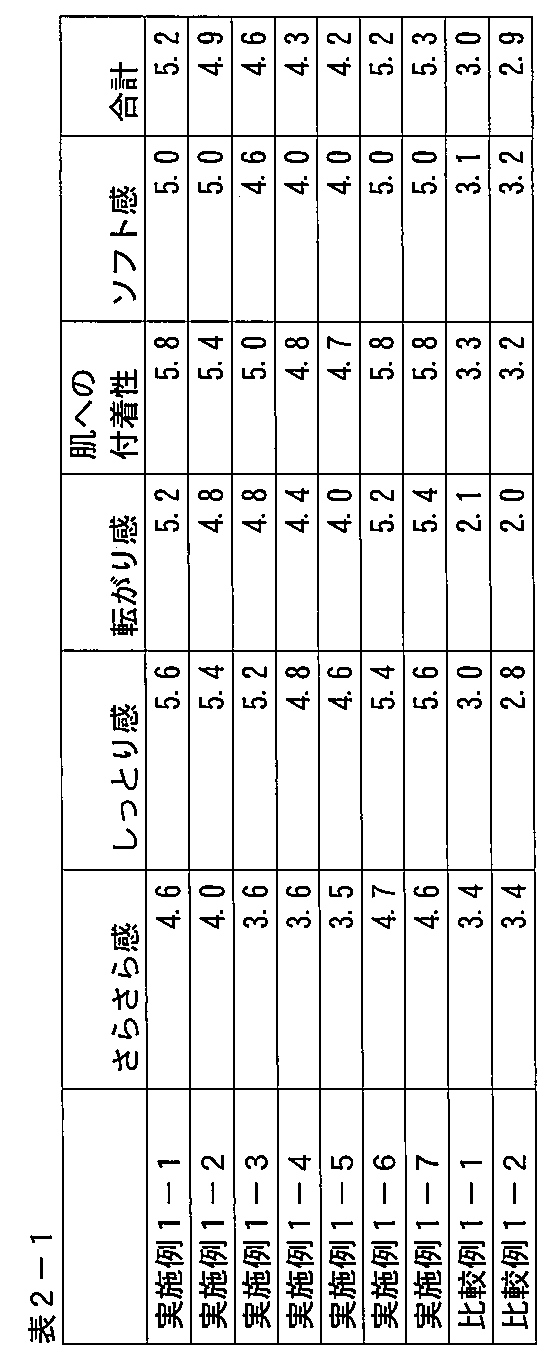
- Sensory evaluation method We interviewed five specialized panels on the five evaluation items of silky feeling, moist feeling, rolling feeling, adhesion to the skin, and soft feeling, and when the comparative control score was 5, the following evaluation items were given. The score of the evaluation item was determined by the average score of 5 people. Further, it was judged in 5 stages from A to E based on the average value of the scores of each evaluation item.
- Score (Evaluation) 6: Very good 5: Good 4: Somewhat good 3: Slightly defective 2: Defective 1: Very bad (Judgment): (Average score) A: 5.0 or above B: 4.4-4.9 C: 3.9-4.3 D: 3.1-3.8 E: 3.0 or less
- Example 1-1 to 1-7 and Comparative Examples 1-1 to 1-2 Each raw material was weighed so as to have a total of 5.0 g at the compounding ratio (mass%) shown in Table 1, and all the raw materials were simultaneously charged into a lab miller (Tescom Mill & Mixer TML162). The evaluation sample was a mixture for 100 seconds (20 seconds 5 times, scraping off the powder adhering to the inner wall surface during each mixing). Table 1 shows the evaluation results when nylon (manufactured by Toray Industries, Inc., SP-500) was used as a comparative control. The scores of each evaluation item are shown in Table 2-1.
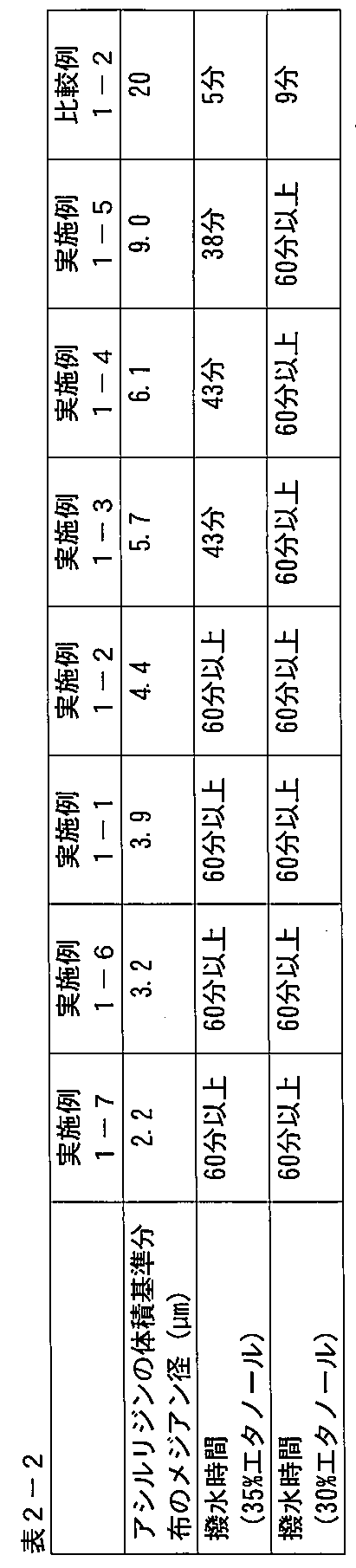
- the water repellency time was evaluated for the evaluation sample.
- the evaluation method was as follows: 5 g of a 30% by mass or 35% by mass aqueous solution of ethanol was placed in a 10 mL glass vial, 30 mg of each evaluation sample was gradually added from above, and the time during which the evaluation sample remained on the liquid surface was defined as the water repellent time. ..
- the evaluation results are shown in Table 2-2.
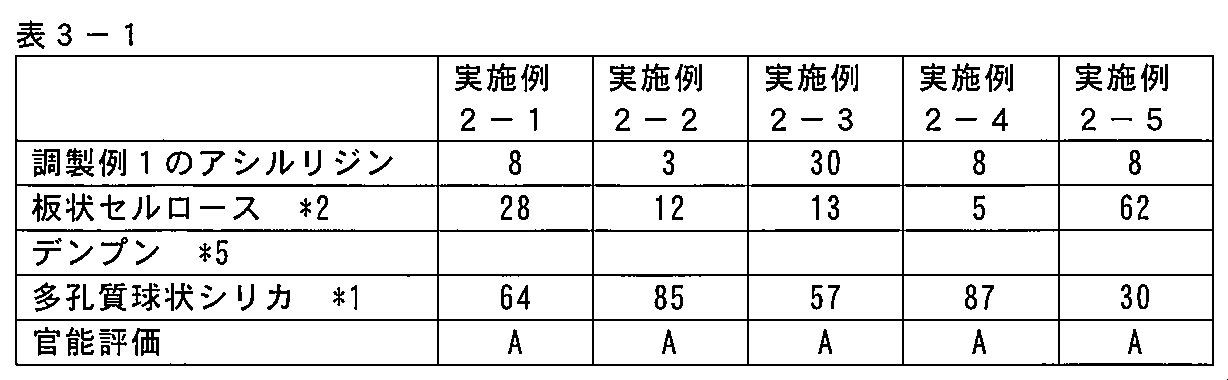
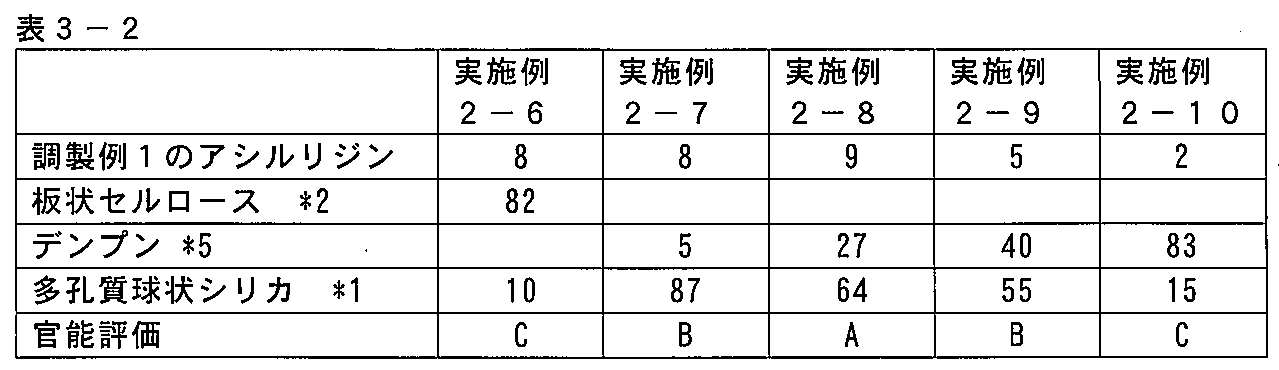
- Examples 2-1 to 2-12 and Comparative Examples 2-1 to 2-4 Each raw material was weighed so as to have a total of 5.0 g at the compounding ratios (% by mass) shown in Tables 3-1 to 3-3, and all the raw materials were put into a lab miller (Tescom Mill & Mixer TML162) at the same time. ..
- the evaluation sample was a mixture for 100 seconds (20 seconds 5 times, scraping off the powder adhering to the inner wall surface during each mixing).
- Tables 3-1 to 3-3 show the evaluation results when nylon (manufactured by Toray Industries, Inc., SP-500) was used as a comparative control.
- Examples 3-1 to 3-3 Each raw material was weighed so as to have a total of 5.0 g at the compounding ratio (mass%) shown in Table 4, and all the raw materials were simultaneously charged into a lab miller (Tescom Mill & Mixer TML162). The evaluation sample was a mixture for 100 seconds (20 seconds 5 times, scraping off the powder adhering to the inner wall surface during each mixing). Table 4 shows the evaluation results when nylon (manufactured by Toray Industries, Inc., SP-500) was used as a comparative control.
- nylon manufactured by Toray Industries, Inc., SP-500
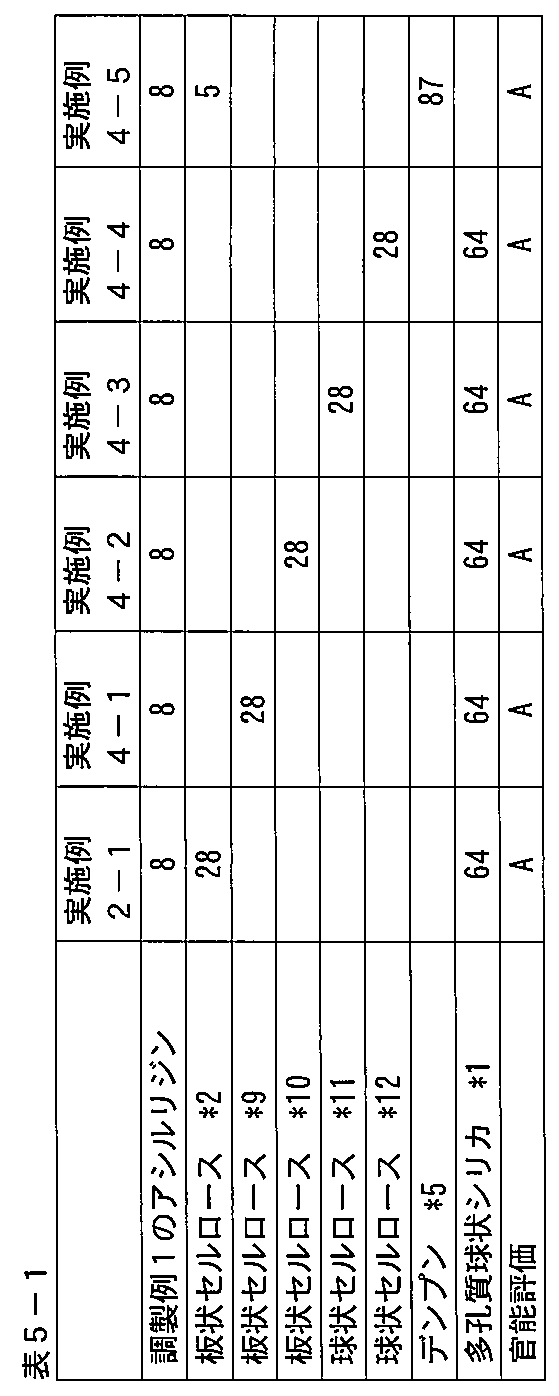
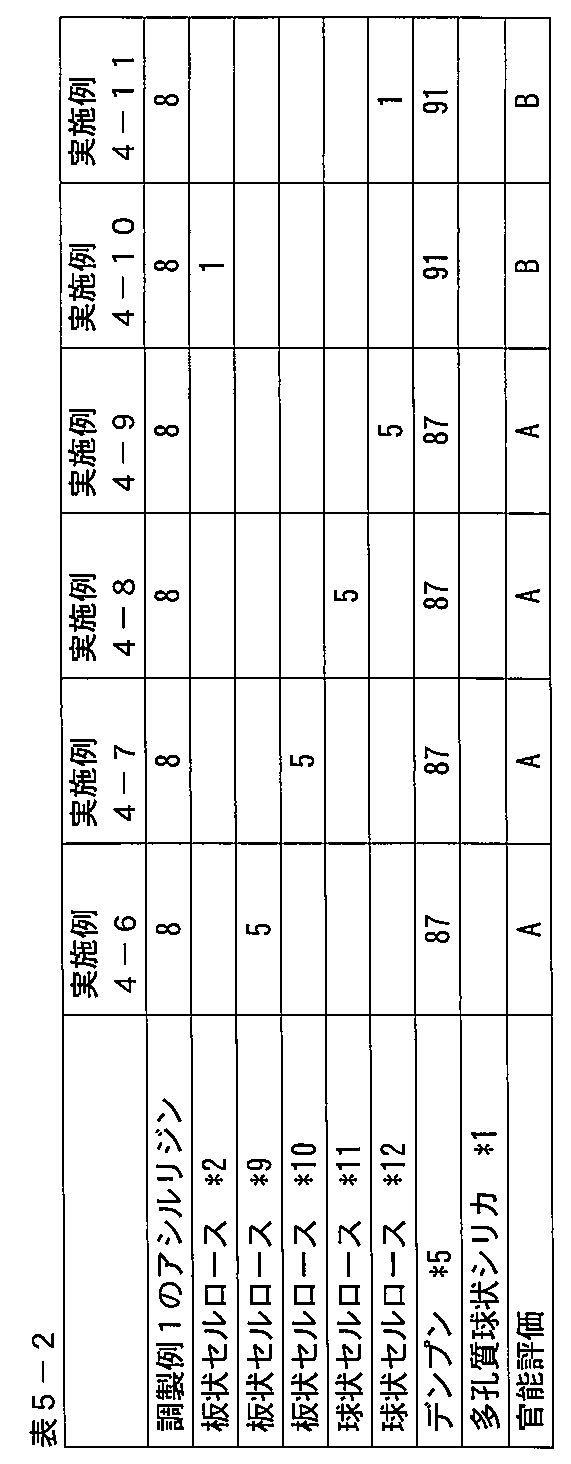
- Examples 4-1 to 4-11 Each raw material was weighed so as to have a total of 5.0 g at the compounding ratio (mass%) shown in Table 5-1 and Table 5-2, and all the raw materials were put into a lab miller (Tescom Mill & Mixer TML162) at the same time. ..
- the evaluation sample was a mixture for 100 seconds (20 seconds 5 times, scraping off the powder adhering to the inner wall surface during each mixing).
- Tables 5-1 and 5-2 show the evaluation results when nylon (Toray Industries, Inc., SP-500) was used as a comparative control.
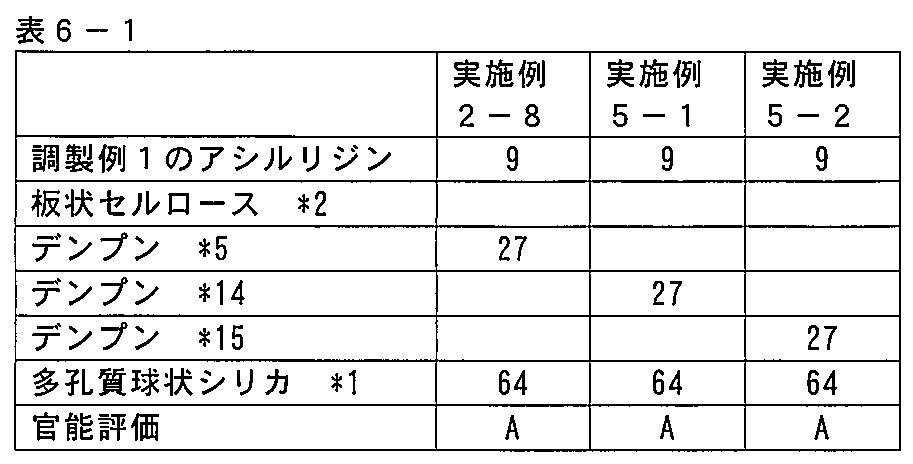
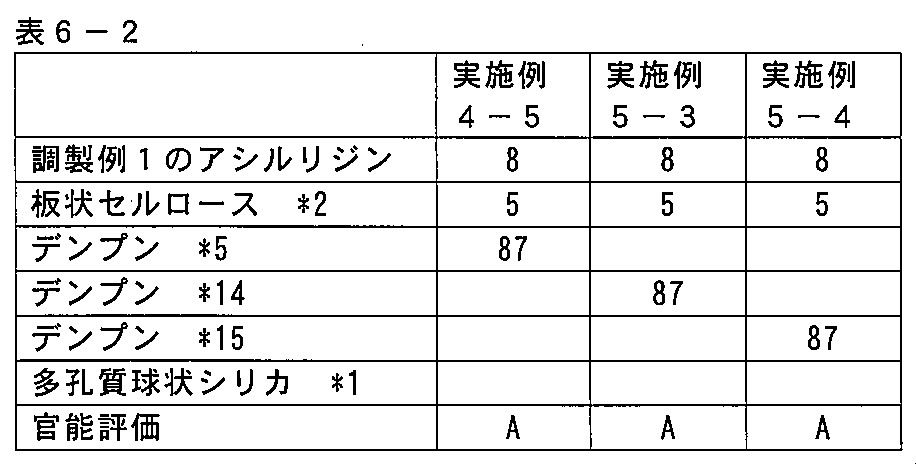
- Examples 5-1 to 5-4 Each raw material was weighed so as to have a total of 5.0 g at the compounding ratio (mass%) shown in Table 6-1 and Table 6-2, and all the raw materials were put into a lab miller (Tescom Mill & Mixer TML162) at the same time. ..
- the evaluation sample was a mixture for 100 seconds (20 seconds 5 times, scraping off the powder adhering to the inner wall surface during each mixing).
- Tables 6-1 and 6-2 show the evaluation results when PMMA particles (manufactured by Matsumoto Yushi Pharmaceutical Co., Ltd .: Matsumoto Microsphere M-100) were used as comparative controls.
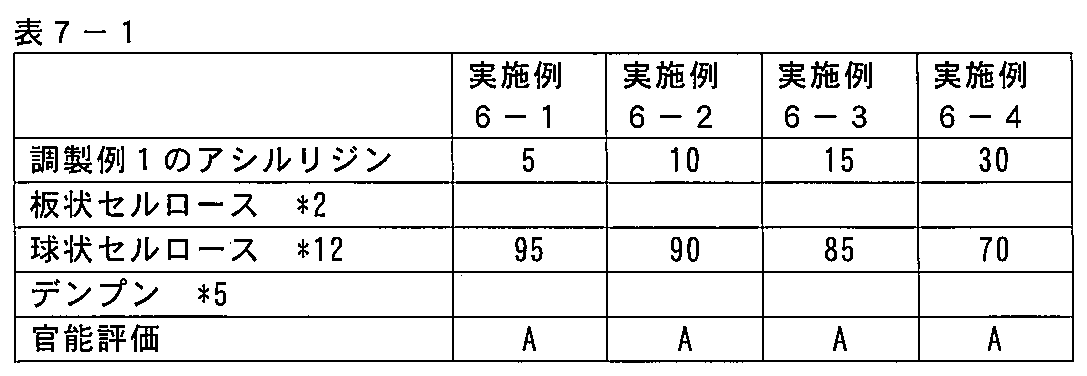
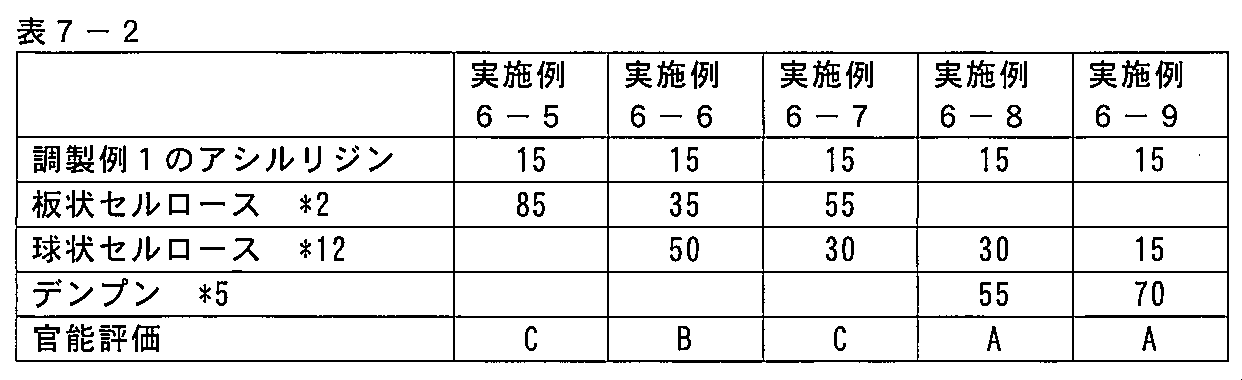
- Examples 6-1 to 6-14 Each raw material was weighed so as to have a total of 5.0 g at the compounding ratios (% by mass) shown in Tables 7-1 to 7-3, and all the raw materials were put into a lab miller (Tescom Mill & Mixer TML162) at the same time. ..
- the evaluation sample was a mixture for 100 seconds (20 seconds 5 times, scraping off the powder adhering to the inner wall surface during each mixing).
- Tables 7-1 to 7-3 show the evaluation results when urethane particles (manufactured by Dainichiseika Kogyo Co., Ltd .: Dimic beads) are used as comparative controls.
- Examples 7-1 to 7-4 Each raw material was weighed so as to have a total of 5.0 g at the compounding ratio (mass%) shown in Table 8, and all the raw materials were put into a lab miller (Tescom Mill & Mixer TML162) at the same time.
- the evaluation sample was a mixture for 100 seconds (20 seconds 5 times, scraping off the powder adhering to the inner wall surface during each mixing).
- Five expert panels evaluated the lack of dryness when applying various mixtures according to the following criteria. Dryness evaluation method at the time of application: 1) I don't feel the dry feeling at all when applying ... 4 points 2) I hardly feel the dry feeling when applying ...
- AGC SAITEC Average particle size 5 ⁇ m * 2 Made by Evonik Operations (TEGO Feel): Average particle size 30 ⁇ m * 4 Ajinomoto Amihope LL: Median diameter of volume-based distribution: 20 ⁇ m * 5 Made by Nissho Kagakusha (ST Starch C (W)): Average particle size 18 ⁇ m * 6
- AGC SAITEC Average particle size 12 ⁇ m * 7
- AGC SAITEC Average particle size 4 ⁇ m * 8
- AGC SAITEC Average particle size 10 ⁇ m * 9 Made by Evonik Operations: Average particle diameter 10 ⁇ m * 10 Average particle diameter 20 ⁇ m, bulk density 0.22 g / cm 3 * 11 Made by Daito Kasei Kogyo Co., Ltd .: Average particle diameter 5 ⁇ m * 12 Made by Daito Kasei Kogyo Co., Ltd .: Average particle diameter 10 ⁇ m *
- Manufacturing Examples 1 to 4 An example of producing the powder composition of the present invention is shown below.
- (Manufacturing Example 1) Weigh 15.0 kg of silica, 7.5 kg of crystalline cellulose, and 2.5 kg of N ⁇ -lauroyl lysine (median diameter of 3.9 ⁇ m in volume-based distribution) using a Henshell mixer (Nippon Coke Industries FM Mixer FM150), and use the mixer as a mixer. Add at the same time (total amount of powder: 25 kg). Mix for 30 minutes at a peripheral speed of 60 m / sec of the stirring blade.
- a presto foundation was prepared and evaluated as a cosmetic or a skin external preparation using the powder composition of the present invention.
- 5 specialized panels gave grades to each of the 4 evaluation items of "adhesiveness”, “smoothness at the time of application”, “non-stickiness”, and “moisturizing feeling”, and based on the average score of 5 people.
- the score of the evaluation item was decided. Further, it was judged on a scale of 5 from A to D based on the average value of the scores of each evaluation item.
- Example 8 A presto foundation was prepared as follows using the components shown in Tables 9-1 and 9-2. B was heated and dissolved. A was weighed and mixed with a lab miller for 30 seconds. B was added to A, and the mixture was further stirred with a laboratory mixer for 5 minutes, and then mixed with a laboratory miller for 30 seconds ⁇ 3 times. It was sieved with a 150 ⁇ m open sieve to make the particle size uniform, filled in a gold plate, and compression-molded.
- Raw materials The raw materials used in each of the Examples and Comparative Examples from Table 9-1 to Table 9-2 are as follows. * 1 SA-Tark JA-46R manufactured by Miyoshi Kasei, Inc.
- Example 9 A presto foundation was prepared as follows using the components shown in Table 10-1 and Table 10-2. B was heated and dissolved. A was weighed and mixed with a lab miller for 30 seconds. B was added to A, and the mixture was further stirred with a laboratory mixer for 5 minutes, and then mixed with a laboratory miller for 30 seconds ⁇ 3 times. It was sieved with a 150 ⁇ m open sieve to make the particle size uniform, filled in a gold plate, and compression-molded. Compared with Comparative Examples 9-1 to 9-4, in Examples 9-1 to 9-10, a formulation having better moldability and excellent removability was obtained.
- Raw materials The raw materials used in each of the Examples and Comparative Examples from Table 10-1 to Table 10-2 are as follows.
- a liquid foundation was prepared and evaluated as a cosmetic or a skin external preparation using the powder composition of the present invention.
- 5 specialized panels gave grades to each of the 4 evaluation items of "adhesiveness”, “smoothness at the time of application”, “non-stickiness”, and “moisturizing feeling", and based on the average score of 5 people.
- the score of the evaluation item was decided. Further, it was judged on a scale of 5 from A to D based on the average value of the scores of each evaluation item.
- Example 10 A liquid foundation was prepared as follows using the components shown in Tables 11-1 and 11-2. A was heated (75 ° C.) and mixed (4000 rpm) with a homomixer. B was added to A, and the mixture was heated (75 ° C.) and mixed (4000 rpm) with a homomixer. Further, C was added to A, and the mixture was heated (75 ° C.) and mixed (4000 rpm) with a homomixer. D was heated to 75 ° C to dissolve, and then gradually added to A for emulsification. After that, it was cooled to 30 ° C while stirring with a paddle. Raw materials: The raw materials used in each of the Examples and Comparative Examples from Table 11-1 to Table 11-2 are as follows.
- Example 11 A liquid foundation was prepared as follows using the components shown in Tables 12-1 and 12-2. A was heated (75 ° C.) and mixed (4000 rpm) with a homomixer. B was added to A, and the mixture was heated (75 ° C.) and mixed (4000 rpm) with a homomixer. Further, C was added to A, and the mixture was heated (75 ° C.) and mixed (4000 rpm) with a homomixer. D was heated to 75 ° C to dissolve, and then gradually added to A for emulsification. After that, it was cooled to 30 ° C while stirring with a paddle. Raw materials: The raw materials used in each of the Examples and Comparative Examples from Table 12-1 to Table 12-2 are as follows.
- a lip cosmetic as a cosmetic using the powder composition of the present invention or a skin external preparation was prepared as follows using the components shown in Table 13.
- Component A was heated and dissolved at 105 ⁇ 5 ° C.
- component B was added to component A and heated and dissolved at 90 ° C.
- component C was added, heated and mixed at 90 ° C., dispersed in three rolls, and then component D was added.
- defoaming was performed. It was filled in a sink at a filling temperature of 90 ° C., cooled, and then loaded into a container.
- the lip cosmetic of Formulation Example 1 had less color unevenness and good color uniformity. Furthermore, there was no sweating and the stability was good.
- a leave-on cosmetic was prepared as follows using the components shown in Table 14. After heating and dissolving each of the component A and the component B at 80 ° C., the component A was added to the component B with stirring. It was emulsified with a homomixer and cooled to room temperature (3000 rpm, 3 minutes, 80 ° C.) to obtain leave-on cosmetics.
- the leave-on cosmetics of Formulation Example 2 had an excellent moist feeling after application, and were glossy when applied. Furthermore, the stability and antiseptic property were good.
- Example 12-1 to 12-7 Each raw material was weighed so as to have a total of 5.0 g at the compounding ratio (mass%) shown in Table 15, and all the raw materials were put into a lab miller (Tescom Mill & Mixer TML162) at the same time. The evaluation sample was a mixture for 100 seconds (20 seconds 5 times, scraping off the powder adhering to the inner wall surface during each mixing).
- Raw materials The raw materials used in each of the examples in Table 15 above are as follows.
- Loose powder was prepared as follows using the components shown in Table 16.
- Component A is mixed and pulverized using a pulverizer.
- Component B is added to component A and stirred and mixed.
- the mixture of component C is added and stirred and mixed.
- a mixture of component D was added, and the mixture was stirred and mixed to obtain a loose powder.
- the loose powders of Formulation Examples 3 to 9 were excellent in slipperiness, adhesiveness, and uniformity during application, and were also excellent in moist feeling and soft focus effect after application.
- Eye makeup cosmetics were prepared as follows using the ingredients shown in Table 17. After mixing the A component for 10 minutes, the B component was added to the A component and further mixed for 20 minutes. The C component was mixed for 10 minutes using a mixer (FM 10C / I manufactured by Nippon Coke Industries, Ltd.), then added to the mixture of A component + B component, and further mixed for 5 minutes. The obtained mixture was filled in a container and compressed using a press to obtain the desired eye makeup cosmetics.
- the eye make-up cosmetic of Formulation Example 4 had good pearly feeling, gloss, shine and color development after application.
Landscapes
- Health & Medical Sciences (AREA)
- Life Sciences & Earth Sciences (AREA)
- Animal Behavior & Ethology (AREA)
- General Health & Medical Sciences (AREA)
- Public Health (AREA)
- Veterinary Medicine (AREA)
- Birds (AREA)
- Epidemiology (AREA)
- Dermatology (AREA)
- Chemical & Material Sciences (AREA)
- Inorganic Chemistry (AREA)
- Cosmetics (AREA)
Abstract
Description
また、特開2020-50840号公報には、特定の結晶性セルロースが集合して形成された多孔質セルロース粒子が配合された化粧料が記載されている。
また、特開2020-152851号公報には、特定のセルロース誘導体粒子を含有する化粧品組成物が記載されている。
しかしながら、依然として、ナイロン粉体、アクリル粉体、またはウレタン粉体などのプラスチック粉体に代わる、優れた粉体組成物が求められている。
[1]
(A)アシルリジンと、
(B)セルロース及び/又はデンプンと、
を含み、(A)アシルリジンの体積基準分布のメジアン径が9μm以下である、粉末組成物であって、
粉末組成物全体を100質量%とした場合、
前記(A)の含有量が2~40質量%であり、
前記(B)の含有量が3~95質量%であり、
前記(A)と前記(B)の合計量が、10質量%以上である、
組成物。
[2]
(A)アシルリジンと、
(B)セルロース及び/又はデンプンと、
を含む粉末組成物であって、
粉末組成物全体を100質量%とした場合、
前記(A)の含有量が2~40質量%であり、
前記(B)の含有量が3~95質量%であり、
前記(A)と前記(B)の合計量が、10質量%以上であり、
エタノール35質量%水溶液を用いた撥水時間が30分以上であり、エタノール35質量%水溶液を用いた撥水時間は、10mLガラスバイアルに5gのエタノール35質量%水溶液を入れ、液面上に30mgの粉末組成物を配置し、すべての粉末組成物が沈降するのにかかる時間である、
組成物。
[3]
(A)アシルリジンと、
(B)セルロース及び/又はデンプンと、
を含む粉末組成物であって、
粉末組成物全体を100質量%とした場合、
前記(A)の含有量が2~40質量%であり、
前記(B)の含有量が3~95質量%であり、
前記(A)と前記(B)の合計量が、10質量%以上であり、
エタノール30質量%水溶液を用いた撥水時間が60分以上であり、エタノール30質量%水溶液を用いた撥水時間は、10mLガラスバイアルに5gのエタノール30質量%水溶液を入れ、液面上に30mgの粉末組成物を配置し、すべての粉末組成物が沈降するのにかかる時間である、
組成物。
[4]
前記(B)が板状セルロースを含む、上記1~3のいずれか1項に記載の組成物。
[5]
粉末組成物全体を100質量%とした場合、板状セルロースを5~65質量%含む上記4に記載の組成物。
[6]
粉末組成物全体を100質量%とした場合、デンプンを5~90質量%含む上記1~5のいずれか1項に記載の組成物。
[7]
前記(B)が球状セルロースを含む、上記1~6のいずれか1項に記載の組成物。
[8]
粉末組成物全体を100質量%とした場合、球状セルロースを5~95質量%含む上記7に記載の組成物。
[9]
さらに、(C)シリカを含む上記1~8のいずれか1項に記載の組成物。
[10]
粉末組成物全体を100質量%とした場合、
前記(A)の含有量が2~30質量%であり、
前記(B)の含有量が3~65質量%であり、
前記(C)の含有量が30~90質量%である、上記9に記載の組成物。
[11]
セルロースが結晶セルロースである、上記1~10のいずれか1項に記載の組成物。
[12]
さらに(D)リジンまたはその塩を含む上記1~11のいずれか1項に記載の組成物。
[13]
粉末組成物全体を100質量%とした場合、前記(D)の含有量が0.0001~1質量%である、上記12に記載の組成物。
[14]
前記アシルリジンの個数基準分布のメジアン径が4μm以下である、上記1~13のいずれか1項に記載の組成物。
[15]
前記アシルリジンの体積基準分布のメジアン径が6μm以下である、上記1~14のいずれか1項に記載の組成物。
[16]
前記アシルリジンの個数基準分布のメジアン径が2μm以下である、上記1~15のいずれか1項に記載の組成物。
[17]
前記アシルリジンの体積基準分布のメジアン径が4μm以下である、上記1~16のいずれか1項に記載の組成物。
[18]
前記アシルリジンのかさ密度が0.38g/mL以下である、上記1~17のいずれか1項に記載の組成物。
[19]
上記1~18に記載の組成物を含む化粧料又は皮膚外用剤。
[20]
(A)アシルリジンと、(B)セルロース及び/又はデンプンと、を投入する工程;及び
混合する工程;
を含む、上記1~18のいずれか1項に記載の組成物の製造方法。
[21]
(A)アシルリジンと、(B)セルロース及び/又はデンプンと、(C)シリカと、を投入する工程;及び
混合する工程;
を含む、請求項9~18のいずれか1項に記載の組成物の製造方法。
[22]
前記混合することが、乾式混合によって混合することを含む、上記20又は21に記載の製造方法。
[23]
前記混合することが、混合機によって120分以下混合することを含む、上記20~22のいずれか1項に記載の製造方法。
本態様の(A)アシルリジンの個数基準分布のメジアン径は、4μm以下が好ましく、密着性向上の観点から、好ましくは3μm以下、密着性向上および製造時間の短縮の観点からさらに好ましくは2μm以下である。
アシルリジンのメジアン径は、レーザー回折/散乱式の粒子径分布測定装置を使用し、個数基準又は体積基準の粒子径分布を測定することによって求めることができる。メジアン径とは、通過分積算%の分布曲線が50%の横軸と交差するポイントの粒子径を意味する。「個数基準分布」とは、粒子径分布のそれぞれの粒径の頻度を計算するとき、粒子の数を計数してその個数を基準に計算している粒子径分布を表し、「体積基準分布」とは、粒子径分布のそれぞれの粒径の頻度を計算するとき、球状として仮定した粒子の体積を計数してその値を基準に計算している粒子径分布を表す。
(A)アシルリジンのかさ密度は、好ましくは0.38g/mL以下である。また、前記かさ密度は、好ましくは0.01~0.38g/mLであり、0.05~0.38g/mLがより好ましく、0.1~0.32g/mLが更に好ましい。
アシルリジンのかさ密度は、以下の測定方法で測定することができる。
アシルリジンをミキサーで2分以上攪拌させ解砕し、得られた結晶のかさ密度を粉体流動性分析装置(例えば、パウダーレオメータFT-4(フリーマンテクノロジーTM社製))を用いて測定する。具体的には、一定量のアシルリジンをホルダーに測り取った後、利用手順に沿ってコンディショニングを行い、コンディショニング後の体積及びアシルリジンの質量から下記式よりかさ密度を測定する。
かさ密度=コンディショニング後の質量/コンディショニング後の体積 (g/mL)
エタノール35質量%水溶液を用いた撥水時間は、10mLガラスバイアルに5gのエタノール35質量%水溶液を入れ、液面上に30mgの粉末組成物を配置し、すべての粉末組成物が沈降するのにかかる時間である。エタノール35質量%水溶液を用いた撥水時間は、好ましくは40分以上、より好ましくは60分以上である。
エタノール30質量%水溶液を用いた撥水時間は、10mLガラスバイアルに5gのエタノール30質量%水溶液を入れ、液面上に30mgの粉末組成物を配置し、すべての粉末組成物が沈降するのにかかる時間である。
セルロースとしては、板状セルロース、球状セルロース、不定形セルロースなどが挙げられる。
板状セルロースとしては、板状結晶セルロース、針状結晶セルロースなどが挙げられ、板状結晶セルロースが好ましい。
板状セルロースの平均粒径は、好ましくは2~50μm、より好ましくは5~30μm、さらに好ましくは8~20μmである。ここで板状セルロースの平均粒径はJIS規格(Z8819-2:2019)のように特定する。
球状セルロースとしては、無孔質セルロース、多孔質セルロースが挙げられ、無孔質セルロースが好ましい。ここで球状には真球状、略球状、楕円状が含まれる。
球状セルロースの平均粒径は、好ましくは2~30μm、より好ましくは3~20μm、さらに好ましくは5~10μmである。ここで球状セルロースの平均粒径はJIS規格(Z8819-2:2019)のように特定する。
セルロースは、INCI名として、結晶セルロース、セルロース、セルロースアセテート、リグニンとして登録されているものを使用することができる。セルロースは商業的に入手可能であり、例えば、エボニック社製TEGO Feel Green、大東化成工業株式会社製CELLULOBEADS D-5、CELLULOBEADS D-10を使用することができる。
デンプンの平均粒径は、好ましくは5~30μm、より好ましくは5~25μm、さらに好ましくは5~20μmである。ここでデンプンの平均粒径はJIS規格(Z8819-2:2019)のように特定する。
デンプンは商業的に入手可能であり、例えば、日澱化學株式会社製STスターチPを使用することができる。
シリカの平均粒径は、好ましくは1~50μm、より好ましくは3~20μm、さらに好ましくは5~12μmである。ここでシリカの平均粒径はJIS規格(Z8819-2:2019)のように特定する。
シリカは商業的に入手可能であり、例えば、三好化成株式会社の多孔質シリカビーズSB-300、SB-700、AGCエスアイテック株式会社製サンスフェアH-31、H-51、H-121、L-31、L-51を使用することができる。
ポリアミド系粉体(例えばナイロン)またはシリコーン重合体粒子(例えばシリコーンエラストマー)の代替の官能を得るという観点で好ましくは、第二の態様として、(A)体積基準分布のメジアン径が9μm以下であるアシルリジン、(B-2)デンプン、および(C)シリカを含む態様が挙げられる。
ポリアミド系粉体(例えばナイロン)またはシリコーン重合体粒子(例えばシリコーンエラストマー)の代替の官能を得るという観点で好ましくは、第三の態様として、(A)体積基準分布のメジアン径が9μm以下であるアシルリジン、(B-3)セルロースおよびデンプンを含む態様が挙げられる。
炭素重合系粒子(例えば、ポリアクリル・ポリエチレン・ポリスチレン)の代替の官能を得るという観点で好ましくは、第四の態様として、(A)体積基準分布のメジアン径が9μm以下であるアシルリジン、(B-2)デンプン、および(C)シリカを含む態様が挙げられる。
炭素重合系粒子(例えば、ポリアクリル・ポリエチレン・ポリスチレン)の代替の官能を得るという観点で好ましくは、第五の態様として、(A)体積基準分布のメジアン径が9μm以下であるアシルリジン、(B-3)セルロースおよびデンプンを含む態様が挙げられる。
ポリウレタン粒子の代替の官能を得るという観点で好ましくは、第六の態様として、(A)体積基準分布のメジアン径が9μm以下であるアシルリジン、(B-1)セルロースを含む態様が挙げられる。(B-1)セルロースは、球状セルロースが好ましい。
ウレタン粒子の代替の官能を得るという観点で好ましくは、第七の態様として、(A)体積基準分布のメジアン径が9μm以下であるアシルリジン、(B-3)セルロースおよびデンプンを含む態様が挙げられる。(B-1)セルロースは、球状セルロースが好ましい。
本発明の粉末組成物において、前記(A)と前記(B)の合計量は、粉末組成物全体を100質量%とした場合、少なくとも10質量%以上である。好ましくは20質量%以上であり、さらに好ましくは35質量%以上である。
前記(B)セルロース及び/又はデンプンの含有量は、粉末組成物全体を100質量%とした場合、3~95質量%であり、好ましくは25~95質量%である。
前記(B)が(B-1)セルロースを含む態様では、セルロースの含有量は、粉末組成物全体を100質量%とした場合、好ましくは5~95質量%であり、より好ましくは5~60質量%であり、更に好ましくは5~40質量%である。板状セルロースの場合、好ましくは5~95質量%であり、より好ましくは5~60質量%であり、更に好ましくは5~40質量%である。球状セルロースの場合、好ましくは5~95質量%であり、より好ましくは5~60質量%であり、更に好ましくは5~40質量%である。
前記(B)が(B-2)デンプンを含む態様では、デンプンの含有量は、粉末組成物全体を100質量%とした場合、好ましくは5~95質量%であり、より好ましくは20~90質量%である。
前記(B)が(B-3)セルロースおよびデンプンを含む態様では、セルロースおよびデンプンのそれぞれの含有量は、粉末組成物全体を100質量%とした場合、好ましくはセルロース5~75質量%:デンプン20~90質量%であり、より好ましくはセルロース5~40質量%:デンプン55~90質量%である。
粉末組成物が(C)シリカを含む態様では、粉末組成物全体を100質量%とした場合、(C)の含有量は30~90質量%であり、好ましくは50~80質量%である。
粉末組成物が(D)リジンまたはその塩を含む態様では、粉末組成物全体を100質量%とした場合、前記(D)の含有量が0.0001~1質量%である。
前記第二の態様として好ましくは、(A)体積基準分布のメジアン径が9μm以下であるアシルリジン2~30質量%、(B-2)デンプン5~40質量%、および(C)シリカ30~93質量%を含む態様が挙げられる。
前記第三の態様として好ましくは、(A)体積基準分布のメジアン径が9μm以下であるアシルリジン2~20質量%、(B-3)セルロースおよびデンプンをそれぞれ1~38質量%、60~97質量%含む態様が挙げられる。前記第三の態様が(C)シリカを含む場合、(A)体積基準分布のメジアン径が9μm以下であるアシルリジン2~20質量%、(B-3)セルロースおよびデンプンをそれぞれ5~30質量%、25~90質量%、(C)シリカ3~78質量%を含む態様が挙げられる。
前記第四の態様として好ましくは、(A)体積基準分布のメジアン径が9μm以下であるアシルリジン2~20質量%、(B-2)デンプン20~50質量%、および(C)シリカ30~78質量%を含む態様が挙げられる。
前記第五の態様として好ましくは、(A)体積基準分布のメジアン径が9μm以下であるアシルリジン2~20質量%、(B-3)セルロースおよびデンプンをそれぞれ1~97質量%、1~97質量%含む態様が挙げられる。
前記第六の態様として好ましくは、(A)体積基準分布のメジアン径が9μm以下であるアシルリジン5~40質量%、(B-1)セルロース60~95質量%を含む態様が挙げられる。(B-1)セルロースは、球状結晶セルロースが好ましい。
前記第七の態様として好ましくは、(A)体積基準分布のメジアン径が9μm以下であるアシルリジン5~40質量%、(B-3)セルロースおよびデンプンをそれぞれ10~40質量%、50~85質量%含む態様が挙げられる。(B-1)セルロースは、球状結晶セルロースが好ましい。
本発明の粉体組成物が(C)シリカを含む場合、本発明の粉体組成物は、上記アシルリジンと上記セルロース及び/又はデンプンと上記シリカとを投入し、混合することによって得ることができる。アシルリジンとセルロース及び/又はデンプンと上記シリカの投入は、同時に投入することもできる。
上記アシルリジンの混合は、乾式混合によって実施することができる。本発明における乾式混合は、完全に溶媒を使用しない態様を含むほか、少量の溶媒を使用する態様も含む。
また、上記アシルリジンの混合は、混合機によって1分以上混合することで実施することができる。混合時間は1分以上が好ましく、10分以上がより好ましい。生産性を落とさず、安価に生産できるという観点から混合時間は120分以下であることが好ましい。混合機としてはヘンシェルミキサー、家庭用ミキサー、ハイシェアミキサーなどの高速攪拌型混合機;W型混合機、CV型混合機、V型混合機、ロッキングミキサーなどの容器回転型混合機又は攪拌機付容器回転型混合機;リボン攪拌型、複軸パドル型、二軸遊星攪拌型、円錐スクリュー型の機械攪拌式混合機;気流攪拌式混合機、ジュリアミキサー、ナウターミキサー、ノビルタなどの圧縮・せん断・衝撃型混合機などを使用することができ、安価な生産及び汎用性の観点からは高速攪拌型混合機が好ましい。
レーザー回折/散乱式の粒子径分布測定装置(HORIBA社製、Partica LA-950)を使用し、体積累積値を使って粒子径分布を測定した。測定して得られた結果を装置付属のソフトウェアを用いて解析することにより個数基準分布及び体積基準分布の各種粒子径を求めた。20mgのアシルリジンを5gのイソプロピルアルコールに添加し、出力300Wattの超音波装置を用いて30分間超音波に攪拌しながらさらして解砕し、分散した。この分散液の適量を装置の手順に従って500mLイソプロピルアルコールに添加し、透明度を確認しながら、適度な濃度の分散サンプルを調整した。このサンプルを10mL/minの流量で循環させながら30分間超音波を当てて一次粒子まで分散させ、脱気したのち、フローセルを用いてサンプル中のアシルリジンの粒度分布及び各種粒子径を求めた。
ラウロイルリジンをミキサーで2分以上攪拌させ解砕した。得られた結晶のかさ密度をパウダーレオメータFT-4(フリーマンテクノロジーTM社製)を用いて測定した。具体的には、一定量のラウロイルリジンをホルダーに測り取った後、利用手順に沿ってコンディショニングを行った。ラウロイルリジンのコンディショニング後の体積及び質量から下記式よりかさ密度を測定した。
かさ密度=コンディショニング後の質量/コンディショニング後の体積 (g/mL)
(調製例Aのアシルリジン)
メタノール97.4gと水62.7gの混合溶液に水酸化ナトリウム5.7gを室温にて溶解させた後、約50℃に加温してから市販のNε-ラウロイルリジン結晶36.4gを加えて同温度にて溶解させてNε-ラウロイルリジンの溶液を得た。その後、30℃以下に冷却し続けた0.1mol/Lの濃度の塩酸水溶液(600mL)に、pHを0.7~1.3に維持しながら、Nε-ラウロイルリジンの溶液を75分かけて滴下した。滴下終了後、水酸化ナトリウムでpHを7.0に調整し、析出した結晶を濾過し、減圧乾燥して白色結晶36.0gを得た。得られた結晶の体積基準分布のメジアン径は、9μmであった。
なお、Nε-ラウロイルリジンの溶液を滴下する塩酸水溶液の温度を下げることにより、体積基準分布のメジアン径がより小さなNε-ラウロイルリジンを得ることができる。
(調製例1のアシルリジン)
調製例Aに従い、Nε-ラウロイルリジンの溶液を滴下する塩酸水溶液の温度を適宜変更することにより、体積基準分布のメジアン径が3.9μm、個数基準分布のメジアン径が1.1μm、かさ密度が0.28g/mLのNε-ラウロイルリジンの白色結晶を得た。
(調製例2のアシルリジン)
調製例Aに従い、Nε-ラウロイルリジンの溶液を滴下する塩酸水溶液の温度を適宜変更することにより、体積基準分布のメジアン径が4.4μmのNε-ラウロイルリジンの白色結晶を得た。
(調製例3のアシルリジン)
調製例Aに従い、Nε-ラウロイルリジンの溶液を滴下する塩酸水溶液の温度を適宜変更することにより、体積基準分布のメジアン径が5.7μm、個数基準分布のメジアン径が3.5μmのNε-ラウロイルリジンの白色結晶を得た。
(調製例4のアシルリジン)
調製例Aに従い、Nε-ラウロイルリジンの溶液を滴下する塩酸水溶液の温度を適宜変更することにより、体積基準分布のメジアン径が6.1μmのNε-ラウロイルリジンの白色結晶を得た。
(調製例5のアシルリジン)
調製例Aに従い、Nε-ラウロイルリジンの溶液を滴下する塩酸水溶液の温度を適宜変更することにより、体積基準分布のメジアン径が9.0μmのNε-ラウロイルリジンの白色結晶を得た。
(調製例6のアシルリジン)
ホソカワミクロン株式会社のピコライン(旋回流型ジェットミル)を用いて供給ガス圧力0.60MPa、粉砕ガス圧力0.60MPa、供給速度49.3g/hにて、市販のNε-ラウロイルリジン(商品名:アミホープLL、味の素社製)を粉砕することによりNε-ラウロイルリジンを得た。得られたNε-ラウロイルリジンの体積基準分布のメジアン径は、3.2μmであった。
(調製例7のアシルリジン)
調製例Aに従い、Nε-ラウロイルリジンの溶液を滴下する塩酸水溶液の温度を適宜変更することにより、体積基準分布のメジアン径が2.2μmのNε-ラウロイルリジンの白色結晶を得た。
(調製例8のアシルリジン)
WO01/014317の製造実施例4に従い、白色結晶を得た。得られた結晶の各種測定をした結果、得られたNε-ラウロイルリジンの体積基準分布のメジアン径は、14μmであった。
さらさら感、しっとり感、転がり感、肌への付着性、及びソフト感の5つの評価項目に関して専門パネル5名に聞き取り調査を行い、比較対照の評点を5とした時、それぞれの評価項目について以下の方法で評点をつけ5名の平均点により、その評価項目の評点を決定した。さらに、各評価項目の評点の平均値によりA~Eの5段階で判定した。
(評点):(評価)
6:非常に良好
5:良好
4:やや良好
3:やや不良
2:不良
1:非常に不良
(判定):(評点平均値)
A:5.0以上
B:4.4~4.9
C:3.9~4.3
D:3.1~3.8
E:3.0以下
各々の原料を表1に示す配合比(質量%)にて合計5.0gとなるように秤量し、ラボミルサー(テスコム ミル&ミキサーTML162)に全ての原料を同時に投入した。100秒間(20秒を5回、各混合の間に内部壁面に付着した粉体をかき落とした)混合したものを評価サンプルとした。ナイロン(東レ社製、SP-500)を比較対照としたときの評価結果を表1に示す。各評価項目の評点を表2-1に示す。

各々の原料を表3-1~表3-3に示す配合比(質量%)にて合計5.0gとなるように秤量し、ラボミルサー(テスコム ミル&ミキサーTML162)に全ての原料を同時に投入した。100秒間(20秒を5回、各混合の間に内部壁面に付着した粉体をかき落とした)混合したものを評価サンプルとした。ナイロン(東レ社製、SP-500)を比較対照としたときの評価結果を表3-1~表3-3に示す。
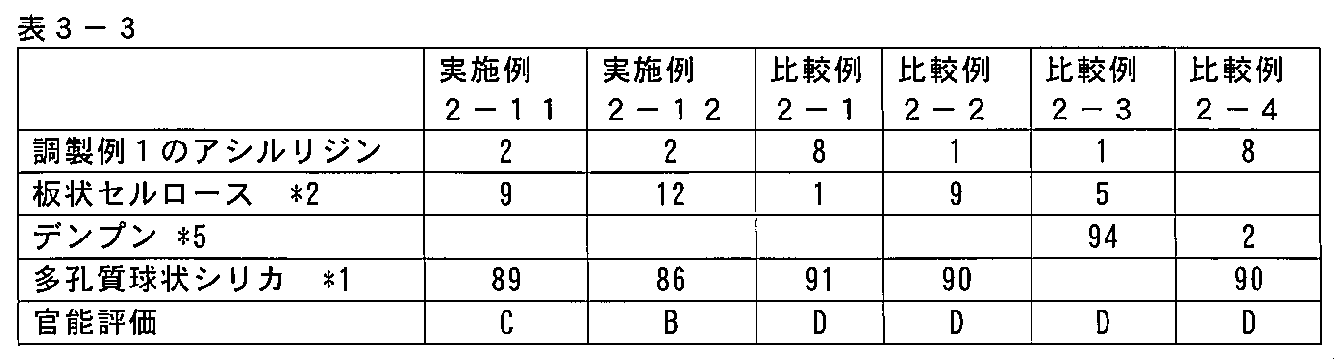
各々の原料を表4に示す配合比(質量%)にて合計5.0gとなるように秤量し、ラボミルサー(テスコム ミル&ミキサーTML162)に全ての原料を同時に投入した。100秒間(20秒を5回、各混合の間に内部壁面に付着した粉体をかき落とした)混合したものを評価サンプルとした。ナイロン(東レ社製、SP-500)を比較対照としたときの評価結果を表4に示す。
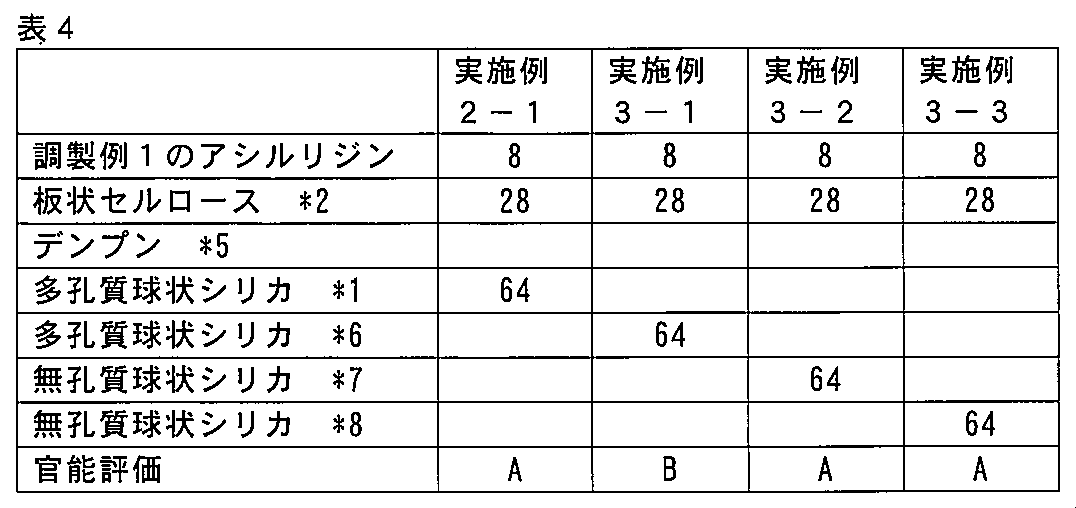
各々の原料を表5-1及び表5-2に示す配合比(質量%)にて合計5.0gとなるように秤量し、ラボミルサー(テスコム ミル&ミキサーTML162)に全ての原料を同時に投入した。100秒間(20秒を5回、各混合の間に内部壁面に付着した粉体をかき落とした)混合したものを評価サンプルとした。ナイロン(東レ社製、SP-500)を比較対照としたときの評価結果を表5-1及び5-2に示す。
各々の原料を表6-1及び表6-2に示す配合比(質量%)にて合計5.0gとなるように秤量し、ラボミルサー(テスコム ミル&ミキサーTML162)に全ての原料を同時に投入した。100秒間(20秒を5回、各混合の間に内部壁面に付着した粉体をかき落とした)混合したものを評価サンプルとした。PMMA粒子(松本油脂製薬社製:マツモトマイクロスフェアM-100)を比較対照としたときの評価結果を表6-1及び表6-2に示す。
各々の原料を表7-1~表7-3に示す配合比(質量%)にて合計5.0gとなるように秤量し、ラボミルサー(テスコム ミル&ミキサーTML162)に全ての原料を同時に投入した。100秒間(20秒を5回、各混合の間に内部壁面に付着した粉体をかき落とした)混合したものを評価サンプルとした。ウレタン粒子(大日精化工業社製:ダイミックビーズ)を比較対照としたときの評価結果を表7-1~表7-3に示す。

各々の原料を表8に示す配合比(質量%)にて合計5.0gとなるように秤量し、ラボミルサー(テスコム ミル&ミキサーTML162)に全ての原料を同時に投入した。100秒間(20秒を5回、各混合の間に内部壁面に付着した粉体をかき落とした)混合したものを評価サンプルとした。
専門パネル5名により、各種混合物の塗布時の乾燥感のなさを下記基準により評価した。
塗布時の乾燥感評価方法:
1)塗布時の乾燥感は全く感じない・・・・・4点
2)塗布時の乾燥感はほとんど感じない・・・・・・・・3点
3)塗布時の乾燥感は少し感じる・・・2点
4)塗布時は乾燥感を感じる・・・・1点
専門パネル5名の評価の平均点を基に以下のように判断した。結果を表14に示す。
評価平均点3.5以上:とても好ましい(A)
評価平均点2.5以上3.5未満:やや好ましい(B)
評価平均点1.5以上2.5未満:あまり好ましくない(C)
評価平均点1.5未満:全く好ましくない(D)
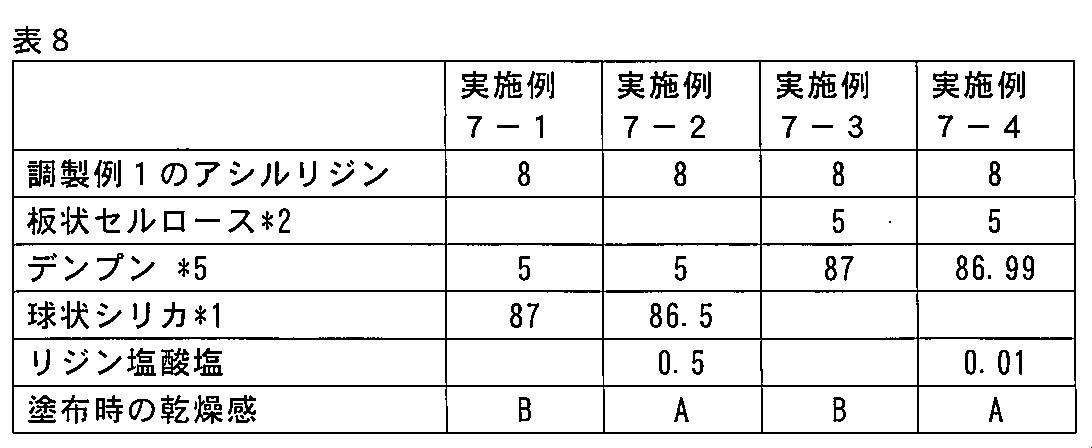
上記表1から表8までの各実施例及び比較例で用いた原料は、以下の通りである。
*1 AGC エスアイテック社製:平均粒子径5μm
*2 Evonik Operations社製(TEGO Feel):平均粒子径30μm
*4 味の素社製アミホープ LL:体積基準分布のメジアン径:20μm
*5 日澱化學社製(STスターチ C(W)):平均粒子径18μm
*6 AGC エスアイテック社製:平均粒子径12μm
*7 AGC エスアイテック社製:平均粒子径4μm
*8 AGC エスアイテック社製:平均粒子径10μm
*9 Evonik Operations社製:平均粒子径10μm
*10 平均粒子径20μm、かさ密度0.22g/cm3
*11 大東化成工業社製:平均粒子径5μm
*12 大東化成工業社製:平均粒子径10μm
*14 大東化成工業社製(RICE PW):平均粒子径8μm
*15 日澱化學社製(STスターチ P):平均粒子径32μm
本発明の粉体組成物の製造例を以下に示す。
(製造例1)
ヘンシェルミキサー(日本コークス工業 FMミキサ FM150)を用いてシリカ15.0kg、結晶セルロース7.5kg、Nε-ラウロイルリジン(体積基準分布のメジアン径3.9μm)2.5kgをそれぞれ秤取し、ミキサーに同時に投入する(粉体総量:25kg)。攪拌羽根の周速60m/secで30分混合する。
(製造例2)
撹拌混合造粒機(株式会社パウレック バーチカルグラニュレータ VG-200)を用いてシリカ15.0kg、結晶セルロース7.5kg、Nε-ラウロイルリジン(体積基準分布のメジアン径3.9μm)2.5kgをそれぞれ秤取し、ミキサーに同時に投入する(粉体総量:25kg)。ブレード回転速度:100rpm、クロススクリュー回転速度:1800rpmにて混合時間60分混合する。
(製造例3)
撹拌混合造粒機(株式会社アーステクニカ ハイスピードミキサー LFS2)を用いてシリカ120g、結晶セルロース60g、ラウロイルリジン(体積基準分布のメジアン径3.9μm)20gをそれぞれ秤取し、ミキサーに同時に投入する(粉体総量:200g)。ブレード回転速度:500rpm、チョッパー回転速度:2000rpmにて混合時間60分混合する。
(製造例4)
撹拌混合造粒機(株式会社アーステクニカ ハイスピードミキサー LFS2)を用いてシリカ120g、結晶セルロース60g、オクタノイルリジン(体積基準分布のメジアン径8.8μm)20gをそれぞれ秤取し、ミキサーに同時に投入する(粉体総量:200g)。ブレード回転速度:500rpm、チョッパー回転速度:2000rpmにて混合時間60分混合する。
本発明の粉体組成物を用いた化粧料又は皮膚外用剤として、プレストファンデーションを調製し、その評価を行った。
使用性の評価に関して、専門パネル5名が「付着性」、「塗布時の滑らかさ」、「べたつきのなさ」、「保湿感」の4つの評価項目につきそれぞれ評点をつけ5名の平均点によりその評価項目の評点を決定した。さらに各評価項目の評点の平均値により、A~Dの5段階で判定した。
(評点):(評価)
6:非常に良好
5:良好
4:やや良好
3:やや不良
2:不良
1:非常に不良
(判定):(評点平均値)
A:5点以上
B:4点以上5点未満
C:3点以上4点未満
D:3点未満
表9-1及び表9-2に示す成分を用いてプレストファンデーションを以下のようにして調製した。Bを加熱溶解した。Aを秤量し、ラボミルサーで30秒間混合した。AにBを加え、ラボミキサーで更に5分撹拌した後、ラボミルサーで30秒間×3回混合した。150μm目開き篩にて篩過して粒度をそろえ、金皿に充填して圧縮成形した。
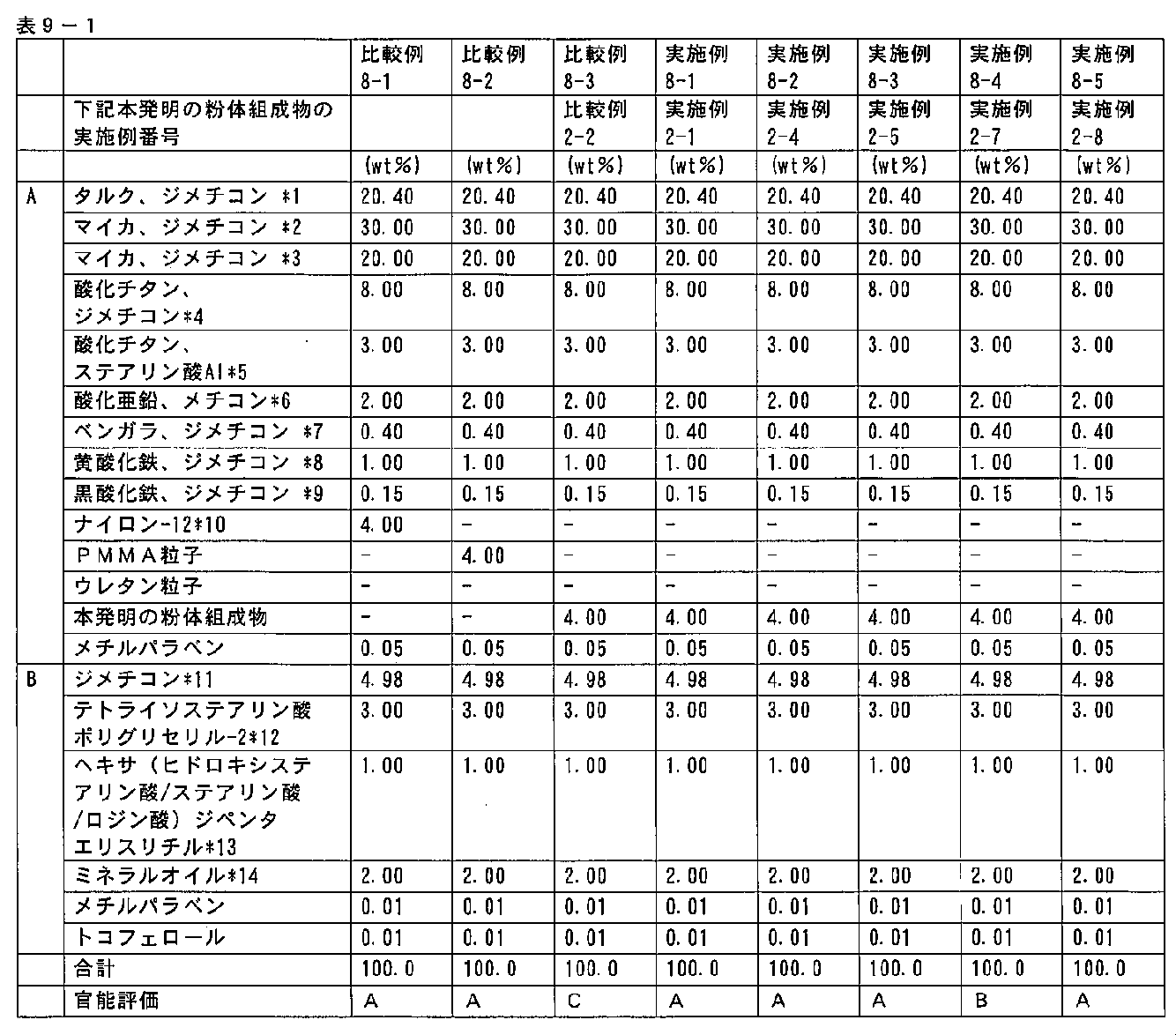
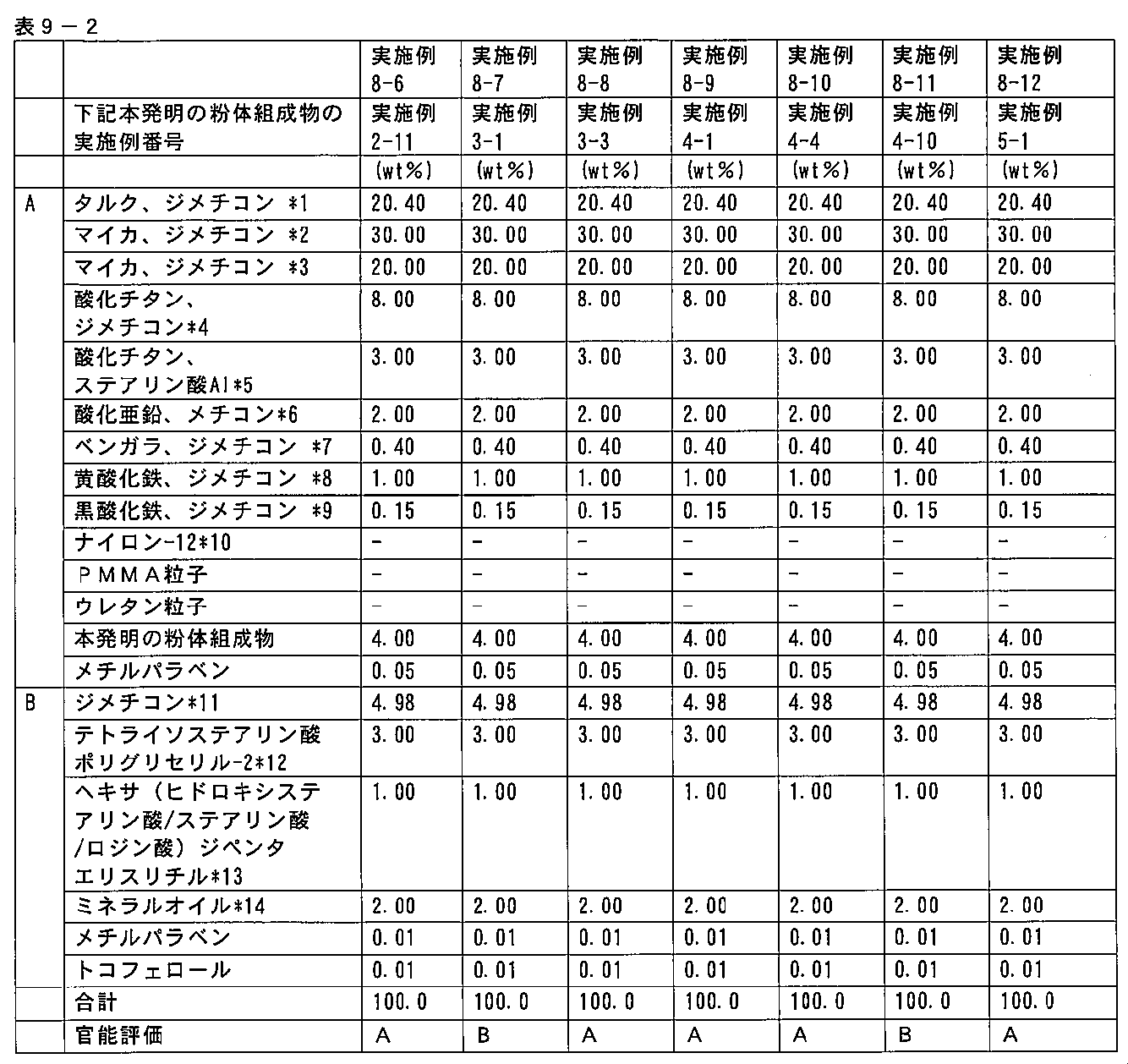
*1 SA-タルク JA-46R 三好化成社製
*2 SA-セリサイトFSE 三好化成社製
*3 SA-マイカ Y-2300 三好化成社製
*4 SA-チタン CR50(100%) 三好化成社製
*5 MT-100Z テイカ社製
*6 MZ-303S テイカ社製
*7 SA-レッド R-516PS (100%) 三好化成社製
*8 SA-イエローLL-100P (100%) 三好化成社製
*9 SA-ブラックBL-100PS(100%) 三好化成社製
*10 SP-500 東レ社製
*11 KF-96A-20cs 信越化学社製
*12 コスモール44V 日清オイリオ社製
*13 コスモール168ARV 日清オイリオ社製
*14 ハイコールK-230 カネダ社製
表10-1及び表10-2に示す成分を用いてプレストファンデーションを以下のようにして調製した。 Bを加熱溶解した。Aを秤量し、ラボミルサーで30秒間混合した。AにBを加え、ラボミキサーで更に5分撹拌した後、ラボミルサーで30秒間×3回混合した。150μm目開き篩にて篩過して粒度をそろえ、金皿に充填して圧縮成形した。
比較例9-1~9-4に比べて実施例9-1~9-10では成型性がよく、また取れ性にも優れる処方が得られた。

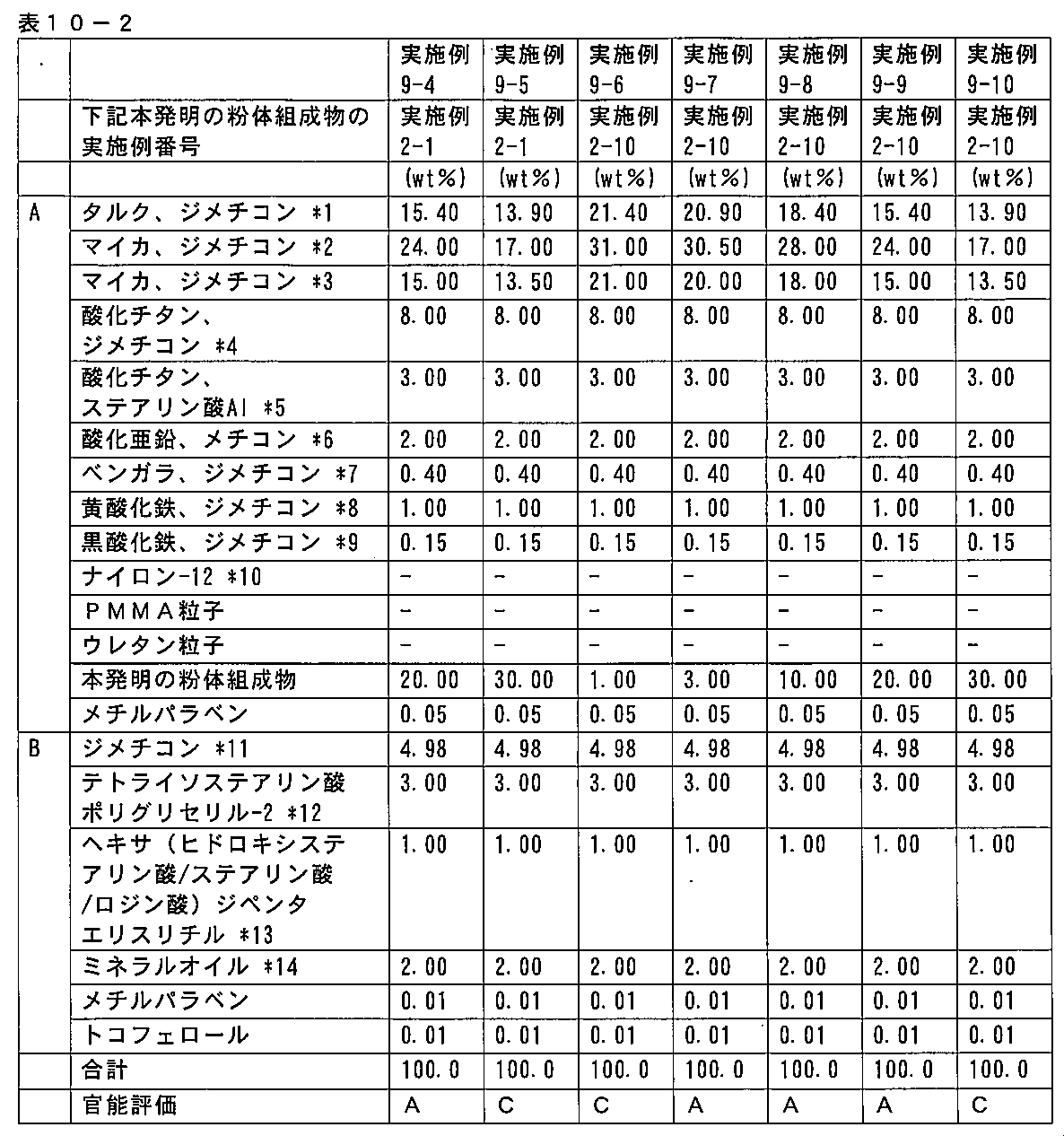
*1 SA-タルク JA-46R 三好化成社製
*2 SA-セリサイトFSE 三好化成社製
*3 SA-マイカ Y-2300 三好化成社製
*4 SA-チタン CR50(100%) 三好化成社製
*5 MT-100Z テイカ社製
*6 MZ-303S テイカ社製
*7 SA-レッド R-516PS (100%) 三好化成社製
*8 SA-イエローLL-100P (100%) 三好化成社製
*9 SA-ブラックBL-100PS(100%) 三好化成社製
*10 SP-500 東レ社製
*11 KF-96A-20cs 信越化学社製
*12 コスモール44V 日清オイリオ社製
*13 コスモール168ARV 日清オイリオ社製
*14 ハイコールK-230 カネダ社製
本発明の粉体組成物を用いた化粧料又は皮膚外用剤として、リキッドファンデーションを調製し、その評価を行った。
使用性の評価に関して、専門パネル5名が「付着性」、「塗布時の滑らかさ」、「べたつきのなさ」、「保湿感」の4つの評価項目につきそれぞれ評点をつけ5名の平均点によりその評価項目の評点を決定した。さらに各評価項目の評点の平均値により、A~Dの5段階で判定した。
(評点):(評価)
6:非常に良好
5:良好
4:やや良好
3:やや不良
2:不良
1:非常に不良
(判定):(評点平均値)
A:5点以上
B:4点以上5点未満
C:3点以上4点未満
D:3点未満
表11-1及び表11-2に示す成分を用いてリキッドファンデーションを以下のようにして調製した。
Aをホモミクサーで加温(75℃)、混合(4000rpm)した。AにBを加え、ホモミクサーで加温(75℃)、混合(4000rpm)した。さらにAにCを加え、ホモミクサーで加温(75℃)、混合(4000rpm)した。Dを75゜Cまで加温し溶解した後、Aに徐々に加えて乳化させた。その後パドルでかき混ぜながら30゜Cまで冷却した。

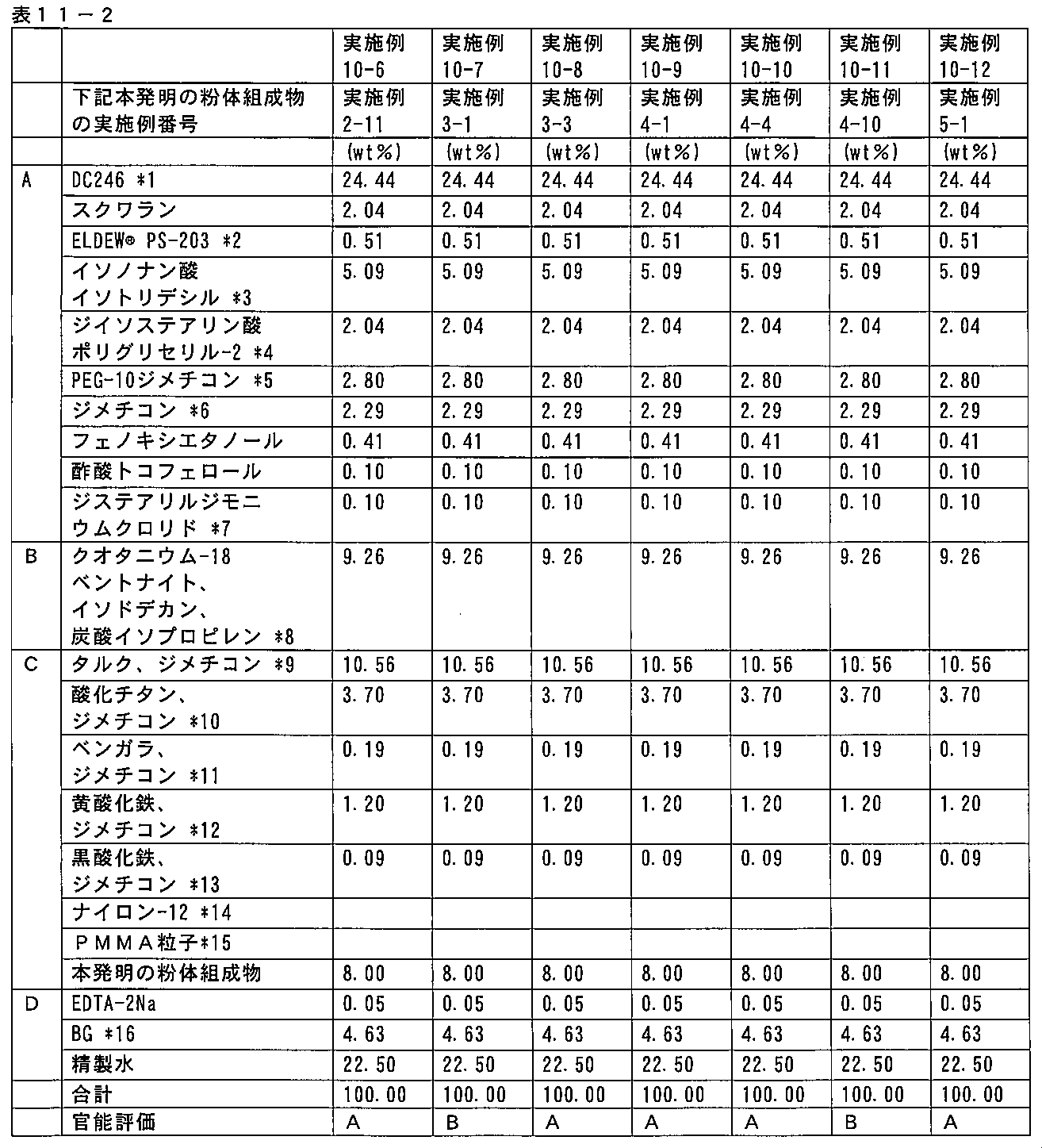
*1 シクロヘキサシロキサン、シクロペンタシロキサン
*2 味の素社製
*3 EMALEX INTD-139 日清オイリオ社製
*4 EMALEX DISG-2EX 日本エマルジョン社製
*5 KF-6017P 信越化学工業社製
*6 KF-96A-6T 信越化学工業社製
*7 NIKKOL CA-3475V 日光ケミカルズ社製
*8 BENTONGEL ISD Elementis社製
*9 SA-タルク JA-46R 三好化成社製
*10 SA-チタン CR50(100%) 三好化成社製
*11 SA-レッド R-516PS (100%) 三好化成社製
*12 SA-イエローLL-100P (100%) 三好化成社製
*13 SA-ブラックBL-100PS(100%) 三好化成社製
*14 SP-500 東レ社製
*15 マツモトマイクロスフェア M-100 松本油脂製薬社製
*16 ダイセル社製
表12-1及び表12-2に示す成分を用いてリキッドファンデーションを以下のようにして調製した。
Aをホモミクサーで加温(75℃)、混合(4000rpm)した。AにBを加え、ホモミクサーで加温(75℃)、混合(4000rpm)した。さらにAにCを加え、ホモミクサーで加温(75℃)、混合(4000rpm)した。Dを75゜Cまで加温し溶解した後、Aに徐々に加えて乳化させた。その後パドルでかき混ぜながら30゜Cまで冷却した。


*1 シクロヘキサシロキサン、シクロペンタシロキサン
*2 味の素社製
*3 EMALEX INTD-139 日清オイリオ社製
*4 EMALEX DISG-2EX 日本エマルジョン社製
*5 KF-6017P 信越化学工業社製
*6 KF-96A-6T 信越化学工業社製
*7 NIKKOL CA-3475V 日光ケミカルズ社製
*8 BENTONGEL ISD Elementis社製
*9 SA-タルク JA-46R 三好化成社製
*10 SA-チタン CR50(100%) 三好化成社製
*11 SA-レッド R-516PS (100%) 三好化成社製
*12 SA-イエローLL-100P (100%) 三好化成社製
*13 SA-ブラックBL-100PS(100%) 三好化成社製
*14 SP-500 東レ社製
*15 マツモトマイクロスフェア M-100 松本油脂製薬社製
*16 ダイセル社製
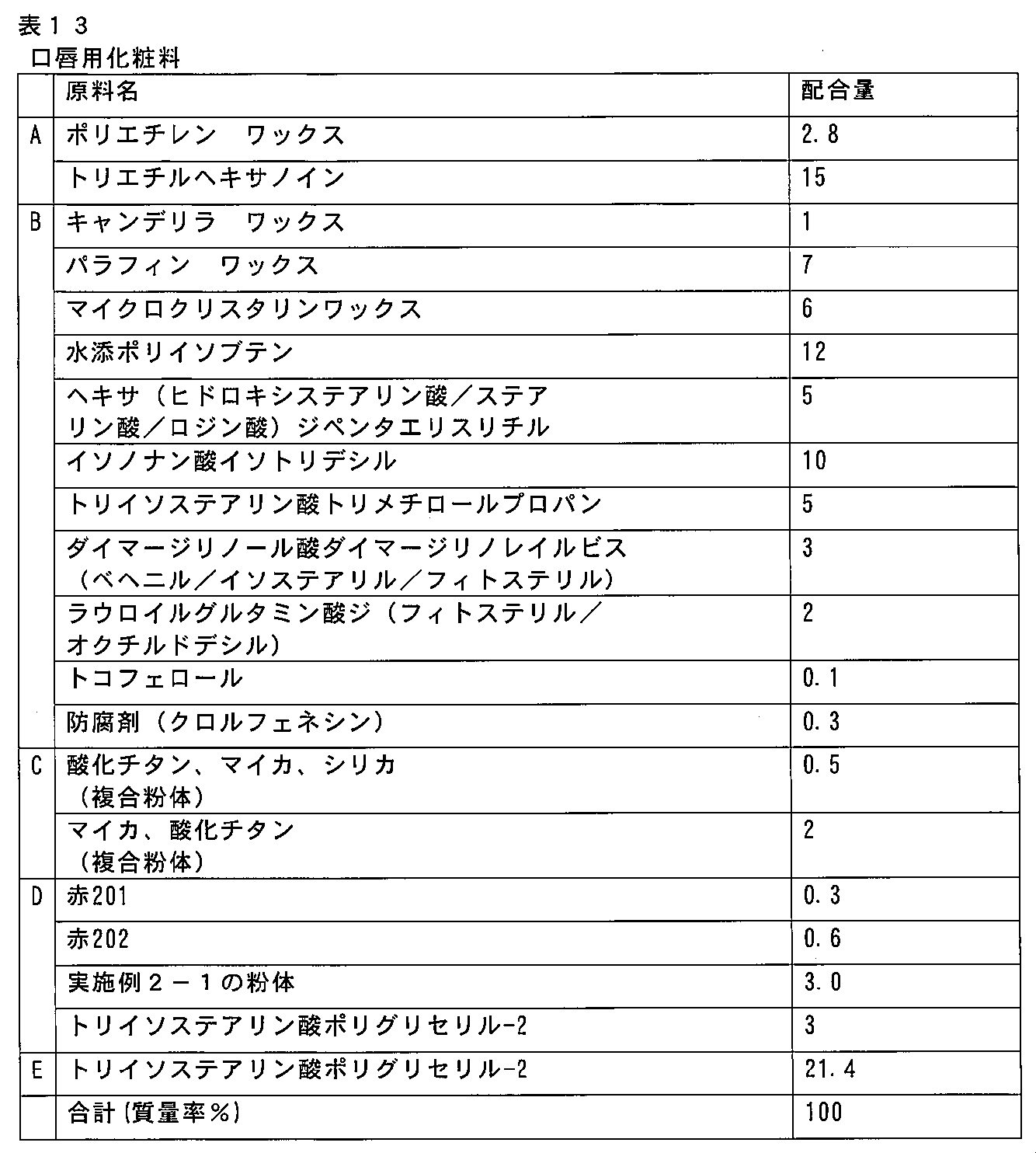
本発明の粉体組成物を用いた化粧料又は皮膚外用剤として口唇用化粧料を、表13に示す成分を用いて以下のようにして調製した。
成分Aを105±5℃で加熱溶解し、成分Bを成分Aに加え90℃で加熱溶解した。さらに成分Cを加え90℃で加熱混合した後3本ロールで分散した後、成分Dを加えた。成分Eを加え90℃で加熱混合した後、脱泡を行った。充填温度90℃にて流し型に充填し、冷却後容器に装填した。処方例1の口唇用化粧料は、色ムラが少なく、色の均一性がよかった。更に、発汗などなく、安定性もよかった。
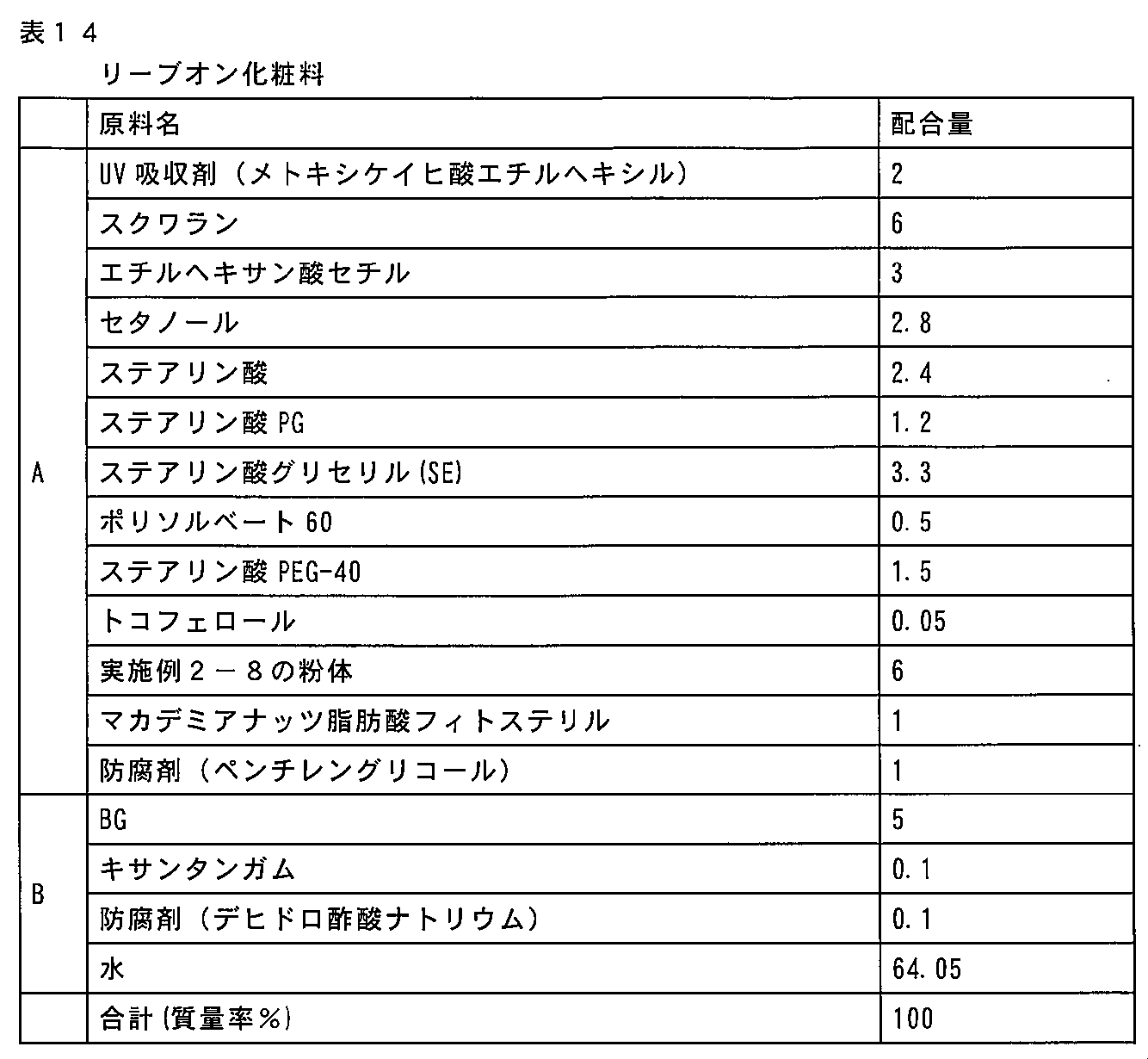
本発明の粉体組成物を用いた化粧料又は皮膚外用剤としてリーブオン化粧料を、表14に示す成分を用いて以下のようにして調製した。
成分Aと成分Bをそれぞれ80℃に加熱して溶解した後、成分Bに成分Aを撹拌しながら加えた。ホモミキサーにて乳化し、(3000rpm,3分間,80℃)室温まで冷却してリーブオン化粧料を得た。
処方例2のリーブオン化粧料は、塗布後のしっとり感に優れ、塗布することでツヤが良かった。更に、安定性及び防腐性がよかった。
各々の原料を表15に示す配合比(質量%)にて合計5.0gとなるように秤量し、ラボミルサー(テスコム ミル&ミキサーTML162)に全ての原料を同時に投入した。100秒間(20秒を5回、各混合の間に内部壁面に付着した粉体をかき落とした)混合したものを評価サンプルとした。
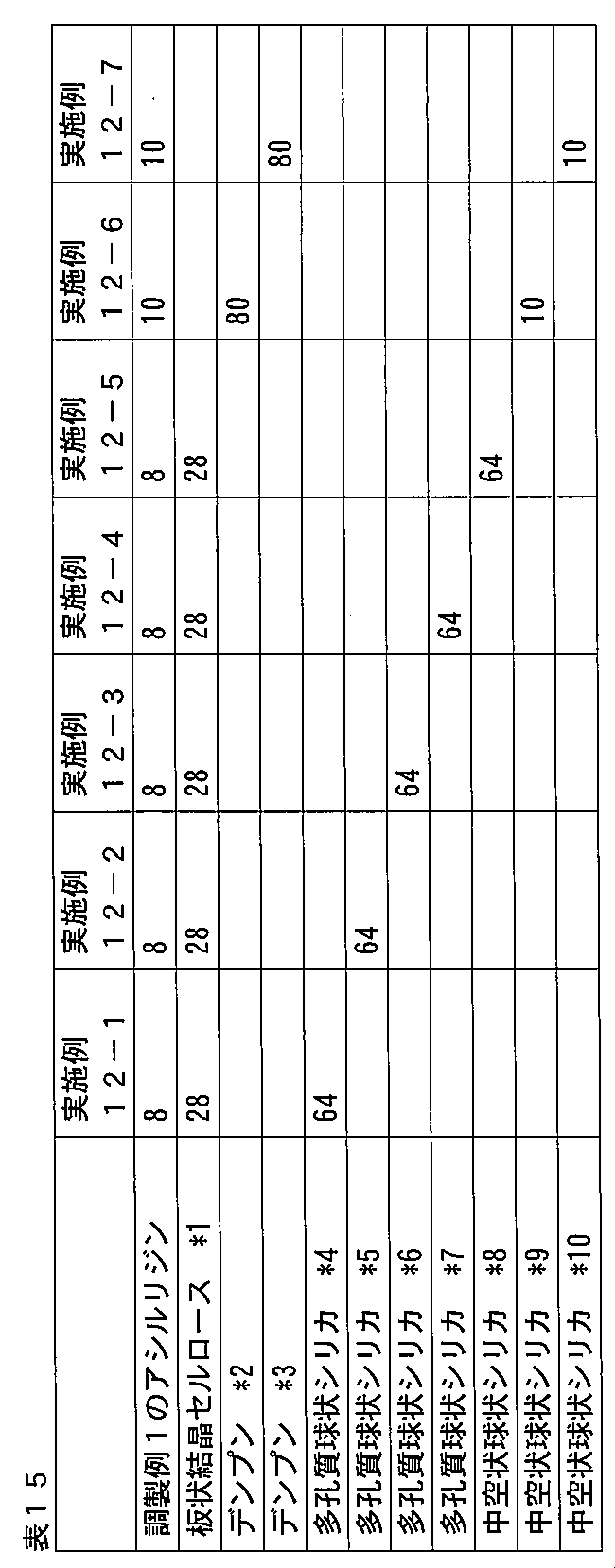
*1 日本製紙ケミカル社製:平均粒子径24μm
*2 大東化成工業社製:平均粒子径10μm
*3 日澱化學社製:平均粒子径18μm
*4 三好化成社製:平均粒子径5μm
*5 Sunjin社製:平均粒子径7μm
*6 Kobo社製:平均粒子径20μm
*7 Kobo社製:平均粒子径5μm
*8 三好化成社製:平均粒子径7μm
*9 日揮触媒化成社製:平均粒子径4μm
*10 鈴木油脂工業:平均粒子径6μm
表16に示す成分を用いてルースパウダーを以下のようにして調製した。
成分Aを混合し、微粉砕機を使用し微粉砕化させる。成分Bを成分Aに投入し、攪拌混合させる。成分Cの混合物を加え、攪拌混合させる。更に成分Dの混合物を加え、攪拌混合させてルースパウダーを得た。
処方例3~9のルースパウダーは、塗布時の滑り性、付着性、均一性に優れ、塗布後のしっとり感、ソフトフォーカス効果にも優れていた。
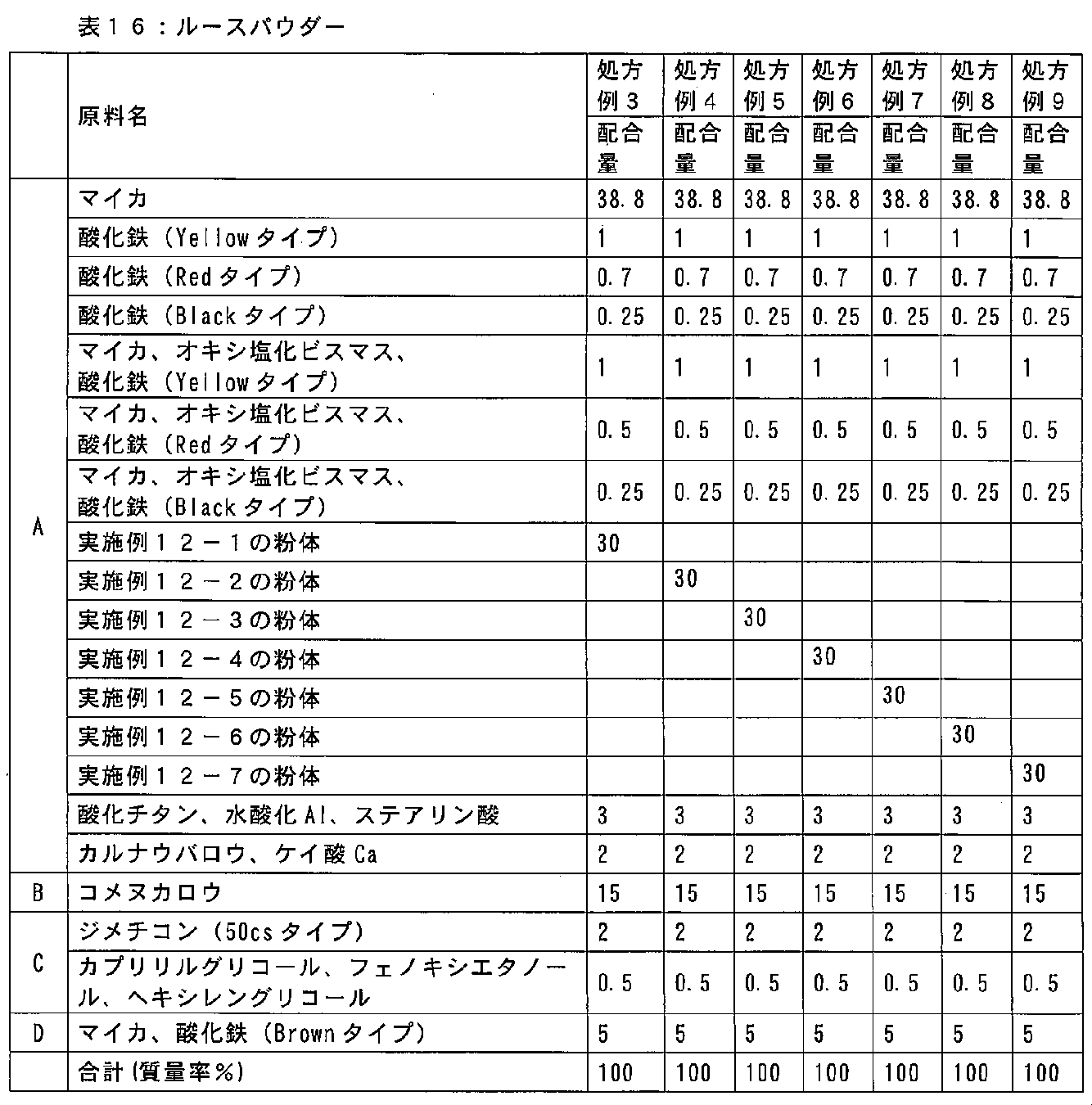
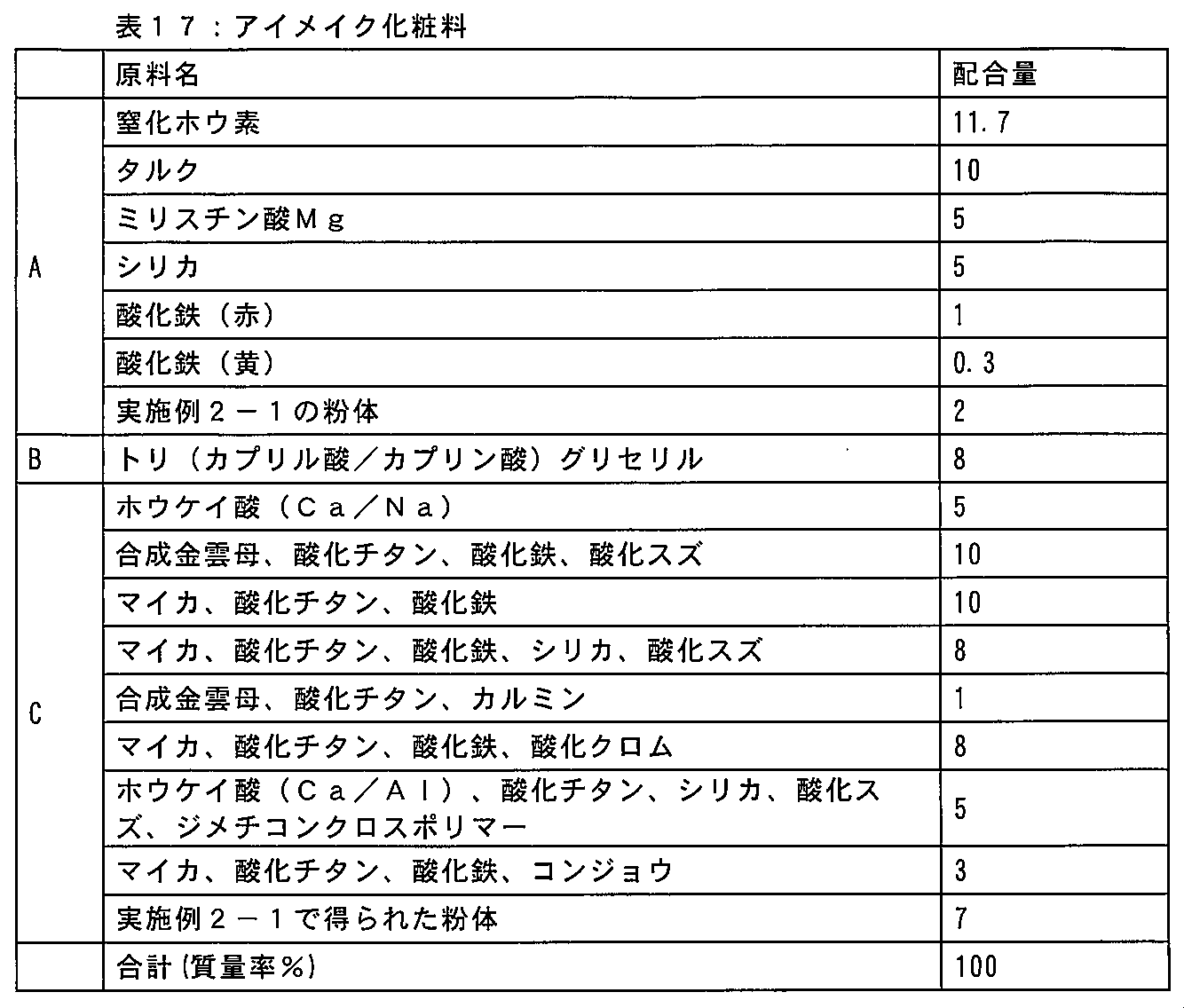
表17に示す成分を用いてアイメイク化粧料を以下のようにして調製した。
A成分を10分間混合した後、B成分をA成分に添加し、更に20分間混合した。C成分は混合機(日本コークス工業社製FM 10C/I)を用いて10分間混合した後A成分+B成分の混合物に添加し、更に5分間混合した。得られた混合物を容器の充填し、プレス機を用いて圧縮させることで目的のアイメイク化粧料を得た。
処方例4のアイメイク化粧料は、塗布後のパール感、光沢、ツキ及び発色が良かった。
Claims (23)
- (A)アシルリジンと、
(B)セルロース及び/又はデンプンと、
を含み、(A)アシルリジンの体積基準分布のメジアン径が9μm以下である、粉末組成物であって、
粉末組成物全体を100質量%とした場合、
前記(A)の含有量が2~40質量%であり、
前記(B)の含有量が3~95質量%であり、
前記(A)と前記(B)の合計量が、10質量%以上である、
組成物。 - (A)アシルリジンと、
(B)セルロース及び/又はデンプンと、
を含む粉末組成物であって、
粉末組成物全体を100質量%とした場合、
前記(A)の含有量が2~40質量%であり、
前記(B)の含有量が3~95質量%であり、
前記(A)と前記(B)の合計量が、10質量%以上であり、
エタノール35質量%水溶液を用いた撥水時間が30分以上であり、エタノール35質量%水溶液を用いた撥水時間は、10mLガラスバイアルに5gのエタノール35質量%水溶液を入れ、液面上に30mgの粉末組成物を配置し、すべての粉末組成物が沈降するのにかかる時間である、
組成物。 - (A)アシルリジンと、
(B)セルロース及び/又はデンプンと、
を含む粉末組成物であって、
粉末組成物全体を100質量%とした場合、
前記(A)の含有量が2~40質量%であり、
前記(B)の含有量が3~95質量%であり、
前記(A)と前記(B)の合計量が、10質量%以上であり、
エタノール30質量%水溶液を用いた撥水時間が60分以上であり、エタノール30質量%水溶液を用いた撥水時間は、10mLガラスバイアルに5gのエタノール30質量%水溶液を入れ、液面上に30mgの粉末組成物を配置し、すべての粉末組成物が沈降するのにかかる時間である、
組成物。 - 前記(B)が板状セルロースを含む、請求項1~3のいずれか1項に記載の組成物。
- 粉末組成物全体を100質量%とした場合、板状セルロースを5~65質量%含む請求項4に記載の組成物。
- 粉末組成物全体を100質量%とした場合、デンプンを5~90質量%含む請求項1~5のいずれか1項に記載の組成物。
- 前記(B)が球状セルロースを含む、請求項1~6のいずれか1項に記載の組成物。
- 粉末組成物全体を100質量%とした場合、球状セルロースを5~95質量%含む請求項7に記載の組成物。
- さらに、(C)シリカを含む請求項1~8のいずれか1項に記載の組成物。
- 粉末組成物全体を100質量%とした場合、
前記(A)の含有量が2~30質量%であり、
前記(B)の含有量が3~65質量%であり、
前記(C)の含有量が30~90質量%である、請求項9に記載の組成物。 - セルロースが結晶セルロースである、請求項1~10のいずれか1項に記載の組成物。
- さらに(D)リジンまたはその塩を含む請求項1~11のいずれか1項に記載の組成物。
- 粉末組成物全体を100質量%とした場合、前記(D)の含有量が0.0001~1質量%である、請求項12に記載の組成物。
- 前記アシルリジンの個数基準分布のメジアン径が4μm以下である、請求項1~13のいずれか1項に記載の組成物。
- 前記アシルリジンの体積基準分布のメジアン径が6μm以下である、請求項1~14のいずれか1項に記載の組成物。
- 前記アシルリジンの個数基準分布のメジアン径が2μm以下である、請求項1~15のいずれか1項に記載の組成物。
- 前記アシルリジンの体積基準分布のメジアン径が4μm以下である、請求項1~16のいずれか1項に記載の組成物。
- 前記アシルリジンのかさ密度が0.38g/mL以下である、請求項1~17のいずれか1項に記載の組成物。
- 請求項1~18に記載の組成物を含む化粧料又は皮膚外用剤。
- (A)アシルリジンと、(B)セルロース及び/又はデンプンと、を投入する工程;及び
混合する工程;
を含む、請求項1~18のいずれか1項に記載の組成物の製造方法。 - (A)アシルリジンと、(B)セルロース及び/又はデンプンと、(C)シリカと、を投入する工程;及び
混合する工程;
を含む、請求項9~18のいずれか1項に記載の組成物の製造方法。 - 前記混合することが、乾式混合によって混合することを含む、請求項20又は21に記載の製造方法。
- 前記混合することが、混合機によって120分以下混合することを含む、請求項20~22のいずれか1項に記載の製造方法。
Priority Applications (4)
| Application Number | Priority Date | Filing Date | Title |
|---|---|---|---|
| JP2022573119A JPWO2022145471A1 (ja) | 2020-12-28 | 2021-12-28 | |
| EP21915329.3A EP4268902A4 (en) | 2020-12-28 | 2021-12-28 | Powder composition for cosmetics or skin topical agent, and production method therefor |
| CN202180087859.9A CN116916883A (zh) | 2020-12-28 | 2021-12-28 | 化妆品或皮肤外用剂用的粉末组合物及其制造方法 |
| US18/343,239 US20230338269A1 (en) | 2020-12-28 | 2023-06-28 | Powder composition for cosmetics or skin topical agent, and production method therefor |
Applications Claiming Priority (2)
| Application Number | Priority Date | Filing Date | Title |
|---|---|---|---|
| JP2020-218447 | 2020-12-28 | ||
| JP2020218447 | 2020-12-28 |
Related Child Applications (1)
| Application Number | Title | Priority Date | Filing Date |
|---|---|---|---|
| US18/343,239 Continuation US20230338269A1 (en) | 2020-12-28 | 2023-06-28 | Powder composition for cosmetics or skin topical agent, and production method therefor |
Publications (1)
| Publication Number | Publication Date |
|---|---|
| WO2022145471A1 true WO2022145471A1 (ja) | 2022-07-07 |
Family
ID=82260807
Family Applications (1)
| Application Number | Title | Priority Date | Filing Date |
|---|---|---|---|
| PCT/JP2021/048957 Ceased WO2022145471A1 (ja) | 2020-12-28 | 2021-12-28 | 化粧料又は皮膚外用剤用の粉末組成物及びその製造方法 |
Country Status (5)
| Country | Link |
|---|---|
| US (1) | US20230338269A1 (ja) |
| EP (1) | EP4268902A4 (ja) |
| JP (1) | JPWO2022145471A1 (ja) |
| CN (1) | CN116916883A (ja) |
| WO (1) | WO2022145471A1 (ja) |
Cited By (2)
| Publication number | Priority date | Publication date | Assignee | Title |
|---|---|---|---|---|
| WO2024080157A1 (ja) * | 2022-10-13 | 2024-04-18 | 株式会社 資生堂 | 粉末化粧料 |
| JP2024152006A (ja) * | 2023-04-13 | 2024-10-25 | 花王株式会社 | 毛髪化粧料 |
Families Citing this family (2)
| Publication number | Priority date | Publication date | Assignee | Title |
|---|---|---|---|---|
| WO2023191097A1 (ja) * | 2022-03-31 | 2023-10-05 | 味の素株式会社 | 粉末組成物 |
| FR3159319A1 (fr) * | 2024-02-19 | 2025-08-22 | L'oreal | Composition comprenant un gélifiant et des particules spécifiques |
Citations (6)
| Publication number | Priority date | Publication date | Assignee | Title |
|---|---|---|---|---|
| WO2001014317A1 (fr) | 1999-08-19 | 2001-03-01 | Ajinomoto Co., Inc. | CRISTAUX D'ACYLLYSINE A CHAINE LONGUE Nε, PROCEDE DE FABRICATION ET PRODUITS COSMETIQUES RENFERMANT CES CRISTAUX |
| JP2020050840A (ja) | 2018-09-28 | 2020-04-02 | 日揮触媒化成株式会社 | 多孔質セルロース粒子とその製造方法、および化粧料 |
| JP2020097552A (ja) | 2018-12-19 | 2020-06-25 | 日本メナード化粧品株式会社 | 凹凸補正化粧料 |
| JP2020152851A (ja) | 2019-03-22 | 2020-09-24 | 株式会社ダイセル | セルロース誘導体粒子、化粧品組成物及びセルロース誘導体粒子の製造方法 |
| JP2020180088A (ja) * | 2019-04-26 | 2020-11-05 | 株式会社ノエビア | 皮膚外用剤 |
| WO2020262367A1 (ja) | 2019-06-27 | 2020-12-30 | 味の素株式会社 | Nε-長鎖アシルリジン結晶の製造方法及びその結晶を含有する組成物 |
Family Cites Families (4)
| Publication number | Priority date | Publication date | Assignee | Title |
|---|---|---|---|---|
| JPH07206640A (ja) * | 1994-01-27 | 1995-08-08 | Ajinomoto Co Inc | 高滑沢性撥水性粉体および化粧料 |
| JP3308177B2 (ja) * | 1996-12-18 | 2002-07-29 | 花王株式会社 | 粉体化粧料 |
| WO2017047432A1 (ja) * | 2015-09-15 | 2017-03-23 | 日本製紙パピリア株式会社 | 化粧品 |
| JP2019104935A (ja) * | 2019-04-04 | 2019-06-27 | イビデン株式会社 | ヒアルロン酸及び/又はその塩の粉末 |
-
2021
- 2021-12-28 JP JP2022573119A patent/JPWO2022145471A1/ja active Pending
- 2021-12-28 CN CN202180087859.9A patent/CN116916883A/zh active Pending
- 2021-12-28 WO PCT/JP2021/048957 patent/WO2022145471A1/ja not_active Ceased
- 2021-12-28 EP EP21915329.3A patent/EP4268902A4/en active Pending
-
2023
- 2023-06-28 US US18/343,239 patent/US20230338269A1/en active Pending
Patent Citations (6)
| Publication number | Priority date | Publication date | Assignee | Title |
|---|---|---|---|---|
| WO2001014317A1 (fr) | 1999-08-19 | 2001-03-01 | Ajinomoto Co., Inc. | CRISTAUX D'ACYLLYSINE A CHAINE LONGUE Nε, PROCEDE DE FABRICATION ET PRODUITS COSMETIQUES RENFERMANT CES CRISTAUX |
| JP2020050840A (ja) | 2018-09-28 | 2020-04-02 | 日揮触媒化成株式会社 | 多孔質セルロース粒子とその製造方法、および化粧料 |
| JP2020097552A (ja) | 2018-12-19 | 2020-06-25 | 日本メナード化粧品株式会社 | 凹凸補正化粧料 |
| JP2020152851A (ja) | 2019-03-22 | 2020-09-24 | 株式会社ダイセル | セルロース誘導体粒子、化粧品組成物及びセルロース誘導体粒子の製造方法 |
| JP2020180088A (ja) * | 2019-04-26 | 2020-11-05 | 株式会社ノエビア | 皮膚外用剤 |
| WO2020262367A1 (ja) | 2019-06-27 | 2020-12-30 | 味の素株式会社 | Nε-長鎖アシルリジン結晶の製造方法及びその結晶を含有する組成物 |
Cited By (3)
| Publication number | Priority date | Publication date | Assignee | Title |
|---|---|---|---|---|
| WO2024080157A1 (ja) * | 2022-10-13 | 2024-04-18 | 株式会社 資生堂 | 粉末化粧料 |
| JP2024152006A (ja) * | 2023-04-13 | 2024-10-25 | 花王株式会社 | 毛髪化粧料 |
| JP7620656B2 (ja) | 2023-04-13 | 2025-01-23 | 花王株式会社 | 毛髪化粧料 |
Also Published As
| Publication number | Publication date |
|---|---|
| CN116916883A (zh) | 2023-10-20 |
| US20230338269A1 (en) | 2023-10-26 |
| JPWO2022145471A1 (ja) | 2022-07-07 |
| EP4268902A4 (en) | 2025-03-05 |
| EP4268902A1 (en) | 2023-11-01 |
Similar Documents
| Publication | Publication Date | Title |
|---|---|---|
| US11896684B2 (en) | Cosmetic composition having increased skin contact and makeup persistence and method of manufacturing same | |
| US8105691B2 (en) | Hydrophilized surface-treated powder and cosmetics containing same | |
| CN101107214B (zh) | 酯化反应生成物和化妆品 | |
| WO2022145471A1 (ja) | 化粧料又は皮膚外用剤用の粉末組成物及びその製造方法 | |
| CN114026062B (zh) | Nε-长链酰基赖氨酸晶体的制造方法及包含该晶体的组合物 | |
| JP2019131538A (ja) | 油性皮膚外用剤または油性化粧料 | |
| JP2021123596A (ja) | 油中水型乳化固形化粧料 | |
| US11696878B2 (en) | Oil-in-water type emulsified cosmetic | |
| JP2004231564A (ja) | 特定のリポアミノ酸組成物で被覆した粉体及びこれを配合した化粧料 | |
| JP2009046643A (ja) | セルロース被覆顔料およびその製造方法並びにそれを含有する化粧料 | |
| JP2022020064A (ja) | 化粧料 | |
| WO2015072540A1 (ja) | テアニンを用いた表面処理粉体及びそれを含有する化粧料 | |
| JP6109592B2 (ja) | 油性化粧料 | |
| JP3442698B2 (ja) | 化粧料の製造方法 | |
| JP2024004371A (ja) | 乳化組成物 | |
| JP2004099458A (ja) | 粉末化粧料 | |
| JP4421831B2 (ja) | 油性化粧料 | |
| JP7752812B1 (ja) | 金属酸化物分散組成物 | |
| JP7799352B2 (ja) | 油性または乳化メーキャップ化粧料 | |
| JP2013177328A (ja) | ヒアルロン酸被覆処理粉体およびその製造方法並びに化粧料 | |
| WO2023191097A1 (ja) | 粉末組成物 | |
| JP7486928B2 (ja) | 化粧品用水性分散体、分散保護剤、化粧品の製造方法 | |
| WO2025216284A1 (ja) | 複合粉体及びその製造方法 | |
| JP2025020717A (ja) | 化粧料組成物 | |
| JP2024171061A (ja) | 油中水型乳化組成物 |
Legal Events
| Date | Code | Title | Description |
|---|---|---|---|
| 121 | Ep: the epo has been informed by wipo that ep was designated in this application |
Ref document number: 21915329 Country of ref document: EP Kind code of ref document: A1 |
|
| ENP | Entry into the national phase |
Ref document number: 2022573119 Country of ref document: JP Kind code of ref document: A |
|
| WWE | Wipo information: entry into national phase |
Ref document number: 202180087859.9 Country of ref document: CN |
|
| WWE | Wipo information: entry into national phase |
Ref document number: 2021915329 Country of ref document: EP |
|
| NENP | Non-entry into the national phase |
Ref country code: DE |
|
| ENP | Entry into the national phase |
Ref document number: 2021915329 Country of ref document: EP Effective date: 20230728 |