WO2022149471A1 - 架橋用ゴム組成物、タイヤ用ゴム組成物、タイヤのサイドウォール用成形体、シート、タイヤのサイドウォールの製造方法、タイヤのサイドウォール - Google Patents
架橋用ゴム組成物、タイヤ用ゴム組成物、タイヤのサイドウォール用成形体、シート、タイヤのサイドウォールの製造方法、タイヤのサイドウォール Download PDFInfo
- Publication number
- WO2022149471A1 WO2022149471A1 PCT/JP2021/047600 JP2021047600W WO2022149471A1 WO 2022149471 A1 WO2022149471 A1 WO 2022149471A1 JP 2021047600 W JP2021047600 W JP 2021047600W WO 2022149471 A1 WO2022149471 A1 WO 2022149471A1
- Authority
- WO
- WIPO (PCT)
- Prior art keywords
- rubber
- mass
- polymer
- parts
- tire
- Prior art date
- Legal status (The legal status is an assumption and is not a legal conclusion. Google has not performed a legal analysis and makes no representation as to the accuracy of the status listed.)
- Ceased
Links
Classifications
-
- C—CHEMISTRY; METALLURGY
- C08—ORGANIC MACROMOLECULAR COMPOUNDS; THEIR PREPARATION OR CHEMICAL WORKING-UP; COMPOSITIONS BASED THEREON
- C08F—MACROMOLECULAR COMPOUNDS OBTAINED BY REACTIONS ONLY INVOLVING CARBON-TO-CARBON UNSATURATED BONDS
- C08F297/00—Macromolecular compounds obtained by successively polymerising different monomer systems using a catalyst of the ionic or coordination type without deactivating the intermediate polymer
- C08F297/02—Macromolecular compounds obtained by successively polymerising different monomer systems using a catalyst of the ionic or coordination type without deactivating the intermediate polymer using a catalyst of the anionic type
- C08F297/04—Macromolecular compounds obtained by successively polymerising different monomer systems using a catalyst of the ionic or coordination type without deactivating the intermediate polymer using a catalyst of the anionic type polymerising vinyl aromatic monomers and conjugated dienes
- C08F297/044—Macromolecular compounds obtained by successively polymerising different monomer systems using a catalyst of the ionic or coordination type without deactivating the intermediate polymer using a catalyst of the anionic type polymerising vinyl aromatic monomers and conjugated dienes using a coupling agent
-
- C—CHEMISTRY; METALLURGY
- C08—ORGANIC MACROMOLECULAR COMPOUNDS; THEIR PREPARATION OR CHEMICAL WORKING-UP; COMPOSITIONS BASED THEREON
- C08L—COMPOSITIONS OF MACROMOLECULAR COMPOUNDS
- C08L9/00—Compositions of homopolymers or copolymers of conjugated diene hydrocarbons
-
- B—PERFORMING OPERATIONS; TRANSPORTING
- B60—VEHICLES IN GENERAL
- B60C—VEHICLE TYRES; TYRE INFLATION; TYRE CHANGING; CONNECTING VALVES TO INFLATABLE ELASTIC BODIES IN GENERAL; DEVICES OR ARRANGEMENTS RELATED TO TYRES
- B60C1/00—Tyres characterised by the chemical composition or the physical arrangement or mixture of the composition
- B60C1/0025—Compositions of the sidewalls
-
- C—CHEMISTRY; METALLURGY
- C08—ORGANIC MACROMOLECULAR COMPOUNDS; THEIR PREPARATION OR CHEMICAL WORKING-UP; COMPOSITIONS BASED THEREON
- C08C—TREATMENT OR CHEMICAL MODIFICATION OF RUBBERS
- C08C19/00—Chemical modification of rubber
- C08C19/02—Hydrogenation
-
- C—CHEMISTRY; METALLURGY
- C08—ORGANIC MACROMOLECULAR COMPOUNDS; THEIR PREPARATION OR CHEMICAL WORKING-UP; COMPOSITIONS BASED THEREON
- C08C—TREATMENT OR CHEMICAL MODIFICATION OF RUBBERS
- C08C19/00—Chemical modification of rubber
- C08C19/22—Incorporating nitrogen atoms into the molecule
-
- C—CHEMISTRY; METALLURGY
- C08—ORGANIC MACROMOLECULAR COMPOUNDS; THEIR PREPARATION OR CHEMICAL WORKING-UP; COMPOSITIONS BASED THEREON
- C08C—TREATMENT OR CHEMICAL MODIFICATION OF RUBBERS
- C08C19/00—Chemical modification of rubber
- C08C19/25—Incorporating silicon atoms into the molecule
-
- C—CHEMISTRY; METALLURGY
- C08—ORGANIC MACROMOLECULAR COMPOUNDS; THEIR PREPARATION OR CHEMICAL WORKING-UP; COMPOSITIONS BASED THEREON
- C08C—TREATMENT OR CHEMICAL MODIFICATION OF RUBBERS
- C08C19/00—Chemical modification of rubber
- C08C19/30—Addition of a reagent which reacts with a hetero atom or a group containing hetero atoms of the macromolecule
- C08C19/42—Addition of a reagent which reacts with a hetero atom or a group containing hetero atoms of the macromolecule reacting with metals or metal-containing groups
- C08C19/44—Addition of a reagent which reacts with a hetero atom or a group containing hetero atoms of the macromolecule reacting with metals or metal-containing groups of polymers containing metal atoms exclusively at one or both ends of the skeleton
-
- C—CHEMISTRY; METALLURGY
- C08—ORGANIC MACROMOLECULAR COMPOUNDS; THEIR PREPARATION OR CHEMICAL WORKING-UP; COMPOSITIONS BASED THEREON
- C08K—Use of inorganic or non-macromolecular organic substances as compounding ingredients
- C08K3/00—Use of inorganic substances as compounding ingredients
- C08K3/01—Use of inorganic substances as compounding ingredients characterized by their specific function
- C08K3/011—Crosslinking or vulcanising agents, e.g. accelerators
-
- C—CHEMISTRY; METALLURGY
- C08—ORGANIC MACROMOLECULAR COMPOUNDS; THEIR PREPARATION OR CHEMICAL WORKING-UP; COMPOSITIONS BASED THEREON
- C08K—Use of inorganic or non-macromolecular organic substances as compounding ingredients
- C08K3/00—Use of inorganic substances as compounding ingredients
- C08K3/02—Elements
- C08K3/04—Carbon
-
- C—CHEMISTRY; METALLURGY
- C08—ORGANIC MACROMOLECULAR COMPOUNDS; THEIR PREPARATION OR CHEMICAL WORKING-UP; COMPOSITIONS BASED THEREON
- C08K—Use of inorganic or non-macromolecular organic substances as compounding ingredients
- C08K3/00—Use of inorganic substances as compounding ingredients
- C08K3/02—Elements
- C08K3/06—Sulfur
-
- C—CHEMISTRY; METALLURGY
- C08—ORGANIC MACROMOLECULAR COMPOUNDS; THEIR PREPARATION OR CHEMICAL WORKING-UP; COMPOSITIONS BASED THEREON
- C08K—Use of inorganic or non-macromolecular organic substances as compounding ingredients
- C08K3/00—Use of inorganic substances as compounding ingredients
- C08K3/34—Silicon-containing compounds
- C08K3/36—Silica
-
- C—CHEMISTRY; METALLURGY
- C08—ORGANIC MACROMOLECULAR COMPOUNDS; THEIR PREPARATION OR CHEMICAL WORKING-UP; COMPOSITIONS BASED THEREON
- C08K—Use of inorganic or non-macromolecular organic substances as compounding ingredients
- C08K5/00—Use of organic ingredients
- C08K5/16—Nitrogen-containing compounds
- C08K5/17—Amines; Quaternary ammonium compounds
-
- C—CHEMISTRY; METALLURGY
- C08—ORGANIC MACROMOLECULAR COMPOUNDS; THEIR PREPARATION OR CHEMICAL WORKING-UP; COMPOSITIONS BASED THEREON
- C08L—COMPOSITIONS OF MACROMOLECULAR COMPOUNDS
- C08L15/00—Compositions of rubber derivatives
-
- C—CHEMISTRY; METALLURGY
- C08—ORGANIC MACROMOLECULAR COMPOUNDS; THEIR PREPARATION OR CHEMICAL WORKING-UP; COMPOSITIONS BASED THEREON
- C08L—COMPOSITIONS OF MACROMOLECULAR COMPOUNDS
- C08L53/00—Compositions of block copolymers containing at least one sequence of a polymer obtained by reactions only involving carbon-to-carbon unsaturated bonds; Compositions of derivatives of such polymers
- C08L53/02—Compositions of block copolymers containing at least one sequence of a polymer obtained by reactions only involving carbon-to-carbon unsaturated bonds; Compositions of derivatives of such polymers of vinyl-aromatic monomers and conjugated dienes
- C08L53/025—Compositions of block copolymers containing at least one sequence of a polymer obtained by reactions only involving carbon-to-carbon unsaturated bonds; Compositions of derivatives of such polymers of vinyl-aromatic monomers and conjugated dienes modified
-
- C—CHEMISTRY; METALLURGY
- C08—ORGANIC MACROMOLECULAR COMPOUNDS; THEIR PREPARATION OR CHEMICAL WORKING-UP; COMPOSITIONS BASED THEREON
- C08L—COMPOSITIONS OF MACROMOLECULAR COMPOUNDS
- C08L7/00—Compositions of natural rubber
-
- C—CHEMISTRY; METALLURGY
- C08—ORGANIC MACROMOLECULAR COMPOUNDS; THEIR PREPARATION OR CHEMICAL WORKING-UP; COMPOSITIONS BASED THEREON
- C08L—COMPOSITIONS OF MACROMOLECULAR COMPOUNDS
- C08L9/00—Compositions of homopolymers or copolymers of conjugated diene hydrocarbons
- C08L9/06—Copolymers with styrene
-
- C—CHEMISTRY; METALLURGY
- C08—ORGANIC MACROMOLECULAR COMPOUNDS; THEIR PREPARATION OR CHEMICAL WORKING-UP; COMPOSITIONS BASED THEREON
- C08K—Use of inorganic or non-macromolecular organic substances as compounding ingredients
- C08K2201/00—Specific properties of additives
- C08K2201/002—Physical properties
- C08K2201/006—Additives being defined by their surface area
-
- C—CHEMISTRY; METALLURGY
- C08—ORGANIC MACROMOLECULAR COMPOUNDS; THEIR PREPARATION OR CHEMICAL WORKING-UP; COMPOSITIONS BASED THEREON
- C08L—COMPOSITIONS OF MACROMOLECULAR COMPOUNDS
- C08L2205/00—Polymer mixtures characterised by other features
- C08L2205/02—Polymer mixtures characterised by other features containing two or more polymers of the same C08L -group
- C08L2205/025—Polymer mixtures characterised by other features containing two or more polymers of the same C08L -group containing two or more polymers of the same hierarchy C08L, and differing only in parameters such as density, comonomer content, molecular weight, structure
-
- C—CHEMISTRY; METALLURGY
- C08—ORGANIC MACROMOLECULAR COMPOUNDS; THEIR PREPARATION OR CHEMICAL WORKING-UP; COMPOSITIONS BASED THEREON
- C08L—COMPOSITIONS OF MACROMOLECULAR COMPOUNDS
- C08L2205/00—Polymer mixtures characterised by other features
- C08L2205/03—Polymer mixtures characterised by other features containing three or more polymers in a blend
-
- C—CHEMISTRY; METALLURGY
- C08—ORGANIC MACROMOLECULAR COMPOUNDS; THEIR PREPARATION OR CHEMICAL WORKING-UP; COMPOSITIONS BASED THEREON
- C08L—COMPOSITIONS OF MACROMOLECULAR COMPOUNDS
- C08L2312/00—Crosslinking
-
- Y—GENERAL TAGGING OF NEW TECHNOLOGICAL DEVELOPMENTS; GENERAL TAGGING OF CROSS-SECTIONAL TECHNOLOGIES SPANNING OVER SEVERAL SECTIONS OF THE IPC; TECHNICAL SUBJECTS COVERED BY FORMER USPC CROSS-REFERENCE ART COLLECTIONS [XRACs] AND DIGESTS
- Y02—TECHNOLOGIES OR APPLICATIONS FOR MITIGATION OR ADAPTATION AGAINST CLIMATE CHANGE
- Y02T—CLIMATE CHANGE MITIGATION TECHNOLOGIES RELATED TO TRANSPORTATION
- Y02T10/00—Road transport of goods or passengers
- Y02T10/80—Technologies aiming to reduce greenhouse gasses emissions common to all road transportation technologies
- Y02T10/86—Optimisation of rolling resistance, e.g. weight reduction
Definitions
- the present invention relates to a rubber composition for cross-linking, a rubber composition for a tire, a molded body for a tire sidewall, a sheet, a method for manufacturing a tire sidewall, and a tire sidewall.
- the conventionally proposed rubber composition for cross-linking containing a rubber-like polymer having an ethylene structure and a cross-linkable unsaturated group has mechanical strength, fuel saving when used for a tire member, and ozone resistance.
- a rubber-like polymer having an ethylene structure and a cross-linkable unsaturated group has mechanical strength, fuel saving when used for a tire member, and ozone resistance.
- an object of the present invention is to provide a rubber composition for cross-linking, which has high mechanical strength, high fuel efficiency when used for a tire member, and high ozone resistance.
- the present inventors have found that the iodine value, the ethylene structure, and the amount of the vinyl aromatic monomer block are each within a predetermined numerical range and are modified.
- a rubber-like polymer (A) having a ratio within a predetermined numerical range and a cross-linking rubber composition containing a cross-linking agent (B) can solve the above-mentioned problems of the prior art. I arrived. That is, the present invention is as follows.
- the iodine value is 10 to 250 (g / 100 g), the ethylene structure is ⁇ 3% by mass, the vinyl aromatic monomer block is ⁇ 10% by mass, the nitrogen atom is contained, and the measurement is performed by the column adsorption GPC method.
- the rubber-like polymer (A) having a modification rate of 40% by mass or more, A rubber composition for cross-linking containing a cross-linking agent (B).
- the cross-linking agent (B) is contained.
- the SP value of the rubber-like polymer (A) and the glass transition temperature Tg are (-0.03 x Tg + 14.4) ⁇ SP value ⁇ (-0.03 x Tg + 15.4)
- the cross-linking rubber composition according to any one of [1] to [3], natural rubber, and butadiene rubber are contained in 100 parts by mass of a rubber component, and the content of the natural rubber is 30 parts by mass or more.
- the iodine value is 10 to 250 (g / 100 g)
- the ethylene structure is ⁇ 3% by mass
- the vinyl aromatic monomer block is ⁇ 10% by mass
- the nitrogen atom is contained
- the measurement is performed by the column adsorption GPC method.
- the modification rate is 40% by mass or more
- the glass transition temperature is -60 ° C. or less
- the weight average molecular weight is 200,000 or more.
- N 2 SA nitrogen adsorption specific surface area
- B cross-linking agent
- the present embodiment will be described in detail.
- the following embodiments are examples for explaining the present invention, and the present invention is not limited to the following embodiments.
- the present invention can be appropriately modified and carried out within the scope of the gist thereof.
- the cross-linking rubber composition of the present embodiment has an iodine value of 10 to 250 (g / 100 g), an ethylene structure ⁇ 3% by mass, a vinyl aromatic monomer block ⁇ 10% by mass, and a nitrogen atom.
- the rubber-like polymer (A) having a modification rate of 40% by mass or more as measured by the column adsorption GPC method and the cross-linking agent (B) are contained.
- the rubber-like polymer (A) contained in the rubber composition for crosslinking of the present embodiment has an iodine value of 10 to 250 (g / 100 g), an ethylene structure ⁇ 3% by mass, and a vinyl aromatic monomer.
- the block is ⁇ 10% by mass, contains a nitrogen atom, and the modification rate measured by the column adsorption GPC method is 40% by mass or more.
- the rubbery polymer (A) has an iodine value of 10 to 250 (g / 100 g).
- the iodine value is 10 (g) from the viewpoint of co-crosslinking property when the rubber-like polymer (A) is used in the rubber composition for cross-linking and flexibility of the tire material when used as a tire material.
- / 100 g) or more preferably 15 (g / 100 g) or more, more preferably 30 (g / 100 g) or more, and even more preferably 50 (g / 100 g) or more.
- the iodine value can be measured according to the method described in "JIS K 0070: 1992".
- the unit of iodine value is "g / 100 g".
- the conjugated diene compound has a double bond, so that the iodine value of the rubbery polymer is high.
- the iodine value of the rubber-like polymer adjust the addition amount of the conjugated diene compound having an unsaturated bond, the polymerization time, the polymerization conditions such as the polymerization temperature, the hydrogenation amount in the hydrogenation step, and the conditions such as the hydrogenation time. Therefore, it can be controlled within the above numerical range.
- the rubber-like polymer (A) used in the cross-linking rubber composition of the present embodiment has an ethylene structure of 3% by mass or more. That is, the ethylene structure ⁇ 3% by mass.
- the ethylene structure is preferably 5% by mass or more, more preferably 20% by mass or more, and further preferably 40% by mass or more.
- the ethylene structure is preferably 90% by mass or less, more preferably 80% by mass or less, further preferably 70% by mass or less, still more preferably 60% by mass or less.
- the ethylene structure in the rubber-like polymer (A) includes all of an ethylene structure obtained by polymerizing an ethylene monomer, an ethylene structure obtained by hydrogenating a conjugated diene monomer after polymerization, and the like. For example, when 1,4-butadiene units are hydrogenated, two ethylene structures are obtained, and when 1,4-isoprene units are hydrogenated, one propylene structure and one ethylene structure are obtained. ..
- the ethylene structure of the rubber-like polymer (A) can be measured by the method described in Examples described later, and by adjusting the amount of ethylene added, the amount of the conjugated diene compound added, the hydrogenation rate, and the like, the above can be measured. It can be controlled within a numerical range.
- the rubber-like polymer (A) used in the rubber composition for crosslinking of the present embodiment has a vinyl aromatic monomer block content of less than 10% by mass, that is, a vinyl aromatic monomer block ⁇ 10% by mass.
- the vinyl aromatic monomer block means a block in which eight or more vinyl aromatic monomer units are chained.
- the vinyl aromatic monomer block content of the rubber-like polymer (A) is preferably 7% by mass or less, more preferably 5% by mass or less, and even more preferably 3% by mass or less.
- the vinyl aromatic monomer block has a small number or no blocks in which 30 or more vinyl aromatic monomer units are chained from the viewpoint of the flexibility of the rubber composition for cross-linking of the present embodiment. Is preferable.
- the form of the vinyl aromatic monomer block is the method of Koltoff (IM KOLTHOFF, et al., J. Polym. Sci. 1).
- the copolymer can be analyzed by decomposing the copolymer and measuring the amount of polystyrene insoluble in methanol.
- analysis can be performed by a known method such as measuring the chain of styrene units using NMR.
- the vinyl aromatic monomer block content of the rubber-like polymer (A) can be controlled within the above numerical range by adjusting the method of adding the vinyl aromatic compound, the amount of the polymerization aid added, the polymerization temperature, and the like. ..
- the rubber-like polymer (A) used in the cross-linking rubber composition of the present embodiment preferably contains 2% by mass or more of a conjugated diene monomer unit or a monomer unit having an unsaturated group such as Milsen. From the viewpoint of economy and manufacturability, the rubber-like polymer (A) more preferably contains a conjugated diene monomer unit.
- the conjugated diene monomer unit or milsen When the conjugated diene monomer unit or milsen is contained as a component of the rubber-like polymer (A), the conjugated diene monomer unit or milsen has a double bond, so that the obtained rubber-like polymer (A) ) Also has a double bond and becomes an unsaturated group that can be crosslinked.
- the content of the conjugated diene monomer unit or the monomer unit having an unsaturated group such as Milsen in the rubber-like polymer (A) is closely related to the iodine value described above.
- the content of the conjugated diene monomer unit or the monomer unit having an unsaturated group such as myrcene is 2% by mass or more, it is excellent in terms of ease of crosslinking.
- the content of the conjugated diene monomer unit is more preferably 3% by mass or more, still more preferably 6% by mass or more.
- the content of the conjugated diene monomer unit or the monomer unit having an unsaturated group such as Milsen is preferably 50% by mass or less, more preferably 30% by mass or less, still more preferably 20% by mass or less.
- the rubber composition for crosslinking of the present embodiment has excellent weather resistance and aging resistance.
- the content of the conjugated diene monomer unit of the rubber-like polymer (A) and the monomer unit having an unsaturated group such as Milsen can be determined by the method of measuring the "hydrogenization rate" described in Examples described later.
- the amount of the conjugated diene monomer unit and the monomer having an unsaturated group such as Milsen, which will be described later, and the hydrogenation rate can be adjusted. Therefore, it can be controlled within the above numerical range.
- the content of ⁇ -olefin in all the monomer units except the vinyl aromatic single unit in the rubber-like polymer (A) is 13 mass by mass from the viewpoint of the productivity of the rubber-like polymer (A). % Or more is preferable, 20% by mass or more is more preferable, and 30% by mass or more is further preferable.
- the content of the ⁇ -olefin is preferably 70% by mass or less, preferably 60% by mass or less, from the viewpoint of the mechanical strength of the tire material. More preferably, 55% by mass or less is further preferable, and 50% by mass or less is even more preferable.
- the content of the ⁇ -olefin is the content of the conjugated diene monomer unit before the hydrogenation reaction when the rubbery polymer (A) is produced by hydrogenating the polymer or copolymer of the conjugated diene compound. It can be controlled by adjusting the amount, the amount of vinyl bond, and the hydrogenation rate. When 1,2-butadiene is hydrogenated, it becomes butylene and has an ⁇ -olefin structure.
- the ⁇ -olefin content of the rubber-like polymer (A) can be measured by 1 H-NMR measurement described in Examples described later.
- the content of the vinyl aromatic monomer unit in the rubber-like polymer (A) used in the cross-linking rubber composition of the present embodiment is the deformation resistance during transportation of the molded product of the cross-linking rubber composition of the present embodiment. From the viewpoint of properties and the breaking strength and wet skid resistance of the tire member when the rubber composition for cross-linking of the present embodiment is used as a material for a tire member such as a tire tread, 5% by mass or more is preferable. By mass% or more is more preferable, 15% by mass or more is further preferable, and 20% by mass or more is even more preferable.
- the rubber composition for cross-linking of the present embodiment may be used as a tire tread or the like.
- the content of the vinyl aromatic monomer unit in the rubber-like polymer (A) is 45% by mass or less. It is preferably 35% by mass or less, more preferably 25% by mass or less.
- the cross-linking rubber composition of the present embodiment contains the hydrogenated resin (C) described later
- the compatibility between the rubber-like polymer (A) and the hydrogenated resin (C) From the viewpoint, the content of the aromatic monomer unit is more preferably less than 30% by mass, further preferably 25% by mass or less.
- the content of the vinyl aromatic monomer unit in the rubber-like polymer (A) can be measured by the method described in Examples described later, and by adjusting the addition amount of the vinyl aromatic compound in the polymerization step, the above It can be controlled within a numerical range.
- the rubber-like polymer (A) used in the cross-linking rubber composition of the present embodiment preferably has a vinyl unit and a butylene unit content of 20 mL% or more.
- the contents of the vinyl unit and the butylene unit are the manufacturability of the rubber-like polymer (A), the processability of the rubber composition for cross-linking of the present embodiment, and the content of the tire tread when used as a material for the tire tread. From the viewpoint of wet skid resistance, 20 mL or more is preferable, 25 mL or more is more preferable, and 30 mL or more is further preferable.
- the contents of the vinyl unit and the butylene unit in the rubber-like polymer (A) can be measured by 1 H-NMR measurement described in Examples described later.
- the content of the vinyl unit and the butylene unit of the rubber-like polymer (A) is controlled within the above numerical range by adjusting the addition amount of the polar compound and the polymerization temperature in the polymerization step of the rubber-like polymer (A). be able to.
- the cross-linking rubber composition of the present embodiment is from the viewpoint of peeling resistance of the cross-linking rubber composition from the molded body of the cross-linking rubber composition and fuel saving of the tire when used as a tire material.
- the rubber-like polymer (A) contains a nitrogen atom.
- the rubber-like polymer (A) used in the cross-linking rubber composition of the present embodiment is described above when the rubber-like polymer (A) for cross-linking contains the mechanical strength of the cross-linking rubber composition and a filler such as silica or carbon black to be used as a material for a tire.
- the modification rate of the rubber-like polymer (A) measured by the column adsorption GPC method is 40% by mass or more.
- the modification rate of the rubber-like polymer (A) is preferably 60% by mass or more, more preferably 70% by mass or more.
- the "modification rate” represents the mass ratio of the polymer having a nitrogen atom-containing functional group to the total amount of the rubber-like polymer (A).
- the position of introduction of the nitrogen atom into the rubber-like polymer (A) used in the rubber composition for cross-linking of the present embodiment is the polymerization initiation terminal of the rubber-like polymer (A) and the molecular chain (including the graft product). , And the polymerization terminal.
- the modification rate of the rubber-like polymer (A) can be controlled within the above numerical range by adjusting the amount of the modifier added to the rubber-like polymer (A) and the modification step time.
- the rubber-like polymer (A) used in the rubber composition for cross-linking of the present embodiment is produced by adding hydrogen after polymerizing a conjugated diene compound, it is used for polymerization productivity, high modification rate, and tire material. From the viewpoint of wear resistance and fuel saving of the tire at the time of the tire, it is possible to adopt a method of introducing a tin atom or a nitrogen atom into the polymer by using a coupling agent containing a tin atom or a nitrogen atom. preferable. In particular, it is more preferable to adopt a method of introducing a nitrogen atom into the polymer by using a coupling agent containing a nitrogen atom.
- an isocyanato compound, an isothiocyanate compound, an isocyanuric acid derivative, a nitrogen group-containing carbonyl compound, a nitrogen group-containing vinyl compound, and a nitrogen group-containing coupling agent from the viewpoint of polymerization productivity and high modification rate, an isocyanato compound, an isothiocyanate compound, an isocyanuric acid derivative, a nitrogen group-containing carbonyl compound, a nitrogen group-containing vinyl compound, and a nitrogen group-containing coupling agent.
- Epoxy compounds, nitrogen group-containing alkoxysilane compounds and the like are preferable.
- nitrogen is used from the viewpoint of the polymerization productivity and high modification rate of the rubber-like polymer (A) and the tensile strength of the tire material when used as the tire material.
- Group-containing alkoxysilane compounds are more preferred.
- the nitrogen group-containing alkoxysilane compound is not limited to the following, and is, for example, 2,2-dimethoxy-1- (3-trimethoxysilylpropyl) -1-aza-2-silacyclopentane, 2,2-diethoxy-.
- the rubber-like polymer (A) used in the rubber composition for cross-linking of the present embodiment is produced by copolymerizing ethylene and a conjugated diene compound, the rubber composition for cross-linking of the present embodiment is destroyed.
- the rubber-like polymer (A) shall contain a nitrogen atom, a tin atom and silicon. It preferably contains more atoms.
- a coupling agent containing a nitrogen atom when the conversion rate of the polymerization reaction reaches 100%, a coupling agent containing a nitrogen atom, and further, a coupling containing a tin atom or a silicon atom.
- the coupling agent containing a nitrogen atom, a tin atom, or a silicon atom is not limited to the following, and is, for example, a tin-containing compound such as bis (-1-octadecyl maleate) dioctyltin, 4,4-diphenylmethane diisocyanate, or the like.
- a tin-containing compound such as bis (-1-octadecyl maleate) dioctyltin, 4,4-diphenylmethane diisocyanate, or the like.
- examples thereof include an isocyanate compound of the above, an alkoxysilane compound such as glycidylpropyltrimethoxysilane, and the like.
- the glass transition temperature of the rubber-like polymer (A) used in the cross-linking rubber composition of the present embodiment is preferably ⁇ 90 ° C. or higher, more preferably ⁇ 80 ° C. or higher, from the viewpoint of the tensile strength of the cross-linking composition. -75 ° C. or higher is more preferable.
- the temperature is preferably ⁇ 15 ° C. or lower, preferably ⁇ 30 ° C. or lower. , ⁇ 40 ° C.
- the glass transition temperature of the rubber-like polymer (A) the peak top (Infection point) of the DSC differential curve when the DSC curve is recorded while raising the temperature in a predetermined temperature range according to ISO 22768: 2006 is transferred to the glass. Let it be the temperature.
- the weight average molecular weight of the rubber-like polymer (A) used in the cross-linking rubber composition of the present embodiment is compatible with materials such as the cross-linking agent (B) and the rubber component contained in the cross-linking rubber composition. From the viewpoint of tensile elongation of the rubber composition for crosslinking, 100,000 or more is preferable, 150,000 or more is more preferable, 200,000 or more is further preferable, and 250,000 or more is even more preferable.
- the rubber-like polymer (A) is compatible with materials such as the cross-linking agent (B) and the rubber component contained in the rubber composition for cross-linking, and the tire. From the viewpoint of fuel saving when used, 2.0 or less is preferable, 1.8 or less is more preferable, and 1.6 or less is further preferable.
- the weight average molecular weight and the molecular weight distribution can be calculated from the polystyrene-equivalent molecular weight measured by GPC (gel permeation chromatography).
- the weight average molecular weight and molecular weight distribution of the rubber-like polymer (A) are controlled within the above numerical ranges by adjusting various polymerization conditions such as the amount of monomer added in the polymerization step, the polymerization time, the polymerization temperature, and the polymerization pressure. can.
- the rubber-like polymer (A) used in the cross-linking rubber composition of the present embodiment has compatibility with materials such as the cross-linking agent (B) and the rubber component contained in the cross-linking rubber composition, and the cross-linking rubber composition. From the viewpoint of obtaining appropriate flexibility in a wide range from low temperature to high temperature in a product, it has two or more polymer blocks having different ratios of vinyl aromatic monomer, ethylene, ⁇ -olefin and conjugated diene monomer. May be good. From the viewpoint of flexibility, the amount of the vinyl aromatic monomer in the polymer block is preferably 60% by mass or less, more preferably 50% by mass or less, still more preferably 40% by mass or less.
- the water addition ratio of the rubber-like polymer (A) used in the cross-linking rubber composition of the present embodiment is 60 to 95 mL from the viewpoint of fuel saving and mechanical strength balance of the cross-linking rubber composition of the present embodiment. %, More preferably 70 to 90 mL, and even more preferably 75 to 85 mL.
- the hydrogenation rate of the rubber-like polymer (A) can be measured by the method described in Examples described later. The hydrogenation rate can be controlled within the above numerical range by appropriately adjusting the conditions in the hydrogenation process.
- the rubber-like polymer (A) used in the rubber composition for cross-linking of the present embodiment polymerizes or copolymerizes at least a conjugated diene compound, and then hydrogenates (hydrogenates) a part or most of the double bond. It is preferable to produce it by copolymerizing at least ethylene and a conjugated diene compound.
- Examples thereof include a method in which various additives are added, various conditions are selected, and ethylene, a conjugated diene compound, and if necessary, other monomers are added and copolymerized by coordinate polymerization.
- the rubber-like polymer (A) is produced by polymerizing the conjugated diene compound and then hydrogenating it.
- the conjugated diene compound is not limited to the following, and for example, 1,3-butadiene, isoprene, 2,3-dimethyl-1,3-butadiene, 1,3-pentadiene, 3-methyl-1,3-pentadiene, and the like.
- examples thereof include 1,3-hexadiene and 1,3-heptadiene.
- 1,3-butadiene and isoprene are preferable, and 1,3-butadiene is more preferable from the viewpoint of easy industrial availability. These may be used alone or in combination of two or more.
- Examples of the compound other than the conjugated diene compound for producing the rubber-like polymer (A) include vinyl aromatic compounds.
- the vinyl aromatic compound is not limited to the following, and is, for example, styrene, p-methylstyrene, ⁇ -methylstyrene, vinylethylbenzene, vinylxylene, vinylnaphthalene, diphenylethylene, vinylbenzyldimethylamine, (4-vinylbenzyl).
- styrene is preferable from the viewpoint of easy industrial availability. These may be used alone or in combination of two or more.
- a conjugated diene compound, a vinyl aromatic compound, or other monomers may be used if necessary.
- Other monomers include, but are not limited to, unsaturated carboxylic acid esters, unsaturated carboxylic acids, ⁇ , ⁇ -unsaturated nitrile compounds, ⁇ -olefins (butylene, propylene, butylene, penten, hexene, etc.). ), Ethylene, milsen, ethylidene norbornene, isopropyridene norbornene, cyclopentadiene, divinylbenzene and the like. These may be used alone or in combination of two or more.
- the rubber-like polymer (A) used in the rubber composition for cross-linking of the present embodiment is produced by polymerizing or copolymerizing a conjugated diene compound and then hydrogenating, the characteristics of the rubber-like polymer (A) and From the viewpoint of the characteristics of the rubber composition for cross-linking of the present embodiment, it is important to adjust the vinyl bond amount of the conjugated diene monomer unit of the conjugated diene-based polymer before hydrogenation.
- the vinyl bond amount of the conjugated diene monomer unit is the vinyl bond amount from the viewpoint of the productivity of the rubber-like polymer (A) and the high wet skid resistance of the tire when used as a tire material. 10 mol% or more is preferable, and 20 mol% or more is more preferable.
- the mechanical strength of the tire when used as a material for a tire 75 mol% or less is preferable, 60 mol% or less is more preferable, 45 mol% or less is further preferable, and 30 mol% or less is further more preferable.
- the vinyl bond amount can be measured by the method described in Examples described later.
- the above polymerization step and hydrogenation step may be performed by either a batch method or a continuous method, respectively.
- the rubber-like polymer (A) used in the cross-linking rubber composition of the present embodiment is preferably used in the cross-linking rubber composition of the present embodiment by adding various additives at the time of its production.
- the rubber-like polymer (A) is a softening agent for rubber as an additive from the viewpoint of improving the productivity of the rubber-like polymer (A) and the processability when an inorganic filler or the like at the time of tire manufacturing is blended. Is preferably added in an amount of 1 to 30% by mass.
- a rubber softener is preferably used in an amount of 15 to 30% by mass, while a filler is added to the rubber composition.
- a softening agent for rubber is preferably used in an amount of 1 to 15% by mass.
- the content of the rubber softening agent in the cross-linking rubber composition of the present embodiment containing the rubber-like polymer (A) is determined from the viewpoint of the aged deterioration characteristics of the tire when used as a tire material. 20% by mass or less is preferable, 10% by mass or less is more preferable, and 5% by mass or less is further preferable.
- the softening agent for rubber is not particularly limited, and examples thereof include wrought oil, liquid rubber, resin, and the like, and wrought oil is preferable from the viewpoint of processability, productivity, and economy.
- the method of adding the softening agent for rubber to the rubber-like polymer (A) is not limited to the following, but the softening agent for rubber is added to the solution of the rubber-like polymer (A) and mixed to contain the softening agent for rubber.
- a method of desolving a solution of the rubber-like polymer (A) in the above is preferable.
- Examples of the spreading oil as the softening agent for rubber include aroma oil, naphthenic oil, paraffin oil and the like. Among these, from the viewpoint of environmental safety, prevention of oil bleeding, and wet grip characteristics, an aroma substitute oil having a polycyclic aromatic (PCA) component of 3% by mass or less according to the IP346 method is preferable.
- Examples of the aroma substitute oil include TDAE (Treated Distillate Aromatic Extracts) shown in Kautschuk Kunststoffe 52 (12) 799 (1999), MES (Mild Extract Plastic), and others.
- ⁇ Rubber stabilizer> For the rubber-like polymer (A) used in the cross-linking rubber composition of the present embodiment, it is preferable to add a rubber stabilizer after the polymerization step from the viewpoint of preventing gel formation and processing stability.
- Stabilizers for rubber include, but are not limited to, 2,6-di-tert-butyl-4-hydroxytoluene (hereinafter, also referred to as "BHT"), n-octadecyl-3- (4'-hydroxy). Examples thereof include antioxidants such as -3', 5'-di-tert-butylphenol) propinate and 2-methyl-4,6-bis [(octylthio) methyl] phenol.
- the residual amount of the polymerization solvent used in the polymerization step is preferably low from the viewpoint of reducing odor and VOC. Specifically, 5000 ppm or less is preferable, 3000 ppm or less is more preferable, and 1500 ppm or less is further preferable. Further, from the viewpoint of the balance between the above characteristics and economy, 50 ppmm or more is preferable, 150 ppm or more is more preferable, and 300 ppm or more is further preferable.
- the content of water in the rubber-like polymer (A) used in the cross-linking rubber composition of the present embodiment, the cross-linking agent (B) described later, and the cross-linking rubber composition to which various additives are added is 0. It is preferably 05% by mass or more and 1.5% by mass or less.
- the water content in the rubber composition for crosslinking is preferably 0.05% by mass or more, more preferably 0.1% by mass or more, and 0, from the viewpoint of suppressing gel generation during drying after removing the polymerization solvent. .2% by mass or more is more preferable.
- 1.5% by mass or less is preferable, 1.0% by mass or less is more preferable, and 0.8% by mass or less is further preferable.
- the Mooney viscosity of the rubber-like polymer (A) used in the cross-linking rubber composition of the present embodiment and the cross-linking rubber composition to which the cross-linking agent (B) described later and various additives are added is a rubber-like polymer ( It is an index including information such as the molecular weight, the molecular weight distribution and the degree of branching of A), and the contents of the softener, the residual solvent and water.
- the Mooney viscosity of the rubber-like polymer (A) and the cross-linking rubber composition measured at 100 ° C. is the wear resistance of the cross-linking rubber composition of the present embodiment and the wear resistance of the tire when used as a tire material.
- Mooney viscosity can be measured by the method specified in ISO289, and specifically, can be measured by the method described in Examples described later.
- the Mooney relaxation rate is an index of the entanglement of the molecules of the conjugated diene polymer, and the lower it is, the more the molecules are entangled.
- Mooney relaxation rate a sample taken from the rubber-like polymer (A) or the rubber composition for cross-linking using the rubber-like polymer (A) was preheated at 100 ° C. for 1 minute, and then the rotor was rotated at 2 rpm. After measuring the Mooney viscosity (ML (1 + 4) ) from the torque 4 minutes later, the rotation of the rotor is immediately stopped, and the torque every 0.1 seconds for 1.6 seconds to 5 seconds after the stop is applied in Mooney units. It can be obtained by recording, calculating the slope of a straight line when torque and time (seconds) are plotted both logarithmically, and using the absolute value as the Mooney relaxation rate.
- the rubber-like polymer (A) used in the cross-linking rubber composition of the present embodiment and the cross-linking rubber composition using the rubber-like polymer can be molded into a sheet or a block from the viewpoint of handleability.
- the block shape is more preferable, the block shape (veil) of 1,000 cm 3 or more is further preferable, and the rectangular cuboid type bale of 17.5 kg to 35 kg is further preferable.
- the cross-linking rubber composition of the present embodiment contains a cross-linking agent (B).
- a hydrogenated resin (C) other rubber components, a spreading oil, a filler, and a silane coupling agent can be contained.
- Cross-linking agent (B) examples include a sulfur-based cross-linking agent, an organic peroxide-based cross-linking agent, an inorganic cross-linking agent, a polyamine cross-linking agent, a resin cross-linking agent, a sulfur compound-based cross-linking agent, and an oxymunitrosoamine-based cross-linking agent. , These may be used alone or in combination of two or more.
- Sulfur-based cross-linking agents (vulcanizing agents) are more preferable, and sulfur is more preferable, from the viewpoint of compression-resistant permanent strain and less deterioration of physical properties over time.
- the sulfur referred to here refers to both powdered sulfur (soluble sulfur) and insoluble sulfur.
- the content of the cross-linking agent (B) in the rubber composition for cross-linking of the present embodiment is preferably 0.1 part by mass or more and 20 parts by mass or less with respect to 100 parts by mass of the rubber component from the viewpoint of tensile modulus.
- the "rubber component” includes the above-mentioned rubber-like polymer (A) and other rubber components.
- the content of the cross-linking agent (B) is preferably 0.1 part by mass or more, more preferably 0.5 part by mass or more, with respect to 100 parts by mass of the rubber component, from the viewpoint of high tensile strength and high cross-linking speed. More than 5.5 parts by mass is more preferable.
- 20 parts by mass or less is preferable, 5 parts by mass or less is more preferable, and 3 parts by mass or less is further preferable.
- a sulfur-based cross-linking agent (vulcanization agent) is used as the cross-linking agent (B), it is preferable to use a vulcanization accelerator in combination.
- a vulcanization accelerator in combination.
- the vulcanization accelerator is not limited to the following from the viewpoint of short cross-linking time of the cross-linking rubber composition and wear resistance, but is not limited to the following, for example, guanidine-based, aldehyde-amine-based, aldehyde-ammonia-based, thiazole-based, and sulfene.
- Amido-based, thiourea-based, thiuram-based, dithiocarbamate-based, and zantate-based compounds are preferable, and guanidine-based vulcanization accelerators such as 1,3-diphenylguanidine, 2-mercaptobenzothiazole, dibenzothiazoledisulfide, and N- Thiazole-based vulcanization accelerators such as cyclohexylbenzothiazole-2-sulfenamide and N-tert-butylbenzothiazole-2-sulfenamide are more preferable.
- the vulcanization accelerator may be used alone or in combination of two or more.
- the cross-linking rubber composition of the present embodiment may contain a hydrogenated resin (C).
- a hydrogenated resin (C) By containing the hydrogenated resin (C), in the cross-linking rubber composition of the present embodiment, the decrease in processability, the decrease in tensile energy, and the decrease in wear resistance are suppressed. be able to.
- the hydrogenated resin (C) the ring-containing resin (C) is preferable, and the hydrogenated ring-containing resin having a softening point of less than 140 ° C. is more preferable.
- ring-containing resin (C) refers to a resin having an aromatic ring and / or an aliphatic ring.
- a "resin" having an aromatic ring and / or an aliphatic ring and having a low molecular weight and in a glassy state at room temperature is contained in the rubber composition. Often referred to. Also in this embodiment, the resin is a preferred embodiment of the hydrogenated resin (C).
- the molecular weight of the hydrogenated resin (C) is preferably 300 or more from the viewpoint of high tensile energy of the cross-linking rubber composition of the present embodiment, and 2500 or less from the viewpoint of processability of the cross-linking rubber composition. preferable.
- the glass transition temperature of the hydrogenated resin (C) is preferably 85 ° C. or lower, more preferably 80 ° C. or lower, and more preferably 75 ° C. or lower, from the viewpoint of cutting resistance when the cross-linking rubber composition of the present embodiment is used as a sheet. °C or less is more preferable.
- 25 ° C. or higher is preferable, 40 ° C. or higher is more preferable, and 50 ° C. is further preferable. 110 ° C. or higher is even more preferable.
- the rubber-like polymer (A) having an iodine value of 10 to 250 (g / 100 g) and an ethylene structure ⁇ 3% by mass and the hydrogenated resin (C) having a softening point of less than 140 ° C. are easy to knead. Since the compatibility is high, good properties tend to be obtained in the cross-linking rubber composition of the present embodiment by using the resin (C).
- the softening point of the hydrogenated resin (C) is more preferably 135 ° C. or lower, further preferably 130 ° C. or lower, still more preferably 125 ° C. or lower, from the viewpoint of the cutting resistance of the sheet using the cross-linking rubber composition of the present embodiment. Is even more preferable.
- the hydrogenated resin (C) is a resin in which unsaturated bonds in the molecule are partially or completely hydrogenated. Specifically, it is a resin in which at least one unsaturated group selected from the group consisting of an aromatic ring such as a benzene ring, cyclopentadiene, dicyclopentadiene, and a terpene structure is partially or completely hydrogenated. ..
- a resin having an unsaturated bond in the molecule is hydrogenated with nickel organic carboxylate, cobalt organic carboxylate, or a group 1 to 3 organic metal compound; carbon, silica, or diatomaceous earth.
- a method of hydrogenation can be mentioned.
- the resin before hydrogenation may be either a natural resin or a synthetic resin.
- the hydrogenated resin (C) a commercially available product can be used.
- the commercially available product is not limited to the following, but is, for example, manufactured by Idemitsu Kosan Co., Ltd., which is a hydrogenated petroleum resin of DCPD (dicyclopentadiene) / aromatic (C9) copolymer using C5 distillate as a main raw material.
- Examples thereof include P135, Clearon P150 manufactured by Yasuhara Chemical (trade name, softening point 152 ° C.), Clearron M105 manufactured by Yasuhara Chemical, Clearron M115 manufactured by Yasuhara Chemical, Clearron K100 manufactured by Yasuhara Chemical, Clearron K110 manufactured by Yasuhara Chemical, Clearron K4100 manufactured by Yasuhara Chemical, and Clearron K4090 manufactured by Yasuhara Chemical.
- these hydrogenated resins (C) only one kind may be used alone, or two or more kinds may be used in combination.
- the rubber composition for cross-linking of the present embodiment may contain other rubber components in addition to the rubber-like polymer (A) described above.
- Other rubber components can be appropriately selected depending on the intended purpose, and are not limited to the following, and are, for example, styrene-butadiene rubber (emulsified polymerization type or solution polymerization type), natural rubber, polyisoprene, and butadiene rubber (Hysis).
- the content of the rubber-like polymer (A) with respect to the total amount of rubber components in the rubber composition for crosslinking of the present embodiment is from the viewpoints of mechanical strength, fuel saving when used for tire members, ozone resistance, and storage stability. Therefore, it is preferably 10% by mass or more, more preferably 30% by mass or more, and further preferably 60% by mass or more. That is, the rubber composition for crosslinking of the present embodiment contains 100 parts by mass or more of the rubber component (A), preferably 10 parts by mass or more, more preferably 30 parts by mass or more, and further preferably 60 parts by mass or more. including.
- the content of the rubber-like polymer (A) with respect to the total amount of rubber components is 30% by mass. The above is preferable.
- the average iodine value of the total amount of rubber components in the rubber composition for crosslinking of the present embodiment is preferably 250 (g / 100 g) or less, preferably 200 (g), from the viewpoint of suppressing uneven crosslinking and obtaining high mechanical strength.
- / 100 g) or less is more preferable, 130 (g / 100 g) or less is further preferable, and 70 (g / 100 g) or less is even more preferable.
- the cross-linking rubber composition of the present embodiment preferably contains a stretchable oil from the viewpoint of ensuring good moldability after kneading.
- the content of the spreading oil in the cross-linking rubber composition of the present embodiment is preferably 1 part by mass or more, more preferably 3 parts by mass or more, based on 100 parts by mass of the total amount of the rubber components. When the content of the spreading oil is 1 part by mass or more, the processability of the compound is improved.
- the content of the spreading oil is preferably 50 parts by mass or less, more preferably 30 parts by mass or less, still more preferably 10 parts by mass or less, still more preferably 5 parts by mass or less, based on 100 parts by mass of the rubber component.
- the content of the spreading oil is 50 parts by mass or less, the wear resistance of the rubber composition for crosslinking tends to be further improved.
- the spreading oil for example, aroma oil, naphthenic oil, paraffin oil and the like are preferable.
- an aroma substitute oil having a polycyclic aromatic (PCA) component of 3% by mass or less according to the IP346 method is preferable.
- the aroma substitute oil is not limited to the following, and is, for example, TDAE (Treated Distillate Aromatic Extracts), MES (Mild ExtractRation), MES (Mild ExtractRation), as shown in Kautschuk Gummy Kunststoffe52 (12) 799 (1999). Can be mentioned.
- vegetable oil may be used as the spreading oil.
- vegetable oil includes, but are not limited to, flaxseed oil, benibana oil, soybean oil, corn oil, cottonseed, turnip seed oil, sunflower oil, millet oil, pine oil, sunflower oil, palm oil, olive oil, and coconut oil.
- pepper oil, grape seed oil and the like, and sunflower oil is particularly preferable. These vegetable oils may be used alone or in combination of two or more.
- a filler can be used from the viewpoint of improving the reinforcing property.
- the content of the filler in the cross-linking rubber composition of the present embodiment can be appropriately selected depending on the intended purpose, but from the viewpoint of reinforcing property, it may exceed 30 parts by mass with respect to 100 parts by mass of the rubber component. It is preferable that it exceeds 50 parts by mass, more preferably 60 parts by mass, and even more preferably 70 parts by mass.
- 130 parts by mass or less is preferable, and 120 parts by mass or less is more preferable.
- Fillers include, but are not limited to, carbon black, silica, aluminum hydroxide, clay, alumina, talc, mica, kaolin, glass balloons, glass beads, calcium carbonate, magnesium carbonate, magnesium hydroxide, magnesium oxide. , Titanium oxide, potassium titanate, barium sulfate and the like, and among these, carbon black is preferable. These may be used alone or in combination of two or more.
- the carbon black can be appropriately selected depending on the intended purpose, and examples thereof include SRF, GPF, FEF, HAF, ISAF, and SAF. These may be used alone or in combination of two or more. Further, the nitrogen adsorption specific surface area of the carbon black (measured according to N 2 SA, JIS K6217-2: 2001) can be appropriately selected depending on the intended purpose.
- carbon black is preferable from the viewpoint of improving the reinforcing property of the cross-linking rubber composition of the present embodiment, but from the viewpoint of improving fuel efficiency when the cross-linking rubber composition is used for a tire member. Therefore, it is preferable to use carbon black and silica together.
- silica is used as the filler, the content of silica in the cross-linking rubber composition of the present embodiment is 10 to 10 to 100 parts by mass of the rubber component from the viewpoint of achieving both improvement in fuel efficiency and tensile strength. 50 parts by mass is preferable, 20 to 40 parts by mass is more preferable, and 25 to 35 parts by mass is further preferable.
- the carbon black used in the rubber composition for cross-linking of the present embodiment preferably has a nitrogen adsorption specific surface area (BET specific surface area) of 20 m 2 / g or more, more preferably 30 m 2 / g or more, and more preferably 40 m. It is more preferably 2 / g or more, and further preferably 50 m 2 / g or more.
- BET specific surface area nitrogen adsorption specific surface area
- the nitrogen adsorption specific surface area (BET specific surface area) of carbon black is preferably 150 m 2 / g or less, more preferably 130 m 2 / g or less, and even more preferably 120 m 2 / g or less. When the nitrogen adsorption specific surface area is 150 m 2 / g or less, good fuel efficiency can be obtained.
- the silica-based inorganic filler used in the rubber composition for crosslinking of the present embodiment preferably has a nitrogen adsorption specific surface area (BET specific surface area) of 110 m 2 / g or more, and more preferably 130 m 2 / g or more. It is preferably 150 m 2 / g or more, and more preferably 150 m 2 / g or more.
- BET specific surface area nitrogen adsorption specific surface area
- the nitrogen adsorption specific surface area is preferably 220 m 2 / g or less, more preferably 200 m 2 / g or less, and even more preferably 180 m 2 / g or less. When it is 220 m 2 / g or less, good fuel efficiency can be obtained.
- the silica-based inorganic filler is not particularly limited, but for example, solid particles containing SiO 2 or Si 3 Al as a constituent unit are preferable, and solid particles containing SiO 2 or Si 3 Al as a main component of the constituent unit are more preferable. ..
- the main component means a component contained in the silica-based inorganic filler in an amount of 50% by mass or more, preferably 70% by mass or more, and more preferably 80% by mass or more.
- silica-based inorganic filler examples include, but are not limited to, inorganic fibrous substances such as silica, clay, talc, mica, diatomaceous earth, wollastonite, montmorillonite, zeolite, and glass fiber.
- inorganic fibrous substances such as silica, clay, talc, mica, diatomaceous earth, wollastonite, montmorillonite, zeolite, and glass fiber.
- the trade name "Ultrasil 7000GR" manufactured by Evonik Degussa Co., Ltd. can be mentioned.
- silica-based inorganic filler a silica-based inorganic filler having a hydrophobic surface, or a mixture of a silica-based inorganic filler and a non-silica-based inorganic filler can also be used.
- silica and glass fiber are preferable, and silica is more preferable, from the viewpoint of strength and wear resistance.
- examples of silica include dry silica, wet silica, and synthetic silicate silica. Among these, wet silica is more preferable from the viewpoint of improving the fracture characteristics and excellent balance of wet skid resistance.
- the nitrogen adsorption specific surface area (N 2 SA) can be measured according to JIS K6217-2: 2001.
- the cross-linking rubber composition of the present embodiment preferably contains a silane coupling agent from the viewpoint of improving the dispersibility of the filler and the tensile physical strength of the cross-linked product.
- the silane coupling agent has a function of closely interacting with the rubber component and the inorganic filler, has an affinity or binding group for each of the rubber component and the filler, and has a sulfur bond.
- a compound having a moiety and an alkoxysilyl group or silanol group moiety in one molecule is preferable.
- Such compounds include, but are not limited to, bis- [3- (triethoxysilyl) -propyl] -tetrasulfide, bis- [3- (triethoxysilyl) -propyl] -disulfide, bis-.
- the content of the silane coupling agent in the cross-linking rubber composition of the present embodiment is preferably 0.1 part by mass or more and 30 parts by mass or less, and 0.5 part by mass or more, with respect to 100 parts by mass of the above-mentioned filler. 20 parts by mass or less is more preferable, and 1.0 part by mass or more and 10 parts by mass or less is further preferable.
- the content of the silane coupling agent is in the above range, the effect of the addition by the silane coupling agent tends to be more remarkable.
- the cross-linking rubber composition of the present embodiment includes other softeners, fillers, heat-resistant stabilizers, antistatic agents, weather-resistant stabilizers, anti-aging agents, colorants, and the like.
- Various additives such as lubricants may be used.
- known softeners can be used.
- Other fillers include, for example, calcium carbonate, magnesium carbonate, aluminum sulphate, barium sulphate.
- Known materials can be used as the heat-resistant stabilizer, antistatic agent, weather-resistant stabilizer, antiaging agent, colorant, and lubricant.
- the rubber composition for cross-linking of the present embodiment includes a rubber-like polymer (A), a cross-linking agent (B), a resin (C) hydrogenated as necessary, other rubber components, a spreading oil, and a silica-based inorganic substance. It is obtained by mixing various additives such as fillers, carbon black and other fillers, silane coupling agents, and softeners for rubber.
- the mixing method is not limited to the following, but for example, melt kneading using a general mixer such as an open roll, a Banbury mixer, a kneader, a single-screw screw extruder, a twin-screw screw extruder, or a multi-screw screw extruder.
- a general mixer such as an open roll, a Banbury mixer, a kneader, a single-screw screw extruder, a twin-screw screw extruder, or a multi-screw screw extruder.
- a melt-kneading method using a roll, a Banbury mixer, a kneader, or an extruder is preferable from the viewpoint of productivity and good kneading.
- the rubber composition for a tire of the present embodiment contains 30 parts by mass or more of natural rubber, 100 parts by mass of a rubber component containing 10 parts by mass or more of the rubber-like polymer (A), and the cross-linking agent (B).
- the content of the rubber-like polymer (A) is preferably 30 parts by mass or more, and more preferably 60 parts by mass or more in 100 parts by mass of the rubber component.
- the rubber composition for a tire of the present embodiment is used as a member constituting the tire, and examples thereof include a tire member such as a tire sidewall, a gum chafer, a steel belt coating, and a bead filler.
- the rubber composition for a tire of the present embodiment is appropriately molded according to the intended use. For example, it is molded into a sheet or integrally molded so as to cover a cord or a belt.
- the rubber composition for a tire of the present embodiment has a carbon black having a nitrogen adsorption specific surface area (N 2 SA) of 20 to 150 m 2 / g and / or a nitrogen adsorption specific surface area (N 2 SA) of 110 to 220 m 2 / g. It is preferable to further contain a silica-based inorganic filler. As a result, a rubber composition for a tire having excellent fuel efficiency, tensile strength and ozone deterioration resistance (ozone resistance) can be obtained.
- the content of carbon black having a nitrogen adsorption specific surface area (N 2 SA) of 20 to 150 m 2 / g and / or a silica-based inorganic filler having a nitrogen adsorption specific surface area (N 2 SA) of 110 to 220 m 2 / g is described above.
- the amount is preferably 30 parts by mass or more with respect to 100 parts by mass of the rubber component containing 30 parts by mass or more of the natural rubber and 10 parts by mass or more of the rubber-like polymer (A). It is more preferably 40 parts by mass or more, and even more preferably 50 parts by mass or more.
- the upper limit of the content of the carbon black and / or the silica-based inorganic filler is preferably 90 parts by mass or less, more preferably 80 parts by mass or less, and further preferably 70 parts by mass or less.
- the content of the rubber-like polymer (A) in 100 parts by mass of the rubber component is 10 parts by mass or more, it contains 30 parts by mass or more of carbon black and / or a silica-based inorganic filler.
- the rubber-like polymer (A) has a modifying group and has a high affinity with the hydrophilic carbon black and / or the silica-based inorganic filler, the carbon black and / or the silica-based inorganic filler is used.
- the content of the rubber-like polymer (A) is high or the modification rate of the rubber-like polymer (A) is high.
- a rubber composition containing a carbon black and / or a silica-based inorganic filler when the content of the rubber-like polymer (A) is increased to improve the dispersibility of the filler, the rubber in 100 parts by mass of the rubber component is used.
- the content of the state polymer (A) is preferably 30 parts by mass or more.
- the upper limit of the content of the carbon black and / or the silica-based inorganic filler depends on the functional group and the modification rate contained in the rubber-like polymer (A), but is preferably 100 parts by mass or less, preferably 90 parts by mass. Less than a part is more preferable.
- the molded body for sidewalls for tires of the present embodiment contains the above-mentioned rubber composition for cross-linking of the present embodiment, and contains 30 parts by mass or more of natural rubber and 10 parts by mass or more of the above-mentioned rubber-like polymer (A).
- the tire sidewall molded body of the present embodiment is generally a sheet-shaped molded body. It is superposed together with a sheet-shaped molded body for forming a portion other than the sidewall of the tire, molded into the shape of the tire, and then crosslinked.
- the composition ratio of the rubber component of the sidewall molded body can be appropriately set according to the desired sidewall performance.
- the composition in 100 parts by mass of the rubber component is 30 parts by mass or more for natural rubber and 10 parts by mass or more for the above-mentioned rubber-like polymer (A). It is one of the preferred embodiments to be set to include.
- the rubber-like polymer (A) is a polymer having a constant iodine value (10 to 250 (g / 100 g)), and therefore, it is crosslinked by blending the rubber-like polymer (A).
- the body forms a uniform structure and the tensile strength is improved.
- due to the small number of double bonds it is less susceptible to ozone attack, and ozone deterioration resistance can be improved.
- the cross-linking rubber composition of the present embodiment contains natural rubber in terms of the balance between tensile strength and low heat generation and workability, but on the other hand, it tends to be inferior in weather resistance.
- a conjugated diene polymer such as butadiene rubber has excellent bending resistance and low heat generation, it is preferable to use the conjugated diene polymer for a sidewall, but the breaking strength is that of natural rubber. Inferior. Therefore, it is preferable to use butadiene rubber and natural rubber in combination in order to achieve both bending resistance, low heat generation, and fracture strength.
- the sheet of the present embodiment contains the above-mentioned rubber composition for cross-linking of the present embodiment.
- the sheet of the present embodiment may contain 100 parts by mass of a rubber component containing 30 parts by mass or more of natural rubber, 10 parts by mass or more of butadiene rubber, and 10 parts by mass or more of the rubber-like polymer (A). preferable.
- the content of the rubber-like polymer (A) in 100 parts by mass of the rubber component is more preferably 20 parts by mass or more, and further preferably 30 parts by mass or more, from the viewpoint of fuel efficiency.
- the rubber-like polymer (A) contained in the sheet of the present embodiment preferably has a glass transition temperature of ⁇ 60 ° C.
- the sheet of the present embodiment has high mechanical strength, high fuel efficiency, and high ozone resistance.
- the use of the seat of the present embodiment include members constituting the tire, which can be used for manufacturing tire members such as tire sidewalls.
- the mixing ratio of the rubber component, the type and amount of the filler, and the additive can be appropriately adjusted according to the functions required for the member using the sheet of the present embodiment.
- the width and thickness of the seat of the present embodiment can be appropriately adjusted according to the applied member and the size of the finally obtained tire, but generally, the thickness is about 0.5 to 3 cm.
- the width is about 0.5 to 1.0 times the tire size, and for example, for passenger cars, a seat of about 15 to 300 mm is preferable, although it depends on the shape of the tire.
- the sheet of the present embodiment is filled with carbon black having a nitrogen adsorption specific surface area (N 2 SA) of 20 to 150 m 2 / g and / or a silica-based inorganic filling having a nitrogen adsorption specific surface area (N 2 SA) of 110 to 220 m 2 / g. It is preferable to further contain the agent.
- the content of carbon black having a nitrogen adsorption specific surface area (N 2 SA) of 20 to 150 m 2 / g and / or a silica-based inorganic filler having a nitrogen adsorption specific surface area (N 2 SA) of 110 to 220 m 2 / g is described above.
- the rubber-like polymer (A) is mixed with natural rubber and butadiene rubber in the sheet manufacturing process of the present embodiment, it is extremely important that the compatibility between these rubbers is good.
- the raw materials constituting the rubber composition are kneaded, formed into a sheet, and then stored for a certain period of time until being vulcanized. If the rubbers are incompatible with each other, the physical properties such as the tensile properties of the molded product after vulcanization tend to change during this storage. This is because phase separation occurs in the rubber composition during storage, and changes occur in the phase structure and dispersibility of the filler, resulting in stress concentration points in the molded body after vulcanization. It is thought to be caused.
- the rubber phase constituting the rubber composition is required for each member of the tire to exhibit the desired performance. It is necessary to ensure sufficient capacity. From this point of view, it is preferable that the rubber-like polymer (A) has good compatibility with both natural rubber and butadiene rubber. Specifically, the rubber-like polymer (A) preferably has a glass transition temperature of ⁇ 60 ° C. or lower. As a result, the compatibility between the natural rubber having a glass transition temperature of ⁇ 50 ° C. to ⁇ 70 ° C. and the butadiene rubber having a glass transition temperature of ⁇ 110 ° C. to ⁇ 90 ° C. is excellent, and the rubber composition becomes excellent. Items tend to have excellent stability over time during storage.
- the compatibility of the rubber-like polymer (A) with the natural rubber and the butadiene rubber has a correlation with the SP value of the rubber-like polymer (A) and the glass transition temperature Tg.
- adjust the amount of 1,2-vinyl bond, the amount of vinyl aromatic monomer unit, and the hydrogenation rate of the rubber-like polymer (A). Can be controlled by.
- the relationship between the SP value and Tg that the rubber-like polymer (A) should satisfy from the viewpoint of improving compatibility in the three-component system of a specific natural rubber or butadiene rubber and the rubber-like polymer (A).
- the molar aggregation energy is additive.
- the molar agglomeration energy of the rubber-like polymer (A) is calculated as an average value (an average value proportionally divided according to the content) based on the content rate (mol%) of each component.
- the molar volume is also additive, and the molar volume of the rubber-like polymer (A) is the average value of the molar volume (depending on the content) according to the content rate (mol%) of each component. It is calculated as the proportionally divided average value).
- the two or more different components are not particularly limited, but are 1,2-bond without hydrogen addition, 1,2-bond after hydrogenation, 3,4-bond without hydrogenation, and 3 after hydrogenation. , 4-bonds, 1,4-bonds without hydrogenation, and 1,4-bonds after hydrogenation, conjugated diene monomer units incorporated in each mode, vinyl aromatic monomer units, etc. Be done.
- the amounts of the conjugated diene monomer unit and the vinyl aromatic monomer unit incorporated in each bonding mode can be measured by NMR or the like.
- the SP value of the rubber-like polymer (A) is determined by controlling the 1,2-vinyl bond amount of the conjugated diene monomer unit, the content of the vinyl aromatic monomer unit, and the hydrogenation rate. It can be controlled to a numerical range that satisfies the above equation (1). For example, when the rubber-like polymer (A) is a hydrogenated product of a copolymer of styrene and butadiene, the content of styrene is lowered and / or the 1,2-vinyl bond amount of the butadiene monomer unit is increased. And / or by increasing the hydrogenation rate, the SP value of the rubbery polymer (A) can be lowered.
- the fluctuation range of the SP value when each structural factor is changed depends on the structure, but for example, when the other two are fixed and only the amount of styrene is reduced by 10% by mass, it is 0.20 to 0. When it decreased by about 0.25, when only the 1,2-vinyl bond amount of the butadiene monomer unit was increased by 10 mol%, it decreased by about 0.025 to 0.050, and when the hydrogenation rate was increased by 10 mol%, it decreased. It decreases by about 0.05 to 0.10. Conversely, by increasing the amount of styrene and / or decreasing the 1,2-vinyl bond amount of the butadiene monomer unit and / or decreasing the hydrogenation rate, it is possible to increase the SP value with the same range of change. Is.
- the glass transition temperature Tg also changes at the same time, but in order to satisfy the above formula (1), for example, when the rubber-like polymer (A) is a hydrogenated product of a copolymer of styrene and butadiene, the amount of styrene is used. Is preferably 20% by mass or less.
- the structure of the rubber-like polymer (A) needs to have a low amount of 1,2-vinyl, and the content of styrene is 20. If it exceeds% by mass, it tends to be difficult to control the structure of the rubber-like polymer (A) so as to satisfy the above formula (1).
- the section in the formula (1) can include the characteristics of both natural rubber (RSS # 3) and butadiene rubber (high cis polybutadiene) by being within the range in the formula (1). ..
- the Tg and SP values of the rubber-like polymer (A) satisfy the above formula (1), the properties of the natural rubber and the butadiene rubber are close to each other, and the compatibility is further improved. Since most of the natural rubber is composed of 1,4-cispolyisoprene, there is no big difference in the Tg and SP values of the naturally distributed natural rubber. Therefore, no matter which natural rubber is selected, the above formula is used.
- polybutadiene low cis polybutadiene having a different Tg and SP value depending on the bonding mode (cis type, trans type) of butadiene and having a low 1,4-cis content is also commercially available.
- the content of the rubber-like polymer (A) in the sheet of the present embodiment is preferably 10 parts by mass or more, more preferably 20 parts by mass, with respect to 100 parts by mass of the rubber component containing the rubber-like polymer (A). It is more than 30 parts by mass, more preferably 30 parts by mass or more. By setting the content of the rubber-like polymer (A) to 10 parts by mass or more, there is a tendency to obtain a sheet having excellent fuel efficiency.
- the content of the rubber-like polymer (A) is preferably 60 parts by mass or less, more preferably 55 parts by mass or less, and further preferably 50 parts by mass or less with respect to 100 parts by mass of the rubber component. By setting the content of the rubber-like polymer (A) to 60 parts by mass or less with respect to 100 parts by mass of the rubber component and increasing the ratio of the natural rubber to be blended, a sheet having excellent mechanical strength tends to be obtained.
- the sheet of the present embodiment may contain other constituent components other than the rubber composition for cross-linking of the present embodiment.
- the ratios of the constituent components and the additives may be appropriately set according to the intended use, and more specifically, they may be set within a preferable range in each of the uses described below.
- the seat of the present embodiment described above can be used as a sidewall of a tire.
- the sidewall of the tire of the present embodiment has an iodine value of 10 to 250 (g / 100 g), an ethylene structure ⁇ 3% by mass, a vinyl aromatic monomer block ⁇ 10% by mass, and contains nitrogen atoms.
- It contains 30 parts by mass or more of natural rubber, 10 parts by mass or more of butadiene rubber, and has a structure in which the rubbery polymer (A), the natural rubber, and the butadiene rubber are crosslinked.
- the SP value of the rubber-like polymer (A) and the glass transition temperature Tg satisfy the following formula (1). Equation (1): (-0.03 x Tg + 14.4) ⁇ SP value ⁇ (-0.03 x Tg + 15.4)
- the rubber-like polymer (A) Has excellent compatibility with natural rubber and butadiene rubber, and a sidewall of a tire having excellent storage stability can be obtained.
- the sidewall of the tire of the present embodiment is carbon black having a nitrogen adsorption specific surface area (N 2 SA) of 20 to 150 m 2 / g and / or silica having a nitrogen adsorption specific surface area (N 2 SA) of 110 to 220 m 2 / g. It is preferable to contain a based inorganic filler. Further, the sidewall of the tire of the present embodiment is made of the carbon with respect to 100 parts by mass of a rubber component containing 10 parts by mass or more of the rubber-like polymer (A), 30 parts by mass or more of natural rubber, and 10 parts by mass or more of butadiene rubber. It is preferable to contain 50 to 90 parts by mass of the black and / or silica-based inorganic filler and the cross-linking agent (B). As a result, a sheet having excellent fuel efficiency and tensile strength can be obtained.
- N 2 SA nitrogen adsorption specific surface area
- silica having a nitrogen adsorption specific surface area (
- the sidewall of the tire of the present embodiment is a step of kneading the cross-linking rubber composition of the present embodiment, natural rubber, and butadiene rubber to obtain a sheet-shaped molded body, and cross-linking the sheet-shaped molded body.
- the natural rubber is 30 parts by mass or more
- the butadiene rubber is 10 parts by mass or more
- the rubber-like polymer (A) is 10 parts by mass or more in 100 parts by mass of the rubber component. , To be included.
- the sheet of the present embodiment contains a rubber component 100 containing 40 parts by mass or more of natural rubber and 30 parts by mass or more of the rubber-like polymer (A). 50 parts by mass and a carbon black having a nitrogen adsorption specific surface area (N 2 SA) of 20 to 150 m 2 / g and / or a silica-based inorganic filler having a nitrogen adsorption specific surface area (N 2 SA) of 110 to 220 m 2 / g. It preferably contains up to 90 parts by mass and further contains the above-mentioned cross-linking agent (B).
- the performance required for the tire gum chafer and the compounding conditions are the same as those of the tire sidewall described above, but fuel efficiency and tensile strength are particularly emphasized. In particular, due to the characteristics of the member, higher tensile strength than the above-mentioned tire sidewall is required.
- the rubber-like polymer (A) is a polymer having a constant iodine value (10 to 250 (g / 100 g))
- the crosslinked product forms a uniform structure and has tensile strength. Is improved.
- Tire gum chafer contains a larger amount of filler than the tire sidewall due to the characteristics of the material, and in order to ensure good kneading workability, natural rubber is used rather than the tire sidewall.
- the sheet of the present embodiment contains 30 parts by mass or more of natural rubber and 30 parts by mass or more of the rubber-like polymer (A).
- A the rubber-like polymer
- N 2 SA nitrogen adsorption specific surface area
- the performance required for the steel belt-coated rubber of the tire and the compounding conditions are the same as those of the tire sidewall described above, but fuel efficiency and tensile strength are more important.
- the steel belt-coated rubber of a tire is required to have a higher tensile strength than the sidewall of the tire due to the characteristics of the member, and is further required to have low heat generation (fuel efficiency).
- the rubber-like polymer (A) is a polymer having a constant iodine value (10 to 250 (g / 100 g)
- the crosslinked product forms a uniform structure and has a tensile strength. It can be expected to improve.
- the steel belt-coated rubber of the tire is required to have excellent adhesiveness.
- the sheet of this embodiment When the sheet of this embodiment is used as a bead filler for a tire, the sheet of this embodiment has 100 parts by mass or more of a rubber component containing 40 parts by mass or more of natural rubber and 30 parts by mass or more of the rubber-like polymer (A). 50 to 150 m 2 / g of carbon black with a specific surface area of nitrogen adsorption (N 2 SA) and / or 110 to 220 m of silica-based inorganic filler with a specific surface area of nitrogen adsorption (N 2 SA) of 110 to 220 m 2 / g. It preferably contains 90 parts by mass and further contains the above-mentioned cross-linking agent (B).
- the performance required for the bead filler of the tire and the compounding conditions are the same as those of the tire sidewall described above, but fuel efficiency and tensile strength are particularly emphasized.
- the bead filler of a tire is required to have a higher tensile strength than the above-mentioned tire sidewall due to the characteristics of the member.
- the rubber-like polymer (A) is a polymer having a constant iodine value (10 to 250 (g / 100 g)
- the crosslinked product forms a uniform structure and has a tensile strength. improves.
- the bead filler of a tire needs to have a larger amount of filler than the sidewall of the tire due to the characteristics of the member, and further, in order to increase the hardness, especially a thermosetting resin or the like. Often contains a hardener. Therefore, in order to ensure good kneading workability, it tends to be necessary to contain more natural rubber than the sidewall of the tire. Specifically, by setting the content of natural rubber to 40 parts by mass or more with respect to 100 parts by mass of the total amount of rubber components, good processability at the time of kneading is ensured and the balance of physical properties tends to be good. be.
- the cross-linking rubber composition of the present embodiment is suitable as a material for various tire members as described above, and is used for interior and exterior parts of automobiles, anti-vibration rubber, belts, footwear (particularly outsole and midsole), and the like. It can also be used as a material for foams and various industrial products. Among these, it is preferably used as a material for tire members.
- tire members various tires such as fuel-saving tires, all-season tires, high-performance tires, snow tires, and studless tires: can be used for various tire parts such as treads, carcass, sidewalls, and bead parts.
- the cross-linking rubber composition of the present embodiment is excellent in fuel efficiency and tensile strength when made into a vulcanized product, and is therefore suitable for sidewalls, gum chafers, steel belt-coated rubbers, and bead fillers.
- a conventional method can be used. For example, a group consisting of an unvulcanized rubber composition for cross-linking and a cord is selected on a tire forming drum, and members used for normal tire manufacturing such as a carcass layer, a belt layer, and a tread layer are sequentially laminated and laminated on the drum. To make a green tire. Then, by heating and vulcanizing this green tire according to a conventional method, a desired tire (for example, a pneumatic tire) can be manufactured.
- a desired tire for example, a pneumatic tire
- GPC measuring device Product name "HLC-8320GPC” manufactured by Tosoh Corporation Eluent: THF (tetrahydrofuran) containing 5 mmol / L triethylamine Guard column: "TSKguardcolum SuperMP (HZ) -H” manufactured by Tosoh Corporation Column: Three “TSKgel SuperMultipore HZ-H” manufactured by Tosoh Co., Ltd. were connected. Oven temperature: 40 ° C Flow rate: 0.35 mL / min Sample: 10 mg of the sample for measurement was dissolved in 10 mL of THF to prepare a measurement solution, and 10 ⁇ L of the measurement solution was injected into a GPC measuring device for measurement.
- the sample whose molecular weight distribution (Mw / Mn) value is less than 1.6 is measured again according to the following ⁇ Measurement condition 2>, and the measurement thereof is performed. The results were used.
- the measurement results under ⁇ Measurement condition 1> were used for the samples measured under ⁇ Measurement condition 1> and whose molecular weight distribution value was 1.6 or more.
- ⁇ Measurement condition 2> Using a rubber-like polymer as a sample, a GPC measuring device (trade name "HLC-8320GPC” manufactured by Toso Co., Ltd.) in which three columns using polystyrene gel as a filler are connected according to the following [measurement conditions] is used. Chromatograms were measured using an RI detector (trade name "HLC8020” manufactured by Toso Co., Ltd.), and weight average molecular weight (Mw), number average molecular weight (Mn), and molecular weight distribution based on a calibration curve using standard polystyrene. (Mw / Mn) was obtained.
- GPC measuring device Product name "HLC-8320GPC” manufactured by Tosoh Corporation Eluent: THF containing 5 mmol / L triethylamine Guard column: "TSKguardcolum SuperH-H” manufactured by Tosoh Corporation Column: Tosoh's “TSKgel SuperH5000", “TSKgel SuperH6000”, and “TSKgel SuperH7000” connected in this order from the upstream oven temperature: 40 ° C. Flow rate: 0.6 mL / min Sample: 10 mg of the sample for measurement was dissolved in 20 mL of THF to prepare a measurement solution, and 20 ⁇ L of the measurement solution was injected into a GPC measuring device for measurement.
- the modification rate of the rubbery polymer was measured by the column adsorption GPC method as follows. The measurement was carried out by applying the property of adsorbing the modified basic polymer component to a GPC column using a rubber-like polymer as a sample and a silica-based gel as a filler. The amount of adsorption of the sample solution containing the sample and low molecular weight internal standard polystyrene to the silica-based column was measured from the difference between the chromatogram measured on the polystyrene-based column and the chromatogram measured on the silica-based column, and the modification rate was determined. I asked.
- the sample having a molecular weight distribution value of 1.6 or more was measured under the following measurement condition 3 and the measurement result was used.
- the measurement was performed under the following measurement condition 4, and the measurement result was used.
- ⁇ Measurement condition 3 GPC measurement condition using polystyrene column>: GPC measuring device: Product name "HLC-8320GPC” manufactured by Tosoh Corporation Eluent: THF containing 5 mmol / L triethylamine Guard column: "TSKguardcolum SuperMP (HZ) -H” manufactured by Tosoh Corporation Column: Three “TSKgel SuperMultipore HZ-H” manufactured by Tosoh Corporation were connected.
- Oven temperature 40 ° C
- Flow rate 0.35 mL / min RI detector (HLC8020 manufactured by Tosoh Corporation)
- Sample 10 mg of the sample for measurement and 5 mg of standard polystyrene were dissolved in 20 mL of THF to prepare a measurement solution, and 10 ⁇ L of the measurement solution was injected into the GPC measuring device.
- ⁇ Measurement condition 4 GPC measurement condition using polystyrene column>: GPC measuring device: Product name "HLC-8320GPC” manufactured by Tosoh Corporation Eluent: THF containing 5 mmol / L triethylamine Guard column: "TSKguardcolum SuperH-H” manufactured by Tosoh Corporation Column: Tosoh's "TSKgel SuperH5000", “TSKgel SuperH6000", and “TSKgel SuperH7000" connected in this order from the upstream oven temperature: 40 ° C.
- Flow rate 0.6 mL / min RI detector (HLC8020 manufactured by Tosoh Corporation) Sample: 10 mg of the sample for measurement was dissolved in 20 mL of THF to prepare a measurement solution, and 20 ⁇ L of the measurement solution was injected into a GPC measuring device for measurement.
- GPC measuring device Product name "HLC-8320GPC” manufactured by Tosoh Corporation Eluent: THF Guard column: "DIOL 4.6 x 12.5 mm 5 micron” Column: “Zorbax PSM-1000S”, “PSM-300S”, “PSM-60S” connected in this order from the upstream Oven temperature: 40 ° C.
- Flow rate 0.5 mL / min RI detector (HLC8020 manufactured by Tosoh Corporation) Sample: 10 mg of the sample for measurement and 5 mg of standard polystyrene were dissolved in 20 mL of THF to prepare a measurement solution, and 50 ⁇ L of the measurement solution was injected into the GPC measuring device.
- the microstructure of the butadiene portion that is, the 1,2-vinyl bond amount (mol%) was determined according to the calculation formula of (Measuring device: Fourier-converted infrared spectrophotometer "FT-IR230" manufactured by Nippon Spectral Co., Ltd.).
- the state of "contents of vinyl unit and butylene unit” before hydrogenation corresponds to "1,2-vinyl bond amount", and the numerical values are the same. Therefore, the "contents of vinyl unit and butylene unit” in Tables 1 to 3 correspond to the 1,2-vinyl bond amount before hydrogenation.
- Glass transition temperature (Tg) of rubber-like polymer ((Physical characteristics 9) Glass transition temperature (Tg) of rubber-like polymer) Using a rubber-like polymer as a sample, in accordance with ISO 22768: 2006, using a differential scanning calorimeter "DSC3200S" manufactured by MacScience, the temperature rises from -100 ° C to 20 ° C / min under the flow of 50 mL / min of helium. The DSC curve was recorded while warming, and the peak top (reflection point) of the DSC differential curve was defined as the glass transition temperature (Tg).
- DSC3200S differential scanning calorimeter
- the SP value (MPa 1/2 ) of the rubber-like polymer was calculated from the formula ((molar aggregation energy) / (molar volume)) 1/2 . In Tables 1 to 3, it is shown as the calculated SP value.
- the molar aggregation energy is additive. From the content rate (mol%) of each monomer and the molar aggregation energy of the homopolymer of the monomer, the molar aggregation energy of the polymer is calculated from the average value of the molar aggregation energy of each monomer (depending on the content).
- the molar volume is also additive. Calculated from the content (molar%) of each monomer and the molar volume of the homopolymer of the monomer, the molar volume of the polymer is the average value of the molar volume of each monomer (depending on the content). Calculated as a proportionally divided average value).
- the molar aggregation energy and molar volume of the homopolymer composed of each monomer are shown below.
- ((Polymerization Example 1) Rubbery Polymer 1) A temperature-controllable autoclave with an internal volume of 40 L and a stirrer and a jacket was used as a reactor, and impurities were removed in advance.
- 1,3-butadiene was 2,700 g
- styrene was 300 g
- cyclohexane was 21, 000 g
- 30 mmol of tetrahydrofuran (THF) and 11.6 mmol of 2,2-bis (2-oxolanyl) propane as polar substances were placed in the reactor, and the temperature inside the reactor was maintained at 43 ° C.
- THF tetrahydrofuran
- 2-oxolanyl 2,2-bis (2-oxolanyl propane
- the hydrogenation catalyst (TC-1) was added to the rubbery polymer solution before hydrogenation at 70 ppm based on titanium per 100 parts by mass of the rubbery polymer before hydrogenation, and the hydrogen pressure was 0.8 MPa.
- the hydrogenation reaction was carried out at an average temperature of 85 ° C. for 40 minutes to obtain a rubbery polymer 1.
- the iodine value of the obtained rubber-like polymer 1 was 108.
- 12.6 g of n-octadecyl-3- (3,5-di-t-butyl-4-hydrooxyphenyl) -propionate as an antioxidant was added to the solution, and 4,6.
- -Bis (octylthiomethyl) -o-cresol was added in an amount of 3.0 g, and the mixture was dried.
- Table 1 The results of the analysis are shown in Table 1.
- the rubber-like polymer 2 was obtained by the same method as in (Polymerization Example 1) except that the hydrogenation reaction was set to 60 minutes.
- the rubber-like polymer 3 was obtained by the same method as in (Polymerization Example 1) except that the hydrogenation reaction was set to 80 minutes.
- the iodine value of the obtained rubber-like polymer 2 was 65, and the iodine value of the rubber-like polymer 3 was 22.
- the results of the analysis are shown in Table 1.
- ((Polymerization Example 4) Rubbery Polymer 4) A temperature-controllable autoclave with an internal volume of 40 L and a stirrer and a jacket was used as a reactor, and impurities were removed in advance. 1,3-butadiene was 3,000 g, cyclohexane was 21,000 g, and a polar substance. 30 mmol of tetrahydrofuran (THF) and 8.9 mmol of 2,2-bis (2-oxolanyl) propane were put into the reactor, and the temperature inside the reactor was maintained at 43 ° C. As a polymerization initiator, 49.2 mmol of n-butyllithium was supplied to the reactor.
- THF tetrahydrofuran
- 2,2-bis (2-oxolanyl) propane As a polymerization initiator, 49.2 mmol of n-butyllithium was supplied to the reactor.
- the hydrogenation catalyst (TC-1) was added to the rubbery polymer solution before hydrogenation at 70 ppm based on titanium per 100 parts by mass of the rubbery polymer before hydrogenation, and the hydrogen pressure was 0.8 MPa.
- the hydrogenation reaction was carried out at an average temperature of 85 ° C. for 60 minutes to obtain a rubbery polymer 4.
- the iodine value of the obtained rubber-like polymer 4 was 137.
- 12.6 g of n-octadecyl-3- (3,5-di-t-butyl-4-hydrooxyphenyl) -propionate as an antioxidant was added to the solution, and 4,6.
- -Bis (octylthiomethyl) -o-cresol was added in an amount of 3.0 g, and the mixture was dried.
- Table 1 The results of the analysis are shown in Table 1.
- the hydrogenation catalyst (TC-1) was added to the rubbery polymer solution before hydrogenation at 70 ppm based on titanium per 100 parts by mass of the rubbery polymer before hydrogenation, and the hydrogen pressure was 0.8 MPa.
- the hydrogenation reaction was carried out at an average temperature of 85 ° C. for 80 minutes to obtain a rubbery polymer 5.
- the iodine value of the obtained rubber-like polymer 5 was 33.
- 12.6 g of n-octadecyl-3- (3,5-di-t-butyl-4-hydrooxyphenyl) -propionate as an antioxidant was added to the solution, and 4,6.
- -Bis (octylthiomethyl) -o-cresol was added in an amount of 3.0 g, and the mixture was dried.
- Table 1 The results of the analysis are shown in Table 1.
- ((Polymerization Example 6) Rubbery Polymer 6) The rubber-like polymer 6 was obtained by the same method as in (Polymerization Example 1) except that the amount of 2,2-bis (2-oxolanyl) propane added was 1.5 mmol and the hydrogenation reaction was 20 minutes. rice field. The iodine value of the obtained rubber-like polymer 6 was 238. The results of the analysis are shown in Table 1.
- ((Polymerization Example 7) Rubbery Polymer 7) The rubber-like polymer 7 was obtained by the same method as in (Polymerization Example 6) except that the hydrogenation reaction was set to 60 minutes. The iodine value of the obtained rubber-like polymer 7 was 65. The results of the analysis are shown in Table 1.
- ((Polymerization Example 8) Rubbery Polymer 8) The rubber-like polymer 8 was obtained by the same method as in (Polymerization Example 1) except that the amount of 2,2-bis (2-oxolanyl) propane added was 25.0 mmol and the hydrogenation reaction was 30 minutes. rice field. The iodine value of the obtained rubber-like polymer 8 was 173. The results of the analysis are shown in Table 1.
- the temperature of the closed mixer was controlled, and the discharge temperature was 150 to 160 ° C. to obtain the compound.
- the formulation obtained above was cooled to room temperature and then kneaded again in order to improve the dispersion of the reinforcing filler.
- the discharge temperature of the compound was adjusted to 150 to 160 ° C. by controlling the temperature of the mixer.
- zinc oxide, a vulcanization accelerator, and sulfur were added and kneaded by an open roll set at 70 ° C. Then, it was molded and vulcanized in a vulcanization press under the conditions of 160 ° C. for 15 to 30 minutes.
- the rubber composition after vulcanization was evaluated by the following method. The results of evaluations 1 to 4 are shown in Table 4 and Tables 8 to 13.
- Rubber-like polymer 1-28 Rubber-like polymer obtained in the polymerization example NR: Natural rubber RSS No.3 (Producer: UNIMAC RUBBER CO., LTD.
- the formulation obtained above was cooled to room temperature and then kneaded again in order to improve the dispersion of the reinforcing filler.
- the discharge temperature of the compound was adjusted to 150 to 160 ° C. by controlling the temperature of the mixer.
- zinc oxide, a vulcanization accelerator and sulfur were added and kneaded in an open roll set at 70 ° C. as the third stage kneading.
- the rubber composition after vulcanization was evaluated by the following method. The results of evaluation 1 and evaluation 2 are shown in Table 5.
- Rubber-like polymer 1-5 Rubber-like polymer obtained in the polymerization example NR: Natural rubber RSS No.3 (Producer: UNIMAC RUBBER CO., LTD.
- the formulation obtained above was cooled to room temperature and then kneaded again in order to improve the dispersion of the reinforcing filler.
- the discharge temperature of the compound was adjusted to 150 to 160 ° C. by controlling the temperature of the mixer.
- zinc oxide, a vulcanization accelerator and insoluble sulfur were added and kneaded in an open roll set at 70 ° C. as the third stage kneading.
- the rubber composition after vulcanization was evaluated by the following method. The results of evaluation 1 and evaluation 2 are shown in Table 6.
- Rubber-like polymer 1-5 Rubber-like polymer obtained in the polymerization example NR: Natural rubber RSS No.3 (Producer: UNIMAC RUBBER CO., LTD.
- the formulation obtained above was cooled to room temperature and then kneaded again in order to improve the dispersion of the reinforcing filler.
- the discharge temperature of the compound was adjusted to 150 to 160 ° C. by controlling the temperature of the mixer.
- a vulcanization accelerator, a curing agent, and insoluble sulfur were added and kneaded by an open roll set at 70 ° C. as the third stage kneading. Then, it was molded and vulcanized in a vulcanization press under the conditions of 160 ° C. for 20 to 35 minutes.
- the rubber composition after vulcanization was evaluated by the following method. The results of evaluation 1 and evaluation 2 are shown in Table 7.
- Rubber-like polymer 1-5 Rubber-like polymer obtained in the polymerization example NR: Natural rubber RSS No.3 (Producer: UNIMAC RUBBER CO., LTD.
- the results for the composition were set to ⁇ , respectively, and the case where the effect was improved in the range of 5% or more and less than 10% was ⁇ , the case where the effect was improved in the range of 10% or more and less than 20% was ⁇ , and the case where the effect was improved by 20% or more.
- the case was ⁇ .
- the effect is improved or deteriorated in the range of 0% or more and less than 5%, it is marked as ⁇ , if the effect is deteriorated in the range of 5% or more and less than 10%, it is marked as ⁇ , and if it is deteriorated by 10% or more, it is marked as XX. did.
- Table 4 shows the results for the rubber composition of Comparative Example 1
- Table 5 shows the results for the rubber composition of Comparative Example 2
- Table 6 shows the results for the rubber composition of Comparative Example 3
- Table 7 shows the results for the rubber of Comparative Example 4.
- the results for the composition were set to ⁇ , respectively, and the case where the effect was improved in the range of 5% or more and less than 10% was ⁇ , the case where the effect was improved in the range of 10% or more and less than 20% was ⁇ , and the case where the effect was improved by 20% or more. The case was ⁇ .
- the effect is improved or deteriorated in the range of 0% or more and less than 5%, it is marked as ⁇ , if the effect is deteriorated in the range of 5% or more and less than 10%, it is marked as ⁇ , and if it is deteriorated by 10% or more, it is marked as XX. did.
- ⁇ Difference between (a) and (b) is 20% or more ⁇ : Difference between (a) and (b) is 10% or more and less than 20% ⁇ : Difference between (a) and (b) is 5% or more and 10% Less than ⁇ : The difference between (a) and (b) is less than 5%
- the cross-linking rubber composition of the present embodiment has industrial applicability in fields such as tire members, automobile interior and exterior parts, anti-vibration rubber, belts, footwear, foams, and various industrial supplies.
Landscapes
- Chemical & Material Sciences (AREA)
- Health & Medical Sciences (AREA)
- Chemical Kinetics & Catalysis (AREA)
- Medicinal Chemistry (AREA)
- Polymers & Plastics (AREA)
- Organic Chemistry (AREA)
- General Chemical & Material Sciences (AREA)
- Engineering & Computer Science (AREA)
- Mechanical Engineering (AREA)
- Inorganic Chemistry (AREA)
- Compositions Of Macromolecular Compounds (AREA)
- Tires In General (AREA)
Abstract
Description
すなわち本発明は以下の通りである。
ヨウ素価が10~250(g/100g)であり、エチレン構造≧3質量%であり、ビニル芳香族単量体ブロック<10質量%であり、窒素原子を含有し、カラム吸着GPC法で測定される変性率が40質量%以上であるゴム状重合体(A)と、
架橋剤(B)と、を含有する、架橋用ゴム組成物。
〔2〕
前記ゴム状重合体(A)が、ビニル芳香族単量体単位を、35質量%以下含有する、前記〔1〕に記載の架橋用ゴム組成物。
〔3〕
前記ゴム状重合体(A)中のビニル単位及びブチレン単位の含有量が、20mol%以上である、前記〔1〕又は〔2〕に記載の架橋用ゴム組成物。
〔4〕
前記〔1〕乃至〔3〕のいずれか一に記載の架橋用ゴム組成物を含有するタイヤ用ゴム組成物であって、
天然ゴムを30質量部以上と、前記ゴム状重合体(A)を10質量部以上と、を含むゴム成分100質量部と、
前記架橋剤(B)と、を含有する、タイヤ用ゴム組成物。
〔5〕
前記ゴム成分100質量部中、前記ゴム状重合体(A)の含有量が30質量部以上である、前記〔4〕に記載のタイヤ用ゴム組成物。
〔6〕
窒素吸着比表面積(N2SA)が20~150m2/gのカーボンブラック及び/又は窒素吸着比表面積(N2SA)が110~220m2/gのシリカ系無機充填剤を、さらに含有する、前記〔4〕又は〔5〕に記載のタイヤ用ゴム組成物。
〔7〕
天然ゴムを30質量部以上と、前記ゴム状重合体(A)を10質量部以上とを含むゴム成分100質量部と、
窒素吸着比表面積(N2SA)が20~150m2/gのカーボンブラック及び/又は窒素吸着比表面積(N2SA)が110~220m2/gのシリカ系無機充填剤を30~90質量部と、
前記架橋剤(B)を含有する、
前記〔6〕に記載のタイヤ用ゴム組成物。
〔8〕
前記〔1〕乃至〔3〕のいずれか一に記載の架橋用ゴム組成物を含有するタイヤのサイドウォール用成形体であって、
天然ゴムを30質量部以上と、前記ゴム状重合体(A)を10質量部以上とを含むゴム成分100質量部と、
窒素吸着比表面積(N2SA)が20~150m2/gのカーボンブラック及び/又は窒素吸着比表面積(N2SA)が110~220m2/gのシリカ系無機充填剤30~70質量部と、
前記架橋剤(B)と、を含有する、タイヤのサイドウォール用成形体。
〔9〕
前記〔1〕乃至〔3〕のいずれか一に記載の架橋用ゴム組成物を含有するシートであって、
前記ゴム状重合体(A)のガラス転移温度が-60℃以下であり、重量平均分子量が20万以上である、シート。
〔10〕
天然ゴムを30質量部以上と、ブタジエンゴム10質量部以上と、前記ゴム状重合体(A)を10質量部以上とを含むゴム成分100質量部を含有する、前記〔9〕に記載のシート。
〔11〕
前記ゴム成分100質量部中、前記ゴム状重合体(A)の含有量が30質量部以上である、前記〔9〕又は〔10〕に記載のシート。
〔12〕
前記ゴム成分100質量部に対し、窒素吸着比表面積(N2SA)が20~150m2/gのカーボンブラック及び/又は窒素吸着比表面積(N2SA)が110~220m2/gのシリカ系無機充填剤50~90質量部を、さらに含有する、前記〔9〕乃至〔11〕のいずれか一に記載のシート。
〔13〕
前記ゴム状重合体(A)のSP値と、前記ガラス転移温度Tgとが、
(-0.03×Tg + 14.4)< SP値 < (-0.03×Tg + 15.4)
を満たす、前記〔9〕乃至〔12〕のいずれか一に記載のシート。
〔14〕
タイヤのサイドウォール用のシートである、前記〔9〕乃至〔13〕のいずれか一に記載のシート。
〔15〕
前記〔1〕乃至〔3〕のいずれか一に記載の架橋用ゴム組成物と、天然ゴムと、ブタジエンゴムとを、ゴム成分100質量部中に、前記天然ゴムの含有量が30質量部以上、前記ブタジエンゴムの含有量が10質量部以上、前記ゴム状重合体(A)の含有量が10質量部以上となるように混練する工程と、
シート状に成形する工程と、
得られたシート状の成形体を架橋する工程と、
を、有するタイヤのサイドウォールの製造方法。
〔16〕
ヨウ素価が10~250(g/100g)であり、エチレン構造≧3質量%であり、ビニル芳香族単量体ブロック<10質量%であり、窒素原子を含有し、カラム吸着GPC法で測定される変性率が40質量%以上であり、ガラス転移温度が-60℃以下であり、重量平均分子量が20万以上であるゴム状重合体(A)10質量部以上と、
天然ゴム30質量部以上と、
ブタジエンゴム10質量部以上と、を含有し、
前記ゴム状重合体(A)、前記天然ゴム、及び前記ブタジエンゴムが架橋された構造を有する、
タイヤのサイドウォール。
〔17〕
前記ゴム状重合体(A)のSP値と、前記ガラス転移温度Tgとが、
(-0.03×Tg + 14.4)< SP値 < (-0.03×Tg + 15.4)
を満たす、前記〔16〕に記載のタイヤのサイドウォール。
〔18〕
前記ゴム状重合体(A)10質量部と、天然ゴム30質量部と、ブタジエンゴム10質量部を含むゴム成分100質量部と、
窒素吸着比表面積(N2SA)が20~150m2/gのカーボンブラック及び/又は窒素吸着比表面積(N2SA)が110~220m2/gのシリカ系無機充填剤50~90質量部と、
前記架橋剤(B)と、
を、含有する、
前記〔16〕又は〔17〕に記載のタイヤのサイドウォール。
なお、以下の本実施形態は、本発明を説明するための例示であり、本発明は以下の実施形態に限定されるものではない。本発明は、その要旨の範囲内で適宜に変形して実施することができる。
本実施形態の架橋用ゴム組成物は、ヨウ素価が10~250(g/100g)であり、エチレン構造≧3質量%であり、ビニル芳香族単量体ブロック<10質量%であり、窒素原子を含有し、カラム吸着GPC法で測定される変性率が40質量%以上であるゴム状重合体(A)と、架橋剤(B)を含有する。
上記構成により、機械強度が高く、タイヤ部材に用いた時の省燃費性が高く、オゾン耐性が高い架橋用ゴム組成物が得られる。
本実施形態の架橋用ゴム組成物に含まれるゴム状重合体(A)は、ヨウ素価が10~250(g/100g)であり、エチレン構造≧3質量%であり、ビニル芳香族単量体ブロック<10質量%であり、窒素原子を含有し、カラム吸着GPC法で測定される変性率が40質量%以上である。
ゴム状重合体(A)は、ヨウ素価は10~250(g/100g)である。
ヨウ素価は、ゴム状重合体(A)を架橋用ゴム組成物に使用する場合の共架橋性や、タイヤの材料に使用する場合の、前記タイヤの材料の柔軟性の観点から、10(g/100g)以上であり、15(g/100g)以上が好ましく、30(g/100g)以上がより好ましく、50(g/100g)以上がさらに好ましい。
一方、タイヤの材料に使用する場合の、前記タイヤの材料の高い引張強度や耐摩耗性の観点から、250(g/100g)以下とし、200(g/100g)以下が好ましく、150(g/100g)以下がより好ましく、100(g/100g)以下がさらに好ましく、70(g/100g)以下がさらにより好ましい。
ヨウ素価は、「JIS K 0070:1992」に記載の方法に準じて測定することができる。
ヨウ素価は、対象となる物質100gと反応するハロゲンの量をヨウ素のグラム数に換算して表す値であるため、ヨウ素価の単位は「g/100g」である。
例えば、後述するゴム状重合体の製造方法において、共役ジエン化合物とビニル芳香族化合物とを共重合した場合は、共役ジエン化合物は二重結合を有しているため、ゴム状重合体のヨウ素価は、共役ジエン単量体単位の含有量が低い方が低くなり、また、共役ジエン単量体単位を水素添加する場合は、水素添加率が高い方がヨウ素価は低くなる。
ゴム状重合体のヨウ素価は、不飽和結合を有する共役ジエン化合物等の添加量、重合時間、重合温度等の重合条件、水素添加工程における水素添加量、水素添加時間等の条件を調整することにより、上記数値範囲に制御することができる。
本実施形態の架橋用ゴム組成物に用いるゴム状重合体(A)は、エチレン構造が3質量%以上である。すなわちエチレン構造≧3質量%である。
ゴム状重合体(A)が、エチレン構造が3質量%以上であることにより、ゴム状重合体(A)を用いた架橋用ゴム組成物の引張強度が低くなりにくくなる、という効果が得られる。好ましくはエチレン構造が5質量%以上であり、より好ましくは20質量%以上、さらに好ましくは40質量%以上である。
また、エチレン構造は好ましくは90質量%以下であり、80質量%以下がより好ましく、70質量%以下がさらに好ましく、60質量%以下がさらにより好ましい。ゴム状重合体(A)中のエチレン構造が90質量%以下であることにより、優れたゴム弾性が得られる。
ゴム状重合体(A)中のエチレン構造は、エチレン単量体を重合して得られるエチレン構造や、共役ジエン単量体を重合後に水素添加して得られるエチレン構造等の全てを含む。例えば、1,4-ブタジエン単位が水素添加された場合は、二つのエチレン構造が得られ、1,4-イソプレン単位が水素添加された場合は、一つのプロピレン構造と一つのエチレン構造が得られる。
ゴム状重合体(A)のエチレン構造は、後述する実施例に記載する方法により測定することができ、エチレンの添加量、共役ジエン化合物の添加量と水素添加率等を調整することにより、上記数値範囲に制御することができる。
本実施形態の架橋用ゴム組成物に用いるゴム状重合体(A)は、ビニル芳香族単量体ブロック含有量が10質量%未満、すなわちビニル芳香族単量体ブロック<10質量%である。
ビニル芳香族単量体ブロックとは、ビニル芳香族単量体単位が8個以上連鎖しているブロックをいう。
ゴム状重合体(A)のビニル芳香族単量体ブロック含有量が10質量%未満であると、本実施形態の架橋用ゴム組成物をタイヤの原料とした時の省燃費性が向上しやすい傾向にある。
ゴム状重合体(A)のビニル芳香族単量体ブロック含有量は、7質量%以下が好ましく、5質量%以下がより好ましく、3質量%以下がさらに好ましい。
ビニル芳香族単量体ブロックは、本実施形態の架橋用ゴム組成物の柔軟性の観点から、ビニル芳香族単量体単位が30個以上連鎖しているブロックの数が、少ないか又はないものであることが好ましい。
ビニル芳香族単量体ブロックの形態は、具体的には、共重合体がブタジエン-スチレン共重合体の場合、Kolthoffの方法(I.M.KOLTHOFF,et al.,J.Polym.Sci.1,429(1946)に記載の方法)により共重合体を分解し、メタノールに不溶なポリスチレン量を測定することにより分析することができる。その他の方法として、国際公開第2014-133097号公報に記載されているように、NMRを用いてスチレン単位の連鎖を測定すること等の公知の方法で分析することができる。
ゴム状重合体(A)のビニル芳香族単量体ブロック含有量は、ビニル芳香族化合物の添加方法や重合助剤の添加量や重合温度等の調整により、上記数値範囲に制御することができる。
本実施形態の架橋用ゴム組成物に用いるゴム状重合体(A)は、共役ジエン単量体単位やミルセン等の不飽和基を有する単量体単位を2質量%以上含有することが好ましい。
経済性や製造性の観点から、ゴム状重合体(A)は、共役ジエン単量体単位を含有することがより好ましい。
ゴム状重合体(A)の成分として共役ジエン単量体単位やミルセンを含有する場合、共役ジエン単量体単位やミルセンは二重結合を有しているため、得られるゴム状重合体(A)においても二重結合を有していることになり、架橋可能な不飽和基となる。
ゴム状重合体(A)中の共役ジエン単量体単位やミルセン等の不飽和基を有する単量体単位の含有量は、上述したヨウ素価と密接に関係している。
共役ジエン単量体単位やミルセン等の不飽和基を有する単量体単位の含有量が2質量%以上であることにより、架橋のしやすさの観点で優れたものとなる。共役ジエン単量体単位の含有量はより好ましくは3質量%以上、さらに好ましくは6質量%以上である。
また、共役ジエン単量体単位やミルセン等の不飽和基を有する単量体単位の含有量は、好ましくは50質量%以下、より好ましく30質量%以下、さらに好ましくは20質量%以下である。前記不飽和基を有する単量体単位の含有量が50質量%以下であることにより、本実施形態の架橋用ゴム組成物は、耐候性や耐経年劣化性が優れたものとなる。
ゴム状重合体(A)の共役ジエン単量体単位やミルセン等の不飽和基を有する単量体単位の含有量は、後述する実施例に記載する「水添率」の測定方法により併せて測定することができ、ゴム状重合体(A)の製造工程において、後述する共役ジエン単量体単位やミルセン等の不飽和基を有する単量体の添加量や、水素添加率を調整することにより、上記数値範囲に制御することができる。
ゴム状重合体(A)中のビニル芳香族単量単位を除いた全ての単量体単位中のα-オレフィンの含有量は、ゴム状重合体(A)の生産性の観点から、13質量%以上が好ましく、20質量%以上がより好ましく、30質量%以上がさらに好ましい。
一方で、架橋用ゴム組成物をタイヤの材料に使用した時の、前記タイヤの材料の機械強度の観点から、前記α-オレフィンの含有量は、70質量%以下が好ましく、60質量%以下がより好ましく、55質量%以下がさらに好ましく、50質量%以下がさらにより好ましい。
前記α-オレフィンの含有量は、ゴム状重合体(A)を、共役ジエン化合物の重合体又は共重合体を水素添加して製造する場合、水素添加反応前の共役ジエン単量体単位の含有量やビニル結合量や水素添加率を調整することによって制御できる。
なお、1,2-ブタジエンが水素添加されるとブチレンとなり、α-オレフィン構造となる。
ゴム状重合体(A)のα-オレフィン含有量は、後述する実施例に記載する1H-NMR測定により測定することができる。
本実施形態の架橋用ゴム組成物に用いるゴム状重合体(A)中のビニル芳香族単量体単位の含有量は、本実施形態の架橋用ゴム組成物の成形体の運搬時の耐変形性や、本実施形態の架橋用ゴム組成物をタイヤトレッド等のタイヤ部材の材料に用いた時の、前記タイヤ部材の破壊強度やウェットスキッド抵抗性の観点から、5質量%以上が好ましく、10質量%以上がより好ましく、15質量%以上がさらに好ましく、20質量%以上がさらにより好ましい。
一方、シート状あるいはブロック状の成形体の計量時の切断性や包装フィルムの密着性や包装フィルムの破れ難さの観点から、さらには、本実施形態の架橋用ゴム組成物をタイヤトレッド等のタイヤ部材の材料に用いた時の、前記タイヤの省燃費性や耐摩耗性の観点から、ゴム状重合体(A)中のビニル芳香族単量体単位の含有量は、45質量%以下が好ましく、35質量%以下がより好ましく、25質量%以下がさらに好ましい。
さらに、本実施形態の架橋用ゴム組成物が後述する水素添加された樹脂(C)を含有する場合、ゴム状重合体(A)と、水素添加された樹脂(C)との相容性の観点から、前記芳香族単量体単位の含有量は、30質量%未満がより好ましく、25質量%以下がさらに好ましい。
ゴム状重合体(A)中のビニル芳香族単量体単位の含有量は、後述する実施例に記載する方法により測定でき、重合工程におけるビニル芳香族化合物の添加量を調整することにより、上記数値範囲に制御することができる。
本実施形態の架橋用ゴム組成物に用いるゴム状重合体(A)は、ビニル単位及びブチレン単位の含有量が20mоl%以上であることが好ましい。
ビニル単位及びブチレン単位の含有量は、ゴム状重合体(A)の製造性や、本実施形態の架橋用ゴム組成物の加工性や、タイヤトレッドの材料に使用した時の、前記タイヤトレッドのウェットスキッド抵抗性の観点から、20mоl%以上が好ましく、25mоl%以上がより好ましく、30mоl%以上がさらに好ましい。また、ゴム状重合体(A)の耐熱老化性や、タイヤトレッドの材料に使用した時の、前記タイヤトレッドの省燃費性の観点から、60mоl%以下が好ましく、50mоl%以下がより好ましく、45mоl%以下がさらに好ましい。
ゴム状重合体(A)中のビニル単位及びブチレン単位の含有量は、後述する実施例に記載する、1H-NMR測定により測定することができる。
ゴム状重合体(A)のビニル単位及びブチレン単位の含有量は、ゴム状重合体(A)の重合工程における、極性化合物の添加量や重合温度を調整することにより、上記数値範囲に制御することができる。
本実施形態の架橋用ゴム組成物は、当該架橋用ゴム組成物の成形体からの架橋用ゴム組成物の耐剥離性や、タイヤの材料に用いた時の前記タイヤの省燃費性の観点から、ゴム状重合体(A)が、窒素原子を含有する。
本明細書中、「変性率」は、ゴム状重合体(A)の総量に対する窒素原子含有官能基を有する重合体の質量比率を表す。
本実施形態の架橋用ゴム組成物に用いるゴム状重合体(A)中への窒素原子の導入位置は、ゴム状重合体(A)の重合開始末端、分子鎖中(グラフト生成物を含む)、及び重合末端のいずれであってもよい。
ゴム状重合体(A)の変性率は、ゴム状重合体(A)に対する変性剤の添加量、変性工程時間を調整することにより、上記数値範囲に制御することができる。
これらの窒素原子を含有するカップリング剤としては、ゴム状重合体(A)の重合生産性や高い変性率や、タイヤの材料に使用した時の前記タイヤの材料の引張強度の観点から、窒素基含有アルコキシシラン化合物がより好ましい。
ゴム状重合体(A)の製造性の観点から、重合反応の転化率が100%に達した際に、窒素原子を含有するカップリング剤、さらには、スズ原子や珪素原子を含有するカップリング剤を用いて、窒素原子、スズ原子、珪素原子を導入する方法を採用することが好ましい。
窒素原子、スズ原子、又は珪素原子を含有するカップリング剤としては、以下に限定されないが、例えば、ビス(マレイン酸-1-オクタデシル)ジオクチルスズ等のスズ含有化合物、4,4-ジフェニルメタンジイソシアネート等のイソシアネート化合物、グリシジルプロピルトリメトキシシラン等のアルコキシシラン化合物等が挙げられる。
本実施形態の架橋用ゴム組成物に用いるゴム状重合体(A)のガラス転移温度は、架橋用組成物の引張強度の観点から、-90℃以上が好ましく、-80℃以上がより好ましく、-75℃以上がさらに好ましい。
一方、架橋用ゴム組成物の柔軟性や、タイヤを製造する工程における本実施形態の架橋用ゴム組成物のシートの耐切れ性の観点から、-15℃以下が好ましく、-30℃以下が好ましく、-40℃以下がさらに好ましい。
ゴム状重合体(A)のガラス転移温度については、ISO 22768:2006に従い、所定の温度範囲で昇温しながらDSC曲線を記録したときの、DSC微分曲線のピークトップ(Inflection point)をガラス転移温度とする。
本実施形態の架橋用ゴム組成物に用いるゴム状重合体(A)の重量平均分子量は、架橋剤(B)及び架橋用ゴム組成物に含有させるゴム成分等の材料との相容性や、架橋用ゴム組成物の引張伸びの観点から、10万以上が好ましく、15万以上がより好ましく、20万以上がさらに好ましく、25万以上がさらにより好ましい。
一方、架橋用ゴム組成物の加工性の観点から、100万以下が好ましく、70万以下がより好ましく、60万以下がさらに好ましく、50万以下がさらにより好ましい。
ゴム状重合体(A)の分子量分布(=重量平均分子量/数平均分子量)は、架橋剤(B)及び架橋用ゴム組成物に含有させるゴム成分等の材料との相容性や、タイヤに使用した時の省燃費性の観点から、2.0以下が好ましく、1.8以下がより好ましく、1.6以下がさらに好ましい。一方、架橋用ゴム組成物の加工性の観点から、1.05以上が好ましく、1.2以上がより好ましく、1.4以上がさらに好ましい。
重量平均分子量や分子量分布は、GPC(ゲルパーミエーションクロマトグラフィー)によって測定されたポリスチレン換算の分子量から計算できる。
ゴム状重合体(A)の重量平均分子量、分子量分布は、重合工程における単量体の添加量、重合時間、重合温度、重合圧力等の各種重合条件を調整することにより、上記数値範囲に制御できる。
本実施形態の架橋用ゴム組成物に用いるゴム状重合体(A)の水添率は、本実施形態の架橋用ゴム組成物の省燃費性と機械強度の物性バランスの観点から、60~95mоl%であることが好ましく、70~90mоl%であることがより好ましく、75~85mоl%であることがさらに好ましい。
ゴム状重合体(A)の水添率は、後述する実施例に記載する方法により測定できる。
水添率は、水添工程における条件を適宜調整することより、上記数値範囲に制御できる。
本実施形態の架橋用ゴム組成物に用いるゴム状重合体(A)は、少なくとも共役ジエン化合物を重合又は共重合し、その後、二重結合の一部又は大部分を水素化(水素添加)して製造するか、少なくともエチレンと共役ジエン化合物を共重合して製造することが好ましい。
これらの中でも、工業的入手の容易さの観点から、1,3-ブタジエンやイソプレンが好ましく、1,3-ブタジエンがより好ましい。
これらは、1種単独で用いてもよいし、2種以上を併用してもよい。
ビニル芳香族化合物としては、以下に限定されないが、例えば、スチレン、p-メチルスチレン、α-メチルスチレン、ビニルエチルベンゼン、ビニルキシレン、ビニルナフタレン、ジフェニルエチレン、ビニルベンジルジメチルアミン、(4-ビニルベンジル)ジメチルアミノエチルエーテル、N,N-ジメチルアミノエチルスチレン、N,N-ジメチルアミノメチルスチレン、3級アミノ基含有ジフェニルエチレン(例えば、1-(4-N,N-ジメチルアミノフェニル)-1-フェニルエチレン)等が挙げられる。
これらの中でも、工業的入手の容易さの観点から、スチレンが好ましい。
これらは、1種単独で用いてもよいし、2種以上を併用してもよい。
その他の単量体としては、以下に限定されないが、例えば、不飽和カルボン酸エステル、不飽和カルボン酸、α,β-不飽和ニトリル化合物、α-オレフィン(ブチレン、プロピレン、ブチレン、ペンテン、ヘキセン等)、エチレン、ミルセン、エチリデンノルボルネン、イソプロピリデンノルボルネン、シクロペンタジエン、ジビニルベンゼン等が挙げられる。
これらは1種単独で用いてもよいし、2種以上を併用してもよい。
ビニル結合量は、後述する実施例に記載の方法により測定することができる。
本実施形態の架橋用ゴム組成物に用いるゴム状重合体(A)は、その製造時に、種々の添加剤を添加して、本実施形態の架橋用ゴム組成物に用いることが好ましい。
ゴム状重合体(A)には、前記ゴム状重合体(A)の生産性、タイヤ製造時の無機充填剤等を配合したときの加工性を改善する観点から、添加剤としてゴム用軟化剤を1~30質量%添加することが好ましい。ゴム状重合体(A)の分子量が高い場合、例えば重量平均分子量が100万を超える場合は、ゴム用軟化剤を好ましくは15~30質量%用い、一方、充填剤を配合してゴム組成物とする場合の、充填剤の配合量の自由度を広げるためには、ゴム用軟化剤を好ましくは1~15質量%用いる。
ゴム状重合体(A)を含む本実施形態の架橋用ゴム組成物中のゴム用軟化剤の含有量は、タイヤの材料に用いた時の、前記タイヤの耐経年劣化の特性の観点から、20質量%以下が好ましく、10質量%以下がより好ましく、5質量%以下がさらに好ましい。
ゴム用軟化剤としては、特に限定されないが、例えば、伸展油、液状ゴム、及び樹脂等が挙げられ、加工性や生産性や経済性の観点から、伸展油が好ましい。
ゴム用軟化剤をゴム状重合体(A)に添加する方法としては、以下に限定されないが、ゴム用軟化剤をゴム状重合体(A)溶液に加え、混合して、ゴム用軟化剤含有のゴム状重合体(A)の溶液としたものを脱溶媒する方法が好ましい。
前記ゴム用軟化剤としての伸展油は、例えば、アロマ油、ナフテン油、及びパラフィン油等が挙げられる。
これらの中でも、環境安全上の観点、並びにオイルブリード防止及びウェットグリップ特性の観点から、IP346法による多環芳香族(PCA)成分が3質量%以下であるアロマ代替油が好ましい。アロマ代替油としては、例えば、Kautschuk Gummi Kunststoffe 52(12)799(1999)に示されるTDAE(Treated Distillate Aromatic Extracts)、MES(Mild Extraction Solvate)等の他、RAE(Residual Aromatic Extracts)が挙げられる。
本実施形態の架橋用ゴム組成物に用いるゴム状重合体(A)は、その重合工程の後に、ゲル生成の防止や加工安定性の観点から、ゴム用安定剤を添加することが好ましい。
ゴム用安定剤としては、以下に限定されないが、例えば、2,6-ジ-tert-ブチル-4-ヒドロキシトルエン(以下「BHT」とも記す。)、n-オクタデシル-3-(4’-ヒドロキシ-3’,5’-ジ-tert-ブチルフェノール)プロピネート、2-メチル-4,6-ビス[(オクチルチオ)メチル]フェノール等の酸化防止剤が挙げられる。
<残存溶媒量>
本実施形態の架橋用ゴム組成物に用いるゴム状重合体(A)や、後述する架橋剤(B)及び種々の添加剤を添加した架橋用ゴム組成物中の、ゴム状重合体(A)の重合工程で用いた重合溶媒の残存量は、臭気やVOC削減の観点から低い方が好ましい。具体的には5000ppm以下が好ましく、3000ppm以下がより好ましく、1500ppm以下がさらに好ましい。また、上記特性と経済性とのバランスの観点から、50ppmm以上が好ましく、150ppm以上がより好ましく、300ppm以上がさらに好ましい。
本実施形態の架橋用ゴム組成物に用いるゴム状重合体(A)や、後述する架橋剤(B)及び種々の添加剤を添加した架橋用ゴム組成物中の水分の含有量は、0.05質量%以上1.5質量%以下が好ましい。架橋用ゴム組成物中の水分の含有量は、重合溶媒を除去した後の乾燥時のゲル発生を抑制する観点から0.05質量%以上が好ましく、0.1質量%以上がより好ましく、0.2質量%以上がさらに好ましい。一方、架橋用ゴム組成物の結露抑制や耐変色性の観点から1.5質量%以下が好ましく、1.0質量%以下がより好ましく、0.8質量%以下がさらに好ましい。
本実施形態の架橋用ゴム組成物に用いるゴム状重合体(A)や、後述する架橋剤(B)及び種々の添加剤を添加した架橋用ゴム組成物のムーニー粘度は、ゴム状重合体(A)の分子量、分子量分布及び分岐度、並びに軟化剤、残存溶剤及び水の含有量等の情報を含んだ指標となる。
ゴム状重合体(A)及び架橋用ゴム組成物の100℃で測定されるムーニー粘度は、本実施形態の架橋用ゴム組成物の耐摩耗性や、タイヤの材料に使用した時の前記タイヤの操縦安定性や破壊強度の観点から、40以上が好ましく、50以上がより好ましく、55以上がさらに好ましい。一方、ゴム状重合体(A)や架橋用ゴム組成物の生産性、充填剤等を配合したゴム組成物としたときの加工性の観点から、170以下が好ましく、150以下がより好ましく、130以下がさらに好ましく、110以下がさらにより好ましい。
ムーニー粘度は、ISO289に規定されている方法で測定でき、具体的には、後述する実施例に記載する方法により測定できる。
本実施形態の架橋用ゴム組成物に用いるゴム状重合体(A)や、後述する架橋剤(B)及び種々の添加剤を添加した架橋用ゴム状組成物の100℃で測定されるムーニー緩和率は、成形性の観点から、0.80以下が好ましく、0.7以下がより好ましく、0.6以下がさらに好ましい。
ムーニー緩和率は、共役ジエン系重合体の分子の絡み合いの指標となり、低いほど分子の絡み合いが多いことを意味し、ゴム状重合体(A)の分子量を大きくしたり、上述するカップリング剤や分岐化剤等で分岐度を高くしたり、ゴム用軟化剤の添加量を低くしてムーニー粘度を高くさせることにより、低くすることができる。
ムーニー緩和率は、ゴム状重合体(A)又はゴム状重合体(A)を用いた架橋用ゴム組成物から採取したサンプルを、100℃で1分間予熱した後、2rpmでローターを回転させ、その4分後のトルクからムーニー粘度(ML(1+4))を測定した後に、即座にローターの回転を停止させ、停止後1.6秒間~5秒間の0.1秒ごとのトルクをムーニー単位で記録し、トルクと時間(秒)とを両対数プロットした際の直線の傾きを求め、その絶対値をムーニー緩和率とすることで求めることができる。
本実施形態の架橋用ゴム組成物に用いるゴム状重合体(A)、当該ゴム状重合体を用いた架橋用ゴム組成物は、取扱い性の観点で、シート状又はブロック状に成形することが好ましい。ブロック状の方がより好ましく、1,000cm3以上のブロック状(ベール)がさらに好ましく、17.5kg~35kgの直方体型ベールがさらにより好ましい。
本実施形態の架橋用ゴム組成物は、架橋剤(B)を含有する。
その他、必要に応じて、水素添加された樹脂(C)、その他のゴム成分、伸展油、充填剤、シランカップリング剤を含むことができる。
架橋剤(B)としては、硫黄系架橋剤、有機過酸化物系架橋剤、無機架橋剤、ポリアミン架橋剤、樹脂架橋剤、硫黄化合物系架橋剤、及びオキシムーニトロソアミン系架橋剤等が挙げられる、これらは、1種のみを単独で用いてもよく、2種以上を併用してもよい。
耐圧縮永久歪や経時の物性低下の少なさの観点から、硫黄系架橋剤(加硫剤)がより好ましく、硫黄がより好ましい。
なお、ここでいう硫黄とは粉末硫黄(可溶性硫黄)と不溶性硫黄の両方を指す。
なお、前記「ゴム成分」とは、上述したゴム状重合体(A)、及びその他のゴム成分を含むものとする。
架橋剤(B)の含有量は、ゴム成分100質量部に対して、高い引張強度や高い架橋速度の観点から、0.1質量部以上が好ましく、0.5質量部以上がより好ましく、1.5質量部以上がさらに好ましい。
一方、架橋ムラの抑制や高い引張強度の観点から、20質量部以下が好ましく、5質量部以下がより好ましく、3質量部以下がさらに好ましい。
特に、ゴム状重合体(A)のヨウ素価が200(g/100g)以下の場合は、加硫促進剤を併用することが好ましい。
加硫促進剤は、架橋用ゴム組成物の短い架橋時間や、耐摩耗性の観点から、以下に限定されないが、例えば、グアニジン系、アルデヒドーアミン系、アルデヒドーアンモニア系、チアゾール系、スルフェンアミド系、チオ尿素系、チウラム系、ジチオカルバメート系、ザンテート系等の化合物が好ましく、1,3-ジフェニルグアニジン等のグアニジン系加硫促進剤や、2-メルカプトベンゾチアゾール、ジベンゾチアゾールジスルフィド、N-シクロヘキシルベンゾチアゾール-2-スルフェンアミド、N-tert-ブチルベンゾチアゾール-2-スルフェンアミド等のチアゾール系加硫促進剤がより好ましい。
加硫促進剤は、1種単独で使用してもよく、2種以上を併用してもよい。
本実施形態の架橋用ゴム組成物は、水素添加された樹脂(C)を含有してもよい。
前記水素添加された樹脂(C)を含有することにより、本実施形態の架橋用ゴム組成物において、加工性の低下の抑制、引張エネルギーの低下の抑制、及び耐摩耗性の低下の抑制を図ることができる。
水素添加された樹脂(C)としては、環含有樹脂(C)が好ましく、軟化点が140℃未満の水素添加された環含有樹脂がより好ましい。
本明細書中、「環含有樹脂(C)」は、芳香族環及び/又は脂肪族環を有する樹脂を示す。
一般的に、タイヤ用のゴム組成物においては、芳香族環及び/又は脂肪族環を有し、低分子量であって室温でガラス状態のポリマーを、ゴム組成物中の含有させる「樹脂」と称することが多い。本実施形態においても、前記樹脂は、水素添加された樹脂(C)の好ましい態様である。
水素添加された樹脂(C)の軟化点は、本実施形態の架橋用ゴム組成物を用いたシートの耐切れ性の観点から、135℃以下がより好ましく、130℃以下さらに好ましく、125℃以下がさらにより好ましい。一方で、本実施形態の架橋用ゴム組成物の剛性や、架橋用ゴム組成物の混合時の取扱い性の観点から、75℃以上が好ましく、90℃以上がより好ましく、100℃がさらに好ましく、110℃以上がさらにより好ましい。
具体的には、ベンゼン環等の芳香族環、シクロペンタジエン、ジシクロペンタジエン、及びテルペン構造からなる群より選ばれる少なくともいずれかの不飽和基が部分的に又は完全に水素添加された樹脂である。
水素添加方法としては、例えば、分子内に不飽和結合を有する樹脂を、有機カルボン酸ニッケル、有機カルボン酸コバルト、又は1~3族の有機金属化合物からなる水素化触媒;カーボン、シリカ、又は珪藻土等に、ニッケル、白金、パラジウム、ルテニウム、又はロジウムを担持した金属触媒;コバルト、ニッケル、ロジウム、又はルテニウムの錯体等から選択される一種を水添触媒として、1~100気圧の加圧水素下で水素化する方法が挙げられる。
水添前の樹脂は、天然樹脂、合成樹脂のいずれであってもよい。
これら水素添加された樹脂(C)は、1種のみを単独で使用してもよいし、2種以上を組み合わせて使用してもよい。
本実施形態の架橋用ゴム組成物は、上述したゴム状重合体(A)の他に、その他のゴム成分を含有することができる。
その他のゴム成分は、目的に応じて適宜選択することができ、以下に限定されないが、例えば、スチレン-ブタジエンゴム(乳化重合タイプ又は溶液重合タイプ)、天然ゴム、ポリイソプレン、ブタジエンゴム(ハイシスポリブタジエン、ローシスポリブタジエン、シンジオタクチック1,2-ポリブタジエン、アクリロニトリル-ブタジエンゴム(NBR))、クロロプレンゴム、エチレン-プロピレンゴムやエチレン-ブテンゴムやエチレン-オクテン等のエチレン-α-オレフィン共重合体ゴム、エチレン-プロピレン-ジエンゴム(EPDM)、ブチルゴム、多硫化ゴム、シリコーンゴム、フッ素ゴム、及びウレタンゴム等が挙げられる。
これらは、1種単独で使用してもよく、2種以上を混合して用いてもよい。
その他のゴム成分は、ゴム状重合体(A)の重合後にドライ状で混合しても、ゴム状重合体(A)重合中に溶液状態で混合してもよい。
本実施形態の架橋用ゴム組成物中のゴム成分総量に対するゴム状重合体(A)の含有量は、機械強度、タイヤ部材に用いた時の省燃費性、オゾン耐性、及び貯蔵安定性の観点から、10質量%以上であることが好ましく、30質量%以上であることがより好ましく、60質量%以上であることがさらに好ましい。すなわち、本実施形態の架橋用ゴム組成物は、ゴム状重合体(A)を好ましくは10質量部以上、より好ましくは30質量部以上、さらに好ましくは60質量部以上含む、ゴム成分100質量部を含む。
特に、後述するタイヤ用ゴム組成物、タイヤのサイドウォール、タイヤのガムチェーファー、タイヤのチールベルトコーティングゴムの用途においては、ゴム成分総量に対するゴム状重合体(A)の含有量は30質量%以上であることが好ましい。
本実施形態の架橋用ゴム組成物中のゴム成分総量の平均のヨウ素価は、架橋ムラを抑制する観点や、高い機械強度を得る観点から、250(g/100g)以下が好ましく、200(g/100g)以下がより好ましく、130(g/100g)以下がさらに好ましく、70(g/100g)以下がさらにより好ましい。
<伸展油>
本実施形態の架橋用ゴム組成物は、混練後の良好な成形性を確保する観点から、伸展油を含有することが好ましい。
本実施形態の架橋用ゴム組成物の伸展油の含有量は、ゴム成分の総量100質量部に対して、1質量部以上が好ましく、3質量部以上がより好ましい。伸展油の含有量が1質量部以上であることにより、配合物の加工性が向上する。
一方、伸展油の含有量は、ゴム成分100質量部に対して、50質量部以下が好ましく、30質量部以下がより好ましく、10質量部以下がさらに好ましく、5質量部以下がさらにより好ましい。伸展油の含有量が50質量部以下であることにより、架橋用ゴム組成物の耐摩耗性がより向上する傾向にある。
アロマ代替油としては、以下に限定されないが、例えば、Kautschuk Gummi Kunststoffe52(12)799(1999)に示されるTDAE(Treated Distillate Aromatic Extracts)、MES(Mild Extraction Solvate)、及びRAE(Residual Aromatic Extracts)が挙げられる。
植物油としては、以下に限定されないが、例えば、アマニ油、ベニバナ油、ダイズ油、コーン油、綿実、ターニップシード油、ヒマシ油、キリ油、パイン油、ヒマワリ油、パーム油、オリーブ油、ココナッツ油、落花生油、グレープシード油等が挙げられ、特にヒマワリ油が好ましい。これらの植物油は、1種単独で用いてもよいし、2種以上を併用してもよい。
本実施形態の架橋用ゴム組成物は、補強性の向上の観点から、充填剤を用いることができる。
本実施形態の架橋用ゴム組成物における充填剤の含有量は、目的に応じて適宜選択することができるが、補強性の観点から、ゴム成分100質量部に対し、30質量部を超えることが好ましく、50質量部を超えることがより好ましく、60質量部を超えることがさらに好ましく、70質量部を超えることがさらにより好ましい。一方、架橋性ゴム組成物の加工性の観点から、130質量部以下が好ましく、120質量部以下がより好ましい。
これらは、1種単独で使用してもよく、2種以上を併用してもよい。
カーボンブラックとしては、目的に応じて適宜選択することができるが、例えば、SRF、GPF、FEF、HAF、ISAF、SAF等が挙げられる。これらは、1種単独で使用してもよく、2種以上を併用してもよい。
また、前記カーボンブラックの窒素吸着比表面積(N2SA、JIS K6217-2:2001に準拠して測定する)は、目的に応じて適宜選択することができる。
また、充填剤としてシリカを用いる場合、本実施形態の架橋用ゴム組成物中のシリカの含有量は、省燃費性向上と引張強度の両立の観点から、ゴム成分100質量部に対し、10~50質量部が好ましく、20~40質量部がより好ましく、25~35質量部がさらに好ましい。
カーボンブラックの窒素吸着比表面積が20m2/g以上であることにより、良好な補強効果が得られ、優れたゴム破壊強度、操縦安定性が得られる。また、窒素吸着比表面積が30m2/g以上であることにより、充分な補強効果が得られ、充分なゴム破壊強度、操縦安定性が得られる。
カーボンブラックの窒素吸着比表面積(BET比表面積)は、150m2/g以下が好ましく、130m2/g以下がより好ましく、120m2/g以下がさらに好ましい。窒素吸着比表面積が150m2/g以下であることにより、良好な低燃費性が得られる。
シリカ系無機充填剤の窒素吸着比表面積が110m2/g以上であることにより、充分な補強効果が得られ、充分なゴム破壊強度、操縦安定性が得られる。窒素吸着比表面積(BET比表面積)は、220m2/g以下が好ましく、200m2/g以下がより好ましく、180m2/g以下がさらに好ましい。220m2/g以下であることにより、良好な低燃費性が得られる。
ここで、主成分とは、シリカ系無機充填剤中に50質量%以上、好ましくは70質量%以上、より好ましくは80質量%以上含有される成分をいう。
シリカ系無機充填剤の市販品として、例えば、エボニック デグサ社製の商品名「Ultrasil 7000GR」が挙げられる。
また、シリカ系無機充填剤としては、表面を疎水化したシリカ系無機充填剤、シリカ系無機充填剤とシリカ系以外の無機充填剤との混合物も使用できる。
これらの中でも、強度及び耐摩耗性の観点から、シリカ及びガラス繊維が好ましく、シリカがより好ましい。シリカとしては、例えば、乾式シリカ、湿式シリカ、合成ケイ酸塩シリカが挙げられる。これらの中でも、破壊特性の改良効果及びウェットスキッド抵抗性のバランスに優れる観点から、湿式シリカがさらに好ましい。
また、前記の窒素吸着比表面積(N2SA)は、JIS K6217-2:2001に準拠して測定できる。
本実施形態の架橋用ゴム組成物は、充填剤の分散性の改善や架橋体の引張物性強度の観点から、シランカップリング剤を含むことが好ましい。
シランカップリング剤は、ゴム成分と無機充填剤との相互作用を緊密にする機能を有しており、ゴム成分及び充填剤のそれぞれに対する親和性又は結合性の基を有しており、硫黄結合部分とアルコキシシリル基又はシラノール基部分とを一分子中に有する化合物が好ましい。
このような化合物としては、以下に限定されないが、例えば、ビス-[3-(トリエトキシシリル)-プロピル]-テトラスルフィド、ビス-[3-(トリエトキシシリル)-プロピル]-ジスルフィド、ビス-[2-(トリエトキシシリル)-エチル]-テトラスルフィド、S-[3-(トリエトキシシリル)-プロピル]オクタンチオエート、S-[3-(トリエトキシシリル)-プロピル]オクタンチオエートと[(トリエトキシシリル)-プロピル]チオールの縮合物、少なくとも1個のチオール(-SH)官能基(メルカプトシランと称する)及び/又は、少なくとも1個のマスクトチオール基を担持するシラン類が挙げられる。
本実施形態の架橋用ゴム組成物には、上述した各種の構成成分の他にも、その他の軟化剤、充填剤、耐熱安定剤、帯電防止剤、耐候安定剤、老化防止剤、着色剤、滑剤等の各種添加剤を用いてもよい。
その他の軟化剤としては、公知の軟化剤を用いることができる。
その他の充填剤としては、例えば、炭酸カルシウム、炭酸マグネシウム、硫酸アルミニウム、硫酸バリウムが挙げられる。
上記の耐熱安定剤、帯電防止剤、耐候安定剤、老化防止剤、着色剤、潤滑剤としては、それぞれ公知の材料を用いることができる。
本実施形態の架橋用ゴム組成物は、ゴム状重合体(A)、架橋剤(B)、及び必要に応じて水素添加された樹脂(C)、その他のゴム成分、伸展油、シリカ系無機充填剤、カーボンブラックやその他の充填剤、シランカップリング剤、ゴム用軟化剤等の各種添加剤を混合することにより得られる。
混合方法については、以下に限定されないが、例えば、オープンロール、バンバリーミキサー、ニーダー、単軸スクリュー押出機、2軸スクリュー押出機、多軸スクリュー押出機等の一般的な混和機を用いた溶融混練法、各成分を溶解混合後、溶剤を加熱除去する方法が挙げられる。
これらの方法うち、ロール、バンバリーミキサー、ニーダー、押出機による溶融混練法が生産性、良混練性の観点から好ましい。
また、ゴム成分とその他の充填剤、シランカップリング剤、及び添加剤とを一度に混練する方法、複数の回数に分けて混合する方法のいずれも適用可能である。
本実施形態のタイヤ用ゴム組成物は、天然ゴムを30質量部以上、前記ゴム状重合体(A)を10質量部以上含むゴム成分100質量部と、前記架橋剤(B)を含有する。
ゴム状重合体(A)の含有量は、ゴム成分100質量部中、好ましくは30質量部以上であり、より好ましくは60質量部以上である。
これにより、混練り時の加工性が良好であり、物性のバランスに優れたタイヤ用ゴム組成物が得られる。
本実施形態のタイヤ用ゴム組成物の用途は、タイヤを構成する部材であり、例えば、タイヤのサイドウォール、ガムチェーファー、スチールベルトコーティング、ビードフィラー等のタイヤ部材が挙げられる。本実施形態のタイヤ用ゴム組成物は用途に応じて適宜成形される。例えば、シート状に成形したり、コードやベルトを被覆するように一体成形される。
これにより、省燃費性と引張強度と耐オゾン劣化性(オゾン耐性)に優れたタイヤ用ゴム組成物が得られる。
なお、上述のようにゴム成分100質量部中のゴム状重合体(A)の含有量が10質量部以上の場合にも、30質量部以上のカーボンブラック及び/又はシリカ系無機充填剤を含有し得るが、ゴム状重合体(A)は変性基を有し、親水性のカーボンブラック及び/又はシリカ系無機充填剤とも親和性が高いため、前記カーボンブラック及び/又はシリカ系無機充填剤の分散性の観点では、ゴム状重合体(A)の含有量が多いか、ゴム状重合体(A)の変性率が高い方が好ましい。カーボンブラック及び/又はシリカ系無機充填剤を含有するゴム組成物において、ゴム状重合体(A)の含有量を多くして充填剤の分散性向上を図る場合、ゴム成分100質量部中のゴム状重合体(A)の含有量は30質量部以上であることが好ましい。この組成において、カーボンブラック及び/又はシリカ系無機充填剤の含有量の上限は、ゴム状重合体(A)に含まれる官能基や変性率にもよるが、100質量部以下が好ましく、90質量部以下がより好ましい。
本実施形態のタイヤ用サイドウォール用成形体は、上述した本実施形態の架橋用ゴム組成物を含有し、天然ゴムを30質量部以上、上述したゴム状重合体(A)を10質量部以上含むゴム成分100質量部と、窒素吸着比表面積(N2SA)が20~150m2/gのカーボンブラック及び/又は窒素吸着比表面積(N2SA)が110~220m2/gのシリカ系無機充填剤を30~70質量部を含有し、さらに、上述した架橋剤(B)を含有する組成物の成形体である。
本実施形態のタイヤのサイドウォール用成形体は、一般的にはシート状の成形体である。タイヤのサイドウォール以外の他の部分を形成するためのシート状の成形体と共に重ね合わせて、タイヤの形状に成形された後に架橋される。サイドウォール用成形体のゴム成分の組成比は、所望のサイドウォールの性能に応じて適宜設定することができる。例えばシリカ系無機充填剤の分散性や耐オゾン性を高める目的で、ゴム成分100質量部中の組成を、天然ゴムを30質量部以上、上述したゴム状重合体(A)を10質量部以上含むように設定することが好ましい態様の一つである。
ゴム状重合体(A)は、上述したように、一定のヨウ素価(10~250(g/100g))を有する重合体であるため、ゴム状重合体(A)を配合することにより、架橋体が均一な構造を形成して引張強度が向上する。また、二重結合の少なさに起因してオゾンの攻撃を受けにくく、耐オゾン劣化性が良化し得る。なお、省燃費性に関しては、ゴムの発熱性指標tanδ=G’’/G’=損失弾性率/貯蔵弾性率において、前記ゴム状重合体(A)を配合することにより、G’は高い数字にもかかわらず、G’’がそれほど高くならないため、その結果、tanδの値が低い、すなわち、低発熱性で省燃費性に優れたものとなると推測される。
なお、貯蔵弾性率G’が高い数字であるのは、ゴム状重合体(A)の水添により絡み合い点間分子量が低下し、ポリマー間の絡み合いが増加することに起因すると推測される。
また、本実施形態の架橋用ゴム組成物が天然ゴムを含有することは、引張強度と低発熱性のバランス及び加工性の面では好ましいが、一方において、耐候性には劣る傾向にある。
さらに、ブタジエンゴム等の共役ジエン系重合体は、耐屈曲性に優れ、低発熱性となるため、かかる共役ジエン系重合体はサイドウォールに用いることが好適であるが、破壊強度は天然ゴムに劣る。そこで、耐屈曲性、低発熱性、及び破壊強度の全ての特性を両立させるため、ブタジエンゴムと天然ゴムを併用することが好ましい。
天然ゴム/ゴム状重合体(A)=30/70~70/30とすることにより耐候性を含む各種物性は、タイヤのサイドウォール用成形体において実用上十分な値となり、また、用途に応じて含有量及び物性を制御できる。天然ゴムとゴム状重合体(A)の比率はそれぞれのコスト等に応じて適宜配合組成を変えることも可能である。
本実施形態のタイヤのサイドウォール用成形体を構成するゴム組成物において、ゴム成分の総量100質量部に対し、天然ゴムの含有量を30質量部以上に設定することで、混練り時の加工性を良好にし、物性のバランスを改善することができる傾向にある。
本実施形態のシートは、上述した本実施形態の架橋用ゴム組成物を含有する。
本実施形態のシートは、天然ゴムを30質量部以上と、ブタジエンゴム10質量部以上と、前記ゴム状重合体(A)を10質量部以上とを含むゴム成分100質量部を含有することが好ましい。
ゴム成分100質量部中のゴム状重合体(A)の含有量は、省燃費性の観点から、20質量部以上であることがより好ましく、30質量部以上であることがさらに好ましい。
また、本実施形態のシートに含有される前記ゴム状重合体(A)はガラス転移温度が-60℃以下であり、重量平均分子量が20万以上であることが好ましい。
上述した構成を有することにより、本実施形態のシートは、機械強度が高く、省燃費性が高く、オゾン耐性が高いものとなる。
本実施形態のシートの用途としては、例えば、タイヤを構成する部材が挙げられ、タイヤのサイドウォール等のタイヤ部材を製造するために使用できる。本実施形態のシートを使用する部材に求められる機能に応じて、ゴム成分の配合割合や充填剤、添加剤の種類や量を適宜調整することができる。
本実施形態のシートの幅や厚さについては、適用する部材や最終的に得られるタイヤのサイズに応じて適宜調整できるが、一般的には、厚みは0.5~3cm程度である。幅はタイヤサイズに対し0.5~1.0倍程度であり、例えば乗用車用であればタイヤの形状にもよるが15~300mm程度のシートであることが好ましい。
窒素吸着比表面積(N2SA)が20~150m2/gのカーボンブラック及び/又は窒素吸着比表面積(N2SA)が110~220m2/gのシリカ系無機充填剤の含有量は、上述した天然ゴム30質量部以上と、ブタジエンゴム10質量部以上と、ゴム状重合体(A)10質量部以上を含有するゴム成分100質量部に対し、50質量部以上90質量部以下であることが好ましく、50質量部以上85質量部以下であることがより好ましく、50質量部以上80質量部以下であることがさらに好ましい。
これにより、省燃費性と引張強度に優れたシートが得られる。
一般的なタイヤの製造工程においては、ゴム組成物を構成する原材料を混練し、シート状に成形した後に加硫成形されるまで一定時間保管される傾向にある。ゴム同士の相容性が悪い場合、この保管中に、加硫後の成形体の引張特性等の物性が変化してしまう傾向にある。これは、保管中にゴム組成物中で相分離が起こったり、相構造や充填剤の分散性に変化が発生したりすることで、加硫後の成形体内に応力集中点が発生することに起因すると考えられる。すなわち、成形したシートを一定期間保管した後に加硫して架橋するという製造工程を前提とすると、タイヤの各部材が所期の性能を発現するためには、ゴム組成物を構成するゴムの相容性を十分に確保することが必要である。
かかる観点から、ゴム状重合体(A)は、天然ゴムとブタジエンゴムの両方との相容性が良好であることが好ましい。具体的には、ゴム状重合体(A)は、ガラス転移温度が-60℃以下であることが好ましい。これにより、一般的にガラス転移温度が-50℃~-70℃である天然ゴムと、-110℃~-90℃であるブタジエンゴムとの両方との相容性が優れたものとなり、ゴム組成物は保管中の経時安定性が優れたものとなる傾向にある。
ゴム状重合体(A)のSP値及びガラス転移温度Tgは、ゴム状重合体(A)の1,2-ビニル結合量やビニル芳香族単量体単位の量、水素添加率を調整することにより制御できる。
特定の天然ゴム及びブタジエンゴムとゴム状重合体(A)との三成分系において、相容性を良好なものとする観点から、ゴム状重合体(A)が満たすべきSP値とTgの関係式を実験的に求めたところ、SP値と、前記ガラス転移温度Tgとが、下記式(1)を満たすことにより、天然ゴムとブタジエンゴムとの双方に相容する傾向にあることを見出した。
式(1):
(-0.03Tg+14.4)< SP値 <(-0.03Tg+15.4)
前記式(1)において、ゴム状重合体(A)のSP値は、(SP値)=((モル凝集エネルギー)/(モル容積))1/2の式から算出される。
ゴム状重合体(A)が異なる2種類以上の成分から構成される場合、モル凝集エネルギーは加成性が成立する。そのため、ゴム状重合体(A)のモル凝集エネルギーは、各成分の含有率(モル%)によるモル凝集エネルギーの平均値(含有率に応じて按分した平均値)として算出される。モル容積もモル凝集エネルギーと同様に、加成性が成立し、ゴム状重合体(A)のモル容積は、各成分の含有率(モル%)によるモル容積の平均値(含有率に応じて按分した平均値)として算出される。
なお、各結合様式で組み込まれている共役ジエン単量体単位、ビニル芳香族単量体単位の各々の量は、NMR等によって測定することができる。
具体的には、式(1)中の係数:-0.03は、天然ゴムとブタジエンゴムのTg及びSP値を、それぞれ、天然ゴム(RSS):Tg=-62℃、SP値:16.7、ブタジエンゴム(ハイシスポリブタジエン):Tg=-95℃、SP値:17.7としたときに、両者を結ぶ直線を引いた時の傾きに相当する。また、式(1)中の切片に関しては、当該式(1)中の範囲にあることで、天然ゴム(RSS#3)とブタジエンゴム(ハイシスポリブタジエン)の両方の特性を包含することができる。
ゴム状重合体(A)のTg及びSP値が、前記式(1)を満たすことにより、天然ゴムとブタジエンゴムと性質が近付き、より相容性に優れるたのとなる。
天然ゴムは、その大部分が1,4-シスポリイソプレンからなることから、一般に流通する天然ゴムのTg及びSP値には大きな差は無いため、いずれの天然ゴムを選択しても、前記式(1)を満たすゴム状重合体(A)とは良好な相容性を示す傾向にある。
一方、ポリブタジエンは、ブタジエンの結合様式(シス型、トランス型)により、TgとSP値が異なり、1,4-シス含有量が少ない低シスポリブタジエンも市販されている。ポリブタジエンのTgとSP値は構造にもよるが、例えば1,2-ビニル結合量が15モル%程度のシス含有量が低いものの場合であれば、Tg=-90℃、SP値:17.6程度であり、前記式(1)を満たすゴム状重合体(A)と良好な相容性を示す。
ゴム状重合体(A)の含有量は、ゴム成分100質量部に対し、60質量部以下が好ましく、より好ましくは55質量以下、さらに好ましくは50質量部以下である。ゴム状重合体(A)の含有量を、ゴム成分100質量部に対して60質量部以下とし、配合する天然ゴムの比率を上げることにより、機械強度に優れるシートが得られる傾向にある。
上述した本実施形態のシートは、タイヤのサイドウォールに用いることができる。
本実施形態のタイヤのサイドウォールは、ヨウ素価が10~250(g/100g)であり、エチレン構造≧3質量%であり、ビニル芳香族単量体ブロック<10質量%であり、窒素原子を含有し、カラム吸着GPC法で測定される変性率が40質量%以上であり、ガラス転移温度が-60℃以下であり、重量平均分子量が20万以上であるゴム状重合体(A)10質量部以上と、天然ゴム30質量部以上と、ブタジエンゴム10質量部以上と、を含有し、前記ゴム状重合体(A)、前記天然ゴム、及び前記ブタジエンゴムが架橋された構造を有する。
上記構成により、機械強度が高く、省燃費性が高く、オゾン耐性が高いタイヤのサイドウォールが得られる。
式(1):
(-0.03×Tg + 14.4)< SP値 < (-0.03×Tg + 15.4)
上記式(1)を満たすことにより、本実施形態のタイヤのサイドウォールが、ゴム状重合体と、天然ゴムと、ブタジエンゴムを含むゴム成分を含有するものであるとき、ゴム状重合体(A)は、天然ゴム及びブタジエンゴムと優れた相容性を有し、貯蔵安定性に優れたタイヤのサイドウォールが得られる。
また、本実施形態のタイヤのサイドウォールは、ゴム状重合体(A)10質量部以上と天然ゴム30質量部以上と、ブタジエンゴム10質量部以上を含むゴム成分100質量部に対し、前記カーボンブラック及び/又はシリカ系無機充填剤を50~90質量部と、前記架橋剤(B)とを含有することが好ましい。
これにより、省燃費性と引張強度に優れたシートが得られる。
本実施形態のタイヤのサイドウォールは、本実施形態の架橋用ゴム組成物と、天然ゴムと、ブタジエンゴムとを混練し、シート状の成形体を得、前記シート状の成形体を架橋する工程を有する。なお、前記シート状の成形体においては、ゴム成分100質量部中に、前記天然ゴムが30質量部以上、前記ブタジエンゴムが10質量部以上、前記ゴム状重合体(A)が10質量部以上、含まれているようにする。
本実施形態のシートを、タイヤのガムチェーファーに使用する場合、本実施形態のシートは、天然ゴムを40質量部以上と、前記ゴム状重合体(A)を30質量部以上含むゴム成分100質量部と、窒素吸着比表面積(N2SA)が20~150m2/gのカーボンブラック及び/又は窒素吸着比表面積(N2SA)が110~220m2/gのシリカ系無機充填剤を50~90質量部を含み、さらに上述した架橋剤(B)を含有することが好ましい。
上述のように、ゴム状重合体(A)は、一定のヨウ素価(10~250(g/100g))を有する重合体であるために、架橋体は、均一な構造を形成して引張強度が向上する。タイヤのガムチェーファーは、タイヤのサイドウォールより、部材の特徴上、充填剤の配合量が多めであり、良好な混練り加工性を担保するためには、タイヤのサイドウォールよりも天然ゴムを多く配合することが必要となる傾向にある。かかる観点から、ゴム成分の総量100質量部に対し天然ゴムの含有量を40質量部以上とすることにより、良好な混練り時の加工性を担保し、物性のバランスを良好なものとすることができる傾向にある。
本実施形態のシートを、タイヤのスチールベルトコーティングゴムに使用する場合、本実施形態のシートは、天然ゴムを30質量部以上、前記ゴム状重合体(A)を30質量部以上含むゴム成分100質量部と、窒素吸着比表面積(N2SA)が20~150m2/gのカーボンブラック及び/又は窒素吸着比表面積(N2SA)が110~220m2/gのシリカ系無機充填剤を40~80質量部とを含有し、さらに架橋剤(B)を含有することが好ましい。
上述のように、ゴム状重合体(A)は、一定のヨウ素価(10~250(g/100g))を有する重合体であるために、架橋体が均一な構造を形成して引張強度が向上することが期待できる。
また、他の特徴としては、タイヤのスチールベルトコーティングゴムは接着性に優れることが要求される。そのため、金属との接着性に優れる天然ゴムを含有することが必要である。ゴム成分の総量100質量部に対し天然ゴムを30質量部以上配合することにより、金属との接着性が優れたものとなり、物性のバランスも良好になる傾向にある。
本実施形態のシートを、タイヤのビードフィラーに使用する場合、本実施形態のシートは、天然ゴムを40質量部以上と、前記ゴム状重合体(A)を30質量部以上含むゴム成分100質量部と、窒素吸着比表面積(N2SA)が20~150m2/gのカーボンブラック及び/又は窒素吸着比表面積(N2SA)が110~220m2/gのシリカ系無機充填剤を50~90質量部を含み、さらに上述した架橋剤(B)を含有することが好ましい。
上述のように、ゴム状重合体(A)は、一定のヨウ素価(10~250(g/100g))を有する重合体であるために、架橋体が均一な構造を形成して引張強度が向上する。
また、タイヤのビードフィラーは、タイヤのサイドウォールより、部材の特徴上、充填剤の配合量が多めであることが必要であり、さらに、高硬度化を図るために、特に熱硬化性樹脂や硬化剤を配合することが多い。このため、良好な混練り加工性を担保するためには、タイヤのサイドウォールよりも天然ゴムを多く含有することが必要となる傾向にある。具体的には、ゴム成分の総量100質量部に対し天然ゴムの含有量を40質量部以上とすることで、良好な混練り時の加工性を担保し、物性のバランスを良好にできる傾向にある。
本実施形態の架橋用ゴム組成物は、上述したような各種のタイヤ部材の材料として好適であり、その他自動車の内装及び外装品、防振ゴム、ベルト、履物(特にアウトソールやミッドソール)、発泡体、各種工業用品の材料等にも利用できる。
これらの中でも、タイヤ部材の材料として好適に用いられる。
タイヤ部材としては、省燃費タイヤ、オールシーズンタイヤ、高性能タイヤ、スノー用タイヤ、スタッドレスタイヤ等の各種タイヤ:トレッド、カーカス、サイドウォール、ビード部等のタイヤ各部位への利用が可能である。特に、本実施形態の架橋用ゴム組成物は、加硫物にした時に低燃費性と引張強度に優れているため、サイドウォール、ガムチェーファー、スチールベルトコーティングゴム、ビードフィラー用として、好適に用いられる。
タイヤを製造する方法としては、慣用の方法を用いることができる。例えば、タイヤ成形用ドラム上に、未加硫の架橋用ゴム組成物及びコードよりなる群から選択し、カーカス層、ベルト層、トレッド層等の通常タイヤ製造に用いられる部材を順次貼り重ね、ドラムを抜き去ってグリーンタイヤとする。次いで、このグリーンタイヤを常法に従って加熱加硫することにより、所望のタイヤ(例えば、空気入りタイヤ)を製造することができる。
実施例及び比較例における各種の物性は下記に示す方法により測定した。
<測定条件1> :
ゴム状重合体を試料として、下記[測定条件]に従い、ポリスチレン系ゲルを充填剤としたカラムを3本連結したGPC測定装置(東ソー社製の商品名「HLC-8320GPC」)を使用して、RI検出器(東ソー社製の商品名「HLC8020」)を用いてクロマトグラムを測定し、標準ポリスチレンを使用して得られる検量線に基づいて、重量平均分子量(Mw)と数平均分子量(Mn)と分子量分布(Mw/Mn)とを求めた。
GPC測定装置:東ソー社製の商品名「HLC-8320GPC」
溶離液 :5mmol/Lのトリエチルアミン入りTHF(テトラヒドロフラン)
ガードカラム:東ソー社製の「TSKguardcolumn SuperMP(HZ)-H」
カラム :東ソー社製の「TSKgel SuperMultiporeHZ-H」を3本接続した。
オーブン温度:40℃
流量 :0.35mL/分
サンプル :測定用の試料10mgを10mLのTHFに溶解して測定溶液とし、測定溶液10μLをGPC測定装置に注入して測定した。
ゴム状重合体を試料として、下記[測定条件]に従い、ポリスチレン系ゲルを充填剤としたカラムを3本連結したGPC測定装置(東ソー社製の商品名「HLC-8320GPC」)を使用して、RI検出器(東ソー社製の商品名「HLC8020」)を用いてクロマトグラムを測定し、標準ポリスチレンを使用した検量線に基づいて、重量平均分子量(Mw)と数平均分子量(Mn)と分子量分布(Mw/Mn)とを求めた。
GPC測定装置:東ソー社製の商品名「HLC-8320GPC」
溶離液 :5mmol/Lのトリエチルアミン入りTHF
ガードカラム:東ソー社製の「TSKguardcolumn SuperH-H」
カラム :東ソー社製の「TSKgel SuperH5000」、「TSKgel SuperH6000」、及び「「TSKgel SuperH7000」を上流からこの順で連結したもの
オーブン温度:40℃
流量 :0.6mL/分
サンプル :測定用の試料10mgを20mLのTHFに溶解して測定溶液とし、測定溶液20μLをGPC測定装置に注入して測定した。
ゴム状重合体を試料として、ムーニー粘度計(上島製作所社製の商品名「VR1132」)を用い、ISO 289に準拠し、ムーニー粘度を測定した。
試料を1分間、100℃で予熱した後、L型ローターを2rpmで回転させ、4分後のトルクを測定してムーニー粘度(ML(1+4))を得た。
ゴム状重合体の変性率をカラム吸着GPC法で以下のとおり測定した。ゴム状重合体を試料として、シリカ系ゲルを充填剤としたGPCカラムに、変性した塩基性重合体成分が吸着する特性を応用することにより、測定した。
試料及び低分子量内部標準ポリスチレンを含む試料溶液を、ポリスチレン系カラムで測定したクロマトグラムと、シリカ系カラムで測定したクロマトグラムと、の差分よりシリカ系カラムへの吸着量を測定し、変性率を求めた。
上記の(物性1)の測定条件1で測定した結果、分子量分布の値が1.6以上であった試料に対しては下記の測定条件3で測定し、その測定結果を用いた。前記分子量分布の値が1.6未満であった試料に対しては下記の測定条件4で測定し、その測定結果を用いた。
GPC測定装置:東ソー社製の商品名「HLC-8320GPC」
溶離液 :5mmol/Lのトリエチルアミン入りTHF
ガードカラム:東ソー社製の「TSKguardcolumn SuperMP(HZ)-H」
カラム :東ソー社製の「TSKgel SuperMultiporeHZ-H」を3本接続した。
オーブン温度:40℃
流量 :0.35mL/分
RI検出器(東ソー社製 HLC8020)
サンプル :測定用の試料10mg及び標準ポリスチレン5mgを20mLのTHFに溶解して測定溶液とし、測定溶液10μLをGPC測定装置に注入した。
GPC測定装置:東ソー社製の商品名「HLC-8320GPC」
溶離液 :5mmol/Lのトリエチルアミン入りTHF
ガードカラム:東ソー社製の「TSKguardcolumn SuperH-H」
カラム :東ソー社製の「TSKgel SuperH5000」、「TSKgel SuperH6000」、及び「「TSKgel SuperH7000」を上流からこの順で連結したもの
オーブン温度:40℃
流量 :0.6mL/分
RI検出器(東ソー社製 HLC8020)
サンプル :測定用の試料10mgを20mLのTHFに溶解して測定溶液とし、測定溶液20μLをGPC測定装置に注入して測定した。
GPC測定装置:東ソー社製の商品名「HLC-8320GPC」
溶離液 :THF
ガードカラム:「DIOL 4.6×12.5mm 5micron」
カラム :「Zorbax PSM-1000S」、「PSM-300S」、「PSM-60S」を上流からこの順で連結したもの
オーブン温度:40℃
流量 :0.5mL/分
RI検出器(東ソー社製 HLC8020)
サンプル :測定用の試料10mg及び標準ポリスチレン5mgを20mLのTHFに溶解して測定溶液とし、測定溶液50μLをGPC測定装置に注入した。
ポリスチレン系カラムを用いたクロマトグラムのピーク面積の全体を100として、試料のピーク面積P1、標準ポリスチレンのピーク面積P2を求めた。同様に、シリカ系カラムを用いたクロマトグラムのピーク面積の全体を100として、試料のピーク面積P3、標準ポリスチレンのピーク面積P4を求めた。そして、得られた面積値に基づいて、下記式より変性率(%)を求めた。
変性率(%)=[1-(P2×P3)/(P1×P4)]×100
(ただし、P1+P2=P3+P4=100)
ゴム状重合体を試料として、試料100mgを、クロロホルムで100mLにメスアップし、溶解して測定サンプルとした。
スチレンのフェニル基による紫外線吸収波長(254nm付近)の吸収量により、試料であるゴム状重合体100質量%に対しての結合スチレン量(質量%)を測定した(測定装置:島津製作所社製の分光光度計「UV-2450」)。
ゴム状重合体を試料として、試料50mgを、10mLの二硫化炭素に溶解して測定サンプルとした。
溶液セルを用いて、赤外線スペクトルを600~1000cm-1の範囲で測定して、所定の波数における吸光度によりハンプトンの方法(R.R.Hampton,Analytical Chemistry 21,923(1949)に記載の方法)の計算式に従い、ブタジエン部分のミクロ構造、すなわち、1,2-ビニル結合量(mol%)を求めた(測定装置:日本分光社製のフーリエ変換赤外分光光度計「FT-IR230」)。
なお、「ビニル単位及びブチレン単位の含有量」の水添する前の状態が、「1,2-ビニル結合量」に相当し、数値は同じになる。よって、表1~3中の「ビニル単位及びブチレン単位の含有量」は、水添前の1,2-ビニル結合量に相当する。
ゴム状重合体を試料として、1H-NMR測定によって、ゴム状重合体の水添率、エチレン構造とビニル単位及びブチレン単位の含有量を測定した。
1H-NMR測定条件を以下に記す。
<測定条件>
測定機器 :JNM-LA400(JEOL製)
溶媒 :重水素化クロロホルム
測定サンプル :ゴム状重合体
サンプル濃度 :50mg/mL
観測周波数 :400MHz
化学シフト基準:TMS(テトラメチルシラン)
パルスディレイ:2.904秒
スキャン回数 :64回
パルス幅 :45°
測定温度 :26℃
スチレン構造単位が8個以上連なった連鎖をスチレンブロックとし、スチレンブロック量を次のように求めた。
重クロロホルムを溶媒としてゴム状重合体の400MHzの1H-NMRスペクトルを測定した。前記スペクトルから、以下の(X)の各化学シフト範囲の積分値割合を求め、ゴム状重合体中に含まれるスチレンブロック量を求めた。
芳香族ビニル化合物連鎖8以上: 6.00≦X<6.68
ゴム状重合体を試料として、前記試料をシクロヘキサンに溶かした後、一塩化ヨウ素溶液を加え、暗所に放置後、ヨウ化カリウム及び水を加え、チオ硫酸ナトリウム溶液で滴定し、溶液の色が薄い黄色になったとき、でんぷん溶液を加え、青が消えるまで滴定することにより、ヨウ素価を求めた。
ゴム状重合体を試料として、ISO 22768:2006に準拠して、マックサイエンス社製の示差走査熱量計「DSC3200S」を用い、ヘリウム50mL/分の流通下、-100℃から20℃/分で昇温しながらDSC曲線を記録し、DSC微分曲線のピークトップ(Inflection point)をガラス転移温度(Tg)とした。
ゴム状重合体のSP値(MPa1/2)を、((モル凝集エネルギー)/(モル容積))1/2の式から算出した。表1~3中、計算SP値と示した。
ここで、ゴム状重合体が異なる2種類以上の単量体から構成される場合、モル凝集エネルギーは加成性が成立する。各単量体の含有率(モル%)及びその単量体の単独重合体のモル凝集エネルギーから、重合体のモル凝集エネルギーを、各単量体のモル凝集エネルギーの平均値(含有率に応じて按分した平均値)として算出した。
モル容積もモル凝集エネルギーと同様に、加成性が成立する。各単量体の含有率(モル%)及びその単量体の単独重合体のモル容積から算出し、重合体のモル容積を、各単量体のモル容積の平均値(含有率に応じて按分した平均値)として算出した。
なお、各単量体により構成される単独重合体のモル凝集エネルギーとモル容積を、下記に示す。
モル凝集エネルギー:36,932(J/mоl)
モル体積:97.0(×10-6m3/mоl)
<1,2-ポリブタジエン単独重合体>
モル凝集エネルギー:16,450(J/mоl)
モル体積:58.3(×10-6m3/mоl)
<1,4-ポリブタジエン単独重合体>
モル凝集エネルギー:18,579(J/mоl)
モル体積:59.1(×10-6m3/mоl)
<1,2-ポリブチレン単独重合体>
モル凝集エネルギー:17,527(J/mоl)
モル体積:65.6(×10-6m3/mоl)
<ポリエチレン(1,4-水添ポリブタジエン)単独重合体>
モル凝集エネルギー:18,146(J/mоl)
モル体積:64.4(×10-6m3/mоl)
(水素添加触媒の調製)
窒素置換した反応容器に、乾燥及び精製したシクロヘキサン1リットルを仕込み、ビス(η5-シクロペンタジエニル)チタニウムジクロリド100ミリモルを添加し、十分に攪拌しながらトリメチルアルミニウム200ミリモルを含むn-ヘキサン溶液を添加して、室温にて約3日間反応させ水素添加触媒(TC-1)を得た。
内容積40Lで、撹持機及びジャケットを具備する温度制御が可能なオートクレーブを反応器として使用し、予め不純物を除去した、1,3-ブタジエンを2,700g、スチレンを300g、シクロヘキサンを21,000g、極性物質として、テトラヒドロフラン(THF)を30mmolと2,2-ビス(2-オキソラニル)プロパンを11.6mmol、反応器へ入れ、反応器内温を43℃に保持した。
重合開始剤として、n-ブチルリチウム68.0mmolを前記反応器に供給した。
重合反応開始後、重合による発熱で反応器内の温度は上昇を始め、最終的な反応器内の温度は、76℃に達した。この反応温度ピーク到達後から2分後に、反応器に2,2-ジメトキシ-1-(3-卜リメトキシシリルプロピル)-1-アザ-2-シラシクロペンタン(化合物1)を13.6mmol添加し、20分間、カップリング反応を実施した。この重合体溶液に、反応停止剤としてメタノールを13.3mmolを添加し、水素添加前のゴム状重合体溶液を一部分析用に抜き出し、乾燥機で脱溶剤し、水素添加前のゴム状重合体を得た。
その後、水素添加前のゴム状重合体溶液に、前記水素添加触媒(TC-1)を、水素添加前のゴム状重合体100質量部当たり、チタン基準で70ppm添加し、水素圧0.8MPa、平均温度85℃で水素添加反応を40分間行い、ゴム状重合体1を得た。得られたゴム状重合体1のヨウ素価は108であった。
得られたゴム状重合体1の溶液に、酸化防止剤としてn-オクタデシル-3-(3,5-ジ-t-ブチル-4-ヒドロオキシフェニル)-プロピオネートを12.6gと、4,6-ビス(オクチルチオメチル)-o-クレゾールを3.0g添加し、乾燥処理を施した。
分析した結果を表1に示す。
水素添加反応を60分間とした以外は、前記(重合例1)と同様の方法で、ゴム状重合体2を得た。
水素添加反応を80分間とした以外は、前記(重合例1)と同様の方法で、ゴム状重合体3を得た。
得られたゴム状重合体2のヨウ素価は65、ゴム状重合体3のヨウ素価は22であった。
分析した結果を表1に示す。
内容積40Lで、撹持機及びジャケットを具備する温度制御が可能なオートクレーブを反応器として使用し、予め不純物を除去した、1,3-ブタジエンを3,000g、シクロヘキサンを21,000g、極性物質として、テトラヒドロフラン(THF)を30mmolと2,2-ビス(2-オキソラニル)プロパンを8.9mmol、反応器へ入れ、反応器内温を43℃に保持した。
重合開始剤として、n-ブチルリチウム49.2mmolを前記反応器に供給した。
重合反応開始後、重合による発熱で反応器内の温度は上昇を始め、最終的な反応器内の温度は、78℃に達した。この反応温度ピーク到達後から2分後に、反応器に2,2-ジメトキシ-1-(3-卜リメトキシシリルプロピル)-1-アザ-2-シラシクロペンタン(化合物1)を9.8mmol添加し、20分間、カップリング反応を実施した。この重合体溶液に、反応停止剤としてメタノールを9.3mmolを添加し、水素添加前のゴム状重合体溶液を一部分析用に抜き出し、乾燥機で脱溶剤し、水素添加前のゴム状重合体を得た。
その後、水素添加前のゴム状重合体溶液に、前記水素添加触媒(TC-1)を、水素添加前のゴム状重合体100質量部当たり、チタン基準で70ppm添加し、水素圧0.8MPa、平均温度85℃で水素添加反応を60分間行い、ゴム状重合体4を得た。得られたゴム状重合体4のヨウ素価は137であった。
得られたゴム状重合体4の溶液に、酸化防止剤としてn-オクタデシル-3-(3,5-ジ-t-ブチル-4-ヒドロオキシフェニル)-プロピオネートを12.6gと、4,6-ビス(オクチルチオメチル)-o-クレゾールを3.0g添加し、乾燥処理を施した。
分析した結果を表1に示す。
内容積40Lで、撹持機及びジャケットを具備する温度制御が可能なオートクレーブを反応器として使用し、予め不純物を除去した、1,3-ブタジエンを3,000g、シクロヘキサンを21,000g、極性物質として、テトラヒドロフラン(THF)を30mmolと2,2-ビス(2-オキソラニル)プロパンを2.7mmol、反応器へ入れ、反応器内温を41℃に保持した。
重合開始剤として、n-ブチルリチウム54.8mmolを前記反応器に供給した。
重合反応開始後、重合による発熱で反応器内の温度は上昇を始め、最終的な反応器内の温度は、78℃に達した。この反応温度ピーク到達後から2分後に、反応器に2,2-ジメトキシ-1-(3-卜リメトキシシリルプロピル)-1-アザ-2-シラシクロペンタン(化合物1)を11.0mmol添加し、20分間、カップリング反応を実施した。この重合体溶液に、反応停止剤としてメタノールを10.4mmolを添加し、水素添加前のゴム状重合体溶液を一部分析用に抜き出し、乾燥機で脱溶剤し、水素添加前のゴム状重合体を得た。
その後、水素添加前のゴム状重合体溶液に、前記水素添加触媒(TC-1)を、水素添加前のゴム状重合体100質量部当たり、チタン基準で70ppm添加し、水素圧0.8MPa、平均温度85℃で水素添加反応を80分間行い、ゴム状重合体5を得た。得られたゴム状重合体5のヨウ素価は33であった。
得られたゴム状重合体5の溶液に、酸化防止剤としてn-オクタデシル-3-(3,5-ジ-t-ブチル-4-ヒドロオキシフェニル)-プロピオネートを12.6gと、4,6-ビス(オクチルチオメチル)-o-クレゾールを3.0g添加し、乾燥処理を施した。
分析した結果を表1に示す。
2,2-ビス(2-オキソラニル)プロパンの添加量を1.5mmolとし、水素添加反応を20分間とした以外は、前記(重合例1)と同様の方法で、ゴム状重合体6を得た。
得られたゴム状重合体6のヨウ素価は238であった。
分析した結果を表1に示す。
水素添加反応を60分間とした以外は、前記(重合例6)と同様の方法で、ゴム状重合体7を得た。
得られたゴム状重合体7のヨウ素価は65であった。
分析した結果を表1に示す。
2,2-ビス(2-オキソラニル)プロパンの添加量を25.0mmolとし、水素添加反応を30分間とした以外は、前記(重合例1)と同様の方法で、ゴム状重合体8を得た。
得られたゴム状重合体8のヨウ素価は173であった。
分析した結果を表1に示す。
添加量をそれぞれ、1,3-ブタジエンを2,640g、スチレンを360g、n-ブチルリチウムを54.8mmol、2,2-ビス(2-オキソラニル)プロパンを5.0mmol、2,2-ジメトキシ-1-(3-卜リメトキシシリルプロピル)-1-アザ-2-シラシクロペンタン(化合物1)を11.0mmol、メタノールを10.7mmolとした以外は、前記(重合例1)と同様の方法で、ゴム状重合体9を得た。
得られたゴム状重合体9のヨウ素価は124であった。
分析した結果を表1に示す。
添加量をそれぞれ、n-ブチルリチウムを75.0mmol、2,2-ビス(2-オキソラニル)プロパンを6.5mmol、2,2-ジメトキシ-1-(3-卜リメトキシシリルプロピル)-1-アザ-2-シラシクロペンタン(化合物1)を15.0mmol、メタノールを14.6mmolとし、水素添加反応を20分間とした以外は、前記(重合例4)と同様の方法で、ゴム状重合体10を得た。
得られたゴム状重合体10のヨウ素価は235であった。
分析した結果を表1に示す。
水素添加反応を60分間とした以外は、前記(重合例10)と同様の方法で、ゴム状重合体11を得た。
得られたゴム状重合体11のヨウ素価は71であった。
分析した結果を表2に示す。
添加量をそれぞれ、1,3-ブタジエンを2,550g、スチレンを450g、n-ブチルリチウムを70.0mmol、2,2-ビス(2-オキソラニル)プロパンを20.0mmol、2,2-ジメトキシ-1-(3-卜リメトキシシリルプロピル)-1-アザ-2-シラシクロペンタン(化合物1)を14.0mmol、メタノールを13.6mmolとし、水素添加反応を20分間とした以外は、前記(重合例1)と同様の方法で、ゴム状重合体12を得た。
得られたゴム状重合体12のヨウ素価は200であった。
分析した結果を表2に示す。
添加量をそれぞれ、1,3-ブタジエンを2,640g、スチレンを360g、2,2-ビス(2-オキソラニル)プロパンを25.0mmolとした以外は、前記(重合例12)と同様の方法で、ゴム状重合体13を得た。
得られたゴム状重合体13のヨウ素価は248であった。
分析した結果を表2に示す。
添加量をそれぞれ、1,3-ブタジエンを2,850g、スチレンを150g、n-ブチルリチウムを60.0mmol、2,2-ビス(2-オキソラニル)プロパンを35.0mmol、2,2-ジメトキシ-1-(3-卜リメトキシシリルプロピル)-1-アザ-2-シラシクロペンタン(化合物1)を12.0mmol、メタノールを11.6mmolとした以外は、前記(重合例1)と同様の方法で、ゴム状重合体14を得た。
得られたゴム状重合体14のヨウ素価は112であった。
分析した結果を表2に示す。
添加量をそれぞれ、1,3-ブタジエンを2,940g、スチレンを60g、n-ブチルリチウムを70.0mmol、2,2-ビス(2-オキソラニル)プロパンを40.0mmol、2,2-ジメトキシ-1-(3-卜リメトキシシリルプロピル)-1-アザ-2-シラシクロペンタン(化合物1)を14.0mmol、メタノールを13.6mmolとした以外は、前記(重合例1)と同様の方法で、ゴム状重合体15を得た。
得られたゴム状重合体15のヨウ素価は138であった。
分析した結果を表2に示す。
添加量をそれぞれ、1,3-ブタジエンを2,700g、スチレンを300g、n-ブチルリチウムを70.0mmol、2,2-ビス(2-オキソラニル)プロパンを50.0mmol、2,2-ジメトキシ-1-(3-卜リメトキシシリルプロピル)-1-アザ-2-シラシクロペンタン(化合物1)を14.0mmol、メタノールを13.6mmolとし、水素添加反応を30分間とした以外は、前記(重合例1)と同様の方法で、ゴム状重合体16を得た。
得られたゴム状重合体16のヨウ素価は169であった。
分析した結果を表2に示す。
水素添加反応を80分間とした以外は、前記(重合例16)と同様の方法で、ゴム状重合体17を得た。
得られたゴム状重合体17のヨウ素価は21であった。
分析した結果を表2に示す。
添加量をそれぞれ、1,3-ブタジエンを1,950g、スチレンを1050g、n-ブチルリチウムを70.0mmol、2,2-ビス(2-オキソラニル)プロパンを30.0mmol、2,2-ジメトキシ-1-(3-卜リメトキシシリルプロピル)-1-アザ-2-シラシクロペンタン(化合物1)を14.0mmol、メタノールを13.6mmolとし、水素添加反応を30分間とした以外は、前記(重合例1)と同様の方法で、ゴム状重合体18を得た。
得られたゴム状重合体18のヨウ素価は122であった。
分析した結果を表2に示す。
水素添加反応を80分間とした以外は、前記(重合例18)と同様の方法で、ゴム状重合体19を得た。
得られたゴム状重合体19のヨウ素価は15であった。
分析した結果を表2に示す。
添加量をそれぞれ、n-ブチルリチウムを95.0mmol、2,2-ビス(2-オキソラニル)プロパンを30.0mmol、2,2-ジメトキシ-1-(3-卜リメトキシシリルプロピル)-1-アザ-2-シラシクロペンタン(化合物1)を19.0mmol、メタノールを18.5mmolとした以外は、前記(重合例1)と同様の方法で、ゴム状重合体20を得た。
得られたゴム状重合体20のヨウ素価は108であった。
分析した結果を表2に示す。
添加量をそれぞれ、n-ブチルリチウムを15.0mmol、テトラヒドロフラン(THF)を10.0mmol、2,2-ジメトキシ-1-(3-卜リメトキシシリルプロピル)-1-アザ-2-シラシクロペンタン(化合物1)を3.0mmol、メタノールを2.9mmolとし、2,2-ビス(2-オキソラニル)プロパンを添加しなかった以外は、前記(重合例1)と同様の方法で、ゴム状重合体21を得た。
得られたゴム状重合体21のヨウ素価は108であった。
分析した結果を表3に示す。
添加量をそれぞれ、2,2-ジメトキシ-1-(3-卜リメトキシシリルプロピル)-1-アザ-2-シラシクロペンタン(化合物1)を7.6mmol、メタノールを7.4mmolとした以外は、前記(重合例1)と同様の方法で、ゴム状重合体22を得た。
得られたゴム状重合体22のヨウ素価は108であった。
分析した結果を表3に示す。
添加量をそれぞれ、2,2-ジメトキシ-1-(3-卜リメトキシシリルプロピル)-1-アザ-2-シラシクロペンタン(化合物1)を10.2mmol、メタノールを9.9mmolとした以外は、前記(重合例1)と同様の方法で、ゴム状重合体23を得た。
得られたゴム状重合体23のヨウ素価は108であった。
分析した結果を表3に示す。
添加量をそれぞれ、n-ブチルリチウムを75.0mmol、2,2-ビス(2-オキソラニル)プロパンを16.0mmol、メタノールを9.7mmolとし、2,2-ジメトキシ-1-(3-卜リメトキシシリルプロピル)-1-アザ-2-シラシクロペンタン(化合物1)の代わりにトリス(3-トリメトキシシリルプロピル)アミン(化合物2)を10.0mmolを使用した以外は、前記(重合例1)と同様の方法で、ゴム状重合体24を得た。
得られたゴム状重合体24のヨウ素価は108であった。
分析した結果を表3に示す。
添加量をそれぞれ、n-ブチルリチウムを82.0mmol、2,2-ビス(2-オキソラニル)プロパンを20.0mmol、メタノールを7.9mmolとし、2,2-ジメトキシ-1-(3-卜リメトキシシリルプロピル)-1-アザ-2-シラシクロペンタン(化合物1)の代わりにテトラキス(3-トリメトキシシリルプロピル)-1,3-ビスアミノメチルシクロヘキサン(化合物3)を8.2mmolを使用した以外は、前記(重合例1)と同様の方法で、ゴム状重合体25を得た。
得られたゴム状重合体25のヨウ素価は108であった。
分析した結果を表3に示す。
添加量をそれぞれ、2,2-ジメトキシ-1-(3-卜リメトキシシリルプロピル)-1-アザ-2-シラシクロペンタン(化合物1)を6.5mmol、メタノールを6.3mmolとした以外は、前記(重合例1)と同様の方法で、ゴム状重合体26を得た。
得られたゴム状重合体26のヨウ素価は108であった。
分析した結果を表3に示す。
添加量をそれぞれ、1,3-ブタジエンを1,800g、スチレンを1200g、n-ブチルリチウムを60.0mmol、2,2-ビス(2-オキソラニル)プロパンを7.0mmol、2,2-ジメトキシ-1-(3-卜リメトキシシリルプロピル)-1-アザ-2-シラシクロペンタン(化合物1)を12.0mmol、メタノールを11.6mmolとした以外は、前記(重合例1)と同様の方法で、ゴム状重合体27を得た。
得られたゴム状重合体18のヨウ素価は71であった。
分析した結果を表3に示す。
添加量をそれぞれ、n-ブチルリチウムを60.0mmol、テトラヒドロフラン(THF)を20.0mmol、2,2-ジメトキシ-1-(3-卜リメトキシシリルプロピル)-1-アザ-2-シラシクロペンタン(化合物1)を12.0mmol、メタノールを11.6mmolとし、2,2-ビス(2-オキソラニル)プロパンを添加しなかった以外は、前記(重合例1)と同様の方法で、ゴム状重合体28を得た。
得られたゴム状重合体28のヨウ素価は108であった。
分析した結果を表3に示す。
化合物1:2,2-ジメトキシ-1-(3-卜リメトキシシリルプロピル)-1-アザ-2-シラシクロペンタン
化合物2:トリス(3-トリメトキシシリルプロピル)アミン
化合物3:テトラキス(3-トリメトキシシリルプロピル)-1,3-ビスアミノメチルシクロヘキサン

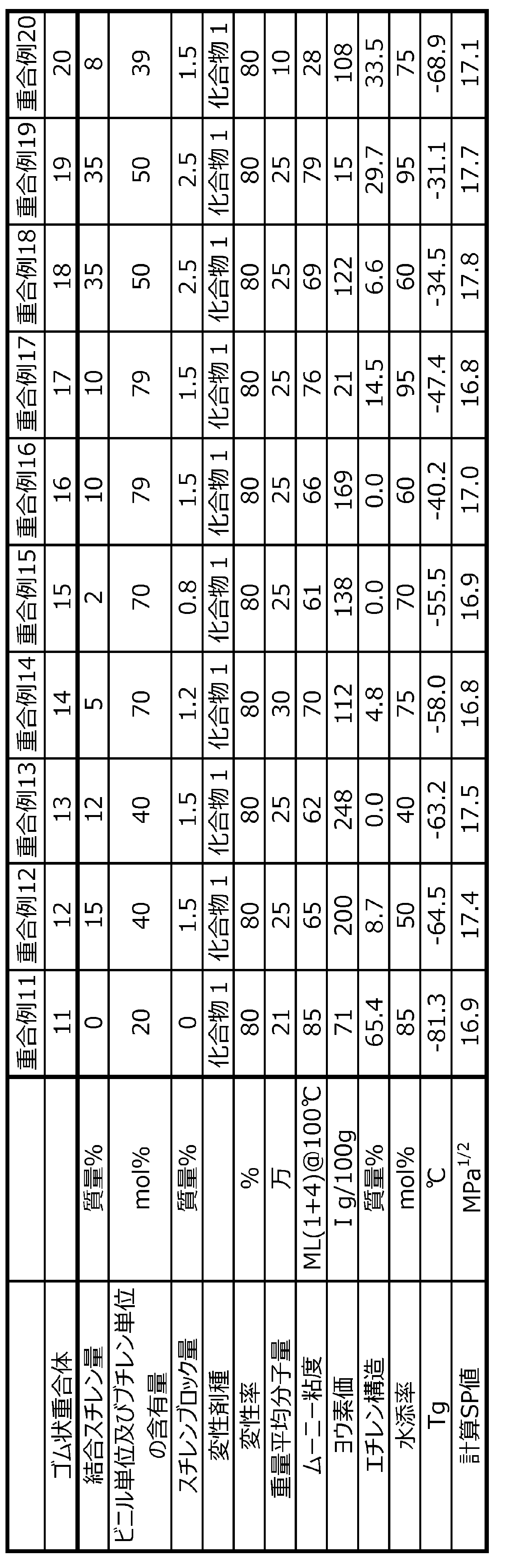
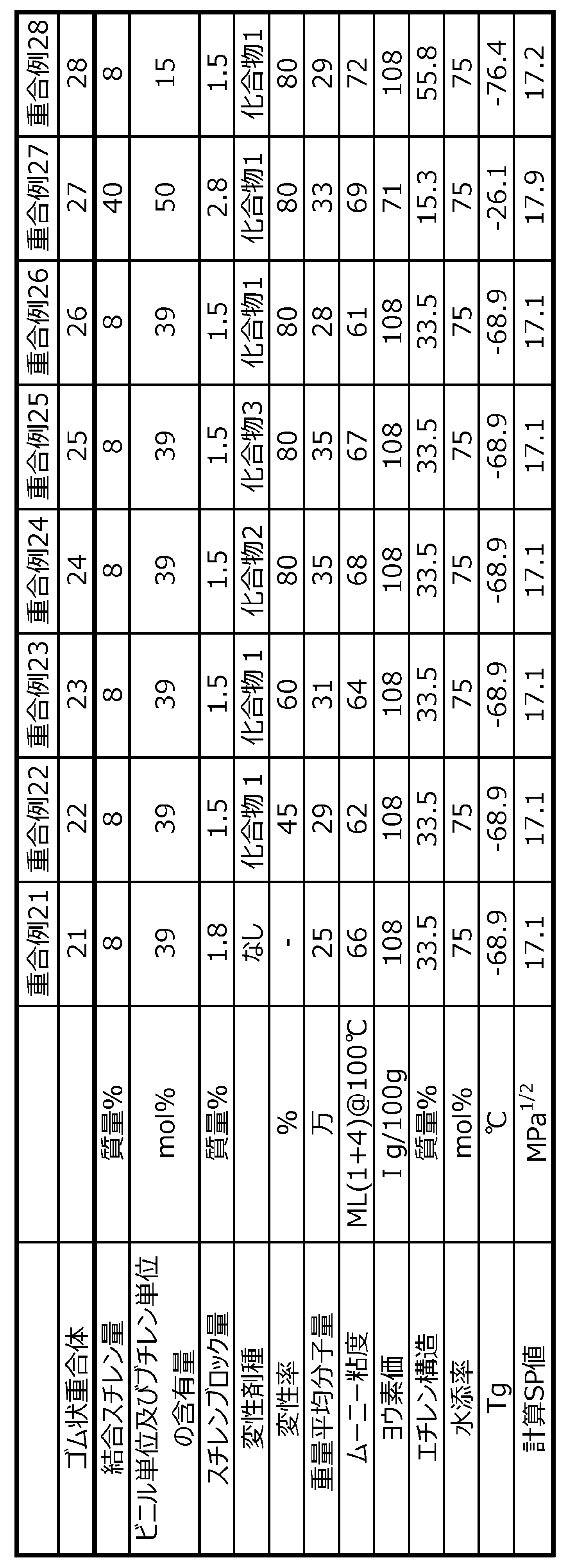
(実施例1~10)、(実施例41~69)及び(比較例1)、(比較例5~10)
下記に記載の各成分を混合し、ゴム組成物を得た。
より具体的には、温度制御装置を備える密閉混練機(内容量0.5L)を使用し、第一段の混練として、充填率65%、ローター回転数50~90rpmの条件で、ゴム成分、補強充填剤、シランカップリング剤、伸展油、ステアリン酸、老化防止剤及びワックスを混練した。
このとき、密閉混合機の温度を制御し、排出温度は150~160℃で配合物を得た。
次に、第二段の混練として、上記で得た配合物を室温まで冷却後、補強充填剤の分散を向上させるため再度混練した。この場合も、混合機の温度制御により、配合物の排出温度を150~160℃に調整した。
冷却後、第三段の混練として、70℃に設定したオープンロールにて、亜鉛華、加硫促進剤、及び硫黄を加えて混練した。
その後、成形し、160℃で15~30分間の条件で、加硫プレスにて加硫した。
加硫後のゴム組成物を下記方法により評価した。
評価1~4の結果を表4及び表8~表13に示す。
<ゴム成分>
ゴム状重合体1~28:重合例で得られたゴム状重合体
NR:天然ゴム RSS No.3(生産者:UNIMAC RUBBER CO., LTD.(タイ)、供給者:丸紅テクノラバー)
BR:ポリブタジエンゴム(宇部興産製の商品名「UBEPOL 150」))
<補強充填剤>
カーボンブラック(東海カーボン社製の商品名「シーストSO(FEF)」、窒素吸着比表面積42m2/g)
シリカ(エボニック・ジャパン デグサ社製の商品名「ULTRASIL 7000GR」、窒素吸着比表面積175m2/g)
<シランカップリング剤>
シランカップリング剤(エボニック・ジャパン デグサ社製の商品名「Si75」、ビス(トリエトキシシリルプロピル)ジスルフィド)
<伸展油>
鉱物油:JXTGエネルギー社製 「プロセスオイル PF30」(SRAEオイル)
<薬品>
ステアリン酸(花王社製の商品名「ルナック S-90V」)
老化防止剤 6C(大内新興化学社製の商品名「ノクラック6C」)
ワックス(大内新興化学社製の商品名「サンノック」)
<亜鉛華>
亜鉛華(堺化学工業社製の商品名「酸化亜鉛」)
<加硫促進剤>
DPG(1,3-ジフェニルグアニジン)(大内新興化学社製の商品名「ノクセラーD-P」)
TBBS(N-tert-ブチルベンゾチアゾール-2-スルフェンアミド)(三新化学社製の商品名 「サンセラーNS-G」)
<硫黄>
粉末硫黄(鶴見化学工業社製「サルファックス 200S」)
(実施例11~20)及び(比較例2)
下記に記載の各成分を混合し、ゴム組成物を得た。
温度制御装置を備える密閉混練機(内容量0.5L)を使用し、第一段の混練として、充填率65%、ローター回転数50~90rpmの条件で、ゴム成分、補強充填剤、シランカップリング剤、伸展油、樹脂、ステアリン酸、及び老化防止剤を混練した。このとき、密閉混合機の温度を制御し、排出温度は150~160℃で配合物を得た。
次に、第二段の混練として、上記で得た配合物を室温まで冷却後、補強充填剤の分散を向上させるため再度混練した。この場合も、混合機の温度制御により、配合物の排出温度を150~160℃に調整した。
冷却後、第三段の混練として、70℃に設定したオープンロールにて、亜鉛華、加硫促進剤及び硫黄を加えて混練した。
その後、成形し、150℃で20~35分間の条件で、加硫プレスにて加硫した。加硫後のゴム組成物を下記方法により評価した。
評価1及び評価2の結果を表5に示す。
<ゴム成分>
ゴム状重合体1~5:重合例で得られたゴム状重合体
NR:天然ゴム RSS No.3(生産者:UNIMAC RUBBER CO., LTD.(タイ)、供給者:丸紅テクノラバー)
BR:ポリブタジエンゴム(宇部興産社製の商品名「UBEPOL 150」))
<補強充填剤>
カーボンブラック(東海カーボン社製の商品名「シーストKH(N339)」、窒素吸着比表面積93m2/g)
シリカ(エボニック・ジャパン デグサ社製の商品名「ULTRASIL 7000GR」、窒素吸着比表面積 175m2/g)
<シランカップリング剤>
シランカップリング剤(エボニック・ジャパン デグサ社製の商品名「Si75」、ビス(トリエトキシシリルプロピル)ジスルフィド)
<樹脂>
アルキルフェノール・ホルムアルデヒド樹脂(田岡化学工業社製「TACKIROL 130」)
<伸展油>
鉱物油:JXTGエネルギー社製 「プロセスオイル PF30」(SRAEオイル)
<薬品>
ステアリン酸(花王社製の商品名「ルナック S-90V」)
老化防止剤 6C(大内新興化学社製の商品名「ノクラック6C」)
<亜鉛華>
亜鉛華(堺化学工業社製の商品名「酸化亜鉛」)
<加硫促進剤>
DPG(1,3-ジフェニルグアニジン)(大内新興化学社製の商品名「ノクセラーD-P」)
TBBS(N-tert-ブチルベンゾチアゾール-2-スルフェンアミド)(三新化学社製の商品名 「サンセラーNS-G」)
<硫黄>
粉末硫黄(鶴見化学工業社製「サルファックス 200S」)
(実施例21~30)及び(比較例3)
下記に記載の各成分を混合し、ゴム組成物を得た。
温度制御装置を備える密閉混練機(内容量0.5L)を使用し、第一段の混練として、充填率65%、ローター回転数50~90rpmの条件で、ゴム成分、補強充填剤、シランカップリング剤、伸展油、亜鉛華、老化防止剤、及びコバルト塩を混練した。このとき、密閉混合機の温度を制御し、排出温度は150~160℃で各配合物を得た。
次に、第二段の混練として、上記で得た配合物を室温まで冷却後、補強充填剤の分散を向上させるため再度混練した。この場合も、混合機の温度制御により、配合物の排出温度を150~160℃に調整した。
冷却後、第三段の混練として、70℃に設定したオープンロールにて、亜鉛華、加硫促進剤及び不溶性硫黄を加えて混練した。
その後、成形し、150℃で20~40分間の条件で、加硫プレスにて加硫した。加硫後のゴム組成物を下記方法により評価した。
評価1及び評価2の結果を表6に示す。
<ゴム成分>
ゴム状重合体1~5:重合例で得られたゴム状重合体
NR:天然ゴム RSS No.3(生産者:UNIMAC RUBBER CO., LTD.(タイ)、供給者:丸紅テクノラバー)
<補強充填剤>
カーボンブラック(東海カーボン社製の商品名「シーストKH(N339)」、窒素吸着比表面積93m2/g))
シリカ(エボニック・ジャパン デグサ社製の商品名「ULTRASIL 7000GR」、窒素吸着比表面積175m2/g)
<シランカップリング剤>
シランカップリング剤(エボニック・ジャパン デグサ社製の商品名「Si75」、ビス(トリエトキシシリルプロピル)ジスルフィド)
<伸展油>
鉱物油:JXTGエネルギー社製 「スーパーオイル Y-22」(スピンドルオイル)
<薬品>
亜鉛華(堺化学工業社製の商品名「酸化亜鉛」)
老化防止剤 6C(大内新興化学社製の商品名「ノクラック6C」)
老化防止剤 TMQ(大内新興化学社製の商品名「ノクラック224」)
コバルト塩(OMG社製の商品名「マノボンドC22.5」)
<亜鉛華>
亜鉛華(堺化学工業社製の商品名「酸化亜鉛」)
<加硫促進剤>
DPG(1,3-ジフェニルグアニジン)(大内新興化学社製の商品名「ノクセラーD-P」)
CBS(N-シクロヘキシル-2-ベンゾチアジルスルフェンアミド)(大内新興化学社製の商品名「ノクセラーCZ-G」)
<不溶性硫黄>
不溶性硫黄(四国化成社製「ミュークロン OT-20」)
(実施例31~40)及び(比較例4)
下記に記載の各成分を混合し、ゴム組成物を得た。
温度制御装置を備える密閉混練機(内容量0.5L)を使用し、第一段の混練として、充填率65%、ローター回転数50~90rpmの条件で、ゴム成分、補強充填剤、シランカップリング剤、伸展油、樹脂、ステアリン酸、亜鉛華及び老化防止剤を混練した。このとき、密閉混合機の温度を制御し、排出温度は150~160℃で配合物を得た。
次に、第二段の混練として、上記で得た配合物を室温まで冷却後、補強充填剤の分散を向上させるため再度混練した。この場合も、混合機の温度制御により、配合物の排出温度を150~160℃に調整した。
冷却後、第三段の混練として、70℃に設定したオープンロールにて、加硫促進剤、硬化剤、及び不溶性硫黄を加えて混練した。
その後、成形し、160℃で20~35分間の条件で、加硫プレスにて加硫した。加硫後のゴム組成物を下記方法により評価した。
評価1及び評価2の結果を表7に示す。
<ゴム成分>
ゴム状重合体1~5:重合例で得られたゴム状重合体
NR:天然ゴム RSS No.3(生産者:UNIMAC RUBBER CO., LTD.(タイ)、供給者:丸紅テクノラバー)
SBR:スチレンブタジエンゴム(日本ゼオン社製の商品名「Nipol 1502」))
<補強充填剤>
カーボンブラック(東海カーボン社製の商品名「シーストKH(N339)」、窒素吸着比表面積93m2/g)
シリカ(エボニック・ジャパン デグサ社製の商品名「ULTRASIL 7000GR」、窒素吸着比表面積 175m2/g)
<シランカップリング剤>
シランカップリング剤(エボニック・ジャパン デグサ社製の商品名「Si75」、ビス(トリエトキシシリルプロピル)ジスルフィド)
<樹脂>
カシュー変性フェノール樹脂(住友ベークライト社製「スミライトレジン PR-NR-1」)
<伸展油>
鉱物油:JXTGエネルギー社製 「プロセスオイル PF30」(SRAEオイル)
<薬品>
ステアリン酸(花王社製の商品名「ルナック S-90V」)
亜鉛華(堺化学工業社製の商品名「酸化亜鉛」)
老化防止剤 6C(大内新興化学社製の商品名「ノクラック6C」)
<加硫促進剤>
DPG(1,3-ジフェニルグアニジン)(大内新興化学社製の商品名「ノクセラーD-P」)
TBBS(N-tert-ブチルベンゾチアゾール-2-スルフェンアミド)(三新化学社製の商品名 「サンセラーNS-G」)
<硬化剤>
ヘキサメチレンテトラミン(大内新興化学社製の商品名「ノクセラーH」
<不溶性硫黄>
不溶性硫黄(四国化成社製「ミュークロン OT-20」)
((評価1)省燃費性)
得られた加硫ゴム組成物を用いて、必要な試験片を打ち抜き、レオメトリックス・サイエンティフィック社製の粘弾性試験機「ARES」を使用し、ねじりモードで粘弾性パラメータを測定した。
50℃において周波数10Hz、歪3%で測定したtanδを低燃費性の指標とした。
各々の測定値を用い、測定結果をまとめた。
表4では比較例1のゴム組成物に対する結果を、表5では比較例2のゴム組成物に対する結果を、表6では比較例3のゴム組成物に対する結果を、表7では比較例4のゴム組成物に対する結果を、それぞれ△とし、効果が5%以上10%未満の範囲で良化した場合を〇、10%以上20%未満の範囲で良化した場合を◎、20%以上良化した場合を◎◎とした。
また、効果が0%以上5%未満の範囲で良化又は悪化した場合は△とし、効果が5%以上10%未満の範囲で悪化した場合を×、10%以上悪化した場合を××とした。
得られた加硫ゴム組成物を用いて、以下に示す試験法で引張エネルギーを評価した。
<引張エネルギーの測定>
得られた加硫ゴム組成物からJIS3号ダンベル状の試験片を打ち抜き、JIS K6251:2010に準拠して、引張速度500mm/分で引張試験を行い、得られた応力-歪み曲線の、歪みゼロから破断した歪みまでの応力を積分することで、引張エネルギーを測定した。
各々の測定値を用い、測定結果をまとめた。
表4では比較例1のゴム組成物に対する結果を、表5では比較例2のゴム組成物に対する結果を、表6では比較例3のゴム組成物に対する結果を、表7では比較例4のゴム組成物に対する結果を、それぞれ△とし、効果が5%以上10%未満の範囲で良化した場合を〇、10%以上20%未満の範囲で良化した場合を◎、20%以上良化した場合を◎◎とした。また、効果が0%以上5%未満の範囲で良化又は悪化した場合は△とし、効果が5%以上10%未満の範囲で悪化した場合を×、10%以上悪化した場合を××とした。
得られた加硫ゴム組成物を用いて、以下に示す試験法でオゾン耐性を評価した。
<オゾン耐性の評価>
加硫ゴム組成物を用いて、160℃で15~30分間の条件で、所定の金型(縦15cm×横15cm×厚み2.0mm)により加硫プレスし、加硫ゴムシートを得た。この加硫ゴムシートから、短冊状サンプル(長さ6cm×幅1cm×厚み2.0mm)を打ち抜き、オゾン槽(50℃、100pphm)に入れ、40%伸張の状態で48時間静置した。その後、短冊状サンプル(加硫ゴムシート)を観察し、表面に存在する長さ1mm以上の亀裂の個数を数え、以下の基準により評価した。
判定基準及び評価結果を表4に示す(オゾン耐性)。
[判定基準]
×:加硫ゴムシートが破断
△:1mm以上の亀裂が21個以上
○:1mm以上の亀裂が10個以上20個以下
◎:1mm以上の亀裂が1個以上10個未満
◎◎:1mm以上の亀裂が無い
表8~表13中の所定の原料を混練し配合物を得たのち、1日後に加硫し、前記((評価2)機械強度(引張エネルギー))の測定を行った。この測定結果を(a)とした。
また、表8~表13中の所定の原料を混練し配合物を得たのち、7日後に加硫し、前記((評価2)機械強度(引張エネルギー))の測定を行った。この測定結果を(b)とした。
これら(a)及び(b)の結果により以下の基準により評価した。
[判定基準]
×:(a)と(b)の差が20%以上
△:(a)と(b)の差が10%以上20%未満
○:(a)と(b)の差が5%以上10%未満
◎:(a)と(b)の差が5%未満


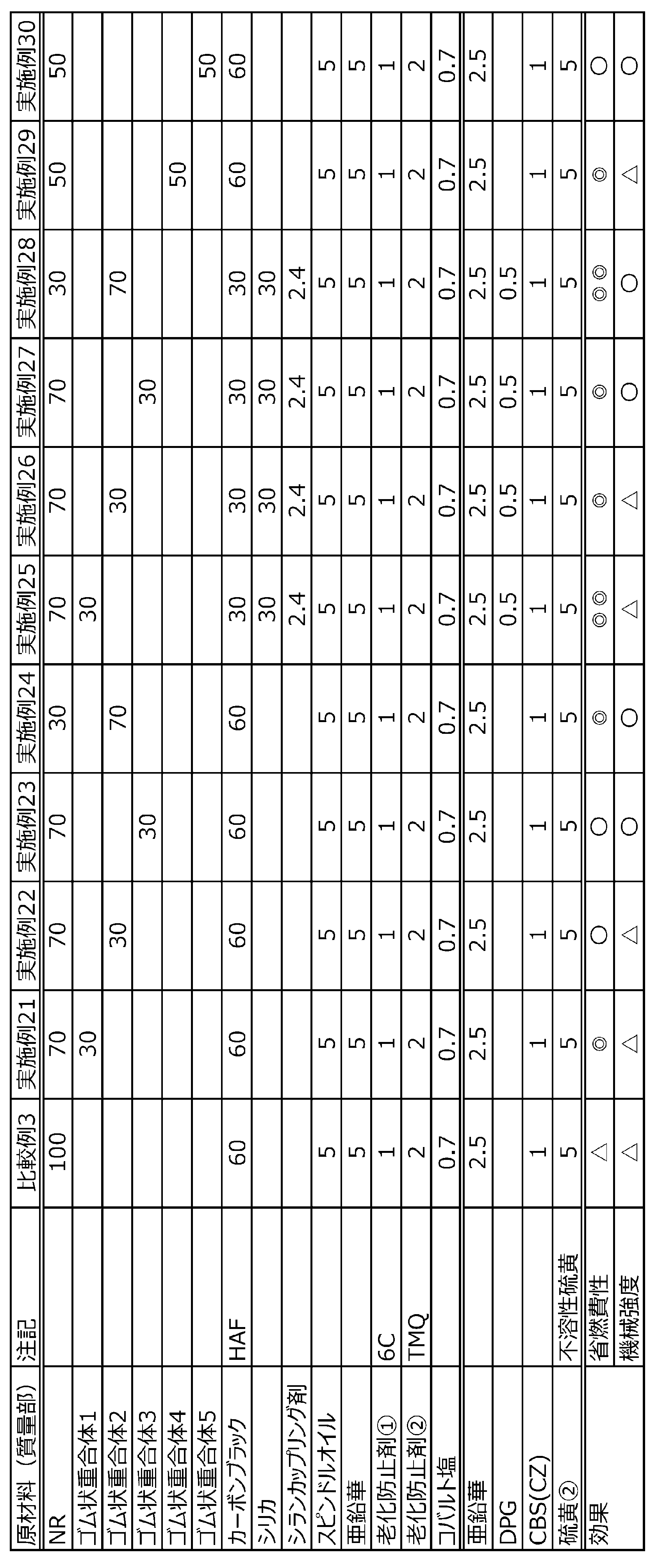
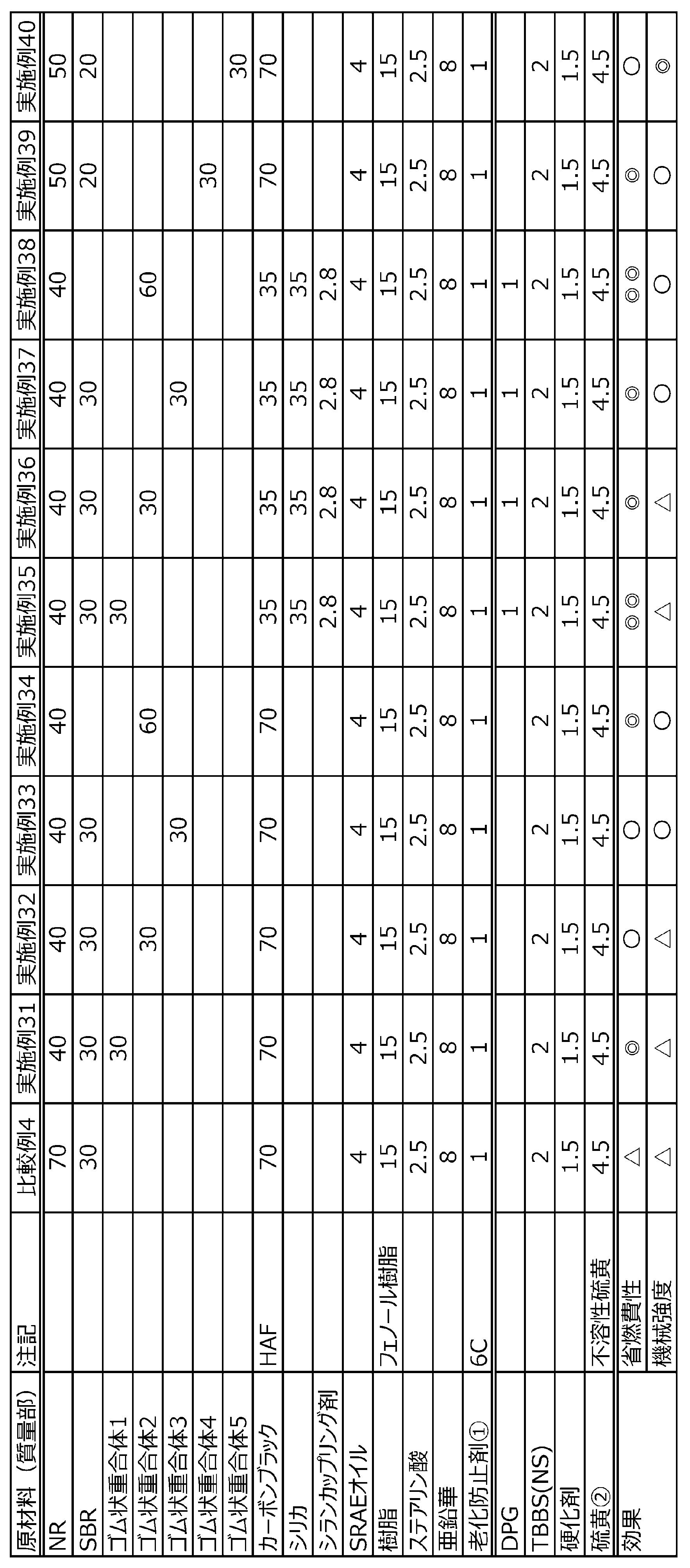

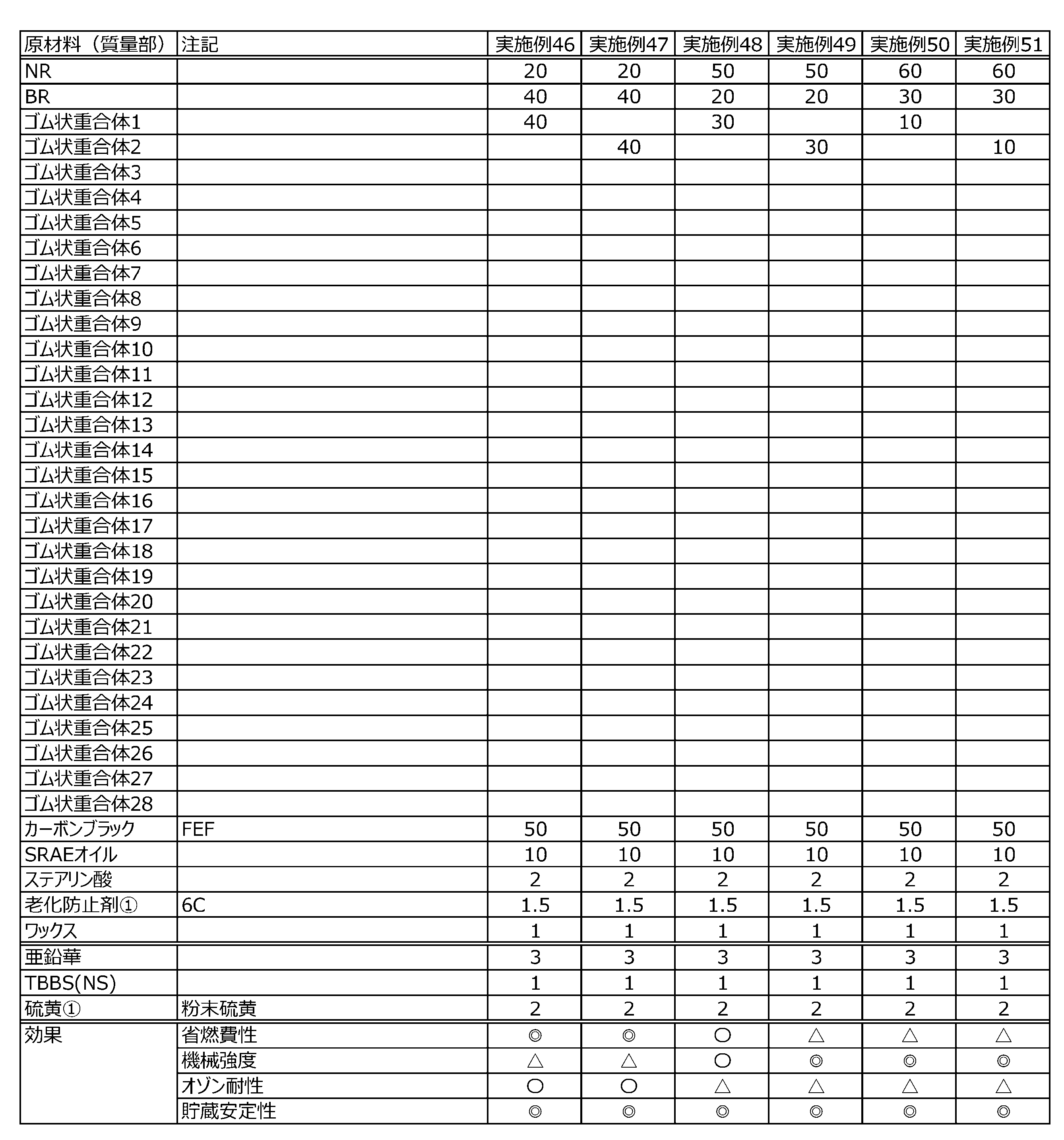


Claims (18)
- ヨウ素価が10~250(g/100g)であり、エチレン構造≧3質量%であり、ビニル芳香族単量体ブロック<10質量%であり、窒素原子を含有し、カラム吸着GPC法で測定される変性率が40質量%以上であるゴム状重合体(A)と、
架橋剤(B)と、を含有する、架橋用ゴム組成物。 - 前記ゴム状重合体(A)が、ビニル芳香族単量体単位を、35質量%以下含有する、
請求項1に記載の架橋用ゴム組成物。 - 前記ゴム状重合体(A)中のビニル単位及びブチレン単位の含有量が、20mol%以上である、
請求項1又は2に記載の架橋用ゴム組成物。 - 請求項1乃至3のいずれか一項に記載の架橋用ゴム組成物を含有するタイヤ用ゴム組成物であって、
天然ゴムを30質量部以上と、前記ゴム状重合体(A)を10質量部以上と、を含むゴム成分100質量部と、
前記架橋剤(B)と、を含有する、タイヤ用ゴム組成物。 - 前記ゴム成分100質量部中、前記ゴム状重合体(A)の含有量が30質量部以上である、
請求項4に記載のタイヤ用ゴム組成物。 - 窒素吸着比表面積(N2SA)が20~150m2/gのカーボンブラック及び/又は窒素吸着比表面積(N2SA)が110~220m2/gのシリカ系無機充填剤を、さらに含有する、
請求項4又は5に記載のタイヤ用ゴム組成物。 - 天然ゴムを30質量部以上と、前記ゴム状重合体(A)を10質量部以上とを含むゴム成分100質量部と、
窒素吸着比表面積(N2SA)が20~150m2/gのカーボンブラック及び/又は窒素吸着比表面積(N2SA)が110~220m2/gのシリカ系無機充填剤を30~90質量部と、
前記架橋剤(B)を含有する、
請求項6に記載のタイヤ用ゴム組成物。 - 請求項1乃至3のいずれか一項に記載の架橋用ゴム組成物を含有するタイヤのサイドウォール用成形体であって、
天然ゴムを30質量部以上と、前記ゴム状重合体(A)を10質量部以上とを含むゴム成分100質量部と、
窒素吸着比表面積(N2SA)が20~150m2/gのカーボンブラック及び/又は窒素吸着比表面積(N2SA)が110~220m2/gのシリカ系無機充填剤30~70質量部と、
前記架橋剤(B)と、を含有する、タイヤのサイドウォール用成形体。 - 請求項1乃至3のいずれか一項に記載の架橋用ゴム組成物を含有するシートであって、
前記ゴム状重合体(A)のガラス転移温度が-60℃以下であり、重量平均分子量が20万以上である、シート。 - 天然ゴムを30質量部以上と、ブタジエンゴム10質量部以上と、前記ゴム状重合体(A)を10質量部以上とを含むゴム成分100質量部を含有する、
請求項9に記載のシート。 - 前記ゴム成分100質量部中、前記ゴム状重合体(A)の含有量が30質量部以上である、
請求項9又は10に記載のシート。 - 前記ゴム成分100質量部に対し、窒素吸着比表面積(N2SA)が20~150m2/gのカーボンブラック及び/又は窒素吸着比表面積(N2SA)が110~220m2/gのシリカ系無機充填剤50~90質量部を、さらに含有する、
請求項9乃至11のいずれか一項に記載のシート。 - 前記ゴム状重合体(A)のSP値と、前記ガラス転移温度Tgとが、
(-0.03×Tg + 14.4)< SP値 < (-0.03×Tg + 15.4)
を満たす、
請求項9乃至12のいずれか一項に記載のシート。 - タイヤのサイドウォール用のシートである、
請求項9乃至13のいずれか一項に記載のシート。 - 請求項1乃至3のいずれか一項に記載の架橋用ゴム組成物と、天然ゴムと、ブタジエンゴムとを、ゴム成分100質量部中に、前記天然ゴムの含有量が30質量部以上、前記ブタジエンゴムの含有量が10質量部以上、前記ゴム状重合体(A)の含有量が10質量部以上となるように混練する工程と、
シート状に成形する工程と、
得られたシート状の成形体を架橋する工程と、
を、有するタイヤのサイドウォールの製造方法。 - ヨウ素価が10~250(g/100g)であり、エチレン構造≧3質量%であり、ビニル芳香族単量体ブロック<10質量%であり、窒素原子を含有し、カラム吸着GPC法で測定される変性率が40質量%以上であり、ガラス転移温度が-60℃以下であり、重量平均分子量が20万以上であるゴム状重合体(A)10質量部以上と、
天然ゴム30質量部以上と、
ブタジエンゴム10質量部以上と、を含有し、
前記ゴム状重合体(A)、前記天然ゴム、及び前記ブタジエンゴムが架橋された構造を有する、
タイヤのサイドウォール。 - 前記ゴム状重合体(A)のSP値と、前記ガラス転移温度Tgとが、
(-0.03×Tg + 14.4)< SP値 < (-0.03×Tg + 15.4)
を満たす、
請求項16に記載のタイヤのサイドウォール。 - 前記ゴム状重合体(A)10質量部と、天然ゴム30質量部と、ブタジエンゴム10質量部を含むゴム成分100質量部と、
窒素吸着比表面積(N2SA)が20~150m2/gのカーボンブラック及び/又は窒素吸着比表面積(N2SA)が110~220m2/gのシリカ系無機充填剤50~90質量部と、
前記架橋剤(B)と、
を、含有する、
請求項16又は17に記載のタイヤのサイドウォール。
Priority Applications (5)
| Application Number | Priority Date | Filing Date | Title |
|---|---|---|---|
| EP21917691.4A EP4275914A4 (en) | 2021-01-07 | 2021-12-22 | RUBBER COMPOSITION FOR CROSSLINKING, RUBBER COMPOSITION FOR TIRE, MOLDED BODY FOR TIRE SIDE, SHEET, METHOD FOR PRODUCING TIRE SIDE, AND TIRE SIDE |
| JP2022573994A JP7507255B2 (ja) | 2021-01-07 | 2021-12-22 | 架橋用ゴム組成物、タイヤ用ゴム組成物、タイヤのサイドウォール用成形体、シート、タイヤのサイドウォールの製造方法、タイヤのサイドウォール |
| US18/271,148 US20240026057A1 (en) | 2021-01-07 | 2021-12-22 | Crosslinking Rubber Composition, Rubber Composition for Tire, Molded Article for Tire Sidewall, Sheet, Method for Producing Tire Sidewall, and Tire Sidewall |
| KR1020237014923A KR102924193B1 (ko) | 2021-01-07 | 2021-12-22 | 가교용 고무 조성물, 타이어용 고무 조성물, 타이어의 사이드 월용 성형체, 시트, 타이어의 사이드 월의 제조 방법, 타이어의 사이드 월 |
| CN202180087236.1A CN116761727A (zh) | 2021-01-07 | 2021-12-22 | 交联用橡胶组合物、轮胎用橡胶组合物、轮胎胎侧用成型体、片材、轮胎胎侧的制造方法、轮胎胎侧 |
Applications Claiming Priority (4)
| Application Number | Priority Date | Filing Date | Title |
|---|---|---|---|
| JP2021-001427 | 2021-01-07 | ||
| JP2021001427 | 2021-01-07 | ||
| JP2021-065420 | 2021-04-07 | ||
| JP2021065420 | 2021-04-07 |
Publications (1)
| Publication Number | Publication Date |
|---|---|
| WO2022149471A1 true WO2022149471A1 (ja) | 2022-07-14 |
Family
ID=82357270
Family Applications (1)
| Application Number | Title | Priority Date | Filing Date |
|---|---|---|---|
| PCT/JP2021/047600 Ceased WO2022149471A1 (ja) | 2021-01-07 | 2021-12-22 | 架橋用ゴム組成物、タイヤ用ゴム組成物、タイヤのサイドウォール用成形体、シート、タイヤのサイドウォールの製造方法、タイヤのサイドウォール |
Country Status (5)
| Country | Link |
|---|---|
| US (1) | US20240026057A1 (ja) |
| EP (1) | EP4275914A4 (ja) |
| JP (1) | JP7507255B2 (ja) |
| KR (1) | KR102924193B1 (ja) |
| WO (1) | WO2022149471A1 (ja) |
Cited By (4)
| Publication number | Priority date | Publication date | Assignee | Title |
|---|---|---|---|---|
| CN114669294A (zh) * | 2022-04-13 | 2022-06-28 | 宏业生物科技股份有限公司 | 2,2-二(2-呋喃基)丙烷加氢制2,2-二(2-四氢呋喃基)丙烷的复合催化剂 |
| JP2022122538A (ja) * | 2021-02-10 | 2022-08-23 | 株式会社Eneosマテリアル | 重合体組成物及びゴム成型品 |
| JPWO2023038095A1 (ja) * | 2021-09-13 | 2023-03-16 | ||
| JP2024014428A (ja) * | 2022-07-22 | 2024-02-01 | 旭化成株式会社 | 更生タイヤの製造方法 |
Citations (18)
| Publication number | Priority date | Publication date | Assignee | Title |
|---|---|---|---|---|
| JPH07238187A (ja) * | 1994-02-28 | 1995-09-12 | Asahi Chem Ind Co Ltd | タイヤトレッド用ゴム組成物 |
| WO1996005250A1 (en) | 1994-08-08 | 1996-02-22 | Asahi Kasei Kogyo Kabushiki Kaisha | Hydrogenated rubber composition |
| JPH08245839A (ja) * | 1995-03-08 | 1996-09-24 | Asahi Chem Ind Co Ltd | 選択部分水添変性重合体組成物 |
| JP2000053706A (ja) | 1998-08-07 | 2000-02-22 | Jsr Corp | 水添共役ジオレフィン系重合体 |
| WO2002002663A2 (en) | 2000-06-30 | 2002-01-10 | Kraton Polymers Research, B.V. | Block copolymers containing both polystyrene and low vinyl content polydiene hard blocks |
| WO2003085010A1 (en) | 2002-04-10 | 2003-10-16 | Asahi Kasei Chemicals Corporation | Modified polymers and compositions containing the same |
| JP2010270314A (ja) | 2009-04-22 | 2010-12-02 | Bridgestone Corp | ゴム組成物及びそれを用いたタイヤ |
| WO2011129425A1 (ja) * | 2010-04-16 | 2011-10-20 | 旭化成ケミカルズ株式会社 | 変性共役ジエン系重合体の製造方法、変性共役ジエン系重合体、及び変性共役ジエン系重合体組成物 |
| WO2014133097A1 (ja) | 2013-02-28 | 2014-09-04 | Jsr株式会社 | タイヤ用部材、水添共役ジエン系重合体、及び、重合体組成物 |
| WO2015006179A1 (en) | 2013-07-12 | 2015-01-15 | Kraton Polymers U.S. Llc | High flow, hydrogenated styrene-butadiene-styrene block copolymers and applications |
| JP2017133026A (ja) * | 2016-03-30 | 2017-08-03 | 日本ゼオン株式会社 | ゴム組成物 |
| WO2019078083A1 (ja) | 2017-10-20 | 2019-04-25 | 株式会社ブリヂストン | 多元共重合体、ゴム組成物、架橋ゴム組成物、ゴム製品、及びタイヤ |
| WO2019142501A1 (ja) | 2018-01-19 | 2019-07-25 | 株式会社ブリヂストン | ゴム組成物、タイヤ、コンベヤベルト、ゴムクローラ、防振装置、免震装置及びホース |
| WO2019151127A1 (ja) | 2018-01-31 | 2019-08-08 | Jsr株式会社 | 組成物、架橋成形体及びタイヤ |
| WO2019151126A1 (ja) | 2018-01-31 | 2019-08-08 | Jsr株式会社 | 組成物、架橋成形体及びタイヤ |
| WO2019171679A1 (ja) | 2018-03-05 | 2019-09-12 | 株式会社ブリヂストン | 共重合体、共重合体の製造方法、ゴム組成物及びタイヤ |
| JP2021001427A (ja) | 2019-06-19 | 2021-01-07 | ザウラー スピニング ソリューションズ ゲー・エム・ベー・ハー ウント コー. カー・ゲーSaurer Spinning Solutions GmbH & Co. KG | 複数の作業ユニットを備えた繊維機械、および複数の作業ユニットを備えた繊維機械を監視するための方法 |
| JP2021065420A (ja) | 2019-10-23 | 2021-04-30 | サミー株式会社 | 遊技機 |
Family Cites Families (5)
| Publication number | Priority date | Publication date | Assignee | Title |
|---|---|---|---|---|
| JP6996074B2 (ja) | 2016-06-28 | 2022-01-17 | 住友ゴム工業株式会社 | ゴム組成物およびタイヤ |
| JP7500440B2 (ja) * | 2019-01-30 | 2024-06-17 | 株式会社Eneosマテリアル | ゴム組成物、架橋体及びタイヤ |
| JP7388370B2 (ja) * | 2019-02-05 | 2023-11-29 | 住友ゴム工業株式会社 | ゴム組成物及びタイヤ |
| JP7477394B2 (ja) * | 2020-08-03 | 2024-05-01 | 旭化成株式会社 | ゴム組成物、及びタイヤ |
| WO2022091982A1 (ja) * | 2020-10-30 | 2022-05-05 | 旭化成株式会社 | ゴム組成物、及びタイヤ |
-
2021
- 2021-12-22 WO PCT/JP2021/047600 patent/WO2022149471A1/ja not_active Ceased
- 2021-12-22 KR KR1020237014923A patent/KR102924193B1/ko active Active
- 2021-12-22 JP JP2022573994A patent/JP7507255B2/ja active Active
- 2021-12-22 EP EP21917691.4A patent/EP4275914A4/en active Pending
- 2021-12-22 US US18/271,148 patent/US20240026057A1/en active Pending
Patent Citations (18)
| Publication number | Priority date | Publication date | Assignee | Title |
|---|---|---|---|---|
| JPH07238187A (ja) * | 1994-02-28 | 1995-09-12 | Asahi Chem Ind Co Ltd | タイヤトレッド用ゴム組成物 |
| WO1996005250A1 (en) | 1994-08-08 | 1996-02-22 | Asahi Kasei Kogyo Kabushiki Kaisha | Hydrogenated rubber composition |
| JPH08245839A (ja) * | 1995-03-08 | 1996-09-24 | Asahi Chem Ind Co Ltd | 選択部分水添変性重合体組成物 |
| JP2000053706A (ja) | 1998-08-07 | 2000-02-22 | Jsr Corp | 水添共役ジオレフィン系重合体 |
| WO2002002663A2 (en) | 2000-06-30 | 2002-01-10 | Kraton Polymers Research, B.V. | Block copolymers containing both polystyrene and low vinyl content polydiene hard blocks |
| WO2003085010A1 (en) | 2002-04-10 | 2003-10-16 | Asahi Kasei Chemicals Corporation | Modified polymers and compositions containing the same |
| JP2010270314A (ja) | 2009-04-22 | 2010-12-02 | Bridgestone Corp | ゴム組成物及びそれを用いたタイヤ |
| WO2011129425A1 (ja) * | 2010-04-16 | 2011-10-20 | 旭化成ケミカルズ株式会社 | 変性共役ジエン系重合体の製造方法、変性共役ジエン系重合体、及び変性共役ジエン系重合体組成物 |
| WO2014133097A1 (ja) | 2013-02-28 | 2014-09-04 | Jsr株式会社 | タイヤ用部材、水添共役ジエン系重合体、及び、重合体組成物 |
| WO2015006179A1 (en) | 2013-07-12 | 2015-01-15 | Kraton Polymers U.S. Llc | High flow, hydrogenated styrene-butadiene-styrene block copolymers and applications |
| JP2017133026A (ja) * | 2016-03-30 | 2017-08-03 | 日本ゼオン株式会社 | ゴム組成物 |
| WO2019078083A1 (ja) | 2017-10-20 | 2019-04-25 | 株式会社ブリヂストン | 多元共重合体、ゴム組成物、架橋ゴム組成物、ゴム製品、及びタイヤ |
| WO2019142501A1 (ja) | 2018-01-19 | 2019-07-25 | 株式会社ブリヂストン | ゴム組成物、タイヤ、コンベヤベルト、ゴムクローラ、防振装置、免震装置及びホース |
| WO2019151127A1 (ja) | 2018-01-31 | 2019-08-08 | Jsr株式会社 | 組成物、架橋成形体及びタイヤ |
| WO2019151126A1 (ja) | 2018-01-31 | 2019-08-08 | Jsr株式会社 | 組成物、架橋成形体及びタイヤ |
| WO2019171679A1 (ja) | 2018-03-05 | 2019-09-12 | 株式会社ブリヂストン | 共重合体、共重合体の製造方法、ゴム組成物及びタイヤ |
| JP2021001427A (ja) | 2019-06-19 | 2021-01-07 | ザウラー スピニング ソリューションズ ゲー・エム・ベー・ハー ウント コー. カー・ゲーSaurer Spinning Solutions GmbH & Co. KG | 複数の作業ユニットを備えた繊維機械、および複数の作業ユニットを備えた繊維機械を監視するための方法 |
| JP2021065420A (ja) | 2019-10-23 | 2021-04-30 | サミー株式会社 | 遊技機 |
Non-Patent Citations (4)
| Title |
|---|
| I. M. KOLTHOFF ET AL., J. POLYM. SCI., vol. 1, 1946, pages 429 |
| J. BICERANO: "Prediction of Polymer Properties", 2002, MARCEL DEKKER |
| R. R. HAMPTON, ANALYTICAL CHEMISTRY, vol. 21, 1949, pages 923 |
| See also references of EP4275914A4 |
Cited By (5)
| Publication number | Priority date | Publication date | Assignee | Title |
|---|---|---|---|---|
| JP2022122538A (ja) * | 2021-02-10 | 2022-08-23 | 株式会社Eneosマテリアル | 重合体組成物及びゴム成型品 |
| JPWO2023038095A1 (ja) * | 2021-09-13 | 2023-03-16 | ||
| WO2023038095A1 (ja) * | 2021-09-13 | 2023-03-16 | 日本エラストマー株式会社 | 架橋ゴム組成物、架橋ゴム組成物の製造方法 |
| CN114669294A (zh) * | 2022-04-13 | 2022-06-28 | 宏业生物科技股份有限公司 | 2,2-二(2-呋喃基)丙烷加氢制2,2-二(2-四氢呋喃基)丙烷的复合催化剂 |
| JP2024014428A (ja) * | 2022-07-22 | 2024-02-01 | 旭化成株式会社 | 更生タイヤの製造方法 |
Also Published As
| Publication number | Publication date |
|---|---|
| KR102924193B1 (ko) | 2026-02-06 |
| JP7507255B2 (ja) | 2024-06-27 |
| EP4275914A1 (en) | 2023-11-15 |
| JPWO2022149471A1 (ja) | 2022-07-14 |
| US20240026057A1 (en) | 2024-01-25 |
| EP4275914A4 (en) | 2024-06-26 |
| KR20230079269A (ko) | 2023-06-05 |
Similar Documents
| Publication | Publication Date | Title |
|---|---|---|
| JP7507255B2 (ja) | 架橋用ゴム組成物、タイヤ用ゴム組成物、タイヤのサイドウォール用成形体、シート、タイヤのサイドウォールの製造方法、タイヤのサイドウォール | |
| EP3950723B1 (en) | Rubber composition, and tire | |
| JP7592744B2 (ja) | ゴム組成物、及びタイヤ | |
| JP7757080B2 (ja) | 架橋用ゴム組成物、架橋ゴムの製造方法、及びタイヤ用トレッド | |
| EP4261234B1 (en) | Hydrogenated diene polymer, bale, rubber composition, and tire | |
| JP7570883B2 (ja) | 架橋用ゴム組成物、及びタイヤ用トレッド | |
| EP3988327B1 (en) | Crosslinking rubber composition, method for producing crosslinked rubber, and tread for tire | |
| JP7652546B2 (ja) | ゴム組成物、架橋用ゴム組成物、ゴム組成物成形体の製造方法、及びタイヤ用トレッド | |
| JP7525666B2 (ja) | ゴム状重合体、ゴム状重合体の製造方法、ゴム組成物、及びタイヤ用トレッド | |
| JP2023144632A (ja) | 変性共役ジエン系重合体、それを含む靴用ゴム組成物、及びアウトソール | |
| JP7553581B2 (ja) | ベール成形体 | |
| US11912858B2 (en) | Molded bale of rubber-like block copolymer, rubber composition, crosslinking rubber composition, and tread for tire | |
| CN116761727A (zh) | 交联用橡胶组合物、轮胎用橡胶组合物、轮胎胎侧用成型体、片材、轮胎胎侧的制造方法、轮胎胎侧 | |
| JP7720717B2 (ja) | ゴム組成物のベール成形体、ゴム組成物のベール成形体の製造方法、架橋用ゴム組成物、及びタイヤ用トレッド | |
| JP2025117902A (ja) | 変性共役ジエン系重合体、靴用ゴム組成物、及びアウトソール | |
| JP2025117871A (ja) | 変性共役ジエン系重合体、靴用ゴム組成物、及びアウトソール | |
| WO2024009793A1 (ja) | 共役ジエン重合体、ゴム組成物、及びタイヤ用部材 | |
| WO2025205189A1 (ja) | ゴム組成物、及び、加硫ゴム組成物 | |
| JP2023142465A (ja) | ゴム組成物、ゴム組成物の製造方法、及びタイヤ | |
| JP2022008066A (ja) | ゴム組成物のベール成形体、ベール成形体の製造方法、架橋用ゴム組成物、及びタイヤ用トレッド |
Legal Events
| Date | Code | Title | Description |
|---|---|---|---|
| 121 | Ep: the epo has been informed by wipo that ep was designated in this application |
Ref document number: 21917691 Country of ref document: EP Kind code of ref document: A1 |
|
| ENP | Entry into the national phase |
Ref document number: 20237014923 Country of ref document: KR Kind code of ref document: A |
|
| ENP | Entry into the national phase |
Ref document number: 2022573994 Country of ref document: JP Kind code of ref document: A |
|
| WWE | Wipo information: entry into national phase |
Ref document number: 202317040812 Country of ref document: IN |
|
| WWE | Wipo information: entry into national phase |
Ref document number: 202180087236.1 Country of ref document: CN |
|
| WWE | Wipo information: entry into national phase |
Ref document number: 18271148 Country of ref document: US |
|
| NENP | Non-entry into the national phase |
Ref country code: DE |
|
| ENP | Entry into the national phase |
Ref document number: 2021917691 Country of ref document: EP Effective date: 20230807 |