WO2022158588A1 - ベータ型ゼオライト及びその製造方法 - Google Patents
ベータ型ゼオライト及びその製造方法 Download PDFInfo
- Publication number
- WO2022158588A1 WO2022158588A1 PCT/JP2022/002370 JP2022002370W WO2022158588A1 WO 2022158588 A1 WO2022158588 A1 WO 2022158588A1 JP 2022002370 W JP2022002370 W JP 2022002370W WO 2022158588 A1 WO2022158588 A1 WO 2022158588A1
- Authority
- WO
- WIPO (PCT)
- Prior art keywords
- zeolite
- beta
- aqueous solution
- mother powder
- less
- Prior art date
- Legal status (The legal status is an assumption and is not a legal conclusion. Google has not performed a legal analysis and makes no representation as to the accuracy of the status listed.)
- Ceased
Links
Images


Classifications
-
- B—PERFORMING OPERATIONS; TRANSPORTING
- B01—PHYSICAL OR CHEMICAL PROCESSES OR APPARATUS IN GENERAL
- B01J—CHEMICAL OR PHYSICAL PROCESSES, e.g. CATALYSIS OR COLLOID CHEMISTRY; THEIR RELEVANT APPARATUS
- B01J29/00—Catalysts comprising molecular sieves
- B01J29/04—Catalysts comprising molecular sieves having base-exchange properties, e.g. crystalline zeolites
- B01J29/06—Crystalline aluminosilicate zeolites; Isomorphous compounds thereof
- B01J29/70—Crystalline aluminosilicate zeolites; Isomorphous compounds thereof of types characterised by their specific structure not provided for in groups B01J29/08 - B01J29/65
- B01J29/7007—Zeolite Beta
-
- B—PERFORMING OPERATIONS; TRANSPORTING
- B01—PHYSICAL OR CHEMICAL PROCESSES OR APPARATUS IN GENERAL
- B01J—CHEMICAL OR PHYSICAL PROCESSES, e.g. CATALYSIS OR COLLOID CHEMISTRY; THEIR RELEVANT APPARATUS
- B01J20/00—Solid sorbent compositions or filter aid compositions; Sorbents for chromatography; Processes for preparing, regenerating or reactivating thereof
- B01J20/02—Solid sorbent compositions or filter aid compositions; Sorbents for chromatography; Processes for preparing, regenerating or reactivating thereof comprising inorganic material
- B01J20/10—Solid sorbent compositions or filter aid compositions; Sorbents for chromatography; Processes for preparing, regenerating or reactivating thereof comprising inorganic material comprising silica or silicate
- B01J20/16—Alumino-silicates
- B01J20/18—Synthetic zeolitic molecular sieves
-
- B—PERFORMING OPERATIONS; TRANSPORTING
- B01—PHYSICAL OR CHEMICAL PROCESSES OR APPARATUS IN GENERAL
- B01J—CHEMICAL OR PHYSICAL PROCESSES, e.g. CATALYSIS OR COLLOID CHEMISTRY; THEIR RELEVANT APPARATUS
- B01J20/00—Solid sorbent compositions or filter aid compositions; Sorbents for chromatography; Processes for preparing, regenerating or reactivating thereof
- B01J20/02—Solid sorbent compositions or filter aid compositions; Sorbents for chromatography; Processes for preparing, regenerating or reactivating thereof comprising inorganic material
- B01J20/10—Solid sorbent compositions or filter aid compositions; Sorbents for chromatography; Processes for preparing, regenerating or reactivating thereof comprising inorganic material comprising silica or silicate
- B01J20/16—Alumino-silicates
- B01J20/18—Synthetic zeolitic molecular sieves
- B01J20/186—Chemical treatments in view of modifying the properties of the sieve, e.g. increasing the stability or the activity, also decreasing the activity
-
- B—PERFORMING OPERATIONS; TRANSPORTING
- B01—PHYSICAL OR CHEMICAL PROCESSES OR APPARATUS IN GENERAL
- B01J—CHEMICAL OR PHYSICAL PROCESSES, e.g. CATALYSIS OR COLLOID CHEMISTRY; THEIR RELEVANT APPARATUS
- B01J20/00—Solid sorbent compositions or filter aid compositions; Sorbents for chromatography; Processes for preparing, regenerating or reactivating thereof
- B01J20/28—Solid sorbent compositions or filter aid compositions; Sorbents for chromatography; Processes for preparing, regenerating or reactivating thereof characterised by their form or physical properties
- B01J20/28002—Solid sorbent compositions or filter aid compositions; Sorbents for chromatography; Processes for preparing, regenerating or reactivating thereof characterised by their form or physical properties characterised by their physical properties
- B01J20/28004—Sorbent size or size distribution, e.g. particle size
-
- B—PERFORMING OPERATIONS; TRANSPORTING
- B01—PHYSICAL OR CHEMICAL PROCESSES OR APPARATUS IN GENERAL
- B01J—CHEMICAL OR PHYSICAL PROCESSES, e.g. CATALYSIS OR COLLOID CHEMISTRY; THEIR RELEVANT APPARATUS
- B01J20/00—Solid sorbent compositions or filter aid compositions; Sorbents for chromatography; Processes for preparing, regenerating or reactivating thereof
- B01J20/28—Solid sorbent compositions or filter aid compositions; Sorbents for chromatography; Processes for preparing, regenerating or reactivating thereof characterised by their form or physical properties
- B01J20/28054—Solid sorbent compositions or filter aid compositions; Sorbents for chromatography; Processes for preparing, regenerating or reactivating thereof characterised by their form or physical properties characterised by their surface properties or porosity
- B01J20/28069—Pore volume, e.g. total pore volume, mesopore volume, micropore volume
- B01J20/28071—Pore volume, e.g. total pore volume, mesopore volume, micropore volume being less than 0.5 ml/g
-
- B—PERFORMING OPERATIONS; TRANSPORTING
- B01—PHYSICAL OR CHEMICAL PROCESSES OR APPARATUS IN GENERAL
- B01J—CHEMICAL OR PHYSICAL PROCESSES, e.g. CATALYSIS OR COLLOID CHEMISTRY; THEIR RELEVANT APPARATUS
- B01J20/00—Solid sorbent compositions or filter aid compositions; Sorbents for chromatography; Processes for preparing, regenerating or reactivating thereof
- B01J20/30—Processes for preparing, regenerating, or reactivating
-
- B—PERFORMING OPERATIONS; TRANSPORTING
- B01—PHYSICAL OR CHEMICAL PROCESSES OR APPARATUS IN GENERAL
- B01J—CHEMICAL OR PHYSICAL PROCESSES, e.g. CATALYSIS OR COLLOID CHEMISTRY; THEIR RELEVANT APPARATUS
- B01J20/00—Solid sorbent compositions or filter aid compositions; Sorbents for chromatography; Processes for preparing, regenerating or reactivating thereof
- B01J20/30—Processes for preparing, regenerating, or reactivating
- B01J20/3085—Chemical treatments not covered by groups B01J20/3007 - B01J20/3078
-
- B—PERFORMING OPERATIONS; TRANSPORTING
- B01—PHYSICAL OR CHEMICAL PROCESSES OR APPARATUS IN GENERAL
- B01J—CHEMICAL OR PHYSICAL PROCESSES, e.g. CATALYSIS OR COLLOID CHEMISTRY; THEIR RELEVANT APPARATUS
- B01J35/00—Catalysts, in general, characterised by their form or physical properties
- B01J35/40—Catalysts, in general, characterised by their form or physical properties characterised by dimensions, e.g. grain size
-
- B—PERFORMING OPERATIONS; TRANSPORTING
- B01—PHYSICAL OR CHEMICAL PROCESSES OR APPARATUS IN GENERAL
- B01J—CHEMICAL OR PHYSICAL PROCESSES, e.g. CATALYSIS OR COLLOID CHEMISTRY; THEIR RELEVANT APPARATUS
- B01J35/00—Catalysts, in general, characterised by their form or physical properties
- B01J35/60—Catalysts, in general, characterised by their form or physical properties characterised by their surface properties or porosity
- B01J35/63—Pore volume
- B01J35/633—Pore volume less than 0.5 ml/g
-
- B—PERFORMING OPERATIONS; TRANSPORTING
- B01—PHYSICAL OR CHEMICAL PROCESSES OR APPARATUS IN GENERAL
- B01J—CHEMICAL OR PHYSICAL PROCESSES, e.g. CATALYSIS OR COLLOID CHEMISTRY; THEIR RELEVANT APPARATUS
- B01J37/00—Processes, in general, for preparing catalysts; Processes, in general, for activation of catalysts
- B01J37/04—Mixing
-
- B—PERFORMING OPERATIONS; TRANSPORTING
- B01—PHYSICAL OR CHEMICAL PROCESSES OR APPARATUS IN GENERAL
- B01J—CHEMICAL OR PHYSICAL PROCESSES, e.g. CATALYSIS OR COLLOID CHEMISTRY; THEIR RELEVANT APPARATUS
- B01J37/00—Processes, in general, for preparing catalysts; Processes, in general, for activation of catalysts
- B01J37/08—Heat treatment
-
- C—CHEMISTRY; METALLURGY
- C01—INORGANIC CHEMISTRY
- C01B—NON-METALLIC ELEMENTS; COMPOUNDS THEREOF; METALLOIDS OR COMPOUNDS THEREOF NOT COVERED BY SUBCLASS C01C
- C01B39/00—Compounds having molecular sieve and base-exchange properties, e.g. crystalline zeolites; Their preparation; After-treatment, e.g. ion-exchange or dealumination
- C01B39/02—Crystalline aluminosilicate zeolites; Isomorphous compounds thereof; Direct preparation thereof; Preparation thereof starting from a reaction mixture containing a crystalline zeolite of another type, or from preformed reactants; After-treatment thereof
- C01B39/026—After-treatment
-
- C—CHEMISTRY; METALLURGY
- C01—INORGANIC CHEMISTRY
- C01B—NON-METALLIC ELEMENTS; COMPOUNDS THEREOF; METALLOIDS OR COMPOUNDS THEREOF NOT COVERED BY SUBCLASS C01C
- C01B39/00—Compounds having molecular sieve and base-exchange properties, e.g. crystalline zeolites; Their preparation; After-treatment, e.g. ion-exchange or dealumination
- C01B39/02—Crystalline aluminosilicate zeolites; Isomorphous compounds thereof; Direct preparation thereof; Preparation thereof starting from a reaction mixture containing a crystalline zeolite of another type, or from preformed reactants; After-treatment thereof
- C01B39/46—Other types characterised by their X-ray diffraction pattern and their defined composition
-
- B—PERFORMING OPERATIONS; TRANSPORTING
- B01—PHYSICAL OR CHEMICAL PROCESSES OR APPARATUS IN GENERAL
- B01J—CHEMICAL OR PHYSICAL PROCESSES, e.g. CATALYSIS OR COLLOID CHEMISTRY; THEIR RELEVANT APPARATUS
- B01J2229/00—Aspects of molecular sieve catalysts not covered by B01J29/00
- B01J2229/10—After treatment, characterised by the effect to be obtained
- B01J2229/22—After treatment, characterised by the effect to be obtained to destroy the molecular sieve structure or part thereof
-
- B—PERFORMING OPERATIONS; TRANSPORTING
- B01—PHYSICAL OR CHEMICAL PROCESSES OR APPARATUS IN GENERAL
- B01J—CHEMICAL OR PHYSICAL PROCESSES, e.g. CATALYSIS OR COLLOID CHEMISTRY; THEIR RELEVANT APPARATUS
- B01J2229/00—Aspects of molecular sieve catalysts not covered by B01J29/00
- B01J2229/30—After treatment, characterised by the means used
- B01J2229/38—Base treatment
Definitions
- the present invention relates to beta-type zeolite and a method for producing the same.
- Beta-type zeolite is industrially used as a molecular sieve adsorbent that adsorbs only molecules with a specific size, an adsorption separation material that adsorbs molecules with strong affinity, a catalyst base material, or a catalytically active component.
- beta-type zeolite Various methods for synthesizing beta-type zeolite have been proposed.
- a common method is to use tetraethylammonium ion as an organic structure-directing agent (hereinafter also referred to as "OSDA").
- OSDA organic structure-directing agent
- compounds containing tetraethylammonium ions are expensive, and most of them are decomposed after crystallization of beta-type zeolite is completed, so it is impossible to recover and reuse them. Therefore, beta zeolite produced by this method is expensive. Therefore, a method for producing beta zeolite without using OSDA has been proposed.
- Patent Literatures 1 to 3 propose a method of producing beta zeolite by mixing a beta zeolite seed crystal with a gel containing a silica source, an alumina source, an alkali source and water, followed by closed heating. ing. According to this method, beta-type zeolite can be produced without using OSDA, which is an expensive substance, so it is economically advantageous and also advantageous from the point of view of reducing the environmental load.
- OSDA which is an expensive substance
- an object of the present invention is to provide a beta-type zeolite that is fine and useful for synthesizing zeolite without using an organic structure-directing agent, and a method for producing the same.
- the present invention provides a method for producing beta zeolite, in which beta zeolite mother powder synthesized without using an organic structure-directing agent is brought into contact with an alkaline aqueous solution having a pH of 12 or higher.
- the molar ratio of SiO 2 /Al 2 O 3 is 16 or less
- the volume cumulative particle size D90 at a cumulative volume of 90 % by volume measured by a laser diffraction scattering particle size distribution measurement method is 10 ⁇ m or less
- a beta zeolite having a micropore volume of 0.15 cm 3 /g or more and 0.30 cm 3 /g or less is provided.
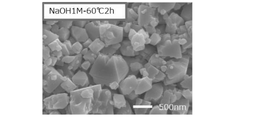
- FIG. 1 is a scanning electron microscope image of beta zeolite obtained in Example 1.
- FIG. 2 is a scanning electron microscope image of beta zeolite obtained in Example 3.
- FIG. 3 is a scanning electron microscope image of beta zeolite obtained in Example 5.
- FIG. 4 is a scanning electron microscope image of beta zeolite of Comparative Example 1 (that is, mother powder of beta zeolite).
- the present invention relates to a method for producing beta zeolite.
- a beta-zeolite mother powder is used as a raw material, and the target beta-zeolite fine powder is obtained by treating the mother powder with an alkaline aqueous solution.
- the mother powder used as a raw material is synthesized without using an organic structure-directing agent (hereinafter also referred to as "OSDA").
- OSDA organic structure-directing agent
- a beta zeolite synthesized without using OSDA (hereinafter also referred to as "OSDA-free zeolite") is known.
- the OSDA-free zeolite is obtained, for example, by mixing a beta-type zeolite seed crystal (the seed crystal may be synthesized using OSDA) with a reaction mixture containing a silica source, an alumina source, an alkalinity source and water. Then, the mixture can be heated and synthesized under high temperature and pressure.
- the particle size of the beta-type zeolite seed crystals used for synthesizing the mother powder is expressed by the volume cumulative particle size D90 at a cumulative volume of 90 % by volume measured by a laser diffraction scattering particle size distribution measurement method, preferably It is 0.1 ⁇ m or more and 50 ⁇ m or less, more preferably 0.1 ⁇ m or more and 20 ⁇ m or less, and still more preferably 0.1 ⁇ m or more and 10 ⁇ m or less.
- the method for measuring the particle size by the laser diffraction/scattering particle size distribution measurement method is as described in Examples.
- the reaction mixture to which seed crystals are added is preferably obtained by mixing a silica source, an alumina source, an alkali source and water so as to have the molar ratio shown below.
- a silica source an alumina source
- an alkali source an alkali source
- water so as to have the molar ratio shown below.
- the desired mother powder of beta-type zeolite can be successfully obtained.
- - SiO2 / Al2O3 10 or more and 200 or less, especially 10 or more and 45 or less.
- - Na2O / SiO2 0.18 or more and 0.4 or less, especially 0.2 or more and 0.3 or less.
- - H2O / SiO2 10 or more and 50 or less, especially 13 or more and 25 or less.
- Silica sources used to obtain the reaction mixture having the above molar ratio include silica itself and silicon-containing compounds capable of producing silicate ions in water. Specific examples include wet-process silica, dry-process silica, colloidal silica, sodium silicate, and aluminosilicate gel. These silica sources can be used alone or in combination of two or more. Among these silica sources, it is preferable to use silica (silicon dioxide) or aluminosilicate gel in that the mother powder of beta-type zeolite can be obtained without producing unnecessary by-products.
- alumina source for example, a water-soluble aluminum-containing compound can be used. Specific examples include sodium aluminate, aluminum nitrate, and aluminum sulfate.
- Aluminum hydroxide is also a suitable source of alumina. These alumina sources can be used alone or in combination of two or more. Of these alumina sources, it is preferable to use sodium aluminate or aluminum hydroxide, since the mother powder of beta-type zeolite can be obtained without unwanted by-products (for example, sulfates, nitrates, etc.).
- sodium hydroxide As an alkali source, for example, sodium hydroxide can be used.
- sodium silicate is used as the silica source or sodium aluminate is used as the alumina source
- sodium, which is an alkali metal component contained therein, is simultaneously regarded as NaOH and is also an alkali component. Therefore, the Na 2 O mentioned above is calculated as the sum of all alkaline components in the reaction mixture.
- the amount of beta zeolite used as seed crystals should be 0.1% by mass or more and 20% by mass or less with respect to the silica component in the reaction mixture, in order to successfully obtain mother powder of beta zeolite. It is preferably 0.1% by mass or more and 10% by mass or less, and still more preferably 0.1% by mass or more and 5% by mass or less.
- a method that facilitates obtaining a uniform reaction mixture should be adopted.
- a uniform reaction mixture can be obtained by adding and dissolving an alumina source in an aqueous sodium hydroxide solution, then adding a silica source and stirring and mixing.
- the seed crystals are added while mixing with the silica source or after adding the silica source. After that, the mixture is stirred and mixed so that the seed crystals are uniformly dispersed.
- the temperature at which the reaction mixture is prepared is not particularly limited, and generally room temperature (20° C. to 25° C.) may be used.
- the reaction mixture containing the seed crystals is placed in a container, sealed, heated and reacted to produce crystals of beta-type zeolite.
- This reaction mixture does not contain OSDA.
- One method of forming crystals is a method of heating and standing under high temperature and high pressure.
- the heating temperature is preferably in the range of 100°C or higher and 200°C or lower, more preferably 120°C or higher and 180°C or lower.
- a satisfactory crystallization rate can be obtained by heating at 100° C. or higher.
- heating at 200° C. or less makes it difficult to generate other zeolite species such as mordenite.
- the heating time is not critical in this production method, and the heating may be continued until beta-type zeolite mother powder with sufficiently high crystallinity is produced. In general, heating for about 5 to 150 hours provides mother powder of beta-type zeolite with satisfactory crystallinity.
- the liquid When heating by the stationary method, the liquid may be aged prior to that. Aging refers to an operation of holding at a temperature lower than the reaction temperature for a certain period of time. Aging is generally done without agitation. By performing aging, effects such as preventing the by-production of impurities, enabling heating under stirring without the by-production of impurities, and increasing the reaction rate are exhibited.
- the aging temperature and time are set so that the above effects are maximized.
- aging is preferably carried out at 20 to 80° C., more preferably 20 to 60° C., preferably for 2 hours to 1 day.
- a mother powder of beta-type zeolite is obtained by the above heating. After completion of heating, the mother powder produced is separated from the liquid by filtration, washed with water or warm water, and dried. No calcination is required as it does not contain OSDA while remaining dry.
- the mother powder in this state contains Na + ions in the crystals.
- the mother powder in this state may be subjected to the next step, or the mother powder obtained by exchanging Na + ions with NH 4 + ions may be subjected to the next step. Furthermore, after exchanging with NH 4 + ions, the mother powder converted to H + type by firing may be supplied to the next step. From the viewpoint of industrial productivity, it is advantageous to supply the Na + -type mother powder to the next step.
- the particle size of the mother powder is determined by the laser diffraction scattering particle size distribution measurement method.
- the cumulative particle diameter D90 is about 10 ⁇ m or more and 200 ⁇ m or less.
- the primary particles aggregate to form aggregates.
- the primary particles are polycrystalline crystal particles formed by aggregation of single crystals. In the present invention, primary particles are the smallest units observed as independent particles in observation using an electron microscope.
- the mother powder in the case of using the Na + -type mother powder, in the case of using the mother powder in the NH 4 + -type by ion exchange, and in the case of using the mother powder in the H + -type by calcination, the mother powder is converted into crystals. It is preferable to remove coarse particles by pulverizing or classifying to such an extent that the properties are not impaired, and to adjust the particle size, from the viewpoint that contact with an alkaline aqueous solution, which is the next step, can be performed efficiently. For pulverization, jet mills, ball mills, bead mills, and the like can be used.
- a method of separating by a sedimentation method using a slurry in which mother powder is dispersed in a dispersion medium for example, a method of separating by a sedimentation method using a slurry in which mother powder is dispersed in a dispersion medium, a wet classification method, a dry classification method, or the like can be used.
- the particle size of the mother powder after classification is preferably 0.1 ⁇ m or more and 20 ⁇ m or less, expressed as a volume cumulative particle size D90 at a cumulative volume of 90 % by volume measured by a laser diffraction scattering particle size distribution measurement method, and 0.1 ⁇ m. It is more preferable to set the thickness to 10 ⁇ m or less.
- the mother powder is subjected to a contact process with an alkaline aqueous solution.
- an alkaline aqueous solution For example, by mixing the mother powder and the alkaline aqueous solution, the two can be brought into contact with each other.
- the OSDA-free zeolite mother powder produced by the method described above has the advantage of being highly crystalline, the particles tend to agglomerate.
- the alkaline aqueous solution that is brought into contact with the OSDA-free zeolite mother powder can be an aqueous solution of various basic substances.
- basic substances include alkali metal hydroxides such as sodium hydroxide and potassium hydroxide, alkaline earth metal hydroxides such as calcium hydroxide, and ammonia.
- the pH when the alkaline aqueous solution is brought into contact with the OSDA-free zeolite mother powder is preferably 12 or more, more preferably 13 or more, in order to selectively dissolve the grain boundaries of the OSDA-free zeolite particles. , 14 or more.
- the concentration of the basic substance contained in the alkaline aqueous solution is adjusted so that the pH of the alkaline aqueous solution is the above value.
- the OH ⁇ ion concentration of the alkaline aqueous solution is preferably 0.01 mol/L or more, more preferably 0.1 mol/L or more, and even more preferably 1.0 mol/L or more.
- the upper limit of the concentration is not particularly limited, but if it is about 5.0 mol/L, preferably about 2.3 mol/L, the aggregated OSDA-free zeolite mother powder is sufficiently dispersed into the primary particles. can be made
- the amounts of the OSDA-free zeolite mother powder and the alkaline aqueous solution used are set so that the mother powder/alkaline aqueous solution ratio is 10 g/L or more and 1000 g/L or less.
- mother powder can be sufficiently dispersed in the primary particles, more preferably 20 g / L or more and 500 g / L or less, still more preferably 30 g / L or more and 200 g / L or less, 30 g / L or more and 180 g /L or less.
- the contact between the OSDA-free zeolite mother powder and the alkaline aqueous solution can be carried out at room temperature.
- Room temperature refers to ambient temperature, which is the temperature without intentional heating and cooling. Instead of contacting at room temperature, both can be contacted under heating.
- OSDA-free zeolite mother powder can be added to an alkaline aqueous solution heated to a predetermined temperature.
- the heating temperature of the alkaline aqueous solution is preferably 40° C. or higher and 100° C. or lower, for example, from the viewpoint of selectively dissolving the grain boundaries of the OSDA-free zeolite particles, more preferably 40° C. or higher and 80° C. or lower, and still more preferably. It is 50°C or higher and 70°C or lower.
- the contact time between the OSDA-free zeolite mother powder and the alkaline aqueous solution is appropriately adjusted so that the aggregated OSDA-free zeolite mother powder can be sufficiently dispersed into primary particles.
- satisfactory results can be obtained by contacting the two for preferably 0.5 hours to 48 hours, more preferably 1 hour to 12 hours, and even more preferably 1 hour to 4 hours.
- the aggregated OSDA-free zeolite mother powder into contact with an alkaline aqueous solution, it is possible to selectively dissolve the grain boundaries of the particles that make up the aggregate. Since the alkaline aqueous solution acts mainly on the grain boundaries of the primary particles in aggregates of primary particles, the crystal structure of the beta-type zeolite that constitutes the particles is less affected by the alkaline aqueous solution. Therefore, the crystallinity of beta zeolite before and after contact with the alkaline aqueous solution is substantially the same, and the high crystallinity before contact with the alkaline aqueous solution is maintained even after contact. This is in contrast to conventional methods of milling OSDA-free zeolite mother flour. When pulverized, the crystallinity of beta zeolite tends to decrease due to the external force applied during pulverization, and in some cases an amorphous substance may be produced.
- the conventional method of classifying the mother powder of OSDA-free zeolite to remove coarse particles has the disadvantage that there is a large loss of coarse particles and the yield is poor.
- the method of contacting the OSDA-free zeolite mother powder with an alkaline aqueous solution since only the agglomeration of the primary particles is loosened, loss of coarse particles does not occur and the yield is increased. It also has the advantage of being good.
- the present inventor conducted microscopic observation it was found that the particle size of the primary particles constituting the aggregates and the particle size distribution measured by the laser diffraction scattering particle size distribution measurement method after contact with the alkaline aqueous solution were substantially the same. It was confirmed.
- the SiO 2 /Al 2 O 3 molar ratio is slightly lower than before the treatment with the alkaline aqueous solution.
- the beta zeolite thus obtained was synthesized without using an organic structure-directing agent.
- the SiO 2 /Al 2 O 3 molar ratio in this beta-type zeolite is approximately the same as that of the mother powder, OSDA-free zeolite.
- the SiO 2 /Al 2 O 3 molar ratio is preferably 16 or less, more preferably 12 or less, still more preferably 10 or less.
- the SiO 2 /Al 2 O 3 molar ratio is preferably 2 or more, more preferably 4 or more, still more preferably 6 or more.
- Beta zeolite dispersed into primary particles by an aqueous alkaline solution preferably has a particle size D90 of 10 ⁇ m or less, more preferably 7 ⁇ m, even more preferably 5 ⁇ m or less, even more preferably 1 ⁇ m or less.
- the particle size D90 of beta zeolite is preferably 10 nm or more, more preferably 50 nm or more, and still more preferably 0.1 ⁇ m or more.
- beta-type zeolite dispersed into primary particles with an alkaline aqueous solution has a large pore volume.
- the beta zeolite having a micropore volume of 0.15 cm 3 /g or more and 0.30 cm 3 /g or less is advantageous when the beta zeolite is used in various applications such as catalysts. It is preferable from a certain point, more preferably 0.18 cm 3 /g or more, and still more preferably 0.22 m 3 /g or more.
- the method for measuring the micropore volume is as described in Examples.
- the beta zeolite obtained by the production method of the present invention can be used for various purposes by utilizing its high crystallinity and fine grains.
- it is suitably used as a catalyst material for purifying exhaust gas generated from internal combustion engines.
- Catalytic materials include substrates and catalytically active components.
- it is suitably used as an adsorbent that adsorbs only molecules having a specific size, and as a catalyst for organic compound synthesis reactions in the petrochemical industry.
- the beta zeolite obtained by the production method of the present invention can also be used as seed crystals for synthesizing beta zeolite.
- this seed crystal was synthesized without using OSDA, by using this seed crystal to synthesize beta-type zeolite without using OSDA, it is possible to ultimately reduce the environmental load.
- the method of synthesizing beta zeolite using seed crystals without using OSDA is as described above.
- the seed crystals may be mixed at a ratio of 0.1% by mass or more and 20% by mass or less, and sealed and heated at 100° C. or more and 200° C. or less.
- This beta-type zeolite was used as mother powder.
- a SEM image of the mother powder is shown in FIG.
- the mother powder had a SiO 2 /Al 2 O 3 molar ratio of 9.8.
- the volume cumulative particle size D90 at a cumulative volume of 90 % by volume measured by a laser diffraction scattering particle size distribution measurement method was 23 ⁇ m.
- the volume cumulative particle size D90 at a cumulative volume of 90 % by volume was measured by a laser diffraction scattering particle size distribution measurement method as follows. Using a laser diffraction scattering particle size distribution analyzer ("LS 13 320, Universal Liquid Module” manufactured by Beckman Coulter), zeolite is put into pure water and irradiated with ultrasonic waves for 180 seconds at a flow rate of 40%. After dispersing, the particle size distribution was measured. The measurement conditions were a solvent refractive index of 1.33, a particle refractive index of 1.50, a measurement time of 90 seconds, and a measurement range of 0.020 to 2000 ⁇ m.
- micropore volume was calculated using Microtrac Bell Co., Ltd. "BELSORP MINI X", after pretreatment at 400 ° C. under vacuum for 3 hours, nitrogen adsorption isotherm measured at 77 K by t-plot method. I did it by analyzing. Furthermore, the volume cumulative particle size D90 at a cumulative volume of 90 % by volume was measured using the laser diffraction scattering particle size distribution analyzer described above. Those results are shown in Table 1. A scanning electron microscope (hereinafter also referred to as "SEM”) image of beta zeolite is shown in FIG.
- SEM scanning electron microscope
- Beta Zeolite Beta zeolite was synthesized using the beta zeolite obtained in (2) above (this beta zeolite was not produced using OSDA) as a seed crystal.
- beta zeolite was synthesized without After cooling the closed vessel, the product was filtered and washed with warm water to obtain a white powder. X-ray diffraction measurement of this product confirmed that it was beta zeolite containing no impurities.
- Beta zeolite was obtained in the same manner as in Example 1, except that in (2) of Example 1, the concentration of the aqueous sodium hydroxide solution was adjusted as shown in Table 1. The SiO 2 /Al 2 O 3 molar ratio, micropore volume and particle size D90 of the resulting beta zeolite were measured in the same manner as in Example 1. Those results are shown in Table 1. Using the obtained zeolite beta as seed crystals, zeolite beta was synthesized in the same manner as in Example 1 (3). When the obtained beta-type zeolites were subjected to X-ray diffraction measurement, it was confirmed that they were beta-type zeolites containing no impurities in Examples 2 and 3.
- Example 6 In (2) of Example 1, 150 g of beta zeolite mother powder was added to 926 mL of a 2.0 mol/L sodium hydroxide aqueous solution. The volume of the aqueous sodium hydroxide solution with respect to the mass of the beta zeolite mother powder was 162 g/L. Beta zeolite was obtained in the same manner as in Example 1 except for this. The SiO 2 /Al 2 O 3 molar ratio, micropore volume and particle size D90 of the resulting beta zeolite were measured in the same manner as in Example 1. Those results are shown in Table 1. Using the obtained zeolite beta as seed crystals, zeolite beta was synthesized in the same manner as in Example 1 (3). When the obtained zeolite beta was subjected to X-ray diffraction measurement, it was confirmed to be beta zeolite containing no impurities.
- This comparative example is an example in which the mother powder was not treated with the alkaline aqueous solution in (2) of Example 1.
- beta-type zeolite was synthesized in the same manner as in Example 1 (3) using the OSDA-free zeolite mother powder of Example 1 (2) as a seed crystal.
- the obtained zeolite beta was subjected to X-ray diffraction measurement, it was confirmed to be beta zeolite containing mordenite and amorphous.
- This comparative example is an example in which the OSDA-free zeolite mother powder obtained in (2) of Example 1 was treated with an acidic aqueous solution instead of being treated with an alkaline aqueous solution.
- the OSDA-free zeolite mother powder obtained in (2) of Example 1 was added to a 0.1 mol/L sulfuric acid aqueous solution and stirred for 2 hours.
- the volume of the aqueous sulfuric acid solution relative to the mass of the OSDA-free zeolite mother powder was 40 g/L.
- the liquid temperature was maintained at 60° C. during stirring. After that, solid content was recovered by solid-liquid separation. The solid content was washed with water and then dried to obtain beta zeolite powder.
- the SiO 2 /Al 2 O 3 molar ratio, micropore volume and particle size D90 of the resulting beta zeolite were measured in the same manner as in Example 1. Those results are shown in Table 1.
- dealumination occurs due to the treatment of the mother powder with the acidic aqueous solution, and the SiO 2 /Al 2 O 3 molar ratio is lower than before the treatment with the acidic aqueous solution.
- Rose Using the obtained zeolite beta as seed crystals, zeolite beta was synthesized in the same manner as in Example 1 (3). When the obtained zeolite beta was subjected to X-ray diffraction measurement, it was confirmed to be zeolite beta containing a small amount of mordenite.
- the particle size D90 of the beta zeolite obtained in each example is smaller than that of the beta zeolite of the comparative example, and it can be seen that the particles are atomized by treatment with an alkaline aqueous solution. .
- the reason why the D90 value in Example 5 is larger than in other examples is that in Example 5, the mother powder of beta-type zeolite, which is an aggregate, was once dispersed into primary particles and then re-agglomerated. It is assumed that there is.
- a beta-type zeolite that is fine and useful for synthesizing zeolite without using an organic structure-directing agent and a method for producing the same are provided.
Landscapes
- Chemical & Material Sciences (AREA)
- Organic Chemistry (AREA)
- Chemical Kinetics & Catalysis (AREA)
- Engineering & Computer Science (AREA)
- Materials Engineering (AREA)
- Analytical Chemistry (AREA)
- Inorganic Chemistry (AREA)
- Life Sciences & Earth Sciences (AREA)
- General Life Sciences & Earth Sciences (AREA)
- Geology (AREA)
- Crystallography & Structural Chemistry (AREA)
- Thermal Sciences (AREA)
- Physics & Mathematics (AREA)
- Silicates, Zeolites, And Molecular Sieves (AREA)
Abstract
Description
したがって本発明の課題は、微粒であり、有機構造規定剤を用いないゼオライトの合成に有用なベータ型ゼオライト及びその製造方法を提供することにある。
レーザー回折散乱式粒度分布測定法による累積体積90容量%における体積累積粒径D90が10μm以下であり、
ミクロ孔容積が0.15cm3/g以上0.30cm3/g以下である、ベータ型ゼオライトを提供するものである。
・SiO2/Al2O3=10以上200以下、特に10以上45以下。
・Na2O/SiO2=0.18以上0.4以下、特に0.2以上0.3以下。
・H2O/SiO2=10以上50以下、特に13以上25以下。
また、本発明の製造方法によって得られたベータ型ゼオライトを、ベータ型ゼオライトを合成するための種結晶として用いることもできる。この種結晶はOSDAを用いずに合成されたものなので、この種結晶を用い、OSDAを用いずにベータ型ゼオライトを合成することで、環境負荷を究極的に小さくすることができる。種結晶を用い、OSDAを用いずにベータ型ゼオライトを合成する方法は先に述べたとおりであり、詳細には、種結晶と特定の組成の反応混合物とを、該反応混合物中のシリカ成分に対して該種結晶を0.1質量%以上20質量%以下の割合で混合し、100℃以上200℃以下で密閉加熱すればよい。
(1)OSDAフリーベータ型ゼオライト母粉の合成
種結晶として、ベータ型ゼオライト(HSZ931HOA(SiO2/Al2O3モル比=28):東ソー社製)を用意した。3号ケイ酸ソーダと硫酸バンド水溶液及び硫酸、純水を用いて、SiO2/Al2O3モル比=16のアルミノシリケートゲルを調製した。合成したゲルスラリーを遠心分離機でろ過、純水で洗浄した後、含水アルミノシリケートゲルを得た。含有水分量は71.0%であった。調製したアルミノシリケートゲルと、50w/v%水酸化ナトリウム水溶液及び純水とを用いて、SiO2/Al2O3モル比=16、Na2O/SiO2モル比=0.23、H2O/SiO2モル比=15の組成の反応混合物を調製し、これを種結晶と混合した。その後、密閉容器に入れて、150℃で43時間加熱して、OSDAを使用することなしに、ベータ型ゼオライトを合成した。密閉容器を冷却後、生成物をろ過、温水洗浄して白色粉末を得た。この生成物のX線回折測定を行ったところ、不純物を含まないベータ型ゼオライトであることが確認された。このベータ型ゼオライトを母粉として用いた。母粉のSEM像を図4に示す。ICP-MSによる組成分析の結果、母粉のSiO2/Al2O3モル比は9.8であった。レーザー回折散乱式粒度分布測定法による累積体積90容量%における体積累積粒径D90は23μmであった。
レーザー回折散乱式粒度分布測定装置(ベックマン・コールター社製 「LS 13 320,ユニバーサルリキッドモジュール」)を用いて、ゼオライトを純水に投入し、40%の流速中、超音波を180秒間照射して分散させた後、粒度分布を測定した。測定条件は、溶媒屈折率1.33、粒子屈折率1.50、測定時間90秒、測定範囲0.020~2000μmとした。
1.0mol/Lの水酸化ナトリウム水溶液に、前記ベータ型ゼオライトの母粉を添加し、2時間にわたって撹拌した。水酸化ナトリウム水溶液の容量に対するベータ型ゼオライトの母粉の質量の比率は40g/Lであった。撹拌をしている間、液温を60℃に維持した。その後、固液分離して固形分を回収した。この固形分を水洗した後に乾燥させて、目的とするベータ型ゼオライトの粉末を得た。
得られたベータ型ゼオライトを組成分析してSiO2/Al2O3モル比を測定した。
また、得られたベータ型ゼオライトのミクロ孔容積を算出した。ミクロ孔容積の算出は、マイクロトラック・ベル社製「BELSORP MINI X」を用いて、真空下400℃、3時間の前処理後、77Kで測定された窒素の吸着等温線をt-プロット法により解析することで行った。
更に、累積体積90容量%における体積累積粒径D90を、上述したレーザー回折散乱式粒度分布測定装置を用いて測定した。それらの結果を表1に示す。また、ベータ型ゼオライトの走査型電子顕微鏡(以下「SEM」ともいう。)像を図1に示す。
前記(2)で得られたベータ型ゼオライト(このベータ型ゼオライトはOSDAを用いて製造されたものではない。)を種結晶として用い、ベータ型ゼオライトを合成した。
前記(1)で調製したアルミノシリケートゲルと、50w/v%水酸化ナトリウム水溶液及び純水とを用いて、SiO2/Al2O3モル比=16、Na2O/SiO2モル比=0.23、H2O/SiO2モル比=15の組成の反応混合物を調製し、これを種結晶と混合した後、密閉容器に入れて、150℃で48時間加熱して、OSDAを使用することなしに、ベータ型ゼオライトを合成した。密閉容器を冷却後、生成物をろ過、温水洗浄して白色粉末を得た。この生成物のX線回折測定を行ったところ、不純物を含まないベータ型ゼオライトであることが確認された。
実施例1の(2)において、水酸化ナトリウム水溶液の濃度を表1に記載のように調製した以外は実施例1と同様にしてベータ型ゼオライトを得た。得られたベータ型ゼオライトのSiO2/Al2O3モル比、ミクロ孔容積及び粒径D90を実施例1と同様にして測定した。それらの結果を表1に示す。
得られたベータ型ゼオライトを種結晶として用い、実施例1の(3)と同様にしてベータ型ゼオライトを合成した。得られたベータ型ゼオライトのX線回折測定を行ったところ、実施例2及び3において、不純物を含まないベータ型ゼオライトであることが確認された。
実施例1の(2)において、2.0mol/Lの水酸化ナトリウム水溶液926mLに、150gのベータ型ゼオライトの母粉を添加した。ベータ型ゼオライトの母粉の質量に対する水酸化ナトリウム水溶液の容量は162g/Lであった。これ以外は実施例1と同様にしてベータ型ゼオライトを得た。得られたベータ型ゼオライトのSiO2/Al2O3モル比、ミクロ孔容積及び粒径D90を実施例1と同様にして測定した。それらの結果を表1に示す。
得られたベータ型ゼオライトを種結晶として用い、実施例1の(3)と同様にしてベータ型ゼオライトを合成した。得られたベータ型ゼオライトのX線回折測定を行ったところ、不純物を含まないベータ型ゼオライトであることが確認された。
本比較例は、実施例1の(2)のアルカリ性水溶液による母粉の処理を行わなかった例である。
本比較例においては、実施例1の(2)のOSDAフリーゼオライト母粉を種結晶として用い、実施例1の(3)と同様にしてベータ型ゼオライトを合成した。得られたベータ型ゼオライトのX線回折測定を行ったところ、モルデナイト及び非晶質を含むベータ型ゼオライトであることが確認された。
本比較例は、実施例1の(2)で得られたOSDAフリーゼオライト母粉をアルカリ性水溶液で処理することに代えて、酸性水溶液で処理した例である。
0.1mоl/Lの硫酸水溶液に、実施例1の(2)で得られたOSDAフリーゼオライト母粉を添加し、2時間にわたって撹拌した。OSDAフリーゼオライト母粉の質量に対する硫酸水溶液の容量は40g/Lであった。撹拌をしている間、液温を60℃に維持した。その後、固液分離して固形分を回収した。この固形分を水洗した後に乾燥させて、ベータ型ゼオライトの粉末を得た。得られたベータ型ゼオライトのSiO2/Al2O3モル比、ミクロ孔容積及び粒径D90を実施例1と同様にして測定した。それらの結果を表1に示す。本比較例で得られたベータ型ゼオライトは、母粉を酸性水溶液で処理したことに起因して脱アルミニウム化が起こり、酸性水溶液での処理前に比べてSiO2/Al2O3モル比が上昇した。
得られたベータ型ゼオライトを種結晶として用い、実施例1の(3)と同様にしてベータ型ゼオライトを合成した。得られたベータ型ゼオライトのX線回折測定を行ったところ、モルデナイトを少量含むベータ型ゼオライトであることが確認された。

なお実施例5におけるD90の値が他の実施例よりも大きい理由は、実施例5では、凝集体であるベータ型ゼオライトの母粉が一旦一次粒子に分散された後に、再凝集したからであると推察される。
Claims (6)
- 有機構造規定剤を用いずに合成されたベータ型ゼオライト母粉と、pH12以上のアルカリ性水溶液とを接触させる、ベータ型ゼオライトの製造方法。
- 前記アルカリ性水溶液の液温を40℃以上100℃以下に設定し、
前記母粉/前記アルカリ性水溶液の比率を10g/L以上1000g/L以下に設定して、前記母粉と前記アルカリ性水溶液とを接触させる、請求項1に記載の製造方法。 - 前記母粉と前記アルカリ性水溶液との接触によって得られたベータ型ゼオライトと、以下に示すモル比からなる組成の反応混合物とを、該反応混合物中のシリカ成分に対して該ベータ型ゼオライトを0.1質量%以上20質量%以下の割合で混合し、100℃以上200℃以下で密閉加熱する、請求項1又は2に記載の製造方法。
SiO2/Al2O3=10以上200以下
Na2O/SiO2=0.18以上0.4以下
H2O/SiO2=10以上50以下 - SiO2/Al2O3のモル比が16以下であり、
レーザー回折散乱式粒度分布測定法による累積体積90容量%における体積累積粒径D90が10μm以下であり、
ミクロ孔容積が0.15cm3/g以上0.30cm3/g以下である、ベータ型ゼオライト。 - 請求項4に記載のベータ型ゼオライトを含んでなる触媒活性成分。
- 請求項4に記載のベータ型ゼオライトを含んでなる吸着材。
Priority Applications (4)
| Application Number | Priority Date | Filing Date | Title |
|---|---|---|---|
| US18/269,906 US20240058801A1 (en) | 2021-01-25 | 2022-01-24 | Beta zeolite and method for producing same |
| CN202280009052.8A CN116745033A (zh) | 2021-01-25 | 2022-01-24 | β型沸石及其制造方法 |
| JP2022576768A JP7835695B2 (ja) | 2021-01-25 | 2022-01-24 | ベータ型ゼオライト及びその製造方法 |
| EP22742707.7A EP4282823A4 (en) | 2021-01-25 | 2022-01-24 | ZEOLITE BETA AND ITS PRODUCTION PROCESS |
Applications Claiming Priority (2)
| Application Number | Priority Date | Filing Date | Title |
|---|---|---|---|
| JP2021009773 | 2021-01-25 | ||
| JP2021-009773 | 2021-01-25 |
Publications (1)
| Publication Number | Publication Date |
|---|---|
| WO2022158588A1 true WO2022158588A1 (ja) | 2022-07-28 |
Family
ID=82548724
Family Applications (1)
| Application Number | Title | Priority Date | Filing Date |
|---|---|---|---|
| PCT/JP2022/002370 Ceased WO2022158588A1 (ja) | 2021-01-25 | 2022-01-24 | ベータ型ゼオライト及びその製造方法 |
Country Status (5)
| Country | Link |
|---|---|
| US (1) | US20240058801A1 (ja) |
| EP (1) | EP4282823A4 (ja) |
| JP (1) | JP7835695B2 (ja) |
| CN (1) | CN116745033A (ja) |
| WO (1) | WO2022158588A1 (ja) |
Citations (7)
| Publication number | Priority date | Publication date | Assignee | Title |
|---|---|---|---|---|
| JPS60108316A (ja) * | 1983-07-27 | 1985-06-13 | モ−ビル オイル コ−ポレ−シヨン | 多孔性珪質結晶性物質のデアクロメレ−シヨン |
| CN101920974A (zh) * | 2009-06-12 | 2010-12-22 | 中国石油天然气股份有限公司 | 一种改善沸石分散性降低沸石平均粒径的方法 |
| US20120190534A1 (en) | 2009-07-27 | 2012-07-26 | The University Of Tokyo | Zeolite beta and process for producing the same |
| WO2016013245A1 (ja) * | 2014-07-23 | 2016-01-28 | 日本ゼオン株式会社 | 触媒材料およびその製造方法 |
| JP2016145138A (ja) * | 2015-02-09 | 2016-08-12 | ユニゼオ株式会社 | ベータ型ゼオライトの製造方法 |
| US20190177173A1 (en) | 2016-06-17 | 2019-06-13 | Mitsui Mining & Smelting Co., Ltd. | Method of producing beta zeolite |
| JP2019182741A (ja) * | 2018-03-30 | 2019-10-24 | 日揮触媒化成株式会社 | 局所的に結晶構造を有する非晶質シリカアルミナおよびその製造方法 |
Family Cites Families (3)
| Publication number | Priority date | Publication date | Assignee | Title |
|---|---|---|---|---|
| US20110286914A1 (en) * | 2010-05-21 | 2011-11-24 | Pq Corporation | NOVEL METAL-CONTAINING ZEOLITE BETA FOR NOx REDUCTION AND METHODS OF MAKING THE SAME |
| US8951498B2 (en) | 2010-07-30 | 2015-02-10 | University Of Iowa Research Foundation | Synthesis of hierarchical nanocrystalline zeolites with controlled particle size and mesoporosity |
| JP6375204B2 (ja) * | 2014-10-29 | 2018-08-15 | 国立大学法人 東京大学 | Nes型ゼオライトの製造方法 |
-
2022
- 2022-01-24 WO PCT/JP2022/002370 patent/WO2022158588A1/ja not_active Ceased
- 2022-01-24 EP EP22742707.7A patent/EP4282823A4/en active Pending
- 2022-01-24 US US18/269,906 patent/US20240058801A1/en active Pending
- 2022-01-24 CN CN202280009052.8A patent/CN116745033A/zh active Pending
- 2022-01-24 JP JP2022576768A patent/JP7835695B2/ja active Active
Patent Citations (8)
| Publication number | Priority date | Publication date | Assignee | Title |
|---|---|---|---|---|
| JPS60108316A (ja) * | 1983-07-27 | 1985-06-13 | モ−ビル オイル コ−ポレ−シヨン | 多孔性珪質結晶性物質のデアクロメレ−シヨン |
| CN101920974A (zh) * | 2009-06-12 | 2010-12-22 | 中国石油天然气股份有限公司 | 一种改善沸石分散性降低沸石平均粒径的方法 |
| US20120190534A1 (en) | 2009-07-27 | 2012-07-26 | The University Of Tokyo | Zeolite beta and process for producing the same |
| WO2016013245A1 (ja) * | 2014-07-23 | 2016-01-28 | 日本ゼオン株式会社 | 触媒材料およびその製造方法 |
| JP2016145138A (ja) * | 2015-02-09 | 2016-08-12 | ユニゼオ株式会社 | ベータ型ゼオライトの製造方法 |
| US20180022612A1 (en) | 2015-02-09 | 2018-01-25 | Unizeo Co., Ltd. | Method for producing beta zeolite |
| US20190177173A1 (en) | 2016-06-17 | 2019-06-13 | Mitsui Mining & Smelting Co., Ltd. | Method of producing beta zeolite |
| JP2019182741A (ja) * | 2018-03-30 | 2019-10-24 | 日揮触媒化成株式会社 | 局所的に結晶構造を有する非晶質シリカアルミナおよびその製造方法 |
Non-Patent Citations (4)
| Title |
|---|
| GERARDO MAJANO, LUC DELMOTTE, VALENTIN VALTCHEV, SVETLANA MINTOVA: "Al-Rich Zeolite Beta by Seeding in the Absence of Organic Template", CHEMICAL OF MATERIALS, vol. 21, no. 18, 22 September 2009 (2009-09-22), US , pages 4184 - 4191, XP002605661, ISSN: 1520-5002, DOI: 10.1021/cm900462u * |
| KE ZHANG, SERGIO FERNANDEZ, JOHN A. LAWRENCE, MICHELE L. OSTRAAT: "Organotemplate-Free β Zeolites: From Zeolite Synthesis to Hierarchical Structure Creation", ACS OMEGA, vol. 3, no. 12, 31 December 2018 (2018-12-31), US , pages 18935 - 18942, XP055600904, ISSN: 2470-1343, DOI: 10.1021/acsomega.8b02762 * |
| See also references of EP4282823A4 |
| ZHANG QIANG, XIANG SHENG, ZHANG QING, WANG BINJU, MAYORAL ALVARO, LIU WEIYAN, WANG YUYAO, LIU YINGHAO, SHI JING, YANG GUOJU, LUO J: "Breaking the Si/Al Limit of Nanosized β Zeolites: Promoting Catalytic Production of Lactide", CHEMISTRY OF MATERIALS, vol. 32, no. 2, 28 January 2020 (2020-01-28), US , pages 751 - 758, XP055952324, ISSN: 0897-4756, DOI: 10.1021/acs.chemmater.9b04023 * |
Also Published As
| Publication number | Publication date |
|---|---|
| JPWO2022158588A1 (ja) | 2022-07-28 |
| JP7835695B2 (ja) | 2026-03-25 |
| EP4282823A4 (en) | 2024-10-30 |
| EP4282823A1 (en) | 2023-11-29 |
| CN116745033A (zh) | 2023-09-12 |
| US20240058801A1 (en) | 2024-02-22 |
Similar Documents
| Publication | Publication Date | Title |
|---|---|---|
| RU2540550C2 (ru) | Способ получения цеолита zsm-5 с использованием нанокристаллических затравок zsm-5 | |
| CN104321280B (zh) | β型沸石及其制造方法 | |
| EP2928825B1 (en) | Synthesis of zsm-58 crystals with improved morphology | |
| CN108383131B (zh) | 一种利用固相转化法将粉煤灰制备成不同沸石的方法 | |
| EP3257813B1 (en) | Method for producing beta zeolite | |
| CN102659133A (zh) | 一种具有核壳结构的p型沸石分子筛的制备方法 | |
| CN104428248B (zh) | Maz型沸石的制造方法 | |
| JP2021151942A (ja) | 多孔質シリカアルミナ粒子およびその製造方法 | |
| CN109694085B (zh) | 铵型zsm-5纳米片的无模板剂合成方法 | |
| CN112969663A (zh) | 制备具有高二氧化硅与氧化铝摩尔比率(sar)的aei型沸石的方法 | |
| CN104556122B (zh) | 一种分子筛负载纳米晶粒y型分子筛及其合成方法 | |
| WO2022158588A1 (ja) | ベータ型ゼオライト及びその製造方法 | |
| CN112573536A (zh) | 一种纳米p型沸石及其制备方法和应用 | |
| JP6727884B2 (ja) | アーモンド状の形状を有するzsm−5型ゼオライトおよびその製造方法 | |
| JP4488691B2 (ja) | フォージャサイト型ゼオライトの製造方法 | |
| JP6905459B2 (ja) | ベータ型ゼオライトの製造方法 | |
| CN118005031B (zh) | Beta分子筛团聚体及其制备方法和应用 | |
| JP3482673B2 (ja) | ゼオライトβの製造方法 | |
| EP3978436A1 (en) | Production method relating to industrial mass-production of high-purity artificial zeolite | |
| CN116119679B (zh) | 一种高纯4a沸石及其室温常压合成方法 | |
| JP2564581B2 (ja) | 高シリカ含有量ゼオライトの製法 | |
| JP2555643B2 (ja) | 特異な結晶形態を有するモルデナイト型ゼオライト及びその製造方法 | |
| CN108367932B (zh) | β型沸石以及其制造方法 | |
| CN114804145A (zh) | 一种直接合成氢型沸石的方法 | |
| JPS6158812A (ja) | 結晶性アルミノシリケ−トゼオライトの製造方法 |
Legal Events
| Date | Code | Title | Description |
|---|---|---|---|
| 121 | Ep: the epo has been informed by wipo that ep was designated in this application |
Ref document number: 22742707 Country of ref document: EP Kind code of ref document: A1 |
|
| ENP | Entry into the national phase |
Ref document number: 2022576768 Country of ref document: JP Kind code of ref document: A |
|
| WWE | Wipo information: entry into national phase |
Ref document number: 18269906 Country of ref document: US |
|
| WWE | Wipo information: entry into national phase |
Ref document number: 202280009052.8 Country of ref document: CN |
|
| WWE | Wipo information: entry into national phase |
Ref document number: 202317047544 Country of ref document: IN |
|
| WWE | Wipo information: entry into national phase |
Ref document number: 2022742707 Country of ref document: EP |
|
| NENP | Non-entry into the national phase |
Ref country code: DE |
|
| ENP | Entry into the national phase |
Ref document number: 2022742707 Country of ref document: EP Effective date: 20230825 |