WO2022163499A1 - 赤外線吸収性紫外線硬化型インク及び赤外線吸収性印刷物 - Google Patents
赤外線吸収性紫外線硬化型インク及び赤外線吸収性印刷物 Download PDFInfo
- Publication number
- WO2022163499A1 WO2022163499A1 PCT/JP2022/002038 JP2022002038W WO2022163499A1 WO 2022163499 A1 WO2022163499 A1 WO 2022163499A1 JP 2022002038 W JP2022002038 W JP 2022002038W WO 2022163499 A1 WO2022163499 A1 WO 2022163499A1
- Authority
- WO
- WIPO (PCT)
- Prior art keywords
- absorbing
- infrared
- curable
- ultraviolet
- parts
- Prior art date
- Legal status (The legal status is an assumption and is not a legal conclusion. Google has not performed a legal analysis and makes no representation as to the accuracy of the status listed.)
- Ceased
Links
Classifications
-
- C—CHEMISTRY; METALLURGY
- C09—DYES; PAINTS; POLISHES; NATURAL RESINS; ADHESIVES; COMPOSITIONS NOT OTHERWISE PROVIDED FOR; APPLICATIONS OF MATERIALS NOT OTHERWISE PROVIDED FOR
- C09D—COATING COMPOSITIONS, e.g. PAINTS, VARNISHES OR LACQUERS; FILLING PASTES; CHEMICAL PAINT OR INK REMOVERS; INKS; CORRECTING FLUIDS; WOODSTAINS; PASTES OR SOLIDS FOR COLOURING OR PRINTING; USE OF MATERIALS THEREFOR
- C09D11/00—Inks
- C09D11/02—Printing inks
- C09D11/10—Printing inks based on artificial resins
- C09D11/101—Inks specially adapted for printing processes involving curing by wave energy or particle radiation, e.g. with UV-curing following the printing
-
- C—CHEMISTRY; METALLURGY
- C09—DYES; PAINTS; POLISHES; NATURAL RESINS; ADHESIVES; COMPOSITIONS NOT OTHERWISE PROVIDED FOR; APPLICATIONS OF MATERIALS NOT OTHERWISE PROVIDED FOR
- C09D—COATING COMPOSITIONS, e.g. PAINTS, VARNISHES OR LACQUERS; FILLING PASTES; CHEMICAL PAINT OR INK REMOVERS; INKS; CORRECTING FLUIDS; WOODSTAINS; PASTES OR SOLIDS FOR COLOURING OR PRINTING; USE OF MATERIALS THEREFOR
- C09D11/00—Inks
- C09D11/30—Inkjet printing inks
- C09D11/32—Inkjet printing inks characterised by colouring agents
- C09D11/322—Pigment inks
-
- C—CHEMISTRY; METALLURGY
- C09—DYES; PAINTS; POLISHES; NATURAL RESINS; ADHESIVES; COMPOSITIONS NOT OTHERWISE PROVIDED FOR; APPLICATIONS OF MATERIALS NOT OTHERWISE PROVIDED FOR
- C09D—COATING COMPOSITIONS, e.g. PAINTS, VARNISHES OR LACQUERS; FILLING PASTES; CHEMICAL PAINT OR INK REMOVERS; INKS; CORRECTING FLUIDS; WOODSTAINS; PASTES OR SOLIDS FOR COLOURING OR PRINTING; USE OF MATERIALS THEREFOR
- C09D11/00—Inks
- C09D11/50—Sympathetic, colour changing or similar inks
Definitions
- the present invention relates to an infrared absorbing ultraviolet curing ink and an infrared absorbing printed matter. More particularly, it relates to an infrared-absorbing UV-curable ink and an infrared-absorbing print containing a tungsten-based infrared-absorbing pigment and an UV-absorbing fluorescent pigment.
- Infrared absorbing ink which is a type of functional ink, is used for various purposes.
- Pigments that exhibit infrared absorption function that are blended in infrared absorbing ink include cesium tungsten oxide (CWO), antimony-doped tin oxide (ATO), indium tin oxide (ITO), carbon black, and the like.
- CWO cesium tungsten oxide
- ATO antimony-doped tin oxide
- ITO indium tin oxide
- carbon black carbon black, and the like.
- CWO cesium tungsten oxide
- ATO antimony-doped tin oxide
- ITO indium tin oxide
- carbon black carbon black
- Patent Document 1 describes an ink containing infrared absorbing material fine particles selected from composite tungsten oxides such as cesium tungsten oxide (CWO) and tungsten oxides having a Magneli phase, and a vehicle.
- composite tungsten oxides such as cesium tungsten oxide (CWO) and tungsten oxides having a Magneli phase
- Patent Document 2 proposes an anti-counterfeiting ink composition using ultrafine particles of composite tungsten oxide (such as CWO) having an XRD peak top intensity ratio within a specific range. It is described that a fluorescent material may be added to.
- composite tungsten oxide such as CWO
- the tungsten-based infrared-absorbing pigment used in the infrared-absorbing inks described in Patent Documents 1 and 2 may be deactivated by the influence of basic substances such as detergents, and may not be able to maintain the infrared-absorbing function. there were.
- Patent Document 3 an ink is produced by mixing a tungsten-based infrared absorbing pigment, a certain amount of solvent, an acrylic resin soluble in the solvent, and an ultraviolet curable resin. It has been proposed to impart resistance to basic substances such as detergents (wash resistance) to a tungsten-based infrared absorbing pigment (see Patent Document 3).
- CWO cesium tungsten oxide
- UV ultraviolet
- the ink composition contains a fluorescent pigment that absorbs ultraviolet rays (UV) and emits light, in addition to a pigment that exhibits an infrared absorption function. Then, a printed matter printed using this composition is produced, and this is used as an authentic printed matter.
- UV ultraviolet rays
- the printed matter subject to authenticity determination is evaluated using an ultraviolet (UV) irradiation device.
- UV ultraviolet
- Infrared absorption is evaluated using dedicated equipment such as a camera.
- the two-stage evaluation described above can also be applied to printed matter that requires a judgment with higher security.
- an ink composition that is, an ink composition containing a fluorescent pigment having an ultraviolet (UV) absorbing ability in addition to a tungsten-based infrared absorbing pigment, may cause washing of the fluorescent pigment due to the interaction of these pigments. Tolerance tended to decrease significantly.
- UV ultraviolet
- the present invention has been made in view of the above background, and has both infrared absorption and ultraviolet absorption, and can provide a printed matter excellent in base resistance, especially washing resistance.
- An object of the present invention is to provide a curable ink and an infrared absorbing printed matter.
- the present inventors have made intensive studies to solve the above problems. Then, when an ink composition using an ultraviolet-curable urethane acrylate resin together with a tungsten-based infrared-absorbing pigment and an ultraviolet-absorbing fluorescent pigment is used, it has both infrared-absorbing and ultraviolet-absorbing properties, and is resistant to base by ultraviolet curing. The inventors have found that a printed matter having excellent properties can be obtained, and have completed the present invention. That is, the present invention is as follows.
- the tungsten-based infrared absorbing pigment is General formula (1): M x W y O z ⁇ wherein M is H, He, an alkali metal element, an alkaline earth metal element, a rare earth element, Mg, Zr, Cr, Mn, Fe, Ru, Co, Rh, Ir, Ni, Pd, Pt, Cu, Ag, Au, Zn, Cd, Al, Ga, In, Tl, Si, Ge, Sn, Pb, Sb, B, F, P, S, Se, Br, Te, Ti, Nb, V, Mo, Ta, one or more elements selected from the group consisting of Re, Be, Hf, Os, Bi, and I, W is tungsten, O is oxygen, and x, y, and z are each positive numbers; , 0 ⁇ x/y ⁇ 1 and 2.2 ⁇ z/y ⁇ 3.0 ⁇ A composite tungsten oxide represented by, or General formula (2) : WyOz ⁇ wherein W is tungsten, O
- the infrared-absorbing ultraviolet-curable ink of the present invention is an ink that has both infrared-absorbing properties and ultraviolet-absorbing properties, and that can provide printed matter with excellent base resistance, particularly washing resistance. Therefore, printed matter obtained using the infrared-absorbing ultraviolet-curable ink of the present invention can maintain its infrared-absorbing function and ultraviolet-absorbing function due to its base resistance even when washed together with clothes. can.
- a genuine printed material formed using the infrared-absorbing ultraviolet-curable ink of the present invention has both infrared-absorbing properties and ultraviolet-absorbing properties. For this reason, when conducting authenticity determinations for printed matter whose authenticity is unknown, the primary evaluation is generally performed using an inexpensive ultraviolet (UV) irradiation device. Only when required, as a secondary evaluation, evaluation of infrared absorption properties using a dedicated device such as an infrared camera can be carried out.
- UV ultraviolet
- the authenticity determination of the printed matter whose authenticity is unknown is a two-step evaluation consisting of a primary evaluation and a secondary evaluation, A simple ultraviolet (UV) absorption evaluation, which is the primary evaluation, can limit the objects for which the secondary evaluation is performed. Therefore, according to the present invention, the convenience of authenticity determination can be improved, the introduction cost of an expensive infrared evaluation device can be suppressed, and the use scene of authenticity determination can be expanded.
- UV ultraviolet
- the infrared-absorbing, ultraviolet-curable ink of the present invention includes a tungsten-based infrared-absorbing pigment, an ultraviolet-absorbing fluorescent pigment, an ultraviolet-curable urethane acrylate resin, and an ultraviolet-curable acrylic resin containing no urethane bond.
- the term "ultraviolet curable resin” means a material that is cured by polymerization or cross-linking with the energy of ultraviolet rays irradiated from an ultraviolet irradiation device and a photopolymerization initiator, and is a monomer, oligomer, or It may be in the form of a prepolymer.
- the infrared-absorbing ultraviolet-curable ink of the present invention can provide a printed material having infrared-absorbing properties by containing a tungsten-based infrared-absorbing pigment.
- a tungsten-based infrared-absorbing pigment in addition, by containing an ultraviolet-absorbing fluorescent pigment, it is possible to provide a printed material having ultraviolet-absorbing performance.
- an ultraviolet curable urethane acrylate resin it is possible to realize a printed material having ultraviolet curing performance and excellent base resistance, particularly washing resistance.
- Tungsten-based infrared-absorbing pigments which impart infrared-absorbing performance, tend to settle in the ink even when dispersing them in conventional inks that are mainly composed of UV-curable acrylic resins that do not contain urethane bonds.
- the pigment-containing dispersion separates from the UV-curable ink, making it difficult to use as a printing ink.
- the UV-absorbing fluorescent pigment that imparts UV-absorbing performance is contained in a conventional ink mainly composed of a UV-curable acrylic resin that does not contain a urethane bond, it alone has poor base resistance, especially washing. It is possible to realize printed matter with excellent durability. However, when the ink is dispersed together with the tungsten-based infrared absorbing pigment, the washing resistance is greatly impaired.
- the UV-curable urethane acrylate resin that imparts washing resistance which is an essential component of the present invention, has a high viscosity. Therefore, a composition containing an ultraviolet curable urethane acrylate resin as a component cannot be used as an inkjet ink as it is.
- the present inventors have found that if an ultraviolet-curable acrylic resin having a low viscosity and high compatibility with an ultraviolet-curable urethane acrylate resin is used, the tungsten-based infrared absorbing pigment can be dispersed well, The function of the ultraviolet absorbing fluorescent pigment can be maintained even in the presence of the tungsten-based infrared absorbing pigment, and the increase in ink viscosity caused by the ultraviolet curable urethane acrylate resin can be suppressed. As a result, it was found that a practical ink can be realized.
- the ink of the present invention is capable of forming hydrogen bonds with urethane bonds by containing an ultraviolet curable urethane acrylate resin. Therefore, the tungsten infrared absorbing pigment and the ultraviolet absorbing fluorescent pigment form hydrogen bonds with the ultraviolet curable urethane acrylate resin and are coated. When these pigments are coated with a resin, their dispersibility in ink is improved, and base resistance, especially washing resistance, of printed matter is improved. In addition, the coating with the resin reduces the interaction between the tungsten-based infrared absorbing pigment and the ultraviolet absorbing fluorescent pigment, thereby maintaining the function of the ultraviolet absorbing fluorescent pigment.
- the ink of the present invention contains an ultraviolet-curable acrylic resin that is highly compatible with the ultraviolet-curable urethane acrylate resin, the formation of hydrogen bonds between the ultraviolet-curable urethane acrylate resins is inhibited, resulting in the formation of ink. It is considered that the increase in viscosity is suppressed.
- the viscosity of the infrared-absorbing UV-curable ink of the present invention may be 300 mPa ⁇ s or less, 150 mPa ⁇ s or less, 80 mPa ⁇ s or less, or 60 mPa ⁇ s or less, and 10 mPa ⁇ s or more at a temperature of about 25°C. , or 15 mPa ⁇ s or more.
- the viscosity of the ink is preferably 60 mPa ⁇ s or less, more preferably 40 mPa ⁇ s or less and 30 mPa ⁇ s or less. Well, 20 mPa ⁇ s or less is particularly preferable.
- the infrared-absorbing ultraviolet-curable ink of the present invention has a tungsten-based infrared-absorbing pigment dispersed as an essential component.
- the infrared-absorbing ultraviolet-curable ink of the present invention can provide a printed material having infrared-absorbing properties by containing a tungsten-based infrared-absorbing pigment.
- the tungsten-based infrared absorbing pigment used in the present invention is not particularly limited, and known pigments used in the field of ink can be applied.
- the tungsten-based infrared absorbing pigment for example, the general formula (1): M x W y O z ⁇ wherein M is H, He, an alkali metal element, an alkaline earth metal element, a rare earth element, Mg, Zr , Cr, Mn, Fe, Ru, Co, Rh, Ir, Ni, Pd, Pt, Cu, Ag, Au, Zn, Cd, Al, Ga, In, Tl, Si, Ge, Sn, Pb, Sb, B , F, P, S, Se, Br, Te, Ti, Nb, V, Mo, Ta, Re, Be, Hf, Os, Bi, and one or more elements selected from the group consisting of I; is tungsten, O is oxygen, x, y and z are each positive numbers, 0 ⁇ x/y ⁇ 1, and 2.2 ⁇ z/y ⁇ 3.0 ⁇ A composite tungsten oxide represented by the general formula (2): W y O z ⁇ wherein W is tungsten, O is oxygen, x
- Such a tungsten-based infrared absorbing pigment can be produced, for example, by the method for producing a composite tungsten oxide or a tungsten oxide having a Magneli phase, which is described in JP-A-2005-187323.
- the element M is a group consisting of Cs, Rb, K, Tl, In, Ba, Li, Ca, Sr, Fe, and Sn from the viewpoint of improving optical properties and weather resistance as a near-infrared absorbing material. It can be one or more types selected from.
- the composite tungsten oxide represented by general formula (1) may be treated with a silane coupling agent.
- a silane coupling agent By treating the composite tungsten oxide represented by the general formula (1) with a silane coupling agent, the near-infrared absorption and transparency in the visible light wavelength region of the resulting printed matter can be enhanced.
- x/y which indicates the amount of element M added
- a sufficient amount of free electrons is generated, and the near-infrared absorption effect can be fully exhibited.
- the amount of free electrons supplied increases as the amount of the element M added increases, and the near-infrared absorption effect increases.
- the supply of free electrons is usually saturated when the value of x/y is about 1.
- the value of x/y is 1 or less, it is possible to prevent the formation of an impurity phase in the pigment-containing layer.
- x/y may be 0.001 or more, 0.2 or more, or 0.30 or more, and may be 0.85 or less, 0.5 or less, or 0.35 or less.
- the value of x/y may in particular be approximately 0.33.
- the value of z/y indicates the level of oxygen content control.
- the tungsten represented by the general formula (2) when the value of z / y satisfies the relationship of 2.2 ⁇ z / y ⁇ 3.0, the tungsten represented by the general formula (2) The same oxygen control mechanism works as for oxides.
- the value of z/y may satisfy the relationship of 2.45 ⁇ z/y ⁇ 3.0.
- the composite tungsten oxide represented by the general formula (1) preferably contains a hexagonal crystal structure or consists of a hexagonal crystal structure.
- the pigment has greater transmission in the visible light wavelength region and greater absorption in the near-infrared light wavelength region.
- the cations of the element M are arranged in the gaps of the hexagonal crystal.
- hexagonal crystals are formed when an element M having a large ionic radius is added.
- an element having a large ionic radius such as Cs, K, Rb, Tl, In, Ba, Sn, Li, Ca, Sr, and Fe is added, hexagonal crystals are likely to be formed.
- the element M in the composite tungsten oxide represented by the general formula (1) is not limited to these elements, and the additive element M is present in the hexagonal voids formed by WO 6 units. It is good if there is
- the amount of the additive element M added is 0.2 or more in terms of x/y. It can be less than or equal to 0.5, more than or equal to 0.30 and less than or equal to 0.35, in particular about 0.33. It is believed that an x/y value of about 0.33 places the additive element M in substantially all of the hexagonal voids.
- tungsten bronze of tetragonal crystal or cubic crystal may be used.
- the composite tungsten oxide represented by the general formula (1) tends to change the absorption position in the near-infrared light wavelength region depending on the crystal structure, and the absorption position is longer in the order of cubic, tetragonal, and hexagonal. It tends to move toward the wavelength side.
- the order of hexagonal, tetragonal, and cubic crystals is accompanied by low absorption in the visible light wavelength range. Therefore, hexagonal tungsten bronze may be used when it is desired to transmit more light in the visible light wavelength region and to absorb more light in the near-infrared light wavelength region.
- the so-called “Magneli phase” in which the value of z/y satisfies the relationship of 2.45 ⁇ z/y ⁇ 2.999 is stable is high, and the pigment has high absorption characteristics in the near-infrared light wavelength region.
- the composite tungsten oxide represented by the general formula (1) and the tungsten oxide having the Magneli phase represented by the general formula (2) absorb a large amount of light in the near-infrared wavelength region, particularly around a wavelength of 1000 nm. , the transmitted color tone changes from bluish to greenish in many cases.
- the dispersed particle diameter of the tungsten infrared absorbing pigment used in the infrared absorbing ultraviolet curable ink of the present invention is not particularly limited, and can be appropriately selected depending on the purpose of use of the formed ink.
- a tungsten-based infrared absorbing pigment having a dispersed particle diameter of 2000 nm or less on a volume average. If the dispersed particle diameter is 2000 nm or less, the difference between the peak of the transmittance (reflectance) in the visible light wavelength region and the bottom of the absorption in the near-infrared light wavelength region increases, so the transparency in the visible light wavelength region It becomes a near-infrared absorbing pigment having. Furthermore, since particles with a dispersed particle diameter smaller than 2000 nm do not completely block light due to scattering, visibility in the visible light wavelength region can be maintained, and at the same time, transparency can be efficiently maintained. .
- the volume average dispersed particle size of the tungsten-based infrared absorbing pigment is preferably 200 nm or less, and may be 100 nm or less, 50 nm or less, or 30 nm or less.
- the dispersed particle diameter of the tungsten-based infrared absorbing pigment is 200 nm or less, geometric scattering or Mie scattering is reduced, resulting in a Rayleigh scattering region.
- the scattered light is reduced in inverse proportion to the sixth power of the diameter of the dispersed particles. Therefore, as the diameter of the dispersed particles is reduced, the scattering is reduced and the transparency is improved.
- the dispersed particle size of the tungsten-based infrared absorbing pigment is 100 nm or less, scattered light is greatly reduced. Therefore, from the viewpoint of avoiding light scattering, the smaller the dispersed particle size, the better.
- the dispersed particle diameter of the tungsten-based infrared absorbing pigment is 1 nm or more, 3 nm or more, 5 nm or more, or 10 nm or more, industrial production tends to be easy.
- the volume-average dispersed particle diameter of the tungsten-based infrared-absorbing pigment is obtained by Microtrack, a dynamic light scattering method in which fine particles in Brownian motion are irradiated with a laser beam and the particle diameter is obtained from the light scattering information obtained therefrom. It can be measured using a particle size distribution meter (manufactured by Nikkiso Co., Ltd.).
- the content of the tungsten-based infrared-absorbing pigment is not particularly limited. It is preferable to include 20 parts by mass or less of the tungsten-based infrared absorbing pigment.
- the content of the tungsten-based infrared absorbing pigment in the infrared absorbing ultraviolet curing ink is within this range, the dispersibility of the pigment is improved, an excessive increase in ink viscosity is suppressed, and the manufacturing cost of the ink is suppressed. be.
- the content of the tungsten-based infrared absorbing pigment in the infrared absorbing ultraviolet curable ink of the present invention is 20 parts by weight or less, 15 parts by weight or less with respect to 100 parts by weight of the total solid content of the infrared absorbing ultraviolet curable ink. It may be 14 parts by mass, 12 parts by mass or less, 10 parts by mass or less, 8 parts by mass or less, 5 parts by mass or less, or 3 parts by mass or less.
- the content of the tungsten-based infrared absorbing pigment in the infrared absorbing ultraviolet curable ink of the present invention is 0.1 parts by mass or more and 0 .5 parts by mass or more, 1.0 parts by mass or more, 1.5 parts by mass or more, 2.0 parts by mass or more, 3.0 parts by mass or more, or 5.0 parts by mass or more.
- the infrared-absorbing ultraviolet-curable ink of the present invention has an ultraviolet-absorbing fluorescent pigment dispersed as an essential component.
- the infrared-absorbing ultraviolet-curing ink of the present invention can provide a printed material having ultraviolet-absorbing performance by containing an ultraviolet-absorbing fluorescent pigment.
- the ultraviolet-absorbing fluorescent pigment used in the present invention emits fluorescence with visible light having spectral peaks in blue, green, red, etc. when excited by ultraviolet light and returning to a low energy level.
- the present invention is not particularly limited as long as it is a substance that absorbs ultraviolet rays and emits fluorescence, and known pigments used in the field of inks can be applied.
- the ultraviolet absorbing fluorescent pigment may be an organic pigment or an inorganic pigment. From the viewpoint of excellent weather resistance, it is preferable to use an inorganic pigment. On the other hand, when it is desired to secure transparency and enhance invisibility, an organic pigment that emits sufficient fluorescence even when added in a small amount is preferable.
- Lumogen L Yellow, Lumogen Brilliant Yellow, Lumogen Brilliant Green, and the like are examples of organic UV-absorbing fluorescent pigments.
- an inorganic fluorescent pigment a compound represented by M-Al 2 O 4 (M is a compound composed of strontium (Sr) and barium (Ba) is used as a mother crystal, and europium (Eu) is used as an activator. ) and dysprosium (Dy) as a co-activator).
- organic UV-absorbing fluorescent pigments examples include Lumicol (registered trademark) 1000 (Nippon Shokuryo Kagaku Co., Ltd., quinazolone derivative).
- examples of inorganic UV-absorbing fluorescent pigments include D1164 manufactured by Nemoto & Co., Ltd., and the like.
- the content of the ultraviolet-absorbing fluorescent pigment is not particularly limited, and can be appropriately set according to whether an organic pigment or an inorganic pigment is used. can be done.
- the content of the UV-absorbing fluorescent pigment in the infrared-absorbing UV-curable ink of the present invention is 20 parts by mass or less, 15 parts by mass or less, 14 parts by mass or less, relative to 100 parts by mass of the total solid content of the infrared-absorbing UV-curable ink. parts by mass, 12 parts by mass or less, 10 parts by mass or less, 8 parts by mass or less, 5 parts by mass or less, or 3 parts by mass or less.
- the content of the ultraviolet-absorbing fluorescent pigment in the infrared-absorbing ultraviolet-curable ink is within this range, the dispersibility of the pigment is improved, an excessive increase in ink viscosity is suppressed, and the manufacturing cost of the ink is suppressed. .
- the content of the ultraviolet absorbing fluorescent pigment in the infrared absorbing ultraviolet curing ink of the present invention is 0.1 parts by mass or more and 0.1 part by weight or more with respect to 100 parts by weight of the total solid content of the infrared absorbing ultraviolet curing ink. 5 parts by mass or more, 1.0 parts by mass or more, 1.5 parts by mass or more, 2.0 parts by mass or more, 3.0 parts by mass or more, 4.0 parts by mass or more, or 5.0 parts by mass or more good too.
- the infrared-absorbing UV-curable ink of the present invention contains UV-curable urethane acrylate resin as an essential component.
- UV-curable urethane acrylate resin By including the UV-curable urethane acrylate resin, it is possible to provide a printed material having UV-curing performance and excellent base resistance, particularly washing resistance.
- the UV-curable urethane acrylate resin used in the present invention is not particularly limited, and may be any polymer having a urethane bond and an acryloyl group derived from acrylic acid.
- UV-curing urethane acrylate resin can be cured by UV light because it has an acryloyl group in its molecular chain.
- a urethane bond in the molecular chain it is possible to form a hydrogen bond with another molecule.
- a printed material having excellent base resistance, particularly washing resistance.
- the acryloyl group that the UV-curable urethane acrylate resin has is a group derived from acrylic acid.
- Acrylic acid may be monofunctional or multifunctional.
- the ultraviolet curable urethane acrylate resin used in the present invention preferably contains a plurality of acryloyl groups.
- the number of acryloyl groups possessed by the ultraviolet curable urethane acrylate resin may be 2 or more, 3 or more, 4 or more, 6 or more, or 9 or more.
- the number of acryloyl groups is 3 or more, it is possible to form intermolecular crosslinks, so that it is possible to further improve base resistance, especially washing resistance.
- the urethane bond possessed by the UV-curable urethane acrylate resin is formed by reacting an isocyanate group and a hydroxy group.
- the urethane bond of the ultraviolet curable urethane acrylate resin used in the present invention may be formed from an aromatic isocyanate compound or from an aliphatic isocyanate compound. It's okay.
- the compound having a hydroxy group for forming a urethane bond in the ultraviolet curable urethane acrylate resin may be either polyether or polyester. may be
- the UV-curable urethane acrylate resin used in the present invention may be a polymer, an oligomer, or a prepolymer having a certain molecular weight.
- the content of the ultraviolet-curable urethane acrylate resin is not particularly limited. It preferably contains 1 to 50 parts by mass of an ultraviolet curable urethane acrylate resin.
- the infrared-absorbing ultraviolet-curable ink of the present invention has a moderate viscosity and is sufficiently It is possible to provide a printed matter having excellent ultraviolet curing performance and sufficient base resistance, particularly excellent washing resistance.
- the content of the UV-curable urethane acrylate resin in the infrared-absorbing UV-curable ink of the present invention is 2 parts by mass or more and 3 parts by mass with respect to 100 parts by mass of the total solid content of the infrared-absorbing UV-curable ink. Above, it may be 5 parts by mass or more, 10 parts by mass or more, 15 parts by mass or more, 20 parts by mass or more, or 25 parts by mass or more.
- the content of the UV-curable urethane acrylate resin in the infrared-absorbing UV-curable ink of the present invention is 45 parts by mass or less, 40 parts by mass or less with respect to 100 parts by mass of the total solid content of the infrared-absorbing UV-curable ink. It may be 35 parts by mass or less, 30 parts by mass or less, or 25 parts by mass or less.
- the UV-curable urethane acrylate resin is 1 to 150 parts by mass with respect to 100 parts by mass of the UV-curable acrylic resin, which is one of the essential components described later. Preferably.
- the blending amount of the UV-curable urethane acrylate resin with respect to 100 parts by mass of the UV-curable acrylic resin is within the above range, the viscosity of the infrared-absorbing UV-curable ink of the present invention will increase due to the UV-curable urethane acrylate resin. is suppressed.
- the amount of the UV-curable urethane acrylate resin blended with respect to 100 parts by mass of the UV-curable acrylic resin is 2 parts by mass or more, 3 parts by mass or more, 5 parts by mass or more, 10 parts by mass or more, 15 parts by mass or more, 20 parts by mass or more. , 30 parts by mass or more, 40 parts by mass or more, or 50 parts by mass or more.
- the amount of the UV-curable urethane acrylate resin blended with respect to 100 parts by mass of the UV-curable acrylic resin is 120 parts by mass or less, 100 parts by mass or less, 90 parts by mass or less, 80 parts by mass or less, 70 parts by mass or less, and 60 parts by mass. or less, or 50 parts by mass or less.
- the infrared-absorbing UV-curable ink of the present invention contains UV-curable acrylic resin containing no urethane bond as an essential component.
- the UV-curable acrylic resin containing no urethane group has the effect of well dispersing the tungsten-based infrared absorbing pigment and the UV-absorbing fluorescent pigment and suppressing the increase in viscosity caused by the UV-curable urethane acrylate resin.
- the UV-curable acrylic resin containing no urethane bond has a low viscosity and is highly compatible with the UV-curable urethane acrylate resin.
- the UV-curable acrylic resin that does not contain urethane bonds is preferably a monomer, an oligomer, or a prepolymer, particularly preferably a monomer, because of the necessity of having a low viscosity.
- the monomer that becomes the UV-curable acrylic resin containing no urethane bond used in the present invention is not particularly limited, and known acrylic monomers used in UV-curable inks can be used. can be done.
- acrylic monomers examples include acrylates having ethylenically unsaturated bonds, and in the present invention, they may be either monofunctional acrylates or polyfunctional acrylates. It is also possible to use these together.
- Examples of monofunctional acrylates include caprolactone acrylate, isodecyl acrylate, isooctyl acrylate, isomyristyl acrylate, isostearyl acrylate, 2-ethylhexyl-diglycol diacrylate, 2-hydroxybutyl acrylate, 2-acryloyloxyethyl hexahydro phthalic acid, neopentyl glycol acrylic acid benzoate, isoamyl acrylate, lauryl acrylate, stearyl acrylate, butoxyethyl acrylate, ethoxy-diethylene glycol acrylate, methoxy-triethylene glycol acrylate, methoxy-polyethylene glycol acrylate, methoxydipropylene glycol acrylate, phenoxyethyl acrylate, phenoxy-polyethylene glycol acrylate, nonylphenol ethylene oxide adduct acrylate, tetrahydrofurfury
- Bifunctional acrylates include, for example, hydroxypivalic acid neopentyl glycol diacrylate, alkoxylated hexanediol diacrylate, polytetramethylene glycol diacrylate, trimethylolpropane acrylic acid benzoate, diethylene glycol diacrylate, triethylene glycol diacrylate, Tetraethylene glycol diacrylate, polyethylene glycol (200) diacrylate, polyethylene glycol (400) diacrylate, polyethylene glycol (600) diacrylate, neopentyl glycol diacrylate, 1,3-butylene glycol diacrylate, 1,4-butane diol diacrylate, 1,6-hexanediol diacrylate, 1,9-nonanediol diacrylate, dimethylol-tricyclodecane diacrylate, bisphenol A diacrylate and the like.
- tri- or higher functional acrylates examples include ethoxylated isocyanuric acid triacrylate, ⁇ -caprolactone-modified tris-(2-acryloxyethyl) isocyanurate, pentaerythritol triacrylate, trimethylolpropane triacrylate, ditrimethylolpropane tetraacrylate, Pentaerythritol tetraacrylate, dipentaerythritol polyacrylate, ethoxylated pentaerythritol tetraacrylate, dipentaerythritol hexaacrylate and the like.
- acrylic oligomers include polyester acrylate, epoxy acrylate, silicon acrylate, polybutadiene acrylate, and the like.
- the infrared-absorbing ultraviolet-curable ink of the present invention includes, in addition to the essential components, a tungsten-based infrared-absorbing pigment, an ultraviolet-absorbing fluorescent pigment, an ultraviolet-curable urethane acrylate resin, and an ultraviolet-curable acrylic resin containing no urethane group, It may contain other optional components.
- UV curable inks are not particularly limited, and known substances applied in the field of UV curable inks can be used. Examples thereof include photopolymerization initiators, solvents for dilution, dispersants, coupling agents, viscosity modifiers, surface tension modifiers, and pH modifiers.
- a photopolymerization initiator is a compound that generates radicals such as active oxygen when irradiated with ultraviolet rays.
- the UV-curable urethane acrylate resin and the UV-curable acrylic resin containing no urethane group, which are essential components can be photopolymerized.
- the type thereof is not particularly limited, and it can be appropriately selected and used from photopolymerization initiators conventionally used in ultraviolet curable inks.
- photopolymerization initiators examples include acetophenone, ⁇ -aminoacetophenone, 2,2-diethoxyacetophenone, p-dimethylaminoacetophenone, 2-hydroxy-2-methyl-1-phenylpropan-1-one, and benzyldimethylketal.
- photopolymerization initiation aids such as ethyl 4-dimethylaminobenzoate and isoamyl 4-dimethylaminobenzoate may be used together with the photopolymerization initiator.
- the amount of the photopolymerization initiator used is not particularly limited, but for example, 1 mass per 100 parts by mass of the UV-curable urethane acrylate resin and the UV-curable acrylic resin that does not contain a urethane group. parts or more, 2 parts by mass or more, 3 parts by mass or more, 4 parts by mass or more, or 5 parts by mass or more; It may be 6 parts by mass or less.
- the infrared-absorbing UV-curable ink of the present invention may contain a solvent for purposes such as dispersion and viscosity adjustment.
- the solvent is not particularly limited as long as it can disperse or dissolve the materials contained in the ink of the present invention.
- alcohols such as ethanol, propanol, butanol, isopropyl alcohol, isobutyl alcohol, diacetone alcohol; ethers such as methyl ether, ethyl ether, propyl ether; esters such as ethyl acetate; acetone, methyl ethyl ketone, diethyl ketone, cyclohexanone , ethyl isobutyl ketone, methyl isobutyl ketone; aromatic hydrocarbons such as toluene, xylene, benzene; aliphatic hydrocarbons such as normal hexane, heptane, cyclohexane; propylene glycol monomethyl ether acetate, propylene glycol monoethyl Various organic solvents can be mentioned, such as glycol ethers such as ethers.
- a solvent when a solvent is applied, it may be a single solvent or a mixed solvent in which two or more solvents are mixed. Further, the solvent used for dispersing or diluting each component may be directly brought in and mixed in the preparation of the ink composition. Further, after preparing the ink composition, a solvent for dilution may be added for the purpose of reducing the viscosity of the ink composition.
- a first solvent that constitutes a dispersion containing a tungsten-based infrared absorbing pigment, a second solvent that constitutes an ultraviolet-curable urethane acrylate resin solution, and a solution of an ultraviolet-curable acrylic resin that does not contain a urethane group may be the same or different, and may be a single solvent or a mixed solvent of two or more.
- the content of the solvent in the infrared-absorbing ultraviolet-curable ink of the present invention is not particularly limited. 5 parts by mass or more, 1 part by mass or more, 3 parts by mass or more, or 5 parts by mass or more, 50 parts by mass or less, 30 parts by mass or less, 20 parts by mass or less, 15 parts by mass or less, 10 parts by mass Below, it may be 5 parts by mass or less, 3 parts by mass or less, or 1 part by mass or less.
- the infrared absorbing ultraviolet curable ink of the present invention may contain a dispersant.
- dispersants include, but are not limited to, compounds having functional groups such as amines, hydroxyl groups, carboxyl groups, and epoxy groups. These functional groups have the function of uniformly dispersing the tungsten-based infrared absorbing pigment in the ink by adsorbing to the surface of the tungsten-based infrared absorbing pigment and preventing aggregation of the tungsten-based infrared absorbing pigment.
- the content of the dispersant in the ink is 0.1 parts by mass or more, 0.3 parts by mass or more, 0.5 parts by mass or more, or 1.0 parts by mass or more with respect to 100 parts by mass of the infrared-absorbing UV-curable ink. , 1.5 parts by mass or more, or 2.0 parts by mass or more, 15 parts by mass or less, 10 parts by mass or less, 8.0 parts by mass or less, 5.0 parts by mass or less, 3.0 parts by mass Below, it may be 2.0 parts by mass or less, or 1.5 parts by mass or less.
- the method for producing the infrared-absorbing UV-curable ink of the present invention is not particularly limited, and known methods used when forming ink can be applied.
- a method of mixing with an ultraviolet curable acrylic resin that does not contain a urethane group can be mentioned.
- a step of mixing a diluting solvent to adjust the viscosity may be included.
- the solvent for dilution is a dispersion of a tungsten-based infrared absorbing pigment, a UV-curable urethane acrylate resin or a composition containing the resin and a second solvent, and urethane It may be mixed with at least one of the group-free UV-curable acrylic resins, or it may be mixed with the composition after preparing the ink composition.
- Apps of the infrared-absorbing UV-curable ink of the present invention are not particularly limited. It can be used as a general printing ink, for example, flexographic printing ink, letterpress printing ink, offset printing ink, intaglio printing ink, gravure printing ink, screen printing ink, inkjet printing ink, and the like.
- the infrared-absorbing UV-curable ink of the present invention is used as an inkjet ink using an inkjet head compatible with high-viscosity liquids, which makes it possible to form fine patterns even with high-viscosity ink. be able to.
- Another aspect of the present invention is an infrared-absorbing printed material comprising a printed portion printed with the infrared-absorbing UV-curable ink of the present invention.
- the infrared-absorbing ultraviolet-curable ink of the present invention is printed on a substrate and cured with ultraviolet rays to provide a printed material having a printed portion formed from the infrared-absorbing ultraviolet-curable ink of the present invention. can.
- the substrate is not particularly limited, and examples include paper substrates such as woodfree paper, coated paper, art paper, cast coated paper, foil paper, recycled paper, impregnated paper, and variable information paper; polyester film, polypropylene. Film substrates such as films, polystyrene films, vinyl chloride films, polyimide films, and films for variable information; and cloth substrates such as woven fabrics, knitted fabrics, and non-woven fabrics.
- the infrared absorbing printed material of the present invention may be banknotes, securities, cards, etc., for example.
- a true printed matter obtained using the infrared-absorbing ultraviolet-curable ink of the present invention has both infrared-absorbing properties and ultraviolet-absorbing properties. Therefore, the authenticity judgment of printed materials whose authenticity is unknown is made into a two-stage evaluation consisting of a primary evaluation and a secondary evaluation. Only when there is a risk of quality, when security is required, etc., as a secondary evaluation, evaluation of infrared absorption can be performed using a dedicated device such as an infrared camera.
- UV absorption evaluation which is the primary evaluation. Cost can be suppressed.
- UV-absorbing fluorescent pigment Organic fluorescent pigment (Lumicol (registered trademark) 1000, Nihon Shokuryo Kagaku, quinazolone derivative, white powder)
- UV curable acrylic resin containing no urethane group Acrylic monomer (UV monomer for BESTCURE dispersion, T&K TOKA Co., Ltd.): 100% photosensitive monomer
- Example 1 As a tungsten-based infrared absorbing pigment, 10.0 g of a cesium tungsten oxide (CWO) dispersion (YMS-01A-2, Sumitomo Metal Mining Co., Ltd.), (B) an ultraviolet absorbing fluorescent pigment (UV-FP) As, 2.5 g of organic fluorescent pigment (Lumicol (registered trademark) 1000, Nippon Shokuryo Kagaku, quinazolone derivative, white powder), (C) UV-curable urethane acrylate resin, Luxidia (registered trademark) WLS-373 (DIC Co., Ltd.) 5.0 g, (D) UV-curable acrylic resin containing no urethane group, acrylic monomer (BESTCURE dispersion UV monomer, T & K TOKA Co., Ltd.) 30.0 g, and (G) photopolymerization initiation As an agent, IRGACURE (registered trademark) 500 (BASF Corporation) was mixed to prepare an infrared X IR (IR-IR
- the photopolymerization initiator is added so as to be 4 parts by mass with respect to a total of 100 parts by mass of the (C) UV-curable urethane acrylate resin and the UV-curable acrylic resin that does not contain a urethane group. did.
- Examples 2 to 8 and Comparative Examples 1 to 4 Inks of Comparative Examples 1 to 4 were prepared by changing the compounding ratio of the components as shown in Table 1.
- the amount of (G) the photopolymerization initiator is the same as in Example 1, the total of (C) the UV-curable urethane acrylate resin and (D) the UV-curable acrylic resin containing no urethane group is 100 mass. It was made to be 4 parts by mass with respect to parts.
- ⁇ Evaluation> (Preparation of printed matter)
- base materials a polyethylene terephthalate film (CD942, KOLON INDUSTRIES, INC.) and paper (OCR paper, Oji Paper Co., Ltd.) were prepared.
- the ink prepared in each example and comparative example was applied to each substrate using a wire bar at a coating amount of 7.5 g/m 2 , and after heat drying at 80°C, it was cured by ultraviolet irradiation. , got a print.
- the printed matter obtained was cut into a size of 2.5 cm ⁇ 4 cm.
- the fluorescence intensity measurements in Examples 5, 6, and 8 were performed using a light-attenuating plate with a light transmittance of about 14% in order to match the measurement range of the measuring instrument used.
- washing resistance test a washing resistance test was performed on the printed matter thus produced. Specifically, the printed matter was immersed in an aqueous solution at a temperature of 90° C. for 30 minutes. An aqueous solution was prepared by adding 0.5% by weight of laundry detergent (Attack (trademark), Kao Corporation) and 1% by weight of sodium carbonate to distilled water. After immersion, it was washed with water and dried.
- laundry detergent Alttack (trademark), Kao Corporation
- Comparative Example 2 which is an ink containing only an ultraviolet-absorbing fluorescent pigment, has a very good fluorescence intensity even after the washing resistance test, but both the ultraviolet-absorbing fluorescent pigment and the tungsten-based infrared-absorbing pigment are used.
- Comparative Example 3 which is an ink, resulted in a marked decrease in fluorescence intensity after the washing resistance test. That is, it can be seen that the washing resistance of the ultraviolet-absorbing fluorescent pigment is remarkably lowered by the presence of the tungsten-based infrared-absorbing pigment.
- Examples 1 to 8 containing the ultraviolet-curable urethane acrylate resin resulted in maintaining both infrared absorption performance and fluorescence intensity even after the washing resistance test. This is because hydrogen bonds are formed by the urethane bonds possessed by the UV-curable urethane acrylate resin, and a resin film is formed by the UV-curable urethane acrylate resin around the tungsten-based infrared absorbing pigment and the UV-absorbing fluorescent pigment. It is thought that this is because
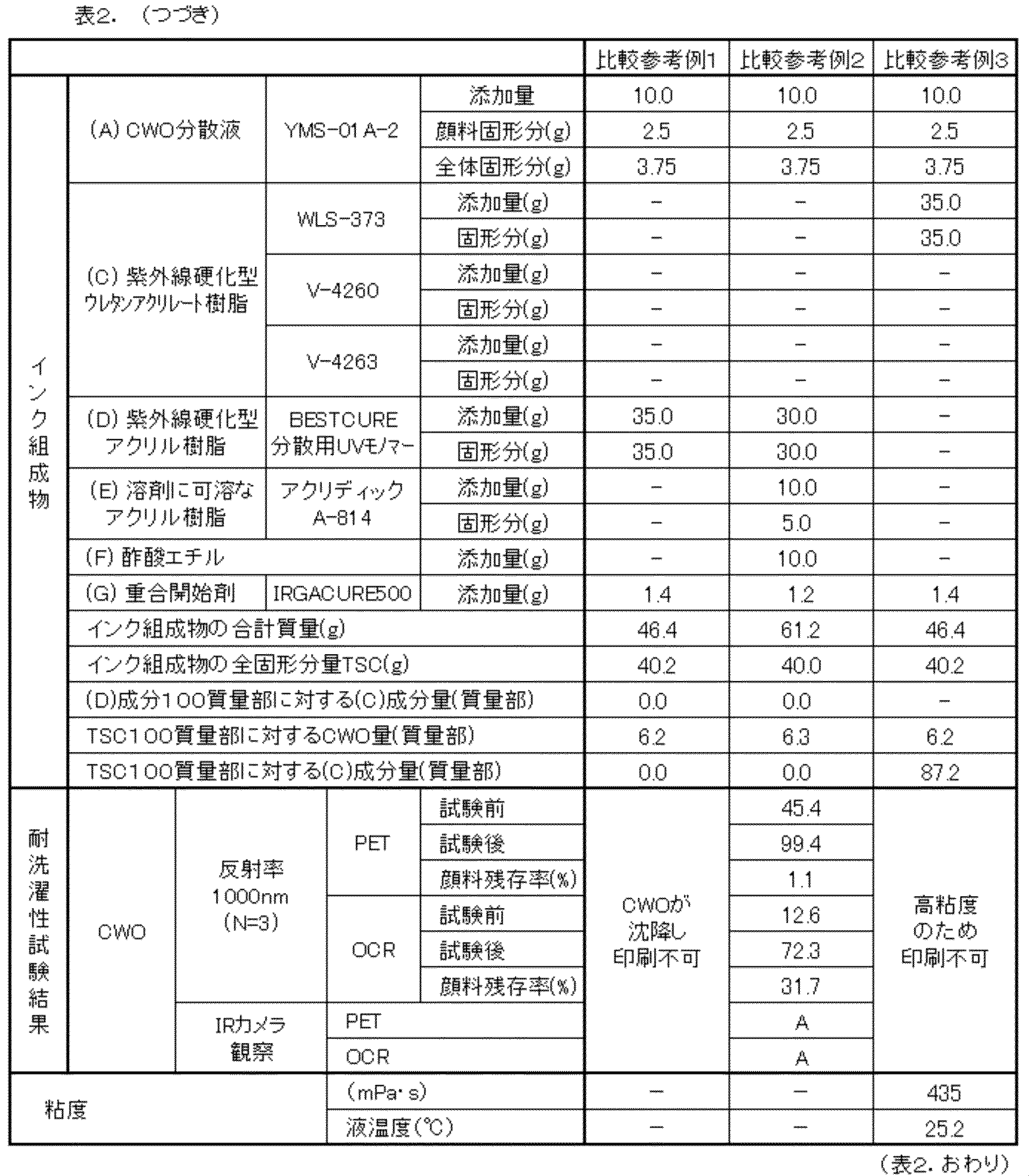
- the solvent-soluble acrylic resin (Acrydic (registered trademark) A-814, DIC Corporation) used in Comparative Reference Example 2 was highly viscous, so it was diluted with the same amount of ethyl acetate, and then It was mixed with a cesium tungsten oxide (CWO) dispersion (YMS-01A-2, Sumitomo Metal Mining Co., Ltd.).
- CWO cesium tungsten oxide
- Comparative Reference Example 3 since the ratio of the UV-curable urethane acrylate resin was high, the resulting composition had too high a viscosity and could not be used as an ink.
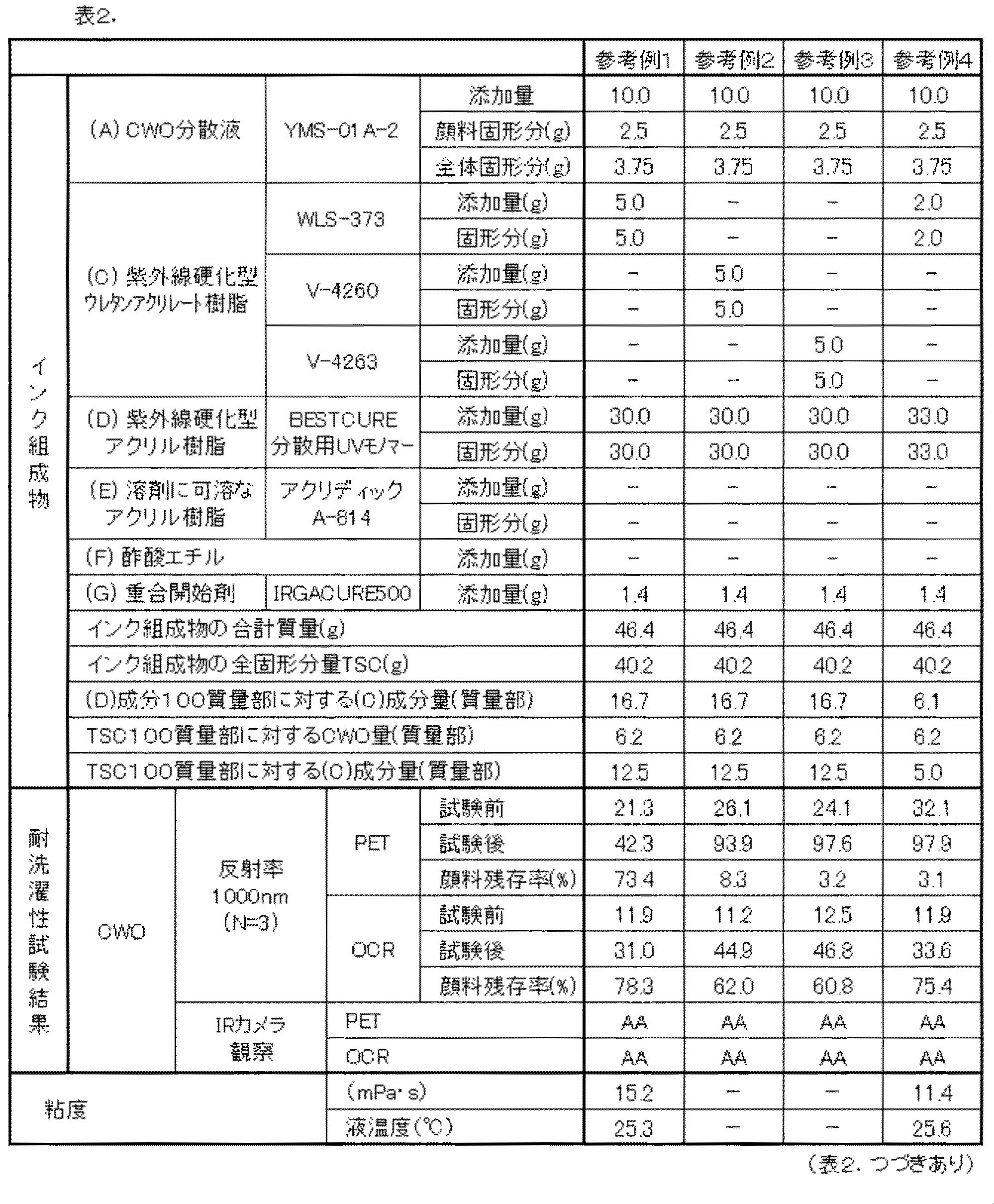
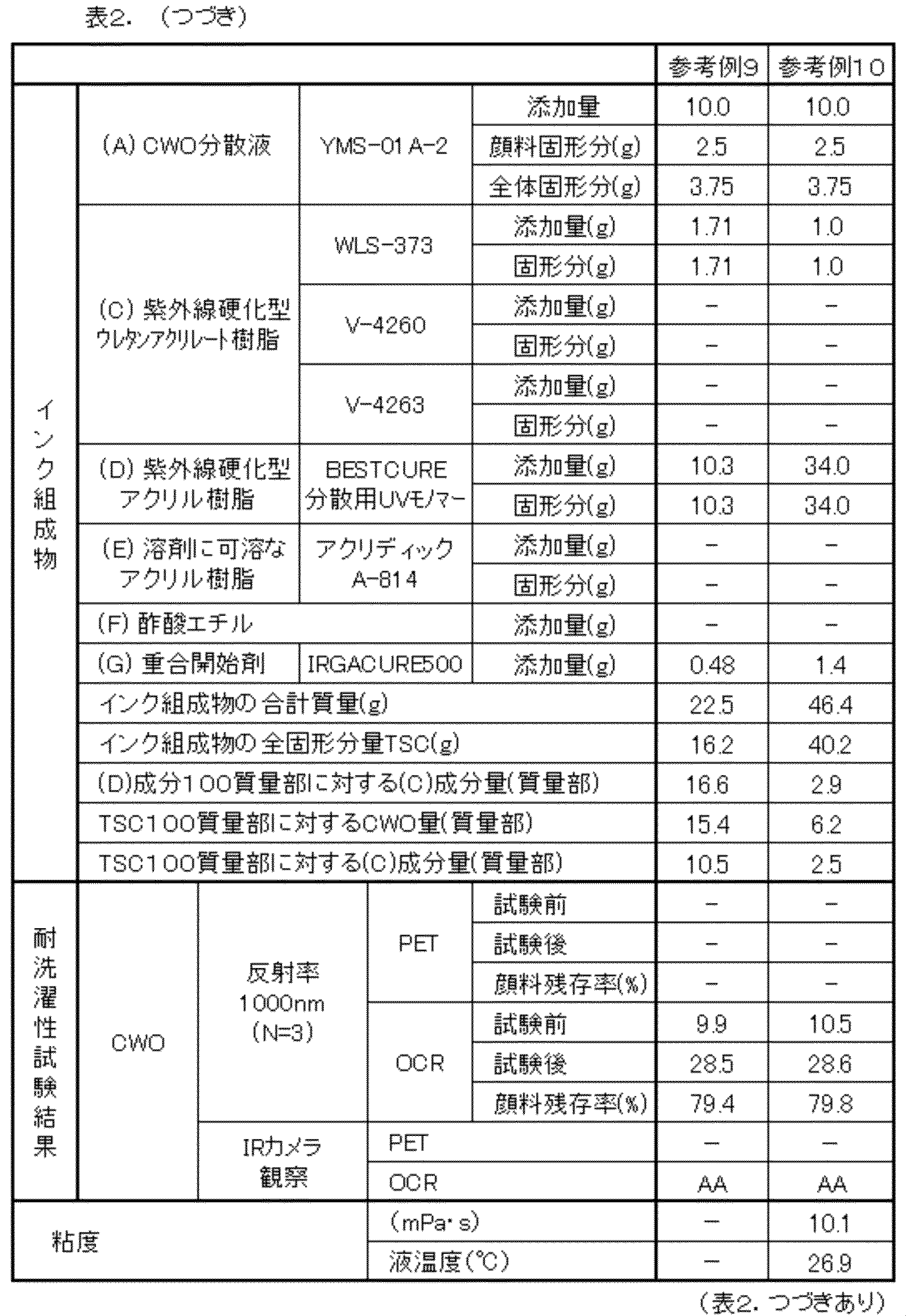
- Example 2 A printed matter was produced in the same manner as in Example 1, and the infrared reflectance was measured before and after the washing resistance test in the same manner as in Example 1, and the residual rate of the tungsten-based infrared absorbing pigment after washing was measured. Calculated. Further, in the same manner as in Example 1, the printed matter after the washing resistance test was observed with an infrared camera and evaluated. The results are shown in Table 2.
- the residual ratios of the tungsten-based infrared absorbing pigments of Reference Examples 1 to 10 are higher than those of Comparative Reference Example 2 for both polyethylene terephthalate film coating and OCR coating, and Reference Examples 1 to 10 resulted in a significantly higher effect on wash resistance. This is probably because hydrogen bonds are formed by the urethane bonds of the UV-curable urethane acrylate resin, and a strong resin film is formed by the UV-curable urethane acrylate resin around the tungsten-based infrared absorbing pigment.
- inks of Reference Examples having a viscosity of 60 mPa ⁇ s or less could be used as inkjet inks without any problems.
Landscapes
- Chemical & Material Sciences (AREA)
- Life Sciences & Earth Sciences (AREA)
- Engineering & Computer Science (AREA)
- Materials Engineering (AREA)
- Wood Science & Technology (AREA)
- Organic Chemistry (AREA)
- Inks, Pencil-Leads, Or Crayons (AREA)
Abstract
Description
タングステン系赤外線吸収性顔料、紫外線吸収性蛍光顔料、紫外線硬化型ウレタンアクリレート樹脂、及びウレタン結合を含まない紫外線硬化型アクリル樹脂、を含む、赤外線吸収性紫外線硬化型インク。
《態様2》
前記紫外線硬化型アクリル樹脂100質量部に対して、前記紫外線硬化型ウレタンアクリレート樹脂を、1~150質量部含む、態様1に記載の赤外線吸収性紫外線硬化型インク。
《態様3》
前記赤外線吸収性紫外線硬化型インクにおける全固形分100質量部に対して、前記タングステン系赤外線吸収性顔料を、20質量部以下含む、態様1又は2に記載の赤外線吸収性紫外線硬化型インク。
《態様4》
前記赤外線吸収性紫外線硬化型インクにおける全固形分100質量部に対して、前記紫外線吸収性蛍光顔料を、20質量部以下含む、態様1~3いずれか一態様に記載の赤外線吸収性紫外線硬化型インク。
《態様5》
前記赤外線吸収性紫外線硬化型インクにおける全固形分100質量部に対して、前記紫外線硬化型ウレタンアクリレート樹脂を、1~50質量部含む、態様1~4のいずれか一態様に記載の赤外線吸収性紫外線硬化型インク。
《態様6》
前記紫外線硬化型ウレタンアクリレート樹脂は、アクリロイル基を複数含む、態様1~5のいずれか一態様に記載の赤外線吸収性紫外線硬化型インク。
《態様7》
前記タングステン系赤外線吸収性顔料は、
一般式(1):MxWyOz
{式中、Mは、H、He、アルカリ金属元素、アルカリ土類金属元素、希土類元素、Mg、Zr、Cr、Mn、Fe、Ru、Co、Rh、Ir、Ni、Pd、Pt、Cu、Ag、Au、Zn、Cd、Al、Ga、In、Tl、Si、Ge、Sn、Pb、Sb、B、F、P、S、Se、Br、Te、Ti、Nb、V、Mo、Ta、Re、Be、Hf、Os、Bi、及びIからなる群から選ばれる1種類以上の元素であり、Wはタングステンであり、Oは酸素であり、x、y及びzは、それぞれ正数であり、0<x/y≦1であり、かつ2.2≦z/y≦3.0である}
で表される複合タングステン酸化物、又は、
一般式(2):WyOz
{式中、Wはタングステンであり、Oは酸素であり、y及びzは、それぞれ正数であり、かつ2.45≦z/y≦2.999である}
で表されるマグネリ相を有するタングステン酸化物、
から選ばれる少なくとも1種以上である、態様1~6のいずれか一態様に記載の赤外線吸収性紫外線硬化型インク。
《態様8》
インクジェット用インクである、態様1~7のいずれか一態様に記載の赤外線吸収性紫外線硬化型インク。
《態様9》
態様1~8のいずれか一態様に記載の赤外線吸収性紫外線硬化型インクにより印刷された印刷部を備える、赤外線吸収性印刷物。
本発明の赤外線吸収性紫外線硬化型インクは、タングステン系赤外線吸収性顔料、紫外線吸収性蛍光顔料、紫外線硬化型ウレタンアクリレート樹脂、及びウレタン結合を含まない紫外線硬化型アクリル樹脂、を含む。
本発明の赤外線吸収性紫外線硬化型インクは、タングステン系赤外線吸収性顔料を、必須成分として分散している。本発明の赤外線吸収性紫外線硬化型インクは、タングステン系赤外線吸収性顔料を含むことで、赤外線吸収性能を有する印刷物を提供することができる。
本発明の赤外線吸収性紫外線硬化型インクは、紫外線吸収性蛍光顔料を、必須成分として分散している。本発明の赤外線吸収性紫外線硬化型インクは、紫外線吸収性蛍光顔料を含むことで、紫外線吸収性能を有する印刷物を提供することができる。
本発明の赤外線吸収性紫外線硬化型インクは、紫外線硬化型ウレタンアクリレート樹脂を、必須成分として含む。紫外線硬化型ウレタンアクリレート樹脂を含むことで、紫外線硬化性能を有するとともに、耐塩基性、特に洗濯耐性に優れた印刷物を与えることが可能となる。
本発明の赤外線吸収性紫外線硬化型インクは、ウレタン結合を含まない紫外線硬化型アクリル樹脂を、必須成分として含む。ウレタン基を含まない紫外線硬化型アクリル樹脂は、タングステン系赤外線吸収性顔料及び紫外線吸収性蛍光顔料を良好に分散するとともに、紫外線硬化型ウレタンアクリレート樹脂に起因する粘度の上昇を抑制する作用を有する。
本発明の赤外線吸収性紫外線硬化型インクは、必須成分となるタングステン系赤外線吸収性顔料、紫外線吸収性蛍光顔料、紫外線硬化型ウレタンアクリレート樹脂、及びウレタン基を含まない紫外線硬化型アクリル樹脂以外に、その他の任意の成分を含んでいてもよい。
光重合開始剤は、紫外線照射によって活性酸素等のラジカルを発生する化合物である。本発明の赤外線吸収性紫外線硬化型インクに光重合開始剤を用いる場合には、必須成分である、紫外線硬化型ウレタンアクリレート樹脂、及びウレタン基を含まない紫外線硬化型アクリル樹脂を光重合させることができれば、その種類は特に限定されるものではなく、従来から紫外線硬化型インクに使用されている光重合開始剤から適宜選択して用いることができる。
本発明の赤外線吸収性紫外線硬化型インクには、分散や粘度調整等を目的として、溶媒が含まれていてもよい。溶剤としては、本発明のインクに含まれる材料を分散又は溶解するものであれば、特に限定されるものではない。
タングステン系赤外線吸収性顔料のインク中への分散性を高めるために、本発明の赤外線吸収性紫外線硬化型インクには、分散剤が含有されていてもよい。分散剤としては、特に限定されるものではないが、例えば、アミン、水酸基、カルボキシル基、エポキシ基等の官能基を有している化合物を挙げることができる。これらの官能基は、タングステン系赤外線吸収性顔料の表面に吸着し、タングステン系赤外線吸収性顔料の凝集を防ぐことで、インク中においてタングステン系赤外線吸収性顔料を均一に分散させる機能を有する。
本発明の赤外線吸収性紫外線硬化型インクの製造方法は、特に限定されるものではなく、インクを形成する際に用いられる公知の手法を適用することができる。
本発明の赤外線吸収性紫外線硬化型インクの用途は、特に限定されるものではない。一般的な印刷インクとして使用することができ、例えば、フレキソ印刷インク、活版印刷インク、オフセット印刷インク、凹版印刷インク、グラビア印刷インク、スクリーン印刷インク、インクジェット印刷インク等として使用することができる。
また別の本発明は、本発明の赤外線吸収性紫外線硬化型インクにより印刷された印刷部を備える、赤外線吸収性印刷物である。
実施例及び比較例等で用いた材料を、以下に示す。
(1)タングステン系赤外線吸収性顔料
・セシウム酸化タングステン(CWO)分散液(YMS-01A-2、住友金属鉱山株式会社):CWO含有率25質量%
六方晶Cs0.33WO3:25質重量%
プロピレングリコールモノメチルエーテルアセテート:58.9質量%
ジプロピレングリコールモノメチルエーテル:1.86質量%
酢酸ブチル:1.74質量%
分散剤:12.5質量%
・有機蛍光顔料(ルミコール(登録商標)1000、日本蛍光化学、キナゾロン誘導体、白色粉体)
・ルクシディア(登録商標)WLS-373、DIC株式会社:アクリロイル基数6個/1分子中、樹脂分100%
・ルクシディア(登録商標)V-4260、DIC株式会社:アクリロイル基数3個/1分子中、樹脂分99%以上
・ルクシディア(登録商標)V-4263、DIC株式会社:アクリロイル基数3個/1分子中、樹脂分99%以上
・アクリルモノマー(BESTCURE分散用UVモノマー、株式会社T&K TOKA):感光性モノマー100%
・アクリル樹脂(アクリディック(登録商標)A-814、DIC株式会社)
アクリル樹脂(Tg:85℃):50質量%
トルエン:42.5質量%
酢酸エチル:7.5質量%
・光ラジカル開始剤(IRGACURE(登録商標)500、BASF株式会社)
(A)タングステン系赤外線吸収性顔料として、セシウム酸化タングステン(CWO)分散液(YMS-01A-2、住友金属鉱山株式会社)を10.0g、(B)紫外線吸収性蛍光顔料(UV-FP)として、有機蛍光顔料(ルミコール(登録商標)1000、日本蛍光化学、キナゾロン誘導体、白色粉体)を2.5g、(C)紫外線硬化型ウレタンアクリレート樹脂として、ルクシディア(登録商標)WLS-373(DIC株式会社)を5.0g、(D)ウレタン基を含まない紫外線硬化型アクリル樹脂として、アクリルモノマー(BESTCURE分散用UVモノマー、株式会社T&K TOKA)を30.0g、更に、(G)光重合開始剤として、IRGACURE(登録商標)500(BASF株式会社)を混合して、赤外線吸収性紫外線硬化型インクを作製した。
成分の配合比を表1に記載のように変更して、比較例1~4のインクを作製した。なお、(G)光重合開始剤の配合量は、実施例1と同様に、(C)紫外線硬化型ウレタンアクリレート樹脂と、(D)ウレタン基を含まない紫外線硬化型アクリル樹脂との合計100質量部に対して、4質量部となるようにした。
(印刷物の作製)
基材として、ポリエチレンテレフタレートフィルム(CD942、KOLON INDUSTRIES,INC.)と、紙(OCR用紙、王子製紙株式会社)とを準備した。各実施例及び比較例で作製したインクを、それぞれの基材に、ワイヤーバーを用いて塗工量7.5g/m2で塗工し、80℃で熱乾燥の後、紫外線照射により硬化し、印刷物を得た。得られた印刷物を、2.5cm×4cmのサイズにカットした。
得られた印刷物につき、UV-vis反射スペクトル測定器(紫外可視近赤外分光光度計UH4150、株式会社日立ハイテクサイエンス)を使用し、JIS K 0115に準拠して、赤外線の反射率を測定した。各試験片について、測定回数は3回(N数=3)とした。なお、赤外線反射率は、数値が低いほど、赤外線吸収率が高いことを意味している。波長1000nmにおける赤外線反射率を、表1に示す。
JIS K 0120に準拠して、得られた印刷物に対して波長365nmの光を照射し、日本分光製FP-6600を用いて蛍光強度の測定を実施した。蛍光強度は、スペクトルの波長522nmにおける値から算出した。各試験片について、測定回数は3回(N数=3)とした。結果を、表1に示す。
続いて、作成した印刷物に対して、耐洗濯性試験を実施した。具体的には、印刷物を温度90℃の水溶液に30分間浸漬した。水溶液は、蒸留水に0.5質量%の洗濯用洗剤(アタック(商標)、花王株式会社)、及び1質量%の炭酸ナトリウムを加えて調製した。浸漬後は、水洗し、乾燥させた。
耐洗濯性試験後の印刷物に対して、上記と同様にして、赤外線反射率を測定した。波長1000nmにおける赤外線反射率を、表1に示す。
耐洗濯試験前の波長1000nmにおける赤外線反射率と、耐洗濯試験後の波長1000nmにおける赤外線反射率を用いて、以下の式により、耐洗濯試験後のタングステン系赤外線吸収性顔料の残存率を求めた。結果を、表1に示す。なお、得られたタングステン系赤外線吸収性顔料の残存率は、赤外線吸収機能がどれだけ維持できたかを判断する指標となる。
顔料残存率(%)=(100-試験後の赤外線反射率)/(100-試験前の赤外線反射率)×100
耐洗濯性試験後の印刷物を、赤外線カメラにて観察した。観察に際しては、赤外線照明に波長940nmの赤外LEDを使用し、820nm以下の波長の光をカットするためのフィルターを用いた。25万画素の画素数、水平67°及び垂直47°のレンズ画角、並びに22×18mmの描画範囲の観察条件にて観察し、以下の評価基準で判定した。結果を、表1に示す。
AA:塗工部を極めてはっきり判別できる。
A:塗工部をはっきり判別できる。
B:非塗工部と塗工部とを直接対比観察すれば塗工部を判別できる。
C:非塗工部と塗工部とを直接対比観察しても塗工部を判別できない。
耐洗濯性試験後の印刷物に対して、上記と同様にして、蛍光強度の測定を実施した。結果を、表1に示す。
耐洗濯試験前の波長522nmにおける蛍光強度と、耐洗濯試験後の波長522nmにおける蛍光強度を用いて、以下の式により、耐洗濯試験後の紫外線吸収性蛍光顔料の残存率を求めた。結果を、表1に示す。なお、得られた紫外線吸収性蛍光顔料の残存率は、紫外線吸収性蛍光顔料がどれだけ維持できたかを判断する指標となる。
蛍光強度残存率(%)=(試験後の値)/(試験前の値)×100
耐洗濯性試験後の印刷物に、波長375nmのUVライトを照射し、蛍光発光の状態を、以下の評価基準で目視にて判定した。結果を、表1に示す。
A:塗工部をはっきり判別できる。
C:非塗工部と塗工部とを直接対比観察しても塗工部を判別できない。


成分の配合比を表2に記載のように変更して、参考例1~10、及び比較参考例1~3のインクを作製した。なお、光重合開始剤の配合量は、実施例1と同様に、紫外線硬化型ウレタンアクリレート樹脂と、ウレタン基を含まない紫外線硬化型アクリル樹脂の合計100質量部に対して、4質量部となるようにした。
実施例1と同様にして印刷物を作製し、実施例1と同様にして、耐洗濯試験前後それぞれについて、赤外線反射率の測定を実施するとともに、洗濯後のタングステン系赤外線吸収性顔料の残存率を算出した。また、実施例1と同様にして、耐洗濯性試験後の印刷物について赤外線カメラにて観察し、評価を実施した。結果を、表2に示す。
得られたインクの粘度を、音叉振動式粘度計(SV-1A(固有振動数30Hz)、株式会社エー・アンド・デイ))を用いて、JIS Z 8803に準拠して、表2に示す温度にて測定した。なお、測定サンプルは、5mLとした。結果を、表2に示す。

Claims (9)
- タングステン系赤外線吸収性顔料、紫外線吸収性蛍光顔料、紫外線硬化型ウレタンアクリレート樹脂、及びウレタン結合を含まない紫外線硬化型アクリル樹脂、を含む、赤外線吸収性紫外線硬化型インク。
- 前記紫外線硬化型アクリル樹脂100質量部に対して、前記紫外線硬化型ウレタンアクリレート樹脂を、1~150質量部含む、請求項1に記載の赤外線吸収性紫外線硬化型インク。
- 前記赤外線吸収性紫外線硬化型インクにおける全固形分100質量部に対して、前記タングステン系赤外線吸収性顔料を、20質量部以下含む、請求項1又は2に記載の赤外線吸収性紫外線硬化型インク。
- 前記赤外線吸収性紫外線硬化型インクにおける全固形分100質量部に対して、前記紫外線吸収性蛍光顔料を、20質量部以下含む、請求項1~3いずれか1項に記載の赤外線吸収性紫外線硬化型インク。
- 前記赤外線吸収性紫外線硬化型インクにおける全固形分100質量部に対して、前記紫外線硬化型ウレタンアクリレート樹脂を、1~50質量部含む、請求項1~4のいずれか1項に記載の赤外線吸収性紫外線硬化型インク。
- 前記紫外線硬化型ウレタンアクリレート樹脂は、アクリロイル基を複数含む、請求項1~5のいずれか1項に記載の赤外線吸収性紫外線硬化型インク。
- 前記タングステン系赤外線吸収性顔料は、
一般式(1):MxWyOz
{式中、Mは、H、He、アルカリ金属元素、アルカリ土類金属元素、希土類元素、Mg、Zr、Cr、Mn、Fe、Ru、Co、Rh、Ir、Ni、Pd、Pt、Cu、Ag、Au、Zn、Cd、Al、Ga、In、Tl、Si、Ge、Sn、Pb、Sb、B、F、P、S、Se、Br、Te、Ti、Nb、V、Mo、Ta、Re、Be、Hf、Os、Bi、及びIからなる群から選ばれる1種類以上の元素であり、Wはタングステンであり、Oは酸素であり、x、y及びzは、それぞれ正数であり、0<x/y≦1であり、かつ2.2≦z/y≦3.0である}
で表される複合タングステン酸化物、又は、
一般式(2):WyOz
{式中、Wはタングステンであり、Oは酸素であり、y及びzは、それぞれ正数であり、かつ2.45≦z/y≦2.999である}
で表されるマグネリ相を有するタングステン酸化物、
から選ばれる少なくとも1種以上である、請求項1~6のいずれか1項に記載の赤外線吸収性紫外線硬化型インク。 - インクジェット用インクである、請求項1~7のいずれか1項に記載の赤外線吸収性紫外線硬化型インク。
- 請求項1~8のいずれか1項に記載の赤外線吸収性紫外線硬化型インクにより印刷された印刷部を備える、赤外線吸収性印刷物。
Priority Applications (4)
| Application Number | Priority Date | Filing Date | Title |
|---|---|---|---|
| CN202280011539.XA CN116829656A (zh) | 2021-01-29 | 2022-01-20 | 红外线吸收性紫外线固化型墨和红外线吸收性印刷物 |
| US18/273,623 US20240101843A1 (en) | 2021-01-29 | 2022-01-20 | Infrared-absorbing ultraviolet-curable ink, and infrared-absorbing printed matter |
| JP2022578307A JPWO2022163499A1 (ja) | 2021-01-29 | 2022-01-20 | |
| EP22745720.7A EP4286164A4 (en) | 2021-01-29 | 2022-01-20 | INFRARED ABSORBENT UV-CURING INK AND INFRARED ABSORBENT PRINTED MATERIAL |
Applications Claiming Priority (2)
| Application Number | Priority Date | Filing Date | Title |
|---|---|---|---|
| JP2021013651 | 2021-01-29 | ||
| JP2021-013651 | 2021-01-29 |
Publications (1)
| Publication Number | Publication Date |
|---|---|
| WO2022163499A1 true WO2022163499A1 (ja) | 2022-08-04 |
Family
ID=82654519
Family Applications (1)
| Application Number | Title | Priority Date | Filing Date |
|---|---|---|---|
| PCT/JP2022/002038 Ceased WO2022163499A1 (ja) | 2021-01-29 | 2022-01-20 | 赤外線吸収性紫外線硬化型インク及び赤外線吸収性印刷物 |
Country Status (5)
| Country | Link |
|---|---|
| US (1) | US20240101843A1 (ja) |
| EP (1) | EP4286164A4 (ja) |
| JP (1) | JPWO2022163499A1 (ja) |
| CN (1) | CN116829656A (ja) |
| WO (1) | WO2022163499A1 (ja) |
Cited By (1)
| Publication number | Priority date | Publication date | Assignee | Title |
|---|---|---|---|---|
| CN117467310A (zh) * | 2023-10-31 | 2024-01-30 | 珠海市铠信科技有限公司 | 防伪色浆、紫外光固化防伪喷墨墨水及其制备方法和应用 |
Families Citing this family (1)
| Publication number | Priority date | Publication date | Assignee | Title |
|---|---|---|---|---|
| CN120761319B (zh) * | 2025-09-02 | 2025-11-28 | 怀化市恒渝新材料有限公司 | 一种检测光引发剂质量的方法及其应用 |
Citations (5)
| Publication number | Priority date | Publication date | Assignee | Title |
|---|---|---|---|---|
| JP2005187323A (ja) | 2003-12-05 | 2005-07-14 | Sumitomo Metal Mining Co Ltd | 日射遮蔽体形成用タングステン酸化物微粒子の製造方法、日射遮蔽体形成用タングステン酸化物微粒子および日射遮蔽体形成用分散液並びに日射遮蔽体 |
| WO2015068282A1 (ja) * | 2013-11-08 | 2015-05-14 | 共同印刷株式会社 | 赤外線吸収性インクジェット印刷インク |
| CN107474634A (zh) * | 2017-09-30 | 2017-12-15 | 北京赛腾标识系统股份公司 | 一种双重防伪喷印油墨 |
| WO2020061629A1 (en) * | 2018-09-25 | 2020-04-02 | Ccl Secure Pty Ltd | An ink for printing a security document and a security feature on a substrate for a security document |
| WO2020066388A1 (ja) * | 2018-09-28 | 2020-04-02 | 富士フイルム株式会社 | インクジェット記録方法 |
Family Cites Families (10)
| Publication number | Priority date | Publication date | Assignee | Title |
|---|---|---|---|---|
| WO2006008251A2 (en) * | 2004-07-21 | 2006-01-26 | Ciba Specialty Chemicals Holding Inc. | Process for the photoactivation and use of a catalyst by an inverted two-stage procedure |
| EP2230283B1 (en) * | 2009-03-18 | 2014-07-02 | Konica Minolta IJ Technologies, Inc. | Actinic energy radiation curable ink-jet ink and ink-jet recording method |
| JP5490475B2 (ja) * | 2009-09-24 | 2014-05-14 | 富士フイルム株式会社 | 近赤外吸収性色素を含有する硬化性組成物、インク用組成物および近赤外線吸収フィルタの製造方法 |
| JP6196450B2 (ja) * | 2013-01-29 | 2017-09-13 | 富士フイルム株式会社 | 電飾用シート、電飾用印刷物およびその製造方法ならびに電飾看板 |
| EP3234036A1 (en) * | 2014-12-18 | 2017-10-25 | DataLase Ltd | Method of image formation |
| US11008476B2 (en) * | 2015-12-18 | 2021-05-18 | Sumitomo Metal Mining Co., Ltd. | Anti-counterfeit ink composition, anti-counterfeit ink, anti-counterfeit printed matter, and method for producing the anti-counterfeit ink composition |
| EP3643754B1 (en) * | 2017-06-19 | 2024-09-18 | Sumitomo Metal Mining Co., Ltd. | Near-infrared-curable ink composition, method for producing same, near-infrared-cured film, and optical shaping method |
| JP7122920B2 (ja) * | 2018-09-21 | 2022-08-22 | 共同印刷株式会社 | 赤外線吸収性uvインキ及びその製造方法 |
| JP2023093043A (ja) * | 2021-12-22 | 2023-07-04 | 共同印刷株式会社 | 真贋判定用印刷布地及びその製造方法 |
| WO2023190789A1 (ja) * | 2022-03-29 | 2023-10-05 | 富士フイルム株式会社 | 加飾フィルム及びその製造方法、積層体及びその製造方法、加飾フィルム製造用光学マスク付き基材、成型体、物品、並びに、表示装置 |
-
2022
- 2022-01-20 EP EP22745720.7A patent/EP4286164A4/en not_active Withdrawn
- 2022-01-20 US US18/273,623 patent/US20240101843A1/en not_active Abandoned
- 2022-01-20 WO PCT/JP2022/002038 patent/WO2022163499A1/ja not_active Ceased
- 2022-01-20 CN CN202280011539.XA patent/CN116829656A/zh active Pending
- 2022-01-20 JP JP2022578307A patent/JPWO2022163499A1/ja active Pending
Patent Citations (5)
| Publication number | Priority date | Publication date | Assignee | Title |
|---|---|---|---|---|
| JP2005187323A (ja) | 2003-12-05 | 2005-07-14 | Sumitomo Metal Mining Co Ltd | 日射遮蔽体形成用タングステン酸化物微粒子の製造方法、日射遮蔽体形成用タングステン酸化物微粒子および日射遮蔽体形成用分散液並びに日射遮蔽体 |
| WO2015068282A1 (ja) * | 2013-11-08 | 2015-05-14 | 共同印刷株式会社 | 赤外線吸収性インクジェット印刷インク |
| CN107474634A (zh) * | 2017-09-30 | 2017-12-15 | 北京赛腾标识系统股份公司 | 一种双重防伪喷印油墨 |
| WO2020061629A1 (en) * | 2018-09-25 | 2020-04-02 | Ccl Secure Pty Ltd | An ink for printing a security document and a security feature on a substrate for a security document |
| WO2020066388A1 (ja) * | 2018-09-28 | 2020-04-02 | 富士フイルム株式会社 | インクジェット記録方法 |
Cited By (1)
| Publication number | Priority date | Publication date | Assignee | Title |
|---|---|---|---|---|
| CN117467310A (zh) * | 2023-10-31 | 2024-01-30 | 珠海市铠信科技有限公司 | 防伪色浆、紫外光固化防伪喷墨墨水及其制备方法和应用 |
Also Published As
| Publication number | Publication date |
|---|---|
| EP4286164A4 (en) | 2024-12-18 |
| US20240101843A1 (en) | 2024-03-28 |
| CN116829656A (zh) | 2023-09-29 |
| EP4286164A1 (en) | 2023-12-06 |
| JPWO2022163499A1 (ja) | 2022-08-04 |
Similar Documents
| Publication | Publication Date | Title |
|---|---|---|
| JP7433329B2 (ja) | 印刷物 | |
| CN107532030B (zh) | 微粒分散液及其制造方法、防伪油墨组合物及防伪印刷物 | |
| KR102924277B1 (ko) | 위조 방지 잉크용 조성물, 위조 방지 잉크, 위조 방지용 인쇄물 | |
| WO2022163499A1 (ja) | 赤外線吸収性紫外線硬化型インク及び赤外線吸収性印刷物 | |
| JP7122920B2 (ja) | 赤外線吸収性uvインキ及びその製造方法 | |
| JP2023506825A (ja) | Uv-ledラジカル硬化性オフセット印刷インク及び印刷方法 | |
| US11807766B2 (en) | Anti-counterfeit ink composition, anti-counterfeit ink, anti-counterfeit printed matter, and method for producing the anti-counterfeit ink composition | |
| WO2023120513A1 (ja) | 真贋判定用印刷布地及びその製造方法 | |
| WO2015068292A1 (ja) | 印刷物 | |
| JP7833853B2 (ja) | 赤外線吸収性紫外線硬化型インク及び赤外線吸収性印刷物 | |
| US20230059759A1 (en) | Infrared-absorbing uv ink and method for producing same | |
| JP2016155903A (ja) | フォトクロミック光輝性インキ及びその印刷物 | |
| WO2024024445A1 (ja) | 印刷物の真贋判定用端末、真贋判定用ソフトウェア、真贋判定用システム | |
| TW201518125A (zh) | 印刷物 | |
| WO2015068281A1 (ja) | 赤外線吸収性スクリーン印刷インキ | |
| WO2015068291A1 (ja) | 印刷物 | |
| WO2024024384A1 (ja) | 印刷物 | |
| TW201518427A (zh) | 紅外線吸收性柔版印刷墨 | |
| TW201518446A (zh) | 紅外線吸收性平凸印刷墨 | |
| TW201518429A (zh) | 紅外線吸收性網版印刷墨 | |
| TW201518425A (zh) | 紅外線吸收性活版印刷墨 |
Legal Events
| Date | Code | Title | Description |
|---|---|---|---|
| 121 | Ep: the epo has been informed by wipo that ep was designated in this application |
Ref document number: 22745720 Country of ref document: EP Kind code of ref document: A1 |
|
| ENP | Entry into the national phase |
Ref document number: 2022578307 Country of ref document: JP Kind code of ref document: A |
|
| WWE | Wipo information: entry into national phase |
Ref document number: 18273623 Country of ref document: US |
|
| WWE | Wipo information: entry into national phase |
Ref document number: 202280011539.X Country of ref document: CN |
|
| WWE | Wipo information: entry into national phase |
Ref document number: 2022745720 Country of ref document: EP |
|
| NENP | Non-entry into the national phase |
Ref country code: DE |
|
| ENP | Entry into the national phase |
Ref document number: 2022745720 Country of ref document: EP Effective date: 20230829 |