WO2022163736A1 - アゾ鉄錯体染料、それを含むインク組成物、及びアゾ鉄錯体染料の製造方法 - Google Patents
アゾ鉄錯体染料、それを含むインク組成物、及びアゾ鉄錯体染料の製造方法 Download PDFInfo
- Publication number
- WO2022163736A1 WO2022163736A1 PCT/JP2022/002988 JP2022002988W WO2022163736A1 WO 2022163736 A1 WO2022163736 A1 WO 2022163736A1 JP 2022002988 W JP2022002988 W JP 2022002988W WO 2022163736 A1 WO2022163736 A1 WO 2022163736A1
- Authority
- WO
- WIPO (PCT)
- Prior art keywords
- group
- iron complex
- chemical formula
- azo
- dye
- Prior art date
- Legal status (The legal status is an assumption and is not a legal conclusion. Google has not performed a legal analysis and makes no representation as to the accuracy of the status listed.)
- Ceased
Links
Images



Classifications
-
- C—CHEMISTRY; METALLURGY
- C09—DYES; PAINTS; POLISHES; NATURAL RESINS; ADHESIVES; COMPOSITIONS NOT OTHERWISE PROVIDED FOR; APPLICATIONS OF MATERIALS NOT OTHERWISE PROVIDED FOR
- C09B—ORGANIC DYES OR CLOSELY-RELATED COMPOUNDS FOR PRODUCING DYES, e.g. PIGMENTS; MORDANTS; LAKES
- C09B45/00—Complex metal compounds of azo dyes
- C09B45/02—Preparation from dyes containing in o-position a hydroxy group and in o'-position hydroxy, alkoxy, carboxyl, amino or keto groups
- C09B45/04—Azo compounds in general
- C09B45/12—Azo compounds in general other metal compounds
-
- B—PERFORMING OPERATIONS; TRANSPORTING
- B41—PRINTING; LINING MACHINES; TYPEWRITERS; STAMPS
- B41M—PRINTING, DUPLICATING, MARKING, OR COPYING PROCESSES; COLOUR PRINTING
- B41M5/00—Duplicating or marking methods; Sheet materials for use therein
-
- C—CHEMISTRY; METALLURGY
- C07—ORGANIC CHEMISTRY
- C07C—ACYCLIC OR CARBOCYCLIC COMPOUNDS
- C07C245/00—Compounds containing chains of at least two nitrogen atoms with at least one nitrogen-to-nitrogen multiple bond
- C07C245/02—Azo compounds, i.e. compounds having the free valencies of —N=N— groups attached to different atoms, e.g. diazohydroxides
- C07C245/06—Azo compounds, i.e. compounds having the free valencies of —N=N— groups attached to different atoms, e.g. diazohydroxides with nitrogen atoms of azo groups bound to carbon atoms of six-membered aromatic rings
- C07C245/08—Azo compounds, i.e. compounds having the free valencies of —N=N— groups attached to different atoms, e.g. diazohydroxides with nitrogen atoms of azo groups bound to carbon atoms of six-membered aromatic rings with the two nitrogen atoms of azo groups bound to carbon atoms of six-membered aromatic rings, e.g. azobenzene
-
- C—CHEMISTRY; METALLURGY
- C09—DYES; PAINTS; POLISHES; NATURAL RESINS; ADHESIVES; COMPOSITIONS NOT OTHERWISE PROVIDED FOR; APPLICATIONS OF MATERIALS NOT OTHERWISE PROVIDED FOR
- C09B—ORGANIC DYES OR CLOSELY-RELATED COMPOUNDS FOR PRODUCING DYES, e.g. PIGMENTS; MORDANTS; LAKES
- C09B45/00—Complex metal compounds of azo dyes
- C09B45/02—Preparation from dyes containing in o-position a hydroxy group and in o'-position hydroxy, alkoxy, carboxyl, amino or keto groups
- C09B45/24—Disazo or polyazo compounds
- C09B45/32—Disazo or polyazo compounds containing other metals
-
- C—CHEMISTRY; METALLURGY
- C09—DYES; PAINTS; POLISHES; NATURAL RESINS; ADHESIVES; COMPOSITIONS NOT OTHERWISE PROVIDED FOR; APPLICATIONS OF MATERIALS NOT OTHERWISE PROVIDED FOR
- C09B—ORGANIC DYES OR CLOSELY-RELATED COMPOUNDS FOR PRODUCING DYES, e.g. PIGMENTS; MORDANTS; LAKES
- C09B67/00—Influencing the physical, e.g. the dyeing or printing properties of dyestuffs without chemical reactions, e.g. by treating with solvents grinding or grinding assistants, coating of pigments or dyes; Process features in the making of dyestuff preparations; Dyestuff preparations of a special physical nature, e.g. tablets, films
- C09B67/0033—Blends of pigments; Mixtured crystals; Solid solutions
- C09B67/0046—Mixtures of two or more azo dyes
- C09B67/0047—Mixtures of two or more reactive azo dyes
-
- C—CHEMISTRY; METALLURGY
- C09—DYES; PAINTS; POLISHES; NATURAL RESINS; ADHESIVES; COMPOSITIONS NOT OTHERWISE PROVIDED FOR; APPLICATIONS OF MATERIALS NOT OTHERWISE PROVIDED FOR
- C09D—COATING COMPOSITIONS, e.g. PAINTS, VARNISHES OR LACQUERS; FILLING PASTES; CHEMICAL PAINT OR INK REMOVERS; INKS; CORRECTING FLUIDS; WOODSTAINS; PASTES OR SOLIDS FOR COLOURING OR PRINTING; USE OF MATERIALS THEREFOR
- C09D11/00—Inks
- C09D11/02—Printing inks
- C09D11/03—Printing inks characterised by features other than the chemical nature of the binder
- C09D11/037—Printing inks characterised by features other than the chemical nature of the binder characterised by the pigment
-
- C—CHEMISTRY; METALLURGY
- C09—DYES; PAINTS; POLISHES; NATURAL RESINS; ADHESIVES; COMPOSITIONS NOT OTHERWISE PROVIDED FOR; APPLICATIONS OF MATERIALS NOT OTHERWISE PROVIDED FOR
- C09D—COATING COMPOSITIONS, e.g. PAINTS, VARNISHES OR LACQUERS; FILLING PASTES; CHEMICAL PAINT OR INK REMOVERS; INKS; CORRECTING FLUIDS; WOODSTAINS; PASTES OR SOLIDS FOR COLOURING OR PRINTING; USE OF MATERIALS THEREFOR
- C09D11/00—Inks
- C09D11/30—Inkjet printing inks
- C09D11/32—Inkjet printing inks characterised by colouring agents
- C09D11/328—Inkjet printing inks characterised by colouring agents characterised by dyes
-
- C—CHEMISTRY; METALLURGY
- C07—ORGANIC CHEMISTRY
- C07F—ACYCLIC, CARBOCYCLIC OR HETEROCYCLIC COMPOUNDS CONTAINING ELEMENTS OTHER THAN CARBON, HYDROGEN, HALOGEN, OXYGEN, NITROGEN, SULFUR, SELENIUM OR TELLURIUM
- C07F15/00—Compounds containing elements of Groups 8, 9, 10 or 18 of the Periodic Table
- C07F15/02—Iron compounds
-
- C—CHEMISTRY; METALLURGY
- C07—ORGANIC CHEMISTRY
- C07F—ACYCLIC, CARBOCYCLIC OR HETEROCYCLIC COMPOUNDS CONTAINING ELEMENTS OTHER THAN CARBON, HYDROGEN, HALOGEN, OXYGEN, NITROGEN, SULFUR, SELENIUM OR TELLURIUM
- C07F15/00—Compounds containing elements of Groups 8, 9, 10 or 18 of the Periodic Table
- C07F15/02—Iron compounds
- C07F15/025—Iron compounds without a metal-carbon linkage
-
- C—CHEMISTRY; METALLURGY
- C09—DYES; PAINTS; POLISHES; NATURAL RESINS; ADHESIVES; COMPOSITIONS NOT OTHERWISE PROVIDED FOR; APPLICATIONS OF MATERIALS NOT OTHERWISE PROVIDED FOR
- C09B—ORGANIC DYES OR CLOSELY-RELATED COMPOUNDS FOR PRODUCING DYES, e.g. PIGMENTS; MORDANTS; LAKES
- C09B67/00—Influencing the physical, e.g. the dyeing or printing properties of dyestuffs without chemical reactions, e.g. by treating with solvents grinding or grinding assistants, coating of pigments or dyes; Process features in the making of dyestuff preparations; Dyestuff preparations of a special physical nature, e.g. tablets, films
- C09B67/0033—Blends of pigments; Mixtured crystals; Solid solutions
Definitions
- the present invention relates to an azo iron complex dye, an ink composition containing the same, and a method for producing an azo iron complex dye.
- the ink composition is used for printing on a recording medium or drawing handwriting with an inkjet printer, writing instrument, and recorder.
- the ink composition for continuous inkjet (CIJ) printers which is widely used in the industrial field, is due to the fact that the CIJ printer discharges the ink composition to the recording medium while charging and deflecting it. It is formulated to have high electrical conductivity as a material and to provide good adhesion of the ink to smooth non-absorbing surfaces such as glass, metal and plastic plates.
- Such an ink composition contains a colorant, an organic solvent, and a resin as a fixing agent soluble in the organic solvent.
- Pigments and dyes are examples of colorants contained in the ink composition. Demand for black colorants is the highest among colorants. However, although black pigments are less susceptible to discoloration due to light or heat, they are poor in color developability and may aggregate in ink compositions, resulting in poor storage stability. Black dyes have high solubility in organic solvents, and are excellent in color developability and storage stability. However, black dyes are inferior in heat resistance and light resistance because they are deteriorated and discolored by heat and light. Therefore, a metal complex dye that exhibits black color and has high heat resistance and light resistance like a black pigment is used as a black colorant while ensuring the high solubility in an organic solvent that the black dye originally has.
- organic solvent contained in the ink composition in addition to conventionally used ketone-based organic solvents such as acetone and methyl ethyl ketone, alcohols such as ethanol and propylene glycol are used from the viewpoint of environmental conservation and safety to the human body.
- Ether-based organic solvents such as propylene glycol monoalkyl ether and the like are also used.
- Amine salts of azochrome complex dyes are known as black dyes that are highly soluble in alcoholic organic solvents.
- Specific examples of such azochrome complex dyes include C.I. I. SOLVENT BLACK 23, 27, 28, 29, 35, 45.
- Patent Document 1 describes an azochrome complex dye that exhibits a black color and dissolves in acetone.
- azochrome complex dyes contain chromium, which is a harmful heavy metal, their use is being avoided from the perspective of environmental conservation and ensuring safety for the human body. Therefore, metal complex dyes that do not contain harmful heavy metals such as chromium while having the favorable properties of metal complex dyes have been investigated.
- Patent Document 2 proposes a complex mixed dye of three types of disazo compounds and iron as a specific complexing agent. Further, Patent Document 3 describes a polyazo iron complex dye. However, these iron complex dyes are not black, but brown or reddish brown. On the other hand, Patent Document 4 describes a monoazo iron complex salt compound. This monoazo iron complex salt compound exhibits a blackish purple color, which is inferior to the blackness exhibited by the azochrome complex dye.
- the present invention has been made to solve the above problems, and includes an azo iron complex dye that does not contain harmful heavy metals, has sufficient practical solubility in organic solvents, and exhibits a good black color.
- An object of the present invention is to provide an ink composition and a method for producing an azo iron complex dye.
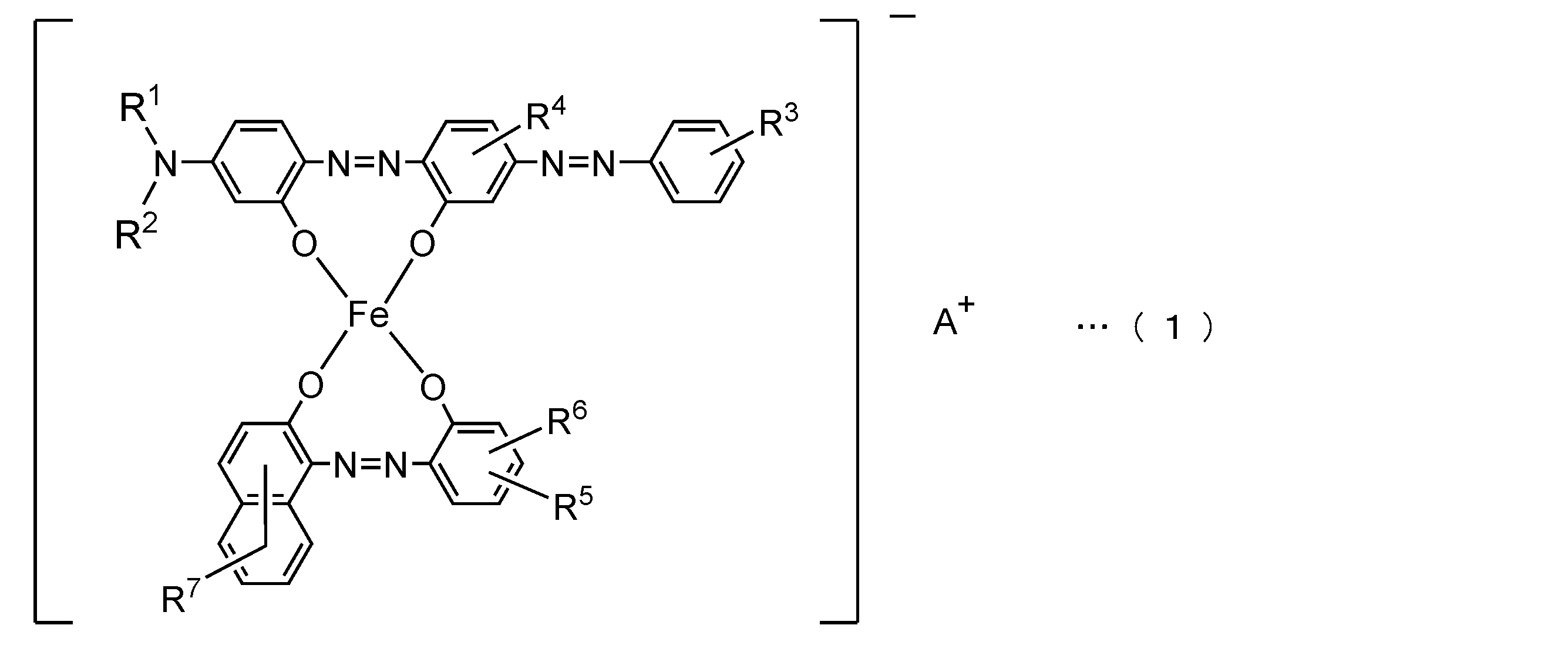
- the azo iron complex dye made to achieve the above object has the following chemical formula (1) (In the chemical formula (1), R 1 and R 2 are each independently a linear or branched alkyl group having 3 to 10 carbon atoms, R 3 is an electron-withdrawing group, and R 4 is a carbon number 1 to 5 linear or branched alkyl groups or 1 to 5 carbon atoms linear or branched alkoxy groups, R 5 is a nitro group, a sulfonamide group, or a halogen atom, and R 6 is a hydrogen atom, a linear or branched alkyl group with 1 to 8 carbon atoms, a nitro group, or a halogen atom, and R 7 is a hydrogen atom or a linear or branched alkyl group with 3 to 12 carbon atoms and A + is a monovalent cation.).
- the R 3 is bonded to the azo group on the same aromatic ring at the para position, and the electron withdrawing selected from a cyano group, a nitro group, an acetyl group, a sulfonamide group, and a halogen atom It may be a sexual group.
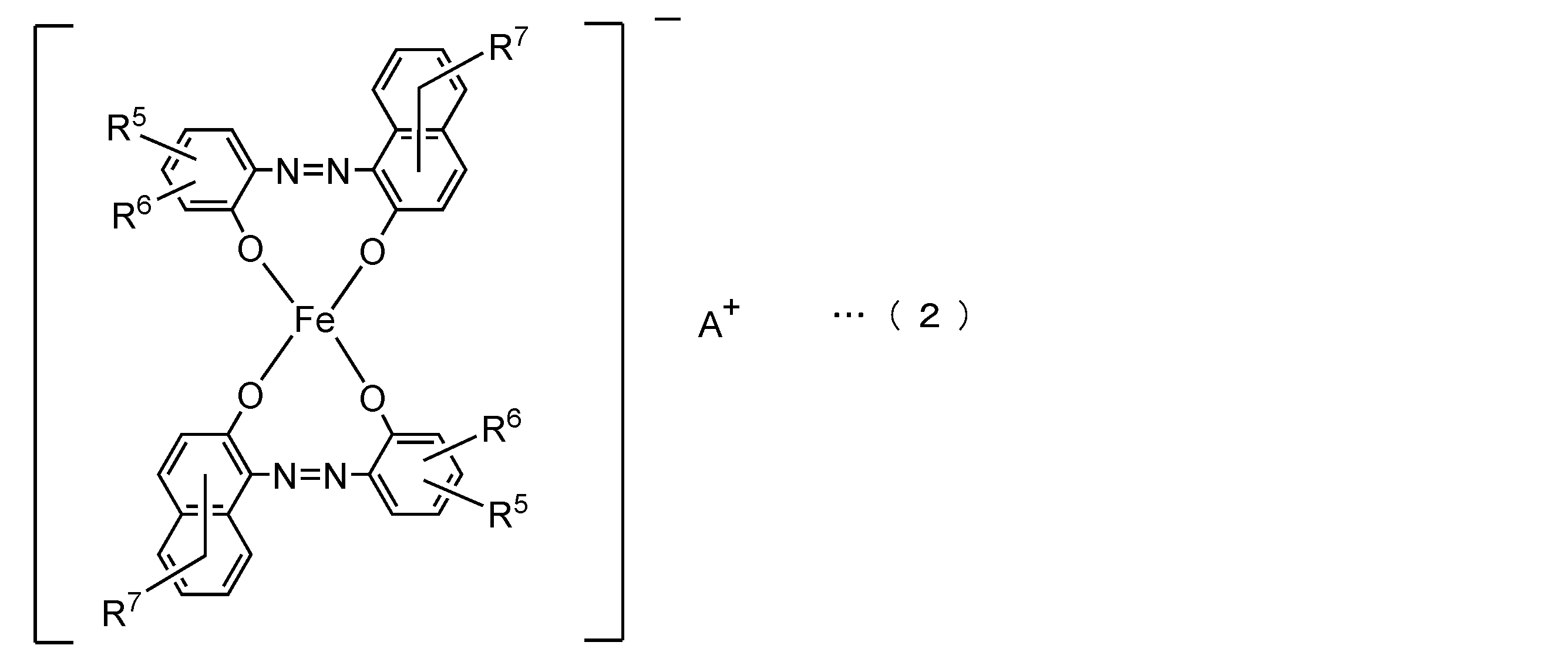
- the azo iron complex dye is, for example, the following chemical formula (2) (In chemical formula (2), R 5 to R 7 and A + are the same as in chemical formula (1).).
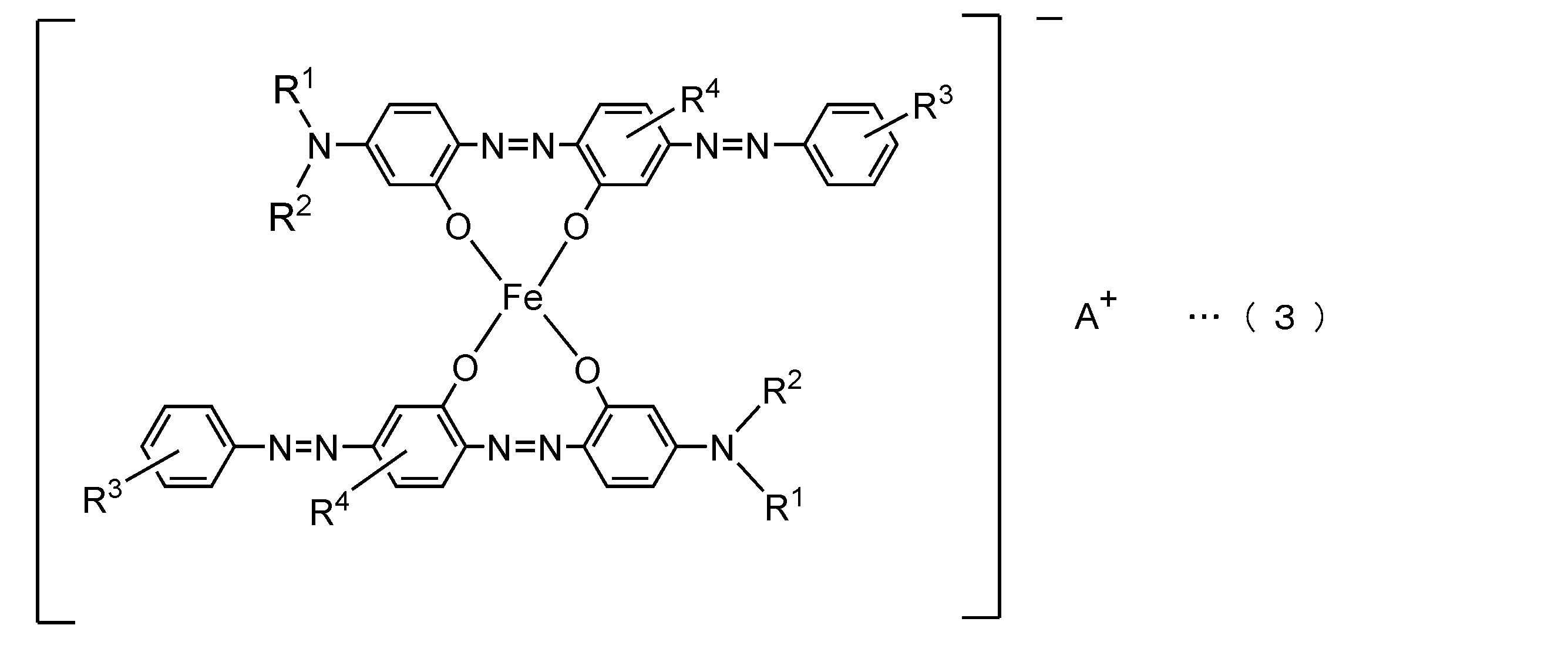
- the azo iron complex dye has the following chemical formula (3) (In the chemical formula (3), R 1 to R 4 and A + are the same as in the chemical formula (1).).
- the monovalent cation is an alkali metal ion, an ammonium ion, and the following chemical formula (4)
- R 8 is a linear or branched alkyl group having 1 to 18 carbon atoms
- R 9 and R 10 are each independently a hydrogen atom or a linear or branched alkyl group having 1 to 8 carbon atoms. branched-chain alkyl group).
- the azo-iron complex dye is the disazo-monoazo iron complex, the monoazo-monoazo iron complex, and the disazo-disazo iron complex, and the peak area of the chromatogram obtained by measuring at a wavelength of 254 nm in high performance liquid chromatography.
- the ratio may be 20-70:5-80:0-50, respectively.
- the ink composition of the present invention contains any of the above azo iron complex dyes and an organic solvent.
- the ink composition may be for inkjet printers.
- the method for producing the azo iron complex dye of the present invention is represented by the following chemical formula (5)
- R 1 and R 2 are each independently a linear or branched alkyl group having 3 to 10 carbon atoms
- R 3 is an electron-withdrawing group
- R 4 is a carbon number a linear or branched alkyl group having 1 to 5 carbon atoms or a linear or branched alkoxy group having 1 to 5 carbon atoms
- R 5 is a nitro group, a sulfonamide group, or a halogen atom
- R 6 is a hydrogen atom, a linear or branched alkyl group having 1 to 8 carbon atoms, a nitro group, or a halogen
- R 7 is a hydrogen atom or a linear or branched alkyl group having 3 to 12 carbon atoms.
- a method for producing an azo iron complex dye includes, for example, a method in which the molar ratio of the disazo dye and the monoazo dye is 2:8 to 8:2 in the iron complexation step.
- the azo-iron complex dye of the present invention does not contain harmful heavy metals such as chromium and cobalt, so it can contribute to environmental conservation and has a high degree of safety to the human body compared to azo-chromium complex dyes.
- the azo-iron complex dye exhibits a higher degree of blackness than conventional azo-iron complex dyes because it contains an azo-iron complex having a specific structure.
- the azo iron complex dye of the present invention has practical dissolution stability in various organic solvents such as ketone organic solvents, alcoholic organic solvents, and ether organic solvents.
- the ink composition of the present invention contains the azo-iron complex dye, it is highly safe to the environment and the human body, and can easily adhere firmly to the recording medium regardless of whether the recording medium is ink-absorbing or non-absorbing. Since it does not peel off easily, it can be widely applied as a black colorant to various media such as inkjet printers, writing instruments, and recorders.
- a substituent bonded to the benzene ring of the ligand of the azo-iron complex or a cation bonded to the azo-iron complex anion is appropriately selected and becomes a disazo ligand.
- an azo iron complex dye having both high solubility in various organic solvents and high blackness can be produced.
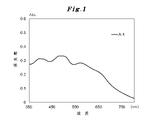
- 1 is a graph showing the visible absorption spectrum of azo iron complex dye A-1 in Example 1 to which the present invention is applied.
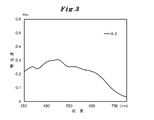
- 2 is a graph showing the visible absorption spectrum of azo iron complex dye A-2 in Example 2 to which the present invention is applied.
- 10 is a graph showing the visible absorption spectrum of the azo iron complex dye A-3 in Example 3 to which the present invention is applied.
- 10 is a graph showing the visible absorption spectrum of the azo iron complex dye A-4 in Example 4 to which the present invention is applied.
- 10 is a graph showing the visible absorption spectrum of the azo iron complex dye A-5 in Example 5 to which the present invention is applied.
- 10 is a graph showing the visible absorption spectrum of the azo iron complex dye A-6 in Example 6 to which the present invention is applied.
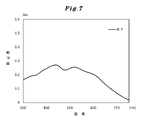
- 10 is a graph showing the visible absorption spectrum of the azo iron complex dye A-7 in Example 7 to which the present invention is applied.
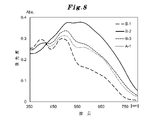
- 1 is a graph showing visible absorption spectra of azo iron complex dye A-1 in Example 1 to which the present invention is applied and azo iron complex dyes B-1 to B-3 in Comparative Examples 1 to 3 to which the present invention is not applied. .
- the azo iron complex dye of the present invention has the following chemical formula (1) (In the chemical formula (1), R 1 and R 2 are each independently a linear or branched alkyl group having 3 to 10 carbon atoms, R 3 is an electron-withdrawing group, and R 4 is a carbon number 1 to 5 linear or branched alkyl groups or 1 to 5 carbon atoms linear or branched alkoxy groups, R 5 is a nitro group, a sulfonamide group, or a halogen atom, and R 6 is a hydrogen atom, a linear or branched alkyl group with 1 to 8 carbon atoms, a nitro group, or a halogen atom, and R 7 is a hydrogen atom or a linear or branched alkyl group with 3 to 12 carbon atoms and A + is a monovalent cation.).
- the disazo-monoazo iron complex contained in the azo iron complex dye of the present invention contains trivalent iron and an azo ligand in which a disazo dye and a monoazo dye are combined at a ratio of 1:2. It has a structure in which an azo iron complex anion contained in a molar ratio of and a monovalent cation are combined.
- R 1 and R 2 are straight or branched alkyl groups having 3 to 10 carbon atoms. Specifically, n-propyl group, isopropyl group, n-butyl group, isobutyl group, sec-butyl group, tert-butyl group, n-pentyl group, isopentyl group, neopentyl group, n-hexyl group, 2-methylpentyl group, 3-methylpentyl group, 2,2-dimethylbutyl group, 2,3-dimethylbutyl group, n-heptyl group, 2-methylhexyl group, 3-methylhexyl group, 2,2-dimethylpentyl group, 2 , 3-dimethylpentyl group, 2,4-dimethylpentyl group, 3,3-dimethylpentyl group, 3-ethylpentyl group, 2,2,3-trimethylbutyl group, n-octyl group, 2-
- R3 is an electron-withdrawing group, specifically cyano group, nitro group, acetyl group, sulfonamide group, and halogen atom.
- the halogen atoms include fluorine, chlorine, bromine, and iodine.
- Such a disazo-monoazo iron complex is specifically represented by the following chemical formula (7) (In chemical formula (7), R 1 to R 7 and A + are the same as in chemical formula (1).).
- R 4 is a linear or branched alkyl group having 1 to 5 carbon atoms or a linear or branched alkoxy group having 1 to 5 carbon atoms.
- the alkyl group include methyl group, ethyl group, n-propyl group, isopropyl group, n-butyl group, sec-butyl group, tert-butyl group, n-pentyl group, isopentyl group, and neopentyl group.
- the alkoxy groups include methoxy, ethoxy, n-propoxy, isopropoxy, n-butoxy, sec-butoxy, tert-butoxy, n-pentyloxy, isopentyloxy, and neopentyl An oxy group can be mentioned.
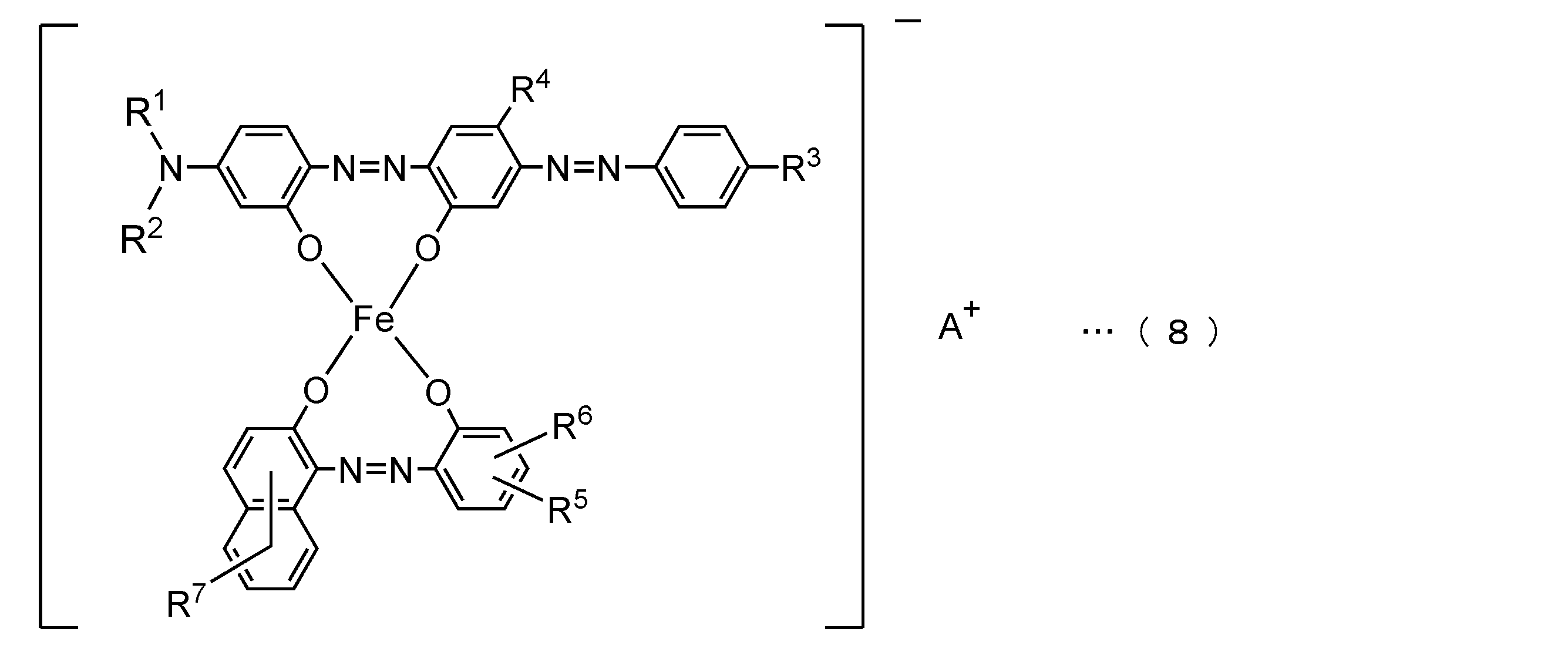
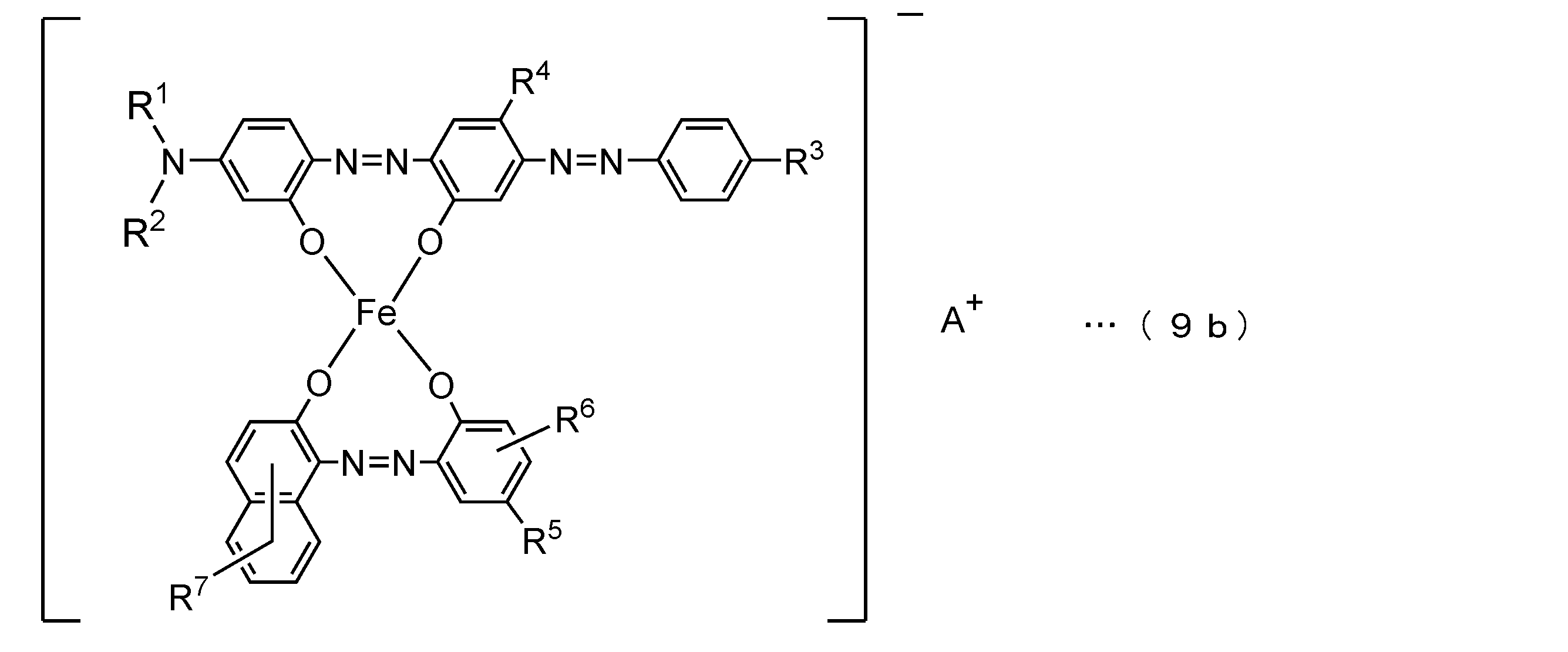
- Such a disazo-monoazo iron complex is specifically represented by the following chemical formula (8) (In chemical formula (8), R 1 to R 7 and A + are the same as in chemical formula (1).).
- R5 is an electron-withdrawing group such as a nitro group, a sulfonamide group, or a halogen atom.
- the halogen atoms include fluorine, chlorine, bromine, and iodine.
- R 6 is a hydrogen atom, a linear or branched alkyl group having 1 to 8 carbon atoms, a nitro group, or a halogen atom.
- alkyl group include methyl group, ethyl group, n-propyl group, isopropyl group, n-butyl group, isobutyl group, sec-butyl group, tert-butyl group, n-pentyl group, isopentyl group, neopentyl group, n- hexyl group, 2-methylpentyl group, 3-methylpentyl group, 2,2-dimethylbutyl group, 2,3-dimethylbutyl group, n-heptyl group, 2-methylhexyl group, 3-methylhexyl group, 2, 2-dimethylpentyl group, 2,3-dimethylpentyl group, 2,4-dimethylpentyl group, 3,3-dimethylpenty
- Such a disazo-monoazo iron complex is specifically represented by the following chemical formula (9a) (In the chemical formula (9a), R 1 to R 7 and A + are the same as in the chemical formula (1).) and the following chemical formula (9b) (In chemical formula (9b), R 1 to R 7 and A + are the same as in chemical formula (1).).
- R 7 is a hydrogen atom or a linear or branched alkyl group having 3 to 12 carbon atoms.
- alkyl group examples include n-propyl group, isopropyl group, n-butyl group, isobutyl group, sec-butyl group, tert-butyl group, n-pentyl group, isopentyl group, neopentyl group, n-hexyl group, 2-methyl pentyl group, 3-methylpentyl group, 2,2-dimethylbutyl group, 2,3-dimethylbutyl group, n-heptyl group, 2-methylhexyl group, 3-methylhexyl group, 2,2-dimethylpentyl group, 2,3-dimethylpentyl group, 2,4-dimethylpentyl group, 3,3-dimethylpentyl group, 3-ethylpentyl group, 2,2,3-trimethylbutyl group, n
- tert-butyl group isopentyl group, hexyl group, n-octyl group, tert-octyl group, 2-ethylhexyl group, n-nonyl group, n-decyl group and dodecyl group are preferable.
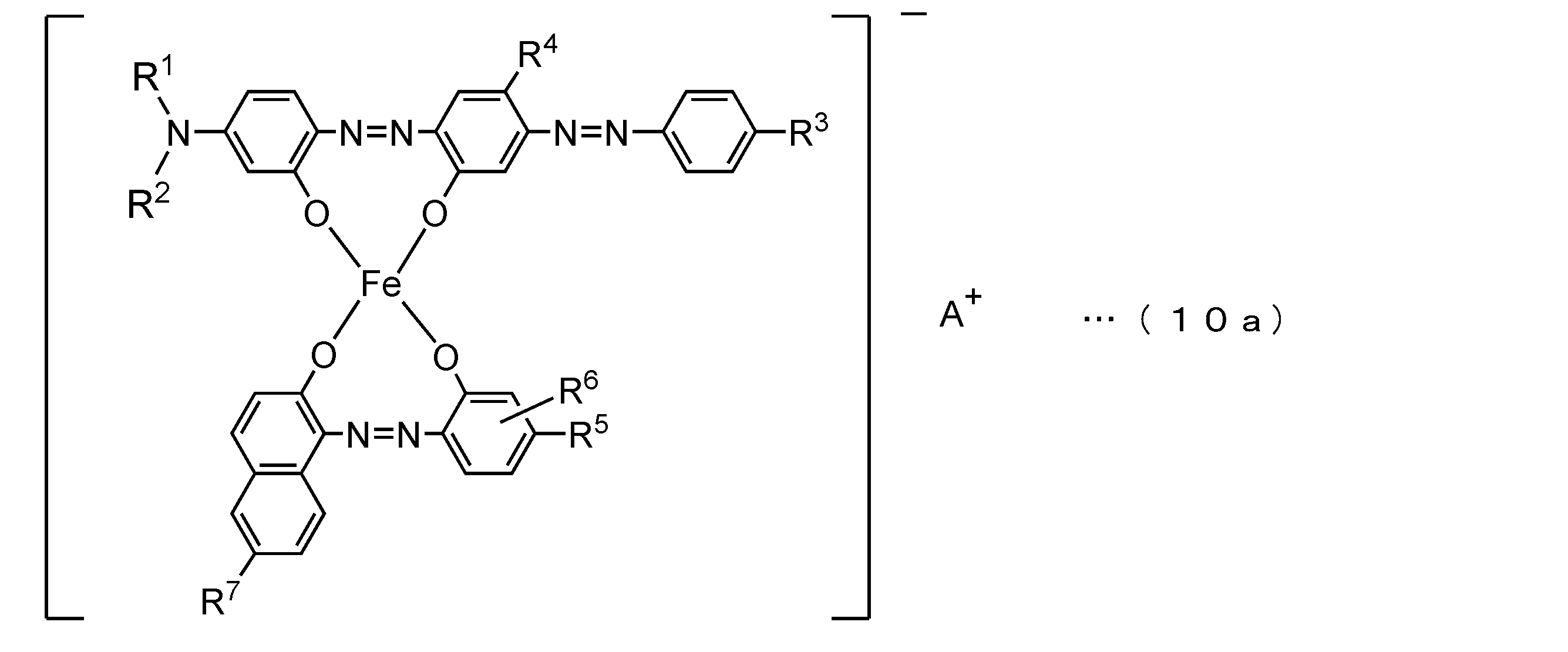
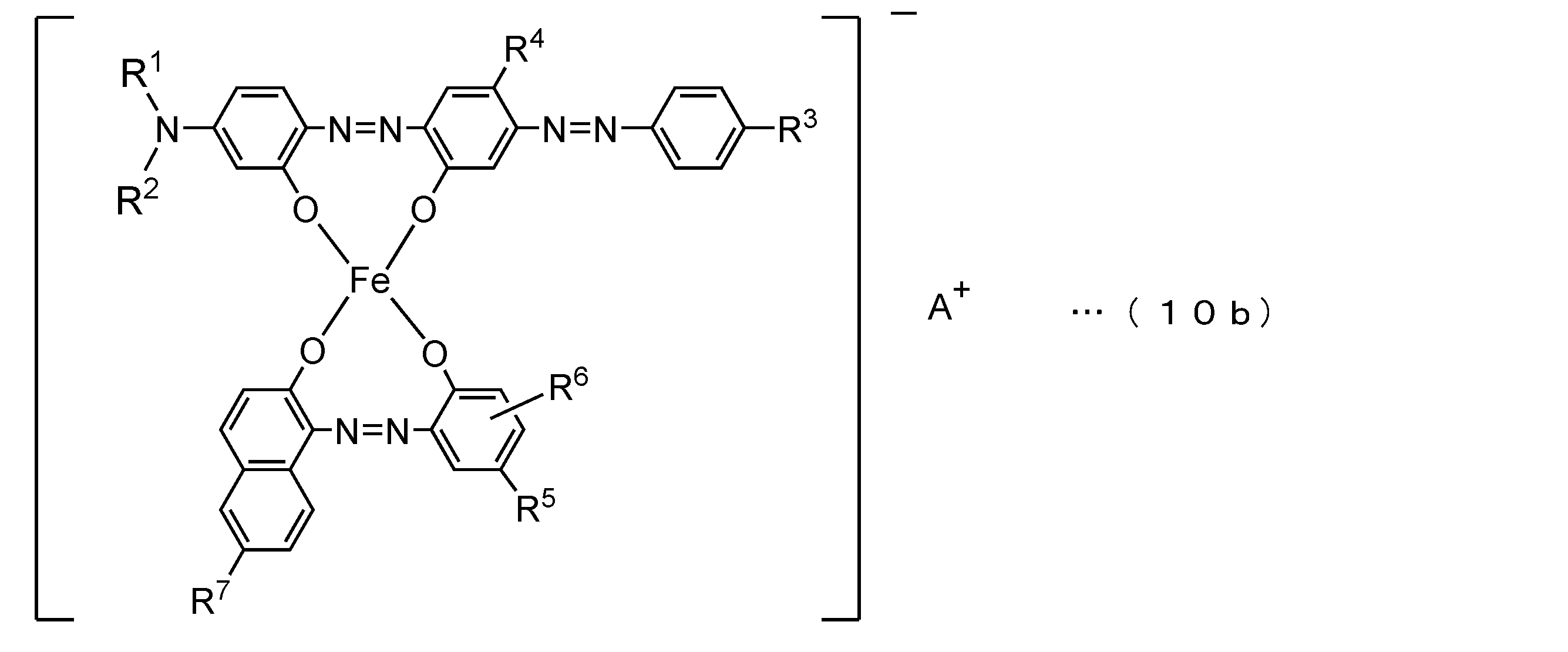
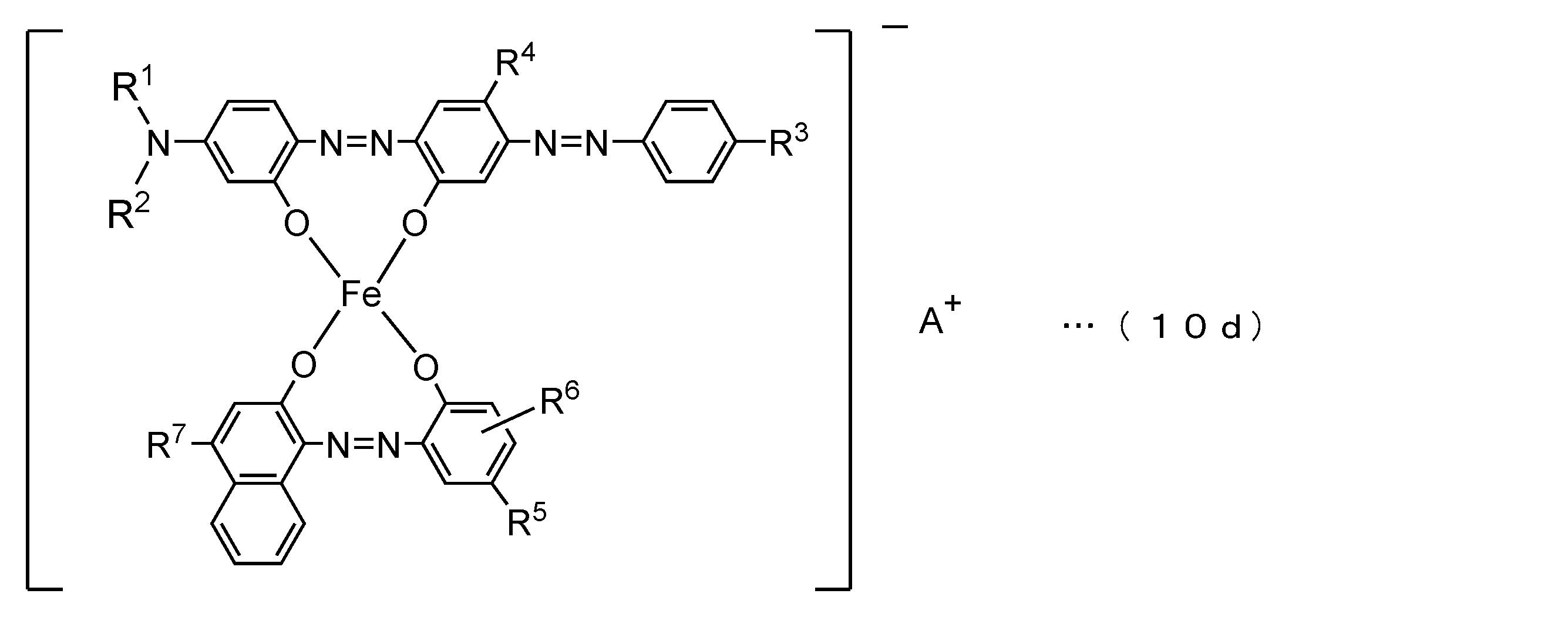
- Such a disazo-monoazo iron complex is specifically represented by the following chemical formula (10a) (In chemical formula (10a), R 1 to R 7 and A + are the same as in chemical formula (1).), the following chemical formula (10b) (In the chemical formula (10b), R 1 to R 7 and A + are the same as in the chemical formula (1).), the following chemical formula (10c), (In chemical formula (10c), R 1 to R 7 and A + are the same as in chemical formula (1).), and the following chemical formula (10d) (In chemical formula (10d), R 1 to R 7 and A + are the same as in chemical formula (1).).
- a + is a monovalent cation.
- the monovalent cations include hydrogen ions, alkali metal ions, ammonium ions (NH 4 + ), and monovalent alkyl group-containing ammonium ions.
- the disazo-monoazo iron complex may contain only one or a plurality of these monovalent cations. Among them, ammonium ions and monovalent alkyl group-containing ammonium ions are preferred.
- Alkali metal ions include lithium ions (Li + ), sodium ions (Na + ), and potassium ions (K + ). Alkali metal ions may originate from the pH adjuster used in the process of synthesizing the disazo-monoazo iron complex. In addition, only one type of monovalent cation may be combined with the iron complex anion, or plural types may be combined with the iron complex anion.
- a monovalent alkyl group-containing ammonium ion has the following chemical formula (4) is represented by
- R 8 is a straight or branched alkyl group having 1 to 18 carbon atoms
- R 9 and R 10 are each independently a hydrogen atom or a straight or branched chain having 1 to 8 carbon atoms. It is a branched alkyl group.
- Alkyl groups for R7 include methyl group, ethyl group, n-propyl group, isopropyl group, n-butyl group, sec-butyl group, tert-butyl group, n-pentyl group, isopentyl group, neopentyl group and n-hexyl.
- it is preferably a straight or branched chain alkyl group having 7 to 18 carbon atoms, more preferably a branched alkyl group having 8 to 15 carbon atoms, and a branched chain alkyl group having 11 to 14 carbon atoms.
- An alkyl group is even more preferred.
- alkyl groups for R 9 and R 10 include methyl group, ethyl group, n-propyl group, isopropyl group, n-butyl group, isobutyl group, sec-butyl group and tert-butyl group. , n-pentyl, isopentyl, neopentyl, n-hexyl, n-heptyl, and n-octyl groups. Among them, a methyl group is preferred.
- the disazo-monoazo iron complex which is essentially contained in the azo iron complex dye of the present invention, has an amino group (-NR 1 R 2 in the chemical formula (1)) to which a dialkyl group having a carbon number within a specific range is bonded and an electron-withdrawing It has an asymmetric structure containing a disazo ligand having a group (-R 3 ) and a monoazo ligand having an electron-withdrawing group (-R 5 and/or -R 6 ).
- the azo-iron complex dye becomes bathochromic, absorbs wavelengths in the visible light region, and exhibits a practically deep black color.
- the aromatic ring of the disazo ligand is composed only of arylene groups, and does not have a naphthalene ring that is bulky and causes a high molecular weight. Therefore, this azo-iron complex dye has a low molecular weight compared to an azo-iron complex dye having a naphthalene ring-containing disazo ligand, and therefore exhibits high color development even in a small amount.
- this disazo-monoazo iron complex has, as a cation, an alkali metal ion, an ammonium ion, and/or a monovalent alkyl group-containing ammonium ion having an alkyl group having a carbon number within a specific range, thereby exhibiting a black color. It improves the solubility of anions. Therefore, the azo iron complex dye of the present invention exhibits a practically higher solubility as an ink composition in alcohol-based organic solvents such as ethanol and ethylene glycol and ketone-based organic solvents such as methyl ethyl ketone, and has high dissolution stability. It does not separate out or precipitate in organic solvents.
- this azo iron complex dye is suitable for ink compositions, particularly ink compositions for continuous ink jet printers. Furthermore, since the azo iron complex dye does not contain chromium or cobalt, which are heavy metals harmful to the environment and the human body, it is possible to contribute to environmental conservation and ensure safety to the human body.
- the azo iron complex dye in the present invention is a monoazo-monoazo iron complex having only a monoazo ligand which is a ligand possessed by the disazo-monoazo iron complex in addition to the disazo-monoazo iron complex represented by the chemical formula (1). and/or a disazo-disazo iron complex having only disazo ligands.
- This monoazo-monoazo iron complex has the following chemical formula (2) (In chemical formula (2), R 5 to R 7 and A + are the same as in chemical formula (1).).
- disazo-disazo iron complex has the following chemical formula (3) (In chemical formula (3), R 1 to R 4 and A + are the same as in chemical formula (1).).
- the azo-iron complex dye contains a disazo-monoazo iron complex (DM form), a monoazo-monoazo iron complex (MM form), and a disazo-disazo iron complex (DD form)
- the molar ratio of these is determined at a specific wavelength, such as It can be expressed as a peak area ratio in a chromatogram obtained by high performance liquid chromatography at a wavelength of 254 nm.
- the DM form:MM form:DD form is preferably 20-70:5-80:0-50, more preferably 20-65:5-80:0-50, and 20- More preferably 60:20-80:0-30, even more preferably 20-55:20-80:0-15.
- the lower limit of the DD form may be 1 instead of 0.
- the above values are obtained by rounding off the peak area ratio to one decimal place. Including values from 0.1 to 0.4.
- Azo-iron complex dyes include, in addition to disazo-monoazo iron complexes which are asymmetric azo-iron complexes, monoazo-monoazo iron complexes having only monoazo ligands and/or disazo-disazo iron complexes having only disazo ligands.
- disazo-monoazo iron complexes which are asymmetric azo-iron complexes
- monoazo-monoazo iron complexes having only monoazo ligands
- disazo-disazo iron complexes having only disazo ligands.
- blackness, solubility, and dissolution of the azo-iron complex dye are improved by adjusting the ratio of each azo-iron complex in the azo-iron complex to an appropriate range. It is preferable because the stability and the electric conductivity required for the ink composition for continuous ink jet (CIJ) printers can be appropriately and arbitrarily adjusted.
- the azo iron complex dye of the present invention is suitable for use in ink compositions for CIJ printers.
- the electrical conductivity K of the azo iron complex dye is preferably 300-2200 ⁇ S/cm, more preferably 600-2000 ⁇ S/cm.
- the electric conductivity is within this range, the electric charge of the azo iron complex dye-containing CIJ printer ink composition can be stably and freely controlled, so that the ejection stability of the ink composition can be improved.
- the electrical conductivity K is measured by inserting and immersing an electrode of an electrical conductivity meter in a 6% by mass methyl ethyl ketone solution of the azo iron complex dye.
- the content of alkali metal ions in the azo iron complex dye is preferably 1000 ppm or less, more preferably 500 ppm or less. Since the surface tension of the ink composition can thereby be lowered, the ink composition can be suitably used for CIJ printers.
- additives such as leveling agents and anti-repellent agents contained in the CIJ ink composition may contain silicone compounds and silicone surfactants, but the alkali metal ion content of the azo iron complex dye When the amount is within the above range, complex formation between these silicone compounds and silicone-based surfactants and alkali metal ions can be suppressed. This prevents clogging of the printer head and improves the ejection stability of the ink composition for CIJ printers.
- Step 1 Step of obtaining a disazo dye using a diazo coupling reaction
- Step 2 Step of obtaining a monoazo dye using a diazo coupling reaction
- Step 3 Iron complexing a mixture of a disazo dye and a monoazo dye with azo iron
- Step 4 Step of changing/preparing the cation of the azo iron complex dye
- Step 5 Step of filtering, washing, drying and pulverizing the azo iron complex dye Iron complex dyes can be obtained.
- the first step is a step of obtaining a disazo dye that can serve as a disazo ligand in an azo iron complex.
- an aqueous solution prepared by diluting aminobenzene (diazo component) having an electron-withdrawing group with hydrochloric acid and sodium nitrite for example, a 40% by mass prepared aqueous solution
- Aminobenzene is diazotized by adding to water or ion-exchanged water-lower alcohol mixed solvent and stirring at a temperature of 0 to 5° C. for 1 to 3 hours to obtain a diazotized solution.
- Excess nitrous acid is decomposed with sulfamic acid or the like.
- an aminophenol having a substituent suitable for forming a metal complex salt such as a hydroxyl group is dissolved or finely dispersed in an aqueous solution prepared by diluting with hydrochloric acid, the diazotization solution is added dropwise to the solution, and the mixture is added in a hydrophilic solvent or in a water-low-grade solution.
- a diazo coupling reaction is performed in an alcoholic solvent at room temperature or low temperature with stirring for several hours to obtain a solution containing a monoazo compound.
- the monoazo compound is filtered and washed with water to obtain a wet cake of the monoazo compound.
- the wet cake may be dried before being used in the next step of synthesizing a disazo dye, or the wet cake may be used as it is, or the monoazo compound-containing solution may be used as it is.
- an aqueous solution obtained by diluting the monoazo compound obtained in the synthesis of the monoazo compound with hydrochloric acid and sodium nitrite (for example, a 40% by mass aqueous solution) are mixed with ion-exchanged water or Aminobenzene is diazotized by adding it to an ion-exchanged water-lower alcohol mixed solvent and stirring at a temperature of 0 to 5° C. for 1 to 3 hours to obtain a diazotized solution. Excess nitrous acid is decomposed with sulfamic acid or the like.
- an aminophenol having a substituent suitable for forming a metal complex salt such as a hydroxyl group is dissolved or finely dispersed in an alkaline aqueous solution, the diazotized solution is added dropwise to the solution, and the solution is added in a hydrophilic solvent or in a water-lower alcohol solvent. Then, while stirring at room temperature or low temperature for several hours, a diazo coupling reaction is carried out to obtain a solution containing a disazo dye. The disazo dye is filtered and washed with water to obtain a wet cake of disazo dye. The wet cake may be dried and then used in the subsequent iron complexing step, the wet cake may be used as it is, or the disazo dye-containing solution may be used as it is.
- the second step is a step of obtaining a monoazo dye that can serve as a monoazo ligand in an azo iron complex.
- an aromatic amine having an electron-withdrawing group such as a nitro group or a halogen atom is diazotized by a known method to obtain a diazotized solution.
- a diazotized solution obtained by diluting aminobenzene (diazo component) having an electron-withdrawing group with hydrochloric acid and sodium nitrite (eg, 40% by mass aqueous solution) are mixed with ion-exchanged water or ion-exchanged water-lower alcohol.
- Aminobenzene is diazotized by adding to the mixed solvent and stirring at a temperature of 0 to 5° C. for 1 to 3 hours to obtain a diazotized solution. Excess nitrous acid is decomposed with sulfamic acid or the like.
- the reaction of chemical formula (13) is specifically carried out as follows. 2-Naphthol is dissolved or finely dispersed in an alkaline aqueous solution, the diazotizing solution is added dropwise to the solution, and diazotization is performed in a hydrophilic solvent or in a water-lower alcohol solvent at room temperature or low temperature for several hours while stirring. to obtain a solution containing a monoazo dye. The monoazo dye is filtered and washed with water to obtain a monoazo dye wet cake. The wet cake may be dried before being used in the next iron complexation step, or the wet cake may be used as it is, or the monoazo dye-containing solution may be used as it is.
- Third step A step of iron-complexing a mixture of a disazo dye and a monoazo dye to obtain an azo-iron complex. ) is the iron complexation step.
- the disazo dye obtained in the first step and the monoazo dye obtained in the second step are charged in a molar ratio of, for example, 2:8 and mixed to obtain a mixed dye.
- This mixed dye is dispersed or dissolved in a solvent, an iron agent is added, and the mixture is heated and stirred at 80 to 140° C. for 1 to 5 hours.
- the ironification reaction proceeds to coordinate the disazo dye and the monoazo dye to the iron atom, disazo-monoazo iron complex represented by chemical formula (1), chemical formula (2)
- a mixture of the monoazo-monoazo iron complex represented by and the disazo-disazo iron complex represented by the chemical formula (3) is obtained.
- R 1 to R 7 are the same as chemical formula (1), and X + is an arbitrary cation.
- the molar mixing ratio of the disazo dye and the monoazo dye is preferably 2:8 to 8:2, specifically 2:8, 3:7, 4:6, 5:5, 6:4, Charge mix ratios of 7:3 and 8:2 are exemplified.
- a disazo dye:monoazo dye ratio of 2:8 to 5:5 is preferable because it exhibits high blackness and high solubility in the organic solvent contained in the ink composition.
- the solvent used in the iron complexation step includes water, a water-organic solvent mixed solution, and an organic solvent, and among them, a mixed solvent of water-organic solvent is preferable.
- organic solvents include alcohol-based solvents, glycol-based solvents, amide-based solvents, ether-based solvents, ketone-based solvents, sulfoxide-based solvents, and aromatic hydrocarbon-based solvents. Solvents, sulfoxide solvents and the like are preferred.
- preferred organic solvents include alcohol solvents such as ethanol, n-propanol, isopropanol, n-butanol, isobutanol, amyl alcohol, benzyl alcohol, cyclohexanol, and diacetone alcohol; ethylene glycol monomethyl ether, ethylene glycol.
- alcohol solvents such as ethanol, n-propanol, isopropanol, n-butanol, isobutanol, amyl alcohol, benzyl alcohol, cyclohexanol, and diacetone alcohol
- ethylene glycol monomethyl ether ethylene glycol.
- Alkyl ethers of glycols such as monoethyl ether, propylene glycol monomethyl ether, propylene glycol monoethyl ether, diethylene glycol monoethyl ether, diethylene glycol monobutyl ether and dipropylene glycol monoethyl ether; ethylene glycol monoacetate and propylene glycol monoacetate
- Glycol solvents such as glycols such as ethylene glycol, diethylene glycol, trimethylene glycol, triethylene glycol, tetraethylene glycol, polyethylene glycol, propylene glycol, and butanediol; N-methylformamide, amide solvents such as N,N-dimethylformamide, N-ethylformamide, N,N-diethylformamide, N-methylacetamide, N,N-dimethylacetamide; Sulfoxide solvents include sulfolane, 3-methylsulfolane, dimethylsulfoxide and the like. Among them,
- Iron agents used in the iron complexation step include ferric sulfate, ferrous sulfate, ferric chloride, ferrous chloride, ferric nitrate, iron acetate, and iron lactate.
- the equivalent number of the iron agent is preferably 1/2 to 2, more preferably 1/2 to 2/3, with respect to the total equivalent number of the disazo dye and the monoazo dye. preferable.
- the ironification reaction is preferably carried out at a temperature suitable for the type of solvent used while heating (including stirring under reflux). The ironification reaction may be carried out with the addition of additives such as reaction accelerators and pH adjusters.
- Any cation X + combined with the azoiron complex anion in the course of the reaction is converted to the desired cation A + , e.g. hydrogen, sodium, potassium, ammonium, by adjusting the pH by adding acid or base. , monovalent alkyl group-containing ammonium ions, or mixtures thereof.
- the third step an example of mixing the disazo dye obtained in the first step and the monoazo dye obtained in the second step and then performing the ironification reaction was shown, but the third step is not limited to this, A disazo dye or monoazo dye may be added to a solvent, then the monoazo dye or disazo dye may be added sequentially, and an iron agent may be added to carry out an ironification reaction with trivalent iron. is added, and then an ironizing agent is added to carry out an ironation reaction, then a monoazo dye or a disazo dye is added, and if necessary, an ironizing agent is further added to carry out an ironation reaction with trivalent iron. .
- the surplus azo dye that has undergone the ironation reaction first and another azo dye that is added later form a disazo-monoazo iron complex through the ironation reaction.
- the disazo dye and the monoazo dye may each be used singly, or a mixture of multiple types having different substituents or having different bonding positions of the substituents may be used.
- one type of disazo dye may be mixed with two types of monoazo dyes, or two types of disazo dyes may be mixed with one type of monoazo ligand.
- the fourth step is the step of changing/preparing the cation of the azo iron complex dye, for example, an alkali metal solution, an ammonium aqueous solution, and / or a carbon number of 3 to
- An ion-exchange step of exchanging the cations of the azo-iron complex dyes obtained in the step of iron-complexing a mixture of azo-dyes to obtain azo-iron-complex dyes with a monovalent amine having 18 alkyl groups for the desired cations. is.
- ammonium agents include aqueous ammonium solutions and monovalent amine compounds having alkyl groups of 3 to 18 carbon atoms. Ammonium-forming agents may be used singly or in combination.
- an azo iron complex having mixed ions as cations can be obtained.
- An azo iron complex can be obtained in which 86 mol % or more, particularly 90 mol % or more of the cations in the mixed ions are the desired ammonium ions.
- the cation exchange reaction in the fourth step can be carried out simultaneously or sequentially in the same reaction system as the ironification reaction in the third step.
- the fourth step may be performed by adding an ammonium agent together with the organic solvent when preparing the ink composition.
- the fifth step is performed after the third step or the fourth step as necessary, and includes a filtering step, a washing step, a drying step, and a pulverizing step. Optionally have steps.
- the reaction solution containing the azo iron complex dye obtained in the iron complexation step (or the subsequent alkali treatment) or the ion exchange step, which is the third step, is filtered to separate the solid matter of the azo iron complex dye and the solvent. to obtain a wet cake of the azo iron complex dye.
- Filtration methods include filter paper filtration, bag filtration, and gravity filtration methods such as centrifugation; vacuum filtration methods using filters such as Nutsche, Moore filters, disc filters, drum filters, and Oliver filters; Pressure filtration methods such as leaf filters and sealed multi-stage filters can be used.
- a washing process may be performed after the filtration process.
- the azo-iron complex and the wet cake of the azo-iron complex dye are thoroughly washed with the washing liquid. Washing liquids include water and organic solvents, with water being preferred. This wet cake may be used as it is as an intermediate in the next step.
- a drying process for drying the wet cake of the azo iron complex dye may be performed. Furthermore, a drying step may be performed as necessary.
- the dried bulk azo iron complex dye is pulverized or pulverized using a known pulverizer so as to have a desired particle size.
- R 1 and R 2 are the same as in chemical formula (1), and any one of R 3a to R 3c is selected from a cyano group, a nitro group, an acetyl group, a sulfonamide group, and a halogen atom.
- R 4a to R 4c is a straight or branched alkyl group having 1 to 5 carbon atoms or a straight or branched chain alkyl group having 1 to 5 carbon atoms
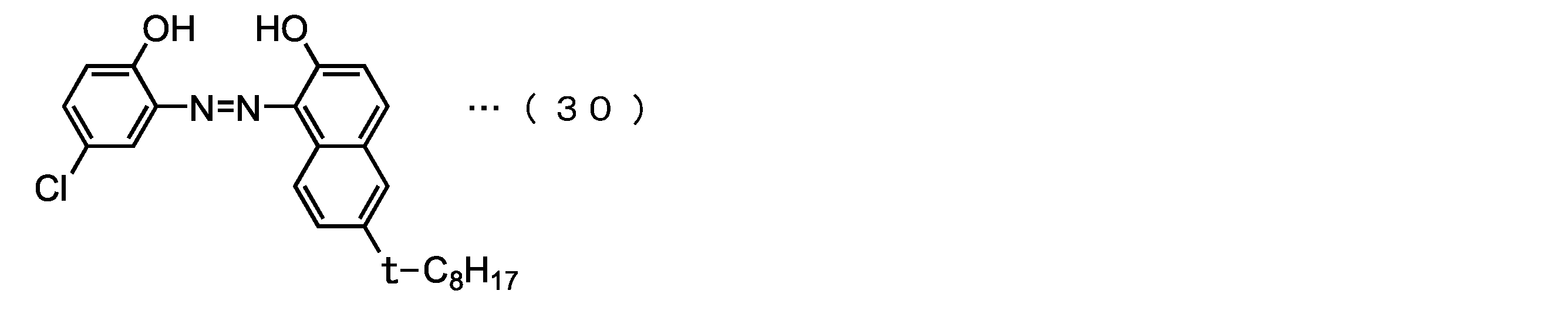
- a branched alkoxy group and the others are hydrogen atoms.
- Table 1 shows specific substituents for R 1 , R 2 , R 3a to R 3c , and R 4a to R 4c in the chemical formula (16).
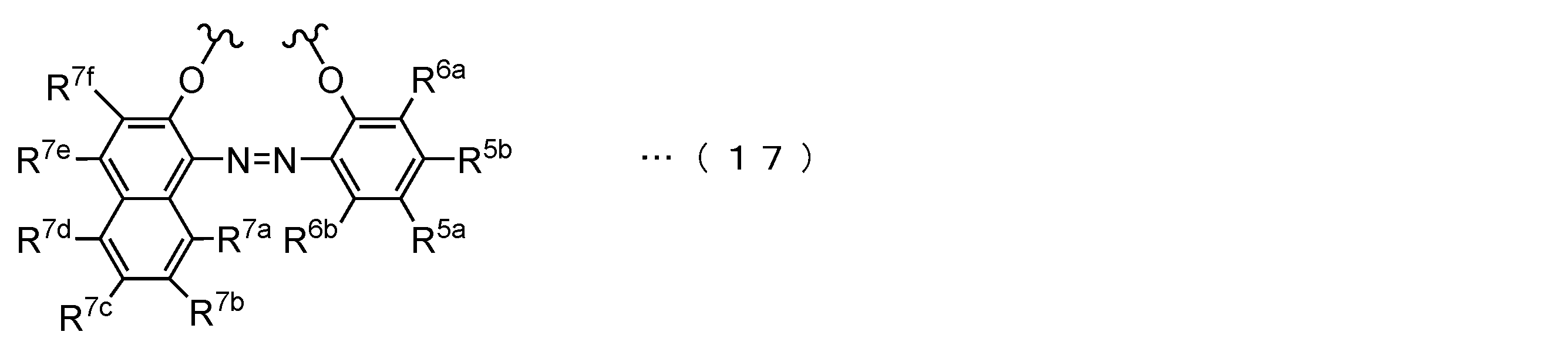
- R 5a and R 5b are each independently a hydrogen atom, a nitro group, a sulfonamide group, or a halogen atom
- R 6a and R 6b are each independently a hydrogen atom having 1 to 8 is a linear or branched alkyl group, a nitro group, or a halogen atom
- R 7a to R 7f are each independently a hydrogen atom or a linear or branched alkyl group having 3 to 12 carbon atoms
- It is preferable that all of R 5a , R 5b , R 6a , and R 6b are not the same substituent at the same time, and any one of R 7a to R 7f is an alkyl group and the other are all hydrogen atoms.
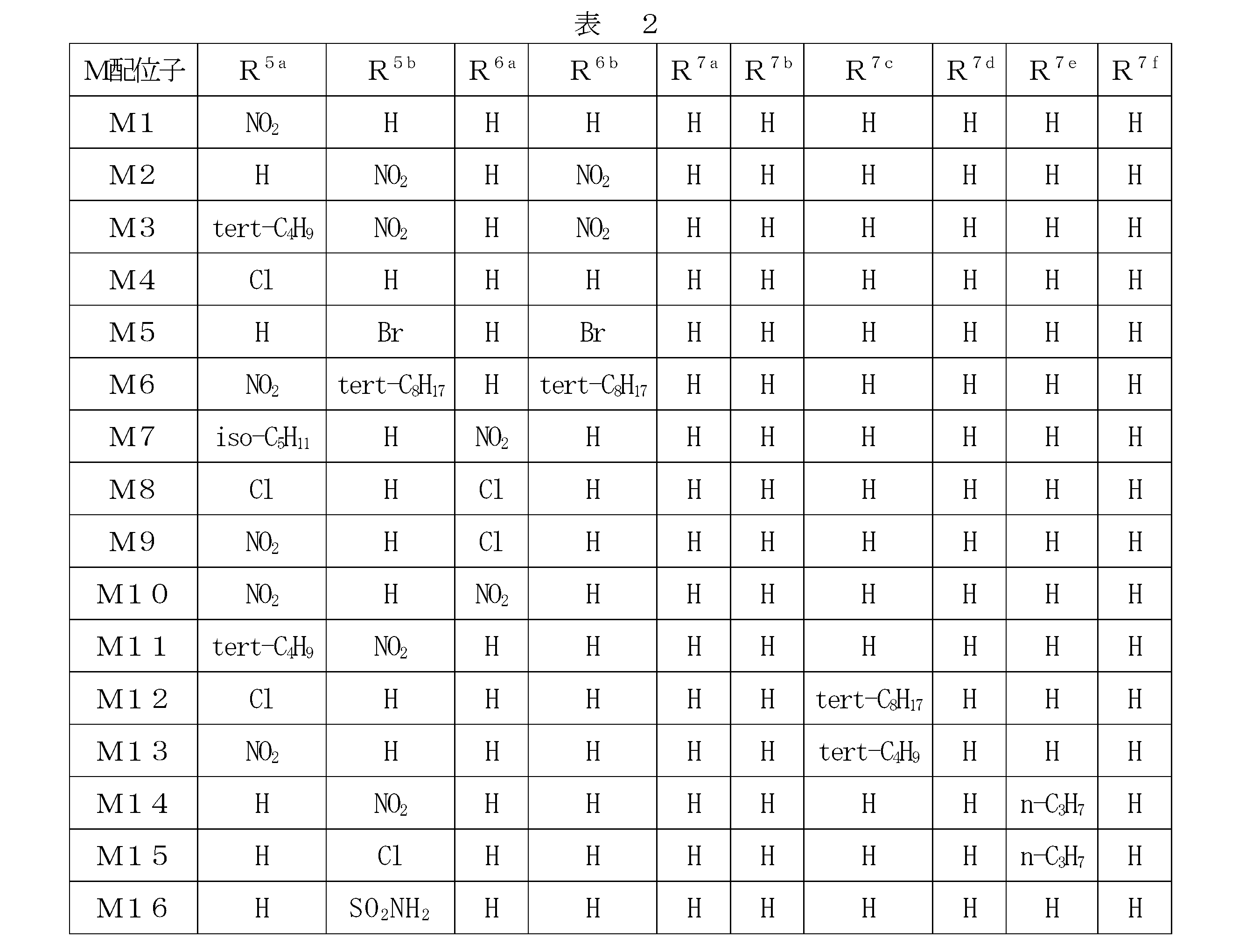
- Table 2 shows specific substituents for R 5a , R 5b , R 6a , R 6b , and R 7a to R 7f in chemical formula (17).
- the azo iron complex dye of the present invention is represented by the chemical formula (16), and specifically, for example, at least one disazo ligand (D ligand) having a substituent shown in Table 1, and the chemical formula (17), specifically, for example, at least one monoazo ligand (M ligand) shown in Table 2 and a disazo-monoazo iron complex (DM body).
- D ligand disazo ligand
- M ligand monoazo ligand
- DM body disazo-monoazo iron complex
- the azo iron complex dye is represented by the above chemical formula (17).
- a monoazo-monoazo iron complex (MM form), and at least one D ligand represented by the chemical formula (16), specifically, for example, having a substituent shown in Table 1, 2 moles of an iron atom may also contain a disazo-disazo iron complex (DD form) coordinated to 1 mol of
- DD form disazo-disazo iron complex
- Table 3 shows the charge mixing ratio with (M dye).
- the symbols in the D ligand and M ligand columns correspond to those described in Tables 1 and 2.
- the ink composition of the present invention contains an azo iron complex dye and an oily liquid medium as an organic solvent.
- the content of the azo iron complex dye in the ink composition is preferably 3 to 25% by mass, more preferably 5 to 15% by mass, and even more preferably 5 to 10% by mass.
- organic solvents include ketone-based organic solvents, alcohol-based organic solvents, and ether-based organic solvents. Among them, ketone-based organic solvents and alcohol-based organic solvents are preferred.
- Ketone-based organic solvents include lower alkyl ketones such as acetone, methyl ethyl ketone, dipropyl ketone, methyl isobutyl ketone, and methyl isopropyl ketone; and cyclic ketones such as cyclohexanone.
- methyl ethyl ketone is suitable for the ink composition for continuous ink jet printers because it has good solubility of resins, good dispersibility of pigments, good electrical conductivity, and good drying property of ink.
- Alcohol-based organic solvents include lower alkyl alcohols such as methanol, ethanol, propanol, isopropanol and butanol; glycols such as dioxane, ethylene glycol, diethylene glycol, and triethylene glycol.
- ether-based organic solvents examples include glycol ethers and their esters.
- glycol ethers include ethylene glycol monomethyl ether, ethylene glycol monoethyl ether, ethylene glycol monobutyl ether, ethylene glycol monoisopropyl ether, ethylene glycol monoisobutyl ether, ethylene glycol monophenyl glycol, ethylene glycol monobenzyl glycol, and ethylene glycol dimethyl ether.
- ethylene glycol alkyl ethers such as ethylene glycol diethyl ether; triethylene glycol alkyl ethers such as triethylene glycol monomethyl ether, triethylene glycol monobutyl ether, triethylene glycol dimethyl ether, and triethylene glycol diethyl ether; propylene glycol monomethyl ether, propylene glycol monoethyl ether, propylene Propylene glycol alkyl ethers such as glycol monopropyl ether, propylene glycol monobutyl ether and propylene glycol monophenyl ether; dipropylene glycol monomethyl ether, dipropylene glycol monobutyl ether, dipropylene glycol monopropyl ether and dipropylene glycol monopropyl ether and tripropylene glycol alkyl ethers such as tripropylene glycol monomethyl ether and tripropylene glycol monobutyl ether.
- triethylene glycol alkyl ethers such as triethylene glycol
- organic solvents include ester organic solvents such as ethyl acetate, ethyl propionate, ethyl lactate, propyl acetate, and butyl acetate; and aromatic hydrocarbon organic solvents such as toluene and xylene.
- the above organic solvents may be used singly or in combination.
- the ink composition of the present invention may contain a resin soluble in the above organic solvent.
- a resin soluble in the above organic solvent Specifically, cellulose resin, styrene-acrylic resin, terpene phenol resin, polyvinyl butyral resin, ketone resin, maleic acid resin, rosin resin, acrylic resin, styrene-maleic acid resin, polyvinyl acetal resin, polyvinyl alcohol resin, rosin Ester resin, silicone resin, phenol resin, coumarone-indene resin, novolac resin, aldehyde resin, polyester resin, polyamide resin, polyimide resin, terpene resin, alkyd resin, urethane resin, acetal resin, epoxy resin, urea resin, melamine resin , and xylene resins. These resins may be used singly or in combination.
- cellulose-based resins include nitrocellulose; lower acyl group-substituted products such as cellulose propionate, cellulose butyrate, cellulose acetate, cellulose acetate propionate, and cellulose acetate butyrate; lower alkyl group-substituted products; cellulose nitrate; and hydroxypropyl cellulose.
- a cellulose resin is appropriately selected according to the viscosity required for the ink composition.
- examples thereof include cellulose esters that are wholly or partially modified with one or more esters in which the hydroxy group of the cellulose resin has 2 to 8 carbon atoms, preferably 2 to 5 carbon atoms.
- lower acyl group-substituted celluloses such as cellulose acetate propionate and cellulose acetate butyrate are preferred.
- Cellulose acetate propionate having a substitution degree of acetyl group and propionyl group of 0.5 to 10% and 35 to 55%, respectively, is particularly preferred.
- the degree of substitution is defined as 100% when all three hydroxy groups of one unit of glucose are substituted.
- the styrene-acrylic resin is a copolymer of a styrene-based monomer and an acrylic-based monomer, and preferably has an acid value of 120 or less and a molecular weight of 3,000 to 30,000.
- Styrenic monomers include styrene, ⁇ -methylstyrene, and vinyltoluene.
- Acrylic monomers include acrylic acid, methacrylic acid, methyl acrylate, methyl methacrylate, ethyl acrylate, ethyl methacrylate, propyl acrylate, propyl methacrylate, isopropyl acrylate, isopropyl methacrylate, butyl acrylate, and methacrylic acid.
- Styrene-acrylic resins are commercially available, such as Joncryl® 68, 586, and 611 (manufactured by BASF), Hymer® SBM-100, and Hymer SAM-955 (Sanyo Kasei Co., Ltd.). ), and Nicalite (registered trademark) NC-6531 and Nicalite NC-6100 (manufactured by Nippon Carbide Co., Ltd.).
- Terpene phenolic resins are copolymers of terpenes such as ⁇ -pinene, ⁇ -pinene, and dipentene and phenols such as phenol and bisphenol. After the monomers are selected according to the requirements for the ink composition, the molar ratio of each monomer is set. Terpene phenolic resins are commercially available such as YP90 and YP90L; YS Polystar S145, #2100, #2115, #2130, T80, T100, T115, T130, and T145; company).
- Polyvinyl butyral resin is a copolymer of polyvinyl alcohol and butyraldehyde.
- the degree of butyralization, the content of hydroxy groups and acetyl groups, and the degree of polymerization are set according to the requirements for the ink composition.
- the polyvinyl butyral resin preferably has a relatively low degree of polymerization from the viewpoint of the viscosity of the ink composition and solubility in solvents.
- Polyvinyl butyral resins are commercially available, e.g.
- BH-3, BH-S, BX-1, BX-2, BX-5, BX-10, BX-55, and BX-L (manufactured by Sekisui Chemical Co., Ltd.); Denka Butyral #2000-L, #3000- 1, #3000-2, #3000-4, #3000-K, #4000-1, #4000-2, #5000-A, and #6000-C (manufactured by Denka).
- the ketone resin is a copolymer of a ketone compound and formaldehyde, and is preferably a polymer compound having an average molecular weight of 3000 or more.
- the ketone resin may be chemically modified such as hydrogenated and/or end group modified.
- Ketone resins are commercially available, such as Hilac® 111 and 222 (manufactured by Showa Denko Materials); K-90 (manufactured by Arakawa Chemical Industries).
- the maleic acid-based resin is particularly preferably a rosin-modified maleic acid resin.
- Rosin-modified maleic acid resin is a polyester of rosin, maleic acid and polyhydric alcohol. Rosin-modified maleic acid resins are commercially available, for example, Beccasite® P-720 and J-896 (manufactured by DIC); , 1152, 1155, 1158, and 1161 (manufactured by Showa Denko Materials).
- the ink composition of the present invention can be suitably used for inkjet printers, preferably industrial inkjet printers, especially continuous inkjet printers (CIJ), which are charge amount control type.
- Ink compositions for CIJ printers may contain charge control agents to obtain the desired amount of charge.
- the ink composition of the present invention since the azo-iron complex dye has high electrical conductivity, a sufficient amount of charge is imparted to the ink composition. may On the other hand, if the ink composition is required to have a particularly high amount of charge, the ink composition may contain a charge control agent.
- Charge control agents include conductive salts such as alkali metal salts such as lithium, sodium, and potassium; alkaline earth metal salts such as magnesium and potassium; ammonium salts and quaternary ammonium salts. Specifically, perchlorate, thiocyanate, formate, acetate, sulfate, sulfonate, propionate, trifluoroacetate, triflate (trifluoro-methanesulfonate), hexafluorophosphate salts, hexafluoro-antimonates, tetrafluoroborates, picrates and carboxylates, tetrabutylammonium hexafluorophosphate, tetrabutylammonium bromide, and tetraphenylboron quaternary ammonium salts.
- alkali metal salts such as lithium, sodium, and potassium
- alkaline earth metal salts such as magnesium and potassium
- alkali metal halides and alkaline earth metal halides.
- the halides include fluorides, chlorides, bromides, and iodides.
- the content of the charge control agent in the ink composition is 0.1 to 10% by mass, preferably 0.1 to 5% by mass, more preferably 0.3 to 3% by mass.
- the humectant of the ink composition for CIJ printers may contain a humectant so that the droplets have a desired size when ejected from the nozzle of the CIJ printer.
- Wetting agents include surfactants, specifically anionic surfactants, cationic surfactants, nonionic surfactants, and amphoteric surfactants.
- anionic surfactants include fatty acid salts, alkyl sulfates, alkylarylsulfonates, alkylnaphthalenesulfonates, dialkylsulfonates, dialkylsulfosuccinates, alkyldiaryletherdisulfonates, alkylphosphates, poly Oxyethylene alkyl ether sulfates, polyoxyethylene alkyl aryl ether sulfates, naphthalenesulfonic acid formalin condensates, polyoxyethylene alkyl phosphate ester salts, glycerol borate fatty acid esters, and polyoxyethylene glycerol fatty acid esters.
- Cationic surfactants include alkylamine salts, quaternary ammonium salts, alkylpyridinium salts, and alkylimidazolium salts.
- Nonionic surfactants include polyoxyethylene alkyl ethers, polyoxyethylene alkylaryl ethers, polyoxyethyleneoxypropylene block copolymers, sorbitan fatty acid esters, polyoxyethylene sorbitan fatty acid esters, polyoxyethylene sorbitol fatty acid esters, glycerin fatty acid esters, Examples include polyoxyethylene fatty acid esters, polyoxyethylene alkylamines, fluorine-based nonionic surfactants, and silicone-based nonionic surfactants.
- Amphoteric surfactants include alkylbetaines, alkylamine oxides, and phosphatylcholines.
- the ink composition of the present invention may contain a pH adjuster in order to suppress changes in the ink composition such as precipitation and sedimentation of dyes, etc., and deterioration in storage stability such as discoloration.
- the pH adjuster is not particularly limited as long as it is added for the above purpose and can control the pH of the ink within the range of 7-8.
- pH adjusters include aliphatic substituted amines such as methylamine, dimethylamine, trimethylamine, ethylamine, diethylamine, triethylamine, propylamine, dipropylamine and tripropylamine, methanolamine, dimethanolamine, trimethanolamine, Alkanolamines such as ethanolamine, diethanolamine, triethanolamine, propanolamine, dipropanolamine and tripropanolamine. Alkanolamine such as triethanolamine is particularly preferable from the viewpoint of suppressing discoloration.
- the ink composition may have a desired viscosity and surface tension to improve print quality, ink fixation, and dissolution stability of azo iron complex dyes.
- Additives may be included for imparting. Such additives include antifoam agents, chemical stabilizers, UV stabilizers, and stabilizers to inhibit salt corrosion; biocides such as bactericides and fungicides.
- a method for manufacturing an ink composition will be explained.
- An azo iron complex dye, an organic solvent, a resin, and, if necessary, additives are placed in a sealed container and stirred. These are thereby uniformly mixed and dissolved, and then filtered through a membrane filter. The mixed solution may be heated as necessary.
- the ink composition is used in CIJ printers as follows.
- the ink composition stored in the ink tank flows through the flow path toward the printer head by being sucked out by a pump.
- Droplets of the ink composition are ejected from nozzles provided at the end of the printer head.
- Droplets of the ink composition are charged by passing through charging electrodes and subsequently through deflection electrodes.
- the droplets of the ink composition are deflected in a predetermined array so as to draw a desired character or figure, and reach the print medium passing through the tip of the deflection electrodes.
- characters and the like are drawn on the print medium. For example, lot numbers and dates such as date of manufacture and expiration date are printed on the print media.
- plastics from which plastic bottles are made include polyolefins such as polyethylene and polypropylene; polyvinyl chloride; polyesters such as polyamide and PET; polycarbonates;
- the ink composition of the present invention by using a CIJ printer, it is possible to print on glasses such as soda lime glass and borosilicate glass; the above plastics; and metals such as aluminum, iron, tin, and copper.
- glasses such as soda lime glass and borosilicate glass; the above plastics; and metals such as aluminum, iron, tin, and copper.
- metals such as aluminum, iron, tin, and copper.
- the ink composition is also suitable as an ink for writing instruments.
- the content of the azo iron complex dye is 5 to 10% by mass, and when it is used as a ballpoint pen ink, it is 15 to 25% by mass. be.
- % means % by mass.
- reaction mixture was allowed to cool to room temperature, and 9.0 g of a 20 % aqueous sodium hydroxide solution was added to adjust the pH to 10.0 . 103.6 g of an aqueous solution of amine (manufactured by Dow Chemical Co., trade name: PRIMENE 81-R) was gradually added, and the mixture was heated and stirred at 40° C. for 1 hour.
- PRIMENE 81-R an aqueous solution of amine
- a disazo-monoazo iron complex (DM form) represented by the following chemical formula (31DM) and a monoazo-monoazo iron complex (MM form) represented by the following chemical formula (31MM) are , and 23.1 g of an azo-iron complex dye A-1 containing a disazo-disazo-iron complex (DD form) represented by the following chemical formula (31DD).
- FIG. 1 shows the visible absorption spectrum of the azo iron complex dye A-1.
- a solution in which the azo iron complex dye A-1 was adjusted to a concentration of 5% exhibited a sufficiently black color.
- a 6% methyl ethyl ketone solution of the azo iron complex dye A-1 was prepared and measured using a conductivity meter (manufactured by Eutech Instruments; trade name CyberScan CON100). As a result, the electrical conductivity K was 1530 ⁇ S/cm. Further, a 6% methyl ethyl ketone solution of the azo iron complex dye A-1 was prepared and measured using a conductivity meter (manufactured by Knick; trade name: Conducell 4USF-PG120). As a result, the electrical conductivity K was 1530 ⁇ S/cm.
- Example 2 Synthesis of azo iron complex dye A-2
- 9.5 g (0.010 mol) of a 41% ferric sulfate aqueous solution was added dropwise thereto, and after the dropwise addition was completed, the temperature was raised to 120° C.
- FIG. 2 shows the visible absorption spectrum of the azo iron complex dye A-2.
- a solution prepared by adjusting the azo iron complex dye A-2 to a concentration of 5% exhibited a sufficiently black color.
- the azo-iron complex dye A-2 had an electric conductivity K of 908 ⁇ S/cm and an alkali metal ion content of 1000 ppm or less.
- Example 3 Synthesis of azo iron complex dye A-3
- 12.9 g (0.013 mol) of a 41% ferric sulfate aqueous solution was added dropwise thereto, and after the dropwise addition was completed, the temperature was raised to 120° C. and the mixture was stirred for 3 hours.
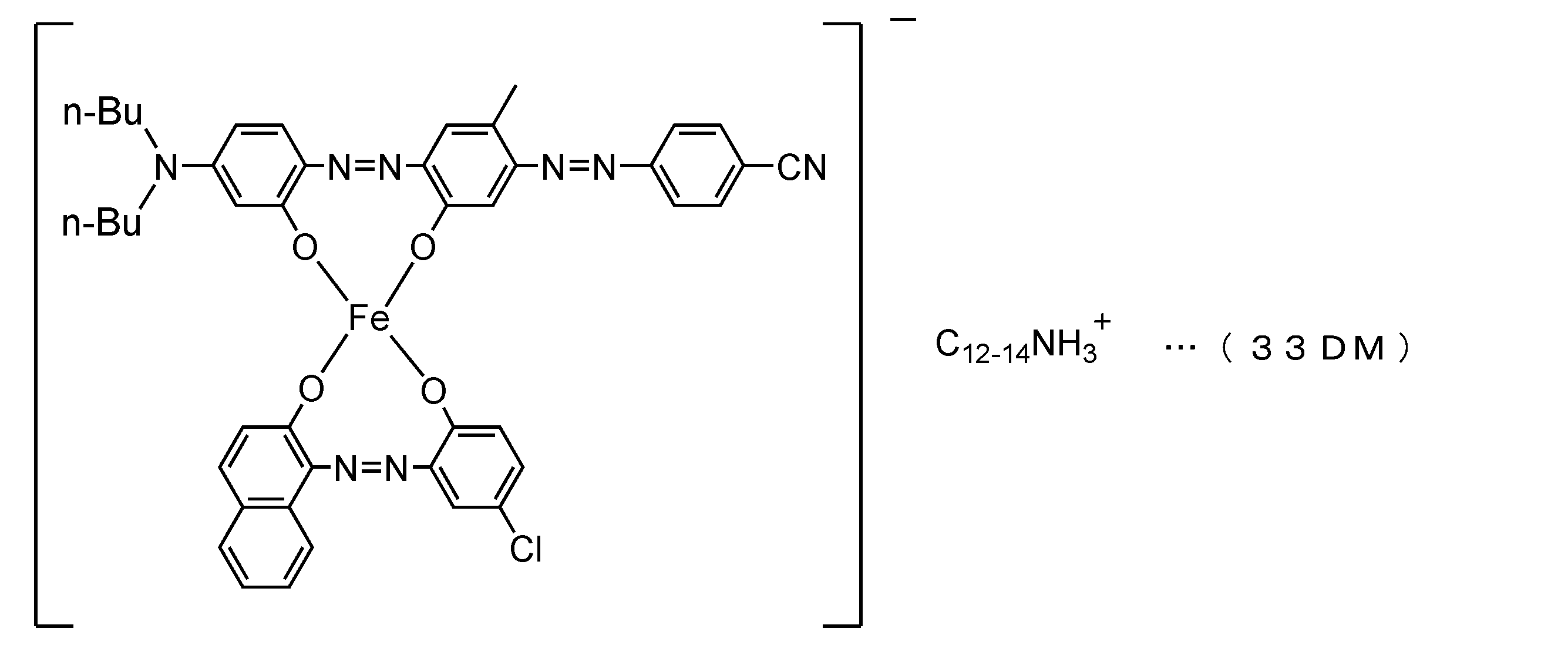
- reaction solution was allowed to cool to room temperature, and 9.0 g of a 20 % aqueous sodium hydroxide solution was added to adjust the pH to 10.2 . 103.0 g of an aqueous solution (trade name: PRIMENE 81-R) manufactured by Dow Chemical Co. was gradually added, and the mixture was heated and stirred at 40° C. for 1 hour. Thereafter, the precipitate is filtered, washed with water, and dried to obtain a DM form represented by the following chemical formula (33DM), an MM form represented by the following chemical formula (33MM), and a DD form represented by the following chemical formula (33DD). 17.8 g of azo iron complex dye A-3 containing
- FIG. 3 shows the visible absorption spectrum of the azo iron complex dye A-3.
- a solution prepared by adjusting the azo iron complex dye A-3 to a concentration of 5% exhibited a sufficiently black color.
- the azo iron complex dye A-3 had an electrical conductivity K of 1260 ⁇ S/cm and an alkali metal ion content of 1000 ppm or less.
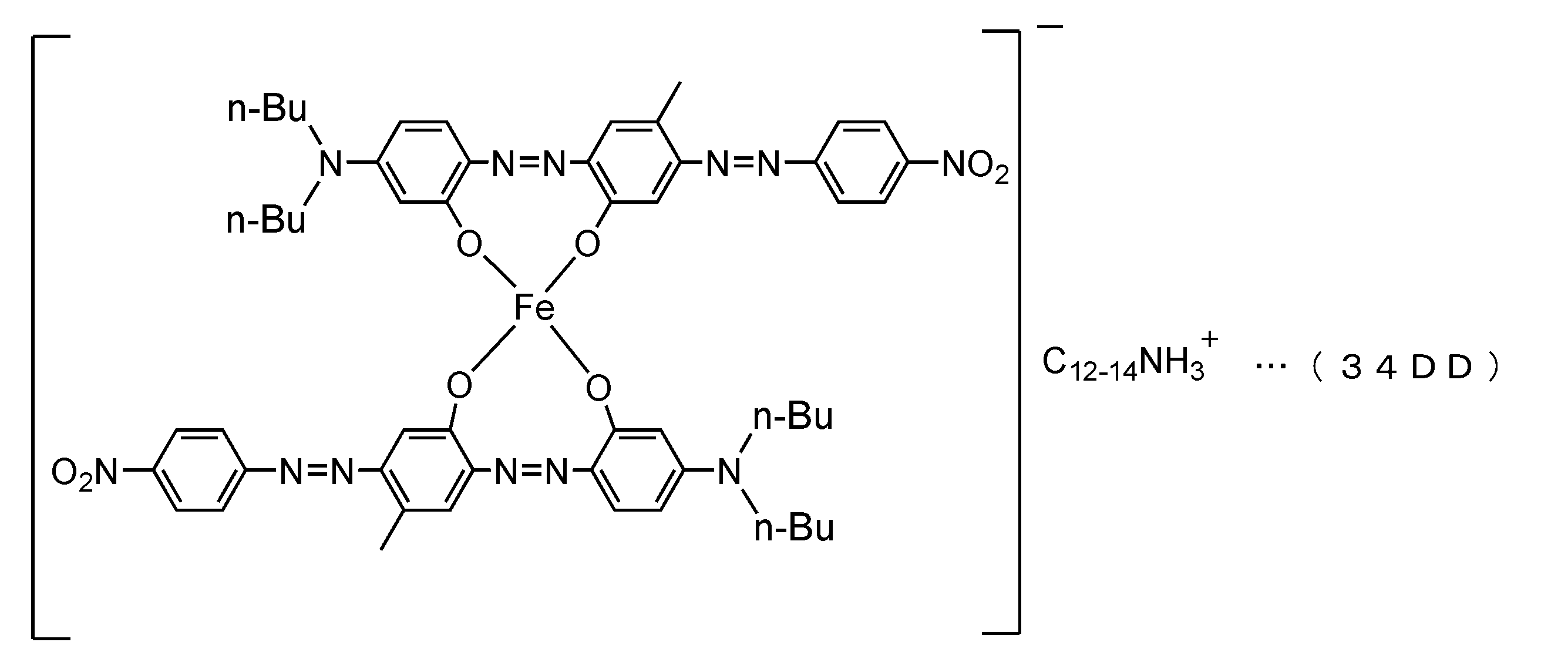
- reaction mixture was allowed to cool to room temperature, and 9.0 g of a 20 % aqueous sodium hydroxide solution was added to adjust the pH to 10.1 . 102.8 g of an aqueous solution (trade name: PRIMENE 81-R) manufactured by Dow Chemical Co. was gradually added, and the mixture was heated and stirred at 40° C. for 1 hour. After that, the precipitate is filtered, washed with water, and dried, and the DM isomer represented by the following chemical formula (34DM), the MM isomer represented by the following chemical formula (34MM), and the DD isomer represented by the following chemical formula (34DD) 16.5 g of the azo iron complex dye A-4 containing
- the absorbance, electrical conductivity, and alkali metal ion content of the azo iron complex dye A-4 were measured in the same manner as the azo iron complex dye A-1.
- FIG. 4 shows the visible absorption spectrum of the azo iron complex dye A-4.
- a solution prepared by adjusting the azo iron complex dye A-4 to a concentration of 5% exhibited a sufficiently black color.
- the azo iron complex dye A-4 had an electric conductivity K of 1275 ⁇ S/cm and an alkali metal ion content of 1000 ppm or less.
- Example 5 Synthesis of azo iron complex dye A-5
- 15.0 g (0.015 mol) of a 41% ferric sulfate aqueous solution was added dropwise thereto, and after the dropwise addition was completed, the temperature was raised to 120° C. and the mixture was stirred for 3 hours.
- reaction solution was allowed to cool to room temperature, and 9.0 g of a 20 % aqueous sodium hydroxide solution was added to adjust the pH to 9.9 . 125.3 g of an aqueous solution (trade name: PRIMENE 81-R) manufactured by Dow Chemical Co. was gradually added, and the mixture was heated and stirred at 40° C. for 1 hour. Thereafter, the precipitate is filtered, washed with water, and dried to obtain a DM form represented by the following chemical formula (35DM), an MM form represented by the following chemical formula (35MM), and a DD form represented by the following chemical formula (35DD). 15.9 g of azo iron complex dye A-5 containing
- FIG. 5 shows the visible absorption spectrum of the azo iron complex dye A-5.
- a solution prepared by adjusting the azo iron complex dye A-5 to a concentration of 5% exhibited a sufficiently black color.
- the azo-iron complex dye A-5 had an electric conductivity K of 920 ⁇ S/cm and an alkali metal ion content of 1000 ppm or less.
- the absorbance, electrical conductivity, and alkali metal ion content of the azo iron complex dye A-6 were measured in the same manner as the azo iron complex dye A-1.
- FIG. 6 shows the visible absorption spectrum of the azo iron complex dye A-6.
- the solution in which the azo iron complex dye A-6 was adjusted to a concentration of 5% exhibited a sufficiently black color.
- the azo iron complex dye A-6 had an electric conductivity K of 1450 ⁇ S/cm and an alkali metal ion content of 1000 ppm or less.
- Example 7 Synthesis of azo iron complex dye A-7-7
- the absorbance, electrical conductivity, and alkali metal ion content of the azo iron complex dye A-7 were measured in the same manner as the azo iron complex dye A-1.
- FIG. 7 shows the visible absorption spectrum of the azo iron complex dye A-7.
- a solution in which the azo iron complex dye A-7 was adjusted to a concentration of 5% exhibited a sufficiently black color.
- the azo-iron complex dye A-7 had an electric conductivity K of 826 ⁇ S/cm and an alkali metal ion content of 1000 ppm or less.
- reaction mixture was allowed to cool to room temperature, and 9.0 g of a 20 % aqueous sodium hydroxide solution was added to adjust the pH to 10.1 . 100.4 g of an aqueous solution (trade name: PRIMENE 81-R) manufactured by Dow Chemical Co. was gradually added, and the mixture was heated and stirred at 40° C. for 1 hour. The precipitate was then filtered, washed with water and dried. As a result, 27.4 g of an azo-iron complex dye B-1 composed only of a monoazo-monoazo-iron complex was obtained as represented by the following chemical formula (38MM).
- the absorbance, electrical conductivity, and alkali metal ion content of the azo iron complex dye B-1 were measured in the same manner as the azo iron complex dye A-1.
- a solution prepared by adjusting the azo iron complex dye B-1 to a concentration of 5% exhibited a dark brown color.
- the azo-iron complex dye B-1 had an electric conductivity K of 1450 ⁇ S/cm and an alkali metal ion content of 1000 ppm or less.
- the absorbance, electrical conductivity, and alkali metal ion content of the azo iron complex dye B-2 were measured in the same manner as the azo iron complex dye A-1.
- the azo iron complex dye B-2 was dissolved at a concentration of 5%, a sufficient black color was exhibited.
- the azo-iron complex dye B-2 has poor dissolution stability, and a precipitate was observed after standing overnight (8 hours).
- the electric conductivity K of the azo iron complex dye B-2 immediately after dissolution was 165 ⁇ S/cm, and the alkali metal ion content was 1000 ppm or less.
- Comparative Example 3 Azo iron complex dye B-3
- 5 parts by mass of the azo iron complex dye B-1 obtained in Comparative Example 1 and 5 parts by mass of the azo iron complex dye B-2 obtained in Comparative Example 2 were mixed in an experimental mini blender (manufactured by AS ONE). 9.9 g of azo-iron complex dye B-3, which is a mixture of azo-iron complex dye B-1 and azo-iron complex dye B-2, was obtained.
- the absorbance, electrical conductivity, and alkali metal ion content of the azo iron complex dye B-3 were measured in the same manner as the azo iron complex dye A-1.
- a solution in which the azo iron complex dye B-3 was adjusted to a concentration of 5% exhibited a reddish black color.
- the electric conductivity K of the azo iron complex dye B-1 was 979 ⁇ S/cm, and the alkali metal ion content was 1000 ppm or less.
- the visible absorption spectrum of the azo iron complex dye B-2 is particularly strong in the long wavelength region of 550 nm or longer. This indicates that the azo iron complex dye B-2 exhibits a strong bluish tone.
- the visible absorption spectrum of the azo-iron complex dye B-3 was almost the same as that of the azo-iron complex dye A-1.
- the azo iron complex dye A-1 exhibited a practically sufficient black color
- the azo iron complex dye B-3 exhibited a reddish black color.
- a detailed comparison of both spectra shows that the visible absorption spectrum of the azo iron complex dye B-3 at 400 nm to 550 nm is higher than that of the azo iron complex dye A-1, while the absorbance at 600 nm to 650 nm is equivalent. . This indicates that the MD form contained only in the azo iron complex dye A-1 greatly contributes to the blackness.
- Azo-iron complex dyes A-1 to A-7 to which the present invention is applied contain at least three types of azo-iron complexes of DM, DD and MM forms.
- the relative abundance ratio (molar ratio) of these in the azo iron complex dye is the peak area ratio in the chromatogram obtained when measured at a specific wavelength by high performance liquid chromatography (HPLC; manufactured by Shimadzu Corporation, Prominence) can ask for more.
- each azo iron 1 mg of the complex dye was dissolved in 10 ml of dimethylformamide solution and measured under the following measurement conditions. Table 4 shows the results.
- the azo-iron complex dyes of the examples essentially containing a disazo-monoazo-iron complex exhibited a practical black color in a 5% methyl ethyl ketone solution.
- the azo iron complex dyes A-1, A-2 and A-6 having a disazo ligand having a cyano group and a monoazo ligand having a nitro group exhibited high solubility in both methyl ethyl ketone and ethanol.
- azo-iron complex dye A- in which the disazo ligand and the monoazo ligand have a sulfoamide group 7 had a slightly lower electrical conductivity and a slightly reddish hue, but showed very high solubility in both methyl ethyl ketone and ethanol.
- the azo-iron complex dye A-3, in which the monoazo ligand has chlorine as a substituent, showed low solubility in ethanol, but a high concentration of 10%, which exceeds the practical concentration of 6% for methyl ethyl ketone. showed solubility.
- the azo-iron complex dye B-1 consisting only of a monoazo-monoazo iron complex exhibited good solubility, but exhibited a reddish-brown hue instead of black.
- the azo-iron complex dye B-2 which consists only of a disazo-disazo-iron complex, exhibited a black color within a practical range, but showed only low solubility in both methyl ethyl ketone and ethanol. Furthermore, it has poor dissolution stability in ethanol, and when the ethanol solution of the azo iron complex dye B-2 is allowed to stand for about 10 minutes, a precipitate is observed.
- azo iron complex dye B-3 which is a mixture of azo iron complex dye B-1 consisting only of a monoazo-monoazo iron complex and azo iron complex dye B-2 consisting only of disazo-disazo iron complex.
- azo iron complex dye B-3 which is a mixture of azo iron complex dye B-1 consisting only of a monoazo-monoazo iron complex and azo iron complex dye B-2 consisting only of disazo-disazo iron complex.
- Ink Example 1 6 parts by mass of cellulose resin, 1 part by mass of lithium nitrate, and 3 parts by mass of azo iron complex dye A-1 were added to 70 parts by mass of methyl ethyl ketone, 10 parts by mass of ethanol, and 10 parts by mass of isopropyl alcohol. was stirred to dissolve. Thereafter, the mixed solution was filtered through a filter with an opening of 1.0 ⁇ m to obtain an ink composition of Example 1. This ink composition was filled in an ink cartridge and printed using an inkjet printer to obtain a black print. The print was dark black without fading. Based on this, the ink composition of Ink Example 1 was evaluated to have good print density and ink ejection stability.
- Ink Example 2 An ink composition of Ink Example 2 was obtained in the same manner as in Ink Example 1, except that the azo iron complex dye A-2 was used instead of the azo iron complex dye A-1. Using this ink composition and performing the same procedure as in Ink Example 1, a black print was obtained. The print was dark black without fading. Based on this, the ink composition of Ink Example 2 was evaluated to have good print density and ink ejection stability.
- Ink Example 3 An ink composition of Ink Example 3 was obtained in the same manner as in Ink Example 1, except that the azo iron complex dye A-5 was used instead of the azo iron complex dye A-1. Using this ink composition and performing the same procedure as in Ink Example 1, a black print was obtained. The print was dark black without fading. Based on this, the ink composition of Ink Example 3 was evaluated to have good print density and ink ejection stability.
- Ink Example 4 Ink Example 4 was repeated except that azo iron complex dye A-6 was used instead of azo iron complex dye A-1 and 0.5 parts by mass of triethanolamine was added as a pH adjuster. An ink composition of Ink Example 4 was obtained. Using this ink composition and performing the same procedure as in Ink Example 1, a black print was obtained. The print was dark black without fading. Based on this, the ink composition of Ink Example 4 was evaluated to have good print density and ink ejection stability.
- Ink Comparative Example 1 An ink composition of Comparative Ink Example 1 was obtained in the same manner as in Ink Example 1, except that the azo iron complex dye B-1 was used instead of the azo iron complex dye A-1. When this ink composition was used and printed on a printing medium in the same manner as in Ink Example 1, a light brown print with no opacity was obtained.
- Comparative Example 2 An ink composition of Comparative Ink Example 2 was obtained in the same manner as in Ink Example 1, except that the azo iron complex dye B-2 was used instead of the azo iron complex dye A-1. However, when this ink composition was allowed to stand still for about 10 minutes, a deposit was formed. This was removed by filtration. When the ink composition was used and printed on a print medium in the same manner as in Ink Example 1, a light black print was obtained.
- the azo iron complex dye of the present invention and the ink composition containing the same are used as inks for inkjet printers, writing instruments, and recorders.
- the method for producing an azo iron complex dye of the present invention is used for producing the above azo iron complex.
Landscapes
- Chemical & Material Sciences (AREA)
- Organic Chemistry (AREA)
- Life Sciences & Earth Sciences (AREA)
- Engineering & Computer Science (AREA)
- Materials Engineering (AREA)
- Wood Science & Technology (AREA)
- Chemical Kinetics & Catalysis (AREA)
- General Chemical & Material Sciences (AREA)
- Developing Agents For Electrophotography (AREA)
- Inks, Pencil-Leads, Or Crayons (AREA)
Abstract
Description




前記アゾ鉄錯体アニオンと、アルカリ金属溶液及び/又はアンモニウム化剤とを反応させて前記アゾ鉄錯体アニオンに組み合わせられるカチオンを導入するイオン交換工程とを有することにより、下記化学式(1)
本発明のアゾ鉄錯体染料は、下記化学式(1)






第1工程:ジアゾカップリング反応を用いてジスアゾ色素を得る工程
第2工程:ジアゾカップリング反応を用いてモノアゾ色素を得る工程
第3工程:ジスアゾ色素とモノアゾ色素との混合物を鉄錯体化しアゾ鉄錯体染料を得る工程
第4工程:アゾ鉄錯体染料のカチオンを変更・調製する工程
第5工程:アゾ鉄錯体染料を濾過・洗浄・乾燥・粉砕する工程
この製造方法によれば、高純度のアゾ鉄錯体染料を得ることができる。以下、各工程を詳しく説明する。
第1工程はアゾ鉄錯体においてジスアゾ配位子となり得るジスアゾ色素を得る工程である。
まず下記化学式(11)に示すように、特定の芳香族アミンを公知の方法でジアゾ化し、常法により2-アミノフェノールとジアゾカップリング反応を行ってジスアゾ色素の中間体であるモノアゾ化合物を得る。

上記の合成にて得られたモノアゾ化合物を、下記化学式(12)に示すように公知の方法でジアゾ化し、特定のアルキルアミノ基を有するアミノフェノール化合物と、常法によりジアゾカップリング反応を行い、ジスアゾ色素を含む溶液を得る。

第2工程はアゾ鉄錯体においてモノアゾ配位子となり得るモノアゾ色素を得る工程である。

第3工程は、前記工程で得られたジスアゾ色素とモノアゾ色素を鉄化してアゾ鉄錯体(アゾ鉄錯体アニオン)を得るという鉄錯体化工程である。
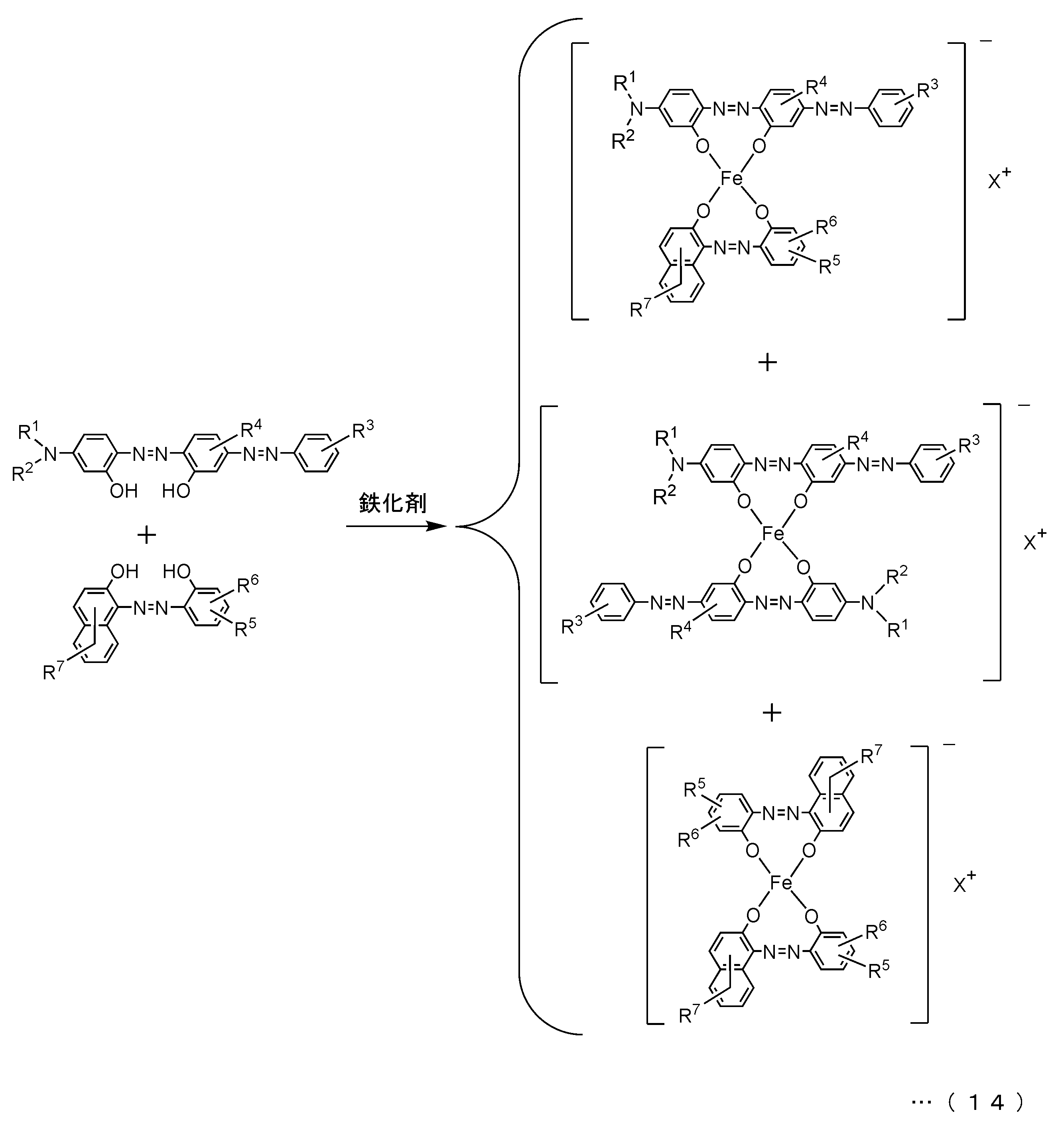
第4工程は、アゾ鉄錯体染料のカチオンを変更・調製する工程は、例えばアルカリ金属溶液、アンモニウム水溶液、及び/又は炭素数3~18のアルキル基を有する一価のアミンを用いて、アゾ色素の混合物を鉄錯体化しアゾ鉄錯体染料を得る工程で得られたアゾ鉄錯体染料のカチオンを所望のカチオンに交換するというイオン交換工程である。
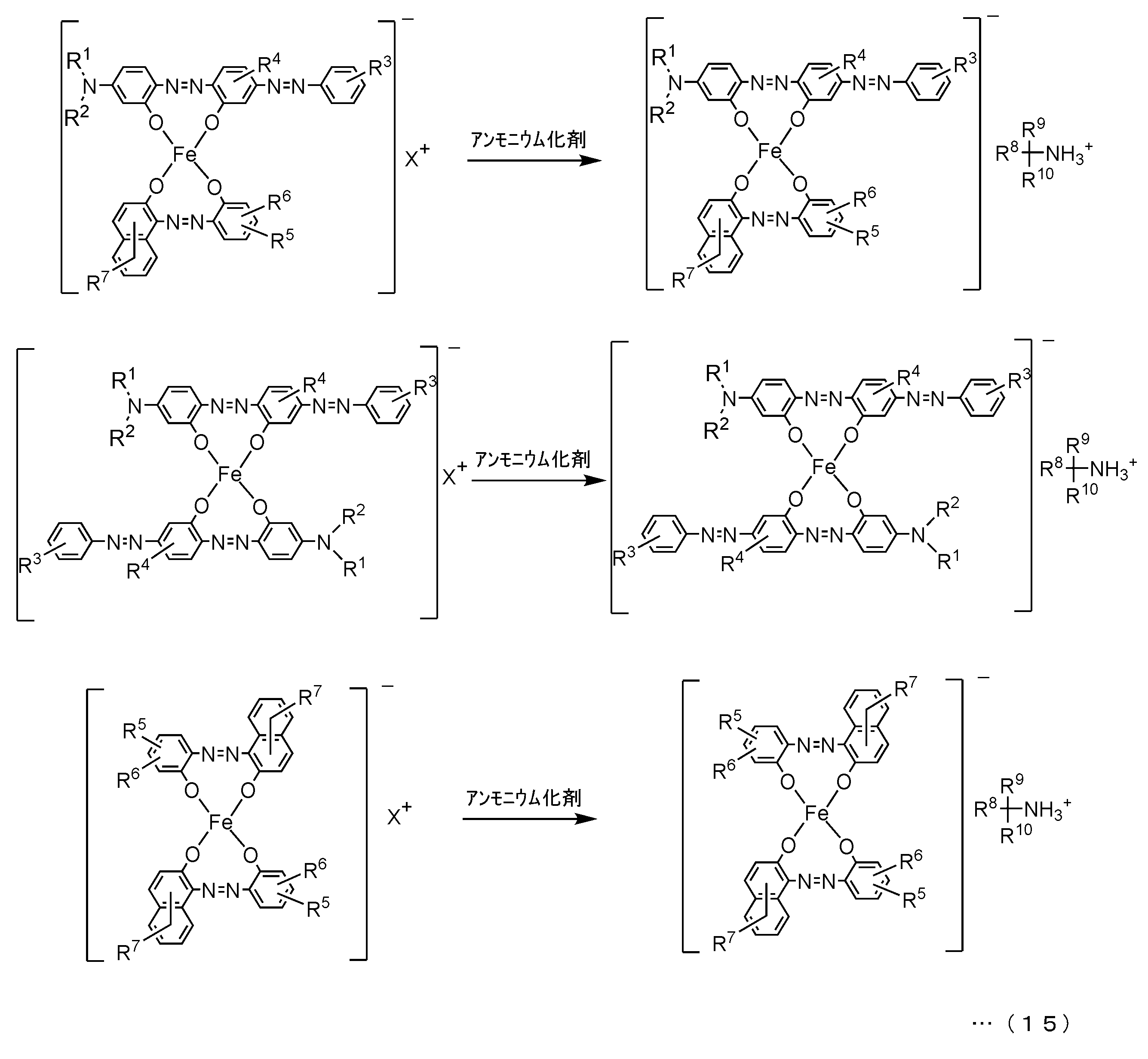
第5工程は、第3工程又は第4工程の後必要に応じて行われ、濾過工程、洗浄工程、乾燥工程、及び粉砕工程を任意に有する。
本発明のアゾ鉄錯体染料の配位子であるジスアゾ配位子(D配位子)は、具体的に下記化学式(16)で表される。


本発明のアゾ鉄錯体染料の配位子であるモノアゾ配位子(M配位子)は、具体的に下記化学式(17)で表される。

本発明のインク組成物は、アゾ鉄錯体染料と有機溶媒としての油性液媒体とを含んでいる。インク組成物におけるアゾ鉄錯体染料の含有率は、3~25質量%であることが好ましく、5~15質量%であることがより好ましく、5~10質量%であることがより一層好ましい。また有機溶媒として、ケトン系有機溶媒、アルコール系有機溶媒、及びエーテル系有機溶媒が挙げられ、中でもケトン系有機溶媒及びアルコール系有機溶媒が好ましい。
p-アミノベンゾニトリル118.0g(1.0mol)と35%塩酸339gをイオン交換水592.0gに加え、氷浴下で-3℃まで冷却し、これに40%亜硝酸ナトリウム水溶液178gを徐々に加え、ジアゾ化反応を行い、ジアゾニウム塩溶液を得た。


p-ニトロアニリン107.5g(0.78mol)と35%塩酸290gをイオン交換水200.0gに加え、撹拌しながら65℃に昇温した。1時間撹拌後、氷浴下-3℃まで冷却した。これに40%亜硝酸ナトリウム水溶液138.5gを徐々に加え、ジアゾ化反応を行い、ジアゾニウム塩溶液を得た。


p-アミノベンゼンスルホンアミド172g(1.00mol)と35%塩酸271gとをイオン交換水600.0gに加え、氷浴下-3℃まで冷却した。これに40%亜硝酸ナトリウム水溶液179.3gを徐々に加えた。さらに尿素2.4g加えてジアゾ化反応を行い、ジアゾニウム塩溶液を得た。


4-アセトアミノフェノン67.6g(0.50mol)と35%塩酸114.6gとをイオン交換水688.0gに加え、氷浴下-3℃まで冷却した。これに40%亜硝酸ナトリウム水溶液90.6gを徐々に加え、ジアゾ化反応を行った。1時間撹拌後、チオ尿素1.9gを加え、ジアゾニウム塩溶液を得た。


5-ニトロ-2-アミノフェノール7.5g(0.05mol)と、35%塩酸13.6gとを、50.0gのイソプロパノールに加え溶解させ、氷浴下、40%亜硝酸ナトリウム水溶液8.0gを徐々に加え、ジアゾ化してジアゾニウム塩溶液を得た。

4-ニトロ-2-アミノフェノール7.5g(0.05mol)と、35%塩酸13.6gとを、50.0gのイソプロパノールに加え溶解させ、氷浴下、40%亜硝酸ナトリウム水溶液8.0gを徐々に加え、ジアゾ化してジアゾニウム塩溶液を得た。

4-クロロ-2-アミノフェノール7.0g(0.05mol)と、35%塩酸13.6gとを、50.0gのイソプロパノールに加え溶解させ、氷浴下、40%亜硝酸ナトリウム水溶液8.0gを徐々に加え、ジアゾ化してジアゾニウム塩溶液を得た。

4-クロロ-2-アミノフェノール7.0g(0.05mol)と、35%塩酸13.6gとを、50.0gのイソプロパノールに加え溶解させ、氷浴下、40%亜硝酸ナトリウム水溶液8.0gを徐々に加え、ジアゾ化してジアゾニウム塩溶液を得た。

4-クロロ-2-アミノフェノール34.0g(0.24mol)と、35%塩酸82.2gとを、182.0gのイソプロパノールに加え溶解させ、氷浴下、40%亜硝酸ナトリウム水溶液48.9gを徐々に加え、ジアゾ化してジアゾニウム塩溶液を得た。
調製例1で得られたジスアゾ色素D-1の5.3g(0.011mol)と、調製例5で得られたモノアゾ色素M-1のウェットケーキ22.1g(含水率40%、0.043mol)とをN,N-ジメチルホルムアミド溶液120gに加え、55℃で1時間撹拌した(ジスアゾ色素:モノアゾ色素=2:8mol)。そこへ41%硫酸第二鉄水溶液12.4g(0.013mol)を滴下し、滴下終了後120℃まで昇温し3時間撹拌した。反応終了後、室温まで放冷し、そこへ20%水酸化ナトリウム水溶液9.0gを加えてpHを10.0に調整し、その反応液に5%tert-アルキル(C12~C14)一級アミン(ダウケミカル社製;商品名PRIMENE 81-R)水溶液103.6gを徐々に加え、40℃で1時間加熱撹拌した。その後、析出物を濾過、水洗、及び乾燥し、下記化学式(31DM)で表されるジスアゾ-モノアゾ鉄錯体(DM体)、下記化学式(31MM)で表されるモノアゾ-モノアゾ鉄錯体(MM体)、及び下記化学式(31DD)で表されるジスアゾ-ジスアゾ鉄錯体(DD体)を含むアゾ鉄錯体染料A-1の23.1gを得た。


メチルエチルケトン中にアゾ鉄錯体染料A-1を10mg/1000ml(10ppm)の濃度になるように溶液を調製した。この溶液について、紫外可視分光光度計(島津製作所社製;商品名UV-1700)を用い、吸光度を測定した。アゾ鉄錯体染料A-1の可視吸収スペクトルを図1に示す。アゾ鉄錯体染料A-1を5%濃度に調整した溶液は充分な黒色を呈した。
アゾ鉄錯体染料A-1のメチルエチルケトン6%溶液を調製し、電気伝導度計(Eutech Instruments社製;商品名CyberScan CON100)を用いて測定した。その結果、電気伝導度Kは1530μS/cmであった。さらにアゾ鉄錯体染料A-1のメチルエチルケトン6%溶液を調製し、電気伝導度計(Knick社製;商品名Conducell 4USF-PG120)を用いて測定した。その結果、電気伝導度Kは1530μS/cmであった。
原子吸光分光光度計(バリアンテクノロジーズジャパンリミテッド社製;商品名SpectrAA-220FS)を用い、アゾ鉄錯体染料中のアルカリ金属イオン(Naイオン)含有量を測定した。その結果、アルカリ金属イオンの含有量は1000ppm以下であった。
調製例1で得られたジスアゾ色素D-1の9.69g(0.020mol)と、調製例6で得られたモノアゾ色素M-2のウェットケーキ10.6g(含水率42%、0.020mol)とをN,N-ジメチルホルムアミド溶液100gに加え、55℃で1時間撹拌した(ジスアゾ色素:モノアゾ色素=5:5mol)。そこへ41%硫酸第二鉄水溶液9.5g(0.010mol)を滴下し、滴下終了後120℃まで昇温し3時間撹拌した。反応終了後、室温まで放冷し、そこへ20%水酸化ナトリウム水溶液9.0gを加えてpHを10.1に調整し、その反応液に5%tert-アルキル(C12~C14)一級アミン(ダウケミカル社製;商品名PRIMENE 81-R)水溶液80.6gを徐々に加え、40℃で1時間加熱撹拌した。その後、析出物を濾過、水洗、及び乾燥し、下記化学式(32DM)で表されるDM体、下記化学式(32MM)で表されるMM体、及び下記化学式(32DD)で表されるDD体を含むアゾ鉄錯体染料A-2の15.6gを得た。
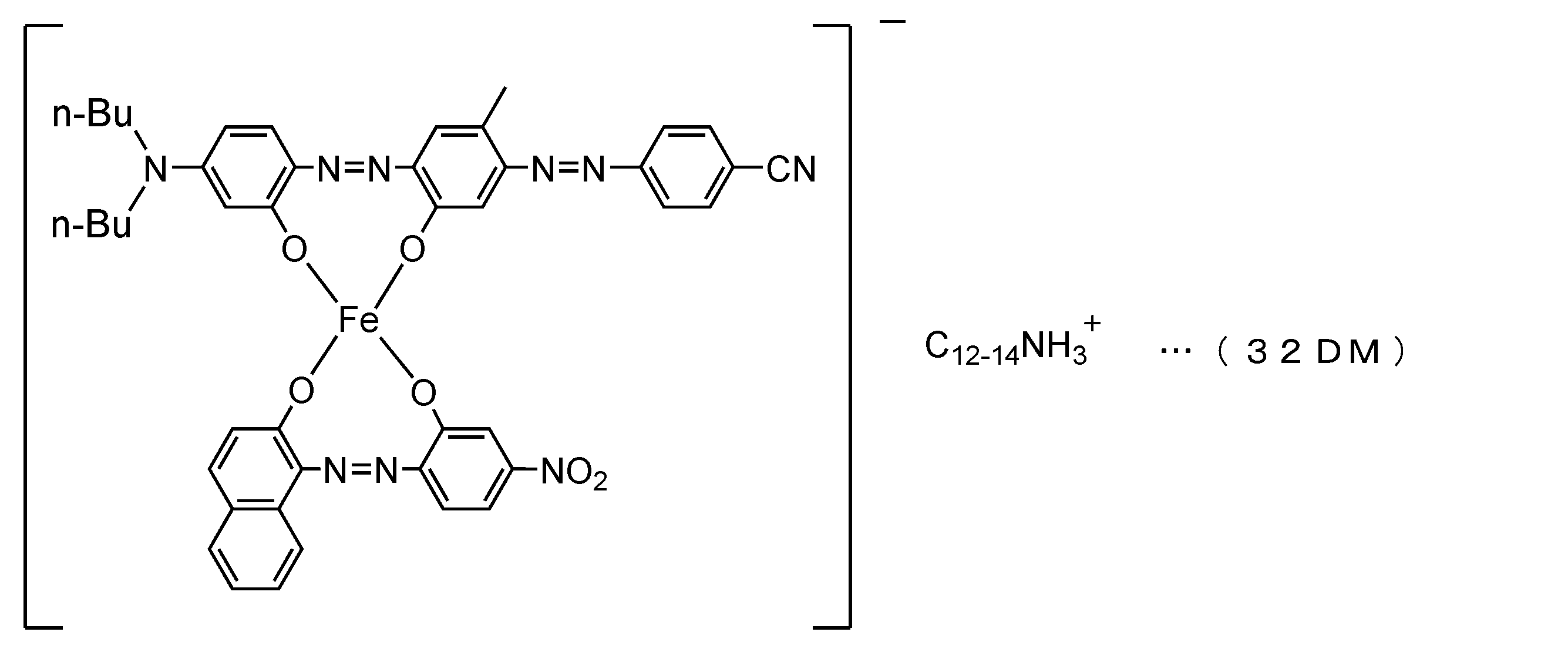


調製例1で得られたジスアゾ色素D-1の5.33g(0.011mol)と、調製例7で得られたモノアゾ色素M-3のウェットケーキ21.9g(含水率40%、0.044mol)とをN,N-ジメチルホルムアミド溶液100gに加え、55℃で1時間撹拌した(ジスアゾ色素:モノアゾ色素=2:8mol)。そこへ41%硫酸第二鉄水溶液12.9g(0.013mol)を滴下し、滴下終了後120℃まで昇温し3時間撹拌した。反応終了後、室温まで放冷し、20%水酸化ナトリウム水溶液9.0gを加えてpHを10.2に調整し、その反応液に5%tert-アルキル(C12~C14)一級アミン(ダウケミカル社製;商品名PRIMENE 81-R)水溶液103.0gを徐々に加え、40℃で1時間加熱撹拌した。その後、析出物を濾過、水洗、及び乾燥し、下記化学式(33DM)で表されるDM体、下記化学式(33MM)で表されるMM体、及び下記化学式(33DD)で表されるDD体を含むアゾ鉄錯体染料A-3の17.8gを得た。


調製例2で得られたジスアゾ色素D-2の5.55g(0.011mol)と調製例6で得られたモノアゾ配位子M-2のウェットケーキ21.9g(含水率40%、0.043mol)とをN,N-ジメチルホルムアミド溶液100gに加え、55℃で1時間撹拌した(ジスアゾ色素:モノアゾ色素=2:8mol)。そこへ41%硫酸第二鉄水溶液12.4g(0.013mol)を滴下し、滴下終了後120℃まで昇温し3時間撹拌した。反応終了後、室温まで放冷し、20%水酸化ナトリウム水溶液9.0gを加えてpHを10.1に調整し、その反応液に5%tert-アルキル(C12~C14)一級アミン(ダウケミカル社製;商品名PRIMENE 81-R)水溶液102.8gを徐々に加え、40℃で1時間加熱撹拌した。その後、析出物を濾過、水洗、及び乾燥し、下記化学式(34DM)で表されるDM体、下記化学式(34MM)で表されるMM体、及び下記化学式(34DD)で表されるDD体を含むアゾ鉄錯体染料A-4の16.5gを得た。


調製例3で得られたジスアゾ色素D-3の12.9g(0.024mol)と、調製例6で得られたモノアゾ色素M-2のウェットケーキ18.7g(含水率40%、0.036mol)とをN,N-ジメチルホルムアミド溶液120gに加え、55℃で1時間撹拌した(ジスアゾ色素:モノアゾ色素=4:6mol)。そこへ41%硫酸第二鉄水溶液15.0g(0.015mol)を滴下し、滴下終了後120℃まで昇温し3時間撹拌した。反応終了後、室温まで放冷し、20%水酸化ナトリウム水溶液9.0gを加えてpHを9.9に調整し、その反応液に5%tert-アルキル(C12~C14)一級アミン(ダウケミカル社製;商品名PRIMENE 81-R)水溶液125.3gを徐々に加え、40℃で1時間加熱撹拌した。その後、析出物を濾過、水洗、及び乾燥し、下記化学式(35DM)で表されるDM体、下記化学式(35MM)で表されるMM体、及び下記化学式(35DD)で表されるDD体を含むアゾ鉄錯体染料A-5の15.9gを得た。
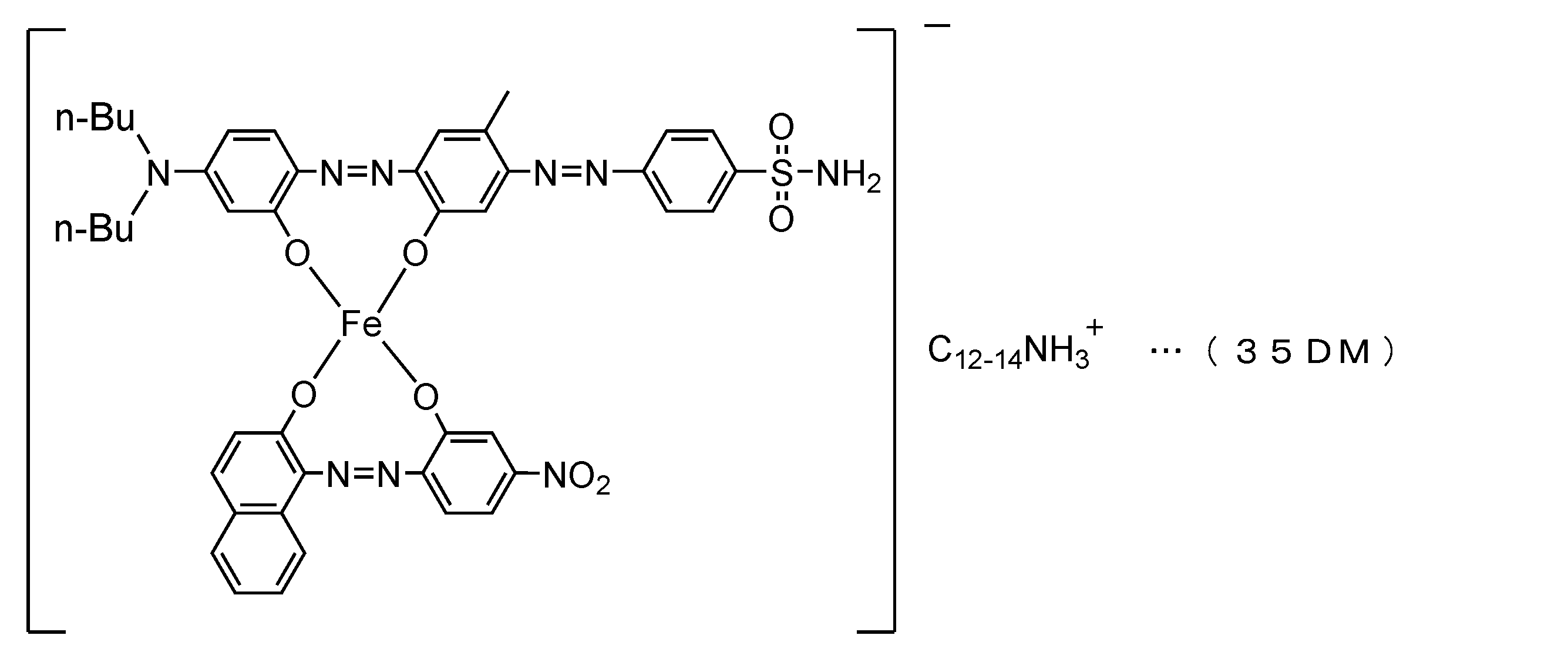


調製例1で得られたジスアゾ色素D-1の5.3g(0.011mol)と、調製例5で得られたモノアゾ色素M-1のウェットケーキ11.2g(含水率40%、0.022mol)と、調製例6で得られたモノアゾ色素M-2のウェットケーキ11.6g(含水率42%、0.022mol)とをN,N-ジメチルホルムアミド溶液120gに加え、55℃で1時間撹拌した(ジスアゾ色素:モノアゾ色素1:モノアゾ色素2=2:4:4mol)。そこへ41%硫酸第二鉄水溶液12.4g(0.013mol)を滴下し、滴下終了後120℃まで昇温し3時間撹拌した。反応終了後、室温まで放冷し、20%水酸化ナトリウム水溶液9.0gを加えてpHを10.1に調整し、その反応液に5%tert-アルキル(C12~C14)一級アミン(ダウケミカル社製;商品名PRIMENE 81-R)水溶液100.4gを徐々に加え、40℃で1時間加熱撹拌した。その後、析出物を濾過、水洗、及び乾燥し、下記化学式(36DM)で表されるDM体、下記化学式(36MM)で表されるMM体、及び下記化学式(36DD)で表されるDD体を含むアゾ鉄錯体染料A-6の14.4gを得た。


調製例5で得られたジスアゾ色素D-3の12.9g(0.024mol)と、調製例8で得られたモノアゾ色素M-4のウェットケーキ32.0g(含水率40%、0.056mol)、イオン交換水200g、n-ブタノール12g、20%水酸化ナトリウム水溶液48gを加え、70℃で30分間撹拌した(ジスアゾ色素:モノアゾ色素=3:7mol)。そこへ41%硫酸第二鉄水溶液20.0g(0.021mol)を滴下し、滴下終了後90℃まで昇温し3時間撹拌した。反応終了後、室温まで放冷し、その反応液に5%tert-アルキル(C12~C14)一級アミン(ダウケミカル社製;商品名PRIMENE 81-R)水溶液191.3gを徐々に加え、40℃で1時間加熱撹拌した。その後、析出物を濾過、水洗、及び乾燥し、下記化学式(37DM)で表されるDM体、下記化学式(37MM)で表されるMM体、及び下記化学式(37DD)で表されるDD体を含むアゾ鉄錯体染料A-7の40.2gを得た。

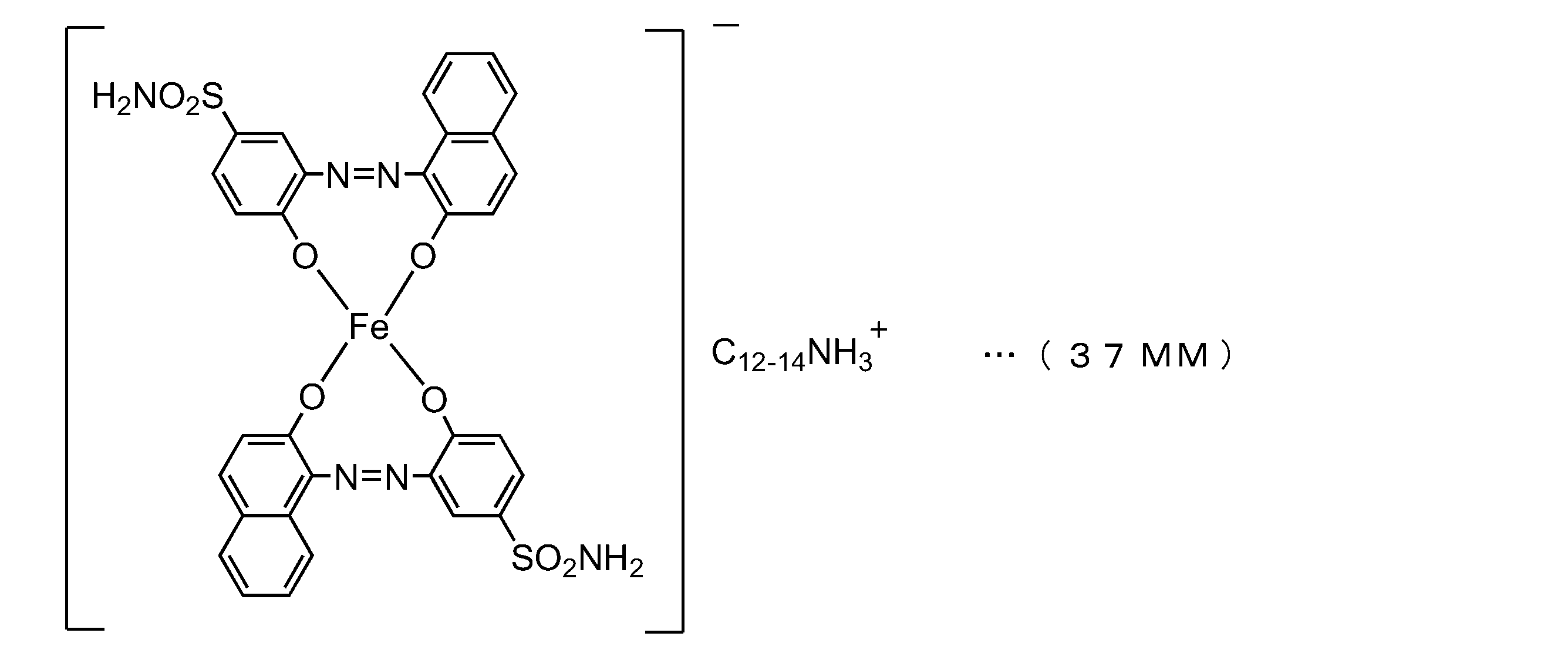

調製例6で得られたモノアゾ色素M-2のウェットケーキ42.5g(含水率42%、0.080mol)と、イオン交換水120gと、n-ブタノール5.7gとを20%水酸化ナトリウム水溶液12.5gに加え、90℃で1時間撹拌した(ジスアゾ色素:モノアゾ色素=0:10mol)。そこへ41%硫酸第二鉄水溶液40.7g(0.042mol)を滴下し、滴下終了後90℃まで昇温し3時間撹拌した。反応終了後、室温まで放冷し、20%水酸化ナトリウム水溶液9.0gを加えてpHを10.1に調整し、その反応液に5%tert-アルキル(C12~C14)一級アミン(ダウケミカル社製;商品名PRIMENE 81-R)水溶液100.4gを徐々に加え、40℃で1時間加熱撹拌を行った。その後、析出物を濾過、水洗、及び乾燥した。その結果下記化学式(38MM)で表されるように、モノアゾ-モノアゾ鉄錯体のみからなるアゾ鉄錯体染料B-1の27.4gを得た。

調製例1で得られたジスアゾ色素D-1のウェットケーキ21.9g(含水率42%、0.026mol)と、尿素2.9gとをN,N-ジメチルホルムアミド溶液100gに加え、50℃で1時間撹拌した(ジスアゾ色素:モノアゾ色素=10:0mol)。そこへ41%硫酸第二鉄水溶液6.33g(0.007mol)を滴下し、滴下終了後120℃まで昇温し3時間撹拌した。反応終了後、室温まで放冷し、20%水酸化ナトリウム水溶液5.0gを加えてpHを10.9に調整し、その反応液に5%tert-アルキル(C12~C14)一級アミン(ダウケミカル社製;商品名PRIMENE 81-R)水溶液80.1gを徐々に加え、35℃で2時間加熱撹拌した。その後、析出物を濾過、水洗、及び乾燥した。その結果下記化学式(39DD)で表されるように、ジスアゾ-ジスアゾ鉄錯体のみからなるアゾ鉄錯体染料B-2の9.41gを得た。

比較例1で得られたアゾ鉄錯体染料B-1の5質量部と比較例2で得られたアゾ鉄錯体染料B-2の5質量部とを、実験用ミニブレンダー(アズワン社製)を用いて粉砕混合し、アゾ鉄錯体染料B-1とアゾ鉄錯体染料B-2の混合物であるアゾ鉄錯体染料B-3の9.9gを得た。
実施例1で得られたアゾ鉄錯体染料A-1、及び比較例1~3で得られたアゾ鉄錯体染料B-1~B-3の可視吸収スペクトルを重ねて図8に示す。アゾ鉄錯体染料B-1の可視吸収スペクトルは、400nm~550nmにアゾ鉄錯体染料A-1のそれよりも強い。これはアゾ鉄錯体染料B-1が強い赤みの色調を呈することを示している。
本発明を適用したアゾ鉄錯体染料A-1~A-7は、DM体、DD体、及びMM体の少なくとも3種類のアゾ鉄錯体を含有している。アゾ鉄錯体染料におけるこれらの相対的な存在比(モル比)は、高速液体クロマトグラフィー(HPLC;島津製作所社製、Prominence)により特定波長で測定したときに得られたクロマトグラムにおけるピークの面積比より求めることができる。実施例1~7で得られたアゾ鉄錯体染料A-1~C-6及び比較例1で得られた比較例1~3で得られたアゾ鉄錯体染料B-1につき、夫々のアゾ鉄錯体染料1mgをジメチルホルムアミド溶液10mlに溶解し、以下の測定条件で測定した。その結果を表4に示す。
高速液体クロマトグラフィー:
カラム:L-COLUMN ODS2 4.6×250mm、5μm
カラム温度:40℃
移動相:
A液:テトラヒドロフラン(富士フイルム和光純薬社製HPLCグレード)/アセトニトリル(同社製)=3/2
B液:超純水/10mMテトラエチルアンモニウム(waters社製)=500/7.5
グラジエント:A液/B液 50:50 → 70:30
測定波長:UV at 254nm

実施例1~7で得られたアゾ鉄錯体染料A-1~A-7及び比較例1~3で得られたアゾ鉄錯体染料B-1~B-3を、濃度5%、10%、15%、及び20%となるようにメチルエチルケトン及びエタノールに夫々投入してアゾ鉄錯体染料溶液を調製し、10分間超音波分散を行った。その後、アゾ鉄錯体染料溶液をメンブレンフィルター(孔径1μm、PTFE)で減圧濾過し、メンブレンフィルター上に不溶解物がないことが確認できた濃度をアゾ鉄錯体染料の最大濃度とした。また、アゾ鉄錯体染料の濃度を5%としたメチルエチルケトン溶液の色相を目視によって観察した。結果を表5に示す。
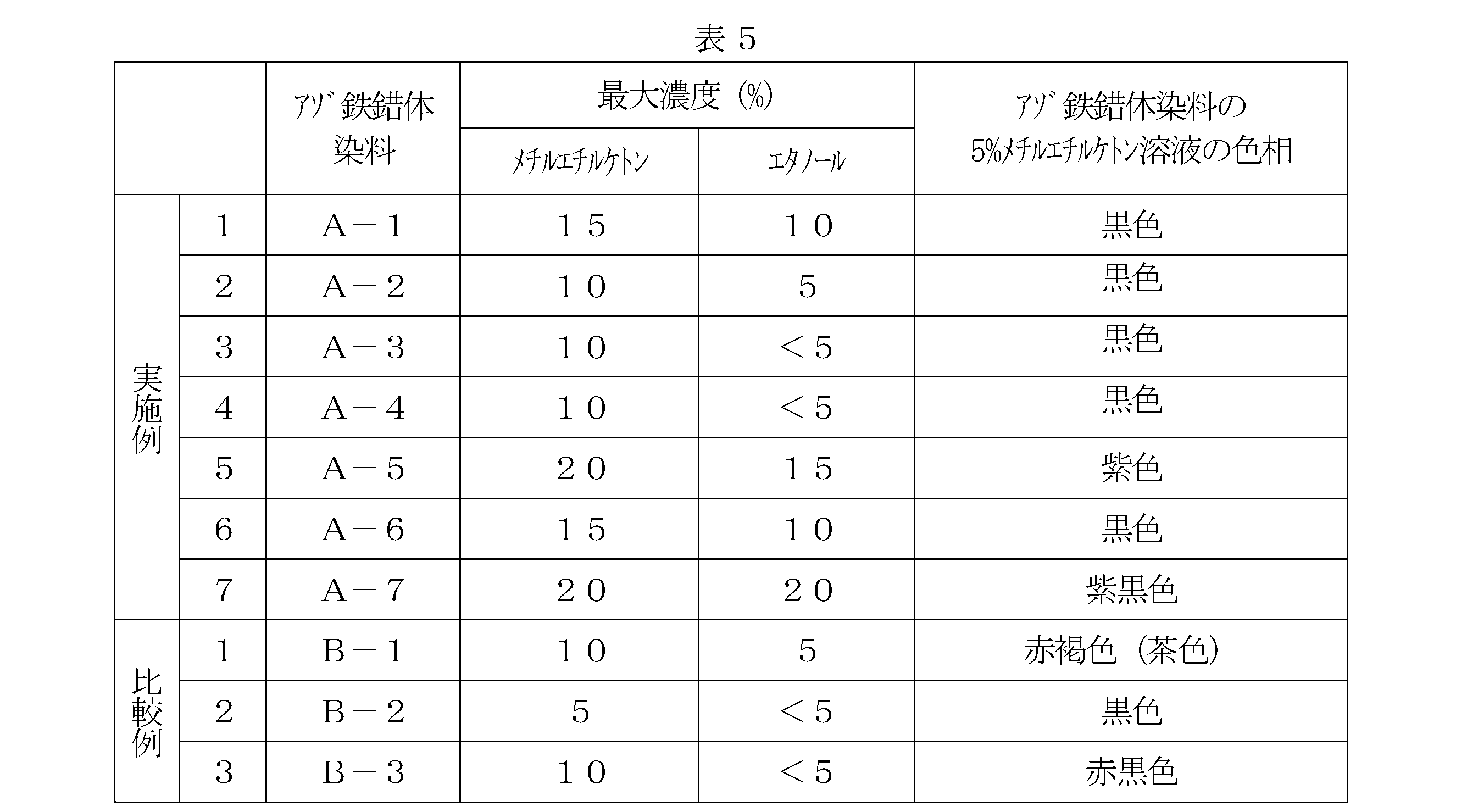
セルロース系樹脂の6質量部、硝酸リチウムの1質量部、及びアゾ鉄錯体染料A-1の3質量部を、メチルエチルケトンの70質量部、エタノールの10質量部、イソプロピルアルコールの10質量部に投入して撹拌して溶解した。その後、混合溶液を目開き1.0μmのフィルターで濾過して、実施例1のインク組成物を得た。このインク組成物を、インクカートリッジに充填し、インクジェットプリンターを用いて印刷し黒色の印字を得た。印字はカスレがなく濃い黒色を呈していた。このことから、インク実施例1のインク組成物の印字濃度及びインクの吐出安定性は良好であると評価した。
アゾ鉄錯体染料A-1に代えてアゾ鉄錯体染料A-2を用いたことを除き、インク実施例1と同様に操作してインク実施例2のインク組成物を得た。このインク組成物を用い、インク実施例1と同様に操作して黒色の印字を得た。印字はカスレがなく濃い黒色を呈していた。このことから、インク実施例2のインク組成物の印字濃度及びインクの吐出安定性は良好であると評価した。
アゾ鉄錯体染料A-1に代えてアゾ鉄錯体染料A-5を用いたことを除き、インク実施例1と同様に操作してインク実施例3のインク組成物を得た。このインク組成物を用い、インク実施例1と同様に操作して黒色の印字を得た。印字はカスレがなく濃い黒色を呈していた。このことから、インク実施例3のインク組成物の印字濃度及びインクの吐出安定性は良好であると評価した。
アゾ鉄錯体染料A-1に代えてアゾ鉄錯体染料A-6を用いたこととpH調整剤としてトリエタノールアミン0.5質量部加えたことを除き、インク実施例1と同様に操作してインク実施例4のインク組成物を得た。このインク組成物を用い、インク実施例1と同様に操作して黒色の印字を得た。印字はカスレがなく濃い黒色を呈していた。このことから、インク実施例4のインク組成物の印字濃度及びインクの吐出安定性は良好であると評価した。
アゾ鉄錯体染料A-1に代えてアゾ鉄錯体染料B-1を用いたことを除き、インク実施例1と同様に操作してインク比較例1のインク組成物を得た。このインク組成物を用い、インク実施例1と同様に操作して印刷媒体に印刷したところ、隠蔽性のない薄い茶色の印字を得た。
アゾ鉄錯体染料A-1に代えてアゾ鉄錯体染料B-2を用いたことを除き、インク実施例1と同様に操作してインク比較例2のインク組成物を得た。しかしこのインク組成物は10分ほど静置すると、析出物を生じた。これを濾過により除去した。インク組成物を用い、インク実施例1と同様に操作して印刷媒体に印刷したところ、薄い黒色の印字を得た。
アゾ鉄錯体染料A-1に代えてアゾ鉄錯体染料B-3を用いたことを除き、インク実施例1と同様に操作してインク比較例3のインク組成物を得た。このインク組成物を用い、インク実施例1と同様に操作して印刷媒体に印刷したところ、隠蔽性のない薄い茶色の印字を得た。
Claims (10)
- 下記化学式(1)

- 前記R3が同一芳香環上のアゾ基に対してパラ位に結合しており、シアノ基、ニトロ基、アセチル基、スルホアマイド基、及びハロゲン原子から選ばれる前記電子吸引性基であることを特徴とする請求項1に記載のアゾ鉄錯体染料。
- 下記化学式(2)
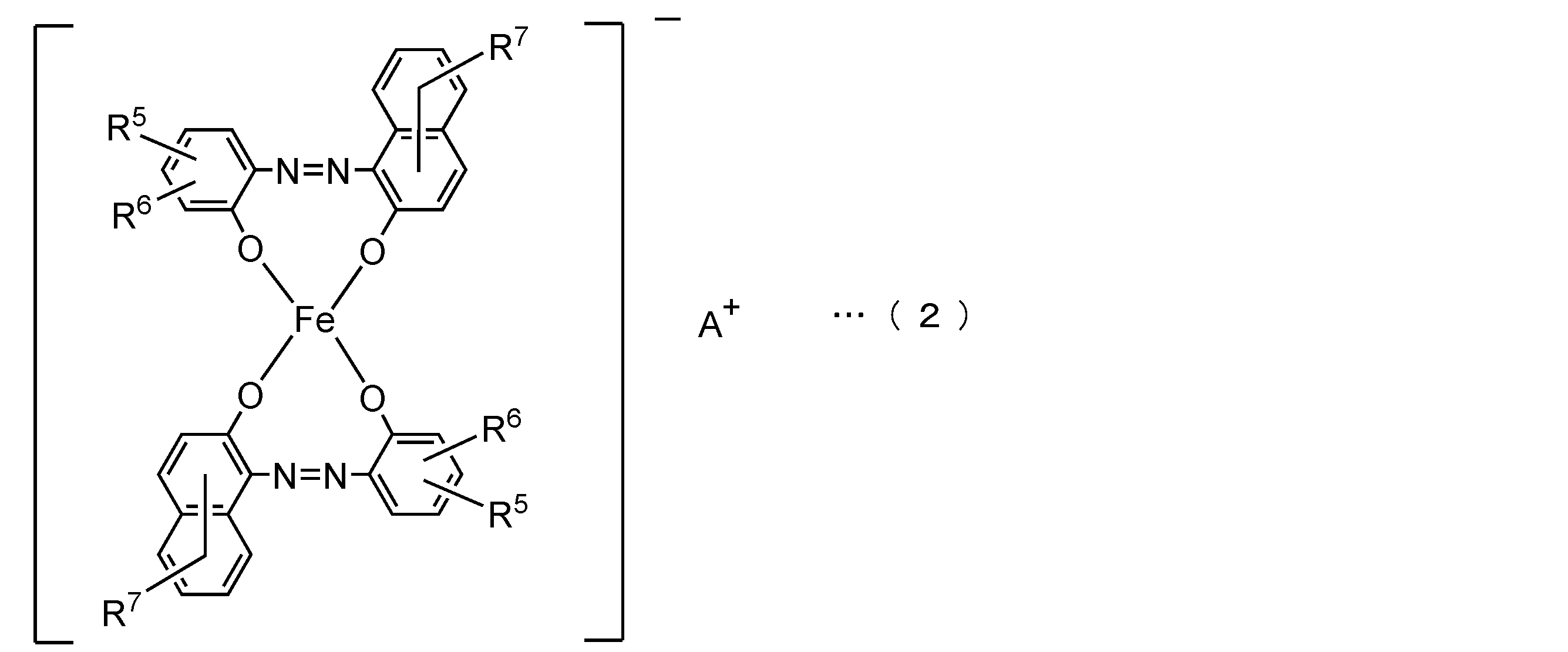
- 下記化学式(3)

- 前記一価のカチオンが、アルカリ金属イオン、アンモニウムイオン、及び下記化学式(4)

- 前記ジスアゾ-モノアゾ鉄錯体、前記モノアゾ-モノアゾ鉄錯体、及び前記ジスアゾ-ジスアゾ鉄錯体が、高速液体クロマトグラフィーにおいて254nmの波長で測定することにより得られたクロマトグラムのピーク面積比を、夫々20~70:5~80:0~50としていることを特徴とする請求項4に記載のアゾ鉄錯体染料。
- 請求項1から6のいずれかに記載のアゾ鉄錯体染料と、有機溶媒とを含むことを特徴とするインク組成物。
- インクジェットプリンター用であることを特徴とする請求項7に記載のインク組成物。
- 下記化学式(5)


前記アゾ鉄錯体アニオンと、アルカリ金属溶液及び/又はアンモニウム化剤とを反応させて前記アゾ鉄錯体アニオンに組み合わせられるカチオンを導入するイオン交換工程とを有することにより、下記化学式(1)

- 前記鉄錯体化工程において、前記ジスアゾ色素と前記モノアゾ色素とを2:8~8:2のモル比とすることを特徴とする請求項9に記載のアゾ鉄錯体染料の製造方法。
Priority Applications (5)
| Application Number | Priority Date | Filing Date | Title |
|---|---|---|---|
| US18/272,520 US12384920B2 (en) | 2021-01-29 | 2022-01-27 | Azo iron complex dye, ink composition containing same, and method for producing azo iron complex dye |
| EP22745955.9A EP4286367A4 (en) | 2021-01-29 | 2022-01-27 | IRON-COMPLEXED AZO DYE, INK COMPOSITION CONTAINING SAME, AND METHOD FOR PRODUCING IRON-COMPLEXED AZO DYE |
| JP2022578460A JP7828083B2 (ja) | 2021-01-29 | 2022-01-27 | アゾ鉄錯体染料、それを含むインク組成物、及びアゾ鉄錯体染料の製造方法 |
| CN202280009818.2A CN116783158B (zh) | 2021-01-29 | 2022-01-27 | 偶氮铁络合物染料、包含其的油墨组合物及偶氮铁络合物染料的制造方法 |
| KR1020237023047A KR20230136736A (ko) | 2021-01-29 | 2022-01-27 | 아조철착체 염료, 이를 함유하는 잉크 조성물, 및 아조철착체염료의 제조 방법 |
Applications Claiming Priority (2)
| Application Number | Priority Date | Filing Date | Title |
|---|---|---|---|
| JP2021-013104 | 2021-01-29 | ||
| JP2021013104 | 2021-01-29 |
Publications (1)
| Publication Number | Publication Date |
|---|---|
| WO2022163736A1 true WO2022163736A1 (ja) | 2022-08-04 |
Family
ID=82654712
Family Applications (1)
| Application Number | Title | Priority Date | Filing Date |
|---|---|---|---|
| PCT/JP2022/002988 Ceased WO2022163736A1 (ja) | 2021-01-29 | 2022-01-27 | アゾ鉄錯体染料、それを含むインク組成物、及びアゾ鉄錯体染料の製造方法 |
Country Status (6)
| Country | Link |
|---|---|
| US (1) | US12384920B2 (ja) |
| EP (1) | EP4286367A4 (ja) |
| JP (1) | JP7828083B2 (ja) |
| KR (1) | KR20230136736A (ja) |
| CN (1) | CN116783158B (ja) |
| WO (1) | WO2022163736A1 (ja) |
Cited By (1)
| Publication number | Priority date | Publication date | Assignee | Title |
|---|---|---|---|---|
| EP4381016A4 (en) * | 2021-08-04 | 2025-07-09 | Videojet Technologies Inc | METAL COMPLEX DYES FOR INKJET PRINTING |
Families Citing this family (1)
| Publication number | Priority date | Publication date | Assignee | Title |
|---|---|---|---|---|
| CN118185381A (zh) * | 2024-03-06 | 2024-06-14 | 深圳千岸科技股份有限公司 | 一种马克笔墨水及其制备方法 |
Citations (8)
| Publication number | Priority date | Publication date | Assignee | Title |
|---|---|---|---|---|
| JPS5123518A (ja) | 1974-07-19 | 1976-02-25 | Taoka Chemical Co Ltd | Kinzokuganjuazosenryono seiho |
| JPS62129358A (ja) * | 1985-11-30 | 1987-06-11 | Hodogaya Chem Co Ltd | 金属錯塩化合物および電子写真用トナ− |
| JPS634992A (ja) | 1986-06-25 | 1988-01-09 | Hodogaya Chem Co Ltd | 金属錯塩化合物及び近赤外線吸収剤 |
| JPH0213904A (ja) * | 1988-06-30 | 1990-01-18 | Sumitomo Chem Co Ltd | 染料系偏光膜 |
| JPH04283270A (ja) * | 1990-10-15 | 1992-10-08 | Sandoz Ag | ジスアゾ化合物の鉄錯体 |
| JPH05247360A (ja) | 1990-10-15 | 1993-09-24 | Sandoz Ag | 金属化ジスアゾ化合物の鉄−錯体混合物 |
| JP2002080739A (ja) * | 1999-07-14 | 2002-03-19 | Orient Chem Ind Ltd | モノアゾ金属錯塩化合物の製法及びその関連技術 |
| JP2017222751A (ja) * | 2016-06-14 | 2017-12-21 | オリヱント化学工業株式会社 | アゾ含鉄染料及びそれを含有する油性インク組成物 |
Family Cites Families (4)
| Publication number | Priority date | Publication date | Assignee | Title |
|---|---|---|---|---|
| US4762524A (en) * | 1987-02-05 | 1988-08-09 | Hoechst Celanese Corporation | Composition comprising the addition product of a vinyl-sulfone dye and a secondary amine and process for dyeing a polyamide therewith |
| JPH11217530A (ja) * | 1998-02-02 | 1999-08-10 | Hodogaya Chem Co Ltd | 記録液 |
| US6548648B1 (en) * | 1999-07-14 | 2003-04-15 | Orient Chemical Industries, Ltd. | Process for preparing a monoazo metal complex salt compound for charge control agent and toner for developing electrostatic images |
| US6589701B2 (en) * | 2000-07-28 | 2003-07-08 | Canon Kabushiki Kaisha | Dry toner, image forming method and process cartridge |
-
2022
- 2022-01-27 EP EP22745955.9A patent/EP4286367A4/en active Pending
- 2022-01-27 WO PCT/JP2022/002988 patent/WO2022163736A1/ja not_active Ceased
- 2022-01-27 KR KR1020237023047A patent/KR20230136736A/ko active Pending
- 2022-01-27 JP JP2022578460A patent/JP7828083B2/ja active Active
- 2022-01-27 CN CN202280009818.2A patent/CN116783158B/zh active Active
- 2022-01-27 US US18/272,520 patent/US12384920B2/en active Active
Patent Citations (8)
| Publication number | Priority date | Publication date | Assignee | Title |
|---|---|---|---|---|
| JPS5123518A (ja) | 1974-07-19 | 1976-02-25 | Taoka Chemical Co Ltd | Kinzokuganjuazosenryono seiho |
| JPS62129358A (ja) * | 1985-11-30 | 1987-06-11 | Hodogaya Chem Co Ltd | 金属錯塩化合物および電子写真用トナ− |
| JPS634992A (ja) | 1986-06-25 | 1988-01-09 | Hodogaya Chem Co Ltd | 金属錯塩化合物及び近赤外線吸収剤 |
| JPH0213904A (ja) * | 1988-06-30 | 1990-01-18 | Sumitomo Chem Co Ltd | 染料系偏光膜 |
| JPH04283270A (ja) * | 1990-10-15 | 1992-10-08 | Sandoz Ag | ジスアゾ化合物の鉄錯体 |
| JPH05247360A (ja) | 1990-10-15 | 1993-09-24 | Sandoz Ag | 金属化ジスアゾ化合物の鉄−錯体混合物 |
| JP2002080739A (ja) * | 1999-07-14 | 2002-03-19 | Orient Chem Ind Ltd | モノアゾ金属錯塩化合物の製法及びその関連技術 |
| JP2017222751A (ja) * | 2016-06-14 | 2017-12-21 | オリヱント化学工業株式会社 | アゾ含鉄染料及びそれを含有する油性インク組成物 |
Non-Patent Citations (1)
| Title |
|---|
| See also references of EP4286367A4 |
Cited By (1)
| Publication number | Priority date | Publication date | Assignee | Title |
|---|---|---|---|---|
| EP4381016A4 (en) * | 2021-08-04 | 2025-07-09 | Videojet Technologies Inc | METAL COMPLEX DYES FOR INKJET PRINTING |
Also Published As
| Publication number | Publication date |
|---|---|
| US20240409746A1 (en) | 2024-12-12 |
| KR20230136736A (ko) | 2023-09-26 |
| EP4286367A1 (en) | 2023-12-06 |
| CN116783158A (zh) | 2023-09-19 |
| JPWO2022163736A1 (ja) | 2022-08-04 |
| EP4286367A4 (en) | 2024-12-11 |
| US12384920B2 (en) | 2025-08-12 |
| CN116783158B (zh) | 2025-11-04 |
| JP7828083B2 (ja) | 2026-03-11 |
Similar Documents
| Publication | Publication Date | Title |
|---|---|---|
| JP7828083B2 (ja) | アゾ鉄錯体染料、それを含むインク組成物、及びアゾ鉄錯体染料の製造方法 | |
| JP3423784B2 (ja) | 油性黒色インキ組成物 | |
| JP6727647B2 (ja) | アゾ含鉄染料及びそれを含有する油性インク組成物 | |
| TW200424268A (en) | Tris-azo dyes for ink jet printing | |
| JPH10287836A (ja) | インクジェットインキの製造方法 | |
| JP2025168336A (ja) | サーマルインクジェットプリンター用インク組成物 | |
| HK40104580A (en) | Azo iron complex dye, ink composition containing same, and method for producing azo iron complex dye | |
| JP2571613B2 (ja) | 水溶性黄色モノアゾ染料 | |
| US7220843B2 (en) | Methanesulfonamide azo dyes | |
| JPH11246803A (ja) | インクジェットインキの製造方法 | |
| US7799122B2 (en) | Azo compounds | |
| JPS6356575A (ja) | 水性インク組成物 | |
| JPH02233775A (ja) | インクジェット記録液及びインクジェット記録方法 | |
| JP2000239548A (ja) | アルコール溶解性アゾ染料及びアルコール系インキ組成物 | |
| EP0645435A1 (en) | Trisazo dye, process for producing the same and aqueous ink composition containing the same | |
| CN103030991A (zh) | 有机溶剂可溶的金属络合物偶氮染料 | |
| JP2005213403A (ja) | カーボンブラックおよび有機顔料分散液の製造方法 | |
| JPH02233778A (ja) | インクジェット記録液及びインクジェット記録方法 | |
| JPH05311084A (ja) | アゾ液体染料およびそれを含むインキ組成物 | |
| JPH02233777A (ja) | インクジェット記録液及びインクジェット記録方法 | |
| JP3511672B2 (ja) | 記録液及び該記録液を用いたインクジェット記録方法 | |
| JP2024167094A (ja) | 筆記具用インキ組成物 | |
| JP3412336B2 (ja) | 記録液 | |
| JPS6356574A (ja) | 水性インク組成物 | |
| CN102766347A (zh) | 二偶氮染料及其黑色墨水组合物 |
Legal Events
| Date | Code | Title | Description |
|---|---|---|---|
| 121 | Ep: the epo has been informed by wipo that ep was designated in this application |
Ref document number: 22745955 Country of ref document: EP Kind code of ref document: A1 |
|
| ENP | Entry into the national phase |
Ref document number: 2022578460 Country of ref document: JP Kind code of ref document: A |
|
| WWE | Wipo information: entry into national phase |
Ref document number: 202280009818.2 Country of ref document: CN |
|
| WWE | Wipo information: entry into national phase |
Ref document number: 18272520 Country of ref document: US |
|
| WWE | Wipo information: entry into national phase |
Ref document number: 2022745955 Country of ref document: EP |
|
| NENP | Non-entry into the national phase |
Ref country code: DE |
|
| ENP | Entry into the national phase |
Ref document number: 2022745955 Country of ref document: EP Effective date: 20230829 |
|
| WWG | Wipo information: grant in national office |
Ref document number: 18272520 Country of ref document: US |
|
| WWG | Wipo information: grant in national office |
Ref document number: 202280009818.2 Country of ref document: CN |