WO2022163794A1 - 小児がん治療用医薬組成物 - Google Patents
小児がん治療用医薬組成物 Download PDFInfo
- Publication number
- WO2022163794A1 WO2022163794A1 PCT/JP2022/003228 JP2022003228W WO2022163794A1 WO 2022163794 A1 WO2022163794 A1 WO 2022163794A1 JP 2022003228 W JP2022003228 W JP 2022003228W WO 2022163794 A1 WO2022163794 A1 WO 2022163794A1
- Authority
- WO
- WIPO (PCT)
- Prior art keywords
- months
- alk
- alectinib
- cancer
- less
- Prior art date
- Legal status (The legal status is an assumption and is not a legal conclusion. Google has not performed a legal analysis and makes no representation as to the accuracy of the status listed.)
- Ceased
Links
Images


Classifications
-
- A—HUMAN NECESSITIES
- A61—MEDICAL OR VETERINARY SCIENCE; HYGIENE
- A61K—PREPARATIONS FOR MEDICAL, DENTAL OR TOILETRY PURPOSES
- A61K31/00—Medicinal preparations containing organic active ingredients
- A61K31/33—Heterocyclic compounds
- A61K31/395—Heterocyclic compounds having nitrogen as a ring hetero atom, e.g. guanethidine or rifamycins
- A61K31/535—Heterocyclic compounds having nitrogen as a ring hetero atom, e.g. guanethidine or rifamycins having six-membered rings with at least one nitrogen and one oxygen as the ring hetero atoms, e.g. 1,2-oxazines
- A61K31/5375—1,4-Oxazines, e.g. morpholine
- A61K31/5377—1,4-Oxazines, e.g. morpholine not condensed and containing further heterocyclic rings, e.g. timolol
-
- A—HUMAN NECESSITIES
- A61—MEDICAL OR VETERINARY SCIENCE; HYGIENE
- A61K—PREPARATIONS FOR MEDICAL, DENTAL OR TOILETRY PURPOSES
- A61K9/00—Medicinal preparations characterised by special physical form
- A61K9/10—Dispersions; Emulsions
-
- A—HUMAN NECESSITIES
- A61—MEDICAL OR VETERINARY SCIENCE; HYGIENE
- A61K—PREPARATIONS FOR MEDICAL, DENTAL OR TOILETRY PURPOSES
- A61K9/00—Medicinal preparations characterised by special physical form
- A61K9/0012—Galenical forms characterised by the site of application
- A61K9/0043—Nose
-
- A—HUMAN NECESSITIES
- A61—MEDICAL OR VETERINARY SCIENCE; HYGIENE
- A61K—PREPARATIONS FOR MEDICAL, DENTAL OR TOILETRY PURPOSES
- A61K9/00—Medicinal preparations characterised by special physical form
- A61K9/0012—Galenical forms characterised by the site of application
- A61K9/0053—Mouth and digestive tract, i.e. intraoral and peroral administration
-
- A—HUMAN NECESSITIES
- A61—MEDICAL OR VETERINARY SCIENCE; HYGIENE
- A61K—PREPARATIONS FOR MEDICAL, DENTAL OR TOILETRY PURPOSES
- A61K9/00—Medicinal preparations characterised by special physical form
- A61K9/0012—Galenical forms characterised by the site of application
- A61K9/0053—Mouth and digestive tract, i.e. intraoral and peroral administration
- A61K9/0056—Mouth soluble or dispersible forms; Suckable, eatable, chewable coherent forms; Forms rapidly disintegrating in the mouth; Lozenges; Lollipops; Bite capsules; Baked products; Baits or other oral forms for animals
-
- A—HUMAN NECESSITIES
- A61—MEDICAL OR VETERINARY SCIENCE; HYGIENE
- A61P—SPECIFIC THERAPEUTIC ACTIVITY OF CHEMICAL COMPOUNDS OR MEDICINAL PREPARATIONS
- A61P35/00—Antineoplastic agents
-
- A—HUMAN NECESSITIES
- A61—MEDICAL OR VETERINARY SCIENCE; HYGIENE
- A61P—SPECIFIC THERAPEUTIC ACTIVITY OF CHEMICAL COMPOUNDS OR MEDICINAL PREPARATIONS
- A61P35/00—Antineoplastic agents
- A61P35/04—Antineoplastic agents specific for metastasis
-
- A—HUMAN NECESSITIES
- A61—MEDICAL OR VETERINARY SCIENCE; HYGIENE
- A61P—SPECIFIC THERAPEUTIC ACTIVITY OF CHEMICAL COMPOUNDS OR MEDICINAL PREPARATIONS
- A61P43/00—Drugs for specific purposes, not provided for in groups A61P1/00-A61P41/00
Definitions
- the present invention relates to pharmaceutical compositions, solutions, suspensions, uses, methods, etc., containing alectinib or a salt thereof, for treating cancer in children under the age of 2.
- ALK Advanced Lymphoma Kinase
- ALK fusion gene The expression of the ALK fusion gene was reported relatively early in anaplastic large cell lymphoma (ALCL) and inflammatory myofibroblastic tumor (IMT), which frequently occur in children/adolescents and young adults.
- ALCL anaplastic large cell lymphoma
- IMT inflammatory myofibroblastic tumor
- NPM-ALK fusion gene due to the t(2;5)(p23;q35) translocation was first reported in 1994. Since then, several ALK fusion genes including NPM-ALK have been found in ALCL. It has been found to be expressed in -85% (Non-Patent Document 1: Science. 1994 Mar 4;263(5151):1281-4., Non-Patent Document 2: Blood. 1997 Mar 1;89(5): 1483-90.).
- IMT is a relatively rare soft tissue sarcoma that most commonly occurs in the lungs and soft tissues, most commonly in the teens and twenties.
- the TPM3/4-ALK fusion gene was identified in IMT, and subsequently, about 50% of IMTs were found to have the TPM3/4-ALK fusion gene, and it has been reported that ALK translocations are common in children.
- Non-Patent Document 3 Am J Pathol. 2000 Aug;157(2):377-84
- Recent studies have revealed that there are cases with different combinations of ALK fusions other than the TPK3/4-ALK fusion gene in IMTs, and it has been reported that ALK fusion genes are detected in the majority of IMTs.
- Non-Patent Document 4 Cancer Discov. 2014 Aug;4(8):889-95).
- Non-Patent Document 5 Biochem J. 2008 Dec 1;416(2):153-9. It was found that germline mutations in the ALK gene were detected in familial neuroblastoma, which accounts for 1-2% of all cases (Non-Patent Document 6: Nature. 2008 Oct 16;455(7215):930-5.) .
- ALK protein amplification and the presence of the ATIC-ALK fusion gene have also been reported in rhabdomyosarcoma. 2002 Jul 1;100(1):49-56; Non-Patent Document 8: Mod Pathol. 2013 Jun;26(6):772-81; Non-Patent Document 9: J Clin Oncol.
- Non-Patent Documents 8, 9 Furthermore, in Ewing's sarcoma, there is a report that expression of ALK protein was observed in 50% or more (Non-Patent Document 10: Int J Cancer. 2013 Jul 15;133(2):427-36.).
- Patent Document 7 Mod Pathol. 2002 Sep;15(9):931-8.).
- the prognosis of recurrent pediatric malignant solid tumors is poor, and the median overall survival is about 1 to 2 years regardless of cancer type. , there are rare patients with long-term survival. Due to the rarity of recurrent pediatric malignant solid tumors, there is almost no established standard treatment regardless of cancer type, and there is a need for therapeutic agents that are effective regardless of cancer type.
- crizotinib a first-generation ALK inhibitor, COG (Children's Oncology Group), a US pediatric cancer research group, has identified relapsed/refractory pediatric malignant solid tumors, ALK fusion gene-positive ALCL and neuroblastoma, and ALK fusion. Clinical development has been conducted in other malignant solid tumors, including gene-positive IMT, and the efficacy of adult dose-equivalent crizotinib for pediatric neuroblastoma with ALK mutation, IMT, and ALCL has been reported ( Non-Patent Document 12: Journal of Clinical Oncology 2017 Oct 1;35(28):3215-21).
- ALK abnormalities are found in a wide variety of pediatric malignant solid tumors, and ALK inhibitors against ALK abnormalities are considered important targets for therapeutic development in the field of pediatric cancer. It is desired to provide a novel therapeutic agent containing alectinib, a second-generation ALK inhibitor, as an active ingredient.
- PK pharmacokinetic
- compositions with optimized dosage regimens for children under two years of age. That is, the present invention provides pharmaceutical compositions, solutions, suspensions, uses, and methods of the following aspects.
- ⁇ 3> (i) 20 mg to 60 mg of alectinib or its salt converted to free form at a time, 1) For children aged 7 months to less than 13 months, once a day or twice a day; or 2) For children aged 13 months to less than 20 months, twice a day; or , (ii) 40 mg to 80 mg of alectinib or its salt converted to free form, twice a day for children aged 20 months or more and less than 24 months;
- Pharmaceutical composition for treatment of pediatric cancer with ALK abnormality for administration ⁇ 4> ALK gene abnormality in which the ALK abnormality is an ALK fusion gene, activating gene mutation, or copy number increase, or an abnormality is recognized
- the pediatric malignant solid tumor is inflammatory myofibroblastic tumor, sarcoma, central nervous system tumor, skin tumor, retinoblastoma, lung cancer, renal cell carcinoma, undifferentiated thyroid cancer, thymus cancer, ovarian cancer, gallbladder/extrahepatic bile duct epithelial tumor, thyroid cancer, germ cell tumor, malignant fibrous histiocytoma, esophageal cancer, gastric cancer, colorectal cancer, breast cancer, or liver cancer
- ⁇ 5-3> The pharmaceutical composition according to any one of ⁇ 1> to ⁇ 5-1>, wherein the malignant lymphoma is Hodgkin's lymphoma or non-Hodgkin's lymphoma.
- ⁇ 5-4> The pharmaceutical composition according to ⁇ 5-3>, wherein the non-Hodgkin's lymphoma is Burkitt's lymphoma, diffuse large B-cell lymphoma, lymphoblastic lymphoma, or anaplastic large cell lymphoma. thing.
- ⁇ 6> The pharmaceutical composition of any one of ⁇ 1> to ⁇ 5-4>, wherein the pediatric cancer is metastatic, unresectable, or has a recurrent lesion.
- ⁇ 6-1> The pharmaceutical composition according to any one of ⁇ 1> to ⁇ 5-4>, wherein the pediatric cancer is refractory or recurrent.
- ⁇ 7> The pharmaceutical composition according to any one of ⁇ 1> to ⁇ 6-1>, which is used for oral administration or tube administration.
- ⁇ 8> A solution or suspension containing the pharmaceutical composition according to any one of ⁇ 1> to ⁇ 7>.
- ⁇ 9A> At least one selected from the following (a) to (d), or any combination of two or more, including alectinib or a salt thereof for administration to children aged 7 months or more and less than 24 months
- a pharmaceutical composition, solution or suspension characterized by: (a) Dosage: (a) The daily dose is 20 mg to 160 mg in terms of free form; (b) 1) 20 mg to 120 mg in free form for children aged 7 months to less than 13 months, 2) 40 mg to 120 mg in terms of free form for children aged 13 months or more and less than 20 months, or 3) For children aged 20 to 24 months, 80 mg to 160 mg in free form, is the daily dose; (C) (i) 20 mg to 60 mg once in terms of free form, 1) For children aged 7 months to less than 13 months, once a day or twice a day; or 2) For children aged 13 months to less than 20 months, twice a day; or , (ii) 40 mg to 80 mg once in terms of free form, Twice daily administration to children aged 20 months to less than 24 months
- ⁇ 9B> Use of alectinib or a salt thereof for producing the pharmaceutical composition, solution or suspension of ⁇ 9A> above.
- ALK abnormality including administration of a pharmaceutical composition containing alectinib or a salt thereof, characterized by at least one selected from the above (a) to (d), or any combination of two or more A method for treating childhood cancer with cancer.
- the ALK abnormality is an ALK fusion gene, an activating gene mutation, an ALK gene abnormality that is an increase in copy number, and/or an abnormal ALK protein expression ⁇ 9A> to ⁇ 9C>
- the pharmaceutical composition, solution, suspension, use, and method of the present invention provide a pharmaceutical composition with a novel dosage and administration that can be expected to be effective and safe in the treatment of cancer in children under the age of two.
- Figure 1 is a graph showing changes in trough concentration when 20 mg to 80 mg of alectinib was administered twice daily to hypothetical Japanese under 24 months of age.
- FIG. 2 is a graph showing changes in Cmax and AUC ss after administration of 20 mg of alectinib once daily to hypothetical Japanese under 13 months of age.
- FIG. 3 is a graph showing changes in trough concentration when 20 mg to 40 mg of alectinib was administered twice daily to hypothetical Japanese aged 13 months to less than 24 months.
- Alectinib has the formula (I)
- the compound represented by the compound name 9-ethyl-6,6-dimethyl-8-(4-morpholin-4-yl-piperidin-1-yl)-11-oxo-6,11-dihydro-5H-benzo [ b] means carbazole-3-carbonitrile.
- the "salt" of alectinib is preferably a pharmaceutically acceptable salt
- examples of the “pharmaceutically acceptable salt” include hydrochloride, hydrobromide, hydroiodide, phosphate, sulfonates such as phosphonates, sulfates, methanesulfonates, p-toluenesulfonates; carboxylates such as acetates, citrates, malate, tartrates, succinates, salicylates; Alternatively, alkali metal salts such as sodium salts and potassium salts; alkaline earth metal salts such as magnesium salts and calcium salts; ammonium salts such as ammonium salts, alkylammonium salts, dialkylammonium salts, trialkylammonium salts and tetraalkylammonium salts. and so on.
- Preferred is the hydrochloride, most preferred is the monohydrochloride.
- Alectinib or a salt thereof
- Alectinib monohydrochloride may be amorphous (WO2016/021707) or crystalline, and if crystalline, it has a powder X-ray diffraction pattern of 8.4°, 14.0°, 16.7°, 18.8°, 23.3°. A crystal having a peak at a diffraction angle (2 ⁇ ) near ° is preferred (WO2015/163447).
- the amorphous form of alectinib monohydrochloride can be produced by the method described in WO2016/021707, and the crystal having the peak can be produced by the method described in WO2015/163447.
- Alectinib or a salt thereof is contained in an amount of 20 to 70% by weight, preferably 35 to 60% by weight, more preferably 45 to 50% by weight in terms of free form, relative to the entire composition.
- composition of the present invention can be prepared by using additives such as excipients, lubricants, coating agents, binders, disintegrants, stabilizers, flavoring agents, diluents, etc., using known methods and methods such as those disclosed in Japanese Patent No. 4588121. No., Patent No. 4918630, Patent No. 5006987, Patent No. 5859712, WO2020/004630, etc. can be used for formulation.
- Alectinib hydrochloride is a second-generation ALK inhibitor developed in Japan by Chugai Pharmaceutical Co., Ltd. and having high selective inhibitory activity against ALK.
- Alectinib hydrochloride showed high efficacy in a domestic phase I/II study (AF-001JP study) in patients with ALK fusion gene-positive advanced or recurrent non-small cell lung cancer (NSCLC). Manufacturing for "ALK fusion gene-positive, unresectable, advanced or recurrent non-small cell lung cancer” in July 2020 and for "relapsed or refractory ALK fusion gene-positive anaplastic large cell lymphoma" in February 2020 Marketing approval has been obtained.
- pharmaceutical composition means a mixture containing at least one active ingredient and at least one inactive ingredient, which is used for treatment/prevention of diseases.
- active ingredient means a component that exerts a desired effect on a living body
- active ingredient means a component other than the active ingredient, such as an additive.
- the pharmaceutical composition is used for the manufacture of pharmaceutical formulations.
- a “pharmaceutical preparation” means a preparation for treating or preventing a disease.
- compositions include solid formulations and liquid formulations, but in the present invention, liquid formulations or suspensions are preferred.
- solid preparations include tablets, capsules, liquids, powders, troches, chewing agents, granules, gels, films, etc. Among them, granules are preferred.
- compositions containing the pharmaceutical composition of the present invention may contain excipients, lubricants, coating agents, binders, disintegrants, stabilizers, flavoring agents, diluents, coloring agents, flow agents, preservatives, antiseptics, It is manufactured by a well-known method using additives such as an oxidizing agent.
- excipients include starches such as corn starch, potato starch, wheat costarch, rice starch, partially pregelatinized starch, pregelatinized starch, and perforated starch; lactose hydrate, fructose, glucose, mannitol, sorbitol sugars or sugar alcohols such as: anhydrous calcium hydrogen phosphate, crystalline cellulose, precipitated calcium carbonate, calcium silicate and the like.
- Preferred excipients include starches such as starch, potato starch and corn starch, lactose hydrate, crystalline cellulose, anhydrous calcium hydrogen phosphate and the like.
- examples of the "coating agent” include ethyl cellulose, hydroxypropyl cellulose, hydroxypropyl methyl cellulose, shellac, talc, carnauba wax, paraffin and the like.
- a “disintegrant” is a component that promotes rapid disintegration of a solid preparation after oral administration.
- examples of disintegrants include sodium starch glycolate, low-substituted hydroxypropylcellulose, carmellose calcium, pregelatinized starch, sodium chloride, corn starch, croscarmellose sodium, microcrystalline cellulose, silicic anhydride, carmellose and the like.
- the amount of disintegrant used is, for example, 5% by weight or more, preferably 7.5% by weight or more, more preferably 8.5% by weight or more, and particularly preferably 10% by weight, based on the total composition or formulation of the present invention. % or more.
- the upper limit of the amount used is not particularly limited, but is, for example, 30% by weight.
- the formulation of the present invention is a formulation having a film such as a coated tablet, the amount used is based on the entire ingredients coated with the film (entire ingredients filled in capsules, entire ingredients covered with coating) quantity.
- Binders include, for example, polyvinylpyrrolidone, macrogol, and compounds similar to the above excipients. Specific examples of binders include hydroxypropylcellulose, hydroxypropylmethylcellulose, methylcellulose, povidone (polyvinylpyrrolidone), gum arabic powder, and the like.
- the amount of the binder used is preferably 0.1 to 50 parts by weight, more preferably 0.5 to 40 parts by weight, per 100 parts by weight of the formulation.
- lubricant examples include magnesium stearate, calcium stearate, talc, sucrose fatty acid ester, sodium stearyl fumarate and the like.
- surfactants or emulsifiers include polysorbate 80, polyoxyl 40 stearate, lauromacrogol and the like.
- Any colorant may be used as long as it is permitted to be added to pharmaceuticals.
- edible pigments such as No. 1, edible lake pigments, iron sesquioxide, and the like.
- stabilizers include paraoxybenzoic acid esters such as methylparaben and propylparaben; alcohols such as chlorobutanol, benzyl alcohol and phenylethyl alcohol; benzalkonium chloride; phenols such as phenol and cresol; dehydroacetic acid; and sorbic acid.
- the "flavoring agent” include commonly used sweeteners, acidulants, flavoring agents, and the like.
- “Diluent” is an inactive ingredient that is added for the purpose of diluting the active ingredient contained in the formulation. Excipients, sucrose and the like are used.
- fluidizers are used to improve the fluidity of mixed powders and granules, and typical examples include talc, light silicic anhydride, which is silicon dioxide, and hydrated silicon dioxide.
- the light anhydrous silicic acid may be composed mainly of hydrated silicon dioxide (SiO2.nH2O) (where n is an integer). Ltd.), Aerosil 200 (trade name, Nippon Aerosil Co., Ltd.), and the like.
- Suitable examples of “preservatives” include paraoxybenzoic acid esters, chlorobutanol, benzyl alcohol, phenethyl alcohol, dehydroacetic acid, sorbic acid and the like.
- Suitable examples of antioxidants include sulfites and ascorbic acid. Two or more of the above-described additives may be mixed in an appropriate ratio and used. Ethanol, phenol, chlorocresol, purified water, distilled water and the like can be used as the solvent for producing the liquid preparation.
- the term "granules" refers to substantially uniform particles obtained by granulating raw materials such as powders, lumps, solutions, or molten liquids by wet granulation, dry granulation, heat granulation, or the like. It means a grain with a similar shape and size.
- the average particle size of the granules is, for example, 150 ⁇ m or more, preferably 180 ⁇ m or more, more preferably 200 ⁇ m or more, still more preferably 250 ⁇ m or more, and particularly preferably 300 ⁇ m or more.
- the upper limit of the average particle size of the granules is not particularly limited, it is, for example, 1 mm.
- the average particle size is obtained by carrying out the following steps; (ii) shake the sieves for 3 minutes; (iii) measure the weight of the granules remaining on each sieve; , the particle diameter corresponding to a cumulative rate of 50% is calculated using logarithmic normal distribution approximation. When 10% by weight or more of granules having a particle size of more than 850 ⁇ m are present, the particle size corresponding to a cumulative rate of 50% is calculated using the Rosin-Rammler distribution from the pore size of each sieve and the cumulative rate on the sieve.
- the granules used in the present invention preferably have a bulk density of 0.5 g/mL or more and a tap density of 0.6 g/mL or more, and a bulk density of 0.6 g/mL or more and a tap density of is more preferably 0.7 g/mL or more.
- the upper limits of bulk density and tap density are not particularly limited, 1.0 g/mL is preferable.
- bulk density and tapped density are measured according to the methods described in the Japanese Pharmacopoeia 16th Edition.
- the pharmaceutical composition used in the present invention may contain a surfactant.
- Preferred surfactants include monoalkyl sulfates such as sodium lauryl sulfate, sodium tetradecyl sulfate, sodium hexadecyl sulfate, and sodium octadecyl sulfate, dioctyl sodium sulfosuccinate, sodium lauroyl sarcosinate, and sodium dodecylbenzene sulfonate. be done.
- ALK abnormality refers to an ALK gene abnormality or a state exhibiting ALK protein expression in which abnormality is observed
- ALK gene abnormality is a state in which activation of ALK is expected due to an abnormality observed in the ALK gene. Specifically, it refers to ALK fusion gene, activating gene mutation, or increased copy number.
- An "abnormal ALK protein” means an ALK protein that is not recognized as a normal ALK protein, preferably a protein expressed by a gene having an ALK gene abnormality. In addition, exhibiting some ALK abnormality is also called ALK positive.
- ALK fusion gene ALK a receptor tyrosine kinase
- ALK is activated by ligand binding. It is thought that the ALK fusion gene is formed by chromosomal inversion or translocation between the ALK gene and a gene that encodes a protein that functions to multimerize, resulting in the expression of an ALK fusion protein. be done.
- ALK fusion protein constitutively activates ALK tyrosine kinase, resulting in abnormal activation of cell proliferation signals, resulting in cancerous transformation of cells. EML4, NPM, TPM3, TFG, ATIC, CLTC1, MSN, TPM4, ALO17, MYH9 RANBP2, CARS, SEC31L1, etc.
- ALK fusion gene should be detected by fluorescence in situ hybridization (FISH), immunohistochemistry (IHC), RT-PCR (including sequencing), and gene panel testing (capture hybrid and amplicon) , which includes not only known ALK fusion genes but also unknown ALK fusion genes detected by this method.
- FISH fluorescence in situ hybridization
- IHC immunohistochemistry
- RT-PCR RT-PCR
- gene panel testing capture hybrid and amplicon
- Kits for detecting the ALK fusion gene or the protein expressed by the ALK fusion gene include Vysis LSI ALK Break Apart Rearrangement Probe Kit (registered trademark), Vysis ALK Break Apart FISH Probe Kit (registered trademark) (Abbott), Histo Fine ALK iAEP (registered trademark) Kit (Nichirei), Ventana OptiView ALK (D5F3) (Roche Diagnostics), FoundationOne (registered trademark) CDx Cancer Genomic Profile (Chugai Pharmaceutical Co., Ltd.), OncoGuide AmoyDx ( ROS1 Fusion Gene Detection Kit (Riken Genesis Co., Ltd.) and Oncomine Dx Target Test Multi CDx System (Life Technologies Japan Co., Ltd.) can be used.
- ALK fusion gene positive When the ALK fusion gene or ALK fusion protein is detected by these, it is called ALK fusion gene positive.
- ALK activating gene mutation means that the ALK gene is mutated to an active form by point mutation or frameshift mutation, specifically G1128A, F1174L, F1174I, F1174S, R1192Q, F1245C, F1245L, Y1278S, M1166R, I1171N, R1275Q, etc. are known, but those newly detected using WGS, targeted-capture sequencing, etc. are also included. G1128A, F1174L, F1174I, F1174S, R1192Q, F1245C, F1245L, Y1278S, M1166R and R1275Q are preferred.
- WGS whole genome sequencing
- Copy Number gain refers to the presence of a copy number of 2.5 or greater (alternatively Log2 ratio > 0.32) of a particular gene in the diploid genome of a subject. If the copy number is 2.5, 50% of the cells used to define the copy number contain the normal 2 copies of the gene in diploid organisms and the cells used to define the copy number contain the normal two copies and one more copy of the gene (a total of 3 copies of the gene). Copy number gain can be analyzed using MLPA and CGH.
- MLPA Multiplex Ligation-dependent Probe Amplification
- CGH comparative genomic hybridization
- array CGH/SNPs array A method for comprehensive analysis of genome copy number changes. Genomic DNA extracted from tumor tissue and control tissue are labeled with different fluorescent dyes and then mixed and hybridized to metaphase chromosomes. Genome copy number changes in tumor tissue are detected by observing the ratio of fluorescence signals.
- Chronic cancer generally means cancer that occurs in children under the age of 15. Pediatric cancers have different characteristics from adult cancers. About half are blood tumors such as leukemia and lymphoma, and 15% are brain tumors. , is classified as an embryonal tumor originating from undifferentiated cells that have not yet determined their functions in each part of the body (https://www.ncc.go.jp/jp/rcc/about/paediatric_malignancies/index .html). ALK abnormalities due to ALK gene abnormalities and ALK amplification/high expression are often observed in pediatric cancers.
- Pediatric cancers in the present invention include pediatric malignant solid tumors and malignant lymphomas.
- Pediatric malignant solid tumors include inflammatory myofibroblastic tumor, rhabdomyosarcoma, Ewing sarcoma family tumors (bone and nonbone Ewing sarcoma, undifferentiated ectodermal tumor (PNET), and Askin tumor (PNET originating in the chest wall).
- sarcoma such as leiomyosarcoma, neuroblastoma, glioma, neuroblastoma, central nervous system tumor such as malignant peripheral nerve sheath tumor, malignant melanoma, skin tumor such as Spitz tumor, retinoblastoma, Lung cancer such as non-small cell lung cancer, renal cell carcinoma, undifferentiated thyroid cancer, thymic carcinoma, ovarian cancer, epithelial tumor of the gallbladder/extrahepatic bile duct, thyroid cancer, germ cell tumor , malignant fibrous histiocytoma, etc.
- Malignant melanoma includes (1) acral lentiginous melanoma (ALM), (2) superficial spreading melanoma (SSM), (3) nodular melanoma (NM), and (4) lentigo malignant melanoma (LMM). ) is included.
- Spitz tumors include malignant Spitz tumor, malignant juvenile melanoma, Spitz melanoma, Spitz nevus-like melanoma, and the like.
- pediatric malignant solid tumors are known to be rare cancers, and rare cancers are a general term for malignant tumors (cancers) with a low incidence. Less than 6 cases of cancer per 10,000 people.
- rare tissue subtypes of non-rare cancers are also included.
- rare tissue subtypes of non-rare cancers are rare tissue subtypes such as esophageal cancer, gastric cancer, colon cancer, breast cancer, and liver cancer, and are specifically classified in Table 1 below. It is a carcinoma. In addition, it is a rare tissue subtype that is not classified in Table 1 below, and it is reported that the annual incidence is less than 6 cases per 100,000 population (for example, hepatocellular carcinoma special type fibrous lamellar cancer) Cancer (fibrolamellar carcinoma) is also included in the rare tissue subtypes of non-rare cancers of the present invention. Malignant lymphoma is one of the rare cancers of childhood and is classified into Hodgkin's lymphoma and non-Hodgkin's lymphoma.
- Pediatric non-Hodgkin's lymphoma is further classified into mature B-cell lymphoma (Burkitt's lymphoma, diffuse large B-cell lymphoma), lymphoblastic lymphoma, anaplastic large cell lymphoma, preferably anaplastic large cell lymphoma. Lymphoma, diffuse large B-cell lymphoma.
- Pediatric cancers in the present invention are preferably inflammatory myofibroblastic tumor, neuroblastoma, thymic carcinoma, ovarian cancer, anaplastic thyroid carcinoma, neuroblastoma, Spitz tumor, malignant melanoma, and thyroid cancer. Examples include rhinosarcoma, Ewing's sarcoma, retinoblastoma, and glioma of the central nervous system.
- pediatric cancers are preferably inflammatory myofibroblastic tumor, diffuse large B-cell lymphoma, and neuroblastoma.
- thymic cancer ovarian cancer, Spitz tumor, malignant melanoma, retinoblastoma, diffuse large B-cell lymphoma, gastric cancer, or colon cancer with ALK abnormality cancer, breast cancer, or rare histological subtypes of liver cancer.
- the above pediatric cancers with refractory or recurrent lesions.
- relapsed means that the best response to the most recent treatment is complete remission or partial remission
- refractory means that the best response to the most recent treatment is stable or progresses.
- pathological conditions such as metastatic and unresectable conditions are also included.
- “Failure of prior therapy” refers to instances in which prior therapy was ineffective and discontinued. Prior treatments include chemotherapy with other agents with similar or different mechanisms of action, radiation therapy, and surgery. Concrete examples include the development of tolerance due to administration of crizotinib.
- crizotinib has been reported to be effective against relapsed/refractory pediatric cancer.
- a case report of crizotinib for IMT with an ALK fusion gene (The New England journal of medicine. 2010 Oct 28;363(18):1727-33.) and US COG Phase I in children with solid tumors or ALCL A phase study (The Lancet Oncology.
- Alectinib showed better results than crizotinib in terms of both safety and efficacy from the results of a phase III trial in Japanese adults with ALK fusion-positive NSCLC.
- alectinib has been used since 2014, has extensive experience with adult NSCLC in Japan, and its safety has been established.
- treatment refers to killing or reducing the number of cancer cells in pediatric cancer, suppressing the proliferation of cancer cells, and treating cancer by administering the pharmaceutical composition of the present invention to a subject. It means an act aimed at improving the various symptoms caused by it. Specifically, it refers to any of the following cases.
- the size of the tumor should not increase compared to before treatment, preferably it should decrease compared to before treatment
- the rate of disease control is ⁇ 10%, ⁇ 20%, ⁇ 30%, or ⁇ 40%, or higher than the no-treatment group or the conventional treatment group be either As described in Example 2, the disease control rate is based on the overall evaluation determined from the combination of the effect of target lesions, the effect of non-target lesions, and the presence or absence of the appearance of new lesions. Percentage of patients with either PR or SD. Furthermore, it also includes delaying the progression of pediatric cancer compared to before treatment, a non-treatment group, or a conventional treatment group, and improving general condition and clinical parameters compared to before treatment.
- Tumor size is determined by the sum of tumor diameters. For the tumor diameter, measure the major axis for non-lymph node lesions and the minor axis for lymph node lesions. Tumor diameter is measured by CT or MRI cross-sectional image.
- PFS progression-free survival
- RECIST Solid Tumor Response Criteria
- CA-125 levels as a determinant of progression.
- the pharmaceutical composition of the present invention contains 20 mg to 160 mg of alectinib or a salt thereof converted to free form as a daily dosage for pediatric cancer patients aged 7 months or more and less than 24 months, depending on their age. It is something to do.
- the above dose is for pediatric cancer patients aged 7 months or more and less than 24 months, based on the Ministry of Health, Labor and Welfare "2010 Infant Physical Development Survey Report" It corresponds to a daily dosage of 2 mg to 16 mg of the salt converted to the free form.
- 20 mg to 120 mg of alectinib or its salt in free form may be administered as a daily dose. More preferably, a daily dose of 20 mg, 40 mg, 80 mg or 120 mg may be administered.
- 40 mg to 120 mg of alectinib or its salt in free form may be administered as a daily dose. More preferably, a daily dose of 40 mg, 80 mg or 120 mg may be administered.
- a single dose of 20 mg twice daily, a single dose of 40 mg twice daily, or a single dose of 60 mg twice daily may be administered.
- 80 mg to 160 mg of alectinib or its salt in free form may be administered as a daily dose. More preferably, a daily dose of 80 mg, 120 mg or 160 mg may be administered.
- Alectinib is known to be metabolized by the metabolic enzyme CYP3A4, but other metabolic pathways have also been suggested.
- the activities and expression levels of metabolic enzymes differ between children and adults, and it is not clear how they change with growth stages in children. Therefore, the dosage and administration for children was set based on PBPK simulations, assuming that the developmental processes of unspecified metabolic enzymes in children are similar to those of CYP3A4, and that the estimated pediatric exposure exceeds the adult exposure.
- the lower limit was set as the dosage and administration that minimized the risk as much as possible
- the upper limit was set based on PBPK simulations assuming the same metabolic activity as adults from 0 months of age. Specifically, it is as described in (A) to (P) below.
- N 1) For children aged 7 months or more and less than 13 months, 80 mg of alectinib or its salt in terms of free form (40 mg twice a day as a single dose), 2) For children aged 13 months or more and less than 20 months, 120 mg of alectinib or its salt converted to free form (60 mg twice a day as a single dose), or 3) For children aged 20 months or more and less than 24 months, 160 mg of alectinib or its salt in terms of free form (80 mg twice a day as a single dose), A pharmaceutical composition for the treatment of pediatric cancer with ALK abnormality, containing as a daily dose.
- the pharmaceutical composition of the present invention can be administered orally or tube-administered.
- the pharmaceutical composition of the present invention can also be dissolved or disintegrated in liquids such as water and beverages at the time of use and administered as a liquid formulation or suspension.
- capsules may be orally administered using internal jelly.
- the capsule may be disintegrated with water or the like to form a suspension and then orally administered.
- Tube administration is a method of administering a liquid using a tube (nasogastric tube, orogastric tube) inserted from the nose or mouth to the stomach.
- the capsule formulation may be made into a suspension using warm water, water, or the like, and the suspension may be administered by intubation.
- the pharmaceutical composition of the present invention may be administered before meals, between meals, or after meals. In the case of once-a-day administration, the administration is preferably in the morning, and in the case of twice-a-day administration, administration is preferably in the morning and at night.
- the pharmaceutical composition of the present invention may be used in combination with the following drugs, supportive therapy (including blood transfusion therapy) and symptomatic therapy, if deemed clinically necessary.
- supportive therapy including blood transfusion therapy
- symptomatic therapy if deemed clinically necessary.
- Antiemetics, antidiarrheals, antipyretics 2) Treatment/surgical therapy as clinically necessary combination therapy (e.g. fractures in traffic accidents) 3) Prophylactic and therapeutic administration of antibiotics 4) Bisphosphonates and anti-RANKL antibodies for bone lesions 5) Administration of anticonvulsants
- Anticonvulsants may be administered in patients with intracranial tumors.
- Intracranial antihypertensive drugs concentrate glycerin formulations, mannitol, isobide, etc.
- steroids diexamethasone (decadrone injection), etc.
- Example 1 In the J-ALEX study (domestic phase III clinical trial, JO28928), the dosage and administration of alectinib in children exceeded the average steady-state exposure in adults receiving repeated doses of this drug at 300 mg twice daily (BID). We examined the dosage and administration when it reaches the maximum within the range of zero. A physiological pharmacokinetic (PBPK) model was used to predict oral exposure to alectinib in these children.
- PBPK physiological pharmacokinetic
- Alectinib is a liver metabolized drug that is mainly metabolized by CYP3A4.
- pediatric PK it has been reported that it is necessary to consider developmental changes in the expression of drug-metabolizing enzymes, etc., in addition to changes in physique, especially in children under the age of 2 (C Wagner, P Zhao, Y Pan, V Hsu, J Grillo, S M Huang, V Sinha.
- PBPK Physiologically Based Pharmacokinetic
- the PBPK model combines alectinib-specific physicochemical information (molecular weight, logP, pKa, etc.), previously obtained in vitro and in vivo test results, with the biometric information of the population of interest and the SimCYP® software ( Certara, Sheffield, UK) (Table 2).
- alectinib-specific physicochemical information molecular weight, logP, pKa, etc.
- C trough (trough value), for which actual measurements were obtained in the J-ALEX test, was used as an indicator of the amount of exposure during administration of BID.
- C max maximal blood concentration
- AUC ss steady-state blood concentration
- Pediatric patients aged ⁇ 7 months and ⁇ 2 years receive alectinib at the starting dose until 3 courses are complete, regardless of age change or >2 years of age. From the 4th course until the age of 2 years, according to the age at the start of each course, change the dose according to Table 7 “Alectinib dose per month in pediatric patients under 2 years of age” and continue administration. . After age 2 years, at the start of the next course, determine the dose of alectinib using the Alectinib Dosage per Body Weight in Pediatric Patients 2 to 15 Years of Age. After that, the administration of alectinib will be continued without changing the dose even if body weight changes during the study period. The interval between administrations should be at least 8 hours if possible. A course of 28 days will be continued unless the protocol treatment discontinuation criteria are met. In addition, regardless of the time of evaluation within each course, as long as it does not fall under the criteria for stopping within the course, in principle, the oral medication will be continued.
- Imaging studies for tumor assessment will be performed every 8 weeks until Week 24 and for 12 weeks after Week 25, unchanged if there is a delay in starting the course after starting protocol treatment. be implemented every time. Use the same modalities and imaging conditions used in the pre-registration evaluation * . Imaging inspections are allowed within ⁇ 7 days of the specified date above. If brain metastasis is found in the screening test, the same modality (contrast-enhanced CT or contrast-enhanced MRI*) as at the time of screening will be continued in subsequent tumor evaluations. If CR or PR is observed for the first time in overall response, confirmatory imaging will be performed after 4 weeks. *Continue evaluation with simple CT/MRI if a new symptom such as contrast agent allergy or decreased renal function occurs.
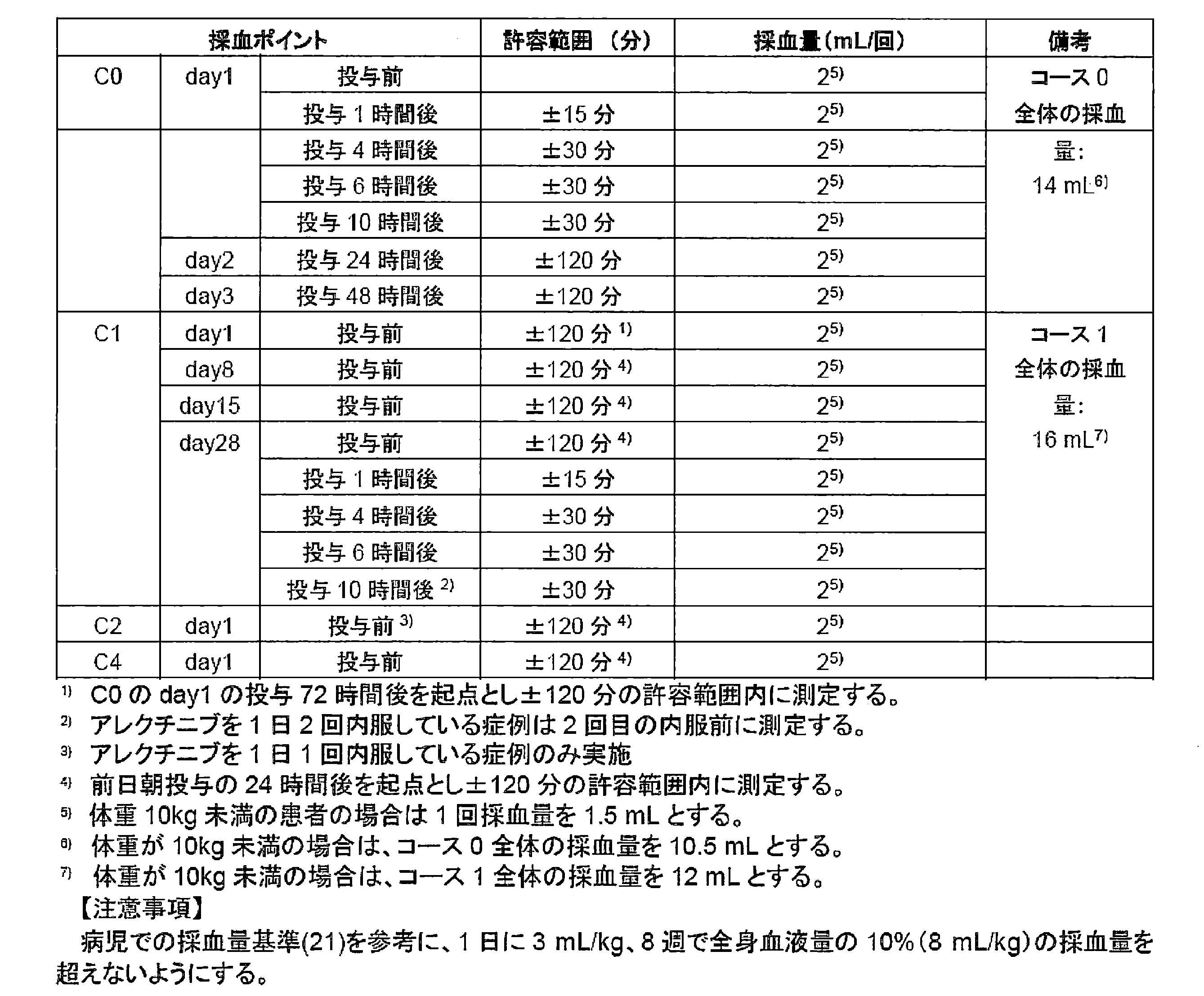
- Blood alectinib concentration measurement A blood alectinib concentration measurement will be performed in a special cohort or in patients weighing less than 15 kg and capable of having PK blood drawn for pharmacokinetic evaluation. Blood sampling points and blood sampling volume The blood sampling volume for blood alectinib concentration measurement is 2 mL, and the blood sampling points are shown in the table below. .
- “administration" in Table 9 in the case of twice-daily administration refers to the first oral administration in one day.
- Neoplastic lesions were identified prior to enrollment by contrast-enhanced CT of the head, chest, abdomen, and pelvis (slice thickness of 5 mm or less), and each lesion was classified as a “measurable lesion” or a “non-measurable lesion.” ”.
- measurable lesion 1 A lesion that corresponds to any of the following is defined as a measurable lesion.
- Lymph node lesions with a short axis of 15 mm or more on CT (lymph node lesions with a short axis of 10 mm or more and less than 15 mm are considered non-target lesions, and lymph nodes with a short axis of less than 10 mm are not considered lesions) 2) Treat all other lesions as non-measurable lesions.
- target lesions and non-tumor lesions were evaluated at 8 weeks, 16 weeks, 24 weeks, and thereafter every 12 weeks according to “4. Evaluation of efficacy”. Target lesions will be evaluated using the same examination method as at enrollment, and the size of target lesions and the presence or absence of disappearance or exacerbation of non-target lesions will be recorded.
- Efficacy criteria 1) Target lesion efficacy criteria (i) CR (Complete Response): All non-lymph node-targeted lesions have disappeared, and all lymph node-targeted lesions have a minor axis of less than 10 mm.
- PR Partial Response: 30% or more reduction in the sum diameter of the target lesion compared to the baseline sum diameter
- PD Progressive Disease
- the sum of the diameters of the target lesions compared to the minimum sum of diameters during progression if the baseline is the minimum value during More than 20% increase, and total diameter increased more than 5 mm even in absolute value
- SD Stable Disease: no shrinkage corresponding to stable PR and no increase corresponding to PD
- NE Not all Evaluated
- the reduction/increase ratio of the sum of diameters is calculated as follows.
- CR Complete Response
- Non-CR/non-PD non-CR/non-PD 1 or more residual non-target lesions (including residual lymph node non-target lesions ⁇ 10 mm in short axis)
- PD Progressive Disease
- NE Not all Evaluated: Deficient evaluation If the test could not be performed for some reason, or if it could not be judged as CR, Non-CR/non-PD, or PD 3) Presence or absence of new lesions Baseline If a lesion that did not exist in , is observed after the start of treatment, it is considered to be a “new lesion”.
- SD Stable Disease
- PD Progressive Disease
- NE Not Evaluable
- the pharmaceutical composition of the present invention is particularly useful as a therapeutic agent for cancer in children under 24 months of age.
Landscapes
- Health & Medical Sciences (AREA)
- Chemical & Material Sciences (AREA)
- Veterinary Medicine (AREA)
- Life Sciences & Earth Sciences (AREA)
- Animal Behavior & Ethology (AREA)
- Public Health (AREA)
- Medicinal Chemistry (AREA)
- General Health & Medical Sciences (AREA)
- Pharmacology & Pharmacy (AREA)
- Epidemiology (AREA)
- Nuclear Medicine, Radiotherapy & Molecular Imaging (AREA)
- General Chemical & Material Sciences (AREA)
- Chemical Kinetics & Catalysis (AREA)
- Organic Chemistry (AREA)
- Physiology (AREA)
- Nutrition Science (AREA)
- Oncology (AREA)
- Otolaryngology (AREA)
- Dispersion Chemistry (AREA)
- Zoology (AREA)
- Engineering & Computer Science (AREA)
- Bioinformatics & Cheminformatics (AREA)
- Pharmaceuticals Containing Other Organic And Inorganic Compounds (AREA)
- Acyclic And Carbocyclic Compounds In Medicinal Compositions (AREA)
- Medicines That Contain Protein Lipid Enzymes And Other Medicines (AREA)
Abstract
Description
すなわち、本発明は、以下の態様の医薬組成物、液剤、懸濁剤、使用、方法を提供する。
<1>アレクチニブまたはその塩を、フリー体に換算して20mg~160mgを1日投与量として含有する、生後7か月以上24か月未満の小児におけるALK異常を有する小児がんの治療用医薬組成物。
<2>1)生後7か月以上13か月未満の小児に対し、アレクチニブまたはその塩をフリー体に換算して20mg~120 mg、
2)生後13か月以上20か月未満の小児に対し、アレクチニブまたはその塩をフリー体に換算して40mg~120 mg、または、
3)生後20か月以上24か月未満の小児に対し、アレクチニブまたはその塩をフリー体に換算して80mg~160 mg、
を1日投与量として含有する、ALK異常を有する小児がんの治療用医薬組成物。
<3>(i)アレクチニブまたはその塩をフリー体に換算して1回20 mg~60mgを、
1)生後7か月以上13か月未満の小児に対し、1日1回、もしくは1日2回、または
2)生後13か月以上20か月未満の小児に対し、1日2回、あるいは、
(ii)アレクチニブまたはその塩をフリー体に換算して1回40 mg~80mgを、生後20か月以上24か月未満の小児に対し、1日2回、
投与するための、ALK異常を有する小児がんの治療用医薬組成物
<4>前記ALK異常が、ALK融合遺伝子、活性化型遺伝子変異、もしくはコピー数増加であるALK遺伝子異常、または異常が認められるALKタンパクの発現である、<1>~<3>のいずれか一項に記載の医薬組成物。
<5>前記小児がんが、小児悪性固形腫瘍または悪性リンパ腫である、<1>~<4>のいずれか一項に記載の医薬組成物。
<5-1>前記ALK異常を有する小児がんが、ALK陽性小児悪性固形腫瘍またはALK陽性悪性リンパ腫である、<1>~<4>のいずれか一項に記載の医薬組成物。
<5-2>前記小児悪性固形腫瘍が、炎症性筋線維芽細胞腫瘍、肉腫、中枢神経系腫瘍、皮膚腫瘍、網膜芽細胞腫、肺癌、腎細胞がん、甲状腺未分化がん、胸腺がん、卵巣がん、胆嚢・肝外胆管の上皮性腫瘍、甲状腺がん、胚細胞性腫瘍、悪性線維性組織球腫、食道がん、胃がん、大腸がん、乳がん、または肝臓がんから選択される、<1>~<5-1>のいずれかに記載の医薬組成物。
<5-3>前記悪性リンパ腫が、ホジキンリンパ腫または非ホジキンリンパ腫である、<1>~<5-1>のいずれかに記載の医薬組成物。
<5-4>前記非ホジキンリンパ腫が、バーキットリンパ腫、びまん性大細胞型B細胞型リンパ腫、リンパ芽球性リンパ腫、または未分化大細胞リンパ腫である、<5-3>に記載の医薬組成物。
<6>前記小児がんが、転移性、治癒切除不能であるか、または再発の病変を有する、<1>~<5-4>のいずれか一項に記載の医薬組成物。
<6-1>前記小児がんが、難治性または再発である、<1>~<5-4>のいずれか一項に記載の医薬組成物。
<7>経口投与または経管投与に用いられる、<1>~<6-1>のいずれか一項に記載の医薬組成物。
<8>前記<1>~<7>のいずれか一項に記載の医薬組成物を含む、液剤または懸濁剤。
<9A>生後7か月以上24か月未満の小児に投与するためのアレクチニブまたはその塩を含む、下記(a)~(d)から選択される少なくとも1つ、あるいは2以上の任意の組み合わせによる特徴を有する、医薬組成物、液剤または懸濁剤:
(a)投与量:
(ア)フリー体に換算して20mg~160mgを1日投与量とする;
(イ)1)生後7か月以上13か月未満の小児に対し、フリー体に換算して20mg~120 mg、
2)生後13か月以上20か月未満の小児に対し、フリー体に換算して40mg~120 mg、または、
3)生後20か月以上24か月未満の小児に対し、フリー体に換算して80mg~160 mg、
を1日投与量とする;
(ウ)(i)フリー体に換算して1回20 mg~60mgを、
1)生後7か月以上13か月未満の小児に対し、1日1回、もしくは1日2回、または
2)生後13か月以上20か月未満の小児に対し、1日2回、あるいは、
(ii)フリー体に換算して1回40 mg~80mgを、
生後20か月以上24か月未満の小児に対し、1日2回投与する;
(b)投与方法:(ア)経口投与;(イ)経管投与;
(c)疾患:
(ア)小児がALK異常を有する小児がん(小児悪性固形腫瘍または悪性リンパ腫)を有する;
(イ)小児悪性固形腫瘍が、炎症性筋線維芽細胞腫瘍、肉腫、中枢神経系腫瘍、皮膚腫瘍、網膜芽細胞腫、肺癌、腎細胞がん、甲状腺未分化がん、胸腺がん、卵巣がん、胆嚢・肝外胆管の上皮性腫瘍、甲状腺がん、胚細胞性腫瘍、悪性線維性組織球腫、食道がん、胃がん、大腸がん、乳がん、または肝臓がんから選択される;
(ウ)悪性リンパ腫が、ホジキンリンパ腫と非ホジキンリンパ腫(成熟B細胞リンパ腫:バーキットリンパ腫、びまん性大細胞型B細胞型リンパ腫)、リンパ芽球性リンパ腫、未分化大細胞リンパ腫から選択される;
(d)悪性度:
(ア)難治性または再発;
(イ)転移性、治癒切除不能;
(ウ)先行治療無効。
<9B>前記<9A>の医薬組成物、液剤または懸濁剤を製造するための、アレクチニブまたはその塩の使用。
<9C>上記(a)~(d)から選択される少なくとも1つ、あるいは2以上の任意の組み合わせによる特徴を有する、アレクチニブまたはその塩を含む医薬組成物を投与することを含む、ALK異常を有する小児がんの治療方法。
<9-1>前記ALK異常が、ALK融合遺伝子、活性化型遺伝子変異、もしくはコピー数増加であるALK遺伝子異常、および/または、異常が認められるALKタンパクの発現である、<9A>~<9C>のいずれか一項に記載の医薬組成物、液剤、懸濁剤、使用、治療方法。

好ましくは塩酸塩であり、最も好ましくは一塩酸塩である。
アレクチニブまたはその塩は、公知の方法(例えば、特許4588121号やWO2020/050241に記載の方法)により製造することができる。
アレクチニブまたはその塩は、組成物全体に対し、フリー体に換算して20~70重量%、好ましくは35~60重量%、さらに好ましくは45~50重量%含有する。
アレクチニブ塩酸塩は、中外製薬株式会社が開発した、本邦発の、ALKに対して高い選択的阻害活性を有する第2世代ALK阻害薬である。
「崩壊剤」とは、固形製剤を内服後、固体の製剤の速やかな崩壊を促すための成分である。
崩壊剤の例としては、デンプングリコール酸ナトリウム、低置換ヒドロキシプロピルセルロース、カルメロースカルシウム、アルファ化デンプン、塩化ナトリウム、トウモロコシデンプン、クロスカルメロースナトリウム、結晶セルロース、無水ケイ酸、カルメロースなどが挙げられる。
崩壊剤の使用量は、本発明の組成物全体または製剤全体に対し、例えば、5重量%以上、好ましくは7.5重量%以上、さらに好ましくは8.5重量%以上、特に好ましくは10重量%以上である。使用量の上限は、特に限定されないが、例えば30重量%である。なお、本発明の製剤がコーティング錠等といった皮膜を有する製剤である場合、前記使用量は、該皮膜により被覆される成分全体(カプセルに充てんされる成分全体、コーティングに被覆される成分全体)に対する量である。
界面活性剤または乳化剤としては、例えば、ポリソルベート80、ステアリン酸ポリオキシル40、ラウロマクロゴール等を挙げることができる。
「矯味矯臭剤」としては、例えば通常使用される、甘味料、酸味料、香料等を挙げることができる。
「希釈剤」とは、製剤中に含まれる有効成分の希釈等を目的に加えられる不活性成分であり、当該不活性成分として、たとえば、顆粒剤などの固形製剤には、乳糖またはデンプン等の賦形剤やショ糖などが用いられる。
抗酸化剤の好適な例としては、例えば、亜硫酸塩、アスコルビン酸などが用いられる。
上記した添加剤は、2種以上を適宜の割合で混合して用いてもよい。
液剤を製造するための溶媒としては、エタノール、フェノール、クロロクレゾール、精製水、蒸留水等を使用することができる。
顆粒の平均粒子径は、例えば150μm以上、好ましくは180μm以上、より好ましくは200μm以上、さらに好ましくは250μm以上、特に好ましくは300μm以上である。顆粒の平均粒子径の上限は、特に限定されないが、例えば1mmである。
受容体型チロシンキナーゼであるALKはリガンド結合によって二量体化し活性化するが、この遺伝子に転座がおこるとALKに結合したcoiled-coilドメインによってリガンド結合なしに恒常的に二量体化し活性化すると考えられている。ALK融合遺伝子は、ALK遺伝子と多量体化する機能を持つタンパク質をコードする遺伝子が染色体の逆位や転座により、両者の融合遺伝子が形成され、それにより、両者が融合したALK融合タンパク質が発現される。ALK融合タンパク質は、恒常的にALKチロシンキナーゼを活性化し、結果として細胞増殖シグナルを異常に活性化し続けることで細胞ががん化する。ALK融合遺伝子形成する相手方の遺伝子としては、EML4、NPM,TPM3, TFG, ATIC,CLTC1, MSN, TPM4, ALO17, MYH9 RANBP2, CARS, SEC31L1などが知られている(「ALK遺伝子検査の手引き」日本肺癌学会バイオマーカー委員会)。
ALK融合遺伝子は、蛍光in situハイブリダイゼーション(FISH)法、免疫組織化学(IHC)法、RT-PCR法(塩基配列決定を含む)、遺伝子パネル検査(Capture hybrid法およびamplicon法)により検出することができ、既知のALK融合遺伝子のほか、当該方法により検出された未知のALK融合遺伝子も含まれる。
ALK融合遺伝子またはALK融合遺伝子により発現されるタンパクを検出するためのキットとして、Vysis LSI ALK Break Apart Rearrangement Probe Kit(登録商標)、Vysis ALK Break Apart FISHプローブキット(登録商標)(Abbott社)、ヒストファイン ALK iAEP(登録商標)キット(ニチレイ社)、ベンタナ OptiView ALK (D5F3)(ロシュ・ダイアグノスティックス株式会社)、FoundationOne(登録商標)CDxがんゲノムプロファイル(中外製薬株式会社)、OncoGuide AmoyDx(登録商標) ROS1 融合遺伝子検出キット(株式会社理研ジェネシス)、オンコマイン Dx Target Test マルチ CDxシステム(ライフテクノロジーズジャパン株式会社)を用いることができる。これらによりALK融合遺伝子またはALK融合タンパクが検出された場合は、ALK融合遺伝子陽性と称する。
ALK活性化型遺伝子変異とは、ALK遺伝子が点変異やフレームシフト変異により活性型に変異したものを意味し、具体的には、G1128A、F1174L、F1174I、F1174S、R1192Q、F1245C、F1245L、Y1278S、M1166R、I1171N、R1275Qなどが知られているが、WGSやTargeted-capture sequencingなどを用いて新たに検出されたものも含まれる。好ましくは、G1128A、F1174L、F1174I、F1174S、R1192Q、F1245C、F1245L、Y1278S、M1166R、R1275Qである。
WGS(whole genome sequencing):次世代シークエンサーを用いて、全ゲノム領域を解読する、最も包括的な手法である。1塩基変異(single-nucleotide variant: SNV)だけでなく、挿入・欠失(insertion or deletion: INDEL)、コピー数変化(copy-number variation: CNV、減少、増幅、ヘテロ接合性の消失などを含む)、大規模な構造異常(structural variation: SV、転座、逆位、欠失、重複などを含む)、外来性ゲノム(EBVやHTLV-1ゲノムなど)などを検出可能である。特に非コード領域の遺伝子異常や構造異常の検出に有効である。
Targeted-capture sequencing:一般的に「がん遺伝子パネル検査」に用いられる遺伝子異常の検出法である。
「コピー数増加」とは、対象の2倍体ゲノム中の特定の遺伝子の2.5以上のコピー数(あるいは、Log2比≧0.32)の存在を指す。コピー数が2.5である場合、コピー数を定義するために用いられる細胞の50%が2倍体生物中に通常の2コピーの遺伝子を含有し、コピー数を定義するために用いられる細胞の50%が通常の2コピーおよびさらに1コピー多い前記遺伝子(合計3コピーの前記遺伝子)を含有する。コピー数増加は、MLPAやCGHを用いて解析することができる。
MLPA(Multiplex Ligation-dependent Probe Amplification):鋳型DNAにハイブリダイズしたプローブをPCRにより増幅することにより、対象ゲノム領域のコピー数変化を定量的に解析する方法である。
CGH(comparative genomic hybridization)/array CGH/SNPsアレイ:ゲノムのコピー数変化を網羅的に解析する方法である。腫瘍組織と対照組織から抽出したゲノムDNAを異なる蛍光色素で標識をしたのちに混合して分裂中期の染色体にハイブリダイゼーションを行う。蛍光シグナルの比を観察することで、腫瘍組織のゲノムコピー数変化を検出する。
小児悪性固形腫瘍としては、炎症性筋線維芽細胞腫瘍、横紋筋肉腫、ユーイング肉腫ファミリー腫瘍(骨や骨以外のユーイング肉腫、未分化外胚葉腫瘍(PNET)、アスキン腫瘍(胸壁に原発するPNET)など)、平滑筋肉腫などの肉腫、神経芽腫、グリオーマ、神経芽細胞腫、悪性末梢神経鞘腫瘍などの中枢神経系腫瘍、悪性黒色腫、スピッツ腫瘍などの皮膚腫瘍、網膜芽細胞腫、非小細胞肺癌などの肺癌、腎細胞がん、甲状腺未分化がん、胸腺がん、卵巣がんなどが挙げられるほか、胆嚢・肝外胆管の上皮性腫瘍、甲状腺がん、胚細胞性腫瘍、悪性線維性組織球腫なども含まれる。
悪性黒色腫には、(1)肢端黒子型黒色腫(ALM)(2)表在拡大型黒色腫(SSM)(3)結節型黒色腫(NM)(4)悪性黒子型黒色腫(LMM)が含まれる。
スピッツ腫瘍には、悪性スピッツ腫瘍、悪性若年性黒色腫、スピッツ黒色腫、スピッツ母斑様黒色腫などが含まれる。
なお、小児悪性固形腫瘍は、希少がんであることがしられており、希少がんとは発生頻度が低い悪性腫瘍(がん)の総称であり、日本においては、年間発生数が、人口10万人あたり6例未満のがんである。
また、上記固形がんのほか、非希少がんの希少組織亜型も含まれる。

本発明の別の態様においては、小児がんとしては、炎症性筋線維芽細胞腫瘍、びまん性大細胞型B細胞型リンパ腫、および神経芽腫が好ましい。
本発明のさらに別の態様においては、ALK異常を有する胸腺がん、卵巣がん、スピッツ腫瘍、悪性黒色腫、網膜芽細胞腫、びまん性大細胞型B細胞型リンパ腫、または、胃がん、大腸がん、乳がん、もしくは肝臓がんの希少組織亜型などの小児がんに対する治療用医薬組成物が挙げられる。
好ましくは、難治性または再発の病変を有する上記小児がんである。
なお、「再発」とは直近治療の最良奏効が完全寛解又は部分寛解を意味し、「難治性」とは直近治療の最良奏効が安定、進行を意味する。または、転移性、治癒切除不能などの病態も含まれる。
「先行治療無効」は、先行する治療が無効であり中止された例を意味する。先行する治療としては、類似あるいは異なる作用機序を有する他剤による化学療法や放射線治療、外科的手術などが挙げられる。具体的には、クリゾチニブの投与により耐性が生じる例などが挙げられる。
これらの知見により、アレクチニブは、ALK異常を有する小児がんに対し、有効性が予測できる。
具体的には、下記のいずれかに該当する場合をいう。
・腫瘍の大きさが、治療前よりも増大しないこと、好ましくは、治療前よりも縮小すること
・無増悪生存期間を非治療群もしくは従来治療群と比べて延長すること
・全生存期間を非治療群もしくは従来治療群と比べて延長すること
・病勢制御割合が、10%以上、20%以上、30%以上、または40%以上であるか、非治療群もしくは従来治療群と比較して多いこと、のいずれかであること。
なお、病勢制御割合は、実施例2に説明されるように、標的病変の効果、非標的病変の効果、新病変出現の有無の組み合わせから判定される総合評価にもとづき、最良総合効果がCR、PR、SDのいずれかである患者の割合とする。
さらに、小児がんの進行を、治療前または非治療群もしくは従来治療群と比べて遅らせ、全身状態や臨床パラメータが、治療前よりも改善することも含まれる。
生後7か月以上13か月未満の小児に対し、1日投与量として、アレクチニブまたはその塩をフリー体に換算して20 mg~120mgを投与してもよい。より好ましくは、20mg、40mg、80mg、120mgのいずれかの1日投与量で投与してもよい。あるいは、1回投与量として20mgを1日1回、もしくは1日2回、1回投与量として40mgを1日2回、または、1回投与量として60mgを1日2回投与してもよい。
生後13か月以上20か月未満の小児に対し、1日投与量として、アレクチニブまたはその塩をフリー体に換算して40mg~120mgを投与してもよい。より好ましくは、40 mg、80mg、120mgのいずれかの1日投与量で投与してもよい。あるいは、1回投与量として20mgを1日2回、1回投与量として40mgを1日2回、または、1回投与量として60mgを1日2回投与してもよい。
生後20か月以上24か月未満の小児に対し、1日投与量として、アレクチニブまたはその塩をフリー体に換算して80 mg~160mgを投与してもよい。より好ましくは、80mg、120mg、160mgのいずれかの1日投与量で投与してもよい。あるいは、1回投与量として40mgを1日2回、1回投与量として60mgを1日2回投与、1回投与量として80mgを1日2回投与してもよい。
具体的には、下記(A)~(P)に記載のとおりである。
(A)
1)生後7か月以上13か月未満の小児に対し、アレクチニブまたはその塩をフリー体に換算して20 mg(1回投与量として20mgを1日1回)、
2)生後13か月以上20か月未満の小児に対し、アレクチニブまたはその塩をフリー体に換算して40 mg(1回投与量として20mgを1日2回)、または、
3)生後20か月以上24か月未満の小児に対し、アレクチニブまたはその塩をフリー体に換算して80 mg(1回投与量として40mgを1日2回)、
を1日投与量として含有する、ALK異常を有する小児がんの治療用医薬組成物。
(B)
1)生後7か月以上13か月未満の小児に対し、アレクチニブまたはその塩をフリー体に換算して20 mg(1回投与量として20mgを1日1回)、
2)生後13か月以上20か月未満の小児に対し、アレクチニブまたはその塩をフリー体に換算して80 mg(1回投与量として40mgを1日2回)、または、
3)生後20か月以上24か月未満の小児に対し、アレクチニブまたはその塩をフリー体に換算して80 mg(1回投与量として40mgを1日2回)、
を1日投与量として含有する、ALK異常を有する小児がんの治療用医薬組成物。
(C)
1)生後7か月以上13か月未満の小児に対し、アレクチニブまたはその塩をフリー体に換算して20 mg(1回投与量として20mgを1日1回)、
2)生後13か月以上20か月未満の小児に対し、アレクチニブまたはその塩をフリー体に換算して80 mg(1回投与量として40mgを1日2回)、または、
3)生後20か月以上24か月未満の小児に対し、アレクチニブまたはその塩をフリー体に換算して120 mg(1回投与量として60mgを1日2回)、
を1日投与量として含有する、ALK異常を有する小児がんの治療用医薬組成物。
(D)
1)生後7か月以上13か月未満の小児に対し、アレクチニブまたはその塩をフリー体に換算して20 mg(1回投与量として20mgを1日1回)、
2)生後13か月以上20か月未満の小児に対し、アレクチニブまたはその塩をフリー体に換算して120 mg(1回投与量として60mgを1日2回)、または、
3)生後20か月以上24か月未満の小児に対し、アレクチニブまたはその塩をフリー体に換算して120 mg(1回投与量として60mgを1日2回)、
を1日投与量として含有する、ALK異常を有する小児がんの治療用医薬組成物。
(E)
1)生後7か月以上13か月未満の小児に対し、アレクチニブまたはその塩をフリー体に換算して20 mg(1回投与量として20mgを1日1回)、
2)生後13か月以上20か月未満の小児に対し、アレクチニブまたはその塩をフリー体に換算して120 mg(1回投与量として60mgを1日2回)、または、
3)生後20か月以上24か月未満の小児に対し、アレクチニブまたはその塩をフリー体に換算して160 mg(1回投与量として80mgを1日2回)、
を1日投与量として含有する、ALK異常を有する小児がんの治療用医薬組成物。
(F)
1)生後7か月以上13か月未満の小児に対し、アレクチニブまたはその塩をフリー体に換算して40 mg(1回投与量として20mgを1日2回)、
2)生後13か月以上20か月未満の小児に対し、アレクチニブまたはその塩をフリー体に換算して40 mg(1回投与量として20mgを1日2回)、または、
3)生後20か月以上24か月未満の小児に対し、アレクチニブまたはその塩をフリー体に換算して80 mg(1回投与量として40mgを1日2回)、
を1日投与量として含有する、ALK異常を有する小児がんの治療用医薬組成物。
(G)
1)生後7か月以上13か月未満の小児に対し、アレクチニブまたはその塩をフリー体に換算して40 mg(1回投与量として20mgを1日2回)、
2)生後13か月以上20か月未満の小児に対し、アレクチニブまたはその塩をフリー体に換算して80 mg(1回投与量として40mgを1日2回)、または、
3)生後20か月以上24か月未満の小児に対し、アレクチニブまたはその塩をフリー体に換算して80 mg(1回投与量として40mgを1日2回)、
を1日投与量として含有する、ALK異常を有する小児がんの治療用医薬組成物。
(H)
1)生後7か月以上13か月未満の小児に対し、アレクチニブまたはその塩をフリー体に換算して40 mg(1回投与量として20mgを1日2回)、
2)生後13か月以上20か月未満の小児に対し、アレクチニブまたはその塩をフリー体に換算して80 mg(1回投与量として40mgを1日2回)、または、
3)生後20か月以上24か月未満の小児に対し、アレクチニブまたはその塩をフリー体に換算して120 mg(1回投与量として60mgを1日2回)、
を1日投与量として含有する、ALK異常を有する小児がんの治療用医薬組成物。
(I)
1)生後7か月以上13か月未満の小児に対し、アレクチニブまたはその塩をフリー体に換算して40 mg(1回投与量として20mgを1日2回)、
2)生後13か月以上20か月未満の小児に対し、アレクチニブまたはその塩をフリー体に換算して120 mg(1回投与量として60mgを1日2回)、または、
3)生後20か月以上24か月未満の小児に対し、アレクチニブまたはその塩をフリー体に換算して120 mg(1回投与量として60mgを1日2回)、
を1日投与量として含有する、ALK異常を有する小児がんの治療用医薬組成物。
(J)
1)生後7か月以上13か月未満の小児に対し、アレクチニブまたはその塩をフリー体に換算して40 mg(1回投与量として20mgを1日2回)、
2)生後13か月以上20か月未満の小児に対し、アレクチニブまたはその塩をフリー体に換算して120 mg(1回投与量として60mgを1日2回)、または、
3)生後20か月以上24か月未満の小児に対し、アレクチニブまたはその塩をフリー体に換算して160 mg(1回投与量として80mgを1日2回)、
を1日投与量として含有する、ALK異常を有する小児がんの治療用医薬組成物。
(K)
1)生後7か月以上13か月未満の小児に対し、アレクチニブまたはその塩をフリー体に換算して80 mg(1回投与量として40mgを1日2回)、
2)生後13か月以上20か月未満の小児に対し、アレクチニブまたはその塩をフリー体に換算して80 mg(1回投与量として40mgを1日2回)、または、
3)生後20か月以上24か月未満の小児に対し、アレクチニブまたはその塩をフリー体に換算して80 mg(1回投与量として40mgを1日2回)、
を1日投与量として含有する、ALK異常を有する小児がんの治療用医薬組成物。
(L)
1)生後7か月以上13か月未満の小児に対し、アレクチニブまたはその塩をフリー体に換算して80 mg(1回投与量として40mgを1日2回)、
2)生後13か月以上20か月未満の小児に対し、アレクチニブまたはその塩をフリー体に換算して80 mg(1回投与量として40mgを1日2回)、または、
3)生後20か月以上24か月未満の小児に対し、アレクチニブまたはその塩をフリー体に換算して120 mg(1回投与量として60mgを1日2回)、
を1日投与量として含有する、ALK異常を有する小児がんの治療用医薬組成物。
(M)
1)生後7か月以上13か月未満の小児に対し、アレクチニブまたはその塩をフリー体に換算して80 mg(1回投与量として40mgを1日2回)、
2)生後13か月以上20か月未満の小児に対し、アレクチニブまたはその塩をフリー体に換算して120 mg(1回投与量として60mgを1日2回)、または、
3)生後20か月以上24か月未満の小児に対し、アレクチニブまたはその塩をフリー体に換算して120 mg(1回投与量として60mgを1日2回)、
を1日投与量として含有する、ALK異常を有する小児がんの治療用医薬組成物。
(N)
1)生後7か月以上13か月未満の小児に対し、アレクチニブまたはその塩をフリー体に換算して80 mg(1回投与量として40mgを1日2回)、
2)生後13か月以上20か月未満の小児に対し、アレクチニブまたはその塩をフリー体に換算して120 mg(1回投与量として60mgを1日2回)、または、
3)生後20か月以上24か月未満の小児に対し、アレクチニブまたはその塩をフリー体に換算して160 mg(1回投与量として80mgを1日2回)、
を1日投与量として含有する、ALK異常を有する小児がんの治療用医薬組成物。
(O)
1)生後7か月以上13か月未満の小児に対し、アレクチニブまたはその塩をフリー体に換算して120 mg(1回投与量として60mgを1日2回)、
2)生後13か月以上20か月未満の小児に対し、アレクチニブまたはその塩をフリー体に換算して120 mg(1回投与量として60mgを1日2回)、または、
3)生後20か月以上24か月未満の小児に対し、アレクチニブまたはその塩をフリー体に換算し120 mg(1回投与量として60mgを1日2回)、
を1日投与量として含有する、ALK異常を有する小児がんの治療用医薬組成物。
(P)
1)生後7か月以上13か月未満の小児に対し、アレクチニブまたはその塩をフリー体に換算して120 mg(1回投与量として60mgを1日2回)、
2)生後13か月以上20か月未満の小児に対し、アレクチニブまたはその塩をフリー体に換算して120 mg(1回投与量として60mgを1日2回)、または、
3)生後20か月以上24か月未満の小児に対し、アレクチニブまたはその塩をフリー体に換算して160 mg(1回投与量として80mgを1日2回)、
を1日投与量として含有する、ALK異常を有する小児がんの治療用医薬組成物。
本発明の医薬組成物の投与は、食前、食間、食後いずれの服用でもよい。
なお、1日1回投与のときは、朝、1日2回投与のときは、朝および夜に投与するのが好ましい。
1)制吐剤、止瀉薬、解熱剤
2)臨床上必要な併用療法としての処置・手術療法(例:交通事故での骨折など)
3)抗菌薬の予防投与や治療的投与
4)骨病変に対するビスホスホネート製剤および抗RANKL抗体
5)抗けいれん薬の投与
頭蓋内腫瘍を有する患者においては、抗けいれん薬を投与してよい。
6)頭蓋内圧降下薬およびステロイド薬の投与
頭蓋内腫瘍を有する患者においては頭蓋内圧降下薬(濃グリセリン配合製剤、マンニトール、イソバイドなど)およびステロイド薬(デキサメタゾン(デカドロン注)など)を投与してもよい。
本明細書において明示的に引用される全ての特許および参考文献の内容は全て本明細書に参照として取り込まれる。
アレクチニブの小児に対する用法用量として、J-ALEX試験(国内第III相臨床試験、JO28928)において成人に本剤300 mgを1日2回(BID)反復投与したときの定常状態における平均曝露量を超えない範囲で最大になるときの用法用量を検討した。生理学的薬物速度論(PBPK)モデルを用いて、当該小児にアレクチニブを経口投与したときの曝露量を予測した。


生後7カ月未満の小児では、20 mgをQD反復投与した場合の推定曝露量(CmaxおよびAUCss)の平均値が成人曝露量を超えたことから(図2)、本製剤の当該年齢層への投与は困難であることが示唆された。
生後7カ月以上13カ月未満の小児に対しては、20 mgをQD投与した場合に成人曝露量を超えないことが示唆された(図3)。
生後13カ月以上20カ月未満の小児に対しては、20 mgをBID投与した場合に成人曝露量(Ctrough)を超えないことが示唆された(図3)。
生後20カ月以上24カ月未満の小児に対しては、40 mgをBID投与した場合に成人曝露量(Ctrough)を超えないことが示唆された(図3)。
以上の結果を表5にまとめる。

したがって、少なくとも当該用法用量により、ALK異常を有する生後7か月以上2歳未満の小児がんに対する有効性および安全性が確保できるものと考えられる。
表4および表5の結果をまとめて表6に示す。

ALK異常を有する生後7か月以上2歳未満の小児がんに対するアレクチニブの有効性・安全性は、以下に記載する臨床試験で確認する。
試験開始前にALK異常を有することをスクリーニングにより確認された、生後7か月以上2歳未満の小児がん患者に対し、試験登録時の月齢から、表7「2歳未満の小児患者における月齢当たりのアレクチニブの1回投与量」、または、後掲する2.2に従って、アレクチニブを投与する。
本試験では、アレクチニブの20mgカプセル剤を用いる。なお、本試験の小児患者はカプセル剤の内服が困難であることが多いため、内服ゼリーを用いてもよく、あるいは、カプセルごと温湯に懸濁して溶液とする簡易懸濁法を用い、経口投与や経管投与により投与することができる。
なお、投与の間隔はなるべく8時間以上空ける。
28日を1コースとして、プロトコール治療中止基準に該当しない限り治療を継続する。
また、各コース内の評価の時期に関わらずコース内休止基準に該当しない限り、原則内服を継続する。

年少の小児患者で、カプセルを内服することのできない患者を対象とした、1-6名の特別コホート(「簡易懸濁コホート)」を設定し、簡易懸濁によるアレクチニブの投与を行う。懸濁方法および内服法の詳細については、「簡易懸濁コホートについての手順書」に記載する。1回のアレクチニブの投与量については、表7に従って、投与を行う。
2.2 単回投与 (0コース:C0)
簡易懸濁コホートまたは、体重15kg未満かつ薬物動態評価用PK採血が可能な小児においては単回投与後の薬物動態評価のため、初回投与時のみ0コースとして単回投与を行う。0コースでは、治験薬を1日目(C0day1)のみ1回、朝に服用する。夕分は服用せず、その後2日休薬する。その他の患者においては単回投与(0コース)を行わず、1コースからアレクチニブの投与を開始する。
下記表8のスケジュールに従って、各評価項目について評価する。
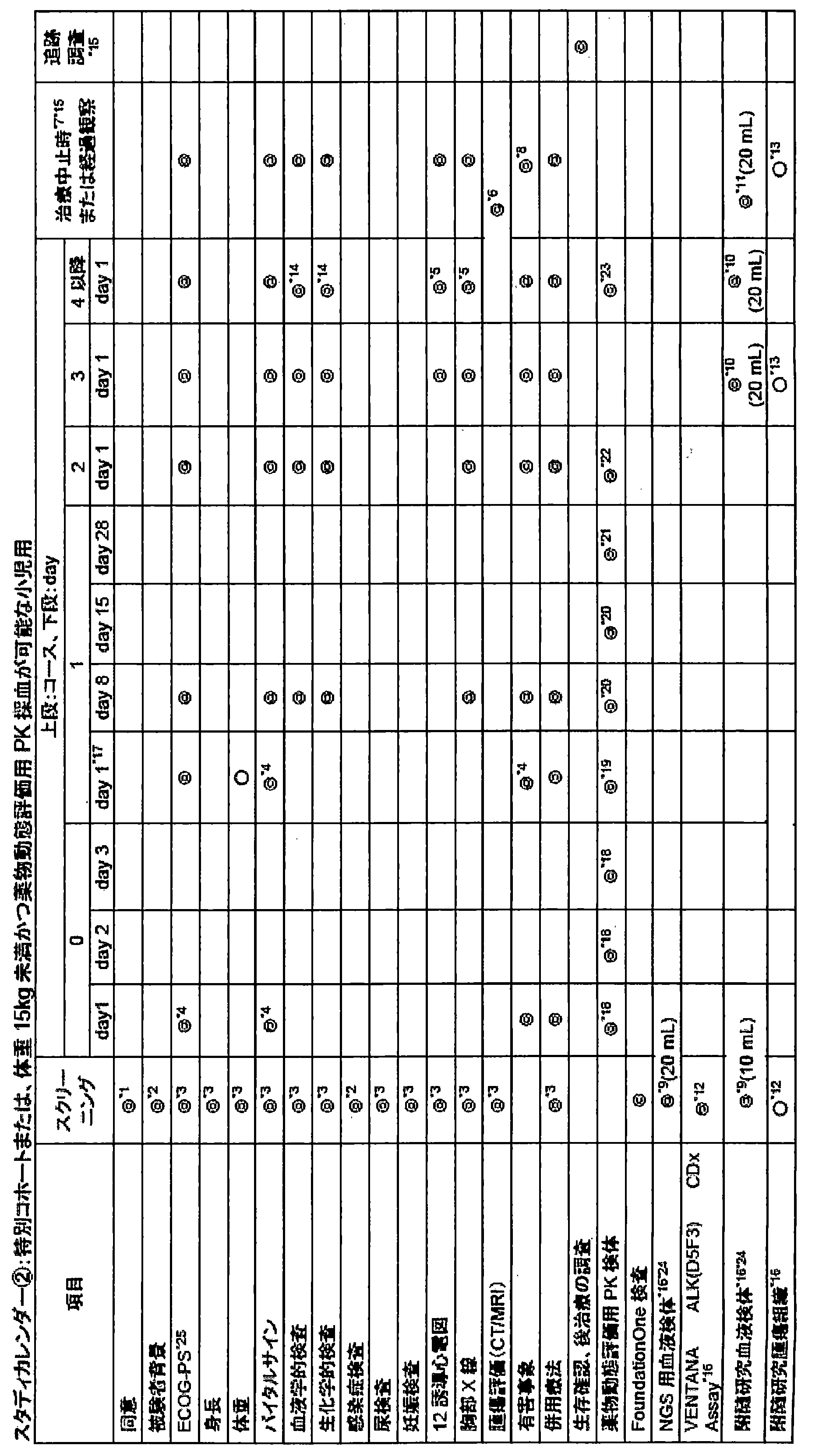
腫瘍評価のための画像検査(CTまたはMRI)は、プロトコール治療開始後、コース開始の延期があった場合も変更せず、24週までは8週毎、25週以降は12週毎に実施する。登録前評価において使用したモダリティおよび撮影条件が同じものを使用する※。画像検査は、上記規定日の±7日以内を許容する。
スクリーニング検査で脳転移が認められた場合、以降の腫瘍評価ではスクリーニング時と同じモダリティ(造影CTまたは造影MRI※)を継続して実施する。
総合効果ではじめてCRまたはPRが認められた場合、その4週後以降に確定のための画像検査を実施する。
※造影剤アレルギーや腎機能低下などが新たに発生した場合は、単純CT/MRIで評価を継続する。
特別コホートまたは、体重15kg未満かつ薬物動態評価用PK採血が可能な患者を対象として血中アレクチニブ濃度測定を実施する。
採血ポイントと採血量
血中アレクチニブ濃度測定のための1回採血量は2 mLであり、採血ポイントを下表に示す(ただし、体重が10kg未満の場合は1回採血量を1.5mLとする)。
なお、1日2回投与の場合の表9の「投与」とは、1日のうちの1回目の内服のことを指す。
腫瘍縮小効果判定は「固形がんの治療効果判定のための新ガイドライン(RECISTガイドライン)改訂版version 1.1―日本語訳JCOG版―:Revised RECIST guideline(version 1.1)」に従った以下の手順により行う。
頭部・胸部・腹部・骨盤造影CT(スライス厚5 mm以下)により、登録前の腫瘍性病変の特定を行い、それぞれの病変を「測定可能病変」と「測定不能病変」に分類する。
1)以下のいずれかに該当する病変を測定可能病変(measurable lesion)とする。
(i) CTまたはMRIにて最大径10 mm以上のリンパ節病変以外の病変(非リンパ節病変)
2)上記以外のすべての病変を測定不能病変(non-measurable lesion)とする。
※ 「臓器」の数え方
・左右のある臓器(肺・腎など)は左右合わせて1臓器とする
・部位によらず、すべてのリンパ節は1臓器とする
標的病変として選択されなかった病変は、測定可能か否かを問わずすべて非標的病変(non-target lesion)として記録する。同一臓器内の複数の非標的病変は、1病変として記録する(例:複数の腫大骨盤リンパ節、多発性肝転移)。
コース開始の延期の有無によらず、8週後、16週後、24週後、それ以降は12週毎に「4.有効性の評価」に従って標的病変および非標的病変の評価を登録時と同じ検査法にて行い、標的病変の径、非標的病変の消失または増悪の有無を記録する。
1)標的病変の効果判定基準
(i)CR(Complete Response):完全奏効
すべての非リンパ節標的病変が消失し、すべてのリンパ節標的病変の短径が10 mm未満となった場合。
(ii)PR(Partial Response):部分奏効
ベースライン径和に比して、標的病変の径和が30%以上減少
(iii)PD(Progressive Disease):進行
経過中の最小の径和(ベースラインが経過中の最小値である場合、これを最小の径和とする)に比して、標的病変の径和が20%以上増加、かつ、径和が絶対値でも5 mm以上増加
(iv)SD(Stable Disease):安定
PRに相当する縮小がなくPDに相当する増大がない
(v)NE(Not all Evaluated):評価の欠損あり
なんらかの理由で検査が行えない場合、またはCR、PR、PD、SDいずれとも判定できない場合

(ii) 縮小割合がPRの条件を満たし、同時に増大割合がPDの条件を満たす場合にはPDとする。
(iii) 治療中に1つの病変が分離した場合は、それぞれの径を径和に加算する。
(iv) 治療中に複数の病変が癒合して境界が識別できなくなった場合は、癒合した病変の径を径和に加算する。病変どうしが接していても、病変の境界が識別可能な場合は各病変の径を径和に加算する。
(i)CR(Complete Response):完全奏効
すべての非リンパ節非標的病変が消失し、すべてのリンパ節非標的病変の短径が10 mm未満となった場合
(ii)Non-CR/non-PD:非CR/非PD
1つ以上の非標的病変が残存する場合(リンパ節非標的病変の短径10 mm以上の残存も含む)
(iii)PD(Progressive Disease):進行
既存の非標的病変の「明らかな増悪」(再発を含む)。
(iv)NE(Not all Evaluated):評価の欠損あり
なんらかの理由で検査が行えなかった場合、またはCR、Non-CR/non-PD、PDいずれとも判定できない場合
3)新病変出現の有無
ベースラインでは存在しなかった病変が治療開始後に認められた場合、「新病変」の出現ありとする。
総合効果(Overall response)は標的病変の効果、非標的病変の効果、新病変出現の有無の組み合わせから、表10に従って8週後、16週後、24週後、それ以降は12週毎に判定する。ベースラインで非標的病変が存在しない場合の総合効果は、標的病変の効果と新病変出現の有無により判定する。

総合効果(overall response)はCR>PR>SD>PD>NEの順に「良好」であるとし、以下の基準に従って最良総合効果(Best Overall Response)を判定する。複数の区分の定義に該当する場合は、CR>PR>SD>PD>NEの順に、より良好なものに区分する。
(i)CR(Complete Response):完全奏効
4週(28日)以上の間隔で連続2回以上の総合効果CRが得られた場合。
(ii)PR(Partial Response):部分奏効
4週(28日)以上の間隔で連続2回以上のPR以上の総合効果(CRまたはPR)が得られた場合。
(iii)SD(Stable Disease):安定
最良総合効果のCRもPRも得られず、かつ総合効果が1回以上SD以上である場合。
(iv)PD(Progressive Disease):進行
最良総合効果CR、PR、SDのいずれにも該当せずに、総合効果がPDとなった場合
(v)NE(Not Evaluable):評価不能
総合効果がすべてNEであった場合
Claims (7)
- アレクチニブまたはその塩を、フリー体に換算して20mg~160mgを1日投与量として含有する、生後7か月以上24か月未満の小児におけるALK異常を有する小児がんの治療用医薬組成物。
- 1)生後7か月以上13か月未満の小児に対し、アレクチニブまたはその塩をフリー体に換算して20mg~120 mg、
2)生後13か月以上20か月未満の小児に対し、アレクチニブまたはその塩をフリー体に換算して40mg~120 mg、または、
3)生後20か月以上24か月未満の小児に対し、アレクチニブまたはその塩をフリー体に換算して80mg~160 mg、
を1日投与量として含有する、ALK異常を有する小児がんの治療用医薬組成物。 - (1)アレクチニブまたはその塩をフリー体に換算して1回20 mg~60mgを、
1)生後7か月以上13か月未満の小児に対し、1日1回、もしくは1日2回、または
2)生後13か月以上20か月未満の小児に対し、1日2回、あるいは、
(2)アレクチニブまたはその塩をフリー体に換算して1回40 mg~80mgを、
生後20か月以上24か月未満の小児に対し、1日2回、
投与するための、ALK異常を有する小児がんの治療用医薬組成物 - 前記ALK異常が、ALK融合遺伝子、活性化型遺伝子変異、もしくはコピー数増加であるALK遺伝子異常、または異常が認められるALKタンパクの発現である、請求項1~3のいずれか一項に記載の医薬組成物。
- 前記小児がんが、小児悪性固形腫瘍または悪性リンパ腫である、請求項1~4のいずれか一項に記載の医薬組成物。
- 前記小児がんが、転移性、治癒切除不能であるか、または再発の病変を有する、請求項1~4のいずれか一項に記載の医薬組成物。
- 経口投与または経管投与に用いられる、請求項1~6のいずれか一項に記載の医薬組成物。
Priority Applications (10)
| Application Number | Priority Date | Filing Date | Title |
|---|---|---|---|
| US18/271,529 US20240115578A1 (en) | 2021-01-29 | 2022-01-28 | Drug composition for treating pediatric cancers |
| EP22746013.6A EP4285907A4 (en) | 2021-01-29 | 2022-01-28 | Drug composition for treating pediatric cancers |
| KR1020237024830A KR20230137321A (ko) | 2021-01-29 | 2022-01-28 | 소아암 치료용 의약 조성물 |
| CN202280011762.4A CN116806152A (zh) | 2021-01-29 | 2022-01-28 | 儿童癌症治疗用药物组合物 |
| CA3206965A CA3206965A1 (en) | 2021-01-29 | 2022-01-28 | Drug composition for treating pediatric cancers |
| MX2023008735A MX2023008735A (es) | 2021-01-29 | 2022-01-28 | Composicion farmaceutica para el tratamiento de cancer pediatrico. |
| AU2022215105A AU2022215105A1 (en) | 2021-01-29 | 2022-01-28 | Drug composition for treating pediatric cancers |
| JP2022578503A JP7419572B2 (ja) | 2021-01-29 | 2022-01-28 | 小児がん治療用医薬組成物 |
| IL304651A IL304651A (en) | 2021-01-29 | 2023-07-23 | A pharmaceutical preparation for the treatment of childhood cancer |
| JP2024001689A JP2024041877A (ja) | 2021-01-29 | 2024-01-10 | 小児がん治療用医薬組成物 |
Applications Claiming Priority (2)
| Application Number | Priority Date | Filing Date | Title |
|---|---|---|---|
| JP2021-013246 | 2021-01-29 | ||
| JP2021013246 | 2021-01-29 |
Publications (1)
| Publication Number | Publication Date |
|---|---|
| WO2022163794A1 true WO2022163794A1 (ja) | 2022-08-04 |
Family
ID=82653555
Family Applications (1)
| Application Number | Title | Priority Date | Filing Date |
|---|---|---|---|
| PCT/JP2022/003228 Ceased WO2022163794A1 (ja) | 2021-01-29 | 2022-01-28 | 小児がん治療用医薬組成物 |
Country Status (11)
| Country | Link |
|---|---|
| US (1) | US20240115578A1 (ja) |
| EP (1) | EP4285907A4 (ja) |
| JP (2) | JP7419572B2 (ja) |
| KR (1) | KR20230137321A (ja) |
| CN (1) | CN116806152A (ja) |
| AU (1) | AU2022215105A1 (ja) |
| CA (1) | CA3206965A1 (ja) |
| IL (1) | IL304651A (ja) |
| MX (1) | MX2023008735A (ja) |
| TW (1) | TW202245785A (ja) |
| WO (1) | WO2022163794A1 (ja) |
Citations (9)
| Publication number | Priority date | Publication date | Assignee | Title |
|---|---|---|---|---|
| JPH028927A (ja) | 1988-06-27 | 1990-01-12 | Yokogawa Electric Corp | アナログ入出力装置 |
| JP4588121B1 (ja) | 2009-06-10 | 2010-11-24 | 中外製薬株式会社 | 4環性化合物 |
| JP4918630B1 (ja) | 2010-08-20 | 2012-04-18 | 中外製薬株式会社 | 4環性化合物を含む組成物 |
| JP5006987B2 (ja) | 2010-11-22 | 2012-08-22 | 中外製薬株式会社 | 4環性化合物を含む医薬 |
| WO2015163447A1 (ja) | 2014-04-25 | 2015-10-29 | 中外製薬株式会社 | 4環性化合物の新規結晶 |
| JP5859712B1 (ja) | 2014-04-25 | 2016-02-10 | 中外製薬株式会社 | 4環性化合物を高用量含有する製剤 |
| WO2016021707A1 (ja) | 2014-08-08 | 2016-02-11 | 中外製薬株式会社 | 4環性化合物の非晶質体 |
| WO2020004630A1 (ja) | 2018-06-29 | 2020-01-02 | 中外製薬株式会社 | 難溶性の塩基性薬剤を含有する医薬組成物 |
| WO2020050241A1 (ja) | 2018-09-04 | 2020-03-12 | 中外製薬株式会社 | 4環性化合物の製造方法 |
-
2022
- 2022-01-28 EP EP22746013.6A patent/EP4285907A4/en not_active Withdrawn
- 2022-01-28 CA CA3206965A patent/CA3206965A1/en active Pending
- 2022-01-28 KR KR1020237024830A patent/KR20230137321A/ko not_active Ceased
- 2022-01-28 CN CN202280011762.4A patent/CN116806152A/zh active Pending
- 2022-01-28 US US18/271,529 patent/US20240115578A1/en active Pending
- 2022-01-28 AU AU2022215105A patent/AU2022215105A1/en not_active Abandoned
- 2022-01-28 MX MX2023008735A patent/MX2023008735A/es unknown
- 2022-01-28 WO PCT/JP2022/003228 patent/WO2022163794A1/ja not_active Ceased
- 2022-01-28 JP JP2022578503A patent/JP7419572B2/ja active Active
- 2022-01-28 TW TW111104097A patent/TW202245785A/zh unknown
-
2023
- 2023-07-23 IL IL304651A patent/IL304651A/en unknown
-
2024
- 2024-01-10 JP JP2024001689A patent/JP2024041877A/ja active Pending
Patent Citations (9)
| Publication number | Priority date | Publication date | Assignee | Title |
|---|---|---|---|---|
| JPH028927A (ja) | 1988-06-27 | 1990-01-12 | Yokogawa Electric Corp | アナログ入出力装置 |
| JP4588121B1 (ja) | 2009-06-10 | 2010-11-24 | 中外製薬株式会社 | 4環性化合物 |
| JP4918630B1 (ja) | 2010-08-20 | 2012-04-18 | 中外製薬株式会社 | 4環性化合物を含む組成物 |
| JP5006987B2 (ja) | 2010-11-22 | 2012-08-22 | 中外製薬株式会社 | 4環性化合物を含む医薬 |
| WO2015163447A1 (ja) | 2014-04-25 | 2015-10-29 | 中外製薬株式会社 | 4環性化合物の新規結晶 |
| JP5859712B1 (ja) | 2014-04-25 | 2016-02-10 | 中外製薬株式会社 | 4環性化合物を高用量含有する製剤 |
| WO2016021707A1 (ja) | 2014-08-08 | 2016-02-11 | 中外製薬株式会社 | 4環性化合物の非晶質体 |
| WO2020004630A1 (ja) | 2018-06-29 | 2020-01-02 | 中外製薬株式会社 | 難溶性の塩基性薬剤を含有する医薬組成物 |
| WO2020050241A1 (ja) | 2018-09-04 | 2020-03-12 | 中外製薬株式会社 | 4環性化合物の製造方法 |
Non-Patent Citations (22)
| Title |
|---|
| "Alectinib's physician-initiated clinical trial and clinical trial registration system for rare cancers with ALK gene abnormalities", CENTER FOR CLINICAL TRIALS, JAPAN MEDICAL ASSOCIATION, JP, JP, pages 1 - 13, XP009538904, Retrieved from the Internet <URL:https://dbcentre3.jmacct.med.or.jp/JMACTR/App/JMACTRE02_04/JMACTRE02_04.aspx?kbn=3&seqno=8259> [retrieved on 20220907] * |
| "Japanese Phase III clinical trial, JO28928", vol. 390, 1 July 2017, LANCET, pages: 29 - 39 |
| AM J PATHOL, vol. 157, no. 2, August 2000 (2000-08-01), pages 377 - 84 |
| AYUMU ARAKAWA : "Clinical Trial Registration System for Pediatric Patients with Refractory Malignant Solid Tumors or Malignant Lymphoma", CLINICAL TRIAL REGISTRATION SYSTEM, JAPAN MEDICAL ASSOCIATION CENTER FOR CLINICAL TRIALS, JP, no. NCCH1708, JP, pages 1 - 4, XP009538792, Retrieved from the Internet <URL:https://rctportal.niph.go.jp/s/detail/um?trial_id=JMA-IIA00354> * |
| BIOCHEM J., vol. 416, no. 2, 1 December 2008 (2008-12-01), pages 153 - 9 |
| BLOOD, vol. 89, no. 5, 1 March 1997 (1997-03-01), pages 1483 - 90 |
| CANCER DISCOV, vol. 4, no. 8, August 2014 (2014-08-01), pages 889 - 95 |
| CPT PHARMACOMETRICS SYST PHARMACOL, vol. 4, no. 4, April 2015 (2015-04-01), pages 226 - 30 |
| DELLA CORTE CARMINIA MARIA, VISCARDI GIUSEPPE, DI LIELLO RAIMONDO, FASANO MORENA, MARTINELLI ERIKA, TROIANI TERESA, CIARDIELLO FOR: "Role and targeting of anaplastic lymphoma kinase in cancer", MOLECULAR CANCER, vol. 17, no. 1, 1 December 2018 (2018-12-01), XP055955855, DOI: 10.1186/s12943-018-0776-2 * |
| INT J CANCER, vol. 100, no. 1, 1 July 2002 (2002-07-01), pages 49 - 56 |
| INT J CANCER, vol. 133, no. 2, 15 July 2013 (2013-07-15), pages 427 - 36 |
| J CLIN ONCOL, vol. 30, no. 3, 20 January 2012 (2012-01-20), pages 308 - 15 |
| J PATHOL, vol. 157, no. 2, August 2000 (2000-08-01), pages 377 - 84 |
| JOURNAL OF CLINICAL ONCOLOGY, vol. 35, no. 28, 1 October 2017 (2017-10-01), pages 3215 - 21 |
| LOPEZ-NUNEZ OSCAR; JOHN IVY; PANASITI RYANE N.; RANGANATHAN SARANGARAJAN; SANTORO LUISA; GRéLAUD DIANE; WU TAO; BUCCOLIERO AN: "Infantile inflammatory myofibroblastic tumors: clinicopathological and molecular characterization of 12 cases", MODERN PATHOLOGY, NATURE PUBLISHING GROUP, GB, vol. 33, no. 4, 5 November 2019 (2019-11-05), GB , pages 576 - 590, XP037079672, ISSN: 0893-3952, DOI: 10.1038/s41379-019-0406-6 * |
| MOD PATHOL, vol. 15, no. 9, September 2002 (2002-09-01), pages 931 - 8 |
| MOD PATHOL, vol. 26, no. 6, June 2013 (2013-06-01), pages 772 - 81 |
| NATURE, vol. 455, no. 7215, 16 October 2008 (2008-10-16), pages 930 - 5 |
| SCIENCE, vol. 263, no. 5151, 4 March 1994 (1994-03-04), pages 1281 - 4 |
| See also references of EP4285907A4 |
| THE LANCET ONCOLOGY, vol. 14, no. 6, May 2013 (2013-05-01), pages 472 - 80 |
| THE NEW ENGLAND JOURNAL OF MEDICINE, vol. 363, no. 18, 28 October 2010 (2010-10-28), pages 1727 - 33 |
Also Published As
| Publication number | Publication date |
|---|---|
| AU2022215105A9 (en) | 2024-10-17 |
| MX2023008735A (es) | 2023-08-01 |
| KR20230137321A (ko) | 2023-10-04 |
| AU2022215105A1 (en) | 2023-07-20 |
| JP7419572B2 (ja) | 2024-01-22 |
| US20240115578A1 (en) | 2024-04-11 |
| CN116806152A (zh) | 2023-09-26 |
| CA3206965A1 (en) | 2022-08-04 |
| EP4285907A4 (en) | 2024-11-13 |
| IL304651A (en) | 2023-09-01 |
| EP4285907A1 (en) | 2023-12-06 |
| JPWO2022163794A1 (ja) | 2022-08-04 |
| TW202245785A (zh) | 2022-12-01 |
| JP2024041877A (ja) | 2024-03-27 |
Similar Documents
| Publication | Publication Date | Title |
|---|---|---|
| JP2023096027A (ja) | がんを処置する方法 | |
| TWI612139B (zh) | 測定人類個體在預定年齡或年齡範圍內有提高發展成阿茲海默症型之認知力損傷之風險之方法 | |
| US20250326711A1 (en) | Solid dispersions and pharmaceutical compositions comprising a substituted indane and methods for the preparation and use thereof | |
| CN114652723A (zh) | 治疗非小细胞肺癌的喹啉衍生物 | |
| TW201618785A (zh) | 使用erk抑制劑的治療方法 | |
| US20150094321A1 (en) | Combination | |
| CN105792816A (zh) | 以基因突变为特征的癌症的预防或治疗中的tor激酶抑制剂 | |
| JP7419572B2 (ja) | 小児がん治療用医薬組成物 | |
| US20240190858A1 (en) | Crystalline forms, pharmaceutical compositions and methods of use thereof | |
| JP7719796B2 (ja) | 医薬製剤 | |
| HK40101501A (zh) | 儿童癌症治疗用药物组合物 | |
| KR20240004589A (ko) | 소토라십 제형 | |
| CN115120732B (zh) | 一种喹唑啉化合物的药物组合物及其制备方法 | |
| WO2025166308A1 (en) | Crystalline forms, pharmaceutical compositions and methods of use thereof | |
| RU2827402C2 (ru) | Фармацевтическая композиция, содержащая пиридинаминное соединение, и ее применение при ros1-положительном немелкоклеточном раке легкого | |
| RU2772693C1 (ru) | Твердые дисперсии и фармацевтические композиции, включающие замещенный индан, и способы их приготовления и применения | |
| TW202245786A (zh) | 喹唑啉化合物及藥物組合物的應用 | |
| WO2025166186A1 (en) | Crystalline forms, pharmaceutical compositions and methods of use thereof | |
| CN117222403A (zh) | 索托拉西布制剂 | |
| WO2025104045A1 (en) | Alectinib for the treatment of alk fusion-positive solid or cns tumours | |
| EA050314B1 (ru) | Состав с соторасибом | |
| CN115040519A (zh) | Egfr抑制剂用于治疗非常见或非经典突变的用途 | |
| BR122022005778B1 (pt) | Cápsula compreendendo cis-4-[2-{[(3s,4r)-3-fluoro-oxan-4-il]amino}-8-(2,4,6-tricloroanilino)-9h-purin-9-il]-1-metilciclohexano-1-carboxamida | |
| EA040951B1 (ru) | Лекарственные формы цис-4-[2-{[(3s,4r)-3-фтороксан-4-ил]амино}-8-(2,4,6-трихлоранилино)-9н-пурин-9-ил]-1-метилциклогексан-1-карбоксамида и их применение в способе лечения рака |
Legal Events
| Date | Code | Title | Description |
|---|---|---|---|
| 121 | Ep: the epo has been informed by wipo that ep was designated in this application |
Ref document number: 22746013 Country of ref document: EP Kind code of ref document: A1 |
|
| ENP | Entry into the national phase |
Ref document number: 2022578503 Country of ref document: JP Kind code of ref document: A |
|
| ENP | Entry into the national phase |
Ref document number: 3206965 Country of ref document: CA |
|
| ENP | Entry into the national phase |
Ref document number: 2022215105 Country of ref document: AU Date of ref document: 20220128 Kind code of ref document: A |
|
| WWE | Wipo information: entry into national phase |
Ref document number: MX/A/2023/008735 Country of ref document: MX |
|
| WWE | Wipo information: entry into national phase |
Ref document number: 202280011762.4 Country of ref document: CN |
|
| WWE | Wipo information: entry into national phase |
Ref document number: 2022746013 Country of ref document: EP |
|
| NENP | Non-entry into the national phase |
Ref country code: DE |
|
| ENP | Entry into the national phase |
Ref document number: 2022746013 Country of ref document: EP Effective date: 20230829 |
|
| WWW | Wipo information: withdrawn in national office |
Ref document number: 2022746013 Country of ref document: EP |