WO2022168967A1 - 新規なコポリマー - Google Patents
新規なコポリマー Download PDFInfo
- Publication number
- WO2022168967A1 WO2022168967A1 PCT/JP2022/004592 JP2022004592W WO2022168967A1 WO 2022168967 A1 WO2022168967 A1 WO 2022168967A1 JP 2022004592 W JP2022004592 W JP 2022004592W WO 2022168967 A1 WO2022168967 A1 WO 2022168967A1
- Authority
- WO
- WIPO (PCT)
- Prior art keywords
- group
- copolymer
- hydrogen atom
- copolymer according
- optionally substituted
- Prior art date
- Legal status (The legal status is an assumption and is not a legal conclusion. Google has not performed a legal analysis and makes no representation as to the accuracy of the status listed.)
- Ceased
Links
Images


Classifications
-
- C—CHEMISTRY; METALLURGY
- C08—ORGANIC MACROMOLECULAR COMPOUNDS; THEIR PREPARATION OR CHEMICAL WORKING-UP; COMPOSITIONS BASED THEREON
- C08F—MACROMOLECULAR COMPOUNDS OBTAINED BY REACTIONS ONLY INVOLVING CARBON-TO-CARBON UNSATURATED BONDS
- C08F220/00—Copolymers of compounds having one or more unsaturated aliphatic radicals, each having only one carbon-to-carbon double bond, and only one being terminated by only one carboxyl radical or a salt, anhydride ester, amide, imide or nitrile thereof
- C08F220/02—Monocarboxylic acids having less than ten carbon atoms; Derivatives thereof
- C08F220/10—Esters
- C08F220/26—Esters containing oxygen in addition to the carboxy oxygen
- C08F220/28—Esters containing oxygen in addition to the carboxy oxygen containing no aromatic rings in the alcohol moiety
- C08F220/285—Esters containing oxygen in addition to the carboxy oxygen containing no aromatic rings in the alcohol moiety and containing a polyether chain in the alcohol moiety
- C08F220/286—Esters containing oxygen in addition to the carboxy oxygen containing no aromatic rings in the alcohol moiety and containing a polyether chain in the alcohol moiety and containing polyethylene oxide in the alcohol moiety, e.g. methoxy polyethylene glycol (meth)acrylate
-
- A—HUMAN NECESSITIES
- A61—MEDICAL OR VETERINARY SCIENCE; HYGIENE
- A61K—PREPARATIONS FOR MEDICAL, DENTAL OR TOILETRY PURPOSES
- A61K9/00—Medicinal preparations characterised by special physical form
- A61K9/48—Preparations in capsules, e.g. of gelatin, of chocolate
- A61K9/50—Microcapsules having a gas, liquid or semi-solid filling; Solid microparticles or pellets surrounded by a distinct coating layer, e.g. coated microspheres, coated drug crystals
- A61K9/51—Nanocapsules; Nanoparticles
- A61K9/5107—Excipients; Inactive ingredients
- A61K9/513—Organic macromolecular compounds; Dendrimers
-
- C—CHEMISTRY; METALLURGY
- C08—ORGANIC MACROMOLECULAR COMPOUNDS; THEIR PREPARATION OR CHEMICAL WORKING-UP; COMPOSITIONS BASED THEREON
- C08F—MACROMOLECULAR COMPOUNDS OBTAINED BY REACTIONS ONLY INVOLVING CARBON-TO-CARBON UNSATURATED BONDS
- C08F220/00—Copolymers of compounds having one or more unsaturated aliphatic radicals, each having only one carbon-to-carbon double bond, and only one being terminated by only one carboxyl radical or a salt, anhydride ester, amide, imide or nitrile thereof
- C08F220/02—Monocarboxylic acids having less than ten carbon atoms; Derivatives thereof
- C08F220/10—Esters
- C08F220/26—Esters containing oxygen in addition to the carboxy oxygen
- C08F220/28—Esters containing oxygen in addition to the carboxy oxygen containing no aromatic rings in the alcohol moiety
- C08F220/285—Esters containing oxygen in addition to the carboxy oxygen containing no aromatic rings in the alcohol moiety and containing a polyether chain in the alcohol moiety
-
- A—HUMAN NECESSITIES
- A61—MEDICAL OR VETERINARY SCIENCE; HYGIENE
- A61K—PREPARATIONS FOR MEDICAL, DENTAL OR TOILETRY PURPOSES
- A61K47/00—Medicinal preparations characterised by the non-active ingredients used, e.g. carriers or inert additives; Targeting or modifying agents chemically bound to the active ingredient
- A61K47/50—Medicinal preparations characterised by the non-active ingredients used, e.g. carriers or inert additives; Targeting or modifying agents chemically bound to the active ingredient the non-active ingredient being chemically bound to the active ingredient, e.g. polymer-drug conjugates
- A61K47/51—Medicinal preparations characterised by the non-active ingredients used, e.g. carriers or inert additives; Targeting or modifying agents chemically bound to the active ingredient the non-active ingredient being chemically bound to the active ingredient, e.g. polymer-drug conjugates the non-active ingredient being a modifying agent
- A61K47/56—Medicinal preparations characterised by the non-active ingredients used, e.g. carriers or inert additives; Targeting or modifying agents chemically bound to the active ingredient the non-active ingredient being chemically bound to the active ingredient, e.g. polymer-drug conjugates the non-active ingredient being a modifying agent the modifying agent being an organic macromolecular compound, e.g. an oligomeric, polymeric or dendrimeric molecule
- A61K47/58—Medicinal preparations characterised by the non-active ingredients used, e.g. carriers or inert additives; Targeting or modifying agents chemically bound to the active ingredient the non-active ingredient being chemically bound to the active ingredient, e.g. polymer-drug conjugates the non-active ingredient being a modifying agent the modifying agent being an organic macromolecular compound, e.g. an oligomeric, polymeric or dendrimeric molecule obtained by reactions only involving carbon-to-carbon unsaturated bonds, e.g. poly[meth]acrylate, polyacrylamide, polystyrene, polyvinylpyrrolidone, polyvinylalcohol or polystyrene sulfonic acid resin
-
- A—HUMAN NECESSITIES
- A61—MEDICAL OR VETERINARY SCIENCE; HYGIENE
- A61K—PREPARATIONS FOR MEDICAL, DENTAL OR TOILETRY PURPOSES
- A61K9/00—Medicinal preparations characterised by special physical form
- A61K9/48—Preparations in capsules, e.g. of gelatin, of chocolate
- A61K9/50—Microcapsules having a gas, liquid or semi-solid filling; Solid microparticles or pellets surrounded by a distinct coating layer, e.g. coated microspheres, coated drug crystals
- A61K9/51—Nanocapsules; Nanoparticles
- A61K9/5107—Excipients; Inactive ingredients
- A61K9/513—Organic macromolecular compounds; Dendrimers
- A61K9/5138—Organic macromolecular compounds; Dendrimers obtained by reactions only involving carbon-to-carbon unsaturated bonds, e.g. polyvinyl pyrrolidone, poly(meth)acrylates
-
- C—CHEMISTRY; METALLURGY
- C08—ORGANIC MACROMOLECULAR COMPOUNDS; THEIR PREPARATION OR CHEMICAL WORKING-UP; COMPOSITIONS BASED THEREON
- C08F—MACROMOLECULAR COMPOUNDS OBTAINED BY REACTIONS ONLY INVOLVING CARBON-TO-CARBON UNSATURATED BONDS
- C08F220/00—Copolymers of compounds having one or more unsaturated aliphatic radicals, each having only one carbon-to-carbon double bond, and only one being terminated by only one carboxyl radical or a salt, anhydride ester, amide, imide or nitrile thereof
- C08F220/02—Monocarboxylic acids having less than ten carbon atoms; Derivatives thereof
- C08F220/10—Esters
- C08F220/12—Esters of monohydric alcohols or phenols
- C08F220/16—Esters of monohydric alcohols or phenols of phenols or of alcohols containing two or more carbon atoms
- C08F220/18—Esters of monohydric alcohols or phenols of phenols or of alcohols containing two or more carbon atoms with acrylic or methacrylic acids
- C08F220/1807—C7-(meth)acrylate, e.g. heptyl (meth)acrylate or benzyl (meth)acrylate
-
- C—CHEMISTRY; METALLURGY
- C08—ORGANIC MACROMOLECULAR COMPOUNDS; THEIR PREPARATION OR CHEMICAL WORKING-UP; COMPOSITIONS BASED THEREON
- C08F—MACROMOLECULAR COMPOUNDS OBTAINED BY REACTIONS ONLY INVOLVING CARBON-TO-CARBON UNSATURATED BONDS
- C08F220/00—Copolymers of compounds having one or more unsaturated aliphatic radicals, each having only one carbon-to-carbon double bond, and only one being terminated by only one carboxyl radical or a salt, anhydride ester, amide, imide or nitrile thereof
- C08F220/02—Monocarboxylic acids having less than ten carbon atoms; Derivatives thereof
- C08F220/10—Esters
- C08F220/26—Esters containing oxygen in addition to the carboxy oxygen
- C08F220/28—Esters containing oxygen in addition to the carboxy oxygen containing no aromatic rings in the alcohol moiety
- C08F220/281—Esters containing oxygen in addition to the carboxy oxygen containing no aromatic rings in the alcohol moiety and containing only one oxygen, e.g. furfuryl (meth)acrylate or 2-methoxyethyl (meth)acrylate
-
- C—CHEMISTRY; METALLURGY
- C08—ORGANIC MACROMOLECULAR COMPOUNDS; THEIR PREPARATION OR CHEMICAL WORKING-UP; COMPOSITIONS BASED THEREON
- C08F—MACROMOLECULAR COMPOUNDS OBTAINED BY REACTIONS ONLY INVOLVING CARBON-TO-CARBON UNSATURATED BONDS
- C08F8/00—Chemical modification by after-treatment
- C08F8/12—Hydrolysis
-
- C—CHEMISTRY; METALLURGY
- C08—ORGANIC MACROMOLECULAR COMPOUNDS; THEIR PREPARATION OR CHEMICAL WORKING-UP; COMPOSITIONS BASED THEREON
- C08F—MACROMOLECULAR COMPOUNDS OBTAINED BY REACTIONS ONLY INVOLVING CARBON-TO-CARBON UNSATURATED BONDS
- C08F2438/00—Living radical polymerisation
- C08F2438/03—Use of a di- or tri-thiocarbonylthio compound, e.g. di- or tri-thioester, di- or tri-thiocarbamate, or a xanthate as chain transfer agent, e.g . Reversible Addition Fragmentation chain Transfer [RAFT] or Macromolecular Design via Interchange of Xanthates [MADIX]
-
- C—CHEMISTRY; METALLURGY
- C08—ORGANIC MACROMOLECULAR COMPOUNDS; THEIR PREPARATION OR CHEMICAL WORKING-UP; COMPOSITIONS BASED THEREON
- C08F—MACROMOLECULAR COMPOUNDS OBTAINED BY REACTIONS ONLY INVOLVING CARBON-TO-CARBON UNSATURATED BONDS
- C08F2800/00—Copolymer characterised by the proportions of the comonomers expressed
- C08F2800/20—Copolymer characterised by the proportions of the comonomers expressed as weight or mass percentages
Definitions
- the present invention relates to novel copolymers that can be used for drug delivery technology. More specifically, the present invention relates to a tumor-targeted drug delivery carrier copolymer, a pharmaceutical composition comprising the copolymer carrying a physiologically active substance such as an anticancer agent, and a drug containing the composition.
- DDS drug delivery systems
- the structure of new blood vessels is immature compared to normal blood vessels.
- nanoparticles are known to selectively permeate tumor blood vessels and accumulate in solid tumor tissue.
- the lymphatic system which is involved in the excretion of macromolecules, is dysfunctional, so that the infiltrated nanoparticles are persistently retained in the tissue (enhanced permeability and retention effect, EPR effect).
- EPR effect enhanced permeability and retention effect
- General low-molecular-weight drugs leak out of blood vessels through membrane permeation of vascular cells, so they are non-selectively distributed in tissues and do not accumulate in solid tumor tissues.
- nanoparticle-based drug delivery could improve tissue selectivity for drug distribution to solid tumors, because tissue distribution is governed by the permeability of vascular endothelial cell spaces. Bring. Therefore, the EPR effect has become a powerful scientific basis for the development of nanotechnology-applied pharmaceuticals (nanomedicine) targeting solid cancers.
- the drug delivery process in the EPR effect is via the bloodstream, and the nanoparticle extravasation process is thought to be passive. Therefore, in order to maximize the accumulation of nanoparticles in solid tumors, it is important to give the constituents of the nanoparticles, which serve as drug delivery carriers, a molecular design that can withstand long-term retention in the blood. . Drug delivery carriers therefore avoid barriers such as non-specific interactions with blood constituents, foreign body recognition by the reticuloendothelial system (RES) in the liver, spleen, and lung, and glomerular filtration in the kidney. Ability is required. It is also known that these barriers can be overcome by optimizing particle properties such as particle size and surface modification with biocompatible polymers. For example, the particle size of the drug delivery carrier should be greater than the renal clearance threshold of about 6 nm and less than 200 nm to avoid recognition by the RES.
- RES reticuloendothelial system
- the particle size of the drug delivery carrier also affects tissue permeability at diseased sites.
- the anticancer activity of drug-encapsulated nanoparticles with particle sizes of 30 nm, 50 nm, 70 nm, and 100 nm, which exhibit equivalent blood retention has been comparatively studied, and drug-encapsulated nanoparticles with a particle size of 30 nm reach deep into diseased areas. It has been clarified that the highest therapeutic effect is exhibited from the fact that it is (Non-Patent Document 1). Therefore, it is considered desirable that the particle size of nanoparticles for drug delivery carriers targeting solid tumors is as small as possible within a range that avoids renal clearance.
- nanoparticles for drug delivery carriers As nanoparticles for drug delivery carriers, a method using colloidal dispersions such as liposomes, emulsions, or nanoparticles, a method using biological raw materials such as albumin, a method using natural polymers such as natural polysaccharides, or a method using synthetic high Molecular methods have been developed. Synthetic polymers, among others, are widely used as components of drug delivery carriers because it is possible to prepare nanoparticles with precisely controlled particle diameters by appropriately selecting the constituent monomers and the synthesis method. It is
- an amphiphilic block copolymer consisting of a hydrophilic segment and a hydrophobic segment as a drug delivery carrier.
- the block copolymer spontaneously associates in an aqueous medium driven by intermolecular hydrophobic interaction or the like to form core-shell nanoparticles (polymeric micelles).
- a low-molecular-weight drug can be encapsulated or bound to the hydrophobic segment of the polymeric micelle, and the resulting drug-encapsulating polymeric micelle exhibits high stability in blood and solid cancer through the EPR effect.
- Patent Document 1 It is known that the selective accumulation of low-molecular-weight drugs in the cytoplasm results in higher anticancer activity compared to administration of a low-molecular-weight drug (Patent Document 1).
- the lower limit of the particle size that can be prepared is about 30 nm, and it is difficult to finely control the particle size around 10 nm, which can avoid the effects of renal clearance. is.
- SCNP single chain nanoparticles
- An object of the present invention is to provide a copolymer for a tumor-targeted drug delivery carrier. More specifically, the object is to provide a copolymer for a drug delivery carrier that can be used to improve drug retention in blood and/or tumor accumulation.
- the present inventors have found that a terpolymer of an acrylic acid derivative can form SCNP in water while conducting intensive studies to solve the above-mentioned problems.
- the polymer was loaded with an anticancer drug and administered to colon cancer subcutaneous model mice, an excellent antitumor effect was confirmed.
- R 1 , R 2 and R 3 are the same or different and represent a hydrogen atom or a C 1-3 alkyl group, R 4 represents a C 1-3 alkyl group, R 5 is a hydrogen atom, C 1- 18 alkyl group, optionally substituted 3-8 membered cycloalkyl group, adamantyl group, optionally substituted C 6-18 aryl group or optionally substituted 5-10 membered represents a heteroaryl group, X 1 , X 2 and X 3 are the same or different and represent an oxygen atom, a sulfur atom or N—R 7 , R 6 represents a hydrogen atom, a leaving group or a linker, and R 7 represents hydrogen represents an atom or a C 1-3 alkyl group, m represents an integer of 1 to 100, and n represents an integer of 0 to 3] [2]
- R 1 , R 2 and R 3 are the same or different and represent a hydrogen atom or a C 1-3 alkyl group, R 4 represents a C 1-3 alkyl group, R 5 is a hydrogen atom, C 1- 18 alkyl group, optionally substituted 3-8 membered cycloalkyl group, adamantyl group, optionally substituted C 6-18 aryl group or optionally substituted 5-10 membered represents a heteroaryl group, X 1 , X 2 and X 3 are the same or different and represent an oxygen atom, a sulfur atom or N—R 7 , R 6 represents a hydrogen atom, a leaving group or a linker, and R 7 represents hydrogen represents an atom or a C 1-3 alkyl group, m represents an integer of 1 to 100, and n represents an integer of 0 to 3]
- the linker of R 6 is represented by the following formulas (5) to (7):
- the ratio of structural units (A), (B), and (C) is 0.01 to 100 parts by mass (B) and 0.1 to 100 parts by mass per 1 part by mass of (A)
- the above [2] obtained by polymerizing 0.01 to 100 parts by mass of monomer (2) and 0.1 to 100 parts by mass of monomer (3) with respect to 1 part by mass of monomer (1)
- a pharmaceutical composition comprising the copolymer according to any one of [1] to [19].
- the SCNP obtained by self-association of the copolymer of the present invention carrying an anticancer drug showed an effect of suppressing tumor growth in a mouse tumor-bearing model, and therefore, malignant tumors can be applied as a therapeutic agent for SCNP obtained by self-association of the copolymer of the present invention carrying an anticancer drug has a high tumor growth inhibitory effect at a low dose, so it is possible to achieve both enhancement of pharmacological action and suppression of side effects.
- a therapeutic agent for malignant tumors can be provided.
- FIG. 1 shows the 1 H-NMR spectrum of the copolymer obtained in Example 1, measured using nuclear magnetic resonance (NMR).
- 2 is a chromatogram obtained by gel permeation chromatography (GPC) for the copolymer obtained in Example 1.
- FIG. 3 is a diagram showing the particle size measurement results (scattering intensity distribution) by dynamic light scattering (DLS) for the copolymer before encapsulating DACHPt (Example 69) and SCNP encapsulating DACHPt (Example 70). be.
- FIG. 1 shows the 1 H-NMR spectrum of the copolymer obtained in Example 1, measured using nuclear magnetic resonance (NMR).
- 2 is a chromatogram obtained by gel permeation chromatography (GPC) for the copolymer obtained in Example 1.
- FIG. 3 is a diagram showing the particle size measurement results (scattering intensity distribution) by dynamic light scattering (DLS) for the copolymer before encapsulating DACHPt (Example 69) and
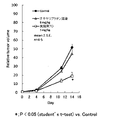
- FIG. 4 is a diagram showing changes in relative tumor volume when oxaliplatin solution or DACHPt-encapsulating SCNP (Example 70) was administered three times every other day to a mouse colon cancer cell line (C26) subcutaneous dorsal transplantation model mouse. be.
- nanoparticle refers to structures exhibiting a particle size of 100 nm or less.
- single chain nanoparticle refers to a nanoparticle formed by chemical cross-linking, hydrophobic interaction, ionic bond, etc. within a single chain as a driving force. They often have a relatively small particle size of 20 nm or less among nanoparticles.
- initiator means an initiator for thermal radical polymerization such as an azo compound or peroxide.
- chain transfer agent refers to a compound that causes a chain transfer reaction in radical polymerization, preferably a compound having a thiocarbonyl group.
- C 1-3 alkyl group means a linear or branched alkyl group having 1 to 3 carbon atoms, and examples thereof include methyl, ethyl, n-propyl and isopropyl groups. be done.
- C 1-18 alkyl group means a linear or branched alkyl group having 1 to 18 carbon atoms, such as methyl group, ethyl group, n-propyl group, isopropyl group, n -butyl group, isobutyl group, sec-butyl group, tert-butyl group, pentyl group, hexyl group, heptyl group, octyl group, nonyl group, decyl group, undecyl group, dodecyl group, tridecyl group, tetradecyl group, pentadecyl group, A hexadecyl group, a heptadecyl group, an octadecyl group and the like can be mentioned.
- cycloalkyl group means a cyclic alkyl group having 3 to 8 carbon atoms, such as cyclopropyl, cyclobutyl, cyclopentyl, cyclohexyl group, cycloheptyl group, cyclooctyl group and the like.
- Substituents are not particularly limited, but examples include halogen atoms, alkyl groups having 1 to 6 carbon atoms, alkenyl groups having 2 to 6 carbon atoms, alkynyl groups having 2 to 6 carbon atoms, hydroxyl groups, and groups having 1 to 6 carbon atoms.
- Alkoxy group amino group, alkylamino group having 1 to 6 carbon atoms, di-C1 to 6 alkylamino group having the same or different alkyl groups, thiol group, alkylthio group having 1 to 6 carbon atoms, carboxyl group, 1 carbon atom to 6 alkoxycarbonyl groups, carbamoyl groups, and the like.
- the term “optionally substituted C 6-18 aryl group” means a monocyclic or condensed polycyclic aromatic hydrocarbon group, such as a phenyl group, a naphthyl group , anthracenyl group, phenanthrenyl group, triphenylenyl group, pyrenyl group, chrysenyl group, naphthacenyl group and the like.
- the "C 6-14 aryl group optionally having substituents” means a monocyclic or condensed polycyclic aromatic hydrocarbon group, such as a phenyl group, a naphthyl group, an anthracenyl group , a phenanthrenyl group, and the like.
- Substituents are not particularly limited, but examples include halogen atoms, alkyl groups having 1 to 6 carbon atoms, alkenyl groups having 2 to 6 carbon atoms, alkynyl groups having 2 to 6 carbon atoms, hydroxyl groups, and groups having 1 to 6 carbon atoms. Alkoxy group, amino group, alkylamino group having 1 to 6 carbon atoms, alkylamino group having 1 to 6 carbon atoms and having the same or different alkyl groups, thiol group, alkylthio group having 1 to 6 carbon atoms, carboxyl group, carbon number 1 to 6 alkoxycarbonyl groups, carbamoyl groups and the like.
- the term "optionally substituted 5- to 10-membered heteroaryl group” refers to 1 to 4 atoms selected from nitrogen atoms, oxygen atoms and sulfur atoms in addition to carbon atoms constituting the ring. means a 5- to 10-membered monocyclic aromatic heterocyclic group or condensed aromatic heterocyclic group containing a heteroatom.
- Examples of monocyclic aromatic heterocyclic groups include furyl, thienyl, pyrrolyl, pyridinyl, pyrazinyl, pyrimidinyl, pyridazinyl, imidazolyl, pyrazyl, thiaryl, oxazolyl, isoxazolyl, 1, 3,4-thiadiazolyl group, 1,2,3-triazolyl group, 1,2,4-triazolyl group, tetrazolyl group and the like.
- condensed aromatic heterocyclic groups include benzofuranyl, benzothiophenyl, quinoxalinyl, indolyl, isoindolyl, isobenzofuranyl, chromanyl, benzimidazolyl, benzothiazolyl, benzoxazolyl, and quinolyl. groups, isoquinolinyl groups, and the like.
- the "6- to 10-membered heteroaryl group optionally having substituent(s)" means 1 to 4 heteroatoms selected from a nitrogen atom, an oxygen atom and a sulfur atom in addition to the carbon atoms constituting the ring.
- Monocyclic aromatic heterocyclic groups include, for example, a pyridinyl group, a pyrazinyl group, a pyrimidinyl group, a pyridazinyl group, and the like.
- condensed aromatic heterocyclic groups include benzofuranyl, benzothiophenyl, quinoxalinyl, indolyl, isoindolyl, isobenzofuranyl, chromanyl, benzimidazolyl, benzothiazolyl, benzoxazolyl, and quinolyl. groups, isoquinolinyl groups, and the like.
- Substituents are not particularly limited, and examples include halogen atoms, alkyl groups having 1 to 6 carbon atoms, alkenyl groups having 2 to 6 carbon atoms, alkynyl groups having 2 to 6 carbon atoms, hydroxyl groups, and groups having 1 to 6 carbon atoms. Alkoxy group, amino group, alkylamino group having 1 to 6 carbon atoms, alkylamino group having 1 to 6 carbon atoms and having the same or different alkyl groups, thiol group, alkylthio group having 1 to 6 carbon atoms, carboxyl group, carbon number 1 to 6 alkoxycarbonyl groups, carbamoyl groups and the like.
- halogen atom includes a fluorine atom, a chlorine atom, a bromine atom, an iodine atom, and the like.
- the structural unit (A) functions as a unit that imparts hydrophilicity
- the structural unit (B) functions as a unit that imparts hydrophobicity
- the structural unit (C) functions as a scaffold for binding the active ingredient (drug, physiologically active substance) and the copolymer.
- R 1 in structural unit (A) represents a hydrogen atom or a C 1-3 alkyl group, preferably a hydrogen atom or a methyl group, more preferably a hydrogen atom, an ethyl group, an n-propyl group or an isopropyl group, A hydrogen atom is more preferred.
- X 1 represents an oxygen atom, a sulfur atom or NR 7 , preferably an oxygen atom, a sulfur atom or NH, more preferably an oxygen atom.
- m represents an integer of 1 to 100, preferably an integer of 3 to 100, preferably 3 to 80 from the viewpoint of imparting good hydrophilicity, more preferably 4 to 60, more preferably 4 to 40, further preferably 4 to 22 is even more preferred.
- R 4 represents a C 1-3 alkyl group, specifically methyl group, ethyl group, n-propyl group or isopropyl group, preferably methyl group or ethyl group, more preferably methyl group.
- R 2 in the structural unit (B) represents a hydrogen atom or a C 1-3 alkyl group, preferably a hydrogen atom or a methyl group, more preferably a hydrogen atom, an ethyl group, an n-propyl group or an isopropyl group; A hydrogen atom is more preferred.
- X 2 represents an oxygen atom, a sulfur atom or NR 7 , preferably an oxygen atom, a sulfur atom or NH, more preferably an oxygen atom.
- n represents an integer of 0 to 3, preferably an integer of 1 to 3, more preferably 1.
- R 5 is a hydrogen atom, a C 1-18 alkyl group, an optionally substituted 3- to 8-membered cycloalkyl group, an adamantyl group, an optionally substituted C 6-18 aryl group or a substituent; is a 5- to 10-membered heteroaryl group optionally having a C 1-18 alkyl group, a 3- to 8-membered heteroaryl group optionally having a substituent from the viewpoint of imparting hydrophobicity to the structural unit (B)
- a cycloalkyl group, an adamantyl group, an optionally substituted C 6-18 aryl group or an optionally substituted 5- to 10-membered heteroaryl group is preferred, and a C 1-18 alkyl group and a substituent are preferably an optionally substituted 3- to 8-membered cycloalkyl group, an adamantyl group, an optionally substituted C 6-18 aryl group or an optionally substituted 5- to 10-membered heteroaryl
- substituent is preferably one or more selected from a halogen atom, an alkyl group having 1 to 6 carbon atoms, an alkenyl group having 2 to 6 carbon atoms and an alkynyl group having 2 to 6 carbon atoms.
- R 3 in structural unit (C) represents a hydrogen atom or a C 1-3 alkyl group, preferably a hydrogen atom or a methyl group, and more preferably a hydrogen atom, an ethyl group, an n-propyl group or a monopropyl group. , more preferably a hydrogen atom.
- X 3 represents an oxygen atom, a sulfur atom or NR 7 , preferably an oxygen atom, a sulfur atom or NH, more preferably an oxygen atom.
- R6 represents a hydrogen atom, a leaving group or a linker.
- the leaving group is a group that can be eliminated when the structural unit (C) binds to the drug (biologically active substance), and the linker is a It is a group that can be used for cross-linking.
- These leaving groups or linkers include optionally substituted C 1-18 alkyl groups, optionally substituted 3- to 8-membered cycloalkyl groups, and optionally substituted C 7-19 aralkyl groups are preferred.
- the substituents include, for example, a halogen atom, an alkyl group having 1 to 6 carbon atoms, an alkenyl group having 2 to 6 carbon atoms, an alkynyl group having 2 to 6 carbon atoms, a hydroxyl group, and an alkoxy group having 1 to 6 carbon atoms. , an amino group, an alkylamino group having 1 to 6 carbon atoms, an alkylamino group having 1 to 6 carbon atoms and having the same or different alkyl groups, a thiol group, an alkylthio group having 1 to 6 carbon atoms, a carboxyl group, and 1 to 6 carbon atoms 6 alkoxycarbonyl group, carbamoyl group and the like.
- the linker is preferably a group having a functional group such as a hydroxyl group, an amino group, a thiol group, or a carboxyl group as a substituent.
- a functional group such as a hydroxyl group, an amino group, a thiol group, or a carboxyl group as a substituent.
- Preferred specific examples of the leaving group for R 6 include the following formula (4):
- R 6 linkers are the following formulas (5) to (7):
- a group selected from is exemplified.
- the copolymer of the present invention is a copolymer having structural units represented by formulas (A), (B) and (C).
- the copolymer may be a random copolymer or a block copolymer, preferably a random copolymer.
- the composition ratio of each structural unit in one molecule is 0.01 to 100 parts by mass of (B) and 0.1 to 100 parts by mass of (C) when (A) is 1 part by mass.
- the ratio is preferable, and when (A) is 1 part by mass, (B) is 0.05 to 18 parts by mass and (C) is more preferably 0.1 to 20 parts by mass.
- a ratio of 0.7 to 0.9 parts by mass of (B) and 0.1 to 0.3 parts by mass of (C) is particularly preferred when 1 part by mass is used.
- the number average molecular weight is preferably 5,000 to 150,000, more preferably 8,000 to 150,000.
- the monomer represented by general formula (1) functions as a unit that imparts hydrophilicity
- the monomer represented by general formula (2) functions as a unit that imparts hydrophobicity
- the monomer represented by general formula (3) functions as a scaffold for binding the drug and the copolymer.
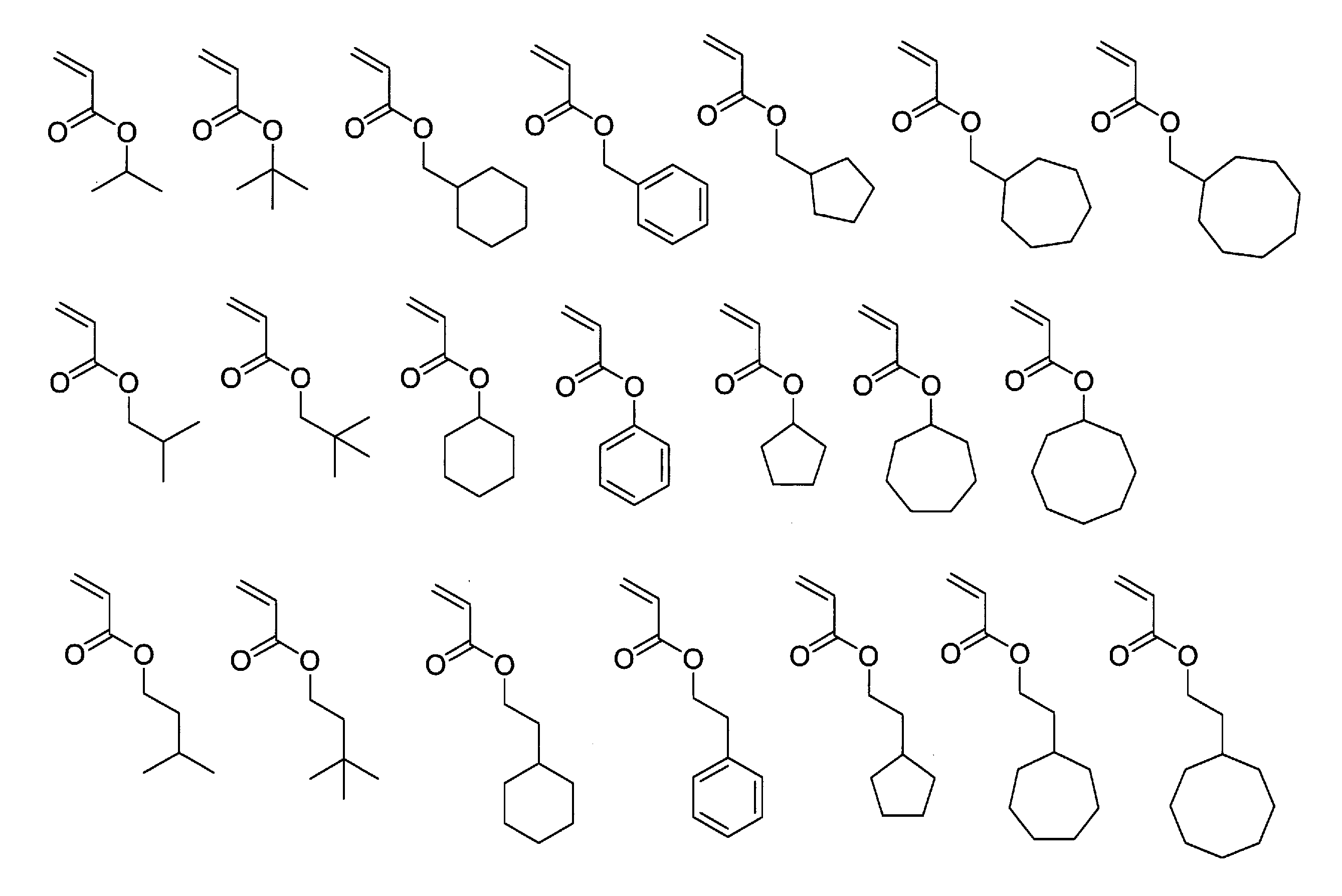
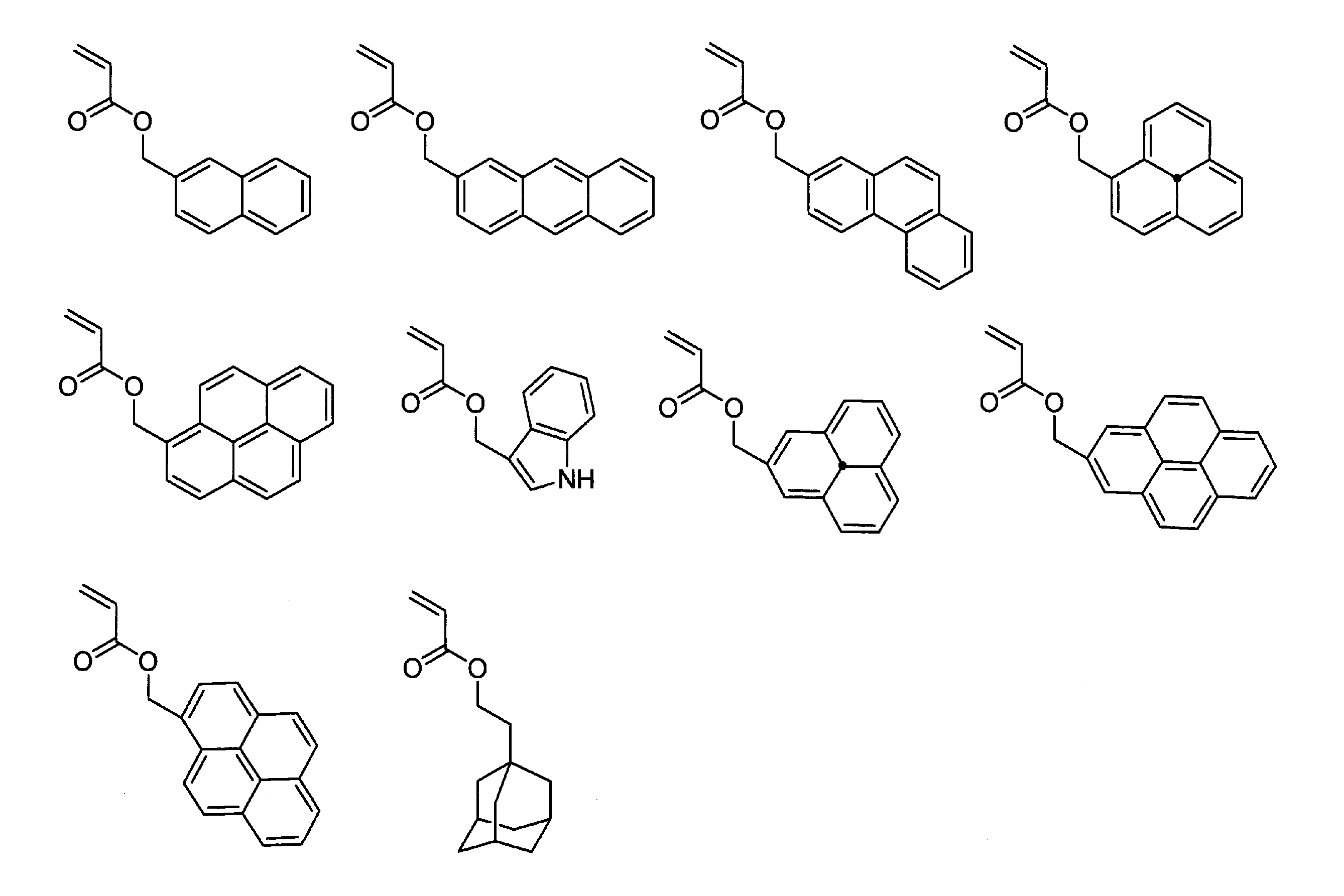
- a monomer functioning as a hydrophobic unit represented by general formula (2) for example, the following formula:
- the monomer represented by can be exemplified.
- R 1 represents a hydrogen atom or a C 1-3 alkyl group, preferably a hydrogen atom or a methyl group, more preferably a hydrogen atom, an ethyl group, an n-propyl group or an isopropyl group; A hydrogen atom is more preferred.
- R 2 represents a hydrogen atom or a C 1-3 alkyl group, preferably a hydrogen atom or a methyl group, more preferably a hydrogen atom, an ethyl group, an n-propyl group or an isopropyl group; A hydrogen atom is more preferred.
- R 3 represents a hydrogen atom or a C 1-3 alkyl group, preferably a hydrogen atom or a methyl group, more preferably a hydrogen atom, an ethyl group, an n-propyl group or an isopropyl group; A hydrogen atom is more preferred.
- R 4 represents a C 1-3 alkyl group, specifically methyl group, ethyl group, n-propyl group or isopropyl group, preferably methyl group or ethyl group, and methyl group is more preferred.
- X 1 represents an oxygen atom, a sulfur atom or NR 7 , preferably an oxygen atom, a sulfur atom or NH, more preferably an oxygen atom.
- m represents an integer of 1 to 100, preferably an integer of 3 to 100, preferably 3 to 80 in terms of imparting good hydrophilicity, more preferably 4 to 60, 4 to 40 is more preferred, and 4-22 is even more preferred.
- R 5 is a hydrogen atom, a C 1-18 alkyl group, an optionally substituted 3- to 8-membered cycloalkyl group, an adamantyl group, or an optionally substituted C 6 A -18 aryl group or a 5- to 10-membered heteroaryl group which may have a substituent, but from the viewpoint of imparting hydrophobicity to the structural unit (B), a C 1-18 alkyl group and a substituent A 3- to 8-membered cycloalkyl group which may be optionally substituted, an adamantyl group, a C 6-18 aryl group which may be substituted or a 5- to 10-membered heteroaryl group which may be substituted are preferred, and C 1- 18 alkyl group, optionally substituted 3- to 8-membered cycloalkyl group, adamantyl group, optionally substituted C 6-18 aryl group, or optionally substituted 5 A to 10-membered heteroaryl group is more prefer
- substituent is preferably one or more selected from a halogen atom, an alkyl group having 1 to 6 carbon atoms, an alkenyl group having 2 to 6 carbon atoms and an alkynyl group having 2 to 6 carbon atoms.
- X 2 represents an oxygen atom, a sulfur atom or NR 7 , preferably an oxygen atom, a sulfur atom or NH, more preferably an oxygen atom.
- n represents an integer of 0 to 3, preferably an integer of 1 to 3, more preferably 1.
- R6 represents a hydrogen atom, a leaving group or a linker.
- These leaving groups or linkers include optionally substituted C 1-18 alkyl groups, optionally substituted 3- to 8-membered cycloalkyl groups, and optionally substituted C 7-19 aralkyl groups are preferred.
- the substituents include, for example, a halogen atom, an alkyl group having 1 to 6 carbon atoms, an alkenyl group having 2 to 6 carbon atoms, an alkynyl group having 2 to 6 carbon atoms, a hydroxyl group, and an alkoxy group having 1 to 6 carbon atoms.
- the linker is preferably a group having a functional group such as a hydroxyl group, an amino group, a thiol group, or a carboxyl group as a substituent.
- Preferred specific examples of the leaving group for R 6 include the following formula (4):
- R 6 linkers are the following formulas (5) to (7):
- a group selected from is exemplified.
- X 3 represents an oxygen atom, a sulfur atom or NR 7 , preferably an oxygen atom, a sulfur atom or NH, more preferably an oxygen atom.
- the copolymer of the present invention is formed by copolymerizing three types of monomers represented by general formulas (1) to (3).
- Copolymerization may be random copolymerization or block copolymerization, but is preferably formed by random copolymerization.
- the blending ratio of the three types of monomers is 0.01 to 100 parts by mass of monomer (2) and 0.1 to 100 parts by mass of monomer (3) when the mass of monomer (1) is 1.
- 0.05 to 18 parts by mass of the monomer (2) and 0.1 to 20 parts by mass of the monomer (3) are polymerized, more preferably 0.7 to 0.9 parts by mass of the monomer (2). It is particularly preferred to polymerize monomer (2) with 0.1 to 0.3 parts by weight of monomer (3).
- solvent coordinated with various solvents are also included in the copolymers of the present invention.
- solvate includes, for example, hydrates and ethanolates.
- the solvent may be coordinated to the copolymers of the invention in any number.
- the term "pharmaceutical composition” means that an active ingredient (drug, physiologically active substance) that can be used for diagnosis, prevention or treatment of a disease interacts with the copolymer of the present invention through electrostatic interaction, hydrogen bonding, or hydrophobic interaction. Alternatively, it means a substance supported by an action such as a covalent bond.
- the form of loading includes a form in which the drug is present on the surface of the particles, a form in which the drug is encapsulated in the nanoparticles, and a combination of these forms.
- the copolymer of the present invention can be produced by various known methods. Although the production method is not particularly limited, it can be produced, for example, according to the basic polymer synthesis method described below.
- R′ represents a hydrogen atom or a C 1-3 alkyl group
- R′′ represents a group represented by R 4 , R 5 or R 6 ]
- This reaction shows the process of reacting the monomer (I) with the chain transfer agent (II) and the initiator to produce the polymer (III).
- This reaction can be carried out without a solvent, or with alcohols such as methanol, ethanol, 1-propanol and 2-propanol, ethers such as diethyl ether, tetrahydrofuran and 1,4-dioxane, and aromatics such as benzene, toluene and xylene.
- solvents such as hydrocarbons, halogenated hydrocarbons such as dichloromethane, chloroform and 1,2-dichloroethane, N,N-dimethylformamide, N,N-dimethylacetamide, N-methylpyrrolidone, acetonitrile and ethyl acetate.
- aromatic hydrocarbons such as toluene and xylene
- aromatic hydrocarbons such as toluene and xylene
- DDMAT Dodecylthiocarbonothioylthio-2-methylpropionic acid
- CDTTC dodecyltrithiocarbonate
- CPDTTC Cyano-2-propyldodecyl trithiocarbonate
- CDSPA dodecylsulfanyl-thiocarbonyl
- CDSPA diodecylsulfanyl-thiocarbonyl
- the copolymer of the present invention assumes a structure in which part or all of the structure of the chain transfer agent is partially bonded. If the copolymer contains serial transfer agent structures, the structures may be removed by any suitable method.
- initiators 2,2′-Azobis-isobutylonitrile (AIBN), 1,1′-Azobis (cyclohexanecarbonitrile) (ACHN), 2,2′-Azobis-2-methylbutyronitrile (AMBN), 2,2′-Azobis Azo polymerization initiators such as -2,4-dimethylvaleronitrile (ADVN) can be used, and AIBN is preferably used.
- the reaction temperature is 0 to 300°C, preferably 0 to 150°C, more preferably room temperature to 100°C, and the reaction time is 1 minute to 48 hours, preferably 5 minutes to 24 hours.
- the reaction time is 1 minute to 48 hours, preferably 5 minutes to 24 hours.
- the produced copolymer of the present invention can be purified by a polymer isolation and purification method generally known in the field of polymer chemistry. Specifically, for example, extraction, recrystallization, salting out with ammonium sulfate or sodium sulfate, centrifugation, dialysis, ultrafiltration, adsorption chromatography, ion exchange chromatography, hydrophobic chromatography, normal phase chromatography, reverse Processing procedures such as phase chromatography, gel filtration, gel permeation chromatography, affinity chromatography, electrophoresis, countercurrent distribution, and the like, and combinations thereof.
- a polymer isolation and purification method generally known in the field of polymer chemistry. Specifically, for example, extraction, recrystallization, salting out with ammonium sulfate or sodium sulfate, centrifugation, dialysis, ultrafiltration, adsorption chromatography, ion exchange chromatography, hydrophobic chromatography, normal phase chromatography, reverse Processing procedures such
- the copolymer of the present invention can be used as a carrier for transporting various physiologically active substances (drugs).
- a pharmaceutical composition in which a tumor therapeutic drug is carried (encapsulated) in the copolymer of the present invention suppresses the growth of tumors, as confirmed in the test examples described later.
- It can be used as a preventive and/or therapeutic agent for various cancer diseases such as gastric cancer, pancreatic cancer, liver cancer, lung cancer, uterine cancer and ovarian cancer.
- it can be used as a diagnostic agent for tumors and as a contrast medium because of its high ability to accumulate in tumors.
- the dosage and frequency of administration may be appropriately selected in consideration of the dosage form, age and body weight of the patient, nature or severity of symptoms to be treated, and the like.
- the dose and frequency of administration should not be limited, when a drug-encapsulating polymer is intravenously injected as an injection, for example, 0.12 mg per adult (60 kg) per administration It is preferred to administer an amount of ⁇ 12,000,000 mg, more preferably an amount of 1.2 mg to 1200,000 mg, particularly preferably an amount of 12 to 120,000 mg.
- a pharmaceutical composition of the invention can be prepared by mixing a copolymer of the invention with a drug.
- the copolymer of the present invention and the drug are mixed to produce a single chain nanoparticle, or the single chain nanoparticle of the copolymer of the present invention is produced and then the drug is mixed.
- a single chain nanoparticle can be produced by a known method.
- the drug may be supported on the copolymer by an action such as electrostatic interaction, hydrogen bond, hydrophobic interaction or covalent bond.
- Drugs used for various cancer diseases include pemetrexed sodium, mitomycin C, bleomycin hydrochloride, aclarubicin hydrochloride, amrubicin hydrochloride, epirubicin hydrochloride, doxorubicin hydrochloride, pirarubicin hydrochloride, irinotecan hydrochloride, etoposide, docetaxel, nogitecan hydrochloride, paclitaxel, vinorelbine tartrate, vinblastine sulfate, oxaliplatin, carfilzomib, carboplatin, cisplatin, temsirolimus, trabectedin, fulvestrant, bortezomib, mitoxantrone hydrochloride, miriplatin, emtansine, SN-38, monomethyl Auristatin E, monomethyl auristatin F, staurosporine and the like can be mentioned.
- these drugs are produced into the pharmaceutical composition
- the administration route of the pharmaceutical composition of the present invention it is desirable to use the most effective one for treatment.
- Parenteral administration such as , intraarterial injection, intravenous injection, subcutaneous injection, intramuscular injection and intraperitoneal injection is preferred, and intraarterial injection and intravenous injection are more preferred.
- the frequency of administration should not be limited, but may be, for example, once to several times per week on average.
- formulations suitable for administration routes include excipients, extenders, binders, wetting agents, disintegrants, lubricants, surfactants, dispersants, buffers, preservatives, solubilizers, Formulation additives such as preservatives, flavoring agents, analgesics, stabilizers, tonicity agents, etc. can be appropriately selected, and the preparation can be produced by a conventional method.
- formulation additives that can be included in the above various formulations are not particularly limited as long as they are pharmaceutically acceptable.
- examples of such formulation additives include purified water, water for injection, distilled water for injection, pharmaceutically acceptable organic solvents, collagen, polyvinyl alcohol, polyvinylpyrrolidone, carboxyvinyl polymer, sodium alginate, water-soluble dextran, carboxy Sodium methyl starch, pectin, xanthan gum, gum arabic, casein, gelatin, agar, glycerin, propylene glycol, polyethylene glycol, petrolatum, paraffin, stearyl alcohol, stearic acid, human serum albumin, mannitol, sorbitol, lactose and the like.
- Additives to be used can be appropriately selected according to various formulations and used alone or in combination.
- Injections can also be prepared as non-aqueous diluents (eg, polyethylene glycol, vegetable oils such as olive oil, alcohols such as ethanol, etc.), suspensions, or emulsions. Sterilization of injections can be carried out by filtration sterilization using a filter, or by adding a bactericide or the like. Injections can also be manufactured in the form of preparations just before use. That is, it can be made into a sterile solid composition by a freeze-drying method or the like, and dissolved in water for injection, distilled water for injection or other solvent before use.
- non-aqueous diluents eg, polyethylene glycol, vegetable oils such as olive oil, alcohols such as ethanol, etc.
- Sterilization of injections can be carried out by filtration sterilization using a filter, or by adding a bactericide or the like.
- Injections can also be manufactured in the form of preparations just before use. That is, it can be made into a
- Example 1 Production of poly[(benzyl acrylate)-co-(poly(ethylene glycol) methyl ether acrylate)-co-(1-ethoxyethyl acrylate)] (1) Synthesis of 1-Ethoxyethyl acrylate (EEA) Argon atmosphere Below, Ethyl vinyl ether (28.725 mL) was weighed out, and Phosphoric acid (50 mg) was added under ice-cooling. After that, acrylic acid (17.15 mL) was added, and the mixture was stirred at room temperature for 48 hours. Hydrotalcite (3 g) was added and stirred for an additional 2 hours to stop the reaction.
- EAA 1-Ethoxyethyl acrylate
- poly(ethylene glycol) methyl ether acrylate (mPEGA, the average number of repetitions of ethylene glycol (n) is 9) 1.296 g, Benzyl acrylate (BnA) 0.394 g, 1-Ethoxyethyl acrylate 0.039 g , DDMAT/Toluene stock solution 1.73 mL and AIBN/Toluene stock solution 1.73 mL were added, and polymerization was performed in an oil bath at 70°C. After 90 minutes had passed, the polymerization was stopped, and the copolymer was recovered by reprecipitation or dialyzing the reaction solution against methanol.
- mPEGA poly(ethylene glycol) methyl ether acrylate
- Example 69 Preparation of poly[(benzyl acrylate)-co-(poly(ethylene glycol) methyl ether acrylate)-co-(acrylic acid)]
- Poly[(benzyl acrylate)-co-(poly(ethylene glycol) methyl ether acrylate)-co-(1-ethoxyethyl acrylate)] was treated with 0.5N HCl at room temperature to eliminate the ethoxyethyl group and obtain 1.176 g of a terpolymer having a carboxyl group.
- the Z-average particle size and polydispersity index of the obtained terpolymer in water were measured by dynamic light scattering (DLS), and the result was 8.5 nm (polydispersity index: 0.14). there were.
- Example 70 (1,2-Diaminocyclohexane) Platinum (II) Encapsulating SCNP Production Method (1,2-Diaminocyclohexane) platinum (II) (hereinafter abbreviated as DACHPt) Cl (H 2 O) form (DACHPt Cl H 2 O) 65.28 mg was dissolved in 20 mL of purified water and stirred at 70° C. for 2 hours. 287.4 mg of the terpolymer obtained in Example 69 was added to 5 mL of this solution, and the mixture was stirred overnight at 50°C. After stirring, the reaction solution was purified by dialysis using purified water as an external liquid to obtain 5 mL of DACHPt-encapsulating SCNP.
- the Pt content of DACHPt-encapsulating SCNP obtained after purification was measured by inductively coupled plasma-atomic emission spectrometry (ICP-AES) and found to be 720 ⁇ g/mL (1.14 mg/mL as DACHPt).
- ICP-AES inductively coupled plasma-atomic emission spectrometry
- 200 ⁇ L of DACHPt-encapsulating SCNP was lyophilized, the solid content concentration was calculated, and the ratio with the Pt content was calculated to calculate the Pt binding amount per polymer, which was 3.4 mol/mol.
- the Z-average particle size and polydispersity index of the obtained DACHPt-encapsulating SCNP were measured by dynamic light scattering (DLS) and found to be 8.7 nm (polydispersity index: 0.14).
- FIG. 3 shows the particle size of SCNP before and after encapsulation of DACHPt. The particle size of SCNP hardly changed before and after encapsulation of DACHPt. The results are summarize
- ICP-AES measurement device Sequential high-frequency plasma emission device ICPE-9000/Shimadzu Corporation
- Pretreatment device Microwave sample pretreatment device ETHOS EASY/Milestone General Measurement wavelength: 342 nm Standard solution: Gadolinium standard solution (Gd1000) for ICP analysis/Fujifilm Wako Pure Chemical Industries
- DLS measurement Apparatus Zetasizer NanoZS/Malvern Instruments Ltd. Measurement temperature: 25°C Sample concentration: 10 mg/mL Results: Figure 3
- DACHPt-encapsulating SCNP (DACHPt-encapsulating SCNP prepared using the copolymer of Example 70) was administered to the tail vein (three times every other day), and the antitumor effect was evaluated from the tumor volume (4-5 mice per group).
- an oxaliplatin solution (Comparative Example 1) was used and administered in the same manner.
- the dose of each preparation was 8 mg/kg (3.9 mg/kg in terms of Pt) as the maximum dose for the oxaliplatin solution, and 3 mg/kg in terms of Pt for the DACHPt-encapsulating SCNP.
- FIG. 4 shows changes in tumor volume over time.
- T/C tumor volume ratio between drug-administered group (T) and control group (C)].
- T/C tumor volume ratio between drug-administered group (T) and control group (C)].
- T/C tumor volume ratio between drug-administered group (T) and control group (C)].
- T/C tumor volume ratio between drug-administered group (T) and control group (C)].
- T/C tumor volume ratio between drug-administered group
- C control group
Landscapes
- Health & Medical Sciences (AREA)
- Chemical & Material Sciences (AREA)
- Medicinal Chemistry (AREA)
- Chemical Kinetics & Catalysis (AREA)
- Polymers & Plastics (AREA)
- Organic Chemistry (AREA)
- Engineering & Computer Science (AREA)
- Bioinformatics & Cheminformatics (AREA)
- General Health & Medical Sciences (AREA)
- Epidemiology (AREA)
- Life Sciences & Earth Sciences (AREA)
- Animal Behavior & Ethology (AREA)
- Pharmacology & Pharmacy (AREA)
- Public Health (AREA)
- Veterinary Medicine (AREA)
- Physics & Mathematics (AREA)
- Biomedical Technology (AREA)
- Nanotechnology (AREA)
- Optics & Photonics (AREA)
- General Chemical & Material Sciences (AREA)
- Medicinal Preparation (AREA)
- Addition Polymer Or Copolymer, Post-Treatments, Or Chemical Modifications (AREA)
- Pharmaceuticals Containing Other Organic And Inorganic Compounds (AREA)
- Medicines That Contain Protein Lipid Enzymes And Other Medicines (AREA)
Abstract
Description
[1]次の式(A)、(B)及び(C)で示される構造単位を有するコポリマー。

[2]次の一般式(1)~(3):

で示される3種のモノマーの重合によって形成されるコポリマー。
[3]R1が水素原子である前記[1]又は[2]に記載のコポリマー。
[4]R2が水素原子である前記[1]~[3]のいずれかに記載のコポリマー。
[5]R3が水素原子である前記[1]~[4]のいずれかに記載のコポリマー。
[6]R4がメチル基である前記[1]~[5]のいずれかに記載のコポリマー。
[7]R5が置換基を有してもよいC6-18アリール基である前記[1]~[6]のいずれかに記載のコポリマー。
[8]R5がフェニル基である前記[1]~[7]のいずれかに記載のコポリマー。
[9]R6が、水素原子である前記[1]~[8]のいずれかに記載のコポリマー。
[10]R6の脱離基が、次式(4):

[11]R6のリンカーが、次式(5)~(7):

[12]X1が酸素原子である前記[1]~[11]のいずれかに記載のコポリマー。
[13]X2が酸素原子である前記[1]~[12]のいずれかに記載のコポリマー。
[14]X3が酸素原子である前記[1]~[13]のいずれかに記載のコポリマー。
[15]mが4~22の整数である前記[1]~[14]のいずれかに記載のコポリマー。
[16]nが1である前記[1]~[15]のいずれかに記載のコポリマー。
[17]構造単位(A)、(B)、(C)の比率が、(A)1質量部に対して、0.01~100質量部の(B)と、0.1~100質量部の(C)で構成されている前記[1]~[16]に記載のコポリマー。
[18]モノマー(1)の1質量部に対して、0.01~100質量部のモノマー(2)と、0.1~100質量部のモノマー(3)を重合させてなる前記[2]~[16]のいずれかに記載のコポリマー。
[19]数平均分子量が、5000~150000である前記[1]~[18]のいずれかに記載のコポリマー。
[20]前記[1]~[19]のいずれかに記載のコポリマーを含むsingle chain nanoparticle。
[21]前記[1]~[19]のいずれかに記載のコポリマーを含む医薬組成物。
本明細書において「ナノ粒子」とは、100nm以下の粒子径を示す構造体を指す。
X1は、酸素原子、硫黄原子又はN-R7を示すが、酸素原子、硫黄原子又はNHが好ましく、酸素原子がより好ましい。
mは1~100の整数を示すが、3~100の整数が好ましく、良好な親水性を付与する点から3~80が好ましく、4~60がより好ましく、4~40がさらに好ましく、4~22がよりさらに好ましい。
R4は、C1-3アルキル基を示し、具体的にはメチル基、エチル基、n-プロピル基又はイソプロピル基であり、メチル基又はエチル基が好ましく、メチル基がより好ましい。
X2は、酸素原子、硫黄原子又はN-R7を示すが、酸素原子、硫黄原子又はNHが好ましく、酸素原子がより好ましい。
nは0~3の整数を示すが、1~3の整数が好ましく、1がより好ましい。
R5は、水素原子、C1-18アルキル基、置換基を有してもよい3~8員シクロアルキル基、アダマンチル基、置換基を有してもよいC6-18アリール基又は置換基を有してもよい5~10員へテロアリール基を示すが、構造単位(B)に疎水性を付与する点から、C1-18アルキル基、置換基を有してもよい3~8員シクロアルキル基、アダマンチル基、置換基を有してもよいC6-18アリール基又は置換基を有してもよい5~10員へテロアリール基が好ましく、C1-18アルキル基、置換基を有していてもよい3~8員シクロアルキル基、アダマンチル基、置換基を有していてもよいC6-18アリール基又は置換基を有していてもよい5~10員へテロアリール基がより好ましく、C1-18アルキル基、3~8員シクロアルキル基、アダマンチル基又はC6-18アリール基がよりさらに好ましい。また一方で、置換基を有してもよい3~8員シクロアルキル基、アダマンチル基、置換基を有してもよいC6-14アリール基又は置換基を有してもよい6~10員へテロアリール基も好ましい。ここで、置換基としては、ハロゲン原子、炭素数1~6のアルキル基、炭素数2~6のアルケニル基及び炭素数2~6のアルキニル基から選ばれる1種又は2種以上が好ましい。
X3は、酸素原子、硫黄原子又はN-R7を示すが、酸素原子、硫黄原子又はNHが好ましく、酸素原子がより好ましい。
R6は、水素原子、脱離基又はリンカーを示す。この脱離基は、構造単位(C)が薬物(生理活性物質)と結合するときに脱離し得る基であり、リンカーは、構造単位(C)が薬物(生理活性物質)と結合するときに架橋に使用できる基である。これら脱離基又はリンカーとしては、置換基を有していてもよいC1-18アルキル基、置換基を有してもよい3~8員シクロアルキル基、置換基を有していてもよいC7-19アラルキル基が好ましい。ここで、置換基としては、例えば、ハロゲン原子、炭素数1~6のアルキル基、炭素数2~6のアルケニル基、炭素数2~6のアルキニル基、水酸基、炭素数1~6のアルコキシ基、アミノ基、炭素数1~6のアルキルアミノ基、アルキル基が同一又は異なるジ炭素数1~6のアルキルアミノ基、チオール基、炭素数1~6のアルキルチオ基、カルボキシル基、炭素数1~6のアルコキシカルボニル基、カルバモイル基等が挙げられる。これらの基のうち、リンカーとしては、置換基として、水酸基、アミノ基、チオール基、カルボキシル基などの官能基を有する基が好ましい。
R6の脱離基の好ましい具体例としては、次式(4):



R6の脱離基の好ましい具体例としては、次式(4):


本発明の医薬組成物において、薬物は、静電的相互作用、水素結合、疎水的相互作用又は共有結合といった作用等により、コポリマーに担持されていればよい。
(1)1-Ethoxyethyl acrylate(EEA)の合成
アルゴン雰囲気下にて、Ethyl vinyl ether(28.725mL)を秤取し、氷冷下にてPhosphoric acid(50mg)を加えた。その後、Acrylic acid(17.15mL)を加え、室温にて48時間攪拌した。Hydrotalcite(3g)を加えて、さらに2時間攪拌し、反応を停止した。セライトろ過後、エバポレーションにより、未反応のEthyl vinyl etherを除去した。重合禁止剤としてPhenothiazineを500ppmとなるように加え、水素化カルシウムと共に減圧蒸留することにより精製した(蒸留温度 28-32℃)。得られた1-Ethoxyethyl acrylateはガラスバイヤルに分取し、―30℃にて保管した。
13C NMR(400MHz,CDCl3),δ, ppm:15.29(-OCH2CH3), 21.16(-COOCH(CH3)), 64.98(-OCH2-), 96.73(-COOCH(CH3)), 128.84(CH2CH-), 131.43(CH2CH-), 166.00(-COO).
100mgの2-(Dodecylthiocarbonothioylthio)-2-methylpropionic acid(DDMAT)を秤取し、Toluene17.3mLに溶かしてDDMAT/Toluene stock solution(DDMAT濃度として5.78mg/mL)とした。同様に、22mgの2,2’-Azobis(2-methylpropionitrile)(AIBN)を秤取し,Toluene17.3mLに溶かしてAIBN/Toluene stock solution(AIBN濃度として1.27mg/mL)とした。別に、poly(ethylene glycol)methyl ether acrylate(mPEGA,エチレングリコールの繰り返し数の平均値(n)は9である。)1.296g、Benzyl acrylate(BnA)0.394g、1-Ethoxyethyl acrylate 0.039g、DDMAT/Toluene stock solution 1.73mL及びAIBN/Toluene stock solution 1.73mLを加え、70℃の油浴にて重合を行った。90分経過後、重合を停止した後、反応溶液を再沈殿法またはメタノールに対し透析することでコポリマーを回収した。得られたコポリマーは基本的に粘稠体であるため、再沈殿法については、貧溶媒(ヘキサン/酢酸エチル=7/3[v/v])を加えた遠沈管に反応溶液を滴下し、遠心分離(2,000×g、5min)により回収する操作を3回繰り返し、最終的に真空乾燥を行ない、poly[(benzyl acrylate)-co-(poly(ethylene glycol)methyl ether acrylate)-co-(1-ethoxyethyl acrylate)]を1.223g得た。
得られたコポリマーについて、NMRを用いて測定した1H-NMRスペクトルより各モノマーの重合度、並びに数平均分子量(Mn,NMR)を解析した結果、mPEGA(n=9)の重合度は102、BnAの重合度は94、EEAの重合度は9であり、Mn,NMRは65,900であった。さらに、得られたコポリマーについて、GPCを用いて、分子量分散度(Mw/Mn)を測定した結果1.53であった。

(1)1H-NMR測定
装置 :JNM-ECX400(400MHz)/日本電子
溶媒 :Dimethyl sulfoxide-d6 containing 0.03% tetramethylsilane/関東化学
試料濃度 :20mg/mL
測定温度 :25℃
積算回数 :256回
結果 :図1
(2)GPC測定
装置 :HPLC-Prominence system/島津製作所
検出器 :RID-10A Refractive index detector/島津製作所
カラム :TSKgel α-2500 column/東ソー
(カラムサイズ 7.8mm × 300mm,粒子径 7μm,
排除限界分子量 5 × 10³)
TSKgel α-4000 column/東ソー
(カラムサイズ 7.8mm × 300mm,粒子径 10μm,
排除限界分子量 4 × 10⁵)
TSKgel guardcolum/東ソー
移動相 :10mmol/Lの臭化リチウムを含有するN,N-dimethyformamide(DMF)
温度 :40℃
流速 :0.5mL/min
試料濃度 :6mg/mL
標準物質 :Poly(methyl methacrylate)standard ReadyCal set, Mp 800-2,200,000Da/SIGMA
結果 :図2

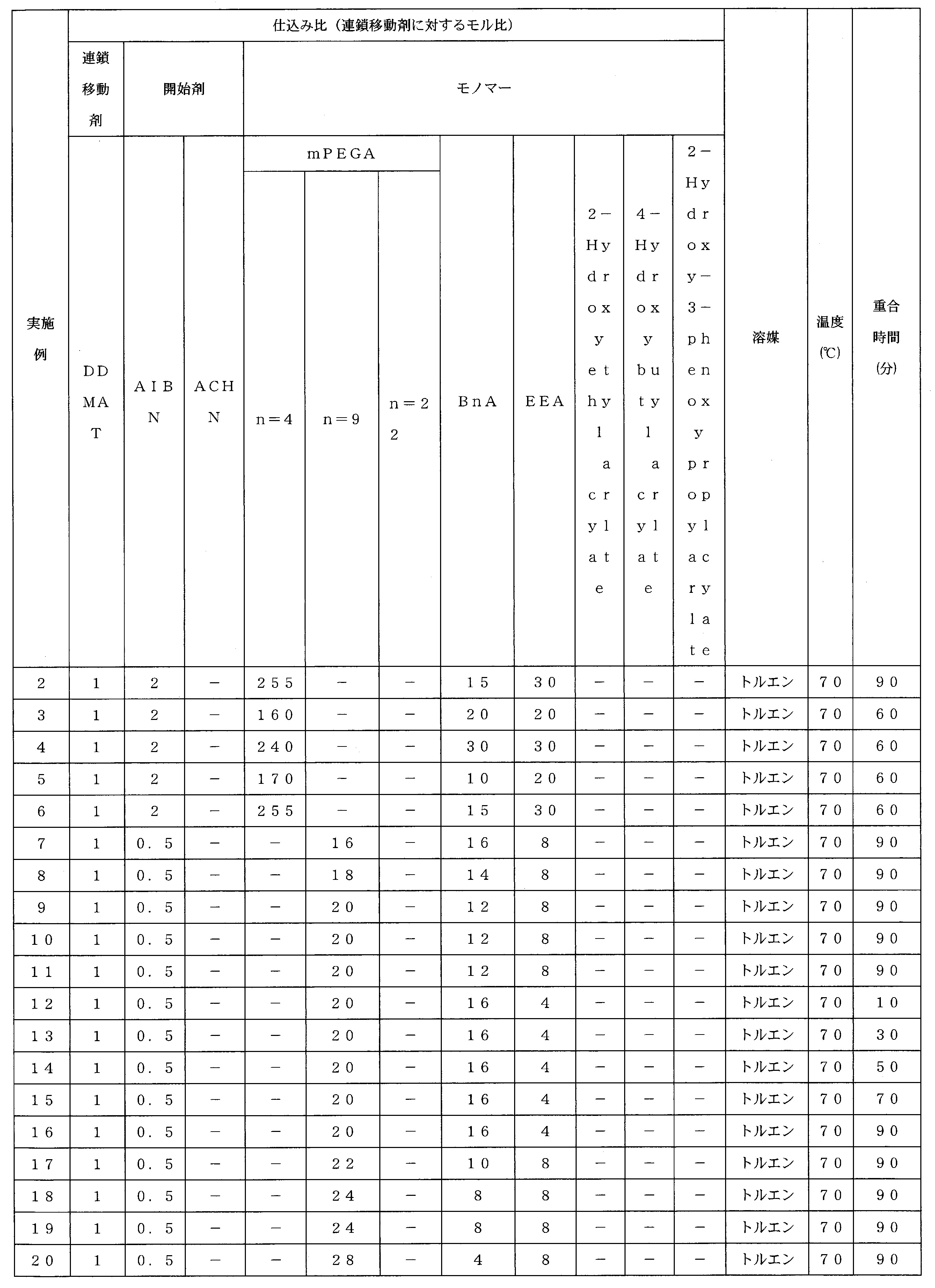
実施例1で用いたモノマー(mPEGA、BnA、EEA)の種類、仕込み量、反応温度、重合時間を適宜変更し、実施例1と同様の方法を用いることにより、下表に示す、組成比率や平均分子量の異なるポリマーを製造した。


poly[(benzyl acrylate)-co-(poly(ethylene glycol) methyl ether acrylate)-co-(acrylic acid)]の製造
実施例1で得たpoly[(benzyl acrylate)-co-(poly(ethylene glycol) methyl ether acrylate)-co-(1-ethoxyethyl acrylate)]を室温にて0.5N HClで処理することにより、ethoxyethyl基を脱離してカルボキシル基を有する3元共重合体1.176gを得た。得られた3元共重合体の水中におけるZ平均粒子径、並びに多分散指数を動的光散乱法(Dynamic light scattering,DLS)により測定した結果、8.5nm(多分散指数 0.14)であった。
(1)DLS測定
装置 :Zetasizer NanoZS/Malvern Instruments Ltd.
測定温度 :25℃
試料濃度 :10mg/mL
結果 :図3

(1,2-diaminocyclohexane)platinum(II)内包SCNPの製造方法
(1,2-diaminocyclohexane)platinum(II)(以下、DACHPtと略記する)のCl(H2O)体(DACHPt・Cl・H2O)65.28mgを精製水20mLに溶解し、70℃にて2時間撹拌した。この溶液5mLに対し、実施例69で得た3元共重合体287.4mgを添加し、50℃にて一晩撹拌した。撹拌終了後、反応溶液を、精製水を外液として透析精製し、DACHPt内包SCNPを5mL得た。精製後に得られたDACHPt内包SCNPのPt含量は誘導結合プラズマ発光分析(Inductively coupled plasma-atomic emission spectrometry,ICP-AES)により測定し、720μg/mL(DACHPtとして1.14mg/mL)であった。別途、DACHPt内包SCNP200μLを凍結乾燥し、固形分濃度を算出した後、Pt含量との比をとりポリマーあたりのPt結合量を算出した結果、3.4mol/molであった。また、得られたDACHPt内包SCNPのZ平均粒子径、並びに多分散指数を動的光散乱法(Dynamic light scattering,DLS)により測定した結果、8.7nm(多分散指数 0.14)であった。DACHPt内包前後のSCNPの粒子径を図3に示す。SCNPの粒子径は、DACHPt内包前後でほとんど変動しなかった。結果を下表にまとめた。
(1)ICP-AES測定
装置 :シーケンシャル高周波プラズマ発光装置 ICPE-9000/島津製作所
前処理装置 :マイクロ波試料前処理装置 ETHOS EASY/マイルストーン ゼネラル
測定波長 :342nm
標準溶液 :ガドリニウム標準液(Gd1000) ICP分析用/富士フィルム和光純薬
(2)DLS測定
装置 :Zetasizer NanoZS/Malvern Instruments Ltd.
測定温度 :25℃
試料濃度 :10mg/mL
結果 :図3

オキサリプラチン溶液の調製
エルプラット点滴静注液50mg((株)ヤクルト本社)1mLを5.9(w/v)%グルコース溶液5.58mLに添加し、オキサリプラチンとして760μg含有5(w/v)%グルコース溶液を調製した。
雌性ヌードマウス(BALB/c-nu nu/nu,7週齢;日本チャールス・リバー(株))にマウス大腸がん細胞株C26(American Type Culture Collection)を皮下移植した担癌モデルを薬効試験に用いた。
CO2インキュベーター内で継代培養したマウス大腸がん細胞株C26を液体培地(Dulbecco's Modified Eagle's Medium-high glucose, Sigma-Aldrich)に懸濁し、一匹あたり細胞数として1×10⁶/100μLとなるようにヌードマウスの背部皮下に注射した。その後約1週間ヌードマウスを飼育した後、腫瘍体積の平均値が約30mm3に生育したところで薬剤の投与を開始した。DACHPt内包SCNP(実施例70のコポリマーを使用して調製したDACHPt内包SCNP)を尾静脈内投与し(隔日3回)、腫瘍体積から抗腫瘍効果を評価した(1群4~5匹)。比較としてオキサリプラチン溶液(比較例1)を用いて、同様に投与した。各製剤の投与量は、オキサリプラチン溶液については、投与可能な最高用量として8mg/kg(Pt換算で3.9mg/kg)、DACHPt内包SCNPについては、Pt換算で3mg/kgとした。
腫瘍体積の経時変化を図4に示した。DACHPt内包SCNPの場合、投与14日後にT/C=0.4であった[T/C:薬物投与群(T)とControl群(C)の腫瘍体積の比]。オキサリプラチン溶液(比較例1)の場合、投与14日後にT/C=1.1であった。また、投与14日後においてDACHPt内包SCNPはControlに比較して有意に腫瘍の増大を抑制することを確認した(student's t-test)。以上の結果は、DACHPt内包SCNPはオキサリプラチン溶液に比較して優れた抗腫瘍効果を有することを示している。
Claims (21)
- 次の式(A)、(B)及び(C)で示される構造単位を有するコポリマー。

- 次の一般式(1)~(3):
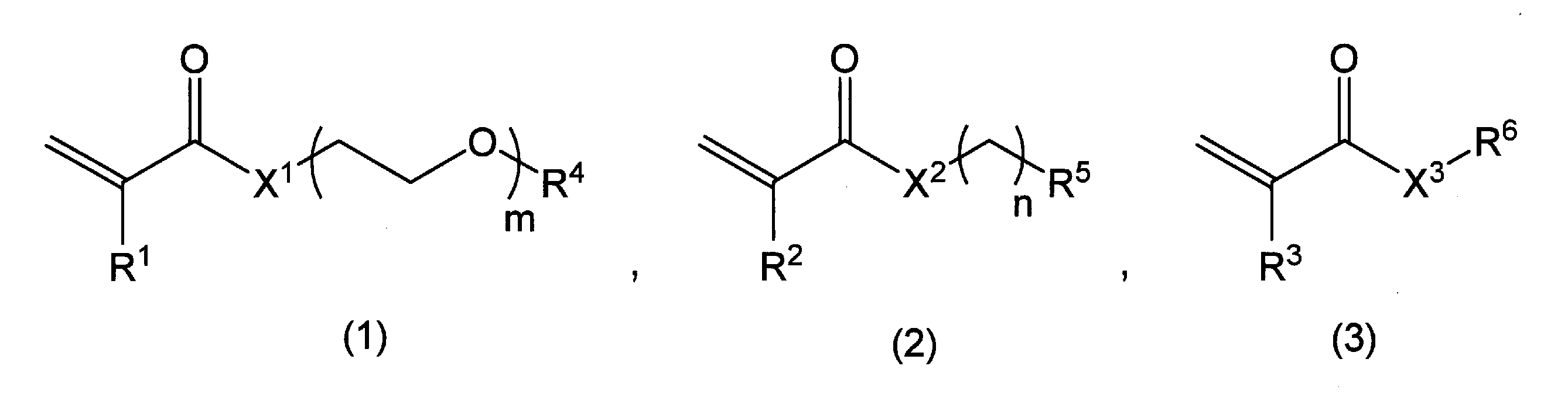
で示される3種のモノマーの重合によって形成されるコポリマー。 - R1が水素原子である請求項1又は2に記載のコポリマー。
- R2が水素原子である請求項1~3のいずれか1項に記載のコポリマー。
- R3が水素原子である請求項1~4のいずれか1項に記載のコポリマー。
- R4がメチル基である請求項1~5のいずれか1項に記載のコポリマー。
- R5が置換基を有してもよいC6-18アリール基である請求項1~6のいずれか1項に記載のコポリマー。
- R5がフェニル基である請求項1~7のいずれか1項に記載のコポリマー。
- R6が水素原子である請求項1~8のずれか1項に記載のコポリマー。
- R6の脱離基が、次式(4):

- R6のリンカーが、次式(5)~(7):
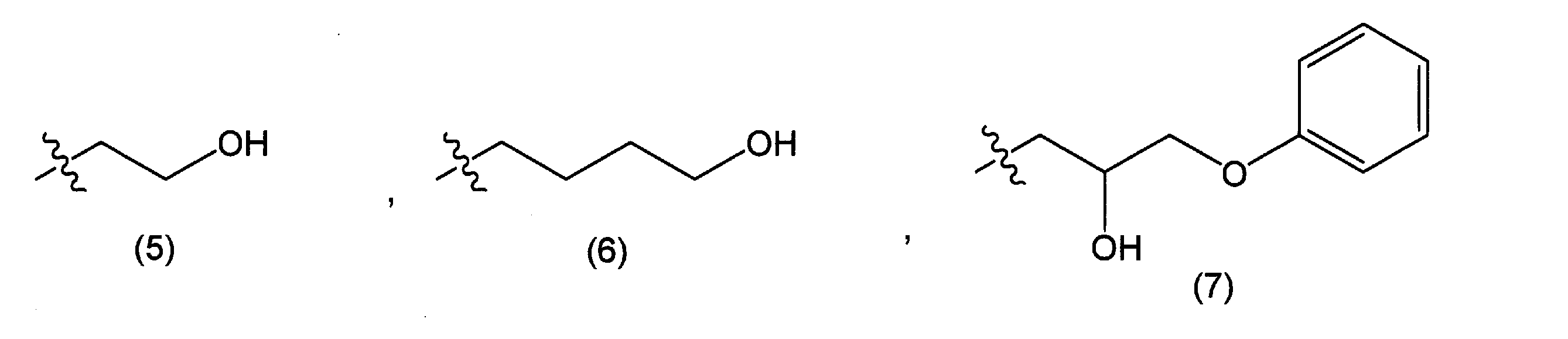
- X1が酸素原子である請求項1~11のいずれか1項に記載のコポリマー。
- X2が酸素原子である請求項1~12のいずれか1項に記載のコポリマー。
- X3が酸素原子である請求項1~13のいずれか1項に記載のコポリマー。
- mが4~22の整数である請求項1~14のいずれか1項に記載のコポリマー。
- nが1である請求項1~15のいずれか1項に記載のコポリマー。
- 構造単位(A)、(B)、(C)の比率が、(A)1質量部に対して、0.01~100質量部の(B)と、0.1~100質量部の(C)で構成されている請求項1~16のいずれか1項に記載のコポリマー。
- モノマー(1)の1質量部に対して、0.01~100質量部のモノマー(2)と、0.1~100質量部のモノマー(3)を重合させてなる請求項2~16のいずれか1項に記載のコポリマー。
- 数平均分子量が、5000~150000である請求項1~18のいずれか1項に記載のコポリマー。
- 請求項1~19のいずれか1項に記載のコポリマーを含むsingle chain nanoparticle。
- 請求項1~19のいずれか1項に記載のコポリマーを含む医薬組成物。
Priority Applications (5)
| Application Number | Priority Date | Filing Date | Title |
|---|---|---|---|
| EP22749838.3A EP4289877A4 (en) | 2021-02-05 | 2022-02-07 | Novel copolymer |
| KR1020237024232A KR20230141766A (ko) | 2021-02-05 | 2022-02-07 | 신규한 코폴리머 |
| JP2022579636A JPWO2022168967A1 (ja) | 2021-02-05 | 2022-02-07 | |
| CN202280013811.8A CN116888178A (zh) | 2021-02-05 | 2022-02-07 | 新型共聚物 |
| US18/263,730 US20240092953A1 (en) | 2021-02-05 | 2022-02-07 | Novel copolymer |
Applications Claiming Priority (2)
| Application Number | Priority Date | Filing Date | Title |
|---|---|---|---|
| JP2021017807 | 2021-02-05 | ||
| JP2021-017807 | 2021-02-05 |
Publications (1)
| Publication Number | Publication Date |
|---|---|
| WO2022168967A1 true WO2022168967A1 (ja) | 2022-08-11 |
Family
ID=82741160
Family Applications (1)
| Application Number | Title | Priority Date | Filing Date |
|---|---|---|---|
| PCT/JP2022/004592 Ceased WO2022168967A1 (ja) | 2021-02-05 | 2022-02-07 | 新規なコポリマー |
Country Status (6)
| Country | Link |
|---|---|
| US (1) | US20240092953A1 (ja) |
| EP (1) | EP4289877A4 (ja) |
| JP (1) | JPWO2022168967A1 (ja) |
| KR (1) | KR20230141766A (ja) |
| CN (1) | CN116888178A (ja) |
| WO (1) | WO2022168967A1 (ja) |
Cited By (3)
| Publication number | Priority date | Publication date | Assignee | Title |
|---|---|---|---|---|
| WO2024034685A1 (ja) * | 2022-08-10 | 2024-02-15 | 興和株式会社 | アフィボディミセル薬物複合体 |
| WO2024034684A1 (ja) * | 2022-08-10 | 2024-02-15 | 興和株式会社 | 新薬物複合体 |
| WO2024034683A1 (ja) * | 2022-08-10 | 2024-02-15 | 興和株式会社 | 新規なコポリマー |
Citations (6)
| Publication number | Priority date | Publication date | Assignee | Title |
|---|---|---|---|---|
| JP3270592B2 (ja) | 1992-10-26 | 2002-04-02 | 日本化薬株式会社 | ブロック共重合体−抗癌剤複合体医薬製剤 |
| JP2003231648A (ja) * | 2001-12-07 | 2003-08-19 | Jsr Corp | 生理活性物質担体用ポリマー粒子およびその製造方法 |
| JP2012108460A (ja) * | 2010-10-22 | 2012-06-07 | Fujifilm Corp | 感光性樹脂組成物、硬化膜の形成方法、硬化膜、有機el表示装置、及び、液晶表示装置 |
| JP2016122174A (ja) * | 2014-08-12 | 2016-07-07 | 株式会社Dnpファインケミカル | 色材分散液、カラーフィルタ用着色樹脂組成物、カラーフィルタ及び表示装置 |
| JP2017105722A (ja) * | 2015-12-08 | 2017-06-15 | 東洋インキScホールディングス株式会社 | 皮膚貼付用粘着剤、経皮吸収性粘着剤、および経皮吸収性粘着シート |
| JP2017198919A (ja) * | 2016-04-28 | 2017-11-02 | 東京応化工業株式会社 | 化学増幅型ポジ型感光性樹脂組成物 |
Family Cites Families (6)
| Publication number | Priority date | Publication date | Assignee | Title |
|---|---|---|---|---|
| NL165821C (nl) | 1976-02-09 | 1981-05-15 | Doornes Transmissie Bv | Traploos variabele overbrenging. |
| US5990202A (en) * | 1997-10-31 | 1999-11-23 | Hewlett-Packard Company | Dual encapsulation technique for preparing ink-jets inks |
| WO2011129078A1 (ja) * | 2010-04-14 | 2011-10-20 | 日本曹達株式会社 | 新規共重合体 |
| JP5492755B2 (ja) * | 2010-12-03 | 2014-05-14 | 富士フイルム株式会社 | 感光性樹脂組成物、硬化膜の形成方法、硬化膜、有機el表示装置、及び、液晶表示装置 |
| GB201314455D0 (en) * | 2013-08-13 | 2013-09-25 | Contamac Ltd | Monomers for use in a polymerizable composition and high refractive index polymer for opthalmic applications |
| GB2556055B (en) * | 2016-11-16 | 2022-03-23 | Rs Arastirma Egitim Danismanlik Ilac Sanayi Ticaret Ltd Sti | Self-assembled diblock copolymers composed of pegmema and drug bearing polymeric segments |
-
2022
- 2022-02-07 CN CN202280013811.8A patent/CN116888178A/zh active Pending
- 2022-02-07 US US18/263,730 patent/US20240092953A1/en active Pending
- 2022-02-07 EP EP22749838.3A patent/EP4289877A4/en active Pending
- 2022-02-07 JP JP2022579636A patent/JPWO2022168967A1/ja active Pending
- 2022-02-07 WO PCT/JP2022/004592 patent/WO2022168967A1/ja not_active Ceased
- 2022-02-07 KR KR1020237024232A patent/KR20230141766A/ko active Pending
Patent Citations (6)
| Publication number | Priority date | Publication date | Assignee | Title |
|---|---|---|---|---|
| JP3270592B2 (ja) | 1992-10-26 | 2002-04-02 | 日本化薬株式会社 | ブロック共重合体−抗癌剤複合体医薬製剤 |
| JP2003231648A (ja) * | 2001-12-07 | 2003-08-19 | Jsr Corp | 生理活性物質担体用ポリマー粒子およびその製造方法 |
| JP2012108460A (ja) * | 2010-10-22 | 2012-06-07 | Fujifilm Corp | 感光性樹脂組成物、硬化膜の形成方法、硬化膜、有機el表示装置、及び、液晶表示装置 |
| JP2016122174A (ja) * | 2014-08-12 | 2016-07-07 | 株式会社Dnpファインケミカル | 色材分散液、カラーフィルタ用着色樹脂組成物、カラーフィルタ及び表示装置 |
| JP2017105722A (ja) * | 2015-12-08 | 2017-06-15 | 東洋インキScホールディングス株式会社 | 皮膚貼付用粘着剤、経皮吸収性粘着剤、および経皮吸収性粘着シート |
| JP2017198919A (ja) * | 2016-04-28 | 2017-11-02 | 東京応化工業株式会社 | 化学増幅型ポジ型感光性樹脂組成物 |
Non-Patent Citations (2)
| Title |
|---|
| H. CABRAL ET AL., NAT. NANOTECHNOL., vol. 6, 2011, pages 815 - 823 |
| JOSE A. POMPOSO, SINGLE-CHAIN POLYMER NANOPARTICLES:SYNTHESIS, CHARACTERIZATION, SIMULATIONS, AND APPLICATIONS, 2017 |
Cited By (3)
| Publication number | Priority date | Publication date | Assignee | Title |
|---|---|---|---|---|
| WO2024034685A1 (ja) * | 2022-08-10 | 2024-02-15 | 興和株式会社 | アフィボディミセル薬物複合体 |
| WO2024034684A1 (ja) * | 2022-08-10 | 2024-02-15 | 興和株式会社 | 新薬物複合体 |
| WO2024034683A1 (ja) * | 2022-08-10 | 2024-02-15 | 興和株式会社 | 新規なコポリマー |
Also Published As
| Publication number | Publication date |
|---|---|
| KR20230141766A (ko) | 2023-10-10 |
| EP4289877A4 (en) | 2024-12-25 |
| JPWO2022168967A1 (ja) | 2022-08-11 |
| EP4289877A1 (en) | 2023-12-13 |
| US20240092953A1 (en) | 2024-03-21 |
| CN116888178A (zh) | 2023-10-13 |
| TW202245797A (zh) | 2022-12-01 |
Similar Documents
| Publication | Publication Date | Title |
|---|---|---|
| WO2022168967A1 (ja) | 新規なコポリマー | |
| Zhou et al. | A polypeptide based podophyllotoxin conjugate for the treatment of multi drug resistant breast cancer with enhanced efficiency and minimal toxicity | |
| CA2581125C (en) | Modified poly(ethylene oxide-amino acid) copolymer, micelle preparation, and anticancer agent containing the same | |
| Yan et al. | Construction of size-transformable supramolecular nano-platform against drug-resistant colorectal cancer caused by Fusobacterium nucleatum | |
| WO2009142326A1 (ja) | ドセタキセル高分子誘導体、並びにその製造方法及びその用途 | |
| JP7046321B2 (ja) | 修飾されたスチレン-無水マレイン酸共重合体及びその使用 | |
| Buwalda et al. | Reversibly core-crosslinked PEG-P (HPMA) micelles: Platinum coordination chemistry for competitive-ligand-regulated drug delivery | |
| CN105963706A (zh) | 一种超支化hpma共聚物-dox偶联物及其制备方法和应用 | |
| CN109762099B (zh) | 一种聚合物-抗肿瘤药物偶联物及其制备方法和用途 | |
| EP3054928A1 (en) | Self-assembled brush block copolymer-nanoparticles for drug delivery | |
| Zhang et al. | Preparation of an Ultrahigh-DAR PDL1 monoclonal antibody-polymeric-SN38 conjugate for precise colon cancer therapy | |
| Lu et al. | Nanoplatform for synergistic therapy constructed via the co-assembly of a reduction-responsive cholesterol-based block copolymer and a photothermal amphiphile | |
| US11007148B2 (en) | Amphiphilic block copolymers for delivery of active agents | |
| JP2024025749A (ja) | 新規なコポリマー | |
| CN113262309B (zh) | 一种负载抗肿瘤药物的超支化-嵌段共接枝药物载体及其制备方法和应用 | |
| US20260048140A1 (en) | Novel copolymer | |
| EP4570834A1 (en) | Affibody micelle drug conjugate | |
| CN114848834A (zh) | 一种双药物共递的复合多层纳米载体及其制备方法和应用 | |
| CN112961338A (zh) | 一种pH敏感的普朗尼克交联剂、制备方法与应用 | |
| WO2024034686A1 (ja) | 高分子造影剤 | |
| CN108676130B (zh) | 用于药物载体的还原响应型核交联聚合物MPEG-NSASS-Chol胶束的制备 | |
| CN121081664A (zh) | 一种基于线型-树枝状聚合物的肿瘤微环境响应型纳米药物 | |
| Chen et al. | Supramolecular self-assembly of multifunctional carrageenan-based Nanomicelles for effective tumor therapy via apoptosis and immunogenic cell death | |
| Yan et al. | Supramolecular nanomedicine for enhanced chemotherapy against drug-resistant colorectal cancer | |
| WO2025259830A1 (en) | Copolymeric compositions and methods of use thereof |
Legal Events
| Date | Code | Title | Description |
|---|---|---|---|
| 121 | Ep: the epo has been informed by wipo that ep was designated in this application |
Ref document number: 22749838 Country of ref document: EP Kind code of ref document: A1 |
|
| ENP | Entry into the national phase |
Ref document number: 2022579636 Country of ref document: JP Kind code of ref document: A |
|
| WWE | Wipo information: entry into national phase |
Ref document number: 18263730 Country of ref document: US |
|
| WWE | Wipo information: entry into national phase |
Ref document number: 202280013811.8 Country of ref document: CN |
|
| NENP | Non-entry into the national phase |
Ref country code: DE |
|
| ENP | Entry into the national phase |
Ref document number: 2022749838 Country of ref document: EP Effective date: 20230905 |