WO2022181264A1 - 非水電解質二次電池用正極活物質および非水電解質二次電池 - Google Patents
非水電解質二次電池用正極活物質および非水電解質二次電池 Download PDFInfo
- Publication number
- WO2022181264A1 WO2022181264A1 PCT/JP2022/003931 JP2022003931W WO2022181264A1 WO 2022181264 A1 WO2022181264 A1 WO 2022181264A1 JP 2022003931 W JP2022003931 W JP 2022003931W WO 2022181264 A1 WO2022181264 A1 WO 2022181264A1
- Authority
- WO
- WIPO (PCT)
- Prior art keywords
- positive electrode
- aqueous electrolyte
- active material
- electrolyte secondary
- electrode active
- Prior art date
- Legal status (The legal status is an assumption and is not a legal conclusion. Google has not performed a legal analysis and makes no representation as to the accuracy of the status listed.)
- Ceased
Links
Images

Classifications
-
- H—ELECTRICITY
- H01—ELECTRIC ELEMENTS
- H01M—PROCESSES OR MEANS, e.g. BATTERIES, FOR THE DIRECT CONVERSION OF CHEMICAL ENERGY INTO ELECTRICAL ENERGY
- H01M4/00—Electrodes
- H01M4/02—Electrodes composed of, or comprising, active material
- H01M4/36—Selection of substances as active materials, active masses, active liquids
- H01M4/48—Selection of substances as active materials, active masses, active liquids of inorganic oxides or hydroxides
- H01M4/50—Selection of substances as active materials, active masses, active liquids of inorganic oxides or hydroxides of manganese
- H01M4/505—Selection of substances as active materials, active masses, active liquids of inorganic oxides or hydroxides of manganese of mixed oxides or hydroxides containing manganese for inserting or intercalating light metals, e.g. LiMn2O4 or LiMn2OxFy
-
- C—CHEMISTRY; METALLURGY
- C01—INORGANIC CHEMISTRY
- C01G—COMPOUNDS CONTAINING METALS NOT COVERED BY SUBCLASSES C01D OR C01F
- C01G53/00—Compounds of nickel
- C01G53/40—Complex oxides containing nickel and at least one other metal element
- C01G53/42—Complex oxides containing nickel and at least one other metal element containing alkali metals, e.g. LiNiO2
- C01G53/44—Complex oxides containing nickel and at least one other metal element containing alkali metals, e.g. LiNiO2 containing manganese
- C01G53/50—Complex oxides containing nickel and at least one other metal element containing alkali metals, e.g. LiNiO2 containing manganese of the type (MnO2)n-, e.g. Li(NixMn1-x)O2 or Li(MyNixMn1-x-y)O2
-
- H—ELECTRICITY
- H01—ELECTRIC ELEMENTS
- H01M—PROCESSES OR MEANS, e.g. BATTERIES, FOR THE DIRECT CONVERSION OF CHEMICAL ENERGY INTO ELECTRICAL ENERGY
- H01M10/00—Secondary cells; Manufacture thereof
- H01M10/05—Accumulators with non-aqueous electrolyte
- H01M10/052—Li-accumulators
-
- H—ELECTRICITY
- H01—ELECTRIC ELEMENTS
- H01M—PROCESSES OR MEANS, e.g. BATTERIES, FOR THE DIRECT CONVERSION OF CHEMICAL ENERGY INTO ELECTRICAL ENERGY
- H01M10/00—Secondary cells; Manufacture thereof
- H01M10/05—Accumulators with non-aqueous electrolyte
- H01M10/052—Li-accumulators
- H01M10/0525—Rocking-chair batteries, i.e. batteries with lithium insertion or intercalation in both electrodes; Lithium-ion batteries
-
- H—ELECTRICITY
- H01—ELECTRIC ELEMENTS
- H01M—PROCESSES OR MEANS, e.g. BATTERIES, FOR THE DIRECT CONVERSION OF CHEMICAL ENERGY INTO ELECTRICAL ENERGY
- H01M4/00—Electrodes
- H01M4/02—Electrodes composed of, or comprising, active material
- H01M4/36—Selection of substances as active materials, active masses, active liquids
- H01M4/48—Selection of substances as active materials, active masses, active liquids of inorganic oxides or hydroxides
- H01M4/485—Selection of substances as active materials, active masses, active liquids of inorganic oxides or hydroxides of mixed oxides or hydroxides for inserting or intercalating light metals, e.g. LiTi2O4 or LiTi2OxFy
-
- H—ELECTRICITY
- H01—ELECTRIC ELEMENTS
- H01M—PROCESSES OR MEANS, e.g. BATTERIES, FOR THE DIRECT CONVERSION OF CHEMICAL ENERGY INTO ELECTRICAL ENERGY
- H01M4/00—Electrodes
- H01M4/02—Electrodes composed of, or comprising, active material
- H01M4/36—Selection of substances as active materials, active masses, active liquids
- H01M4/48—Selection of substances as active materials, active masses, active liquids of inorganic oxides or hydroxides
- H01M4/52—Selection of substances as active materials, active masses, active liquids of inorganic oxides or hydroxides of nickel, cobalt or iron
- H01M4/525—Selection of substances as active materials, active masses, active liquids of inorganic oxides or hydroxides of nickel, cobalt or iron of mixed oxides or hydroxides containing iron, cobalt or nickel for inserting or intercalating light metals, e.g. LiNiO2, LiCoO2 or LiCoOxFy
-
- C—CHEMISTRY; METALLURGY
- C01—INORGANIC CHEMISTRY
- C01P—INDEXING SCHEME RELATING TO STRUCTURAL AND PHYSICAL ASPECTS OF SOLID INORGANIC COMPOUNDS
- C01P2002/00—Crystal-structural characteristics
- C01P2002/50—Solid solutions
- C01P2002/52—Solid solutions containing elements as dopants
-
- C—CHEMISTRY; METALLURGY
- C01—INORGANIC CHEMISTRY
- C01P—INDEXING SCHEME RELATING TO STRUCTURAL AND PHYSICAL ASPECTS OF SOLID INORGANIC COMPOUNDS
- C01P2006/00—Physical properties of inorganic compounds
- C01P2006/40—Electric properties
-
- H—ELECTRICITY
- H01—ELECTRIC ELEMENTS
- H01M—PROCESSES OR MEANS, e.g. BATTERIES, FOR THE DIRECT CONVERSION OF CHEMICAL ENERGY INTO ELECTRICAL ENERGY
- H01M4/00—Electrodes
- H01M4/02—Electrodes composed of, or comprising, active material
- H01M2004/026—Electrodes composed of, or comprising, active material characterised by the polarity
- H01M2004/028—Positive electrodes
-
- Y—GENERAL TAGGING OF NEW TECHNOLOGICAL DEVELOPMENTS; GENERAL TAGGING OF CROSS-SECTIONAL TECHNOLOGIES SPANNING OVER SEVERAL SECTIONS OF THE IPC; TECHNICAL SUBJECTS COVERED BY FORMER USPC CROSS-REFERENCE ART COLLECTIONS [XRACs] AND DIGESTS
- Y02—TECHNOLOGIES OR APPLICATIONS FOR MITIGATION OR ADAPTATION AGAINST CLIMATE CHANGE
- Y02E—REDUCTION OF GREENHOUSE GAS [GHG] EMISSIONS, RELATED TO ENERGY GENERATION, TRANSMISSION OR DISTRIBUTION
- Y02E60/00—Enabling technologies; Technologies with a potential or indirect contribution to GHG emissions mitigation
- Y02E60/10—Energy storage using batteries
Definitions
- the present disclosure relates to a positive electrode active material for non-aqueous electrolyte secondary batteries and a non-aqueous electrolyte secondary battery using the positive electrode active material.
- the positive electrode active material greatly affects battery performance such as input/output characteristics, capacity, and durability.
- Lithium-transition metal composite oxides containing metal elements such as Ni, Co, Mn, and Al are generally used as positive electrode active materials.
- the types and amounts of elements added to the lithium-transition metal composite oxide greatly affect the battery performance. be. Therefore, many studies have been made on the types and amounts of additive elements in lithium-transition metal composite oxides.
- Patent Document 1 discloses a single particle of a nickel-based lithium composite metal oxide containing a metal (Al, Ti, Mg, Zr, W, Y, Sr, Co, F) doped in the crystal lattice of the single particle. , Si, Mg, Na, Cu, Fe, Ca, S, and B) at 2500 to 6000 ppm.
- a metal Al, Ti, Mg, Zr, W, Y, Sr, Co, F
- Patent Document 2 a composition formula Li x Ni 1-y Co y-z M z O 2-a X b (M is Al alone or contains Al as an essential element, and the periodic table Group 13 and Group 14 elements, Mn, Fe, Ti, Zr, Nd, La, Cu, V, Sm, W, Zn, Y, Mg, Sr, Ca, Ba, Cs, Na, selected from P and X is a halogen element).
- a lithium-excess type lithium-transition metal composite oxide in which the molar ratio of Li to the transition metal exceeds 1 is expected as a high-capacity next-generation positive electrode active material, but there are problems such as easy elution of the transition metal. be. It is known that the addition of F to a lithium-excess type composite oxide suppresses the elution of transition metals and improves the durability, but there is a demand for further improvement in durability.
- An object of the present disclosure is to provide a high-capacity positive electrode active material containing a lithium-excess lithium-transition metal composite oxide, which improves battery durability.
- a positive electrode active material for a non-aqueous electrolyte secondary battery which is one aspect of the present disclosure, has a composition formula of Li x Mny Ni z Sia MfO 2- ⁇ F ⁇ (wherein M is Na, K, Mg, Ca , Sr, Ba, Sc, Y, La, Ce, Pr, Nd, Sm, Eu, Gd, Tb, Dy, Ho, Er, Tm, Yb, Lu, Ge, Sn, Pb, Sc, Ti, V, Cr , Fe, Co, Cu, Zn, Ru, Rh, Re, Pd, Ir, Ag, Bi, Sb, B, Al, Ga, In, P, Zr, Hf, Nb, Mo, W x+y+z+a+f ⁇ 2+A, 1.0 ⁇ x ⁇ 1.2, 0.4 ⁇ y ⁇ 0.8, 0 ⁇ z ⁇ 0.4, 0 ⁇ a ⁇ 0.03, 0 ⁇ f ⁇ 0.05, 0 ⁇ 0.1, 0 ⁇ A ⁇ 0.03).
- a non-aqueous electrolyte secondary battery includes a positive electrode containing the positive electrode active material, a negative electrode, a separator interposed between the positive electrode and the negative electrode, and a non-aqueous electrolyte.
- the cycle characteristics of the battery can be improved, and the durability can be improved.
- FIG. 1 is a cross-sectional view of a non-aqueous electrolyte secondary battery that is an example of an embodiment
- the present inventors found that by adding Si to a lithium-excess F-containing composite oxide containing at least Mn as a transition metal, the durability of the battery is improved specifically. found to improve. In particular, it was found that when Si and a specific element M are added, preferably when two or more elements M are added, the durability is significantly improved.
- a cylindrical battery in which the wound electrode body 14 is housed in a bottomed cylindrical outer can 16 will be exemplified. It may be a prismatic battery), a coin-shaped outer can (coin-shaped battery), or an outer body (laminate battery) composed of a laminate sheet including a metal layer and a resin layer. Further, the electrode assembly is not limited to the wound type, and may be a laminated electrode assembly in which a plurality of positive electrodes and a plurality of negative electrodes are alternately laminated with separators interposed therebetween.
- FIG. 1 is a cross-sectional view of a non-aqueous electrolyte secondary battery 10 that is an example of an embodiment.
- the non-aqueous electrolyte secondary battery 10 includes a wound electrode body 14, a non-aqueous electrolyte, and an outer can 16 that accommodates the electrode body 14 and the non-aqueous electrolyte.
- the electrode body 14 has a positive electrode 11, a negative electrode 12, and a separator 13, and has a wound structure in which the positive electrode 11 and the negative electrode 12 are spirally wound with the separator 13 interposed therebetween.
- the outer can 16 is a bottomed cylindrical metal container that is open on one side in the axial direction. In the following description, for convenience of explanation, the side of the sealing member 17 of the battery will be referred to as the upper side, and the bottom side of the outer can 16 will be referred to as the lower side.
- the non-aqueous electrolyte contains a non-aqueous solvent and an electrolyte salt dissolved in the non-aqueous solvent.
- non-aqueous solvents include esters, ethers, nitriles, amides, and mixed solvents of two or more thereof.
- the non-aqueous solvent may contain a halogen-substituted product obtained by substituting at least part of the hydrogen atoms of these solvents with halogen atoms such as fluorine.
- non-aqueous solvents include ethylene carbonate (EC), ethylmethyl carbonate (EMC), dimethyl carbonate (DMC), mixed solvents thereof, and the like.
- a lithium salt such as LiPF 6 is used as the electrolyte salt.
- the non-aqueous electrolyte is not limited to a liquid electrolyte, and may be a solid electrolyte.
- the positive electrode 11, the negative electrode 12, and the separator 13, which constitute the electrode assembly 14, are all strip-shaped elongated bodies, and are alternately laminated in the radial direction of the electrode assembly 14 by being spirally wound.
- the negative electrode 12 is formed with a size one size larger than that of the positive electrode 11 in order to prevent deposition of lithium. That is, the negative electrode 12 is formed longer than the positive electrode 11 in the longitudinal direction and the width direction (transverse direction).
- the separator 13 is at least one size larger than the positive electrode 11, and two separators 13 are arranged so as to sandwich the positive electrode 11, for example.
- the electrode body 14 has a positive electrode lead 20 connected to the positive electrode 11 by welding or the like, and a negative electrode lead 21 connected to the negative electrode 12 by welding or the like.
- Insulating plates 18 and 19 are arranged above and below the electrode body 14, respectively.
- the positive electrode lead 20 extends through the through hole of the insulating plate 18 toward the sealing member 17
- the negative electrode lead 21 extends through the outside of the insulating plate 19 toward the bottom of the outer can 16 .
- the positive electrode lead 20 is connected to the lower surface of the internal terminal plate 23 of the sealing body 17 by welding or the like, and the cap 27, which is the top plate of the sealing body 17 electrically connected to the internal terminal plate 23, serves as the positive electrode terminal.
- the negative electrode lead 21 is connected to the inner surface of the bottom of the outer can 16 by welding or the like, and the outer can 16 serves as a negative electrode terminal.
- a gasket 28 is provided between the outer can 16 and the sealing body 17 to ensure hermeticity inside the battery.
- the outer can 16 is formed with a grooved portion 22 that supports the sealing member 17 and has a portion of the side surface projecting inward.
- the grooved portion 22 is preferably annularly formed along the circumferential direction of the outer can 16 and supports the sealing member 17 on its upper surface.
- the sealing member 17 is fixed to the upper portion of the outer can 16 by the grooved portion 22 and the open end of the outer can 16 that is crimped to the sealing member 17 .
- the sealing body 17 has a structure in which an internal terminal plate 23, a lower valve body 24, an insulating member 25, an upper valve body 26, and a cap 27 are layered in order from the electrode body 14 side.
- Each member constituting the sealing member 17 has, for example, a disk shape or a ring shape, and each member except for the insulating member 25 is electrically connected to each other.
- the lower valve body 24 and the upper valve body 26 are connected at their central portions, and an insulating member 25 is interposed between their peripheral edge portions.
- the positive electrode 11, the negative electrode 12, and the separator 13 that make up the electrode body 14 will be described in detail below, particularly the positive electrode active material that makes up the positive electrode 11.
- the positive electrode 11 has a positive electrode core and a positive electrode mixture layer provided on the surface of the positive electrode core.
- a foil of a metal such as aluminum or an aluminum alloy that is stable in the potential range of the positive electrode 11, a film having the metal on the surface layer, or the like can be used.
- the positive electrode mixture layer contains a positive electrode active material, a conductive agent, and a binder, and is preferably provided on both sides of the positive electrode core.
- a positive electrode mixture slurry containing a positive electrode active material, a conductive agent, a binder, and the like is applied onto a positive electrode core, the coating film is dried, and then compressed to form a positive electrode mixture layer on the positive electrode core. It can be made by forming on both sides of the body.
- Carbon materials such as carbon black, acetylene black, ketjen black, and graphite can be exemplified as the conductive agent contained in the positive electrode mixture layer.
- the binder contained in the positive electrode mixture layer include fluororesins such as polytetrafluoroethylene (PTFE) and polyvinylidene fluoride (PVdF), polyacrylonitrile (PAN), polyimide resins, acrylic resins, and polyolefin resins. . These resins may be used in combination with cellulose derivatives such as carboxymethyl cellulose (CMC) or salts thereof, polyethylene oxide (PEO), and the like.
- CMC carboxymethyl cellulose
- PEO polyethylene oxide
- the positive electrode active material has a composition formula of Li x Mny Ni z Sia MfO 2- ⁇ F ⁇ (wherein M is Na, K, Mg, Ca, Sr, Ba, Sc, Y, La, Ce, Pr , Nd, Sm, Eu, Gd, Tb, Dy, Ho, Er, Tm, Yb, Lu, Ge, Sn, Pb, Sc, Ti, V, Cr, Fe, Co, Cu, Zn, Ru, Rh, Re , Pd, Ir, Ag, Bi, Sb, B, Al, Ga, In, P, Zr, Hf, Nb, Mo, and W, and x+y+z+a+b ⁇ 2+A, 1.0 ⁇ x ⁇ 1.2, 0.4 ⁇ y ⁇ 0.8, 0 ⁇ z ⁇ 0.4, 0 ⁇ a ⁇ 0.03, 0 ⁇ f ⁇ 0.05, 0 ⁇ 0.1, 0 ⁇ A ⁇ 0.03) including a lithium transition metal composite oxide.
- the composite oxide contains Li, Mn, Si, and F as essential elements, and is a Li-excess material in which the molar ratio of Li to the transition metal exceeds 1, and a predetermined amount of fluoride ions is introduced, and It is a composite oxide in which the part is replaced with F.
- the main component of the positive electrode active material is the composite oxide represented by the above composition formula.
- the main component means the component having the highest mass ratio among the constituent components of the composite oxide.
- a composite oxide other than the composite oxide represented by the above composition formula for example, a composite oxide that is not Li-excessive or a composite compound that does not contain fluoride ions
- the content of the composite oxide is preferably 50% by mass or more, and may be substantially 100% by mass.
- the composition of the composite oxide can be measured using an ICP emission spectrometer (iCAP6300 manufactured by Thermo Fisher Scientific).
- the lithium-transition metal composite oxide represented by the above composition formula preferably contains Ni in addition to Li, Mn, and Si. Ni contributes to high capacity. If Si is added to the lithium-transition metal composite oxide represented by the above composition formula, preferably to the Ni-containing composite oxide, the durability of the battery is improved. performance is more effectively improved.
- the composite oxide contains essential elements Na, K, Mg, Ca, Sr, Ba, Sc, Y, La, Ce, Pr, Nd, Sm, Eu, Gd, Tb, Dy, Ho, Er, Tm, Yb, Lu, Ge, Sn, Pb, Sc, Ti, V, Cr, Fe, Co, Cu, Zn, Ru, Rh, Re, Pd, Ir, Ag, Bi, Sb, B, Al, Ga, In, It preferably contains at least one element M selected from P, Zr, Hf, Nb, Mo and W.
- the element M is Na , K, Mg, Ca, Sr, Ba, Sc, Y, La, Ce, Pr, Nd, Sm, Eu, Gd, Tb, Dy, Ho, Er, Tm, Yb, Lu, Ge, Sn, Pb, Sc, Ti, V, Cr, Fe, Co, Cu, Zn, Ru, Rh, Re, Pd, Ir, At least two elements selected from Ag, Bi, Sb, B, Al, Ga, In, P, Zr, Hf, Nb, Mo and W are preferred.
- At least two elements selected from Al, P, Sb, Sr, Ti, Mg, and Nb are preferable.
- the effect of improving durability becomes more pronounced.
- the total molar ratio of the elements M is set to 0.05 or less (0 ⁇ f ⁇ 0.05).
- the lithium-transition metal composite oxide represented by the above composition formula preferably contains three or more elements as the element M.
- the effect of improving durability becomes more pronounced.
- four or more elements M may be contained in an amount of 0.2 mol% or more with respect to the total molar amount (x + y + z + a + f) of Li, Mn, Ni, Si, and element M, but preferably 1 to 3 types, more preferably 2 or 3 types, particularly preferably 3 types.
- the lithium-transition metal composite oxide does not have to contain substantially Co. Considering the production cost, etc., it is possible to contain substantially no Co. preferable. According to the lithium-transition metal composite oxide represented by the above composition formula, even if another element M is used in place of Co, a durability improvement effect equal to or greater than that obtained when Co is used can be obtained.
- the molar ratio (x) of Li is 1.0 ⁇ x ⁇ 1.2, preferably 1.1 ⁇ x. ⁇ 1.2.
- the molar ratio (y) of Mn is 0.4 ⁇ y ⁇ 0.8, preferably 0.45 ⁇ y ⁇ 0.60. If the molar ratio of Li and Mn is within the range, it becomes easier to achieve both high durability and high capacity.
- Ni is an optional component, it is preferably contained in an amount smaller than that of Mn, for example. From the viewpoint of achieving both high durability and high capacity, the preferred Ni content (molar ratio) is 0.05 ⁇ z ⁇ 0.3.
- the total molar amount (x+y+z+a+f) of Li, Mn, Ni, Si, and the element M is 2+ A or less, and A is 0.03. It is below. Mn, Ni, Si, and the element M are present in the octahedral sites of the crystal structure of the composite oxide, but part of Si may also enter the tetrahedral sites of the crystal structure. In this case, it is assumed that the total molar amount (x+y+z+a+f) exceeds 2.
- the composite oxide of the present embodiment is, for example, a Li-excessive composite oxide and not a cation-excessive composite oxide.
- ⁇ Li-excessive composite oxide and a cation-excessive composite oxide.
- the molar ratio ( ⁇ ) of F is 0.1 or less (0 ⁇ 0.1), preferably 0.05 ⁇ 0.085. If the content of F is within this range, it is possible to sufficiently suppress the elution of transition metals while ensuring a high capacity, which contributes to the improvement of durability.
- the molar ratio ( a ) of Si is 0.03 or less (0 ⁇ a ⁇ 0.03), preferably 0. 0.002 ⁇ a ⁇ 0.015, or 0.002 ⁇ a ⁇ 0.010, or 0.002 ⁇ a ⁇ 0.005. Even a small amount of Si contributes to the improvement of durability, but when it is present in an amount of 0.2 mol% or more with respect to the total number of moles of elements excluding Li, O, and F, the effect of improving durability becomes more pronounced. Become. On the other hand, even if the Si content is too high, there is a limit to the effect of improving durability, and other battery performances such as capacity may be affected. Therefore, it is preferable to set the upper limit of the content to 1.5 mol %, 1 mol %, or 0.5 mol %.
- the molar ratio ( f ) of the element M is preferably 0.05 or less (0 ⁇ f ⁇ 0.05), and is preferably 0.04. or less (0 ⁇ f ⁇ 0.04), or 0.03 or less (0 ⁇ f ⁇ 0.03).
- the total molar ratio of the elements M is 0.05 or less. In this case, durability can be improved more efficiently.
- the molar ratio of each element M is preferably 0.015 or less, 0.01 or less, or 0.005 or less, although it varies slightly depending on the type of element.
- the content ratio (molar ratio) of Si and element M is not particularly limited, but the preferred ratio differs slightly depending on the type of element M.
- the molar ratio of Si to each of the elements M may be substantially the same, for example.
- the total number of moles of element M is preferably larger than the number of moles of Si.
- the number of moles of Al is made equal to or greater than the number of moles of Si, and is made larger than the number of moles of other elements M.
- the lithium-transition metal composite oxide may contain elements other than Li, Mn, Ni, Si, and the elements M, O, and F within a range that does not impair the purpose of the present disclosure.
- a lithium-transition metal composite oxide is, for example, secondary particles formed by agglomeration of a plurality of primary particles.
- An example of the volume-based median diameter (D50) of the lithium-transition metal composite oxide is 1 to 20 ⁇ m, or 2 to 15 ⁇ m. D50 is the particle size at which the volume integrated value is 50% in the particle size distribution measured by the laser diffraction scattering method.
- the BET specific surface area of the lithium-transition metal composite oxide is, for example, 1.0-4.0 mm 2 /g. If the BET specific surface area is within this range, it becomes easier to achieve both high durability and high capacity. The BET specific surface area is measured according to the BET method (nitrogen adsorption method) described in JIS R1626.
- the lithium transition metal composite oxide represented by the above composition formula is, for example, a carbonate containing Mn and Ni, a compound containing Si, a compound containing the element M, and lithium carbonate (Li 2 CO 3 ). and lithium fluoride (LiF), and sintering the mixture.
- An example of firing conditions is 700 to 900° C. ⁇ 10 to 30 hours.
- the Si-containing compound may be added to the fired product after mixing with other components and firing. In this case, Si tends to be unevenly distributed on the particle surfaces of the lithium-transition metal composite oxide. Silicon oxide etc. are mentioned as a compound containing Si.
- Compounds containing the element M include aluminum oxide, strontium oxide, diantimony trioxide, niobium oxide, magnesium oxide, titanium oxide, germanium oxide, diphosphorus pentoxide, lithium phosphate, and the like.
- the target compound can be synthesized not only by using these starting materials but also by using other starting materials.
- the positive electrode active material is mainly composed of a lithium transition metal composite oxide represented by the composition formula Li x Mn y Ni z Sia MfO 2- ⁇ F ⁇ .
- the composite oxide preferably contains Ni and element M as essential elements.
- Element M is preferably two or more elements selected from Al, P, Sb, Sr, Ti, Mg, and Nb.
- an example of a suitable range of the Si content is 0.2 to 1 mol%
- an example of a suitable range of the total content of the element M is 0. .2 to 3 mol %.
- the negative electrode 12 has a negative electrode core and a negative electrode mixture layer provided on the surface of the negative electrode core.
- a foil of a metal such as copper that is stable in the potential range of the negative electrode 12, a film having the metal on the surface layer, or the like can be used.
- the negative electrode mixture layer contains a negative electrode active material and a binder, and is preferably provided on both sides of the negative electrode core.
- a negative electrode mixture slurry containing a negative electrode active material, a conductive agent, a binder, and the like is applied to the surface of a negative electrode core, the coating film is dried, and then compressed to turn the negative electrode mixture layer into a negative electrode. It can be produced by forming on both sides of the core.
- the negative electrode mixture layer contains, as a negative electrode active material, for example, a carbon-based active material that reversibly absorbs and releases lithium ions.
- a carbon-based active material for example, a carbon-based active material that reversibly absorbs and releases lithium ions.
- Suitable carbon-based active materials are graphite such as natural graphite such as flake graphite, massive graphite and earthy graphite, artificial graphite such as massive artificial graphite (MAG) and graphitized mesophase carbon microbeads (MCMB).
- a Si-based active material composed of at least one of Si and a Si-containing compound may be used as the negative electrode active material, or a carbon-based active material and a Si-based active material may be used in combination.
- the conductive agent contained in the negative electrode mixture layer carbon materials such as carbon black, acetylene black, ketjen black, and graphite can be used, as in the case of the positive electrode 11 .
- the binder contained in the negative electrode mixture layer may be fluororesin, PAN, polyimide, acrylic resin, polyolefin, or the like, but styrene-butadiene rubber (SBR) is preferably used. is preferred.
- the negative electrode mixture layer preferably further contains CMC or its salt, polyacrylic acid (PAA) or its salt, polyvinyl alcohol (PVA), or the like. Among them, it is preferable to use SBR together with CMC or its salt or PAA or its salt.
- a porous sheet having ion permeability and insulation is used for the separator 13 .
- porous sheets include microporous thin films, woven fabrics, and non-woven fabrics.
- Suitable materials for the separator 13 include polyolefins such as polyethylene, polypropylene, copolymers of ethylene and ⁇ -olefin, and cellulose.
- the separator 13 may have either a single layer structure or a laminated structure.
- a heat-resistant layer containing inorganic particles, a heat-resistant layer made of a highly heat-resistant resin such as aramid resin, polyimide, polyamideimide, or the like may be formed on the surface of the separator 13 .
- the above lithium-transition metal composite oxide was used as the positive electrode active material.
- a positive electrode active material, acetylene black, and polyvinylidene fluoride are mixed at a solid content mass ratio of 7:2:1, and N-methyl-2-pyrrolidone (NMP) is used as a dispersion medium to prepare a positive electrode mixture slurry.
- NMP N-methyl-2-pyrrolidone
- the positive electrode mixture slurry was applied onto a positive electrode core made of aluminum foil, the coating film was dried and compressed, and then cut into a predetermined electrode size to obtain a positive electrode.
- Ethylene carbonate (EC), ethyl methyl carbonate (EMC), and dimethyl carbonate (DMC) were mixed in a predetermined volume ratio. LiPF 6 was added to the mixed solvent to obtain a non-aqueous electrolyte.
- An electrode assembly was constructed by arranging the positive electrode and the negative electrode made of lithium metal foil in opposition to each other with a separator interposed therebetween, and the electrode assembly was housed in a coin-shaped outer can. After the non-aqueous electrolyte was injected into the outer can, the outer can was sealed to obtain a coin-shaped test cell (non-aqueous electrolyte secondary battery).
- Example 1 A test cell was prepared in the same manner as in Example 1, except that silicon oxide was not added in the synthesis of the lithium-transition metal composite oxide.
- Example 2 A test cell was prepared in the same manner as in Example 1, except that silicon oxide and lithium fluoride were not added in the synthesis of the lithium-transition metal composite oxide.
- Capacity retention rate (E22/E1) ⁇ Cycle test>
- the test cell is charged under a temperature environment of 25° C. (1) Constant current charging is performed at 0.05 C until the battery voltage reaches 4.7 V, and constant voltage charging is performed at 4.7 V until the current value reaches 0.025 C. (2) then rested for 20 minutes, (3) followed by constant current discharge at 0.05 C until the battery voltage reached 2.5 V, and (4) finally rested for 20 minutes. The steps (1) to (4) were set as one charge/discharge cycle, and 22 cycles were repeated.
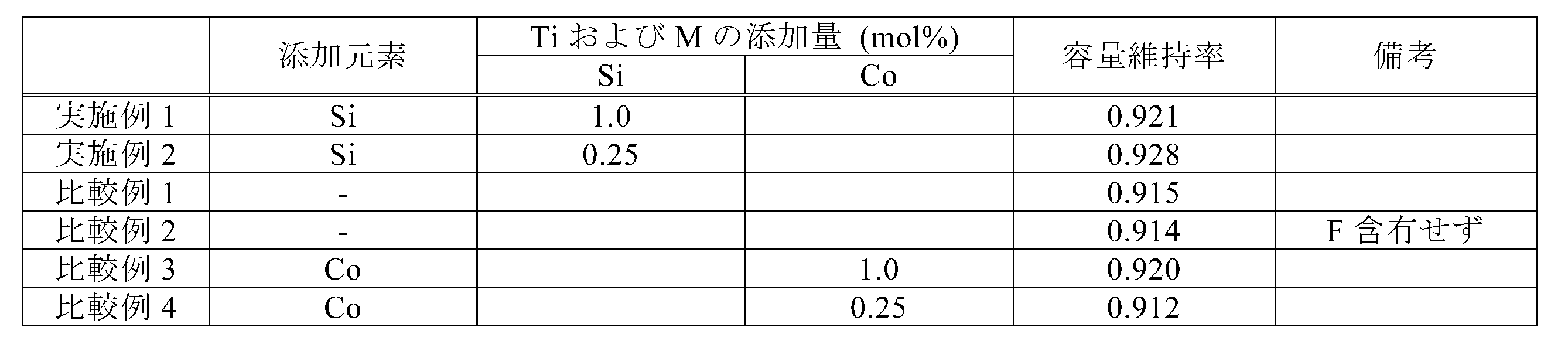
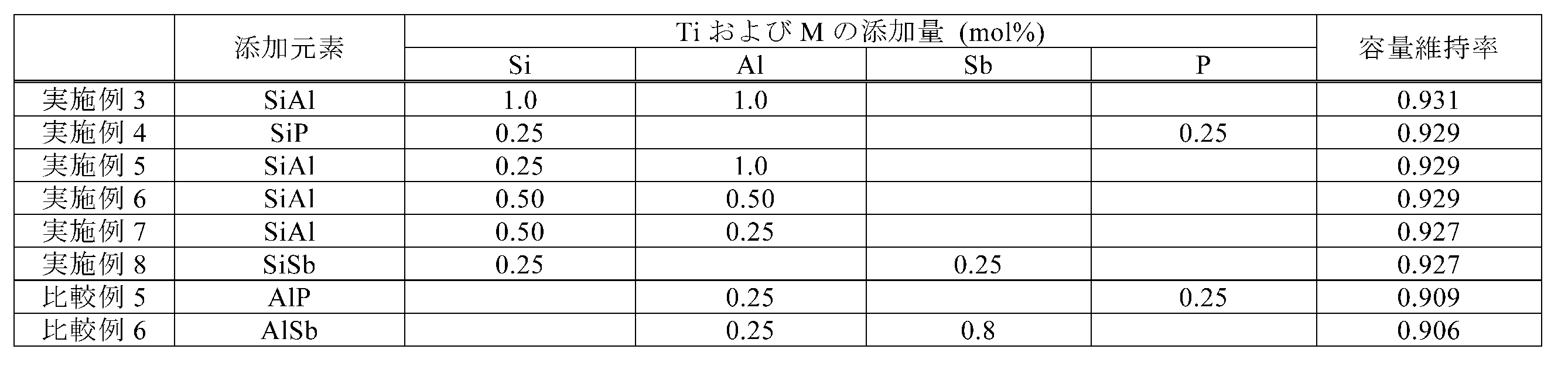
- the test cells of Examples 1 and 2 have higher capacity retention ratios and superior cycle characteristics than the test cells of Comparative Examples 1 and 2.
- F is added to a lithium transition metal composite oxide containing Mn and Ni
- the capacity retention rate of a test cell using the oxide is improved, but compared with the effect when using a composite oxide to which Si is added. Then, the improvement effect is small.
- the test cell of Example 1 has excellent cycle characteristics even when compared with the case of using a composite oxide in which Co is added instead of Si (Comparative Examples 3 and 4).
- Al, P, Sb, Sr, Ti, Mg, and Nb were used as the element M, but in addition to or instead of these elements, Na, K, Ca, Ba, Sc, Y, La, Ce, Pr, Nd, Sm, Eu, Gd, Tb, Dy, Ho, Er, Tm, Yb, Lu, Ge, Sn, Pb, Sc, V, Cr, Fe, It is assumed that even when Cu, Zn, Ru, Rh, Re, Pd, Ir, Ag, Bi, B, Ga, In, Zr, Hf, Mo, and W are used, an effect of improving durability can be obtained. .
Landscapes
- Chemical & Material Sciences (AREA)
- Inorganic Chemistry (AREA)
- Chemical Kinetics & Catalysis (AREA)
- Electrochemistry (AREA)
- General Chemical & Material Sciences (AREA)
- Organic Chemistry (AREA)
- Engineering & Computer Science (AREA)
- Manufacturing & Machinery (AREA)
- Materials Engineering (AREA)
- Battery Electrode And Active Subsutance (AREA)
- Secondary Cells (AREA)
Abstract
Description
正極11は、正極芯体と、正極芯体の表面に設けられた正極合剤層とを有する。正極芯体には、アルミニウム、アルミニウム合金など正極11の電位範囲で安定な金属の箔、当該金属を表層に配置したフィルム等を用いることができる。正極合剤層は、正極活物質、導電剤、および結着剤を含み、正極芯体の両面に設けられることが好ましい。正極11は、例えば正極芯体上に正極活物質、導電剤、および結着剤等を含む正極合剤スラリーを塗布し、塗膜を乾燥させた後、圧縮して正極合剤層を正極芯体の両面に形成することにより作製できる。
負極12は、負極芯体と、負極芯体の表面に設けられた負極合剤層とを有する。負極芯体には、銅などの負極12の電位範囲で安定な金属の箔、当該金属を表層に配置したフィルム等を用いることができる。負極合剤層は、負極活物質および結着剤を含み、負極芯体の両面に設けられることが好ましい。負極12は、例えば負極芯体の表面に負極活物質、導電剤、および結着剤等を含む負極合剤スラリーを塗布し、塗膜を乾燥させた後、圧縮して負極合剤層を負極芯体の両面に形成することにより作製できる。
セパレータ13には、イオン透過性および絶縁性を有する多孔性シートが用いられる。多孔性シートの具体例としては、微多孔薄膜、織布、不織布等が挙げられる。セパレータ13の材質としては、ポリエチレン、ポリプロピレン、エチレンとαオレフィンの共重合体等のポリオレフィン、セルロースなどが好適である。セパレータ13は、単層構造、積層構造のいずれであってもよい。セパレータ13の表面には、無機粒子を含む耐熱層、アラミド樹脂、ポリイミド、ポリアミドイミド等の耐熱性の高い樹脂で構成される耐熱層などが形成されていてもよい。
[リチウム遷移金属複合酸化物の合成]
Mn、Niを2:1のモル比で含有する炭酸塩と、酸化ケイ素と、炭酸リチウムと、フッ化リチウムとを混合し、混合物を800℃で20時間、空気中で焼成して、組成式Li1.167Mn0.550Ni0.275Si0.008O1.958F0.042で表されるリチウム遷移金属複合酸化物を得た。
正極活物質として、上記リチウム遷移金属複合酸化物を用いた。正極活物質と、アセチレンブラックと、ポリフッ化ビニリデンとを、7:2:1の固形分質量比で混合し、分散媒としてN-メチル-2-ピロリドン(NMP)を用いて、正極合剤スラリーを調製した。次に、アルミニウム箔からなる正極芯体上に正極合剤スラリーを塗布し、塗膜を乾燥、圧縮した後、所定の電極サイズに切断して正極を得た。
エチレンカーボネート(EC)と、エチルメチルカーボネート(EMC)と、ジメチルカーボネート(DMC)とを、所定の体積比で混合した。当該混合溶媒に、LiPF6を添加して非水電解液を得た。
セパレータを介して上記正極とリチウム金属箔からなる負極を対向配置して電極体を構成し、コイン形の外装缶に電極体を収容した。外装缶に上記非水電解液を注入した後、外装缶を封止してコイン形の試験セル(非水電解質二次電池)を得た。
リチウム遷移金属複合酸化物の合成において、Siおよび元素Mの含有量が表1に示すものとなるように、元素Mを含有する化合物を混合し、適宜原料の種類および原料の混合比を変更したこと以外(Li、Ni、Mn、O、Fの含有率は実施例1の場合と同じ)は、実施例1と同様にして試験セルを作製した。なお、Al、Co、P、Sb、Sr、Ti、Mg、Nbをそれぞれ含有する化合物には、酸化物を用いた。
リチウム遷移金属複合酸化物の合成において、酸化ケイ素を添加しなかったこと以外は、実施例1と同様にして試験セルを作製した。
リチウム遷移金属複合酸化物の合成において、酸化ケイ素およびフッ化リチウムを添加しなかったこと以外は、実施例1と同様にして試験セルを作製した。
下記サイクル試験の1サイクル後の放電電力量E1(初期放電電力量)および22サイクル後の放電電力量E22から、下記式により容量維持率を算出した。
容量維持率=(E22/E1)
<サイクル試験>
試験セルを、25℃の温度環境下、(1)0.05Cで電池電圧が4.7Vになるまで定電流充電を行い、4.7Vで電流値が0.025Cになるまで定電圧充電を行い、(2)次に20分間休止し、(3)続いて0.05Cで電池電圧が2.5Vになるまで定電流放電を行い、(4)最後に20分間休止した。この(1)から(4)までの工程を1サイクルの充放電サイクルとし、22サイクル繰り返した。


Claims (5)
- 組成式LixMnyNizSiaMfO2-αFα(式中、MはNa、K、Mg、Ca、Sr、Ba、Sc、Y、La、Ce、Pr、Nd、Sm、Eu、Gd、Tb、Dy、Ho、Er、Tm、Yb、Lu、Ge、Sn、Pb、Sc、Ti、V、Cr、Fe、Co、Cu、Zn、Ru、Rh、Re、Pd、Ir、Ag、Bi、Sb、B、Al、Ga、In、P、Zr、Hf、Nb、Mo、Wから選択される少なくとも1種類の元素であり、x+y+z+a+f≦2+A、1.0<x≦1.2、0.4≦y≦0.8、0≦z≦0.4、0<a≦0.03、0≦f≦0.05、0<α≦0.1、0≦A≦0.03)で表されるリチウム遷移金属複合酸化物を含む、非水電解質二次電池用正極活物質。
- 組成式LixMnyNizSiaMfO2-αFαにおいて、
MはNa、K、Mg、Ca、Sr、Ba、Sc、Y、La、Ce、Pr、Nd、Sm、Eu、Gd、Tb、Dy、Ho、Er、Tm、Yb、Lu、Ge、Sn、Pb、Sc、Ti、V、Cr、Fe、Co、Cu、Zn、Ru、Rh、Re、Pd、Ir、Ag、Bi、Sb、B、Al、Ga、In、P、Zr、Hf、Nb、Mo、Wから選択される少なくとも2種類の元素であり、Mのモル比(f)は0<f≦0.03である、請求項1に記載の非水電解質二次電池用正極活物質。 - 組成式LixMnyNizSiaMfO2-αFαにおいて、
MはAl、P、Sb、Sr、Ti、Nb、Mgから選択される少なくとも2種類の元素である、請求項2に記載の非水電解質二次電池用正極活物質。 - 組成式LixMnyNizSiaMfO2-αFαにおいて、
Siのモル比(a)は0.002≦a≦0.015である、請求項1~3のいずれか一項に記載の非水電解質二次電池用正極活物質。 - 請求項1~4のいずれか一項に記載の正極活物質を含む正極と、
負極と、
前記正極と前記負極の間に介在するセパレータと、
非水電解質と、
を備える、非水電解質二次電池。
Priority Applications (4)
| Application Number | Priority Date | Filing Date | Title |
|---|---|---|---|
| EP22759305.0A EP4299529A4 (en) | 2021-02-26 | 2022-02-02 | POSITIVE ELECTRODE ACTIVE MATERIAL FOR SECONDARY BATTERIES WITH ANHYDROUS ELECTROLYTE AND SECONDARY BATTERY WITH ANHYDROUS ELECTROLYTE |
| US18/275,333 US20240304803A1 (en) | 2021-02-26 | 2022-02-02 | Positive electrode active material for non-aqueous electrolyte secondary batteries, and non-aqueous electrolyte secondary battery |
| JP2023502232A JP7792579B2 (ja) | 2021-02-26 | 2022-02-02 | 非水電解質二次電池用正極活物質および非水電解質二次電池 |
| CN202280015810.7A CN116897445A (zh) | 2021-02-26 | 2022-02-02 | 非水电解质二次电池用正极活性物质及非水电解质二次电池 |
Applications Claiming Priority (2)
| Application Number | Priority Date | Filing Date | Title |
|---|---|---|---|
| JP2021029996 | 2021-02-26 | ||
| JP2021-029996 | 2021-02-26 |
Publications (1)
| Publication Number | Publication Date |
|---|---|
| WO2022181264A1 true WO2022181264A1 (ja) | 2022-09-01 |
Family
ID=83048148
Family Applications (1)
| Application Number | Title | Priority Date | Filing Date |
|---|---|---|---|
| PCT/JP2022/003931 Ceased WO2022181264A1 (ja) | 2021-02-26 | 2022-02-02 | 非水電解質二次電池用正極活物質および非水電解質二次電池 |
Country Status (5)
| Country | Link |
|---|---|
| US (1) | US20240304803A1 (ja) |
| EP (1) | EP4299529A4 (ja) |
| JP (1) | JP7792579B2 (ja) |
| CN (1) | CN116897445A (ja) |
| WO (1) | WO2022181264A1 (ja) |
Citations (7)
| Publication number | Priority date | Publication date | Assignee | Title |
|---|---|---|---|---|
| JP2006278341A (ja) * | 2006-04-07 | 2006-10-12 | Ube Ind Ltd | リチウムイオン非水電解質二次電池 |
| JP4197002B2 (ja) | 2006-04-07 | 2008-12-17 | 宇部興産株式会社 | リチウムイオン非水電解質二次電池用正極活物質及びその製造方法 |
| WO2012017826A1 (ja) * | 2010-08-06 | 2012-02-09 | Tdk株式会社 | 活物質、活物質の製造方法及びリチウムイオン二次電池 |
| JP2012038562A (ja) * | 2010-08-06 | 2012-02-23 | Tdk Corp | 前駆体、活物質の製造方法及びリチウムイオン二次電池 |
| JP2019029343A (ja) * | 2017-07-27 | 2019-02-21 | パナソニックIpマネジメント株式会社 | 正極活物質、および、電池 |
| WO2020012739A1 (ja) * | 2018-07-12 | 2020-01-16 | パナソニックIpマネジメント株式会社 | 正極活物質およびそれを備えた電池 |
| JP2020520539A (ja) | 2017-11-22 | 2020-07-09 | エルジー・ケム・リミテッド | リチウム二次電池用正極活物質およびその製造方法 |
Family Cites Families (5)
| Publication number | Priority date | Publication date | Assignee | Title |
|---|---|---|---|---|
| CN103053051A (zh) * | 2010-08-06 | 2013-04-17 | Tdk株式会社 | 前体、前体的制造方法、活性物质的制造方法以及锂离子二次电池 |
| KR101794097B1 (ko) * | 2013-07-03 | 2017-11-06 | 삼성에스디아이 주식회사 | 리튬 이차 전지용 양극 활물질, 이의 제조 방법, 그리고 이를 포함하는 리튬 이차 전지용 양극 및 리튬 이차 전지 |
| JP7122553B2 (ja) * | 2018-04-24 | 2022-08-22 | パナソニックIpマネジメント株式会社 | リチウム金属二次電池およびその製造方法 |
| JP7289072B2 (ja) * | 2018-05-31 | 2023-06-09 | パナソニックIpマネジメント株式会社 | リチウム二次電池 |
| JP7223980B2 (ja) * | 2018-07-31 | 2023-02-17 | パナソニックIpマネジメント株式会社 | 正極材料および二次電池 |
-
2022
- 2022-02-02 EP EP22759305.0A patent/EP4299529A4/en active Pending
- 2022-02-02 JP JP2023502232A patent/JP7792579B2/ja active Active
- 2022-02-02 WO PCT/JP2022/003931 patent/WO2022181264A1/ja not_active Ceased
- 2022-02-02 US US18/275,333 patent/US20240304803A1/en active Pending
- 2022-02-02 CN CN202280015810.7A patent/CN116897445A/zh active Pending
Patent Citations (8)
| Publication number | Priority date | Publication date | Assignee | Title |
|---|---|---|---|---|
| JP2006278341A (ja) * | 2006-04-07 | 2006-10-12 | Ube Ind Ltd | リチウムイオン非水電解質二次電池 |
| JP4197002B2 (ja) | 2006-04-07 | 2008-12-17 | 宇部興産株式会社 | リチウムイオン非水電解質二次電池用正極活物質及びその製造方法 |
| WO2012017826A1 (ja) * | 2010-08-06 | 2012-02-09 | Tdk株式会社 | 活物質、活物質の製造方法及びリチウムイオン二次電池 |
| JP2012038562A (ja) * | 2010-08-06 | 2012-02-23 | Tdk Corp | 前駆体、活物質の製造方法及びリチウムイオン二次電池 |
| JP2012038564A (ja) * | 2010-08-06 | 2012-02-23 | Tdk Corp | 活物質、活物質の製造方法及びリチウムイオン二次電池 |
| JP2019029343A (ja) * | 2017-07-27 | 2019-02-21 | パナソニックIpマネジメント株式会社 | 正極活物質、および、電池 |
| JP2020520539A (ja) | 2017-11-22 | 2020-07-09 | エルジー・ケム・リミテッド | リチウム二次電池用正極活物質およびその製造方法 |
| WO2020012739A1 (ja) * | 2018-07-12 | 2020-01-16 | パナソニックIpマネジメント株式会社 | 正極活物質およびそれを備えた電池 |
Non-Patent Citations (1)
| Title |
|---|
| See also references of EP4299529A4 |
Also Published As
| Publication number | Publication date |
|---|---|
| EP4299529A1 (en) | 2024-01-03 |
| US20240304803A1 (en) | 2024-09-12 |
| CN116897445A (zh) | 2023-10-17 |
| EP4299529A4 (en) | 2024-09-11 |
| JP7792579B2 (ja) | 2025-12-26 |
| JPWO2022181264A1 (ja) | 2022-09-01 |
Similar Documents
| Publication | Publication Date | Title |
|---|---|---|
| JP7634182B2 (ja) | 非水電解質二次電池用正極活物質および非水電解質二次電池 | |
| JP7804945B2 (ja) | 非水電解質二次電池 | |
| JP7702630B2 (ja) | 非水電解質二次電池用正極活物質および非水電解質二次電池 | |
| CN114342139A (zh) | 非水电解质二次电池 | |
| JP7692170B2 (ja) | 非水電解質二次電池用正極活物質および非水電解質二次電池 | |
| JP7689286B2 (ja) | 非水電解質二次電池用正極活物質および非水電解質二次電池 | |
| WO2022209894A1 (ja) | 非水電解質二次電池用正極活物質および非水電解質二次電池 | |
| JP7752330B2 (ja) | 非水電解質二次電池用正極活物質、及び非水電解質二次電池 | |
| JP7780722B2 (ja) | 非水電解質二次電池用正極活物質および非水電解質二次電池 | |
| WO2023054041A1 (ja) | 非水電解質二次電池用正極活物質および非水電解質二次電池 | |
| JP7792579B2 (ja) | 非水電解質二次電池用正極活物質および非水電解質二次電池 | |
| JP7792577B2 (ja) | 非水電解質二次電池用正極活物質および非水電解質二次電池 | |
| US20250210646A1 (en) | Positive electrode active material for non-aqueous electrolyte secondary battery, and non-aqueous electrolyte secondary battery | |
| JP7685708B2 (ja) | 非水電解質二次電池用正極活物質および非水電解質二次電池 | |
| JP7685709B2 (ja) | 非水電解質二次電池用正極活物質および非水電解質二次電池 | |
| WO2024161962A1 (ja) | 非水電解質二次電池用正極および非水電解質二次電池 | |
| WO2023053582A1 (ja) | 二次電池用正極、及びそれを用いた二次電池 | |
| WO2023068229A1 (ja) | 非水電解質二次電池用正極及び非水電解質二次電池 | |
| WO2026048786A1 (ja) | 正極活物質および正極活物質の製造方法 | |
| WO2024162121A1 (ja) | 非水電解質二次電池用正極活物質および非水電解質二次電池 | |
| WO2022163531A1 (ja) | 非水電解質二次電池用活物質、及び非水電解質二次電池 |
Legal Events
| Date | Code | Title | Description |
|---|---|---|---|
| 121 | Ep: the epo has been informed by wipo that ep was designated in this application |
Ref document number: 22759305 Country of ref document: EP Kind code of ref document: A1 |
|
| WWE | Wipo information: entry into national phase |
Ref document number: 2023502232 Country of ref document: JP |
|
| WWE | Wipo information: entry into national phase |
Ref document number: 18275333 Country of ref document: US |
|
| WWE | Wipo information: entry into national phase |
Ref document number: 202280015810.7 Country of ref document: CN |
|
| WWE | Wipo information: entry into national phase |
Ref document number: 2022759305 Country of ref document: EP |
|
| NENP | Non-entry into the national phase |
Ref country code: DE |
|
| ENP | Entry into the national phase |
Ref document number: 2022759305 Country of ref document: EP Effective date: 20230926 |