WO2022181782A1 - 発酵飲食品の製造方法、及び嫌気発酵方法 - Google Patents
発酵飲食品の製造方法、及び嫌気発酵方法 Download PDFInfo
- Publication number
- WO2022181782A1 WO2022181782A1 PCT/JP2022/007979 JP2022007979W WO2022181782A1 WO 2022181782 A1 WO2022181782 A1 WO 2022181782A1 JP 2022007979 W JP2022007979 W JP 2022007979W WO 2022181782 A1 WO2022181782 A1 WO 2022181782A1
- Authority
- WO
- WIPO (PCT)
- Prior art keywords
- carbohydrate oxidase
- anaerobic fermentation
- amino acid
- fermented food
- carbohydrate
- Prior art date
- Legal status (The legal status is an assumption and is not a legal conclusion. Google has not performed a legal analysis and makes no representation as to the accuracy of the status listed.)
- Ceased
Links
Classifications
-
- C—CHEMISTRY; METALLURGY
- C12—BIOCHEMISTRY; BEER; SPIRITS; WINE; VINEGAR; MICROBIOLOGY; ENZYMOLOGY; MUTATION OR GENETIC ENGINEERING
- C12N—MICROORGANISMS OR ENZYMES; COMPOSITIONS THEREOF; PROPAGATING, PRESERVING, OR MAINTAINING MICROORGANISMS; MUTATION OR GENETIC ENGINEERING; CULTURE MEDIA
- C12N9/00—Enzymes; Proenzymes; Compositions thereof; Processes for preparing, activating, inhibiting, separating or purifying enzymes
- C12N9/0004—Oxidoreductases (1.)
- C12N9/0006—Oxidoreductases (1.) acting on CH-OH groups as donors (1.1)
-
- A—HUMAN NECESSITIES
- A23—FOODS OR FOODSTUFFS; TREATMENT THEREOF, NOT COVERED BY OTHER CLASSES
- A23C—DAIRY PRODUCTS, e.g. MILK, BUTTER OR CHEESE; MILK OR CHEESE SUBSTITUTES; PREPARATION THEREOF
- A23C9/00—Milk preparations; Milk powder or milk powder preparations
- A23C9/12—Fermented milk preparations; Treatment using microorganisms or enzymes
- A23C9/1203—Addition of, or treatment with, enzymes or microorganisms other than lactobacteriaceae
- A23C9/1213—Oxidation or reduction enzymes, e.g. peroxidase, catalase, dehydrogenase
-
- A—HUMAN NECESSITIES
- A23—FOODS OR FOODSTUFFS; TREATMENT THEREOF, NOT COVERED BY OTHER CLASSES
- A23C—DAIRY PRODUCTS, e.g. MILK, BUTTER OR CHEESE; MILK OR CHEESE SUBSTITUTES; PREPARATION THEREOF
- A23C11/00—Milk substitutes, e.g. coffee whitener compositions
- A23C11/02—Milk substitutes, e.g. coffee whitener compositions containing at least one non-milk component as source of fats or proteins
- A23C11/10—Milk substitutes, e.g. coffee whitener compositions containing at least one non-milk component as source of fats or proteins containing or not lactose but no other milk components as source of fats, carbohydrates or proteins
-
- A—HUMAN NECESSITIES
- A23—FOODS OR FOODSTUFFS; TREATMENT THEREOF, NOT COVERED BY OTHER CLASSES
- A23C—DAIRY PRODUCTS, e.g. MILK, BUTTER OR CHEESE; MILK OR CHEESE SUBSTITUTES; PREPARATION THEREOF
- A23C11/00—Milk substitutes, e.g. coffee whitener compositions
- A23C11/02—Milk substitutes, e.g. coffee whitener compositions containing at least one non-milk component as source of fats or proteins
- A23C11/10—Milk substitutes, e.g. coffee whitener compositions containing at least one non-milk component as source of fats or proteins containing or not lactose but no other milk components as source of fats, carbohydrates or proteins
- A23C11/103—Milk substitutes, e.g. coffee whitener compositions containing at least one non-milk component as source of fats or proteins containing or not lactose but no other milk components as source of fats, carbohydrates or proteins containing only proteins from pulses, oilseeds or nuts, e.g. nut milk
- A23C11/106—Addition of, or treatment with, microorganisms
-
- A—HUMAN NECESSITIES
- A23—FOODS OR FOODSTUFFS; TREATMENT THEREOF, NOT COVERED BY OTHER CLASSES
- A23C—DAIRY PRODUCTS, e.g. MILK, BUTTER OR CHEESE; MILK OR CHEESE SUBSTITUTES; PREPARATION THEREOF
- A23C9/00—Milk preparations; Milk powder or milk powder preparations
- A23C9/12—Fermented milk preparations; Treatment using microorganisms or enzymes
- A23C9/123—Fermented milk preparations; Treatment using microorganisms or enzymes using only microorganisms of the genus lactobacteriaceae; Yoghurt
-
- A—HUMAN NECESSITIES
- A23—FOODS OR FOODSTUFFS; TREATMENT THEREOF, NOT COVERED BY OTHER CLASSES
- A23C—DAIRY PRODUCTS, e.g. MILK, BUTTER OR CHEESE; MILK OR CHEESE SUBSTITUTES; PREPARATION THEREOF
- A23C9/00—Milk preparations; Milk powder or milk powder preparations
- A23C9/12—Fermented milk preparations; Treatment using microorganisms or enzymes
- A23C9/127—Fermented milk preparations; Treatment using microorganisms or enzymes using microorganisms of the genus lactobacteriaceae and other microorganisms or enzymes, e.g. kefir, koumiss
-
- A—HUMAN NECESSITIES
- A23—FOODS OR FOODSTUFFS; TREATMENT THEREOF, NOT COVERED BY OTHER CLASSES
- A23C—DAIRY PRODUCTS, e.g. MILK, BUTTER OR CHEESE; MILK OR CHEESE SUBSTITUTES; PREPARATION THEREOF
- A23C9/00—Milk preparations; Milk powder or milk powder preparations
- A23C9/12—Fermented milk preparations; Treatment using microorganisms or enzymes
- A23C9/127—Fermented milk preparations; Treatment using microorganisms or enzymes using microorganisms of the genus lactobacteriaceae and other microorganisms or enzymes, e.g. kefir, koumiss
- A23C9/1275—Fermented milk preparations; Treatment using microorganisms or enzymes using microorganisms of the genus lactobacteriaceae and other microorganisms or enzymes, e.g. kefir, koumiss using only lactobacteriaceae for fermentation in combination with enzyme treatment of the milk product; using enzyme treated milk products for fermentation with lactobacteriaceae
-
- A—HUMAN NECESSITIES
- A23—FOODS OR FOODSTUFFS; TREATMENT THEREOF, NOT COVERED BY OTHER CLASSES
- A23L—FOODS, FOODSTUFFS OR NON-ALCOHOLIC BEVERAGES, NOT OTHERWISE PROVIDED FOR; PREPARATION OR TREATMENT THEREOF
- A23L11/00—Pulses, i.e. fruits of leguminous plants, for production of food; Products from legumes; Preparation or treatment thereof
- A23L11/50—Fermented pulses or legumes; Fermentation of pulses or legumes based on the addition of microorganisms
-
- A—HUMAN NECESSITIES
- A23—FOODS OR FOODSTUFFS; TREATMENT THEREOF, NOT COVERED BY OTHER CLASSES
- A23L—FOODS, FOODSTUFFS OR NON-ALCOHOLIC BEVERAGES, NOT OTHERWISE PROVIDED FOR; PREPARATION OR TREATMENT THEREOF
- A23L27/00—Spices; Flavouring agents or condiments; Artificial sweetening agents; Table salts; Dietetic salt substitutes; Preparation or treatment thereof
- A23L27/50—Soya sauce
-
- A—HUMAN NECESSITIES
- A23—FOODS OR FOODSTUFFS; TREATMENT THEREOF, NOT COVERED BY OTHER CLASSES
- A23L—FOODS, FOODSTUFFS OR NON-ALCOHOLIC BEVERAGES, NOT OTHERWISE PROVIDED FOR; PREPARATION OR TREATMENT THEREOF
- A23L29/00—Foods or foodstuffs containing additives; Preparation or treatment thereof
- A23L29/06—Enzymes
-
- A—HUMAN NECESSITIES
- A23—FOODS OR FOODSTUFFS; TREATMENT THEREOF, NOT COVERED BY OTHER CLASSES
- A23L—FOODS, FOODSTUFFS OR NON-ALCOHOLIC BEVERAGES, NOT OTHERWISE PROVIDED FOR; PREPARATION OR TREATMENT THEREOF
- A23L29/00—Foods or foodstuffs containing additives; Preparation or treatment thereof
- A23L29/065—Microorganisms
-
- A—HUMAN NECESSITIES
- A23—FOODS OR FOODSTUFFS; TREATMENT THEREOF, NOT COVERED BY OTHER CLASSES
- A23L—FOODS, FOODSTUFFS OR NON-ALCOHOLIC BEVERAGES, NOT OTHERWISE PROVIDED FOR; PREPARATION OR TREATMENT THEREOF
- A23L7/00—Cereal-derived products; Malt products; Preparation or treatment thereof
- A23L7/10—Cereal-derived products
- A23L7/104—Fermentation of farinaceous cereal or cereal material; Addition of enzymes or microorganisms
-
- C—CHEMISTRY; METALLURGY
- C12—BIOCHEMISTRY; BEER; SPIRITS; WINE; VINEGAR; MICROBIOLOGY; ENZYMOLOGY; MUTATION OR GENETIC ENGINEERING
- C12N—MICROORGANISMS OR ENZYMES; COMPOSITIONS THEREOF; PROPAGATING, PRESERVING, OR MAINTAINING MICROORGANISMS; MUTATION OR GENETIC ENGINEERING; CULTURE MEDIA
- C12N9/00—Enzymes; Proenzymes; Compositions thereof; Processes for preparing, activating, inhibiting, separating or purifying enzymes
- C12N9/14—Hydrolases (3)
- C12N9/24—Hydrolases (3) acting on glycosyl compounds (3.2)
- C12N9/2402—Hydrolases (3) acting on glycosyl compounds (3.2) hydrolysing O- and S- glycosyl compounds (3.2.1)
- C12N9/2405—Glucanases
- C12N9/2434—Glucanases acting on beta-1,4-glucosidic bonds
- C12N9/2445—Beta-glucosidase (3.2.1.21)
-
- C—CHEMISTRY; METALLURGY
- C12—BIOCHEMISTRY; BEER; SPIRITS; WINE; VINEGAR; MICROBIOLOGY; ENZYMOLOGY; MUTATION OR GENETIC ENGINEERING
- C12P—FERMENTATION OR ENZYME-USING PROCESSES TO SYNTHESISE A DESIRED CHEMICAL COMPOUND OR COMPOSITION OR TO SEPARATE OPTICAL ISOMERS FROM A RACEMIC MIXTURE
- C12P7/00—Preparation of oxygen-containing organic compounds
- C12P7/40—Preparation of oxygen-containing organic compounds containing a carboxyl group including Peroxycarboxylic acids
- C12P7/56—Lactic acid
-
- C—CHEMISTRY; METALLURGY
- C12—BIOCHEMISTRY; BEER; SPIRITS; WINE; VINEGAR; MICROBIOLOGY; ENZYMOLOGY; MUTATION OR GENETIC ENGINEERING
- C12Y—ENZYMES
- C12Y101/00—Oxidoreductases acting on the CH-OH group of donors (1.1)
-
- C—CHEMISTRY; METALLURGY
- C12—BIOCHEMISTRY; BEER; SPIRITS; WINE; VINEGAR; MICROBIOLOGY; ENZYMOLOGY; MUTATION OR GENETIC ENGINEERING
- C12Y—ENZYMES
- C12Y302/00—Hydrolases acting on glycosyl compounds, i.e. glycosylases (3.2)
- C12Y302/01—Glycosidases, i.e. enzymes hydrolysing O- and S-glycosyl compounds (3.2.1)
- C12Y302/01021—Beta-glucosidase (3.2.1.21)
-
- C—CHEMISTRY; METALLURGY
- C12—BIOCHEMISTRY; BEER; SPIRITS; WINE; VINEGAR; MICROBIOLOGY; ENZYMOLOGY; MUTATION OR GENETIC ENGINEERING
- C12R—INDEXING SCHEME ASSOCIATED WITH SUBCLASSES C12C - C12Q, RELATING TO MICROORGANISMS
- C12R2001/00—Microorganisms ; Processes using microorganisms
- C12R2001/645—Fungi ; Processes using fungi
- C12R2001/745—Cephalosporium ; Acremonium
Definitions
- the present invention relates to a method for promoting anaerobic fermentation. More specifically, the present invention relates to a production technique for shortening the anaerobic fermentation time by using carbohydrate oxidase to reduce the oxygen concentration contained in raw materials.
- Patent Documents 1 to 3 Disclosed in Non-Patent Document 1, Patent Documents 1 to 3, etc. that the fermentation efficiency can be improved and the fermentation time of fermented milk can be shortened by replacing and reducing dissolved oxygen in raw milk with an inert gas such as nitrogen. It is Instead of mixing an inert gas, oxygen dissolved in raw material milk can be removed by deaeration. Furthermore, Patent Document 4 discloses a method for producing fermented milk using both a process of reducing the oxygen concentration contained in the raw material milk and yeast lactase, and maintains a constant flavor and quality regardless of the state of lactic acid bacteria and enzymes. It is said to be possible.
- the conventional oxygen concentration reduction technology has the problem of requiring large-scale equipment such as a nitrogen replacement device that can replace inert gas.
- the main purpose of this technology is to provide a new technology that shortens the anaerobic fermentation time by reducing the oxygen concentration contained in the raw material other than the inert gas replacement method that requires the introduction of equipment. do.
- the inventors of the present application conducted intensive research on techniques for shortening the anaerobic fermentation time, and as a result, found that the anaerobic fermentation time can be shortened by allowing carbohydrate oxidase to act on raw milk, and completed the present invention. came to.
- a carbohydrate oxidase acting step of causing carbohydrate oxidase to act on part or all of the carbohydrates in the raw material An anaerobic fermentation step of performing anaerobic fermentation;
- the carbohydrate oxidase action step can be performed before and/or simultaneously with the anaerobic fermentation step.
- the carbohydrate oxidase having the property of acting on one or more carbohydrates selected from glucose, maltotriose, maltose, galactose, maltotetraose, lactose, cellobiose, and maltodextrin.
- a carbohydrate oxidase comprising a polypeptide shown in any one of (1) to (3) below can be used as the carbohydrate oxidase.
- polypeptides consisting of the amino acid sequence shown in SEQ ID NO: 1; (2) A substrate equivalent to a polypeptide having one or several amino acid residues substituted, added, inserted or deleted in the amino acid sequence shown in SEQ ID NO: 1 and consisting of the amino acid sequence shown in SEQ ID NO: 1 and (3) a polypeptide having a sequence identity of 90% or more to the amino acid sequence shown in SEQ ID NO: 1 in the amino acid sequence shown in SEQ ID NO: 1 and consisting of the amino acid sequence shown in SEQ ID NO: 1.
- Polypeptides exhibiting substrate specificity comparable to In the method for producing a fermented food or drink according to the present technology, lactic acid fermentation can be performed in the anaerobic fermentation step. In the method for producing a fermented food or drink according to the present technology, fermented milk can be produced as the fermented food or drink.
- This technology then provides an oxygen concentration-reducing agent for anaerobic fermentation that contains carbohydrate oxidase.
- the present technology further provides an anaerobic fermentation method that includes a carbohydrate oxidase acting step in which carbohydrate oxidase acts on part or all of the carbohydrates in the raw material.
- the carbohydrate oxidase action step can be performed before and/or simultaneously with the anaerobic fermentation step.
- anaerobic fermentation time can be shortened without the need to introduce equipment by performing a treatment that reduces the oxygen concentration contained in raw materials using carbohydrate oxidase in anaerobic fermentation. .
- a method for producing a fermented food or drink according to the present technology is a method in which at least a carbohydrate oxidase action step and an anaerobic fermentation step are performed.
- Carbohydrate oxidase action step is a step in which a part or all of the saccharides in the raw material are acted on by saccharide oxidase.
- the concentration of oxygen contained in the raw material can be reduced by causing carbohydrate oxidase to act on the sugar in the raw material.
- the anaerobic fermentation time in the anaerobic fermentation step which will be described later, can be shortened.
- carbohydrate oxidase By allowing carbohydrate oxidase to act on the raw material, it is possible to improve the stringiness of the fermented food and drink obtained through the anaerobic fermentation process described later.
- carbohydrate oxidases that can be used in the present technology are described in detail below.
- stringiness refers to the property of a substance to “pull strings.” It can be evaluated by the time until the is interrupted. A unique texture can be imparted by improving the stringiness of the food and drink.
- Carbohydrate Oxidase that can be used in the present technology is not particularly limited as long as it is an enzyme that can oxidize a carbohydrate, but an enzyme that oxidizes an oligosaccharide having two or more sugars is preferable. Specific examples include proteins having the physicochemical properties described below.
- Carbohydrate oxidase that can be used in the present technology oxidizes sugars described later to produce sugar acids in the presence of oxygen. More specifically, sugar acid and hydrogen peroxide are produced by reacting a sugar described later with a sugar oxidase that can be used in the present technology in the presence of oxygen.
- Carbohydrate oxidases that can be used in the present technology include one or more carbohydrates selected from glucose, maltotriose, maltose, galactose, maltotetraose, lactose, cellobiose, and maltodextrin. Any protein that exhibits activity against it can be used.
- the relative activity for each substrate is maltotriose: about 92%, maltose: about 86%, galactose: about 79%, maltotetraose: about 60%, lactose: about 58%, when the activity for glucose is 100%.
- cellobiose about 53%
- maltodextrin about 24%.
- the relative activity is 50% or more when the activity when glucose is used as a substrate is taken as the standard (100%), it is judged that "this enzyme is a substrate that works well".
- carbohydrate oxidase that is active not only on monosaccharides such as glucose but also on a wide range of carbohydrates such as disaccharides, it is possible to treat a wide range of carbohydrates that cannot be treated by existing glucose oxidases and oligosaccharide oxidases. It is possible to function carbohydrate oxidation in various fields.
- a specific method for calculating the Km value (Michaelis constant) of a protein is not particularly limited, and a known method can be freely selected for calculation.
- Methods for calculating the Km value of protein include, for example, Lineweaver-Burk plot, Eadie-Hofstee plot, Hanes-Woolf plot and the like, preferably Hanes-Woolf plot.
- the Km value of the carbohydrate oxidase that can be used in the present technology is not particularly limited, it is preferably [Km value of glucose]/[Km value of maltose] ⁇ 1, and 0.4 ⁇ [Km value of glucose ]/[Km value of maltose] ⁇ 1.
- (D) Molecular Mass Carbohydrate oxidase that can be used in the present technology has a molecular mass of about 63 kDa as determined by the SDS-PAGE method.
- Carbohydrate oxidase that can be used in the present technology can be a carbohydrate oxidase that is stable in the vicinity of pH 5.0 to 10.5 under treatment conditions of 37° C. for 15 minutes. .
- Carbohydrate oxidase that can be used in the present technology has the highest carbohydrate oxidase activity at around 20°C to 55°C under reaction conditions of pH 7.0 for 5 minutes. can be used.
- (H) Temperature stability A carbohydrate oxidase that can be used in the present technology maintains an activity of 80% or more even after treatment at pH 7.0 for 15 minutes and at temperatures up to 45°C. Carbohydrate oxidase that can be used can be used.
- Origin of the carbohydrate oxidase that can be used in the present technology described above is not particularly limited, but examples thereof include those derived from microorganisms belonging to the genus Acremonium.
- the microorganism belonging to the Acremonium genus includes Acremonium chrysogenum.
- carbohydrate oxidase derived from Acremonium chrysogenum means a carbohydrate oxidase produced by a microorganism classified as Acremonium chrysogenum (whether a wild strain or a mutant), or a carbohydrate It means that it is a carbohydrate oxidase obtained by a genetic engineering technique using an oxidase gene. Therefore, a recombinant enzyme produced by a host microorganism into which a carbohydrate oxidase gene obtained from Acremonium chrysogenum (or a gene obtained by modifying the gene) has been introduced also corresponds to "a carbohydrate oxidase derived from Acremonium chrysogenum".
- Acremonium chrysogenum from which carbohydrate oxidases that can be used in the present technology are derived examples include Acremonium chrysogenum NBRC30055 (NITE, Japan), ATCC15006 (ATCC, USA), and DSM880 (DSMZ, Germany). can be done.
- amino acid sequence of the carbohydrate oxidase that can be used in the present technology is not limited, but can be specified by the following amino acid sequence, for example.
- carbohydrate oxidase that can be used in this technology can be specified by the amino acid sequence represented by SEQ ID NO:1.
- the protein after modification may have the same function as the protein before modification. That is, the modification of the amino acid sequence does not substantially affect the function of the protein, and the function of the protein may be maintained before and after modification. Therefore, as another aspect of the present invention, a protein comprising an amino acid sequence in which one to several amino acids are deleted, substituted and/or added in the amino acid sequence represented by SEQ ID NO: 1 and having carbohydrate oxidase activity I will provide a. "Deletion, substitution and/or addition of one to several amino acids constituting an amino acid sequence" typically refers to partial differences in amino acid sequences.
- a difference in the amino acid sequence here is permissible as long as the carbohydrate oxidase activity can be maintained (the activity may vary slightly).
- the positions where the amino acid sequences differ are not particularly limited, and differences may occur at multiple positions.
- the plural here is, for example, a number corresponding to less than about 30% of the total amino acid sequence, preferably a number corresponding to less than about 20%, and more preferably a number corresponding to less than about 10%. , even more preferably a number corresponding to less than about 5%, and most preferably a number corresponding to less than about 1%. That is, for example, about 70% or more, preferably about 80% or more, more preferably about 90% or more, even more preferably about 95% or more, most preferably about 99% or more identity with the amino acid sequence of SEQ ID NO:1 refers to having
- a method of obtaining a protein by causing conservative amino acid substitutions in amino acid residues that are not essential for carbohydrate oxidase activity is good.
- conservative amino acid substitution refers to substitution of an amino acid residue with an amino acid residue having a side chain with similar properties.
- Amino acid residues have, depending on their side chain, a basic side chain (e.g. lysine, arginine, histidine), an acidic side chain (e.g. aspartic acid, glutamic acid), an uncharged polar side chain (e.g. glycine, asparagine, glutamine, serine, threonine, tyrosine, cysteine), nonpolar side chains (e.g.
- alanine, valine, leucine, isoleucine, proline, phenylalanine, methionine, tryptophan), beta-branched side chains (e.g. threonine, valine, isoleucine), aromatic side chains (e.g. tyrosine, phenylalanine). , tryptophan, histidine) are classified into several families. Conservative amino acid substitutions are preferably between amino acid residues within the same family.
- the identity (%) of two amino acid sequences or two nucleic acids can be determined, for example, by the following procedure.
- the two sequences are aligned for optimal comparison.
- gaps may be introduced into the first sequence to optimize alignment with the second sequence.
- comparison of two sequences and determination of identity can be realized using a mathematical algorithm.
- mathematical algorithms that can be used for sequence comparison include Karlin and Altschul (1990) Proc. Natl. Acad. Sci. USA 87:2264-68 and Karlin and Altschul (1993) Proc. Natl. Acad. Sci. USA 90:5873-77, modified algorithm, but not limited to this.
- Such algorithms are described in Altschul et al. (1990) J. Am. Mol. Biol. 215:403-10, incorporated in the NBLAST and XBLAST programs (version 2.0).
- Gapped BLAST can be used as described in Altschul et al. (1997) Nucleic Acids Research 25(17):3389-3402.
- the default parameters of the corresponding programs eg, XBLAST and NBLAST
- XBLAST and NBLAST the default parameters of the corresponding programs
- a carbohydrate oxidase that can be used in this technology may be part of a larger protein (eg, a fusion protein).
- Additional sequences in the fusion protein include, for example, sequences that aid in purification such as multiple histidine residues, additional sequences that ensure stability during recombinant production, and the like.
- a protein having the above amino acid sequence can be easily prepared by genetic engineering techniques. For example, it can be prepared by transforming a suitable host cell (eg, Escherichia coli, yeast, filamentous fungus) with a DNA encoding the present protein, and recovering the protein expressed in the transformant. The recovered protein is appropriately prepared according to the purpose.
- a suitable host cell eg, Escherichia coli, yeast, filamentous fungus
- the recovered protein is appropriately prepared according to the purpose.
- the present protein as a recombinant protein in this manner, various modifications are possible. For example, if a DNA encoding the present protein and other suitable DNA are inserted into the same vector, and the vector is used to produce a recombinant protein, the recombinant protein consists of any peptide or protein linked thereto.
- the present protein can be obtained.
- addition of sugar chains and/or lipids, or modification that causes N-terminal or C-terminal processing may be performed. Such modifications enable extraction of
- the pH, temperature, duration of action, etc. can be set according to the physicochemical properties of the carbohydrate oxidase to be used, such as optimum pH, stable pH range, optimum temperature, and temperature stability.
- the pH can be set to, for example, pH 5.0 to 10.5, preferably pH 5.0 to 7.5.
- the temperature can be set to, for example, 20°C to 55°C, preferably 30°C to 50°C, more preferably 35°C to 45°C.
- the duration of action can be set to, for example, 1 to 12 hours, preferably 4 to 10 hours.
- the amount of carbohydrate oxidase added in the carbohydrate oxidase action process can be freely set as long as it does not impair the effect of this technology.
- carbohydrate oxidase action step other enzymes can be used in addition to carbohydrate oxidase as long as the effect of this technology is not impaired.
- one or more enzymes selected from lactase, protease, transglutaminase, laccase, peroxidase, catalase, lipase, cellulase, and amylase can be used in combination.
- sugar can be used in combination in the sugar oxidase action step.
- sugar By using sugar together, the oxygen in the raw material of the food or drink is consumed during oxidation of the sugar, so that the deoxidizing effect can be improved.
- the type of saccharide that can be used in combination in the present technology is not particularly limited as long as it does not impair the effect of the present technology.
- one or more sugars selected from starch, modified starch, dextrin, cellulose, and processed cellulose. Quality can be used together.
- the anaerobic fermentation step can be performed after the carbohydrate oxidase action step, or can be performed simultaneously with the carbohydrate oxidase action step.
- anaerobic fermentation process of this technology fermentation can be performed using anaerobic microorganisms.
- Anaerobic microorganisms that can be used in this technology are anaerobic microorganisms that can be used in the production of general fermented food and drink, depending on the type of fermented food and drink to be manufactured, as long as the effect of this technology is not impaired.
- One or more types can be freely selected and used.
- anaerobic microorganisms include lactic acid bacteria, yeast, and the like.
- Lactic acid fermentation can be performed in the anaerobic fermentation process of this technology.
- the lactic acid bacterium used for lactic acid fermentation one or more types of lactic acid bacteria that can be used for general lactic acid-fermented food and drink production are selected according to the type and purpose of the lactic acid-fermented food and drink to be produced, as long as the effect of the present technology is not impaired. , can be freely selected and used.
- Examples of lactic acid bacteria include Lactococcus, Streptococcus, Pediococcus, lactic acid bacteria belonging to Leuconostoc, lactic acid bacteria belonging to Lactobacillus, and Bifidobacterium. etc., preferably Lactobacillus delbrueckii subsp. bulgaricus, Streptococcus thermophilus, Lactobacillus delbrueckii subsp. delbrueckii.
- the oxygen concentration contained in the raw material is reduced by performing the carbohydrate oxidase action step, so the progress of anaerobic fermentation can be promoted, but performing aerobic fermentation is excluded. not something to do.
- Various conditions for the anaerobic fermentation process can be freely set as long as they do not impair the effect of this technology.
- fermentation conditions, heating conditions, etc. can be set according to the type of anaerobic microorganisms to be used.
- the fermentation temperature can be set at, for example, 20°C to 55°C, preferably 30°C to 50°C, more preferably 35°C to 45°C.
- Fermentation time can be set to, for example, 1 to 12 hours, preferably 4 to 10 hours.
- Heating conditions include, for example, high-temperature short-time sterilization (HTST) method, high-temperature cooking (UHT) method, retort method, etc., and the temperature of food and drink materials is 90 ° C. or higher, preferably about 95 ° C. Just do it. Examples include a method of treating food and beverage materials at 90 to 100° C. for 1 to 5 minutes, and a method of treating them at 90 to 95° C. for 1 to 3 minutes.
- fermented food and drink refers to food and drink obtained by fermenting food and drink ingredients. Specifically, for example, fermented milk (yogurt), lactic acid bacteria beverage, cheese, yogurt paste, alcoholic beverages (sake, beer, wine, shochu, etc.), various fermented seasonings (soy sauce, miso, vinegar, etc.), bran pickles, kimchi , natto, and kuzumochi.
- fermented milk yogurt
- lactic acid bacteria beverage cheese
- yogurt paste alcoholic beverages
- alcoholic beverages asake, beer, wine, shochu, etc.
- various fermented seasonings sauce, miso, vinegar, etc.
- bran pickles kimchi , natto, and kuzumochi.
- “fermented food and drink” also includes secondary processed food and drink using these fermented food and drink.
- “fermented milk” refers to animal-derived “animal fermented milk” and plant-derived “vegetable fermented milk”. “Fermented animal milk” is defined in the “Ministerial Ordinance Concerning Ingredient Standards, etc. for Milk and Dairy Products” as “milk or milk containing non-fat milk solids equal to or higher than milk is fermented with lactic acid bacteria or yeast and made into a paste. or liquefied or frozen”.
- “Vegetable fermented milk” refers to fermented plant milk, and plant milk includes, for example, peas, soybeans, broad beans, chickpeas, barley, wheat, oats, rice, buckwheat, millet , millet, hemp (industrial hemp), algae, almonds, cashews, hazelnuts, pecans, macadamia nuts, pistachios, walnuts, brazil nuts, peanuts, coconut milk.
- Oxygen concentration reducing agent for anaerobic fermentation contains carbohydrate oxidase as an active ingredient. Since the details of the carbohydrate oxidase are the same as those of the carbohydrate oxidase that can be used in the method for producing the fermented food and drink described above, the description is omitted here.
- the oxygen concentration reducing agent for anaerobic fermentation contains the above-described carbohydrate oxidase, it may be composed only of the above-described carbohydrate oxidase. can be freely selected and contained.
- examples of other ingredients that can be used include excipients, pH adjusters, colorants, flavoring agents, disintegrants, lubricants, stabilizers, and the like that are commonly used in formulations.
- An anaerobic fermentation method is a method of performing at least a carbohydrate oxidase action step and an anaerobic fermentation step. Details of the carbohydrate oxidase action step and the anaerobic fermentation step performed in the anaerobic fermentation method according to the present technology are the same as the carbohydrate oxidase action step and the anaerobic fermentation step in the above-described method for producing fermented food and drink. I omit the explanation.
- the following measurement method was used as a method for measuring the activity of carbohydrate oxidase.
- Glucose oxidase activity measurement method A suitable amount of the enzyme was weighed, and a cooled potassium phosphate/sodium hydroxide buffer (0.1 mol/L) of pH 7.0 was added to dissolve or uniformly disperse to make 50 mL of the sample solution. 2.50 g of D(+)-glucose was weighed and dissolved by adding water to make 25 mL, which was used as a substrate solution.
- Substrate solution 0.5 mL, potassium phosphate / sodium hydroxide buffer (0.1 mol / L, pH 7.0, containing phenol) 2 mL, peroxidase test solution (25 units / mL) 0.5 mL and 4-aminoantipyrine solution ( 1 ⁇ 250) was placed in a quartz cell and heated at 37° C. for 10 minutes. 0.1 mL of the sample solution was added to this solution, mixed well and heated at 37° C. to obtain a test solution.
- a potassium phosphate/sodium hydroxide buffer 0.1 mol/L of pH 7.0 or water was used, and the same procedure as in the preparation of the test solution was performed to prepare a comparative solution.
- the absorbance at a wavelength of 500 nm was measured 2 minutes and 5 minutes after the addition of the test solution and the comparison solution.
- the amount of oxidized glucose was quantified from the molar extinction coefficient of the quinoneimine dye produced. One unit was defined as the amount of enzyme required to oxidize 1 ⁇ mol of glucose per minute under the conditions.
- Lactase Y “Amano” LK lactase derived from Kluyveromyces lactis
- a sterilized dairy raw material mix was prepared in the same manner as in Experimental Example 1, 10 mL was dispensed into 15 mL tubes in a clean bench, and 0.8 U (versus the dairy raw material mix) (0.08 U/mL) of carbohydrate oxidase was added. 0.02 to 0.1 v/v% (2 to 10 U/mL) of a lactase agent and 2 v/v% of a lactic acid bacteria starter are added, mixed by inversion five times, and then fermented at 37°C for several hours in a constant temperature water bath. rice field. 0.5 mL was sampled every hour to check the pH of the milk raw material mix.
- the sterilized soymilk is water-cooled and Lactobacillus delbrueckii subsp. 0.6 mL of the lactic acid bacteria starter containing delbrueckii and 0.24 U (0.008 U/mL) of the carbohydrate oxidase used in Experimental Example 1 were added, and fermentation was performed overnight at 37°C. The pH was monitored with a pH sensor during the fermentation. An example in which no carbohydrate oxidase was added was designated as an enzyme-free group.
- Oat milk (“Oat milk” manufactured by Oatly) was dispensed by 10 mL each, and Lactobacillus delbrueckii subsp. 0.2 mL of the lactic acid bacteria starter containing delbrueckii and 0.08 U (0.008 U/mL) of the carbohydrate oxidase used in Experimental Example 1 were added, and fermentation was performed overnight at 37°C. The pH was monitored with a pH sensor during the fermentation. An example in which no carbohydrate oxidase was added was designated as an enzyme-free group.
Landscapes
- Life Sciences & Earth Sciences (AREA)
- Chemical & Material Sciences (AREA)
- Engineering & Computer Science (AREA)
- Health & Medical Sciences (AREA)
- Organic Chemistry (AREA)
- Microbiology (AREA)
- Polymers & Plastics (AREA)
- Food Science & Technology (AREA)
- Wood Science & Technology (AREA)
- Zoology (AREA)
- Bioinformatics & Cheminformatics (AREA)
- Genetics & Genomics (AREA)
- Biochemistry (AREA)
- General Engineering & Computer Science (AREA)
- General Health & Medical Sciences (AREA)
- Biotechnology (AREA)
- Nutrition Science (AREA)
- Medicinal Chemistry (AREA)
- Molecular Biology (AREA)
- Biomedical Technology (AREA)
- Oil, Petroleum & Natural Gas (AREA)
- Chemical Kinetics & Catalysis (AREA)
- General Chemical & Material Sciences (AREA)
- Agronomy & Crop Science (AREA)
- Botany (AREA)
- Dairy Products (AREA)
Abstract
Description
嫌気発酵を行う嫌気発酵工程と、
を含む、発酵飲食品の製造方法を提供する。
本技術に係る発酵飲食品の製造方法において、前記糖質酸化酵素作用工程は、前記嫌気発酵工程の前及び/又は前記嫌気発酵工程と同時に行うことができる。
本技術では、前記糖質酸化酵素として、グルコース、マルトトリオース、マルトース、ガラクトース、マルトテトラオース、ラクトース、セロビオース、及びマルトデキストリンから選ばれる1以上の糖質に作用する性質を有する糖質酸化酵素を用いることができる。
また、本技術では、前記糖質酸化酵素として、以下の(1)から(3)のいずれかに示すポリペプチドからなる糖質酸化酵素を用いることができる。
(1)配列番号1に示すアミノ酸配列からなるポリペプチド、
(2)配列番号1に示すアミノ酸配列において、1個又は数個のアミノ酸残基が置換、付加、挿入又は欠失されてなり、且つ配列番号1に示すアミノ酸配列からなるポリペプチドと同等の基質特異性を示すポリペプチド、及び
(3)配列番号1に示すアミノ酸配列において、配列番号1に示すアミノ酸配列に対する配列同一性が90%以上であり、且つ配列番号1に示すアミノ酸配列からなるポリペプチドと同等の基質特異性を示すポリペプチド。
本技術に係る発酵飲食品の製造方法において、前記嫌気発酵工程では乳酸発酵を行うことができる。
本技術に係る発酵飲食品の製造方法では、前記発酵飲食品として発酵乳を製造することができる。
本技術に係る嫌気発酵方法において、前記糖質酸化酵素作用工程は、嫌気発酵工程の前及び/又は嫌気発酵工程と同時に行うことができる。
本技術に係る発酵飲食品の製造方法は、糖質酸化酵素作用工程と、嫌気発酵工程と、を少なくとも行う方法である。その他、発酵飲食品の種類等に応じて、各工程の前後や各工程と同時に、本技術の効果を損なわない範囲において、一般的な食品の製造工程を行うことも可能である。以下、各工程について詳細に説明する。
糖質酸化酵素作用工程は、原料中の糖質の一部または全部に糖質酸化酵素を作用させる工程である。本技術では、原料中の糖質に糖質酸化酵素を作用させることで、原料中に含まれる酸素濃度を低減させることができる。その結果、後述する嫌気発酵工程における嫌気発酵時間を短縮することができる。
本技術に用いることができる糖質酸化酵素としては、糖質を酸化できる酵素であれば特に限定されないが、好ましくは2糖以上のオリゴ糖を酸化する酵素である。具体的には、後述する理化学的性質を有するタンパク質が挙げられる。
本技術に用いることができる糖質酸化酵素は、酸素存在下において、後述する糖を酸化し糖酸を生成する。より詳しくは、酸素存在下において、後述する糖に、本技術に用いることができる糖質酸化酵素を作用させると、糖酸と過酸化水素が生成する。
本技術に用いることができる糖質酸化酵素としては、グルコース、マルトトリオース、マルトース、ガラクトース、マルトテトラオース、ラクトース、セロビオース、及びマルトデキストリンから選ばれる1以上の糖質に対し活性を示すタンパク質を用いることができる。各基質に対する相対活性は、グルコースに対する活性を100%とした場合、マルトトリオース:約92%、マルトース:約86%、ガラクトース:約79%、マルトテトラオース:約60%、ラクトース:約58%、セロビオース:約53%、マルトデキストリン:約24%である。
なお、本発明においては、グルコースを基質とした場合の活性を基準(100%)としたときの相対活性が50%以上あれば、「本酵素が良好に作用する基質である」と判断した。
本技術において、タンパク質のKm値(ミカエリス定数)の具体的な算出方法は特に限定されず、公知の方法を自由に選択して算出することができる。タンパク質のKm値の算出方法として、例えば、Lineweaver-Burkプロット、Eadie-Hofsteeプロット、Hanes-Woolfプロット等が挙げられ、好ましくはHanes-Woolfプロットが挙げられる。本技術に用いることができる糖質酸化酵素のKm値は特に限定されないが、[グルコースのKm値]/[マルトースのKm値]≦1であることが好ましく、0.4≦[グルコースのKm値]/[マルトースのKm値]≦1であることがより好ましい。
本技術に用いることができる糖質酸化酵素としては、SDS-PAGE法による分子質量が約63kDaの糖質酸化酵素を用いることができる。
本技術に用いることができる糖質酸化酵素としては、37℃で5分間の反応条件において、pH5.0~9.0付近で最も糖質酸化酵素活性が高い糖質酸化酵素を用いることができる。
本技術に用いることができる糖質酸化酵素としては、37℃で15分間の処理条件において、pH5.0~10.5付近において安定な糖質酸化酵素を用いることができる。
本技術に用いることができる糖質酸化酵素としては、pH7.0で5分間の反応条件において、20℃~55℃付近で最も糖質酸化酵素活性が高い糖質酸化酵素を用いることができる。
本技術に用いることができる糖質酸化酵素としては、pH7.0で15分間の処理条件において、45℃までの温度条件で処理しても80%以上の活性を維持することができる糖質酸化酵素を用いることができる。
以上説明した本技術に用いることができる糖質酸化酵素の由来は特に限定されないが、例えば、Acremonium属に属する微生物に由来するものが挙げられる。この場合、Acremonium属に属する微生物としては、Acremonium chrysogenumが挙げられる。
本技術に用いることができる糖質酸化酵素のアミノ酸配列は限定されないが、一例を挙げると、以下のアミノ酸配列により特定することができる。
即ち、配列番号1のアミノ酸配列と、例えば約70%以上、好ましくは約80%以上、さらに好ましくは約90%以上、より一層好ましくは約95%以上、最も好ましくは約99%以上の同一性を有することを指す。
嫌気発酵工程では、原料の一部または全部を、嫌気的条件下で発酵させる工程である。嫌気発酵工程は、前記糖質酸化酵素作用工程後に行うこともできるし、前記糖質酸化酵素作用工程と同時に行うこともできる。
本技術に係る嫌気発酵用酸素濃度低減剤は、糖質酸化酵素を有効成分として含有する。糖質酸化酵素の詳細は、前述した発酵飲食品の製造方法に用いることができる糖質酸化酵素と同一であるため、ここでは説明を割愛する。
本技術に係る嫌気発酵方法は、糖質酸化酵素作用工程と、嫌気発酵工程と、を少なくとも行う方法である。本技術に係る嫌気発酵方法で行う糖質酸化酵素作用工程及び嫌気発酵工程の詳細は、前述した発酵飲食品の製造方法における糖質酸化酵素作用工程及び嫌気発酵工程と同一であるため、ここでは説明を割愛する。
[グルコースオキシダーゼ活性測定法]
適当量の酵素を量り、冷却したpH7.0のリン酸カリウム・水酸化ナトリウム緩衝液(0.1mol/L)を加えて溶解又は均一に分散して50mLとしたものを試料液とした。D(+)-グルコース2.50gを量り、水を加えて溶かし、25mLとしたものを基質溶液とした。基質溶液0.5mL、リン酸カリウム・水酸化ナトリウム緩衝液(0.1mol/L、pH7.0、フェノール含有)2mL、パーオキシダーゼ試液(25単位/mL)0.5mL及び4-アミノアンチピリン溶液(1→250)0.1mLを石英セルに入れ、37℃で10分間加温した。この液に試料液0.1mLを加えてよく混ぜて37℃で加温し、検液とした。別に試料液の代わりにpH7.0のリン酸カリウム・水酸化ナトリウム緩衝液(0.1mol/L)又は水を用いて検液の調製と同様に操作し、比較液とした。検液及び比較液につき、試料液添加2分後及び5分後の波長500nmにおける吸光度を測定した。生成したキノンイミン色素のモル吸光係数から酸化されたグルコース量を定量した。条件下、1分間に1μmolのグルコースを酸化するのに必要な酵素量を1単位とした。
実験例1では、乳原料の発酵時に、糖質酸化酵素を用いた場合の乳原料中の溶存酸素濃度の挙動と、発酵時間への影響を調べた。
市販牛乳(「明治おいしい牛乳」(無脂乳固形分8.3%以上、乳脂肪分3.5%以上)、株式会社明治製)380g、市販スキムミルク(森永乳業株式会社製)11g、水57gをガラス容器内で混ぜて乳原料ミックスを調製した後、95℃で5分間殺菌処理した。続いて、室温まで戻した殺菌処理済み乳原料ミックスをクリーンベンチ内で50mLチューブ内に30mLずつ分注し、糖質酸化酵素の一例として、WO2014/042237に記載の方法で調製された酵素を5~120U(対乳原料ミックス)(0.17~4U/mL)になるように添加後、Lactobacillus delbrueckii subsp. bulgaricusならびにStreptococcus thermophilusを含む乳酸菌スターターを2v/v%添加し、5回転倒混和した後、恒温水槽にて37℃で数時間発酵を行った。発酵時のpHおよび溶存酸素の挙動はそれぞれpHセンサー、DOセンサーを用いることでモニタリングした。
結果を表1に示す。

表1に示す通り、溶存酸素の挙動を確認した結果、酵素無添加区では溶存酸素が発酵初期の10%未満になるまでにかかる時間が2.5時間であったが、これに対して糖質酸化酵素添加区では0.3時間まで短縮され、酵素処理により酸素を除去できることが明らかとなった。さらに、pH挙動を確認したところ、酵素無添加区では乳原料のカードが形成されるpH5.5に到達するまでに2.8時間要したが、糖質酸化酵素添加区では0.17U/mLで2.3時間、0.8U/mL以上で1.9時間と、最大で1時間の発酵時間短縮が認められた。これらの結果から、糖質酸化酵素の作用によって乳原料の酸素濃度を低減させることで嫌気発酵を促進させ、発酵時間を短縮できることが明らかとなった。
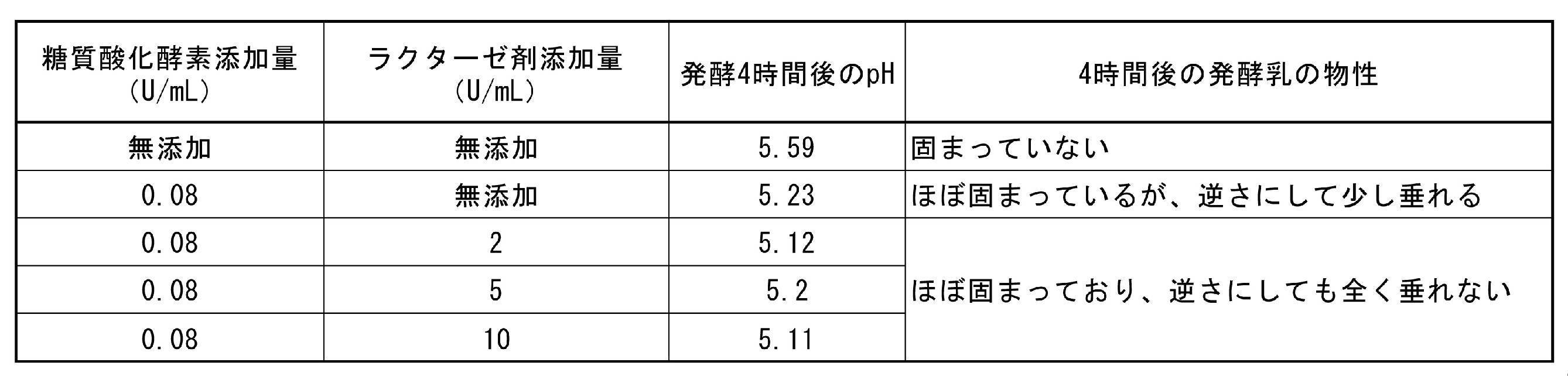
実験例2では、糖質酸化酵素とラクターゼの併用効果を確認した。
ラクターゼとしてLactase Y“Amano”L-K(Kluyveromyces lactis由来ラクターゼ)を用いた。実験例1と同様に殺菌処理済み乳原料ミックスを調製、クリーンベンチ内で15mLチューブに10mLずつ分注し、糖質酸化酵素を0.8U(対乳原料ミックス)(0.08U/mL)、ラクターゼ剤を0.02~0.1v/v%(2~10U/mL)、乳酸菌スターターを2v/v%添加し、5回転倒混和した後、恒温水槽にて37℃で数時間発酵を行った。1時間ごとに0.5mLずつサンプリングし、乳原料ミックスのpHを確認した。
結果を表2に示す。
(3)考察
表2に示す通り、発酵4時間で酵素併用効果が確認された。糖質酸化酵素単独処理では発酵4時間でカードは形成されているが、物性はややゆるく、チューブを逆さにすると少し垂れるのに対して、糖質酸化酵素とラクターゼ併用添加処理ではカードは垂れず、より強固な物性であることが明らかとなった。これらの結果から、糖質酸化酵素とラクターゼの併用効果が認められた。
実験例3では、発酵工程前に、糖質酸化酵素による処理を行った場合の効果について確認した。
実験例1と同様に殺菌処理済み乳原料ミックスを調製、クリーンベンチ内で15mLチューブに10mLずつ分注し、糖質酸化酵素を無添加または0.8~39.1U(対乳原料ミックス)(0.08~3.91U/mL)添加し、5回転倒混和した後、5℃低温庫で一晩(20時間)反応させた。酵素無添加または0.8~39.1U(対乳原料ミックス)(0.08~3.91U/mL)の糖質酸化酵素で処理した乳原料ミックスを100℃で10分間殺菌処理し、室温まで戻した後に乳酸菌スターターを2v/v%添加、5回転倒混和した後、恒温水槽にて37℃で数時間発酵を行った。1時間ごとに0.5mLずつサンプリングし、乳原料ミックスのpHを確認した。
結果を表3に示す。
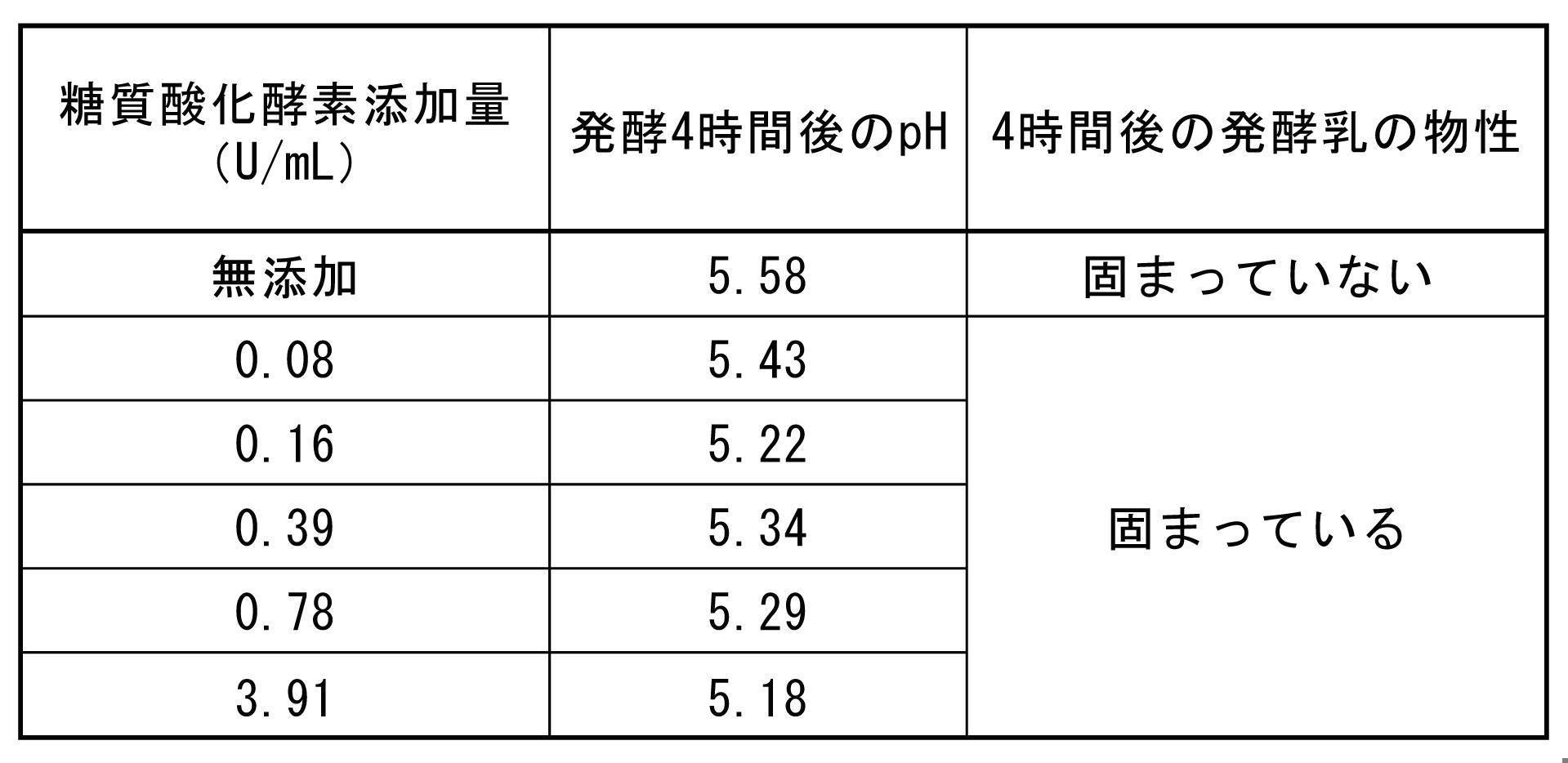
表3に示す通り、発酵工程前に、糖質酸化酵素による処理を行った場合でも、糖質酸化酵素添加量依存的に発酵時間が短縮されることが認められ、発酵前または発酵工程中でも効果を発揮できることが明らかとなった。
実験例4では、植物性原料の発酵時に、糖質酸化酵素を用いた場合の発酵時間への影響を調べた。植物性原料として、豆乳を用いた。
大豆100gに常水400g入れ、24時間浸漬した。浸漬大豆を取り出し、100gをミキサーで粉砕(2分程度)し、ご汁を調製した。得られたご汁に、ご汁の7倍の水を加えながら、ミキサーでさらに細かく破砕した。破砕したものを鍋に入れ、沸騰してから中火~弱火で焦げつかないようにヘラで混ぜながら10分間火入れした。冷却後、こし袋に入れ、ご汁を漉して、豆乳を調製した。調製した豆乳を、50mLチューブに30mL分注し、95℃で5分間殺菌した。
結果を表4に示す。
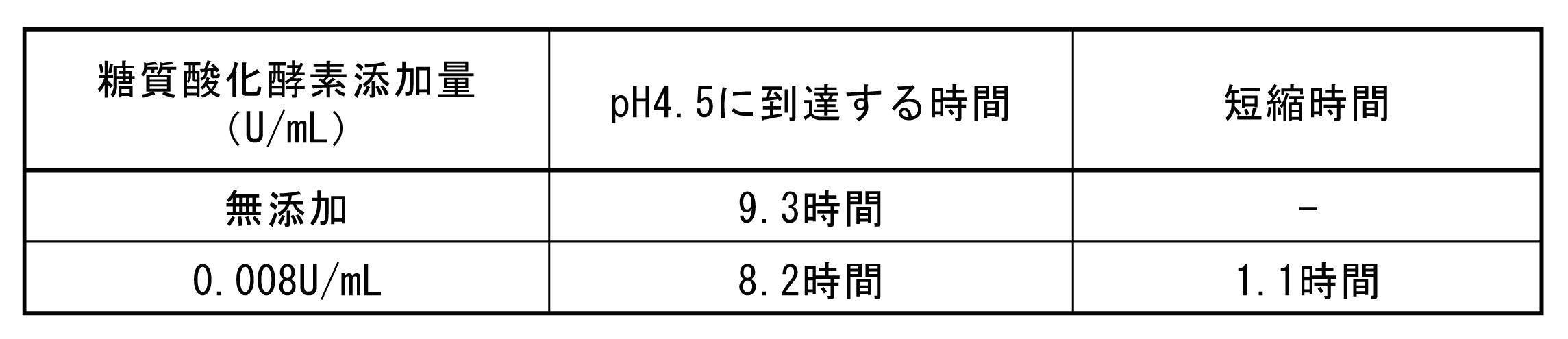
表4に示す通り、酵素無添加区では豆乳原料のカードが形成されるpH4.5に到達するまでに9.3時間要したが、糖質酸化酵素添加区では8.2時間と、1.1時間の発酵時間短縮が認められた。この結果から、植物性原料である豆乳を用いた場合も、本技術を用いれば発酵時間を短縮できることが明らかとなった。
実験例5では、植物性原料としてオーツミルクを用いて発酵を行った際、糖質酸化酵素を用いた場合の発酵時間への影響を調べた。
オーツミルク(Oatly社製「オーツミルク」)を10mLずつ分注し、クリーンベンチにてLactobacillus delbrueckii subsp. delbrueckiiを含む乳酸菌スターターを0.2mLと、前記実験例1で用いた糖質酸化酵素を0.08U(0.008U/mL)添加し、37℃で一晩発酵を行った。発酵中、pHセンサーでpHをモニターした。なお、糖質酸化酵素を添加しなかった例を酵素無添加区とした。
結果を表5に示す。

表5に示す通り、酵素無添加区ではオーツミルク原料のカードが形成されるpH4.5に到達するまでに7.8時間要したが、糖質酸化酵素添加区では5.5時間と、2.3時間の発酵時間短縮が認められた。この結果から、植物性原料であるオーツミルクを用いた場合も、本技術を用いれば発酵時間を短縮できることが明らかとなった。
実験例6では、植物性原料の発酵時に、糖質酸化酵素を用いた場合の曵糸性への影響を調べた。植物性原料として、豆乳を用いた。
滅菌済み300mLビーカーに、豆乳(マルサンアイ株式会社製「オーガニック 成分無調整豆乳」)を280mL分注し、水冷後、クリーンベンチにてLactobacillus delbrueckii subsp. delbrueckiiを含む乳酸菌スターターを5.6mLと、前記実験例1で用いた糖質酸化酵素を1.5U/mL又はセルラーゼを2.0U/mLとなるよう添加し、37℃で一晩発酵を行った。発酵後、豆乳ヨーグルトの曵糸性について、ザーンカップを用いて流出時間を計測した。具体的には、ザーンカップのオリフィスから流出する試料の流れが途切れるまでの時間を流出時間とした。なお、糖質酸化酵素を添加しなかった例を酵素無添加区とした。
結果を表6に示す。
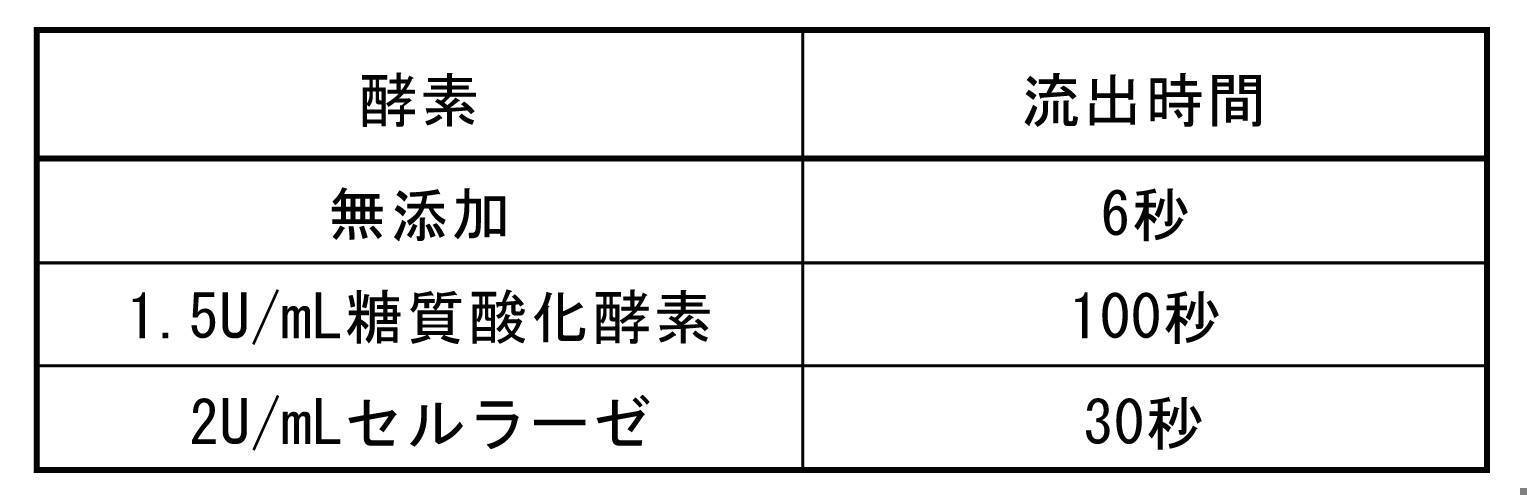
表6に示す通り、酵素無添加区では流出時間が6秒であるところ、糖質酸化酵素添加区では流出時間が100秒と、飛躍的に曵糸性が向上していた。また、セルラーゼ添加区では、酵素無添加区に比べると曵糸性の向上が見られたが、曵糸性の向上効果は、糖質酸化酵素添加区でより顕著であった。この結果から、本技術を用いれば、植物性原料を用いた場合でも、曵糸性を向上させることが明らかとなった。
実験例7では、植物性原料の発酵後の曵糸性について、添加する糖質酸化酵素の添加量の影響を調べた。植物性原料として、豆乳を用いた。
滅菌済み300mLビーカーに、豆乳(マルサンアイ株式会社製「オーガニック 成分無調整豆乳」)を280mL分注し、水冷後、クリーンベンチにてLactobacillus delbrueckii subsp. delbrueckiiを含む乳酸菌スターターを5.6mLと、前記実験例1で用いた糖質酸化酵素を下記の表7に示す量添加し、37℃で一晩発酵を行った。発酵後、豆乳ヨーグルトの曵糸性について、ザーンカップを用いて流出時間を計測した。
結果を表7に示す。

表7に示す通り、糖質酸化酵素の添加量が0.015U/mLおよび0.15U/mLの場合に比べて、1.5U/mL以上添加した場合、飛躍的に流出時間が延びていた。この結果から、曵糸性向上を確実に実現するためには、糖質酸化酵素を1.5U/mL以上添加することが好ましいことが分かった。
Claims (9)
- 原料中の糖質の一部または全部に糖質酸化酵素を作用させる糖質酸化酵素作用工程と、
嫌気発酵を行う嫌気発酵工程と、
を含む、発酵飲食品の製造方法。 - 前記糖質酸化酵素作用工程は、前記嫌気発酵工程の前及び/又は前記嫌気発酵工程と同時に行われる、請求項1に記載の発酵飲食品の製造方法。
- 前記糖質酸化酵素が、グルコース、マルトトリオース、マルトース、ガラクトース、マルトテトラオース、ラクトース、セロビオース、及びマルトデキストリンから選ばれる1以上の糖質に作用する性質を有する、請求項1又は2に記載の発酵飲食品の製造方法。
- 前記糖質酸化酵素が、以下の(1)から(3)のいずれかに示すポリペプチドからなる、請求項1から3のいずれか一項に記載の発酵飲食品の製造方法。
(1)配列番号1に示すアミノ酸配列からなるポリペプチド、
(2)配列番号1に示すアミノ酸配列において、1個又は数個のアミノ酸残基が置換、付加、挿入又は欠失されてなり、且つ配列番号1に示すアミノ酸配列からなるポリペプチドと同等の基質特異性を示すポリペプチド、及び
(3)配列番号1に示すアミノ酸配列において、配列番号1に示すアミノ酸配列に対する配列同一性が90%以上であり、且つ配列番号1に示すアミノ酸配列からなるポリペプチドと同等の基質特異性を示すポリペプチド。 - 前記嫌気発酵工程では乳酸発酵が行われる、請求項1から4のいずれか一項に記載の発酵飲食品の製造方法。
- 前記発酵飲食品が発酵乳である、請求項1から5のいずれか一項に記載の発酵飲食品の製造方法。
- 糖質酸化酵素を含む、嫌気発酵用酸素濃度低減剤。
- 原料中の糖質の一部または全部に糖質酸化酵素を作用させる糖質酸化酵素作用工程を含む、嫌気発酵方法。
- 前記糖質酸化酵素作用工程が、嫌気発酵工程の前及び/又は嫌気発酵工程と同時に行われる、請求項8に記載の嫌気発酵方法。
Priority Applications (4)
| Application Number | Priority Date | Filing Date | Title |
|---|---|---|---|
| US18/278,896 US20240057625A1 (en) | 2021-02-26 | 2022-02-25 | Method for producing fermented food or beverage, and anaerobic fermentation method |
| EP22759816.6A EP4299730A4 (en) | 2021-02-26 | 2022-02-25 | METHOD FOR PRODUCING FERMENTED FOOD OR BEVERAGE, AND ANAEROBIC FERMENTATION METHOD |
| JP2023502547A JPWO2022181782A1 (ja) | 2021-02-26 | 2022-02-25 | |
| CN202280008899.4A CN117119894A (zh) | 2021-02-26 | 2022-02-25 | 发酵饮料食品的制造方法以及厌氧发酵方法 |
Applications Claiming Priority (4)
| Application Number | Priority Date | Filing Date | Title |
|---|---|---|---|
| JP2021031032 | 2021-02-26 | ||
| JP2021-031032 | 2021-02-26 | ||
| JP2021-133303 | 2021-08-18 | ||
| JP2021133303 | 2021-08-18 |
Publications (1)
| Publication Number | Publication Date |
|---|---|
| WO2022181782A1 true WO2022181782A1 (ja) | 2022-09-01 |
Family
ID=83047556
Family Applications (1)
| Application Number | Title | Priority Date | Filing Date |
|---|---|---|---|
| PCT/JP2022/007979 Ceased WO2022181782A1 (ja) | 2021-02-26 | 2022-02-25 | 発酵飲食品の製造方法、及び嫌気発酵方法 |
Country Status (4)
| Country | Link |
|---|---|
| US (1) | US20240057625A1 (ja) |
| EP (1) | EP4299730A4 (ja) |
| JP (1) | JPWO2022181782A1 (ja) |
| WO (1) | WO2022181782A1 (ja) |
Citations (11)
| Publication number | Priority date | Publication date | Assignee | Title |
|---|---|---|---|---|
| US2482724A (en) * | 1944-07-22 | 1949-09-20 | Ben L Sarett | Deoxygenation process |
| JPS61271959A (ja) * | 1985-05-22 | 1986-12-02 | オレオフイナ・ソシエテ・アノニム | 食品類および飲料類中の酸素の除去方法並びにこの目的用に使用される酵素組成物 |
| JPS62285778A (ja) * | 1986-05-23 | 1987-12-11 | シンテックス(ユ−・エス・エイ)インコ−ポレイテッド | 嫌気性微生物の保護方法および組成物 |
| JPH02265443A (ja) * | 1982-11-02 | 1990-10-30 | Cultor Oy | かいばおよび穀物を貯蔵する方法 |
| JP2005176603A (ja) | 2002-12-03 | 2005-07-07 | Meiji Milk Prod Co Ltd | 発酵乳の製造法及び発酵乳 |
| JP2005348703A (ja) | 2004-06-14 | 2005-12-22 | Meiji Milk Prod Co Ltd | 発酵乳の製造法及び発酵乳 |
| JP2007104995A (ja) | 2005-10-14 | 2007-04-26 | Meiji Milk Prod Co Ltd | おいしい乳脂肪分の少ない発酵乳及びその製造方法 |
| WO2012026384A1 (ja) | 2010-08-21 | 2012-03-01 | 株式会社 明治 | 乳糖分の少ない発酵乳及びその製造方法 |
| WO2012121090A1 (ja) * | 2011-03-04 | 2012-09-13 | 株式会社明治 | 物性が改良された発酵乳の製造方法 |
| WO2014042237A1 (ja) | 2012-09-14 | 2014-03-20 | 天野エンザイム株式会社 | 糖質酸化酵素とその製造方法並びに用途 |
| WO2015041194A1 (ja) * | 2013-09-17 | 2015-03-26 | 株式会社明治 | 物性が改良された発酵乳の製造方法 |
Family Cites Families (23)
| Publication number | Priority date | Publication date | Assignee | Title |
|---|---|---|---|---|
| US4806481A (en) * | 1983-06-09 | 1989-02-21 | Taishi Foods Company Ltd. | Streptococcus sojalactis |
| DE60124071T2 (de) * | 2000-01-21 | 2007-05-31 | Chr. Hansen A/S | Porphyrin enthaltende milchsäurebakterien und deren verwendung |
| US20090061046A1 (en) * | 2007-08-02 | 2009-03-05 | Novozymes A/S | Method for producing an acidified milk drink |
| JP2009118755A (ja) * | 2007-11-13 | 2009-06-04 | Sanei Gen Ffi Inc | 溶存酸素増加抑制方法 |
| US9028895B2 (en) * | 2009-07-10 | 2015-05-12 | Chr. Hansen A/S | Method for production of an alcoholic beverage with reduced content of alcohol |
| EP2456865A1 (en) * | 2009-07-24 | 2012-05-30 | Novozymes A/S | Carbohydrate oxidases |
| HUE031303T2 (hu) * | 2010-11-02 | 2017-07-28 | Codexis Inc | Javított gombatörzsek |
| WO2015101377A1 (en) * | 2014-01-02 | 2015-07-09 | Carlsberg Breweries A/S | Flavour stable beverages |
| WO2015185592A2 (en) * | 2014-06-03 | 2015-12-10 | Dsm Ip Assets B.V. | Proline-specific endoprotease and use thereof |
| JP5782173B1 (ja) * | 2014-12-18 | 2015-09-24 | 株式会社 伊藤園 | 乳含有容器詰飲料及びその製造方法 |
| PL3640336T3 (pl) * | 2015-01-28 | 2022-08-01 | Dsm Ip Assets B.V. | Sposób enzymatycznej hydrolizy materiału lignocelulozowego i fermentacji cukrów |
| EP3259361A1 (en) * | 2015-02-16 | 2017-12-27 | DSM IP Assets B.V. | Process for producing itaconic acid under anaerobic conditions |
| ES2916209T3 (es) * | 2015-02-20 | 2022-06-29 | Loibl Verwaltungs Gmbh | Procedimiento y dispositivo para la disminución biotecnológica de azúcares en materias primas de frutos, con el propósito de obtener productos de fruto con disminución en el contenido de azúcar |
| KR20230127261A (ko) * | 2017-08-30 | 2023-08-31 | 더 파인더 그룹, 인크. | 사상균을 함유하는 식용 조성물 및 이의 배양을 위한생물 반응기 시스템 |
| US20240268430A1 (en) * | 2017-08-30 | 2024-08-15 | The Fynder Group, Inc. | Edible foodstuffs and bio reactor design |
| US20210400963A1 (en) * | 2018-09-28 | 2021-12-30 | Locus Ip Company, Llc | Multi-Use Fermentation Products Obtained Through Production of Sophorolipids |
| CN112888789A (zh) * | 2018-10-24 | 2021-06-01 | 绿色地球研究所株式会社 | 经过蓄积nadh的反应途径从起始物质制造目标物质的方法 |
| EP3953488A4 (en) * | 2019-04-10 | 2023-05-24 | Triple W Ltd. | PROCESSING OF ORGANIC WASTE USING A HIGH-SPECIFIC D-LACTATE OXIDASE |
| BR112021020454A2 (pt) * | 2019-04-12 | 2021-12-14 | Locus Ip Co Llc | Tratamentos de pastagem para sequestro de carbono e redução de emissões de gases de efeito estufa produzidas pela pecuária melhorados |
| CN110178897A (zh) * | 2019-05-27 | 2019-08-30 | 安徽工程大学 | 一种低血糖生成指数的谷物发酵乳及其制备方法 |
| CN114391041A (zh) * | 2019-09-10 | 2022-04-22 | 帝斯曼知识产权资产管理有限公司 | 酶组合物 |
| WO2021087434A1 (en) * | 2019-11-01 | 2021-05-06 | Locus Ip Company, Llc | Three-vessel reactor system for producing microbial biosurfactants and other metabolites |
| FR3104907A1 (fr) * | 2019-12-19 | 2021-06-25 | Roquette Freres | Solubles de pois fermentes |
-
2022
- 2022-02-25 JP JP2023502547A patent/JPWO2022181782A1/ja active Pending
- 2022-02-25 EP EP22759816.6A patent/EP4299730A4/en active Pending
- 2022-02-25 US US18/278,896 patent/US20240057625A1/en active Pending
- 2022-02-25 WO PCT/JP2022/007979 patent/WO2022181782A1/ja not_active Ceased
Patent Citations (11)
| Publication number | Priority date | Publication date | Assignee | Title |
|---|---|---|---|---|
| US2482724A (en) * | 1944-07-22 | 1949-09-20 | Ben L Sarett | Deoxygenation process |
| JPH02265443A (ja) * | 1982-11-02 | 1990-10-30 | Cultor Oy | かいばおよび穀物を貯蔵する方法 |
| JPS61271959A (ja) * | 1985-05-22 | 1986-12-02 | オレオフイナ・ソシエテ・アノニム | 食品類および飲料類中の酸素の除去方法並びにこの目的用に使用される酵素組成物 |
| JPS62285778A (ja) * | 1986-05-23 | 1987-12-11 | シンテックス(ユ−・エス・エイ)インコ−ポレイテッド | 嫌気性微生物の保護方法および組成物 |
| JP2005176603A (ja) | 2002-12-03 | 2005-07-07 | Meiji Milk Prod Co Ltd | 発酵乳の製造法及び発酵乳 |
| JP2005348703A (ja) | 2004-06-14 | 2005-12-22 | Meiji Milk Prod Co Ltd | 発酵乳の製造法及び発酵乳 |
| JP2007104995A (ja) | 2005-10-14 | 2007-04-26 | Meiji Milk Prod Co Ltd | おいしい乳脂肪分の少ない発酵乳及びその製造方法 |
| WO2012026384A1 (ja) | 2010-08-21 | 2012-03-01 | 株式会社 明治 | 乳糖分の少ない発酵乳及びその製造方法 |
| WO2012121090A1 (ja) * | 2011-03-04 | 2012-09-13 | 株式会社明治 | 物性が改良された発酵乳の製造方法 |
| WO2014042237A1 (ja) | 2012-09-14 | 2014-03-20 | 天野エンザイム株式会社 | 糖質酸化酵素とその製造方法並びに用途 |
| WO2015041194A1 (ja) * | 2013-09-17 | 2015-03-26 | 株式会社明治 | 物性が改良された発酵乳の製造方法 |
Non-Patent Citations (7)
| Title |
|---|
| ALTSCHUL ET AL., J.MOL.BIOL., vol. 215, 1990, pages 403 - 10 |
| ALTSCHUL, NUCLEIC ACIDS RESEARCH, vol. 25, no. 17, 1997, pages 3389 - 3402 |
| CRUZ A.G., CASTRO W.F., FARIA J.A.F., LOLLO P.C.B., AMAYA-FARFÁN J., FREITAS M.Q., RODRIGUES D., OLIVEIRA C.A.F., GODOY H.T.: "Probiotic yogurts manufactured with increased glucose oxidase levels: Postacidification, proteolytic patterns, survival of probiotic microorganisms, production of organic acid and aroma compounds", JOURNAL OF DAIRY SCIENCE, vol. 95, no. 5, 1 May 2012 (2012-05-01), US , pages 2261 - 2269, XP055949335, ISSN: 0022-0302, DOI: 10.3168/jds.2011-4582 * |
| KARLINALTSCHUL, PROC.NATL.ACAD.SCI. USA, vol. 87, 1990, pages 2264 - 68 |
| KARLINALTSCHUL, PROC.NATL.ACAD.SCI. USA, vol. 90, 1993, pages 5873 - 77 |
| MYERSMILLER, COMPUT APPL BIOSCI., vol. 4, 1988, pages 11 - 17 |
| See also references of EP4299730A4 |
Also Published As
| Publication number | Publication date |
|---|---|
| EP4299730A4 (en) | 2025-09-03 |
| US20240057625A1 (en) | 2024-02-22 |
| EP4299730A1 (en) | 2024-01-03 |
| JPWO2022181782A1 (ja) | 2022-09-01 |
Similar Documents
| Publication | Publication Date | Title |
|---|---|---|
| US12215367B2 (en) | Lactase enzymes with improved properties | |
| CN102449148B (zh) | 来自环状芽孢杆菌的β-半乳糖苷酶 | |
| DK2146582T3 (en) | Process for preparing an acidified milk beverage | |
| US12486305B2 (en) | Lactase enzymes with improved properties | |
| JP2022524312A (ja) | 高温でラクトースを減少させる方法 | |
| EP4407027A2 (en) | Lactase enzymes with improved properties at acidic ph | |
| US12435326B2 (en) | Lactase enzymes with improved properties | |
| CN110678478A (zh) | 在低温下具有改善的活性的乳糖酶 | |
| US11078470B2 (en) | Nucleosidase | |
| US20240057625A1 (en) | Method for producing fermented food or beverage, and anaerobic fermentation method | |
| WO2023095840A1 (ja) | 植物性飲食品の製造方法、及び糖類低減用酵素剤 | |
| Jeon et al. | Glutaminase activity of Lactobacillus reuteri KCTC3594 and expression of the activity in other Lactobacillus spp. by introduction of the glutaminase gene | |
| CN117119894A (zh) | 发酵饮料食品的制造方法以及厌氧发酵方法 | |
| WO2023027182A1 (ja) | 植物性発酵飲食品用改質剤 | |
| RU2788608C2 (ru) | Ферменты лактазы с улучшенными свойствами | |
| Bukhari et al. | Heterodimeric studies of β-galactosidase genes as biocatalyst of lactose from Lactobacillus acidophilus MR-24 | |
| CN114072508B (zh) | 新的乳酸细菌 | |
| US20250324990A1 (en) | Lactase enzymes with improved activity at low temperatures | |
| RU2806709C2 (ru) | Ферменты лактазы с улучшенными свойствами | |
| RU2814542C2 (ru) | Ферменты лактазы с улучшенными свойствами при кислом pH | |
| RU2800427C2 (ru) | Ферменты лактазы с улучшенной активностью при низких температурах |
Legal Events
| Date | Code | Title | Description |
|---|---|---|---|
| 121 | Ep: the epo has been informed by wipo that ep was designated in this application |
Ref document number: 22759816 Country of ref document: EP Kind code of ref document: A1 |
|
| ENP | Entry into the national phase |
Ref document number: 2023502547 Country of ref document: JP Kind code of ref document: A |
|
| WWE | Wipo information: entry into national phase |
Ref document number: 18278896 Country of ref document: US |
|
| WWE | Wipo information: entry into national phase |
Ref document number: 2022759816 Country of ref document: EP |
|
| NENP | Non-entry into the national phase |
Ref country code: DE |
|
| ENP | Entry into the national phase |
Ref document number: 2022759816 Country of ref document: EP Effective date: 20230926 |