WO2022186261A1 - ポリマー及びその製造方法、分離膜、電解質膜、燃料電池、水電解、並びに電解技術 - Google Patents
ポリマー及びその製造方法、分離膜、電解質膜、燃料電池、水電解、並びに電解技術 Download PDFInfo
- Publication number
- WO2022186261A1 WO2022186261A1 PCT/JP2022/008810 JP2022008810W WO2022186261A1 WO 2022186261 A1 WO2022186261 A1 WO 2022186261A1 JP 2022008810 W JP2022008810 W JP 2022008810W WO 2022186261 A1 WO2022186261 A1 WO 2022186261A1
- Authority
- WO
- WIPO (PCT)
- Prior art keywords
- group
- polymer
- represented
- formulas
- independently
- Prior art date
- Legal status (The legal status is an assumption and is not a legal conclusion. Google has not performed a legal analysis and makes no representation as to the accuracy of the status listed.)
- Ceased
Links
Images


Classifications
-
- C—CHEMISTRY; METALLURGY
- C08—ORGANIC MACROMOLECULAR COMPOUNDS; THEIR PREPARATION OR CHEMICAL WORKING-UP; COMPOSITIONS BASED THEREON
- C08G—MACROMOLECULAR COMPOUNDS OBTAINED OTHERWISE THAN BY REACTIONS ONLY INVOLVING UNSATURATED CARBON-TO-CARBON BONDS
- C08G61/00—Macromolecular compounds obtained by reactions forming a carbon-to-carbon link in the main chain of the macromolecule
- C08G61/02—Macromolecular compounds containing only carbon atoms in the main chain of the macromolecule, e.g. polyxylylenes
-
- C—CHEMISTRY; METALLURGY
- C08—ORGANIC MACROMOLECULAR COMPOUNDS; THEIR PREPARATION OR CHEMICAL WORKING-UP; COMPOSITIONS BASED THEREON
- C08G—MACROMOLECULAR COMPOUNDS OBTAINED OTHERWISE THAN BY REACTIONS ONLY INVOLVING UNSATURATED CARBON-TO-CARBON BONDS
- C08G61/00—Macromolecular compounds obtained by reactions forming a carbon-to-carbon link in the main chain of the macromolecule
- C08G61/12—Macromolecular compounds containing atoms other than carbon in the main chain of the macromolecule
-
- B—PERFORMING OPERATIONS; TRANSPORTING
- B01—PHYSICAL OR CHEMICAL PROCESSES OR APPARATUS IN GENERAL
- B01D—SEPARATION
- B01D71/00—Semi-permeable membranes for separation processes or apparatus characterised by the material; Manufacturing processes specially adapted therefor
- B01D71/06—Organic material
- B01D71/72—Macromolecular compounds obtained otherwise than by reactions only involving carbon-to-carbon unsaturated bonds, not provided for in a single one of the groups B01D71/46 - B01D71/70 and B01D71/701 - B01D71/702
-
- C—CHEMISTRY; METALLURGY
- C08—ORGANIC MACROMOLECULAR COMPOUNDS; THEIR PREPARATION OR CHEMICAL WORKING-UP; COMPOSITIONS BASED THEREON
- C08J—WORKING-UP; GENERAL PROCESSES OF COMPOUNDING; AFTER-TREATMENT NOT COVERED BY SUBCLASSES C08B, C08C, C08F, C08G or C08H
- C08J5/00—Manufacture of articles or shaped materials containing macromolecular substances
- C08J5/18—Manufacture of films or sheets
-
- C—CHEMISTRY; METALLURGY
- C08—ORGANIC MACROMOLECULAR COMPOUNDS; THEIR PREPARATION OR CHEMICAL WORKING-UP; COMPOSITIONS BASED THEREON
- C08J—WORKING-UP; GENERAL PROCESSES OF COMPOUNDING; AFTER-TREATMENT NOT COVERED BY SUBCLASSES C08B, C08C, C08F, C08G or C08H
- C08J5/00—Manufacture of articles or shaped materials containing macromolecular substances
- C08J5/20—Manufacture of shaped structures of ion-exchange resins
- C08J5/22—Films, membranes or diaphragms
- C08J5/2206—Films, membranes or diaphragms based on organic and/or inorganic macromolecular compounds
- C08J5/2218—Synthetic macromolecular compounds
- C08J5/2256—Synthetic macromolecular compounds based on macromolecular compounds obtained by reactions other than those involving carbon-to-carbon bonds, e.g. obtained by polycondensation
- C08J5/2262—Synthetic macromolecular compounds based on macromolecular compounds obtained by reactions other than those involving carbon-to-carbon bonds, e.g. obtained by polycondensation containing fluorine
-
- C—CHEMISTRY; METALLURGY
- C08—ORGANIC MACROMOLECULAR COMPOUNDS; THEIR PREPARATION OR CHEMICAL WORKING-UP; COMPOSITIONS BASED THEREON
- C08L—COMPOSITIONS OF MACROMOLECULAR COMPOUNDS
- C08L65/00—Compositions of macromolecular compounds obtained by reactions forming a carbon-to-carbon link in the main chain; Compositions of derivatives of such polymers
-
- C—CHEMISTRY; METALLURGY
- C09—DYES; PAINTS; POLISHES; NATURAL RESINS; ADHESIVES; COMPOSITIONS NOT OTHERWISE PROVIDED FOR; APPLICATIONS OF MATERIALS NOT OTHERWISE PROVIDED FOR
- C09D—COATING COMPOSITIONS, e.g. PAINTS, VARNISHES OR LACQUERS; FILLING PASTES; CHEMICAL PAINT OR INK REMOVERS; INKS; CORRECTING FLUIDS; WOODSTAINS; PASTES OR SOLIDS FOR COLOURING OR PRINTING; USE OF MATERIALS THEREFOR
- C09D165/00—Coating compositions based on macromolecular compounds obtained by reactions forming a carbon-to-carbon link in the main chain; Coating compositions based on derivatives of such polymers
-
- C—CHEMISTRY; METALLURGY
- C25—ELECTROLYTIC OR ELECTROPHORETIC PROCESSES; APPARATUS THEREFOR
- C25B—ELECTROLYTIC OR ELECTROPHORETIC PROCESSES FOR THE PRODUCTION OF COMPOUNDS OR NON-METALS; APPARATUS THEREFOR
- C25B1/00—Electrolytic production of inorganic compounds or non-metals
- C25B1/01—Products
- C25B1/02—Hydrogen or oxygen
- C25B1/04—Hydrogen or oxygen by electrolysis of water
-
- C—CHEMISTRY; METALLURGY
- C25—ELECTROLYTIC OR ELECTROPHORETIC PROCESSES; APPARATUS THEREFOR
- C25B—ELECTROLYTIC OR ELECTROPHORETIC PROCESSES FOR THE PRODUCTION OF COMPOUNDS OR NON-METALS; APPARATUS THEREFOR
- C25B13/00—Diaphragms; Spacing elements
- C25B13/04—Diaphragms; Spacing elements characterised by the material
- C25B13/08—Diaphragms; Spacing elements characterised by the material based on organic materials
-
- H—ELECTRICITY
- H01—ELECTRIC ELEMENTS
- H01M—PROCESSES OR MEANS, e.g. BATTERIES, FOR THE DIRECT CONVERSION OF CHEMICAL ENERGY INTO ELECTRICAL ENERGY
- H01M8/00—Fuel cells; Manufacture thereof
- H01M8/10—Fuel cells with solid electrolytes
- H01M8/1016—Fuel cells with solid electrolytes characterised by the electrolyte material
- H01M8/1018—Polymeric electrolyte materials
- H01M8/102—Polymeric electrolyte materials characterised by the chemical structure of the main chain of the ion-conducting polymer
- H01M8/1032—Polymeric electrolyte materials characterised by the chemical structure of the main chain of the ion-conducting polymer having sulfur, e.g. sulfonated-polyethersulfones [S-PES]
-
- H—ELECTRICITY
- H01—ELECTRIC ELEMENTS
- H01M—PROCESSES OR MEANS, e.g. BATTERIES, FOR THE DIRECT CONVERSION OF CHEMICAL ENERGY INTO ELECTRICAL ENERGY
- H01M8/00—Fuel cells; Manufacture thereof
- H01M8/10—Fuel cells with solid electrolytes
- H01M8/1016—Fuel cells with solid electrolytes characterised by the electrolyte material
- H01M8/1018—Polymeric electrolyte materials
- H01M8/1039—Polymeric electrolyte materials halogenated, e.g. sulfonated polyvinylidene fluorides
-
- C—CHEMISTRY; METALLURGY
- C08—ORGANIC MACROMOLECULAR COMPOUNDS; THEIR PREPARATION OR CHEMICAL WORKING-UP; COMPOSITIONS BASED THEREON
- C08G—MACROMOLECULAR COMPOUNDS OBTAINED OTHERWISE THAN BY REACTIONS ONLY INVOLVING UNSATURATED CARBON-TO-CARBON BONDS
- C08G2261/00—Macromolecular compounds obtained by reactions forming a carbon-to-carbon link in the main chain of the macromolecule
- C08G2261/10—Definition of the polymer structure
- C08G2261/12—Copolymers
- C08G2261/122—Copolymers statistical
-
- C—CHEMISTRY; METALLURGY
- C08—ORGANIC MACROMOLECULAR COMPOUNDS; THEIR PREPARATION OR CHEMICAL WORKING-UP; COMPOSITIONS BASED THEREON
- C08G—MACROMOLECULAR COMPOUNDS OBTAINED OTHERWISE THAN BY REACTIONS ONLY INVOLVING UNSATURATED CARBON-TO-CARBON BONDS
- C08G2261/00—Macromolecular compounds obtained by reactions forming a carbon-to-carbon link in the main chain of the macromolecule
- C08G2261/10—Definition of the polymer structure
- C08G2261/12—Copolymers
- C08G2261/124—Copolymers alternating
-
- C—CHEMISTRY; METALLURGY
- C08—ORGANIC MACROMOLECULAR COMPOUNDS; THEIR PREPARATION OR CHEMICAL WORKING-UP; COMPOSITIONS BASED THEREON
- C08G—MACROMOLECULAR COMPOUNDS OBTAINED OTHERWISE THAN BY REACTIONS ONLY INVOLVING UNSATURATED CARBON-TO-CARBON BONDS
- C08G2261/00—Macromolecular compounds obtained by reactions forming a carbon-to-carbon link in the main chain of the macromolecule
- C08G2261/10—Definition of the polymer structure
- C08G2261/14—Side-groups
- C08G2261/141—Side-chains having aliphatic units
- C08G2261/1412—Saturated aliphatic units
-
- C—CHEMISTRY; METALLURGY
- C08—ORGANIC MACROMOLECULAR COMPOUNDS; THEIR PREPARATION OR CHEMICAL WORKING-UP; COMPOSITIONS BASED THEREON
- C08G—MACROMOLECULAR COMPOUNDS OBTAINED OTHERWISE THAN BY REACTIONS ONLY INVOLVING UNSATURATED CARBON-TO-CARBON BONDS
- C08G2261/00—Macromolecular compounds obtained by reactions forming a carbon-to-carbon link in the main chain of the macromolecule
- C08G2261/10—Definition of the polymer structure
- C08G2261/14—Side-groups
- C08G2261/143—Side-chains containing nitrogen
-
- C—CHEMISTRY; METALLURGY
- C08—ORGANIC MACROMOLECULAR COMPOUNDS; THEIR PREPARATION OR CHEMICAL WORKING-UP; COMPOSITIONS BASED THEREON
- C08G—MACROMOLECULAR COMPOUNDS OBTAINED OTHERWISE THAN BY REACTIONS ONLY INVOLVING UNSATURATED CARBON-TO-CARBON BONDS
- C08G2261/00—Macromolecular compounds obtained by reactions forming a carbon-to-carbon link in the main chain of the macromolecule
- C08G2261/10—Definition of the polymer structure
- C08G2261/14—Side-groups
- C08G2261/145—Side-chains containing sulfur
- C08G2261/1452—Side-chains containing sulfur containing sulfonyl or sulfonate-groups
-
- C—CHEMISTRY; METALLURGY
- C08—ORGANIC MACROMOLECULAR COMPOUNDS; THEIR PREPARATION OR CHEMICAL WORKING-UP; COMPOSITIONS BASED THEREON
- C08G—MACROMOLECULAR COMPOUNDS OBTAINED OTHERWISE THAN BY REACTIONS ONLY INVOLVING UNSATURATED CARBON-TO-CARBON BONDS
- C08G2261/00—Macromolecular compounds obtained by reactions forming a carbon-to-carbon link in the main chain of the macromolecule
- C08G2261/10—Definition of the polymer structure
- C08G2261/14—Side-groups
- C08G2261/146—Side-chains containing halogens
-
- C—CHEMISTRY; METALLURGY
- C08—ORGANIC MACROMOLECULAR COMPOUNDS; THEIR PREPARATION OR CHEMICAL WORKING-UP; COMPOSITIONS BASED THEREON
- C08G—MACROMOLECULAR COMPOUNDS OBTAINED OTHERWISE THAN BY REACTIONS ONLY INVOLVING UNSATURATED CARBON-TO-CARBON BONDS
- C08G2261/00—Macromolecular compounds obtained by reactions forming a carbon-to-carbon link in the main chain of the macromolecule
- C08G2261/10—Definition of the polymer structure
- C08G2261/18—Definition of the polymer structure conjugated
-
- C—CHEMISTRY; METALLURGY
- C08—ORGANIC MACROMOLECULAR COMPOUNDS; THEIR PREPARATION OR CHEMICAL WORKING-UP; COMPOSITIONS BASED THEREON
- C08G—MACROMOLECULAR COMPOUNDS OBTAINED OTHERWISE THAN BY REACTIONS ONLY INVOLVING UNSATURATED CARBON-TO-CARBON BONDS
- C08G2261/00—Macromolecular compounds obtained by reactions forming a carbon-to-carbon link in the main chain of the macromolecule
- C08G2261/10—Definition of the polymer structure
- C08G2261/22—Molecular weight
- C08G2261/228—Polymers, i.e. more than 10 repeat units
-
- C—CHEMISTRY; METALLURGY
- C08—ORGANIC MACROMOLECULAR COMPOUNDS; THEIR PREPARATION OR CHEMICAL WORKING-UP; COMPOSITIONS BASED THEREON
- C08G—MACROMOLECULAR COMPOUNDS OBTAINED OTHERWISE THAN BY REACTIONS ONLY INVOLVING UNSATURATED CARBON-TO-CARBON BONDS
- C08G2261/00—Macromolecular compounds obtained by reactions forming a carbon-to-carbon link in the main chain of the macromolecule
- C08G2261/30—Monomer units or repeat units incorporating structural elements in the main chain
- C08G2261/31—Monomer units or repeat units incorporating structural elements in the main chain incorporating aromatic structural elements in the main chain
- C08G2261/312—Non-condensed aromatic systems, e.g. benzene
-
- C—CHEMISTRY; METALLURGY
- C08—ORGANIC MACROMOLECULAR COMPOUNDS; THEIR PREPARATION OR CHEMICAL WORKING-UP; COMPOSITIONS BASED THEREON
- C08G—MACROMOLECULAR COMPOUNDS OBTAINED OTHERWISE THAN BY REACTIONS ONLY INVOLVING UNSATURATED CARBON-TO-CARBON BONDS
- C08G2261/00—Macromolecular compounds obtained by reactions forming a carbon-to-carbon link in the main chain of the macromolecule
- C08G2261/30—Monomer units or repeat units incorporating structural elements in the main chain
- C08G2261/31—Monomer units or repeat units incorporating structural elements in the main chain incorporating aromatic structural elements in the main chain
- C08G2261/314—Condensed aromatic systems, e.g. perylene, anthracene or pyrene
- C08G2261/3142—Condensed aromatic systems, e.g. perylene, anthracene or pyrene fluorene-based, e.g. fluorene, indenofluorene, or spirobifluorene
-
- C—CHEMISTRY; METALLURGY
- C08—ORGANIC MACROMOLECULAR COMPOUNDS; THEIR PREPARATION OR CHEMICAL WORKING-UP; COMPOSITIONS BASED THEREON
- C08G—MACROMOLECULAR COMPOUNDS OBTAINED OTHERWISE THAN BY REACTIONS ONLY INVOLVING UNSATURATED CARBON-TO-CARBON BONDS
- C08G2261/00—Macromolecular compounds obtained by reactions forming a carbon-to-carbon link in the main chain of the macromolecule
- C08G2261/50—Physical properties
- C08G2261/51—Charge transport
- C08G2261/516—Charge transport ion-conductive
-
- C—CHEMISTRY; METALLURGY
- C08—ORGANIC MACROMOLECULAR COMPOUNDS; THEIR PREPARATION OR CHEMICAL WORKING-UP; COMPOSITIONS BASED THEREON
- C08G—MACROMOLECULAR COMPOUNDS OBTAINED OTHERWISE THAN BY REACTIONS ONLY INVOLVING UNSATURATED CARBON-TO-CARBON BONDS
- C08G2261/00—Macromolecular compounds obtained by reactions forming a carbon-to-carbon link in the main chain of the macromolecule
- C08G2261/90—Applications
-
- C—CHEMISTRY; METALLURGY
- C08—ORGANIC MACROMOLECULAR COMPOUNDS; THEIR PREPARATION OR CHEMICAL WORKING-UP; COMPOSITIONS BASED THEREON
- C08J—WORKING-UP; GENERAL PROCESSES OF COMPOUNDING; AFTER-TREATMENT NOT COVERED BY SUBCLASSES C08B, C08C, C08F, C08G or C08H
- C08J2365/00—Characterised by the use of macromolecular compounds obtained by reactions forming a carbon-to-carbon link in the main chain; Derivatives of such polymers
-
- H—ELECTRICITY
- H01—ELECTRIC ELEMENTS
- H01M—PROCESSES OR MEANS, e.g. BATTERIES, FOR THE DIRECT CONVERSION OF CHEMICAL ENERGY INTO ELECTRICAL ENERGY
- H01M8/00—Fuel cells; Manufacture thereof
- H01M8/10—Fuel cells with solid electrolytes
- H01M2008/1095—Fuel cells with polymeric electrolytes
-
- Y—GENERAL TAGGING OF NEW TECHNOLOGICAL DEVELOPMENTS; GENERAL TAGGING OF CROSS-SECTIONAL TECHNOLOGIES SPANNING OVER SEVERAL SECTIONS OF THE IPC; TECHNICAL SUBJECTS COVERED BY FORMER USPC CROSS-REFERENCE ART COLLECTIONS [XRACs] AND DIGESTS
- Y02—TECHNOLOGIES OR APPLICATIONS FOR MITIGATION OR ADAPTATION AGAINST CLIMATE CHANGE
- Y02E—REDUCTION OF GREENHOUSE GAS [GHG] EMISSIONS, RELATED TO ENERGY GENERATION, TRANSMISSION OR DISTRIBUTION
- Y02E10/00—Energy generation through renewable energy sources
- Y02E10/50—Photovoltaic [PV] energy
- Y02E10/549—Organic PV cells
-
- Y—GENERAL TAGGING OF NEW TECHNOLOGICAL DEVELOPMENTS; GENERAL TAGGING OF CROSS-SECTIONAL TECHNOLOGIES SPANNING OVER SEVERAL SECTIONS OF THE IPC; TECHNICAL SUBJECTS COVERED BY FORMER USPC CROSS-REFERENCE ART COLLECTIONS [XRACs] AND DIGESTS
- Y02—TECHNOLOGIES OR APPLICATIONS FOR MITIGATION OR ADAPTATION AGAINST CLIMATE CHANGE
- Y02E—REDUCTION OF GREENHOUSE GAS [GHG] EMISSIONS, RELATED TO ENERGY GENERATION, TRANSMISSION OR DISTRIBUTION
- Y02E60/00—Enabling technologies; Technologies with a potential or indirect contribution to GHG emissions mitigation
- Y02E60/30—Hydrogen technology
- Y02E60/50—Fuel cells
Definitions
- the present invention relates to polymers and their production methods, separation membranes, electrolyte membranes, fuel cells, water electrolysis, and electrolysis technology.
- Electrolyte membranes and electrolyte ionomers are used in various fuel cells such as polymer electrolyte fuel cells and solid alkaline fuel cells, and in various electrolysis technologies such as water electrolysis.
- the electrolyte membrane is required to have excellent ionic conductivity as well as chemical and mechanical durability to withstand long-term use.
- electrolyte ionomers are required to have high fuel gas permeability as well as high chemical durability.
- Patent Document 1 a specific hydrophilic portion and a specific hydrophobic portion are used as a proton conductive material for an electrolyte membrane having high swelling resistance and high proton conductivity in which ion exchange groups are densely accumulated. and a repeating unit containing a specific cyclic compound in at least one of the hydrophilic portion and the hydrophobic portion.
- the proton conductive material has a structure in which a hydrophilic portion and a hydrophobic portion are linked via an ether bond.
- an anion-conducting polymer for an electrolyte membrane having excellent chemical durability and excellent solubility in a solvent is a divalent polymer having an ionic functional group. It discloses a polymer having a structure in which an aromatic group and a spirobifluorene skeleton are alternately repeated.
- the proton-conducting material described in Patent Document 1 may deteriorate due to the cleavage of the ether bond in the main chain in an alkaline environment.
- the anion-conducting polymer described in Patent Document 2 is excellent in chemical durability, it requires multi-stage synthesis steps for production, and is a material for electrolyte membranes with excellent productivity. development was requested.
- many of the polymers for electrolyte membranes have relatively small molecular weights (for example, the weight average molecular weight is less than 10,000), and the film-forming properties and the mechanical strength of the produced membranes are sometimes inferior.
- the present invention provides a polymer excellent in mechanical strength, mechanical flexibility and gas permeability, a simple method for producing the polymer, a separation membrane excellent in chemical durability and mechanical strength using the polymer, an electrolyte membrane,
- An object of the present invention is to provide an electrolyte ionomer, a fuel cell using the electrolyte membrane or the electrolyte ionomer, water electrolysis, and electrolysis technology.
- the polymer according to the present invention has a repeating unit represented by the following formula (1) and a repeating unit represented by the following formula (2).
- Ar 1 is a group containing an aromatic ring
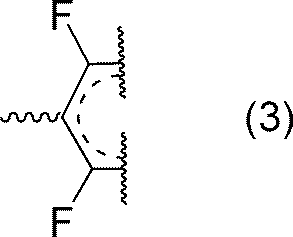
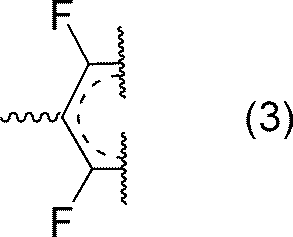
- Ar 2 is each independently a group having a structure represented by the following formula (3) at both ends
- L 1 is an organic group in which the angle formed by the two bonds of L 1 is 45 to 90 degrees
- the multiple Ar 1 , Ar 2 and L 1 may be the same or different.
- L 1 is a group represented by any one of formulas (L1) to (L3) below.
- R 1 to R 10 are each independently a hydrogen atom, an optionally substituted alkyl group having 1 to 6 carbon atoms, an optionally substituted phenyl group, or R 1 and R 2 , R 2 and R 3 , R 3 and R 4 , R 4 and R 5 , R 6 and R 7 , R 7 and R 8 , R 8 and R 9 , R 9 and R 10 are linked may form a ring structure, R 11 to R 22 are each independently a hydrogen atom, an optionally substituted alkyl group having 1 to 6 carbon atoms, an optionally substituted phenyl group, or R11 and R12 , R12 and R13 , R13 and R14 , R14 and R15 , R15 and R16 , R17 and R18 , R18 and R19 , R19 and R20 , R20 and R 21 , R 21 and R 22 may be linked to form a ring structure, R 31 to R 40 are each independently a hydrogen atom,
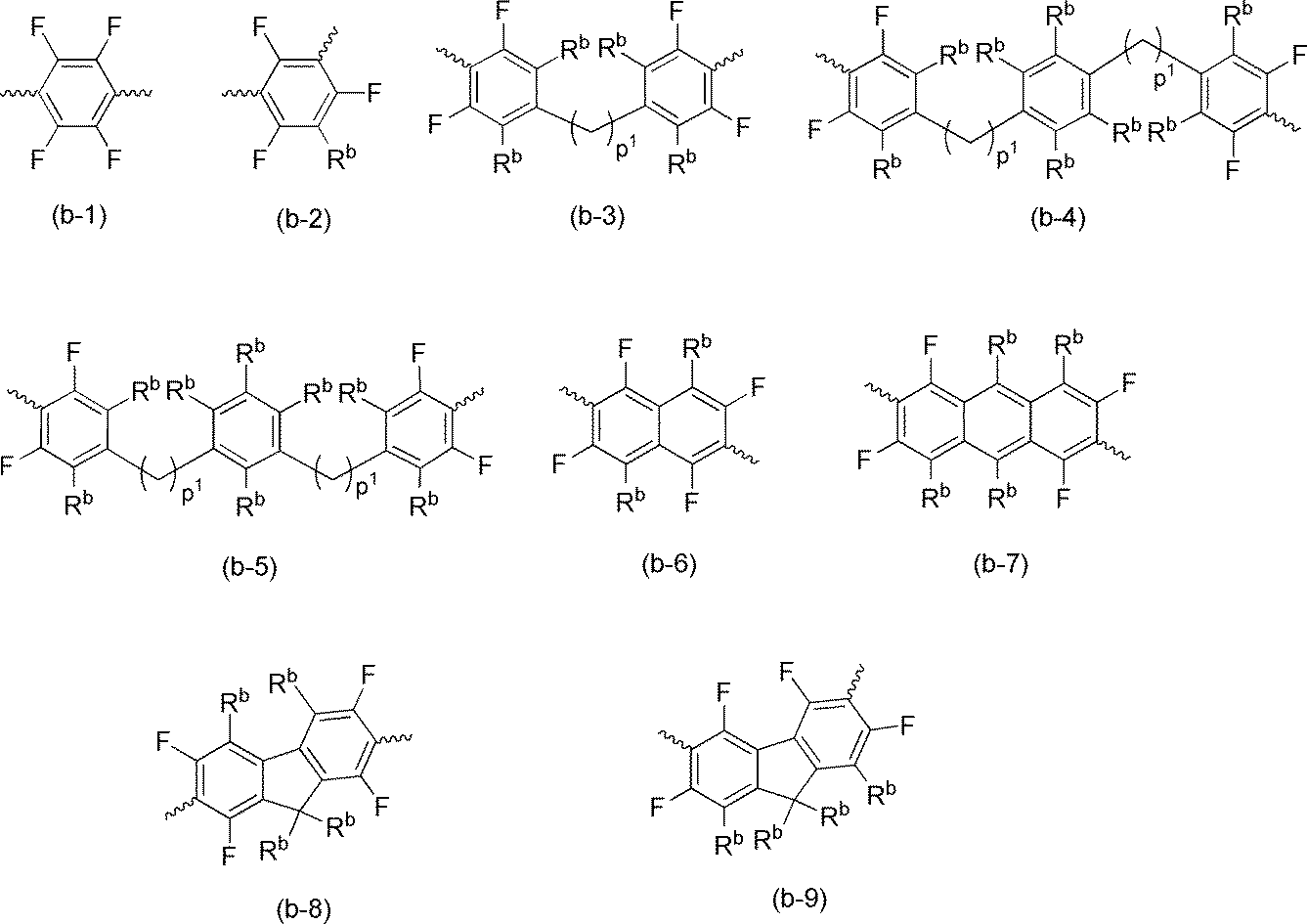
- Ar 2 is a group represented by any one of the following formulas (b-1) to (b-9).
- Each R b is independently a hydrogen atom, a halogen atom or an organic group
- each p 1 is independently an integer of 0 or more and 12 or less, and when there are multiple R b or p 1 , the multiple R b or p1 may each be the same or different.
- Ar 2 is a group represented by any one of formulas (b-10) to (b-14) below.
- Ar 1 is a group represented by any one of formulas (a-1) to (a-9) below.
- Each R a is independently a hydrogen atom or an optionally substituted hydrocarbon group, and a plurality of R a may be the same or different.
- the molar ratio of the repeating unit represented by formula (1) to the repeating unit represented by formula (2) is 95:5 to 50:50.
- said Ar 1 has an ion exchange group.
- the ion exchange group is a sulfonic acid group, a phosphoric acid group, a carboxylic acid group, a quaternary ammonium group, or an imidazolium group.
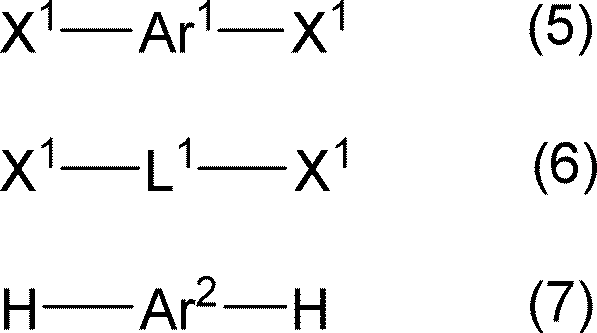
- a method for producing a polymer according to the present invention comprises a step of reacting a compound represented by the following formula (5), a compound represented by the following formula (6), and a compound represented by the following formula (7). include.
- Ar 1 is a group containing an aromatic ring
- Ar 2 is a group having a structure represented by the following formula (3) at both ends
- L 1 is an organic group in which the angle formed by the two bonds of L 1 is 45 to 90 degrees
- Each X 1 is independently Br or I, and multiple X 1s may be the same or different.
- the present invention provides a separation membrane and an electrolyte membrane comprising the polymer according to the present invention.
- the present invention also provides a fuel cell, water electrolysis, and an electrolysis technique comprising the electrolyte membrane according to the present invention.
- polymer includes “copolymer” unless otherwise specified.
- ion exchange group refers to a dissociative functional group capable of ion exchange.
- - indicating a numerical range means that the numerical values described before and after it are included as a lower limit and an upper limit.
- the "repeating unit represented by formula (1)” may be referred to as “structural unit (1)”. Repeating units represented by other formulas also conform to this.
- polymer according to the present invention (hereinafter also referred to as the present polymer) has a repeating unit represented by the following formula (1) and a repeating unit represented by the following formula (2).
- Ar 1 is a group containing an aromatic ring
- Ar 2 is each independently a group having a structure represented by the following formula (3) at both ends
- L 1 is an organic group in which the angle formed by the two bonds of L 1 is 45 to 90 degrees
- the multiple Ar 1 , Ar 2 and L 1 may be the same or different.
- the present polymer is a polymer having one or more of the structural units (1) and one or more of the structural units (2), and has a linear structure in which Ar 1 or L 1 and Ar 2 are alternately arranged.
- This polymer has L1 in the main chain.
- L 1 is an organic group having a twisted structure in which the angle formed by the bonds that bind to two adjacent Ar 2 atoms is 45 to 90 degrees. Since this polymer has L1, the entire main chain skeleton has a three-dimensionally bent structure.
- this polymer is a linear polymer
- the linearity is low, and it is presumed that the entanglement between multiple polymers increases, for example, during film formation, and as a result, the mechanical strength is improved. It is estimated to be.
- the inclusion of L1 in the present polymer improved the elongation against tension and increased the mechanical flexibility.
- the film containing the present polymer is formed with fine pores due to the bending of the present polymer.
- membranes containing this polymer also have excellent gas permeability.
- introduction of an ion-exchange group to Ar 1 can make the present polymer suitable for electrolyte membrane and electrolyte ionomer applications. The details of each configuration of the present polymer will be described below.
- L 1 is an organic group having an angle of 45 to 90 degrees between two adjacent Ar 2 bonds.
- the angle formed by the bonds is 45 to 90 degrees, a film having excellent mechanical strength and gas permeability can be obtained.
- the angle formed is preferably 60 to 90 degrees, more preferably 75 to 90 degrees.
- the angles formed in the present invention are assumed to be right angles or acute angles. The angle can be measured by X-ray structural analysis of the polymer. Alternatively, it may be obtained from the X-ray structural analysis of the starting compound (6).
- L 1 is preferably a group represented by any one of the following formulas (L1) to (L3) from the viewpoint of excellent chemical durability, mechanical strength and gas permeability.
- the groups (L1) and (L3) are twisted around the spiro atom.
- the group (L2) is twisted around the single bond connecting the two naphthyl groups.
- R 1 to R 10 are each independently a hydrogen atom, an optionally substituted alkyl group having 1 to 6 carbon atoms, an optionally substituted phenyl group, or R 1 and R 2 , R 2 and R 3 , R 3 and R 4 , R 4 and R 5 , R 6 and R 7 , R 7 and R 8 , R 8 and R 9 , R 9 and R 10 are linked may form a ring structure, R 11 to R 22 are each independently a hydrogen atom, an optionally substituted alkyl group having 1 to 6 carbon atoms, an optionally substituted phenyl group, or R11 and R12 , R12 and R13 , R13 and R14 , R14 and R15 , R15 and R16 , R17 and R18 , R18 and R19 , R19 and R20 , R20 and R 21 , R 21 and R 22 may be linked to form a ring structure, R 31 to R 40 are each independently a hydrogen atom,
- the alkyl groups for R 1 to R 10 , R 11 to R 22 and R 31 to R 40 include linear or branched alkyl groups, specific examples being methyl, ethyl, propyl and tert. -Butyl group and the like.
- a halogen atom, a phenyl group, etc. are mentioned as a substituent which the said alkyl group may have.
- Examples of the substituent that the phenyl group in R 1 to R 10 may have include an alkyl group having 1 to 6 carbon atoms.
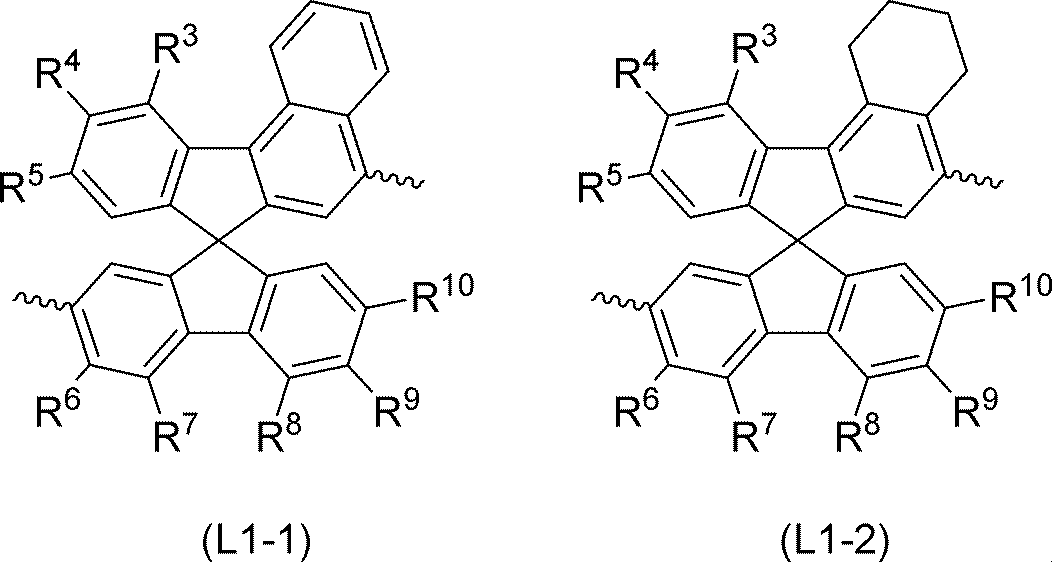
- the expression that R 1 and R 2 are linked to form a ring structure means that R 1 and R 2 form a ring via two carbon atoms in formula (L1). Specifically, the following formula (L1-1), formula (L1-2), and the like can be mentioned. The same applies to other combinations.
- Ar 1 is a group containing an aromatic ring. Since Ar 1 contains an aromatic ring, the polymer has excellent mechanical strength and chemical durability.
- the aromatic ring in Ar 1 preferably forms part of the main chain of the polymer.
- the aromatic ring may be a condensed ring such as a naphthalene ring, an anthracene ring, etc., in addition to a benzene ring, and a heterocyclic ring containing an oxygen atom (O), a nitrogen atom (N), a sulfur atom (S) ( For example, thiophene, etc.), or a structure in which these rings are linked via a single bond or a linking group. Structures in which multiple rings are linked by single bonds include, for example, biphenyl and terphenyl. Examples of the linking group include linear or branched alkylene groups, cyclic alkylene groups, and groups composed of combinations thereof.
- the aromatic ring in Ar 1 may have various substituents.
- Various functionalities can be imparted to the present polymer by having a substituent.
- the substituent include an optionally substituted alkyl group having 1 to 6 carbon atoms, an optionally substituted phenyl group, a halogen atom, and an ion exchange group.
- Specific examples of the hydrocarbon group include methyl group, ethyl group, propyl group, tert-butyl group and the like.
- a halogen atom, a phenyl group, etc. are mentioned as a substituent which the said alkyl group may have.
- Ar 1 When the present polymer is used as an electrolyte membrane or an electrolyte ionomer, Ar 1 preferably has an ion exchange group.
- the ion exchange group is preferably an acidic group. A group (--COOH group) is more preferred, and a sulfonic acid group is even more preferred.
- H in the acidic group may be substituted with an alkali metal ion, an alkaline earth metal ion, or the like.
- the ion exchange group is preferably a quaternary ammonium group or an imidazolium group, more preferably a quaternary ammonium group.
- the quaternary ammonium group is preferably a quaternary alkylammonium group from the viewpoint of alkali durability.
- the quaternary alkylammonium group includes those in which alkyl groups bonded to nitrogen atoms are bonded to each other to form a ring structure, and may be, for example, an azaadamantyl group, a quinuclidinium group, or the like.
- Preferred specific examples of the quaternary ammonium group include groups represented by the following formulas (e-1) to (e-3).
- preferred specific examples of the imidazolium group include a group represented by the following formula (f-1), furthermore, a group represented by the following formula (f-2) or a group represented by the following formula (f-3) are more preferred.
- each R e is independently a linear, branched or cyclic alkyl group having 1 to 6 carbon atoms
- each R f is independently a hydrogen atom, a
- a - is a monovalent or divalent or more valent anion, R e or
- the plurality of R e or R f may be the same or different.
- the wavy line in the formula indicates a bond that bonds to the aromatic ring side in Ar1 .
- alkyl group for R e examples include a methyl group, an ethyl group, a propyl group, a butyl group, a pentyl group, a hexyl group and a cyclohexyl group.
- alkyl group for R f examples include a methyl group, an ethyl group, a propyl group, and a butyl group.
- aromatic group for R f include a phenyl group and the like, and examples of a substituent for the phenyl group include an alkyl group having 1 to 6 carbon atoms.
- the above A ⁇ is preferably an inorganic anion such as chloride ion (Cl ⁇ ), bromide ion (Br ⁇ ), iodide ion (I ⁇ ), hydrogen carbonate ion (HCO 3 ⁇ ), carbonate ion (CO 3 2 ⁇ ), hydroxide ion (OH ⁇ ), and the like.
- the above ion-exchange group may be directly bonded to the aromatic ring side in Ar 1 or may be bonded via an organic group.
- a linear or branched alkylene group is preferable, and a linear alkylene group is particularly preferable.
- the number of carbon atoms in the alkylene group can be appropriately adjusted according to the physical properties required for the polymer. For example, by setting the number of carbon atoms in the alkylene group to 20 or less, preferably 16 or less, more preferably 12 or less, the ion exchange group capacity of the present polymer increases. On the other hand, by setting the number of carbon atoms in the alkylene group to 2 or more, preferably 4 or more, and more preferably 6 or more, the present polymer having excellent solubility and swelling resistance can be obtained.
- Ar 1 is a group represented by any one of the following formulas (a-1) to (a-9) from the viewpoint of excellent mechanical strength, chemical durability, and film-forming properties of the present polymer. is preferred.
- Each R a is independently a hydrogen atom or a hydrocarbon group optionally having a substituent (including an ion-exchange group), and a plurality of R a may be the same or different. . Note that the wavy line indicates a bond that binds to Ar 2 .
- Ar 2 is a group having a structure represented by the following formula (3) at both ends.
- Ar 2 is a divalent group containing an aromatic ring having a fluorine atom at the ⁇ -position of the terminal carbon atom.
- the terminus of Ar 2 refers to the carbon atom bonded to Ar 1 or L 1 .
- the wavy line in the formula indicates a bond that bonds with Ar 1 or L 1 , and the carbon atom in the formula has aromaticity.
- the aromatic ring having the partial structure (3) constitutes part of the main chain of the polymer.
- the aromatic ring may be a condensed ring such as a naphthalene ring, an anthracene ring, etc., in addition to a benzene ring. It may be a heterocyclic ring containing Furthermore, the aromatic ring may have a substituent, and furthermore, a structure in which multiple rings are linked via a single bond or a linking group (hereinafter also referred to as a chain polycyclic hydrocarbon) good too. Structures in which multiple rings are linked by single bonds include, for example, biphenyl and terphenyl.
- substituents on the aromatic ring include halogeno groups and organic groups (eg, linear or branched alkyl groups having 1 to 20 carbon atoms which may be substituted).
- substituents on the aromatic ring include halogeno groups and organic groups (eg, linear or branched alkyl groups having 1 to 20 carbon atoms which may be substituted).
- the linking group include linear or branched alkylene groups, cyclic alkylene groups, and groups composed of combinations thereof.
- Ar 2 may have two partial structures (3) in one ring structure (e.g., benzene ring), for example, as in formula (b-1) described below, or may have two partial structures (3) in the formula (b-1) described below. As in b-2), one CF bond may constitute two partial structures (3).
- each of the two ring structures of the chain polycyclic hydrocarbon has one partial structure (3), and the rings are directly or via the linking group , or one of a plurality of ring structures may have two partial structures (3).
- Ar 2 is a group represented by any one of the following formulas (b-1) to (b-9). is preferably
- Each R b is independently a hydrogen atom, a halogen atom or an organic group
- each p 1 is independently an integer of 0 or more and 12 or less, and when there are multiple R b or p 1 , the multiple R b or p1 may each be the same or different.
- halogen atom for R b examples include a fluorine atom, a chlorine atom, a bromine atom and an iodine atom.
- organic group for R b examples include a linear or branched alkyl group having 1 to 20 carbon atoms which may have a substituent (eg, a halogen atom).
- p 1 when p 1 is 0, a plurality of benzene rings are directly bonded by a single bond, resulting in a biphenyl structure or a terphenyl structure, respectively. .
- Ar 2 is any one of the following formulas (b-10) to (b-14). is more preferably a group represented by
- the order in which the structural unit (1) and the structural unit (2) of the present polymer are linked is not particularly limited. It may be a random copolymer, or it may be an alternating copolymer in which the structural unit (1) and the structural unit (2) are alternately arranged, and the block of the structural unit (1) and the structural unit (2) ), or a partial combination thereof. Random copolymers are preferred from the standpoint of ease of production.
- the ratio of the structural unit (1) and the structural unit (2) is not particularly limited, and may be adjusted as appropriate according to the application of the polymer. From the viewpoint of improving the mechanical strength and tensile strength of the present polymer, the molar ratio of the structural unit (1) and the structural unit (2) is preferably 95:5 to 50:50, preferably 90:10 to 70: 30 is more preferred.
- the weight-average molecular weight of the polymer is not particularly limited, and may be appropriately adjusted according to the application of the polymer. For example, it can be in the range of 10,000 to 1,000,000, preferably 30,000 or more, more preferably 100,000 or more, from the viewpoint of film-forming property and film strength.
- a weight average molecular weight is the numerical value of polystyrene conversion measured by GPC (gel permeation chromatography).
- the method for producing a polymer according to the present invention (hereinafter also referred to as the present production method) is a suitable method for producing the present polymer, A step of reacting a compound represented by the following formula (5), a compound represented by the following formula (6), and a compound represented by the following formula (7) is included.
- Each X 1 is independently Br or I, and multiple X 1s may be the same or different, Ar 1 , Ar 2 and L 1 are the same as those described in the section of the polymer above.
- the reactivity between X 1 of compound (5) and compound (6) and the hydrogen atom of compound (7) is excellent, so that the polymerization reaction can be easily carried out.
- Compound (7) contains an aromatic ring (partial structure (3) above) having a fluoro group (-F) at the ⁇ -position of a hydrogen atom serving as a reaction point in the C—H activation reaction, and thus has excellent reactivity. ing.
- X 1 of compound (5) and compound (6) is reacted with the hydrogen atom of compound (7) by a C—H activation reaction.
- the C—H activation reaction is carried out, for example, by reacting compound (5) and compound (6) with compound (7) in the presence of a Pd complex, ligand, carboxylic acid (RCO 2 H) and a base in a solvent. It can be performed by reacting.
- a Pd complex, ligands , carboxylic acids, bases and solvents can be used in the C — H activation reaction step.
- (oC 6 H 4 -OMe) 3 pivalic acid (PivOH), Cs 2 CO 3 and dryTHF are preferably used, respectively.
- dba means dibenzylideneacetone.
- the reaction time and reaction temperature in the C—H activation reaction step can also be appropriately set, for example, 1 to 72 hours and 80 to 110°C.
- Ar 1 having an ion-exchange group When Ar 1 having an ion-exchange group is used in the present polymer, it is preferable to use one having a functional group convertible to an ion-exchange group as Ar 1 in the compound (5) as a starting material.
- Functional groups that can be converted to on-exchange groups include halogen atoms, sulfonate groups (--SO 3 R 41 groups), phosphate groups (--R 41 2 PO 4 groups), and carboxylate groups (--COOR 41 group), imidazole group, amino group (-NR'R''), and the like.
- each R 41 independently includes an optionally substituted alkyl group and the like, and specific examples include a methyl group, an ethyl group, a propyl group and the like.
- R′ and R′′ each independently include a hydrogen atom, an optionally substituted alkyl group, and the like.
- a step of converting the functional group to an ion-exchange group may be included after the synthesis of the polymer.
- the method for introducing the ion-exchange group can be appropriately selected according to the functional group convertible to the ion-exchange group.
- the functional groups that can be converted to ion-exchange groups are sulfonate groups, phosphate groups, and carboxylate groups
- hydrolysis of these groups converts ion-exchange groups (sulfonic acid groups, phosphoric acid ester groups, acid group and carboxylic acid group).
- Compound (5), compound (6), and compound (7) may be synthesized by known methods, or may be commercially available products. As described above, the production method according to the present invention can easily produce a polymer having excellent mechanical strength and tensile strength in a small number of synthesis steps.
- the separation membrane according to the present invention is characterized by comprising the present polymer.
- Separation membranes obtained by forming films of the present polymer are excellent in mechanical strength, chemical durability and tensile strength, and are also excellent in gas (for example, hydrogen and oxygen) permeability.
- gas for example, hydrogen and oxygen
- Many conventional polymers with a high ratio of aromatic rings have low gas permeability. It is presumed that fine pores are formed in the film containing the present polymer due to the bending of the present polymer. As a result, membranes containing this polymer have excellent gas permeability, especially hydrogen permeability.
- a general film forming method can be applied as a method for producing a separation membrane.
- the present polymer is dissolved in a solvent capable of dissolving it (e.g., dimethyl sulfoxide, alcohol, alcohol aqueous solution, etc.), and a polymer solution is obtained.
- a solvent capable of dissolving it e.g., dimethyl sulfoxide, alcohol, alcohol aqueous solution, etc.
- a separation membrane can be obtained by preparing, forming a coating film using a known coating means, and drying.
- Electrolyte Membrane The electrolyte membrane according to the present invention is characterized by using the present polymer in which Ar 1 has an ion exchange group. Electrolyte membranes using such polymers are excellent in chemical durability, ionic conductivity and membrane mechanical strength, and can be suitably used as electrolyte membranes for fuel cells, water electrolysis, and electrolysis technology. .
- the polymer, which has ion-exchange groups can be easily dissolved in solvents (alcohol, mixed solvents of alcohol and water, etc.) commonly used in the production of membrane electrode assemblies (MEAs) for fuel cells, and has good gas permeability. It can also be used as an electrolyte ionomer in these batteries and electrolytic devices.
- the polymer has a high ionic functional group density (IEC) and exhibits very high ionic conductivity.
- the IEC of the present polymer is preferably 0.5 meq ⁇ g ⁇ 1 or more and 4.0 meq ⁇ g ⁇ 1 or less.
- the ionic conductivity of the present polymer preferably exhibits an ionic conductivity of 100 mS/cm or more at 80° C. saturated humidity.
- the polymer can exhibit high ionic conductivity even at reduced relative humidity. This polymer exhibits a high ionic conductivity of 10 mS/cm or more even under conditions of, for example, 80° C. and 60% relative humidity.
- a polymer with high ionic conductivity has a high water content and often swells remarkably in a water-containing state, but the present polymer has good swelling resistance.
- the present polymer is dissolved in a solvent capable of dissolving (e.g., dimethyl sulfoxide, alcohol, alcohol aqueous solution, etc.) to prepare a polymer solution, a coating film is formed using a known coating means, and dried to obtain an electrolyte.
- a solvent capable of dissolving e.g., dimethyl sulfoxide, alcohol, alcohol aqueous solution, etc.
- a coating film is formed using a known coating means, and dried to obtain an electrolyte.
- Membranes can be manufactured.
- a proton-conducting electrolyte membrane can be obtained by making the ion-exchange groups acidic groups. Further, by using basic groups such as the quaternary ammonium groups as the ion exchange groups, an anion conductive electrolyte membrane can be obtained.
- Fuel Cell A fuel cell according to the present invention is characterized by comprising the above electrolyte membrane or electrolyte ionomer.
- the electrolyte membrane and electrolyte ionomer of the present invention can be suitably used for both solid alkaline fuel cells and polymer electrolyte fuel cells.
- an anion conductive electrolyte membrane is used as the electrolyte membrane.
- the configuration of the solid alkaline fuel cell can be a conventionally known configuration.
- a membrane electrode assembly is formed by arranging a cathode on one side of an electrolyte membrane and an anode on the other side, oxygen is supplied to the cathode, fuel is supplied to the anode, and OH generated at the cathode is Electricity is generated by moving to the anode through the electrolyte membrane and generating water there.
- the fuel can be appropriately selected from conventionally known fuels, and examples thereof include, but are not limited to, hydrogen, methanol, ethanol, ethylene glycol, formate, hydrazine, sodium borohydride, and ammonia.
- hydrogen, methanol, ethanol, ethylene glycol, formate, hydrazine, sodium borohydride, and ammonia As a representative example, the reaction at each electrode when hydrogen, methanol and formate are used as fuel is shown.
- a proton conductive electrolyte membrane is used as the electrolyte membrane.
- the configuration of the polymer electrolyte fuel cell can be a conventionally known configuration.
- a membrane electrode assembly is formed by arranging a cathode on one side of an electrolyte membrane and an anode on the other side, oxygen is supplied to the cathode, fuel is supplied to the anode, and protons generated at the anode are converted into an electrolyte. Electricity is generated by moving through the membrane to the anode where water is generated.
- the fuel can be appropriately selected from known ones, and specific examples thereof include those exemplified for the solid alkaline fuel cell. Reaction at each electrode when hydrogen is used as a representative fuel is shown.
- Cathode O 2 + 4H + + 4e ⁇ ⁇ 2H 2 O
- the electrolyte membrane of the present invention can be suitably used for water electrolysis (apparatus), other electrolysis techniques (electrolysis apparatus), and electrolysis apparatus using these electrolysis methods.
- the electrolytic device can be configured to have, for example, the electrolyte membrane of the present invention, an anode and a cathode in an electrolytic cell, and electrolyze (oxidation-reduction reaction) an object through the electrolyte membrane of the present invention. can obtain the object.
- a proton-conducting or anion-conducting electrolyte membrane is used as the electrolyte membrane.
- an anode is arranged on one side of a proton-conducting electrolyte membrane and a cathode is arranged on the other side, and protons generated at the anode are transferred to the cathode through the electrolyte membrane and combined with electrons at the cathode. Hydrogen can be obtained.
- the reaction formula at each electrode is as follows. Anode: 2H 2 O ⁇ O 2 + 4H + + 4e ⁇ Cathode: 2H + + 2e ⁇ ⁇ H 2
- Another electrolysis technique includes an electrolysis technique in which carbon dioxide is electrolyzed to produce formic acid.
- protons generated at the anode can be transferred to the cathode through the electrolyte membrane and reacted with carbon dioxide supplied to the cathode to obtain formic acid.
- the reaction formula at each electrode is as follows. Anode: 2H 2 O ⁇ O 2 + 4H + + 4e ⁇ Cathode: CO 2 + 2H + + 2e ⁇ ⁇ HCOOH
- Examples 1 to 6 correspond to (i) in Scheme 1 (FIG. 1)
- Examples 7 to 12 include (ii) in Scheme 1.
- Examples 13-14 correspond to (i) of Scheme 2 (FIG. 2)
- Examples 15-16 include (ii) of Scheme 2.
- Example 1 Synthesis of PFTNp-C 6 -SBF(0.1)] 2,7-dibromo-9,9'-bis(6-chlorohexyl)fluorene 1.01g (1.8mmol), 2,2'-dibromo-9,9'-spirobifluorene 94.8mg ( 0.2 mmol), Pivalic acid 204 mg (2.00 mmol), Cs 2 CO 3 1.96 g (6.00 mmol), P(o-C 6 H 4 -OMe) 3 14 mg (40 ⁇ mol), Pd 2 (dba) 3 - CHCl 3 10.5 mg (10 ⁇ mol) was added. 2 mL of dehydrated THF was added and N 2 substitution was performed for 10 minutes.
- Example 2 Synthesis of PFTNp-C 6 -SBF(0.2)]
- the ratio of the monomers was 2,7-dibromo-9,9'-bis (6-chlorohexyl)fluorene 898 mg (1.6 mmol), 2,2'-dibromo-9,9'-spirobifluorene 190 mg ( 906 mg of a white solid (PFTNp-C 6 -SBF (0.2) below) was obtained in the same manner as in Example 1, except that the amount was changed to 0.4 mmol).
- Example 3 Synthesis of PFTNp-C 8 -SBF (0.1)]
- 2,7-dibromo-9,9'-bis(8-chlorooctyl)fluorene 1111 mg (1.8 mmol) and 94.8 mg (0.2 mmol) of 2,2'-dibromo-9,9'-spirobifluorene were used in the same manner as in Example 1 to obtain a white solid (PFTNp-C 8 -SBF below ( 0.1)) 1030 mg were obtained.
- Example 4 Synthesis of PFTNp-C 8 -SBF(0.2)]
- the ratio of the monomers was 2,7-dibromo-9,9'-bis (8-chlorooctyl)fluorene 987 mg (1.6 mmol) and 2,2'-dibromo-9,9'-spirobifluorene 190 mg (0.6 mmol).
- 998 mg of a white solid (PFTNp-C 8 -SBF (0.2) below) was obtained in the same manner as in Example 3, except that the content was changed to 4 mmol).
- Example 5 Synthesis of PFTNp-C 10 -SBF (0.1)]
- 1211 mg (1.8 mmol) of 2,7-dibromo-9,9'-bis(10-chlorodecyl)fluorene was used instead of 2,7-dibromo-9,9'-bis(6-chlorohexyl)fluorene.
- 2,2'-dibromo-9,9'-spirobifluorene 94.8 mg (0.2 mmol) was used to obtain a white solid (PFTNp-C 10 -SBF (0 .1)) 1130 mg were obtained.
- Example 6 Synthesis of PFTNp-C 10 -SBF(0.2)]
- the ratio of the monomers was 2,7-dibromo-9,9'-bis (10-chlorodecyl)fluorene 1077 mg (1.6 mmol), 2,2'-dibromo-9,9'-spirobifluorene 190 mg ( 1089 mg of a white solid (PFTNp-C 10 -SBF (0.2) below) was obtained in the same manner as in Example 5, except that the amount was changed to 0.4 mmol).
- Example 7 Production of membrane containing PFTN-C 6 -SBF (0.1)] 30 ml of chlorobenzene was added to 600 mg of PFTNp-C 6 -SBF (0.1) of Example 1, and insoluble components were removed by filtration. The resulting filtrate was transferred to a 50 mL sample tube, 2 mL of trimethylamine methanol solution (3.2 mol/l) was added, and the mixture was stirred at 105° C. in a closed system for 10 hours. After cooling to room temperature, 20 mL of dimethyl sulfoxide and 1 mL (3.2 mol/l) of trimethylamine methanol solution were added and stirred at 105° C. for 8 hours.
- Example 8 Production of membrane containing PFTN-C 6 -SBF (0.2)] The following PFTN- 601 mg of membrane containing C 6 -SBF (0.2) was obtained. 1 H-NMR spectrum of PFTN-C 6 -SBF(0.2) is shown in FIG.
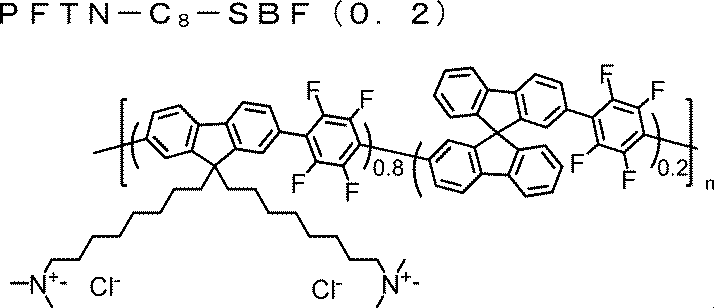
- Example 9 Production of membrane containing PFTN-C 8 -SBF (0.1)] The following PFTN- 572 mg of membranes containing C 8 -SBF (0.1) were obtained. 1 H-NMR spectrum of PFTN-C 8 -SBF(0.1) is shown in FIG.
- Example 10 Production of membrane containing PFTN-C 8 -SBF (0.2)] The following PFTN- 562 mg of membranes containing C 8 -SBF (0.2) were obtained. 1 H-NMR spectrum of PFTN-C 8 -SBF(0.2) is shown in FIG.
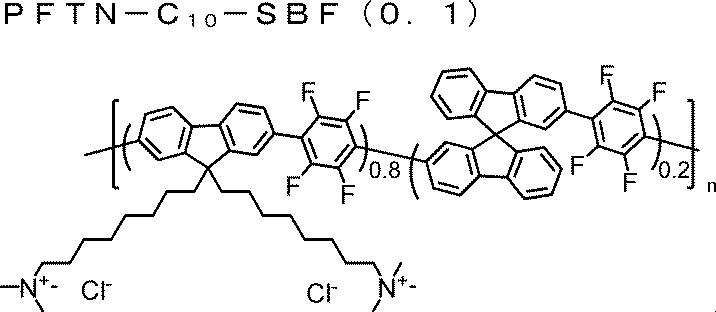
- Example 11 Production of membrane containing PFTN-C 10 -SBF (0.1)] The following PFTN- 567 mg of membranes containing C 10 -SBF (0.1) were obtained.
- FIG. 9 shows the 1 H-NMR spectrum of PFTN-C 10 -SBF(0.1).
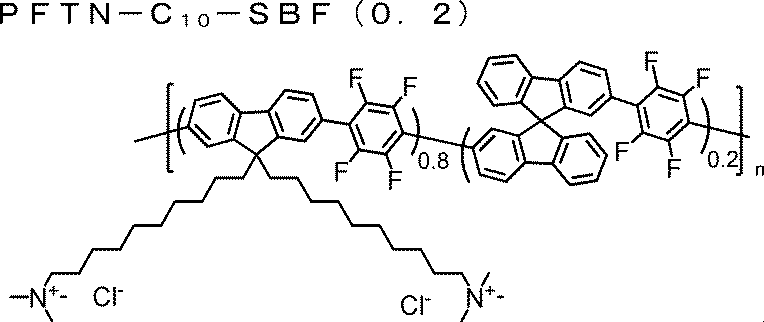
- Example 12 Production of membrane containing PFTN-C 10 -SBF (0.2)] The following PFTN- 552 mg of membranes containing C 10 -SBF (0.2) were obtained.
- FIG. 9 shows the 1 H-NMR spectrum of PFTN-C 10 -SBF(0.2).
- Example 13 Synthesis of PFTSp-C 6 -SBF(0.1)] 2,7-dibromo-9,9'-[6-(sulfonic acid 2,2-dimethylpropyl ester)hexyl]fluorene 1.43 g (1.8 mmol), 2,2'-dibromo-9 in a 50 mL two-neck eggplant flask ,9′-spirobifluorene 94.8 mg (0.2 mmol), Pivalic acid 204 mg (2.00 mmol), Cs 2 CO 3 1.96 g (6.00 mmol), P(oC 6 H 4 -OMe) 3 14 mg (40 ⁇ mol), Pd 2 (dba) 3 —CHCl 3 10.5 mg (10 ⁇ mol) was added.
- Example 14 Synthesis of PFTSp-C 8 -SBF(0.1)]
- Example 13 2,7-dibromo-9,9'-[8- A white solid (PFTSp-C 8 -SBF (0.1 )) to give 780 mg.
- Example 15 Production of membrane containing PFTS-C 6 -SBF (0.1)] 600 mg of PFTSp-C 6 -SBF (0.1) of Example 13, 80 mL of DMF, and 2.16 mg of Me 3 N.HCl were added to a 100 mL two-neck eggplant flask. Refluxed at 160° C. for 2 days under nitrogen. The solvent was removed on a rotary evaporator, the solid was collected by suction filtration and vacuum dried at 75° C. overnight. 1M Hydrochloric acid was added to the obtained solid, and the mixture was stirred at 80° C. for 1 hour. After recovering the polymer by suction filtration, water was added and washed at 80° C. for 1 hour.
- Example 16 Production of membrane containing PFTS-C 8 -SBF (0.1)]
- Example 15 the following PFTS 371 mg of a membranous solid containing -C 8 -SBF (0.1) was obtained.
- 1 H-NMR spectrum of PFTS-C 8 -SBF(0.1) is shown in FIG.
- Comparative Examples 1 to 7 The following polymers were prepared as Comparative Examples 1-7. Comparative Examples 1 to 5 are obtained by conducting the reaction in Scheme 1 or 2 without adding 2,2'-dibromo-9,9'-spirobifluorene.
- each R is represented in the above formula, and the polymers of Comparative Examples 1 to 5 are PFTN-C 6 and PFTN-C 8 in that order.
- n indicates a repeating unit.
- the tensile test speed was 100 mm/min, and the distance between chucks was 20 mm.
- the same measurements were performed on the polymer films of Comparative Examples 1, 2, 3 and 6 above. The results are shown in FIGS. 3 and 4.
- FIG. 1 The results are shown in FIGS. 3 and 4.
- Membrane gas permeability measurement Membrane samples (permeation area: 0.785 cm 2 , film thickness: 10 ⁇ m to 40 ⁇ m ), the gas (hydrogen and oxygen) permeability was measured according to the JIS-K7126-2 standard. As comparative examples, the same measurements were performed on the polymer films of Comparative Examples 2, 4, 5 and 7 above. In addition, the hydrogen/oxygen selective permeability (permeability of hydrogen/permeability of oxygen) was calculated. The results are shown in FIGS. 5 and 6. FIG.
- the membrane containing the polymer according to the present invention was shown to be a polymer with high mechanical strength, high elongation and excellent flexibility. Further, as shown in FIGS. 5 and 6, the membrane containing the polymer according to the present invention has excellent hydrogen permeability, and the oxygen permeability can be adjusted by the substituent of the polymer. It was shown that it is possible to produce a separation membrane with high performance.
Landscapes
- Chemical & Material Sciences (AREA)
- Chemical Kinetics & Catalysis (AREA)
- Engineering & Computer Science (AREA)
- Organic Chemistry (AREA)
- Manufacturing & Machinery (AREA)
- Electrochemistry (AREA)
- Materials Engineering (AREA)
- Medicinal Chemistry (AREA)
- Polymers & Plastics (AREA)
- Health & Medical Sciences (AREA)
- Life Sciences & Earth Sciences (AREA)
- Metallurgy (AREA)
- General Chemical & Material Sciences (AREA)
- Sustainable Energy (AREA)
- Sustainable Development (AREA)
- Inorganic Chemistry (AREA)
- Wood Science & Technology (AREA)
- Crystallography & Structural Chemistry (AREA)
- Fuel Cell (AREA)
- Polyethers (AREA)
Abstract
Description
また、特許文献2に記載のアニオン伝導性ポリマーは、化学的な耐久性には優れているが、製造には多段階の合成ステップが必要であり、より生産性に優れた電解質膜用の材料の開発が求められた。
さらに、電解質膜用のポリマーは、比較的、分子量が小さいものが多く(例えば、重量平均分子量が1万未満)、成膜性や作製した膜の機械強度が劣る場合があった。

Ar1は芳香環を含む基であり、
Ar2は各々独立に下記式(3)で表される構造を両末端に有する基であり、
L1は当該L1が有する2つの結合手のなす角が45~90度の有機基であり、
Ar1、Ar2及びL1が複数ある場合、当該複数あるAr1、Ar2及びL1は各々互いに同一であっても異なっていてもよい。

R1~R10は、各々独立に、水素原子、置換基を有していてもよい炭素数が1~6のアルキル基、置換基を有していてもよいフェニル基であるか、又は、R1とR2、R2とR3、R3とR4、R4とR5、R6とR7、R7とR8、R8とR9、R9とR10とが連結して環構造を形成していてもよく、
R11~R22は、各々独立に、水素原子、置換基を有していてもよい炭素数が1~6のアルキル基、置換基を有していてもよいフェニル基であるか、又は、R11とR12、R12とR13、R13とR14、R14とR15、R15とR16、R17とR18、R18とR19、R19とR20、R20とR21、R21とR22とが連結して環構造を形成していてもよく、
R31~R40は、各々独立に、水素原子、置換基を有していてもよい炭素数が1~6のアルキル基、置換基を有していてもよいフェニル基であるか、又は、R31とR32、R32とR33、R34とR35、R35とR36、R36とR37、R40とR31とが連結して環構造を形成していてもよい。
Rbは、各々独立に、水素原子、ハロゲン原子又は有機基であり、p1は、各々独立に、0以上12以下の整数であり、Rb又はp1が複数ある場合、当該複数あるRb又はp1は各々互いに同一であっても異なっていてもよい。


Raは、各々独立に、水素原子、又は置換基を有していてもよい炭化水素基であり、複数あるRaは互いに同一であっても異なっていてもよい。
式(5)~式(7)中、
Ar1は芳香環を含む基であり、
Ar2は下記式(3)で表される構造を両末端に有する基であり、
L1は当該L1が有する2つの結合手のなす角が45~90度の有機基であり、
X1は各々独立に、Br又はIであり、複数あるX1は互いに同一であっても異なっていてもよい。

また本発明は、上記本発明に係る電解質膜を備える燃料電池、水電解、及び電解技術を提供する。
なお、本発明において「ポリマー」は、特に断りがない限り「コポリマー」を含むものとする。
本発明において「イオン交換基」とは、解離性を有しイオン交換が可能な官能基を示す。
本発明において数値範囲を示す「~」は、その前後に記載された数値を下限値及び上限値として含むことを意味する。
本明細書において「式(1)で表される繰り返し単位」を「構成単位(1)」と記すことがある。他の式で表される繰り返し単位もこれに準ずる。
本明細書において「式(5)で表される化合物」を「化合物(5)」と記すことがある。他の式で表される化合物、置換基等もこれに準ずる。
本明細書において、「R1~R10」は、「R1、R2、R3、R4、R5、R6、R7、R8、R9及びR10」を表す。他の符号等もこれに準ずる。
本明細書において、「式(L1)~式(L3)のいずれか」は、「式(L1)、式(L2)又は式(L3)のいずれか」を表す。他の式番号等もこれに準ずる。
本発明に係るポリマー(以下、本ポリマーともいう)は、下記式(1)で表される繰り返し単位と、下記式(2)で表される繰り返し単位とを有する。

Ar1は芳香環を含む基であり、
Ar2は各々独立に下記式(3)で表される構造を両末端に有する基であり、
L1は当該L1が有する2つの結合手のなす角が45~90度の有機基であり、
Ar1、Ar2及びL1が複数ある場合、当該複数あるAr1、Ar2及びL1は各々互いに同一であっても異なっていてもよい。
本ポリマーは、主鎖にエーテル結合等を有しないため、アルカリやラジカル存在下における化学的な耐久性に優れている。
本ポリマーは主鎖にL1を有している。L1は隣接する2つのAr2に結合する結合手のなす角が45~90度のねじれ構造を有する有機基である。本ポリマーはL1有することで、主鎖骨格全体が3次元的に折れ曲がりを持った構造となっている。そのため、本ポリマーは直鎖状のポリマーであるが、直線性は低く、例えば成膜時などにおいて複数のポリマー間の絡み合いが増加するものと推定され、その結果、機械強度が向上しているものと推定される。また、本ポリマーはL1を含むことで引っ張りに対する伸び率が向上し、機械的な柔軟性が高くなったものと推定される。更に本ポリマーを含む膜は、本ポリマーが折れ曲がりを持つことで微細な孔が形成されているものと推定される。その結果、本ポリマーを含む膜はガス透過性にも優れている。更に、例えば、Ar1にイオン交換基を導入することで、本ポリマーを電解質膜及び電解質アイオノマー用途に適したポリマーとすることができる。
以下、本ポリマーの各構成の詳細について説明する。
基(L1)及び基(L3)ではスピロ原子を中心にねじれが生じている。また、基(L2)では2つのナフチル基をつなぐ単結合を軸にねじれが生じている。
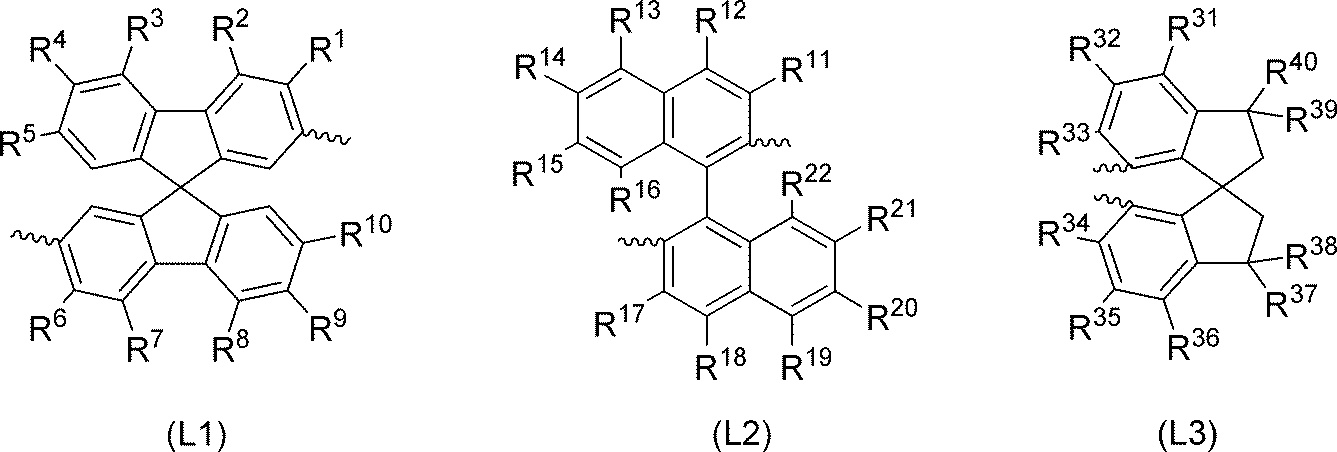
R1~R10は、各々独立に、水素原子、置換基を有していてもよい炭素数が1~6のアルキル基、置換基を有していてもよいフェニル基であるか、又は、R1とR2、R2とR3、R3とR4、R4とR5、R6とR7、R7とR8、R8とR9、R9とR10とが連結して環構造を形成していてもよく、
R11~R22は、各々独立に、水素原子、置換基を有していてもよい炭素数が1~6のアルキル基、置換基を有していてもよいフェニル基であるか、又は、R11とR12、R12とR13、R13とR14、R14とR15、R15とR16、R17とR18、R18とR19、R19とR20、R20とR21、R21とR22とが連結して環構造を形成していてもよく、
R31~R40は、各々独立に、水素原子、置換基を有していてもよい炭素数が1~6のアルキル基、置換基を有していてもよいフェニル基であるか、又は、R31とR32、R32とR33、R34とR35、R35とR36、R36とR37、R40とR31とが連結して環構造を形成していてもよい。
なお式中の波線は、Ar2に結合する結合手を表す。
R1とR2とが連結して環構造を形成しているとは、式(L1)中の2つの炭素原子を介してR1とR2とが環を形成していることをいう。具体的には、下記式(L1-1)、式(L1-2)などが挙げられる。他の組み合わせについても同様である。
Ar1における芳香環は、ポリマーの主鎖の一部を構成することが好ましい。当該芳香環としては、ベンゼン環のほか、ナフタレン環、アントランセン環等の縮合環であってもよく、また、酸素原子(O)、窒素原子(N)、硫黄原子(S)を含む複素環(例えば、チオフェン等)であってもよく、更に、これらの環が、単結合または連結基を介して連結した構造であってもよい。複数の環が単結合で連結した構造としては、例えば、ビフェニル、ターフェニルなどが挙げられる。また、前記連結基としては、例えば、直鎖状または分岐状のアルキレン基、環状のアルキレン基、及びこれらの組み合わせからなる基が挙げられる。
上記炭化水素基の具体例としては、メチル基、エチル基、プロピル基、tert-ブチル基などが挙げられる。当該アルキル基が有していてもよい置換基としては、ハロゲン原子、フェニル基などが挙げられる。
本ポリマーにプロトン伝導性を付与する場合には、イオン交換基は酸性基が好ましく、中でも、スルホン酸基(-SO3H基)、リン酸基(-H2PO4基)、又はカルボン酸基(-COOH基)がより好ましく、スルホン酸基がさらに好ましい。なお、上記酸性基のHはアルカリ金属イオン、アルカリ土類金属イオン等で置換されていてもよい。
また、本ポリマーにアニオン伝導性を付与する場合には、イオン交換基は、4級アンモニウム基またはイミダゾリウム基であることが好ましく、4級アンモニウム基がより好ましい。前記4級アンモニウム基は、さらに、アルカリ耐久性の観点から、4級アルキルアンモニウム基が好ましい。なお、当該4級アルキルアンモニウム基は、窒素原子に結合するアルキル基同士が結合して環構造を形成しているものも含むものであり、例えば、アザアダマンチル基、キヌクリジニウム基などであってもよい。
上記4級アンモニウム基の好ましい具体例としては下記式(e-1)~式(e-3)で表される基が挙げられる。また、イミダゾリウム基の好ましい具体例としては下記式(f-1)で表される基が挙げられ、更に、下記式(f-2)で表される基又は下記式(f-3)で表される基がより好ましい。


Raは、各々独立に、水素原子、置換基(イオン交換基を含む)を有していてもよい炭化水素基、であり、複数あるRaは互いに同一であっても異なっていてもよい。
なお波線は、Ar2に結合する結合手を示す。

Ar2は、例えば、後述の式(b-1)のように、1つの環構造(例えば、ベンゼン環)に部分構造(3)を2つ有してもよいし、また、後述の式(b-2)のように、1つのC-F結合が、2つの部分構造(3)を構成してもよい。さらに、上記鎖状多環式炭化水素の場合、鎖状多環式炭化水素が有する2つの環構造に部分構造(3)を1つずつ有し、それらの環が直接または上記連結基を介して連結してもよいし、複数の環構造のうちの1つに部分構造(3)を2つ有してもよい。

Rbは、各々独立に、水素原子、ハロゲン原子又は有機基であり、p1は、各々独立に、0以上12以下の整数であり、Rb又はp1が複数ある場合、当該複数あるRb又はp1は各々互いに同一であっても異なっていてもよい。
また、上記Rbにおける有機基としては、例えば、置換基(例えばハロゲン原子)を有していてもよい炭素数1~20の直鎖状または分岐状のアルキル基が挙げられる。なお、上記式(b-3)~式(b-5)において、p1が0の場合は、複数のベンゼン環が単結合により直接結合することになり、それぞれビフェニル構造やターフェニル構造となる。

本発明に係るポリマーの製造方法(以下、本製造方法ともいう)は、上記本ポリマーの好適な製造方法であり、
下記式(5)で表される化合物と、下記式(6)で表される化合物と、下記式(7)で表される化合物とを反応させる工程を含む。

X1は各々独立に、Br又はIであり、複数あるX1は互いに同一であっても異なっていてもよく、
Ar1、Ar2、L1は前述のポリマーの項で説明したものと同様である。
化合物(7)は、C-H活性化反応において、反応点となる水素原子のα位にフルオロ基(-F)を有する芳香環(前記部分構造(3))を含むものであるため反応性に優れている。
ここでR41は、各々独立に、置換基を有していてもよいアルキル基などが挙げられ、具体的にはメチル基、エチル基、プロピル基などが挙げられる。
また、R’及びR”としては、各々独立に、水素原子、置換基を有していてもよいアルキル基などが挙げられる。
このように本発明に係る製造方法は、上記機械強度及び引張強度に優れたポリマーを少ない合成ステップで容易に製造することができる。
本発明に係る分離膜は、上記本ポリマーを有することを特徴とする。本ポリマーを成膜して得られた分離膜は、機械強度、化学的耐久性、引張強度に優れ、且つ、ガス(例えば水素、酸素)の透過性にも優れている。芳香環の割合の高い従来のポリマーは、ガス透過性が低いものが多かった。本ポリマーを含む膜は、本ポリマーが折れ曲がりを持つことで微細な孔が形成されているものと推定される。その結果、本ポリマーを含む膜はガス透過性、特に水素透過性に優れている。
分離膜の製造方法は、一般的な成膜方法を適用することができ、例えば、本ポリマーを溶解可能な溶媒(例えば、ジメチルスルホキシド、アルコールや、アルコール水溶液等)に溶解させて、ポリマー溶液を調製し、公知の塗布手段を用いて塗膜とし、乾燥することにより、分離膜を得ることができる。
本発明に係る電解質膜は、上記本ポリマーにおいてAr1がイオン交換基を有するものを用いることを特徴とする。このようなポリマーを使用する電解質膜は、化学的耐久性、イオン伝導性及び膜の機械的強度に優れており、燃料電池や、水電解、電解技術用の電解質膜として好適に用いることができる。また、イオン交換基を有する本ポリマーは、燃料電池の膜電極複合体(MEA)作製時に通常使用する溶媒(アルコールや、アルコールと水との混合溶媒等)に容易に溶解でき、気体透過性にも優れる事から、これらの電池、電解デバイスにおける電解質アイオノマーとしても利用可能である。
なお、本ポリマーは、イオン官能基密度(IEC)が高く、非常に高いイオン伝導度を示す。本ポリマーのIECは、0.5meq・g-1以上、4.0meq・g-1以下であることが好ましい。また、本ポリマーのイオン伝導度は、80℃飽和湿度において、100mS/cm以上のイオン伝導度を示すことが好ましい。さらに、本ポリマーは、相対湿度を低下させた場合であっても、高いイオン伝導度を示すことができる。本ポリマーは、例えば、80℃、相対湿度60%の条件においても、10mS/cm以上の高いイオン伝導度を示す。なお、通常、イオン伝導度が高いポリマーは、含水率が高く、含水状態で著しく膨潤することが多いが、本ポリマーは、膨潤耐性も良好である。
本発明に係る燃料電池は、前記電解質膜、または電解質アイオノマーを備えることを特徴とする。本発明の電解質膜及び電解質アイオノマーは、固体アルカリ燃料電池、及び固体高分子形燃料電池のいずれに対しても好適に用いることができる。
例えば、電解質膜の一方の面にカソードを、他方の面にアノードを配置した膜電極複合体を形成し、カソードに酸素を供給し、アノードに燃料を供給して、カソードで生成したOH-が電解質膜を介してアノードに移動し、そこで水を発生させることにより発電を行う。
燃料は従来公知のものの中から適宜選択することができ、例えば、水素、メタノール、エタノール、エチレングリコール、ギ酸塩、ヒドラジン、水素化ホウ素ナトリウム、アンモニア等が挙げられるが、これらに限定されない。
代表として、燃料として、水素、メタノール及びギ酸塩を用いた場合の各極での反応を示す。
・水素を用いた燃料電池
アノード: 2OH- + H2 → 2H2O
カソード: O2 + 2H2O + 4e- → 4OH-
・メタノールを用いた燃料電池
アノード: 6OH- + CH3OH → CO2 + 5H2O
カソード: O2 + 2H2O + 4e- → 4OH-
・ギ酸塩を用いた燃料電池
アノード: HCOO- + 3OH- → 2H2O + CO3 2- + 2e-
カソード: O2 + 2H2O + 4e- → 4OH-
例えば、電解質膜の一方の面にカソードを、他方の面にアノードを配置した膜電極複合体を形成し、カソードに酸素を供給し、アノードに燃料を供給して、アノードで生成したプロトンが電解質膜を介してアノードに移動し、そこで水を発生させることにより発電を行う。
燃料は公知のものの中から適宜選択することができ、具体的には前記固体アルカリ燃料電池において例示したものと同様のものが挙げられる。
代表して、燃料として水素を用いた場合の各極での反応を示す。
アノード: H2 → 2H+ + 2e-
カソード: O2 + 4H+ + 4e- → 2H2O
また、本発明の電解質膜は、水電解(装置)や他の電解技術(電解装置)、これらの電解方法を利用した電解装置に好適に用いることができる。当該電解装置は、例えば電解槽内に、本発明の電解質膜、陽極および陰極を有する構成とすることができ、本発明の電解質膜を介して、対象物を電気分解(酸化還元反応)することにより、目的物を得ることができる。
陽極: 2H2O → O2+ 4H+ + 4e-
陰極: 2H+ + 2e- → H2
陽極: 2H2O → O2+ 4H+ + 4e-
陰極: CO2 + 2H+ + 2e- → HCOOH
なお、実施例1~6はスキーム1(図1)の(i)に対応し、実施例7~12はスキーム1の(ii)を含む。また、実施例13~14はスキーム2(図2)の(i)に対応し、実施例15~16はスキーム2の(ii)を含む。
50mL二口ナスフラスコに2,7-dibromo-9,9’-bis(6-chlorohexyl)fluorene 1.01g(1.8mmol)、2,2’-dibromo-9,9’-spirobifluorene 94.8mg(0.2mmol)、Pivalic acid 204mg(2.00mmol)、Cs2CO3 1.96g(6.00mmol)、P(o-C6H4-OMe)3 14mg(40μmol)、Pd2(dba)3-CHCl3 10.5mg(10μmol)を加えた。脱水THF2mLを加え、10分間N2置換を行った。N2置換をやめ、1,2,4,5-Tetrafuluorobenzene 309mg(2.06mmol)を脱水THF 1.0mLに溶解させて加えた。室温窒素下で30分間攪拌させた後、80℃で、24時間反応させた。得られた固体を200mLのクロロホルムに溶解させ、1Mの塩酸で洗浄後、水で二回洗浄した。溶媒除去後、クロロホルムに溶解させ、メタノール中に再沈殿後しばらく攪拌した。ろ過後、75℃で3時間真空乾燥し、白色固体(下記PFTNp-C6-SBF(0.1))921mgを得た。
PFTNp-C6-SBF(0.1)の分子量(GPC):Mn=53900,Mw=376000

上記実施例1において、モノマーの比率を2,7-dibromo-9,9’-bis (6-chlorohexyl)fluorene 898mg(1.6mmol)、2,2’-dibromo-9,9’-spirobifluorene 190mg(0.4mmol)と変更した以外は、実施例1と同様の手法で、白色固体(下記PFTNp-C6-SBF(0.2))906mgを得た。
PFTNp-C6-SBF(0.2)の分子量(GPC):Mn=25100,Mw=190000

上記実施例1において、2,7-dibromo-9,9’-bis(6-chlorohexyl)fluoreneの代わりに2,7-dibromo-9,9’-bis(8-chlorooctyl)fluorene 1111mg(1.8 mmol)を用い、2,2’-dibromo-9,9’-spirobifluorene 94.8mg(0.2mmol)とした以外は実施例1と同様の手法で、白色固体(下記PFTNp-C8-SBF(0.1))1030mgを得た。
PFTNp-C8-SBF(0.1)の分子量(GPC):Mn=46600,Mw=339000
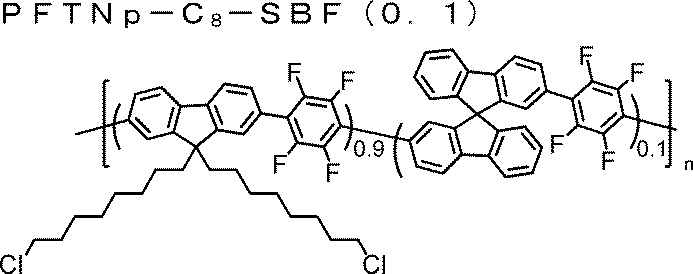
実施例3においてモノマーの比率を2,7-dibromo-9,9’-bis (8-chlorooctyl)fluorene 987mg(1.6mmol)、2,2’-dibromo-9,9’-spirobifluorene 190mg(0.4mmol)と変更した以外、実施例3と同様の手法で、白色固体(下記PFTNp-C8-SBF(0.2))998mgを得た。
PFTNp-C8-SBF(0.2)の分子量(GPC):Mn=21800,Mw=116000
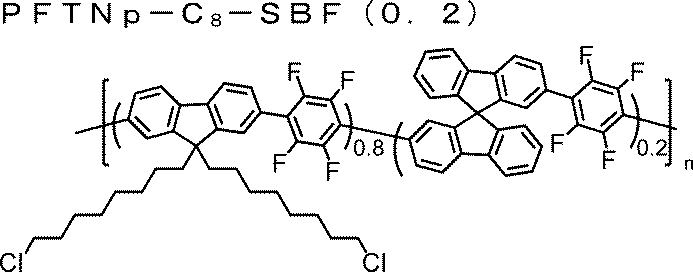
上記実施例1において、2,7-dibromo-9,9’-bis (6-chlorohexyl)fluoreneの代わりに2,7-dibromo-9,9’-bis(10-chlorodecyl)fluorene 1211mg(1.8mmol)を用い、2,2’-dibromo-9,9’-spirobifluorene 94.8mg(0.2mmol)とした以外は実施例1と同様の手法で、白色固体(下記PFTNp-C10-SBF(0.1))1130mgを得た。
PFTNp-C10-SBF(0.1)の分子量(GPC):Mn=43000,Mw=355000

上記実施例5において、モノマーの比率を2,7-dibromo-9,9’-bis (10-chlorodecyl)fluorene 1077mg(1.6mmol)、2,2’-dibromo-9,9’-spirobifluorene 190mg(0.4mmol)と変更した以外は実施例5と同様の手法で、白色固体(下記PFTNp-C10-SBF(0.2))1089mgを得た。
PFTNp-C10-SBF(0.2)の分子量(GPC):Mn=25400,Mw=252000

実施例1のPFTNp-C6-SBF(0.1)600mgにクロロベンゼン30mlを加え、不溶性成分をろ過にて取り除いた。得られたろ液を50mLサンプル管に移し、2mLのトリメチルアミンメタノール溶液(3.2mol/l)を加え、105℃閉鎖系にて10時間攪拌させた。室温まで冷却した後、ジメチルスルホキシド20mL、トリメチルアミンメタノール溶液1mL(3.2mol/l)を加え、8時間105℃にて攪拌させた。室温まで冷却した後、エバポレーターにてクロロベンゼン、トリメチルアミンを取り除いた。残渣にジメチルスルホキシド20mL、トリメチルアミンメタノール溶液1mL(3.2mol/l)を加え、8時間105℃にて攪拌させた。室温まで冷却した後、エバポレーターにてジメチルスルホキシド、トリメチルアミンを除去し、乾固させた。得られた固体を80℃の熱水に30分浸漬させ、固体を洗浄した。3回洗浄した後、ろ過にて固体を回収し、70℃において3時間真空乾燥させることで高分子膜601mgを得た。その後、得られた膜を1MNaOH水溶液に室温にて24時間浸漬し、純水で洗浄する事でイオン交換を行い、下記PFTN-C6-SBF(0.1)を含む膜を得た。PFTN-C6-SBF(0.1)の1H-NMRスペクトルを図7に示す。

実施例7においてPFTNp-C6-SBF(0.1)の代わりに、実施例2のPFTNp-C6-SBF(0.2)を用いた以外は、実施例7と同様にして下記PFTN-C6-SBF(0.2)を含む膜601mgを得た。PFTN-C6-SBF(0.2)の1H-NMRスペクトルを図7に示す。

実施例7においてPFTNp-C6-SBF(0.1)の代わりに、実施例3のPFTNp-C8-SBF(0.1)を用いた以外は、実施例7と同様にして下記PFTN-C8-SBF(0.1)を含む膜572mgを得た。PFTN-C8-SBF(0.1)の1H-NMRスペクトルを図8に示す。

実施例7においてPFTNp-C6-SBF(0.1)の代わりに、実施例4のPFTNp-C8-SBF(0.2)を用いた以外は、実施例7と同様にして下記PFTN-C8-SBF(0.2)を含む膜562mgを得た。PFTN-C8-SBF(0.2)の1H-NMRスペクトルを図8に示す。
実施例7においてPFTNp-C6-SBF(0.1)の代わりに、実施例5のPFTNp-C10-SBF(0.1)を用いた以外は、実施例7と同様にして下記PFTN-C10-SBF(0.1)を含む膜567mgを得た。PFTN-C10-SBF(0.1)の1H-NMRスペクトルを図9に示す。
実施例7においてPFTNp-C6-SBF(0.1)の代わりに、実施例6のPFTNp-C10-SBF(0.2)を用いた以外は、実施例7と同様にして下記PFTN-C10-SBF(0.2)を含む膜552mgを得た。PFTN-C10-SBF(0.2)の1H-NMRスペクトルを図9に示す。
50mL二口ナスフラスコに2,7-dibromo-9,9’-[6-(sulfonic acid 2,2-dimethylpropyl ester)hexyl] fluorene 1.43g(1.8mmol)、2,2’-dibromo-9,9’-spirobifluorene 94.8mg(0.2mmol)、Pivalic acid 204mg(2.00 mmol)、Cs2CO3 1.96g(6.00mmol)、P(o-C6H4-OMe)3 14mg(40μmol)、Pd2(dba)3-CHCl3 10.5mg(10μmol)を加えた。脱水THF2mLを加え、10分間N2置換を行った。N2置換をやめ、1,2,4,5-Tetrafuluorobenzene 309mg(2.06mmol)を脱水THF 1.0 mLに溶解させて加えた。室温窒素下で30分間攪拌させた後、90℃で、溶媒がなくなり、撹拌子が回らなくなるまで反応させた。得られた固体を90mLのクロロホルムに溶解させ、1Mの塩酸で洗浄後、水で二回洗浄した。溶媒除去後、クロロホルムに溶解させ、メタノール中に再沈殿後しばらく攪拌した。ろ過後、クロロホルムに溶解させヘキサンに再沈殿し、75℃で一晩真空乾燥し、黒色固体(下記PFTSp-C6-SBF(0.1))715mgを得た。
PFTSp-C6-SBF(0.1)の分子量(GPC):Mn=5.3×10⁴,Mw=25×104

実施例13において、2,7-dibromo-9,9’-[6-(sulfonic acid 2,2-dimethylpropyl ester)hexyl] fluoreneの代わりに、2,7-dibromo-9,9’-[8-(sulfonic acid 2,2-dimethylpropyl ester)octyl] fluorene 1.53g(1.8mmol)を用いた以外は、実施例13と同様の手法で、白色固体(下記PFTSp-C8-SBF(0.1))780mgを得た。
PFTSp-C8-SBF(0.1)の分子量(GPC):Mn=3.1×10⁴,Mw=15×104,

100mL二口ナスフラスコに実施例13のPFTSp-C6-SBF(0.1)600mg、DMF 80mL、Me3N・HCl2.16mgに加えた。窒素下にて160℃で2日間還流させた。ロータリーエバポレーターで溶媒除去し、吸引ろ過で固体を回収し、75℃で一晩真空乾燥させた。得られた固体に1M塩酸を加え、80℃で1時間撹拌した。吸引ろ過でポリマーを回収後、水を加え、80℃で1h洗浄した。なおこの1時間中にpH試験紙で水が中性になるまで、水を替えた。その後、吸引ろ過でポリマーを回収し、75℃で一晩真空乾燥することで、下記PFTS-C6-SBF(0.1)を含む膜状固体350mgを得た。PFTS-C6-SBF(0.1)の1H-NMRスペクトルを図10に示す。
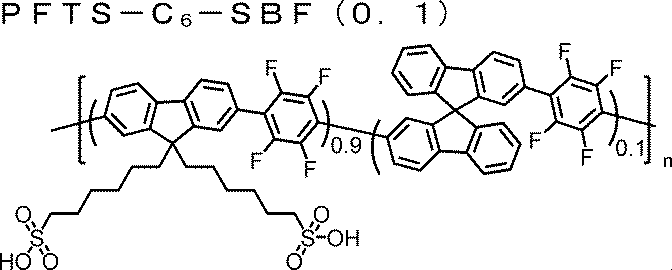
実施例15において、PFTSp-C6-SBF(0.1)の代わりに実施例14のPFTSp-C8-SBF(0.1)600mgを用いた以外は実施例15と同様にして、下記PFTS-C8-SBF(0.1)を含む膜状固体371mgを得た。PFTS-C8-SBF(0.1)の1H-NMRスペクトルを図10に示す。

比較例1~7として下記のポリマーを準備した。なお比較例1~5は、スキーム1または2において、2,2’-dibromo-9,9’-spirobifluoreneを添加せずに反応を実施することで得られる。
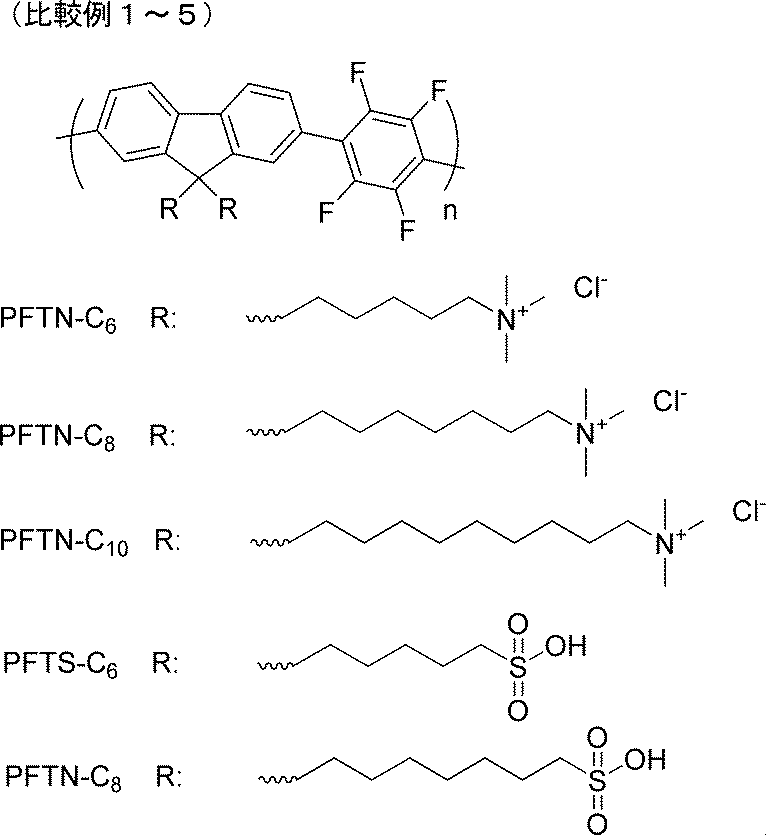

(比較例7)Nafion211(Sigma-Aldrich製)
(膜の機械強度測定)
実施例7~12で得られたPFTN-Cx-SBF(y)を含む膜は、
前処理として、1M NaOH水溶液に24時間浸漬させた後、純水で1時間、3回洗浄し、OH-へのイオン交換を行った。
実施例15~16で得られたPFTS-Cx-SBF(y)を含む膜は、あらかじめ酸処理した膜を用いた。
上記前処理後の膜を用いて、各々、JIS K6251 7号形のサンプルを作製し、23℃大気下で測定機器(Instron デジタル材料試験機 5985)を用いて、引っ張り試験を実施した。引っ張り試験速度は100mm/分、チャック間距離は20mmとした。
また、比較例として、上記比較例1、2、3及び6のポリマーの膜についても同様の測定を行った。結果を図3及び図4に示す。
実施例7~12、実施例15~16で得られた膜を各々、80℃、相対湿度90%の条件で両面加湿を行った膜サンプル(透過面積:0.785cm2,膜厚10μm-40μm)に関して、JIS-K7126-2規格に従った測定により気体(水素及び酸素)の透過度の測定を行った。また、比較例として、上記比較例2、4、5及び7のポリマーの膜についても同様の測定を行った。また、水素/酸素選択透過性(水素の透過度/酸素の透過度)を算出した。結果を図5及び図6に示す。
表3及び表4に示される通り、本発明に係るポリマーを含む膜は、機械強度及び伸び率が高く柔軟性に優れたポリマーであることが示された。
また図5及び図6に示される通り、本発明係るポリマーを含む膜は、水素透過性に優れ、また、ポリマーの置換基などにより酸素透過性を調製することができ、例えば水素/酸素選択透過性の高い分離膜を製造することが可能となることが示された。
Claims (14)
- 下記式(1)で表される繰り返し単位と、下記式(2)で表される繰り返し単位とを有する、ポリマー。

Ar1は芳香環を含む基であり、
Ar2は各々独立に下記式(3)で表される構造を両末端に有する基であり、
L1は当該L1が有する2つの結合手のなす角が45~90度の有機基であり、
Ar1、Ar2及びL1が複数ある場合、当該複数あるAr1、Ar2及びL1は各々互いに同一であっても異なっていてもよい。

- 前記L1が下記式(L1)~下記式(L3)のいずれかで表される基である、請求項1に記載のポリマー。
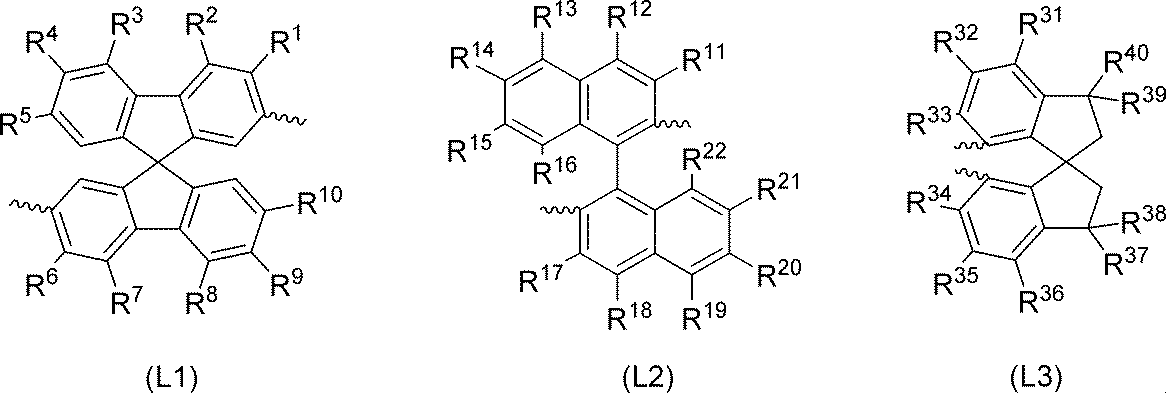
R1~R10は、各々独立に、水素原子、置換基を有していてもよい炭素数が1~6のアルキル基、置換基を有していてもよいフェニル基であるか、又は、R1とR2、R2とR3、R3とR4、R4とR5、R6とR7、R7とR8、R8とR9、R9とR10とが連結して環構造を形成していてもよく、
R11~R22は、各々独立に、水素原子、置換基を有していてもよい炭素数が1~6のアルキル基、置換基を有していてもよいフェニル基であるか、又は、R11とR12、R12とR13、R13とR14、R14とR15、R15とR16、R17とR18、R18とR19、R19とR20、R20とR21、R21とR22とが連結して環構造を形成していてもよく、
R31~R40は、各々独立に、水素原子、置換基を有していてもよい炭素数が1~6のアルキル基、置換基を有していてもよいフェニル基であるか、又は、R31とR32、R32とR33、R34とR35、R35とR36、R36とR37、R40とR31とが連結して環構造を形成していてもよい。 - 前記Ar2が、下記式(b-1)~下記式(b-9)のいずれかで表される基である、請求項1又は2に記載のポリマー。
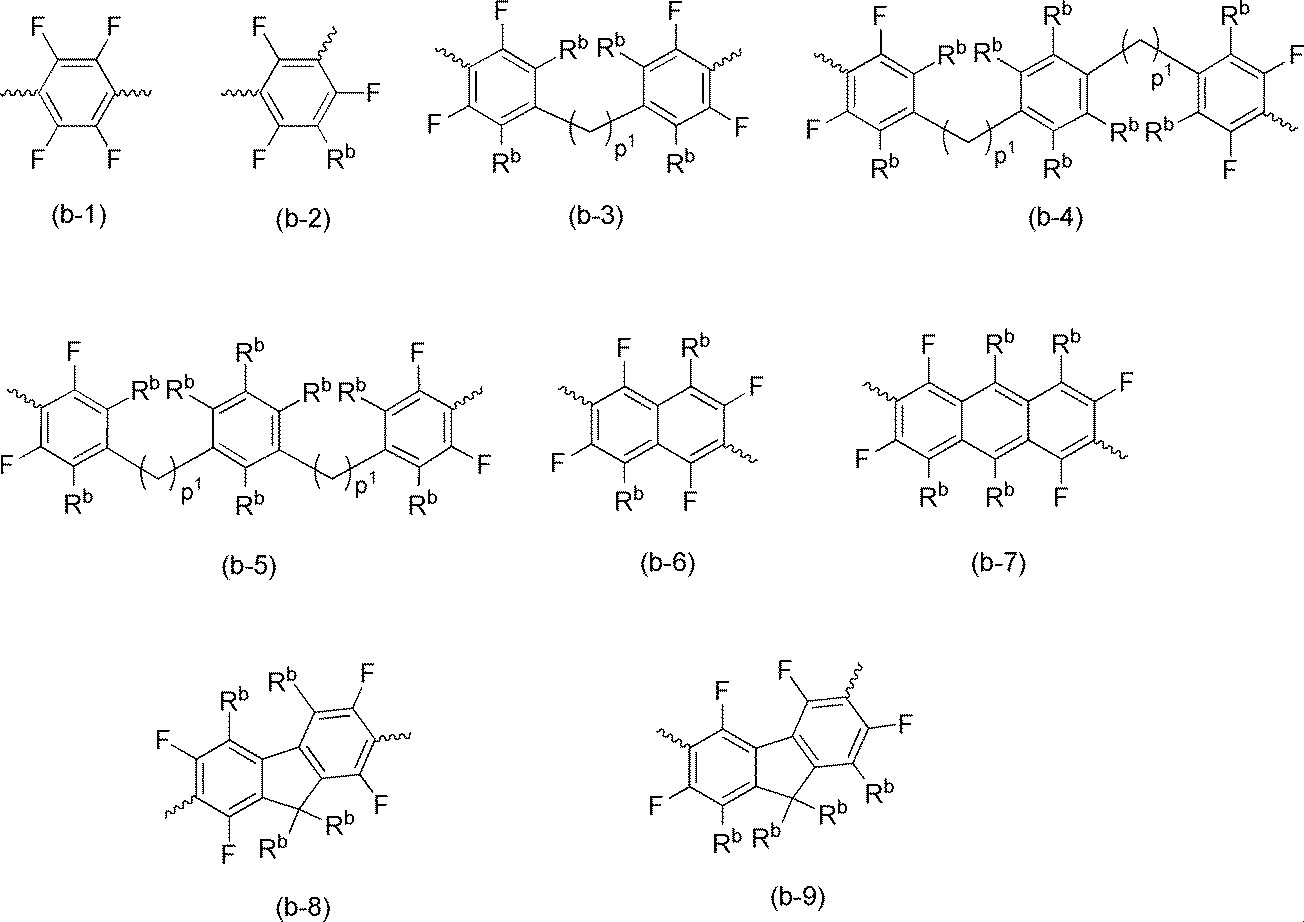
Rbは、各々独立に、水素原子、ハロゲン原子又は有機基であり、p1は、各々独立に、0以上12以下の整数であり、Rb又はp1が複数ある場合、当該複数あるRb又はp1は各々互いに同一であっても異なっていてもよい。 - 前記Ar2が、下記式(b-10)~下記式(b-14)のいずれかで表される基である、請求項1~3のいずれか一項に記載のポリマー。
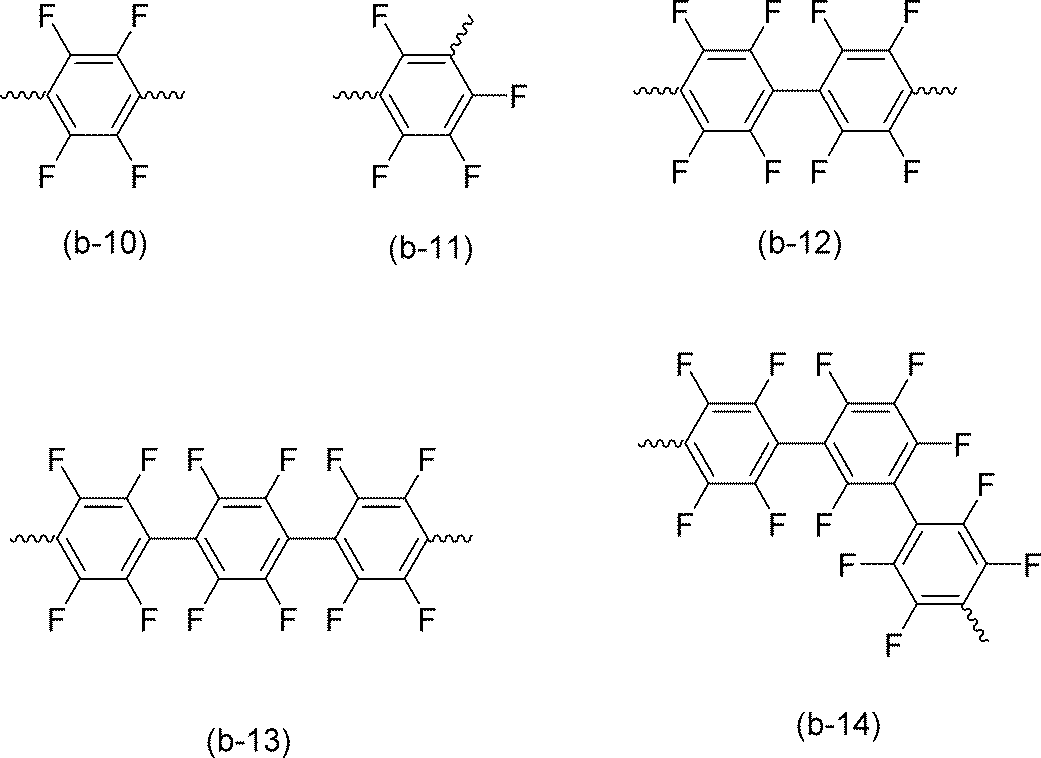
- 前記Ar1が、下記式(a-1)~下記式(a-9)のいずれかで表される基である、請求項1~4のいずれか一項に記載のポリマー。
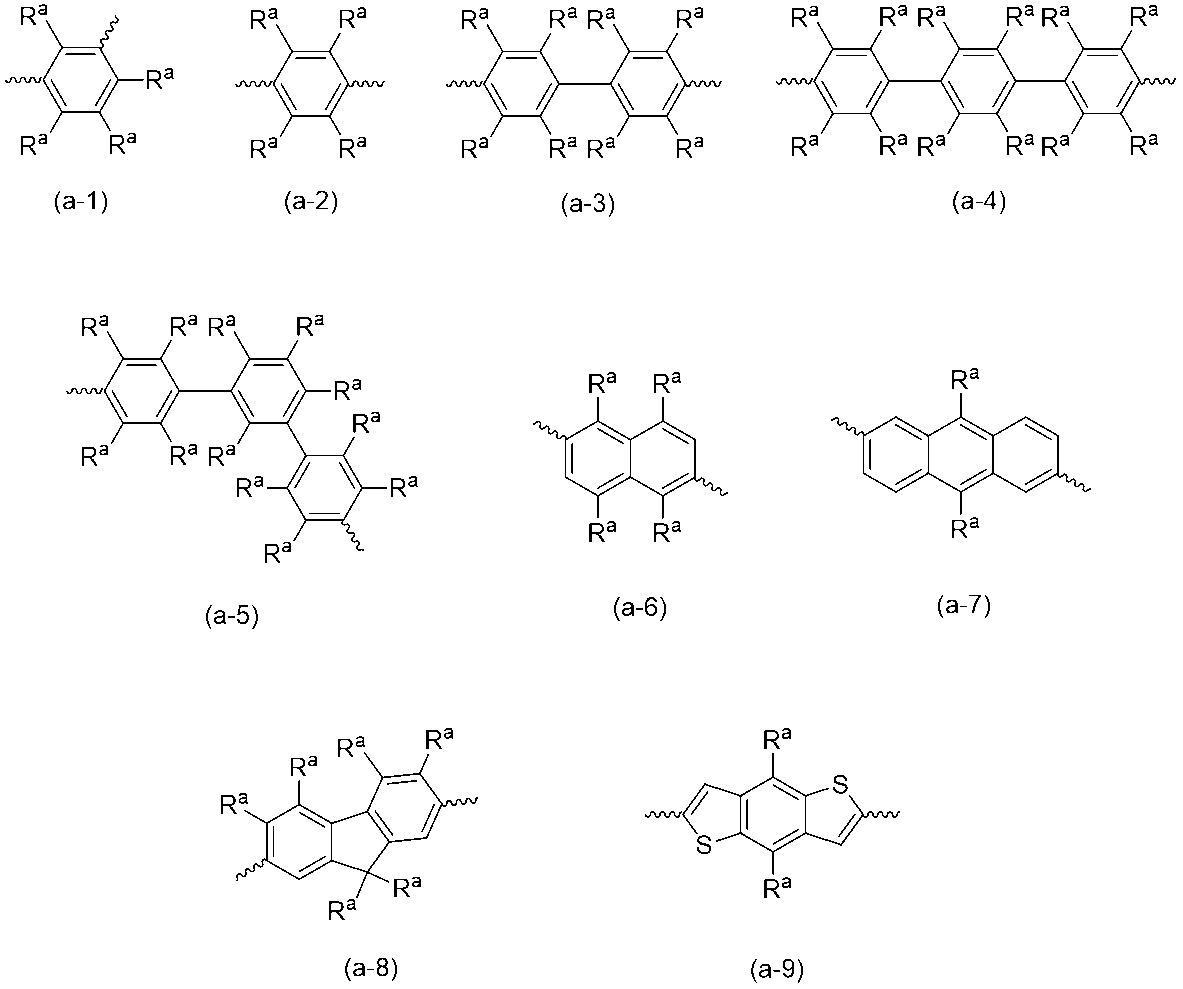
Raは、各々独立に、水素原子、又は置換基を有していてもよい炭化水素基であり、複数あるRaは互いに同一であっても異なっていてもよい。 - 前記式(1)で表される繰り返し単位と、前記式(2)で表される繰り返し単位とのモル比が、95:5~50:50である、請求項1~5のいずれか一項に記載のポリマー。
- 前記Ar1がイオン交換基を有する、請求項1~6のいずれか一項に記載のポリマー。
- 前記イオン交換基が、スルホン酸基、リン酸基、カルボン酸基、4級アンモニウム基、またはイミダゾリウム基である、請求項7に記載のポリマー。
- 請求項1~8のいずれか一項に記載のポリマーの製造方法であって、
下記式(5)で表される化合物と、下記式(6)で表される化合物と、下記式(7)で表される化合物とを反応させる工程を含む、ポリマーの製造方法。
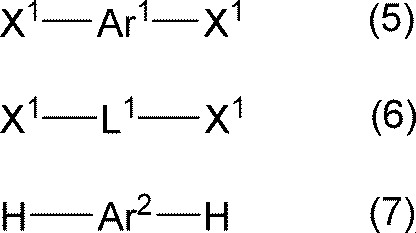
Ar1は芳香環を含む基であり、
Ar2は下記式(3)で表される構造を両末端に有する基であり、
L1は当該L1が有する2つの結合手のなす角が45~90度の有機基であり、
X1は各々独立に、Br又はIであり、複数あるX1は互いに同一であっても異なっていてもよい。

- 請求項1~8のいずれか一項に記載のポリマーを含む、分離膜。
- 請求項7又は8に記載のポリマーを有する、電解質膜。
- 請求項11に記載の電解質膜を備える、燃料電池。
- 請求項11に記載の電解質膜を用いる、水電解。
- 請求項11に記載の電解質膜を用いる、電解技術。
Priority Applications (4)
| Application Number | Priority Date | Filing Date | Title |
|---|---|---|---|
| CN202280018748.7A CN117337311A (zh) | 2021-03-05 | 2022-03-02 | 聚合物及其制造方法、分离膜、电解质膜、燃料电池、水电解、以及电解技术 |
| EP22763315.3A EP4296292A4 (en) | 2021-03-05 | 2022-03-02 | Polymer and method for producing same, separation membrane, electrolyte membrane, fuel cell, water electrolysis, and electrolysis technique |
| US18/548,855 US20240002584A1 (en) | 2021-03-05 | 2022-03-02 | Polymer and method for producing same, separation membrane, electrolyte membrane, fuel cell, water electrolysis, and electrolysis technique |
| JP2023503898A JPWO2022186261A1 (ja) | 2021-03-05 | 2022-03-02 |
Applications Claiming Priority (2)
| Application Number | Priority Date | Filing Date | Title |
|---|---|---|---|
| JP2021-035443 | 2021-03-05 | ||
| JP2021035443 | 2021-03-05 |
Publications (1)
| Publication Number | Publication Date |
|---|---|
| WO2022186261A1 true WO2022186261A1 (ja) | 2022-09-09 |
Family
ID=83154621
Family Applications (1)
| Application Number | Title | Priority Date | Filing Date |
|---|---|---|---|
| PCT/JP2022/008810 Ceased WO2022186261A1 (ja) | 2021-03-05 | 2022-03-02 | ポリマー及びその製造方法、分離膜、電解質膜、燃料電池、水電解、並びに電解技術 |
Country Status (5)
| Country | Link |
|---|---|
| US (1) | US20240002584A1 (ja) |
| EP (1) | EP4296292A4 (ja) |
| JP (1) | JPWO2022186261A1 (ja) |
| CN (1) | CN117337311A (ja) |
| WO (1) | WO2022186261A1 (ja) |
Cited By (2)
| Publication number | Priority date | Publication date | Assignee | Title |
|---|---|---|---|---|
| WO2024080321A1 (ja) * | 2022-10-13 | 2024-04-18 | 国立大学法人東京工業大学 | 化合物、ポリマー、電解質膜、燃料電池、及び電解装置 |
| WO2026004900A1 (ja) * | 2024-06-28 | 2026-01-02 | 国立大学法人東京科学大学 | ポリマー、電解質膜、膜電極接合体、燃料電池、及び水電解装置 |
Citations (5)
| Publication number | Priority date | Publication date | Assignee | Title |
|---|---|---|---|---|
| JP2016044242A (ja) | 2014-08-22 | 2016-04-04 | 公益財団法人神奈川科学技術アカデミー | プロトン伝導性材料、電解質膜及び固体高分子形燃料電池 |
| JP2018135487A (ja) | 2017-02-23 | 2018-08-30 | 国立大学法人東京工業大学 | ポリマー、電解質膜、及び固体高分子形燃料電池 |
| CN110698654A (zh) * | 2018-07-10 | 2020-01-17 | 中国科学院长春应用化学研究所 | 基于三聚吲哚的超支化共轭聚电解质及其制备方法和用途 |
| JP2021035443A (ja) | 2019-08-30 | 2021-03-04 | 株式会社タバタ | スイミングゴーグル |
| JP2021161472A (ja) * | 2020-03-31 | 2021-10-11 | 国立大学法人東京工業大学 | 水電解装置 |
Family Cites Families (3)
| Publication number | Priority date | Publication date | Assignee | Title |
|---|---|---|---|---|
| JP7142852B2 (ja) * | 2018-08-27 | 2022-09-28 | 国立大学法人山梨大学 | 陰イオン交換樹脂、電解質膜、電極触媒層形成用バインダー、電池電極触媒層および燃料電池 |
| JP7233642B2 (ja) * | 2019-01-19 | 2023-03-07 | 国立大学法人山梨大学 | 陰イオン交換樹脂、電解質膜、電極触媒層形成用バインダー、電池電極触媒層および燃料電池 |
| JP7432918B2 (ja) * | 2019-09-03 | 2024-02-19 | 国立大学法人東京工業大学 | ポリマー、プリカーサ、ポリマーの製造方法、電解質膜、燃料電池、膜電極複合体および電解装置 |
-
2022
- 2022-03-02 WO PCT/JP2022/008810 patent/WO2022186261A1/ja not_active Ceased
- 2022-03-02 US US18/548,855 patent/US20240002584A1/en active Pending
- 2022-03-02 EP EP22763315.3A patent/EP4296292A4/en active Pending
- 2022-03-02 CN CN202280018748.7A patent/CN117337311A/zh active Pending
- 2022-03-02 JP JP2023503898A patent/JPWO2022186261A1/ja active Pending
Patent Citations (5)
| Publication number | Priority date | Publication date | Assignee | Title |
|---|---|---|---|---|
| JP2016044242A (ja) | 2014-08-22 | 2016-04-04 | 公益財団法人神奈川科学技術アカデミー | プロトン伝導性材料、電解質膜及び固体高分子形燃料電池 |
| JP2018135487A (ja) | 2017-02-23 | 2018-08-30 | 国立大学法人東京工業大学 | ポリマー、電解質膜、及び固体高分子形燃料電池 |
| CN110698654A (zh) * | 2018-07-10 | 2020-01-17 | 中国科学院长春应用化学研究所 | 基于三聚吲哚的超支化共轭聚电解质及其制备方法和用途 |
| JP2021035443A (ja) | 2019-08-30 | 2021-03-04 | 株式会社タバタ | スイミングゴーグル |
| JP2021161472A (ja) * | 2020-03-31 | 2021-10-11 | 国立大学法人東京工業大学 | 水電解装置 |
Non-Patent Citations (4)
| Title |
|---|
| KEMPE FABIAN, RIEHLE FELIX, KOMBER HARTMUT, MATSIDIK RUKIYA, WALTER MICHAEL, SOMMER MICHAEL: "Semifluorinated, kinked polyarylenes via direct arylation polycondensation", POLYMER CHEMISTRY, ROYAL SOCIETY OF CHEMISTRY, CAMBRIDGE, vol. 11, no. 43, 10 November 2020 (2020-11-10), Cambridge , pages 6928 - 6934, XP055964364, ISSN: 1759-9954, DOI: 10.1039/D0PY00973C * |
| LIU DE-PENG, CHEN QI, ZHAO YAN-CHAO, ZHANG LI-MIN, QI AI-DI, HAN BAO-HANG: "Fluorinated Porous Organic Polymers via Direct C–H Arylation Polycondensation", ACS MACRO LETTERS, vol. 2, no. 6, 18 June 2013 (2013-06-18), pages 522 - 526, XP055964365, ISSN: 2161-1653, DOI: 10.1021/mz4001699 * |
| MASAFUMI MIYANISHI, SONI ROBY , HIDEKI KUROKI , TAKEO YAMAGUCHI : "Development of High Molecular Weight Wholly Aromatic Anion Conductive Membrane Using CH-Activated Polymerization and Application to Solid Alkaline Water Electrolysis", MEMBRANE SYMPOSIUM 2020 ABSTRACTS., 4 November 2020 (2020-11-04), pages 31 - 33, XP055964366, Retrieved from the Internet <URL:https://jglobal.jst.go.jp/detail?JGLOBAL_ID=202002282277198760> [retrieved on 20220923] * |
| See also references of EP4296292A4 |
Cited By (2)
| Publication number | Priority date | Publication date | Assignee | Title |
|---|---|---|---|---|
| WO2024080321A1 (ja) * | 2022-10-13 | 2024-04-18 | 国立大学法人東京工業大学 | 化合物、ポリマー、電解質膜、燃料電池、及び電解装置 |
| WO2026004900A1 (ja) * | 2024-06-28 | 2026-01-02 | 国立大学法人東京科学大学 | ポリマー、電解質膜、膜電極接合体、燃料電池、及び水電解装置 |
Also Published As
| Publication number | Publication date |
|---|---|
| CN117337311A (zh) | 2024-01-02 |
| EP4296292A1 (en) | 2023-12-27 |
| US20240002584A1 (en) | 2024-01-04 |
| JPWO2022186261A1 (ja) | 2022-09-09 |
| EP4296292A4 (en) | 2025-03-12 |
Similar Documents
| Publication | Publication Date | Title |
|---|---|---|
| Hu et al. | Piperidinium functionalized aryl ether-free polyaromatics as anion exchange membrane for water electrolysers: Performance and durability | |
| JP6929978B2 (ja) | 新規ポリマー及びその製造方法 | |
| JP7432918B2 (ja) | ポリマー、プリカーサ、ポリマーの製造方法、電解質膜、燃料電池、膜電極複合体および電解装置 | |
| Jheng et al. | Quaternized polybenzimidazoles with imidazolium cation moieties for anion exchange membrane fuel cells | |
| Wang et al. | Durable and conductive anion exchange membranes based on Poly (m-triphenyl carbazolyl piperidinium) for water electrolysis | |
| CN114929775B (zh) | 基于聚芴的离聚物、阴离子交换膜和用于制备其的方法 | |
| JP2024536492A (ja) | アニオン交換膜用の分岐構造を有するアリールエーテルフリー多環芳香族炭化水素ポリマー | |
| WO2024080321A1 (ja) | 化合物、ポリマー、電解質膜、燃料電池、及び電解装置 | |
| KR102031823B1 (ko) | 이온 전도성 고분자 및 이를 이용한 고분자 전해질 막의 제조방법 | |
| WO2022186261A1 (ja) | ポリマー及びその製造方法、分離膜、電解質膜、燃料電池、水電解、並びに電解技術 | |
| CN118027323A (zh) | 一种聚芳基甲基哌啶聚合物、制备方法及阴离子交换膜 | |
| CN119234011A (zh) | 新型含支化的聚(芳基哌啶鎓)共聚物离聚体、阴离子交换膜及其制备方法 | |
| US20240317951A1 (en) | Novel polyfluorene-based cross-linked copolymer, method for producing same, and anion exchange membrane for alkaline fuel cell using same | |
| US9593215B2 (en) | Polymer useful for an ion exchange membrane | |
| KR102036872B1 (ko) | 폴리에테르에테르케톤 기반의 복합막, 이의 제조방법 및 이를 포함하는 연료전지용 음이온 교환막 | |
| JP2020169287A (ja) | 化合物、プリカーサ、電解質膜、燃料電池、水電解及び電解技術 | |
| CN108503835A (zh) | 一种支化嵌段梳型聚芳醚砜、其制备方法和应用 | |
| KR20060131934A (ko) | 고체 고분자 전해질막, 그 제조 방법 및 고체 고분자형연료전지 | |
| JP7814693B2 (ja) | ポリマーの製造方法、ポリマー、電解質膜、燃料電池、及び電解装置 | |
| JP7792554B2 (ja) | 触媒被覆型電解質膜 | |
| JP2009242790A (ja) | 高分子電解質組成物 | |
| CN116031456A (zh) | 一种高稳定性碱性聚电解质及其制备方法 | |
| WO2026004900A1 (ja) | ポリマー、電解質膜、膜電極接合体、燃料電池、及び水電解装置 | |
| WO2026086134A1 (zh) | 烷基侧链取代芳烃单体、聚芳烷及其制备方法与应用 | |
| CN121045513A (zh) | 基于Trögers Base短链的聚合物、制备方法及其聚合物的阴离子交换膜和应用 |
Legal Events
| Date | Code | Title | Description |
|---|---|---|---|
| 121 | Ep: the epo has been informed by wipo that ep was designated in this application |
Ref document number: 22763315 Country of ref document: EP Kind code of ref document: A1 |
|
| WWE | Wipo information: entry into national phase |
Ref document number: 2023503898 Country of ref document: JP |
|
| WWE | Wipo information: entry into national phase |
Ref document number: 202280018748.7 Country of ref document: CN Ref document number: 18548855 Country of ref document: US |
|
| WWE | Wipo information: entry into national phase |
Ref document number: 2022763315 Country of ref document: EP |
|
| ENP | Entry into the national phase |
Ref document number: 2022763315 Country of ref document: EP Effective date: 20230919 |
|
| NENP | Non-entry into the national phase |
Ref country code: DE |