WO2022196521A1 - シリコーンゴム粒子の水分散物および化粧料 - Google Patents
シリコーンゴム粒子の水分散物および化粧料 Download PDFInfo
- Publication number
- WO2022196521A1 WO2022196521A1 PCT/JP2022/010614 JP2022010614W WO2022196521A1 WO 2022196521 A1 WO2022196521 A1 WO 2022196521A1 JP 2022010614 W JP2022010614 W JP 2022010614W WO 2022196521 A1 WO2022196521 A1 WO 2022196521A1
- Authority
- WO
- WIPO (PCT)
- Prior art keywords
- silicone rubber
- rubber particles
- aqueous dispersion
- component
- oil
- Prior art date
- Legal status (The legal status is an assumption and is not a legal conclusion. Google has not performed a legal analysis and makes no representation as to the accuracy of the status listed.)
- Ceased
Links
Classifications
-
- C—CHEMISTRY; METALLURGY
- C08—ORGANIC MACROMOLECULAR COMPOUNDS; THEIR PREPARATION OR CHEMICAL WORKING-UP; COMPOSITIONS BASED THEREON
- C08L—COMPOSITIONS OF MACROMOLECULAR COMPOUNDS
- C08L83/00—Compositions of macromolecular compounds obtained by reactions forming in the main chain of the macromolecule a linkage containing silicon with or without sulfur, nitrogen, oxygen or carbon only; Compositions of derivatives of such polymers
- C08L83/14—Compositions of macromolecular compounds obtained by reactions forming in the main chain of the macromolecule a linkage containing silicon with or without sulfur, nitrogen, oxygen or carbon only; Compositions of derivatives of such polymers in which at least two but not all the silicon atoms are connected by linkages other than oxygen atoms
-
- C—CHEMISTRY; METALLURGY
- C08—ORGANIC MACROMOLECULAR COMPOUNDS; THEIR PREPARATION OR CHEMICAL WORKING-UP; COMPOSITIONS BASED THEREON
- C08L—COMPOSITIONS OF MACROMOLECULAR COMPOUNDS
- C08L83/00—Compositions of macromolecular compounds obtained by reactions forming in the main chain of the macromolecule a linkage containing silicon with or without sulfur, nitrogen, oxygen or carbon only; Compositions of derivatives of such polymers
- C08L83/04—Polysiloxanes
-
- A—HUMAN NECESSITIES
- A61—MEDICAL OR VETERINARY SCIENCE; HYGIENE
- A61K—PREPARATIONS FOR MEDICAL, DENTAL OR TOILETRY PURPOSES
- A61K8/00—Cosmetics or similar toiletry preparations
- A61K8/02—Cosmetics or similar toiletry preparations characterised by special physical form
- A61K8/0241—Containing particulates characterized by their shape and/or structure
-
- A—HUMAN NECESSITIES
- A61—MEDICAL OR VETERINARY SCIENCE; HYGIENE
- A61K—PREPARATIONS FOR MEDICAL, DENTAL OR TOILETRY PURPOSES
- A61K8/00—Cosmetics or similar toiletry preparations
- A61K8/02—Cosmetics or similar toiletry preparations characterised by special physical form
- A61K8/0241—Containing particulates characterized by their shape and/or structure
- A61K8/0279—Porous; Hollow
-
- A—HUMAN NECESSITIES
- A61—MEDICAL OR VETERINARY SCIENCE; HYGIENE
- A61K—PREPARATIONS FOR MEDICAL, DENTAL OR TOILETRY PURPOSES
- A61K8/00—Cosmetics or similar toiletry preparations
- A61K8/18—Cosmetics or similar toiletry preparations characterised by the composition
- A61K8/72—Cosmetics or similar toiletry preparations characterised by the composition containing organic macromolecular compounds
- A61K8/84—Cosmetics or similar toiletry preparations characterised by the composition containing organic macromolecular compounds obtained by reactions otherwise than those involving only carbon-carbon unsaturated bonds
- A61K8/89—Polysiloxanes
- A61K8/891—Polysiloxanes saturated, e.g. dimethicone, phenyl trimethicone, C24-C28 methicone or stearyl dimethicone
-
- A—HUMAN NECESSITIES
- A61—MEDICAL OR VETERINARY SCIENCE; HYGIENE
- A61K—PREPARATIONS FOR MEDICAL, DENTAL OR TOILETRY PURPOSES
- A61K8/00—Cosmetics or similar toiletry preparations
- A61K8/18—Cosmetics or similar toiletry preparations characterised by the composition
- A61K8/72—Cosmetics or similar toiletry preparations characterised by the composition containing organic macromolecular compounds
- A61K8/84—Cosmetics or similar toiletry preparations characterised by the composition containing organic macromolecular compounds obtained by reactions otherwise than those involving only carbon-carbon unsaturated bonds
- A61K8/89—Polysiloxanes
- A61K8/895—Polysiloxanes containing silicon bound to unsaturated aliphatic groups, e.g. vinyl dimethicone
-
- A—HUMAN NECESSITIES
- A61—MEDICAL OR VETERINARY SCIENCE; HYGIENE
- A61Q—SPECIFIC USE OF COSMETICS OR SIMILAR TOILETRY PREPARATIONS
- A61Q1/00—Make-up preparations; Body powders; Preparations for removing make-up
-
- A—HUMAN NECESSITIES
- A61—MEDICAL OR VETERINARY SCIENCE; HYGIENE
- A61Q—SPECIFIC USE OF COSMETICS OR SIMILAR TOILETRY PREPARATIONS
- A61Q1/00—Make-up preparations; Body powders; Preparations for removing make-up
- A61Q1/02—Preparations containing skin colorants, e.g. pigments
- A61Q1/10—Preparations containing skin colorants, e.g. pigments for eyes, e.g. eyeliner, mascara
-
- A—HUMAN NECESSITIES
- A61—MEDICAL OR VETERINARY SCIENCE; HYGIENE
- A61Q—SPECIFIC USE OF COSMETICS OR SIMILAR TOILETRY PREPARATIONS
- A61Q17/00—Barrier preparations; Preparations brought into direct contact with the skin for affording protection against external influences, e.g. sunlight, X-rays or other harmful rays, corrosive materials, bacteria or insect stings
- A61Q17/04—Topical preparations for affording protection against sunlight or other radiation; Topical sun tanning preparations
-
- A—HUMAN NECESSITIES
- A61—MEDICAL OR VETERINARY SCIENCE; HYGIENE
- A61Q—SPECIFIC USE OF COSMETICS OR SIMILAR TOILETRY PREPARATIONS
- A61Q19/00—Preparations for care of the skin
- A61Q19/007—Preparations for dry skin
-
- A—HUMAN NECESSITIES
- A61—MEDICAL OR VETERINARY SCIENCE; HYGIENE
- A61Q—SPECIFIC USE OF COSMETICS OR SIMILAR TOILETRY PREPARATIONS
- A61Q19/00—Preparations for care of the skin
- A61Q19/008—Preparations for oily skin
-
- C—CHEMISTRY; METALLURGY
- C08—ORGANIC MACROMOLECULAR COMPOUNDS; THEIR PREPARATION OR CHEMICAL WORKING-UP; COMPOSITIONS BASED THEREON
- C08G—MACROMOLECULAR COMPOUNDS OBTAINED OTHERWISE THAN BY REACTIONS ONLY INVOLVING UNSATURATED CARBON-TO-CARBON BONDS
- C08G77/00—Macromolecular compounds obtained by reactions forming a linkage containing silicon with or without sulfur, nitrogen, oxygen or carbon in the main chain of the macromolecule
- C08G77/04—Polysiloxanes
- C08G77/12—Polysiloxanes containing silicon bound to hydrogen
-
- C—CHEMISTRY; METALLURGY
- C08—ORGANIC MACROMOLECULAR COMPOUNDS; THEIR PREPARATION OR CHEMICAL WORKING-UP; COMPOSITIONS BASED THEREON
- C08G—MACROMOLECULAR COMPOUNDS OBTAINED OTHERWISE THAN BY REACTIONS ONLY INVOLVING UNSATURATED CARBON-TO-CARBON BONDS
- C08G77/00—Macromolecular compounds obtained by reactions forming a linkage containing silicon with or without sulfur, nitrogen, oxygen or carbon in the main chain of the macromolecule
- C08G77/04—Polysiloxanes
- C08G77/20—Polysiloxanes containing silicon bound to unsaturated aliphatic groups
-
- C—CHEMISTRY; METALLURGY
- C08—ORGANIC MACROMOLECULAR COMPOUNDS; THEIR PREPARATION OR CHEMICAL WORKING-UP; COMPOSITIONS BASED THEREON
- C08G—MACROMOLECULAR COMPOUNDS OBTAINED OTHERWISE THAN BY REACTIONS ONLY INVOLVING UNSATURATED CARBON-TO-CARBON BONDS
- C08G77/00—Macromolecular compounds obtained by reactions forming a linkage containing silicon with or without sulfur, nitrogen, oxygen or carbon in the main chain of the macromolecule
- C08G77/48—Macromolecular compounds obtained by reactions forming a linkage containing silicon with or without sulfur, nitrogen, oxygen or carbon in the main chain of the macromolecule in which at least two but not all the silicon atoms are connected by linkages other than oxygen atoms
- C08G77/50—Macromolecular compounds obtained by reactions forming a linkage containing silicon with or without sulfur, nitrogen, oxygen or carbon in the main chain of the macromolecule in which at least two but not all the silicon atoms are connected by linkages other than oxygen atoms by carbon linkages
-
- C—CHEMISTRY; METALLURGY
- C08—ORGANIC MACROMOLECULAR COMPOUNDS; THEIR PREPARATION OR CHEMICAL WORKING-UP; COMPOSITIONS BASED THEREON
- C08G—MACROMOLECULAR COMPOUNDS OBTAINED OTHERWISE THAN BY REACTIONS ONLY INVOLVING UNSATURATED CARBON-TO-CARBON BONDS
- C08G77/00—Macromolecular compounds obtained by reactions forming a linkage containing silicon with or without sulfur, nitrogen, oxygen or carbon in the main chain of the macromolecule
- C08G77/80—Siloxanes having aromatic substituents, e.g. phenyl side groups
-
- C—CHEMISTRY; METALLURGY
- C08—ORGANIC MACROMOLECULAR COMPOUNDS; THEIR PREPARATION OR CHEMICAL WORKING-UP; COMPOSITIONS BASED THEREON
- C08J—WORKING-UP; GENERAL PROCESSES OF COMPOUNDING; AFTER-TREATMENT NOT COVERED BY SUBCLASSES C08B, C08C, C08F, C08G or C08H
- C08J3/00—Processes of treating or compounding macromolecular substances
- C08J3/02—Making solutions, dispersions, lattices or gels by other methods than by solution, emulsion or suspension polymerisation techniques
- C08J3/03—Making solutions, dispersions, lattices or gels by other methods than by solution, emulsion or suspension polymerisation techniques in aqueous media
-
- C—CHEMISTRY; METALLURGY
- C08—ORGANIC MACROMOLECULAR COMPOUNDS; THEIR PREPARATION OR CHEMICAL WORKING-UP; COMPOSITIONS BASED THEREON
- C08K—Use of inorganic or non-macromolecular organic substances as compounding ingredients
- C08K5/00—Use of organic ingredients
- C08K5/01—Hydrocarbons
-
- C—CHEMISTRY; METALLURGY
- C08—ORGANIC MACROMOLECULAR COMPOUNDS; THEIR PREPARATION OR CHEMICAL WORKING-UP; COMPOSITIONS BASED THEREON
- C08K—Use of inorganic or non-macromolecular organic substances as compounding ingredients
- C08K5/00—Use of organic ingredients
- C08K5/04—Oxygen-containing compounds
- C08K5/10—Esters; Ether-esters
- C08K5/101—Esters; Ether-esters of monocarboxylic acids
-
- C—CHEMISTRY; METALLURGY
- C08—ORGANIC MACROMOLECULAR COMPOUNDS; THEIR PREPARATION OR CHEMICAL WORKING-UP; COMPOSITIONS BASED THEREON
- C08L—COMPOSITIONS OF MACROMOLECULAR COMPOUNDS
- C08L91/00—Compositions of oils, fats or waxes; Compositions of derivatives thereof
-
- A—HUMAN NECESSITIES
- A61—MEDICAL OR VETERINARY SCIENCE; HYGIENE
- A61K—PREPARATIONS FOR MEDICAL, DENTAL OR TOILETRY PURPOSES
- A61K2800/00—Properties of cosmetic compositions or active ingredients thereof or formulation aids used therein and process related aspects
- A61K2800/20—Chemical, physico-chemical or functional or structural properties of the composition as a whole
- A61K2800/28—Rubbing or scrubbing compositions; Peeling or abrasive compositions; Containing exfoliants
-
- A—HUMAN NECESSITIES
- A61—MEDICAL OR VETERINARY SCIENCE; HYGIENE
- A61K—PREPARATIONS FOR MEDICAL, DENTAL OR TOILETRY PURPOSES
- A61K2800/00—Properties of cosmetic compositions or active ingredients thereof or formulation aids used therein and process related aspects
- A61K2800/40—Chemical, physico-chemical or functional or structural properties of particular ingredients
- A61K2800/41—Particular ingredients further characterized by their size
- A61K2800/412—Microsized, i.e. having sizes between 0.1 and 100 microns
-
- A—HUMAN NECESSITIES
- A61—MEDICAL OR VETERINARY SCIENCE; HYGIENE
- A61Q—SPECIFIC USE OF COSMETICS OR SIMILAR TOILETRY PREPARATIONS
- A61Q1/00—Make-up preparations; Body powders; Preparations for removing make-up
- A61Q1/02—Preparations containing skin colorants, e.g. pigments
-
- A—HUMAN NECESSITIES
- A61—MEDICAL OR VETERINARY SCIENCE; HYGIENE
- A61Q—SPECIFIC USE OF COSMETICS OR SIMILAR TOILETRY PREPARATIONS
- A61Q19/00—Preparations for care of the skin
-
- A—HUMAN NECESSITIES
- A61—MEDICAL OR VETERINARY SCIENCE; HYGIENE
- A61Q—SPECIFIC USE OF COSMETICS OR SIMILAR TOILETRY PREPARATIONS
- A61Q19/00—Preparations for care of the skin
- A61Q19/005—Preparations for sensitive skin
-
- A—HUMAN NECESSITIES
- A61—MEDICAL OR VETERINARY SCIENCE; HYGIENE
- A61Q—SPECIFIC USE OF COSMETICS OR SIMILAR TOILETRY PREPARATIONS
- A61Q19/00—Preparations for care of the skin
- A61Q19/10—Washing or bathing preparations
-
- C—CHEMISTRY; METALLURGY
- C08—ORGANIC MACROMOLECULAR COMPOUNDS; THEIR PREPARATION OR CHEMICAL WORKING-UP; COMPOSITIONS BASED THEREON
- C08J—WORKING-UP; GENERAL PROCESSES OF COMPOUNDING; AFTER-TREATMENT NOT COVERED BY SUBCLASSES C08B, C08C, C08F, C08G or C08H
- C08J2383/00—Characterised by the use of macromolecular compounds obtained by reactions forming in the main chain of the macromolecule a linkage containing silicon with or without sulfur, nitrogen, oxygen, or carbon only; Derivatives of such polymers
- C08J2383/04—Polysiloxanes
-
- C—CHEMISTRY; METALLURGY
- C08—ORGANIC MACROMOLECULAR COMPOUNDS; THEIR PREPARATION OR CHEMICAL WORKING-UP; COMPOSITIONS BASED THEREON
- C08L—COMPOSITIONS OF MACROMOLECULAR COMPOUNDS
- C08L2201/00—Properties
- C08L2201/54—Aqueous solutions or dispersions
Definitions
- the present invention relates to an aqueous dispersion of crosslinked silicone rubber particles having long-chain alkyl groups, and particularly to cosmetics containing the same.
- makeup cosmetics are required to have a long lasting cosmetic effect.
- the sebum secreted from the skin reduces the cosmetic effect over time.
- there are methods such as applying makeup that suppresses sebum as a base, applying makeup cosmetics that are resistant to sebum, and applying makeup that suppresses sebum. .
- Patent Document 1 A method for selectively removing sebum by spraying makeup cosmetics from above is known (Patent Document 1).
- Patent Document 1 A method for selectively removing sebum by spraying makeup cosmetics from above is known (Patent Document 1).
- Patent Documents 2 and 3 there are known techniques for controlling sebum using oil-absorbing powder.
- the oil absorption of hydrocarbon oils and ester oils, which are similar to sebum is poor.
- the irregular-shaped oil-absorbing powder is used, it is necessary to use powder with low oil-absorbing property in combination as a feel-improving agent, and to blend the powder excessively in the entire cosmetic. be.
- silicone powder which has oil absorption properties for a wide range of oil agents, has been proposed (Patent Document 4). It was difficult to formulate.
- Patent Document 5 there is known a technique of dispersing silicone rubber powder in advance in an aqueous phase to form a dispersion.
- these dispersions are techniques for improving the feeling of use such as slipperiness, and no research has been conducted on sebum and oil absorption.
- the present invention has been made in view of the above circumstances, and is an aqueous dispersion of silicone rubber spherical particles that has excellent oil absorption properties for specific oil agents, particularly hydrocarbon oils or ester oils, and an aqueous dispersion of silicone rubber spherical particles that is blended with the same. To provide a cosmetic excellent in adhesion and sebum resistance.
- the present invention provides the following aqueous dispersion of silicone rubber particles and cosmetics containing the same.
- Silicone rubber particles which are an addition reaction product of (A-1) organohydrogenpolysiloxane and (A-2) monovalent olefin hydrocarbon group-containing organopolysiloxane, wherein the component (A-1) and At least one of the components (A-2) contains 5 to 70 monovalent saturated aliphatic hydrocarbon groups having 6 to 30 carbon atoms bonded to silicon atoms, relative to the total number of all substituents bonded to silicon atoms.
- % of the silicone rubber particles 5 to 80% by weight with respect to the total weight of the aqueous dispersion
- B at least one surfactant: 0.01 to 15% by weight based on the total weight of the aqueous dispersion
- C water: 19 to 94% by weight based on the total weight of the aqueous dispersion
- the aqueous dispersion of the silicone rubber particles of the present invention has excellent oil absorption for specific oils, especially hydrocarbon oils or ester oils.
- specific oils especially hydrocarbon oils or ester oils.
- the aqueous dispersion is incorporated into cosmetics, it is possible to provide excellent feeling of use, finish, adhesion, sebum resistance, and dispersibility.
- Silicone rubber particles Component (A) is a silicone rubber particle that is an addition reaction product of (A-1) organohydrogenpolysiloxane and (A-2) monovalent olefin hydrocarbon group-containing organopolysiloxane, At least one of the component (A-1) and the component (A-2) is a monovalent saturated aliphatic hydrocarbon group having 6 to 30 carbon atoms bonded to the silicon atom, and all substituents bonded to the silicon atom. 5 to 70% of the total number of silicone rubber spherical particles.
- the (A-1) organohydrogenpolysiloxane preferably has the average composition formula (1): R 1 a H b SiO (4-ab)/2 (1)
- R 1 is each independently an unsubstituted or substituted monovalent hydrocarbon group having 1 to 30 carbon atoms and having no aliphatic unsaturated bond, and a and b are 0 ⁇ is a positive number that satisfies a ⁇ 3, 0 ⁇ b ⁇ 3 and 0.1 ⁇ a+b ⁇ 3) is an organohydrogenpolysiloxane having two or more silicon-bonded hydrogen atoms in one molecule, represented by
- the (A-2) monovalent olefin hydrocarbon group-containing organopolysiloxane preferably has the average composition formula (2): R 2 c R 3 d SiO (4-cd)/2 (2) (wherein R 2 is each independently an unsubstituted or substituted monovalent hydrocarbon group having 1 to 30 carbon atoms and having no aliphatic unsaturated bond;
- the monovalent olefinic hydrocarbon group is preferably an alkenyl group having 2 to 6 carbon atoms such as vinyl group, allyl group, propenyl group, butenyl group, pentenyl group and hexenyl group, and more preferably vinyl group.
- the amount of the component (A-2) relative to the component (A-1) is the monovalent olefin hydrocarbon in the component (A-2) relative to one silicon-bonded hydrogen atom in the component (A-1).
- the amount is such that the number ratio of the groups is 0.5 to 2, and at least one of the component (A-1) and the component (A-2) accounts for the total number of all substituents bonded to silicon atoms.
- 5 to 70% are monovalent hydrocarbon groups having 6 to 30 carbon atoms.
- the combination of the (A-1) organohydrogenpolysiloxane having only two SiH groups and the (A-2) organopolysiloxane having only two olefinic hydrocarbon groups is excluded.
- At least one component (A-2) is an organosiloxane having three or more monovalent olefinic hydrocarbon groups. Further, when the component (A-2) has two monovalent olefinic hydrocarbon groups, at least one component (A-1) is an organohydrogensiloxane having three or more SiH groups.
- the silicone rubber particles should have a volume average particle size of 0.1 to 100 ⁇ m, preferably 1 to 40 ⁇ m. If the volume-average particle diameter is less than the above upper limit, the obtained silicone microparticles are less likely to have a dry feel and smoothness. If the volume-average particle size is larger than the above upper limit, the obtained silicone microparticles may have reduced smoothness and smoothness, and may have a rough feel.
- the volume average particle diameter is measured by the Coulter counter method (electrical resistance method).
- the silicone rubber particles should be spherical.
- the term “spherical” means that not only the shape of the fine particles is a true sphere, but also the average length of the longest axis/length of the shortest axis (aspect ratio) is usually 1 to 4, It means also a deformed sphere, preferably in the range of 1 to 2, more preferably 1 to 1.6, even more preferably 1 to 1.4.
- the shape of fine particles can be confirmed by observing the fine particles with an optical microscope, an electron microscope, or the like. A spherical shape is preferable from the viewpoint of feeling in use.
- the silicone rubber that constitutes the silicone rubber particles is preferably non-sticky, and its rubber hardness is in the range of 10 to 95 as measured by an Asker C-type hardness tester specified in the Standard of Japan Rubber Society (SRIS) 0101. and more preferably in the range of 20-85.
- SRIS Standard of Japan Rubber Society
- the (A) silicone rubber particles of the present invention can absorb 30 parts by mass or more, preferably 40 parts by mass or more, and more preferably 70 parts by mass or more of hydrocarbon oil or ester oil based on 100 parts by mass of the silicone rubber.
- the absorption amount of hydrocarbon oil and ester oil which are sebum-like components, is less than 30 parts by mass, the effect of suppressing changes in the properties of makeup cosmetics and at least one liquid oil consisting of hydrocarbon oil and ester oil
- the effect of suppressing the oiliness, stickiness, and oily film feeling of cosmetics containing seeds tends to be poor.
- the upper limit of the absorption amount is not particularly limited because it is preferable that the absorption amount of the oily substance is as large as possible.
- hydrocarbon oils include, for example, linear or branched hydrocarbon oils, and may be volatile or non-volatile hydrocarbon oils.
- hydrocarbon oils include squalane such as synthetic squalane and vegetable squalane, squalene, light liquid isoparaffin, liquid paraffin, liquid isoparaffin, and hydrogenated isopolybutene.
- Ester oils include diethylhexyl succinate, diethylhexyl sebacate, dibutyloctyl sebacate, diisocetyl adipate, diisostearyl malate, di-2-heptylundecyl adipate, propylene glycol dicaprate, and neopentyl glycol dicaprate.
- the silicone rubber particles of the present invention absorb 30 parts by mass or more, preferably 40 parts by mass or more, more preferably 70 parts by mass or more of squalane or ethylhexyl palmitate per 100 parts by mass of the silicone rubber particles. can.
- the (A) silicone rubber particles of the present invention are composed of the (A-1) organohydrogenpolysiloxane, the (A-2) monovalent olefin hydrocarbon group-containing organopolysiloxane, and (A-3) platinum A cured product of a silicone composition containing a group metal-based catalyst.
- Each component will be described in more detail below.
- Component (A-1) is preferably an organohydrogen poly containing a silicon-bonded hydrogen atom (hereinafter sometimes referred to as "SiH group") in one molecule represented by the following average composition formula (1): It is siloxane. R 1 a H b SiO (4-ab)/2 (1) (In the formula, R 1 is each independently an unsubstituted or substituted monovalent hydrocarbon group having 1 to 30 carbon atoms and having no aliphatic unsaturated bond, and a and b are 0 ⁇ a ⁇ 3, 0 ⁇ b ⁇ 3 and positive numbers that satisfy 0.1 ⁇ a+b ⁇ 3)
- One of the organopolysiloxanes represented by the average compositional formula (1) may be used alone, or two or more may be used in combination.
- a and b are preferably positive numbers satisfying 0 ⁇ a ⁇ 2.295, 0.005 ⁇ b ⁇ 2.3 and 0.5 ⁇ a+b ⁇ 2.3.
- R 1 is an unsubstituted or substituted monovalent hydrocarbon group free of aliphatic unsaturation having 1 to 30 carbon atoms, preferably 1 to 22 carbon atoms, more preferably 1 to 18 carbon atoms.
- the viscosity of the organohydrogenpolysiloxane is preferably 100,000 mm 2 /s or less, more preferably 10,000 mm 2 /s or less. When the viscosity is 100,000 mm 2 /s or less, it is particularly easy to obtain silicone microparticles with a narrow particle size distribution by the production method described below. Although the lower limit of the viscosity is not particularly limited, the viscosity may be practically 0.4 mm 2 /s or more, particularly 2 mm 2 /s or more.
- the structure of (A-1) organohydrogenpolysiloxane may be linear, cyclic, or branched, but linear is particularly preferred.
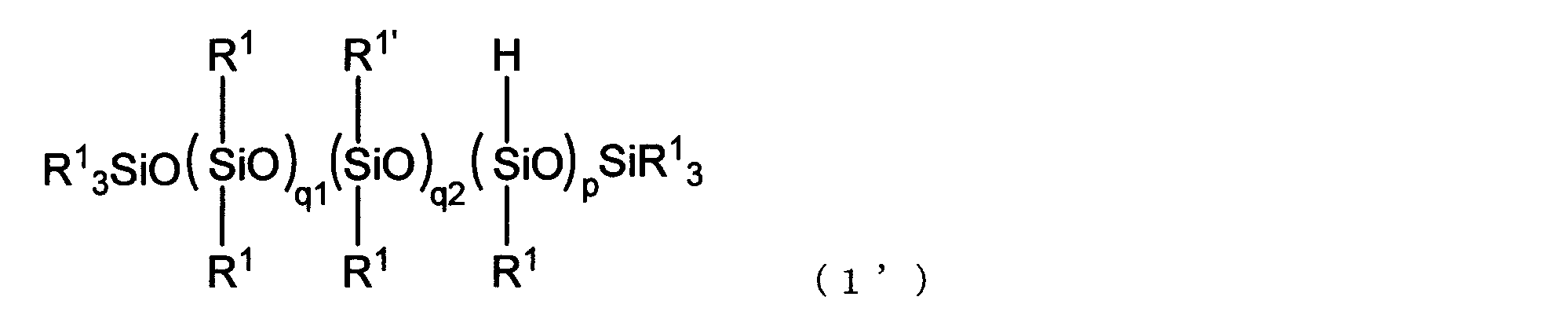
- (A-1) organohydrogenpolysiloxane is represented by the following formula (1').
- R 1′ is a monovalent aliphatic saturated hydrocarbon group having 6 to 30 carbon atoms.
- R 1 is a substituent of R 1 described above other than R 1′ , preferably an alkyl group having 1 to 6 carbon atoms, more preferably a methyl group.
- q1 and q2 are integers of 1 or more, p is an integer of 2 or more, and q1, q2, and p are such that the viscosity of the organohydrogenpolysiloxane is 100,000 mm 2 /s or less, preferably 10,000 mm 2 /s or less, and an integer equal to or greater than 0.4 mm 2 /s, preferably 2 mm 2 /s or greater.
- q2 is an integer such that the number of R 1' accounts for 5 to 70%, preferably 8 to 60%, of the total number of all substituents (R 1 and R 1' ) bonded to silicon atoms.
- q1 is preferably an integer of 1 to 60, more preferably an integer of 10 to 50
- q2 is preferably an integer of 1 to 50, more preferably an integer of 5 to 30
- p is preferably an integer of 2 to 20 It is an integer, more preferably an integer from 3 to 10.
- the bonding order of the siloxane units is not limited to the above, and may be random or may form block units.
- Component (A-2) preferably has the average compositional formula (2): R 2 c R 3 d SiO (4-cd)/2 (2) (wherein R 2 is each independently an unsubstituted or substituted monovalent hydrocarbon group having 1 to 30 carbon atoms and having no aliphatic unsaturated bond; and R 3 is each independently , is a monovalent olefin hydrocarbon group having 2 to 6 carbon atoms, and c and d are positive numbers satisfying 0 ⁇ c ⁇ 3, 0 ⁇ d ⁇ 3 and 0.1 ⁇ c+d ⁇ 3) is an organopolysiloxane having two or more monovalent olefinic hydrocarbon groups in one molecule.
- One of the organopolysiloxanes represented by the average compositional formula (2) may be used alone, or two or more may be used in combination.
- c and d are positive numbers that preferably satisfy 0 ⁇ c ⁇ 2.295, 0.005 ⁇ d ⁇ 2.3, and 0.5 ⁇ c+d ⁇ 2.3.
- R 2 above is an unsubstituted or substituted monovalent hydrocarbon group having no aliphatic unsaturated bonds and having 1 to 30 carbon atoms, preferably 1 to 22 carbon atoms, more preferably 1 to 18 carbon atoms.
- R 2 above include the groups exemplified for R 1 above.
- all substituents bonded to silicon atoms that is, R 1 in formula (1) or R 2 and R in formula (2) 5 to 70%, preferably 8 to 60 mol%, of the total number of 3
- R 1 in formula (1) or R 2 and R in formula (2) 5 to 70%, preferably 8 to 60 mol%, of the total number of 3
- It is an aliphatic saturated hydrocarbon group.
- the ratio of the long-chain monovalent saturated aliphatic hydrocarbon group is less than the above lower limit, the absorption of the oily substance tends to decrease.
- the reactivity between the hydrogenpolysiloxane and the organopolysiloxane having an olefinic hydrocarbon group of the component (A-2) tends to decrease, and the rubber hardness of the resulting cured product tends to decrease.
- R 3 above is independently a monovalent olefinic hydrocarbon group having 2 to 6 carbon atoms.
- R 3 include alkenyl groups having 2 to 6 carbon atoms such as vinyl group, allyl group, propenyl group, butenyl group, pentenyl group and hexenyl group. Industrially, it is preferably a vinyl group.
- the viscosity of component (A-2) is preferably 100,000 mm 2 /s or less, more preferably 10,000 mm 2 /s or less. When the viscosity is 100,000 mm 2 /s or less, it is particularly easy to obtain silicone microparticles with a narrow particle size distribution by the production method described below. Although the lower limit of the viscosity is not particularly limited, the viscosity may be practically 0.7 mm 2 /s or more, particularly 2 mm 2 /s or more.
- the structure of (A-2) organopolysiloxane may be linear, cyclic, or branched, but linear is particularly preferred.
- the bonding site of the olefinic hydrocarbon group is not particularly limited, and it may be bonded to either the side chain or the terminal silicon atom. Especially preferred.
- (A-2) organopolysiloxane is represented by the following formula (2').
- R 1′ is a monovalent aliphatic saturated hydrocarbon group having 6 to 30 carbon atoms.
- R 2 is a substituent of R 2 described above other than R 1′ , preferably an alkyl group having 1 to 6 carbon atoms, more preferably a methyl group.
- R 3 is as described above, preferably an alkenyl group having 2 to 6 carbon atoms, more preferably a vinyl group.
- n1 is an integer of 1 or more
- n2 is an integer of 0 or more
- m is an integer of 0 or more
- k1 and k2 are each an integer of 0 to 3, provided that m+k1+k2 is an integer of 2 or more.
- both k1 and k2 are one.
- n1, q2, and m are such that the viscosity of the organopolysiloxane is 100,000 mm 2 /s or less, preferably 10,000 mm 2 /s or less, and 0.4 mm 2 /s or more, preferably 2 mm 2 /s or more.
- n2 is preferably an integer such that the number of R 1' accounts for 5 to 70%, preferably 8 to 60% of the total number of all substituents (R 2 and R 1' ) bonded to the silicon atom. It's good. n1 is preferably an integer of 1-40, more preferably an integer of 5-30. n2 is preferably an integer of 0-50, more preferably an integer of 0 or 1-20. m is preferably an integer of 0-10, more preferably an integer of 0 or 1-5. In the present invention, the bonding order of the siloxane units is not limited to the above, and may be random or may form block units.
- the substituents other than the monovalent saturated aliphatic hydrocarbon group having 6 to 30 carbon atoms (R 1′ ) are methyl groups.
- Both the component (A-1) and the component (A-2) may have monovalent saturated aliphatic hydrocarbon groups (R 1′ ) having 6 to 30 carbon atoms in the proportions described above.
- either one of the component (A-1) and the component (A-2) is a silicon-bonded monovalent hydrocarbon group having 6 to 30 carbon atoms, which is a fully substituted silicon-bonded It has 5 to 70%, preferably 8 to 60%, of the total number of groups.
- the component (A-1) contains 5 monovalent saturated aliphatic hydrocarbon groups having 6 to 30 carbon atoms bonded to silicon atoms, relative to the total number of all substituents bonded to silicon atoms. It should be between ⁇ 70%, preferably 8-60%.
- (A-1) is an organohydrogenpolysiloxane having two or more silicon-bonded hydrogen atoms in one molecule
- (A-2) is a monovalent olefinic hydrocarbon in one molecule. It is an organopolysiloxane having two or more groups.
- the combination of the (A-1) organohydrogenpolysiloxane having only two SiH groups and the (A-2) organopolysiloxane having only two olefinic hydrocarbon groups is excluded.
- a combination of an organohydrogensiloxane having two SiH groups as component (A-1) and an organopolysiloxane having two olefinic hydrocarbon groups as component (A-2) results in a sticky cured product. This is because silicone rubber cannot be obtained. That is, when the (A-1) component has two SiH groups, at least one of the (A-2) components is an organosiloxane having three or more olefinic hydrocarbon groups, and the (A-2) When the component has two olefinic hydrocarbon groups, at least one component (A-1) is an organohydrogensiloxane having three or more SiH groups.
- the amount of component (A-2) relative to component (A-1) is such that the ratio of the number of monovalent olefinic hydrocarbon groups in component (A-2) to one SiH group in component (A-1) is 0.00.
- the amount is 5 to 2, preferably 0.7 to 1.5. If component (A-2) is blended in such an amount that the number ratio of monovalent olefin hydrocarbon groups is less than the above lower limit value or more than the above upper limit value, the resulting silicone rubber cured product tends to be sticky, and reaction It tends to be too active.
- the platinum group metal-based catalyst is a catalyst for promoting the addition reaction between the SiH groups in the component (A-1) and the monovalent olefinic hydrocarbon groups in the component (A-2).
- Component (A-3) may be used alone or in combination of two or more.
- Component (A-3) includes well-known catalysts used in hydrosilylation reactions.
- simple platinum group metals such as platinum (including platinum black ), rhodium , and palladium ; O, Na 2 PtCl 6 ⁇ kH 2 O, K 2 PtCl 4 ⁇ kH 2 O, PtCl 4 ⁇ kH 2 O, PtCl 2 , Na 2 HPtCl 4 ⁇ kH 2 O (where k is 0 to 6).
- platinum chloride, chloroplatinic acid and chloroplatinates such as integers, preferably 0 or 6; alcohol-modified chloroplatinic acid (see U.S. Pat. No.
- the amount of component (A-3) may be an effective amount as a hydrosilylation reaction catalyst, and the amount of platinum group metal in component (A-3) with respect to the total amount of the composition is usually 0.1 in terms of mass.
- the amount is about 500 ppm, preferably about 0.5 to 200 ppm, more preferably about 1 to 100 ppm.
- silicone oil, organosilane, inorganic powder, organic powder, antioxidant, etc. may be contained in the (A) component silicone rubber particles.
- the amount of component (A) is 5-80% by mass, preferably 20-70% by mass, more preferably 40-60% by mass, based on the total mass of the aqueous dispersion. If it is less than the above lower limit, the productivity per component (A) will be low, and the amount of water dispersion added to the cosmetic will increase, which is inefficient and not preferred. On the other hand, when the amount is more than the above upper limit, the viscosity of the aqueous dispersion becomes high and handling becomes difficult.
- Surfactant functions as a dispersant for silicone rubber particles in aqueous dispersions and cosmetics. In addition, as will be described later, it also functions as an emulsifier for liquid silicone in the production of an aqueous dispersion of silicone rubber particles.
- Component (B) is not particularly limited, and may be any of nonionic surfactants, anionic surfactants, cationic surfactants and amphoteric surfactants, either alone or in combination of two or more. They can be used in combination as appropriate.
- nonionic surfactants include polyoxyethylene alkyl ethers, polyoxyethylene polyoxypropylene alkyl ethers, polyoxyethylene alkylphenyl ethers, polyethylene glycol fatty acid esters, sorbitan fatty acid esters, polyoxyethylene sorbitan fatty acid esters, poly Oxyethylene sorbitol fatty acid ester, glycerin fatty acid ester, polyoxyethylene glycerin fatty acid ester, polyglycerin fatty acid ester, propylene glycol fatty acid ester, polyoxyethylene castor oil, polyoxyethylene hydrogenated castor oil, polyoxyethylene hydrogenated castor oil fatty acid ester, poly Oxyethylene alkylamine, polyoxyethylene fatty acid amide, polyoxyethylene-modified organopolysiloxane, polyoxyethylenepolyoxypropylene-modified organopolysiloxane, and the like.
- anionic surfactants include alkyl sulfates such as sodium lauryl sulfate, polyoxyethylene alkyl ether sulfates, polyoxyethylene alkylphenyl ether sulfates, fatty acid alkylolamide sulfates, and alkylbenzene sulfones.
- Cationic surfactants include alkyltrimethylammonium salts, dialkyldimethylammonium salts, polyoxyethylenealkyldimethylammonium salts, dipolyoxyethylenealkylmethylammonium salts, tripolyoxyethylenealkylammonium salts, alkylbenzyldimethylammonium salts, alkylpyri dium salts, monoalkylamine salts, monoalkylamidoamine salts and the like.
- Amphoteric surfactants include alkyldimethylamine oxide, alkyldimethylcarboxybetaine, alkylamidopropyldimethylcarboxybetaine, alkylhydroxysulfobetaine, alkylcarboxymethylhydroxyethylimidazolinium betaine, and the like.
- the amount of component (B) is 0.01 to 15% by mass, preferably 0.1 to 10% by mass, more preferably 0.5 to 5% by mass, relative to the total mass of the aqueous dispersion. If it is less than 0.01% by mass, the liquid silicone cannot be emulsified in the production stage, and it becomes difficult to obtain particles with a narrow distribution. In addition, the stability of the aqueous dispersion may deteriorate. On the other hand, even if it exceeds 15% by mass, it is not preferable because the water-dispersibility of the silicone rubber particles is not improved and there is a possibility that the irritation to the skin may increase.
- (C) Water Water is a dispersion medium for the silicone rubber particles (A).
- the amount of component (C) is 19-94% by weight, preferably 30-80% by weight, based on the total weight of the aqueous dispersion.
- aqueous dispersion of silicone rubber particles can be produced by a known method. For example, (B) surfactant and (C) water are added to a mixed solution of (A-1) organohydrogenpolysiloxane and (A-2) organopolysiloxane having an olefinic hydrocarbon group to emulsify. (A-3) a platinum group metal-based catalyst is added to conduct the addition reaction.
- a general emulsifying disperser may be used, examples of which include a high-speed rotating centrifugal radial stirrer such as Homodisper; a high-speed rotating shearing stirrer such as Homomixer; and a high-pressure injection emulsifier such as a homogenizer. Disperser; colloid mill; ultrasonic emulsifier and the like.
- (A-3) When the platinum group metal-based catalyst has poor dispersibility in water, it is preferable to add it to the emulsion in a state dissolved in (B) a surfactant.
- the addition reaction may be carried out at room temperature (1 to 30°C), but if the reaction is not completed, it may be carried out under heating below 100°C.
- the present invention further provides a cosmetic containing an aqueous dispersion of silicone rubber particles.
- the aqueous dispersion of the present invention can be blended into various cosmetics.
- it is preferably used in cosmetics for external application to the skin and hair, such as skin care products, make-up products, hair products, antiperspirant products, and UV protection products.
- the blending amount of the aqueous dispersion is not particularly limited, and may be appropriately selected according to each formulation.
- the weight of the aqueous dispersion of silicone rubber particles is preferably in the range of 0.1 to 50% by weight with respect to the entire cosmetic composition.
- the cosmetic can contain various ingredients that are commonly used in cosmetics as long as they do not impair the effects of the present invention.
- the (A) silicone rubber particles can be taken out by drying the aqueous dispersion of the present invention by spray drying or the like.
- the (A) silicone rubber particles, (B) surfactant, and (C) water may be separately blended into the cosmetic, but (A) silicone rubber particles, (B) surfactant, and It is preferable to blend (C) as an aqueous dispersion containing water into the cosmetic from the viewpoint of feeling of use and dispersibility, and it is preferable because the step of drying up component (A) and the step of redispersing are unnecessary. .
- the cosmetic of the present invention can contain, as other ingredients, various ingredients that are commonly used in cosmetics.
- Other components include, for example, (1) an aqueous component, (2) an oil agent, (3) powders other than component (A), (4) surfactants other than component (B), and (5) crosslinked organo It may contain polysiloxane, (6) a coating agent, and (7) other additives. These can be used individually by 1 type or in combination of 2 or more types as appropriate. These components are appropriately selected and used according to the type of cosmetic, etc., and the blending amount thereof can be a known blending amount according to the type of cosmetic, etc.
- Aqueous component is not particularly limited as long as it is an aqueous component that can be usually blended in cosmetics.
- cosmetics For example, water, lower alcohols such as ethanol, sugar alcohols such as erythritol, maltitol, xylitol, and sorbitol, polyphenols such as BG (butylene glycol), glycerin, PG (propylene glycol), DPG (dipropylene glycol), and pentylene glycol.
- Hydric alcohols, trimethylglycine, humectants such as pyrrolidone carboxylates, plant extracts, and the like can be mentioned, and can be used singly or in combination of two or more.
- the blending amount is preferably 0.1 to 90% by mass in the cosmetic.
- the cosmetic of the present invention may contain an oil agent.
- Oils may be volatile or non-volatile, and may be solid, semi-solid, or liquid at room temperature. Ester oils, fluorine-based oils, ultraviolet absorbers, and the like can be mentioned.
- the amount of the oil agent to be blended is not particularly limited, but is preferably 1 to 95% by mass, more preferably 15 to 40% by mass, based on the total cosmetic composition.
- Silicone oil includes, for example, dimethylpolysiloxane (manufactured by Shin-Etsu Chemical Co., Ltd.: KF-96L-1cs, KF-96L-1.5cs, KF-96L-2cs, etc.), octamethyltetrasiloxane (D4 ), decamethylpentasiloxane (D5) (manufactured by Shin-Etsu Chemical Co., Ltd.: KF-995), dodecamethylhexasiloxane (D6), trimethylsiloxymethylsilane (manufactured by Shin-Etsu Chemical Co., Ltd.: TMF-1.5 ), caprylyl methicone, phenyl trimethicone, methylphenylpolysiloxane (manufactured by Shin-Etsu Chemical Co., Ltd.: KF-54, KF-54HV), diphenylsiloxyphenyl trim
- Low to high viscosity linear or branched organopolysiloxanes such as , methylhexylpolysiloxane, methylhydrogenpolysiloxane, dimethylsiloxane-methylphenylsiloxane copolymer, amino-modified organopolysiloxane, pyrrolidone-modified organopolysiloxane , pyrrolidonecarboxylic acid-modified organopolysiloxane, high degree of polymerization gum-like dimethylpolysiloxane, gum-like amino-modified organopolysiloxane, silicone rubber such as gum-like dimethylsiloxane/methylphenylsiloxane copolymer, and silicone gum and rubber Examples include cyclic organopolysiloxane solutions, amino acid-modified silicones, fluorine-modified silicones, silicone resins, and silicone resin melts.
- Solid oily component in the present invention, when it is desired to solidify the cosmetic, it is preferable to blend a wax, a hydrocarbon, an ester, a higher alcohol, or a higher fatty acid that is solid at 25°C.
- the oily component that is solid at 25°C preferably has a melting point of 40°C or higher, more preferably 60 to 110°C, and includes waxes, hydrocarbons, esters, higher alcohols and higher fatty acids. There is no particular limitation as long as it is a raw material that can be incorporated into cosmetics.
- vegetable waxes such as carnauba wax, candelilla wax, rice wax and wood wax, animal waxes such as beeswax and whale wax, hydrocarbon waxes such as solid paraffin, polyethylene, ceresin, ozokerite and microcrystalline wax.
- higher alcohols such as stearyl alcohol, behenyl alcohol, and cetanol; fatty acids such as stearic acid and behenic acid; -Silicone graft copolymers: KP-561P, 562P, etc.), or derivatives thereof, preferably one or more selected from these.
- Natural animal and vegetable oils and semi-synthetic oils and fats include avocado oil, linseed oil, almond oil, ivory wax, enno oil, olive oil, cocoa butter, kapok wax, kaya oil, carnauba wax, cod liver oil, candelilla Wax, Refined candelilla wax, Beef tallow, Beef leg fat, Beef bone fat, Hydrogenated beef tallow, Kyonin oil, Whale wax, Hydrogenated oil, Wheat germ oil, Sesame oil, Rice germ oil, Rice bran oil, Sugarcane wax, Camellia oil, Safflower oil, shea butter, cinnamon oil, cinnamon oil, jojoba wax, squalane, squalene, shellac wax, turtle oil, soybean oil, tea seed oil, camellia oil, evening primrose oil, corn oil, lard, rapeseed oil, Japanese pear oil, bran wax , germ oil, horse fat,
- Liquid oil components include hydrocarbon oils, higher fatty acids, higher alcohols, esters, silicone oils, and fluorine-based oils.
- hydrocarbon oil examples include linear or branched hydrocarbon oils, and they may be volatile or non-volatile. Specific examples include ⁇ -olefin oligomer, light isoparaffin, isododecane, isohexadecane, light liquid isoparaffin, squalane, synthetic squalane, vegetable squalane, squalene, liquid paraffin, liquid isoparaffin, polyisobutylene, hydrogenated polyisobutene, petrolatum, and the like. be done.
- Higher fatty acids include oleic acid, linoleic acid, linolenic acid, arachidonic acid, eicosapentaenoic acid (EPA), docosahexaenoic acid (DHA), isostearic acid, and 12-hydroxystearic acid.
- Higher alcohols include, for example, alcohols preferably having 6 or more carbon atoms. Specific examples of higher alcohols include oleyl alcohol, isostearyl alcohol, 2-decyltetradecinol, cholesterol, phytosterol, polyoxyethylene cholesterol ether, monostearyl glycerin ether (bacyl alcohol), and monooleyl glyceryl ether (serachyl alcohol). etc.
- Esters such as diisobutyl adipate, 2-hexyldecyl adipate, di-2-heptylundecyl adipate, N-alkyl glycol monoisostearate, isocetyl isostearate, trimethylolpropane triisostearate, di-2- Ethylene glycol ethylhexanoate, cetyl 2-ethylhexanoate, trimethylolpropane tri-2-ethylhexanoate, pentaerythritol tetra-2-ethylhexanoate, cetyl octanoate, octyldodecyl gum ester, oleyl oleate, octyl oleate Dodecyl, decyl oleate, neopentyl glycol dioctoate, neopentyl glycol dicaprate, triethy
- Fluorine-based oils examples include perfluoropolyether, perfluorodecalin, and perfluorooctane.
- UV absorbers include homomenthyl salicylate, octocrylene, 4-tert-butyl-4′-methoxydibenzoylmethane, 4-(2- ⁇ -glucopyranosiloxy)propoxy-2-hydroxybenzophenone, and octyl salicylate.
- a UVA absorber eg, hexyl diethylaminohydroxybenzoylbenzoate, etc.
- a UVB absorber eg, ethylhexyl methoxycinnamate, etc.
- a component (A) that does not absorb oil or a volatile oil.
- hydrocarbon oil, ester oil, or the like which is a sebum-like component, is blended, the amount of sebum that can be absorbed may decrease.
- a non-volatile hydrocarbon oil or ester oil is blended, it is preferably 100% or less, preferably 80% or less, more preferably 50% or less, and most preferably not blended with respect to the blending amount of component (A). .
- the powder is not particularly limited as long as it is a raw material that can be usually blended in cosmetics, and examples thereof include pigments and spherical silicone powders.
- the amount of powder to be blended is not particularly limited, but it is desirable to blend 0.1 to 90% by mass, more preferably 1 to 35% by mass of the total cosmetic composition.
- Coloring pigments include red iron oxide, yellow iron oxide, white titanium oxide, black iron oxide, iron oxide, iron oxide, iron oxide, manganese violet, cobalt violet, chromium hydroxide, chromium oxide, cobalt oxide, cobalt titanate, Iron oxide-doped titanium oxide, iron titanate, (titanium/titanium oxide) baked product, titanate (Li/cobalt), cobalt titanate, titanium nitride, iron hydroxide, inorganic brown pigments such as ⁇ -iron oxide, ocher Inorganic yellow pigments such as, tar pigments in lakes, natural pigments in lakes, and other colored pigments can be used.
- the pigment according to the present invention may be partially or wholly surface-treated with an inorganic compound such as alumina, aluminum hydroxide, silica, or hydrous silica.
- an inorganic compound such as alumina, aluminum hydroxide, silica, or hydrous silica.
- the coloring pigment may be hydrophobized.
- the hydrophobizing treatment means surface-treating the color pigment with a hydrophobizing agent.
- the surface-hydrophobicizing agent for the colored pigment according to the present invention is not particularly limited as long as it can impart hydrophobicity, and includes silicone treating agents, waxes, paraffins, organic fluorine compounds such as perfluoroalkyls and phosphates, Treatment agents include surfactants, amino acids such as N-acylglutamic acid, and metal soaps such as aluminum stearate and magnesium myristate.
- the above surface hydrophobizing agents may be used alone or in combination of two or more.
- color pigments subjected to hydrophobic surface treatment include the KTP-09 series, particularly KTP-09W, 09R, 09Y, 09B, etc. (manufactured by Shin-Etsu Chemical Co., Ltd.).
- Inorganic powders include zirconium oxide, zinc oxide, cerium oxide, magnesium oxide, barium sulfate, calcium sulfate, magnesium sulfate, calcium carbonate, magnesium carbonate, talc, cleaved talc, mica, kaolin, sericite, white clouds.
- Microparticles consisting of Examples of inorganic colored pearl pigments include pearl pigments such as titanium oxide-coated mica, bismuth oxychloride, titanium oxide-coated bismuth oxychloride, titanium oxide-coated talc, fish scale foil, and titanium oxide-coated colored mica.
- the fine particle metal oxide is one or more selected from fine particle titanium oxide, fine particle iron-containing titanium oxide, fine particle zinc oxide, fine particle cerium oxide, and composites thereof. These metal oxides may be composite powders with other powders.
- the average primary particle size is preferably 1 nm or more and 200 nm or less, more preferably 120 nm or less. If the particle size is larger than this, the UV protective function will be lowered, resulting in a white residue. Incidentally, the average temporary particle size can be measured by a transmission electron micrograph or the like.
- the above fine particle metal oxide is not particularly limited whether it is untreated or has been subjected to a known surface treatment used in cosmetics. Furthermore, a dispersion preliminarily dispersed with a volatile oil agent or ester oil may be used. Specific examples of dispersions include SPD series, particularly SPD-T5, SPD-T5L, SPD-T6, SPD-T7, SPD-Z5, SPD-Z5L (manufactured by Shin-Etsu Chemical Co., Ltd.).
- metal powder examples include fine metal particles made of aluminum, copper, stainless steel, silver, and the like.
- Organic powder examples include silicone, polyamide, polyacrylic acid/acrylic acid ester, polyester, polyethylene, polypropylene, polystyrene, styrene/acrylic acid copolymer, divinylbenzene/styrene copolymer, polyurethane, Powder consisting of vinyl resin, urea resin, melamine resin, benzoguanamine, polymethylbenzoguanamine, tetrafluoroethylene, polymethyl methacrylate (e.g., polymethyl methacrylate), cellulose, silk, nylon, phenol resin, epoxy resin, polycarbonate, etc. is mentioned.
- silicone silicone resin particles (specific examples: KMP-590, 591, 592, etc.
- silicone resin-coated silicone rubber powder (specific examples include Shin-Etsu Chemical Co., Ltd. ): KSP-100, 101, 102, 105, 300, 411, 441, etc.), which may be previously dispersed in water or oil.
- Metal soaps are also included, and specific examples include zinc stearate, aluminum stearate, calcium stearate, magnesium stearate, zinc myristate, magnesium myristate, zinc cetylphosphate, calcium cetylphosphate, zinc sodium cetylphosphate, and the like. powders.
- organic dyes and the like are also included, and specific examples include Red No. 3, Red No. 104, Red No. 106, Red No.
- inorganic/Organic Composite Powder examples include composite powder in which the surface of an inorganic powder is coated with an organic powder by a publicly known method.
- the above-mentioned powder can also be used after the particle surface has been treated.
- the surface treatment agent is preferably one that can impart hydrophobicity from the viewpoint of water resistance of the cosmetic, and the treatment agent that imparts hydrophobicity is not particularly limited, and silicone treatment agents, waxes, paraffins, Treatment agents include organic fluorine compounds such as perfluoroalkyls and phosphates, surfactants, amino acids such as N-acylglutamic acid, and metal soaps such as aluminum stearate and magnesium myristate.
- a silicone treatment agent such as caprylsilane (manufactured by Shin-Etsu Chemical Co., Ltd.: AES-3083), or silanes such as trimethoxysilyl dimethicone or a silylating agent, dimethyl silicone (manufactured by Shin-Etsu Chemical Co., Ltd.: KF-96A series), methyl hydrogen-type polysiloxane (manufactured by Shin-Etsu Chemical Co., Ltd.: KF-99P, KF-9901, etc.), silicone branched silicone treatment agent (manufactured by Shin-Etsu Chemical Co., Ltd.: KF-9908, KF-9909, etc.), acrylic silicone (manufactured by Shin-Etsu Chemical Co., Ltd.: KP-574, KP-541), and the like.
- the above surface hydrophobizing agents may be used singly or in combination of two or more.
- Surfactants other than component (B) include nonionic, anionic, cationic and amphoteric surfactants, but are not particularly limited and can be used in ordinary cosmetics. can be used.
- these surfactants partially crosslinked polyether-modified silicone, partially crosslinked polyglycerin-modified silicone, linear or branched polyoxyethylene-modified organopolysiloxane, linear or branched polyoxyethylene polyoxypropylene-modified organo Polysiloxane, linear or branched polyoxyethylene/alkyl co-modified organopolysiloxane, linear or branched polyoxyethylene polyoxypropylene/alkyl co-modified organopolysiloxane, linear or branched polyglycerin-modified organopolysiloxane, A linear or branched polyglycerin/alkyl co-modified organopolysiloxane and a linear or branched pyrrolidone-modified organo
- the content of hydrophilic polyoxyethylene groups, polyoxyethylene-polyoxypropylene groups or polyglycerin residues preferably accounts for 10 to 70% by mass in the molecule.
- the crosslinked organopolysiloxane in a composition comprising the crosslinked organopolysiloxane and an oil that is liquid at room temperature, the crosslinked organopolysiloxane is a liquid oil.
- fluorine-based oils such as liquid silicone, hydrocarbon oil, ester oil, natural animal and vegetable oil, and semi - synthetic oil can be used in the oil agent of the optional component.
- s (25°C) low viscosity silicone hydrocarbon oils such as liquid paraffin, squalane, isododecane, isohexadecane, glyceride oils such as trioctanoin, esters such as isotridecyl isononanoate, N-acylglutamate, lauroyl sarcosinate Oil, natural animal and vegetable oils such as macadamia nut oil.
- Specific examples include KSG-210, 240, 310, 320, 330, 340, 320Z, 350Z, 710, 810, 820, 830, 840, 820Z, and 850Z manufactured by Shin-Etsu Chemical Co., Ltd.
- Specific examples of surfactants that are not crosslinked organopolysiloxanes include KF-6011, 6013, 6043, 6017, 6028, 6038, 6048, 6100, 6104, 6105, 6106 manufactured by Shin-Etsu Chemical Co., Ltd. be done. In any case, the blending amount of the surfactant is preferably 0.1 to 20% by mass of the total cosmetic composition.
- the dispersing and emulsifying functions can be sufficiently achieved, and if it is 20% by mass or less, the cosmetic does not give a sticky feeling when used, which is preferable.
- the HLB of the surfactant is not limited, but preferably 2 to 14.5 for the purpose of maintaining the water resistance of the cosmetic.
- crosslinked Organopolysiloxane is not particularly limited as long as it is commonly used in cosmetics, and may be used alone or in combination of two or more.
- This crosslinked organopolysiloxane does not have a spherical shape, unlike the silicone powder and component (A) described in (3) above. Further, unlike the surfactant (4) above, it is a compound that does not have a polyether or polyglycerin structure in its molecular structure. (2) It is an elastomer having structural viscosity by being swollen with an oil agent.
- the coating agent is not particularly limited as long as it is a raw material that can be usually blended in cosmetics.
- cellulose derivatives such as alkylcellulose and nitrocellulose, siliconized polysaccharide compounds such as tri(trimethylsiloxy)silylpropylcarbamate pullulan, acrylic-silicone graft copolymers such as (alkyl acrylate/dimethicone) copolymer, trimethylsiloxysilicate Silicone resins such as acids, silicone-based resins such as silicone-modified polynorbornene, fluorine-modified silicone resins, fluorine-based resins, aromatic hydrocarbon resins, polymer emulsion resins, terpene-based resins, polybutene, polyisoprene, alkyd resins, polyvinylpyrrolidone-modified Polymers, rosin-modified resins, polyurethanes, and the like are used.
- silicone-based coating agents are particularly preferred, and among them, tri(trimethylsiloxy)silylpropylcarbamate pullulan [as a commercially available product dissolved in a solvent, manufactured by Shin-Etsu Chemical Co., Ltd.: TSPL-30-D5] , ID], (alkyl acrylate / dimethicone) copolymer [as a commercially available product dissolved in a solvent, manufactured by Shin-Etsu Chemical Co., Ltd.: KP-543, 545, 549, 550, 545L, etc.] and trimethyl Siloxysilicic acid [as a commercially available product dissolved in a solvent, manufactured by Shin-Etsu Chemical Co., Ltd.: KF-7312J, X-21-5250, etc.] and silicone-modified polynorbornene [as a commercially available product dissolved in a solvent NBN-30-ID manufactured by Shin-Etsu Chemical Co., Ltd.] and organo
- additives include oil-soluble gelling agents, water-soluble thickeners, antiperspirants, preservatives/bactericides, fragrances, salts, antioxidants, pH adjusters, and chelating agents. , cooling agents, anti-inflammatory agents, skin-beautifying ingredients (whitening agents, cell activators, rough skin improvers, blood circulation promoters, skin astringents, antiseborrheic agents, etc.), vitamins, amino acids, water-soluble polymer compounds, Fibers, clathrate compounds and the like can be mentioned.
- Oil-soluble gelling agents include metal soaps such as aluminum stearate, magnesium stearate and zinc myristate; amino acids such as N-lauroyl-L-glutamic acid and ⁇ , ⁇ -di-n-butylamine Derivatives; dextrin fatty acid esters such as dextrin palmitate, dextrin stearate, dextrin 2-ethylhexanoate palmitate; sucrose fatty acid esters such as sucrose palmitate and sucrose stearate; fructooligosaccharide stearate , fructo-oligosaccharide fatty acid esters such as 2-ethylhexanoic acid ester; benzylidene derivatives of sorbitol such as monobenzylidene sorbitol and dibenzylidene sorbitol; etc.
- metal soaps such as aluminum stearate, magnesium stearate and zinc myristate
- amino acids such as N-lauroyl
- Water-soluble thickeners include gum arabic, tragacanth, galactan, carob gum, guar gum, karaya gum, carrageenan, pectin, agar, quince seed (quince), starch (rice, corn, potato, wheat, etc.), Plant-based polymers such as algae colloid, tranto gum and locust bean gum Microbial-based polymers such as xanthan gum, dextran, succinoglucan and pullulan Animal-based polymers such as collagen, casein, albumin and gelatin Carboxymethyl starch, methyl Starch polymers such as hydroxypropyl starch, methylcellulose, ethylcellulose, methylhydroxypropylcellulose, carboxymethylcellulose, hydroxymethylcellulose, hydroxypropylcellulose, nitrocellulose, sodium cellulose sulfate, sodium carboxymethylcellulose, crystalline cellulose, cationized cellulose, cellulose powder Cellulose-based polymers, alginic acid-based polymers such as sodium al
- plant-based polymers preferably, plant-based polymers, microbial-based polymers, animal-based polymers, starch-based polymers, cellulose-based polymers, alginic acid-based polymers, polyoxyethylene-polyoxypropylene copolymer-based polymers, acrylic-based polymers, and One or more water-soluble thickeners selected from inorganic water-soluble polymers are preferably used.
- Antiperspirants include chlorohydroxyaluminum, aluminum hydroxyhalides such as allantoin chlorohydroxyaluminum, aluminum halides such as aluminum chloride, allantoin aluminum salt, tannic acid, persimmon tannin, aluminum potassium sulfate, zinc oxide, para zinc phenolsulfonate, baked alum, tetrachloro(Al/zirconium) hydrate, trichlorohydrex glycine (Al/zirconium), and the like.
- aluminum hydroxyhalides, aluminum halides, and complexes or mixtures thereof with zirconyl oxyhalides and zirconyl hydroxyhalides e.g., tetrachloro (Al/zirconium) hydrate, Trichlorohydrex glycine (Al/zirconium)
- zirconyl oxyhalides and zirconyl hydroxyhalides e.g., tetrachloro (Al/zirconium) hydrate, Trichlorohydrex glycine (Al/zirconium)
- Preservatives and bactericides include parahydroxybenzoic acid alkyl ester, benzoic acid, sodium benzoate, sorbic acid, potassium sorbate, phenoxyethanol, imidazolidinyl urea, salicylic acid, isopropylmethylphenol, carbolic acid, para Chlormetacresol, hexachlorophene, benzalkonium chloride, chlorhexidine chloride, trichlorocarbanilide, iodopropynyl butylcarbamate, polylysine, photosensitive element, silver, plant extracts, and the like.
- Fragrance Flavors include natural fragrances and synthetic fragrances. Natural fragrances include vegetable fragrances isolated from flowers, leaves, wood, pericarp, etc., and animal fragrances such as musk and civet. Synthetic fragrances include hydrocarbons such as monoterpenes, alcohols such as aliphatic alcohols and aromatic alcohols, aldehydes such as terpene aldehydes and aromatic aldehydes, ketones such as alicyclic ketones, and esters such as terpene esters. lactones, phenols, oxides, nitrogen-containing compounds, acetals and the like.
- Salts include inorganic salts, organic acid salts, amine salts and amino acid salts.
- inorganic salts include sodium salts, potassium salts, magnesium salts, calcium salts, aluminum salts, zirconium salts and zinc salts of inorganic acids such as hydrochloric acid, sulfuric acid, carbonic acid and nitric acid.
- organic acid salts include salts of organic acids such as acetic acid, dehydroacetic acid, citric acid, malic acid, succinic acid, ascorbic acid and stearic acid.
- Amine salts and amino acid salts include, for example, salts of amines such as triethanolamine, salts of amino acids such as glutamic acid, and the like.
- salts of hyaluronic acid, chondroitin sulfate, etc., and acid-alkali neutralized salts used in formulations can also be used.
- Antioxidant Antioxidants are not particularly limited, but examples include carotenoids, ascorbic acid and salts thereof, ascorbyl stearate, tocopherol, tocophenol acetate, tocopherol, pt-butylphenol, butylhydroxyanisole, dibutylhydroxy toluene, phytic acid, ferulic acid, thiotaurine, hypotaurine, sulfites, erythorbic acid and its salts, chlorogenic acid, epicatechin, epigallocatechin, epigallocatechin gallate, apigenin, camperol, myricetin, quercetin and the like.
- pH adjuster examples include lactic acid, citric acid, glycolic acid, succinic acid, tartaric acid, dl-malic acid, potassium carbonate, sodium hydrogencarbonate and ammonium hydrogencarbonate.
- Chelating agent examples include alanine, sodium edetate, sodium polyphosphate, sodium metaphosphate, and phosphoric acid.
- Coolant Coolant includes L-menthol, camphor, and menthyl lactate.
- Anti-inflammatory agents include allantoin, glycyrrhizic acid and its salts, glycyrrhetinic acid and stearyl glycyrrhetinate, tranexamic acid, and azulene.
- Skin-beautifying ingredients include whitening agents such as placenta extract, arbutin, glutathione, and saxifrage extract; Nonylic Acid Valenylamide, Nicotinic Acid Benzyl Ester, Nicotinic Acid ⁇ -Butoxyethyl Ester, Capsaicin, Zingerone, Cantharis Tincture, Ictamol, Caffeine, Tannic Acid, ⁇ -Borneol, Tocopherol Nicotinate, Inositol Hexanicotinate, Cyclanderate, Blood circulation promoters such as cinnarizine, tolazoline, acetylcholine, verapamil, cepharanthine, ⁇ -oryzanol, skin astringents, antiseborrheic agents such as sulfur, thianthrol and the like.
- Nonylic Acid Valenylamide Nicotinic Acid Benzyl Ester, Nicotinic Acid ⁇ -Butoxyethyl Este
- Vitamins include vitamin A oil, retinol, retinol acetate, retinol palmitate and other vitamin A , riboflavin, riboflavin butyrate, flavin adenine nucleotide and other vitamin B2, pyridoxine hydrochloride, pyridoxine dioctanoate , vitamin B6 such as pyridoxine tripalmitate, vitamin B12 and its derivatives, vitamin B15 and its derivatives, L - ascorbic acid, L-ascorbic acid dipalmitate, L-ascorbic acid- 2-sodium sulfate, vitamin Cs such as L-ascorbic acid diester dipotassium phosphate, vitamin Ds such as ergocalciferol and cholecalciferol, ⁇ -tocopherol, ⁇ -tocopherol, dl- ⁇ -tocopherol acetate , Vitamin E such as dl
- amino acids include glycine, valine, leucine, isoleucine, serine, threonine, phenylalanine, arginine, lysine, aspartic acid, glutamic acid, cystine, cysteine, methionine, and tryptophan.
- Nucleic acid includes deoxyribonucleic acid and the like.
- Hormones include estradiol and ethenyl estradiol.
- clathrate compound examples include cyclodextrins.
- the form of the above cosmetics may be either an emulsion system or a water system.
- an emulsified form is selected, and the emulsified form may be any form of O/W emulsion, W/O emulsion, O/W/O emulsion, and W/O/W emulsion.
- a water-based composition or a powder composition can be selected to obtain a refreshing feel, and good cosmetics can be obtained in either case.
- the term "aqueous composition” refers to a composition that does not intentionally contain an oil agent.
- a "powder composition” is a fine particle powder coated with a water phase, or a water phase coated with a powder. It is a composition that provides a fresh feeling in use. Among these, water-based compositions are preferred because they can be expected to have particularly high sebum resistance.
- the aqueous dispersion of silicone rubber particles of the present invention can be incorporated into cosmetics by various methods. For example, in the case of an emulsified composition, it is pre-mixed in the aqueous phase, mixed as a separate phase from the aqueous phase, or when blended in the internal aqueous phase, it is ejected into the external phase by making the droplets smaller. Things are mentioned.
- the aqueous dispersion of the present invention can be easily blended into an aqueous phase.
- Cosmetics in the present invention are not particularly limited, but for example lotions, serums, milky lotions, creams, hair care, foundations, makeup bases, sunscreens, concealers, cheek colors, lipsticks, glosses, balms, mascara. , eyeshadows, eyeliners, body makeup, deodorants, nail cosmetics, and various other products.
- basic cosmetics such as lotions, beauty essences, milky lotions, creams, makeup bases, and deodorants are particularly preferred.
- Various properties such as liquid, cream, solid, paste, gel, mousse, soufflé, clay, powder, and stick can be selected as the properties of the cosmetic of the present invention.
- kinematic viscosity is a value measured using a capillary viscometer at 25°C
- % representing concentration and content indicates "% by mass”.
- the amount of long-chain monovalent hydrocarbon groups % means the ratio of the number of long-chain monovalent hydrocarbon groups bonded to silicon atoms to the total number of all substituents bonded to silicon atoms.
- Example 1 400 g of an organohydrogenpolysiloxane having a long-chain monovalent hydrocarbon group content of 22.2% and a viscosity of 110 mm 2 /s, represented by the following formula (1); 114 g of methylvinylpolysiloxane represented by the following formula (2) and containing no long-chain monovalent hydrocarbon group and having a viscosity of 10 mm 2 /s A blending amount at which the number ratio of the vinyl groups of is 0.96), 0.1 g of dl- ⁇ -tocopherol was placed in a glass beaker having a capacity of 1 liter and mixed with stirring at 2,000 rpm using a homomixer.
- Example 2 400 g of an organohydrogenpolysiloxane having 10.5% long-chain monovalent hydrocarbon groups and a viscosity of 130 mm 2 /s, represented by the following formula (3); 113 g of methylvinylpolysiloxane represented by the above formula (2) and containing no long-chain monovalent hydrocarbon group and having a viscosity of 10 mm 2 /s (in methylvinylpolysiloxane for one SiH group in the organohydrogenpolysiloxane 0.91) and 0.1 g of dl- ⁇ -tocopherol were placed in a glass beaker having a volume of 1 liter and mixed with stirring at 2,000 rpm using a homomixer.
- Example 3 Having 22.2% of the long-chain monovalent hydrocarbon group represented by the above formula (1) and having a viscosity of 110 467 g of organohydrogenpolysiloxane of mm 2 /s, and 133 g of methylvinylpolysiloxane (organohydrogenpolysiloxane) having a viscosity of 10 mm 2 /s, which is represented by the above formula (2) and does not contain a long-chain monovalent hydrocarbon group.
- 0.96 of vinyl groups in methylvinylpolysiloxane to one SiH group in siloxane) and 0.1 g of dl- ⁇ -tocopherol were placed in a 1-liter glass beaker and homogenized.
- Comparative example 1 19 g of methylhydrogenpolysiloxane represented by the following formula (4) and containing no long-chain monovalent hydrocarbon group and having a viscosity of 30 mm 2 /s; 500 g of methylvinylpolysiloxane represented by the following formula (5) and containing no long-chain monovalent hydrocarbon group and having a viscosity of 580 mm 2 /s (in methylvinylpolysiloxane for one SiH group in organohydrogenpolysiloxane A blending amount at which the ratio of the number of vinyl groups in is 0.95), 0.1 g of dl- ⁇ -tocopherol was placed in a glass beaker having a capacity of 1 liter and mixed with stirring at 2,000 rpm using a homomixer.
- the obtained sheet was cut into a size of about 30 mm square to obtain a test piece.
- the test piece absorbed the oily substance and swelled.
- the mass of the test piece was measured. Table 1 shows the amount of oily substance (oil absorption) absorbed by the silicone rubber sheet per 1 g of silicone rubber.
- Examples 4-6, Comparative Examples 2-5 A gel emulsion was prepared by mixing each component according to the composition shown in Table 2 below.
- the percentage in parentheses is the concentration of silicone rubber particles in the aqueous dispersion.
- the cosmetics of the present invention were remarkably superior to those of Comparative Examples 2 to 5 in terms of feel during use, finish, adhesion, and sebum resistance. Also, even when the sebum-resistant elastomers of Comparative Examples 4 and 5 are used, the dispersibility in the aqueous phase is not favorable, and the adhesiveness is not favorable because the composition cannot be applied cleanly on the skin.
- Example 7 O/W gel ⁇ Preparation of cosmetics> A: Components 2 to 12 were uniformly mixed. B: Component 1 was added to A and emulsified to obtain an O/W gel. The resulting O/W gel was excellent in feel, finish, adhesion and sebum resistance.
- Example 8 O/W base ⁇ Preparation of cosmetics> A: Components 1 to 7 were uniformly mixed at 90°C. B: Components 8 to 13 were uniformly mixed at 85°C. C: B was added to A and emulsified. After cooling, components 14 and 15 were added and uniformly mixed to obtain a base.
- the O/W base thus obtained was excellent in usability, finish, adhesion, and sebum resistance, and was excellent in durability of the make-up cosmetic applied in layers.
- O/W sunscreen cream ⁇ Preparation of cosmetics>
- the resulting O/W sunscreen cream was excellent in feel, finish, adhesion and sebum resistance.
- O/W sunscreen cream ⁇ Preparation of cosmetics> A: Components 1 to 6 were heated to 85°C and mixed uniformly. B: Components 8 to 14 were heated to 85°C and mixed uniformly. C: B was added to A and emulsified. After cooling, component 7 was added and mixed uniformly to obtain a sunscreen. The resulting O/W sunscreen cream was excellent in feel, finish, adhesion and sebum resistance.
- W/O/W gel ⁇ Preparation of cosmetics>
- the obtained W/O/W gel was excellent in feeling of use, finish, adhesion and sebum resistance.
- Example 12 W/O eye cream ⁇ Preparation of cosmetics> A: Components 1 to 7 were uniformly mixed. B: Components 8 to 14 were uniformly mixed. C: B was added to A and emulsified to obtain an eye cream. The resulting W/O eye cream was excellent in feel, finish, adhesion and sebum resistance.
- Example 13 W/O eye cream ⁇ Preparation of cosmetics> A: Components 1 to 7 were uniformly mixed. B: Components 8 to 14 were uniformly mixed. C: B was added to A and emulsified to obtain an eye cream. The resulting W/O eye cream was excellent in feel, finish, adhesion and sebum resistance.
- Example 14 lotion ⁇ Preparation of cosmetics> A: Components 1 to 9 were uniformly mixed to obtain a lotion.
- the lotion thus obtained was excellent in usability, finish, adhesion and sebum resistance. Furthermore, by spraying the obtained lotion on top of makeup in the form of a mist or pressing it with a cotton pad, improvement in make-up floating was observed.
- Example 15 Serum ⁇ Preparation of cosmetics> A: Components 1 to 15 were uniformly mixed to obtain a beauty essence. The beauty essence obtained was excellent in usability, finish, adhesion and sebum resistance.
- Example 16 out bath treatment ⁇ Preparation of cosmetics> A: Components 1 to 7 were uniformly mixed. B: Components 8 to 14 were uniformly mixed. C: B was added to A and emulsified to obtain an eye cream. The resulting out-bath treatment was excellent in usability, finish, adhesion and sebum resistance.
- shaking foundation ⁇ Preparation of cosmetics>
- the obtained shaking foundation was excellent in feeling during use, finish, adhesion, and sebum resistance, and had good make-up durability.
- Example 18 mascara ⁇ Preparation of cosmetics> A: Components 1 to 11 were uniformly mixed at 90°C and then cooled to 70°C. B: Components 12 to 14 were uniformly mixed at 60°C. C: B was added to A, emulsified, and cooled to obtain a mascara. The obtained mascara was excellent in usability, finish, adhesion and sebum resistance, and was effective in improving panda's eyes.
- Example 19 Glight ⁇ Preparation of cosmetics> A: Components 5 and 6 were uniformly mixed. B: Components 1 to 4 were uniformly mixed. C: B was added to A and uniformly mixed to obtain a gel. It was confirmed that the glow thus obtained was excellent in finish, feeling of use and adhesion, and was excellent in glow effects such as removal of sebum.
- pack mask ⁇ Preparation of cosmetics>
Landscapes
- Health & Medical Sciences (AREA)
- Chemical & Material Sciences (AREA)
- Life Sciences & Earth Sciences (AREA)
- Organic Chemistry (AREA)
- Polymers & Plastics (AREA)
- Medicinal Chemistry (AREA)
- Chemical Kinetics & Catalysis (AREA)
- Animal Behavior & Ethology (AREA)
- Veterinary Medicine (AREA)
- Public Health (AREA)
- General Health & Medical Sciences (AREA)
- Epidemiology (AREA)
- Birds (AREA)
- Dermatology (AREA)
- Oil, Petroleum & Natural Gas (AREA)
- Dispersion Chemistry (AREA)
- Compositions Of Macromolecular Compounds (AREA)
- Cosmetics (AREA)
Abstract
Description
(A)(A-1)オルガノハイドロジェンポリシロキサンと(A-2)1価オレフィン炭化水素基含有オルガノポリシロキサンとの付加反応物であるシリコーンゴム粒子であり、前記(A-1)成分及び前記(A-2)成分の少なくとも一方が、ケイ素原子に結合する炭素原子数6~30の1価脂肪族飽和炭化水素基を、ケイ素原子に結合する全置換基の合計個数に対し5~70%の量で有することを特徴とする、前記シリコーンゴム粒子:水分散物全体の質量に対して5~80質量%
(B)界面活性剤の少なくとも1種:水分散物全体の質量に対して0.01~15質量%、及び
(C)水:水分散物全体の質量に対して19~94質量%
を含む、前記シリコーンゴム粒子の水分散物。
(A)シリコーンゴム粒子
(A)成分は(A-1)オルガノハイドロジェンポリシロキサンと(A-2)1価オレフィン炭化水素基含有オルガノポリシロキサンとの付加反応物であるシリコーンゴム粒子であり、前記(A-1)成分及び前記(A-2)成分の少なくとも一方が、ケイ素原子に結合する炭素原子数6~30の1価脂肪族飽和炭化水素基を、ケイ素原子に結合する全置換基の合計個数に対し5~70%で有することを特徴とする、シリコーンゴム球状粒子である。
(式中、R1は、互いに独立に、非置換もしくは置換の、脂肪族不飽和結合を有さない、炭素原子数1~30の1価炭化水素基であり、aおよびbは、0<a<3、0<b<3および0.1≦a+b≦3を満たす正数である)
で示される、一分子中にケイ素原子に結合した水素原子を2個以上有するオルガノハイドロジェンポリシロキサンである。
また、前記(A-2)1価オレフィン炭化水素基含有オルガノポリシロキサンは、好ましくは平均組成式(2):R2 cR3 dSiO(4-c-d)/2 (2)
(式中、R2は、互いに独立に、非置換もしくは置換の、脂肪族不飽和結合を有さない、炭素原子数1~30の1価炭化水素基であり、R3は、互いに独立に、炭素原子数2~6の1価オレフィン炭化水素基であり、cおよびdは0<c<3、0<d≦3および0.1≦c+d≦3を満たす正数である)
で示される、一分子中に1価オレフィン炭化水素基を2個以上有するオルガノポリシロキサンである。1価オレフィン炭化水素基とは、好ましくは、ビニル基、アリル基、プロペニル基、ブテニル基、ペンテニル基、ヘキセニル基など、炭素数2~6のアルケニル基であり、より好ましくはビニル基である。
ただし、SiH基を2個のみ有する前記(A-1)オルガノハイドロジェンポリシロキサンとオレフィン炭化水素基を2個のみ有する前記(A-2)オルガノポリシロキサンとの組合せを除く。すなわち、前記(A-1)成分がSiH基を2個有するとき前記(A-2)成分の少なくとも1は1価オレフィン炭化水素基を3個以上有するオルガノシロキサンである。また、前記(A-2)成分が1価オレフィン炭化水素基を2個有するとき前記(A-1)成分の少なくとも1はSiH基を3個以上有するオルガノハイドロジェンシロキサンである。
R1 aHbSiO(4-a-b)/2 (1)
(式中、R1は、互いに独立に、非置換もしくは置換の、脂肪族不飽和結合を有さない炭素原子数1~30の1価炭化水素基であり、aおよびbは、0<a<3、0<b<3および0.1≦a+b≦3を満たす正数である)
上記平均組成式(1)で示されるオルガノポリシロキサンの1種を単独で用いても2種以上を併用してもよい。
R2 cR3 dSiO(4-c-d)/2 (2)
(式中、R2は、互いに独立に、非置換もしくは置換の、脂肪族不飽和結合を有さない、炭素原子数1~30の1価炭化水素基であり、R3は、互いに独立に、炭素原子数2~6の1価オレフィン炭化水素基であり、cおよびdは0<c<3、0<d≦3および0.1≦c+d≦3を満たす正数である)
で示される、一分子中に1価オレフィン炭化水素基を2個以上有するオルガノポリシロキサンである。上記平均組成式(2)で示されるオルガノポリシロキサンの1種を単独で用いても2種以上を併用してもよい。

(B)界面活性剤は、水分散物や化粧料におけるシリコーンゴム粒子の分散剤として機能する。また、後述するように、シリコーンゴム粒子の水分散物の製造において液状シリコーンの乳化剤としても機能する。
水は上記(A)シリコーンゴム粒子の分散媒である。(C)成分の量は、水分散物全体の質量に対して19~94質量%であり、好ましくは30~80質量%である。
シリコーンゴム粒子の水分散物は公知の方法によって製造することができる。例えば、(A-1)オルガノハイドロジェンポリシロキサンと(A-2)オレフィン炭化水素基を有するオルガノポリシロキサンの混合溶解物に(B)界面活性剤と(C)水を添加し、乳化を行ってエマルジョンとした後に(A-3)白金族金属系触媒を添加して付加反応を行う方法が挙げられる。
本発明はさらに、シリコーンゴム粒子の水分散物を含有する化粧料を提供する。
本発明の化粧料には、その他の成分として、通常の化粧料に使用される種々の成分を配合することができる。その他の成分としては、例えば、(1)水性成分、(2)油剤、(3)(A)成分以外の粉体、(4)(B)成分以外の界面活性剤、(5)架橋型オルガノポリシロキサン、(6)皮膜剤、(7)その他の添加剤を含んでよい。これらは1種単独で又は2種以上を適宜組み合わせて用いることができる。これらの成分は、化粧料の種類等に応じて適宜選択使用され、またその配合量も化粧料の種類等に応じた公知の配合量とすることができる。
水性成分は、通常化粧料に配合できる水性成分であれば、特に限定されない。例えば、水、エタノール等の低級アルコール、エリスリトール、マルチトール、キシリトール、ソルビトール等の糖アルコール、BG(ブチレングリコール)、グリセリン、PG(プロピレングリコール)、DPG(ジプロピレングリコール)、ペンチレングリコール等の多価アルコール、トリメチルグリシン、ピロリドンカルボン酸塩等の保湿剤、植物抽出エキス等が挙げられ、1種単独で又は2種以上を適宜組み合わせて用いることができる。水性成分を配合する場合の配合量は、化粧料中0.1~90質量%が好ましい。
本発明の化粧料には、油剤を配合してもよい。油剤は、揮発性でも不揮発性でも良く、室温で固体、半固体、液状、いずれであってもよく、例えば、シリコーンオイル、天然動植物油脂類及び半合成油脂、炭化水素油、高級アルコール、脂肪酸、エステル油、フッ素系油剤、紫外線吸収剤等が挙げられる。油剤を配合する場合、油剤の配合量は、特に限定されないが、化粧料全体の1~95質量%が好ましく、15~40質量%がより好ましい。
シリコーンオイルとしては、例えば、ジメチルポリシロキサン(信越化学工業(株)製:KF-96L-1cs、KF-96L-1.5cs、KF-96L-2cs等)、オクタメチルテトラシロキサン(D4)、デカメチルペンタシロキサン(D5)(信越化学工業(株)製:KF-995)、ドデカメチルヘキサシロキサン(D6)、トリストリメチルシロキシメチルシラン(信越化学工業(株)製:TMF-1.5)、カプリリルメチコン、フェニルトリメチコン、メチルフェニルポリシロキサン(信越化学工業(株)製:KF-54、KF-54HV)、ジフェニルシロキシフェニルトリメチコン(信越化学工業(株)製:KF-56A)、メチルヘキシルポリシロキサン、メチルハイドロジェンポリシロキサン、ジメチルシロキサン・メチルフェニルシロキサン共重合体等の低粘度から高粘度の直鎖又は分岐状のオルガノポリシロキサン、アミノ変性オルガノポリシロキサン、ピロリドン変性オルガノポリシロキサン、ピロリドンカルボン酸変性オルガノポリシロキサン、高重合度のガム状ジメチルポリシロキサン、ガム状アミノ変性オルガノポリシロキサン、ガム状のジメチルシロキサン・メチルフェニルシロキサン共重合体等のシリコーンゴム、及びシリコーンガムやゴムの環状オルガノポリシロキサン溶液、アミノ酸変性シリコーン、フッ素変性シリコーン、シリコーン樹脂及びシリコーンレジンの溶解物等が挙げられる。
本発明において、化粧料を固化させたい場合には、25℃で固体状のワックス、炭化水素、エステル、高級アルコール、高級脂肪酸を配合することが好ましい。25℃で固体状の油性成分としては、好ましくは40℃以上、より好ましくは60~110℃の融点を有するもので、ワックス、炭化水素、エステル、高級アルコール、高級脂肪酸を挙げることができ、通常化粧料に配合できる原料であれば、特に限定されない。具体的には、カルナウバロウ、キャンデリラロウ、ライスワックス、木ロウ等の植物性ワックス、ミツロウ、鯨ロウ等の動物性ワックス、固体パラフィン、ポリエチレン、セレシン、オゾケライト、マイクロクリスタリンワックス等の炭化水素系ワックス、ステアリルアルコール、ベヘニルアルコール、セタノール等の高級アルコール、ステアリン酸、ベヘニン酸等の脂肪酸、及び、アクリル-シリコーングラフト又はブロック共重合体のアクリルシリコーン樹脂等のシリコーンワックス(信越化学工業(株)製:アクリル-シリコーングラフト共重合体:KP-561P,562P等)、あるいは、これらの誘導体が挙げられ、これらから選択される1種または2種以上であることが好ましい。
天然動植物油脂類及び半合成油脂としては、アボガド油、アマニ油、アーモンド油、イボタロウ、エノ油、オリーブ油、カカオ脂、カポックロウ、カヤ油、カルナウバロウ、肝油、キャンデリラロウ、精製キャンデリラロウ、牛脂、牛脚脂、牛骨脂、硬化牛脂、キョウニン油、鯨ロウ、硬化油、小麦胚芽油、ゴマ油、コメ胚芽油、コメヌカ油、サトウキビロウ、サザンカ油、サフラワー油、シアバター、シナギリ油、シナモン油、ジョジョバロウ、スクワラン、スクワレン、セラックロウ、タートル油、大豆油、茶実油、ツバキ油、月見草油、トウモロコシ油、豚脂、ナタネ油、日本キリ油、ヌカロウ、胚芽油、馬脂、パーシック油、パーム油、パーム核油、ヒマシ油、硬化ヒマシ油、ヒマシ油脂肪酸メチルエステル、ヒマワリ油、ブドウ油、ベイベリーロウ、ホホバ油、マカデミアナッツ油、ミツロウ、ミンク油、メドウフォーム油、綿実油、綿ロウ、モクロウ、モクロウ核油、モンタンロウ、ヤシ油、硬化ヤシ油、トリヤシ油脂肪酸グリセライド、羊脂、落花生油、ラノリン、液状ラノリン、還元ラノリン、ラノリンアルコール、硬質ラノリン、酢酸ラノリン、酢酸ラノリンアルコール、ラノリン脂肪酸イソプロピル、ポリオキシエチレンラノリンアルコールエーテル、ポリオキシエチレンラノリンアルコールアセテート、ラノリン脂肪酸ポリエチレングリコール、ポリオキシエチレン水素添加ラノリンアルコールエーテル、卵黄油等が挙げられる。
液状の油性成分としては、炭化水素油、高級脂肪酸、高級アルコール、エステル、シリコーンオイル、フッ素系油剤が挙げられる。
炭化水素油としては、直鎖状又は分岐状の炭化水素油が挙げられ、揮発性の炭化水素油であっても不揮発性の炭化水素油であってもよい。具体的には、α-オレフィンオリゴマー、軽質イソパラフィン、イソドデカン、イソヘキサデカン、軽質流動イソパラフィン、スクワラン、合成スクワラン、植物性スクワラン、スクワレン、流動パラフィン、流動イソパラフィン、ポリイソブチレン、水添ポリイソブテン、ワセリン等が挙げられる。
高級脂肪酸としては、オレイン酸、リノール酸、リノレン酸、アラキドン酸、エイコサペンタエン酸(EPA)、ドコサヘキサエン酸(DHA)、イソステアリン酸、12-ヒドロキシステアリン酸等が挙げられる。
高級アルコールとしては、例えば、炭素原子数が好ましくは6以上のアルコールが挙げられる。高級アルコールの具体例としては、オレイルアルコール、イソステアリルアルコール、2-デシルテトラデシノール、コレステロール、フィトステロール、ポリオキシエチレンコレステロールエーテル、モノステアリルグリセリンエーテル(バチルアルコール)、モノオレイルグリセリルエーテル(セラキルアルコール)等が挙げられる。
エステルとしては、アジピン酸ジイソブチル、アジピン酸2-ヘキシルデシル、アジピン酸ジ-2-ヘプチルウンデシル、モノイソステアリン酸N-アルキルグリコール、イソステアリン酸イソセチル、トリイソステアリン酸トリメチロールプロパン、ジ-2-エチルヘキサン酸エチレングリコール、2-エチルヘキサン酸セチル、トリ-2-エチルヘキサン酸トリメチロールプロパン、テトラ-2-エチルヘキサン酸ペンタエリスリトール、オクタン酸セチル、オクチルドデシルガムエステル、オレイン酸オレイル、オレイン酸オクチルドデシル、オレイン酸デシル、ジオクタン酸ネオペンチルグリコール、ジカプリン酸ネオペンチルグリコール、クエン酸トリエチル、コハク酸2-エチルヘキシル、酢酸アミル、酢酸エチル、酢酸ブチル、ステアリン酸イソセチル、ステアリン酸ブチル、セバシン酸ジイソプロピル、セバシン酸ジ-2-エチルヘキシル、乳酸セチル、乳酸ミリスチル、イソノナン酸イソノニル、イソノナン酸イソトリデシル、パルミチン酸イソプロピル、パルミチン酸2-エチルヘキシル、パルミチン酸2-ヘキシルデシル、パルミチン酸2-ヘプチルウンデシル、12-ヒドロキシステアリル酸コレステリル、ジペンタエリスリトール脂肪酸エステル、ミリスチン酸イソプロピル、ミリスチン酸オクチルドデシル、ミリスチン酸2-ヘキシルデシル、ミリスチン酸ミリスチル、ジメチルオクタン酸ヘキシルデシル、ラウリン酸エチル、ラウリン酸ヘキシル、N-ラウロイル-L-グルタミン酸-2-オクチルドデシルエステル、ラウロイルサルコシンイソプロピルエステル、リンゴ酸ジイソステアリル等;アセトグリセリル、トリイソオクタン酸グリセリル、トリイソステアリン酸グリセリル、トリイソパルミチン酸グリセリル、トリベヘン酸グリセリル、モノステアリン酸グリセリル、ジ-2-ヘプチルウンデカン酸グリセリル、トリミリスチン酸グリセリル、ミリスチン酸イソステアリン酸ジグリセリル等のグリセライド油が挙げられる。
フッ素系油剤としては、パーフルオロポリエーテル、パーフルオロデカリン、パーフルオロオクタン等が挙げられる。
紫外線吸収剤としては、サリチル酸ホモメンチル、オクトクリレン、4-tert-ブチル-4’-メトキシジベンゾイルメタン、4-(2-β-グルコピラノシロキシ)プロポキシ-2-ヒドロキシベンゾフェノン、サリチル酸オクチル、2-[4-(ジエチルアミノ)-2-ヒドロキシベンゾイル]安息香酸ヘキシルエステル、ジヒドロキシジメトキシベンゾフェノン、ジヒドロキシジメトキシベンゾフェノンジスルホン酸ナトリウム、ジヒドロキシベンゾフェノン、ジメチコジエチルベンザルマロネート、1-(3,4-ジメトキシフェニル)-4,4-ジメチル-1,3-ペンタンジオン、ジメトキシベンジリデンジオキソイミダゾリジンプロピオン酸2-エチルヘキシル、テトラヒドロキシベンゾフェノン、テレフタリリデンジカンフルスルホン酸、2,4,6-トリス[4-(2-エチルヘキシルオキシカルボニル)アニリノ]-1,3,5-トリアジン、トリメトキシケイ皮酸メチルビス(トリメチルシロキシ)シリルイソペンチル、ドロメトリゾールトリシロキサン、パラジメチルアミノ安息香酸2-エチルヘキシル、パラメトキシケイ皮酸イソプロピル、パラメトキシケイ皮酸2-エチルヘキシル、2,4-ビス-[{4-(2-エチルヘキシルオキシ)-2-ヒドロキシ}-フェニル]-6-(4-メトキシフェニル)-1,3,5-トリアジン、2-ヒドロキシ-4-メトキシベンゾフェノン、ヒドロキシメトキシベンゾフェノンスルホン酸及びその三水塩、ヒドロキシメトキシベンゾフェノンスルホン酸ナトリウム、フェニルベンズイミダゾールスルホン酸、2,2’-メチレンビス(6-(2Hベンゾトリアゾール-2-イル)-4-(1,1,3,3-テトラメチルブチル)フェノール)が挙げられる。UVA吸収剤(例えば、ジエチルアミノヒドロキシベンゾイル安息香酸ヘキシル等)と、UVB吸収剤(例えば、メトキシケイヒ酸エチルヘキシル等)を併用することが可能であり、それぞれを任意に組み合わせることも可能である。
粉体は通常化粧料に配合できる原料であれば、特に限定されないが、例えば、顔料、シリコーン球状粉体等が挙げられる。粉体を配合する場合、粉体の配合量は特に限定されないが、化粧料全体の0.1~90質量%配合することが望ましく、1~35質量%がさらに好ましい。
着色顔料としては、赤色酸化鉄、黄色酸化鉄、白色酸化チタン、黒色酸化鉄、ベンガラ、グンジョウ、コンジョウ、マンガンバイオレット、コバルトバイオレット、水酸化クロム、酸化クロム、酸化コバルト、チタン酸コバルト、酸化鉄ドープ酸化チタン、チタン酸鉄、(チタン/酸化チタン)焼成物、チタン酸(Li/コバルト)、チタン酸コバルト、窒化チタン、水酸化鉄、γ-酸化鉄等の無機褐色系顔料、黄土等の無機黄色系顔料、タール系色素をレーキ化したもの、天然色素をレーキ化したもの等の有色顔料等、いずれのものも使用することができる。
無機粉体としては、酸化ジルコニウム、酸化亜鉛、酸化セリウム、酸化マグネシウム、硫酸バリウム、硫酸カルシウム、硫酸マグネシウム、炭酸カルシウム、炭酸マグネシウム、タルク、劈開タルク、マイカ、カオリン、セリサイト、白雲母、合成雲母、金雲母、紅雲母、黒雲母、リチア雲母、ケイ酸、二酸化ケイ素、フュームドシリカ、含水二酸化ケイ素、ケイ酸アルミニウム、ケイ酸マグネシウム、ケイ酸アルミニウムマグネシウム、ケイ酸カルシウム、ケイ酸バリウム、ケイ酸ストロンチウム、タングステン酸金属塩、ヒドロキシアパタイト、バーミキュライト、ハイジライト、ベントナイト、モンモリロナイト、ヘクトライト、ゼオライト、セラミックス、第二リン酸カルシウム、アルミナ、水酸化アルミニウム、チッ化ホウ素、チッ化ボロン、ガラス等からなる微粒子が挙げられる。また、無機着色パール顔料としては、酸化チタン被覆雲母、オキシ塩化ビスマス、酸化チタン被覆オキシ塩化ビスマス、酸化チタン被覆タルク、魚鱗箔、酸化チタン被覆着色雲母等のパール顔料が挙げられる。微粒子金属酸化物としては微粒子酸化チタン、微粒子鉄含有酸化チタン、微粒子酸化亜鉛、微粒子酸化セリウム及びそれらの複合体から選ばれる、一種又は二種以上である。これらの金属酸化物は他の粉体との複合粉体でもよい。平均一次粒子径は1nm以上、200nm以下が好ましく、さらに好ましくは120nm以下である。これ以上粒子径が大きいと紫外線防御機能が低下し、白残りしてしまう。なお、平均一時粒子径は透過型電子顕微鏡写真等により測定できる。
金属粉体としては、例えば、アルミニウム、銅、ステンレス、銀等からなる金属微粒子が挙げられる。
有機粉体としては、例えば、シリコーン、ポリアミド、ポリアクリル酸・アクリル酸エステル、ポリエステル、ポリエチレン、ポリプロピレン、ポリスチレン、スチレン・アクリル酸共重合体、ジビニルベンゼン・スチレン共重合体、ポリウレタン、ビニル樹脂、尿素樹脂、メラミン樹脂、ベンゾグアナミン、ポリメチルベンゾグアナミン、テトラフルオロエチレン、ポリメチルメタクリレート(例えば、ポリメタクリル酸メチル等)、セルロース、シルク、ナイロン、フェノール樹脂、エポキシ樹脂、ポリカーボネート等からなる粉体が挙げられる。特に、シリコーンとしては、シリコーン樹脂粒子(具体例としては、信越化学工業(株)製:KMP-590,591,592等)やシリコーン樹脂被覆シリコーンゴム粉末(具体例としては、信越化学工業(株)製:KSP-100、101、102、105、300、411、441等)が挙げられ、あらかじめ水中や油中に分散していてもよい。また、金属石鹸等も挙げられ、具体例としては、ステアリン酸亜鉛、ステアリン酸アルミニウム、ステアリン酸カルシウム、ステアリン酸マグネシウム、ミリスチン酸亜鉛、ミリスチン酸マグネシウム、セチルリン酸亜鉛、セチルリン酸カルシウム、セチルリン酸亜鉛ナトリウム等からなる粉体も挙げられる。さらに、有機系色素等も挙げられ、具体例としては、赤色3号、赤色104号、赤色106号、赤色201号、赤色202号、赤色204号、赤色205号、赤色220号、赤色226号、赤色227号、赤色228号、赤色230号、赤色401号、赤色505号、黄色4号、黄色5号、黄色202号、黄色203号、黄色204号、黄色401号、青色1号、青色2号、青色201号、青色404号、緑色3号、緑色201号、緑色204号、緑色205号、橙色201号、橙色203号、橙色204号、橙色206号、橙色207号等のタール色素、カルミン酸、ラッカイン酸、カルサミン、ブラジリン、クロシン等の天然色素が挙げられる。
無機・有機複合粉体としては、例えば、無機粉体表面が、公知公用の方法により有機粉体で被覆された複合粉体が挙げられる。
界面活性剤としては、非イオン性、アニオン性、カチオン性及び両性の活性剤があるが、特に制限されるものではなく、通常の化粧料に使用されるものであれば、いずれのものも使用することができる。これらの界面活性剤の中でも、部分架橋型ポリエーテル変性シリコーン、部分架橋型ポリグリセリン変性シリコーン、直鎖又は分岐状ポリオキシエチレン変性オルガノポリシロキサン、直鎖又は分岐状ポリオキシエチレンポリオキシプロピレン変性オルガノポリシロキサン、直鎖又は分岐状ポリオキシエチレン・アルキル共変性オルガノポリシロキサン、直鎖又は分岐状ポリオキシエチレンポリオキシプロピレン・アルキル共変性オルガノポリシロキサン、直鎖又は分岐状ポリグリセリン変性オルガノポリシロキサン、直鎖又は分岐状ポリグリセリン・アルキル共変性オルガノポリシロキサン、直鎖又は分岐状ピロリドン変性オルガノポリシロキサンであることが好ましい。これらの界面活性剤において、親水性のポリオキシエチレン基、ポリオキシエチレンポリオキシプロピレン基又はポリグリセリン残基の含有量が、分子中の10~70質量%を占めることが好ましい。また、部分架橋型ポリエーテル変性シリコーン、部分架橋型ポリグリセリン変性シリコーンを用いる場合には、当該架橋型オルガノポリシロキサンと室温で液状の油剤からなる組成物において、架橋型オルガノポリシロキサンは、液状油に対し、自重以上の該液状油剤を含んで膨潤することが好ましい。当該液状油剤としては、任意成分の油剤中の液状のシリコーン、炭化水素油、エステル油、天然動植物油、半合成油等、フッ素系油を用いることができ、例えば、0.65~100mm2/s(25℃)の低粘度シリコーン、流動パラフィン、スクワラン、イソドデカン、イソヘキサデカン等の炭化水素油やトリオクタノイン等のグリセライド油、イソノナン酸イソトリデシル、N-アシルグルタミン酸エステル、ラウロイルサルコシン酸エステル等のエステル油、マカデミアナッツ油等の天然動植物油が挙げられる。具体例としては、信越化学工業(株)製:KSG-210,240,310,320,330,340,320Z,350Z,710,810,820,830,840,820Z,850Z等が挙げられる。架橋型オルガノポリシロキサンではない界面活性剤の具体例としては、信越化学工業(株)製:KF-6011,6013,6043,6017,6028,6038,6048,6100,6104,6105,6106等が挙げられる。何れの場合においても界面活性剤の配合量としては、化粧料全体の0.1~20質量%が好ましい。0.1%以上であれば、分散や乳化の機能を十分に果たすことができ、20質量%以下であれば化粧料がべたついた使用感になる恐れがないために好ましい。界面活性剤のHLBは、限定されないが化粧料の耐水性を維持するという目的から2~14.5が好ましい。
架橋型オルガノポリシロキサンとしては、通常化粧品に使用されるものであれば特に限定されず、1種単独で又は2種以上を適宜組み合わせて用いることができる。この架橋型オルガノポリシロキサンは、上記の(3)で説明したシリコーン粉体や(A)成分と異なり、球状形状を有していない。また、上記の(4)界面活性剤とは異なり、分子構造中、ポリエーテル又はポリグリセリン構造を有しない化合物である。上記の(2)油剤で膨潤することにより、構造粘性を有するエラストマーである。具体例としては、化粧品表示名称で定義される、(ジメチコン/ビニルジメチコン)クロスポリマー、(ジメチコン/フェニルビニルジメチコン)クロスポリマー、(ビニルジメチコン/ラウリルジメチコン)クロスポリマー、(ラウリルポリジメチルシロキシエチルジメチコン/ビスビニルジメチコン)クロスポリマー等が挙げられる。これらは室温で液状のオイルを含む膨潤物として市販され、具体例としては、信越化学工業(株)製のKSG-15,1510,16,1610,18A,19,41A,42A,43,44,042Z,045Z,048Z等が挙げられる。この成分を配合する場合の配合量は、固形分として化粧料中0.01~30質量%が好ましい。
皮膜剤としては、通常化粧料に配合できる原料であれば特に限定されないが、具体的には、ポリビニルアルコール、ポリビニルピロリドン、ポリ酢酸ビニル、ポリアクリル酸アルキル等のラテックス類、デキストリン、アルキルセルロースやニトロセルロース等のセルロース誘導体、トリ(トリメチルシロキシ)シリルプロピルカルバミド酸プルラン等のシリコーン化多糖化合物、(アクリル酸アルキル/ジメチコン)コポリマー等のアクリル-シリコーン系グラフト共重合体、トリメチルシロキシケイ酸等のシリコーン樹脂、シリコーン変性ポリノルボルネン、フッ素変性シリコーン樹脂等のシリコーン系樹脂、フッ素樹脂、芳香族系炭化水素樹脂、ポリマーエマルジョン樹脂、テルペン系樹脂、ポリブテン、ポリイソプレン、アルキド樹脂、ポリビニルピロリドン変性ポリマー、ロジン変性樹脂、ポリウレタン等が用いられる。
その他の添加剤としては、油溶性ゲル化剤、水溶性増粘剤、制汗剤、防腐剤・殺菌剤、香料、塩類、酸化防止剤、pH調整剤、キレート剤、清涼剤、抗炎症剤、美肌用成分(美白剤、細胞賦活剤、肌荒れ改善剤、血行促進剤、皮膚収斂剤、抗脂漏剤等)、ビタミン類、アミノ酸類、水溶性高分子化合物、繊維、包接化合物等が挙げられる。
油溶性ゲル化剤としては、アルミニウムステアレート、マグネシウムステアレート、ジンクミリステート等の金属セッケン;N-ラウロイル-L-グルタミン酸、α,γ-ジ-n-ブチルアミン等のアミノ酸誘導体;デキストリンパルミチン酸エステル、デキストリンステアリン酸エステル、デキストリン2-エチルヘキサン酸パルミチン酸エステル等のデキストリン脂肪酸エステル;ショ糖パルミチン酸エステル、ショ糖ステアリン酸エステル等のショ糖脂肪酸エステル;フラクトオリゴ糖ステアリン酸エステル、フラクトオリゴ糖2-エチルヘキサン酸エステル等のフラクトオリゴ糖脂肪酸エステル;モノベンジリデンソルビトール、ジベンジリデンソルビトール等のソルビトールのベンジリデン誘導体;ジステアルジモニウムヘクトライト、ステアラルコニウムクトライト、ヘクトライトの有機変性粘土鉱物等が挙げられる。
水溶性増粘剤として、アラビアゴム、トラガカント、ガラクタン、キャロブガム、グアーガム、カラヤガム、カラギーナン、ペクチン、寒天、クインスシード(マルメロ)、デンプン(コメ、トウモロコシ、バレイショ、コムギ等)、アルゲコロイド、トラントガム、ローカストビーンガム等の植物系高分子、キサンタンガム、デキストラン、サクシノグルカン、プルラン等の微生物系高分子、コラーゲン、カゼイン、アルブミン、ゼラチン等の動物系高分子、カルボキシメチルデンプン、メチルヒドロキシプロピルデンプン等のデンプン系高分子、メチルセルロース、エチルセルロース、メチルヒドロキシプロピルセルロース、カルボキシメチルセルロース、ヒドロキシメチルセルロース、ヒドロキシプロピルセルロース、ニトロセルロース、セルロース硫酸ナトリウム、カルボキシメチルセルロースナトリウム、結晶セルロース、カチオン化セルロース、セルロース末のセルロース系高分子、アルギン酸ナトリウム、アルギン酸プロピレングリコールエステル等のアルギン酸系高分子、ポリビニルメチルエーテル、カルボキシビニルポリマー等のビニル系高分子、ポリオキシエチレン系高分子、ポリオキシエチレンポリオキシプロピレン共重合体系高分子、ポリアクリル酸ナトリウム、ポリエチルアクリレート、ポリアクリルアミド、アクリロイルジメチルタウリン塩コポリマー等のアクリル系高分子、ポリエチレンイミン、カチオンポリマー等他の合成水溶性高分子、ベントナイト、ケイ酸アルミニウムマグネシウム、モンモリロナイト、バイデライト、ノントロナイト、サポナイト、ヘクトライト、無水ケイ酸等の無機系水溶性高分子等がある。
制汗剤として、クロルヒドロキシアルミニウム、アラントインクロルヒドロキシアルミニウム等のヒドロキシハロゲン化アルミニウム、塩化アルミニウム等のハロゲン化アルミニウム、アラントインアルミニウム塩、タンニン酸、カキタンニン、硫酸アルミニウムカリウム、酸化亜鉛、パラフェノールスルホン酸亜鉛、焼きミョウバン、テトラクロロ(Al/ジルコニウム)水和物、トリクロロハイドレックスグリシン(Al/ジルコニウム)等が挙げられる。特に、高い効果を発現する成分として、ヒドロキシハロゲン化アルミニウム、ハロゲン化アルミニウム、ならびにこれらのオキシハロゲン化ジルコニル及びヒドロキシハロゲン化ジルコニルとの錯体又は混合物(例えば、テトラクロロ(Al/ジルコニウム)水和物、トリクロロハイドレックスグリシン(Al/ジルコニウム))等が好ましい。
防腐剤及び殺菌剤としては、パラオキシ安息香酸アルキルエステル、安息香酸、安息香酸ナトリウム、ソルビン酸、ソルビン酸カリウム、フェノキシエタノール、イミダゾリジニルウレア、サリチル酸、イソプロピルメチルフェノール、石炭酸、パラクロルメタクレゾール、ヘキサクロロフェン、塩化ベンザルコニウム、塩化クロルヘキシジン、トリクロロカルバニリド、ブチルカルバミン酸ヨウ化プロピニル、ポリリジン、感光素、銀、植物エキス等が挙げられる。
香料としては、天然香料及び合成香料がある。天然香料としては花、葉、材、果皮等から分離した植物性香料、ムスク、シベット等の動物性香料がある。合成香料としてはモノテルペン等の炭化水素類、脂肪族アルコール、芳香族アルコール等のアルコール類、テルペンアルデヒド、芳香族アルデヒド等のアルデヒド類、脂環式ケトン等のケトン類、テルペン系エステル等のエステル類、ラクトン類、フェノール類、オキサイド類、含チッソ化合物類、アセタール類等が挙げられる。
塩類としては、無機塩、有機酸塩、アミン塩及びアミノ酸塩が挙げられる。無機塩としては、例えば、塩酸、硫酸、炭酸、硝酸等の無機酸のナトリウム塩、カリウム塩、マグネシウム塩、カルシウム塩、アルミニウム塩、ジルコニウム塩、亜鉛塩等が挙げられる。有機酸塩としては、例えば、酢酸、デヒドロ酢酸、クエン酸、りんご酸、コハク酸、アスコルビン酸、ステアリン酸等の有機酸類の塩が挙げられる。アミン塩及びアミノ酸塩としては、例えば、トリエタノールアミン等のアミン類の塩、グルタミン酸等のアミノ酸類の塩等が挙げられる。また、その他、ヒアルロン酸、コンドロイチン硫酸等の塩等や、さらには、製剤処方の中で使用される酸-アルカリの中和塩等も使用することができる。
酸化防止剤としては、特に限定されないが、例えば、カロチノイド、アスコルビン酸及びその塩、ステアリン酸アスコルビル、トコフェノール、酢酸トコフェノール、トコフェロール、p-t-ブチルフェノール、ブチルヒドロキシアニソール、ジブチルヒドロキシトルエン、フィチン酸、フェルラ酸、チオタウリン、ヒポタウリン、亜硫酸塩、エリソルビン酸及びその塩、クロロゲン酸、エピカテキン、エピガロカテキン、エピガロカテキンガレート、アピゲニン、カンフェロール、ミリセチン、ケルセチン等が挙げられる。
pH調整剤としては、乳酸、クエン酸、グリコール酸、コハク酸、酒石酸、dl-リンゴ酸、炭酸カリウム、炭酸水素ナトリウム、炭酸水素アンモニウム等が挙げられる。
キレート剤としては、アラニン、エデト酸ナトリウム塩、ポリリン酸ナトリウム、メタリン酸ナトリウム、リン酸等が挙げられる。
清涼剤としては、L-メントール、カンフル、乳酸メンチル等が挙げられる。
抗炎症剤としては、アラントイン、グリチルリチン酸及びその塩、グリチルレチン酸及びグリチルレチン酸ステアリル、トラネキサム酸、アズレン等が挙げられる。
美肌用成分としては、胎盤抽出液、アルブチン、グルタチオン、ユキノシタ抽出物等の美白剤、ロイヤルゼリー、感光素、コレステロール誘導体、幼牛血液抽出液等の細胞賦活剤、肌荒れ改善剤、ノニル酸ワレニルアミド、ニコチン酸ベンジルエステル、ニコチン酸β-ブトキシエチルエステル、カプサイシン、ジンゲロン、カンタリスチンキ、イクタモール、カフェイン、タンニン酸、α-ボルネオール、ニコチン酸トコフェロール、イノシトールヘキサニコチネート、シクランデレート、シンナリジン、トラゾリン、アセチルコリン、ベラパミル、セファランチン、γ-オリザノール等の血行促進剤、皮膚収斂剤、イオウ、チアントロール等の抗脂漏剤等が挙げられる。
ビタミン類としては、ビタミンA油、レチノール、酢酸レチノール、パルミチン酸レチノール等のビタミンA類、リボフラビン、酪酸リボフラビン、フラビンアデニンヌクレオチド等のビタミンB2類、ピリドキシン塩酸塩、ピリドキシンジオクタノエート、ピリドキシントリパルミテート等のビタミンB6類、ビタミンB12及びその誘導体、ビタミンB15及びその誘導体等のビタミンB類、L-アスコルビン酸、L-アスコルビン酸ジパルミチン酸エステル、L-アスコルビン酸-2-硫酸ナトリウム、L-アスコルビン酸リン酸ジエステルジカリウム等のビタミンC類、エルゴカルシフェロール、コレカルシフェロール等のビタミンD類、α-トコフェロール、β-トコフェロール、γ-トコフェロール、酢酸dl-α-トコフェロール、ニコチン酸dl-α-トコフェロール、コハク酸dl-α-トコフェロール等のビタミンE類;ニコチン酸、ニコチン酸ベンジル、ニコチン酸アミド等のニコチン酸類、ビタミンH、ビタミンP、パントテン酸カルシウム、D-パントテニルアルコール、パントテニルエチルエーテル、アセチルパントテニルエチルエーテル等のパントテン酸類、ビオチン等が挙げられる。
アミノ酸類としては、グリシン、バリン、ロイシン、イソロイシン、セリン、トレオニン、フェニルアラニン、アルギニン、リジン、アスパラギン酸、グルタミン酸、シスチン、システイン、メチオニン、トリプトファン等が挙げられる。
核酸としては、デオキシリボ核酸等が挙げられる。
ホルモンとしては、エストラジオール、エテニルエストラジオール等が挙げられる。
包接化合物としては、シクロデキストリン等が挙げられる。
なお、例中、動粘度は25℃において毛管粘度計を用いて測定した値であり、濃度及び含有率を表す「%」は「質量%」を示す。また、長鎖1価炭化水素基量%は、ケイ素原子に結合する全置換基の合計個数に対する、ケイ素原子に結合する長鎖1価炭化水素基量の個数の比率を意味する。
下記式(1)で示される、長鎖1価炭化水素基量を22.2%有し、粘度が110mm2/sのオルガノハイドロジェンポリシロキサン400gと、
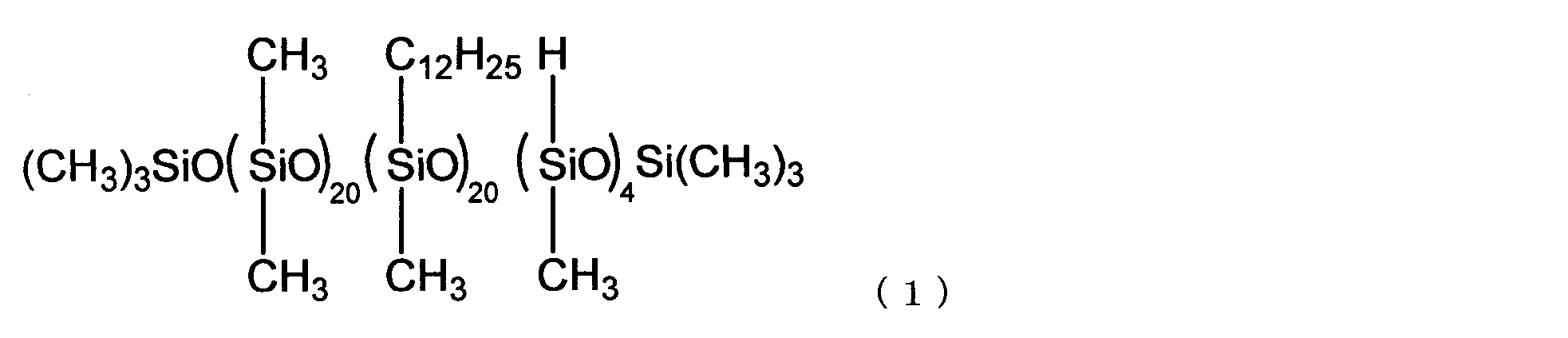

このエマルションを、錨型攪拌翼を備えた撹拌装置の付いた容量1リットルのガラスフラスコに移し、15~20℃に温度調整した後、ポリオキシエチレンラウリルエーテル(エチレンオキサイド付加モル数=9モル)18gを添加し30分撹拌してエマルションに溶解させた。次いで、撹拌下に白金-ビニル基含有ジシロキサン錯体のイソドデカン溶液(白金含有量0.5%)2.4g及びポリオキシエチレンラウリルエーテル(エチレンオキサイド付加モル数=9モル)1.0gの混合溶解物を添加し、同温度で12時間撹拌し、シリコーンゴム粒子の水分散物を得た。
このシリコーンゴム粒子について、形状を光学顕微鏡にて観察したところ球状であり、体積平均粒径を粒度分布測定装置「マルチサイザー3」(商品名、ベックマン・コールター(株)製)を用いて測定したところ12μmであった。
下記式(3)で示される、長鎖1価炭化水素基を10.5%有し、粘度が130mm2/sのオルガノハイドロジェンポリシロキサン400gと、

このエマルションを、錨型攪拌翼を備えた撹拌装置の付いた容量1リットルのガラスフラスコに移し、15~20℃に温度調整した後、ポリオキシエチレンラウリルエーテル(エチレンオキサイド付加モル数=9モル)18gを添加し30分撹拌してエマルションに溶解させた。次いで、撹拌下に白金-ビニル基含有ジシロキサン錯体のイソドデカン溶液(白金含有量0.5%)2.4g及びポリオキシエチレンラウリルエーテル(エチレンオキサイド付加モル数=9モル)1.0gの混合溶解物を添加し、同温度で12時間撹拌し、シリコーンゴム粒子の水分散物を得た。
このシリコーンゴム粒子について、形状を光学顕微鏡にて観察したところ球状であり、体積平均粒径を粒度分布測定装置「マルチサイザー3」(商品名、ベックマン・コールター(株)製)を用いて測定したところ12μmであった。
上記式(1)で示される、長鎖1価炭化水素基を22.2%有し、粘度が110
mm2/sのオルガノハイドロジェンポリシロキサン467gと、上記式(2)で示され、長鎖1価炭化水素基を含まない、粘度が10mm2/sのメチルビニルポリシロキサン 133g(オルガノハイドロジェンポリシロキサン中のSiH基1個に対するメチルビニルポリシロキサン中のビニル基の個数比が0.96となる配合量)と、dl-α-トコフェロール0.1gとを容量1リットルのガラスビーカーに仕込み、ホモミキサーを用いて2,000rpmで撹拌混合した。得られた混合液にポリオキシエチレンステアリルエーテル(エチレンオキサイド付加モル数=6モル)0.5gと、ポリオキシエチレンステアリルエーテル(エチレンオキサイド付加モル数=20モル)1.6gと、フェノキシエタノール10gと、水200gとを加え、ホモミキサーを用いて6,000rpmで撹拌したところ、O/W型エマルジョンとなり、増粘が認められた。更に15分間撹拌を継続した。次いで、2,000rpmで撹拌しながら、水164gを加えたところ、均一な白色エマルションが得られた。
このエマルションを、錨型攪拌翼を備えた撹拌装置の付いた容量1リットルのガラスフラスコに移し、15~20℃に温度調整した後、ポリオキシエチレンステアリルエーテル(エチレンオキサイド付加モル数=6モル)5gとポリオキシエチレンステアリルエーテル(エチレンオキサイド付加モル数=20モル)14gとを添加し、30分撹拌してエマルションに溶解させた。次いで、撹拌下に白金-ビニル基含有ジシロキサン錯体のイソドデカン溶液(白金含有量0.5%)2.5g、ポリオキシエチレンソルビタントリステアレート(エチレンオキサイド付加モル数=20モル)1.1g、及びポリオキシエチレンソルビタンモノステアレート(エチレンオキサイド付加モル数=20モル)1.1gの混合溶解物を添加し、同温度で12時間撹拌し、シリコーンゴム粒子の水分散物を得た。
このシリコーンゴム粒子について、形状を光学顕微鏡にて観察したところ球状であり、体積平均粒径を粒度分布測定装置「マルチサイザー3」(商品名、ベックマン・コールター(株)製)を用いて測定したところ5μmであった。
下記式(4)で示され、長鎖1価炭化水素基を含まない、粘度が30mm2/sのメチルハイドロジェンポリシロキサン19gと、


このシリコーンゴム粒子について、形状を光学顕微鏡にて観察したところ球状であり、体積平均粒径を「マルチサイザー3」を用いて測定したところ12μmであった。
上記実施例1~3及び比較例にて使用した上記各オルガノハイドロジェンポリシロキサン、メチルビニルポリシロキサン、および白金-ビニル基含有ジシロキサン錯体のイソドデカン溶液(白金含有量0.5%)を、上記実施例1~3及び比較例の各々に記載の配合比にて混合し、厚みが10mmになるようアルミニウムシャーレに流し込んだ。25℃で24時間放置後、50℃の恒温槽内で1時間加熱し、べたつきのないシリコーンゴムを得た。このシリコーンゴムの硬度をSRIS0101に規定のアスカーC型硬度計で測定した。結果を表1に示す。
上記実施例1~3及び比較例にて使用した上記各オルガノハイドロジェンポリシロキサン、メチルビニルポリシロキサン、および白金-ビニル基含有ジシロキサン錯体のイソドデカン溶液(白金含有量0.5%)を、上記実施例1~3及び比較例の各々に記載の配合比にて混合し、厚みが約1mmになるようテフロン(登録商標)トレイ(80mm×130mm)に流し込んだ。25℃で24時間放置後、50℃の恒温槽内で1時間加熱し、シリコーンゴムのシートを得た。得られたシートを約30mm四方の大きさにカットして試験片を得、この試験片の質量を測定した後、表1に示す油状物質に該試験片を24時間浸漬した。これにより試験片は油状物質を吸収して膨潤した。油状物質から試験片を取り出し、その表面の油状物質をティッシュで拭き取った後、該試験片の質量を測定した。表1にシリコーンゴムのシートが吸収した油状物質の量(吸油量)をシリコーンゴム1g当たりの値として示す。

下記表2に示す組成にて各成分を混合しジェル状乳液を調製した。

(注2)信越化学工業(株)製:(ビニルジメチコン/ラウリルジメチコン)クロスポリマー(表示名称(INCI:Vinyl Dimethicone/Lauryl Dimethicone Crosspolymer)_20%とイソドデカン(表示名称(INCI:Isododecane))_80%の混合物
(注3)括弧内の%は水分散物中のシリコーンゴム粒子の濃度である
成分5~11を均一になるよう混合した。これに、成分1~4を均一混合後に穏やかに加え、撹拌した。これを所定の容器に充填し、ジェル状乳液を得た。
得られたジェル状乳液について、10名の女性の専門パネラーに、使用感(べたつきのなさ)、仕上がり(毛穴や皺を暈しているか)、密着性(肌への付着性)、耐皮脂性(塗布後経時でのテカリ感のなさ)、分散性(手攪拌混合時にダマが出来ないか)を、下記基準により評価し、評価結果の平均を取った。
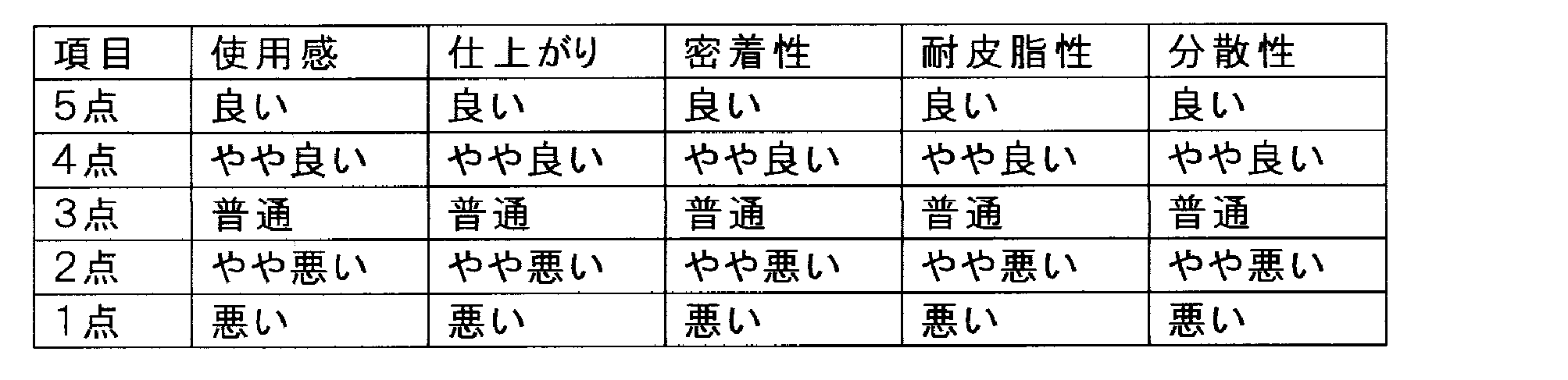
◎ :平均点が4.0点以上
○ :平均点が3.0点以上4.0点未満
△ :平均点が2.0点以上3.0点未満
× :平均点が2.0点未満

O/Wジェル
<化粧料の調製>
A:成分2~12を均一に混合した。
B:Aに成分1を添加して乳化し、O/Wジェルを得た。


O/W下地
<化粧料の調製>
A:成分1~7を90℃で均一に混合した。
B:成分8~13を85℃で均一に混合した。
C:BをAに添加して乳化して冷却後、成分14、15をそれぞれ加えて均一に混合し、下地を得た。


O/Wサンスクリーンクリーム
<化粧料の調製>
A:成分1~6を85℃まで加熱し、均一に混合した。
B:成分8~15を85℃まで加熱し、均一に混合した。
C:BをAに添加して乳化して冷却後、成分7を加えて均一に混合し、サンスクリーンを得た。


O/Wサンスクリーンクリーム
<化粧料の調製>
A:成分1~6を85℃まで加熱し、均一に混合した。
B:成分8~14を85℃まで加熱し、均一に混合した。
C:BをAに添加して乳化して冷却後、成分7を加えて均一に混合し、サンスクリーンを得た。


W/O/Wジェル
<化粧料の調製>
A:成分1~2を均一に混合した。
B:成分3~7を均一に混合した。
C:成分8~13を均一に混合した。
D:AにBを添加して乳化した。
E:CにDを加えて乳化し、W/O/Wジェルを得た。


W/Oアイクリーム
<化粧料の調製>
A:成分1~7を均一に混合した。
B:成分8~14を均一に混合した。
C:BをAに添加して乳化し、アイクリームを得た。


W/Oアイクリーム
<化粧料の調製>
A:成分1~7を均一に混合した。
B:成分8~14を均一に混合した。
C:BをAに添加して乳化し、アイクリームを得た。


化粧水
<化粧料の調製>
A:成分1~9を均一に混合し、化粧水を得た。
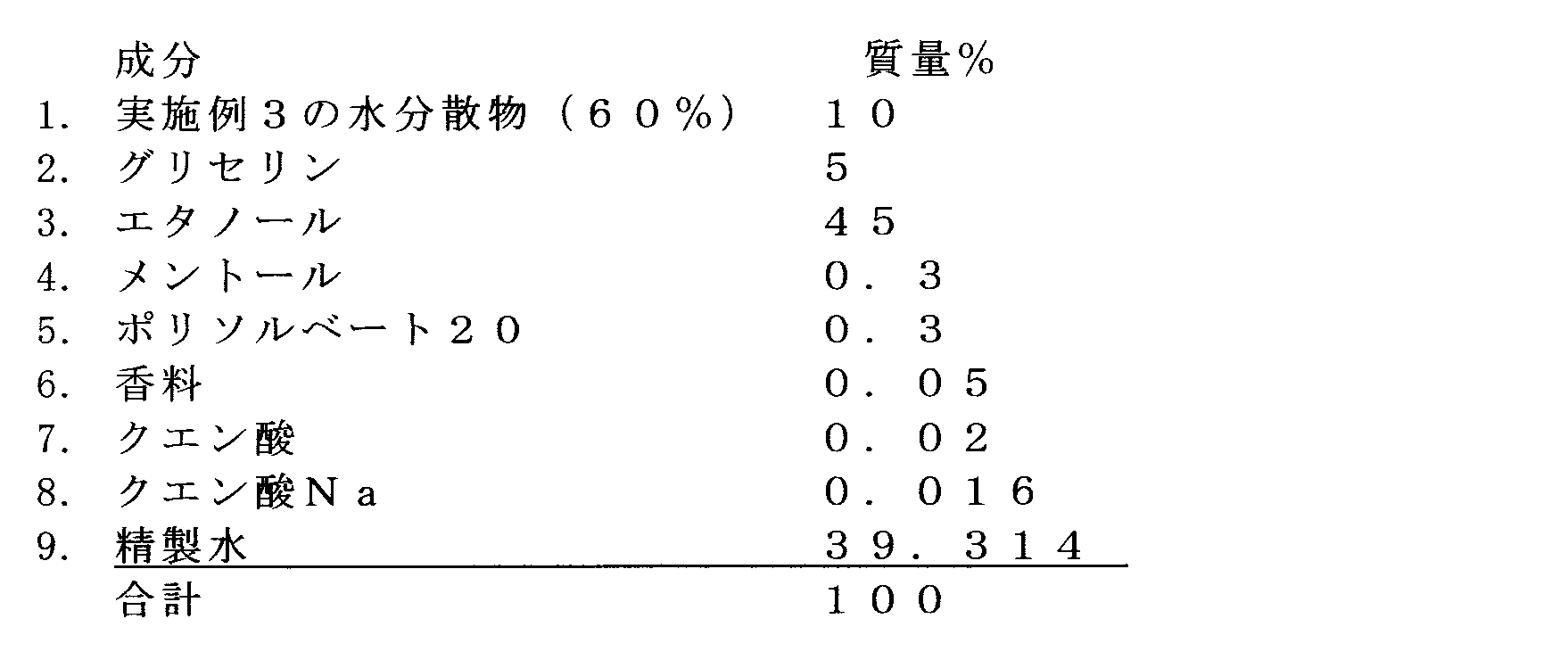
美容液
<化粧料の調製>
A:成分1~15を均一に混合し、美容液を得た。

アウトバストリートメント
<化粧料の調製>
A:成分1~7を均一に混合した。
B:成分8~14を均一に混合した。
C:BをAに添加して乳化し、アイクリームを得た。

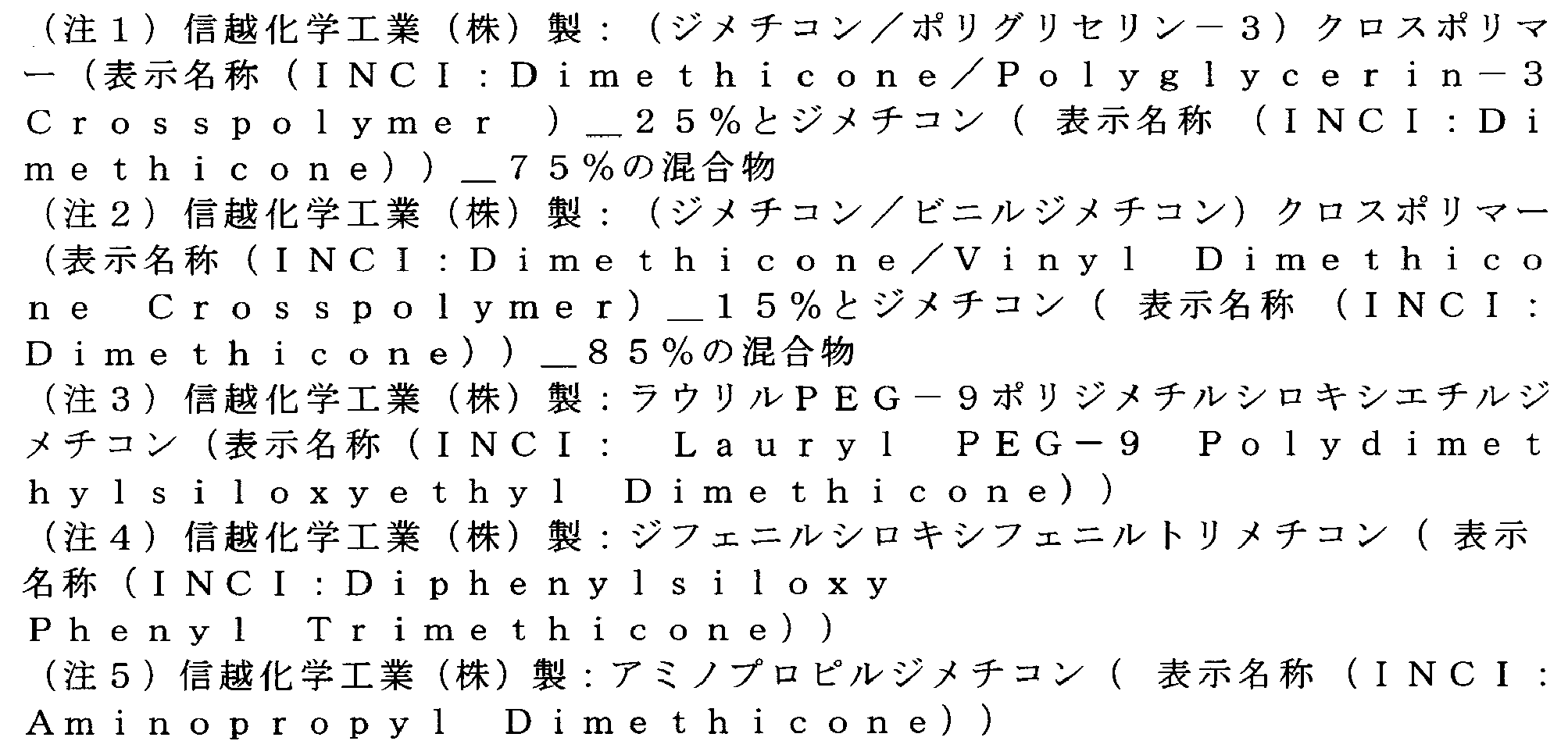
シェイキングファンデーション
<化粧料の調製>
A:成分1~14をホモミキサーにて均一に混合した。
B:成分15~18を均一に混合した。
C:BをAに添加して乳化し、シェイキングファンデーションを得た。


マスカラ
<化粧料の調製>
A:成分1~11を90℃にて均一に混合後、70℃に冷却した。
B:成分12~14を60℃にて均一に混合した。
C:BをAに添加して乳化し、冷却してマスカラを得た。


ゴマージュ
<化粧料の調製>
A:成分5~6を均一に混合した。
B:成分1~4を均一に混合した。
C:AにBを加え均一に混合し、ジェルを得た。

パックマスク
<化粧料の調製>
A:成分1~5を均一に混合した。
B:成分6~8を均一に混合した。
C:成分9~12を均一に混合した。
D:AにB、C、残りの成分を加え均一に混合し、パックマスクを得た。

Claims (10)
- (A)(A-1)オルガノハイドロジェンポリシロキサンと(A-2)1価オレフィン炭化水素基含有オルガノポリシロキサンとの付加反応物であるシリコーンゴム粒子であり、前記(A-1)成分及び前記(A-2)成分の少なくとも一方が、ケイ素原子に結合する炭素原子数6~30の1価脂肪族飽和炭化水素基を、ケイ素原子に結合する全置換基の合計個数に対し5~70%の量で有することを特徴とする、前記シリコーンゴム粒子:水分散物全体の質量に対して5~80質量%
(B)界面活性剤の少なくとも1種:水分散物全体の質量に対して0.01~15質量%、及び
(C)水:水分散物全体の質量に対して19~94質量%
を含む、前記シリコーンゴム粒子の水分散物。 - 前記(A-1)成分が、平均組成式(1):
R1 aHbSiO(4-a-b)/2 (1)
(式中、R1は、互いに独立に、非置換もしくは置換の、脂肪族不飽和結合を有さない、炭素原子数1~30の1価炭化水素基であり、aおよびbは、0<a<3、0<b<3および0.1≦a+b≦3を満たす数である)
で示される、一分子中にケイ素原子に結合した水素原子を2個以上有するオルガノハイドロジェンポリシロキサンであり、及び
前記(A-2)成分が、平均組成式(2):
R2 cR3 dSiO(4-c-d)/2 (2)
(式中、R2は、互いに独立に、非置換もしくは置換の、脂肪族不飽和結合を有さない、炭素原子数1~30の1価炭化水素基であり、R3は、互いに独立に、炭素原子数2~6の1価オレフィン炭化水素基であり、cおよびdは0<c<3、0<d≦3および0.1≦c+d≦3を満たす数である)
で示される、一分子中にオレフィン炭化水素基を2個以上有するオルガノポリシロキサンであり、
前記(A-1)成分に対する前記(A-2)成分の量が、(A-1)成分中のケイ素原子に結合した水素原子1個に対する(A-2)成分中のオレフィン炭化水素基の個数の比が0.5~2となる量であり、且つ、前記(A-1)成分及び前記(A-2)成分の少なくとも一方は、ケイ素原子に結合する全置換基の合計個数の5~70%が炭素原子数6~30の1価脂肪族飽和炭化水素基であり、
ただし、SiH基を2個のみ有する前記(A-1)オルガノハイドロジェンポリシロキサンとオレフィン炭化水素基を2個のみ有する前記(A-2)オルガノポリシロキサンとの組合せを除く、
請求項1記載のシリコーンゴム粒子の水分散物。 - 前記(A-1)成分が、ケイ素原子に結合する炭素原子数6~30の1価脂肪族飽和炭化水素基を、ケイ素原子に結合する全置換基の合計個数に対し5~70%で有する、請求項1または2記載のシリコーンゴム粒子の水分散物。
- 前記(A)シリコーンゴム粒子が、前記(A-1)オルガノハイドロジェンポリシロキサン、前記(A-2)オレフィン炭化水素基含有オルガノポリシロキサン、及び(A-3)白金族金属系触媒を含むシリコーン組成物の硬化物である、請求項1~3のいずれか1項記載のシリコーンゴム粒子の水分散物。
- 前記(A)成分が、体積平均粒径0.1~100μmを有する球状シリコーンゴム粒子である、請求項1~4のいずれか1項記載のシリコーンゴム粒子の水分散物。
- 前記(A)シリコーンゴム粒子が、炭化水素油又はエステル油を該シリコーンゴム粒子100質量部に対し30質量部以上吸収し得る、請求項1~5のいずれか1項記載のシリコーンゴム粒子の水分散物。
- 前記炭化水素油がスクワランである、請求項6記載のシリコーンゴム粒子の水分散物。
- 前記エステル油がパルミチン酸エチルヘキシルである、請求項6記載のシリコーンゴム粒子の水分散物。
- 前記(A)シリコーンゴム粒子はオルガノポリシルセスキオキサンを表面に有さない、請求項1~8のいずれか1項記載のシリコーンゴム粒子の水分散物。
- 請求項1~9のいずれか1項記載のシリコーンゴム粒子の水分散物を含有する化粧料。
Priority Applications (4)
| Application Number | Priority Date | Filing Date | Title |
|---|---|---|---|
| US18/550,027 US20240301207A1 (en) | 2021-03-15 | 2022-03-10 | Aqueous dispersion of silicone rubber particles and cosmetics |
| EP22771272.6A EP4310151A4 (en) | 2021-03-15 | 2022-03-10 | AQUEOUS DISPERSION OF SILICONE RUBBER PARTICLES, AND COSMETIC PREPARATION |
| CN202280020773.9A CN116964154A (zh) | 2021-03-15 | 2022-03-10 | 硅酮橡胶粒子的水分散物及化妆料 |
| KR1020237032160A KR20230157366A (ko) | 2021-03-15 | 2022-03-10 | 실리콘 고무 입자의 수분산물 및 화장료 |
Applications Claiming Priority (2)
| Application Number | Priority Date | Filing Date | Title |
|---|---|---|---|
| JP2021-041362 | 2021-03-15 | ||
| JP2021041362A JP2022141173A (ja) | 2021-03-15 | 2021-03-15 | シリコーンゴム粒子の水分散物および化粧料 |
Publications (1)
| Publication Number | Publication Date |
|---|---|
| WO2022196521A1 true WO2022196521A1 (ja) | 2022-09-22 |
Family
ID=83320619
Family Applications (1)
| Application Number | Title | Priority Date | Filing Date |
|---|---|---|---|
| PCT/JP2022/010614 Ceased WO2022196521A1 (ja) | 2021-03-15 | 2022-03-10 | シリコーンゴム粒子の水分散物および化粧料 |
Country Status (7)
| Country | Link |
|---|---|
| US (1) | US20240301207A1 (ja) |
| EP (1) | EP4310151A4 (ja) |
| JP (1) | JP2022141173A (ja) |
| KR (1) | KR20230157366A (ja) |
| CN (1) | CN116964154A (ja) |
| TW (1) | TW202237750A (ja) |
| WO (1) | WO2022196521A1 (ja) |
Families Citing this family (1)
| Publication number | Priority date | Publication date | Assignee | Title |
|---|---|---|---|---|
| US20260090977A1 (en) * | 2022-09-13 | 2026-04-02 | Shin-Etsu Chemical Co., Ltd. | Water-in-oil cosmetic composition |
Citations (20)
| Publication number | Priority date | Publication date | Assignee | Title |
|---|---|---|---|---|
| US3159662A (en) | 1962-07-02 | 1964-12-01 | Gen Electric | Addition reaction |
| US3159601A (en) | 1962-07-02 | 1964-12-01 | Gen Electric | Platinum-olefin complex catalyzed addition of hydrogen- and alkenyl-substituted siloxanes |
| US3220972A (en) | 1962-07-02 | 1965-11-30 | Gen Electric | Organosilicon process using a chloroplatinic acid reaction product as the catalyst |
| US3775452A (en) | 1971-04-28 | 1973-11-27 | Gen Electric | Platinum complexes of unsaturated siloxanes and platinum containing organopolysiloxanes |
| JPH08109262A (ja) * | 1994-08-18 | 1996-04-30 | Toray Dow Corning Silicone Co Ltd | シリコーンゴム粉末およびその製造方法 |
| JPH08259742A (ja) * | 1995-03-23 | 1996-10-08 | Toray Dow Corning Silicone Co Ltd | ポリオレフィン樹脂組成物 |
| JPH09132722A (ja) * | 1995-11-08 | 1997-05-20 | Shin Etsu Chem Co Ltd | 熱可塑性樹脂組成物及びそれを用いた成形品 |
| JPH10139624A (ja) | 1996-09-13 | 1998-05-26 | Shin Etsu Chem Co Ltd | 化粧料の製造方法 |
| JP2000159896A (ja) * | 1998-11-26 | 2000-06-13 | Dow Corning Toray Silicone Co Ltd | 加熱硬化性有機重合体組成物 |
| JP2000198851A (ja) * | 1998-12-15 | 2000-07-18 | General Electric Co <Ge> | シリコ―ンエラストマ― |
| JP2001294522A (ja) | 2000-04-14 | 2001-10-23 | Kao Corp | 皮脂ケア化粧料 |
| JP2002114665A (ja) | 2000-10-04 | 2002-04-16 | Fancl Corp | 皮脂コントロール化粧料 |
| WO2003024413A1 (en) * | 2001-09-14 | 2003-03-27 | Shin-Etsu Chemical Co., Ltd. | Composition and cosmetic preparation containing the same |
| WO2006120876A1 (ja) * | 2005-05-02 | 2006-11-16 | Kose Corporation | メーキャップ化粧料 |
| JP2008115358A (ja) * | 2007-06-18 | 2008-05-22 | Shin Etsu Chem Co Ltd | オルガノポリシロキサン及びその製法ならびに該オルガノポリシロキサンを含む化粧料組成物 |
| JP2010132877A (ja) * | 2008-10-31 | 2010-06-17 | Shin-Etsu Chemical Co Ltd | シリコーンエラストマー球状微粒子をポリオルガノシルセスキオキサンで被覆したシリコーン微粒子およびその製造方法 |
| JP2010132878A (ja) * | 2008-10-31 | 2010-06-17 | Shin-Etsu Chemical Co Ltd | シリコーンエラストマー球状微粒子をポリオルガノシルセスキオキサンで被覆したシリコーン微粒子およびその製造方法 |
| JP2011105662A (ja) | 2009-11-18 | 2011-06-02 | Shin-Etsu Chemical Co Ltd | 化粧料 |
| JP2013040241A (ja) * | 2011-08-11 | 2013-02-28 | Shin-Etsu Chemical Co Ltd | シリコーン微粒子及びその製造方法 |
| JP2017501993A (ja) | 2013-12-05 | 2017-01-19 | ロレアル | 皮脂吸い上げフィラー及び多量のモノアルコールを含む組成物 |
Family Cites Families (2)
| Publication number | Priority date | Publication date | Assignee | Title |
|---|---|---|---|---|
| JP5359593B2 (ja) * | 2009-06-22 | 2013-12-04 | 信越化学工業株式会社 | 複合粒子及びその製造方法、ならびに化粧料 |
| US9205031B2 (en) * | 2009-06-24 | 2015-12-08 | Shin-Etsu Chemical Co., Ltd. | Composite particles, method for preparing the same and cosmetic composition |
-
2021
- 2021-03-15 JP JP2021041362A patent/JP2022141173A/ja active Pending
-
2022
- 2022-03-07 TW TW111108113A patent/TW202237750A/zh unknown
- 2022-03-10 WO PCT/JP2022/010614 patent/WO2022196521A1/ja not_active Ceased
- 2022-03-10 EP EP22771272.6A patent/EP4310151A4/en not_active Withdrawn
- 2022-03-10 CN CN202280020773.9A patent/CN116964154A/zh active Pending
- 2022-03-10 KR KR1020237032160A patent/KR20230157366A/ko active Pending
- 2022-03-10 US US18/550,027 patent/US20240301207A1/en active Pending
Patent Citations (20)
| Publication number | Priority date | Publication date | Assignee | Title |
|---|---|---|---|---|
| US3159662A (en) | 1962-07-02 | 1964-12-01 | Gen Electric | Addition reaction |
| US3159601A (en) | 1962-07-02 | 1964-12-01 | Gen Electric | Platinum-olefin complex catalyzed addition of hydrogen- and alkenyl-substituted siloxanes |
| US3220972A (en) | 1962-07-02 | 1965-11-30 | Gen Electric | Organosilicon process using a chloroplatinic acid reaction product as the catalyst |
| US3775452A (en) | 1971-04-28 | 1973-11-27 | Gen Electric | Platinum complexes of unsaturated siloxanes and platinum containing organopolysiloxanes |
| JPH08109262A (ja) * | 1994-08-18 | 1996-04-30 | Toray Dow Corning Silicone Co Ltd | シリコーンゴム粉末およびその製造方法 |
| JPH08259742A (ja) * | 1995-03-23 | 1996-10-08 | Toray Dow Corning Silicone Co Ltd | ポリオレフィン樹脂組成物 |
| JPH09132722A (ja) * | 1995-11-08 | 1997-05-20 | Shin Etsu Chem Co Ltd | 熱可塑性樹脂組成物及びそれを用いた成形品 |
| JPH10139624A (ja) | 1996-09-13 | 1998-05-26 | Shin Etsu Chem Co Ltd | 化粧料の製造方法 |
| JP2000159896A (ja) * | 1998-11-26 | 2000-06-13 | Dow Corning Toray Silicone Co Ltd | 加熱硬化性有機重合体組成物 |
| JP2000198851A (ja) * | 1998-12-15 | 2000-07-18 | General Electric Co <Ge> | シリコ―ンエラストマ― |
| JP2001294522A (ja) | 2000-04-14 | 2001-10-23 | Kao Corp | 皮脂ケア化粧料 |
| JP2002114665A (ja) | 2000-10-04 | 2002-04-16 | Fancl Corp | 皮脂コントロール化粧料 |
| WO2003024413A1 (en) * | 2001-09-14 | 2003-03-27 | Shin-Etsu Chemical Co., Ltd. | Composition and cosmetic preparation containing the same |
| WO2006120876A1 (ja) * | 2005-05-02 | 2006-11-16 | Kose Corporation | メーキャップ化粧料 |
| JP2008115358A (ja) * | 2007-06-18 | 2008-05-22 | Shin Etsu Chem Co Ltd | オルガノポリシロキサン及びその製法ならびに該オルガノポリシロキサンを含む化粧料組成物 |
| JP2010132877A (ja) * | 2008-10-31 | 2010-06-17 | Shin-Etsu Chemical Co Ltd | シリコーンエラストマー球状微粒子をポリオルガノシルセスキオキサンで被覆したシリコーン微粒子およびその製造方法 |
| JP2010132878A (ja) * | 2008-10-31 | 2010-06-17 | Shin-Etsu Chemical Co Ltd | シリコーンエラストマー球状微粒子をポリオルガノシルセスキオキサンで被覆したシリコーン微粒子およびその製造方法 |
| JP2011105662A (ja) | 2009-11-18 | 2011-06-02 | Shin-Etsu Chemical Co Ltd | 化粧料 |
| JP2013040241A (ja) * | 2011-08-11 | 2013-02-28 | Shin-Etsu Chemical Co Ltd | シリコーン微粒子及びその製造方法 |
| JP2017501993A (ja) | 2013-12-05 | 2017-01-19 | ロレアル | 皮脂吸い上げフィラー及び多量のモノアルコールを含む組成物 |
Non-Patent Citations (1)
| Title |
|---|
| See also references of EP4310151A4 |
Also Published As
| Publication number | Publication date |
|---|---|
| US20240301207A1 (en) | 2024-09-12 |
| EP4310151A4 (en) | 2025-04-09 |
| JP2022141173A (ja) | 2022-09-29 |
| EP4310151A1 (en) | 2024-01-24 |
| TW202237750A (zh) | 2022-10-01 |
| CN116964154A (zh) | 2023-10-27 |
| KR20230157366A (ko) | 2023-11-16 |
Similar Documents
| Publication | Publication Date | Title |
|---|---|---|
| KR101699552B1 (ko) | 화장료 | |
| CN102058494B (zh) | 化妆品 | |
| JP5359593B2 (ja) | 複合粒子及びその製造方法、ならびに化粧料 | |
| KR101078077B1 (ko) | 유기폴리실록산과 그 제법 및 상기 유기폴리실록산을포함하는 화장료 조성물 | |
| KR102801855B1 (ko) | 화장료 | |
| KR20120110053A (ko) | 오르가노폴리실록산 엘라스토머 조성물 및 이것을 함유하는 화장료 | |
| JP5491540B2 (ja) | 化粧料の製造方法 | |
| JP2009256616A (ja) | グリセリン変性シリコーン及びそれを含む化粧料 | |
| CN107530264A (zh) | 化妆料组合物 | |
| JP5754866B2 (ja) | 化粧料 | |
| JP5682662B2 (ja) | 複合粒子の製造方法 | |
| JPWO2019044391A1 (ja) | 水中油型乳化組成物及び化粧料 | |
| WO2022196521A1 (ja) | シリコーンゴム粒子の水分散物および化粧料 | |
| WO2024058043A1 (ja) | 油中水型化粧料 | |
| JP7250655B2 (ja) | 水分散型エマルション組成物及びその製造方法、エマルション付加硬化組成物、及び化粧料 | |
| JP7325629B2 (ja) | 化粧料 | |
| KR102773286B1 (ko) | 마이크로에멀전 조성물 및 그의 경화물, 그리고, 그것을 포함한 화장료 | |
| JP7743355B2 (ja) | 複合粒子、複合粒子の製造方法、及び化粧料 |
Legal Events
| Date | Code | Title | Description |
|---|---|---|---|
| 121 | Ep: the epo has been informed by wipo that ep was designated in this application |
Ref document number: 22771272 Country of ref document: EP Kind code of ref document: A1 |
|
| WWE | Wipo information: entry into national phase |
Ref document number: 18550027 Country of ref document: US Ref document number: 202280020773.9 Country of ref document: CN |
|
| ENP | Entry into the national phase |
Ref document number: 20237032160 Country of ref document: KR Kind code of ref document: A |
|
| WWE | Wipo information: entry into national phase |
Ref document number: 2022771272 Country of ref document: EP |
|
| NENP | Non-entry into the national phase |
Ref country code: DE |
|
| ENP | Entry into the national phase |
Ref document number: 2022771272 Country of ref document: EP Effective date: 20231016 |
|
| WWW | Wipo information: withdrawn in national office |
Ref document number: 2022771272 Country of ref document: EP |