WO2022197726A1 - One component thermally conductive ambient temperature curable materials - Google Patents
One component thermally conductive ambient temperature curable materials Download PDFInfo
- Publication number
- WO2022197726A1 WO2022197726A1 PCT/US2022/020415 US2022020415W WO2022197726A1 WO 2022197726 A1 WO2022197726 A1 WO 2022197726A1 US 2022020415 W US2022020415 W US 2022020415W WO 2022197726 A1 WO2022197726 A1 WO 2022197726A1
- Authority
- WO
- WIPO (PCT)
- Prior art keywords
- thermally conductive
- moisture
- less
- conductive material
- curable
- Prior art date
- Legal status (The legal status is an assumption and is not a legal conclusion. Google has not performed a legal analysis and makes no representation as to the accuracy of the status listed.)
- Ceased
Links
Classifications
-
- C—CHEMISTRY; METALLURGY
- C09—DYES; PAINTS; POLISHES; NATURAL RESINS; ADHESIVES; COMPOSITIONS NOT OTHERWISE PROVIDED FOR; APPLICATIONS OF MATERIALS NOT OTHERWISE PROVIDED FOR
- C09D—COATING COMPOSITIONS, e.g. PAINTS, VARNISHES OR LACQUERS; FILLING PASTES; CHEMICAL PAINT OR INK REMOVERS; INKS; CORRECTING FLUIDS; WOODSTAINS; PASTES OR SOLIDS FOR COLOURING OR PRINTING; USE OF MATERIALS THEREFOR
- C09D7/00—Features of coating compositions, not provided for in group C09D5/00; Processes for incorporating ingredients in coating compositions
- C09D7/40—Additives
- C09D7/60—Additives non-macromolecular
- C09D7/61—Additives non-macromolecular inorganic
-
- C—CHEMISTRY; METALLURGY
- C08—ORGANIC MACROMOLECULAR COMPOUNDS; THEIR PREPARATION OR CHEMICAL WORKING-UP; COMPOSITIONS BASED THEREON
- C08K—Use of inorganic or non-macromolecular organic substances as compounding ingredients
- C08K7/00—Use of ingredients characterised by shape
- C08K7/16—Solid spheres
- C08K7/18—Solid spheres inorganic
-
- C—CHEMISTRY; METALLURGY
- C08—ORGANIC MACROMOLECULAR COMPOUNDS; THEIR PREPARATION OR CHEMICAL WORKING-UP; COMPOSITIONS BASED THEREON
- C08K—Use of inorganic or non-macromolecular organic substances as compounding ingredients
- C08K3/00—Use of inorganic substances as compounding ingredients
- C08K3/02—Elements
- C08K3/04—Carbon
-
- C—CHEMISTRY; METALLURGY
- C08—ORGANIC MACROMOLECULAR COMPOUNDS; THEIR PREPARATION OR CHEMICAL WORKING-UP; COMPOSITIONS BASED THEREON
- C08K—Use of inorganic or non-macromolecular organic substances as compounding ingredients
- C08K3/00—Use of inorganic substances as compounding ingredients
- C08K3/18—Oxygen-containing compounds, e.g. metal carbonyls
- C08K3/20—Oxides; Hydroxides
- C08K3/22—Oxides; Hydroxides of metals
-
- C—CHEMISTRY; METALLURGY
- C08—ORGANIC MACROMOLECULAR COMPOUNDS; THEIR PREPARATION OR CHEMICAL WORKING-UP; COMPOSITIONS BASED THEREON
- C08K—Use of inorganic or non-macromolecular organic substances as compounding ingredients
- C08K3/00—Use of inorganic substances as compounding ingredients
- C08K3/34—Silicon-containing compounds
- C08K3/36—Silica
-
- C—CHEMISTRY; METALLURGY
- C08—ORGANIC MACROMOLECULAR COMPOUNDS; THEIR PREPARATION OR CHEMICAL WORKING-UP; COMPOSITIONS BASED THEREON
- C08K—Use of inorganic or non-macromolecular organic substances as compounding ingredients
- C08K5/00—Use of organic ingredients
- C08K5/0008—Organic ingredients according to more than one of the "one dot" groups of C08K5/01 - C08K5/59
- C08K5/0016—Plasticisers
-
- C—CHEMISTRY; METALLURGY
- C08—ORGANIC MACROMOLECULAR COMPOUNDS; THEIR PREPARATION OR CHEMICAL WORKING-UP; COMPOSITIONS BASED THEREON
- C08K—Use of inorganic or non-macromolecular organic substances as compounding ingredients
- C08K5/00—Use of organic ingredients
- C08K5/56—Organo-metallic compounds, i.e. organic compounds containing a metal-to-carbon bond
-
- C—CHEMISTRY; METALLURGY
- C08—ORGANIC MACROMOLECULAR COMPOUNDS; THEIR PREPARATION OR CHEMICAL WORKING-UP; COMPOSITIONS BASED THEREON
- C08K—Use of inorganic or non-macromolecular organic substances as compounding ingredients
- C08K5/00—Use of organic ingredients
- C08K5/56—Organo-metallic compounds, i.e. organic compounds containing a metal-to-carbon bond
- C08K5/57—Organo-tin compounds
-
- C—CHEMISTRY; METALLURGY
- C08—ORGANIC MACROMOLECULAR COMPOUNDS; THEIR PREPARATION OR CHEMICAL WORKING-UP; COMPOSITIONS BASED THEREON
- C08L—COMPOSITIONS OF MACROMOLECULAR COMPOUNDS
- C08L101/00—Compositions of unspecified macromolecular compounds
- C08L101/02—Compositions of unspecified macromolecular compounds characterised by the presence of specified groups, e.g. terminal or pendant functional groups
- C08L101/10—Compositions of unspecified macromolecular compounds characterised by the presence of specified groups, e.g. terminal or pendant functional groups containing hydrolysable silane groups
-
- C—CHEMISTRY; METALLURGY
- C08—ORGANIC MACROMOLECULAR COMPOUNDS; THEIR PREPARATION OR CHEMICAL WORKING-UP; COMPOSITIONS BASED THEREON
- C08L—COMPOSITIONS OF MACROMOLECULAR COMPOUNDS
- C08L33/00—Compositions of homopolymers or copolymers of compounds having one or more unsaturated aliphatic radicals, each having only one carbon-to-carbon double bond, and only one being terminated by only one carboxyl radical, or of salts, anhydrides, esters, amides, imides or nitriles thereof; Compositions of derivatives of such polymers
- C08L33/04—Homopolymers or copolymers of esters
-
- C—CHEMISTRY; METALLURGY
- C08—ORGANIC MACROMOLECULAR COMPOUNDS; THEIR PREPARATION OR CHEMICAL WORKING-UP; COMPOSITIONS BASED THEREON
- C08L—COMPOSITIONS OF MACROMOLECULAR COMPOUNDS
- C08L33/00—Compositions of homopolymers or copolymers of compounds having one or more unsaturated aliphatic radicals, each having only one carbon-to-carbon double bond, and only one being terminated by only one carboxyl radical, or of salts, anhydrides, esters, amides, imides or nitriles thereof; Compositions of derivatives of such polymers
- C08L33/04—Homopolymers or copolymers of esters
- C08L33/06—Homopolymers or copolymers of esters of esters containing only carbon, hydrogen and oxygen, which oxygen atoms are present only as part of the carboxyl radical
- C08L33/08—Homopolymers or copolymers of acrylic acid esters
-
- C—CHEMISTRY; METALLURGY
- C08—ORGANIC MACROMOLECULAR COMPOUNDS; THEIR PREPARATION OR CHEMICAL WORKING-UP; COMPOSITIONS BASED THEREON
- C08L—COMPOSITIONS OF MACROMOLECULAR COMPOUNDS
- C08L43/00—Compositions of homopolymers or copolymers of compounds having one or more unsaturated aliphatic radicals, each having only one carbon-to-carbon double bond, and containing boron, silicon, phosphorus, selenium, tellurium or a metal; Compositions of derivatives of such polymers
- C08L43/04—Homopolymers or copolymers of monomers containing silicon
-
- C—CHEMISTRY; METALLURGY
- C08—ORGANIC MACROMOLECULAR COMPOUNDS; THEIR PREPARATION OR CHEMICAL WORKING-UP; COMPOSITIONS BASED THEREON
- C08L—COMPOSITIONS OF MACROMOLECULAR COMPOUNDS
- C08L71/00—Compositions of polyethers obtained by reactions forming an ether link in the main chain; Compositions of derivatives of such polymers
-
- C—CHEMISTRY; METALLURGY
- C08—ORGANIC MACROMOLECULAR COMPOUNDS; THEIR PREPARATION OR CHEMICAL WORKING-UP; COMPOSITIONS BASED THEREON
- C08F—MACROMOLECULAR COMPOUNDS OBTAINED BY REACTIONS ONLY INVOLVING CARBON-TO-CARBON UNSATURATED BONDS
- C08F130/00—Homopolymers of compounds having one or more unsaturated aliphatic radicals, each having only one carbon-to-carbon double bond, and containing phosphorus, selenium, tellurium or a metal
- C08F130/04—Homopolymers of compounds having one or more unsaturated aliphatic radicals, each having only one carbon-to-carbon double bond, and containing phosphorus, selenium, tellurium or a metal containing a metal
- C08F130/08—Homopolymers of compounds having one or more unsaturated aliphatic radicals, each having only one carbon-to-carbon double bond, and containing phosphorus, selenium, tellurium or a metal containing a metal containing silicon
-
- C—CHEMISTRY; METALLURGY
- C08—ORGANIC MACROMOLECULAR COMPOUNDS; THEIR PREPARATION OR CHEMICAL WORKING-UP; COMPOSITIONS BASED THEREON
- C08G—MACROMOLECULAR COMPOUNDS OBTAINED OTHERWISE THAN BY REACTIONS ONLY INVOLVING UNSATURATED CARBON-TO-CARBON BONDS
- C08G65/00—Macromolecular compounds obtained by reactions forming an ether link in the main chain of the macromolecule
- C08G65/02—Macromolecular compounds obtained by reactions forming an ether link in the main chain of the macromolecule from cyclic ethers by opening of the heterocyclic ring
- C08G65/32—Polymers modified by chemical after-treatment
- C08G65/329—Polymers modified by chemical after-treatment with organic compounds
- C08G65/336—Polymers modified by chemical after-treatment with organic compounds containing silicon
-
- C—CHEMISTRY; METALLURGY
- C08—ORGANIC MACROMOLECULAR COMPOUNDS; THEIR PREPARATION OR CHEMICAL WORKING-UP; COMPOSITIONS BASED THEREON
- C08K—Use of inorganic or non-macromolecular organic substances as compounding ingredients
- C08K3/00—Use of inorganic substances as compounding ingredients
- C08K3/18—Oxygen-containing compounds, e.g. metal carbonyls
- C08K3/20—Oxides; Hydroxides
- C08K3/22—Oxides; Hydroxides of metals
- C08K2003/2227—Oxides; Hydroxides of metals of aluminium
-
- C—CHEMISTRY; METALLURGY
- C08—ORGANIC MACROMOLECULAR COMPOUNDS; THEIR PREPARATION OR CHEMICAL WORKING-UP; COMPOSITIONS BASED THEREON
- C08K—Use of inorganic or non-macromolecular organic substances as compounding ingredients
- C08K2201/00—Specific properties of additives
- C08K2201/001—Conductive additives
-
- C—CHEMISTRY; METALLURGY
- C08—ORGANIC MACROMOLECULAR COMPOUNDS; THEIR PREPARATION OR CHEMICAL WORKING-UP; COMPOSITIONS BASED THEREON
- C08K—Use of inorganic or non-macromolecular organic substances as compounding ingredients
- C08K2201/00—Specific properties of additives
- C08K2201/002—Physical properties
- C08K2201/005—Additives being defined by their particle size in general
-
- C—CHEMISTRY; METALLURGY
- C08—ORGANIC MACROMOLECULAR COMPOUNDS; THEIR PREPARATION OR CHEMICAL WORKING-UP; COMPOSITIONS BASED THEREON
- C08L—COMPOSITIONS OF MACROMOLECULAR COMPOUNDS
- C08L2203/00—Applications
- C08L2203/20—Applications use in electrical or conductive gadgets
- C08L2203/206—Applications use in electrical or conductive gadgets use in coating or encapsulating of electronic parts
Definitions
- the present invention relates to thermal interface materials generally, and more particularly to mechanically conformable thermally conductive materials that may be formed in place following dispensation from a vessel.
- the one-part compositions of the invention are dispensable in a fluent state and moisture curable in situ at ambient temperature.
- Thermally conductive materials are widely employed as interfaces between, for example, a heat-generating electronic component and a heat dissipater for permitting transfer of excess thermal energy from the electronic component to a thermally coupled heat dissipater.
- Numerous designs and materials for such thermal interfaces have been implemented, with the highest performance being achieved when gaps between the thermal interface and the respective heat transfer surfaces are substantially avoided to promote conductive heat transfer from the electronic component to the heat dissipater.
- the thermal interface materials therefore preferably mechanically conform to the somewhat uneven heat transfer surfaces of the respective components.
- An important physical characteristic of high performance thermal interface materials is therefore flexibility and a relatively low hardness.
- Some example conformable thermal interface materials include silicone polymers forming a matrix that is filled with thermally conductive particles such as aluminum oxide, aluminum nitride, and boron nitride.
- the materials are typically sufficiently flexible to conform to irregularities of the interface surfaces, whether at room temperature and/or elevated temperatures.
- silicone-based materials may be incompatible in certain applications, such as where outgassing of silicone vapors may not be tolerated.
- Alternative non-silicone polymer systems have drawbacks that limit their adoption in thermal interface applications.
- a form-in-place material that is dispensable from a single-component dispensing system as currently used in electronics manufacturing is a pursuit of the present invention.
- the dispensable material is preferably stable in storage, and is cured with moisture after application to arrest dislocation from intended interface position.
- the silicone-free thermal interface is formed from a relatively low viscosity composition, and is curable to a durometer hardness that is stable over time, even with exposure to elevated temperatures and significant mechanical stress.
- a highly thermally conductive silicone-free interface material may be formed from a composition exhibiting a viscosity suitable for dispensation as a fluent mass through conventional dispensing equipment, and thereafter cured in situ with moisture at ambient temperature to a desired durometer hardness.
- the dispensable viscosity of the present compositions facilitates low compression stress during apparatus assembly.
- the composition generally includes three primary components: a non-silicone cross-linkable polymer including a reactive silyl group, thermally conductive particulate filler, and a diluent.
- a non-silicone cross-linkable polymer including a reactive silyl group
- thermally conductive particulate filler Prior to curing, the composition exhibits a dispensable viscosity, and is curable to form a soft solid with high thermal conductivity.
- the diluent has a predetermined viscosity that lowers the overall composition viscosity under high shear rates, yet permits form stability upon application.
- a moisture-curable thermally conductive composition includes a non-silicone resin including a reactive silyl group, thermally conductive particulate filler, and a diluent having a viscosity of less than 1000 cP at 25 °C.
- the thermally conductive composition exhibits a thermal conductivity of at least 1.0 W/m*K, and a pre-cured viscosity of more than 300 Pa*s at Is 1 at 25 °C and less than 300 Pa*s at 1500s 1 at 25 °C.
- the composition is curable in less than 72 hours at 25 °C in the presence of water to a durometer hardness of less than 80 Shore OO.
- the moisture-curable thermally conductive composition may be dispensable as a coherent mass through an orifice.
- the term “coherent” means united, or forming a whole.
- a catalyst for the composition may be selected for facilitating condensation-type cross-linking of the non-silicone resin.
- the catalyst may include an organotin or organobismuth compound.
- the composition including a thickening agent
- the composition may include less than 20 wt% of the non-silicone resin including the reactive silyl group, from 60-95 wt% of the thermally conductive particulate filler, less than 20 wt% of the diluent, less than 1 wt% of the thickening agent, and less than 0.5% of the catalyst.
- a cure of the composition may occur in the presence of water, such as at least 0.1 wt% of the composition.
- An electronic apparatus may include an electronic component and the moisture- curable thermally conductive composition thermally coupled to the electronic component. In some embodiments, the composition is coated on the electronic component.
- a thermal interface is formed from a one-part dispensable mass including a non-silicone resin with a reactive silyl group, thermally conductive particulate filler, and a diluent, wherein the dispensable mass exhibits a viscosity of between 300,000 cP and 1,500,000 cP at Is 1 at 25 °C to facilitate a stable form after dispensing, and a viscosity of between 50 cP to 200 cP at 1500 s 1 at 25 °C to facilitate dispensation through an orifice.
- At least a portion of the dispensable mass may be dispensed through an orifice onto a surface and cured in the presence of water and at a temperature of less than 30 °C.
- the thermal interface exhibits a thermal conductivity of at least 1.0 W/m*K and a durometer hardness of less than 80 Shore OO at 25 °C.
- the thermally conductive materials of the present invention may be used as a coating on a surface for placement along a thermal dissipation pathway, typically to remove excess heat from a heat-generating electronic component.
- the thermally conductive material is preferably silicone-free and filled with thermally conducive particles to achieve a desired thermal conductivity, typically at least 1.0 W/m*K.
- the thermal material preferably remains conformable to surface roughness by exhibiting a durometer harness of less than about 80 Shore 00.
- the thermally conducive material is formed from a composition that is dispensable from a single container as a one-part dispensable mass.
- Conventional one-part materials are often considered “gels”, which are packaged in a cured condition for pre-cured dispensation.
- Commercial non-silicone thermal gels are typically fabricated from alkyl or other organic resins that tend to flow under heat or mechanical stress.
- the present materials instead employ reactive resins with thermally stable backbone and hindered reactive silyl groups, which are cured after application into a soft solid through silyl hydrolyzation and condensation in the presence of moisture from the environment or from water released from the object to which the thermal material is applied.
- a wide variety of non-silicone resins may be usefully employed in the matrices of the present invention, limited by the resin system being storable and deliverable as a single component, wherein the resin matrix may be dispensed from a single coherent mass and thereafter cured.
- Multi -component systems by contrast, require storage and delivery from separate masses to form the end product.
- the resin composition is also preferably curable at ambient temperature upon exposure to moisture sufficient to facilitate hydrolyzation and condensation cure.
- the non-silicone bulk matrix of the compositions of the present invention include non-silicone cross-linkable polymer, wherein no more than a trace amount of silicone is contained in the composition.
- Resin matrices employed herein are present in the range of about 1 up to about 90 percent by weight of the compositions; in some embodiments, the compositions comprise in the range of about 1 up to about 80 percent by weight resin matrix; in some embodiments, the compositions comprise in the range of about 1 up to about 50 percent by weight of resin matrix; in some embodiments, the compositions comprise in the range of about 1 up to about 20 percent by weight of resin matrix; in some embodiments, the compositions comprise in the range of about 1 up to about 10 percent by weight of resin matrix.
- resin matrices employed herein are present in the range of less than 10 by weight of the compositions; in some embodiments, the compositions comprise in the range of less than 8 percent by weight of resin matrix; in some embodiments, the compositions comprise in the range of less than 5 percent by weight of resin matrix.
- resin matrices employed herein are present in the range of about 5 up to about 90 percent by weight of the compositions; in some embodiments, the compositions comprise in the range of about 10 up to about 85 percent by weight resin matrix; in some embodiments, the compositions comprise in the range of about 20 up to about 80 percent by weight of resin matrix.
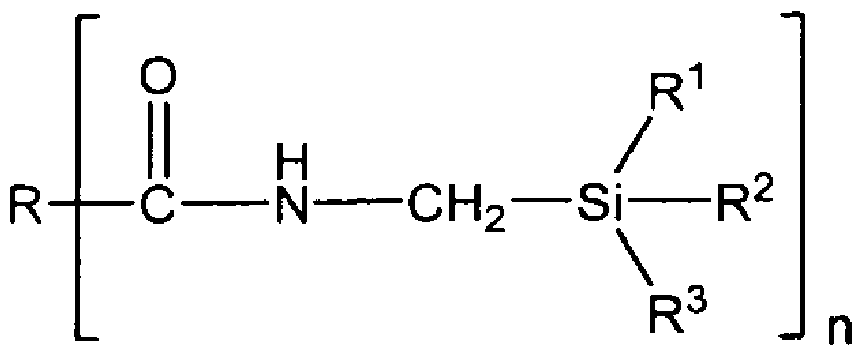
- Example resins suitable for the resin matrix of the present invention include reactive polymer resins with at least one silyl-reactive functional group, including at least one bond that may be activated with water.
- Example silyl-reactive functional groups include alkoxy silane, acetoxy silane, and ketoxime silane.
- the reactive polymer resin can be any reactive polymer capable of participating in a silyl hydrolyzation reaction.
- the reactive polymer resin can be selected from a wide range of polymers as polymer systems that possess reactive silyl groups, for example a silyl-modified reactive polymer.
- the silyl-modified reactive polymers can have a non-silicone backbone to limit the release of silicone when heated, such as when used in an electronic device.
- the silyl-modified reactive polymer has a non-silicone backbone.
- the silyl-modified reactive polymer has a flexible backbone for lower modulus and glass transition temperature.
- the silyl-modified reactive polymer has a flexible backbone of polyether, polyester, polyurethane, polyacrylate, polyisoprene, polybutadiene, polystyrene- butadiene, or polybutylene-isoprene.
- the silyl-modified reactive polymer can be obtained by reacting a polymer with at least one ethylenically unsaturated silane in the presence of a radical starter, the ethylenically unsaturated silane carrying at least one hydrolyzable group on the silicon atom.
- the silyl modified reactive polymer can be dimethoxysilane modified polymer, trimethoxysilane modified polymer, or tri ethoxy silane modified polymer.
- the silyl modified reactive polymer may include a silane modified polyether, polyester, polyurethane, polyacrylate, polyisoprene, polybutadiene, polystyrene-butadiene, or polybutylene-isoprene.
- the ethylenically unsaturated silane is particularly preferably selected from the group made up of vinyltrimethoxysilane, vinyltriethoxysilane, vinyldimethoxymethylsilane, vinyldiethoxymethylsilane, trans-P-methyl acrylic acid trimethoxysilylmethyl ester, and trans-b- methylacrylic acid trimethoxysilylpropyl ester.
- the silyl-modified reactive polymer preferably comprise(s) silyl groups having at least one hydrolyzable group on the silicon atom in a statistical distribution.
- the silyl-modified reactive polymer can also be obtained by reacting a polymer with hydroxy group and alkoxysilane with isocyanate group.
- the silyl modified reactive polymer can be dimethoxysilane modified polyurethane polymer, trimethoxysilane modified polyurethane polymer, or triethoxysilane modified polyurethane polymer.
- Silyl-modified reactive polymers are available, for example, as dimethoxysilane modified MS polymer with polyether backbone and XMAPTM polymer with polyacrylate backbone from Kaneka Belgium NV, trimethoxysilane modified ST polymer from Evonik, triethoxysilane modified TegopacTM polymer from Evonik, silane modified DesmosealTM polymer from Covestro, or silane modified SMP polymer from Henkel.
- Acrylates contemplated for use in the present invention as the resin backbone are well known in the art, as set forth in US Patent No. 5,717,034, the entire contents of which being incorporated herein by reference.
- Exemplary acrylates contemplated for use herein include monofunctional (meth)acrylates, difunctional (meth)acrylates, trifunctional (meth)acrylates, polyfunctional (meth)acrylates, and the like.
- Exemplary monofunctional (meth)acrylates include phenylphenol acrylate, methoxypolyethylene acrylate, acryloyloxyethyl succinate, fatty acid acrylate, methacroloyloxyethylphthalic acid, phenoxyethylene glycol methacrylate, fatty acid methacrylate, b-carboxyethyl acrylate, isobomyl acrylate, isobutyl acrylate, t-butyl acrylate, hydroxyethyl acrylate, hydroxypropyl acrylate, dihydrocyclopentadiethyl acrylate, cyclohexyl methacrylate, t-butyl methacrylate, dimethylaminoethyl methacrylate, diethlylaminoethyl methacrylate, t-butylaminoethyl methacrylate, 4-hydroxybutyl acrylate, tetrahydrofurfuryl
- Exemplary difunctional (meth)acrylates include hexanediol dimethacrylate, hydroxyacryloyloxypropyl methacrylate, hexanediol diacrylate, urethane acrylate, epoxyacrylate, bisphenol A-type epoxyacrylate, modified epoxyacrylate, fatty acid-modified epoxyacrylate, amine-modified bisphenol A-type epoxyacrylate, allyl methacrylate, ethylene glycol dimethacrylate, diethylene glycol dimethacryrlate, ehoxylated bisphenol A dimethacrylate, tricyclodecanedimethanol dimethacrylate, glycerine dimethacrylage, polypropylene glycol diacrylate, propoxylated ethoylated bisphenol A diacrylate, 9,9 bis-(4-(2- acryloyloxyehoxy)phenyl) fluorine, tricyclodecane diacrylate, dipropyleneglycol diacrylate
- Exemplary trifunctional (meth)acrylates include trimethylolpropane trimethacrylate, trimethylolpropane triacrylate, trimethylolpropane ehoxy triacrylate, polyether triacrylate, glycerine propoxy triacrylate, and the like.
- Exemplary polyfunctional (meth)acrylates include dipentaerythritol polyacrylate, dipentaerythritol hexaacrylate, pentaerythritol tetraacrylate, pentaerythriolethoxy tetraacrylate, ditrimethololpropane tetraacrylate, and the like.
- the present compositions preferably include a diluent to lower the viscosity of the dispensable mass, particularly under shear, and to maintain a flexibility/softness property when the composition is in a cured state.
- the cured compositions exhibit a relatively low modulus or hardness of less than 80 Shore 00 to mitigate the stress in electronic component assembly and to promote conformability of the thermal material to respective contact surfaces of the electronic component.
- Diluents useful in the present compositions are those which are effective in facilitating fluency of the coherent mass making up the composition.
- the diluents of the present invention may preferably be low-volatility liquids that reduce the viscosity of the overall pre cured composition so that the composition is readably dispensable through liquid dispensing equipment.
- the diluent may therefore exhibit a viscosity of less than 1000 cP at 25 °C.
- the diluent may exhibit a viscosity of less than 500 cP at 25 °C.
- the diluent may exhibit a viscosity of less than 200 cP at 25 °C.
- the diluent exhibits a viscosity of between 10-1000 cP at 25 °C.
- an aspect of the present invention is that the diluent does not participate in the polymer cross-linking reaction during cure. Moreover, the diluent does not itself cross-link, wherein the diluent retains a hardness reducing property to the cured composition.
- non-crosslinked means that no reactant molecule is linked to more than two other reactant molecules unless the other reactant molecules are linked only to a single reactant molecule.
- the diluent is preferably added to the composition in an amount suitable to appropriately adjust viscosity for pre-cured dispensability, and post-cured softness.
- the diluent may represent about 1-50 percent by weight of the composition.
- the diluent may represent about 1-20 percent by weight of the composition.
- the diluent may represent about 1-10 percent by weight of the composition.
- the diluent may preferably be present at less than 20% by weight of the composition.
- Example diluents include sebacates, adipates, terephthalates, dibenzoates, gluterates, phthalates, azelates, benzoates, sulfonamides, organophosphates, glycols, polyethers, and polybutadienes, epoxies, amines, acrylates, thiols, polyols, and isocyanates.
- the non-silicone cross-linkable polymer forming the bulk matrix of the composition preferably forms a cross-linked network without reacting with the diluent.
- SMP non-silicone silyl-modified polymers
- the thermally conductive compositions of the present invention preferably include thermally conductive particles dispersed therein.
- the particles may be both thermally conductive and electrically conductive.
- the particles may be thermally conductive and electrically insulating.
- Example thermally conductive particles include aluminum oxide, aluminum trihydrate, zinc oxide, graphite, magnesium oxide, silicon carbide, aluminum nitride, boron nitride, metal particulate, and combinations thereof.
- the thermally conductive particles may be of various shape and size, and it is contemplated that a particle size distribution may be employed to fit the parameters of any particular application.
- Thermally conductive particles used in the compositions of the present invention may be present in the range of about 20-95 percent by weight. In some embodiments, the compositions comprise in the range of about 50 up to about 95 percent by weight thermally conductive particles. In some embodiments, the compositions comprise in the range of about 80 up to about 95 percent by weight thermally conductive particles. In some embodiments, the compositions comprise in the range of about 90 up to about 95 percent by weight thermally conductive particles. In some embodiments, the compositions comprise between 90-95 percent by weight conductive particles.
- the thermally conductive particles used in the compositions of the present invention have an average particle size (dso) in the range of about 0.1 to about 250 micrometers. In some embodiments, the average particle size is in the range of about 0.5 to about 100 micrometers. In some embodiments, the average particle size is in the range of about 1 to about 50 micrometers.
- the thermally conductive particles may be spherical, rod-like, or plate-like in shape, and one or more particle shapes may be employed in the compositions of the present invention.
- the thermally conductive fillers comprise multiple sizes of particulate fillers.
- the fillers include 2pm, 7pm, and 70pm fillers.
- the 2pm fillers are present in the composition in an amount of about 5-20 wt.% based on the total weight of the filler mixture
- 7pm fillers are present in an amount of about 20- 30 wt.% based on the total weight of the filler mixture
- 70gm fillers present in an amount of about 50-75 wt.% based on the total weight of the filler mixture.
- composition of the present invention exhibits a thermal conductivity of at least 1.0 W/m*K, more preferably at least 3.0 W/m*K, and still more preferably at least 6 W/m*K.
- Certain rheological modifiers may be included in the compositions of the present invention to aid in the flow characteristics, thixotropy, and dispensed form stability.
- the rheological modifiers useful in the present invention may include thickening agents such as fumed silica, organoclay, polyurethanes, and acrylic polymers.
- the rheological modifiers may also include dispersion agents for the thermally conductive fillers.
- Thickening agents used in the compositions of the present invention are present in the range of about 0 up to about 3 percent by weight. In some embodiments, the compositions comprise in the range of about 0.01 up to about 1 percent by weight thickening agent. In some embodiments, the compositions comprise in the range of about 0.05 up to about 0.5 percent by weight thickening agent. In some embodiments, the compositions comprise less than 0.5 percent by weight thickening agent.
- a reaction catalyst is employed to facilitate the cross-linking of the non-silicone resin.
- the reaction catalyst facilitates condensation-type cross-linking of the non-silicone resin.
- Example reaction catalysts useful in the compositions of the present invention include organotin and organobismuth compounds that facilitate moisture cure of the non-silicone resins.
- Reaction catalysts used in the compositions of the present invention are present in the range of about 0 up to about 2 percent by weight. In some embodiments, the compositions comprise in the range of about 0.01 up to about 0.5 percent by weight reaction catalyst. In some embodiments, the compositions comprise in the range of about 0.05 up to about 0.2 percent by weight reaction catalyst. In some embodiments, the compositions comprise less than 0.2 percent by weight reaction catalyst.
- the thermally conductive compositions of the present invention are preferably curable in the presence of water (moisture curable) at ambient temperature. The moisture may be available from the ambient environment or from water released from the object(s) to which the composition is applied.
- the term “ambient temperature” is intended to mean the temperature of the environment within which the reaction occurs, and within a temperature range of 15-30 °C.
- the thermally conductive compositions are curable in the presence of water at ambient temperature within 72 hours, and preferably within 24 hours.
- the thermally conductive compositions may also be curable in the presence of water at elevated temperatures.
- the term “curable” is intended to mean reactable to form a cross-linked network of a solidous body.
- compositions of the present invention preferably include a water scavenger for extended pot life.
- the water scavenger may be, for example, alkyltrimethoxysilane, oxazolidines, zeolite powder, p-toluenesulfonyl isocyanate, and ethyl orthoformate.
- the water scavenger is preferably vinyltrimethoxysilane. If too much of the water scavenger is included in the composition the curing will be slowed. In an amount of greater than about 0.05 wt.% and less than about 0.5wt.%, for example about 0.1 wt.%.
- compositions described herein may further comprise one or more additives selected from fillers, stabilizers, adhesion promoters, pigments, wetting agents, dispersants, flame retardants, and corrosion inhibitors.
- the composition can be useful as a thermal interface material, for example a thermal interface material for use in electronic devices.
- the composition cures to a soft solid at room temperature through silane hydrolyzation and condensation with external humidity in application.
- the pre-cured dispensable compositions of the present invention are formulated to exhibit a viscosity of between 300 Pa*s and 1,500 Pa*s at Is 1 and 25 °C. In some embodiments, the pre-cured dispensable compositions are formulated to exhibit a viscosity of between 400 Pa*s and 1,200 Pa*s at Is 1 and 25 °C. In some embodiments, the pre-cured dispensable compositions are formulated to exhibit a viscosity of between 500 Pa*s and 1,000 Pa*s at Is 1 and 25 °C.
- the pre-cured dispensable compositions of the present invention are formulated to exhibit a viscosity of less than 300 Pa*s at 1500s 1 and 25 °C. In some embodiments, the pre cured dispensable compositions are formulated to exhibit a viscosity of less than 200 Pa*s at 1500s 1 and 25 °C. In some embodiments, the pre-cured dispensable compositions are formulated to exhibit a viscosity of less than 100 Pa*s at 1500s 1 and 25 °C.
- the resin components can be altered for application requirements.
- silane modified polyacrylate can be used in the compositions along with low volatile diluent above 100°C.
- silane modified polyether could be formulated can be used in the compositions along with low volatile diluent.
- the Examples described herein are one-component thermally conductive materials using alkoxy silane modified polyacrylate as the reactive polymer component for applications requiring stable operation above 100 °C.
- the example compositions include less than 10 wt.% alkoxysilane modified polyacrylate, less than 10 wt.% plasticizer with viscosity below 200 cP, less than 0.5 wt.% of liquid dispersion additive, less than 0.2 wt.% of the catalyst, less than 0.5 wt.% of thickener (fume silica), less than 0.5 wt.% water scavenger, and more than 90 wt.% alumina powders or alumina/alumina nitrile combined.
- Curing of the compositions is achieved by mixing the compositions with 0.1 wt.% water, so that the compositions become solid within about 24 hours.
- the hardness of a cured 250mm puck measured by Shore OO durometer is between about 50 and about 80 Shore OO.
- Example A was prepared by adding 80g of trimellitate plasticizer, 20g of dimethoxysilane terminated polyacrylate, lg of liquid rheology additive, lg of fume silica, 165g of alumina filler with average size of 2 micron, 275g of alumina filler with average size of 7 micron, 630g of alumina filler with average size of 70 micron, lg of carbon black as pigment, lg of dibutyltin catalyst, and lg of water scavenger into a 0.6 gallon size of mixing bucket, and mixing twice at 800 rpm for 2 minutes with Flacktec DAC-5000 high speed mixer.
- Example B includes 2 phr thickener in the composition to increase low shear viscosity.
- Examples C and D include 2 micron size of aluminum nitrile filler instead of 2 micron size of alumina filler used in the compositions of Examples A and B to increase thermal conductivity.
- Each of Examples B-D is otherwise prepared with the same method as the Example A described above. Comparison of the composition of the samples are shown in Table 1.
- Examples E, F, and G are one-component thermally conductive materials using alkoxysilane modified polyether as the reactive polymer component along with polyether plasticizer for better compatibility with the polymer.
- Example E includes less than 10 wt.% alkoxysilane modified poly ether, less than 10 wt.% poly ether plasticizer with viscosity below 500 cP, less than 0.5 wt.% of liquid dispersion additives, less than 0.2 wt.% of the catalyst, less than 0.5 wt.% of thickener (fume silica), less than 0.5 wt.% water scavenger, and more than 90 wt.% alumina powders.
- Example E was prepared by adding 85g of polyether polyol with average Mw of 2000, 15g of dimethoxy silane terminated poly ether, lg of liquid rheology additive, lg of thickener (fume silica), 165g of alumina filler with average particle size of 2 pm, 275g of alumina filler with average particle size of 7 pm, 63 Og of alumina filler with average particle size of 70 pm, lg of carbon black as pigment, lg of dibutyltin catalyst, and lg of water scavenger into a 0.6 gallon mixing bucket, and mixing twice at 800 rpm for 2 minutes with Flacktec DAC- 5000 high speed mixer.
- Example F and G have 25g and 35g of dimethoxysilane terminated poly ether in the compositions, respectively, instead of 15g used in the composition of Example E to increase the hardness of the cured compositions.
- Each of Examples F, G are otherwise prepared with the same method as for Example E described above. Comparison of the composition of the samples are shown in Table 3. The properties of the compositions of Examples E, F, and G are measured similarly to Examples A to D described above, and are shown in Table 4. Table 3
Landscapes
- Chemical & Material Sciences (AREA)
- Organic Chemistry (AREA)
- Health & Medical Sciences (AREA)
- Chemical Kinetics & Catalysis (AREA)
- Medicinal Chemistry (AREA)
- Polymers & Plastics (AREA)
- Inorganic Chemistry (AREA)
- Life Sciences & Earth Sciences (AREA)
- Engineering & Computer Science (AREA)
- Materials Engineering (AREA)
- Wood Science & Technology (AREA)
- Compositions Of Macromolecular Compounds (AREA)
Abstract
Description



Claims
Priority Applications (6)
| Application Number | Priority Date | Filing Date | Title |
|---|---|---|---|
| KR1020237027868A KR20230157946A (en) | 2021-03-15 | 2022-03-15 | 1-component thermally conductive ambient temperature curable material |
| CN202280021824.XA CN117098816A (en) | 2021-03-15 | 2022-03-15 | Ambient temperature curable one-component thermally conductive material |
| MX2023010465A MX2023010465A (en) | 2021-03-15 | 2022-03-15 | One component thermally conductive ambient temperature curable materials. |
| JP2023556754A JP2024511976A (en) | 2021-03-15 | 2022-03-15 | One-component thermally conductive ambient temperature curable material |
| EP22772077.8A EP4308653A4 (en) | 2021-03-15 | 2022-03-15 | One component thermally conductive ambient temperature curable materials |
| US18/237,487 US20230391986A1 (en) | 2021-03-15 | 2023-08-24 | One component thermally conductive ambient temperature curable materials |
Applications Claiming Priority (2)
| Application Number | Priority Date | Filing Date | Title |
|---|---|---|---|
| US202163161022P | 2021-03-15 | 2021-03-15 | |
| US63/161,022 | 2021-03-15 |
Related Child Applications (1)
| Application Number | Title | Priority Date | Filing Date |
|---|---|---|---|
| US18/237,487 Continuation US20230391986A1 (en) | 2021-03-15 | 2023-08-24 | One component thermally conductive ambient temperature curable materials |
Publications (1)
| Publication Number | Publication Date |
|---|---|
| WO2022197726A1 true WO2022197726A1 (en) | 2022-09-22 |
Family
ID=83320940
Family Applications (1)
| Application Number | Title | Priority Date | Filing Date |
|---|---|---|---|
| PCT/US2022/020415 Ceased WO2022197726A1 (en) | 2021-03-15 | 2022-03-15 | One component thermally conductive ambient temperature curable materials |
Country Status (7)
| Country | Link |
|---|---|
| US (1) | US20230391986A1 (en) |
| EP (1) | EP4308653A4 (en) |
| JP (1) | JP2024511976A (en) |
| KR (1) | KR20230157946A (en) |
| CN (1) | CN117098816A (en) |
| MX (1) | MX2023010465A (en) |
| WO (1) | WO2022197726A1 (en) |
Cited By (3)
| Publication number | Priority date | Publication date | Assignee | Title |
|---|---|---|---|---|
| WO2024086553A1 (en) * | 2022-10-18 | 2024-04-25 | Dow Silicones Corporation | Silane modified polymer-based thermally conductive composition |
| EP4424761A1 (en) * | 2023-02-28 | 2024-09-04 | POLYTEC PT GMBH Polymere Technologien | High temperature resistant contact and filling material and use thereof |
| WO2024206793A1 (en) * | 2023-03-30 | 2024-10-03 | Kaneka Americas Holding, Inc. | Curable resin composition with adjustable adhesion properties and methods thereof |
Citations (5)
| Publication number | Priority date | Publication date | Assignee | Title |
|---|---|---|---|---|
| US20090215944A1 (en) * | 2005-04-06 | 2009-08-27 | Isabelle Maton | Organosiloxane Compositions |
| US20090281253A1 (en) * | 2005-09-30 | 2009-11-12 | Kaneka Corporation | Curable composition improved in curability and storage stability |
| US20130020025A1 (en) * | 2010-03-16 | 2013-01-24 | Henkel Corporation | Silane moisture curable hot melts |
| WO2013042638A1 (en) * | 2011-09-21 | 2013-03-28 | 株式会社スリーボンド | Thermally conductive, moisture-curable resin composition |
| CN105102575A (en) * | 2013-02-11 | 2015-11-25 | 道康宁公司 | In situ method for forming thermally conductive thermal radical cure silicone composition |
Family Cites Families (5)
| Publication number | Priority date | Publication date | Assignee | Title |
|---|---|---|---|---|
| JP5743584B2 (en) * | 2011-02-09 | 2015-07-01 | サンスター技研株式会社 | Thermally conductive composition |
| CN103890094B (en) * | 2011-10-06 | 2016-08-17 | 电化株式会社 | Low exhaust heat-conductive composition |
| JP2016520696A (en) * | 2013-05-10 | 2016-07-14 | ザ プロクター アンド ギャンブル カンパニー | Consumer products containing silane-modified oil |
| JP6870605B2 (en) * | 2017-12-26 | 2021-05-12 | 信越化学工業株式会社 | Primer composition and method of adhering silicone resin and polyolefin resin |
| JP6566058B2 (en) * | 2018-02-09 | 2019-08-28 | 横浜ゴム株式会社 | Curable resin composition |
-
2022
- 2022-03-15 WO PCT/US2022/020415 patent/WO2022197726A1/en not_active Ceased
- 2022-03-15 EP EP22772077.8A patent/EP4308653A4/en active Pending
- 2022-03-15 JP JP2023556754A patent/JP2024511976A/en active Pending
- 2022-03-15 CN CN202280021824.XA patent/CN117098816A/en active Pending
- 2022-03-15 MX MX2023010465A patent/MX2023010465A/en unknown
- 2022-03-15 KR KR1020237027868A patent/KR20230157946A/en active Pending
-
2023
- 2023-08-24 US US18/237,487 patent/US20230391986A1/en active Pending
Patent Citations (5)
| Publication number | Priority date | Publication date | Assignee | Title |
|---|---|---|---|---|
| US20090215944A1 (en) * | 2005-04-06 | 2009-08-27 | Isabelle Maton | Organosiloxane Compositions |
| US20090281253A1 (en) * | 2005-09-30 | 2009-11-12 | Kaneka Corporation | Curable composition improved in curability and storage stability |
| US20130020025A1 (en) * | 2010-03-16 | 2013-01-24 | Henkel Corporation | Silane moisture curable hot melts |
| WO2013042638A1 (en) * | 2011-09-21 | 2013-03-28 | 株式会社スリーボンド | Thermally conductive, moisture-curable resin composition |
| CN105102575A (en) * | 2013-02-11 | 2015-11-25 | 道康宁公司 | In situ method for forming thermally conductive thermal radical cure silicone composition |
Non-Patent Citations (1)
| Title |
|---|
| See also references of EP4308653A4 * |
Cited By (4)
| Publication number | Priority date | Publication date | Assignee | Title |
|---|---|---|---|---|
| WO2024086553A1 (en) * | 2022-10-18 | 2024-04-25 | Dow Silicones Corporation | Silane modified polymer-based thermally conductive composition |
| EP4424761A1 (en) * | 2023-02-28 | 2024-09-04 | POLYTEC PT GMBH Polymere Technologien | High temperature resistant contact and filling material and use thereof |
| WO2024179909A1 (en) * | 2023-02-28 | 2024-09-06 | Polytec Pt Gmbh Polymere Technologien | High-temperature-resistant contact and filling material and use thereof |
| WO2024206793A1 (en) * | 2023-03-30 | 2024-10-03 | Kaneka Americas Holding, Inc. | Curable resin composition with adjustable adhesion properties and methods thereof |
Also Published As
| Publication number | Publication date |
|---|---|
| KR20230157946A (en) | 2023-11-17 |
| JP2024511976A (en) | 2024-03-18 |
| CN117098816A (en) | 2023-11-21 |
| EP4308653A4 (en) | 2025-02-19 |
| US20230391986A1 (en) | 2023-12-07 |
| MX2023010465A (en) | 2023-09-14 |
| EP4308653A1 (en) | 2024-01-24 |
Similar Documents
| Publication | Publication Date | Title |
|---|---|---|
| US20230391986A1 (en) | One component thermally conductive ambient temperature curable materials | |
| US12441881B2 (en) | Thermal interface materials | |
| EP2392628B1 (en) | Heat-conductive pressure-sensitive adhesive composition and heat-conductive pressure-sensitive adhesive sheet | |
| JP7050704B2 (en) | Thermally conductive silicone rubber sheet with thermally conductive adhesive layer | |
| CN103649150B (en) | Carbamide paint containing silane | |
| JP4670171B2 (en) | Primer composition | |
| CN113692427A (en) | Heat conductive composition, heat conductive member, and battery module | |
| WO2023212274A1 (en) | Two-part curable thermally conductive composition | |
| JP4423808B2 (en) | Primer composition | |
| JP4474607B2 (en) | Composition for thermally conductive resin molded body and molded body obtained therefrom | |
| US20240270930A1 (en) | Thermally conductive composition | |
| US20240279426A1 (en) | Non-silicone thermal interface material | |
| JP2022078110A (en) | Heat-conductive silicone rubber sheet having heat-conductive adhesive layer | |
| JP2006131741A (en) | Curable resin composition | |
| CA3130341C (en) | Thermal interface materials | |
| AU2016268157B2 (en) | Water-based zinc-rich pre-construction primer | |
| US12614779B2 (en) | Silicone free thermal interface material with reactive diluent | |
| US20220328902A1 (en) | Silicone free thermal interface material with reactive diluent | |
| JP6740917B2 (en) | Primer composition | |
| JP2006001975A (en) | Primer composition |
Legal Events
| Date | Code | Title | Description |
|---|---|---|---|
| 121 | Ep: the epo has been informed by wipo that ep was designated in this application |
Ref document number: 22772077 Country of ref document: EP Kind code of ref document: A1 |
|
| WWE | Wipo information: entry into national phase |
Ref document number: MX/A/2023/010465 Country of ref document: MX |
|
| WWE | Wipo information: entry into national phase |
Ref document number: 2023556754 Country of ref document: JP |
|
| WWE | Wipo information: entry into national phase |
Ref document number: 202280021824.X Country of ref document: CN |
|
| WWE | Wipo information: entry into national phase |
Ref document number: 2022772077 Country of ref document: EP |
|
| NENP | Non-entry into the national phase |
Ref country code: DE |
|
| ENP | Entry into the national phase |
Ref document number: 2022772077 Country of ref document: EP Effective date: 20231016 |