WO2022210046A1 - 二次電池電極用樹脂組成物 - Google Patents
二次電池電極用樹脂組成物 Download PDFInfo
- Publication number
- WO2022210046A1 WO2022210046A1 PCT/JP2022/012777 JP2022012777W WO2022210046A1 WO 2022210046 A1 WO2022210046 A1 WO 2022210046A1 JP 2022012777 W JP2022012777 W JP 2022012777W WO 2022210046 A1 WO2022210046 A1 WO 2022210046A1
- Authority
- WO
- WIPO (PCT)
- Prior art keywords
- group
- amount
- acetal
- modified
- structural unit
- Prior art date
- Legal status (The legal status is an assumption and is not a legal conclusion. Google has not performed a legal analysis and makes no representation as to the accuracy of the status listed.)
- Ceased
Links
Classifications
-
- C—CHEMISTRY; METALLURGY
- C08—ORGANIC MACROMOLECULAR COMPOUNDS; THEIR PREPARATION OR CHEMICAL WORKING-UP; COMPOSITIONS BASED THEREON
- C08F—MACROMOLECULAR COMPOUNDS OBTAINED BY REACTIONS ONLY INVOLVING CARBON-TO-CARBON UNSATURATED BONDS
- C08F216/00—Copolymers of compounds having one or more unsaturated aliphatic radicals, each having only one carbon-to-carbon double bond, and at least one being terminated by an alcohol, ether, aldehydo, ketonic, acetal or ketal radical
- C08F216/38—Copolymers of compounds having one or more unsaturated aliphatic radicals, each having only one carbon-to-carbon double bond, and at least one being terminated by an alcohol, ether, aldehydo, ketonic, acetal or ketal radical by an acetal or ketal radical
-
- H—ELECTRICITY
- H01—ELECTRIC ELEMENTS
- H01M—PROCESSES OR MEANS, e.g. BATTERIES, FOR THE DIRECT CONVERSION OF CHEMICAL ENERGY INTO ELECTRICAL ENERGY
- H01M4/00—Electrodes
- H01M4/02—Electrodes composed of, or comprising, active material
- H01M4/62—Selection of inactive substances as ingredients for active masses, e.g. binders, fillers
-
- H—ELECTRICITY
- H01—ELECTRIC ELEMENTS
- H01M—PROCESSES OR MEANS, e.g. BATTERIES, FOR THE DIRECT CONVERSION OF CHEMICAL ENERGY INTO ELECTRICAL ENERGY
- H01M4/00—Electrodes
- H01M4/02—Electrodes composed of, or comprising, active material
- H01M4/62—Selection of inactive substances as ingredients for active masses, e.g. binders, fillers
- H01M4/621—Binders
- H01M4/622—Binders being polymers
- H01M4/623—Binders being polymers fluorinated polymers
-
- C—CHEMISTRY; METALLURGY
- C08—ORGANIC MACROMOLECULAR COMPOUNDS; THEIR PREPARATION OR CHEMICAL WORKING-UP; COMPOSITIONS BASED THEREON
- C08F—MACROMOLECULAR COMPOUNDS OBTAINED BY REACTIONS ONLY INVOLVING CARBON-TO-CARBON UNSATURATED BONDS
- C08F8/00—Chemical modification by after-treatment
-
- C—CHEMISTRY; METALLURGY
- C08—ORGANIC MACROMOLECULAR COMPOUNDS; THEIR PREPARATION OR CHEMICAL WORKING-UP; COMPOSITIONS BASED THEREON
- C08F—MACROMOLECULAR COMPOUNDS OBTAINED BY REACTIONS ONLY INVOLVING CARBON-TO-CARBON UNSATURATED BONDS
- C08F8/00—Chemical modification by after-treatment
- C08F8/28—Condensation with aldehydes or ketones
-
- C—CHEMISTRY; METALLURGY
- C08—ORGANIC MACROMOLECULAR COMPOUNDS; THEIR PREPARATION OR CHEMICAL WORKING-UP; COMPOSITIONS BASED THEREON
- C08L—COMPOSITIONS OF MACROMOLECULAR COMPOUNDS
- C08L29/00—Compositions of homopolymers or copolymers of compounds having one or more unsaturated aliphatic radicals, each having only one carbon-to-carbon double bond, and at least one being terminated by an alcohol, ether, aldehydo, ketonic, acetal or ketal radical; Compositions of hydrolysed polymers of esters of unsaturated alcohols with saturated carboxylic acids; Compositions of derivatives of such polymers
- C08L29/14—Homopolymers or copolymers of acetals or ketals obtained by polymerisation of unsaturated acetals or ketals or by after-treatment of polymers of unsaturated alcohols
-
- C—CHEMISTRY; METALLURGY
- C09—DYES; PAINTS; POLISHES; NATURAL RESINS; ADHESIVES; COMPOSITIONS NOT OTHERWISE PROVIDED FOR; APPLICATIONS OF MATERIALS NOT OTHERWISE PROVIDED FOR
- C09D—COATING COMPOSITIONS, e.g. PAINTS, VARNISHES OR LACQUERS; FILLING PASTES; CHEMICAL PAINT OR INK REMOVERS; INKS; CORRECTING FLUIDS; WOODSTAINS; PASTES OR SOLIDS FOR COLOURING OR PRINTING; USE OF MATERIALS THEREFOR
- C09D129/00—Coating compositions based on homopolymers or copolymers of compounds having one or more unsaturated aliphatic radicals, each having only one carbon-to-carbon double bond, and at least one being terminated by an alcohol, ether, aldehydo, ketonic, acetal, or ketal radical; Coating compositions based on hydrolysed polymers of esters of unsaturated alcohols with saturated carboxylic acids; Coating compositions based on derivatives of such polymers
- C09D129/14—Homopolymers or copolymers of acetals or ketals obtained by polymerisation of unsaturated acetals or ketals or by after-treatment of polymers of unsaturated alcohols
-
- H—ELECTRICITY
- H01—ELECTRIC ELEMENTS
- H01M—PROCESSES OR MEANS, e.g. BATTERIES, FOR THE DIRECT CONVERSION OF CHEMICAL ENERGY INTO ELECTRICAL ENERGY
- H01M10/00—Secondary cells; Manufacture thereof
- H01M10/05—Accumulators with non-aqueous electrolyte
- H01M10/052—Li-accumulators
-
- H—ELECTRICITY
- H01—ELECTRIC ELEMENTS
- H01M—PROCESSES OR MEANS, e.g. BATTERIES, FOR THE DIRECT CONVERSION OF CHEMICAL ENERGY INTO ELECTRICAL ENERGY
- H01M10/00—Secondary cells; Manufacture thereof
- H01M10/05—Accumulators with non-aqueous electrolyte
- H01M10/052—Li-accumulators
- H01M10/0525—Rocking-chair batteries, i.e. batteries with lithium insertion or intercalation in both electrodes; Lithium-ion batteries
-
- H—ELECTRICITY
- H01—ELECTRIC ELEMENTS
- H01M—PROCESSES OR MEANS, e.g. BATTERIES, FOR THE DIRECT CONVERSION OF CHEMICAL ENERGY INTO ELECTRICAL ENERGY
- H01M4/00—Electrodes
- H01M4/02—Electrodes composed of, or comprising, active material
- H01M4/13—Electrodes for accumulators with non-aqueous electrolyte, e.g. for lithium-accumulators; Processes of manufacture thereof
-
- H—ELECTRICITY
- H01—ELECTRIC ELEMENTS
- H01M—PROCESSES OR MEANS, e.g. BATTERIES, FOR THE DIRECT CONVERSION OF CHEMICAL ENERGY INTO ELECTRICAL ENERGY
- H01M4/00—Electrodes
- H01M4/02—Electrodes composed of, or comprising, active material
- H01M4/13—Electrodes for accumulators with non-aqueous electrolyte, e.g. for lithium-accumulators; Processes of manufacture thereof
- H01M4/139—Processes of manufacture
-
- H—ELECTRICITY
- H01—ELECTRIC ELEMENTS
- H01M—PROCESSES OR MEANS, e.g. BATTERIES, FOR THE DIRECT CONVERSION OF CHEMICAL ENERGY INTO ELECTRICAL ENERGY
- H01M4/00—Electrodes
- H01M4/02—Electrodes composed of, or comprising, active material
- H01M4/62—Selection of inactive substances as ingredients for active masses, e.g. binders, fillers
- H01M4/621—Binders
- H01M4/622—Binders being polymers
-
- C—CHEMISTRY; METALLURGY
- C08—ORGANIC MACROMOLECULAR COMPOUNDS; THEIR PREPARATION OR CHEMICAL WORKING-UP; COMPOSITIONS BASED THEREON
- C08K—Use of inorganic or non-macromolecular organic substances as compounding ingredients
- C08K3/00—Use of inorganic substances as compounding ingredients
- C08K3/18—Oxygen-containing compounds, e.g. metal carbonyls
- C08K3/20—Oxides; Hydroxides
- C08K3/22—Oxides; Hydroxides of metals
- C08K2003/2203—Oxides; Hydroxides of metals of lithium
-
- C—CHEMISTRY; METALLURGY
- C08—ORGANIC MACROMOLECULAR COMPOUNDS; THEIR PREPARATION OR CHEMICAL WORKING-UP; COMPOSITIONS BASED THEREON
- C08K—Use of inorganic or non-macromolecular organic substances as compounding ingredients
- C08K3/00—Use of inorganic substances as compounding ingredients
- C08K3/18—Oxygen-containing compounds, e.g. metal carbonyls
- C08K3/20—Oxides; Hydroxides
- C08K3/22—Oxides; Hydroxides of metals
- C08K2003/2289—Oxides; Hydroxides of metals of cobalt
-
- C—CHEMISTRY; METALLURGY
- C08—ORGANIC MACROMOLECULAR COMPOUNDS; THEIR PREPARATION OR CHEMICAL WORKING-UP; COMPOSITIONS BASED THEREON
- C08K—Use of inorganic or non-macromolecular organic substances as compounding ingredients
- C08K3/00—Use of inorganic substances as compounding ingredients
- C08K3/02—Elements
- C08K3/04—Carbon
-
- Y—GENERAL TAGGING OF NEW TECHNOLOGICAL DEVELOPMENTS; GENERAL TAGGING OF CROSS-SECTIONAL TECHNOLOGIES SPANNING OVER SEVERAL SECTIONS OF THE IPC; TECHNICAL SUBJECTS COVERED BY FORMER USPC CROSS-REFERENCE ART COLLECTIONS [XRACs] AND DIGESTS
- Y02—TECHNOLOGIES OR APPLICATIONS FOR MITIGATION OR ADAPTATION AGAINST CLIMATE CHANGE
- Y02E—REDUCTION OF GREENHOUSE GAS [GHG] EMISSIONS, RELATED TO ENERGY GENERATION, TRANSMISSION OR DISTRIBUTION
- Y02E60/00—Enabling technologies; Technologies with a potential or indirect contribution to GHG emissions mitigation
- Y02E60/10—Energy storage using batteries
Definitions
- the present invention relates to a resin composition for a secondary battery electrode which is excellent in active material dispersibility, electrolytic solution resistance, and coating film density, and which is capable of achieving both high conductivity and adhesiveness.
- a polyvinyl acetal resin is a resin synthesized using polyvinyl alcohol as a raw material, and has an acetyl group, a hydroxyl group, and an acetal group in side chains. Thereby, excellent toughness, adhesiveness, and the like can be exhibited. Also, by changing the ratio of the side chain groups, it is possible to change the physical properties of the resin. Taking advantage of such properties, polyvinyl acetal resins are used in applications such as electrodes for storage batteries, pigment compositions, and ceramic green sheets.
- Patent Document 1 describes the use of a polyvinyl acetal resin containing an aromatic acetal group in a composition for a lithium secondary battery electrode.
- Patent Document 1 when the polyvinyl acetal resin disclosed in Patent Document 1 is used as an electrode material for a secondary battery, there is a problem that the dispersibility of the active material, the electrolyte resistance, and the coating film density are lowered. In addition, it is not possible to achieve both conductivity and adhesion. If the conductivity is increased, the structure becomes rigid and adhesion decreases, and if the adhesion is increased, an electronic conduction path is not formed and the battery performance decreases There is a problem that Accordingly, there is a demand for a resin that is excellent in dispersibility of an active material, resistance to an electrolyte solution, and coating film density, and exhibits excellent adhesiveness while maintaining high conductivity.
- An object of the present invention is to provide a resin composition for a secondary battery electrode that is excellent in dispersibility of an active material, electrolyte resistance, and coating film density, and is capable of achieving both high conductivity and adhesiveness.
- the present invention comprises an active material, a non-aqueous solvent, and a polyvinyl acetal resin, wherein the polyvinyl acetal resin has a structural unit having a halogen atom and has a Vicat softening temperature of 50° C. or higher and 150° C. or lower. It is a resin composition for a secondary battery electrode.
- the present invention will be described in detail below.
- the present inventors have found that by using a combination of an active material, a non-aqueous solvent, and a polyvinyl acetal resin having a specific structure and physical properties, the dispersibility of the active material, the electrolyte resistance, and the coating density It has been found that both high electrical conductivity and adhesiveness can be achieved. Further, the inventors have found that a secondary battery obtained by using such a resin composition for a secondary battery electrode can achieve a high capacity retention rate, and have completed the present invention.
- the resin composition for secondary battery electrodes of the present invention contains an active material.
- the active material include a positive electrode active material and a negative electrode active material.
- the positive electrode active material include lithium-containing composite metal oxides such as lithium nickel oxide, lithium cobalt oxide, and lithium manganese oxide. Specific examples include LiNiO 2 , LiCoO 2 , LiMn 2 O 4 and the like.
- the negative electrode active material for example, materials conventionally used as negative electrode active materials for storage batteries can be used, for example, spherical natural graphite, natural graphite, artificial graphite, amorphous carbon, carbon black, or Examples include those obtained by adding different elements to these components. In addition, these may be used independently and may use 2 or more types together.
- the resin composition for a secondary battery electrode of the present invention further contains a conductive aid (conductive imparting agent).
- a conductive aid conductive imparting agent
- the electrical resistance of the obtained composition for storage battery electrodes can be further reduced.
- the conductive aid include carbon materials such as graphite, acetylene black, carbon black, ketjen black, and vapor-grown carbon fiber.
- the content of the active material in the resin composition for a secondary battery electrode of the present invention is preferably 20% by weight or more, more preferably 25% by weight or more, and further preferably 30% by weight or more. More preferably, it is 80% by weight or less, and more preferably 70% by weight or less.
- the resin composition for secondary battery electrodes of the present invention contains a non-aqueous solvent.
- the non-aqueous solvent means a solvent having a water content of 100 mass ppm or less in terms of mass.
- the non-aqueous solvent include organic solvents such as ketones, alcohols, aromatic hydrocarbons, esters and amides.
- ketones include acetone, methyl ethyl ketone, dipropyl ketone and diisobutyl ketone.
- Examples of alcohols include methanol, ethanol, isopropanol, and butanol. Toluene, xylene, etc. are mentioned as said aromatic hydrocarbons.
- esters examples include methyl propionate, ethyl propionate, butyl propionate, methyl butanoate, ethyl butanoate, butyl butanoate, methyl pentanoate, ethyl pentanoate, butyl pentanoate, methyl hexanoate, ethyl hexanoate, butyl hexanoate, 2-ethylhexyl acetate, 2-ethylhexyl butyrate and the like.
- methyl cellosolve, ethyl cellosolve, butyl cellosolve, terpineol, dihydroterpineol, butyl cellosolve acetate, butyl carbitol acetate, terpineol acetate, dihydroterpineol acetate and the like can also be used.
- the carbonates include propylene carbonate, ethylene carbonate, diethyl carbonate, dimethyl carbonate, methyl ethyl carbonate and the like.
- the amides include dimethylacetamide, N,N-dimethylformamide, 1-methyl-2-pyrrolidone (N-methylpyrrolidone), diethylformamide and the like.
- amides are preferred, and compounds having a lactam structure are particularly preferred.
- the compound having a lactam structure a compound containing a 3- to 6-membered ring lactam structure is preferable, and a compound containing a 5-membered ring lactam structure is particularly preferable.
- the content of the non-aqueous solvent in the resin composition for a secondary battery electrode of the present invention is preferably 5% by weight or more, more preferably 10% by weight or more, and 45% by weight or less. Preferably, it is 40% by weight or less.
- the resin composition for secondary battery electrodes of the present invention contains a polyvinyl acetal resin.
- the polyvinyl acetal resin has a structural unit having a halogen atom, and has a Vicat softening temperature of 50° C. or higher and 150° C. or lower.
- the dispersibility of the active material can be sufficiently improved, and both high conductivity and dispersibility of the active material can be achieved.
- the polyvinyl acetal resin has a Vicat softening temperature of 50°C or higher and 150°C or lower.
- a Vicat softening temperature is within the above range, excellent electrolyte resistance and high electrical conductivity can be achieved. In addition, changes in coating film density are suppressed, making it possible to produce a dense electrode sheet.
- a preferable lower limit of the Vicat softening temperature is 60°C, a more preferable lower limit is 70°C, a preferable upper limit is 100°C, and a further preferable upper limit is 90°C.
- the Vicat softening temperature can be measured by a method conforming to JIS K 7206:2016 (Plastics-Thermoplastics-Determination of Vicat softening temperature (VST) A50 method).
- the Vicat softening temperature is determined by the structure of the polyvinyl acetal resin (in particular, the structure of the structural unit having a halogen atom), the following numerical range of the polyvinyl acetal resin (the numerical range related to the structural unit having a halogen atom, the amount of hydroxyl groups , acetyl group content, degree of polymerization, etc.) can be adjusted by the method for producing the polyvinyl acetal resin.
- the polyvinyl acetal resin contains a structural unit having a halogen atom.
- a structural unit having the halogen atom By containing the structural unit having the halogen atom, excellent adhesiveness and dispersibility can be obtained. Moreover, when it is used as an electrode, the electrode resistance can be lowered, and deterioration due to the electrolytic solution can be prevented, making it possible to produce a high-output storage battery.
- halogenation-modified unit amount means the content of structural units having a halogen atom.
- halogenation-modified acetal bond unit amount means the content of a structure in which halogen atoms are bonded via acetal bonds (halogenation-modified acetal bond units).
- non-halogenated acetal group amount means the content of structural units having an acetal group, excluding the halogenated modified acetal bond units.
- “Acetal group content” means the content of structural units having an acetal group. That is, it also includes a halogenated modified acetal linking unit.
- the halogen atom is preferably at least one selected from the group consisting of fluorine, chlorine and bromine. Among them, it is more preferable to use chlorine.
- the structural unit having a halogen atom preferably has 1 to 3 halogen atoms.
- the structural unit having a halogen atom is not particularly limited as long as it has a structure having a halogen atom. etc. are preferred.
- the structure in which halogen atoms are bonded via an acetal bond also includes the case of further bonding via a linking group other than an acetal bond.
- the halogen atom is fluorine, it is preferably used in combination with an aromatic hydrocarbon, and when the halogen atom is chlorine, it is preferably used in combination with an aliphatic hydrocarbon.
- the structural unit having a halogen atom has a structure in which the halogen atom is bonded via an acetal bond (hereinafter, such a structural unit is also referred to as a halogenated modified acetal bond unit), it is represented by the following formula (1).
- the structure which has a multiple types of halogen atom in one structural unit may be sufficient. Further, it may have a structure having a plurality of constitutional units having different halogen atom species.
- R6 represents a halogen atom-containing hydrocarbon group.
- the halogenated modified acetal bond unit is preferably a structural unit represented by the following formula (2).
- R 1 represents a halogen atom or a halogenated alkyl group
- R 2 and R 3 each independently represent a hydrogen atom or a halogen atom.
- R 2 and R 3 may be halogenated alkyl groups.
- halogenated alkyl group examples include a chloroalkyl group, a fluoroalkyl group and a bromoalkyl group.
- chloroalkyl group examples include a chloromethyl group (--CH 2 Cl), a chloroethyl group (--CH 2 CH 2 Cl), a dichloroethyl group, a chloropropyl group and a trichloromethyl group.
- R 1 is preferably a chlorine atom, -CH 2 Cl or -CH 2 CH 2 Cl.
- fluoroalkyl group examples include a fluoromethyl group (--CH 2 F), a fluoroethyl group (--CH 2 CH 2 F), a difluoroethyl group, a fluoropropyl group, a trifluoromethyl group and the like.
- bromoalkyl group examples include a bromomethyl group (--CH 2 Br), a bromoethyl group (--CH 2 CH 2 Br), a dibromoethyl group, a bromopropyl group, a tribromomethyl group and the like.
- the above R 6 can be a halogen atom-containing aromatic group.
- the halogen atom of the halogen atom-containing aromatic group is preferably chlorine, fluorine or bromine.
- the halogen atom-containing aromatic group include a chlorophenyl group, a chloroalkylphenyl group, a fluorophenyl group, a fluoroalkylphenyl group, a bromophenyl group, and a bromoalkylphenyl group.
- the chlorophenyl group include 2-chlorophenyl group, 3-chlorophenyl group, 4-chlorophenyl group, 2,4-dichlorophenyl group and 3,4-dichlorophenyl group.
- chloroalkylphenyl group examples include 2-chloromethylphenyl group, 3-chloromethylphenyl group and 4-chloromethylphenyl group.
- the chlorophenyl group and chloroalkylphenyl group may have other substituents in addition to the chloro group.
- Examples of the fluorophenyl group include 2-fluorophenyl group, 3-fluorophenyl group, 4-fluorophenyl group, 2,4,6-trifluorophenyl group and perfluorophenyl group.
- the fluoroalkylphenyl group includes a 4-trifluoromethylphenyl group, a 3-trifluoromethylphenyl group, a 3,5-ditrifluoromethylphenyl group, a 4-pentafluoroethylphenyl group and a 4-perfluorohexylphenyl group. and the like.
- the bromophenyl group include a 2-bromophenyl group and a 3-bromophenyl group.
- the structural unit having a halogen atom has a structure having a halogen atom or a halogen atom-containing group in a side chain (hereinafter, such a structural unit is also referred to as a halogenated modified side chain binding unit), the following formula (3) It is preferably a structural unit represented by By having a structural unit represented by the following formula (3), the modified polyvinyl acetal resin has excellent adhesiveness and dispersibility, and the obtained composition has even better stability over time. Moreover, when it is used for the electrode of a storage battery, the electrode resistance can be reduced.
- R4 represents a single bond or an alkylene group
- R5 represents a hydrogen atom, a halogen atom or a halogenated alkyl group
- X represents at least one selected from the group consisting of fluorine, chlorine and bromine. show.
- R 4 may be a halogenated alkylene group.
- the alkylene group represented by R 4 above preferably has 1 to 20 carbon atoms, such as a linear alkylene group, a branched alkylene group, and a cyclic alkylene group.
- Examples of the linear alkylene group include methylene group, ethylene group, trimethylene group, tetramethylene group, pentamethylene group, hexamethylene group, octamethylene group and decamethylene group.
- Examples of the branched alkylene group include a methylmethylene group, a methylethylene group, a 1-methylpentylene group and a 1,4-dimethylbutylene group.
- cyclic alkylene group examples include a cyclopropylene group, a cyclobutylene group, and a cyclohexylene group.
- linear alkyl groups such as methylene group, ethylene group, n-propylene group and n-butylene group are preferred, and methylene group and ethylene group are more preferred.
- chloroalkyl group represented by R 5 above the same groups as those for R 1 can be used. Further, in the present invention, it is preferable to use a combination of a single bond for R4 and a hydrogen atom for R5 .
- the preferable lower limit of the content of the structural unit having a halogen atom (halogenation-modified unit amount) relative to the total structural units of the polyvinyl acetal resin is 0.01 mol %, and the preferred upper limit is 20 mol %. Adhesiveness and dispersibility can be improved by adjusting the amount of the halogenated modified unit to 0.01 mol % or more.
- the more preferable lower limit of the amount of the halogenated modification unit is 0.05 mol%, the more preferable lower limit is 0.1 mol%, the more preferable upper limit is 15 mol%, and the more preferable upper limit is 10 mol%.
- the amount of the halogenated modified unit means the sum of both. Further, when the polyvinyl acetal resin has two kinds of structural units having halogen atoms, the ratio of the amounts of the two kinds of halogenated modified units is preferably in the range of 100:1 to 1:100.
- the content of the halogenated modified acetal bond units (halogenated modified acetal bond unit amount)
- a preferable lower limit is 0.01 mol%, and a preferable upper limit is 20 mol%. Adhesiveness and dispersibility can be improved by adjusting the amount of the halogenated modified acetal bond unit to 0.01 mol % or more.
- the more preferable lower limit of the amount of the halogenated modification unit is 0.05 mol%, the more preferable lower limit is 0.1 mol%, the more preferable upper limit is 15 mol%, and the more preferable upper limit is 10 mol%.
- the more preferable lower limit of the content of the halogenation-modified side-chain-bonding unit is 0. .1 mol %, and a more preferred upper limit is 15 mol %.
- a more preferable lower limit is 0.5 mol%, and a more preferable upper limit is 10 mol%. Adhesiveness and dispersibility can be improved by setting it in the said range.
- the ratio of the two (halogenated modified acetal bond units/halogenated modified side chain bond units) is 0. .1 or more and 3 or less, and more preferably 0.5 or more and 2 or less.
- the polyvinyl acetal resin includes a structural unit having an acetal group represented by the following formula (4-1), a structural unit having a hydroxyl group represented by the following formula (4-2), and a structural unit having a hydroxyl group represented by the following formula (4-3). It is preferable to have a structural unit having an acetyl group represented by.
- R 26 represents a hydrogen atom or an alkyl group having 1 to 20 carbon atoms.
- R 26 is an alkyl group having 1 to 20 carbon atoms
- examples of the alkyl group include methyl group, ethyl group, n-propyl group, isopropyl group and n-butyl group.
- the content of the structural unit having an acetal group represented by the formula (4-1) (hereinafter also referred to as "non-halogenated acetal group content”) is 5.0 mol% or more. preferably 70.0 mol % or less. Within the above range, the dispersibility of the active material can be further improved.
- the amount of non-halogenated acetal groups is more preferably 10.0 mol % or more, and more preferably 60.0 mol % or less.
- the two acetalized groups A method of counting hydroxyl groups is adopted to calculate the amount of acetal groups.
- the amount of non-halogenated acetal groups can be measured, for example, by NMR. Also.
- the content of the aforementioned "structure in which halogen atoms are bonded via acetal bonds" is not included in the amount of non-halogenated acetal groups.
- the content of acetoacetal groups acetalized with acetaldehyde in the polyvinyl acetal resin is preferably 10 mol % or more and 30 mol % or less.
- the content of butyl acetal groups acetalized with butyraldehyde (butyral group content) in the polyvinyl acetal resin is preferably 10 mol % or more and 60 mol % or less.
- the polyvinyl acetal resin contains both a structural unit having a non-halogenated acetal group and a halogenated modified acetal bond unit, it is the total amount of the non-halogenated acetal group amount and the halogenated modified acetal bond unit amount.
- the amount of acetal groups [the amount of non-halogenated acetal groups + the amount of halogenated modified acetal bond units] is preferably 10 mol % or more and 70 mol % or less. By setting it within the above range, the adhesiveness and dispersibility are excellent while maintaining the solubility in the organic solvent. More preferably, the acetal group content is 15 mol % or more and 60 mol % or less.
- the content of the halogenated modified acetal bond unit with respect to the structural unit having the non-halogenated acetal group is 6000 or less. preferable. Moreover, it is more preferable that the ratio is 4000 or less. Although the lower limit is not particularly limited, 1 or more is preferable.
- the total amount of the non-halogenated acetal group amount and the halogenated modified unit amount in the polyvinyl acetal resin is 10 mol% or more and 70 mol% or less. is preferred. Within the above range, the adhesiveness and dispersibility are improved. More preferably, the above non-halogenated acetal group amount+halogenated modification unit amount is 15 mol % or more and 60 mol % or less.
- the ratio of the non-halogenated acetal group amount to the halogenated modified unit amount in the polyvinyl acetal resin is preferably 1 or more and 6000 or less. Within the above range, the adhesiveness and dispersibility are improved. More preferably, the ratio of non-halogenated acetal group/halogenated modified unit is 2 or more and 5000 or less.
- the content of the structural unit having a hydroxyl group represented by the formula (4-2) (hereinafter also referred to as "hydroxyl group content”) is 20 mol% or more and 90 mol% or less. is preferred. By setting it as the said range, while being able to fully improve the dispersibility of an active material, high electronic conductivity can be exhibited.
- the amount of hydroxyl groups is more preferably 30.0 mol % or more, and more preferably 85.0 mol % or less.
- the amount of hydroxyl groups can be measured, for example, by NMR.
- the content of the structural unit having an acetyl group represented by the formula (4-3) (hereinafter also referred to as "acetyl group content”) is preferably 0.1 mol% or more. , is more preferably 5.0 mol % or more, preferably 20.0 mol % or less, and more preferably 15.0 mol % or less.
- acetyl group content is preferably 0.1 mol% or more.
- the amount of acetyl groups can be measured, for example, by NMR.
- the average degree of polymerization of the polyvinyl acetal resin is preferably 100 or more and 6000 or less. Within the above range, the dispersibility of the active material can be sufficiently improved, and high conductivity can be exhibited.
- the average degree of polymerization is preferably 150 or more and 5500 or less, more preferably 200 or more and 4000 or less.
- the average degree of polymerization can be measured, for example, according to JIS K6726-1994.
- the "average degree of polymerization of polyvinyl acetal resin" means the average degree of polymerization of polyvinyl alcohol resin as a raw material.
- the content of the polyvinyl acetal resin in the resin composition for a secondary battery electrode of the present invention is preferably 0.1% by weight or more, more preferably 0.5% by weight or more, and 20.0% by weight. % or less, more preferably 15.0% by weight or less.
- the ratio of the content of the polyvinyl acetal resin to the content of the active material (polyvinyl acetal resin content/active material content) in the resin composition for a secondary battery electrode of the present invention is 0.01 or more. preferably 10.0 or less. Within the above range, the dispersibility of the active material is improved, making it easier to form a conductive path. As a result, the conductivity becomes even more excellent.
- the content ratio is more preferably 0.10 or more, and more preferably 8.00 or less.
- a method for producing the polyvinyl acetal resin a method of preparing a polyvinyl alcohol containing a structural unit having a halogen atom and then acetalizing it, a method of acetalizing a polyvinyl alcohol containing no structural unit having a halogen atom, and then a halogen atom and the like. Further, a method of preparing a polyvinyl alcohol containing a structural unit having a halogen atom or a polyvinyl alcohol not containing a structural unit having a halogen atom and then introducing a structural unit having a halogen atom by acetalization can be used.
- polyvinyl alcohol having a structural unit represented by the above formula (3) is prepared in advance and then acetalized. and adding moieties corresponding to R 4 and R 5 of the structural unit represented by the above formula (3).
- a polyvinyl alcohol previously having a structural unit represented by the above formula (3) and a polyvinyl alcohol not having a structural unit represented by the above formula (3) are prepared, and then acetalized to form a poly(vinyl alcohol) represented by the above formula (3). and a method of introducing a structural unit to be used.
- polyvinyl alcohol containing a structural unit having a halogen atom for example, vinyl chloride and vinyl acetate are copolymerized, and then acid or alkali is added to an alcohol solution of the obtained copolymer to obtain a poly(vinyl alcohol). and the like.
- Polyvinyl alcohol containing a structural unit having the above halogen atom may also be produced by a method of adding a halogen atom. Examples of the method for adding the halogen atom include a method of reacting polyvinyl alcohol with a halogen gas.
- Polyvinyl alcohol containing no structural unit having a halogen atom (hereinafter also simply referred to as polyvinyl alcohol) can be obtained, for example, by saponifying a copolymer of vinyl ester and ethylene.
- the vinyl ester include vinyl formate, vinyl acetate, vinyl propionate, and vinyl pivalate. Among them, vinyl acetate is preferable from the viewpoint of economy.
- aldehydes having a halogen atom include, for example, chloroacetaldehyde, dichloroacetaldehyde, trichloroacetaldehyde, 3-chloropropionaldehyde, 4-chlorobutyraldehyde and the like.
- examples of the aldehyde having a fluorine atom include a fluorine atom-containing aliphatic aldehyde and a fluorine atom-containing aromatic aldehyde.
- examples of the fluorine atom-containing aliphatic aldehyde include fluoroacetaldehyde, difluoroacetaldehyde, trifluoroacetaldehyde, 2,2,3,3,3-pentafluoropropionaldehyde, 3-fluoropropionaldehyde, and 3,3,3-trifluoropropione. aldehyde, 4-fluorobutyraldehyde and the like.
- fluorine atom-containing aromatic aldehyde examples include fluorobenzaldehyde, fluoromethylbenzaldehyde, difluoromethylbenzaldehyde, trifluoromethylbenzaldehyde, 3-(4-fluorophenyl)propionaldehyde and the like.
- aldehydes having a halogen atom examples of the aldehyde having a bromine atom include bromine atom-containing aliphatic aldehydes and bromine atom-containing aromatic aldehydes. Acetyl bromide etc. are mentioned as said fluorine atom containing aliphatic aldehyde.
- fluorine atom-containing aromatic aldehyde examples include 4-bromonicotinaldehyde, 2-bromoisophthalaldehyde, 1-bromo-2-naphthaldehyde, 4-bromo-2-thiophenecarboxaldehyde, 4-bromobenzaldehyde, and 3-bromosalicyl. aldehyde, 4-bromo-1-naphthaldehyde, 5-bromo-2-pyridinecarboxaldehyde and the like.
- the aldehyde equivalent is an aldehyde with a protecting group or a compound that can be converted into an aldehyde by a commonly used method, and examples thereof include acetal, hemiacetal, and aldehyde hydrate. Among them, an aldehyde equivalent having a halogen atom is preferable.
- the aldehyde equivalents having a chlorine atom include chloroacetaldehyde dimethyl acetal, chloroacetaldehyde diethyl acetal, 2-chloromethyl-1,3-dioxolane, dichloroacetaldehyde dimethyl acetal, and dichloroacetaldehyde diethyl.
- aldehyde equivalents having a fluorine atom include difluoroacetaldehyde ethyl hemiacetal, 2-(perfluorohexyl)acetaldehyde dimethyl acetal, fluoroacetaldehyde dimethyl acetal, fluoroacetaldehyde diethyl acetal, 2- fluoromethyl-1,3-dioxolane, 2-(perfluorohexyl)acetaldehyde dimethyl acetal, difluoroacetaldehyde dimethyl acetal, difluoroacetaldehyde diethyl acetal, trifluoroacetaldehyde dimethyl acetal, trifluoroacetaldehyde diethyl acetal, trifluoroacetaldehyde methyl hemiacetal, tri fluoroacetaldehyde ethyl hemiacetal, tri fluoroacetaldehyde ethyl
- aldehyde equivalents having a halogen atom examples include bromoacetaldehyde diethyl acetal, 3-bromobenzaldehyde diethyl acetal, and 4-bromobenzaldehyde diethyl acetal.
- the polyvinyl acetal resin may be one obtained by copolymerizing an ethylenically unsaturated monomer as long as the effects of the present invention are not impaired.
- the ethylenically unsaturated monomer is not particularly limited, and examples thereof include acrylic acid, methacrylic acid, (anhydrous) phthalic acid, (anhydrous) maleic acid, and (anhydrous) itaconic acid. Also included are acrylonitrile, methacrylonitrile, acrylamide, methacrylamide, trimethyl-(3-acrylamido-3-dimethylpropyl)-ammonium chloride, acrylamido-2-methylpropanesulfonic acid and sodium salts thereof.
- Terminal-modified polyvinyl alcohol obtained by copolymerizing a vinyl ester monomer such as vinyl acetate and ethylene in the presence of a thiol compound such as thiolacetic acid or mercaptopropionic acid and saponifying the copolymer may also be used. can be done.
- the polyvinyl alcohol which is the raw material of the polyvinyl acetal resin, preferably has a saponification degree of 80.0 mol% or more and 99.9 mol% or less, and preferably 85.0 mol% or more and 95.0 mol% or less. more preferred.
- the dispersibility of the active material can be further enhanced.
- a known method can be used for the acetalization, and it is preferably carried out in an aqueous solvent, in a mixed solvent of water and an organic solvent having compatibility with water, or in an organic solvent.
- an organic solvent compatible with water for example, an alcohol-based organic solvent can be used.
- the organic solvent include alcohol-based organic solvents, aromatic organic solvents, aliphatic ester-based solvents, ketone-based solvents, lower paraffin-based solvents, ether-based solvents, amide-based solvents, and amine-based solvents.
- the acetalization is preferably carried out in the presence of an acid catalyst.
- the acid catalyst is not particularly limited, and includes mineral acids such as sulfuric acid, hydrochloric acid, nitric acid and phosphoric acid, carboxylic acids such as formic acid, acetic acid and propionic acid, methanesulfonic acid, ethanesulfonic acid, benzenesulfonic acid and paratoluenesulfone. sulfonic acids such as acids.
- These acid catalysts may be used alone or in combination of two or more compounds. Among them, hydrochloric acid, nitric acid and sulfuric acid are preferred, and hydrochloric acid is particularly preferred.
- Aldehydes that are commonly used for acetalization include aldehydes having a chain aliphatic group, a cycloaliphatic group, or an aromatic group having 1 to 10 carbon atoms. Conventionally known aldehydes can be used as these aldehydes.
- the aldehyde used in the acetalization reaction is not particularly limited, and examples thereof include aliphatic aldehydes and aromatic aldehydes.
- Examples of the aliphatic aldehyde include formaldehyde, acetaldehyde, propionaldehyde, n-butyraldehyde, isobutyraldehyde, n-valeraldehyde, n-hexylaldehyde, 2-ethylbutyraldehyde, 2-ethylhexylaldehyde, n-heptylaldehyde, n- octylaldehyde, octeraldehyde, n-nonylaldehyde, n-decylaldehyde, amylaldehyde and the like.
- aromatic aldehyde examples include aromatic aldehydes such as benzaldehyde, cinnamaldehyde, 2-methylbenzaldehyde, 3-methylbenzaldehyde, 4-methylbenzaldehyde, p-hydroxybenzaldehyde, m-hydroxybenzaldehyde, phenylacetaldehyde and ⁇ -phenylpropionaldehyde. etc.
- cyclic multimers such as paraldehyde and metaldehyde can be used. These aldehydes may be used individually by 1 type, and may use 2 or more types together.
- aldehydes formaldehyde, acetaldehyde, butyraldehyde, 2-ethylhexylaldehyde, 2-ethylhexylaldehyde, etc., which are excellent in acetalization reactivity, bring about a sufficient internal plasticizing effect on the resin to be produced, and as a result impart good flexibility.
- n-nonylaldehyde and paraldehyde are preferred.
- the amount of the aldehyde to be added can be appropriately set according to the amount of acetal groups in the desired polyvinyl acetal resin.
- 10 to 80 mol %, preferably 15 to 75 mol %, relative to 100 mol % of polyvinyl alcohol is preferable because the acetalization reaction is efficiently carried out and unreacted aldehyde is easily removed.
- the resin composition for secondary battery electrodes of the present invention may further contain other binders such as polyvinylidene fluoride, flame retardant aids, antifoaming agents, leveling agents, and adhesion imparting agents within a range that does not impair the effects of the present invention. It may contain additives such as
- the method for producing the resin composition for a secondary battery electrode of the present invention is not particularly limited, and for example, a method of adding a polyvinyl acetal resin obtained by acetalizing raw material polyvinyl alcohol and an active material to a non-aqueous solvent and mixing them. etc.
- Examples of the mixing method include a method using various mixers such as a ball mill, blender mill, and three rolls.
- a secondary battery electrode is formed by, for example, applying the composition for a secondary battery electrode of the present invention onto a conductive substrate and passing through a step of drying.
- various coating methods such as an extrusion coater, a reverse roller, a doctor blade, and an applicator can be employed.
- a resin composition for a secondary battery electrode which is excellent in dispersibility of an active material, resistance to an electrolyte solution, and coating film density, and which is capable of achieving both high conductivity and adhesiveness. can be done.
- the powder of chlorinated modified polyvinyl acetal resin A1 containing a structural unit having a chlorine atom was obtained through neutralization, washing with water and drying by a conventional method. rice field.
- the resulting chlorinated modified polyvinyl acetal resin was dissolved in DMSO-d 6 (dimethyl sulfoxide), and 1 H-NMR (nuclear magnetic resonance spectrum) was used to determine the amount of hydroxyl groups, acetyl groups, and butyral groups (non-halogenated acetal base amount), the amount of chlorinated modified acetal bond units (modified amount), and the amount of acetal group were measured.
- Table 1 shows the results.
- the resulting chlorinated modified polyvinyl acetal resin was dissolved in DMSO-d 6 (dimethyl sulfoxide), and 1 H-NMR (nuclear magnetic resonance spectrum) was used to determine the amount of hydroxyl groups, acetyl groups, and butyral groups (non-halogenated acetal base amount), the amount of chlorinated modified acetal bond units (modified amount), and the amount of acetal group were measured.
- Table 1 shows the results.
- the resulting chlorinated modified polyvinyl acetal resin was dissolved in DMSO-d 6 (dimethyl sulfoxide), and 1 H-NMR (nuclear magnetic resonance spectrum) was used to determine the amount of hydroxyl groups, acetyl groups, and butyral groups (non-halogenated acetal base amount), the amount of chlorinated modified acetal bond units (modified amount), and the amount of acetal group were measured.
- Table 1 shows the results.
- the resulting brominated modified polyvinyl acetal resin was dissolved in DMSO-d 6 (dimethyl sulfoxide), and 1 H-NMR (nuclear magnetic resonance spectroscopy) was used to determine the amount of hydroxyl groups, acetyl groups, and butyral groups (non-halogenated acetal base amount), brominated modified acetal bond unit amount (modified amount), and acetal group amount were measured.
- Table 1 shows the results.
- the resulting chlorinated modified polyvinyl acetal resin was dissolved in DMSO-d 6 (dimethyl sulfoxide), and 1 H-NMR (nuclear magnetic resonance spectrum) was used to determine the amount of hydroxyl groups, acetyl groups, and butyral groups (non-halogenated acetal base amount), the amount of chlorinated modified acetal bond units (modified amount), and the amount of acetal group were measured.
- Table 1 shows the results.
- the resulting chlorinated modified polyvinyl acetal resin was dissolved in DMSO-d 6 (dimethyl sulfoxide), and 1 H-NMR (nuclear magnetic resonance spectrum) was used to determine the amount of hydroxyl groups, acetyl groups, and butyral groups (non-halogenated acetal base amount), the amount of chlorinated modified acetal bond units (modified amount), and the amount of acetal group were measured.
- Table 1 shows the results.
- the resulting brominated modified polyvinyl acetal resin was dissolved in DMSO-d 6 (dimethyl sulfoxide), and 1 H-NMR (nuclear magnetic resonance spectroscopy) was used to determine the amount of hydroxyl groups, acetyl groups, and butyral groups (non-halogenated acetal base amount), brominated modified acetal bond unit amount (modified amount), and acetal group amount were measured.
- Table 1 shows the results.
- the resulting chlorinated modified polyvinyl acetal resin was dissolved in DMSO-d 6 (dimethyl sulfoxide), and 1 H-NMR (nuclear magnetic resonance spectrum) was used to determine the amount of hydroxyl groups, acetyl groups, and butyral groups (non-halogenated acetal base amount), the amount of chlorinated modified acetal bond units (modified amount), and the amount of acetal group were measured.
- Table 1 shows the results.
- chlorination and bromination modified polyvinyl acetal containing structural units having chlorine and bromine atoms A powder of resin A9 was obtained.
- the obtained chlorinated and brominated modified polyvinyl acetal resin was dissolved in DMSO - d 6 (dimethyl sulfoxide), and the amount of hydroxyl groups, acetyl groups and butyral groups (non- Halogenated acetal group amount), chlorinated modified acetal bond unit amount (chlorine modified amount), brominated modified acetal bond unit amount (bromine modified amount), and acetal group amount were measured.
- Table 1 shows the results.
- the resulting fluorinated modified polyvinyl acetal resin was dissolved in DMSO-d 6 (dimethyl sulfoxide), and 1 H-NMR (nuclear magnetic resonance spectrum) was used to determine the amount of hydroxyl groups, acetyl groups, and butyral groups (non-halogenated acetal group amount), the amount of fluorinated modified side chain bond units (modified amount), and the amount of acetal group were measured.
- Table 1 shows the results.
- Table 1 shows the results.
- the resulting chlorinated or fluorinated modified polyvinyl acetal resin was dissolved in DMSO-d 6 (dimethyl sulfoxide), and 1 H-NMR (nuclear magnetic resonance spectrum) was used to determine the amount of hydroxyl groups, acetyl groups, and butyral groups (non- Halogenated acetal group amount), chlorinated modified side chain bond unit amount (chlorine modified amount), fluorinated modified side chain bond unit amount (fluorine modified amount), and acetal group amount were measured. Table 1 shows the results.
- the resulting fluorinated modified polyvinyl acetal resin was dissolved in DMSO-d 6 (dimethyl sulfoxide), and 1 H-NMR (nuclear magnetic resonance spectrum) was used to determine the amount of hydroxyl groups, acetyl groups, and butyral groups (non-halogenated acetal group amount), the amount of fluorinated modified acetal bond units (modified amount), and the amount of acetal group were measured.
- Table 1 shows the results.
- the resulting fluorinated modified polyvinyl acetal resin was dissolved in DMSO-d 6 (dimethyl sulfoxide), and 1 H-NMR (nuclear magnetic resonance spectrum) was used to determine the amount of hydroxyl groups, acetyl groups, and butyral groups (non-halogenated acetal group amount), the amount of fluorinated modified acetal bond units (modified amount), and the amount of acetal group were measured.
- Table 1 shows the results.
- the resulting chlorinated modified polyvinyl acetal resin was dissolved in DMSO-d 6 (dimethyl sulfoxide), and 1 H-NMR (nuclear magnetic resonance spectrum) was used to determine the amount of hydroxyl groups, acetyl groups, and butyral groups (non-halogenated acetal base amount), the amount of chlorinated modified acetal bond units (modified amount), and the amount of acetal group were measured.
- Table 1 shows the results.
- the resulting brominated modified polyvinyl acetal resin was dissolved in DMSO-d 6 (dimethyl sulfoxide), and 1 H-NMR (nuclear magnetic resonance spectroscopy) was used to determine the amount of hydroxyl groups, acetyl groups, and butyral groups (non-halogenated acetal base amount), brominated modified side chain bond unit amount (modified amount), and acetal group amount were measured.
- Table 1 shows the results.
- the resulting chlorinated modified polyvinyl acetal resin was dissolved in DMSO-d 6 (dimethyl sulfoxide), and 1 H-NMR (nuclear magnetic resonance spectroscopy) was used to determine the amount of hydroxyl groups, acetyl groups, acetoacetal groups, and butyral groups. (non-halogenated acetal group amount), chlorinated modified acetal bond unit amount (modified amount), and acetal group amount were measured. Table 1 shows the results.
- the resulting fluorination-modified and chlorination-modified polyvinyl acetal resin was dissolved in DMSO-d 6 (dimethyl sulfoxide), and 1 H-NMR (nuclear magnetic resonance spectrum) was used to determine the amount of hydroxyl groups, acetyl groups, and butyral groups ( Non-halogenated acetal group amount), fluorinated modified acetal bond unit amount (modified amount), chlorinated modified acetal bond unit amount (modified amount), and acetal group amount were measured.
- polyvinyl acetal resin B1 A polyvinyl acetal resin is dissolved in DMSO-d 6 (dimethyl sulfoxide), and 1 H-NMR (nuclear magnetic resonance spectrum) is used to determine the amount of hydroxyl groups, the amount of acetyl groups, the amount of butyral groups (the amount of non-halogenated acetal groups), and Acetal group content was measured. Table 1 shows the results.
- the liquid temperature is kept at 50° C. for 6 hours to complete the reaction, and the ethylene oxide-modified and chlorinated-modified polyvinyl acetal resin B2 containing a structural unit having a chlorine atom is neutralized, washed with water and dried by a conventional method. powder was obtained.
- the obtained ethylene oxide-modified and chlorinated-modified polyvinyl acetal resin was dissolved in DMSO-d 6 (dimethyl sulfoxide).
- the resulting fluorinated modified polyvinyl acetal resin was dissolved in DMSO-d 6 (dimethyl sulfoxide), and 1 H-NMR (nuclear magnetic resonance spectrum) was used to determine the amount of hydroxyl groups, acetyl groups, and butyral groups (non-halogenated acetal group amount), the amount of fluorinated modified acetal bond units (modified amount), and the amount of acetal group were measured.
- Example 1 To 20 parts by weight of a resin solution containing the obtained polyvinyl acetal resin A1 (polyvinyl acetal resin: 2.5 parts by weight, solvent: N-methylpyrrolidone), lithium cobaltate (manufactured by Nippon Kagaku Kogyo Co., Ltd., Cellseed C -5H) 50 parts by weight, 5 parts by weight of acetylene black (Denka Black, manufactured by Denki Kagaku Kogyo Co., Ltd.) as a conductivity imparting agent, and 25 parts by weight of N-methylpyrrolidone were added. After that, they were mixed with an Awatori Mixer manufactured by THINKY Co., Ltd. to obtain a composition for a secondary battery electrode.
- an Awatori Mixer manufactured by THINKY Co., Ltd. To 20 parts by weight of a resin solution containing the obtained polyvinyl acetal resin A1 (polyvinyl acetal resin: 2.5 parts by weight, solvent: N-methylpyr
- Examples 2 to 18, Comparative Examples 1 to 3 A secondary battery electrode composition was obtained in the same manner as in Example 1, except that the type of polyvinyl acetal resin, the amount of resin added, and the active material were changed as shown in Table 2.
- Example 4 A secondary battery electrode composition was obtained in the same manner as in Example 1, except that PVDF (polyvinylidene fluoride) was used instead of the obtained polyvinyl acetal resin.
- PVDF polyvinylidene fluoride
- Example 5 A secondary battery electrode composition was obtained in the same manner as in Example 1, except that PVC (polyvinyl chloride) was used instead of the obtained polyvinyl acetal resin. ⁇ Evaluation> The polyvinyl acetal resins and compositions for secondary battery electrodes obtained in Examples and Comparative Examples were evaluated as follows. Table 1 shows the results.
- the Vicat softening temperature of the polyvinyl acetal resin was measured according to JIS K 7206:2016 (Plastics-Thermoplastics-Determination of Vicat softening temperature (VST) A50 method). Specifically, the resin powder was press-molded and cut into a width of about 15 mm square to obtain a sheet measurement sample having a thickness of 2 mm. Moreover, the measurement was performed by stacking two measurement samples.
- an HDT tester (3M-2 type, manufactured by Toyo Seiki Co., Ltd.) was used, and the measurement conditions were JIS K7206: 2016 test method A50 method (test load: 10 N, temperature increase rate: 50 ° C./ h), the test starting temperature was 30° C., and the maximum penetration amount was 1 mm.
- the obtained resin composition was coated on a release-treated polyethylene terephthalate (PET) film so that the film thickness after drying was 20 ⁇ m, dried, and peeled from the PET film to prepare a sheet.
- PET polyethylene terephthalate
- the obtained sheet was measured for average surface roughness Rz based on JIS B 0601 (1994).
- Electrolyte resistance (solvent solubility) (Preparation of electrode sheet)
- PET polyalkylene terephthalate
- the secondary battery electrode composition obtained in Examples and Comparative Examples is applied so that the film thickness after drying is 20 ⁇ m, and dried to form an electrode.
- a sheet was produced. The electrode sheet was cut into 2 cm squares to prepare electrode sheet test pieces.
- the secondary battery electrode composition obtained on a conductive release-treated polyethylene terephthalate (PET) film is coated so that the film thickness after drying is 20 ⁇ m, dried and removed from the PET film. A sheet was produced by peeling.
- the electrode resistance value of the obtained sheet was measured using an electrode resistance measuring device (manufactured by Hioki Electric Co., Ltd.) and evaluated according to the following criteria.
- ⁇ The electrode resistance value was less than 500 ⁇ /sq.
- ⁇ The electrode resistance value was 500 ⁇ /sq or more and less than 1000 ⁇ /sq.
- x The electrode resistance value was 1000 ⁇ /sq or more. When the surface resistance value is low, it can be said that the electron conductivity is excellent.
- Battery performance evaluation (capacity retention rate) (Production of coin-type battery)
- the secondary battery electrode compositions obtained in Examples and Comparative Examples were coated on an aluminum foil (thickness 20 ⁇ m) and dried to obtain a positive electrode sheet having a thickness of 80 ⁇ m after drying. was punched out to a diameter of 11 mm to obtain a positive electrode layer. Further, a negative electrode layer was obtained by punching a metal lithium foil having a thickness of 100 ⁇ m into a diameter of 11 mm.
- the obtained coin battery was subjected to charge-discharge cycle evaluation at a voltage range of 3.0 to 4.2 V and a temperature of 25° C. using a charge-discharge tester (manufactured by Hokuto Denko Co., Ltd.).
- the capacity at the 100th cycle was calculated as the capacity retention rate (%) with respect to the initial discharge capacity.
- the obtained capacity retention rate was evaluated according to the following criteria. ⁇ : 90% or more ⁇ : 80% or more and less than 90% ⁇ : less than 80%
- a resin composition for a secondary battery electrode which is excellent in dispersibility of an active material, resistance to an electrolyte solution, and coating film density, and which is capable of achieving both high conductivity and adhesiveness. can be done.
Landscapes
- Chemical & Material Sciences (AREA)
- Chemical Kinetics & Catalysis (AREA)
- General Chemical & Material Sciences (AREA)
- Electrochemistry (AREA)
- Engineering & Computer Science (AREA)
- Organic Chemistry (AREA)
- Materials Engineering (AREA)
- Health & Medical Sciences (AREA)
- Medicinal Chemistry (AREA)
- Polymers & Plastics (AREA)
- Manufacturing & Machinery (AREA)
- Life Sciences & Earth Sciences (AREA)
- Wood Science & Technology (AREA)
- Addition Polymer Or Copolymer, Post-Treatments, Or Chemical Modifications (AREA)
- Battery Electrode And Active Subsutance (AREA)
Abstract
Description
また、導電性と接着性を両立することができず、導電性を高めると、構造が剛直になって接着性が低下し、接着性を高めると、電子伝導パスが形成されず電池性能が低下するという問題がある。従って、活物質の分散性、耐電解液性、塗膜密度に優れ、高い導電性を維持しつつ、優れた接着性を発揮する樹脂が求められる。
以下に本発明を詳述する。
上記活物質としては、正極活物質、負極活物質が挙げられる。
上記正極活物質としては、例えば、リチウムニッケル酸化物、リチウムコバルト酸化物、リチウムマンガン酸化物等のリチウム含有複合金属酸化物が挙げられる。具体的には例えば、LiNiO2、LiCoO2、LiMn2O4等が挙げられる。
また、上記負極活物質としては、例えば、従来から蓄電池の負極活物質として用いられている材料を用いることができ、例えば、球状天然黒鉛、天然グラファイト、人造グラファイト、アモルファス炭素、カーボンブラック、または、これらの成分に異種元素を添加したもの等が挙げられる。
なお、これらは単独で用いてもよく、2種以上を併用してもよい。
上記非水系溶剤とは、溶剤中の水の含有量が質量換算で100質量ppm以下である溶剤を意味する。
上記非水溶剤としては、ケトン類、アルコール類、芳香族炭化水素類、エステル類、アミド類等の有機溶剤が挙げられる。
上記ケトン類としては、アセトン、メチルエチルケトン、ジプロピルケトン、ジイソブチルケトン等が挙げられる。
上記アルコール類としては、メタノール、エタノール、イソプロパノール、ブタノール等が挙げられる。
上記芳香族炭化水素類としては、トルエン、キシレン等が挙げられる。
上記エステル類としては、プロピオン酸メチル、プロピオン酸エチル、プロピオン酸ブチル、ブタン酸メチル、ブタン酸エチル、ブタン酸ブチル、ペンタン酸メチル、ペンタン酸エチル、ペンタン酸ブチル、ヘキサン酸メチル、ヘキサン酸エチル、ヘキサン酸ブチル、酢酸2-エチルヘキシル、酪酸2-エチルヘキシル等が挙げられる。
また、メチルセルソルブ、エチルセルソルブ、ブチルセルソルブ、テルピネオール、ジヒドロテルピネオール、ブチルセルソルブアセテート、ブチルカルビトールアセテート、テルピネオールアセテート、ジヒドロテルピネオールアセテート等を用いることもできる。
上記カーボネート類としては、プロピレンカーボネート、エチレンカーボネート、ジエチルカーボネート、ジメチルカーボネート、メチルエチルカーボネート等が挙げられる。
上記アミド類としては、ジメチルアセトアミド、N,N-ジメチルホルムアミド、1-メチル-2-ピロリドン(N-メチルピロリドン)、ジエチルホルムアミド等が挙げられる。
これのなかでは、アミド類が好ましく、特にラクタム構造を有する化合物が好ましい。上記ラクタム構造を有する化合物としては、3~6員環のラクタム構造を含む化合物が好ましく、特に、5員環のラクタム構造を含む化合物が好ましい。
上記ポリビニルアセタール樹脂は、ハロゲン原子を有する構成単位を有し、ビカット軟化温度が50℃以上、150℃以下である。
上記ポリビニルアセタール樹脂を含有することで、活物質の分散性を充分に向上させることができ、高い導電性と活物質の分散性とを両立させることができる。
上記ビカット軟化温度は、JIS K 7206:2016(プラスチック-熱可塑性プラスチック-ビカット軟化温度(VST)の求め方 A50法)に準拠した方法で測定することができる。
なお、上記ビカット軟化温度は、上記ポリビニルアセタール樹脂の構造(特に、ハロゲン原子を有する構成単位の構造)、上記ポリビニルアセタール樹脂の下記数値範囲(ハロゲン原子を有する構成単位に関係する数値範囲、水酸基量、アセチル基量、重合度等)、上記ポリビニルアセタール樹脂の製造方法によって調整することができる。
「ハロゲン化変性単位量」とは、ハロゲン原子を有する構成単位の含有量を意味する。
「ハロゲン化変性アセタール結合単位量」とは、ハロゲン原子がアセタール結合を介して結合した構造(ハロゲン化変性アセタール結合単位)の含有量を意味する。
「非ハロゲン化アセタール基量」とは、上記ハロゲン化変性アセタール結合単位を除く、アセタール基を有する構成単位の含有量を意味する。
「アセタール基量」とは、アセタール基を有する構成単位の含有量を意味する。即ち、ハロゲン化変性アセタール結合単位も含む。
なお、上記ハロゲン原子を有する構成単位は、ハロゲン原子を1~3個有するものであることが好ましい。
本発明では、上記ハロゲン原子がフッ素である場合、芳香族炭化水素と組み合わせて用いることが好ましく、上記ハロゲン原子が塩素である場合、脂肪族炭化水素と組み合わせて用いることが好ましい。

また、上記ハロゲン化変性アセタール結合単位は、下記式(2)で表される構成単位であることが好ましい。
下記式(2)で表される構成単位を有することで、ポリビニルアセタール樹脂の主鎖とハロゲン原子とが適度な距離を保つことができる。その結果、ポリビニルアセタール樹脂は、接着性及び分散性に優れるものとなる。また、蓄電池の電極に用いた場合に電極抵抗を低下させることができる。

なお、R2、R3は、ハロゲン化アルキル基であってもよい。
上記クロロアルキル基としては、クロロメチル基(-CH2Cl)、クロロエチル基(-CH2CH2Cl)、ジクロロエチル基、クロルプロピル基、トリクロロメチル基等が挙げられる。式(1)において、R1は塩素原子、-CH2Cl又は-CH2CH2Clであることが好ましい。
上記フルオロアルキル基としては、フルオロメチル基(-CH2F)、フルオロエチル基(-CH2CH2F)、ジフルオロエチル基、フルオロプロピル基、トリフルオロメチル基等が挙げられる。
上記ブロモアルキル基としては、ブロモメチル基(-CH2Br)、ブロモエチル基(-CH2CH2Br)、ジブロモエチル基、ブロモプロピル基、トリブロモメチル基等が挙げられる。
また、本発明では、R1がハロゲン原子、R2、R3が水素原子の組み合わせで用いることが好ましい。
上記ハロゲン原子含有芳香族基としては、クロロフェニル基、クロロアルキルフェニル基、フルオロフェニル基、フルオロアルキルフェニル基、ブロモフェニル基、ブロモアルキルフェニル基等が挙げられる。
上記クロロフェニル基としては、2-クロロフェニル基、3-クロロフェニル基、4-クロロフェニル基、2,4-ジクロロフェニル基、3,4―ジクロロフェニル基等が挙げられる。
また、上記クロロアルキルフェニル基としては、2-クロロメチルフェニル基、3-クロロメチルフェニル基、4-クロロメチルフェニル基等が挙げられる。
上記クロロフェニル基およびクロロアルキルフェニル基は、クロロ基に加えて他の置換基を有していても良い。
上記フルオロフェニル基としては、2-フルオロフェニル基、3-フルオロフェニル基、4-フルオロフェニル基、2,4,6-トリフルオロフェニル基、パーフルオロフェニル基等が挙げられる。
また、上記フルオロアルキルフェニル基としては、4-トリフルオロメチルフェニル基、3-トリフルオロメチルフェニル基、3,5-ジトリフルオロメチルフェニル基、4-ペンタフルオロエチルフェニル基、4-パーフルオロヘキシルフェニル基等が挙げられる。
上記ブロモフェニル基としては、2-ブロモフェニル基、3-ブロモフェニル基等が挙げられる。
下記式(3)で表される構成単位を有することで、変性ポリビニルアセタール樹脂は、接着性及び分散性に優れ、また、得られる組成物の経時安定性にもより一層優れたものとなる。また、蓄電池の電極に用いた場合に電極抵抗を低下させることができる。

なお、R4は、ハロゲン化アルキレン基であってもよい。
上記直鎖状アルキレン基としては、メチレン基、エチレン基、トリメチレン基、テトラメチレン基、ペンタメチレン基、ヘキサメチレン基、オクタメチレン基、デカメチレン基等が挙げられる。
上記分岐状アルキレン基としては、メチルメチレン基、メチルエチレン基、1-メチルペンチレン基、1,4-ジメチルブチレン基等が挙げられる。
上記環状アルキレン基としては、シクロプロピレン基、シクロブチレン基、シクロヘキシレン基等が挙げられる。なかでも、メチレン基、エチレン基、n-プロピレン基、n-ブチレン基等の直鎖状アルキル基が好ましく、メチレン基、エチレン基がより好ましい。
上記R5に示すクロロアルキル基としては、R1と同様のものを使用することができる。
また、本発明では、R4が単結合、R5が水素原子の組み合わせで用いることが好ましい。
なお、上記ポリビニルアセタール樹脂が、ハロゲン化変性アセタール結合単位と、ハロゲン化変性側鎖結合単位の両方を含む場合、上記ハロゲン化変性単位量は両者の合計を意味する。
また、上記ポリビニルアセタール樹脂が2種のハロゲン原子を有する構成単位を有する場合、当該2種のハロゲン化変性単位量の比率は、100:1~1:100の範囲内であることが好ましい。

上記範囲であると、活物質の分散性をより向上させることができる。
上記非ハロゲン化アセタール基量は、10.0モル%以上であることがより好ましく、60.0モル%以下であることがより好ましい。
なお、本明細書において、上記アセタール基量の計算方法としては、ポリビニルアセタール樹脂の非ハロゲン化アセタール基が2個の水酸基をアセタール化して得られるものであることから、アセタール化された2個の水酸基を数える方法を採用してアセタール基量を計算する。
上記非ハロゲン化アセタール基量は、例えば、NMRにより測定することができる。
また。上述した「ハロゲン原子がアセタール結合を介して結合した構造」の含有量は非ハロゲン化アセタール基量には含まれない。
また、上記ポリビニルアセタール樹脂におけるブチルアルデヒドでアセタール化されたブチルアセタール基の含有量(ブチラール基量)は10モル%以上、60モル%以下であることが好ましい。上記範囲内とすることで、耐水性を維持、優れた粘度特性を得ることができる。
また、上記非ハロゲン化アセタール基を有する構成単位に対する上記ハロゲン化変性アセタール結合単位の含有量[非ハロゲン化アセタール基を有する構成単位量/ハロゲン化変性アセタール結合単位量]は6000以下であることが好ましい。また、上記割合は4000以下であることがより好ましい。なお、下限については特に限定されないが1以上が好ましい。
上記非ハロゲン化アセタール基量/ハロゲン化変性単位量は、2以上、5000以下であることがより好ましい。
上記範囲とすることで、活物質の分散性を充分に向上させることができるとともに、高い電子伝導性を発揮させることができる。
上記水酸基量は、30.0モル%以上であることがより好ましく、85.0モル%以下であることがより好ましい。
上記水酸基量は、例えば、NMRにより測定することができる。
上記アセチル基量が上記範囲であると増粘を抑制して、塗工性をより高めることができる。
上記アセチル基量は、例えば、NMRにより測定することができる。
上記範囲であると、活物質の分散性を充分に向上させることができるとともに、高い導電性を発揮させることができる。
上記平均重合度は、150以上、5500以下であることが好ましく、200以上、4000以下であることがより好ましい。
上記平均重合度は、例えば、JIS K6726-1994に準拠して測定することができる。
ここで、上記「ポリビニルアセタール樹脂の平均重合度」とは、原料となるポリビニルアルコール樹脂の平均重合度を意味する。
上記範囲であると、活物質の分散性が良好となり、導電パスを形成しやすくなる。その結果、導電性がより一層優れるものとなる。
上記含有量の比は、0.10以上であることがより好ましく、8.00以下であることがより好ましい。
より具体的には、上記式(3)で表される構成単位を予め有するポリビニルアルコールを用意し、その後アセタール化する方法、上記式(3)で表される構成単位を有しないポリビニルアルコールをアセタール化した後、上記式(3)で表される構成単位のR4、R5に相当する部分を付加する方法等が挙げられる。また、上記式(3)で表される構成単位を予め有するポリビニルアルコール、上記式(3)で表される構成単位を有しないポリビニルアルコールを用意し、その後アセタール化によって上記式(3)で表される構成単位を導入する方法等が挙げられる。
また、上記ハロゲン原子を付加する方法としては、例えば、ポリビニルアルコールとハロゲンガスを反応させる方法等が挙げられる。
上記ハロゲン原子を有するアルデヒドのうち、塩素原子を有するアルデヒドとしては、例えば、クロロアセトアルデヒド、ジクロロアセトアルデヒド、トリクロロアセトアルデヒド、3-クロロプロピオンアルデヒド、4-クロロブチルアルデヒド等が挙げられる。
上記ハロゲン原子を有するアルデヒドのうち、上記フッ素原子を有するアルデヒドとしては、例えば、フッ素原子含有脂肪族アルデヒド、フッ素原子含有芳香族アルデヒド等が挙げられる。
上記フッ素原子含有脂肪族アルデヒドとしては、フルオロアセトアルデヒド、ジフルオロアセトアルデヒド、トリフルオロアセトアルデヒド、2,2,3,3,3-ペンタフルオロプロピオンアルデヒド、3-フルオロプロピオンアルデヒド、3,3,3-トリフルオロプロピオンアルデヒド、4-フルオロブチルアルデヒド等が挙げられる。
上記フッ素原子含有芳香族アルデヒドとしては、フルオロベンズアルデヒド、フルオロメチルベンズアルデヒド、ジフルオロメチルベンズアルデヒド、トリフルオロメチルベンズアルデヒド、3-(4-フルオロフェニル)プロピオンアルデヒド等が挙げられる。
上記ハロゲン原子を有するアルデヒドのうち、上記臭素原子を有するアルデヒドとしては、例えば、臭素原子含有脂肪族アルデヒド、臭素原子含有芳香族アルデヒド等が挙げられる。
上記フッ素原子含有脂肪族アルデヒドとしては、臭化アセチル等が挙げられる。
上記フッ素原子含有芳香族アルデヒドとしては、4-ブロモニコチンアルデヒド、2-ブロモイソフタルアルデヒド、1-ブロモ-2-ナフトアルデヒド、4-ブロモ-2-チオフェンカルボキシアルデヒド、4-ブロモベンズアルデヒド、3-ブロモサリチルアルデヒド、4-ブロモ-1-ナフトアルデヒド、5-ブロモ-2-ピリジンカルボキシアルデヒド等が挙げられる。
上記アルデヒド等価体とは、アルデヒドに保護基を付けたもの、又は、一般に用いられる方法でアルデヒドに変換できる化合物であり、例えば、アセタール、ヘミアセタール、アルデヒド水和物等が挙げられる。なかでも、ハロゲン原子を有するアルデヒド等価体が好ましい。
上記ハロゲン原子を有するアルデヒド等価体のうち、塩素原子を有するアルデヒド等価体としては、クロロアセトアルデヒドジメチルアセタール、クロロアセトアルデヒドジエチルアセタール、2-クロロメチル-1,3-ジオキソラン、ジクロロアセトアルデヒドジメチルアセタール、ジクロロアセトアルデヒドジエチルアセタール、2,2-ジクロロメチル-1,3-ジオキソラン、トリクロロアセトアルデヒドジメチルアセタール、トリクロロアセトアルデヒドジエチルアセタール、トリクロロアセトアルデヒドメチルヘミアセタール、トリクロロアセトアルデヒドエチルヘミアセタール、抱水クロラール、2,2,2-トリクロロメチル-1,3-ジオキソラン、3-クロロプロピオンアルデヒドジメチルアセタール、3-クロロプロピオンアルデヒドジエチルアセタール、2-(2-クロロエチル)-1,3-ジオキソラン、4-クロロブチルアルデヒドジメチルアセタール、4-クロロブチルアルデヒドジエチルアセタール、2-(3-クロロプロピル)-1,3-ジオキソラン等が挙げられる。
上記ハロゲン原子を有するアルデヒド等価体のうち、フッ素原子を有するアルデヒド等価体としては、ジフルオロアセトアルデヒドエチルヘミアセタール、2-(パーフルオロヘキシル)アセトアルデヒドジメチルアセタール、フルオロアセトアルデヒドジメチルアセタール、フルオロアセトアルデヒドジエチルアセタール、2-フルオロメチル-1,3-ジオキソラン、2-(パーフルオロヘキシル)アセトアルデヒドジメチルアセタール、ジフルオロアセトアルデヒドジメチルアセタール、ジフルオロアセトアルデヒドジエチルアセタール、トリフルオロアセトアルデヒドジメチルアセタール、トリフルオロアセトアルデヒドジエチルアセタール、トリフルオロアセトアルデヒドメチルヘミアセタール、トリフルオロアセトアルデヒドエチルヘミアセタール、2,2,2-トリフルオロメチル-1,3-ジオキソラン、3-フルオロプロピオンアルデヒドジメチルアセタール、3-フルオロプロピオンアルデヒドジエチルアセタール、2-(2-フルオロエチル)-1,3-ジオキソラン、4-フルオロブチルアルデヒドジメチルアセタール、4-フルオロブチルアルデヒドジエチルアセタール、2-(3-フルオロプロピル)-1,3-ジオキソラン等が挙げられる。
上記ハロゲン原子を有するアルデヒド等価体のうち、臭素原子を有するアルデヒド等価体としては、ブロモアセトアルデヒドジエチルアセタール、3-ブロモベンズアルデヒドジエチルアセタール、4-ブロモベンズアルデヒドジエチルアセタール等が挙げられる。
上記ポリビニルアルコール系樹脂を用いることにより、活物質の分散性をより高めることができる。
上記水との相溶性のある有機溶剤としては、例えば、アルコール系有機溶剤を用いることができる。
上記有機溶剤としては、例えば、アルコール系有機溶剤、芳香族有機溶剤、脂肪族エステル系溶剤、ケトン系溶剤、低級パラフィン系溶剤、エーテル系溶剤、アミド系溶剤、アミン系溶剤等が挙げられる。
上記酸触媒は特に限定されず、硫酸、塩酸、硝酸、リン酸等の鉱酸や、ギ酸、酢酸、プロピオン酸等のカルボン酸や、メタンスルホン酸、エタンスルホン酸、ベンゼンスルホン酸、パラトルエンスルホン酸等のスルホン酸が挙げられる。これらの酸触媒は、単独で用いられてもよく、2種以上の化合物を併用してもよい。なかでも、塩酸、硝酸、硫酸が好ましく、塩酸が特に好ましい。
上記脂肪族アルデヒドとしては、ホルムアルデヒド、アセトアルデヒド、プロピオンアルデヒド、n-ブチルアルデヒド、イソブチルアルデヒド、n-バレルアルデヒド、n-ヘキシルアルデヒド、2-エチルブチルアルデヒド、2-エチルヘキシルアルデヒド、n-ヘプチルアルデヒド、n-オクチルアルデヒドオクテルアルデヒド、n-ノニルアルデヒド、n-デシルアルデヒド、アミルアルデヒド等が挙げられる。
上記芳香族アルデヒドとしては、ベンズアルデヒド、シンナムアルデヒド、2-メチルベンズアルデヒド、3-メチルベンズアルデヒド、4-メチルベンズアルデヒド、p-ヒドロキシベンズアルデヒド、m-ヒドロキシベンズアルデヒド、フェニルアセトアルデヒド、β-フェニルプロピオンアルデヒド等の芳香族アルデヒド等が挙げられる。
また、パラアルデヒド、メタアルデヒド等の環状の多量体等を用いることができる。
これらのアルデヒドは、1種を単独で使用してもよく、2種以上を併用してもよい。アルデヒドとしては、なかでも、アセタール化反応性に優れ、生成する樹脂に充分な内部可塑効果をもたらし、結果として良好な柔軟性を付与することができるホルムアルデヒド、アセトアルデヒド、ブチルアルデヒド、2-エチルヘキシルアルデヒド、n-ノニルアルデヒド、パラアルデヒドが好ましい。
上記混合する方法としては、例えば、ボールミル、ブレンダーミル、3本ロール等の各種混合機を用いる方法等が挙げられる。
上記塗布方法としては、例えば、押出しコーター、リバースローラー、ドクターブレード、アプリケーターなどをはじめ、各種の塗布方法を採用することができる。
ケン化度98モル%、平均重合度150のポリビニルアルコール120gを純水1400gに加え、90℃の温度で約2時間攪拌し溶解させた。この溶液を40℃に冷却し、これに濃度35重量%の塩酸100g、n-ブチルアルデヒド80g及びクロロアセトアルデヒドジメチルアセタール0.5g添加した後、液温を50℃に保持してアセタール化反応を行い、反応生成物を析出させた。その後、液温を50℃のまま6時間保持して反応を完了させ、常法により中和、水洗及び乾燥を経て、塩素原子を有する構成単位を含む塩素化変性ポリビニルアセタール樹脂A1の粉末を得た。得られた塩素化変性ポリビニルアセタール樹脂をDMSO-d6(ジメチルスルホキシド)に溶解し、1H-NMR(核磁気共鳴スペクトル)を用いて水酸基量、アセチル基量、ブチラール基量(非ハロゲン化アセタール基量)、塩素化変性アセタール結合単位量(変性量)、及び、アセタール基量を測定した。結果を表1に示す。
なお、塩素原子を有する構成単位は、上記式(2)で表される構成単位(R1=Cl、R2=H、R3=H)であった。
ケン化度98モル%、平均重合度500のポリビニルアルコール120gを純水1400gに加え、90℃の温度で約2時間攪拌し溶解させた。この溶液を40℃に冷却し、これに濃度35重量%の塩酸100g、n-ブチルアルデヒド30g及びクロロアセトアルデヒドジメチルアセタール2g添加した後、液温を50℃に保持してアセタール化反応を行い、反応生成物を析出させた。その後、液温を50℃のまま6時間保持して反応を完了させ、常法により中和、水洗及び乾燥を経て、塩素原子を有する構成単位を含む塩素化変性ポリビニルアセタール樹脂A2の粉末を得た。得られた塩素化変性ポリビニルアセタール樹脂をDMSO-d6(ジメチルスルホキシド)に溶解し、1H-NMR(核磁気共鳴スペクトル)を用いて水酸基量、アセチル基量、ブチラール基量(非ハロゲン化アセタール基量)、塩素化変性アセタール結合単位量(変性量)、及び、アセタール基量を測定した。結果を表1に示す。
なお、塩素原子を有する構成単位は、上記式(2)で表される構成単位(R1=Cl、R2=H、R3=H)であった。
ケン化度98モル%、平均重合度1000のポリビニルアルコール120gを純水1400gに加え、90℃の温度で約2時間攪拌し溶解させた。この溶液を40℃に冷却し、これに濃度35重量%の塩酸100g、n-ブチルアルデヒド60g及びクロロアセトアルデヒドジメチルアセタール0.2g添加した後、液温を50℃に保持してアセタール化反応を行い、反応生成物を析出させた。その後、液温を50℃のまま6時間保持して反応を完了させ、常法により中和、水洗及び乾燥を経て、塩素原子を有する構成単位を含む塩素化変性ポリビニルアセタール樹脂A3の粉末を得た。得られた塩素化変性ポリビニルアセタール樹脂をDMSO-d6(ジメチルスルホキシド)に溶解し、1H-NMR(核磁気共鳴スペクトル)を用いて水酸基量、アセチル基量、ブチラール基量(非ハロゲン化アセタール基量)、塩素化変性アセタール結合単位量(変性量)、及び、アセタール基量を測定した。結果を表1に示す。
なお、塩素原子を有する構成単位は、上記式(2)で表される構成単位(R1=Cl、R2=H、R3=H)であった。
ケン化度98モル%、平均重合度1500のポリビニルアルコール120gを純水1400gに加え、90℃の温度で約2時間攪拌し溶解させた。この溶液を40℃に冷却し、これに濃度35重量%の塩酸100g、n-ブチルアルデヒド60g及び4-ブロモベンズアルデヒド0.4g添加した後、液温を50℃に保持してアセタール化反応を行い、反応生成物を析出させた。その後、液温を50℃のまま6時間保持して反応を完了させ、常法により中和、水洗及び乾燥を経て、臭素原子を有する構成単位を含む臭素化変性ポリビニルアセタール樹脂A4の粉末を得た。得られた臭素化変性ポリビニルアセタール樹脂をDMSO-d6(ジメチルスルホキシド)に溶解し、1H-NMR(核磁気共鳴スペクトル)を用いて水酸基量、アセチル基量、ブチラール基量(非ハロゲン化アセタール基量)、臭素化変性アセタール結合単位量(変性量)、及び、アセタール基量を測定した。結果を表1に示す。
なお、臭素原子を有する構成単位は、上記式(1)で表される構成単位(R1=4-ブロモフェニル基)であった。
ケン化度92モル%、平均重合度2000のポリビニルアルコール120gを純水1400gに加え、90℃の温度で約2時間攪拌し溶解させた。この溶液を40℃に冷却し、これに濃度35重量%の塩酸100g、n-ブチルアルデヒド50g及びクロロアセトアルデヒドジメチルアセタール30g添加した後、液温を50℃に保持してアセタール化反応を行い、反応生成物を析出させた。その後、液温を50℃のまま6時間保持して反応を完了させ、常法により中和、水洗及び乾燥を経て、塩素原子を有する構成単位を含む塩素化変性ポリビニルアセタール樹脂A5の粉末を得た。得られた塩素化変性ポリビニルアセタール樹脂をDMSO-d6(ジメチルスルホキシド)に溶解し、1H-NMR(核磁気共鳴スペクトル)を用いて水酸基量、アセチル基量、ブチラール基量(非ハロゲン化アセタール基量)、塩素化変性アセタール結合単位量(変性量)、及び、アセタール基量を測定した。結果を表1に示す。
なお、塩素原子を有する構成単位は、上記式(2)で表される構成単位(R1=Cl、R2=H、R3=H)であった。
ケン化度98モル%、平均重合度3000のポリビニルアルコール120gを純水1400gに加え、90℃の温度で約2時間攪拌し溶解させた。この溶液を40℃に冷却し、これに濃度35重量%の塩酸100g、n-ブチルアルデヒド80g及びクロロアセトアルデヒドジメチルアセタール0.5g添加した後、液温を50℃に保持してアセタール化反応を行い、反応生成物を析出させた。その後、液温を50℃のまま6時間保持して反応を完了させ、常法により中和、水洗及び乾燥を経て、塩素原子を有する構成単位を含む塩素化変性ポリビニルアセタール樹脂A6の粉末を得た。得られた塩素化変性ポリビニルアセタール樹脂をDMSO-d6(ジメチルスルホキシド)に溶解し、1H-NMR(核磁気共鳴スペクトル)を用いて水酸基量、アセチル基量、ブチラール基量(非ハロゲン化アセタール基量)、塩素化変性アセタール結合単位量(変性量)、及び、アセタール基量を測定した。結果を表1に示す。
なお、塩素原子を有する構成単位は、上記式(2)で表される構成単位(R1=Cl、R2=H、R3=H)であった。
ケン化度98モル%、平均重合度4000のポリビニルアルコール120gを純水1400gに加え、90℃の温度で約2時間攪拌し溶解させた。この溶液を40℃に冷却し、これに濃度35重量%の塩酸100g、n-ブチルアルデヒド80g及び4-ブロモベンズアルデヒド0.5g添加した後、液温を50℃に保持してアセタール化反応を行い、反応生成物を析出させた。その後、液温を50℃のまま6時間保持して反応を完了させ、常法により中和、水洗及び乾燥を経て、臭素原子を有する構成単位を含む臭素化変性ポリビニルアセタール樹脂A7の粉末を得た。得られた臭素化変性ポリビニルアセタール樹脂をDMSO-d6(ジメチルスルホキシド)に溶解し、1H-NMR(核磁気共鳴スペクトル)を用いて水酸基量、アセチル基量、ブチラール基量(非ハロゲン化アセタール基量)、臭素化変性アセタール結合単位量(変性量)、及び、アセタール基量を測定した。結果を表1に示す。
なお、臭素原子を有する構成単位は、上記式(1)で表される構成単位(R1=4-ブロモフェニル基)であった。
ケン化度88モル%、平均重合度5000のポリビニルアルコール120gを純水1400gに加え、90℃の温度で約2時間攪拌し溶解させた。この溶液を40℃に冷却し、これに濃度35重量%の塩酸100g、n-ブチルアルデヒド30g及びクロロアセトアルデヒドジメチルアセタール0.2g添加した後、液温を50℃に保持してアセタール化反応を行い、反応生成物を析出させた。その後、液温を50℃のまま6時間保持して反応を完了させ、常法により中和、水洗及び乾燥を経て、塩素原子を有する構成単位を含む塩素化変性ポリビニルアセタール樹脂A8の粉末を得た。得られた塩素化変性ポリビニルアセタール樹脂をDMSO-d6(ジメチルスルホキシド)に溶解し、1H-NMR(核磁気共鳴スペクトル)を用いて水酸基量、アセチル基量、ブチラール基量(非ハロゲン化アセタール基量)、塩素化変性アセタール結合単位量(変性量)、及び、アセタール基量を測定した。結果を表1に示す。
なお、塩素原子を有する構成単位は、上記式(2)で表される構成単位(R1=Cl、R2=H、R3=H)であった。
ケン化度98モル%、重合度2000のポリビニルアルコール120gを純水1400gに加え、90℃の温度で約2時間攪拌し溶解させた。この溶液を40℃に冷却し、これに濃度35重量%の塩酸100g、n-ブチルアルデヒド50g及びクロロアセトアルデヒドジメチルアセタール2.0g、4-ブロモベンズアルデヒド0.5g添加した後、液温を50℃に保持してアセタール化反応を行い、反応生成物を析出させた。その後、液温を50℃のまま6時間保持して反応を完了させ、常法により中和、水洗及び乾燥を経て、塩素原子、臭素原子を有する構成単位を含む塩素化、臭素化変性ポリビニルアセタール樹脂A9の粉末を得た。得られた塩素化、臭素化変性ポリビニルアセタール樹脂をDMSO-d6(ジメチルスルホキシド)に溶解し、1H-NMR(核磁気共鳴スペクトル)を用いて水酸基量、アセチル基量、ブチラール基量(非ハロゲン化アセタール基量)、塩素化変性アセタール結合単位量(塩素の変性量)、臭素化変性アセタール結合単位量(臭素の変性量)、及び、アセタール基量を測定した。結果を表1に示す。
なお、塩素原子を有する構成単位は、上記式(2)で表される構成単位(R1=Cl、R2=H、R3=H)、臭素原子を有する構成単位は、上記式(1)で表される構成単位(R1=4-ブロモフェニル基)であった。
ケン化度92モル%、平均重合度4000、フッ素変性ポリビニルアルコール(変性量1モル%)120gを純水1400gに加え、90℃の温度で約2時間攪拌し溶解させた。この溶液を40℃に冷却し、これに濃度35重量%の塩酸100g、n-ブチルアルデヒド70g添加した後、液温を50℃に保持してアセタール化反応を行い、反応生成物を析出させた。その後、液温を50℃のまま6時間保持して反応を完了させ、常法により中和、水洗及び乾燥を経て、フッ素原子を有する構成単位を含むフッ素化変性ポリビニルアセタール樹脂A10の粉末を得た。得られたフッ素化変性ポリビニルアセタール樹脂をDMSO-d6(ジメチルスルホキシド)に溶解し、1H-NMR(核磁気共鳴スペクトル)を用いて水酸基量、アセチル基量、ブチラール基量(非ハロゲン化アセタール基量)、フッ素化変性側鎖結合単位量(変性量)、及び、アセタール基量を測定した。結果を表1に示す。
なお、フッ素原子を有する構成単位は、上記式(3)で表される構成単位(X=F、R4 =単結合、R5 =H)であった。
ケン化度98モル%、平均重合度3000、塩素変性ポリビニルアルコール(変性量10モル%)120gを純水1400gに加え、90℃の温度で約2時間攪拌し溶解させた。この溶液を40℃に冷却し、これに濃度35重量%の塩酸100g、n-ブチルアルデヒド50g、4-ブロモベンズアルデヒド30g添加した後、液温を50℃に保持してアセタール化反応を行い、反応生成物を析出させた。その後、液温を50℃のまま6時間保持して反応を完了させ、常法により中和、水洗及び乾燥を経て、塩素原子、臭素原子を有する構成単位を含む塩素化、臭素化変性ポリビニルアセタール樹脂A11の粉末を得た。得られた塩素化、臭素化変性ポリビニルアセタール樹脂をDMSO-d6(ジメチルスルホキシド)に溶解し、1H-NMR(核磁気共鳴スペクトル)を用いて水酸基量、アセチル基量、ブチラール基量(非ハロゲン化アセタール基量)、塩素化変性側鎖結合単位量(塩素の変性量)、臭素化変性アセタール結合単位量(臭素の変性量)、及び、アセタール基量を測定した。結果を表1に示す。
なお、臭素原子を有する構成単位は、上記式(1)で表される構成単位(R1=4-ブロモフェニル基)であり、塩素原子を有する構成単位は、上記式(3)で表される構成単位(X=Cl、R4=単結合、R5=H)であった。
ケン化度98モル%、平均重合度500、塩素変性ポリビニルアルコール(変性量1モル%)60gとケン化度98モル%、平均重合度1000、フッ素変性ポリビニルアルコール(変性量1モル%)60gを純水1400gに加え、90℃の温度で約2時間攪拌し溶解させた。この溶液を40℃に冷却し、これに濃度35重量%の塩酸100g、n-ブチルアルデヒド50g添加した後、液温を50℃に保持してアセタール化反応を行い、反応生成物を析出させた。その後、液温を50℃のまま6時間保持して反応を完了させ、常法により中和、水洗及び乾燥を経て、塩素原子、フッ素原子を有する構成単位を含む塩素化フッ素化変性ポリビニルアセタール樹脂A12の粉末を得た。得られた塩素化、フッ素化変性ポリビニルアセタール樹脂をDMSO-d6(ジメチルスルホキシド)に溶解し、1H-NMR(核磁気共鳴スペクトル)を用いて水酸基量、アセチル基量、ブチラール基量(非ハロゲン化アセタール基量)、塩素化変性側鎖結合単位量(塩素の変性量)、フッ素化変性側鎖結合単位量(フッ素の変性量)、及び、アセタール基量を測定した。結果を表1に示す。
なお、塩素原子を有する構成単位は、上記式(3)で表される構成単位(X=Cl、R4=単結合、R5=H)であり、フッ素原子を有する構成単位は、上記式(3)で表される構成単位(X=F、R4=単結合、R5=H)であった。
ケン化度98モル%、平均重合度100のポリビニルアルコール120gを純水1400gに加え、90℃の温度で約2時間攪拌し溶解させた。この溶液を40℃に冷却し、これに濃度35重量%の塩酸100g、n-ブチルアルデヒド70g、4-トリフルオロメチルベンズアルデヒド0.5g添加した後、液温を50℃に保持してアセタール化反応を行い、反応生成物を析出させた。その後、液温を50℃のまま6時間保持して反応を完了させ、常法により中和、水洗及び乾燥を経て、フッ素原子を有する構成単位を含むフッ素化変性ポリビニルアセタール樹脂A13の粉末を得た。得られたフッ素化変性ポリビニルアセタール樹脂をDMSO-d6(ジメチルスルホキシド)に溶解し、1H-NMR(核磁気共鳴スペクトル)を用いて水酸基量、アセチル基量、ブチラール基量(非ハロゲン化アセタール基量)、フッ素化変性アセタール結合単位量(変性量)、及び、アセタール基量を測定した。結果を表1に示す。
なお、フッ素原子を有する構成単位は、上記式(1)で表される構成単位(R1=4-トリフルオロメチルフェニル基)であった。
ケン化度98モル%、平均重合度5500のポリビニルアルコール120gを純水1400gに加え、90℃の温度で約2時間攪拌し溶解させた。この溶液を40℃に冷却し、これに濃度35重量%の塩酸100g、n-ブチルアルデヒド30g、4-トリフルオロメチルベンズアルデヒド30g添加した後、液温を50℃に保持してアセタール化反応を行い、反応生成物を析出させた。その後、液温を50℃のまま6時間保持して反応を完了させ、常法により中和、水洗及び乾燥を経て、フッ素原子を有する構成単位を含むフッ素化変性ポリビニルアセタール樹脂A14の粉末を得た。得られたフッ素化変性ポリビニルアセタール樹脂をDMSO-d6(ジメチルスルホキシド)に溶解し、1H-NMR(核磁気共鳴スペクトル)を用いて水酸基量、アセチル基量、ブチラール基量(非ハロゲン化アセタール基量)、フッ素化変性アセタール結合単位量(変性量)、及び、アセタール基量を測定した。結果を表1に示す。
なお、フッ素原子を有する構成単位は、上記式(1)で表される構成単位(R1=4-トリフルオロメチルフェニル基)であった。
ケン化度92モル%、平均重合度1000のポリビニルアルコール120gを純水1400gに加え、90℃の温度で約2時間攪拌し溶解させた。この溶液を40℃に冷却し、これに濃度35重量%の塩酸100g、n-ブチルアルデヒド80g、クロロアセトアルデヒドジメチルアセタール0.5g添加した後、液温を50℃に保持してアセタール化反応を行い、反応生成物を析出させた。その後、液温を50℃のまま6時間保持して反応を完了させ、常法により中和、水洗及び乾燥を経て、塩素原子を有する構成単位を含む塩素化変性ポリビニルアセタール樹脂A15の粉末を得た。得られた塩素化変性ポリビニルアセタール樹脂をDMSO-d6(ジメチルスルホキシド)に溶解し、1H-NMR(核磁気共鳴スペクトル)を用いて水酸基量、アセチル基量、ブチラール基量(非ハロゲン化アセタール基量)、塩素化変性アセタール結合単位量(変性量)、及び、アセタール基量を測定した。結果を表1に示す。
なお、塩素原子を有する構成単位は、上記式(2)で表される構成単位(R1=Cl、R2=H、R3=H)であった。
(臭素変性ポリビニルアルコールの合成)
臭化ビニルと酢酸ビニルとを共重合した後、得られた共重合体のアルコール溶液に酸またはアルカリを添加してケン化することで、臭素原子を有する構成単位を含むポリビニルアルコール(変性量0.01モル%)を作製した。
(臭素化変性ポリビニルアセタール樹脂の合成)
ケン化度98モル%、平均重合度3000の臭素変性ポリビニルアルコール(変性量0.01モル%)120gを純水1400gに加え、90℃の温度で約2時間攪拌し溶解させた。この溶液を40℃に冷却し、これに濃度35重量%の塩酸100g、n-ブチルアルデヒド30g添加した後、液温を50℃に保持してアセタール化反応を行い、反応生成物を析出させた。その後、液温を50℃のまま6時間保持して反応を完了させ、常法により中和、水洗及び乾燥を経て、臭素原子を有する構成単位を含む臭素化変性ポリビニルアセタール樹脂A16の粉末を得た。得られた臭素化変性ポリビニルアセタール樹脂をDMSO-d6(ジメチルスルホキシド)に溶解し、1H-NMR(核磁気共鳴スペクトル)を用いて水酸基量、アセチル基量、ブチラール基量(非ハロゲン化アセタール基量)、臭素化変性側鎖結合単位量(変性量)、及び、アセタール基量を測定した。結果を表1に示す。
なお、臭素原子を有する構成単位は、上記式(3)で表される構成単位(X=Br、R4=単結合、R5=H)であった。
ケン化度98モル%、平均重合度1500のポリビニルアルコール120gを純水1400gに加え、90℃の温度で約2時間攪拌し溶解させた。この溶液を40℃に冷却し、これに濃度35重量%の塩酸100g、アセトアルデヒド20g、クロロアセトアルデヒドジメチルアセタール20g、n-ブチルアルデヒド30g添加した後、液温を50℃に保持してアセタール化反応を行い、反応生成物を析出させた。その後、液温を50℃のまま6時間保持して反応を完了させ、常法により中和、水洗及び乾燥を経て、塩素原子を有する構成単位を含む塩素化変性ポリビニルアセタール樹脂A17の粉末を得た。得られた塩素化変性ポリビニルアセタール樹脂をDMSO-d6(ジメチルスルホキシド)に溶解し、1H-NMR(核磁気共鳴スペクトル)を用いて水酸基量、アセチル基量、アセトアセタール基量とブチラール基量の合計量(非ハロゲン化アセタール基量)、塩素化変性アセタール結合単位量(変性量)、及び、アセタール基量を測定した。結果を表1に示す。
なお、塩素原子を有する構成単位は、上記式(2)で表される構成単位(R1=Cl、R2=H、R3=H)であった。
(フッ素変性ポリビニルアルコールの合成)
フッ化ビニリデンと酢酸ビニルとを共重合した後、得られた共重合体のアルコール溶液に酸を添加してケン化することで、フッ素変性ポリビニルアルコール(ケン化度は98モル%、フッ素化変性側鎖結合単位量10モル%、平均重合度は3000)を作製した。
ケン化度88モル%、平均重合度500のポリビニルアルコール120gを純水1400gに加え、90℃の温度で約2時間攪拌し溶解させた。この溶液を40℃に冷却し、これに濃度35重量%の塩酸100g、n-ブチルアルデヒド50g添加した後、液温を50℃に保持してアセタール化反応を行い、反応生成物を析出させた。その後、液温を50℃のまま6時間保持して反応を完了させ、常法により中和、水洗及び乾燥を経て、ポリビニルアセタール樹脂B1の粉末を得た。ポリビニルアセタール樹脂をDMSO-d6(ジメチルスルホキシド)に溶解し、1H-NMR(核磁気共鳴スペクトル)を用いて水酸基量、アセチル基量、ブチラール基量(非ハロゲン化アセタール基量)、及び、アセタール基量を測定した。結果を表1に示す。
ケン化度88モル%、平均重合度700のエチレンオキサイド(EO)変性ポリビニルアルコール(三菱化学社製)120gを純水1400gに加え、90℃の温度で約2時間攪拌し溶解させた。この溶液を40℃に冷却し、これに濃度35重量%の塩酸100g、n-ブチルアルデヒド40g、クロロアセトアルデヒドジメチルアセタール40g添加した後、液温を50℃に保持してアセタール化反応を行い、反応生成物を析出させた。その後、液温を50℃のまま6時間保持して反応を完了させ、常法により中和、水洗及び乾燥を経て、塩素原子を有する構成単位を含むエチレンオキサイド変性、塩素化変性ポリビニルアセタール樹脂B2の粉末を得た。得られたエチレンオキサイド変性、塩素化変性ポリビニルアセタール樹脂をDMSO-d6(ジメチルスルホキシド)に溶解した。その後、1H-NMR(核磁気共鳴スペクトル)を用いて水酸基量、アセチル基量、ブチラール基量(非ハロゲン化アセタール基量)、塩素化変性アセタール結合単位量(塩素の変性量)、エチレンオキサイドの変性量(EOの変性量)、及び、アセタール基量を測定した。結果を表1に示す。
なお、塩素原子を有する構成単位は、上記式(2)で表される構成単位(R1=Cl、R2=H、R3=H)であった。
(フッ素変性ポリビニルアルコールの合成)
フッ化ビニリデンと酢酸ビニルとを共重合した後、得られた共重合体のアルコール溶液に酸を添加してケン化することで、フッ素変性ポリビニルアルコール(ケン化度は98モル%、フッ素化変性側鎖結合単位量50モル%、平均重合度は1000)を作製した。

得られたポリビニルアセタール樹脂A1を含有する樹脂溶液20重量部(ポリビニルアセタール樹脂:2.5重量部、溶媒:N-メチルピロリドン)に、活物質としてコバルト酸リチウム(日本化学工業社製、セルシードC-5H)50重量部、導電付与剤としてアセチレンブラック(電気化学工業社製、デンカブラック)を5重量部、N-メチルピロリドン25重量部を加えた。その後、シンキー社製泡取練太郎にて混合し、二次電池電極用組成物を得た。
ポリビニルアセタール樹脂種、樹脂添加量、活物質を表2に示す通りに変更した以外は実施例1と同様にして、二次電池電極用組成物を得た。
得られたポリビニルアセタール樹脂に代えて、PVDF(ポリフッ化ビニリデン)を用いた以外は、実施例1と同様にして、二次電池電極用組成物を得た。
得られたポリビニルアセタール樹脂に代えて、PVC(ポリ塩化ビニル)を用いた以外は、実施例1と同様にして、二次電池電極用組成物を得た。
<評価>
実施例及び比較例で得られたポリビニルアセタール樹脂、二次電池電極用組成物について以下の評価を行った。結果を表1に示した。
JIS K 7206:2016(プラスチック-熱可塑性プラスチック-ビカット軟化温度(VST)の求め方 A50法)に準拠した方法で、ポリビニルアセタール樹脂のビカット軟化温度を測定した。
具体的には、樹脂粉末をプレス成型し、幅約15mm角に切出すことで、厚さ2mmのシートの測定サンプルとした。また、測定は、測定サンプルを2枚重ねることで行った。
なお、使用機器としては、HDT試験装置(3M-2型、東洋精機社製)を使用し、測定条件はJIS K7206:2016の試験法A50法(試験荷重:10N、昇温速度:50℃/h)にて行い、試験開始温度は30℃、最大針入量は1mmとした。
アルミ箔(厚み20μm)の上に、乾燥後の膜厚が20μmとなるように得られた樹脂組成物を塗工、乾燥し、アルミ箔上に樹脂組成物のシートが形成された試験片を得た。
この試験片を縦1cm、横2cmに切り出し、AUTOGRAPH(島津製作所社製、「AGS-J」)を用い、試験片を固定しながらシートを引き上げ、アルミ箔から完全にシートが剥離するまでに要する剥離力(N)を計測した。
離型処理されたポリエチレンテレフタレート(PET)フィルム上に得られた樹脂組成物を乾燥後の膜厚が20μmとなるように塗工し、乾燥してPETフィルムから剥離してシートを作製した。
得られたシートについて、JIS B 0601(1994)に基づいて平均表面粗さRzを測定した。
アルミ箔(厚み20μm)の上に、乾燥後の膜厚が20μmとなるように得られた樹脂組成物を塗工、乾燥し、アルミ箔上に樹脂組成物のシートが形成された試験片を得た。
得られた試験片を20℃で24時間静置した。静置後のシートの厚みを測定し、試験前後の膜厚変化から変化率を算出し、以下の基準で評価した。
〇:変化率が3.0%未満であった。
×:変化率が3.0%以上であった。
(電極シートの作製)
離型処理されたポリアルキレンテレフタレート(PET)フィルム上に、乾燥後の膜厚が20μmとなるように実施例及び比較例で得られた二次電池電極用組成物を塗工、乾燥して電極シートを作製した。
その電極シートを2cm角に切り出し、電極シート試験片を作製した。
得られた試験片の重量を正確に計量し、シートに含まれる成分重量比から試験片に含まれる樹脂の重量を算出した。その後、試験片を袋状のメッシュに入れ、メッシュ袋と試験片の合計重量を正確に計測した。
次いで、試験片の入っているメッシュ袋を電解液溶剤であるジエチルカーボネート:アルキレンカーボネート=1:1混合溶剤に浸し、60℃にて5Hr放置した。放置後メッシュ袋を取り出し、150℃、8時間の条件で乾燥させ、完全に溶剤を乾燥させた。
乾燥機から取り出した後、室温にて1時間放置し、重量を計測した。試験前後の重量変化から樹脂の溶出量を算出し、その溶出量とあらかじめ算出しておいた樹脂の重量の比から樹脂の溶出率を算出した。
離型処理されたポリエチレンテレフタレート(PET)フィルム上に得られた二次電池電極用組成物を乾燥後の膜厚が20μmとなるように塗工し、乾燥してPETフィルムから剥離してシートを作製した。
得られたシートについて、電極抵抗測定器(日置電機株式会社製)を用いて電極抵抗値を測定し、以下の基準で評価した。
〇:電極抵抗値が500Ω/sq未満であった。
△:電極抵抗値が500Ω/sq以上、1000Ω/sq未満であった。
×:電極抵抗値が1000Ω/sq以上であった。
表面抵抗値が低い値であると電子伝導性に優れているといえる。
(コイン型電池の作製)
実施例、比較例で得られた二次電池電極用組成物を、アルミ箔(厚み20μm)の上に塗工、乾燥し、乾燥後の厚さが80μmである正極シートを得た後、これをφ11mmに打ち抜き正極層を得た。また、厚さ100μmの金属リチウム箔をφ11mmに打ち抜くことで負極層を得た。電解液として1モル/LのLiPF6を含有するEC:DEC:EMC=3:4:3の混合溶媒を用い、正極集電体、正極層、多孔質PP膜セパレータ(厚さ25μm)、負極層、負極集電体の順で重ね合わせた後、かしめ機により圧力を加えることで密閉型のコイン型電池を得た。
得られたコイン電池について、充放電試験装置(北斗電工社製)を用い、電圧範囲3.0~4.2V、温度25℃で充放電サイクル評価を行った。初回の放電容量に対する、100サイクル目の容量を容量維持率(%)として算出した。得られた容量維持率から以下の基準で評価を行った。
〇:90%以上
△:80%以上90%未満
×:80%未満
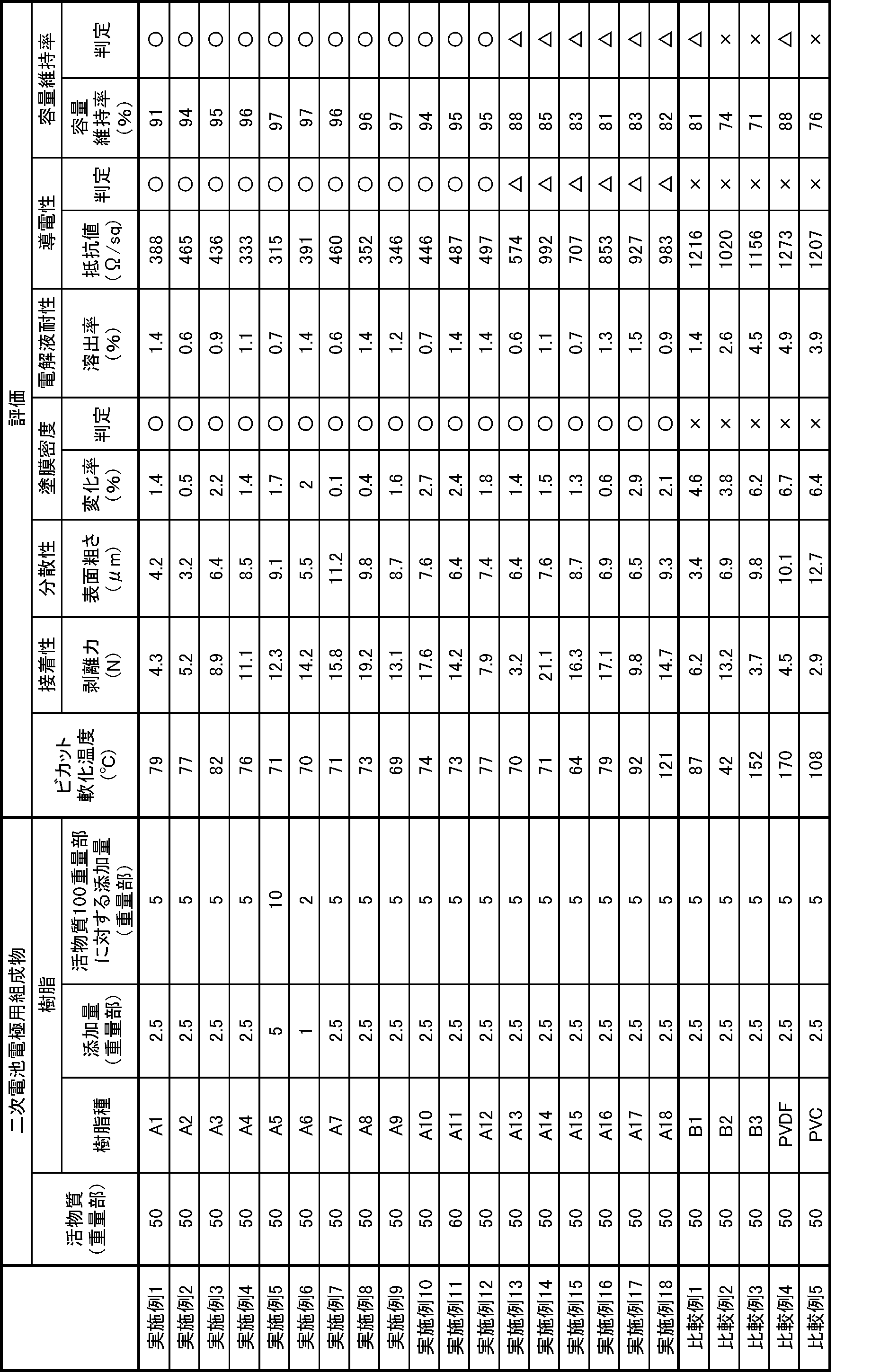
Claims (6)
- 活物質と、非水系溶剤と、ポリビニルアセタール樹脂とを含み、
前記ポリビニルアセタール樹脂は、ハロゲン原子を有する構成単位を有し、
ビカット軟化温度が50℃以上、150℃以下である、二次電池電極用樹脂組成物。 - ハロゲン原子が、フッ素、塩素及び臭素からなる群から選ばれる少なくとも1種である、請求項1に記載の二次電池電極用樹脂組成物。
- ハロゲン原子を有する構成単位は、ハロゲン原子がアセタール結合を介して結合した構造である、請求項1又は2記載の二次電池電極用樹脂組成物。
- ポリビニルアセタール樹脂の全構成単位に対するハロゲン原子を有する構成単位の含有量が、0.01モル%以上、20モル%以下である、請求項1~3の何れかに記載の二次電池電極用樹脂組成物。
- 平均重合度が100以上、6000以下である、請求項1~4の何れかに記載の二次電池電極用樹脂組成物。
- 水酸基量が20モル%以上、90モル%以下である、請求項1~5の何れかに記載の二次電池電極用樹脂組成物。
Priority Applications (5)
| Application Number | Priority Date | Filing Date | Title |
|---|---|---|---|
| KR1020237009227A KR20230163343A (ko) | 2021-03-31 | 2022-03-18 | 이차 전지 전극용 수지 조성물 |
| EP22780261.8A EP4317203A4 (en) | 2021-03-31 | 2022-03-18 | RESIN COMPOSITION FOR SECONDARY BATTERY ELECTRODE |
| JP2022519455A JPWO2022210046A1 (ja) | 2021-03-31 | 2022-03-18 | |
| CN202280007254.9A CN116368162A (zh) | 2021-03-31 | 2022-03-18 | 二次电池电极用树脂组合物 |
| US18/284,155 US20240186520A1 (en) | 2021-03-31 | 2022-03-18 | Resin composition for secondary battery electrode |
Applications Claiming Priority (2)
| Application Number | Priority Date | Filing Date | Title |
|---|---|---|---|
| JP2021-061852 | 2021-03-31 | ||
| JP2021061852 | 2021-03-31 |
Publications (1)
| Publication Number | Publication Date |
|---|---|
| WO2022210046A1 true WO2022210046A1 (ja) | 2022-10-06 |
Family
ID=83456073
Family Applications (1)
| Application Number | Title | Priority Date | Filing Date |
|---|---|---|---|
| PCT/JP2022/012777 Ceased WO2022210046A1 (ja) | 2021-03-31 | 2022-03-18 | 二次電池電極用樹脂組成物 |
Country Status (7)
| Country | Link |
|---|---|
| US (1) | US20240186520A1 (ja) |
| EP (1) | EP4317203A4 (ja) |
| JP (1) | JPWO2022210046A1 (ja) |
| KR (1) | KR20230163343A (ja) |
| CN (1) | CN116368162A (ja) |
| TW (1) | TW202306222A (ja) |
| WO (1) | WO2022210046A1 (ja) |
Families Citing this family (2)
| Publication number | Priority date | Publication date | Assignee | Title |
|---|---|---|---|---|
| US20240178397A1 (en) * | 2021-03-30 | 2024-05-30 | Sekisui Chemical Co., Ltd. | All solid state battery composition |
| CN116813829B (zh) * | 2023-07-10 | 2024-08-02 | 山东诺尔生物科技有限公司 | 一种制备高吸水树脂的组合物、高吸水树脂及其制备方法 |
Citations (6)
| Publication number | Priority date | Publication date | Assignee | Title |
|---|---|---|---|---|
| JPH05314965A (ja) * | 1992-05-06 | 1993-11-26 | Nippon Telegr & Teleph Corp <Ntt> | 電池正極シートとその製造方法、並びに全固体二次電池 |
| US20020146633A1 (en) * | 2001-03-08 | 2002-10-10 | Kodak Polychrome Graphics L.L.C. | Fluorinated aromatic acetal polymers and photosensitive compositions containing such polymers |
| WO2011087029A1 (ja) * | 2010-01-15 | 2011-07-21 | 株式会社クラレ | 高分子電解質ゲル組成物 |
| JP2014032811A (ja) * | 2012-08-02 | 2014-02-20 | Kuraray Co Ltd | 高分子電解質膜 |
| JP2015141883A (ja) | 2014-01-30 | 2015-08-03 | 積水化学工業株式会社 | リチウム二次電池電極用組成物 |
| WO2017047662A1 (ja) * | 2015-09-17 | 2017-03-23 | 積水化学工業株式会社 | 蓄電デバイス電極用バインダー |
Family Cites Families (5)
| Publication number | Priority date | Publication date | Assignee | Title |
|---|---|---|---|---|
| JP3227190B2 (ja) * | 1990-12-26 | 2001-11-12 | キヤノン株式会社 | 電子写真感光体、それを用いた電子写真装置および装置ユニット |
| JPH05152595A (ja) * | 1991-11-05 | 1993-06-18 | Canon Inc | 有機太陽電池 |
| CN108028387B (zh) * | 2016-04-01 | 2022-06-28 | 积水化学工业株式会社 | 锂二次电池电极用组合物 |
| WO2017204291A1 (ja) * | 2016-05-26 | 2017-11-30 | 日本板硝子株式会社 | 合わせガラス |
| JP6807195B2 (ja) * | 2016-09-15 | 2021-01-06 | 日東電工株式会社 | 生体貼付用積層体 |
-
2022
- 2022-03-18 CN CN202280007254.9A patent/CN116368162A/zh active Pending
- 2022-03-18 WO PCT/JP2022/012777 patent/WO2022210046A1/ja not_active Ceased
- 2022-03-18 JP JP2022519455A patent/JPWO2022210046A1/ja active Pending
- 2022-03-18 US US18/284,155 patent/US20240186520A1/en not_active Abandoned
- 2022-03-18 EP EP22780261.8A patent/EP4317203A4/en not_active Withdrawn
- 2022-03-18 KR KR1020237009227A patent/KR20230163343A/ko active Pending
- 2022-03-21 TW TW111110352A patent/TW202306222A/zh unknown
Patent Citations (6)
| Publication number | Priority date | Publication date | Assignee | Title |
|---|---|---|---|---|
| JPH05314965A (ja) * | 1992-05-06 | 1993-11-26 | Nippon Telegr & Teleph Corp <Ntt> | 電池正極シートとその製造方法、並びに全固体二次電池 |
| US20020146633A1 (en) * | 2001-03-08 | 2002-10-10 | Kodak Polychrome Graphics L.L.C. | Fluorinated aromatic acetal polymers and photosensitive compositions containing such polymers |
| WO2011087029A1 (ja) * | 2010-01-15 | 2011-07-21 | 株式会社クラレ | 高分子電解質ゲル組成物 |
| JP2014032811A (ja) * | 2012-08-02 | 2014-02-20 | Kuraray Co Ltd | 高分子電解質膜 |
| JP2015141883A (ja) | 2014-01-30 | 2015-08-03 | 積水化学工業株式会社 | リチウム二次電池電極用組成物 |
| WO2017047662A1 (ja) * | 2015-09-17 | 2017-03-23 | 積水化学工業株式会社 | 蓄電デバイス電極用バインダー |
Non-Patent Citations (1)
| Title |
|---|
| See also references of EP4317203A4 |
Also Published As
| Publication number | Publication date |
|---|---|
| TW202306222A (zh) | 2023-02-01 |
| EP4317203A4 (en) | 2025-10-29 |
| KR20230163343A (ko) | 2023-11-30 |
| CN116368162A (zh) | 2023-06-30 |
| EP4317203A1 (en) | 2024-02-07 |
| US20240186520A1 (en) | 2024-06-06 |
| JPWO2022210046A1 (ja) | 2022-10-06 |
Similar Documents
| Publication | Publication Date | Title |
|---|---|---|
| JP6114821B2 (ja) | 蓄電デバイス電極用バインダー | |
| JP5827581B2 (ja) | リチウム二次電池電極用組成物 | |
| JP6259952B1 (ja) | リチウム二次電池電極用組成物 | |
| JP6352132B2 (ja) | リチウム二次電池電極用組成物 | |
| JP5827580B2 (ja) | リチウム二次電池電極用組成物 | |
| JP6114891B1 (ja) | 蓄電デバイス電極用バインダー | |
| JP6126757B1 (ja) | 蓄電デバイス電極用バインダー | |
| WO2022210046A1 (ja) | 二次電池電極用樹脂組成物 | |
| TWI688150B (zh) | 鋰二次電池電極用組成物 | |
| JP6310286B2 (ja) | リチウム二次電池電極用組成物 | |
| JP6434772B2 (ja) | リチウム二次電池電極用組成物 | |
| JP7000614B1 (ja) | 変性ポリビニルアセタール樹脂、蓄電池電極用組成物、顔料組成物、及び、変性ポリビニルアルコール樹脂 | |
| WO2020066917A1 (ja) | 二次電池電極用組成物 | |
| JP6935647B2 (ja) | 蓄電デバイス負極用バインダー | |
| JP2022056387A (ja) | 変性ポリビニルアセタール樹脂及び蓄電池電極用組成物 | |
| JP2017183241A (ja) | 蓄電デバイス電極用バインダー | |
| WO2022210414A1 (ja) | 全固体電池用組成物 | |
| TWI886307B (zh) | 改質聚乙烯縮醛樹脂、蓄電池電極用組成物、顏料組成物 | |
| JP6357603B1 (ja) | 蓄電デバイス電極用バインダー | |
| JP2018160401A (ja) | 蓄電デバイス電極用バインダー |
Legal Events
| Date | Code | Title | Description |
|---|---|---|---|
| ENP | Entry into the national phase |
Ref document number: 2022519455 Country of ref document: JP Kind code of ref document: A |
|
| 121 | Ep: the epo has been informed by wipo that ep was designated in this application |
Ref document number: 22780261 Country of ref document: EP Kind code of ref document: A1 |
|
| WWE | Wipo information: entry into national phase |
Ref document number: 18284155 Country of ref document: US |
|
| WWE | Wipo information: entry into national phase |
Ref document number: 2022780261 Country of ref document: EP |
|
| ENP | Entry into the national phase |
Ref document number: 2022780261 Country of ref document: EP Effective date: 20231031 |
|
| NENP | Non-entry into the national phase |
Ref country code: DE |
|
| WWW | Wipo information: withdrawn in national office |
Ref document number: 2022780261 Country of ref document: EP |