WO2022210166A1 - 接着剤組成物、接合体および接着剤組成物の製造方法 - Google Patents
接着剤組成物、接合体および接着剤組成物の製造方法 Download PDFInfo
- Publication number
- WO2022210166A1 WO2022210166A1 PCT/JP2022/013513 JP2022013513W WO2022210166A1 WO 2022210166 A1 WO2022210166 A1 WO 2022210166A1 JP 2022013513 W JP2022013513 W JP 2022013513W WO 2022210166 A1 WO2022210166 A1 WO 2022210166A1
- Authority
- WO
- WIPO (PCT)
- Prior art keywords
- adhesive composition
- meth
- polymer particles
- composition according
- particles
- Prior art date
- Legal status (The legal status is an assumption and is not a legal conclusion. Google has not performed a legal analysis and makes no representation as to the accuracy of the status listed.)
- Ceased
Links
Classifications
-
- C—CHEMISTRY; METALLURGY
- C09—DYES; PAINTS; POLISHES; NATURAL RESINS; ADHESIVES; COMPOSITIONS NOT OTHERWISE PROVIDED FOR; APPLICATIONS OF MATERIALS NOT OTHERWISE PROVIDED FOR
- C09J—ADHESIVES; NON-MECHANICAL ASPECTS OF ADHESIVE PROCESSES IN GENERAL; ADHESIVE PROCESSES NOT PROVIDED FOR ELSEWHERE; USE OF MATERIALS AS ADHESIVES
- C09J4/00—Adhesives based on organic non-macromolecular compounds having at least one polymerisable carbon-to-carbon unsaturated bond ; adhesives, based on monomers of macromolecular compounds of groups C09J183/00 - C09J183/16
- C09J4/06—Organic non-macromolecular compounds having at least one polymerisable carbon-to-carbon unsaturated bond in combination with a macromolecular compound other than an unsaturated polymer of groups C09J159/00 - C09J187/00
-
- C—CHEMISTRY; METALLURGY
- C09—DYES; PAINTS; POLISHES; NATURAL RESINS; ADHESIVES; COMPOSITIONS NOT OTHERWISE PROVIDED FOR; APPLICATIONS OF MATERIALS NOT OTHERWISE PROVIDED FOR
- C09J—ADHESIVES; NON-MECHANICAL ASPECTS OF ADHESIVE PROCESSES IN GENERAL; ADHESIVE PROCESSES NOT PROVIDED FOR ELSEWHERE; USE OF MATERIALS AS ADHESIVES
- C09J4/00—Adhesives based on organic non-macromolecular compounds having at least one polymerisable carbon-to-carbon unsaturated bond ; adhesives, based on monomers of macromolecular compounds of groups C09J183/00 - C09J183/16
-
- C—CHEMISTRY; METALLURGY
- C08—ORGANIC MACROMOLECULAR COMPOUNDS; THEIR PREPARATION OR CHEMICAL WORKING-UP; COMPOSITIONS BASED THEREON
- C08F—MACROMOLECULAR COMPOUNDS OBTAINED BY REACTIONS ONLY INVOLVING CARBON-TO-CARBON UNSATURATED BONDS
- C08F265/00—Macromolecular compounds obtained by polymerising monomers on to polymers of unsaturated monocarboxylic acids or derivatives thereof as defined in group C08F20/00
- C08F265/04—Macromolecular compounds obtained by polymerising monomers on to polymers of unsaturated monocarboxylic acids or derivatives thereof as defined in group C08F20/00 on to polymers of esters
-
- C—CHEMISTRY; METALLURGY
- C08—ORGANIC MACROMOLECULAR COMPOUNDS; THEIR PREPARATION OR CHEMICAL WORKING-UP; COMPOSITIONS BASED THEREON
- C08F—MACROMOLECULAR COMPOUNDS OBTAINED BY REACTIONS ONLY INVOLVING CARBON-TO-CARBON UNSATURATED BONDS
- C08F285/00—Macromolecular compounds obtained by polymerising monomers on to preformed graft polymers
-
- C—CHEMISTRY; METALLURGY
- C08—ORGANIC MACROMOLECULAR COMPOUNDS; THEIR PREPARATION OR CHEMICAL WORKING-UP; COMPOSITIONS BASED THEREON
- C08J—WORKING-UP; GENERAL PROCESSES OF COMPOUNDING; AFTER-TREATMENT NOT COVERED BY SUBCLASSES C08B, C08C, C08F, C08G or C08H
- C08J3/00—Processes of treating or compounding macromolecular substances
- C08J3/12—Powdering or granulating
- C08J3/126—Polymer particles coated by polymer, e.g. core shell structures
-
- C—CHEMISTRY; METALLURGY
- C08—ORGANIC MACROMOLECULAR COMPOUNDS; THEIR PREPARATION OR CHEMICAL WORKING-UP; COMPOSITIONS BASED THEREON
- C08K—Use of inorganic or non-macromolecular organic substances as compounding ingredients
- C08K5/00—Use of organic ingredients
- C08K5/16—Nitrogen-containing compounds
- C08K5/34—Heterocyclic compounds having nitrogen in the ring
- C08K5/3412—Heterocyclic compounds having nitrogen in the ring having one nitrogen atom in the ring
- C08K5/3432—Six-membered rings
- C08K5/3435—Piperidines
-
- C—CHEMISTRY; METALLURGY
- C08—ORGANIC MACROMOLECULAR COMPOUNDS; THEIR PREPARATION OR CHEMICAL WORKING-UP; COMPOSITIONS BASED THEREON
- C08L—COMPOSITIONS OF MACROMOLECULAR COMPOUNDS
- C08L55/00—Compositions of homopolymers or copolymers, obtained by polymerisation reactions only involving carbon-to-carbon unsaturated bonds, not provided for in groups C08L23/00 - C08L53/00
- C08L55/02—ABS [Acrylonitrile-Butadiene-Styrene] polymers
-
- C—CHEMISTRY; METALLURGY
- C09—DYES; PAINTS; POLISHES; NATURAL RESINS; ADHESIVES; COMPOSITIONS NOT OTHERWISE PROVIDED FOR; APPLICATIONS OF MATERIALS NOT OTHERWISE PROVIDED FOR
- C09J—ADHESIVES; NON-MECHANICAL ASPECTS OF ADHESIVE PROCESSES IN GENERAL; ADHESIVE PROCESSES NOT PROVIDED FOR ELSEWHERE; USE OF MATERIALS AS ADHESIVES
- C09J11/00—Features of adhesives not provided for in group C09J9/00, e.g. additives
- C09J11/02—Non-macromolecular additives
- C09J11/06—Non-macromolecular additives organic
-
- C—CHEMISTRY; METALLURGY
- C09—DYES; PAINTS; POLISHES; NATURAL RESINS; ADHESIVES; COMPOSITIONS NOT OTHERWISE PROVIDED FOR; APPLICATIONS OF MATERIALS NOT OTHERWISE PROVIDED FOR
- C09J—ADHESIVES; NON-MECHANICAL ASPECTS OF ADHESIVE PROCESSES IN GENERAL; ADHESIVE PROCESSES NOT PROVIDED FOR ELSEWHERE; USE OF MATERIALS AS ADHESIVES
- C09J11/00—Features of adhesives not provided for in group C09J9/00, e.g. additives
- C09J11/08—Macromolecular additives
-
- C—CHEMISTRY; METALLURGY
- C09—DYES; PAINTS; POLISHES; NATURAL RESINS; ADHESIVES; COMPOSITIONS NOT OTHERWISE PROVIDED FOR; APPLICATIONS OF MATERIALS NOT OTHERWISE PROVIDED FOR
- C09J—ADHESIVES; NON-MECHANICAL ASPECTS OF ADHESIVE PROCESSES IN GENERAL; ADHESIVE PROCESSES NOT PROVIDED FOR ELSEWHERE; USE OF MATERIALS AS ADHESIVES
- C09J151/00—Adhesives based on graft polymers in which the grafted component is obtained by reactions only involving carbon-to-carbon unsaturated bonds; Adhesives based on derivatives of such polymers
- C09J151/003—Adhesives based on graft polymers in which the grafted component is obtained by reactions only involving carbon-to-carbon unsaturated bonds; Adhesives based on derivatives of such polymers grafted on to macromolecular compounds obtained by reactions only involving unsaturated carbon-to-carbon bonds
Definitions
- the present invention relates to an adhesive composition, a bonded product, and a method for producing an adhesive composition.
- Epoxy-based adhesives acrylic-based adhesives, urethane-based adhesives, etc. are known as adhesive compositions. Among these, acrylic adhesives are generally superior in terms of adhesion to oily surfaces, good workability, and the like.
- Patent Document 1 can be cited as an example of an acrylic adhesive.
- Patent Document 1 describes an acrylic adhesive composition containing (1) a (meth)acrylic acid derivative monomer, (2) a polymerization initiator, (3) a reducing agent, and (4) a diene core-shell polymer. ing.
- the diene-based core-shell polymer is an MBS resin (methyl methacrylate-acrylonitrile-butadiene-styrene copolymer), which is swellable in (meth)acrylic acid derivative monomers and in toluene at 25°C. The degree of swelling at is 9.5 or more.
- the present inventor completed an adhesive composition with improved storage stability compared to the adhesive composition described in Patent Document 1. Specifically, according to the present invention, an adhesive composition capable of obtaining a desired adhesive strength even after the passage of time after production has been completed.
- (Meth) a polymerizable monomer having an acryloyl group; a radical polymerization initiator; An adhesive composition comprising polymer particles having the property of being swollen by an organic solvent, In the particle size distribution of the secondary particles, which are aggregates of the polymer particles, in the adhesive composition determined by a laser diffraction/scattering method, the proportion of secondary particles having a diameter of 1 ⁇ m or more and 200 ⁇ m or less is 30% by volume or more.
- An adhesive composition is provided which is
- a first structural member a second structural member;
- a joined body is provided, which joins the first structural member and the second structural member, and includes a cured body of the adhesive composition described above.
- a manufacturing method for manufacturing the above adhesive composition A dispersing step of adding the polymer particles into a container containing the polymerizable monomer and stirring to disperse the polymer particles in the polymerizable monomer; There is provided a method for producing an adhesive composition, wherein the temperature of the polymerizable monomer during the charging is 0°C or higher and 40°C or lower.
- an adhesive composition with good storage stability and high adhesive strength is provided.
- X to Y in the description of numerical ranges means X or more and Y or less, unless otherwise specified.
- “1 to 5% by mass” means “1% by mass or more and 5% by mass or less”.
- the amount used preferably represents the total amount of the first agent and the second agent.
- a description without indicating whether it is substituted or unsubstituted includes both those having no substituent and those having a substituent.
- alkyl group includes not only alkyl groups without substituents (unsubstituted alkyl groups) but also alkyl groups with substituents (substituted alkyl groups).
- the notation "(meth)acryl” used herein represents a concept that includes both acryl and methacryl. The same applies to similar notations such as "(meth)acrylate”.
- organic group as used herein means an atomic group obtained by removing one or more hydrogen atoms from an organic compound, unless otherwise specified.
- a "monovalent organic group” represents an atomic group obtained by removing one hydrogen atom from an arbitrary organic compound.
- the adhesive composition of the present embodiment contains a polymerizable monomer having a (meth)acryloyl group, a radical polymerization initiator, and polymer particles that swell with an organic solvent.
- the proportion of secondary particles having a diameter of 1 ⁇ m or more and 200 ⁇ m or less is It is 30% by volume or more, preferably 40% by volume or more, and more preferably 50% by volume or more. This value may be 100% by volume, or may be 99.5% by volume or less.
- the inventor conducted various studies to improve the storage stability of the adhesive composition. As described above, the inventors set the ratio of secondary particles having a diameter of 1 ⁇ m or more and 200 ⁇ m or less to 30% by volume or more in the particle size distribution of secondary particles, which are aggregates of polymer particles. As a result, it was possible to provide an adhesive composition with good storage stability and high adhesive strength.
- the method for producing the adhesive composition of the present embodiment is not limited, but from the viewpoint of appropriately controlling the particle size distribution of secondary particles that are aggregates of polymer particles, it is possible to adopt an appropriate production method and production conditions.
- Points for the manufacturing method and manufacturing conditions include, for example, appropriately controlling the temperature when mixing the polymerizable monomer and the polymer particles, the stirring speed (the stirring peripheral speed) during mixing, and the like. Details of the manufacturing method and manufacturing conditions will be described later.
- the adhesive composition of this embodiment contains a polymerizable monomer having a (meth)acryloyl group.
- a polymerizable monomer having a (meth)acryloyl group is also simply referred to as a "polymerizable monomer”.
- polymerizable monomers include the following.
- Z is a (meth)acryloyl group
- CH2 CHCOOCH2CH2- group
- CH2 C( CH3 ) COOCH2 - CH2CH2- group
- CH2 CHCOOCH2 - CH(OH) - group
- CH 2 C(CH 3 )COOCH 2 -CH(OH)-
- CH 2 CHCOOCH 2 -CH(OH)CH 2 - group
- CH 2 C(CH 3 )COOCH 2 -CH(OH) represents a CH 2 — group
- R 1 is hydrogen, an alkyl group having 1 to 20 carbon atoms, a cycloalkyl group, a benzyl group, a phenyl group, a tetrahydrofurfuryl group, a glycidyl group, a dicyclopentyl group, a dicyclopentenyl
- Such monomers include, for example, methyl (meth)acrylate, cyclohexyl (meth)acrylate, benzyl (meth)acrylate, tetrahydrofurfuryl (meth)acrylate, dicyclopentyl (meth)acrylate, (meth) dicyclopentenyl acrylate, glycerol (meth)acrylate, glycerol di(meth)acrylate, isobornyl (meth)acrylate, (meth)acrylic acid and the like.
- Examples of such monomers include 2-hydroxyethyl (meth)acrylate, 2-hydroxypropyl (meth)acrylate, ethoxyethyl (meth)acrylate, polyethylene glycol (meth)acrylate, phenoxyethyl (meth)acrylate, dicyclopentenyl oxyethyl (meth)acrylate, phenoxydiethylene glycol (meth)acrylate and the like.
- Examples of such monomers include 2,2-bis(4-(meth)acryloxyphenyl)propane, 2,2-bis(4-(meth)acryloxyethoxyphenyl)propane, 2,2-bis( 4-(meth)acryloxydiethoxyphenyl)propane, 2,2-bis(4-(meth)acryloxypropoxyphenyl)propane and 2,2-bis(4-(meth)acryloxytetraethoxyphenyl)propane, and ethoxylated bisphenol A di(meth)acrylate.
- Examples of such monomers include trimethylolpropane tri(meth)acrylate, neopentyl glycol di(meth)acrylate, pentaerythritol tetra(meth)acrylate and dipentaerythritol hexa(meth)acrylate, tripropylene glycol di(meth)acrylate, (Meth)acrylate, 1,6-hexanediol di(meth)acrylate and the like.
- a urethane prepolymer having a (meth)acryloyloxy group can be obtained, for example, by reacting a (meth)acrylic acid ester having a hydroxyl group, an organic polyisocyanate and a polyhydric alcohol.
- Examples of (meth)acrylic acid esters having a hydroxyl group include hydroxyethyl (meth)acrylate, hydroxypropyl (meth)acrylate and hydroxybutyl (meth)acrylate.
- organic polyisocyanates examples include toluene diisocyanate, 4,4-diphenylmethane diisocyanate, hexamethylene diisocyanate and isophorone diisocyanate.
- polyhydric alcohols examples include polyethylene glycol, polypropylene glycol, polytetramethylene glycol and polyester polyol.
- R is a CH 2 ⁇ CR 4 CO(OR 5 ) m — group (where R 4 is hydrogen or a methyl group, R 5 is —C 2 H 4 —, —C 3 H 6 —, —CH 2 CH(CH 3 )-, -C 4 H 8 -, -C 6 H 12 - or -C 2 H 4 -OCO-C 5 H 10 -, and m represents an integer of 1 or more and 10 or less.) and n represents an integer of 1 or 2.
- Examples of the acidic phosphoric acid compound represented by formula (I) include acid phosphooxyethyl (meth)acrylate, acid phosphooxypropyl (meth)acrylate, bis(2-(meth)acryloyloxyethyl) phosphate, 2- (Meth)acryloyloxyethyl acid phosphate and the like.
- Particularly preferred polymerizable monomers are: ⁇ Monofunctional methyl (meth)acrylate, ethylhexyl (meth)acrylate, lauryl (meth)acrylate, ethylene oxide-modified nonylphenol (meth)acrylate, tetrahydrofurfuryl (meth)acrylate, isobornyl (meth)acrylate, benzyl (meth)acrylate, phenoxyethyl (meth)acrylate, dicyclopentenyloxyethyl (meth)acrylate, dicyclopentanyloxyethyl (meth)acrylate, cyclohexyl (meth)acrylate, hydroxyethyl (meth)acrylate, hydroxypropyl (meth)acrylate and (meth)acrylate ) Acrylic acid/polyfunctional ethylene oxide-modified di(meth)acrylate, trimethylolpropane tri(meth)acrylate, 1,6-hexane
- the adhesive composition of the present embodiment may contain only one of the monomers (i) to (vi), or may contain two or more of them. Among these, one or two or more of (i), (ii) and (vi) are preferable in terms of high adhesiveness and low adhesive distortion of the adherend after bonding. ) and (vi) are more preferably used in combination.
- the amount used is preferably 0.05 parts by mass or more and 10 parts by mass or less with respect to a total of 100 parts by mass of (i) and (ii), and 0.1 parts by mass or more and 5 parts by mass or less more preferred.
- the adhesive composition of this embodiment contains a radical polymerization initiator.
- the polymerizable carbon-carbon double bond of the polymerizable monomer is polymerized by the radical polymerization initiator, enabling the adhesion of the article.
- a thermal radical polymerization initiator is preferred.
- an organic peroxide can be preferably mentioned.
- organic peroxides include cumene hydroperoxide, paramenthane hydroperoxide, tertiary butyl hydroperoxide, diisopropylbenzene dihydroperoxide, methyl ethyl ketone peroxide, tertiary butyl peroxybenzoate, and benzoyl peroxide. .
- cumene hydroperoxide is preferred in terms of stability.
- the amount of the radical polymerization initiator is preferably 0.1 parts by mass or more and 20 parts by mass or less, more preferably 0.4 parts by mass or more and 10 parts by mass or less with respect to 100 parts by mass of the polymerizable monomer.
- the amount of the radical polymerization initiator is preferably 0.1 parts by mass or more and 20 parts by mass or less, more preferably 0.4 parts by mass or more and 10 parts by mass or less with respect to 100 parts by mass of the polymerizable monomer.
- the adhesive composition of this embodiment contains polymer particles that have the property of being swollen by an organic solvent.
- the term "swellable with an organic solvent” means that when the polymer particles are brought into contact with a liquid such as an organic solvent, the polymer particles absorb the liquid and swell.
- the degree of swelling is preferably 5 times or more, more preferably 7 times or more, still more preferably 9.5 times or more, and particularly preferably 10 times or more.
- the upper limit of the degree of swelling is, for example, 15 times.
- polymer particles are swellable, it is expected that the polymerizable monomer will enter the polymer particles and polymerization will occur in the polymer particles, resulting in a further increase in adhesive strength and the like.
- polymer particles that have the property of being swollen by an organic solvent are also simply referred to as "polymer particles”.
- the numerical values relating to various particle sizes and particle size distributions of the polymer particles in this specification are the numerical values of the polymer particles in the adhesive composition (when the polymer particles are swollen), unless otherwise specified. If so, it represents the particle size in a swollen state, etc.).
- the polymer particles preferably include core-shell polymer particles.
- Core-shell type polymer particles can be obtained by methods described in International Publication No. 2005/028546, Japanese Patent Application Laid-Open No. 2016-104834, and the like.
- the polymer particles preferably contain a diene-based polymer, more preferably the polymer constituting the polymer particles is a (meth)acrylonitrile-butadiene-styrene copolymer and/or methyl (meth)acrylate ⁇ Contains (meth)acrylonitrile-butadiene-styrene copolymer.
- the median diameter D50 of the secondary particles determined from the particle size distribution of the secondary particles is preferably 1 ⁇ m or more and 200 ⁇ m or less, more preferably 5 ⁇ m or more and 180 ⁇ m or less, still more preferably 10 ⁇ m or more and 150 ⁇ m or less.
- the cumulative 90 % diameter D90 of the secondary particles obtained from the particle size distribution of the secondary particles is preferably 10 ⁇ m or more and 500 ⁇ m or less, more preferably 20 ⁇ m or more and 400 ⁇ m or less, still more preferably 30 ⁇ m or more and 300 ⁇ m or less.
- the volume average particle diameter of the "primary particles” of the polymer particles is preferably 0.01 ⁇ m or more and 1 ⁇ m or less, more preferably 0.02 ⁇ m or more and 0.8 ⁇ m or less, and still more preferably 0.03 ⁇ m or more and 0.6 ⁇ m or less.
- Appropriate selection of the volume average particle size of the primary particles can also further enhance the performance of the adhesive composition.
- the volume average particle diameter of the "primary particles” can be adjusted by subjecting the polymer particles to a pulverization step and a sieve classification step after the pulverization treatment.
- the volume average particle size of the "primary particles” can also be adjusted by using polymer particles with an appropriate particle size distribution.
- Polymer particles that can be preferably used are available from Denka Corporation and Kaneka Corporation, for example.
- the amount of the polymer particles is preferably 0.1 to 30 parts by mass, more preferably 1 to 20 parts by mass, based on 100 parts by mass of the polymerizable monomer.
- the amount of the polymer particles is not too large, sufficient amounts of the polymerizable monomer and the polymerization initiator can be used, and curability tends to be further enhanced.
- the adhesive composition of this embodiment preferably comprises one or more elastomers.
- the elastomer excludes polymer particles as described above.
- the cured body of the adhesive composition has appropriate elasticity, and for example, toughness can be further improved.
- Elastomer components include (meth)acrylonitrile-butadiene-(meth)acrylic acid copolymer, (meth)acrylonitrile-butadiene-methyl(meth)acrylate copolymer, (meth)acrylonitrile-butadiene copolymer, and styrene.
- Styrene-based thermoplastic elastomers such as -butadiene copolymer, chlorosulfonated polyethylene, styrene-polybutadiene-styrene-based synthetic rubber, polybutadiene with (meth)acryl-modified terminals, and urethane-based elastomers.
- the total amount of the polymer particles is preferably 5 parts by mass or more and 40 parts by mass or less, more preferably 10 parts by mass or more and 30 parts by mass or less, based on 100 parts by mass of the polymerizable monomer.
- the adhesive composition of this embodiment preferably contains one or more reducing agents.
- the reducing agent may be any known reducing agent that reacts with the polymerization initiator to generate radicals.
- the reducing agent is preferably at least one selected from the group consisting of tertiary amines, thiourea derivatives and transition metal salts, more preferably transition metal salts. Examples of thiourea derivatives include acetylthiourea and ethylenethiourea.
- transition metal salts include cobalt naphthenate, cobalt octylate, copper naphthenate and vanadyl acetylacetonate.
- transition metal salts vanadyl acetylacetonate is preferred.
- the amount used is preferably 0.01 parts by mass or more and 10 parts by mass or less, more preferably 0.1 parts by mass or more and 5 parts by mass or less, relative to 100 parts by mass of the polymerizable monomer.
- 0.01 parts by mass or more the curing speed becomes sufficiently high, and by using 10 parts by mass or less, the storage stability becomes better.
- paraffin The adhesive composition of this embodiment may contain paraffin. Specifically, various paraffins can be used to speed up the curing of the parts exposed to air. Paraffins include paraffin wax, microcrystalline wax, carnauba wax, beeswax, lanolin, spermaceti, ceresin and candelilla wax.
- the adhesive composition of the present embodiment contains paraffin, it may contain only one paraffin, or may contain two or more paraffins.
- the amount is preferably 0.01 parts by mass or more and 3 parts by mass or less, and 0.5 parts by mass or more and 2 parts by mass with respect to 100 parts by mass of the polymerizable monomer. The following are more preferred.
- the adhesive composition of the present embodiment may or may not contain optional components other than those described above.
- the adhesive composition of the present embodiment may contain spacers (particles) or the like in order to adjust the film thickness during use. Spacers are typically spherical particles made of resin such as polyolefin.
- the adhesive composition of the present embodiment may contain various stabilizers in order to improve storage stability (suppress deterioration during storage).
- stabilizers include (i) compounds known as phenolic antioxidants, (ii) quinone compounds such as p-benzoquinone and hydroquinone monomethyl ether, and (iii) known polymerization inhibitors.
- Compounds such as amine-based polymerization inhibitors such as phenothiazine, (iv) stable radical type compounds having stable radicals, and the like can be mentioned. Among them, it is desirable to use a stable radical type compound from the viewpoint of improving storage stability without impairing performance as an adhesive (tensile shear bond strength and storage modulus).
- a nitroxide radical is preferable as a stable radical.
- stable radical compounds that are nitroxide radicals include 1-oxyl-2,2,6,6-tetramethylpiperidine, 4-hydroxy-2,2,6,6-tetramethylpiperidine 1-oxyl, 4 -(meth)acryloyloxy-2,2,6,6-tetramethylpiperidine 1-oxyl and the like. When using a stable radical compound, it is preferable to use one or more of these.
- the content thereof is, for example, 0.001 per 100 parts by mass of the polymerizable monomer in terms of improving the storage stability without impairing the performance as an adhesive.
- Part by mass to 1 part by mass preferably 0.001 part by mass to 0.5 part by mass, more preferably 0.01 part by mass to 0.3 part by mass, still more preferably 0.02 part by mass to 0.3 part by mass. It is 1 part by mass or less.
- the adhesive composition of the present embodiment may be a so-called one-component type, or a two-component type (adhesive composition that uses two agents filled in separate containers and mixed immediately before use).
- the radical polymerization initiator is preferably contained in the first component
- the reducing agent is contained in the second component, respectively.
- the tertiary amine is preferably contained in the first agent
- the thiourea derivative and transition metal salt are preferably contained in the second agent.
- Other ingredients can be appropriately mixed in the two agents.
- the first agent and the second agent may be mixed just before use.
- the adhesive composition of the present embodiment is a two-part type
- the adhesive composition after mixing the first agent and the second agent contains each component within the preferred content range of each component described above.
- the amounts of each component in the first and second parts are adjusted to include.
- the method for producing the adhesive composition of this embodiment is not limited. However, from the viewpoint of appropriately controlling the particle size distribution of secondary particles, which are aggregates of polymer particles, it is preferable to employ an appropriate manufacturing method and manufacturing conditions. Points for the manufacturing method and manufacturing conditions include, for example, appropriately controlling the temperature when mixing the polymerizable monomer and the polymer particles, the stirring speed during mixing, and the like.
- the method for producing the adhesive composition of the present embodiment preferably includes a dispersing step of putting polymer particles into a container containing a polymerizable monomer and stirring to disperse the polymer particles in the polymerizable monomer.
- the temperature of the polymerizable monomer in the container when the polymer particles are added is preferably 0° C. or higher and 40° C. or lower, more preferably 15° C. or higher and 35° C. or lower.
- the temperature of the polymerizable monomer is 0° C. or higher when the polymer particles are added, the polymer particles can be easily dispersed in the polymerizable monomer in a shorter time.
- the temperature of the polymerizable monomer is 40° C. or less when it is added, it becomes difficult for polymer particles to form lumps (aggregates, splinters), so that a good polymer dispersion state can be easily obtained.
- a stirring blade is preferably used to mix the polymerizable monomer and the polymer particles.
- the stirring peripheral speed of the stirring blade is preferably 300 mm/s or more, more preferably 500 mm/s or more.
- the peripheral speed of stirring it is, for example, 300,000 mm/s or less due to restrictions on equipment.
- a joined body containing a cured product of the adhesive composition By applying the adhesive composition of the present embodiment to an article and curing it, etc., a joined body containing a cured product of the adhesive composition can be obtained.
- an adhesive composition for bonding a first structural member, a second structural member, and the first structural member and the second structural member by using the adhesive composition of the present embodiment It is possible to obtain a bonded body containing a cured body of the product.
- the adhesive composition of the present embodiment especially when it contains a reducing agent, preferably cures without heating (at room temperature) and can bond articles. Of course, heating is not excluded in obtaining the joined body.
- Agent A (first agent) and agent B (second agent) of each example and comparative example were each produced as follows. (1) Put the monomers (unit: parts by weight, other components are the same) listed in “Polymerizable Monomer” in the table below and the NBR listed in “Elastomer” in a temperature-controllable mixing container. , and stirred and mixed at 60° C. for 1 hour using a stirring blade (anchor blade). (2) Into the container, polymer particles described in "Polymer Particles" in the table below were put. The temperature at which the polymer particles were charged is shown in the table below. Then, they were mixed for 1 hour using a stirring blade. The rotational speed of the stirring blade, the diameter of the stirring blade, and the peripheral speed of stirring were as shown in the table. (3) The rest of the ingredients were put into the container and stirred at room temperature for 24 hours to mix well.
- the polymerizable monomer, radical polymerization initiator, reducing agent, and 4-hydroxy-2,2,6,6-tetramethylpiperidine 1-oxyl are those commercially available. . Details of the polymer particles and elastomer are as follows.
- Product 1 Core-shell particles, methyl methacrylate-acrylonitrile-butadiene-styrene copolymer, degree of swelling measured as described in paragraph 0049 of Patent Document 1: 14.0
- Product 2 Core-shell type particles, acrylonitrile-butadiene-styrene copolymer, degree of swelling measured as described in paragraph 0049 of Patent Document 1: 10.1 NBR: "230S" manufactured by JSR Corporation (amount of bound acrylonitrile: 35%, Mooney viscosity: 56)
- the structure of ethoxylated bisphenol A dimethacrylate is shown below.
- the particle size distribution is measured according to JIS Z 8825: 2013, using a laser diffraction particle size distribution analyzer "SALD-2200" manufactured by Shimadzu Corporation, measurement temperature: 23 ° C., measurement solvent: methyl methacrylate (manufactured by Tokyo Chemical Industry Co., Ltd. , >99.8%).
- SALD-2200 laser diffraction particle size distribution analyzer
- measurement temperature 23 ° C.
- measurement solvent methyl methacrylate (manufactured by Tokyo Chemical Industry Co., Ltd. , >99.8%).
- ultrasonic dispersion As a supplement, in general, when measuring the particle size distribution, ultrasonic dispersion, etc. are often used to reduce secondary particles as much as possible. However, this time, in order to obtain information on the particle size distribution that reflects the aggregation state of the polymer particles in the adhesive composition, dispersion treatment such as ultrasonic dispersion was not performed, and only dilution treatment with methyl methacrylate was performed. .
- TI thixotropic index
- peel strength peel strength, unit: kN/m
- peel adhesion strength unit: kN/m
- the peel adhesion strength was measured at a tensile speed of 50 mm/min under an environment of 23° C. temperature and 50% relative humidity. The measurement was performed three times, and the average value was recorded in the table as the peel strength.
- the standard deviation of the triplicate is also listed in the table.
- the results of observing the state of destruction are also shown in the table.
- the fracture state the area ratio of the fracture type was obtained. Cohesive failure is preferred in the failure state, since high bond strength is generally obtained when cohesive failure occurs.
- the various information above is summarized in the table below.
- the units for the amount of the polymerizable monomer, polymer particles, elastomer, radical polymerization initiator, reducing agent, and other components are parts by mass.
- the viscosity retention rate A of the adhesive composition containing 30% by volume or more of secondary particles having a diameter of 1 ⁇ m or more and 200 ⁇ m or less in the polymer particles was almost 100%. That is, the storage stability was good. Further, by using an adhesive composition containing 30% by volume or more of secondary particles having a polymer particle diameter of 1 ⁇ m or more and 200 ⁇ m or less, the SECC steel plates could be strongly bonded together. That is, high adhesive strength could be obtained.
- the present inventor conducted various studies to improve the storage stability of adhesive compositions. Through investigation, it was found that in a conventional adhesive composition such as that described in Patent Document 1, polymer particles (diene-based core-shell polymer, etc.) excessively agglomerate in the composition to form coarse secondary particles. , it was presumed that this led to a decrease in adhesive strength over time. Specifically, the adhesive composition described in Patent Document 1 has the problem that the desired adhesive strength may not be obtained with the lapse of time after production, and it is preferable to use it immediately after production. there were.
- the present inventor determined that the proportion of secondary particles having a diameter of 1 ⁇ m or more and 200 ⁇ m or less in the particle size distribution of secondary particles, which are aggregates of polymer particles, is 30% by volume or more. As a result, it was possible to provide an adhesive composition with good storage stability and high adhesive strength.
- secondary particles that are aggregates of polymer particles, mainly containing a polymerizable monomer having a (meth)acryloyl group, a radical polymerization initiator, and polymer particles having the property of being swollen by an organic solvent
- the "adhesive composition” characterized by a particle size distribution of
- the adhesive compositions described herein can also be used in areas other than adhesives, such as coatings and injectables.
- the adhesive composition described herein can also be used as a non-limiting composition, a curable composition, or a resin composition.
Landscapes
- Chemical & Material Sciences (AREA)
- Organic Chemistry (AREA)
- Chemical Kinetics & Catalysis (AREA)
- Health & Medical Sciences (AREA)
- Medicinal Chemistry (AREA)
- Polymers & Plastics (AREA)
- Crystallography & Structural Chemistry (AREA)
- Adhesives Or Adhesive Processes (AREA)
Abstract
Description
(メタ)アクリロイル基を有する重合性モノマーと、
ラジカル重合開始剤と、
有機溶剤により膨潤する性質を有するポリマー粒子と、を含む接着剤組成物であって、
レーザ回折・散乱法により求められる、当該接着剤組成物中の、前記ポリマー粒子の凝集体である二次粒子の粒径分布において、直径1μm以上200μm以下の二次粒子の割合が30体積%以上である接着剤組成物
が提供される。
第1の構造部材と、
第2の構造部材と、
前記第1の構造部材と前記第2の構造部材とを接合する、上記の接着剤組成物の硬化体とを含む接合体
が提供される。
上記の接着剤組成物を製造する製造方法であって、
前記重合性モノマーが入った容器内に、前記ポリマー粒子を投入して攪拌し、前記重合性モノマーに前記ポリマー粒子を分散させる分散工程を含み、
前記投入の際の前記重合性モノマーの温度は、0℃以上40℃以下である、接着剤組成物の製造方法
が提供される。
本明細書中、使用量は、第1剤と第2剤の合計に対する量を表すことが好ましい。
本明細書における「(メタ)アクリル」との表記は、アクリルとメタクリルの両方を包含する概念を表す。「(メタ)アクリレート」等の類似の表記についても同様である。
本明細書における「有機基」の語は、特に断りが無い限り、有機化合物から1つ以上の水素原子を除いた原子団のことを意味する。例えば、「1価の有機基」とは、任意の有機化合物から1つの水素原子を除いた原子団のことを表す。
本実施形態の接着剤組成物は、(メタ)アクリロイル基を有する重合性モノマーと、ラジカル重合開始剤と、有機溶剤により膨潤する性質を有するポリマー粒子と、を含む。
レーザ回折・散乱法により求められる、本実施形態の接着剤組成物中の、上記ポリマー粒子の凝集体である二次粒子の粒径分布において、直径1μm以上200μm以下の二次粒子の割合は、30体積%以上、好ましくは40体積%以上、さらに好ましくは50体積%以上である。この値は100体積%であってもよく、99.5体積%以下であってもよい。
本実施形態の接着剤組成物は、(メタ)アクリロイル基を有する重合性モノマーを含む。本明細書では、(メタ)アクリロイル基を有する重合性モノマーのことを、単に「重合性モノマー」とも表記する。
(i)一般式
Z-O-R1
で示されるモノマー。
一般式中、Zは(メタ)アクリロイル基、CH2=CHCOOCH2CH2-基、CH2=C(CH3)COOCH2-CH2CH2-基、CH2=CHCOOCH2-CH(OH)-基、CH2=C(CH3)COOCH2-CH(OH)-、CH2=CHCOOCH2-CH(OH)CH2-基又はCH2=C(CH3)COOCH2-CH(OH)CH2-基を示し、R1は水素、炭素数1以上20以下のアルキル基、シクロアルキル基、ベンジル基、フェニル基、テトラヒドロフルフリル基、グリシジル基、ジシクロペンチル基、ジシクロペンテニル基、(メタ)アクリロイル基およびイソボルニル基を示す。
Z-O-(R2O)p-R1
で示されるモノマー。
一般式中、Z及びR1は前述の通りである。R2は-C2H4-、-C3H6-、-CH2CH(CH3)-、-C4H8-又は-C6H12-を示し、pは1以上25以下の整数を表す。

一般式中、Z及びR2は前述の通りである。R3は水素又は炭素数1以上4以下のアルキル基を示し、qは0以上8以下の整数を表す。Z、R2、R3、qはそれぞれ同一でも異なっても良い。
多価アルコールとしては、例えば、ポリエチレングリコール、ポリプロピレングリコール、ポリテトラメチレングリコール及びポリエステルポリオール等が挙げられる。

・単官能
メチル(メタ)アクリレート、エチルヘキシル(メタ)アクリレート、ラウリル(メタ)アクリレート、エチレンオキサイド変性ノニルフェノール(メタ)アクリレート、テトラヒドロフルフリル(メタ)アクリレート、イソボルニル(メタ)アクリレート、ベンジル(メタ)アクリレート、フェノキシエチル(メタ)アクリレート、ジシクロペンテニルオキシエチル(メタ)アクリレート、ジシクロペンタニルオキシエチル(メタ)アクリレート、シクロヘキシル(メタ)アクリレート、ヒドロキシエチル(メタ)アクリレート、ヒドロキシプロピル(メタ)アクリレートおよび(メタ)アクリル酸
・多官能
エチレンオキサイド変性ジ(メタ)アクリレート、トリメチロールプロパントリ(メタ)アクリレート、1,6-ヘキサンジオールジ(メタ)アクリレート、ポリエチレングリコールジ(メタ)アクリレート、エトキシ化ビスフェノールAジ(メタ)アクリレート、およびエトキシ化ペンタエリスリトールテトラ(メタ)アクリレート
(i)と(ii)を併用した場合、その組成比は質量比で(i):(ii)=50~95:5~50が好ましく、60~80:20~40がより好ましい。(vi)を用いる場合、使用量は、(i)と(ii)の合計100質量部に対して0.05質量部以上10質量部以下が好ましく、0.1質量部以上5質量部以下がより好ましい。
本実施形態の接着剤組成物は、ラジカル重合開始剤を含む。ラジカル重合開始剤により重合性モノマーの重合性炭素-炭素二重結合が重合され、物品の接着が可能となる。
ちなみに、ラジカル重合開始剤と、後述の還元剤とを併用することで、硬化性を一層高めたり、室温硬化を実現できたりする。
本実施形態の接着剤組成物は、有機溶剤により膨潤する性質を有するポリマー粒子を含む。「有機溶剤により膨潤する」とは、ポリマー粒子を有機溶剤等の液体と接触させたとき、ポリマー粒子が液体を吸収して膨らむ性質を有することを意味する。具体的には、膨潤度は、好ましくは5倍以上、より好ましくは7倍以上、さらに好ましくは9.5倍以上、特に好ましくは10倍以上である。膨潤度の上限は、例えば15倍である。
本明細書では、有機溶剤により膨潤する性質を有するポリマー粒子を、単に「ポリマー粒子」とも表記する。
別観点として、ポリマー粒子は、好ましくは、ジエン系ポリマーを含み、より好ましくは、ポリマー粒子を構成するポリマーは、(メタ)アクリロニトリル・ブタジエン・スチレン共重合体、および/または、メチル(メタ)アクリレート・(メタ)アクリロニトリル・ブタジエン・スチレン共重合体を含む。
二次粒子の粒径分布から求められる二次粒子の累積90%径D90は、好ましくは10μm以上500μm以下、より好ましくは20μm以上400μm以下、さらに好ましくは30μm以上300μm以下である。
これら数値は、前述の直径1μm以上200μm以下の二次粒子の割合とは異なる観点から、粗大な二次粒子が比較的少ないことを規定したものである。これら数値を調整することで、接着剤組成物の性能を一層高めうる。
二次粒子のメジアン径D50と二次粒子の累積90%径D90の調整は、例えば、重合性モノマーとポリマー粒子とを混合する際の温度、混合の際の剪断力等を適切に制御することにより行う。剪断力は、例えば、攪拌羽根の回転数、攪拌羽根の直径、および、攪拌速度(攪拌周速度)等を適宜選択することにより調整する。
例えば、ポリマー粒子に対して、粉砕工程と、粉砕処理後の篩分級工程とを行うことにより、「一次粒子」の体積平均粒子径を調整することができる。適切な粒径分布を有するポリマー粒子を使用することにより、「一次粒子」の体積平均粒子径を調整することもできる。
本実施形態の接着剤組成物は、好ましくは、1または2以上のエラストマーを含む。エラストマーは、前述のポリマー粒子を除くことが好ましい。エラストマーを用いることにより、接着剤組成物の硬化体が適度な弾性を有することとなり、例えば靭性の一層の向上を図ることができる。
本実施形態の接着剤組成物は、1または2以上の還元剤を含むことが好ましい。ラジカル重合開始剤と還元剤とを併用することで、硬化性を一層高めたり、室温硬化を実現できたりする。
還元剤は、重合開始剤と反応し、ラジカルを発生する公知の還元剤であればよい。還元剤としては、第3級アミン、チオ尿素誘導体、遷移金属塩からなる群より選択される少なくとも一種が好ましく、遷移金属塩がより好ましい。チオ尿素誘導体としては、アセチルチオ尿素、エチレンチオ尿素等を挙げることができる。遷移金属塩としては、ナフテン酸コバルト、オクチル酸コバルト、ナフテン酸銅及びバナジルアセチルアセトナート等が挙げられる。遷移金属塩の中では、バナジルアセチルアセトナートが好ましい。
本実施形態の接着剤組成物は、パラフィンを含んでもよい。具体的には、空気に接している部分の硬化を迅速にするために各種パラフィン類を使用することができる。パラフィンとしては、パラフィンワックス、マイクロクリスタリンワックス、カルナバろう、蜜ろう、ラノリン、鯨ろう、セレシン及びカンデリラろう等が挙げられる。
本実施形態の接着剤組成物がパラフィンを含む場合、その量は、重合性モノマー100質量部に対して、0.01質量部以上3質量部以下が好ましく、0.5質量部以上2質量部以下がより好ましい。ある程度多くの量のパラフィンを用いることで、硬化迅速化の効果を十分に得ることができる。一方、パラフィンの量が多すぎないことにより、十分な接着性を得つつ、硬化迅速化の効果を得ることができる。
本実施形態の接着剤組成物は、上記以外の任意成分を含んでもよいし、含まなくてもよい。
一例として、本実施形態の接着剤組成物は、使用時の膜厚調整のため、スペーサー(粒子)等を含んでもよい。スペーサーは、典型的にはポリオレフィン等の樹脂製の球状粒子である。
本実施形態の接着剤組成物は、いわゆる一剤型であってもよいし、二剤型(別々の容器に充填された2の剤を、使用直前に混合して用いる接着剤組成物)であってもよい。
二剤型の場合、好ましくは、ラジカル重合開始剤が第一剤に、還元剤が第二剤に、それぞれ含まれる。ただし、第3級アミンは、第一剤に含まれることが好ましく、チオ尿素誘導体や遷移金属塩は第二剤に含まれることが好ましい。他の成分は適宜二剤に混合することができる。使用直前に第一剤と第二剤とを混合して用いればよい。
ちなみに、本実施形態の接着剤組成物が二剤型である場合、第一剤と第二剤を混合した後の接着剤組成物が、上述の各成分の好適含有量の範囲で各成分を含むように、第一剤および第二剤中の各成分の量を調整することが好ましい。
本実施形態の接着剤組成物の製造方法は限定されない。しかしながら、ポリマー粒子の凝集体である二次粒子の粒径分布を適切に制御する観点では、適切な製造方法・製造条件を採用することが好ましい。製造方法・製造条件のポイントとしては、例えば、重合性モノマーとポリマー粒子とを混合する際の温度、混合の際の攪拌速度等を適切に制御することが挙げられる。
ポリマー粒子投入の際の重合性モノマーの温度が0℃以上であることにより、より短い時間でポリマー粒子が重合性モノマー中に分散しやすくなる。
また、投入の際の重合性モノマーの温度が40℃以下であることにより、ポリマー粒子の塊(凝集体、継粉)が生じづらくなるため、良好なポリマー分散状態を得やすい。
本実施形態の接着剤組成物を物品に塗布して硬化させる等することで、接着剤組成物の硬化体を含む接合体が得られる。具体的には、本実施形態の接着剤組成物を用いることで、第1の構造部材と、第2の構造部材と、第1の構造部材と第2の構造部材とを接合する接着剤組成物の硬化体と、を含む接合体を得ることができる。
本実施形態の接着剤組成物は、特に還元剤を含む場合、好ましくは加熱をせずとも(室温で)硬化して、物品を接着することができる。もちろん、接合体を得るに際して加熱を行うことは排除されない。
各実施例および比較例のA剤(第1剤)およびB剤(第2剤)を、それぞれ、以下のようにして製造した。
(1)温度調節が可能な調合用の容器内に、後掲の表の「重合性モノマー」に記載のモノマー(単位:質量部、他成分も同様)および「エラストマー」に記載のNBRを入れ、攪拌羽根(アンカー翼)を用いて60℃で1時間攪拌混合した。
(2)容器内に、後掲の表の「ポリマー粒子」に記載のポリマー粒子を投入した。ポリマー粒子の投入の際の温度は後掲の表に示した。そして、攪拌羽根を用いて1時間混合した。攪拌羽根の回転数、攪拌羽根の直径、および、攪拌周速度は表に記載の通りとした。
(3)残りの成分を容器内に投入し、さらに室温で24時間攪拌して十分に混合した。
ポリマー粒子およびエラストマーの詳細は以下の通りである。
製品1:コアシェル型粒子、メチルメタクリレート・アクリロニトリル・ブタジエン・スチレン共重合体、特許文献1の段落0049に記載のようにして測定した膨潤度:14.0
製品2:コアシェル型粒子、アクリロニトリル・ブタジエン・スチレン共重合体、特許文献1の段落0049に記載のようにして測定した膨潤度:10.1
NBR:JSR株式会社製「230S」(結合アクリロニトリル量:35%、ムーニー粘度:56)
エトキシ化ビスフェノールAジメタクリレートの構造は以下の通りである。

以下手順で測定した。
(1)接着剤組成物1gを、10mLガラスバイアルに取り、ここに4gのメチルメタクリレート(東京化成工業製、>99.8%)を加えた(組成物を希釈して粒径分布を測定しやすくするために、メチルメタクリレートを用いた)。
(2)ガラスバイアルのフタを閉め、振らずに23℃で24時間静置した。静置後のガラスバイアルから上澄みをスポイトで取り、この上澄み中に含まれるポリマー粒子の粒径分布を測定した。粒径分布の測定は、JIS Z 8825:2013に従い、島津製作所製レーザ回折式粒径分布測定装置「SALD-2200」を用いて、測定温度:23℃、測定溶媒:メチルメタクリレート(東京化成工業製、>99.8%)にて実施した。
(3)測定結果から、以下を求めた。
・二次粒子の粒径分布における、直径1μm以上200μm以下の二次粒子の割合
・二次粒子のメジアン径D50
・二次粒子の累積90%径D90
以下の手順で測定した。
(1)ポリマー粒子(製品1または製品2)0.1gを10mLガラスバイアルに取り、濃度0.2質量%のヘキサメタリン酸ナトリウム水溶液を4.9g添加し、超音波(130W)にて10分間分散処理を行った。
(2)この分散液に含まれるポリマー粒子の粒径分布を測定した。粒径分布の測定は、JIS Z 8825:2013に従い、島津製作所製レーザ回折式粒径分布測定装置「SALD-2200」を用いて、測定温度:23℃、測定溶媒:純水にて実施した。
(3)測定結果のうち、ポリマー粒子の一次粒子の体積平均粒子径とした。
JIS K 6838に従い、各接着剤組成物(A剤、B剤)の粘度を、B型粘度計を用いて、ローター回転数20rpm、測定時間2分、測定雰囲気温度25℃にて粘度(単位:mPa・s)を測定した。この粘度測定値をA1とした。なお、各接着剤組成物(A剤、B剤)は測定前に25℃雰囲気に24時間以上静置しておき、液温が25℃となるように調整した。
さらに、各接着剤組成物(A剤、B剤)を、それぞれ500mLポリエチレンボトルに500g充填し、これを23℃で一週間静置した。そして、静置後のA剤、B剤の粘度を同様の方法で測定した。この粘度測定値をA2とした。そして、粘度保持率A(%)を次式で算出した
A(%)=(A2/A1)×100
JIS K 6854に準じて以下のようにして評価した。評価は温度23℃、相対湿度50%の環境下にて実施した。
まず、各実施例および各比較例の接着剤組成物の、A剤とB剤とを等量混合した混合物を準備した。この混合物を、素早く、一枚の試験片(200mm×25mm×1.6mm、SECC鋼板)の片方に塗布した。その後直ちに、もう片方の試験片(200mm×25mm×0.5mm:SECC鋼板)を重ね合わせて張り合わせ、クリップで固定した。そして、室温で24時間養生した。このようにして評価用サンプルを得た。
得られた評価用サンプルを用いて、剥離接着強さ(剥離強度、単位:kN/m)を測定した。剥離接着強さ(単位:kN/m)は、温度23℃、相対湿度50%の環境下において、引張速度50mm/分で測定した。測定は3回行い、平均値を剥離強度として表に記載した。また、3回の標準偏差も表に記載した。さらに、破壊状態を観察した結果も表に記載した。破壊状態においては、破壊の種類の面積率を求めた。一般に強い接着強さが得られるのは凝集破壊が起きる場合なので、破壊状態においては凝集破壊が好ましい。
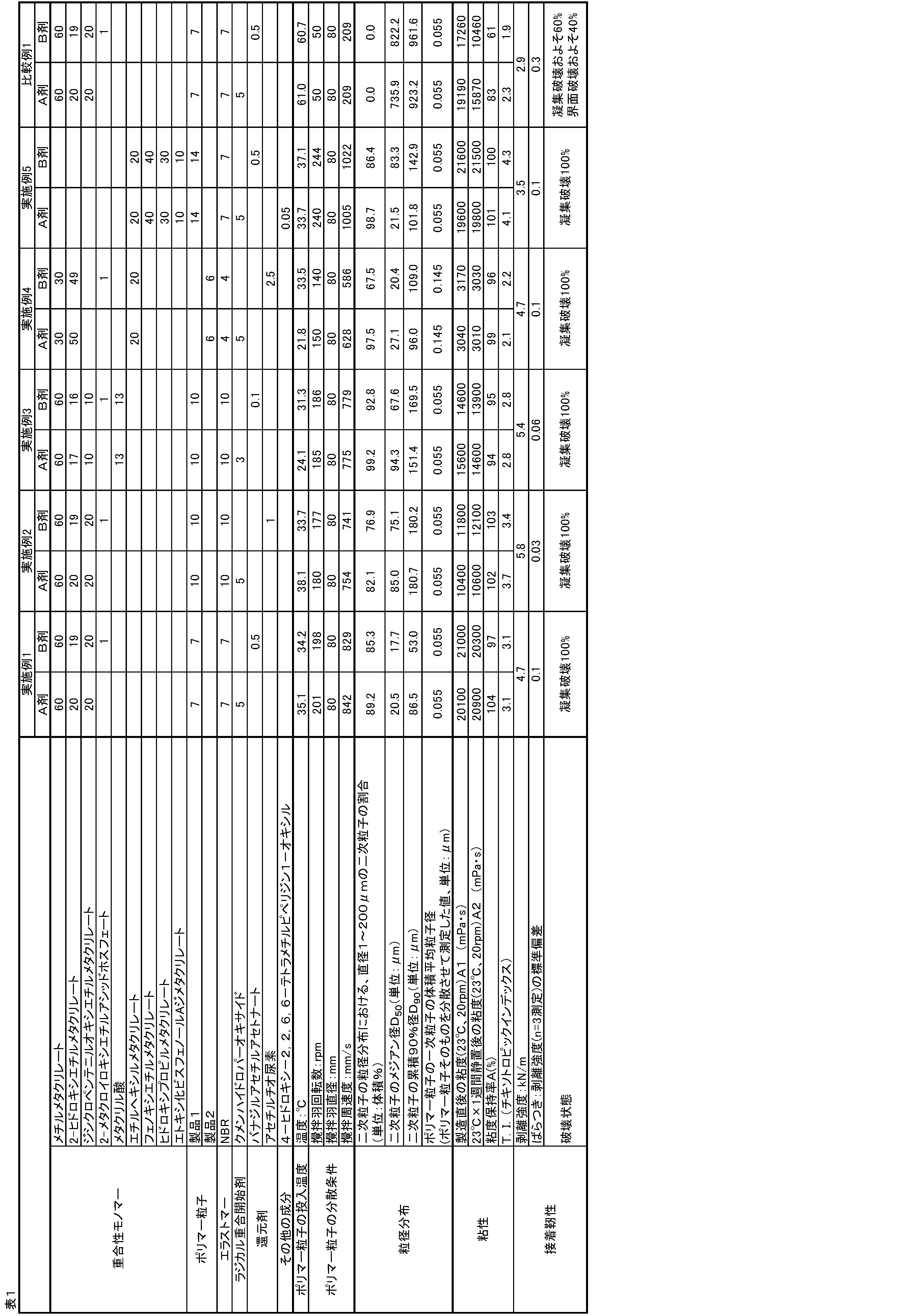
また、ポリマー粒子の直径1μm以上200μm以下の二次粒子の割合が30体積%以上である接着剤組成物を用いることで、SECC鋼板同士を強く接着することができた。つまり、高い接着強度を得ることができた。
この推定に基づき、本発明者は、上記のように、ポリマー粒子の凝集体である二次粒子の粒径分布において、直径1μm以上200μm以下の二次粒子の割合が30体積%以上とした。これにより、貯蔵安定性が良好で、高い接着強度が得られる接着剤組成物を提供することができた。
Claims (17)
- (メタ)アクリロイル基を有する重合性モノマーと、
ラジカル重合開始剤と、
有機溶剤により膨潤する性質を有するポリマー粒子と、を含む接着剤組成物であって、
レーザ回折・散乱法により求められる、当該接着剤組成物中の、前記ポリマー粒子の凝集体である二次粒子の粒径分布において、直径1μm以上200μm以下の二次粒子の割合が30体積%以上である接着剤組成物。 - 請求項1に記載の接着剤組成物であって、
前記二次粒子の粒径分布から求められる二次粒子のメジアン径D50が1μm以上200μm以下である接着剤組成物。 - 請求項1または2に記載の接着剤組成物であって、
前記二次粒子の粒径分布から求められる二次粒子の累積90%径D90が10μm以上500μm以下である接着剤組成物。 - 請求項1~3のいずれか1項に記載の接着剤組成物であって、
前記ポリマー粒子の一次粒子の体積平均粒子径が0.01μm以上1μm以下である接着剤組成物。 - 請求項1~4のいずれか1項に記載の接着剤組成物であって、
前記ポリマー粒子を構成するポリマーは、ジエン系ポリマーを含む接着剤組成物。 - 請求項1~5のいずれか1項に記載の接着剤組成物であって、
前記ポリマー粒子を構成するポリマーは、(メタ)アクリロニトリル・ブタジエン・スチレン共重合体、および/または、メチル(メタ)アクリレート・(メタ)アクリロニトリル・ブタジエン・スチレン共重合体を含む接着剤組成物。 - 請求項1~6のいずれか1項に記載の接着剤組成物であって、
前記ポリマー粒子は、コアシェル型ポリマー粒子を含む接着剤組成物。 - 請求項1~7のいずれか1項に記載の接着剤組成物であって、
さらにエラストマーを含む接着剤組成物。 - 請求項1~8のいずれか1項に記載の接着剤組成物であって、
さらに、安定ラジカルを有する安定ラジカル型化合物を含む接着剤組成物。 - 請求項9に記載の接着剤組成物であって、
前記安定ラジカルがニトロキシドラジカルである接着剤組成物。 - 請求項9または10に記載の接着剤組成物であって、
前記安定ラジカル型化合物が、1-オキシル-2,2,6,6-テトラメチルピペリジン、4-ヒドロキシ-2,2,6,6-テトラメチルピペリジン1-オキシルおよび4-(メタ)アクリロイルオキシ-2,2,6,6-テトラメチルピペリジン1-オキシルからなる群より選択される少なくとも一種を含む接着剤組成物。 - 請求項9~11のいずれか1項に記載の接着剤組成物であって、
前記安定ラジカル型化合物の含有量が、前記重合性モノマー100質量部に対して、0.001質量部以上0.5質量部以下である接着剤組成物。 - 請求項1~12のいずれか1項に記載の接着剤組成物であって、
さらに還元剤を含む接着剤組成物。 - 請求項13に記載の接着剤組成物であって、
当該接着剤組成物は、第1剤と第2剤とからなり、使用直前に混合して用いる2剤型の接着剤組成物であり、前記第1剤が前記ラジカル重合開始剤を含み、前記第2剤が前記還元剤を含む接着剤組成物。 - 第1の構造部材と、
第2の構造部材と、
前記第1の構造部材と前記第2の構造部材とを接合する、請求項1~14のいずれか1項に記載の接着剤組成物の硬化体とを含む接合体。 - 請求項1~14のいずれか1項に記載の接着剤組成物を製造する製造方法であって、
前記重合性モノマーが入った容器内に、前記ポリマー粒子を投入して攪拌し、前記重合性モノマーに前記ポリマー粒子を分散させる分散工程を含み、
前記投入の際の前記重合性モノマーの温度は、0℃以上40℃以下である、接着剤組成物の製造方法。 - 請求項16に記載の製造方法であって、
前記攪拌は、攪拌羽根を用い、300mm/s以上の攪拌周速度で行われる、接着剤組成物の製造方法。
Priority Applications (6)
| Application Number | Priority Date | Filing Date | Title |
|---|---|---|---|
| EP22780381.4A EP4310118A4 (en) | 2021-03-31 | 2022-03-23 | ADHESIVE COMPOSITION, BONDED BODY AND METHOD FOR PRODUCING AN ADHESIVE COMPOSITION |
| US18/284,506 US20240174893A1 (en) | 2021-03-31 | 2022-03-23 | Adhesive composition, bonded body and production method for an adhesive composition |
| CN202280007060.9A CN116348511A (zh) | 2021-03-31 | 2022-03-23 | 粘接剂组合物、接合体及粘接剂组合物的制造方法 |
| JP2023511059A JP7768977B2 (ja) | 2021-03-31 | 2022-03-23 | 接着剤組成物、接合体および接着剤組成物の製造方法 |
| KR1020237032852A KR102933707B1 (ko) | 2021-03-31 | 2022-03-23 | 접착제 조성물, 접합체 및 접착제 조성물의 제조 방법 |
| JP2024001671A JP2024032758A (ja) | 2021-03-31 | 2024-01-10 | 接着剤組成物、接合体および接着剤組成物の製造方法 |
Applications Claiming Priority (2)
| Application Number | Priority Date | Filing Date | Title |
|---|---|---|---|
| JP2021059627 | 2021-03-31 | ||
| JP2021-059627 | 2021-03-31 |
Publications (1)
| Publication Number | Publication Date |
|---|---|
| WO2022210166A1 true WO2022210166A1 (ja) | 2022-10-06 |
Family
ID=83456753
Family Applications (1)
| Application Number | Title | Priority Date | Filing Date |
|---|---|---|---|
| PCT/JP2022/013513 Ceased WO2022210166A1 (ja) | 2021-03-31 | 2022-03-23 | 接着剤組成物、接合体および接着剤組成物の製造方法 |
Country Status (7)
| Country | Link |
|---|---|
| US (1) | US20240174893A1 (ja) |
| EP (1) | EP4310118A4 (ja) |
| JP (2) | JP7768977B2 (ja) |
| KR (1) | KR102933707B1 (ja) |
| CN (1) | CN116348511A (ja) |
| TW (2) | TWI870654B (ja) |
| WO (1) | WO2022210166A1 (ja) |
Families Citing this family (1)
| Publication number | Priority date | Publication date | Assignee | Title |
|---|---|---|---|---|
| JP2026066776A (ja) * | 2024-10-07 | 2026-04-17 | デンカ株式会社 | 組成物、物品およびモータ |
Citations (11)
| Publication number | Priority date | Publication date | Assignee | Title |
|---|---|---|---|---|
| JPH04226579A (ja) * | 1990-07-05 | 1992-08-17 | Illinois Tool Works Inc <Itw> | 低温用接着剤 |
| WO2005028546A1 (ja) | 2003-09-18 | 2005-03-31 | Kaneka Corporation | ゴム状重合体粒子の製造方法およびこれを含有する樹脂組成物の製造方法 |
| WO2007046190A1 (ja) * | 2005-10-18 | 2007-04-26 | Hitachi Chemical Company, Ltd. | 接着剤組成物、回路接続材料、回路部材の接続構造及び半導体装置 |
| JP2009519368A (ja) * | 2005-12-15 | 2009-05-14 | ハンツマン アドバンスト マテリアルズ (スイッツァランド) ゲーエムベーハー | 多相アクリル系接着剤 |
| JP4707320B2 (ja) | 2003-12-22 | 2011-06-22 | 電気化学工業株式会社 | 二剤型アクリル系接着剤組成物とそれを用いた接合体 |
| JP2016104834A (ja) | 2014-12-01 | 2016-06-09 | 株式会社カネカ | コアシェルポリマーにより改質された変性熱可塑性ウレタンエラストマー |
| JP2016155892A (ja) * | 2015-02-23 | 2016-09-01 | スリーエム イノベイティブ プロパティズ カンパニー | 2液型接着剤 |
| WO2017170957A1 (ja) * | 2016-03-31 | 2017-10-05 | デンカ株式会社 | 組成物 |
| WO2020110911A1 (ja) * | 2018-11-27 | 2020-06-04 | 株式会社イーテック | 2液混合型接着剤 |
| JP2020527621A (ja) * | 2017-07-12 | 2020-09-10 | アルケマ フランス | (メタ)アクリル接着剤組成物、その調製方法及びその使用 |
| JP2021059627A (ja) | 2019-10-03 | 2021-04-15 | 横浜ゴム株式会社 | スチールコード接着用ゴム組成物及びコンベヤベルト |
Family Cites Families (6)
| Publication number | Priority date | Publication date | Assignee | Title |
|---|---|---|---|---|
| NL8202281A (nl) * | 1982-06-04 | 1984-01-02 | Dow Chemical Nederland | Met rubber versterkte polymeren van aromatische monovinylideenverbindingen en werkwijze voor de bereiding daarvan. |
| EP2624338B1 (en) * | 2012-02-02 | 2014-11-05 | JSR Corporation | Electrode binder composition, electrode slurry, electrode, and electrical storage device |
| JP6219058B2 (ja) | 2013-04-08 | 2017-10-25 | アイカ工業株式会社 | 光硬化樹脂組成物 |
| WO2017018486A1 (ja) * | 2015-07-30 | 2017-02-02 | デンカ株式会社 | 組成物 |
| CN110461594B (zh) * | 2017-03-22 | 2021-02-12 | 住友电木株式会社 | 脱模膜及挠性印刷电路基板的制造方法 |
| CN112654728A (zh) * | 2018-09-11 | 2021-04-13 | 三菱工程塑料株式会社 | 带金属膜的树脂成型品及其制造方法 |
-
2022
- 2022-03-23 WO PCT/JP2022/013513 patent/WO2022210166A1/ja not_active Ceased
- 2022-03-23 KR KR1020237032852A patent/KR102933707B1/ko active Active
- 2022-03-23 JP JP2023511059A patent/JP7768977B2/ja active Active
- 2022-03-23 US US18/284,506 patent/US20240174893A1/en active Pending
- 2022-03-23 CN CN202280007060.9A patent/CN116348511A/zh active Pending
- 2022-03-23 EP EP22780381.4A patent/EP4310118A4/en active Pending
- 2022-03-28 TW TW111111531A patent/TWI870654B/zh active
- 2022-03-28 TW TW113147805A patent/TW202513738A/zh unknown
-
2024
- 2024-01-10 JP JP2024001671A patent/JP2024032758A/ja active Pending
Patent Citations (11)
| Publication number | Priority date | Publication date | Assignee | Title |
|---|---|---|---|---|
| JPH04226579A (ja) * | 1990-07-05 | 1992-08-17 | Illinois Tool Works Inc <Itw> | 低温用接着剤 |
| WO2005028546A1 (ja) | 2003-09-18 | 2005-03-31 | Kaneka Corporation | ゴム状重合体粒子の製造方法およびこれを含有する樹脂組成物の製造方法 |
| JP4707320B2 (ja) | 2003-12-22 | 2011-06-22 | 電気化学工業株式会社 | 二剤型アクリル系接着剤組成物とそれを用いた接合体 |
| WO2007046190A1 (ja) * | 2005-10-18 | 2007-04-26 | Hitachi Chemical Company, Ltd. | 接着剤組成物、回路接続材料、回路部材の接続構造及び半導体装置 |
| JP2009519368A (ja) * | 2005-12-15 | 2009-05-14 | ハンツマン アドバンスト マテリアルズ (スイッツァランド) ゲーエムベーハー | 多相アクリル系接着剤 |
| JP2016104834A (ja) | 2014-12-01 | 2016-06-09 | 株式会社カネカ | コアシェルポリマーにより改質された変性熱可塑性ウレタンエラストマー |
| JP2016155892A (ja) * | 2015-02-23 | 2016-09-01 | スリーエム イノベイティブ プロパティズ カンパニー | 2液型接着剤 |
| WO2017170957A1 (ja) * | 2016-03-31 | 2017-10-05 | デンカ株式会社 | 組成物 |
| JP2020527621A (ja) * | 2017-07-12 | 2020-09-10 | アルケマ フランス | (メタ)アクリル接着剤組成物、その調製方法及びその使用 |
| WO2020110911A1 (ja) * | 2018-11-27 | 2020-06-04 | 株式会社イーテック | 2液混合型接着剤 |
| JP2021059627A (ja) | 2019-10-03 | 2021-04-15 | 横浜ゴム株式会社 | スチールコード接着用ゴム組成物及びコンベヤベルト |
Also Published As
| Publication number | Publication date |
|---|---|
| EP4310118A1 (en) | 2024-01-24 |
| JP2024032758A (ja) | 2024-03-12 |
| EP4310118A4 (en) | 2024-07-31 |
| US20240174893A1 (en) | 2024-05-30 |
| TW202246436A (zh) | 2022-12-01 |
| TWI870654B (zh) | 2025-01-21 |
| JP7768977B2 (ja) | 2025-11-12 |
| KR102933707B1 (ko) | 2026-03-03 |
| KR20230150341A (ko) | 2023-10-30 |
| TW202513738A (zh) | 2025-04-01 |
| CN116348511A (zh) | 2023-06-27 |
| JPWO2022210166A1 (ja) | 2022-10-06 |
Similar Documents
| Publication | Publication Date | Title |
|---|---|---|
| EP2388280B1 (en) | Curable composition, cured object obtained therefrom, and process for producing same | |
| EP2978777B1 (en) | Ultraviolet curable pressure sensitive adhesives | |
| JP5586497B2 (ja) | 光学部材用の粘接着剤組成物、粘接着剤層、粘接着剤層が設けられた光学部材、光学部材付画像表示装置、および画像表示装置の製造方法 | |
| WO2017170957A1 (ja) | 組成物 | |
| JP6684800B2 (ja) | 組成物 | |
| CN102449093B (zh) | 光固化型粘合粘接剂组合物、光固化型粘合粘接剂层、和光固化型粘合粘接片 | |
| JP7415497B2 (ja) | 耐熱性アクリル系接着剤組成物 | |
| CN102648261B (zh) | 光固化型粘合粘接剂组合物、光固化型粘合粘接剂层、和光固化型粘合粘接片 | |
| JP7612836B2 (ja) | 接着剤組成物および物品 | |
| CN116981705A (zh) | 包含具有羧酸基团的丙烯酸类单体、具有羟基基团的丙烯酸类单体、(甲基)丙烯酸烷基酯单体和交联剂的组合物以及相关制品和方法 | |
| WO2022249965A1 (ja) | 耐熱性アクリル系接着剤組成物 | |
| CN1113932C (zh) | 可固化树脂组合物 | |
| WO2022210166A1 (ja) | 接着剤組成物、接合体および接着剤組成物の製造方法 | |
| JP5533406B2 (ja) | 紫外線硬化型粘着剤組成物 | |
| US20220340795A1 (en) | Reactive adhesive film with good heat-and-humidity resistance, in particular for bonding polyamide | |
| JP2022176897A (ja) | 塗膜保護コート材およびコーティング組成物 | |
| JP4707320B2 (ja) | 二剤型アクリル系接着剤組成物とそれを用いた接合体 | |
| JP2020189946A (ja) | (メタ)アクリル系樹脂組成物 | |
| JP7825944B2 (ja) | 接着剤組成物および接合体 | |
| WO2022244695A1 (ja) | 塗膜保護コート材およびコーティング組成物 | |
| EP4695313A1 (en) | Two-part adhesive composition and method of making a bonded article | |
| TW202513628A (zh) | 丙烯酸系接著劑組成物 | |
| KR101073098B1 (ko) | 용제형 재박리용 점착제 조성물 및 재박리용 점착 제품 | |
| JP2009046551A (ja) | ラジカル硬化型接着剤組成物 | |
| WO2024162199A1 (ja) | 組成物、物品およびバッテリー |
Legal Events
| Date | Code | Title | Description |
|---|---|---|---|
| 121 | Ep: the epo has been informed by wipo that ep was designated in this application |
Ref document number: 22780381 Country of ref document: EP Kind code of ref document: A1 |
|
| ENP | Entry into the national phase |
Ref document number: 2023511059 Country of ref document: JP Kind code of ref document: A |
|
| ENP | Entry into the national phase |
Ref document number: 20237032852 Country of ref document: KR Kind code of ref document: A |
|
| WWE | Wipo information: entry into national phase |
Ref document number: 18284506 Country of ref document: US |
|
| WWE | Wipo information: entry into national phase |
Ref document number: 2022780381 Country of ref document: EP |
|
| ENP | Entry into the national phase |
Ref document number: 2022780381 Country of ref document: EP Effective date: 20231018 |
|
| NENP | Non-entry into the national phase |
Ref country code: DE |