WO2022210527A1 - 艶消物品 - Google Patents
艶消物品 Download PDFInfo
- Publication number
- WO2022210527A1 WO2022210527A1 PCT/JP2022/014969 JP2022014969W WO2022210527A1 WO 2022210527 A1 WO2022210527 A1 WO 2022210527A1 JP 2022014969 W JP2022014969 W JP 2022014969W WO 2022210527 A1 WO2022210527 A1 WO 2022210527A1
- Authority
- WO
- WIPO (PCT)
- Prior art keywords
- matte
- layer
- less
- resin
- article
- Prior art date
- Legal status (The legal status is an assumption and is not a legal conclusion. Google has not performed a legal analysis and makes no representation as to the accuracy of the status listed.)
- Ceased
Links
Images







Classifications
-
- B—PERFORMING OPERATIONS; TRANSPORTING
- B05—SPRAYING OR ATOMISING IN GENERAL; APPLYING FLUENT MATERIALS TO SURFACES, IN GENERAL
- B05D—PROCESSES FOR APPLYING FLUENT MATERIALS TO SURFACES, IN GENERAL
- B05D5/00—Processes for applying liquids or other fluent materials to surfaces to obtain special surface effects, finishes or structures
- B05D5/02—Processes for applying liquids or other fluent materials to surfaces to obtain special surface effects, finishes or structures to obtain a matt or rough surface
-
- B—PERFORMING OPERATIONS; TRANSPORTING
- B32—LAYERED PRODUCTS
- B32B—LAYERED PRODUCTS, i.e. PRODUCTS BUILT-UP OF STRATA OF FLAT OR NON-FLAT, e.g. CELLULAR OR HONEYCOMB, FORM
- B32B3/00—Layered products comprising a layer with external or internal discontinuities or unevennesses, or a layer of non-planar shape; Layered products comprising a layer having particular features of form
- B32B3/26—Layered products comprising a layer with external or internal discontinuities or unevennesses, or a layer of non-planar shape; Layered products comprising a layer having particular features of form characterised by a particular shape of the outline of the cross-section of a continuous layer; characterised by a layer with cavities or internal voids ; characterised by an apertured layer
- B32B3/30—Layered products comprising a layer with external or internal discontinuities or unevennesses, or a layer of non-planar shape; Layered products comprising a layer having particular features of form characterised by a particular shape of the outline of the cross-section of a continuous layer; characterised by a layer with cavities or internal voids ; characterised by an apertured layer characterised by a layer formed with recesses or projections, e.g. hollows, grooves, protuberances, ribs
-
- B—PERFORMING OPERATIONS; TRANSPORTING
- B05—SPRAYING OR ATOMISING IN GENERAL; APPLYING FLUENT MATERIALS TO SURFACES, IN GENERAL
- B05D—PROCESSES FOR APPLYING FLUENT MATERIALS TO SURFACES, IN GENERAL
- B05D5/00—Processes for applying liquids or other fluent materials to surfaces to obtain special surface effects, finishes or structures
- B05D5/06—Processes for applying liquids or other fluent materials to surfaces to obtain special surface effects, finishes or structures to obtain multicolour or other optical effects
- B05D5/061—Special surface effect
- B05D5/062—Wrinkled, cracked or ancient-looking effect
-
- B—PERFORMING OPERATIONS; TRANSPORTING
- B32—LAYERED PRODUCTS
- B32B—LAYERED PRODUCTS, i.e. PRODUCTS BUILT-UP OF STRATA OF FLAT OR NON-FLAT, e.g. CELLULAR OR HONEYCOMB, FORM
- B32B27/00—Layered products comprising a layer of synthetic resin
- B32B27/18—Layered products comprising a layer of synthetic resin characterised by the use of special additives
-
- B—PERFORMING OPERATIONS; TRANSPORTING
- B32—LAYERED PRODUCTS
- B32B—LAYERED PRODUCTS, i.e. PRODUCTS BUILT-UP OF STRATA OF FLAT OR NON-FLAT, e.g. CELLULAR OR HONEYCOMB, FORM
- B32B7/00—Layered products characterised by the relation between layers; Layered products characterised by the relative orientation of features between layers, or by the relative values of a measurable parameter between layers, i.e. products comprising layers having different physical, chemical or physicochemical properties; Layered products characterised by the interconnection of layers
- B32B7/04—Interconnection of layers
- B32B7/12—Interconnection of layers using interposed adhesives or interposed materials with bonding properties
-
- C—CHEMISTRY; METALLURGY
- C08—ORGANIC MACROMOLECULAR COMPOUNDS; THEIR PREPARATION OR CHEMICAL WORKING-UP; COMPOSITIONS BASED THEREON
- C08J—WORKING-UP; GENERAL PROCESSES OF COMPOUNDING; AFTER-TREATMENT NOT COVERED BY SUBCLASSES C08B, C08C, C08F, C08G or C08H
- C08J7/00—Chemical treatment or coating of shaped articles made of macromolecular substances
- C08J7/04—Coating
-
- C—CHEMISTRY; METALLURGY
- C08—ORGANIC MACROMOLECULAR COMPOUNDS; THEIR PREPARATION OR CHEMICAL WORKING-UP; COMPOSITIONS BASED THEREON
- C08J—WORKING-UP; GENERAL PROCESSES OF COMPOUNDING; AFTER-TREATMENT NOT COVERED BY SUBCLASSES C08B, C08C, C08F, C08G or C08H
- C08J7/00—Chemical treatment or coating of shaped articles made of macromolecular substances
- C08J7/04—Coating
- C08J7/0427—Coating with only one layer of a composition containing a polymer binder
-
- C—CHEMISTRY; METALLURGY
- C09—DYES; PAINTS; POLISHES; NATURAL RESINS; ADHESIVES; COMPOSITIONS NOT OTHERWISE PROVIDED FOR; APPLICATIONS OF MATERIALS NOT OTHERWISE PROVIDED FOR
- C09D—COATING COMPOSITIONS, e.g. PAINTS, VARNISHES OR LACQUERS; FILLING PASTES; CHEMICAL PAINT OR INK REMOVERS; INKS; CORRECTING FLUIDS; WOODSTAINS; PASTES OR SOLIDS FOR COLOURING OR PRINTING; USE OF MATERIALS THEREFOR
- C09D4/00—Coating compositions, e.g. paints, varnishes or lacquers, based on organic non-macromolecular compounds having at least one polymerisable carbon-to-carbon unsaturated bond ; Coating compositions, based on monomers of macromolecular compounds of groups C09D183/00 - C09D183/16
-
- C—CHEMISTRY; METALLURGY
- C09—DYES; PAINTS; POLISHES; NATURAL RESINS; ADHESIVES; COMPOSITIONS NOT OTHERWISE PROVIDED FOR; APPLICATIONS OF MATERIALS NOT OTHERWISE PROVIDED FOR
- C09D—COATING COMPOSITIONS, e.g. PAINTS, VARNISHES OR LACQUERS; FILLING PASTES; CHEMICAL PAINT OR INK REMOVERS; INKS; CORRECTING FLUIDS; WOODSTAINS; PASTES OR SOLIDS FOR COLOURING OR PRINTING; USE OF MATERIALS THEREFOR
- C09D5/00—Coating compositions, e.g. paints, varnishes or lacquers, characterised by their physical nature or the effects produced; Filling pastes
-
- C—CHEMISTRY; METALLURGY
- C09—DYES; PAINTS; POLISHES; NATURAL RESINS; ADHESIVES; COMPOSITIONS NOT OTHERWISE PROVIDED FOR; APPLICATIONS OF MATERIALS NOT OTHERWISE PROVIDED FOR
- C09D—COATING COMPOSITIONS, e.g. PAINTS, VARNISHES OR LACQUERS; FILLING PASTES; CHEMICAL PAINT OR INK REMOVERS; INKS; CORRECTING FLUIDS; WOODSTAINS; PASTES OR SOLIDS FOR COLOURING OR PRINTING; USE OF MATERIALS THEREFOR
- C09D5/00—Coating compositions, e.g. paints, varnishes or lacquers, characterised by their physical nature or the effects produced; Filling pastes
- C09D5/28—Coating compositions, e.g. paints, varnishes or lacquers, characterised by their physical nature or the effects produced; Filling pastes for wrinkle, crackle, orange-peel, or similar decorative effects
-
- C—CHEMISTRY; METALLURGY
- C09—DYES; PAINTS; POLISHES; NATURAL RESINS; ADHESIVES; COMPOSITIONS NOT OTHERWISE PROVIDED FOR; APPLICATIONS OF MATERIALS NOT OTHERWISE PROVIDED FOR
- C09D—COATING COMPOSITIONS, e.g. PAINTS, VARNISHES OR LACQUERS; FILLING PASTES; CHEMICAL PAINT OR INK REMOVERS; INKS; CORRECTING FLUIDS; WOODSTAINS; PASTES OR SOLIDS FOR COLOURING OR PRINTING; USE OF MATERIALS THEREFOR
- C09D7/00—Features of coating compositions, not provided for in group C09D5/00; Processes for incorporating ingredients in coating compositions
- C09D7/40—Additives
- C09D7/60—Additives non-macromolecular
- C09D7/61—Additives non-macromolecular inorganic
-
- C—CHEMISTRY; METALLURGY
- C09—DYES; PAINTS; POLISHES; NATURAL RESINS; ADHESIVES; COMPOSITIONS NOT OTHERWISE PROVIDED FOR; APPLICATIONS OF MATERIALS NOT OTHERWISE PROVIDED FOR
- C09D—COATING COMPOSITIONS, e.g. PAINTS, VARNISHES OR LACQUERS; FILLING PASTES; CHEMICAL PAINT OR INK REMOVERS; INKS; CORRECTING FLUIDS; WOODSTAINS; PASTES OR SOLIDS FOR COLOURING OR PRINTING; USE OF MATERIALS THEREFOR
- C09D7/00—Features of coating compositions, not provided for in group C09D5/00; Processes for incorporating ingredients in coating compositions
- C09D7/40—Additives
- C09D7/66—Additives characterised by particle size
-
- E—FIXED CONSTRUCTIONS
- E04—BUILDING
- E04F—FINISHING WORK ON BUILDINGS, e.g. STAIRS, FLOORS
- E04F13/00—Coverings or linings, e.g. for walls or ceilings
- E04F13/07—Coverings or linings, e.g. for walls or ceilings composed of covering or lining elements; Sub-structures therefor; Fastening means therefor
- E04F13/08—Coverings or linings, e.g. for walls or ceilings composed of covering or lining elements; Sub-structures therefor; Fastening means therefor composed of a plurality of similar covering or lining elements
- E04F13/18—Coverings or linings, e.g. for walls or ceilings composed of covering or lining elements; Sub-structures therefor; Fastening means therefor composed of a plurality of similar covering or lining elements of organic plastics with or without reinforcements or filling materials or with an outer layer of organic plastics with or without reinforcements or filling materials; plastic tiles
-
- B—PERFORMING OPERATIONS; TRANSPORTING
- B05—SPRAYING OR ATOMISING IN GENERAL; APPLYING FLUENT MATERIALS TO SURFACES, IN GENERAL
- B05D—PROCESSES FOR APPLYING FLUENT MATERIALS TO SURFACES, IN GENERAL
- B05D2252/00—Sheets
-
- B—PERFORMING OPERATIONS; TRANSPORTING
- B32—LAYERED PRODUCTS
- B32B—LAYERED PRODUCTS, i.e. PRODUCTS BUILT-UP OF STRATA OF FLAT OR NON-FLAT, e.g. CELLULAR OR HONEYCOMB, FORM
- B32B2307/00—Properties of the layers or laminate
- B32B2307/40—Properties of the layers or laminate having particular optical properties
- B32B2307/408—Matt, dull surface
-
- B—PERFORMING OPERATIONS; TRANSPORTING
- B32—LAYERED PRODUCTS
- B32B—LAYERED PRODUCTS, i.e. PRODUCTS BUILT-UP OF STRATA OF FLAT OR NON-FLAT, e.g. CELLULAR OR HONEYCOMB, FORM
- B32B2307/00—Properties of the layers or laminate
- B32B2307/50—Properties of the layers or laminate having particular mechanical properties
- B32B2307/538—Roughness
-
- B—PERFORMING OPERATIONS; TRANSPORTING
- B32—LAYERED PRODUCTS
- B32B—LAYERED PRODUCTS, i.e. PRODUCTS BUILT-UP OF STRATA OF FLAT OR NON-FLAT, e.g. CELLULAR OR HONEYCOMB, FORM
- B32B2307/00—Properties of the layers or laminate
- B32B2307/70—Other properties
- B32B2307/732—Dimensional properties
-
- B—PERFORMING OPERATIONS; TRANSPORTING
- B32—LAYERED PRODUCTS
- B32B—LAYERED PRODUCTS, i.e. PRODUCTS BUILT-UP OF STRATA OF FLAT OR NON-FLAT, e.g. CELLULAR OR HONEYCOMB, FORM
- B32B2451/00—Decorative or ornamental articles
-
- C—CHEMISTRY; METALLURGY
- C08—ORGANIC MACROMOLECULAR COMPOUNDS; THEIR PREPARATION OR CHEMICAL WORKING-UP; COMPOSITIONS BASED THEREON
- C08J—WORKING-UP; GENERAL PROCESSES OF COMPOUNDING; AFTER-TREATMENT NOT COVERED BY SUBCLASSES C08B, C08C, C08F, C08G or C08H
- C08J2367/00—Characterised by the use of polyesters obtained by reactions forming a carboxylic ester link in the main chain; Derivatives of such polymers
- C08J2367/02—Polyesters derived from dicarboxylic acids and dihydroxy compounds
-
- C—CHEMISTRY; METALLURGY
- C08—ORGANIC MACROMOLECULAR COMPOUNDS; THEIR PREPARATION OR CHEMICAL WORKING-UP; COMPOSITIONS BASED THEREON
- C08J—WORKING-UP; GENERAL PROCESSES OF COMPOUNDING; AFTER-TREATMENT NOT COVERED BY SUBCLASSES C08B, C08C, C08F, C08G or C08H
- C08J2475/00—Characterised by the use of polyureas or polyurethanes; Derivatives of such polymers
- C08J2475/04—Polyurethanes
- C08J2475/14—Polyurethanes having carbon-to-carbon unsaturated bonds
-
- C—CHEMISTRY; METALLURGY
- C08—ORGANIC MACROMOLECULAR COMPOUNDS; THEIR PREPARATION OR CHEMICAL WORKING-UP; COMPOSITIONS BASED THEREON
- C08K—Use of inorganic or non-macromolecular organic substances as compounding ingredients
- C08K3/00—Use of inorganic substances as compounding ingredients
- C08K3/34—Silicon-containing compounds
- C08K3/36—Silica
Definitions
- the present disclosure relates to matte articles.
- interior members of buildings such as walls, ceilings and floors; exterior members such as outer walls, eaves, roofs, fences and fences; , malls and other fixtures or fixtures, general furniture such as chests, shelves, desks, kitchen furniture such as dining tables and sinks, or surface decorative panels such as cabinets for home appliances and OA equipment, interior or exterior parts for vehicles
- a so-called decorative material or decorative sheet is used as an article for decorating and protecting the surface of such as.
- a decorative material for example, a material having a surface layer having a desired function is used.
- a method of improving the texture by using a matte effect is widely used to improve the design.
- a base sheet has a pattern layer and a concealing layer on one side, and has a gloss adjusting layer (mat layer, gloss layer) on the other side.
- a cosmetic sheet has been proposed.
- the design effect of enhancing the pattern layer and the concealing layer is obtained due to the difference in gloss between the matte layer and the gloss layer of the gloss adjusting layer.
- a matte ink is used in which a total of 50 parts by weight of matting agent, ie, 10 parts by weight of spherical alumina and 40 parts by weight of calcium carbonate, is added to 100 parts by weight of resin.
- Patent Document 2 proposes a decorative material in which a printed layer and a transparent resin layer are sequentially provided on a base material, and an embossed pattern is applied to the outermost surface of the transparent resin layer.
- a matting agent also referred to as a "matting agent”
- the light diffusion effect itself is used.
- a matting agent is used as in Patent Document 1
- An object of the present disclosure is to provide a matte article that has excellent matte effect visibility and texture, and also has an excellent soft touch feeling (soft touch).
- the present disclosure provides the following matte article.
- At least part of the surface has Spc (arithmetic mean curvature of the apex of the protrusion) defined in JIS B0601:2013 greater than 4000 mm -1 and Rsm (average of curve elements length) is less than 30 ⁇ m.
- Rz maximum height
- Rz maximum height
- Ra arithmetic mean roughness
- the irregular wrinkles are composed of a plurality of protrusions formed by a plurality of filamentary projections and recesses formed by being surrounded by the plurality of filamentary projections. matte article.
- the matte layer is composed of a cured resin composition containing a resin and a wrinkle-forming stabilizer, and the wrinkle-forming stabilizer is either 100% or less of the thickness of the matte layer or 30 ⁇ m or less. Any one of [4] to [6], which has an average particle size with a smaller upper limit, and contains the wrinkle-forming stabilizer in an amount of 0.5 parts by mass or more with respect to 100 parts by mass of the resin. Matte article as described. [8] The matte article according to any one of [1] to [7], which has a substrate. [9] The matte article according to [8], wherein the substrate is in the form of a sheet.
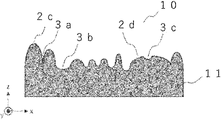
- FIG. 2 is a schematic diagram for explaining the surface shape of the matte article of the present disclosure
- FIG. 2 is a schematic diagram for explaining the surface shape of the matte article of the present disclosure
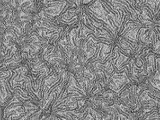
- 1 is a schematic plan view showing an embodiment of a matte article of the present disclosure
- FIG. 1 is a cross-sectional view of one embodiment of a matte article of the present disclosure
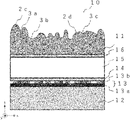
- FIG. 1 is a cross-sectional view of one embodiment of a matte article of the present disclosure
- FIG. 1 is a cross-sectional view of one embodiment of a matte article of the present disclosure
- FIG. 2 is an optical microscope image of the surface of the matte article obtained in Example 1.
- FIG. 2 is an optical microscope image of the surface of the matte article obtained in Example 2.
- FIG. 4 is an optical microscope image of the surface of the matte article obtained in Example 3.
- FIG. 2 is an optical microscope image of the surface of the matte article obtained in Comparative Example 1.
- FIG. 4 is an optical microscope image of the surface of the matte article obtained in Comparative Example 2.
- FIG. 3 is an optical microscope image of the surface of the matte article obtained in Comparative Example 3.
- FIG. 4 is an optical microscope image of the surface of the matte article obtained in Comparative Example 4.
- FIG. 4 is an optical microscope image of the surface of the matte article obtained in Comparative Example 5.
- the matte article of the present embodiment has, on at least part of the surface, Spc (arithmetic mean curvature of the apex of the protrusion) defined in JIS B0601:2013 is greater than 4000 mm -1 and is defined in JIS B0601:2013. It is characterized by having a surface shape with Rsm (average length of curvilinear element) of less than 30 ⁇ m.
- the surface shape of at least a part of the surface of the matte article of the present embodiment (hereinafter also simply referred to as "surface shape”) will be described.
- the surface shape is defined in JIS B0601: 2013, Spc (arithmetic mean curvature of the apex of the protrusion) is greater than 4000 mm -1 , and Rsm (average length of curvilinear element) defined in JIS B0601: It should be less than 30 ⁇ m.
- the matte article of the present embodiment has excellent visibility and texture of the matting effect (hereinafter collectively referred to as "glossy It may be referred to as an "extinguishing effect”.
- Soft-touch feeling is a sensual expression, but “soft-touch feeling” in the present specification generally includes all tactile sensations that feel “soft”. Specifically, it means a tactile sensation that is felt when touching a non-moisture smooth surface with the pad of a finger, unlike the cold or rough tactile sensation that tends to occur in conventional resin decorative sheets. Examples of materials that have a “soft touch feeling” include high-quality paper (not coated paper with a coated surface), Oxford cloth using fine threads of about 60 to 120 counts (fine count to extra fine count), etc.
- Spc (arithmetic mean curvature of protrusion vertex)
- Spc (arithmetic mean curvature of protrusion apex) is one of the three-dimensional surface texture parameters specified in JIS B0601:2013, and is classified as a mountain (convex portion) in the feature image included in the reference area. It is the average curvature (average sharpness) of the tip of the peak obtained from the arithmetic average value of the radius of curvature of the peak (apex of the protrusion) of the location. Therefore, Spc is the reciprocal (mm ⁇ 1 ) of the radius (mm).
- a surface shape with a large Spc (a surface shape with sharp apexes of protrusions) will increase light scattering on the surface and reduce gloss.
- a surface shape with a small Spc has a rounded apex of the protrusions, so that the touch is soft.
- the value of Spc is increased, the roundness of the protrusions is lost, and although the soft touch feeling is impaired, the matte effect is improved.
- Spc is preferably 4200 mm ⁇ 1 or more, more preferably 4300 mm ⁇ 1 or more, from the viewpoint of improving the matte effect and soft touch feeling in relation to Rsm (average length of curved element) described later. It is preferably 4400 mm ⁇ 1 or more, and the upper limit is preferably 7000 mm ⁇ 1 or less, preferably 6500 mm ⁇ 1 or less, more preferably 6000 mm ⁇ 1 or less, and even more preferably 5700 mm ⁇ 1 or less.
- the cut-off value is 0.8 mm for the measurement of Spc in this specification.
- the measurement of Spc is a measurement value measured using a shape analysis laser microscope for a rectangle (1024 ⁇ m ⁇ 768 ⁇ m) at an arbitrary part of the surface shape of the matte article, and the measurement conditions can be adjusted as appropriate. It can be measured under the conditions described in Examples. Rsm (average length of curvilinear element), Rz (maximum height) and Ra (arithmetic mean roughness), which will be described later, can also be measured in the same manner.
- Rsm average length of curvilinear element
- Rsm average length of curve element
- Rsm is large, ie, 30 ⁇ m or more, desired soft touch feeling cannot be obtained, but if Rsm is small, ie, less than 30 ⁇ m, good soft touch feeling can be obtained.
- the density of protrusions increases by reducing Rsm.
- the soft touch feeling is improved by increasing the Spc to improve the matte effect and further decreasing the Rsm. More specifically, the relationship between Spc and Rsm is as follows. As described above, by increasing Spc, a matte effect can be obtained, but a soft touch feeling cannot be obtained because the tactile sensation is rough. In the present disclosure, by increasing Spc and decreasing Rsm, it has become possible to achieve both a matte effect and a soft touch feeling at a high level. By increasing the Spc, the surface shape has sharp projections, but as the Rsm is decreased, the projections are densely packed, so that the contact portion with the pad of the finger becomes even. , the soft touch feeling is improved. In this way, it is considered that the soft touch feeling is improved while the excellent matting effect is obtained, and it has become possible to achieve both the matting effect and the soft touch feeling at a high level.
- Rsm is preferably 29.5 ⁇ m or less, more preferably 29.0 ⁇ m or less, still more preferably 28.5 ⁇ m or less. is preferably 10.0 ⁇ m or more, more preferably 12.0 ⁇ m or more, and still more preferably 13.5 ⁇ m or more.
- the cutoff value for the measurement of Rsm in this specification is 0.8 mm.
- the surface shape of the matte article of the present embodiment preferably has fine wrinkles (wrinkles) visible in a plan view shown in FIG. 3 described later.
- Spc (arithmetic mean curvature of the apex of the protrusion) and Rsm (average length of the curvilinear element), preferably Rz (maximum height) and Ra (arithmetic mean roughness ) is likely to be within a specific numerical range due to having the minute wrinkles (wrinkles), while the minute wrinkles (wrinkles) are within a specific numerical range Spc (arithmetic mean curvature of the apex of the protrusion) and Rsm (average length of the curvilinear element), and also Rz (maximum height) and Ra (arithmetic mean roughness), preferably within certain numerical ranges.
- Spc arithmetic mean curvature of the apex of the protrusion
- Rsm average length of the curvilinear element
- Rz maximum height
- Ra Arithmetic mean roughness
- composition formulation of the resin composition for forming the matte layer particularly the type of polymerizable monomer and polymerizable oligomer, the number of functional groups, the molecular weight, the presence or absence of a wrinkle-forming stabilizer, and when using a wrinkle-forming stabilizer, the wrinkles optimizing the particle size and content of the forming agent; (3) optimizing the irradiation conditions of the resin composition for matting formation, especially the wavelength of light with a wavelength of 100 nm or more and 380 nm or less that can cause curing shrinkage of the surface portion of the matte layer, the integrated weight, the ultraviolet power density, etc. (4) In addition to the above, optimize the type and thickness of the base material, the thickness of the matte layer, etc. is preferred.
- Rz maximum height
- Ra arithmetic mean roughness
- Rz (maximum height) which is a lateral parameter of the contour curve defined in JIS B0601:2013, be 12.50 ⁇ m or less.
- Rz (maximum height) is one of the peak and height parameters of the contour curve, and is the sum of the height of the highest peak and the depth of the deepest valley in the contour curve at the reference length. The larger the numerical value of Rz (maximum height) is, the larger (higher) the shape of the convex portion is when viewed from the valley (concave portion).
- Rz (maximum height) is preferably 12.0 ⁇ m or less, more preferably 11.5 ⁇ m or less, still more preferably 11.0 ⁇ m or less, from the viewpoint of improving the matte effect and soft touch feeling, and the lower limit is It is preferably 3.25 ⁇ m or more, more preferably 3.50 ⁇ m or more, and still more preferably 4.00 ⁇ m or more. Note that the cutoff value for the measurement of Rz (maximum height) in this specification is 0.8 mm.
- the surface profile preferably has Ra (arithmetic mean roughness) of 2.00 ⁇ m or less, which is a lateral parameter of the contour curve defined in JIS B0601:2013.
- Ra (arithmetic mean roughness) is one of the parameters in the height direction of the profile curve, and is the average value of the difference in height from the average plane in the profile curve at the reference length. The smaller the numerical value of Ra (arithmetic mean roughness), the smaller the height difference between the convex portions and the concave portions formed accordingly in the surface shape. be.
- Ra arithmetic mean roughness
- the surface shape that satisfies the above Spc (arithmetic mean curvature of the apex of the protrusion) and Rsm (average length of the curvilinear element)
- the surface shape Since the projections have more uniform and gentle shapes, the erratic touch feeling is suppressed, and especially the soft touch feeling is improved.
- the matting effect is also improved.
- Ra (arithmetic mean roughness) is preferably 1.90 ⁇ m or less, more preferably 1.80 ⁇ m or less, and even more preferably 1.75 ⁇ m or less, from the viewpoint of improving the matte effect and soft touch feeling, and is preferable as the lower limit.
- the cutoff value is 0.8 mm.
- the layer structure of the matte article of the present embodiment is not particularly limited as long as it has a surface shape defined by the above parameters, and any layer structure may be employed.
- the simplest layer structure of the matte article of the present embodiment is a single layer structure as shown in FIG.
- the article shown in FIG. 4 for example, in a cured product layer of a resin composition, preferably a cured product layer of a curable resin composition containing a curable resin such as an ionizing radiation curable resin described later, An article having the surface shape on its surface, or an article having a surface shape formed by subjecting the surface of a resin molded article to processing such as embossing may be mentioned.
- a laminate formed by laminating a plurality of layers such as a substrate, and at least a part thereof having the surface shape for example, a laminate having a cured product layer of a resin composition as a matte layer. Goods are also included.
- a substrate and a cured product layer having the surface shape at least in part thereof for an article constituted by a laminate, which is one of the preferred embodiments, a substrate and a cured product layer having the surface shape at least in part thereof ( The matte layer) and the layers constituting the laminate having the above will be described.
- the form (or shape) of the base material for forming the matte article of the present embodiment is not particularly limited. It can be preferably adopted from.
- films, sheets and plates are referred to as films, sheets and plates according to their relatively thin thickness, but in the present specification there is no particular significance in strictly distinguishing between these three. , sheet and board differences shall not lead to any difference in the interpretation of rights of this disclosure. Therefore, in this specification, films, sheets, and plates are sometimes collectively referred to as "sheet”, “sheet-like”, and the like.
- the shape of the substrate is preferably sheet-like. When the substrate is in the form of a sheet, it is particularly easy to form a matte layer, which will be described later, so that production aptitude is improved.
- the constituent material of the base material is not particularly limited, and various materials such as resins, metals, non-metallic inorganic materials, fibrous materials, and woody materials can be appropriately selected according to the application.
- a base material composed of these various materials can be used as a single layer, or a plurality of layers in which two or more layers of base materials composed of these various materials are combined. In the case of multiple layers, two or more layers of different materials can be laminated and integrated to complement each other's functions of the materials of each layer.
- each layer constituting the multiple layers for example, a layer made of material A and a layer made of material B are laminated to form a laminate "A / B".
- Resin/wood material Resin/metal
- Resin/fibrous material Resin/non-metallic inorganic material
- Resin 1/resin 2 for example, "olefin resin/acrylic resin” etc.
- Metal/wood-based materials Metal/non-metallic inorganic materials
- Metal/fibrous materials Metal/fibrous materials
- Metal 1/metal 2 for example, multiple metals composed of different metals such as "copper/chromium” layer
- Preferred examples include nonmetallic inorganic material/fibrous material.
- an adhesive layer, a pressure-sensitive adhesive layer, a primer layer (both anchor layer and easy-adhesion layer) may be added between each layer to improve the adhesion of adjacent layers. ) may be further included.
- Synthetic resins include thermoplastic resins and curable resins, and thermoplastic resins are preferred in consideration of suitability for production of matte articles, suitability for handling, suitability for post-processing, and the like.
- Thermoplastic resins include olefin resins such as polyethylene, polypropylene, polymethylpentene, ionomers, and various olefin-based thermoplastic elastomers; vinyl chloride resins such as polyvinyl chloride, polyvinylidene chloride, and vinyl chloride-vinyl acetate copolymer; polyethylene Polyester resins such as terephthalate, polybutylene terephthalate, polyethylene naphthalate, ethylene glycol-terephthalic acid-isophthalic acid copolymer, polyester thermoplastic elastomer; poly(methyl) acrylate, poly(meth)ethyl acrylate, poly( acrylic resins such as butyl methacrylate and methyl (meth)acrylate-butyl (meth)acrylate copolymer; polyamide resins such as nylon 6 and nylon 66; cellulose triacetate, cellophane, celluloid and the like Resin; Styrene resin such as poly
- Preferred natural resins include natural rubber, pine resin, amber, and the like.
- a thermosetting resin, an ionizing radiation curable resin, and the like which are exemplified as constituent materials of the later-described matte layer, are preferably exemplified.
- Metals that can be used for the substrate include, for example, aluminum or aluminum alloys such as duralumin; iron or iron alloys such as carbon steel and stainless steel; copper or copper alloys such as brass and bronze; gold, silver, chromium, nickel, and cobalt. , tin, and titanium are preferred.
- the base material composed of metal those having the surface thereof coated with such metal by plating or the like are also preferably exemplified.
- Paper such as base paper; woven fabrics or non-woven fabrics made of fibers such as polyester resin fibers, acrylic resin fibers, proteins such as silk, cotton and hemp, natural fibers such as cellulose, glass fibers and carbon fibers are preferred.
- the paper base material composed of paper or with other base materials used in combination with the paper base material, and to prevent fluffing, acrylic resin , styrene-butadiene rubber, melamine resin, urethane resin, and the like (impregnated with these resins after papermaking or incorporated during papermaking).
- the resin-added paper for example, inter-paper reinforced paper, resin-impregnated paper, and the like are preferably used.
- a substrate made of a fibrous material such as paper when the liquid resin composition for forming a matting layer is applied, the liquid composition permeates into the substrate, and the fibers on the surface of the substrate The influence of the uneven shape appears on the surface of the matting layer, and the desired Spc and Rsm values may not be obtained.
- a known permeation-preventing resin layer on the surface of the substrate of fibrous material on which the matting layer is formed by a method such as coating.
- a permeation-preventing resin layer-forming resin for example, a two-liquid curable urethane resin can be used.
- a vinyl chloride resin layer and an olefin resin are added to the surface of wallpaper backing paper commonly used in the field of building materials.
- Preferred examples include wallpaper raw fabrics in which layers composed of various resins such as layers and acrylic resin layers are laminated.
- any base material composed of the materials described above can be used without limitation, and the material may be appropriately selected according to the desired properties and the like.
- a base material composed of a resin a base material composed of a fibrous material are preferable, and a base material composed of a resin is more preferable.
- resins olefin resins, vinyl chloride resins, polyester resins, and acrylic resins are preferable, olefin resins, vinyl chloride resins, and polyester resins are more preferable, polyethylene and polypropylene are preferable as olefin resins, and polyvinyl chloride is preferable as vinyl chloride resins.
- Polyethylene terephthalate is preferred as the polyester resin.
- fibrous materials paper is preferable.
- the shape and dimensions of the single-layer or laminate substrate are not particularly limited, and may be appropriately selected in consideration of the intended use, desired properties, post-processing suitability, and the like.
- thickness is a representative dimension in designing the matte article, but such thickness is not particularly limited, and the suitability for manufacture, suitability for use and handling, suitability for post-processing, and mechanical Considering the strength, economy, etc., the thickness should preferably be selected from the range of 10 ⁇ m or more and 10 cm or less.
- the shape of a film or sheet When adopting the shape of a film or sheet, it is preferably selected from the range of 20 ⁇ m or more and 300 ⁇ m or less, and when adopting the shape of a plate, it is preferably selected from the range of 1 mm or more and 2 cm or less.
- At least one surface thereof can be subjected to a physical surface treatment such as an acid value method or roughening method, or a surface treatment such as a chemical surface treatment for improving easy adhesion.
- a physical surface treatment such as an acid value method or roughening method
- a surface treatment such as a chemical surface treatment for improving easy adhesion.
- oxidation methods include corona discharge treatment, chromium oxidation treatment, flame treatment, hot air treatment, ozone-ultraviolet treatment, and the like.
- roughening methods include sandblasting and solvent treatment.
- the substrate may be colored or may not be colored (it may be transparent), and when colored, the mode of coloring is not particularly limited, and may be transparently colored, Opaque coloring (concealing coloring) may be used, and these can be selected arbitrarily.
- coloring agents include white pigments such as titanium white, inorganic pigments such as iron black, yellow lead, titanium yellow, red iron oxide, cadmium red, ultramarine blue, and cobalt blue; quinacridone red. , isoindolinone yellow, phthalocyanine blue, nickel-azo complexes, azomethine azo black pigments, perylene black pigments, and other organic pigments or dyes; metal pigments made of scale-like foil pieces such as aluminum and brass; titanium dioxide-coated mica, bases coloring agents such as pearl luster (pearl) pigments composed of scaly foil pieces such as organic lead carbonate.
- white pigments such as titanium white
- inorganic pigments such as iron black, yellow lead, titanium yellow, red iron oxide, cadmium red, ultramarine blue, and cobalt blue
- quinacridone red isoindolinone yellow, phthalocyanine blue, nickel-azo complexes, azomethine azo black pigments, perylene black pigments, and other
- an adherend such as a resin molded article laminated with a matte article
- an inorganic pigment such as a white pigment.
- any means such as adding (kneading or kneading) a coloring agent into the resin, or forming a coating film of a paint containing a resin and a coloring agent may be adopted.
- a base material made of fibrous material such as paper, woven fabric, or non-woven fabric
- it can be carried out by any means such as mixing with pulp or fibrous material, forming a coating film, or a combination thereof.
- coloring a base material made of a woody material it can be carried out by dyeing with a dye, or by forming a coating film, or by a combination thereof.
- an electrolytic coloring method or the like can be employed in which a metal oxide film is formed on the surface using an anodizing method.
- coloring a base material using a non-metallic inorganic material it can be carried out by either means of forming a coating film or adding it to the base material, or a combination thereof.
- Additives may be added to the base material as necessary.
- Additives mainly in the case of resins, include, for example, inorganics such as calcium carbonate and clay, flame retardants such as magnesium hydroxide, antioxidants, lubricants, foaming agents, antioxidants, ultraviolet absorbers, and light stabilizers. etc.
- the amount of the additive compounded is not particularly limited as long as it does not impair the surface characteristics, processing characteristics, etc., and can be appropriately set according to the required characteristics.
- weather resistance agents such as ultraviolet absorbers and light stabilizers among the additives.
- the ultraviolet absorber and light stabilizer include those exemplified as those that can be contained in the later-described matte layer. These ultraviolet absorbers, weathering agents such as light stabilizers, and other various additives can be used alone or in combination.
- the above base materials can be used alone or in combination.
- a combination of a plurality of paper substrates may be used, or a paper substrate and a fiber substrate, a paper substrate and a resin substrate, a fiber substrate and a resin substrate, a paper substrate, a fiber substrate and a resin substrate. It may be a combination of materials.
- the resin base material may be composed of a single layer of the resin base material, or a multiple layer structure of the same or different resin.
- the thickness of the substrate is as described above. Considering physical strength, economic efficiency, etc., the thickness is more preferably 40 ⁇ m or more, and the upper limit is more preferably 200 ⁇ m or less, and further preferably 100 ⁇ m or less. From the same point of view, when the substrate is paper, the basis weight is usually preferably 20 to 150 g/m 2 , more preferably 30 to 100 g/m 2 .
- the matte layer in the matte article of the present embodiment is configured as a single layer or laminated on at least a part of the base material, and the surface shape, that is, Spc (the top of the protrusion) Arithmetic mean curvature) is greater than 4000 mm ⁇ 1 and Rsm (average length of curvilinear element) is less than 30 ⁇ m, and the matte article has a substrate, as shown in FIG.
- the layer is provided such that the surface having the surface shape is the surface opposite to the base material. Therefore, the matte article of the present embodiment preferably includes a matte layer and has a configuration in which the surface shape is formed by the surface of the matte layer.
- the erase layer is preferably a layer composed of a cured product of a resin composition, preferably a cured product of a curable resin composition containing a cured resin.
- the matte layer As the resin composition forming the matte layer, a resin composition containing a resin and a wrinkle-forming stabilizer (hereinafter referred to as may be referred to as a "resin composition for forming a matte layer"). That is, in the present embodiment, the matte layer is preferably a layer containing a resin and a wrinkle-forming stabilizer.
- the wrinkle-forming stabilizer stabilizes the formation of wrinkles on at least one surface of the matte layer, thereby uniformly matting the entire surface of the matte layer that forms the surface shape of at least a part of the surface of the matte article. Visibility of the effect is manifested, and partial gloss unevenness is reduced, stable visibility of the matting effect (hereinafter simply referred to as “stable visibility of the matting effect", expressions according to this ), and has the function of imparting a uniform surface condition (also referred to as “texture”) by stably forming wrinkles over the entire surface of the matte layer.
- the wrinkles formed in the matte layer greatly contribute to the development of the soft touch feeling.
- the term “wrinkle formation stability” refers to the shape of wrinkles and their geometric characteristic values (the length and width of each protrusion, and the ratio of the two), and their statistical indicators (Spc in this case). , Rsm, Rz and Ra, and optionally Sm, Ssk, Sku, etc.), the in-plane distribution (dispersion ⁇ ) of the means to converge. As a result, the in-plane distribution (dispersion ⁇ ) of the 60° gloss value of the surface shape, which will be described later, also converges.
- the so-called “matting agent” in the prior art and the “wrinkle-forming stabilizer” in the present embodiment have the same matting mechanism (action) even if the constituent substances and the average particle size are the same. ), the structure for expressing mattness, and the relationship between the amount used and the degree of surface luster (gloss value). It also differs from the "matting agent” in that it expresses a soft touch feeling by forming wrinkles.
- the matting agent that has been used for matte expression expresses the visibility of the matting effect itself due to the light diffusion effect caused by the physical shape.
- a matting agent generally has a refractive index difference between the matting agent particles and the surrounding resin and air, and the light reflection and refraction properties corresponding to the contour shape of the particles
- the visibility of the matte effect is expressed by the light diffusion effect of the interface.
- the wrinkle-forming stabilizer is caused by the wrinkle-forming stabilizer rather than light diffusion due to reflection and refraction of light rays by the particles themselves to express the visibility of the matting effect.
- the wrinkle-forming stabilizer used in the present embodiment is different from the matting agent that itself expresses the visibility of the matting effect (even if the constituent substances and the average particle size of both are the same. ,)
- the matting mechanism (action) of the two, the structure for expressing the matting, etc. are different.
- the "wrinkle-forming stabilizer" and the “matting agent” also differ in the relationship between the content and surface luster (gloss value).
- 60° gloss value G 60° AW (C) of the surface when the same substance A is used as a wrinkle-forming initiator AW (W: wrinkles) and this is contained in a specific amount C to form wrinkles on the surface is clearly lower than the 60 ° gloss value G of the surface when wrinkles are not formed on the surface even when the same substance A is used as a simple matting agent AM and this is contained in the specific amount C (C). do. That is, the following relational expression holds.
- the matting layer in the matting article of the present embodiment may contain an agent that has been conventionally used as a matting agent. It is preferable that no delustering agent is contained in consideration of the characteristics of the effect of the present invention that a soft touch feeling can be obtained.
- the matte article of the present embodiment has extremely excellent visibility and texture of the matte effect even without substantially containing a matting agent that has been used to obtain the visibility of the matte effect in the past. It can be said that it has Here, "does not contain a matting agent” means not containing a matting agent at all, and even if it does contain a matting agent, it does not have the visibility of the matting effect based on the effect of the matting agent itself.
- the content of the matting agent is less than 15.0 parts by mass, preferably 10.0 parts by mass or less, and more preferably 3.0 parts by mass or less per 100 parts by mass of the resin.
- the "matting agent” specifically refers to a layer that can contain the matting agent, that is, a matting layer, from the viewpoint of forming convex portions by the effect of cueing as described above. It means particles having an average particle size with a lower limit of more than 100% of the thickness and more than 30 ⁇ m, whichever is smaller.
- the wrinkle-forming stabilizer is not a delustering agent, especially if it has an average particle diameter of 100% or less of the matte layer thickness or 30 ⁇ m or less, whichever is smaller. Can be used without restrictions. From the viewpoint of improving the matting effect and the soft touch feeling, a wrinkle-forming stabilizer having an average particle size of 100% or less of the thickness of the matte layer or 30 ⁇ m or less, whichever is smaller, depending on the average particle size It is preferred to use at least one of two distinct wrinkle stabilizers. Specifically, the two types of wrinkle-forming stabilizers have an average particle size of 1 ⁇ m or more and a wrinkle-forming stabilizer 1 whose upper limit is the smaller of 100% or less of the thickness of the matte layer and 30 ⁇ m or less.
- wrinkle stabilizer 2 having an average particle size of less than 1 ⁇ m.
- the formation of wrinkles is stabilized, an excellent matting effect is stably obtained, and a soft touch feeling is also obtained.
- the wrinkle-forming stabilizer 1 and the wrinkle-forming stabilizer 2 can be used alone, or the wrinkle-forming stabilizer 1 and the wrinkle-forming stabilizer 2 can be used in combination to improve the matting effect and the soft touch feeling. It is more preferable to use the wrinkle-forming stabilizer 1 and the wrinkle-forming stabilizer 2 together from the viewpoint of improving the wrinkle-forming properties.
- organic particles or inorganic particles can be used.
- Organic substances constituting organic particles include polymethyl methacrylate, acrylic-styrene copolymer resin, melamine resin, polycarbonate, polystyrene, polyvinyl chloride resin, benzoguanamine-melamine-formaldehyde condensate, silicone, fluorine-based resin and polyester-based resin. etc.
- Inorganic substances constituting the inorganic particles include silica, alumina, calcium carbonate, aluminosilicate, barium sulfate, and the like. Among these, silica is preferred because of its excellent transparency.
- the shape of the wrinkle-forming stabilizer is not particularly limited, and examples thereof include spherical, polyhedral, scaly, and irregular shapes.
- the upper limit of the average particle size of the wrinkle-forming stabilizer 1 is 1 ⁇ m or more and 100% or less of the thickness of the matte layer or 30 ⁇ m or less, whichever is smaller. From the viewpoint of stably improving the matting effect and improving the soft touch feeling, the average particle size of the wrinkle-forming stabilizer 1 is preferably 1.3 ⁇ m or more, more preferably 1.5 ⁇ m or more, and still more preferably 1.5 ⁇ m or more.
- the upper limit of the thickness of the matte layer is preferably 90% or less of the thickness of the matte layer, more preferably 80% or less of the thickness of the matte layer, and still more preferably It is 70% or less of the thickness of the matte layer, and the absolute value is preferably 20 ⁇ m or less, more preferably 10 ⁇ m or less, even more preferably 8 ⁇ m or less, and even more preferably 7 ⁇ m or less. and the upper limit of the absolute value, whichever is smaller.
- the upper limit may be 90% or less of the matte layer thickness or 20 ⁇ m or less, whichever is smaller, or the smaller one of 90% or less and 10 ⁇ m or less of the matte layer thickness may be the upper limit.
- the thickness of the matte layer will be described later.
- the average particle size of the wrinkle-forming stabilizer 2 is less than 1 ⁇ m.
- the average particle size of the wrinkle-forming stabilizer 2 is preferably 1 nm or more, more preferably 3 nm or more. It is preferably 5 nm or more, and the upper limit is preferably 900 nm or less, more preferably 700 nm or less, and even more preferably 500 nm or less.
- the average particle size of the wrinkle-forming stabilizer is measured as the mass average value d50 in particle size distribution measurement by a laser beam diffraction method.
- the total content of these is preferably 0.5 parts by mass or more, more preferably 0.75 parts by mass or more, and still more preferably 100 parts by mass of the resin forming the matte layer is 1.0 parts by mass or more, more preferably 1.2 parts by mass or more, and the upper limit is not particularly limited from the viewpoint of stable improvement of matting effect and improvement of soft touch feeling, but for example From the viewpoint of improving the productivity of the decorative material due to the applicability of the resin composition for forming the matte layer, and efficiently improving the visibility and texture of the matte effect, it is preferably 25.0 parts by mass or less, more preferably 15.0 parts by mass or less, more preferably 10.0 parts by mass or less, even more preferably 7.5 parts by mass or less, and particularly preferably 6.0 parts by mass or less.
- the content of each of the wrinkle-forming stabilizer 1 and the wrinkle-forming stabilizer 2 is not particularly limited as long as the total content is within the above range.
- the content of the wrinkle-forming stabilizer 2 is preferably 0.1 parts by mass or more, more preferably 0.5 parts by mass or more, and still more preferably 1.0 parts by mass or more with respect to 100 parts by mass of the resin.
- the upper limit is preferably 10.0 parts by mass or less, more preferably 7.5 parts by mass or less, still more preferably 5.0 parts by mass or less, and even more preferably 3.5 parts by mass or less.
- the blending ratio of the wrinkle-forming stabilizer 1 and the wrinkle-forming stabilizer 2 is preferably 0.0 parts by mass or more as the blending amount of the wrinkle-forming stabilizer 1 when the total amount of these is 100 parts by mass. 0.95 parts by mass or less, more preferably 0.10 parts by mass or more and 0.90 parts by mass or less, still more preferably 0.20 parts by mass or more and 0.80 parts by mass or less, still more preferably 0.30 parts by mass Above, it is 0.70 mass parts or less.
- organic particles and inorganic particles can be used as described above.
- Matting agents such as spherical alumina and calcium carbonate are used in the matte layer of the decorative sheet described in 1 above.
- matting agents such as spherical alumina and calcium carbonate
- the matte article of the present embodiment stably forms wrinkles on the surface even though it does not substantially contain a matting agent, so that it is superior to the case where a matting agent is used. It can be said that the visibility of the matte effect is stably obtained, and at the same time, a texture is obtained, and a soft touch feeling is also obtained.
- the matte layer in the matte article of the present embodiment is a layer having the above-described surface shape, and is preferably cured from a resin composition for forming a matte layer containing the specific wrinkle-forming stabilizer in a specific content. It is a layer composed of objects. As described above, by stabilizing the formation of wrinkles on the surface of the matte layer, the matte effect is stably expressed by the light diffusion effect caused by the shape of the wrinkles, and the layer also expresses a soft touch feeling. .
- FIG. 3 is a schematic plan view showing one embodiment of the matte article of the present embodiment, which is a schematic image of the surface of the matte article obtained in the example.
- planar view means viewing the surface of the matte article from the positive direction of the Z-axis in the XYZ coordinate system shown in FIGS.
- Wrinkles appearing on at least one surface of the matte layer have the above-mentioned surface shape, that is, the surface having Spc and Rsm within the above-mentioned specific numerical ranges, preferably other Rz and Ra within the above-mentioned specific numerical ranges.
- the wrinkle-forming stabilizer stabilizes the formation, stably exhibits a matting effect, and has a soft touch feeling.
- at least one surface of the matte layer should have an uneven shape composed of irregular wrinkles from the viewpoint of expressing the surface shape, improving the matting effect, and improving the soft touch feeling.
- the irregular wrinkles are composed of a plurality of protrusions formed by a plurality of protrusions and a recess formed by being surrounded by the plurality of protrusions. It is preferable to have a protrusion of
- the "striated protrusion” (hereinafter also referred to as “striated protrusion") means that the ratio of the length to the width of the protrusion (length/width) is 3 or more, preferably It means 5 or more, more preferably 10 or more, and the method for determining the length and width will be described later.
- the more preferable irregular wrinkles are composed of a plurality of protrusions formed by a plurality of filamentary protrusions and a recess formed by being surrounded by the plurality of filamentary protrusions. .
- FIG. 3 shows that the surface of the matte article, that is, the surface of the matte layer, has irregular wrinkles in a plan view, and the irregular wrinkles are formed by a plurality of curved filamentary protrusions. and a recess 3 formed by being surrounded by a plurality of protrusions (plurality of protrusions 2), and at least part of the plurality of protrusions 2 that are curved. are formed by meandering filamentous projections, and meandering recesses 3 are formed so as to be surrounded by the meandering filamentous projections.
- the matte article of the present embodiment stably exhibits a matte effect due to the stable formation of wrinkles shown in FIG. 3, and also exhibits a soft touch feeling.
- curved means that there is at least one portion where the extending direction of the continuous filamentary projections 2 is reversed from one side to the other side in plan view.
- a continuous curve Examples of approximation include a form having an inflection point.
- the term "meandering” refers to a portion where the extending direction of the continuous filamentary protrusions 2 is reversed from one side to the other side (hereinafter also referred to as “reversed portion”) in a plan view, at least two times. There are at least two portions where the extension direction of the filament projections 2 is alternately reversed at two locations adjacent to each other when the filament projections 2 are advanced in their extending direction.
- the linear projections 2 are approximated by straight lines when the width of the projections 2 in plan view is ignored, there may be a form having a portion approximated by the Roman letter "W".
- the term "irregular” means a shape having a certain rule, or a shape that is arranged according to a certain rule, which cannot be said to be patterned.
- a typical example of a non-irregular shape (regular shape) is a so-called “lenticular lens ( lenticular lens)”, which are arranged with a certain periodicity in a specific direction. Therefore, the irregular wrinkles in the present embodiment refer to the fact that the shape of one protrusion itself is irregular rather than a shape formed according to a certain rule such as periodicity, and that the shape of a plurality of protrusions formed by a plurality of protrusions is irregular.
- the shape of the protrusions is not formed and arranged according to a certain rule but is irregular, and that the shape of the recesses surrounded by such a plurality of protrusions is also irregular.
- the shape of one protrusion (one protrusion) itself, the shape and arrangement of each of the plurality of protrusions (plurality of protrusions), and the recesses surrounded by the plurality of protrusions If any one of the shapes is irregular, a matte effect and a soft touch feeling can be obtained by having irregular wrinkles, but both are preferably irregular.
- the matte article of the present embodiment improves the visibility and texture of the matte effect, stably exhibits an extremely excellent matte effect, and exhibits a soft touch feeling. will be.
- the matte layer has wrinkles, that is, an uneven shape on at least one surface thereof.
- the darkest part in the density distribution image is set to gradation 255
- the lightest part in the density distribution image is set to gradation.
- the gradation 0 to 255 the gradation 0 to 127 can be divided into concave portions, and the gradation 128 to 255 into convex portions by binarization processing.
- Irregular wrinkles are preferably formed on at least a part of the surface of the matte article of the present embodiment, and more preferably irregular wrinkles are formed over the entire surface.
- the place where the wrinkles are formed is not particularly limited as long as it is the surface of the matte article, for example, it is not limited to the place corresponding to the pattern described later (on the pattern), and if it is at least part of the surface, wrinkles A matte effect and a soft touch feel due to the formation are exhibited.
- the wrinkles are formed in a place corresponding to the pattern of the decorative layer (for example, on the pattern), the pattern will be more prominent than the surroundings.
- FIG. 3 Since it is visually recognized as a matted portion, it is possible to improve the design. Also, as shown in FIG. 3, it has a plurality of protrusions formed by a plurality of irregular but uniform protrusions and recesses surrounded by the protrusions. is preferred. Therefore, a shape in which the width of one protrusion (protrusion) changes extremely is unlikely to be the surface shape described above, and is not a preferable aspect for obtaining the visibility and texture of the matte effect. It cannot be said that this is a preferable mode for obtaining a touch feeling. Concerning the shapes of protrusions (protrusions) and recesses that form irregular wrinkles, specific aspects that can be advantageous in stably improving the matting effect and improving the soft touch feeling will be described below. . When the wrinkles have the following shape, it becomes easier to exhibit the surface shape described above, and the matte effect and the soft touch feeling are improved.
- the height of the projections is preferably 0.5 ⁇ m or more, more preferably 1 ⁇ m or more, and still more preferably 2 ⁇ m or more. and the upper limit is about 10 ⁇ m or less.
- the width of the protrusion is preferably 0.1 ⁇ m or more, more preferably 0.3 ⁇ m or more, and still more preferably 0.5 ⁇ m or more, and the upper limit is preferably 10 ⁇ m or less, more preferably 4 ⁇ m or less, and still more preferably 3 ⁇ m. It is below.
- the dimensions of the protrusions are arbitrary 10 protrusions (protrusions) in arbitrary 10 locations (100 ⁇ m square area ⁇ 10 locations) of the matte article of this embodiment, that is, a total of 100 protrusions. Average value.
- the width of one protrusion (projection) is not the same but varies, the width of one protrusion (projection) is ) shall be the average value of the widths of any five locations. The same applies to the height of the projection (protrusion).
- the depth of the concave portion is preferably 0.5 ⁇ m or more, more preferably 1 ⁇ m or more, still more preferably 2 ⁇ m or more, and the upper limit is about 10 ⁇ m or less.
- the width of the recess is preferably 0.1 ⁇ m or more, more preferably 0.2 ⁇ m or more, and still more preferably 0.3 ⁇ m or more, and the upper limit is preferably 10 ⁇ m or less, more preferably 3 ⁇ m or less, and still more preferably 2 ⁇ m or less. is.
- the distance from the top of the projection to the bottom of the recess is preferably 1 ⁇ m or more, more preferably 2 ⁇ m or more, and still more preferably 4 ⁇ m or more, and the upper limit is preferably 20 ⁇ m or less, more preferably 2 ⁇ m or more. It is preferably 8 ⁇ m or less, more preferably 7 ⁇ m or less.
- the dimensions of the recesses are determined in the same manner as the dimensions of the projections.
- the occupancy ratio of the convex portion is preferably 15% or more, more preferably 20% or more, and still more preferably 30% or more, and the upper limit is preferably 80% or less, more preferably 70% or less, and further preferably 60% or less. is.
- the occupancy ratio of the convex portions is within the above range, the surface shape is likely to be exhibited, and in relation to the occupancy ratio of the concave portions surrounded by the convex portions, the matting effect is stably improved and the soft touch feeling is obtained. improves.
- the occupancy ratio of the convex portions is the average value of the occupancy ratio of the convex portions at arbitrary 10 locations (100 ⁇ m square area ⁇ 10 locations) of the matte article of the present embodiment.
- the convex portion and the concave portion may have portions with substantially the same direction and substantially the same width
- the length thereof is preferably short from the viewpoint of improving the matting effect and improving the soft touch feeling.
- the length of continuous protrusions and recesses having approximately the same direction and approximately the same width is preferably 95 ⁇ m or less, more preferably 80 ⁇ m or less, and even more preferably 70 ⁇ m or less, and the lower limit is preferably 5 ⁇ m or more. It is more preferably 10 ⁇ m or more, still more preferably 15 ⁇ m or more.
- any 10 convex portions and concave portions that is, a total of 100 convex portions and concave portions
- any 10 locations 100 ⁇ m square area ⁇ 10 locations
- the “substantially” of “substantially the same” in this specification means that they are substantially the same, without branching, meaning a difference within ⁇ 3 ° in the case of direction, and ⁇ 5 in the case of width Means difference within %.
- the number of protrusions (protrusions) in a 100 ⁇ m square area is preferably 10 or more, more preferably 20 or more, and still more preferably 30 or more, and the upper limit is preferably 200 or less, more preferably 100 or less, and further. Preferably it is 70 or less.
- the number of protrusions is the average value of the number of protrusions in 10 locations (100 ⁇ m square area ⁇ 10 locations) of the matte article of the present embodiment.
- FIG. 4 is a cross-sectional view showing one embodiment of the matte article of the present embodiment, and is a cross-sectional view of the matte article 10 cut along a plane parallel to its thickness direction (the Z direction in the figure).
- the shape of the concave portion may be, for example, an acute-angled one as shown in FIG. 4A, a semicircular or semielliptical shape as shown in FIG. 4B, or a combination thereof.
- a shape such as 3c in FIG. 4, in which one convex part has a concave part may be used.
- the shape of the convex portion as shown in 2c and 2d of FIG. 4, although the width varies, it exhibits a semicircular or semielliptical shape.
- the thickness of the matte layer is not particularly limited as long as it is a thickness capable of stably expressing the matting effect and forming the wrinkles to the extent that a soft touch feeling can be expressed. Considering the ease of handling, etc., it is usually 1 ⁇ m or more, preferably 2 ⁇ m or more, more preferably 3 ⁇ m or more, still more preferably 4 ⁇ m or more, and even more preferably 5 ⁇ m or more, and the upper limit is preferably 300 ⁇ m or less, more preferably 300 ⁇ m or less. It is 200 ⁇ m or less, more preferably 150 ⁇ m or less, still more preferably 100 ⁇ m or less.
- the thickness of the matte layer is the average value of the 20 thicknesses measured from the image of the cross section of the matte article taken using a scanning electron microscope (SEM). do.
- the acceleration voltage of the SEM is set to 3 kV, and the magnification is set according to the thickness. The same applies to the thicknesses of other layers.
- the matte layer is a layer that exhibits the surface shape described above over its entire surface, and since the matte article of the present embodiment has the surface shape on at least a part of the surface, at least one surface of the matte article It is sufficient that it is provided on the part, and it may be provided on the entire surface.
- the matte article of the present embodiment has the base material and the matte layer, it may be provided on at least a part of the surface of the base material, or may be provided over the entire surface of the base material. good. If the matte layer is provided in a place where the consumer can see and touch the matte article, that is, the surface shape is provided in a place where the consumer can see and touch the matte article. , the effects of the invention such as matte effect and soft touch feeling can be obtained.
- the matte layer may be provided at a place where the consumer can see and touch the matte article, and at least one surface of the matte layer It may be provided on a part of the surface, or may be provided on the entire surface, and from the viewpoint of improving the matte effect and the soft touch feeling, as shown in FIGS. It is preferable that
- the resin for forming the matte layer As the resin for forming the matte layer, a resin composition for forming a matte layer containing a predetermined amount of the wrinkle-forming stabilizer is formed and cured to form a cured product and a resin constituting the matte layer. good.
- Such resins include ionizing radiation-curable resins.
- the matte layer is a layer that can be provided on the outermost surface of the matte article of the present embodiment.
- the ionizing radiation-curable resin is a resin having an ionizing radiation-curable functional group
- the ionizing radiation-curable functional group is a group that is crosslinked and cured by irradiation with ionizing radiation.
- a functional group having an ethylenic double bond such as an allyl group is preferred.
- a (meth)acryloyl group shows an acryloyl group or a methacryloyl group.
- (meth)acrylate indicates acrylate or methacrylate.
- ionizing radiation means among electromagnetic waves or charged particle beams, those having energy quanta capable of polymerizing and/or cross-linking molecules, and ultraviolet rays (UV) or electron beams (EB) are usually used,
- electromagnetic waves such as X-rays and ⁇ -rays, and charged particle beams such as ⁇ -rays and ion beams are also included.
- ionizing radiation curable resins examples include electron beam curable resins and ultraviolet curable resins, which stabilize the formation of wrinkles by the wrinkle-forming stabilizer, stably improve the matting effect, and provide a soft touch feeling. From the viewpoint of improvement, an ultraviolet curable resin is preferable.
- the ionizing radiation-curable resin can be appropriately selected and used from polymerizable monomers and polymerizable oligomers conventionally used as ionizing radiation-curable resins.
- polymerizable monomer a (meth)acrylate-based monomer having a radically polymerizable unsaturated group in the molecule is preferable, and a polyfunctional (meth)acrylate monomer is particularly preferable.
- (meth)acrylate means "acrylate or methacrylate”.
- Polyfunctional (meth)acrylate monomers include (meth)acrylate monomers having two or more ionizing radiation-curable functional groups in the molecule and at least a (meth)acryloyl group as the functional group.
- the number of functional groups of the (meth)acrylate monomer is preferably 2 or more and 8 or less, more preferably 2 or more and 6 or less. Moreover, when it is the said number of functional groups, the said surface shape is especially easy to obtain, and it becomes easy to improve a soft touch feeling.
- These polyfunctional (meth)acrylates may be used alone or in combination.
- Polymerizable oligomers include, for example, (meth)acrylate oligomers having two or more ionizing radiation-curable functional groups in the molecule and at least (meth)acryloyl groups as the functional groups. Examples thereof include urethane (meth)acrylate oligomers, epoxy (meth)acrylate oligomers, polyester (meth)acrylate oligomers, polyether (meth)acrylate oligomers, polycarbonate (meth)acrylate oligomers, and acrylic (meth)acrylate oligomers.
- polymerizable oligomers there are also highly hydrophobic polybutadiene (meth)acrylate oligomers having (meth)acrylate groups in the side chains of polybutadiene oligomers, and silicone (meth)acrylate oligomers having polysiloxane bonds in the main chain.
- aminoplast resins modified with aminoplast resins having many reactive groups in small molecules (meth)acrylate oligomers novolac type epoxy resins, bisphenol type epoxy resins, aliphatic vinyl ethers, aromatic vinyl ethers, etc.
- oligomers having cationic polymerizable functional groups There are oligomers having cationic polymerizable functional groups.
- polymerizable oligomers may be used alone or in combination.
- the number of functional groups of these polymerizable oligomers stabilizes the formation of wrinkles, stably improves the matting effect, improves the soft touch feeling, further improves the processing characteristics, scratch resistance and weather resistance of the surface.
- the number is preferably 2 or more and 8 or less, and the upper limit is more preferably 6 or less, and even more preferably 4 or less.
- the weight average molecular weight of these polymerizable oligomers is preferably 2,500 or more and 7,500 or less, more preferably 3,000 or more and 7,000 or less, and more preferably 3,500 or more and 6,000. More preferred are:
- the weight average molecular weight is the average molecular weight measured by GPC analysis and converted with standard polystyrene.
- the polymerizable oligomer is preferably a polyfunctional urethane (meth)acrylate oligomer, more preferably a polyfunctional urethane acrylate oligomer, and the polymerizable monomer is preferably a polyfunctional polymerizable monomer.
- acrylate monomers are more preferred, and multifunctional acrylate monomers are even more preferred. It is possible to stabilize the formation of wrinkles, stably improve the matting effect, improve the soft touch feeling, and further improve surface properties such as processing properties, scratch resistance and weather resistance.
- the content of the polymerizable oligomer with respect to a total of 100 parts by mass of the polymerizable oligomer and the polymerizable monomer is preferably 40 parts by mass or more, more preferably 50 parts by mass or more, and further It is preferably 55 parts by mass or more, more preferably 60 parts by mass or more, and the upper limit is preferably 90 parts by mass or less, more preferably 80 parts by mass or less, and even more preferably 70 parts by mass or less.
- the content of the oligomer is preferably 50 parts by mass or more, more preferably 55 parts by mass or more, even more preferably 60 parts by mass or more, and even more preferably 65 parts by mass or more.
- the matte layer is preferably composed of a cured product of a resin composition containing a predetermined amount of the wrinkle-forming stabilizer, and the resin composition preferably contains a predetermined amount of the resin and the wrinkle-forming stabilizer. Quantity.
- the resin composition used in the present embodiment may contain other components in addition to the wrinkle-forming stabilizer and resin, depending on desired performance and the like.
- the resin composition for forming the matte layer may contain a monofunctional (meth)acrylate for the purpose of reducing its viscosity, for example. These monofunctional (meth)acrylates may be used alone or in combination.
- the resin when it is an ultraviolet curable resin that is cured by ultraviolet rays, it preferably contains additives such as a photopolymerization initiator and a photopolymerization accelerator.
- additives such as a photopolymerization initiator and a photopolymerization accelerator.
- the resin can be cured even with ultraviolet light (without using ionizing radiation), and practical surface properties can be obtained.
- the photopolymerization initiator include one or more selected from acetophenone, benzophenone, ⁇ -hydroxyalkylphenone, Michler's ketone, benzoin, benzyldimethylketal, benzoylbenzoate, ⁇ -acyloxime ester, thioxanthones and the like.
- the photopolymerization accelerator can reduce polymerization inhibition by air during curing and increase the curing speed. One or more selected types can be mentioned.
- the matte layer is a layer that can be provided on the outermost surface of the matte article of the present embodiment, it is preferably a layer having weather resistance, and includes various weather resistance agents such as ultraviolet absorbers and light stabilizers.
- various weather resistance agents such as ultraviolet absorbers and light stabilizers.
- the UV absorber any UV absorber that is commonly used for cosmetic materials, decorative sheets, etc. can be used without particular limitation. Examples include triazine-based ultraviolet absorbers.
- the light stabilizer any light stabilizer commonly used for decorative materials, decorative sheets, etc. can be used without particular limitation, and examples thereof include hindered amine light stabilizers such as piperidinyl sebacate light stabilizers.
- these ultraviolet absorbers and light stabilizers may have a reactive functional group having an ethylenic double bond such as a (meth)acryloyl group, vinyl group or allyl group in the molecule.
- Weather resistance agents such as these ultraviolet absorbers and light stabilizers can be used alone or in combination.
- the matte article of the present embodiment is an article having excellent visibility and texture of the matte effect.
- the term “matte” means that the gloss is difficult to see, and it cannot be said unconditionally because it varies depending on the color tone, pattern, etc. of the article. If it is about 0.0 or less, it is generally treated as “matte”.
- black and other dark colors (“dark colors” are low in brightness, for example, CIE (Commission Internationale de l'Eclairage) L * a * b * L in the color system measured in accordance with JIS Z8781-4:2013 * value (hereinafter sometimes simply referred to as "L * value”) means that it is usually about 40 or less, preferably 30 or less.
- two types of wrinkle-forming stabilizers having a predetermined average particle size are used in combination, and the content thereof is small as described above. Not only has the visibility and texture of the matte effect been obtained, but also a soft touch feeling has been obtained.
- by suppressing the amount of the wrinkle-forming stabilizer used to an extremely small amount it is possible to suppress a significant increase in the viscosity of the resin composition, making it easier to form a layer. It naturally has surface properties such as stain resistance, scratch resistance, and weather resistance.
- the matte article of the present embodiment varies depending on the color tone as described above, so it cannot be defined unconditionally. .0 or less, furthermore, 7.5 or less, 5.0 or less, 4.0 or less, 3.6 or less, 2.0 or less, and can exhibit extremely excellent visibility of the matte effect. Also, a matte article exhibiting a color tone other than black or other dark colors can have the above 60° gloss value.
- the 60° gloss value of the matte layer side of the matte article of the present embodiment is substantially the same as the 60° gloss value of the surface of the layer forming the outermost surface of the matte article, and the other layers is the 60° gloss value of the surface of the matte layer.
- the 60 ° gloss value means the 60 ° gloss value of the other layer, but this embodiment
- the particular 60° gloss value of the matte article is due substantially to the construction of the matte layer.
- the 60° gloss value on the matte layer side is the 60° specular gloss measured in accordance with JIS K 5600-4-7: 1999, and a gloss meter or the like is measured at arbitrary 10 points. is the average value of the values that can be measured from the matte layer side using
- the matte article of the present embodiment may have other layers such as a primer layer, a transparent resin layer, a decorative layer, an adhesive layer, and the like, if necessary.
- a cross-sectional view showing one embodiment of the matte article of the present invention having these layers is shown in FIGS.
- the soft touch feeling is a cross-sectional view showing one embodiment of the matte article of the present embodiment, and is a cross-sectional view of the matte article 10 cut along a plane parallel to its thickness direction (the Z direction in the figure).
- the matte decorative material 10 shown in FIG. 5 has a base material 12 and a matte layer 11 in this order, and the matte article 10 shown in FIG. It has a transparent resin layer 15, a primer layer 16 and a matte layer 11 in this order.
- the matte article of the present embodiment when the matte article of the present embodiment is composed of a plurality of layers, it may have a primer layer in order to improve the interlayer adhesion of the plurality of layers.
- a primer is added between the matte layer and the substrate to improve interlayer adhesion. Layers can be provided.
- the release layer is preferably surface-treated, and the surface treatment is preferably corona irradiation.
- the primer layer is mainly composed of a binder resin, and may contain additives such as UV absorbers and light stabilizers as necessary.
- Binder resins include urethane resins, acrylic polyol resins, acrylic resins, ester resins, amide resins, butyral resins, styrene resins, urethane-acrylic copolymers, and polycarbonate-based urethane-acrylic copolymers (carbonate bonds in the polymer main chain).
- urethane-acrylic copolymer derived from a polymer (polycarbonate polyol) having two or more hydroxyl groups at the ends and side chains), vinyl chloride-vinyl acetate copolymer resin, vinyl chloride-vinyl acetate-acrylic copolymer Resins such as coalescent resins, chlorinated propylene resins, nitrocellulose resins (nitrocellulose), and cellulose acetate resins are preferred, and these can be used alone or in combination. Further, the binder resin may be one obtained by adding a curing agent such as an isocyanate curing agent or an epoxy curing agent to these resins and curing by crosslinking.
- a curing agent such as an isocyanate curing agent or an epoxy curing agent
- a polyol resin such as an acrylic polyol resin that is crosslinked and cured with an isocyanate curing agent is preferable, and an acrylic polyol resin that is crosslinked and cured with an isocyanate curing agent is more preferable.
- the thickness of the primer layer is preferably 0.1 ⁇ m or more and 10 ⁇ m or less, more preferably 1 ⁇ m or more and 8 ⁇ m or less, and even more preferably 1.5 ⁇ m or more and 6 ⁇ m or less.
- the matte article of the present embodiment for the purpose of improving adhesion to an adherend such as a resin molded article on which the article is laminated, on the opposite side of at least one wrinkled surface of the matte layer, Moreover, when it has a substrate, it can also have a primer layer (also referred to as a “back primer layer”) on the side of the substrate opposite to the side on which the matte layer is provided.
- a primer layer also referred to as a “back primer layer”
- the matte article of the present embodiment may have a transparent resin layer in order to increase its strength, and from the viewpoint of protecting the decorative layer when it has a decorative layer, which will be described later.
- the transparent resin layer has a base material, it may be provided between the base material and the matte layer. It may be provided between layers.
- resins constituting the transparent resin layer include polyolefin resins, polyester resins, polycarbonate resins, acrylonitrile-butadiene-styrene resins (hereinafter also referred to as "ABS resins"), acrylic resins, vinyl chloride resins, and the like.
- ABS resins acrylonitrile-butadiene-styrene resins
- acrylic resins vinyl chloride resins
- two or more of these various resins may be laminated or mixed for use.
- the transparent resin layer may be transparent to the extent that the base material side of the transparent resin layer is visible, and if it has a decorative layer, it may be transparent to the extent that the decorative layer can be visually recognized. In addition, it may be colored, transparent, or translucent. That is, in the present disclosure, "transparency" means not only colorless transparency, but also colored transparency and semi-transparency.
- the transparent resin layer may contain additives such as ultraviolet absorbers, light stabilizers and other weather resistance agents, and colorants and the like.
- the thickness of the transparent resin layer is preferably 20 ⁇ m or more and 150 ⁇ m or less, more preferably 40 ⁇ m or more and 120 ⁇ m or less, and even more preferably 60 ⁇ m or more and 100 ⁇ m or less, from the viewpoint of protecting the decorative layer and considering post-processing suitability.
- the matte article of the present embodiment may have a decorative layer from the viewpoint of improving the design.
- the decorative layer may be provided on the surface opposite to at least one wrinkled surface of the matte layer. If they are provided, the decoration layer, the transparent resin layer and the matte layer may be provided in this order.
- the decorative layer may be, for example, a colored layer that covers the entire surface (a so-called solid colored layer, "13a” in FIG. 6), or may be formed by printing various patterns using ink and a printing machine. It may be a pattern layer (“13b” in FIG. 6) to be printed. Alternatively, as shown in FIG. 6, a solid colored layer and a pattern layer may be combined.
- the pattern (pattern) of the pattern layer is not particularly limited, and any desired pattern may be adopted. Examples include texture patterns on the surface of fabric, grain patterns on the surface of leather, geometric patterns, characters, figures, and combinations thereof.
- the ink used for the decorative layer is a mixture of a binder resin and a coloring agent such as a pigment or dye, an extender pigment, a solvent, a stabilizer, a plasticizer, a catalyst, a curing agent, an ultraviolet absorber, a light stabilizer, etc. used.
- the binder resin for the decorative layer is not particularly limited, and examples include urethane resins, acrylic polyol resins, acrylic resins, ester resins, amide resins, butyral resins, styrene resins, urethane-acrylic copolymers, and vinyl chloride-vinyl acetate copolymers.
- Resins such as coalesced resins, vinyl chloride-vinyl acetate-acrylic copolymer resins, chlorinated propylene resins, nitrocellulose resins, and cellulose acetate resins can be used.
- various types of resins can be used, such as a one-liquid curable resin and a two-liquid curable resin with a curing agent such as an isocyanate compound.
- the coloring agent pigments having excellent hiding properties and weather resistance are preferred. Pigments similar to those exemplified as pigments that can be used in the substrate can be used.
- the content of the colorant is preferably 5 parts by mass or more and 90 parts by mass or less, more preferably 15 parts by mass or more and 80 parts by mass or less, and 30 parts by mass or more, based on 100 parts by mass of the resin constituting the decorative layer. 70 parts by mass or less is more preferable.
- the decorative layer may contain additives such as ultraviolet absorbers, weathering agents such as light stabilizers, and colorants.
- the thickness of the decorative layer may be appropriately selected according to the desired pattern, but from the viewpoint of concealing the background color of the adherend and improving the design, it is preferably 0.5 ⁇ m or more and 20 ⁇ m or less, and 1 ⁇ m. Above, 10 micrometers or less are more preferable, and 2 micrometers or more and 5 micrometers or less are still more preferable.
- an adhesive layer may be provided between the base material and the transparent resin layer in order to improve adhesion between the two layers. good.
- a decorative layer is further provided between the substrate and the transparent resin layer, the positional relationship between the adhesive layer and the decorative layer is not particularly limited. and a transparent resin layer in this order, or an adhesive layer, a decoration layer, and a transparent resin layer in this order from the side closer to the substrate.
- the adhesive layer can be composed of, for example, an adhesive such as a urethane-based adhesive, an acrylic adhesive, an epoxy-based adhesive, or a rubber-based adhesive.
- an adhesive such as a urethane-based adhesive, an acrylic adhesive, an epoxy-based adhesive, or a rubber-based adhesive.
- urethane-based adhesives are preferable in terms of adhesive strength.
- Examples of urethane-based adhesives include adhesives using two-liquid curing urethane resins containing various polyol compounds such as polyether polyols, polyester polyols and acrylic polyols, and curing agents such as isocyanate compounds.
- the thickness of the adhesive layer is preferably 0.1 ⁇ m or more and 30 ⁇ m or less, more preferably 1 ⁇ m or more and 15 ⁇ m or less, and even more preferably 2 ⁇ m or more and 10 ⁇ m or less, from the viewpoint of efficiently obtaining the desired adhesive strength.
- the matte article of this embodiment may have a substrate made of a non-transparent material or may have a decorative layer. Therefore, the matte article of this embodiment may have a low total light transmittance.
- the total light transmittance of the matte article of the present embodiment measured according to JIS K7361-1:1997 is preferably 20% or less, more preferably 15% or less, and still more preferably 10%. It is below.
- the total light transmittance of a matte article is the total light transmittance measured according to JIS K7361-1:1997, and is the average value of measurements at 10 arbitrary points.
- a first method for producing a matte article of the present embodiment comprises forming a matte layer, a layer of a resin composition for forming a matte layer containing the above-mentioned resin and a wrinkle stabilizer, with a thickness of at least 100 nm or more and 380 nm or less. It is characterized by comprising a step of forming a matte layer by irradiating with wavelength light.
- the first production method for example, as shown in FIGS.
- a laminate having a substrate and a cured product layer of a resin composition having the surface shape on at least a part thereof as a matte layer thus, it is possible to produce a matte article having a laminate structure in which a plurality of layers are laminated.
- the matte layer-forming resin composition is applied onto a substrate, a layer of the resin composition is formed on the substrate, and the matte layer is formed by irradiation, A matte article can be made having a substrate and a matte layer.
- the matte article By making the matte article have the surface shape with the matte layer (by making the surface on the matte layer side have the surface shape), the 60° gloss value on the matte layer side is 20.
- This production method is suitable for producing a matte article having a matte effect of 0.0 or less, 10.0 or less, or even less, and having a soft touch feeling.
- the matte article manufacturing method of the present embodiment makes it possible to easily obtain the matte article of the present embodiment described above.
- a resin composition for forming a matte layer containing a wrinkle-forming stabilizer is irradiated with ultraviolet light having a short wavelength of at least 100 nm or more and 380 nm or less.
- wrinkles can be formed on at least one surface of the matte layer, and a matte effect and a soft touch feeling can be imparted to the matte article (matte layer).
- a coating layer of a resin composition for forming a matte layer is applied to a predetermined thickness and irradiated with ultraviolet light having a short wavelength
- the energy of the ultraviolet light penetrates only the surface portion, and the energy does not reach the lower layer.
- only the surface portion of the resin composition begins to harden, and it is thought that only the surface causes curing shrinkage, resulting in the formation of wrinkles.
- the formation of wrinkles is considered to occur when the resin composition for forming the matte layer is cured only in a certain thickness direction from the surface by irradiation with short-wave ultraviolet rays.
- the formation of wrinkles becomes unstable when the wrinkle-forming stabilizer is not included, and the visibility and texture of the matting effect are stable over the entire surface of the matting layer.
- the matte effect and the stable expression of the soft touch cannot be explained only by curing only the surface portion with short wavelength ultraviolet rays, because the matte effect and the soft touch are not sufficiently exhibited. . That is, in order for the matte article of the present embodiment to stably have wrinkles to exhibit a matte effect and a soft touch feeling, it is essential to contain a wrinkle-forming stabilizer.
- the wrinkle formation stabilizer functions as a nucleus that triggers wrinkle formation.
- the resin on the surface of the resin composition gathers to form wrinkle protrusions (projections) and recesses along with the formation of the protrusions (projections), resulting in wrinkles. It is considered that the formation is stable, and the matte effect and soft touch feeling are stably exhibited.
- the wrinkle-forming stabilizer used in the production method of the present embodiment and the resin composition for forming a matte layer containing a wrinkle-forming stabilizer include the wrinkle-forming stabilizer that can be used in the matte decorative material of the present embodiment, The contents are the same as those described for the resin composition for forming the matte layer.
- the resin composition for forming the matte layer is irradiated with light having a wavelength of at least 100 nm or more and 380 nm or less.
- the layer of the resin composition becomes a cured product, thereby covering the entire thickness of the resin composition. It cures, exhibits a light diffusion effect on the surface, and constitutes a matte layer having wrinkles that exhibit a soft touch feeling. From the viewpoint of accelerating the progress of curing to the deep portion, it is preferable to perform another irradiation treatment after irradiating with light having a wavelength of 100 nm or more and 380 nm or less, as described later.
- the light having a wavelength of at least 100 nm or more and 380 nm or less includes, for example, rare gases such as Ar, Kr, Xe, and Ne, halogen halides of rare gases such as F, Cl, I, and Br, or mixed gases thereof.
- excimer light which includes light in the ultraviolet wavelength region from excited dimers, or excimers, formed by the discharge.
- the wavelength of the excimer light and the excimer serving as the light source include, for example, light with a wavelength of 126 nm emitted from the excimer of Ar 2 (hereinafter abbreviated as “126 nm (Ar 2 )”), 146 nm (Kr 2 ), and 157 nm.
- Wavelength light such as (F 2 ), 172 nm (Xe 2 ), 193 nm (ArF), 222 nm (KrCl), 247 nm (KrF), 308 nm (XeCl), 351 nm (XeF) can be preferably employed.
- excimer light either spontaneous emission light or laser light with high coherence due to stimulated emission can be used, but the use of spontaneous emission light is usually sufficient.
- a discharge lamp that emits the light is also called an “excimer lamp”.
- the excimer light has a single wavelength peak and is characterized by a narrow half width of the wavelength compared to ordinary ultraviolet rays (for example, ultraviolet rays emitted from metal halide lamps, mercury lamps, etc.).
- ordinary ultraviolet rays for example, ultraviolet rays emitted from metal halide lamps, mercury lamps, etc.
- the formation of wrinkles is stabilized, the matting effect is stably improved, and the soft touch feeling is also improved.
- the wavelength is preferably 120 nm or more, more preferably 140 nm or more, still more preferably 150 nm or more, and even more preferably. is 155 nm or more, and the upper limit is preferably 320 nm or less, more preferably 300 nm or less, even more preferably 250 nm or less, still more preferably 200 nm or less, and most preferably 172 nm (Xe 2 ).
- the present embodiment from the viewpoint of stably improving the matting effect and improving the soft touch feeling, it is preferable to use light with a shorter wavelength, medium wavelength ultraviolet light (wavelength: 280 to 320 nm). It can also be said that short-wavelength ultraviolet rays (wavelength: 280 nm or less) are more preferable, and short-wavelength ultraviolet rays are even more preferable.
- the integrated light amount of the wavelength light is preferably 1 mJ/cm 2 or more, more preferably 1 mJ/cm 2 or more, from the viewpoint of stabilizing the formation of wrinkles, stably improving the matting effect, and improving the soft touch feeling.
- the upper limit is not particularly limited, and from the viewpoint of productivity such as reducing the number of lamps required for irradiation of wavelength light and improving production efficiency, the upper limit is preferably 1,000 mJ/cm 2 or less, more preferably 1,000 mJ/cm 2 or less.
- the ultraviolet power density is preferably 0.001 W/cm or more, more preferably 0.01 W/cm or more, still more preferably 0.03 W/cm, and the upper limit is preferably 10 W/cm or less. , more preferably 5 W/cm or less, and still more preferably 3 W/cm or less.
- the oxygen concentration at the time of irradiation with the above-mentioned wavelength light is preferably lower, preferably 1,000 ppm or less, more preferably 750 ppm or less, even more preferably 500 ppm or less, and even more preferably 300 ppm or less.
- the matte layer forming step in the method for producing a matte article of the present embodiment in addition to irradiation with light having a wavelength of at least 100 nm or more and 380 nm or less, other components that contribute to curing of the resin composition for forming the matte layer processing may be performed.
- the entire resin composition for forming the matte layer by previously irradiating with light having a wavelength exceeding 385 nm or more and preferably 400 nm or less, it is possible to irradiate with light having a wavelength of 100 nm or more and 380 nm or less.
- post-curing may be performed to further cure the resin composition.
- Pre-curing and post-curing may be appropriately determined depending on desired properties (for example, surface properties such as processability and stain resistance) required for the matte layer.
- desired properties for example, surface properties such as processability and stain resistance
- the wavelength light belongs to ultraviolet rays, it is possible to use not only ultraviolet rays but also other ionizing radiation such as electron beams.
- an electron beam can be preferably used from the viewpoint of improving the surface properties of the matte layer.
- the matte layer is formed by applying a resin composition for forming a matte layer by a known method such as gravure printing, bar coating, roll coating, reverse roll coating, comma coating, and the like.
- the applied coating layer (uncured resin layer) can be formed by irradiating with light having a wavelength of at least 100 nm or more and 380 nm or less.
- the matte article obtained by the production method of the present embodiment has other layers such as a transparent resin layer in addition to the base material described as the layers that can be employed in the matte article of the present embodiment.
- the decorative layer, the adhesive layer, and the primer layer can be formed by applying a coating liquid containing the composition for forming each layer by the known method described above, and drying and curing as necessary.
- a resin film forming the transparent resin layer can be formed by dry lamination or the like.
- the second manufacturing method is a step of applying a resin composition for forming a matte article containing a resin and a wrinkle-forming stabilizer onto the release layer of a support sheet having a release layer to form a coating layer. , a step of irradiating the coating layer with light having a wavelength of at least 100 nm or more and 380 nm or less, and a step of peeling off the support sheet.
- the support sheet may be appropriately selected from those exemplified as those that can be used as the base material.
- a base material composed of a fibrous material, preferably paper such as fine paper.
- the release layer is a layer provided for facilitating peeling of the support sheet from the matte article after the resin composition has been formed into the matte article.
- the release layer include those containing acrylic resins, vinyl chloride-vinyl acetate, olefin resins, silicone resins, fluorine resins, silicones, or various resins modified with fluorine, which are excellent in release properties, and wax if necessary. can be mixed.
- Waxes include, for example, microcrystalline wax, carnauba wax, paraffin wax, Fischer-Tropsch wax, various low-molecular-weight polyethylenes, wood wax, beeswax, whale wax, ivory wax, wool wax, shellac wax, candelilla wax, petrolactam, and some Various waxes such as modified waxes, fatty acid esters and fatty acid amides are preferred.
- the resin composition for forming a matte article containing a resin and a wrinkle-forming stabilizer can be selected from resins and wrinkle-forming stabilizers exemplified as usable in the resin composition for forming a matte layer. be. Also, the content of the wrinkle-forming stabilizer is the same as that of the resin composition for forming the matte layer.
- the application of the resin composition for forming a matte article can be performed in the same manner as the application of the resin composition for forming a matte layer, and the coating layer is irradiated with light having a wavelength of at least 100 nm or more and 380 nm or less.
- the method is also the same as that for irradiating the layer of the resin composition for forming the matte layer.
- the thickness of the coating layer is the thickness of the matte article obtained as it is.
- the thickness of the coating layer may be determined according to the desired thickness, is not particularly limited, and may be selected from the widest range of 1 ⁇ m or more and 10 cm or less among the thicknesses of the substrate. Considering manufacturing suitability, handling suitability, etc., the thickness of the coating layer is preferably 3 ⁇ m or more, more preferably 5 ⁇ m or more, and the upper limit is preferably 300 ⁇ m or less, more preferably 200 ⁇ m or less.
- a decorative layer may be provided in order to improve the design before forming the coating layer of the resin composition for forming the matte article.
- the matte article when composed of a single layer as shown in FIG. 3, the matte article may additionally have a decorative layer.
- the decorative layer may have the same structure as the decorative layer described as a layer that can be included in the matte article having the substrate and the matte layer.
- the coating layer of the resin composition for forming a matte article with light of the wavelength By irradiating the coating layer of the resin composition for forming a matte article with light of the wavelength, as with the matte layer, only the surface causes curing shrinkage, thereby stabilizing the formation of wrinkles, and the resin
- the surface layer of the composition becomes a cured product having the surface shape, and curing progresses to a deep portion away from the surface layer, which progresses slowly in the depth direction, and the resin composition is cured as a whole.
- a matte article having the surface shape at least in part is obtained.
- the irradiation may be post-cured or pre-cured to accelerate the curing of deep portions.
- the support sheet After curing the coating layer of the resin composition for forming a matte article by irradiating light of the predetermined wavelength, the support sheet is peeled off, so that at least a part of the surface has the above-mentioned surface shape. Consumables are obtained.
- the article can be manufactured by the following third manufacturing method.
- a third manufacturing method is characterized by having a step of embossing at least part of the surface of the resin molded product using an embossing plate, a shaping sheet, etc. to give the surface shape.
- embossing plate or embossing sheet can be used without particular limitation as long as it can impart the surface shape described above.
- the surface shape of the embossing plate and the embossing sheet and the surface shape embossed by them are opposite to each other. Specifically, it is sufficient that the shape of the recesses of the imprinted sheet, which are the projections in the imprinted surface shape, is such that the absolute value of the Spc of the surface shape is greater than 4000 mm ⁇ 1 , and the imprinted sheet Rsm of is less than 30 ⁇ m. Numerical values relating to the surface shape of the sculpting sheet and the matte article are theoretical values, and needless to say, some errors may occur.
- thermosetting resin veneer is obtained by adding a liquid thermosetting resin to a fibrous material, such as paper, woven fabric or non-woven fabric made of fibers, which has been described as being usable as a base material for the matte article.
- pressure molding or heat pressure molding is performed, for example, heating temperature: 100 to 200 ° C., pressure: 0.1 to 9.8 MPa, molding time: 10 seconds to 120 It is a decorative board obtained by applying under the conditions of minutes.
- the base material, the embossing plate, and the shaping sheet are arranged so as to be laminated and molded to obtain a matte article having the surface shape described above. is obtained.
- thermosetting resin to be impregnated into the substrate includes, for example, melamine resin, urea resin, melamine-urea resin, guanamine resin, diallyl phthalate resin, polyester resin, phenol resin, epoxy resin, aminoalkyd resin, silicon resin. , Polysiloxane resins are preferred, and thermosetting resins such as melamine resins, urea resins, melamine-urea resins, guanamine resins, and sulfonamide resins are preferred. Preferred are melamine resins.
- the matte article of this embodiment can be used as a decorative member as described later.
- the matte article of the present embodiment can also be used as a shaping sheet.
- embossing sheet When used as an embossing sheet, it can be used as an embossing plate, embossing sheet, etc. used for embossing in the second manufacturing method and the third manufacturing method, thereby forming an article composed of the single layer.
- a thermosetting resin decorative board is obtained.
- the surface shape of the shaped object (article composed of a single layer, thermosetting resin decorative board, etc.) is different from the surface shape of the shaped sheet (matte article of the present embodiment) as described above. It becomes a shape exhibiting an opposite shape.
- the matte article of the present embodiment can be used as a decorative member as it is, or can be used as a decorative member by being laminated, combined, or combined with an adherend. Which one to use may be determined as desired.
- the matte article of the present embodiment is used as a decorative member, the matte article preferably has a decorative layer.
- the decorative member has the adherend and the matte article of the present embodiment.
- the surface of the adherend requiring decoration and the matte article The surface opposite to the one surface on which wrinkles are formed in the matte layer to exhibit the matte effect and the soft touch feeling is laminated so as to face each other.
- the matte article of the present embodiment preferably has a film or sheet form in consideration of ease of lamination.
- the matte article of the present embodiment which is composed of a single layer as shown in FIG. 4, is suitable for use as a decorative member as it is. Matte articles having the surface features described above are particularly preferred.
- the matte article of the present embodiment is used as it is as a decorative member, it is suitable for use as a decorative member that constitutes the surfaces of buildings, various types of furniture, vehicles, home electric appliances, and the like.
- the articles composed of a single layer shown in FIG. It can be used as a member, and depending on the thickness, it can be used in combination with an adherend.
- adherend examples include flat plates of various materials, plate materials such as curved plates, three-dimensional shaped articles such as cylinders and polygonal prisms, sheets (or films), and the like.
- plate material such as a wood veneer made of various woods such as cedar, cypress, pine, lauan, wood plywood, laminated lumber, particle board, and wood fiberboard such as MDF (medium density fiberboard), and as a three-dimensional article.
- the adherend may be appropriately selected from the above depending on the application, and may be interior members of buildings such as walls, ceilings, and floors, or exterior members such as outer walls, roofs, eaves, fences, gates, and windows.
- fittings or fixtures such as frames, doors, handrails, baseboards, rims, moldings, etc.
- it is preferably made of at least one member selected from wooden members, metal members and resin members, such as entrance doors.
- fittings such as exterior members, window frames, and doors
- it is preferably made of at least one member selected from metal members and resin members.
- the thickness of the adherend may be appropriately selected according to the application and material, preferably 0.1 mm or more and 100 mm or less, more preferably 0.3 mm or more and 5 mm or less, and even more preferably 0.5 mm or more and 3 mm or less.
- adherend and the matte article are preferably attached via an adhesive layer in order to obtain excellent adhesiveness.
- the adhesive used for the adhesive layer is not particularly limited, and known adhesives can be used, and may be appropriately selected according to the application.
- adhesives such as moisture-curable adhesives, anaerobic-curable adhesives, dry-curable adhesives, UV-curable adhesives, heat-sensitive adhesives (e.g., hot-melt adhesives), and pressure-sensitive adhesives are preferred. be done.
- resins used for these adhesives include acrylic resins, urethane resins, vinyl chloride resins, vinyl acetate resins, vinyl chloride-vinyl acetate copolymers, styrene-acrylic copolymers, polyester resins, amide resins, Examples include cyanoacrylate resins and epoxy resins, and these can be used alone or in combination.
- a two-liquid curing type urethane-based adhesive or an ester-based adhesive using an isocyanate compound or the like as a curing agent can also be applied.
- a pressure-sensitive adhesive can also be used for the adhesive layer.
- various adhesives such as acrylic, urethane, silicone, and rubber can be appropriately selected and used.
- the thickness of the adhesive layer is not particularly limited, it is preferably 1 ⁇ m or more and 100 ⁇ m or less, more preferably 5 ⁇ m or more and 50 ⁇ m or less, and still more preferably 10 ⁇ m or more and 30 ⁇ m or less, from the viewpoint of obtaining excellent adhesiveness.
- the decorative member can be manufactured through a step of laminating the matte article of the present embodiment and an adherend.
- This step is a step of laminating the adherend and the matte article of the present embodiment, and the surface of the adherend requiring decoration and the wrinkles of the matte layer of the matte article of the present embodiment are formed.
- the matte article of the present embodiment has a substrate, the surface opposite to the surface that exhibits the matte effect and the soft touch feeling is laminated so as to face the surface on the side of the substrate.
- Examples of the method for laminating the adherend and the matte article include a lamination method in which the matte article is laminated on a plate-like adherend by pressing with a pressure roller via an adhesive layer.
- the heating temperature is preferably 160° C. or higher and 200° C. or lower, although it depends on the type of resin that constitutes the adhesive. °C or higher and 130 °C or lower. Moreover, in the case of vacuum forming, it is common to carry out while heating, and the temperature is preferably 80° C. or higher and 130° C. or lower, more preferably 90° C. or higher and 120° C. or lower.
- the decorative member obtained as described above can be arbitrarily cut, and the surface and the butt end portion can be arbitrarily decorated such as grooving and chamfering using a cutting machine such as a router and a cutter.
- a cutting machine such as a router and a cutter.
- various uses for example, interior members of buildings such as walls, ceilings and floors, exterior members such as outer walls, eaves, roofs, fences and fences, window frames, doors, door frames, handrails, baseboards,
- fittings or fixtures such as rims and malls, general furniture such as chests, shelves, desks, kitchen furniture such as dining tables and sinks, surface decorative panels such as cabinets such as home appliances and OA equipment, interior and exterior of vehicles It is suitably used as a member for use.
- the matte article of the present embodiment may be used alone, or may be laminated, composited, or combined with another material (adherent material).
- the matte article of the present embodiment which usually exhibits a matte effect and a soft touch feeling, is arranged on the outermost surface. Of course, it is also possible to set it as a usage form.
- Example 1 (Preparation of resin composition for forming matte layer) 60 parts by mass of a polyfunctional urethane acrylate oligomer (number of functional groups: 4), 30 parts by mass of a polyfunctional acrylate monomer (bifunctional), and 10 parts by mass of a monofunctional acrylate monomer are mixed, and a wrinkle-forming stabilizer (silica particles, average particle Diameter: 5 nm) and 0.8 parts by mass of a photopolymerization initiator (benzophenone type) were added to obtain a resin composition (resin A) for forming a matte layer.
- a wrinkle-forming stabilizer silicone particles, average particle Diameter: 5 nm
- a photopolymerization initiator benzophenone type
- a PET sheet (Cosmoshine (registered trademark) A4160 (50 ⁇ m) manufactured by Toyobo Co., Ltd.) is used as a base material, and the resin composition (resin A) for forming the matte layer is applied to the easily adhesive surface of the base material by a gravure method.
- UV irradiation using a UV irradiation device composed of LEDs (wavelength: 395 nm, UV dose: 0.6 W/cm 2 ), then excimer light irradiation device (wavelength: 172 nm (Xe 2 ), UV output density: 1 W/cm, integrated light intensity: 10 to 100 mJ/cm 2 , nitrogen atmosphere (oxygen concentration: 200 ppm or less)), and then using a high-pressure mercury lamp. (ultraviolet power density: 200 W/cm) to provide a matte layer on the substrate to obtain a matte article having the substrate and the matte layer.
- the obtained matte article was evaluated for Spc (arithmetic mean curvature of apex of protrusion), Rsm (average length of curvilinear element) and 60° gloss value, evaluation of texture (uniformity of surface condition), and soft touch. A feeling evaluation was performed. These results are shown in Table 1.
- Example 2 The matte layer of Example 2 was obtained in the same manner as in Example 1, except that the coating amount and the base material of the resin composition (resin A) for forming the matte layer were set to the coating amount and the base material shown in Table 1. got the goods.
- the coating amount of the resin composition for forming the matte layer is shown in Table 1, and the base material is a polypropylene sheet (PP, thickness: 100 ⁇ m) subjected to corona discharge treatment.
- a resin composition for forming a primer layer (urethane resin, coating amount: 2 ⁇ m (when dry)) is applied to one surface of the primer layer, except that the resin composition for forming the matte layer is applied on the primer layer
- a matte article of Example 3 was obtained in the same manner as in Example 1.
- Example 4 In Example 1, a PET sheet (Cosmoshine (registered trademark) A4160 (50 ⁇ m) manufactured by Toyobo Co., Ltd.) was used as a substrate, and a colored layer (thickness: 3 ⁇ m (when dry)) was formed on the easy-adhesion surface of the substrate. After coating, a matte article was obtained in the same manner except that the resin composition for forming a matte layer (resin A) was applied onto the colored layer.
- a PET sheet Cosmoshine (registered trademark) A4160 (50 ⁇ m) manufactured by Toyobo Co., Ltd.
- Comparative Example 1 A colored thin base paper for building materials (thickness: 30 ⁇ m) is used as a substrate, and a colored layer (thickness: 3 ⁇ m (dry)) is applied to one side of the substrate, and then the matte layer is formed on the colored layer.
- a matte article of Comparative Example 1 was obtained in the same manner as in Example 1, except that the resin composition for formation (Resin A) was applied (coating amount: 5 ⁇ m (when dry)).
- Comparative Example 2 A matte article of Comparative Example 2 was obtained in the same manner as in Example 2, except that the ultraviolet irradiation using the UV irradiation device composed of LEDs was not performed.
- Example 3 In Example 1, instead of the resin composition (resin A) for forming the matte layer, 60 parts by mass of a polyfunctional urethane acrylate oligomer (number of functional groups: 7) and 30 parts by mass of a polyfunctional acrylate monomer (bifunctional) , Mix 10 parts by mass of a monofunctional monomer, add 15 parts by mass of a wrinkle-forming stabilizer (silica particles, average particle size: 5 nm) and 0.8 parts by mass of a photopolymerization initiator (benzophenone type). A matte article of Comparative Example 3 was obtained in the same manner as above, except that the resin composition (resin B) for forming the delamination layer was used.
- Example 5 In Example 2, instead of the resin composition (resin A) for forming the matte layer, 60 parts by mass of a polyfunctional urethane acrylate oligomer (number of functional groups: 4) and 30 parts by mass of a polyfunctional acrylate monomer (bifunctional) , Mix 10 parts by mass of a monofunctional acrylate monomer, 40 parts by mass of a matting agent (silica particles, average particle size: 7 ⁇ m), 3 parts by mass of a wrinkle-forming stabilizer (silica particles, average particle size: 5 nm) and photopolymerization A matte article of Comparative Example 5 was obtained in the same manner except that a resin composition for forming a matte layer (resin C) obtained by adding 0.8 parts by mass of an initiator (benzophenone-based) was used.
- a resin composition for forming a matte layer (resin C) obtained by adding 0.8 parts by mass of an initiator (benzophenone-based) was used.
- the resins in Table 1 mean resin compositions for forming matte layers. From the results in Table 1, the matte article of the present embodiment has a 60° gloss value on the matte layer side of 1.6 to 1.9, and the article has extremely excellent visibility of the matte effect. It was confirmed that the texture was also excellent. It was also confirmed that the soft touch feeling was also excellent. On the other hand, it was found that the matte article of Comparative Example 1 having Rsm of 30 ⁇ m or more was excellent in 60° gloss value and texture, but could not provide a soft touch feeling.
- the matte articles of Comparative Examples 2 to 4 having an Rsm of 30 ⁇ m or more and an Spc of 4000 mm ⁇ 1 or less have a 60° gloss value of 2.9 to 5.4 and a texture similar to that of the matte articles of Comparative Example 1. It was further found that the soft touch feeling was not obtained.
- the matte article of Comparative Example 5 using a resin composition for forming a matte layer containing a matting agent was also inferior in 60° gloss value, texture and soft touch feeling. I found out.
- the matte article of the present embodiment has excellent visibility and texture of the matte effect, and is excellent in soft touch feeling, so it can be used for various purposes, interior materials of buildings such as walls, ceilings, floors, etc. Exterior materials such as exterior walls, eaves, roofs, fences, and fences, window frames, doors, door frames, handrails, baseboards, rims, malls, and fittings or fixtures, as well as chests, shelves, desks, etc. General furniture, dining tables, kitchen furniture such as sinks, decorative surface boards for cabinets such as home appliances and OA equipment, decorative members for various members such as interior and exterior members for vehicles, and for the above buildings, etc.
- Exterior materials such as exterior walls, eaves, roofs, fences, and fences, window frames, doors, door frames, handrails, baseboards, rims, malls, and fittings or fixtures, as well as chests, shelves, desks, etc.
- the matte article of the present embodiment can be used as a single unit as it is, or in a form in which the matte article is laminated, composited, or combined with another material (adherend material), for packaging materials and displays.
- anherend material for packaging materials and displays.
Landscapes
- Chemical & Material Sciences (AREA)
- Engineering & Computer Science (AREA)
- Organic Chemistry (AREA)
- Wood Science & Technology (AREA)
- Materials Engineering (AREA)
- Life Sciences & Earth Sciences (AREA)
- Architecture (AREA)
- Health & Medical Sciences (AREA)
- Polymers & Plastics (AREA)
- Medicinal Chemistry (AREA)
- Chemical Kinetics & Catalysis (AREA)
- Structural Engineering (AREA)
- Civil Engineering (AREA)
- Inorganic Chemistry (AREA)
- Laminated Bodies (AREA)
- Finishing Walls (AREA)
- User Interface Of Digital Computer (AREA)
Abstract
Description
しかし、特許文献1のように艶消剤を用いる場合、艶消効果をより優れたものとするにはその使用量を増加させる必要があるが、その使用量が多くなるにつれて、艶消剤が塗膜から脱落し、かつ塗膜を傷つけることで耐擦傷性が低下し、また艶消剤の欠落による艶変化により傷が目立ちやすくなる、あるいは艶消剤と樹脂との界面の微小間隙に汚染物質が浸透する、さらに艶消剤自体に汚染物質が吸着することで耐汚染性が低下するなどの理由により、表面特性が低下する傾向にある。他方、表面特性の低下を抑制するために使用量を少なくすると艶消効果が低下する傾向にあり、表面特性と艶消効果とは二律相反の関係にある。そのため、艶消剤を用いたマット効果には限界がある。
また、特許文献2のようにエンボス加工を用いる場合、エンボスの版の作製は多大な手間がかかり容易なことではなく、さらに所望の柄ごとに版を作製する必要が生じる。そのため、顧客の需要の多様性に十分に対応しやすい手法であるとはいえない。
[1] 表面の少なくとも一部に、JIS B0601:2013に規定されるSpc(突起部頂点の算術平均曲率)が、4000mm-1より大きく、JIS B0601:2013に規定されるRsm(曲線要素の平均長さ)が、30μm未満である、表面形状を有する、艶消物品。
[2] 前記表面形状の、JIS B0601:2013に規定される輪郭曲線の山及び高さパラメータであるRz(最大高さ)が、12.5μm以下である、[1]に記載の艶消物品。
[3] 前記表面形状の、JIS B0601:2013に規定される輪郭曲線の高さ方向のパラメータであるRa(算術平均粗さ)が、2.0μm以下である、[1]又は[2]に記載の艶消物品。
[5] 前記表面形状を形成する前記艶消層の表面が、不規則なシワにより構成される凹凸形状を有する、[4]に記載の艶消物品。
[6] 前記不規則なシワが、複数の線条突起部により形成する複数の凸部と、前記複数の線条突起部により囲まれて形成する凹部とにより構成される、[5]に記載の艶消物品。
[8] 基材を有する、[1]~[7]のいずれか1に記載の艶消物品。
[9] 前記基材が、シート状である、[8]に記載の艶消物品。
[11] 前記表面形状の60°グロス値が、10.0以下である、[1]~[10]のいずれか1に記載の艶消物品。
以下、本開示の実施形態(以下、「本実施形態」と称することがある。)について説明する。なお、本明細書中において、数値範囲の記載に関する「以上」、「以下」及び「~」に係る数値は任意に組み合わせできる数値であり、実施例の数値は数値範囲の上下限に用い得る数値である。
本実施形態の艶消物品が、その表面の少なくとも一部に有する表面形状(以下、単に「表面形状」とも称する。)から説明する。
表面形状は、JIS B0601:2013に規定される、Spc(突起部頂点の算術平均曲率)が、4000mm-1より大きく、JIS B0601:2013に規定されるRsm(曲線要素の平均長さ)が、30μm未満であることを要する。このような表面形状を有することで、斯かる表面形状による光拡散に起因して、本実施形態の艶消物品は、優れた艶消効果の視認性及び質感(以下、これらをまとめて「艶消効果」と称することがある。)を発現するとともに、触感(手触り)として、とりわけ「ソフトタッチ感」(ソフトな手触り)を発現するものとなる。「ソフトタッチ感」は官能的な表現であるが、本明細書における「ソフトタッチ感」は一般的に「ソフト」と感じる触感であるもの全てが包含される。具体的には、従来の樹脂製化粧シートにありがちな、冷たい触感やざらついた触感とは異なり、指の腹で湿り気のない滑らかな面を触れた際に感じる触感を意味する。「ソフトタッチ感」を有するものとしては、例えば、上質紙(表面がコートされたコート紙ではなく)、60~120番手(細番手から極細番手)程度の細めの糸を用いたオックスフォード生地等の布地、ベビースキン、シルク(絹)、テンセル(リヨセル)等の天然繊維の生地、プロミックス、レーヨン、キュプラ等の合成繊維、再生繊維等の化学繊維の生地、あるいはこれらの化学繊維の生地をピーチスキン加工(桃の果実の表皮と類似の触感を有する薄起毛加工)した生地等が挙げられる。
Spc(突起部頂点の算術平均曲率)は、前記JIS B0601:2013にて規定される三次元表面性状パラメータの一つであり、基準領域に含まれる形体画像で山(凸部)と分類された箇所の山頂(突起部頂点)の曲率半径の算術平均値から求められる、山頂の先端部の平均曲率(平均的な鋭さ)である。このためSpcは、半径(mm)の逆数(mm-1)となる。
Spcが小さな表面形状は、突起部頂点が丸みを帯びているため、ソフトな手触りとなる。一方、Spcの値を大きくすると、突起部の丸みが失われ、ソフトタッチ感が損なわれるものの艶消し効果は改善される。このように、Spcが小さい、すなわち4000mm-1以下(曲率半径が0.25mm以上)であると所望する艶消効果が得られないが、Spcを大きくする、すなわち4000mm-1より大きい(曲率半径が0.25mm未満)とソフトタッチ感が低減するため、艶消効果とソフトタッチ感とは二律背反の関係にあるといえる。本開示では、Spcに加えて、後述するRsmを特定の範囲のものとすることで、艶消効果とソフトタッチ感との両立を図ることを可能とした。
Rsm(曲線要素の平均長さ)は、前記JIS B0601:2013に規定される三次元表面性状パラメータのうち、輪郭曲線の横方向のパラメータであり、基準長さにおける輪郭曲線要素の長さの平均である。Rsmが小さいほど基準長さに含まれる凸部(図2における2a及び2b)が多くなる。このため、Rsmが小さい表面形状は、突起部頂点が密に存在するため、例えば表面を指で撫でた場合、指と接触する面積が大きくなるため、ソフトタッチ感が良好になる。このように、Rsmが大きい、すなわち30μm以上であると所望するソフトタッチ感が得れないが、Rsmを小さくする、すなわち30μm未満とすると良好なソフトタッチ感が得られる。
前記のように、Spcを大きくすることで、艶消効果を得ることができる一方、触感がざらつくため、ソフトタッチ感が得られない。本開示ではSpcを大きくしつつ、Rsmをより小さくすることで、艶消効果とソフトタッチ感とを高いレベルで両立することが可能となった。Spcを大きくすることで、表面形状は尖った突起物を有するものとなるが、Rsmを小さくするほど当該突起物が密に詰まることになるため、指の腹との接触部分にムラがなくなるため、ソフトタッチ感が向上する。このようにして、優れた艶消効果が得られながら、ソフトタッチ感が向上し、艶消効果とソフトタッチ感とを高いレベルで両立することができるようになったと考えられる。
本実施形態の艶消物品の表面形状は、後述する図3に示される平面視にて視認される微小なシワ(皺)を有することが好ましい。本実施形態の艶消物品の表面形状について、Spc(突起部頂点の算術平均曲率)及びRsm(曲線要素の平均長さ)、好ましくは後述する、Rz(最大高さ)及びRa(算術平均粗さ)は、当該微小なシワ(皺)を有することで特定の数値範囲内となりやすく、他方、当該微小なシワ(皺)は、特定の数値範囲内のSpc(突起部頂点の算術平均曲率)及びRsm(曲線要素の平均長さ)、また好ましくは特定の数値範囲内の、Rz(最大高さ)及びRa(算術平均粗さ)を有することで、形成しやすくなる。このように、Spc(突起部頂点の算術平均曲率)及びRsm(曲線要素の平均長さ)等と微小なシワ(皺)とは、表裏一体の関係にあるといえる。そして、このような表面形状を有することで、ソフトタッチ感(ソフトな手触り)とともに艶消効果が向上することとなる。
(1)艶消層の表面に微小なシワ構造を形成する、
ことが好ましい。さらに、
(2)艶消層形成用の樹脂組成物の組成配合、特に重合性モノマー及び重合性オリゴマーの種類、官能基数、分子量、シワ形成安定剤の有無、シワ形成安定剤を使用する場合は当該シワ形成剤の粒径及び含有量を適正化する、
(3)艶消形成用の樹脂組成物の照射条件、特に艶消層の表面部分を硬化収縮させ得る100nm以上380nm以下の波長光の波長、積算考量、紫外線出力密度等を適正化する、
(4)前記の他、基材の種類及び厚さ、艶消層の厚さ等を適正化する、
ことが好ましい。これらを適正化することにより、本実施形態の艶消物品の表面形状について、Spc(突起部頂点の算術平均曲率)及びRsm(曲線要素の平均長さ)を前記特定の数値範囲内とし、好ましくは後述するRz(最大高さ)及びRa(算術平均粗さ)を所定の数値範囲内としやすくなる。
(Rz(最大高さ))
Rz(最大高さ)は、輪郭曲線の山及び高さパラメータの一つであり、基準長さにおける輪郭曲線の中で、最も高い山の高さと最も深い谷の深さとの和である。Rz(最大高さ)の数値が大きいほど、谷(凹部)からみて形状が大きい(高い)凸部が存在し、そのような凸部が多く存在する傾向があることを示す指標となる。よって、前記、Spc(突起部頂点の算術平均曲率)及びRsm(曲線要素の平均長さ)を満足する表面形状において、Rz(最大高さ)が12.50μm以下であると、凸部の高さのバラツキも少なくなり、ソフトタッチ感が向上する。
本実施形態において、表面形状として、JIS B0601:2013に規定される輪郭曲線の横方向のパラメータであるRa(算術平均粗さ)が、2.00μm以下であることが好ましい。
Ra(算術平均粗さ)は、輪郭曲線の高さ方向のパラメータの一つであり、基準長さにおける輪郭曲線において、平均面からの高低差の平均値である。Ra(算術平均粗さ)の数値が小さいほど、表面形状における凸部、これに応じて形成する凹部の高低差がより小さくなり、より滑らかで均一な形状となる傾向があることを示す指標である。よって、前記、Spc(突起部頂点の算術平均曲率)及びRsm(曲線要素の平均長さ)を満足する表面形状において、Ra(算術平均粗さ)が2.00μm以下であると、表面形状が有する凸部の形状が、より均一かつ穏やかなものがより多く存在するものとなるため、突飛な触感が抑えられ、特にソフトタッチ感が向上する。また艶消効果も向上する。
艶消効果及びソフトタッチ感の向上の観点から、Ra(算術平均粗さ)は、好ましくは1.90μm以下、より好ましくは1.80μm以下、更に好ましくは1.75μm以下であり、下限として好ましくは0.10μm以上、より好ましくは0.40μm以上、更に好ましくは0.60μm以上である。なお、本明細書におけるRa(算術平均粗さ)の測定にあたり、カットオフ値は0.8mmである。
本実施形態の艶消物品は、表面形状として前記パラメータにより規定される形状を有していれば、層構成については特に限定されず、どのような層構成を採用してもよい。
例えば、本実施形態の艶消物品が有する最も単純な層構成としては、図4に示されるような単一層の構成が挙げられる。図4に示される物品としては、例えば樹脂組成物の硬化物層、好ましくは後述する電離放射線硬化性樹脂等の硬化性樹脂を含む硬化性樹脂組成物の硬化物層において、その一方の側の表面上に前記表面形状を有する物品、あるいは樹脂成形品の表面にエンボス加工等の加工を施して表面形状を賦型した物品等の単一層により構成される物品が挙げられる。
以下、本実施形態の艶消物品を構成する各層について、好ましい態様の一つである、積層体により構成される物品について、基材と、その少なくとも一部に前記表面形状を有する硬化物層(艶消層)と、を有する積層体を構成する層から説明する。
本実施形態の艶消物品を形成する基材は、その形態(あるいは形状)は特に制限なく、例えばフィルム、シート又は板、多面体、多角柱、円柱、球体、回転楕円体等の各種形状の中から好ましく採用することができる。ここで、フィルム、シート及び板は、相対的に厚みの薄いものからフィルム、シート及び板と称されるが、本明細書中においては、これら三者を厳密に区別する意義は特になく、フィルム、シート及び板の相違によって、本開示の権利解釈に相違が生じることはないものとする。よって、本明細書においては、フィルム、シート及び板については、これらを「シート」、「シート状」等と総称することがある。
本実施形態の艶消物品が積層体により構成される場合、基材の形状としては、シート状であることが好ましい。基材がシート状であると、特に後述する艶消層を設けやすいことから製造適性が向上し、また例えば樹脂成形品に貼着等により一体化しやすいため、後加工適性が向上する。
(1)樹脂/木質系材料
(2)樹脂/金属
(3)樹脂/繊維質材料
(4)樹脂/非金属無機材料
(5)樹脂1/樹脂2(例えば、「オレフィン樹脂/アクリル樹脂」等の異なる樹脂により構成される複数の層を有する場合)
(6)金属/木質系材料
(7)金属/非金属無機材料
(8)金属/繊維質材料
(9)金属1/金属2(例えば、「銅/クロム」等の異なる金属により構成される複数の層を有する場合)
(10)非金属無機材料/繊維質材料
等の態様が好ましく挙げられる。
また、基材が複数層である場合、複数層の各層間に、隣接する各層の接着性を向上させるための層として、接着剤層、粘着剤層、プライマー層(アンカー層、易接着層とも称される。)を更に有するものであってもよい。
天然樹脂としては、天然ゴム、松脂、琥珀等が好ましく挙げられる。
また、硬化性樹脂としては、後述する艶消層の構成材料として例示する熱硬化性樹脂、電離放射線硬化性樹脂等が好ましく挙げられる。
尚、紙等の繊維質材料の基材の場合、液状の艷消層形成用樹脂組成物を塗工した際に、該液状組成物が基材中に浸透することによって、基材表面の繊維の凹凸形状の影響が艷消層表面に現出して、所望のSpc及びRsmの値が得られ無い場合が有り得る。このような場合には、繊維質材料の基材の艷消層形成側表面に、公知の浸透防止用樹脂層を塗工等の方法により形成することが好ましい。斯かる浸透防止用樹脂層形成用樹脂としては、例えば、2液硬化型ウレタン樹脂を挙げることができる。
また、繊維質材料で構成される層と、樹脂で構成される層とを積層してなる積層体としては、建材分野で汎用される壁紙用裏打紙の表面に、塩化ビニル樹脂層、オレフィン樹脂層、アクリル樹脂層等の各種樹脂で構成される層を積層した壁紙原反等が好ましく挙げられる。
樹脂の中でもオレフィン樹脂、塩化ビニル樹脂、ポリエステル樹脂、アクリル樹脂が好ましく、オレフィン樹脂、塩化ビニル樹脂、ポリエステル樹脂がより好ましく、オレフィン樹脂としてはポリエチレン、ポリプロピレンが好ましく、塩化ビニル樹脂としてはポリ塩化ビニルが好ましく、ポリエステル樹脂としてはポリエチレンテレフタレートが好ましい。また、繊維質材料の中でも、紙が好ましい。これらの材料により構成される基材を用いることで、特に前記表面形状が得られやすく、ソフトタッチ感を向上させやすくなる。
フィルム、シート及び板の形状を採用する場合、艶消物品の設計上の代表的な寸法として厚さがあるが、かかる厚さも特に制限なく、製造適性、使用取扱い適性、後加工適性また機械的強度、経済性等を考慮すると、好ましくは10μm以上10cm以下の範囲から選択すればよい。フィルム、シートの形状を採用する場合、好ましくは20μm以上300μm以下の範囲から選択すればよく、板の形状を採用する場合、好ましくは1mm以上2cm以下の範囲から選択するとよい。
酸化法としては、例えばコロナ放電処理、クロム酸化処理、火炎処理、熱風処理、オゾン-紫外線処理法等が挙げられ、凹凸化法としては、例えばサンドブラスト法、溶剤処理法等が挙げられる。これらの表面処理は、基材の種類に応じて適宜選択すればよく、表面処理による易接着性向上効果、また作業適性等の点から、コロナ放電処理法が好ましい。
木質系材料による基材を着色する場合は、染料による染色、あるいは塗膜形成のいずれかの手段、又はこれらの併用により行うことができる。金属による基材を着色する場合、塗膜形成の他、陽極酸化法を用いて表面に金属酸化物皮膜を形成する電解着色法等を採用することができる。また、非金属無機材料による基材を着色する場合、塗膜形成、あるいは基材中への添加のいずれかの手段、又はこれらの併用により行うことができる。
紫外線吸収剤、光安定剤としては、後述する艶消層に含み得るものとして例示するものが挙げられる。
これらの紫外線吸収剤、光安定剤等の耐候剤、その他各種添加剤は、単独で、又は複数種を組み合わせて用いることができる。
これと同様の観点から、基材が紙である場合、坪量は、通常20~150g/m2が好ましく、30~100g/m2がより好ましい。
本実施形態の艶消物品における艶消層は、単一層として構成されるか、或いは前記の基材の少なくとも一部に積層して設けられ、かつ前記の表面形状、すなわちSpc(突起部頂点の算術平均曲率)が、4000mm-1より大きく、Rsm(曲線要素の平均長さ)が、30μm未満である表面形状を有する層であり、艶消し物品が基材を有する場合、図5に示されるように、当該表面形状を有する面が前記基材側とは反対側の面となるように設けられる層である。よって、本実施形態の艶消物品は、艶消層を備え、前記表面形状が艶消層の表面により形成される構成を有することが好ましく、また機械的強度、製造適性等の観点から、艶消層は、樹脂組成物の硬化物、好ましくは硬化物樹脂を含む硬化性樹脂組成物の硬化物により構成される層であることが好ましい。
シワ形成安定剤は、艶消層の少なくとも一方の表面でシワの形成を安定させることで、艶消物品の表面の少なくとも一部に有する表面形状を形成する艶消層の全面にわたり均一に艶消効果の視認性が発現し、部分的な艶のムラが低減される、安定的な艶消効果の視認性(以下、単に「安定的な艶消効果の視認性」といった表現、これに準ずる表現を用いる場合がある。)、そして艶消層の全面にわたりシワが安定して形成することによる面状態の均一性(「質感」とも称する。)を付与する機能を有するものである。そして、艶消層に形成するシワは、ソフトタッチ感の発現にも大きく寄与する。
本明細書において、「シワ形成安定」とは、シワの形状及び其の幾何学的特性値(個々の突起部の長さ、幅、及び両者の比)、及びその統計的指標(本件におけるSpc、Rsm、Rz及びRa、更に必要に応じて、Sm、Ssk、Sku等)について、その面内分布(分散σ)が、シワ形成安定剤を添加することにより、無添加の場合に比べて、収束することを意味する。これにより、後記する表面形状の60°グロス値の面内分布(分散σ)も収束することとなる。
よって、従来技術におけるいわゆる「艶消剤」と本実施形態における「シワ形成安定剤」とは、例えその構成物質、平均粒子径が同じであった場合においても、両者の艶消の機構(作用)、艶消を発現させるための構造、及び使用量と、表面の艶(グロス値)の程度との関係において異なるものとなる。また、シワを形成することにより、ソフトタッチ感を発現させる点でも、「艶消剤」とは異なるものである。
さらに、「シワ形成安定剤」と「艶消剤」とは、含有量と表面の艶(グロス値)との関係においても異なる。同じ物質Aをシワ形成開始剤AW(W:シワ,wrincle)として用い、これを特定量Cで含有させて表面にシワを形成させた場合の表面の60°グロス値G60° AW(C)は、同物質Aを単なる艶消剤AMとして用い、これを当該特定量Cで含有させるも表面にシワが形成しない場合の表面の60°グロス値G60° AM(C)よりも明らかに低下する。すなわち、以下の関係式が成立する。
G60° AW(C)<G60° AM(C)
なお、本願明細書において「艶消剤」は、既述のように頭出しの効果により凸部を形成する観点から、具体的には当該艶消剤が含まれ得る層、すなわち艶消層の厚さの100%超及び30μm超のいずれか小さい方を下限とする平均粒子径を有する粒子を意味する。
艶消効果及びソフトタッチ感を向上させる観点から、平均粒子径が艶消層の厚さの100%以下及び30μm以下のいずれか小さい方を上限とするシワ形成安定剤について、その平均粒子径により区別される二種のシワ形成安定剤の少なくともいずれかを用いることが好ましい。二種のシワ形成安定剤は、具体的には、平均粒子径が1μm以上、かつ前記艶消層の厚さの100%以下及び30μm以下のいずれか小さい方を上限とするシワ形成安定剤1、及び平均粒子径が1μm未満であるシワ形成安定剤2である。本実施形態においては、二種のシワ形成安定剤の少なくともいずれかを用いれば、シワの形成が安定し、安定的に優れた艶消効果が得られ、またソフトタッチ感も得られる。
有機粒子を構成する有機物としては、ポリメチルメタクリレート、アクリル-スチレン共重合体樹脂、メラミン樹脂、ポリカーボネート、ポリスチレン、ポリ塩化ビニル樹脂、ベンゾグアナミン-メラミン-ホルムアルデヒド縮合物、シリコーン、フッ素系樹脂及びポリエステル系樹脂等が挙げられる。
無機粒子を構成する無機物としては、シリカ、アルミナ、炭酸カルシウム、アルミノシリケート及び硫酸バリウム等が挙げられ、これらの中でも透明性に優れるシリカが好ましい。
本明細書において、シワ形成安定剤の平均粒子径は、レーザ光回折法による粒度分布測定における質量平均値d50として測定したものである。
本実施形態の艶消物品における艶消層は、前記表面形状を有する層であり、好ましくは前記の特定のシワ形成安定剤を特定の含有量で含む艶消層形成用の樹脂組成物の硬化物により構成される層である。既述のように艶消層の表面においてシワの形成が安定することで、シワの形状に起因する光拡散効果により安定的に艶消効果を発現し、ソフトタッチ感をも発現する層となる。図3は本実施形態の艶消物品の一実施形態を示す平面視における模式図であり、実施例で得られた艶消物品の表面の画像を模式化したものである。図3には、本実施形態の艶消物品は、その表面、すなわち艶消層の表面にシワが形成されていることが示されている。ここで、「平面視」は、図4~6に示されるXYZ座標系で、Z軸正方向から艶消物品の表面を見ることを意味する。
シワについて、前記表面形状を発現し、艶消効果を向上させ、かつソフトタッチ感を向上させる観点から、艶消層の少なくとも一方の表面は、不規則なシワにより構成される凹凸形状を有することが好ましく、不規則なシワは、複数の突起部により形成する複数の凸部と、複数の突起部により囲まれて形成する凹部と、により構成されていることが好ましく、当該突起部は線条の突起部を有していることが好ましい。本明細書において、「線条の突起部」(以下、「線条突起部」とも称する。)とは、当該突起部の長さと幅との比(長さ/幅)が3以上、好ましくは5以上、より好ましくは10以上であることを意味し、当該長さ及び幅の決定方法は後述の通りである。
本実施形態において、より好ましい不規則なシワは、複数の線条突起部により形成する複数の凸部と、当該複数の線条突起部により囲まれて形成する凹部により構成されるもの、である。
本実施形態の艶消物品において、一つの突起部(一つの凸部)の形状自体、複数の突起部(複数の凸部)の各々の形状及びその配列、複数の突起部により囲まれた凹部の形状のいずれかが不規則であれば、不規則なシワを有することによる艶消効果、かつソフトタッチ感は得られるが、いずれもが不規則であることが好ましい。本実施形態の艶消物品は、不規則なシワを有することにより、その艶消効果の視認性及び質感は向上し、極めて優れた艶消効果を安定的に発現し、かつソフトタッチ感を発現するものとなる。
また図3にも示されるように、不規則ながらもある程度の均質性をもった複数の突起部により形成される複数の凸部と、当該凸部により囲まれた凹部と、を有していることが好ましい。よって、1の凸部(突起部)において、その幅が極端に変化する形状は、前記の表面形状になりにくく、艶消効果の視認性及び質感を得るにあたり好ましい態様とはいえないし、またソフトタッチ感を得るにあたっても好ましい態様とはいえない。不規則なシワを形成する凸部(突起部)、凹部の形状について、安定的に艶消効果を向上させ、かつソフトタッチ感を向上させる上で優位となり得る具体的な態様について、以下説明する。シワが以下の形状を有することにより、前記表面形状を呈しやすくなり、艶消効果及びソフトタッチ感が向上する。
ここで、凸部の前記寸法は、本実施形態の艶消物品の任意の10箇所(100μm四方の領域×10箇所)における任意の10の凸部(突起部)、すなわち合計100の凸部の平均値である。また、図3に示されるように、1の凸部(突起部)においてその幅は同じではなく広狭があるため、1の凸部(突起部)の幅は、当該1の凸部(突起部)における任意の5箇所の幅の平均値とする。凸部(突起部)の高さについても同様とする。
ここで、凹部の寸法は、前記の凸部の寸法と同様に決定する。
ここで、凹部の寸法は、前記の凸部の寸法と同様に決定する。
ここで、凸部の占有割合は、本実施形態の艶消物品の任意の10箇所(100μm四方の領域×10箇所)における凸部の占有割合の平均値である。
ここで、本実施形態の艶消物品の任意の10箇所(100μm四方の領域×10箇所)における任意の10の凸部及び凹部(すなわち合計100の凸部及び凹部)について、その80%以上が前記の条件を満たすものであることが好ましく、より好ましくは85%以上、更に好ましくは90%以上、より更に好ましくは95%以上である。また、本明細書における「略同一」の「略」は、概ね同じであることを意味し、枝分かれすることなく、方向の場合は±3°以内の違いを意味し、幅の場合は±5%以内の違いを意味する。
当該凸部の数は、本実施形態の艶消物品の10箇所(100μm四方の領域×10箇所)における凸部の数の平均値である。
凹部の形状としては、例えば図4の3aのように鋭角状のものでもよいし、また3bのように半円又は半楕円状のものであってもよく、これらの組合せであってもよい。また一つの凸部が一部に凹部を有する、図4の3cのような形状であってもよい。
他方、凸部の形状としては、図4の2c、2dのように幅の広狭はあるものの、半円又は半楕円の形状を呈する。
本明細書において、艶消層の厚さは、艶消物品の断面について、走査電子顕微鏡(SEM)を用いて撮影した画像から20箇所の厚さを測定し、20箇所の値の平均値とする。なお、SEMの加速電圧は3kV、倍率は厚さに応じて設定とする。また、他の層の厚さについても同様である。
艶消層は、艶消物品において需要者が視認し、また触れる箇所に設けられていれば、すなわち前記表面形状は、艶消物品において需要者が視認し、また触れる箇所に設けられていれば、艶消効果及びソフトタッチ感という発明の効果は得られることとなる。
艶消層を形成する樹脂としては、前記シワ形成安定剤を所定量で含む艶消層形成用の樹脂組成物を形成し、硬化することにより硬化物となり艶消層を構成する樹脂であればよい。このような樹脂としては、電離放射線硬化性樹脂が挙げられる。艶消層は、図4~6にも示されるように、本実施形態の艶消物品の最表面に設けられ得る層であるため、シワ形成安定剤によりシワを形成しやすい樹脂であることの他、艶消物品として使用性向上の観点から、加工特性、耐汚染性、耐擦傷性、耐候性等の表面特性を発現しやすい樹脂であることが好ましく、電離放射線硬化性樹脂はこれらの観点から好ましい樹脂である。本実施形態の艶消物品は、艶消層に含まれるシワ形成安定剤の含有量が極めて少ないため、その表面特性として、艶消層を形成する樹脂の性能がより直接的に発揮されることとなる。
また、電離放射線とは、電磁波又は荷電粒子線のうち、分子を重合及び/又は架橋し得るエネルギー量子を有するものを意味し、通常、紫外線(UV)又は電子線(EB)が用いられるが、その他、X線、γ線などの電磁波、α線、イオン線などの荷電粒子線も含まれる。
電離放射線硬化性樹脂は、具体的には、従来電離放射線硬化性樹脂として慣用されている重合性モノマー、重合性オリゴマーの中から適宜選択して用いることができる。
多官能性(メタ)アクリレートモノマーとしては、分子中に2つ以上の電離放射線硬化性官能基を有し、かつ該官能基として少なくとも(メタ)アクリロイル基を有する(メタ)アクリレートモノマーが挙げられる。
これらの多官能性(メタ)アクリレートは、単独で、又は複数種を組み合わせて用いてもよい。
さらに、重合性オリゴマーとしては、他にポリブタジエンオリゴマーの側鎖に(メタ)アクリレート基をもつ疎水性の高いポリブタジエン(メタ)アクリレート系オリゴマー、主鎖にポリシロキサン結合をもつシリコーン(メタ)アクリレート系オリゴマー、小さな分子内に多くの反応性基をもつアミノプラスト樹脂を変性したアミノプラスト樹脂(メタ)アクリレート系オリゴマー、及びノボラック型エポキシ樹脂、ビスフェノール型エポキシ樹脂、脂肪族ビニルエーテル、芳香族ビニルエーテル等の分子中にカチオン重合性官能基を有するオリゴマー等がある。
シワの形成を安定させて、安定的に艶消効果を向上させる観点、ソフトタッチ感を向上させる観点、更に後加工特性、耐擦傷性及び耐候性等の表面特性を向上させる観点から、ウレタン(メタ)アクリレートオリゴマー、エポキシ(メタ)アクリレートオリゴマー、ポリエステル(メタ)アクリレートオリゴマー、ポリエーテル(メタ)アクリレートオリゴマー、ポリカーボネート(メタ)アクリレートオリゴマー、アクリル(メタ)アクリレートオリゴマーが好ましく、ウレタン(メタ)アクリレートオリゴマー、ポリカーボネート(メタ)アクリレートオリゴマーがより好ましく、ウレタン(メタ)アクリレートオリゴマーが更に好ましい。
また、これと同様の観点から、これらの重合性オリゴマーの重量平均分子量は、2,500以上7,500以下が好ましく、3,000以上7,000以下がより好ましく、3,500以上6,000以下が更に好ましい。ここで、重量平均分子量は、GPC分析によって測定され、かつ標準ポリスチレンで換算された平均分子量である。
組み合わせて用いる場合、これと同様の観点から、重合性オリゴマーと重合性モノマーとの合計100質量部に対する重合性オリゴマーの含有量は、好ましくは40質量部以上、より好ましくは50質量部以上、更に好ましくは55質量部以上、より更に好ましくは60質量部以上であり、上限として好ましくは90質量部以下、より好ましくは80質量部以下、更に好ましくは70質量部以下である。また、重合性オリゴマーを組み合わせて用いることもでき、官能基数の異なる二種の重合性オリゴマーを組み合わせて用いることが好ましく、この場合、重合性オリゴマーの全量100質量部に対する官能基数のより大きい重合性オリゴマーの含有量は、好ましくは50質量部以上、より好ましくは55質量部以上、さらに好ましくは60質量部以上、より更に好ましくは65質量部以上である。
艶消層は、前記シワ形成安定剤を所定含有量で含む樹脂組成物の硬化物により構成されることが好ましく、当該樹脂組成物は、好ましくは前記樹脂と、前記シワ形成安定剤を所定含有量で含むものである。本実施形態で用いられる樹脂組成物は、前記シワ形成安定剤及び樹脂の他、所望の性能等に応じて、他の成分を含んでもよい。
艶消層形成用の樹脂組成物は、例えばその粘度を低下させる等の目的で、単官能性(メタ)アクリレートを含有してもよい。これらの単官能性(メタ)アクリレートは、単独で、又は複数種を組み合わせて用いてもよい。
光重合開始剤としては、アセトフェノン、ベンゾフェノン、α-ヒドロキシアルキルフェノン、ミヒラーケトン、ベンゾイン、ベンジルジメチルケタール、ベンゾイルベンゾエート、α-アシルオキシムエステル、チオキサントン類等から選ばれる1種以上が挙げられる。
また、光重合促進剤は、硬化時の空気による重合阻害を軽減させ硬化速度を速めることができるものであり、例えば、p-ジメチルアミノ安息香酸イソアミルエステル、p-ジメチルアミノ安息香酸エチルエステル等から選ばれる1種以上が挙げられる。
紫外線吸収剤としては、化粧材、化粧シート等に汎用される紫外線吸収剤を特に制限なく用いることができ、例えばベンゾトリアゾール系紫外線吸収剤、ベンゾフェノン系紫外線吸収剤、トリアジン系紫外線吸収剤、ヒドロキシフェニルトリアジン系紫外線吸収剤等が挙げられる。光安定剤としても、化粧材、化粧シート等に汎用される光安定剤を特に制限なく用いることができ、例えばピペリジニルセバケート系光安定剤等のヒンダードアミン系光安定剤等が挙げられる。また、これらの紫外線吸収剤、光安定剤は、分子中に(メタ)アクリロイル基、ビニル基、アリル基等のエチレン性二重結合を有する反応性官能基を有するものであってもよい。
これらの紫外線吸収剤、光安定剤等の耐候剤は、単独で、又は複数種を組み合わせて用いることができる。
本実施形態の艶消物品は、優れた艶消効果の視認性及び質感を有する物品である。本明細書において「艶消」は、光沢を視認しにくいことを意味し、物品の色調、柄等によりかわるため一概にはいえないが、例えば60°グロス値が20.0以下、好ましくは10.0以下程度であれば一般的に「艶消」と扱うものとする。
これまで、例えば黒色その他暗色(「暗色」とは、明度が低く、例えばJIS Z8781-4:2013に準拠して測定されるCIE(国際照明委員会)L*a*b*表色系におけるL*値(以下、単に「L*値」と称することがある。)が、通常40以下程度、好ましくは30以下であることを意味する。)を呈する艶消物品では、艶消剤を用いても60°グロス値が20.0以下、好ましくは10.0以下という優れた艶消効果の視認性を得るのは可能ではあるものの、艶消剤を多く使用することから、層形成時のスジ、ムラが発生するため容易に製造できるものではなく、また表面特性が低下するものとなっていた。また例えば黒色その他暗色以外の色調を呈する艶消物品についても、艶消剤を用いても60°グロス値の数値に下限があり、黒色を呈する艶消物品と同様であり、いずれにしても表面特性に優れ、また艶消効果の視認性及び質感にも優れる艶消物品を容易に得られなかった。このような傾向は、60°グロス値を小さくするほど顕著となる。
また、黒色その他暗色以外の色調を呈する艶消物品についても、前記60°グロス値を有し得るものである。本実施形態の艶消物品の前記艶消層側の60°グロス値は、当該艶消物品の最表面を形成する層の表面の60°グロス値と実質的に同じであり、更に他の層を有しない限り、艶消層の表面の60°グロス値となる。更に他の層を有し、かつ艶消層より表面側に当該他の層が設けられる場合、60°グロス値は当該他の層の60°グロス値を意味することとなるが、本実施形態の艶消物品が特定の60°グロス値を有するのは、実質的には艶消層の構成によるものである。
本明細書において、艶消層側の60°グロス値は、JIS K 5600-4-7:1999に準拠して測定した60°鏡面光沢度のことであり、任意の10箇所におけるグロスメータ等を用いて艶消層側から測定し得る値の平均値である。
本実施形態の艶消物品は、前記艶消層、基材の他、その他の層として、例えばプライマー層、透明性樹脂層、装飾層、接着層等を必要に応じて有し得る。これらの層を有する本実施形態の艶消物品の一実施形態を示す断面図を図5及び6に示す。ソフトタッチ感は、本実施形態の艶消物品の一実施形態を示す断面図であり、艶消物品10をその厚さ方向(同図においてはZ方向)に平行な面で切断した断面図である。
図5に示される艶消化粧材10は、基材12及び艶消層11を順に有しており、図6に示される艶消物品10は、基材12、装飾層13、接着層14、透明性樹脂層15、プライマー層16及び艶消層11を順に有している。
本実施形態の艶消物品は、例えば複数の層により構成される場合、当該複数の層の層間密着性を向上させるために、プライマー層を有してもよい。
本実施形態の艶消物品が艶消層以外の層を有する場合、例えば艶消層と基材とを有する場合、艶消層と基材との間に、層間密着性の向上のため、プライマー層を設けることができる。
剥離層にプライマー層を形成する場合、剥離層に表面処理を行うことが好ましく、表面処理としては、コロナ照射が好ましい。
また、バインダー樹脂は、これら樹脂に、イソシアネート系硬化剤、エポキシ系硬化剤等の硬化剤を添加し、架橋硬化したものであってもよい。これらの中でも、アクリルポリオール樹脂等のポリオール系樹脂をイソシアネート系硬化剤で架橋硬化したものが好ましく、アクリルポリオール樹脂をイソシアネート系硬化剤で架橋硬化したものがより好ましい。
本実施形態の艶消物品は、その強度を高めるため、また後述する装飾層を有する場合は当該装飾層の保護等の観点から、透明性樹脂層を有してもよい。透明性樹脂層は、基材を有する場合は、当該基材と艶消層との間に設ければよく、装飾層を有する場合は、当該装飾層を保護するため、当該装飾層と艶消層との間に設ければよい。
透明性樹脂層の厚さは、装飾層を保護する観点、また後加工適性等を考慮すると、20μm以上150μm以下が好ましく、40μm以上120μm以下がより好ましく、60μm以上100μm以下が更に好ましい。
本実施形態の艶消物品は、意匠性を向上させる観点から、装飾層を有してもよい。装飾層は、艶消層のシワを有する少なくとも一方の面とは反対側の面に設ければよく、基材を有する場合は基材と艶消層との間に、また透明性樹脂層を有する場合は装飾層、透明性樹脂層及び艶消層の順に設ければよい。
装飾層のバインダー樹脂としては特に制限はなく、例えば、ウレタン樹脂、アクリルポリオール樹脂、アクリル樹脂、エステル樹脂、アミド樹脂、ブチラール樹脂、スチレン樹脂、ウレタン-アクリル共重合体、塩化ビニル-酢酸ビニル共重合体樹脂、塩化ビニル-酢酸ビニル-アクリル共重合体樹脂、塩素化プロピレン樹脂、ニトロセルロース樹脂、酢酸セルロース樹脂等の樹脂が挙げられる。また、1液硬化型樹脂、イソシアネート化合物等の硬化剤を伴う2液硬化型樹脂など、種々のタイプの樹脂を用いることができる。
着色剤の含有量は、装飾層を構成する樹脂100質量部に対して、5質量部以上、90質量部以下が好ましく、15質量部以上、80質量部以下がより好ましく、30質量部以上、70質量部以下がさらに好ましい。
装飾層の厚さは、所望の絵柄に応じて適宜選択すればよいが、被着材の地色を隠蔽し、かつ意匠性を向上させる観点から、0.5μm以上、20μm以下が好ましく、1μm以上、10μm以下がより好ましく、2μm以上、5μm以下が更に好ましい。
本実施形態の艶消物品が、基材と透明性樹脂層を有する場合、基材と透明性樹脂層との間には、両層の密着性を向上するために接着層を有してもよい。
基材と透明性樹脂層との間に、更に装飾層を有する場合、接着層と装飾層との位置関係は特に限定されず、具体的には、基材に近い側から装飾層、接着層及び透明性樹脂層をこの順に有していてもよいし、基材に近い側から接着層、装飾層及び透明性樹脂層をこの順に有していてもよい。
ウレタン系接着剤としては、例えば、ポリエーテルポリオール、ポリエステルポリオール、アクリルポリオール等の各種ポリオール化合物と、イソシアネート化合物等の硬化剤とを含む2液硬化型ウレタン樹脂を利用した接着剤が挙げられる。
本明細書において、艶消物品の全光線透過率は、JIS K7361-1:1997に準拠して測定した全光線透過率のことであり、任意の10箇所における測定の平均値である。
本実施形態の艶消物品の第一の製造方法は、艶消層を、前記の樹脂及びシワ形成安定剤を含む艶消層形成用の樹脂組成物の層を、少なくとも100nm以上、380nm以下の波長光で照射して形成する艶消層形成工程を備える、ことを特徴とするものである。
第一の製造方法により、例えば図5及び6に示されるような、基材、及びその少なくとも一部に前記表面形状を有する、例えば樹脂組成物の硬化物層を艶消層として有する積層体のように、複数の層が積層してなる積層体の構成を有する艶消物品を製造することができる。例えば、前記の艶消層形成用の樹脂組成物を、基材上に塗布し、当該基材上に当該樹脂組成物の層を形成し、前記照射することで艶消層を形成すれば、基材と艶消層とを有する艶消物品を製造することができる。艶消物品を艶消層により前記表面形状を有するものとすることで(前記艶消層側の表面が前記表面形状を有するものとすることで)、艶消層側の60°グロス値が20.0以下、10.0以下、さらにはそれ以下という艶消効果を有し、かつソフトタッチ感を有する艶消物品を製造する場合に好適な製造方法である。
また、後述する実施例と比較例との対比より、シワ形成安定剤を含まない場合にシワの形成が不安定となり、艶消効果の視認性及び質感が艶消層の全面にわたって安定して、十分な程度には発現せず、またソフトタッチ感を十分に発現しないことから、当該艶消効果及びソフトタッチ感の安定的な発現は、短波長の紫外線による表面部分のみの硬化だけでは説明できない。すなわち、本実施形態の艶消物品がシワを安定的に有することで艶消効果及びソフトタッチ感を発現するには、シワ形成安定剤が含まれることが必要不可欠である。シワ形成安定剤を含まない場合にシワの形成による安定的な艶消効果及びソフトタッチ感が得られていないことを考慮すると、シワ形成安定剤がシワ形成のきっかけとなる核のような機能を有しており、当該核を中心に、前記樹脂組成物の表面部分の樹脂が集まりシワの凸部(突起部)と、凸部(突起部)の形成とともに凹部が形成し、結果としてシワの形成が安定し、安定的に艶消効果及びソフトタッチ感が発現するものと考えられる。
エキシマ光は波長ピークが単一であり、また通常の紫外線(例えば、メタルハライドランプ、水銀ランプ等から放射される紫外線)と比べて波長の半値幅が狭いことが特徴として挙げられる。このようなエキシマ光を用いることで、シワの形成が安定し、安定的に艶消効果が向上し、ソフトタッチ感も向上する。
また、前記波長光を照射する際の酸素濃度は、より低いことが好ましく、好ましくは1,000ppm以下、より好ましくは750ppm以下、更に好ましくは500ppm以下、より更に好ましくは300ppm以下である。
例えば、既述の表面部分と表面から深さ方向に離れた深奥部分の硬化の進行度合いの違いによるシワの形成を安定させ、かつ深奥部分への硬化の進行を促進する観点から、例えば380nmを超える波長光、好ましくは385nm以上400nm以下程度の波長光で予め照射して艶消層形成用の樹脂組成物を全体的に予備硬化させた後に、100nm以上380nm以下の波長光で照射してもよいし、また100nm以上380nm以下の波長光での照射後に、樹脂組成物を更に硬化させるために後硬化を行ってもよい。予備硬化、後硬化については、艶消層に求められる所望の性状(例えば、加工特性、耐汚染性等の表面特性)に応じて採用の要否を適宜決めればよい。また、前記波長光は紫外線に属するものであるが、紫外線に限らず他の電離放射線、例えば電子線等を用いることも可能である。例えば、後硬化においては、艶消層の表面特性の向上の観点から、電子線が好ましく用いられ得る。
例えば、装飾層、接着層及びプライマー層は、各層を形成する組成物を含む塗布液を、前記の公知の方式で塗布し、必要に応じて、乾燥、硬化することにより形成することができる。また、透明性樹脂層を形成する場合は、透明性樹脂層を形成する樹脂フィルムをドライラミネート等により形成することができる。
第二の製造方法は、離型層を有する支持体シートの当該離型層上に、樹脂及びシワ形成安定剤を含む艶消物品形成用の樹脂組成物を塗布して塗布層を形成する工程、当該塗布層を、少なくとも100nm以上380nm以下の波長光で照射する工程、及び支持体シートを剥離する工程、を有することを特徴とする。
ワックスとしては、例えば、マイクロクリスタリンワックス、カルナバワックス、パラフィンワックス、フィッシャートロプシュワックス、各種低分子量ポリエチレン、木ロウ、ミツロウ、鯨ロウ、イボタロウ、羊毛ロウ、セラックワックス、キャンデリラワックス、ペトロラクタム、一部変性ワックス、脂肪酸エステル、脂肪酸アミド等、種々のワックスが好ましく挙げられる。
また、塗布層の厚さは、そのまま得られる艶消物品の厚さとなる。塗布層の厚さは、所望の厚さに応じて決定すればよく、特に制限はなく、前記基材の厚さのうち最も広い1μm以上10cm以下の範囲から選択すればよい。製造適性、取扱い適性等を考慮すると、塗布層の厚さは、好ましくは3μm以上、より好ましくは5μm以上であり、上限として好ましくは300μm以下、より好ましくは200μm以下である。
また、照射について、深奥部分への硬化を促進させるために後硬化を行ってもよく、また予備硬化を行ってもよい。
第三の製造方法は、樹脂成形品の表面の少なくとも一部に、エンボス版、賦型シート等を用いてエンボス加工を施して、前記表面形状を付与する工程を有することを特徴とする。
本実施形態の艶消物品は、後述するように化粧部材として用いることができる。
賦型された対象物(単一層により構成される物品、熱硬化性樹脂化粧板等)の表面形状は、前記のように賦型シート(本実施形態の艶消物品)が有する表面形状とは逆の形状を呈する形状となる。
本実施形態の艶消物品は、そのまま化粧部材として用いることもできるし、また被着材と積層、複合、又は組み合わせて化粧部材として用いることも可能である。いずれとするかは、所望に応じて決定すればよい。本実施形態の艶消物品を化粧部材に用いる場合、艶消物品は装飾層を有していることが好ましい。
また、図4で示される単一層により構成される物品のうち、前記の第二の製造方法により得られる艶消物品形成用の樹脂組成物の硬化物により構成される艶消物品は、そのまま化粧部材として用いることもできるし、また厚さによっては被着材と組み合わせて用いることもできる。
被着材としては、各種素材の平板、曲面板等の板材、円柱、多角柱等の立体形状物品、シート(又はフィルム)等が挙げられる。例えば、杉、檜、松、ラワン等の各種木材から成る木材単板、木材合板、集成材、パーティクルボード、MDF(中密度繊維板)等の木質繊維板等の板材や立体形状物品等として用いられる木質部材;鉄、アルミニウム、銅、及びこれら金属の1種以上を含む合金等の金属からなる板材、立体形状物品、又はシート等として用いられる金属部材;ガラス、陶磁器等のセラミックス、石膏、セメント、ALC(軽量気泡コンクリート)、珪酸カルシウム系等の非セラミックス窯業系材料から成る板材や立体形状物品等として用いられる窯業部材;アクリル樹脂、ポリエステル樹脂、ポリスチレン樹脂、ポリプロピレン等のポリオレフィン樹脂、ABS(アクリロニトリル-ブタジエン-スチレン共重合体)樹脂、フェノール樹脂、塩化ビニル樹脂、セルロース樹脂、ゴム等の樹脂から成る板材、立体形状物品、及びシート等として用いられる樹脂部材等が挙げられる。また、これらの部材は、単独で、又は複数種を組み合わせて用いることができる。
被着材と艶消物品とは、優れた接着性を得るため、接着剤層を介して貼着されることが好ましい。
また、接着剤層には、粘着剤を用いることもできる。粘着剤としては、アクリル系、ウレタン系、シリコーン系、ゴム系等の各種粘着剤を適宜選択して用いることができる。
化粧部材は、本実施形態の艶消物品と被着材とを積層する工程を経て製造することができる。
本工程は、被着材と、本実施形態の艶消物品とを積層する工程であり、被着材の装飾を要する面と、本実施形態の艶消物品の艶消層のシワが形成され艶消効果及びソフトタッチ感を発現する一方の面とは反対側の面と、また本実施形態の艶消物品が基材を有する場合は基材側の面とを対向させて積層する。被着材と艶消物品との積層する方法としては、例えば、接着剤層を介して艶消物品を板状の被着材に加圧ローラーで加圧して積層するラミネート方法等が挙げられる。
また、前記の建築物等に用いられる化粧部材の他、本実施形態の艶消物品は、そのまま単体で、又は当該艶消物品を他の素材(被着材)と積層、複合、又は組み合わせた形態で、包装材料、ディスプレイ用防眩フィルム、白板(ホワイトボード)又は黒板、クレジットカード、キャッシュカード、テレフォンカード、各種証明書類等の各種カード、各種キーボードの鍵盤、窓、扉、間仕切り等の透明板(窓硝子等)、人工皮革等に用いることができる。これらの用途において、通常は艶消効果及びソフトタッチ感を発現する、本実施形態の艶消物品が最表面に配置される形態とすることが好ましいが、用途、使用目的等に応じて、その他使用形態とすることももちろん可能である。
実施例及び比較例で得られた物品の、Spc(突起部頂点の算術平均曲率)、Rsm(曲線要素の平均長さ)、Rz(最大高さ)及びRa(算術平均粗さ)は、当該物品の表面形状の任意の箇所の長方形(1024μm×768μm)について、形状解析レーザ顕微鏡(「VK-X150(制御部)/VK-X160(測定部)」、株式会社キーエンス製)を用い、対物レンズ:50倍、レーザ波長:658nm、測定モード:表面形状モード、測定ピッチ:0.13μm、測定品質:高速モードにて測定した。
また、Rsm(曲線要素の平均長さ)、Rz(最大高さ)及びRa(算術平均粗さ)のカットオフ値は0.8mmとした。
実施例及び比較例で得られた物品について、グロスメータ(「マイクログロス(機種名)」、BYKガードナー社製)を用いて、K 5600-4-7:1999に準拠して60°鏡面光沢度を測定した。
実施例及び比較例で得られた物品について、任意の成人20人に表面の質感(面状態の均一性)について評価させて、以下の基準で評価した。
A:18人以上が、面状態が均一であり、艶消効果の視認性が高いと評価した。
B:15人以上17人以下が、面状態が均一であり、艶消効果の視認性が高いと評価した。
C:14人以下が、面状態が均一であり、艶消効果の視認性が高いと評価した。
A及びBを合格とした。
実施例及び比較例で得られた物品について、ソフトタッチ感の基準となる触感の基準として、80番手の綿糸を用いたオックスフォード生地を用い、任意の成人20人に表面の触感について評価させて、以下の基準で評価した。
A:18人以上が、基準に近い触感であり、ソフトな触感であると評価した。
B:15人以上17人以下が、基準に近い触感であり、ソフトな触感であると評価した。
C:14人以下が、基準に近い触感であり、ソフトな触感であると評価した。
A及びBを合格とした。
(艶消層形成用の樹脂組成物の調製)
多官能ウレタンアクリレートオリゴマー(官能基数:4)を60質量部、多官能アクリレートモノマー(2官能)を30質量部、単官能アクリレートモノマーを10質量部混合し、シワ形成安定剤(シリカ粒子、平均粒子径:5nm)3質量部及び光重合開始剤(ベンゾフェノン系)を0.8質量部添加し、艶消層形成用の樹脂組成物(樹脂A)を得た。
(艶消物品の製造)
PETシート(東洋紡株式会社製コスモシャイン(登録商標)A4160(50μm))を基材とし、当該基材の易接着面に、前記艶消層形成用の樹脂組成物(樹脂A)をグラビア法により塗布し(塗布量:18μm(乾燥時))、次いでLEDから構成されるUV照射装置を用いて紫外線を照射し(波長:395nm、紫外線量:0.6W/cm2)、次いでエキシマ光照射装置を用いて紫外線を照射し(波長:172nm(Xe2)、紫外線出力密度:1W/cm、積算光量:10~100mJ/cm2、窒素雰囲気(酸素濃度200ppm以下))、次いで更に高圧水銀灯を用いて照射して(紫外線出力密度:200W/cm)、基材上に艶消層を設け、基材と艶消層とを有する艶消物品を得た。得られた艶消物品について、Spc(突起部頂点の算術平均曲率)、Rsm(曲線要素の平均長さ)及び60°グロス値の測定結果、質感(面状態の均一性)の評価、ソフトタッチ感の評価を行った。これらの結果を第1表に示す。
艶消層形成用の樹脂組成物(樹脂A)の塗布量及び基材を第1表に示される塗布量及び基材とした以外は、実施例1と同様にして、実施例2の艶消物品を得た。
艶消層形成用の樹脂組成物の塗布量を第1表に示される塗布量に、基材をコロナ放電処理を施したポリプロピレンシート(PP、厚さ:100μm)を基材とし、当該基材の一方の面にプライマー層形成用の樹脂組成物(ウレタン樹脂、塗布量:2μm(乾燥時))を塗工し、プライマー層上に前記艶消層形成用の樹脂組成物を塗布した以外は、実施例1と同様にして、実施例3の艶消物品を得た。
実施例1において、PETシート(東洋紡株式会社製コスモシャイン(登録商標)A4160(50μm))を基材とし、当該基材の易接着面に、着色層(厚さ:3μm(乾燥時))を塗工した後、該着色層上に前記艶消層形成用の樹脂組成物(樹脂A)を塗布する以外は同様にして艶消物品を得た。
建材用着色薄紙原紙(厚さ:30μm)を基材とし、当該基材の一方の面に着色層(厚さ:3μm(乾燥時))を塗工した後、着色層上に前記艶消層形成用の樹脂組成物(樹脂A)を塗布した(塗布量:5μm(乾燥時))以外は、実施例1と同様にして、比較例1の艶消物品を得た。
実施例2において、LEDから構成されるUV照射装置を用いた紫外線を照射行わない以外は同様にして、比較例2の艶消物品を得た。
実施例1において、艶消層形成用の樹脂組成物(樹脂A)に換えて、多官能ウレタンアクリレートオリゴマー(官能基数:7)を60質量部、多官能アクリレートモノマー(2官能)を30質量部、単官能モノマーを10質量部混合し、シワ形成安定剤(シリカ粒子、平均粒子径:5nm)を15質量部及び光重合開始剤(ベンゾフェノン系)を0.8質量部添加して得た艶消層形成用の樹脂組成物(樹脂B)を用いる以外は同様にして、比較例3の艶消物品を得た。
実施例2において、艶消層形成用の樹脂組成物(樹脂A)に換えて、比較例3で得た艶消層形成用の樹脂組成物(樹脂B)を用いる以外は同様にして、比較例4の艶消物品を得た。
実施例2において、艶消層形成用の樹脂組成物(樹脂A)に換えて、多官能ウレタンアクリレートオリゴマー(官能基数:4)を60質量部、多官能アクリレートモノマー(2官能)を30質量部、単官能アクリレートモノマーを10質量部混合し、艶消剤(シリカ粒子、平均粒子径:7μm)を40質量部、シワ形成安定剤(シリカ粒子、平均粒子径:5nm)3質量部及び光重合開始剤(ベンゾフェノン系)を0.8質量部添加して得た艶消層形成用の樹脂組成物(樹脂C)を用いる以外は同様にして、比較例5の艶消物品を得た。
図7~14は、実施例1~3及び比較例1~5得られた艶消物品の顕微鏡画像である。

第1表の結果から、本実施形態の艶消物品は、その艶消層側の60°グロス値が1.6~1.9となっており、艶消効果の視認性に極めて優れた物品であり、質感にも優れるものであることが確認された。また、ソフトタッチ感にも優れたものであることも確認された。
一方、Rsmが30μm以上である比較例1の艶消物品は、60°グロス値及び質感こそ優れるものの、ソフトタッチ感も得られないことがわかった。Rsmが30μm以上であり、更にSpcも4000mm-1以下である比較例2~4の艶消物品は、60°グロス値は2.9~5.4となり、質感も比較例1の艶消物品よりも更に劣り、またソフトタッチ感も得られないことがわかった。艶消剤を含む艶消層形成用の樹脂組成物を用いた比較例5の艶消物品も比較例2~4と同様に、60°グロス値、質感及びソフトタッチ感が劣るものであることが分かった。
1b:突起部頂点(Spc小)
2:凸部
2a:凸部(Rsm小)
2b:凸部(Rsm大)
3:凹部
10:艶消物品
11:艶消層
12:基材
13:装飾層
13a:着色層
13b:絵柄層
14:接着層
15:透明性樹脂層
16:プライマー層
Claims (11)
- 表面の少なくとも一部に、JIS B0601:2013に規定されるSpc(突起部頂点の算術平均曲率)が、4000mm-1より大きく、JIS B0601:2013に規定されるRsm(曲線要素の平均長さ)が、30μm未満である、表面形状を有する、艶消物品。
- 前記表面形状の、JIS B0601:2013に規定される輪郭曲線の山及び高さパラメータであるRz(最大高さ)が、12.5μm以下である、請求項1に記載の艶消物品。
- 前記表面形状の、JIS B0601:2013に規定される輪郭曲線の高さ方向のパラメータであるRa(算術平均粗さ)が、2.0μm以下である、請求項1又は2に記載の艶消物品。
- 艶消層を備え、前記表面形状が前記艶消層の表面により形成される、請求項1~3のいずれか1項に記載の艶消物品。
- 前記表面形状を形成する前記艶消層の表面が、不規則なシワにより構成される凹凸形状を有する、請求項4に記載の艶消物品。
- 前記不規則なシワが、複数の線条突起部により形成する複数の凸部と、前記複数の線条突起部により囲まれて形成する凹部とにより構成される、請求項5に記載の艶消物品。
- 前記艶消層が、樹脂及びシワ形成安定剤を含む樹脂組成物の硬化物により構成され、前記シワ形成安定剤が前記艶消層の厚さの100%以下及び30μm以下のいずれか小さい方を上限とする平均粒子径を有し、前記シワ形成安定剤を、前記樹脂100質量部に対して0.5質量部以上で含むものである、請求項4~6のいずれか1項に記載の艶消物品。
- 基材を有する、請求項1~7のいずれか1項に記載の艶消物品。
- 前記基材が、シート状である、請求項8に記載の艶消物品。
- 前記艶消層が、前記基材の一方の面の全面にわたって設けられる、請求項8又は9に記載の艶消物品。
- 前記表面形状の60°グロス値が、10.0以下である、請求項1~10のいずれか1項に記載の艶消物品。
Priority Applications (4)
| Application Number | Priority Date | Filing Date | Title |
|---|---|---|---|
| KR1020237031494A KR20230164664A (ko) | 2021-03-29 | 2022-03-28 | 무광택 물품 |
| EP22780738.5A EP4316818A4 (en) | 2021-03-29 | 2022-03-28 | MATTER ARTICLE |
| CN202280025245.2A CN117083176B (zh) | 2021-03-29 | 2022-03-28 | 消光物品 |
| US18/283,546 US20240173744A1 (en) | 2021-03-29 | 2022-03-28 | Matte article |
Applications Claiming Priority (2)
| Application Number | Priority Date | Filing Date | Title |
|---|---|---|---|
| JP2021055893A JP7243755B2 (ja) | 2021-03-29 | 2021-03-29 | 艶消物品 |
| JP2021-055893 | 2021-03-29 |
Publications (1)
| Publication Number | Publication Date |
|---|---|
| WO2022210527A1 true WO2022210527A1 (ja) | 2022-10-06 |
Family
ID=83456356
Family Applications (1)
| Application Number | Title | Priority Date | Filing Date |
|---|---|---|---|
| PCT/JP2022/014969 Ceased WO2022210527A1 (ja) | 2021-03-29 | 2022-03-28 | 艶消物品 |
Country Status (7)
| Country | Link |
|---|---|
| US (1) | US20240173744A1 (ja) |
| EP (1) | EP4316818A4 (ja) |
| JP (2) | JP7243755B2 (ja) |
| KR (1) | KR20230164664A (ja) |
| CN (1) | CN117083176B (ja) |
| TW (1) | TW202248017A (ja) |
| WO (1) | WO2022210527A1 (ja) |
Families Citing this family (3)
| Publication number | Priority date | Publication date | Assignee | Title |
|---|---|---|---|---|
| KR20220017824A (ko) * | 2020-08-05 | 2022-02-14 | (주)엘엑스하우시스 | 초무광 데코 필름 |
| JP7359275B1 (ja) * | 2022-09-30 | 2023-10-11 | 大日本印刷株式会社 | 化粧シートおよび化粧材 |
| WO2025004272A1 (ja) * | 2023-06-29 | 2025-01-02 | 日産自動車株式会社 | 車両内装用樹脂成形品 |
Citations (6)
| Publication number | Priority date | Publication date | Assignee | Title |
|---|---|---|---|---|
| JPH11286083A (ja) * | 1998-04-02 | 1999-10-19 | Oike Ind Co Ltd | 防眩性フイルム |
| JP2008119867A (ja) * | 2006-11-09 | 2008-05-29 | Lintec Corp | 防眩性ハードコートフィルム |
| WO2017061493A1 (ja) * | 2015-10-09 | 2017-04-13 | 大日本印刷株式会社 | 光学シート、偏光板、光学シートの選別方法及び光学シートの製造方法、並びに表示装置 |
| KR20200025050A (ko) * | 2018-08-29 | 2020-03-10 | (주)엘지하우시스 | 내오염성 및 논슬립성이 우수한 바닥재 |
| WO2020067565A1 (ja) * | 2018-09-28 | 2020-04-02 | 大日本印刷株式会社 | 化粧シート |
| WO2022054645A1 (ja) * | 2020-09-14 | 2022-03-17 | 大日本印刷株式会社 | 艶消物品 |
Family Cites Families (11)
| Publication number | Priority date | Publication date | Assignee | Title |
|---|---|---|---|---|
| JP2000062081A (ja) | 1998-08-24 | 2000-02-29 | Toppan Printing Co Ltd | 化粧シート |
| JP4268486B2 (ja) * | 2003-09-19 | 2009-05-27 | 大日本印刷株式会社 | コート紙 |
| KR101380565B1 (ko) | 2009-12-21 | 2014-04-02 | 한국전자통신연구원 | 실시간 게임 사용자 특성 분석 장치 및 그 제어 방법 |
| BR112013001922A2 (pt) * | 2010-07-29 | 2016-05-24 | Evonik Roehm Gmbh | processo de revestimento resistente a arranhão e abrasão e entrelaçamento físico de substratos plásticos, mais particularmente poli (metacrilato de metila), com material de revestimento com nanocompósito |
| EP3121005A4 (en) * | 2014-03-19 | 2017-11-08 | Dai Nippon Printing Co., Ltd. | Mirror surface decorative sheet and mirror surface decorative plate using same |
| JP6131517B1 (ja) * | 2016-08-09 | 2017-05-24 | 東洋インキScホールディングス株式会社 | 艶消し被覆組成物、化粧材及びその製造方法 |
| EP3723958A1 (en) * | 2017-12-15 | 2020-10-21 | West Pharmaceutical Services, Inc. | Smooth film laminated elastomer articles |
| WO2019244791A1 (ja) * | 2018-06-21 | 2019-12-26 | 三菱ケミカル株式会社 | アクリル艶消樹脂フィルム |
| KR102331112B1 (ko) * | 2018-09-14 | 2021-11-26 | (주)엘엑스하우시스 | 촉감이 우수한 저광택의 데코 시트 |
| US12076746B2 (en) * | 2019-03-15 | 2024-09-03 | Wilsonart Llc | Surfacing materials and method of manufacture, including a textured press plate for use in the manufacture of decorative laminate |
| CN112558378A (zh) * | 2020-11-30 | 2021-03-26 | 江西晶超光学有限公司 | 消光结构、镜筒、取像装置及电子设备 |
-
2021
- 2021-03-29 JP JP2021055893A patent/JP7243755B2/ja active Active
-
2022
- 2022-03-28 WO PCT/JP2022/014969 patent/WO2022210527A1/ja not_active Ceased
- 2022-03-28 CN CN202280025245.2A patent/CN117083176B/zh active Active
- 2022-03-28 EP EP22780738.5A patent/EP4316818A4/en active Pending
- 2022-03-28 KR KR1020237031494A patent/KR20230164664A/ko active Pending
- 2022-03-28 US US18/283,546 patent/US20240173744A1/en active Pending
- 2022-03-29 TW TW111111809A patent/TW202248017A/zh unknown
-
2023
- 2023-03-03 JP JP2023032614A patent/JP2023085262A/ja active Pending
Patent Citations (6)
| Publication number | Priority date | Publication date | Assignee | Title |
|---|---|---|---|---|
| JPH11286083A (ja) * | 1998-04-02 | 1999-10-19 | Oike Ind Co Ltd | 防眩性フイルム |
| JP2008119867A (ja) * | 2006-11-09 | 2008-05-29 | Lintec Corp | 防眩性ハードコートフィルム |
| WO2017061493A1 (ja) * | 2015-10-09 | 2017-04-13 | 大日本印刷株式会社 | 光学シート、偏光板、光学シートの選別方法及び光学シートの製造方法、並びに表示装置 |
| KR20200025050A (ko) * | 2018-08-29 | 2020-03-10 | (주)엘지하우시스 | 내오염성 및 논슬립성이 우수한 바닥재 |
| WO2020067565A1 (ja) * | 2018-09-28 | 2020-04-02 | 大日本印刷株式会社 | 化粧シート |
| WO2022054645A1 (ja) * | 2020-09-14 | 2022-03-17 | 大日本印刷株式会社 | 艶消物品 |
Non-Patent Citations (1)
| Title |
|---|
| See also references of EP4316818A4 * |
Also Published As
| Publication number | Publication date |
|---|---|
| JP7243755B2 (ja) | 2023-03-22 |
| TW202248017A (zh) | 2022-12-16 |
| US20240173744A1 (en) | 2024-05-30 |
| JP2023085262A (ja) | 2023-06-20 |
| JP2022152929A (ja) | 2022-10-12 |
| KR20230164664A (ko) | 2023-12-04 |
| EP4316818A4 (en) | 2025-04-09 |
| EP4316818A1 (en) | 2024-02-07 |
| CN117083176B (zh) | 2026-04-24 |
| CN117083176A (zh) | 2023-11-17 |
Similar Documents
| Publication | Publication Date | Title |
|---|---|---|
| JP7196969B2 (ja) | 艶消物品 | |
| JP7088431B1 (ja) | 艶消物品 | |
| JP7196968B2 (ja) | 艶消物品 | |
| JP7226465B2 (ja) | 艶消物品 | |
| JP2023085262A (ja) | 艶消物品 | |
| JP7294482B1 (ja) | 積層体 | |
| JP2023049868A (ja) | 化粧シート及び化粧材 | |
| JP7215514B2 (ja) | 艶消物品 | |
| JP2022154615A (ja) | 転写シート、並びに、これを用いた化粧材の製造方法及び化粧材 | |
| CN117083175B (zh) | 消光物品 | |
| JP2022157494A (ja) | 転写シート、並びに、これを用いた化粧材の製造方法及び化粧材 | |
| JP2022154689A (ja) | 転写シート、並びに、これを用いた化粧材の製造方法及び化粧材 |
Legal Events
| Date | Code | Title | Description |
|---|---|---|---|
| 121 | Ep: the epo has been informed by wipo that ep was designated in this application |
Ref document number: 22780738 Country of ref document: EP Kind code of ref document: A1 |
|
| WWE | Wipo information: entry into national phase |
Ref document number: 18283546 Country of ref document: US |
|
| WWE | Wipo information: entry into national phase |
Ref document number: 202280025245.2 Country of ref document: CN |
|
| WWE | Wipo information: entry into national phase |
Ref document number: 2022780738 Country of ref document: EP |
|
| NENP | Non-entry into the national phase |
Ref country code: DE |
|
| ENP | Entry into the national phase |
Ref document number: 2022780738 Country of ref document: EP Effective date: 20231030 |