WO2022210531A1 - 密封型転がり軸受 - Google Patents
密封型転がり軸受 Download PDFInfo
- Publication number
- WO2022210531A1 WO2022210531A1 PCT/JP2022/014996 JP2022014996W WO2022210531A1 WO 2022210531 A1 WO2022210531 A1 WO 2022210531A1 JP 2022014996 W JP2022014996 W JP 2022014996W WO 2022210531 A1 WO2022210531 A1 WO 2022210531A1
- Authority
- WO
- WIPO (PCT)
- Prior art keywords
- grease
- rolling bearing
- sealed rolling
- sliding contact
- seal
- Prior art date
- Legal status (The legal status is an assumption and is not a legal conclusion. Google has not performed a legal analysis and makes no representation as to the accuracy of the status listed.)
- Ceased
Links
Images


Classifications
-
- F—MECHANICAL ENGINEERING; LIGHTING; HEATING; WEAPONS; BLASTING
- F16—ENGINEERING ELEMENTS AND UNITS; GENERAL MEASURES FOR PRODUCING AND MAINTAINING EFFECTIVE FUNCTIONING OF MACHINES OR INSTALLATIONS; THERMAL INSULATION IN GENERAL
- F16J—PISTONS; CYLINDERS; SEALINGS
- F16J15/00—Sealings
- F16J15/16—Sealings between relatively-moving surfaces
- F16J15/32—Sealings between relatively-moving surfaces with elastic sealings, e.g. O-rings
- F16J15/324—Arrangements for lubrication or cooling of the sealing itself
-
- F—MECHANICAL ENGINEERING; LIGHTING; HEATING; WEAPONS; BLASTING
- F16—ENGINEERING ELEMENTS AND UNITS; GENERAL MEASURES FOR PRODUCING AND MAINTAINING EFFECTIVE FUNCTIONING OF MACHINES OR INSTALLATIONS; THERMAL INSULATION IN GENERAL
- F16C—SHAFTS; FLEXIBLE SHAFTS; ELEMENTS OR CRANKSHAFT MECHANISMS; ROTARY BODIES OTHER THAN GEARING ELEMENTS; BEARINGS
- F16C33/00—Parts of bearings; Special methods for making bearings or parts thereof
- F16C33/30—Parts of ball or roller bearings
- F16C33/66—Special parts or details in view of lubrication
- F16C33/6603—Special parts or details in view of lubrication with grease as lubricant
- F16C33/6633—Grease properties or compositions, e.g. rheological properties
-
- B—PERFORMING OPERATIONS; TRANSPORTING
- B60—VEHICLES IN GENERAL
- B60B—VEHICLE WHEELS; CASTORS; AXLES FOR WHEELS OR CASTORS; INCREASING WHEEL ADHESION
- B60B27/00—Hubs
- B60B27/0073—Hubs characterised by sealing means
-
- C—CHEMISTRY; METALLURGY
- C10—PETROLEUM, GAS OR COKE INDUSTRIES; TECHNICAL GASES CONTAINING CARBON MONOXIDE; FUELS; LUBRICANTS; PEAT
- C10M—LUBRICATING COMPOSITIONS; USE OF CHEMICAL SUBSTANCES EITHER ALONE OR AS LUBRICATING INGREDIENTS IN A LUBRICATING COMPOSITION
- C10M169/00—Lubricating compositions characterised by containing as components a mixture of at least two types of ingredient selected from base-materials, thickeners or additives, covered by the preceding groups, each of these compounds being essential
- C10M169/02—Mixtures of base-materials and thickeners
-
- F—MECHANICAL ENGINEERING; LIGHTING; HEATING; WEAPONS; BLASTING
- F16—ENGINEERING ELEMENTS AND UNITS; GENERAL MEASURES FOR PRODUCING AND MAINTAINING EFFECTIVE FUNCTIONING OF MACHINES OR INSTALLATIONS; THERMAL INSULATION IN GENERAL
- F16C—SHAFTS; FLEXIBLE SHAFTS; ELEMENTS OR CRANKSHAFT MECHANISMS; ROTARY BODIES OTHER THAN GEARING ELEMENTS; BEARINGS
- F16C19/00—Bearings with rolling contact, for exclusively rotary movement
- F16C19/02—Bearings with rolling contact, for exclusively rotary movement with bearing balls essentially of the same size in one or more circular rows
- F16C19/04—Bearings with rolling contact, for exclusively rotary movement with bearing balls essentially of the same size in one or more circular rows for radial load mainly
- F16C19/06—Bearings with rolling contact, for exclusively rotary movement with bearing balls essentially of the same size in one or more circular rows for radial load mainly with a single row or balls
-
- F—MECHANICAL ENGINEERING; LIGHTING; HEATING; WEAPONS; BLASTING
- F16—ENGINEERING ELEMENTS AND UNITS; GENERAL MEASURES FOR PRODUCING AND MAINTAINING EFFECTIVE FUNCTIONING OF MACHINES OR INSTALLATIONS; THERMAL INSULATION IN GENERAL
- F16C—SHAFTS; FLEXIBLE SHAFTS; ELEMENTS OR CRANKSHAFT MECHANISMS; ROTARY BODIES OTHER THAN GEARING ELEMENTS; BEARINGS
- F16C19/00—Bearings with rolling contact, for exclusively rotary movement
- F16C19/02—Bearings with rolling contact, for exclusively rotary movement with bearing balls essentially of the same size in one or more circular rows
- F16C19/14—Bearings with rolling contact, for exclusively rotary movement with bearing balls essentially of the same size in one or more circular rows for both radial and axial load
- F16C19/18—Bearings with rolling contact, for exclusively rotary movement with bearing balls essentially of the same size in one or more circular rows for both radial and axial load with two or more rows of balls
- F16C19/181—Bearings with rolling contact, for exclusively rotary movement with bearing balls essentially of the same size in one or more circular rows for both radial and axial load with two or more rows of balls with angular contact
- F16C19/183—Bearings with rolling contact, for exclusively rotary movement with bearing balls essentially of the same size in one or more circular rows for both radial and axial load with two or more rows of balls with angular contact with two rows at opposite angles
- F16C19/184—Bearings with rolling contact, for exclusively rotary movement with bearing balls essentially of the same size in one or more circular rows for both radial and axial load with two or more rows of balls with angular contact with two rows at opposite angles in O-arrangement
- F16C19/186—Bearings with rolling contact, for exclusively rotary movement with bearing balls essentially of the same size in one or more circular rows for both radial and axial load with two or more rows of balls with angular contact with two rows at opposite angles in O-arrangement with three raceways provided integrally on parts other than race rings, e.g. third generation hubs
-
- F—MECHANICAL ENGINEERING; LIGHTING; HEATING; WEAPONS; BLASTING
- F16—ENGINEERING ELEMENTS AND UNITS; GENERAL MEASURES FOR PRODUCING AND MAINTAINING EFFECTIVE FUNCTIONING OF MACHINES OR INSTALLATIONS; THERMAL INSULATION IN GENERAL
- F16C—SHAFTS; FLEXIBLE SHAFTS; ELEMENTS OR CRANKSHAFT MECHANISMS; ROTARY BODIES OTHER THAN GEARING ELEMENTS; BEARINGS
- F16C29/00—Bearings for parts moving only linearly
- F16C29/02—Sliding-contact bearings
- F16C29/025—Hydrostatic or aerostatic
-
- F—MECHANICAL ENGINEERING; LIGHTING; HEATING; WEAPONS; BLASTING
- F16—ENGINEERING ELEMENTS AND UNITS; GENERAL MEASURES FOR PRODUCING AND MAINTAINING EFFECTIVE FUNCTIONING OF MACHINES OR INSTALLATIONS; THERMAL INSULATION IN GENERAL
- F16C—SHAFTS; FLEXIBLE SHAFTS; ELEMENTS OR CRANKSHAFT MECHANISMS; ROTARY BODIES OTHER THAN GEARING ELEMENTS; BEARINGS
- F16C33/00—Parts of bearings; Special methods for making bearings or parts thereof
- F16C33/72—Sealings
- F16C33/76—Sealings of ball or roller bearings
- F16C33/78—Sealings of ball or roller bearings with a diaphragm, disc, or ring, with or without resilient members
- F16C33/7816—Details of the sealing or parts thereof, e.g. geometry, material
- F16C33/782—Details of the sealing or parts thereof, e.g. geometry, material of the sealing region
- F16C33/7823—Details of the sealing or parts thereof, e.g. geometry, material of the sealing region of sealing lips
-
- F—MECHANICAL ENGINEERING; LIGHTING; HEATING; WEAPONS; BLASTING
- F16—ENGINEERING ELEMENTS AND UNITS; GENERAL MEASURES FOR PRODUCING AND MAINTAINING EFFECTIVE FUNCTIONING OF MACHINES OR INSTALLATIONS; THERMAL INSULATION IN GENERAL
- F16C—SHAFTS; FLEXIBLE SHAFTS; ELEMENTS OR CRANKSHAFT MECHANISMS; ROTARY BODIES OTHER THAN GEARING ELEMENTS; BEARINGS
- F16C33/00—Parts of bearings; Special methods for making bearings or parts thereof
- F16C33/72—Sealings
- F16C33/76—Sealings of ball or roller bearings
- F16C33/78—Sealings of ball or roller bearings with a diaphragm, disc, or ring, with or without resilient members
- F16C33/7869—Sealings of ball or roller bearings with a diaphragm, disc, or ring, with or without resilient members mounted with a cylindrical portion to the inner surface of the outer race and having a radial portion extending inward
- F16C33/7879—Sealings of ball or roller bearings with a diaphragm, disc, or ring, with or without resilient members mounted with a cylindrical portion to the inner surface of the outer race and having a radial portion extending inward with a further sealing ring
- F16C33/7883—Sealings of ball or roller bearings with a diaphragm, disc, or ring, with or without resilient members mounted with a cylindrical portion to the inner surface of the outer race and having a radial portion extending inward with a further sealing ring mounted to the inner race and of generally L-shape, the two sealing rings defining a sealing with box-shaped cross-section
-
- F—MECHANICAL ENGINEERING; LIGHTING; HEATING; WEAPONS; BLASTING
- F16—ENGINEERING ELEMENTS AND UNITS; GENERAL MEASURES FOR PRODUCING AND MAINTAINING EFFECTIVE FUNCTIONING OF MACHINES OR INSTALLATIONS; THERMAL INSULATION IN GENERAL
- F16C—SHAFTS; FLEXIBLE SHAFTS; ELEMENTS OR CRANKSHAFT MECHANISMS; ROTARY BODIES OTHER THAN GEARING ELEMENTS; BEARINGS
- F16C33/00—Parts of bearings; Special methods for making bearings or parts thereof
- F16C33/72—Sealings
- F16C33/76—Sealings of ball or roller bearings
- F16C33/78—Sealings of ball or roller bearings with a diaphragm, disc, or ring, with or without resilient members
- F16C33/7886—Sealings of ball or roller bearings with a diaphragm, disc, or ring, with or without resilient members mounted outside the gap between the inner and outer races, e.g. sealing rings mounted to an end face or outer surface of a race
-
- C—CHEMISTRY; METALLURGY
- C10—PETROLEUM, GAS OR COKE INDUSTRIES; TECHNICAL GASES CONTAINING CARBON MONOXIDE; FUELS; LUBRICANTS; PEAT
- C10M—LUBRICATING COMPOSITIONS; USE OF CHEMICAL SUBSTANCES EITHER ALONE OR AS LUBRICATING INGREDIENTS IN A LUBRICATING COMPOSITION
- C10M2207/00—Organic non-macromolecular hydrocarbon compounds containing hydrogen, carbon and oxygen as ingredients in lubricant compositions
- C10M2207/10—Carboxylix acids; Neutral salts thereof
- C10M2207/12—Carboxylix acids; Neutral salts thereof having carboxyl groups bound to acyclic or cycloaliphatic carbon atoms
- C10M2207/121—Carboxylix acids; Neutral salts thereof having carboxyl groups bound to acyclic or cycloaliphatic carbon atoms having hydrocarbon chains of seven or less carbon atoms
- C10M2207/123—Carboxylix acids; Neutral salts thereof having carboxyl groups bound to acyclic or cycloaliphatic carbon atoms having hydrocarbon chains of seven or less carbon atoms polycarboxylic
- C10M2207/1236—Carboxylix acids; Neutral salts thereof having carboxyl groups bound to acyclic or cycloaliphatic carbon atoms having hydrocarbon chains of seven or less carbon atoms polycarboxylic used as thickening agent
-
- C—CHEMISTRY; METALLURGY
- C10—PETROLEUM, GAS OR COKE INDUSTRIES; TECHNICAL GASES CONTAINING CARBON MONOXIDE; FUELS; LUBRICANTS; PEAT
- C10M—LUBRICATING COMPOSITIONS; USE OF CHEMICAL SUBSTANCES EITHER ALONE OR AS LUBRICATING INGREDIENTS IN A LUBRICATING COMPOSITION
- C10M2207/00—Organic non-macromolecular hydrocarbon compounds containing hydrogen, carbon and oxygen as ingredients in lubricant compositions
- C10M2207/10—Carboxylix acids; Neutral salts thereof
- C10M2207/12—Carboxylix acids; Neutral salts thereof having carboxyl groups bound to acyclic or cycloaliphatic carbon atoms
- C10M2207/125—Carboxylix acids; Neutral salts thereof having carboxyl groups bound to acyclic or cycloaliphatic carbon atoms having hydrocarbon chains of eight up to twenty-nine carbon atoms, i.e. fatty acids
- C10M2207/128—Carboxylix acids; Neutral salts thereof having carboxyl groups bound to acyclic or cycloaliphatic carbon atoms having hydrocarbon chains of eight up to twenty-nine carbon atoms, i.e. fatty acids containing hydroxy groups; Ethers thereof
- C10M2207/1285—Carboxylix acids; Neutral salts thereof having carboxyl groups bound to acyclic or cycloaliphatic carbon atoms having hydrocarbon chains of eight up to twenty-nine carbon atoms, i.e. fatty acids containing hydroxy groups; Ethers thereof used as thickening agents
-
- C—CHEMISTRY; METALLURGY
- C10—PETROLEUM, GAS OR COKE INDUSTRIES; TECHNICAL GASES CONTAINING CARBON MONOXIDE; FUELS; LUBRICANTS; PEAT
- C10M—LUBRICATING COMPOSITIONS; USE OF CHEMICAL SUBSTANCES EITHER ALONE OR AS LUBRICATING INGREDIENTS IN A LUBRICATING COMPOSITION
- C10M2207/00—Organic non-macromolecular hydrocarbon compounds containing hydrogen, carbon and oxygen as ingredients in lubricant compositions
- C10M2207/28—Esters
- C10M2207/2805—Esters used as base material
-
- C—CHEMISTRY; METALLURGY
- C10—PETROLEUM, GAS OR COKE INDUSTRIES; TECHNICAL GASES CONTAINING CARBON MONOXIDE; FUELS; LUBRICANTS; PEAT
- C10M—LUBRICATING COMPOSITIONS; USE OF CHEMICAL SUBSTANCES EITHER ALONE OR AS LUBRICATING INGREDIENTS IN A LUBRICATING COMPOSITION
- C10M2207/00—Organic non-macromolecular hydrocarbon compounds containing hydrogen, carbon and oxygen as ingredients in lubricant compositions
- C10M2207/28—Esters
- C10M2207/283—Esters of polyhydroxy compounds
-
- C—CHEMISTRY; METALLURGY
- C10—PETROLEUM, GAS OR COKE INDUSTRIES; TECHNICAL GASES CONTAINING CARBON MONOXIDE; FUELS; LUBRICANTS; PEAT
- C10M—LUBRICATING COMPOSITIONS; USE OF CHEMICAL SUBSTANCES EITHER ALONE OR AS LUBRICATING INGREDIENTS IN A LUBRICATING COMPOSITION
- C10M2207/00—Organic non-macromolecular hydrocarbon compounds containing hydrogen, carbon and oxygen as ingredients in lubricant compositions
- C10M2207/28—Esters
- C10M2207/287—Partial esters
- C10M2207/289—Partial esters containing free hydroxy groups
-
- C—CHEMISTRY; METALLURGY
- C10—PETROLEUM, GAS OR COKE INDUSTRIES; TECHNICAL GASES CONTAINING CARBON MONOXIDE; FUELS; LUBRICANTS; PEAT
- C10M—LUBRICATING COMPOSITIONS; USE OF CHEMICAL SUBSTANCES EITHER ALONE OR AS LUBRICATING INGREDIENTS IN A LUBRICATING COMPOSITION
- C10M2211/00—Organic non-macromolecular compounds containing halogen as ingredients in lubricant compositions
- C10M2211/04—Organic non-macromolecular compounds containing halogen as ingredients in lubricant compositions containing carbon, hydrogen, halogen, and oxygen
- C10M2211/042—Alcohols; Ethers; Aldehydes; Ketones
- C10M2211/0425—Alcohols; Ethers; Aldehydes; Ketones used as base material
-
- C—CHEMISTRY; METALLURGY
- C10—PETROLEUM, GAS OR COKE INDUSTRIES; TECHNICAL GASES CONTAINING CARBON MONOXIDE; FUELS; LUBRICANTS; PEAT
- C10M—LUBRICATING COMPOSITIONS; USE OF CHEMICAL SUBSTANCES EITHER ALONE OR AS LUBRICATING INGREDIENTS IN A LUBRICATING COMPOSITION
- C10M2215/00—Organic non-macromolecular compounds containing nitrogen as ingredients in lubricant Compositions
- C10M2215/10—Amides of carbonic or haloformic acids
- C10M2215/102—Ureas; Semicarbazides; Allophanates
- C10M2215/1026—Ureas; Semicarbazides; Allophanates used as thickening material
-
- C—CHEMISTRY; METALLURGY
- C10—PETROLEUM, GAS OR COKE INDUSTRIES; TECHNICAL GASES CONTAINING CARBON MONOXIDE; FUELS; LUBRICANTS; PEAT
- C10M—LUBRICATING COMPOSITIONS; USE OF CHEMICAL SUBSTANCES EITHER ALONE OR AS LUBRICATING INGREDIENTS IN A LUBRICATING COMPOSITION
- C10M2219/00—Organic non-macromolecular compounds containing sulfur, selenium or tellurium as ingredients in lubricant compositions
- C10M2219/04—Organic non-macromolecular compounds containing sulfur, selenium or tellurium as ingredients in lubricant compositions containing sulfur-to-oxygen bonds, i.e. sulfones, sulfoxides
- C10M2219/044—Sulfonic acids, Derivatives thereof, e.g. neutral salts
-
- C—CHEMISTRY; METALLURGY
- C10—PETROLEUM, GAS OR COKE INDUSTRIES; TECHNICAL GASES CONTAINING CARBON MONOXIDE; FUELS; LUBRICANTS; PEAT
- C10N—INDEXING SCHEME ASSOCIATED WITH SUBCLASS C10M RELATING TO LUBRICATING COMPOSITIONS
- C10N2010/00—Metal present as such or in compounds
- C10N2010/02—Groups 1 or 11
-
- C—CHEMISTRY; METALLURGY
- C10—PETROLEUM, GAS OR COKE INDUSTRIES; TECHNICAL GASES CONTAINING CARBON MONOXIDE; FUELS; LUBRICANTS; PEAT
- C10N—INDEXING SCHEME ASSOCIATED WITH SUBCLASS C10M RELATING TO LUBRICATING COMPOSITIONS
- C10N2020/00—Specified physical or chemical properties or characteristics, i.e. function, of component of lubricating compositions
- C10N2020/01—Physico-chemical properties
- C10N2020/02—Viscosity; Viscosity index
-
- C—CHEMISTRY; METALLURGY
- C10—PETROLEUM, GAS OR COKE INDUSTRIES; TECHNICAL GASES CONTAINING CARBON MONOXIDE; FUELS; LUBRICANTS; PEAT
- C10N—INDEXING SCHEME ASSOCIATED WITH SUBCLASS C10M RELATING TO LUBRICATING COMPOSITIONS
- C10N2030/00—Specified physical or chemical properties which is improved by the additive characterising the lubricating composition, e.g. multifunctional additives
- C10N2030/10—Inhibition of oxidation, e.g. anti-oxidants
-
- C—CHEMISTRY; METALLURGY
- C10—PETROLEUM, GAS OR COKE INDUSTRIES; TECHNICAL GASES CONTAINING CARBON MONOXIDE; FUELS; LUBRICANTS; PEAT
- C10N—INDEXING SCHEME ASSOCIATED WITH SUBCLASS C10M RELATING TO LUBRICATING COMPOSITIONS
- C10N2030/00—Specified physical or chemical properties which is improved by the additive characterising the lubricating composition, e.g. multifunctional additives
- C10N2030/12—Inhibition of corrosion, e.g. anti-rust agents or anti-corrosives
-
- C—CHEMISTRY; METALLURGY
- C10—PETROLEUM, GAS OR COKE INDUSTRIES; TECHNICAL GASES CONTAINING CARBON MONOXIDE; FUELS; LUBRICANTS; PEAT
- C10N—INDEXING SCHEME ASSOCIATED WITH SUBCLASS C10M RELATING TO LUBRICATING COMPOSITIONS
- C10N2040/00—Specified use or application for which the lubricating composition is intended
- C10N2040/02—Bearings
-
- C—CHEMISTRY; METALLURGY
- C10—PETROLEUM, GAS OR COKE INDUSTRIES; TECHNICAL GASES CONTAINING CARBON MONOXIDE; FUELS; LUBRICANTS; PEAT
- C10N—INDEXING SCHEME ASSOCIATED WITH SUBCLASS C10M RELATING TO LUBRICATING COMPOSITIONS
- C10N2050/00—Form in which the lubricant is applied to the material being lubricated
- C10N2050/10—Form in which the lubricant is applied to the material being lubricated semi-solid; greasy
-
- F—MECHANICAL ENGINEERING; LIGHTING; HEATING; WEAPONS; BLASTING
- F16—ENGINEERING ELEMENTS AND UNITS; GENERAL MEASURES FOR PRODUCING AND MAINTAINING EFFECTIVE FUNCTIONING OF MACHINES OR INSTALLATIONS; THERMAL INSULATION IN GENERAL
- F16C—SHAFTS; FLEXIBLE SHAFTS; ELEMENTS OR CRANKSHAFT MECHANISMS; ROTARY BODIES OTHER THAN GEARING ELEMENTS; BEARINGS
- F16C2326/00—Articles relating to transporting
- F16C2326/01—Parts of vehicles in general
- F16C2326/02—Wheel hubs or castors
-
- F—MECHANICAL ENGINEERING; LIGHTING; HEATING; WEAPONS; BLASTING
- F16—ENGINEERING ELEMENTS AND UNITS; GENERAL MEASURES FOR PRODUCING AND MAINTAINING EFFECTIVE FUNCTIONING OF MACHINES OR INSTALLATIONS; THERMAL INSULATION IN GENERAL
- F16C—SHAFTS; FLEXIBLE SHAFTS; ELEMENTS OR CRANKSHAFT MECHANISMS; ROTARY BODIES OTHER THAN GEARING ELEMENTS; BEARINGS
- F16C2380/00—Electrical apparatus
- F16C2380/18—Handling tools for semiconductor devices
Definitions
- the present invention relates to a sealed rolling bearing provided with a seal member, and more particularly to a sealed rolling bearing that supports an axle such as a hub bearing.
- a grease composition for lubrication is sealed inside the rolling bearing.
- a bearing containing a grease composition has a long life, does not require an external lubrication unit, etc., and is inexpensive.
- a contact-type sealed rolling bearing is used in which the seal lip of the seal member is brought into contact with the sliding surface of the mating member such as the bearing ring to seal the bearing space.
- Patent Document 1 describes, as a sealed rolling bearing, a hub unit bearing filled with a grease composition having a predetermined composition.
- This grease composition contains a base oil, a thickener, three types of rust preventives, and an antiwear agent, and thus is said to be excellent in water resistance and the like.
- grease leakage from the bearings may contaminate external mechanical parts.
- the contamination of foreign matter such as water from the outside may significantly reduce the durability (wear resistance and bearing life) of the bearing. Therefore, it is important to ensure sealing performance in sealed rolling bearings.
- low torque is also required for the sliding of the seal lip.
- Patent Literature 2 describes a rolling bearing in which grease is pre-applied to a portion of one side of the tip portion of a seal lip that comes into sliding contact with the surface of a hub wheel during use.
- Patent Document 3 describes a rolling bearing in which grease is applied in advance to the surface of a mating member with which a seal lip is in sliding contact.
- the shape of the seal member (dimensions of the seal lip, etc.) is considered to prevent the grease applied to the seal lip from peeling off in advance. This is intended to increase frictional resistance and reduce seal failure.
- no consideration is given to the performance of the grease itself pre-applied to the seal lip in terms of frictional resistance and sealability. Therefore, the insufficient performance of the grease may cause an increase in frictional resistance and a sealing failure.
- the rotation torque is reduced by specifying the kinematic viscosity of the base oil of the grease. It is considered difficult to achieve both
- bearings for axles are required to have less torque fluctuation in order to improve driving comfort and prevent poor sealing performance due to vibration.
- bearings for axles are required to be usable in a wide temperature range, assuming temperature rise during high-speed driving and use in cold regions.
- the greases applied in Patent Documents 2 and 3 do not consider the properties required for such axle bearings.
- the present invention has been made in view of the above problems, and provides a sealed rolling bearing capable of achieving both low torque and high sealing performance by improving the grease applied to the seal lip and its mating member.
- intended to A further object of the present invention is to provide a sealed rolling bearing that achieves both high water resistance and rust resistance, and to provide a sealed rolling bearing that achieves both torque stability, high temperature resistance, and low temperature resistance. .
- a sealed rolling bearing according to the present invention is a sealed rolling bearing including a seal member that seals a bearing space, is fixed to a stationary member, and is in sliding contact with a rotary member, wherein the seal member slides on the rotary member.
- Grease is applied to at least one of a sliding contact surface of the seal lip and a sliding contact surface of the rotation-side member with which the seal lip is in sliding contact,
- the grease contains a base oil having a kinematic viscosity at 40° C. of 6 mm 2 /s to 45 mm 2 /s and a thickener, and has a worked penetration of 220 to 320 measured according to JIS K 2220. Characterized by
- the thickener is a urea compound obtained by reacting a polyisocyanate component with at least one monoamine component selected from aliphatic monoamines and alicyclic monoamines, or a composite lithium soap. Characterized by
- the base oil is characterized by being at least one selected from synthetic hydrocarbon oils, ester oils, and ether oils.
- the base oil is characterized by being composed only of a synthetic hydrocarbon oil or being a mixed oil of the synthetic hydrocarbon oil and an ester oil.
- the base oil has a kinematic viscosity of 6 mm 2 /s to 20 mm 2 /s at 40° C. and a worked penetration of 220 to 270.
- the grease is characterized by containing a rust inhibitor and having a worked penetration of 220 to 280.
- the rust preventive agent is characterized by being at least one selected from an ester rust preventive agent and a sulfonate rust preventive agent.
- the grease contains an ester-based rust inhibitor and a sulfonate-based rust inhibitor as the rust inhibitor, and contains 0.5% by mass or more of the rust inhibitor with respect to the total amount of the base oil and the thickener. It is characterized by containing less than 5% by mass.
- the grease contains an antioxidant, and contains 0.1% by mass or more and less than 3% by mass of the antioxidant with respect to the total amount of the base oil and the thickener, It is characterized by having a degree of 240-300. Further, the antioxidant is characterized by being an amine-based antioxidant.
- the seal member is formed of nitrile rubber, and has, as the seal lip, a first seal lip, a second seal lip, and a third seal lip in order from the inner side of the bearing space, The grease is applied to the sliding surfaces of the seal lips.
- the sealed rolling bearing is a bearing that rotatably supports the axle.
- a sealed rolling bearing according to the present invention is a sealed rolling bearing including a seal member that seals a bearing space, is fixed to a stationary member, and is in sliding contact with a rotary member, wherein the seal member slides on the rotary member.
- Grease is applied to at least one of a sliding contact surface of the seal lip and a sliding contact surface of the rotation-side member with which the seal lip is in sliding contact,
- the grease contains a base oil, a thickener, and an antioxidant, and the antioxidant is 0.1% by mass or more and 3% by mass based on the total amount of the base oil and the thickener. It is characterized by having a worked penetration of 240 to 300 measured according to JIS K 2220.
- a sealed rolling bearing according to the present invention includes a seal member fixed to a stationary member and in sliding contact with the rotary member, and grease is applied to at least one of the sliding contact surface of the seal lip and the sliding contact surface of the rotary member.
- the grease contains a base oil having a kinematic viscosity of 6 mm 2 /s to 45 mm 2 /s at 40° C. and a thickener, and has a worked penetration of 220 to 320 measured in accordance with JIS K 2220. Therefore, when it is applied to the sliding contact surface of the seal lip or the sliding contact surface of the rotating side member, it ensures channeling performance and prevents the oil film from running out at low speeds, resulting in low torque and high sealing performance. Obtainable.
- the thickener is a urea compound obtained by reacting a polyisocyanate component with at least one monoamine component selected from aliphatic monoamines and alicyclic monoamines, or a composite lithium soap, Further contributes to lower torque.
- the grease further contains a rust preventive agent and has a worked penetration of 220 to 280. Therefore, when applied to the sliding contact surface of the seal lip or the sliding contact surface of the rotating member, the channeling property is improved. can be ensured, low torque can be obtained, and high water resistance and rust resistance can be obtained.
- the above grease contains an ester rust inhibitor and a sulfonate rust inhibitor as rust inhibitors, and contains 0.5% by mass or more and less than 1.5% by mass of the rust inhibitor relative to the entire grease. By suppressing the content of the rust preventive agent while exhibiting the rust preventive property, the grease can easily retain its shape even when it comes into contact with water, and the water resistance can be improved.
- the grease further contains 0.1% by mass or more and less than 3% by mass of an antioxidant, and has a worked penetration of 240 to 300, so that the sealing member exhibits low torque, torque stability, and high temperature resistance. It is excellent in durability and low temperature resistance, and leads to high performance (low fuel consumption) of sealed rolling bearings sealed with the seal.
- the seal member is made of nitrile rubber, and has three seal lips as seal lips in order from the inner side of the bearing space. While ensuring the above, the sealing property can be further improved.
- the above-mentioned sealed rolling bearing is a bearing that rotatably supports the axle, it can contribute to higher performance (lower fuel consumption) of axle bearings such as hub bearings.
- a sealed rolling bearing according to the present invention includes a seal member fixed to a stationary member and in sliding contact with the rotary member, and grease is applied to at least one of the sliding contact surface of the seal lip and the sliding contact surface of the rotary member.
- the grease contains a base oil, a thickener, and an antioxidant, and the antioxidant is 0.1% by mass or more and 3% by mass based on the total amount of the base oil and the thickener. %, and the worked penetration measured in accordance with JIS K 2220 is 240 to 300, so the seal member has excellent low torque, torque stability, and high and low temperature resistance. It leads to high performance (low fuel consumption) of sealed rolling bearings sealed with
- FIG. 1 is a longitudinal sectional view showing an example of a sealed rolling bearing of the present invention
- FIG. FIG. 2 is an enlarged cross-sectional view showing the inboard-side bearing sealing device of FIG. 1
- FIG. 2 is an enlarged cross-sectional view showing the outboard-side bearing sealing device of FIG. 1
- FIG. 4 is a longitudinal sectional view showing another example of the sealed rolling bearing of the present invention
- FIG. 5 is an enlarged sectional view of the sealed rolling bearing of FIG. 4; It is a schematic diagram showing a method of making grease.
- FIG. 1 is a longitudinal sectional view showing a hub bearing, which is an example of the sealed rolling bearing of the present invention.
- a hub bearing 1 shown in FIG. 1 is a driving wheel-side axle bearing that rotatably supports an axle.
- the hub bearing 1 integrally has a vehicle body mounting flange 2b on its outer circumference to be mounted on a vehicle body (not shown), and an outer raceway surface 2a formed on its inner circumference with double-row outer raceway surfaces 2a, 2a.
- the member 2 is integrally provided with a wheel mounting flange 4b to which a wheel (not shown) is mounted at one end thereof, and on the outer circumference, the double-row outer raceway surfaces 2a, one inner raceway surface 4a facing the 2a, and the inner side.
- a cylindrical small-diameter stepped portion 4c extending in the axial direction from the raceway surface 4a is formed.
- An inner ring 5 having a raceway surface 5a is provided.
- bearing sealing devices 11 and 16 are provided in an annular space formed between an inner member 3, which is a rotating member, and an outer member 2, which is a stationary member. They are installed to prevent the leakage of the grease composition sealed in the bearing space 9 and the entry of rainwater, dust, etc. into the bearing space 9 from the outside.
- the inboard side (right side in the drawing) bearing sealing device 11 mounted between the outer member 2 and the inner ring 5 will be described with reference to FIG.
- the bearing sealing device 11 includes a core metal 12 fitted inside the outer member 2 and having an L-shaped cross section, and a seal member 13 integrally bonded to the core metal 12 by vulcanization. and a slinger 15 fitted on the inner ring 5 and also formed to have an L-shaped cross section.
- the core metal 12 of the slinger 15 and the seal ring 14 is formed by pressing an austenitic stainless steel plate (JIS SUS304 series, etc.) or a rust-proof cold-rolled steel plate (JIS SPCC series, etc.). is formed by pressing an austenitic stainless steel plate (JIS SUS304 series, etc.) or a rust-proof cold-rolled steel plate (JIS SPCC series, etc.). is formed by pressing an austenitic stainless steel plate (JIS SUS304 series, etc.) or a rust-proof cold-rolled steel plate (JIS SPCC series, etc.). is formed by
- Nitrile rubber (NBR), acrylic rubber, silicone rubber, fluororubber, or the like is used as the material of the seal member 13 .
- the seal member 13 has three seal lips 13a, 13b, and 13c in order from the inner side of the bearing space. The tip edges of the remaining intermediate seal lip 13b and inner seal lip 13a are brought into sliding contact with the cylindrical portion 15a of the slinger 15. As shown in FIG. In this configuration, the cored bar 12 corresponds to the fixed side member, and the slinger 15 corresponds to the rotating side member.
- grease is applied to the sliding contact surface of the seal lip of the seal member.
- grease G is applied to the sliding surfaces of the seal lips 13a, 13b, and 13c that slide against the slinger 15.
- the grease G should be applied at least to the sliding contact surface of the seal lip, and may be applied to the entire seal lip.
- the grease G is characterized by containing a base oil and a thickening agent and having a worked penetration within the range of 220-320. This grease will be described below.
- the base oil used in the grease a general one that is usually used in the grease field can be used.
- mineral oils such as paraffinic mineral oil and naphthenic mineral oil, poly- ⁇ -olefin (PAO) oil, alkylbenzene oil, alkylnaphthalene oil, polyphenyl oil, synthetic naphthenic oil, synthetic hydrocarbon oil such as polybutene oil (non-polar oil ), ester oil, ether oil, silicone oil, fluorine oil and the like.
- PAO poly- ⁇ -olefin
- the base oil is at least one selected from synthetic hydrocarbon oil, ester oil, and ether oil, and the base oil is only synthetic hydrocarbon oil, mixed oil of synthetic hydrocarbon oil and ester oil. , or a mixed oil of a synthetic hydrocarbon oil and an ether oil, and it is more preferred that the base oil is only a synthetic hydrocarbon oil or a mixed oil of a synthetic hydrocarbon oil and an ester oil.
- the synthetic hydrocarbon oil is preferably 60% by mass or more of the total base oil (mixed oil), and is 65% to 90% by mass. is more preferred.
- PAO oil a synthetic hydrocarbon oil
- PAO oil is a mixture of oligomers or polymers of ⁇ -olefins or isomerized ⁇ -olefins.
- ⁇ -olefins include 1-octene, 1-nonene, 1-decene, 1-dodecene, 1-tridecene, 1-tetradecene, 1-pentadecene, 1-hexadecene, 1-heptadecene, 1-octadecene, 1 -nonadecene, 1-eicosene, 1-docosene, 1-tetradocosene and the like, and mixtures thereof are usually used.
- Ester oils include diester oils such as dibutyl sebacate, di-2-ethylhexyl sebacate, and dioctyl adipate; aromatic ester oils such as trioctyl trimellitate, tridecyl trimellitate, and tetraoctyl pyromellitate; and trimethylol.
- Polyol ester oils such as propane caprylate, trimethylolpropane verargonate, and pentaerythritol ester oils, carbonate ester oils, phosphate ester oils, and the like. Among these, pentaerythritol ester oil is preferred.
- the kinematic viscosity of the base oil used for the grease at 40° C. is, for example, 6 mm 2 /s to 45 mm 2 /s, preferably 6 mm 2 /s to 31 mm 2 /s, more preferably 6 mm 2 /s to 20 mm 2 /s, still more preferably 7 mm 2 /s to 17 mm 2 /s, and 9 mm 2 /s to 17 mm 2 /s is particularly preferred.
- the thickener used in the grease is not particularly limited, and general ones commonly used in the field of grease can be used.
- soap thickeners such as metallic soaps and composite metal soaps
- non-soap thickeners such as bentone, silica gel, diurea compounds, triurea compounds, tetraurea compounds, and urea/urethane compounds
- metal soaps include sodium soap, calcium soap, lithium soap and the like
- composite metal soaps include composite lithium soap and the like.
- it is preferable to use a diurea compound or a composite lithium soap it is more preferable to use a diurea compound.
- a diurea compound is obtained by reacting a polyisocyanate component and a monoamine component.
- the polyisocyanate component include phenylene diisocyanate, tolylene diisocyanate, diphenyldiisocyanate, diphenylmethane diisocyanate, octadecane diisocyanate, decane diisocyanate, and hexane diisocyanate.
- an aliphatic monoamine, an alicyclic monoamine, and an aromatic monoamine can be used as the monoamine component.
- Aliphatic monoamines include hexylamine, octylamine, dodecylamine, hexadecylamine, octadecylamine, stearylamine, oleylamine, and the like. Cyclohexylamine etc. are mentioned as an alicyclic monoamine. Aromatic monoamines include aniline and p-toluidine.
- aromatic diisocyanate is used as the polyisocyanate component, and at least one of aliphatic monoamine and alicyclic monoamine is used as the monoamine component, because it is superior in low torque property as shown in the examples below. It is preferable to use In particular, an aliphatic/alicyclic diurea compound prepared by using an aromatic diisocyanate as a polyisocyanate component and an aliphatic monoamine having 6 to 12 carbon atoms and an alicyclic monoamine as a monoamine component is used as a thickener.
- a base grease that uses a diurea compound as a thickener is produced by reacting the polyisocyanate component and the monoamine component in the base oil.
- a composite lithium soap is synthesized from lithium hydroxide, an aliphatic monocarboxylic acid, and a dibasic acid such as an aliphatic dicarboxylic acid.
- aliphatic monocarboxylic acids include stearic acid, 12-hydroxystearic acid, 12-hydroxylauric acid, 16-hydroxypalmitic acid and the like.
- Aliphatic dicarboxylic acids include azelaic acid, sebacic acid, oxalic acid, malonic acid, succinic acid, glutaric acid, adipic acid, pimelic acid, superic acid, undecanedioic acid, dodecanedioic acid and the like.
- the composite lithium soaps it is preferable to use a combination of a fatty acid monocarboxylic acid having 10 or more carbon atoms and a fatty acid dicarboxylic acid having less than 10 carbon atoms.
- a fatty acid monocarboxylic acid having 10 or more carbon atoms 12-hydroxystearic acid is more preferred as the fatty acid monocarboxylic acid having 10 or more carbon atoms
- azelaic acid is more preferred as the fatty acid dicarboxylic acid having less than 10 carbon atoms.
- the thickener is preferably contained in an amount of 10% by mass to 30% by mass, preferably 10% by mass to 20% by mass, based on the total amount (100% by mass) of the base oil and the thickener. %, more preferably 12% to 18% by mass, and may be 15% to 20% by mass.
- the worked penetration (JIS K 2220) of the grease used in the present invention is in the range of 220-320. Further, as shown in Examples described later, it is preferable that the state of the grease is slightly hard from the viewpoint of sealing performance. Specifically, the worked penetration is preferably in the range of 220-270, more preferably in the range of 220-250.
- a particularly preferred form of the above grease is a base oil having a kinematic viscosity at 40° C. of 6 mm 2 /s to 20 mm 2 /s, a polyisocyanate component as a thickener, and an aliphatic monoamine and an alicyclic monoamine.
- the grease contains a urea compound obtained by reacting with at least one monoamine component, the base oil contains at least a synthetic hydrocarbon oil, and the worked penetration of the grease is in the range of 220-270.
- additives can be added to the grease as needed.
- additives include antioxidants such as amine-based, phenol-based, and sulfur-based compounds, and rust preventives such as polyhydric alcohol esters. It is preferable that extreme pressure agents such as organic zinc compounds and organic molybdenum compounds are not included.
- the grease contains a rust inhibitor in addition to the above base oil and thickener.
- the content of the rust preventive is preferably 0.5% by mass or more and less than 3.0% by mass with respect to the entire base grease (100% by mass) consisting of the base oil and the thickener. When the content is within this range, the shape of the grease can be easily maintained even when it comes into contact with water while exhibiting antirust properties. More preferably, the amount of the rust preventive compounded is 0.5% by mass or more and less than 1.5% by mass with respect to the entire base grease.
- the type of rust inhibitor is not particularly limited, and ester rust inhibitors; sulfonate rust inhibitors; linear fatty acids such as lauric acid and stearic acid; carboxylic acid rust inhibitors such as succinic acid and alkylsuccinic acid; Carboxylate-based rust inhibitors such as metal salts (cobalt, manganese, zinc) of fatty acids, naphthenic acid, and the like; amine-based rust inhibitors such as alkoxyphenylamine and the like can be used.
- ester rust inhibitors sulfonate rust inhibitors
- linear fatty acids such as lauric acid and stearic acid
- carboxylic acid rust inhibitors such as succinic acid and alkylsuccinic acid
- Carboxylate-based rust inhibitors such as metal salts (cobalt, manganese, zinc) of fatty acids, naphthenic acid, and the like
- amine-based rust inhibitors such as alkoxy
- Ester-based rust inhibitors include partial esters of polyhydric alcohols such as sorbitan, sorbitol, pentaerythritol, sucrose and glycerin with carboxylic acids such as oleic acid and lauric acid, alkyl succinic acid half esters and alkenyl succinic acid.
- a succinic acid half ester such as a half ester can be used.
- These ester-based rust inhibitors may be used alone, or two or more of them may be used in combination.
- Sorbitan fatty acid esters include sorbitan fatty acid monoesters such as sorbitan monolaurate, sorbitan monostearate and sorbitan monooleate, and sorbitan trioleate.
- the content thereof is preferably less than 1% by mass relative to the entire base grease.
- Sulfonate-based rust inhibitors include various metal salts and amines of alkylaromatic sulfonic acids such as alkylbenzenesulfonic acid and alkylnaphthalenesulfonic acid, and petroleum-based sulfonic acids obtained by sulfonating aromatic components of petroleum distillates. Salt or the like can be used.
- metals constituting the metal salt include alkaline earth metals such as barium, calcium and magnesium, alkali metals such as sodium and lithium, and zinc. Ethylamine, trimethylamine, etc. are mentioned as an amine which comprises an amine salt.
- These sulfonate-based rust inhibitors may be used alone or in combination of two or more.
- rust preventiveness it is preferable to use a combination of an ester-based rust inhibitor and a sulfonate-based rust inhibitor as the rust inhibitor.
- the worked penetration (JIS K 2220) of the grease is preferably in the range of 220-280, more preferably in the range of 240-280.
- a particularly preferred form of grease containing a rust inhibitor is a base oil having a kinematic viscosity of 6 mm 2 /s to 20 mm 2 /s at 40° C., a polyisocyanate component as a thickener, an aliphatic monoamine and an alicyclic monoamine. a urea compound obtained by reacting with at least one monoamine component selected from , and an ester-based rust inhibitor and a sulfonate-based rust inhibitor as rust inhibitors, wherein the worked penetration of the grease is 220 to 280. Range.
- the amount of the rust preventive compounded is preferably 0.5% by mass or more and less than 1.5% by mass with respect to the entire base grease.
- the grease contains an antioxidant in addition to the base oil and the thickener.
- the blending amount of the antioxidant is 0.1% by mass or more and less than 3% by mass with respect to the entire base grease (100% by mass) consisting of the base oil and the thickener. Within this range, oxidation deterioration of the grease can be suppressed, and torque fluctuation during rotation of the bearing can be suppressed.
- the content of the antioxidant is preferably 0.5% by mass or more and less than 3% by mass, more preferably 0.5% by mass or more and 2% by mass or less, relative to the entire base grease.
- Antioxidants include phenyl-1-naphthylamine, phenyl-2-naphthylamine, diphenyl-p-phenylenediamine, dipyridylamine, phenothiazine, N-methylphenothiazine, N-ethylphenothiazine, 3,7-dioctylphenothiazine, p,p Amine antioxidants such as '-dioctyldiphenylamine, N,N'-diisopropyl-p-phenylenediamine, and phenolic antioxidants such as 2,2'-methylenebis(6-tert-butyl-4-methylphenol) etc. These antioxidants may be used alone or in combination of two or more. It is preferable to use an amine-based antioxidant as the antioxidant.
- the worked penetration (JIS K 2220) of the grease is preferably in the range of 240 to 300, and as shown in the examples below, it is 240 to 280 because torque fluctuation can be further suppressed. is more preferably in the range of
- a particularly preferred form of grease containing an antioxidant is a base oil having a kinematic viscosity of 6 mm 2 /s to 20 mm 2 /s at 40° C., a polyisocyanate component as a thickener, an aliphatic monoamine and an alicyclic monoamine.
- the grease used in the present invention may be blended with a combination of the above-described rust inhibitor and antioxidant.
- the bearing sealing device 16 is fitted inside the outer member 2 and comprises an annular core metal 17 and a seal member 18 integrally bonded to the core metal 17 by vulcanization.
- the cored bar 17 is formed in the same manner as the above-described slinger.
- the seal member 18 is made of an elastic member such as nitrile rubber, and has two side lips (dust seals) 18b and 18c and a single radial lip (grease seal) 18a. Specifically, it is brought into direct sliding contact with an arc-shaped sliding contact surface 19 of the inboard side base portion of the wheel mounting flange 4b.
- grease G is applied to the surfaces of the seal lips 18a, 18b, and 18c that are in sliding contact with the hub wheel 4, specifically, to one side surface of the tip of each seal lip. is applied. This is intended to ensure both sealing performance and reduction of rotational torque.
- FIG. 4 is a longitudinal sectional view showing a deep groove ball bearing as another example of the sealed rolling bearing of the present invention
- FIG. 5 is a partially enlarged view thereof.
- a rolling bearing 21 has an inner ring 22 having an inner ring raceway surface on its outer peripheral surface and an outer ring 23 having an outer ring raceway surface on its inner peripheral surface, which are arranged concentrically. 24 are placed. This rolling element 24 is held by a retainer 25 .
- Bearing sealing devices 27 are attached to the axial end openings of the inner and outer rings, and a grease composition 26 is enclosed at least around the rolling elements 24 .
- the inner ring 22, the outer ring 23 and the rolling elements 24 are made of a ferrous metal material, and the grease composition 26 intervenes between the raceway surfaces of the rolling elements 24 to lubricate them.
- the bearing sealing device 27 includes a disc-shaped core metal 28 formed by pressing a cold-rolled steel plate or the like, and a seal member integrally bonded to the core metal 28 by vulcanization. 29.
- the seal member 29 has a main lip 29a with a bifurcated tip formed at the end on the inner ring 22 side, and a dust lip 29b located on the outer side of the bearing space from the main lip 29a.
- the seal member 29 is partly fixed to the seal groove on the inner circumference of the end portion of the outer ring 23, which is the stationary side member, and each seal lip is formed on the outer circumference of the end portion of the inner ring 22, which is the rotating side member. Sliding contact with the U-shaped seal groove.
- grease G is applied to the surface of each seal lip 29a, 29b that is in sliding contact with the inner ring 22, specifically, one side surface of the tip of each seal lip. ing.
- a deep groove ball bearing is illustrated as a sealed rolling bearing, but the bearing sealing device of the present invention can be applied to cylindrical roller bearings, tapered roller bearings, self-aligning roller bearings, and needle roller bearings. It can also be used as a roller bearing, a thrust cylindrical roller bearing, a thrust tapered roller bearing, a thrust needle roller bearing, a thrust self-aligning roller bearing, and the like.
- the grease used in the present invention is previously applied to the sliding contact surface of the seal lip of the seal member.
- the lubricant may be applied in advance to the surface of the rotating member with which the seal lip is in sliding contact.
- the use of the sealed rolling bearing of the present invention is not particularly limited, but as shown in the examples below, it is particularly suitable for low-speed rotation applications because it can prevent oil film breakage even at low-speed rotation and has low torque.
- the sealed rolling bearing of the present invention is applied, for example, to bearings used in a rotational speed range of 2000 min -1 or less.
- being used in a rotational speed range of 2000 min -1 or less means that the main rotational speed (steady state rotational speed) of the bearing in use is 2000 min -1 or less.
- the rotation speed may be 1500 min -1 or less, or 1000 min -1 or less.
- FIG. 6(a) Greases using a diurea compound as a thickener (other than Test Example A5) were produced as shown in FIG. 6(a).
- the oil phase B was added and mixed, and heated at 100° C. for 30 minutes (urea reaction). Completion of the reaction was confirmed by IR (infrared spectrometer) or the like.
- the mixture was heated at 130° C. for 1 hour (reaction stabilization) and slowly cooled to room temperature.
- a homogenization treatment was performed and the grease was smoothed by a three-roll mill.
- FIG. 6(b) is a micrograph of the obtained grease.
- a grease using a composite lithium soap as a thickener was prepared as follows. First, 12-hydroxystearic acid was added to half the amount of base oil and heated to 90° C., and then lithium hydroxide diluted about 10 times with water was added. After that, a nonionic surfactant was added and vigorously stirred. Thereafter, azelaic acid was added and stirred, and lithium hydroxide diluted about 10 times with water was added in portions and stirred for about 30 minutes. Completion of the reaction was confirmed by IR (infrared spectrometer) or the like. After that, an antioxidant was added and the mixture was heated to 180° C., then the rest of the base oil was added and allowed to cool to room temperature. After that, a homogenization treatment was performed and the grease was smoothed by a three-roll mill.
- the worked penetration JIS K 2220 was measured for the obtained grease.
- the obtained grease was applied to one side of the tips of three seal lips of a nitrile rubber seal member ( ⁇ 60 to 70 mm).
- the seal member was attached to a member simulating a hub outer ring, and a slinger made of SUS430 was attached to a member simulating a hub inner ring, and assembled so that the seal lip and the slinger were in contact.
- ⁇ Seal torque test> The torque (N ⁇ m) due to the sliding contact of the seal lip was measured 15 minutes after the start of the test at a rotational speed of 600 min ⁇ 1 or 50 min ⁇ 1 under a room temperature atmosphere with the inner ring rotating. In this test, when the rotation speed was 600 min ⁇ 1 , a value of 0.20 or more was considered unacceptable.
- ⁇ Torque fluctuation test> A member simulating a hub inner ring was rotated for 15 minutes at a rotational speed of 50 min ⁇ 1 at room temperature. The seal member was brought into sliding contact with a SUS430 slinger (mating member). The torque (N ⁇ m) due to the sliding contact between the seal lip and the slinger was measured, and the difference between the maximum torque value and the minimum torque value in the last 5 minutes was obtained. If the difference (torque fluctuation) is less than 0.01 N ⁇ m, it is indicated by ⁇ , 0.01 N ⁇ m or more and less than 0.02 N ⁇ m is marked by ⁇ , and 0.02 N ⁇ m or more is marked by ⁇ in Tables 1 to 3. be written together.
- the test bearing was fixed, the number of revolutions was 5000 min ⁇ 1 , 80° C., the outer ring was loaded with an axial load of 640 N and a radial load of 67 N, and was restrained by a load cell.
- the leakage rate was calculated from the following formula. Before operation, 0.05 g of a known grease composition (having a different composition from the greases prepared in Tables 1 to 3) was filled in the bearing space.
- Leakage rate (mass%) ((bearing weight before operation - bearing weight after operation) / (bearing weight before operation)) x 100
- the evaluation of the leakage rate is shown in Tables 1 to 3, with ⁇ for less than 8% by mass, ⁇ for 8% by mass or more and less than 13% by mass, and X for 13% by mass or more.
- A1 to Test Example A20 showed good results in all tests.
- Test Examples A6 to A9, Test Examples A15 to A18, and Test Examples A23 to A26 have the same kinematic viscosity of the base oil, but Test Examples A24 to A26 with a consistency exceeding 320 exhibit large torque fluctuations. , and increased leakage of grease, good results were obtained in Test Examples A6 to A9 and Test Examples A15 to A18 having a consistency of 320 or less. Further, as the consistency decreased, the leakage rate and the like improved. It is thought that the grease became harder as the consistency decreased, leading to high leakability. On the other hand, Test Example A23 exhibited a small consistency and high leakability, but the torque fluctuation increased.
- Test Example A from the results in Tables 1 to 3, it can be said that it is preferable to use a base oil with a low kinematic viscosity in order to reduce the seal torque. Become. In this regard, by combining an appropriate thickener and type of base oil, it is possible to set the consistency to an appropriate numerical range while using a low-viscosity base oil.
- a low-viscosity base oil synthetic hydrocarbon oil only, mixed oil of synthetic hydrocarbon oil and ester oil, or mixed oil of synthetic hydrocarbon oil and ether oil
- a thickener aliphatic diurea compound , an alicyclic diurea compound, and an aliphatic/alicyclic diurea compound
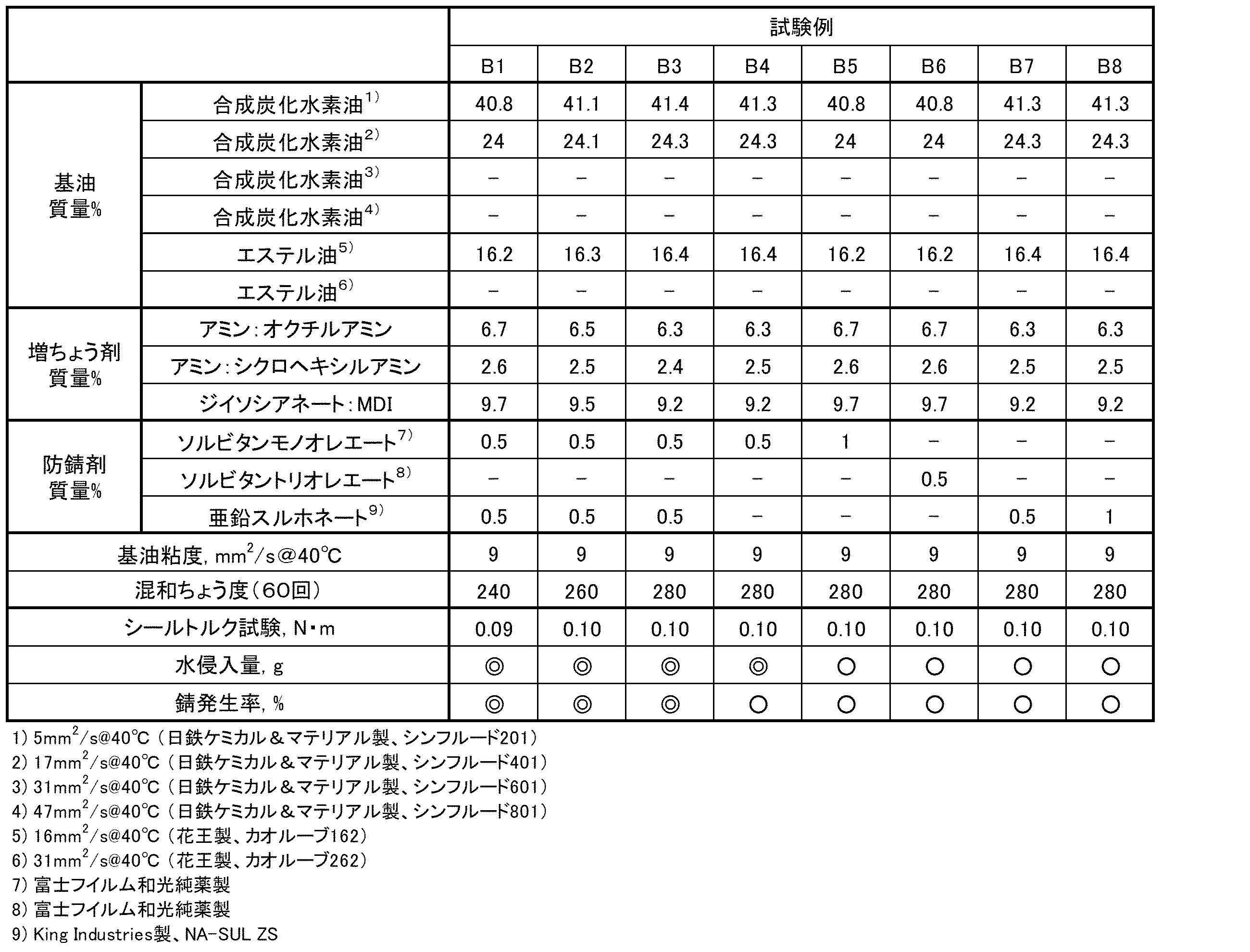
- Test example B Greases having compositions shown in Tables 4 to 6 were prepared. In Tables 4 to 6, mass % of the base oil, thickener, and antirust agent indicates the content in the base grease (base oil + thickener). 1) to 9) below in Table 4 also apply to Tables 5 and 6.
- the worked penetration JIS K 2220 was measured for the obtained grease.
- ⁇ Seal torque test> A total of 0.6 g of the obtained grease was applied to one side of the tips of three seal lips of a nitrile rubber seal member ( ⁇ 60 to 70 mm). The seal member was attached to a member simulating a hub outer ring, and a slinger made of SUS430 was attached to a member simulating a hub inner ring, and assembled so that the seal lip and the slinger were in contact. Thirty minutes after the start of the test, the torque (N ⁇ m) due to the sliding contact of the seal lip was measured for 1 minute at a rotation speed of 600 min ⁇ 1 , room temperature, and inner ring rotation. In this test, 0.20 or more was regarded as unacceptable.
- test bearing After the test bearing was assembled into the housing of the wash water resistance tester, the test bearing was submerged in hot water at 79°C. Then, while the test bearing was submerged in water and rotated at a rotational speed of 600 min ⁇ 1 , warm water of 79° C. was sprayed onto the test bearing from the injection nozzle at a flow rate of 6 ml/s for 120 minutes. After the test, the amount of water intrusion into the test bearing was obtained from the following formula.
- Amount of water intrusion (g) (Bearing weight after operation - Bearing weight before operation) The evaluation of the amount of water intrusion is shown in Tables 4 to 6, with ⁇ for less than 0.5 g, ⁇ for 0.5 g or more and less than 1.0 g, and X for 1.0 g or more.
- Test Example B17 water resistance
- Test Example B18 in which the worked penetration was out of the range of 220 to 280, showed an increased amount of water intrusion.
- Test Example B18 (worked penetration 300) was high in consistency and soft, so it is considered that the grease flowed out from the vicinity of the lip, resulting in a decrease in sealing performance.
- Test Example B17 (worked penetration of 200) was hard and poor in fluidity, so it is believed that gaps tended to occur and the sealing performance deteriorated.
- Test Example B From the results in Tables 4 to 6, it was found that an appropriate consistency and base oil viscosity were combined with an appropriate rust preventive (especially a combination of an ester rust preventive and a sulfonate rust preventive). Therefore, it is possible to secure channeling properties, achieve low torque, and obtain high water resistance and rust resistance. In addition, since it is easy to set the consistency to an appropriate numerical range while using a low-viscosity base oil, in this test, a predetermined base oil (synthetic hydrocarbon oil only, mixed oil of synthetic hydrocarbon oil and ester oil) and , and a predetermined thickener (aliphatic/alicyclic diurea compound).
- a predetermined base oil synthetic hydrocarbon oil only, mixed oil of synthetic hydrocarbon oil and ester oil
- a predetermined thickener aliphatic/alicyclic diurea compound
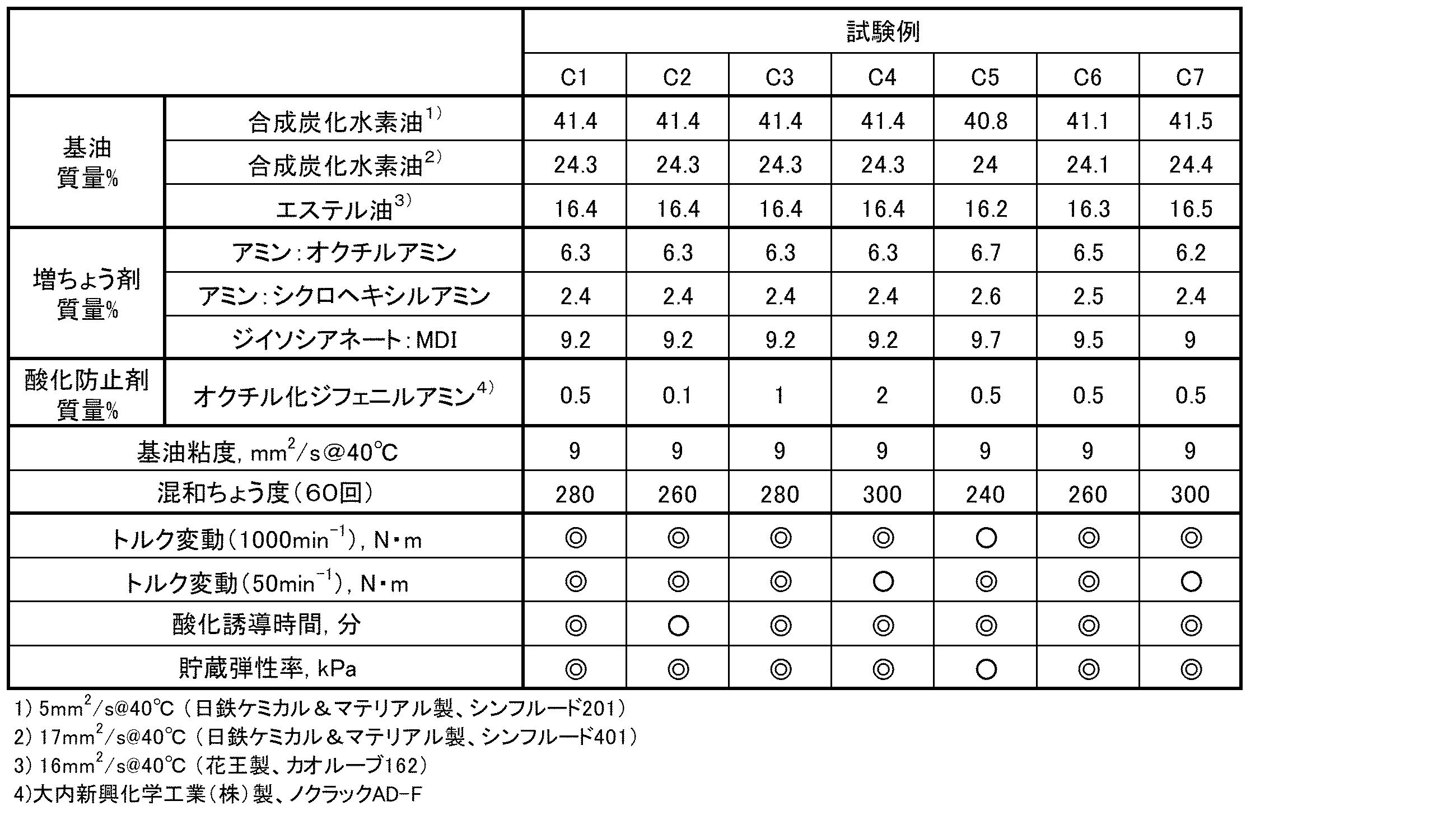
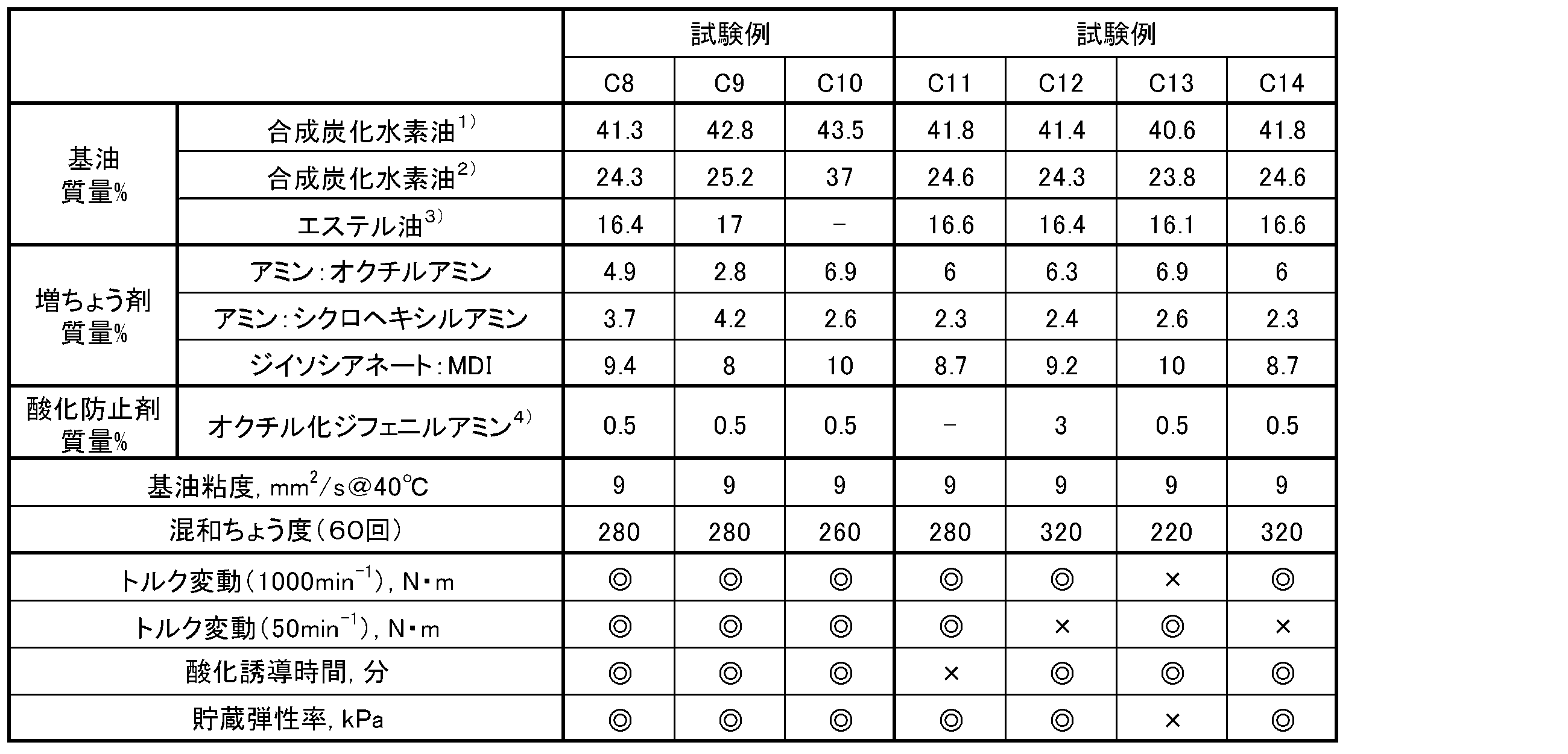
- Test Example C Greases having compositions shown in Tables 7 and 8 were prepared. In Tables 7 and 8, mass % of the base oil, thickener, and antioxidant indicates the content relative to the base grease (base oil + thickener). 1) to 4) below in Table 7 are the same as in Table 8.
- the worked penetration JIS K 2220 was measured for the obtained grease.
- 0.6 g of the obtained grease was applied to one side of the tips of three seal lips of a nitrile rubber seal member ( ⁇ 60 to 70 mm).
- the seal member was attached to a member simulating a hub outer ring, and a slinger made of SUS430 was attached to a member simulating a hub inner ring, and assembled so that the seal lip and the slinger were in contact.
- ⁇ Torque fluctuation test 1> A member simulating a hub inner ring was rotated for 30 minutes at a rotational speed of 1000 min ⁇ 1 at room temperature. The seal member was brought into sliding contact with a SUS430 slinger (mating member). The torque (N ⁇ m) due to the sliding contact between the seal lip and the slinger was measured, and the difference between the maximum torque value and the minimum torque value in the last 5 minutes was obtained. If the difference (torque fluctuation) is less than 0.01 N ⁇ m, it is indicated by ⁇ , 0.01 N ⁇ m or more and less than 0.02 N ⁇ m is marked by ⁇ , and 0.02 N ⁇ m or more is marked by ⁇ in Tables 7 and 8. be written together.
- ⁇ Torque fluctuation test 2> A member simulating a hub inner ring was rotated for 15 minutes at a rotational speed of 50 min ⁇ 1 at room temperature. The seal member was brought into sliding contact with a SUS430 slinger (mating member). The torque (N ⁇ m) due to the sliding contact between the seal lip and the slinger was measured, and the difference between the maximum torque value and the minimum torque value in the last 5 minutes was obtained. If the difference (torque fluctuation) is less than 0.01 N ⁇ m, it is indicated by ⁇ , 0.01 N ⁇ m or more and less than 0.02 N ⁇ m is marked by ⁇ , and 0.02 N ⁇ m or more is marked by ⁇ in Tables 7 and 8. be written together.
- Oxidation induction time was measured by high pressure differential scanning calorimetry (PDSC).
- PDSC is a measurement method in which differential scanning calorimetry is performed under pressure, and in this PDSC, the oxidation induction period is measured as the time from when the sample reaches a predetermined temperature to when oxidation begins.
- Using 3 mg of sample grease, pressurized to 3.5 MPa in an oxygen atmosphere set the test temperature to 220°C, and measured the time from the time the sample temperature reached 220°C to the oxidation exothermic peak (oxidation induction time).
- Oxidation induction times of 30 minutes or more are marked with ⁇
- 10 minutes or more and less than 30 minutes are marked with ⁇
- less than 10 minutes are marked with X in Tables 7 and 8.
- ⁇ Low temperature resistance test> The low temperature resistance of each grease was evaluated by storage modulus.
- a parallel plate rheometer was used for the test.
- the grease was placed on a ⁇ 25 mm lower plate and sandwiched between ⁇ 25 mm upper plates, with a gap of 1 mm between the plates.
- the storage elastic modulus of the grease was measured at a temperature of ⁇ 40° C., a frequency of 1 Hz, and a strain of 0.001.
- the storage modulus of less than 200 kPa is indicated by ⁇ , the storage modulus of 200 kPa to less than 250 kPa by ⁇ , and the storage modulus of 250 kPa or more by ⁇ .
- Test Example C from the results in Tables 7 and 8, by combining an appropriate consistency and an appropriate antioxidant, low torque and high torque stability and high temperature resistance / low temperature resistance can be achieved. Obtainable. In addition, since it is easy to set the consistency to an appropriate numerical range while using a low-viscosity base oil, in this test, a predetermined base oil (synthetic hydrocarbon oil only, mixed oil of synthetic hydrocarbon oil and ester oil) and , and a predetermined thickener (aliphatic/alicyclic diurea compound).
- a predetermined base oil synthetic hydrocarbon oil only, mixed oil of synthetic hydrocarbon oil and ester oil
- a predetermined thickener aliphatic/alicyclic diurea compound
- the sealed rolling bearing of the present invention can achieve both low torque and high sealing performance, and can also achieve both high water resistance and rust resistance, torque stability, high temperature resistance, and low temperature resistance. Therefore, it can be widely used as a sealed rolling bearing.
Landscapes
- Engineering & Computer Science (AREA)
- General Engineering & Computer Science (AREA)
- Mechanical Engineering (AREA)
- Chemical & Material Sciences (AREA)
- Chemical Kinetics & Catalysis (AREA)
- General Chemical & Material Sciences (AREA)
- Oil, Petroleum & Natural Gas (AREA)
- Organic Chemistry (AREA)
- Lubricants (AREA)
Abstract
Description
まず、表1~表3に示す組成のグリースをそれぞれ作製した。表1~表3中、基油と増ちょう剤の質量%は、ベースグリース(基油+増ちょう剤)に対する含有率を示している。また、表1下記の1)~8)は、表2および表3においても同じである。
まず、イソシアネート(4,4’-ジフェニルメタンジイソシアネート、MDI)および基油の半量を60℃で混合した油相Aと、アミンおよび基油の半量を所定の温度(室温から60℃)で混合した油相Bとを準備した。続いて、油相Aを撹拌しながら、油相Bを添加して混合し、100℃で30分加熱した(ウレア反応)。なお、反応の完了はIR(赤外分光装置)などにより確認した。その後、130℃で1時間加熱し(反応安定化)、室温まで徐冷した。その後、均一化処理を行い、グリースを3本ロールミルによって滑らかにした。図6(b)は得られたグリースの顕微鏡写真である。
まず、12-ヒドロキシステアリン酸を半量の基油に入れて90℃に加熱し、そこへ水酸化リチウムを水で約10倍薄めたものを添加した。その後、非イオン型界面活性剤を添加して激しく撹拌した。その後、アゼライン酸を加えて撹拌し、そこへ水酸化リチウムを水で約10倍薄めたものを分割して加え、約30分撹拌した。なお、反応の完了はIR(赤外分光装置)などにより確認した。その後、酸化防止剤を加えて、180℃まで加熱した後、残りの基油を加えて、室温になるまで放冷した。その後、均一化処理を行い、グリースを3本ロールミルによって滑らかにした。
回転速度600min-1または回転速度50min-1、室温雰囲気、内輪回転として、試験開始15分後において、シールリップの摺接によるトルク(N・m)を測定した。この試験において、回転速度600min-1の場合、0.20以上を不合格とした。
回転速度50min-1、室温雰囲気でハブ内輪を模擬した部材を15分回転させた。シール部材をSUS430製スリンガ(相手材)に摺接させた。シールリップとスリンガの摺接によるトルク(N・m)を測定し、最後の5分間におけるトルク最大値と最小値の差を求めた。これらの差(トルク変動)が、0.01N・m未満を◎印、0.01N・m以上0.02N・m未満を○印、0.02N・m以上を×印として表1~表3に併記する。
上記で得られたグリースを、深溝玉軸受6204の内輪の外周に形成されたシール溝に0.4g塗布して、そのシール溝にシールリップが接触するようにニトリルゴム製のシール部材を装着した。
試験軸受を固定し、回転数5000min-1、80℃、外輪にアキシアル荷重640N、ラジアル荷重67Nを負荷してロードセルで拘束し、内輪回転として、24時間運転でのグリースの漏洩率を測定した。漏洩率は以下の式より算出した。なお、運転前には、軸受空間に公知のグリース組成物(表1~表3で作製したグリースとは組成が異なる)を0.05g封入した。
漏洩率(質量%)=((運転前の軸受重量-運転後の軸受重量)/(運転前の軸受重量))×100
漏洩率の評価について、8質量%未満を◎印、8質量%以上13質量%未満を○印、13質量%以上を×印として表1~表3に併記する。

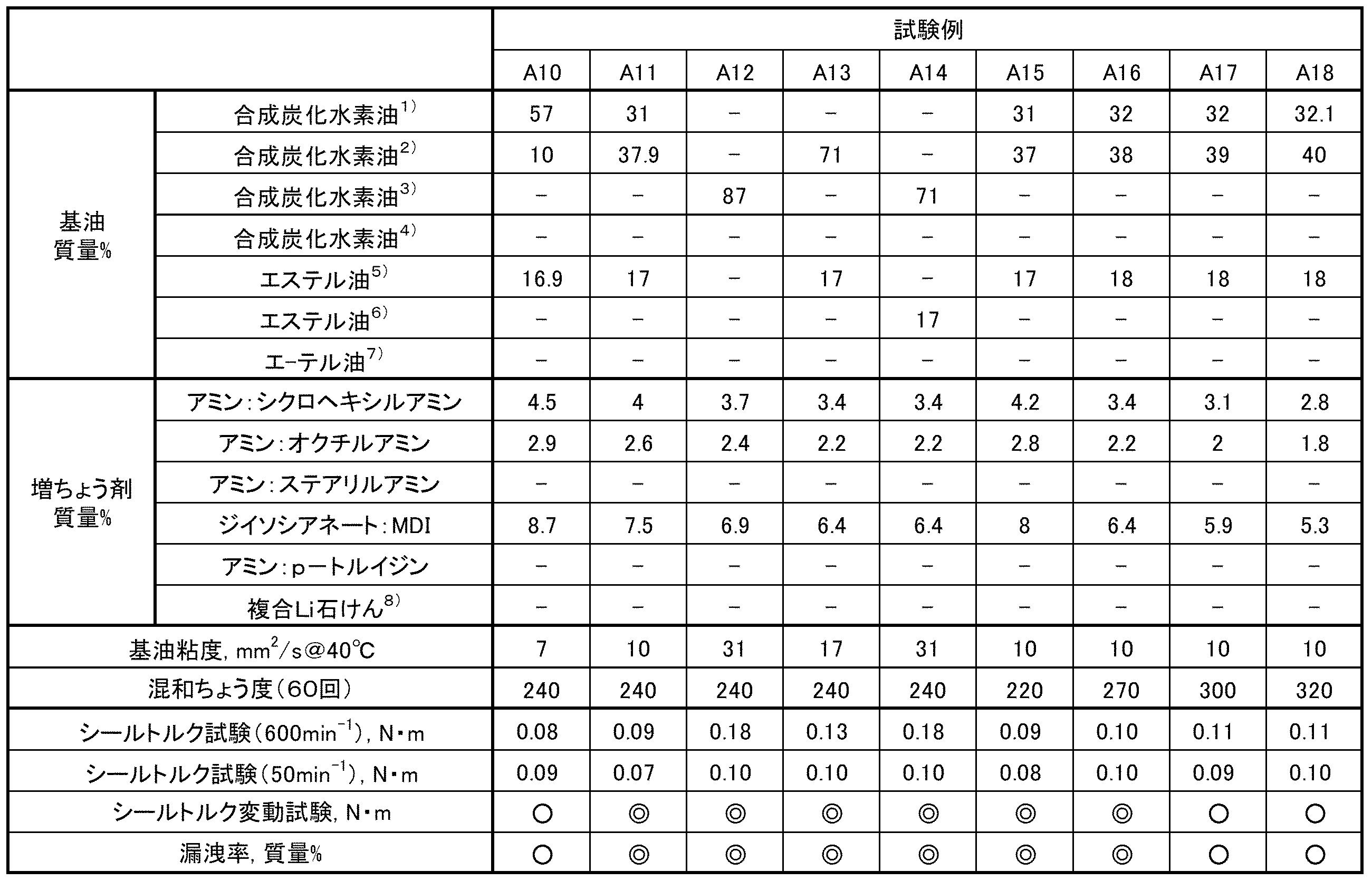
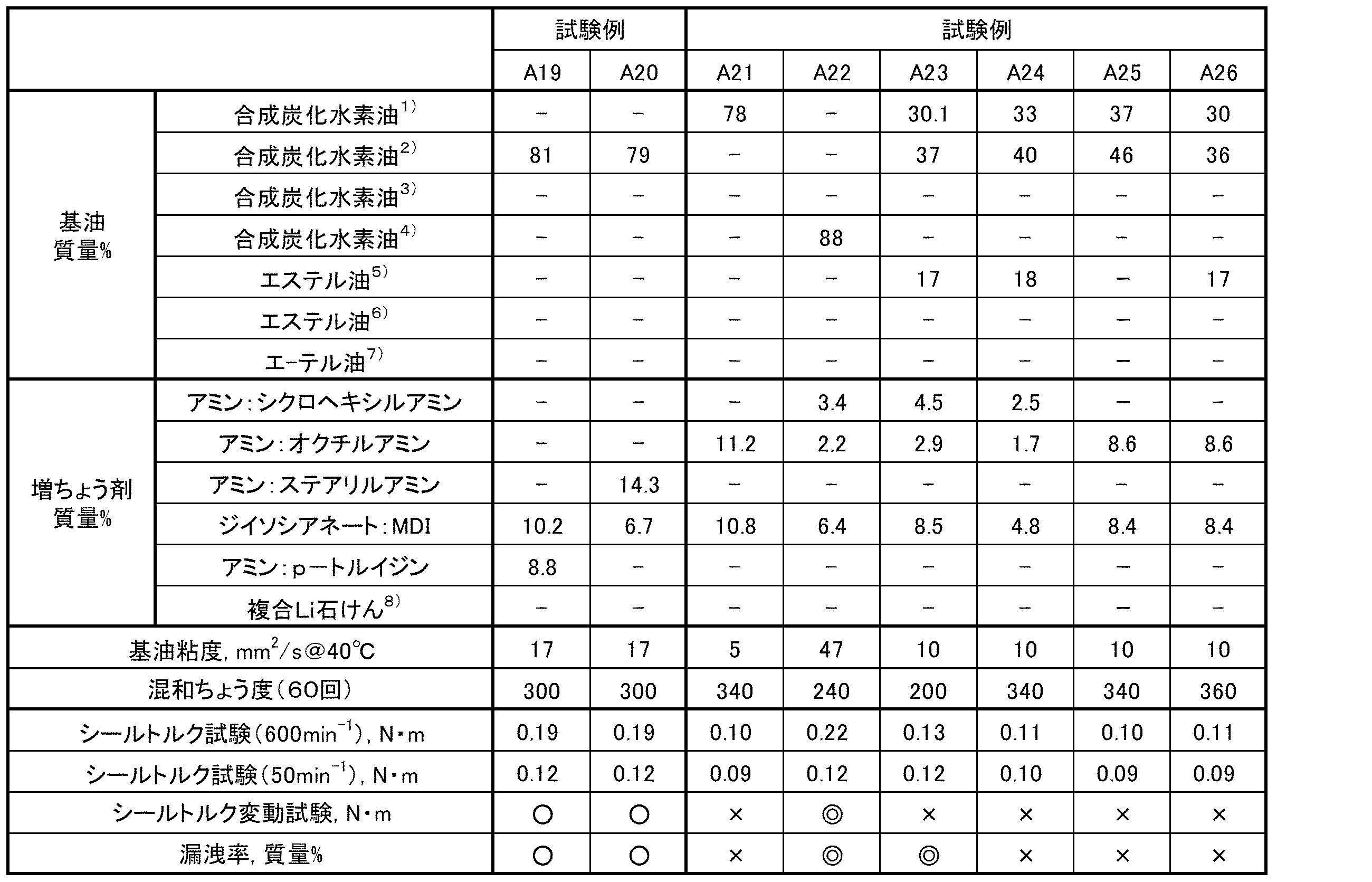
表4~表6に示す組成のグリースをそれぞれ作製した。表4~表6中、基油と増ちょう剤と防錆剤の質量%は、ベースグリース(基油+増ちょう剤)に対する含有率を示している。また、表4下記の1)~9)は、表5および表6においても同じである。
得られたグリースをニトリルゴム製のシール部材(φ60~70mm)の3つのシールリップの先端部の片側面に合計で0.6g塗布した。ハブ外輪を模擬した部材に上記シール部材を装着し、ハブ内輪を模擬した部材にSUS430製のスリンガを装着して、シールリップとスリンガが接触するように組付けた。
回転速度600min-1、室温雰囲気、内輪回転として、試験開始30分後、シールリップの摺接によるトルク(N・m)を1分間測定した。この試験において、0.20以上を不合格とした。
上記グリースを6204ステンレス軸受の内輪の外周および外輪の内周に形成されたシール溝に合計で0.4g塗布して、その内輪のシール溝にシールリップが接触するようにニトリルゴム製のシール部材を装着した。軸受空間に公知のグリース組成物(表4~表6で作製したグリースとは組成が異なる)を0.05g封入した。この試験軸受を用いて、JIS K 2220に規定される水洗耐水度試験を改変した以下の試験を行った。
水侵入量(g)=(運転後の軸受重量-運転前の軸受重量)
水侵入量の評価について、0.5g未満を◎印、0.5g以上1.0g未満を○印、1.0g以上を×印として表4~表6に併記する。
上記グリースを塗布した円錐ころ軸受を1質量%の塩水に10秒間浸漬させ、高湿環境下で静置させた。試験後に軸受を取り出し、外輪転走面を目視で観察した。評価は外輪転走面を32区画に分割し、そのうち何区画に錆が発生しているかで、錆発生率を算出した。
軸受 : 4T-30204
グリース封入量: 2.1g
試験温度 : 40℃
試験湿度 : 100%RH
試験時間 : 48h
錆発生率の評価について、25%未満を◎印、25%以上75%未満を○印、75%以上を×印として表4~表6に併記する。
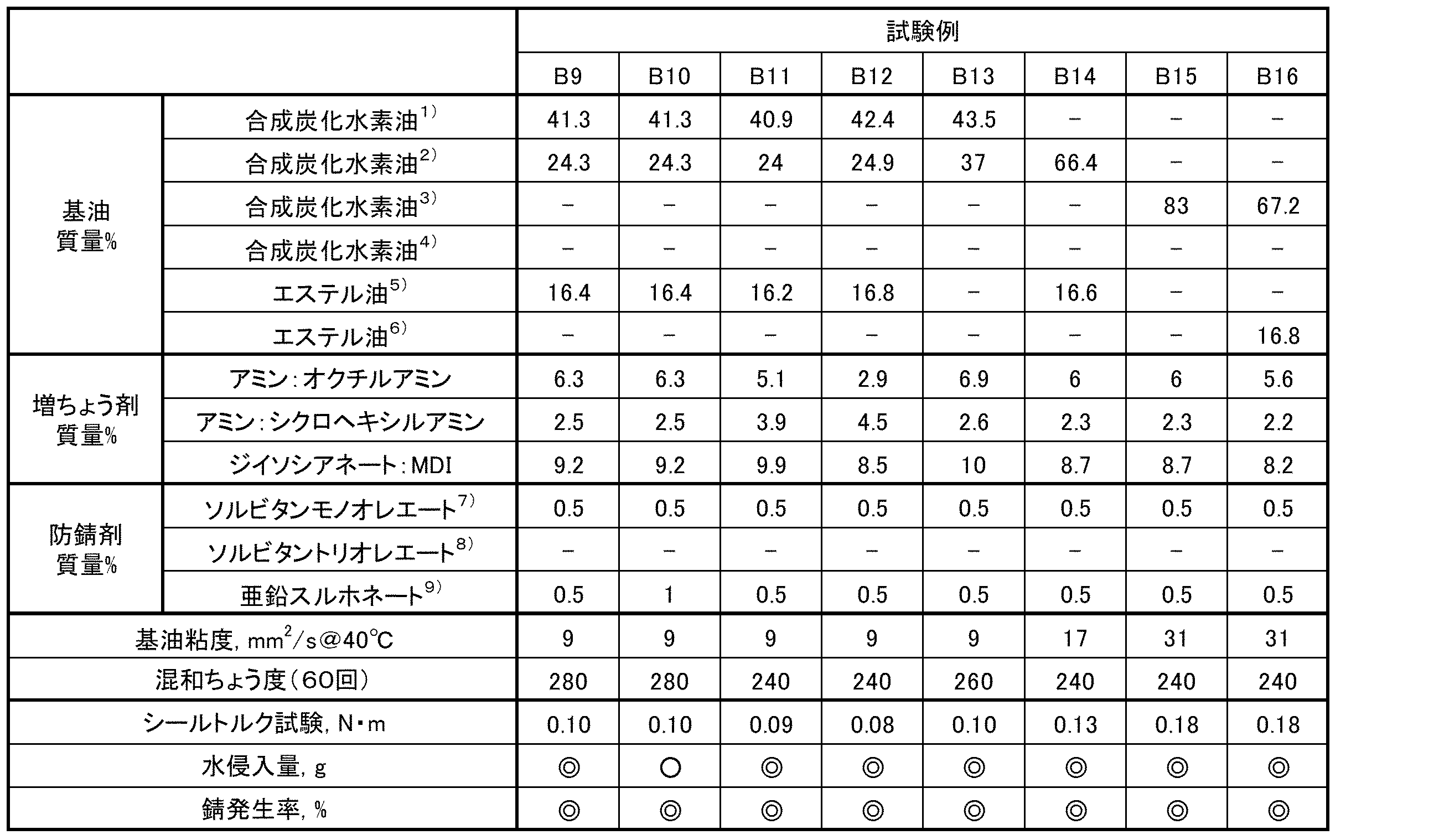
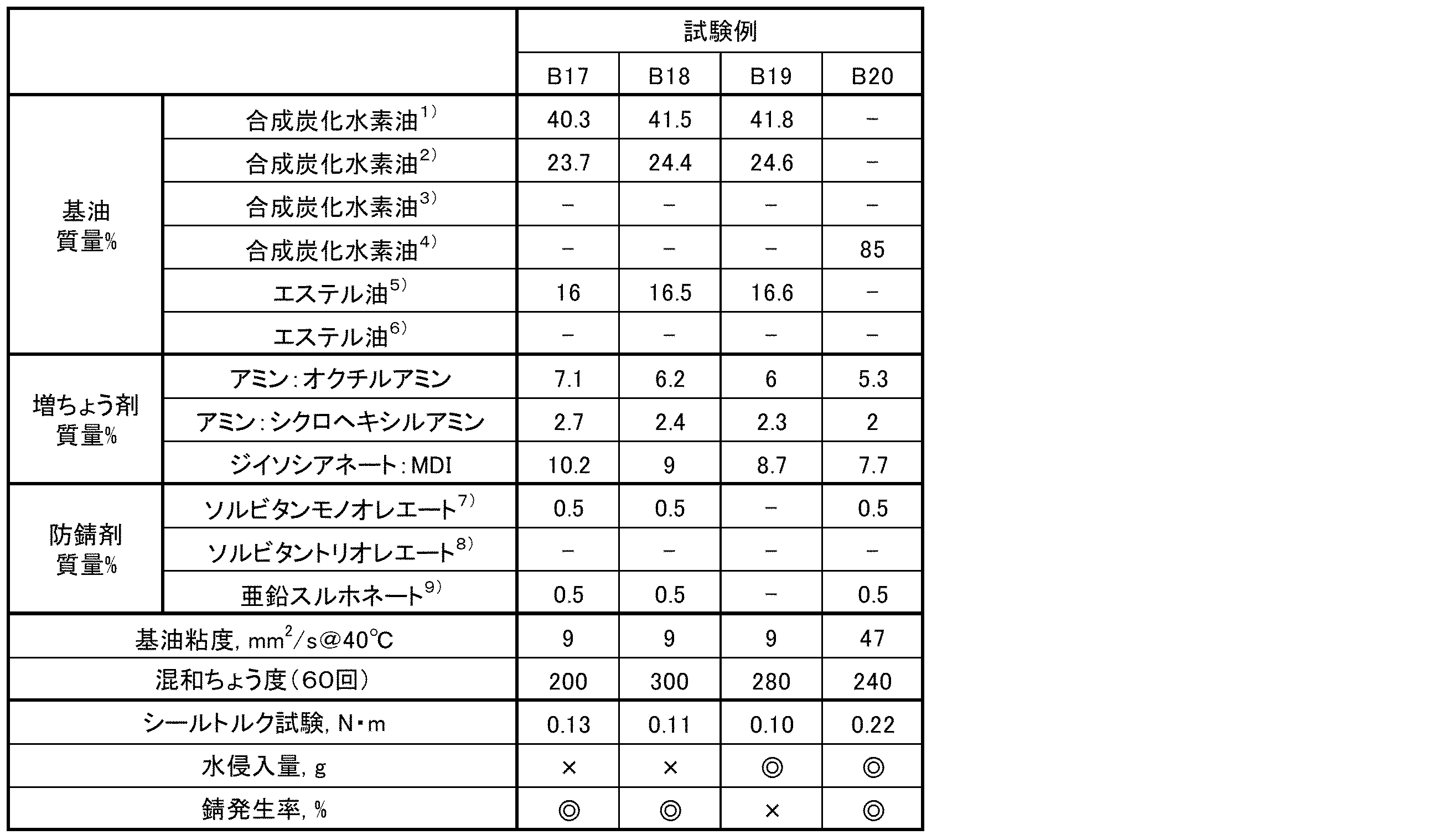
また、防錆剤の配合量が増加すると、水侵入量が増加する傾向が見られた(試験例B4~B5、試験例B9~B10)。防錆剤は、防錆性の観点では有効であるが、水の侵入に対するグリースのシール性の観点では、不利に働く可能性が示唆された。防錆剤の配合量が多くなることで、グリースが水と馴染みやすくなり、リップ付近に存在するグリースの形状が保持しにくくなったと推察される。
表7~表8に示す組成のグリースをそれぞれ作製した。表7~表8中、基油と増ちょう剤と酸化防止剤の質量%は、ベースグリース(基油+増ちょう剤)に対する含有率を示している。また、表7下記の1)~4)は、表8においても同じである。
回転速度1000min-1、室温雰囲気でハブ内輪を模擬した部材を30分回転させた。シール部材をSUS430製スリンガ(相手材)に摺接させた。シールリップとスリンガの摺接によるトルク(N・m)を測定し、最後の5分間におけるトルク最大値と最小値の差を求めた。これらの差(トルク変動)が、0.01N・m未満を◎印、0.01N・m以上0.02N・m未満を○印、0.02N・m以上を×印として表7~表8に併記する。
回転速度50min-1、室温雰囲気でハブ内輪を模擬した部材を15分回転させた。シール部材をSUS430製スリンガ(相手材)に摺接させた。シールリップとスリンガの摺接によるトルク(N・m)を測定し、最後の5分間におけるトルク最大値と最小値の差を求めた。これらの差(トルク変動)が、0.01N・m未満を◎印、0.01N・m以上0.02N・m未満を○印、0.02N・m以上を×印として表7~表8に併記する。
各グリースの耐高温性を酸化誘導時間により評価した。酸化誘導時間は高圧示差走査熱量測定(PDSC)によって測定した。PDSCは、加圧下で示差走査熱量測定を行なう測定法であり、このPDSCにおいて、酸化誘導期間は、試料が所定温度に達してから酸化が始まるまでの時間として測定される。試料グリース3mgを用い、酸素雰囲気下、3.5MPaに加圧して、試験温度220℃に設定し、試料温度が220℃に達した時点から酸化発熱ピークまでの時間(酸化誘導時間)を測定した。酸化誘導時間が、30分以上を◎印、10分以上30分未満を○印、10分未満を×印として表7~表8に併記する。
各グリースの耐低温性を貯蔵弾性率により評価した。試験には、パラレルプレート型のレオメータを用いた。グリースをφ25mmの下部プレートに載せ、φ25mmの上部プレートで上下から挟み、プレート間のギャップを1mmとした。温度-40℃、周波数1Hz、ひずみ量0.001を与えた時のグリースの貯蔵弾性率を測定した。貯蔵弾性率が、200kPa未満を◎印、200kPa以上250kPa未満を○印、250kPa以上を×印として表7~表8に併記する。
2 外方部材
3 内方部材
4 ハブ輪
5 内輪
6 セレーション
7 転動体
8 保持器
9 軸受空間
11 軸受密封装置
12 芯金
13 シール部材
14 シールリング
15 スリンガ
16 軸受密封装置
17 芯金
18 シール部材
19 摺接面
21 転がり軸受(密封型転がり軸受)
22 内輪
23 外輪
24 転動体
25 保持器
26 グリース組成物
27 軸受密封装置
28 芯金
29 シール部材
G グリース
Claims (13)
- 軸受空間を密封し、固定側部材に固定され、回転側部材に摺接するシール部材を備える密封型転がり軸受であって、
前記シール部材は前記回転側部材に摺接するシールリップを有し、前記密封型転がり軸受において、前記シールリップの摺接面、および該シールリップが摺接する前記回転側部材の摺接面の少なくとも一方の面にグリースが塗布されており、
前記グリースは、40℃における動粘度が6mm2/s~45mm2/sの基油と増ちょう剤を含み、JIS K 2220に準拠して測定される混和ちょう度が220~320であることを特徴とする密封型転がり軸受。 - 前記増ちょう剤は、ポリイソシアネート成分と、脂肪族モノアミンおよび脂環族モノアミンから選ばれた少なくとも1つのモノアミン成分とを反応して得られるウレア化合物であるか、または、複合リチウム石けんであることを特徴とする請求項1記載の密封型転がり軸受。
- 前記基油は、合成炭化水素油、エステル油、およびエーテル油から選ばれる少なくとも1種であることを特徴とする請求項1記載の密封型転がり軸受。
- 前記基油が、合成炭化水素油のみからなるか、または、前記合成炭化水素油とエステル油との混合油であることを特徴とする請求項1記載の密封型転がり軸受。
- 前記基油は、40℃における動粘度が6mm2/s~20mm2/sであり、前記混和ちょう度が220~270であることを特徴とする請求項1記載の密封型転がり軸受。
- 前記グリースは防錆剤を含み、前記混和ちょう度が220~280であることを特徴とする請求項1記載の密封型転がり軸受。
- 前記防錆剤が、エステル系防錆剤およびスルホネート系防錆剤から選ばれた少なくとも一種であることを特徴とする請求項6記載の密封型転がり軸受。
- 前記グリースは、前記防錆剤としてエステル系防錆剤およびスルホネート系防錆剤を含み、前記基油および前記増ちょう剤の合計量に対して前記防錆剤を0.5質量%以上1.5質量%未満含むことを特徴とする請求項6記載の密封型転がり軸受。
- 前記グリースは酸化防止剤を含み、かつ、前記基油および前記増ちょう剤の合計量に対して前記酸化防止剤を0.1質量%以上3質量%未満含み、前記混和ちょう度が240~300であることを特徴とする請求項1記載の密封型転がり軸受。
- 前記酸化防止剤がアミン系酸化防止剤であることを特徴とする請求項9記載の密封型転がり軸受。
- 前記シール部材は、ニトリルゴムで形成され、前記シールリップとして、前記軸受空間の内方側から順に、第1のシールリップと、第2のシールリップと、第3のシールリップとを有し、これらシールリップの前記摺接面に前記グリースが塗布されていることを特徴とする請求項1記載の密封型転がり軸受。
- 前記密封型転がり軸受が車軸を回転可能に支持する軸受であることを特徴とする請求項1記載の密封型転がり軸受。
- 軸受空間を密封し、固定側部材に固定され、回転側部材に摺接するシール部材を備える密封型転がり軸受であって、
前記シール部材は前記回転側部材に摺接するシールリップを有し、前記密封型転がり軸受において、前記シールリップの摺接面、および該シールリップが摺接する前記回転側部材の摺接面の少なくとも一方の面にグリースが塗布されており、
前記グリースは、基油と、増ちょう剤と、酸化防止剤とを含み、かつ、前記基油および前記増ちょう剤の合計量に対して前記酸化防止剤を0.1質量%以上3質量%未満含み、JIS K 2220に準拠して測定される混和ちょう度が240~300であることを特徴とする密封型転がり軸受。
Priority Applications (3)
| Application Number | Priority Date | Filing Date | Title |
|---|---|---|---|
| CN202280022492.7A CN117043482A (zh) | 2021-03-30 | 2022-03-28 | 密封型滚动轴承 |
| US18/283,200 US20250290548A1 (en) | 2021-03-30 | 2022-03-28 | Sealed rolling bearing |
| EP22780742.7A EP4317374A4 (en) | 2021-03-30 | 2022-03-28 | SEALED ROLLING BEARING |
Applications Claiming Priority (6)
| Application Number | Priority Date | Filing Date | Title |
|---|---|---|---|
| JP2021058898A JP2022155413A (ja) | 2021-03-30 | 2021-03-30 | 密封型転がり軸受 |
| JP2021-058899 | 2021-03-30 | ||
| JP2021-058898 | 2021-03-30 | ||
| JP2021058899A JP2022155414A (ja) | 2021-03-30 | 2021-03-30 | 密封型転がり軸受 |
| JP2021058900A JP2022155415A (ja) | 2021-03-30 | 2021-03-30 | 密封型転がり軸受 |
| JP2021-058900 | 2021-03-30 |
Publications (1)
| Publication Number | Publication Date |
|---|---|
| WO2022210531A1 true WO2022210531A1 (ja) | 2022-10-06 |
Family
ID=83456297
Family Applications (1)
| Application Number | Title | Priority Date | Filing Date |
|---|---|---|---|
| PCT/JP2022/014996 Ceased WO2022210531A1 (ja) | 2021-03-30 | 2022-03-28 | 密封型転がり軸受 |
Country Status (3)
| Country | Link |
|---|---|
| US (1) | US20250290548A1 (ja) |
| EP (1) | EP4317374A4 (ja) |
| WO (1) | WO2022210531A1 (ja) |
Cited By (1)
| Publication number | Priority date | Publication date | Assignee | Title |
|---|---|---|---|---|
| WO2026083671A1 (ja) * | 2024-10-17 | 2026-04-23 | Astemo株式会社 | 油圧シリンダ装置 |
Citations (9)
| Publication number | Priority date | Publication date | Assignee | Title |
|---|---|---|---|---|
| WO2008105377A1 (ja) * | 2007-02-26 | 2008-09-04 | Ntn Corporation | 高速軸受用グリースおよび高速用転がり軸受 |
| JP2010059369A (ja) * | 2008-09-05 | 2010-03-18 | Ntn Corp | グリース組成物、該グリース組成物を封入した転がり軸受および自在継手 |
| JP4475055B2 (ja) | 2004-08-05 | 2010-06-09 | 日本精工株式会社 | シールリング及び車輪支持用転がり軸受ユニット |
| JP4997532B2 (ja) | 2004-12-16 | 2012-08-08 | 内山工業株式会社 | 回転部材のシール構造 |
| JP5110843B2 (ja) | 2006-10-05 | 2012-12-26 | 日本精工株式会社 | ゴムシール付き軸受用グリース組成物及び車両用ゴムシール付きハブユニット軸受 |
| JP2015021566A (ja) * | 2013-07-19 | 2015-02-02 | Ntn株式会社 | 転がり軸受 |
| JP2019014824A (ja) * | 2017-07-07 | 2019-01-31 | Ntn株式会社 | グリース組成物およびグリース封入転がり軸受 |
| JP2019039470A (ja) * | 2017-08-23 | 2019-03-14 | Ntn株式会社 | 転がり軸受 |
| JP2020105462A (ja) * | 2018-12-28 | 2020-07-09 | Ntn株式会社 | グリース組成物、および転がり軸受 |
Family Cites Families (4)
| Publication number | Priority date | Publication date | Assignee | Title |
|---|---|---|---|---|
| JP5220275B2 (ja) * | 2005-12-05 | 2013-06-26 | 協同油脂株式会社 | グリース組成物及び軸受 |
| US9046132B2 (en) * | 2010-09-13 | 2015-06-02 | Ntn Corporation | Grease composition and rolling bearing |
| JP5918556B2 (ja) * | 2012-02-07 | 2016-05-18 | Ntn株式会社 | 車輪用軸受装置 |
| US9765821B2 (en) * | 2013-07-19 | 2017-09-19 | Ntn Corporation | Rolling bearing |
-
2022
- 2022-03-28 US US18/283,200 patent/US20250290548A1/en active Pending
- 2022-03-28 WO PCT/JP2022/014996 patent/WO2022210531A1/ja not_active Ceased
- 2022-03-28 EP EP22780742.7A patent/EP4317374A4/en active Pending
Patent Citations (9)
| Publication number | Priority date | Publication date | Assignee | Title |
|---|---|---|---|---|
| JP4475055B2 (ja) | 2004-08-05 | 2010-06-09 | 日本精工株式会社 | シールリング及び車輪支持用転がり軸受ユニット |
| JP4997532B2 (ja) | 2004-12-16 | 2012-08-08 | 内山工業株式会社 | 回転部材のシール構造 |
| JP5110843B2 (ja) | 2006-10-05 | 2012-12-26 | 日本精工株式会社 | ゴムシール付き軸受用グリース組成物及び車両用ゴムシール付きハブユニット軸受 |
| WO2008105377A1 (ja) * | 2007-02-26 | 2008-09-04 | Ntn Corporation | 高速軸受用グリースおよび高速用転がり軸受 |
| JP2010059369A (ja) * | 2008-09-05 | 2010-03-18 | Ntn Corp | グリース組成物、該グリース組成物を封入した転がり軸受および自在継手 |
| JP2015021566A (ja) * | 2013-07-19 | 2015-02-02 | Ntn株式会社 | 転がり軸受 |
| JP2019014824A (ja) * | 2017-07-07 | 2019-01-31 | Ntn株式会社 | グリース組成物およびグリース封入転がり軸受 |
| JP2019039470A (ja) * | 2017-08-23 | 2019-03-14 | Ntn株式会社 | 転がり軸受 |
| JP2020105462A (ja) * | 2018-12-28 | 2020-07-09 | Ntn株式会社 | グリース組成物、および転がり軸受 |
Cited By (1)
| Publication number | Priority date | Publication date | Assignee | Title |
|---|---|---|---|---|
| WO2026083671A1 (ja) * | 2024-10-17 | 2026-04-23 | Astemo株式会社 | 油圧シリンダ装置 |
Also Published As
| Publication number | Publication date |
|---|---|
| EP4317374A4 (en) | 2025-04-02 |
| EP4317374A1 (en) | 2024-02-07 |
| US20250290548A1 (en) | 2025-09-18 |
Similar Documents
| Publication | Publication Date | Title |
|---|---|---|
| JP6268642B2 (ja) | グリース組成物及びグリース封入車輪用軸受 | |
| JP5681414B2 (ja) | ハブユニット軸受用グリース組成物 | |
| JPWO2004061058A1 (ja) | 自動車電装補機用グリース組成物及び前記グリース組成物を封入した転がり軸受 | |
| JP5756587B2 (ja) | アンギュラ玉軸受用グリース組成物及びそれを用いたアンギュラ玉軸受 | |
| JP2026063405A (ja) | 密封型転がり軸受 | |
| JP2026063404A (ja) | 密封型転がり軸受 | |
| WO2022210531A1 (ja) | 密封型転がり軸受 | |
| JP4434685B2 (ja) | グリース組成物および該グリース封入軸受 | |
| JP7607418B2 (ja) | 転がり軸受 | |
| JP2002323053A (ja) | 転がり軸受 | |
| JP7825400B2 (ja) | 密封型転がり軸受 | |
| JP2010059369A (ja) | グリース組成物、該グリース組成物を封入した転がり軸受および自在継手 | |
| JP2005298629A (ja) | 自動車電装補機用グリース組成物及び前記グリース組成物を封入した転がり軸受 | |
| JP2007217609A (ja) | グリース組成物及び軸受 | |
| JP2004339448A (ja) | グリース組成物、転がり軸受、及び電動モータ | |
| WO2024181375A1 (ja) | 転がり軸受 | |
| EP4053252B1 (en) | Low-dust grease composition for high-speed rotation, and bearing enclosing same | |
| JP2022155415A (ja) | 密封型転がり軸受 | |
| JP2025030954A (ja) | 密封装置 | |
| WO2025041862A1 (ja) | 密封装置 | |
| JP2025030953A (ja) | 密封装置 | |
| JP2008069882A (ja) | グリース封入密封型転がり軸受 | |
| JP4653969B2 (ja) | モータ用グリース封入軸受 | |
| JP2015229704A (ja) | グリース組成物及び転がり軸受 | |
| JP2026056908A (ja) | グリース組成物およびグリース封入軸受 |
Legal Events
| Date | Code | Title | Description |
|---|---|---|---|
| 121 | Ep: the epo has been informed by wipo that ep was designated in this application |
Ref document number: 22780742 Country of ref document: EP Kind code of ref document: A1 |
|
| WWE | Wipo information: entry into national phase |
Ref document number: 202280022492.7 Country of ref document: CN |
|
| WWE | Wipo information: entry into national phase |
Ref document number: 2022780742 Country of ref document: EP |
|
| NENP | Non-entry into the national phase |
Ref country code: DE |
|
| ENP | Entry into the national phase |
Ref document number: 2022780742 Country of ref document: EP Effective date: 20231030 |
|
| WWP | Wipo information: published in national office |
Ref document number: 18283200 Country of ref document: US |