WO2022210708A1 - 組換え微生物及びc6化合物の製造方法 - Google Patents
組換え微生物及びc6化合物の製造方法 Download PDFInfo
- Publication number
- WO2022210708A1 WO2022210708A1 PCT/JP2022/015439 JP2022015439W WO2022210708A1 WO 2022210708 A1 WO2022210708 A1 WO 2022210708A1 JP 2022015439 W JP2022015439 W JP 2022015439W WO 2022210708 A1 WO2022210708 A1 WO 2022210708A1
- Authority
- WO
- WIPO (PCT)
- Prior art keywords
- seq
- nucleotide
- dna
- sequence shown
- coa
- Prior art date
- Legal status (The legal status is an assumption and is not a legal conclusion. Google has not performed a legal analysis and makes no representation as to the accuracy of the status listed.)
- Ceased
Links
Images
















Classifications
-
- C—CHEMISTRY; METALLURGY
- C12—BIOCHEMISTRY; BEER; SPIRITS; WINE; VINEGAR; MICROBIOLOGY; ENZYMOLOGY; MUTATION OR GENETIC ENGINEERING
- C12N—MICROORGANISMS OR ENZYMES; COMPOSITIONS THEREOF; PROPAGATING, PRESERVING, OR MAINTAINING MICROORGANISMS; MUTATION OR GENETIC ENGINEERING; CULTURE MEDIA
- C12N15/00—Mutation or genetic engineering; DNA or RNA concerning genetic engineering, vectors, e.g. plasmids, or their isolation, preparation or purification; Use of hosts therefor
- C12N15/09—Recombinant DNA-technology
- C12N15/63—Introduction of foreign genetic material using vectors; Vectors; Use of hosts therefor; Regulation of expression
- C12N15/70—Vectors or expression systems specially adapted for E. coli
-
- C—CHEMISTRY; METALLURGY
- C12—BIOCHEMISTRY; BEER; SPIRITS; WINE; VINEGAR; MICROBIOLOGY; ENZYMOLOGY; MUTATION OR GENETIC ENGINEERING
- C12N—MICROORGANISMS OR ENZYMES; COMPOSITIONS THEREOF; PROPAGATING, PRESERVING, OR MAINTAINING MICROORGANISMS; MUTATION OR GENETIC ENGINEERING; CULTURE MEDIA
- C12N15/00—Mutation or genetic engineering; DNA or RNA concerning genetic engineering, vectors, e.g. plasmids, or their isolation, preparation or purification; Use of hosts therefor
- C12N15/09—Recombinant DNA-technology
- C12N15/11—DNA or RNA fragments; Modified forms thereof; Non-coding nucleic acids having a biological activity
- C12N15/52—Genes encoding for enzymes or proenzymes
-
- C—CHEMISTRY; METALLURGY
- C12—BIOCHEMISTRY; BEER; SPIRITS; WINE; VINEGAR; MICROBIOLOGY; ENZYMOLOGY; MUTATION OR GENETIC ENGINEERING
- C12N—MICROORGANISMS OR ENZYMES; COMPOSITIONS THEREOF; PROPAGATING, PRESERVING, OR MAINTAINING MICROORGANISMS; MUTATION OR GENETIC ENGINEERING; CULTURE MEDIA
- C12N9/00—Enzymes; Proenzymes; Compositions thereof; Processes for preparing, activating, inhibiting, separating or purifying enzymes
- C12N9/0004—Oxidoreductases (1.)
- C12N9/0006—Oxidoreductases (1.) acting on CH-OH groups as donors (1.1)
-
- C—CHEMISTRY; METALLURGY
- C12—BIOCHEMISTRY; BEER; SPIRITS; WINE; VINEGAR; MICROBIOLOGY; ENZYMOLOGY; MUTATION OR GENETIC ENGINEERING
- C12N—MICROORGANISMS OR ENZYMES; COMPOSITIONS THEREOF; PROPAGATING, PRESERVING, OR MAINTAINING MICROORGANISMS; MUTATION OR GENETIC ENGINEERING; CULTURE MEDIA
- C12N9/00—Enzymes; Proenzymes; Compositions thereof; Processes for preparing, activating, inhibiting, separating or purifying enzymes
- C12N9/0004—Oxidoreductases (1.)
- C12N9/0008—Oxidoreductases (1.) acting on the aldehyde or oxo group of donors (1.2)
-
- C—CHEMISTRY; METALLURGY
- C12—BIOCHEMISTRY; BEER; SPIRITS; WINE; VINEGAR; MICROBIOLOGY; ENZYMOLOGY; MUTATION OR GENETIC ENGINEERING
- C12N—MICROORGANISMS OR ENZYMES; COMPOSITIONS THEREOF; PROPAGATING, PRESERVING, OR MAINTAINING MICROORGANISMS; MUTATION OR GENETIC ENGINEERING; CULTURE MEDIA
- C12N9/00—Enzymes; Proenzymes; Compositions thereof; Processes for preparing, activating, inhibiting, separating or purifying enzymes
- C12N9/0004—Oxidoreductases (1.)
- C12N9/001—Oxidoreductases (1.) acting on the CH-CH group of donors (1.3)
-
- C—CHEMISTRY; METALLURGY
- C12—BIOCHEMISTRY; BEER; SPIRITS; WINE; VINEGAR; MICROBIOLOGY; ENZYMOLOGY; MUTATION OR GENETIC ENGINEERING
- C12N—MICROORGANISMS OR ENZYMES; COMPOSITIONS THEREOF; PROPAGATING, PRESERVING, OR MAINTAINING MICROORGANISMS; MUTATION OR GENETIC ENGINEERING; CULTURE MEDIA
- C12N9/00—Enzymes; Proenzymes; Compositions thereof; Processes for preparing, activating, inhibiting, separating or purifying enzymes
- C12N9/10—Transferases (2.)
- C12N9/1025—Acyltransferases (2.3)
- C12N9/1029—Acyltransferases (2.3) transferring groups other than amino-acyl groups (2.3.1)
-
- C—CHEMISTRY; METALLURGY
- C12—BIOCHEMISTRY; BEER; SPIRITS; WINE; VINEGAR; MICROBIOLOGY; ENZYMOLOGY; MUTATION OR GENETIC ENGINEERING
- C12N—MICROORGANISMS OR ENZYMES; COMPOSITIONS THEREOF; PROPAGATING, PRESERVING, OR MAINTAINING MICROORGANISMS; MUTATION OR GENETIC ENGINEERING; CULTURE MEDIA
- C12N9/00—Enzymes; Proenzymes; Compositions thereof; Processes for preparing, activating, inhibiting, separating or purifying enzymes
- C12N9/10—Transferases (2.)
- C12N9/1096—Transferases (2.) transferring nitrogenous groups (2.6)
-
- C—CHEMISTRY; METALLURGY
- C12—BIOCHEMISTRY; BEER; SPIRITS; WINE; VINEGAR; MICROBIOLOGY; ENZYMOLOGY; MUTATION OR GENETIC ENGINEERING
- C12N—MICROORGANISMS OR ENZYMES; COMPOSITIONS THEREOF; PROPAGATING, PRESERVING, OR MAINTAINING MICROORGANISMS; MUTATION OR GENETIC ENGINEERING; CULTURE MEDIA
- C12N9/00—Enzymes; Proenzymes; Compositions thereof; Processes for preparing, activating, inhibiting, separating or purifying enzymes
- C12N9/88—Lyases (4.)
-
- C—CHEMISTRY; METALLURGY
- C12—BIOCHEMISTRY; BEER; SPIRITS; WINE; VINEGAR; MICROBIOLOGY; ENZYMOLOGY; MUTATION OR GENETIC ENGINEERING
- C12P—FERMENTATION OR ENZYME-USING PROCESSES TO SYNTHESISE A DESIRED CHEMICAL COMPOUND OR COMPOSITION OR TO SEPARATE OPTICAL ISOMERS FROM A RACEMIC MIXTURE
- C12P13/00—Preparation of nitrogen-containing organic compounds
-
- C—CHEMISTRY; METALLURGY
- C12—BIOCHEMISTRY; BEER; SPIRITS; WINE; VINEGAR; MICROBIOLOGY; ENZYMOLOGY; MUTATION OR GENETIC ENGINEERING
- C12P—FERMENTATION OR ENZYME-USING PROCESSES TO SYNTHESISE A DESIRED CHEMICAL COMPOUND OR COMPOSITION OR TO SEPARATE OPTICAL ISOMERS FROM A RACEMIC MIXTURE
- C12P13/00—Preparation of nitrogen-containing organic compounds
- C12P13/001—Amines; Imines
-
- C—CHEMISTRY; METALLURGY
- C12—BIOCHEMISTRY; BEER; SPIRITS; WINE; VINEGAR; MICROBIOLOGY; ENZYMOLOGY; MUTATION OR GENETIC ENGINEERING
- C12P—FERMENTATION OR ENZYME-USING PROCESSES TO SYNTHESISE A DESIRED CHEMICAL COMPOUND OR COMPOSITION OR TO SEPARATE OPTICAL ISOMERS FROM A RACEMIC MIXTURE
- C12P13/00—Preparation of nitrogen-containing organic compounds
- C12P13/005—Amino acids other than alpha- or beta amino acids, e.g. gamma amino acids
-
- C—CHEMISTRY; METALLURGY
- C12—BIOCHEMISTRY; BEER; SPIRITS; WINE; VINEGAR; MICROBIOLOGY; ENZYMOLOGY; MUTATION OR GENETIC ENGINEERING
- C12P—FERMENTATION OR ENZYME-USING PROCESSES TO SYNTHESISE A DESIRED CHEMICAL COMPOUND OR COMPOSITION OR TO SEPARATE OPTICAL ISOMERS FROM A RACEMIC MIXTURE
- C12P17/00—Preparation of heterocyclic carbon compounds with only O, N, S, Se or Te as ring hetero atoms
- C12P17/10—Nitrogen as only ring hetero atom
-
- C—CHEMISTRY; METALLURGY
- C12—BIOCHEMISTRY; BEER; SPIRITS; WINE; VINEGAR; MICROBIOLOGY; ENZYMOLOGY; MUTATION OR GENETIC ENGINEERING
- C12P—FERMENTATION OR ENZYME-USING PROCESSES TO SYNTHESISE A DESIRED CHEMICAL COMPOUND OR COMPOSITION OR TO SEPARATE OPTICAL ISOMERS FROM A RACEMIC MIXTURE
- C12P7/00—Preparation of oxygen-containing organic compounds
- C12P7/02—Preparation of oxygen-containing organic compounds containing a hydroxy group
-
- C—CHEMISTRY; METALLURGY
- C12—BIOCHEMISTRY; BEER; SPIRITS; WINE; VINEGAR; MICROBIOLOGY; ENZYMOLOGY; MUTATION OR GENETIC ENGINEERING
- C12P—FERMENTATION OR ENZYME-USING PROCESSES TO SYNTHESISE A DESIRED CHEMICAL COMPOUND OR COMPOSITION OR TO SEPARATE OPTICAL ISOMERS FROM A RACEMIC MIXTURE
- C12P7/00—Preparation of oxygen-containing organic compounds
- C12P7/02—Preparation of oxygen-containing organic compounds containing a hydroxy group
- C12P7/04—Preparation of oxygen-containing organic compounds containing a hydroxy group acyclic
- C12P7/18—Preparation of oxygen-containing organic compounds containing a hydroxy group acyclic polyhydric
-
- C—CHEMISTRY; METALLURGY
- C12—BIOCHEMISTRY; BEER; SPIRITS; WINE; VINEGAR; MICROBIOLOGY; ENZYMOLOGY; MUTATION OR GENETIC ENGINEERING
- C12P—FERMENTATION OR ENZYME-USING PROCESSES TO SYNTHESISE A DESIRED CHEMICAL COMPOUND OR COMPOSITION OR TO SEPARATE OPTICAL ISOMERS FROM A RACEMIC MIXTURE
- C12P7/00—Preparation of oxygen-containing organic compounds
- C12P7/40—Preparation of oxygen-containing organic compounds containing a carboxyl group including Peroxycarboxylic acids
- C12P7/42—Hydroxy-carboxylic acids
-
- C—CHEMISTRY; METALLURGY
- C12—BIOCHEMISTRY; BEER; SPIRITS; WINE; VINEGAR; MICROBIOLOGY; ENZYMOLOGY; MUTATION OR GENETIC ENGINEERING
- C12P—FERMENTATION OR ENZYME-USING PROCESSES TO SYNTHESISE A DESIRED CHEMICAL COMPOUND OR COMPOSITION OR TO SEPARATE OPTICAL ISOMERS FROM A RACEMIC MIXTURE
- C12P7/00—Preparation of oxygen-containing organic compounds
- C12P7/40—Preparation of oxygen-containing organic compounds containing a carboxyl group including Peroxycarboxylic acids
- C12P7/44—Polycarboxylic acids
-
- C—CHEMISTRY; METALLURGY
- C12—BIOCHEMISTRY; BEER; SPIRITS; WINE; VINEGAR; MICROBIOLOGY; ENZYMOLOGY; MUTATION OR GENETIC ENGINEERING
- C12Y—ENZYMES
- C12Y101/00—Oxidoreductases acting on the CH-OH group of donors (1.1)
- C12Y101/01—Oxidoreductases acting on the CH-OH group of donors (1.1) with NAD+ or NADP+ as acceptor (1.1.1)
- C12Y101/01035—3-Hydroxyacyl-CoA dehydrogenase (1.1.1.35)
-
- C—CHEMISTRY; METALLURGY
- C12—BIOCHEMISTRY; BEER; SPIRITS; WINE; VINEGAR; MICROBIOLOGY; ENZYMOLOGY; MUTATION OR GENETIC ENGINEERING
- C12Y—ENZYMES
- C12Y103/00—Oxidoreductases acting on the CH-CH group of donors (1.3)
- C12Y103/01—Oxidoreductases acting on the CH-CH group of donors (1.3) with NAD+ or NADP+ as acceptor (1.3.1)
-
- C—CHEMISTRY; METALLURGY
- C12—BIOCHEMISTRY; BEER; SPIRITS; WINE; VINEGAR; MICROBIOLOGY; ENZYMOLOGY; MUTATION OR GENETIC ENGINEERING
- C12Y—ENZYMES
- C12Y203/00—Acyltransferases (2.3)
- C12Y203/01—Acyltransferases (2.3) transferring groups other than amino-acyl groups (2.3.1)
- C12Y203/01174—3-Oxoadipyl-CoA thiolase (2.3.1.174)
-
- C—CHEMISTRY; METALLURGY
- C12—BIOCHEMISTRY; BEER; SPIRITS; WINE; VINEGAR; MICROBIOLOGY; ENZYMOLOGY; MUTATION OR GENETIC ENGINEERING
- C12Y—ENZYMES
- C12Y402/00—Carbon-oxygen lyases (4.2)
- C12Y402/01—Hydro-lyases (4.2.1)
-
- C—CHEMISTRY; METALLURGY
- C12—BIOCHEMISTRY; BEER; SPIRITS; WINE; VINEGAR; MICROBIOLOGY; ENZYMOLOGY; MUTATION OR GENETIC ENGINEERING
- C12R—INDEXING SCHEME ASSOCIATED WITH SUBCLASSES C12C - C12Q, RELATING TO MICROORGANISMS
- C12R2001/00—Microorganisms ; Processes using microorganisms
- C12R2001/01—Bacteria or Actinomycetales ; using bacteria or Actinomycetales
-
- C—CHEMISTRY; METALLURGY
- C12—BIOCHEMISTRY; BEER; SPIRITS; WINE; VINEGAR; MICROBIOLOGY; ENZYMOLOGY; MUTATION OR GENETIC ENGINEERING
- C12R—INDEXING SCHEME ASSOCIATED WITH SUBCLASSES C12C - C12Q, RELATING TO MICROORGANISMS
- C12R2001/00—Microorganisms ; Processes using microorganisms
- C12R2001/01—Bacteria or Actinomycetales ; using bacteria or Actinomycetales
- C12R2001/185—Escherichia
- C12R2001/19—Escherichia coli
-
- C—CHEMISTRY; METALLURGY
- C12—BIOCHEMISTRY; BEER; SPIRITS; WINE; VINEGAR; MICROBIOLOGY; ENZYMOLOGY; MUTATION OR GENETIC ENGINEERING
- C12R—INDEXING SCHEME ASSOCIATED WITH SUBCLASSES C12C - C12Q, RELATING TO MICROORGANISMS
- C12R2001/00—Microorganisms ; Processes using microorganisms
- C12R2001/645—Fungi ; Processes using fungi
-
- C—CHEMISTRY; METALLURGY
- C12—BIOCHEMISTRY; BEER; SPIRITS; WINE; VINEGAR; MICROBIOLOGY; ENZYMOLOGY; MUTATION OR GENETIC ENGINEERING
- C12R—INDEXING SCHEME ASSOCIATED WITH SUBCLASSES C12C - C12Q, RELATING TO MICROORGANISMS
- C12R2001/00—Microorganisms ; Processes using microorganisms
- C12R2001/645—Fungi ; Processes using fungi
- C12R2001/72—Candida
-
- C—CHEMISTRY; METALLURGY
- C12—BIOCHEMISTRY; BEER; SPIRITS; WINE; VINEGAR; MICROBIOLOGY; ENZYMOLOGY; MUTATION OR GENETIC ENGINEERING
- C12R—INDEXING SCHEME ASSOCIATED WITH SUBCLASSES C12C - C12Q, RELATING TO MICROORGANISMS
- C12R2001/00—Microorganisms ; Processes using microorganisms
- C12R2001/645—Fungi ; Processes using fungi
- C12R2001/84—Pichia
-
- Y—GENERAL TAGGING OF NEW TECHNOLOGICAL DEVELOPMENTS; GENERAL TAGGING OF CROSS-SECTIONAL TECHNOLOGIES SPANNING OVER SEVERAL SECTIONS OF THE IPC; TECHNICAL SUBJECTS COVERED BY FORMER USPC CROSS-REFERENCE ART COLLECTIONS [XRACs] AND DIGESTS
- Y02—TECHNOLOGIES OR APPLICATIONS FOR MITIGATION OR ADAPTATION AGAINST CLIMATE CHANGE
- Y02E—REDUCTION OF GREENHOUSE GAS [GHG] EMISSIONS, RELATED TO ENERGY GENERATION, TRANSMISSION OR DISTRIBUTION
- Y02E50/00—Technologies for the production of fuel of non-fossil origin
- Y02E50/10—Biofuels, e.g. bio-diesel
Definitions
- the present invention relates to recombinant microorganisms and methods for producing C6 compounds.
- the present invention also relates to recombinant microorganisms and methods for producing adipic acid or derivatives thereof.
- C6 compounds such as adipic acid, hexamethylenediamine, 1,6-hexanediol, 6-aminohexanoic acid, 6-amino-1-hexanol and 6-hydroxyhexanoic acid are used as raw materials for polyamides and polyurethanes, etc. It is positioned as an important compound in industry.
- adipic acid (CAS No. 124-04-9) is a monomer compound used as a raw material for polyamides such as nylon-66, urethane, and a raw material for plasticizers.
- a common current method for producing adipic acid is chemical synthesis, such as oxidation of cyclohexanol alone or a mixture of cyclohexanol and cyclohexanone (K/A oil) with nitric acid.
- microorganisms for adipic acid, 6-aminocaproic acid, or caprolactam biosynthesis have been reported (Patent Document 1).
- Examples include "succinyl-CoA: acetyl-CoA acyltransferase” which converts succinyl-CoA and acetyl-CoA to 3-oxoadipyl-CoA; "3- hydroxyacyl-CoA dehydrogenase”; converts 3-hydroxyadipyl-CoA to 5-carboxy-2-pentenoyl-CoA; “3-hydroxyadipyl-CoA dehydratase”; converts 5-carboxy-2-pentenoyl-CoA to adipyl- Disclosed is a method of culturing a microorganism containing "5-carboxy-2-pentenoyl-CoA reductase" that converts to CoA; and "phosphotransadipylase” and "adipate kinase
- Non-Patent Document 1 a culture of genetically modified E. coli in which the E. coli-derived enzymes PaaJ, PaaH, and PaaF and Acinetobacter baylyi-derived enzymes DcaA and TesB were co-expressed. 36 mg/L of adipic acid was produced using glucose as a carbon source. It has been reported that it can be done (Non-Patent Document 1).
- adipic acid as a production method using biomass-derived raw materials, after converting a biomass-derived carbon source into cis, cis-muconic acid using genetically modified microorganisms, the obtained cis, cis-muconic acid is A method of hydrogenating to produce adipic acid has also been proposed (Patent Document 4). A method for producing adipic acid from ⁇ -ketoglutarate using a genetic recombinant has also been proposed (Patent Document 5).
- An object of the present invention is to provide a recombinant microorganism having 2,3-dehydroadipyl-CoA reductase activity and an efficient method for producing C6 compounds.
- a further object of the present invention is to provide a recombinant microorganism capable of producing adipic acid or an adipic acid derivative, and a method for producing adipic acid or an adipic acid derivative.
- the present inventors have conducted intensive studies to solve the above-described problems of the prior art, and found that by expressing a specific exogenous enzyme in a host microorganism, 2,3-dehydroadipyl-CoA reductase activity The present inventors have found that it is possible to obtain a recombinant microorganism exhibiting a favorable reaction rate, and that the C6 compound can be efficiently produced by culturing the present recombinant microorganism, thereby completing the present invention.
- a recombinant microorganism comprising an exogenous gene encoding a protein having an enzymatic activity that reduces 2,3-dehydroadipyl-CoA and converts it to adipyl-CoA
- the exogenous gene is (i) a DNA encoding a protein consisting of an amino acid sequence having 80% or more sequence identity with the amino acid sequence shown in SEQ ID NO: 8, 9, 10, 11, 12, 13, 14, 15 or 16; (ii) an amino acid sequence in which 1 to 10 amino acids are deleted, substituted, inserted and/or added to the amino acid sequence shown in SEQ ID NO: 8, 9, 10, 11, 12, 13, 14, 15 or 16
- the recombinant microorganism according to any one of [1] to [3]; [5]
- the recombinant microorganism is Escherichia genus, Bacillus genus, Corynebacterium genus, Arthrobacter genus, Brevibacterium genus, Clostridium genus , Zymomonas genus, Pseudomonas genus, Burkholderia genus, Streptomyces genus, Rhodococcus genus, Synechocystis genus, Alkalihalobacillus genus, Alkalihalobacillus genus any of [1] to [4] belonging to the genus Saccharomyces, the genus Schizosaccharomyces, the genus Yarrowia, the genus Candida, the genus Pichia, or the genus Aspergillus Recombinant microorganism according to paragraph 1;
- a method for producing a C6 compound comprising a culturing step of culturing the recombinant microorganism according to any one of [1] to [7],
- the C6 compound is at least one selected from the group consisting of adipic acid, hexamethylenediamine, 1,6-hexanediol, 6-aminohexanoic acid, 6-amino-1-hexanol and 6-hydroxyhexanoic acid.
- the present inventors have found a microorganism newly isolated from nature, the genus Burkholderia (Burkholderia sp.) LEBP-3 strain (accession number: NITE BP-03334) has found that adipic acids can be efficiently produced by culturing genetically modified microorganisms that express a given enzyme, leading to the present invention.
- the present invention further provides: [12] A recombinant microorganism comprising at least one of an exogenous gene encoding 3-hydroxyadipyl-CoA dehydratase and an exogenous gene encoding 2,3-dehydroadipyl-CoA reductase; [13] At least one of 3-hydroxyadipyl-CoA dehydratase and 2,3-dehydroadipyl-CoA reductase is derived from Burkholderia sp.
- LEBP-3 strain (accession number: NITE BP-03334) the recombinant microorganism of [12]; [14] The 3-hydroxyadipyl-CoA dehydratase uses the chromosomal DNA of Burkholderia sp.
- LEBP-3 strain as a template, (1a) a nucleotide consisting of the nucleotide sequence shown in SEQ ID NO: 168 and a nucleotide consisting of the nucleotide sequence shown in SEQ ID NO: 169, or (1b) a nucleotide comprising the nucleotide sequence shown in SEQ ID NO: 168 and a nucleotide comprising the nucleotide sequence shown in SEQ ID NO: 169 is 80% or more, 85% or more, 88% or more, 90% or more, 93% or more, 95% or more, 97% or more, 98% or more, or 99% or more encoded in DNA
- the 2,3-dehydroadipyl-CoA reductase uses the chromosomal DNA of Burkholderia sp.
- LEBP-3 strain as a template, (2a) a nucleotide consisting of the nucleotide sequence shown in SEQ ID NO: 170 and a nucleotide consisting of the nucleotide sequence shown in SEQ ID NO: 171, or (2b) a nucleotide comprising the nucleotide sequence shown in SEQ ID NO: 170 and a nucleotide comprising the nucleotide sequence shown in SEQ ID NO: 171 is 80% or more, 85% or more, 88% or more, 90% or more, 93% or more, 95% or more, 97% or more, 98% or more, or 99% or more encoded in DNA
- the recombinant microorganism according to any one of [12] to [14], wherein the DNA has 924 to 1386 bp; [16]
- the 3-hydroxyadipyl-CoA dehydratase uses the chromosomal DNA of Burkholderia sp.
- LEBP-3 strain as a template, (1a) a nucleotide consisting of the nucleotide sequence shown in SEQ ID NO: 168 and a nucleotide consisting of the nucleotide sequence shown in SEQ ID NO: 169, or (1b) a nucleotide comprising the nucleotide sequence shown in SEQ ID NO: 168 and a nucleotide comprising the nucleotide sequence shown in SEQ ID NO: 169 encoded in a DNA that is a PCR amplification product using as a primer
- the 2,3-dehydroadipyl-CoA reductase uses the chromosomal DNA of Burkholderia sp.
- LEBP-3 strain as a template, (2a) a nucleotide consisting of the nucleotide sequence shown in SEQ ID NO: 170 and a nucleotide consisting of the nucleotide sequence shown in SEQ ID NO: 171, or (2b) a nucleotide comprising the nucleotide sequence shown in SEQ ID NO: 170 and a nucleotide comprising the nucleotide sequence shown in SEQ ID NO: 171 encoded in a DNA that is a PCR amplification product using as a primer
- the recombinant microorganism according to any one of [12] to [14], wherein the DNA has 1155 or 1156 bp; [18]
- the recombinant microorganism is of the genus Esselicia, Corynebacterium, Bacillus, Acinetobacter, Burkholderia, Pseudomonas, Clostridium, Saccharomyces, Schizosaccharomy
- a method for producing a target compound comprising a culturing step of culturing the recombinant microorganism according to any one of [12] to [17], which belongs to a genus selected from the group consisting of the genus Aspergillus; [19] The recombinant microorganism according to any one of [12] to [18], which has an adipic acid production pathway; [20] The recombinant microorganism according to any one of [12] to [19], which has a hexamethylenediamine production pathway; [21] The recombinant microorganism according to any one of [12] to [19], which has a 1,6-hexanediol production pathway; [22] The recombinant microorganism according to any one of [12] to [19], which has a 6-amino-1-hexanol production pathway; [23] A method for producing a target compound, comprising a culturing step of
- LEBP-3 strain as a template, (a1) a nucleotide consisting of the nucleotide sequence shown in SEQ ID NO: 168 and a nucleotide consisting of the nucleotide sequence shown in SEQ ID NO: 169, or (a2) a nucleotide comprising the nucleotide sequence shown in SEQ ID NO: 168 and a nucleotide comprising the nucleotide sequence shown in SEQ ID NO: 169 is 80% or more, 85% or more, 88% or more, 90% or more, 93% or more, 95% or more, 97% or more, 98% or more, or 99% or more
- a DNA-encoded recombinant polypeptide comprising: having 3-hydroxyadipyl CoA dehydratase activity, a recombinant polypeptide, wherein the DNA has 626-940 bp; (A-2) Using the chromosomal DNA of Burkholderia sp.
- LEBP-3 strain as a template, (a1) a nucleotide consisting of the nucleotide sequence shown in SEQ ID NO: 168 and a nucleotide consisting of the nucleotide sequence shown in SEQ ID NO: 169, or (a2) a nucleotide comprising the nucleotide sequence shown in SEQ ID NO: 168 and a nucleotide comprising the nucleotide sequence shown in SEQ ID NO: 169
- LEBP-3 strain as a template, (a1) a nucleotide consisting of the nucleotide sequence shown in SEQ ID NO: 168 and a nucleotide consisting of the nucleotide sequence shown in SEQ ID NO: 169, or (a2) a nucleotide comprising the nucleotide sequence shown in SEQ ID NO: 168 and a nucleotide comprising the nucleotide sequence shown in SEQ ID NO: 169
- LEBP-3 strain as a template, (b1) a nucleotide consisting of the nucleotide sequence shown in SEQ ID NO: 170 and a nucleotide consisting of the nucleotide sequence shown in SEQ ID NO: 171, or (b2) a nucleotide comprising the nucleotide sequence shown in SEQ ID NO: 170 and a nucleotide comprising the nucleotide sequence shown in SEQ ID NO: 171 is 80% or more, 85% or more, 88% or more, 90% or more, 93% or more, 95% or more, 97% or more, 98% or more, or 99% or more
- LEBP-3 strain as a template, (b1) a nucleotide consisting of the nucleotide sequence shown in SEQ ID NO: 170 and a nucleotide consisting of the nucleotide sequence shown in SEQ ID NO: 171, or (b2) a nucleotide comprising the nucleotide sequence shown in SEQ ID NO: 170 and a nucleotide comprising the nucleotide sequence shown in SEQ ID NO: 171
- LEBP-3 strain as a template, (b1) a nucleotide consisting of the nucleotide sequence shown in SEQ ID NO: 170 and a nucleotide consisting of the nucleotide sequence shown in SEQ ID NO: 171, or (b2) a nucleotide comprising the nucleotide sequence shown in SEQ ID NO: 170 and a nucleotide comprising the nucleotide sequence shown in SEQ ID NO: 171
- the present invention provides a recombinant microorganism having 2,3-dehydroadipyl-CoA reductase activity and a method for producing a C6 compound.
- the present invention also provides recombinant microorganisms capable of producing adipic acid or adipic acid derivatives, and methods for producing adipic acid or adipic acid derivatives.
- FIG. 1 shows examples of biosynthetic pathways from acetyl-CoA and succinyl-CoA to C6 compounds.
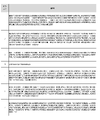
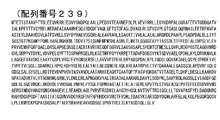
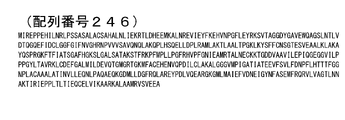
- FIG. 2 shows the amino acid sequences of each enzyme and the base sequences of primers.
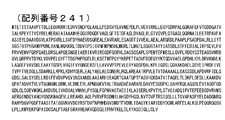
- FIG. 3 shows the amino acid sequences of each enzyme.
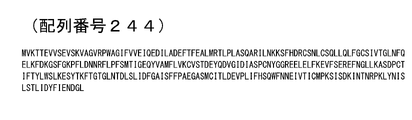
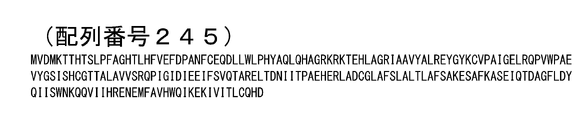
- FIG. 4 shows the amino acid sequences of each enzyme.
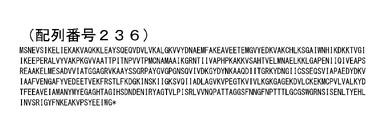
- FIG. 5 shows the amino acid sequences of each enzyme.
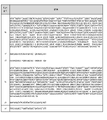
- FIG. 6 shows the base sequences encoding each enzyme and the base sequences of primers.
- FIG. 7 shows the nucleotide sequences encoding each enzyme and the nucleotide sequences of primers.
- FIG. 8 shows the base sequences encoding each enzyme and the base sequences of primers.
- FIG. 9 is a diagram showing base sequences encoding each enzyme.
- FIG. 10 shows the base sequences encoding each enzyme.
- FIG. 11 shows the nucleotide sequences of each primer.
- FIG. 12 shows the base sequences encoding each enzyme and the base sequences of each primer.
- FIG. 13 shows the nucleotide sequences of each primer.
- FIG. 14 shows the nucleotide sequences encoding each enzyme and the nucleotide sequences of each primer.
- FIG. 15 shows the amino acid sequence of each enzyme, the nucleotide sequence encoding each enzyme, and the nucleotide sequence of each primer.
- FIG. 16 shows examples of adipic acid, adipic acid derivatives, hexamethylenediamine, 1,6-hexanediol and 6-amino-1-hexanol production pathways possessed by recombinant microorganisms of the present invention.
- FIG. 17 shows the genes to be amplified in PCR and the primers used.
- Figure 18 shows the amino acid sequence of each enzyme.
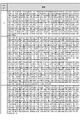
- FIG. 19A shows the nucleotide sequences encoding each enzyme.
- FIG. 19B shows the base sequences encoding each enzyme.
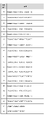
- FIG. 20A shows amplification targets and primers used in PCR.
- FIG. 20B shows amplification targets and primers used in PCR.
- Figure 21 shows the amino acid sequence of the enzyme.
- Figure 22A shows the amino acid sequence of the enzyme.
- Figure 22B shows the amino acid sequence of the enzyme.
- Figure 22C shows the amino acid sequence of the enzyme.
- Figure 22D shows the amino acid sequence of the enzyme.
- Figure 22E shows the amino acid sequence of the enzyme.
- Figure 23A shows the amino acid sequence of the enzyme.
- Figure 23B shows the amino acid sequence of the enzyme.
- Figure 23C shows the amino acid sequence of the enzyme.
- Figure 23D shows the amino acid sequence of the enzyme.
- Figure 24A shows the amino acid sequence of the enzyme.
- Figure 24B shows the amino acid sequence of the enzyme.
- Figure 24C shows the amino acid sequence of the enzyme.
- Figure 24D shows the amino acid sequence of the enzyme.
- Figure 24E shows the amino acid sequence of the enzyme.
- Figure 25 shows the amino acid sequence of the enzyme.
- a numerical range indicated using "-" indicates a range that includes the numerical values before and after "-" as the minimum and maximum values, respectively.
- the upper limit value or lower limit value of the numerical range in one step can be arbitrarily combined with the upper limit value or lower limit of the numerical range in another step.
- endogenous refers to the gene to which the referred gene or the protein encoded thereby (typically is used to mean that the host microorganism has an enzyme) whether or not it is functionally expressed to the extent that it can drive a dominant biochemical reaction within the host cell.
- exogenous or “exogenous” means that if the host microorganism before genetic recombination does not have the gene to be introduced according to the present invention, the enzyme resulting from the gene is substantially expressed. and where that gene or a different gene encodes the amino acid sequence of the enzyme but does not express comparable endogenous enzymatic activity after genetic recombination, the gene or nucleic acid sequence according to the present invention is introduced into the host. Used to mean to introduce.
- Invention A Recombinant microorganism and method for producing C6 compound
- the recombinant microorganism according to the present invention encodes a protein having an enzymatic activity that reduces 2,3-dehydroadipyl-CoA and converts it to adipyl-CoA. Contains exogenous genes. The reaction to reduce 2,3-dehydroadipyl-CoA to convert it to adipyl-CoA is shown in step D of FIG.
- a "protein having an enzymatic activity to reduce 2,3-dehydroadipyl-CoA and convert it to adipyl-CoA” is also referred to as a "2,3-dehydroadipyl-CoA reductase.”
- the enzymatic activity that reduces 2,3-dehydroadipyl-CoA and converts it to adipyl-CoA is referred to as "2,3-dehydroadipyl-CoA reductase activity" or "2,3-dehydroadipyl-CoA reductase enzymatic activity.” Also referred to as , and these terms are used interchangeably.
- the exogenous gene contained in the recombinant microorganism according to the invention is selected from: (i) 80% or more, 85% or more, 88% or more, 90% or more, 93% or more, 95% or more of the amino acid sequence shown in SEQ ID NO: 8, 9, 10, 11, 12, 13, 14, 15 or 16 , a DNA encoding a protein consisting of an amino acid sequence having a sequence identity of 97% or more, 98% or more or 99% or more; (ii) 1-10, 1-7, 1-5 or 1-3 amino acids relative to the amino acid sequence set forth in SEQ ID NO: 8, 9, 10, 11, 12, 13, 14, 15 or 16 A DNA encoding a protein consisting of an amino acid sequence in which is deleted, substituted, inserted and/or added, (iii) a polynucleotide sequence set forth in SEQ ID NO: 57, 58, 59, 60, 61, 62, 63, 64 or 65 and 80% or more, 85% or more, 88% or more, 90% or more,
- the exogenous gene contained in the recombinant microorganism according to the invention is preferably selected from: (i) a DNA encoding a protein consisting of an amino acid sequence having 80% or more sequence identity with the amino acid sequence shown in SEQ ID NO: 8, 9, 10, 11, 12, 13, 14, 15 or 16; (ii) an amino acid sequence in which 1 to 10 amino acids are deleted, substituted, inserted and/or added to the amino acid sequence shown in SEQ ID NO: 8, 9, 10, 11, 12, 13, 14, 15 or 16 DNA encoding a protein consisting of (iii) a DNA consisting of a polynucleotide sequence having 80% or more sequence identity with the polynucleotide sequence set forth in SEQ ID NO: 57, 58, 59, 60, 61, 62, 63, 64 or 65; (iv) deletions, substitutions of 1-10 amino acids relative to the amino acid sequence of the protein encoded by the polynucleotide sequence set forth in SEQ ID NOs: 57, 58
- the exogenous gene contained in the recombinant microorganism of the present invention is (xi) a DNA encoding a protein consisting of the amino acid sequence shown in SEQ ID NO: 8, 9, 10, 11, 12, 13, 14, 15 or 16, or (xiii) DNA consisting of the polynucleotide sequence shown in SEQ ID NO: 57, 58, 59, 60, 61, 62, 63, 64 or 65 is.
- the recombinant microorganism has good 2,3-dehydroadipyl-CoA reductase activity.
- a target compound can be produced by using a recombinant microorganism having such enzymatic activity. Examples of target compounds include C6 compounds.
- C6 compound includes - Adipic acid (CAS No. 124-04-9), - Hexamethylenediamine (CAS No. 124-09-4), - 1,6-hexanediol (CAS No. 629-11-8), - 6-aminohexanoic acid (CAS No. 60-32-2), ⁇ 6-amino-1-hexanol (CAS No.4048-33-3), and ⁇ 6-hydroxyhexanoic acid (CAS No.1191-25-9) and "C6 compound” refers to one or more compounds selected from the group consisting of these compounds.
- C6 compound herein can take a neutral or ionized form, including any salt form, and that this form is pH dependent.
- the microorganism of the present invention is a genetically modified microorganism into which an exogenous enzyme gene has been introduced.
- a "genetically modified microorganism” is also simply referred to as a "recombinant microorganism”.
- the host microorganism into which the exogenous gene of interest is introduced is not particularly limited, and may be either prokaryote or eukaryote. It can be arbitrarily selected from those that have already been isolated and preserved, those that have been newly isolated from nature, and those that have been genetically modified.
- Host microorganisms include, for example, the genera Escherichia, Bacillus, Corynebacterium, Arthrobacter, Brevibacterium, Clostridium, Zymomonas ( Genus Zymomonas, Pseudomonas, Burkholderia, Streptomyces, Rhodococcus, Synechocystis, Alkalihalobacillus (Saccharomyces) genus Schizosaccharomyces, Yarrowia, Candida, Pichia, or Aspergillus.
- the host microorganism preferably belongs to the genus Escherichia, more preferably Escherichia coli.
- the recombinant microorganism according to the present invention in which an exogenous gene is introduced into the host microorganism is, for example, Escherichia genera, Bacillus genera, Corynebacterium genera, Arthrobacter genera , Brevibacterium genus, Clostridium genus, Zymomonas genus, Pseudomonas genus, Burkholderia genus, Streptomyces genus, Rhodococcus genus, Synechococcus genus Synechocystis, Alkalihalobacillus, Saccharomyces, Schizosaccharomyces, Yarrowia, Candida, Pichia, or Aspergillus belong to the genus
- the recombinant microorganism according to the present invention preferably belongs to the genus Escherichia, more preferably Escherichia coli.
- the genetically modified microorganism of the present invention expresses a sufficient amount of the enzyme for each reaction step in the production pathway of the compound to proceed. , means that the compound can be biosynthesized.
- the recombinant microorganism of the present invention may be one using a host microorganism that originally has the ability to produce the compound, and the compound is produced against the host microorganism that originally does not have the ability to produce the compound. It may be modified so as to have productivity.
- derived from means that the gene or the protein (typically an enzyme) encoded thereby is endogenously possessed by the particular species referred to. .
- the genetically modified microorganism of the present invention is an exogenous protein encoding a protein having an enzymatic activity that reduces 2,3-dehydroadipyl-CoA and converts it to adipyl-CoA (that is, a 2,3-dehydroadipyl-CoA reductase activity).
- Including the sex gene expresses sufficient amounts of the enzyme (ie, 2,3-dehydroadipyl-CoA reductase) for the reaction to proceed. This enzyme participates in the reaction of step D in FIG.
- the recombinant microorganism according to the invention comprises - a gene encoding 3-oxoadipyl CoA thiolase, a gene encoding 3-hydroxyadipyl-CoA dehydrogenase, a gene encoding 3-hydroxyadipyl CoA dehydratase, - a combination of a gene encoding phosphate adipyltransferase and a gene encoding adipic kinase, a gene encoding adipyl-CoA hydrolase, - a gene encoding adipic acid CoA transferase, a gene encoding a dehydrogenase, - a gene encoding a carboxylic acid reductase, - a gene encoding a transaminase (aminotransferase) - a gene encoding an alcohol dehydrogenase, and - a gene encoding a CoA
- 3-oxoadipyl-CoA thiolase performs the reaction of step A in FIG.
- 3-Hydroxyadipyl-CoA dehydrogenase performs the reaction in step B of FIG.
- 3-hydroxyadipyl-CoA dehydratase performs the reaction in step C of FIG.
- a combination of adipyl phosphate transferase and adipic kinase, adipyl-CoA hydrolase, adipate CoA transferase performs the reaction in step E of FIG. - the dehydrogenase performs at least one reaction of steps F, U and V of FIG.
- the carboxylic acid reductase performs at least one reaction of steps G, I, K and N of FIG. -
- the transaminase (aminotransferase) performs at least one reaction of steps J, M, P and R of FIG. -
- the alcohol dehydrogenase performs at least one reaction of steps H, L, O and Q of FIG. •
- CoA transferase or acid thiol ligase catalyzes at least one reaction of steps S and T;
- the recombinant microorganism according to the invention is - a gene encoding 3-oxoadipyl CoA thiolase, a gene encoding 3-hydroxyadipyl-CoA dehydrogenase, a gene encoding 3-hydroxyadipyl CoA dehydratase, - a gene encoding a carboxylic acid reductase, - a gene encoding an alcohol dehydrogenase; and - a gene encoding a transaminase (aminotransferase).
- the genetically modified microorganism of the present invention expresses a sufficient amount of an enzyme that catalyzes the reaction step of the C6 compound production pathway without introducing a foreign gene, the enzyme encoded by the endogenous gene reacts. may proceed.
- Fig. 1 shows an example of the C6 compound production pathway that the genetically modified microorganism of the present invention can have. Enzymes that catalyze each reaction step are described below with reference to FIG.
- step A of Figure 1 succinyl-CoA and acetyl-CoA are condensed and converted to 3-oxoadipyl-CoA.
- enzymes that can catalyze this conversion include ⁇ -ketothiolase.
- EC 2.3.1.9 acetoacetyl-CoA thiolase
- EC 2.3.1.16 3-ketoacyl-CoA thiolase
- EC 2.3.1.174 3-oxoadipyl- Enzymes falling into groups such as CoA thiolase
- Enzymes that can be used in this conversion are not limited as long as they have activity for this conversion, and include, for example, succinyl-CoA:acetyl-CoA acyltransferase and 3-oxoadipyl-CoA thiolase.
- PaaJ from E. coli consisting of the amino acid sequence set forth in SEQ ID NO: 1 is used.
- 3-oxoadipyl-CoA is converted to 3-hydroxyadipyl-CoA.
- enzymes that can catalyze this conversion include oxidoreductases classified in group EC 1.1.1.
- EC 1.1.1.35 (3-hydroxyacyl-CoA dehydrogenase)
- EC 1.1.1.36 (acetoacetyl-CoA dehydrogenase)
- EC 1.1.1.157 (3-hydroxybutane noyl-CoA dehydrogenase
- EC 1.1.1.211 long-chain 3-hydroxyacyl-CoA dehydrogenase
- EC 1.1.1.259 (3-hydroxypymeloyl-CoA dehydrogenase)
- Enzymes can be exemplified as enzymes that may have activity for this conversion.
- Enzymes that can be used in the present invention are not limited as long as they have activity for this conversion, and are, for example, 3-hydroxyadipyl-CoA dehydrogenase.
- PaaH from E. coli consisting of the amino acid sequence set forth in SEQ ID NO: 2 is used.
- step C of FIG. 1 3-hydroxyadipyl-CoA is converted to 2,3-dehydroadipyl-CoA.
- enzymes capable of catalyzing this conversion include hydrolyases classified in group EC 4.2.1.
- EC 4.2.1.17 enoyl-CoA hydratase
- EC 4.2.1.55 3-hydroxybutanoyl-CoA dehydratase
- EC 4.2.1.74 long-chain enoyl- Enzymes falling into groups such as CoA hydratase
- Enzymes that can be used in the present invention are not limited as long as they have activity for this conversion, but for example, 3-hydroxyadipyl-CoA dehydratase.
- an E. coli-derived PaaF consisting of the amino acid sequence set forth in SEQ ID NO:3 is used.
- the enzyme uses the chromosomal DNA of Burkholderia sp.
- the 3-hydroxyadipyl-CoA dehydratase PaaF (L3) encoded by the nucleotide sequence (783 bp) of the PCR amplicon obtained from the PCR amplification product is used. Burkholderia sp.
- L3 strain The LEBP-3 strain (hereinafter also abbreviated as “L3 strain”) is an independent administrative agency Product Evaluation Technology National Institute Patent Microorganism Depositary Center (NPMD) (Address: 2-5-8 Kazusa Kamatari, Kisarazu City, Chiba Prefecture Room 122 ) on December 4, 2020 (receipt number: NITE ABP-03334), and has been internationally deposited as "acceptance number: NITE BP-03334".
- NPMD Product Evaluation Technology National Institute Patent Microorganism Depositary Center
- DNA polymerase used to prepare the PCR amplification product those known in the art are used, for example, Taq DNA polymerase, hot-start adjusted DNA polymerase, 3'-5' exonuclease in addition to the polymerase activity Examples include, but are not limited to, proofreading DNA polymerases having activity.
- 1 ⁇ M of a specific nucleotide is used as a forward primer and a reverse primer
- PrimeSTAR Max DNA Polymerase product name, manufactured by Takara Bio Inc.
- 25 ⁇ L of liquid is 30 cycles of heat treatment at 98° C. for 10 seconds, annealing at 55° C. for 15 seconds, and elongation at 72° C. for 5 seconds/kb.
- step D of FIG. 1 2,3-dehydroadipyl-CoA is converted to adipyl-CoA.
- enzymes that can catalyze this conversion include oxidoreductases that fall into the group of EC 1.3.1.
- EC 1.3.1.8 acyl-CoA dehydrogenase (NADP + )
- EC 1.3.1.9 enoyl-ACP reductase (NADH)
- EC 1.3.1.38 trans -2-enoyl-CoA reductase (NADP + )
- EC 1.3.1.44 trans-2-enoyl-CoA reductase (NAD + )
- EC 1.3.1.86 crotonyl-CoA reductase
- EC 1.3.1.93 long-chain acyl-CoA reductase
- EC 1.3.1.104 enoyl-ACP reductase (NADPH)
- the 2,3-dehydroadipyl-CoA reductase used in the present invention is, for example, an enzyme derived from the following species: Candida auris (SEQ ID NO: 8), Kluyveromyces marxianus (SEQ ID NO: 9), Pichia kudriavzevii (SEQ ID NO: 9) ⁇ 10) ⁇ Thermothelomyces thermophilus( ⁇ 11) ⁇ Thermothielavioides terrestris( ⁇ 12) ⁇ Chaetomium thermophilum( ⁇ 13) ⁇ Podospora anserina( ⁇ 14) ⁇ Purpureocillium lilacinum( ⁇ 15) ⁇ Pyrenophora teres( ⁇ 16 ).
- At least one of the enzymes consisting of the amino acid sequences set forth in SEQ ID NOs: 8 to 16 is used, more preferably at least one of the enzymes consisting of the amino acid sequences set forth in SEQ ID NOs: 11, 12, 13, 14 and 16 is used. used (Fig. 3).
- adipyl-CoA is converted to adipic acid.
- enzymes capable of catalyzing this transformation include thioester hydrolases, which are classified in group EC 3.1.2.
- enzymes classified into groups such as EC 3.1.2.1 (acetyl-CoA hydrolase) and EC 3.1.2.20 (acyl-CoA hydrolase) have activity for this conversion. It can be exemplified as an enzyme to be obtained.
- Enzymes that can be used in the present invention are not limited as long as they have activity for this conversion, and for example, adipyl-CoA hydrolase.
- CoA-transferase Another example of an enzyme that can catalyze the reaction in step E of FIG. 1 is CoA-transferase, which is classified in the group EC 2.8.3.
- EC 2.8.3.5 (3-oxoacid CoA-transferase)
- EC 2.8.3.6 (3-oxoadipate CoA-transferase)
- EC 2.8.3.18 succinyl -CoA: acetyl-CoA-transferase
- Enzymes that can be used in the present invention are not limited as long as they have activity for this conversion, but for example, adipic acid CoA transferase.
- a pathway that undergoes dephosphorylation by phosphotransferases classified in the group of EC 2.7.2 after producing adipyl phosphate can also be exemplified.
- acyltransferases enzymes classified into groups such as EC 2.3.1.8 (phosphate acetyltransferase) and EC 2.3.1.19 (phosphate butyryltransferase) are suitable for this conversion. Examples can be given as enzymes that can have activity against.
- enzymes classified into groups such as EC 2.7.2.1 (acetate kinase) and EC 2.7.2.7 (butanoate kinase) have activity for this conversion. It can be exemplified as an enzyme to be obtained. Enzymes that can be used in the present invention are not limited as long as they have activity for this conversion, and examples include adipyl phosphate transferase and adipic kinase.
- acyl-CoA is converted to aldehyde.
- enzymes that can catalyze this conversion include enzymes classified in group EC 1.2.1.
- EC 1.2.1.10 acetaldehyde dehydrogenase (acetylation)
- EC 1.2.1.17 glyoxylate dehydrogenase (acylation)
- EC 1.2.1.42 hexadecanal dehydrogenase (acylation)
- EC 1.2.1.44 cinnamoyl-CoA reductase (acylation)
- EC 1.2.1.75 malonyl-CoA reductase (malonic semialdehyde formation)
- EC 1.2.1.10 acetaldehyde dehydrogenase (acetylation)
- EC 1.2.1.17 glyoxylate dehydrogenase (acylation)
- EC 1.2.1.42 hexadecanal dehydrogenase (acylation)
- EC 1.2.1.44
- Enzymes classified into groups such as 2.1.76 succinic semialdehyde dehydrogenase (acylation) catalyze conversion reactions that eliminate CoA and generate aldehydes, similar to this conversion. It can also be exemplified as an enzyme that can have activity against Enzymes that can be used in the present invention are not limited as long as they have activity for this conversion.
- 2.1.76 succinic semialdehyde dehydrogenase (acylation)
- the carboxyl group is converted to an aldehyde.
- Enzymes that can catalyze this conversion include, for example, carboxylic acid reductase (CAR).
- CAR carboxylic acid reductase
- EC 1.2.1.30 carboxylic acid reductase (NADP + )
- EC 1.2.1.31 L-aminoadipate semialdehyde dehydrogenase
- EC 1.2.1.95 L- 2-aminoadipate reductase
- EC 1.2.99.6 carboxylic acid reductase catalyzes the conversion reaction of carboxylic acid to aldehyde in the same manner as this conversion.
- carboxylic acid reductase can be converted to an active holoenzyme by phosphopantetheinylation (Venkitasubramanian et al., Journal of Biological Chemistry, Vol. 282, No. 1, 478-485 (2007) ).
- Phosphopantetheinylation is catalyzed by phosphopantetheinyl transferase (PT).
- Enzymes that can catalyze this reaction include, for example, enzymes classified under EC 2.7.8.7. Accordingly, the microorganism of the invention may be further modified to increase the activity of phosphopantetheinyltransferase.
- Methods for increasing the activity of phosphopantetheinyl transferase include a method of introducing an exogenous phosphopantetheinyl transferase gene and a method of enhancing expression of an endogenous phosphopantetheinyl transferase gene. include, but are not limited to. Enzymes that can be used in the present invention are not limited to these as long as they have phosphopantetheinyl group transfer activity. Venkitasubramanian et al., Journal of Biological Chemistry, Vol.282, No.1, 478-485 (2007)), Lys5 of Saccharomyces cerevisiae (Ehmann et al., Biochemistry 61-7:1919) (19). mentioned.
- Enzymes that can be used in the present invention are not limited as long as they have activity for this conversion.
- at least one enzyme consisting of the amino acid sequences shown in SEQ ID NOs: 23 to 26 may be used.
- Npt of Nocardia iowensis derived from Nocardia iowensis consisting of the amino acid sequence set forth in SEQ ID NO: 24 is used (Fig. 5).
- steps J, M, P and R in Figure 1 are transamination reactions.
- enzymes that can catalyze this conversion include the transaminases (aminotransferases) that fall into the group of EC 2.6.1.
- EC 2.6.1.19 (4-aminobutanoic acid-2-oxoglutarate transaminase)
- EC 2.6.1.29 (diamine transaminase)
- EC 2.6.1.48 (5-aminobutyric acid transaminase)
- Enzymes classified into groups such as herbal acid transaminase can be exemplified as enzymes that may also have activity for this conversion.
- Enzymes that can be used in the present invention are not particularly limited as long as they have the conversion activity of each step. (Samsonova., et al., BMC Microbiology 3.1 (2003): 2.) and Pseudomonas putrescine aminotransferase SpuC (Lu et al., Journal of bacteria 184.14 (2002): 3765-3773 , Galman et al., Green Chemistry 19.2 (2017): 361-366.), E.
- coli GABA aminotransferase GabT and PuuE may be used.
- ⁇ Ruegeria pomeroyi ⁇ Chromobacterium violaceum ⁇ Arthrobacter citreus ⁇ Sphaerobacter thermophilus ⁇ Aspergillus fischeri ⁇ Vibrio fluvialis ⁇ Agrobacterium tumefaciens ⁇ Mesorhizobium loti ⁇ - ⁇ 1,8- ⁇ 1,10- ⁇ and may be used in the present invention (Sung et al., Green Chemistry 20.20 (2016): 4591-4595., Sattler et al.). , Angewandte Chemie 124.36 (2012): 9290-9293.).
- Enzymes that can be used in the present invention are not limited as long as they have activity for this conversion. (Figs. 5 and 15).
- Typical amino group donors include, but are not limited to, L-glutamic acid, L-alanine and glycine.
- the aldehyde is converted to an alcohol.
- enzymes that can catalyze this conversion include oxidoreductases that fall into the group of EC 1.1.1.
- EC 1.1.1.1 (alcohol dehydrogenase), EC 1.1.1.2 (alcohol dehydrogenase (NADP + )), EC 1.1.1.71 (alcohol dehydrogenase [NAD(P) + ])
- enzymes that can also have activity for this conversion since they catalyze the conversion reaction from aldehyde to alcohol as well as this conversion.
- Enzymes that can be used in the present invention are not limited as long as they have activity for this conversion.
- E. coli-derived Ahr described in SEQ ID NO: 32 (FIG. 5).
- CoA is added to the carboxyl group.
- enzymes that can catalyze this conversion include CoA transferases classified in group EC 2.8.3 and acid thiol ligases classified in group EC 6.2.1. Enzymes used in the present invention are not limited as long as they have activity for this conversion.
- Genes encoding the above enzymes that can be used in the present invention may be derived from organisms other than the exemplified organisms, or may be artificially synthesized. Any material can be used as long as it can express activity.
- the recombinant microorganism according to the present invention may be a host microorganism in which any gene is appropriately disrupted. Targeted gene disruption is performed by methods known in the art.
- amino acid sequences of the enzymes or the base sequences of the genes encoding the enzymes that can be used in the present invention include all possible sequences that can occur in nature, as long as they can express substantial enzyme activity in the host microbial cells. and artificially introduced mutations and modifications, including mutations such as deletions, substitutions, insertions and additions.
- 1 or more, preferably 1 to 20, more preferably 1 to 10, still more preferably 1 to 7, even more preferably 1 to 5, particularly preferably 1 to 5 relative to the amino acid sequence of the above enzyme may contain amino acid sequences with deletions, substitutions, insertions and/or additions of 1-3 amino acids.
- nucleotide sequence of the gene encoding the above enzyme that can be used in the present invention includes DNA having a complementary nucleotide sequence and under stringent conditions, as long as it can express substantial enzyme activity in the host microbial cell. DNAs that hybridize with are also available. “Stringent conditions” are, for example, conditions of about “1 ⁇ SSC, 0.1% SDS, 60° C.”, and more stringent conditions are conditions of about “0.1 ⁇ SSC, 0.1% SDS, 60° C.” A more severe condition is "0.1 x SSC, 0.1% SDS, 68°C".
- the base sequence of the enzyme gene for example, 80% or more, 85% or more, 88% or more, 90% or more, 93% or more, It may include nucleotide sequences with 95% or more, 97% or more, 98% or more, or 99% or more sequence identity.
- an amino acid sequence having, for example, 80% or more, 85% or more, 88% or more, 90% or more, 95% or more, 97% or more, 98% or more, or 99% or more sequence identity with the amino acid sequence of the above enzyme. It may contain genes that encode proteins containing.
- sequence identity As used herein, the percentage of "sequence identity" of a comparative amino acid sequence relative to a reference amino acid sequence is expressed by aligning the sequences so that the identity between these two sequences is maximized, and if necessary Defined as the percentage of amino acid residues in a comparison sequence that are identical to amino acid residues in a reference sequence when gaps are introduced in one or both of the two sequences. At this time, conservative substitutions are not considered part of sequence identity. Sequence identity can be determined by using publicly available computer software, for example, using an alignment search tool such as BLAST (registered trademark) (Basic Local Alignment Search Tool). can decide. Those skilled in the art can determine appropriate parameters for maximal alignment of the comparison sequences in the alignment. "Sequence identity" of nucleotide sequences can also be determined by similar methods.
- an "expression cassette” refers to a nucleic acid to be expressed or a nucleotide containing nucleic acid sequences that regulate transcription and translation operably linked to a gene to be expressed.
- an expression cassette of the invention comprises a promoter sequence 5′ upstream from the coding sequence, a terminator sequence 3′ downstream, and optionally further conventional regulatory elements operably linked, such that In some cases, the nucleic acid to be expressed or the gene to be expressed is introduced into the host microorganism.
- a promoter is defined as a DNA sequence that causes RNA polymerase to bind to DNA and initiate RNA synthesis, regardless of whether it is a constitutive or inducible promoter.
- a strong promoter is a promoter that initiates mRNA synthesis at a high frequency, and is also preferably used in the present invention.
- glycolytic enzymes e.g., 3-phosphoglycerate kinase, glyceraldehyde-3-phosphorus Acid dehydrogenase
- glutamic acid decarboxylase A glutamic acid decarboxylase A
- promoters for serine hydroxymethyltransferase promoter regions of T7 phage-derived RNA polymerase, and the like can be used.
- HCE high-level constitutive expression
- cspB promoter cspB promoter
- sodA promoter elongation factor (EF-Tu) promoter
- Terminators that can be used include T7 terminator, rrnBT1T2 terminator, lac terminator, and the like.
- other regulatory elements may include selectable markers, amplification signals, origins of replication, and the like. Suitable regulatory sequences are described, for example, in “Gene Expression Technology: Methods in Enzymology 185", Academic Press (1990).
- the expression cassette described above is incorporated into a vector consisting of, for example, a plasmid, phage, transposon, IS element, fosmid, cosmid, or linear or circular DNA, and inserted into a host microorganism. Plasmids and phages are preferred. These vectors may replicate autonomously in the host microorganism or may replicate chromosomally. Suitable plasmids are, for example, E.
- a conventional method can be used as a method applicable when introducing the vector into a host microorganism.
- a method applicable when introducing the vector into a host microorganism examples thereof include, but are not limited to, the calcium chloride method, electroporation method, conjugative transfer method, and protoplast fusion method, and a method suitable for the host microorganism can be selected.
- a second aspect of the present invention relates to a method for producing a target compound, which includes a culturing step of culturing the aforementioned recombinant microorganism.
- the compound is preferably a C6 compound.
- the C6 compound is at least one selected from the group consisting of adipic acid, hexamethylenediamine, 1,6-hexanediol, 6-aminohexanoic acid, 6-amino-1-hexanol and 6-hydroxyhexanoic acid.
- the method for producing the C6 compound includes a culturing step of culturing the genetically modified microorganism according to the present invention.
- the recombinant microorganism is cultured in a medium containing a carbon source and a nitrogen source to obtain a culture containing bacterial cells.
- the genetically modified microorganism of the present invention is cultured under conditions suitable for C6 compound production, growth and maintenance of the microorganism, and suitable medium composition, culture time, and culture conditions can be easily set by those skilled in the art.
- Carbon sources include D-glucose, sucrose, lactose, fructose, maltose, oligosaccharides, polysaccharides, starch, cellulose, rice bran, blackstrap molasses, fats and oils (such as soybean oil, sunflower oil, peanut oil, coconut oil, etc.), fatty acids ( Examples thereof include palmitic acid, linoleic acid, oleic acid, linolenic acid, etc.), alcohols (eg, glycerol, ethanol, etc.), organic acids (eg, acetic acid, lactic acid, succinic acid, etc.), corn decomposing solutions, and cellulose decomposing solutions. D-glucose, sucrose or glycerol are preferred. These carbon sources can be used individually or as a mixture.
- C6 compounds produced using raw materials derived from biomass are measured for biobased carbon content based on Carbon-14 (radiocarbon) analysis specified in ISO 16620-2 or ASTM D6866, for example oil, natural gas, coal It can be clearly distinguished from synthetic raw materials derived from
- Nitrogen sources include nitrogen-containing organic compounds (e.g. peptones, casamino acids, tryptones, yeast extracts, meat extracts, malt extracts, corn steep liquor, soy flour, amino acids and urea), or inorganic compounds (e.g. ammonia aqueous solution, ammonium sulfate, ammonium chloride, ammonium phosphate, ammonium carbonate, sodium nitrate, ammonium nitrate, etc.). These nitrogen sources can be used individually or as a mixture.
- organic compounds e.g. peptones, casamino acids, tryptones, yeast extracts, meat extracts, malt extracts, corn steep liquor, soy flour, amino acids and urea
- inorganic compounds e.g. ammonia aqueous solution, ammonium sulfate, ammonium chloride, ammonium phosphate, ammonium carbonate, sodium nitrate, ammonium nitrate, etc.
- the medium may also contain corresponding antibiotics if the recombinant microorganism expresses useful additional traits, for example if it has markers for resistance to antibiotics. This reduces the risk of contamination by germs during culture.
- Antibiotics include, but are not limited to, ⁇ -lactam antibiotics such as ampicillin, aminoglycoside antibiotics such as kanamycin, macrolide antibiotics such as erythromycin, tetracycline antibiotics, chloramphenicol, and the like. not.
- Cultivation may be batch or continuous. Moreover, in any case, it may be possible to replenish the additional carbon source or the like at an appropriate point in the culture.
- the culture may be cultured while controlling conditions such as suitable temperature, oxygen concentration, and pH. Suitable culture temperatures for transformants derived from common microbial host cells are usually in the range of 15°C to 55°C, preferably 25°C to 40°C. If the host microorganism is aerobic, shaking (such as flask culture) or stirring/aeration (such as jar fermenter culture) may be performed to ensure an appropriate oxygen concentration during fermentation. Those culture conditions can be easily set by those skilled in the art.
- the culturing step may include obtaining a culture of the recombinant microorganism and/or an extract of the culture.
- the method for producing a compound according to the present invention may further include a mixing step of mixing the culture and/or the extract of the culture with a substrate compound to obtain a mixed solution.
- a substrate compound may be appropriately selected according to the enzyme and target compound.
- the method for producing a compound according to the present invention may include a step of isolating and/or purifying the target compound, the C6 compound.
- any technique such as centrifugation, filtration, membrane separation, crystallization, extraction, distillation, adsorption, phase separation, ion exchange and various types of chromatography can be used. is not limited to
- one type of method may be selected, or multiple methods may be combined.
- a further aspect of the invention relates to proteins.
- the protein is (a) having an enzymatic activity that reduces 2,3-dehydroadipyl-CoA to convert it to adipyl-CoA; (b) below: (i) 80% or more, 85% or more, 88% or more, 90% or more, 93% or more, 95% or more of the amino acid sequence shown in SEQ ID NO: 8, 9, 10, 11, 12, 13, 14, 15 or 16 , consisting of amino acid sequences having 97% or greater, 98% or greater or 99% or greater sequence identity, (ii) 1-10, 1-7, 1-5 or 1-3 amino acids relative to the amino acid sequence set forth in SEQ ID NO: 8, 9, 10, 11, 12, 13, 14, 15 or 16 consists of a deleted, substituted, inserted and/or added amino acid sequence, (iii) a polynucleotide sequence set forth in SEQ ID NO: 57, 58, 59, 60, 61, 62, 63, 64 or 65 and 80% or more,
- the protein is preferably (a) having an enzymatic activity that reduces 2,3-dehydroadipyl-CoA to convert it to adipyl-CoA; (b) below: (i) consisting of an amino acid sequence having 80% or more sequence identity with the amino acid sequence shown in SEQ ID NO: 8, 9, 10, 11, 12, 13, 14, 15 or 16; (ii) an amino acid sequence in which 1 to 10 amino acids are deleted, substituted, inserted and/or added to the amino acid sequence shown in SEQ ID NO: 8, 9, 10, 11, 12, 13, 14, 15 or 16 consisting of (iii) encoded by a DNA consisting of a polynucleotide sequence having 80% or more sequence identity with the polynucleotide sequence set forth in SEQ ID NO: 57, 58, 59, 60, 61, 62, 63, 64 or 65; (iv) deletions, substitutions of 1-10 amino acids relative to the amino acid sequence of the protein encoded by the polynucleotide sequence set forth in SEQ
- the recombinant protein is (xi) consists of the amino acid sequence set forth in SEQ ID NO: 8, 9, 10, 11, 12, 13, 14, 15 or 16, or (xiii) is encoded by a DNA consisting of the polynucleotide sequence set forth in SEQ ID NO: 57, 58, 59, 60, 61, 62, 63, 64 or 65;
- Yet another aspect of the present invention relates to a method for producing a C6 compound, including using the aforementioned protein.
- 2,3-dehydroadipyl-CoA reductase activity by introducing a gene encoding a protein having 2,3-dehydroadipyl-CoA reductase activity into a host microorganism, 2,3-dehydroadipyl-CoA reductase activity can obtain a good recombinant microorganism of Also provided are proteins with good 2,3-dehydroadipyl CoA reductase activity.
- the target C6 compound can be efficiently produced by using the recombinant microorganism or the protein. Also, depending on the desired C6 compound, different C6 compounds can be obtained by performing the conversion with additional enzymes. Furthermore, since the recombinant microorganism according to the present invention has a good C6 compound-producing ability, it is expected that it can be used for the production of the target compound on an industrial scale.
- Invention B Recombinant microorganism and method for producing adipic acid or a derivative thereof It is a microorganism in which the host microorganism has been genetically modified so that it can be produced efficiently.
- an "adipic acid derivative” is an aliphatic carboxylic acid having an aliphatic hydrocarbon group with 3 to 5 carbon atoms and one or more carboxyl groups.
- the aliphatic hydrocarbon group possessed by the adipic acid derivative is saturated or unsaturated.
- carbon may be substituted with substituents such as hydroxyl, carboxyl, ketone, amino, and the like.
- the number of carbon atoms in the aliphatic hydrocarbon group of the "adipic acid derivative” is preferably 3 or 4.
- the "adipic acid derivative” preferably has 1 or 2 carboxyl groups.
- adipic acid derivative examples include 3-oxoadipic acid (3-OA) having an aliphatic hydrocarbon group of 4 carbon atoms and two carboxylic acids, an aliphatic Levulinic acid (LEV) having a hydrocarbon group and one carboxylic acid, 3-hydroxyadipic acid (3HA) having an aliphatic hydrocarbon group with 4 carbon atoms and two carboxylic acids and 2,3-dehydroadipic acid (23DA) having an aliphatic hydrocarbon group of 4 carbon atoms and two carboxylic acids (see FIG. 16).
- 3-OA 3-oxoadipic acid
- LUV aliphatic Levulinic acid
- 3HA 3-hydroxyadipic acid
- 23DA 2,3-dehydroadipic acid
- adipic acid and adipic acid derivatives herein can take a neutral or ionized form including any salt form, and that this form depends on pH.
- adipic acid and adipic acid derivatives include the free acid form as well as any salt and ionized forms.
- adipic acid and adipic acid derivatives may be collectively referred to as “adipic acids” or “adipic acid analogues.”
- the synthesis method may be a chemical synthesis method, a biological synthesis method using an enzyme or a microorganism containing an enzyme, or the like.
- the microorganism contains a metabolic pathway for converting adipic acid into the above compound, metabolic conversion from a raw material using adipic acid as an intermediate in the cell is also possible.
- the genetically modified microorganism according to the present invention specifically contains at least one of an exogenous gene encoding 3-hydroxyadipyl-CoA dehydratase and an exogenous gene encoding 2,3-dehydroadipyl-CoA reductase. include.
- the recombinant microorganism has an adipic acid production pathway and can produce adipic acid or an adipic acid derivative.
- "genetically modified microorganism" is also simply referred to as "recombinant microorganism”.
- At least one of 3-hydroxyadipyl-CoA dehydratase and 2,3-dehydroadipyl-CoA reductase is derived from Burkholderia sp. strain LEBP-3 (accession number: NITE BP-03334).
- both the 3-hydroxyadipyl-CoA dehydratase and the 2,3-dehydroadipyl-CoA reductase are derived from Burkholderia sp. strain LEBP-3.
- At least one of the exogenous gene encoding 3-hydroxyadipyl-CoA dehydratase and the exogenous gene encoding 2,3-dehydroadipyl-CoA reductase is Burkholderia sp. Number: Derived from NITE BP-03334).
- both the exogenous gene encoding 3-hydroxyadipyl-CoA dehydratase and the exogenous gene encoding 2,3-dehydroadipyl-CoA reductase are from Burkholderia sp. LEBP-3 strain ( Accession number: Derived from NITE BP-03334).
- the genetically modified microorganism of the present invention may be introduced with at least one of the foreign genes encoding the above enzymes.
- the genetically modified microorganism of the present invention is preferably introduced with at least one exogenous gene encoding an enzyme that catalyzes each reaction step in the adipic acid production pathway, and expresses the exogenous enzyme.
- the genetically modified microorganism of the present invention expresses a sufficient amount of an enzyme that catalyzes the reaction step of the adipic acid production pathway without introduction of an exogenous gene, the enzyme encoded by the endogenous gene reacts. may proceed.
- the recombinant microorganism of the present invention preferably expresses at least one of 3-hydroxyadipyl-CoA dehydratase and 2,3-dehydroadipyl-CoA reductase.
- the reaction steps of the adipic acid production pathway proceed and the target compound can be produced.
- the recombinant microorganism of the present invention expresses both 3-hydroxyadipyl-CoA dehydratase and 2,3-dehydroadipyl-CoA reductase.
- these enzymes in the recombinant microorganism according to the present invention each of the reaction steps in the adipic acid production pathway proceeds and the target compound can be produced.
- the recombinant microorganism according to the present invention expresses oxidoreductase and/or ⁇ -ketothiolase in addition to 3-hydroxyadipyl-CoA dehydratase and 2,3-dehydroadipyl-CoA reductase.
- oxidoreductase and/or ⁇ -ketothiolase in addition to 3-hydroxyadipyl-CoA dehydratase and 2,3-dehydroadipyl-CoA reductase.
- 3-Hydroxyadipyl-CoA dehydratase is an enzyme that catalyzes the reaction that converts 3-hydroxyadipyl-CoA to 2,3-dehydroadipyl-CoA (step C in FIG. 16).
- the 3-hydroxyadipyl-CoA dehydratase has a sequence identity of 65 to a PCR amplification product using Burkholderia sp. strain LEBP-3 chromosomal DNA as a template and given nucleotides as primers. % or more, 70% or more, 75% or more, 80% or more, 85% or more, 88% or more, 90% or more, 93% or more, 95% or more, 97% or more, 98% or more, or 99% or more coded.
- the DNA has, for example, 626-940 bp, preferably 740-862 bp, more preferably 743-823 bp, still more preferably 767-799 bp, particularly preferably 775-791 bp, and most preferably 778-788 bp. Primers used for PCR are described later.
- 3-hydroxyadipyl-CoA dehydratase is encoded by DNA that is a PCR amplification product using chromosomal DNA of Burkholderia sp. LEBP-3 strain as a template and given nucleotides as primers. be done.
- the DNA has, for example, 626-940 bp, preferably 740-862 bp, more preferably 743-823 bp, still more preferably 767-799 bp, particularly more preferably 775-791 bp, most preferably 778-788 bp.
- the 3-hydroxyadipyl-CoA dehydratase is selected from: (A-1) Sequence identity with a PCR amplified product using chromosomal DNA of Burkholderia sp. LEBP-3 strain as a template and using predetermined nucleotides as primers 65% or more, 70% or more, 75 % or more, 80% or more, 85% or more, 88% or more, 90% or more, 93% or more, 95% or more, 97% or more, 98% or more, or 99% or more of There is having 3-hydroxyadipyl CoA dehydratase activity, a recombinant polypeptide, wherein the DNA has the base pair number (bp) as described above; (A-2) Against the amino acid sequence of a polypeptide encoded by DNA, which is a PCR amplification product using chromosomal DNA of Burkholderia sp.
- LEBP-3 strain as a template and predetermined nucleotides as primers for example, 1 to 10, preferably 1 to 7, more preferably 1 to 5, more preferably 1 to 3 amino acids are deleted, substituted, inserted and/or added.
- Recombination consisting of an amino acid sequence a polypeptide, having 3-hydroxyadipyl CoA dehydratase activity, a recombinant polypeptide, wherein the DNA has the base pair number (bp) as described above; and (A-3) a set encoded by a DNA consisting of degenerate isomers of a PCR amplification product using chromosomal DNA of Burkholderia sp.
- LEBP-3 strain as a template and predetermined nucleotides as primers a replacement polypeptide, having 3-hydroxyadipyl CoA dehydratase activity, A recombinant polypeptide, wherein said DNA has a base pair number (bp) as described above.
- 3-hydroxyadipyl-CoA dehydratase is encoded in a PCR amplification product using chromosomal DNA of Burkholderia sp. LEBP-3 strain as a template and given nucleotides as primers. It is a recombinant polypeptide, and the base pair number of the amplicon is 783 or 784 bp.
- the primers (forward and reverse) used for PCR include the following (see Figure 17).
- nucleotide containing the base sequence shown in SEQ ID NO: 168 and the nucleotide containing the base sequence shown in SEQ ID NO: 169" in (1b) are respectively "the base sequence shown in SEQ ID NO: 168" and "the base sequence shown in SEQ ID NO: 169.” , for example 1-20 bp, preferably 1-15 bp, more preferably 5-15 bp, even more preferably 10-15 bp, has an additional nucleotide length.
- nucleotide containing a codon-optimized base sequence of the base sequence shown in SEQ ID NO: 168 and the nucleotide containing a codon-optimized base sequence of the base sequence shown in SEQ ID NO: 169" in (1d) are respectively "SEQ ID NO: 168
- it contains a sequence homologous to the end of the vector for example, 1 to 20 bp, preferably 1 ⁇ 15 bp, more preferably 5-15 bp, even more preferably 10-15 bp has an additional nucleotide length.
- nucleotides containing a codon-optimized base sequence of the base sequence shown in SEQ ID NO: 168 and nucleotides containing a codon-optimized base sequence of the base sequence shown in SEQ ID NO: 169 include: (1d') includes a nucleotide consisting of the base sequence shown in SEQ ID NO: 198 and a nucleotide consisting of the base sequence shown in SEQ ID NO: 199 (Fig. 20A).
- preferred primers are (1a) a nucleotide consisting of the nucleotide sequence shown in SEQ ID NO: 168 and a nucleotide consisting of the nucleotide sequence shown in SEQ ID NO: 169, and (1b) a nucleotide comprising the nucleotide sequence shown in SEQ ID NO: 168 and a nucleotide comprising the nucleotide sequence shown in SEQ ID NO: 169 is.
- DNA which is a PCR amplified product using the above nucleotides as primers and using the chromosomal DNA of Burkholderia sp. LEBP-3 strain as a template, preferably has 783 or 784 bp.
- DNA polymerase used in PCR those known in the art are used, such as Taq DNA polymerase, hot-start adjusted DNA polymerase, proofreading having 3'-5' exonuclease activity in addition to polymerase activity DNA polymerase and the like.
- 2,3-Dehydroadipyl-CoA reductase is an enzyme that catalyzes the reaction that converts 2,3-dehydroadipyl-CoA to adipyl-CoA (see step D in Figure 16).
- the 2,3-dehydroadipyl-CoA reductase has sequence identity with a PCR amplification product using Burkholderia sp. LEBP-3 strain chromosomal DNA as a template and given nucleotides as primers. is 65% or more, 70% or more, 75% or more, 80% or more, 85% or more, 88% or more, 90% or more, 93% or more, 95% or more, 97% or more, 98% or more, or 99% or more encoded in DNA.
- the DNA is, for example, 924-1386 bp, preferably 1039-1249 bp, more preferably 1097-1213 bp, even more preferably 1131-1179 bp, particularly more preferably 1143-1167 bp, even more preferably 1145-1165 bp, most preferably It has 1150-1160 bp.
- the 2,3-dehydroadipyl-CoA reductase is a DNA that is a PCR amplification product using chromosomal DNA of Burkholderia sp. LEBP-3 strain as a template and predetermined nucleotides as primers.
- coded to The DNA is, for example, 924-1386 bp, preferably 1039-1249 bp, more preferably 1097-1213 bp, even more preferably 1131-1179 bp, particularly more preferably 1143-1167 bp, even more preferably 1145-1165 bp, most preferably It has 1150-1160 bp.
- the 2,3-dehydroadipyl-CoA reductase is selected from: (B-1) 65% or more, 70% or more, sequence identity with a PCR amplified product using chromosomal DNA of Burkholderia sp.
- LEBP-3 strain as a template and using predetermined nucleotides as primers, 75% or more % or more, 80% or more, 85% or more, 88% or more, 90% or more, 93% or more, 95% or more, 97% or more, 98% or more, or 99% or more of There is having 2,3-dehydroadipyl CoA reductase activity, a recombinant polypeptide, wherein the DNA has the base pair number (bp) as described above; (B-2) Against the amino acid sequence of a polypeptide encoded by a DNA that is a PCR amplification product using chromosomal DNA of Burkholderia sp.
- LEBP-3 strain as a template and predetermined nucleotides as primers
- 1 to 10 preferably 1 to 7, more preferably 1 to 5, more preferably 1 to 3 amino acids are deleted, substituted, inserted and/or added.
- LEBP-3 strain as a template and predetermined nucleotides as primers a replacement polypeptide, having 2,3-dehydroadipyl CoA reductase activity, A recombinant polypeptide, wherein said DNA has a base pair number (bp) as described above.
- exogenous 2,3-dehydroadipyl-CoA reductase is amplified by PCR using chromosomal DNA of Burkholderia sp. LEBP-3 strain as a template and predetermined nucleotides as primers. and the base pair number of the amplicon is 1155 or 1156 bp.
- the primers (forward and reverse) used for PCR include the following (see Figure 17).
- nucleotide containing the base sequence shown in SEQ ID NO: 170 and the nucleotide containing the base sequence shown in SEQ ID NO: 171" in (2b) are respectively "the base sequence shown in SEQ ID NO: 170" and "the base sequence shown in SEQ ID NO: 171.” , for example 1-20 bp, preferably 1-15 bp, more preferably 5-15 bp, even more preferably 10-15 bp, has an additional nucleotide length.
- nucleotide containing a codon-optimized base sequence of the base sequence shown in SEQ ID NO: 170 and nucleotide containing a codon-optimized base sequence of the base sequence shown in SEQ ID NO: 171" are respectively "SEQ ID NO: 170
- it contains a sequence homologous to the end of the vector for example, 1 to 20 bp, preferably 1 ⁇ 15 bp, more preferably 5-15 bp, even more preferably 10-15 bp has an additional nucleotide length.
- Examples of (2d) "a nucleotide containing a codon-optimized base sequence of the base sequence shown in SEQ ID NO: 170 and a nucleotide containing a codon-optimized base sequence of SEQ ID NO: 171" include: (2d') A nucleotide consisting of the base sequence shown in SEQ ID NO: 210 and a nucleotide consisting of the base sequence shown in SEQ ID NO: 211 are included (Fig. 20A).
- preferred primers are (2a) a nucleotide consisting of the nucleotide sequence shown in SEQ ID NO: 170 and a nucleotide consisting of the nucleotide sequence shown in SEQ ID NO: 171, and (2b) A nucleotide containing the base sequence shown in SEQ ID NO:170 and a nucleotide containing the base sequence shown in SEQ ID NO:171.
- DNA which is a PCR amplified product using the above nucleotides as primers and using the chromosomal DNA of Burkholderia sp. LEBP-3 strain as a template, preferably has 1155 or 1156 bp.
- DNA polymerase used in PCR those known in the art are used, such as Taq DNA polymerase, hot-start adjusted DNA polymerase, proofreading having 3'-5' exonuclease activity in addition to polymerase activity DNA polymerase and the like.
- PCR amplification product refers to a product obtained as a result of PCR using specific nucleotides as primers. Unless otherwise specified, in this specification, in PCR amplification, 1 ⁇ M of specific nucleotides were used as forward primers and reverse primers, and PrimeSTAR Max DNA Polymerase (product name, manufactured by Takara Bio Inc.) was used as the enzyme. , heat treatment at 98°C for 10 seconds, annealing at 55°C for 15 seconds, and elongation at 72°C for 5 seconds/kb for 30 cycles.
- the host microorganism into which the exogenous gene of interest is introduced is not particularly limited, and may be either a prokaryote or a eukaryote. It can be arbitrarily selected from those that have already been isolated and preserved, those that have been newly isolated from nature, and those that have been genetically modified.
- Host microorganisms include, for example, Esselicia, Corynebacterium, Bacillus, Acinetobacter, Burkholderia, Pseudomonas, Clostridium, Saccharomyces, Schizosaccharomyces, Yarrowia, Candida, Pichia, Aspergillus.
- the host microorganism of the present invention is preferably of the genera Esselicia, Corynebacterium, Bacillus, Acinetobacter, Burkholderia, Pseudomonas, Clostridium, Saccharomyces, Schizosaccharomyces, Yarrowia, Candida, Pichia. belongs to a genus selected from the group consisting of the genus Aspergillus and the genus Aspergillus.
- the host microorganism is more preferably Escherichia coli.
- the recombinant microorganism according to the present invention in which an exogenous gene has been introduced into the host microorganism is, for example, the genera Esselicia, Corynebacterium, Bacillus, Acinetobacter, Burkholderia, Pseudomonas, Clostridium, Saccharomyces.
- Schizosaccharomyces, Yarrowia, Candida, Pichia, Aspergillus, Klebsiella, Gluconobacter, Zymomonas, Lactobacillus, Lactococcus, Streptococcus and Streptomyces preferably belongs to the genus Esselicia, Corynebacterium, Bacillus, Acinetobacter, Burkholderia, Pseudomonas, Clostridium, Saccharomyces, Schizosaccharomyces, Yarrowia, Candida, Pichia and It belongs to a genus selected from the group consisting of the genus Aspergillus.
- the recombinant microorganism according to the present invention is more preferably Escherichia coli.
- adipic acid adipic acid derivatives, hexamethylenediamine, 1,6-hexanediol and 6-amino-1-hexanol production pathways possessed by the genetically modified microorganism of the present invention, and enzymes that catalyze each reaction step of the pathways, Description will be made below with reference to FIG.
- the conversion in step A of FIG. 16 involves, for example, succinyl-CoA:acetyl-CoA acyltransferase, or 3-oxoadipyl-CoA thiolase to condense succinyl-CoA and acetyl-CoA and convert them to 3-oxoadipyl-CoA.
- Other examples of enzymes that can catalyze this conversion include ⁇ -ketothiolase.
- EC 2.3.1.9 acetoacetyl-CoA thiolase
- EC 2.3.1.16 (3-ketoacyl-CoA thiolase)
- EC 2.3.1.174 (3-oxoadipyl- Enzymes falling into groups such as CoA thiolase)
- the enzyme used in the present invention is not limited as long as it has activity for this conversion, but in one aspect, E. coli-derived PaaJ consisting of the amino acid sequence shown in SEQ ID NO: 172 is used.
- the enzyme is PCR-amplified using the nucleotide shown in SEQ ID NO: 164 and the nucleotide shown in SEQ ID NO: 165 as primers and using the chromosomal DNA of Burkholderia sp. It is a succinyl-CoA:acetyl-CoA acyltransferase encoded by a DNA sequence (1203 bp) that is a product.
- 3-hydroxyadipyl-CoA dehydrogenase is involved and 3-oxoadipyl-CoA is converted to 3-hydroxyadipyl-CoA.
- Examples of other enzymes that can catalyze this conversion include the oxidoreductases classified in group EC 1.1.1.
- EC 1.1.1.35 (3-hydroxyacyl-CoA dehydrogenase)
- EC 1.1.1.36 (acetoacetyl-CoA dehydrogenase)
- EC 1.1.1.157 (3 - hydroxybutanoyl-CoA dehydrogenase)
- EC 1.1.1.211 long chain 3-hydroxyacyl-CoA dehydrogenase
- EC 1.1.1.259 (3-hydroxypymeloyl-CoA dehydrogenase)
- Enzymes classified into groups can be exemplified as enzymes that may have activity for this conversion.
- the enzyme used in the present invention is not limited as long as it has activity for this conversion.
- the enzyme is PCR amplified using the nucleotides shown in SEQ ID NO: 166 and the nucleotides shown in SEQ ID NO: 167 as primers and the chromosomal DNA of Burkholderia sp. It is a 3-hydroxyadipyl-CoA dehydrogenase encoded by the DNA sequence (1521 bp) of the product.
- 3-hydroxyadipyl-CoA dehydratase is involved and 3-hydroxyadipyl-CoA is converted to 2,3-dehydroadipyl-CoA.
- Examples of other enzymes that can catalyze this conversion include hydrolyases classified in group EC 4.2.1. Specifically, for example, EC 4.2.1.17 (enoyl-CoA hydratase), EC 4.2.1.55 (3-hydroxybutanoyl-CoA dehydratase) and EC 4.2.1.74 (long Enzymes falling into groups such as chain enoyl-CoA hydratase) can be exemplified as enzymes that may have activity for this conversion.
- the enzyme is 3-hydroxyadipyl-CoA dehydratase as described above.
- the conversion in step D of FIG. 16 involves, for example, 2,3-dehydroadipyl-CoA reductase to convert 2,3-dehydroadipyl-CoA to adipyl-CoA.
- Other examples of enzymes that can catalyze this conversion include the oxidoreductases that fall into the group of EC 1.3.1.
- EC 1.3.1.8 (acyl-CoA dehydrogenase (NADP + )
- EC 1.3.1.9 (enoyl-ACP reductase (NADH)
- EC 1.3.1 .38 trans-2-enoyl-CoA reductase (NADP + )
- EC 1.3.1.44 trans-2-enoyl-CoA reductase (NAD + )
- EC 1.3.1.86 crotonyl -CoA reductase
- EC 1.3.1.93 long chain acyl-CoA reductase
- EC 1.3.1.104 (enoyl-ACP reductase (NADPH)).
- It can be exemplified as an enzyme that may have activity on the conversion.
- the enzyme is 2,3-dehydroadipyl-CoA reductase as described above.
- adipyl-CoA is converted to adipic acid.
- enzymes that can catalyze this conversion include thioester hydratases that are classified in group EC 3.1.2.
- groups such as EC 3.1.2.1 (acetyl-CoA hydratase) and EC 3.1.2.20 (acyl-CoA hydratase) have activity towards this conversion. It can be exemplified as an enzyme to be obtained.
- the enzyme is not limited as long as it has activity for this conversion, but tesB (Ab) derived from Acinetobacter ADP1 strain shown in SEQ ID NO: 179 is used.
- the CoA of 3-oxoadipyl-CoA, 3-hydroxyadipyl-CoA and 2,3-dehydroadipyl-CoA is eliminated to form 3-oxoadipyl-CoA, 3-hydroxyadipyl-CoA, respectively. It produces the acid 2,3-dehydroadipic acid.
- CoA-transferase Another example of an enzyme that can catalyze the conversion in step E of FIG. 16 is CoA-transferase, which is classified in the group EC 2.8.3.
- EC 2.8.3.5 (3-oxoacid CoA-transferase)
- EC 2.8.3.6 (3-oxoadipate CoA-transferase)
- EC 2.8.3.18 succinyl -CoA: Acetate (CoA-transferase) can be exemplified as enzymes that may have activity for this conversion.
- a pathway that undergoes dephosphorylation by phosphotransferases classified in the group of EC 2.7.2 after producing adipyl phosphate can also be exemplified.
- EC 2.7.2 Enzymes classified into groups such as .1 (acetate kinase) and EC 2.7.2.7 (butanoate kinase) can be exemplified as enzymes that may have activity for this conversion.
- 3-oxoadipic acid is converted to levulinic acid. This conversion is either catalyzed by an enzyme (3-oxoadipate decarboxylase) or occurs spontaneously.
- adipyl-CoA is converted to adipic acid semialdehyde.
- enzymes that can catalyze this conversion include enzymes classified in group EC 1.2.1.
- EC 1.2.1.10 acetaldehyde dehydrogenase (acetylation)
- EC 1.2.1.17 glyoxylate dehydrogenase (acylation)
- EC 1.2.1.42 hexadecanal dehydrogenase (acylation)
- EC 1.2.1.44 cinnamoyl-CoA reductase (acylation)
- EC 1.2.1.75 malonyl-CoA reductase (malonic semialdehyde formation)
- EC 1.2.1.10 acetaldehyde dehydrogenase (acetylation)
- EC 1.2.1.17 glyoxylate dehydrogenase (acylation)
- EC 1.2.1.42 hexadecanal dehydrogenase (acylation)
- Enzymes classified into groups such as 2.1.76 succinic semialdehyde dehydrogenase (acylation) catalyze conversion reactions that eliminate CoA and generate aldehydes, similar to this conversion. It can also be exemplified as an enzyme that can have activity against The enzyme used in the present invention is not limited as long as it has activity for this conversion.
- 2.1.76 succinic semialdehyde dehydrogenase (acylation)
- carboxyl groups are converted to aldehydes.
- Enzymes that can catalyze this conversion include, for example, carboxylic acid reductase (CAR).
- CAR carboxylic acid reductase
- EC 1.2.1.30 carboxylic acid reductase (NADP+)
- EC 1.2.1.31 L-aminoadipate semialdehyde dehydrogenase
- EC 1.2.1.95 L-2 -Aminoadipate reductase
- EC 1.2.99.6 carboxylic acid reductase catalyzes the conversion reaction that produces aldehyde from carboxylic acid as in this conversion, It can be exemplified as an enzyme that can also have activity for this conversion.
- Nocardia iowensis nocardia asteroides
- Nocardia brasiliensis nocardia farcinica ⁇ Segniliparus rugosus ⁇ Segniliparus
- MaCar from Mycobacterium abscessus consisting of the amino acid sequence set forth in SEQ ID NO: 239, MaCar (m ) is used, more preferably MaCar(m) consisting of the amino acid sequence set forth in SEQ ID NO: 241 is used.
- carboxylic acid reductase can be converted to an active holoenzyme by phosphopantetheinylation (Venkitasubramanian et al., Journal of Biological Chemistry, Vol. 282, No. 1, 478-485 (2007) ).
- Phosphopantetheinylation is catalyzed by phosphopantetheinyl transferase (PT).
- Enzymes that can catalyze this reaction include, for example, enzymes classified under EC 2.7.8.7. Accordingly, the microorganism of the invention may be further modified to increase the activity of phosphopantetheinyltransferase.
- Methods for increasing the activity of phosphopantetheinyl transferase include a method of introducing an exogenous phosphopantetheinyl transferase gene and a method of enhancing expression of an endogenous phosphopantetheinyl transferase gene. include, but are not limited to. Enzymes used in the present invention are not limited to these as long as they have phosphopantetheinyl group transfer activity. Venkitasubramanian et al., Journal of Biological Chemistry, Vol.282, No.1, 478-485 (2007)), Lys5 of Saccharomyces cerevisiae (Ehmann et al., Biochemistry 61-7:1919) (19). mentioned.
- the enzyme used in the present invention is not limited as long as it has activity for this conversion.
- at least one enzyme consisting of the amino acid sequences set forth in SEQ ID NOS: 242 to 245 may be used.
- Npt of Nocardia iowensis derived from Nocardia iowensis consisting of the amino acid sequence set forth in SEQ ID NO: 243 is preferably used.
- the transformations in steps M, N, S of Figure 16 are transamination reactions.
- Examples of enzymes that can catalyze this conversion include the transaminases (aminotransferases) that fall into the group of EC 2.6.1.
- EC 2.6.1.19 (4-aminobutanoic acid-2-oxoglutarate transaminase), EC 2.6.1.29 (diamine transaminase), EC 2.6.1.48 (5-aminobutyric acid transaminase),
- Enzymes classified into groups such as herbal acid transaminase) can be exemplified as enzymes that may also have activity for this conversion.
- the enzyme used in the present invention is not particularly limited as long as it has the conversion activity of each step.
- coli GABA aminotransferase GabT and PuuE may be used.
- Ruegeria pomeroyi ⁇ Chromobacterium violaceum ⁇ Arthrobacter citreus ⁇ Sphaerobacter thermophilus ⁇ Aspergillus fischeri ⁇ Vibrio fluvialis ⁇ Agrobacterium tumefaciens ⁇ Mesorhizobium loti ⁇ - ⁇ 1,8- ⁇ 1,10- ⁇ and may be used in the present invention (Sung et al., Green Chemistry 20.20 (2018): 4591-4595. , Sattler et al. , Angewandte Chemie 124.36 (2012): 9290-9293. ).
- the enzyme used in the present invention is not limited as long as it has activity for this conversion.
- at least one enzyme consisting of the amino acid sequences set forth in SEQ ID NOs: 246-250 may be used.
- Typical amino group donors include, but are not limited to, L-glutamic acid, L-alanine, glycine.
- aldehydes are converted to alcohols.
- enzymes that can catalyze this conversion include oxidoreductases that fall into the group of EC 1.1.1.
- EC 1.1.1.1 (alcohol dehydrogenase), EC 1.1.1.2 (alcohol dehydrogenase (NADP + )), EC 1.1.1.71 (alcohol dehydrogenase [NAD(P) + ])
- EC 1.1.1.71 alcohol dehydrogenase [NAD(P) + ]
- the enzyme used in the present invention is not limited as long as it has activity for this conversion.
- E. coli-derived Ahr described in SEQ ID NO: 251 is used (Fig. 25).
- CoA is added to the carboxyl group in the conversion in steps I and O of FIG.
- Examples of enzymes capable of catalyzing this conversion include CoA transferases classified in group EC 2.8.3 and acid thiol ligases classified in group EC 6.2.1. Enzymes used in the present invention are not limited as long as they have activity for this conversion.
- Genes encoding the above enzymes that can be used in the present invention may be derived from organisms other than the exemplified organisms, or may be artificially synthesized. Any material can be used as long as it can express activity.
- the genetically modified microorganism according to the present invention contains, in addition to the exogenous gene encoding the aforementioned 3-hydroxyadipyl-CoA dehydratase and/or 2,3-dehydroadipyl-CoA reductase, succinyl-CoA:acetyl-CoA acyltransferase and 3-
- an exogenous gene encoding at least one enzyme selected from the group consisting of hydroxyadipyl-CoA dehydrogenase is introduced.
- the recombinant microorganism according to the present invention preferably further comprises at least one of an exogenous gene encoding succinyl-CoA:acetyl-CoA acyltransferase and an exogenous gene encoding 3-hydroxyadipyl-CoA dehydrogenase. .
- the recombinant microorganism according to the present invention contains exogenous genes other than the above exogenous genes, that is, 3-hydroxyadipyl-CoA dehydratase, 2,3-dehydroadipyl-CoA reductase, succinyl-CoA:acetyl-CoA acyltransferase and 3-hydroxyadipyl-CoA dehydrogenase. may also contain additional exogenous genes.
- the recombinant microorganism according to the present invention may be a host microorganism in which any gene is appropriately disrupted. Targeted gene disruption may be performed according to methods known in the art.
- the enzyme gene that can be used for the purpose of the present invention includes all mutations that can occur in nature and artificially introduced mutations, as long as they can express substantial enzyme activity in the host microbial cells. and may have modifications. For example, it is known that there are extra codons for various codons that code for specific amino acids. Therefore, also in the present invention, alternative codons that are ultimately translated into the same amino acid may be used. That is, because the genetic code is degenerate, multiple codons can be used to encode a particular amino acid, such that an amino acid sequence can be encoded by any set of similar DNA oligonucleotides.
- the base sequence of the enzyme gene is, for example, 65% or more, 70% or more, 75% or more, 80% or more, 85% or more. % or greater, 90% or greater, 95% or greater, 97% or greater, 98% or greater, or 99% or greater sequence identity.
- the genetically modified microorganism according to the present invention has a nucleotide sequence encoding the amino acid sequence of the above enzyme, for example, 65% or more, 70% or more, 75% or more, 80% or more, 85% or more, 90% or more, 95% or more % or greater, 97% or greater, 98% or greater or 99% or greater sequence identity.
- an "expression cassette” refers to a nucleic acid to be expressed or a nucleotide containing nucleic acid sequences that regulate transcription and translation operably linked to a gene to be expressed.
- an expression cassette of the invention comprises a promoter sequence 5′ upstream from the coding sequence, a terminator sequence 3′ downstream, and optionally further conventional regulatory elements operably linked, such that In some cases, the nucleic acid to be expressed or the gene to be expressed is introduced into the host microorganism.
- a promoter is defined as a DNA sequence that causes RNA polymerase to bind to DNA and initiate RNA synthesis, regardless of whether it is a constitutive promoter or an inducible promoter.
- a strong promoter is a promoter that initiates mRNA synthesis at a high frequency, and is also preferably used in the present invention.
- coli the lac system, trp system, tac or trc system, the major operator and promoter region of ⁇ phage, the regulatory region of the fd coat protein, glycolytic enzymes (e.g., 3-phosphoglycerate kinase, glyceraldehyde-3-phosphorus Acid dehydrogenase), glutamic acid decarboxylase A, promoters for serine hydroxymethyltransferase, promoter regions of T7 phage-derived RNA polymerase, and the like can be used.
- glycolytic enzymes e.g., 3-phosphoglycerate kinase, glyceraldehyde-3-phosphorus Acid dehydrogenase
- glutamic acid decarboxylase A glutamic acid decarboxylase A
- promoters for serine hydroxymethyltransferase promoter regions of T7 phage-derived RNA polymerase, and the like
- HCE high-level constitutive expression
- a terminator As a terminator, a T7 terminator, rrnBT1T2 terminator, lac terminator, etc. can be used.
- regulatory elements include, for example, selectable markers, amplification signals and replication origins. Suitable regulatory elements are described, for example, in “Gene Expression Technology: Methods in Enzymology 185", Academic Press (1990).
- the host microorganism used in the present invention may be a microorganism in which the enzyme-encoding gene originally possessed by the microorganism has been disrupted.
- Genes encoding the enzyme include, for example, the ldh gene encoding lactate dehydrogenase, the atoB gene encoding acetyl-CoA acetyltransferase, and the sucD gene encoding succinyl-CoA synthetase ⁇ -subunit.
- the production of lactic acid as an impurity can be reduced.
- Disruption of the atoB gene, which encodes acetyl-CoA acetyltransferase, and the sucD gene, which encodes the succinyl-CoA synthetase ⁇ -subunit can improve the yield of adipic acid.
- the expression cassette described above is incorporated into a vector consisting of, for example, a plasmid, phage, transposon, IS element, fosmid, cosmid, or linear or circular DNA, and inserted into a host microorganism. Plasmids and phages are preferred. These vectors may replicate autonomously in the host microorganism or may replicate chromosomally. Suitable plasmids are, for example, E.
- a conventional method can be used as a method applicable when introducing the vector into a host microorganism.
- a method applicable when introducing the vector into a host microorganism examples thereof include, but are not limited to, the calcium chloride method, electroporation method, conjugative transfer method, and protoplast fusion method, and a method suitable for the host microorganism can be selected.
- Another aspect of the present invention relates to a method for producing a target compound using the recombinant microorganism. More specifically, it relates to a method for producing a target compound, which includes a culturing step of culturing the recombinant microorganism.
- the target compound is selected from the group consisting of adipic acid, adipic acid derivatives, hexamethylenediamine, 1,6-hexanediol and 6-amino-1-hexanol.
- Adipic acid derivatives include, as described above, for example, 3-oxoadipic acid (3-OA), levulinic acid (LEV), 3-hydroxyadipic acid (3HA) and 2,3-dehydroadipic acid (23DA). be done.
- the recombinant microorganism of the present invention has an adipic acid production pathway.
- the present invention also relates to a method for producing adipic acid, comprising a culturing step of culturing the recombinant microorganism.
- the recombinant microorganism according to the present invention has a hexamethylenediamine production pathway.
- the present invention also relates to a method for producing hexamethylenediamine, comprising a culturing step of culturing the recombinant microorganism.
- the recombinant microorganism according to the present invention has a 1,6-hexanediol production pathway.
- the invention also relates to a method for producing 1,6-hexanediol, comprising a culturing step of culturing the recombinant microorganism.
- the recombinant microorganism according to the present invention has a 6-amino-1-hexanol production pathway.
- the invention also relates to a process for producing 6-amino-1-hexanol, comprising a culturing step of culturing the recombinant microorganism.
- a culture containing bacterial cells is obtained by culturing the recombinant microorganism in a medium containing a carbon source and a nitrogen source.
- the genetically modified microorganism of the present invention is cultured under conditions suitable for adipic acid production, growth and maintenance of the microorganism, and suitable medium composition, culture time and culture conditions can be easily set by those skilled in the art.
- Carbon sources include D-glucose, sucrose, lactose, fructose, maltose, oligosaccharides, polysaccharides, starch, cellulose, rice bran, molasses, fats and oils (such as soybean oil, sunflower oil, peanut oil, coconut oil, etc.), fatty acids ( palmitic acid, linoleic acid, oleic acid, linolenic acid, etc.), alcohols (e.g., glycerol, ethanol, etc.), organic acids (e.g., acetic acid, lactic acid, succinic acid, etc.), corn decomposition solution, cellulose decomposition solution, carbon dioxide, monoxide carbon and the like. D-glucose, sucrose or glycerol are preferred. These carbon sources can be used individually or as a mixture.
- Adipic acid produced using biomass-derived raw materials is measured for biobased carbon content based on Carbon-14 (radiocarbon) analysis specified in ISO 16620-2 or ASTM D6866, for example, petroleum, natural gas, coal It can be clearly distinguished from synthetic raw materials derived from
- Nitrogen sources can be nitrogen-containing organic compounds such as peptones, casamino acids, tryptones, yeast extracts, meat extracts, malt extracts, corn steep liquor, soybean flour, amino acids and urea, or inorganic compounds such as ammonia aqueous solution, ammonium sulfate, ammonium chloride, ammonium phosphate, ammonium carbonate, sodium nitrate, ammonium nitrate, etc.). These nitrogen sources can be used individually or as a mixture.
- the medium may also contain corresponding antibiotics if the recombinant microorganism expresses useful additional traits, for example if it has markers for resistance to antibiotics. This reduces the risk of contamination by germs during culture.
- Antibiotics include, but are not limited to, ⁇ -lactam antibiotics such as ampicillin, aminoglycoside antibiotics such as kanamycin, macrolide antibiotics such as erythromycin, tetracycline antibiotics, chloramphenicol, and the like. not.
- Cultivation may be batch or continuous. Moreover, in any case, it may be possible to replenish the additional carbon source or the like at an appropriate point in the culture.
- the culture may be cultured while controlling conditions such as suitable temperature, oxygen concentration, and pH. Suitable culture temperatures for transformants derived from common microbial host cells are usually in the range of 15°C to 45°C, preferably 25°C to 37°C. If the host microorganism is aerobic, shaking (such as flask culture) or stirring/aeration (such as jar fermenter culture) may be performed to ensure an appropriate oxygen concentration during fermentation. Those culture conditions can be easily set by those skilled in the art.
- the method for producing the target compound according to the present invention may include a separation and purification step of separating and purifying the produced compound from the culture.
- a separation and purification step of separating and purifying the produced compound from the culture.
- any technique such as centrifugation, membrane filtration, membrane separation, crystallization, extraction, distillation, adsorption, phase separation and various types of chromatography can be used, but not limited thereto.
- the separation and purification step may consist of one type of step, or may consist of a combination of a plurality of steps.
- a polynucleotide encoding PaaJ(Ec) (SEQ ID NO: 1) of Escherichia coli was obtained by cloning from Escherichia coli strain W3110 (NBRC12713) genomic DNA.
- PCR was performed using the oligonucleotides of SEQ ID NOs: 34 and 35 as primers to obtain a PCR product containing the paaJ(Ec) gene coding region (SEQ ID NO: 33).
- PCR was performed using pRSFDuet-1 (product name, manufactured by Merck) as a template and oligonucleotides of SEQ ID NOs: 36 and 37 as primers to obtain a pRSFDuet-1 fragment.
- a DNA fragment containing the paaJ(Ec) gene coding region and the pRSFDuet-1 fragment were ligated using In-Fusion (registered trademark, abbreviated hereinafter) HD cloning kit (product name, manufactured by Clontech). Escherichia coli strain JM109 was transformed, and a plasmid was extracted from the resulting transformant. "paaJ(Ec)-pRSFDuet" was obtained as a PaaJ(Ec) expression plasmid.
- a polynucleotide encoding Eshcherichia coli PaaH(Ec) was obtained by cloning from the genomic DNA of Eshcherichia coli strain W3110 (NBRC12713). PCR was performed using the oligonucleotides of SEQ ID NOs: 39 and 40 as primers to obtain a PCR product containing the paaH(Ec) gene coding region (SEQ ID NO: 38). Next, PCR was performed using "paaJ(Ec)-pRSFDuet" as a template and oligonucleotides of SEQ ID NOS: 41 and 42 as primers to obtain a "paaJ(Ec)-pRSFDuet” fragment.
- a DNA fragment containing the paaH(Ec) gene coding region and the "paaJ(Ec)-pRSFDuet” fragment were ligated using In-Fusion HD cloning kit (product name, manufactured by Clontech). Escherichia coli strain JM109 was transformed, and a plasmid was extracted from the resulting transformant. "paaJ(Ec)-paaH(Ec)-pRSFDuet" was obtained as a PaaJ(Ec)/PaaH(Ec) co-expression plasmid.
- a polynucleotide encoding Eshcherichia coli PaaF(Ec) was obtained by cloning from Eshcherichia coli strain W3110 (NBRC12713) genomic DNA. PCR was performed using the oligonucleotides of SEQ ID NOS: 44 and 45 as primers to obtain a PCR product containing the paaF(Ec) gene coding region (SEQ ID NO: 43).
- the nucleotide sequence encoding the L3 strain PaaF (L3) encoded in the nucleotide sequence of the PCR amplification product using the chromosomal DNA of the L3 strain as a template is , the base sequence was optimized for E. coli expression and obtained using the artificial gene synthesis service of Eurofins Genomics.
- PCR was performed using the oligonucleotides of SEQ ID NOS: 47 and 48 as primers to obtain a PCR product containing the optimized sequence of the coding region of the paaF (L3) gene.
- PCR was performed using pETDuet-1 (product name, manufactured by Merck) as a template and oligonucleotides of SEQ ID NOS: 49 and 50 as primers to obtain a pETDuet-1 fragment.
- the DNA fragment containing the paaF (Ec) and paaF (L3) coding regions and the pETDuet-1 fragment were ligated using the In-Fusion HD cloning kit (product name, manufactured by Clontech). Escherichia coli strain JM109 was transformed, and a plasmid was extracted from the resulting transformant.
- paaF(Ec)-pETDuet was obtained as a PaaF(Ec) expression plasmid, and "paaF(L3)-pETDuet” as a PaaF(L3) expression plasmid.
- a polynucleotide encoding Acinetobacter baylyi dcaA (Ab) was obtained by optimizing the base sequence for E. coli expression and using the artificial gene synthesis service of Eurofins Genomics.
- PCR was performed using the oligonucleotides of SEQ ID NOs: 52 and 53 as primers to obtain a PCR product containing the coding region of the dcaA (Ab) gene (SEQ ID NO: 51).
- PCR was performed using "paaF(Ec)-pETDuet" as a template and oligonucleotides of SEQ ID NOs: 84 and 85 as primers to obtain a "paaF(Ec)-pETDuet” fragment.
- a DNA fragment containing the coding region of the dcaA(Ab) gene and the "paaF(Ec)-pETDuet” fragment were ligated using In-Fusion HD cloning kit (product name, manufactured by Clontech). Escherichia coli strain JM109 was transformed, and a plasmid was extracted from the resulting transformant. "paaF(Ec)-dcaA(Ab)-pETDuet” was obtained as a PaaF(Ec)/DcaA(Ab) co-expression plasmid.
- Candida tropicalis Ter(Ct) (SEQ ID NO: 6) was cloned as a sequence (SEQ ID NO: 7) in which 22 residues of the N-terminal region were removed.
- the encoding polynucleotide was sequence-optimized for E. coli expression and obtained using the artificial gene synthesis service of Eurofins Genomics.
- PCR was performed using the oligonucleotides of SEQ ID NOs: 55 and 56 as primers to obtain a PCR product containing the coding region of the ter(Ct) gene (SEQ ID NO: 54).
- PCR was performed using "paaF(L3)-pETDuet” as a template and oligonucleotides of SEQ ID NOs: 84 and 85 as primers to obtain a "paaF(L3)-pETDuet” fragment.
- a DNA fragment containing the coding region of the ter(Ct) gene and the "paaF(L3)-pETDuet” fragment were ligated using In-Fusion HD cloning kit (product name, manufactured by Clontech). Escherichia coli strain JM109 was transformed, and a plasmid was extracted from the resulting transformant.
- "paaF(L3)-ter(Ct)-pETDuet” was obtained as a PaaF(L3), Ter(Ct) co-expression plasmid.
- the polynucleotide encoding the selected 2,3-dehydroadipyl-CoA reductase candidate protein is optimized for base sequence expression for E. coli expression, obtained using the artificial gene synthesis service of Eurofins Genomics, and each A DNA fragment containing the coding region of the enzyme gene was obtained by PCR.
- Table 2 shows the nucleotide sequence of the coding region of each enzyme gene and the sequence numbers of the nucleotide sequences of the primer sets used for PCR.
- PCR was performed using "paaF(L3)-pETDuet" as a template and oligonucleotides of SEQ ID NOs: 84 and 85 as primers to obtain a "paaF(L3)-pETDuet” fragment.
- a DNA fragment containing the coding region of each gene and the "paaF(L3)-pETDuet" fragment were ligated using In-Fusion HD cloning kit (product name, manufactured by Clontech). Escherichia coli strain JM109 was transformed, and a plasmid was extracted from the resulting transformant. Co-expression plasmids of PaaF (L3) and each 2,3-dehydroadipyl-CoA reductase candidate protein were obtained.
- Mycobacterium abscessus carboxylic acid reductase MaCar (SEQ ID NO: 20) is used as a mutant MaCar(m) in which the 283rd tryptophan residue in the amino acid sequence is replaced with an arginine residue and the 303rd alanine residue is replaced with a methionine residue. (SEQ ID NO: 22).
- a polynucleotide encoding MaCar(m) was obtained by optimizing the base sequence for E. coli expression and using the artificial gene synthesis service of Eurofins Genomics. PCR was performed using the oligonucleotides of SEQ ID NOS: 87 and 88 as primers to obtain a PCR product containing the Macar(m) gene coding region (SEQ ID NO: 86).
- a polynucleotide encoding Nocardia iowensis Npt (SEQ ID NO: 24) was obtained by cloning from the genomic DNA of the Nocardia iowensis strain JCM18299 (provided by RIKEN BRC via the National BioResource Project of the Ministry of Education, Culture, Sports, Science and Technology). PCR was performed using the oligonucleotides of SEQ ID NOS: 90 and 91 as primers to obtain a PCR product containing the npt gene coding region (SEQ ID NO: 89).
- PCR was performed using "MaCar(m)-pACYCDuet” as a template and oligonucleotides of SEQ ID NOs: 92 and 93 as primers to obtain a "Macar(m)-pACYCDuet” fragment.
- the PCR products were ligated together using the In-Fusion HD cloning kit (product name, manufactured by Clontech). Escherichia coli strain JM109 was transformed, and a plasmid was extracted from the resulting transformant.
- "Macar(m)-npt-pACYCDuet” was obtained as a MaCar(m), Npt co-expression plasmid.
- a polynucleotide encoding Escherichia coli Ahr was obtained by cloning from Escherichia coli strain W3110 (NBRC12713) genomic DNA. PCR was performed using the oligonucleotides of SEQ ID NOS:95 and 96 as primers to obtain a PCR product containing the coding region of the ahr gene (SEQ ID NO:94). Next, PCR was performed using "Macar(m)-npt-pACYCDuet" as a template and oligonucleotides of SEQ ID NOs: 97 and 98 as primers to obtain a "macar(m)-npt-pACYCDuet" fragment.
- the PCR product containing the coding region of each gene and the "macar(m)-npt-pACYCDuet" fragment were connected using In-Fusion HD cloning kit (product name, manufactured by Clontech). Escherichia coli strain JM109 was transformed, and a plasmid was extracted from the resulting transformant. 'ahr-macar(m)-npt-pACYCDuet' was obtained as an Ahr, MaCar, and Npt co-expression plasmid.
- Transformants ADA1-11 were added to 2 mL (14 mL round-bottom tube) of LB liquid medium (tryptone 10 g/L, yeast extract 5 g/L, sodium chloride 5 g/L) containing ampicillin sodium 50 mg/L and kanamycin sulfate 30 mg/L. ) and cultured with shaking at 37° C. for 24 hours to obtain a preculture solution. 10 ⁇ L of the obtained preculture solution was inoculated into 1 mL of MM medium (96-well deep well plate) containing 50 mg/L of ampicillin sodium and 30 mg/L of kanamycin sulfate, and cultured with shaking at 37° C. for 48 hours. The composition of MM medium is shown in Table A-4.
- reaction solution 100 ⁇ L of a 20 mg/mL pyridine solution of methoxyamine hydrochloride was added to the obtained dried product, and the mixture was shaken at 30° C. for 90 minutes. 50 ⁇ L of N-methyl-N-trimethylsilyltrifluoroacetamide was added and shaken at 37° C. for 30 minutes. The reaction solution was used as a GC/MS measurement sample and analyzed under the following conditions.
- Transformants ADA1 to ADA11 are transformants introduced with expression plasmids of enzyme genes capable of advancing the reactions of steps A, B, C and D in FIG.
- the reaction of step E proceeds by endogenous enzymes of E. coli.
- adipic acid content exceeding that of the comparative example was obtained. It was shown that expression of the enzymes Ter(mtm), Ter(ttt), Ter(cthr), Ter(pan), or Ter(pte) improved C6 compound production. These results also show that the microorganisms shown in the examples exhibit good 2,3-dehydroadipyl-CoA reductase activity.
- 10 ⁇ L of the obtained preculture solution was inoculated into 1 mL of MM medium (96-well deep well plate) containing 50 mg/L of ampicillin sodium, 30 mg/L of kanamycin sulfate, and 30 mg/L of chloramphenicol, and incubated at 37° C. for 48 hours. Shaking culture was performed.
- the 1,6-hexanediol concentration and 6-hydroxyhexanoic acid concentration in the culture medium were analyzed.
- the 6-hydroxyhexanoic acid concentration was analyzed using GC/MS under the same conditions as the adipic acid concentration analysis. Analysis of 1,6-hexanediol concentration was performed under the following conditions using a high-performance liquid chromatograph Prominence system (manufactured by Shimadzu Corporation).
- High performance liquid chromatograph (HPLC) analysis conditions Detector Differential refractive index detector Column: Shim-Pack Fast-OA (G), Fast-OA (manufactured by Shimadzu Corporation) Oven temperature: 40°C Mobile phase: 8 mM methanesulfonic acid aqueous solution Flow rate: 0.6 mL/min Injection volume: 10 ⁇ L
- Transformant HDO1 is a transformant into which expression plasmids for carboxylic acid reductase and alcohol dehydrogenase have been introduced in addition to expression plasmids for enzyme genes that allow the reactions of steps A, B, C and D in FIG. 1 to proceed.
- Cultivation of transformant HDO1 (Example 10) produced 6-hydroxyhexanoic acid and 1,6-hexanediol.
- pHAK1 (receipt number NITE P-02919), National Institute of Technology and Evaluation, Biotechnology Center, Patent Microorganism Depositary Center (NPMD) (Address: 2-Kazusa Kamatari, Kisarazu City, Chiba Prefecture) 5-8 Room 122) on March 18, 2019.
- International deposit number: NITE BP-02919 was carried out by the homologous recombination method.
- pHAK1 contains a temperature-sensitive mutant repA gene, a kanamycin resistance gene, and a Bacillus subtilis-derived levansucrase gene sacB.
- the levansucrase gene is lethal to host microorganisms in the presence of sucrose.
- PrimeSTAR Max DNA Polymerase product name, manufactured by Takara Bio
- KOD FX Neo product name, manufactured by Toyobo
- Escherichia coli HST08 strain was used for plasmid preparation.
- this PCR product was inserted into the pHAK1 plasmid fragment amplified using the primers of SEQ ID NOs: 115 and 116 and circularized. Escherichia coli HST08 strain was transformed, and a plasmid was extracted from the resulting transformant.
- pHAK1 plasmid in which the DNA fragments of the 5′ homologous region, coding region, and 3′ homologous region of the disruption target gene were inserted as a template, PCR was performed using the primers listed in Table A-8 below. , a portion or the entire coding region of the disruption target gene was removed to obtain a pHAK1 plasmid fragment containing the 5' and 3' homologous regions.
- the resulting plasmid fragment was circularized by terminal phosphorylation and self-ligation.
- Escherichia coli HST08 strain was transformed, and a plasmid was extracted from the resulting transformant to obtain a gene-disrupting plasmid.
- a plasmid for gene insertion was designed so that the paaJ (Ec) and paaH (Ec) genes were inserted into the pflB gene region as an expression cassette.
- Promoter region SEQ ID NO: 133
- paaJ (Ec) gene coding region linker sequence
- SEQ ID NO: 134 linker sequence
- the paaH gene coding region and the terminator region (SEQ ID NO: 135).
- the nucleotide sequence encoding the L3 strain PaaF (L3) encoded in the nucleotide sequence of the PCR amplification product using the chromosomal DNA of the L3 strain as a template is , the base sequence was optimized for E. coli expression and obtained using the artificial gene synthesis service of Eurofins Genomics.
- a polynucleotide encoding MmgC (L3) of the L3 strain encoded by the nucleotide sequence of the PCR amplification product using the chromosomal DNA of the L3 strain as a template (1155 bp) was obtained by optimizing the base sequence for E. coli expression and using the synthetic gene synthesis service of Eurofins Genomics.
- a gene insertion plasmid was designed so that the optimized sequences of the paaF (L3) and mmgC (L3) gene coding regions were inserted into the yahK gene region as an expression cassette.
- Promoter region SEQ ID NO: 136
- paaF L3) gene coding region
- linker sequence SEQ ID NO: 137
- the mmgC L3) gene coding region
- terminator region SEQ ID NO: 138
- Mycobacterium abscessus carboxylic acid reductase MaCar uses a mutant MaCar(m) in which the 283rd tryptophan residue in the amino acid sequence is replaced with an arginine residue and the 303rd alanine residue is replaced with a methionine residue. (SEQ ID NO: 22).
- a polynucleotide (SEQ ID NO: 86) encoding MaCar(m) was obtained by optimizing the base sequence for E. coli expression and using the artificial gene synthesis service of Eurofins Genomics.
- a polynucleotide (SEQ ID NO: 89) encoding Nocardia iowensis Npt (SEQ ID NO: 24) was cloned from the genomic DNA of the Nocardia iowensis strain JCM18299 (provided by RIKEN BRC via the National BioResource Project of the Ministry of Education, Culture, Sports, Science and Technology). obtained.
- a plasmid for gene insertion was designed so that the macar(m) and npt genes were inserted into the ldhA gene region as an expression cassette. Between the 5' homologous region and the 3' homologous region of the ldhA gene coding region contained in the previously constructed ldhA gene disruption plasmid, a promoter region (SEQ ID NO: 139), macar(m) gene coding region, linker sequence (SEQ ID NO: 140), the npt gene coding region, and the terminator region (SEQ ID NO: 141).
- E. coli BL21 (DE3) strain was transformed with a plasmid for disruption or insertion of the desired gene by electroporation (see Genetic Engineering Experimental Notebook, Yodosha, Takaaki Tamura).
- LB agar medium containing tryptone 10 g / L, yeast extract 5 g / L, sodium chloride 5 g / L, agar powder 15 g / L), incubate at 30 ° C.
- ⁇ Construction of hexamethylenediamine production pathway enzyme gene expression plasmid> PrimeSTAR Max DNA Polymerase (product name, manufactured by Takara Bio) or KOD FX Neo (product name, manufactured by Toyobo) was used to amplify the PCR fragment, and Escherichia coli JM109 strain was used to prepare the plasmid.
- YgjG (SEQ ID NO: 27) of Escherichia coli used mutant YgjG(m) (SEQ ID NO: 158) in which a part of the amino acid sequence was substituted.
- a polynucleotide encoding YgjG(m) was subjected to PCR using the oligonucleotides of SEQ ID NOS: 160 and 161 as primers to obtain a PCR product containing the coding region of the ygjG(m) gene (SEQ ID NO: 159).
- the culture solution was separated into bacterial cells and supernatant by centrifugation, and the concentration of hexamethylenediamine in the supernatant was analyzed. Analysis of the hexamethylenediamine concentration was performed using an ion chromatograph under the following conditions.
- Ion chromatograph analysis conditions Equipment: ICS-3000 (manufactured by Dionex) Detector: Electrical conductivity detector Column: IonPac CG19 (2 x 50 mm) / CS19 (2 x 250 mm) (manufactured by Thermo Scientific) Oven temperature: 30°C
- Mobile phase 8 mM methanesulfonic acid aqueous solution (A), 70 mM methanesulfonic acid aqueous solution (B)
- Gradient conditions (A: 100%, B: 0%) - (10 min) - (A: 0%, B: 100%) - (hold for 1 min)
- Flow rate 0.28 mL/min
- Injection volume 20 ⁇ L
- Transformant HMD1 is a transformant into which carboxylic acid reductase and aminotransferase genes have been introduced in addition to enzyme genes capable of advancing the reactions of steps A, B, C and D in FIG. Cultivation of transformant HMD1 (Example 11) produced hexamethylenediamine.
- Burkholderia sp. LEBP-3 strain was isolated from activated sludge in Japan using a medium containing adipic acid as the sole carbon source and energy source.
- the Burkholderia sp. LEBP-3 strain was transferred to the National Institute of Technology and Evaluation Patent Microorganism Depositary Center NPMD) (Address: 2-5-8 122 Kazusa Kamatari, Kisarazu City, Chiba Prefecture) in 2020.
- paaJ as succinyl-CoA:acetyl-CoA acyltransferase
- paaH as 3-hydroxyadipyl-CoA dehydrogenase
- paaF as 3-hydroxyadipyl-CoA dehydratase
- 2, mmgC was identified as a 3-dehydroadipyl CoA reductase.
- Table B-1 shows the results of a BLAST search performed using the PaaJ (L3) sequence as a query
- Table B-2 shows the results of a BLAST search performed using the PaaH (L3) sequence as a query
- PaaF (L3) sequence as a query shows the results of the BLAST search
- Table B-3 shows the results of the BLAST search
- Table B-4 shows the results of the BLAST search using the MmgC(L3) sequence as a query.
- "Refseq_Protein” was designated as the database for the sequence search.
- the above enzyme possessed by the LEBP-3 strain was identified as a novel sequence.
- the paaJ(L3) gene can be amplified by PCR using the nucleotide shown in SEQ ID NO: 164 and the nucleotide shown in SEQ ID NO: 165 as primers.
- the paaH(L3) gene can be amplified by PCR using the nucleotide shown in SEQ ID NO: 166 and the nucleotide shown in SEQ ID NO: 167 as primers.
- the paaF(L3) gene can be amplified by PCR using the nucleotide shown in SEQ ID NO: 168 and the nucleotide shown in SEQ ID NO: 169 as primers.
- the mmgC (L3) gene can be amplified by PCR using the nucleotide shown in SEQ ID NO: 170 and the nucleotide shown in SEQ ID NO: 171 as primers.
- the primers used for PCR, each enzyme, and the base sequences encoding the enzymes are shown in FIGS. 17-20.
- PCR amplification conditions An example of PCR amplification conditions is shown below.
- PrimeSTAR Max DNA Polymerase product name, manufactured by Takara Bio
- Heat treatment at 98°C for 10 seconds, annealing at 55°C for 15 seconds, and elongation at 72°C for 5 seconds/kb were performed for 30 cycles.
- Oligonucleotides used as primers were added at 1 ⁇ M each. The liquid volume was 25 ⁇ L.
- a polynucleotide encoding Escherichia coli PaaJ (Ec) was cloned from Escherichia coli strain W3110 (NBRC12713) genomic DNA.
- PCR was performed using the oligonucleotides of SEQ ID NOS: 188 and 189 ( Figure 20A) as primers to obtain a PCR amplification product containing the paaJ(Ec) gene coding region (SEQ ID NO: 180) ( Figure 19A).
- PCR was performed using pRSFDuet-1 (product name, manufactured by Merck) as a template and the nucleotides shown in SEQ ID NOs: 190 and 191 (FIG.
- a polynucleotide encoding Escherichia coli PaaH(Ec) was cloned from the genomic DNA of Escherichia coli strain W3110 (NBRC12713). PCR was performed using the nucleotides shown in SEQ ID NOS: 192 and 193 ( Figure 20A) as primers to obtain a PCR amplification product containing the paaH(Ec) gene coding region (SEQ ID NO: 181) ( Figure 19A). Next, PCR was performed using prm203 as a template and the nucleotides shown in SEQ ID NOs: 194 and 195 (Fig. 20A) as primers to obtain a prm203 fragment.
- the DNA fragment containing each gene coding region and the prm203 fragment were connected using In-Fusion HD cloning kit (product name, manufactured by Clontech). Escherichia coli strain JM109 was transformed, and a plasmid was extracted from the resulting transformant. "prm69" was obtained as a PaaJ(Ec)-PaaH(Ec) expression plasmid.
- a polynucleotide encoding Escherichia coli PaaF (Ec) was cloned from Escherichia coli strain W3110 (NBRC12713) genomic DNA. PCR was performed using the nucleotides shown in SEQ ID NOS: 196 and 197 ( Figure 20A) as primers to obtain a PCR amplification product containing the paaF(Ec) gene coding region (SEQ ID NO: 182) ( Figure 19A).
- a polynucleotide encoding PaaF (L3) of the L3 strain was obtained by optimizing the base sequence for E. coli expression and using the artificial gene synthesis service of Eurofins Genomics.
- PCR was performed using the nucleotides shown in SEQ ID NOS: 198 and 199 ( Figure 20A) as primers to obtain a PCR amplification product containing the coding region of the paaF (L3) gene.
- PCR was performed using pETDuet-1 (product name, manufactured by Merck) as a template and the nucleotides shown in SEQ ID NOs: 204 and 205 (FIG. 20A) as primers to obtain a pETDuet-1 fragment.
- the DNA fragment containing the coding region of each gene and the pETDuet-1 fragment were connected using the In-Fusion HD cloning kit (product name, manufactured by Clontech).
- Escherichia coli strain JM109 was transformed, and a plasmid was extracted from the resulting transformant.
- 'prm74' was obtained as a PaaF(Ec) expression plasmid
- 'prm194' was obtained as a PaaF(L3) expression plasmid.
- dcaA (Ab) of Acinetobacter baylyi, Tfu1647 of Thermobifida fusca, and MmgC (L3) of L3 strain were sequence-optimized for E. coli expression, and the artificial gene synthesis service of Eurofins Genomics was used. and obtained.
- the dcaA (Ab) gene (SEQ ID NO: 185) (FIG. 19B) was generated using the nucleotides shown in SEQ ID NOS: 206 and 207 (FIG. 20A) as primers, and Thermobifida fusca Tfu1647 gene (SEQ ID NO: 186) (FIG. 19B) was generated using SEQ ID NO: 208.
- FIG. 20A mmgC5 (L3) gene was subjected to PCR using the nucleotides shown in SEQ ID NOS: 210 and 211 (FIG. 20A) as primers to obtain dcaA (Ab), Tfu1647, and mmgC5 (L3).
- Each PCR amplicon containing the coding region of the gene was obtained.
- PCR was performed using prm74 and prm194 as templates and the nucleotides shown in SEQ ID NOs: 212 and 213 (Fig. 20A) as primers to obtain prm74 and prm194 fragments, respectively.
- a DNA fragment containing the coding region of each gene was ligated with the prm74 fragment and the prm194 fragment using the In-Fusion HD cloning kit (product name, manufactured by Clontech).
- Escherichia coli strain JM109 was transformed, and a plasmid was extracted from the resulting transformant.
- "prm127" as the PaaF(Ec)-dcaA(Ab) expression plasmid
- prm234" as the PaaF(Ec)-mmgC(L3) expression plasmid
- prm166 as the PaaF(L3)-mmgC(L3) expression plasmid.
- a polynucleotide encoding Acinetobacter baylyi tesB (Ab) was obtained by PCR from the Acinetobacter baylyi chromosomal DNA using the nucleotides shown in SEQ ID NOS: 214 and 215 (Fig. 20A) as primers, and a PCR containing the coding region of the tesB (Ab) gene was performed. Each amplicon was obtained. PCR was performed using pCDFDuet-1 as a template and the nucleotides shown in SEQ ID NOs: 216 and 217 (FIG. 20A) as primers to obtain a pCDFDuet-1 fragment.
- a DNA fragment containing each tesB (Ab) gene coding region was ligated with the pCDFDuet-1 fragment using In-Fusion HD cloning kit (product name, manufactured by Clontech). Escherichia coli strain JM109 was transformed, and a plasmid was extracted from the resulting transformant. "prm92" was obtained as a TesB(Ab) expression plasmid.
- a gene-disrupted strain of E. coli BL21 (DE3) strain was prepared as follows. Disruption of the ldh gene, which encodes lactate dehydrogenase, the atoB gene, which encodes acetyl-CoA acetyltransferase, and the sucD gene, which encodes succinyl-CoA synthetase ⁇ -subunit, was identified as pHAK1 (acceptance number NITE P-02919, Independent Administrative Agency Product Evaluation Technology). Deposited at the Patent Microorganism Depositary Center (NPMD), Biotechnology Center, Infrastructure Organization (Address: Room 122, 2-5-8 Kazusa Kamatari, Kisarazu City, Chiba Prefecture) on March 18, 2019.
- NPMD Patent Microorganism Depositary Center
- NITE BP-02919 was performed by the homologous recombination method using pHAK1 contains a temperature-sensitive mutant repA gene, a kanamycin resistance gene, and a Bacillus subtilis-derived levansucrase gene SacB.
- the levansucrase gene is lethal to host microorganisms in the presence of sucrose.
- PrimeSTAR Max DNA Polymerase product name, manufactured by Takara Bio was used to amplify the PCR fragment, and Escherichia coli HST08 strain was used to prepare the plasmid.
- a PCR amplification product containing the upstream region, coding region, and downstream region of the disruption target gene was obtained.
- the ldh gene peripheral region was subjected to PCR using the nucleotides shown in SEQ ID NOs: 218 and 219 (FIG. 20B) as primers
- the atoB gene peripheral region was subjected to PCR using the nucleotides shown in SEQ ID NOS: 220 and 221 (FIG. 20B) as primers
- the sucD gene The surrounding region was subjected to PCR using the nucleotides shown in SEQ ID NOs: 222 and 223 (Fig. 20B) as primers to obtain respective fragments.
- the pHAK1 plasmid in which DNA fragments of the resulting disruption target gene upstream region, coding region, and downstream region were inserted the ldh gene peripheral region was subjected to PCR using the nucleotides shown in SEQ ID NOs: 226 and 227 (FIG. 20B) as primers.
- PCR was performed for the atoB gene peripheral region using the nucleotides shown in SEQ ID NOS: 228 and 229 (FIG. 20B) as primers, and for the sucD gene peripheral region, PCR was performed using the nucleotides shown in SEQ ID NOS: 230 and 231 as primers (FIG. 20B).
- a plasmid fragment was obtained in which part or all of the coding region of the disruption target gene was deleted.
- the resulting plasmid fragment was circularized by terminal phosphorylation and self-ligation to obtain a plasmid for gene disruption.
- E. coli BL21 (DE3) strain was transformed with a plasmid for disruption of the desired gene by the calcium chloride method (see Takaaki Tamura, Genetic Engineering Laboratory Notes, Yodosha), and then kanamycin sulfate was added at 100 mg/L.
- Spread on LB agar medium tryptone 10 g/L, yeast extract 5 g/L, sodium chloride 5 g/L, agar powder 15 g/L
- culture overnight at 30°C to obtain single colonies, and obtain transformants. rice field.
- One platinum loop of this transformant was inoculated into 1 mL of LB liquid medium (tryptone 10 g/L, yeast extract 5 g/L, sodium chloride 5 g/L) containing kanamycin sulfate 100 mg/L, and cultured with shaking at 30°C. gone.
- the resulting culture medium was spread on an LB agar medium containing 100 mg/L of kanamycin sulfate and cultured overnight at 42°C.
- the resulting colonies have the plasmid inserted into the genome by single crossover.
- a loopful of colonies was inoculated into 1 mL of LB liquid medium, and cultured with shaking at 30°C.
- the resulting culture solution was spread on an LB agar medium containing 10% sucrose and cultured overnight.
- the resulting colonies were confirmed by colony direct PCR to confirm that the desired gene was disrupted.
- an ldh gene-disrupted strain was constructed, an atoB gene-disrupted strain was constructed based on this ldh gene-disrupted strain, and a sucD gene-disrupted strain was constructed based on the ldh and atoB double-disrupted strain.
- the triple disrupted strain of the ldh, atoB, and sucD genes thus prepared was designated as the ASL000 strain.
- the constructed plasmid was transformed into ASL000 strain, and LB agar medium containing 50 mg/L ampicillin sodium, 30 mg/L kanamycin sulfate, and 50 mg/L streptomycin sulfate (tryptone 10 g/L, yeast extract 5 g/L, sodium chloride 5 g /L, agar powder 15 g/L) and incubated at 37°C for 24 hours to obtain a single transformant colony.
- the obtained transformants are shown in Table B-5.
- ⁇ Adipic acid production test by recombinant E. coli expressing acquired enzyme gene> The strains shown in Table B-5 were added to LB liquid medium containing 50 mg/L ampicillin sodium, 30 mg/L kanamycin sulfate, and 50 mg/L streptomycin sulfate (tryptone 10 g/L, yeast extract 5 g/L, sodium chloride 5 g/L).
- MM medium 96-well deep well plate
- 50 mg/L ampicillin sodium, 30 mg/L kanamycin sulfate, and 50 mg/L streptomycin sulfate were inoculated into 1 mL of MM medium (96-well deep well plate) containing 50 mg/L ampicillin sodium, 30 mg/L kanamycin sulfate, and 50 mg/L streptomycin sulfate, and incubated at 37°C. Shaking culture was performed for 48 hours.
- the composition of MM medium is shown in Table B-6.
- reaction solution 100 ⁇ L of a 20 mg/mL pyridine solution of methoxyamine hydrochloride was added to the obtained dried product, and the mixture was shaken at 30° C. for 90 minutes. 50 ⁇ L of N-methyl-N-trimethylsilyltrifluoroacetamide was added and shaken at 37° C. for 30 minutes. The reaction solution was used as a GC/MS measurement sample and analyzed under the following conditions.
- Inventive strains that expressed both PaaF (L3) and mmgC (L3) from strain L3, namely strains ADA500 and ADA496, 3-oxoadipate (3-OA), levulinic acid (LEV), 3- Hydroxyadipic acid (3HA), 2,3-dehydroadipic acid (23DA), and adipic acid (ADA) were produced more than the control strain, and the combined values of these were 355 mg/L and 613 mg/L, respectively.
- the above results indicate that the enzymes encoded by these genes have high activity in advancing the adipic acid pathway reaction and improve the production of adipic acid and adipic acid derivatives.
- the present invention can provide, for example, an efficient manufacturing process for C6 compounds, and is expected to be applied to production on an industrial scale.
- the present invention can also be suitably used in direct fermentation production of adipic acids from biomass raw materials.
Landscapes
- Chemical & Material Sciences (AREA)
- Life Sciences & Earth Sciences (AREA)
- Organic Chemistry (AREA)
- Engineering & Computer Science (AREA)
- Health & Medical Sciences (AREA)
- Wood Science & Technology (AREA)
- Zoology (AREA)
- Genetics & Genomics (AREA)
- Bioinformatics & Cheminformatics (AREA)
- General Engineering & Computer Science (AREA)
- Biotechnology (AREA)
- Biochemistry (AREA)
- General Health & Medical Sciences (AREA)
- Microbiology (AREA)
- Biomedical Technology (AREA)
- Molecular Biology (AREA)
- General Chemical & Material Sciences (AREA)
- Chemical Kinetics & Catalysis (AREA)
- Medicinal Chemistry (AREA)
- Physics & Mathematics (AREA)
- Biophysics (AREA)
- Plant Pathology (AREA)
- Proteomics, Peptides & Aminoacids (AREA)
- Micro-Organisms Or Cultivation Processes Thereof (AREA)
- Preparation Of Compounds By Using Micro-Organisms (AREA)
Abstract
Description
[1]2,3-デヒドロアジピル-CoAを還元してアジピルCoAに変換する酵素活性を有するタンパク質をコードする外来性遺伝子を含む組換え微生物であって、
前記外来性遺伝子が、
(i)配列番号8、9、10、11、12、13、14、15または16に示すアミノ酸配列と80%以上の配列同一性を有するアミノ酸配列からなるタンパク質をコードするDNA、
(ii)配列番号8、9、10、11、12、13、14、15または16に示すアミノ酸配列に対して1~10個のアミノ酸が欠失、置換、挿入および/または付加されたアミノ酸配列からなるタンパク質をコードするDNA、
(iii)配列番号57、58、59、60、61、62、63、64または65に示すポリヌクレオチド配列と80%以上の配列同一性を有するポリヌクレオチド配列からなるDNA、
(iv)配列番号57、58、59、60、61、62、63、64または65に示すポリヌクレオチド配列によりコードされるタンパク質のアミノ酸配列に対して1~10個のアミノ酸が欠失、置換、挿入および/または付加されたアミノ酸配列からなるタンパク質をコードするDNA、
(v)配列番号57、58、59、60、61、62、63、64または65に示すポリヌクレオチド配列に相補的なポリヌクレオチド配列からなるDNAと緊縮条件下でハイブリダイズするDNA、または
(vi)配列番号57、58、59、60、61、62、63、64または65に示すポリヌクレオチド配列の縮重異性体からなるDNA
である、組換え微生物;
[2]前記外来性遺伝子が、
(xi)配列番号8、9、10、11、12、13、14、15または16に示すアミノ酸配列からなるタンパク質をコードするDNA、または、
(xiii)配列番号57、58、59、60、61、62、63、64または65に示すポリヌクレオチド配列からなるDNA
である、[1]に記載の組換え微生物;
[3]前記外来性遺伝子が、Candida auris、Kluyveromyces marxianus、Pichia kudriavzevii、Thermothelomyces thermophilus、Thermothielavioides terrestris、Chaetomium thermophilum、Podo
spora anserina、Purpureocillium lilacinumおよびPyrenophora teresから選択される少なくとも1つに由来する、[1]または[2]に記載の組換え微生物;
[4]前記組換え微生物が、C6化合物の生産経路を有し、
前記C6化合物が、アジピン酸、ヘキサメチレンジアミン、1,6-ヘキサンジオール、6-アミノヘキサン酸、6-アミノ-1-ヘキサノールおよび6-ヒドロキシヘキサン酸からなる群から選択される少なくとも一つである、[1]~[3]のいずれか1項に記載の組換え微生物;
[5]前記組換え微生物が、エスケリキア(Escherichia)属、バチルス(Bacillus)属、コリネバクテリウム(Corynebacterium)属、アルスロバクター(Arthrobacter)属、ブレビバクテリウム(Brevibacterium)属、クロストリジウム(Clostridium)属、ザイモモナス(Zymomonas)属、シュードモナス(Pseudomonas)属、バークホルデリア(Burkholderia)属、ストレプトマイセス(Streptomyces)属、ロドコッカス(Rhodococcus)属、シネコシスティス(Synechocystis)属、アルカリハロバチルス(Alkalihalobacillus)属、サッカロマイセス(Saccharomyces)属、シゾサッカロマイセス(Schizosaccharomyces)属、ヤロウィア(Yarrowia)属、カンジタ(Candida)属、ピキア(Pichia)属、またはアスペルギルス(Aspergillus)属に属する、[1]~[4]のいずれか1項に記載の組換え微生物;
[6]前記組換え微生物が、大腸菌(Escherichia coli)である、[1]~[5]のいずれか1項に記載の組換え微生物;
[7]・3-オキソアジピルCoAチオラーゼをコードする遺伝子、
・3-ヒドロキシアジピルCoAデヒドロゲナーゼをコードする遺伝子、
・3-ヒドロキシアジピルCoAデヒドラターゼをコードする遺伝子、
・カルボン酸レダクターゼをコードする遺伝子、
・アルコールデヒドロゲナーゼをコードする遺伝子、および
・トランスアミナーゼ(アミノトランスフェラーゼ)をコードする遺伝子
からなる群より選択される少なくとも1つをさらに含む、[1]~[6]のいずれか1項に記載の組換え微生物;
[8][1]~[7]のいずれか1項に記載の組換え微生物を培養する培養工程を含む、C6化合物の製造方法であって、
前記C6化合物が、アジピン酸、ヘキサメチレンジアミン、1,6-ヘキサンジオール、6-アミノヘキサン酸、6-アミノ-1-ヘキサノールおよび6-ヒドロキシヘキサン酸からなる群から選択される少なくとも一つである、製造方法;
[9](a)2,3-デヒドロアジピル-CoAを還元してアジピルCoAに変換する酵素活性を有し、
(b)以下:
(i)配列番号8、9、10、11、12、13、14、15または16に示すアミノ酸配列と80%以上の配列同一性を有するアミノ酸配列からなる、
(ii)配列番号8、9、10、11、12、13、14、15または16に示すアミノ酸配列に対して1~10個のアミノ酸が欠失、置換、挿入および/または付加されたアミノ酸配列からなる、
(iii)配列番号57、58、59、60、61、62、63、64または65に示すポリヌクレオチド配列と80%以上の配列同一性を有するポリヌクレオチド配列からなるDNAによってコードされる、
(iv)配列番号57、58、59、60、61、62、63、64または65に示すポリヌクレオチド配列によりコードされるタンパク質のアミノ酸配列に対して1~10個のアミノ酸が欠失、置換、挿入および/または付加されたアミノ酸配列からなる、
(v)配列番号57、58、59、60、61、62、63、64または65に示すポリヌクレオチド配列に相補的なポリヌクレオチド配列からなるDNAと緊縮条件下でハイブリダイズするDNAによってコードされる、および
(vi)配列番号57、58、59、60、61、62、63、64または65に示すポリヌクレオチド配列の縮重異性体からなるDNAによってコードされる
のいずれかである、組換えタンパク質;
[10](xi)配列番号8、9、10、11、12、13、14、15または16に示すアミノ酸配列からなるか、または、
(xiii)配列番号57、58、59、60、61、62、63、64または65に示すポリヌクレオチド配列からなるDNAによってコードされる、組換えタンパク質;
[11][9]または[10]に記載の組換えタンパク質を用いることを含む、C6化合物の製造方法。
[12]3-ヒドロキシアジピルCoAデヒドラターゼをコードする外来性遺伝子および2,3-デヒドロアジピルCoAレダクターゼをコードする外来性遺伝子のうちの少なくとも1つを含む、組換え微生物;
[13]前記3-ヒドロキシアジピルCoAデヒドラターゼおよび2,3-デヒドロアジピルCoAレダクターゼの少なくとも1つが、バークホルデリア属(Burkholderia sp.)LEBP-3株(受託番号:NITE BP-03334)に由来する、[12]に記載の組換え微生物;
[14]前記3-ヒドロキシアジピルCoAデヒドラターゼが、バークホルデリア属(Burkholderia sp.)LEBP-3株の染色体DNAを鋳型とし、
(1a)配列番号168に示す塩基配列からなるヌクレオチドおよび配列番号169に示す塩基配列からなるヌクレオチド、または
(1b)配列番号168に示す塩基配列を含むヌクレオチドおよび配列番号169に示す塩基配列を含むヌクレオチド
をプライマーとして使用したPCR増幅物と配列同一性が80%以上、85%以上、88%以上、90%以上、93%以上、95%以上、97%以上、98%以上または99%以上であるDNAにコードされ、
当該DNAは、626~940bpを有する、[12]または[13]に記載の組換え微生物;
[15]前記2,3-デヒドロアジピルCoAレダクターゼが、バークホルデリア属(Burkholderia sp.)LEBP-3株の染色体DNAを鋳型とし、
(2a)配列番号170に示す塩基配列からなるヌクレオチドおよび配列番号171に示す塩基配列からなるヌクレオチド、または
(2b)配列番号170に示す塩基配列を含むヌクレオチドおよび配列番号171に示す塩基配列を含むヌクレオチド
をプライマーとして使用したPCR増幅物と配列同一性が80%以上、85%以上、88%以上、90%以上、93%以上、95%以上、97%以上、98%以上または99%以上であるDNAにコードされ、
当該DNAは、924~1386bpを有する、[12]~[14]のいずれか1項に記載の組換え微生物;
[16]前記3-ヒドロキシアジピルCoAデヒドラターゼが、バークホルデリア属(Burkholderia sp.)LEBP-3株の染色体DNAを鋳型とし、
(1a)配列番号168に示す塩基配列からなるヌクレオチドおよび配列番号169に示す塩基配列からなるヌクレオチド、または
(1b)配列番号168に示す塩基配列を含むヌクレオチドおよび配列番号169に示す塩基配列を含むヌクレオチド
をプライマーとして使用したPCR増幅物であるDNAにコードされ、
当該DNAは、783または784bpを有する、[12]または[13]に記載の組換え微生物;
[17]前記2,3-デヒドロアジピルCoAレダクターゼが、バークホルデリア属(Burkholderia sp.)LEBP-3株の染色体DNAを鋳型とし、
(2a)配列番号170に示す塩基配列からなるヌクレオチドおよび配列番号171に示す塩基配列からなるヌクレオチド、または
(2b)配列番号170に示す塩基配列を含むヌクレオチドおよび配列番号171に示す塩基配列を含むヌクレオチド
をプライマーとして使用したPCR増幅物であるDNAにコードされ、
当該DNAは、1155または1156bpを有する、[12]~[14]のいずれか1項に記載の組換え微生物;
[18]上記組換え微生物が、エッセリシア属、コリネバクテリウム属、バチルス属、アシネトバクター属、バークホルデリア属、シュードモナス属、クロストリジウム属、サッカロマイセス属、シゾサッカロマイセス属、ヤロウィア属、カンジタ属、ピキア属およびアスペルギルス属からなる群より選択される属に属する、[12]~[17]のいずれか1項に記載の組換え微生物;
[19]アジピン酸生産経路を有する、[12]~[18]のいずれか一項に記載の組換え微生物;
[20]ヘキサメチレンジアミン生産経路を有する、[12]~[19]のいずれか一項に記載の組換え微生物;
[21]1,6-ヘキサンジオール生産経路を有する、[12]~[19]のいずれか一項に記載の組換え微生物;
[22]6-アミノ-1-ヘキサノール生産経路を有する、[12]~[19]のいずれか一項に記載の組換え微生物;
[23][12]~[18]のいずれか1項に記載の組換え微生物を培養する培養工程を含む、目的化合物の製造方法であって、
前記目的化合物が、アジピン酸、アジピン酸誘導体、ヘキサメチレンジアミン、1,6-ヘキサンジオールおよび6-アミノ-1-ヘキサノールからなる群より選択され、
前記アジピン酸誘導体が、オキソアジピン酸、レブリン酸、3-ヒドロキシアジピン酸および2,3-デヒドロアジピン酸からなる群より選択される、製造方法;
[24][19]に記載の組換え微生物を培養する培養工程を含む、アジピン酸の製造方法;
[25][20]に記載の組換え微生物を培養する培養工程を含む、ヘキサメチレンジアミンの製造方法;
[26][21]に記載の組換え微生物を培養する培養工程を含む、1,6-ヘキサンジオールの製造方法;
[27][22]に記載の組換え微生物を培養する培養工程を含む、6-アミノ-1-ヘキサノールの製造方法;
[28](A-1)バークホルデリア属(Burkholderia sp.)LEBP-3株の染色体DNAを鋳型とし、
(a1)配列番号168に示す塩基配列からなるヌクレオチドおよび配列番号169に示す塩基配列からなるヌクレオチド、または
(a2)配列番号168に示す塩基配列を含むヌクレオチドおよび配列番号169に示す塩基配列を含むヌクレオチド
をプライマーとして使用したPCR増幅物と配列同一性が80%以上、85%以上、88%以上、90%以上、93%以上、95%以上、97%以上、98%以上または99%以上であるDNAにコードされる組換えポリペプチドであって、
3-ヒドロキシアジピルCoAデヒドラターゼ活性を有し、
前記DNAは、626~940bpを有する、組換えポリペプチド;
(A-2)バークホルデリア属(Burkholderia sp.)LEBP-3株の染色体DNAを鋳型とし、
(a1)配列番号168に示す塩基配列からなるヌクレオチドおよび配列番号169に示す塩基配列からなるヌクレオチド、または
(a2)配列番号168に示す塩基配列を含むヌクレオチドおよび配列番号169に示す塩基配列を含むヌクレオチド
をプライマーとして使用したPCR増幅物であるDNAによりコードされるポリペプチドのアミノ酸配列に対して1~10個のアミノ酸が欠失、置換、挿入および/または付加されたアミノ酸配列からなる組換えポリペプチドであって、
3-ヒドロキシアジピルCoAデヒドラターゼ活性を有し、
前記DNAは、626~940bpを有する、組換えポリペプチド;
または
(A-3)バークホルデリア属(Burkholderia sp.)LEBP-3株の染色体DNAを鋳型とし、
(a1)配列番号168に示す塩基配列からなるヌクレオチドおよび配列番号169に示す塩基配列からなるヌクレオチド、または
(a2)配列番号168に示す塩基配列を含むヌクレオチドおよび配列番号169に示す塩基配列を含むヌクレオチド
をプライマーとして使用したPCR増幅物の縮重異性体からなるDNAにコードされる組換えポリペプチドであって、
3-ヒドロキシアジピルCoAデヒドラターゼ活性を有し、
前記DNAは、626~940bpを有する、組換えポリペプチド;
[29](B-1)バークホルデリア属(Burkholderia sp.)LEBP-3株の染色体DNAを鋳型とし、
(b1)配列番号170に示す塩基配列からなるヌクレオチドおよび配列番号171に示す塩基配列からなるヌクレオチド、または
(b2)配列番号170に示す塩基配列を含むヌクレオチドおよび配列番号171に示す塩基配列を含むヌクレオチド
をプライマーとして使用したPCR増幅物と配列同一性が80%以上、85%以上、88%以上、90%以上、93%以上、95%以上、97%以上、98%以上または99%以上であるDNAにコードされる組換えポリペプチドであって、
2,3-デヒドロアジピルCoAレダクターゼ活性を有し、
前記DNAは、924~1386bpを有する、組換えポリペプチド;
(B-2)バークホルデリア属(Burkholderia sp.)LEBP-3株の染色体DNAを鋳型とし、
(b1)配列番号170に示す塩基配列からなるヌクレオチドおよび配列番号171に示す塩基配列からなるヌクレオチド、または
(b2)配列番号170に示す塩基配列を含むヌクレオチドおよび配列番号171に示す塩基配列を含むヌクレオチド
をプライマーとして使用したPCR増幅物であるDNAによりコードされるポリペプチドのアミノ酸配列に対して1~10個のアミノ酸が欠失、置換、挿入および/または付加されたアミノ酸配列からなる組換えポリペプチドであって、
2,3-デヒドロアジピルCoAレダクターゼ活性を有し、
前記DNAは、924~1386bpを有する、組換えポリペプチド;
または
(B-3)バークホルデリア属(Burkholderia sp.)LEBP-3株の染色体DNAを鋳型とし、
(b1)配列番号170に示す塩基配列からなるヌクレオチドおよび配列番号171に示す塩基配列からなるヌクレオチド、または
(b2)配列番号170に示す塩基配列を含むヌクレオチドおよび配列番号171に示す塩基配列を含むヌクレオチド
をプライマーとして使用したPCR増幅物の縮重異性体からなるDNAにコードされる組換えポリペプチドであって、
2,3-デヒドロアジピルCoAレダクターゼ活性を有し、
前記DNAは、924~1386bpを有する、組換えポリペプチド。
本発明にかかる組換え微生物は、2,3-デヒドロアジピル-CoAを還元してアジピルCoAに変換する酵素活性を有するタンパク質をコードする外来性遺伝子を含む。2,3-デヒドロアジピル-CoAを還元してアジピルCoAに変換する反応は、図1のステップDに示される。「2,3-デヒドロアジピル-CoAを還元してアジピルCoAに変換する酵素活性を有するタンパク質」は、「2,3-デヒドロアジピルCoAレダクターゼ」とも称される。また、2,3-デヒドロアジピル-CoAを還元してアジピルCoAに変換する酵素活性は、「2,3-デヒドロアジピルCoAレダクターゼ活性」または「2,3-デヒドロアジピルCoAレダクターゼ酵素活性」とも称され、これらの語は互換可能に用いられる。
(i)配列番号8、9、10、11、12、13、14、15または16に示すアミノ酸配列と80%以上、85%以上、88%以上、90%以上、93%以上、95%以上、97%以上、98%以上または99%以上の配列同一性を有するアミノ酸配列からなるタンパク質をコードするDNA、
(ii)配列番号8、9、10、11、12、13、14、15または16に示すアミノ酸配列に対して1~10個、1~7個、1~5個または1~3個のアミノ酸が欠失、置換、挿入および/または付加されたアミノ酸配列からなるタンパク質をコードするDNA、
(iii)配列番号57、58、59、60、61、62、63、64または65に示すポリヌクレオチド配列と80%以上、85%以上、88%以上、90%以上、93%以上、95%以上、97%以上、98%以上または99%以上の配列同一性を有するポリヌクレオチド配列からなるDNA、
(iv)配列番号57、58、59、60、61、62、63、64または65に示すポリヌクレオチド配列によりコードされるタンパク質のアミノ酸配列に対して1~10個、1~7個、1~5個または1~3個のアミノ酸が欠失、置換、挿入および/または付加されたアミノ酸配列からなるタンパク質をコードするDNA、
(v)配列番号57、58、59、60、61、62、63、64または65に示すポリヌクレオチド配列に相補的なポリヌクレオチド配列からなるDNAと緊縮条件下でハイブリダイズするDNA、
(vi)配列番号57、58、59、60、61、62、63、64または65に示すポリヌクレオチド配列の縮重異性体からなるDNA。
(i)配列番号8、9、10、11、12、13、14、15または16に示すアミノ酸配列と80%以上の配列同一性を有するアミノ酸配列からなるタンパク質をコードするDNA、
(ii)配列番号8、9、10、11、12、13、14、15または16に示すアミノ酸配列に対して1~10個のアミノ酸が欠失、置換、挿入および/または付加されたアミノ酸配列からなるタンパク質をコードするDNA、
(iii)配列番号57、58、59、60、61、62、63、64または65に示すポリヌクレオチド配列と80%以上の配列同一性を有するポリヌクレオチド配列からなるDNA、
(iv)配列番号57、58、59、60、61、62、63、64または65に示すポリヌクレオチド配列によりコードされるタンパク質のアミノ酸配列に対して1~10個のアミノ酸が欠失、置換、挿入および/または付加されたアミノ酸配列からなるタンパク質をコードするDNA、
(v)配列番号57、58、59、60、61、62、63、64または65に示すポリヌクレオチド配列に相補的なポリヌクレオチド配列からなるDNAと緊縮条件下でハイブリダイズするDNA、
(vi)配列番号57、58、59、60、61、62、63、64または65に示すポリヌクレオチド配列の縮重異性体からなるDNA。
(xi)配列番号8、9、10、11、12、13、14、15または16に示すアミノ酸配列からなるタンパク質をコードするDNA、または、
(xiii)配列番号57、58、59、60、61、62、63、64または65に示すポリヌクレオチド配列からなるDNA
である。
・アジピン酸(CAS No.124-04-9)、
・ヘキサメチレンジアミン(CAS No.124-09-4)、
・1,6-ヘキサンジオール(CAS No.629-11-8)、
・6-アミノヘキサン酸(CAS No.60-32-2)、
・6-アミノ-1-ヘキサノール(CAS No.4048-33-3)、及び
・6-ヒドロキシヘキサン酸(CAS No.1191-25-9)
が包含され、「C6化合物」とは、これら化合物からなる群から選択される1または複数の化合物をいう。
・3-オキソアジピルCoAチオラーゼをコードする遺伝子、
・3-ヒドロキシアジピルCoAデヒドロゲナーゼをコードする遺伝子、
・3-ヒドロキシアジピルCoAデヒドラターゼをコードする遺伝子、
・リン酸アジピルトランスフェラーゼをコードする遺伝子とアジピン酸キナーゼをコードする遺伝子との組み合わせ、
・アジピル-CoAヒドロラーゼをコードする遺伝子、
・アジピン酸 CoAトランスフェラーゼをコードする遺伝子、
・デヒドロゲナーゼをコードする遺伝子、
・カルボン酸レダクターゼをコードする遺伝子、
・トランスアミナーゼ(アミノトランスフェラーゼ)をコードする遺伝子
・アルコールデヒドロゲナーゼをコードする遺伝子、および、
・CoAトランスフェラーゼをコードする遺伝子、
・酸チオールリガーゼをコードする遺伝子、
からなる群より選択される少なくとも1つをさらに含む。
・3-ヒドロキシアジピルCoAデヒドロゲナーゼは、図1のステップBの反応を、
・3-ヒドロキシアジピルCoAデヒドラターゼは、図1のステップCの反応を、
・リン酸アジピルトランスフェラーゼとアジピン酸キナーゼとの組み合わせ、アジピル-CoAヒドロラーゼ、アジピン酸 CoAトランスフェラーゼは、図1のステップEの反応を、
・デヒドロゲナーゼは、図1のステップF、UおよびVの少なくとも1つの反応を、
・カルボン酸レダクターゼは、図1のステップG、I、KおよびNの少なくとも1つの反応を、
・トランスアミナーゼ(アミノトランスフェラーゼ)は、図1のステップJ、M、PおよびRの少なくとも1つの反応を、
・アルコールデヒドロゲナーゼは、図1のステップH、L、OおよびQの少なくとも1つの反応を、
・CoAトランスフェラーゼまたは酸チオールリガーゼは、ステップSおよびTの少なくとも1つの反応を
触媒する。
・3-オキソアジピルCoAチオラーゼをコードする遺伝子、
・3-ヒドロキシアジピルCoAデヒドロゲナーゼをコードする遺伝子、
・3-ヒドロキシアジピルCoAデヒドラターゼをコードする遺伝子、
・カルボン酸レダクターゼをコードする遺伝子、
・アルコールデヒドロゲナーゼをコードする遺伝子、および
・トランスアミナーゼ(アミノトランスフェラーゼ)をコードする遺伝子
からなる群より選択される少なくとも1つをさらに含む。
(a)2,3-デヒドロアジピル-CoAを還元してアジピルCoAに変換する酵素活性を有し、
(b)以下:
(i)配列番号8、9、10、11、12、13、14、15または16に示すアミノ酸配列と80%以上、85%以上、88%以上、90%以上、93%以上、95%以上、97%以上、98%以上または99%以上の配列同一性を有するアミノ酸配列からなる、
(ii)配列番号8、9、10、11、12、13、14、15または16に示すアミノ酸配列に対して1~10個、1~7個、1~5個または1~3個のアミノ酸が欠失、置換、挿入および/または付加されたアミノ酸配列からなる、
(iii)配列番号57、58、59、60、61、62、63、64または65に示すポリヌクレオチド配列と80%以上、85%以上、88%以上、90%以上、93%以上、95%以上、97%以上、98%以上または99%以上の配列同一性を有するポリヌクレオチド配列からなるDNAによってコードされる、
(iv)配列番号57、58、59、60、61、62、63、64または65に示すポリヌクレオチド配列によりコードされるタンパク質のアミノ酸配列に対して1~10個、1~7個、1~5個または1~3個のアミノ酸が欠失、置換、挿入および/または付加されたアミノ酸配列からなる、
(v)配列番号57、58、59、60、61、62、63、64または65に示すポリヌクレオチド配列に相補的なポリヌクレオチド配列からなるDNAと緊縮条件下でハイブリダイズするDNAによってコードされる、および
(vi)配列番号57、58、59、60、61、62、63、64または65に示すポリヌクレオチド配列の縮重異性体からなるDNAによってコードされる
のいずれかである、組換えタンパク質である。
(a)2,3-デヒドロアジピル-CoAを還元してアジピルCoAに変換する酵素活性を有し、
(b)以下:
(i)配列番号8、9、10、11、12、13、14、15または16に示すアミノ酸配列と80%以上の配列同一性を有するアミノ酸配列からなる、
(ii)配列番号8、9、10、11、12、13、14、15または16に示すアミノ酸配列に対して1~10個のアミノ酸が欠失、置換、挿入および/または付加されたアミノ酸配列からなる、
(iii)配列番号57、58、59、60、61、62、63、64または65に示すポリヌクレオチド配列と80%以上の配列同一性を有するポリヌクレオチド配列からなるDNAによってコードされる、
(iv)配列番号57、58、59、60、61、62、63、64または65に示すポリヌクレオチド配列によりコードされるタンパク質のアミノ酸配列に対して1~10個のアミノ酸が欠失、置換、挿入および/または付加されたアミノ酸配列からなる、
(v)配列番号57、58、59、60、61、62、63、64または65に示すポリヌクレオチド配列に相補的なポリヌクレオチド配列からなるDNAと緊縮条件下でハイブリダイズするDNAによってコードされる、および
(vi)配列番号57、58、59、60、61、62、63、64または65に示すポリヌクレオチド配列の縮重異性体からなるDNAによってコードされる
のいずれかである、組換えタンパク質である。
(xi)配列番号8、9、10、11、12、13、14、15または16に示すアミノ酸配列からなるか、または、
(xiii)配列番号57、58、59、60、61、62、63、64または65に示すポリヌクレオチド配列からなるDNAによってコードされる。
本発明にかかる組換え微生物は、アジピン酸(Adipic acid;ADA)(CAS No.124-04-9)またはアジピン酸誘導体を効率よく生産することができるよう、宿主微生物に対して遺伝子の改変が行われた微生物である。
3-ヒドロキシアジピルCoAデヒドラターゼは、3-ヒドロキシアジピル-CoAを2,3-デヒドロアジピル-CoAへと変換する反応を触媒する酵素である(図16のステップC)。
(A-1)バークホルデリア属(Burkholderia sp.)LEBP-3株の染色体DNAを鋳型とし、所定のヌクレオチドをプライマーとして使用したPCR増幅物と配列同一性が65%以上、70%以上、75%以上、80%以上、85%以上、88%以上、90%以上、93%以上、95%以上、97%以上、98%以上または99%以上であるDNAにコードされる組換えポリペプチドであって、
3-ヒドロキシアジピルCoAデヒドラターゼ活性を有し、
前記DNAは、先述の塩基対数(bp)を有する、組換えポリペプチド;
(A-2)バークホルデリア属(Burkholderia sp.)LEBP-3株の染色体DNAを鋳型とし、所定のヌクレオチドをプライマーとして使用したPCR増幅物であるDNAによりコードされるポリペプチドのアミノ酸配列に対して例えば1~10個、好ましくは1~7個、より好ましくは1~5個、さらに好ましくは1~3個のアミノ酸が欠失、置換、挿入および/または付加されたアミノ酸配列からなる組換えポリペプチドであって、
3-ヒドロキシアジピルCoAデヒドラターゼ活性を有し、
前記DNAは、先述の塩基対数(bp)を有する、組換えポリペプチド;
および
(A-3)バークホルデリア属(Burkholderia sp.)LEBP-3株の染色体DNAを鋳型とし、所定のヌクレオチドをプライマーとして使用したPCR増幅物の縮重異性体からなるDNAにコードされる組換えポリペプチドであって、
3-ヒドロキシアジピルCoAデヒドラターゼ活性を有し、
前記DNAは、先述の塩基対数(bp)を有する、組換えポリペプチド。
(1a)配列番号168に示す塩基配列からなるヌクレオチドおよび配列番号169に示す塩基配列からなるヌクレオチド、
(1b)配列番号168に示す塩基配列を含むヌクレオチドおよび配列番号169に示す塩基配列を含むヌクレオチド、
(1c)配列番号168に示す塩基配列をコドン最適化した塩基配列からなるヌクレオチドおよび配列番号169に示す塩基配列をコドン最適化した塩基配列からなるヌクレオチド、
(1d)配列番号168に示す塩基配列をコドン最適化した塩基配列を含むヌクレオチドおよび配列番号169に示す塩基配列をコドン最適化した塩基配列を含むヌクレオチド。
(1d’)配列番号198に示す塩基配列からなるヌクレオチドおよび配列番号199に示す塩基配列からなるヌクレオチド
が挙げられる(図20A)。
(1a)配列番号168に示す塩基配列からなるヌクレオチドおよび配列番号169に示す塩基配列からなるヌクレオチド、および
(1b)配列番号168に示す塩基配列を含むヌクレオチドおよび配列番号169に示す塩基配列を含むヌクレオチド
である。
2,3-デヒドロアジピルCoAレダクターゼは、2,3-デヒドロアジピル-CoAをアジピル-CoAへと変換する反応を触媒する酵素である(図16のステップD参照)。
(B-1)バークホルデリア属(Burkholderia sp.)LEBP-3株の染色体DNAを鋳型とし、所定のヌクレオチドをプライマーとして使用したPCR増幅物と配列同一性が65%以上、70%以上、75%以上、80%以上、85%以上、88%以上、90%以上、93%以上、95%以上、97%以上、98%以上または99%以上であるDNAにコードされる組換えポリペプチドであって、
2,3-デヒドロアジピルCoAレダクターゼ活性を有し、
前記DNAは、先述の塩基対数(bp)を有する、組換えポリペプチド;
(B-2)バークホルデリア属(Burkholderia sp.)LEBP-3株の染色体DNAを鋳型とし、所定のヌクレオチドをプライマーとして使用したPCR増幅物であるDNAによりコードされるポリペプチドのアミノ酸配列に対して、例えば1~10個、好ましくは1~7個、より好ましくは1~5個、さらに好ましくは1~3個のアミノ酸が欠失、置換、挿入および/または付加されたアミノ酸配列からなる組換えポリペプチドであって、
2,3-デヒドロアジピルCoAレダクターゼ活性を有し、
前記DNAは、先述の塩基対数(bp)を有する、組換えポリペプチド;
および
(B-3)バークホルデリア属(Burkholderia sp.)LEBP-3株の染色体DNAを鋳型とし、所定のヌクレオチドをプライマーとして使用したPCR増幅物の縮重異性体からなるDNAにコードされる組換えポリペプチドであって、
2,3-デヒドロアジピルCoAレダクターゼ活性を有し、
前記DNAは、先述の塩基対数(bp)を有する、組換えポリペプチド。
(2a)配列番号170に示す塩基配列からなるヌクレオチドおよび配列番号171に示す塩基配列からなるヌクレオチド、
(2b)配列番号170に示す塩基配列を含むヌクレオチドおよび配列番号171に示す塩基配列を含むヌクレオチド、
(2c)配列番号170に示す塩基配列をコドン最適化した塩基配列からなるヌクレオチドおよび配列番号171に示す塩基配列をコドン最適化した塩基配列からなるヌクレオチド、
(2d)配列番号170に示す塩基配列をコドン最適化した塩基配列を含むヌクレオチドお
よび配列番号171に示す塩基配列をコドン最適化した塩基配列を含むヌクレオチド。
(2d’)配列番号210に示す塩基配列からなるヌクレオチドおよび配列番号211に示す塩基配列からなるヌクレオチド
が挙げられる(図20A)。
(2a)配列番号170に示す塩基配列からなるヌクレオチドおよび配列番号171に示す塩基配列からなるヌクレオチド、および、
(2b)配列番号170に示す塩基配列を含むヌクレオチドおよび配列番号171に示す塩基配列を含むヌクレオチド
である。
4591-4595.、Sattler et al., Angewandte Chemie 124.36 (2012): 9290-9293.)。本発明で使用される酵素は、本変換に対する活性を有するものであれば限定されないが、例えば、配列番号246~250に記載されるアミノ酸配列からなる酵素の少なくともいずれか一種が使用されてもよい(図24A~図24E)。典型的なアミノ基供与体としては、L-グルタミン酸、L-アラニン、グリシンが挙げられるが、これらには限定されない。
以下、本発明Aを実施例に基づいて説明するが、本発明Aはこれらの実施例に限定されるものではない。
PCR断片の増幅にはPrimeSTAR Max DNA Polymerase(製品名、タカラバイオ製)、または、KOD FX Neo(製品名、東洋紡製)、プラスミドの調製には大腸菌JM109株を用いた。塩基配列の最適化には、GeneArt GeneOptimizer(ソフトウェア名、サーモフィッシャーサイエンティフィック社)、または、ユーロフィンジェノミクス社の人工遺伝子合成サービスを用いた。
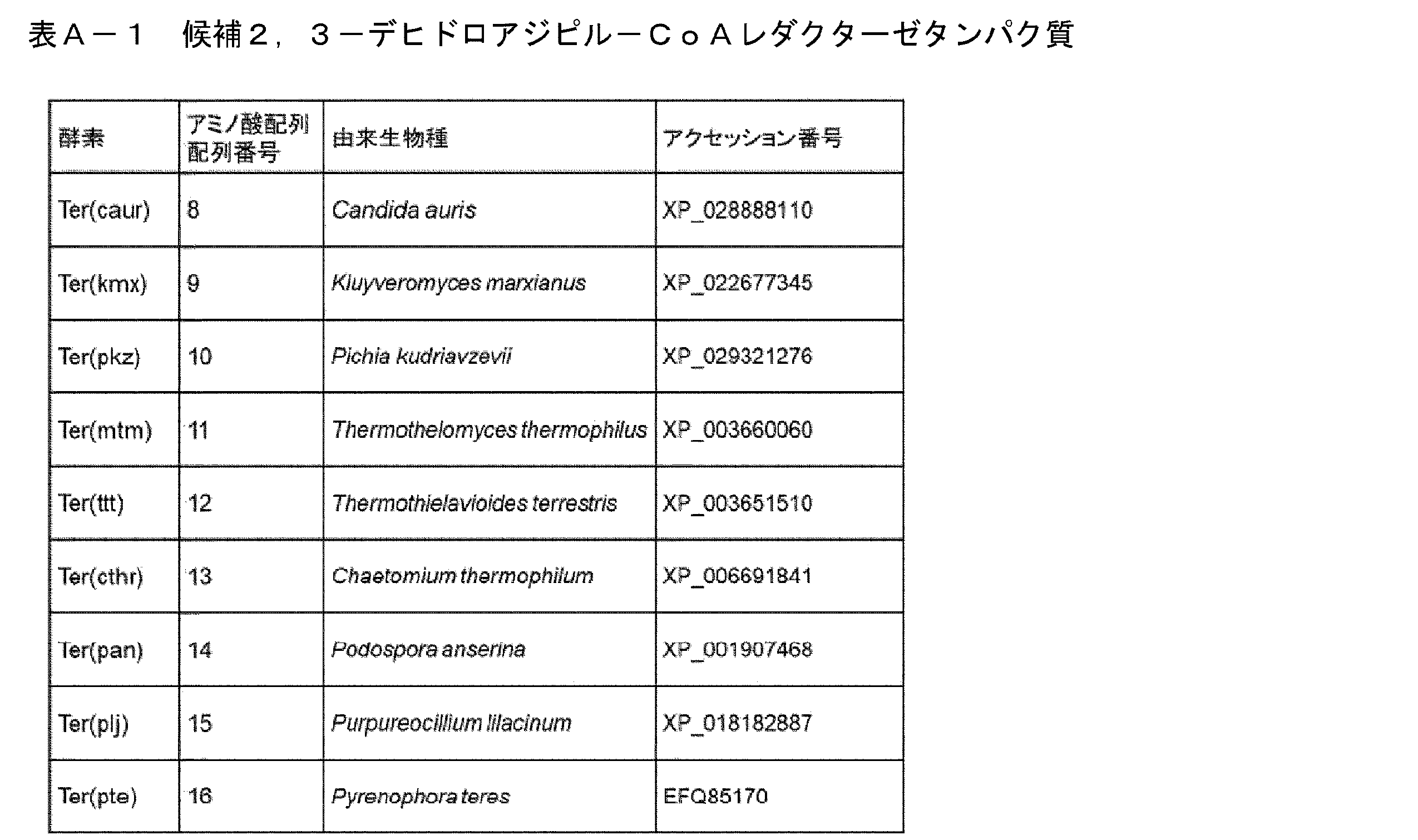
の共発現プラスミドを得た。

構築したプラスミドを大腸菌BL21(DE3)株コンピテントセル(ニッポンジーン社製)に形質転換し、アンピシリンナトリウム50mg/L、カナマイシン硫酸塩30mg/L、(菌株HDO1の構築はさらにクロラムフェニコール30mg/L)を含むLB寒天培地(トリプトン10g/L、酵母エキス5g/L、塩化ナトリウム5g/L、寒天末15g/L)に塗布し、37℃で24時間インキュベートして形質転換体のシングルコロニーを得た。取得した形質転換体を表A-3に示す。

形質転換体ADA1~11を、アンピシリンナトリウム50mg/L、カナマイシン硫酸塩30mg/Lを含むLB液体培地(トリプトン10g/L、酵母エキス5g/L、塩化ナトリウム5g/L)2mL(14mL容ラウンドボトムチューブ)に一白金耳植菌し、37℃で24時間振盪培養を行い、前培養液を得た。得られた前培養液10μLを、アンピシリンナトリウム50mg/L、カナマイシン硫酸塩30mg/Lを含むMM培地1mL(96穴ディープウェルプレート)に植菌し、37℃で48時間振盪培養を行った。MM培地の組成を表A-4に示す。
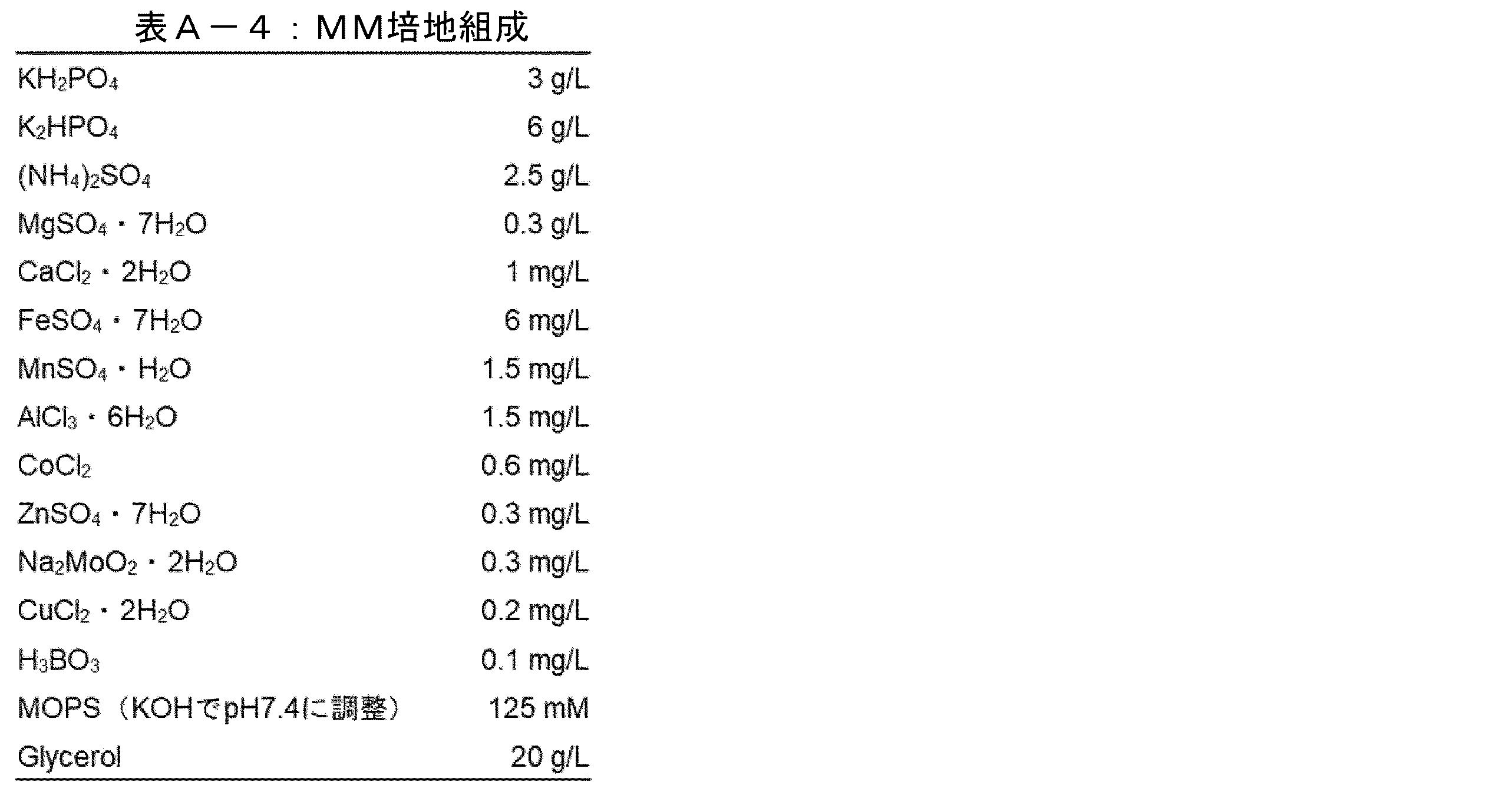
装置:GCMS-QP-2020NX(島津製作所製)
カラム:フューズドシリカキャピラリーチューブ 不活性処理チューブ(長さ1m、外径0.35mm、内径0.25mm、GLサイエンス社製)、InertCap 5MS/NP(長さ30m、内径0.25mm、膜厚0.25μm、GLサイエンス社製)
試料注入量:1μL
試料導入法:スプリット(スプリット比25:1)
気化室温度:230℃
キャリアガス:ヘリウム
キャリアガス線速度:39.0cm/秒
オーブン温度:80℃、2分保持→15℃/分昇温→325℃、13分保持
イオン化法:電子イオン化法(EI)
イオン化エネルギー:70eV
イオン源温度:230℃
スキャン範囲:m/z=50~500

形質転換体HDO1を、アンピシリンナトリウム50mg/L、カナマイシン硫酸塩30mg/L、クロラムフェニコール30mg/Lを含むLB液体培地2mL(14mL容ラウンドボトムチューブ)に一白金耳植菌し、37℃で24時間振盪培養を行い、前培養液を得た。得られた前培養液10μLをアンピシリンナトリウム50mg/L、カナマイシン硫酸塩30mg/L、クロラムフェニコール30mg/Lを含むMM培地1mL(96穴ディープウェルプレート)に植菌し、37℃で48時間振盪培養を行った。
検出器:示差屈折率検出器
カラム:Shim-Pack Fast-OA(G)、Fast-OA(島津製作所製)
オーブン温度:40℃
移動相:8mMメタンスルホン酸水溶液
流速:0.6mL/min
注入量:10μL

大腸菌の遺伝子の破壊・挿入には、pHAK1(受領番号NITE P-02919として、独立行政法人製品評価技術基盤機構 バイオテクノロジーセンター 特許微生物寄託センター(NPMD)(住所:千葉県木更津市かずさ鎌足2-5-8 122号室)に2019年3月18日に寄託した。国際寄託番号:NITE BP-02919)を用いた相同組換え法により行った。pHAK1は温度感受性変異型repA遺伝子、カナマイシン耐性遺伝子、Bacillus subtilis由来レバンスクラーゼ遺伝子sacBを含む。レバンスクラーゼ遺伝子は、スクロース存在下において宿主微生物に対して致死的に作用する。PCR断片の増幅にはPrimeSTAR Max DNA Polymerase(製品名、タカラバイオ製)、または、KOD FX Neo(製品名、東洋紡製)、プラスミド調製は大腸菌HST08株を用いて行った。
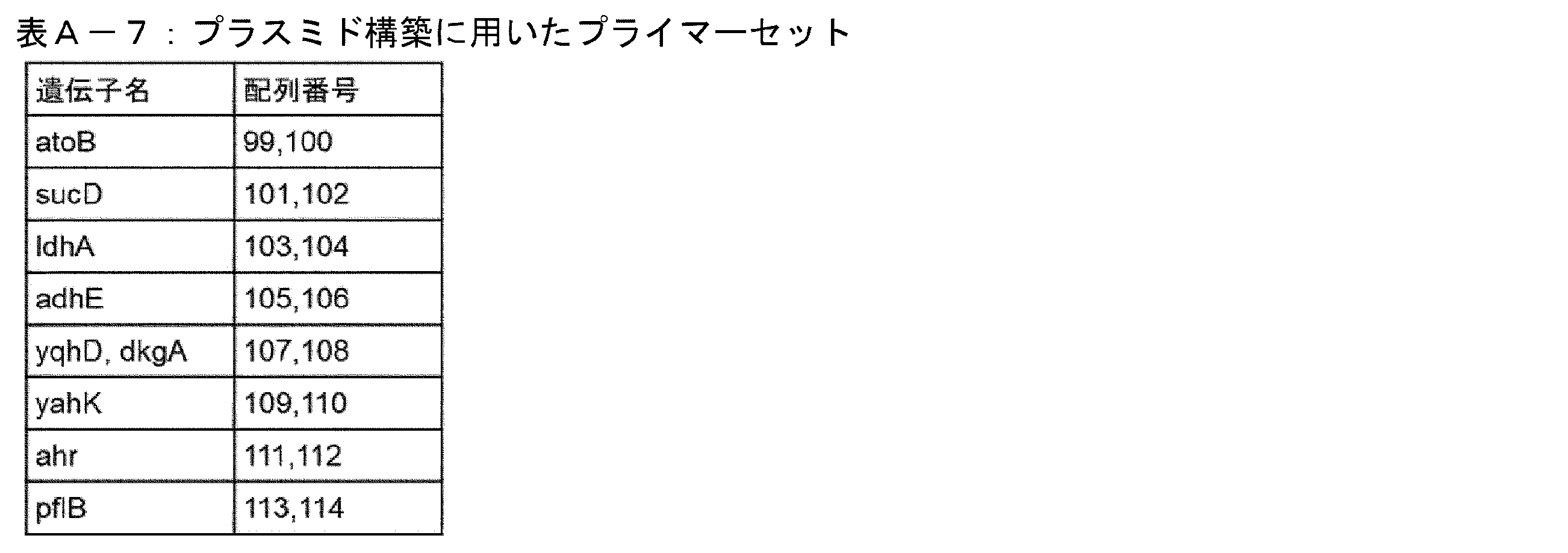

Eshcherichia coliのPaaJ(Ec)(配列番号1)をコードするポリヌクレオチド(配列番号33)は、Eshcherichia coli W3110株(NBRC12713)ゲノムDNAからクローニングを行った。Eshcherichia coliのPaaH(Ec)(配列番号2)をコードするポリヌクレオチド(配列番号38)は、Eshcherichia coli W3110株(NBRC12713)のゲノムDNAからクローニングを行って取得した。
エレクトロポレーション法(羊土社 遺伝子工学実験ノート 田村隆明著、参照)により、大腸菌BL21(DE3)株に所望の遺伝子の破壊または挿入のためのプラスミドを形質転換した後、カナマイシン硫酸塩100mg/Lを含有するLB寒天培地(トリプトン10g/L、酵母エキス5g/L、塩化ナトリウム5g/L、寒天末15g/L)に塗布し、30℃で一晩インキュベートしてシングルコロニーを取得し、形質転換体を得た。本形質転換体をカナマイシン硫酸塩100mg/Lを含有するLB液体培地(トリプトン10g/L、酵母エキス5g/L、塩化ナトリウム5g/L)1mLに一白金耳植菌し、30℃で振盪培養を行った。得られた培養液を、カナマイシン硫酸塩100mg/Lを含有するLB寒天培地に塗布し、42℃で一晩インキュベートし、コロニーを取得した。得られたコロニーをLB液体培地1mLに一白金耳植菌し、30℃で振盪培養を行った。得られた培養液を、スクロース20%を含有するLB寒天培地に塗布し、30℃で2日間インキュベートした。得られたコロニーについて、所望の遺伝子が破壊または挿入されていることを、表A-9に示すプライマーセットを用いたコロニーダイレクトPCRにより確認した。
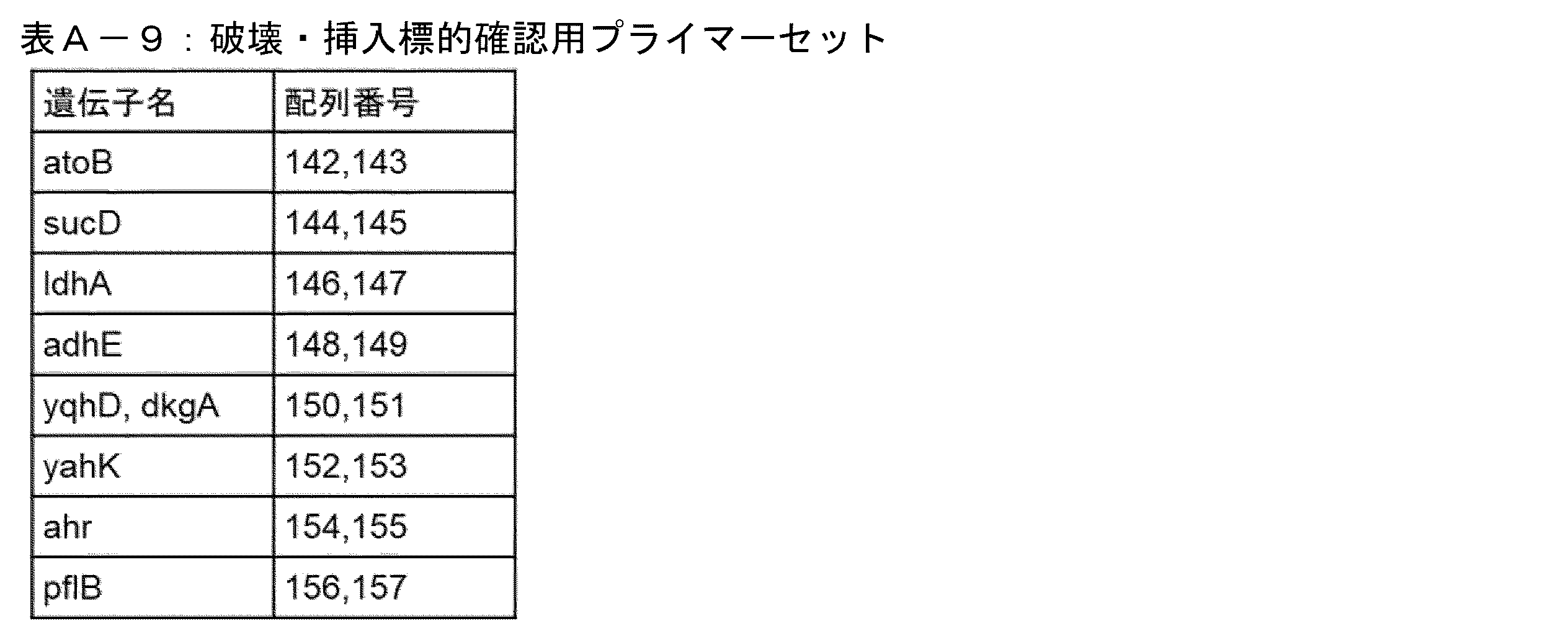

PCR断片の増幅にはPrimeSTAR Max DNA Polymerase(製品名、タカラバイオ製)、または、KOD FX Neo(製品名、東洋紡製)、プラスミドの調製には大腸菌JM109株を用いた。
エレクトロポレーション法により、大腸菌改変株No.060に「paaF(L3)-ter(mtm)-pETDuet」および「ygjG(m)-pACYCDuet」を形質転換し、アンピシリンナトリウム50mg/L、クロラムフェニコール30mg/Lを含むLB寒天培地上で、37℃、一日間培養して、コロニーを形成させ、形質転換体HMD1を得た。アンピシリンナトリウム50mg/L、クロラムフェニコール30mg/Lを含むLB液体培地2mL(14mL容ラウンドボトムチューブ)に形質転換体HMD1のコロニーを一白金耳植菌し、37℃、3~5時間振盪培養を行い、前培養液を得た。250mL容のJar培養装置(機種名 バイオJr.8、バイオット社製)に、カルベニシリンナトリウム50mg/L、クロラムフェニコール30mg/L、IPTG0.02mMを含む合成培地(下表)に前培養液0.5mLを添加し、本培養を行った。培養条件は次の通り;培養温度 37℃;培養pH 7.0;pH調整 10%(w/v)アンモニア水;撹拌 750rpm;通気 1vvm。前培養液植菌から22時間経過時点でグルコースを終濃度35g/Lとなるよう追添し、41時間経過まで培養した。

装置:ICS-3000(Dionex社製)
検出器:電気伝導度検出器
カラム:IonPac CG19(2×50mm)/CS19(2×250mm)(Thermo Scientific社製)
オーブン温度:30℃
移動相:8mMメタンスルホン酸水溶液(A)、70mMメタンスルホン酸水溶液(B)
グラジエント条件:(A:100%、B:0%)-(10min)-(A:0%、B:100%)-(1min保持)
流速:0.28mL/min
注入量:20μL

以下、本発明Bを実施例に基づいて説明するが、本発明Bはこれらの実施例に限定されるものではない。
日本国内の活性汚泥より、アジピン酸を唯一の炭素源及びエネルギー源とする培地を用いて、バークホルデリア属(Burkholderia sp.)LEBP-3株を分離した。バークホルデリア属(Burkholderia sp.)LEBP-3株は、独立行政法人製品評価技術基盤機構特許微生物寄託センター NPMD)(住所:千葉県木更津市かずさ鎌足2-5-8 122号室)に2020年12月4日(原寄託日)付けで寄託申請し(受領番号:NITE ABP-03334)、「受託番号:NITE BP-03334」として国際寄託されている。Burkholderia sp.LEBP-3株の分類的性状は以下に示す通りである。
培養温度:37℃、
細胞形態:桿菌(0.7x1.7-3.0μm)、
グラム染色性:-、
芽胞の有無:-、
運動性:+、
LB寒天培地48h培養時のコロニー形態:直径1.9~2.5mm、淡黄色、円形、
レンズ状、全縁、平滑、不透明、バター様、
30℃生育:+、
45℃生育:+、
カタラーゼ反応:+、
オキシダーゼ反応:+、
グルコースからの酸/ガス産生:+/-、
O/Fテスト(酸化/発酵):+/-、
硝酸塩還元性:-、
インドール産生性:-、
ブドウ糖酸性化性:-、
ウレアーゼ:持たない、
エスクリン分解性:+、
ブドウ糖、L-アラビノース、D-マンノース、N-アセチル-D-グルコサミン、グルコン酸、n-カプリン酸、アジピン酸、リンゴ酸、クエン酸および酢酸フェニル:資化できる、
マルトース:資化できない。
16SrDNA遺伝子の塩基配列解析を行うことにより同定を行った。16SrDNA遺伝子の塩基配列をPCRにて増幅し、シーケンス解析を行った。BLAST相同性検索のデータベースはDB-BA11.0(テクノスルガ・ラボ社)および国際塩基配列データベースを使用した。その結果、LEBP-3株はBurkhlderia属で構成されるクラスター内に含まれたが、何れの既知種とも異なる分子系統学的位置を示したことから、種名の同定に至らなかった。
Burkholderia sp.LEBP-3株の全ゲノムドラフト解析を実施した。LEBP-3株を2mLのLB培地(トリプトン10g/L、酵母エキス5g/L、塩化ナトリウム10g/L)で37℃振とう培養を実施した。培養終了後、培養液から菌体を回収し、Nucleo Spin Tissue(製品名、MACHEREY-NAGEL社製)を使用してゲノムDNAを抽出した。Burkholderia sp.LEBP-3株の全ゲノムドラフト解析およびアノテーションを実施し、7679個のオープンリーディングフレーム(Open reading frame;ORF)を同定した。この情報を元に、スクシニルCoA:アセチルCoAアシルトランスフェラーゼとしてpaaJ(L3)を、3-ヒドロキシアジピルCoAデヒドロゲナーゼとしてpaaH(L3)を、3-ヒドロキシアジピルCoAデヒドラターゼとしてpaaF(L3)を、2,3-デヒドロアジピルCoAレダクターゼとしてmmgC(L3)を同定した。
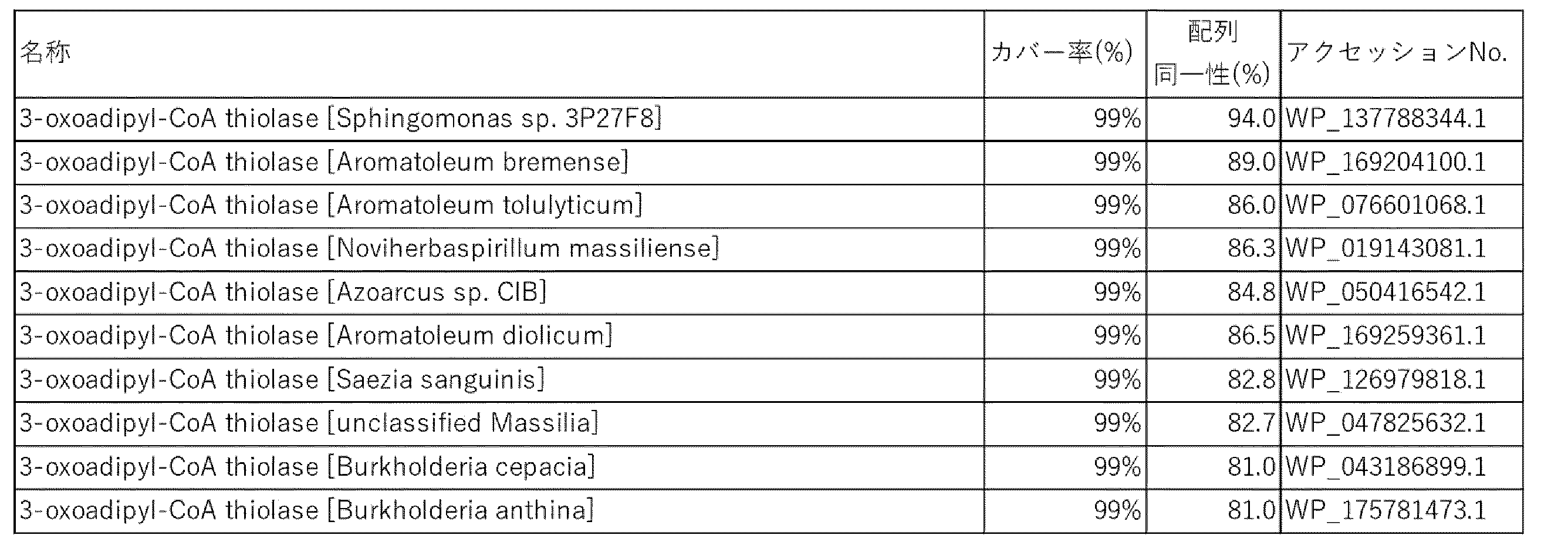
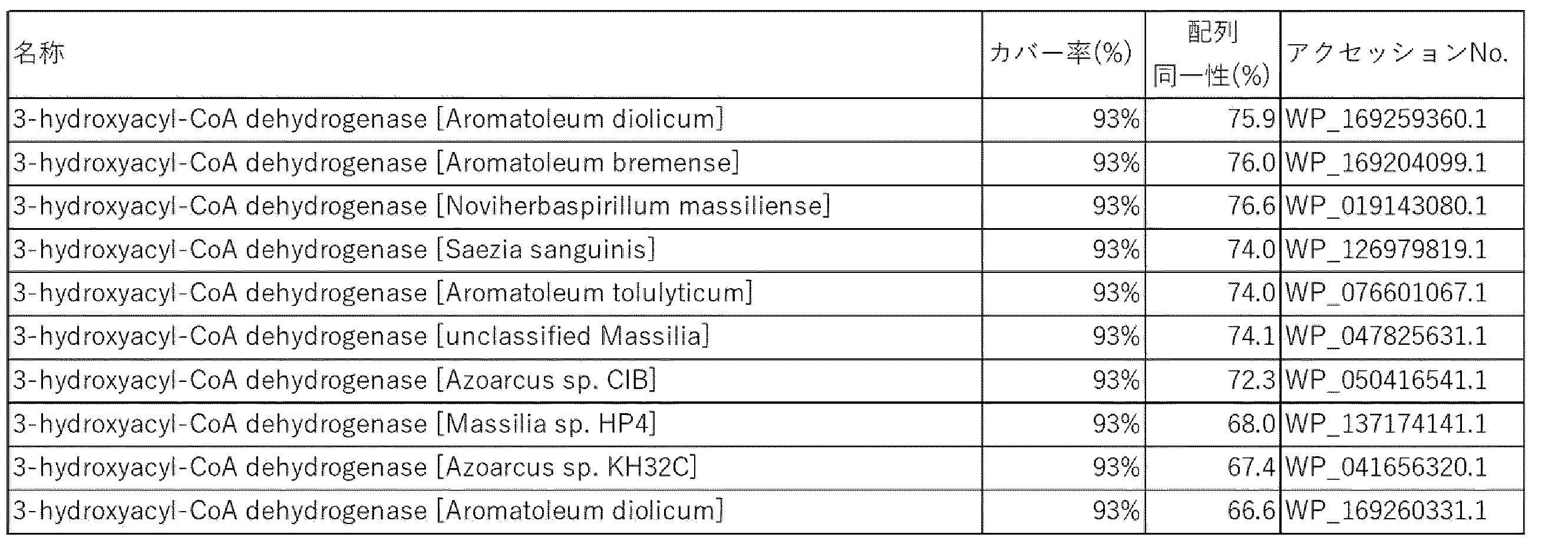

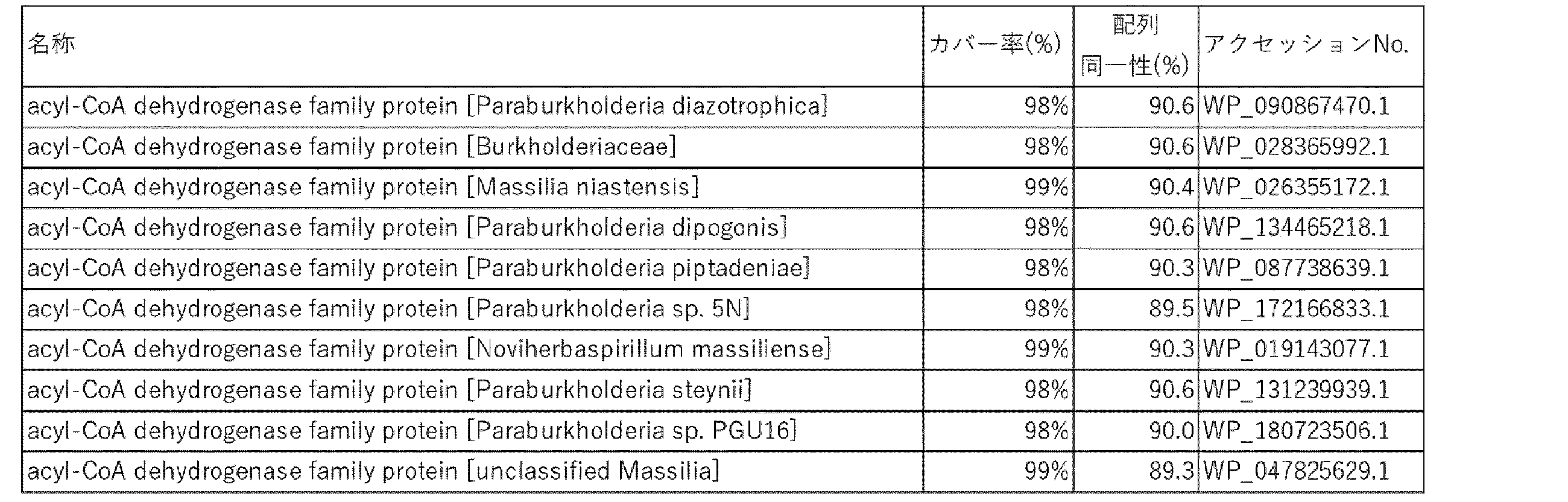
PCR断片の増幅にはPrimeSTAR Max DNA Polymerase(製品名、タカラバイオ製)、プラスミドの調製には大腸菌JM109株を用いた。塩基配列のコドン最適化には、GeneArt GeneOptinizer(ソフトウェア名、サーモフィッシャーサイエンティフィック社)、または、ユーロフィンジェノミクス社の人工遺伝子合成サービスを用いた。

表B-5に示す菌株を、アンピシリンナトリウム50mg/L、カナマイシン硫酸塩30mg/L、およびストレプトマイシン硫酸塩50mg/Lを含むLB液体培地(トリプトン10g/L、酵母エキス5g/L、塩化ナトリウム5g/L)2mL(14mL容ラウンドボトムチューブ)に一白金耳植菌し、37℃で24時間振盪培養を行い、前培養液を得た。前得られた前培養液10μLを、アンピシリンナトリウム50mg/L、カナマイシン硫酸塩30mg/L、およびストレプトマイシン硫酸塩50mg/Lを含むMM培地1mL(96穴ディープウェルプレート)に植菌し、37℃で48時間振盪培養を行った。
MM培地の組成を表B-6に示す。
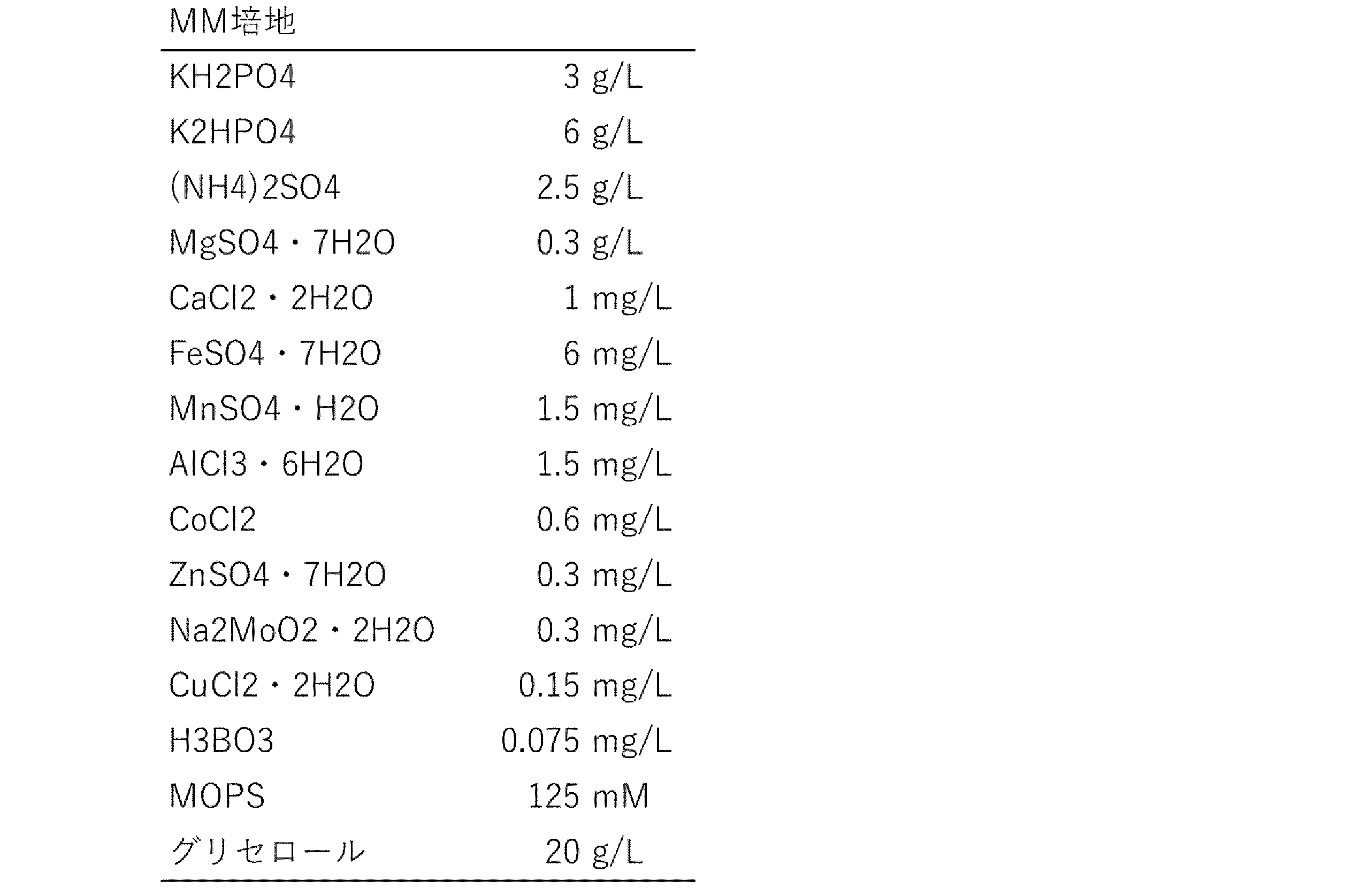
装置:GCMS-QP-2020NX(島津製作所製)
カラム:フューズドシリカキャピラリーチューブ 不活性処理チューブ(長さ1m、外径0.35mm、内径0.25mm、GLサイエンス社製)、InertCap 5MS/NP(長さ30m、内径0.25mm、膜厚0.25μm、GLサイエンス社製)
試料注入量:1μL
試料導入法:スプリット(スプリット比25:1)
気化室温度:230℃
キャリアガス:ヘリウム
キャリアガス線速度:39.0cm/秒
オーブン温度:80℃、2分保持→15℃/分昇温→325℃、13分保持
イオン化法:電子イオン化法(EI)
イオン化エネルギー:70eV
イオン源温度:230℃
スキャン範囲:m/z=50~500
注入量:1μL

Claims (29)
- 2,3-デヒドロアジピル-CoAを還元してアジピルCoAに変換する酵素活性を有するタンパク質をコードする外来性遺伝子を含む組換え微生物であって、
前記外来性遺伝子が、
(i)配列番号8、9、10、11、12、13、14、15または16に示すアミノ酸配列と80%以上の配列同一性を有するアミノ酸配列からなるタンパク質をコードするDNA、
(ii)配列番号8、9、10、11、12、13、14、15または16に示すアミノ酸配列に対して1~10個のアミノ酸が欠失、置換、挿入および/または付加されたアミノ酸配列からなるタンパク質をコードするDNA、
(iii)配列番号57、58、59、60、61、62、63、64または65に示すポリヌクレオチド配列と80%以上の配列同一性を有するポリヌクレオチド配列からなるDNA、
(iv)配列番号57、58、59、60、61、62、63、64または65に示すポリヌクレオチド配列によりコードされるタンパク質のアミノ酸配列に対して1~10個のアミノ酸が欠失、置換、挿入および/または付加されたアミノ酸配列からなるタンパク質をコードするDNA、
(v)配列番号57、58、59、60、61、62、63、64または65に示すポリヌクレオチド配列に相補的なポリヌクレオチド配列からなるDNAと緊縮条件下でハイブリダイズするDNA、または
(vi)配列番号57、58、59、60、61、62、63、64または65に示すポリヌクレオチド配列の縮重異性体からなるDNA
である、組換え微生物。 - 前記外来性遺伝子が、
(xi)配列番号8、9、10、11、12、13、14、15または16に示すアミノ酸配列からなるタンパク質をコードするDNA、または、
(xiii)配列番号57、58、59、60、61、62、63、64または65に示すポリヌクレオチド配列からなるDNA
である、請求項1に記載の組換え微生物。 - 前記外来性遺伝子が、Candida auris、Kluyveromyces marxianus、Pichia kudriavzevii、Thermothelomyces thermophilus、Thermothielavioides terrestris、Chaetomium thermophilum、Podospora anserina、Purpureocillium lilacinumおよびPyrenophora teresから選択される少なくとも1つに由来する、請求項1または2に記載の組換え微生物。
- 前記組換え微生物が、C6化合物の生産経路を有し、
前記C6化合物が、アジピン酸、ヘキサメチレンジアミン、1,6-ヘキサンジオール、6-アミノヘキサン酸、6-アミノ-1-ヘキサノールおよび6-ヒドロキシヘキサン酸からなる群から選択される少なくとも一つである、請求項1~3のいずれか1項に記載の組換え微生物。 - 前記組換え微生物が、エスケリキア(Escherichia)属、バチルス(Bacillus)属、コリネバクテリウム(Corynebacterium)属、アルスロバクター(Arthrobacter)属、ブレビバクテリウム(Brevibacterium)属、クロストリジウム(Clostridium)属、ザイモモナス(Zymomonas)属、シュードモナス(Pseudomonas)属、バークホルデリア(Burkholderia)属、ストレプトマイセス(Streptomyces)属、ロドコッカス(Rhodococcus)属、シネコシスティス(Synechocystis)属、アルカリハロバチルス(Alkalihalobacillus)属、サッカロマイセス(Saccharomyces)属、シゾサッカロマイセス(Schizosaccharomyces)属、ヤロウィア(Yarrowia)属、カンジタ(Candida)属、ピキア(Pichia)属、またはアスペルギルス(Aspergillus)属に属する、請求項1~4のいずれか1項に記載の組換え微生物。
- 前記組換え微生物が、大腸菌(Escherichia coli)である、請求項1~5のいずれか1項に記載の組換え微生物。
- ・3-オキソアジピルCoAチオラーゼをコードする遺伝子、
・3-ヒドロキシアジピルCoAデヒドロゲナーゼをコードする遺伝子、
・3-ヒドロキシアジピルCoAデヒドラターゼをコードする遺伝子、
・カルボン酸レダクターゼをコードする遺伝子、
・アルコールデヒドロゲナーゼをコードする遺伝子、および
・トランスアミナーゼ(アミノトランスフェラーゼ)をコードする遺伝子
からなる群より選択される少なくとも1つをさらに含む、請求項1~6のいずれか1項に記載の組換え微生物。 - 請求項1~7のいずれか1項に記載の組換え微生物を培養する培養工程を含む、C6化合物の製造方法であって、
前記C6化合物が、アジピン酸、ヘキサメチレンジアミン、1,6-ヘキサンジオール、6-アミノヘキサン酸、6-アミノ-1-ヘキサノールおよび6-ヒドロキシヘキサン酸からなる群から選択される少なくとも一つである、製造方法。 - (a)2,3-デヒドロアジピル-CoAを還元してアジピルCoAに変換する酵素活性を有し、
(b)以下:
(i)配列番号8、9、10、11、12、13、14、15または16に示すアミノ酸配列と80%以上の配列同一性を有するアミノ酸配列からなる、
(ii)配列番号8、9、10、11、12、13、14、15または16に示すアミノ酸配列に対して1~10個のアミノ酸が欠失、置換、挿入および/または付加されたアミノ酸配列からなる、
(iii)配列番号57、58、59、60、61、62、63、64または65に示すポリヌクレオチド配列と80%以上の配列同一性を有するポリヌクレオチド配列からなるDNAによってコードされる、
(iv)配列番号57、58、59、60、61、62、63、64または65に示すポリヌクレオチド配列によりコードされるタンパク質のアミノ酸配列に対して1~10個のアミノ酸が欠失、置換、挿入および/または付加されたアミノ酸配列からなる、
(v)配列番号57、58、59、60、61、62、63、64または65に示すポリヌクレオチド配列に相補的なポリヌクレオチド配列からなるDNAと緊縮条件下でハイブリダイズするDNAによってコードされる、および
(vi)配列番号57、58、59、60、61、62、63、64または65に示すポリヌクレオチド配列の縮重異性体からなるDNAによってコードされる
のいずれかである、組換えタンパク質。 - (xi)配列番号8、9、10、11、12、13、14、15または16に示すアミノ酸配列からなるか、または、
(xiii)配列番号57、58、59、60、61、62、63、64または65に示すポリヌクレオチド配列からなるDNAによってコードされる、組換えタンパク質。 - 請求項9または10に記載の組換えタンパク質を用いることを含む、C6化合物の製造方法。
- 3-ヒドロキシアジピルCoAデヒドラターゼをコードする外来性遺伝子および2,3-デヒドロアジピルCoAレダクターゼをコードする外来性遺伝子のうちの少なくとも1つを含む、組換え微生物。
- 前記3-ヒドロキシアジピルCoAデヒドラターゼおよび2,3-デヒドロアジピルCoAレダクターゼの少なくとも1つが、バークホルデリア属(Burkholderia sp.)LEBP-3株(受託番号:NITE BP-03334)に由来する、請求項12に記載の組換え微生物。
- 前記3-ヒドロキシアジピルCoAデヒドラターゼが、バークホルデリア属(Burkholderia sp.)LEBP-3株の染色体DNAを鋳型とし、
(1a)配列番号168に示す塩基配列からなるヌクレオチドおよび配列番号169に示す塩基配列からなるヌクレオチド、または
(1b)配列番号168に示す塩基配列を含むヌクレオチドおよび配列番号169に示す塩基配列を含むヌクレオチド
をプライマーとして使用したPCR増幅物と配列同一性が80%以上、85%以上、88%以上、90%以上、93%以上、95%以上、97%以上、98%以上または99%以上であるDNAにコードされ、
当該DNAは、626~940bpを有する、請求項12または13に記載の組換え微生物。 - 前記2,3-デヒドロアジピルCoAレダクターゼが、バークホルデリア属(Burkholderia sp.)LEBP-3株の染色体DNAを鋳型とし、
(2a)配列番号170に示す塩基配列からなるヌクレオチドおよび配列番171に示す塩基配列からなるヌクレオチド、または
(2b)配列番号170に示す塩基配列を含むヌクレオチドおよび配列番号171に示す塩基配列を含むヌクレオチド
をプライマーとして使用したPCR増幅物と配列同一性が80%以上、85%以上、88%以上、90%以上、93%以上、95%以上、97%以上、98%以上または99%以上であるDNAにコードされ、
当該DNAは、924~1386bpを有する、請求項12~14のいずれか1項に記載の組換え微生物。 - 前記3-ヒドロキシアジピルCoAデヒドラターゼが、バークホルデリア属(Burkholderia sp.)LEBP-3株の染色体DNAを鋳型とし、
(1a)配列番号168に示す塩基配列からなるヌクレオチドおよび配列番号169に示す塩基配列からなるヌクレオチド、または
(1b)配列番号168に示す塩基配列を含むヌクレオチドおよび配列番号169に示す塩基配列を含むヌクレオチド
をプライマーとして使用したPCR増幅物であるDNAにコードされ、
当該DNAは、783または784bpを有する、請求項12または13に記載の組換え微生物。 - 前記2,3-デヒドロアジピルCoAレダクターゼが、バークホルデリア属(Burkholderia sp.)LEBP-3株の染色体DNAを鋳型とし、
(2a)配列番号170に示す塩基配列からなるヌクレオチドおよび配列番号171に示す塩基配列からなるヌクレオチド、または
(2b)配列番号170に示す塩基配列を含むヌクレオチドおよび配列番号171に示す塩基配列を含むヌクレオチド
をプライマーとして使用したPCR増幅物であるDNAにコードされ、
当該DNAは、1155または1156bpを有する、請求項12~14のいずれか1項に記載の組換え微生物。 - 上記組換え微生物が、エッセリシア属、コリネバクテリウム属、バチルス属、アシネトバクター属、バークホルデリア属、シュードモナス属、クロストリジウム属、サッカロマイセス属、シゾサッカロマイセス属、ヤロウィア属、カンジタ属、ピキア属およびアスペルギルス属からなる群より選択される属に属する、請求項12~17のいずれか1項に記載の組換え微生物。
- アジピン酸生産経路を有する、請求項12~18のいずれか一項に記載の組換え微生物。
- ヘキサメチレンジアミン生産経路を有する、請求項12~19のいずれか一項に記載の組換え微生物。
- 1,6-ヘキサンジオール生産経路を有する、請求項12~19のいずれか一項に記載の組換え微生物。
- 6-アミノ-1-ヘキサノール生産経路を有する、請求項12~19のいずれか一項に記載の組換え微生物。
- 請求項12~18のいずれか1項に記載の組換え微生物を培養する培養工程を含む、目的化合物の製造方法であって、
前記目的化合物が、アジピン酸、アジピン酸誘導体、ヘキサメチレンジアミン、1,6-ヘキサンジオールおよび6-アミノ-1-ヘキサノールからなる群より選択され、
前記アジピン酸誘導体が、オキソアジピン酸、レブリン酸、3-ヒドロキシアジピン酸および2,3-デヒドロアジピン酸からなる群より選択される、製造方法。 - 請求項19に記載の組換え微生物を培養する培養工程を含む、アジピン酸の製造方法。
- 請求項20に記載の組換え微生物を培養する培養工程を含む、ヘキサメチレンジアミンの製造方法。
- 請求項21に記載の組換え微生物を培養する培養工程を含む、1,6-ヘキサンジオールの製造方法。
- 請求項22に記載の組換え微生物を培養する培養工程を含む、6-アミノ-1-ヘキサノールの製造方法。
- (A-1)バークホルデリア属(Burkholderia sp.)LEBP-3株の染色体DNAを鋳型とし、
(a1)配列番号168に示す塩基配列からなるヌクレオチドおよび配列番号169に示す塩基配列からなるヌクレオチド、または
(a2)配列番号168に示す塩基配列を含むヌクレオチドおよび配列番号169に示す塩基配列を含むヌクレオチド
をプライマーとして使用したPCR増幅物と配列同一性が80%以上、85%以上、88%以上、90%以上、93%以上、95%以上、97%以上、98%以上または99%以上であるDNAにコードされる組換えポリペプチドであって、
3-ヒドロキシアジピルCoAデヒドラターゼ活性を有し、
前記DNAは、626~940bpを有する、組換えポリペプチド;
(A-2)バークホルデリア属(Burkholderia sp.)LEBP-3株の染色体DNAを鋳型とし、
(a1)配列番号168に示す塩基配列からなるヌクレオチドおよび配列番号169に示す塩基配列からなるヌクレオチド、または
(a2)配列番号168に示す塩基配列を含むヌクレオチドおよび配列番号169に示す塩基配列を含むヌクレオチド
をプライマーとして使用したPCR増幅物であるDNAによりコードされるポリペプチドのアミノ酸配列に対して1~10個のアミノ酸が欠失、置換、挿入および/または付加されたアミノ酸配列からなる組換えポリペプチドであって、
3-ヒドロキシアジピルCoAデヒドラターゼ活性を有し、
前記DNAは、626~940bpを有する、組換えポリペプチド;
または
(A-3)バークホルデリア属(Burkholderia sp.)LEBP-3株の染色体DNAを鋳型とし、
(a1)配列番号168に示す塩基配列からなるヌクレオチドおよび配列番号169に示す塩基配列からなるヌクレオチド、または
(a2)配列番号168に示す塩基配列を含むヌクレオチドおよび配列番号169に示す塩基配列を含むヌクレオチド
をプライマーとして使用したPCR増幅物の縮重異性体からなるDNAにコードされる組換えポリペプチドであって、
3-ヒドロキシアジピルCoAデヒドラターゼ活性を有し、
前記DNAは、626~940bpを有する、組換えポリペプチド。 - (B-1)バークホルデリア属(Burkholderia sp.)LEBP-3株の染色体DNAを鋳型とし、
(b1)配列番号170に示す塩基配列からなるヌクレオチドおよび配列番号171に示す塩基配列からなるヌクレオチド、または
(b2)配列番号170に示す塩基配列を含むヌクレオチドおよび配列番号171に示す塩基配列を含むヌクレオチド
をプライマーとして使用したPCR増幅物と配列同一性が80%以上、85%以上、88%以上、90%以上、93%以上、95%以上、97%以上、98%以上または99%以上であるDNAにコードされる組換えポリペプチドであって、
2,3-デヒドロアジピルCoAレダクターゼ活性を有し、
前記DNAは、924~1386bpを有する、組換えポリペプチド;
(B-2)バークホルデリア属(Burkholderia sp.)LEBP-3株の染色体DNAを鋳型とし、
(b1)配列番号170に示す塩基配列からなるヌクレオチドおよび配列番号171に示す塩基配列からなるヌクレオチド、または
(b2)配列番号170に示す塩基配列を含むヌクレオチドおよび配列番号171に示す塩基配列を含むヌクレオチド
をプライマーとして使用したPCR増幅物であるDNAによりコードされるポリペプチドのアミノ酸配列に対して1~10個のアミノ酸が欠失、置換、挿入および/または付加されたアミノ酸配列からなる組換えポリペプチドであって、
2,3-デヒドロアジピルCoAレダクターゼ活性を有し、
前記DNAは、924~1386bpを有する、組換えポリペプチド;
または
(B-3)バークホルデリア属(Burkholderia sp.)LEBP-3株の染色体DNAを鋳型とし、
(b1)配列番号170に示す塩基配列からなるヌクレオチドおよび配列番号171に示す塩基配列からなるヌクレオチド、または
(b2)配列番号170に示す塩基配列を含むヌクレオチドおよび配列番号171に示す塩基配列を含むヌクレオチド
をプライマーとして使用したPCR増幅物の縮重異性体からなるDNAにコードされる組換えポリペプチドであって、
2,3-デヒドロアジピルCoAレダクターゼ活性を有し、
前記DNAは、924~1386bpを有する、組換えポリペプチド。
Priority Applications (5)
| Application Number | Priority Date | Filing Date | Title |
|---|---|---|---|
| EP22780919.1A EP4317416A4 (en) | 2021-03-30 | 2022-03-29 | Recombinant microorganism and method for producing a C6 compound |
| JP2023511377A JP7625070B2 (ja) | 2021-03-30 | 2022-03-29 | 組換え微生物及びc6化合物の製造方法 |
| CN202280025115.9A CN117441008A (zh) | 2021-03-30 | 2022-03-29 | 重组微生物和c6化合物的制造方法 |
| US18/284,539 US20240158803A1 (en) | 2021-03-30 | 2022-03-29 | Recombinant microorganism and method for producing c6 compound |
| KR1020237037089A KR20230159611A (ko) | 2021-03-30 | 2022-03-29 | 재조합 미생물 및 c6 화합물의 제조 방법 |
Applications Claiming Priority (4)
| Application Number | Priority Date | Filing Date | Title |
|---|---|---|---|
| JP2021057325A JP7038241B1 (ja) | 2021-03-30 | 2021-03-30 | 組換え微生物及びアジピン酸又はその誘導体の製造方法 |
| JP2021-057325 | 2021-03-30 | ||
| JP2021069632 | 2021-04-16 | ||
| JP2021-069632 | 2021-04-16 |
Publications (1)
| Publication Number | Publication Date |
|---|---|
| WO2022210708A1 true WO2022210708A1 (ja) | 2022-10-06 |
Family
ID=83456322
Family Applications (1)
| Application Number | Title | Priority Date | Filing Date |
|---|---|---|---|
| PCT/JP2022/015439 Ceased WO2022210708A1 (ja) | 2021-03-30 | 2022-03-29 | 組換え微生物及びc6化合物の製造方法 |
Country Status (5)
| Country | Link |
|---|---|
| US (1) | US20240158803A1 (ja) |
| EP (1) | EP4317416A4 (ja) |
| JP (1) | JP7625070B2 (ja) |
| KR (1) | KR20230159611A (ja) |
| WO (1) | WO2022210708A1 (ja) |
Cited By (3)
| Publication number | Priority date | Publication date | Assignee | Title |
|---|---|---|---|---|
| CN117821351A (zh) * | 2023-12-29 | 2024-04-05 | 淮北矿业绿色化工新材料研究院有限公司 | 一种生产己二胺的菌株及其制备方法 |
| CN118185844A (zh) * | 2023-12-29 | 2024-06-14 | 淮北矿业绿色化工新材料研究院有限公司 | 一种己二胺高产菌株及其制备方法 |
| EP4317437A4 (en) * | 2021-03-30 | 2024-11-20 | Asahi Kasei Kabushiki Kaisha | Recombinant polypeptide having carboxylic acid reducing activity |
Citations (7)
| Publication number | Priority date | Publication date | Assignee | Title |
|---|---|---|---|---|
| WO1995007996A1 (en) | 1993-09-16 | 1995-03-23 | Purdue Research Foundation | Synthesis of adipic acid from biomass-derived carbon sources |
| WO2010104391A2 (en) | 2009-03-11 | 2010-09-16 | Dsm Ip Assets B.V. | Preparation of adipic acid |
| JP2011512868A (ja) | 2008-03-11 | 2011-04-28 | ディーエスエム アイピー アセッツ ビー.ブイ. | アジピン酸(エステルまたはチオエステル)の合成 |
| JP2011515111A (ja) | 2008-03-27 | 2011-05-19 | ジェノマティカ, インコーポレイテッド | アジピン酸および他の化合物を生成するための微生物 |
| JP2016533162A (ja) * | 2013-09-17 | 2016-10-27 | ズィモケム インコーポレイテッドZymochem Inc. | 再生可能資源から化合物を生成するための高収量経路 |
| JP2018500911A (ja) * | 2014-12-23 | 2018-01-18 | ジェノマティカ, インコーポレイテッド | ジアミンの製造および処理方法 |
| WO2020219859A1 (en) | 2019-04-24 | 2020-10-29 | Genomatica, Inc. | Engineered trans-enoyl coa reductase and methods of making and using |
Family Cites Families (3)
| Publication number | Priority date | Publication date | Assignee | Title |
|---|---|---|---|---|
| JPH077996A (ja) | 1991-06-12 | 1995-01-10 | Yuuji Tanose | 水中で気体を発生させ、その浮力を利用して発電する浮力発電 システム |
| JP2010104391A (ja) | 2008-10-28 | 2010-05-13 | Hoya Corp | 蛍光観察用プローブ |
| WO2012089613A1 (en) * | 2010-12-28 | 2012-07-05 | Dsm Ip Assets B.V. | Process to increase the production of a succinyl-coa derived compound |
-
2022
- 2022-03-29 KR KR1020237037089A patent/KR20230159611A/ko active Pending
- 2022-03-29 WO PCT/JP2022/015439 patent/WO2022210708A1/ja not_active Ceased
- 2022-03-29 EP EP22780919.1A patent/EP4317416A4/en active Pending
- 2022-03-29 US US18/284,539 patent/US20240158803A1/en active Pending
- 2022-03-29 JP JP2023511377A patent/JP7625070B2/ja active Active
Patent Citations (8)
| Publication number | Priority date | Publication date | Assignee | Title |
|---|---|---|---|---|
| WO1995007996A1 (en) | 1993-09-16 | 1995-03-23 | Purdue Research Foundation | Synthesis of adipic acid from biomass-derived carbon sources |
| JP2011512868A (ja) | 2008-03-11 | 2011-04-28 | ディーエスエム アイピー アセッツ ビー.ブイ. | アジピン酸(エステルまたはチオエステル)の合成 |
| JP2011515111A (ja) | 2008-03-27 | 2011-05-19 | ジェノマティカ, インコーポレイテッド | アジピン酸および他の化合物を生成するための微生物 |
| JP5951990B2 (ja) | 2008-03-27 | 2016-07-13 | ジェノマティカ, インコーポレイテッド | アジピン酸および他の化合物を生成するための微生物 |
| WO2010104391A2 (en) | 2009-03-11 | 2010-09-16 | Dsm Ip Assets B.V. | Preparation of adipic acid |
| JP2016533162A (ja) * | 2013-09-17 | 2016-10-27 | ズィモケム インコーポレイテッドZymochem Inc. | 再生可能資源から化合物を生成するための高収量経路 |
| JP2018500911A (ja) * | 2014-12-23 | 2018-01-18 | ジェノマティカ, インコーポレイテッド | ジアミンの製造および処理方法 |
| WO2020219859A1 (en) | 2019-04-24 | 2020-10-29 | Genomatica, Inc. | Engineered trans-enoyl coa reductase and methods of making and using |
Non-Patent Citations (14)
| Title |
|---|
| "Gene Cloning and DNA analysis", 2016, WILEY-BLACKWELL |
| "Gene Expression Technology: Methods in Enzymology", vol. 185, 1990, ACADEMIC PRESS, pages: 185 |
| CAS , no. 1191-25-9 |
| DATABASE PROTEIN 15 November 2017 (2017-11-15), ANONYMOUS : "hypothetical protein B9J08_005027 [[Candida] auris]", XP055974415, retrieved from NCBI Database accession no. B9J08_005027 * |
| EHMANN ET AL., BIOCHEMISTRY, vol. 38, no. 19, 1999, pages 6171 - 6177 |
| GALMAN ET AL., GREEN CHEMISTRY, vol. 19, no. 2, 2017, pages 361 - 366 |
| GENE, vol. 105, 1991, pages 61 - 72 |
| KALLSCHEUER, NICOLAI ET AL.: "Improved production of adipate with Escherichia coli by reversal of β-oxidation.", APPLIED MICROBIOLOGY AND BIOTECHNOLOGY, vol. 101, no. 6, 2017, pages 2371 - 2382 |
| LU ET AL., JOURNAL OF BACTERIOLOGY, vol. 184, no. 14, 2002, pages 3765 - 3773 |
| SAMSONOVA ET AL., BMC MICROBIOLOGY, vol. 3, no. 1, 2003, pages 2 |
| SATTLER ET AL., ANGEWANDTE CHEMIE, vol. 124, no. 36, 2012, pages 9290 - 9293 |
| See also references of EP4317416A4 |
| SUNG ET AL., GREEN CHEMISTRY, vol. 20, no. 20, 2018, pages 4591 - 4595 |
| VENKITASUBRAMANIAN ET AL., JOURNAL OF BIOLOGICAL CHEMISTRY, vol. 282, no. 1, 2007, pages 478 - 485 |
Cited By (5)
| Publication number | Priority date | Publication date | Assignee | Title |
|---|---|---|---|---|
| EP4317437A4 (en) * | 2021-03-30 | 2024-11-20 | Asahi Kasei Kabushiki Kaisha | Recombinant polypeptide having carboxylic acid reducing activity |
| CN117821351A (zh) * | 2023-12-29 | 2024-04-05 | 淮北矿业绿色化工新材料研究院有限公司 | 一种生产己二胺的菌株及其制备方法 |
| CN118185844A (zh) * | 2023-12-29 | 2024-06-14 | 淮北矿业绿色化工新材料研究院有限公司 | 一种己二胺高产菌株及其制备方法 |
| CN118185844B (zh) * | 2023-12-29 | 2024-12-03 | 淮北矿业绿色化工新材料研究院有限公司 | 一种己二胺高产菌株及其制备方法 |
| CN117821351B (zh) * | 2023-12-29 | 2024-12-03 | 淮北矿业绿色化工新材料研究院有限公司 | 一种生产己二胺的菌株及其制备方法 |
Also Published As
| Publication number | Publication date |
|---|---|
| KR20230159611A (ko) | 2023-11-21 |
| JP7625070B2 (ja) | 2025-01-31 |
| JPWO2022210708A1 (ja) | 2022-10-06 |
| EP4317416A4 (en) | 2025-06-25 |
| US20240158803A1 (en) | 2024-05-16 |
| EP4317416A1 (en) | 2024-02-07 |
Similar Documents
| Publication | Publication Date | Title |
|---|---|---|
| US20230022583A1 (en) | Adipate (ester or thioester) synthesis | |
| US20200255840A1 (en) | High yield route for the production of 1, 6-hexanediol | |
| JP7625070B2 (ja) | 組換え微生物及びc6化合物の製造方法 | |
| CN102690774A (zh) | 重组微生物、重组载体及制备3-羟基丙酸的方法 | |
| WO2009089457A1 (en) | Methods for producing 3-hydroxypropionic acid and compounds thereof | |
| EP3155108A1 (en) | Methods, reagents and cells for biosynthesizing compounds | |
| JP2022530475A (ja) | 遺伝子操作された微生物及びアルデヒド脱水素酵素活性の改善方法 | |
| US12104160B2 (en) | Production of 4,6-dihydroxy-2-oxo-hexanoic acid | |
| JP7038241B1 (ja) | 組換え微生物及びアジピン酸又はその誘導体の製造方法 | |
| CN117441008A (zh) | 重组微生物和c6化合物的制造方法 | |
| JP7827466B2 (ja) | 改変微生物及び化合物の製造方法 | |
| JP7696228B2 (ja) | 組換え微生物及び化合物の製造方法 | |
| CN117500912A (zh) | 具有二胺生产能力的重组微生物和二胺的制造方法 | |
| JP7672486B2 (ja) | ジアミン生産能を有する組換え微生物およびジアミンの製造方法 | |
| JP2023132560A (ja) | 1,2-シクロヘキサンジオール生合成のための微生物および製造方法 | |
| JP2025087535A (ja) | 組換え微生物、組換えタンパク質およびc6化合物の製造方法 | |
| JP2024092581A (ja) | カルボン酸生産能を有する好塩性の組換え微生物 | |
| JP2023127841A (ja) | 2,6-キシレノール生合成のための微生物および製造方法 | |
| JP2023012570A (ja) | リジンアンモニアリアーゼ活性を有する組換えポリペプチド | |
| AU2015203845B2 (en) | Adipate ester or thioester synthesis | |
| WO2025170543A1 (en) | Production of 1,4-butanediol via condensation of c1-derived formyl-coa and 3-hydroxypropionaldehyde derived from glycerol, ethylene glycol, and c1 feedstocks |
Legal Events
| Date | Code | Title | Description |
|---|---|---|---|
| 121 | Ep: the epo has been informed by wipo that ep was designated in this application |
Ref document number: 22780919 Country of ref document: EP Kind code of ref document: A1 |
|
| WWE | Wipo information: entry into national phase |
Ref document number: 202280025115.9 Country of ref document: CN |
|
| WWE | Wipo information: entry into national phase |
Ref document number: 2301006250 Country of ref document: TH Ref document number: 2023511377 Country of ref document: JP |
|
| WWE | Wipo information: entry into national phase |
Ref document number: 18284539 Country of ref document: US |
|
| ENP | Entry into the national phase |
Ref document number: 20237037089 Country of ref document: KR Kind code of ref document: A |
|
| WWE | Wipo information: entry into national phase |
Ref document number: 1020237037089 Country of ref document: KR |
|
| WWE | Wipo information: entry into national phase |
Ref document number: 2022780919 Country of ref document: EP |
|
| NENP | Non-entry into the national phase |
Ref country code: DE |
|
| ENP | Entry into the national phase |
Ref document number: 2022780919 Country of ref document: EP Effective date: 20231030 |