WO2022211067A1 - フッ素樹脂組成物、及び、成形体 - Google Patents
フッ素樹脂組成物、及び、成形体 Download PDFInfo
- Publication number
- WO2022211067A1 WO2022211067A1 PCT/JP2022/016738 JP2022016738W WO2022211067A1 WO 2022211067 A1 WO2022211067 A1 WO 2022211067A1 JP 2022016738 W JP2022016738 W JP 2022016738W WO 2022211067 A1 WO2022211067 A1 WO 2022211067A1
- Authority
- WO
- WIPO (PCT)
- Prior art keywords
- fluororesin
- mass
- less
- fluororesin composition
- powder
- Prior art date
- Legal status (The legal status is an assumption and is not a legal conclusion. Google has not performed a legal analysis and makes no representation as to the accuracy of the status listed.)
- Ceased
Links
Classifications
-
- C—CHEMISTRY; METALLURGY
- C08—ORGANIC MACROMOLECULAR COMPOUNDS; THEIR PREPARATION OR CHEMICAL WORKING-UP; COMPOSITIONS BASED THEREON
- C08L—COMPOSITIONS OF MACROMOLECULAR COMPOUNDS
- C08L27/00—Compositions of homopolymers or copolymers of compounds having one or more unsaturated aliphatic radicals, each having only one carbon-to-carbon double bond, and at least one being terminated by a halogen; Compositions of derivatives of such polymers
- C08L27/02—Compositions of homopolymers or copolymers of compounds having one or more unsaturated aliphatic radicals, each having only one carbon-to-carbon double bond, and at least one being terminated by a halogen; Compositions of derivatives of such polymers not modified by chemical after-treatment
- C08L27/12—Compositions of homopolymers or copolymers of compounds having one or more unsaturated aliphatic radicals, each having only one carbon-to-carbon double bond, and at least one being terminated by a halogen; Compositions of derivatives of such polymers not modified by chemical after-treatment containing fluorine atoms
- C08L27/18—Homopolymers or copolymers or tetrafluoroethene
-
- C—CHEMISTRY; METALLURGY
- C08—ORGANIC MACROMOLECULAR COMPOUNDS; THEIR PREPARATION OR CHEMICAL WORKING-UP; COMPOSITIONS BASED THEREON
- C08F—MACROMOLECULAR COMPOUNDS OBTAINED BY REACTIONS ONLY INVOLVING CARBON-TO-CARBON UNSATURATED BONDS
- C08F14/00—Homopolymers and copolymers of compounds having one or more unsaturated aliphatic radicals, each having only one carbon-to-carbon double bond, and at least one being terminated by a halogen
- C08F14/18—Monomers containing fluorine
- C08F14/26—Tetrafluoroethene
-
- B—PERFORMING OPERATIONS; TRANSPORTING
- B29—WORKING OF PLASTICS; WORKING OF SUBSTANCES IN A PLASTIC STATE IN GENERAL
- B29C—SHAPING OR JOINING OF PLASTICS; SHAPING OF MATERIAL IN A PLASTIC STATE, NOT OTHERWISE PROVIDED FOR; AFTER-TREATMENT OF THE SHAPED PRODUCTS, e.g. REPAIRING
- B29C43/00—Compression moulding, i.e. applying external pressure to flow the moulding material; Apparatus therefor
- B29C43/003—Compression moulding, i.e. applying external pressure to flow the moulding material; Apparatus therefor characterised by the choice of material
-
- B—PERFORMING OPERATIONS; TRANSPORTING
- B29—WORKING OF PLASTICS; WORKING OF SUBSTANCES IN A PLASTIC STATE IN GENERAL
- B29C—SHAPING OR JOINING OF PLASTICS; SHAPING OF MATERIAL IN A PLASTIC STATE, NOT OTHERWISE PROVIDED FOR; AFTER-TREATMENT OF THE SHAPED PRODUCTS, e.g. REPAIRING
- B29C43/00—Compression moulding, i.e. applying external pressure to flow the moulding material; Apparatus therefor
- B29C43/02—Compression moulding, i.e. applying external pressure to flow the moulding material; Apparatus therefor of articles of definite length, i.e. discrete articles
-
- C—CHEMISTRY; METALLURGY
- C08—ORGANIC MACROMOLECULAR COMPOUNDS; THEIR PREPARATION OR CHEMICAL WORKING-UP; COMPOSITIONS BASED THEREON
- C08F—MACROMOLECULAR COMPOUNDS OBTAINED BY REACTIONS ONLY INVOLVING CARBON-TO-CARBON UNSATURATED BONDS
- C08F2/00—Processes of polymerisation
- C08F2/12—Polymerisation in non-solvents
- C08F2/16—Aqueous medium
- C08F2/18—Suspension polymerisation
-
- C—CHEMISTRY; METALLURGY
- C08—ORGANIC MACROMOLECULAR COMPOUNDS; THEIR PREPARATION OR CHEMICAL WORKING-UP; COMPOSITIONS BASED THEREON
- C08F—MACROMOLECULAR COMPOUNDS OBTAINED BY REACTIONS ONLY INVOLVING CARBON-TO-CARBON UNSATURATED BONDS
- C08F214/00—Copolymers of compounds having one or more unsaturated aliphatic radicals, each having only one carbon-to-carbon double bond, and at least one being terminated by a halogen
- C08F214/18—Monomers containing fluorine
- C08F214/26—Tetrafluoroethene
-
- C—CHEMISTRY; METALLURGY
- C08—ORGANIC MACROMOLECULAR COMPOUNDS; THEIR PREPARATION OR CHEMICAL WORKING-UP; COMPOSITIONS BASED THEREON
- C08J—WORKING-UP; GENERAL PROCESSES OF COMPOUNDING; AFTER-TREATMENT NOT COVERED BY SUBCLASSES C08B, C08C, C08F, C08G or C08H
- C08J3/00—Processes of treating or compounding macromolecular substances
- C08J3/005—Processes for mixing polymers
-
- C—CHEMISTRY; METALLURGY
- C08—ORGANIC MACROMOLECULAR COMPOUNDS; THEIR PREPARATION OR CHEMICAL WORKING-UP; COMPOSITIONS BASED THEREON
- C08J—WORKING-UP; GENERAL PROCESSES OF COMPOUNDING; AFTER-TREATMENT NOT COVERED BY SUBCLASSES C08B, C08C, C08F, C08G or C08H
- C08J3/00—Processes of treating or compounding macromolecular substances
- C08J3/12—Powdering or granulating
-
- C—CHEMISTRY; METALLURGY
- C08—ORGANIC MACROMOLECULAR COMPOUNDS; THEIR PREPARATION OR CHEMICAL WORKING-UP; COMPOSITIONS BASED THEREON
- C08J—WORKING-UP; GENERAL PROCESSES OF COMPOUNDING; AFTER-TREATMENT NOT COVERED BY SUBCLASSES C08B, C08C, C08F, C08G or C08H
- C08J3/00—Processes of treating or compounding macromolecular substances
- C08J3/12—Powdering or granulating
- C08J3/16—Powdering or granulating by coagulating dispersions
-
- B—PERFORMING OPERATIONS; TRANSPORTING
- B29—WORKING OF PLASTICS; WORKING OF SUBSTANCES IN A PLASTIC STATE IN GENERAL
- B29K—INDEXING SCHEME ASSOCIATED WITH SUBCLASSES B29B, B29C OR B29D, RELATING TO MOULDING MATERIALS OR TO MATERIALS FOR MOULDS, REINFORCEMENTS, FILLERS OR PREFORMED PARTS, e.g. INSERTS
- B29K2027/00—Use of polyvinylhalogenides or derivatives thereof as moulding material
- B29K2027/12—Use of polyvinylhalogenides or derivatives thereof as moulding material containing fluorine
- B29K2027/18—PTFE, i.e. polytetrafluoroethylene, e.g. ePTFE, i.e. expanded polytetrafluoroethylene
-
- B—PERFORMING OPERATIONS; TRANSPORTING
- B29—WORKING OF PLASTICS; WORKING OF SUBSTANCES IN A PLASTIC STATE IN GENERAL
- B29K—INDEXING SCHEME ASSOCIATED WITH SUBCLASSES B29B, B29C OR B29D, RELATING TO MOULDING MATERIALS OR TO MATERIALS FOR MOULDS, REINFORCEMENTS, FILLERS OR PREFORMED PARTS, e.g. INSERTS
- B29K2105/00—Condition, form or state of moulded material or of the material to be shaped
- B29K2105/25—Solid
- B29K2105/251—Particles, powder or granules
-
- C—CHEMISTRY; METALLURGY
- C08—ORGANIC MACROMOLECULAR COMPOUNDS; THEIR PREPARATION OR CHEMICAL WORKING-UP; COMPOSITIONS BASED THEREON
- C08F—MACROMOLECULAR COMPOUNDS OBTAINED BY REACTIONS ONLY INVOLVING CARBON-TO-CARBON UNSATURATED BONDS
- C08F214/00—Copolymers of compounds having one or more unsaturated aliphatic radicals, each having only one carbon-to-carbon double bond, and at least one being terminated by a halogen
- C08F214/18—Monomers containing fluorine
- C08F214/26—Tetrafluoroethene
- C08F214/262—Tetrafluoroethene with fluorinated vinyl ethers
-
- C—CHEMISTRY; METALLURGY
- C08—ORGANIC MACROMOLECULAR COMPOUNDS; THEIR PREPARATION OR CHEMICAL WORKING-UP; COMPOSITIONS BASED THEREON
- C08J—WORKING-UP; GENERAL PROCESSES OF COMPOUNDING; AFTER-TREATMENT NOT COVERED BY SUBCLASSES C08B, C08C, C08F, C08G or C08H
- C08J2327/00—Characterised by the use of homopolymers or copolymers of compounds having one or more unsaturated aliphatic radicals, each having only one carbon-to-carbon double bond, and at least one being terminated by a halogen; Derivatives of such polymers
- C08J2327/02—Characterised by the use of homopolymers or copolymers of compounds having one or more unsaturated aliphatic radicals, each having only one carbon-to-carbon double bond, and at least one being terminated by a halogen; Derivatives of such polymers not modified by chemical after-treatment
- C08J2327/12—Characterised by the use of homopolymers or copolymers of compounds having one or more unsaturated aliphatic radicals, each having only one carbon-to-carbon double bond, and at least one being terminated by a halogen; Derivatives of such polymers not modified by chemical after-treatment containing fluorine atoms
- C08J2327/18—Homopolymers or copolymers of tetrafluoroethylene
-
- C—CHEMISTRY; METALLURGY
- C08—ORGANIC MACROMOLECULAR COMPOUNDS; THEIR PREPARATION OR CHEMICAL WORKING-UP; COMPOSITIONS BASED THEREON
- C08J—WORKING-UP; GENERAL PROCESSES OF COMPOUNDING; AFTER-TREATMENT NOT COVERED BY SUBCLASSES C08B, C08C, C08F, C08G or C08H
- C08J2427/00—Characterised by the use of homopolymers or copolymers of compounds having one or more unsaturated aliphatic radicals, each having only one carbon-to-carbon double bond, and at least one being terminated by a halogen; Derivatives of such polymers
- C08J2427/02—Characterised by the use of homopolymers or copolymers of compounds having one or more unsaturated aliphatic radicals, each having only one carbon-to-carbon double bond, and at least one being terminated by a halogen; Derivatives of such polymers not modified by chemical after-treatment
- C08J2427/12—Characterised by the use of homopolymers or copolymers of compounds having one or more unsaturated aliphatic radicals, each having only one carbon-to-carbon double bond, and at least one being terminated by a halogen; Derivatives of such polymers not modified by chemical after-treatment containing fluorine atoms
- C08J2427/18—Homopolymers or copolymers of tetrafluoroethylene
-
- C—CHEMISTRY; METALLURGY
- C08—ORGANIC MACROMOLECULAR COMPOUNDS; THEIR PREPARATION OR CHEMICAL WORKING-UP; COMPOSITIONS BASED THEREON
- C08L—COMPOSITIONS OF MACROMOLECULAR COMPOUNDS
- C08L2205/00—Polymer mixtures characterised by other features
- C08L2205/02—Polymer mixtures characterised by other features containing two or more polymers of the same C08L -group
- C08L2205/025—Polymer mixtures characterised by other features containing two or more polymers of the same C08L -group containing two or more polymers of the same hierarchy C08L, and differing only in parameters such as density, comonomer content, molecular weight, structure
-
- C—CHEMISTRY; METALLURGY
- C08—ORGANIC MACROMOLECULAR COMPOUNDS; THEIR PREPARATION OR CHEMICAL WORKING-UP; COMPOSITIONS BASED THEREON
- C08L—COMPOSITIONS OF MACROMOLECULAR COMPOUNDS
- C08L2205/00—Polymer mixtures characterised by other features
- C08L2205/03—Polymer mixtures characterised by other features containing three or more polymers in a blend
Definitions
- the present disclosure relates to a fluororesin composition and a molded article.
- PTFE Polytetrafluoroethylene
- Patent Literatures 1 and 2 describe techniques for recycling PTFE pulverized after sintering and heated PTFE.
- An object of the present disclosure is to provide a fluororesin composition that has excellent tensile properties despite containing a fluororesin that has been heated to a temperature above its melting point, and a molded article obtained from the fluororesin composition.
- the present disclosure provides a fluororesin composition that does not exhibit melt fluidity, including a fluororesin A that has a history of being heated to a temperature equal to or higher than the melting point and does not exhibit melt fluidity, and a fluororesin B that exhibits melt fluidity. .
- the fluororesin A is preferably polytetrafluoroethylene.
- the fluororesin B preferably has an MFR of 0.25 g/10 minutes or more.
- the fluororesin B is preferably a fluororesin having a melting point of 320° C. or lower.
- the fluororesin composition preferably further contains a fluororesin C that does not exhibit melt fluidity and has a portion that has not been heated to a temperature equal to or higher than its melting point.
- the fluororesin composition preferably has one or more melting points in a temperature range of less than 333°C and one or more melting points in a temperature range of 333 to 360°C.
- the fluororesin composition contains tetrafluoroethylene units and modified monomer units based on modified monomers copolymerizable with tetrafluoroethylene, and the amount of the modified monomer units is 1.0% by mass with respect to all polymerized units. The following are preferable.
- the fluororesin composition preferably has an average secondary particle size of 5 to 700 ⁇ m.
- the content of the low-molecular-weight fluorine-containing compound is preferably 1 ppm by mass or less relative to the fluororesin composition.
- the fluororesin composition is preferably powder.
- the fluororesin composition is preferably a powder for compression molding.
- the fluororesin composition preferably has a tensile strength at break of 10 MPa or more.
- the fluororesin composition preferably has a tensile strain at break of 150% or more.
- the present disclosure also provides a molded article obtained by compression molding and baking the fluororesin composition.
- a fluororesin composition having excellent tensile properties despite containing a fluororesin that has been heated to a temperature above its melting point, and a molded article obtained from the fluororesin composition. can be done.
- the present disclosure provides a fluororesin composition that does not exhibit melt fluidity, including a fluororesin A that has a history of being heated to a temperature equal to or higher than the melting point and does not exhibit melt fluidity, and a fluororesin B that exhibits melt fluidity.
- the fluororesin composition of the present disclosure contains the fluororesin B that exhibits melt fluidity, it has tensile properties (e.g., tensile breaking strength, Tensile breaking strain). This effect is considered to be due to the fact that the interfaces between the particles of the fluororesin A are filled with the fluororesin B during molding.
- the fluororesin composition of the present disclosure as a method for distinguishing between fluororesin A and fluororesin B, for example, the fluororesin composition is placed on a hot stage and observed under a microscope while the temperature is raised at 5 ° C./min. and determining which of the fluororesin A and B the particles are based on whether or not the shape of the particles is maintained.
- the fluororesin A has a history of being heated to a temperature equal to or higher than its melting point.
- Examples of the heating include heating for molding, heat treatment, and the like.
- the fluororesin A preferably has a melting point of 100°C or higher and lower than 333°C, more preferably lower than 332°C, and even more preferably lower than 331°C.
- the lower limit is not limited, it is more preferably 140°C, and even more preferably 180°C or higher.
- the fluororesin A preferably has one or more melting points in the temperature range below 333°C.
- the temperature range of less than 333° C. is more preferably less than 332° C., further preferably less than 331° C., preferably 100° C. or higher, more preferably 140° C. or higher, It is more preferably 180°C or higher.
- the fact that the melting point is within the above range indicates that there is a history of heating to a temperature equal to or higher than the melting point.
- the fluororesin A may also have a melting point in the temperature range of 333° C. or higher.
- the melting point of the fluororesin is the heat of fusion obtained by performing differential scanning calorimetry [DSC] at a heating rate of 10° C./min using X-DSC7000 (manufactured by Hitachi High-Tech Science Co., Ltd.). is the temperature corresponding to the minimum point on the curve. If there are two or more local minimum points in one melting peak, each point is taken as the melting point.
- the fluororesin A does not exhibit melt fluidity.
- the term "not exhibiting melt fluidity” means that the melt flow rate (MFR) is less than 0.25 g/10 minutes, preferably less than 0.10 g/10 minutes, and more preferably 0.05 g/10 minutes or less. It means that there is In this specification, MFR is defined by the type of fluororesin using a melt indexer according to ASTM D1238, the measurement temperature (for example, 372 ° C. for PFA and FEP, 297 ° C.
- load eg, 5 kg for PFA, FEP and ETFE
- load eg, 5 kg for PFA, FEP and ETFE
- PTFE it is a value obtained by measuring under the same measurement conditions as PFA.
- the reduction rate of the thickness after heating relative to the thickness before heating is 20%. If it is less than or the thickness after heating is greater than the thickness before heating, it also means that the fluororesin does not exhibit melt fluidity.
- polytetrafluoroethylene [PTFE] is preferable.
- the PTFE may be high molecular weight PTFE.
- the PTFE as the fluororesin A may be a homopolymer of TFE, or may be a polymer unit based on 99.0% by mass or more of TFE and a polymer unit based on 1.0% by mass or less of a modified monomer (hereinafter referred to as (also referred to as "modified monomer units").
- the modified PTFE may be composed only of polymerized units based on TFE and modified monomer units.
- the content of modified monomer units in the modified PTFE is preferably in the range of 0.00001 to 1.0% by mass based on the total polymerized units.
- the lower limit of the modified monomer unit content is more preferably 0.0001% by mass, still more preferably 0.001% by mass, even more preferably 0.005% by mass, and particularly preferably 0.010% by mass.
- the upper limit of the modified monomer unit content is preferably 0.90% by mass, more preferably 0.50% by mass, still more preferably 0.40% by mass, even more preferably 0.30% by mass, and 0.20% by mass. % by weight is particularly preferred, and 0.10% by weight is particularly preferred.
- the modified monomer unit means a part of the molecular structure of PTFE that is derived from the modified monomer.
- the modified monomer is not particularly limited as long as it can be copolymerized with TFE.
- examples include perfluoroolefin such as hexafluoropropylene [HFP]; hydrogen such as trifluoroethylene and vinylidene fluoride [VDF]. Containing fluoroolefin; perhaloolefin such as chlorotrifluoroethylene; perfluorovinyl ether: perfluoroallyl ether; (perfluoroalkyl)ethylene, ethylene and the like.
- one type of modifying monomer may be used, or a plurality of types thereof may be used.
- Rf represents a perfluoro organic group
- perfluoro organic group means an organic group in which all hydrogen atoms bonded to carbon atoms are substituted with fluorine atoms.
- the perfluoro organic group may have an ether oxygen.
- perfluorovinyl ether examples include perfluoro(alkyl vinyl ether) [PAVE] in which Rf is a perfluoroalkyl group having 1 to 10 carbon atoms in the general formula (A).
- the perfluoroalkyl group preferably has 1 to 5 carbon atoms.
- Examples of the perfluoroalkyl group in PAVE include perfluoromethyl group, perfluoroethyl group, perfluoropropyl group, perfluorobutyl group, perfluoropentyl group, perfluorohexyl group and the like.
- Rf is a perfluoro(alkoxyalkyl) group having 4 to 9 carbon atoms, and Rf is the following formula:
- Rf is the following formula:
- n an integer of 1 to 4.
- PFAE Perfluoroalkylethylene
- examples thereof include (perfluorobutyl)ethylene (PFBE) and (perfluorohexyl)ethylene.
- Rf 1 is preferably a perfluoroalkyl group having 1 to 10 carbon atoms or a perfluoroalkoxyalkyl group having 1 to 10 carbon atoms.
- the above PTFE as the fluororesin A preferably has a standard specific gravity (SSG) of 2.280 or less, more preferably 2.10 or less. Moreover, it is preferably 1.50 or more, and more preferably 1.60 or more.
- SSG is measured by a water displacement method in accordance with ASTM D-792 using a sample molded in accordance with ASTM D 4895-89.
- the above PTFE as the fluororesin A usually has non-melt secondary processability.
- the above non-melt secondary processability means the property that the melt flow rate cannot be measured at a temperature higher than the melting point in accordance with ASTM D-1238 and D-2116, in other words, the property that does not flow easily even in the melting temperature range. do.
- One of the melting points of PTFE (high molecular weight PTFE) as the fluororesin A is preferably 310°C or higher, more preferably 320°C or higher, and preferably lower than 333°C. It may also have a melting point in the temperature range of 333° C. or higher.
- the fluororesin composition of the present disclosure may contain fluororesin A particles.
- the particles of the fluororesin A may be secondary particles of the fluororesin A.
- the particles of the fluororesin A preferably have an average secondary particle size of 1 to 200 ⁇ m.
- the average secondary particle size is more preferably 5 ⁇ m or more, further preferably 10 ⁇ m or more, more preferably 150 ⁇ m or less, further preferably 100 ⁇ m or less, and 70 ⁇ m or less. is even more preferable, particularly preferably 50 ⁇ m or less, and most preferably 30 ⁇ m or less.
- the average secondary particle diameter is measured using a Beckman Coulter laser diffraction particle size distribution analyzer (LS13 320) in a dry manner at a vacuum pressure of 20 mH 2 O, and 50% of the integrated particle size distribution (volume basis). be equal to the particle size corresponding to
- the particles of the fluororesin A preferably have a D90 of 10 ⁇ m or more, more preferably 30 ⁇ m or more, still more preferably 50 ⁇ m or more, and preferably 600 ⁇ m or less, and 500 ⁇ m or less. is more preferable, and 400 ⁇ m or less is even more preferable.
- the above D90 is measured using a Beckman Coulter laser diffraction particle size distribution analyzer (LS13 320) in a dry manner at a vacuum pressure of 20 mH 2 O, and the particles corresponding to 90% of the integrated particle size distribution (volume basis). equal to the diameter.
- the particles of the fluororesin A are obtained, for example, by compression-molding a fluororesin that has not been heated to a temperature above its melting point and does not exhibit melt fluidity, and pulverizing the shavings of the molded product obtained by firing. be able to.
- the pulverization can be performed with a pulverizer or the like. After coarsely pulverizing, it may be pulverized.
- the shape of compression molding is not particularly limited.
- the firing temperature should be higher than the melting point of the fluororesin.
- the pulverizer is not particularly limited as long as it can pulverize (preferably refine) the cutting waste. Examples include air jet mills, hammer mills, force mills, stone mills, freeze grinders, and the like.
- the particles of the fluororesin A are obtained by heating the fluororesin powder, which has no history of heating to a temperature above the melting point and does not exhibit melt fluidity, to a temperature above the melting point without compression molding, and then pulverizing the powder using a pulverizer.
- the crusher is the same as above.
- the fluororesin B exhibits melt fluidity.
- exhibiting melt fluidity means having an MFR of 0.25 g/10 minutes or more, preferably 0.50 g/10 minutes or more, and more preferably 1.00 g/10 minutes or more.
- the MFR may be 100 g/10 minutes or less, preferably 80 g/10 minutes or less.
- the fluororesin B preferably has no history of being heated to a temperature equal to or higher than its melting point.
- the fluororesin B preferably has a melting point of 100 to 340°C.
- the melting point is more preferably 140° C. or higher, more preferably 160° C. or higher, more preferably 336° C. or lower, even more preferably 333° C. or lower, and 332° C. or lower. 331° C. or lower is even more preferred, and 330° C. or lower is particularly preferred.
- the melting point of the fluororesin B can be measured by the above-described method.
- the fluororesin B is small, for example, 5% by mass or less with respect to the total of the fluororesin A and the fluororesin B, it cannot be detected by the above method. It can be difficult.
- the temperature is raised again at a rate of 10 ° C./min. melting peaks can be detected. The temperature may be raised by this method.
- the fluororesin B is preferably at least one selected from the group consisting of a fluororesin having a melting point of 320° C. or less and a low-molecular-weight polytetrafluoroethylene (low-molecular-weight PTFE), and a fluororesin having a melting point of 320° C. or less. more preferred.
- a perfluororesin is also preferable.
- fluororesin having a melting point of 320° C. or lower examples include tetrafluoroethylene [TFE]/perfluoro(alkyl vinyl ether) [PAVE] or perfluoro(alkyl allyl ether) copolymer [PFA], TFE/hexafluoropropylene [HFP].
- the PFA contains TFE units and PAVE units or perfluoro(alkylallyl ether) units.
- PAVE include monomers in which Rf is a perfluoroalkyl group having 1 to 10 carbon atoms in the general formula (A).
- Examples of the above perfluoro(alkyl allyl ether) include monomers in which Rf 1 is a perfluoroalkyl group having 1 to 10 carbon atoms in the above general formula (B).
- the PFA is not particularly limited, but the molar ratio of TFE units to PAVE units or perfluoro(alkylallyl ether) units (TFE units/(PAVE units or perfluoro(alkylallyl ether) units)) is 70/ Copolymers with a ratio of 30 or more and less than 99/1 are preferred. A more preferable molar ratio is 70/30 or more and 98.9/1.1 or less, and a still more preferable molar ratio is 80/20 or more and 98.9/1.1 or less.
- the above PFA contains 0.1 to 10 mol% of polymer units derived from monomers copolymerizable with TFE and PAVE or perfluoro(alkyl allyl ether) (TFE units and PAVE units or perfluoro(alkyl allyl ether) It is also preferred that the total amount of units is 90 to 99.9 mol %), more preferably 0.1 to 5 mol %, particularly preferably 0.2 to 4 mol %.
- monomers copolymerizable with TFE and PAVE or perfluoro(alkylallyl ether) further include itaconic acid, itaconic anhydride, citraconic anhydride, and 5-norbornene-2,3-dicarboxylic anhydride. and unsaturated monocarboxylic acids, unsaturated dicarboxylic acids, acid anhydrides of unsaturated dicarboxylic acids, and the like.
- the PFA preferably has a melting point of 180 to 320°C, more preferably 230 to 320°C, even more preferably 280 to 320°C.
- the PFA preferably has an MFR of 0.25 g/10 min or more and 100 g/10 min or less, more preferably 0.5 g/10 min or more, and 1.0 g/10 min or more. More preferably, it is 90 g/10 minutes or less, and even more preferably 80 g/10 minutes or less.
- the MFR of PFA is measured using a melt indexer in accordance with ASTM D1238 at a temperature of 372°C and a load of 5 kg. is the value obtained as
- the FEP is not particularly limited, a copolymer having a molar ratio of TFE units to HFP units (TFE units/HFP units) of 70/30 or more and less than 99/1 is preferable. A more preferable molar ratio is 70/30 or more and 98.9/1.1 or less, and a still more preferable molar ratio is 80/20 or more and 98.9/1.1 or less.
- the FEP contains 0.1 to 10 mol% polymerized units derived from monomers copolymerizable with TFE and HFP (TFE units and HFP units total 90 to 99.9 mol%), more preferably 0 .1 to 5 mol %, particularly preferably 0.2 to 4 mol %, are also preferred.
- Monomers copolymerizable with TFE and HFP include PAVE, monomers represented by formula (III), and alkyl perfluorovinyl ether derivatives represented by formula (II).
- Monomers copolymerizable with TFE and HFP further include unsaturated monocarboxylic acids such as itaconic acid, itaconic anhydride, citraconic anhydride, and 5-norbornene-2,3-dicarboxylic anhydride. , unsaturated dicarboxylic acids, acid anhydrides of unsaturated dicarboxylic acids, and the like.
- the above FEP preferably has a melting point of 150 to 320°C, more preferably 200 to 320°C, even more preferably 240 to 320°C.
- the FEP has an MFR of preferably 0.25 g/10 min or more and 100 g/10 min or less, more preferably 0.5 g/10 min or more, and 1.0 g/10 min or more. More preferably, it is 80 g/10 minutes or less, and even more preferably 60 g/10 minutes or less.
- the MFR of FEP is measured using a melt indexer in accordance with ASTM D1238 at a temperature of 372°C and a load of 5 kg. is the value obtained as
- ETFE a copolymer having a molar ratio of TFE units to ethylene units (TFE units/ethylene units) of 20/80 or more and 90/10 or less is preferable.
- a more preferable molar ratio is 37/63 or more and 85/15 or less, and a still more preferable molar ratio is 38/62 or more and 80/20 or less.
- ETFE may be a copolymer consisting of TFE, ethylene, and monomers copolymerizable with TFE and ethylene.
- Rf 5 represents a perfluoroalkyl group having 1 to 5 carbon atoms. represents a perfluoroalkyl group having 1 to 5 carbon atoms) and a perfluoroalkyl allyl ether represented by CH 2 ⁇ CX 1 Rf 4 in which Rf 4 is a fluoroalkyl group having 1 to 8 carbon atoms.
- Fluorinated vinyl monomers are more preferred.
- the monomer copolymerizable with TFE and ethylene may be aliphatic unsaturated carboxylic acids such as itaconic acid and itaconic anhydride.
- the monomer copolymerizable with TFE and ethylene is preferably 0.1 to 10 mol%, more preferably 0.1 to 5 mol%, particularly 0.2 to 4 mol%, relative to the fluorine-containing polymer. preferable.
- the ETFE preferably has a melting point of 140 to 320°C, more preferably 160 to 320°C, even more preferably 195 to 320°C.
- the ETFE preferably has an MFR of 0.25 g/10 min or more and 100 g/10 min or less, more preferably 0.5 g/10 min or more, and 1.0 g/10 min or more. More preferably, it is 90 g/10 minutes or less, and even more preferably 80 g/10 minutes or less.
- the MFR of ETFE is measured using a melt indexer in accordance with ASTM D1238 at a temperature of 297°C and a load of 5 kg. is the value obtained as
- the low-molecular-weight PTFE preferably has a melt viscosity (complex viscosity) at 380° C. of 1.0 ⁇ 10 1 to 1.0 ⁇ 10 7 Pa ⁇ s.
- the melt viscosity is more preferably 1.0 ⁇ 10 2 Pa ⁇ s or more, still more preferably 1.5 ⁇ 10 3 Pa ⁇ s or more, and 7.0 ⁇ 10 3 Pa ⁇ s or more. more preferably 7.0 ⁇ 10 5 Pa s or less, even more preferably 3.0 ⁇ 10 5 Pa s or less, and 1.0 ⁇ 10 5 Pa ⁇ It is particularly preferable that the value is equal to or less than s.
- "low molecular weight PTFE” means PTFE having the melt viscosity within the above range.
- the above melt viscosity was measured in accordance with ASTM D 1238 using a flow tester (manufactured by Shimadzu Corporation) and a 2 ⁇ -8L die, and a 2g sample preheated at 380°C for 5 minutes under a load of 0.7MPa. It is a value measured while maintaining the above temperature.
- the low-molecular-weight PTFE has an MFR value of 0.25 g/10, which is obtained as the mass (g/10 minutes) of the polymer that flows out per 10 minutes from a nozzle having an inner diameter of 2.095 mm and a length of 8 mm at 372° C. and a load of 5 kg. minutes or more, more preferably 0.10 g/10 minutes or more, and even more preferably 0.05 g/10 minutes or more.
- the MFR is also preferably 50 g/10 minutes or less, more preferably 30 g/10 minutes or less, and even more preferably 10 g/10 minutes or less.
- the low-molecular-weight PTFE preferably has a melting point of 320 to 340°C.
- the melting point is more preferably 324° C. or higher, more preferably 336° C. or lower, even more preferably 333° C. or lower, even more preferably 332° C. or lower, and 331° C. or lower. is particularly preferable, and 330° C. or less is particularly preferable.
- the low-molecular-weight PTFE may be a TFE homopolymer, or may be a polymer unit based on 99.0% by mass or more of TFE and a polymer unit based on 1.0% by mass or less of a modified monomer (hereinafter referred to as "modified monomer (also referred to as "unit").
- modified monomer also referred to as "unit”
- the modified PTFE may be composed only of polymerized units based on TFE and modified monomer units.
- the content of modified monomer units in the modified PTFE is preferably in the range of 0.00001 to 1.0% by mass based on the total polymerized units.
- the lower limit of the modified monomer unit content is more preferably 0.0001% by mass, still more preferably 0.001% by mass, even more preferably 0.005% by mass, and particularly preferably 0.010% by mass.
- the upper limit of the modified monomer unit content is preferably 0.90% by mass, more preferably 0.50% by mass, still more preferably 0.40% by mass, even more preferably 0.30% by mass, and 0.20% by mass. % by weight is particularly preferred, and 0.10% by weight is particularly preferred.
- modified monomer examples include the monomers described above for PTFE (high molecular weight PTFE) as a fluororesin that does not exhibit melt fluidity.
- each polymer unit in the polymer described above can be calculated by appropriately combining NMR, FT-IR, elemental analysis, and fluorescent X-ray analysis depending on the type of monomer.
- the fluororesin B can be produced by known polymerization methods such as emulsion polymerization, suspension polymerization, and solution polymerization.
- the fluororesin composition of the present disclosure may contain fluororesin B particles.
- the particles of the fluororesin B may be primary particles or secondary particles of the fluororesin B.
- the average primary particle size is preferably 500 nm or less.
- the average primary particle size is more preferably 400 nm or less, even more preferably 300 nm or less.
- the average primary particle size is preferably 10 nm or more, more preferably 25 nm or more, still more preferably 50 nm or more, even more preferably 100 nm or more, and 150 nm or more. is particularly preferred.
- the average primary particle size was obtained by dropping an aqueous dispersion having a solid content concentration of 0.5% by mass onto an aluminum foil and removing water by drying at 150 ° C. for 1 hour. Average diameter of over 100 randomly selected particles observed.
- the average secondary particle size is preferably 100 ⁇ m or less.
- the average secondary particle size is more preferably 70 ⁇ m or less, still more preferably 50 ⁇ m or less, and particularly preferably 40 ⁇ m or less.
- the average secondary particle size is preferably 1 ⁇ m or more, more preferably 5 ⁇ m or more, still more preferably 10 ⁇ m or more, and even more preferably 20 ⁇ m or more.
- the average secondary particle diameter is measured using a Beckman Coulter laser diffraction particle size distribution analyzer (LS13 320) in a dry manner at a vacuum pressure of 20 mH 2 O, and 50% of the integrated particle size distribution (volume basis). be equal to the particle size corresponding to
- the fluororesin composition of the present disclosure preferably further contains a fluororesin C that has no history of being heated to a temperature equal to or higher than the melting point and does not exhibit melt fluidity.
- the fluororesin composition of the present disclosure is excellent in tensile properties even without fluororesin C, but by further including fluororesin C, the tensile properties are further improved.
- the fluororesin composition of the present disclosure preferably comprises fluororesins A and B and, optionally, fluororesin C.
- the fluororesin C has a portion that has not been heated to a temperature equal to or higher than its melting point.
- the fluororesin C preferably has one or more melting points in the temperature range of 333 to 360°C.
- the temperature range is more preferably 334° C. or higher, still more preferably 335° C. or higher, and more preferably 355° C. or lower, further preferably 350° C. or lower.
- the fact that the melting point is within the above range indicates that there is a portion that has no history of being heated to a temperature equal to or higher than the melting point. In addition to the above melting point, it may also have a melting point in a temperature range below 333°C.
- the fluororesin composition of the present disclosure further contains fluororesin C, it preferably has one or more melting points in the temperature range of less than 333°C and one or more melting points in the temperature range of 333 to 360°C.
- the temperature range of less than 333°C is more preferably less than 332°C, further preferably less than 331°C, preferably 100°C or higher, more preferably 140°C or higher, and 160°C. It is more preferable that it is above.
- the temperature range of 333 to 360° C. is more preferably 334° C. or higher, still more preferably 335° C., more preferably 355° C. or lower, and even more preferably 350° C. or lower. .
- the fluororesin composition has a history of heating to a temperature above the melting point and does not exhibit melt fluidity, and a portion that has no history of heating to a temperature above the melting point. and a fluororesin C that does not exhibit melt fluidity.
- the fluororesin C does not exhibit melt fluidity.
- the melt fluidity is as described above.
- PTFE is preferable.
- the PTFE may be high molecular weight PTFE.
- the above PTFE (high molecular weight PTFE) as the fluororesin C has a heat of fusion curve when the temperature is raised at a rate of 10 ° C./min using a differential scanning calorimeter [DSC]. It is preferable that one or more endothermic peaks appear and the heat of fusion at 290 to 350° C. calculated from the heat of fusion curve is 62 mJ/mg or more.
- the above PTFE as the fluororesin C preferably has a standard specific gravity (SSG) of 2.130 to 2.280.
- the standard specific gravity is measured by a water displacement method according to ASTM D792 using a sample molded according to ASTM D489589.
- "High molecular weight" for PTFE that has never been heated above its melting point means that the standard specific gravity is within the above range.
- Non-melt secondary processability is as described above.
- the PTFE as the fluororesin C may be a homopolymer of TFE, or may contain 99.0% by mass or more of polymerized units based on TFE and 1.0% by mass or less of polymerized units based on a modified monomer (modified It may be a modified PTFE containing a monomer unit).
- modified PTFE may be composed only of polymerized units based on TFE and modified monomer units.
- the content of modified monomer units in the modified PTFE is preferably in the range of 0.00001 to 1.0% by mass based on the total polymerized units.
- the lower limit of the modified monomer unit content is more preferably 0.0001% by mass, still more preferably 0.001% by mass, even more preferably 0.005% by mass, and particularly preferably 0.010% by mass.
- the upper limit of the modified monomer unit content is preferably 0.90% by mass, more preferably 0.50% by mass, still more preferably 0.40% by mass, even more preferably 0.30% by mass, and 0.20% by mass. % by weight is particularly preferred, and 0.10% by weight is particularly preferred.
- Modification monomers that can be used in the above PTFE as the fluororesin C are the same as those exemplified for PTFE (high molecular weight PTFE) as the fluororesin A.
- the fluororesin composition of the present disclosure may contain fluororesin C particles.
- the particles of the fluororesin C may be primary particles or secondary particles of the fluororesin C.
- the average primary particle size is preferably 500 nm or less.
- the average primary particle size is more preferably 400 nm or less, still more preferably 350 nm or less, and particularly preferably 300 nm or less.
- the average primary particle size is preferably 10 nm or more, more preferably 25 nm or more, still more preferably 50 nm or more, even more preferably 100 nm or more, and 150 nm or more. is particularly preferred.
- the average primary particle size was obtained by dropping an aqueous dispersion having a solid content concentration of 0.5% by mass onto an aluminum foil and removing water by drying at 150 ° C. for 1 hour. Average diameter of over 100 randomly selected particles observed.
- the average secondary particle diameter is preferably 700 ⁇ m or less.
- the average secondary particle size is more preferably 500 ⁇ m or less, still more preferably 100 ⁇ m or less, even more preferably 60 ⁇ m or less, and particularly preferably 50 ⁇ m or less.
- the average secondary particle size is preferably 1 ⁇ m or more, more preferably 5 ⁇ m or more, still more preferably 10 ⁇ m or more, and even more preferably 20 ⁇ m or more.
- the average secondary particle diameter is measured using a Beckman Coulter laser diffraction particle size distribution analyzer (LS13 320) in a dry manner at a vacuum pressure of 20 mH 2 O, and 50% of the integrated particle size distribution (volume basis). be equal to the particle size corresponding to
- the average aspect ratio is preferably 2.0 or less, and 1.7 or less. is more preferably 1.6 or less, even more preferably 1.5 or less, even more preferably 1.4 or less, particularly preferably 1.3 or less .
- the average aspect ratio may also be 1.0 or greater.
- the average aspect ratio is obtained by observing the fluororesin composition with a scanning electron microscope (SEM), performing image processing on 100 or more randomly extracted primary particles, and averaging the ratio of the major axis to the minor axis. .
- SEM scanning electron microscope
- the particles of the fluororesin C when present in the state of primary particles, have an aspect ratio of 2.5 or more with respect to the total number of particles of the fluororesin C.
- the ratio of the particles of the fluororesin C is preferably 0.5% or more, more preferably 1.0% or more, further preferably 1.5% or more, and 2.0% or more. is particularly preferred.
- the ratio is also preferably 20% or less, more preferably 15% or less, and even more preferably 10% or less.
- the ratio is obtained by observing the fluororesin composition with a scanning electron microscope (SEM), performing image processing on 100 or more randomly extracted primary particles, calculating the aspect ratio of each particle, and calculating the above extracted particles. It is calculated as a percentage of the total number of
- the content of the fluororesin A in the fluororesin composition of the present disclosure is preferably 10 to 99.5% by mass with respect to the fluororesin composition, in order to further improve the tensile properties.
- the content is more preferably 30% by mass or more, still more preferably 40% by mass or more, particularly preferably 50% by mass or more, and more preferably 99% by mass or less.
- the content of the fluororesin B in the fluororesin composition of the present disclosure is preferably 0.5 to 30% by mass with respect to the fluororesin composition, in order to further improve the tensile properties.
- the content is more preferably 1.0% by mass or more, still more preferably 3% by mass or more, even more preferably 5% by mass or more, and particularly preferably 7% by mass or more. It is preferably 25% by mass or less, still more preferably 20% by mass or less, even more preferably 15% by mass or less, and particularly preferably 10% by mass or less.
- the content of the fluororesin C in the fluororesin composition of the present disclosure is preferably 0 to 80% by mass with respect to the fluororesin composition, in order to further improve the tensile properties.
- the content is more preferably 1% by mass or more, still more preferably 10% by mass or more, even more preferably 20% by mass or more, and even more preferably 30% by mass or more. , it is particularly preferably 40% by mass or more, more preferably 75% by mass or less, still more preferably 70% by mass or less, even more preferably 65% by mass or less, and 60% by mass % or less, and particularly preferably 50 mass % or less.
- the total amount of the fluororesins A to C in the fluororesin composition of the present disclosure is preferably 80% by mass or more, more preferably 85% by mass or more, and 90% by mass with respect to the fluororesin composition. It is more preferably 95% by mass or more, even more preferably 95% by mass or more, and particularly preferably 98% by mass or more.
- the fluororesin composition of the present disclosure does not exhibit melt fluidity.
- the MFR of the fluororesin composition of the present disclosure may be less than 0.25 g/10 min, preferably less than 0.10 g/10 min, more preferably 0.05 g/10 min or less.
- the thickness after heating with respect to the thickness before heating is less than 20% or that the thickness after heating is greater than the thickness before heating, since this means that the fluororesin composition does not exhibit melt fluidity.
- the fluororesin composition of the present disclosure contains TFE units and modified monomer units based on modified monomers copolymerizable with TFE, and the amount of the modified monomer units is 1.0% by mass or less with respect to the total polymerization units. Preferably. Moreover, it is preferable that the amount of TFE units is 99.0% by mass or more.
- the lower limit of the content of the modified monomer unit in the fluororesin composition of the present disclosure may be 0% by mass, more preferably 0.0001% by mass, still more preferably 0.001% by mass, and 0.005% by mass. % is even more preferred, and 0.010% by weight is even more preferred.
- the upper limit of the modified monomer unit content is preferably 0.90% by mass, more preferably 0.50% by mass, still more preferably 0.40% by mass, even more preferably 0.30% by mass, and 0.20% by mass. % by weight is particularly preferred, and 0.10% by weight is particularly preferred.
- the content of modified monomer units can be calculated by appropriately combining NMR, FT-IR, elemental analysis, and fluorescent X-ray analysis depending on the type of monomer. Moreover, when the raw material composition is known, it can be obtained by calculation from the raw material composition.
- the form of the fluororesin composition of the present disclosure is not particularly limited, it is preferably powder.
- the fluororesin composition of the present disclosure preferably has an average secondary particle size of 5 to 700 ⁇ m.
- the average secondary particle size is more preferably 10 ⁇ m or more, further preferably 20 ⁇ m or more, more preferably 600 ⁇ m or less, more preferably 500 ⁇ m or less, and still more preferably 400 ⁇ m or less.
- the average secondary particle diameter is measured using a Beckman Coulter laser diffraction particle size distribution analyzer (LS13 320) in a dry manner at a vacuum pressure of 20 mH 2 O, and 50% of the integrated particle size distribution (volume basis). be equal to the particle size corresponding to
- the fluororesin composition of the present disclosure preferably has a D90 of 10 ⁇ m or more, more preferably 30 ⁇ m or more, even more preferably 50 ⁇ m or more, and preferably 600 ⁇ m or less, and 500 ⁇ m or less. It is more preferable that the thickness is 400 ⁇ m or less.
- the above D90 is measured using a Beckman Coulter laser diffraction particle size distribution analyzer (LS13 320) in a dry manner at a vacuum pressure of 20 mH 2 O, and the particles corresponding to 90% of the integrated particle size distribution (volume basis). equal to the diameter.
- the content (total amount) of the low-molecular-weight fluorine-containing compound is preferably 1 ppm by mass or less relative to the fluororesin composition, in that the tensile properties are further improved, and 500 mass. It is more preferably ppb or less, still more preferably 100 mass ppb or less, even more preferably 50 mass ppb or less, particularly preferably 25 mass ppb or less, and 10 mass ppb or less. is particularly preferred, 5 mass ppb or less is particularly preferred, 1 mass ppb or less is even more preferred, and less than 1 mass ppb is most preferred.
- the content of the low-molecular-weight fluorine-containing compound is measured by a liquid chromatograph mass spectrometer (LC/MS/MS) after Soxhlet extraction of the sample with methanol.
- low-molecular-weight fluorine-containing compounds include fluorine-containing carboxylic acids having 4 or more carbon atoms and salts thereof, fluorine-containing sulfonic acids having 4 or more carbon atoms and salts thereof, and the like, all of which contain an ether bond (-O-) may have
- Examples of the low-molecular-weight fluorine-containing compound include anionic fluorine-containing surfactants.
- the anionic fluorine-containing surfactant may be, for example, a surfactant containing a fluorine atom having a total carbon number of 20 or less in the portion excluding the anionic group.
- the anionic fluorine-containing surfactant may also be a fluorine-containing surfactant whose anionic portion has a molecular weight of 800 or less.
- the "anionic portion” means the portion of the fluorine-containing surfactant excluding the cation. For example, in the case of F(CF 2 ) n1 COOM represented by formula (I), which will be described later, it is the “F(CF 2 ) n1 COO” portion.
- the low-molecular-weight fluorine-containing compound also includes a fluorine-containing surfactant having a LogPOW of 3.5 or less.
- the above LogPOW is the partition coefficient between 1-octanol and water, and LogP [wherein P is the octanol/water (1:1) mixture containing the fluorine-containing surfactant during phase separation. represents the concentration ratio of the fluorine-containing surfactant/the concentration of the fluorine-containing surfactant in water].
- fluorine-containing surfactant examples include US Patent Application Publication No. 2007/0015864, US Patent Application Publication No. 2007/0015865, US Patent Application Publication No. 2007/0015866, and US Patent US2007/0276103, US2007/0117914, US2007/142541, US2008/0015319, US3250808 Specification, US Patent No. 3271341, JP 2003-119204, WO 2005/042593, WO 2008/060461, WO 2007/046377, JP 2007-119526 Publications, WO 2007/046482, WO 2007/046345, US Patent Application Publication No. 2014/0228531, WO 2013/189824, WO 2013/189826 etc.
- anionic fluorine-containing surfactant As the anionic fluorine-containing surfactant, the following general formula (N 0 ): X n0 ⁇ Rf n0 ⁇ Y 0 (N 0 ) (In the formula, X n0 is H, Cl or and F. Rf n0 has 3 to 20 carbon atoms, is chain-shaped, branched-chain or cyclic, and some or all of H is substituted by F. The alkylene group may contain one or more ether bonds, and some H may be substituted with Cl. Y 0 is an anionic group.) Compound represented by is mentioned.
- the anionic group of Y 0 may be -COOM, -SO 2 M, or -SO 3 M, and may be -COOM or -SO 3 M.
- M is H, a metal atom, NR 74 , optionally substituted imidazolium, optionally substituted pyridinium or optionally substituted phosphonium ; is H or an organic group.
- the metal atom include alkali metals (group 1) and alkaline earth metals (group 2), such as Na, K, and Li.
- R 7 may be H or a C 1-10 organic group, may be H or a C 1-4 organic group, may be H or a C 1-4 alkyl group.
- M may be H, a metal atom or NR 7 4 , may be H, an alkali metal (group 1), an alkaline earth metal (group 2) or NR 7 4 , H, Na, K, Li or NH4 .
- Rf n0 50% or more of H may be substituted with fluorine.
- N 1 As the compound represented by the general formula (N 0 ), the following general formula (N 1 ): X n0 ⁇ (CF 2 ) m1 ⁇ Y 0 (N 1 ) (Wherein, X n0 are H, Cl and F, m1 is an integer of 3 to 15, and Y 0 is as defined above.)
- Rf n5 is a linear or branched partially or fully fluorinated alkylene group which may contain an ether bond having 1 to 3 carbon atoms, and L is a linking group; , Y 0 are as defined above, provided that the total number of carbon atoms of X n2 , X n3 , X n4 and Rf n5 is 18 or less.
- the compounds represented by the general formula (N 0 ) include perfluorocarboxylic acids (I) represented by the following general formula (I), ⁇ -H represented by the following general formula (II) Perfluorocarboxylic acid (II), perfluoroethercarboxylic acid (III) represented by the following general formula (III), perfluoroalkylalkylenecarboxylic acid (IV) represented by the following general formula (IV), the following general formula Alkoxyfluorocarboxylic acid (V) represented by (V), perfluoroalkylsulfonic acid (VI) represented by the following general formula (VI), ⁇ -H perfluorosulfone represented by the following general formula (VII) Acid (VII), perfluoroalkylalkylenesulfonic acid (VIII) represented by the following general formula (VIII), alkylalkylenecarboxylic acid (IX) represented by the following general formula (IX), and the following general formula (X) Fluorocarboxylic acids
- the perfluorocarboxylic acid (I) has the following general formula (I): F( CF2 ) n1COOM (I) (Wherein, n1 is an integer of 3 to 14 , M is H, a metal atom, NR 74 , imidazolium optionally having substituents, pyridinium optionally having substituents or It is a phosphonium which may have a substituent, and R 7 is H or an organic group.).
- the ⁇ -H perfluorocarboxylic acid (II) has the following general formula (II): H(CF2) n2COOM ( II ) (wherein n2 is an integer of 4 to 15, and M is as defined above).
- the perfluoroether carboxylic acid (III) has the following general formula (III): Rf 1 -O-(CF(CF 3 )CF 2 O) n3 CF(CF 3 )COOM (III) (Wherein, Rf 1 is a perfluoroalkyl group having 1 to 5 carbon atoms, n3 is an integer of 0 to 3, and M is as defined above.) .
- the perfluoroalkylalkylenecarboxylic acid (IV) has the following general formula (IV): Rf2(CH2)n4Rf3COOM ( IV ) (wherein Rf 2 is a perfluoroalkyl group having 1 to 5 carbon atoms, Rf 3 is a linear or branched perfluoroalkylene group having 1 to 3 carbon atoms, n4 is a is an integer, and M is as defined above.
- the alkoxyfluorocarboxylic acid (V) has the following general formula (V): Rf4 - O - CY1Y2CF2 - COOM (V) (In the formula, Rf 4 is a linear or branched partially or fully fluorinated alkyl group which may contain an ether bond and/or a chlorine atom having 1 to 12 carbon atoms, and Y 1 and Y 2 are the same or different and are H or F, and M is as defined above.
- the perfluoroalkylsulfonic acid (VI) has the following general formula (VI): F( CF2)n5SO3M ( VI ) (wherein n5 is an integer of 3 to 14, and M is as defined above).
- the ⁇ -H perfluorosulfonic acid (VII) has the following general formula (VII): H( CF2)n6SO3M ( VII ) (wherein n6 is an integer of 4 to 14, and M is as defined above).
- the perfluoroalkylalkylenesulfonic acid (VIII) has the following general formula (VIII): Rf5 ( CH2 ) n7SO3M ( VIII) (Wherein, Rf 5 is a perfluoroalkyl group having 1 to 13 carbon atoms, n7 is an integer of 1 to 3, and M is as defined above.) .
- the alkylalkylenecarboxylic acid (IX) has the following general formula (IX): Rf6 ( CH2 ) n8COOM (IX) (wherein Rf 6 is a linear or branched partially or fully fluorinated alkyl group that may contain an ether bond with 1 to 13 carbon atoms, n8 is an integer of 1 to 3, M is defined above.).
- the fluorocarboxylic acid (X) has the following general formula (X): Rf7 - O - Rf8 - O-CF2-COOM(X) (Wherein, Rf 7 is a linear or branched partially or fully fluorinated alkyl group that may contain an ether bond and/or a chlorine atom having 1 to 6 carbon atoms, and Rf 8 is a carbon A linear or branched, partially or fully fluorinated alkyl group of numbers 1 to 6, wherein M is as defined above.).
- the alkoxyfluorosulfonic acid (XI) has the following general formula (XI): Rf9 -O - CY1Y2CF2 - SO3M (XI) (In the formula, Rf 9 is a linear or branched chain that may contain an ether bond having 1 to 12 carbon atoms, and may contain chlorine, and is a partially or fully fluorinated alkyl group; 1 and Y 2 are the same or different and are H or F, and M is as defined above.
- the above compound (XII) has the following general formula (XII): (Wherein, X 1 , X 2 and X 3 may be the same or different, and may contain H, F and an ether bond having 1 to 6 carbon atoms, a linear or branched partially or fully fluorinated Rf 10 is a perfluoroalkylene group having 1 to 3 carbon atoms, L is a linking group, and Y 0 is an anionic group.).
- Y 0 can be -COOM, -SO 2 M, or -SO 3 M, and can be -SO 3 M, or COOM, where M is as defined above.
- Examples of L include a single bond, a partially fluorinated alkylene group which may contain an ether bond having 1 to 10 carbon atoms, and the like.
- the above compound (XIII) has the following general formula (XIII): Rf 11 —O—(CF 2 CF(CF 3 )O) n9 (CF 2 O) n10 CF 2 COOM (XIII) (wherein Rf 11 is a chlorine-containing fluoroalkyl group having 1 to 5 carbon atoms, n9 is an integer of 0 to 3, n10 is an integer of 0 to 3, and M is the above-defined It is represented by Compound (XIII) includes CF2ClO ( CF2CF ( CF3 )O) n9 ( CF2O ) n10CF2COONH4 ( a mixture having an average molecular weight of 750, wherein n9 and n10 are as defined above). There is.)
- anionic fluorine-containing surfactant examples include carboxylic acid-based surfactants, sulfonic acid-based surfactants, and the like.
- the fluorine-containing surfactant may be a single fluorine-containing surfactant or a mixture containing two or more fluorine-containing surfactants.
- fluorine-containing surfactant examples include compounds represented by the following formulas.
- a fluorine-containing surfactant may be a mixture of these compounds.
- the fluororesin composition of the present disclosure may further contain a filler.
- the filler include glass fiber, glass beads, carbon fiber, spherical carbon, carbon black, graphite, silica, alumina, mica, silicon carbide, boron nitride, titanium oxide, bismuth oxide, cobalt oxide, molybdenum disulfide, At least one selected from the group consisting of bronze, gold, silver, copper, and nickel can be used. Among them, at least one selected from the group consisting of glass fiber, carbon fiber, carbon black, and bronze is preferable.
- the content of the filler may be, for example, 0 to 80% by mass with respect to the fluororesin composition.
- the fluororesin composition of the present disclosure can be produced, for example, by mixing powder of fluororesin A, particles of fluororesin B, and particles of fluororesin C if necessary.
- the particles of the fluororesin B may be mixed with the powder of the fluororesin A in the form of powder, or may be mixed with the powder of the fluororesin A in the form of an aqueous dispersion. It is preferable to mix with the powder of the fluororesin A in the form of an aqueous dispersion in that the composition can be produced.
- An aqueous dispersion containing particles of the fluororesin B can be produced by a known method. For example, it can be produced by emulsion polymerization of monomers necessary for composing the fluororesin B in an aqueous medium in the presence of an anionic surfactant and a polymerization initiator. In the above emulsion polymerization, chain transfer agents, buffers, pH adjusters, stabilizing aids, dispersion stabilizers, etc. may be used as necessary. A person skilled in the art can control the composition and physical properties of the fluororesin B, the physical properties of the particles, etc. by adjusting the conditions of the emulsion polymerization.
- the aqueous dispersion may contain a hydrocarbon surfactant.
- the hydrocarbon-based surfactant preferably does not contain a fluorine atom.
- the hydrocarbon-based surfactant may be the one used in the emulsion polymerization, or may be added after the emulsion polymerization.
- hydrocarbon-based surfactant for example, those described in JP-A-2013-542308, JP-A-2013-542309, and JP-A-2013-542310 can be used.
- Hydrocarbon surfactants have a hydrophilic portion and a hydrophobic portion on the same molecule. These may be cationic, nonionic or anionic.
- Cationic surfactants typically have a positively charged hydrophilic portion such as an alkylated ammonium halide such as an alkylated ammonium bromide and a hydrophobic portion such as a long chain fatty acid.
- Anionic surfactants typically have a hydrophilic portion, such as a carboxylate, sulfonate, or sulfate, and a hydrophobic portion, which is a long-chain hydrocarbon moiety such as alkyl.
- Nonionic surfactants usually do not contain charged groups and have hydrophobic moieties that are long-chain hydrocarbons.
- the hydrophilic portion of the nonionic surfactant contains water-soluble functional groups such as ethylene ether chains derived from polymerization with ethylene oxide.
- the hydrocarbon surfactant is preferably an anionic surfactant or a nonionic surfactant.
- anionic hydrocarbon surfactant examples include Versatic (registered trademark) 10 from Resolution Performance Products, Avanel S series (S-70, S-74, etc.) manufactured by BASF, and the like.
- anionic hydrocarbon surfactant examples include RLM 1 (wherein R is a linear or branched alkyl group having 1 or more carbon atoms which may have a substituent, or It is a cyclic alkyl group having 3 or more carbon atoms which may have a substituent, and when the number of carbon atoms is 3 or more, it may contain a monovalent or divalent heterocyclic ring or may have a ring.
- L is -ArSO 3 - , -SO 3 - , -SO 4 -, -PO 3 - or -COO -
- M 1 is H, a metal atom, NR 5 4 (R 5 may be the same or different; H or an organic group having 1 to 10 carbon atoms), optionally substituted imidazolium, optionally substituted pyridinium, or optionally substituted phosphonium .-- ArSO.sub.3-- is an arylsulfonate.).
- those represented by CH 3 —(CH 2 ) n —LM 1 (wherein n is an integer of 6 to 17, and L and M 1 are the same as above) can be mentioned. be done.
- Mixtures in which R is an alkyl group having 12-16 carbon atoms and L is sulfate or sodium dodecyl sulfate (SDS) can also be used.
- anionic hydrocarbon surfactants include R 6 (-L-M 1 ) 2 (wherein R 6 is a linear or branched chain having 1 or more carbon atoms which may have a substituent; An alkylene group or a cyclic alkylene group having 3 or more carbon atoms which may have a substituent, and when the number of carbon atoms is 3 or more, it may contain a monovalent or divalent heterocyclic ring, or a ring may be wound.
- L is -ArSO 3 - , -SO 3 - , -SO 4 -, -PO 3 - or -COO -
- M 1 is H, a metal atom, NR 5 4 (R 5 is , which may be the same or different, H or an organic group having 1 to 10 carbon atoms), imidazolium optionally having a substituent, pyridinium optionally having a substituent, or having a substituent
- An anionic surfactant represented by —ArSO 3 — is an arylsulfonate.).
- anionic hydrocarbon surfactant examples include R 7 (-L-M 1 ) 3 (wherein R 7 is a linear or branched chain having 1 or more carbon atoms which may have a substituent; An alkylidyne group, or an optionally substituted cyclic alkylidyne group having 3 or more carbon atoms, and if the carbon number is 3 or more, it may contain a monovalent or divalent heterocyclic ring, or a ring may be wound.
- L is -ArSO 3 - , -SO 3 - , -SO 4 -, -PO 3 - or -COO -
- M 1 is H, a metal atom, NR 5 4 (R 5 is , which may be the same or different, H or an organic group having 1 to 10 carbon atoms), imidazolium optionally having a substituent, pyridinium optionally having a substituent, or having a substituent
- An anionic surfactant represented by —ArSO 3 — is an arylsulfonate.).
- Anionic hydrocarbon surfactants also include sulfosuccinate surfactant Lankropol® K8300 from Akzo Nobel Surface Chemistry LLC.
- sulfosuccinate hydrocarbon-based surfactants include diisodecyl sulfosuccinate Na salt (Emulsogen® SB10 from Clariant), diisotridecyl sulfosuccinate Na salt (Polirol® TR/LNA from Cesapinia Chemicals), and the like. be done.
- anionic hydrocarbon surfactant Omnova Solutions, Inc.; PolyFox® surfactants (PolyFox TM PF-156A, PolyFox TM PF-136A, etc.).
- nonionic surfactant examples include ether-type nonionic surfactants such as polyoxyethylene alkyl ether, polyoxyethylene alkylphenyl ether, and polyoxyethylene alkylene alkyl ether; Polyoxyethylene derivatives such as coalescence; polyoxyethylene fatty acid ester (polyoxyethylene alkyl ester), sorbitan fatty acid ester (sorbitan alkyl ester), polyoxyethylene sorbitan fatty acid ester (polyoxyethylene sorbitan alkyl ester), polyoxyethylene sorbitol fatty acid ester, glycerin fatty acid ester (glycerol ester), and other ester-type nonionic surfactants; polyoxyethylene alkylamine, alkylalkanolamide, and other amine-based nonionic surfactants; One type can be used alone, or two or more types can be used in combination.
- the nonionic surfactant may be a non-fluorinated nonionic surfactant.
- polyoxyethylene alkyl ether examples include polyoxyethylene lauryl ether, polyoxyethylene cetyl ether, polyoxyethylene stearyl ether, polyoxyethylene oleyl ether, polyoxyethylene behenyl ether and the like.
- polyoxyethylene alkylphenyl ether examples include polyoxyethylene nonylphenyl ether and polyoxyethylene octylphenyl ether.
- polyoxyethylene fatty acid ester examples include polyethylene glycol monolaurate, polyethylene glycol monooleate, and polyethylene glycol monostearate.
- sorbitan fatty acid ester examples include sorbitan monolaurylate, sorbitan monopalmitate, sorbitan monostearate, sorbitan monooleate, and the like.
- polyoxyethylene sorbitan fatty acid ester examples include polyoxyethylene sorbitan monolaurylate, polyoxyethylene sorbitan monopalmitate, and polyoxyethylene sorbitan monostearate.
- glycerin fatty acid ester examples include glycerol monomyristate, glycerol monostearate, glycerol monooleate, and the like.
- Examples of the above derivatives include polyoxyethylene alkylamine, polyoxyethylene alkylphenyl-formaldehyde condensate, polyoxyethylene alkyl ether phosphate, and the like.
- the ether-type nonionic surfactants and ester-type nonionic surfactants may have an HLB value of 10-18.
- nonionic hydrocarbon surfactants Dow Chemical Company Triton (registered trademark) X series (X15, X45, X100, etc.), Tergitol (registered trademark) 15-S series, Tergitol (registered trademark) TMN series (TMN-6, TMN-10, TMN-100, etc.), Tergitol® L series, BASF Pluronic® R series (31R1, 17R2, 10R5, 25R4 (m ⁇ 22, n ⁇ 23) ), T-Det series (A138), Iconol (registered trademark) TDA series (TDA-6, TDA-9, TDA-10) and the like.
- the hydrophobic group may be an alkylphenol group, a linear alkyl group or a branched alkyl group. It preferably has no ring.
- nonionic surfactants those having an ether bond (--O--) are preferred, the above-mentioned ether-type nonionic surfactants are more preferred, and polyoxyethylene alkyl ethers are even more preferred.
- the polyoxyethylene alkyl ether preferably has a polyoxyethylene alkyl ether structure having an alkyl group of 10 to 20 carbon atoms, and a polyoxyethylene alkyl ether structure having an alkyl group of 10 to 15 carbon atoms. is more preferred.
- the alkyl group in the polyoxyethylene alkyl ether structure preferably has a branched structure.
- the content of the hydrocarbon surfactant is preferably 12% by mass or less based on the solid content of the aqueous dispersion, in that a fluororesin composition with less coloring and more excellent tensile properties can be produced. 8% by mass or less is more preferable, 6% by mass or less is still more preferable, 4% by mass or less is even more preferable, 2% by mass or less is particularly preferable, and 1% by mass or less is particularly preferable.
- the content of the hydrocarbon surfactant may also be 1 mass ppm or more, 10 mass ppm or more, 100 mass ppm or more, or 500 mass ppm or more. good too.
- the aqueous dispersion obtained by the emulsion polymerization or the aqueous dispersion containing the hydrocarbon surfactant may be brought into contact with an anion exchange resin or a mixed bed containing an anion exchange resin and a cation exchange resin. well, it may be concentrated, or it may be treated with both. Low-molecular-weight fluorine-containing compounds can be removed by performing the above treatment. A known process can be adopted as the above process.
- a mixture obtained by mixing the powder of the fluororesin A and the aqueous dispersion containing the particles of the fluororesin B may be coagulated.
- Methods of coagulation include a method of aggregating emulsified particles by freezing or mechanical shearing force. Stirring may be performed while adding water-soluble organic compounds such as methanol and acetone, inorganic salts such as potassium nitrate and ammonium carbonate, and inorganic acids such as hydrochloric acid, sulfuric acid and nitric acid as coagulants.
- the coagulation may also be carried out continuously using an in-line mixer or the like.
- the wet powder obtained by the above coagulation may be dried.
- the drying method is not particularly limited, and a known method can be used. For example, it can be performed using means such as vacuum, high frequency, and hot air.
- the drying temperature is preferably 50° C. or higher, more preferably 70° C. or higher, still more preferably 100° C. or higher, particularly preferably 150° C. or higher, preferably 300° C. or lower, and more preferably 250° C. or lower.
- the particles of the fluororesin C may be mixed with the powder of the fluororesin A (and the particles of the fluororesin B) in the form of powder, and the powder of the fluororesin A (and the particles of the fluororesin B) may be mixed in the form of an aqueous dispersion. ) may be mixed with
- the obtained fluororesin composition may be pulverized.
- the pulverization may be carried out by a known method, for example, using a pulverizer such as an air jet mill, a hammer mill, a force mill, a stone mill type pulverizer, or a freeze pulverizer.
- a pulverizer such as an air jet mill, a hammer mill, a force mill, a stone mill type pulverizer, or a freeze pulverizer.
- the obtained fluororesin composition may be granulated.
- a fluororesin composition having a high apparent density and excellent handleability can be obtained.
- the granulation method include known methods such as underwater granulation, hot water granulation, emulsification dispersion granulation, emulsified hot water granulation, solvent-free granulation, and dry solvent granulation. mentioned.
- the fluororesin composition of the present disclosure preferably has a tensile strength at break of 10 MPa or more, more preferably 13 MPa or more, even more preferably 15 MPa or more, even more preferably 17 MPa or more, and 20 MPa. It is particularly preferable that it is above. Although the upper limit is not particularly limited, it may be, for example, 30 MPa.
- the tensile strength at break was measured by putting 35 g of the fluororesin composition into a mold of ⁇ 100 mm, compressing it under the conditions of a pressure of 30 MPa and 1 minute, raising the temperature from room temperature to 300 ° C. in 3 hours, and then 300 ° C. The temperature is raised from 1 to 370°C in 4 hours, held at 370°C for 12 hours, then lowered to 300°C in 5 hours, and then lowered to room temperature in 1 hour. and measured according to ASTM D1708.
- the fluororesin composition of the present disclosure preferably has a tensile strain at break of 150% or more, more preferably 200% or more, still more preferably 250% or more, and further preferably 300% or more. It is more preferably 360% or more, particularly preferably 400% or more. Although the upper limit is not particularly limited, it may be 600%, for example.
- the above tensile breaking strain is obtained by putting 35 g of the above fluororesin composition into a mold of ⁇ 100 mm, compression molding under the conditions of a pressure of 30 MPa and 1 minute, heating from room temperature to 300 ° C. in 3 hours, and then 300 ° C. The temperature is raised from 1 to 370°C in 4 hours, held at 370°C for 12 hours, then lowered to 300°C in 5 hours, and then lowered to room temperature in 1 hour. and measured according to ASTM D1708.
- the fluororesin composition of the present disclosure can be suitably used as a molding material.
- the method for molding the fluororesin composition is not particularly limited, but compression molding, ram extrusion molding, isostatic molding and the like can be mentioned. Among them, compression molding is preferred.
- the fluororesin composition of the present disclosure is preferably powder for compression molding.
- the present disclosure also provides a molded body obtained by compression molding and firing the fluororesin composition of the present disclosure.
- the molded article of the present disclosure has excellent tensile properties even though it contains a fluororesin that has been heated to a temperature equal to or higher than its melting point.
- the compression molding can be performed, for example, by maintaining a pressure of 10 to 50 MPa for 1 minute to 30 hours.
- the firing can be performed, for example, by heating at a temperature of 350 to 380° C. for 0.5 to 50 hours.
- the molded article of the present disclosure preferably has a tensile strength at break of 10 MPa or more, more preferably 13 MPa or more, even more preferably 15 MPa or more, even more preferably 17 MPa or more, and 20 MPa or more. It is particularly preferred to have Although the upper limit is not particularly limited, it may be, for example, 30 MPa. The tensile strength at break is measured according to ASTM D1708.
- the molded article of the present disclosure preferably has a tensile breaking strain of 150% or more, more preferably 200% or more, even more preferably 250% or more, and even more preferably 300% or more. , is particularly preferably 360% or more, and particularly preferably 400% or more. Although the upper limit is not particularly limited, it may be 600%, for example.
- the tensile breaking strain is measured according to ASTM D1708.
- Molded articles obtained from the fluororesin composition of the present disclosure include lining sheets, packings, gaskets, diaphragm valves, heat-resistant wires, heat-resistant insulating tapes for vehicle motors and generators, release sheets, sealing materials, casings, sleeves, and bellows. , hoses, piston rings, butterfly valves, square tanks, wafer carriers and the like.
- aqueous dispersion adjusted to a solid content concentration of 0.5% by mass was dropped onto an aluminum foil, and the water was removed by drying at 150 ° C. for 1 hour. It was obtained as an average value of the diameters of 100 or more particles.
- a fluororesin aqueous dispersion diluted to a solid content concentration of 0.5% by mass was observed with a scanning electron microscope (SEM), and 100 or more randomly extracted particles were subjected to image processing.
- An average aspect ratio was obtained from the average of the minor axis ratios.
- the ratio of particles with an aspect ratio of 2.5 or more was obtained by observing a fluororesin aqueous dispersion diluted to a solid content concentration of 0.5% by mass with a scanning electron microscope (SEM) and randomly extracting 100 Image processing was performed on at least one particle, the aspect ratio of each particle was calculated, and the aspect ratio was obtained as a ratio to the total number of the extracted particles.
- N [(YZ) / Z] ⁇ 100 (% by mass) calculated from
- MFR mass of polymer flowing out per 10 min from a nozzle with an inner diameter of 2.095 mm and a length of 8 mm was measured.
- melt fluidity of fluororesin composition When the fluororesin composition (powder) is compression molded and sintered under the same conditions as in the tensile test, if the thickness after sintering with respect to the thickness before sintering decreases by 20% or more, the fluororesin composition exhibits melt fluidity. If the rate of decrease before and after firing was less than 20%, or if the thickness after firing was greater than the thickness before firing, it was determined that there was no melt fluidity.
- a peak of a compound that can be identified as a fluorine compound having a molecular weight of 800 or less was extracted from the accurate mass, and an extraction chromatogram was drawn.
- an aqueous solution containing perfluorooctanoic acid with a known concentration prepare aqueous solutions with four levels of content, analyze the aqueous solution with each content, and plot the content and the relationship between the area area and the content. , the calibration curve was drawn.
- the content of fluorine-containing compounds having a molecular weight of 800 or less in the extract was calculated in terms of perfluorooctanoic acid using the above extraction chromatogram and calibration curve.
- Synthesis Example 1 (Synthesis of perfluoroethercarboxylic acid ammonium salt A) After purging the 1 L autoclave with nitrogen, 16.5 g of dehydrated tetramethylurea and 220 g of diethylene glycol dimethyl ether were charged and cooled. 38.5 g of carbonyl fluoride was charged, and then 100 g of hexafluoropropylene oxide was introduced and stirred. After that, 38.5 g of carbonyl fluoride and 100 g of hexafluoropropylene oxide were additionally charged. After that, the same amounts of carbonyl fluoride and hexafluoropropylene oxide were further charged. After completion of the reaction, the reaction mixture was taken out and separated to obtain a reaction product in the lower layer.
- Production Example 1 (Preparation of fluororesin powder A-1) 35 g of PTFE molding powder (standard specific gravity (SSG): 2.159, melting point: 345.0°C) obtained by pulverizing coarse homo-PTFE powder obtained by suspension polymerization of only TFE monomer with a pulverizer is used. Then, it was compression-molded in a mold of ⁇ 100 mm at 30 MPa for 1 minute, and fired at 370° C. for 3 hours to obtain a molded product. After cutting the obtained molded product, it was pulverized with a pulverizer to obtain a fluororesin powder A-1.
- SSG standard specific gravity
- the fluororesin powder A-1 had a melting point of 328° C., an average secondary particle size of 23 ⁇ m, a D10 of 8 ⁇ m, a D90 of 48 ⁇ m, and an apparent density of 0.64 g/ml.
- Production Example 2 (Preparation of fluororesin powder A-2) A molded article obtained in the same manner as in Production Example 1 was cut and then pulverized with a pulverizer to obtain fluororesin powder A-2.
- the fluororesin powder A-2 had a melting point of 328° C., an average secondary particle size of 37 ⁇ m, a D10 of 7 ⁇ m, a D90 of 87 ⁇ m, and an apparent density of 0.53 g/ml.
- Production Example 3 (Preparation of PFA aqueous dispersion B-1 containing PFA particles)
- TFE units and perfluoro(propyl vinyl ether) (PPVE) units are subjected to a known emulsion polymerization method.
- a PFA aqueous dispersion B-1 containing PFA particles was obtained.
- the resulting PFA aqueous dispersion B-1 had a solid content concentration of 14% by mass, an average primary particle diameter of 291 nm, an MFR of 22 g/10 min, a melting point of 314° C., and a PPVE unit content of 1.4 mol %. Met.
- Production Example 4 (Preparation of PFA powder B-2) In an autoclave made of SUS with an internal volume of 6 L equipped with a stirring blade, using perfluoroethercarboxylic acid ammonium salt A, TFE units and perfluoro(propyl vinyl ether) (PPVE) units are subjected to a known emulsion polymerization method. An aqueous PFA dispersion containing PFA particles was obtained. The resulting PFA aqueous dispersion was coagulated to obtain PFA powder B-2. The PFA powder B-2 had an average secondary particle size of 11 ⁇ m, an MFR of 27 g/10 min, a melting point of 298° C., and a PPVE unit content of 2.1 mol %.
- Production Example 5 (Preparation of PFA powder B-3) A PFA aqueous dispersion obtained in the same manner as in Production Example 3 was coagulated to obtain PFA powder B-3.
- PFA powder B-3 had an average secondary particle diameter of 1.5 ⁇ m, an MFR of 28 g/10 min, a melting point of 314° C., and a PPVE unit content of 1.4 mol %.
- FEP powder B-4 Ammonium persulfate is used in a SUS autoclave with an internal volume of 6 L and equipped with a stirring blade to form TFE units, hexafluoropropylene [HFP] units, and perfluoro(propyl vinyl ether) units by a known emulsion polymerization method.
- a FEP aqueous dispersion containing FEP particles was obtained.
- the resulting FEP aqueous dispersion was coagulated with nitric acid, dehydrated by pressing, and dried at 170° C. for 4 hours to obtain FEP powder B-4.
- the obtained FEP powder had an average secondary particle size of 19 ⁇ m, an MFR of 24 g/10 min, a melting point of 261° C., and a total content of HFP units and PPVE units of 7.6 mol %.
- FEP powder B-5 consisting of TFE units and hexafluoropropylene [HFP] units was obtained.
- the obtained FEP powder had an average secondary particle diameter of 50 ⁇ m, an MFR of 1 g/10 min, a melting point of 302° C., and a total content of FEP units and PPVE units of 8.4 mol %.
- Production Example 8 (Preparation of fluororesin aqueous dispersion C-1) In an autoclave made of SUS with an internal volume of 6 L and equipped with a stirring blade, ammonium perfluoroethercarboxylic acid salt A is used to prepare a fluororesin aqueous dispersion containing homo PTFE particles consisting only of TFE monomer by a known emulsion polymerization method. Liquid Ca was obtained.
- an OH-type anion exchange resin trade name: Amberjet AMJ4002, manufactured by Rohm and Haas
- the nonionic surfactant TDS-80 was added to the aqueous dispersion obtained by passing the liquid so that the amount became 16 parts by mass with respect to 100 parts by mass of PTFE, held at 65 ° C. for 3 hours, and concentrated with the supernatant phase. separated into phases. The concentrated phase was recovered to obtain a fluororesin aqueous dispersion Cb.
- a non-ionized surfactant TDS-80 was added to the fluororesin aqueous dispersion Cb so as to be 6.0% by mass with respect to PTFE, and deionized water and ammonia water were added to obtain the fluororesin aqueous dispersion.
- C-1 was obtained.
- the solid content concentration was 60.2% by mass, and the content of the nonionic surfactant was 6.0% by mass with respect to PTFE.
- Production Example 9 (Preparation of fluororesin powder C-2) Crude homo-PTFE powder obtained by suspension polymerization of only the TFE monomer was pulverized with a pulverizer to obtain fluororesin powder C-2.
- the fluororesin powder C-2 had an apparent density of 0.34 g/ml, an average secondary particle diameter of 24 ⁇ m, a D90 of 55 ⁇ m, a standard specific gravity (SSG) of 2.163, and a melting point of 345.0°C.
- Production Example 10 (Preparation of fluororesin powder C-3) A coarse powder of modified PTFE obtained by suspension polymerization of TFE and perfluoropropyl vinyl ether (PPVE) was pulverized with a pulverizer to obtain fluororesin powder C-3.
- the fluororesin powder C-3 has an apparent density of 0.33 g/ml, an average secondary particle size of 28 ⁇ m, a D90 of 77 ⁇ m, a standard specific gravity (SSG) of 2.168, a melting point of 341.5° C., and an amount in PPVE units. was 0.09% by mass.
- Example 1 After shaking 95 g of fluororesin powder A-1 and 36 g of PFA aqueous dispersion B-1 in a flask, methanol was added for coagulation, filtered, and washed with water and methanol to obtain a wet powder. took out. The obtained wet powder was dried in an electric furnace at 150° C. for 15 hours to remove water. The powder after drying was pulverized using a Wonder Crusher WC-3 at a rotation speed of 2900 rpm for 60 seconds to obtain a mixed powder (fluororesin composition). The mixed powder contained 99.82% by mass of TFE units and 0.18% by mass of PPVE units based on the total polymerized units. The mixed powder had melting points of 314° C.
- Example 2 A mixed powder was obtained in the same manner as in Example 1 except that 95 g of the fluororesin powder A-1 was changed to 90 g and the PFA aqueous dispersion B-1 was changed to 71 g.
- the mixed powder contained 99.64% by mass of TFE units and 0.36% by mass of PPVE units based on the total polymerized units.
- the mixed powder has a melting point of 315° C.
- a tensile strength at break of 15 MPa a tensile strain at break of 353%
- an average secondary particle size of 25 ⁇ m D10 of 9 ⁇ m, D90 of 52 ⁇ m
- a low molecular weight fluorine-containing compound anionic portion content of fluorine-containing surfactant having a molecular weight of 800 or less
- the thickness of the molded article increased before and after firing, and the shape was maintained. Therefore, it was determined that the mixed powder did not exhibit melt fluidity.
- Comparative example 1 A tensile test was performed in the same manner as in Example 1 using 35 g of fluororesin powder A-1 (melting point 328° C.). , D90 was 48 ⁇ m.
- Example 3 A mixed powder was obtained in the same manner as in Example 1 using 50 g of the fluororesin powder A-1, 14 g of the PFA aqueous dispersion B-1, and 80 g of the fluororesin aqueous dispersion C-1.
- the mixed powder contained 99.928% by mass of TFE units and 0.072% by mass of PPVE units based on the total polymerized units.
- the mixed powder had melting points of 312° C., 329° C. and 337° C., tensile strength at break of 19 MPa, and tensile strain at break of 377%.
- the thickness of the molded article increased before and after firing, and the shape was maintained. Therefore, it was determined that the mixed powder did not exhibit melt fluidity.
- Example 4 A mixed powder was obtained in the same manner as in Example 1 using 50 g of the fluororesin powder A-1, 36 g of the PFA aqueous dispersion B-1, and 75 g of the fluororesin aqueous dispersion C-1.
- the mixed powder contained 99.82% by mass of TFE units and 0.18% by mass of PPVE units based on the total polymerized units.
- the mixed powder had melting points of 312° C., 329° C. and 337° C., tensile strength at break of 25 MPa, and tensile strain at break of 531%.
- the thickness of the molded article increased before and after firing, and the shape was maintained. Therefore, it was determined that the mixed powder did not exhibit melt fluidity.
- Comparative example 2 A mixed powder was obtained in the same manner as in Example 1 using 50 g of fluororesin powder A-1 and 83 g of fluororesin aqueous dispersion C-1.
- the mixed powder had a melting point of 329° C. and 337° C., a tensile strength at break of 12 MPa, and a tensile strain at break of 278%.
- Example 5 75 g of fluororesin powder A-1 and 25 g of PFA powder B-2 were mixed using Wonder Crusher WC-3 at a rotation speed of 6900 rpm for 60 seconds to obtain a mixed powder (fluororesin composition). .
- the mixed powder contained 99.1% by mass of TFE units and 0.9% by mass of PPVE units based on the total polymerized units.
- the mixed powder had a melting point of 298° C. and 329° C., a tensile strength at break of 16 MPa, a tensile strain at break of 297%, an average secondary particle size of 22 ⁇ m, D10 of 4 ⁇ m, and D90 of 64 ⁇ m.
- the thickness of the molded article increased before and after firing, and the shape was maintained. Therefore, it was determined that the mixed powder did not exhibit melt fluidity.
- Example 6 A mixed powder was obtained in the same manner as in Example 5 using 50 g of the fluororesin powder A-1, 3 g of the FEP powder B-4, and 47 g of the fluororesin powder C-2.
- the mixed powder contained 99.64% by mass of TFE units and 0.36% by mass of HFP units based on the total polymerized units.
- the mixed powder had melting points of 263° C., 329° C. and 345° C., tensile strength at break of 22 MPa, tensile strain at break of 404%, average secondary particle size of 27 ⁇ m, D10 of 8 ⁇ m and D90 of 64 ⁇ m.
- the thickness of the molded article increased before and after firing, and the shape was maintained. Therefore, it was determined that the mixed powder did not exhibit melt fluidity.
- Example 7 After shaking 90 g of fluororesin powder A-1 and 36 g of PFA aqueous dispersion B-1 in a flask, methanol was added for coagulation, filtered, and washed with water and methanol to obtain a wet powder. took out. The obtained wet powder was dried in an electric furnace at 150° C. for 15 hours to remove water. The powder after drying and the fluororesin powder C-3 were mixed and pulverized at 2900 rpm for 60 seconds using a Wonder Crusher WC-3 to obtain a mixed powder (fluororesin composition). The mixed powder contained 99.82% by mass of TFE units and 0.18% by mass of PPVE units based on the total polymerized units.
- the mixed powder had melting points of 314° C., 329° C. and 342° C., tensile strength at break of 13 MPa, tensile strain at break of 344%, average secondary particle size of 26 ⁇ m, D10 of 9 ⁇ m and D90 of 61 ⁇ m.
- the thickness of the molded article increased before and after firing, and the shape was maintained. Therefore, it was determined that the mixed powder did not exhibit melt fluidity.
- Example 8 A mixed powder was obtained in the same manner as in Example 5 using 50 g of fluororesin powder A-1, 8 g of FEP powder B-5, and 42 g of fluororesin powder C-2.
- the mixed powder contained 99.04% by mass of TFE units and 0.96% by mass of HFP units based on the total polymerized units.
- the mixed powder had melting points of 263° C., 329° C. and 345° C., tensile strength at break of 21 MPa, tensile strain at break of 342%, average secondary particle size of 28 ⁇ m, D10 of 9 ⁇ m and D90 of 62 ⁇ m.
- the thickness of the molded article increased before and after firing, and the shape was maintained. Therefore, it was determined that the mixed powder did not exhibit melt fluidity.
- Example 9 A mixed powder was obtained in the same manner as in Example 5 using 90 g of fluororesin powder A-2 and 10 g of PFA powder B-3.
- the mixed powder contained 99.64% by mass of TFE units and 0.36% by mass of PPVE units based on the total polymerized units.
- the mixed powder had a melting point of 314° C. and 329° C., a tensile strength at break of 12 MPa, and a tensile strain at break of 275%.
- the thickness of the molded article increased before and after firing, and the shape was maintained. Therefore, it was determined that the mixed powder did not exhibit melt fluidity.
- Example 10 Mixed powder was obtained in the same manner as in Example 5 using 50 g of fluororesin powder A-1, 40 g of fluororesin powder A-2, and 10 g of PFA powder B-3.
- the mixed powder contained 99.64% by mass of TFE units and 0.36% by mass of PPVE units based on the total polymerized units.
- the mixed powder had melting points of 314° C., 329° C. and 342° C., tensile strength at break of 23 MPa, and tensile strain at break of 363%.
- the thickness of the molded article increased before and after firing, and the shape was maintained. Therefore, it was determined that the mixed powder did not exhibit melt fluidity.
Landscapes
- Chemical & Material Sciences (AREA)
- Health & Medical Sciences (AREA)
- Chemical Kinetics & Catalysis (AREA)
- Medicinal Chemistry (AREA)
- Polymers & Plastics (AREA)
- Organic Chemistry (AREA)
- Engineering & Computer Science (AREA)
- Mechanical Engineering (AREA)
- Dispersion Chemistry (AREA)
- Compositions Of Macromolecular Compounds (AREA)
- Addition Polymer Or Copolymer, Post-Treatments, Or Chemical Modifications (AREA)
Abstract
Description
本開示のフッ素樹脂組成物は、溶融流動性を示すフッ素樹脂Bを含むので、融点以上の温度に加熱した履歴のあるフッ素樹脂Aを含むにもかかわらず、引張特性(例えば、引張破断強度、引張破断歪)に優れる。この効果は、成形時に、フッ素樹脂Aの粒子間の界面がフッ素樹脂Bによって埋まることによると考えられる。
下限は限定されないが、140℃であることがより好ましく、180℃以上であることが更に好ましい。
融点が上記範囲内にあることは、融点以上の温度に加熱した履歴があることを示す。
フッ素樹脂Aは、333℃以上の温度領域にも融点を有していてもよい。
本明細書において、溶融流動性を示さないとは、メルトフローレート(MFR)が0.25g/10分未満、好ましくは0.10g/10分未満、より好ましくは0.05g/10分以下であることを意味する。
本明細書において、MFRは、ASTM D1238に従って、メルトインデクサーを用いて、フッ素樹脂の種類によって定められた測定温度(例えば、PFAやFEPの場合は372℃、ETFEの場合は297℃)、荷重(例えば、PFA、FEP及びETFEの場合は5kg)において内径2.095mm、長さ8mmのノズルから10分間あたりに流出するポリマーの質量(g/10分)として得られる値である。PTFEの場合は、PFAと同様の測定条件で測定して得られる値である。
本明細書において、上記変性モノマー単位とは、PTFEの分子構造の一部分であって変性モノマーに由来する部分を意味する。
CF2=CF-ORf (A)
(式中、Rfは、パーフルオロ有機基を表す。)で表されるパーフルオロ不飽和化合物等が挙げられる。本明細書において、上記「パーフルオロ有機基」とは、炭素原子に結合する水素原子が全てフッ素原子に置換されてなる有機基を意味する。上記パーフルオロ有機基は、エーテル酸素を有していてもよい。


CF2=CF-CF2-ORf1 (B)
(式中、Rf1は、パーフルオロ有機基を表す。)で表されるフルオロモノマーが挙げられる。
上記平均二次粒子径は、ベックマン・コールター製レーザー回折式粒度分布測定装置(LS13 320)を用いて、乾式で、バキューム圧20mH2Oで測定を行ない、粒度分布積算(体積基準)の50%に対応する粒子径に等しいとする。
上記D90は、ベックマン・コールター製レーザー回折式粒度分布測定装置(LS13 320)を用いて、乾式で、バキューム圧20mH2Oで測定を行ない、粒度分布積算(体積基準)の90%に対応する粒子径に等しいとする。
本明細書において、溶融流動性を示すとは、MFRが0.25g/10分以上、好ましくは0.50g/10分以上、より好ましくは1.00g/10分以上であることを意味する。上記MFRは、100g/10分以下であってよく、80g/10分以下であることが好ましい。
フッ素樹脂Bとしては、パーフルオロ樹脂も好ましい。
また、TFE及びPAVE又はパーフルオロ(アルキルアリルエーテル)と共重合可能な単量体としては、更に、イタコン酸、無水イタコン酸、無水シトラコン酸、及び5-ノルボルネン-2,3-ジカルボン酸無水物等の、不飽和モノカルボン酸、不飽和ジカルボン酸、不飽和ジカルボン酸の酸無水物等も挙げられる。
PFAのMFRは、ASTM D1238に従って、メルトインデクサーを用いて、測定温度372℃、荷重5kgにおいて内径2.095mm、長さ8mmのノズルから10分間あたりに流出するポリマーの質量(g/10分)として得られる値である。
また、TFE及びHFPと共重合可能な単量体としては、更に、イタコン酸、無水イタコン酸、無水シトラコン酸、及び5-ノルボルネン-2,3-ジカルボン酸無水物等の、不飽和モノカルボン酸、不飽和ジカルボン酸、不飽和ジカルボン酸の酸無水物等も挙げられる。
FEPのMFRは、ASTM D1238に従って、メルトインデクサーを用いて、測定温度372℃、荷重5kgにおいて内径2.095mm、長さ8mmのノズルから10分間あたりに流出するポリマーの質量(g/10分)として得られる値である。
CH2=CX1Rf4、CF2=CFRf4、CF2=CFORf4、CH2=C(Rf4)2(式中、X1は水素原子又はフッ素原子、Rf4はエーテル結合を含んでいてもよいフルオロアルキル基を表す。)で表される単量体や式(III)で表される単量体が挙げられ、なかでも、CF2=CFRf4、CF2=CFORf4及びCH2=CX1Rf4で表される含フッ素ビニルモノマー、式(III)で表される単量体が好ましく、HFP、CF2=CF-ORf5(式中、Rf5は炭素数1~5のパーフルオロアルキル基を表す。)で表されるパーフルオロ(アルキルビニルエーテル)、CF2=CF-CF2-O-Rf3(式中、Rf3は炭素数1~5のパーフルオロアルキル基を表す。)で表されるパーフルオロアルキルアリルエーテル及びRf4が炭素数1~8のフルオロアルキル基であるCH2=CX1Rf4で表される含フッ素ビニルモノマーがより好ましい。また、TFE及びエチレンと共重合可能な単量体としては、イタコン酸、無水イタコン酸等の脂肪族不飽和カルボン酸であってもよい。TFE及びエチレンと共重合可能な単量体は、含フッ素重合体に対して0.1~10モル%が好ましく、0.1~5モル%がより好ましく、0.2~4モル%が特に好ましい。
ETFEのMFRは、ASTM D1238に従って、メルトインデクサーを用いて、測定温度297℃、荷重5kgにおいて内径2.095mm、長さ8mmのノズルから10分間あたりに流出するポリマーの質量(g/10分)として得られる値である。
上記溶融粘度は、1.0×10²Pa・s以上であることがより好ましく、1.5×10³Pa・s以上であることが更に好ましく、7.0×10³Pa・s以上であることが特にり好ましく、また、7.0×10⁵Pa・s以下であることがより好ましく、3.0×10⁵Pa・s以下であることが更に好ましく、1.0×10⁵Pa・s以下であることが特に好ましい。
本明細書において、「低分子量PTFE」とは、上記溶融粘度が上記の範囲内にあるPTFEを意味する。
上記平均一次粒子径は、固形分濃度を0.5質量%に調整した水性分散液をアルミ箔に滴下し、150℃、1時間の条件で水を乾燥除去したものの走査電子顕微鏡(SEM)で観察し、無作為に抽出した100個以上の粒子の直径の平均値である。
上記平均二次粒子径は、ベックマン・コールター製レーザー回折式粒度分布測定装置(LS13 320)を用いて、乾式で、バキューム圧20mH2Oで測定を行ない、粒度分布積算(体積基準)の50%に対応する粒子径に等しいとする。
本開示のフッ素樹脂組成物は、フッ素樹脂A及びBと、任意で、フッ素樹脂Cとを含むものであることが好ましい。
フッ素樹脂Cは、333~360℃の温度領域に1つ以上の融点を有することが好ましい。上記温度領域は、334℃以上であることがより好ましく、335℃以上であることが更に好ましく、また、355℃以下であることがより好ましく、350℃以下であることが更に好ましい。
融点が上記範囲内にあることは、融点以上の温度に加熱した履歴がない部分を有することを示す。
上記融点とともに、333℃未満の温度領域にも融点を有していても構わない。
上記333℃未満の温度領域は、332℃未満であることがより好ましく、331℃未満であることが更に好ましく、100℃以上であることが好ましく、140℃以上であることがより好ましく、160℃以上であることが更に好ましい。
上記333~360℃の温度領域は、334℃以上であることがより好ましく、335℃であることが更に好ましく、また、355℃以下であることがより好ましく、350℃以下であることが更に好ましい。
上記2つの温度領域に融点を有することは、フッ素樹脂組成物が、融点以上の温度に加熱した履歴のある溶融流動性を示さないフッ素樹脂Aと、融点以上の温度に加熱した履歴のない部分を有する溶融流動性を示さないフッ素樹脂Cとを含むことを示す。
融点以上の温度に加熱した履歴のないPTFEについての「高分子量」とは、上記標準比重が上記の範囲内にあることを意味する。
上記平均一次粒子径は、固形分濃度を0.5質量%に調整した水性分散液をアルミ箔に滴下し、150℃、1時間の条件で水を乾燥除去したものの走査電子顕微鏡(SEM)で観察し、無作為に抽出した100個以上の粒子の直径の平均値である。
上記平均二次粒子径は、ベックマン・コールター製レーザー回折式粒度分布測定装置(LS13 320)を用いて、乾式で、バキューム圧20mH2Oで測定を行ない、粒度分布積算(体積基準)の50%に対応する粒子径に等しいとする。
本開示のフッ素樹脂組成物のMFRは0.25g/10分未満であってよく、好ましくは0.10g/10分未満であり、より好ましくは0.05g/10分以下である。
上記平均二次粒子径は、ベックマン・コールター製レーザー回折式粒度分布測定装置(LS13 320)を用いて、乾式で、バキューム圧20mH2Oで測定を行ない、粒度分布積算(体積基準)の50%に対応する粒子径に等しいとする。
上記D90は、ベックマン・コールター製レーザー回折式粒度分布測定装置(LS13 320)を用いて、乾式で、バキューム圧20mH2Oで測定を行ない、粒度分布積算(体積基準)の90%に対応する粒子径に等しいとする。
上記低分子量含フッ素化合物の含有量は、試料をメタノールでソックスレー抽出した後、液体クロマトグラフ質量計(LC/MS/MS)により測定する。
なお、上記「アニオン性部分」は、上記含フッ素界面活性剤のカチオンを除く部分を意味する。例えば、後述する式(I)で表されるF(CF2)n1COOMの場合には、「F(CF2)n1COO」の部分である。
上記LogPOWは、カラム;TOSOH ODS-120Tカラム(φ4.6mm×250mm、東ソー(株)製)、溶離液;アセトニトリル/0.6質量%HClO4水=1/1(vol/vol%)、流速;1.0ml/分、サンプル量;300μL、カラム温度;40℃、検出光;UV210nmの条件で、既知のオクタノール/水分配係数を有する標準物質(ヘプタン酸、オクタン酸、ノナン酸及びデカン酸)についてHPLCを行い、各溶出時間と既知のオクタノール/水分配係数との検量線を作成し、この検量線に基づき、試料液におけるHPLCの溶出時間から算出する。
Xn0-Rfn0-Y0 (N0)
(式中、Xn0は、H、Cl又は及びFである。Rfn0は、炭素数3~20で、鎖状、分枝鎖状又は環状で、一部又は全てのHがFにより置換されたアルキレン基であり、該アルキレン基は1つ以上のエーテル結合を含んでもよく、一部のHがClにより置換されていてもよい。Y0はアニオン性基である。)で表される化合物が挙げられる。
Mは、H、金属原子、NR7 4、置換基を有していてもよいイミダゾリウム、置換基を有していてもよいピリジニウム又は置換基を有していてもよいホスホニウムであり、R7は、H又は有機基である。
上記金属原子としては、アルカリ金属(1族)、アルカリ土類金属(2族)等が挙げられ、例えば、Na、K又はLiである。
R7は、H又はC1-10の有機基であってよく、H又はC1-4の有機基であってよく、H又はC1-4のアルキル基であってよい。
Mは、H、金属原子又はNR7 4であってよく、H、アルカリ金属(1族)、アルカリ土類金属(2族)又はNR7 4であってよく、H、Na、K、Li又はNH4であってよい。
Xn0-(CF2)m1-Y0 (N1)
(式中、Xn0は、H、Cl及びFであり、m1は3~15の整数であり、Y0は、上記定義したものである。)で表される化合物、下記一般式(N2):
Rfn1-O-(CF(CF3)CF2O)m2CFXn1-Y0 (N2)
(式中、Rfn1は、炭素数1~5のパーフルオロアルキル基であり、m2は、0~3の整数であり、Xn1は、F又はCF3であり、Y0は、上記定義したものである。)で表される化合物、下記一般式(N3):
Rfn2(CH2)m3-(Rfn3)q-Y0 (N3)
(式中、Rfn2は、炭素数1~13のエーテル結合及び/又は塩素原子を含み得る、部分又は完全フッ素化されたアルキル基であり、m3は、1~3の整数であり、Rfn3は、直鎖状又は分岐状の炭素数1~3のパーフルオロアルキレン基であり、qは0又は1であり、Y0は、上記定義したものである。)で表される化合物、下記一般式(N4):
Rfn4-O-(CYn1Yn2)pCF2-Y0 (N4)
(式中、Rfn4は、炭素数1~12のエーテル結合を含み得る直鎖状又は分枝鎖状の部分又は完全フッ素化されたアルキル基であり、Yn1及びYn2は、同一若しくは異なって、H又はFであり、pは0又は1であり、Y0は、上記定義したものである。)で表される化合物、及び、一般式(N5):
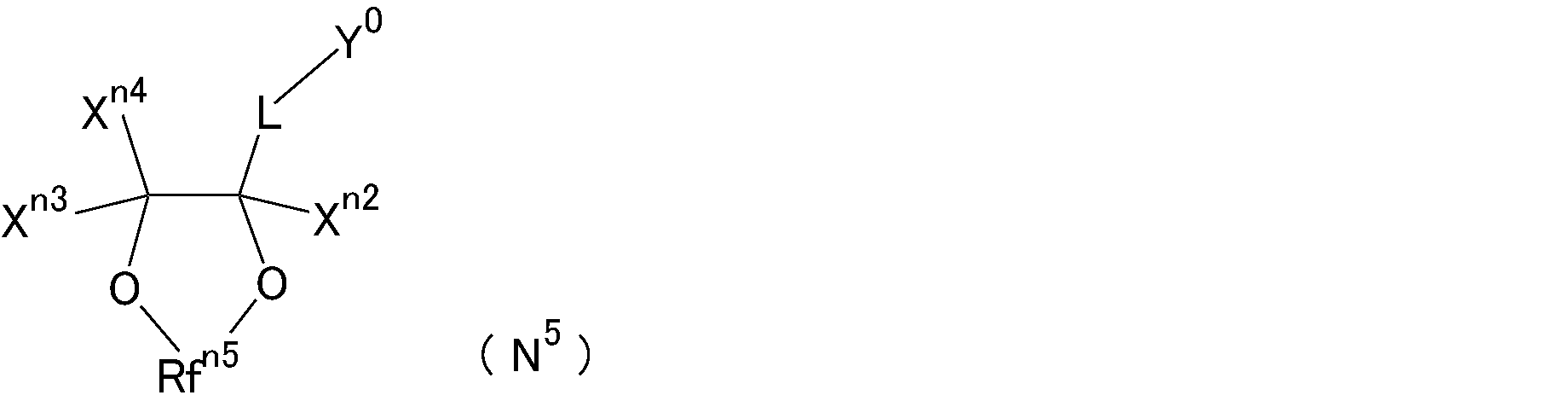
F(CF2)n1COOM (I)
(式中、n1は、3~14の整数であり、Mは、H、金属原子、NR7 4、置換基を有していてもよいイミダゾリウム、置換基を有していてもよいピリジニウム又は置換基を有していてもよいホスホニウムであり、R7は、H又は有機基である。)で表されるものである。
H(CF2)n2COOM (II)
(式中、n2は、4~15の整数であり、Mは、上記定義したものである。)で表されるものである。
Rf1-O-(CF(CF3)CF2O)n3CF(CF3)COOM (III)
(式中、Rf1は、炭素数1~5のパーフルオロアルキル基であり、n3は、0~3の整数であり、Mは、上記定義したものである。)で表されるものである。
Rf2(CH2)n4Rf3COOM (IV)
(式中、Rf2は、炭素数1~5のパーフルオロアルキル基であり、Rf3は、直鎖状又は分岐状の炭素数1~3のパーフルオロアルキレン基、n4は、1~3の整数であり、Mは、上記定義したものである。)で表されるものである。
Rf4-O-CY1Y2CF2-COOM (V)
(式中、Rf4は、炭素数1~12のエーテル結合及び/又は塩素原子を含み得る直鎖状又は分枝鎖状の部分又は完全フッ素化されたアルキル基であり、Y1及びY2は、同一若しくは異なって、H又はFであり、Mは、上記定義したものである。)で表されるものである。
F(CF2)n5SO3M (VI)
(式中、n5は、3~14の整数であり、Mは、上記定義したものである。)で表されるものである。
H(CF2)n6SO3M (VII)
(式中、n6は、4~14の整数であり、Mは、上記定義したものである。)で表されるものである。
Rf5(CH2)n7SO3M (VIII)
(式中、Rf5は、炭素数1~13のパーフルオロアルキル基であり、n7は、1~3の整数であり、Mは、上記定義したものである。)で表されるものである。
Rf6(CH2)n8COOM (IX)
(式中、Rf6は、炭素数1~13のエーテル結合を含み得る直鎖状または分岐鎖状の部分又は完全フッ素化されたアルキル基であり、n8は、1~3の整数であり、Mは、上記定義したものである。)で表されるものである。
Rf7-O-Rf8-O-CF2-COOM (X)
(式中、Rf7は、炭素数1~6のエーテル結合及び/又は塩素原子を含み得る直鎖状又は分枝鎖状の部分又は完全フッ素化されたアルキル基であり、Rf8は、炭素数1~6の直鎖状又は分枝鎖状の部分又は完全フッ素化されたアルキル基であり、Mは、上記定義したものである。)で表されるものである。
Rf9-O-CY1Y2CF2-SO3M (XI)
(式中、Rf9は、炭素数1~12のエーテル結合を含み得る直鎖状又は分枝鎖状であって、塩素を含んでもよい、部分又は完全フッ素化されたアルキル基であり、Y1及びY2は、同一若しくは異なって、H又はFであり、Mは、上記定義したものである。)で表されるものである。
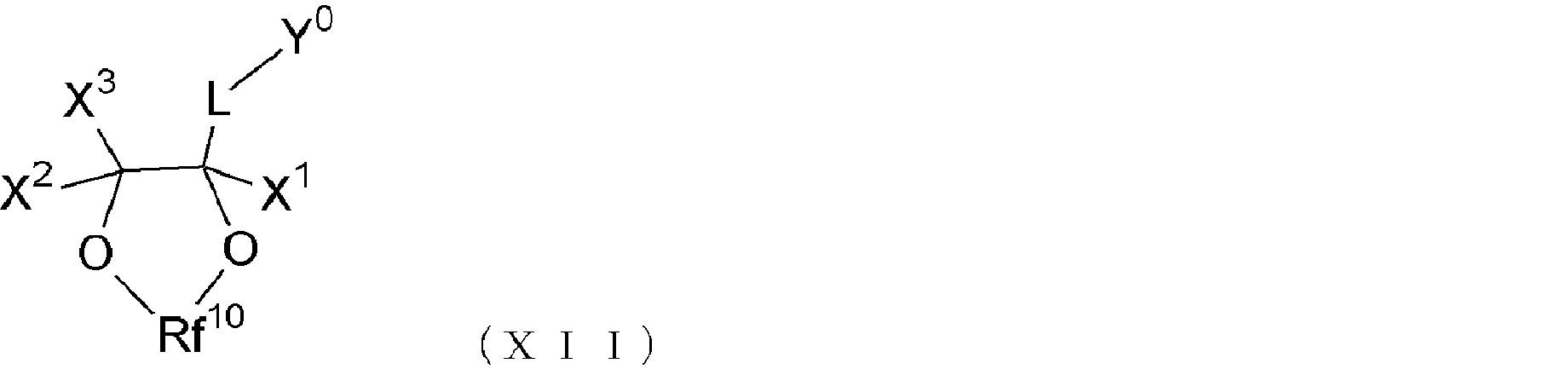
Y0は、-COOM、-SO2M、又は、-SO3Mであってよく、-SO3M、又は、COOMであってよい(式中、Mは上記定義したものである。)。
Lとしては、例えば、単結合、炭素数1~10のエーテル結合を含みうる部分又は完全フッ素化されたアルキレン基が挙げられる。
Rf11-O-(CF2CF(CF3)O)n9(CF2O)n10CF2COOM (XIII)
(式中、Rf11は、塩素を含む炭素数1~5のフルオロアルキル基であり、n9は、0~3の整数であり、n10は、0~3の整数であり、Mは、上記定義したものである。)で表されるものである。化合物(XIII)としては、CF2ClO(CF2CF(CF3)O)n9(CF2O)n10CF2COONH4(平均分子量750の混合物、式中、n9及びn10は上記定義したものである。)が挙げられる。
F(CF2)7COOM、
F(CF2)5COOM、
H(CF2)6COOM、
H(CF2)7COOM、
CF3O(CF2)3OCHFCF2COOM、
C3F7OCF(CF3)CF2OCF(CF3)COOM、
CF3CF2CF2OCF(CF3)COOM、
CF3CF2OCF2CF2OCF2COOM、
C2F5OCF(CF3)CF2OCF(CF3)COOM、
CF3OCF(CF3)CF2OCF(CF3)COOM、
CF2ClCF2CF2OCF(CF3)CF2OCF2COOM、
CF2ClCF2CF2OCF2CF(CF3)OCF2COOM、
CF2ClCF(CF3)OCF(CF3)CF2OCF2COOM、
CF2ClCF(CF3)OCF2CF(CF3)OCF2COOM、
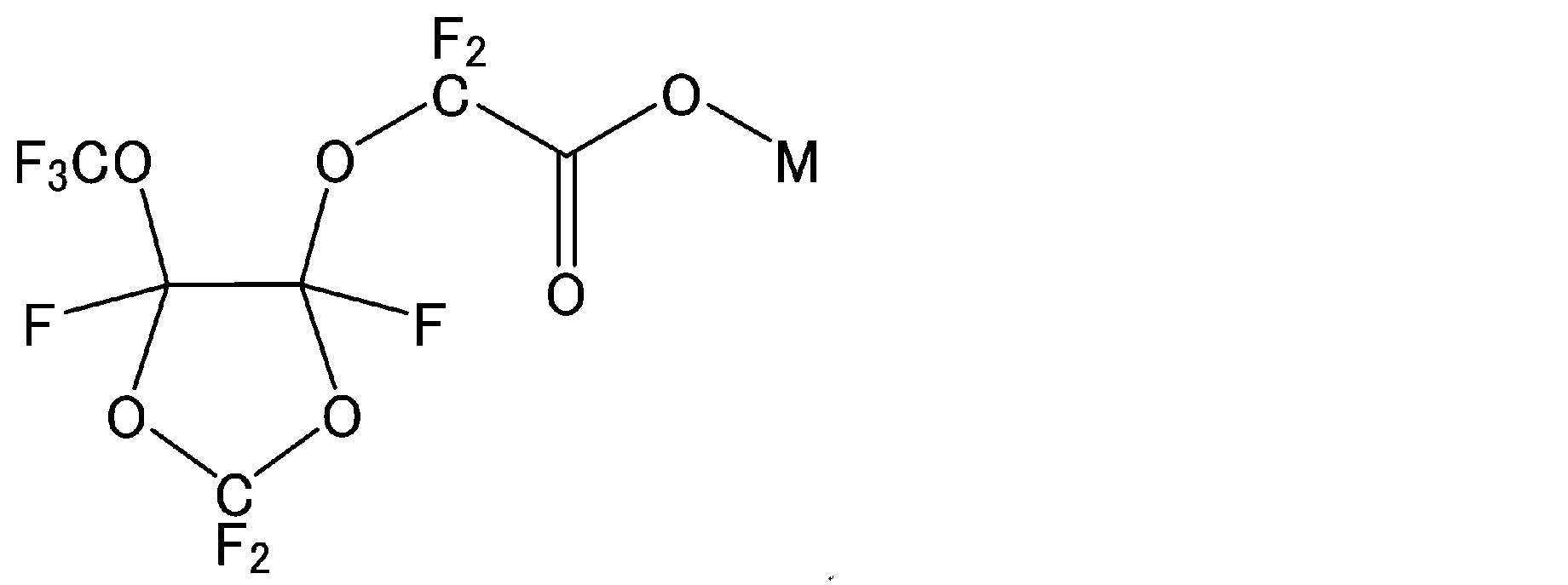
上記充填材としては、例えば、ガラス繊維、ガラスビーズ、炭素繊維、球状カーボン、カーボンブラック、グラファイト、シリカ、アルミナ、マイカ、炭化珪素、窒化硼素、酸化チタン、酸化ビスマス、酸化コバルト、二硫化モリブデン、ブロンズ、金、銀、銅、及び、ニッケルからなる群より選択される少なくとも1種が挙げられる。
なかでも、ガラス繊維、炭素繊維、カーボンブラック、及び、ブロンズからなる群より選択される少なくとも1種が好ましい。
当業者であれば、上記乳化重合の条件を調整することにより、フッ素樹脂Bの組成や物性、粒子の物性等を制御することができる。
具体的には、CH3-(CH2)n-L-M1(式中、nが、6~17の整数である。L及びM1が、上記と同じ)によって表されるものが挙げられる。
Rが、12~16個の炭素原子を有するアルキル基であり、Lが、硫酸塩又はドデシル硫酸ナトリウム(SDS)であるものの混合物も使用できる。
スルホサクシネート炭化水素系界面活性剤としては、スルホコハク酸ジイソデシルNa塩、(ClariantのEmulsogen(登録商標)SB10)、スルホコハク酸ジイソトリデシルNa塩(Cesapinia ChemicalsのPolirol(登録商標)TR/LNA)等が挙げられる。
上記非イオン性界面活性剤は、非フッ素化非イオン性界面活性剤であってよい。
乾燥の方法は特に限定されず、公知の方法を用いることができ、例えば、真空、高周波、熱風等の手段を用いて行うことができる。
上記乾燥の温度としては、50℃以上が好ましく、70℃以上がより好ましく、100℃以上が更に好ましく、150℃以上が特に好ましく、また、300℃以下が好ましく、250℃以下がより好ましい。
上記造粒の方法としては、公知の方法が挙げられ、水中造粒法、温水造粒法、乳化分散造粒法、乳化温水造粒法、無溶剤造粒法、乾式溶剤造粒法等が挙げられる。
上記引張破断強度は、φ100mmの金型に35gの上記フッ素樹脂組成物を投入し、30MPaの圧力、1分間の条件で圧縮成形し、室温から300℃まで3時間で昇温し、その後300℃から370℃まで4時間で昇温し、370℃で12時間保持した後、300℃まで5時間で降温したのち、室温まで1時間で降温する工程によって焼成した成形体を打ち抜いて作成したダンベルを用いて、ASTM D1708に準じて測定する。
上記引張破断歪は、φ100mmの金型に35gの上記フッ素樹脂組成物を投入し、30MPaの圧力、1分間の条件で圧縮成形し、室温から300℃まで3時間で昇温し、その後300℃から370℃まで4時間で昇温し、370℃で12時間保持した後、300℃まで5時間で降温したのち、室温まで1時間で降温する工程によって焼成した成形体を打ち抜いて作成したダンベルを用いて、ASTM D1708に準じて測定する。
本開示のフッ素樹脂組成物は、圧縮成形用粉末であることが好ましい。
本開示の成形体は、融点以上の温度に加熱した履歴のあるフッ素樹脂を含むにもかかわらず、引張特性に優れる。
上記引張破断強度は、ASTM D1708に準じて測定する。
上記引張破断歪は、ASTM D1708に準じて測定する。
X-DSC7000(株式会社日立ハイテクサイエンス社製)を用い、10℃/分の昇温速度で示差走査熱量測定〔DSC〕を行って得られた融解熱曲線における極小点に対応する温度として求めた。1つの融解ピーク中に極小点が2つ以上ある場合は、それぞれを融点とした。
フッ素樹脂Bが5質量%以下の場合は、X-DSC7000(株式会社日立ハイテクサイエンス社製)を用い、10℃/分の昇温速度でフッ素樹脂Bの融点未満である300℃まで昇温し、300℃で10分間保持した後、10℃/分の昇温速度で昇温し示差走査熱量測定〔DSC〕を行って得られた融解熱曲線における極小点に対応する温度として求めた。
19F-NMR法により測定した。
原料組成から計算により求めた。
ベックマン・コールター製レーザー回折式粒度分布測定装置(LS13 320)を用いて、乾式で、バキューム圧20mH2Oで測定を行ない、得られた粒度分布(体積基準)に基づいて求めた。平均二次粒子径は、粒度分布積算の50%に対応する粒子径に等しいとした。10%に対応する粒子径をD10、90%に対応する粒子径をD90とした。
固形分濃度を0.5質量%に調整した水性分散液をアルミ箔に滴下し、150℃、1時間の条件で水を乾燥除去したものの走査電子顕微鏡(SEM)で観察し、無作為に抽出した100個以上の粒子の直径の平均値として求めた。
固形分濃度が0.5質量%となるように希釈したフッ素樹脂水性分散液を走査電子顕微鏡(SEM)で観察し、無作為に抽出した100個以上の粒子について画像処理を行い、その長径と短径の比の平均より平均アスペクト比を求めた。
アスペクト比が2.5以上の粒子の割合は、固形分濃度が0.5質量%となるように希釈したフッ素樹脂水性分散液を走査電子顕微鏡(SEM)で観察し、無作為に抽出した100個以上の粒子について画像処理を行って各粒子のアスペクト比を算出し、上記抽出した粒子の全数に対する割合として求めた。
水性分散液中の固形分濃度(P質量%)は、試料約1g(Xg)を直径5cmのアルミカップにとり、110℃にて30分で加熱した加熱残分(Yg)、更に、得られた加熱残分(Yg)を300℃にて30分加熱した加熱残分(Zg)より、式:P=[Z/X]×100(質量%)から算出した。
水性分散液中の非イオン性界面活性剤のPTFEに対する含有量(N質量%)は、試料約1g(Xg)を直径5cmのアルミカップにとり、110℃にて30分で加熱した加熱残分(Yg)、更に、得られた加熱残分(Yg)を300℃にて30分加熱した加熱残分(Zg)より、式:N=[(Y-Z)/Z]×100(質量%)から算出した。
JIS K 6891に準拠して測定した。
ASTM D4895 89に準拠して成形されたサンプルを用い、ASTM D 792に準拠した水置換法により測定した。
ASTM D1238に準拠して、メルトインデクサーを用いて、フッ素樹脂の種類によって定められた測定温度(例えば、PFAやFEPの場合は372℃、ETFEの場合は297℃)、荷重(例えば、PFA、FEP及びETFEの場合は5kg)において内径2.095mm、長さ8mmのノズルから10分間あたりに流出するポリマーの質量(g/10分)を測定した。
φ100mmの金型に35gの粉末を入れて、30MPa、1分間の圧縮成形を行った後に、室温から300℃まで3時間で昇温し、その後300℃から370℃まで4時間で昇温し、370℃で12時間保持した後、300℃まで5時間で降温したのち、室温まで1時間で降温する工程により焼成することで成形品を得、この成形品を打ち抜くことでダンベルを用意し、ASTM D 1708に準じて引張試験を行い、引張破断強度、引張破断歪を測定した。
上記引張試験と同じ条件でフッ素樹脂組成物(粉末)を圧縮成形及び焼成した際に、焼成前の厚みに対する焼成後の厚みが20%以上減少した場合に、フッ素樹脂組成物に溶融流動性があると判定し、焼成前後の減少率が20%未満であるか、又は、焼成後の厚みが焼成前の厚みより増加する場合に溶融流動性がないと判定した。
フッ素樹脂組成物(粉末)を1g秤量し、アンモニア水とメタノールで調製した0.3%水酸化アンモニウムメタノール溶液(A)を10mL加え、60℃に温調した超音波洗浄機にサンプル瓶をセットし、2時間の超音波処理を行ない、抽出液を得た。抽出液中の含フッ素化合物について、液体クロマトグラフ質量分析計(Agilent社製1290 Infinity II型LC、6530型飛行時間型質量分析計)を用いて測定を行った。測定機器構成と測定条件を表1に示す。精密質量から分子量800以下のフッ素化合物と同定できる化合物をピーク抽出し、抽出クロマトグラムを描いた。濃度既知の含パーフルオロオクタン酸の水溶液を用いて、4水準の含有量の水溶液を作製し、それぞれの含有量の水溶液の分析を行ない、含有量とその含有量に対するエリア面積と関係をプロットし、検量線を描いた。上記検量線を用いて、抽出液中の分子量800以下の含フッ素化合物の含有量は、上記抽出クロマトグラムと検量線を用いて、パーフルオロオクタン酸換算で計算した。

1Lオートクレーブを窒素にて置換した後、脱水したテトラメチル尿素16.5g及びジエチレングルコールジメチルエーテル220gを仕込み、冷却した。フッ化カルボニル38.5gを仕込み、次いでヘキサフルオロプロピレンオキサイド100gを導入して撹拌した。その後、フッ化カルボニル38.5g及びヘキサフルオロプロピレンオキサイド100gを追加で仕込んだ。その後、更にフッ化カルボニル及びヘキサフルオロプロピレンオキサイドを同量の仕込みを行った。反応終了後、反応混合液を取り出して、分液して下層の反応生成物を得た。
TFEモノマーのみの懸濁重合で得られたホモPTFEの粗粉末を粉砕機で粉砕して得られたPTFEモールディングパウダー(標準比重(SSG):2.159,融点:345.0℃)35gを使用して、φ100mmの金型にて30MPa、1分間の条件で圧縮成形し、370℃で3時間焼成することで成形品を得た。得られた成形品を切削した後に、粉砕機で粉砕し、フッ素樹脂粉末A-1を得た。フッ素樹脂粉末A-1の融点は328℃、平均二次粒子径は23μm、D10は8μm、D90は48μm、見掛密度は0.64g/mlであった。
製造例1と同様にして得られた成形品を切削した後に、粉砕機で粉砕し、フッ素樹脂粉末A-2を得た。フッ素樹脂粉末A-2の融点は328℃、平均二次粒子径は37μm、D10は7μm、D90は87μm、見掛密度は0.53g/mlであった。
撹拌翼を備えた内容積6LのSUS製のオートクレーブにて、パーフルオロエーテルカルボン酸アンモニウム塩Aを使用して、公知の乳化重合方法によりTFE単位とパーフルオロ(プロピルビニルエーテル)(PPVE)単位とからなるPFA粒子を含むPFA水性分散液B-1を得た。
得られたPFA水性分散液B-1の固形分濃度は14質量%であり、平均一次粒子径は291nm、MFRは22g/10min、融点は314℃、PPVE単位の含有量は1.4モル%であった。
撹拌翼を備えた内容積6LのSUS製のオートクレーブにて、パーフルオロエーテルカルボン酸アンモニウム塩Aを使用して、公知の乳化重合方法によりTFE単位とパーフルオロ(プロピルビニルエーテル)(PPVE)単位とからなるPFA粒子を含むPFA水性分散液を得た。得られたPFA水性分散液を凝析してPFA粉末B-2を得た。PFA粉末B-2の平均二次粒子径は11μm、MFRは27g/10min、融点は298℃、PPVE単位の含有量は2.1モル%であった。
製造例3と同様にして得られたPFA水性分散液を凝析してPFA粉末B-3を得た。PFA粉末B-3の平均二次粒子径は1.5μm、MFRは28g/10min、融点は314℃、PPVE単位の含有量は1.4モル%であった。
撹拌翼を備えた内容積6LのSUS製のオートクレーブにて、過硫酸アンモニウムを使用して、公知の乳化重合方法によりTFE単位とヘキサフロプロピレン[HFP]単位、パーフルオロ(プロピルビニルエーテル)単位とからなるFEP粒子を含むFEP水性分散液を得た。得られたFEP水性分散液を硝酸により凝析、圧搾により脱水し、170℃にて4時間乾燥し、FEP粉末B-4を得た。得られたFEP粉末の平均二次粒子径は19μm、MFRは24g/10min、融点は261℃、HFP単位とPPVE単位の含有量の合計は7.6モル%であった。
国際公開第2001/036504号の実施例1に記載の方法を用い、(TFEモノマー、HFPモノマー、ジ-(ω-ヒドロデカフルオロヘプタノイル)パーオキサイド(DHP)及びメタノールの仕込み量を調整して)TFE単位とヘキサフロプロピレン[HFP]単位とからなるFEP粉末B-5を得た。得られたFEP粉末の平均二次粒子径は50μm、MFRは1g/10min、融点は302℃、FEP単位とPPVE単位の含有量の合計は8.4モル%であった。
撹拌翼を備えた内容積6LのSUS製のオートクレーブにて、パーフルオロエーテルカルボン酸アンモニウム塩Aを使用して、公知の乳化重合方法によりTFEモノマーのみからなるホモのPTFE粒子を含むフッ素樹脂水性分散液C-aを得た。
TFEモノマーのみの懸濁重合で得られたホモPTFEの粗粉末を粉砕機で粉砕し、フッ素樹脂粉末C-2を得た。フッ素樹脂粉末C-2の見掛密度は0.34g/ml、平均二次粒子径は24μm、D90が55μm、標準比重(SSG)は2.163、融点は345.0℃であった。
TFEとパーフルオロプロピルビニルエーテル(PPVE)との懸濁重合で得られた変性PTFEの粗粉末を粉砕機で粉砕し、フッ素樹脂粉末C-3を得た。フッ素樹脂粉末C-3の見掛密度は0.33g/ml、平均二次粒子径は28μm、D90が77μm、標準比重(SSG)は2.168、融点は341.5℃、PPVE単位の量は0.09質量%であった。
95gのフッ素樹脂粉末A-1と36gのPFA水性分散液B-1とをフラスコ内で振り混ぜた後、メタノールを入れて凝析し、ろ過して、水とメタノールで洗浄することで湿潤粉末を取り出した。
得られた湿潤粉末を電気炉にて、150℃、15時間乾燥することで水を除去した。
乾燥後の粉末をワンダークラッシャーWC-3を用いて、回転数2900rpmで60秒間の粉砕を行なうことで混合粉末(フッ素樹脂組成物)を得た。上記混合粉末は、全重合単位に対しTFE単位を99.82質量%、PPVE単位を0.18質量%含んでいた。上記混合粉末の融点は314℃及び329℃、引張破断強度は12MPa、引張破断歪は253%、平均二次粒子径は25μm、D10は9μm、D90は51μmであった。
焼成前後で成形品の厚みが増加しており、形状を維持していたので、上記混合粉末は溶融流動性を示さないと判定した。
95gのフッ素樹脂粉末A-1を90g、PFA水性分散液B-1を71gとした以外は実施例1と同様にして混合粉末を得た。上記混合粉末は、全重合単位に対しTFE単位を99.64質量%、PPVE単位を0.36質量%含んでいた。上記混合粉末の融点は315℃及び328℃、引張破断強度は15MPa、引張破断歪は353%、平均二次粒子径は25μm、D10は9μm、D90は52μm、低分子量含フッ素化合物(アニオン性部分の分子量が800以下のフッ素を含む界面活性剤)の含有量は1質量ppm以下であった。
焼成前後で成形品の厚みが増加しており、形状を維持していたので、上記混合粉末は溶融流動性を示さないと判定した。
35gのフッ素樹脂粉末A-1(融点328℃)を用いて実施例1と同様に引張試験を行なったところ引張破断強度9MPa、引張破断歪145%、平均二次粒子径は23μm、D10は8μm、D90は48μmであった。
フッ素樹脂粉末A-1を50g、PFA水性分散液B-1を14gとし、フッ素樹脂水性分散液C-1を80g用いて実施例1と同様にして混合粉末を得た。上記混合粉末は、全重合単位に対しTFE単位を99.928質量%、PPVE単位を0.072質量%含んでいた。上記混合粉末の融点は312℃、329℃及び337℃、引張破断強度は19MPa、引張破断歪は377%であった。
焼成前後で成形品の厚みが増加しており、形状を維持していたので、上記混合粉末は溶融流動性を示さないと判定した。
フッ素樹脂粉末A-1を50g、PFA水性分散液B-1を36gとし、フッ素樹脂水性分散液C-1を75g用いて実施例1と同様にして混合粉末を得た。上記混合粉末は、全重合単位に対しTFE単位を99.82質量%、PPVE単位を0.18質量%含んでいた。上記混合粉末の融点は312℃、329℃及び337℃、引張破断強度は25MPa、引張破断歪は531%であった。
焼成前後で成形品の厚みが増加しており、形状を維持していたので、上記混合粉末は溶融流動性を示さないと判定した。
フッ素樹脂粉末A-1を50g、フッ素樹脂水性分散液C-1を83g用いて実施例1と同様にして混合粉末を得た。上記混合粉末の融点は329℃及び337℃、引張破断強度は12MPa、引張破断歪は278%であった。
75gのフッ素樹脂粉末A-1と25gのPFA粉末B-2とをワンダークラッシャーWC-3を用いて、回転数6900rpmで60秒間の混合を行なうことで混合粉末(フッ素樹脂組成物)を得た。上記混合粉末は、全重合単位に対しTFE単位を99.1質量%、PPVE単位を0.9質量%含んでいた。上記混合粉末の融点は298℃及び329℃、引張破断強度は16MPa、引張破断歪は297%、平均二次粒子径は22μm、D10は4μm、D90は64μmであった。
焼成前後で成形品の厚みが増加しており、形状を維持していたので、上記混合粉末は溶融流動性を示さないと判定した。
フッ素樹脂粉末A-1を50gとし、FEP粉末B-4を3g、フッ素樹脂粉末C-2を47g用いて実施例5と同様にして混合粉末を得た。上記混合粉末は、全重合単位に対しTFE単位を99.64質量%、HFP単位を0.36質量%含んでいた。上記混合粉末の融点は263℃、329℃及び345℃、引張破断強度は22MPa、引張破断歪は404%、平均二次粒子径は27μm、D10は8μm、D90は64μmであった。
焼成前後で成形品の厚みが増加しており、形状を維持していたので、上記混合粉末は溶融流動性を示さないと判定した。
90gのフッ素樹脂粉末A-1と36gのPFA水性分散液B-1とをフラスコ内で振り混ぜた後、メタノールを入れて凝析し、ろ過して、水とメタノールで洗浄することで湿潤粉末を取り出した。
得られた湿潤粉末を電気炉にて、150℃、15時間乾燥することで水を除去した。
乾燥後の粉末とフッ素樹脂粉末C-3とを混合し、ワンダークラッシャーWC-3を用いて、回転数2900rpmで60秒間の粉砕を行なうことで混合粉末(フッ素樹脂組成物)を得た。上記混合粉末は、全重合単位に対しTFE単位を99.82質量%、PPVE単位を0.18質量%含んでいた。上記混合粉末の融点は314℃、329℃及び342℃、引張破断強度は13MPa、引張破断歪は344%、平均二次粒子径は26μm、D10は9μm、D90は61μmであった。
焼成前後で成形品の厚みが増加しており、形状を維持していたので、上記混合粉末は溶融流動性を示さないと判定した。
フッ素樹脂粉末A-1を50gとし、FEP粉末B-5を8g、フッ素樹脂粉末C-2を42g用いて実施例5と同様にして混合粉末を得た。上記混合粉末は、全重合単位に対しTFE単位を99.04質量%、HFP単位を0.96質量%含んでいた。上記混合粉末の融点は263℃、329℃及び345℃、引張破断強度は21MPa、引張破断歪は342%、平均二次粒子径は28μm、D10は9μm、D90は62μmであった。
焼成前後で成形品の厚みが増加しており、形状を維持していたので、上記混合粉末は溶融流動性を示さないと判定した。
フッ素樹脂粉末A-2を90g、PFA粉末B-3を10g用いて実施例5と同様にして混合粉末を得た。上記混合粉末は、全重合単位に対しTFE単位を99.64質量%、PPVE単位を0.36質量%含んでいた。上記混合粉末の融点は314℃及び329℃、引張破断強度は12MPa、引張破断歪は275%であった。
焼成前後で成形品の厚みが増加しており、形状を維持していたので、上記混合粉末は溶融流動性を示さないと判定した。
フッ素樹脂粉末A-1を50g、フッ素樹脂粉末A-2を40g、PFA粉末B-3を10g用いて実施例5と同様にして混合粉末を得た。上記混合粉末は、全重合単位に対しTFE単位を99.64質量%、PPVE単位を0.36質量%含んでいた。上記混合粉末の融点は314℃、329℃、及び342℃、引張破断強度は23MPa、引張破断歪は363%あった。
焼成前後で成形品の厚みが増加しており、形状を維持していたので、上記混合粉末は溶融流動性を示さないと判定した。
Claims (14)
- 融点以上の温度に加熱した履歴のある溶融流動性を示さないフッ素樹脂Aと、溶融流動性を示すフッ素樹脂Bとを含む、溶融流動性を示さないフッ素樹脂組成物。
- フッ素樹脂Aは、ポリテトラフルオロエチレンである請求項1に記載のフッ素樹脂組成物。
- フッ素樹脂Bは、MFRが0.25g/10分以上である請求項1又は2に記載のフッ素樹脂組成物。
- フッ素樹脂Bは、融点が320℃以下のフッ素樹脂である請求項1~3のいずれかに記載のフッ素樹脂組成物。
- 更に、融点以上の温度に加熱した履歴のない部分を有する溶融流動性を示さないフッ素樹脂Cを含む請求項1~4のいずれかに記載のフッ素樹脂組成物。
- 333℃未満の温度領域に1つ以上、かつ、333~360℃の温度領域に1つ以上の融点を有する請求項5に記載のフッ素樹脂組成物。
- 前記フッ素樹脂組成物は、テトラフルオロエチレン単位、及び、テトラフルオロエチレンと共重合可能な変性モノマーに基づく変性モノマー単位を含み、全重合単位に対し、前記変性モノマー単位の量が1.0質量%以下である請求項1~6のいずれかに記載のフッ素樹脂組成物。
- 平均二次粒子径が5~700μmである請求項1~7のいずれかに記載のフッ素樹脂組成物。
- 低分子量含フッ素化合物の含有量が、前記フッ素樹脂組成物に対し1質量ppm以下である請求項1~8のいずれかに記載のフッ素樹脂組成物。
- 粉末である請求項1~9のいずれかに記載のフッ素樹脂組成物。
- 圧縮成形用粉末である請求項1~10のいずれかに記載のフッ素樹脂組成物。
- 引張破断強度が10MPa以上である請求項1~11のいずれかに記載のフッ素樹脂組成物。
- 引張破断歪が150%以上である請求項1~12のいずれかに記載のフッ素樹脂組成物。
- 請求項1~13のいずれかに記載のフッ素樹脂組成物を圧縮成形及び焼成して得られる成形体。
Priority Applications (4)
| Application Number | Priority Date | Filing Date | Title |
|---|---|---|---|
| EP22781277.3A EP4317307A4 (en) | 2021-03-31 | 2022-03-31 | Fluororesin composition and molded object |
| CN202280023254.8A CN117043258A (zh) | 2021-03-31 | 2022-03-31 | 氟树脂组合物和成型体 |
| KR1020237031980A KR20230146632A (ko) | 2021-03-31 | 2022-03-31 | 불소 수지 조성물 및 성형체 |
| US18/477,801 US20240018280A1 (en) | 2021-03-31 | 2023-09-29 | Fluororesin composition and molded object |
Applications Claiming Priority (2)
| Application Number | Priority Date | Filing Date | Title |
|---|---|---|---|
| JP2021-060837 | 2021-03-31 | ||
| JP2021060837 | 2021-03-31 |
Related Child Applications (1)
| Application Number | Title | Priority Date | Filing Date |
|---|---|---|---|
| US18/477,801 Continuation US20240018280A1 (en) | 2021-03-31 | 2023-09-29 | Fluororesin composition and molded object |
Publications (1)
| Publication Number | Publication Date |
|---|---|
| WO2022211067A1 true WO2022211067A1 (ja) | 2022-10-06 |
Family
ID=83459603
Family Applications (1)
| Application Number | Title | Priority Date | Filing Date |
|---|---|---|---|
| PCT/JP2022/016738 Ceased WO2022211067A1 (ja) | 2021-03-31 | 2022-03-31 | フッ素樹脂組成物、及び、成形体 |
Country Status (7)
| Country | Link |
|---|---|
| US (1) | US20240018280A1 (ja) |
| EP (1) | EP4317307A4 (ja) |
| JP (2) | JP7705361B2 (ja) |
| KR (1) | KR20230146632A (ja) |
| CN (1) | CN117043258A (ja) |
| TW (2) | TW202530278A (ja) |
| WO (1) | WO2022211067A1 (ja) |
Cited By (1)
| Publication number | Priority date | Publication date | Assignee | Title |
|---|---|---|---|---|
| EP4475234A4 (en) * | 2023-01-18 | 2025-05-07 | Daikin Industries, Ltd. | FLUOROPOLYMER COMPOSITION, BINDER FOR ELECTROCHEMICAL DEVICE, ELECTRODE MIXTURE, ELECTRODE AND SECONDARY BATTERY |
Families Citing this family (3)
| Publication number | Priority date | Publication date | Assignee | Title |
|---|---|---|---|---|
| WO2024190687A1 (ja) * | 2023-03-13 | 2024-09-19 | ニチアス株式会社 | 変性ポリテトラフルオロエチレン樹脂の粉体、及び成形体 |
| CN121219357A (zh) * | 2023-06-02 | 2025-12-26 | Agc株式会社 | 氟树脂组合物、成形体以及氟树脂组合物的制造方法 |
| JP2025026008A (ja) * | 2023-08-10 | 2025-02-21 | ニチアス株式会社 | フッ素樹脂粉体及びその成形体 |
Citations (30)
| Publication number | Priority date | Publication date | Assignee | Title |
|---|---|---|---|---|
| US3250808A (en) | 1963-10-31 | 1966-05-10 | Du Pont | Fluorocarbon ethers derived from hexafluoropropylene epoxide |
| US3271341A (en) | 1961-08-07 | 1966-09-06 | Du Pont | Aqueous colloidal dispersions of polymer |
| JPS6166730A (ja) * | 1984-09-07 | 1986-04-05 | Chuko Kasei Kogyo Kk | ポリテトラフルオロエチレン樹脂多孔質体の製造方法 |
| JPH0593086A (ja) * | 1991-04-04 | 1993-04-16 | Daikin Ind Ltd | 多孔質ポリテトラフルオロエチレン成形体の製法 |
| JP2000508015A (ja) * | 1996-03-30 | 2000-06-27 | ダブリュ.エル.ゴア アンド アソシエーツ(ユーケー)リミティド | 顆粒タイプのポリテトラフルオロエチレンディスパージョンとそれから調製された融合物品 |
| JP2000239596A (ja) * | 1999-02-22 | 2000-09-05 | Sumitomo Electric Ind Ltd | フッ素樹脂被覆物及びその製造方法 |
| WO2001036504A1 (fr) | 1999-11-16 | 2001-05-25 | Daikin Industries, Ltd. | Fluorocopolymere |
| JP2003119204A (ja) | 2001-10-05 | 2003-04-23 | Daikin Ind Ltd | 含フッ素重合体ラテックスの製造方法 |
| JP2003225949A (ja) * | 2002-02-04 | 2003-08-12 | Daikin Ind Ltd | Ptfe多孔体製造方法及びptfe多孔体 |
| WO2005042593A1 (ja) | 2003-10-31 | 2005-05-12 | Daikin Industries, Ltd. | 含フッ素重合体水性分散体の製造方法及び含フッ素重合体水性分散体 |
| JP2006070233A (ja) | 2004-08-31 | 2006-03-16 | Starlite Co Ltd | 混合系の非溶融加工性フッ素樹脂 |
| US20070015864A1 (en) | 2005-07-15 | 2007-01-18 | 3M Innovative Properties Company | Method of making fluoropolymer dispersion |
| US20070015866A1 (en) | 2005-07-15 | 2007-01-18 | 3M Innovative Properties Company | Aqueous emulsion polymerization of fluorinated monomers using a fluorinated surfactant |
| US20070015865A1 (en) | 2005-07-15 | 2007-01-18 | 3M Innovative Properties Company | Aqueous emulsion polymerization of fluorinated monomers using a perfluoropolyether surfactant |
| WO2007046482A1 (ja) | 2005-10-20 | 2007-04-26 | Asahi Glass Company, Limited | ポリテトラフルオロエチレン水性分散液およびその製品 |
| WO2007046345A1 (ja) | 2005-10-17 | 2007-04-26 | Asahi Glass Company, Limited | ポリテトラフルオロエチレン水性乳化液、それから得られるポリテトラフルオロエチレンファインパウダーおよび多孔体 |
| WO2007046377A1 (ja) | 2005-10-20 | 2007-04-26 | Asahi Glass Company, Limited | 溶融成形可能なフッ素樹脂の製造方法 |
| JP2007119526A (ja) | 2005-10-25 | 2007-05-17 | Asahi Glass Co Ltd | 含フッ素重合体の製造方法 |
| US20070117914A1 (en) | 2005-11-24 | 2007-05-24 | 3M Innovative Properties Company | Fluorinated surfactants for use in making a fluoropolymer |
| US20070142541A1 (en) | 2005-12-21 | 2007-06-21 | 3M Innovative Properties Company | Fluorinated surfactants for making fluoropolymers |
| US20070276103A1 (en) | 2006-05-25 | 2007-11-29 | 3M Innovative Properties Company | Fluorinated Surfactants |
| US20080015319A1 (en) | 2006-07-13 | 2008-01-17 | Klaus Hintzer | Explosion taming surfactants for the production of perfluoropolymers |
| WO2008060461A1 (en) | 2006-11-09 | 2008-05-22 | E. I. Du Pont De Nemours And Company | Aqueous polymerization of fluorinated monomer using polymerization agent comprising fluoropolyether acid or salt and short chain fluorosurfactant |
| JP2013542310A (ja) | 2010-11-09 | 2013-11-21 | イー・アイ・デュポン・ドウ・ヌムール・アンド・カンパニー | 水性分散体フルオロモノマーの重合における炭化水素含有界面活性剤のテロゲン性挙動の低下 |
| JP2013542309A (ja) | 2010-11-09 | 2013-11-21 | イー・アイ・デュポン・ドウ・ヌムール・アンド・カンパニー | フルオロモノマーの水性重合における核形成 |
| JP2013542308A (ja) | 2010-11-09 | 2013-11-21 | イー・アイ・デュポン・ドウ・ヌムール・アンド・カンパニー | 炭化水素界面活性剤を用いたフルオロモノマーの水性重合 |
| WO2013189824A1 (en) | 2012-06-20 | 2013-12-27 | Solvay Specialty Polymers Italy S.P.A. | Tetrafluoroethylene copolymers |
| WO2013189826A1 (en) | 2012-06-20 | 2013-12-27 | Solvay Specialty Polymers Italy S.P.A. | Tetrafluoroethylene copolymers |
| US20140228531A1 (en) | 2008-07-08 | 2014-08-14 | Solvay Solexis S.P.A. | Method for manufacturing fluoropolymers |
| WO2019244433A1 (ja) | 2018-06-21 | 2019-12-26 | Blanc Bijou株式会社 | フッ素樹脂焼成体の生産方法、フッ素樹脂焼成体、フッ素樹脂ディスパージョンの生産方法、焼成体の生産方法、フッ素樹脂ディスパージョン、及び焼成体 |
Family Cites Families (4)
| Publication number | Priority date | Publication date | Assignee | Title |
|---|---|---|---|---|
| JP3892631B2 (ja) | 1999-10-21 | 2007-03-14 | ダイキン工業株式会社 | 成形用樹脂粉末およびその製造法 |
| JP4607738B2 (ja) * | 2005-11-08 | 2011-01-05 | 三井・デュポンフロロケミカル株式会社 | 溶融成形用フッ素樹脂組成物 |
| JP5655785B2 (ja) * | 2008-09-26 | 2015-01-21 | ウィットフォード コーポレーション | 可撓性基材用のフルオロポリマーブレンド組成物およびコーティング |
| WO2018071218A1 (en) * | 2016-10-12 | 2018-04-19 | The Chemours Company Fc, Llc | Low bake temperature fluoropolymer coatings |
-
2022
- 2022-03-31 WO PCT/JP2022/016738 patent/WO2022211067A1/ja not_active Ceased
- 2022-03-31 EP EP22781277.3A patent/EP4317307A4/en active Pending
- 2022-03-31 KR KR1020237031980A patent/KR20230146632A/ko active Pending
- 2022-03-31 JP JP2022058833A patent/JP7705361B2/ja active Active
- 2022-03-31 TW TW114112766A patent/TW202530278A/zh unknown
- 2022-03-31 TW TW111112621A patent/TWI882214B/zh active
- 2022-03-31 CN CN202280023254.8A patent/CN117043258A/zh active Pending
-
2023
- 2023-05-25 JP JP2023086185A patent/JP2023099772A/ja active Pending
- 2023-09-29 US US18/477,801 patent/US20240018280A1/en active Pending
Patent Citations (30)
| Publication number | Priority date | Publication date | Assignee | Title |
|---|---|---|---|---|
| US3271341A (en) | 1961-08-07 | 1966-09-06 | Du Pont | Aqueous colloidal dispersions of polymer |
| US3250808A (en) | 1963-10-31 | 1966-05-10 | Du Pont | Fluorocarbon ethers derived from hexafluoropropylene epoxide |
| JPS6166730A (ja) * | 1984-09-07 | 1986-04-05 | Chuko Kasei Kogyo Kk | ポリテトラフルオロエチレン樹脂多孔質体の製造方法 |
| JPH0593086A (ja) * | 1991-04-04 | 1993-04-16 | Daikin Ind Ltd | 多孔質ポリテトラフルオロエチレン成形体の製法 |
| JP2000508015A (ja) * | 1996-03-30 | 2000-06-27 | ダブリュ.エル.ゴア アンド アソシエーツ(ユーケー)リミティド | 顆粒タイプのポリテトラフルオロエチレンディスパージョンとそれから調製された融合物品 |
| JP2000239596A (ja) * | 1999-02-22 | 2000-09-05 | Sumitomo Electric Ind Ltd | フッ素樹脂被覆物及びその製造方法 |
| WO2001036504A1 (fr) | 1999-11-16 | 2001-05-25 | Daikin Industries, Ltd. | Fluorocopolymere |
| JP2003119204A (ja) | 2001-10-05 | 2003-04-23 | Daikin Ind Ltd | 含フッ素重合体ラテックスの製造方法 |
| JP2003225949A (ja) * | 2002-02-04 | 2003-08-12 | Daikin Ind Ltd | Ptfe多孔体製造方法及びptfe多孔体 |
| WO2005042593A1 (ja) | 2003-10-31 | 2005-05-12 | Daikin Industries, Ltd. | 含フッ素重合体水性分散体の製造方法及び含フッ素重合体水性分散体 |
| JP2006070233A (ja) | 2004-08-31 | 2006-03-16 | Starlite Co Ltd | 混合系の非溶融加工性フッ素樹脂 |
| US20070015864A1 (en) | 2005-07-15 | 2007-01-18 | 3M Innovative Properties Company | Method of making fluoropolymer dispersion |
| US20070015866A1 (en) | 2005-07-15 | 2007-01-18 | 3M Innovative Properties Company | Aqueous emulsion polymerization of fluorinated monomers using a fluorinated surfactant |
| US20070015865A1 (en) | 2005-07-15 | 2007-01-18 | 3M Innovative Properties Company | Aqueous emulsion polymerization of fluorinated monomers using a perfluoropolyether surfactant |
| WO2007046345A1 (ja) | 2005-10-17 | 2007-04-26 | Asahi Glass Company, Limited | ポリテトラフルオロエチレン水性乳化液、それから得られるポリテトラフルオロエチレンファインパウダーおよび多孔体 |
| WO2007046482A1 (ja) | 2005-10-20 | 2007-04-26 | Asahi Glass Company, Limited | ポリテトラフルオロエチレン水性分散液およびその製品 |
| WO2007046377A1 (ja) | 2005-10-20 | 2007-04-26 | Asahi Glass Company, Limited | 溶融成形可能なフッ素樹脂の製造方法 |
| JP2007119526A (ja) | 2005-10-25 | 2007-05-17 | Asahi Glass Co Ltd | 含フッ素重合体の製造方法 |
| US20070117914A1 (en) | 2005-11-24 | 2007-05-24 | 3M Innovative Properties Company | Fluorinated surfactants for use in making a fluoropolymer |
| US20070142541A1 (en) | 2005-12-21 | 2007-06-21 | 3M Innovative Properties Company | Fluorinated surfactants for making fluoropolymers |
| US20070276103A1 (en) | 2006-05-25 | 2007-11-29 | 3M Innovative Properties Company | Fluorinated Surfactants |
| US20080015319A1 (en) | 2006-07-13 | 2008-01-17 | Klaus Hintzer | Explosion taming surfactants for the production of perfluoropolymers |
| WO2008060461A1 (en) | 2006-11-09 | 2008-05-22 | E. I. Du Pont De Nemours And Company | Aqueous polymerization of fluorinated monomer using polymerization agent comprising fluoropolyether acid or salt and short chain fluorosurfactant |
| US20140228531A1 (en) | 2008-07-08 | 2014-08-14 | Solvay Solexis S.P.A. | Method for manufacturing fluoropolymers |
| JP2013542310A (ja) | 2010-11-09 | 2013-11-21 | イー・アイ・デュポン・ドウ・ヌムール・アンド・カンパニー | 水性分散体フルオロモノマーの重合における炭化水素含有界面活性剤のテロゲン性挙動の低下 |
| JP2013542309A (ja) | 2010-11-09 | 2013-11-21 | イー・アイ・デュポン・ドウ・ヌムール・アンド・カンパニー | フルオロモノマーの水性重合における核形成 |
| JP2013542308A (ja) | 2010-11-09 | 2013-11-21 | イー・アイ・デュポン・ドウ・ヌムール・アンド・カンパニー | 炭化水素界面活性剤を用いたフルオロモノマーの水性重合 |
| WO2013189824A1 (en) | 2012-06-20 | 2013-12-27 | Solvay Specialty Polymers Italy S.P.A. | Tetrafluoroethylene copolymers |
| WO2013189826A1 (en) | 2012-06-20 | 2013-12-27 | Solvay Specialty Polymers Italy S.P.A. | Tetrafluoroethylene copolymers |
| WO2019244433A1 (ja) | 2018-06-21 | 2019-12-26 | Blanc Bijou株式会社 | フッ素樹脂焼成体の生産方法、フッ素樹脂焼成体、フッ素樹脂ディスパージョンの生産方法、焼成体の生産方法、フッ素樹脂ディスパージョン、及び焼成体 |
Non-Patent Citations (1)
| Title |
|---|
| See also references of EP4317307A4 |
Cited By (1)
| Publication number | Priority date | Publication date | Assignee | Title |
|---|---|---|---|---|
| EP4475234A4 (en) * | 2023-01-18 | 2025-05-07 | Daikin Industries, Ltd. | FLUOROPOLYMER COMPOSITION, BINDER FOR ELECTROCHEMICAL DEVICE, ELECTRODE MIXTURE, ELECTRODE AND SECONDARY BATTERY |
Also Published As
| Publication number | Publication date |
|---|---|
| JP2022159201A (ja) | 2022-10-17 |
| TW202530278A (zh) | 2025-08-01 |
| JP2023099772A (ja) | 2023-07-13 |
| EP4317307A1 (en) | 2024-02-07 |
| JP7705361B2 (ja) | 2025-07-09 |
| TWI882214B (zh) | 2025-05-01 |
| KR20230146632A (ko) | 2023-10-19 |
| TW202246407A (zh) | 2022-12-01 |
| US20240018280A1 (en) | 2024-01-18 |
| EP4317307A4 (en) | 2025-04-23 |
| CN117043258A (zh) | 2023-11-10 |
Similar Documents
| Publication | Publication Date | Title |
|---|---|---|
| JP7323833B2 (ja) | フッ素樹脂組成物の製造方法、フッ素樹脂組成物、及び、成形体 | |
| JP7360066B2 (ja) | フッ素樹脂組成物、及び、成形体 | |
| JP7705361B2 (ja) | フッ素樹脂組成物、及び、成形体 | |
| JP7323832B2 (ja) | フッ素樹脂組成物、及び、成形体 | |
| JP7323831B2 (ja) | フッ素樹脂組成物、及び、成形体 | |
| RU2840494C2 (ru) | Композиция фторсмолы и формованный предмет | |
| RU2840776C2 (ru) | Композиция фторкаучука и формованное тело | |
| RU2843524C2 (ru) | Композиция фторкаучука и формованное тело | |
| RU2839252C2 (ru) | Способ производства композиции фторкаучука, композиция фторкаучука и формованное тело | |
| JP7785034B2 (ja) | フッ素樹脂組成物、及び、成形体 | |
| TW202608980A (zh) | 氟樹脂組成物之製造方法、氟樹脂組成物、及成形體 |
Legal Events
| Date | Code | Title | Description |
|---|---|---|---|
| 121 | Ep: the epo has been informed by wipo that ep was designated in this application |
Ref document number: 22781277 Country of ref document: EP Kind code of ref document: A1 |
|
| ENP | Entry into the national phase |
Ref document number: 20237031980 Country of ref document: KR Kind code of ref document: A |
|
| WWE | Wipo information: entry into national phase |
Ref document number: 1020237031980 Country of ref document: KR |
|
| WWE | Wipo information: entry into national phase |
Ref document number: 202280023254.8 Country of ref document: CN |
|
| WWE | Wipo information: entry into national phase |
Ref document number: 2301006175 Country of ref document: TH |
|
| WWE | Wipo information: entry into national phase |
Ref document number: 202337067200 Country of ref document: IN |
|
| WWE | Wipo information: entry into national phase |
Ref document number: 2023127647 Country of ref document: RU Ref document number: 2022781277 Country of ref document: EP |
|
| ENP | Entry into the national phase |
Ref document number: 2022781277 Country of ref document: EP Effective date: 20231031 |
|
| NENP | Non-entry into the national phase |
Ref country code: DE |
|
| WWG | Wipo information: grant in national office |
Ref document number: 2023127647 Country of ref document: RU |
|
| WWD | Wipo information: divisional of initial pct application |
Ref document number: 202538120992 Country of ref document: IN |
|
| WWP | Wipo information: published in national office |
Ref document number: 202538120992 Country of ref document: IN |