WO2022221963A1 - Tetrodotoxin liquid formulations - Google Patents
Tetrodotoxin liquid formulations Download PDFInfo
- Publication number
- WO2022221963A1 WO2022221963A1 PCT/CA2022/050623 CA2022050623W WO2022221963A1 WO 2022221963 A1 WO2022221963 A1 WO 2022221963A1 CA 2022050623 W CA2022050623 W CA 2022050623W WO 2022221963 A1 WO2022221963 A1 WO 2022221963A1
- Authority
- WO
- WIPO (PCT)
- Prior art keywords
- formulation
- acid
- ttx
- tetrodotoxin
- peg
- Prior art date
- Legal status (The legal status is an assumption and is not a legal conclusion. Google has not performed a legal analysis and makes no representation as to the accuracy of the status listed.)
- Ceased
Links
Classifications
-
- A—HUMAN NECESSITIES
- A61—MEDICAL OR VETERINARY SCIENCE; HYGIENE
- A61K—PREPARATIONS FOR MEDICAL, DENTAL OR TOILETRY PURPOSES
- A61K31/00—Medicinal preparations containing organic active ingredients
- A61K31/33—Heterocyclic compounds
- A61K31/395—Heterocyclic compounds having nitrogen as a ring hetero atom, e.g. guanethidine or rifamycins
- A61K31/495—Heterocyclic compounds having nitrogen as a ring hetero atom, e.g. guanethidine or rifamycins having six-membered rings with two or more nitrogen atoms as the only ring heteroatoms, e.g. piperazine or tetrazines
- A61K31/505—Pyrimidines; Hydrogenated pyrimidines, e.g. trimethoprim
- A61K31/519—Pyrimidines; Hydrogenated pyrimidines, e.g. trimethoprim ortho- or peri-condensed with heterocyclic rings
-
- A—HUMAN NECESSITIES
- A61—MEDICAL OR VETERINARY SCIENCE; HYGIENE
- A61P—SPECIFIC THERAPEUTIC ACTIVITY OF CHEMICAL COMPOUNDS OR MEDICINAL PREPARATIONS
- A61P29/00—Non-central analgesic, antipyretic or antiinflammatory agents, e.g. antirheumatic agents; Non-steroidal antiinflammatory drugs [NSAID]
-
- A—HUMAN NECESSITIES
- A61—MEDICAL OR VETERINARY SCIENCE; HYGIENE
- A61K—PREPARATIONS FOR MEDICAL, DENTAL OR TOILETRY PURPOSES
- A61K31/00—Medicinal preparations containing organic active ingredients
- A61K31/33—Heterocyclic compounds
- A61K31/395—Heterocyclic compounds having nitrogen as a ring hetero atom, e.g. guanethidine or rifamycins
- A61K31/495—Heterocyclic compounds having nitrogen as a ring hetero atom, e.g. guanethidine or rifamycins having six-membered rings with two or more nitrogen atoms as the only ring heteroatoms, e.g. piperazine or tetrazines
- A61K31/505—Pyrimidines; Hydrogenated pyrimidines, e.g. trimethoprim
- A61K31/529—Pyrimidines; Hydrogenated pyrimidines, e.g. trimethoprim forming part of bridged ring systems
-
- A—HUMAN NECESSITIES
- A61—MEDICAL OR VETERINARY SCIENCE; HYGIENE
- A61K—PREPARATIONS FOR MEDICAL, DENTAL OR TOILETRY PURPOSES
- A61K47/00—Medicinal preparations characterised by the non-active ingredients used, e.g. carriers or inert additives; Targeting or modifying agents chemically bound to the active ingredient
- A61K47/02—Inorganic compounds
-
- A—HUMAN NECESSITIES
- A61—MEDICAL OR VETERINARY SCIENCE; HYGIENE
- A61K—PREPARATIONS FOR MEDICAL, DENTAL OR TOILETRY PURPOSES
- A61K47/00—Medicinal preparations characterised by the non-active ingredients used, e.g. carriers or inert additives; Targeting or modifying agents chemically bound to the active ingredient
- A61K47/06—Organic compounds, e.g. natural or synthetic hydrocarbons, polyolefins, mineral oil, petrolatum or ozokerite
- A61K47/08—Organic compounds, e.g. natural or synthetic hydrocarbons, polyolefins, mineral oil, petrolatum or ozokerite containing oxygen, e.g. ethers, acetals, ketones, quinones, aldehydes, peroxides
- A61K47/10—Alcohols; Phenols; Salts thereof, e.g. glycerol; Polyethylene glycols [PEG]; Poloxamers; PEG/POE alkyl ethers
-
- A—HUMAN NECESSITIES
- A61—MEDICAL OR VETERINARY SCIENCE; HYGIENE
- A61K—PREPARATIONS FOR MEDICAL, DENTAL OR TOILETRY PURPOSES
- A61K47/00—Medicinal preparations characterised by the non-active ingredients used, e.g. carriers or inert additives; Targeting or modifying agents chemically bound to the active ingredient
- A61K47/06—Organic compounds, e.g. natural or synthetic hydrocarbons, polyolefins, mineral oil, petrolatum or ozokerite
- A61K47/08—Organic compounds, e.g. natural or synthetic hydrocarbons, polyolefins, mineral oil, petrolatum or ozokerite containing oxygen, e.g. ethers, acetals, ketones, quinones, aldehydes, peroxides
- A61K47/12—Carboxylic acids; Salts or anhydrides thereof
-
- A—HUMAN NECESSITIES
- A61—MEDICAL OR VETERINARY SCIENCE; HYGIENE
- A61K—PREPARATIONS FOR MEDICAL, DENTAL OR TOILETRY PURPOSES
- A61K47/00—Medicinal preparations characterised by the non-active ingredients used, e.g. carriers or inert additives; Targeting or modifying agents chemically bound to the active ingredient
- A61K47/06—Organic compounds, e.g. natural or synthetic hydrocarbons, polyolefins, mineral oil, petrolatum or ozokerite
- A61K47/16—Organic compounds, e.g. natural or synthetic hydrocarbons, polyolefins, mineral oil, petrolatum or ozokerite containing nitrogen, e.g. nitro-, nitroso-, azo-compounds, nitriles, cyanates
- A61K47/18—Amines; Amides; Ureas; Quaternary ammonium compounds; Amino acids; Oligopeptides having up to five amino acids
-
- A—HUMAN NECESSITIES
- A61—MEDICAL OR VETERINARY SCIENCE; HYGIENE
- A61K—PREPARATIONS FOR MEDICAL, DENTAL OR TOILETRY PURPOSES
- A61K47/00—Medicinal preparations characterised by the non-active ingredients used, e.g. carriers or inert additives; Targeting or modifying agents chemically bound to the active ingredient
- A61K47/06—Organic compounds, e.g. natural or synthetic hydrocarbons, polyolefins, mineral oil, petrolatum or ozokerite
- A61K47/20—Organic compounds, e.g. natural or synthetic hydrocarbons, polyolefins, mineral oil, petrolatum or ozokerite containing sulfur, e.g. dimethyl sulfoxide [DMSO], docusate, sodium lauryl sulfate or aminosulfonic acids
-
- A—HUMAN NECESSITIES
- A61—MEDICAL OR VETERINARY SCIENCE; HYGIENE
- A61K—PREPARATIONS FOR MEDICAL, DENTAL OR TOILETRY PURPOSES
- A61K9/00—Medicinal preparations characterised by special physical form
- A61K9/0012—Galenical forms characterised by the site of application
- A61K9/0019—Injectable compositions; Intramuscular, intravenous, arterial, subcutaneous administration; Compositions to be administered through the skin in an invasive manner
-
- A—HUMAN NECESSITIES
- A61—MEDICAL OR VETERINARY SCIENCE; HYGIENE
- A61K—PREPARATIONS FOR MEDICAL, DENTAL OR TOILETRY PURPOSES
- A61K9/00—Medicinal preparations characterised by special physical form
- A61K9/08—Solutions
-
- A—HUMAN NECESSITIES
- A61—MEDICAL OR VETERINARY SCIENCE; HYGIENE
- A61P—SPECIFIC THERAPEUTIC ACTIVITY OF CHEMICAL COMPOUNDS OR MEDICINAL PREPARATIONS
- A61P25/00—Drugs for disorders of the nervous system
Definitions
- the present description relates generally to liquid formulations comprising tetrodotoxin.
- the description relates to stable tetrodotoxin formulations that are suitable for use as pharmaceutical product. Such products may be in a form for injection to a mammal.
- Tetrodotoxin is a naturally occurring, non-protein marine neurotoxin. Tetrodotoxin binds with the SS1/SS2 subunit of voltage-gated sodium channels with high specificity and high affinity.
- tetrodotoxin (CiiHi 7 N 3 0 8 ) is octahydro-12-(hydroxymethyl)- 2-imino-5, 9:7, 10a-dimethano-10aH-(1 ,3)dioxocino (6,5-d)-pyrimidine-4,7,10,11 ,12-pentanol. Its molecular weight 319.28, and has the following structure:
- TTX is water soluble and generally insoluble in organic solvents. TTX is relatively stable at acidic pH, but quickly degrades in alkaline solution.
- TTX has not been extensively investigated. Nevertheless, tetrodotoxin has been known to be used as a tool in pharmacological research, particularly neurophysiology and ion-channel electrophysiology. In addition to its use in scientific research, therapeutic applications of TTX have also been described. In some cases, a tetrodotoxin compositions for injection (i.e., in the form of aqueous solutions), have been described. For example, TTX and derivatives thereof have been described for use as non-opioid analgesics in the treatment of chemotherapy induced neuropathic pain (CINP) and cancer related pain (CRP).
- CINP chemotherapy induced neuropathic pain
- CRP cancer related pain
- a lyophilized tetrodotoxin powder formulation has been proposed, such as described in U.S. Patent Nos. 8,124,608; 8,222,258; and 8,530,481.
- lyophilized powder formulations has several disadvantages.
- the lyophilization process incurs a significant manufacturing cost per dose when considered in an industrial scale, which thereby leads to increased costs for the therapeutic products.
- a conventional lyophilized formulation which is typically in a powdered form, first requires reconstitution in a diluent, such as water for injection (WFI), or 0.9% sodium chloride injection (USP), in order for the drug to be administered.
- a diluent such as water for injection (WFI), or 0.9% sodium chloride injection (USP)
- Reconstitution is an aseptic technique that generally requires the skill of a healthcare professional and often a qualified pharmacy compounding facility.
- TTX is soluble in water and not to any desired degree in organic solvents; however, as also discussed above, exposure to water accelerates the degradation of TTX. Consequently, formulations formed by reconstituting TTX in an aqueous solution are not sufficiently stable unless stored under special conditions.
- a stable liquid formulation comprising tetrodotoxin, and/or a derivative, analog, or a pharmaceutically acceptable salt thereof, and one or more pharmaceutically acceptable diluents, carriers, and excipients.
- the formulation comprises less than 15% water (w/v). In another aspect, the formulation comprises up to 95% polyethylene glycol (PEG) (w/v).
- the stable formulation is provided in a container. In another aspect, the stable formulation is provided in a pre-filled syringe adapted for subcutaneous administration of tetrodotoxin. In another aspect, the formulation is adapted to administer a tetrodotoxin dose of 5-120, or 15-60, or about 30 pg to a subject.
- a use of the stable liquid formulation comprising TTX for the treatment of pain. In a further aspect the pain is chemotherapy induced neuropathic pain (CINP).
- CINP chemotherapy induced neuropathic pain
- the stable liquid formulation comprising TTX for use in the treatment pain.
- the pain is chemotherapy induced neuropathic pain (CINP).
- CINP chemotherapy induced neuropathic pain
- the pain is chemotherapy induced neuropathic pain (CINP).
- TTX tetrodotoxin
- PG propylene glycol
- PEG 400 polyethylene glycol 400
- FIG. 2 illustrates TTX stability in formulations having different pH and with an acid/PG/PEG 400 ratio of 5/50/45 (v/v).
- Fig. 3 illustrates TTX stability in formulations having different pH and with an acid/PG/PEG 400 ratio of 5/80/15 (v/v).
- Fig. 4 is a graph illustrating the effects of two TTX formulations on pain withdrawal threshold (PWT) in oxaliplatin induced pain model rats.
- PWT pain withdrawal threshold
- Fig. 5 is a graph illustrating the effects of two TTX formulations on PWT in oxaliplatin induced pain model in rats at one hour post dose.
- Fig. 6 is a graph illustrating the effects of two TTX formulations on PWT in oxaliplatin induced pain model in rats at 2 hours post dose.
- Fig. 7 is a graph illustrating the effect of two TTX formulations on baseline PWT in oxaliplatin induced pain model in rats.
- liquid pharmaceutical formulations of tetrodotoxin or derivatives or analogs thereof, or pharmaceutically acceptable salts thereof.
- the tetrodotoxin liquid formulations disclosed herein have several advantages over known lyophilized formulations.
- the presently described tetrodotoxin liquid formulations do not require a lyophilization process, which results in reduced manufacturing costs, which is particularly of importance when manufacturing doses on an industrial scale.
- the described liquid formulations do not need to be reconstituted, thereby avoiding the expense associated therewith and the need for health care practitioners required for such reconstitution.
- the formulations described herein may be provided or packaged in a container, such as a syringe, an ampule, a vial, or an autoinjector, etc.
- a container such as a syringe, an ampule, a vial, or an autoinjector, etc.
- Such containers may be made of glass, plastic, or another other material as known in the art.
- the described tetrodotoxin liquid formulations can be provided in a “ready to use” form for self-administration by a patient, or for administration by any other person, using an injection device.
- the presently described formulation may be provided in the form of pre-filled syringes, or other known administration devices, having a pre-set dosage of tetrodotoxin.
- administration errors may also be reduced since the formulations do not require reconstitution.
- administration errors can be highly detrimental to the patient owing to the fact that tetrodotoxin is a highly toxic substance.
- tetrodotoxin refers to a naturally occurring, synthetic, or semi-synthetic chemical with the general formula provided above, and pharmaceutically acceptable salts thereof.
- tetrodotoxin derivatives of tetrodotoxin and “analogs of tetrodotoxin” refer, but are not limited to anhydro-tetrodotoxin, tetrodaminotoxin, methoxytetrodotoxin, ethoxytetrodotoxin, deoxytetrodotoxin, tetrodonic acid, 6-epi-tetrodotoxin, 11- doexytetrodotoxin as well as the hemilactal type tetrodotoxin analogs (e.g.
- the term “subject” or “patient” refers to a mammal. Examples of subjects include humans, and may also include other animals such as horses, pigs, cattle, dogs, cats, rats, rabbits, and aquatic mammals. The present description is not limited to any particular mammal; however, it will be understood that the preferred subjects are humans.
- treat means the treatment of a disease in a subject, for example a human, and includes inhibiting the disease (e.g., decreasing its rate of progression); regressing the disease; relieving or decreasing the severity of one or more symptoms of the disease; and/or curing the disease.
- prevent means the prevention of a disease in a subject and includes inhibiting initiation of the disease; decreasing a predisposition toward the disease; and/or delaying the onset of at least one symptom of the disease.
- the term “about” is synonymous with “approximately” and is used to provide flexibility to a numerical value, or to the start- and endpoints of range, by providing that a given value may be “a little above” or “a little below” the value stated.
- “About” can mean, for example, within three or more than three standard deviations.
- “About” can mean within a percentage range of a given value. For example, the range can be ⁇ 1%, ⁇ 5%, ⁇ 10%, ⁇ 20%, ⁇ 30%, ⁇ 40% or ⁇ 50% of a given value.
- “About” can mean with an order of magnitude of a given value, for example, within 2-fold, 3-fold, 4-fold, or 5-fold of a value.
- TTX stable in the context of the present TTX formulations, will be understood to apply to a formulation wherein the TTX component does not degrade beyond a given value over a given period of time.
- TTX component does not degrade beyond a given value over a given period of time.
- a liquid TTX formulation may be described as being stable if the TTX component of the formulation does not degrade to greater degree than TTX in liquid formulations known in the art, examples of which are provided above. This stability criteria are particularly advantageous when the TTX liquid formulations are to be stored for immediate administration or self-administration to a subject in need thereof.
- the stability of TTX can be evaluated or quantified by measuring the level or concentration of TTX in a formulation over a period of time and at predetermined conditions (e.g., at a specified temperature and relative humidity) and comparing such observations or measurements against known TTX formulations.
- the stability of a TTX formulation can be evaluated or quantified by measuring the presence, level, or concentration of one or more TTX degradation products in the formulation over a given period of time and under specified conditions.
- the stability of TTX formulations may be measured qualitatively or quantitatively by measuring the presence of degradation products and comparing such measurements to predetermined threshold values.
- a stable TTX formulation may be defined as a formulation that is sufficiently effective (i.e., achieving the desired TTX response), and has a concentration of one or more TTX degradation products that is below a predetermined threshold.
- Sufficiently effective may be, for example, about 90%, 91%, 92%, 94%, 94%, 95%, 96%, 97%, 98%,
- a stable liquid TTX formulation may comprise a formulation of TTX wherein the TTX component does not degrade by more than 11% after being stored at 25°C for three months.
- a stable TTX formulation may comprise a formulation of TTX wherein the TTX component does not degrade more than 5% after being stored at 25°C for one month.
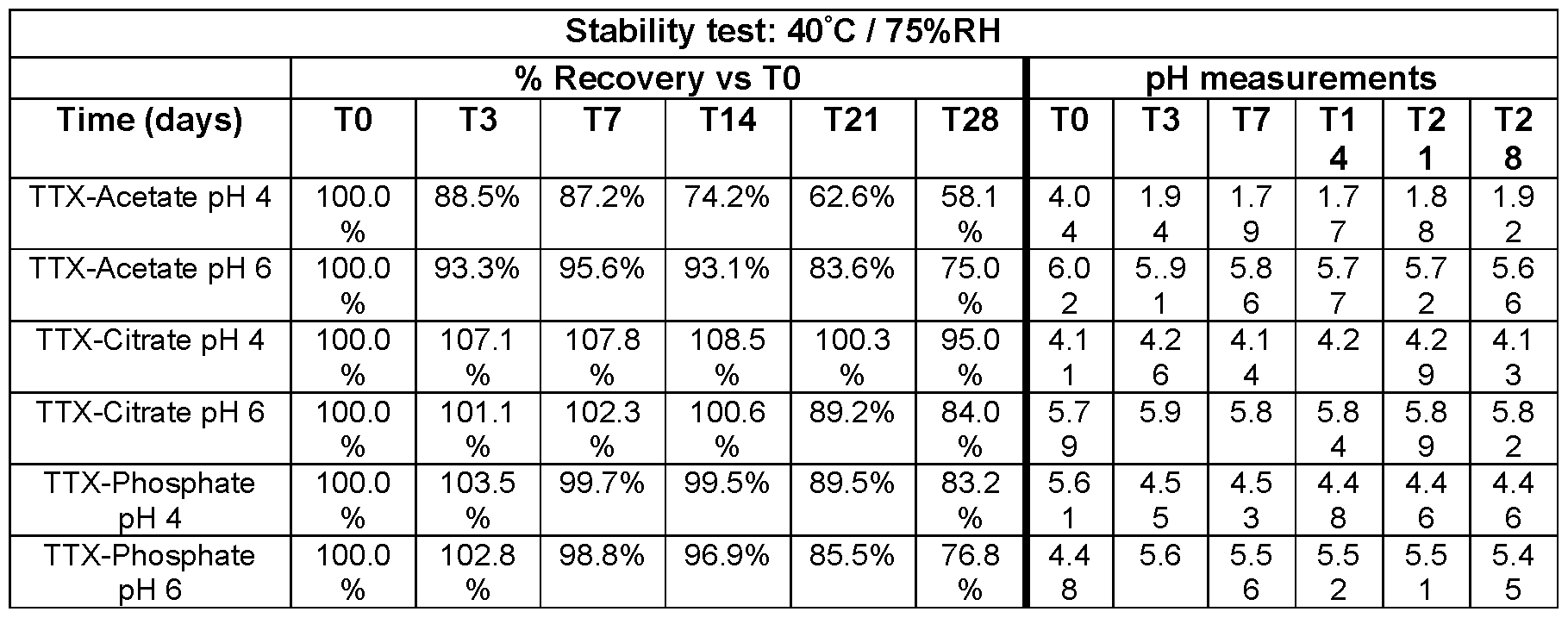
- the present description provides a TTX formulation that is (a) stable for 24 months at a temperature of 2-8°C; and/or (b) stable for 1 month at 25°C; and/or (c) stable for 28 days at a temperature of 40°C.
- a stable TTX formulation exhibits less than 5%, 10%, 15%, 20%, 25%, 30% or 35% degradation of the tetrodotoxin after the formulation is stored at 40°C and 75% relative humidity (RH) for a period of 28 days.
- RH relative humidity
- the formulation is defined as being stable if less than 10% of the tetrodotoxin undergoes degradation after being stored at 40°C for a period of 28 days.
- a stable TTX formulation exhibits less than 5%, 10%, 15%, 20%, 25%, 30% or 35% degradation of the tetrodotoxin when the formulation is stored at 25°C and 40% RH for a period of 12 weeks.
- the formulation is defined as stable if less than 10% of the tetrodotoxin undergoes degradation after being stored at 25°C and 40% RH for a period of 12 weeks.
- a stable TTX formulation exhibits less than 5%, 10%, 15%, 20%, 25%, 30% or 35% degradation of the tetrodotoxin when the formulation is stored at 2-8°C and ambient RH for a period of 6 months.
- the formulation is defined as stable if less than 5% of the tetrodotoxin undergoes degradation after being stored at 2-8°C and ambient RH for a period of 6 months.
- TTX stability of a TTX formulation
- concentration of 4-epi-tetrodotoxin does not exceed about 2% and/or the concentration of 4,9- anydro-tetrodotoxin does not exceed about 5% in the formulation.
- time for these degradation products to reach such concentrations will depend on the conditions to which the formulations are exposed. For example, it is understood that TTX degradation is accelerated at higher temperatures.
- liquid formulations of tetrodotoxin, or derivatives or analogs thereof, or pharmaceutically acceptable salts thereof that have been shown to have enhanced stability characteristics over known TTX liquid formulations, such as known formulations made by reconstituting lyophilized TTX.
- stable has been defined above and will be understood to mean that the TTX component in the formulation is not degraded by a given amount, and/or that the concentration of one or more TTX degradation products is not greater than a given amount.
- compositions described herein may be formulated in an injectable form and/or in the form of ready to administer compositions.
- dosage forms that comprise, for example, pre-filled syringes or pre-filled ampules comprising a set dose of TTX for administration to a subject.
- the liquid TTX formulations described herein comprise tetrodotoxin, water, a solvent, and one or more other components as discussed herein.
- the formulations may further comprise one or more pharmaceutically acceptable diluents, carriers, excipients etc.
- the tetrodotoxin liquid formulations described herein contain a minimal amount of water that balances the solubility and stability of tetrodotoxin.
- the formulations described herein comprise a sufficient amount of water to solubilize the TTX component but not enough water to detrimentally affect the stability of such component.
- liquid TTX formulation is adapted for parenteral administration and comprises:
- Tetrodotoxin or a derivative of tetrodotoxin, or an analog of tetrodotoxin, or a pharmaceutically acceptable salt thereof; [0058] (ii) water; [0059] (iii) one or more pharmaceutically acceptable solvents; [0060] (iv) one or more pharmaceutically acceptable pH adjusting agents; [0061] (v) one or more pharmaceutically acceptable buffering agents; and [0062] (vi) one or more pharmaceutically acceptable stabilizing agents.
- Solvents suitable for use in the presently described formulation include, but are not limited to, ethyl alcohol (ethanol) (“EtOH”), dehydrated ethyl alcohol, denatured ethyl alcohol, benzyl alcohol, dimethyl sulfoxide, glycerin, isopropyl alcohol, methylpyrrolidone, N,N- dimethylacetamide (“DMA”), polyethylene glycol 200 (“PEG 200”), polyethylene glycol 300 (“PEG 300”), polyethylene glycol 400 (“PEG 400”), polyethylene glycol 600 (“PEG 600”), polypropylene glycol, propylene glycol (“PG”), diethylene glycol monoethyl ether, or any combination thereof.
- EtOH ethyl alcohol
- dehydrated ethyl alcohol denatured ethyl alcohol
- benzyl alcohol dimethyl sulfoxide
- glycerin isopropyl alcohol
- DMA N,N- dimethylacetamide
- PEG 200
- the pH adjusting agents suitable for use in the presently described formulation include, but are not limited to, hydrochloric acid, acetic acid (“AA”), acetic anhydride, adipic acid, anhydrous citric acid, benzenesulfonic acid, boric acid, citric acid monohydrate, lactic acid, (DL)-lactic acid, (L)-lactic acid, maleic acid, metaphosphoric acid, methanesulfonic acid (“MSA”), nitric acid, phosphoric acid, succinic acid, sulfuric acid, sulfurous acid, tartaric acid, (DL)-tartaric acid, trifluoroacetic acid, ascorbic acid, benzoic acid, edetic acid, formic acid, lactobionic acid, aspartic acid, caprylic acid, glucuronic acid, hydroxyethylpiperazine ethane sulfonic acid, methylboronic acid, oleic acid, palmitic acid, pentetic acid, stearic acid
- Buffering agents used in the presently described formulation include, but are not limited to sodium phosphate, dibasic, heptahydrated sodium phosphate, dibasic, sodium phosphate, dibasic, anhydrous, sodium phosphate, dibasic dehydrate, sodium phosphate, dibasic dodecahydrate, sodium phosphate, sodium phosphate dehydrate, sodium phosphate, monobasic, anhydrous, sodium phosphate, monobasic, dehydrate, sodium phosphate, monobasic, monohydrate, dibasic potassium phosphate, potassium phosphate, monobasic, sodium acetate, sodium acetate anhydrous, ammonium acetate, sodium citrate, disodium hydrogen citrate, anhydrous trisodium citrate, disodium citrate sesqui hydrate, trisodium citrate dehydrate, sodium lactate, (L)-sodium lactate, sodium tartrate, ammonium sulfate, ethanolamine hydrochloride, or any combination thereof.
- Stabilizing agents used in the presently described formulation may comprise one or more known pharmaceutically acceptable antioxidants, surfactants, preservatives, sugars.
- Such agents include, but are not limited to sodium sulfite, sodium bisulfite, sodium metabisulfite, potassium metabisulfite, alpha-tocopherol, acetone sodium bisulfite, ascorbic acid, sodium ascorbate, butylated hydroxyanisole, butylated hydroxytoluene, gentisic acid, gentisic ethanolamide, glutathione, methionine, monothioglycerol, sodium formaldehyde sulfoxylate, edetate disodium, edetate disodium anhydrous, edetate sodium, edetate calcium disodium, edetate calcium disodium anhydrous, edetic acid, gluceptate sodium, pentasodium pentetate, pentetate calcium trisodium, pentetic acid, povid
- the formulation described herein is packaged in a container.
- the container may comprise a syringe, an ampule, a vial, or an autoinjector.
- the formulation may be provided in such container in a predetermined volume and/or TTX concentration, thereby resulting in a predetermined dose of TTX for administration.
- the container may be provided in a kit comprising the container and a suitable administration device, where needed.
- the kit may comprise an ampule or vial containing a volume of the formulation and a syringe for administering the formulation to a subject.
- the kit may also comprise suitable instructions and other information and/or equipment to aid in the administration or self-administration of the TTX formulation.
- the subject formulations can be prepared using techniques described herein.
- the formulations may be prepared by first dissolving TTX (or a derivative, analog, or salt thereof) in water.
- One or more pH adjusting agents, and/or one or more buffering agents may also be combined in this aqueous solution.
- One or more stabilizing agents may then be combined, followed by mixing one or more solvents.
- the composition can be aseptically filled into a container suitable for direct administration (i.e., without requiring any further mixing, diluting, reconstituting, etc.)
- the studies summarized herein illustrate the ability of providing stable TTX liquid formulations.
- the formulations can be provided in containers and stored in liquid form for a sufficient period of time, without degradation, for later use.
- the formulations provided herein are believed to be the first commercially viable liquid TTX formulations that are stable.
- the formulation can therefore be provided in predetermined doses for administration by, for example, sub-cutaneous (“S.C.”) or intramuscular (“I.M.”) injection.
- the TTX formulation can be provided in a pre-filled syringe.
- the formulation can, in one aspect, be provided in a form for self-administration.
- the TTX formulations described herein may be provided in any suitable concentration and/or dose amount. As will be understood, the required TTX dosage and concentration are closely related to the volume of the dose to be delivered.
- the TTX formulations described herein may be provided with a TTX concentration from about 5 to 5000 pg/ml. Included in this range are concentrations of about 5, 10, 15, 20, 25, 30, 35, 40, 45, 50, 55, 60, 65, 70, 75, 80, 85, 90, 95, 100, 105, 110, 115, 120, 125, 130, 135, 140, 145, 150, 155, 160, 165, 170, 175, 180, 185, 190, 195, 200,
- the formulation described herein may comprise a TTX dose of from about 5 to about 120 pg. In another example, the formulation described herein may comprise a TTX dose from about 15 to about 60 pg. In another example, the formulation described herein may comprise a TTX dose of about 30 pg.
- the required TTX dosage and concentration are closely related to the volume of the dose to be delivered.
- the formulation may comprise from about 60 pg/ml of TTX, thereby allowing for a dose of 30 pg TTX with about 0.5 ml of the formulation, which is suitable for S.C. administration.
- the formulation may comprise from about 100 pg/ml of TTX, thereby allowing for a dose of 30 pg TTX with about 0.3 ml of the formulation, which is suitable for S.C. administration.
- the formulation may comprise from about 150 pg/ml of TTX, thereby allowing for a dose of 30 pg TTX with about 0.2 ml of the formulation, which is suitable for S.C. administration.
- the aim of the examples was to arrive at a liquid TTX formulation that would provide a fixed TTX dose of up to 30 pg. For this reason, the aim was to arrive at a formulation having a TTX concentration of 300 pg/ml, which would allow for a S.C. or I.M. administration of roughly 0.1 to 0.2 ml of the formulation.
- TTX is known to be heat sensitive; e.g., TTX rapidly degrades at 40°C.
- 40°C as a study condition would provide better screening when assessing stability of the formulations.
- exposing the formulations to conditions of 40°C for 1 month was assumed to be equivalent to a 24-month study at 5°C.
- TTX is known to have better stability characteristics in acidic environments.
- TTX is labile in alkaline, pH > 6, so the present study sought to arrive at a preferred formulation pH of 3-5. In some of the tests, a pH of 4 was used for the analyses.
- TTX is water soluble but is also quickly degraded in such aqueous environment.
- the present study therefore sought to determine what amount of water provides an optimal balance of the need for water to enhance the dissolution of TTX with the degradation of TTX resulting from exposure to water.
- TTX solubility of TTX in various acid and organic solvent combinations was investigated to determine solubility characteristics of TTX in an environment essentially free of water.
- the target TTX concentration was 30 pg/mL.
- the acids studied were ascorbic acid (“AA”), citric acid (“CA”), and methanesulfonic acid (“MSA”).
- the solvents studied were ethanol (“EtOH”) and benzyl alcohol (“BA”). The results of this study are presented below in Table 1.
- Example 2 Solubility of TTX in water and acid
- TTX was added to aqueous solutions of acetic acid (“AA”) at concentrations of 1.0, 1.5, 2.0, and 3.0 mg/ml_.
- AA acetic acid
- Table 2 As noted in Table 2, the solubility of TTX in aqueous AA solutions was found to increase as the pH is lowered. A 0.02M acetic acid solution at pH 3.30 was found to readily dissolve TTX at up to 3.0 mg/ml.
- This study confirms the necessity of some water content in a solution for dissolving TTX at the target concentrations.
- acetic acid (“AA”) solution at pH 3.30, was mixed with an organic solvent at volume ratios of 10%AA / 90% organic and 5% AA / 95% organic.
- the organic solvents studied were ethanol (“EtOH”), N,N-Dimethylacetamide (“DMA”), Polyethylene Glycol 400 (“PEG 400”), and Propylene Glycol (“PG”).
- TTX was added at a concentration of 3.0 mg/ml.
- the aim of the tests was to arrive at a TTX formulation having a pH of 4.0 ⁇ 0.5. Table 3 provides the pH measurements of the solutions before and after TTX addition.
- Table 3 [0095] As noted above, the addition of TTX resulted in a significant upward shift of the pH of the formulation (by roughly 2 pH units). To reduce the pH to the desired value of 4, the formulations were titrated with addition of a 0.696M AA solution. The results of one of these titration tests are presented in Table 4. [0096] In these tests, a solution of TTX in AA (0.02M), at a TTX concentration of 3.0 mg/ml, was added to organic solvents in a v/v amount of 10% aq : 90% org to provide a total TTX concentration of 300 pg/ml in the final formulation.
- Example 3 A solubility study similar to Example 3 was conducted by substituting methanesulfonic acid (“MSA”) for AA. As is known, the pKa of MSA is -1.86, whereas the pKa of AA is 4.76.
- MSA methanesulfonic acid
- TTX was dissolved in a solution of 10% MSA solution (0.01 M, pH 2) to arrive at a TTX concentration of 3 mg/ml. This TTX solution was then combined with an organic solvent at 1:9 (v/v) ratio, to result in a formation having 10% aq : 90% org (as in Example 3). This results in a formulation having a TTX concentration of 300 pg/ml.
- the initial pH of each mixture was measured and then titrated with MSA to reach a pH of 4 ⁇ 0.5. The results of this study are presented in Table 5.
- TTX was found to be solubilized at 0.3 mg/ml_.
- the addition of TTX was found to raise the pH of the formulation by approximately 2 pH units.
- To reach the target pH of about 4.0 addition of 1.0%, 2.0%, 1.1%, and 0.1% AA (all w/v) was found to be required for formulations having 10% Aqueous + 90% of EtOH, DMA, PEG 400, and PG, respectively.
- the amount of MSA required to achieve the target pH of about 4.0 was less than that for AA. This is believed to be attributed to MSA being a stronger acid than AA.
- Example 5 Stability of TTX in formulations of aqueous acid (MSA/AA1 and organic solvent (10% aqueous : 90% organic (v/v))
- formulations comprising MSA were found to generally provide better stability results than formulations with AA. This may be attributed to MSA being a stronger acid. While some variation in the stability results was found, there was no clear differentiation amongst the four organic solvents that were reviewed. This suggests that degradation of TTX observed in this study was the result of the 10% aqueous component. [00119] The study also revealed that formulations comprising MSA with PEG 400 or DMA were found to provide the highest stability results.
- Example 6 Stability of TTX in formulations of aqueous acid (MSA/AA) and organic solvent (5% aqueous : 95% organic (v/vV) [00121] Based on the findings in Example 5, studies were conducted to investigate TTX solubility and stability with less than 10% water content. In this study, similar tests as above were conducted with formulations comprising a 5% aqueous component and a 95% organic component. In these studies, PEG 400, DMA, and PG were used as the organic solvents and MSA and AA were used as the acids. [00122] Initially, six samples of formulations were attempted with each containing 0.3 mg/ml (or 300 pg/ml) TTX in the acid/organic composition.
- the TTX was found to not fully dissolve when mixed with either AA or 0.01 M MSA. Only the sample comprising TTX mixed with 3.48M AA was found to achieve the desired TTX concentration. It was therefore decided to reduce the TTX concentration in the final formulation to 0.15 mg/ml.
- TTX was dissolved in 1 ml of either AA or 0.01 M MSA and this aqueous solution was mixed with 19 ml of the organic component, comprising DMA, PEG 400, or PG.
- the organic component comprising DMA, PEG 400, or PG.
- 3.48M AA was added until dissolution was achieved.
- the final concentration of TTX in the samples was 0.15 mg/ml.
- Table 7 [00126] As noted in Table 7, the DMA/MSA sample was found to be relatively stable, whereas the results for PEG 400/MSA and PEG 400/MSA/guanidine were found to be extremely low. The latter was unexpected given that this was not reflected in the results from the 10% aq / 90% org tests. Given that both these samples exhibited the same degradation trend, it was postulated that these unexpected results may be attributed insufficient mixing of the sample and to issues with over titration during sample preparation. As above, acid was added to the final formulation to bring the final pH to 4.
- Table 8 [00137] Controls used in these tests comprised samples that only comprised an aqueous phase. [00139] Preliminary stability data for these samples was obtained after maintaining the samples at 25°C and 40% RH for one week (T 1) and this data is summarized in Table 9. [00140] Table 9 [00141] As noted, all the samples were found to maintain TTX stability for up to 7 days under the above-mentioned conditions. [00142] For the next section of this study, only samples 1 , 3, and 4 were utilized and these samples were subjected to stability testing under the following three different conditions and time periods:
- %TTX was measured using HPLC and quantified by peak area as with previous examples.
- the TTX amounts are expressed with reference to the amount at TO.
- Example 8 Stability of TTX in formulations of aqueous acid and organic solvent combination (2% aqueous: 98% organic (v/vV)
- formulations were prepared with three buffer systems, namely, acetate, citrate, and phosphate buffer systems.
- Formulations were prepared having 2% aqueous solution and 98% organic solvent, comprising 50% (v/v) PG and 48% (v/v) PEG.
- Aqueous MSA was used to titrate the formulations to pH 4, 5, and 6.
- TTX samples were then prepared at a concentration of 60 pg/ml.
- the formulations were adapted with the buffer to remain at about pH 4 to minimize the amount of MSA required after TTX addition.
- Table 13 [00159] Corresponding control samples were also prepared. The formulations were then transferred to three different stability chambers to assess the stability of the formulations under the following three conditions: 40°C/75%RH; 25°C/40% RH; and 2-8°C. The samples were then assayed at varying times depending on the conditions. Table 14 summarizes the assay times for the samples. [00160] Table 14 [00161] Tables 15, 16, and 17 summarize the results of these studies. [00162] Table 15 [00163] Table 16
- TTX solubility is at least about 60 pg/ml.
- the data from the 2% aqueous samples placed in accelerated conditions i.e., 40°C
- having an aqueous component as low as 2% is still sufficient to maintain TTX stability.
- This conclusion is further supported by the stability data obtained from the tests run at 2-8°C.
- Formulations were studied comprising 10% (v/v) aqueous and 90% (v/v) organic components. These formulations comprised an aqueous phase of an acid (AA or MSA) solution. The organic phase comprised EtOH, DMA, PEG400, or PG. The formulations were prepared with pH of about 4 and TTX concentrations of 300 pg/ml were achieved. The stability of TTX in these formulations persisted for approximately 7 days with some variability. Owing to the high organic solvent content, chromatographic effects such as peak splitting made it challenging to obtain results using the HPLC method that was employed.
- AA or MSA acid
- the formulations were prepared with pH of about 4 and TTX concentrations of 300 pg/ml were achieved. The stability of TTX in these formulations persisted for approximately 7 days with some variability. Owing to the high organic solvent content, chromatographic effects such as peak splitting made it challenging to obtain results using the HPLC method that was employed.
- TTX formulations can remain stable at low aqueous contents.
- 2% (v/v) aqueous formulations were explored to determine if improved stability could be achieved.
- TTX solubility was found to be about 60 pg/mL.
- Stability testing conducted at 40°C did not show a significant difference between 2% and 5% aqueous compositions. This suggests that stable TTX formulations can be achieved with aqueous concentrations as low as 2%.
- chromatographic defects encountered during the analytical phase were challenging for the 2% aqueous formulation.
- Example 9 Stability of TTX in formulations with various PG/PEG 400 ratios and EH
- the formulations were made up with a TTX concentration of 100 ug/ml and according to the volume ratios of MSA/PG/PEG 400 listed in Table 18. Where MSA is 0.01 M aqueous MSA.
- formulation 2 would be ideal for further investigation.
- This formulation comprised MSA/PG/PEG 400 in the ratio 5/50/45 (v/v) (where MSA is 0.01 M aqueous MSA).
- Example 9 The study described in Example 9 was repeated to provide supplementary data regarding impurities.
- the relative amounts of various degradation products of TTX were measured at the noted time points.
- the degradation products of TTX are identified as impurities g-TTX, o-TTX, e-TTX and a-TTX as shown in Table 19.
- Table 19 The results of the repeat study measuring the amount of impurities are shown in Table 20 below: [00188] Table 20 [00189]
- the results of this study generally showed consistency compared to the initial study.
- the formulation comprising PG:PEG 400: MSA (50:45:5) demonstrates good stability over the observed time period.
- Example 10 Stability of TTX in formulations with different aqueous acids and different PEG
- the formulation mentioned above i.e., a formulation comprising MSA/PG/PEG in the ratio 5/50/45 (v/v)
- the formulations were made up with 100 pg/ml TTX.
- the following acids were investigated: benzenesulfonic acid, formic acid, hydrochloric acid, phosphoric acid, sulfuric acid, sulfurous acid, and citric acid.
- Benzenesulfonic acid exhibited a high variability in pH measurement and was also generally difficult to use (requiring more care and control as compared to the other acids studied). Thus, it is concluded that this acid may not be an ideal candidate for TTX formulations, primarily owing to the difficulty of pH titration. Phosphoric acid does not appear to improve TTX stabilize as compared to MSA. The formulations containing other acids - formic acid, hydrochloric acid, sulfuric acid, sulfurous acid, and citric acid - showed similar TTX stability to MSA. These studies indicate that the stability of TTX is not related to the acid employed and that various acids may be used for preparing stable TTX liquid formulations.
- Table 22 The samples as shown in Table 22 below were repeated at target pH 5 for pH/Assay/RS stability at 40°C at time points TO, 2 weeks and 4 weeks.
- test refers to all the chemical tests conducted on each sample at each stability test time point.
- assay refers to the test to determine the content of TTX and the term “RS” refers to the “related substances” test which is the test for the presence and amount of impurities.
- Table 22 [00204] The stability results are for the formulations of T able 22 provided in T ables 23 and 24.
- T able 23 includes the measured pH values at each time point and the percent of TTX relative to the TTX at TO and Table 24 includes the relative percentage of the TTX degradation products relative to TO.
- Table 23 [00206] Table 24
- Example 11- Secondary Percentage H?0 Study A further study of the effect of the concentration of H 2 0 in the formulation was carried out on formulations comprising the combinations of aqueous MSA, PG and PEG. The formulations tested are outlined in Table 25. The stability is assessed at the temperature and times points noted in the last column. For the formulation shown in the last row of table 25 comprising 2% MSA, the amount of TTX may have been reduced slightly in cases where the TTX did not fully dissolve.
- Table 25 [00211] The study results are provided in Tables 26 and 27.
- Table 26 includes the measured pH values for each formulation at each time point and the percent of TTX relative to the TTX at TO and Table 27 includes the relative percentage of the TTX degradation products (g-TTX, o-TTX, e-TTX, a-TTX) relative to the amount of these substances at TO.
- Table 26 [00213] Table 27 [00214] From these results a clear trend emerges, that the higher the water content the higher the degree of TTX degradation.
- Example 12 - Exemplary TTX formulations are preferably in a form for parenteral administration.
- the formulations described herein may be administered by I.M. or, preferably, S.C. routes to provide an initial dose of 30 pg of Tetrodotoxin to a patient.
- the liquid parenteral formulations described herein may also be administered to provide a daily dose of 60 pg of Tetrodotoxin to a patient.
- the formulations described herein are also suitable for various other doses and dosage regimens as would be known to persons skilled in the art.
- the formulations described herein are well-suited for being stored for periods of time in containers, such as vials, ampules, syringes, auto injectors and the like.
- the formulations may be packaged in predetermined dosage amounts for use by a subject or for administration to a subject.
- the formulation may, for example be packaged into pre-filled syringes or the like.
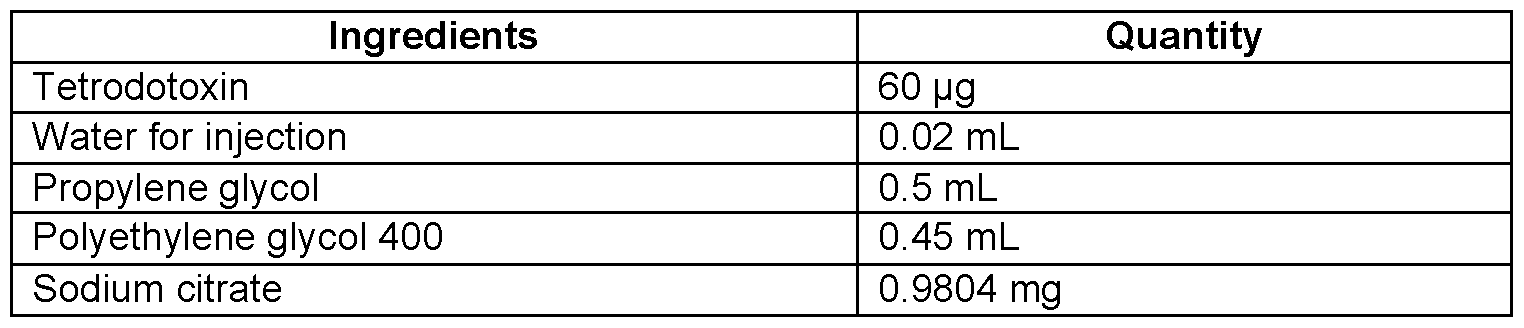
- Example 12h To a processing vessel, water for injection, sodium phosphate monobasic and sodium phosphate dibasic were added to prepare a buffer solution. Tetrodotoxin was added to the above solution and mixed until dissolved. Propylene glycol and polyethylene glycol 400 were added and mixed well. The pH of the solution was adjusted to 4.0 ⁇ 0.5 by addition of methanesulfonic acid if necessary. The solution was filtered and filled into containers. [00232] Example 12h [00233] To a processing vessel, water for injection, sodium phosphate monobasic and sodium phosphate dibasic were added to prepare a buffer solution. Tetrodotoxin was added to the above solution and mixed until dissolved. Propylene glycol and polyethylene glycol 400 were added and mixed well.
- Example 13 -Stability of TTX Formulations Stored in Pre-Filled Syringes A study was conducted to determine the stability characteristics of TTX formulations stored in pre-filled syringes. A TTX formulation comprising methanesulfonic acid (MSA), propylene glycol (PG) and polyethylene glycol (PEG) was prepared as described above. The samples were filled into BD Neopak 1 ml 27g glass syringes.
- Table 28 [00236] Table 28 [00237] The relative amount of TTX and TTX impurities was determined for each of the above conditions and time periods as shown in Table 29. The determination of the relative amounts of the impurities was done by HPLC in comparison to sample at time 0 (TO) by the method described above. [00238] Table 29
- Example 14 -Order of Addition Study [00241] To investigate the potential impact of the order of addition of the components on TTX solubility, as series of experiments were run altering the order of addition of the components of the composition. First, a TTX formulation having the following excipient ratios PG:PEG 400:MSA (50:45:5) (where MSA is 0.01 M aqueous MSA) was prepared as a standard preparation. The pH and appearance were recorded after each step. The results of this experiment are reported in Table 30. In Experiments A to G, TTX formulations having the same composition as the standard preparation were prepared but the order of the addition steps was altered. The pH and appearance were recorded after each addition step.
- Tables 31-37 The results of Experiments A to G are shown in Tables 31-37 which include the order of addition of the components and the pH and appearance at each step.
- a stock solution of TTX in MSA/H20 was prepared and used in the Experiments B-G shown in Tables 32-37.
- Table 30 [00243] Table 31 [00244] Table 32 [00245] Table 33 [00246] Table 34 [00247] Table 35 [00248] Table 36 [00249] Table 37 [00250]
- the TTX formulations prepared by the standard procedure and in the Experiments A-G (Tables 30-37) were assayed to determine the amount of TTX and the amount of impurities obtained by each process.
- the assay and impurity test results are shown in Table 38 below. The percentages are w/v.
- Paw withdrawal threshold was tested daily for three days before beginning the treatment course (pre test) daily before dosing, 1 hour after dosing and 2 hours after dosing during the 5 day treatment course, and once on the 7th, 10th and 14th days after the start of the dosing course. PWT was expressed as mean ⁇ SEM. One-way ANOVA was used to compare different groups at the same time points.
- the lyophilized TTX formulation comprises lyophilized TTX reconstituted in water at a concentration of 8 pg/mL and the stable liquid formulation is formulation of TTX having an excipient ratio of PG:PEG 400:MSA (50:45:5) (where MSA is 0.01 M aqueous MSA) prepared by the Standard Preparation method described in example 14.
- the lyophilized TTX was administered at a dose of 8 pg/kg while the stable liquid formulation was tested at doses of 8 pg/kg and 10 pg/kg.
- the results of the PWT testing for the two TTX formulations is shown in Figs. 4-7.
- FIG. 4 illustrates the PWT test results at all testing time points.
- the testing time points include daily testing for 3 days before oxaliplatin administration (Pre1, Pre2, Pre3) weekly testing for two weeks after oxaliplatin administration (W1 , W2) testing 3 times per day during the TTX dosing course (D-0, before TTX dosing, D-1h, one hour post TTX dosing, and D-2h, two hours post TTX dosing) and once a daily testing a days 7, 10 and 14 post TTX dosing.
- Graphs 5-7 isolate the data for each of the 1 hour, 2hour and immediate before TTX dosing, time periods, so that comparisons can be more readily observed.
Landscapes
- Health & Medical Sciences (AREA)
- Chemical & Material Sciences (AREA)
- Life Sciences & Earth Sciences (AREA)
- Veterinary Medicine (AREA)
- Medicinal Chemistry (AREA)
- Pharmacology & Pharmacy (AREA)
- Animal Behavior & Ethology (AREA)
- General Health & Medical Sciences (AREA)
- Public Health (AREA)
- Epidemiology (AREA)
- Chemical Kinetics & Catalysis (AREA)
- General Chemical & Material Sciences (AREA)
- Engineering & Computer Science (AREA)
- Oil, Petroleum & Natural Gas (AREA)
- Organic Chemistry (AREA)
- Dermatology (AREA)
- Nuclear Medicine, Radiotherapy & Molecular Imaging (AREA)
- Pain & Pain Management (AREA)
- Rheumatology (AREA)
- Bioinformatics & Cheminformatics (AREA)
- Proteomics, Peptides & Aminoacids (AREA)
- Inorganic Chemistry (AREA)
- Biomedical Technology (AREA)
- Neurology (AREA)
- Neurosurgery (AREA)
- Medicinal Preparation (AREA)
- Medicines That Contain Protein Lipid Enzymes And Other Medicines (AREA)
- Pharmaceuticals Containing Other Organic And Inorganic Compounds (AREA)
Abstract
Description








Claims
Priority Applications (7)
| Application Number | Priority Date | Filing Date | Title |
|---|---|---|---|
| US18/556,683 US20240226105A1 (en) | 2021-04-23 | 2022-04-22 | Tetrodotoxin liquid formulations |
| EP22790649.2A EP4326282A4 (en) | 2021-04-23 | 2022-04-22 | TETRODOTOXIN LIQUID FORMULATIONS |
| JP2023565457A JP2024518821A (en) | 2021-04-23 | 2022-04-22 | Tetrodotoxin liquid preparation |
| AU2022261799A AU2022261799A1 (en) | 2021-04-23 | 2022-04-22 | Tetrodotoxin liquid formulations |
| KR1020237037918A KR20230175221A (en) | 2021-04-23 | 2022-04-22 | Tetrodotoxin liquid formulation |
| CA3215362A CA3215362A1 (en) | 2021-04-23 | 2022-04-22 | Tetrodotoxin liquid formulations |
| CN202280030118.1A CN117202912A (en) | 2021-04-23 | 2022-04-22 | Tetrodotoxin liquid preparation |
Applications Claiming Priority (2)
| Application Number | Priority Date | Filing Date | Title |
|---|---|---|---|
| US202163201331P | 2021-04-23 | 2021-04-23 | |
| US63/201,331 | 2021-04-23 |
Publications (1)
| Publication Number | Publication Date |
|---|---|
| WO2022221963A1 true WO2022221963A1 (en) | 2022-10-27 |
Family
ID=83723506
Family Applications (1)
| Application Number | Title | Priority Date | Filing Date |
|---|---|---|---|
| PCT/CA2022/050623 Ceased WO2022221963A1 (en) | 2021-04-23 | 2022-04-22 | Tetrodotoxin liquid formulations |
Country Status (8)
| Country | Link |
|---|---|
| US (1) | US20240226105A1 (en) |
| EP (1) | EP4326282A4 (en) |
| JP (1) | JP2024518821A (en) |
| KR (1) | KR20230175221A (en) |
| CN (1) | CN117202912A (en) |
| AU (1) | AU2022261799A1 (en) |
| CA (1) | CA3215362A1 (en) |
| WO (1) | WO2022221963A1 (en) |
Families Citing this family (1)
| Publication number | Priority date | Publication date | Assignee | Title |
|---|---|---|---|---|
| WO2023001237A1 (en) * | 2021-07-21 | 2023-01-26 | Hepagene Therapeutics (HK) Limited | Glucagon-like peptide-1 receptor modulators and uses thereof |
Citations (12)
| Publication number | Priority date | Publication date | Assignee | Title |
|---|---|---|---|---|
| US5846975A (en) | 1994-03-17 | 1998-12-08 | Nanning Maple Leaf Pharmaceutical Co., Ltd. | Use of amino hydrogenated quinazoline compounds and derivatives thereof for abstaining from drug dependence |
| WO2002022128A1 (en) * | 2000-09-18 | 2002-03-21 | Wex Medical Instrumentation Co., Ltd. | A method of local anesthesia and analgesia |
| US6407088B1 (en) | 2000-09-18 | 2002-06-18 | Wex Medical Instrumentation Co., Ltd. | Method of analgesia |
| WO2006032481A1 (en) * | 2004-09-21 | 2006-03-30 | Laboratorios Del Dr. Esteve S.A. | Tetrodotoxin and its derivatives for the treatment of central-nervously derived neuropathic pain |
| WO2007110221A1 (en) * | 2006-03-27 | 2007-10-04 | Wex Pharmaceuticals Inc. | Use of sodium channel blockers for the treatment of neuropathic pain developing as a consequence of chemotherapy |
| CN101264063A (en) * | 2007-03-15 | 2008-09-17 | 深圳市宏锦天生物科技有限公司 | Stable tetrodotoxin preparations under room temperature for injection |
| CN101317846A (en) * | 2008-05-28 | 2008-12-10 | 王开业 | Tetrodotoxin preparation for drug rehabilitation and analgesia |
| CN101554368A (en) * | 2008-04-07 | 2009-10-14 | 深圳市宏锦天生物科技有限公司 | Tetrodotoxin composition formulation stable at room temperature and used for injection |
| US8124608B2 (en) | 2003-07-14 | 2012-02-28 | Wex Medical Limited | Stable pharmaceutical composition of freeze-dried tetrodotoxin powder |
| US8486901B2 (en) | 2009-03-30 | 2013-07-16 | Wex Medical Limited | Sodium channel blocking compounds tetrodotoxin galactopyranosides |
| CN107334652A (en) * | 2017-07-11 | 2017-11-10 | 崔震 | Application of the tetraodotoxin in skin care item are prepared, the skin care item containing tetraodotoxin and preparation method |
| CA2942085A1 (en) * | 2016-09-16 | 2018-03-16 | Wex Medical Limited | Use of sodium channel blockers for the treatment of neuropathic pain developing as a consequence of chemotherapy |
Family Cites Families (3)
| Publication number | Priority date | Publication date | Assignee | Title |
|---|---|---|---|---|
| CN1236773C (en) * | 2000-11-22 | 2006-01-18 | 南宁枫叶药业有限公司 | Preparation for analgesia and anesthesia or curing drug dependence |
| CN100367966C (en) * | 2004-09-28 | 2008-02-13 | 黄致强 | Tetrodotoxin oil phase formulation preparation method |
| CN102784102A (en) * | 2012-08-28 | 2012-11-21 | 赵继红 | Tetraodotoxin oral liquid state preparation and preparation method thereof |
-
2022
- 2022-04-22 CA CA3215362A patent/CA3215362A1/en active Pending
- 2022-04-22 US US18/556,683 patent/US20240226105A1/en active Pending
- 2022-04-22 WO PCT/CA2022/050623 patent/WO2022221963A1/en not_active Ceased
- 2022-04-22 JP JP2023565457A patent/JP2024518821A/en active Pending
- 2022-04-22 AU AU2022261799A patent/AU2022261799A1/en active Pending
- 2022-04-22 KR KR1020237037918A patent/KR20230175221A/en active Pending
- 2022-04-22 CN CN202280030118.1A patent/CN117202912A/en active Pending
- 2022-04-22 EP EP22790649.2A patent/EP4326282A4/en active Pending
Patent Citations (17)
| Publication number | Priority date | Publication date | Assignee | Title |
|---|---|---|---|---|
| US5846975A (en) | 1994-03-17 | 1998-12-08 | Nanning Maple Leaf Pharmaceutical Co., Ltd. | Use of amino hydrogenated quinazoline compounds and derivatives thereof for abstaining from drug dependence |
| WO2002022128A1 (en) * | 2000-09-18 | 2002-03-21 | Wex Medical Instrumentation Co., Ltd. | A method of local anesthesia and analgesia |
| US6407088B1 (en) | 2000-09-18 | 2002-06-18 | Wex Medical Instrumentation Co., Ltd. | Method of analgesia |
| US6599906B1 (en) | 2000-09-18 | 2003-07-29 | Wex Medical Instrumentation Co., Ltd. | Method of local anesthesia and analgesia |
| US8124608B2 (en) | 2003-07-14 | 2012-02-28 | Wex Medical Limited | Stable pharmaceutical composition of freeze-dried tetrodotoxin powder |
| US8530481B2 (en) | 2003-07-14 | 2013-09-10 | Wex Medical Limited | Stable pharmaceutical composition of freeze-dried tetrodotoxin powder |
| US8222258B2 (en) | 2003-07-14 | 2012-07-17 | Wex Medical Limited | Stable pharmaceutical composition of freeze-dried tetrodoxin powder |
| WO2006032481A1 (en) * | 2004-09-21 | 2006-03-30 | Laboratorios Del Dr. Esteve S.A. | Tetrodotoxin and its derivatives for the treatment of central-nervously derived neuropathic pain |
| WO2007110221A1 (en) * | 2006-03-27 | 2007-10-04 | Wex Pharmaceuticals Inc. | Use of sodium channel blockers for the treatment of neuropathic pain developing as a consequence of chemotherapy |
| US9018222B2 (en) | 2006-03-27 | 2015-04-28 | Wex Medical Limited | Use of sodium channel blockers for the treatment of neuropathic pain developing as a consequence of chemotherapy |
| US10624896B2 (en) | 2006-03-27 | 2020-04-21 | Wex Medical Limited | Use of sodium channel blockers for the treatment of neuropathic pain developing as a consequence of chemotherapy |
| CN101264063A (en) * | 2007-03-15 | 2008-09-17 | 深圳市宏锦天生物科技有限公司 | Stable tetrodotoxin preparations under room temperature for injection |
| CN101554368A (en) * | 2008-04-07 | 2009-10-14 | 深圳市宏锦天生物科技有限公司 | Tetrodotoxin composition formulation stable at room temperature and used for injection |
| CN101317846A (en) * | 2008-05-28 | 2008-12-10 | 王开业 | Tetrodotoxin preparation for drug rehabilitation and analgesia |
| US8486901B2 (en) | 2009-03-30 | 2013-07-16 | Wex Medical Limited | Sodium channel blocking compounds tetrodotoxin galactopyranosides |
| CA2942085A1 (en) * | 2016-09-16 | 2018-03-16 | Wex Medical Limited | Use of sodium channel blockers for the treatment of neuropathic pain developing as a consequence of chemotherapy |
| CN107334652A (en) * | 2017-07-11 | 2017-11-10 | 崔震 | Application of the tetraodotoxin in skin care item are prepared, the skin care item containing tetraodotoxin and preparation method |
Non-Patent Citations (6)
| Title |
|---|
| P. MOLYNEUX: "Water -A Comprehensive Treatise;", vol. 4, 1975, PLENUM PRESS, article "Synthetic polymers" |
| S. LUSSE ET AL., MACROMOLECULES, vol. 29, 1996, pages 4251 - 4257 |
| See also references of EP4326282A4 |
| T. GOTO ET AL., TETRAHEDRON LETT., vol. 4, 1963, pages 2105 - 2113 |
| TETRAHEDRON, vol. 21, 1965, pages 2059 - 2088 |
| WOODWARD, R. B.: "The structure of tetrodotoxin.", PURE AND APPL. CHEMISTRY, vol. 9, no. 1, 1964, pages 49 - 74 |
Also Published As
| Publication number | Publication date |
|---|---|
| JP2024518821A (en) | 2024-05-07 |
| EP4326282A1 (en) | 2024-02-28 |
| KR20230175221A (en) | 2023-12-29 |
| AU2022261799A1 (en) | 2023-10-26 |
| US20240226105A1 (en) | 2024-07-11 |
| EP4326282A4 (en) | 2025-02-26 |
| CA3215362A1 (en) | 2022-10-27 |
| CN117202912A (en) | 2023-12-08 |
Similar Documents
| Publication | Publication Date | Title |
|---|---|---|
| DK2648520T3 (en) | DEXMEDETOMIDI PREMISSION FORMULATION | |
| US11696905B2 (en) | Ready-to-use tranexamic acid intravenous solution | |
| US9925196B2 (en) | Ceftolozane-tazobactam pharmaceutical compositions | |
| US11413277B2 (en) | Non-aqueous liquid nimodipine compositions | |
| US11759457B2 (en) | Liquid nimodipine compositions | |
| US20240226105A1 (en) | Tetrodotoxin liquid formulations | |
| BR112012031928B1 (en) | Pharmaceutical compositions which include paracetamol and process for preparing the same | |
| US12419867B2 (en) | Stable pharmaceutical compositions of bendamustine | |
| WO2019023791A1 (en) | Levothyroxine formulations | |
| HK40104880A (en) | Tetrodotoxin liquid formulations | |
| US20240238275A1 (en) | Hydromorphone formulations for multi-dose products | |
| US20250255804A1 (en) | Liquid injectable compositions of lurbinectedin | |
| EP4719368A1 (en) | Injectable guanfacine formulations and methods |
Legal Events
| Date | Code | Title | Description |
|---|---|---|---|
| 121 | Ep: the epo has been informed by wipo that ep was designated in this application |
Ref document number: 22790649 Country of ref document: EP Kind code of ref document: A1 |
|
| DPE1 | Request for preliminary examination filed after expiration of 19th month from priority date (pct application filed from 20040101) | ||
| WWE | Wipo information: entry into national phase |
Ref document number: 804051 Country of ref document: NZ |
|
| WWE | Wipo information: entry into national phase |
Ref document number: AU2022261799 Country of ref document: AU Ref document number: 2022261799 Country of ref document: AU |
|
| WWE | Wipo information: entry into national phase |
Ref document number: 3215362 Country of ref document: CA |
|
| WWE | Wipo information: entry into national phase |
Ref document number: 202280030118.1 Country of ref document: CN |
|
| WWE | Wipo information: entry into national phase |
Ref document number: 2023565457 Country of ref document: JP |
|
| ENP | Entry into the national phase |
Ref document number: 2022261799 Country of ref document: AU Date of ref document: 20220422 Kind code of ref document: A |
|
| ENP | Entry into the national phase |
Ref document number: 20237037918 Country of ref document: KR Kind code of ref document: A |
|
| WWE | Wipo information: entry into national phase |
Ref document number: 1020237037918 Country of ref document: KR |
|
| WWE | Wipo information: entry into national phase |
Ref document number: 2022790649 Country of ref document: EP |
|
| NENP | Non-entry into the national phase |
Ref country code: DE |
|
| ENP | Entry into the national phase |
Ref document number: 2022790649 Country of ref document: EP Effective date: 20231123 |