WO2022230600A1 - 硬化性オルガノポリシロキサン組成物及び半導体装置 - Google Patents
硬化性オルガノポリシロキサン組成物及び半導体装置 Download PDFInfo
- Publication number
- WO2022230600A1 WO2022230600A1 PCT/JP2022/016564 JP2022016564W WO2022230600A1 WO 2022230600 A1 WO2022230600 A1 WO 2022230600A1 JP 2022016564 W JP2022016564 W JP 2022016564W WO 2022230600 A1 WO2022230600 A1 WO 2022230600A1
- Authority
- WO
- WIPO (PCT)
- Prior art keywords
- component
- heat
- mass
- group
- composition
- Prior art date
- Legal status (The legal status is an assumption and is not a legal conclusion. Google has not performed a legal analysis and makes no representation as to the accuracy of the status listed.)
- Ceased
Links
Images
Classifications
-
- C—CHEMISTRY; METALLURGY
- C08—ORGANIC MACROMOLECULAR COMPOUNDS; THEIR PREPARATION OR CHEMICAL WORKING-UP; COMPOSITIONS BASED THEREON
- C08G—MACROMOLECULAR COMPOUNDS OBTAINED OTHERWISE THAN BY REACTIONS ONLY INVOLVING UNSATURATED CARBON-TO-CARBON BONDS
- C08G77/00—Macromolecular compounds obtained by reactions forming a linkage containing silicon with or without sulfur, nitrogen, oxygen or carbon in the main chain of the macromolecule
- C08G77/04—Polysiloxanes
- C08G77/22—Polysiloxanes containing silicon bound to organic groups containing atoms other than carbon, hydrogen and oxygen
- C08G77/24—Polysiloxanes containing silicon bound to organic groups containing atoms other than carbon, hydrogen and oxygen halogen-containing groups
-
- C—CHEMISTRY; METALLURGY
- C09—DYES; PAINTS; POLISHES; NATURAL RESINS; ADHESIVES; COMPOSITIONS NOT OTHERWISE PROVIDED FOR; APPLICATIONS OF MATERIALS NOT OTHERWISE PROVIDED FOR
- C09K—MATERIALS FOR MISCELLANEOUS APPLICATIONS, NOT PROVIDED FOR ELSEWHERE
- C09K5/00—Heat-transfer, heat-exchange or heat-storage materials, e.g. refrigerants; Materials for the production of heat or cold by chemical reactions other than by combustion
- C09K5/08—Materials not undergoing a change of physical state when used
- C09K5/14—Solid materials, e.g. powdery or granular
-
- C—CHEMISTRY; METALLURGY
- C08—ORGANIC MACROMOLECULAR COMPOUNDS; THEIR PREPARATION OR CHEMICAL WORKING-UP; COMPOSITIONS BASED THEREON
- C08G—MACROMOLECULAR COMPOUNDS OBTAINED OTHERWISE THAN BY REACTIONS ONLY INVOLVING UNSATURATED CARBON-TO-CARBON BONDS
- C08G77/00—Macromolecular compounds obtained by reactions forming a linkage containing silicon with or without sulfur, nitrogen, oxygen or carbon in the main chain of the macromolecule
- C08G77/04—Polysiloxanes
- C08G77/12—Polysiloxanes containing silicon bound to hydrogen
-
- C—CHEMISTRY; METALLURGY
- C08—ORGANIC MACROMOLECULAR COMPOUNDS; THEIR PREPARATION OR CHEMICAL WORKING-UP; COMPOSITIONS BASED THEREON
- C08G—MACROMOLECULAR COMPOUNDS OBTAINED OTHERWISE THAN BY REACTIONS ONLY INVOLVING UNSATURATED CARBON-TO-CARBON BONDS
- C08G77/00—Macromolecular compounds obtained by reactions forming a linkage containing silicon with or without sulfur, nitrogen, oxygen or carbon in the main chain of the macromolecule
- C08G77/04—Polysiloxanes
- C08G77/14—Polysiloxanes containing silicon bound to oxygen-containing groups
- C08G77/18—Polysiloxanes containing silicon bound to oxygen-containing groups to alkoxy or aryloxy groups
-
- C—CHEMISTRY; METALLURGY
- C08—ORGANIC MACROMOLECULAR COMPOUNDS; THEIR PREPARATION OR CHEMICAL WORKING-UP; COMPOSITIONS BASED THEREON
- C08G—MACROMOLECULAR COMPOUNDS OBTAINED OTHERWISE THAN BY REACTIONS ONLY INVOLVING UNSATURATED CARBON-TO-CARBON BONDS
- C08G77/00—Macromolecular compounds obtained by reactions forming a linkage containing silicon with or without sulfur, nitrogen, oxygen or carbon in the main chain of the macromolecule
- C08G77/04—Polysiloxanes
- C08G77/20—Polysiloxanes containing silicon bound to unsaturated aliphatic groups
-
- C—CHEMISTRY; METALLURGY
- C08—ORGANIC MACROMOLECULAR COMPOUNDS; THEIR PREPARATION OR CHEMICAL WORKING-UP; COMPOSITIONS BASED THEREON
- C08J—WORKING-UP; GENERAL PROCESSES OF COMPOUNDING; AFTER-TREATMENT NOT COVERED BY SUBCLASSES C08B, C08C, C08F, C08G or C08H
- C08J7/00—Chemical treatment or coating of shaped articles made of macromolecular substances
- C08J7/12—Chemical modification
-
- C—CHEMISTRY; METALLURGY
- C08—ORGANIC MACROMOLECULAR COMPOUNDS; THEIR PREPARATION OR CHEMICAL WORKING-UP; COMPOSITIONS BASED THEREON
- C08K—Use of inorganic or non-macromolecular organic substances as compounding ingredients
- C08K3/00—Use of inorganic substances as compounding ingredients
- C08K3/01—Use of inorganic substances as compounding ingredients characterized by their specific function
- C08K3/013—Fillers, pigments or reinforcing additives
-
- C—CHEMISTRY; METALLURGY
- C08—ORGANIC MACROMOLECULAR COMPOUNDS; THEIR PREPARATION OR CHEMICAL WORKING-UP; COMPOSITIONS BASED THEREON
- C08K—Use of inorganic or non-macromolecular organic substances as compounding ingredients
- C08K3/00—Use of inorganic substances as compounding ingredients
- C08K3/02—Elements
- C08K3/08—Metals
-
- C—CHEMISTRY; METALLURGY
- C08—ORGANIC MACROMOLECULAR COMPOUNDS; THEIR PREPARATION OR CHEMICAL WORKING-UP; COMPOSITIONS BASED THEREON
- C08K—Use of inorganic or non-macromolecular organic substances as compounding ingredients
- C08K3/00—Use of inorganic substances as compounding ingredients
- C08K3/10—Metal compounds
- C08K3/105—Compounds containing metals of Groups 1 to 3 or of Groups 11 to 13 of the Periodic Table
-
- C—CHEMISTRY; METALLURGY
- C08—ORGANIC MACROMOLECULAR COMPOUNDS; THEIR PREPARATION OR CHEMICAL WORKING-UP; COMPOSITIONS BASED THEREON
- C08K—Use of inorganic or non-macromolecular organic substances as compounding ingredients
- C08K3/00—Use of inorganic substances as compounding ingredients
- C08K3/18—Oxygen-containing compounds, e.g. metal carbonyls
- C08K3/20—Oxides; Hydroxides
- C08K3/22—Oxides; Hydroxides of metals
-
- C—CHEMISTRY; METALLURGY
- C08—ORGANIC MACROMOLECULAR COMPOUNDS; THEIR PREPARATION OR CHEMICAL WORKING-UP; COMPOSITIONS BASED THEREON
- C08L—COMPOSITIONS OF MACROMOLECULAR COMPOUNDS
- C08L83/00—Compositions of macromolecular compounds obtained by reactions forming in the main chain of the macromolecule a linkage containing silicon with or without sulfur, nitrogen, oxygen or carbon only; Compositions of derivatives of such polymers
- C08L83/04—Polysiloxanes
-
- C—CHEMISTRY; METALLURGY
- C08—ORGANIC MACROMOLECULAR COMPOUNDS; THEIR PREPARATION OR CHEMICAL WORKING-UP; COMPOSITIONS BASED THEREON
- C08L—COMPOSITIONS OF MACROMOLECULAR COMPOUNDS
- C08L83/00—Compositions of macromolecular compounds obtained by reactions forming in the main chain of the macromolecule a linkage containing silicon with or without sulfur, nitrogen, oxygen or carbon only; Compositions of derivatives of such polymers
- C08L83/04—Polysiloxanes
- C08L83/06—Polysiloxanes containing silicon bound to oxygen-containing groups
-
- C—CHEMISTRY; METALLURGY
- C09—DYES; PAINTS; POLISHES; NATURAL RESINS; ADHESIVES; COMPOSITIONS NOT OTHERWISE PROVIDED FOR; APPLICATIONS OF MATERIALS NOT OTHERWISE PROVIDED FOR
- C09D—COATING COMPOSITIONS, e.g. PAINTS, VARNISHES OR LACQUERS; FILLING PASTES; CHEMICAL PAINT OR INK REMOVERS; INKS; CORRECTING FLUIDS; WOODSTAINS; PASTES OR SOLIDS FOR COLOURING OR PRINTING; USE OF MATERIALS THEREFOR
- C09D183/00—Coating compositions based on macromolecular compounds obtained by reactions forming in the main chain of the macromolecule a linkage containing silicon, with or without sulfur, nitrogen, oxygen, or carbon only; Coating compositions based on derivatives of such polymers
- C09D183/04—Polysiloxanes
-
- H—ELECTRICITY
- H10—SEMICONDUCTOR DEVICES; ELECTRIC SOLID-STATE DEVICES NOT OTHERWISE PROVIDED FOR
- H10W—GENERIC PACKAGES, INTERCONNECTIONS, CONNECTORS OR OTHER CONSTRUCTIONAL DETAILS OF DEVICES COVERED BY CLASS H10
- H10W40/00—Arrangements for thermal protection or thermal control
- H10W40/10—Arrangements for heating
-
- H—ELECTRICITY
- H10—SEMICONDUCTOR DEVICES; ELECTRIC SOLID-STATE DEVICES NOT OTHERWISE PROVIDED FOR
- H10W—GENERIC PACKAGES, INTERCONNECTIONS, CONNECTORS OR OTHER CONSTRUCTIONAL DETAILS OF DEVICES COVERED BY CLASS H10
- H10W40/00—Arrangements for thermal protection or thermal control
- H10W40/20—Arrangements for cooling
- H10W40/25—Arrangements for cooling characterised by their materials
-
- H—ELECTRICITY
- H10—SEMICONDUCTOR DEVICES; ELECTRIC SOLID-STATE DEVICES NOT OTHERWISE PROVIDED FOR
- H10W—GENERIC PACKAGES, INTERCONNECTIONS, CONNECTORS OR OTHER CONSTRUCTIONAL DETAILS OF DEVICES COVERED BY CLASS H10
- H10W40/00—Arrangements for thermal protection or thermal control
- H10W40/20—Arrangements for cooling
- H10W40/25—Arrangements for cooling characterised by their materials
- H10W40/251—Organics
-
- C—CHEMISTRY; METALLURGY
- C08—ORGANIC MACROMOLECULAR COMPOUNDS; THEIR PREPARATION OR CHEMICAL WORKING-UP; COMPOSITIONS BASED THEREON
- C08K—Use of inorganic or non-macromolecular organic substances as compounding ingredients
- C08K3/00—Use of inorganic substances as compounding ingredients
- C08K3/18—Oxygen-containing compounds, e.g. metal carbonyls
- C08K3/20—Oxides; Hydroxides
- C08K3/22—Oxides; Hydroxides of metals
- C08K2003/2227—Oxides; Hydroxides of metals of aluminium
-
- C—CHEMISTRY; METALLURGY
- C08—ORGANIC MACROMOLECULAR COMPOUNDS; THEIR PREPARATION OR CHEMICAL WORKING-UP; COMPOSITIONS BASED THEREON
- C08K—Use of inorganic or non-macromolecular organic substances as compounding ingredients
- C08K3/00—Use of inorganic substances as compounding ingredients
- C08K3/18—Oxygen-containing compounds, e.g. metal carbonyls
- C08K3/20—Oxides; Hydroxides
- C08K3/22—Oxides; Hydroxides of metals
- C08K2003/2296—Oxides; Hydroxides of metals of zinc
-
- C—CHEMISTRY; METALLURGY
- C08—ORGANIC MACROMOLECULAR COMPOUNDS; THEIR PREPARATION OR CHEMICAL WORKING-UP; COMPOSITIONS BASED THEREON
- C08K—Use of inorganic or non-macromolecular organic substances as compounding ingredients
- C08K2201/00—Specific properties of additives
- C08K2201/002—Physical properties
- C08K2201/005—Additives being defined by their particle size in general
-
- H—ELECTRICITY
- H10—SEMICONDUCTOR DEVICES; ELECTRIC SOLID-STATE DEVICES NOT OTHERWISE PROVIDED FOR
- H10W—GENERIC PACKAGES, INTERCONNECTIONS, CONNECTORS OR OTHER CONSTRUCTIONAL DETAILS OF DEVICES COVERED BY CLASS H10
- H10W40/00—Arrangements for thermal protection or thermal control
- H10W40/70—Fillings or auxiliary members in containers or in encapsulations for thermal protection or control
Definitions
- the present invention relates to a curable organopolysiloxane composition, a method for producing the same, a cured product thereof, use of the cured product as a thermally conductive layer, a semiconductor device having the thermally conductive layer, and a method for producing the semiconductor device. .
- Heat-generating electronic components mounted on a printed wiring board may experience deterioration in performance or damage due to temperature rises caused by heat generated during use.
- a thermally conductive sheet with good thermal conductivity is placed between the heat dissipating member having fins, or heat conductive grease is applied to efficiently conduct the heat generated from the IC package or the like to the heat dissipating member. Heat dissipation is practiced. However, as electronic parts and the like become more sophisticated, the amount of heat they generate tends to increase more and more.
- thermally conductive sheets have the advantage of being easy to mount and install.
- thermally conductive grease it follows the unevenness of the surface of the CPU, the heat dissipating member, etc., without being affected by the unevenness of the surface, and adheres the two without creating a gap between them. and has the advantage of low interfacial thermal resistance.
- both thermally conductive sheets and thermally conductive greases are obtained by blending thermally conductive fillers to impart thermal conductivity.
- thermally conductive fillers In order not to interfere with the performance, and in the case of thermally conductive grease, to avoid problems with workability when applying it to exothermic electronic parts using a syringe etc. Since the upper limit of the viscosity must be suppressed to a certain limit, the upper limit of the amount of the thermally conductive filler compounded is limited in any case, and there is a drawback that a sufficient thermal conductivity effect cannot be obtained.
- Patent Document 1 JP-A-7-207160
- Patent Document 2 JP-A-8-53664
- liquid metal in a three-phase composite A particulate material that functions to fix and stabilize
- Patent Document 3 Japanese Patent Application Laid-Open No. 2002-121292
- these thermally conductive materials using low-melting-point metals have problems such as contamination of parts other than coated parts, and leakage of oily matter when used for a long period of time.
- a method of dispersing gallium and/or gallium alloy in curable silicone has been proposed (Patent Document 4: Patent No.
- JP-A-7-207160 JP-A-8-53664 Japanese Patent Application Laid-Open No. 2002-121292 Patent No. 4551074 Patent No. 4913874 Patent No. 5640945
- an object of the present invention is to mix a necessary and sufficient amount of a material with excellent thermal conductivity properties, and to disperse the material uniformly in a matrix made of a resin component in the state of fine particles so that cracks and cracks do not occur during curing.
- An object of the present invention is to obtain a curable organopolysiloxane composition that forms a cured product free from voids.
- Another object of the present invention is to provide a method for producing the curable organopolysiloxane composition.
- the present inventors have found that using organopolysiloxanes having two types of alkenyl groups with different viscosities, low-melting gallium and / or its alloys, specific alkoxypolysiloxanes, By blending syroquine, a specific silicon-bonded organohydrogenpolysiloxane, and a thermally conductive filler, it is possible to easily obtain a composition in which the gallium and/or its alloys are uniformly dispersed in fine particles, In the step of heat-treating the composition to form a cured product, cracks and voids are less likely to occur, and the liquid gallium and/or its alloys aggregate to form liquid particles having a large particle size. Particles are further connected with a thermally conductive filler to form a kind of continuous path, and the path-like structure is fixed and held in a crosslinked network formed by curing the resin component. I got the knowledge that
- the present invention provides the following curable organopolysiloxane composition and a semiconductor device using the curable organopolysiloxane composition.
- A Organo consisting of the following (A-1) and (A-2), wherein the ratio of (A-1) to the total of (A-1) and (A-2) is 10 to 90% by mass Polysiloxane: 100 parts by mass, (A-1) Organopolysiloxane having two or more silicon-bonded alkenyl groups per molecule with a viscosity of 0.01 to 10 Pa s at 25°C (A-2) Viscosity at 25°C of 11 to 1 ,000 Pa ⁇ s Organopolysiloxane having two or more silicon-bonded alkenyl groups per molecule (B) Organohydrogenpolysiloxane having two or more silicon-bonded hydrogen atoms per molecule: (A) an amount such that the number of silicon-bonded hydrogen atoms in the component is 0.1 to 5.0 per alkenyl group in the component; (C) one or more selected from the group consisting of gallium and gallium alloys having a melting point of ⁇ 20 to 70° C.
- Component (B) has 5 or more hydrogen atoms bonded to silicon atoms at non-terminals of the molecular chain in one molecule, and has the following formula (3): 0.1 ⁇ / ⁇ (3)
- ⁇ represents the number of hydrogen atoms bonded to non-terminal silicon atoms of the molecular chain, and ⁇ represents the total number of silicon atoms in component (B).
- ⁇ 5> The curable organopolysiloxane composition according to any one of ⁇ 1> to ⁇ 4>, wherein component (C) is dispersed in the composition in the form of particles of 1 to 200 ⁇ m.
- component (C) is dispersed in the composition in the form of particles of 1 to 200 ⁇ m.
- a thermally conductive silicone grease composition comprising the curable organopolysiloxane composition according to any one of ⁇ 1> to ⁇ 5>.
- ⁇ 7> A cured product of the curable organopolysiloxane composition according to any one of ⁇ 1> to ⁇ 5>.
- ⁇ 8> Use of the cured product according to ⁇ 7> as a thermally conductive layer sandwiched between a heat-generating electronic component and a heat-dissipating member.
- a semiconductor device comprising a heat-generating electronic component, a heat-dissipating member, and a thermally conductive layer made of the cured product according to ⁇ 7>, wherein the heat-generating electronic component and the heat-dissipating member form the heat-conductive layer.
- a method for manufacturing a semiconductor device according to ⁇ 9> (a) The surface of an exothermic electronic component is coated with the curable organopolysiloxane composition according to any one of ⁇ 1> to ⁇ 5> to form a coating layer comprising the composition on the surface. the process of causing (b) a step of pressing and fixing a heat radiating member to the coating layer; A method of manufacturing a semiconductor device comprising a step of forming a conductive layer.
- the curable organopolysiloxane composition of the present invention is in the form of grease before curing, it has good workability when coated on a heat-generating electronic component such as a CPU, and when a heat-dissipating member is brought into pressure contact with the composition.
- a heat-generating electronic component such as a CPU
- a heat-dissipating member is brought into pressure contact with the composition.
- the two can be adhered to each other without forming a gap between them by following the unevenness of the surfaces of the two, interfacial thermal resistance does not occur.
- the gallium and/or alloys thereof contained in the composition of the present invention aggregate to form large liquid particles.
- the liquid particles are connected to each other and further connected to the thermally conductive filler to form a kind of path, and the path-like structure is formed in the three-dimensional crosslinked network formed by curing the resin component. Since it is fixed and held, the heat generated from heat-generating electronic components can be quickly conducted to the heat-dissipating member, so that a higher heat-dissipating effect can be reliably exhibited than the conventional heat-conducting sheet or heat-conducting grease. be able to.
- the gallium and/or alloy thereof contained in the thermally conductive layer made of the cured product of the composition of the present invention incorporated in the semiconductor device and forming the path is fixed in the three-dimensional crosslinked network of the cured resin. ⁇ Because it is retained, it does not contaminate other parts, which is a problem with conventional thermally conductive grease, and does not leak oily matter over time. Therefore, the reliability of the semiconductor device can be further improved.
- Component (A) of the composition of the present invention is an organopolysiloxane having two or more silicon-bonded alkenyl groups per molecule, and is the main component (base polymer) in the addition reaction curing system of the present invention.
- the component (A) consists of the following (A-1) and (A-2).
- A-1 Organopolysiloxane having two or more silicon-bonded alkenyl groups per molecule, having a viscosity of 0.01 to 10 Pa s at 25°C
- A-2) Viscosity at 25°C of 11 to 1
- the viscosity of (A-1) is preferably in the range of 0.1 to 5 Pa ⁇ s, more preferably 0.1 to 1 Pa ⁇ s. When the viscosity of (A-1) is less than 0.01 Pa ⁇ s, the cured product becomes brittle and cracks easily occur.
- the viscosity of (A-2) is preferably in the range of 15 to 500 Pa ⁇ s, more preferably in the range of 20 to 100 Pa ⁇ s. If the viscosity of (A-2) is less than 11 Pa ⁇ s, the material will not be stirred and sheared during production, making the composition less likely to become grease-like. It becomes difficult to handle.
- the viscosity is a value measured at 25°C using a spiral viscometer PC-ITL (manufactured by Malcom Co., Ltd.).
- the ratio of (A-1) to the total of (A-1) and (A-2) is 10 to 90% by mass, preferably 20 to 80% by mass, more preferably 30 to 70% by mass. be. If the ratio of (A-1) is less than 10% by mass, the cured product becomes soft and voids are likely to appear during curing. becomes difficult to become.
- the molecular structures of the organopolysiloxanes (A-1) and (A-2) are not limited, and examples thereof include straight-chain, branched-chain, and partially branched straight-chain, with straight-chain being particularly preferred. shape.
- the number of alkenyl groups bonded to silicon atoms may be 2 or more per molecule in each of (A-1) and (A-2), preferably 2 to 10, more preferably 2 to 5.
- Alkenyl groups bonded to silicon atoms include, for example, vinyl groups, allyl groups, 1-butenyl groups, 1-hexenyl groups and the like. Among these, a vinyl group having high versatility is preferable.
- This alkenyl group may be bonded to either a silicon atom at the terminal of the molecular chain or a silicon atom in the middle of the molecular chain, but in order to improve the flexibility of the resulting cured product, the silicon atom at the terminal of the molecular chain is It is preferably present bound only to.
- Silicon-bonded groups other than alkenyl groups include, for example, unsubstituted or substituted monovalent hydrocarbon groups such as methyl, ethyl, propyl, butyl, pentyl, hexyl, heptyl, and octyl.
- Alkyl groups such as groups, nonyl groups, decyl groups and dodecyl groups; Cycloalkyl groups such as cyclopentyl groups and cyclohexyl groups; Aryl groups such as phenyl groups, tolyl groups, xylyl groups and naphthyl groups; benzyl groups and 2-phenylethyl groups aralkyl groups such as , 2-phenylpropyl group; halogenated alkyl groups such as chloromethyl group, 3,3,3-trifluoropropyl group and 3-chloropropyl group; From the point of view of synthesis and economy, 90% or more of these groups are preferably methyl groups.
- organopolysiloxanes include polydimethylsiloxane having both molecular chain terminals blocked with dimethylvinylsiloxy groups, polydimethylsiloxane having both molecular chain terminals blocked with methyldivinylsiloxy groups, and dimethylsiloxane having both molecular chain terminals blocked with dimethylvinylsiloxy groups.
- a methylphenyl siloxane copolymer etc. are mentioned.
- Component (B) of the composition of the present invention is an organohydrogenpolysiloxane having two or more silicon-bonded hydrogen atoms (hereinafter referred to as "Si—H groups") per molecule, and the above (A ) acts as a cross-linking agent for the component. That is, the Si—H groups in the component (B) are added to the alkenyl groups in the component (A) by a hydrosilylation reaction due to the action of the platinum-based catalyst of the component (E) described later to form a crosslinked 3 A crosslinked cured product having a dimensional network structure is obtained.
- Si—H groups silicon-bonded hydrogen atoms
- component (B) The number of Si—H groups in the component (B) is 2 or more per molecule, preferably 5 or more, more preferably 10 or more, from the viewpoint of suppressing voids during curing.
- component (B) is more preferably an organohydrogenpolysiloxane having five or more silicon-bonded hydrogen atoms per molecule at non-terminal ends of the molecular chain and satisfying the following formula (3). preferable.
- ⁇ / ⁇ (3) (In formula (3), ⁇ represents the number of hydrogen atoms bonded to non-terminal silicon atoms of the molecular chain, and ⁇ represents the total number of silicon atoms in component (B).) If the range of ⁇ / ⁇ is as small as 0.1 or less, voids are likely to occur during curing, so it is also necessary that 0.1 ⁇ / ⁇ . In this case, ⁇ / ⁇ is preferably 0.11 or more, particularly 0.12 or more, and although the upper limit is not particularly limited, it is preferably 0.95 or less, particularly 0.90 or less.
- the molecular structure of component (B) is not particularly limited as long as it satisfies the above requirements, and may be any of conventionally known structures such as linear, cyclic, branched, and three-dimensional network (resinous). good too.
- the number of silicon atoms (or degree of polymerization) in one molecule is usually 3 to 1,000, preferably 5 to 400, more preferably 10 to 300, still more preferably 10 to 100, particularly preferably 10 ⁇ 60 is preferred.
- the kinematic viscosity of the component (B) organohydrogenpolysiloxane is usually 1 to 10,000 mm 2 /s, preferably 3 to 5,000 mm 2 /s, more preferably 5 to 3,000 mm 2 /s. , preferably liquid at room temperature (25°C).
- the kinematic viscosity is a value measured at 25° C. with an Ostwald viscometer.
- organohydrogenpolysiloxane that satisfies the above requirements, for example, one represented by the following average compositional formula (4) is preferable.
- R6eHfSiO ( 4-ef)/2 ( 4) (In formula (4), R 6 represents an unsubstituted or substituted monovalent hydrocarbon group having no aliphatic unsaturated bond, e is a number from 0.7 to 2.2, and f is 0.7. 001 to 0.5, provided that e+f is a number that satisfies 0.8 to 2.5.)
- R 6 is an unsubstituted or substituted monovalent hydrocarbon group usually having 1 to 10 carbon atoms, preferably 1 to 6 carbon atoms and having no aliphatic unsaturated bonds. Specific examples include methyl, ethyl, propyl, isopropyl, butyl, isobutyl, tert-butyl, pentyl, neopentyl, hexyl, cyclohexyl, octyl, nonyl, and decyl groups.
- Aryl groups such as phenyl, tolyl, xylyl and naphthyl groups; Aralkyl groups such as benzyl, phenylethyl and phenylpropyl; , 3,3,3-trifluoropropyl groups substituted with halogen atoms such as chlorine, etc., preferably alkyl groups, aryl groups and 3,3,3-trifluoropropyl groups, more preferably methyl a phenyl group and a 3,3,3-trifluoropropyl group.
- e is preferably a number of 0.9 to 2.1
- f is a number of 0.002 to 0.2
- the number is preferably 0.005 to 0.1
- e+f is preferably a number satisfying 1.0 to 2.3, particularly 1.5 to 2.2.
- the molecular structure of the organohydrogenpolysiloxane represented by formula (4) is not particularly limited, and may be linear, cyclic, branched, or three-dimensional network (resinous). Among them, those having the number of silicon atoms in one molecule and the kinematic viscosity satisfying the ranges described above, and particularly those having a straight chain shape are preferable.
- organohydrogenpolysiloxane represented by the above formula (4) include a dimethylsiloxane-methylhydrogensiloxane copolymer having both molecular chain terminals blocked with dimethylhydrogensiloxy groups, and a dimethylhydrogensiloxy group at both molecular chain terminals.
- the amount of component (B) is such that the number of silicon-bonded hydrogen atoms in component (B) is 0.1 to 5.0 per silicon-bonded alkenyl group in component (A).
- the amount is preferably 0.3 to 3.0, more preferably 0.5 to 2.0. If the number of silicon-bonded hydrogen atoms is less than 0.1, the crosslink density becomes too low and voids are likely to occur during curing. Too hard and unreliable.
- the (B) component organohydrogenpolysiloxane may be used alone or in combination of two or more.
- the (C) component of the composition of the present invention is gallium and/or its alloy with a melting point of -20 to 70°C.
- the component (C) is a component that is blended to impart good thermal conductivity to the cured product obtained from the composition of the present invention, and the blending of this component is a feature of the present invention.
- the melting point of this component (C) must be in the range of -20 to 70°C, as described above.
- a temperature within the range of -19°C to 50°C is preferred because the preparation of the composition of the present invention is easy.
- This component (C) can be used alone or in combination of two or more.
- the shape of the liquid fine particles or solid fine particles of gallium and/or its alloys present in the uncured composition of the present invention is generally spherical, and may include irregular shapes.
- the average particle diameter is usually 1 to 200 ⁇ m, preferably 5 to 150 ⁇ m, more preferably 10 to 100 ⁇ m. If the average particle size is too small, the viscosity of the composition becomes too high, resulting in poor extensibility, which poses a problem in coating workability. It becomes difficult to apply a thin film to exothermic electronic parts and the like.
- the shape, average particle size, and dispersion state in the composition are maintained at a low temperature immediately after preparation of the composition, and thus are maintained until the coating process for heat-generating electronic components. can do.
- the average particle size was calculated by sandwiching the composition before curing between two slide glasses and observing with VR-3000 manufactured by Keyence Corporation. That is, 30 particles were randomly selected from the images photographed by this measuring device, the particle diameters of each particle were measured, and the average value thereof was calculated.
- the blending amount of component (C) is 300 to 20,000 parts by mass, particularly preferably 2,000 to 15,000 parts by mass, more preferably 2,000 to 15,000 parts by mass, based on 100 parts by mass of component (A). 3,000 to 12,000. If the amount is less than 300 parts by mass, the thermal conductivity will be low, and if the composition is thick, sufficient heat dissipation performance will not be obtained. If the amount is more than 20,000 parts by mass, it becomes difficult to obtain a uniform composition, and the viscosity of the composition becomes too high. be.
- the composition of the present invention contains (D) a thermally conductive filler (excluding component (C)) that is blended in a conventionally known thermally conductive sheet or thermally conductive grease together with the component (C). It is necessary to mix.
- the component (D) is not particularly limited as long as it has good thermal conductivity, and all conventionally known components can be used. Examples include aluminum powder, zinc oxide powder, alumina powder, and boron nitride. powder, aluminum nitride powder, silicon nitride powder, copper powder, diamond powder, nickel powder, zinc powder, stainless steel powder, carbon powder and the like. Moreover, this (D) component can be used individually by 1 type, or in combination of 2 or more types. Zinc oxide powder and alumina powder are particularly preferred from the standpoint of availability and economy.
- the average particle size of component (D) is 0.1 to 100 ⁇ m, preferably 1 to 20 ⁇ m. If the average particle size is too small, the viscosity of the resulting composition becomes too high, resulting in poor extensibility. On the other hand, if it is too large, it will be difficult to obtain a uniform composition.
- the average particle diameter is the volume-based volume average diameter [MV] measured by Microtrac MT3300EX (manufactured by Nikkiso Co., Ltd.).
- component (D) When the amount of component (D) is less than 10 parts by mass with respect to 100 parts by mass of component (A), gallium and/or its alloy mixes with component (A) or component (A) and component (G) described below. If it is more than 1,000 parts by mass, the viscosity of the composition becomes high and it is impossible to obtain a composition in the form of a spreadable grease.
- 000 parts by weight preferably 50 to 500 parts by weight.
- the platinum group metal catalyst of the component (E) of the composition of the present invention accelerates the addition reaction between the alkenyl group in the component (A) and the SiH in the component (B), thereby forming a three-dimensional network from the composition of the present invention. It is a component that is blended to give a crosslinked cured product in good condition.
- component (E) all known components used in ordinary hydrosilylation reactions can be used. Examples include platinum metal (platinum black), chloroplatinic acid, platinum-olefin complexes, platinum-alcohol complexes, A platinum coordination compound and the like can be mentioned.
- the amount of component (E) is not particularly limited as long as it is an effective amount necessary to cure the composition of the present invention. It is preferably about 1 to 500 ppm.
- the component (C) gallium and/or its alloy is subjected to a hydrophobizing treatment at the time of composition preparation, and the wettability of the component (C) with the organopolysiloxane (A) is improved.
- a polysiloxane represented by the following general formula (1) is blended as (G-1) a surface treatment agent for the purpose of uniformly dispersing the component (C) as fine particles in a matrix composed of the component (A). do.
- this component (G-1) also has the effect of improving the wettability of the surface of the thermally conductive filler of component (D) as well, thereby improving its uniform dispersibility. .
- (G-1) as the component the following general formula (1) (In formula (1), R 1 is the same or different alkyl group, R 2 is an alkyl group, a is an integer of 5 to 100, and b is an integer of 1 to 3.) is a polysiloxane in which one end of the molecular chain is blocked with a hydrolyzable group, and has a kinematic viscosity of 10 to 10,000 mm 2 /s at 25°C. The kinematic viscosity is a value measured at 25° C. with an Ostwald viscometer.
- Examples of the alkyl group for R 1 in the general formula (1) include methyl group, ethyl group, propyl group, isopropyl group, butyl group, isobutyl group, tert-butyl group, pentyl group, neopentyl group, hexyl group, cyclohexyl group, octyl group, nonyl group, decyl group and the like.
- a methyl group and an ethyl group are particularly preferred.
- Examples of the alkyl group for R 2 in the general formula (1) include methyl group, ethyl group, propyl group, isopropyl group, butyl group, isobutyl group, tert-butyl group, pentyl group, neopentyl group and hexyl group. , cyclohexyl group, octyl group, nonyl group, decyl group and the like. Among these, a methyl group and an ethyl group are particularly preferred.
- the amount of component (G-1) is 10 parts by mass or more per 100 parts by mass of component (A), the components (C) and (D) are sufficiently dispersed to form a uniform grease composition, which is preferable. However, if the amount is more than 500 parts by mass, the amount of component (A) will be relatively small, resulting in a problem that the resulting composition will be difficult to cure. If the grease is not hardened, it may be displaced after it is applied to a device such as a CPU, resulting in a significant drop in performance. Accordingly, the amount of component (G-1) to be blended is in the range of 10 to 500 parts by mass, preferably 50 to 300 parts by mass.
- the curable organopolysiloxane composition of the present invention may optionally contain the following components.
- the addition reaction inhibitor, component (F) of the composition of the present invention is a component that is optionally blended. It is a component that is blended so as to ensure the longevity (life, pot life) so as not to interfere with the coating work on exothermic electronic parts and the like.
- this component (F) all known addition reaction inhibitors used in ordinary addition reaction curing silicone compositions can be used. -ol and other acetylene compounds, various nitrogen compounds, organic phosphorus compounds, oxime compounds, organic chloro compounds, and the like.
- the amount of component (F) to be blended varies depending on the amount of component (E) used, and cannot be generalized, but is not particularly limited as long as it is an effective amount capable of suppressing the progress of the hydrosilylation reaction. For example, it is usually about 0.001 to 5 parts by mass per 100 parts by mass of component (A). If the amount of component (F) is too small, a sufficient working life cannot be ensured, and if it is too large, the curability of the composition of the present invention will be lowered. In order to improve dispersibility in the composition, the component (F) may be diluted with an organic solvent such as toluene, xylene, isopropyl alcohol, etc., if necessary.
- an organic solvent such as toluene, xylene, isopropyl alcohol, etc.
- composition of the present invention may further contain the following alkoxysilanes as component (G-2).
- G-2) the following general formula (2): R3cR4dSi ( OR5 ) 4 -cd ( 2)
- R 3 is independently an alkyl group having 6 to 16 carbon atoms
- R 4 is independently an unsubstituted or substituted monovalent hydrocarbon group having 1 to 8 carbon atoms
- R 5 is independently an alkyl group having 1 to 6 carbon atoms
- c is an integer of 1 to 3
- d is an integer of 0 to 2
- the sum of c+d is an integer of 1 to 3.
- R 3 in the general formula (2) examples include hexyl group, octyl group, nonyl group, decyl group, dodecyl group and tetradecyl group. If the number of carbon atoms is less than 6, the wettability of components (C) and (D) is not sufficiently improved, and if it exceeds 16, the organosilane of component (G-2) solidifies at room temperature. In addition to being inconvenient to handle, the low temperature properties of the resulting composition are compromised.
- R 4 in the general formula (2) examples include alkyl groups such as methyl group, ethyl group, propyl group, hexyl group and octyl group; cycloalkyl groups such as cyclopentyl group and cyclohexyl group; vinyl group; alkenyl groups such as allyl group; aryl groups such as phenyl group and tolyl group; aralkyl groups such as 2-phenylethyl group and 2-methyl-2-phenylethyl group; 3,3,3-trifluoropropyl group, 2- Examples thereof include halogenated hydrocarbon groups such as (nanofluorobutyl)ethyl group, 2-(heptadecafluorooctyl)ethyl group and p-chlorophenyl group. Among these, a methyl group and an ethyl group are particularly preferred.
- R 5 in the general formula (2) examples include alkyl groups such as methyl group, ethyl group, propyl group, butyl group, pentyl group and hexyl group. Among these, a methyl group and an ethyl group are particularly preferred.
- This (G-2) component can be used alone or in combination of two or more. If the amount is 0.1 part by mass or more relative to 100 parts by mass of component (A), the viscosity of the composition tends to be within the desired range, and if it is more than 100 parts by mass, the wetter effect increases.
- the range of 0.1 to 100 parts by mass is preferable because it is uneconomical. More preferably, it is 1 to 50 parts by mass.
- composition of the present invention may optionally contain trifluoropropyltrimethoxysilane as component (G-3). If the amount is 0.1 part by mass or more relative to 100 parts by mass of component (A), the viscosity of the composition tends to be within the desired range, and if it is more than 100 parts by mass, the wetter effect increases. The range of 0.1 to 100 parts by mass is preferable because it is uneconomical. More preferably, it is 1 to 50 parts by mass.
- the (G-1) component, (G-2) component, and (G-3) component may be used alone or in combination.
- composition of the present invention may also contain an organopolysiloxane represented by the following average compositional formula (5) as long as the objects and effects of the present invention are not impaired.
- R 7gSiO (4- g )/2 (5) (In formula (5), R 7 is independently an unsubstituted or substituted monovalent hydrocarbon group having 1 to 18 carbon atoms and having no aliphatic unsaturated bond, and g is 1.8 to 2.0. is the number of 2.) It is an organopolysiloxane having a kinematic viscosity of 10 to 100,000 mm 2 /s at 25° C. represented by the formula, and may be used alone or in combination of two or more.
- R 7 above is independently an unsubstituted or substituted monovalent hydrocarbon group of 1 to 18 carbon atoms.
- R7 include alkyl groups such as methyl group, ethyl group, propyl group, hexyl group, octyl group, decyl group, dodecyl group, tetradecyl group, hexadecyl group and octadecyl group; cyclohexyl groups such as cyclopentyl group and cyclohexyl group; alkenyl groups such as a vinyl group and an allyl group; aryl groups such as a phenyl group and a tolyl group; aralkyl groups such as a 2-phenylethyl group and a 2-methyl-2-phenylethyl group; 3,3,3-trifluoropropyl group, 2-(perfluorobutyl)ethyl group, 2-(perfluorooctyl)
- composition of the present invention may further contain, for example, heat resistance improvers such as iron oxide and cerium oxide; viscosity modifiers such as silica; coloring agents and the like.
- composition of the present invention is applied to the surface of a heat-generating electronic component, pressed against a heat-dissipating member, and cured by heat treatment to form a heat conductive layer.
- the composition of the present invention should be in the form of grease in order to improve workability.
- the composition of the present invention is placed in a syringe and applied from the syringe to the surface of heat-generating electronic components such as a CPU to form a coating layer, on which a heat radiating member is pressed. Therefore, the viscosity of the composition of the present invention is generally 10 to 1,000 Pa.s, preferably 30 to 400 Pa.s. If the viscosity is too low, dripping may occur during application, which may pose a problem in operation. Conversely, if it is too high, it will be difficult to push it out from the syringe, which may reduce the efficiency of the coating operation. This viscosity is a value measured at 25° C. using a spiral viscometer PC-ITL (manufactured by Malcom Co., Ltd.).
- the curable organopolysiloxane composition of the present invention is (i) said (A), said (C), said (D) and said (G-1), and, if contained, said (G-2) component and (G-3) component, 20 to A step of kneading at a temperature within the range of 120° C.
- a stirring/kneading machine such as a conditioning mixer or planetary mixer equipped with heating means and, if necessary, cooling means is used.
- the liquid gallium and/or alloy thereof as the component (C) and the thermally conductive filler as the component (D) are composed of the component (A), (G-1), and (G -2) and (G-3) are uniformly dispersed in a mixture of either or two or more thereof.
- the temperature-lowering operation or cooling operation in the step (ii) be performed promptly.
- Component (C) in the state of liquid fine particles or solid fine particles uniformly dispersed in the liquid retains its average particle size and the dispersion state.
- step (iii) it is preferable to finish the step (iii) in as short a time as possible.
- the dispersed state of the fine particles of component (C) is not substantially changed.
- the resulting composition is placed in a container and immediately placed in a freezer or freezer at a temperature of about -30 to -10°C, preferably -25 to -15°C. Better to save.
- the composition of the present invention can be carried out by holding at a temperature of 80 to 180° C. for about 30 to 240 minutes.
- the cured product of the composition of the present invention can be used as a thermally conductive cured product for forming a thermally conductive layer interposed between a heat-generating electronic component and a heat radiating member.
- a semiconductor device having excellent heat dissipation properties using the composition of the present invention that is, a semiconductor device having a heat-generating electronic component, a heat-dissipating member, and a thermally conductive layer comprising a cured product of the composition of the present invention.
- a semiconductor device in which the heat-generating electronic component and the heat-dissipating member are bonded via the heat-conductive layer.
- the semiconductor device is (a) applying the composition of the present invention to the surface of a heat-generating electronic component to form a coating layer comprising the composition on the surface; (b) a step of pressing and fixing a heat radiating member to the coating layer; It can be obtained by a manufacturing method having a step of forming an elastic layer.
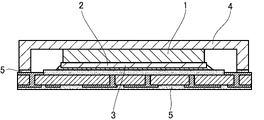
- the semiconductor device and its manufacturing method will be described with reference to FIG.
- the device shown in FIG. 1 merely shows an example of application of the composition of the present invention to a semiconductor device, and is not intended to limit the semiconductor device according to the present invention to that shown in FIG. .
- the composition of the present invention in a state of frozen storage is allowed to stand at room temperature to naturally defrost to form a grease.
- the liquid composition of the present invention is placed in a coating tool such as a syringe.
- a curable composition layer is formed by applying (dispensing) the composition of the present invention from a syringe or the like onto the surface of a heat-generating electronic component, for example, the CPU 2, which is a heat-generating electronic component mounted on a substrate 3 shown in FIG. (Coating layer) 1 is formed.
- a heat-generating electronic component for example, the CPU 2, which is a heat-generating electronic component mounted on a substrate 3 shown in FIG. (Coating layer) 1 is formed.
- an adhesive 5 is also applied to fix the heat radiating member 4, and the heat radiating member 4 is pressed against and fixed to the CPU 2 with the coating layer 1 therebetween.
- the thickness of the coating layer 1 sandwiched between the CPU 2 and the heat radiating member 4 is normally 5 to 100 ⁇ m, particularly preferably 10 to 70 ⁇ m. If the thickness is too thin, peeling will easily occur and the reliability will deteriorate.
- the coating layer 1 made of the composition of the present invention is cured in the apparatus configured as described above to form the thermally conductive layer 1 in the heating apparatus.
- the temperature condition required for this curing is 80 to 180°C, preferably 100 to 150°C. If the temperature is less than 80°C, curing will be insufficient, and if the temperature exceeds 180°C, electronic parts and substrates may deteriorate.
- liquid fine particles or solid fine particles of component (C) gallium and/or its alloy in the composition of the present invention aggregate with each other to form large liquid particles. At the same time, it also connects with the component (D) to form a series of pathways.
- the liquid particles of the component (C) are also fused to the surfaces of the CPU 2 and the heat radiating member 4 that are in contact with each other. Therefore, the CPU 2 and the heat dissipating member 4 are substantially integrally continuous through a kind of path in which the liquid particles of the component (C) and the thermally conductive filler of the component (D) are connected and connected. It becomes a thing rich in thermal conductivity.
- the path-like structure is fixed and held in the three-dimensional crosslinked network of the cured product formed by the addition reaction of the components (A) and (B).
- the surface temperature of heat-generating electronic components such as a CPU usually reaches a high temperature of about 60 to 120°C.
- the thermally conductive layer made of the cured product of the composition of the present invention exhibits high thermal conductivity as described above, and is superior in heat dissipation characteristics to conventional thermally conductive sheets and thermally conductive greases. It has a remarkably excellent action and effect.
- gallium and/or its alloy as the component (C) contained in the thermally conductive layer and forming the path is removed in the three-dimensional crosslinked network of the cured product. Since it is fixed and held by the heat-conducting layer, it does not leak from the heat-conductive layer.
- this thermally conductive layer has tackiness, so that even if the heat dissipating member is displaced, it has stable flexibility even during long-term use, and is protected from heat-generating electronic components and heat dissipating members. It never peels off.
- composition of the present invention can also be used to prepare a cured sheet having a desired thickness in advance and interpose this sheet between a heat-generating electronic component and a heat-dissipating member in the same manner as a conventional thermally conductive sheet. effect can be obtained.
- a sheet of the cured product of the composition of the present invention can be appropriately used as a component of other devices that require thermal conductivity and heat resistance.
- the present invention will be described in more detail below with reference to Examples, but the present invention is not limited to these.
- Components (A) to (G) used in the following examples and comparative examples are shown below.
- the viscosity is a value measured using a spiral viscometer PC-ITL (manufactured by Malcom Co., Ltd.), and the kinematic viscosity is a value measured using an Ostwald viscometer.
- (G) Component (G-1) A dimethylpolysiloxane having a kinematic viscosity of 32 mm 2 /s and having a trimethoxysilyl group-blocked at one end, represented by the following structural formula: (G-2) Structural formula: Organosilane represented by C 10 H 21 Si(OCH 3 ) 3 (G-3) Trifluoropropyltrimethoxysilane In the procedure for preparing the composition, "Component (G) ” represents a collection of (G-1), (G-2) and (G-3) used in each example described in Table 1 or Table 2.
- compositions were prepared as follows.
- Components (A), (C), (D) and (G) were added to a conditioning mixer (manufactured by Thinky Co., Ltd., trade name: Awatori Mixer) container with an internal volume of 250 ml, and the temperature was raised to 70°C. It was warmed and maintained at this temperature and kneaded for 5 minutes. The kneading was then stopped and cooled to 15°C.
- components (B), (E) and (F) are added to the mixture of components (A), (C), (D) and (G), and the mixture is heated at 25°C until uniform. was kneaded to prepare each composition.
- ⁇ Preparation of cured product> Each of the compositions obtained above is applied to the entire surface of an aluminum plate having a diameter of 1.26 mm and a thickness of 1 mm (hereinafter referred to as "standard aluminum plate"), and another standard aluminum plate is superimposed to obtain a pressure of about 175.5 kPa. A pressure of (1.80 kgf/cm 2 ) was applied to obtain a three-layer structure. Next, the three-layer structure was heated to 150° C. in an electric furnace and held at that temperature for 1 hour to harden each composition. was prepared. The thickness of each resulting cured composition was calculated by measuring the thickness of each sample and subtracting the known thickness of a standard aluminum plate. A micrometer (Mitutoyo Co., Ltd., model: M820-25VA) was used to measure the thickness of each sample. The thickness of each cured composition is shown in Tables 1-2.
- ⁇ Void test> 0.2 g of each composition was sandwiched between two slide glasses of 5 ⁇ 7 cm, a weight of 1 kg was placed thereon, and left at room temperature for 15 minutes. The weight was then removed and the specimen was placed in an oven at 150°C for 1 hour before being removed. The cured product sandwiched between slide glasses was observed visually and with a microscope (manufactured by Keyence Corporation: model VR-3200).
- ⁇ Cracks were visually observed: ⁇ ⁇ One or more circular voids (gaps) with a diameter of 1.0 mm or more were observed with a microscope: ⁇ ⁇ No cracks or circular voids (gaps) with a diameter of 1.0 mm or more are observed visually and with a microscope: ⁇
- the particle size measurement of the thermally conductive filler is the volume-based cumulative average diameter measured by Microtrac MT3300EX, a particle size analyzer manufactured by Nikkiso Co., Ltd.
- the heat generation temperature of the CPU was about 100°C, but in any device, stable heat conduction and heat dissipation were possible over a long period of time. It was possible to prevent CPU performance degradation and damage due to overheat accumulation. Therefore, it was confirmed that the adoption of the cured product of the composition of the present invention improved the reliability of the semiconductor device.
- component (B) *For convenience, the number of silicon-bonded hydrogen atoms in component (B) per silicon-bonded alkenyl group in component (A) is expressed as H/Vi (the same shall apply hereinafter).
- curable composition layer (coating layer) (thermal conductive layer) 2 CPU (Central Processing Unit) 3 substrate 4 heat dissipation member 5 adhesive
Landscapes
- Chemical & Material Sciences (AREA)
- Organic Chemistry (AREA)
- Chemical Kinetics & Catalysis (AREA)
- Polymers & Plastics (AREA)
- Health & Medical Sciences (AREA)
- Medicinal Chemistry (AREA)
- Engineering & Computer Science (AREA)
- Materials Engineering (AREA)
- Physics & Mathematics (AREA)
- Combustion & Propulsion (AREA)
- Thermal Sciences (AREA)
- General Chemical & Material Sciences (AREA)
- Wood Science & Technology (AREA)
- Life Sciences & Earth Sciences (AREA)
- Compositions Of Macromolecular Compounds (AREA)
Abstract
Description
また、本発明の他の目的は、該硬化性オルガノポリシロキサン組成物を、従来の熱伝導性グリースと同様に、発熱性電子部品と放熱部材との間に挟まれるように配置し、前記部品又は部材の表面の凹凸に追随して隙間を生じせしめることなく、かつ、加熱処理により架橋された硬化物からなる熱伝導性層としての使用を提供することにある。更に、本発明の目的は、発熱性電子部品と放熱部材とが前記熱伝導性層を介して接合された放熱性能に優れた半導体装置及びその製造方法を提供することにある。
即ち、本発明は、下記の硬化性オルガノポリシロキサン組成物、及び硬化性オルガノポリシロキサン組成物を用いた半導体装置を提供するものである。
(A)下記(A-1)及び(A-2)からなり、且つ(A-1)と(A-2)との合計に対する(A-1)の割合が10~90質量%であるオルガノポリシロキサン:100質量部、
(A-1)25℃における粘度が0.01~10Pa・sのケイ素原子に結合したアルケニル基を1分子中に2個以上有するオルガノポリシロキサン
(A-2)25℃における粘度が11~1,000Pa・sのケイ素原子に結合したアルケニル基を1分子中に2個以上有するオルガノポリシロキサン
(B)ケイ素原子に結合した水素原子を1分子中に2個以上有するオルガノハイドロジェンポリシロキサン:前記(A)成分中のアルケニル基1個に対して、当該成分中のケイ素原子に結合した水素原子の個数が0.1~5.0個となる量、
(C)融点が-20~70℃の、ガリウム及びガリウム合金からなる群より選択される1種以上:300~20,000質量部、
(D)平均粒径が0.1~100μmの熱伝導性充填剤:10~1,000質量部、
(E)白金族金属触媒:(A)成分の質量に対して白金族金属の質量換算で0.1~500ppm
並びに、
(G-1)下記一般式(1)で表されるオルガノポリシロキサン:10~500質量部

を含む硬化性オルガノポリシロキサン組成物。
<2>
更に、(G-2)下記一般式(2):
R3 cR4 dSi(OR5)4-c-d (2)
(式(2)中、R3は独立に炭素原子数6~16のアルキル基であり、R4は独立に非置換又は置換の炭素原子数1~8の1価炭化水素基であり、R5は独立に炭素原子数1~6のアルキル基であり、cは1~3の整数、dは0~2の整数であり、c+dの和は1~3の整数である。)
で表されるアルコキシシラン化合物を、(A)成分100質量部に対し0.1~100質量部含む、<1>に記載の硬化性オルガノポリシロキサン組成物。
<3>
更に、(G-3)トリフルオロプロピルトリメトキシシランを(A)成分100質量部に対し0.1~100質量部含む、<1>又は<2>に記載の硬化性オルガノポリシロキサン組成物。
<4>
(B)成分が、分子鎖非末端にケイ素原子に結合した水素原子を1分子中に5個以上有し、且つ、下記式(3):
0.1<α/β (3)
(式(3)中、αは分子鎖非末端のケイ素原子に結合した水素原子の数を表し、βは(B)成分中の全ケイ素原子数を表す。)
を満たすオルガノハイドロジェンポリシロキサンである<1>~<3>のいずれか1つに記載の硬化性オルガノポリシロキサン組成物。
<5>
(C)成分が、組成物中に1~200μmの粒子状に分散している<1>~<4>のいずれか1つに記載の硬化性オルガノポリシロキサン組成物。
<6>
<1>~<5>のいずれか1つに記載の硬化性オルガノポリシロキサン組成物からなる熱伝導性シリコーングリース組成物。
<7>
<1>~<5>のいずれか1つに記載の硬化性オルガノポリシロキサン組成物の硬化物。
<8>
<7>に記載の硬化物の、発熱性電子部品と放熱部材との間に挟まれて配置される熱伝導性層としての使用。
<9>
発熱性電子部品と、放熱部材と、<7>に記載の硬化物からなる熱伝導性層とを有する半導体装置であって、前記発熱性電子部品と前記放熱部材とが前記熱伝導性層を介して接合されている半導体装置。
<10>
<9>に記載の半導体装置の製造方法であって、
(a)発熱性電子部品の表面に、<1>~<5>のいずれか1つに記載の硬化性オルガノポリシロキサン組成物を塗布して、前記表面に前記組成物からなる被覆層を形成させる工程、
(b)前記被覆層に放熱部材を圧接して固定させる工程、及び
(c)工程(b)後に得られた構造体を80~180℃で加熱して、前記被覆層を硬化させて熱伝導性層とする工程
を有する半導体装置の製造方法。
<(A)オルガノポリシロキサン>
本発明組成物の(A)成分は、ケイ素原子に結合したアルケニル基を、1分子中に2個以上有するオルガノポリシロキサンであり、本発明の付加反応硬化系における主剤(ベースポリマー)である。(A)成分は、下記(A-1)及び(A-2)からなるものである。
(A-2)25℃における粘度が11~1,000Pa・sのケイ素原子に結合したアルケニル基を1分子中に2個以上有するオルガノポリシロキサン
(A-1)の割合が10質量%より少ないと硬化物が柔らかくなり硬化時ボイドが出やすくなり、90質量%より多いと、製造時に材料に攪拌シェアーがかからず、組成物がグリース状になりにくくなる。
ケイ素原子に結合したアルケニル基としては、例えば、ビニル基、アリル基、1-ブテニル基、1-へキセニル基等が挙げられる。これらの中でも、汎用性が高いビニル基が好ましい。このアルケニル基は、分子鎖末端のケイ素原子、また分子鎖途中のケイ素原子のいずれに結合していてもよいが、得られる硬化物の柔軟性がよいものとするため、分子鎖末端のケイ素原子にのみ結合して存在することが好ましい。
本発明組成物の(B)成分は、ケイ素原子に結合した水素原子(以下、「Si-H基」という)を、1分子中に2個以上有するオルガノハイドロジェンポリシロキサンであり、上記(A)成分の架橋剤として作用するものである。即ち、この(B)成分中のSi-H基が、後記(E)成分の白金系触媒の作用により、(A)成分中のアルケニル基とヒドロシリル化反応により付加して、架橋結合を有する3次元網状構造を有する架橋硬化物を与える。
0.1<α/β (3)
(式(3)中、αは分子鎖非末端のケイ素原子に結合した水素原子の数を表し、βは(B)成分中の全ケイ素原子数を表す。)
上記α/βの範囲が0.1以下と小さい場合、硬化時ボイドが発生しやすくなるため、0.1<α/βであることも同時に必要である。この場合、α/βは好ましくは0.11以上、特に0.12以上であり、その上限は特に制限されないが、0.95以下、特に0.90以下であることが好ましい。
R6 eHfSiO(4-e-f)/2 (4)
(式(4)中、R6は、脂肪族不飽和結合を有しない非置換又は置換の1価炭化水素基を表し、eは0.7~2.2の数であり、fは0.001~0.5の数であり、但しe+fは0.8~2.5を満たす数である。)
(B)成分のオルガノハイドロジェンポリシロキサンは、1種単独で用いても2種以上を併用してもよい。
本発明組成物の(C)成分は、融点が-20~70℃の、ガリウム及び/又はその合金である。該(C)成分は、本発明組成物から得られる硬化物に良好な熱伝導性を付与するために配合される成分であり、この成分の配合が本発明の特徴をなすものである。
未硬化状態の本発明組成物中に存在するガリウム及び/又はその合金の液状微粒子又は固体微粒子の形状は、略球状であり、不定形のものが含まれていてもよい。また、その平均粒径が、通常、1~200μm、特に5~150μmであることが好ましく、更に好ましくは10~100μmである。前記平均粒径が小さすぎると組成物の粘度が高くなりすぎるため、伸展性が乏しいものとなるので塗工作業性に問題があり、また、逆に大きすぎると組成物が不均一となるため発熱性電子部品等への薄膜状の塗布が困難となる。なお、前記形状及び平均粒径、更に組成物中での分散状態は、上記のとおり、組成物調製後に速やかに低温下で保存されることから、発熱性電子部品等への塗工工程まで維持することができる。なお、この平均粒径は、硬化前の組成物を2枚のスライドガラスで挟み込み、株式会社キーエンス社製のVR-3000で観察することにより算出した。即ち、この測定器により撮影した画像の中から、ランダムに30個の粒子を選び、それぞれの粒径を計測し、それらの平均値を算出した。
本発明組成物には、前記(C)成分とともに、従来から公知の熱伝導性シート又は熱伝導性グリースに配合される(D)熱伝導性充填剤(但し、(C)成分を除く)を配合することが必要である。
特に、入手のしやすさ、経済的な観点から、酸化亜鉛粉末、アルミナ粉末が特に好ましい。
本発明組成物の(E)成分の白金族金属触媒は、上記(A)成分中のアルケニル基と上記(B)成分中のSiHとの付加反応を促進し、本発明組成物から3次元網状状態の架橋硬化物を与えるために配合される成分である。
本発明組成物には、組成物調製時に(C)成分のガリウム及び/又はその合金を疎水化処理し、且つ前記(C)成分の(A)成分のオルガノポリシロキサンとの濡れ性を向上させ、前記(C)成分を微粒子として、前記(A)成分からなるマトリックス中に均一に分散させることを目的として下記一般式(1)で示されるポリシロキサンを(G-1)表面処理剤として配合する。

で表される、分子鎖の片末端が加水分解性基で封鎖されたポリシロキサンであり、25℃における動粘度が10~10,000mm2/sである。なお、この動粘度はオストワルド粘度計により25℃で測定した値である。
上記必須成分に加えて、本発明の硬化性オルガノポリシロキサン組成物には、必要により、下記成分を配合してもよい。
<(F)付加反応制御剤>
本発明組成物の(F)成分の付加反応制御剤は、必要により配合される成分で、室温における上記白金系触媒の作用にヒドロシリル化反応を抑制し、本発明組成物の可使時間(シェルフライフ、ポットライフ)を確保して、発熱性電子部品等への塗工作業に支障をきたさないように配合される成分である。
(G-2)下記一般式(2):
R3 cR4 dSi(OR5)4-c-d (2)
(式(2)中、R3は独立に炭素原子数6~16のアルキル基であり、R4は独立に非置換又は置換の炭素原子数1~8の1価炭化水素基であり、R5は独立に炭素原子数1~6のアルキル基であり、cは1~3の整数、dは0~2の整数であり、c+dの和は1~3の整数である。)
C6H13Si(OCH3)3
C10H21Si(OCH3)3
C12H25Si(OCH3)3
C12H25Si(OC2H5)3
C10H21(CH3)Si(OCH3)2
C10H21(C6H5)Si(OCH3)2
C10H21(CH3)Si(OC2H5)2
C10H21(CH=CH2)Si(OCH3)2
尚、(G-1)成分、(G-2)成分、(G-3)成分は、それぞれ単独で使用してもよいし、組み合わせてもよい。
本発明組成物には、本発明の目的・効果を損ねない範囲で、以下平均組成式(5)のオルガノポリシロキサンを配合することもできる。
R7 gSiO(4-g)/2 (5)
(式(5)中、R7は独立に脂肪族系不飽和結合を有さない非置換又は置換の炭素原子数1~18の一価炭化水素基であり、gは1.8~2.2の数である。)
で表される25℃における動粘度が10~100,000mm2/sのオルガノポリシロキサンであり、1種単独で使用しても、2種以上を併用してもよい。
本発明組成物は、後述のとおり、発熱性電子部品の表面に適用され、これに放熱部材を圧接した後、加熱処理することにより硬化して、熱伝導性層を形成する。この際、作業性を良好とするために、本発明組成物はグリース状である必要がある。
本発明の硬化性オルガノポリシロキサン組成物は、
(i)前記(A)、前記(C)、前記(D)及び前記(G-1)、並びに、含有する場合は、前記(G-2)成分及び(G-3)成分を、20~120℃の範囲内の温度であり、かつ、前記(C)成分の融点以上である温度で混練して均一な混合物(i)を得る工程;
(ii)混合物(i)の混練を停止して、混合物(i)の温度を前記(C)成分の融点未満にまで冷却し混合物(ii)を得る工程;及び
(iii)前記(B)成分と前記(E)成分と、含有する場合は前記(F)成分と、場合により他の成分とを、混合物(ii)に追加して、前記(C)成分の融点未満の温度で混練して均一な混合物(iii)を得る工程
を有する製造方法によって得ることができるが本記載に限るものではない。
本発明の組成物を硬化させる場合は80~180℃の温度に30~240分程度保持することにより行うことができる。
本発明の組成物の硬化物は、発熱性電子部品と放熱部材との間に介在させて熱伝導性層を形成するための熱伝導性硬化物として使用することができる。
この場合、上記本発明組成物を用いて放熱特性に優れた半導体装置、即ち、発熱性電子部品と、放熱部材と、上記本発明組成物の硬化物からなる熱伝導性層とを有する半導体装置であって、前記発熱性電子部品と前記放熱部材とが前記熱伝導性層を介して接合されている半導体装置を得ることができる。
(a)発熱性電子部品の表面に、本発明の組成物を塗布して、前記表面に前記組成物からなる被覆層を形成させる工程、
(b)前記被覆層に放熱部材を圧接して固定させる工程、及び
(c)工程(b)後に得られた構造体を80~180℃で加熱して、前記被覆層を硬化させて熱伝導性層とする工程
を有する製造方法によって得ることができる。
前記半導体装置及びその製造方法について、図1を参照しながら説明する。なお、図1に記載の装置は、本発明組成物の半導体装置への適用の一例を示したものにすぎず、本発明に係る半導体装置を図1に記載のものに限定するとの趣旨ではない。
下記実施例及び比較例において用いられる(A)~(G)成分を下記に示す。なお、粘度はスパイラル粘度計PC-ITL(株式会社マルコム社製)を用いて測定した値であり、動粘度はオストワルド粘度計を用いて測定した値である。
25℃における粘度が下記のとおりである両末端がジメチルビニルシリル基で封鎖されたジメチルポリシロキサン;
(A-1-1)粘度:0.1Pa・s
(A-1-2)粘度:1.0Pa
(A-2-1)粘度:30Pa・s
(A-2-2)粘度:100Pa・s
(B-1)下記構造式で表されるオルガノハイドロジェンポリシロキサン(α/β=0.35、25℃における動粘度113mm2/s)

(B-2)下記構造式で表されるオルガノハイドロジェンポリシロキサン(α/β=0.29、25℃における動粘度27mm2/s)

(C-1)金属ガリウム〔融点=29.8℃〕
(C-2)Ga-In合金〔質量比=75.4:24.6、融点=15.7℃〕
(C-3)Ga-In-Sn合金[質量比=68.5:21.5:10、融点=-19℃]
(C-4)Ga-In-Sn合金[質量比=62:25:13、融点=5.0℃]
(C-5)金属インジウム〔融点=156.2℃〕<比較用>
(D-1):アルミナ粉末〔平均粒径:8.2μm〕
(D-2):酸化亜鉛粉末〔平均粒径:1.0μm〕
(E-1):白金-ジビニルテトラメチルジシロキサン錯体のジメチルポリシロキサン(両末端がジメチルビニルシリル基で封鎖されたもの、粘度:0.6Pa・s)溶液〔白金原子含有量:1質量%〕
(F-1)1-エチニル-1-シクロヘキサノール
(G-1)下記構造式で表される動粘度32mm2/sの片末端トリメトキシシリル基封鎖ジメチルポリシロキサン

(G-3)トリフルオロプロピルトリメトキシシラン
なお、組成物の調製の手順において、「(G)成分」とは、表1又は表2に記載されたそれぞれの例において使用される(G-1)、(G-2)及び(G-3)をまとめたものを表す。
<組成物の調製>
表1及び2に記載の組成比で各成分を採取し、次のとおりにして、組成物を調製した。
内容積250ミリリットルのコンディショニングミキサー(株式会社シンキー製、商品名:あわとり練太郎)容器に、(A)成分、(C)成分、(D)成分及び(G)成分を加え、70℃に昇温し該温度を維持し、5分間混練した。次いで、混練を停止し、15℃になるまで冷却した。
次に、(A)成分、(C)成分、(D)成分及び(G)成分の混合物に、(B)成分、(E)成分及び(F)成分を加え、25℃で均一になるように混練して各組成物を調製した。
組成物の絶対粘度の測定は、株式会社マルコム社製の型番PC-1TL(10rpm)で、いずれも25℃にて行った。
上記で得られた各組成物を2枚のスライドガラスで挟み込み、株式会社キーエンス社製のVR-3000で撮影した画像の中から、ランダムに30個の粒子を選び、それぞれの粒径を計測し、それらの平均値を算出した。
上記で得られた各組成物を、直径1.26mmで厚さ1mmのアルミニウムプレート(以下、「標準アルミプレート」という)の全面に塗布し、他の標準アルミプレートを重ねて、約175.5kPa(1.80kgf/cm2)の圧力をかけて3層構造体を得た。次いで、該3層構造体を電気炉内で150℃にまで昇温し該温度を1時間保持して各組成物を硬化させ、その後室温になるまで放置して冷却し、熱抵抗測用試料を調製した。
得られた各試料の厚さを測定し、標準アルミプレートの既知の厚さを差し引くことによって、硬化した各組成物の厚さを算出した。なお、上記各試料の厚さの測定に際しては、マイクロメーター(株式会社ミツトヨ、型式;M820-25VA)を用いた。硬化した各組成物の厚さを表1~表2に示す。
上記各試料を用いて、硬化した各組成物の熱抵抗(mm2・K/W)を、熱抵抗測定器(NETZSCH社製モデル:LFA447)を用いて測定した。測定結果を表1~表2に示す。
5×7cmの2枚のスライドガラスに各組成物0.2gを挟み込み、その上に1kgの重りを載せ、室温にて15分放置した。その後その重りを外し、その試験片を150℃のオーブンに1時間放置してから取り出した。スライドガラスに挟まれた硬化物を目視及びマイクロスコープ(株式会社キーエンス社製:モデルVR-3200)にて観察を行った。
[評価]
・目視で、ひび割れが観察された:×
・マイクロスコープにて、直径1.0mm以上の円形状のボイド(空隙)が1個以上観察された:×
・目視及びマイクロスコープの観察でひび割れ及び直径1.0mm以上の円形状のボイド(空隙)が全く観察されない:○
上記各試料の熱伝導率は、京都電子工業株式会社製のTPS-2500Sにより、いずれも25℃において測定した。
熱伝導性充填剤の粒径測定は、日機装株式会社製の粒度分析計であるマイクロトラックMT3300EXにより測定した体積基準の累積平均径である。
上記各実施例1~6で得られた組成物の0.2gを、2cm×2cmのCPUの表面に塗布し被覆層を形成させた。該被覆層に放熱部材を重ね硬化させて、10~70μmの厚さの熱伝導性層を介して前記CPUと放熱部材が接合されている半導体装置を得た。これらの各装置をホストコンピューター、パーソナルコンピュータ等に組み込み、稼動させたところ、CPUの発熱温度は約100℃であったが、いずれの装置の場合も長時間にわたって安定した熱伝導及び放熱が可能であり、過熱蓄積によるCPUの性能低下、破損等が防止できた。よって、本発明組成物の硬化物の採用により、半導体装置の信頼性が向上することが確認できた。


2 CPU(セントラル プロセッシング ユニット)
3 基板
4 放熱部材
5 接着剤
Claims (10)
- (A)下記(A-1)及び(A-2)からなり、且つ(A-1)と(A-2)との合計に対する(A-1)の割合が10~90質量%であるオルガノポリシロキサン:100質量部、
(A-1)25℃における粘度が0.01~10Pa・sのケイ素原子に結合したアルケニル基を1分子中に2個以上有するオルガノポリシロキサン
(A-2)25℃における粘度が11~1,000Pa・sのケイ素原子に結合したアルケニル基を1分子中に2個以上有するオルガノポリシロキサン
(B)ケイ素原子に結合した水素原子を1分子中に2個以上有するオルガノハイドロジェンポリシロキサン:前記(A)成分中のアルケニル基1個に対して、当該成分中のケイ素原子に結合した水素原子の個数が0.1~5.0個となる量、
(C)融点が-20~70℃の、ガリウム及びガリウム合金からなる群より選択される1種以上:300~20,000質量部、
(D)平均粒径が0.1~100μmの熱伝導性充填剤:10~1,000質量部、
(E)白金族金属触媒:(A)成分の質量に対して白金族金属の質量換算で0.1~500ppm
並びに、
(G-1)下記一般式(1)で表されるオルガノポリシロキサン:10~500質量部

を含む硬化性オルガノポリシロキサン組成物。 - 更に、(G-2)下記一般式(2):
R3 cR4 dSi(OR5)4-c-d (2)
(式(2)中、R3は独立に炭素原子数6~16のアルキル基であり、R4は独立に非置換又は置換の炭素原子数1~8の1価炭化水素基であり、R5は独立に炭素原子数1~6のアルキル基であり、cは1~3の整数、dは0~2の整数であり、c+dの和は1~3の整数である。)
で表されるアルコキシシラン化合物を、(A)成分100質量部に対し0.1~100質量部含む、請求項1に記載の硬化性オルガノポリシロキサン組成物。 - 更に、(G-3)トリフルオロプロピルトリメトキシシランを(A)成分100質量部に対し0.1~100質量部含む、請求項1又は2に記載の硬化性オルガノポリシロキサン組成物。
- (B)成分が、分子鎖非末端にケイ素原子に結合した水素原子を1分子中に5個以上有し、且つ、下記式(3):
0.1<α/β (3)
(式(3)中、αは分子鎖非末端のケイ素原子に結合した水素原子の数を表し、βは(B)成分中の全ケイ素原子数を表す。)
を満たすオルガノハイドロジェンポリシロキサンである請求項1~3のいずれか1項に記載の硬化性オルガノポリシロキサン組成物。 - (C)成分が、組成物中に1~200μmの粒子状に分散している請求項1~4のいずれか1項に記載の硬化性オルガノポリシロキサン組成物。
- 請求項1~5のいずれか1項に記載の硬化性オルガノポリシロキサン組成物からなる熱伝導性シリコーングリース組成物。
- 請求項1~5のいずれか1項に記載の硬化性オルガノポリシロキサン組成物の硬化物。
- 請求項7に記載の硬化物の、発熱性電子部品と放熱部材との間に挟まれて配置される熱伝導性層としての使用。
- 発熱性電子部品と、放熱部材と、請求項7に記載の硬化物からなる熱伝導性層とを有する半導体装置であって、前記発熱性電子部品と前記放熱部材とが前記熱伝導性層を介して接合されている半導体装置。
- 請求項9に記載の半導体装置の製造方法であって、
(a)発熱性電子部品の表面に、請求項1~5のいずれか1項に記載の硬化性オルガノポリシロキサン組成物を塗布して、前記表面に前記組成物からなる被覆層を形成させる工程、
(b)前記被覆層に放熱部材を圧接して固定させる工程、及び
(c)工程(b)後に得られた構造体を80~180℃で加熱して、前記被覆層を硬化させて熱伝導性層とする工程
を有する半導体装置の製造方法。
Priority Applications (5)
| Application Number | Priority Date | Filing Date | Title |
|---|---|---|---|
| EP22795516.8A EP4333047A4 (en) | 2021-04-28 | 2022-03-31 | CURABLE SILICONE COMPOSITION AND SEMICONDUCTOR DEVICE |
| JP2023517215A JP7580897B2 (ja) | 2021-04-28 | 2022-03-31 | 硬化性オルガノポリシロキサン組成物及び半導体装置 |
| US18/285,897 US20240199817A1 (en) | 2021-04-28 | 2022-03-31 | Curable organopolysiloxane composition and semiconductor device |
| CN202280031239.8A CN117280000A (zh) | 2021-04-28 | 2022-03-31 | 固化性的有机聚硅氧烷组合物和半导体装置 |
| KR1020237038696A KR20240004493A (ko) | 2021-04-28 | 2022-03-31 | 경화성 오르가노폴리실록산 조성물 및 반도체 장치 |
Applications Claiming Priority (2)
| Application Number | Priority Date | Filing Date | Title |
|---|---|---|---|
| JP2021075503 | 2021-04-28 | ||
| JP2021-075503 | 2021-04-28 |
Publications (1)
| Publication Number | Publication Date |
|---|---|
| WO2022230600A1 true WO2022230600A1 (ja) | 2022-11-03 |
Family
ID=83848062
Family Applications (1)
| Application Number | Title | Priority Date | Filing Date |
|---|---|---|---|
| PCT/JP2022/016564 Ceased WO2022230600A1 (ja) | 2021-04-28 | 2022-03-31 | 硬化性オルガノポリシロキサン組成物及び半導体装置 |
Country Status (7)
| Country | Link |
|---|---|
| US (1) | US20240199817A1 (ja) |
| EP (1) | EP4333047A4 (ja) |
| JP (1) | JP7580897B2 (ja) |
| KR (1) | KR20240004493A (ja) |
| CN (1) | CN117280000A (ja) |
| TW (1) | TWI909031B (ja) |
| WO (1) | WO2022230600A1 (ja) |
Cited By (5)
| Publication number | Priority date | Publication date | Assignee | Title |
|---|---|---|---|---|
| WO2024096000A1 (ja) * | 2022-11-02 | 2024-05-10 | 信越化学工業株式会社 | 熱伝導性シリコーン組成物 |
| WO2024166781A1 (ja) * | 2023-02-09 | 2024-08-15 | 信越化学工業株式会社 | 熱伝導性組成物 |
| WO2025053195A1 (ja) * | 2023-09-08 | 2025-03-13 | 信越化学工業株式会社 | 熱伝導性シリコーン組成物 |
| WO2025220655A1 (ja) * | 2024-04-19 | 2025-10-23 | 株式会社トクヤマ | Ga又はGa合金と、窒化アルミニウムフィラーとを含む組成物 |
| WO2025263443A1 (ja) * | 2024-06-18 | 2025-12-26 | 信越化学工業株式会社 | 熱伝導性シリコーン組成物 |
Families Citing this family (1)
| Publication number | Priority date | Publication date | Assignee | Title |
|---|---|---|---|---|
| WO2023149175A1 (ja) * | 2022-02-02 | 2023-08-10 | 信越化学工業株式会社 | 熱伝導性シリコーン組成物及びその製造方法 |
Citations (10)
| Publication number | Priority date | Publication date | Assignee | Title |
|---|---|---|---|---|
| JPH07207160A (ja) | 1994-01-11 | 1995-08-08 | Toshiba Silicone Co Ltd | シリコーン組成物およびその製造方法 |
| JPH0853664A (ja) | 1994-08-10 | 1996-02-27 | Fujitsu Ltd | 熱伝導材料及びその製造方法、電子部品の冷却方法、回路基板の冷却方法、並びに電子部品の実装方法 |
| JP2002121292A (ja) | 2000-10-17 | 2002-04-23 | Bergquist Co:The | 液体金属架橋粒子クラスターによる熱伝導性化合物の製法 |
| JP2005112961A (ja) * | 2003-10-07 | 2005-04-28 | Shin Etsu Chem Co Ltd | 硬化性オルガノポリシロキサン組成物および半導体装置 |
| JP2008056761A (ja) * | 2006-08-30 | 2008-03-13 | Shin Etsu Chem Co Ltd | 熱伝導性シリコーン組成物及びその硬化物 |
| JP2008255283A (ja) * | 2007-04-09 | 2008-10-23 | Shin Etsu Chem Co Ltd | 定着ロール又は定着ベルト用シリコーンゴム組成物、並びに定着ロール及び定着ベルト |
| JP2010095730A (ja) * | 2010-01-18 | 2010-04-30 | Shin-Etsu Chemical Co Ltd | 硬化性オルガノポリシロキサン組成物および半導体装置 |
| JP2013082816A (ja) * | 2011-10-11 | 2013-05-09 | Shin-Etsu Chemical Co Ltd | 硬化性オルガノポリシロキサン組成物及び半導体装置 |
| JP2017226724A (ja) * | 2016-06-20 | 2017-12-28 | 信越化学工業株式会社 | 熱伝導性シリコーンパテ組成物 |
| JP2019214640A (ja) * | 2018-06-11 | 2019-12-19 | 信越化学工業株式会社 | 付加硬化型液状導電性シリコーンゴム組成物及び電子写真式画像形成部材 |
Family Cites Families (5)
| Publication number | Priority date | Publication date | Assignee | Title |
|---|---|---|---|---|
| US10501671B2 (en) * | 2016-07-26 | 2019-12-10 | Honeywell International Inc. | Gel-type thermal interface material |
| CN111094499B (zh) * | 2017-09-29 | 2022-10-28 | 美国陶氏有机硅公司 | 导热组合物 |
| KR102498951B1 (ko) * | 2018-01-11 | 2023-02-15 | 다우 실리콘즈 코포레이션 | 전자 구성요소 상에 열 전도성 조성물을 도포하는 방법 |
| JP7116703B2 (ja) * | 2019-04-24 | 2022-08-10 | 信越化学工業株式会社 | 熱伝導性シリコーン組成物及びその製造方法、並びに熱伝導性シリコーン硬化物 |
| JP7467017B2 (ja) * | 2021-05-25 | 2024-04-15 | 信越化学工業株式会社 | 熱伝導性シリコーン組成物及びその硬化物 |
-
2022
- 2022-03-31 EP EP22795516.8A patent/EP4333047A4/en active Pending
- 2022-03-31 KR KR1020237038696A patent/KR20240004493A/ko active Pending
- 2022-03-31 WO PCT/JP2022/016564 patent/WO2022230600A1/ja not_active Ceased
- 2022-03-31 CN CN202280031239.8A patent/CN117280000A/zh active Pending
- 2022-03-31 JP JP2023517215A patent/JP7580897B2/ja active Active
- 2022-03-31 US US18/285,897 patent/US20240199817A1/en active Pending
- 2022-04-07 TW TW111113205A patent/TWI909031B/zh active
Patent Citations (13)
| Publication number | Priority date | Publication date | Assignee | Title |
|---|---|---|---|---|
| JPH07207160A (ja) | 1994-01-11 | 1995-08-08 | Toshiba Silicone Co Ltd | シリコーン組成物およびその製造方法 |
| JPH0853664A (ja) | 1994-08-10 | 1996-02-27 | Fujitsu Ltd | 熱伝導材料及びその製造方法、電子部品の冷却方法、回路基板の冷却方法、並びに電子部品の実装方法 |
| JP2002121292A (ja) | 2000-10-17 | 2002-04-23 | Bergquist Co:The | 液体金属架橋粒子クラスターによる熱伝導性化合物の製法 |
| JP4551074B2 (ja) | 2003-10-07 | 2010-09-22 | 信越化学工業株式会社 | 硬化性オルガノポリシロキサン組成物および半導体装置 |
| JP2005112961A (ja) * | 2003-10-07 | 2005-04-28 | Shin Etsu Chem Co Ltd | 硬化性オルガノポリシロキサン組成物および半導体装置 |
| JP2008056761A (ja) * | 2006-08-30 | 2008-03-13 | Shin Etsu Chem Co Ltd | 熱伝導性シリコーン組成物及びその硬化物 |
| JP2008255283A (ja) * | 2007-04-09 | 2008-10-23 | Shin Etsu Chem Co Ltd | 定着ロール又は定着ベルト用シリコーンゴム組成物、並びに定着ロール及び定着ベルト |
| JP2010095730A (ja) * | 2010-01-18 | 2010-04-30 | Shin-Etsu Chemical Co Ltd | 硬化性オルガノポリシロキサン組成物および半導体装置 |
| JP4913874B2 (ja) | 2010-01-18 | 2012-04-11 | 信越化学工業株式会社 | 硬化性オルガノポリシロキサン組成物および半導体装置 |
| JP2013082816A (ja) * | 2011-10-11 | 2013-05-09 | Shin-Etsu Chemical Co Ltd | 硬化性オルガノポリシロキサン組成物及び半導体装置 |
| JP5640945B2 (ja) | 2011-10-11 | 2014-12-17 | 信越化学工業株式会社 | 硬化性オルガノポリシロキサン組成物及び半導体装置 |
| JP2017226724A (ja) * | 2016-06-20 | 2017-12-28 | 信越化学工業株式会社 | 熱伝導性シリコーンパテ組成物 |
| JP2019214640A (ja) * | 2018-06-11 | 2019-12-19 | 信越化学工業株式会社 | 付加硬化型液状導電性シリコーンゴム組成物及び電子写真式画像形成部材 |
Non-Patent Citations (1)
| Title |
|---|
| See also references of EP4333047A4 |
Cited By (5)
| Publication number | Priority date | Publication date | Assignee | Title |
|---|---|---|---|---|
| WO2024096000A1 (ja) * | 2022-11-02 | 2024-05-10 | 信越化学工業株式会社 | 熱伝導性シリコーン組成物 |
| WO2024166781A1 (ja) * | 2023-02-09 | 2024-08-15 | 信越化学工業株式会社 | 熱伝導性組成物 |
| WO2025053195A1 (ja) * | 2023-09-08 | 2025-03-13 | 信越化学工業株式会社 | 熱伝導性シリコーン組成物 |
| WO2025220655A1 (ja) * | 2024-04-19 | 2025-10-23 | 株式会社トクヤマ | Ga又はGa合金と、窒化アルミニウムフィラーとを含む組成物 |
| WO2025263443A1 (ja) * | 2024-06-18 | 2025-12-26 | 信越化学工業株式会社 | 熱伝導性シリコーン組成物 |
Also Published As
| Publication number | Publication date |
|---|---|
| EP4333047A4 (en) | 2025-04-30 |
| JPWO2022230600A1 (ja) | 2022-11-03 |
| KR20240004493A (ko) | 2024-01-11 |
| JP7580897B2 (ja) | 2024-11-12 |
| US20240199817A1 (en) | 2024-06-20 |
| CN117280000A (zh) | 2023-12-22 |
| TW202242026A (zh) | 2022-11-01 |
| TWI909031B (zh) | 2025-12-21 |
| EP4333047A1 (en) | 2024-03-06 |
Similar Documents
| Publication | Publication Date | Title |
|---|---|---|
| JP4551074B2 (ja) | 硬化性オルガノポリシロキサン組成物および半導体装置 | |
| JP5640945B2 (ja) | 硬化性オルガノポリシロキサン組成物及び半導体装置 | |
| JP5565758B2 (ja) | 硬化性でグリース状の熱伝導性シリコーン組成物および半導体装置 | |
| JP4913874B2 (ja) | 硬化性オルガノポリシロキサン組成物および半導体装置 | |
| JP7580897B2 (ja) | 硬化性オルガノポリシロキサン組成物及び半導体装置 | |
| JP4634891B2 (ja) | 熱伝導性シリコーングリース組成物およびその硬化物 | |
| CN101104738A (zh) | 导热硅脂组合物及其固化产物 | |
| CN1247700C (zh) | 导热性硅氧烷组合物,以及使用该组合物的散热结构 | |
| JP2008038137A (ja) | 熱伝導性シリコーングリース組成物およびその硬化物 | |
| JP7467017B2 (ja) | 熱伝導性シリコーン組成物及びその硬化物 | |
| JP6042307B2 (ja) | 硬化性熱伝導性樹脂組成物、該組成物の製造方法、該組成物の硬化物、該硬化物の使用方法、該組成物の硬化物を有する半導体装置、及び該半導体装置の製造方法 | |
| WO2016056286A1 (ja) | 熱伝導性シリコーングリースを用いた半導体装置 | |
| JP2009235279A (ja) | 熱伝導性成形体およびその製造方法 | |
| EP4606862A1 (en) | Curable organopolysiloxane composition and semiconductor device | |
| WO2024048335A1 (ja) | 熱伝導性シリコーン組成物 |
Legal Events
| Date | Code | Title | Description |
|---|---|---|---|
| 121 | Ep: the epo has been informed by wipo that ep was designated in this application |
Ref document number: 22795516 Country of ref document: EP Kind code of ref document: A1 |
|
| WWE | Wipo information: entry into national phase |
Ref document number: 2023517215 Country of ref document: JP |
|
| WWE | Wipo information: entry into national phase |
Ref document number: 18285897 Country of ref document: US |
|
| WWE | Wipo information: entry into national phase |
Ref document number: 202317067465 Country of ref document: IN |
|
| WWE | Wipo information: entry into national phase |
Ref document number: 202280031239.8 Country of ref document: CN |
|
| WWE | Wipo information: entry into national phase |
Ref document number: 1020237038696 Country of ref document: KR |
|
| WWE | Wipo information: entry into national phase |
Ref document number: 2022795516 Country of ref document: EP |
|
| NENP | Non-entry into the national phase |
Ref country code: DE |
|
| ENP | Entry into the national phase |
Ref document number: 2022795516 Country of ref document: EP Effective date: 20231128 |