WO2022230954A1 - オリゴ核酸化合物の製造方法 - Google Patents
オリゴ核酸化合物の製造方法 Download PDFInfo
- Publication number
- WO2022230954A1 WO2022230954A1 PCT/JP2022/019139 JP2022019139W WO2022230954A1 WO 2022230954 A1 WO2022230954 A1 WO 2022230954A1 JP 2022019139 W JP2022019139 W JP 2022019139W WO 2022230954 A1 WO2022230954 A1 WO 2022230954A1
- Authority
- WO
- WIPO (PCT)
- Prior art keywords
- phosphoryl
- dimethylamino
- methoxy
- formula
- morpholin
- Prior art date
- Legal status (The legal status is an assumption and is not a legal conclusion. Google has not performed a legal analysis and makes no representation as to the accuracy of the status listed.)
- Ceased
Links
Classifications
-
- C—CHEMISTRY; METALLURGY
- C07—ORGANIC CHEMISTRY
- C07F—ACYCLIC, CARBOCYCLIC OR HETEROCYCLIC COMPOUNDS CONTAINING ELEMENTS OTHER THAN CARBON, HYDROGEN, HALOGEN, OXYGEN, NITROGEN, SULFUR, SELENIUM OR TELLURIUM
- C07F9/00—Compounds containing elements of Groups 5 or 15 of the Periodic Table
- C07F9/02—Phosphorus compounds
- C07F9/547—Heterocyclic compounds, e.g. containing phosphorus as a ring hetero atom
- C07F9/6561—Heterocyclic compounds, e.g. containing phosphorus as a ring hetero atom containing systems of two or more relevant hetero rings condensed among themselves or condensed with a common carbocyclic ring or ring system, with or without other non-condensed hetero rings
-
- C—CHEMISTRY; METALLURGY
- C07—ORGANIC CHEMISTRY
- C07F—ACYCLIC, CARBOCYCLIC OR HETEROCYCLIC COMPOUNDS CONTAINING ELEMENTS OTHER THAN CARBON, HYDROGEN, HALOGEN, OXYGEN, NITROGEN, SULFUR, SELENIUM OR TELLURIUM
- C07F9/00—Compounds containing elements of Groups 5 or 15 of the Periodic Table
- C07F9/02—Phosphorus compounds
- C07F9/547—Heterocyclic compounds, e.g. containing phosphorus as a ring hetero atom
- C07F9/6561—Heterocyclic compounds, e.g. containing phosphorus as a ring hetero atom containing systems of two or more relevant hetero rings condensed among themselves or condensed with a common carbocyclic ring or ring system, with or without other non-condensed hetero rings
- C07F9/65616—Heterocyclic compounds, e.g. containing phosphorus as a ring hetero atom containing systems of two or more relevant hetero rings condensed among themselves or condensed with a common carbocyclic ring or ring system, with or without other non-condensed hetero rings containing the ring system having three or more than three double bonds between ring members or between ring members and non-ring members, e.g. purine or analogs
-
- C—CHEMISTRY; METALLURGY
- C07—ORGANIC CHEMISTRY
- C07H—SUGARS; DERIVATIVES THEREOF; NUCLEOSIDES; NUCLEOTIDES; NUCLEIC ACIDS
- C07H21/00—Compounds containing two or more mononucleotide units having separate phosphate or polyphosphate groups linked by saccharide radicals of nucleoside groups, e.g. nucleic acids
-
- C—CHEMISTRY; METALLURGY
- C07—ORGANIC CHEMISTRY
- C07F—ACYCLIC, CARBOCYCLIC OR HETEROCYCLIC COMPOUNDS CONTAINING ELEMENTS OTHER THAN CARBON, HYDROGEN, HALOGEN, OXYGEN, NITROGEN, SULFUR, SELENIUM OR TELLURIUM
- C07F9/00—Compounds containing elements of Groups 5 or 15 of the Periodic Table
- C07F9/02—Phosphorus compounds
- C07F9/547—Heterocyclic compounds, e.g. containing phosphorus as a ring hetero atom
- C07F9/6558—Heterocyclic compounds, e.g. containing phosphorus as a ring hetero atom containing at least two different or differently substituted hetero rings neither condensed among themselves nor condensed with a common carbocyclic ring or ring system
- C07F9/65583—Heterocyclic compounds, e.g. containing phosphorus as a ring hetero atom containing at least two different or differently substituted hetero rings neither condensed among themselves nor condensed with a common carbocyclic ring or ring system each of the hetero rings containing nitrogen as ring hetero atom
Definitions
- the present invention relates to a method for producing a novel oligonucleic acid compound.
- a solid-phase method and a liquid-phase method are known as methods for producing an oligonucleic acid compound.
- the solid-phase method is a heterogeneous reaction method in which a nucleic acid is extended while a substrate supported on a solid-phase carrier and a solution containing a reaction reagent are brought into contact with each other.
- a so-called batch method is used in which a reaction vessel with a filter is used and the reaction is carried out in the vessel (see, for example, Non-Patent Document 1 and Patent Document 1).
- the liquid phase method is a homogeneous reaction method in which nucleic acids are elongated by reaction in a solution containing both substrates and reaction reagents.
- the liquid phase method also uses a batch method in which the reaction is carried out in a container (see, for example, Patent Documents 2 and 3).
- oligonucleic acid compounds In any of the solid-phase, liquid-phase, batch, and pseudo-flow synthesis methods, the chemical synthesis of oligonucleic acid compounds involves the removal of protective groups for oxygen atoms or amino groups on nucleic acid compounds. Nucleic acid is elongated by repeating the "deprotection” reaction and the “condensation” reaction that forms a bond between the deprotected oxygen or nitrogen atom and the phosphorus atom. Above all, it is very important in the production of oligonucleic acid compounds to control the reaction efficiency and reaction rate in the "condensation" reaction that forms a bond between a phosphorus atom and an oxygen atom or a nitrogen atom. This is a factor that has a great impact on the production period of oligonucleic acid compounds.
- the solid-phase method is a heterogeneous reaction between a solid-phase carrier and a solution, it is known that steric hindrance caused by the solid-phase carrier lowers the reactivity of the condensation reaction.
- a polystyrene resin is generally used as a solid-phase carrier, but it swells during the reaction due to the reaction solvent used and becomes larger in volume than in a dry state. The degree of swelling depends on the reaction solvent. Therefore, the reaction efficiency and reaction rate of the condensation reaction in the solid-phase method depend on the reaction solvent used. In particular, polystyrene resin does not swell so much in a polar solvent such as acetonitrile, which is commonly used in the synthesis of oligonucleic acid compounds. And it cannot be said to be preferable from the aspect of improving the reaction rate.
- a homogeneous reaction method a synthesis method using a liquid phase method, a hydrophobic group-bonded nucleoside, a pseudo-solid-phase protected nucleoside, or the like is known.
- the liquid phase method is a homogeneous reaction method in which the reaction is carried out in a solution containing both the substrate and the reaction reagent. Column purification or the like is required to remove the reaction solvent.
- Synthetic methods using hydrophobic group-bonded nucleosides, pseudo-solid phase protected nucleosides, etc. can react in a homogeneous system like the liquid phase method, so the reaction efficiency is higher than the solid phase method, and the reaction rate is low. fast.
- unnecessary reaction reagents and reaction solvents can be removed by precipitating the target compound from the reaction mixture (see, for example, Patent Document 4).
- An object of the present invention is to provide a novel production method capable of shortening the production period of oligonucleic acid compounds.
- the present inventors have found that the formation of H-phosphonate in the condensation reaction of oligonucleic acid compounds allows the condensation reaction to proceed efficiently, thus completing the present invention.
- the present invention relates to the following.
- each B P is the same or different and is an optionally protected nucleobase; n is an integer from 1 to 50, preferably an integer from 1 to 30, more preferably an integer from 1 to 25, most preferably an integer from 1 to 15; W is each the same or different and is an oxygen atom or a sulfur atom; and X is each the same or different and is a hydroxyl group substituted with a group capable of leaving under neutral conditions, 3-tetra(C 1-6 alkyl)guanidyl, C 1-6 alkoxy, di(C 1-6 alkyl)amino, mono (amino-C 1- substituted with a group removable under basic conditions 6alkyl )amino, di(amino-C 1-6alkyl )amino substituted with a group removable under basic conditions, or the general formula [2]: (In the formula, * is the position of attachment to P; a is an integer from 0 to 2; E is CH 2 , CH
- G is of the formula: [In the formula, * represents the bonding position with T. ] selected from the group consisting of; T is a single bond; The method according to any one of ⁇ 1> to ⁇ 6>.
- BP is the same or different and is an optionally protected nucleobase
- Q 1 is trityl or dimethoxytrityl
- L′ is —O — N + H(CH 2 CH 3 ) 3 or —O — (HDBU) +
- W is O
- p is an integer from 2 to 20, preferably from 2 to 15, more preferably from 2 to 10;
- H-phosphonate-PMO[TTT]-ON (triethylamine salt)), ((2S, 6R)-4-((dimethylamino) (((2S, 6R)-4-((dimethylamino) (((2S, 6R)-4-((dimethylamino) (((2S, 6R)-6-(5-methyl-2,4-dioxo-3,4-dihydropyrimidin-1(2H)-yl)-4-tritylmorpholin-2-yl)methoxy)phosphoryl)-6-(5- methyl-2,4-dioxo-3,4-dihydropyrimidin-1(2H)-yl)methoxy)phosphoryl)-6-(5-methyl-2,4-dioxo-3,4-dihydropyrimidin-1(2H)-yl)methoxy)phosphoryl)-6-(5-methyl-2,4-dioxo-3,4-dihydr
- BP is an optionally protected nucleobase
- Q 1 is trityl or dimethoxytrityl
- L′ is O ⁇ (HDBU) + and W is O
- W is O
- An oligonucleic acid compound is a compound having a structure in which two to a plurality of nucleoside units are linked via phosphorus bonds.
- phosphorous bonds can be formed efficiently, and as a result, it can be expected that the production time of oligonucleic acid compounds can be shortened.
- Nucleobase can include, for example, adenine, guanine, hypoxanthine, cytosine, thymine, uracil or modified bases thereof.
- modified bases include pseudouracil, 3-methyluracil, dihydrouracil, 5-alkylcytosine (eg, 5-methylcytosine), 5-alkyluracil (eg, 5-ethyluracil), 5-halouracil (5 -bromouracil), 6-azapyrimidine, 6-alkylpyrimidine (6-methyluracil), 2-thiouracil, 4-thiouracil, 4-acetylcytosine, 5-(carboxyhydroxymethyl)uracil, 5′-carboxymethylaminomethyl -2-thiouracil, 5-carboxymethylaminomethyluracil, 1-methyladenine, 1-methylhypoxanthine, 2,2-dimethylguanine, 3-methylcytosine, 2-methyladenine, 2-methylguanine, N 6
- nucleobase associated with BP may be protected.
- “Optionally protected nucleobase” encompasses both unprotected “nucleobase” and protected “nucleobase”, e.g., amino and/or hydroxyl groups are unprotected or protected adenine, guanine, hypoxanthine, cytosine, thymine, uracil, etc.
- the amino-protecting group is not particularly limited as long as it is used as a protecting group for nucleic acids, and specific examples include benzoyl, 4-methoxybenzoyl, acetyl, propionyl, butyryl, isobutyryl, phenylacetyl, Phenoxyacetyl, 4-tert-butylphenoxyacetyl, 4-isopropylphenoxyacetyl, (dimethylamino)methylene may be mentioned. Benzoyl, acetyl, phenylacetyl and 4-tert-butylphenoxyacetyl are preferred as amino-protecting groups.
- hydroxyl-protecting groups include 2-cyanoethyl, 4-nitrophenethyl, phenylsulfonylethyl, methylsulfonylethyl, trimethylsilylethyl, and substituents substituted with 1 to 5 electron-withdrawing groups at any substitutable position.
- phenyl diphenylcarbamoyl, dimethylcarbamoyl, diethylcarbamoyl, methylphenylcarbamoyl, 1-pyrrolidinylcarbamoyl, morpholinocarbamoyl, 4-(tert-butylcarboxy)benzyl, 4-[(dimethylamino)carboxy]benzyl, 4-( phenylcarboxy)benzyl (see, eg, WO 2009/064471 A1).
- Preferred hydroxyl-protecting groups are 2-cyanoethyl, 4-nitrophenethyl and 4-(tert-butylcarboxy)benzyl.
- protected nucleobases include, for example, those shown below. [wherein Pg represents a protecting group]. More specific embodiments of protected nucleobases include adenine (A Bz ) whose amino group is protected with benzoyl, cytosine (C Bz ) whose amino group is protected with benzoyl, and hydroxyl group protected with 2-cyanoethyl. and the amino group is phenoxyacetyl-protected guanine (G CE, Pac ), and the like, but are not limited to these.
- Long-chain alkyl refers to, for example, linear or branched alkyl having 10 to 300 carbon atoms, preferably linear or branched alkyl having 10 to 100 carbon atoms, and more It preferably represents straight-chain or branched-chain alkyl having 10 to 30 carbon atoms.
- the "long-chain alkyl” portion of “long-chain alkyl-carbonyl” and “long-chain alkyloxy” can be the same as the above-mentioned "long-chain alkyl".
- Long-chain alkenyl for example, linear or branched alkenyl having 10 to 300 carbon atoms, preferably linear or branched alkenyl having 10 to 100 carbon atoms, more preferably It represents straight-chain or branched-chain alkenyl having 10 to 30 carbon atoms.
- the "long-chain alkenyl” portion of “long-chain alkenyloxy” and “long-chain alkenyl-carbonyl” can be the same as the above-mentioned "long-chain alkenyl”.
- Halogen includes, for example, a fluorine atom, a chlorine atom, a bromine atom, and an iodine atom.
- the "5- to 6-membered saturated cyclic amino” includes, for example, a 5- to 6-membered saturated cyclic amino having 1 or 2 N, optionally having 1 O or S as a ring-constituting atom.
- Groups, in particular 1-pyrrolidinyl, 1-imidazolidinyl, piperidino, 1-piperazinyl, 1-tetrahydropyrimidinyl, 4-morpholino, 4-thiomorpholino, 1-homopiperazinyl, oxazolidin-3-yl can be mentioned.
- C 1-6 alkyl refers to linear or branched alkyl having 1 to 6 carbon atoms, specifically, for example, methyl, ethyl, n-propyl, isopropyl, n-butyl, isobutyl , sec-butyl, tert-butyl, n-pentyl, n-hexyl.
- C 1-6 alkoxy represents linear or branched alkoxy having 1 to 6 carbon atoms, and specifically, for example, methoxy, ethoxy, n-propoxy, isopropoxy, n-butoxy, Mention may be made of isobutoxy, sec-butoxy, tert-butoxy, n-pentyloxy, n-hexyloxy.
- C 1-6 alkoxy portion of “C 1-6 alkoxy-C 1-6 alkyl”, the same ones as the aforementioned “C 1-6 alkoxy” can be mentioned.
- di(C 1-6 alkyl)amino mono(amino-C 1-6 alkyl)amino substituted with a group removable under basic conditions, di(with a group removable under basic conditions substituted amino-C 1-6 alkyl)amino, mono(C 1-6 alkyl)amino-C 1-6 alkyl, di(C 1-6 alkyl)amino-C 1-6 alkyl, tri(C 1 -6 alkyl)ammonio-C 1-6 alkyl, mono(C 1-6 alkyl)amino, di(C 1-6 alkyl)amino, tri(C 1-6 alkyl)ammonio, mono(amino-C 1-6 Examples of the “C 1-6 alkyl” portion of alkyl)amino and di(amino-C 1-6 alkyl)amino are the same as the aforementioned “C 1-6 alkyl”.
- C 2-10 alkylene is a divalent divalent produced by removing one hydrogen atom bonded to a different constituent carbon atom from a linear or branched alkyl having 2 to 10 carbon atoms. group, for example, an ethylene group, a propylene group, an isopropylene group, a butylene group, a pentylene group, and a hexylene group. Such “alkylene” may be substituted with 1 to 12 halogens at any substitutable position. Ethylene is particularly preferred as the “alkylene” for L 1 .
- C 6-10 arylene is the removal of two hydrogen atoms bonded to two different ring-constituting carbon atoms from a monocyclic or polycyclic aromatic hydrocarbon having 6 to 10 carbon atoms. It is a divalent group generated by and includes, for example, phenylene and naphthylene. Such "arylene” may be substituted with 1 to 6 halogens at any substitutable position. Phenylene is particularly preferred as the “arylene” for L 1 .
- Examples of the "group removable under acidic conditions” include trityl, monomethoxytrityl, tert-butyldimethylsilyl, and dimethoxytrityl.
- Examples of the “group removable under basic conditions” include trifluoroacetyl.
- Examples of the “group that can be removed under neutral conditions” include groups that can be eliminated by the action of tetrabutylammonium fluoride or hydrogen trifluoride/triethylamine salt. -cyanoethoxymethoxy, 2-cyanoethoxy-2-ethoxy, tert-butyldimethylsilyl.
- Examples of "silicon substituents” include triphenylsilyl, diisopropylphenylsilyl, tert-butyldimethylsilyl, and tert-butyldiphenylsilyl.
- Aryl can include, for example, phenyl.
- Heteroaryl can include, for example, pyridyl, pyrimidyl, pyridazyl, pyrazinyl, thienyl, furanyl.
- solid-phase carrier generally, any carrier that can be used for solid-phase synthesis of nucleic acids, peptides, peptide nucleic acids, sugars, etc. can be used without particular problems.
- pore glass CPG
- oxalylated-constant pore glass see, for example, Nucleic Acids Research, Vol. 19, 1527 (1991).
- TentaGel support--aminopolyethylene glycol derivatized support for example, Tetrahedron Letters, Vol. 34, 3373 (1993)
- Poros-polystyrene/divinylbenzene copolymers polystyrene-based resins, polyacrylamide-based resins.
- soluble polymer that dissolves in an organic solvent include non-crosslinked styrene polymers and polyethylene glycol derivatives.
- the ⁇ soluble polymer soluble in organic solvent'' part of ⁇ (soluble polymer soluble in organic solvent) -oxy'' and ⁇ (soluble polymer soluble in organic solvent) -amino'' is the above ⁇ soluble polymer soluble in organic solvent''
- the same can be said of Examples of the "uncrosslinked styrene polymer” include derivatives of polystyrene not crosslinked with divinylbenzene and having a spacer such as polyethylene glycol (TentaGel series, ArgoGel series).
- Examples of the "polyethylene glycol derivative” include derivatives having a substituent of polyethylene glycol having a molecular weight of 100 to 40,000 (SUNBRIGHT (registered trademark) series).
- One aspect of the present invention is a method of obtaining a compound of formula [C-1] by reacting a compound of formula [A-1] with a compound of formula [B-1]: [Wherein, B P , Q 1 , W, X, G, T, n, L′ and p are as defined above] and step (1): condensation and step (2): oxidative amination.
- One aspect of the present invention is Formula [A-1]: [Wherein, B P , W, X, G, T, n, and p are as defined above] and a compound of the formula [B-1]: [Wherein, B P , Q 1 , W, X, L′, and p are as defined above] and a compound of Step (1): Treat with at least one condensing agent selected from the group consisting of phosphorus reagent 1, phosphorus reagent 2, and onium reagent in the presence of a base; and Step (2): with an oxidizing agent and an organic amine.
- process and Formula [C-1]: [Wherein, B P , Q 1 , W, X, G, T, n, and p are as defined above] is a method of obtaining
- the condensing agent may be at least one selected from the group consisting of phosphorus reagent 1, phosphorus reagent 2, and onium reagent.
- the condensing agent can be at least one selected from the group consisting of phosphorus reagent 1, phosphorus reagent 2, and onium reagents. 2,6-dimethylphenyl), bis(2-oxo-3-oxazolidinyl)phosphinic acid chloride, PyBrop (bromotripyrrolidinophosphonium hexafluorophosphate), PyBOP (hexafluorophosphate (benzotriazol-1-yloxy)tri pyrrolidinophosphonium), PyClop (chlorotripyrrolidinophosphonium hexafluorophosphate), PyAOP ((7-azabenzotriazol-1-yloxy)tripyrrolidinophosphonium hexafluorophosphate), PyNTP (3-nitro-1,2 ,4-triazol-1-yl-tris(pyrrolidin-1-yl)
- Phosphorus Reagent 1 is Formula [P-2]: [In the formula, W is an oxygen atom or a sulfur atom; R 1 and R 2 are the same or different and are selected from the group consisting of an optionally substituted aromatic ring —O— and an optionally substituted heterocyclic ring, preferably phenyl, 2,6-dimethylphenyl and 2-oxoxazolidide] is preferably one selected from diphenyl chlorophosphate, bis(2,6-dimethylphenyl) chlorophosphate, and bis(2-oxo-3-oxazolidinyl)phosphinic acid chloride, more preferably chlorophosphorus diphenyl acid, bis(2,6-dimethylphenyl) chlorophosphate.
- the phosphorus reagent 2 is Formula [P-3]: [In the formula, R 1 , R 2 , R 3 and R 4 are the same or different, halogen, C 1-6 alkylamino, di(C 1-6 alkyl)amino, optionally substituted cyclic C 1-6 amino , optionally substituted aromatic amino, optionally substituted aromatic ring, and optionally substituted heterocyclic ring -O-; or R 1 and R 2 together with the phosphorus atom to which they are attached form an optionally substituted ring structure, and R 3 and R 4 are the same or different, halogen, C 1-6 alkylamino, di(C 1-6 alkyl)amino, optionally substituted cyclic C 1-6 amino, optionally substituted aromatic amino, optionally substituted aromatic ring, and optionally substituted is selected from the group consisting of heterocycle -O-
- R 1 , R 2 and R 3 are optionally substituted cyclic C 1-6 amino and R
- the onium reagent is Formula [O]:
- R 1 , R 2 , R 3 and R 4 are the same or different, halogen, C 1-6 alkylamino, di(C 1-6 alkyl)amino, optionally substituted cyclic C 1-6 amino , optionally substituted aromatic amino, optionally substituted aromatic ring, optionally substituted heterocycle-O-, and optionally substituted C 1-6 alkylideneaminooxy is selected, or R 1 and R 2 together with the carbon atom to which they are attached form a ring structure, and R 3 is halogen, C 1-6 alkylamino, di(C 1-6 alkyl)amino, if is selected from the group consisting of cyclic C 1-6 amino substituted by, optionally substituted aromatic amino, optionally substituted aromatic ring, and optionally substituted heterocyclic ring —O—;
- R 1 and R 2 are the same or different and are selected from the group consisting of
- the base is at least one selected from the group consisting of primary amines, secondary amines, tertiary amines, cyclic amines, and aromatic amines, such as diisopropylethylamine, triethylamine, N - ethylmorpholine, pyridine, lutidine, collidine, N-methylimidazole, N,N-dimethylimidazole or 1-benzylimidazole, preferably diisopropylethylamine, pyridine, N-methylimidazole or 1-benzylimidazole, More preferred are pyridine and N-methylimidazole.
- the combination of the condensing agent and the base is not particularly limited, but examples include diphenyl chlorophosphate and pyridine, diphenyl chlorophosphate and N-methylimidazole, and bis(2,6-dimethylphenyl) chlorophosphate.
- the condensing agent is added to the compound of formula [B-1], for example, 0.5 to 100 molar equivalents, preferably 1 to 50 molar equivalents, more preferably 2 to It can be used within the range of 20 molar equivalents.
- the base is added in an amount of, for example, 1 to 100 molar equivalents, preferably 2 to 50 molar equivalents, more preferably 2 to 40 molar equivalents, relative to the compound of formula [A-1]. can be used within the range of
- the solvent used in the step (1) is not particularly limited, and is selected from the group consisting of, for example, dichloromethane, chloroform, 1,2-dichloroethane, tetrahydrofuran, toluene, acetonitrile, and ethyl acetate. At least one selected can be used.
- reaction temperature in step (1) is not particularly limited, and is, for example, -10 to 80°C, preferably 0 to 60°C, more preferably 10 to 40°C. .
- reaction time of step (1) is not particularly limited, and is, for example, 1 minute to 12 hours, preferably 2 minutes to 4 hours, more preferably 5 minutes to 2 hours. is.
- the oxidizing agent is not particularly limited as long as it can oxidize a phosphorus atom. , iodine in tetrahydrofuran, more preferably iodine in tetrahydrofuran.
- the condensing agent is added to the compound of formula [B-1], for example, 0.5 to 100 molar equivalents, preferably 1 to 50 molar equivalents, more preferably 2 to It can be used within the range of 10 molar equivalents.
- the organic amine is not particularly limited, and is, for example, at least one selected from the group consisting of primary amines, secondary amines, tertiary amines, cyclic amines, and aromatic amines.
- the organic amine in step (2) is added in an amount of, for example, 1 to 200 molar equivalents, preferably 2 to 100 molar equivalents, more preferably 2 to 50 molar equivalents, relative to the compound of formula [B-1]. It can be used within the range of equivalence.
- the solvent used in the step (2) is not particularly limited, and is selected from the group consisting of, for example, dichloromethane, chloroform, 1,2-dichloroethane, tetrahydrofuran, toluene, acetonitrile, and ethyl acetate. At least one selected can be used.
- reaction temperature in step (2) is not particularly limited, and is, for example, -10 to 80°C, preferably 0 to 60°C, more preferably 0 to 40°C. .
- reaction time of step (1) is not particularly limited, and is, for example, 1 minute to 4 hours, preferably 2 minutes to 2 hours, more preferably 2 minutes to 1 hour. is.
- One aspect of the present invention is a method for obtaining a compound of formula [A-1] from a compound of formula [A-1-0].
- B P , Q 1 , W, X, G, T, and n are as defined above, and n is an integer of 1 to 50, preferably an integer of 1 to 30 , more preferably an integer from 1 to 25, most preferably an integer from 1 to 15].
- One aspect of the present invention is a method for obtaining a compound of formula [B-1] from a compound of formula [B-1-0]: [Wherein, B P , Q 1 , W, X, L′, and p are as defined above] and step (1): phosphonate step (2): hydrolysis, and optionally step (3): ion exchange.
- the compound of formula [B-1-0] may be synthesized using methods known in the art.
- diphenyl phosphite is preferably diphenyl phosphite, phosphorous acid, bis(1,1,1,3,3,3-hexafluoropropan-2-yl)phosphonate, or diphosphonic acid, more preferably It is diphenyl phosphite.
- the base is at least one selected from the group consisting of primary amines, secondary amines, tertiary amines, cyclic amines, and aromatic amines, such as N-ethylmorpholine, pyridine , triethylamine, N-methylimidazole, preferably N-ethylmorpholine or pyridine, more preferably N-ethylmorpholine.
- the combination of the phosphonylating reagent and the base is not particularly limited, but examples include diphenyl phosphite and N-ethylmorpholine, diphenyl phosphite and pyridine, diphenyl phosphite and N-methyl imidazole, phosphorous acid and pyridine, preferably diphenyl phosphite and N-ethylmorpholine, diphenyl phosphite and pyridine, more preferably diphenyl phosphite and N-ethylmorpholine.
- the compound of the formula [P-1] for example, 1 to 100 molar equivalents, preferably 1 to 40 molar equivalents, relative to the compound of the formula [B-1-0], More preferably, it can be used within the range of 2 to 20 molar equivalents.
- the base is, for example, 1 to 100 molar equivalents, preferably 1 to 40 molar equivalents, more preferably 4 to 40 molar equivalents, relative to the compound of formula [B-1-0]. It can be used within the range of molar equivalents.
- the solvent used in step (1) is not particularly limited, and is selected from the group consisting of, for example, dichloromethane, chloroform, 1,2-dichloroethane, tetrahydrofuran, toluene, and ethyl acetate. at least one of
- reaction temperature in step (1) is not particularly limited, but is, for example, -10 to 60°C, preferably 0 to 50°C, more preferably 20 to 50°C.
- reaction time in step (1) is not particularly limited, and is, for example, 5 minutes to 24 hours, preferably 10 minutes to 18 hours, more preferably 30 minutes to 12 hours. be.
- Step (2) Hydrolysis>
- One aspect of the present invention is Formula [B-1′-0]: [Wherein, B P , Q 1 , W, X, R 1 and p are as defined above] a compound of treated with a hydrolysis solution, Formula [B-1]: [Wherein, B P , Q 1 , W, X, and p are as defined above, and L′ is OH, —O — N + H (aliphatic amine), —O — N + H (cyclic amine), or —O ⁇ N + H (aromatic amine)] and obtaining a compound of In one aspect of the present invention, in formula [B-1], B P , Q 1 , W, X, and p are as defined above, and L′ is —O — N + H (aliphatic amine) , —O ⁇ N + H (cyclic amine), or —O ⁇ N + H (aromatic amine), the compound of formula [B-1] is an aliphatic
- B P , Q 1 , W, X, and p are as defined above, and L′ is preferably —O — N + H(C 1 -6 alkyl) 3 or -O - N + H (cyclic amine), and -O - N + H(C 1-6 alkyl) 3 is for example -O - N + H(CH 2 CH 3 ) 3 and -O - N + H (cyclic amine) is for example -O - (HDBU) + where DBU is 1,8-diazabicyclo[5.4.0]undec-7-ene.
- the hydrolysis solution contains at least one base selected from the group consisting of, for example, aliphatic amines (primary amines, secondary amines, tertiary amines), cyclic amines, and aromatic amines.
- the aliphatic amines include, for example, trimethylamine, triethylamine, diisopropylethylamine and the like
- the cyclic amines include, for example, diazabicycloundecene (DBU: 1,8-diazabicyclo[5.4.0]undeca-7 -ene), piperidine, piperazine, morpholine, N-methylmorpholine, etc.
- DBU diazabicycloundecene
- aromatic amines include pyridine, imidazole, N-methylimidazole, and the like.
- the hydrolysis solution is, for example, an aqueous solution containing at least one base selected from the group consisting of triethylamine, diazabicycloundecene, N-methylimidazole, and N-methylmorpholine, preferably is an aqueous solution in which the base and carbon dioxide are dissolved, more preferably an aqueous triethylammonium hydrogencarbonate solution or an aqueous diazabicycloundecene hydrogencarbonate solution.
- the hydrolysis solution is, for example, 1 to 100 molar equivalents, preferably 1 to 50 molar equivalents, more preferably 1 to 50 molar equivalents, relative to the compound of formula [B-1′-0]. It can be used within the range of 2 to 20 molar equivalents.
- the solvent used in the step (2) is not particularly limited, and is selected from the group consisting of, for example, dichloromethane, chloroform, 1,2-dichloroethane, tetrahydrofuran, toluene, acetonitrile, and ethyl acetate. At least one selected can be used.
- reaction temperature in step (2) is not particularly limited, but is, for example, -10 to 60°C, preferably 0 to 40°C, more preferably 0 to 30°C.
- reaction time in step (2) is not particularly limited, and is, for example, 1 minute to 24 hours, preferably 10 minutes to 12 hours, more preferably 10 minutes to 2 hours. .
- Formula [B-1′-0] [Wherein, B P , Q 1 , W, X, R 1 and p are as defined above] is treated with a hydrolyzing solution to obtain Formula [B-1′]: [Wherein, B P , Q 1 , W, X, and p are as defined above, and L′′ is O ⁇ N + H(C 1-6 alkyl) 3 ] is further treated with a hydrolyzing solution to Formula [B-1]: [Wherein, B P , Q 1 , W, X, and p are as defined above, L′ is -O - N + H (cyclic amine), -O - N + H (cyclic amine ) is for example ⁇ O ⁇ (HDBU) + ] and obtaining a compound of
- the hydrolysis solution is, for example, an aqueous solution containing a cyclic amine, preferably an aqueous solution in which a cyclic amine and carbon dioxide are dissolved, and more preferably an aqueous diazabicycloundecene hydrogen carbonate solution. is.
- the hydrolysis solution is, for example, 1 to 50 molar equivalents, preferably , 1 to 50 molar equivalents, more preferably 2 to 20 molar equivalents.
- the solvent used in the step (3) is not particularly limited, and is selected from the group consisting of, for example, dichloromethane, chloroform, 1,2-dichloroethane, tetrahydrofuran, toluene, and ethyl acetate. at least one of
- reaction temperature in step (3) is not particularly limited, but is, for example, -10 to 60°C, preferably 0 to 40°C, more preferably 0 to 30°C.
- reaction time in step (3) is not particularly limited, and is, for example, 1 minute to 24 hours, preferably 10 minutes to 12 hours, more preferably 10 minutes to 2 hours. .
- One aspect of the present invention is a method of obtaining a compound of formula [C-0-1] by removing Q 1 from a compound of formula [C-1]:
- Q 1 is a group that can be eliminated under acidic conditions, preferably trityl, monomethoxytrityl , or dimethoxytrityl, more preferably trityl or dimethoxytrityl, most preferably trityl.
- One aspect of the present invention is represented by the formula [C-1]: [Wherein, B P , Q 1 , W, X, G, T, n, and p are as defined above] by treating the compound of with acid alone or with an acid and a scavenger, Formula [C-0-1]: [Wherein, B P , W, X, G, T, n, and p are as defined above] and obtaining a compound of
- the acid is not particularly limited as long as it is an acid commonly used in the art. , trichloroacetic acid, phosphoric acid, methanesulfonic acid, p-toluenesulfonic acid, hydrochloric acid. When using these acids, they may be combined with a base (for example, triethylamine) to adjust the acidity.
- a base for example, triethylamine
- the acid is, for example, a commercially available deblocking solution for nucleic acid synthesis [for example, deblocking solution-1,3 w/v% trichloroacetic acid/dichloromethane solution (manufactured by FUJIFILM Wako Pure Chemical Industries, Ltd. ), Deblocking Mix 3% dichloroacetic acid/dichloromethane solution (manufactured by Glen Research)] can be used.
- deblocking solution-1,3 w/v% trichloroacetic acid/dichloromethane solution manufactured by FUJIFILM Wako Pure Chemical Industries, Ltd.
- Deblocking Mix 3% dichloroacetic acid/dichloromethane solution manufactured by Glen Research
- the acid is, for example, 1 to 500 molar equivalents, preferably 2 to 200 molar equivalents, more preferably 2 to 50 molar equivalents, relative to the compound of formula [C-1]. can be used within
- the acid is suitably diluted with a reaction solvent, for example, to a concentration within the range of 1% to 80%. It is preferable to dilute to obtain the concentration.
- the solvent used in ⁇ Q 1 removal> is not particularly limited as long as it is a solvent commonly used in the art, and a single solvent may be used, or two A mixture of two or more solvents may be used.
- the solvent used in ⁇ Q1 removal> includes, for example, aromatic solvents such as benzene, toluene, xylene, and mesitylene; ester solvents such as ethyl acetate and isopropyl acetate; hexane, and pentane.
- the solvent used in ⁇ Q1 removal> is, for example, chloroform, dichloromethane, 1,1-dichloroethane, 1,2-dichloroethane, 1,1,2-trichloroethane, 1,2- Dichloroethylene, 2,2,2-trifluoroethanol or a mixed solvent thereof, preferably one selected from the group consisting of chloroform, dichloromethane and 2,2,2-trifluoroethanol.
- the scavenger includes, for example, ethanol, triisopropylsilane, 1-hydroxybenzotriazole, pyrrole, indole, 2,2,2-trifluoroethanol, methanol, anisole, mercaptoethanol, thioanisole. preferably one selected from the group consisting of ethanol, triisopropylsilane, and 2,2,2-trifluoroethanol.
- the scavenger is, for example, 1 to 100 molar equivalents, preferably 1 to 50 molar equivalents, more preferably 1 to 20 molar equivalents relative to the compound of formula [C-1]. can be used within
- reaction temperature of ⁇ Q 1 removal> is not particularly limited, and is, for example, -10 to 40°C, preferably 0 to 30°C, more preferably 0 to 25°C. be.
- reaction time of ⁇ Q 1 removal> is not particularly limited, and is, for example, 1 minute to 24 hours, preferably 10 minutes to 6 hours, more preferably 10 minutes to 2 hours. It's time.
- the elimination reaction of Q1 can be carried out as this continuous reaction in the same system by adding a solution containing an acid.
- the solvent that can be used in the continuous reaction is not particularly limited as long as it is a solvent commonly used in the art, and a single solvent may be used, or two or more A mixture of solvents may be used.
- solvents that can be used in the present continuous reaction include aromatic solvents such as benzene, toluene, xylene and mesitylene; ester solvents such as ethyl acetate and isopropyl acetate; hexane, pentane, heptane, Aliphatic solvents such as octane, nonane and cyclohexane, and halogen solvents are included. These solvents may be mixed and used.
- One aspect of the present invention is a method of obtaining a compound of formula [A-1] by removing Q 1 from the compound of formula [A-0]:
- Q 1 is a group that can be eliminated under acidic conditions, preferably trityl, monomethoxytrityl , or dimethoxytrityl, more preferably trityl or dimethoxytrityl, most preferably trityl.
- One aspect of the present invention is a compound represented by formula [A-0]: [Wherein, B P , Q 1 , W, X, G, T, and n are as defined above] by treating the compound of with acid alone or with an acid and a scavenger, Formula [A-1]: [Wherein, B P , W, X, G, T, and n are as defined above] and obtaining a compound of
- the step of removing Q 1 from the compound of formula [A-0] to obtain a compound of formula [A-1] includes the above-mentioned “Q 1 in the molecule of compound [C-1] Use the same “acid”, “amount of acid used”, “scavenger”, “amount of scavenger used”, “reaction solvent”, “reaction time”, and “reaction temperature” described in “Removal method” can be done.
- One aspect of the present invention is a method of obtaining a compound of formula [C-0-2] by removing GT from the compound of formula [C-1]: [Wherein, B P , Q 1 , W, X, G, T, n, and p are as defined above] including.
- One aspect of the present invention is a compound represented by formula [C-1]: [Wherein, B P , Q 1 , W, X, and p are as defined above; G is (1) a silicon substituent, (2) optionally substituted C 1-18 alkyl-carbonyl, optionally substituted C 1-18 alkoxy-carbonyl, long chain alkyl-carbonyl, or long chain alkoxy-carbonyl, (3) benzoyl substituted with 1 to 5 long-chain alkyloxy and/or long-chain alkenyloxy, or (4) the following general formula [7]: (In the formula, * represents the bonding position with T; Z is (1) (a soluble polymer that dissolves in an organic solvent)-oxy; (2) (soluble polymer that dissolves in organic solvents) - amino, (3) long-chain alkyloxy, benzoyl substituted with 1-5 long-chain alkyloxy and/or long-chain alkenyloxy, or 1-5 long-chain alkyloxy and/or long-chain alkenyloxy
- R 8d represents a substituent represented by
- Each R 8d is the same or different and is a hydrogen atom, a halogen, a long-chain alkyl optionally substituted with 1 to 13 halogens or a long-chain alkyl optionally substituted by 1 to 13 halogens represents oxy
- R 8e is (1) a long chain alkyl; (2) long-chain alkyl-carbonyl or (3) benzoyl substituted with 1 to 5 long-chain alkyloxy and/or long-chain alkenyloxy
- R 8f is (1) long chain alkyl, (2) long-chain alkyl-carbonyl or (3) long-chain alkenyl-carbonyl.
- L represents the general formula [10]: (In the formula, * represents the bonding position with Z; ** represents the bonding position with T; and L 1 represents optionally substituted C 2-10 alkylene or optionally substituted C 6-10 arylene, or the general formula [10-1] : (In the formula, * represents the bonding position with Z; ** represents the bonding position with T; and L 1 represents optionally substituted C 1-10 alkylene or optionally substituted C 6-10 arylene.
- ) represents a substituent represented by ) represents a substituent represented by; n represents an integer from 1 to 50; and T is a single bond or the following general formula [11]: (In the formula, X and W are as defined above; * represents the bonding position with **O, *O or *N in the above general formulas [4a] to [4d]; ** represents the bonding position with G; and q represents an integer of 0-10. ) wherein T is a single bond when G is a silicon substituent.
- the formula [C-1] [Wherein, B P , Q 1 , W, X, and p are as defined above; G is (1) a silicon substituent, (2) optionally substituted C 1-18 alkyl-carbonyl, optionally substituted C 1-18 alkoxy-carbonyl, long chain alkyl-carbonyl, or long chain alkoxy-carbonyl, or (3) one benzoyl substituted with ⁇ 5 long-chain alkyloxy and/or long-chain alkenyloxy; n represents an integer from 1 to 50; and T is a single bond.
- G is (1) a silicon substituent, (2) optionally substituted C 1-18 alkyl-carbonyl, optionally substituted C 1-18 alkoxy-carbonyl, long chain alkyl-carbonyl, or long chain alkoxy-carbonyl, or (3) one benzoyl substituted with ⁇ 5 long-chain alkyloxy and/or long-chain alkenyloxy; n represents an integer from 1 to 50; and T is a single bond
- the formula [C-1] [Wherein, B P , Q 1 , W, X, and p are as defined above; G is (4) the following general formula [7]: (In the formula, * represents the bonding position with T; Z is (3) long-chain alkyloxy, benzoyl substituted with 1-5 long-chain alkyloxy and/or long-chain alkenyloxy, or 1-5 long-chain alkyloxy and/or long-chain benzyl substituted with alkenyloxy, (4) a solid phase carrier, or (5) the following general formulas [8A], [8B], [8E], [8F]: (In the formula, * represents the bonding position with L; R 8a represents a hydrogen atom or C 1-6 alkyl; each R 8b , the same or different, represents a long chain alkyl; R 8e is (1) a long chain alkyl; (2) long-chain alkyl-carbonyl or (3) benzoyl substituted with 1 to 5 long
- L represents the general formula [10]: (In the formula, * represents the bonding position with Z; ** represents the bonding position with T; and L 1 represents optionally substituted C 2-10 alkylene or optionally substituted C 6-10 arylene, or the general formula [10-1] : (In the formula, * represents the bonding position with Z; ** represents the bonding position with T; and L 1 represents optionally substituted C 1-10 alkylene or optionally substituted C 6-10 arylene.
- ) represents a substituent represented by ) represents a substituent represented by; n represents an integer from 1 to 50; and T is a single bond or the following general formula [11]: (In the formula, X and W are as defined above; * represents the bonding position with **O, *O or *N in the above general formulas [4a] to [4d]; ** represents the bonding position with G; and q represents an integer of 0-10. ) wherein T is a single bond when G is a silicon substituent. ] is a compound of
- the formula [C-1] [Wherein, B P , Q 1 , W, X, n, and p are as defined above; G has the following formula: [In the formula, * represents the bonding position with T. is selected from the group consisting of; T is a single bond. ] is a compound of
- the conditions for removing the hydroxyl-protecting group can be selected according to the type or property of the protecting group in the compound of formula [C-1].
- a compound of the above formula [C-0-2] can be obtained.
- the conditions for removing the hydroxyl-protecting group are, for example, the conditions for deprotecting the hydroxyl-protecting group described in "Green's PROTECTIVE GROUPS in ORGANIC SYNTHESIS, 4th Edition, 2006". .
- the hydroxyl-protecting group is a case where G is (1) the silicon substituent and T is a single bond, and the conditions for removing the hydroxyl-protecting group are, for example, tetra treatment with butylammonium fluoride.
- the hydroxyl-protecting group is such that G is (2) optionally substituted C 1-18 alkyl-carbonyl, optionally substituted C 1-18 alkoxy-carbonyl, long chain alkyl-carbonyl, or long chain alkoxy-carbonyl, or (3 ) is benzoyl substituted with 1 to 5 long-chain alkyloxy and/or long-chain alkenyloxy, and T is a single bond, and the conditions for removal of the hydroxyl-protecting group are, for example, treatment with sodium methoxide.
- G is (4) General formula [7]: (Wherein, Z, L, and * are as described above), and when T is a single bond, conditions for removing the hydroxyl-protecting group include, for example, (1) aqueous ammonia, ( 2) Treatment with aqueous ammonia/ethanol or (3) mixed solution of aqueous ammonia and aqueous methylamine solution.
- the reagent is, for example, 1 to 200 molar equivalents, preferably 2 to 100 molar equivalents, more preferably 2 to 50 molar equivalents relative to the compound of formula [C-1]. Can be used within range.
- the solvent used in ⁇ removal of hydroxyl-protecting group> is not particularly limited as long as it is a solvent commonly used in the art, and a single solvent may be used. , or a mixture of two or more solvents may be used.
- the solvent used in ⁇ removal of hydroxyl-protecting group> includes, for example, benzene, toluene, xylene, aromatic solvents such as mesitylene; ester solvents such as ethyl acetate and isopropyl acetate; Aliphatic solvents such as hexane, pentane, heptane, octane, nonane and cyclohexane, and halogen solvents are included. These solvents may be mixed and used.
- reaction temperature> is not particularly limited, and is, for example, 0 to 80°C, preferably 10 to 60°C, more preferably 20 to 40°C. °C.
- reaction time> is not particularly limited, and is, for example, 10 minutes to 24 hours, preferably 10 minutes to 12 hours, more preferably 30 minutes to 6 hours. is.
- the substituent [6] and the nucleobase amino or hydroxyl protecting group can be removed.
- a group that can be removed under acidic conditions substituted with a protective group for the amino group at the 3'-position of the nucleoside on the 3'-terminal side of the compound [C-1] can be removed.
- the compound [C-1] from which all protecting groups have been removed can be separated and purified from the reaction mixture by conventional means such as extraction, concentration, neutralization, filtration, centrifugation, recrystallization, C 8 to C 18 Isolate by using means such as reversed phase column chromatography, cation exchange column chromatography, anion exchange column chromatography, gel filtration column chromatography, high performance liquid chromatography, dialysis, ultrafiltration, etc. alone or in combination (see, eg, WO 1991/09033 A1).
- a mixed solution of, for example, 20 mM triethylamine/acetic acid buffer and acetonitrile can be used as an elution solvent.
- a mixed solution of 1 M saline and 10 mM sodium hydroxide aqueous solution or 0.3 M saline containing 50 mM phosphate buffer is added. can be used.
- Step 1 Preparation of 4-(octadecylamino)-4-oxobutanoic acid (hereinafter referred to as “G1-suc” )
- G1-suc 4-(octadecylamino)-4-oxobutanoic acid
- Step 2 4-(octadecylamino)-4-oxobutanoic acid [(2S,6R)-6-(5-methyl-2,4-dioxo-3,4-dihydropyrimidin-1(2H)-yl)morpholine-2 -yl]methyl (hereinafter referred to as "G1-suc-morT-OFF").
- G1-suc-morT-OFF 4-(octadecylamino)-4-oxobutanoic acid [(2S,6R)-6-(5-methyl-2,4-dioxo-3,4-dihydropyrimidin-1(2H)-yl)morpholine-2 -yl]methyl.
- G1-suc-morT-OFF 4-(octadecylamino)-4-oxobutanoic acid [(2S,6R)-6-(5-methyl-2,4-dioxo-3,4-d
- Step 1 Production of 4-((1,3-bis(stearoyloxy)propan-2-yl)oxy)-4-oxobutanoic acid (hereinafter referred to as “G2-suc”) 2-Hydroxypropane-1,3- Dichloromethane (8 mL) was added to 1 g (1.60 mmol) of diyl distearate, then 176 mg (1.76 mmol) of succinic anhydride and 293 mg (2.40 mmol) of 4-(N,N-dimethylamino)pyridine were added. Stirred for an hour.
- G2-suc 2-Hydroxypropane-1,3- Dichloromethane
- Step 2 Succinic acid ⁇ [(2S,6R)-6-(5-methyl-2,4-dioxo-3,4-dihydropyrimidin-1-yl)-4-trityl-morpholin-2-yl]methyl ⁇ ⁇
- G2-suc-morT-ON 2- octadecanoyloxy-1-[(octadecanoyloxymethyl)ethyl] ⁇
- G2-suc-morT-ON 2- octadecanoyloxy-1-[(octadecanoyloxymethyl)ethyl] ⁇
- G2-suc-morT-ON 2- octadecanoyloxy-1-[(octadecanoyloxymethyl)ethyl] ⁇
- Step 3 Preparation of G2-suc-morT-OFF Dichloromethane (4.2 mL) was added to G2-suc-morT-ON and stirred at 0°C. Then, 127 ⁇ L (0.62 mmol) of triisopropylsilane and 64 ⁇ L (0.82 mmol) of trifluoroacetic acid were added at 0° C. and stirred at room temperature for 1 hour. After completion of the reaction, a saturated aqueous sodium hydrogencarbonate solution was added to the reaction solution, extracted with dichloromethane, dried over sodium sulfate, and the solvent was distilled off. The obtained residue was purified by silica gel chromatography to obtain G2-suc-morT-OFF (373 mg, 95%).
- Step 1 [ ⁇ (2S,6R)-6-(5-methyl-2,4-dioxo-3,4-dihydropyrimidin-1(2H)-yl)-4-tritylmorpholin-2-yl ⁇ methyl]succinate
- G3-suc-morT-ON 4-((1,3-bis(oleoyloxy)propan-2-yl)oxy)-4-oxobutanoic acid
- G3-suc 4-((1,3-bis(oleoyloxy)propan-2-yl)oxy)-4-oxobutanoic acid
- Step 2 Production of G3-suc-morT-OFF Manufactured in the same manner as in Step 3 of Reference Example 2.
- Step 2 4-oxo-4-(4-stearoylpiperazin-1-yl)butanoic acid ⁇ (2S,6R)-6-(5-methyl-2,4-dioxo-3,4-dihydropyrimidine-1(2H )-yl)-4-tritylmorpholin-2-yl ⁇ methyl (hereinafter referred to as “G4-suc-morT-ON”) G4-suc (982 mg, 2.17 mmol) and 1-ethyl-3-( Tetrahydrofuran (10 mL) was added to 555 mg (2.90 mmol) of 3-dimethylaminopropyl)carbodiimide hydrochloride, and the mixture was stirred at 70°C.
- Step 3 Production of G4-suc-morT-OFF was produced in the same manner as in Step 3 of Reference Example 2.
- Step 2 Production of G5-tpa-morT-OFF was produced in the same manner as in Step 3 of Reference Example 2.
- Step 1 Production of 4-(4-(4-(octadecylcarbamoyl)benzoyl)piperazin-1-yl)-4-oxobutanoic acid (hereinafter referred to as “G6-suc”) 4-(octadecylcarbamoyl) instead of stearic acid ) was produced in the same manner as in step 1 of Reference Example 4 using benzoic acid.
- Step 2 4-[4- ⁇ 4-(ocdadecylcarbamoyl)benzoyl ⁇ piperazin-1-yl]-4-oxobutanoic acid ⁇ (2S,6R)-6-(5-methyl-2,4-dioxo-3, Production of 4-dihydropyrimidin-1(2H)-yl)-4-tritylmorpholin-2-yl ⁇ methyl (hereinafter referred to as "G6-suc-morT-ON”) by the same method as in step 2 of Reference Example 2 Manufactured by
- Step 3 Preparation of G6-suc-morT-OFF To 493 mg (0.47 mmol) of G6-suc-morT-ON, 4.6 mL of dichloromethane and 0.4 mL of 2,2,2-trifluoroethanol were added and stirred at 0°C. Then, 145 ⁇ L (0.70 mmol) of triisopropylsilane and 53 ⁇ L (0.70 mmol) of trifluoroacetic acid were added at 0° C. and stirred at room temperature for 1 hour. After completion of the reaction, a saturated aqueous sodium hydrogencarbonate solution was added to the reaction solution, extracted with dichloromethane, dried over sodium sulfate, and the solvent was distilled off. The obtained residue was purified by silica gel chromatography to obtain G6-suc-morT-OFF (372 mg; 98%).
- Step 1 3,4,5-tris(octadecyloxy)benzoic acid ⁇ (2S,6R)-6-(5-methyl-2,4-dioxo-3,4-dihydropyrimidin-1(2H)-yl)-
- G7-morT-ON 4-trityl-morpholin-2-yl ⁇ methyl
- Step 2 Production of G7-morT-OFF Manufactured in the same manner as in Step 3 of Reference Example 2.
- Step 1 Preparation of 2-hydroxyethyl 3,4,5-trioctadecyloxybenzoate 1.5 g (1.60 mmol) of 3,4,5-trioctadecyloxybenzoate, 1-ethyl-3-(3-dimethylamino
- 370 mg (1.90 mmol) of propyl)carbodiimide hydrochloride and 240 mg (1.90 mmol) of 4-(N,N-dimethylamino)pyridine 8.1 mL of chloroform was added, and then 120 mg (1.90 mmol) of ethylene glycol was added. and stirred for 3 hours.
- Step 2 ⁇ (2S,6R)-6-(5-methyl-2,4-dioxo-3,4-dihydropyrimidin-1(2H)-yl)-4-tritylmorpholin-2-yl ⁇ methyl succinate ( 2-[ ⁇ 3,4,5-tris(octadecyloxy)benzoyloxy ⁇ oxy]ethyl) (hereinafter referred to as "G8-suc-morT-ON”) in the same manner as in step 1 of Reference Example 2 , 4-oxo-4-(2-[ ⁇ 3,4,5-tris(octadecyloxy)benzoyl ⁇ oxy]ethoxy)butanoic acid (hereinafter referred to as "G8-suc”), and then Reference Example 2 G8-suc-morT-ON was obtained in the same manner as in step 2 of .
- Step 3 Production of G8-suc-morT-OFF G8-suc-morT-OFF G8-suc-morT-OFF was obtained in the same manner as Step 3 of Reference Example 2.
- Step 2 Production of G9-suc-morT-OFF was produced in the same manner as in Step 3 of Reference Example 2.
- Step 2 Production of G10-suc-morT-OFF The desired product was obtained in the same manner as in Step 3 of Reference Example 2.
- Table 3 below shows the chemical structural formulas of the compounds described in Reference Examples 1 to 10 above.
- Example 1-1 Triethylammonium [(2S,6R)-6-(6-benzamido-9H-purin-9-yl)-4-tritylmorpholin-2-yl]methylphosphonate (H-phosphonate-PMO[A Bz ]-ON (triethylamine salt)) and diazabicycloundecenium [(2S,6R)-6-(6-benzamido-9H-purin-9-yl)-4-tritylmorpholin-2-yl]methylphosphonate Preparation of (H-phosphonate-PMO[A Bz ]-ON (DBU salt)) N-(9-((2R,6S)-6-(hydroxymethyl)-4-tritylmorpholin-2-yl)-9H-purin-6-yl)benzamide 600 mg (1.06 mmol) and N-ethylmorpholine 1 .3 mL (10.06 mmol) was dissolved in 10 mL of dichloromethane
- Examples 1-2 Triethylammonium [(2S,6R)-6-(4-benzamido-2-oxopyrimidin-1(2H)-yl)-4-tritylmorpholin-2-yl]methylphosphonate in the same manner as in Example 1-1 (H-phosphonate-PMO[C Bz ]-ON), triethylammonium [(2S,6R)-6-(5-methyl-2,4-dioxo-3,4-dihydropyrimidin-1(2H)-yl) -4-tritylmorpholin-2-yl]methylphosphonate (H-phosphonate-PMO[T]-ON) was prepared.
- Example 2-1 Preparation of H-phosphonate-PMO[C Bz -A Bz ]-ON HO-PMO[C Bz -A Bz ]-ON was obtained from AcO-PMO[C Bz ]-ON by a known method. 3.9 g (3.7 mmol) of AcO-PMO[C Bz -A Bz ]-ON was suspended in 50 mL of tetrahydrofuran. To this solution, 148 ⁇ L (0.739 mmol) of 5M sodium methoxide/methanol solution was added 10 times every 5 minutes, followed by 740 ⁇ L (3.70 mmol) of 5M sodium methoxide/methanol solution (11.09 mmol in total).
- Example 2-2 Preparation of H-phosphonate-PMO[C Bz -A Bz -TC Bz -T]-ON
- AcO-PMO[C Bz -A Bz -TC Bz -T]-ON was obtained from AcO-PMO[C Bz ]-ON by a known method.
- 4 g (1.88 mmol) of AcO-PMO[C Bz -A Bz -TC Bz -T]-ON was suspended in 38 mL of tetrahydrofuran.
- 450 ⁇ L (2.26 mmol) of 5 M sodium methoxide/methanol solution was added to this solution every 30 minutes for 6 times (total 13.56 mmol).
- Example 2-3 Preparation of H-phosphonate-PMO[C Bz -G CE,Pac -A Bz -A Bz -G CE,Pac ]-ON TBDPSO-PMO[C Bz -G CE,Pac -A Bz - A Bz -G CE,Pac ]-ON was obtained from TBDPSO-PMO[C Bz ]-ON by a known method.
- the obtained residue was purified by silica gel chromatography to obtain HO-PMO[C Bz -G CE,Pac -A Bz -A Bz -G CE,Pac ]-ON (10.7 g, 62%).
- 1 g (0.408 mmol) of HO-PMO[C Bz -G CE, Pac -A Bz -A Bz -G CE, Pac ]-ON and 1.0 mL (8.15 mmol) of N-ethylmorpholine were added to 4.0 mL of dichloromethane. Dissolved. 937 ⁇ L (4.89 mmol) of diphenyl phosphite was added to this solution and stirred at room temperature.
- Example 2-4 Preparation of H-phosphonate-PMO[G CE,Pac -G CE, Pac -TTC Bz ]-ON TrocO-PMO[G CE, Pac -G CE, Pac -TTC Bz ]-ON 1 g (0.40 mmol) was dissolved in tetrahydrofuran 6.0 mL. 230 ⁇ L (4.01 mmol) of acetic acid and 262 mg (4.01 mmol) of zinc powder were added to this solution and stirred at room temperature. After 1 hour, 115 ⁇ L (2.01 mmol) of acetic acid and 131 mg (4.01 mmol) of zinc powder were added and stirred for 1 hour.
- Examples 2-5 The following H-phosphonates were produced in a similar manner.
- Example 3-1 Production of G1-suc-PMO[C Bz -A Bz ]-ON 17 mg (0.025 mmol) of G1-suc-PMO[C Bz ]-OFF and 29 mg (0.0375 mmol) of H-phosphonate-PMO[A Bz ]-ON (triethylamine salt) were dissolved in 500 ⁇ L of 20% pyridine/dichloromethane. . After adding 12 ⁇ L (0.0563 mmol) of diphenyl chlorophosphate to this solution, the mixture was stirred at room temperature.
- Example 3-2 Production of G1-suc-PMO[C Bz -A Bz ]-ON After mixing 2 mL of liquid a shown below sent at a flow rate of 0.25 mL / min and 2 mL of liquid b shown below sent at a flow rate of 0.25 mL / min, in a 5 mL tube reactor at 60 ° C. for 10 minutes reacted. 100 ⁇ L of the resulting solution was mixed with 100 ⁇ L of an oxidizing solution (0.1 M iodine, 2 M dimethylamine/THF solution) and stirred at room temperature for 10 minutes.
- an oxidizing solution 0.1 M iodine, 2 M dimethylamine/THF solution
- Solution b 200 mg (0.263 mmol) of H-phosphonate-PMO[A Bz ]-ON and 119 mg (0.175 mmol) of G1-suc-PMO[C Bz ]-OFF in 40% anhydrous pyridine/60% anhydrous dichloromethane solution2. Dissolved in 5 mL.
- Example 3-3 Preparation of AcO-PMO[C Bz -C Bz ]-ON 9 mg (0.025 mmol) of AcO-PMO[C Bz ]-OFF and 29 mg (0.0375 mmol) of H-phosphonate-PMO[C Bz ]-ON (triethylamine salt) were dissolved in 500 ⁇ L of 20% pyridine/dichloromethane. After adding 12 ⁇ L (0.0563 mmol) of diphenyl chlorophosphate to this solution, the mixture was stirred at room temperature.
- reaction solution 100 ⁇ L was mixed with 100 ⁇ L of an oxidizing solution (0.1 M iodine, 2 M dimethylamine/THF solution) and stirred at room temperature for 5 minutes.
- an oxidizing solution 0.1 M iodine, 2 M dimethylamine/THF solution
- a 10% aqueous sodium thiosulfate solution was added to the reaction solution, and after separating the organic layer and the aqueous layer, the organic layer was diluted 20-fold with an 80% aqueous acetonitrile solution and analyzed by HPLC (raw material Rt: 5.3 min). , target product Rt: 11.7, 11.8 min, conversion yield 99.7%, ODS conditions 1).
- Example 3-4 Preparation of TBSO-PMO[C Bz -C Bz ]-ON 11 mg (0.025 mmol) of TBSO-PMO[C Bz ]-OFF and 29 mg (0.0375 mmol) of H-phosphonate-PMO[C Bz ]-ON (triethylamine salt) were dissolved in 500 ⁇ L of 20% pyridine/dichloromethane. After adding 12 ⁇ L (0.0563 mmol) of diphenyl chlorophosphate to this solution, the mixture was stirred at room temperature.
- reaction solution 100 ⁇ L was mixed with 100 ⁇ L of an oxidizing solution (0.1 M iodine, 2 M dimethylamine/THF solution) and stirred at room temperature for 5 minutes.
- an oxidizing solution 0.1 M iodine, 2 M dimethylamine/THF solution
- a 10% sodium thiosulfate aqueous solution was added to the reaction solution, and after separating the organic layer and the aqueous layer, the organic layer was diluted 20 times with an 80% acetonitrile aqueous solution and analyzed by HPLC (raw material Rt: 10.7 min). , target product Rt: 14.9, 15.0 min, conversion yield 97.7%, ODS conditions 1).
- Example 3-5 Preparation of G1-suc-PMO[T-G CE,Pac -A Bz ]-ON G1-suc-PMO[TG CE, Pac ]-OFF 17 mg (0.0123 mmol), H-phosphonate-PMO[A Bz ]-ON (triethylamine salt) 14 mg (0.0185 mmol) and N-methylimidazole 20 ⁇ L ( 0.247 mmol) was dissolved in 250 ⁇ L of dichloromethane. After adding 25 ⁇ L (0.123 mmol) of diphenyl chlorophosphate to this solution, the solution was stirred at 40°C.
- reaction solution 100 ⁇ L was mixed with 100 ⁇ L of an oxidizing solution (0.1 M iodine, 2 M dimethylamine/THF solution) and stirred at room temperature for 10 minutes.
- an oxidizing solution 0.1 M iodine, 2 M dimethylamine/THF solution
- a 10% sodium thiosulfate aqueous solution was added to the reaction solution, and after separating the organic layer and the aqueous layer, the organic layer was diluted 20-fold with an 80% acetonitrile aqueous solution and analyzed by HPLC (raw material Rt: 12.9 min). , target product Rt: 18.4, 19.1 min, conversion yield 89.5%, ODS conditions 2).
- Example 3-6 Preparation of G1-suc-PMO[T-G CE,Pac -G CE,Pac -A Bz ]-ON G1-suc-PMO [TG CE, Pac -G CE, Pac ]-OFF 21 mg (0.0125 mmol) and H-phosphonate-PMO [A Bz ]-ON (triethylamine salt) 14 mg (0.0188 mmol) and N - 20 ⁇ L (0.250 mmol) of methylimidazole were dissolved in 250 ⁇ L of dichloromethane. After adding 25 ⁇ L (0.125 mmol) of diphenyl chlorophosphate to this solution, the solution was stirred at 40°C.
- reaction solution 100 ⁇ L was mixed with 100 ⁇ L of an oxidizing solution (0.1 M iodine, 2 M dimethylamine/THF solution) and stirred at room temperature for 10 minutes.
- an oxidizing solution 0.1 M iodine, 2 M dimethylamine/THF solution
- a 10% aqueous sodium thiosulfate solution was added to the reaction solution, and after separating the organic layer and the aqueous layer, the organic layer was diluted 20-fold with an 80% aqueous acetonitrile solution and analyzed by HPLC (raw material Rt: 13.6 min). , target product Rt: 19.5 min, conversion yield 91.6%, ODS conditions 2).
- Example 3-7 Production of G1-suc-PMO[T-G CE, Pac -G CE, Pac -G CE, Pac -A Bz -A Bz ]-ON G1-suc-PMO[T-G CE, Pac -G CE, Pac -G CE, Pac -A Bz ]-OFF 67 mg (0.0251 mmol), H-phosphonate-PMO[A Bz ]-ON (triethylamine salt) 29 mg (0.0377 mmol) and N-methylimidazole 10 ⁇ L (0.126 mmol) was dissolved in 250 ⁇ L of dichloromethane.
- Example 3-8 Preparation of G1-suc-PMO[CBz-CBz- TCBz - CBz - GCE ,Pac - GCE ,Pac - TTCBz - ABz ]-ON (using diphenyl chlorophosphate as a condensing agent)
- G1-suc-PMO [C Bz -C Bz -TC Bz -C Bz -G CE,Pac -G CE,Pac -TTC Bz ]-OFF 28 mg (0.00631 mmol) and H-phosphonate- 9.5 mg (0.0126 mmol) of PMO[A Bz ]-ON (triethylamine salt) and 10 ⁇ L (0.126 mmol) of N-methylimidazole were dissolved in 250 ⁇ L of dichloromethane.
- Example 3-9 Preparation of G1-suc-PMO[CBz-CBz- TCBz - CBz - GCE ,Pac - GCE ,Pac - TTCBz - ABz ]-ON (using bromotripyrrolidinophosphonium hexafluorophosphate as a condensing agent)
- Example 3-10 Preparation of G1-suc-PMO[CBz-CBz- TCBz - CBz - GCE ,Pac - GCE ,Pac - TTCBz - ABz ]-ON (using diphenylbis(2,6-dimethylphenyl) chlorophosphate as a condensing agent)
- G1-suc-PMO [C Bz -C Bz -TC Bz -C Bz -G CE,Pac -G CE,Pac -TTC Bz ]-OFF 28 mg (0.00631 mmol) and H-phosphonate- 9.5 mg (0.0126 mmol) of PMO[A Bz ]-ON (triethylamine salt) and 10 ⁇ L (0.126 mmol) of N-methylimidazole were dissolved in 250 ⁇ L of dichloromethane.
- Example 3-11 Preparation of G1-suc-PMO[CBz-CBz- TCBz - CBz - GCE ,Pac - GCE ,Pac - TTCBz - ABz ]-ON (Using bis(2-oxo-3-oxazolidinyl)phosphinic acid chloride as a condensing agent) G1-suc-PMO [C Bz -C Bz -TC Bz -C Bz -G CE,Pac -G CE,Pac -TTC Bz ]-OFF 28 mg (0.00631 mmol) and H-phosphonate- 9.5 mg (0.0126 mmol) of PMO[A Bz ]-ON (triethylamine salt) and 10 ⁇ L (0.126 mmol) of N-methylimidazole were dissolved in 250 ⁇ L of dichloromethane.
- Example 3-12 Preparation of G1-suc-PMO[TA Bz ]-ON (using piperidine instead of dimethylamine in the oxidizing solution) G1-suc-PMO[T]-OFF 15 mg (0.025 mmol), H-phosphonate-PMO[A Bz ]-ON (triethylamine salt) 29 mg (0.0375 mmol), and N-methylimidazole 20 ⁇ L (0.253 mmol) Dissolved in 500 ⁇ L of dichloromethane. After adding 26 ⁇ L (0.127 mmol) of diphenyl chlorophosphate to this solution, the solution was stirred at room temperature.
- reaction solution 100 ⁇ L was mixed with 100 ⁇ L of an oxidizing solution (0.1 M iodine, 2 M piperidine/THF solution) and stirred at room temperature for 10 minutes.
- an oxidizing solution 0.1 M iodine, 2 M piperidine/THF solution
- a 10% aqueous sodium thiosulfate solution was added to the reaction solution, and after separating the organic layer and the aqueous layer, the organic layer was diluted 20-fold with an 80% aqueous acetonitrile solution and analyzed by HPLC (raw material Rt: 12.0 min). , target product Rt: 19.6, 20.1 min, conversion yield 98.9%, ODS conditions 2).
- Examples 3-13 The following oligomers were produced in a similar manner.
- Example 4 Preparation of PMO Oligomers
- Example 4-1 Production of G1-suc-PMO[A Bz -C Bz -TT]-ON 28 mg (0.025 mmol) of G1-suc-PMO[A Bz -C Bz ]-OFF and 37 mg (0.0375 mmol) of H-phosphonate-PMO[TT]-ON (triethylamine salt) were added to 500 ⁇ L of 20% pyridine/dichloromethane. was dissolved in After adding 12 ⁇ L (0.0563 mmol) of diphenyl chlorophosphate to this solution, the mixture was stirred at room temperature.
- reaction solution 100 ⁇ L was mixed with 100 ⁇ L of an oxidizing solution (0.1 M iodine, 2 M dimethylamine/THF solution) and stirred at room temperature for 10 minutes.
- an oxidizing solution 0.1 M iodine, 2 M dimethylamine/THF solution
- a 10% aqueous sodium thiosulfate solution was added to the reaction solution, and after separating the organic layer and the aqueous layer, the organic layer was diluted 20-fold with an 80% aqueous acetonitrile solution and analyzed by HPLC (raw material Rt: 13.8 min). , target product Rt: 15.3 min, conversion yield 97.2%, ODS conditions 1).
- Example 4-2 Production of G1-suc-PMO[A Bz -C Bz -TT]-ON After mixing 2 mL of solution a shown below sent at a flow rate of 0.2 mL/min and 2 mL of solution b shown below sent at a flow rate of 0.2 mL/min, the mixture was heated at 60° C. in a 5 mL tube reactor. Reactions were carried out for 5 minutes. 100 ⁇ L of the resulting solution was mixed with 100 ⁇ L of an oxidizing solution (0.1 M iodine, 2 M dimethylamine/THF solution) and stirred at room temperature for 10 minutes.
- an oxidizing solution 0.1 M iodine, 2 M dimethylamine/THF solution
- Solution b 257 mg (0.263 mmol) of H-phosphonate-PMO[TT]-ON and 197 mg (0.175 mmol) of G1-suc-PMO[A Bz -C Bz ]-OFF were mixed with 40% anhydrous pyridine/60% anhydrous Dissolved in 2.5 mL of dichloromethane solution.
- Example 4-3 Production of G1-suc-PMO[TTA Bz -TT]-ON 34 mg (0.025 mmol) of G1-suc-PMO[TTA Bz ]-OFF and 37 mg (0.0375 mmol) of H-phosphonate-PMO[TT]-ON (triethylamine salt) were added to 20% pyridine/dichloromethane. Dissolved in 500 ⁇ L. After adding 12 ⁇ L (0.0563 mmol) of diphenyl chlorophosphate to this solution, the mixture was stirred at room temperature.
- reaction solution 100 ⁇ L was mixed with 100 ⁇ L of an oxidizing solution (0.1 M iodine, 2 M dimethylamine/THF solution) and stirred at room temperature for 10 minutes.
- an oxidizing solution 0.1 M iodine, 2 M dimethylamine/THF solution
- a 10% aqueous sodium thiosulfate solution was added to the reaction solution, and after separating the organic layer and the aqueous layer, the organic layer was diluted 20-fold with an 80% aqueous acetonitrile solution and analyzed by HPLC (raw material Rt: 12.4 min). , target product Rt: 14.2 min, conversion yield 88.9%, ODS conditions 1).
- Example 4-4 Production of G1-suc-PMO[TTA Bz -TT]-ON After mixing 2 mL of solution a shown below sent at a flow rate of 0.2 mL/min and 2 mL of solution b shown below sent at a flow rate of 0.2 mL/min, the mixture was heated at 60° C. in a 5 mL tube reactor. Reactions were carried out for 5 minutes. 100 ⁇ L of the resulting solution was mixed with 100 ⁇ L of an oxidizing solution (0.1 M iodine, 2 M dimethylamine/THF solution) and stirred at room temperature for 10 minutes.
- an oxidizing solution 0.1 M iodine, 2 M dimethylamine/THF solution
- Solution b 257 mg (0.263 mmol) of H-phosphonate-PMO[TT]-ON and 239 mg (0.175 mmol) of G1-suc-PMO[TTA Bz ]-OFF were combined with 40% anhydrous pyridine/60% Dissolved in 2.5 mL of anhydrous dichloromethane solution.
- Example 4-5 Preparation of G1-suc-PMO[T-G CE, Pac -G CE, Pac -G CE, Pac -A Bz -C Bz -A Bz -T-C Bz -T]-ON ( using triethylamine salt of H-phosphonate)
- G1-suc-PMO [T-G CE, Pac -G CE, Pac -G CE, Pac -A Bz ]-OFF 33 mg (0.0123 mmol) and H-phosphonate-PMO [C Bz -A Bz -TC Bz -T]-ON (triethylamine salt) 40 mg (0.0185 mmol) and N-methylimidazole 20 ⁇ L (0.247 mmol) were dissolved in dichloromethane 250 ⁇ L.
- Example 4-6 Preparation of G1-suc-PMO[T-G CE, Pac -G CE, Pac -G CE, Pac -A Bz -C Bz -A Bz -T-C Bz -T]-ON ( using DBU salt of H-phosphonate)
- G1-suc-PMO [T-G CE, Pac -G CE, Pac -G CE, Pac -A Bz ]-OFF 33 mg (0.0123 mmol) and H-phosphonate-PMO [C Bz -A Bz -TC Bz -T]-ON (DBU salt) 40 mg (0.0185 mmol) and N-methylimidazole 20 ⁇ L (0.247 mmol) were dissolved in dichloromethane 250 ⁇ L.
- Example 4-7 G1-suc-PMO[C Bz -C Bz -TC Bz -C Bz -G CE,Pac -G CE,Pac -TTC Bz -C Bz -G CE,Pac -A Bz -A Bz -G CE, Pac ]-ON Production of G1-suc-PMO[C Bz -C Bz -TC Bz -C Bz -G CE, Pac -G CE, Pac -TT- C Bz ]-OFF 28 mg (0.00631 mmol) and H-phosphonate-PMO[C Bz -G CE,Pac -A Bz -A Bz -G CE,Pac ]-ON (DBU salt) 32 mg (0.0126 mmol); 16 ⁇ L (0.126 mmol) of N-methylimidazole was dissolved in 250 ⁇ L of dichloromethane.
- Examples 4-8 The following oligomers were produced in a similar manner.
- Example 5 G1-suc-PMO[C Bz -C Bz -T-C Bz -C Bz -G CE, Pac -G CE, Pac -T-T-C Bz -T-G CE, Pac -A Bz -A Bz -G CE,Pac -G CE,Pac -TT]-ON production G1-suc-PMO [C Bz -C Bz -TC Bz -C Bz -G CE,Pac -G CE,Pac -TTC Bz ]-OFF 28 mg (0.00631 mmol) and H-phosphonate- PMO[T-G CE, Pac -A Bz -A Bz -G CE , Pac-G CE, Pac -T-G CE, Pac -T-T]-ON (DBU salt) 43 mg (0.00947 mmol) and N - 16 ⁇ L (0.126 mmol) of
Landscapes
- Chemical & Material Sciences (AREA)
- Organic Chemistry (AREA)
- Health & Medical Sciences (AREA)
- Life Sciences & Earth Sciences (AREA)
- Biochemistry (AREA)
- Molecular Biology (AREA)
- General Health & Medical Sciences (AREA)
- Engineering & Computer Science (AREA)
- Biotechnology (AREA)
- Genetics & Genomics (AREA)
- Saccharide Compounds (AREA)
- Organic Low-Molecular-Weight Compounds And Preparation Thereof (AREA)
Abstract
Description
一方、液相法は基質と反応試薬の両方を含む溶液中で反応させることによって核酸を伸長する均一系の反応方法である。液相法も容器内で反応を行うバッチ法が使用される(例えば、特許文献2、特許文献3を参照。)。
なかでも、リン原子と酸素原子または窒素原子との結合形成を行う「縮合」反応における反応効率や反応速度を制御することはオリゴ核酸化合物の製造において非常に重要であり、この縮合反応の条件はオリゴ核酸化合物の製造期間に大きなインパクトを与える要素となる。
したがって、固相法における縮合反応の反応効率および反応速度は使用する反応溶媒に依存する。特に、ポリスチレン樹脂はオリゴ核酸化合物の合成に一般的に使用されるアセトニトリルのような極性溶媒では、膨潤度がそれほど大きくなく、固相法において極性溶媒を使用するということは、縮合反応の反応効率および反応速度を向上するという側面から好ましいとはいえない。
液相法は、基質と反応試薬の両方を含む溶液中で反応させる均一系の反応方法であり、固相法と比較して反応効率は高く、反応速度は速いが、不純物となる反応試薬や反応溶媒を除去するため、カラム精製などが必要となる。
疎水性基結合ヌクレオシドや擬似固相保護ヌクレオシド等を用いた合成法は、液相法と同様、均一系で反応することができるため、固相法と比較して反応効率は高く、反応速度は速い。さらに、反応後、反応混合物から目的とする化合物を析出させることで不要な反応試薬や反応溶媒を除去することができる(例えば、特許文献4を参照。)。
式[A-1]:
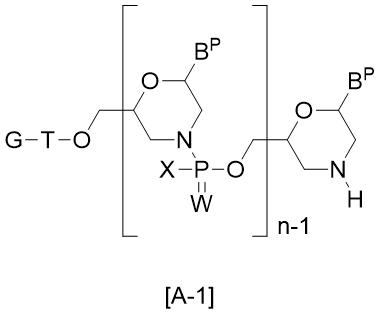
BPは、それぞれ同一または異なって、保護されていてもよい核酸塩基であり;
nは、1~50の整数、好ましくは1~30の整数、更に好ましくは1~25の整数、最も好ましくは1~15の整数であり;
Wは、それぞれ同一または異なって、酸素原子または硫黄原子であり;そして
Xは、それぞれ同一または異なって、中性条件下で脱離可能な基で置換されている水酸基、1,1,3,3-テトラ(C1-6アルキル)グアニジル、C1-6アルコキシ、ジ(C1-6アルキル)アミノ、モノ(塩基性条件下で脱離可能な基で置換されているアミノ-C1-6アルキル)アミノ、ジ(塩基性条件下で脱離可能な基で置換されているアミノ-C1-6アルキル)アミノ、または一般式[2]:

*は、Pとの結合位置であり;
aは、0~2の整数であり;
Eは、CH2、CH-A1またはN-A2であり;
A1は、C1-6アルキル、塩基性条件下で除去可能な基で置換されているモノ(C1-6アルキル)アミノ-C1-6アルキル、ジ(C1-6アルキル)アミノ-C1-6アルキル、トリ(C1-6アルキル)アンモニオ-C1-6アルキル、塩基性条件下で除去可能な基で置換されているアミノ、塩基性条件下で除去可能な基で置換されているモノ(C1-6アルキル)アミノ、ジ(C1-6アルキル)アミノ、トリ(C1-6アルキル)アンモニオ、塩基性条件下で除去可能な基で置換されているアミジノで置換されているアミノ、または一般式[3]:

*は、Eとの結合位置であり;
bは、0~2の整数であり;
cは、0または1であり;
R11は、C1-6アルキルであり;そして
Mは、CH2、酸素原子、硫黄原子またはN-(塩基性条件下で除去可能な基)である)で表される置換基であり;そして
A2は、C1-6アルキル、塩基性条件下で除去可能な基で置換されているモノ(C1-6アルキル)アミノ-C1-6アルキル、ジ(C1-6アルキル)アミノ-C1-6アルキル、トリ(C1-6アルキル)アンモニオ-C1-6アルキル、塩基性条件下で除去可能な基、アリールまたはヘテロアリールである)
で表される置換基であり;
Gは、
(1)ケイ素置換基、
(2)場合により置換されているC1-18アルキル-カルボニル、場合により置換されているC1-18アルコキシ-カルボニル、長鎖アルキル-カルボニル、または長鎖アルコキシ-カルボニル、
(3)1個~5個の、長鎖アルキルオキシおよび/もしくは長鎖アルケニルオキシで置換されているベンゾイル、或いは
(4)一般式[7]:

*は、Tとの結合位置であり;
Zは、
(1)(有機溶媒に溶解する可溶性ポリマー)-オキシ、
(2)(有機溶媒に溶解する可溶性ポリマー)-アミノ、
(3)長鎖アルキルオキシ、1個~5個の長鎖アルキルオキシおよび/もしくは長鎖アルケニルオキシで置換されているベンゾイル、または1個~5個の長鎖アルキルオキシおよび/もしくは長鎖アルケニルオキシで置換されているベンジル、
(4)固相担体、或いは
(5)次の一般式[8A]~[8N]:
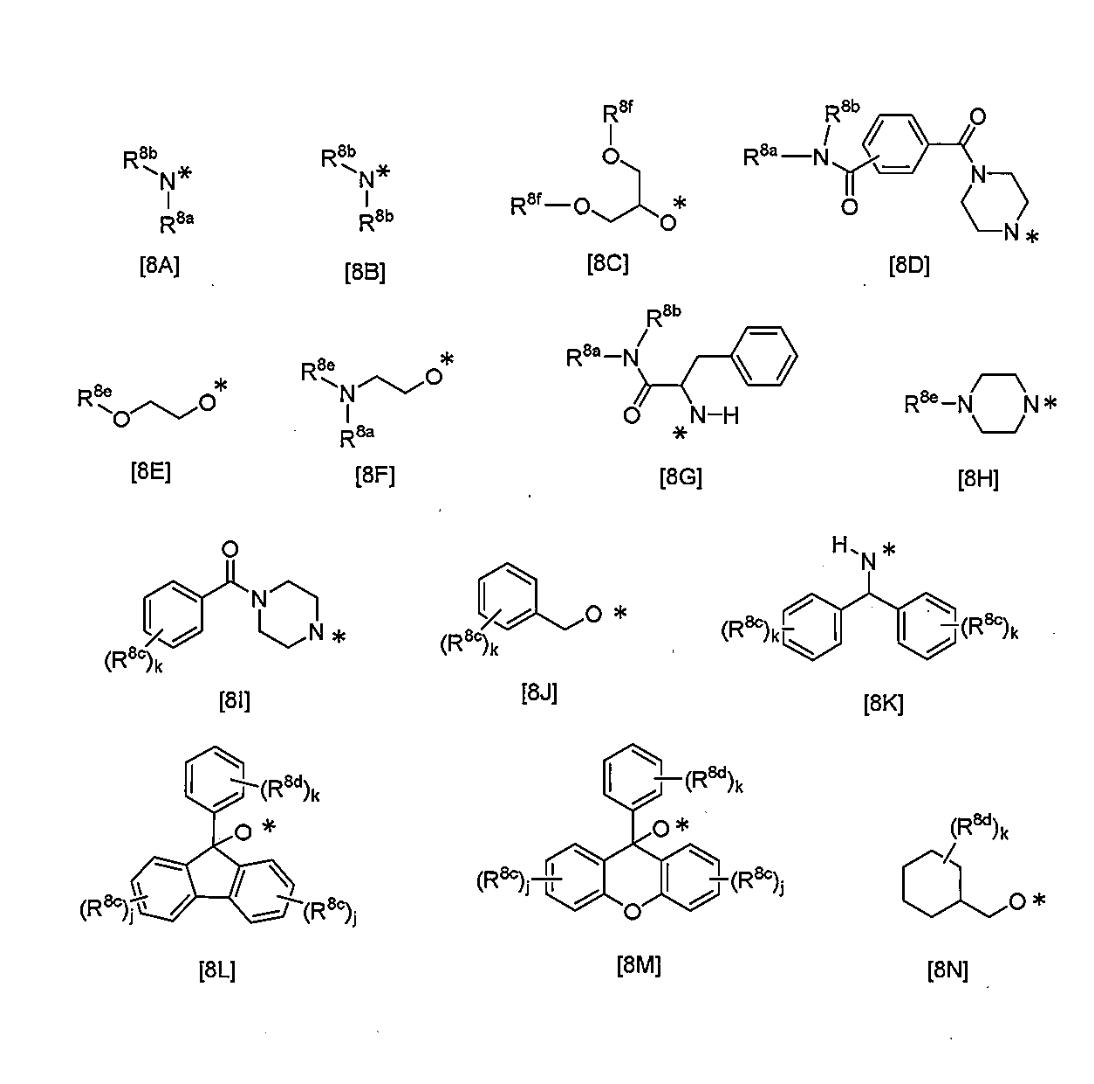
*は、Lとの結合位置であり;
jは、0~4の整数であり;
kは、0~5の整数であり;
R8aは、水素原子またはC1-6アルキルであり;
R8bは、それぞれ同一または異なって、長鎖アルキルであり;
R8cは、それぞれ同一または異なって、一般式[9A]~[9E]:
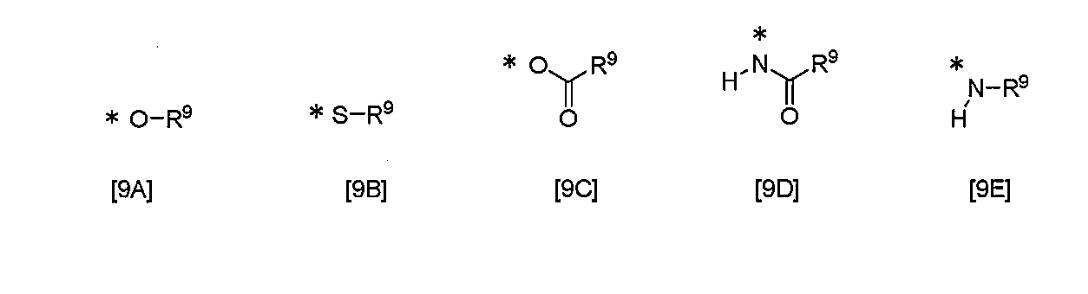
*は、結合位置であり;および
R9は長鎖アルキルおよび/または長鎖アルケニルである)
で表される置換基であり;
R8dは、それぞれ同一または異なって、水素原子、ハロゲン、1個~13個のハロゲンで置換されていてもよい長鎖アルキルまたは1個~13個のハロゲンで置換されていてもよい長鎖アルキルオキシであり;
R8eは
(1)長鎖アルキル、
(2)長鎖アルキル-カルボニル、または
(3)1個~5個の、長鎖アルキルオキシおよび/もしくは長鎖アルケニルオキシで置換されているベンゾイルであり;そして
R8fは、
(1)長鎖アルキル、
(2)長鎖アルキル-カルボニル、または
(3)長鎖アルケニル-カルボニルである)
で表される置換基であり;そして
Lは、一般式[10]:

*は、Zとの結合位置であり;
**は、Tとの結合位置であり;そして
L1は、置換されていてもよいC2-10アルキレンまたは置換されていてもよいC6-10アリーレンであるか、または一般式[10-1]:
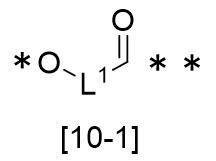
*は、Zとの結合位置であり;
**は、Tとの結合位置であり;そして
L1は、置換されていてもよいC1-10アルキレンまたは置換されていてもよいC6-10アリーレンである)
で表される置換基である)
で表される置換基であり;そして
Tは、単結合または一般式[11]:

XおよびWは、前記と同義であり;
*は、上記一般式[4a]~[4d]の**O、*Oまたは*Nとの結合位置であり;
**は、Gとの結合位置であり;そして
qは、0~10の整数である)
で表される置換基であるが、Gがケイ素置換基である場合、Tは単結合である]
の化合物と、式[B-1]:
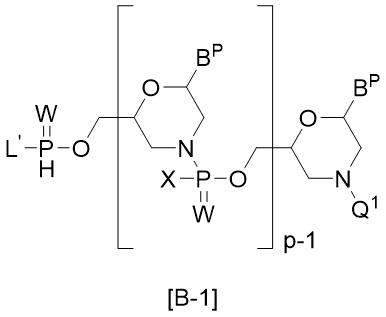
BP、W、及びXは、前記と同義であり、そして
pは、1~50の整数、好ましくは1~30の整数、更に好ましくは1~25の整数、最も好ましくは1~15の整数であり;
L’は、OH、-O-N+H(脂肪族アミン)、-O-N+H(環状アミン)、又は-O-N+H(芳香族アミン)であり、好ましくは-O-N+H(C1-6アルキル)3又は-O-N+H(環状アミン)であり、-O-N+H(C1-6アルキル)3は、例えば-O-N+H(CH2CH3)3であり、-O-N+H(環状アミン)は、例えば-O-(HDBU)+であり;
Q1は、酸性条件下で除去可能な基である]
の化合物とを、
(1)塩基の存在下、リン試薬1、リン試薬2、及びオニウム試薬からなる群より選択される少なくとも一つの縮合剤で処理して、そして
(2)酸化剤及び有機アミンで処理して、
式[C-1]:

の化合物を得る方法。
更に、式[C-1]:

の化合物を、酸、又は酸及びスカベンジャーで処理して、
式[C-0-1]:

の化合物にして、そして
該式[C-0-1]の化合物と、式[B-0-1]:
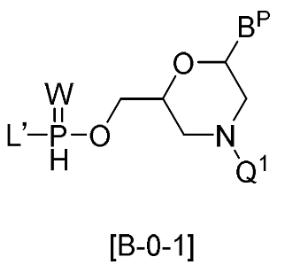
の化合物とを、
(1)塩基の存在下、リン試薬1、リン試薬2、及びオニウム試薬からなる群より選択される少なくとも一つの縮合剤で処理して、そして続いて
(2)酸化剤及び有機アミンで処理して、
式[C-1-1]:
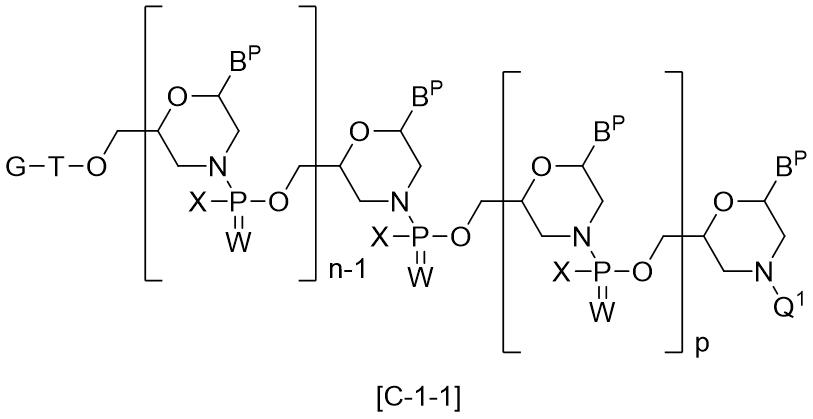
の化合物を得ることを含む、<1>に記載の方法。
更に、式[C-1]:
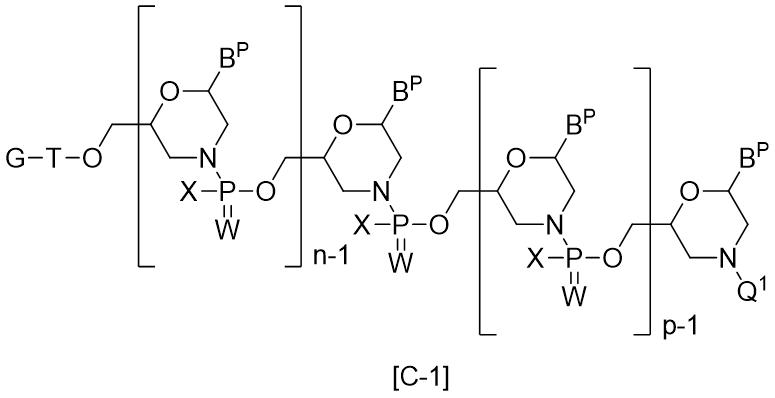
の化合物を、水酸基の保護基の除去条件で処理して、
式[C-0-2]:
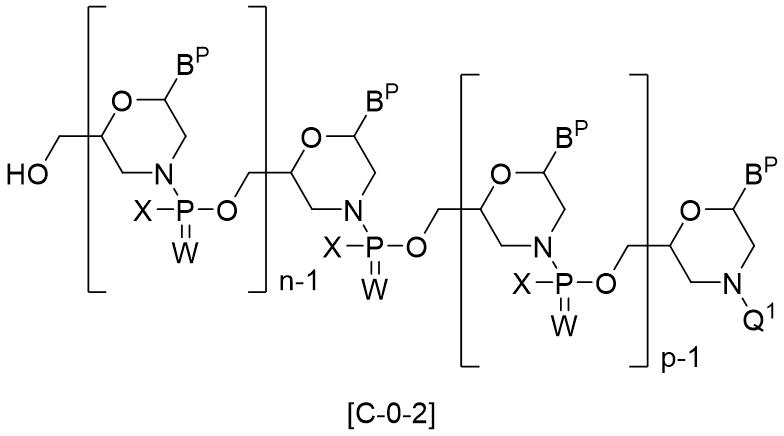
の化合物を得て、
(1)式[P-1]:
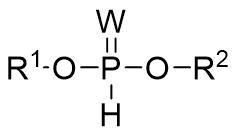
の化合物及び塩基で処理し、そして続いて、
(2)加水分解溶液で処理して、
式[C-0-2-1]:
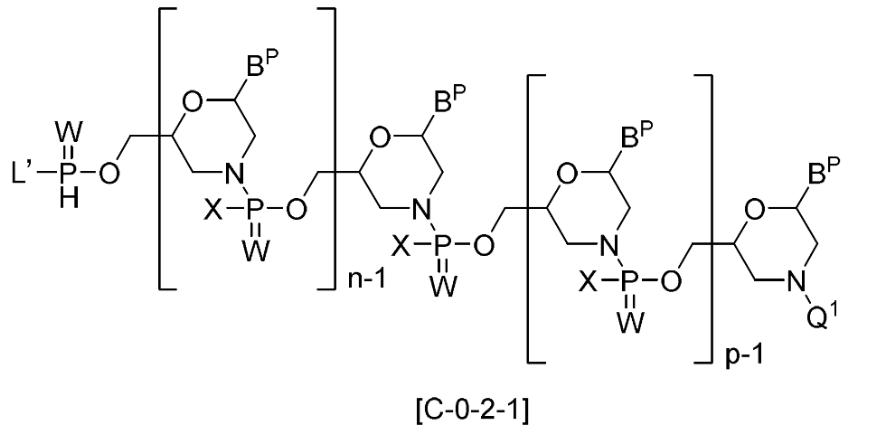
の化合物を得ることを含む、<1>に記載の方法。
更に、式[C-0-2-1]:

の化合物と、式[A-0-1]:
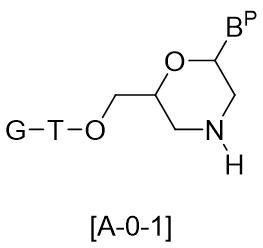
の化合物とを、
(1)塩基の存在下、リン試薬1、リン試薬2、及びオニウム試薬からなる群より選択される少なくとも一つの縮合剤で処理して、そして続いて
(2)酸化剤及び有機アミンで処理して、
式[C-1-2]:
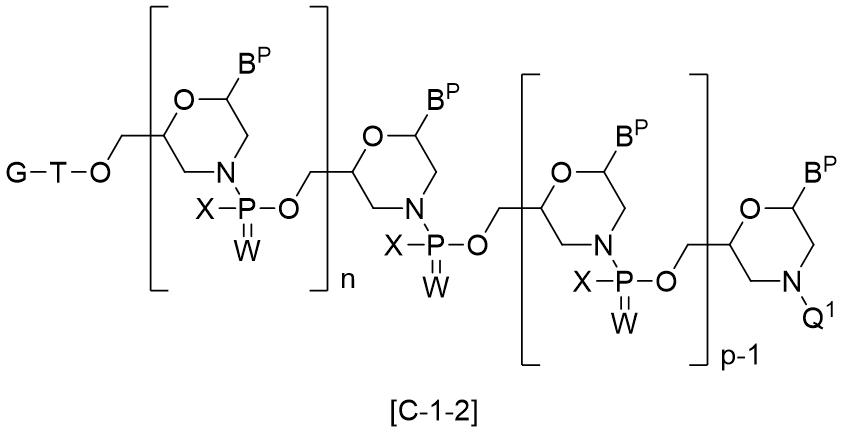
の化合物を得ることを含む、<3>に記載の方法。
更に、式[B-1-0]:
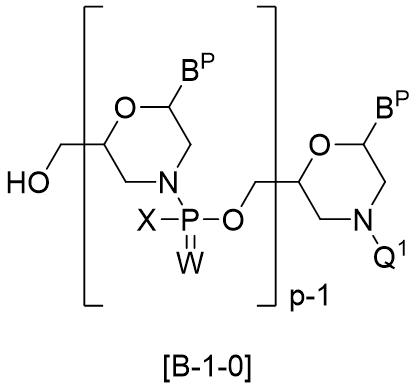
の化合物を、
(1)式[P-1]:
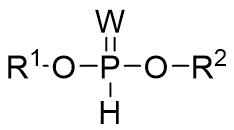
の化合物及び塩基で処理し、そして続いて、
(2)加水分解溶液で処理して、
式[B-1]:
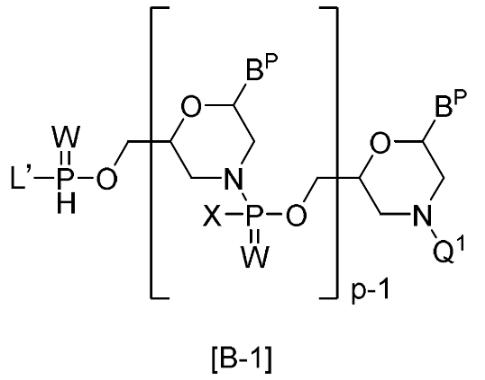
の化合物を得ることを含む、<1>に記載の方法。
更に、式[A-0]:
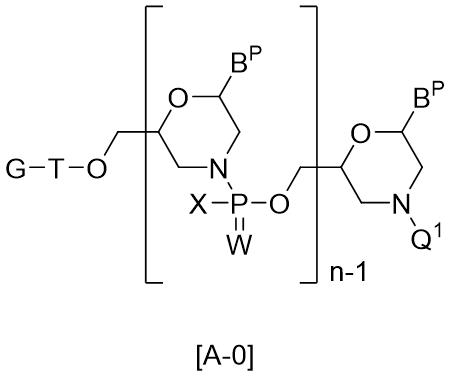
の化合物を、酸、又は酸及びスカベンジャーで処理して、
式[A-1]:
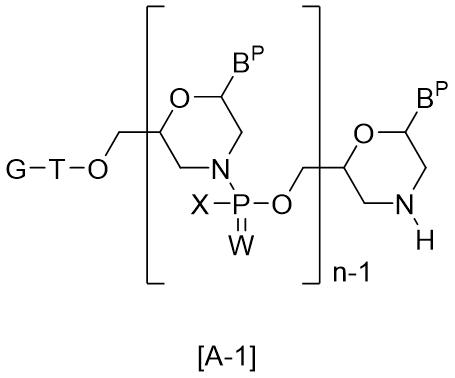
の化合物を得ることを含む、<1>に記載の方法。
Gが、下記の式:
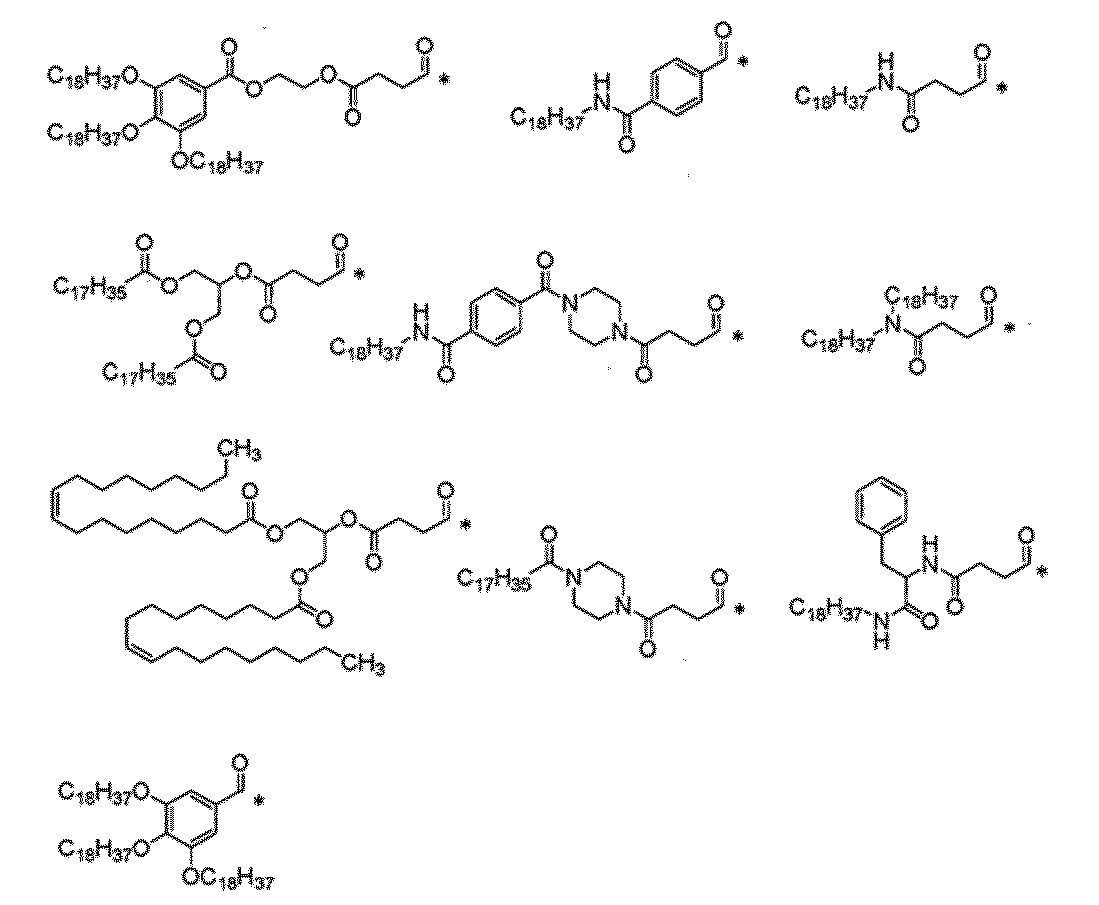
からなる群より選択され;
Tが単結合である、
<1>~<6>のいずれかに記載の方法。
式[B-1]中、
BPが、それぞれ同一または異なって、保護されていてもよい核酸塩基であり、
Q1が、トリチル又はジメトキシトリチルであり、
L’が、-O-N+H(CH2CH3)3、または-O-(HDBU)+であり、
Wが、Oであり、そして
pが、2~20の整数であり、好ましくは2~15の整数であり、更に好ましくは2~10の整数である、
<1>に記載の式[B-1]の化合物。
((2S,6R)-6-(4-ベンズアミド-2-オキソピリミジン-1(2H)-イル)-4-((((2S,6R)-6-(6-ベンズアミド-9H-プリン-9-イル)-4-トリチルモルホリン-2-イル)メトキシ)(ジメチルアミノ)ホスホリル)モルホリン-2-イル)メチルホスホネート(即ち、H-ホスホネート-PMO[CBz-ABz]―ON)、
トリエチルアンモニウム((2S,6R)-6-(4-ベンズアミド-2-オキソピリミジン-1(2H)-イル)-4-((((2S,6R)-6-(6-ベンズアミド-9H-プリン-9-イル)-4-トリチルモルホリン-2-イル)メトキシ)(ジメチルアミノ)ホスホリル)モルホリン-2-イル)メチルホスホネート(即ち、H-ホスホネート-PMO[CBz-ABz]―ON(トリエチルアミン塩))、
((2S,6R)-6-(4-ベンズアミド-2-オキソピリミジン-1(2H)-イル)-4-((((2S,6R)-4-((((2S,6R)-6-(4-ベンズアミド-2-オキソピリミジン-1(2H)-イル)-4-((ジメチルアミノ)(((2S,6R)-6-(5-メチル-2,4-ジオキソ-3,4-ジヒドロピリミジン-1(2H)-イル)-4-トリチルモルホリン-2-イル)メトキシ)ホスホリル)モルホリン-2-イル)(ジメチルアミノ)ホスホリル)-6-(5-メチル-2,4-ジオキソ-3,4-ジヒドロピリミジン-1(2H)-イル)モルホリン-2-イル)メトキシ)ホスホリル)-6-(6-ベンズアミド-9H-プリン-9-イル)モルホリン-2-イル)メトキシ)(ジメチルアミノ)ホスホリル)モルホリン-2-イル)メチルホスホネート(即ち、H-ホスホネート-PMO[CBz-ABz-T-CBz-T]-ON)、
トリエチルアンモニウム((2S,6R)-6-(4-ベンズアミド-2-オキソピリミジン-1(2H)-イル)-4-((((2S,6R)-4-((((2S,6R)-6-(4-ベンズアミド-2-オキソピリミジン-1(2H)-イル)-4-((ジメチルアミノ)(((2S,6R)-6-(5-メチル-2,4-ジオキソ-3,4-ジヒドロピリミジン-1(2H)-イル)-4-トリチルモルホリン-2-イル)メトキシ)ホスホリル)モルホリン-2-イル)(ジメチルアミノ)ホスホリル)-6-(5-メチル-2,4-ジオキソ-3,4-ジヒドロピリミジン-1(2H)-イル)モルホリン-2-イル)メトキシ)ホスホリル)-6-(6-ベンズアミド-9H-プリン-9-イル)モルホリン-2-イル)メトキシ)(ジメチルアミノ)ホスホリル)モルホリン-2-イル)メチルホスホネート(即ち、H-ホスホネート-PMO[CBz-ABz-T-CBz-T]-ON(トリエチルアミン塩))、
((2S,6R)-6-(4-ベンズアミド-2-オキソピリミジン-1(2H)-イル)-4-((((2S,6R)-4-((((2S,6R)-6-(6-ベンズアミド-9H-プリン-9-イル)-4-((((2S,6R)-6-(6-ベンズアミド-9H-プリン-9-イル)-4-((((2S,6R)-6-((2-シアノエトキシ)-2-(2-フェノキシアセトアミド)-9H-プリン-9-イル)-4-トリチルモルホリン-2-イル)メトキシ)(ジメチルアミノ)ホスホリル)モルホリン-2-イル)メトキシ)(ジメチルアミノ)ホスホリル)モルホリン-2-イル)メトキシ)(ジメチルアミノ)ホスホリル)-6-((2-シアノエトキシ)-2-(2-フェノキシアセトアミド)-9H-プリン-9-イル)モルホリン-2-イル)メトキシ)(ジメチルアミノ)ホスホリル)モルホリン-2-イル)メチルホスホネート(即ち、H-ホスホネート-PMO[CBz-GCE,Pac-ABz-ABz-GCE,Pac]-ON)、
トリエチルアンモニウム((2S,6R)-6-(4-ベンズアミド-2-オキソピリミジン-1(2H)-イル)-4-((((2S,6R)-4-((((2S,6R)-6-(6-ベンズアミド-9H-プリン-9-イル)-4-((((2S,6R)-6-(6-ベンズアミド-9H-プリン-9-イル)-4-((((2S,6R)-6-((2-シアノエトキシ)-2-(2-フェノキシアセトアミド)-9H-プリン-9-イル)-4-トリチルモルホリン-2-イル)メトキシ)(ジメチルアミノ)ホスホリル)モルホリン-2-イル)メトキシ)(ジメチルアミノ)ホスホリル)モルホリン-2-イル)メトキシ)(ジメチルアミノ)ホスホリル)-6-((2-シアノエトキシ)-2-(2-フェノキシアセトアミド)-9H-プリン-9-イル)モルホリン-2-イル)メトキシ)(ジメチルアミノ)ホスホリル)モルホリン-2-イル)メチルホスホネート(即ち、H-ホスホネート-PMO[CBz-GCE,Pac-ABz-ABz-GCE,Pac]-ON(トリエチルアミン塩))、
((2S,6R)-4-((((2S,6R)-4-((((2S,6R)-4-((((2S,6R)-6-(4-ベンズアミド-2-オキソピリミジン-1(2H)-イル)-4-トリチルモルホリン-2-イル)メトキシ)(ジメチルアミノ)ホスホリル)-6-(5-メチル-2,4-ジオキソ-3,4-ジヒドロピリミジン-1(2H)-イル)モルホリン-2-イル)メトキシ)(ジメチルアミノ)ホスホリル)-6-(5-メチル-2,4-ジオキソ-3,4-ジヒドロピリミジン-1(2H)-イル)モルホリン-2-イル)メトキシ)(ジメチルアミノ)ホスホリル)-6-((2-シアノエトキシ)-2-(2-フェノキシアセトアミド)-9H-プリン-9-イル)モルホリン-2-イル)メトキシ)(ジメチルアミノ)ホスホリル)-6-((2-シアノエトキシ)-2-(2-フェノキシアセトアミド)-9H-プリン-9-イル)モルホリン-2-イル)メチルホスホネート(即ち、H-ホスホネート-PMO[GCE,Pac-GCE,Pac-T-T-CBz]-ON)、
トリエチルアンモニウム((2S,6R)-4-((((2S,6R)-4-((((2S,6R)-4-((((2S,6R)-6-(4-ベンズアミド-2-オキソピリミジン-1(2H)-イル)-4-トリチルモルホリン-2-イル)メトキシ)(ジメチルアミノ)ホスホリル)-6-(5-メチル-2,4-ジオキソ-3,4-ジヒドロピリミジン-1(2H)-イル)モルホリン-2-イル)メトキシ)(ジメチルアミノ)ホスホリル)-6-(5-メチル-2,4-ジオキソ-3,4-ジヒドロピリミジン-1(2H)-イル)モルホリン-2-イル)メトキシ)(ジメチルアミノ)ホスホリル)-6-((2-シアノエトキシ)-2-(2-フェノキシアセトアミド)-9H-プリン-9-イル)モルホリン-2-イル)メトキシ)(ジメチルアミノ)ホスホリル)-6-((2-シアノエトキシ)-2-(2-フェノキシアセトアミド)-9H-プリン-9-イル)モルホリン-2-イル)メチルホスホネート(即ち、H-ホスホネート-PMO[GCE,Pac-GCE,Pac-T-T-CBz]-ON(トリエチルアミン塩))、
((2S,6R)-6-(4-ベンズアミド-2-オキソピリミジン-1(2H)-イル)-4-((((2S,6R)-6-(4-ベンズアミド-2-オキソピリミジン-1(2H)-イル)-4-トリチルモルホリン-2-イル)メトキシ)(ジメチルアミノ)ホスホリル)モルホリン-2-イル)メチルホスホネート(即ち、H-ホスホネート-PMO[CBz―CBz]-ON)、
トリエチルアンモニウム((2S,6R)-6-(4-ベンズアミド-2-オキソピリミジン-1(2H)-イル)-4-((((2S,6R)-6-(4-ベンズアミド-2-オキソピリミジン-1(2H)-イル)-4-トリチルモルホリン-2-イル)メトキシ)(ジメチルアミノ)ホスホリル)モルホリン-2-イル)メチルホスホネート(即ち、H-ホスホネート-PMO[CBz―CBz]-ON(トリエチルアミン塩))、
((2S,6R)-4-((ジメチルアミノ)(((2S,6R)-6-(5-メチル-2,4-ジオキソ-3,4-ジヒドロピリミジン-1(2H)-イル)-4-トリチルモルホリン-2-イル)メトキシ)ホスホリル)-6-(5-メチル-2,4-ジオキソ-3,4-ジヒドロピリミジン-1(2H)-イル)モルホリン-2-イル)メチルホスホネート(即ち、H-ホスホネート-PMO[T-T]-ON)、
トリエチルアンモニウム(2S,6R)-4-((ジメチルアミノ)(((2S,6R)-6-(5-メチル-2,4-ジオキソ-3,4-ジヒドロピリミジン-1(2H)-イル)-4-トリチルモルホリン-2-イル)メトキシ)ホスホリル)-6-(5-メチル-2,4-ジオキソ-3,4-ジヒドロピリミジン-1(2H)-イル)モルホリン-2-イル)メチルホスホネート(即ち、H-ホスホネート-PMO[T-T]-ON(トリエチルアミン塩))、
((2S,6R)-4-((ジメチルアミノ)(((2S,6R)-4-((ジメチルアミノ)(((2S,6R)-6-(5-メチル-2,4-ジオキソ-3,4-ジヒドロピリミジン-1(2H)-イル)-4-トリチルモルホリン-2-イル)メトキシ)ホスホリル)-6-(5-メチル-2,4-ジオキソ-3,4-ジヒドロピリミジン-1(2H)-イル)メトキシ)ホスホリル)-6-(5-メチル-2,4-ジオキソ-3,4-ジヒドロピリミジン-1(2H)-イル)モルホリン-2-イル)メチルホスホネート(即ち、H-ホスホネート-PMO[T-T-T]-ON)、
トリエチルアンモニウム((2S,6R)-4-((ジメチルアミノ)(((2S,6R)-4-((ジメチルアミノ)(((2S,6R)-6-(5-メチル-2,4-ジオキソ-3,4-ジヒドロピリミジン-1(2H)-イル)-4-トリチルモルホリン-2-イル)メトキシ)ホスホリル)-6-(5-メチル-2,4-ジオキソ-3,4-ジヒドロピリミジン-1(2H)-イル)メトキシ)ホスホリル)-6-(5-メチル-2,4-ジオキソ-3,4-ジヒドロピリミジン-1(2H)-イル)モルホリン-2-イル)メチルホスホネート(即ち、H-ホスホネート-PMO[T-T-T]-ON(トリエチルアミン塩))、
((2S,6R)-4-((ジメチルアミノ)(((2S,6R)-4-((ジメチルアミノ)(((2S,6R)-4-((ジメチルアミノ)((((2S,6R)-6-(5-メチル-2,4-ジオキソ-3,4-ジヒドロピリミジン-1(2H)-イル)-4-トリチルモルホリン-2-イル)メトキシ)ホスホリル)-6-(5-メチル-2,4-ジオキソ-3,4-ジヒドロピリミジン-1(2H)-イル)メトキシ)ホスホリル)-6-(5-メチル-2,4-ジオキソ-3,4-ジヒドロピリミジン-1(2H)-イル)メトキシ)ホスホリル)-6-(5-メチル-2,4-ジオキソ-3,4-ジヒドロピリミジン-1(2H)-イル)モルホリン-2-イル)メチルホスホネート(即ち、H-ホスホネート-PMO[T-T-T-T]-ON)、
トリエチルアンモニウム((2S,6R)-4-((ジメチルアミノ)(((2S,6R)-4-((ジメチルアミノ)(((2S,6R)-4-((ジメチルアミノ)((((2S,6R)-6-(5-メチル-2,4-ジオキソ-3,4-ジヒドロピリミジン-1(2H)-イル)-4-トリチルモルホリン-2-イル)メトキシ)ホスホリル)-6-(5-メチル-2,4-ジオキソ-3,4-ジヒドロピリミジン-1(2H)-イル)メトキシ)ホスホリル)-6-(5-メチル-2,4-ジオキソ-3,4-ジヒドロピリミジン-1(2H)-イル)メトキシ)ホスホリル)-6-(5-メチル-2,4-ジオキソ-3,4-ジヒドロピリミジン-1(2H)-イル)モルホリン-2-イル)メチルホスホネート(即ち、H-ホスホネート-PMO[T-T-T-T]-ON(トリエチルアミン塩))、
1,8-ジアザビシクロ(5.4.0)-7-ウンデセニウム((2S,6R)-6-(4-ベンズアミド-2-オキソピリミジン-1(2H)-イル)-4-((((2S,6R)-4-((((2S,6R)-6-(4-ベンズアミド-2-オキソピリミジン-1(2H)-イル)-4-((ジメチルアミノ)(((2S,6R)-6-(5-メチル-2,4-ジオキソ-3,4-ジヒドロピリミジン-1(2H)-イル)-4-トリチルモルホリン-2-イル)メトキシ)ホスホリル)モルホリン-2-イル)(ジメチルアミノ)ホスホリル)-6-(5-メチル-2,4-ジオキソ-3,4-ジヒドロピリミジン-1(2H)-イル)モルホリン-2-イル)メトキシ)ホスホリル)-6-(6-ベンズアミド-9H-プリン-9-イル)モルホリン-2-イル)メトキシ)(ジメチルアミノ)ホスホリル)モルホリン-2-イル)メチルホスホネート(即ち、H-ホスホネート-PMO[CBz-ABz-T-CBz-T]-ON(DBU塩))、及び
1,8-ジアザビシクロ(5.4.0)-7-ウンデセニウム((2S,6R)-4-(((2S,6R)-4-(((2S,6R)-6-(6-ベンズアミドプリン-9-イル)-4-(((2S,6R)-6-(6-ベンズアミドプリン-9-イル)-4-(((2S,6R)-4-(((2S,6R)-6-(6-(2-シアノエトキシ)-2-((2-フェノキシアセチル)アミノ)プリン-9-イル)-4-(((2S,6R)-4-(((2S,6R)-6-(6-(2-シアノエトキシ)-2-((2-フェノキシアセチル)アミノ)プリン-9-イル-4-(ジメチルアミノ-(((2S,6R)-4-(ジメチルアミノ-(((2S,6R)-6-(5-メチル-2,4-ジオキソ-リピミジン-1-イル)-4-トリチル-モルホリン-2-イル)メトキシ)ホスホリル)-6-(5―メチル-2,4-ジオキソ-ピリミジン-1-イル)モルホリン-2-イル)メトキシ)ホスホリル)モルホリン-2-イル)メトキシ-(ジメチルアミノ)ホスホリル-6-(5-メチル-2,4-ジオキソ-ピリミジン-1-イル)モルホリン-2-イル)メトキシ-(ジメチルアミノ)ホスホリル)モルホリン-2-イルメトキシ-(ジメチルアミノ)ホスホリル)-6-(6-(3-シアノプロポキシ-2-((2-フェノキシアセチル)アミノ)プリン-9-イル)モルホリン-2-イル)メトキシ-(ジメチルアミノ)ホスホリル)モルホリン-2-イル)メトキシ-(ジメチルアミノ)ホスホリル)モルホリン-2-イル)メトキシ-(ジメチルアミノ)ホスホリル)-6-(6-(2-シアノエトキシ)-2-((2-フェノキシアセチル)アミノ)プリン-9-イル)モルホリン-2-イル)メトキシ-(ジメチルアミノ)ホスホリル)-6-(5-メチル-2,4-ジオキソ-ピリミジン-1-イル)モルホリン-2-イル)メトキシホスフィネート(即ち、H-ホスホネート-PMO[T-GCE,Pac-ABz-ABz-GCE,Pac-GCE,Pac-T-GCE,Pac-T-T]-ON(DBU塩))からなる群より選択される、<8>に記載の式[B-1]の化合物。
式[B-0-1]中、
BPが、保護されていてもよい核酸塩基であり、
Q1が、トリチル又はジメトキシトリチルであり、
L’が、O-(HDBU)+であり、そして
Wが、Oである、
<2>に記載の式[B-0-1]の化合物。
1,8-ジアザビシクロ(5.4.0)-7-ウンデセニウム((2S,6R)-6-(6-ベンズアミド-9H-プリン-9-イル)-4-トリチルモルホリン-2-イル)メチルホスホネート、
1,8-ジアザビシクロ(5.4.0)-7-ウンデセニウム((2S,6R)-6-(4-ベンズアミド-2-オキソピリミジン-1(2H)-イル)-4-トリチルモルホリン-2-イル)メチルホスホネート、
1,8-ジアザビシクロ(5.4.0)-7-ウンデセニウム((2S,6R)-6-(5-メチル-2,4-ジオキソ-3,4-ジヒドロピリミジン-1(2H)-イル)-4-トリチルモルホリン-2-イル)メチルホスホネート、
1,8-ジアザビシクロ(5.4.0)-7-ウンデセニウム((2S,6R)-6-((2-シアノエトキシ)-2-(2-フェノキシアセトアミド)-9H-プリン-9-イル)-4-トリチルモルホリン-2-イル)メチルホスホネート、及び
1,8-ジアザビシクロ(5.4.0)-7-ウンデセニウム((2S,6R)-6-(2-(2-フェニルアセトアミド)-6-((4-(ピバロイルオキシ)ベンジル)オキシ)-9H-プリン-9-イル)-4-トリチルモルホリン-2-イル)メチルホスホネート
からなる群より選択される、<10>に記載の式[B-0-1]の化合物。
本発明によれば、効率的にリン結合を形成しうるため、結果的にオリゴ核酸化合物の製造時間を短くすることが期待できる。
「核酸塩基」は、例えば、アデニン、グアニン、ヒポキサンチン、シトシン、チミン、ウラシルまたはそれらの修飾塩基を挙げることができる。かかる修飾塩基としては、例えば、シュードウラシル、3-メチルウラシル,ジヒドロウラシル、5-アルキルシトシン(例えば、5-メチルシトシン)、5-アルキルウラシル(例えば、5-エチルウラシル)、5-ハロウラシル(5-ブロモウラシル)、6-アザピリミジン、6-アルキルピリミジン(6-メチルウラシル)、2-チオウラシル、4-チオウラシル、4-アセチルシトシン、5-(カルボキシヒドロキシメチル)ウラシル、5’-カルボキシメチルアミノメチル-2-チオウラシル、5-カルボキシメチルアミノメチルウラシル、1-メチルアデニン、1-メチルヒポキサンチン、2,2-ジメチルグアニン、3-メチルシトシン、2-メチルアデニン、2-メチルグアニン、N6-メチルアデニン、7-メチルグアニン、5-メトキシアミノメチル-2-チオウラシル、5-メチルアミノメチルウラシル、5-メチルカルボニルメチルウラシル、5-メチルオキシウラシル、5-メチル-2-チオウラシル、2-メチルチオ-N6-イソペンテニルアデニン、ウラシル-5-オキシ酢酸、2-チオシトシン、プリン、2,6-ジアミノプリン、2-アミノプリン、イソグアニン、インドール、イミダゾール、キサンチンが挙げられるが、これらに限定されるものではない。但し、BPに係る核酸塩基のアミノ基または水酸基は保護されていてもよい。
「保護されていてもよい核酸塩基」は、保護されていない「核酸塩基」および保護されている「核酸塩基」の両方を包含し、例えば、アミノ基および/または水酸基が保護されていないまたは保護されている、アデニン、グアニン、ヒポキサンチン、シトシン、チミン、ウラシルなどが挙げられる。
アミノ基の保護基としては、核酸の保護基として使用されるものであれば特に制限されず、具体的には、例えば、ベンゾイル、4-メトキシベンゾイル、アセチル、プロピオニル、ブチリル、イソブチリル、フェニルアセチル、フェノキシアセチル、4-tert-ブチルフェノキシアセチル、4-イソプロピルフェノキシアセチル、(ジメチルアミノ)メチレンを挙げることができる。アミノ基の保護基としては、ベンゾイル、アセチル、フェニルアセチル、4-tert-ブチルフェノキシアセチルが好ましい。水酸基の保護基としては、例えば、2-シアノエチル、4-ニトロフェネチル、フェニルスルホニルエチル、メチルスルホニルエチル、トリメチルシリルエチル、置換可能な任意の位置で1~5個の電子吸引性基で置換されていてもよいフェニル、ジフェニルカルバモイル、ジメチルカルバモイル、ジエチルカルバモイル、メチルフェニルカルバモイル、1-ピロリジニルカルバモイル、モルホリノカルバモイル、4-(tert-ブチルカルボキシ)ベンジル、4-[(ジメチルアミノ)カルボキシ]ベンジル、4-(フェニルカルボキシ)ベンジルを挙げることができる(例えば、国際公開公報第2009/064471A1を参照。)。水酸基の保護基としては、2-シアノエチル、4-ニトロフェネチル、4-(tert-ブチルカルボキシ)ベンジルが好ましい。グアニンの6位水酸基の保護基は、2-シアノエチルが好ましい。
一実施形態において、保護されている核酸塩基としては、例えば以下に示すものが挙げられる。

より具体的な保護されている核酸塩基の態様としては、アミノ基がベンゾイルで保護されたアデニン(ABz)、アミノ基がベンゾイルで保護されたシトシン(CBz)、水酸基が2-シアノエチルで保護され、そしてアミノ基がフェノキシアセチルで保護されたグアニン(GCE,Pac)などが挙げられるが、これらに限定されない。
「長鎖アルキル」は、例えば、直鎖状または分枝鎖状の炭素数10~300のアルキルを示し、好ましくは直鎖状または分枝鎖状の炭素数10~100のアルキルを示し、より好ましくは直鎖状または分枝鎖状の炭素数10~30のアルキルを示す。
「長鎖アルキル-カルボニル」および「長鎖アルキルオキシ」の「長鎖アルキル」部分は、前記「長鎖アルキル」と同じものを挙げることができる。
「長鎖アルケニル」例えば、直鎖状または分枝鎖状の炭素数10~300のアルケニルを示し、好ましくは直鎖状または分枝鎖状の炭素数10~100のアルケニルを示し、より好ましくは直鎖状または分枝鎖状の炭素数10~30のアルケニルを示す。
「長鎖アルケニルオキシ」および「長鎖アルケニル-カルボニル」の「長鎖アルケニル」部分は、前記「長鎖アルケニル」と同じものを挙げることができる。
「ハロゲン」は、例えば、フッ素原子、塩素原子、臭素原子、ヨウ素原子を挙げることができる。
「5~6員の飽和環状アミノ」としては、例えば、環構成原子として、O又はSを1個有していてもよい、Nを1個又は2個有する5員~6員の飽和環状アミノ基、具体的には、1-ピロリジニル、1-イミダゾリジニル、ピペリジノ、1-ピペラジニル、1-テトラヒドロピリミジニル、4-モルホリノ、4-チオモルホリノ、1-ホモピペラジニル、オキサゾリジン-3-イルを挙げることができる。
「C1-6アルキル」は、直鎖状または分枝鎖状の炭素数1~6のアルキルを示し、具体的には、例えば、メチル、エチル、n-プロピル、イソプロピル、n-ブチル、イソブチル、sec-ブチル、tert-ブチル、n-ペンチル、n-ヘキシルを挙げることができる。
「C1-6アルコキシ」は、直鎖状または分枝鎖状の炭素数1~6のアルコキシを示し、具体的には、例えば、メトキシ、エトキシ、n-プロポキシ、イソプロポキシ、n-ブトキシ、イソブトキシ、sec-ブトキシ、tert-ブトキシ、n-ペンチルオキシ、n-ヘキシルオキシを挙げることができる。
「C1-6アルコキシ-C1-6アルキル」の「C1-6アルコキシ」部分は、前記「C1-6アルコキシ」と同じものを挙げることができる。
「ジ(C1-6アルキル)アミノ」、モノ(塩基性条件下で除去可能な基で置換されているアミノ-C1-6アルキル)アミノ、ジ(塩基性条件下で除去可能な基で置換されているアミノ-C1-6アルキル)アミノ、モノ(C1-6アルキル)アミノ-C1-6アルキル、ジ(C1-6アルキル)アミノ-C1-6アルキル、トリ(C1-6アルキル)アンモニオ-C1-6アルキル、モノ(C1-6アルキル)アミノ、ジ(C1-6アルキル)アミノ、トリ(C1-6アルキル)アンモニオ、モノ(アミノ-C1-6アルキル)アミノおよびジ(アミノ-C1-6アルキル)アミノの「C1-6アルキル」部分は、前記「C1-6アルキル」と同じものを挙げることができる。
「C2-10アルキレン」は、直鎖状または分枝鎖状の炭素数2~10のアルキルから異なる構成炭素原子に結合している1つの水素原子を除去することにより生成される2価の基であり、例えば、エチレン基、プロピレン基、イソプロピレン基、ブチレン基、ペンチレン基、ヘキシレン基を挙げることができる。かかる「アルキレン」は、置換可能な任意の位置で、1個~12個のハロゲンで置換されていてもよい。L1に係る「アルキレン」としては、エチレンが特に好ましい。
「C6-10アリーレン」は、炭素数6~10の単環式または多環式の芳香族炭化水素から2個の異なる環構成炭素原子に結合している2個の水素原子を除去することにより生成される2価の基であり、例えば、フェニレン、ナフチレンを挙げることができる。かかる「アリーレン」は、置換可能な任意の位置で、1個~6個のハロゲンで置換されていてもよい。L1に係る「アリーレン」としては、フェニレンが特に好ましい。
「1,1,3,3-テトラ(C1-6アルキル)グアニジル」、「C1-6アルコキシ-C1-6アルキル」「ジ(C1-6アルキル)アミノ」、「ジ(C1-6アルキル)アミノ-C1-6アルキル」、「トリ(C1-6アルキル)アンモニオ」、「トリ(C1-6アルキル)アンモニオ-C1-6アルキル」、「塩基性条件下で脱離可能な基で置換されているモノ(C1-6アルキル)アミノ」、「塩基性条件下で脱離可能な基で置換されているモノ(C1-6アルキル)アミノ-C1-6アルキル」、「モノ(塩基性条件下で脱離可能な基で置換されているアミノ-C1-6アルキル)アミノ」、「ジ(塩基性条件下で脱離可能な基で置換されているアミノ-C1-6アルキル)アミノ」の「C1-6アルキル」部分は、前記「C1-6アルキル」と同じものを挙げることができる。
「酸性条件下で除去可能な基」としては、例えば、トリチル、モノメトキシトリチル、tert-ブチルジメチルシリル、ジメトキシトリチルを挙げることができる。
「塩基性条件下で除去可能な基」としては、例えば、トリフルオロアセチルを挙げることができる。
「中性条件下で除去可能な基」としては、例えば、テトラブチルアンモニウムフルオリドまたは三フッ化水素・トリエチルアミン塩を作用させることによって脱離させることができる基を挙げることができ、例えば、2-シアノエトキシメトキシ、2-シアノエトキシ-2-エトキシ、tert-ブチルジメチルシリルを挙げることができる。
「ケイ素置換基」としては、例えば、トリフェニルシリル、ジイソプロピルフェニルシリル、tert-ブチルジメチルシリル、tert-ブチルジフェニルシリルを挙げることができる。
「アリール」は、例えば、フェニルを挙げることができる。
「ヘテロアリール」は、例えば、ピリジル、ピリミジル、ピリダジル、ピラジニル、チエニル、フラニルを挙げることができる。
「固相担体」としては、一般的に、核酸、ペプチド、ペプチド核酸、糖などの固相合成に使用しうるものであれば、特に問題なく使用することができ、例えば、定孔ガラス(controlled pore glass;CPG)、オキサリル化-定孔ガラス(例えば、Nucleic Acids Research,Vol.19,1527(1991)を参照。)、TentaGel支持体-アミノポリエチレングリコール誘導体化支持体(例えば、Tetrahedron Letters,Vol.34,3373(1993)を参照。)、Poros-ポリスチレン/ジビニルベンゼンのコポリマー、ポリスチレン系樹脂、ポリアクリルアミド系樹脂を挙げることができる。
「有機溶媒に溶解する可溶性ポリマー」としては、例えば、架橋のないスチレンポリマーやポリエチレングリコール誘導体を挙げることができる。
「(有機溶媒に溶解する可溶性ポリマー)-オキシ」および「(有機溶媒に溶解する可溶性ポリマー)-アミノ」の「有機溶媒に溶解する可溶性ポリマー」部分は、前記「有機溶媒に溶解する可溶性ポリマー」と同じものを挙げることができる。
「架橋のないスチレンポリマー」としては、例えば、ジビニルベンゼンで架橋されていないポリスチレンでポリエチレングリコール等のスペーサーを持つ誘導体(TentaGelシリーズ、ArgoGelシリーズ)を挙げることができる。
「ポリエチレングリコール誘導体」としては、例えば、分子量100~40000のポリエチレングリコールで置換基を持つ誘導体等(SUNBRIGHT(登録商標)シリーズ)を挙げることができる。
本発明の一態様は、式[A-1]の化合物と、式[B-1]の化合物とを反応させて、式[C-1]の化合物を得る方法:

であり、そして
工程(1):縮合及び
工程(2):酸化的アミノ化
を含むことができる。
式[A-1]:

の化合物と、式[B-1]:

の化合物とを、
工程(1):塩基の存在下、リン試薬1、リン試薬2、及びオニウム試薬からなる群より選択される少なくとも一つの縮合剤で処理して、そして
工程(2):酸化剤及び有機アミンで処理して、
式[C-1]:
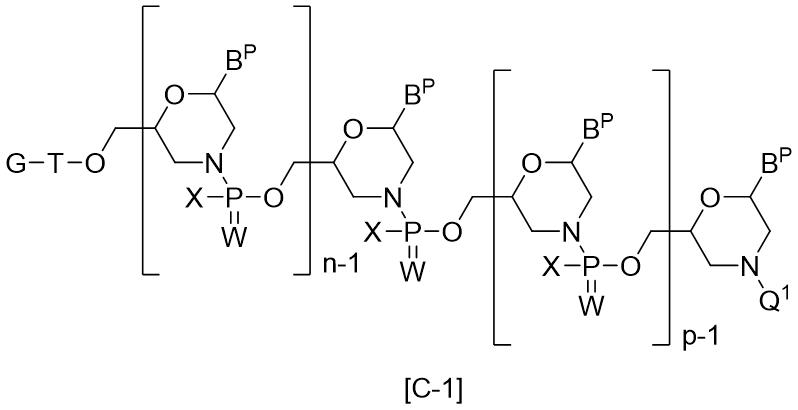
を得る方法である。
本発明の一態様において、前記縮合剤は、リン試薬1、リン試薬2、及びオニウム試薬からなる群より選択される少なくとも一つを使用することができる。
本発明の一態様において、前記縮合剤は、リン試薬1、リン試薬2、及びオニウム試薬からなる群より選択される少なくとも一つを使用することができ、例えば、クロロリン酸ジフェニル、クロロリン酸ビス(2,6-ジメチルフェニル)、ビス(2-オキソ-3-オキサゾリジニル)ホスフィン酸クロリド、PyBrop(ブロモトリピロリジノホスホニウムヘキサフルオロホスファート)、PyBOP(ヘキサフルオロリン酸(ベンゾトリアゾール-1-イルオキシ)トリピロリジノホスホニウム)、PyClop(クロロトリピロリジノホスホニウムヘキサフルオロホスファート)、PyAOP((7-アザベンゾトリアゾール-1-イルオキシ)トリピロリジノホスホニウムヘキサフルオロホスファート)、PyNTP(3-ニトロ-1,2,4-トリアゾール-1-イル-トリス(ピロリジン-1-イル)ホスホニウムヘキサフルオロホスファート)、HATU(1-[ビス(ジメチルアミノ)メチレン]-1H-1,2,3-トリアゾロ[4,5-b]ピリジニウム3-オキシドヘキサフルオロホスファート)、COMU((1-シアノ-2-エトキシ-2-オキソエチリデンアミノオキシ)ジメチルアミノ-モルホリノ-カルベニウムヘキサフルオロホスファート)、HBTU(1-[ビス(ジメチルアミノ)メチレン]-1H-ベンゾトリアゾリウム3-オキシドヘキサフルオロホスファート)、BOI(2-(ベンゾトリアゾール-1-イル)オキシ-1,3-ジメチルイミダゾリジニウムヘキサフルオロホスファート)、DMINTP(1-(1’,3’-ジメチル-1H-イミダゾール-2’-イル)-3-ニトロ-1,2,4-トリアゾールヘキサフルオロホスフェート)であり、好ましくは、クロロリン酸ジフェニル、クロロリン酸ビス(2,6-ジメチルフェニル)、PyBrop、BOIであり、更に好ましくは、クロロリン酸ジフェニル、クロロリン酸ビス(2,6-ジメチルフェニル)、PyBropである。
式[P-2]:
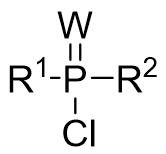
[式中、
Wは、酸素原子または硫黄原子であり;
R1及びR2は、同一又は異なって、場合により置換されている芳香族環-O-及び場合により置換されている複素環からなる群より選択され、好ましくはフェニル、2,6-ジメチルフェニル及び、2-オキソオキサゾリジドからなる群より選択される]
の化合物であり、好ましくはクロロリン酸ジフェニル、クロロリン酸ビス(2,6-ジメチルフェニル)、及びビス(2-オキソ-3-オキサゾリジニル)ホスフィン酸クロリドから選択される一つであり、更に好ましくはクロロリン酸ジフェニル、クロロリン酸ビス(2,6-ジメチルフェニル)である。
式[P-3]:

R1、R2、R3、及びR4は、同一又は異なって、ハロゲン、C1-6アルキルアミノ、ジ(C1-6アルキル)アミノ、場合により置換されている環状C1-6アミノ、場合により置換されている芳香族アミノ、場合により置換されている芳香環、及び場合により置換されている複素環-O-からなる群より選択されるか、或いは、
R1及びR2は、それらが結合するリン原子と一緒になって、場合により置換されている環構造を形成し、そしてR3及びR4は、同一又は異なって、ハロゲン、C1-6アルキルアミノ、ジ(C1-6アルキル)アミノ、場合により置換されている環状C1-6アミノ、場合により置換されている芳香族アミノ、場合により置換されている芳香環、及び場合により置換されている複素環-O-からなる群より選択され、
好ましくは、R1、R2、及びR3は、場合により置換されている環状C1-6アミノであり、そしてR4は、ハロゲン、場合により置換されている芳香族アミノ、又は場合により置換されている複素環-O-であり、
更に好ましくは、R1、R2、及びR3は、ピロリジルであり、そしてR4は、クロロ、ブロモ、ベンゾトリアゾール-1-イルオキシ、7-アザベンゾトリアゾール-1-イルオキシ、又は3-ニトロ-1,2,4-トリアゾール-1-イルである]の化合物であり、好ましくは、PyBrop、pyBOP、PyClop、PyAOP、PyNTPから選択される一つであり、更に好ましくは、PyBropである。
式[O]:

R1、R2、R3、及びR4は、同一又は異なって、ハロゲン、C1-6アルキルアミノ、ジ(C1-6アルキル)アミノ、場合により置換されている環状C1-6アミノ、場合により置換されている芳香族アミノ、場合により置換されている芳香環、場合により置換されている複素環-O-、及び場合により置換されているC1-6アルキリデンアミノオキシからなる群より選択されるか、或いは、
R1及びR2は、それらが結合する炭素原子と一緒になって、環構造を形成し、そしてR3は、ハロゲン、C1-6アルキルアミノ、ジ(C1-6アルキル)アミノ、場合により置換されている環状C1-6アミノ、場合により置換されている芳香族アミノ、場合により置換されている芳香環、及び場合により置換されている複素環-O-からなる群より選択され、
好ましくは、R1及びR2は、同一又は異なって、ジ(C1-6アルキル)アミノ及び場合により置換されている環状C1-6アミノからなる群より選択され、そしてR3は、場合により置換されている複素環-O-、又は場合により置換されているC1-6アルキリデンアミノオキシであり、或いは、
R1及びR2は、それらが結合する炭素原子と一緒になって、環構造を形成し、そして場合により置換されている芳香族アミノであり、
更に好ましくは、R1及びR2は、ジメチルアミノであり、R3は、O-(7-アザベンゾトリアゾール-1-イル)又はO-(ベンゾトリアゾール-1-イル)であり、或いは
R1は、ジメチルアミノであり、R2は、モルホリノであり、そしてR3は、1-シアノ-2-エトキシ-2-オキソエチリデンアミノオキシである]の化合物であり、好ましくは、HATU、COMU、HBTU、BOI、DMINTPから選択される一つであり、更に好ましくはでBOIある。
本発明の一態様において、前記塩基は、一級アミン、二級アミン、三級アミン、環状アミン、及び芳香族アミンからなる群より選択される少なくとも一つであり、例えば、ジイソプロピルエチルアミン、トリエチルアミン、N-エチルモルホリン、ピリジン、ルチジン、コリジン、N-メチルイミダゾール、N,N-ジメチルイミダゾール又は1-ベンジルイミダゾールであり、好ましくは、ジイソプロピルエチルアミン、ピリジン、N-メチルイミダゾール、又は1-ベンジルイミダゾールであり、更に好ましくは、ピリジン又はN-メチルイミダゾールである。
本発明の一態様において、前記縮合剤と前記塩基の組み合わせは、特に限定されないが、例えば、クロロリン酸ジフェニルとピリジン、クロロリン酸ジフェニルとN-メチルイミダゾール、クロロリン酸ビス(2,6-ジメチルフェニル)とピリジン、クロロリン酸ビス(2,6-ジメチルフェニル)とN-メチルイミダゾール、PyBroPとピリジン、PyBroPとN-メチルイミダゾール、PyBroPとジイソプロピルエチルアミン、及びBOIとジイソプロピルエチルアミンであり、好ましくは、クロロリン酸ジフェニルとピリジン、クロロリン酸ジフェニルとN-メチルイミダゾール、クロロリン酸ビス(2,6-ジメチルフェニル)とピリジン、クロロリン酸ビス(2,6-ジメチルフェニル)とN-メチルイミダゾール、PyBroPとピリジン、PyBroPとN-メチルイミダゾール、PyBroPとジイソプロピルエチルアミン、更に好ましくは、クロロリン酸ジフェニルとピリジン、クロロリン酸ジフェニルとN-メチルイミダゾール、クロロリン酸ビス(2,6-ジメチルフェニル)とN-メチルイミダゾール、PyBroPとN-メチルイミダゾール、PyBroPとジイソプロピルエチルアミンである。
本発明の一態様において、前記縮合剤を、前記式[B-1]の化合物に対して、例えば、0.5~100モル当量、好ましくは、1~50モル当量、更に好ましくは、2~20モル当量の範囲内で使用することができる。
本発明の一態様において、前記塩基を、前記式[A-1]の化合物に対して、例えば、1~100モル当量、好ましくは、2~50モル当量、更に好ましくは、2~40モル当量の範囲内で使用することができる。
本発明の一態様において、前記工程(1)において使用される溶媒は、特に限定されることなく、例えば、ジクロロメタン、クロロホルム、1,2-ジクロロエタン、テトラヒドロフラン、トルエン、アセトニトリル、酢酸エチルからなる群より選択される少なくとも一つを使用することができる。
本発明の一態様において、前記工程(1)の反応温度は、特に限定されることなく、例えば、-10~80℃、好ましくは、0~60℃、更に好ましくは、10~40℃である。
本発明の一態様において、前記工程(1)の反応時間は、特に限定されることなく、例えば、1分~12時間、好ましくは、2分~4時間、更に好ましくは、5分~2時間である。
本発明の一態様において、前記酸化剤は、リン原子を酸化することができれば、特に限定されることなく、例えば、ヨウ素、四塩化炭素であり、好ましくは、ヨウ素のジクロロメタン溶液、ヨウ素のクロロホルム溶液、ヨウ素のテトラヒドロフラン溶液であり、更に好ましくは、ヨウ素のテトラヒドロフラン溶液である。
本発明の一態様において、前記縮合剤を、前記式[B-1]の化合物に対して、例えば、0.5~100モル当量、好ましくは、1~50モル当量、更に好ましくは、2~10モル当量の範囲内で使用することができる。
本発明の一態様において、前記有機アミンは、特に限定されることなく、例えば、一級アミン、二級アミン、三級アミン、環状アミン、及び芳香族アミンからなる群より選択される少なくとも一つであり、例えば、ジメチルアミン、ジイソプロピルアミン、ピぺリジン、ピロリジン、N-メチルピペラジン、又はモルホリンであり、好ましくは、ジメチルアミン、ジイソプロピルアミン、ピぺリジン、ピロリジンであり、更に好ましくは、ジメチルアミンである。
本発明の一態様において、前記有機アミンを、前記式[B-1]の化合物に対して、例えば、1~200モル当量、好ましくは、2~100モル当量、更に好ましくは、2~50モル当量の範囲内で使用することができる。
本発明の一態様において、前記工程(2)において使用される溶媒は、特に限定されることなく、例えば、ジクロロメタン、クロロホルム、1,2-ジクロロエタン、テトラヒドロフラン、トルエン、アセトニトリル、酢酸エチルからなる群より選択される少なくとも一つを使用することができる。
本発明の一態様において、前記工程(2)の反応温度は、特に限定されることなく、例えば、-10~80℃、好ましくは、0~60℃、更に好ましくは、0~40℃である。
本発明の一態様において、前記工程(1)の反応時間は、特に限定されることなく、例えば、1分~4時間、好ましくは、2分~2時間、更に好ましくは、2分~1時間である。
本発明の一態様は、式[A-1-0]の化合物より、式[A-1]の化合物を得る方法
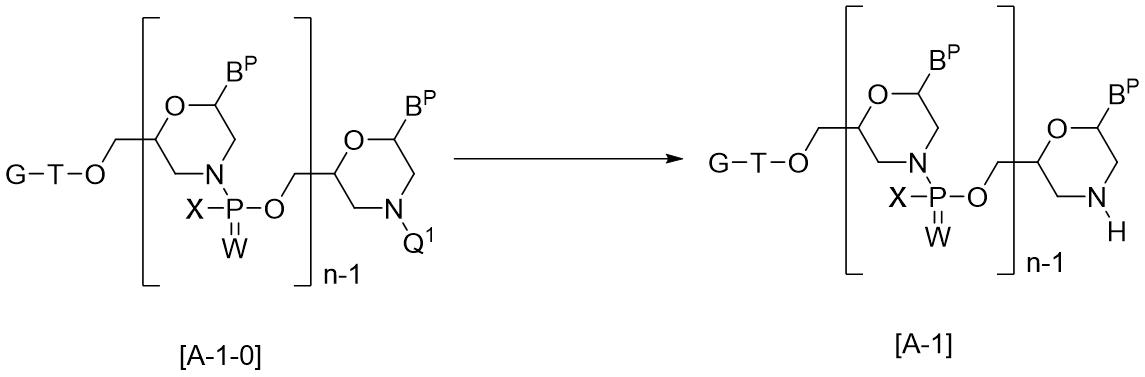
nは、1~50の整数、好ましくは1~30の整数、更に好ましくは1~25の整数、最も好ましくは1~15の整数である]を含む。
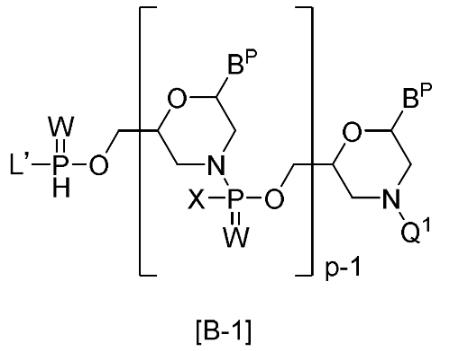
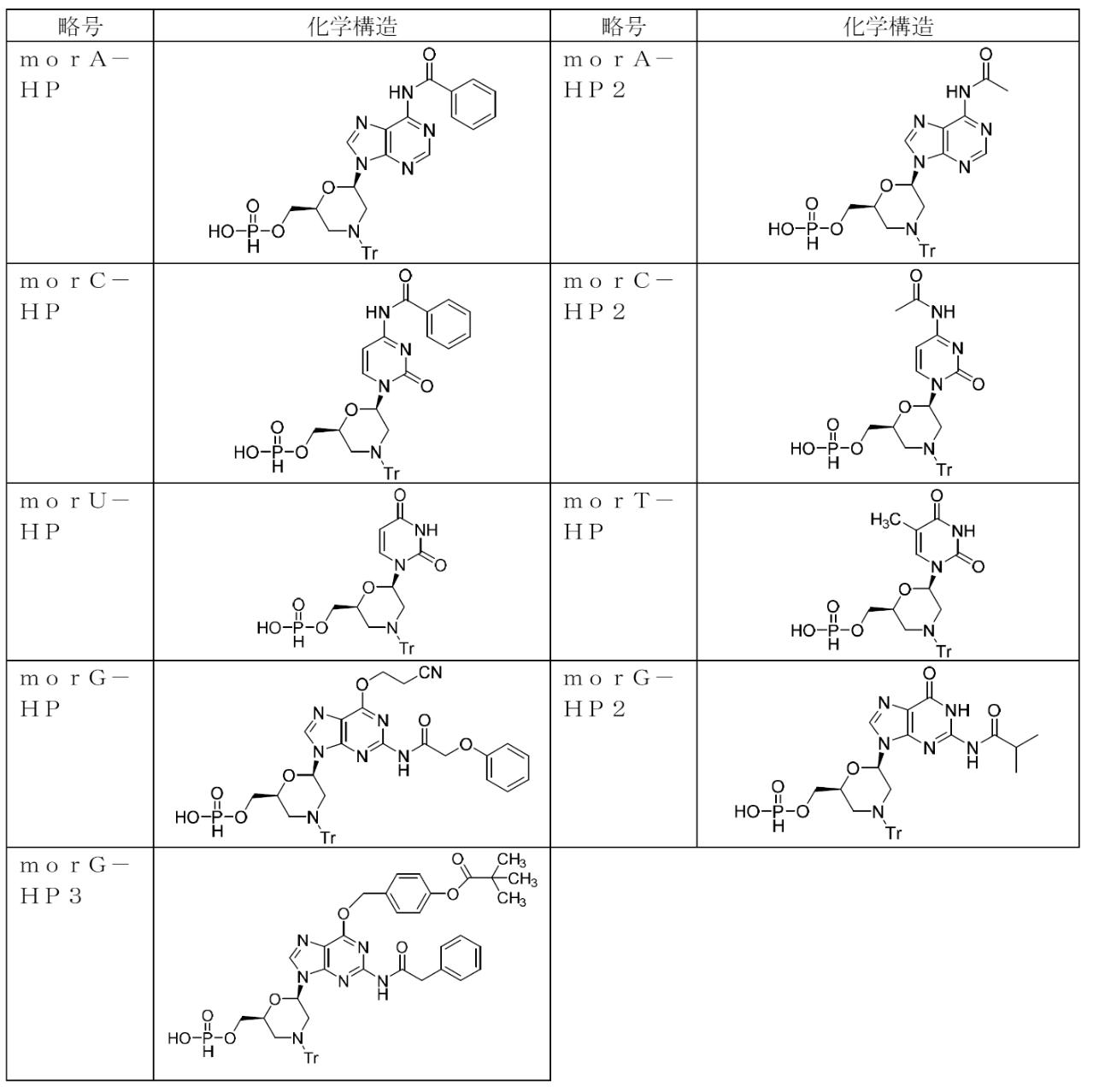
本発明の一態様は、式[B-1-0]の化合物より、式[B-1]の化合物を得る方法:

であり、そして
工程(1):ホスホネート化
工程(2):加水分解、及び
場合により工程(3):イオン交換
を含むことができる。
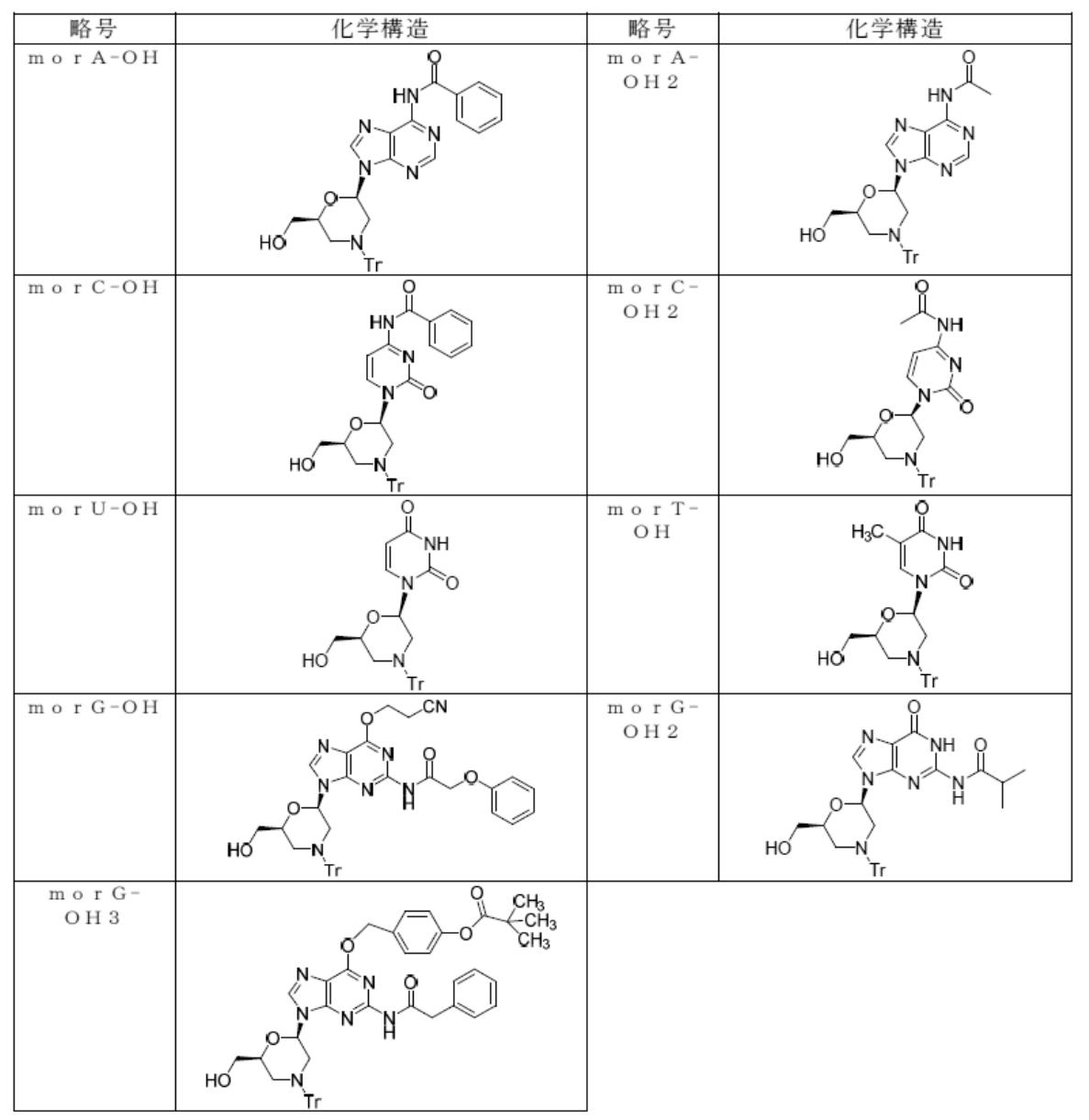
本発明の一態様は、
式[B-1-0]:
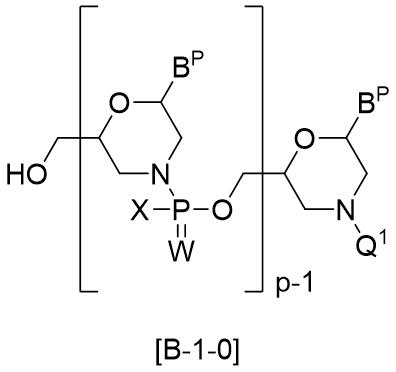
の化合物を、
式[P-1]:

の化合物及び塩基で処理して、
式[B-1’-0]:
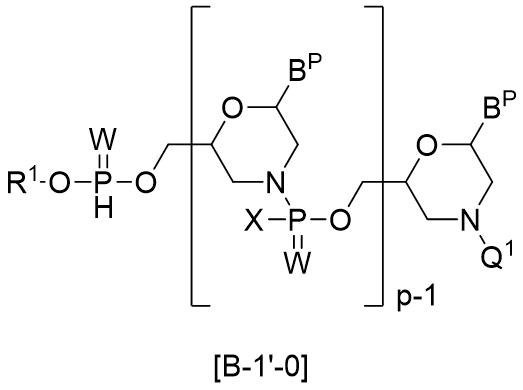
の化合物とする工程を含む。
本発明の一態様において、式[P-1]:

の化合物は、好ましくは、亜リン酸ジフェニル、亜リン酸、ビス(1,1,1,3,3,3-ヘキサフルオロプロパン-2-イル)ホスホナート、又はジホスホン酸であり、更に好ましくは、亜リン酸ジフェニルである。
本発明の一態様において、前記塩基は、一級アミン、二級アミン、三級アミン、環状アミン、及び芳香族アミンからなる群より選択される少なくとも一つであり、例えば、N-エチルモルホリン、ピリジン、トリエチルアミン、N-メチルイミダゾールであり、好ましくは、N-エチルモルホリン又はピリジンであり、更に好ましくは、N-エチルモルホリンである。
本発明の一態様において、前記ホスホニル化試薬と前記塩基の組み合わせは、特に限定されないが、例えば、亜リン酸ジフェニルとN-エチルモルホリン、亜リン酸ジフェニルとピリジン、亜リン酸ジフェニルとN-メチルイミダゾール、亜リン酸とピリジンであり、好ましくは、亜リン酸ジフェニルとN-エチルモルホリン、亜リン酸ジフェニルとピリジンであり、更に好ましくは、亜リン酸ジフェニルとN-エチルモルホリンである。
本発明の一態様において、前記式[P-1]の化合物を、前記式[B-1-0]の化合物に対して、例えば、1~100モル当量、好ましくは、1~40モル当量、更に好ましくは、2~20モル当量の範囲内で使用することができる。
本発明の一態様において、前記塩基を、前記式[B-1-0]の化合物に対して、例えば、1~100モル当量、好ましくは、1~40モル当量、更に好ましくは、4~40モル当量の範囲内で使用することができる。
本発明の一態様において、前記工程(1)において使用される溶媒は、特に限定されることなく、例えば、ジクロロメタン、クロロホルム、1,2-ジクロロエタン、テトラヒドロフラン、トルエン、酢酸エチルからなる群より選択される少なくとも一つを使用することができる。
本発明の一態様において、前記工程(1)の反応温度は、特に限定されることなく、例えば、―10~60℃、好ましくは、0~50℃、更に好ましくは20~50℃である。
本発明の一態様において、前記工程(1)の反応時間は、特に限定されることなく、例えば、5分~24時間、好ましくは、10分~18時間、更に好ましくは30分~12時間である。
本発明の一態様は、
式[B-1’-0]:
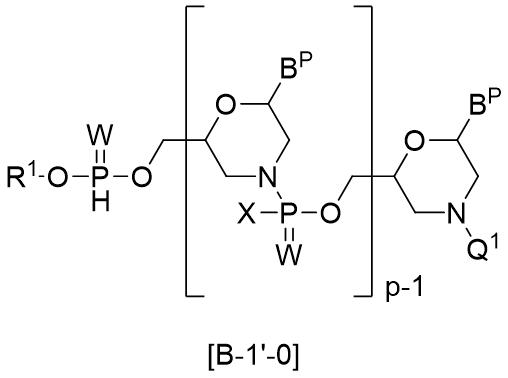
の化合物を、
加水分解溶液で処理して、
式[B-1]:
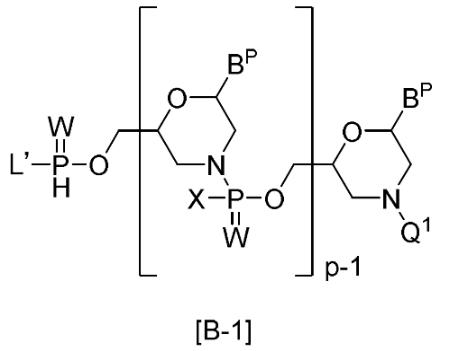
の化合物を得る工程を含む。
本発明の一態様において、式[B-1]中、BP、Q1、W、X、及びpは、前記と同義であり、L’が、-O-N+H(脂肪族アミン)、-O-N+H(環状アミン)、又は-O-N+H(芳香族アミン)であるとき、式[B-1]の化合物は、その脂肪族アミン塩、環状アミン塩、又は芳香族アミン塩であり、例えば、式[B-1]の化合物[ここで、BP、Q1、W、X、及びpは、前記と同義であり、L’が-OHである]が、脂肪族アミン、環状アミン、又は芳香族アミンと形成する塩である。
本発明の一態様において、式[B-1]中、BP、Q1、W、X、及びpは、前記と同義であり、L’は、好ましくは-O-N+H(C1-6アルキル)3又は-O-N+H(環状アミン)であり、-O-N+H(C1-6アルキル)3は、例えば-O-N+H(CH2CH3)3であり、-O-N+H(環状アミン)は、例えば-O-(HDBU)+であり、DBUは、1,8-ジアザビシクロ[5.4.0]ウンデカ-7-エンである。
本発明の一態様において、前記加水分解溶液は、例えば、脂肪族アミン(一級アミン、二級アミン、三級アミン)、環状アミン、及び芳香族アミンからなる群より選択される少なくとも一つの塩基を含む水溶液である。ここで、脂肪族アミンは、例えば、トリメチルアミン、トリエチルアミン、ジイソプロピルエチルアミン等が挙げられ、環状アミンは、例えば、ジアザビシクロウンデセン(DBU:1,8-ジアザビシクロ[5.4.0]ウンデカ-7-エン)、ピペリジン、ピペラジン、モルホリン、N-メチルモルホリン等が挙げられ、芳香族アミンは、例えば、ピリジン、イミダゾール、N-メチルイミダゾール等が挙げられる。
本発明の一態様において、前記加水分解溶液は、前記式[B-1’-0]の化合物に対して、例えば、1~100モル当量、好ましくは、1~50モル当量、更に好ましくは、2~20モル当量の範囲内で使用することができる。
本発明の一態様において、前記工程(2)において使用される溶媒は、特に限定されることなく、例えば、ジクロロメタン、クロロホルム、1,2-ジクロロエタン、テトラヒドロフラン、トルエン、アセトニトリル、酢酸エチルからなる群より選択される少なくとも一つを使用することができる。
本発明の一態様において、前記工程(2)の反応温度は、特に限定されることなく、例えば、-10~60℃、好ましくは0~40℃、更に好ましくは0~30℃である。
本発明の一態様において、前記工程(2)の反応時間は、特に限定されることなく、例えば、1分~24時間、好ましくは10分~12時間、更に好ましくは10分~2時間である。
本発明の一態様は、
式[B-1’-0]:

の化合物を、加水分解溶液で処理して、
式[B-1’]:
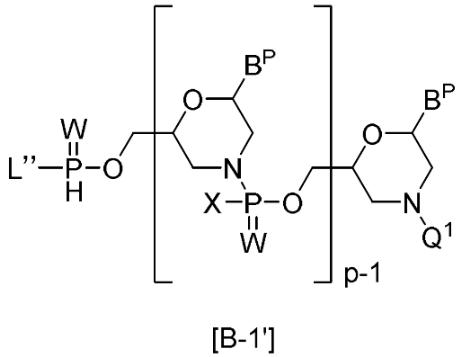
の化合物を、更に、加水分解溶液で処理して、
式[B-1]:
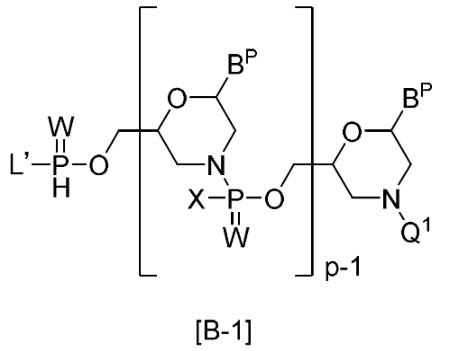
の化合物を得る工程を含む。
本発明の一態様において、前記加水分解溶液は、例えば、環状アミンを含む水溶液であり、好ましくは、環状アミン及び二酸化炭素が溶解した水溶液であり、更に好ましくは、炭酸水素ジアザビシクロウンデセン水溶液である。
本発明の一態様において、前記加水分解溶液は、前記式[B-1’-0]の化合物又は前記式[B-1’]の化合物に対して、例えば、1~50モル当量、好ましくは、1~50モル当量、更に好ましくは、2~20モル当量の範囲内で使用することができる。
本発明の一態様において、前記工程(3)において使用される溶媒は、特に限定されることなく、例えば、ジクロロメタン、クロロホルム、1,2-ジクロロエタン、テトラヒドロフラン、トルエン、酢酸エチルからなる群より選択される少なくとも一つを使用することができる。
本発明の一態様において、前記工程(3)の反応温度は、特に限定されることなく、例えば、-10~60℃、好ましくは0~40℃、更に好ましくは0~30℃である。
本発明の一態様において、前記工程(3)の反応時間は、特に限定されることなく、例えば、1分~24時間、好ましくは10分~12時間、更に好ましくは10分~2時間である。
本発明の一態様は、式[C-1]の化合物より、Q1を除去して、式[C-0-1]の化合物を得る方法:


の化合物を、酸のみ、又は酸及びスカベンジャーで処理して、
式[C-0-1]:
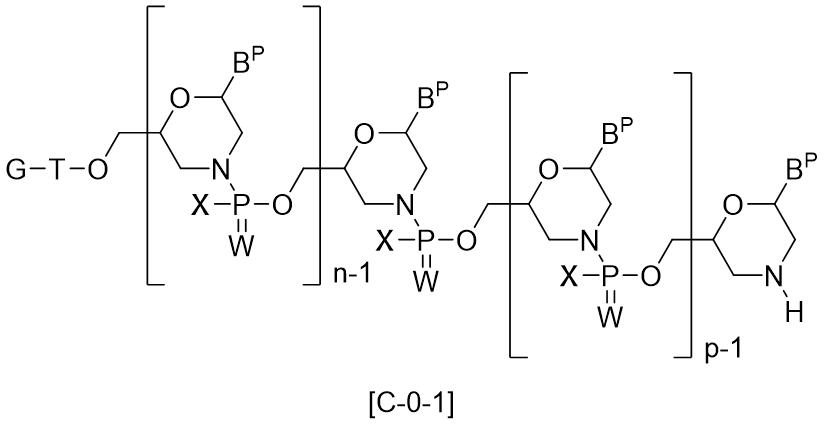
の化合物を得る工程を含む。
本発明の一態様において、前記の酸は、当該技術分野において通常使用される酸であれば特に限定されず、例えば、トリフルオロ酢酸、シアノピリジントリフルオロ酢酸塩、トリエチルアミントリフルオロ酢酸塩、シアノ酢酸、トリクロロ酢酸、リン酸、メタンスルホン酸、p-トルエンスルホン酸、塩酸を挙げることができる。これら酸を使用する際には、塩基(例えば、トリエチルアミン)と組み合わせて、酸性度を調整して使用してもよい。
本発明の一態様において、前記酸は、前記式[C-1]の化合物に対して、例えば、1~500モル当量、好ましくは2~200モル当量、更に好ましくは2~50モル当量の範囲内で使用することができる。
本発明の一態様において、前記酸は、反応溶媒を用いて、例えば、1%~80%の範囲内の濃度になるように希釈することが適当であり、2%~50%の範囲内の濃度になるように希釈することが好ましい。
本発明の一態様において、前記<Q1除去>において使用される溶媒は、当該技術分野において通常使用される溶媒であれば特に限定されず、溶媒を単一で使用してもよく、また二つ以上の溶媒を混合して使用してもよい。
本発明の一態様において、前記<Q1除去>において使用される溶媒は、例えば、ベンゼン、トルエン、キシレン、メシチレン等の芳香族系溶媒;酢酸エチル、酢酸イソプロピル等のエステル系溶媒;ヘキサン、ペンタン、ヘプタン、オクタン、ノナン、シクロヘキサン等の脂肪族系溶媒、ハロゲン系溶媒等が挙げられる。これらの溶媒は混合して使用してもよい。
本発明の一態様において、前記<Q1除去>において使用される溶媒は、例えば、クロロホルム、ジクロロメタン、1,1-ジクロロエタン、1,2-ジクロロエタン、1,1,2-トリクロロエタン、1,2-ジクロロエチレン、2,2,2-トリフルオロエタノールまたはそれらの混合溶媒であり、好ましくは、クロロホルム、ジクロロメタン、及び2,2,2-トリフルオロエタノールからなる群より選択される一つである。
本発明の一態様において、前記スカベンジャーは、例えば、エタノール、トリイソプロピルシラン、1-ヒドロキシベンゾトリアゾール、ピロール、インドール、2,2,2-トリフルオロエタノール、メタノール、アニソール、メルカプトエタノール、チオアニソールを挙げることができ、好ましくは、エタノール、トリイソプロピルシラン、及び2,2,2-トリフルオロエタノールからなる群より選択される一つである。
本発明の一態様において、前記スカベンジャーは、前記式[C-1]の化合物に対して、例えば、1~100モル当量、好ましくは1~50モル当量、更に好ましくは1~20モル当量の範囲内で使用することができる。
本発明の一態様において、前記<Q1除去>の反応温度は、特に限定されることなく、例えば、-10~40℃、好ましくは、0~30℃、更に好ましくは、0~25℃である。
本発明の一態様において、前記<Q1除去>の反応時間は、特に限定されることなく、例えば、1分~24時間、好ましくは、10分~6時間、更に好ましくは、10分~2時間である。
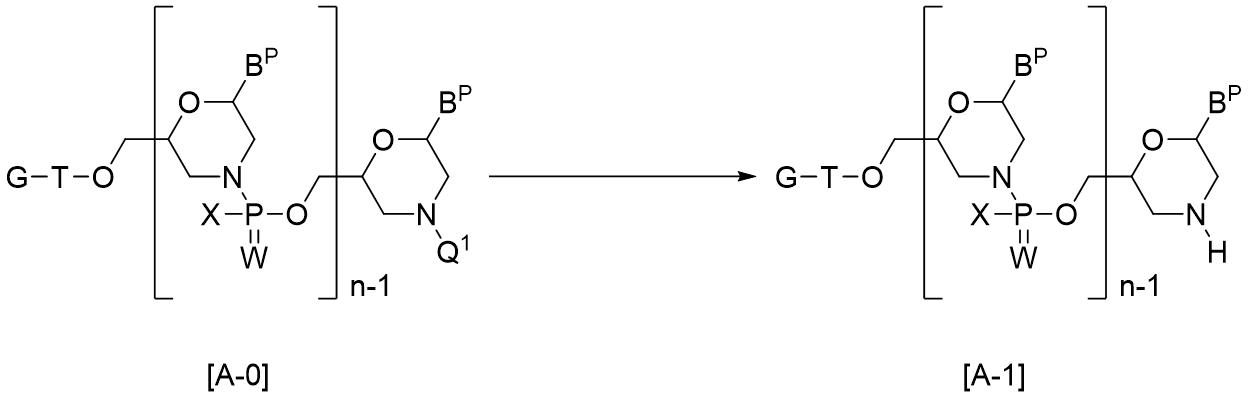
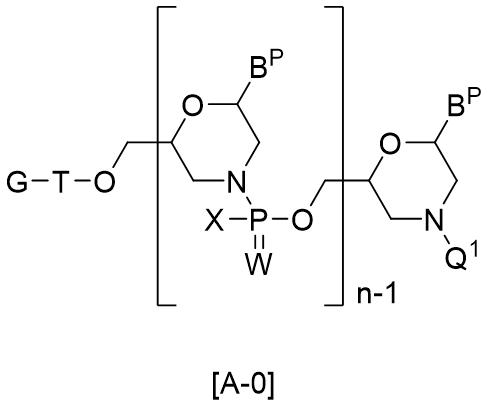
の化合物を、酸のみ、又は酸及びスカベンジャーで処理して、
式[A-1]:

の化合物を得る工程を含む。
本発明の一態様は、式[C-1]の化合物より、G-Tを除去して、式[C-0-2]の化合物を得る方法:
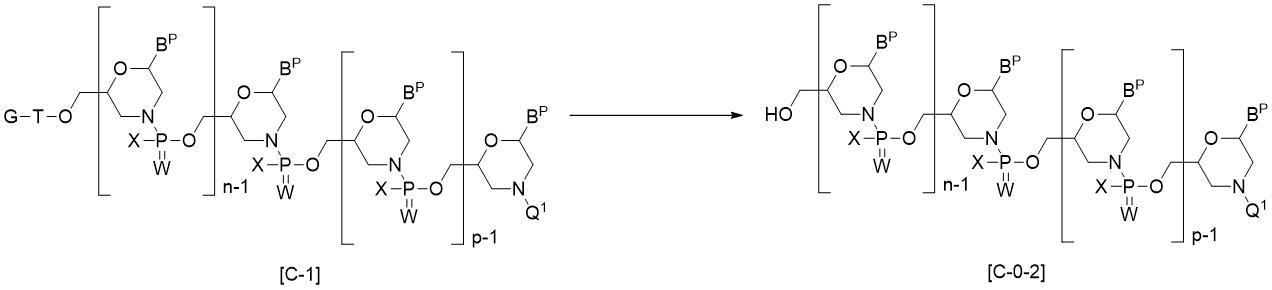
を含む。

Gは、
(1)ケイ素置換基、
(2)場合により置換されているC1-18アルキル-カルボニル、場合により置換されているC1-18アルコキシ-カルボニル、長鎖アルキル-カルボニル、または長鎖アルコキシ-カルボニル、
(3)1個~5個の、長鎖アルキルオキシおよび/もしくは長鎖アルケニルオキシで置換されているベンゾイル、或いは
(4)次の一般式[7]:

*はTとの結合位置を表し;
Zは
(1)(有機溶媒に溶解する可溶性ポリマー)-オキシ、
(2)(有機溶媒に溶解する可溶性ポリマー)-アミノ、
(3)長鎖アルキルオキシ、1個~5個の長鎖アルキルオキシおよび/もしくは長鎖アルケニルオキシで置換されているベンゾイル、または1個~5個の長鎖アルキルオキシおよび/もしくは長鎖アルケニルオキシで置換されているベンジル、
(4)固相担体、或いは
(5)次の一般式[8A]~[8N]:
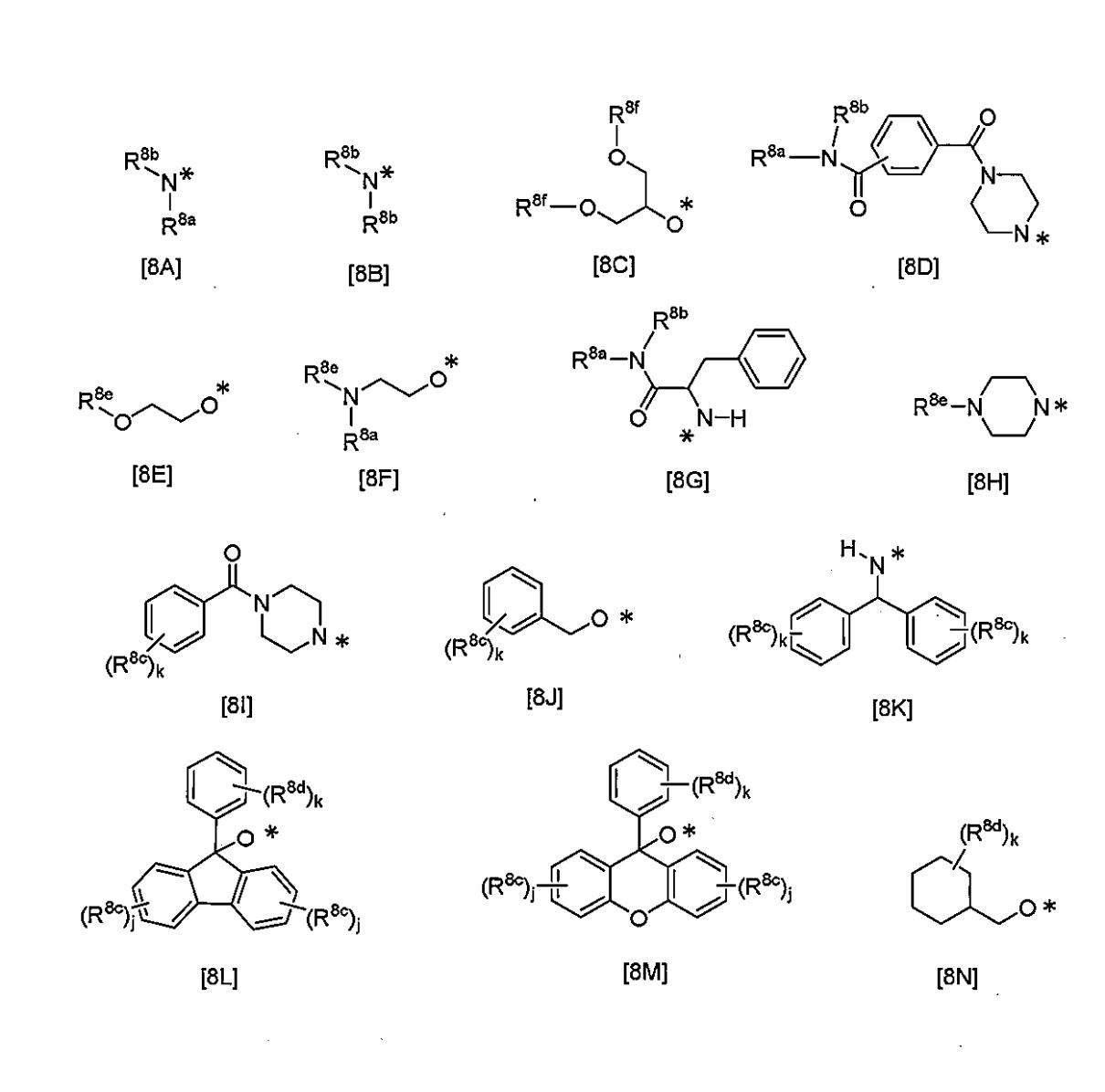
*はLとの結合位置を表し;
jは0~4の整数を表し;
kは0~5の整数を表し;
R8aは水素原子またはC1-6アルキルを表し;
R8bは、それぞれ同一または異なって、長鎖アルキルを表し;
R8cは、それぞれ同一または異なって、次の一般式[9A]~[9E]:
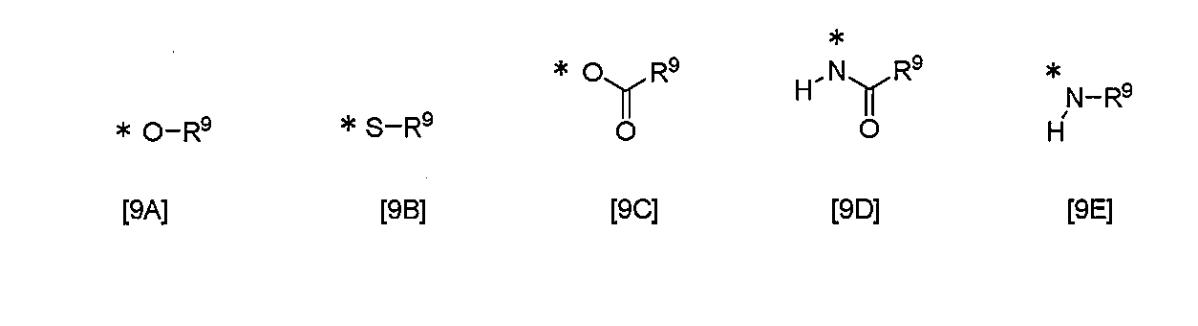
*は結合位置を表し;および
R9は長鎖アルキルおよび/または長鎖アルケニルを表す。)
で表される置換基を表し;
R8dは、それぞれ同一または異なって、水素原子、ハロゲン、1個~13個のハロゲンで置換されていてもよい長鎖アルキルまたは1個~13個のハロゲンで置換されていてもよい長鎖アルキルオキシを表し;
R8eは
(1)長鎖アルキル、
(2)長鎖アルキル-カルボニルまたは
(3)1個~5個の、長鎖アルキルオキシおよび/もしくは長鎖アルケニルオキシで置換されているベンゾイルを表し;および
R8fは、
(1)長鎖アルキル、
(2)長鎖アルキル-カルボニルまたは
(3)長鎖アルケニル-カルボニルを表す。)
で表される置換基を表し;および
Lは一般式[10]:

*はZとの結合位置を表し;
**はTとの結合位置を表し;および
L1は置換されていてもよいC2-10アルキレンまたは置換されていてもよいC6-10アリーレンを表すか、又は一般式[10-1]:
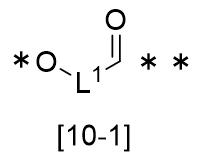
*はZとの結合位置を表し;
**はTとの結合位置を表し;および
L1は置換されていてもよいC1-10アルキレンまたは置換されていてもよいC6-10アリーレンを表す。)
で表される置換基を表す。)
で表される置換基を表し;
nは、1~50の整数を表し;および
Tは、単結合または次の一般式[11]:

XおよびWは、前記と同義であり;
*は上記一般式[4a]~[4d]の**O、*Oまたは*Nとの結合位置を表し;
**はGとの結合位置を表し;および
qは0~10の整数を表す。)
で表される置換基を表すが、Gがケイ素置換基である場合、Tは単結合である。]
の化合物を、水酸基の保護基の除去条件で処理して、
式[C-0-2]:

の化合物を得る工程を含む。

Gは、
(1)ケイ素置換基、
(2)場合により置換されているC1-18アルキル-カルボニル、場合により置換されているC1-18アルコキシ-カルボニル、長鎖アルキル-カルボニル、または長鎖アルコキシ-カルボニル、或いは
(3)1個~5個の、長鎖アルキルオキシおよび/もしくは長鎖アルケニルオキシで置換されているベンゾイルであり、
nは、1~50の整数を表し;および
Tは、単結合である。]
の化合物である。

Gは、
(4)次の一般式[7]:

*はTとの結合位置を表し;
Zは
(3)長鎖アルキルオキシ、1個~5個の長鎖アルキルオキシおよび/もしくは長鎖アルケニルオキシで置換されているベンゾイル、または1個~5個の長鎖アルキルオキシおよび/もしくは長鎖アルケニルオキシで置換されているベンジル、
(4)固相担体、或いは
(5)次の一般式[8A]、[8B]、[8E]、[8F]:
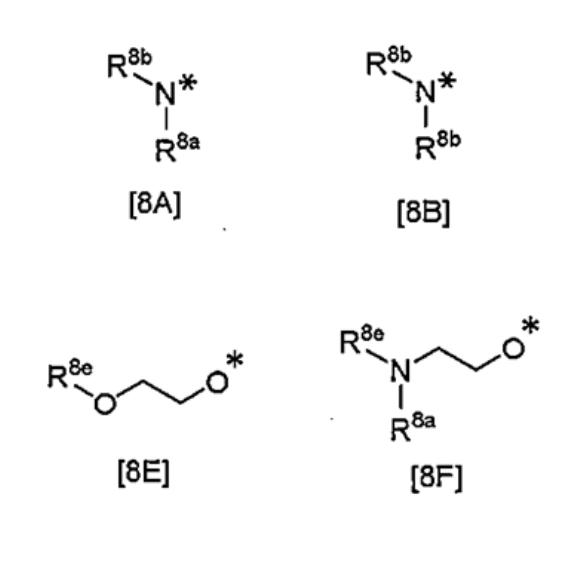
*はLとの結合位置を表し;
R8aは水素原子またはC1-6アルキルを表し;
R8bは、それぞれ同一または異なって、長鎖アルキルを表し;
R8eは
(1)長鎖アルキル、
(2)長鎖アルキル-カルボニルまたは
(3)1個~5個の、長鎖アルキルオキシおよび/もしくは長鎖アルケニルオキシで置換されているベンゾイルを表す。)
で表される置換基を表し;および
Lは一般式[10]:

*はZとの結合位置を表し;
**はTとの結合位置を表し;および
L1は置換されていてもよいC2-10アルキレンまたは置換されていてもよいC6-10アリーレンを表すか、又は一般式[10-1]:
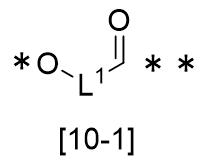
*はZとの結合位置を表し;
**はTとの結合位置を表し;および
L1は置換されていてもよいC1-10アルキレンまたは置換されていてもよいC6-10アリーレンを表す。)
で表される置換基を表す。)
で表される置換基を表し;
nは、1~50の整数を表し;および
Tは、単結合または次の一般式[11]:
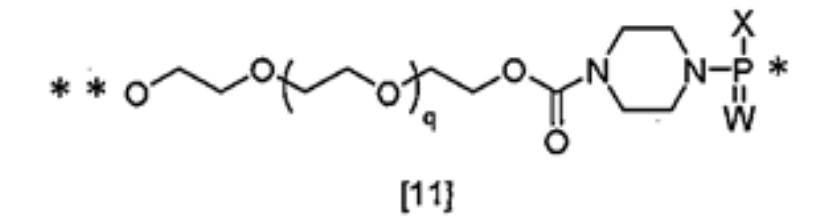
XおよびWは、前記と同義であり;
*は上記一般式[4a]~[4d]の**O、*Oまたは*Nとの結合位置を表し;
**はGとの結合位置を表し;および
qは0~10の整数を表す。)
で表される置換基を表すが、Gがケイ素置換基である場合、Tは単結合である。]
の化合物である。
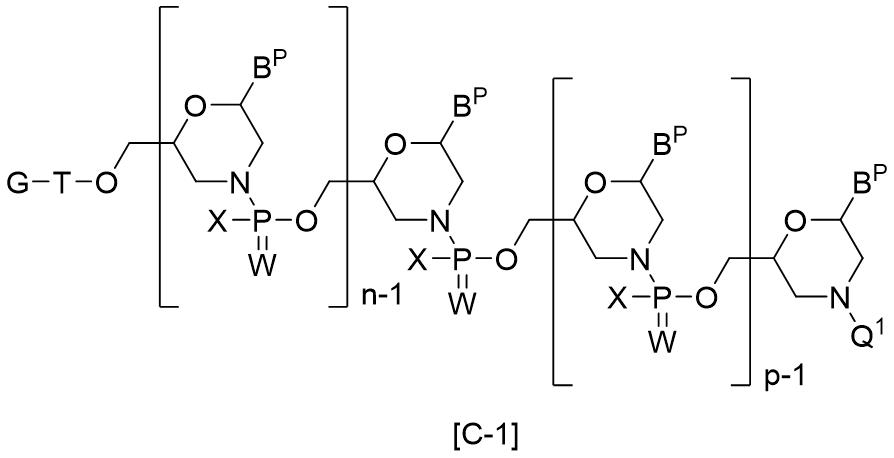
Gは、下記の式:

*はTとの結合位置を表す。]からなる群より選択され;
Tが単結合である。]
の化合物である。
本発明の一態様において、水酸基の保護基の除去条件は、前記式[C-1]の化合物中の保護基の種類または性質に応じて選択することができ、水酸基の保護基の除去により、前記式[C-0-2]の化合物を得ることができる。
(2)場合により置換されているC1-18アルキル-カルボニル、場合により置換されているC1-18アルコキシ-カルボニル、長鎖アルキル-カルボニル、または長鎖アルコキシ-カルボニルであるか、或いは
(3)1個~5個の長鎖アルキルオキシおよび/もしくは長鎖アルケニルオキシで置換されているベンゾイルであり、そしてTが単結合である場合であり、該水酸基の保護基の除去条件は、例えば、ナトリウムメトキシドで処理することである。
(4)前記一般式[7]:

本発明の一態様において、試薬は、前記式[C-1]の化合物に対して、例えば、1~200モル当量、好ましくは、2~100モル当量、更に好ましくは、2~50モル当量の範囲内で使用することができる。
本発明の一態様において、前記<水酸基の保護基の除去>において使用される溶媒は、当該技術分野において通常使用される溶媒であれば特に限定されず、溶媒を単一で使用してもよく、また二つ以上の溶媒を混合して使用してもよい。
本発明の一態様において、前記<水酸基の保護基の除去>において使用される溶媒は、例えば、ベンゼン、トルエン、キシレン、メシチレン等の芳香族系溶媒;酢酸エチル、酢酸イソプロピル等のエステル系溶媒;ヘキサン、ペンタン、ヘプタン、オクタン、ノナン、シクロヘキサン等の脂肪族系溶媒、ハロゲン系溶媒等が挙げられる。これらの溶媒は混合して使用してもよい。
本発明の一態様において、前記<水酸基の保護基の除去>の反応温度は、特に限定されることなく、例えば、0~80℃、好ましくは、10~60℃、更に好ましくは、20~40℃である。
本発明の一態様において、前記<Q1除去>の反応時間は、特に限定されることなく、例えば、10分~24時間、好ましくは、10分~12時間、更に好ましくは、30分~6時間である。
化合物[C-1]がその分子内に保護基を有する場合には、保護基の種類または性質に応じた脱保護処理を実施することにより、全ての保護基が脱離された化合物を製造することができる。例えば、「Green’s PROTECTIVE GROUPS in ORGANIC SYNTHESIS,第4版、2006年」に記載されている脱保護方法に従い、化合物が有する全ての保護基を除去することができる。具体的には、例えば、(1)アンモニア水、(2)アンモニア水/エタノールまたは(3)アンモニア水とメチルアミン水溶液の混合溶液で処理することにより、化合物[C-1]がその分子内に有する置換基[6]および核酸塩基のアミノ基または水酸基の保護基を除去することができる。
また、例えば、前記「化合物[C-1]の分子内のQ1の脱離方法」に記載した「酸」と同じもの、または塩酸もしくは酢酸を適当な溶媒で希釈した溶液で処理することにより、化合物[C-1]の3’末端側のヌクレオシドの3’位のアミノ基の保護基に置換されている酸性条件下で除去可能な基を除去することができる。
化合物[C-1]が有する全ての保護基が除去された化合物は、反応混合物から通常の分離精製手段、例えば、抽出、濃縮、中和、濾過、遠心分離、再結晶、C8からC18の逆相カラムクロマトグラフィー、陽イオン交換カラムクロマトグラフィー、陰イオン交換カラムクロマトグラフィー、ゲルろ過カラムクロマトグラフィー、高速液体クロマトグラフィー、透析、限界ろ過などの手段を単独または組み合わせて用いることによって単離することができる(例えば、国際公開公報第1991/09033A1を参照。)。
逆相クロマトグラフィーを用いて所望の化合物を精製する場合には、溶出溶媒として、例えば20mMのトリエチルアミン/酢酸緩衝液とアセトニトリルの混合溶液を使用することができる。
また、イオン交換クロマトグラフィーを用いて所望の化合物を精製する場合には、例えば、1Mの食塩水と10mMの水酸化ナトリウム水溶液の混合溶液または50mMのリン酸緩衝液の0.3Mの食塩水を使用することができる。
なお、「変換収率(%)」とは原料が目的物に変換された割合を意味し、{高速液体クロマトグラフィー(以下、「HPLC」という。)で検出された目的物に対応するピーク面積(%)}÷{HPLCで検出された原料に対応するピーク面積(%)+HPLCで検出された目的物に対応するピーク面積(%)}×100」で算出される。
HPLCの条件:
生成物は0.5mgをアセトニトリルまたは20%水/アセトニトリルに溶解し、以下の条件でHPLC分析を行ない、変換効率は、HPLCにてUV=264nmでの吸収によって得られるピーク面積の積分値を用いることにより算出した。
<ODS条件1>
Column:Waters XBridge C18(2.5μm,4.6×50mm),60℃
検出波長:264nm
移動相A:20mM AcONH4aq.
移動相B:MeCN
流速:0.75mL/min
グラジェント:40-95%B(0-15min)95%B(15-24min)40%B(24-30min)
<ODS条件2>
Column:Waters XBridge C8(5μm,4.6×75mm),60℃
検出波長:264nm
移動相A:50mM TEAAaq
移動相B:MeOH
流速:0.75mL/min
グラジェント:70-95%B(0-20min)95%B(20-26min)75%B(26-35min)
<LC/MS条件1>
使用機器 超高速流体クロマトグラフACQUITY UPLC(waters)
四重極飛行時間型質量分析計SYNAPT-MS(waters)
Column:ACQUITY UPLC BEH C18 1.7μm,2.1×50mm(waters)
温度:50℃
流速:0.2mL/min
移動相A:10mMアンモニア水
移動相B:MeCN
グラジェント:50-95%B(4min)
検出器1:UV264nm
検出器2:四重極飛行時間型質量分析計
イオン化法:ESI+
測定範囲:100-2000m/z
<LC/MS条件2>
使用機器 超高速流体クロマトグラフACQUITY UPLC(waters)
四重極飛行時間型質量分析計SYNAPT-MS(waters)
Column:ACQUITY UPLC BEH C18 1.7μm,2.1×50mm(waters)
温度:50℃
流速:0.2mL/min
移動相A:10mMアンモニア水
移動相B:MeOH
グラジェント:70-95%B(4min)
検出器1:UV264nm
検出器2:四重極飛行時間型質量分析計
イオン化法:ESI+
測定範囲:100-2000m/z
<LC/MS条件3>
使用機器 Agilent6100シリーズシングル四重極LC/MSシステム(Agilent)
Column:Waters XBridge C18(3.5μm,4.6×150mm)
温度:35℃
流速:1.0mL/min
移動相A:20mM酢酸アンモニウム水溶液
移動相B:MeCN
グラジェント:20-99%B(15min)
検出器1:UV264nm
検出器2:四重極飛行時間型質量分析計
イオン化法:ESI+
測定範囲:250-3000m/z
4-(オクタデシルアミノ)-4-オキソブタン酸[(2S,6R)-6-(5-メチル-2,4-ジオキソ-3,4-ジヒドロピリミジン-1(2H)-イル)モルホリン-2-イル]メチル(以下、「G1-suc-morT-OFF」という。)
オクタデカン-1-アミン(21.94g)のジクロロメタン(500mL)溶液中に、無水コハク酸(8.96g,1.1eq)とトリエチルアミン(17mL,1.5eq.)を加え、室温で7時間撹拌した。減圧濃縮し、残渣にアセトン150mL加え、16時間攪拌した。沈殿物を吸引ろ過し、アセトンで洗浄(400mL)後、30℃で3時間減圧乾燥し、G1-suc(29.1g,96.6%)を白色粉体として得た。
G1-suc(14.4g)のテトラヒドロフラン(150mL)溶液に、1-エチル-3-(3-ジメチルアミノプロピル)カルボジイミド塩酸塩(8.56g,1.2eq.)を加えて室温で撹拌した。その後、1-((2R,6S)-6-(ヒドロキシメチル)-4-トリチルモルホリン-2-イル)-5-メチルピリミジン-2,4(1H,3H)-ジオン(以下、「morT-OH」という。)(18g,1.0eq.)および4-(N,N‐ジメチルアミノ)ピリジン4.57gを加えて、70℃湯浴上で1時間撹拌した。室温まで冷却した後、0.1Mのリン酸二水素ナトリウム水溶液を加えて暫く撹拌した後、水層を除き、有機層を0.1Mのリン酸二水素ナトリウム水溶液および水で二倍希釈した飽和食塩水で1回ずつ洗浄した。水層を1つにまとめてジクロロメタンで抽出し、有機層を合わせて無水硫酸ナトリウムで乾燥した。ろ過した後、溶媒を溜去し、減圧乾燥し4-(オクタデシルアミノ)-4-オキソブタン酸[(2S,6R)-6-(5-メチル-2,4-ジオキソ-3,4-ジヒドロピリミジン-1(2H)-イル)-4-トリチルモルホリン-2-イル]メチル(以下、「G1-suc-morT-ON」という。)(白色アモルファス、28.1g,89.5%)を得た。これをジクロロメタン140mLに溶かし氷浴上で撹拌しながら2,2,2-トリフルオロエタノール20mLおよびトリイソプロピルシラン10.3mLを加えて暫く撹拌した後、トリフルオロ酢酸5.1mLを滴下した。滴下終了から1時間後に、飽和重炭酸ナトリウム水溶液100mLに氷を加えて冷却した液に撹拌しながら反応液を注ぎこんだ。水層がpH7~8である事を確認後、ジクロロメタンを用いて水層から抽出した。有機層を合わせて無水硫酸ナトリウムで乾燥した後、ろ過し濃縮した。ジクロメタン-メタノール混液を移動相として用いてシリカゲルでカラムクロマト精製を行い、減圧乾燥することで、G1-suc-morT-OFFを粉末として19.89g得た。
ESI-MS(+):593.36(M+H)(LC/MS条件1)
参考例1と同様の方法で、
(1)<4-(オクタデシルアミノ)-4-オキソブタン酸[(2S,6R)-6-(6-ベンズアミド-9H-プリン-9-イル)-4-トリチルモルホリン-2-イル]メチル>(G1-suc-morA-ON)、<4-(オクタデシルアミノ)-4-オキソブタン酸[(2S,6R)-6-(6-ベンズアミド-9H-プリン-9-イル)モルホリン-2-イル]メチル>(G1-suc-morA-OFF)
(2)<4-(オクタデシルアミノ)-4-オキソブタン酸[(2S,6R)-6-(4-ベンズアミド-2-オキソピリミジン-1(2H)-イル)-4-トリチルモルホリン-2-イル]メチル>(G1-suc-morC-ON)、<4-(オクタデシルアミノ)-4-オキソブタン酸[(2S,6R)-6-(4-ベンズアミド-2-オキソピリミジン-1(2H)-イル)モルホリン-2-イル]メチル>(G1-suc-morC-OFF)
(3)<4-(オクタデシルアミノ)-4-オキソブタン酸[(2S,6R)-6-(6-(2-シアノエトキシ)-2-(フェノキシアセトアミド)-9H-プリン-9-イル)-4-トリチルモルホリン-2-イル]メチル>(G1-suc-morG-ON)、<4-(オクタデシルアミノ)-4-オキソブタン酸[(2S,6R)-6-(6-(2-シアノエトキシ)-2-(フェノキシアセトアミド)-9H-プリン-9-イル)モルホリン-2-イル]メチル>(G1-suc-morG-OFF)
を製造した。
2-ヒドロキシプロパン-1,3-ジイル ジステアラート 1g(1.60mmol)にジクロロメタン(8mL)を加え、ついで無水コハク酸176mg(1.76mmol)、4-(N,N‐ジメチルアミノ)ピリジン293mg(2.40mmol)を加え、室温で16時間撹拌した。反応終了後、反応液に1Mのリン酸2水素ナトリウム水溶液を加え、ジクロロメタンで抽出、硫酸ナトリウムで乾燥、溶媒留去し、G2-sucを得た(1.40g)。
G2-suc(900mg,1.24mmol)と1-エチル-3-(3-ジメチルアミノプロピル)カルボジイミド塩酸塩277mg(1.45mmol)にジクロロメタン(5.2mL)を加え、ついでmorT-OH 500mg(1.03mmol)、4-(N,N-ジメチルアミノ)ピリジン132mg(1.09mmol)を加え、室温で16時間撹拌した。反応終了後、反応液に0.1Mのリン酸2水素ナトリウム水溶液を加え、ジクロロメタンで抽出、硫酸ナトリウムで乾燥、溶媒留去した。得られた残渣をシリカゲルクロマトグラフィーにて精製し、G2-suc-morT-ONを得た(1.09g,89%)。
G2-suc-morT-ONにジクロロメタン(4.2mL)を加え、0℃で撹拌した。ついでトリイソプロピルシラン127μL(0.62mmol)、トリフルオロ酢酸64μL(0.82mmol)を0℃で加え、室温で1時間撹拌した。反応終了後、反応液に飽和炭酸水素ナトリウム水溶液を加え、ジクロロメタンで抽出、硫酸ナトリウムで乾燥、溶媒留去した。得られた残渣をシリカゲルクロマトグラフィーにて精製し、G2-suc-morT-OFFを得た(373mg,95%)。
2-ヒドロキシプロパン-1,3-ジイルジオレエートを原料に、参考例2の工程1と同様の方法で4-((1,3-ビス(オレオイルオキシ)プロパン-2-イル)オキシ)-4-オキソブタン酸(以下、「G3-suc」という。)を製造した。ついで参考例2工程2と同様の方法でG3-suc-morT-ONを製造した。
参考例2工程3と同様の方法で製造した。
工程1 4-オキソ-4-(4-ステアロイルピペラジン-1-イル)ブタン酸(以下、「G4-suc」という。)の製造
ステアリン酸1.68g(5.91mmol)、1-エチル-3-(3-ジメチルアミノプロピル)カルボジイミド塩酸塩1.13g(5.91mmol)、1-ヒドロキシベンゾトリアゾール0.79g(5.91mmol)にテトラヒドロフラン26mLを加え、ついでトリエチルアミン1.45mL(10.7mmol)、ピペラジン-1-カルボン酸tert-ブチル1g(5.37mmol)を加え、室温で16時間撹拌した。反応終了後、反応液に飽和炭酸水素ナトリウム水溶液を加え、ジクロロメタンで抽出、硫酸ナトリウムで乾燥、溶媒留去した。得られた残渣をシリカゲルクロマトグラフィーにて精製し、4-ステアロイルピペラジン-1-カルボン酸tert-ブチルを得た(1.64g;67%)。これにジクロロメタン18mLを加え0℃で撹拌し、トリフルオロ酢酸2.77mL(36.2mmol)を0℃で加え、室温で2時間撹拌した。反応終了後、反応液に飽和炭酸水素ナトリウム水溶液を加え、ジクロロメタンで抽出、硫酸ナトリウムで乾燥、溶媒留去し、1-(ピペラジン-1-イル)オクタデカン-1-オンを得た(1.30g)。粗体1.3g(3.70mmol)にジクロロメタン18mLを加え、ついで無水コハク酸0.41g(4.10mmol)、トリエチルアミン0.77mL(5.50mmol)を加えて室温で2時間撹拌した。反応終了後、反応液を留去、残渣にアセトンを加えて室温で16時間スラリー洗浄した。不溶物を吸引ろ過で集め、アセトンで洗浄、乾燥し、G4-sucを得た(1.20g)。
G4-suc(982mg,2.17mmol)と1-エチル-3-(3-ジメチルアミノプロピル)カルボジイミド塩酸塩555mg(2.90mmol)にテトラヒドロフラン(10mL)を加え70℃で撹拌した。ついでmorT-OH(1g,2.07mmol)、4-(N,N-ジメチルアミノ)ピリジン265mg(2.17mmol)を加え、70℃で30分撹拌した。反応終了後、室温に放冷し、反応液に0.1Mのリン酸2水素ナトリウム水溶液を加え、ジクロロメタンで抽出、硫酸ナトリウムで乾燥、溶媒留去した。得られた残渣をシリカゲルクロマトグラフィーにて精製し、G4-suc-morT-ONを得た(1.68g,89%)。
参考例2の工程3と同様の方法で製造した。
工程1 4-(オクタデシルカルバモイル)安息香酸[(2S,6R)-6-(5-メチル-2,4-ジオキソ-3,4-ジヒドロピリミジン-1(2H)-イル)-4-トリチルモルホリン-2-イル]メチル(以下、「G5-tpa-morT-ON」という。)の製造
4-(オクタデシルカルバモイル)安息香酸を用い、参考例2の工程2と同様の方法で製造した。
参考例2の工程3と同様の方法で製造した。
工程1 4-(4-(4-(オクタデシルカルバモイル)ベンゾイル)ピペラジン-1-イル)-4-オキソブタン酸(以下、「G6-suc」という。)の製造
ステアリン酸のかわりに4-(オクタデシルカルバモイル)安息香酸を用い、参考例4の工程1と同様の方法で製造した。
参考例2の工程2と同様の方法で製造した。
G6-suc-morT-ON493mg(0.47mmol)にジクロロメタン4.6mL、2,2,2-トリフルオロエタノール0.4mLを加え、0℃で撹拌した。ついでトリイソプロピルシラン145μL(0.70mmol)、トリフルオロ酢酸53μL(0.70mmol)を0℃で加え、室温で1時間撹拌した。反応終了後、反応液に飽和炭酸水素ナトリウム水溶液を加え、ジクロロメタンで抽出、硫酸ナトリウムで乾燥、溶媒留去した。得られた残渣をシリカゲルクロマトグラフィーにて精製し、G6-suc-morT-OFFを得た(372mg;98%)。
3,4,5-トリオクタデコキシ安息香酸を用い、参考例2の工程2と同様の方法で製造した。
参考例2の工程3と同様の方法で製造した。
3,4,5-トリオクタデシルオキシ安息香酸1.5g(1.60mmol)、1-エチル-3-(3-ジメチルアミノプロピル)カルボジイミド塩酸塩370mg(1.90mmol)、4-(N,N-ジメチルアミノ)ピリジン240mg(1.90mmol)にクロロホルム8.1mLを加え、ついでエチレングリコール120mg(1.90mmol)を加え、室温で3時間撹拌した。反応終了後、反応液に1Mのリン酸二水素ナトリウム水溶液を加え、ジクロロメタンで抽出、硫酸ナトリウムで乾燥、溶媒留去した。得られた残渣をシリカゲルクロマトグラフィーにて精製し、3,4,5-トリオクタデシルオキシ安息香酸2-ヒドロキシエチルを得た(882mg;56%)
参考例2の工程1と同様の方法で、4-オキソ-4-(2-[{3,4,5-トリス(オクタデシルオキシ)ベンゾイル}オキシ]エトキシ)ブタン酸(以下、「G8-suc」という。)を得た後、参考例2の工程2と同様の方法でG8-suc-morT-ONを得た。
参考例2の工程3と同様の方法でG8-suc-morT-OFFを得た。
工程1 4-(ジオクタデシルアミノ)-4-オキソブタン酸{(2S,6R)-6-(5-メチル-2,4-ジオキソ-3,4-ジヒドロピリミジン-1(2H)-イル)-4-トリチルモルホリン-2-イル}メチル(以下、「G9-suc-morT-ON」という。)の製造
N-オクタデシルオクタデカン-1-アミンを原料に、参考例2の工程1と同様の方法で4-(ジオクタデシルアミノ)-4-オキソブタン酸(以下、「G9-suc」という。)を製造した。ついで参考例2の工程2と同様の方法でG9-suc-morT-ONを製造した。
参考例2の工程3と同様の方法で製造した。
工程1 4-[{1-(オクタデシルアミノ)-1-オキソ-3-フェニルプロパン-2-イル}アミノ]-4-オキソブタン酸{(2S,6R)-6-(5-メチル-2,4-ジオキソ-3,4-ジヒドロピリミジン-1(2H)-イル)-4-トリチルモルホリン-2-イル}メチル(以下、「G10-suc-morT-ON」という。)の製造
2-tert-ブトキシカルボニルアミノ-3-フェニル-プロパン酸500mg(1.88mmol)にテトラヒドロフラン9.4mLを加え、ついでN-エチル-N-イソプロピル-プロパン-2-アミン652μL(3.77mmol)、4-(N,N-ジメチルアミノ)ピリジン46mg(0.38mmol)、1-エチル-3-(3-ジメチルアミノプロピル)カルボジイミド塩酸塩505mg(2.64mmol)、オクタデカン-1-アミンを加え、室温で5時間撹拌した。反応終了後、反応液に1Mのリン酸二水素ナトリウム水溶液を加え、ジクロロメタンで抽出、硫酸ナトリウムで乾燥、溶媒留去した。得られた残渣をシリカゲルクロマトグラフィーにて精製し、tert-ブトキシカルボニルアミノ-N-オクタデシル-3-フェニル-プロパンアミドを得た(779mg,80%)
参考例2の工程3と同様の方法で目的物を得た。
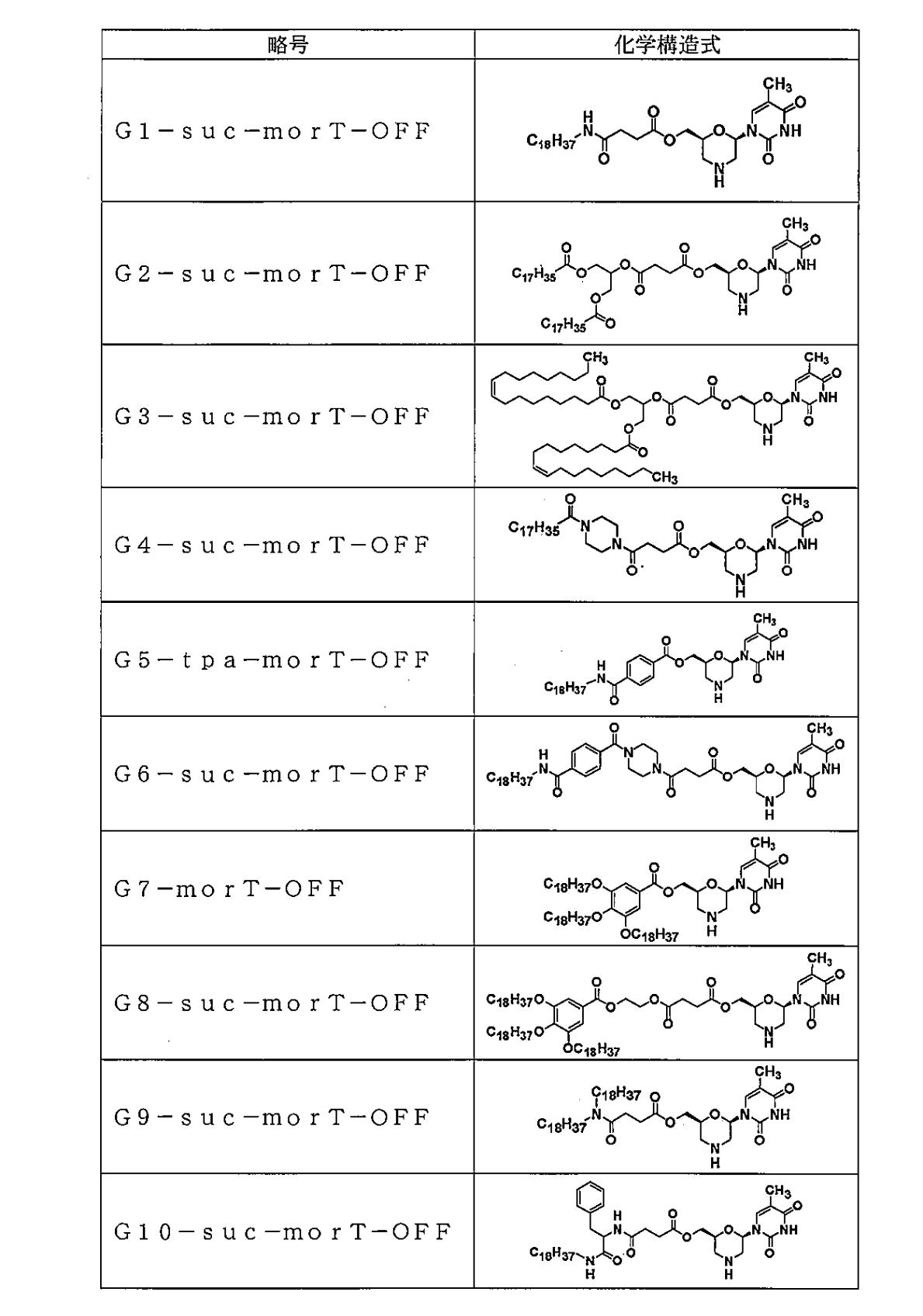
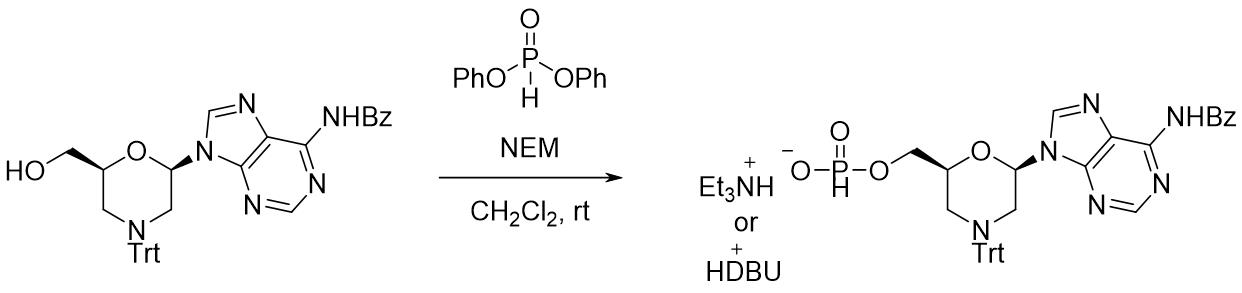
ESI-MS(+):660.2(LC/MS条件1)
1H‐NMR(CDCl3):9.02(brs,1H);8.80(s,1H);8.01(s,2H);7.99(d,J=1.4Hz,1H);7.57~7.62(m,2H);7.49~7.53(m,7H);7.30(d,J=7.3,7.3Hz,6H);7.19(d,J=7.3,7.3Hz,3H);6.40(dd,J=9.6,2.3Hz,1H);4.43~4.49(m,1H);3.81~3.95(m,2H);3.50(ddd,J=11.0,2.3,2.3Hz,1H);3.27(ddd,J=11.9,2.3,2.3Hz,1H);2.95(q,J=7.3Hz,7.2H);1.81(dd,J=10.0,10.0Hz,1H);1.61(dd,J=11.0,11.0Hz,1H);1.23(t,J=7.3Hz,10.8H)
得られたH-ホスホネート-PMO[ABz]―ON(トリエチルアミン塩)500mgをクロロホルム5mLに溶解し、0.2M炭酸水素ジアザビシクロウンデセン溶液20mL加えて室温で10分攪拌した。10分後、有機層を分離、硫酸ナトリウムで乾燥、溶媒留去することでH-ホスホネート-PMO[ABz]―ON(DBU塩)490mgを得た。
1H‐NMR(CDCl3):9.01(brs,1H);8.80(s,1H);8.61~8.63(m,1H);8.04(s,1H);8.00(d,J=7.3Hz,2H);7.70(dddd,J=7.5,7.5,1.8,1.8Hz,1H);7.58~7.61(m,2H);7.49~7.53(m,6H);7.27~7.32(m,6H);7.18(d,J=7.3Hz,3H);6.40(dd,J=9.6,2.3Hz,1H);4.44~4.49(m,1H);3.82~3.97(m,2H);3.49(ddd,J=11.0,2.3,2.3Hz,1H);3.34~3.43(m,7H);3.28(ddd,J=11.9,2.3,2.3Hz,1H);2.80(d,J=3.2Hz,2H);1.93(dddd,J=6.0,6.0,6.0,6.0Hz,2H);1.79(dd,J=10.5,10.5Hz,1H);1.59~1.70(m,10H)
実施例1-1と同様の方法でトリエチルアンモニウム[(2S,6R)-6-(4-ベンズアミド-2-オキソピリミジン-1(2H)-イル)-4-トリチルモルホリン-2-イル]メチルホスホネート(H-ホスホネート-PMO[CBz]―ON)、トリエチルアンモニウム[(2S,6R)-6-(5-メチル-2,4-ジオキソ-3,4-ジヒドロピリミジン-1(2H)-イル)-4-トリチルモルホリン-2-イル]メチルホスホネート(H-ホスホネート-PMO[T]―ON)を製造した。
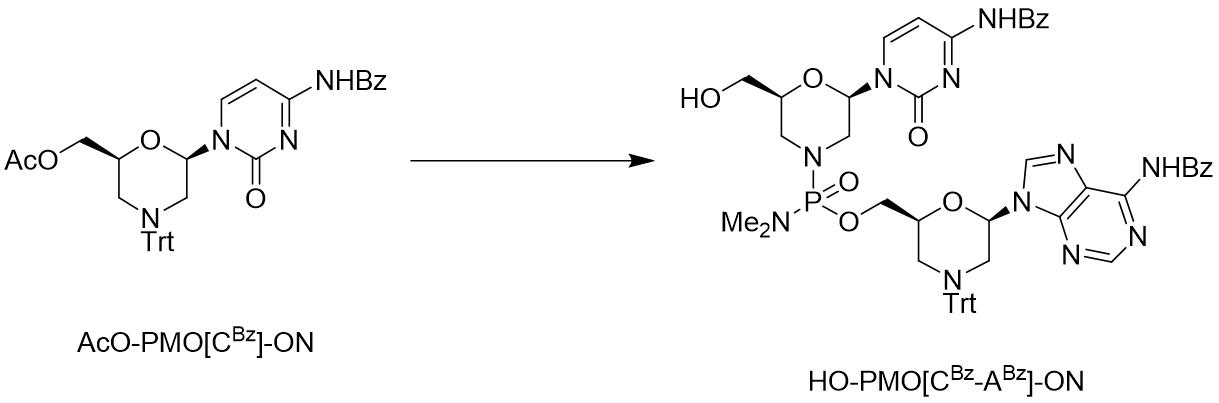

ESI-MS(+):1079.4(LC/MS条件1)

HO-PMO[CBz-ABz-T-CBz-T]―ON 6.2g(3.0mmol)とN-エチルモルホリン7.4mL(60mmol)をジクロロメタン30mLに溶解した。この溶液に亜リン酸ジフェニル4.6mL(24mmol)を加えて40℃で終夜攪拌した。終夜攪拌後、1M炭酸水素トリエチルアンモニウム溶液300mL加えて室温で攪拌した。1時間後、有機層を分離、硫酸ナトリウムで乾燥、溶媒留去した。得られた残渣をシリカゲルクロマトグラフィーにて精製し、H-ホスホネート-PMO[CBz-ABz-T-CBz-T]―ON(トリエチルアミン塩)を得た(6.56g,98%)。
得られた生成物1gをクロロホルム5mLに溶解し、0.2M炭酸水素ジアザビシクロウンデセン溶液20mLを加えて室温で10分攪拌した。10分後、有機層を分離、硫酸ナトリウムで乾燥、溶媒留去することでH-ホスホネート-PMO[CBz-ABz-T-CBz-T]―ON(DBU塩)960mgを得た。
ESI-MS(+):2158.7(LC/MS条件2)
TBDPSO-PMO[CBz-GCE,Pac-ABz-ABz-GCE,Pac]―ONはTBDPSO-PMO[CBz]-ONから公知の方法にて得た。TBDPSO-PMO[CBz-GCE,Pac-ABz-ABz-GCE,Pac]―ON 19g(7.07mmol)と酢酸3.0mL(53.0mmol)をテトラヒドロフラン140mLに懸濁した。この溶液にテトラブチルアンモニウムフルオライド3水和物14.1g(35.4mmol)を加えて、室温で攪拌した。1時間後、水を加えて、ジクロロメタンで抽出、硫酸ナトリウムで乾燥、溶媒留去した。得られた残渣をシリカゲルクロマトグラフィーにて精製し、HO-PMO[CBz-GCE,Pac-ABz-ABz-GCE,Pac]―ONを得た(10.7g,62%)。HO-PMO[CBz-GCE,Pac-ABz-ABz-GCE,Pac]―ON 1g(0.408mmol)とN-エチルモルホリン1.0mL(8.15mmol)をジクロロメタン4.0mLに溶解した。この溶液に亜リン酸ジフェニル937μL(4.89mmol)を加えて室温で攪拌した。1時間後、1M炭酸水素トリエチルアンモニウム溶液40mLを加えて室温で攪拌した。10分後、有機層を分離、硫酸ナトリウムで乾燥、溶媒留去した。得られた残渣をシリカゲルクロマトグラフィーにて精製し、H-ホスホネート-PMO[CBz-GCE,Pac-ABz-ABz-GCE,Pac]―ON(トリエチルアミン塩)を得た(870mg,85%)。得られた生成物500mgをクロロホルム5mLに溶解し、0.2M炭酸水素ジアザビシクロウンデセン溶液20mLを加えて室温で攪拌した。10分後、有機層を分離、硫酸ナトリウムで乾燥、溶媒留去することでH-ホスホネート-PMO[CBz-GCE,Pac-ABz-ABz-GCE,Pac]―ON(DBU塩)490mgを得た。
ESI-MS(+):2606.9(LC/MS条件2)

TrocO-PMO[GCE,Pac-GCE,Pac-T-T-CBz]―ON 1g (0.40mmol)にテトラヒドロフラン6.0mLに溶解した。この溶液に酢酸230μL(4.01mmol)、亜鉛粉末262mg(4.01mmol)を加えて室温で撹拌した。1時間後、さらに酢酸115μL(2.01mmol)、亜鉛粉末131mg(4.01mmol)を追加して1時間撹拌した。1時間後、反応液をセライトろ過し、ろ液を溶媒留去した。得られた残渣を逆相精製にて精製し、HO-PMO[GCE,Pac-GCE,Pac-T-T-CBz]―ONを得た(591.16mg,64%)。
HO-PMO[GCE,Pac-GCE,Pac-T-T-CBz]―ON 441mg(0.19mmol)とN-エチルモルホリン241μL(1.90mmol)をジクロロメタン1.9mLに溶解した。この溶液に亜リン酸ジフェニル145μL(0.76mmol)を加えて40℃で1時間撹拌した。1時間後、トリエチルアミン398μLを加えた。その後、反応液を2%のトリエチルアミンを含むジイソプロピルエーテル4.5mL中に滴下した。滴下終了後生じた白色沈殿物を吸引ろ過し、減圧乾燥した。得られた白色粉末を逆相精製により精製し、H―ホスホネート-PMO[GCE,Pac-GCE,Pac-T-T-CBz]―ONを得た(211mg,45%)。
ESI-MS(+):2382.8(M+H)(LC/MS条件3)
同様の方法にて以下に示すH-ホスホネート体を製造した。

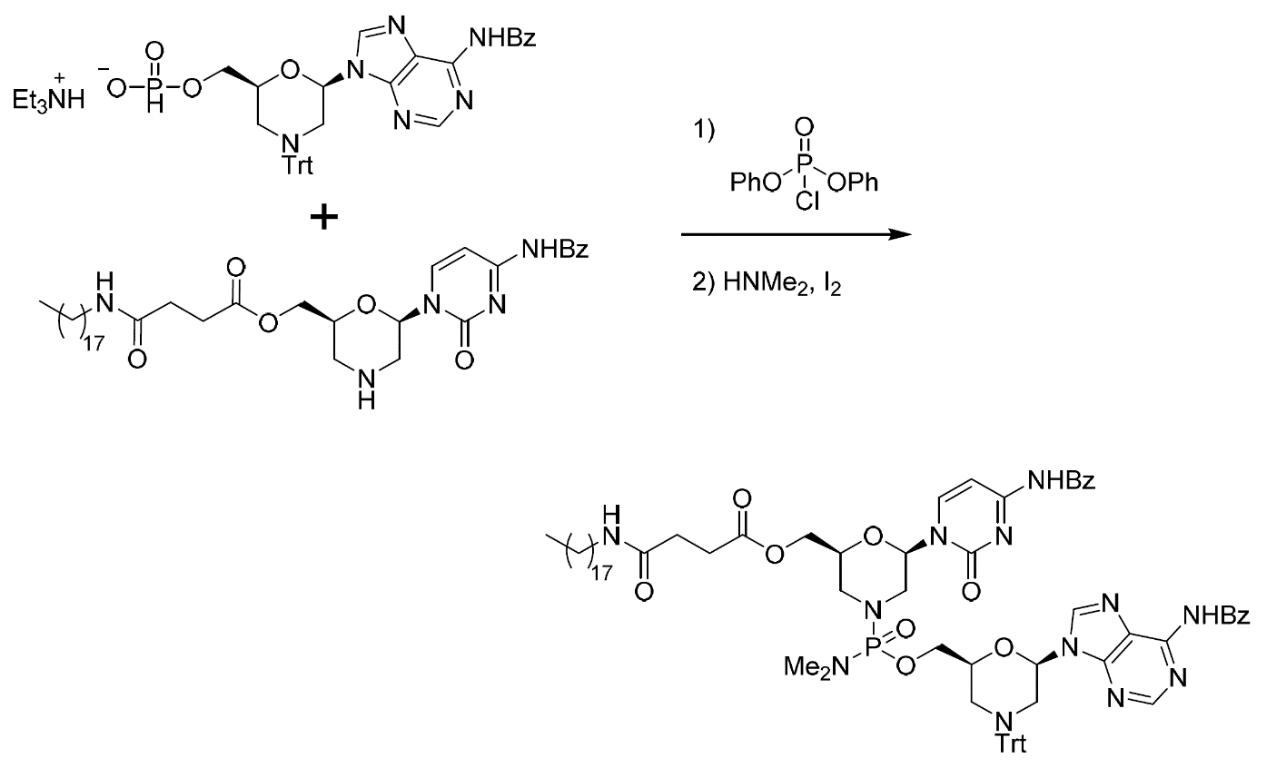
ESI-MS(+):1367.8(M+H)(LC/MS条件1)
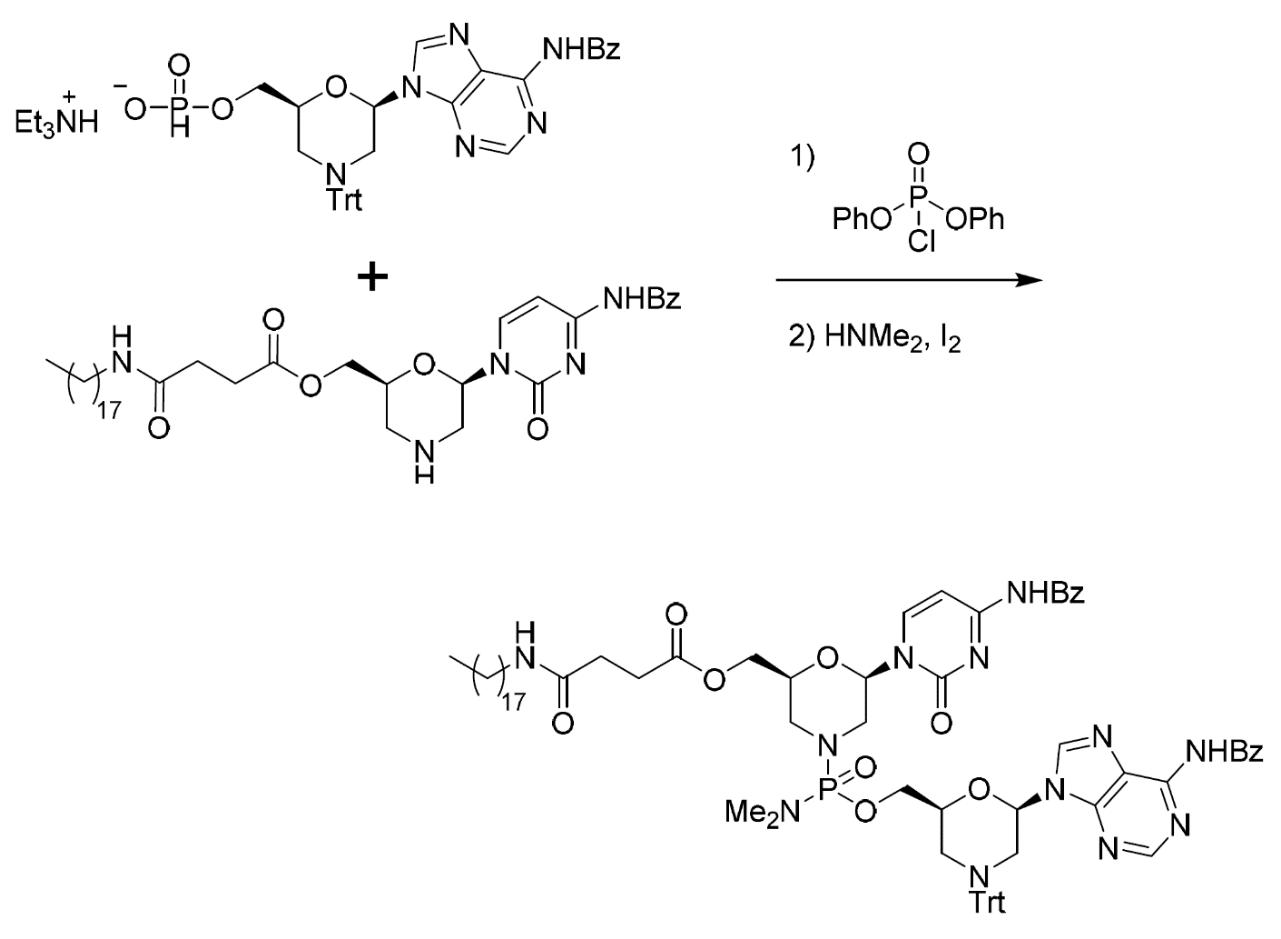
a液: クロロリン酸ジフェニル82μL(0.394mmol)を無水ジクロロメタン2.5mLに溶解させた。
b液: H-ホスホネート-PMO[ABz]―ON 200mg(0.263mmol)およびG1-suc-PMO[CBz]-OFF119mg(0.175mmol)を40%無水ピリジン/60%無水ジクロロメタン溶液2.5mLに溶解させた。

ESI-MS(+):1056.2(M+Na)(LC/MS条件1)

ESI-MS(+):1106.4(M+H)(LC/MS条件1)

ESI-MS(+):1819.9(LC/MS条件2)
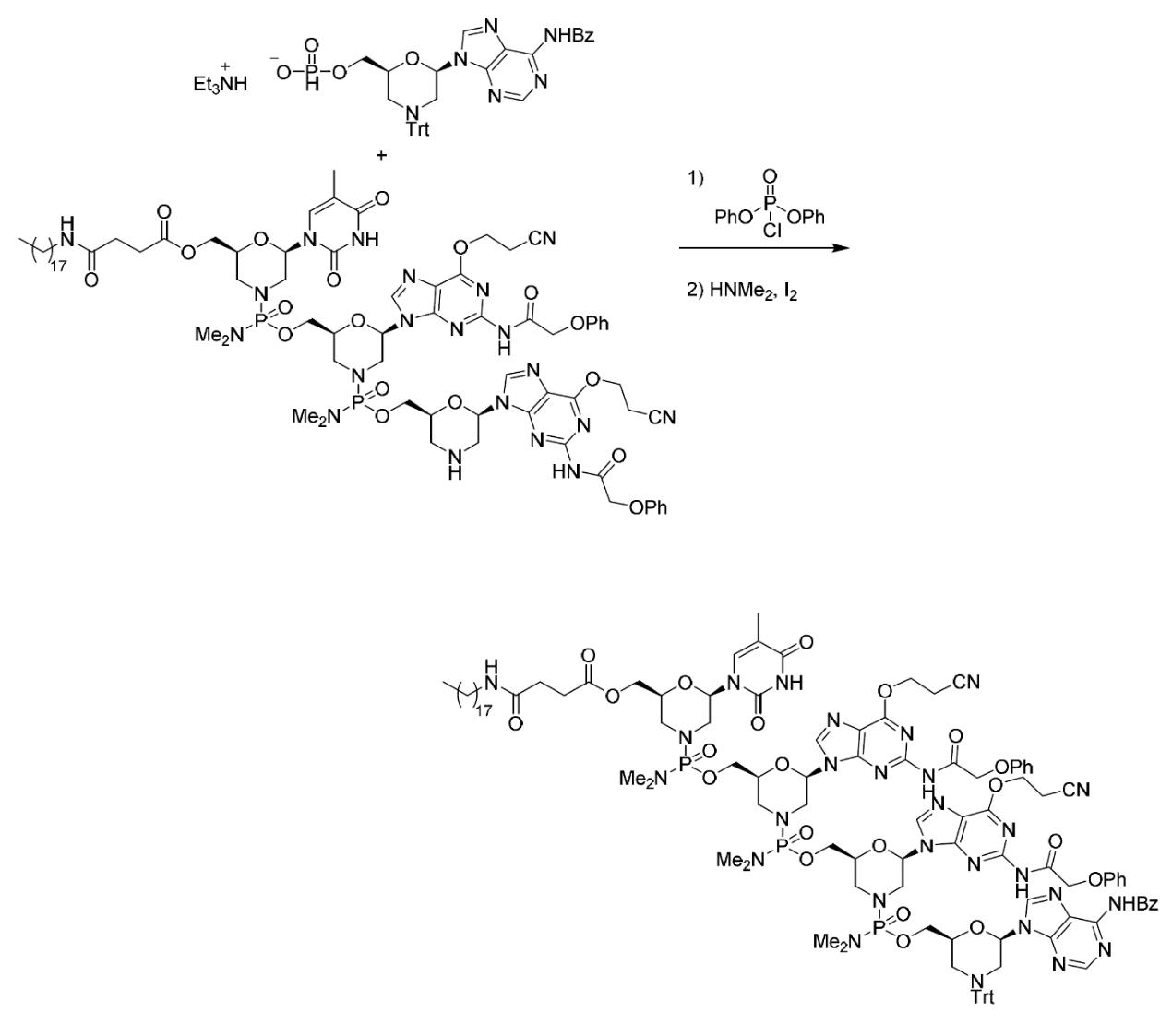
ESI-MS(+):2362.0(LC/MS条件2)
G1-suc-PMO[T-GCE,Pac-GCE,Pac-GCE,Pac-ABz]-OFF 67mg(0.0251mmol)とH-ホスホネート-PMO[ABz]-ON(トリエチルアミン塩) 29mg(0.0377mmol)とN-メチルイミダゾール10μL(0.126mmol)をジクロロメタン250μLに溶解させた。この溶液にクロロリン酸ジフェニル12μL(0.0566mmol)を加えた後、40℃で攪拌した。10分後、反応液100μLを酸化液(0.1Mヨウ素、2Mジメチルアミン/THF溶液)100μLと混合し、室温で10分間攪拌した。反応終了後、反応液に10%チオ硫酸ナトリウム水溶液を加え、有機層と水層を分離後、有機層を80%アセトニトリル水溶液により20倍希釈してHPLCにて分析した(原料Rt:14.4min、目的物Rt:19.0、19.2min、変換収率97.9%、ODS条件2)。
ESI-MS(+):3347.4(LC/MS条件2)
G1-suc-PMO[CBz-CBz-T-CBz-CBz-GCE,Pac-GCE,Pac-T-T-CBz]-OFF 28mg(0.00631mmol)とH-ホスホネート-PMO[ABz]-ON(トリエチルアミン塩) 9.5mg(0.0126mmol)とN-メチルイミダゾール10μL(0.126mmol)をジクロロメタン250μLに溶解させた。この溶液にクロロリン酸ジフェニル13μL(0.0631mmol)を加えた後、40℃で攪拌した。10分後、反応液100μLを酸化液(0.1Mヨウ素、2Mジメチルアミン/THF溶液)100μLと混合し、室温で5分間攪拌した。反応終了後、反応液に10%チオ硫酸ナトリウム水溶液を加え、有機層と水層を分離後、有機層を80%アセトニトリル水溶液により20倍希釈してHPLCにて分析した(原料Rt:16.1min、目的物Rt:19.5min、変換収率94.4%、ODS条件2)。
ESI-MS(+):5117.9(LC/MS条件2)
G1-suc-PMO[CBz-CBz-T-CBz-CBz-GCE,Pac-GCE,Pac-T-T-CBz]-OFF 28mg(0.00631mmol)とH-ホスホネート-PMO[ABz]-ON(トリエチルアミン塩) 9.5mg(0.0126mmol)とN-メチルイミダゾール10μL(0.126mmol)をジクロロメタン250μLに溶解させた。この溶液にブロモトリピロリジノホスホニウム=ヘキサフルオロりん酸塩29mg(0.0631mmol)を加えた後、40℃で攪拌した。10分後、反応液100μLを酸化液(0.1Mヨウ素、2Mジメチルアミン/THF溶液)100μLと混合し、室温で5分間攪拌した。反応終了後、反応液に10%チオ硫酸ナトリウム水溶液を加え、有機層と水層を分離後、有機層を80%アセトニトリル水溶液により20倍希釈してHPLCにて分析した(原料Rt:16.1min、目的物Rt:19.5min、変換収率94.0%、ODS条件2)。
G1-suc-PMO[CBz-CBz-T-CBz-CBz-GCE,Pac-GCE,Pac-T-T-CBz]-OFF 28mg(0.00631mmol)とH-ホスホネート-PMO[ABz]-ON(トリエチルアミン塩) 9.5mg(0.0126mmol)とN-メチルイミダゾール10μL(0.126mmol)をジクロロメタン250μLに溶解させた。この溶液にクロロリン酸ジフェニルビス(2,6-ジメチルフェニル)21mg(0.0631mmol)を加えた後、40℃で攪拌した。10分後、反応液100μLを酸化液(0.1Mヨウ素、2Mジメチルアミン/THF溶液)100μLと混合し、室温で5分間攪拌した。反応終了後、反応液に10%チオ硫酸ナトリウム水溶液を加え、有機層と水層を分離後、有機層を80%アセトニトリル水溶液により20倍希釈してHPLCにて分析した(原料Rt:16.1min、目的物Rt:19.5min、変換収率97.0%、ODS条件2)。
G1-suc-PMO[CBz-CBz-T-CBz-CBz-GCE,Pac-GCE,Pac-T-T-CBz]-OFF 28mg(0.00631mmol)とH-ホスホネート-PMO[ABz]-ON(トリエチルアミン塩) 9.5mg(0.0126mmol)とN-メチルイミダゾール10μL(0.126mmol)をジクロロメタン250μLに溶解させた。この溶液にビス(2-オキソ-3-オキサゾリジニル)ホスフィン酸クロリド16mg(0.0631mmol)を加えた後、40℃で攪拌した。10分後、反応液100μLを酸化液(0.1Mヨウ素、2Mジメチルアミン/THF溶液)100μLと混合し、室温で5分間攪拌した。反応終了後、反応液に10%チオ硫酸ナトリウム水溶液を加え、有機層と水層を分離後、有機層を80%アセトニトリル水溶液により20倍希釈してHPLCにて分析した(原料Rt:16.1min、目的物Rt:19.5min、変換収率95.9%、ODS条件2)。

ESI-MS(+):1317.7(LC/MS条件2)
同様の方法で以下に示すオリゴマーを製造した。
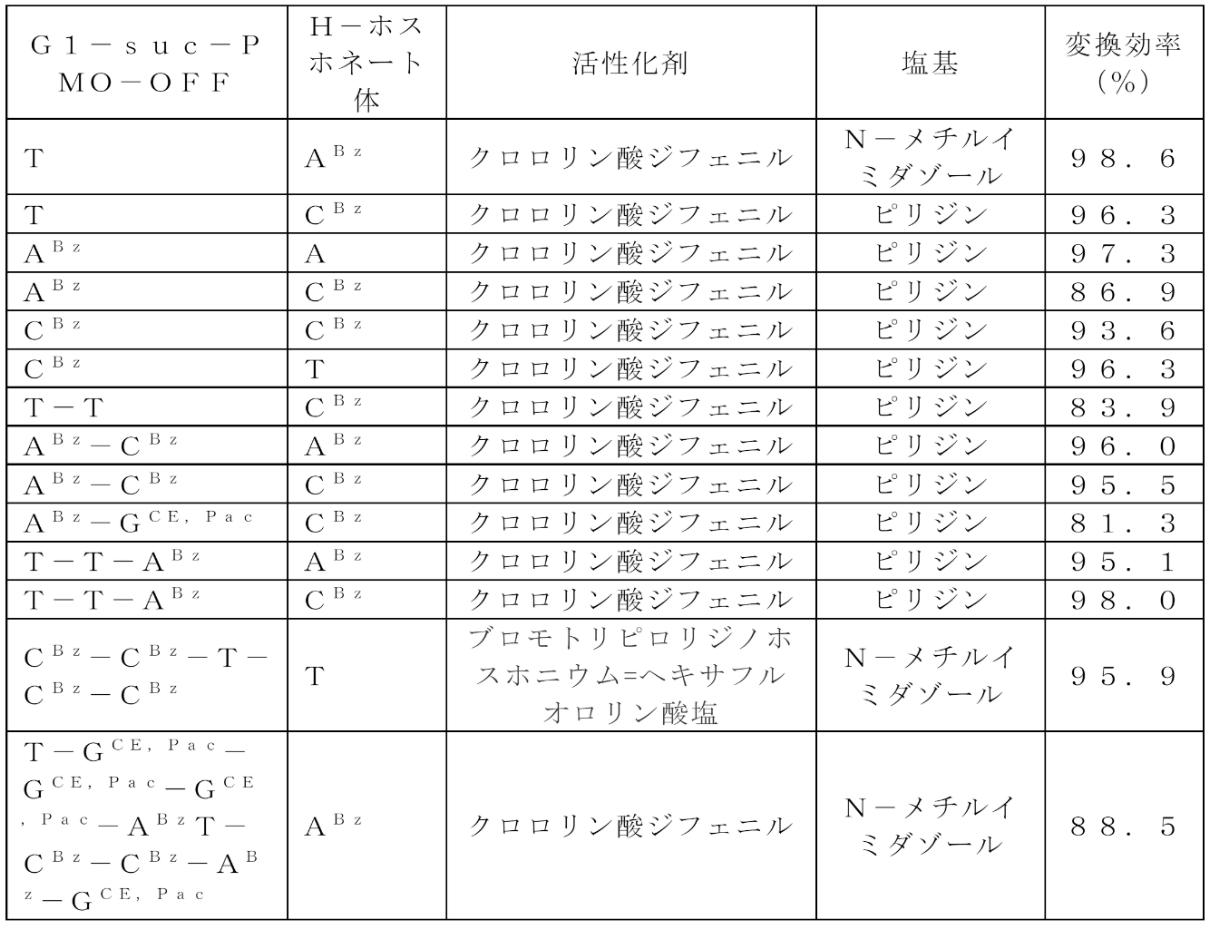

ESI-MS(+):2026.9(LC/MS条件2)

a液: クロロリン酸ジフェニル82μL(0.394mmol)を無水ジクロロメタン2.5mLに溶解させた。
b液: H-ホスホネート-PMO[T-T]―ON 257mg(0.263mmol)およびG1-suc-PMO[ABz-CBz]-OFF197mg(0.175mmol)を40%無水ピリジン/60%無水ジクロロメタン溶液2.5mLに溶解させた。
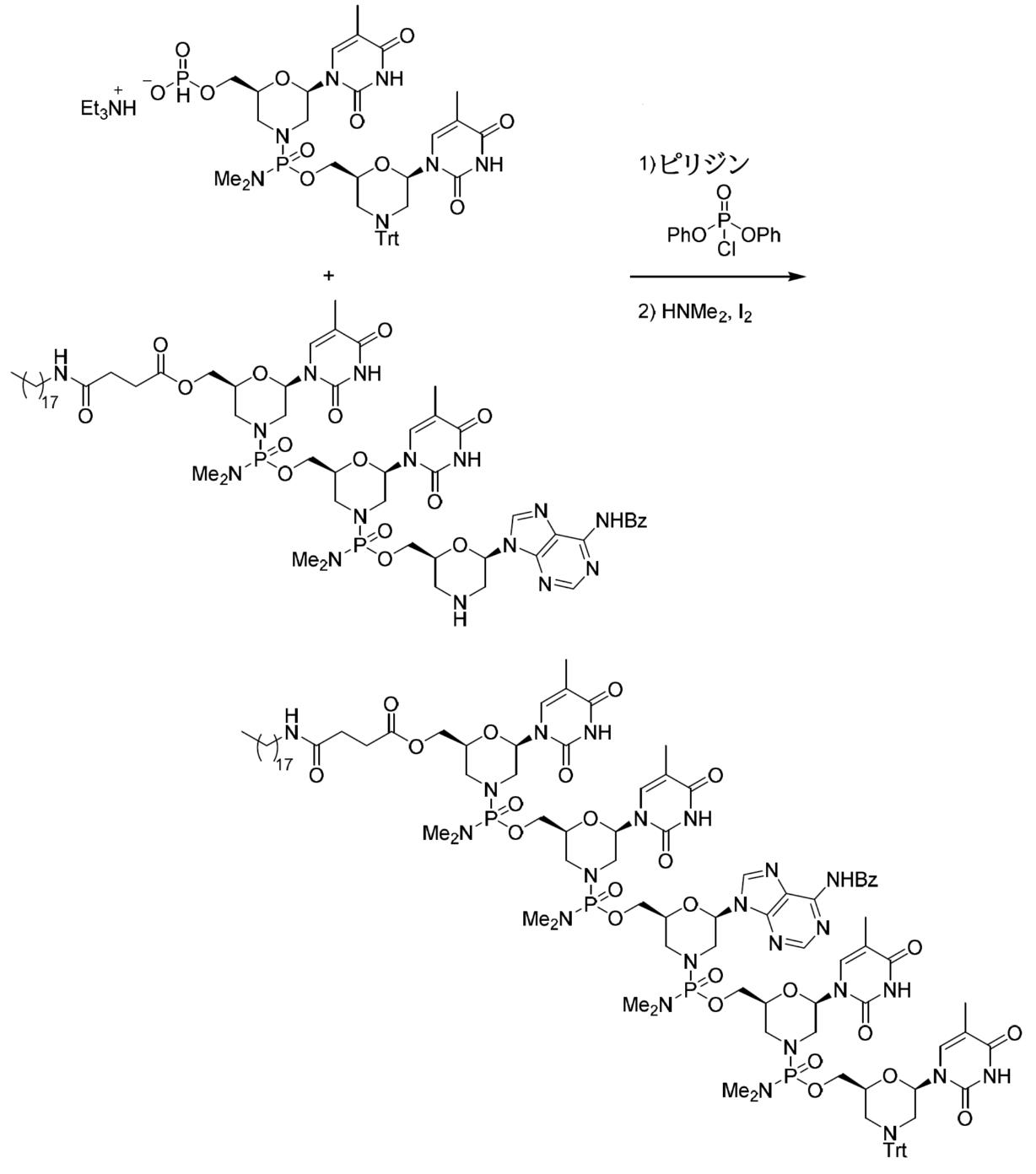
ESI-MS(+):2268.0(LC/MS条件2)

a液: クロロリン酸ジフェニル82μL(0.394mmol)を無水ジクロロメタン2.5mLに溶解させた。
b液: H-ホスホネート-PMO[T-T]―ON 257mg(0.263mmol)およびG1-suc-PMO[T-T-ABz]-OFF239mg(0.175mmol)を40%無水ピリジン/60%無水ジクロロメタン溶液2.5mLに溶解させた。
G1-suc-PMO[T-GCE,Pac-GCE,Pac-GCE,Pac-ABz]-OFF 33mg(0.0123mmol)とH-ホスホネート-PMO[CBz-ABz-T-CBz-T]-ON(トリエチルアミン塩) 40mg(0.0185mmol)とN-メチルイミダゾール20μL(0.247mmol)をジクロロメタン250μLに溶解させた。この溶液にクロロリン酸ジフェニル26μL(0.124mmol)を加えた後、40℃で攪拌した。10分後、反応液100μLを酸化液(0.1Mヨウ素、2Mジメチルアミン/THF溶液)100μLと混合し、室温で5分間攪拌した。反応終了後、反応液に10%チオ硫酸ナトリウム水溶液を加え、有機層と水層を分離後、有機層を80%アセトニトリル水溶液により20倍希釈してHPLCにて分析した(原料Rt:14.4min、目的物Rt:18.6min、変換収率84.7%、目的物純度23.4%、ODS条件2)。
ESI-MS(+):4845.8(LC/MS条件2)
G1-suc-PMO[T-GCE,Pac-GCE,Pac-GCE,Pac-ABz]-OFF 33mg(0.0123mmol)とH-ホスホネート-PMO[CBz-ABz-T-CBz-T]-ON(DBU塩) 40mg(0.0185mmol)とN-メチルイミダゾール20μL(0.247mmol)をジクロロメタン250μLに溶解させた。この溶液にクロロリン酸ジフェニル26μL(0.124mmol)を加えた後、40℃で攪拌した。10分後、反応液100μLを酸化液(0.1Mヨウ素、2Mジメチルアミン/THF溶液)100μLと混合し、室温で5分間攪拌した。反応終了後、反応液に10%チオ硫酸ナトリウム水溶液を加え、有機層と水層を分離後、有機層を80%アセトニトリル水溶液により20倍希釈してHPLCにて分析した(原料Rt:14.4min、目的物Rt:18.6min、変換収率95.8%、目的物純度53.1%、ODS条件2)。
G1-suc-PMO[CBz-CBz-T-CBz-CBz-GCE,Pac-GCE,Pac-T-T-CBz]-OFF 28mg(0.00631mmol)とH-ホスホネート-PMO[CBz-GCE,Pac-ABz-ABz-GCE,Pac]-ON(DBU塩) 32mg(0.0126mmol)とN-メチルイミダゾール16μL(0.126mmol)をジクロロメタン250μLに溶解させた。この溶液にクロロリン酸ジフェニル13μL(0.0631mmol)を加えた後、40℃で攪拌した。10分後、反応液100μLを酸化液(0.1Mヨウ素、2Mジメチルアミン/THF溶液)100μLと混合し、室温で5分間攪拌した。反応終了後、反応液に10%チオ硫酸ナトリウム水溶液を加え、有機層と水層を分離後、有機層を80%アセトニトリル水溶液により20倍希釈してHPLCにて分析した(原料Rt:16.1min、目的物Rt:19.8min、変換収率91.5%、ODS条件2)。
ESI-MS(+):7064.4(LC/MS条件2)
同様の方法で以下に示すオリゴマーを製造した。


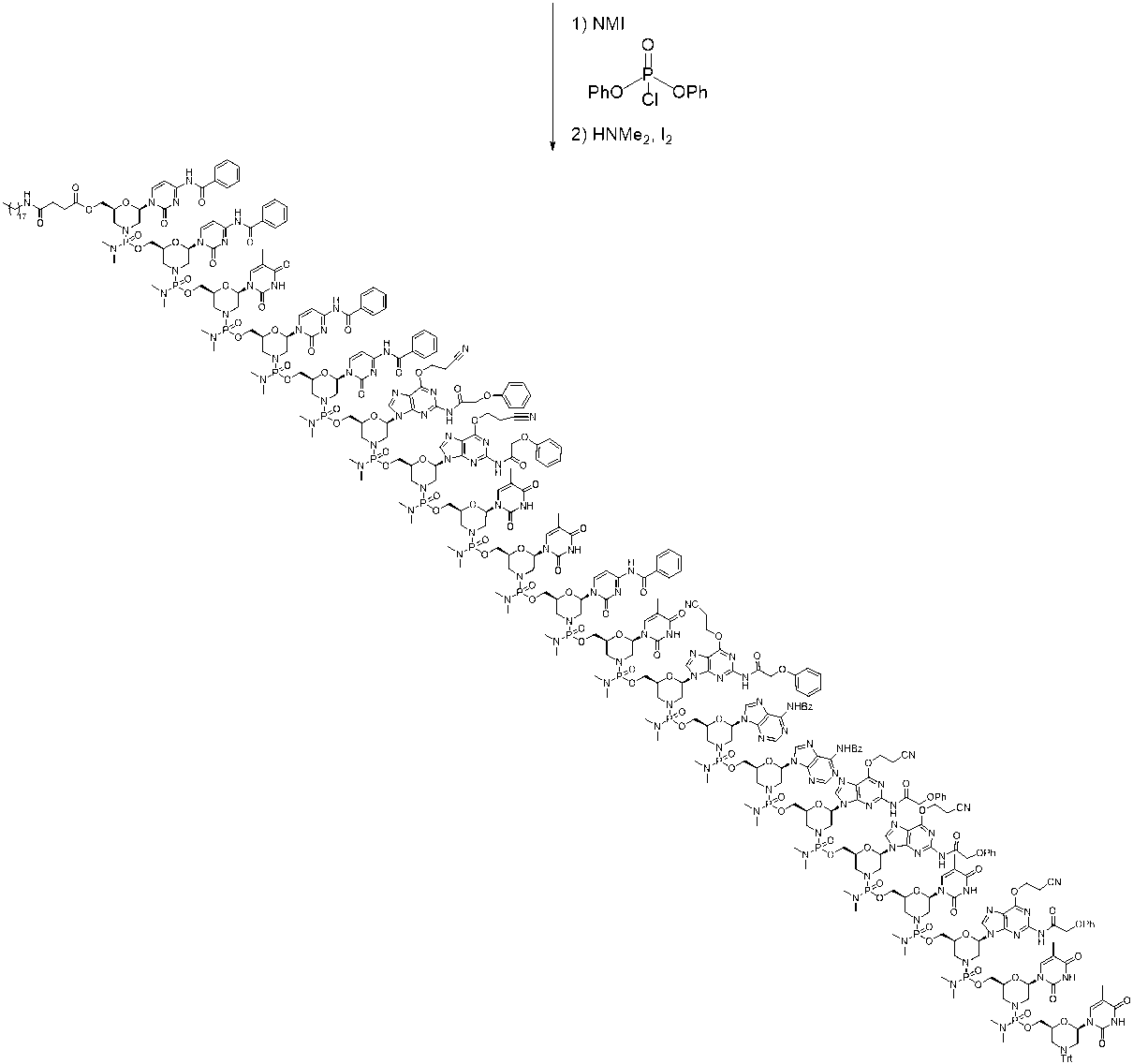
ESI-MS(+):6848.4(LC/MS条件1)
Claims (11)
- 式[A-1]:

BPは、それぞれ同一または異なって、保護されていてもよい核酸塩基であり;
nは、1~50の整数であり;
Wは、それぞれ同一または異なって、酸素原子または硫黄原子であり;そして
Xは、それぞれ同一または異なって、中性条件下で脱離可能な基で置換されている水酸基、1,1,3,3-テトラ(C1-6アルキル)グアニジル、C1-6アルコキシ、ジ(C1-6アルキル)アミノ、モノ(塩基性条件下で脱離可能な基で置換されているアミノ-C1-6アルキル)アミノ、ジ(塩基性条件下で脱離可能な基で置換されているアミノ-C1-6アルキル)アミノ、または一般式[2]:

*は、Pとの結合位置であり;
aは、0~2の整数であり;
Eは、CH2、CH-A1またはN-A2であり;
A1は、C1-6アルキル、塩基性条件下で除去可能な基で置換されているモノ(C1-6アルキル)アミノ-C1-6アルキル、ジ(C1-6アルキル)アミノ-C1-6アルキル、トリ(C1-6アルキル)アンモニオ-C1-6アルキル、塩基性条件下で除去可能な基で置換されているアミノ、塩基性条件下で除去可能な基で置換されているモノ(C1-6アルキル)アミノ、ジ(C1-6アルキル)アミノ、トリ(C1-6アルキル)アンモニオ、塩基性条件下で除去可能な基で置換されているアミジノで置換されているアミノ、または一般式[3]:

*は、Eとの結合位置であり;
bは、0~2の整数であり;
cは、0または1であり;
R11は、C1-6アルキルであり;そして
Mは、CH2、酸素原子、硫黄原子またはN-(塩基性条件下で除去可能な基)である)で表される置換基であり;そして
A2は、C1-6アルキル、塩基性条件下で除去可能な基で置換されているモノ(C1-6アルキル)アミノ-C1-6アルキル、ジ(C1-6アルキル)アミノ-C1-6アルキル、トリ(C1-6アルキル)アンモニオ-C1-6アルキル、塩基性条件下で除去可能な基、アリールまたはヘテロアリールである)
で表される置換基であり;
Gは、
(1)ケイ素置換基、
(2)場合により置換されているC1-18アルキル-カルボニル、場合により置換されているC1-18アルコキシ-カルボニル、長鎖アルキル-カルボニル、または長鎖アルコキシ-カルボニル、
(3)1個~5個の、長鎖アルキルオキシおよび/もしくは長鎖アルケニルオキシで置換されているベンゾイル、或いは
(4)一般式[7]:

*は、Tとの結合位置であり;
Zは、
(1)(有機溶媒に溶解する可溶性ポリマー)-オキシ、
(2)(有機溶媒に溶解する可溶性ポリマー)-アミノ、
(3)長鎖アルキルオキシ、1個~5個の長鎖アルキルオキシおよび/もしくは長鎖アルケニルオキシで置換されているベンゾイル、または1個~5個の長鎖アルキルオキシおよび/もしくは長鎖アルケニルオキシで置換されているベンジル、
(4)固相担体、或いは
(5)次の一般式[8A]~[8N]:
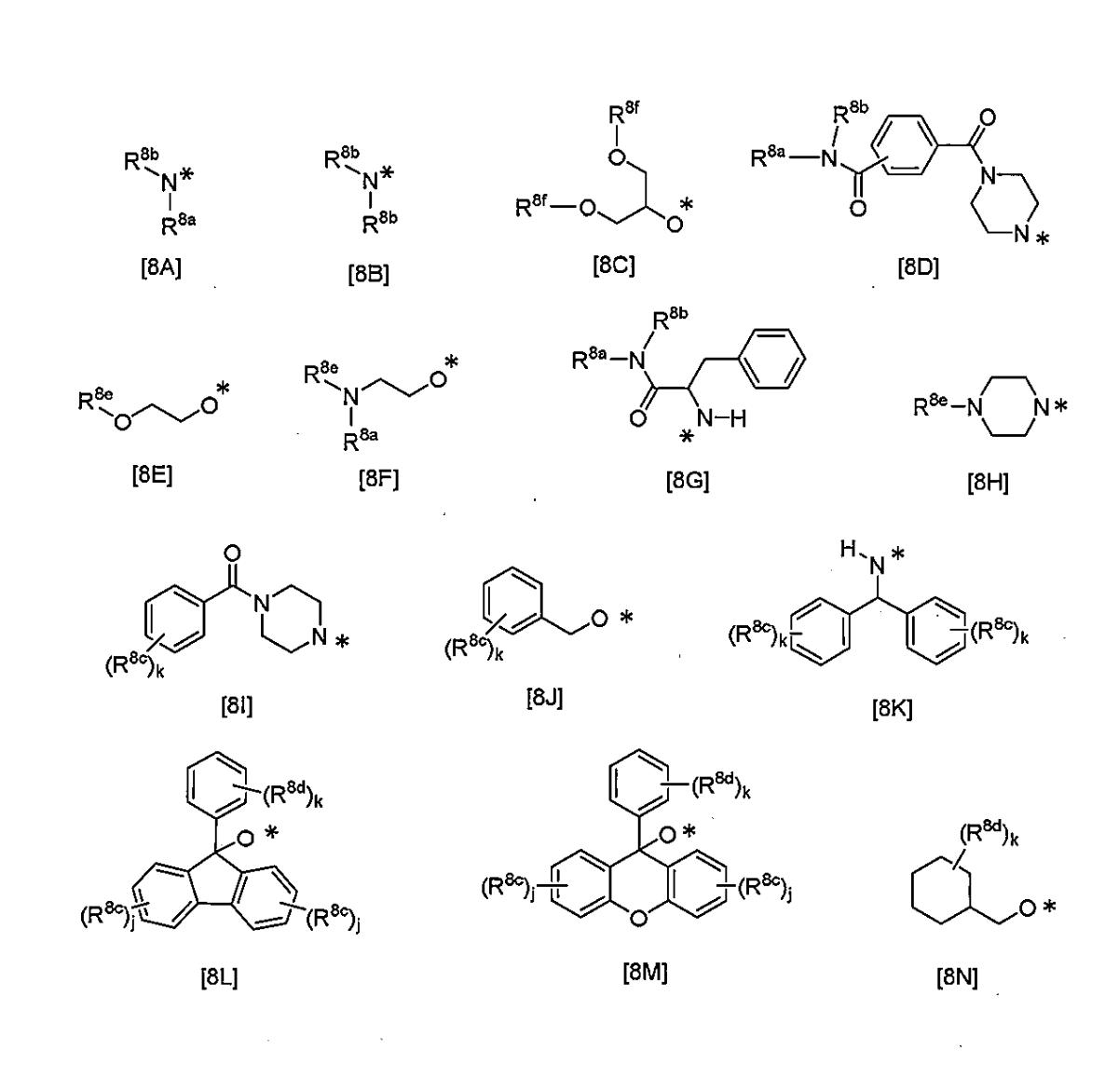
*は、Lとの結合位置であり;
jは、0~4の整数であり;
kは、0~5の整数であり;
R8aは、水素原子またはC1-6アルキルであり;
R8bは、それぞれ同一または異なって、長鎖アルキルであり;
R8cは、それぞれ同一または異なって、一般式[9A]~[9E]:
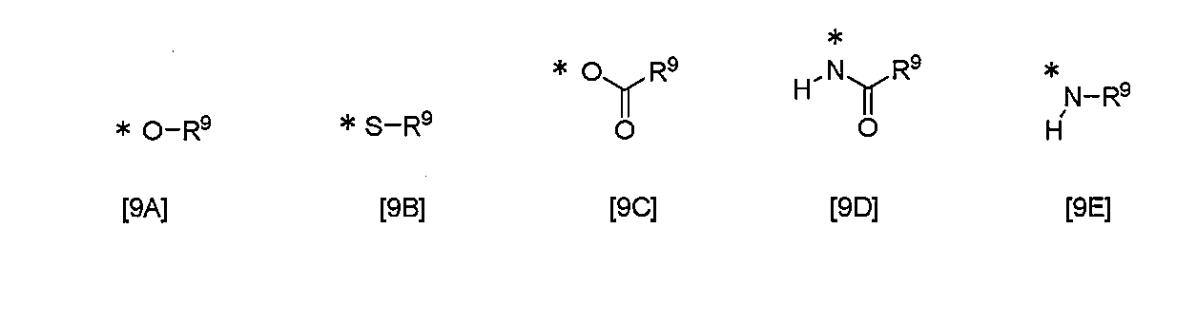
*は、結合位置であり;および
R9は長鎖アルキルおよび/または長鎖アルケニルである)
で表される置換基であり;
R8dは、それぞれ同一または異なって、水素原子、ハロゲン、1個~13個のハロゲンで置換されていてもよい長鎖アルキルまたは1個~13個のハロゲンで置換されていてもよい長鎖アルキルオキシであり;
R8eは
(1)長鎖アルキル、
(2)長鎖アルキル-カルボニル、または
(3)1個~5個の、長鎖アルキルオキシおよび/もしくは長鎖アルケニルオキシで置換されているベンゾイルであり;そして
R8fは、
(1)長鎖アルキル、
(2)長鎖アルキル-カルボニル、または
(3)長鎖アルケニル-カルボニルである)
で表される置換基であり;そして
Lは、一般式[10]:

*は、Zとの結合位置であり;
**は、Tとの結合位置であり;そして
L1は、置換されていてもよいC2-10アルキレンまたは置換されていてもよいC6-10アリーレンであるか、または一般式[10-1]:

*は、Zとの結合位置であり;
**は、Tとの結合位置であり;そして
L1は、置換されていてもよいC1-10アルキレンまたは置換されていてもよいC6-10アリーレンである)
で表される置換基である)
で表される置換基であり;そして
Tは、単結合または一般式[11]:
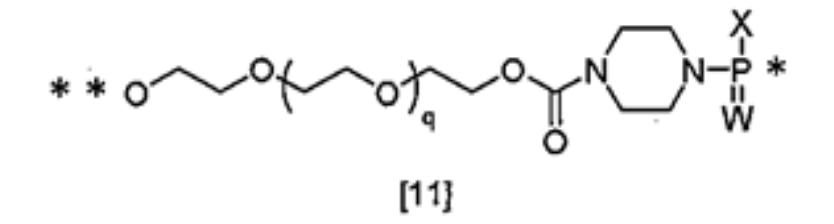
XおよびWは、前記と同義であり;
*は、上記一般式[4a]~[4d]の**O、*Oまたは*Nとの結合位置であり;
**は、Gとの結合位置であり;そして
qは、0~10の整数である)
で表される置換基であるが、Gがケイ素置換基である場合、Tは単結合である]
の化合物と、式[B-1]:

BP、W、及びXは、前記と同義であり、そして
pは、1~50の整数であり;
L’は、OH、-O-N+H(脂肪族アミン)、-O-N+H(環状アミン)、又は-O-N+H(芳香族アミン)であり;
Q1は、酸性条件下で除去可能な基である]
の化合物とを、
(1)塩基の存在下、リン試薬1、リン試薬2、及びオニウム試薬からなる群より選択される少なくとも一つの縮合剤で処理して、そして
(2)酸化剤及び有機アミンで処理して、
式[C-1]:

の化合物を得る方法。 - 更に、式[C-1]:

の化合物を、酸、又は酸及びスカベンジャーで処理して、
式[C-0-1]:
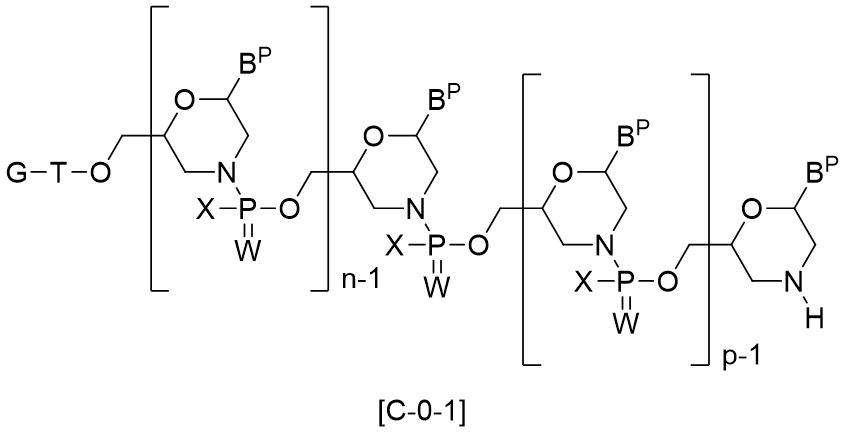
の化合物にして、そして
該式[C-0-1]の化合物と、式[B-0-1]:

の化合物とを、
(1)塩基の存在下、リン試薬1、リン試薬2、及びオニウム試薬からなる群より選択される少なくとも一つの縮合剤で処理して、そして続いて
(2)酸化剤及び有機アミンで処理して、
式[C-1-1]:

の化合物を得ることを含む、請求項1に記載の方法。 - 更に、式[C-1]:

の化合物を、水酸基の保護基の除去条件で処理して、
式[C-0-2]:
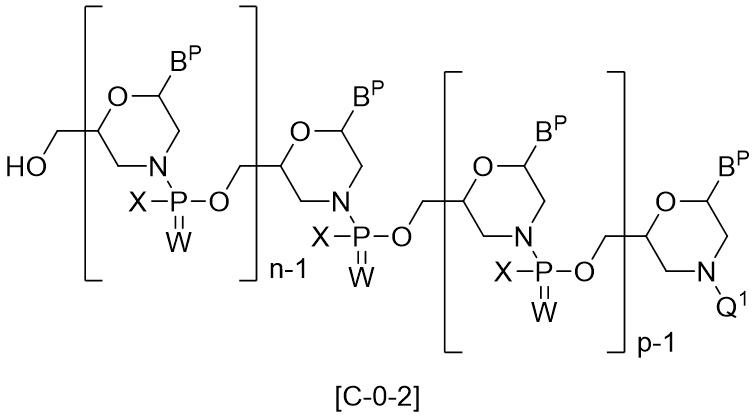
の化合物を得て、
(1)式[P-1]:
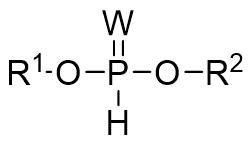
の化合物及び塩基で処理し、そして続いて、
(2)加水分解溶液で処理して、
式[C-0-2-1]:
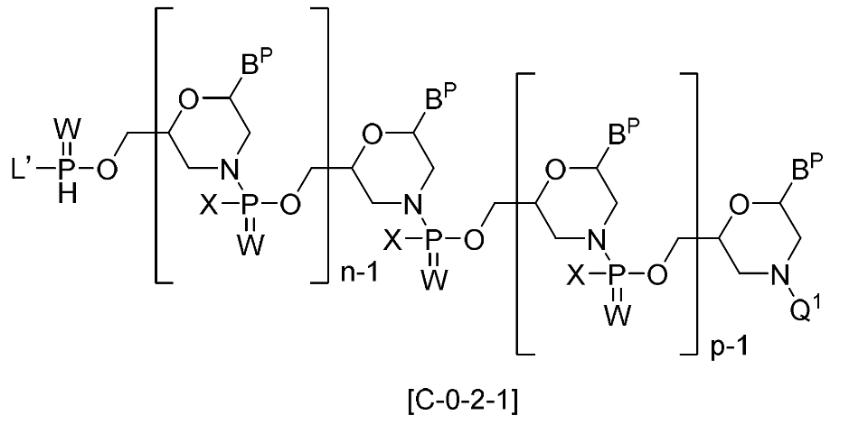
の化合物を得ることを含む、請求項1に記載の方法。 - 更に、式[C-0-2-1]:

の化合物と、式[A-0-1]:

の化合物とを、
(1)塩基の存在下、リン試薬1、リン試薬2、及びオニウム試薬からなる群より選択される少なくとも一つの縮合剤で処理して、そして続いて
(2)酸化剤及び有機アミンで処理して、
式[C-1-2]:
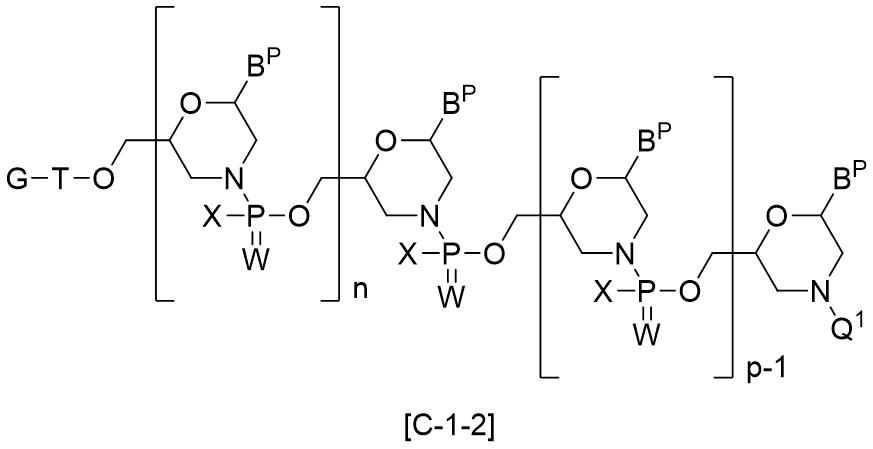
の化合物を得ることを含む、請求項3に記載の方法。 - 更に、式[B-1-0]:
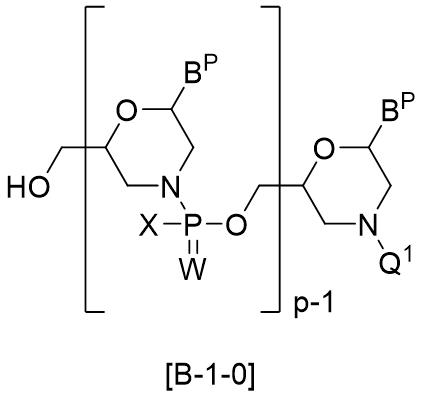
の化合物を、
(1)式[P-1]:

の化合物及び塩基で処理し、そして続いて、
(2)加水分解溶液で処理して、
式[B-1]:
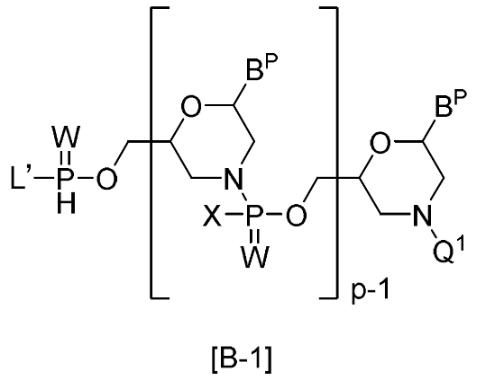
の化合物を得ることを含む、請求項1に記載の方法。 - 更に、式[A-0]:
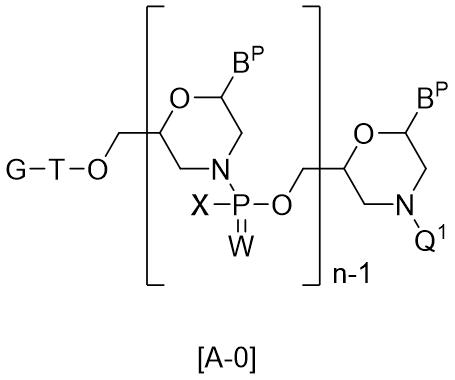
の化合物を、酸、又は酸及びスカベンジャーで処理して、
式[A-1]:

の化合物を得ることを含む、請求項1に記載の方法。 - Gが、下記の式:
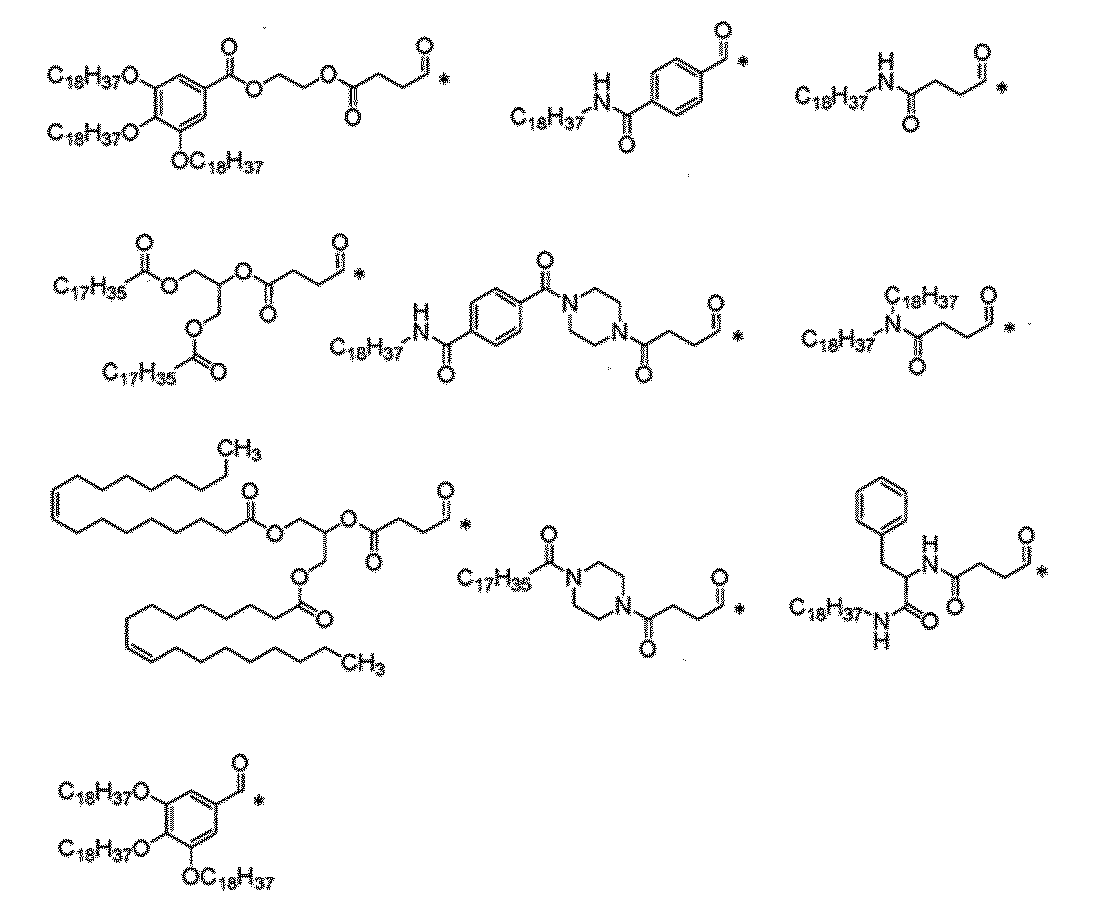
からなる群より選択され;
Tが単結合である、
請求項1~6のいずれかに記載の方法。 - 式[B-1]
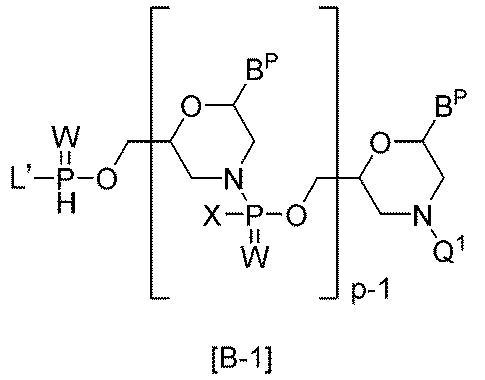
BPが、それぞれ同一または異なって、保護されていてもよい核酸塩基であり、
Q1が、トリチル又はジメトキシトリチルであり、
L’が、-O-N+H(CH2CH3)3、または-O-(HDBU)+であり、
Wが、Oであり、そして
pが、2~20の整数である]
で示される化合物。 - ((2S,6R)-6-(4-ベンズアミド-2-オキソピリミジン-1(2H)-イル)-4-((((2S,6R)-6-(6-ベンズアミド-9H-プリン-9-イル)-4-トリチルモルホリン-2-イル)メトキシ)(ジメチルアミノ)ホスホリル)モルホリン-2-イル)メチルホスホネート、
トリエチルアンモニウム((2S,6R)-6-(4-ベンズアミド-2-オキソピリミジン-1(2H)-イル)-4-((((2S,6R)-6-(6-ベンズアミド-9H-プリン-9-イル)-4-トリチルモルホリン-2-イル)メトキシ)(ジメチルアミノ)ホスホリル)モルホリン-2-イル)メチルホスホネート、
((2S,6R)-6-(4-ベンズアミド-2-オキソピリミジン-1(2H)-イル)-4-((((2S,6R)-4-((((2S,6R)-6-(4-ベンズアミド-2-オキソピリミジン-1(2H)-イル)-4-((ジメチルアミノ)(((2S,6R)-6-(5-メチル-2,4-ジオキソ-3,4-ジヒドロピリミジン-1(2H)-イル)-4-トリチルモルホリン-2-イル)メトキシ)ホスホリル)モルホリン-2-イル)(ジメチルアミノ)ホスホリル)-6-(5-メチル-2,4-ジオキソ-3,4-ジヒドロピリミジン-1(2H)-イル)モルホリン-2-イル)メトキシ)ホスホリル)-6-(6-ベンズアミド-9H-プリン-9-イル)モルホリン-2-イル)メトキシ)(ジメチルアミノ)ホスホリル)モルホリン-2-イル)メチルホスホネート、
トリエチルアンモニウム((2S,6R)-6-(4-ベンズアミド-2-オキソピリミジン-1(2H)-イル)-4-((((2S,6R)-4-((((2S,6R)-6-(4-ベンズアミド-2-オキソピリミジン-1(2H)-イル)-4-((ジメチルアミノ)(((2S,6R)-6-(5-メチル-2,4-ジオキソ-3,4-ジヒドロピリミジン-1(2H)-イル)-4-トリチルモルホリン-2-イル)メトキシ)ホスホリル)モルホリン-2-イル)(ジメチルアミノ)ホスホリル)-6-(5-メチル-2,4-ジオキソ-3,4-ジヒドロピリミジン-1(2H)-イル)モルホリン-2-イル)メトキシ)ホスホリル)-6-(6-ベンズアミド-9H-プリン-9-イル)モルホリン-2-イル)メトキシ)(ジメチルアミノ)ホスホリル)モルホリン-2-イル)メチルホスホネート、
((2S,6R)-6-(4-ベンズアミド-2-オキソピリミジン-1(2H)-イル)-4-((((2S,6R)-4-((((2S,6R)-6-(6-ベンズアミド-9H-プリン-9-イル)-4-((((2S,6R)-6-(6-ベンズアミド-9H-プリン-9-イル)-4-((((2S,6R)-6-((2-シアノエトキシ)-2-(2-フェノキシアセトアミド)-9H-プリン-9-イル)-4-トリチルモルホリン-2-イル)メトキシ)(ジメチルアミノ)ホスホリル)モルホリン-2-イル)メトキシ)(ジメチルアミノ)ホスホリル)モルホリン-2-イル)メトキシ)(ジメチルアミノ)ホスホリル)-6-((2-シアノエトキシ)-2-(2-フェノキシアセトアミド)-9H-プリン-9-イル)モルホリン-2-イル)メトキシ)(ジメチルアミノ)ホスホリル)モルホリン-2-イル)メチルホスホネート、
トリエチルアンモニウム((2S,6R)-6-(4-ベンズアミド-2-オキソピリミジン-1(2H)-イル)-4-((((2S,6R)-4-((((2S,6R)-6-(6-ベンズアミド-9H-プリン-9-イル)-4-((((2S,6R)-6-(6-ベンズアミド-9H-プリン-9-イル)-4-((((2S,6R)-6-((2-シアノエトキシ)-2-(2-フェノキシアセトアミド)-9H-プリン-9-イル)-4-トリチルモルホリン-2-イル)メトキシ)(ジメチルアミノ)ホスホリル)モルホリン-2-イル)メトキシ)(ジメチルアミノ)ホスホリル)モルホリン-2-イル)メトキシ)(ジメチルアミノ)ホスホリル)-6-((2-シアノエトキシ)-2-(2-フェノキシアセトアミド)-9H-プリン-9-イル)モルホリン-2-イル)メトキシ)(ジメチルアミノ)ホスホリル)モルホリン-2-イル)メチルホスホネート、
((2S,6R)-4-((((2S,6R)-4-((((2S,6R)-4-((((2S,6R)-6-(4-ベンズアミド-2-オキソピリミジン-1(2H)-イル)-4-トリチルモルホリン-2-イル)メトキシ)(ジメチルアミノ)ホスホリル)-6-(5-メチル-2,4-ジオキソ-3,4-ジヒドロピリミジン-1(2H)-イル)モルホリン-2-イル)メトキシ)(ジメチルアミノ)ホスホリル)-6-(5-メチル-2,4-ジオキソ-3,4-ジヒドロピリミジン-1(2H)-イル)モルホリン-2-イル)メトキシ)(ジメチルアミノ)ホスホリル)-6-((2-シアノエトキシ)-2-(2-フェノキシアセトアミド)-9H-プリン-9-イル)モルホリン-2-イル)メトキシ)(ジメチルアミノ)ホスホリル)-6-((2-シアノエトキシ)-2-(2-フェノキシアセトアミド)-9H-プリン-9-イル)モルホリン-2-イル)メチルホスホネート、
トリエチルアンモニウム((2S,6R)-4-((((2S,6R)-4-((((2S,6R)-4-((((2S,6R)-6-(4-ベンズアミド-2-オキソピリミジン-1(2H)-イル)-4-トリチルモルホリン-2-イル)メトキシ)(ジメチルアミノ)ホスホリル)-6-(5-メチル-2,4-ジオキソ-3,4-ジヒドロピリミジン-1(2H)-イル)モルホリン-2-イル)メトキシ)(ジメチルアミノ)ホスホリル)-6-(5-メチル-2,4-ジオキソ-3,4-ジヒドロピリミジン-1(2H)-イル)モルホリン-2-イル)メトキシ)(ジメチルアミノ)ホスホリル)-6-((2-シアノエトキシ)-2-(2-フェノキシアセトアミド)-9H-プリン-9-イル)モルホリン-2-イル)メトキシ)(ジメチルアミノ)ホスホリル)-6-((2-シアノエトキシ)-2-(2-フェノキシアセトアミド)-9H-プリン-9-イル)モルホリン-2-イル)メチルホスホネート、
((2S,6R)-6-(4-ベンズアミド-2-オキソピリミジン-1(2H)-イル)-4-((((2S,6R)-6-(4-ベンズアミド-2-オキソピリミジン-1(2H)-イル)-4-トリチルモルホリン-2-イル)メトキシ)(ジメチルアミノ)ホスホリル)モルホリン-2-イル)メチルホスホネート、
トリエチルアンモニウム((2S,6R)-6-(4-ベンズアミド-2-オキソピリミジン-1(2H)-イル)-4-((((2S,6R)-6-(4-ベンズアミド-2-オキソピリミジン-1(2H)-イル)-4-トリチルモルホリン-2-イル)メトキシ)(ジメチルアミノ)ホスホリル)モルホリン-2-イル)メチルホスホネート、
((2S,6R)-4-((ジメチルアミノ)(((2S,6R)-6-(5-メチル-2,4-ジオキソ-3,4-ジヒドロピリミジン-1(2H)-イル)-4-トリチルモルホリン-2-イル)メトキシ)ホスホリル)-6-(5-メチル-2,4-ジオキソ-3,4-ジヒドロピリミジン-1(2H)-イル)モルホリン-2-イル)メチルホスホネート、
トリエチルアンモニウム(2S,6R)-4-((ジメチルアミノ)(((2S,6R)-6-(5-メチル-2,4-ジオキソ-3,4-ジヒドロピリミジン-1(2H)-イル)-4-トリチルモルホリン-2-イル)メトキシ)ホスホリル)-6-(5-メチル-2,4-ジオキソ-3,4-ジヒドロピリミジン-1(2H)-イル)モルホリン-2-イル)メチルホスホネート、
((2S,6R)-4-((ジメチルアミノ)(((2S,6R)-4-((ジメチルアミノ)(((2S,6R)-6-(5-メチル-2,4-ジオキソ-3,4-ジヒドロピリミジン-1(2H)-イル)-4-トリチルモルホリン-2-イル)メトキシ)ホスホリル)-6-(5-メチル-2,4-ジオキソ-3,4-ジヒドロピリミジン-1(2H)-イル)メトキシ)ホスホリル)-6-(5-メチル-2,4-ジオキソ-3,4-ジヒドロピリミジン-1(2H)-イル)モルホリン-2-イル)メチルホスホネート、
トリエチルアンモニウム((2S,6R)-4-((ジメチルアミノ)(((2S,6R)-4-((ジメチルアミノ)(((2S,6R)-6-(5-メチル-2,4-ジオキソ-3,4-ジヒドロピリミジン-1(2H)-イル)-4-トリチルモルホリン-2-イル)メトキシ)ホスホリル)-6-(5-メチル-2,4-ジオキソ-3,4-ジヒドロピリミジン-1(2H)-イル)メトキシ)ホスホリル)-6-(5-メチル-2,4-ジオキソ-3,4-ジヒドロピリミジン-1(2H)-イル)モルホリン-2-イル)メチルホスホネート、
((2S,6R)-4-((ジメチルアミノ)(((2S,6R)-4-((ジメチルアミノ)(((2S,6R)-4-((ジメチルアミノ)((((2S,6R)-6-(5-メチル-2,4-ジオキソ-3,4-ジヒドロピリミジン-1(2H)-イル)-4-トリチルモルホリン-2-イル)メトキシ)ホスホリル)-6-(5-メチル-2,4-ジオキソ-3,4-ジヒドロピリミジン-1(2H)-イル)メトキシ)ホスホリル)-6-(5-メチル-2,4-ジオキソ-3,4-ジヒドロピリミジン-1(2H)-イル)メトキシ)ホスホリル)-6-(5-メチル-2,4-ジオキソ-3,4-ジヒドロピリミジン-1(2H)-イル)モルホリン-2-イル)メチルホスホネート、
トリエチルアンモニウム((2S,6R)-4-((ジメチルアミノ)(((2S,6R)-4-((ジメチルアミノ)(((2S,6R)-4-((ジメチルアミノ)((((2S,6R)-6-(5-メチル-2,4-ジオキソ-3,4-ジヒドロピリミジン-1(2H)-イル)-4-トリチルモルホリン-2-イル)メトキシ)ホスホリル)-6-(5-メチル-2,4-ジオキソ-3,4-ジヒドロピリミジン-1(2H)-イル)メトキシ)ホスホリル)-6-(5-メチル-2,4-ジオキソ-3,4-ジヒドロピリミジン-1(2H)-イル)メトキシ)ホスホリル)-6-(5-メチル-2,4-ジオキソ-3,4-ジヒドロピリミジン-1(2H)-イル)モルホリン-2-イル)メチルホスホネート、
1,8-ジアザビシクロ(5.4.0)-7-ウンデセニウム((2S,6R)-6-(4-ベンズアミド-2-オキソピリミジン-1(2H)-イル)-4-((((2S,6R)-4-((((2S,6R)-6-(4-ベンズアミド-2-オキソピリミジン-1(2H)-イル)-4-((ジメチルアミノ)(((2S,6R)-6-(5-メチル-2,4-ジオキソ-3,4-ジヒドロピリミジン-1(2H)-イル)-4-トリチルモルホリン-2-イル)メトキシ)ホスホリル)モルホリン-2-イル)(ジメチルアミノ)ホスホリル)-6-(5-メチル-2,4-ジオキソ-3,4-ジヒドロピリミジン-1(2H)-イル)モルホリン-2-イル)メトキシ)ホスホリル)-6-(6-ベンズアミド-9H-プリン-9-イル)モルホリン-2-イル)メトキシ)(ジメチルアミノ)ホスホリル)モルホリン-2-イル)メチルホスホネート、及び
1,8-ジアザビシクロ(5.4.0)-7-ウンデセニウム((2S,6R)-4-(((2S,6R)-4-(((2S,6R)-6-(6-ベンズアミドプリン-9-イル)-4-(((2S,6R)-6-(6-ベンズアミドプリン-9-イル)-4-(((2S,6R)-4-(((2S,6R)-6-(6-(2-シアノエトキシ)-2-((2-フェノキシアセチル)アミノ)プリン-9-イル)-4-(((2S,6R)-4-(((2S,6R)-6-(6-(2-シアノエトキシ)-2-((2-フェノキシアセチル)アミノ)プリン-9-イル-4-(ジメチルアミノ-(((2S,6R)-4-(ジメチルアミノ-(((2S,6R)-6-(5-メチル-2,4-ジオキソ-リピミジン-1-イル)-4-トリチル-モルホリン-2-イル)メトキシ)ホスホリル)-6-(5―メチル-2,4-ジオキソ-ピリミジン-1-イル)モルホリン-2-イル)メトキシ)ホスホリル)モルホリン-2-イル)メトキシ-(ジメチルアミノ)ホスホリル-6-(5-メチル-2,4-ジオキソ-ピリミジン-1-イル)モルホリン-2-イル)メトキシ-(ジメチルアミノ)ホスホリル)モルホリン-2-イルメトキシ-(ジメチルアミノ)ホスホリル)-6-(6-(3-シアノプロポキシ-2-((2-フェノキシアセチル)アミノ)プリン-9-イル)モルホリン-2-イル)メトキシ-(ジメチルアミノ)ホスホリル)モルホリン-2-イル)メトキシ-(ジメチルアミノ)ホスホリル)モルホリン-2-イル)メトキシ-(ジメチルアミノ)ホスホリル)-6-(6-(2-シアノエトキシ)-2-((2-フェノキシアセチル)アミノ)プリン-9-イル)モルホリン-2-イル)メトキシ-(ジメチルアミノ)ホスホリル)-6-(5-メチル-2,4-ジオキソ-ピリミジン-1-イル)モルホリン-2-イル)メトキシホスフィネート
からなる群より選択される、請求項8に記載の式[B-1]の化合物。 - 式[B-0-1]:

BPが、保護されていてもよい核酸塩基であり、
Q1が、トリチル又はジメトキシトリチルであり、
L’が、-O-(HDBU)+であり、そして
Wが、Oである。]
の化合物。 - 1,8-ジアザビシクロ(5.4.0)-7-ウンデセニウム((2S,6R)-6-(6-ベンズアミド-9H-プリン-9-イル)-4-トリチルモルホリン-2-イル)メチルホスホネート、
1,8-ジアザビシクロ(5.4.0)-7-ウンデセニウム((2S,6R)-6-(4-ベンズアミド-2-オキソピリミジン-1(2H)-イル)-4-トリチルモルホリン-2-イル)メチルホスホネート、
1,8-ジアザビシクロ(5.4.0)-7-ウンデセニウム((2S,6R)-6-(5-メチル-2,4-ジオキソ-3,4-ジヒドロピリミジン-1(2H)-イル)-4-トリチルモルホリン-2-イル)メチルホスホネート、
1,8-ジアザビシクロ(5.4.0)-7-ウンデセニウム((2S,6R)-6-((2-シアノエトキシ)-2-(2-フェノキシアセトアミド)-9H-プリン-9-イル)-4-トリチルモルホリン-2-イル)メチルホスホネート、及び
1,8-ジアザビシクロ(5.4.0)-7-ウンデセニウム((2S,6R)-6-(2-(2-フェニルアセトアミド)-6-((4-(ピバロイルオキシ)ベンジル)オキシ)-9H-プリン-9-イル)-4-トリチルモルホリン-2-イル)メチルホスホネート
からなる群より選択される、請求項10に記載の式[B-0-1]の化合物。
Priority Applications (7)
| Application Number | Priority Date | Filing Date | Title |
|---|---|---|---|
| CA3218264A CA3218264A1 (en) | 2021-04-28 | 2022-04-27 | Method for producing oligonucleic acid compound |
| KR1020237039847A KR20240004559A (ko) | 2021-04-28 | 2022-04-27 | 올리고 핵산 화합물의 제조 방법 |
| CN202280031612.XA CN117279926A (zh) | 2021-04-28 | 2022-04-27 | 低聚核酸化合物的制造方法 |
| US18/288,057 US20240254158A1 (en) | 2021-04-28 | 2022-04-27 | Method for producing oligonucleic acid compound |
| EP22795867.5A EP4332111A4 (en) | 2021-04-28 | 2022-04-27 | METHOD FOR PRODUCING AN OLIGONUCLEIC ACID COMPOUND |
| AU2022266379A AU2022266379A1 (en) | 2021-04-28 | 2022-04-27 | Method for producing oligonucleic acid compound |
| JP2023517605A JP7825613B2 (ja) | 2021-04-28 | 2022-04-27 | オリゴ核酸化合物の製造方法 |
Applications Claiming Priority (2)
| Application Number | Priority Date | Filing Date | Title |
|---|---|---|---|
| JP2021076609 | 2021-04-28 | ||
| JP2021-076609 | 2021-04-28 |
Publications (1)
| Publication Number | Publication Date |
|---|---|
| WO2022230954A1 true WO2022230954A1 (ja) | 2022-11-03 |
Family
ID=83848560
Family Applications (1)
| Application Number | Title | Priority Date | Filing Date |
|---|---|---|---|
| PCT/JP2022/019139 Ceased WO2022230954A1 (ja) | 2021-04-28 | 2022-04-27 | オリゴ核酸化合物の製造方法 |
Country Status (8)
| Country | Link |
|---|---|
| US (1) | US20240254158A1 (ja) |
| EP (1) | EP4332111A4 (ja) |
| JP (1) | JP7825613B2 (ja) |
| KR (1) | KR20240004559A (ja) |
| CN (1) | CN117279926A (ja) |
| AU (1) | AU2022266379A1 (ja) |
| CA (1) | CA3218264A1 (ja) |
| WO (1) | WO2022230954A1 (ja) |
Cited By (1)
| Publication number | Priority date | Publication date | Assignee | Title |
|---|---|---|---|---|
| WO2023127918A1 (ja) * | 2021-12-27 | 2023-07-06 | 日本新薬株式会社 | オリゴ核酸化合物の製造方法 |
Citations (11)
| Publication number | Priority date | Publication date | Assignee | Title |
|---|---|---|---|---|
| WO1991009033A1 (en) | 1989-12-20 | 1991-06-27 | Anti-Gene Development Group | Uncharged morpholino-based polymers having phosphorous-containing chiral intersubunit linkages |
| WO2009064471A1 (en) | 2007-11-15 | 2009-05-22 | Avi Biopharma, Inc. | Method of synthesis of morpholino oligomers |
| WO2012043730A1 (ja) * | 2010-09-30 | 2012-04-05 | 日本新薬株式会社 | モルホリノ核酸誘導体 |
| WO2013122236A1 (ja) | 2012-02-17 | 2013-08-22 | 味の素株式会社 | 塩基部保護オリゴヌクレオチド |
| WO2014077292A1 (ja) | 2012-11-14 | 2014-05-22 | 武田薬品工業株式会社 | 核酸の液相合成方法 |
| JP5548852B2 (ja) | 2009-05-29 | 2014-07-16 | 国立大学法人東京農工大学 | 疎水性基結合ヌクレオシド、疎水性基結合ヌクレオシド溶液、及び疎水性基結合オリゴヌクレオチド合成方法 |
| WO2014189142A1 (ja) * | 2013-05-24 | 2014-11-27 | 味の素株式会社 | モルフォリノオリゴヌクレオチドの製造方法 |
| WO2016060135A1 (ja) | 2014-10-14 | 2016-04-21 | 味の素株式会社 | モルフォリノオリゴヌクレオチドの製造方法 |
| WO2019216433A1 (ja) * | 2018-05-10 | 2019-11-14 | 日本新薬株式会社 | オリゴ核酸化合物の製造方法 |
| WO2021095874A1 (ja) * | 2019-11-13 | 2021-05-20 | 日本新薬株式会社 | オリゴ核酸化合物の製造方法 |
| WO2021095875A1 (ja) * | 2019-11-13 | 2021-05-20 | 日本新薬株式会社 | オリゴ核酸化合物の製造方法 |
Family Cites Families (2)
| Publication number | Priority date | Publication date | Assignee | Title |
|---|---|---|---|---|
| JP4616175B2 (ja) * | 2003-09-02 | 2011-01-19 | 株式会社キラルジェン | 5’−ホスフィチル化モノマーおよびh−ホスホネートオリゴヌクレオチド誘導体の製造方法 |
| US12012427B2 (en) * | 2019-10-31 | 2024-06-18 | Indian Association For The Cultivation Of Science | Synthesis of Fmoc-protected morpholino monomers and their use in the synthesis of morpholino oligomer |
-
2022
- 2022-04-27 JP JP2023517605A patent/JP7825613B2/ja active Active
- 2022-04-27 US US18/288,057 patent/US20240254158A1/en active Pending
- 2022-04-27 KR KR1020237039847A patent/KR20240004559A/ko active Pending
- 2022-04-27 CA CA3218264A patent/CA3218264A1/en active Pending
- 2022-04-27 CN CN202280031612.XA patent/CN117279926A/zh active Pending
- 2022-04-27 WO PCT/JP2022/019139 patent/WO2022230954A1/ja not_active Ceased
- 2022-04-27 AU AU2022266379A patent/AU2022266379A1/en active Pending
- 2022-04-27 EP EP22795867.5A patent/EP4332111A4/en active Pending
Patent Citations (11)
| Publication number | Priority date | Publication date | Assignee | Title |
|---|---|---|---|---|
| WO1991009033A1 (en) | 1989-12-20 | 1991-06-27 | Anti-Gene Development Group | Uncharged morpholino-based polymers having phosphorous-containing chiral intersubunit linkages |
| WO2009064471A1 (en) | 2007-11-15 | 2009-05-22 | Avi Biopharma, Inc. | Method of synthesis of morpholino oligomers |
| JP5548852B2 (ja) | 2009-05-29 | 2014-07-16 | 国立大学法人東京農工大学 | 疎水性基結合ヌクレオシド、疎水性基結合ヌクレオシド溶液、及び疎水性基結合オリゴヌクレオチド合成方法 |
| WO2012043730A1 (ja) * | 2010-09-30 | 2012-04-05 | 日本新薬株式会社 | モルホリノ核酸誘導体 |
| WO2013122236A1 (ja) | 2012-02-17 | 2013-08-22 | 味の素株式会社 | 塩基部保護オリゴヌクレオチド |
| WO2014077292A1 (ja) | 2012-11-14 | 2014-05-22 | 武田薬品工業株式会社 | 核酸の液相合成方法 |
| WO2014189142A1 (ja) * | 2013-05-24 | 2014-11-27 | 味の素株式会社 | モルフォリノオリゴヌクレオチドの製造方法 |
| WO2016060135A1 (ja) | 2014-10-14 | 2016-04-21 | 味の素株式会社 | モルフォリノオリゴヌクレオチドの製造方法 |
| WO2019216433A1 (ja) * | 2018-05-10 | 2019-11-14 | 日本新薬株式会社 | オリゴ核酸化合物の製造方法 |
| WO2021095874A1 (ja) * | 2019-11-13 | 2021-05-20 | 日本新薬株式会社 | オリゴ核酸化合物の製造方法 |
| WO2021095875A1 (ja) * | 2019-11-13 | 2021-05-20 | 日本新薬株式会社 | オリゴ核酸化合物の製造方法 |
Non-Patent Citations (5)
| Title |
|---|
| ACC. CHEM. RES., vol. 24, 1991, pages 278 - 284 |
| GREEN'S PROTECTING GROUPS IN ORGANIC SYNTHESIS, 2006 |
| NUCLEIC ACIDS RESEARCH, vol. 19, 1991, pages 1527 |
| See also references of EP4332111A4 |
| TETRAHEDRON LETTERS, vol. 34, 1993, pages 3373 |
Cited By (1)
| Publication number | Priority date | Publication date | Assignee | Title |
|---|---|---|---|---|
| WO2023127918A1 (ja) * | 2021-12-27 | 2023-07-06 | 日本新薬株式会社 | オリゴ核酸化合物の製造方法 |
Also Published As
| Publication number | Publication date |
|---|---|
| US20240254158A1 (en) | 2024-08-01 |
| KR20240004559A (ko) | 2024-01-11 |
| CN117279926A (zh) | 2023-12-22 |
| JPWO2022230954A1 (ja) | 2022-11-03 |
| CA3218264A1 (en) | 2022-11-03 |
| JP7825613B2 (ja) | 2026-03-06 |
| AU2022266379A1 (en) | 2023-11-09 |
| EP4332111A1 (en) | 2024-03-06 |
| EP4332111A4 (en) | 2025-04-23 |
Similar Documents
| Publication | Publication Date | Title |
|---|---|---|
| JP5831455B2 (ja) | モルホリノ核酸誘導体 | |
| JP5878758B2 (ja) | Rna及びその誘導体合成のための新規保護基 | |
| JP7394749B2 (ja) | オリゴ核酸化合物の製造方法 | |
| EP3331891B1 (en) | A method for preparing a substantially diastereomerically pure phosphorodiamidate oligomer, a phosphorodiamidate oligomer made by such a method and a pharmaceutical composition comprising such a phosphorodiamidate oligomer | |
| JP6673211B2 (ja) | モルフォリノオリゴヌクレオチドの製造方法 | |
| AU2016357980A1 (en) | GalNAc cluster phosphoramidite | |
| KR20000029952A (ko) | 포스포네이트뉴클레오티드화합물 | |
| JP2025111536A (ja) | オリゴ核酸化合物の製造方法 | |
| JP2025128175A (ja) | オリゴ核酸化合物の製造方法 | |
| JP7825613B2 (ja) | オリゴ核酸化合物の製造方法 | |
| HK40102206A (en) | Method for producing oligonucleic acid compound | |
| JPWO2022230954A5 (ja) | ||
| JP7433684B1 (ja) | 疑似固相保護基、それを用いたヌクレオシド保護体又はオリゴヌクレオチド保護体、オリゴアミダイト前駆体の製造方法 | |
| HK40098710A (zh) | 低聚核酸化合物的制造方法 | |
| HK40081457A (en) | Method for producing oligonucleic acid compound | |
| HK40038624A (en) | Method for producing oligonucleic acid compound | |
| HK40072767A (en) | Method for producing oligonucleic acid compound |
Legal Events
| Date | Code | Title | Description |
|---|---|---|---|
| 121 | Ep: the epo has been informed by wipo that ep was designated in this application |
Ref document number: 22795867 Country of ref document: EP Kind code of ref document: A1 |
|
| WWE | Wipo information: entry into national phase |
Ref document number: 2023517605 Country of ref document: JP |
|
| WWE | Wipo information: entry into national phase |
Ref document number: AU2022266379 Country of ref document: AU Ref document number: 2022266379 Country of ref document: AU |
|
| ENP | Entry into the national phase |
Ref document number: 3218264 Country of ref document: CA |
|
| WWE | Wipo information: entry into national phase |
Ref document number: 202280031612.X Country of ref document: CN |
|
| ENP | Entry into the national phase |
Ref document number: 2022266379 Country of ref document: AU Date of ref document: 20220427 Kind code of ref document: A |
|
| WWE | Wipo information: entry into national phase |
Ref document number: 202317076934 Country of ref document: IN |
|
| ENP | Entry into the national phase |
Ref document number: 20237039847 Country of ref document: KR Kind code of ref document: A |
|
| WWE | Wipo information: entry into national phase |
Ref document number: 2022795867 Country of ref document: EP |
|
| NENP | Non-entry into the national phase |
Ref country code: DE |
|
| ENP | Entry into the national phase |
Ref document number: 2022795867 Country of ref document: EP Effective date: 20231128 |
|
| WWE | Wipo information: entry into national phase |
Ref document number: 11202308154X Country of ref document: SG |