WO2022232931A1 - Catalytic tryptamine processes and precursors - Google Patents

Catalytic tryptamine processes and precursors Download PDF

Info

Publication number
WO2022232931A1
WO2022232931A1 PCT/CA2022/050699 CA2022050699W WO2022232931A1 WO 2022232931 A1 WO2022232931 A1 WO 2022232931A1 CA 2022050699 W CA2022050699 W CA 2022050699W WO 2022232931 A1 WO2022232931 A1 WO 2022232931A1
Authority
WO
WIPO (PCT)
Prior art keywords
alkyl
formula
optionally substituted
alkenyl
alkynyl
Prior art date
Legal status (The legal status is an assumption and is not a legal conclusion. Google has not performed a legal analysis and makes no representation as to the accuracy of the status listed.)
Ceased
Application number
PCT/CA2022/050699
Other languages
French (fr)
Inventor
Kamaluddin Abdur-Rashid
Kareem ABDUR-RASHID
Wenli Jia
Current Assignee (The listed assignees may be inaccurate. Google has not performed a legal analysis and makes no representation or warranty as to the accuracy of the list.)
Kare Chemical Technologies Inc
Original Assignee
Kare Chemical Technologies Inc
Priority date (The priority date is an assumption and is not a legal conclusion. Google has not performed a legal analysis and makes no representation as to the accuracy of the date listed.)
Filing date
Publication date
Application filed by Kare Chemical Technologies Inc filed Critical Kare Chemical Technologies Inc
Priority to EP22798470.5A priority Critical patent/EP4334285A4/en
Priority to IL308184A priority patent/IL308184A/en
Priority to US18/558,674 priority patent/US20240254081A1/en
Priority to CN202280047871.1A priority patent/CN117597329A/en
Priority to JP2023567195A priority patent/JP2024516279A/en
Priority to CA3217559A priority patent/CA3217559A1/en
Priority to AU2022268420A priority patent/AU2022268420A1/en
Publication of WO2022232931A1 publication Critical patent/WO2022232931A1/en
Anticipated expiration legal-status Critical
Ceased legal-status Critical Current

Links

Classifications

    • CCHEMISTRY; METALLURGY
    • C07ORGANIC CHEMISTRY
    • C07DHETEROCYCLIC COMPOUNDS
    • C07D209/00Heterocyclic compounds containing five-membered rings, condensed with other rings, with one nitrogen atom as the only ring hetero atom
    • C07D209/02Heterocyclic compounds containing five-membered rings, condensed with other rings, with one nitrogen atom as the only ring hetero atom condensed with one carbocyclic ring
    • C07D209/04Indoles; Hydrogenated indoles
    • C07D209/10Indoles; Hydrogenated indoles with substituted hydrocarbon radicals attached to carbon atoms of the hetero ring
    • C07D209/18Radicals substituted by carbon atoms having three bonds to hetero atoms with at the most one bond to halogen, e.g. ester or nitrile radicals
    • CCHEMISTRY; METALLURGY
    • C07ORGANIC CHEMISTRY
    • C07DHETEROCYCLIC COMPOUNDS
    • C07D403/00Heterocyclic compounds containing two or more hetero rings, having nitrogen atoms as the only ring hetero atoms, not provided for by group C07D401/00
    • C07D403/02Heterocyclic compounds containing two or more hetero rings, having nitrogen atoms as the only ring hetero atoms, not provided for by group C07D401/00 containing two hetero rings
    • C07D403/04Heterocyclic compounds containing two or more hetero rings, having nitrogen atoms as the only ring hetero atoms, not provided for by group C07D401/00 containing two hetero rings directly linked by a ring-member-to-ring-member bond

Definitions

  • the present disclosure relates to the use of zinc amide enolate compounds for the preparation of tryptamines.
  • the disclosure also relates to the use of catalysts and catalytic processes for the preparation of tryptamines using the zinc amide enolate compounds and tryptamine precursor compounds.
  • Tryptamines are serotonin analogues, which can be described as derivatives of the indolamine metabolite of the amino acid tryptophan. Tryptamine itself (2-(3-indolyl)ethylamine) activates 5-HT4 receptors and regulates gastrointestinal mobility in humans (J.A. Jenkins etal. Nutrients 2016, 8, 56).
  • the molecular structure of substituted tryptamines contains an indole ring connected to an amino group by an ethyl linker.
  • the indole core, ethyl linker and amino group can be further modified with other substituents.
  • the neurotransmitter serotonin (5-hydrotryptamine or 5-HT) and the sleep regulating hormone melatonin are well-known examples of substituted tryptamines (S. Young, J. Psychiatry Neurosci. 2007, 32, 394-399; R. Jockers et al. Br. J. Pharmacol. 2016, 173, 2702-2725).
  • the tryptamine core is present in more complex compounds such as LSD, ibogaine, mitragynine, yohimbine, cipargamin, methysergide and flovatriptan.
  • Tryptamine alkaloids are found in fungi, plants and animals. Some of these constitute traditional sources of medicines in various cultures or for neurological and psychotropic uses. These include N,N-dimethyltryptamine (DMT), 5-methoxy-N,N-dimethyltryptamine (5-MeO-DMT), bufotenin, psilocin and psilocybin (D.J. McKenna et al. J. Ethnopharmacol. 1984, 10, 195-223; J.J.H. Rucker et al. Neuropharmacology, 2018, 142, 200).
  • DMT N,N-dimethyltryptamine
  • 5-MeO-DMT 5-methoxy-N,N-dimethyltryptamine
  • bufotenin psilocin and psilocybin
  • Psilocybin is structurally related to other phosphorylated tryptamine natural products including norbaeocystin, baeocystin, and aeruginascin (J. Fricke et al. Angew. Chem., !nt. Ed. 2017, 56, 12352-12355).
  • psilocybin On ingestion, psilocybin rapidly hydrolyses to psilocin, which is the pharmaceutically active ingredient (R.J. Dinis-Olivera Drug Metab. Rev. 2017, 49, 84) Natural and synthetic sources of these compounds and their analogues are used as psychedelic drugs.
  • Tryptamines can be obtained from biological sources, biocatalytic processes and synthetic methods.
  • Psilocin, psilocybin, DMT, 5-MeO-DMT and bufotenin can all be extracted from psychedelic mushrooms and plant sources.
  • Such supplies rely on agricultural practices, which can be difficult and inconsistent.
  • the yields are typically low (1-2% of biomass) and some compounds, such as psilocybin decomposes easily (D. Hoffmeisteretal. Chem. Eur. J. 2019, 25, 897-903).
  • Biosynthetic production methods are currently being developed. These typically use enzymes extracted from mushroom, plant, or animal sources.
  • There are several reports of advances using genetically modified yeasts and microbes, along with efforts to optimize and improve production yields using generational genetic optimization techniques A.M. Adams et al. Metabolic Engineering 2019, 56, 111-119).
  • DMT, psilocin and 5-MeO-DMT can be prepared from the reaction of the respective indole with oxalyl chloride, followed by reaction with dimethylamine and reduction of the carbonyl functionalities with lithium aluminum hydride (M.E. Speeter and W.C. Anthony J. Am. Chem. Soc. 1954, 76, 6208-6210). Phosphorylation of psilocin is used to prepare psilocybin.
  • Bufotenin can be derived from 5-O-benzyl-DMT by catalytic hydrogenolysis.
  • the present disclosure in some aspects, describes a new approach to the synthesis of tryptamines that focuses on the use of commercially available and stable precursors that can be transformed into the desired tryptamine products and their phosphorylated derivatives.
  • the invention relates to the use of zinc amide enolates and tryptamine precursors for the preparation of tryptamines and their derivatives using catalysts and catalytic processes.
  • the zinc amide enolates and tryptamine precursors can be prepared and purified prior to transformation to the desired products.
  • the indole precursors are air-stable and shelf-stable compounds that can be stored, transported and converted into the desired products on demand.
  • the present invention relates to precursor compounds of Formula (I): wherein, Ri represents hydrogen, a linear or branched alkyl group of any length, possibly substituted, or an alkenyl group of any length, possibly substituted, or an alkynyl group, possibly substituted, or a cycloalkyl group, possibly substituted, or an aryl group, possibly substituted, or an heteroaryl group, possibly substituted, or an acyl group, possibly substituted, ora carbamate group, possibly substituted, or an OR c group or an NR C 2 group, possibly substituted, in which R c is a hydrogen atom or a cyclic, linear or branched alkyl, aryl or alkenyl group;
  • LG represents any suitable leaving group, such as a halide group, sulphonate, or any other anionic leaving group
  • R2 to R6 represent hydrogen, deuterium, a linear or branched alkyl group of any length, possibly substituted, or an alkenyl group of any length, possibly substituted, or an alkynyl group, possibly substituted, or a cycloalkyl group, possibly substituted, or an aryl group, possibly substituted, or an heteroaryl group, possibly substituted, or two adjacent or geminal groups are bonded together to form an optionally substituted ring, or an acyl group, possibly substituted, and one or more of the carbon atoms in the alkyl, alkenyl, alkynyl, cycloalkyl, aryl, heteroaryl or acyl groups of R2 to R6 is optionally replaced with a heteroatom selected from the group consisting of O, S, N, P and Si, which, where possible, is optionally substituted with one or more groups.
  • the compounds of Formula (I) can be prepared and isolated prior to use.
  • the compound of Formula (I) is achiral.
  • the compound of Formula (I) is chiral.
  • the present disclosure relates to zinc amide enolates of Formula (II): wherein, R7 to R10 represent hydrogen, deuterium, a linear or branched alkyl group of any length, possibly substituted, or an alkenyl group of any length, possibly substituted, or an alkynyl group, possibly substituted, or a cycloalkyl group, possibly substituted, or an aryl group, possibly substituted, or an heteroaryl group, possibly substituted, or two adjacent or geminal groups are bonded together to form an optionally substituted ring, or an acyl group, possibly substituted, and one or more of the carbon atoms in the alkyl, alkenyl, alkynyl, cycloalkyl, aryl, heteroaryl or acyl groups of R7 to R10 is optionally replaced with a heteroatom selected from the group consisting of O, S, N, P and Si, which,
  • the compound of Formula (II) is achiral.
  • the compound of Formula (II) is chiral.
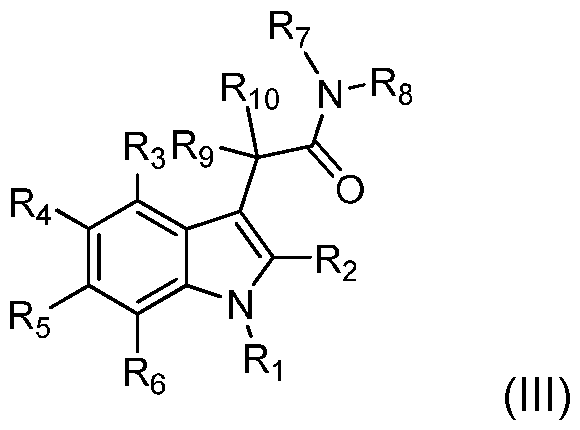
  • the present disclosure relates to the preparation of compounds of Formula (III): wherein, Ri represents hydrogen, a linear or branched alkyl group of any length, possibly substituted, or an alkenyl group of any length, possibly substituted, or an alkynyl group, possibly substituted, or a cycloalkyl group, possibly substituted, or an aryl group, possibly substituted, or an heteroaryl group, possibly substituted, or an acyl group, possibly substituted, ora carbamate group, possibly substituted, or an OR c group or an NR C 2 group, possibly substituted, in which R c is a hydrogen atom or a cyclic, linear or branched alkyl, aryl or alkenyl group;
  • R2 to Rio represent hydrogen, deuterium, a linear or branched alkyl group of any length, possibly substituted, or an alkenyl group of any length, possibly substituted, or an alkynyl group, possibly substituted, or a cycloalkyl group, possibly substituted, or an aryl group, possibly substituted, or an heteroaryl group, possibly substituted, or two adjacent or geminal groups are bonded together to form an optionally substituted ring, or an acyl group, possibly substituted, and one or more of the carbon atoms in the alkyl, alkenyl, alkynyl, cycloalkyl, aryl, heteroaryl or acyl groups of R2 to R10 is optionally replaced with a heteroatom selected from the group consisting of O, S, N, P and Si, which, where possible, is optionally substituted with one or more groups.
  • the compounds of Formula (III) can be prepared and isolated prior to use.
  • the compound of Formula (III) is achiral. In another embodiment of the disclosure, the compound of Formula (III) is chiral.
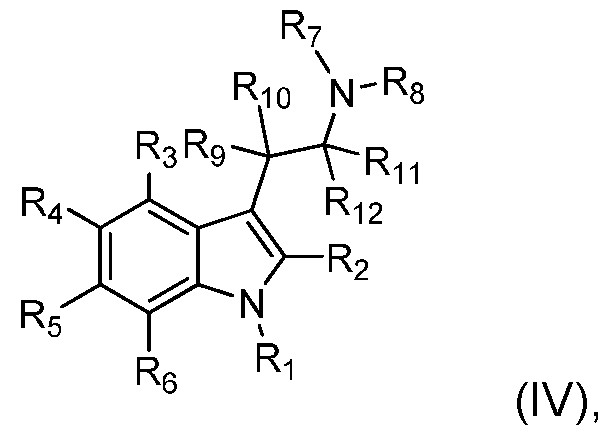
  • the present invention relates to the preparation of tryptamine compounds of Formula (IV): wherein,
  • Ri represents hydrogen, a linear or branched alkyl group of any length, possibly substituted, or an alkenyl group of any length, possibly substituted, or an alkynyl group, possibly substituted, or a cycloalkyl group, possibly substituted, or an aryl group, possibly substituted, or an heteroaryl group, possibly substituted, or an acyl group, possibly substituted, ora carbamate group, possibly substituted, or an OR c group or an NR C 2 group, possibly substituted, in which R c is a hydrogen atom or a cyclic, linear or branched alkyl, aryl or alkenyl group;
  • R2 to Rio represent hydrogen, deuterium, a linear or branched alkyl group of any length, possibly substituted, or an alkenyl group of any length, possibly substituted, or an alkynyl group, possibly substituted, or a cycloalkyl group, possibly substituted, or an aryl group, possibly substituted, or an heteroaryl group, possibly substituted, or two adjacent or geminal groups are bonded together to form an optionally substituted ring, or an acyl group, possibly substituted, and one or more of the carbon atoms in the alkyl, alkenyl, alkynyl, cycloalkyl, aryl, heteroaryl or acyl groups of R2 to R10 is optionally replaced with a heteroatom selected from the group consisting of O, S, N, P and Si, which, where possible, is optionally substituted with one or more groups; and R11 to Ri 2 represent hydrogen or deuterium.
  • the compounds of Formula (IV) can be prepared and isolated prior to use.
  • the compound of Formula (IV) is achiral.
  • the compound of Formula (IV) is chiral.
  • one or more of the carbon-12 atoms in the molecule are replaced with carbon-13.
  • the transformations to which the compounds of the invention can be applied include but are not limited to catalytic and non-catalytic carbon-carbon bond forming Negishi reactions.
  • Such carbon-carbon bond forming reactions include the use of compounds of the present disclosure to prepare tryptamine compounds.
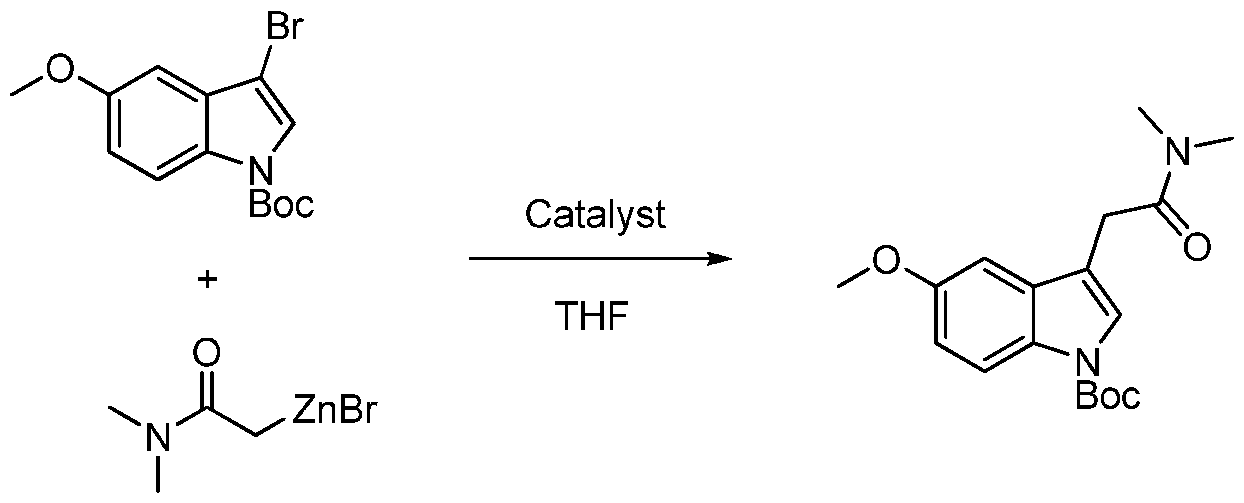
  • Scheme 1 illustrates the preparation of tert-Butyl 3-(2-(dimethylamino)- 2-oxoethyl)-5-methoxy-1 H-indole-1 -carboxylate, 2-(5-m ethoxy- 1 H-indol-3-yl)- N,N-dimethylethanamine (5-MeO-DMT) and 3-(2-(dimethylamino)ethyl)-1 H- indol-5-ol (bufotenin), according to the processes of this invention. This is shown as Figure 1.
  • Figure 1 shows the scheme for the catalytic preparation of 5-MeO-DMT and bufotenin
  • Figure 2 shows the X-ray crystal structure of tert-butyl 5-acetoxy-3- bromo-1 H-indole-1-carboxylate
  • Figure 3 shows the X-ray crystal structure of tert-butyl 3-bromo-5- methoxy-1 H-indole-1 -carboxylate
  • Figure 4 shows the X-ray crystal structure of tert-butyl 3-(2-
  • Figure 5 shows the X-ray crystal structure of 2-(1 H-indol-3-yl)-N,N- diisopropylacetamide
  • Figure 6 shows the X-ray crystal structure of 2-(1 H-indol-3-yl)-N,N- dimethylbutanamide
  • Figure 7 shows the X-ray crystal structure of 4-(2-(1 H-indol-3- yl)ethyl)morpholine
  • Figure 8 shows the 1 H NMR spectrum of tert-butyl 3-(2-(dimethylamino)- 2-oxoethyl)-1 H-indole-1 -carboxylate
  • Figure 9 shows the 1 H NMR spectrum of 2-(1 H-indol-3-yl)-N,N- dimethylacetamide
  • Figure 10 shows the 1 H NMR spectrum of tert-butyl 3-(1- (dimethylamino)-l -oxopropan-2-yl)-1 H-indole-1 -carboxylate;
  • Figure 11 shows the 1 H NMR spectrum of 2-(1 H-indol-3-yl)-N,N- dimethylpropanamide
  • Figure 12 shows the 1 H NMR spectrum of 2-(1 H-indol-3-yl)-N,N- dimethylbutanamide
  • Figure 13 shows the 1 H NMR spectrum of 2-(5-methoxy-1 H-indol-3-yl)- N,N-dimethylacetamide;
  • Figure 14 shows the 1 H NMR spectrum of 2-(4-methoxy-1 H-indol-3-yl)-
  • Figure 15 shows the 1 H NMR spectrum of 2-(1 H-indol-3-yl)-N,N- diisopropylacetamide
  • Figure 16 shows the 1 H NMR spectrum of N,N-diisopropyl-2-(5-methoxy- 1 H-indol-3-yl)acetamide
  • Figure 17 shows the 1 H NMR spectrum of tert-butyl 3-(2-morpholino-2- oxoethyl)-1 H-indole-1 -carboxylate;
  • Figure 18 shows the 1 H NMR spectrum of 2-(1 H-indol-3-yl)-1- morpholinoethanone;
  • Figure 19 shows the 1 H NMR spectrum of 4-(2-(1 H-indol-3- yl)ethyl)morpholine
  • Figure 20 shows the 1 H NMR spectrum of tert-butyl 5-methoxy-3-(2- morpholino-2-oxoethyl)-1 H-indole-1 -carboxylate;
  • Figure 21 shows the 1 H NMR spectrum of 2-(5-methoxy-1 H-indol-3-yl)- 1 -morpholinoethanone
  • Figure 22 shows the 1 H NMR spectrum of 4-(2-(5-methoxy-1 H-indol-3- yl)ethyl)morpholine.
  • (Ci-Cp)-alkyl as used herein means straight and/or branched chain, saturated alkyl radicals containing one or more carbon atoms and includes (depending on the identity of “p”) methyl, ethyl, propyl, isopropyl, n- butyl, s-butyl, isobutyl, t-butyl, 2,2-dimethylbutyl, n-pentyl, 2-methylpentyl, 3- methylpentyl, 4-methylpentyl, n-hexyl and the like.
  • (C2-C P )-alkenyl as used herein means straight and/or branched chain, unsaturated alkyl radicals containing two or more carbon atoms and one to three double bonds, and includes (depending on the identity of “p”) vinyl, allyl, 2-methylprop-1-enyl, but-1-enyl, but-2-enyl, but-3-enyl, 2- methylbut-1-enyl, 2-methylpent-1-enyl, 4-methylpent-1-enyl, 4-methylpent-2- enyl, 2-methylpent-2-enyl, 4-methylpenta-1 ,3-dienyl, hexen-1-yl and the like.
  • (C2-C P )-alkynyl as used herein means straight and/or branched chain, unsaturated alkyl radicals containing two or more carbon atoms and one to three triple bonds, and includes (depending on the identity of “p”) ethynyl, propynyl, but-1-ynyl, but-2-ynyl, but-3-ynyl, 3-methylbut-1-enyl, 3- methylpent-1-ynyl, 4-methylpent-1-ynyl, 4-methylpent-2-ynyl, penta-1 ,3-di- ynyl, hexyn-1-yl and the like.
  • (Ci-Cp)-alkoxy as used herein means straight and/or branched chain alkoxy group containing one or more carbon atoms and includes (depending on the identity of “p”) methoxy, ethoxy, propyloxy, isopropyloxy, t-butoxy, heptoxy, and the like.
  • (C3-C P )-cycloalkyl as used herein means a monocyclic, bicyclic or tricyclic saturated carbocylic group containing three or more carbon atoms and includes (depending on the identity of “p”) cyclopropyl, cyclobutyl, cyclopentyl, cyclodecyl and the like.
  • (C6-C P )-aryl as used herein means a monocyclic, bicyclic or tricyclic aromatic ring system containing at least one aromatic ring and 6 or more carbon atoms (and depending on the identity of “p”) and includes phenyl, naphthyl, anthracenyl, 1 ,2-dihydronaphthyl, 1 ,2,3,4-tetrahydronaphthyl, fluorenyl, indanyl, indenyl and the like.
  • (C5-C P )-heteroaryl as used herein means a monocyclic, bicyclic or tricyclic ring system containing one or two aromatic rings and 5 or more atoms of which, unless otherwise specified, one, two, three, four or five are heteromoieties independently selected from N, NH, N(alkyl), O and S and depending on the value of “p” includes thienyl, furyl, pyrrolyl, pyrididyl, indolyl, quinolyl, isoquinolyl, tetrahydroquinolyl, benzofuryl, benzothienyl and the like.
  • halo or “halogen” as used herein means chloro, fluoro, bromo or iodo.
  • fluoro-substituted means that at least one, including all, of the hydrogens on the referenced group is replaced with fluorine.
  • ring system refers to a carbon-containing ring system, that includes monocycles, fused bicyclic and polycyclic rings, bridged rings and metalocenes. Where specified, the carbons in the rings may be substituted or replaced with heteroatoms.
  • leaving group refers to a group capable of being displaced from a compound when the compound undergoes reaction with a nucleophile.
  • the term “comprising” and its derivatives, as used herein are intended to be open ended terms that specify the presence of the stated features, elements, components, groups, integers, and/or steps, but do not exclude the presence of other unstated features, elements, components, groups, integers and/or steps.
  • the foregoing also applies to words having similar meanings such as the terms, “including”, “having” and their derivatives. For instance, “including” also encompasses “including but not limited to”.
  • Ri represents hydrogen, a linear or branched alkyl group of any length, possibly substituted, or an alkenyl group of any length, possibly substituted, or an alkynyl group, possibly substituted, or a cycloalkyl group, possibly substituted, or an aryl group, possibly substituted, or an heteroaryl group, possibly substituted, or an acyl group, possibly substituted, or a carbamate group, possibly substituted, or an OR c group or an NR C 2 group, possibly substituted, in which R c is a hydrogen atom ora cyclic, linear or branched alkyl, aryl or alkenyl group;
  • LG represents any suitable leaving group, such as a halide group, sulphonate, or any other anionic leaving group
  • R2 to R6 represent hydrogen, deuterium, a linear or branched alkyl group of any length, possibly substituted, or an alkenyl group of any length, possibly substituted, or an alkynyl group, possibly substituted, or a cycloalkyl group, possibly substituted, or an aryl group, possibly substituted, or an heteroaryl group, possibly substituted, or two adjacent or geminal groups are bonded together to form an optionally substituted ring, or an acyl group, possibly substituted, and one or more of the carbon atoms in the alkyl, alkenyl, alkynyl, cycloalkyl, aryl, heteroaryl or acyl groups of R2 to R6 is optionally replaced with a heteroatom selected from the group consisting of O, S, N, P and Si, which, where possible, is optionally substituted with one or more groups.
  • the compounds of Formula (I) can be prepared and isolated prior to use.
  • the compound of Formula (I) is achiral.
  • the compound of Formula (I) is chiral.
  • Ri is a nitrogen protecting group such as a phosphinyl group, a phosphoryl group, a sulfenyl group, a sulfonyl group, or a silyl group (such as TMS, TIPS, TBDMS).
  • a nitrogen protecting group such as a phosphinyl group, a phosphoryl group, a sulfenyl group, a sulfonyl group, or a silyl group (such as TMS, TIPS, TBDMS).
  • LG represents any suitable leaving group, such as a halide group, sulphonate, or any other anionic leaving group.
  • LG is chloro, bromo or iodo.
  • LG is mesylate, triflate or tosylate.
  • R2 to R6 represent hydrogen, deuterium, (OI-OQ)- alkyl, (C2-C6)-alkenyl, (C2-C6)-alkynyl, (C3-C7)-cycloalkyl, (Ce)-aryl, or (Cs-Ce)- heteroaryl.
  • the present disclosure also relates to a tryptamine precursors of Formula (I), wherein one or more of the carbon-12 atoms are replaced with carbon-13.
  • the present disclosure also relates to zinc amide enolates of Formula (II): wherein,
  • R7 to R10 represent hydrogen, deuterium, a linear or branched alkyl group of any length, possibly substituted, or an alkenyl group of any length, possibly substituted, or an alkynyl group, possibly substituted, or a cycloalkyl group, possibly substituted, or an aryl group, possibly substituted, or an heteroaryl group, possibly substituted, or two adjacent or geminal groups are bonded together to form an optionally substituted 5-10-membered carboyclic or heterocyclic ring, or an acyl group, possibly substituted, and one or more of the carbon atoms in the alkyl, alkenyl, alkynyl, cycloalkyl, aryl, heteroaryl or acyl groups of R7 to R10 is optionally replaced with a heteroatom selected from the group consisting of O, S, N, P and Si, which, where possible, is optionally substituted with one or more groups.
  • R7 to R10 represent hydrogen, deuterium, (OI-OQ)- alkyl, (C2-C6)-alkenyl, (C2-C6)-alkynyl, (C3-C7)-cycloalkyl, (Ce)-aryl, or (Cs-Ce)- heteroaryl.
  • R7 and Re are joined together, along with the nitrogen atom to which they are attached, to form a 5-8-membered carbocyclic or heterocyclic ring.
  • the compounds of Formula (II) can be prepared and isolated prior to use.
  • the compound of Formula (II) is achiral.
  • the compound of Formula (II) is chiral.
  • Ri represents hydrogen, a linear or branched alkyl group of any length, possibly substituted, or an alkenyl group of any length, possibly substituted, or an alkynyl group, possibly substituted, or a cycloalkyl group, possibly substituted, or an aryl group, possibly substituted, or an heteroaryl group, possibly substituted, or an acyl group, possibly substituted, or a carbamate group, possibly substituted, or an OR c group or an NR C 2 group, possibly substituted, in which R c is a hydrogen atom ora cyclic, linear or branched alkyl, aryl or alkenyl group;
  • R2 to Rio represent hydrogen, deuterium, a linear or branched alkyl group of any length, possibly substituted, or an alkenyl group of any length, possibly substituted, or an alkynyl group, possibly substituted, or a cycloalkyl group, possibly substituted, or an aryl group, possibly substituted, or an heteroaryl group, possibly substituted, or two adjacent or geminal groups are bonded together to form an optionally substituted ring, or an acyl group, possibly substituted, and one or more of the carbon atoms in the alkyl, alkenyl, alkynyl, cycloalkyl, aryl, heteroaryl or acyl groups of R2 to R10 is optionally replaced with a heteroatom selected from the group consisting of O, S, N, P and Si, which, where possible, is optionally substituted with one or more groups.
  • R2 to R10 represent hydrogen, deuterium, (OI-OQ)- alkyl, (C2-C6)-alkenyl, (C2-C6)-alkynyl, (C3-C7)-cycloalkyl, (Ce)-aryl, or (Cs-Ce)- heteroaryl.
  • the compounds of Formula (III) can be prepared and isolated prior to use.
  • the compound of Formula (III) is achiral. In another embodiment of the disclosure, the compound of Formula (III) is chiral.
  • Ri represents hydrogen, a linear or branched alkyl group of any length, possibly substituted, or an alkenyl group of any length, possibly substituted, or an alkynyl group, possibly substituted, or a cycloalkyl group, possibly substituted, or an aryl group, possibly substituted, or an heteroaryl group, possibly substituted, or an acyl group, possibly substituted, or a carbamate group, possibly substituted, or an OR c group or an NR C 2 group, possibly substituted, in which R c is a hydrogen atom ora cyclic, linear or branched alkyl, aryl or alkenyl group; R2 to Rio represent hydrogen, deuterium, a linear or branched alkyl group of any length, possibly substituted, or an alkenyl group of any length, possibly substituted, or an alkynyl group, possibly substituted, or a cycloalkyl group, possibly substituted, or an aryl group, possibly substituted, or an heteroaryl
  • R11 to R12 represent hydrogen or deuterium.
  • f3 ⁇ 4 to R10 represent hydrogen, deuterium, (C1-C6)- alkyl, (C2-Ce)-alkenyl, (C2-Ce)-alkynyl, (C3-C7)-cycloalkyl, (Ce)-aryl, or (Cs-Ce)- heteroaryl.
  • the compounds of Formula (IV) can be prepared and isolated prior to use.
  • the compound of Formula (IV) is achiral.
  • the compound of Formula (IV) is chiral. In another embodiment, one or more of the carbon-12 atoms in the molecule are replaced with carbon-13.
  • the present disclosure relates to compounds of Formula (V), Formula (VI), Formula (VII) and Formula (VIII):
  • Ri represents hydrogen, a linear or branched alkyl group of any length, possibly substituted, or an alkenyl group of any length, possibly substituted, or an alkynyl group, possibly substituted, or a cycloalkyl group, possibly substituted, or an aryl group, possibly substituted, or an heteroaryl group, possibly substituted, or an acyl group, possibly substituted, or a carbamate group, possibly substituted, or an OR c group or an NR C 2 group, possibly substituted, in which R c is a hydrogen atom ora cyclic, linear or branched alkyl, aryl or alkenyl group;
  • R2 to R10 represent hydrogen, deuterium, a linear or branched alkyl group of any length, possibly substituted, or an alkenyl group of any length, possibly substituted, or an alkynyl group, possibly substituted, or a cycloalkyl group, possibly substituted, or an aryl group, possibly substituted, or an heteroaryl group, possibly substituted, or two adjacent or geminal groups are bonded together to form an optionally substituted ring, or an acyl group, possibly substituted, and one or more of the carbon atoms in the alkyl, alkenyl, alkynyl, cycloalkyl, aryl, heteroaryl or acyl groups of R2 to R10 is optionally replaced with a heteroatom selected from the group consisting of O, S, N, P and Si, which, where possible, is optionally substituted with one or more groups.
  • R2 to R10 represent hydrogen, deuterium, (OI-OQ)- alkyl, (C2-C6)-alkenyl, (C2-C6)-alkynyl, (C3-C7)-cycloalkyl, (Ce)-aryl, or (Cs-Ce)- heteroaryl
  • the compounds of Formula (V), Formula (VI), Formula (VII) and Formula (VIII) are achiral.
  • the compounds of Formula (V), Formula (VI), Formula (VII) and Formula (VIII) are chiral. In another embodiment, one or more of the carbon-12 atoms in the molecule are replaced with carbon-13.
  • the present disclosure also relates to processes for the preparation of compounds of Formula (III): with a compound of Formula (II): in the presence of a suitable catalyst, wherein the variables R1-R10 and LG are as defined above.
  • Suitable catalysts include but are not limited to transition metal salts and complexes, such as compounds of palladium, nickel, iron, ruthenium, cobalt, rhodium, iridium and copper.
  • the catalysts are chiral and can facilitate asymmetric carbon-carbon bond forming reactions.
  • the disclosure also relates to processes for the catalytic and non- catalytic conversion of compounds of Formula (III): to compounds of Formula (IV):
  • Carbon-carbon bond forming reactions for the preparation of compounds of Formula (III) include but are not limited to catalytic and non-catalytic Negishi reactions.
  • Reactions for the preparation of compounds of Formula (IV) include but are not limited to catalytic and non-catalytic reduction and hydrogenation reactions.
  • Suitable reducing agents include borohydrides, borodeuterides, aluminohydrides, aluminodeuterides, silanes, boranes, hydrogen gas and deuterium gas.
  • the catalytic system characterizing the process of the instant invention may comprise a base.
  • said base can be any conventional base.
  • non-limiting examples include: organic non-coordinating bases such as DBU, an alkaline or alkaline-earth metal carbonate, a carboxylate salt such as sodium or potassium acetate, or an alcoholate or hydroxide salt.
  • Preferred bases are the alcoholate or hydroxide salts selected from the group consisting of the compounds of formula (RO)2l and ROM”, wherein M’ is an alkaline-earth metal, M” is an alkaline metal and R stands for hydrogen or a linear or branched alkyl group.
  • the catalyst can be added to the reaction medium in a large range of concentrations.
  • catalyst concentration values ranging from 0.001 % to 50 %, relative to the amount of substrate, thus representing respectively a substrate/catalyst (S/cat) ratio of 100,000 to 2.
  • the complex concentration will be comprised between 0.01 % and 10 %, i.e. a S/cat ratio of 10,000 to 10 respectively.
  • concentrations in the range of 0.1 to 5 %, corresponding to a S/cat ratio of 1000 to 20 respectively.
  • useful quantities of base, added to the reaction mixture may be comprised in a relatively large range.
  • non-limiting examples include: ranges between 1 to 100 molar equivalents relative to the substrate.
  • base/substrate 1 to 3
  • the catalytic reaction can be carried out in the presence or absence of a solvent.
  • a solvent is required or used for practical reasons, then any solvent currently used in catalytic reactions can be used for the purposes of the invention.
  • Non-limiting examples include aromatic solvents such as benzene, toluene or xylene, hydrocarbon solvents such as hexane or cyclohexane, ethers such as tetrahydrofuran, or yet primary or secondary alcohols, or water, or mixtures thereof.
  • aromatic solvents such as benzene, toluene or xylene
  • hydrocarbon solvents such as hexane or cyclohexane
  • ethers such as tetrahydrofuran
  • water or mixtures thereof.
  • a person skilled in the art is well able to select the solvent most convenient in each case to optimize the catalytic reaction.
  • the temperature at which the catalytic reaction can be carried out is comprised between -30 °C and 200 °C, more preferably in the range of between 0 °C and 100 °C.
  • a person skilled in the art is also able to select the preferred temperature.
  • Standard catalytic conditions typically implies the mixture of the substrate with the catalyst with or without a base, possibly in the presence of a solvent, and then treating such a mixture with the desired reactant at a chosen temperature in air or under an inert atmosphere of nitrogen or argon gas. Varying the reaction conditions, including for example, catalyst, temperature, solvent and reagent, to optimize the yield of the desired product would be well within the abilities of a person skilled in the art.
  • Acetic anhydride (3.27 g, 32 mmol) was added slowly to a mixture of 4- hydroxyindole (3.88 g, 29 mmol) and triethylamine (4.4 g, 44 mmol) in dichloromethane (50 ml) at room temperature. The reaction was stirred for 3 hours, then water (30 ml) added. The phases were separated, and the aqueous layer was extracted with dichloromethane (2 x 15 ml). The combined organic layer was washed with water (50 ml), then brine (20 ml) and dried (MgSC ).
  • Triethylamine (3.04 g, 30 mmol) was added to a solution of 4-(tert- butyldimethylsilyloxy)-1 H-indole (3.1 g, 12.5 mmol) in dichloromethane (20 ml) and di-tert-butyl decarbonate (3.27 g, 15 mmol) added, followed by DMAP (0.08 g, 0.65 mmol).
  • the mixture was stirred for 24 hours with venting of the evolved gas through a bubbler.
  • the reaction was evaporated to dryness and the residue was eluted through a pad of silica gel using hexanes/ether (7:1).
  • Example 6 Preparation of tert-butyl 3-bromo-4-(tert- butyldimethylsilyloxy)-1 H-indole-1 -carboxylate
  • NBS (0.282 g, 1.58 mmol) was added to a mixture of tert-butyl 4-(tert- butyldimethylsilyloxy)-1 H-indole-1 -carboxylate (0.5 g, 1.44 mmol) in dichloromethane (10 ml) and the reaction stirred overnight at room temperature. It was quenched with saturated NaHC03 solution (10 ml) and the phases separated. The aqueous layer was extracted with dichloromethane (2 x 10 ml) and the combined organic portion was washed water (10 ml), then dried over MgS04 and filtered.
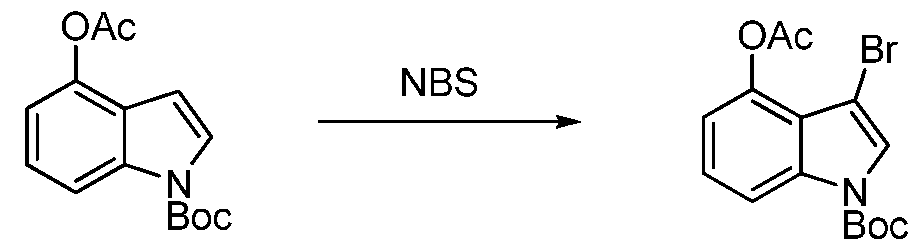
  • Boc Boc NBS (9.0 g, 50.6 mmol) was added to a mixture of tert-butyl 4-methoxy-1 H- indole-1-carboxylate (11.5 g, 46.5 mmol) and NFUCI (20 mg) in dichloromethane (200 ml), THF (10 ml) and DMF (4 drops) and the reaction stirred overnight at room temperature. It was quenched with saturated NaHCCb solution (100 ml) and the phases separated. The aqueous layer was extracted with dichloromethane (2 x 30 ml) and the combined organic portion was washed with brine (50 ml), then water (50 ml), then dried over MgSC and filtered.
  • Acetic anhydride (4.4 g, 43 mmol) was added slowly to a mixture of 5- hydroxyindole (5.2 g, 39 mmol) and triethylamine (5.9 g, 58 mmol) in dichloromethane (50 ml) at room temperature. The reaction was stirred for 3 hours, then water (30 ml) added. The phases were separated, and the aqueous layer was extracted with dichloromethane (2 x 15 ml). The combined organic layer was washed with water (100 ml), then brine (20 ml) and dried (MgSC ).
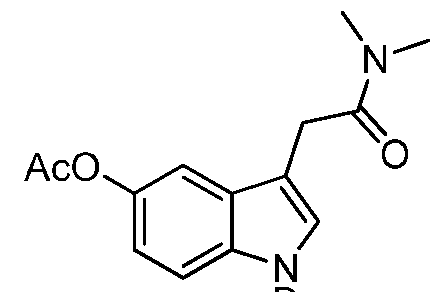
  • Figure 2 shows the X-ray crystal structure of tert-Butyl 5-acetoxy-3-bromo-1 H- indole-1 -carboxylate.
  • Example 13 Preparation of tert-butyl 5-(tert-butyldimethylsilyloxy)-1H- indole-1 -carboxylate Triethylamine (3.04 g, 30 mmol) was added to a solution of 5-(tert- butyldimethylsilyloxy)-1 H-indole (3.1 g, 12.5 mmol) in dichloromethane (20 ml) and di-tert-butyl decarbonate (3.27 g, 15 mmol) added, followed by DMAP (0.08 g, 0.65 mmol). The mixture was stirred for 24 hours with venting of the evolved gas through a bubbler.
  • NBS (0.282 g, 1.58 mmol) was added to a mixture of tert-butyl 5-(tert- butyldimethylsilyloxy)-1 H-indole-1 -carboxylate (0.5 g, 1.44 mmol) in dichloromethane (10 ml) and the reaction stirred overnight at room temperature. It was quenched with saturated NaHC03 solution (10 ml) and the phases separated. The aqueous layer was extracted with dichloromethane (2 x 10 ml) and the combined organic portion was washed water (10 ml), then dried over MgS04 and filtered.
  • NBS (9.0 g, 50.6 mmol) was added to a mixture of tert-butyl 5-methoxy-1 H- indole-1-carboxylate (11.5 g, 46.5 mmol) and NFUCI (20 mg) in dichloromethane (200 ml), THF (10 ml) and DMF (4 drops) and the reaction stirred for one hour at room temperature. It was quenched with saturated NaHCCb solution (100 ml) and the phases separated. The aqueous layer was extracted with dichloromethane (2 x 30 ml) and the combined organic portion was washed with brine (50 ml), then water (50 ml), then dried over MgSC and filtered.
  • Figure 3 shows the X-ray crystal structure of tert-butyl 3-bromo-5-methoxy-1 H- indole-1 -carboxylate.
  • Example 18 Preparation of tert-butyl 3-bromo-1H-indole-1-carboxylate NBS (10.36 g, 58 mmol) was added to a mixture of tert-butyl 1 H-indole-1 - carboxylate (12.05 g, 55.4 mmol) and NhUCI (30 mg) in dichloromethane (150 ml) and the reaction stirred overnight at room temperature. Water (40 ml) was added, and the phases separated. The combined organic portion was washed with brine (30 ml), then water (20 ml), then dried over MgSC and filtered.
  • Example 20 Preparation of 3-bromo-5-methoxy-1-tosyl-1H-indole A solution of NBS (0.30 g, 1.7 mmol) in dichloromethane (5 ml) was added dropwise to a mixture of 5-methoxy-1-tosyl-1 H-indole (0.50 g, 1.66 mmol) in dichloromethane (30 ml) at 0 °C. The reaction was stirred overnight at room temperature. Water (40 ml) was added, and the phases separated. The combined organic portion was washed with brine (30 ml), then water (20 ml), then dried over MgSC and filtered.
  • Example 27 General procedure for the preparation of a-bromo amides A solution of the amine (99.1 mmol) in dichloromethane (100 ml) was added to a solution of 2-bromoacetyl bromide (49.5 mmol) in dichloromethane (50 ml) at -16 °C over 30 minutes and the reaction mixture stirred for another 30 minutes after the addition was completed. It was allowed to warm to room temperature and stirred for another one hour. Water (50 ml) was added, and the phases separated. The aqueous layer was extracted with dichloromethane (2 x 10 ml). The combined organic portion was washed with brine, dried over MgSC , filtered and the solvent removed under vacuum to yield the product.
  • Example 28 General procedure for the preparation of zinc amide enolates
  • Zinc granules (0.90 g, 13.76 mmol) were dried under vacuum while heating in a Schlenk flask, then refilled with argon. The flask was cooled to room temperature and a pinch of iodine was added while the flask was still warm.
  • the a-bromo amide (12.53 mmol) was degassed with argon and dry THF (22 ml) added.
  • the amide solution was added dropwise to the zinc at 0 °C with vigorous stirring. The mixture was allowed to warm to room temperature after the addition was completed and the stirring continued until all the amide reacted.
  • the zinc amide enolates were used as a suspension in THF.
  • Example 28(ii). (1-(Dimethylamino)-1-oxopropan-2-yl)zinc(ll) bromide
  • Example 28(iii). (1-(Dimethylamino)-1-oxobutan-2-yl)zinc(ll) bromide
  • Example 29. Catalyst screening for the Negishi coupling of tert-butyl 3- bromo-5-methoxy-1 H-indole-1 -carboxylate and (2-(dimethylamino)-2- oxoethyl)zinc(ll) bromide
  • Figure 20 shows the 1 H NMR spectrum of tert-Butyl 5-methoxy-3-(2- morpholino-2-oxoethyl)-1 H-indole-1 -carboxylate.
  • Example 30(vi) tert-Butyl 3-(2-(diethylamino)-2-oxoethyl)-5-methoxy-1H- indole-1 -carboxylate
  • Figure 4 shows the X-ray crystal structure of tert-Butyl 3-(2-(diisopropylamino)- 2-oxoethyl)-5-methoxy-1 H-indole-1 -carboxylate.
  • Figure 8 shows the 1 H NMR spectrum of tert-Butyl 3-(2-(dimethylamino)-2- oxoethyl)-1 H-indole-1 -carboxylate.
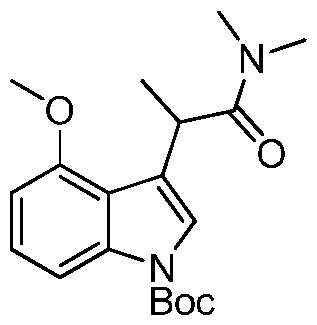
  • Example 30(xiv) tert-Butyl 3-(1-(dimethylamino)-1-oxopropan-2-yl)-1H- indole-1 -carboxylate
  • Figure 10 shows the 1 H NMR spectrum of tert-Butyl 3-(1-(dimethylamino)-1- oxopropan-2-yl)-1 H-indole-1 -carboxylate.
  • Example 30(xv). tert-Butyl 3-(1-(dimethylamino)-1-oxobutan-2-yl)-1H- indole-1 -carboxylate
  • Figure 17 shows the 1 H NMR spectrum of tert-Butyl 3-(2-morpholino-2- oxoethyl)-1 H-indole-1 -carboxylate.
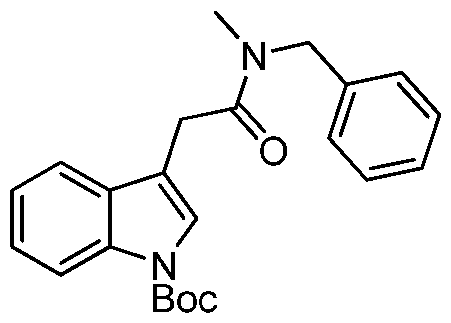
  • Example 30(xx) tert-Butyl 3-(2-(benzyl(methyl)amino)-2-oxoethyl)-1H- indole-1 -carboxylate
  • Example 31 General procedure for the preparation of 2-(1H-indol-3-yl) acetamides A mixture of Cone. HCI (1 .0 ml) and methanol (2 ml) was added to the tert-butyl 3-(2-amino-2-oxoethyl)-1 H-indole-1-carboxylate (50 mg) and the mixture stirred for 12-24 hours at room temperature until the reaction was completed (TLC). The mixture was evaporated under reduced pressure and sodium carbonate solution added to the residue. The mixture was stirred for 10 minutes, then dichloromethane added, and the phases separated. The organic layer was dried over MgSC , then filtered and the solvent removed under reduced pressure. The residue was eluted through a silica gel pad. The eluent was evaporated to yield the crude product, which was purified by silica gel chromatography.
  • Figure 13 shows the 1 H NMR spectrum of 2-(5-Methoxy-1 H-indol-3-yl)-N,N- dimethylacetamide.
  • Figure 21 shows the 1 H NMR spectrum of 2-(5-Methoxy-1 H-indol-3-yl)-1- morpholinoethanone.
  • Example 31 (vii) N,N-Diisopropyl-2-(5-methoxy-1 H-indol-3-yl)acetamide
  • Figure 16 shows the 1 H NMR spectrum of N,N-Diisopropyl-2-(5-methoxy-1 H- indol-3-yl)acetamide.
  • Example 31 (viii) N-Benzyl-2-(5-methoxy-1H-indol-3-yl)-N- methylacetamide
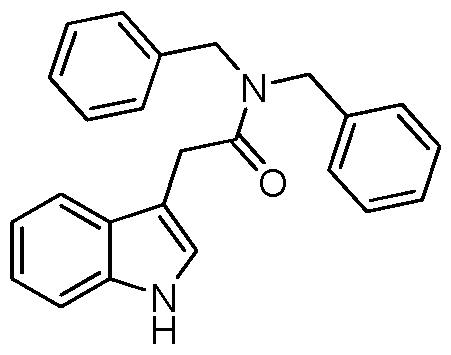
  • Example 31 (ix) N,N-dibenzyl-2-(5-methoxy-1 H-indol-3-yl)acetamide
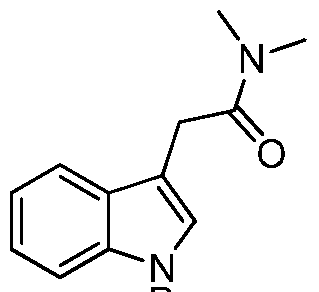
  • Figure 9 shows the 1 H NMR spectrum of 2-(1 H-indol-3-yl)-N,N- dimethylacetamide.
  • Figure 11 shows the 1 H NMR spectrum of 2-(1 H-indol-3-yl)-N,N- dimethylpropanamide.
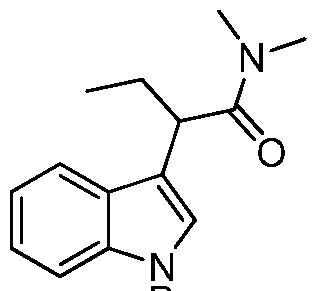
  • Figure 6 shows the X-ray crystal structure of 2-(1 H-indol-3-yl)-N,N- dimethylbutanamide.
  • Figure 12 shows the 1 H NMR spectrum of 2-(1 H-indol-3-yl)-N,N- dimethylbutanamide.
  • Example 31 (xvi). 2-(1 H-indol-3-yl)-1 -(pyrrolidin-1 -yl)ethanone
  • Figure 18 shows the 1 H NMR spectrum of 2-(1 H-indol-3-yl)-1- morpholinoethanone.
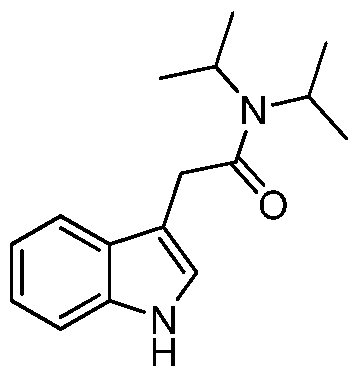
  • Figure 5 shows the X-ray crystal structure of 2-(1 H-indol-3-yl)-N,N- diisopropylacetamide.
  • Figure 15 shows the 1 H NMR spectrum of 2-(1 H-indol-3-yl)-N,N- diisopropylacetamide.
  • Figure 14 shows the 1 H NMR spectrum of 2-(4-m ethoxy- 1 H-indol-3-yl)-N,N- dimethylacetamide.
  • Lithium aluminium hydride solution (1.0 ml of a 1.0 M solution in THF) was added to the 2-(1 H-indol-3-yl) acetamide (50 mg) in a Schlenk flask under argon and the mixture stirred for one hour. The solvent was removed, and ether (2 ml) added. Water (2 ml) was added dropwise at 0 °C and the resulting suspension stirred for 30 minutes. The phases were separated, and the ether layer was dried with MgSC , filtered and the solvent removed under reduced pressure to give the product.
  • Figure 22 shows the 1 H NMR spectrum of 4-(2-(5-methoxy-1 H-indol-3- yl)ethyl)morpholine.
  • Example 32(viii) 2-(5-methoxy-1H-indol-3-yl)-N,N-bis(methyl- d3)ethanamine
  • Example 32(ix) 2-(5-methoxy-1H-indol-3-yl)-N,N-di(methyl-
  • Figure 19 shows the 1 H NMR spectrum of 4-(2-(1 H-indol-3-yl)ethyl)morpholine.
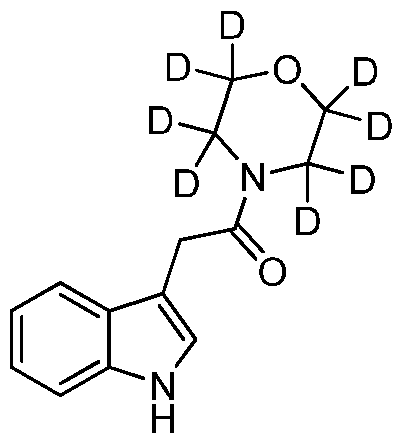
  • Example 32(xiv) 4-(2-(1H-indol-3-yl)ethyl)morpholine-d8
  • Example 32(xv) 2-(4-methoxy-1 H-indol-3-yl)-N,N-dimethylethanamine
  • Lithium aluminium deuteride solution (1.0 ml of a 1.0 M solution in THF) was added to the 2-(1 H-indol-3-yl) acetamide (50 mg) in a Schlenk flask under argon and the mixture stirred for one hour. The solvent was removed, and ether (2 ml) added. Water (2 ml) was added dropwise at 0 °C and the resulting suspension stirred for 30 minutes. The phases were separated, and the ether layer was dried with MgSC , filtered and the solvent removed under reduced pressure to give the product.
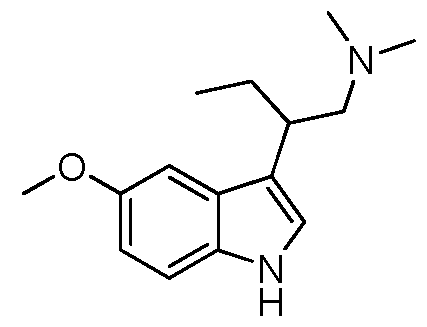
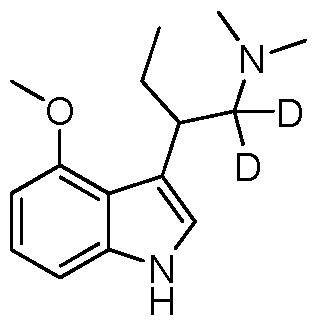
  • Example 33(x) 2-(4-methoxy-1 H-indol-3-yl)-N,N-dimethylbutan-1 -amine- 1,1 -d 2
  • Example 33(xi) 4-methoxy-3-(2-(pyrrolidin-1 -yl)ethyl-2,2-d2)-1 H-indole

Landscapes

  • Chemical & Material Sciences (AREA)
  • Organic Chemistry (AREA)
  • Plural Heterocyclic Compounds (AREA)
  • Pharmaceuticals Containing Other Organic And Inorganic Compounds (AREA)
  • Organic Low-Molecular-Weight Compounds And Preparation Thereof (AREA)
  • Catalysts (AREA)

Abstract

The present disclosure relates to the use of tryptamine precursor compounds and zinc amide enolate compounds for the preparation of tryptamines. The disclosure also relates to the use of catalysts and catalytic processes for the preparation of tryptamines using the zinc amide enolate compounds and the tryptamine precursor compounds.

Description

CATALYTIC TRYPTAMINE PROCESSES AND PRECURSORS
CROSS-REFERENCE TO RELATED APPLICATIONS
This application claims the benefit of priority to U.S. Provisional Application No. 63/184,538 filed May 5, 2021 , the contents of which are incorporated herein by reference in its entirety.
FIELD OF THE DISCLOSURE
The present disclosure relates to the use of zinc amide enolate compounds for the preparation of tryptamines. The disclosure also relates to the use of catalysts and catalytic processes for the preparation of tryptamines using the zinc amide enolate compounds and tryptamine precursor compounds.
BACKGROUND OF THE DISCLOSURE Tryptamines are serotonin analogues, which can be described as derivatives of the indolamine metabolite of the amino acid tryptophan. Tryptamine itself (2-(3-indolyl)ethylamine) activates 5-HT4 receptors and regulates gastrointestinal mobility in humans (J.A. Jenkins etal. Nutrients 2016, 8, 56). The molecular structure of substituted tryptamines contains an indole ring connected to an amino group by an ethyl linker. The indole core, ethyl linker and amino group can be further modified with other substituents.
Figure imgf000003_0001
Tryptamine Serotonin Melatonin
The neurotransmitter serotonin (5-hydrotryptamine or 5-HT) and the sleep regulating hormone melatonin are well-known examples of substituted tryptamines (S. Young, J. Psychiatry Neurosci. 2007, 32, 394-399; R. Jockers et al. Br. J. Pharmacol. 2016, 173, 2702-2725). The tryptamine core is present in more complex compounds such as LSD, ibogaine, mitragynine, yohimbine, cipargamin, methysergide and flovatriptan.
Figure imgf000004_0001
Tryptamine alkaloids are found in fungi, plants and animals. Some of these constitute traditional sources of medicines in various cultures or for neurological and psychotropic uses. These include N,N-dimethyltryptamine (DMT), 5-methoxy-N,N-dimethyltryptamine (5-MeO-DMT), bufotenin, psilocin and psilocybin (D.J. McKenna et al. J. Ethnopharmacol. 1984, 10, 195-223; J.J.H. Rucker et al. Neuropharmacology, 2018, 142, 200). Psilocybin is structurally related to other phosphorylated tryptamine natural products including norbaeocystin, baeocystin, and aeruginascin (J. Fricke et al. Angew. Chem., !nt. Ed. 2017, 56, 12352-12355). On ingestion, psilocybin rapidly hydrolyses to psilocin, which is the pharmaceutically active ingredient (R.J. Dinis-Olivera Drug Metab. Rev. 2017, 49, 84) Natural and synthetic sources of these compounds and their analogues are used as psychedelic drugs. However, they also have medicinal therapeutic uses, and several are being investigated for treating psychiatric illnesses and disorders, opioid use disorders, alcohol use disorders, sleep deprivation, anxiety disorders, major depressive disorders, and cancer-related psychiatric distress (A.C. Krugel and J. Sporn, WO 2021168082] J.P. Roiser and G. Rees Curr. Biol. 2012, 22, 231 ; D.E. Nichols et al. Clin. Pharmacol. Ther. 2017, 101, 209).
Figure imgf000005_0001
Psilocin Psilocybin
In addition to their therapeutic properties, there are increasing worldwide uses of tryptamines as recreational drugs (R. Haroz and M.l. Greenberg, Med. Clin. N. America 2005, 89, 1259-1276). The therapeutic uses and potential for abuse warrant the need for more rigorous research. Currently there is a demand for high purity compounds for investigational and therapeutic studies.
Tryptamines can be obtained from biological sources, biocatalytic processes and synthetic methods. Psilocin, psilocybin, DMT, 5-MeO-DMT and bufotenin can all be extracted from psychedelic mushrooms and plant sources. However, such supplies rely on agricultural practices, which can be difficult and inconsistent. The yields are typically low (1-2% of biomass) and some compounds, such as psilocybin decomposes easily (D. Hoffmeisteretal. Chem. Eur. J. 2019, 25, 897-903). Biosynthetic production methods are currently being developed. These typically use enzymes extracted from mushroom, plant, or animal sources. There are several reports of advances using genetically modified yeasts and microbes, along with efforts to optimize and improve production yields using generational genetic optimization techniques (A.M. Adams et al. Metabolic Engineering 2019, 56, 111-119).
Synthetic methods have been developed for several substituted tryptamines. DMT, psilocin and 5-MeO-DMT can be prepared from the reaction of the respective indole with oxalyl chloride, followed by reaction with dimethylamine and reduction of the carbonyl functionalities with lithium aluminum hydride (M.E. Speeter and W.C. Anthony J. Am. Chem. Soc. 1954, 76, 6208-6210). Phosphorylation of psilocin is used to prepare psilocybin. Bufotenin can be derived from 5-O-benzyl-DMT by catalytic hydrogenolysis.
As research advances, there is a desire for simple and economical means for the preparation of substituted tryptamines, including compound libraries, stable isotope labelled compounds and radioisotope labelled compounds. Advanced clinical studies and commercial launches of successful drug candidates will require cost-effective, environmentally friendly and scalable manufacturing processes.
SUMMARY OF THE DISCLOSURE
The present disclosure, in some aspects, describes a new approach to the synthesis of tryptamines that focuses on the use of commercially available and stable precursors that can be transformed into the desired tryptamine products and their phosphorylated derivatives.
In various aspects, the invention relates to the use of zinc amide enolates and tryptamine precursors for the preparation of tryptamines and their derivatives using catalysts and catalytic processes. The zinc amide enolates and tryptamine precursors can be prepared and purified prior to transformation to the desired products. The indole precursors are air-stable and shelf-stable compounds that can be stored, transported and converted into the desired products on demand. Accordingly, in some embodiments, the present invention relates to precursor compounds of Formula (I):
Figure imgf000007_0001
wherein, Ri represents hydrogen, a linear or branched alkyl group of any length, possibly substituted, or an alkenyl group of any length, possibly substituted, or an alkynyl group, possibly substituted, or a cycloalkyl group, possibly substituted, or an aryl group, possibly substituted, or an heteroaryl group, possibly substituted, or an acyl group, possibly substituted, ora carbamate group, possibly substituted, or an ORc group or an NRC2 group, possibly substituted, in which Rc is a hydrogen atom or a cyclic, linear or branched alkyl, aryl or alkenyl group;
LG represents any suitable leaving group, such as a halide group, sulphonate, or any other anionic leaving group;
R2 to R6 represent hydrogen, deuterium, a linear or branched alkyl group of any length, possibly substituted, or an alkenyl group of any length, possibly substituted, or an alkynyl group, possibly substituted, or a cycloalkyl group, possibly substituted, or an aryl group, possibly substituted, or an heteroaryl group, possibly substituted, or two adjacent or geminal groups are bonded together to form an optionally substituted ring, or an acyl group, possibly substituted, and one or more of the carbon atoms in the alkyl, alkenyl, alkynyl, cycloalkyl, aryl, heteroaryl or acyl groups of R2 to R6 is optionally replaced with a heteroatom selected from the group consisting of O, S, N, P and Si, which, where possible, is optionally substituted with one or more groups.
In a general way, the compounds of Formula (I) can be prepared and isolated prior to use.
In another embodiment of the disclosure, the compound of Formula (I) is achiral.
In another embodiment of the disclosure, the compound of Formula (I) is chiral. In another embodiment, the present disclosure relates to zinc amide enolates of Formula (II):
Figure imgf000008_0001
wherein, R7 to R10 represent hydrogen, deuterium, a linear or branched alkyl group of any length, possibly substituted, or an alkenyl group of any length, possibly substituted, or an alkynyl group, possibly substituted, or a cycloalkyl group, possibly substituted, or an aryl group, possibly substituted, or an heteroaryl group, possibly substituted, or two adjacent or geminal groups are bonded together to form an optionally substituted ring, or an acyl group, possibly substituted, and one or more of the carbon atoms in the alkyl, alkenyl, alkynyl, cycloalkyl, aryl, heteroaryl or acyl groups of R7 to R10 is optionally replaced with a heteroatom selected from the group consisting of O, S, N, P and Si, which, where possible, is optionally substituted with one or more groups. In a general way, the compounds of Formula (II) can be prepared and isolated prior to use.
In another embodiment of the disclosure, the compound of Formula (II) is achiral.
In another embodiment of the disclosure, the compound of Formula (II) is chiral.
In another embodiment, the present disclosure relates to the preparation of compounds of Formula (III):
Figure imgf000008_0002
wherein, Ri represents hydrogen, a linear or branched alkyl group of any length, possibly substituted, or an alkenyl group of any length, possibly substituted, or an alkynyl group, possibly substituted, or a cycloalkyl group, possibly substituted, or an aryl group, possibly substituted, or an heteroaryl group, possibly substituted, or an acyl group, possibly substituted, ora carbamate group, possibly substituted, or an ORc group or an NRC2 group, possibly substituted, in which Rc is a hydrogen atom or a cyclic, linear or branched alkyl, aryl or alkenyl group;
R2 to Rio represent hydrogen, deuterium, a linear or branched alkyl group of any length, possibly substituted, or an alkenyl group of any length, possibly substituted, or an alkynyl group, possibly substituted, or a cycloalkyl group, possibly substituted, or an aryl group, possibly substituted, or an heteroaryl group, possibly substituted, or two adjacent or geminal groups are bonded together to form an optionally substituted ring, or an acyl group, possibly substituted, and one or more of the carbon atoms in the alkyl, alkenyl, alkynyl, cycloalkyl, aryl, heteroaryl or acyl groups of R2 to R10 is optionally replaced with a heteroatom selected from the group consisting of O, S, N, P and Si, which, where possible, is optionally substituted with one or more groups.
In a general way, the compounds of Formula (III) can be prepared and isolated prior to use.
In another embodiment of the disclosure, the compound of Formula (III) is achiral. In another embodiment of the disclosure, the compound of Formula (III) is chiral.
In yet another embodiment, the present invention relates to the preparation of tryptamine compounds of Formula (IV):
Figure imgf000009_0001
wherein,
Ri represents hydrogen, a linear or branched alkyl group of any length, possibly substituted, or an alkenyl group of any length, possibly substituted, or an alkynyl group, possibly substituted, or a cycloalkyl group, possibly substituted, or an aryl group, possibly substituted, or an heteroaryl group, possibly substituted, or an acyl group, possibly substituted, ora carbamate group, possibly substituted, or an ORc group or an NRC2 group, possibly substituted, in which Rc is a hydrogen atom or a cyclic, linear or branched alkyl, aryl or alkenyl group;
R2 to Rio represent hydrogen, deuterium, a linear or branched alkyl group of any length, possibly substituted, or an alkenyl group of any length, possibly substituted, or an alkynyl group, possibly substituted, or a cycloalkyl group, possibly substituted, or an aryl group, possibly substituted, or an heteroaryl group, possibly substituted, or two adjacent or geminal groups are bonded together to form an optionally substituted ring, or an acyl group, possibly substituted, and one or more of the carbon atoms in the alkyl, alkenyl, alkynyl, cycloalkyl, aryl, heteroaryl or acyl groups of R2 to R10 is optionally replaced with a heteroatom selected from the group consisting of O, S, N, P and Si, which, where possible, is optionally substituted with one or more groups; and R11 to Ri 2 represent hydrogen or deuterium.
In a general way, the compounds of Formula (IV) can be prepared and isolated prior to use.
In another embodiment of the disclosure, the compound of Formula (IV) is achiral.
In another embodiment of the disclosure, the compound of Formula (IV) is chiral.
In another embodiment, one or more of the carbon-12 atoms in the molecule are replaced with carbon-13.
In various embodiments of the disclosure, the transformations to which the compounds of the invention can be applied include but are not limited to catalytic and non-catalytic carbon-carbon bond forming Negishi reactions. Such carbon-carbon bond forming reactions include the use of compounds of the present disclosure to prepare tryptamine compounds.
Scheme 1 illustrates the preparation of tert-Butyl 3-(2-(dimethylamino)- 2-oxoethyl)-5-methoxy-1 H-indole-1 -carboxylate, 2-(5-m ethoxy- 1 H-indol-3-yl)- N,N-dimethylethanamine (5-MeO-DMT) and 3-(2-(dimethylamino)ethyl)-1 H- indol-5-ol (bufotenin), according to the processes of this invention. This is shown as Figure 1.
Figure imgf000011_0001
Bufotenin
Scheme 1 The present disclosure also includes compositions, methods of producing the compounds and compositions comprising the compounds of the invention, kits comprising any one or more of the components of the foregoing, optionally with instructions to make or use same and uses of any of the foregoing. Other features and advantages of the present disclosure will become apparent from the following detailed description. It should be understood, however, that the detailed description and the specific examples while indicating preferred embodiments of the disclosure are given by way of illustration only, since various changes and modifications within the spirit and scope of the disclosure will become apparent to those skilled in the art from this detailed description.
BRIEF DESCRIPTION OF THE DRAWINGS
The disclosure will be described in greater detail with reference to the following drawings, which are meant to be illustrative by certain embodiments of the invention and are not meant to limit the scope of the invention:
Figure 1 shows the scheme for the catalytic preparation of 5-MeO-DMT and bufotenin; Figure 2 shows the X-ray crystal structure of tert-butyl 5-acetoxy-3- bromo-1 H-indole-1-carboxylate;
Figure 3 shows the X-ray crystal structure of tert-butyl 3-bromo-5- methoxy-1 H-indole-1 -carboxylate; Figure 4 shows the X-ray crystal structure of tert-butyl 3-(2-
(diisopropylamino)-2-oxoethyl)-5-methoxy-1 H-indole-1 -carboxylate;
Figure 5 shows the X-ray crystal structure of 2-(1 H-indol-3-yl)-N,N- diisopropylacetamide;
Figure 6 shows the X-ray crystal structure of 2-(1 H-indol-3-yl)-N,N- dimethylbutanamide;
Figure 7 shows the X-ray crystal structure of 4-(2-(1 H-indol-3- yl)ethyl)morpholine;
Figure 8 shows the 1H NMR spectrum of tert-butyl 3-(2-(dimethylamino)- 2-oxoethyl)-1 H-indole-1 -carboxylate; Figure 9 shows the 1H NMR spectrum of 2-(1 H-indol-3-yl)-N,N- dimethylacetamide;
Figure 10 shows the 1H NMR spectrum of tert-butyl 3-(1- (dimethylamino)-l -oxopropan-2-yl)-1 H-indole-1 -carboxylate;
Figure 11 shows the 1H NMR spectrum of 2-(1 H-indol-3-yl)-N,N- dimethylpropanamide;
Figure 12 shows the 1H NMR spectrum of 2-(1 H-indol-3-yl)-N,N- dimethylbutanamide;
Figure 13 shows the 1H NMR spectrum of 2-(5-methoxy-1 H-indol-3-yl)- N,N-dimethylacetamide; Figure 14 shows the 1H NMR spectrum of 2-(4-methoxy-1 H-indol-3-yl)-
N,N-dimethylacetamide;
Figure 15 shows the 1H NMR spectrum of 2-(1 H-indol-3-yl)-N,N- diisopropylacetamide;
Figure 16 shows the 1H NMR spectrum of N,N-diisopropyl-2-(5-methoxy- 1 H-indol-3-yl)acetamide;
Figure 17 shows the 1H NMR spectrum of tert-butyl 3-(2-morpholino-2- oxoethyl)-1 H-indole-1 -carboxylate; Figure 18 shows the 1H NMR spectrum of 2-(1 H-indol-3-yl)-1- morpholinoethanone;
Figure 19 shows the 1H NMR spectrum of 4-(2-(1 H-indol-3- yl)ethyl)morpholine; Figure 20 shows the 1H NMR spectrum of tert-butyl 5-methoxy-3-(2- morpholino-2-oxoethyl)-1 H-indole-1 -carboxylate;
Figure 21 shows the 1H NMR spectrum of 2-(5-methoxy-1 H-indol-3-yl)- 1 -morpholinoethanone;
Figure 22 shows the 1H NMR spectrum of 4-(2-(5-methoxy-1 H-indol-3- yl)ethyl)morpholine.
DETAILED DESCRIPTION OF THE DISCLOSURE (I) DEFINITIONS The term “(Ci-Cp)-alkyl” as used herein means straight and/or branched chain, saturated alkyl radicals containing one or more carbon atoms and includes (depending on the identity of “p”) methyl, ethyl, propyl, isopropyl, n- butyl, s-butyl, isobutyl, t-butyl, 2,2-dimethylbutyl, n-pentyl, 2-methylpentyl, 3- methylpentyl, 4-methylpentyl, n-hexyl and the like. The term “(C2-CP)-alkenyl” as used herein means straight and/or branched chain, unsaturated alkyl radicals containing two or more carbon atoms and one to three double bonds, and includes (depending on the identity of “p”) vinyl, allyl, 2-methylprop-1-enyl, but-1-enyl, but-2-enyl, but-3-enyl, 2- methylbut-1-enyl, 2-methylpent-1-enyl, 4-methylpent-1-enyl, 4-methylpent-2- enyl, 2-methylpent-2-enyl, 4-methylpenta-1 ,3-dienyl, hexen-1-yl and the like.
The term “(C2-CP)-alkynyl” as used herein means straight and/or branched chain, unsaturated alkyl radicals containing two or more carbon atoms and one to three triple bonds, and includes (depending on the identity of “p”) ethynyl, propynyl, but-1-ynyl, but-2-ynyl, but-3-ynyl, 3-methylbut-1-enyl, 3- methylpent-1-ynyl, 4-methylpent-1-ynyl, 4-methylpent-2-ynyl, penta-1 ,3-di- ynyl, hexyn-1-yl and the like. The term “(Ci-Cp)-alkoxy” as used herein means straight and/or branched chain alkoxy group containing one or more carbon atoms and includes (depending on the identity of “p”) methoxy, ethoxy, propyloxy, isopropyloxy, t-butoxy, heptoxy, and the like.
The term “(C3-CP)-cycloalkyl” as used herein means a monocyclic, bicyclic or tricyclic saturated carbocylic group containing three or more carbon atoms and includes (depending on the identity of “p”) cyclopropyl, cyclobutyl, cyclopentyl, cyclodecyl and the like.
The term “(C6-CP)-aryl” as used herein means a monocyclic, bicyclic or tricyclic aromatic ring system containing at least one aromatic ring and 6 or more carbon atoms (and depending on the identity of “p”) and includes phenyl, naphthyl, anthracenyl, 1 ,2-dihydronaphthyl, 1 ,2,3,4-tetrahydronaphthyl, fluorenyl, indanyl, indenyl and the like.
The term “(C5-CP)-heteroaryl” as used herein means a monocyclic, bicyclic or tricyclic ring system containing one or two aromatic rings and 5 or more atoms of which, unless otherwise specified, one, two, three, four or five are heteromoieties independently selected from N, NH, N(alkyl), O and S and depending on the value of “p” includes thienyl, furyl, pyrrolyl, pyrididyl, indolyl, quinolyl, isoquinolyl, tetrahydroquinolyl, benzofuryl, benzothienyl and the like.
The term “halo” or “halogen” as used herein means chloro, fluoro, bromo or iodo.
The term "fluoro-substituted" as used herein means that at least one, including all, of the hydrogens on the referenced group is replaced with fluorine.
The suffix “ene” added on to any of the above groups means that the group is divalent, i.e. inserted between two other groups.
The term “ring system” as used herein refers to a carbon-containing ring system, that includes monocycles, fused bicyclic and polycyclic rings, bridged rings and metalocenes. Where specified, the carbons in the rings may be substituted or replaced with heteroatoms.
The term “leaving group” as used herein refers to a group capable of being displaced from a compound when the compound undergoes reaction with a nucleophile. In understanding the scope of the present disclosure, the term "comprising" and its derivatives, as used herein, are intended to be open ended terms that specify the presence of the stated features, elements, components, groups, integers, and/or steps, but do not exclude the presence of other unstated features, elements, components, groups, integers and/or steps. The foregoing also applies to words having similar meanings such as the terms, "including", "having" and their derivatives. For instance, “including” also encompasses “including but not limited to”. Finally, terms of degree such as "substantially", "about" and "approximately" as used herein mean a reasonable amount of deviation of the modified term such that the end result is not significantly changed. These terms of degree should be construed as including a deviation of at least ±5% of the modified term if this deviation would not negate the meaning of the word it modifies.
(II) COMPOUNDS OF THE DISCLOSURE
The present disclosure relates to precursors compounds of Formula (I):
Figure imgf000015_0001
wherein,
Ri represents hydrogen, a linear or branched alkyl group of any length, possibly substituted, or an alkenyl group of any length, possibly substituted, or an alkynyl group, possibly substituted, or a cycloalkyl group, possibly substituted, or an aryl group, possibly substituted, or an heteroaryl group, possibly substituted, or an acyl group, possibly substituted, or a carbamate group, possibly substituted, or an ORc group or an NRC2 group, possibly substituted, in which Rc is a hydrogen atom ora cyclic, linear or branched alkyl, aryl or alkenyl group;
LG represents any suitable leaving group, such as a halide group, sulphonate, or any other anionic leaving group; and
R2 to R6 represent hydrogen, deuterium, a linear or branched alkyl group of any length, possibly substituted, or an alkenyl group of any length, possibly substituted, or an alkynyl group, possibly substituted, or a cycloalkyl group, possibly substituted, or an aryl group, possibly substituted, or an heteroaryl group, possibly substituted, or two adjacent or geminal groups are bonded together to form an optionally substituted ring, or an acyl group, possibly substituted, and one or more of the carbon atoms in the alkyl, alkenyl, alkynyl, cycloalkyl, aryl, heteroaryl or acyl groups of R2 to R6 is optionally replaced with a heteroatom selected from the group consisting of O, S, N, P and Si, which, where possible, is optionally substituted with one or more groups.
In a general way, the compounds of Formula (I) can be prepared and isolated prior to use.
In another embodiment of the disclosure, the compound of Formula (I) is achiral.
In another embodiment of the disclosure, the compound of Formula (I) is chiral.
In one embodiment, Ri represents hydrogen, (Ci-C2o)-alkyl, (C2-C20)- alkenyl, (C2-C2o)-alkynyl, (C3-C2o)-cycloalkyl, (C6-C2o)-aryl, (Cs-C2o)-heteroaryl, -C(=0)-(Ci-C2o)-alkyl, -(C=0)-0-(Ci-C2o)-alkyl, ORc, or NRC2, each of which are optionally substituted with halogen, OH, optionally substituted phenyl or (Ci- C6)-alkyl, and wherein Rc is hydrogen, (Ci-C2o)-alkyl, (C2-C2o)-alkenyl, (C2-C20)- alkynyl, (C3-C2o)-cycloalkyl, or (C6-C2o)-aryl, and one or more of the carbon atoms in the alkyl, alkenyl, alkynyl, cycloalkyl, aryl, heteroaryl or acyl groups of Ri is optionally replaced with a heteroatom selected from the group consisting of O, S, N, P and Si, which, where possible, is optionally substituted with one or more groups selected from halo, OH, optionally substituted phenyl or (Ci- C6)-alkyl.
In one embodiment, Ri represents hydrogen, (Ci-Cio)-alkyl, (C2-C10)- alkenyl, (C2-Cio)-alkynyl, (C3-Cio)-cycloalkyl, (C6-Cio)-aryl, (Cs-Cio)-heteroaryl, -C(=0)-(Ci-Cio)-alkyl, -(C=0)-0-(Ci-Cio)-alkyl, ORc, or NRC2, each of which are optionally substituted with halogen, OH, optionally substituted phenyl or (Ci- C6)-alkyl, and wherein Rc is hydrogen, (Ci-Cio)-alkyl, (C2-Cio)-alkenyl, (C2-C10)- alkynyl, (C3-Cio)-cycloalkyl, or (C6-Cio)-aryl, and one or more of the carbon atoms in the alkyl, alkenyl, alkynyl, cycloalkyl, aryl, heteroaryl or acyl groups of Ri is optionally replaced with a heteroatom selected from the group consisting of O, S, N, P and Si, which, where possible, is optionally substituted with one or more groups selected from halo, OH, optionally substituted phenyl or (Ci- C6)-alkyl.
In one embodiment, Ri represents hydrogen, (Ci-Ce)-alkyl, (C2-C6)- alkenyl, (C2-C6)-alkynyl, (C3-C7)-cycloalkyl, (Ce)-aryl, (Cs-C6)-heteroaryl, - C(=0)-(Ci-C6)-alkyl, -(C=0)-0-(Ci-C6)-alkyl, ORc, or NRC2, each of which are optionally substituted with halogen, OH, optionally substituted phenyl or (Ci- C6)-alkyl, and wherein Rc is hydrogen, (Ci-C6)-alkyl, (C2-C6)-alkenyl, (C2-C6)- alkynyl, (C3-C7)-cycloalkyl, or (C6)-aryl, and one or more of the carbon atoms in the alkyl, alkenyl, alkynyl, cycloalkyl, aryl, heteroaryl or acyl groups of Ri is optionally replaced with a heteroatom selected from the group consisting of O, S, N, P and Si, which, where possible, is optionally substituted with one or more groups selected from halo, OH, optionally substituted phenyl or (Ci-C6)-alkyl.
In one embodiment, Ri represents hydrogen, (Ci-Ce)-alkyl, (C2-C6)- alkenyl, (C2-C6)-alkynyl, (C3-C7)-cycloalkyl, phenyl, or -C(=0)-(Ci-C6)-alkyl, each of which are optionally substituted with halogen, OH, optionally substituted phenyl or (Ci-C6)-alkyl, and one or more of the carbon atoms in the alkyl, alkenyl, alkynyl, cycloalkyl, aryl, heteroaryl or acyl groups of Ri is optionally replaced with a heteroatom selected from the group consisting of O, S, N, P and Si, which, where possible, is optionally substituted with one or more groups selected from halo, OH, optionally substituted phenyl or (Ci-C6)-alkyl.
In one embodiment, Ri is a nitrogen protecting group such as a phosphinyl group, a phosphoryl group, a sulfenyl group, a sulfonyl group, or a silyl group (such as TMS, TIPS, TBDMS).
In one embodiment, LG represents any suitable leaving group, such as a halide group, sulphonate, or any other anionic leaving group. In one embodiment, LG is chloro, bromo or iodo. In another embodiment, LG is mesylate, triflate or tosylate.
In one embodiment, R2 to R6 represent hydrogen, deuterium, (C1-C20)- alkyl, (C2-C2o)-alkenyl, (C2-C2o)-alkynyl, (C3-C2o)-cycloalkyl, (Ce-C2o)-aryl, (Cs- C2o)-heteroaryl, -C(=0)-(Ci-C2o)-alkyl, or two adjacent or geminal groups are bonded together to form an optionally substituted ring, each of which is optionally substituted with halogen, OH, optionally substituted phenyl or (Ci- C6)-alkyl, and one or more of the carbon atoms in the alkyl, alkenyl, alkynyl, cycloalkyl, aryl, heteroaryl or acyl groups of R2 to R6 is optionally replaced with a heteroatom selected from the group consisting of O, S, N, P and Si, which is optionally substituted with one or more groups selected from halogen, OH, and (Ci-Ce)-alkyl.
In one embodiment, R2 to R6 represent hydrogen, deuterium, (C1-C10)- alkyl, (C2-Cio)-alkenyl, (C2-Cio)-alkynyl, (C3-Cio)-cycloalkyl, (C6-Cio)-aryl, (Cs- Cio)-heteroaryl, -C(=0)-(Ci-Cio)-alkyl, or two adjacent or geminal groups are bonded together to form an optionally substituted ring, each of which is optionally substituted with halogen, OH, optionally substituted phenyl or (Ci- C6)-alkyl, and one or more of the carbon atoms in the alkyl, alkenyl, alkynyl, cycloalkyl, aryl, heteroaryl or acyl groups of R2 to R6 is optionally replaced with a heteroatom selected from the group consisting of O, S, N, P and Si, which is optionally substituted with one or more groups selected from halogen, OH, and (Ci-Ce)-alkyl.
In one embodiment, R2 to R6 represent hydrogen, deuterium, (OI-OQ)- alkyl, (C2-C6)-alkenyl, (C2-C6)-alkynyl, (C3-C7)-cycloalkyl, (Ce)-aryl, (Cs-Ce)- heteroaryl, -C(=0)-(Ci-C6)-alkyl, or two adjacent or geminal groups are bonded together to form an optionally substituted ring, each of which is optionally substituted with halogen, OH, optionally substituted phenyl or(Ci-C6)-alkyl, and one or more of the carbon atoms in the alkyl, alkenyl, alkynyl, cycloalkyl, aryl, heteroaryl or acyl groups of R2 to R6 is optionally replaced with a heteroatom selected from the group consisting of O, S, N, P and Si, which is optionally substituted with one or more groups selected from halogen, OH, and (OI-OQ)- alkyl.
In one embodiment, R2 to R6 represent hydrogen, deuterium, (OI-OQ)- alkyl, (C2-C6)-alkenyl, (C2-C6)-alkynyl, (C3-C7)-cycloalkyl, (Ce)-aryl, or (Cs-Ce)- heteroaryl. The present disclosure also relates to a tryptamine precursors of Formula (I), wherein one or more of the carbon-12 atoms are replaced with carbon-13.
The present disclosure also relates to zinc amide enolates of Formula (II):
Figure imgf000019_0001
wherein,
R7 to R10 represent hydrogen, deuterium, a linear or branched alkyl group of any length, possibly substituted, or an alkenyl group of any length, possibly substituted, or an alkynyl group, possibly substituted, or a cycloalkyl group, possibly substituted, or an aryl group, possibly substituted, or an heteroaryl group, possibly substituted, or two adjacent or geminal groups are bonded together to form an optionally substituted 5-10-membered carboyclic or heterocyclic ring, or an acyl group, possibly substituted, and one or more of the carbon atoms in the alkyl, alkenyl, alkynyl, cycloalkyl, aryl, heteroaryl or acyl groups of R7 to R10 is optionally replaced with a heteroatom selected from the group consisting of O, S, N, P and Si, which, where possible, is optionally substituted with one or more groups.
In one embodiment, R7 to R10 represent hydrogen, deuterium, (C1-C20)- alkyl, (C2-C2o)-alkenyl, (C2-C2o)-alkynyl, (C3-C2o)-cycloalkyl, (Ce-C2o)-aryl, (Cs- C2o)-heteroaryl, -C(=0)-(Ci-C2o)-alkyl, or two adjacent or geminal groups are bonded together to form an optionally substituted ring, each of which is optionally substituted with halogen, OH, optionally substituted phenyl or (Ci- C6)-alkyl, and one or more of the carbon atoms in the alkyl, alkenyl, alkynyl, cycloalkyl, aryl, heteroaryl or acyl groups of R7 to R10 is optionally replaced with a heteroatom selected from the group consisting of O, S, N, P and Si, which is optionally substituted with one or more groups selected from halogen, OH, and (Ci-Ce)-alkyl.
In one embodiment, R7 to R10 represent hydrogen, deuterium, (C1-C10)- alkyl, (C2-Cio)-alkenyl, (C2-Cio)-alkynyl, (C3-Cio)-cycloalkyl, (Ce-Cioj-aryl, (Cs- Cio)-heteroaryl, -C(=0)-(Ci-Cio)-alkyl, or two adjacent or geminal groups are bonded together to form an optionally substituted ring, each of which is optionally substituted with halogen, OH, optionally substituted phenyl or (Ci- C6)-alkyl, and one or more of the carbon atoms in the alkyl, alkenyl, alkynyl, cycloalkyl, aryl, heteroaryl or acyl groups of R7 to R10 is optionally replaced with a heteroatom selected from the group consisting of O, S, N, P and Si, which is optionally substituted with one or more groups selected from halogen, OH, and (Ci-Ce)-alkyl.
In one embodiment, R7 to R10 represent hydrogen, deuterium, (C1-C6)- alkyl, (C2-C6)-alkenyl, (C2-C6)-alkynyl, (C3-C7)-cycloalkyl, (Ce)-aryl, (Cs-Ce)- heteroaryl, -C(=0)-(Ci-C6)-alkyl, or two adjacent orgeminal groups are bonded together to form an optionally substituted ring, each of which is optionally substituted with halogen, OH, optionally substituted phenyl or(Ci-C6)-alkyl, and one or more of the carbon atoms in the alkyl, alkenyl, alkynyl, cycloalkyl, aryl, heteroaryl or acyl groups of R7 to R10 is optionally replaced with a heteroatom selected from the group consisting of O, S, N, P and Si, which is optionally substituted with one or more groups selected from halogen, OH, and (C1-C6)- alkyl.
In one embodiment, R7 to R10 represent hydrogen, deuterium, (OI-OQ)- alkyl, (C2-C6)-alkenyl, (C2-C6)-alkynyl, (C3-C7)-cycloalkyl, (Ce)-aryl, or (Cs-Ce)- heteroaryl.
In one embodiment, R7 and Re are joined together, along with the nitrogen atom to which they are attached, to form a 5-8-membered carbocyclic or heterocyclic ring. In one embodiment, the 5-8-membered ring is optionally substituted with halogen, oxo (C=0), OH, optionally substituted phenyl or (Ci- Ce)-alkyl
In a general way, the compounds of Formula (II) can be prepared and isolated prior to use.
In another embodiment of the disclosure, the compound of Formula (II) is achiral.
In another embodiment of the disclosure, the compound of Formula (II) is chiral.
The present disclosure also relates to compounds of Formula (III):
Figure imgf000021_0001
wherein,
Ri represents hydrogen, a linear or branched alkyl group of any length, possibly substituted, or an alkenyl group of any length, possibly substituted, or an alkynyl group, possibly substituted, or a cycloalkyl group, possibly substituted, or an aryl group, possibly substituted, or an heteroaryl group, possibly substituted, or an acyl group, possibly substituted, or a carbamate group, possibly substituted, or an ORc group or an NRC2 group, possibly substituted, in which Rc is a hydrogen atom ora cyclic, linear or branched alkyl, aryl or alkenyl group;
R2 to Rio represent hydrogen, deuterium, a linear or branched alkyl group of any length, possibly substituted, or an alkenyl group of any length, possibly substituted, or an alkynyl group, possibly substituted, or a cycloalkyl group, possibly substituted, or an aryl group, possibly substituted, or an heteroaryl group, possibly substituted, or two adjacent or geminal groups are bonded together to form an optionally substituted ring, or an acyl group, possibly substituted, and one or more of the carbon atoms in the alkyl, alkenyl, alkynyl, cycloalkyl, aryl, heteroaryl or acyl groups of R2 to R10 is optionally replaced with a heteroatom selected from the group consisting of O, S, N, P and Si, which, where possible, is optionally substituted with one or more groups.
In one embodiment, Ri represents hydrogen, (Ci-C2o)-alkyl, (C2-C20)- alkenyl, (C2-C2o)-alkynyl, (C3-C2o)-cycloalkyl, (C6-C2o)-aryl, (Cs-C2o)-heteroaryl, -C(=0)-(Ci-C2o)-alkyl, -(C=0)-0-(Ci-C2o)-alkyl, ORc, or NRC2, each of which are optionally substituted with halogen, OH, or (Ci-Cej-alkyl, and wherein Rc is hydrogen, (Ci-C2o)-alkyl, (C2-C2o)-alkenyl, (C2-C2o)-alkynyl, (C3-C2o)-cycloalkyl, or (C6-C2o)-aryl, and one or more of the carbon atoms in the alkyl, alkenyl, alkynyl, cycloalkyl, aryl, heteroaryl or acyl groups of Ri is optionally replaced with a heteroatom selected from the group consisting of O, S, N, P and Si, which, where possible, is optionally substituted with one or more groups selected from halo, OH, optionally substituted phenyl or (Ci-C6)-alkyl.
In one embodiment, Ri represents hydrogen, (Ci-Cio)-alkyl, (C2-C10)- alkenyl, (C2-Cio)-alkynyl, (C3-Cio)-cycloalkyl, (C6-Cio)-aryl, (Cs-Cio)-heteroaryl, -C(=0)-(Ci-Cio)-alkyl, -(C=0)-0-(Ci-Cio)-alkyl, ORc, or NRC2, each of which are optionally substituted with halogen, OH, or (Ci-C6)-alkyl, and wherein Rc is hydrogen, (Ci-Cio)-alkyl, (C2-Cio)-alkenyl, (C2-Cio)-alkynyl, (C3-Cio)-cycloalkyl, or (C6-Cio)-aryl, and one or more of the carbon atoms in the alkyl, alkenyl, alkynyl, cycloalkyl, aryl, heteroaryl or acyl groups of Ri is optionally replaced with a heteroatom selected from the group consisting of O, S, N, P and Si, which, where possible, is optionally substituted with one or more groups selected from halo, OH, optionally substituted phenyl or (Ci-C6)-alkyl.
In one embodiment, Ri represents hydrogen, (Ci-Ce)-alkyl, (C2-C6)- alkenyl, (C2-C6)-alkynyl, (C3-C7)-cycloalkyl, (Ce)-aryl, (Cs-C6)-heteroaryl, - C(=0)-(Ci-C6)-alkyl, -(C=0)-0-(Ci-C6)-alkyl, ORc, or NRC2, each of which are optionally substituted with halogen, OH, or (Ci-C6)-alkyl, and wherein Rc is hydrogen, (Ci-C6)-alkyl, (C2-C6)-alkenyl, (C2-C6)-alkynyl, (C3-C7)-cycloalkyl, or (C6)-aryl, and one or more of the carbon atoms in the alkyl, alkenyl, alkynyl, cycloalkyl, aryl, heteroaryl or acyl groups of Ri is optionally replaced with a heteroatom selected from the group consisting of O, S, N, P and Si, which, where possible, is optionally substituted with one or more groups selected from halo, OH, optionally substituted phenyl or (Ci-C6)-alkyl.
In one embodiment, Ri represents hydrogen, (Ci-Ce)-alkyl, (C2-C6)- alkenyl, (C2-C6)-alkynyl, (C3-C7)-cycloalkyl, phenyl, or -C(=0)-(Ci-C6)-alkyl, each of which are optionally substituted with halogen, OH, or (Ci-C6)-alkyl, and one or more of the carbon atoms in the alkyl, alkenyl, alkynyl, cycloalkyl, aryl, heteroaryl or acyl groups of Ri is optionally replaced with a heteroatom selected from the group consisting of O, S, N, P and Si, which, where possible, is optionally substituted with one or more groups selected from halo, OH, optionally substituted phenyl or (Ci-C6)-alkyl.
In one embodiment, R2 to R10 represent hydrogen, deuterium, (C1-C20)- alkyl, (C2-C2o)-alkenyl, (C2-C2o)-alkynyl, (C3-C2o)-cycloalkyl, (C6-C2o)-aryl, (Cs- C2o)-heteroaryl, -C(=0)-(Ci-C2o)-alkyl, or two adjacent or geminal groups are bonded together to form an optionally substituted ring, each of which is optionally substituted with halogen, OH, or (Ci-Ce)-alkyl, and one or more of the carbon atoms in the alkyl, alkenyl, alkynyl, cycloalkyl, aryl, heteroaryl or acyl groups of R2 to R\io is optionally replaced with a heteroatom selected from the group consisting of O, S, N, P and Si, which is optionally substituted with one or more groups selected from halogen, OH, and (Ci-Ce)-alkyl.
In one embodiment, R2 to R10 represent hydrogen, deuterium, (C1-C10)- alkyl, (C2-Cio)-alkenyl, (C2-Cio)-alkynyl, (C3-Cio)-cycloalkyl, (Ce-Cioj-aryl, (Cs- Cio)-heteroaryl, -C(=0)-(Ci-Cio)-alkyl, or two adjacent or geminal groups are bonded together to form an optionally substituted ring, each of which is optionally substituted with halogen, OH, or (Ci-Cej-alkyl, and one or more of the carbon atoms in the alkyl, alkenyl, alkynyl, cycloalkyl, aryl, heteroaryl or acyl groups of R2 to R10 is optionally replaced with a heteroatom selected from the group consisting of O, S, N, P and Si, which is optionally substituted with one or more groups selected from halogen, OH, and (Ci-Ce)-alkyl.
In one embodiment, R2 to R10 represent hydrogen, deuterium, (OI-OQ)- alkyl, (C2-C6)-alkenyl, (C2-C6)-alkynyl, (C3-C7)-cycloalkyl, (Ce)-aryl, (Cs-Ce)- heteroaryl, -C(=0)-(Ci-C6)-alkyl, or two adjacent or geminal groups are bonded together to form an optionally substituted ring, each of which is optionally substituted with halogen, OH, or (Ci-Cej-alkyl, and one or more of the carbon atoms in the alkyl, alkenyl, alkynyl, cycloalkyl, aryl, heteroaryl or acyl groups of R2 to R10 is optionally replaced with a heteroatom selected from the group consisting of O, S, N, P and Si, which is optionally substituted with one or more groups selected from halogen, OH, and (Ci-Ce)-alkyl.
In one embodiment, R2 to R10 represent hydrogen, deuterium, (OI-OQ)- alkyl, (C2-C6)-alkenyl, (C2-C6)-alkynyl, (C3-C7)-cycloalkyl, (Ce)-aryl, or (Cs-Ce)- heteroaryl.
In a general way, the compounds of Formula (III) can be prepared and isolated prior to use.
In another embodiment of the disclosure, the compound of Formula (III) is achiral. In another embodiment of the disclosure, the compound of Formula (III) is chiral.
In yet another embodiment, the present disclosure relates to compounds of Formula (IV):
Figure imgf000024_0001
wherein,
Ri represents hydrogen, a linear or branched alkyl group of any length, possibly substituted, or an alkenyl group of any length, possibly substituted, or an alkynyl group, possibly substituted, or a cycloalkyl group, possibly substituted, or an aryl group, possibly substituted, or an heteroaryl group, possibly substituted, or an acyl group, possibly substituted, or a carbamate group, possibly substituted, or an ORc group or an NRC2 group, possibly substituted, in which Rc is a hydrogen atom ora cyclic, linear or branched alkyl, aryl or alkenyl group; R2 to Rio represent hydrogen, deuterium, a linear or branched alkyl group of any length, possibly substituted, or an alkenyl group of any length, possibly substituted, or an alkynyl group, possibly substituted, or a cycloalkyl group, possibly substituted, or an aryl group, possibly substituted, or an heteroaryl group, possibly substituted, or two adjacent or geminal groups are bonded together to form an optionally substituted ring, or an acyl group, possibly substituted, and one or more of the carbon atoms in the alkyl, alkenyl, alkynyl, cycloalkyl, aryl, heteroaryl or acyl groups of R2 to R10 is optionally replaced with a heteroatom selected from the group consisting of O, S, N, P and Si, which, where possible, is optionally substituted with one or more groups; and
R11 to R12 represent hydrogen or deuterium.
In one embodiment, Ri represents hydrogen, (Ci-C2o)-alkyl, (C2-C20)- alkenyl, (C2-C2o)-alkynyl, (C3-C2o)-cycloalkyl, (C6-C2o)-aryl, (Cs-C2o)-heteroaryl, -C(=0)-(Ci-C2o)-alkyl, -(C=0)-0-(Ci-C2o)-alkyl, ORc, or NRC2, each of which are optionally substituted with halogen, OH, or (Ci-Ce)-alkyl, and wherein Rc is hydrogen, (Ci-C2o)-alkyl, (C2-C2o)-alkenyl, (C2-C2o)-alkynyl, (C3-C2o)-cycloalkyl, or (C6-C2o)-aryl, and one or more of the carbon atoms in the alkyl, alkenyl, alkynyl, cycloalkyl, aryl, heteroaryl or acyl groups of Ri is optionally replaced with a heteroatom selected from the group consisting of O, S, N, P and Si, which, where possible, is optionally substituted with one or more groups selected from halo, OH, optionally substituted phenyl or (Ci-C6)-alkyl.
In one embodiment, Ri represents hydrogen, (Ci-Cio)-alkyl, (C2-C10)- alkenyl, (C2-Cio)-alkynyl, (C3-Cio)-cycloalkyl, (C6-Cio)-aryl, (C5-Cio)-heteroaryl, -C(=0)-(Ci-Cio)-alkyl, -(C=0)-0-(Ci-Cio)-alkyl, ORc, or NRC2, each of which are optionally substituted with halogen, OH, or (Ci-C6)-alkyl, and wherein Rc is hydrogen, (Ci-Cio)-alkyl, (C2-Cio)-alkenyl, (C2-Cio)-alkynyl, (C3-Cio)-cycloalkyl, or (C6-Cio)-aryl, and one or more of the carbon atoms in the alkyl, alkenyl, alkynyl, cycloalkyl, aryl, heteroaryl or acyl groups of Ri is optionally replaced with a heteroatom selected from the group consisting of O, S, N, P and Si, which, where possible, is optionally substituted with one or more groups selected from halo, OH, optionally substituted phenyl or (Ci-C6)-alkyl.
In one embodiment, Ri represents hydrogen, (Ci-Ce)-alkyl, (C2-C6)- alkenyl, (C2-C6)-alkynyl, (C3-C7)-cycloalkyl, (Ce)-aryl, (Cs-C6)-heteroaryl, - C(=0)-(Ci-C6)-alkyl, -(C=0)-0-(Ci-C6)-alkyl, ORc, or NRC2, each of which are optionally substituted with halogen, OH, or (Ci-C6)-alkyl, and wherein Rc is hydrogen, (Ci-C6)-alkyl, (C2-C6)-alkenyl, (C2-C6)-alkynyl, (C3-C7)-cycloalkyl, or (C6)-aryl, and one or more of the carbon atoms in the alkyl, alkenyl, alkynyl, cycloalkyl, aryl, heteroaryl or acyl groups of Ri is optionally replaced with a heteroatom selected from the group consisting of O, S, N, P and Si, which, where possible, is optionally substituted with one or more groups selected from halo, OH, optionally substituted phenyl or (Ci-C6)-alkyl.
In one embodiment, Ri represents hydrogen, (Ci-Ce)-alkyl, (C2-C6)- alkenyl, (C2-C6)-alkynyl, (C3-C7)-cycloalkyl, phenyl, or -C(=0)-(Ci-C6)-alkyl, each of which are optionally substituted with halogen, OH, or (Ci-C6)-alkyl, and one or more of the carbon atoms in the alkyl, alkenyl, alkynyl, cycloalkyl, aryl, heteroaryl or acyl groups of Ri is optionally replaced with a heteroatom selected from the group consisting of O, S, N, P and Si, which, where possible, is optionally substituted with one or more groups selected from halo, OH, optionally substituted phenyl or (Ci-C6)-alkyl.
In one embodiment, f¾ to Rio represent hydrogen, deuterium, (C1-C20)- alkyl, (C2-C2o)-alkenyl, (C2-C2o)-alkynyl, (C3-C2o)-cycloalkyl, (C6-C2o)-aryl, (Cs- C2o)-heteroaryl, -C(=0)-(Ci-C2o)-alkyl, or two adjacent or geminal groups are bonded together to form an optionally substituted ring, each of which is optionally substituted with halogen, OH, or (Ci-Cej-alkyl, and one or more of the carbon atoms in the alkyl, alkenyl, alkynyl, cycloalkyl, aryl, heteroaryl or acyl groups of R2 to R\io is optionally replaced with a heteroatom selected from the group consisting of O, S, N, P and Si, which is optionally substituted with one or more groups selected from halogen, OH, and (Ci-Ce)-alkyl.
In one embodiment, R2 to R10 represent hydrogen, deuterium, (C1-C10)- alkyl, (C2-Cio)-alkenyl, (C2-Cio)-alkynyl, (C3-Cio)-cycloalkyl, (Ce-Cioj-aryl, (Cs- Cio)-heteroaryl, -C(=0)-(Ci-Cio)-alkyl, or two adjacent or geminal groups are bonded together to form an optionally substituted ring, each of which is optionally substituted with halogen, OH, or (Ci-Cej-alkyl, and one or more of the carbon atoms in the alkyl, alkenyl, alkynyl, cycloalkyl, aryl, heteroaryl or acyl groups of R2 to R10 is optionally replaced with a heteroatom selected from the group consisting of O, S, N, P and Si, which is optionally substituted with one or more groups selected from halogen, OH, and (Ci-Ce)-alkyl.
In one embodiment, R2 to R10 represent hydrogen, deuterium, (OI-OQ)- alkyl, (C2-C6)-alkenyl, (C2-C6)-alkynyl, (C3-C7)-cycloalkyl, (Ce)-aryl, (Cs-Ce)- heteroaryl, -C(=0)-(Ci-C6)-alkyl, or two adjacent or geminal groups are bonded together to form an optionally substituted ring, each of which is optionally substituted with halogen, OH, or (Ci-Cej-alkyl, and one or more of the carbon atoms in the alkyl, alkenyl, alkynyl, cycloalkyl, aryl, heteroaryl or acyl groups of R2 to R10 is optionally replaced with a heteroatom selected from the group consisting of O, S, N, P and Si, which is optionally substituted with one or more groups selected from halogen, OH, and (Ci-Ce)-alkyl. In one embodiment, f¾ to R10 represent hydrogen, deuterium, (C1-C6)- alkyl, (C2-Ce)-alkenyl, (C2-Ce)-alkynyl, (C3-C7)-cycloalkyl, (Ce)-aryl, or (Cs-Ce)- heteroaryl.
In a general way, the compounds of Formula (IV) can be prepared and isolated prior to use.
In another embodiment of the disclosure, the compound of Formula (IV) is achiral.
In another embodiment of the disclosure, the compound of Formula (IV) is chiral. In another embodiment, one or more of the carbon-12 atoms in the molecule are replaced with carbon-13.
In another embodiment, the present disclosure relates to compounds of Formula (V), Formula (VI), Formula (VII) and Formula (VIII):
Figure imgf000027_0001
(V) (VI) (VII) (VIII) wherein,
Ri represents hydrogen, a linear or branched alkyl group of any length, possibly substituted, or an alkenyl group of any length, possibly substituted, or an alkynyl group, possibly substituted, or a cycloalkyl group, possibly substituted, or an aryl group, possibly substituted, or an heteroaryl group, possibly substituted, or an acyl group, possibly substituted, or a carbamate group, possibly substituted, or an ORc group or an NRC2 group, possibly substituted, in which Rc is a hydrogen atom ora cyclic, linear or branched alkyl, aryl or alkenyl group;
R2 to R10 represent hydrogen, deuterium, a linear or branched alkyl group of any length, possibly substituted, or an alkenyl group of any length, possibly substituted, or an alkynyl group, possibly substituted, or a cycloalkyl group, possibly substituted, or an aryl group, possibly substituted, or an heteroaryl group, possibly substituted, or two adjacent or geminal groups are bonded together to form an optionally substituted ring, or an acyl group, possibly substituted, and one or more of the carbon atoms in the alkyl, alkenyl, alkynyl, cycloalkyl, aryl, heteroaryl or acyl groups of R2 to R10 is optionally replaced with a heteroatom selected from the group consisting of O, S, N, P and Si, which, where possible, is optionally substituted with one or more groups.
In one embodiment, Ri represents hydrogen, (Ci-C2o)-alkyl, (C2-C20)- alkenyl, (C2-C2o)-alkynyl, (C3-C2o)-cycloalkyl, (C6-C2o)-aryl, (Cs-C2o)-heteroaryl, -C(=0)-(Ci-C2o)-alkyl, -(C=0)-0-(Ci-C2o)-alkyl, ORc, or NRC2, each of which are optionally substituted with halogen, OH, or (Ci-Ce)-alkyl, and wherein Rc is hydrogen, (Ci-C2o)-alkyl, (C2-C2o)-alkenyl, (C2-C2o)-alkynyl, (C3-C2o)-cycloalkyl, or (C6-C2o)-aryl.
In one embodiment, Ri represents hydrogen, (Ci-Cio)-alkyl, (C2-C10)- alkenyl, (C2-Cio)-alkynyl, (C3-Cio)-cycloalkyl, (C6-Cio)-aryl, (Cs-Cioj-heteroaryl, -C(=0)-(Ci-Cio)-alkyl, -(C=0)-0-(Ci-Cio)-alkyl, ORc, or NRC2, each of which are optionally substituted with halogen, OH, or (Ci-Cej-alkyl, and wherein Rc is hydrogen, (Ci-Cio)-alkyl, (C2-Cio)-alkenyl, (C2-Cio)-alkynyl, (C3-Cio)-cycloalkyl, or (C6-Cio)-aryl.
In one embodiment, Ri represents hydrogen, (Ci-Cej-alkyl, (C2-C6)- alkenyl, (C2-C6)-alkynyl, (C3-C7)-cycloalkyl, (Cej-aryl, (C5-C6)-heteroaryl, - C(=0)-(Ci-C6)-alkyl, -(C=0)-0-(Ci-C6)-alkyl, ORc, or NRC2, each of which are optionally substituted with halogen, OH, or (Ci-Cej-alkyl, and wherein Rc is hydrogen, (Ci-Cej-alkyl, (C2-C6)-alkenyl, (C2-C6)-alkynyl, (C3-C7)-cycloalkyl, or (Cej-aryl.
In one embodiment, Ri represents hydrogen, (Ci-Cej-alkyl, (C2-C6)- alkenyl, (C2-C6)-alkynyl, (C3-C7)-cycloalkyl, phenyl, or -C(=0)-(Ci-C6)-alkyl, each of which are optionally substituted with halogen, OH, or (Ci-Cej-alkyl.
In one embodiment, R2 to R10 represent hydrogen, deuterium, (C1-C20)- alkyl, (C2-C2o)-alkenyl, (C2-C2o)-alkynyl, (C3-C2o)-cycloalkyl, (C6-C2o)-aryl, (Cs- C2o)-heteroaryl, -C(=0)-(Ci-C2o)-alkyl, or two adjacent or geminal groups are bonded together to form an optionally substituted ring, each of which is optionally substituted with halogen, OH, or (Ci-Ce)-alkyl, and one or more of the carbon atoms in the alkyl, alkenyl, alkynyl, cycloalkyl, aryl, heteroaryl or acyl groups of R2 to R10 is optionally replaced with a heteroatom selected from the group consisting of O, S, N, P and Si, which is optionally substituted with one or more groups selected from halogen, OH, and (Ci-C6)-alkyl.
In one embodiment, R2 to R10 represent hydrogen, deuterium, (C1-C10)- alkyl, (C2-Cio)-alkenyl, (C2-Cio)-alkynyl, (C3-Cio)-cycloalkyl, (C6-Cio)-aryl, (Cs- Cio)-heteroaryl, -C(=0)-(Ci-Cio)-alkyl, or two adjacent or geminal groups are bonded together to form an optionally substituted ring, each of which is optionally substituted with halogen, OH, or (Ci-Cej-alkyl, and one or more of the carbon atoms in the alkyl, alkenyl, alkynyl, cycloalkyl, aryl, heteroaryl or acyl groups of R2 to R10 is optionally replaced with a heteroatom selected from the group consisting of O, S, N, P and Si, which is optionally substituted with one or more groups selected from halogen, OH, and (Ci-Ce)-alkyl.
In one embodiment, R2 to R10 represent hydrogen, deuterium, (OI-OQ)- alkyl, (C2-C6)-alkenyl, (C2-C6)-alkynyl, (C3-C7)-cycloalkyl, (Ce)-aryl, (Cs-Ce)- heteroaryl, -C(=0)-(Ci-C6)-alkyl, or two adjacent or geminal groups are bonded together to form an optionally substituted ring, each of which is optionally substituted with halogen, OH, or (Ci-Cej-alkyl, and one or more of the carbon atoms in the alkyl, alkenyl, alkynyl, cycloalkyl, aryl, heteroaryl or acyl groups of R2 to R10 is optionally replaced with a heteroatom selected from the group consisting of O, S, N, P and Si, which is optionally substituted with one or more groups selected from halogen, OH, and (Ci-Ce)-alkyl.
In one embodiment, R2 to R10 represent hydrogen, deuterium, (OI-OQ)- alkyl, (C2-C6)-alkenyl, (C2-C6)-alkynyl, (C3-C7)-cycloalkyl, (Ce)-aryl, or (Cs-Ce)- heteroaryl
In a general way, the compounds of Formula (V), Formula (VI), Formula (VII) and Formula (VIII) can be prepared and isolated prior to use.
In another embodiment of the disclosure, the compounds of Formula (V), Formula (VI), Formula (VII) and Formula (VIII) are achiral.
In another embodiment of the disclosure, the compounds of Formula (V), Formula (VI), Formula (VII) and Formula (VIII) are chiral. In another embodiment, one or more of the carbon-12 atoms in the molecule are replaced with carbon-13.
(Ill) PROCESSES OF THE DISCLOSURE
The present disclosure also relates to processes for the preparation of compounds of Formula (III):
Figure imgf000030_0001
with a compound of Formula (II):
Figure imgf000030_0002
in the presence of a suitable catalyst, wherein the variables R1-R10 and LG are as defined above.
In some aspects, the transformation of a compound of Formula (I) and Formula (II) to a compound of Formula (III) requires a suitable catalyst. Suitable catalysts include but are not limited to transition metal salts and complexes, such as compounds of palladium, nickel, iron, ruthenium, cobalt, rhodium, iridium and copper.
In some aspects, the catalysts are chiral and can facilitate asymmetric carbon-carbon bond forming reactions.
The disclosure also relates to processes for the catalytic and non- catalytic conversion of compounds of Formula (III):
Figure imgf000031_0001
to compounds of Formula (IV):
Figure imgf000031_0002
Wherein the variables R1-R12 and LG are as defined above.
Carbon-carbon bond forming reactions for the preparation of compounds of Formula (III) include but are not limited to catalytic and non-catalytic Negishi reactions.
Reactions for the preparation of compounds of Formula (IV) include but are not limited to catalytic and non-catalytic reduction and hydrogenation reactions. Suitable reducing agents include borohydrides, borodeuterides, aluminohydrides, aluminodeuterides, silanes, boranes, hydrogen gas and deuterium gas.
In some embodiments of the disclosure, the catalytic system characterizing the process of the instant invention may comprise a base. In some embodiments, said base can be any conventional base. In some embodiments, non-limiting examples include: organic non-coordinating bases such as DBU, an alkaline or alkaline-earth metal carbonate, a carboxylate salt such as sodium or potassium acetate, or an alcoholate or hydroxide salt. Preferred bases are the alcoholate or hydroxide salts selected from the group consisting of the compounds of formula (RO)2l and ROM”, wherein M’ is an alkaline-earth metal, M” is an alkaline metal and R stands for hydrogen or a linear or branched alkyl group. The catalyst can be added to the reaction medium in a large range of concentrations. As non-limiting examples, one can cite as catalyst concentration values ranging from 0.001 % to 50 %, relative to the amount of substrate, thus representing respectively a substrate/catalyst (S/cat) ratio of 100,000 to 2. Preferably, the complex concentration will be comprised between 0.01 % and 10 %, i.e. a S/cat ratio of 10,000 to 10 respectively. In some preferred embodiments, there will be used concentrations in the range of 0.1 to 5 %, corresponding to a S/cat ratio of 1000 to 20 respectively.
If required, useful quantities of base, added to the reaction mixture, may be comprised in a relatively large range. In some embodiments, non-limiting examples include: ranges between 1 to 100 molar equivalents relative to the substrate. However, it should be noted that it is also possible to add a small amount of base (e.g. base/substrate = 1 to 3) to achieve high yields.
In the processes of this disclosure, the catalytic reaction can be carried out in the presence or absence of a solvent. When a solvent is required or used for practical reasons, then any solvent currently used in catalytic reactions can be used for the purposes of the invention. Non-limiting examples include aromatic solvents such as benzene, toluene or xylene, hydrocarbon solvents such as hexane or cyclohexane, ethers such as tetrahydrofuran, or yet primary or secondary alcohols, or water, or mixtures thereof. A person skilled in the art is well able to select the solvent most convenient in each case to optimize the catalytic reaction.
The temperature at which the catalytic reaction can be carried out is comprised between -30 °C and 200 °C, more preferably in the range of between 0 °C and 100 °C. Of course, a person skilled in the art is also able to select the preferred temperature.
Standard catalytic conditions, as used herein, typically implies the mixture of the substrate with the catalyst with or without a base, possibly in the presence of a solvent, and then treating such a mixture with the desired reactant at a chosen temperature in air or under an inert atmosphere of nitrogen or argon gas. Varying the reaction conditions, including for example, catalyst, temperature, solvent and reagent, to optimize the yield of the desired product would be well within the abilities of a person skilled in the art.
The present disclosure is described in the following Examples, which are set forth to aid in the understanding of the invention, and should not be construed to limit in any way the scope of the invention as defined in the claims which follow thereafter.
EXAMPLES
The disclosure will now be described in further details by way of the following examples, wherein the temperatures are indicated in degrees centigrade and the abbreviations have the usual meaning in the art.
All the procedures described hereafter have been carried out under an inert atmosphere unless stated otherwise. All preparations and manipulations under air-free conditions were carried out under N2 or Ar atmospheres with the use of standard Schlenk, vacuum line and glove box techniques in dry, oxygen- free solvents. Deuterated solvents were degassed and dried over activated molecular sieves. NMR spectra were recorded on a 400 MHz spectrometer (400 MHz for 1H, 100 MHz for 13C, 376 MHz for 19F and 162 MHz for 31 P). All 31 P chemical shifts were measured relative to 85% H3P04 as an external reference. 1H and 13C chemical shifts were measured relative to partially deuterated solvent peaks but are reported relative to tetramethylsilane. Example 1. Preparation of 1H-indol-4-yl acetate
Figure imgf000033_0001
Acetic anhydride (3.27 g, 32 mmol) was added slowly to a mixture of 4- hydroxyindole (3.88 g, 29 mmol) and triethylamine (4.4 g, 44 mmol) in dichloromethane (50 ml) at room temperature. The reaction was stirred for 3 hours, then water (30 ml) added. The phases were separated, and the aqueous layer was extracted with dichloromethane (2 x 15 ml). The combined organic layer was washed with water (50 ml), then brine (20 ml) and dried (MgSC ). The solvent was evaporated under reduced pressure and the residue eluted through a silica gel pad using hexanes/ethyl acetate (2: 1 ) as eluent. The solvent was removed, and the residue was dried under vacuum to give the product as a white crystalline solid. Yield = 4.75 g.
Example 2. Preparation of tert-Butyl 4-acetoxy-1H-indole-1-carboxylate
Figure imgf000034_0001
A solution of (Boc)20 (1.3 g, 6.0 mmol) in dichloromethane (5 ml) was added to a mixture of 1 H-indol-4-yl acetate (1.33 g, 5.7 mmol), triethylamine (1.15 g, 11.4 mmol), DMAP (2 mg) in dichloromethane (10 ml) and the reaction stirred overnight at room temperature. It was quenched with saturated NaHC03 solution (20 ml) and the phases separated. The aqueous layer was extracted with dichloromethane (2 x 10 ml). The combined organic portion was washed with brine and dried over MgSC . The solvent was removed, and the residue eluted through a silica gel pad using ethyl acetate/hexanes (1 :3) as eluent. The solvent was removed, and the residue was dried under vacuum to give the product as a colourless oil. Yield = 1 .48 g.
Example 3. Preparation of tert-Butyl 4-acetoxy-3-bromo-1H-indole-1- carboxylate
Figure imgf000034_0002
NBS (3.06 g, 17.2 mmol) was added to a mixture of tert-butyl 4-acetoxy-1 H- indole-1 -carboxylate (4.5 g, 16.4 mmol) and NhUCI (5 mg) in dichloromethane (100 ml) and the reaction stirred overnight at room temperature. Water (50 ml) was added, and the phases separated. The combined organic portion was washed with brine (20 ml), then water (20 ml), then dried over MgSC and filtered. The solvent was removed, and the residue was eluted through a silica gel pad using EA/Ch Ch/hexanes (1 :2:10) as eluent. The solvent was removed, and the residue dried under vacuum to give the product as a white crystalline solid. Yield = 6.0 g.
Example 4. Preparation of 4-(tert-butyldimethylsilyloxy)-1 H-indole
Figure imgf000035_0001
Triethylamine (2.28 g, 22.5 mmol) was added to a solution of 4-hydroxyindole (2.0 g, 15.0 mmol) in dichloromethane (10 ml), followed by TBDMSCI (2.26 g, 15.0 mmol) and the mixture was stirred at room temperature for 20 hours. The solvent was removed under reduced pressure and hexanes/ether (5:2, 20 ml) was added. The mixture was stirred for 30 minutes, then filtered through a pad of silica gel. The filtrate was evaporated to dryness to give the product as an off-white solid. Yield = 3.68 g.
Example 5. Preparation of tert-butyl 4-(tert-butyldimethylsilyloxy)-1H- indole-1 -carboxylate
Figure imgf000035_0002
c
Triethylamine (3.04 g, 30 mmol) was added to a solution of 4-(tert- butyldimethylsilyloxy)-1 H-indole (3.1 g, 12.5 mmol) in dichloromethane (20 ml) and di-tert-butyl decarbonate (3.27 g, 15 mmol) added, followed by DMAP (0.08 g, 0.65 mmol). The mixture was stirred for 24 hours with venting of the evolved gas through a bubbler. The reaction was evaporated to dryness and the residue was eluted through a pad of silica gel using hexanes/ether (7:1). The filtrate was evaporated to dryness to give the product as a colourless oil. Yield = 4.29 9 Example 6. Preparation of tert-butyl 3-bromo-4-(tert- butyldimethylsilyloxy)-1 H-indole-1 -carboxylate
Figure imgf000035_0003
Boc Boc
NBS (0.282 g, 1.58 mmol) was added to a mixture of tert-butyl 4-(tert- butyldimethylsilyloxy)-1 H-indole-1 -carboxylate (0.5 g, 1.44 mmol) in dichloromethane (10 ml) and the reaction stirred overnight at room temperature. It was quenched with saturated NaHC03 solution (10 ml) and the phases separated. The aqueous layer was extracted with dichloromethane (2 x 10 ml) and the combined organic portion was washed water (10 ml), then dried over MgS04 and filtered. The solvent was removed, and the residue was eluted through a silica gel pad using CFhCh/hexanes (1 :3) as eluent. The solvent was removed, and the residue dried under vacuum to give the product as a colourless oil. Yield = 0.42 g.
Example 7. Preparation of tert-butyl 4-methoxy-1H-indole-1-carboxylate
Figure imgf000036_0001
Triethylamine (2.75 g, 27.2 mmol) was added to a solution of 4-methoxyindole (2.0 g, 13.6 mmol) in dichloromethane (20 ml) and di-tert-butyl decarbonate (3.0 g, 13.7 mmol) added, followed by DMAP (0.07 g, 0.54 mmol). The mixture was stirred for 16 hours with venting of the evolved gas through a bubbler. The reaction was evaporated to dryness and the residue was eluted through a pad of silica gel using hexanes/ethylacetate. The filtrate was evaporated to dryness to give the product as a colourless oil. Yield = 3.17 g.
Example 8. Preparation of tert-butyl 3-bromo-4-methoxy-1H-indole-1- carboxylate
Figure imgf000036_0002
Boc Boc NBS (9.0 g, 50.6 mmol) was added to a mixture of tert-butyl 4-methoxy-1 H- indole-1-carboxylate (11.5 g, 46.5 mmol) and NFUCI (20 mg) in dichloromethane (200 ml), THF (10 ml) and DMF (4 drops) and the reaction stirred overnight at room temperature. It was quenched with saturated NaHCCb solution (100 ml) and the phases separated. The aqueous layer was extracted with dichloromethane (2 x 30 ml) and the combined organic portion was washed with brine (50 ml), then water (50 ml), then dried over MgSC and filtered. The solvent was removed, and the residue was eluted through a silica gel pad using ChteCh/hexanes (31) as eluent. The solvent was removed, and the residue dried under vacuum to give the product as a white crystalline solid. Yield = 11.2 9
Example 9. Preparation of 1H-indol-5-yl acetate
Figure imgf000037_0001
Acetic anhydride (4.4 g, 43 mmol) was added slowly to a mixture of 5- hydroxyindole (5.2 g, 39 mmol) and triethylamine (5.9 g, 58 mmol) in dichloromethane (50 ml) at room temperature. The reaction was stirred for 3 hours, then water (30 ml) added. The phases were separated, and the aqueous layer was extracted with dichloromethane (2 x 15 ml). The combined organic layer was washed with water (100 ml), then brine (20 ml) and dried (MgSC ). The solvent was evaporated under reduced pressure and the residue eluted through a silica gel pad using hexanes/ethyl acetate (2: 1 ) as eluent. The solvent was removed, and the residue was dried under vacuum to give the product as a white crystalline solid. Yield = 6.75 g.
Example 10. Preparation of tert-Butyl 5-acetoxy-1H-indole-1-carboxylate
Figure imgf000037_0002
A solution of (Bo O (9.25 g, 42 mmol) in dichloromethane (20 ml) was added to a mixture of 1 H-indol-5-yl acetate (6.75 g, 38 mmol), triethylamine (7.78 g, 77 mmol), DMAP (5 mg) in dichloromethane (70 ml) and the reaction stirred overnight at room temperature. It was quenched with saturated NaHCCb solution (50 ml) and the phases separated. The aqueous layer was extracted with dichloromethane (2 x 20 ml). The combined organic portion was washed with brine and dried over MgSC . The solvent was removed, and the residue eluted through a silica gel pad using ethyl acetate/hexanes (1 :3) as eluent. The solvent was removed, and the residue was dried under vacuum to give the product as a pale-yellow oil. Yield = 10.63 g.
Example 11. Preparation of tert-Butyl 5-acetoxy-3-bromo-1H-indole-1- carboxylate
Figure imgf000038_0001
oc Boc
NBS (6.83 g, 38.4 mmol) was added to a mixture of tert-butyl 5-acetoxy-1 H- indole-1 -carboxylate (10.0 g, 36.3 mmol) and NFUCI (0.2 g) in dichloromethane (100 ml) and the reaction stirred overnight at room temperature. Water (40 ml) was added, and the phases separated. The combined organic portion was washed with brine (30 ml), then water (20 ml), then dried over MgSC and filtered. The solvent was removed, and the residue was eluted through a silica gel pad using EA/CF Ch/hexanes (1 :2:10) as eluent. The solvent was removed, and the residue dried under vacuum to give the product as a white crystalline solid. Yield = 10.29 g.
Figure 2 shows the X-ray crystal structure of tert-Butyl 5-acetoxy-3-bromo-1 H- indole-1 -carboxylate.
Example 12. Preparation of 5-(tert-butyldimethylsilyloxy)-1 H-indole
Figure imgf000038_0002
Triethylamine (2.28 g, 22.5 mmol) was added to a solution of 5-hydroxyindole (2.0 g, 15.0 mmol) in dichloromethane (10 ml), followed by TBDMSCI (2.26 g, 15.0 mmol) and the mixture was stirred at room temperature for 20 hours. The solvent was removed under reduced pressure and hexanes/ether (5:2, 20 ml) was added. The mixture was stirred for 30 minutes, then filtered through a pad of silica gel. The filtrate was evaporated to dryness to give the product as an off-white solid. Yield = 4.2 g.
Example 13. Preparation of tert-butyl 5-(tert-butyldimethylsilyloxy)-1H- indole-1 -carboxylate
Figure imgf000038_0003
Triethylamine (3.04 g, 30 mmol) was added to a solution of 5-(tert- butyldimethylsilyloxy)-1 H-indole (3.1 g, 12.5 mmol) in dichloromethane (20 ml) and di-tert-butyl decarbonate (3.27 g, 15 mmol) added, followed by DMAP (0.08 g, 0.65 mmol). The mixture was stirred for 24 hours with venting of the evolved gas through a bubbler. The reaction was evaporated to dryness and the residue was eluted through a pad of silica gel using hexanes/ether (7:1). The filtrate was evaporated to dryness to give the product as a colourless oil. Yield = 4.1 g.
Example 14. Preparation of tert-butyl 3-bromo-5-(tert- butyldimethylsilyloxy)-1 H-indole-1 -carboxylate
TBDMSO NBS
N
Figure imgf000039_0001
Boc Boc
NBS (0.282 g, 1.58 mmol) was added to a mixture of tert-butyl 5-(tert- butyldimethylsilyloxy)-1 H-indole-1 -carboxylate (0.5 g, 1.44 mmol) in dichloromethane (10 ml) and the reaction stirred overnight at room temperature. It was quenched with saturated NaHC03 solution (10 ml) and the phases separated. The aqueous layer was extracted with dichloromethane (2 x 10 ml) and the combined organic portion was washed water (10 ml), then dried over MgS04 and filtered. The solvent was removed, and the residue was eluted through a silica gel pad using CH2Cl2/hexanes (1 :3) as eluent. The solvent was removed, and the residue dried under vacuum to give the product as a colourless oil. Yield = 0.38 g.
Example 15. Preparation of tert-butyl 5-methoxy-1 H-indole-1 -carboxylate
Figure imgf000039_0002
c
A solution of (Boc)20 (15.0 g, 68.6 mmol) in dichloromethane (20 ml) was added to a mixture of 5-methoxy-1 H-indole 10.0 g, 68 mmol), triethylamine (13.7 g, 136 mmol), DMAP (80 mg) in dichloromethane (100 ml) and the reaction stirred overnight at room temperature. It was quenched with saturated NaHCCb solution (60 ml) and the phases separated. The aqueous layer was extracted with dichloromethane (2 x 30 ml). The combined organic portion was washed with brine and dried over MgSC . The solvent was removed, and the residue eluted through a silica gel pad using CH2Cl2/hexanes (1 :1) as eluent. The solvent was removed, and the residue was dried under vacuum to give the product as a white crystalline solid. Yield = 16.7 g.
Example 16. Preparation of tert-butyl 3-bromo-5-methoxy-1H-indole-1- carboxylate
Figure imgf000040_0001
NBS (9.0 g, 50.6 mmol) was added to a mixture of tert-butyl 5-methoxy-1 H- indole-1-carboxylate (11.5 g, 46.5 mmol) and NFUCI (20 mg) in dichloromethane (200 ml), THF (10 ml) and DMF (4 drops) and the reaction stirred for one hour at room temperature. It was quenched with saturated NaHCCb solution (100 ml) and the phases separated. The aqueous layer was extracted with dichloromethane (2 x 30 ml) and the combined organic portion was washed with brine (50 ml), then water (50 ml), then dried over MgSC and filtered. The solvent was removed, and the residue was eluted through a silica gel pad using CF Ch/hexanes (31) as eluent. The solvent was removed, and the residue dried under vacuum to give the product as a white crystalline solid. Yield = 13.7 g.
Figure 3 shows the X-ray crystal structure of tert-butyl 3-bromo-5-methoxy-1 H- indole-1 -carboxylate.
Example 17. Preparation of tert-butyl 1H-indole-1 -carboxylate
Figure imgf000040_0002
H NEt3, DMAP Boc
A solution of (Boc)20 (13.94 g, 64 mmol) in dichloromethane (20 ml) was added to a mixture of indole (6.8 g, 58 mmol), triethylamine (11.7 g, 116 mmol), DMAP (5 mg) in dichloromethane (70 ml) and the reaction stirred overnight at room temperature. It was quenched with saturated NaHCCb solution (50 ml) and the phases separated. The aqueous layer was extracted with dichloromethane (2 x 20 ml). The combined organic portion was washed with brine and dried over MgS04. The solvent was removed, and the residue eluted through a silica gel pad using ethyl acetate/hexanes (1 :3) as eluent. The solvent was removed, and the residue was dried under vacuum to give the product as a pale-yellow oil. Yield = 12.6 g.
Example 18. Preparation of tert-butyl 3-bromo-1H-indole-1-carboxylate
Figure imgf000041_0001
NBS (10.36 g, 58 mmol) was added to a mixture of tert-butyl 1 H-indole-1 - carboxylate (12.05 g, 55.4 mmol) and NhUCI (30 mg) in dichloromethane (150 ml) and the reaction stirred overnight at room temperature. Water (40 ml) was added, and the phases separated. The combined organic portion was washed with brine (30 ml), then water (20 ml), then dried over MgSC and filtered. The solvent was removed, and the residue was eluted through a silica gel pad using EA/ChteCh/hexanes (1 :2:10) as eluent. The solvent was removed, and the residue dried under vacuum to give the product as a white crystalline solid. Yield = 16.2 g.
Example 19. Preparation of 5-methoxy-1-tosyl-1H-indole
Figure imgf000041_0002
A solution of TsCI (2.6 g, 13.6 mmol) in toluene (20 ml) was added dropwise to a mixture of 5-methoxyindole (2.0 g, 13.6 mmol), 50% NaOH solution (14 ml) and TBAF (0.355 g, 1.36 mmol) with vigorous stirring at room temperature. Stirring was continued for another 3 hours after the addition was completed. The reaction was quenched with saturated NaHCCb solution (20 ml) and the phases separated. The aqueous layer was extracted with toluene (2 x 10 ml). The combined organic portion was washed with water and dried over MgSC . The solvent was removed, and the residue eluted through a silica gel pad using ethyl acetate as eluent. The solvent was removed, and the residue was dried under vacuum to give the product as a white solid. Yield = 4.1 g.
Example 20. Preparation of 3-bromo-5-methoxy-1-tosyl-1H-indole
Figure imgf000041_0003
A solution of NBS (0.30 g, 1.7 mmol) in dichloromethane (5 ml) was added dropwise to a mixture of 5-methoxy-1-tosyl-1 H-indole (0.50 g, 1.66 mmol) in dichloromethane (30 ml) at 0 °C. The reaction was stirred overnight at room temperature. Water (40 ml) was added, and the phases separated. The combined organic portion was washed with brine (30 ml), then water (20 ml), then dried over MgSC and filtered. The solvent was removed, and the residue was eluted through a silica gel pad using EA/ChteCh/hexanes (1 :2:10) as eluent. The solvent was removed, and the residue dried under vacuum to give the product as a white crystalline solid. Yield = 0.61 g. Example 21. Preparation of 3-iodo-4-methoxy-1 H-indole
Figure imgf000042_0001
A solution of iodine (2.57 g, 10.1 mmol) in DMF (15 ml) was added dropwise to a mixture of 4-methoxyindole (1.5 g, 10.2 mmol) in DMF (15 ml) and KOH (1.66 g, 25 mmol) at room temperature. The mixture was stirred for 50 minutes, then the reaction mixture poured into ice-water (200 ml) containing 1% NFUOH and 0.2% sodium sulphite. The precipitate was filtered, washed with ice-water and dried under vacuum. The product was obtained as a brown solid. Yield = 2.55 9
Example 22. Preparation of tert-butyl 3-lodo-4-methoxy-1H-indole-1- carboxylate
Figure imgf000042_0002
A solution of (Boc)20 (2.24 g, 10.3 mmol) in dichloromethane (10 ml) was added to a mixture of 3-iodo-4-methoxy-1 H-indole (2.55 g, 9.3 mmol), triethylamine (1.9 g, 18.6 mmol), DMAP (11 mg) in dichloromethane (30 ml) and the reaction stirred overnight at room temperature. It was quenched with saturated NaHCCb solution (20 ml) and the phases separated. The aqueous layer was extracted with dichloromethane (2 x 20 ml). The combined organic portion was washed with brine and dried over MgS0 . The solvent was removed, and the residue eluted through a silica gel pad using ChteCh/hexanes (1 :2) as eluent. The solvent was removed, and the residue was dried under vacuum to give the product as a grey crystalline solid, that darkens over time. It was stored in the dark. Yield = 3.4 g.
Example 23. Preparation of tert-butyl 3-bromo-5-(methoxy-d3)-1H-indole- 1-carboxylate
Figure imgf000043_0001
Boc
This was prepared from 5-(methoxy-d3)-1 H-indole using the procedures described in Examples 15 and 16.
Example 24. Preparation of tert-butyl 3-bromo-4-(methoxy-d3)-1H-indole- 1-carboxylate
Figure imgf000043_0002
Boc
This was prepared using 4-(methoxy-d3)-1 H-indole and the procedures described in Examples 7 and 8.
Example 25. Preparation of tert-butyl 3-bromo-5-(methoxy-13C)-1H-indole- 1-carboxylate
Figure imgf000043_0003
Boc
This was prepared from 5-(methoxy-13C)-1 H-indole using the procedures described in Examples 15 and 16.
Example 26. Preparation of tert-butyl 3-bromo-4-(methoxy-13C)-1H-indole- 1-carboxylate
Figure imgf000043_0004
Boc This was prepared from 4-(methoxy-13C)-1 H-indole using the procedures described in Examples 15 and 16.
Example 27. General procedure for the preparation of a-bromo amides
Figure imgf000044_0001
A solution of the amine (99.1 mmol) in dichloromethane (100 ml) was added to a solution of 2-bromoacetyl bromide (49.5 mmol) in dichloromethane (50 ml) at -16 °C over 30 minutes and the reaction mixture stirred for another 30 minutes after the addition was completed. It was allowed to warm to room temperature and stirred for another one hour. Water (50 ml) was added, and the phases separated. The aqueous layer was extracted with dichloromethane (2 x 10 ml). The combined organic portion was washed with brine, dried over MgSC , filtered and the solvent removed under vacuum to yield the product.
This procedure was used for the preparation of the a-bromo amides below. Example 27(i). 2-Bromo-N,N-dimethylacetamide
Figure imgf000044_0002
Example 27(ii). 2-Bromo-N,N-dimethylpropanamide
Figure imgf000044_0003
Example 27(iii). 2-Bromo-N,N-dimethylbutanamide
Figure imgf000044_0004
Example 27(iv). 2-Bromo-N,N-diethylacetamide
Figure imgf000044_0005
Example 27(v). 2-Bromo-N,N-diisopropylacetamide
Figure imgf000045_0001
Example 27(vi). 2-Bromo-1-(pyrrolidin-1-yl)ethanone o /Br
O
Example 27(vii). 2-Bromo-1-(piperidin-1-yl)ethanone
Figure imgf000045_0002
Example 27(viii). 2-Bromo-1-morpholinoethanone
Figure imgf000045_0003
Example 27(ix). N,N-Dibenzyl-2-bromoacetamide
Figure imgf000045_0004
Example 27(x). N-Benzyl-2-bromo-N-methylacetamide
Figure imgf000045_0005
Example 27(xi). 2-(2-Bromoacetyl)isoindoline-1,3-dione
Figure imgf000045_0006
Example 27(xii). 2-Bromo-N,N-bis(methyl-d3)acetamide
Figure imgf000045_0007
Example 27(xiii). 2-Bromo-N,N-di(methyl-13C)acetamide
Figure imgf000046_0001
Example 27(xiv). 2-Bromo-1-(morpholino-d8)ethan-1-one
Figure imgf000046_0002
Example 28. General procedure for the preparation of zinc amide enolates
Figure imgf000046_0003
Zinc granules (0.90 g, 13.76 mmol) were dried under vacuum while heating in a Schlenk flask, then refilled with argon. The flask was cooled to room temperature and a pinch of iodine was added while the flask was still warm. The a-bromo amide (12.53 mmol) was degassed with argon and dry THF (22 ml) added. The amide solution was added dropwise to the zinc at 0 °C with vigorous stirring. The mixture was allowed to warm to room temperature after the addition was completed and the stirring continued until all the amide reacted. The zinc amide enolates were used as a suspension in THF.
This procedure was used for the preparation of the zinc amide enolates below. Example 28(i). (2-(Dimethylamino)-2-oxoethyl)zinc(ll) bromide
Figure imgf000046_0004
Example 28(ii). (1-(Dimethylamino)-1-oxopropan-2-yl)zinc(ll) bromide
Figure imgf000046_0005
Example 28(iii). (1-(Dimethylamino)-1-oxobutan-2-yl)zinc(ll) bromide
Figure imgf000047_0001
Example 28(iv). (2-(Diethylamino)-2-oxoethyl)zinc(ll) bromide
Figure imgf000047_0002
Example 28(v). (2-(Diisopropylamino)-2-oxoethyl)zinc(ll) bromide
Figure imgf000047_0003
Example 28(vi). (2-Oxo-2-(pyrrolidin-1-yl)ethyl)zinc(ll) bromide
Figure imgf000047_0004
Example 28(vii). (2-Oxo-2-(piperidin-1-yl)ethyl)zinc(ll) bromide
Figure imgf000047_0005
Example 28(viii). (2-Morpholino-2-oxoethyl)zinc(ll) bromide
Figure imgf000047_0006
Example 28(ix). (2-(Dibenzylamino)-2-oxoethyl)zinc(ll) bromide
Figure imgf000047_0007
Example 28(x). (2-(Benzyl(methyl)amino)-2-oxoethyl)zinc(ll) bromide
Figure imgf000047_0008
Example 28(xi). (2-(1,3-Dioxoisoindolin-2-yl)-2-oxoethyl)zinc(ll) bromide
Figure imgf000048_0001
Example 28(xii). (2-bis(methyl-d3)amino)-2-oxoethyl)zinc(ll) bromide
Figure imgf000048_0002
Example 28(xiii). (2-(di(methyl-13C)amino)-2-oxoethyl)zinc(ll) bromide
Figure imgf000048_0003
Example 28(xiv). (2-(Morpholino-d8)-2-oxoethyl)zinc(ll) bromide
Figure imgf000048_0004
Example 28(xv). (1-Methyl-2-oxopyrrolidin-3-yl)zinc(ll) bromide
Figure imgf000048_0005
Example 29. Catalyst screening for the Negishi coupling of tert-butyl 3- bromo-5-methoxy-1 H-indole-1 -carboxylate and (2-(dimethylamino)-2- oxoethyl)zinc(ll) bromide
Figure imgf000048_0006
A THF suspension of (2-(dimethylamino)-2-oxoethyl)zinc(ll) bromide (1.0 ml, 0.5 mmol) was added to a mixture of tert-butyl 3-bromo-5-methoxy-1 H-indole-
1 -carboxylate (100 mg, 0.3 mmol) and the catalyst (0.015 mmol) in a Schlenk flask under argon. The mixture was stirred at the required temperature under argon and the reaction progress monitored by TLC and 1H NMR. The results for the various catalyst investigated are summarized in Table 1.
Table 1. Catalysts used in Example 29.
Figure imgf000049_0001
Example 30. General procedure for the Negishi coupling of 3-halo-indoles and zinc amide enolates
Figure imgf000050_0001
A suspension of the zinc amide enolate (2.5 mmol) was added to a mixture of the 3-halo-indole (1.5 mmol) and the catalyst tBuXPhosPdGI (50 mg, 0.073 mmol) in a Schlenk flask under argon. The mixture was stirred at 65 °C under argon for 16 hours it was cooled to room temperature and the solvent removed under reduced pressure. Water (10 ml) and ether (10 ml) were added with stirring and the phases separated. The ether layer was dried over MgS04, then filtered and the solvent removed under reduced pressure. The residue was eluted through a silica gel pad. The eluent was evaporated to yield the crude product, which was purified by silica gel chromatography.
This procedure was used for the preparation of the products below.
Example 30(i). tert-Butyl 3-(2-(dimethylamino)-2-oxoethyl)-5-methoxy-1H- indole-1 -carboxylate
Figure imgf000050_0002
Example 30(H). tert-Butyl 3-(1-(dimethylamino)-1-oxopropan-2-yl)-5- methoxy-1 H-indole-1 -carboxylate
Figure imgf000050_0003
Example 30(iii). tert-Butyl 3-(1-(dimethylamino)-1-oxobutan-2-yl)-5- methoxy-1 H-indole-1 -carboxylate
Figure imgf000051_0001
Boc
Example 30(iv). tert-Butyl 5-methoxy-3-(2-oxo-2-(pyrrolidin-1-yl)ethyl)-1H- indole-1 -carboxylate
Figure imgf000051_0002
Boc
Example 30(v). tert-Butyl 5-methoxy-3-(2-morpholino-2-oxoethyl)-1H- indole-1 -carboxylate
Figure imgf000051_0003
Boc
Figure 20 shows the 1H NMR spectrum of tert-Butyl 5-methoxy-3-(2- morpholino-2-oxoethyl)-1 H-indole-1 -carboxylate. Example 30(vi). tert-Butyl 3-(2-(diethylamino)-2-oxoethyl)-5-methoxy-1H- indole-1 -carboxylate
Figure imgf000051_0004
Boc
Example 30(vii). tert-Butyl 3-(2-(diisopropylamino)-2-oxoethyl)-5- methoxy-1 H-indole-1 -carboxylate
Figure imgf000052_0001
Figure 4 shows the X-ray crystal structure of tert-Butyl 3-(2-(diisopropylamino)- 2-oxoethyl)-5-methoxy-1 H-indole-1 -carboxylate.
Example 30(viii). tert-Butyl 3-(2-(benzyl(methyl)amino)-2-oxoethyl)-5- methoxy-1 H-indole-1 -carboxylate
Figure imgf000052_0002
Example 30(ix). tert-Butyl 3-(2-(dibenzylamino)-2-oxoethyl)-5-methoxy- 1 H-indole-1 -carboxylate
Figure imgf000052_0003
Example 30(x). tert-Butyl 3-(2-(bis(methyl-d3)amino)-2-oxoethyl)-5- methoxy-1 H-indole-1 -carboxylate
Figure imgf000052_0004
Example 30(xi). tert-Butyl 3-(2-(di(methyl-13C)amino)-2-oxoethyl)-5- methoxy-1 H-indole-1 -carboxylate
Figure imgf000052_0005
Example 30(xii). tert-Butyl 5-methoxy-3-(2-(morpholino-d8)-2-oxoethyl)- 1 H-indole-1 -carboxylate
Figure imgf000053_0001
Boc Example 30(xiii). tert-Butyl 3-(2-(dimethylamino)-2-oxoethyl)-1 H-indole-1 - carboxylate
Figure imgf000053_0002
Boc
Figure 8 shows the 1H NMR spectrum of tert-Butyl 3-(2-(dimethylamino)-2- oxoethyl)-1 H-indole-1 -carboxylate. Example 30(xiv). tert-Butyl 3-(1-(dimethylamino)-1-oxopropan-2-yl)-1H- indole-1 -carboxylate
Figure imgf000053_0003
Boc
Figure 10 shows the 1H NMR spectrum of tert-Butyl 3-(1-(dimethylamino)-1- oxopropan-2-yl)-1 H-indole-1 -carboxylate. Example 30(xv). tert-Butyl 3-(1-(dimethylamino)-1-oxobutan-2-yl)-1H- indole-1 -carboxylate
Figure imgf000053_0004
Boc Example 30(xvi). tert-Butyl 3-(2-oxo-2-(pyrrolidin-1-yl)ethyl)-1 H-indole-1 - carboxylate
Figure imgf000054_0001
Boc
Example 30(xvii). tert-Butyl 3-(2-morpholino-2-oxoethyl)-1 H-indole-1 - carboxylate
Figure imgf000054_0002
Boc
Figure 17 shows the 1H NMR spectrum of tert-Butyl 3-(2-morpholino-2- oxoethyl)-1 H-indole-1 -carboxylate.
Example 30(xviii). tert-Butyl 3-(2-(diethylamino)-2-oxoethyl)-1 H-indole-1 - carboxylate
Figure imgf000054_0003
Example 30(xix). tert-Butyl 3-(2-(diisopropylamino)-2-oxoethyl)-1H- indole-1 -carboxylate
Figure imgf000054_0004
Example 30(xx). tert-Butyl 3-(2-(benzyl(methyl)amino)-2-oxoethyl)-1H- indole-1 -carboxylate
Figure imgf000055_0001
Example 30(xxi). tert-Butyl 3-(2-(dibenzylamino)-2-oxoethyl)-1H-indole-1- carboxylate
Figure imgf000055_0002
Example 30(xxii). tert-Butyl 3-(2-(bis(methyl-d3)amino)-2-oxoethyl)-1H- indole-1 -carboxylate
Figure imgf000055_0003
Example 30(xxiii). tert-Butyl 3-(2-(di(methyl-13C)amino)-2-oxoethyl)-1H- indole-1 -carboxylate
Figure imgf000055_0004
Example 30(xxiv). tert-Butyl 3-(2-(morpholino-d8)-2-oxoethyl)-1H-indole-1- carboxylate
Figure imgf000055_0005
Example 30(xxv). tert-Butyl 3-(2-(dimethylamino)-2-oxoethyl)-4-methoxy- 1 H-indole-1 -carboxylate
Figure imgf000056_0001
Boc
Example 30(xxvi). tert-Butyl 3-(1-(dimethylamino)-1-oxopropan-2-yl)-4- methoxy-1 H-indole-1 -carboxylate
Figure imgf000056_0002
Example 30(xxvii). tert-Butyl 3-(1-(dimethylamino)-1-oxobutan-2-yl)-4- methoxy-1 H-indole-1 -carboxylate
Figure imgf000056_0003
Example 30(xxviii). tert-Butyl 4-methoxy-3-(2-oxo-2-(pyrrolidin-1-yl)ethyl)- 1 H-indole-1 -carboxylate
Figure imgf000056_0004
Boc
Example 30(xxix). tert-Butyl 4-methoxy-3-(2-morpholino-2-oxoethyl)-1H- indole-1 -carboxylate
Figure imgf000056_0005
Example 30(xxx). tert-Butyl 3-(2-(diethylamino)-2-oxoethyl)-4-methoxy- 1 H-indole-1 -carboxylate
Figure imgf000057_0001
Example 30(xxxi). tert-Butyl 3-(2-(diisopropylamino)-2-oxoethyl)-4- methoxy-1 H-indole-1 -carboxylate
Figure imgf000057_0002
Example 30(xxxii). tert-Butyl 3-(2-(benzyl(methyl)amino)-2-oxoethyl)-4- methoxy-1 H-indole-1 -carboxylate
Figure imgf000057_0003
Example 30(xxxiii). tert-Butyl 3-(2-(dibenzylamino)-2-oxoethyl)-4- methoxy-1 H-indole-1 -carboxylate
Figure imgf000057_0004
Example 30(xxxiv). tert-Butyl 3-(2-(bis(methyl-d3)amino)-2-oxoethyl)-4- methoxy-1 H-indole-1 -carboxylate
Figure imgf000057_0005
Example 30(xxxv). tert-Butyl 3-(2-(di(methyl-13C)amino)-2-oxoethyl)-4- methoxy-1 H-indole-1 -carboxylate
Figure imgf000058_0001
Boc
Example 30(xxxvi). tert-Butyl 4-methoxy-3-(2-(morpholino-d8)-2- oxoethyl)-1 H-indole-1 -carboxylate
Figure imgf000058_0002
Boc
Example 30(xxxvii). tert-Butyl 3-(2-(dimethylamino)-2-oxoethyl)-5- (methoxy-d3)-1 H-indole-1 -carboxylate
Figure imgf000058_0003
Boc Example 30(xxxviii). tert-Butyl 3-(2-(dimethylamino)-2-oxoethyl)-4- (methoxy-d3)-1 H-indole-1 -carboxylate
Figure imgf000058_0004
Boc
Example 30(xxxix). tert-Butyl 5-acetoxy-3-(2-(dimethylamino)-2-oxoethyl)- 1 H-indole-1 -carboxylate
Figure imgf000058_0005
Boc Example 30(xxxx). tert-Butyl 4-acetoxy-3-(2-(dimethylamino)-2-oxoethyl)- 1 H-indole-1 -carboxylate
Figure imgf000059_0001
Example 30(xxxxi). tert-Butyl 5-methoxy-3-(1-methyl-2-oxopyrrolidin-3- yl)-1 H-indole-1 -carboxylate
Figure imgf000059_0002
Example 30(xxxxii). tert-Butyl 4-methoxy-3-(1 -methyl-2 -oxopyrrolidin-3- yl)-1 H-indole-1 -carboxylate
Figure imgf000059_0003
Example 30(xxxxiii). tert-Butyl 3-(1-methyl-2-oxopyrrolidin-3-yl)-1H- indole-1 -carboxylate
Figure imgf000059_0004
Example 31. General procedure for the preparation of 2-(1H-indol-3-yl) acetamides
Figure imgf000059_0005
A mixture of Cone. HCI (1 .0 ml) and methanol (2 ml) was added to the tert-butyl 3-(2-amino-2-oxoethyl)-1 H-indole-1-carboxylate (50 mg) and the mixture stirred for 12-24 hours at room temperature until the reaction was completed (TLC). The mixture was evaporated under reduced pressure and sodium carbonate solution added to the residue. The mixture was stirred for 10 minutes, then dichloromethane added, and the phases separated. The organic layer was dried over MgSC , then filtered and the solvent removed under reduced pressure. The residue was eluted through a silica gel pad. The eluent was evaporated to yield the crude product, which was purified by silica gel chromatography.
This procedure was used for the preparation of the products below.
Example 31 (i). 2-(5-Methoxy-1 H-indol-3-yl)-N,N-dimethylacetamide
Figure imgf000060_0001
Figure 13 shows the 1H NMR spectrum of 2-(5-Methoxy-1 H-indol-3-yl)-N,N- dimethylacetamide.
Example 31 (ii). 2-(5-Methoxy-1 H-indol-3-yl)-N,N-dimethylpropanamide
Figure imgf000060_0002
Example 31 (iii). 2-(5-Methoxy-1 H-indol-3-yl)-N,N-dimethylbutanamide
Figure imgf000060_0003
Example 31 (iv). 2-(5-Methoxy-1 H-indol-3-yl)-1 -(pyrrolidin-1 -yl)ethanone
Figure imgf000061_0001
Example 31 (v). 2-(5-Methoxy-1H-indol-3-yl)-1-morpholinoethanone
Figure imgf000061_0002
Figure 21 shows the 1H NMR spectrum of 2-(5-Methoxy-1 H-indol-3-yl)-1- morpholinoethanone.
Example 31 (vi). N,N-diethyl-2-(5-methoxy-1 H-indol-3-yl)acetamide
Figure imgf000061_0003
Example 31 (vii). N,N-Diisopropyl-2-(5-methoxy-1 H-indol-3-yl)acetamide
Figure imgf000061_0004
Figure 16 shows the 1H NMR spectrum of N,N-Diisopropyl-2-(5-methoxy-1 H- indol-3-yl)acetamide.
Example 31 (viii). N-Benzyl-2-(5-methoxy-1H-indol-3-yl)-N- methylacetamide
Figure imgf000061_0005
Example 31 (ix). N,N-dibenzyl-2-(5-methoxy-1 H-indol-3-yl)acetamide
Figure imgf000062_0001
Example 31 (x). 2-(5-Methoxy-1H-indol-3-yl)-N,N-bis(dimethyl- d3)acetamide
Figure imgf000062_0002
Example 31 (xi). 2-(5-Methoxy-1 H-indol-3-yl)-N,N-di(methyl-13C)acetamide
Figure imgf000062_0003
Example 31 (xii). 2-(5-Methoxy-1 H-indol-3-yl)-1 -(morpholino-dsjethanone
Figure imgf000062_0004
Example 31 (xiii). 2-(1 H-indol-3-yl)-N,N-dimethylacetamide
Figure imgf000062_0005
Figure 9 shows the 1H NMR spectrum of 2-(1 H-indol-3-yl)-N,N- dimethylacetamide.
Example 31(xiv). 2-(1H-indol-3-yl)-N,N-dimethylpropanamide
Figure imgf000063_0001
Figure 11 shows the 1H NMR spectrum of 2-(1 H-indol-3-yl)-N,N- dimethylpropanamide.
Example 31 (xv). 2-(1H-indol-3-yl)-N,N-dimethylbutanamide
Figure imgf000063_0002
Figure 6 shows the X-ray crystal structure of 2-(1 H-indol-3-yl)-N,N- dimethylbutanamide.
Figure 12 shows the 1H NMR spectrum of 2-(1 H-indol-3-yl)-N,N- dimethylbutanamide. Example 31 (xvi). 2-(1 H-indol-3-yl)-1 -(pyrrolidin-1 -yl)ethanone
Figure imgf000063_0003
Example 31(xvii). 2-(1H-indol-3-yl)-1-morpholinoethanone
Figure imgf000063_0004
Figure 18 shows the 1H NMR spectrum of 2-(1 H-indol-3-yl)-1- morpholinoethanone.
Example 31 (xviii). N,N-diethyl-2-(1H-indol-3-yl)acetamide
Figure imgf000064_0001
Example 31(xix). 2-(1H-indol-3-yl)-N,N-diisopropylacetamide
Figure imgf000064_0002
Figure 5 shows the X-ray crystal structure of 2-(1 H-indol-3-yl)-N,N- diisopropylacetamide.
Figure 15 shows the 1H NMR spectrum of 2-(1 H-indol-3-yl)-N,N- diisopropylacetamide.
Example 31 (xx). N-benzyl-2-(1H-indol-3-yl)-N-methylacetamide
Figure imgf000064_0003
Example 31 (xxi). N,N-dibenzyl-2-(1H-indol-3-yl)acetamide
Figure imgf000064_0004
Example 31(xxii). 2-(1H-indol-3-yl)-N,N-bis(methyl-d3)acetamide
Figure imgf000064_0005
Example 31 (xxiii). 2-(1 H-indol-3-yl)-N,N-di(methyl-13C)acetamide
Figure imgf000065_0001
Example 31(xxiv). 2-(1H-indol-3-yl)-1-(morpholino-d8)ethanone
Figure imgf000065_0002
Example 31 (xxv). 2-(4-methoxy-1 H-indol-3-yl)-N,N-dimethylacetamide
Figure imgf000065_0003
Figure 14 shows the 1H NMR spectrum of 2-(4-m ethoxy- 1 H-indol-3-yl)-N,N- dimethylacetamide.
Example 31 (xxvi). 2-(4-methoxy-1 H-indol-3-yl)-N,N-dimethylpropanamide
Figure imgf000065_0004
Example 31(xxvii). 2-(4-methoxy-1H-indol-3-yl)-N,N-dimethylbutanamide
Figure imgf000065_0005
Example 31 (xxviii). 2-(4-methoxy-1 H-indol-3-yl)-1 -(pyrrolidin-1 - yl)ethanone
Figure imgf000066_0001
Example 31 (xxix). 2-(4-methoxy-1 H-indol-3-yl)-1 -morpholinoethanone
Figure imgf000066_0002
Example 31(xxx). N,N-diethyl-2-(4-methoxy-1 H-indol-3-yl)acetamide
Figure imgf000066_0003
Example 31 (xxxi). N,N-diisopropyl-2-(4-methoxy-1 H-indol-3-yl)acetamide
Figure imgf000066_0004
Example 31(xxxii). N-benzyl-2-(4-methoxy-1H-indol-3-yl)-N- methylacetamide
Figure imgf000066_0005
Example 31 (xxxiii). N,N-dibenzyl-2-(4-methoxy-1 H-indol-3-yl)acetamide
Figure imgf000067_0001
Example 31(xxxiv). 2-(4-methoxy-1H-indol-3-yl)-N,N-bis(methyl- d3)acetamide
Figure imgf000067_0002
Example 31(xxxv). 2-(4-methoxy-1H-indol-3-yl)-N,N-di(methyl- 13C)acetamide
Figure imgf000067_0003
Example 31(xxxvi). 2-(4-methoxy-1 H-indol-3-yl)-1 -(morpholino- d8)ethanone
Figure imgf000067_0004
Example 31(xxxvii). 2-(5-(Methoxy-ds)-1H-indol-3-yl)-N,N- dimethylacetamide
Figure imgf000067_0005
Example 31(xxxviii). 2-(4-(Methoxy-d3)-1H-indol-3-yl)-N,N- dimethylacetamide
Figure imgf000068_0001
Example 31 (xxxix). 2-(5-hydroxy-1 H-indol-3-yl)-N,N-dimethylacetamide
Figure imgf000068_0002
Example 31(xxxx). 2-(4-hydroxy-1 H-indol-3-yl)-N,N-dimethylacetamide
Figure imgf000068_0003
Example 31 (xxxxi). 3-(5-methoxy-1 H-indol-3-yl)-1 -methylpyrrolidin-2-one
Figure imgf000068_0004
Example 31 (xxxxii). 3-(4-methoxy-1 H-indol-3-yl)-1 -methylpyrrolidin-2-one
Figure imgf000068_0005
Example 31(xxxxiii). 3-(1H-indol-3-yl)-1-methylpyrrolidin-2-one Example 32. General procedure for the preparation of 2-(1H-indol-3-yl ethanamines
Figure imgf000069_0001
Lithium aluminium hydride solution (1.0 ml of a 1.0 M solution in THF) was added to the 2-(1 H-indol-3-yl) acetamide (50 mg) in a Schlenk flask under argon and the mixture stirred for one hour. The solvent was removed, and ether (2 ml) added. Water (2 ml) was added dropwise at 0 °C and the resulting suspension stirred for 30 minutes. The phases were separated, and the ether layer was dried with MgSC , filtered and the solvent removed under reduced pressure to give the product.
This procedure was used for the preparation of the products below.
Example 32(i). 2-(5-methoxy-1 H-indol-3-yl)-N,N-dimethylethanamine
Figure imgf000069_0002
Example 32(H). 2-(5-methoxy-1 H-indol-3-yl)-N,N-dimethylpropan-1 -amine
Figure imgf000069_0003
Example 32(iii). 2-(5-methoxy-1 H-indol-3-yl)-N,N-dimethylbutan-1 -amine
Figure imgf000069_0004
Example 32(iv). 5-methoxy-3-(2-(pyrrolidin-1 -yl)ethyl)-1 H-indole
Figure imgf000070_0001
Example 32(v). 4-(2-(5-methoxy-1H-indol-3-yl)ethyl)morpholine
Figure imgf000070_0002
Figure 22 shows the 1H NMR spectrum of 4-(2-(5-methoxy-1 H-indol-3- yl)ethyl)morpholine.
Example 32(vi). N-benzyl-2-(5-methoxy-1 H-indol-3-yl)-N- methylethanamine
Figure imgf000070_0003
Example 32(vii). N,N-dibenzyl-2-(5-methoxy-1 H-indol-3-yl)ethanamine
Figure imgf000070_0004
Example 32(viii). 2-(5-methoxy-1H-indol-3-yl)-N,N-bis(methyl- d3)ethanamine
Figure imgf000070_0005
Example 32(ix). 2-(5-methoxy-1H-indol-3-yl)-N,N-di(methyl-
13C)ethanamine
Figure imgf000071_0001
Example 32(x). 4-(2-(5-methoxy-1 H-indol-3-yl)ethyl)morpholine-d8
Figure imgf000071_0002
Example 32(xi). 3-(2-(pyrrolidin-1-yl)ethyl)-1H-indole
Figure imgf000071_0003
Example 32(xii). 4-(2-(1H-indol-3-yl)ethyl)morpholine
Figure imgf000071_0004
Figure 7 shows the X-ray crystal structure of 4-(2-(1 H-indol-3- yl)ethyl)morpholine.
Figure 19 shows the 1H NMR spectrum of 4-(2-(1 H-indol-3-yl)ethyl)morpholine.
Example 32(xiii). N,N-dibenzyl-2-(1H-indol-3-yl)ethanamine
Figure imgf000072_0001
Example 32(xiv). 4-(2-(1H-indol-3-yl)ethyl)morpholine-d8
Figure imgf000072_0002
Example 32(xv). 2-(4-methoxy-1 H-indol-3-yl)-N,N-dimethylethanamine
Figure imgf000072_0003
Example 32(xvi). 2-(4-methoxy-1 H-indol-3-yl)-N,N-dimethylpropan-1 - amine
Figure imgf000072_0004
Example 32(xvii). 2-(4-methoxy-1 H-indol-3-yl)-N,N-dimethylbutan-1 -amine
Figure imgf000072_0005
Example 32(xviii). 4-methoxy-3-(2-(pyrrolidin-1 -yl)ethyl)-1 H-indole
Figure imgf000073_0001
Example 32(xix). 4-(2-(4-methoxy-1H-indol-3-yl)ethyl)morpholine
Figure imgf000073_0002
Example 32(xx). N-benzyl-2-(4-methoxy-1H-indol-3-yl)-N- methylethanamine
Figure imgf000073_0003
Example 32(xxi). N,N-dibenzyl-2-(4-methoxy-1 H-indol-3-yl)ethanamine
Figure imgf000073_0004
Example 32(xxii). 2-(4-methoxy-1H-indol-3-yl)-N,N-bis(methyl- d3)ethanamine
Figure imgf000073_0005
Example 32(xxiii). 2-(4-methoxy-1 H-indol-3-yl)-N,N-di(methyl-13C)ethan-1 - amine
Figure imgf000074_0001
Example 32(xxiv). 4-(2-(4-methoxy-1 H-indol-3-yl)ethyl)morpholine-d8
Figure imgf000074_0002
Example 32(xxv). 2-(5-(methoxy-d3)-1 H-indol-3-yl)-N,N-dimethylethan-1 - amine
Figure imgf000074_0003
Example 32(xxvi). 2-(4-(methoxy-d3)-1 H-indol-3-yl)-N,N-dimethylethan-1 - amine
Figure imgf000074_0004
Example 32(xxvii). 3-(2-(dimethylamino)ethyl)-1H-indol-5-ol
Figure imgf000074_0005
Example 33. General procedure for the UAID4 reduction of 2-(1 H-indol-3- yl) acetamides
Figure imgf000075_0001
Lithium aluminium deuteride solution (1.0 ml of a 1.0 M solution in THF) was added to the 2-(1 H-indol-3-yl) acetamide (50 mg) in a Schlenk flask under argon and the mixture stirred for one hour. The solvent was removed, and ether (2 ml) added. Water (2 ml) was added dropwise at 0 °C and the resulting suspension stirred for 30 minutes. The phases were separated, and the ether layer was dried with MgSC , filtered and the solvent removed under reduced pressure to give the product.
This procedure was used for the preparation of the products below.
Example 33(i). 2-(5-methoxy-1 H-indol-3-yl)-N,N-dimethylethan-1 -amine-
1,1 -d2
Figure imgf000075_0002
Example 33(H). 2-(5-methoxy-1 H-indol-3-yl)-N,N-dimethylpropan-1 -amine- 1,1 -d2
Figure imgf000075_0003
Example 33(iii). 2-(5-methoxy-1 H-indol-3-yl)-N,N-dimethylbutan-1 -amine-
1,1 -d2
Figure imgf000075_0004
Example 33(iv). 5-methoxy-3-(2-(pyrrolidin-1 -yl)ethyl-2,2-d2)-1 H-indole
Figure imgf000076_0001
Example 33(v). 4-(2-(5-methoxy-1 H-indol-3-yl)ethyl-1 ,1 -d2)morpholine
Figure imgf000076_0002
Example 33(vi). 3-(2-(pyrrolidin-1-yl)ethyl-2,2-d2)-1H-indole
Figure imgf000076_0004
Example 33(viii). 2-(4-methoxy-1 H-indol-3-yl)-N,N-dimethylethan-1 -amine- 1,1 -d2
Figure imgf000076_0003
Example 33(ix). 2-(4-methoxy-1 H-indol-3-yl)-N,N-dimethylpropan-1 - amine-1 ,1-d2
Figure imgf000077_0001
Example 33(x). 2-(4-methoxy-1 H-indol-3-yl)-N,N-dimethylbutan-1 -amine- 1,1 -d2
Figure imgf000077_0002
Example 33(xi). 4-methoxy-3-(2-(pyrrolidin-1 -yl)ethyl-2,2-d2)-1 H-indole
Figure imgf000077_0003
Example 33(xii). 4-(2-(4-methoxy-1 H-indol-3-yl)ethyl-1 ,1 -d2)morpholine
Figure imgf000077_0004
Example 33(xiii). 3-(2-(dimethylamino)ethyl-2,2-d2)-1 H-indol-5-ol
Figure imgf000077_0005
While the foregoing disclsoure has been described in some detail for purposes of clarity and understanding, it will be appreciated by one skilled in the art, from a reading of the disclosure that various changes in form and detail can be made without departing from the true scope of the disclosure in the appended claims. All publications, patents, and patent applications are herein incorporated by reference in their entirety to the same extent as if each individual publication, patent or patent application was specifically and individually indicated to be incorporated by reference in its entirety.

Claims

WHAT IS CLAIMED IS:
1 . A process for the preparation of compounds of Formula (III):
Figure imgf000079_0001
(III), comprising contacting a compound of Formula (I):
Figure imgf000079_0002
(I), with a compound of Formula
Figure imgf000079_0003
in the presence of a catalyst, wherein,
Ri is hydrogen, (Ci-C2o)-alkyl, (C2-C2o)-alkenyl, (C2-C2o)-alkynyl, (C3- C2o)-cycloalkyl, (Ce-C2o)-aryl, (Cs-C2o)-heteroaryl, -C(=0)-(Ci-C2o)-alkyl, - (C=0)-0-(Ci-C2o)-alkyl, ORc, or NRC2, each of which are optionally substituted with halogen, OH, optionally substituted phenyl or (Ci-Ce)-alkyl, and wherein Rc is hydrogen, (Ci-C2o)-alkyl, (C2-C2o)-alkenyl, (C2-C2o)-alkynyl, (C3-C20)- cycloalkyl, or (C6-C2o)-aryl, and one or more of the carbon atoms in the alkyl, alkenyl, alkynyl, cycloalkyl, aryl, heteroaryl or acyl groups of Ri is optionally replaced with a heteroatom selected from the group consisting of O, S, N, P and Si, which, where possible, is optionally substituted with one or more groups selected from halo, OH, optionally substituted phenyl or (Ci-Ce)-alkyl;
R2 to R10 represent hydrogen, deuterium, (Ci-C2o)-alkyl, (C2-C20)- alkenyl, (C2-C2o)-alkynyl, (C3-C2o)-cycloalkyl, (C6-C2o)-aryl, (Cs-C2o)-heteroaryl, -C(=0)-(Ci-C2o)-alkyl, or two adjacent or geminal groups are bonded together to form an optionally substituted ring, each of which is optionally substituted with halogen, OH, or (Ci-Ce)-alkyl, and one or more of the carbon atoms in the alkyl, alkenyl, alkynyl, cycloalkyl, aryl, heteroaryl or acyl groups of R2 to R10 is optionally replaced with a heteroatom selected from the group consisting of O, S, N, P and Si, which is optionally substituted with one or more groups selected from halogen, OH, and (Ci-C6)-alkyl;
LG represents any suitable leaving group.
2. The process according to claim 1 , wherein one or more of the carbon-12 atoms in a compound of Formula (III) are replaced with carbon-13.
3. The process according to any one of claims 1 to 2, wherein the compound of Formula (III) is achiral.
4. The process according to any one of claims 1 to 3, wherein the compound of Formula (III) is chiral.
5. The process according to any one of claims 1 to 4, wherein the catalyst comprises transition metal salts and complexes.
6. The process according to claim 5, wherein the transition metal salts and complexes comprises palladium, nickel, iron, ruthenium, cobalt, rhodium, iridium or copper.
7. The process according to any one of Claims 1 to 6, wherein Ri represents hydrogen, (Ci-Cio)-alkyl, (C2-Cio)-alkenyl, (C2-Cio)-alkynyl, (C3- Cio)-cycloalkyl, (Ce-Cio)-aryl, (Cs-Cio)-heteroaryl, -C(=0)-(Ci-Cio)-alkyl, - (C=0)-0-(Ci-Cio)-alkyl, ORc, or NRC2, each of which are optionally substituted with halogen, OH, optionally substituted phenyl or (Ci-Ce)-alkyl, and wherein Rc is hydrogen, (Ci-Cio)-alkyl, (C2-Cio)-alkenyl, (C2-Cio)-alkynyl, (C3-C10)- cycloalkyl, or (C6-Cio)-aryl, and one or more of the carbon atoms in the alkyl, alkenyl, alkynyl, cycloalkyl, aryl, heteroaryl or acyl groups of Ri is optionally replaced with a heteroatom selected from the group consisting of O, S, N, P and Si, which, where possible, is optionally substituted with one or more groups selected from halo, OH, optionally substituted phenyl or (Ci-C6)-alkyl.
8. The process according to claim 7, wherein Ri represents hydrogen, (Ci- Ce)-alkyl, (C2-Ce)-alkenyl, (C2-Ce)-alkynyl, (C3-C7)-cycloalkyl, (Ce)-aryl, (Cs-Ce)- heteroaryl, -C(=0)-(Ci-C6)-alkyl, -(C=0)-0-(Ci-C6)-alkyl, ORc, or NRc2, each of which are optionally substituted with halogen, OH, optionally substituted phenyl or(Ci-C6)-alkyl, and wherein Rc is hydrogen, (Ci-C6)-alkyl, (C2-C6)-alkenyl, (C2- C6)-alkynyl, (C3-C7)-cycloalkyl, or (C6)-aryl, and one or more of the carbon atoms in the alkyl, alkenyl, alkynyl, cycloalkyl, aryl, heteroaryl or acyl groups of Ri is optionally replaced with a heteroatom selected from the group consisting of O, S, N, P and Si, which, where possible, is optionally substituted with one or more groups selected from halo, OH, optionally substituted phenyl or (Ci- C6)-alkyl.
9. The process according to claim 8, wherein Ri represents hydrogen, (Ci- C6)-alkyl, (C2-C6)-alkenyl, (C2-C6)-alkynyl, (C3-C7)-cycloalkyl, phenyl, or - C(=0)-(Ci-C6)-alkyl, each of which are optionally substituted with halogen, OH, optionally substituted phenyl or (Ci-C6)-alkyl, and one or more of the carbon atoms in the alkyl, alkenyl, alkynyl, cycloalkyl, aryl, heteroaryl or acyl groups of Ri is optionally replaced with a heteroatom selected from the group consisting of O, S, N, P and Si, which, where possible, is optionally substituted with one or more groups selected from halo, OH, optionally substituted phenyl or (Ci- C6)-alkyl.
10. The process according to any one of claims 1 to 9, wherein R2 to R10 represent hydrogen, deuterium, (Ci-Cio)-alkyl, (C2-Cio)-alkenyl, (C2-C10)- alkynyl, (C3-Cio)-cycloalkyl, (C6-Cio)-aryl, (Cs-Cio)-heteroaryl, -C(=0)-(Ci-Cio)- alkyl, or two adjacent or geminal groups are bonded together to form an optionally substituted ring, each of which is optionally substituted with halogen, OH, or (Ci-Ce)-alkyl, and one or more of the carbon atoms in the alkyl, alkenyl, alkynyl, cycloalkyl, aryl, heteroaryl or acyl groups of R2 to R10 is optionally replaced with a heteroatom selected from the group consisting of O, S, N, P and Si, which is optionally substituted with one or more groups selected from halogen, OH, and (Ci-Ce)-alkyl.
11. The process according to claim 10, wherein R2 to R10 represent hydrogen, deuterium, (Ci-Ce)-alkyl, (C2-C6)-alkenyl, (C2-C6)-alkynyl, (C3-C7)- cycloalkyl, (Ce)-aryl, (Cs-C6)-heteroaryl, -C(=0)-(Ci-C6)-alkyl, or two adjacent or geminal groups are bonded together to form an optionally substituted ring, each of which is optionally substituted with halogen, OH, or (Ci-Cej-alkyl, and one or more of the carbon atoms in the alkyl, alkenyl, alkynyl, cycloalkyl, aryl, heteroaryl or acyl groups of R2 to R10 is optionally replaced with a heteroatom selected from the group consisting of O, S, N, P and Si, which is optionally substituted with one or more groups selected from halogen, OH, and (C1-C6)- alkyl.
12. The process according to claim 11 , wherein R2 to R10 represent hydrogen, deuterium, (Ci-Ce)-alkyl, (C2-C6)-alkenyl, (C2-C6)-alkynyl, (C3-C7)- cycloalkyl, (C6)-aryl, or (C5-C6)-heteroaryl.
13. The process according to any one of claims 1 to 12, wherein LG is an anionic leaving group.
14. The process according to claim 13, wherein LG is a halide group, or a sulphonate.
15. A process for the preparation of compounds of Formula (IV):
Figure imgf000082_0001
by contacting a compound of Formula (III),
Figure imgf000082_0002
(H I), with a hydrogen or deuterium source optionally in the presence of a catalyst wherein,
Ri to Rio are as defined in any one of claims 1 to 12; and Rii to Ri2 represent hydrogen or deuterium;
16. A process according to Claim 15, wherein the compound of Formula (IV) is achiral.
17. A process according to Claim 15, wherein the compound of Formula (IV) is chiral.
18. A process according to Claim 15; wherein one or more of the carbon-12 atoms in a compound of Formula (IV) are replaced with carbon-13.
19. A process according to Claim 15; for the preparation of a compound of
Formula (IV) by contacting a compound of Formula (III) with a hydrogen or deuterium source in the absence of a catalyst.
20. A process according to Claim 15; wherein the hydrogen or deuterium source is a borohydride, a borodeuteride, an aluminohydride, an aluminodeuteride, a silane, a borane, hydrogen gas or deuterium gas.
21. A Compound of Formula (V), Formula (VI), Formula (VII) or Formula (VIII):
Figure imgf000083_0001
(V) (VI) (VII) (VIII) wherein,
Ri represents hydrogen, (Ci-C2o)-alkyl, (C2-C2o)-alkenyl, (C2-C2o)-alkynyl, (C3- C2o)-cycloalkyl, (Ce-C2o)-aryl, (Cs-C2o)-heteroaryl, -C(=0)-(Ci-C2o)-alkyl, - (C=0)-0-(Ci-C2o)-alkyl, ORc, or NRC2, each of which are optionally substituted with halogen, OH, optionally substituted phenyl or (Ci-C6)-alkyl, and wherein Rc is hydrogen, (Ci-C2o)-alkyl, (C2-C2o)-alkenyl, (C2-C2o)-alkynyl, (C3-C20)- cycloalkyl, or (C6-C2o)-aryl;
R2 to R10 represent hydrogen, deuterium, (Ci-C2o)-alkyl, (C2-C2o)-alkenyl, (C2- C2o)-alkynyl, (C3-C2o)-cycloalkyl, (C6-C2o)-aryl, (C5-C2o)-heteroaryl, -C(=0)-(Ci- C2o)-alkyl, or two adjacent or geminal groups are bonded together to form an optionally substituted ring, each of which is optionally substituted with halogen, OH, or (Ci-C6)-alkyl, and one or more of the carbon atoms in the alkyl, alkenyl, alkynyl, cycloalkyl, aryl, heteroaryl or acyl groups of R2 to R10 is optionally replaced with a heteroatom selected from the group consisting of O, S, N, P and Si, which is optionally substituted with one or more groups selected from halogen, OH, and (Ci-C6)-alkyl.
22. Compounds of Formula (V), Formula (VI), Formula (VII) and Formula (VIII), according to Claim 21 , wherein Ri represents a nitrogen protecting group.
23. Compounds of Formula (V), Formula (VI), Formula (VII) and Formula (VIII), according to Claim 21 , wherein one or more of the carbon-12 atoms in the molecule are replaced with carbon-13.
24. Compounds of Formula (V), Formula (VI), Formula (VII) and Formula (VIII), according to Claim 21 , which are achiral.
25. Compounds of Formula (V), Formula (VI), Formula (VII) and Formula (VIII), according to Claim 21 , which are chiral.
26. Use of Compounds of Formula (V), Formula (VI), Formula (VII) and Formula (VIII) for pharmaceutical applications.
PCT/CA2022/050699 2021-05-05 2022-05-04 Catalytic tryptamine processes and precursors Ceased WO2022232931A1 (en)

Priority Applications (7)

Application Number Priority Date Filing Date Title
EP22798470.5A EP4334285A4 (en) 2021-05-05 2022-05-04 CATALYTIC TRYPTAMININE PROCESSES AND PRECURSORS
IL308184A IL308184A (en) 2021-05-05 2022-05-04 Catalytic tryptamine processes and precursors
US18/558,674 US20240254081A1 (en) 2021-05-05 2022-05-04 Catalytic tryptamine processes and precursors
CN202280047871.1A CN117597329A (en) 2021-05-05 2022-05-04 Catalytic tryptamine methods and precursors
JP2023567195A JP2024516279A (en) 2021-05-05 2022-05-04 Catalytic tryptamine processes and precursors
CA3217559A CA3217559A1 (en) 2021-05-05 2022-05-04 Catalytic tryptamine processes and precursors
AU2022268420A AU2022268420A1 (en) 2021-05-05 2022-05-04 Catalytic tryptamine processes and precursors

Applications Claiming Priority (2)

Application Number Priority Date Filing Date Title
US202163184538P 2021-05-05 2021-05-05
US63/184,538 2021-05-05

Publications (1)

Publication Number Publication Date
WO2022232931A1 true WO2022232931A1 (en) 2022-11-10

Family

ID=83931894

Family Applications (1)

Application Number Title Priority Date Filing Date
PCT/CA2022/050699 Ceased WO2022232931A1 (en) 2021-05-05 2022-05-04 Catalytic tryptamine processes and precursors

Country Status (8)

Country Link
US (1) US20240254081A1 (en)
EP (1) EP4334285A4 (en)
JP (1) JP2024516279A (en)
CN (1) CN117597329A (en)
AU (1) AU2022268420A1 (en)
CA (1) CA3217559A1 (en)
IL (1) IL308184A (en)
WO (1) WO2022232931A1 (en)

Cited By (1)

* Cited by examiner, † Cited by third party
Publication number Priority date Publication date Assignee Title
US12239632B2 (en) 2021-09-03 2025-03-04 Alexander Shulgin Research Institute, Inc. Asymmetric allyl tryptamines

Citations (8)

* Cited by examiner, † Cited by third party
Publication number Priority date Publication date Assignee Title
WO1995022524A1 (en) * 1994-02-22 1995-08-24 Merrell Pharmaceuticals Inc. Novel indole derivatives useful to treat estrogen-related neoplasms and disorders
WO1996040097A1 (en) * 1995-06-07 1996-12-19 Nps Pharmaceuticals, Inc. Compounds active at a novel site on receptor-operated calcium channels useful for treatment of neurological disorders
WO2009132051A1 (en) * 2008-04-21 2009-10-29 Signum Biosciences, Inc. Compounds, compositions and methods for making the same
CA2751536A1 (en) * 2009-02-05 2010-08-12 Kyoto University Indoline derivatives
WO2011047156A1 (en) * 2009-10-15 2011-04-21 Hercules Technology Management Co V, Inc. Sepiapterin reductase inhibitors for the treatment of pain
WO2011060330A1 (en) * 2009-11-12 2011-05-19 Signum Biosciences, Inc. Use of anti-bacterial agents for the treatment of epithelial-related conditions
WO2014001973A1 (en) * 2012-06-29 2014-01-03 Pfizer Inc. NOVEL 4-(SUBSTITUTED-AMINO)-7H-PYRROLO[2,3-d]PYRIMIDINES AS LRRK2 INHIBITORS
WO2020245133A1 (en) * 2019-06-03 2020-12-10 Small Pharma Ltd Therapeutic compositions comprising deuterated or partially deuterated n,n-dimethyltryptamine compounds

Family Cites Families (4)

* Cited by examiner, † Cited by third party
Publication number Priority date Publication date Assignee Title
WO2003082271A2 (en) * 2002-04-03 2003-10-09 Astrazeneca Ab Indole derivatives having anti-angiogenetic activity
EP2548863A1 (en) * 2011-07-18 2013-01-23 Almirall, S.A. New CRTh2 antagonists.
US10336703B2 (en) * 2015-05-12 2019-07-02 Council Of Scientific And Industrial Research Process for the synthesis of ivacaftor and related compounds
US11352326B2 (en) * 2016-11-16 2022-06-07 The General Hospital Corporation Myeloperoxidase imaging agents

Patent Citations (8)

* Cited by examiner, † Cited by third party
Publication number Priority date Publication date Assignee Title
WO1995022524A1 (en) * 1994-02-22 1995-08-24 Merrell Pharmaceuticals Inc. Novel indole derivatives useful to treat estrogen-related neoplasms and disorders
WO1996040097A1 (en) * 1995-06-07 1996-12-19 Nps Pharmaceuticals, Inc. Compounds active at a novel site on receptor-operated calcium channels useful for treatment of neurological disorders
WO2009132051A1 (en) * 2008-04-21 2009-10-29 Signum Biosciences, Inc. Compounds, compositions and methods for making the same
CA2751536A1 (en) * 2009-02-05 2010-08-12 Kyoto University Indoline derivatives
WO2011047156A1 (en) * 2009-10-15 2011-04-21 Hercules Technology Management Co V, Inc. Sepiapterin reductase inhibitors for the treatment of pain
WO2011060330A1 (en) * 2009-11-12 2011-05-19 Signum Biosciences, Inc. Use of anti-bacterial agents for the treatment of epithelial-related conditions
WO2014001973A1 (en) * 2012-06-29 2014-01-03 Pfizer Inc. NOVEL 4-(SUBSTITUTED-AMINO)-7H-PYRROLO[2,3-d]PYRIMIDINES AS LRRK2 INHIBITORS
WO2020245133A1 (en) * 2019-06-03 2020-12-10 Small Pharma Ltd Therapeutic compositions comprising deuterated or partially deuterated n,n-dimethyltryptamine compounds

Non-Patent Citations (13)

* Cited by examiner, † Cited by third party
Title
DATABASE REGISTRY 16 November 1984 (1984-11-16), ANONYMOUS : "-1H-Indole-3-acetamide, 5-hydroxy- (CA INDEX NAME)", XP093019993, retrieved from STN Database accession no. 5933-27-7 *
DATABASE REGISTRY 16 November 1984 (1984-11-16), ANONYMOUS : "-Glycine, N-[2-(5-hydroxy-1H-indol-3-yl)acetyl]- (CA INDEX NAME)", XP093019990, retrieved from STN Database accession no. 16606-62-5 *
DILLARD ET AL.: "Indole Inhibitors of Human Nonpancreatic Secretory Phospholipase A2. 2. Indole-3-Acetamides with Additional Functionality", JOURNAL OF MEDICINAL CHEMISTRY, vol. 39, 20 December 1996 (1996-12-20), pages 5137 - 5158, XP002919386, DOI: 10.1021/jm960486n *
EICHENBERGER SILVAN, BIGLER LAURENT, BIENZ STEFAN: "Structure Elucidation of Polyamine Toxins in the Venom of the Spider Larinioides folium", CHIMIA INTERNATIONAL JOURNAL FOR CHEMISTRY, SCHWEIZERISCHE CHEMISCHE GESELLSCHAFT, CH, vol. 61, no. 4, CH , pages 161, XP093019984, ISSN: 0009-4293, DOI: 10.2533/chimia.2007.161 *
EICHENBERGER SILVAN, MICHAËL MÉRET, STEFAN BIENZ, LAURENT BIGLER: "Decomposition ofN-Hydroxylated Compounds During Atmospheric Pressure Chemical Ionization", JOURNAL OF MASS SPECTROMETRY, vol. 45, no. 2, 26 November 2009 (2009-11-26), pages 190 - 197, XP093019988, DOI: 10.1002/jms.1703 *
KAI, K. HORITA, J. WAKASA, K. MIYAGAWA, H.: "Three oxidative metabolites of indole-3-acetic acid from Arabidopsis thaliana", PHYTOCHEMISTRY, ELSEVIER, AMSTERDAM , NL, vol. 68, no. 12, 8 June 2007 (2007-06-08), Amsterdam , NL , pages 1651 - 1663, XP022110580, ISSN: 0031-9422 *
KOVACS LAJOS, MANFRED HESSE: "Synthetic Analogues of Naturally Occurring Spider Toxins", HELVETICA CHIMICA ACTA, vol. 75, no. 6, 2 October 1992 (1992-10-02), pages 1909 - 1924, XP093019981, DOI: 10.1002/hlca.19920750617 *
MENCIU ET AL.: "New N-(Pyridin-4-yl)-(Indol-3-yl)Acetamides and Propanamides as Antiallergic Agents", JOURNAL OF MEDICINAL CHEMISTRY, vol. 42, 29 January 1999 (1999-01-29), pages 638 - 648, XP002241897, DOI: 10.1021/jm981079+ *
PASQUINI SERENA, MUGNAINI CLAUDIA, BRIZZI ANTONELLA, LIGRESTI ALESSIA, DI MARZO VINCENZO, GHIRON CHIARA, CORELLI FEDERICO: "Rapid Combinatorial Access to a Library of 1,5-Disubstituted-3-indole- N -alkylacetamides as CB2 Receptor Ligands", JOURNAL OF COMBINATORIAL CHEMISTRY., AMERICAN CHEMICAL SOCIETY, WASHINGTON., US, vol. 11, no. 5, 14 September 2009 (2009-09-14), US , pages 795 - 798, XP093019985, ISSN: 1520-4766, DOI: 10.1021/cc9000955 *
PINTORE MARCO, MOMBELLI ENRICO, WECHMAN CHRISTOPHE, CHRETIEN JACQUES R: "3D QSAR Study of Human PLA 2 Inhibitors. A Modeling Approach to Se- lect New and Specific Anti-Inflammatory Drugs", ANTI-INFLAMMATORY & ANTI-ALLERGY AGENTS IN MEDICINAL CHEMISTRY, vol. 5, no. 2, 31 May 2006 (2006-05-31), pages 175 - 187, XP093019982, DOI: 10.2174/187152306776872479 *
See also references of EP4334285A4 *
YONG TIANQIAO, CHEN SHAODAN, XIE YIZHEN, SHUAI OU, LI XIANGMIN, CHEN DILING, SU JIYAN, JIAO CHUNWEI, LIANG YALEI: "Hypouricemic Effects of Extracts From Agrocybe aegerita on Hyperuricemia Mice and Virtual Prediction of Bioactives by Molecular Docking", FRONTIERS IN PHARMACOLOGY, vol. 9, XP093019992, DOI: 10.3389/fphar.2018.00498 *
ZHOU ET AL.: "Facile Synthesis of Unsymmetrical N-Aryl-2,2-di(lH-indol-3-yl)Acetamide Derivatives", CHEMICAL RESEARCH IN CHINESE UNIVERSITIES., BEIJING., CN, vol. 32, 23 November 2016 (2016-11-23), CN , pages 959 - 966, XP009542389, ISSN: 1005-9040 *

Cited By (1)

* Cited by examiner, † Cited by third party
Publication number Priority date Publication date Assignee Title
US12239632B2 (en) 2021-09-03 2025-03-04 Alexander Shulgin Research Institute, Inc. Asymmetric allyl tryptamines

Also Published As

Publication number Publication date
AU2022268420A1 (en) 2023-12-21
CN117597329A (en) 2024-02-23
US20240254081A1 (en) 2024-08-01
CA3217559A1 (en) 2022-11-10
EP4334285A4 (en) 2025-07-30
JP2024516279A (en) 2024-04-12
EP4334285A1 (en) 2024-03-13
IL308184A (en) 2024-01-01

Similar Documents

Publication Publication Date Title
Wilson et al. Bis (2-diphenylphosphinoethyl) amine. A flexible synthesis of functionalized chelating diphosphines
CN109453816B (en) A kind of catalyst for olefin hydroformylation reaction and its preparation method and application
EP4334285A1 (en) Catalytic tryptamine processes and precursors
KR20150013808A (en) Process for making amino acid compounds
CN109265386B (en) Novel method for synthesizing 3-acylated indole derivative through C-H activation
JP2013035837A (en) Method for asymmetrically adding hydrogen to 3-alkenylene-substituted indolone with kind of iridium chiral catalyst
CN113461589B (en) Chiral 2, 3-disubstituted indoleamine compound and preparation method thereof
Neumann et al. One-pot synthesis of an indole-substituted 7, 8-dicarba-nido-dodecahydroundecaborate (− 1)
CN1662488A (en) Method for making aryl hydrazines and substituted indoles
CN106083908A (en) A kind of method synthesizing α alkenyl silanes compounds
CN108218762B (en) Synthetic method of 2-quaternary carbon indole-3-ketone compound
CN110878099A (en) Preparation method of pyrrole [1,2, α ] indole alkaloid derivative
EP2349998B1 (en) A novel process for the preparation of eletriptan
CN113480544B (en) A kind of alkynylated imidazo[1,5-a]indole compound and preparation method thereof
CN110790694A (en) Method for synthesizing chiral indoline by using indole generated in situ by asymmetric hydrogenation under catalysis of palladium
CN110256478B (en) Alkene 1, 2-bifunctional reaction method
CN103130702A (en) Method for synthesizing 3-substituted indole and 2,3-disubstituted indole
CN114539319A (en) Novel chiral phosphine-dicyclic phosphoramidite ligand and preparation method and application thereof
CN109956946B (en) A kind of iridium-catalyzed method for asymmetric hydrogenation of dihydropyrrole/indole[1,2-a]pyrazine to synthesize chiral amine
CN116135834A (en) Iridium-catalyzed asymmetric hydrogenation of α-carbonyl esters to prepare chiral α-hydroxy acid esters
CN120247767B (en) Method for synthesizing beta-indolone compound by nickel-catalyzed aryl cyclopropyl ketone ring-opening 1, 2-functionalization
Li et al. Synthesis of 5-(sulfamoylmethyl) indoles by mild Negishi coupling and their application in almotriptan
CN111205215A (en) Application of copper dichloride dihydrate in photocatalysis reaction of indole compounds and thiocyanate compounds
CN115707518B (en) Chiral binuclear rhodium metal catalyst and preparation method and application thereof
CN115043810B (en) Method for preparing chiral hydrocarbon bond oxidation product by non-metal catalyzed asymmetric hydrocarbon bond oxidation

Legal Events

Date Code Title Description
121 Ep: the epo has been informed by wipo that ep was designated in this application

Ref document number: 22798470

Country of ref document: EP

Kind code of ref document: A1

WWE Wipo information: entry into national phase

Ref document number: 2023567195

Country of ref document: JP

Ref document number: 3217559

Country of ref document: CA

Ref document number: 308184

Country of ref document: IL

WWE Wipo information: entry into national phase

Ref document number: 18558674

Country of ref document: US

WWE Wipo information: entry into national phase

Ref document number: 806197

Country of ref document: NZ

Ref document number: 2022268420

Country of ref document: AU

Ref document number: AU2022268420

Country of ref document: AU

WWE Wipo information: entry into national phase

Ref document number: 2022798470

Country of ref document: EP

NENP Non-entry into the national phase

Ref country code: DE

ENP Entry into the national phase

Ref document number: 2022798470

Country of ref document: EP

Effective date: 20231205

ENP Entry into the national phase

Ref document number: 2022268420

Country of ref document: AU

Date of ref document: 20220504

Kind code of ref document: A

WWE Wipo information: entry into national phase

Ref document number: 202280047871.1

Country of ref document: CN