WO2022234809A1 - 正極合剤、正極および二次電池 - Google Patents
正極合剤、正極および二次電池 Download PDFInfo
- Publication number
- WO2022234809A1 WO2022234809A1 PCT/JP2022/019167 JP2022019167W WO2022234809A1 WO 2022234809 A1 WO2022234809 A1 WO 2022234809A1 JP 2022019167 W JP2022019167 W JP 2022019167W WO 2022234809 A1 WO2022234809 A1 WO 2022234809A1
- Authority
- WO
- WIPO (PCT)
- Prior art keywords
- group
- positive electrode
- units
- electrode mixture
- general formula
- Prior art date
- Legal status (The legal status is an assumption and is not a legal conclusion. Google has not performed a legal analysis and makes no representation as to the accuracy of the status listed.)
- Ceased
Links
Classifications
-
- H—ELECTRICITY
- H01—ELECTRIC ELEMENTS
- H01M—PROCESSES OR MEANS, e.g. BATTERIES, FOR THE DIRECT CONVERSION OF CHEMICAL ENERGY INTO ELECTRICAL ENERGY
- H01M4/00—Electrodes
- H01M4/02—Electrodes composed of, or comprising, active material
- H01M4/13—Electrodes for accumulators with non-aqueous electrolyte, e.g. for lithium-accumulators; Processes of manufacture thereof
- H01M4/131—Electrodes based on mixed oxides or hydroxides, or on mixtures of oxides or hydroxides, e.g. LiCoOx
-
- H—ELECTRICITY
- H01—ELECTRIC ELEMENTS
- H01M—PROCESSES OR MEANS, e.g. BATTERIES, FOR THE DIRECT CONVERSION OF CHEMICAL ENERGY INTO ELECTRICAL ENERGY
- H01M4/00—Electrodes
- H01M4/02—Electrodes composed of, or comprising, active material
- H01M4/62—Selection of inactive substances as ingredients for active masses, e.g. binders, fillers
- H01M4/621—Binders
- H01M4/622—Binders being polymers
- H01M4/623—Binders being polymers fluorinated polymers
-
- C—CHEMISTRY; METALLURGY
- C07—ORGANIC CHEMISTRY
- C07C—ACYCLIC OR CARBOCYCLIC COMPOUNDS
- C07C211/00—Compounds containing amino groups bound to a carbon skeleton
- C07C211/01—Compounds containing amino groups bound to a carbon skeleton having amino groups bound to acyclic carbon atoms
- C07C211/02—Compounds containing amino groups bound to a carbon skeleton having amino groups bound to acyclic carbon atoms of an acyclic saturated carbon skeleton
- C07C211/09—Diamines
- C07C211/10—Diaminoethanes
-
- C—CHEMISTRY; METALLURGY
- C07—ORGANIC CHEMISTRY
- C07C—ACYCLIC OR CARBOCYCLIC COMPOUNDS
- C07C49/00—Ketones; Ketenes; Dimeric ketenes; Ketonic chelates
- C07C49/04—Saturated compounds containing keto groups bound to acyclic carbon atoms
- C07C49/12—Ketones containing more than one keto group
- C07C49/14—Acetylacetone, i.e. 2,4-pentanedione
-
- H—ELECTRICITY
- H01—ELECTRIC ELEMENTS
- H01M—PROCESSES OR MEANS, e.g. BATTERIES, FOR THE DIRECT CONVERSION OF CHEMICAL ENERGY INTO ELECTRICAL ENERGY
- H01M10/00—Secondary cells; Manufacture thereof
- H01M10/05—Accumulators with non-aqueous electrolyte
- H01M10/052—Li-accumulators
-
- H—ELECTRICITY
- H01—ELECTRIC ELEMENTS
- H01M—PROCESSES OR MEANS, e.g. BATTERIES, FOR THE DIRECT CONVERSION OF CHEMICAL ENERGY INTO ELECTRICAL ENERGY
- H01M10/00—Secondary cells; Manufacture thereof
- H01M10/05—Accumulators with non-aqueous electrolyte
- H01M10/052—Li-accumulators
- H01M10/0525—Rocking-chair batteries, i.e. batteries with lithium insertion or intercalation in both electrodes; Lithium-ion batteries
-
- H—ELECTRICITY
- H01—ELECTRIC ELEMENTS
- H01M—PROCESSES OR MEANS, e.g. BATTERIES, FOR THE DIRECT CONVERSION OF CHEMICAL ENERGY INTO ELECTRICAL ENERGY
- H01M10/00—Secondary cells; Manufacture thereof
- H01M10/05—Accumulators with non-aqueous electrolyte
- H01M10/056—Accumulators with non-aqueous electrolyte characterised by the materials used as electrolytes, e.g. mixed inorganic/organic electrolytes
- H01M10/0564—Accumulators with non-aqueous electrolyte characterised by the materials used as electrolytes, e.g. mixed inorganic/organic electrolytes the electrolyte being constituted of organic materials only
- H01M10/0566—Liquid materials
- H01M10/0567—Liquid materials characterised by the additives
-
- H—ELECTRICITY
- H01—ELECTRIC ELEMENTS
- H01M—PROCESSES OR MEANS, e.g. BATTERIES, FOR THE DIRECT CONVERSION OF CHEMICAL ENERGY INTO ELECTRICAL ENERGY
- H01M4/00—Electrodes
- H01M4/02—Electrodes composed of, or comprising, active material
- H01M4/13—Electrodes for accumulators with non-aqueous electrolyte, e.g. for lithium-accumulators; Processes of manufacture thereof
- H01M4/139—Processes of manufacture
- H01M4/1391—Processes of manufacture of electrodes based on mixed oxides or hydroxides, or on mixtures of oxides or hydroxides, e.g. LiCoOx
-
- H—ELECTRICITY
- H01—ELECTRIC ELEMENTS
- H01M—PROCESSES OR MEANS, e.g. BATTERIES, FOR THE DIRECT CONVERSION OF CHEMICAL ENERGY INTO ELECTRICAL ENERGY
- H01M4/00—Electrodes
- H01M4/02—Electrodes composed of, or comprising, active material
- H01M4/36—Selection of substances as active materials, active masses, active liquids
- H01M4/48—Selection of substances as active materials, active masses, active liquids of inorganic oxides or hydroxides
- H01M4/50—Selection of substances as active materials, active masses, active liquids of inorganic oxides or hydroxides of manganese
- H01M4/505—Selection of substances as active materials, active masses, active liquids of inorganic oxides or hydroxides of manganese of mixed oxides or hydroxides containing manganese for inserting or intercalating light metals, e.g. LiMn2O4 or LiMn2OxFy
-
- H—ELECTRICITY
- H01—ELECTRIC ELEMENTS
- H01M—PROCESSES OR MEANS, e.g. BATTERIES, FOR THE DIRECT CONVERSION OF CHEMICAL ENERGY INTO ELECTRICAL ENERGY
- H01M4/00—Electrodes
- H01M4/02—Electrodes composed of, or comprising, active material
- H01M4/36—Selection of substances as active materials, active masses, active liquids
- H01M4/48—Selection of substances as active materials, active masses, active liquids of inorganic oxides or hydroxides
- H01M4/52—Selection of substances as active materials, active masses, active liquids of inorganic oxides or hydroxides of nickel, cobalt or iron
- H01M4/525—Selection of substances as active materials, active masses, active liquids of inorganic oxides or hydroxides of nickel, cobalt or iron of mixed oxides or hydroxides containing iron, cobalt or nickel for inserting or intercalating light metals, e.g. LiNiO2, LiCoO2 or LiCoOxFy
-
- H—ELECTRICITY
- H01—ELECTRIC ELEMENTS
- H01M—PROCESSES OR MEANS, e.g. BATTERIES, FOR THE DIRECT CONVERSION OF CHEMICAL ENERGY INTO ELECTRICAL ENERGY
- H01M4/00—Electrodes
- H01M4/02—Electrodes composed of, or comprising, active material
- H01M4/62—Selection of inactive substances as ingredients for active masses, e.g. binders, fillers
-
- H—ELECTRICITY
- H01—ELECTRIC ELEMENTS
- H01M—PROCESSES OR MEANS, e.g. BATTERIES, FOR THE DIRECT CONVERSION OF CHEMICAL ENERGY INTO ELECTRICAL ENERGY
- H01M4/00—Electrodes
- H01M4/02—Electrodes composed of, or comprising, active material
- H01M2004/026—Electrodes composed of, or comprising, active material characterised by the polarity
- H01M2004/028—Positive electrodes
-
- Y—GENERAL TAGGING OF NEW TECHNOLOGICAL DEVELOPMENTS; GENERAL TAGGING OF CROSS-SECTIONAL TECHNOLOGIES SPANNING OVER SEVERAL SECTIONS OF THE IPC; TECHNICAL SUBJECTS COVERED BY FORMER USPC CROSS-REFERENCE ART COLLECTIONS [XRACs] AND DIGESTS
- Y02—TECHNOLOGIES OR APPLICATIONS FOR MITIGATION OR ADAPTATION AGAINST CLIMATE CHANGE
- Y02E—REDUCTION OF GREENHOUSE GAS [GHG] EMISSIONS, RELATED TO ENERGY GENERATION, TRANSMISSION OR DISTRIBUTION
- Y02E60/00—Enabling technologies; Technologies with a potential or indirect contribution to GHG emissions mitigation
- Y02E60/10—Energy storage using batteries
Definitions
- the present disclosure relates to positive electrode mixtures, positive electrodes, and secondary batteries.
- the positive electrode mixture used to form the positive electrode of the secondary battery is required to have the property that the viscosity change is small after preparation.
- an electrode mixture containing a powder electrode material, a binder, and an organic solvent is used as an electrode mixture whose viscosity change is small even after 24 hours have passed since the mixture was prepared
- the binder contains a fluorine-containing polymer composed of polymerized units based on vinylidene fluoride and polymerized units based on tetrafluoroethylene, and polyvinylidene fluoride, and the fluorine-containing polymer is based on vinylidene fluoride.
- An electrode mixture has been proposed which contains polymerized units in an amount of 80.0 to 90.0 mol % with respect to the total polymerized units, and the polyvinylidene fluoride has a number average molecular weight of 150,000 to 1,400,000.
- An object of the present invention is to provide a positive electrode material mixture that enables a battery with a high efficiency to be obtained.
- Polyvinylidene fluoride (A) is (A2) a polymer containing vinylidene fluoride units and fluorinated monomer units (excluding vinylidene fluoride units and tetrafluoroethylene units); (A3) a polymer containing vinylidene fluoride units and polar group-containing monomer units, and (A4) vinylidene fluoride units and fluorinated monomer units (provided that vinylidene fluoride units and tetrafluoroethylene units are ) and at least one selected from the group consisting of polymers containing polar group-containing monomer
- R 21 represents a single bond or a divalent organic group.
- X 21 to X 24 are independently bonded to a nitrogen atom via a hydrogen atom, a substituted or unsubstituted alkyl group, or a sulfonyl group.
- X 21 and X 23 may each combine to form a ring, and X 22 and X 24 may each combine to form a ring.
- the viscosity does not easily increase, and the residual capacity ratio after high-temperature storage and It is possible to provide a positive electrode mixture that enables a battery with a high recovery capacity rate to be obtained.
- the positive electrode mixture of the present disclosure contains polyvinylidene fluoride (A), positive electrode active material (C), and additive (D).
- PVdF Polyvinylidene fluoride
- A is (A2) a polymer containing vinylidene fluoride (VdF) units and fluorinated monomer units (excluding VdF units and tetrafluoroethylene (TFE) units) and (A3) a polymer containing VdF units and polar group-containing monomer units, and (A4) VdF units, fluorinated monomer units (excluding VdF units and TFE units) and polar group-containing It is a combination with at least one selected from the group consisting of polymers containing monomer units.
- the content of VdF units in PVdF (A) is preferably 84.0 to 99 with respect to all monomer units, since it is possible to obtain a battery with a higher residual capacity rate and recovery capacity rate after high-temperature storage. .999 mol%, more preferably 90.0 mol% or more, still more preferably 92.0 mol% or more, still more preferably 94.0 mol% or more, particularly preferably 95.0 mol% mol % or more, and most preferably 97.0 mol % or more.
- Preferred upper limits are, in order, 99.99 mol% or less, 99.90 mol% or less, 99.899 mol% or less, 99.70 mol% or less, and 99.50 mol% or less. , 99.49 mol % or less, and 99.20 mol % or less.
- composition of PVdF(A) can be measured, for example, by 19 F-NMR measurement.
- the fluorinated monomeric units contained in PVdF (A2) and PVdF (A4) are fluorinated monomeric units different from VdF units and TFE units, and are preferably monomeric units having no polar groups. be.
- the fluorinated monomer include vinyl fluoride, trifluoroethylene, chlorotrifluoroethylene (CTFE), fluoroalkylvinyl ether, hexafluoropropylene (HFP), (perfluoroalkyl)ethylene, 2,3,3,3 - tetrafluoropropene, trans-1,3,3,3-tetrafluoropropene, etc., among others, selected from the group consisting of CTFE, fluoroalkyl vinyl ether, HFP and 2,3,3,3-tetrafluoropropene is preferred, and at least one selected from the group consisting of HFP and fluoroalkyl vinyl ether is more preferred.
- PAVE is preferred and is selected from the group consisting of perfluoro(methyl vinyl ether) (PMVE), perfluoro(ethyl vinyl ether) (PEVE), perfluoro(propyl vinyl ether) (PPVE) and perfluoro(butyl vinyl ether). At least one is more preferred.
- the content of the fluorinated monomer units in PVdF (A2) and PVdF (A4) is preferably 0.10 to 10.0 mol %, more preferably 0.10 to 10.0 mol %, based on the total monomer units. It is 30 to 8.0 mol %, more preferably 0.50 to 6.0 mol %.
- PVdF (A3) and PVdF (A4) have a polar group contained in the polar group-containing monomeric unit, and thereby a battery having a high residual capacity rate and a high recovery capacity rate after high-temperature storage can be obtained.
- the polar group is not particularly limited as long as it is a functional group having polarity, but since it is possible to obtain a battery with a higher residual capacity rate and recovery capacity rate after high temperature storage, a carbonyl group-containing group, an epoxy group, a hydroxy is preferably at least one selected from the group consisting of groups, sulfonic acid groups, sulfate groups, phosphoric acid groups, amino groups, amido groups and alkoxy groups, and is preferably selected from the group consisting of carbonyl group-containing groups, epoxy groups and hydroxy groups.
- the hydroxy group does not include a hydroxy group that forms part of the carbonyl group-containing group.
- the amino group is a monovalent functional group obtained by removing hydrogen from ammonia, primary or secondary amine.
- a carbonyl group-containing group it is possible to obtain a battery with a higher residual capacity rate and recovery capacity rate after high temperature storage, so the general formula: -COOR (R represents a hydrogen atom, an alkyl group or a hydroxyalkyl group ) or a carboxylic acid anhydride group, and more preferably a group represented by the general formula: —COOR.
- the number of carbon atoms in the alkyl group and hydroxyalkyl group is preferably 1-16, more preferably 1-6, still more preferably 1-3.
- groups represented by the general formula: -COOR include -COOCH 2 CH 2 OH, -COOCH 2 CH(CH 3 )OH, -COOCH(CH 3 )CH 2 OH, -COOH, and -COOCH 3 , —COOC 2 H 5 and the like.
- -COOR is -COOH or contains -COOH
- -COOH may be a carboxylate such as a metal carboxylate or an ammonium carboxylate.
- amide group a group represented by the general formula: -CO-NRR' (R and R' independently represent a hydrogen atom or a substituted or unsubstituted alkyl group), or a group represented by the general formula:- A bond represented by CO--NR''-- (R'' represents a hydrogen atom, a substituted or unsubstituted alkyl group or a substituted or unsubstituted phenyl group) is preferred.
- the polar group is an acid group such as carboxylic acid
- the content of the polar group-containing monomer unit in PVdF (A) can be measured by acid-base titration of the acid group.
- Examples of the polar group-containing monomers contained in PVdF (A3) and PVdF (A4) include hydroxyalkyl (meth)acrylates such as hydroxyethyl acrylate and 2-hydroxypropyl acrylate; (meth)acrylic acid; methylidenemalonic acid; alkylidene malonic acid esters such as dimethyl; vinyl carboxyalkyl ethers such as vinyl carboxymethyl ether and vinyl carboxyethyl ether; carboxyalkyl (meth)acrylates such as 2-carboxyethyl acrylate and 2-carboxyethyl methacrylate; acryloyloxyethyl succinic acid, (Meth)acryloyloxyalkyldicarboxylic acid esters such as methacryloyloxyethyl succinic acid, acryloyloxyethyl phthalic acid, methacryloyloxyethyl phthalic acid; maleic acid monomethyl ester, maleic acid monoethy
- hydroxyalkyl selected from the group consisting of meth)acrylates, (meth)acrylic acid, alkylidene malonic acid esters, vinyl carboxyalkyl ethers, carboxyalkyl (meth)acrylates, (meth)acryloyloxyalkyldicarboxylic acid esters and monoesters of unsaturated dibasic acids is preferred, and at least one selected from the group consisting of (meth)acrylic acid, alkylidenemalonic acid esters, (meth)acryloyloxyalkyldicarboxylic acid esters and monoesters of unsaturated dibasic acids is more preferred. .
- the content of the polar group-containing monomer units in PVdF (A3) and PVdF (A4) is preferably 0.001 to 8.0 mol%, more preferably 0, based on the total monomer units. 0.01 to 5.0 mol %, more preferably 0.30 to 3.0 mol %.
- the content ratio of VdF units and fluorinated monomer units is preferably (92.00 to 99.90) / (0.10 to 8.00), more preferably in molar ratio is (94.00-99.50)/(0.50-6.00).
- the content ratio of the VdF units and the polar group-containing monomer units is preferably (92.00 to 99.999) / (0.001 to 8.00) in terms of molar ratio, More preferably (95.00 to 99.99)/(0.01 to 5.00), still more preferably (97.00 to 99.70)/(0.30 to 3.00).
- the content ratio of the VdF unit, the fluorinated monomer unit and the polar group-containing monomer unit is preferably (84.00 to 99.899) / (0.10) in terms of molar ratio. ⁇ 8.00) / (0.001 to 8.00), more preferably (90.00 to 99.49) / (0.50 to 5.00) / (0.01 to 5.00) and more preferably (92.00 to 99.20)/(0.50 to 5.00)/(0.30 to 3.00).
- PVdF (A2), PVdF (A3) and PVdF (A4) may contain non-fluorinated monomeric units.
- non-fluorinated monomer examples include ethylene and propylene.
- the weight average molecular weight (polystyrene equivalent) of PVdF (A) is preferably 200,000 to 2,400,000, more preferably 400,000 or more, still more preferably 600,000 or more, more preferably 2200,000 or less, and still more preferably 2,000,000 or less.
- the weight average molecular weight can be measured by gel permeation chromatography (GPC) using dimethylformamide as a solvent.
- the number average molecular weight (polystyrene equivalent) of PVdF (A) is preferably 70,000 to 1,200,000, more preferably 140,000 or more, and more preferably 1,100,000 or less.
- the number average molecular weight can be measured by gel permeation chromatography (GPC) using dimethylformamide as a solvent.
- the melting point of PVdF (A) is preferably 100-240°C.
- the above melting point can be obtained as the temperature at the maximum value in the heat of fusion curve when the temperature is raised at a rate of 10° C./min using a differential scanning calorimetry (DSC) apparatus.
- PVdF (A) can be produced, for example, by appropriately mixing VdF, the polar group-containing monomer, and an additive such as a polymerization initiator, and performing solution polymerization or suspension polymerization by a conventionally known method. can be done.
- the mass ratio of PVdF (A2) to at least one selected from the group consisting of PVdF (A3) and PVdF (A4) is such that the residual capacity rate and recovery capacity rate after high temperature storage are It is preferably from 95/5 to 5/95, more preferably from 90/10 to 10/90, even more preferably from 85/15 to 15/85, and particularly preferably from the viewpoint that a higher battery can be obtained. is 80/20 to 20/80.
- the content of PVdF (A) is preferably 20% by mass or less, more preferably 10% by mass or less, and even more preferably 5% by mass, relative to the positive electrode mixture. or less, preferably 0.1% by mass or more, and more preferably 0.5% by mass or more.
- the positive electrode mixture of the present disclosure may contain other polymers in addition to PVdF (A).
- Other polymers include polymethacrylate, polymethylmethacrylate, polyacrylonitrile, polyimide, polyamide, polyamideimide, polycarbonate, styrene rubber, and butadiene rubber.
- the positive electrode active material (C) has the general formula (C): Li y Ni 1-x M x O 2 (Wherein, x is 0.01 ⁇ x ⁇ 0.7, y is 0.9 ⁇ y ⁇ 2.0, and M represents a metal atom (excluding Li and Ni).) be done. Since the positive electrode mixture of the present disclosure contains such a positive electrode mixture containing a large amount of Ni, it is beneficial for increasing the capacity of secondary batteries. In the conventional technology, when a positive electrode mixture containing a large amount of Ni is used, the increase in the viscosity of the positive electrode mixture cannot be sufficiently suppressed, but according to the present disclosure, the increase in the viscosity of the positive electrode mixture can be sufficiently suppressed. Therefore, it is possible to achieve both an increase in the capacity of the secondary battery and an improvement in the productivity of the secondary battery.
- examples of metal atoms for M include V, Ti, Cr, Mn, Fe, Co, Cu, Al, Zn, Mg, Ga, Zr, and Si.
- the metal atoms of M include transition metals such as V, Ti, Cr, Mn, Fe, Co, and Cu, or the above transition metals and Al, Ti, V, Cr, Mn, Fe, Co, Cu, Zn, Combinations with other metals such as Mg, Ga, Zr, Si are preferred.
- Examples of the positive electrode active material (C) include lithium transition metal composite oxides such as LiNi 0.80 Co 0.15 Al 0.05 O 2 , LiNi 0.82 Co 0.15 Al 0.03 O 2 , LiNi 0.33Mn0.33Co0.33O2 , LiNi0.5Mn0.3Co0.2O2 , LiNi0.6Mn0.2Co0.2O2 , LiNi0.8Mn0 _ _ _ _ _ _ _ At least one selected from the group consisting of .1 Co 0.1 O 2 and LiNi 0.90 Mn 0.05 Co 0.05 O 2 is preferred, and LiNi 0.82 Co 0.15 Al 0.03 At least one selected from the group consisting of O 2 , LiNi 0.6 Mn 0.2 Co 0.2 O 2 and LiNi 0.8 Mn 0.1 Co 0.1 O 2 is more preferable.
- lithium transition metal composite oxides such as LiNi 0.80 Co 0.15 Al 0.05 O 2 , LiNi 0.82 Co 0.15 Al 0.03 O 2 , LiNi 0.33M
- positive electrode active material (C) different positive electrode active materials may be used in combination.
- specific examples of different positive electrode active materials include LiNiO2 , LiCoO2 , LiMnO2 , LiMn2O4 , Li2MnO3 , LiMn1.8Al0.2O4 , Li4Ti5O12 , LiFePO4 , Li 3 Fe 2 (PO 4 ) 3 , LiFeP 2 O 7 , LiCoPO 4 , Li 1.2 Fe 0.4 Mn 0.4 O 2 and the like.
- the positive electrode active material (C) a material having a different composition from the material constituting the main positive electrode active material (C) attached to the surface of the positive electrode active material (C) can also be used.
- Surface adhering substances include aluminum oxide, silicon oxide, titanium oxide, zirconium oxide, magnesium oxide, calcium oxide, boron oxide, antimony oxide, oxides such as bismuth oxide, lithium sulfate, sodium sulfate, potassium sulfate, magnesium sulfate, and calcium sulfate.
- sulfates such as aluminum sulfate
- carbonates such as lithium carbonate, calcium carbonate, and magnesium carbonate.
- These surface adhering substances are dissolved or suspended in a solvent, impregnated and added to the positive electrode active material (C), and dried; After impregnating and adding it to the positive electrode active material (C), it can be attached to the surface of the positive electrode active material (C) by a method of reacting by heating or the like, a method of adding to the positive electrode active material precursor and baking it at the same time.
- the amount of the substance attached to the surface is preferably 0.1 ppm or more, more preferably 1 ppm or more, still more preferably 10 ppm or more, preferably 20% or less, more preferably 10% by mass relative to the positive electrode active material (C). Below, more preferably 5% or less is used.
- the surface-adhering substance can suppress the oxidation reaction of the non-aqueous electrolyte on the surface of the positive electrode active material (C) and improve the battery life. If it does not appear and if it is too large, the resistance may increase because it inhibits the entry and exit of lithium ions.
- the shape of the positive electrode active material (C) particles conventionally used lumps, polyhedrons, spheres, ellipsoids, plates, needles, columns, etc. are used. It is preferable that secondary particles are formed and the shape of the secondary particles is spherical or oval.
- the active material in the electrode of an electrochemical element expands and contracts as it is charged and discharged, and the stress tends to cause deterioration such as breakage of the active material and disconnection of conductive paths. Therefore, rather than a single-particle active material consisting of only primary particles, it is preferable that the primary particles are aggregated to form secondary particles in order to alleviate the stress of expansion and contraction and prevent deterioration.
- spherical or ellipsoidal particles have less orientation during electrode molding than plate-shaped equiaxially oriented particles, so that the electrode expands and contracts less during charging and discharging, and the electrode can be produced. Also in mixing with the conductive agent at the time, it is preferable because it is easily mixed uniformly.
- the tap density of the positive electrode active material (C) is usually 1.3 g/cm 3 or higher, preferably 1.5 g/cm 3 or higher, more preferably 1.6 g/cm 3 or higher, most preferably 1.7 g/cm 3 or higher. That's it. If the tap density of the positive electrode active material (C) is below the above lower limit, the required amount of dispersion medium increases when forming the positive electrode active material (C) layer, and the required amount of the conductive agent and PVdF (A) increases, In some cases, the filling rate of the positive electrode active material (C) into the positive electrode mixture layer is restricted, and the battery capacity is restricted. By using the positive electrode active material (C) with a high tap density, a high density positive electrode mixture layer can be formed. Generally, the higher the tap density, the more preferable it is, and there is no particular upper limit. , usually 2.5 g/cm 3 or less, preferably 2.4 g/cm 3 or less.
- the tap density of the positive electrode active material (C) is measured by passing it through a sieve with an opening of 300 ⁇ m, dropping the sample into a tapping cell of 20 cm 3 to fill the cell volume, and then measuring it with a powder density measuring instrument (for example, Seishin Enterprise Co., Ltd. Tap Denser) is used to perform tapping with a stroke length of 10 mm 1000 times, and the density determined from the volume and weight of the sample at that time is defined as the tap density.
- a powder density measuring instrument for example, Seishin Enterprise Co., Ltd. Tap Denser
- the median diameter d50 of the particles of the positive electrode active material (C) is usually 0.1 ⁇ m or more, preferably 0.5 ⁇ m or more, or more. It is preferably 1 ⁇ m or more, most preferably 3 ⁇ m or more, and usually 20 ⁇ m or less, preferably 18 ⁇ m or less, more preferably 16 ⁇ m or less, and most preferably 15 ⁇ m or less. If the lower limit is not reached, it may not be possible to obtain a product with a high bulk density. When (C), a conductive agent, PVdF (A), etc. are slurried with a solvent and applied in a thin film, problems such as streaks may occur.
- by mixing two or more kinds of positive electrode active materials (C) having different median diameters d50 it is possible to further improve the filling property during the production of the positive electrode.
- the median diameter d50 in the present disclosure is measured by a known laser diffraction/scattering particle size distribution analyzer.
- HORIBA's LA-920 is used as a particle size distribution analyzer
- a 0.1% by mass sodium hexametaphosphate aqueous solution is used as a dispersion medium for measurement, and a measurement refractive index of 1.24 is set after ultrasonic dispersion for 5 minutes. measured as
- the average primary particle size of the positive electrode active material (C) is usually 0.01 ⁇ m or more, preferably 0.05 ⁇ m or more, more preferably 0.05 ⁇ m or more. It is 08 ⁇ m or more, most preferably 0.1 ⁇ m or more, and usually 3 ⁇ m or less, preferably 2 ⁇ m or less, more preferably 1 ⁇ m or less, and most preferably 0.6 ⁇ m or less. If the above upper limit is exceeded, it is difficult to form spherical secondary particles, which may adversely affect the powder filling property or significantly reduce the specific surface area, which may increase the possibility of deterioration in battery performance such as output characteristics. be.
- the primary particle size is measured by observation using a scanning electron microscope (SEM). Specifically, in a photograph at a magnification of 10,000 times, the maximum value of the intercept of the left and right boundary lines of the primary particles with respect to the horizontal straight line is obtained for arbitrary 50 primary particles, and the average value is obtained. be done.
- SEM scanning electron microscope
- the BET specific surface area of the positive electrode active material (C) is usually 0.2 m 2 /g or more, preferably 0.3 m 2 /g or more, more preferably 0.4 m 2 /g or more, and usually 4.0 m 2 /g. Below, it is preferably 2.5 m 2 /g or less, more preferably 1.5 m 2 /g or less. If the BET specific surface area is smaller than this range, the battery performance tends to deteriorate.
- the BET specific surface area is measured by using a surface area meter (for example, a fully automatic surface area measuring device manufactured by Okura Riken Co., Ltd.), pre-drying the sample at 150 ° C. for 30 minutes under nitrogen flow, and then measuring the amount of nitrogen against atmospheric pressure. It is defined as a value measured by a nitrogen adsorption BET one-point method using a gas flow method using a nitrogen-helium mixed gas precisely adjusted to have a relative pressure value of 0.3.
- a surface area meter for example, a fully automatic surface area measuring device manufactured by Okura Riken Co., Ltd.
- the positive electrode active material (C) As a method for producing the positive electrode active material (C), a general method for producing an inorganic compound is used. In particular, various methods are conceivable for producing spherical or elliptical spherical active materials. Dissolve or pulverize and disperse in a solvent , adjust the pH while stirring to prepare and recover a spherical precursor , and dry it if necessary.
- a Li source such as LiOH, Li 2 CO 3 , or LiNO 3
- transition metal source materials such as transition metal nitrates, sulfates, hydroxides and oxides, Li sources such as LiOH, Li 2 CO 3 and LiNO 3 , and if necessary other
- a solvent such as water, drying and molding it with a spray dryer or the like to form a spherical or ellipsoidal precursor, and firing this at a high temperature to obtain an active material.
- the positive electrode active material (C) may be used singly, or two or more of different compositions or different powder physical properties may be used in any combination and ratio.
- the mass ratio of PVdF (A) and the positive electrode active material (C) is preferably 0 because a battery with a higher residual capacity rate and a higher recovery capacity rate after high-temperature storage can be obtained. 0.01/99.99 to 10/90, more preferably 0.5/99.5 to 4/96, still more preferably 1/99 to 3/97.
- the positive electrode mixture of the present disclosure includes a diketone compound (1), an amine compound (2), an organic phosphorus compound (3), a sulfur-containing compound (4), an aminocarbonate compound (5), a carboxylic acid (6), and an oxalato It contains at least one additive (D) selected from the group consisting of complex compounds (7).
- the diketone compound (1) is represented by general formula (1).
- the heteroatom that may be contained in the hydrocarbon groups of R 11 and R 13 is preferably an oxygen atom, a sulfur atom or a halogen atom.
- an oxygen atom is preferred.
- R 11 and R 13 each independently represent a linear or branched non-fluorinated alkyl group having 1 to 6 carbon atoms, or a linear or branched chain having 1 to 6 carbon atoms.
- a linear or branched non-fluorinated alkylene group of is preferable, a linear or branched non-fluorinated alkyl group having 1 to 6 carbon atoms or a linear or branched chain having 1 to 6 carbon atoms is more preferred.
- R 12 is preferably a linear or branched alkylene group having 1 to 4 carbon atoms or an oxygen atom.
- each of R 11 and R 12 may combine to form a ring.
- Such rings include R 11 and R 12 and an aliphatic ring having 3 to 7 carbon atoms formed together with a carbonyl group to which they are bonded, or formed together with a carbonyl group to which these are bonded, and A substituted or unsubstituted oxygenated heterocycle containing another carbonyl group is preferred.
- Diketone compounds (1) include acetylacetone, 2-acetylcyclopentanone, 2-acetylcyclohexanone, 1,3-bis(4-methoxyphenyl)-1,3-propanedione, 3-methyl-2,4-pentane dione, 1-(4-tert-butylphenyl)-3-(4-methoxyphenyl)-1,3-propanedione, 1-(4-bromophenyl)-1,3-butanedione, 3-chloroacetylacetone, 6 -methyl-2,4-heptanedione, 1-(4-chlorophenyl)-4,4,4-trifluoro-1,3-butanedione, dehydroacetic acid, 1,3-diphenyl-1,3-propanedione, 3 ,5-heptanedione, dipivaloylmethane, 2,2-dimethyl-6,6,7,7,8,8,8-
- diketone compounds (1) 3-methyl-2,4-pentanedione, acetylacetone, 3,5-heptanedione, hexafluoroacetylacetone and trifluoro are preferred because they can further suppress the increase in the viscosity of the positive electrode mixture. At least one selected from the group consisting of acetylacetone is preferred.
- Amine compound (2) is represented by general formula (2).
- the divalent organic group is a linear or branched alkylene group having 1 to 4 carbon atoms in which some of the hydrogen atoms may be substituted with an aryl group, or A cycloalkylene group having 5 to 8 carbon atoms is preferred.
- the alkyl groups of X 21 to X 24 are preferably linear or branched alkyl groups having 1 to 8 carbon atoms.
- the aminoalkyl groups of X 21 to X 24 are preferably linear or branched aminoalkyl groups having 1 to 8 carbon atoms.
- the aryl group for X 21 to X 24 is preferably a hydroxyphenyl group, a methylphenyl group or a trimethylphenyl group, which may be bonded to a nitrogen atom via a sulfonyl group.
- X 21 to X 24 in general formula (2) are preferably a hydrogen atom or a substituted or unsubstituted aminoalkyl group, more preferably a hydrogen atom or an aminoalkyl group having 1 to 8 carbon atoms.
- X 21 and X 23 may each combine to form a ring, and X 22 and X 24 may each combine to form a ring.
- a ring is preferably a nitrogen-containing heterocyclic ring formed with two nitrogen atoms to which they are attached and R 21 .
- Examples of the amine compound (2) include (R,R)-N-(2-amino-1,2-diphenylethyl)-p-toluenesulfonamide, (S,S)-N-(2-amino-1, 2-diphenylethyl)-p-toluenesulfonamide, (1R,2R)-1,2-bis(2,4,6-trimethylphenyl)ethylenediamine, (1S,2S)-1,2-bis(2,4 ,6-trimethylphenyl)ethylenediamine, (1R,2R)-1,2-bis(2-hydroxyphenyl)ethylenediamine, (1S,2S)-1,2-bis(2-hydroxyphenyl)ethylenediamine, N,N' , N′′-trimethyldiethylenetriamine, (1R,2R)-( ⁇ )-1,2-cyclohexanediamine, (1S,2S)-(+)-1,2-cyclohexanediamine, 1,4-diazabicyclo[2.
- the amine compound (2) is selected from the group consisting of ethylenediamine, 1,3-diaminopropane, 1,4-diaminobutane, diethylenetriamine and triethylenetetramine, since the increase in the viscosity of the positive electrode mixture can be further suppressed. is preferred.
- Organophosphorus compounds (3) are compounds containing at least one carbon atom-phosphorus atom bond.
- the organic phosphorus compound (3) (excluding the oxalato complex compound (7)) is preferable, and the phosphine compound is more preferable.
- organic phosphorus compounds (3) include compounds represented by general formula (3-1) or general formula (3-2).
- the compound represented by general formula (3-1) or general formula (3-2) can also form salts with anions such as halide anions and tetrafluoroborate anions.
- the hydrocarbon group can also contain a heteroatom such as an oxygen atom or a nitrogen atom.
- the number of carbon atoms in the hydrocarbon group may be 1-40.
- the alkyl group may have 1 to 30 carbon atoms.
- the cycloalkyl group may have 3 to 8 carbon atoms.
- a phenyl group optionally substituted with an alkyl group, an amino group, a halogen atom, a nitrile group, an alkoxy group or a sulfo group is preferred.
- Organic phosphorus compounds having one phosphorus atom (3) include 1,3-bis(2,6-diisopropylphenyl)-1,3,2-diazaphosphoridine 2-oxide, (2-bromophenyl)diphenyl Phosphine, bis(pentafluorophenyl)phenylphosphine, 2-butenyl(di-tert-butyl)phosphine, cyclohexyldiphenylphosphine, di-tert-butyl(1-methyl-2,2-diphenylcyclopropyl)phosphine, dicyclohexyl (1 -methyl-2,2-diphenylcyclopropyl)phosphine, dicyclohexyl(1,1-diphenyl-1-propen-2-yl)phosphine, diethylphenylphosphine, sodium diphenylphosphinobenzene-3-sulfonate, dicyclohexylphenylphos
- organophosphorus compound (3) having two phosphorus atoms (2S,3S)-(+)-1,4-bis(diphenylphosphino)-2,3-O-isopropylidene-2,3-butane diol, (2R,3R)-(-)-1,4-bis(diphenylphosphino)-2,3-O-isopropylidene-2,3-butanediol, bis(diphenylphosphino)methane, 1,2 -bis(diphenylphosphino)ethane, 1,3-bis(diphenylphosphino)propane, 1,2-bis(dimethylphosphino)ethane, 1,4-bis(diphenylphosphino)butane, (S)-( -)-2,2'-bis(diphenylphosphino)-1,1'-binaphthyl, (R)-(+)-2,2'-bis(diphenyl
- a compound represented by general formula (3-1) is preferable. Furthermore, a compound in which a is 1 and R 31 to R 33 are independently an alkyl group having 1 to 4 carbon atoms or a substituted or unsubstituted phenyl group in general formula (3-1); a is 2, R 31 is a linear or branched alkylene group having 1 to 4 carbon atoms, and R 32 to R 33 are each independently a substituted or unsubstituted phenyl group; At least one selected from the group consisting of is more preferable.
- triphenylphosphine, trimethylphosphine, triethylphosphine, and the general formula: Ph 2 —PR 31 —P— are particularly preferred because they can further suppress the increase in the viscosity of the positive electrode mixture.
- the sulfur-containing compound (4) is not particularly limited as long as it is a compound containing a sulfur atom, but it is preferably an organic sulfur compound, such as a sulfur-containing heterocyclic compound, a sulfonate compound, a sulfate ester compound, and the like. mentioned.
- the sulfur-containing compound (4) is preferably at least one selected from the group consisting of a sulfur-containing heterocyclic compound and a sulfonate ester compound, more preferably a sulfur-containing heterocyclic compound.
- sulfonic acid ester compounds examples include ethyl methanesulfonate.
- a sulfur-containing heterocyclic compound is a substituted or unsubstituted heterocyclic compound containing a sulfur atom, and may be a non-aromatic compound or an aromatic compound. Moreover, it may be a monocyclic compound, a polycyclic compound, or a condensed ring compound.
- the carbon number of the sulfur-containing heterocyclic compound is preferably 1-12.
- sulfur-containing heterocyclic compounds include ethylene sulfide, trimethylene sulfide, tetrahydrothiophene, pentamethylene sulfide, thiophene, 2-thiophenecarboxylic acid, 2,5-dimethylthiophene, 2-methyltetrahydrothiophene, 2,2'-bithiophene, 1,3-propanesultone and the like.
- the sulfur-containing heterocyclic compounds include sulfur-containing heterocyclic saturated monocyclic compounds having 2 to 6 carbon atoms, sulfur-containing heterocyclic unsaturated monocyclic compounds having 4 to 6 carbon atoms and sulfur-containing heterocyclic compounds having 8 to 12 carbon atoms. At least one selected from the group consisting of cyclic unsaturated polycyclic compounds is preferred.
- ethylene sulfide trimethylene sulfide, tetrahydrothiophene, pentamethylene sulfide, thiophene, 2,2'-bithiophene and 1,3 - At least one selected from the group consisting of propanesultone is preferred.
- Amino carbonate compound (5) is an amine compound having a carboxy group, and in the above amine compound having a carboxy group, it may be a hydroxyaminocarbonate compound in which part or all of the carboxy group is substituted with a hydroxy group. . Aminocarbonate compound (5) may also be a hydrate.
- Aminocarbonate compound (5) is represented by general formula (5).
- the organic group includes a linear or branched alkylene group having 1 to 4 carbon atoms, a substituted or unsubstituted cycloalkylene group having 4 to 6 carbon atoms, an oxygen atom, a nitrogen atom or A substituted or unsubstituted alkylene group containing an arylene group, or —R 54 COOZ 54 (R 54 is a single bond or an alkylene group, Z 54 is a hydrogen atom or an alkali metal) is preferred.
- aminocarbonate compound (5) examples include 1,2-bis(2-aminophenoxy)ethane-N,N,N',N'-tetraacetic acid, trans-1,2-cyclohexanediaminetetraacetic acid monohydrate, diethylenetriaminepentaacetic acid (DTPA), 1,2-diaminopropane-N,N,N',N'-tetraacetic acid, 1,3-diamino-2-propanol-N,N,N',N'-tetraacetic acid, 1,6-diaminohexane-N,N,N',N'-tetraacetic acid, diammonium ethylenediaminetetraacetic acid monohydrate, disodium dihydrogen ethylenediaminetetraacetate dihydrate, dipotassium dihydrogen ethylenediaminetetraacetic acid dihydrogen hydrate, ethylenediaminetetraacetic acid (EDTA), disodium copper (II) ethylenediamine
- amino carbonate compound (5) among others, ethylenediaminetetraacetic acid (EDTA), nitrilotriacetic acid (NTA), diethylenetriaminepentaacetic acid (DTPA), N,N- Bis(carboxymethyl)-L-glutamate tetrasodium (GLDA), N-(2-hydroxyethyl)ethylenediamine-N,N',N'-triacetic acid (HEDTA), ethylene glycol bis(2-aminoethyl ether)- N,N,N',N'-tetraacetic acid (GEDTA), triethylenetetramine-N,N,N',N'',N'',N''',N'''-hexaacetic acid (TTHA), hydroxyethylimino At least one selected from the group consisting of diacetic acid (HIDA) and dihydroxyethylglycine (DHEG) is preferred.
- HIDA diacetic acid
- DHEG dihydroxyethy
- Carboxylic acid (6) (excluding aminocarbonate compound (5)) is an organic acid having —COOZ 64 (Z 64 is a hydrogen atom or an alkali metal). It may be a monocarboxylic acid having one —COOZ 64 in one molecule, or a polyvalent carboxylic acid having two or more —COOZ 64 in one molecule.
- the number of carbon atoms in carboxylic acid (6) is preferably 1-12, more preferably 1-6.
- Carboxylic acid (6) preferably does not contain a nitrogen atom.
- Carboxylic acid (6) includes acetic acid, acrylic acid, formic acid, citric acid, oxalic acid, lactic acid, pyruvic acid, malonic acid, propionic acid, maleic acid, butyric acid, citraconic acid, tartaric acid, malic acid, triglycolaminic acid, and the like. is mentioned.
- carboxylic acid (6) acetic acid, maleic acid, pyruvic acid, formic acid, malonic acid, acrylic acid, citraconic acid, tartaric acid, malic acid and triglycolic acid can be used as the carboxylic acid (6) because they can further suppress the increase in the viscosity of the positive electrode mixture. At least one selected from the group consisting of laminic acids is preferred.
- Oxalato complex compound (7) is preferably a complex compound formed by coordination bonding of at least one oxalate ion with a coordinating atom.
- Examples of the oxalato complex compound (7) include compounds represented by the general formula (7).
- X 71 is O, S, an alkylene group having 1 to 10 carbon atoms, a halogenated alkylene group having 1 to 10 carbon atoms, an arylene group having 6 to 20 carbon atoms, or a halogenated arylene group having 6 to 20 carbon atoms (an alkylene group , a halogenated alkylene group, an arylene group, and a halogenated arylene group may have substituents and heteroatoms in their structures, and when n72 is 1 and n73 is 2 to 4, n73 X 71 is may be combined).
- L 71 is a halogen atom, a cyano group, an alkyl group having 1 to 10 carbon atoms, a halogenated alkyl group having 1 to 10 carbon atoms, an aryl group having 6 to 20 carbon atoms, a halogenated aryl group having 6 to 20 carbon atoms (
- the alkylene group, halogenated alkylene group, arylene group, and halogenated arylene group may have substituents and heteroatoms in their structures, and when n71 is 2 to 8, each of n71 L 71 is may combine to form a ring) or -Z 73 Y 73 .
- Y 71 , Y 72 and Z 73 are each independently O, S, NY 74 , a hydrocarbon group or a fluorinated hydrocarbon group.
- Y 73 and Y 74 are each independently H, F, alkyl group having 1 to 10 carbon atoms, halogenated alkyl group having 1 to 10 carbon atoms, aryl group having 6 to 20 carbon atoms or halogen having 6 to 20 carbon atoms
- Aryl groups (alkyl groups, halogenated alkyl groups, aryl groups and halogenated aryl groups may have substituents and heteroatoms in their structures, and when there are multiple Y 73 or Y 74 may combine to form a ring).
- a a+ includes lithium ion, sodium ion, potassium ion, magnesium ion, calcium ion, barium ion, cesium ion, silver ion, zinc ion, copper ion, cobalt ion, iron ion, nickel ion, manganese ion, titanium ion, Lead ion, chromium ion, vanadium ion, ruthenium ion, yttrium ion, lanthanide ion, actinide ion, tetrabutylammonium ion, tetraethylammonium ion, tetramethylammonium ion, triethylmethylammonium ion, triethylammonium ion, pyridinium ion, imidazolium ion , hydrogen ion, tetraethylphosphonium ion, tetramethylphosphonium ion
- a a+ is preferably lithium ion, sodium ion, magnesium ion, tetraalkylammonium ion, hydrogen ion, and particularly preferably lithium ion.
- the valence a of the cation of A a+ is an integer of 1-3. If it is larger than 3, the crystal lattice energy increases, which causes a problem of difficulty in dissolving in a solvent. Therefore, 1 is more preferable when solubility is required.
- the valence b of the anion is also an integer of 1 to 3, preferably 1.
- a constant p representing the ratio of cations and anions is inevitably determined by the valence ratio b/a of the two.
- ligand portion of the general formula (7) will be described.
- the organic or inorganic moiety attached to Z 71 in general formula (7) is referred to herein as a ligand.
- Z 71 is preferably Al, B, V, Ti, Si, Zr, Ge, Sn, Cu, Y, Zn, Ga, Nb, Ta, Bi, P, As, Sc, Hf or Sb, and Al , B or P are more preferred.
- X 71 represents O, S, an alkylene group having 1 to 10 carbon atoms, a halogenated alkylene group having 1 to 10 carbon atoms, an arylene group having 6 to 20 carbon atoms or a halogenated arylene group having 6 to 20 carbon atoms.
- alkylene groups and arylene groups may have substituents and heteroatoms in their structures.
- a halogen atom in place of hydrogen on an alkylene group and an arylene group, a halogen atom, a chain or cyclic alkyl group, aryl group, alkenyl group, alkoxy group, aryloxy group, sulfonyl group, amino group, cyano group, carbonyl It may have a group, an acyl group, an amide group, or a hydroxyl group as a substituent, or may have a structure in which nitrogen, sulfur, or oxygen is introduced instead of carbon on the alkylene group or arylene group.
- n72 is 1 and n73 is 2 to 4, each of n73 X 71 may be bonded. Examples of such may include ligands such as ethylenediaminetetraacetic acid.
- L 71 is a halogen atom, a cyano group, an alkyl group having 1 to 10 carbon atoms, a halogenated alkyl group having 1 to 10 carbon atoms, an aryl group having 6 to 20 carbon atoms, a halogenated aryl group having 6 to 20 carbon atoms, or -Z 73 Y 73 (Z 73 and Y 73 will be described later).
- the alkyl group and aryl group here may also have substituents and heteroatoms in their structures in the same manner as X 71 , and when n71 is 2 to 8, n71 L 71 are each bonded may form a ring.
- L 71 is preferably a fluorine atom or a cyano group.
- Y 71 , Y 72 and Z 73 each independently represent O, S, NY 74 , a hydrocarbon group or a fluorinated hydrocarbon group.
- Y71 and Y72 are preferably O, S or NY74 , more preferably O.
- a feature of the oxalato complex compound (7) is that Y 71 and Y 72 are bound to Z 71 in the same ligand, so these ligands form a chelate structure with Z 71 . The effect of this chelate improves the heat resistance, chemical stability and hydrolysis resistance of this compound.
- the constant n72 in this ligand is 0 or 1.
- a fluorinated hydrocarbon group is a group in which at least one hydrogen atom of a hydrocarbon group is substituted with a fluorine atom.
- Y 73 and Y 74 are each independently H, F, an alkyl group having 1 to 10 carbon atoms, a halogenated alkyl group having 1 to 10 carbon atoms, an aryl group having 6 to 20 carbon atoms, or an aryl group having 6 to 20 carbon atoms.
- Halogenated aryl groups, these alkyl groups and aryl groups may have substituents or heteroatoms in their structures, and when Y 73 or Y 74 is present more than once, each may form a ring.
- n73 related to the number of ligands is an integer of 1 to 4, preferably 1 or 2, more preferably 2.
- n71 related to the number of ligands is an integer of 0-8, preferably an integer of 0-4, more preferably 0, 2 or 4. Further, when n73 is 1, n71 is preferably 2, and when n73 is 2, n71 is preferably 0.
- the alkyl group, halogenated alkyl group, aryl group, and halogenated aryl group include those having other functional groups such as branches, hydroxyl groups, and ether bonds.
- general formula (7-1) (wherein A a+ , a, b, p, n71, Z 71 and L 71 are as described above), or the general formula (7-2): (Wherein, A a+ , a, b, p, n71, Z 71 and L 71 are as described above).
- Oxalato complex compounds (7) include lithium oxalatoborate salts, represented by the following formula: Lithium bis(oxalato)borate (LIBOB) represented by the formula: and lithium difluorooxalatoborate (LIDFOB) represented by.
- LIBOB Lithium bis(oxalato)borate
- LIDFOB lithium difluorooxalatoborate
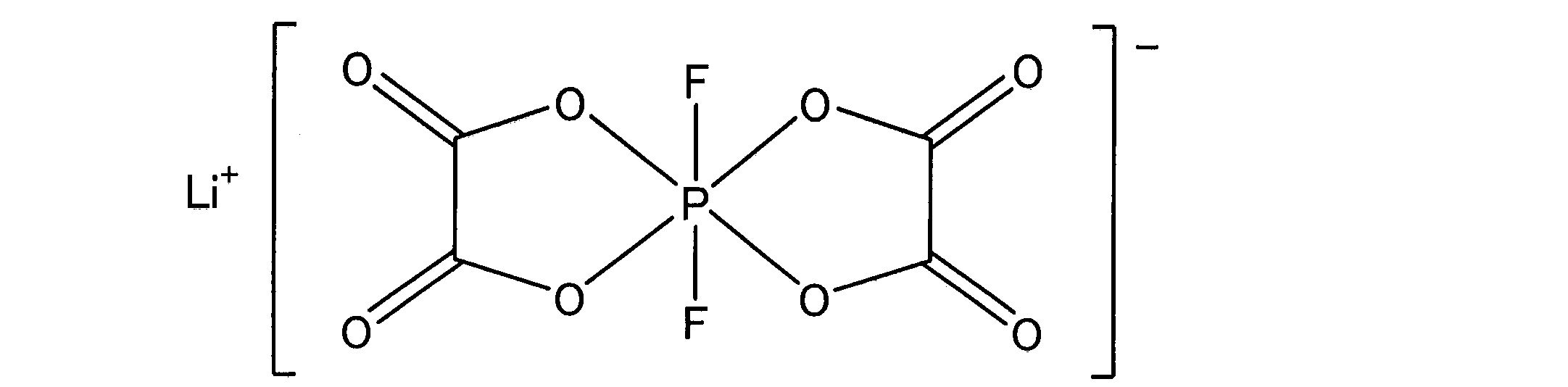
- the oxalato complex compound (7) may also be represented by the following formula: Lithium difluorooxalatophosphanite (LIDFOP) represented by the formula: Lithium tetrafluorooxalatophosphanite (LITFOP) represented by the formula: and lithium bis(oxalato)difluorophosphanite represented by.
- LIDFOP Lithium difluorooxalatophosphanite
- LITFOP Lithium tetrafluorooxalatophosphanite
- lithium bis(oxalato)difluorophosphanite represented by.
- dicarboxylic acid complex salts whose complex central element is boron include lithium bis(malonato)borate, lithium difluoro(malonato)borate, lithium bis(methylmalonato)borate, lithium difluoro(methylmalonato)borate, lithium bis( dimethylmalonato)borate, lithium difluoro(dimethylmalonato)borate and the like.
- dicarboxylic acid complex salts in which the complex central element is phosphorus include lithium tris(oxalato)phosphate, lithium tris(malonato)phosphate, lithium difluorobis(malonato)phosphate, lithium tetrafluoro(malonato)phosphate, lithium tris( methylmalonato)phosphate, lithium difluorobis(methylmalonato)phosphate, lithium tetrafluoro(methylmalonato)phosphate, lithium tris(dimethylmalonato)phosphate, lithium difluorobis(dimethylmalonato)phosphate, lithium tetrafluoro(dimethylmalonato)phosphate, etc. mentioned.
- dicarboxylic acid complex salts in which the complex central element is aluminum include LiAl(C 2 O 4 ) 2 and LiAlF 2 (C 2 O 4 ).
- lithium bis(oxalato)borate, lithium difluoro(oxalato)borate, lithium tris(oxalato)phosphate, lithium difluorobis(oxalato)phosphate, and lithium tetrafluoro(oxalato)phosphate further increase the viscosity of the positive electrode mixture. Since it can suppress, it is used more suitably.
- Lithium bis(oxalato)borate is particularly preferred as the oxalato complex compound (7).
- the content of the additive (D) is preferably 0.001 to 5% by mass, more preferably 0.001 to 5% by mass, based on the total mass of PVdF (A) and the positive electrode active material (C). is 0.005% by mass or more, more preferably 0.01% by mass or more, more preferably 3.0% by mass or less, still more preferably 2.5% by mass or less, and particularly preferably 2 0% by mass or less.
- the positive electrode mixture of the present disclosure preferably contains an organic solvent.
- the organic solvent include nitrogen-containing organic solvents such as N-methyl-2-pyrrolidone, N,N-dimethylacetamide and dimethylformamide; ketone solvents such as acetone, methyl ethyl ketone, cyclohexanone and methyl isobutyl ketone; and ethyl acetate. , butyl acetate and the like; ether solvents such as tetrahydrofuran and dioxane; and low-boiling general-purpose organic solvents such as mixed solvents thereof.
- N-methyl-2-pyrrolidone and/or N,N-dimethylacetamide are preferable as the organic solvent because of their excellent coatability.
- the content of the organic solvent is determined in consideration of the applicability to the current collector, the ability to form a thin film after drying, and the like.
- the total content of PVdF (A) and positive electrode active material (C) is preferably 50 to 90% by mass, more preferably 60 to 85% by mass, even more preferably 65% by mass. ⁇ 80% by mass.
- the total content of the additive (C) and the organic solvent is preferably 10 to 50% by mass, more preferably 15 to 40% by mass, and still more preferably 20 to 50% by mass. 35 mass.
- PVdF (A) is desirably used with a small particle size of 1000 ⁇ m or less, particularly 350 ⁇ m or less, in order to enable rapid dissolution in the organic solvent.
- the positive electrode mixture of the present disclosure preferably contains a conductive agent.
- the conductive agent include carbon blacks such as acetylene black and ketjen black, carbon materials such as graphite, carbon fibers, carbon nanotubes, and carbon nanohorns.
- the content ratio of PVdF (A) and the conductive agent is 5/95 to 90/10 in mass ratio.
- the positive electrode active material (C), the additive (D), and optionally the conductive agent are dispersed and mixed in a solution obtained by dissolving PVdF (A) in an organic solvent.
- the positive electrode mixture may be prepared by first mixing the PVdF (A) and the positive electrode active material (C), and then adding the organic solvent, the additive (D), and optionally the conductive agent.
- a positive electrode mixture may be prepared.
- the viscosity of the positive electrode mixture of the present disclosure is preferably 1,000 to 80,000 mPa s, more preferably 3,000 to 3,000 mPa s, because it is easy to apply and it is easy to obtain a positive electrode mixture layer having a desired thickness. It is 70,000 mPa ⁇ s, more preferably 5,000 to 60,000 mPa ⁇ s.
- the viscosity can be measured at 25° C. with a Brookfield viscometer.
- the positive electrode of the present disclosure is formed from the positive electrode mixture described above.
- the positive electrode mixture described above is applied to a current collector, dried, and pressed to form a thin positive electrode mixture layer on the current collector.
- a method of forming a thin film electrode can be mentioned. That is, in one preferred embodiment, the positive electrode of the present disclosure includes a current collector and a positive electrode mixture layer formed from the positive electrode mixture described above on the current collector.
- Examples of the current collector include metal foils or metal nets of iron, stainless steel, copper, aluminum, nickel, titanium, etc. Among them, aluminum foil is preferable.
- the secondary battery of the present disclosure includes the positive electrode described above.
- the secondary battery of the present disclosure preferably further includes a negative electrode and a non-aqueous electrolyte in addition to the positive electrode described above.
- the non-aqueous electrolyte is not particularly limited, but includes propylene carbonate, ethylene carbonate, butylene carbonate, ⁇ -butyl lactone, 1,2-dimethoxyethane, 1,2-diethoxyethane, dimethyl carbonate, diethyl carbonate,
- solvents such as ethyl methyl carbonate can be used.
- Any known electrolyte can be used, such as LiClO 4 , LiAsF 6 , LiPF 6 , LiBF 4 , LiCl, LiBr, CH 3 SO 3 Li, CF 3 SO 3 Li, cesium carbonate, and the like.
- the positive electrode mixture of the present disclosure is useful not only for lithium ion secondary batteries using the liquid electrolyte described above, but also for polymer electrolyte lithium secondary batteries as non-aqueous electrolyte secondary batteries. It is also useful for electric double layer capacitors.
- Polyvinylidene fluoride (A) is (A2) a polymer containing vinylidene fluoride units and fluorinated monomer units (excluding vinylidene fluoride units and tetrafluoroethylene units); (A3) a polymer containing vinylidene fluoride units and polar group-containing monomer units, and (A4) vinylidene fluoride units and fluorinated monomer units (provided that vinylidene fluoride units and tetrafluoroethylene units are ) and at least one selected from the group consisting of polymers
- X 21 to X 24 are independently bonded to a nitrogen atom via a hydrogen atom, a substituted or unsubstituted alkyl group, or a sulfonyl group.
- X 21 and X 23 may each combine to form a ring, and X 22 and X 24 may each combine to form a ring.
- General formula (5): (wherein R 51 represents an organic group, R 52 represents a single bond or an alkylene group, X 52 represents —OH or —COOZ 52 (Z 52 is a hydrogen atom or an alkali metal), and R 53 is represents a single bond or an alkylene group, X 53 represents —H, —OH or —COOZ 53 (Z 53 is a hydrogen atom or an alkali metal), and b represents 1 or 2.)
- ⁇ 2> According to the second aspect of the present disclosure, The fluorinated monomer units contained in polyvinylidene fluoride (A2) and polyvinylidene flu
- the mass ratio of polyvinylidene fluoride (A2) to at least one selected from the group consisting of polyvinylidene fluoride (A3) and polyvinylidene fluoride (A4) is 95/5 to 5/95.
- a positive electrode mixture according to the second aspect is provided.
- Any one of the first to third aspects, wherein the content of the additive (D) is 0.001 to 5% by mass with respect to the total mass of the polyvinylidene fluoride (A) and the positive electrode active material (C) provides a positive electrode mixture.
- a positive electrode mixture according to any one of the first to fourth aspects is provided, which further contains an organic solvent.
- a positive electrode formed from the positive electrode mixture according to any one of the first to fifth aspects is provided.
- a secondary battery comprising a positive electrode according to the sixth aspect is provided.
- composition of PVdF (AI) The content of acrylic acid units in PVdF(AI) was determined by acid-base titration of carboxylic acid groups. Specifically, about 0.5 g of PVdF (AI) was dissolved in acetone at a temperature of 70-80°C. 5 ml of water was added dropwise under vigorous stirring to avoid coagulation of PVdF(AI). Titration with aqueous NaOH having a concentration of 0.1 N was carried out until complete neutralization of acidity, with a neutral transition at about ⁇ 270 mV. Based on the measured acid equivalent, the content of acrylic acid contained in 1 g of PVdF (AI) was determined from the measurement results, and the content of acrylic acid units was calculated.
- ⁇ Viscosity> The viscosity of the positive electrode mixture was measured using a Brookfield viscometer (TV-10M manufactured by Toki Sangyo Co., Ltd.) at 25° C. and rotor No. Measurement was performed under the conditions of M4 and a rotation speed of 6 rpm, and the measured value after 10 minutes from the start of the measurement was taken as the viscosity.
- a positive electrode having a positive electrode mixture layer on one side prepared in Examples and Comparative Examples was prepared by forming a coated portion (positive electrode mixture layer) having a width of 50 mm and a length of 30 mm (positive electrode mixture layer) and an uncoated portion having a width of 5 mm and a length of 9 mm. It was cut out to have a shape.
- the obtained slurry was applied to a copper foil with a thickness of 20 ⁇ m, dried, and rolled with a press to form a coated portion (negative electrode material layer) having a width of 52 mm and a length of 32 mm, and a width of 5 mm and a length of 9 mm.
- a negative electrode was obtained by cutting out into a shape having an uncoated portion.
- the positive electrode and the negative electrode are opposed to each other with a microporous polyethylene film (separator) having a thickness of 20 ⁇ m interposed therebetween, and the non-aqueous electrolytic solution obtained above is injected, and the non-aqueous electrolytic solution is applied to the separator or the like. After sufficient penetration, it was sealed and aged. Then, at 25°C, the battery was charged to 4.2V (or 4.3V) at a constant current corresponding to 0.2C, and then discharged to 3.0V at a constant current of 0.2C. This was repeated for two cycles to stabilize the battery, and a lithium ion secondary battery (aluminum laminate cell) was produced.
- 4.2V or 4.3V
- the battery was discharged to 3.0 V at a constant current of 1 C under the condition of 25° C., and the residual capacity (mAh) was obtained.
- the residual capacity ratio (%) was obtained by dividing the residual capacity (mAh) by the initial discharge capacity (mAh).
- Remaining capacity ratio (%) Remaining capacity (mAh) / Initial discharge capacity (mAh) x 100
- the battery whose remaining capacity was measured was charged to 4.2 V at a constant current of 1 C at 25 ° C., and then charged at a constant voltage of 4.2 V until the current value reached 0.05 C.
- the battery was discharged to 3.0 V at a constant current of , and the recovery capacity (mAh) was determined.
- the recovery capacity ratio (%) was obtained by dividing the recovery capacity (mAh) by the initial discharge capacity (mAh).
- Recovery capacity rate (%) recovery capacity (mAh) / initial discharge capacity (mAh) x 100
- the battery was discharged to 3.0 V at a constant current of 1 C under the condition of 25° C., and the residual capacity (mAh) was obtained.
- the residual capacity ratio (%) was obtained by dividing the residual capacity (mAh) by the initial discharge capacity (mAh).
- Remaining capacity ratio (%) Remaining capacity (mAh) / Initial discharge capacity (mAh) x 100
- the battery whose remaining capacity was measured was charged to 4.3 V at a constant current of 1 C at 25 ° C., and then charged at a constant voltage of 4.3 V until the current value reached 0.05 C.
- the battery was discharged to 3.0 V at a constant current of , and the recovery capacity (mAh) was determined.
- the recovery capacity ratio (%) was obtained by dividing the recovery capacity (mAh) by the initial discharge capacity (mAh).
- Recovery capacity rate (%) recovery capacity (mAh) / initial discharge capacity (mAh) x 100
- PVdF (A)> AI: PVdF containing acrylic acid units Content of acrylic acid unit 1.0 mol% Weight average molecular weight 1100000 Melting point 165°C A-III: PVdF containing HFP units VdF/HFP 94.5/5.5 (mol%) weight average molecular weight 600000 Melting point 132°C
- Example 1 PVdF (A-I) and PVdF (A-III) were dissolved in N-methyl-2-pyrrolidone (NMP), respectively, and a PVdF (AI) solution and PVdF (A-III) having a concentration of 8% by mass were prepared. A solution was prepared. 20 g of the resulting PVdF (A-I) solution, 5 g of PVdF (A-III) solution, 0.05 g of acetylacetone as an additive (D), and 2 g of acetylene black as a conductive agent were mixed using a stirrer and mixed. I got the liquid.
- the positive electrode active material (C) LiNi 0.8 Mn 0.1 Co 0.1 O 2 (NMC811)
- NMP was further added so that the solid content concentration was 71% by mass.
- they were mixed using a stirrer to obtain a positive electrode mixture.
- the whole amount of the obtained positive electrode mixture was transferred to a plastic bottle, and the viscosity was measured by the method described above. The viscosity of the obtained positive electrode mixture was measured every time a predetermined time passed, and the viscosity change rate was calculated.
- the prepared positive electrode mixture was uniformly applied to an electrode current collector made of aluminum foil having a width of 10 cm, a length of 45 cm, and a thickness of 20 ⁇ m, and NMP was completely volatilized to produce a positive electrode.
- a lithium ion secondary battery was produced by the method described above, and the residual capacity rate and recovery capacity rate in a 60° C. storage test were evaluated. Table 1 shows the results.
- Examples 2-8, Comparative Examples 1-2 A positive electrode mixture, a positive electrode, and a lithium ion secondary battery were obtained in the same manner as in Example 1, except that the PVdF (A) and the additive (D) were changed to the types and amounts shown in Table 1. The obtained positive electrode mixture and lithium ion secondary battery were evaluated by the methods described above. Table 1 shows the results.
- Examples 9-16, Comparative Examples 3-4 PVdF (A) and additive (D) were changed to the types and amounts shown in Table 2, and LiNi 0.82 Co 0.15 Al 0.03 O 2 (NCA) was used as the positive electrode active material (C).
- a positive electrode mixture, a positive electrode, and a lithium ion secondary battery were obtained in the same manner as in Example 1, except that the materials were changed.
- the obtained positive electrode mixture and lithium ion secondary battery were evaluated by the methods described above. Table 2 shows the results.
Landscapes
- Chemical & Material Sciences (AREA)
- Chemical Kinetics & Catalysis (AREA)
- Electrochemistry (AREA)
- General Chemical & Material Sciences (AREA)
- Engineering & Computer Science (AREA)
- Organic Chemistry (AREA)
- Inorganic Chemistry (AREA)
- Manufacturing & Machinery (AREA)
- Materials Engineering (AREA)
- Physics & Mathematics (AREA)
- Condensed Matter Physics & Semiconductors (AREA)
- General Physics & Mathematics (AREA)
- Battery Electrode And Active Subsutance (AREA)
- Secondary Cells (AREA)
Abstract
Description
一般式(C):LiyNi1-xMxO2
(式中、xは、0.01≦x≦0.7、yは、0.9≦y≦2.0であり、Mは金属原子(但しLiおよびNiを除く)を表す)で表される正極活物質(C)、および、添加剤(D)を含有する正極合剤であって、
ポリビニリデンフルオライド(A)が、
(A2)ビニリデンフルオライド単位およびフッ素化単量体単位(ただし、ビニリデンフルオライド単位およびテトラフルオロエチレン単位を除く)を含有する重合体と、
(A3)ビニリデンフルオライド単位および極性基含有単量体単位を含有する重合体、ならびに、(A4)ビニリデンフルオライド単位、フッ素化単量体単位(ただし、ビニリデンフルオライド単位およびテトラフルオロエチレン単位を除く)および極性基含有単量体単位を含有する重合体からなる群より選択される少なくとも1種と
の組み合わせであり、
添加剤(D)が、一般式(1)で表されるジケトン化合物(1)、一般式(2)で表されるアミン化合物(2)、有機リン化合物(3)、含硫黄化合物(4)、一般式(5)で表されるアミノカーボネート化合物(5)、カルボン酸(6)(ただし、アミノカーボネート化合物(5)を除く)、および、オキサラト錯体化合物(7)からなる群より選択される少なくとも1種である
ことを特徴とする正極合剤が提供される。


ポリビニリデンフルオライド(PVdF)(A)は、(A2)ビニリデンフルオライド(VdF)単位およびフッ素化単量体単位(ただし、VdF単位およびテトラフルオロエチレン(TFE)単位を除く)を含有する重合体と、(A3)VdF単位および極性基含有単量体単位を含有する重合体、ならびに、(A4)VdF単位、フッ素化単量体単位(ただし、VdF単位およびTFE単位を除く)および極性基含有単量体単位を含有する重合体からなる群より選択される少なくとも1種との組み合わせである。
正極活物質(C)は、一般式(C):LiyNi1-xMxO2
(式中、xは、0.01≦x≦0.7、yは、0.9≦y≦2.0であり、Mは金属原子(但しLiおよびNiを除く)を表す。)で表される。本開示の正極合剤は、このようにNiを多く含有する正極合剤を含有することから、二次電池の高容量化に有益である。従来の技術では、Niを多く含有する正極合剤を用いると、正極合剤の粘度の上昇を十分に抑制できなかったが、本開示によれば、正極合剤の粘度の上昇を十分に抑制することができるので、二次電池の高容量化と、二次電池の生産性の向上とを両立できる。
本開示の正極合剤は、ジケトン化合物(1)、アミン化合物(2)、有機リン化合物(3)、含硫黄化合物(4)、アミノカーボネート化合物(5)、カルボン酸(6)、および、オキサラト錯体化合物(7)からなる群より選択される少なくとも1種の添加剤(D)を含有する。
ジケトン化合物(1)は、一般式(1)で表される。
一般式(1):

アミン化合物(2)は、一般式(2)で表される。
一般式(2):

有機リン化合物(3)は、少なくとも1つの炭素原子-リン原子の結合を含む化合物である。有機リン化合物(3)としては、有機リン化合物(3)(ただし、オキサラト錯体化合物(7)を除く)が好ましく、ホスフィン化合物がより好ましい。
一般式(3-1):


含硫黄化合物(4)としては、硫黄原子を含有する化合物であれば特に限定されないが、有機硫黄化合物であることが好ましく、たとえば、含硫黄複素環化合物、スルホン酸エステル化合物、硫酸エステル化合物等が挙げられる。含硫黄化合物(4)としては、含硫黄複素環化合物およびスルホン酸エステル化合物からなる群より選択される少なくとも1種が好ましく、含硫黄複素環化合物がより好ましい。
アミノカーボネート化合物(5)は、カルボキシ基を有するアミン化合物であり、上記のカルボキシ基を有するアミン化合物において、カルボキシ基の一部または全部がヒドロキシ基に置換されたヒドロキシアミノカーボネート化合物であってもよい。また、アミノカーボネート化合物(5)は、水和物であってもよい。
一般式(5):

カルボン酸(6)(ただし、アミノカーボネート化合物(5)を除く)は、-COOZ64(Z64は水素原子またはアルカリ金属)を有する有機酸である。1分子中に1つの-COOZ64を有するモノカルボン酸であってもよいし、1分子中に2以上の-COOZ64を有する多価カルボン酸であってもよい。
オキサラト錯体化合物(7)としては、少なくとも一つのシュウ酸イオンが配位原子と配位結合して形成される錯体化合物が好ましい。
一般式(7):
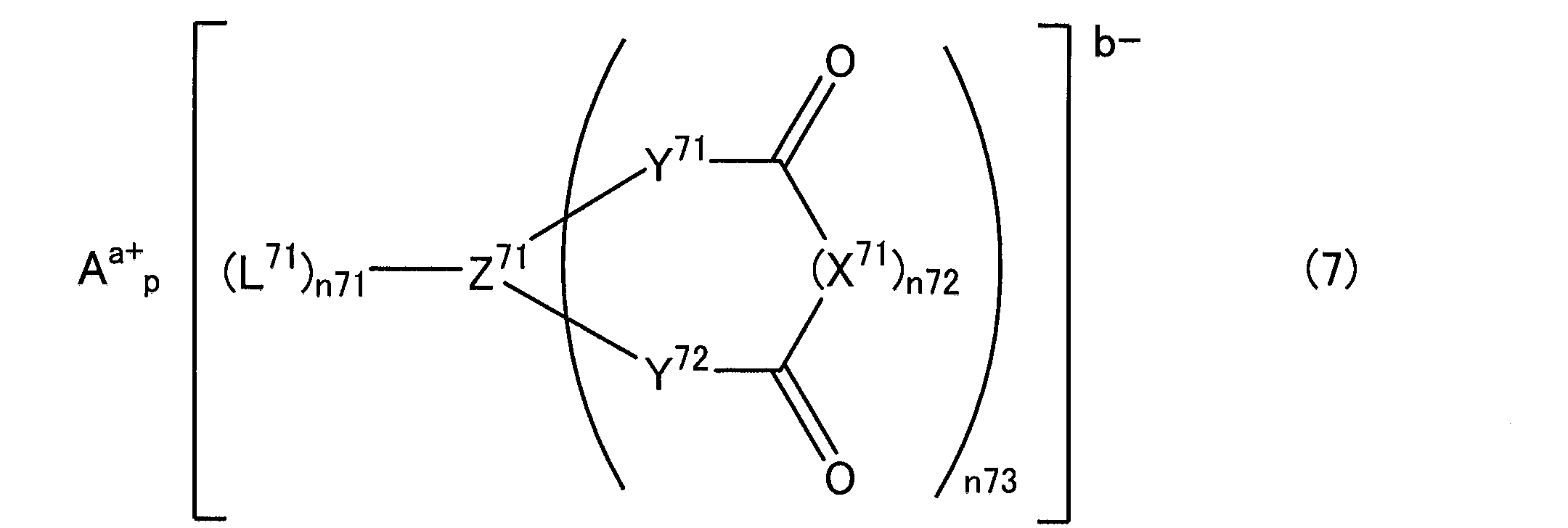
X71は、O、S、炭素数1~10のアルキレン基、炭素数1~10のハロゲン化アルキレン基、炭素数6~20のアリーレン基または炭素数6~20のハロゲン化アリーレン基(アルキレン基、ハロゲン化アルキレン基、アリーレン基、および、ハロゲン化アリーレン基はその構造中に置換基、ヘテロ原子を持っていてもよく、またn72が1でn73が2~4のときにはn73個のX71はそれぞれが結合していてもよい)。
L71は、ハロゲン原子、シアノ基、炭素数1~10のアルキル基、炭素数1~10のハロゲン化アルキル基、炭素数6~20のアリール基、炭素数6~20のハロゲン化アリール基(アルキレン基、ハロゲン化アルキレン基、アリーレン基、および、ハロゲン化アリーレン基はその構造中に置換基、ヘテロ原子を持っていてもよく、またn71が2~8のときにはn71個のL71はそれぞれが結合して環を形成してもよい)または-Z73Y73。
Y71、Y72およびZ73は、それぞれ独立でO、S、NY74、炭化水素基またはフッ素化炭化水素基。Y73およびY74は、それぞれ独立でH、F、炭素数1~10のアルキル基、炭素数1~10のハロゲン化アルキル基、炭素数6~20のアリール基または炭素数6~20のハロゲン化アリール基(アルキル基、ハロゲン化アルキル基、アリール基およびハロゲン化アリール基はその構造中に置換基、ヘテロ原子を持っていてもよく、Y73またはY74が複数個存在する場合にはそれぞれが結合して環を形成してもよい)。
なお、本明細書において、フッ素化炭化水素基は、炭化水素基の水素原子の少なくとも1つがフッ素原子に置換された基である。


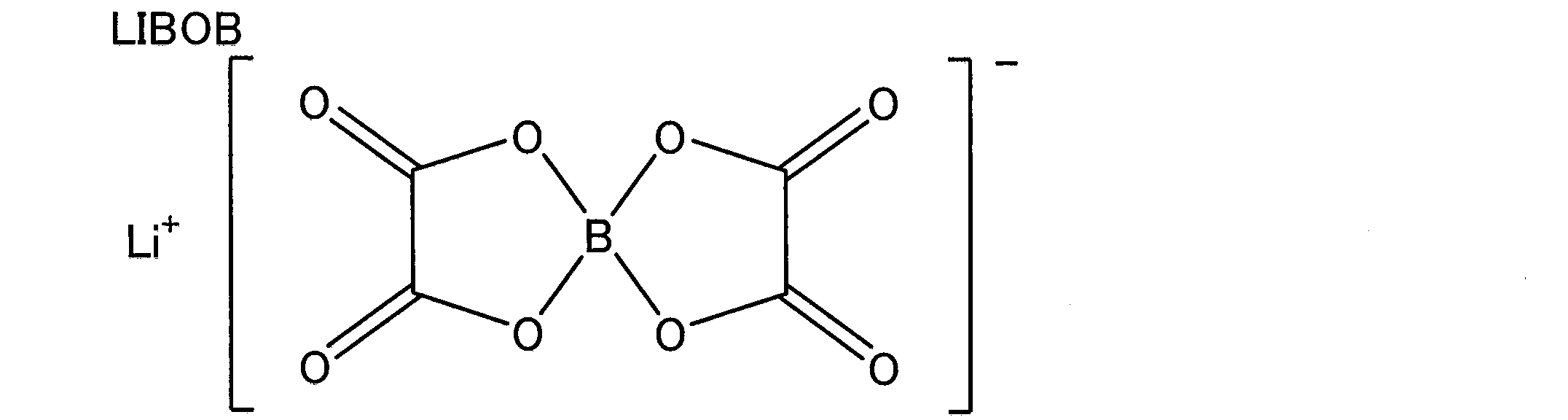


オキサラト錯体化合物(7)としては、リチウムビス(オキサラト)ボレートが特に好ましい。
本開示の正極合剤は、有機溶剤を含むことが好ましい。上記有機溶剤としては、たとえば、N-メチル-2-ピロリドン、N,N-ジメチルアセトアミド、ジメチルホルムアミド等の含窒素系有機溶剤;アセトン、メチルエチルケトン、シクロヘキサノン、メチルイソブチルケトン等のケトン系溶剤;酢酸エチル、酢酸ブチル等のエステル系溶剤;テトラヒドロフラン、ジオキサン等のエーテル系溶剤;さらに、それらの混合溶剤等の低沸点の汎用有機溶剤を挙げることができる。なかでも、上記有機溶剤としては、塗布性に優れている点から、N-メチル-2-ピロリドン、および/または、N,N-ジメチルアセトアミドであることが好ましい。
本開示の正極合剤は、導電剤を含むことが好ましい。上記導電剤としては、アセチレンブラック、ケッチェンブラック等のカーボンブラック類やグラファイト等の炭素材料、カーボンファイバー、カーボンナノチューブ、カーボンナノホーン等が挙げられる。
本開示の正極は、上述した正極合剤から形成される。上述した正極合剤を用いて正極を形成する方法としては、例えば、上述した正極合剤を集電体に塗布して、乾燥、プレスすることにより、集電体上に薄い正極合剤層を形成し、薄膜状電極とする方法が挙げられる。すなわち、本開示の正極は、集電体と、上記集電体上に、上述した正極合剤から形成される正極合剤層とを備えることが、好ましい実施態様の1つである。
本開示の二次電池は、上述した正極を備える。本開示の二次電池は、上述した正極に加えて、負極および非水電解液をさらに備えることが好ましい。
ポリビニリデンフルオライド(A)、
一般式(C):LiyNi1-xMxO2
(式中、xは、0.01≦x≦0.7、yは、0.9≦y≦2.0であり、Mは金属原子(但しLiおよびNiを除く)を表す)で表される正極活物質(C)、および、
添加剤(D)を含有する正極合剤であって、
ポリビニリデンフルオライド(A)が、
(A2)ビニリデンフルオライド単位およびフッ素化単量体単位(ただし、ビニリデンフルオライド単位およびテトラフルオロエチレン単位を除く)を含有する重合体と、
(A3)ビニリデンフルオライド単位および極性基含有単量体単位を含有する重合体、ならびに、(A4)ビニリデンフルオライド単位、フッ素化単量体単位(ただし、ビニリデンフルオライド単位およびテトラフルオロエチレン単位を除く)および極性基含有単量体単位を含有する重合体からなる群より選択される少なくとも1種と
の組み合わせであり、
添加剤(D)が、
一般式(1)で表されるジケトン化合物(1)、
一般式(2)で表されるアミン化合物(2)、
有機リン化合物(3)、
含硫黄化合物(4)、
一般式(5)で表されるアミノカーボネート化合物(5)、
カルボン酸(6)(ただし、アミノカーボネート化合物(5)を除く)、および、
オキサラト錯体化合物(7)
からなる群より選択される少なくとも1種である
ことを特徴とする正極合剤が提供される。
一般式(1):

一般式(2):

一般式(5):

<2> 本開示の第2の観点によれば、
ポリビニリデンフルオライド(A2)およびポリビニリデンフルオライド(A4)が含有する前記フッ素化単量体単位が、ヘキサフルオロプロピレン単位、フルオロアルキルビニルエーテル単位、クロロトリフルオロエチレン単位および2,3,3,3-テトラフルオロプロペン単位からなる群より選択される少なくとも1種である第1の観点による正極合剤が提供される。
<3> 本開示の第3の観点によれば、
ポリビニリデンフルオライド(A2)とポリビニリデンフルオライド(A3)およびポリビニリデンフルオライド(A4)からなる群より選択される少なくとも1種との質量比が、95/5~5/95である第1または第2の観点による正極合剤が提供される。
<4> 本開示の第4の観点によれば、
添加剤(D)の含有量が、ポリビニリデンフルオライド(A)および正極活物質(C)の合計質量に対して、0.001~5質量%である第1~第3のいずれかの観点による正極合剤が提供される。
<5> 本開示の第5の観点によれば、
有機溶剤をさらに含有する第1~第4のいずれかの観点による正極合剤が提供される。
<6> 本開示の第6の観点によれば、
第1~第5のいずれかの観点による正極合剤から形成される正極が提供される。
<7> 本開示の第7の観点によれば、
第6の観点による正極を備える二次電池が提供される。
PVdF(A-I)におけるアクリル酸単位の含有量は、カルボン酸基の酸-塩基滴定によって測定した。具体的には、約0.5gのPVdF(A-I)を、70~80℃の温度でアセトンに溶解させた。5mlの水を、PVdF(A-I)の凝固を回避するように激しい撹拌下に滴々加えた。約-270mVでの中性転移で、酸性度の完全な中和まで0.1Nの濃度を有する水性NaOHでの滴定を実施した。測定した酸当量に基づいて、測定結果から、PVdF(A-I)1g中に含まれるアクリル酸の含有物質量を求め、アクリル酸単位の含有量を算出した。
VdFとHFPの比率については、NMR分析装置(アジレント・テクノロジー社製、VNS400MHz)を用いて、19F-NMR測定でポリマーのDMF-d7溶液状態にて測定した。
A:-69ppm~-78ppmのピークの面積
B:-86ppm~-98ppmのピークの面積
C:-101ppm~-122ppmのピークの面積
VdFの割合:(3B+3C-2A)/(3B+3C)×100[モル%]
HFPの割合:(2A)/(3B+3C)×100[モル%]
ゲルパーミエーションクロマトグラフィ(GPC)により測定した。東ソー社製のAS-8010、CO-8020、カラム(GMHHR-Hを3本直列に接続)、および、島津製作所社製RID-10Aを用い、溶媒としてジメチルホルムアミド(DMF)を流速1.0ml/分で流して測定したデータ(リファレンス:ポリスチレン)より算出した。
示差走査熱量測定(DSC)装置を用い、10℃/分の速度で昇温したときの融解熱曲線における極大値に対する温度として求めた。
正極合剤の粘度は、B型粘度計(東機産業社製、TV-10M)を用いて、25℃、ロータNo.M4、回転速度6rpmの条件にて測定し、測定開始から10分経過後の測定値を粘度とした。
合剤調製時の粘度(η0)、合剤調製からn時間経過後の粘度(ηn)をそれぞれ測定し、粘度変化率(Xn)を下記の式により求めた。
Xn=ηn/η0×100[%]
粘度変化率(X)が200%以下である正極合剤を用いると、良好な特性を示す正極の作成が可能である。粘度変化率(X)が200%超300%以下である正極合剤を用いると、平滑な表面を有する正極合剤層を形成できないなどの不都合が生じる。粘度変化率(X)が300%を超える正極合剤は塗布が困難である。
実施例および比較例で作製した片面に正極合剤層を備える正極を、幅50mm、長さ30mmの塗工部(正極合剤層)、および、幅5mm、長さ9mmの未塗工部を有する形状に切り出した。
上記の正極と負極を厚さ20μmの微孔性ポリエチレンフィルム(セパレータ)を介して正極と負極を対向させ、上記で得られた非水電解液を注入し、上記非水電解液がセパレータ等に充分に浸透した後、封止しエージングを行った。その後、25℃において、0.2Cに相当する定電流で4.2V(もしくは4.3V)まで充電した後、0.2Cの定電流で3.0Vまで放電した。これを2サイクル行って電池を安定させ、リチウムイオン二次電池(アルミラミネートセル)を作製した。
得られたアルミラミネートセルについて、下記のように60℃保存試験を行い、残存容量率および回復容量率を調べた。
上記で製造した二次電池を、25℃において、1Cの定電流で4.2Vまで充電後、4.2Vの定電圧で電流値が0.05Cになるまで充電を実施した。その後、1Cの定電流で3.0Vまで放電し、初期放電容量(mAh)を求めた。25℃において、1Cの定電流で4.2Vまで充電後、4.2Vの定電圧で電流値が0.05Cになるまで充電を実施した。その後、60℃の条件で30日間保存した。その後、25℃の条件で1Cの定電流で3.0Vまで放電し、残存容量(mAh)を求めた。ここで、残存容量(mAh)を初期放電容量(mAh)で除することで残存容量率(%)とした。
残存容量率(%)=残存容量(mAh)/初期放電容量(mAh)×100
回復容量率(%)=回復容量(mAh)/初期放電容量(mAh)×100
得られたアルミラミネートセルについて、下記のように85℃保存試験を行い、残存容量率および回復容量率を調べた。
上記で製造した二次電池を、25℃において、1Cの定電流で4.3Vまで充電後、4.3Vの定電圧で電流値が0.05Cになるまで充電を実施した。その後、1Cの定電流で3.0Vまで放電し、初期放電容量(mAh)を求めた。25℃において、1Cの定電流で4.3Vまで充電後、4.3Vの定電圧で電流値が0.05Cになるまで充電を実施した。その後、85℃の条件で30日間保存した。その後、25℃の条件で1Cの定電流で3.0Vまで放電し、残存容量(mAh)を求めた。ここで、残存容量(mAh)を初期放電容量(mAh)で除することで残存容量率(%)とした。
残存容量率(%)=残存容量(mAh)/初期放電容量(mAh)×100
回復容量率(%)=回復容量(mAh)/初期放電容量(mAh)×100
<PVdF(A)>
A-I:アクリル酸単位を含有するPVdF
アクリル酸単位の含有量1.0モル%
重量平均分子量1100000
融点165℃
A-III:HFP単位を含有するPVdF
VdF/HFP=94.5/5.5(モル%)
重量平均分子量600000
融点132℃
PVdF(A-I)およびPVdF(A-III)を、それぞれN-メチル-2-ピロリドン(NMP)に溶解させ、濃度が8質量%のPVdF(A-I)溶液およびPVdF(A-III)溶液を調製した。得られたPVdF(A-I)溶液20g、PVdF(A-III)溶液5g、添加剤(D)としてアセチルアセトンを0.05gおよび導電剤としてアセチレンブラック2gを、撹拌機を用いて混合し、混合液を得た。得られた混合液に、正極活物質(C)(LiNi0.8Mn0.1Co0.1O2(NMC811))96gを加え、固形分濃度が71質量%になるようにNMPをさらに加えて、撹拌機を用いて混合し、正極合剤を得た。得られた正極合剤をポリ瓶に全量移し、上記した方法により粘度を測定した。得られた正極合剤について、所定の時間が経過するごとに粘度を測定し、粘度変化率を算出した。調製した正極合剤を幅10cm、長さ45cm、厚さ20μmのアルミ箔からなる電極集電体に均一に塗布し、NMPを完全に揮発させ、正極を作製した。得られた正極を用いて、上記した方法によりリチウムイオン二次電池を作製し、60℃保存試験における残存容量率および回復容量率を評価した。結果を表1に示す。
PVdF(A)および添加剤(D)を、表1に記載の種類および添加量に変更した以外は、実施例1と同様にして正極合剤、正極およびリチウムイオン二次電池を得た。得られた正極合剤およびリチウムイオン二次電池について、上記した方法により評価した。結果を表1に示す。

PVdF(A)および添加剤(D)を、表2に記載の種類および添加量に変更し、正極活物質(C)をLiNi0.82Co0.15Al0.03O2(NCA)に変更した以外は、実施例1と同様にして正極合剤、正極およびリチウムイオン二次電池を得た。得られた正極合剤およびリチウムイオン二次電池について、上記した方法により評価した。結果を表2に示す。

Claims (7)
- ポリビニリデンフルオライド(A)、
一般式(C):LiyNi1-xMxO2
(式中、xは、0.01≦x≦0.7、yは、0.9≦y≦2.0であり、Mは金属原子(但しLiおよびNiを除く)を表す)で表される正極活物質(C)、および、
添加剤(D)を含有する正極合剤であって、
ポリビニリデンフルオライド(A)が、
(A2)ビニリデンフルオライド単位およびフッ素化単量体単位(ただし、ビニリデンフルオライド単位およびテトラフルオロエチレン単位を除く)を含有する重合体と、
(A3)ビニリデンフルオライド単位および極性基含有単量体単位を含有する重合体、ならびに、(A4)ビニリデンフルオライド単位、フッ素化単量体単位(ただし、ビニリデンフルオライド単位およびテトラフルオロエチレン単位を除く)および極性基含有単量体単位を含有する重合体からなる群より選択される少なくとも1種と
の組み合わせであり、
添加剤(D)が、
一般式(1)で表されるジケトン化合物(1)、
一般式(2)で表されるアミン化合物(2)、
有機リン化合物(3)、
含硫黄化合物(4)、
一般式(5)で表されるアミノカーボネート化合物(5)、
カルボン酸(6)(ただし、アミノカーボネート化合物(5)を除く)、および、
オキサラト錯体化合物(7)
からなる群より選択される少なくとも1種である
ことを特徴とする正極合剤。
一般式(1):

一般式(2):

一般式(5):

- ポリビニリデンフルオライド(A2)およびポリビニリデンフルオライド(A4)が含有する前記フッ素化単量体単位が、ヘキサフルオロプロピレン単位、フルオロアルキルビニルエーテル単位、クロロトリフルオロエチレン単位および2,3,3,3-テトラフルオロプロペン単位からなる群より選択される少なくとも1種である請求項1に記載の正極合剤。
- ポリビニリデンフルオライド(A2)とポリビニリデンフルオライド(A3)およびポリビニリデンフルオライド(A4)からなる群より選択される少なくとも1種との質量比が、95/5~5/95である請求項1または2に記載の正極合剤。
- 添加剤(D)の含有量が、ポリビニリデンフルオライド(A)および正極活物質(C)の合計質量に対して、0.001~5質量%である請求項1~3のいずれかに記載の正極合剤。
- 有機溶剤をさらに含有する請求項1~4のいずれかに記載の正極合剤。
- 請求項1~5のいずれかに記載の正極合剤から形成される正極。
- 請求項6に記載の正極を備える二次電池。
Priority Applications (4)
| Application Number | Priority Date | Filing Date | Title |
|---|---|---|---|
| CN202280032029.0A CN117223123A (zh) | 2021-05-07 | 2022-04-27 | 正极合剂、正极和二次电池 |
| EP22798914.2A EP4340056A4 (en) | 2021-05-07 | 2022-04-27 | MIXTURE OF POSITIVE ELECTRODE, POSITIVE ELECTRODE, AND SECONDARY BATTERY |
| KR1020237040405A KR102930674B1 (ko) | 2021-05-07 | 2022-04-27 | 정극 합제, 정극 및 이차 전지 |
| US18/500,387 US20240079595A1 (en) | 2021-05-07 | 2023-11-02 | Positive electrode mixture, positive electrode and secondary battery |
Applications Claiming Priority (2)
| Application Number | Priority Date | Filing Date | Title |
|---|---|---|---|
| JP2021079027 | 2021-05-07 | ||
| JP2021-079027 | 2021-05-07 |
Related Child Applications (1)
| Application Number | Title | Priority Date | Filing Date |
|---|---|---|---|
| US18/500,387 Continuation US20240079595A1 (en) | 2021-05-07 | 2023-11-02 | Positive electrode mixture, positive electrode and secondary battery |
Publications (1)
| Publication Number | Publication Date |
|---|---|
| WO2022234809A1 true WO2022234809A1 (ja) | 2022-11-10 |
Family
ID=83932732
Family Applications (1)
| Application Number | Title | Priority Date | Filing Date |
|---|---|---|---|
| PCT/JP2022/019167 Ceased WO2022234809A1 (ja) | 2021-05-07 | 2022-04-27 | 正極合剤、正極および二次電池 |
Country Status (7)
| Country | Link |
|---|---|
| US (1) | US20240079595A1 (ja) |
| EP (1) | EP4340056A4 (ja) |
| JP (1) | JP7348561B2 (ja) |
| KR (1) | KR102930674B1 (ja) |
| CN (1) | CN117223123A (ja) |
| TW (1) | TWI874768B (ja) |
| WO (1) | WO2022234809A1 (ja) |
Families Citing this family (2)
| Publication number | Priority date | Publication date | Assignee | Title |
|---|---|---|---|---|
| CN119823675B (zh) * | 2025-01-23 | 2025-10-17 | 西南石油大学 | 一种改性聚偏二氟乙烯锂硫电池正极粘结剂及其制备方法 |
| CN120149530B (zh) * | 2025-03-21 | 2025-12-23 | 浙江锂威能源科技有限公司 | 一种固态电解质膜及其制备方法、二次电池和用电设备 |
Citations (14)
| Publication number | Priority date | Publication date | Assignee | Title |
|---|---|---|---|---|
| JP2011028898A (ja) * | 2009-07-22 | 2011-02-10 | Toyota Motor Corp | リチウム二次電池用の正極とその製造方法 |
| JP2012048917A (ja) * | 2010-08-25 | 2012-03-08 | Sony Corp | 正極および非水電解質電池、並びに正極合剤および結着剤 |
| JP2013175325A (ja) * | 2012-02-24 | 2013-09-05 | Hitachi Ltd | 正極合剤層形成用組成物の製造方法およびリチウムイオン二次電池の製造方法 |
| WO2013176093A1 (ja) | 2012-05-21 | 2013-11-28 | ダイキン工業株式会社 | 電極合剤 |
| JP2014032777A (ja) * | 2012-08-01 | 2014-02-20 | Toyota Motor Corp | 非水電解質二次電池の製造方法 |
| JP2014078449A (ja) * | 2012-10-11 | 2014-05-01 | Nippon Shokubai Co Ltd | 電池用電極及びこれを用いた電池 |
| JP2015170551A (ja) * | 2014-03-10 | 2015-09-28 | 株式会社豊田自動織機 | 表面処理した正極活物質、分散剤及び溶剤を含む組成物 |
| JP2016046188A (ja) * | 2014-08-26 | 2016-04-04 | 東洋インキScホールディングス株式会社 | カーボンブラック分散液およびその利用 |
| JP2017112041A (ja) * | 2015-12-18 | 2017-06-22 | トヨタ自動車株式会社 | リチウム固体電池 |
| WO2017158961A1 (ja) * | 2016-03-18 | 2017-09-21 | Necエナジーデバイス株式会社 | 二次電池用正極合剤、二次電池用正極の製造方法及び二次電池の製造方法 |
| CN108987752A (zh) * | 2017-06-01 | 2018-12-11 | 宁德时代新能源科技股份有限公司 | 正极片及其制备方法以及锂离子电池 |
| JP2019079710A (ja) * | 2017-10-25 | 2019-05-23 | トヨタ自動車株式会社 | 正極の製造方法 |
| JP2020057606A (ja) * | 2018-10-03 | 2020-04-09 | ダイキン工業株式会社 | 正極構造体および二次電池 |
| CN111916693A (zh) * | 2020-06-28 | 2020-11-10 | 南昌大学 | 一种制备有机物包覆高镍正极材料的方法 |
Family Cites Families (3)
| Publication number | Priority date | Publication date | Assignee | Title |
|---|---|---|---|---|
| JP6059019B2 (ja) * | 2013-01-07 | 2017-01-11 | 日立マクセル株式会社 | 非水電解質二次電池 |
| WO2021002369A1 (ja) * | 2019-07-01 | 2021-01-07 | ダイキン工業株式会社 | 電気化学デバイス用組成物、正極合剤、正極構造体および二次電池 |
| CN111129460A (zh) * | 2019-12-21 | 2020-05-08 | 河南电池研究院有限公司 | 锂离子电池正极浆料和锂离子电池 |
-
2022
- 2022-04-27 WO PCT/JP2022/019167 patent/WO2022234809A1/ja not_active Ceased
- 2022-04-27 KR KR1020237040405A patent/KR102930674B1/ko active Active
- 2022-04-27 JP JP2022073448A patent/JP7348561B2/ja active Active
- 2022-04-27 CN CN202280032029.0A patent/CN117223123A/zh active Pending
- 2022-04-27 EP EP22798914.2A patent/EP4340056A4/en active Pending
- 2022-05-02 TW TW111116580A patent/TWI874768B/zh active
-
2023
- 2023-11-02 US US18/500,387 patent/US20240079595A1/en active Pending
Patent Citations (14)
| Publication number | Priority date | Publication date | Assignee | Title |
|---|---|---|---|---|
| JP2011028898A (ja) * | 2009-07-22 | 2011-02-10 | Toyota Motor Corp | リチウム二次電池用の正極とその製造方法 |
| JP2012048917A (ja) * | 2010-08-25 | 2012-03-08 | Sony Corp | 正極および非水電解質電池、並びに正極合剤および結着剤 |
| JP2013175325A (ja) * | 2012-02-24 | 2013-09-05 | Hitachi Ltd | 正極合剤層形成用組成物の製造方法およびリチウムイオン二次電池の製造方法 |
| WO2013176093A1 (ja) | 2012-05-21 | 2013-11-28 | ダイキン工業株式会社 | 電極合剤 |
| JP2014032777A (ja) * | 2012-08-01 | 2014-02-20 | Toyota Motor Corp | 非水電解質二次電池の製造方法 |
| JP2014078449A (ja) * | 2012-10-11 | 2014-05-01 | Nippon Shokubai Co Ltd | 電池用電極及びこれを用いた電池 |
| JP2015170551A (ja) * | 2014-03-10 | 2015-09-28 | 株式会社豊田自動織機 | 表面処理した正極活物質、分散剤及び溶剤を含む組成物 |
| JP2016046188A (ja) * | 2014-08-26 | 2016-04-04 | 東洋インキScホールディングス株式会社 | カーボンブラック分散液およびその利用 |
| JP2017112041A (ja) * | 2015-12-18 | 2017-06-22 | トヨタ自動車株式会社 | リチウム固体電池 |
| WO2017158961A1 (ja) * | 2016-03-18 | 2017-09-21 | Necエナジーデバイス株式会社 | 二次電池用正極合剤、二次電池用正極の製造方法及び二次電池の製造方法 |
| CN108987752A (zh) * | 2017-06-01 | 2018-12-11 | 宁德时代新能源科技股份有限公司 | 正极片及其制备方法以及锂离子电池 |
| JP2019079710A (ja) * | 2017-10-25 | 2019-05-23 | トヨタ自動車株式会社 | 正極の製造方法 |
| JP2020057606A (ja) * | 2018-10-03 | 2020-04-09 | ダイキン工業株式会社 | 正極構造体および二次電池 |
| CN111916693A (zh) * | 2020-06-28 | 2020-11-10 | 南昌大学 | 一种制备有机物包覆高镍正极材料的方法 |
Non-Patent Citations (1)
| Title |
|---|
| See also references of EP4340056A4 |
Also Published As
| Publication number | Publication date |
|---|---|
| TW202312542A (zh) | 2023-03-16 |
| JP2022173104A (ja) | 2022-11-17 |
| CN117223123A (zh) | 2023-12-12 |
| TWI874768B (zh) | 2025-03-01 |
| US20240079595A1 (en) | 2024-03-07 |
| JP7348561B2 (ja) | 2023-09-21 |
| EP4340056A1 (en) | 2024-03-20 |
| EP4340056A4 (en) | 2026-01-07 |
| KR20240001194A (ko) | 2024-01-03 |
| KR102930674B1 (ko) | 2026-02-25 |
Similar Documents
| Publication | Publication Date | Title |
|---|---|---|
| JP7361116B2 (ja) | 電気化学デバイス用組成物、正極合剤、正極構造体および二次電池 | |
| JP6604014B2 (ja) | 非水系電解液及び非水系電解液二次電池 | |
| JP2020155424A (ja) | 非水系電解液及び非水系電解液二次電池 | |
| WO2021020005A1 (ja) | アルカリ金属電極処理剤、アルカリ金属二次電池用電解液、アルカリ金属電極、アルカリ金属二次電池及びモジュール | |
| JP7348561B2 (ja) | 正極合剤、正極および二次電池 | |
| US20240088381A1 (en) | Positive electrode mixture, positive electrode and secondary battery | |
| JP2021015812A (ja) | 非水系電解液及び非水系電解液二次電池 | |
| JP2019135730A (ja) | 非水系電解液及び非水系電解液二次電池 | |
| JP5810032B2 (ja) | リチウムイオン二次電池用正極保護剤、リチウムイオン二次電池用正極材、リチウムイオン二次電池用非水電解液、リチウムイオン二次電池およびそれらの製造方法 | |
| JP7348560B2 (ja) | 正極合剤、正極および二次電池 | |
| WO2023277055A1 (ja) | 電極形成用組成物、電極および二次電池 | |
| JP2012089312A (ja) | リチウムイオン二次電池及びリチウムイオン二次電池用増粘抑制剤 | |
| CN113711394B (zh) | 锂离子二次电池用正极合剂及其制造方法、以及锂离子二次电池的制造方法 | |
| JPWO2017130245A1 (ja) | リチウム電池 | |
| WO2020204058A1 (ja) | 電気化学素子用バインダー | |
| JP2025068892A (ja) | 非水電解液二次電池 | |
| CN119563241A (zh) | 安全性提高的锂二次电池 | |
| WO2024024650A1 (ja) | 被覆リチウム-遷移金属酸化物粒子およびその製造方法、リチウムイオン電池用正極活物質、ならびにリチウムイオン電池 |
Legal Events
| Date | Code | Title | Description |
|---|---|---|---|
| 121 | Ep: the epo has been informed by wipo that ep was designated in this application |
Ref document number: 22798914 Country of ref document: EP Kind code of ref document: A1 |
|
| WWE | Wipo information: entry into national phase |
Ref document number: 202337072571 Country of ref document: IN |
|
| WWE | Wipo information: entry into national phase |
Ref document number: 202280032029.0 Country of ref document: CN |
|
| ENP | Entry into the national phase |
Ref document number: 20237040405 Country of ref document: KR Kind code of ref document: A |
|
| WWE | Wipo information: entry into national phase |
Ref document number: 1020237040405 Country of ref document: KR |
|
| WWE | Wipo information: entry into national phase |
Ref document number: 2022798914 Country of ref document: EP |
|
| NENP | Non-entry into the national phase |
Ref country code: DE |
|
| ENP | Entry into the national phase |
Ref document number: 2022798914 Country of ref document: EP Effective date: 20231207 |
|
| WWG | Wipo information: grant in national office |
Ref document number: 202337072571 Country of ref document: IN |