WO2022236407A1 - Psilocybin and psilocin conjugates for treatment of mental illnesses - Google Patents
Psilocybin and psilocin conjugates for treatment of mental illnesses Download PDFInfo
- Publication number
- WO2022236407A1 WO2022236407A1 PCT/CA2022/050733 CA2022050733W WO2022236407A1 WO 2022236407 A1 WO2022236407 A1 WO 2022236407A1 CA 2022050733 W CA2022050733 W CA 2022050733W WO 2022236407 A1 WO2022236407 A1 WO 2022236407A1
- Authority
- WO
- WIPO (PCT)
- Prior art keywords
- compound
- formula
- acid
- thc
- delta
- Prior art date
- Legal status (The legal status is an assumption and is not a legal conclusion. Google has not performed a legal analysis and makes no representation as to the accuracy of the status listed.)
- Ceased
Links
Classifications
-
- A—HUMAN NECESSITIES
- A61—MEDICAL OR VETERINARY SCIENCE; HYGIENE
- A61K—PREPARATIONS FOR MEDICAL, DENTAL OR TOILETRY PURPOSES
- A61K47/00—Medicinal preparations characterised by the non-active ingredients used, e.g. carriers or inert additives; Targeting or modifying agents chemically bound to the active ingredient
- A61K47/50—Medicinal preparations characterised by the non-active ingredients used, e.g. carriers or inert additives; Targeting or modifying agents chemically bound to the active ingredient the non-active ingredient being chemically bound to the active ingredient, e.g. polymer-drug conjugates
- A61K47/51—Medicinal preparations characterised by the non-active ingredients used, e.g. carriers or inert additives; Targeting or modifying agents chemically bound to the active ingredient the non-active ingredient being chemically bound to the active ingredient, e.g. polymer-drug conjugates the non-active ingredient being a modifying agent
- A61K47/54—Medicinal preparations characterised by the non-active ingredients used, e.g. carriers or inert additives; Targeting or modifying agents chemically bound to the active ingredient the non-active ingredient being chemically bound to the active ingredient, e.g. polymer-drug conjugates the non-active ingredient being a modifying agent the modifying agent being an organic compound
- A61K47/55—Medicinal preparations characterised by the non-active ingredients used, e.g. carriers or inert additives; Targeting or modifying agents chemically bound to the active ingredient the non-active ingredient being chemically bound to the active ingredient, e.g. polymer-drug conjugates the non-active ingredient being a modifying agent the modifying agent being an organic compound the modifying agent being also a pharmacologically or therapeutically active agent, i.e. the entire conjugate being a codrug
-
- C—CHEMISTRY; METALLURGY
- C07—ORGANIC CHEMISTRY
- C07F—ACYCLIC, CARBOCYCLIC OR HETEROCYCLIC COMPOUNDS CONTAINING ELEMENTS OTHER THAN CARBON, HYDROGEN, HALOGEN, OXYGEN, NITROGEN, SULFUR, SELENIUM OR TELLURIUM
- C07F9/00—Compounds containing elements of Groups 5 or 15 of the Periodic Table
- C07F9/02—Phosphorus compounds
- C07F9/547—Heterocyclic compounds, e.g. containing phosphorus as a ring hetero atom
- C07F9/553—Heterocyclic compounds, e.g. containing phosphorus as a ring hetero atom having one nitrogen atom as the only ring hetero atom
- C07F9/572—Five-membered rings
- C07F9/5728—Five-membered rings condensed with carbocyclic rings or carbocyclic ring systems
-
- A—HUMAN NECESSITIES
- A61—MEDICAL OR VETERINARY SCIENCE; HYGIENE
- A61K—PREPARATIONS FOR MEDICAL, DENTAL OR TOILETRY PURPOSES
- A61K47/00—Medicinal preparations characterised by the non-active ingredients used, e.g. carriers or inert additives; Targeting or modifying agents chemically bound to the active ingredient
- A61K47/50—Medicinal preparations characterised by the non-active ingredients used, e.g. carriers or inert additives; Targeting or modifying agents chemically bound to the active ingredient the non-active ingredient being chemically bound to the active ingredient, e.g. polymer-drug conjugates
- A61K47/51—Medicinal preparations characterised by the non-active ingredients used, e.g. carriers or inert additives; Targeting or modifying agents chemically bound to the active ingredient the non-active ingredient being chemically bound to the active ingredient, e.g. polymer-drug conjugates the non-active ingredient being a modifying agent
- A61K47/54—Medicinal preparations characterised by the non-active ingredients used, e.g. carriers or inert additives; Targeting or modifying agents chemically bound to the active ingredient the non-active ingredient being chemically bound to the active ingredient, e.g. polymer-drug conjugates the non-active ingredient being a modifying agent the modifying agent being an organic compound
-
- A—HUMAN NECESSITIES
- A61—MEDICAL OR VETERINARY SCIENCE; HYGIENE
- A61K—PREPARATIONS FOR MEDICAL, DENTAL OR TOILETRY PURPOSES
- A61K47/00—Medicinal preparations characterised by the non-active ingredients used, e.g. carriers or inert additives; Targeting or modifying agents chemically bound to the active ingredient
- A61K47/50—Medicinal preparations characterised by the non-active ingredients used, e.g. carriers or inert additives; Targeting or modifying agents chemically bound to the active ingredient the non-active ingredient being chemically bound to the active ingredient, e.g. polymer-drug conjugates
- A61K47/51—Medicinal preparations characterised by the non-active ingredients used, e.g. carriers or inert additives; Targeting or modifying agents chemically bound to the active ingredient the non-active ingredient being chemically bound to the active ingredient, e.g. polymer-drug conjugates the non-active ingredient being a modifying agent
- A61K47/54—Medicinal preparations characterised by the non-active ingredients used, e.g. carriers or inert additives; Targeting or modifying agents chemically bound to the active ingredient the non-active ingredient being chemically bound to the active ingredient, e.g. polymer-drug conjugates the non-active ingredient being a modifying agent the modifying agent being an organic compound
- A61K47/542—Carboxylic acids, e.g. a fatty acid or an amino acid
-
- A—HUMAN NECESSITIES
- A61—MEDICAL OR VETERINARY SCIENCE; HYGIENE
- A61K—PREPARATIONS FOR MEDICAL, DENTAL OR TOILETRY PURPOSES
- A61K47/00—Medicinal preparations characterised by the non-active ingredients used, e.g. carriers or inert additives; Targeting or modifying agents chemically bound to the active ingredient
- A61K47/50—Medicinal preparations characterised by the non-active ingredients used, e.g. carriers or inert additives; Targeting or modifying agents chemically bound to the active ingredient the non-active ingredient being chemically bound to the active ingredient, e.g. polymer-drug conjugates
- A61K47/51—Medicinal preparations characterised by the non-active ingredients used, e.g. carriers or inert additives; Targeting or modifying agents chemically bound to the active ingredient the non-active ingredient being chemically bound to the active ingredient, e.g. polymer-drug conjugates the non-active ingredient being a modifying agent
- A61K47/54—Medicinal preparations characterised by the non-active ingredients used, e.g. carriers or inert additives; Targeting or modifying agents chemically bound to the active ingredient the non-active ingredient being chemically bound to the active ingredient, e.g. polymer-drug conjugates the non-active ingredient being a modifying agent the modifying agent being an organic compound
- A61K47/545—Heterocyclic compounds
-
- A—HUMAN NECESSITIES
- A61—MEDICAL OR VETERINARY SCIENCE; HYGIENE
- A61K—PREPARATIONS FOR MEDICAL, DENTAL OR TOILETRY PURPOSES
- A61K47/00—Medicinal preparations characterised by the non-active ingredients used, e.g. carriers or inert additives; Targeting or modifying agents chemically bound to the active ingredient
- A61K47/50—Medicinal preparations characterised by the non-active ingredients used, e.g. carriers or inert additives; Targeting or modifying agents chemically bound to the active ingredient the non-active ingredient being chemically bound to the active ingredient, e.g. polymer-drug conjugates
- A61K47/51—Medicinal preparations characterised by the non-active ingredients used, e.g. carriers or inert additives; Targeting or modifying agents chemically bound to the active ingredient the non-active ingredient being chemically bound to the active ingredient, e.g. polymer-drug conjugates the non-active ingredient being a modifying agent
- A61K47/54—Medicinal preparations characterised by the non-active ingredients used, e.g. carriers or inert additives; Targeting or modifying agents chemically bound to the active ingredient the non-active ingredient being chemically bound to the active ingredient, e.g. polymer-drug conjugates the non-active ingredient being a modifying agent the modifying agent being an organic compound
- A61K47/548—Phosphates or phosphonates, e.g. bone-seeking
-
- A—HUMAN NECESSITIES
- A61—MEDICAL OR VETERINARY SCIENCE; HYGIENE
- A61P—SPECIFIC THERAPEUTIC ACTIVITY OF CHEMICAL COMPOUNDS OR MEDICINAL PREPARATIONS
- A61P25/00—Drugs for disorders of the nervous system
- A61P25/18—Antipsychotics, i.e. neuroleptics; Drugs for mania or schizophrenia
-
- A—HUMAN NECESSITIES
- A61—MEDICAL OR VETERINARY SCIENCE; HYGIENE
- A61P—SPECIFIC THERAPEUTIC ACTIVITY OF CHEMICAL COMPOUNDS OR MEDICINAL PREPARATIONS
- A61P25/00—Drugs for disorders of the nervous system
- A61P25/22—Anxiolytics
-
- A—HUMAN NECESSITIES
- A61—MEDICAL OR VETERINARY SCIENCE; HYGIENE
- A61P—SPECIFIC THERAPEUTIC ACTIVITY OF CHEMICAL COMPOUNDS OR MEDICINAL PREPARATIONS
- A61P25/00—Drugs for disorders of the nervous system
- A61P25/24—Antidepressants
-
- C—CHEMISTRY; METALLURGY
- C07—ORGANIC CHEMISTRY
- C07D—HETEROCYCLIC COMPOUNDS
- C07D209/00—Heterocyclic compounds containing five-membered rings, condensed with other rings, with one nitrogen atom as the only ring hetero atom
- C07D209/02—Heterocyclic compounds containing five-membered rings, condensed with other rings, with one nitrogen atom as the only ring hetero atom condensed with one carbocyclic ring
- C07D209/04—Indoles; Hydrogenated indoles
- C07D209/10—Indoles; Hydrogenated indoles with substituted hydrocarbon radicals attached to carbon atoms of the hetero ring
- C07D209/14—Radicals substituted by nitrogen atoms, not forming part of a nitro radical
- C07D209/16—Tryptamines
-
- C—CHEMISTRY; METALLURGY
- C07—ORGANIC CHEMISTRY
- C07D—HETEROCYCLIC COMPOUNDS
- C07D401/00—Heterocyclic compounds containing two or more hetero rings, having nitrogen atoms as the only ring hetero atoms, at least one ring being a six-membered ring with only one nitrogen atom
- C07D401/02—Heterocyclic compounds containing two or more hetero rings, having nitrogen atoms as the only ring hetero atoms, at least one ring being a six-membered ring with only one nitrogen atom containing two hetero rings
- C07D401/12—Heterocyclic compounds containing two or more hetero rings, having nitrogen atoms as the only ring hetero atoms, at least one ring being a six-membered ring with only one nitrogen atom containing two hetero rings linked by a chain containing hetero atoms as chain links
-
- C—CHEMISTRY; METALLURGY
- C07—ORGANIC CHEMISTRY
- C07D—HETEROCYCLIC COMPOUNDS
- C07D405/00—Heterocyclic compounds containing both one or more hetero rings having oxygen atoms as the only ring hetero atoms, and one or more rings having nitrogen as the only ring hetero atom
- C07D405/02—Heterocyclic compounds containing both one or more hetero rings having oxygen atoms as the only ring hetero atoms, and one or more rings having nitrogen as the only ring hetero atom containing two hetero rings
- C07D405/12—Heterocyclic compounds containing both one or more hetero rings having oxygen atoms as the only ring hetero atoms, and one or more rings having nitrogen as the only ring hetero atom containing two hetero rings linked by a chain containing hetero atoms as chain links
-
- C—CHEMISTRY; METALLURGY
- C07—ORGANIC CHEMISTRY
- C07D—HETEROCYCLIC COMPOUNDS
- C07D417/00—Heterocyclic compounds containing two or more hetero rings, at least one ring having nitrogen and sulfur atoms as the only ring hetero atoms, not provided for by group C07D415/00
- C07D417/02—Heterocyclic compounds containing two or more hetero rings, at least one ring having nitrogen and sulfur atoms as the only ring hetero atoms, not provided for by group C07D415/00 containing two hetero rings
- C07D417/12—Heterocyclic compounds containing two or more hetero rings, at least one ring having nitrogen and sulfur atoms as the only ring hetero atoms, not provided for by group C07D415/00 containing two hetero rings linked by a chain containing hetero atoms as chain links
-
- C—CHEMISTRY; METALLURGY
- C07—ORGANIC CHEMISTRY
- C07D—HETEROCYCLIC COMPOUNDS
- C07D417/00—Heterocyclic compounds containing two or more hetero rings, at least one ring having nitrogen and sulfur atoms as the only ring hetero atoms, not provided for by group C07D415/00
- C07D417/14—Heterocyclic compounds containing two or more hetero rings, at least one ring having nitrogen and sulfur atoms as the only ring hetero atoms, not provided for by group C07D415/00 containing three or more hetero rings
-
- C—CHEMISTRY; METALLURGY
- C07—ORGANIC CHEMISTRY
- C07D—HETEROCYCLIC COMPOUNDS
- C07D471/00—Heterocyclic compounds containing nitrogen atoms as the only ring hetero atoms in the condensed system, at least one ring being a six-membered ring with one nitrogen atom, not provided for by groups C07D451/00 - C07D463/00
- C07D471/02—Heterocyclic compounds containing nitrogen atoms as the only ring hetero atoms in the condensed system, at least one ring being a six-membered ring with one nitrogen atom, not provided for by groups C07D451/00 - C07D463/00 in which the condensed system contains two hetero rings
- C07D471/04—Ortho-condensed systems
-
- C—CHEMISTRY; METALLURGY
- C07—ORGANIC CHEMISTRY
- C07D—HETEROCYCLIC COMPOUNDS
- C07D489/00—Heterocyclic compounds containing 4aH-8, 9 c- Iminoethano-phenanthro [4, 5-b, c, d] furan ring systems, e.g. derivatives of [4, 5-epoxy]-morphinan of the formula:
- C07D489/06—Heterocyclic compounds containing 4aH-8, 9 c- Iminoethano-phenanthro [4, 5-b, c, d] furan ring systems, e.g. derivatives of [4, 5-epoxy]-morphinan of the formula: with a hetero atom directly attached in position 14
- C07D489/08—Oxygen atom
-
- C—CHEMISTRY; METALLURGY
- C07—ORGANIC CHEMISTRY
- C07D—HETEROCYCLIC COMPOUNDS
- C07D491/00—Heterocyclic compounds containing in the condensed ring system both one or more rings having oxygen atoms as the only ring hetero atoms and one or more rings having nitrogen atoms as the only ring hetero atoms, not provided for by groups C07D451/00 - C07D459/00, C07D463/00, C07D477/00 or C07D489/00
- C07D491/02—Heterocyclic compounds containing in the condensed ring system both one or more rings having oxygen atoms as the only ring hetero atoms and one or more rings having nitrogen atoms as the only ring hetero atoms, not provided for by groups C07D451/00 - C07D459/00, C07D463/00, C07D477/00 or C07D489/00 in which the condensed system contains two hetero rings
- C07D491/10—Spiro-condensed systems
- C07D491/107—Spiro-condensed systems with only one oxygen atom as ring hetero atom in the oxygen-containing ring
-
- C—CHEMISTRY; METALLURGY
- C07—ORGANIC CHEMISTRY
- C07F—ACYCLIC, CARBOCYCLIC OR HETEROCYCLIC COMPOUNDS CONTAINING ELEMENTS OTHER THAN CARBON, HYDROGEN, HALOGEN, OXYGEN, NITROGEN, SULFUR, SELENIUM OR TELLURIUM
- C07F9/00—Compounds containing elements of Groups 5 or 15 of the Periodic Table
- C07F9/02—Phosphorus compounds
- C07F9/547—Heterocyclic compounds, e.g. containing phosphorus as a ring hetero atom
- C07F9/6558—Heterocyclic compounds, e.g. containing phosphorus as a ring hetero atom containing at least two different or differently substituted hetero rings neither condensed among themselves nor condensed with a common carbocyclic ring or ring system
- C07F9/65586—Heterocyclic compounds, e.g. containing phosphorus as a ring hetero atom containing at least two different or differently substituted hetero rings neither condensed among themselves nor condensed with a common carbocyclic ring or ring system at least one of the hetero rings does not contain nitrogen as ring hetero atom
-
- C—CHEMISTRY; METALLURGY
- C07—ORGANIC CHEMISTRY
- C07F—ACYCLIC, CARBOCYCLIC OR HETEROCYCLIC COMPOUNDS CONTAINING ELEMENTS OTHER THAN CARBON, HYDROGEN, HALOGEN, OXYGEN, NITROGEN, SULFUR, SELENIUM OR TELLURIUM
- C07F9/00—Compounds containing elements of Groups 5 or 15 of the Periodic Table
- C07F9/02—Phosphorus compounds
- C07F9/547—Heterocyclic compounds, e.g. containing phosphorus as a ring hetero atom
- C07F9/6561—Heterocyclic compounds, e.g. containing phosphorus as a ring hetero atom containing systems of two or more relevant hetero rings condensed among themselves or condensed with a common carbocyclic ring or ring system, with or without other non-condensed hetero rings
Definitions
- the present invention relates to the field of medicinal chemistry and, in particular, to conjugates of psilocin and its pro-drug psilocybin, their salts and therapeutic uses for treating or preventing psychological or neurological disorders.
- Psilocybin and its active form psilocin, can be classified as substituted dialkyl tryptamine derivatives and are the main chemical substances isolated from the genus Psilocybe (psychedelic mushrooms, which are an informal group including various species of mushrooms that contain psilocybin, psilocin or other related substances). They are emerging as an alternative therapy for mental illnesses such as post-traumatic stress disorder (PTSD), addiction, obsessive compulsive disorder (OCD), anxiety, Parkinson’s disease, dementia, and depression.
- PTSD post-traumatic stress disorder
- OCD obsessive compulsive disorder
- psilocybin and/or psilocin in combinations with cannabinoids like cannabidiol (CBD) or tetrahydrocannbidivarin (THC-V) either by separate, sequential, or simultaneous administration.
- CBD cannabidiol
- THC-V tetrahydrocannbidivarin
- WO2018/135943 A1 of Procare Beheer B.V. and US20180221396A1 of Caamtech LLC disclose a combination therapy and compositions comprising individual therapeutic agents including psilocybin, a cannabinoid and/or terpenes for regulating a neurotransmitter receptor (e.g., a serotonin receptor) and prevention or treatment of psychological or brain disorders.
- a neurotransmitter receptor e.g., a serotonin receptor
- the psilocybin and psilocin compounds are labile conjugates of psilocybin and psilocin derivatives and salts with other synergistic or additive therapeutic agents. These new conjugates aim to deliver multiple therapeutic benefits via more than one mechanism of action. This is achieved by combining a psilocybin derivative with a different therapeutic agent with synergistic or additive effects using a hydrolysable spacer.
- the conjugates are sensitive to enzymatic or chemical hydrolysis within the animal or human body, to release the parent psilocybin derivative and the synergistic or additive therapeutic agent(s) thereby modulating their respective target receptors and tissues.
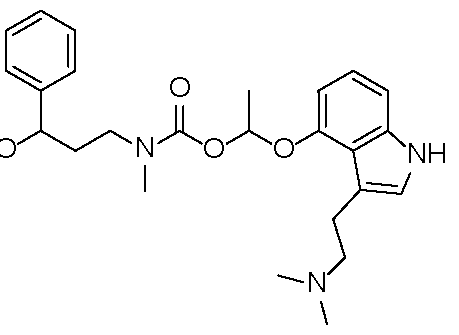
- this invention pertains to a compound having one of formulas 1-6 or pharmaceutically acceptable salts, hydrates, or solvates thereof, wherein: spacer — PS
- DR is an additive or synergistic drug
- PS is psilocybin, a psilocin derivative, or another related phosphorylated mushroom alkaloid
- each X is, independently, a linear, cyclic or branched alkyl carbon chain, with or without heteroatom(s), phosphate, phosphonate, substituted phosphate or phosphonate, oxygen, sulfur with any oxidation status, NH, or substituted nitrogen.
- PS is any psilocybin psilocin derivative or metabolite or another related phosphorylated mushroom alkaloid, including natural, synthetic or semisynthetic derivatives, preferably psilocybin and psilocin, or other analogues baeocystin, norbaeocystin, bufotenine, and aeruginascin.
- the natural phosphorylated mushroom alkaloids are: psilocybin baeocystin norbaeocystin [0010]
- the synthetic or semisynthetic phosphorylated related mushrooms alkaloids are:
- DR is an additive or synergistic drug or its metabolite selected from pregabalin, gabapentin, topiramate, morphine, levodopa, selective serotonin reuptake inhibitor (SSRI) (e.g., citalopram), amisulpride, lurasidone, paliperidone, paliperidone palmitate, tapentadol, pentazocine, carbidopa, nalbuphine, risperidone, ziprasidone, perospirone, doxorubicin, melperone, aripiprazole, brexpiprazole, cariprazine, olanzapine, quetiapine, fluoxetine, calcitonin, pseudoephedrine, piracetam, levetiracetam, sitagliptin, silodosin, hydrochlorothiazide, ezetimibe, propranol
- SSRI selective se
- DR is one or more cannabinoids selected from the group consisting of: delta-9-tetrahydrocannabinol (THC), delta-8-tetrahydrocannabinol (THC), cannabidiol (CBD), cannabinol (CBN), cannabinolic acid (CBNA), cannabigerol (CBG), cannabigerol (CBG), cannabigerovarin (CBGV), cannabichromene (CBC), cannabicyclol (CBL), canabivarol (CBV), tetrahydrocannabivarin (THCV), cannabidivarin (CBDV), cannabichromevarin (CBCV), cannabigerol monoethyl ether (CBGM), cannabigerolic acid monoethyl ether (CBGAM), cannabidiolic acid (CBDA), cannabigerovarinic (CBGV A), cann
- X is, independently, a linear, cyclic or branched alkyl carbon chain, with or without heteroatom(s), phosphate, phosphonate, substituted phosphate or phosphonate, oxygen, sulfur with any oxidation status, NH, or substituted nitrogen.
- the X moieties may be identical or not.
- the spacer is a linear, branched, or cyclic alkane, alkene or alkyne, amino acid, acetal, ketal, peptide, aryl, heteroaryl, or heterocycloalkyl group, each of which is optionally substituted.
- the compounds described herein may be used alone or in combination with other compounds that may be therapeutically effective by the same or different modes of action.
- the compounds described herein may be used in combination with other compounds that are administered to treat other symptoms of psychiatric disorders, such as compounds administered to relieve pain, nausea, vomiting, and the like.
- the psilocybin or psilocin conjugates or any of their derivatives or metabolites, according to the present invention, are two molecules connected directly through spacer(s) by covalent bond(s).
- this invention pertains to compounds having formula 1, or pharmaceutically acceptable salts, hydrates, or solvates thereof, wherein:
- DR is an additive or synergistic drug
- PS is psilocybin, a psilocin derivative or another related phosphorylated mushroom alkaloid.
- this invention pertains to psilocin conjugates with formula la-i, or pharmaceutically acceptable salts, hydrates, or solvates thereof, wherein:
- DR is an additive or synergistic drug
- PS is psilocybin, a psilocin derivative or another related phosphorylated mushroom alkaloid.
- this invention pertains to psilocin conjugates with formula
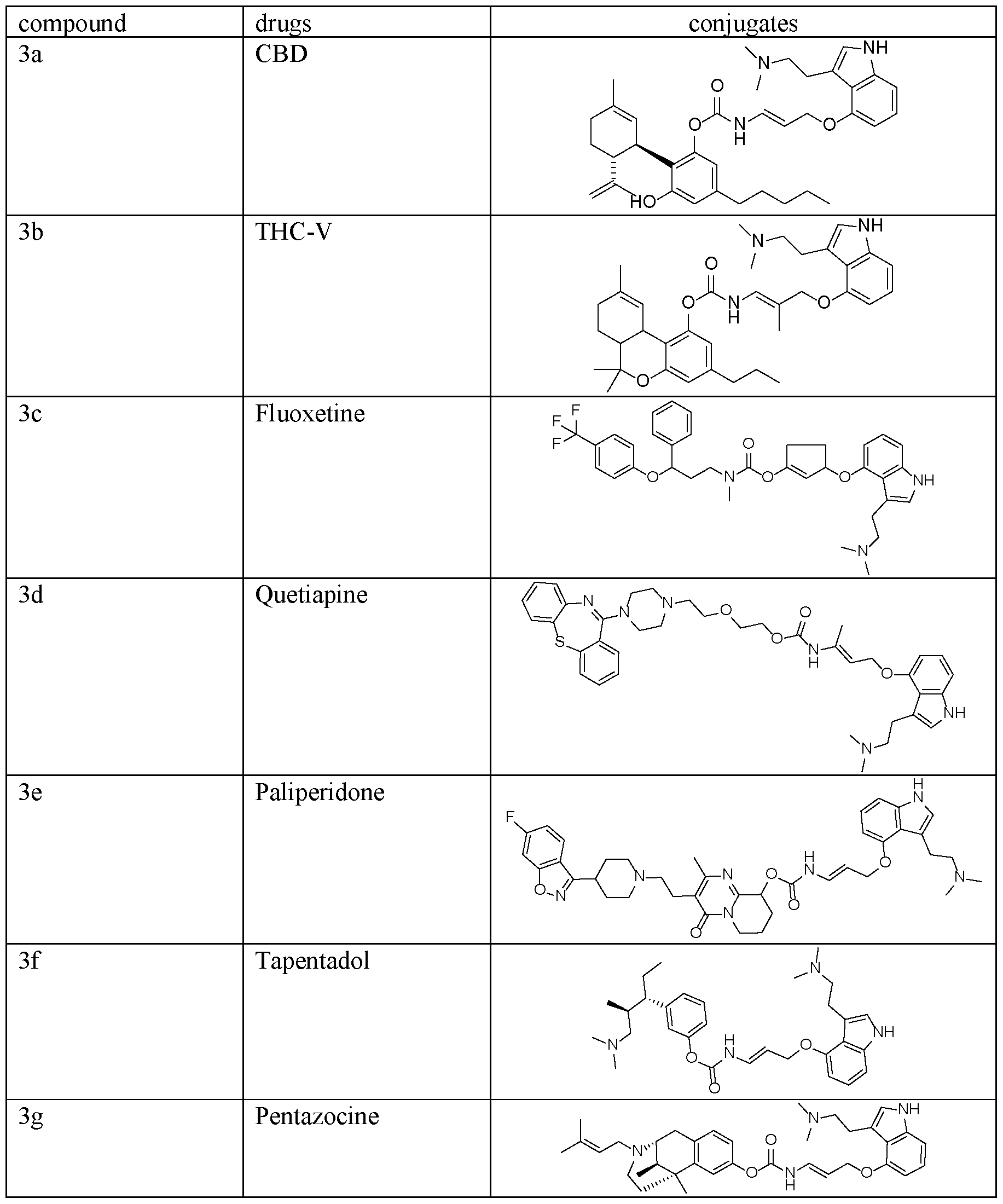
- this invention pertains to compounds having formula 3a-g, or pharmaceutically acceptable salts, hydrates, or solvates thereof, wherein:
- DR is an additive or synergistic drug
- PS is psilocybin, a psilocin derivative or another phosphorylated mushroom alkaloid.
- this invention pertains to psilocin conjugates with formula
- this invention pertains to compounds having formula 4, or pharmaceutically acceptable salts, hydrates, or solvates thereof, wherein:
- DR is an additive or synergistic drug
- PS is psilocybin, a psilocin derivative or another phosphorylated mushroom alkaloid.
- this invention pertains to psilocin conjugates with formula 4a-i, or pharmaceutically acceptable salts, hydrates, or solvates thereof, wherein: [0029] Psilocin conjugates with formula 4a-i are expected to be released after administration as illustrated in the following scheme 4:
- this invention pertains to compounds having formula 5, in which the spacer is a therapeutic agent by itself, or pharmaceutically acceptable salts, hydrates, or solvates thereof, wherein:
- DR is an additive or synergistic drug
- PS is psilocybin, a psilocin derivative or another phosphorylated mushroom alkaloid.
- this invention pertains to psilocin conjugates with formula
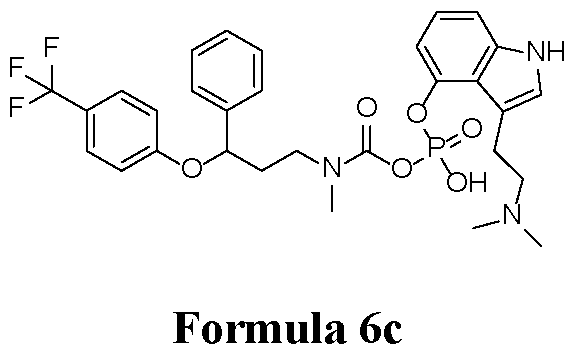
- this invention pertains to compounds having formula 6, or pharmaceutically acceptable salts, hydrates, or solvates thereof, wherein:
- DR is an additive or synergistic drug and PS is psilocybin, another psilocin derivative or another phosphorylated mushroom alkaloid.
- this invention pertains to phosphorylated psilocin, or any other natural, synthetic, or semisynthetic derivatives, conjugates, in which the phosphate or its analogues or derivatives is (or are) part of the spacer or an “X” moiety with formula 6a-i, or both, or pharmaceutically acceptable salts, hydrates, or solvates thereof, wherein:
- the addition of one or more halogen, in particular fluorine atom(s) on the carbon backbone of the spacer may be used to modulate the enzymatic and chemical stabilities, or to control sequence of hydrolysis as shown in specific examples of formula 7 :
- alkyl group(s), in particular methyl on the carbon backbone of the spacer may be used to modulate the enzymatic and chemical stabilities, to control the sequence of hydrolysis, or to reduce the toxicity as shown in specific examples of formula 8:
- PS is any psilocybin, psilocin derivative or another related phosphorylated mushroom alkaloid or metabolite, including, natural, synthetic or semisynthetic derivatives.
- PS is psilocybin, psilocin, or other analogues such as baeocystin, norbaeocystin, bufotenine, and aeruginascin.
- Preferable examples of natural phosphorylated mushroom alkaloids are: psilocybin baeocystin norbaeocystin
- DR is an additive or synergistic drug or its metabolite selected from pregababn, gabapentin, topiramate, morphine, levodopa, selective serotonin reuptake inhibitor (SSRI) (e.g., citalopram), amisulpride, lurasidone, pabperidone, paliperidone palmitate, risperidone, ziprasidone, perospirone, doxorubicin, melperone, aripiprazole, brexpiprazole, cariprazine, olanzapine, quetiapine, flouxetine, calcitonin, pseudoephedrine, piracetam, levetiracetam, sitagbptin, silodosin, hydrochlorothiazide, ezetimi
- SSRI selective serotonin reuptake inhibitor
- DR is one or more cannabinoid derivatives or metabolites, including, synthetic, or semisynthetic derivatives.
- the one or more cannabinoids are taken from the group: delta-9-tetrahydrocannabinol (THC), delta-8-tetrahydrocannabinol (THC), cannabidiol (CBD), cannabinol (CBN), cannabinolic acid (CBNA), cannabigerol (CBG), cannabigerol (CBG), cannabigerovarin (CBGV), cannabichromene (CBC), cannabicyclol (CBL), canabivarol (CBV), tetrahydrocannabivarin (THCV), cannabidivarin (CBDV), cannabichromevarin (CBCV), cannabigerol monoethyl ether (CBGM), cannabigerolic acid monoethyl ether (C
- X is linear, cyclic, or branched hydrocarbon chain, with or without heteroatom(s), oxygen, sulfur, with any oxidation status, NH or substituted nitrogen.
- X is a phosphate, phosphonate, or a substituted phosphate or phosphonate.
- Spacer is a linear, branched or cyclic alkane, alkene or alkyne, optionally halo substituted, amino acid, acetal, ketal, peptide, aryl, heteroaryl, or heterocycloalkyl each of which is optionally substituted.
- any of Spacer , Spacer -X, or X-Spacer-X may be a hydroly sable peptide or protein.
- each cannabinoid component can be the same or different, and, when spacers are used, each spacer can be the same or different.
- the compounds described herein may be used alone or in combination with other psychiatric therapeutic(s) that may be therapeutically effective by the same or different modes of action.
- the compounds described herein may be used in combination with other therapeutics that are administered to treat other symptoms of psychiatric diseases, such as compounds administered to relieve pain, allergy, swelling nausea/vomiting, and the like.
- the term “about” can allow for a degree of variability in a value or range, for example, within 1%, within 5%, or within 10% of a stated value or of a stated limit of a range.
- the term “substantially” can allow for a degree of variability in a value or range, for example, within 90%, within 95%, 99 %, 99.5%, 99.9%, 99.99%, or at least about 99.999% or more of a stated value or of a stated limit of a range.
- alkyl refers to a saturated monovalent chain of carbon atoms, which may be optionally branched. It is understood that in embodiments that include alkyl, illustrative variations of those embodiments include lower alkyl, such as Ci to C9 alkyl, methyl, ethyl, propyl, 3-methylbutyl, and the like.
- cyclic alkane refers to a monovalent chain of carbon atoms, a portion of which forms a ring.
- cyclic alkane refers to an unsaturated monovalent chain of carbon atoms, a portion of which forms a ring.
- cyclic alkene moiety illustrative variations of those embodiments include a lower cyclic alkene moiety, such as C3 - CV, cycloalkenyl, cyclopentenyl, cyclohexenyl, and the like.
- aryl used alone or as part of a phrase such as “aralkyl” or “alkylaryl” refer to monocyclic, bicyclic or fused ring systems, with at least one aromatic ring, having 5- to 12 ring members, wherein at least one ring in the system is aromatic and wherein each ring in the system contains 3 to 7 ring members.
- aryl may be used interchangeably with the term “aryl ring”. Examples of aryl rings include phenyl, biphenyl, naphthyl, anthracyl and the like, which may bear one or more substituents.
- heteroaryl refers 4-, 5-, 6-, or 7-membered ring having 1 to
- hetero-atom selected from O, N, and S, or 8-, 9-, or 10-memebered ring having 1 to 6 heteroatoms selected from O, N, and S, or a salt thereof.
- heteroaryl groups include, pyridine, pyrimidine, pyridazine, quinazoline, quinoline, indole, pyrole, pyrazole, imidazole, furan, benzofuran, thiophene, and benzothiophene.
- hetero-atom refers to non-carbon and non-hydrogen atoms such as N, O, S, Se, P, and the like, preferably N, O or S atoms.
- the term “sulfer oxidation status” refers to sulfide, sulfone, sulfoxide, and sulfonamide.
- heterocycloalkyl by itself or in combination with another term, refers to a saturated monovalent ring of carbon atoms, consisting of the stated number of carbon atoms, where one or more carbon atom(s), such as 1, 2, 3 or 4 carbon atom(s), and the associated hydrogen atom(s) have been independently replaced with the same or different heteroatoms, for example, nitrogen, oxygen or sulfur.
- the carbon atom(s) being replace may be at any position of the ring.
- heterocycloalkyl groups include tetrahydro-2H-pyran, tetrahydro-2H- thiopyran, -NH-alkyl, -alkylene-O-alkyl, and the like.
- each of alkyl, cycloalkane, alkene, and cycloalkene moieties may be optionally substituted with independently selected groups such as halide, alkyl, alkoxy, hydroxy, hydroxyalkyl, carboxylic acid and derivatives thereof, including esters, nitrile, amides, and nitrites, acyloxy, aminoalkyl and dialkylamino, acylamino, thio, and the like, and combinations thereof.
- halide refers to fluoride, chloride, bromide, or iodide.
- the term “patient” includes human and non-human animals such as companion animals such as dogs and cats and the like, and livestock animals. Livestock animals are animals raised for food production.
- the patient to be treated is preferably a mammal, in particular a human being.
- compositions or vehicles such as a liquid or solid filler, solvent or encapsulating material, involved in carrying or transporting any subj ect composition or component thereof.
- carrier must be “acceptable” in the sense of being compatible with the subject composition and its components and not injurious to the patient.
- materials which may serve as pharmaceutically acceptable carriers include : (1) sugars, such as lactose and maltose; (2) starches, such as com starch and gelatinized starch; (3) cellulose, and its derivatives, such as carboxymethyl cellulose salt, and hydroxypropylmethyl cellulose; (4) thickening agents such as gelatin and tragacanth ; (5) disintegrants such as copovidone; (6 ) other excipients, such as cocoa butter and suppository waxes and pyrogen - free water for sterile products; and (7) other non-toxic compatible substances employed in pharmaceutical formulations.
- subject in the present disclosure refers to human patients but is not limited to humans and may include animals.
- administering includes all means of introducing the compounds and compositions described herein to the patient, including, but are not limited to, topical, oral, intravenous, intramuscular, transdermal, inhalation, buccal, ocular, vaginal, rectal, and the like.
- the compounds and compositions described herein may be administered in unit dosage forms or formulations containing conventional nontoxic pharmaceutically acceptable carriers, adjuvants, and vehicles.
- this invention pertains to a pharmaceutical composition
- a pharmaceutical composition comprising a compound disclosed herein, or a pharmaceutically acceptable salt thereof, together with one or more pharmaceutically acceptable diluents, and excipients.
- this invention pertains to a pharmaceutical composition
- a pharmaceutical composition comprising a compound disclosed herein, in combination with one or more other therapeutically active compounds by the same or different mode of action, and one or more pharmaceutically acceptable diluents, and excipients.
- psilocybin and psilocin exerts its pharmacological effect via modulation of serotonin and dopaminergic receptors including 5HT 2 B, 5HTID, 5HTIE, 5HTI A , 5HT5A, 5HT7, 5HT6, 5HT2C, 5HTIB, 5HT2A, Dl, D3; while the DR moiety are modulators of cannabinoid receptor CB1, CB2 and other receptors.
- modulators pertain to allosteric modulators, agonist, biased agonist, antagonist, biased antagonist or partial agonist of any opiate receptor(s), blocking the reuptake of serotonin, modulating the level of neurotransmitters in CNS or peripheral tissues, modulating the level of cellular secondary messengers or modulating the phosphorylated level of cellular enzymes or proteins.
- this invention pertains to a method for treating a patient of psychological disorder(s), the method comprising the step of administering a therapeutically effective amount of a compound disclosed herein, together with one or more pharmaceutically acceptable diluents, and excipients, to the patient in need of relief from said psychological disorder(s).
- the t-Bu-protected dicarboxylic acid (lequiv.) is activated using 1,1'- carbonyldiimidazole (CDI) (1 equiv.), and then the psilocin is added.
- CDI 1,1'- carbonyldiimidazole
- the reaction mixture is stirred at 80° C for 12 hours. Progress of reaction may be monitored by TLC. After complete conversion, the reaction is quenched with distilled water (50 mL), organic material is extracted with ethyl acetate (50 mL x 3), collected, dried over anhydrous MgSCft, and concentrated under reduced pressure.
- the crude intermediate is dissolved in degassed absolute ethanol (20 mL), charged with Pd/C (10%, 20 mg), hydrogen gas is applied, and the reaction is stirred at room temperature for 8 hours. After completion of the reaction, as may be monitored by TLC, the reaction mixture is filtered through Celite 545, and the solvent is removed under vacuum. The free acid is then purified by partitioning between aqueous solution of sodium carbonate (1M, 50 mL), and DCM (25 mL). The aqueous layer is separated and acidified with ammonium hydrochloride to neutral pH. The precipitate is collected, washed thoroughly with distilled water and dried.
- the I,G-carbonyldiimidazole (CDI) can be replaced by other coupling reagents including: phosgene, trichloroacetyl chloride, 1 , l'-carbonylbis(2- methylimidazole), /V/V'-disuccinimidyl carbonate, 4-nitrophenylchloroformate, and bis(4- nitrophenyl)carbonate, bis(pentafluorophenyl)carbonate.
- synthesis of a carbamate moiety can be achieved by selecting reagents, including: phosgene, trichloroacetyl chloride, 1,1'- carbonyldiimidazole (CDI), l,r-carbonylbis(2-methylimidazole), /V,/V'-disuccinimidyl carbonate, 4-nitrophenylchloroformate, bis(4-nitrophenyl)carbonate, bis(pentafluorophenyl)carbonate, and then, optionally, treated with the second partner.
- reagents including: phosgene, trichloroacetyl chloride, 1,1'- carbonyldiimidazole (CDI), l,r-carbonylbis(2-methylimidazole), /V,/V'-disuccinimidyl carbonate, 4-nitrophenylchloroformate, bis(4-nitrophenyl)carbonate, bis(pentafluorophen
Landscapes
- Chemical & Material Sciences (AREA)
- Health & Medical Sciences (AREA)
- Organic Chemistry (AREA)
- Life Sciences & Earth Sciences (AREA)
- General Health & Medical Sciences (AREA)
- Engineering & Computer Science (AREA)
- Bioinformatics & Cheminformatics (AREA)
- Pharmacology & Pharmacy (AREA)
- Medicinal Chemistry (AREA)
- Animal Behavior & Ethology (AREA)
- Public Health (AREA)
- Veterinary Medicine (AREA)
- Epidemiology (AREA)
- Molecular Biology (AREA)
- General Chemical & Material Sciences (AREA)
- Neurology (AREA)
- Neurosurgery (AREA)
- Chemical Kinetics & Catalysis (AREA)
- Biomedical Technology (AREA)
- Nuclear Medicine, Radiotherapy & Molecular Imaging (AREA)
- Biochemistry (AREA)
- Psychiatry (AREA)
- Biophysics (AREA)
- Pain & Pain Management (AREA)
- Pharmaceuticals Containing Other Organic And Inorganic Compounds (AREA)
- Acyclic And Carbocyclic Compounds In Medicinal Compositions (AREA)
Abstract
Description




Claims






Priority Applications (3)
| Application Number | Priority Date | Filing Date | Title |
|---|---|---|---|
| EP22806152.9A EP4337666A4 (en) | 2021-05-10 | 2022-05-10 | PSILOCYBIN AND PSILOCIN CONJUGATES FOR THE TREATMENT OF MENTAL ILLNESS |
| US18/560,206 US20240261419A1 (en) | 2021-05-10 | 2022-05-10 | Psilocybin and psilocin conjugates for treatment of mental illnesses |
| CA3218596A CA3218596A1 (en) | 2021-05-10 | 2022-05-10 | Psilocybin and psilocin conjugates for treatment of mental illnesses |
Applications Claiming Priority (2)
| Application Number | Priority Date | Filing Date | Title |
|---|---|---|---|
| US202163186497P | 2021-05-10 | 2021-05-10 | |
| US63/186,497 | 2021-05-10 |
Publications (1)
| Publication Number | Publication Date |
|---|---|
| WO2022236407A1 true WO2022236407A1 (en) | 2022-11-17 |
Family
ID=84027798
Family Applications (1)
| Application Number | Title | Priority Date | Filing Date |
|---|---|---|---|
| PCT/CA2022/050733 Ceased WO2022236407A1 (en) | 2021-05-10 | 2022-05-10 | Psilocybin and psilocin conjugates for treatment of mental illnesses |
Country Status (4)
| Country | Link |
|---|---|
| US (1) | US20240261419A1 (en) |
| EP (1) | EP4337666A4 (en) |
| CA (1) | CA3218596A1 (en) |
| WO (1) | WO2022236407A1 (en) |
Cited By (7)
| Publication number | Priority date | Publication date | Assignee | Title |
|---|---|---|---|---|
| WO2023009817A3 (en) * | 2021-07-29 | 2023-06-29 | Emory University | Phosphate prodrugs of cannabinoids |
| WO2023173227A1 (en) * | 2022-03-18 | 2023-09-21 | Enveric Biosciences Canada Inc. | C4-substituted tryptamine derivatives and methods of using |
| WO2024055106A1 (en) * | 2022-09-12 | 2024-03-21 | Bionxt Solutions Inc. | Amino acid and carbohydrate psilocin derivatives |
| WO2024156732A1 (en) * | 2023-01-24 | 2024-08-02 | Compass Pathfinder Limited | 3-(2-(dimethylamino)ethyl)-1h-indol-4-yl derivatives |
| US12060328B2 (en) | 2022-03-04 | 2024-08-13 | Reset Pharmaceuticals, Inc. | Co-crystals or salts of psilocybin and methods of treatment therewith |
| US12065404B2 (en) | 2022-03-18 | 2024-08-20 | Enveric Biosciences Canada Inc. | C4-carboxylic acid-substituted tryptamine derivatives and methods of using |
| EP4493541A4 (en) * | 2022-03-18 | 2026-02-25 | Enveric Biosciences Canada Inc | C4-Carbohydrate-Substituted Triptamine Derivatives and Methods for Their Use |
Citations (1)
| Publication number | Priority date | Publication date | Assignee | Title |
|---|---|---|---|---|
| WO2018135943A1 (en) * | 2017-01-18 | 2018-07-26 | Procare Beheer B.V. | Psilocybin and/or psilocin in combination with cannabinoids and/or terpenes |
Family Cites Families (4)
| Publication number | Priority date | Publication date | Assignee | Title |
|---|---|---|---|---|
| US3075992A (en) * | 1958-09-12 | 1963-01-29 | Sandoz Ltd | Esters of indoles |
| CH373381A (en) * | 1959-07-13 | 1963-11-30 | Sandoz Ag | Process for the preparation of new basic indole derivatives |
| JPS50129575A (en) * | 1974-03-29 | 1975-10-13 | ||
| GB2571696B (en) * | 2017-10-09 | 2020-05-27 | Compass Pathways Ltd | Large scale method for the preparation of Psilocybin and formulations of Psilocybin so produced |
-
2022
- 2022-05-10 WO PCT/CA2022/050733 patent/WO2022236407A1/en not_active Ceased
- 2022-05-10 US US18/560,206 patent/US20240261419A1/en active Pending
- 2022-05-10 CA CA3218596A patent/CA3218596A1/en active Pending
- 2022-05-10 EP EP22806152.9A patent/EP4337666A4/en active Pending
Patent Citations (1)
| Publication number | Priority date | Publication date | Assignee | Title |
|---|---|---|---|---|
| WO2018135943A1 (en) * | 2017-01-18 | 2018-07-26 | Procare Beheer B.V. | Psilocybin and/or psilocin in combination with cannabinoids and/or terpenes |
Cited By (9)
| Publication number | Priority date | Publication date | Assignee | Title |
|---|---|---|---|---|
| WO2023009817A3 (en) * | 2021-07-29 | 2023-06-29 | Emory University | Phosphate prodrugs of cannabinoids |
| US12060328B2 (en) | 2022-03-04 | 2024-08-13 | Reset Pharmaceuticals, Inc. | Co-crystals or salts of psilocybin and methods of treatment therewith |
| US12559458B2 (en) | 2022-03-04 | 2026-02-24 | Reset Pharmaceuticals, Inc. | Co-crystals or salts of psilocin and methods of treatment therewith |
| WO2023173227A1 (en) * | 2022-03-18 | 2023-09-21 | Enveric Biosciences Canada Inc. | C4-substituted tryptamine derivatives and methods of using |
| US12065404B2 (en) | 2022-03-18 | 2024-08-20 | Enveric Biosciences Canada Inc. | C4-carboxylic acid-substituted tryptamine derivatives and methods of using |
| US12077498B2 (en) | 2022-03-18 | 2024-09-03 | Enveric Biosciences Canada Inc. | C4-carboxylic acid-substituted tryptamine derivatives and methods of using |
| EP4493541A4 (en) * | 2022-03-18 | 2026-02-25 | Enveric Biosciences Canada Inc | C4-Carbohydrate-Substituted Triptamine Derivatives and Methods for Their Use |
| WO2024055106A1 (en) * | 2022-09-12 | 2024-03-21 | Bionxt Solutions Inc. | Amino acid and carbohydrate psilocin derivatives |
| WO2024156732A1 (en) * | 2023-01-24 | 2024-08-02 | Compass Pathfinder Limited | 3-(2-(dimethylamino)ethyl)-1h-indol-4-yl derivatives |
Also Published As
| Publication number | Publication date |
|---|---|
| CA3218596A1 (en) | 2022-11-17 |
| US20240261419A1 (en) | 2024-08-08 |
| EP4337666A1 (en) | 2024-03-20 |
| EP4337666A4 (en) | 2025-03-26 |
Similar Documents
| Publication | Publication Date | Title |
|---|---|---|
| WO2022236407A1 (en) | Psilocybin and psilocin conjugates for treatment of mental illnesses | |
| CA2660814C (en) | Positively charged water-soluble prodrugs of aryl- and heteroarylpropionic acids with very fast skin penetration rate | |
| RU2190401C2 (en) | Method for treating inflammatory intestinal diseases | |
| US9096494B2 (en) | Arachidonic acid analogs and methods for analgesic treatment using same | |
| KR20230155491A (en) | Synergistic cannabinoid esters, salts thereof and uses thereof | |
| US20090275585A1 (en) | Novel Compounds and Therapeutic Use Thereof for Protein Kinase Inhibition | |
| JP2014532730A (en) | Opioid receptor modulators and methods of use thereof | |
| CN111662294A (en) | Compound with activity of degrading Btk | |
| WO2008012603A1 (en) | Positively charged water-soluble prodrugs of diflunisal and related compounds with very fast skin penetration rate | |
| WO2006083869A2 (en) | Tumor necrosis factor inhibitors | |
| CN107021961A (en) | One class has the noval chemical compound, its preparation method and its medicinal application of Study On The Radioprotective | |
| EP3059232A1 (en) | Chromene derivatives substituted by alkoxide as inhibitors of the tcr-nck interaction | |
| AU2013206218B2 (en) | Positively charged water-soluble prodrugs of aryl- and heteroarylpropionic acids with very fast skin penetration rate | |
| NL8800412A (en) | PIPERAZINE CARBONIC ACID DERIVATIVE, PREPARATION AND PHARMACEUTICAL PREPARATIONS CONTAINING IT. | |
| US11008360B2 (en) | Indoleacetic acid derivative and preparation method and pharmaceutical use thereof | |
| WO2023082003A1 (en) | New cannabinoid-gabapentinoid conjugates and uses thereof | |
| WO2005037759A1 (en) | Novel phenol derivative and antitrypanosoma preventive/therapeutic agent containing the same as active ingredient | |
| WO2009073138A2 (en) | Treatment of metabolic syndrome with novel amides | |
| CN108069833B (en) | Benzocyclo-ring derivatives, preparation method and medical application thereof | |
| CN119751232B (en) | Flavonoid derivatives, preparation methods, pharmaceutical compositions and applications thereof | |
| WO2014186325A1 (en) | Processes and intermediates for preparing indole pharmaceuticals | |
| TW200307548A (en) | Histamine-3 receptor ligands for diabetic conditions | |
| US20240308945A1 (en) | Synthetic Cannabinoid Compounds, Pharmaceutical Compositions, and Methods of Treating Anxiety and Other Disorders | |
| CN101072784B (en) | [2-(8,9-dioxo-2,6-diazabicyclo[5.2.0]non-1(7)-en-2-yl)alkyl]phosphonic acid derivative and its preparation method | |
| CN107200725B (en) | Fused heterocyclic derivative, preparation method and medical application thereof |
Legal Events
| Date | Code | Title | Description |
|---|---|---|---|
| 121 | Ep: the epo has been informed by wipo that ep was designated in this application |
Ref document number: 22806152 Country of ref document: EP Kind code of ref document: A1 |
|
| WWE | Wipo information: entry into national phase |
Ref document number: 3218596 Country of ref document: CA |
|
| WWE | Wipo information: entry into national phase |
Ref document number: 18560206 Country of ref document: US |
|
| WWE | Wipo information: entry into national phase |
Ref document number: 2022806152 Country of ref document: EP |
|
| NENP | Non-entry into the national phase |
Ref country code: DE |
|
| ENP | Entry into the national phase |
Ref document number: 2022806152 Country of ref document: EP Effective date: 20231211 |